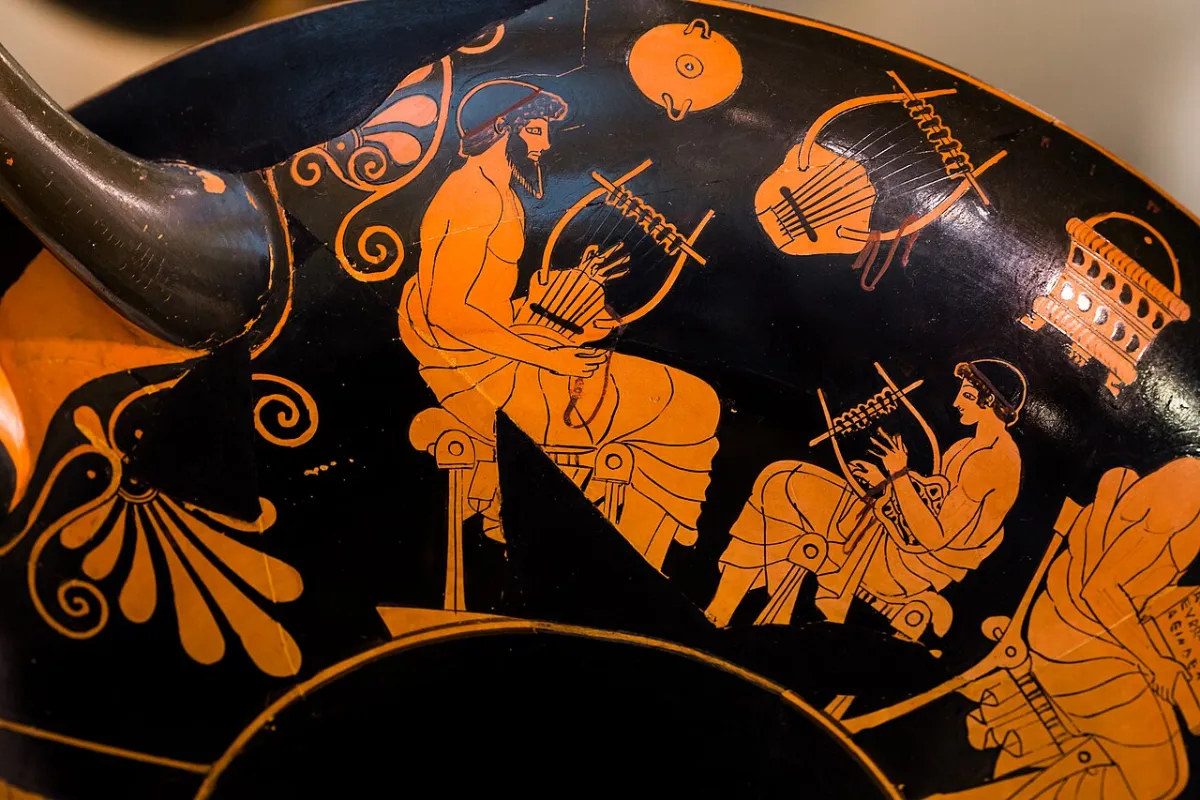
First steps
Greek letters, vowel length and consonants, and how their sounds form syllables.
1. First steps · 1 of 5
First steps: letters and sounds
This is the first step into the sounds of Greek, for complete beginners. It has five tabs: the letters, the vowels, the diphthongs and digraphs, the consonants, and how sounds make syllables. When you have them, Metre › First steps shows what Greek verse does with them. This page leaves a great deal out on purpose, and the rest of the Phonology section fills it in when you are ready.
Start by listening to a word. Then separate what you hear from what you see written on the page. The alphabet table is a reference to return to; you do not need to memorise it before listening.
Greek is written with an alphabet, just as English is. An alphabet is a set of letters in which each letter stands for a sound of the language. The sounds given here are those of classical Attic. That is the Greek spoken at Athens in the fifth and fourth centuries BC, as scholars have reconstructed it, and it is the usual model for reading all the classical poets aloud.[1]
Come back to this page whenever a later step mentions a sound and you need to refresh your memory.
The alphabet
Greek has twenty-four letters. Seven of them are vowels: α, ε, η, ι, ο, υ and ω.[2] The other seventeen are consonants.
The table gives the twenty-four letters, each with its name and the sound it had in classical Attic. Press a sound to hear it. Beside each letter is a word that contains it, with its transliteration, its sound in the IPA and its meaning. Every one of these words is cut from David Chamberlain’s reading of Homer. Press ▶ to hear the word. The small letters are the ones you will read. The capitals begin names and, in some editions, sentences.
Three letters, φ, θ and χ, have two readings used on this site. In the classical reconstruction they are [pʰ tʰ kʰ]: close the lips or tongue as for [p t k], then release with a puff of breath. In later readings they are [f θ x]: let the breath pass continuously through a narrow gap. The switch above the lesson changes both the sounds and the example words in the table.[3] The Consonants tab explains these sounds in detail. Human recordings use the classical reading; computer-made alternatives are labelled synthetic and marked ∿.
| Letter | Name | Sound (press to hear) | Kind | In a word (press ▶ to hear it read) |
|---|---|---|---|---|
| Α α | alpha | short long | vowel | ἄναξ anax [ánaks] “lord” |
| Β β | beta | consonant | βοῦς bous [bûːs] “ox, cow” | |
| Γ γ | gamma | before γ κ χ ξ | consonant | γέρας geras [ɡéras] “prize of honour” κλαγγὴ klaggē [klaŋɡɛ̀ː] “clang (γγ = [ŋɡ])” |
| Δ δ | delta | consonant | δῖος dīos [dîːos] “godlike” | |
| Ε ε | epsilon | vowel, always short | Ἕκτωρ Hektōr [héktɔːr] “Hector” | |
| Ζ ζ | zeta | two consonants | Ζεύς Zeus [zdeús] “Zeus” | |
| Η η | eta | vowel, always long | ἥρως hērōs [hɛ́ːrɔːs] “hero” | |
| Θ θ | theta | consonant | θεά thea [tʰeáː][θeáː] “goddess” | |
| Ι ι | iota | short long | vowel | ἵππους hippous [híppuːs] “horses” |
| Κ κ | kappa | consonant | κλέος kleos [kléos] “fame” | |
| Λ λ | lambda | consonant | λαός laos [laːós] “people, host” | |
| Μ μ | mu | consonant | μῆνιν mēnin [mɛ̂ːnin] “wrath” | |
| Ν ν | nu | consonant | νόστον noston [nóston] “homecoming” | |
| Ξ ξ | xi | two consonants | ξίφος xiphos [ksípʰos][ksífos] “sword” | |
| Ο ο | omicron | vowel, always short | ὁδὸν hodon [hodòn] “road” | |
| Π π | pi | consonant | πατρός patros [patrós] “of a father” | |
| Ρ ρ | rho | ῥ, at the start of a word | consonant | ῥάκος rhakos [r̥ákos] “piece of cloth” |
| Σ σ ς | sigma | before β γ δ μ | consonant | σκῆπτρον skēptron [skɛ̂ːptron] “staff, sceptre” |
| Τ τ | tau | consonant | τέκε teke [téke] “bore (a child)” | |
| Υ υ | upsilon | short long | vowel | ὕδωρ hydōr [hýdɔːr] “water” |
| Φ φ | phi | consonant | φίλος philos [pʰílos][fílos] “dear” | |
| Χ χ | chi | consonant | χόλον cholon [kʰólon][xólon] “anger” | |
| Ψ ψ | psi | two consonants | ψυχὰς psychas [psyːkʰàːs][psyːxàːs] “souls” | |
| Ω ω | omega | vowel, always long | ὠκὺς ōkys [ɔːkỳs] “swift” |
The letter σ is written ς at the end of a word, as in Διός. The sounds are taken from the reconstruction of classical Attic.[4]
Watch out for the letters that look like English ones. Several Greek letters look like English letters but stand for other sounds. η is the vowel [ɛː], not [n]. ρ is [r], not [p]. ν is [n], not [v]. χ is [kʰ], not [x]. And υ is [y], made with rounded lips, not [u].
Marks over the letters. Many words carry small marks over a vowel. The breathings, ῾ and ᾿, show whether a word begins with the sound [h]. The Consonants tab explains them. The three accents, acute ´, grave ` and circumflex ˆ, mark the pitch of the voice, not the sounds of the letters. They have a page of their own, Accent and morae.
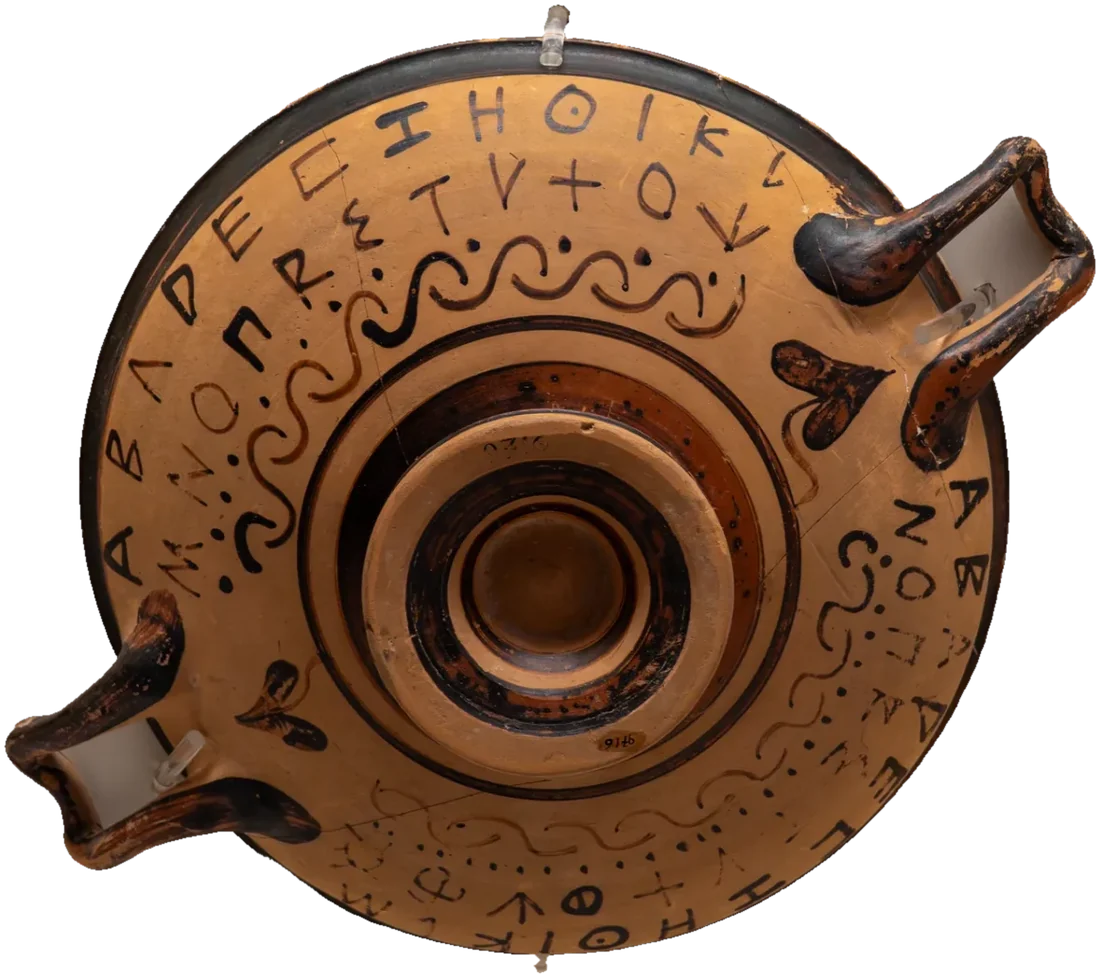
How to read the examples
Each example gives the Greek word first. Under it comes the same word in our alphabet, in italics. This is called a transliteration. Then comes its sound in the International Phonetic Alphabet, the IPA. The IPA gives one sign to each sound. By convention a sound written in the IPA stands in square brackets, so [p] is the sound and π is the letter that writes it.[5] Last comes the meaning. Here is the first word of Homer’s Iliad:
Press hear to listen. Most recordings on this page are real readings of Homer by David Chamberlain, cut out word by word. A few sample words on this website are not available in any reading we can use, so those sounds have been made by computer, marked ∿ and labelled synthetic. The IPA chart tab shows every sign of the IPA, with a recording of each.
Vowels and consonants
A vowel is a sound made with the mouth open enough for the breath to flow freely while the voice sounds. A consonant closes or narrows the passage somewhere, stopping or squeezing the breath.[6] In μῆνιν, “wrath”, η and ι write the vowels, and μ, ν and ν write the consonants. Listen to the word again, then follow its sounds below:
The tables also distinguish long and short vowels: a long vowel is held for longer than a short one.[7] The Vowels tab compares them with recordings.
A letter is not a sound
A letter and a sound are not the same thing. A letter is a written sign. A sound is something the voice does. In English the two often part company. The letters th in thin [θɪn] write one sound, [θ]. The single letter x in box [bɒks] writes two, [ks].[8]
Greek spelling, as fixed at Athens, comes much closer than English to one letter for each sound. Athens officially adopted the Ionic form of the alphabet in 403–402 BC, and that is the alphabet printed in our texts.[9] It still has a few mismatches. Three letters, ζ, ξ and ψ, each stand for two sounds. Two pairs of letters, ει and ου, each stand for a single sound. And the letters α, ι and υ do not show whether the vowel is long or short.[10] The next tabs come back to each of these. Two words of Homer show the first two: the one letter ψ of ψυχάς writes two sounds, [ps], and the two letters ου of βουλή write one vowel, [uː].
Words and syllables
A syllable is one beat of speech, built round a vowel sound and the consonants that go with it.[11] You can hear the beats in μῆνιν: μῆ–νιν, two syllables. The words below have two, three and four:
wrath · sing! · of Achilles
The two letters ει in ἄειδε write one vowel sound, so they fill one syllable. In other spellings two vowel sounds glide together within a syllable. The Diphthongs and digraphs tab explains those pairs.
Notes
1. First steps · 2 of 5
First steps: the vowels, long and short
The first tab introduces vowels and consonants. Here we compare the vowels. They differ in two ways. The first is how high the tongue is and how far forward. The second is whether the lips are rounded.[1] Press [i] and then [u] in the alphabet table on the first tab to hear the two extremes. The Mouth and vowels tab draws this space as a chart.
Vowels, long and short
Every Greek vowel is either long or short. A long vowel is held for longer than a short one.[2] The examples below let you hear the difference. Length here describes the vowel sound itself. The final tab, From sounds to syllables, explains how that length contributes to the rhythm of verse.
Each rule below comes with examples. Press hear to compare them.
ε and ο are always short.
They take about half the time of η and ω.[3]
η and ω are always long.
They are also more open than ε and ο. The mouth is wider, as in French tête [tɛːt] for η and English saw [sɔː] for ω.[4]
α, ι and υ can be long or short.
These three are called the δίχρονα (dichrona), the vowels “of two lengths”, because each of them can be either.[5] Our texts do not show which length is meant. A dictionary or a grammar marks a long one with a line over it, the macron, as in ᾱ, ῑ, ῡ. Where it matters, it marks a short one with a breve, as in ᾰ.[6] The pairs below are the same letter, short and then long:
A circumflex always stands on a long vowel.
The circumflex accent looks like a small wave: ᾶ, ῖ, ῦ. Every vowel that carries it is long.[7] So in πᾶσι, δῖος and κλῦθι above, the circumflex tells you at once that α, ι and υ are long.
A picture of length. The diagram measures each vowel in units of time. One unit is called a mora (plural morae). A short vowel lasts one mora. A long vowel lasts two.[8]
In one line: ε and ο are short; η and ω are long; α, ι and υ may be either; a circumflex means long. The Vowels tab sets out all twelve vowels of classical Attic, and how each was said.
Two letters can also join to write one vowel, or two vowels can glide together in one syllable. The next tab, Diphthongs and digraphs, takes these pairs.
Notes
1. First steps · 3 of 5
First steps: diphthongs and digraphs
The preceding tab compared single vowel sounds. This tab looks at pairs of vowel letters: when they write a glide from one sound to another, and when they write one sound.
Diphthongs
A diphthong is a glide from one vowel to another inside a single syllable. The English word high [haɪ] has one. The voice starts on [a] and slides towards [ɪ].[1] Greek αι, in καί “and”, makes the same glide, [ai].
In Greek a diphthong is written with two vowel letters, and the second of them is ι or υ.[2] Classical Attic had the diphthongs αι, αυ, ευ, οι and υι. αι sounds like English high [haɪ], αυ like how [haʊ], and οι like toy [tɔɪ]. ευ glides from [e] to [u].[3]
Listen for the glide in καί, “and”, read by David Chamberlain:
A diphthong lasts as long as a long vowel: two morae.[4]
Long diphthongs: ᾳ, ῃ, ῳ
A few diphthongs began with a long vowel. Today they are written with a small ι under the vowel: ᾳ, ῃ, ῳ. This is called the iota subscript.[5] By the second century BC the ι was no longer said, and it is best read as plain ᾱ, η, ω.[6] So πόντῳ (pontōi), “at sea”, is read as if it were πόντω. The Diphthongs and digraphs tab tells the whole story of these “long” diphthongs.
Three words of Homer with them, read by David Chamberlain:
Digraphs: ει and ου
Two pairs of letters look like two vowels but write only one. In classical Attic ει was a single long vowel [eː], as in German Beet [beːt]. And ου was a single long vowel [uː], as in English pool [puːl].[7]
A pair of letters that writes a single sound is called a digraph. English sh and th are digraphs: ship [ʃɪp], thin [θɪn].[8] ει and ου look like diphthongs, but in classical Attic they were digraphs. Grammars call them “spurious diphthongs” for that reason.[9]
Listen to δεινή for the difference between ει and η. The first is the closer [eː], the second the more open [ɛː].[10] Both vowel sounds are long.
Two-letter spellings
The table gathers the five diphthongs and the two digraphs ει and ου. Its final row previews another two-letter spelling: in γγ, the first γ is said with the breath passing through the nose, the sound [ŋ] in English finger. The Consonants tab explains it fully.[11] Each comes with a word from Homer that contains it. The sound of each diphthong, and of ου, is David Chamberlain’s as well, cut out of a word of his reading.
| Spelling | Sound | What it is | In a word |
|---|---|---|---|
| αι | diphthong: two vowel sounds in one syllable | καὶ kai [kaì] “and” | |
| αυ | diphthong | αὐτοὺς autous [autùːs] “themselves” | |
| ευ | diphthong | τεῦχε teuche [têukʰe][têuxe] “made” | |
| οι | diphthong | οἰωνοῖσί oiōnoisi [oiɔːnôisí] “for the birds” | |
| υι | diphthong | υἱός hyios [hyiós] “son” | |
| ει | digraph: one long vowel | ἄειδε aeide [áeːde] “sing!” | |
| ου | digraph: one long vowel | βουλή boulē [buːlɛ́ː] “plan, will” | |
| γγ, γκ, γχ, γξ | the first γ is the nasal [ŋ] | κλαγγὴ klaggē [klaŋɡɛ̀ː] “clang” |
Notes
- ^ Allen 1968, pp. 4–5, 75; Roach 2004, p. 243.
- ^ Thompson 1902, p. 5.
- ^ Allen 1968, pp. 75–77; Roach 2004, p. 243.
- ^ Allen 1968, p. 81.
- ^ Allen 1968, p. 80.
- ^ Allen 1968, pp. 82–83.
- ^ Allen 1968, pp. 67–68, 73, 75.
- ^ Roach 2004, p. 240.
- ^ Allen 1968, pp. 67–68, 72–73.
- ^ Allen 1968, p. 67.
- ^ Allen 1968, p. 33.
1. First steps · 4 of 5
First steps: the consonants
Kinds of consonant
The first tab introduced consonants as sounds made by closing or narrowing the passage of breath. This tab groups them by three features.[1]
The first is the place in the mouth where the breath is blocked: the lips for π, the teeth for τ, the soft palate at the back of the mouth for κ.
The second is the manner of blocking. A stop closes the mouth completely for a moment, as in π, τ and κ. A fricative leaves a narrow gap that the breath hisses through, as in σ. A nasal sends the breath through the nose, as in μ and ν.
The third is voice. A voiced consonant is made with the vocal folds vibrating, like β, δ and γ. A voiceless consonant is made without that vibration, like π, τ and κ.
Greek also had aspirated stops. An aspirated stop is a stop followed by a puff of breath before the next sound begins.[1] English has them too, without noticing: the p of pot [pʰɒt] is aspirated, while the p of spot [spɒt] is not.[2] In classical Attic, φ, θ and χ were aspirated stops: [pʰ], [tʰ] and [kʰ]. They were not the fricatives [f], [θ] and [x] that English speakers often give them.[3]
The table puts Greek’s consonants in small families, each with words from Homer to hear.
| Letters | Sounds | What they are | Example | Hear |
|---|---|---|---|---|
| π τ κ | [p t k] | plain stops, with no puff of breath, like the p of English spot [spɒt] | πᾶσι pāsi “to all” | |
| φ θ χ | [pʰ tʰ kʰ] | aspirated stops, with a puff of breath, like the p of English pot [pʰɒt] | θεά theā “goddess” Φοῖβος Phoibos “Phoebus (Apollo)” | |
| β δ γ | [b d ɡ] | voiced stops, like English b, d and the hard g of go | βουλή boulē “plan, will” γένετ’ genet’ “arose” | |
| μ ν | [m n] | nasals: the breath goes through the nose | μῆνιν mēnin “wrath” | |
| λ ρ | [l r] | liquids: a clear [l], and a rolled [r] as in Italian | ἡρώων hērōōn “of heroes” λαοί lāoi “the people” | |
| σ ς | [s] | a hiss, as in English see [siː] | νοῦσον nouson “plague” | |
| ζ ξ ψ | [zd ks ps] | double letters: each writes two consonants | ψυχάς psȳchās “souls” ζαθέην zatheēn “most holy” | |
| ῾ | [h] | the rough breathing, written over a vowel at the start of a word | ἡρώων hērōōn “of heroes” |
The values are those of the reconstruction.[4] The sections below take each family in turn, and the Consonants tab of the Sounds page gives the evidence.
Stops
A stop, as the table shows, closes the mouth completely for a moment. Greek had nine of them, made at three places, the lips, the teeth and the soft palate, and in three kinds at each place: plain, aspirated and voiced.[5]
Plain: π, τ, κ
π, τ and κ were plain stops. No puff of breath followed them, as none follows the p of English spot [spɒt]. They sounded like French p, t and k.[6]
Words from Homer, read by David Chamberlain:
Aspirated: φ, θ, χ
In classical Attic, φ, θ and χ were aspirated stops, [pʰ tʰ kʰ]. Each was a p, t or k followed by a puff of breath, like the p of English pot [pʰɒt] or the t of table [ˈtʰeɪbl̩].[3] They were not the sounds of English f, th and Scottish loch.
Those other sounds, [f θ x], came later. Over the following centuries φ, θ and χ turned into them, and they are the sounds of Modern Greek.[7] Many English-speaking classrooms use them too. That is accepted as a practical help for learners, as long as χ is [x] and not [k]. Otherwise κ and χ fall together, and Κρόνος (Kronos), the god Cronus, sounds like χρόνος (chronos), “time”.[8]
So there are two systems. Choose one with the switch. Every example below that has two versions changes with it, as do those on the next tab. The switch at the top of the page does the same.
Recordings: David Chamberlain, who reads with the classical sounds.Recordings: Eleni Kemiktsi, who reads in the Modern Greek way. Her vowels are Modern too: η, ει, υ and οι all sound [i].
| Letter | Sound | Example | Said as | Hear |
|---|---|---|---|---|
| φ | [pʰ] [f] | ἀφείλετο apheileto “took away” | [apʰéːleto][aˈfileto] | |
| θ | [tʰ] [θ] | θεά theā “goddess” | [tʰeáː][θeˈa] | |
| θ | [tʰ][θ] | θυμόν thȳmon “heart, spirit” | [tʰyːmón][θiˈmon] | |
| χ | [kʰ] [x] | πλάγχθη planchthē “he was driven off course” | [pláŋkʰtʰɛː][ˈplaŋxθi] | |
| χ | [kʰ][x], before ι and η [ç] | ψυχήν psȳchēn “life” | [psyːkʰɛ́ːn][psiˈçin] |
In Modern Greek χ is said a little further forward, [ç], before the front vowels [i] and [e].[9] That is why ψυχήν sounds as it does in the Modern reading.
Voiced: β, δ, γ
β, δ and γ were voiced stops, like English b, d and the hard g of go. They were made at the same places as π, τ and κ.[10] They became the fricatives of Modern Greek much later.[11] Before γ, κ, χ or ξ the letter γ writes another sound, the nasal [ŋ], as the section on nasals shows.
Words from Homer, read by David Chamberlain:
Nasals: μ, ν and [ŋ]
μ and ν were the nasals [m] and [n], as in English.[12] Their breath goes out through the nose.
Words from Homer, read by David Chamberlain:
γ before γ, κ, χ and ξ
One consonant letter also writes a second sound. Before another γ, or before κ, χ or ξ, the letter γ does not stand for [ɡ]. It stands for the nasal [ŋ]. This is the sound written ng or n in English think [θɪŋk], ink [ɪŋk] and finger [ˈfɪŋɡə].[13] The Romans heard it so too. They wrote ἄγκυρα as ancora and ἄγγελος as angelus, with an n.[14]
A velar is a sound made at the soft palate, at the back of the mouth. The diagram follows γ when one of these sounds comes next:
Here is one example of each of the four spellings:
| Spelling | Example | Sound | Meaning | Hear |
|---|---|---|---|---|
| γγ | κλαγγή klangē | [klaŋɡɛ́ː] | a clang, a twang | |
| γγ | ἄγγελος angelos | [áŋɡelos] | messenger | |
| γκ | ἄγκυρα ankyra | [áŋkyra] | anchor | |
| γχ | πλάγχθη planchthē | [pláŋkʰtʰɛː][ˈplaŋxθi] | he was driven off course | |
| γξ | σφίγξ sphinx | [spʰíŋks] | sphinx | |
| [ŋ] | the sound on its own | |||
In one line: γ before γ, κ, χ or ξ is [ŋ]. The Consonants tab of the Sounds page has more words with each spelling, and the same change in ν.
Liquids: λ and ρ
λ was a clear [l] in every position, like the l of English led [led], never the dark l of full.[15] ρ was rolled with the tip of the tongue, [r], as in Italian.[16] At the start of a word it was said without voice, which is why it is written ῥ, and why Latin wrote rh in words like rhetor.[17]
In Homer, read by David Chamberlain: a clear [l] in λαός, the trill in ἡρώων, and the voiceless trill at the start of ῥάκος.
The sibilant σ
σ was a hissing [s], like the s of English see [siː]. It kept that sound between vowels and at the end of a word, where English often says [z]. Only before a voiced consonant did it become [z] itself, as in κόσμος.[18] It is written ς at the end of a word.
In Homer, read by David Chamberlain: [s] in νοῦσον and σκῆπτρον, and [z] before the voiced μ in κοσμήτορε.
Double consonants: ζ, ξ, ψ
Three letters each write two consonants: ζ is [zd], ξ is [ks] and ψ is [ps].[19] The final tab applies this fact to syllable division.
Words from Homer, read by David Chamberlain:
The breathing: [h]
A word that begins with a vowel carries a small mark over it, called a breathing. The rough breathing, written ῾ as in ὁ, means that the word begins with the sound [h]. The smooth breathing, written ᾿ as in ἐν, means that it does not. An initial ρ always has the rough breathing, as in ῥήτωρ, because it was said without voice.[20]
In Homer, read by David Chamberlain: ἥρως and ὁδόν begin with [h].
The next tab, From sounds to syllables, brings the vowels and consonants together and shows which features matter for verse.
Notes
- ^ a b Allen 1968, p. 2.
- ^ Roach 2004, p. 240.
- ^ a b Allen 1968, pp. 16, 26.
- ^ Allen 1968, pp. 12–13, 16, 28, 31, 38–39, 43, 51, 53, 56–57.
- ^ Allen 1968, pp. 2, 12.
- ^ Allen 1968, pp. 12–13; Roach 2004, p. 240.
- ^ Horrocks 2010, pp. 170–171; Allen 1968, pp. 21–23.
- ^ Allen 1968, p. 27.
- ^ Horrocks 2010, pp. 171–172.
- ^ Allen 1968, p. 28.
- ^ Horrocks 2010, p. 170.
- ^ Allen 1968, pp. 31–32.
- ^ Smyth 1920, p. 11; Allen 1968, p. 33.
- ^ Smyth 1920, p. 11.
- ^ Allen 1968, p. 38; Roach 2004, p. 241.
- ^ Allen 1968, p. 39.
- ^ Allen 1968, pp. 39–41.
- ^ Allen 1968, pp. 43–44.
- ^ Allen 1968, pp. 53, 56–57.
- ^ Allen 1968, pp. 39–41, 50–53.
1. First steps · 5 of 5
First steps: from sounds to syllables
The first tab counted the syllables in whole words. Here we divide the sounds between those syllables, then use the division to work out their role in verse.
Open and closed syllables
A syllable that ends in its vowel is open. A syllable that ends in a consonant is closed.[1] A single consonant between vowels normally begins the next syllable: λέγω divides λέ-γω. With two consonants, at least the first normally goes with the preceding syllable: λεπτός divides λεπ-τός.[2] Both words appear in the examples below, with their meanings and recordings. The detailed Syllables and quantity tab explains the exceptions.
Vowel length and syllable weight
Vowel length describes one sound: whether a vowel is long or short. Syllable weight describes the whole syllable, including its ending. We call a syllable heavy if it contains a long vowel or a diphthong, or ends in a consonant; it is light if it is open and contains a short vowel.[3] A closed syllable with a short vowel is heavy, but the vowel itself remains short.[2]
Greek verse uses these weights for its rhythm, where English verse uses patterns of stressed and unstressed syllables.[4] The diagrams mark ⏑ for a light syllable and — for a heavy one. Listen to each word, and compare the vowel with the ending of the coloured syllable:
Count the vowels
Open and closed
Heavy and light
A syllable is light only when it is open and its vowel is short. The Syllables and quantity tab gives all nine rules of division and weight, each with an example, and every kind of syllable to see and hear.
Syllables across words
The sounds of a spoken line run across the spaces between written words. In μῆνιν ἄειδε, the final ν goes with the following vowel, leaving νι open.[1] Here are the first three words of the Iliad. Each label gives the reason for that syllable’s weight:
μῆνιν ἄειδε θεὰ
Sing, goddess, …
Homer, Iliad 1.1, the first three words. Under each syllable: why it is long or short. The ν of μῆνιν is said with the next word, so νι is open.
David Chamberlain, Iliad 1.1 · CC BY 4.0
Diphthongs in verse
A diphthong makes its syllable heavy.[5] Here is the start of Iliad 1.5. Its first three syllables hold the diphthong οι, the long vowel ω and the diphthong οι again, so all three syllables are heavy:
οἰωνοῖσι …
oiōnoisi
for the birds …
Consonants in verse
The two ways of saying φ, θ and χ have the same effect on syllable weight. Each of φ, θ and χ is a single consonant, whichever way you say it. So σοφός divides σο-φός, and its first syllable is light.[6] The same holds in the first line of the Iliad. The θ of θεά begins its syllable, and θε is light:
… ἄειδε θεὰ …
… aeide theā …
… sing, goddess …
ζ, ξ and ψ each count as two consonants.
Each of them writes two sounds, so in verse each counts as two consonants.[7] In ἄναξ ἀνδρῶν, “lord of men”, the ξ is [k] + [s]. The [k] closes the syllable before it.
The rough breathing [h] counts as no consonant at all.
For the rules of verse, [h] does not close a syllable or add to its weight.[8] The Long or short? step of Metre › First steps shows it at work in a line of Homer.
From weight to metre
The Metre pages, like most books on metre, call a heavy syllable long and a light one short. These names still describe the whole syllable, not just its vowel. Metre › First steps shows how a line of verse is built from those syllables.

