Lesbian Aeolic
The sounds, spelling and poetic forms of Sappho’s and Alcaeus’ Lesbian Greek.
The literary dialects and the genres that go with them: epic, Lesbian song, Doric choral lyric, Attic drama.
Lesbian Aeolic · 1 of 5
The Lesbian dialect of Sappho and Alcaeus
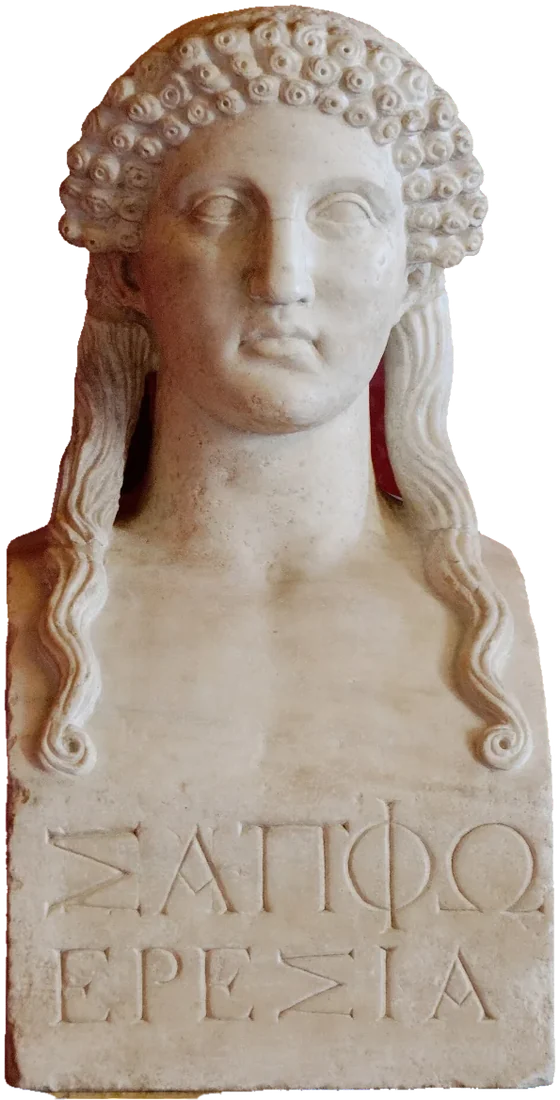
Sappho and Alcaeus were active on Lesbos in the sixth century BC. The language of their songs, as transmitted, is East Aeolic, often simply called Lesbian. It shows limited epic influence, mostly in the fragments in dactylic metres.[1]
It is one of the two “strong” dialects of lyric; the other is Alcman’s Laconian. A strong dialect is fairly homogeneous, and it has a real counterpart among the spoken dialects.[2]
How far the poetic language of Sappho and Alcaeus reproduces the Greek spoken on Lesbos in their day is still hard to say. Silk held that Sappho’s language conveyed “an overall vernacular impression”. De Kreij finds this reductive, if it is taken to equate the two.[3] Their language is close to the island’s vernacular but no direct transcription of it. It was shaped also by earlier Aeolic poetry and by epic.[4]
Sounds
The main features of the sound system are listed below, with fragment numbers from Voigt’s edition:[5]
- ᾱ retained: S. 16.17 βᾶμα.
- First compensatory lengthening: the liquid is doubled. An example is Alc. 150.5 κράνναν (Attic-Ionic κρήνην).
- Second compensatory lengthening: an iota joins the vowel to make a diphthong. Examples are S. 103.5 Μοῖ[σαι, Alc. 119.16 ἐοίσαις and Alc. 72.9 παίσαις (Att.-Ion. Μοῦσαι, οὔσας, πάσας). In -ens this gives -εις, by raising of the ν. Attic-Ionic reaches the same spelling by losing the ν and lengthening the vowel.[6]
- Third compensatory lengthening: the vowel is not lengthened. Forms like S. 16.1 ἰππήων are regarded as epic (disputed).[7]
- Contraction: ᾱο and ᾱω are normally uncontracted, or else contracted to ᾱ. ᾱε is normally uncontracted. εε contracts to η (S. 16.3 κῆν’) or remains (S. 1.10 ὤκεες). οο, if contracted, gives ω (S. 16.18 προσώπω, as Voigt prints it; de Kreij writes πρωσώπω).
- An ι-diphthong before a vowel normally loses its ι (S. 5.9 πόησθαι), except in the optative.
- σδ for ζ (S. 16.1 πέσδων) is most likely a later spelling. It was made when ζ was no longer pronounced [zd].[8]
- Digamma is written at word-beginning in the third-person pronoun (S. 5.3 ϝῶι) and in a few other places. It was probably no longer pronounced. The poets kept it as a poetic archaism, to use when it suited them (Alc. 140.15 ὑπὸ (ϝ)ἔργον). For ϝρ- the papyri sometimes write βρ-. This was perhaps a scribal way of showing a ϝρ- that had fallen out of use, and βρ- sometimes makes position.[9] The sound was probably lost early. The written ϝε and ϝοι are explained by the grammarians’ belief that Aeolic still pronounced it, and Sappho’s prosody usually ignores an initial ϝ.[10]
- Psilosis: initial aspiration was lost, with no further effect (S. 17.20 ἀπίκε[σθαι). Hooker criticised editors for applying it throughout.[11]
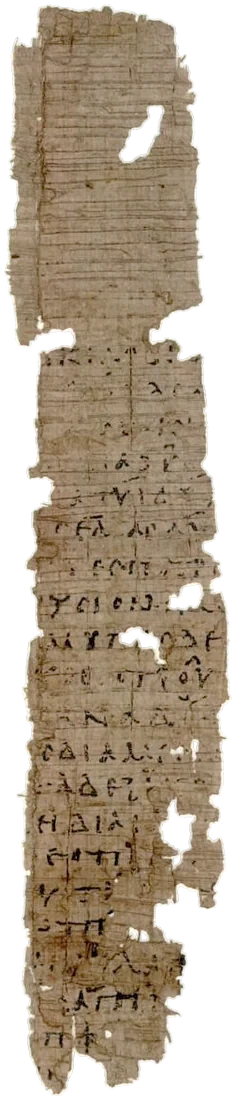
- Recessive accent (barytonesis) is the rule, except in prepositions, particles and a few other words. P.Fouad inv. 239 marks it.[12]
Other accounts of Sappho’s East Aeolic give the same main traits. ᾱ is kept without exception. Consonants are doubled (ἔμμι). There is “diphthongisation” (-οισα, -οισι, παῖς). There is no lengthening in ξένος and κάλος, and contraction gives -ω and -ην. Psilosis is a genuine trait, attested in an inscription of c. 318 BC. And the accent is recessive.[13]
The table sets one example of each sound feature beside its Attic or Ionic counterpart. The Lesbian words are the ones cited above; the counterparts follow the guidelines for readers of Attic:[14]
| feature | Lesbian | Attic-Ionic | meaning |
|---|---|---|---|
| ᾱ kept | βᾶμαbāma | βῆμαbēma | “step, walk” (Sappho 16.17) |
| first lengthening: doubled consonant | κράννανkrannan | κρήνηνkrēnēn | “spring” (Alcaeus 150.5) |
| second lengthening: diphthong with ι | ΜοῖσαιMoisai | ΜοῦσαιMousai | “Muses” (Sappho 103.5) |
| second lengthening: diphthong with ι | παίσαιςpaisais | πάσαςpasas | “all” (Alcaeus 72.9) |
| third lengthening: none | ξένοςxenos | ξεῖνοςxeinos | “stranger” (Ionic ξεῖνος) |
| οο contracted to ω | προσώπωprosōpō | προσώπουprosōpou | “of the face” (Sappho 16.18) |
| σδ for ζ | πέσδωνpesdōn | πεζῶνpezōn | “of foot-soldiers” (Sappho 16.1) |
| psilosis: no [h] | ἀπίκεσθαιapikesthai | ἀφικέσθαιaphikesthai | “to arrive” (Sappho 17.20) |
| recessive accent | ΔίοςDíos | ΔιόςDiós | “of Zeus” (Sappho 1.2) |
The rule in one line: where Attic has η from old ᾱ, Lesbian has ᾱ; where Attic lengthens a vowel after a lost consonant, Lesbian doubles the consonant or makes a diphthong; and Lesbian has no [h].
Forms
The main forms are these:[15]
- The thematic third person plural ends in -οισι(ν) (Alc. 140.6 νεύοισιν).
- Infinitives end in -ην (Alc. 249.5 κατέχην) and -μεναι (S. 16.3 ἔμμεναι).
- Contract verbs are conjugated athematically (S. 60.4 κάλημι), but with a thematic infinitive (Alc. 70.1 κάλην). An athematic form adds its ending straight to the stem, without the linking vowel ε/ο.
- The second person singular can end in -σθα (S. 129b φίλησθα).
- The article has the forms αἰ and οἰ.
- The genitive singular ends in -ω, with -οιο at S. 44.16 and Alc. 367.1.
- Dative plurals end in -αισι(ν), -οισι(ν) and -εσσι(ν); accusative plurals in -αις and -οις.
- Small words include πρός, πεδά, ἔγω (so Voigt at S. 16.3; de Kreij writes ἐγώ), σύ, ἄμμι/ὔμμι, αἰ, κε(ν) and πότα.
- Apocope is frequent (Alc. 362.3 κὰδ δὲ χευάτω). In apocope a preposition loses its final vowel, as κατά becomes κὰδ here.
Here are the forms with their Attic counterparts:
| form | Lesbian | Attic | meaning |
|---|---|---|---|
| third person plural -οισι(ν) | νεύοισινneuoisin | νεύουσινneuousin | “they nod” (Alcaeus 140.6) |
| infinitive -ην | κατέχηνkatechēn | κατέχεινkatechein | “to hold back” (Alcaeus 249.5) |
| infinitive -μεναι | ἔμμεναιemmenai | εἶναιeinai | “to be” (Sappho 16.3) |
| contract verb as a -μι verb | κάλημιkalēmi | καλῶkalō | “I call” (Sappho 60.4) |
| second person -σθα | φίλησθαphilēstha | φιλεῖςphileis | “you love” (Sappho 129b) |
| genitive singular -ω | ὠράνωōranō | οὐρανοῦouranou | “of heaven” (Sappho 1.11) |
| apocope | κὰδkad | κατάkata | “down” (Alcaeus 362.3) |
The athematic contract verbs, the infinitives in -μεναι and the datives in -εσσι are described in the same way elsewhere.[16] Two more forms belong here. One is ἀπύ, whose final -υ, unlike most, can be elided.[17] The other is υ written for a digamma between vowels, in Alc. 10.7 ἀυάτα (⏑ ⏑ —).[18]
Readers who know Attic will meet further correspondences. Among the vowels there are ἄτερος for ἕτερος, ἔχην for ἔχειν, βρόχυς and στρότος for βραχύς and στρατός, ὤρανος for οὐρανός, and δεῦρυ for δεῦρο. Among the consonants there are π for τ (πήλοι, τηλοῦ), ππ for μμ (ὄππα, ὄμμα) and πτ for π (πτόλιν).[14]
| Lesbian | Attic | meaning |
|---|---|---|
| ἄτεροςateros | ἕτεροςheteros | “other” |
| ἔχηνechēn | ἔχεινechein | “to have” |
| βρόχυςbrochys | βραχύςbrachys | “short” |
| στρότοςstrotos | στρατόςstratos | “army” |
| ὤρανοςōranos | οὐρανόςouranos | “heaven” |
| δεῦρυdeury | δεῦροdeuro | “hither” |
| πήλοιpēloi | τηλοῦtēlou | “far away” |
| ὄππαoppa | ὄμμαomma | “eye” |
| πτόλινptolin | πόλινpolin | “city” (object) |
Sappho’s first poem shows several of these in two lines:
ἄρμʼ ὐπασδεύξαισα· κάλοι δέ σʼ ἆγον
ὤκεες στροῦθοι περὶ γᾶς μελαίνας
arm’ upasdeuxaisa; kaloi de s’ āgon / ōkees strouthoi peri gās melainās
“having yoked the chariot; and fair, swift sparrows brought you over the dark earth”
Line 9: ὐπ- without [h] (psilosis); σδ for ζ; the participle in -αισα. Line 10: ὤκεες left uncontracted; long ᾱ in γᾶς and μελαίνᾱς (Attic γῆς μελαίνης).
Sappho 1.9–10 (two Sapphic hendecasyllables)
synthetic ∿
The Alexandrian spelling and its ghosts
We read the East Aeolic of the Alexandrian edition. It includes forms that comparative linguistics can now show could never have existed. These false forms are called hyperaeolicisms. Examples are S. 58.15 φίλημμι, made by false analogy with ἔμμι, and S. 141.3 Ἔρμαις for Ἔρμας.[19]
Disputed. Voigt and other editors print κάλημμι, ὄρημμι and the like. For de Kreij, this first-person form has the backing of neither linguistic theory nor the manuscripts.[20] Tribulato too cites the form as κάλημι.[21] The example of Sappho 1.16 uses the doubled form also printed in Dickinson College Commentaries. The double μ does not affect the metre, since the syllable is long in any case:
δηὖτε κάλημμι
dēute kalēmmi
“… I call on you again”
κάλημμι, “I call”, as Voigt prints it, with the doubled μ. The syllable λημ- is long either way.
Sappho 1.16 (adonean)
synthetic ∿
Notes
- ^ de Kreij 2022, p. 146; Tribulato 2021, p. 135.
- ^ de Kreij 2022, p. 142.
- ^ de Kreij 2022, p. 147 with n. 8.
- ^ D’Alessio 2009, p. 123.
- ^ de Kreij 2022, pp. 147–148.
- ^ de Kreij 2022, p. 147 n. 9.
- ^ See the Sappho’s dialect tab.
- ^ After Willi 2012.
- ^ de Kreij 2022, p. 148 n. 11.
- ^ Tribulato 2021, p. 142.
- ^ de Kreij 2022, p. 148 n. 14.
- ^ Sampson 2022, p. 93.
- ^ Tribulato 2021, pp. 136–138, 144.
- ^ a b Natoli et al. 2022, pp. 329–330.
- ^ de Kreij 2022, pp. 148–149.
- ^ Tribulato 2021, pp. 137, 140.
- ^ West 1987, p. 13.
- ^ West 1987, p. 15.
- ^ de Kreij 2022, pp. 143, 149.
- ^ de Kreij 2022, p. 148 n. 12.
- ^ Tribulato 2021, p. 140.
Lesbian Aeolic · 2 of 5
Metrical consequences
In some respects the Lesbian tradition is more archaic than those of other regions.[1] Its metres probably keep features that go back to Indo-European.[2] Its prosody is the strictest in Greek. Three of its rules follow directly from how the dialect treats syllables.
A fixed number of syllables
Lesbian verse uses neither resolution (⏑ ⏑ for —) nor contraction (— for ⏑ ⏑). So every verse has a fixed number of syllables.[3] This fixed count is called isosyllabism, and it is the chief peculiarity of Aeolic metre.[2] It is why the Sapphic hendecasyllable always has eleven syllables and the Alcaic decasyllable ten.
Ποικιλόθρονʼ ἀθανάτʼ Ἀφρόδιτα
Poikilothron’ athanat’ Aphrodita
“Immortal Aphrodite of the intricate throne”
Eleven syllables for eleven positions. Since a long is never split into two shorts, and two shorts never merge into a long, every Sapphic hendecasyllable has exactly eleven syllables.
Sappho 1.1
synthetic ∿
Hephaestion describes the “Aeolic” dactylic verses in the same spirit. Their first foot, he says, is “entirely indifferent”: it may be any of the disyllables, spondee, iamb, trochee or pyrrhic. The middle feet are all dactyls.[4]
The four two-syllable feet are these. Each name is Greek:
| foot | Greek name | shape |
|---|---|---|
| spondee | σπονδεῖοςspondeios | — — |
| iamb | ἴαμβοςiambos | ⏑ — |
| trochee | τροχαῖοςtrochaios | — ⏑ |
| pyrrhic | πυρρίχιοςpyrrhichios | ⏑ ⏑ |
That free first foot is the aeolic base: two positions that are free in quantity. It is best explained as a survival of the freedom that the part of the verse before the cadence once had in Indo-European.[5] In the base, the number of syllables matters and not their length.[6]
In the Lesbians the first syllable of the base is more often long than short, and it is uncommon for both syllables to be short. Later poets avoid the double short almost completely. Anacreon requires at least one long. Pindar reduces the base to ○ ○, with the first position resolvable.[7] Theocritus, imitating the Lesbians in their dialect, deliberately revives the double-short base from 29.39 onward:[8]
τότα δʼ οὐδὲ καλεῦντος ἐπʼ αὐλεΐαις θύραις
tota d’ oude kaleuntos ep’ auleïais thyrais
“then, even if he calls, at the courtyard doors …”
The base, the first two syllables, is ⏑ ⏑: the double short that Theocritus revives. τότα is Lesbian for τότε, “then”. The colon is gl²ᵈ.
Theocritus 29.39
synthetic ∿
No hiatus
Lesbian lyric avoids hiatus entirely.[9] When vowels meet, Lesbian verse either elides one or runs them together by synecphonesis. The only exception is a single καί in correption, in a proverb at Alc. 366.[10]
The Lesbians elide more than other poets. They elide -αι in middle endings and in active infinitives, and -οι in the dative of enclitic pronouns. They also elide ἔμοι before αὔτωι, and vocatives like Ψάπφοι.[11] Synecphonesis between longer words is rare elsewhere. It is tolerated chiefly in Sappho, in Hipponax and in Old Comedy:[12]
πύκνα δίννεντες πτέρʼ ἀπʼ ὠράνω‿αἴθε-
ρος διὰ μέσσω
pykna dinnentes pter’ ap’ ōranō aithe- / ros dia messō
“whirring their close-set wings, from heaven through the middle of the air”
-ω αἴ- is one syllable: the two vowels are run together by synecphonesis instead of standing in hiatus.[12] The word αἴθερος runs over from one line into the next.
Sappho 1.11–12
synthetic ∿
The crasis in κὤττι and κωὐκ is the same principle, written out. In crasis two words are written as one, and the vowels that meet become one long syllable:
κωὐκ ἐθέλοισα
kōuk etheloisa
“even against her will”
κωὐκ = καὶ οὐκ, “and not”. ἐθέλοισα has the Lesbian participle in -οισα.
Sappho 1.24 (adonean)
synthetic ∿
Stop + liquid makes position
In early poetry a short syllable stays short before a stop + liquid group, as a rule, in only two places. One is the beginning of a word (δειλοῖσι βροτοῖσι). The other is a word that the verse could not otherwise take (Ἀφροδίτη). “Normal” Lesbian lyric avoids even that.[13] So in normal Lesbian verse the group makes position wherever it stands: at the start of a word and, all the more, inside one.
Hephaestion gives Alcaeus as his example of a stop closing one syllable and a liquid opening the next. This makes the syllable “fully long”: ἔκ μ’ ἐλάσας ἀλγέων.[14] Inside a word it works as in Sappho 1.2:
παῖ Δίος δολόπλοκε, λίσσομαί σε
pai Dios doloploke, lissomai se
“child of Zeus, weaver of wiles, I beseech you”
δο-λόπ-λο-κε: π closes one syllable and λ opens the next, so λοπ- is long.
Sappho 1.2 (Sapphic hendecasyllable)
synthetic ∿
West’s word “normal” leaves room for exceptions. The text of 16.19–20 is the third period of a Sapphic stanza. Its ninth position is short in the scheme.[15] That position falls on the first syllable of ὄπλοισι, before πλ, so here the group does not make position; the fr. 16 works tab discusses the line. Fr. 44 is a narrative in gl²ᵈ with epic colouring. It too admits a short syllable before stop + liquid, among its epic licences.[16]
ἢ τὰ Λύδων ἄρματα κἀν ὄπλοισι
[πεσδομ]άχεντας
ē ta Lydōn armata kan oploisi / [pesdom]achentas
“than the chariots of the Lydians and men fighting on foot in armour”
The scheme needs a short ninth syllable, so ὀ- stays short and πλ- goes whole to the next syllable: an exception to the Lesbian rule. The letters in square brackets are restored in a gap of the papyrus.
Sappho 16.19–20 (Waddell, Dickinson College Commentaries)
synthetic ∿
So the reader should expect position before stop + liquid, but check the scheme. The papyri sometimes write βρ- for an original ϝρ-. This can be defended as a real archaism, because in a number of cases βρ- makes position, which a lost ϝ would also have done.[17]
The exceptions prove the rule
Several of Sappho’s fragments stand apart. Fr. 105 is in hexameters of the Ionian type, though not in Ionic dialect. It has some epic features of language and prosody. There is the contraction of ⏑ ⏑ to — (οἶον, μάν), the correptions in ἐρεύθεται ἄκρωι, and the short syllable before -δρ- in μαλοδρόπηες. Normal Lesbian poetry allows none of these. There is also the epic reduplicated aorist λελάθοντο.[18] Fr. 105(c).2 is a true hexameter, with a contraction that the aeolic cola of Sappho and Alcaeus never admit.[19]
Fr. 44, the wedding of Hector and Andromache, is a narrative with a heroic setting, in stichic gl²ᵈ. It admits the same abnormalities, except contraction.[16] The dialect points the same way. Epic influence in Sappho and Alcaeus is limited, and it shows above all in the fragments in dactylic metres.[20] Where the Lesbians borrow epic’s rhythm, they borrow its prosody with it.
| Rule | Lesbian practice | Source |
|---|---|---|
| Resolution / contraction | none; syllable count fixed | West 1987, p. 32 |
| Aeolic base | × × in Sappho and Alcaeus; ○ ○ later | West 1987, pp. 33, 40, 44 |
| Vowels meeting | elision or synecphonesis; no hiatus; correption once | West 1987, pp. 16, 35 n. 2 |
| Stop + liquid | makes position, inside words and at word-start (“normal” Lesbian; exceptions 16.19 ὄπλοισι and fr. 44) | West 1987, p. 16 and n. 7, p. 35; Heph. 1.8 |
| Epic exceptions | frr. 44, 105 | West 1987, p. 35 |
Notes
- ^ West 1987, p. 32.
- ^ a b Battezzato 2021, p. 121.
- ^ West 1987, p. 32; cf. p. 2.
- ^ Hephaestion, Ench. 7.5.
- ^ West 1987, pp. 6, 33.
- ^ Battezzato 2021, p. 122.
- ^ West 1987, pp. 33, 40, 44.
- ^ West 1987, p. 76.
- ^ West 1987, p. 16.
- ^ West 1987, p. 35 n. 2.
- ^ West 1987, pp. 13–14.
- ^ a b West 1987, p. 15.
- ^ West 1987, p. 16 and n. 7.
- ^ Hephaestion, Ench. 1.8.
- ^ West 1987, p. 34.
- ^ a b West 1987, p. 35.
- ^ de Kreij 2022, p. 148 n. 11; see the Grammarians and papyri tab.
- ^ West 1987, p. 35 with n. 2.
- ^ Battezzato 2021, p. 125.
- ^ de Kreij 2022, p. 146.
Lesbian Aeolic · 3 of 5
Sappho and Alcaeus as the corpus; the imitators
Everything we know about the Lesbian literary dialect comes from two poets, and from two poets as later readers preserved them. That has consequences for how confidently the dialect can be described.
Two poets, one dialect, no autograph
No copy of Sappho’s songs in her own hand exists. We have only copies made many centuries after her death, some more accurate than others. We do not know whether Sappho herself ever made a collection. Between the sixth and third centuries her songs were probably passed on very unsystematically, and partly by word of mouth.[1]
Alexandrian scholars edited about nine books of her poetry in the third and second centuries BC. Of perhaps 10,000 lines, about 650 survive. They survive in quotations by later authors, mostly of the second to fifth centuries AD, and on papyrus, parchment and one potsherd.[2] The Alexandrian edition was the turning point in the transmission. Even so, the poems may have been written down soon after they were composed. The papyri date from the third century BC to the seventh AD.[3]
Alcaeus wrote his songs in Sappho’s dialect, so it is often hard to tell whose a fragment is. Most editions therefore set aside a section of fragments that may belong to either poet. Even some of the fragments confidently assigned may be the other poet’s. Modern editors, and perhaps ancient ones too, may have given lines that sound feminine to Sappho and lines on male subjects to Alcaeus.[1]
The dialect, in other words, is a joint corpus. Its grammar is written from both poets together. Further reading on the dialect includes Hamm 1957, Hooker 1977 and Bowie 1981, and more recently Tribulato 2008a.[4]
Dialect is also a tool of attribution. P.Fouad inv. 239 was long ascribed to Sappho because of its Aeolic dialect. The ascription rested on a hypothesis about its metre: that it was the gl²ᵈ of her Book 2. But an asterisk appears in the papyrus, and this has since made the case for Sappho unlikely.[5] The scribe’s occasional accents on the same papyrus mark the Aeolic recessive accent, barytonesis.[6]
What the ancient quotations show
Hephaestion, writing in the second century AD, quotes the Lesbians to illustrate their metres. His manuscripts preserve the dialect spellings. One example is Sappho’s ἐϊκάσδω, with σδ. It comes in a line that Hephaestion counts among his Aeolic “pentameters catalectic in a disyllable”:[7]
τίῳ σʼ, ὦ φίλε γαμβρέ, καλῶς ἐϊκάσδω;
tiōi s’, ō phile gambre, kalōs eïkasdō?
“to what, dear bridegroom, may I best liken you?”
ἐϊκάσδω, “may I liken”, keeps the Lesbian spelling σδ for ζ in Hephaestion’s manuscripts.
Sappho, quoted by Hephaestion, Ench. 7.6
synthetic ∿
Another is the Book 2 line ἠράμαν μὲν ἐγὼ σέθεν, Ἄτθι, πάλαι πόκα, quoted as the “Sapphic fourteen-syllable”:[8]
ἠράμαν μὲν ἐγὼ σέθεν, Ἄτθι, πάλαι πόκα
ēraman men egō sethen, Atthi, palai poka
“I loved you, Atthis, once, long ago”
Fourteen syllables, as the name says. The colon is gl²ᵈ.
Sappho, quoted by Hephaestion, Ench. 7.7
synthetic ∿
Note πόκα. In Alcman πόκα is Doric, and the East Aeolic form is πότα (S. 1.5).[9]
“once, ever”
Hephaestion’s text was transmitted through prose manuscripts. It is one of the places where a quoted fragment’s dialect must be weighed against the dialect grammar.[10]
The Lesbian element elsewhere
The Lesbian dialect reached far beyond Lesbos. Choral lyric’s first exponents, Arion and Terpander, both came from Lesbos. The meeting of Lesbian and Laconian at Sparta may lie at the root of the many-sided language of choral lyric. That would explain why Alcman has doubled consonants (κλεννά) and -οισα beside his Doric.[11] The popularity of Lesbian singers such as Terpander and Arion accounts for the Aeolic features of later choral lyric.[12]
Some of Pindar’s forms are more Aeolic than those of any poet outside Lesbos.[13] By the late fifth century, in Timotheus, the Aeolic element seems to have vanished altogether.[14]
Then come the conscious imitators. Theocritus wrote a group of Lesbian poems (28–31) in Lesbian metres and the East Aeolic dialect.[15] The metre shows an open choice of model: gl²ᶜ and gl²ᵈ for the poems in Lesbian dialect:[16]
Γλαύκας ὦ φιλέριθʼ ἀλακάτα δῶρον Ἀθανάας
γύναιξιν, νόος οἰκωφελίας αἷσιν ἐπάβολος
Glaukās ō philerith’ ālakatā dōron Athānaās / gynaixin, noos oikōpheliās haisin epābolos
“Distaff, friend of wool-workers, gift of grey-eyed Athena to women whose mind is set on housekeeping”
ᾱ throughout: ἀλακάτᾱ, which West marks ᾱ̓λακάτᾱ, and Ἀθανάᾱς. νόος is left uncontracted, and -ιν before ν- makes position. Each line is a glyconic with two choriambs (— ⏑ ⏑ —) inserted, gl²ᶜ. Word-end often falls between the choriambs.[17]
Theocritus 28.1–2
synthetic ∿
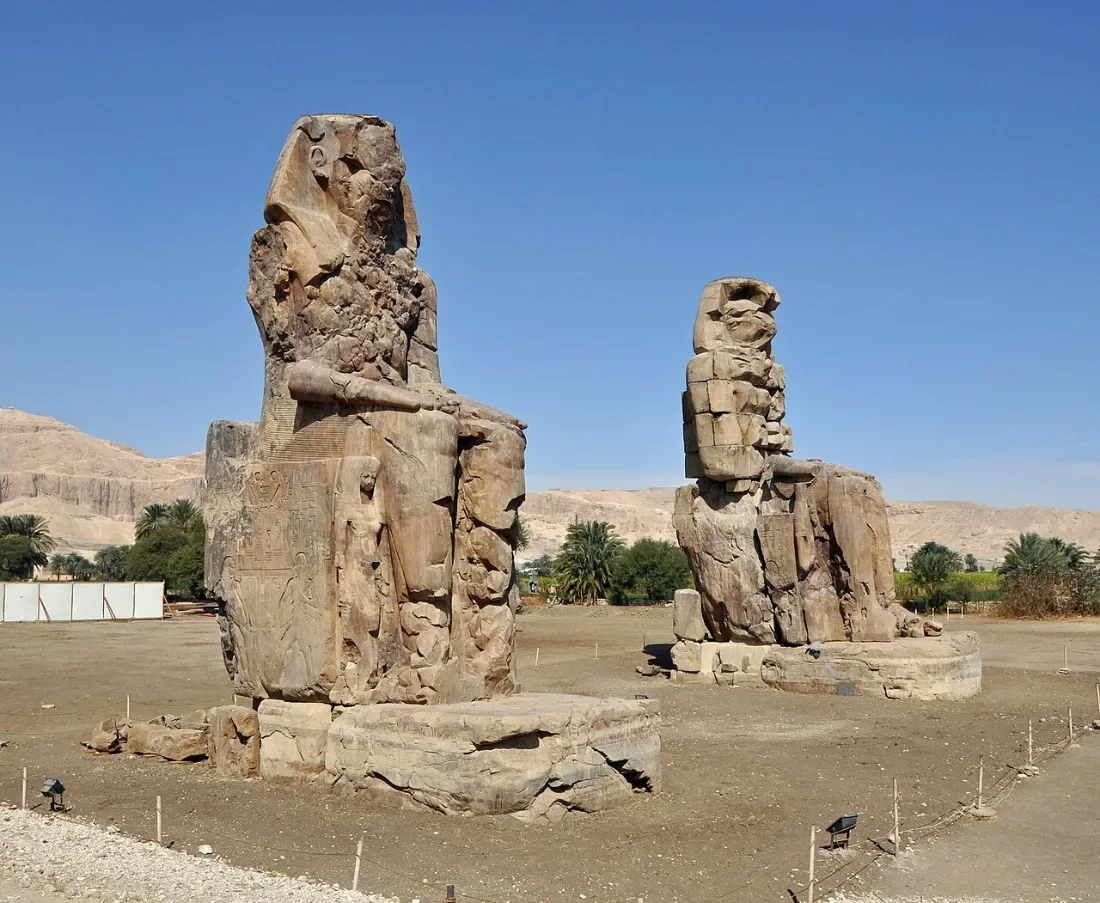
Under Hadrian, Julia Balbilla composed four epigrams for the Colossus of Memnon, all in East Aeolic. The Cretan Mesomedes merely admitted Aeolic forms such as ἴχνεσσι into a mixed Doric colouring. Balbilla, by contrast, must have read Sappho and deliberately imitated her language and poetry, though she wrote in elegiac couplets.[14] The epigrams date from November AD 130. They show the whole Aeolic and hyper-Aeolic apparatus of the imperial editions, σδ included.[18]
A Roman-period lyric fragment, P.Oxy. 5191, has Ionic and Doric features with no East Aeolic at all.[14] Aeolic metre also lived on, but without the dialect. It appears in simple glyconic strophes with a pherecratean close in Hellenistic festival poetry.[19]
Notes
- ^ a b Lardinois 2022, p. 266.
- ^ Lardinois 2022, pp. 265–266.
- ^ Tribulato 2021, p. 141.
- ^ de Kreij 2022, p. 161.
- ^ Sampson 2022, pp. 92, 112–113.
- ^ Sampson 2022, p. 93.
- ^ Hephaestion, Ench. 7.6.
- ^ Hephaestion, Ench. 7.7.
- ^ de Kreij 2022, pp. 146, 148.
- ^ cf. de Kreij 2022, p. 143.
- ^ de Kreij 2022, p. 144.
- ^ D’Alessio 2009, pp. 123–124.
- ^ de Kreij 2022, p. 149.
- ^ a b c de Kreij 2022, p. 160.
- ^ de Kreij 2022, p. 160; Barbantani 2009, p. 307.
- ^ West 1987, p. 76.
- ^ West 1987, p. 34.
- ^ Tribulato 2021, pp. 143, 145.
- ^ West 1987, p. 72.
Lesbian Aeolic · 4 of 5
Sappho's dialect: a literary language on a local base
Sappho’s language, as the reader meets it, is a literary language built on the local dialect of Lesbos.[1] What follows sets out the parts of it that bear on scansion.
A local dialect turned literary
Sappho’s literary language rests on the local dialect of Lesbos. This is a variety of East Aeolic, the dialect of parts of Asia Minor and the east Aegean. It shares features with the other Aeolic dialects, Thessalian and Boeotian, but it has many innovations of its own.[2]
Until the mid-twentieth century, scholars assumed that she wrote an unmixed vernacular, and they dismissed her epic features. Lobel, for instance, classed poems such as fr. 44 as “abnormal”. But no literary dialect is ever linguistically pure. So her language is now rightly treated as a literary product. It often reuses epic material, and it may also draw on an Aeolic poetic tradition that we no longer have.[1]
Disputed, in degree. For D’Alessio the Lesbians are close to their own vernacular. Their language reflects many features of the island’s Aeolic, as later inscriptions show it. Yet it is no direct transcription of everyday speech. Doublets, metrical formulae and non-Lesbian forms show the influence of earlier Aeolic poetry and of Ionic epic.[3] De Kreij thinks it too simple to equate her language with the spoken Lesbian of her day.[4] Natoli speaks of “pepperings of Homeric language”.[5]
Sounds that change the weight
Most East Aeolic sound-changes leave the weight of a syllable as it is. Doubled consonants (ἔμμι, ἄμμες, ὔμμες, ἔμμεναι) and “diphthongisation” (λίποισα 1.7, παῖς) give long syllables where Attic has εἰμί, λιποῦσα, πᾶς. The open long vowels of contraction (-ω in προσώπω, -ην in ἴδην, 16.18) are long like their Attic equivalents, and so is the ᾱ of μερίμναν (1.26). The ο of στρότος (16.1), where Attic has στρατός, is short like the Attic α; both vowels come from an old syllabic r.[6] The same doubling, diphthongisation and contractions appear in other accounts of the dialect.[7] Two changes do matter:
- No third compensatory lengthening. ξένος and κάλος come from ξένϝος and καλϝός. They keep a short first syllable, where Ionic has ξεῖνος and κᾱλός.[8]
- -ευ- stems keep the long vowel: βασίληος, τόκηας, and ἰππήων (16.1). Shortened forms, which always occur in personal names (Νηρεΐδων beside Sappho’s Νηρήϊδες), are epic.[9] De Kreij instead counts ἰππήων as epic influence.[7] Disputed. Either way the η is long:
[Ο]ἰ μὲν ἰππήων στρότον, οἰ δὲ πέσδων
oi men ippēōn stroton, oi de pesdōn
“Some say a host of horsemen, others of foot-soldiers …”
οἰ, the article, has no [h] (psilosis). ἰπ-πή-ων has three syllables, and its long η stands in the anceps. στρό- is short, like Attic στρα-. πέσδων has σδ for ζ.
Sappho 16.1
synthetic ∿
The first of the two changes is easiest to see side by side:[8]
| Lesbian | shape | Ionic | shape | meaning |
|---|---|---|---|---|
| ξένοςxenos | ⏑ ⏑ | ξεῖνοςxeinos | — ⏑ | “stranger” |
| κάλοςkalos | ⏑ ⏑ | κᾱλόςkālos | — ⏑ | “beautiful” |
The rule in one line: Lesbian keeps the first syllable of these words short, where Ionic makes it long.
Psilosis was authentic. An inscription of c. 318 BC already has the unaspirated form κατεστακόντων. Disyllabic prepositions lose their final vowel: κατ, παρ, περ, and ὀν for ἀνά. This loss is called apocope. The Brothers Poem confirms ἄϊ for ἀεί.[10] Psilosis and frequent apocope appear in other accounts of the Lesbian features too.[11]
Verbs: chosen by metre or content
The athematic infinitive in -μεναι fuses Aeolic -μεν with Attic-Ionic -ναι, and it is widespread in Homer. The ending -ην spreads to the perfect (τεθνάκην, 31.15). Verbs like ἴστᾱμι have ἴστᾱν, τίθην, δίδων.[12]
The “contract verbs” are conjugated athematically (κάλημι 60.4, δοκίμωμι 52). This is usually explained as a development within the dialect. Another view sees an older reorganisation, shared with Thessalian, Arcadian and Cypriot.[13] The athematic conjugation and -μεναι appear in other accounts too.[11]
Sappho could choose between the two types. She seems to have picked one conjugation or the other to suit the metre or the subject of a poem.[14] At 16.20 she has athematic πεσδομ]άχεντας.[15] But in fr. 44, one of her most epic-coloured pieces, she has thematic ὀνκαλέοντες:
⌊πάονʼ ὀνκαλέοντες⏗ Ἐκάβολον εὐλύραν
paon’ onkaleontes Ekabolon eulyran
“(all the men raised a lovely, high cry,) calling on Paean, the far-shooter, skilled in the lyre”
Sappho 44.33 (gl²ᵈ)
synthetic ∿
The thematic form gives κα-λέ-ον-τες (⏑ ⏑ — ⏑). These are the double shorts that the dactylic expansion of the glyconic needs here.[16] ὀν- is the apocopated ἀνά.
Notes
- ^ a b Tribulato 2021, pp. 135–136.
- ^ Tribulato 2021, p. 135; cf. Natoli et al. 2022, p. 328.
- ^ D’Alessio 2009, p. 123.
- ^ de Kreij 2022, p. 147 n. 8.
- ^ Natoli et al. 2022, p. 328.
- ^ Tribulato 2021, pp. 136–138.
- ^ a b de Kreij 2022, p. 147.
- ^ a b Tribulato 2021, p. 136.
- ^ Tribulato 2021, p. 139.
- ^ Tribulato 2021, p. 138.
- ^ a b de Kreij 2022, p. 148.
- ^ Tribulato 2021, p. 140.
- ^ Tribulato 2021, p. 140 with n. 12.
- ^ Tribulato 2021, p. 141.
- ^ See the Metrical consequences tab, where the line is scanned.
- ^ West 1987, p. 34.
Lesbian Aeolic · 5 of 5
Grammarians, papyri and inscriptions
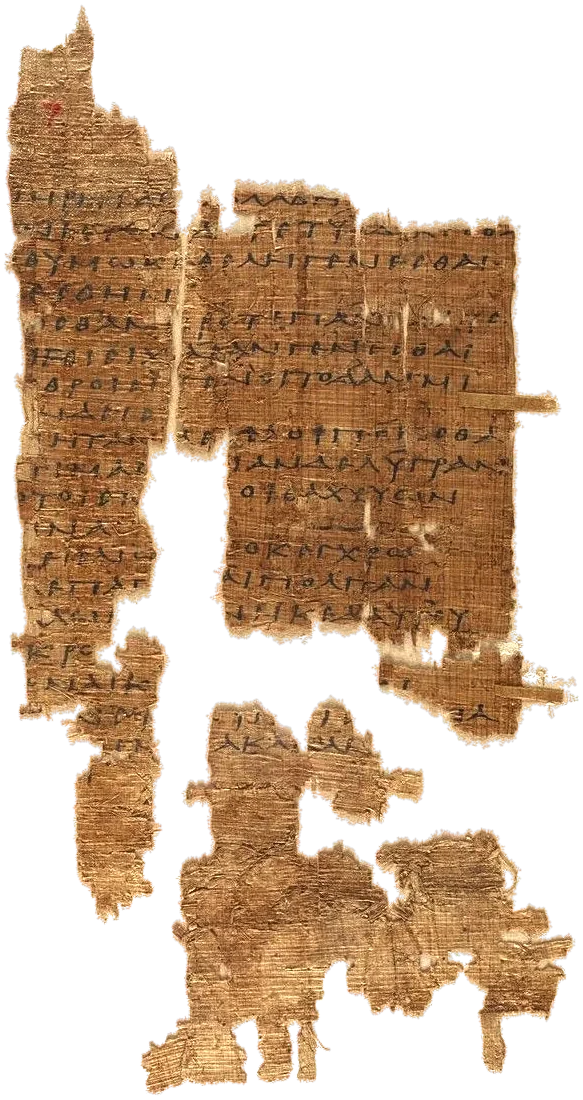
Our picture of Lesbian depends on three kinds of evidence. They are the text of the poets as transmitted, the ancient grammarians, and inscriptions from the East Aeolic area.[1] Each can mislead the reader about how a line scans.
The evidence
The poems may have been written down close to the time of their composition. The Alexandrian edition was the turning-point. Papyri now run from the third century BC to the seventh century AD. From the third century BC comes the Cologne papyrus of the “New Sappho”, which predates that edition and arranges the poems differently. Exegesis of Sappho on papyrus is very rare, while that of Alcaeus is better represented.[2]
Local scholarship began early. Callias of Mytilene wrote a commentary on Sappho and Alcaeus in the third or second century BC. Once the koinē had replaced the dialects, the study of dialect had to rely on literature. So for the grammarians, Aeolic simply meant the East Aeolic of Sappho and Alcaeus. They discuss barytonesis, gemination, contraction and the digamma. But they never properly discuss the “diphthongisation” (-οισα) that modern readers notice first.[1] Inscriptions help with the sounds, but none survives from the seventh or sixth century, and few from before 400 BC.[3]
The digamma and βρ-
Whether Lesbian still had [w] in the archaic period cannot be checked. Late classical inscriptions show no trace of the letter. The papyri write ϝ in the third-person pronoun (ϝε, ϝοι), because the grammarians believed that those forms began with [w]. In Sappho’s prosody, though, an initial [w] usually counts for nothing. The elision in fr. 22.14 ἐπτόαισ’ ἴδοισαν shows this (ἐπ-τό-αι-σἴ-δοι-σαν, — ⏑ — ⏑ — …). There the verb’s final -ε is elided before a word that once began with ϝ.[4]
ἐπτόαισʼ ἴδοισαν
eptoais’ idoisan
— ⏑ — ⏑ — …
“(it) set you aflutter when you saw (it)”
ἴδοισαν, “having seen”, once began with ϝ. If the ϝ still counted, the -ε of ἐπτόαισε could not be elided. It is elided, so the ϝ counts for nothing.
Sappho 22.14
The digamma was probably no longer pronounced in the poets’ day.[5]
βρ- for ῥ- in βρόδον, βράδινος, βραϊδίως is usually taken as an editor’s sign. It tells the reader that the syllable before such a word, which comes from *wr-, is to be scanned long. The adjective “rosy-armed” shows the spelling:[6]
“rosy-armed”
βρ- stands where Attic has ῥ-. Two consonants at the start of the word can make the syllable before it long.
Hooker and A. Bowie are cited for this view.[7] Disputed: Bowie has also argued, against Hooker, that βρ- may record a real archaism, because it makes position.[8]
Accent: the grammarians’ rules
Papyri are the main evidence for Aeolic accentuation. Aristophanes of Byzantium is credited with introducing accents into the texts he edited. The Alexandrians must have learnt the Lesbian accent from local informants. In East Aeolic every accent is recessive: it stands as far from the end of the word as it can. So the Lesbian texts have no oxytone words, which would carry the acute on the last syllable. We find σύνετον for συνετόν (16.5) and ἔμας for ἐμᾶς (1.6).[9] The accent made no difference to the metre:[10]
[πά]γχυ δʼ εὔμαρες σύνετον πόησαι
panchy d’ eumares syneton poēsai
“It is entirely easy to make this understood (to everyone)”
σύνετον has the recessive accent, where Attic has συνετόν. πόησαι has lost the ι of ποι- before a vowel.[5] Neither accent nor spelling changes the scansion.
Sappho 16.5
synthetic ∿
Grammatical theory could mislead the copyists. In words like δάϊδος a lost [w] left two syllables. From such words the grammarians made a rule that vowel-sequences ending in ι were disyllabic. Accordingly the papyri write τυϊδ’ or τύιδ’ for τυίδε at 17.7. But there the sequence scans as one long syllable, a diphthong, τυι- (—). So the papyri’s accent and the theory behind it are both mistaken.[11]
By a similar analogy from genuine παῖς, the grammarians produced αι for ᾱ in Κρονίδαις (Alcaeus 38A.9) and φαῖμι (Sappho 88.17). Tribulato regards these forms as pure inventions.[12]
σδ. The spelling σδ for ζ between vowels is inconsistent in papyri and quotations. It reflects the grammarians’ knowledge that Aeolic ζ was pronounced [zd] (de Kreij, after Willi, explains it the same way).[5] Inscriptions have it only once, in an artificial honorary decree from Cyme. The earliest papyri disagree. The Cologne papyrus has στεναχίζω, while a second-century BC ostrakon has a corrupted σδ form.[13]
The Roman revival
Lesbian inscriptions went on using the dialect long after the koinē had won. At first they did so naturally. Later the dialect was a deliberate revival that displayed local identity and pride. Dionysius of Halicarnassus could even argue that Latin was a form of Aeolic. Julia Balbilla, companion of the empress Sabina, had four epigrams in East Aeolic carved on the statue of Memnon in AD 130.[14] She used σδ and every Aeolic and hyper-Aeolic feature that the editions offered.[15]
Notes
- ^ a b Tribulato 2021, pp. 141–142.
- ^ Tribulato 2021, p. 141 with n. 16.
- ^ Tribulato 2021, p. 142.
- ^ Tribulato 2021, p. 142 with n. 20.
- ^ a b c de Kreij 2022, p. 147.
- ^ Natoli et al. 2022, p. 330.
- ^ Tribulato 2021, p. 142 n. 20.
- ^ de Kreij 2022, p. 148 n. 11.
- ^ Tribulato 2021, pp. 143–144 with n. 24; de Kreij 2022, p. 148.
- ^ West 1987, p. 68; Golston and Riad 2005, pp. 79–80.
- ^ Tribulato 2021, p. 144.
- ^ Tribulato 2021, pp. 144–145.
- ^ Tribulato 2021, p. 145 with n. 28.
- ^ Tribulato 2021, p. 143; de Kreij 2022, p. 160; Natoli et al. 2022, p. 328.
- ^ Tribulato 2021, p. 145.


