Overview
The literary dialects and the genres that go with them: epic, Lesbian song, Doric choral lyric, Attic drama.
Overview · 1 of 4
How dialect affects metre
Metre counts syllables and weighs them.[1] Dialect changes the shape of words, and so it can change both the count and the weights. The features below are the ones a learner meets most often. Each comes with a scanned line. In each box the Greek line stands at the top. Under it every syllable stands over its mark, — for long and ⏑ for short, and the syllable that shows the feature is picked out in red. A transliteration and a translation follow.
Contraction and its absence. Ionic and the lyric dialects often leave two neighbouring vowels uncontracted. Ionic ε, for example, does not contract before ο, ω or α.[2]
The verse may still count the two vowels as one syllable. This is called synecphonesis. Inside a word it happens most often when the first of the two vowels is ε.[3] In Homer’s Πηληϊάδεω, for instance, the final -εω is a single long syllable. Merging of this kind inside one word is also called synizesis.[4]
Here is the line. Each syllable stands over its mark, and the merged syllable is picked out:
μῆνιν ἄειδε θεὰ Πηληϊάδεω Ἀχιλῆος
mēnin aeide theā Pēlēïadeō Achilēos
“Sing, goddess, the wrath of Peleus’ son Achilles”
-δεω is one long syllable, not two.
Homer, Iliad 1.1
David Chamberlain, Iliad 1.1 · CC BY 4.0
Pindar opens Pythian 12 with uncontracted αἰτέω, and again -έω counts as one syllable. The same line has Doric καλλίστᾱ, where Attic would have -η. Its ᾱ is long:[5]
αἰτέω σε, φιλάγλαε, καλλίστα βροτεᾶν πολίων
aiteō se, philaglae, kallistā broteān poliōn
“I ask you, lover of splendour, fairest of mortal cities”
-τέω is one syllable. καλλίστᾱ has Doric ᾱ, which is long. The scheme is — D — D.
Pindar, Pythian 12.1
synthetic ∿
Movable ν. In the editions many endings are written -οισι(ν), -ουσι(ν), -εσσι(ν), κε(ν).[6] The bracketed letter is called “movable” ν, because it may be written or left out. It matters to the metre. By the basic rule of syllabification, a final consonant before a word that begins with a consonant closes its syllable and makes it long. Before a vowel it does not.[7] Theocritus, writing in Lesbian, uses movable ν to make position:
γύναιξιν, νόος οἰκωφελίας αἷσιν ἐπάβολος
gynaixin, noos oikōpheliās haisin epābolos
“for women whose mind is set on housekeeping”
-ξιν stands before ν-, so its syllable is closed and long. νόος is left uncontracted, two short syllables.
Theocritus 28.2
synthetic ∿
Digamma. Some words once began with the letter ϝ, called digamma, which stood for the sound [w]. Such words are often scanned as if the ϝ were still there. This explains much apparent hiatus in Homer and in Doric lyric.[8]
In Alcman the lost ϝ counts in about half the certain cases. Bacchylides lets it prevent hiatus in some places but not in others.[9] The Lesbian texts write the letter in the third-person pronoun (Sappho 5.3 ϝῶι). Alcman even elides a written ϝε at period-end:[10]
Ἀγιδῶς τὸ φῶς· ὁρῶ ϝ’ ‖
Āgidōs to phōs; horō w’
“the light of Agido: I see her …”
ϝ’ is the pronoun ϝε, “her”, written with its digamma and elided at the end of the period (‖). Ἀ- is long, as West marks it. The colon is a lekythion (lk).
Alcman 1.40
synthetic ∿
Psilosis. Lesbian has lost the aspiration [h] at the beginning of words. This loss is called psilosis.[11] It makes no difference to the metre, because the aspirate never counts as a consonant.[12] The word for “horse” shows it:[13]
“horse”
Lesbian writes the smooth breathing, which marks no sound. Attic writes the rough breathing, which stands for [h]. Both words scan — ⏑.
Compensatory lengthening: -οισα, -οντι, κλεννά. The same inherited sequence of sounds gives a different syllable in each dialect. Attic-Ionic has Μοῦσα and ἔχουσα, with a lengthened vowel. East Aeolic has a diphthong instead: Μοῖσα, ἔχοισα. Strict Doric has the open long vowel: Μῶσα. In the same way, where Attic-Ionic has κλεινός, Aeolic doubles the consonant and has κλεννός. A doubled consonant of this kind is called a geminate.[14]
The diagram follows one such group, -ονσ-, into three dialects. In the feminine participle it comes from an older *-ontya.[15]
“Muse” and “having” (feminine) in three dialects. The spelling changes; the weight does not.
The syllable is long in every one of these forms. So the weight is unchanged, though the sound and the spelling are not. Alcman has three such forms in one trochaic line. They are νιν, which is Doric; κλεννά, with the Aeolic doubled consonant; and χορᾱγός, with Doric ᾱ as West marks it:[16]
οὔτε μωμήσθαι νιν ἁ κλεννὰ χοραγός
oute mōmēsthai nin hā klennā chorāgos
“nor to find fault with her, the famous chorus-leader”
Doric νιν, “her”; Aeolic κλεννά, “famous”, with its doubled ν; Doric χορᾱγός, “chorus-leader”, with ᾱ. The colon is three trochaic metra (3tr).
Alcman 1.44
synthetic ∿
Only the third kind of lengthening changes the weight. It came after the loss of a ϝ. Lesbian ξένος and κάλος keep a short first syllable (⏑), where Ionic has ξεῖνος and κᾱλός (—).[17] The choral poets use both kinds.[18]
“stranger, guest”
Here the dialect does change the weight: the first syllable is short in Lesbian and long in Ionic.
Doric ᾱ. Doric and Aeolic keep an original long ᾱ where Ionic has η.[19] Both vowels are long, so the quantity is unaffected. The Doric accusative plural -ᾰς, however, is short. In Stesichorus the metre guarantees this short Doric form, in θανόντᾰς at 97.217.[20]
οὔ νιν κορυφαὶ μεγάλας ἴσχουσι γαίας
ou nin koryphai megalās ischousi gaiās
“the peaks of the great earth do not hold him”
μεγάλᾱς and γαίᾱς have Doric ᾱ (Ionic μεγάλης, γαίης). ἴσχουσι has Ionic -ουσι, two lines after Doric πτάσσοντι at 5.22.[21] The scheme is — D — e —.
Bacchylides 5.24
synthetic ∿
Stop + liquid. A stop followed by a liquid or a nasal may both begin the next syllable. The short vowel before the group then stays in an open, short syllable. Hephaestion calls such syllables κοιναί, “common”.[22]
Early poetry normally admits this only at the beginning of a word. In “normal” Lesbian lyric even that is avoided, so a stop + liquid group always makes position:[23]
παῖ Δίος δολόπλοκε, λίσσομαί σε
pai Dios doloploke, lissomai se
“child of Zeus, weaver of wiles, I beseech you”
δο-λόπ-λο-κε: π and λ are split between two syllables, so λοπ- is closed and long. Δίος carries the Lesbian recessive accent.
Sappho 1.2 (Sapphic hendecasyllable)
synthetic ∿
Attic correption. In Attic speech a short vowel stayed short before stop + liquid. This is the normal scansion in comic dialogue, while tragedy allows the long scansion within a word.[24]
Counts of the verses give the same picture. Inside a word, the short scansion is the commoner one in tragedy and by far the commoner in comedy. In comedy the long scansion belongs mainly to a formal style, such as parody of tragedy. Homer, by contrast, usually lets the group make position:[25]
The two lines below show both treatments. In the tragic line the group is split, and the syllable before it is long. In the comic line the group goes whole to the next syllable, and the vowel before it stays short.
ὦ τέκνα, Κάδμου τοῦ πάλαι νέα τροφή
ō tekna, Kadmou tou palai neā trophē
“Children, young brood of ancient Cadmus”
τέκ-να: κ and ν are split, so the first syllable is closed and long.[26]
Sophocles, Oedipus the King 1 (iambic trimeter)
synthetic ∿
ἀνέβραττεν ὀρνίθεια, καὶ τραγήματα
anebratten ornītheia, kai tragēmata
“was boiling game-birds, and sweetmeats”
ἀ-νέ-βρατ-: βρ goes whole to the next syllable, so νε stays open and short.
Aristophanes, Frogs 510 (iambic trimeter)
synthetic ∿
| Feature | Ionic (epic) | Lesbian | Choral Doric | Attic drama |
|---|---|---|---|---|
| ᾱ / η | η | ᾱ | ᾱ | η in dialogue, ᾱ in song |
| Contraction | often absent | εε > η or kept | varies by poet | (not treated by the sources) |
| Hiatus | admitted, often with ϝ | avoided altogether | virtually only with ϝ | tragedy: only at exclamations, urgent imperatives and a few set phrases |
| Stop + liquid | short normally only at word-start | normally makes position; exceptions in epic-coloured verse (fr. 44, the hexameters of fr. 105) and in ὄπλοισι at Sappho 16.19 (details) | short at word-start the rule in Stesichorus; Pindar freer | short (comedy); long allowed within the word (tragedy) |
Sources for the table: West 1987, pp. 15–17 with n. 7, 35; de Kreij 2022, pp. 146–151, 156–157.
Notes
- ^ West 1987, p. 12; D’Angour 2022, p. 132.
- ^ de Kreij 2022, p. 152.
- ^ West 1987, p. 15.
- ^ Battezzato 2009, p. 139 n. 14.
- ^ West 1987, p. 43.
- ^ de Kreij 2022, pp. 146–159.
- ^ West 1987, p. 12.
- ^ West 1987, pp. 15, 22–23.
- ^ de Kreij 2022, pp. 145, 159.
- ^ West 1987, pp. 36–37; de Kreij 2022, p. 147.
- ^ de Kreij 2022, p. 148.
- ^ West 1987, p. 12 n. 1.
- ^ Natoli et al. 2022, p. 329.
- ^ de Kreij 2022, pp. 144–145, 147, 157.
- ^ de Kreij 2022, p. 145.
- ^ West 1987, p. 36; de Kreij 2022, pp. 145–146.
- ^ Tribulato 2021, p. 136.
- ^ See Doric of choral lyric, tab 2.
- ^ de Kreij 2022, p. 144.
- ^ de Kreij 2022, p. 151.
- ^ de Kreij 2022, p. 159.
- ^ Hephaestion, Ench. 1.7.
- ^ West 1987, p. 16 with n. 7.
- ^ West 1987, pp. 16–17, 27.
- ^ Devine and Stephens 1994, pp. 34–35.
- ^ West 1987, p. 25.
Overview · 2 of 4
Editions and orthography
The dialect printed in a modern edition is built up in layers. At the bottom is the poet’s own language. It was standardised at Alexandria, copied and quoted for centuries, and finally set out by modern editors. To study the lyric dialects is therefore always partly to study how the poetry has been received over thousands of years.[1] This matters to the metrician, because spelling can decide how syllables are counted and weighed. Papyri and line-division are on the next tab.
The diagram shows the layers in order, from the poet at the top to the printed page at the bottom. Each step could change the spelling.[1]
Five layers between the poet and the reader.
What the Alexandrians did
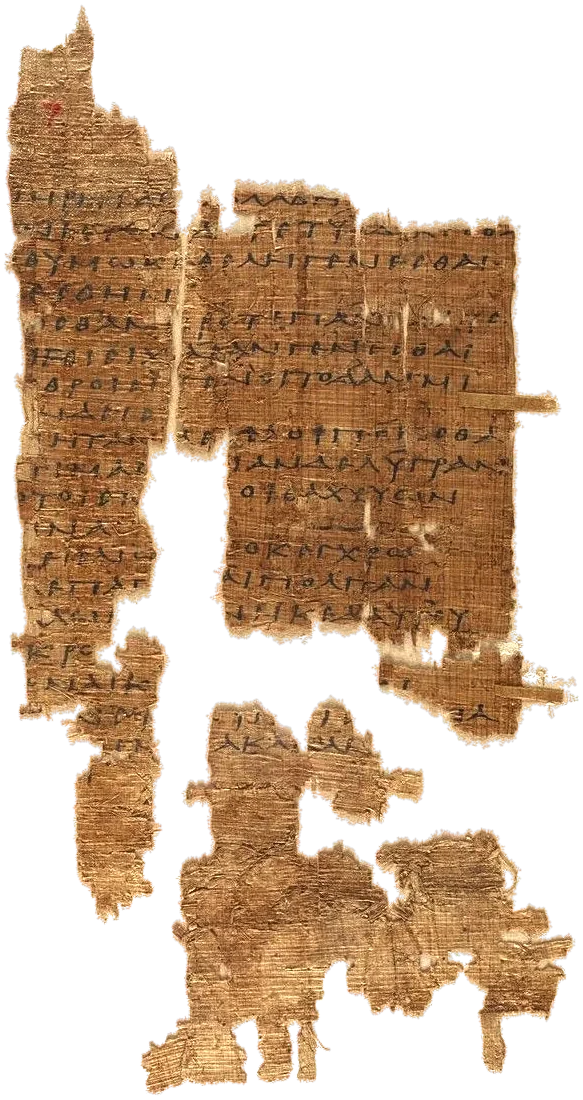
The scholars of Alexandria worked in the third and second centuries BC. They established the canon of nine lyric poets, and they gathered and ordered their works. They also regularised the poets’ spelling by dialect rules of their own making.
The dialects that resulted look coherent. Yet they sometimes contain forms that comparative linguistics shows to be impossible. Such false forms are called hyperaeolicisms and hyperdoricisms. So even in most papyri, Sappho’s language reaches us filtered through the Alexandrians’ idea of what sixth-century Lesbian had been.[1]
Aristophanes of Byzantium lived from the mid-third to the second century BC.[2] He is credited with colometrised texts of Pindar, in which the lines were divided into cola. Aristarchus is credited with editions of Alcaeus and probably of Anacreon, and with commentaries on Alcman, Pindar and Bacchylides. The scholia in our medieval manuscripts descend from commentaries like these.[3]
The Alexandrians did not work alone. Callias of Mytilene wrote a commentary on Sappho and Alcaeus in the third or second century BC. Once the koinē had replaced the spoken dialects, dialectology could only be done from books. So when grammarians speak of οἱ Αἰολεῖς, “the Aeolians”, they usually mean a passage of Sappho or Alcaeus.[4]
Six examples of the editorial layer follow, each with the forms set side by side.
A false Aeolic verb
Sappho 58.15 φίλημμι (philēmmi), “I love”, is a hyperaeolicism. It was formed by false analogy with ἔμμι (emmi), the genuine Lesbian for “I am”. Voigt and other editors print κάλημμι, ὄρημμι and the like. De Kreij objects that neither linguistic theory nor the manuscripts support this first-person form.[5] The genuine Lesbian verb would be φίλημι, with one μ:[6]
| Attic | Lesbian | printed in some editions | meaning |
|---|---|---|---|
| εἰμίeimi | ἔμμιemmi | ἔμμιemmi | I am |
| φιλῶphilō | φίλημιphilēmi | φίλημμιphilēmmi | I love |
Disputed. In the same way, the grammarians’ Aeolic αι for ᾱ in Κρονίδαις (Kronidais, Alcaeus) and φαῖμι (phaimi, Sappho) is, for Tribulato, a mere artificial invention. It was made by false analogy with genuine παῖς (pais), “child”.[7]
Psilosis applied everywhere
Psilosis is the loss of the [h] sound at the start of a word. Lesbian writes ἴππος (ippos) where Attic writes ἵππος (hippos), “horse”.[8] Psilosis was a real Lesbian trait. An inscription of c. 318 BC has unaspirated stops.[9] Hooker, however, criticises the editorial practice of applying it throughout.[10] Disputed.
σδ for ζ
σδ for ζ in Sappho and Alcman is most likely a later spelling. It was made when ζ was no longer pronounced [zd], to keep the recitation right.[11] It has been called a kind of “analytical spelling” devised by the grammarians. The inscriptions give it away, since it occurs there only once, in a decree full of artificial forms.[12] The word for “of foot-soldiers” shows the spelling:[6]
“of foot-soldiers”
σδ spells out the two sounds [zd] that ζ once stood for.
σ for θ in Alcman
In Alcman σ stands for θ. This spelling is generally thought to have entered the text once Laconian pronunciation had changed.[13]
“godlike”
Anacreon and Pindar
In Anacreon the manuscripts have ᾱ in a number of places, but the editors have removed every one of them. The manuscripts also regularly have ευ for εο, which editors treat in different ways.[14]
In Pindar the manuscripts read Ionic -ουσι(ν) in a number of cases, either as the only reading or as a variant. Yet the editors print the East Aeolic ending -οισι(ν) every time, as in διαιθύσσοισιν (diaithyssoisin), “they dart through”, at Olympian 7.95.[15] Both endings make a long syllable, so the choice changes the look of the text, not its scansion.
Quotation and copying
A large share of lyric survives only in quotation. Prose authors and anthologies quoted lyric for many purposes, and they did not always aim to reproduce the original exactly. So a Doric fragment may be quoted in Attic. It is often impossible to say whether this Atticisation happened when the passage was quoted or later, in copying.
About the ninth century, texts were copied into minuscule script and accents were reintroduced. This change obscured peculiarities of accent and breathing.[1]
Spelling and quantity
Two spelling conventions bear directly on scansion. In our Homeric text the metrically lengthened forms of ε and ο are written ει and ου, as in εἰν ἀγορῇ and Οὐλύμποιο. Here the spelling records the lengthening.[16] Οὐλύμποιο, “of Olympus”, comes from Ὄλυμπος, whose first syllable is short:[17]
“of Olympus” · “Olympus”
Ὀ- is short in the plain word. The spelling ου in Homer shows that the verse lengthens it.
Boeotian spelling, as transmitted for Corinna, works the other way. It writes ου for υ whether the vowel is short or long: δουῖν for δυεῖν, and so also Κούπρις and κρουφάδᾱν. Here the written vowel does not show the quantity.[18]
“of two”
Here ου stands for a short υ, so the spelling hides the quantity.
The change υ > ου is one of the Boeotian spellings of her text.[19] On Penney’s judgement, the stage of spelling that our Corinna texts show fits a date of about 200 BC.[20]
Notes
- ^ a b c d de Kreij 2022, p. 143.
- ^ Tribulato 2021, p. 143.
- ^ Phillips 2022, p. 120.
- ^ Tribulato 2021, pp. 141–142.
- ^ de Kreij 2022, pp. 148–149 with n. 12.
- ^ a b Natoli et al. 2022, p. 330.
- ^ Tribulato 2021, pp. 144–145.
- ^ Natoli et al. 2022, p. 329.
- ^ Tribulato 2021, p. 138 n. 7.
- ^ de Kreij 2022, p. 148 n. 14.
- ^ After Willi 2012; de Kreij 2022, pp. 145, 147.
- ^ Tribulato 2021, p. 145.
- ^ de Kreij 2022, p. 145 with n. 5.
- ^ de Kreij 2022, p. 152 nn. 27–28.
- ^ de Kreij 2022, p. 157 with n. 44.
- ^ West 1987, p. 21.
- ^ Smyth 1920, p. 14.
- ^ West 1987, p. 72 n. 5.
- ^ de Kreij 2022, p. 160.
- ^ de Kreij 2022, p. 160 n. 53.
Overview · 3 of 4
Papyri, colometry, and the metre as evidence
Two kinds of evidence lie under every edited line of lyric. One is what the papyri actually show. The other is what the metre allows. What follows shows how editors use both, and why it matters for the dialect when a form is “metrically guaranteed”.
What the papyri show
Papyri give the text as an ancient scribe wrote it. Editors often print two texts side by side. The diplomatic text gives only the letters that can be seen. The edited text divides them into words, regularises them and restores what is lost.[1]
Accents were added by scribes or by later readers. They help with reading, with scansion and with identifying the dialect. On P.Fouad inv. 239 they mark the Aeolic recessive accent, and the scribe deleted an ε to turn ἀεί into Aeolic ἄϊ.[2] P.Köln 2.59 (Alcaeus fr. 298) marks long and short quantities as well as accents.[3] In P.Oxy. 2735 the dialect and the Doric accents are enough by themselves to narrow the author down to Stesichorus or Ibycus.[4]
The scribe’s correction on P.Fouad inv. 239 turns a common word into its Lesbian form:[5]
“always”
The ε is struck out, and the accent moves back to the first syllable, as Lesbian accentuation requires.
Alcman’s papyri show Doric accentuation (1.14 γεραιτάτοι). For Ibycus, the Doric accents may partly be an Alexandrian attempt to recreate the dialect of Rhegium.[6]
Written accents appear from the third century BC.[7] Aristophanes of Byzantium is credited with introducing them into literary texts. Neither inscriptions nor earlier texts had accents. So the Alexandrians must have learnt the Aeolic accent from local informants. In their text of the Lesbian poets no word is oxytone. In other words, no word has the acute accent on its last syllable.[8] Lesbian accents are recessive: the accent goes as far back in the word as the rules allow.[9] So a word that is oxytone in Attic is not oxytone in Sappho:
“of Zeus”
The letters and the scansion are the same. Only the place of the accent differs.
The classical accent played no part in the metre.[10] So an accent tells us about dialect and reading, not about quantity. It can even mislead. The papyri accent Sappho’s τυίδε (fr. 17.7) as if the ι-sequence made two syllables, following a grammarians’ rule. But the line needs a diphthong here, a single long syllable τυι- (—).[11]
“here, hither” (Sappho 17.7)
Two syllables or three: the papyrus accent points the wrong way, and the metre decides.
Colometry
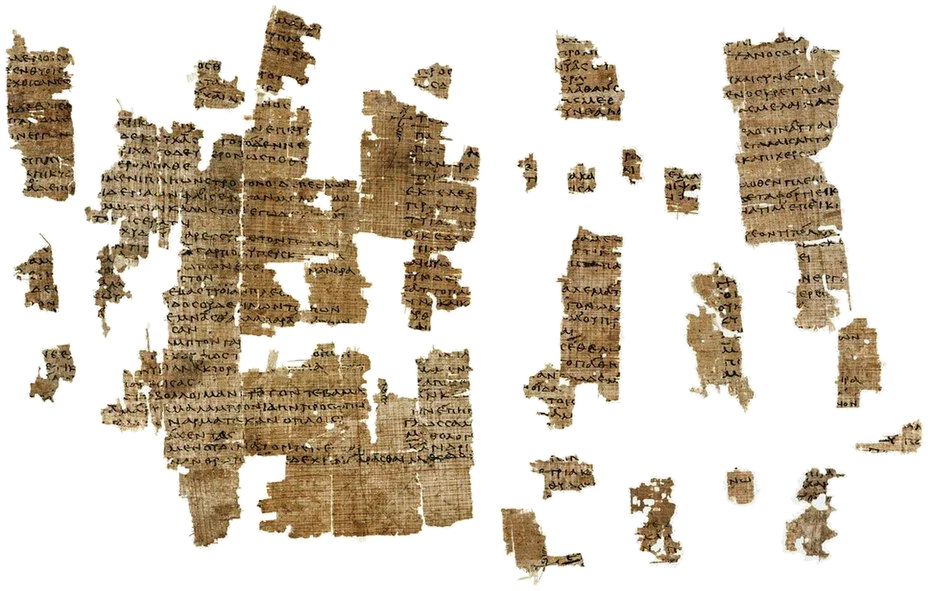
The oldest lyric texts preserved on papyrus were copied in the later fourth and early third centuries BC. They are written out in long lines, like prose.[12] Before the second century BC, lyric was copied without any sign of metrical division.[13] The fourth-century Timotheus papyrus has no colometry at all. It is written in scriptio continua, with the words run together and no spaces between them.[14]
The text was divided into strophes and into short verses, called cola, by Aristophanes of Byzantium in the second half of the third century BC. He was guided by responsion, and by “pauses” that show themselves by hiatus or by brevis in longo. He was also guided by recurring word-ends.[15] The lines we read are therefore an editor’s analysis of the metre.
The diagram imitates the change with the first stanza of Sappho 1. At the top the stanza is run together in capitals, without spaces, accents or line-ends, as early copies wrote lyric. Below it the same words are set out as the editions print them, one colon to a line, with the metre beside each line. The top half is an illustration, not a copy of a real papyrus.
“Immortal Aphrodite of the intricate throne, child of Zeus, weaver of wiles, I beseech you: do not crush my heart, lady, with pain and anguish.” Sappho 1.1–4: three Sapphic hendecasyllables and an adonean.
The metre as evidence for dialect
Forms that the metre does not guarantee may have entered the text in transmission rather than at composition.[16] Forms that it does guarantee are firmer evidence. The sources use this test again and again:[17]
| Case | What the metre shows | Source |
|---|---|---|
| Stesichorus 97.217 θανόντᾰς | Doric short -ᾰς guaranteed by the metre | de Kreij 2022, p. 151 |
| Bacchylides | mixed dialect forms, often fixed by the metre; -εν where a short syllable is needed | de Kreij 2022, p. 158; Maehler 2004, p. 12 |
| choral lyric generally | few exclusively Doric forms guaranteed; non-Doric ἄν (never κᾱ) in Stesichorus | D’Alessio 2009, p. 127 n. 55 |
| Alcman 1.43 φαίνεν | the short infinitive is unmetrical there | D’Alessio 2009, p. 125 |
| Tyrtaeus | Ionic movable ν and ἄν, ἤν guaranteed; Doric future ἀλοιήσευ[μεν (19.12 W) guaranteed | D’Alessio 2009, p. 122 |
| Lesbian βρ- for ϝρ- | makes position, so it may record a real archaism (Bowie, against Hooker) or be an editorial signal of a long syllable | de Kreij 2022, p. 148 n. 11; Tribulato 2021, p. 142 n. 20 |
| Sappho’s contract verbs | athematic or thematic forms apparently chosen to suit the metre or the subject | Tribulato 2021, p. 141 |
Notes
- ^ Sampson 2022, p. 101.
- ^ Sampson 2022, pp. 93, 107.
- ^ Sampson 2022, p. 108.
- ^ Sampson 2022, p. 110.
- ^ Sampson 2022, p. 93.
- ^ de Kreij 2022, pp. 146, 154.
- ^ D’Angour 2022, p. 132.
- ^ Tribulato 2021, pp. 143–144.
- ^ Natoli et al. 2022, p. 329.
- ^ West 1987, p. 68; Golston and Riad 2005, pp. 79–80.
- ^ Tribulato 2021, p. 144.
- ^ Maehler 2004, p. 14.
- ^ Sampson 2022, p. 114.
- ^ Phillips 2022, p. 120.
- ^ Maehler 2004, p. 14; Phillips 2022, p. 120.
- ^ D’Alessio 2009, pp. 122–123.
- ^ For the details see the dialect pages: Doric of choral lyric, tabs 2 and 5, for Alcman and Stesichorus and its tab 4 for Bacchylides, Epic Ionic for Tyrtaeus, and Lesbian Aeolic for βρ- and Sappho’s verbs.
Overview · 4 of 4
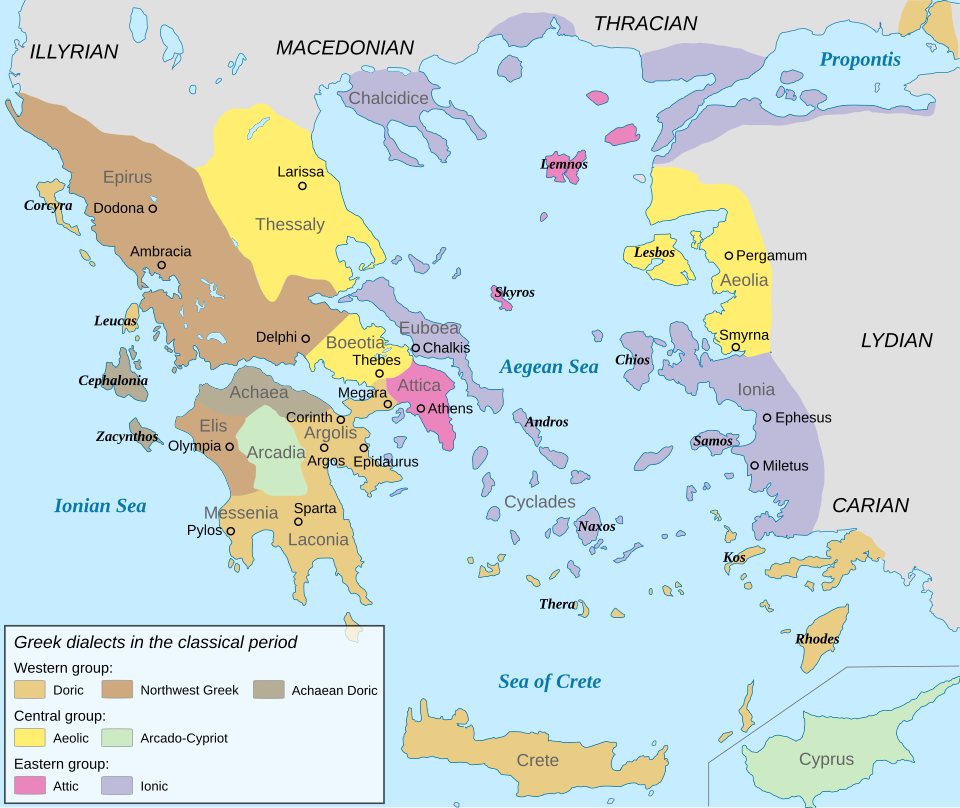
Map of the dialects and the poets
A Greek poet wrote not in the dialect of his or her home town but in the dialect his or her chosen genre had inherited from the region where it grew up: Ionic for epic, elegy and iambus, East Aeolic for the songs of Lesbos, Doric for choral lyric, Attic for the dialogue of drama. The map shows the four dialect groups and the places the poets came from, sang at or wrote about. Click a coloured area for the dialect group, or a dot for the place: its dialect, its metres, its poets and their dates, with links to the pages that say so.
Click or tap a coloured area or a dot: the panel opens over the right of the map, and its arrow tucks it away to the right and brings it back. With the keyboard, Tab moves between them, Enter opens the panel and Esc closes it. Zoom with the buttons above and drag or scroll to pan.
Coastlines and the Nile are drawn from Natural Earth (naturalearthdata.com, 1:10m land, minor islands and rivers; public domain), simplified by metrehelp.org. The coloured dialect areas are schematic: they follow the groupings on the Dialect and genre tab (Attic-Ionic, Aeolic, West Greek including Doric, Arcado-Cypriot) and are not drawn to any ancient boundary. Positions of ancient sites are approximate.


