The music of Greek poetry: instruments, scales and notation, the surviving scores, and how melody and rhythm went with the words.
Rhythm · 1 of 5
Aristoxenus on rhythm
The Greeks thought rhythm the vital part of music. The Problems call it the soul of a song. Aristides Quintilianus calls rhythm male and melody female. Rhythm is also the one element of ancient music that survives nearly intact, because the metres of the poems record it.[1]
Two values
Greek rhythm rests on an opposition of two note values, the one twice the other. There are three proofs. A long syllable is interchangeable with two shorts. The diseme sign in the scores stands over the notes of long syllables. And the ancient writers define the dactyl as 1:1, the iambus as 1:2 and the paeon as 2:3, ratios that only make sense if a long is two shorts.[2]
The rhythm is additive. Fixed small units are strung together into groups of unequal length; a bar of fixed length is not divided up. That is why time-signatures change so often when the music is written out in modern notation.[3] English poetry arranges the stresses of speech into patterns. Greek poetry arranges the durations of its vowels, a long being held for twice the time of a short.[4]
Prōtos chronos: The “primary duration”. This is Aristoxenus’ name for the smallest indivisible time in a given piece, normally the short syllable. It is not a physical constant: in a slow spondaic tempo it is longer.
Aristoxenus
Rhythmic theory began with the sophists and with Damon. Damon classified rhythms by whether their up and down parts were equal or unequal. The three ratios 1:1, 1:2 and 2:3 were noticed as parallels to the harmonic ratios, and some theorists admitted 4:3 as well.[5]
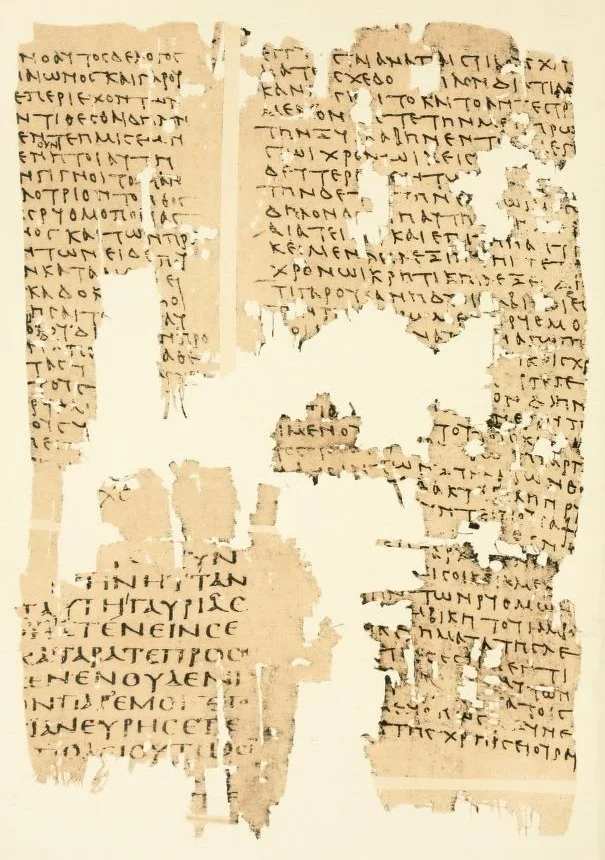
Aristoxenus’ Elements of Rhythm survives only in a few pages of its second book. These are supplemented by a papyrus, and by the later writers who drew on him.[6]
His first move was to separate the rhythm from the things it is imposed on. Speech, melody and bodily movement are the material (rhythmizomena). Rhythm is the ordering of their durations. He rejected the old practice of measuring rhythm by counting syllables, because a syllable has no fixed length: it is the duration that is fixed.[7]
From this came the prōtos chronos, the primary duration, and its multiples, the diseme and the triseme. There were also “irrational” durations that fall between them.[8] A syllable can be stretched or shrunk to fit the time. The sequence long, short, long can fill four units or five. And a long can be held through three units, where the metre alone would show only its length.[8]
In this theory the foot is a repeating group of durations, with an up part and a down part. The ratio between the parts fixes its class: equal (dactylic), double (iambic) or hemiolic (paeonic).[9] Later writers added little. Some separated rhythm from metre altogether, and treated it purely in terms of ratios.[8]
Tempo and character
Aristides defines tempo (agōgē) as the quickness or slowness of the durations. He derives the up and down of the foot, arsis and thesis, from the dancer’s foot, lifted and then placed. The placing is the heavier of the two.[10]
Ancient criticism also heard expression in rhythm. Dionysius of Halicarnassus reads the Sisyphus lines of the Odyssey in this way. Their long syllables imitate the effort of the climb, and their short ones tumble down with the rock.[11]
The sophists’ doctrine of rhythmic ethos set calm against quick, and dignified against lowly. The dactyl of the hexameter was grand and steady. The iambus was close to speech. The trochee was tripping, and fit for the comic dance. The more longs, the grander the rhythm. Feet in equal ratio were orderly, those in 2:1 less so, and those in 3:2 and 4:3 more disturbed.[12] West warns against applying this mechanically. But he allows that running trochaics, solemn spondees and unsettling asymmetries ring true.[13]
Notes
- ^ West 1992, pp. 129–130.
- ^ West 1992, pp. 130–131.
- ^ West 1992, pp. 131, 135.
- ^ Klavan 2021, ch. 8.
- ^ West 1992, pp. 243–244.
- ^ West 1992, p. 244.
- ^ West 1992, pp. 244–245.
- ^ a b c West 1992, p. 245.
- ^ West 1992, pp. 134–135.
- ^ Phillips 2018, pp. 76–77.
- ^ Phillips 2018, p. 75.
- ^ West 1992, pp. 157–159; Phillips 2018, p. 77.
- ^ West 1992, p. 159.
Rhythm · 2 of 5
Up-beat and down-beat
Greek musicians beat time. They clapped, and they used castanets. The piper who led a chorus wore a clapper-shoe (kroupeza) to stamp the beat. A lecturer on music in a papyrus of about 390 BC beats on a little board.[1]
From the second half of the fifth century, Damon’s time, each measure was thought of as having an up and a down. These were called anō and katō, and later arsis and thesis, “lifting” and “placing”. The two parts need not be equal, and the thesis is usually the longer.[1]
What the terms mean
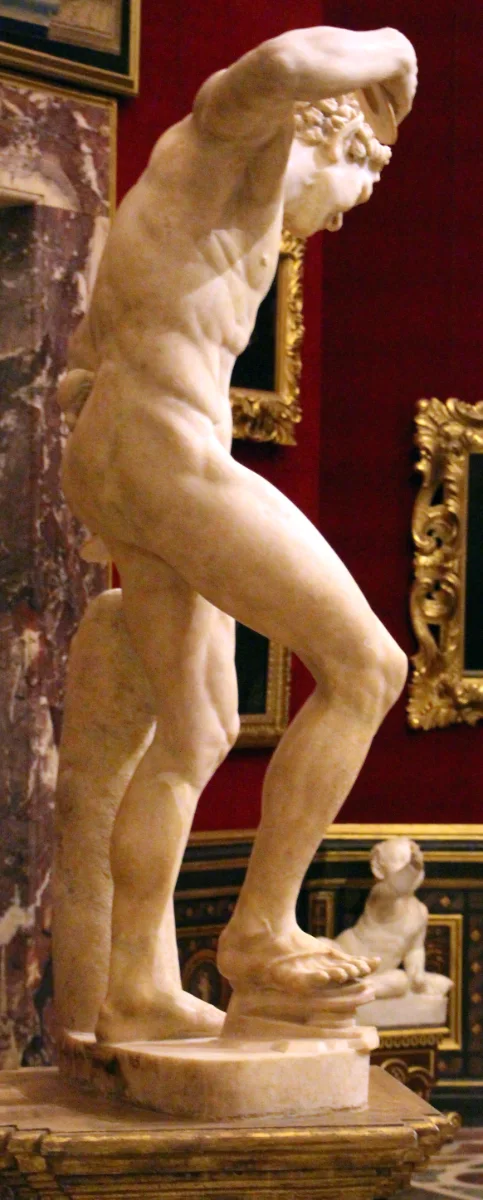
Aristides Quintilianus derives the pair from the dancer. The foot lifted is the arsis. The foot placed, with the body’s weight behind it, is the thesis.[2] The terms may have begun as dance steps, and the thesis may have been marked by drums or castanets. Most scholars take the thesis as the moment of greater emphasis, a down-beat, and the arsis as an up-beat.[3]
In the scores, the arsis is what gets marked. A point (stigmē) stands above its notes, and the treatise of the Anonymus says expressly that the thesis is left unpointed.[4]
Some cautions matter here. The “feet” of Greek rhythmic theory are like bars, in that they repeat. But unlike modern bars, their elements are of unequal length and coincide with notes, and the down part may follow the up. The bar-lines in transcriptions mark the measures that the ancients recognised. They imply nothing about a dynamic accent.[5]
The same holds for Pindar. We do not know where his up-beats and down-beats fell, and there is no simple correlation between long syllables and stress.[6] The wider question, whether Greek verse had a beat at all and what the term ictus is worth, belongs to the Accent page of the Metre section.[7] Here the concern is only what the musical sources say.
Stigmē: The point written above a note in a score to mark the arsis. Each note of a two- or three-note arsis is usually pointed. The Delphic paeans have none, while the Seikilos song and the Orestes papyrus have them.
Where the beat fell
The pointing in the documents, together with the statements of the theorists, lets each basic rhythm be given its up and down:
- In the iambic bar of six units, ♪ ♩ ♪ ♩, the first short-long pair is the thesis and the second the arsis. Aristides says so, and the Seikilos stone marks it so.[8]
- In anapaests the two shorts are the arsis and the long the thesis. The dactyl reverses this: the long is the thesis, and the two shorts the arsis.[9]
- In the paeon the first long is the thesis.[10]
- The dochmiac has eight units, in groups of three and five. The first note of each group is the arsis, and the rest is thesis. That is exactly how the Orestes papyrus points it.[11]
- In ionics the two shorts are the arsis, and the longs the thesis.[12]
D’Angour draws the consequence for the Orestes fragment. If the points mark the up-beat, the down-beats of the dochmiac ⏑ – – ⏑ – fall on the second and on the fourth and fifth positions. So the rhythm is not a march of equal stresses. In his comparison it is nearer to the swing of “that ol’ man river”. The down-beat also coincides with the accented syllables of two of the words. So a stamp of the foot could do the work of a rise in the melody.[13]
For the Seikilos song, four centuries later, he goes further. By then spoken Greek had a stress accent. In the last phrase those stresses fall on syllables that do not carry the written down-beats. A singer who kept both would produce a cross-rhythm. He suggests that the composer may have felt the bar differently from the way the editors print it.[14] This is D’Angour’s reading, not the editors’, and the site presents it as such.
Notes
- ^ a b West 1992, pp. 133–134.
- ^ Phillips 2018, pp. 76–77.
- ^ Klavan 2021, ch. 8.
- ^ West 1992, p. 268.
- ^ West 1992, p. 134.
- ^ Phillips 2018, pp. 79–81.
- ^ See the Stress and ictus tab there.
- ^ West 1992, p. 137.
- ^ West 1992, pp. 136–137.
- ^ West 1992, pp. 140–141.
- ^ West 1992, p. 143.
- ^ West 1992, p. 145.
- ^ D’Angour 2018, pp. 63–64.
- ^ D’Angour 2018, pp. 69–72.
Rhythm · 3 of 5
Sung rhythm and the metre of the words
Greek metre is quantitative, so it reflects the rhythm of the music with reasonable fidelity. A strophe’s metre is repeated exactly in its antistrophe, and that proves that the musical rhythm repeated too.[1]
Rhythm is a function of syllable length. So it was wholly in the composer’s hands, in a way that melody, passed on by ear, was not. The ancients valued it the more for that. Aristoxenus said that the older composers were lovers of rhythm, and the moderns lovers of melody.[2]
Two to one?
The theorists’ ratio of long to short is 2:1. In the notated scores, where a value is specified, short syllables take short notes and long ones long.[1] But was speech so exact, and was song?
For the hexameter as Homer sang it, West thinks that the ratio was less than two to one, perhaps about five to three. That is the proportion Dionysius of Halicarnassus assigns to the spoken quantities. The strict musical ratio would then have been imposed by the dance-rhythms of lyric. Bartók drew a similar distinction, between the free parlando-rubato of sung narrative and the tempo giusto of dance-song.[3] The “cyclic” dactyl of the ancient theorists, in which the long is shortened, belongs to this question.[4]
Plato wanted the words to lead: melody and rhythm must follow the text.[5] Dionysius complains that music alters the quantities of words. What the fragments actually show is modest. A long is sometimes stretched to three or four units. In one papyrus a short syllable closed by a consonant is treated as long. But no long is ever shortened.[6]
The one exception is the Christian hymn of the third century AD. It lengthens shorts freely, because by then the distinction of quantity had been lost in speech.[7] Mesomedes keeps the rule. He never puts a two-unit note on a short, or a one-unit note on a long. A long may be sung to one note of two units, or to two notes of one unit each.[8]
Triseme: A note held for three units, marked in the scores with a bar and a tick. It arises when the short and long of an iambic metron are run together into one note. It is the main way in which sung rhythm departs from the simple quantities of the text.
Stretched notes
The triseme is a variation on the 2:1 pattern, not a departure from it. When the short-long pair of an iambic measure is sung on one note, the result is a three-unit note. In the archaic poets this run-together note was confined to the start or the end of a sequence. From Simonides on, in choral lyric and tragedy, it moved freely. It explains why long-short-long, short-long-long and long-long can stand for the iambic metron.[9]
A papyrus of rhythmic theory from Oxyrhynchus, and the Seikilos song, confirm the account.[10] The choriamb, in this view, is the same bar with its first two values transposed: a “Scotch snap”.[10]
D’Angour reads the second line of Seikilos in this light. Without the signs, one might sing it in “scansion mode”, stretching the longs and squeezing the shorts. But the duration marks and points show an even pulse. He prefers to call the effect prolongation rather than syncopation.[11]
The opposite case is spondaic tempo. Invocations and libation songs made wholly of long syllables were sung slowly. Here the contrast of short and long became one of two units against four. On West’s analysis the Berlin paean is an anapaestic rhythm slowed to double length. The orthios and the “marked trochee” of the theorists had an arsis of four units and a thesis of eight: a slow beat without a slow tempo.[12]
Bars of unequal length
The aeolic metres show how far the Greek bar is from the modern one. A glyconic opens with two free positions. West argues that these are a relic of Indo-European syllable-counting verse. Sappho’s version sets two unregulated notes outside the rhythm, and then a rhythmised six. The ancient division of the line is into an antispastic and an iambic measure, each with equal thesis and arsis. That gives two bars of six units, where a German or English reader instinctively hears bars starting on a long.[13]
The Sapphic and Alcaic stanzas end with a ten-unit bar, made by packing two six-unit bars together. West hears in them “snappy syncopations” and changes of bar-length. These belong with Balkan dance music rather than with nursery rhymes.[14]
Notes
- ^ a b West 1992, p. 130.
- ^ D’Angour 2018, pp. 49–50; West 1992, pp. 152–153.
- ^ West 1992, pp. 135–136.
- ^ West 1992, p. 136.
- ^ West 1992, p. 132.
- ^ West 1992, pp. 132–133.
- ^ West 1992, p. 133 n. 11.
- ^ Psaroudakes 2018, pp. 125–126, 129–130.
- ^ West 1992, pp. 138–139.
- ^ a b West 1992, p. 139.
- ^ D’Angour 2018, pp. 69–70.
- ^ West 1992, pp. 155–157.
- ^ West 1992, pp. 147–148.
- ^ West 1992, pp. 149–150.
Rhythm · 4 of 5
A musician's view of Greek rhythm
John Landels wrote his account of Greek rhythm for readers who know Western music rather than Greek metre. It makes a useful foil to West’s. Some of what he says is the common view. Some is his own, and is marked as such here. His assumptions about stress belong to an older textbook tradition. They are set out on the Arsis and thesis tab and, from the side of the language, on the Accent page of the Metre section.
The words carry the rhythm
In the surviving scores the notes stand above the words, usually with no rhythmic signs at all. The words themselves embodied a rhythm that the singer could read off. Only from the late fifth century, when music began to assert a rhythm of its own, did a rudimentary rhythm notation become necessary.[1] The documents show the same. Values are left unspecified because the metre suffices, and the rhythmic notation grew up later to supplement the pitch signs.[2]
Landels goes further. Two time-values, long and short, are enough for analysis and textual criticism, he says. But they can hardly be the whole of performance, since an ordinary modern melody uses six, and rests are only occasionally marked. The ancient signs allow four values, and he doubts that such variety arose from nowhere.[3]
He also warns against bar-lines. A European ear restores regularity by prolonging notes or adding rests. A lyric line that looks like four dactyls with a syncopated third may simply be a four-beat line whose last beat is syncopated. It needs nothing but long and short.[4] Feet are not bars, because the thesis was not always on the first syllable.[5]
Anapaests, ionics, cretics
The anapaest raises a question that Landels leaves open. When a dactyl stands in for a spondee, did the beat shift to the dactyl’s first syllable? Or was the dactyl a resolved spondee, with the beat where it was? That would make an out-of-step effect against the dance, which “might have been quite effective”. He thinks the question beyond knowing.[6]
In the Ionic dimeter he puts the beat on the central part of each foot, since catalexis drops the last syllable. Anaklasis is the interchange of the two central syllables, and Landels reads it as syncopation in modern terms. It was Anacreon’s favourite rhythm, used in his stanzas except in the closing line. Euripides gave it to the maenads’ dance in the parodos of the Bacchae, where it must have made “a curious, shifting rhythmic effect”.[7] West describes the anacreontic in the same terms, as syncopation across the bar-line.[8]
Landels puts the cretic or paeonic in five-time, divided 2 + 3 or 3 + 2 indifferently. It is the rhythm of the Delphic hymns, of bawdy comic choruses, and of the war-chant that the Greeks sang as they rowed out at Salamis. Whether the oar-strokes fitted 2 + 3 or 3 + 2 he leaves to the naval experts.[9]
The dochmiac: ten quavers in eight
The dochmiac is ⏑ — — ⏑ —: eight shorts’ worth, divided 3 + 5. Its commonest variant is ⏑ ⏖ — ⏑ —. Here Landels parts company with the editors. Resolution of the longs can be fitted into the eight units. But when the fourth syllable, or the first, is lengthened, the foot holds ten quavers’ worth of syllables in an eight-quaver bar.[10]
West’s solution, as Landels reports it, is to treat two crotchets as a quadruplet and three as a sextuplet: four quavers in the time of three, and six in the time of five. Landels thinks this prescription would daunt an orchestral percussionist, let alone an amateur chorus-singer.[11]
His own view, which he calls heretical, is that chorus-singers did not treat the quantities of syllables as sacred. They simply fudged, using false quantities where they had to, in order to fit the words into the basic pattern.[12] The site reports this as Landels’ view against the editors’. What the scores show of such lengthenings is on the What the documents show tab.
Beyond the dochmiac, Landels holds, the lyric rhythms cannot be divided into repeating feet with a fixed beat. So they cannot honestly be written in modern notation with bar-lines. The usual analysis into modified iambic groups is sound for the metrician. But it tells a performer nothing about the sound, since it implies a knowledge of stress that we do not have.[13]
Notes
- ^ Landels 1999, c. pp. 110–111.
- ^ West 1992, p. 130; Pöhlmann and West 2001, p. 1.
- ^ Landels 1999, c. pp. 115–116.
- ^ Landels 1999, c. p. 116.
- ^ Landels 1999, c. p. 114; West 1992, p. 134.
- ^ Landels 1999, c. pp. 117–118.
- ^ Landels 1999, c. pp. 119–121.
- ^ West 1992, p. 145.
- ^ Landels 1999, c. pp. 121–122; West 1992, pp. 140–141.
- ^ Landels 1999, c. p. 122.
- ^ Landels 1999, c. p. 122; West 1992, pp. 143–144.
- ^ Landels 1999, c. pp. 122–123.
- ^ Landels 1999, c. p. 123.
Rhythm · 5 of 5
What the scores show about rhythm
The scores are few, late and short. But on rhythm they speak clearly. A composer wrote rhythm down only when it departed from what the metre already said.[1] Set in order of date, the scores show the rhythmic notation growing up beside the pitch signs.[2]
The Orestes papyrus
The oldest score is a chorus of Euripides, copied about 200 BC. It is in dochmiacs, and it is already pointed. Points mark the up-beats and disemes the longs. From them the editors print the rhythmic pattern of each dochmiac.[3] The dochmiac has two groups, of three and of five units. In each group the first note is the arsis, and the rest is thesis. This rule is drawn from the papyrus.[4]
Between the dochmiacs stands an instrumental note, also pointed. It probably sounded with the start of each bar, rather than in a gap between the words.[5] The dochmiac is a rhythm of the fifth century alone. After Euripides it survives in a single Hellenistic concert aria.[6]
The Delphic paeans
The two hymns of 128 BC have no rhythmic signs at all. The editors derive their rhythm from the metre, which is paeonic almost throughout.[7] What the paeans do show is how a long could be divided. A long syllable could be sung to two notes of one unit each, with its vowel written twice.
In each hymn the plain forms of the five-unit foot alternate freely with divided ones. So a rhythm with no metrical variety at all avoids monotony.[8] About one long in three or four is divided in the paeans, against one in six in the Orestes fragment. In Mesomedes the figure is much lower.[9]
The Seikilos song
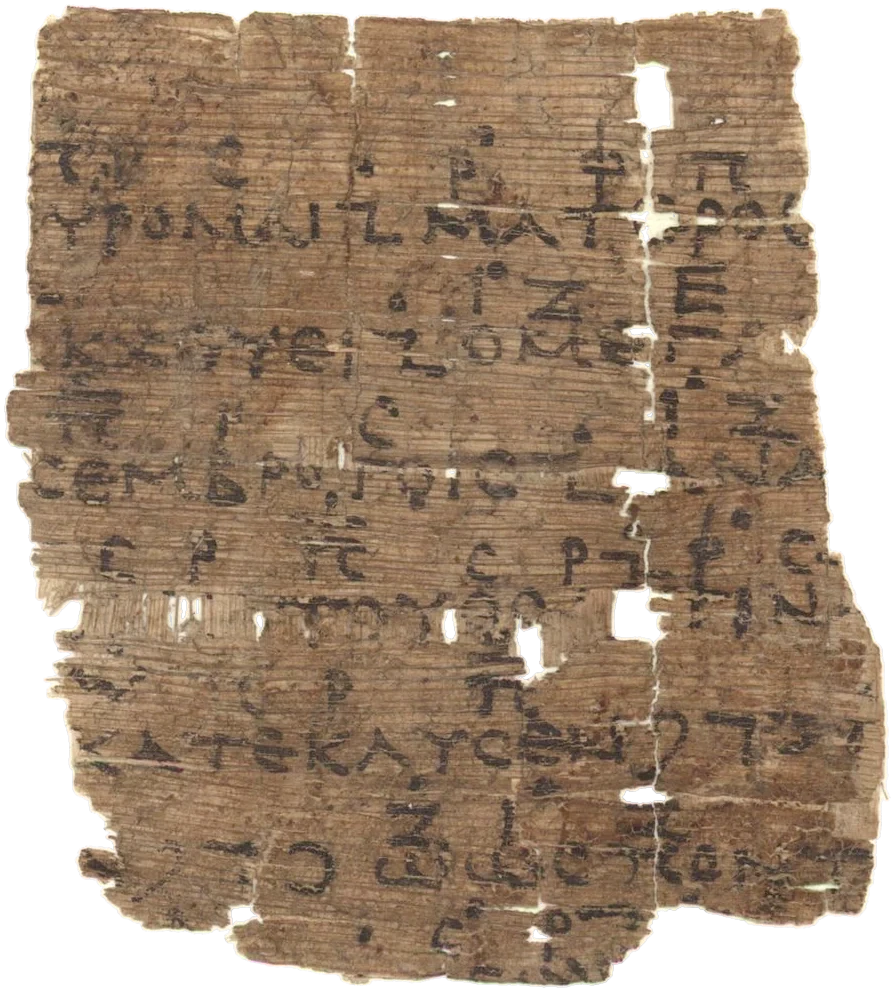
The stone of the first or second century AD is the only document in which every value is written. There are disemes on the two-unit notes and trisemes on the three-unit ones. There are points on every up-beat, and slurs under the notes that share one syllable.[10]
It is also the only text in which the triseme sign occurs. The tetraseme and pentaseme of the treatises are found in no score.[11] Its four lines are each two iambic measures, realised in four different ways. The signs are there precisely because the metre alone would not fix them.[12]
Mesomedes
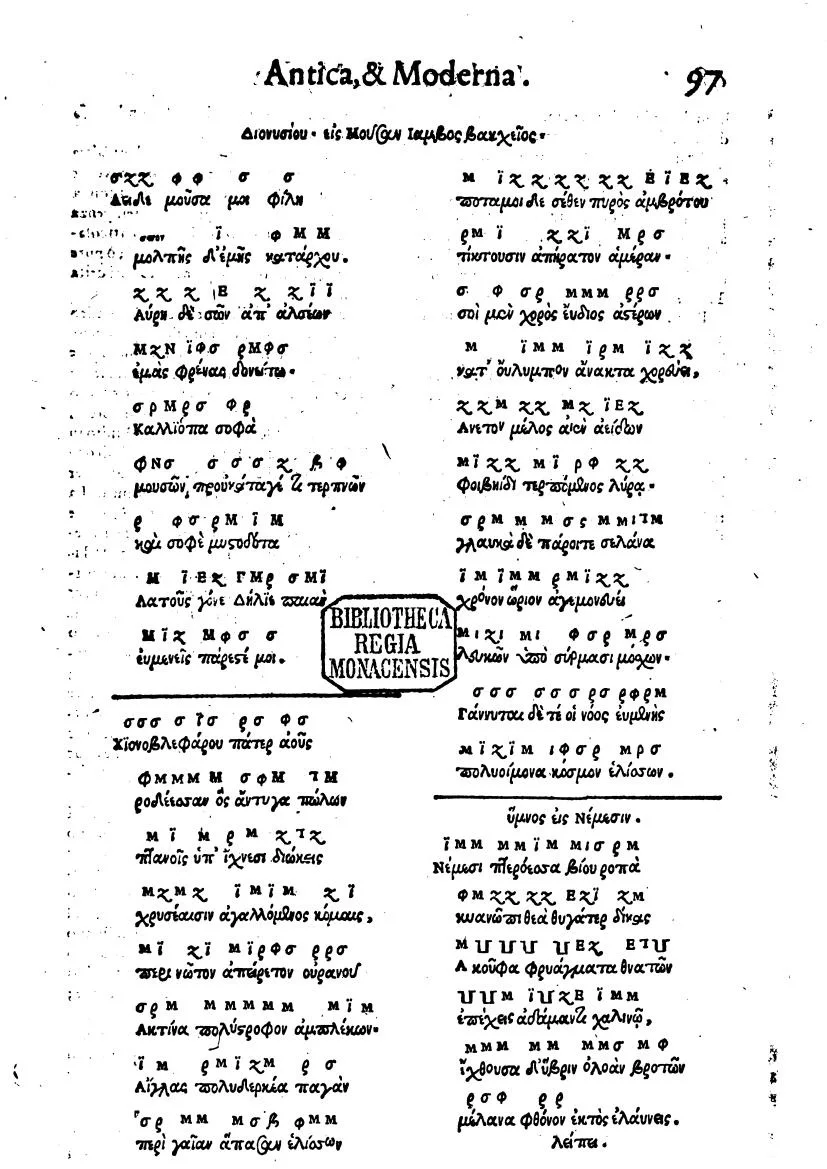
The hymns of Hadrian’s court musician are in lyric anapaests. They obey the rules strictly. A short gets a one-unit note. A long gets a two-unit note, or two one-unit notes. It is never the other way round.[13]
Their line-ends are made equal in length by stretching the first of the two final longs to three units, in any of three ways. So cola of different metrical shape last the same time. Psaroudakes reads this as a regularisation rather than an expressive effect.[14] The leimma, the sign of a rest or a held note, is common at these catalectic endings. In the hymns to the Sun and to Nemesis there are sixteen such endings, and six of them have a leimma.[15]
Later papyri
The papyri of the second and third centuries AD add rests, at the beginning of bars and inside them. The Oslo papyrus writes them out, and in two Oxyrhynchus papyri bars begin with a rest.[16]
These papyri also divide syllables more freely: a diseme over three notes, or a short over two. Mythological names are given elaborate treatment. The style has moved from one note to a syllable towards something nearer the melismatic.[17] In melismatic singing one syllable is spread over many notes.
The Berlin papyrus has a paean in slow spondaic time, and several instrumental pieces. It supports two of West’s reconstructions. One is that the final long of a dactylo-epitrite period was prolonged. The other is that spondaic tempo doubled every value.[18] The Christian hymn from Oxyrhynchus closes the series. Its rhythm no longer respects quantity, because the language it was sung in no longer had it.[19]
Notes
- ^ West 1992, p. 130.
- ^ Pöhlmann and West 2001, p. 1.
- ^ Pöhlmann and West 2001, p. 15.
- ^ West 1992, p. 143.
- ^ West 1992, pp. 206–207.
- ^ West 1992, p. 142.
- ^ Pöhlmann and West 2001, p. 72; West 1992, p. 141.
- ^ West 1992, pp. 141–142, 383.
- ^ West 1992, pp. 202–203.
- ^ Pöhlmann and West 2001, p. 90.
- ^ Anderson 1994, p. 206; West 1992, p. 266.
- ^ West 1992, p. 301; see the Seikilos sign by sign tab of the Notation page.
- ^ Psaroudakes 2018, pp. 129–130.
- ^ Psaroudakes 2018, pp. 125–126.
- ^ Anderson 1994, p. 208.
- ^ West 1992, pp. 136–137.
- ^ West 1992, pp. 203, 384.
- ^ West 1992, pp. 151–152, 155–156.
- ^ West 1992, pp. 133, 384.


