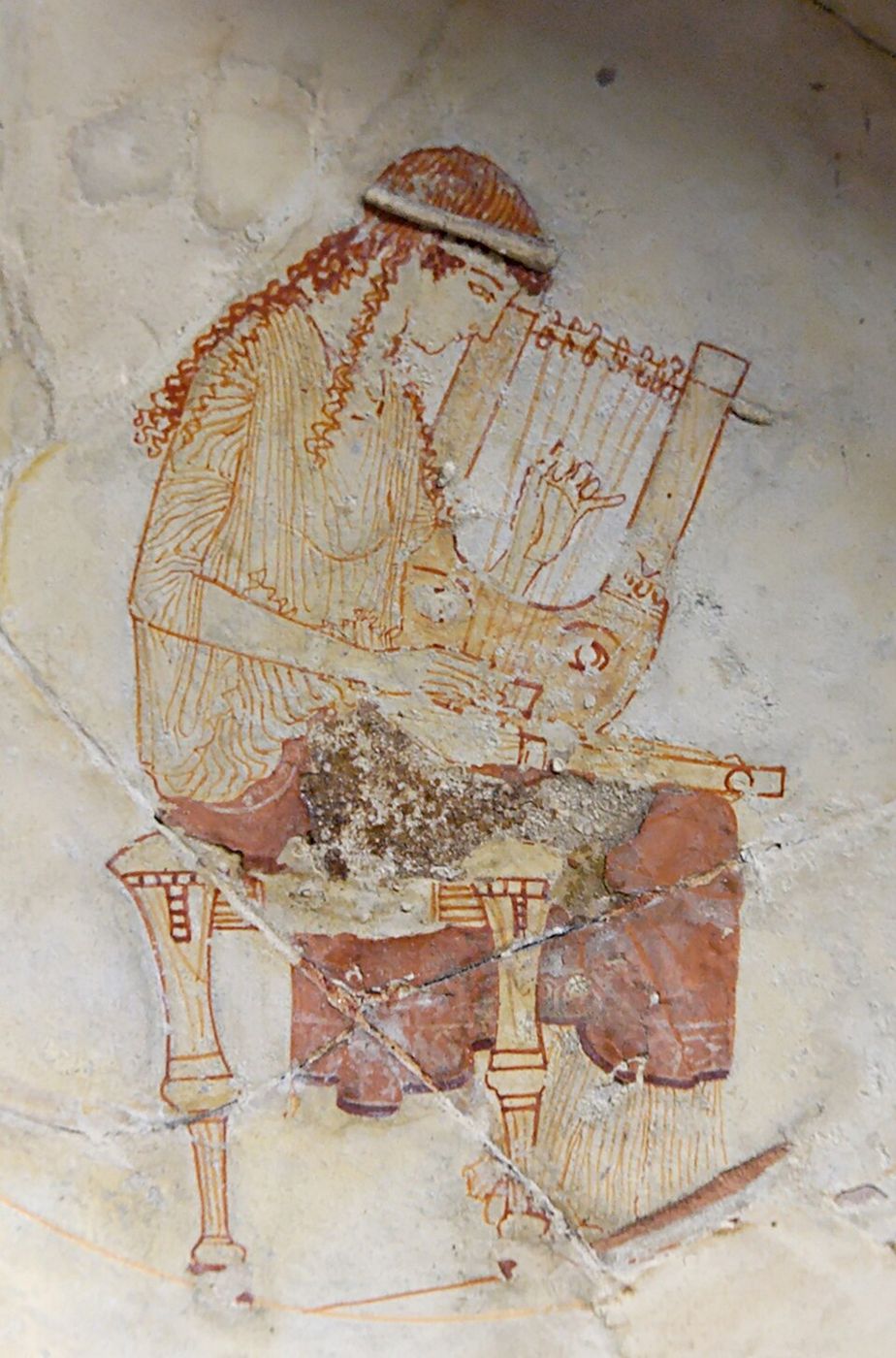
Scales and harmoniai
Tetrachords, genera, keys and octave species: the structure of ancient Greek scales.
The music of Greek poetry: instruments, scales and notation, the surviving scores, and how melody and rhythm went with the words.
Scales · 1 of 5
Tetrachords and the three genera
Greek scales were not built from the octave down, but from the fourth up. The fourth, the fifth and the octave were the concords (symphōna). Every other interval was a discord, acceptable in a melody but not as a frame.[1]
The unit of construction is the tetrachord. A tetrachord is four notes spanning a fourth. Scales are strings of tetrachords. Two tetrachords that share a note are called conjunct. Two that are separated by a whole tone are called disjunct.[2]
Tetrachord: Four notes bounding a perfect fourth. Its two outer notes are fixed. The two inner ones move, and where they stand decides the genus.
Fixed and moving notes
The two outer notes of a tetrachord are the standing notes, and they never change. The two inner notes are the moving notes. They can be set in three ways, and the three settings are called the genera:[3]
- In the diatonic the fourth is filled by a semitone and two tones: e f g a.
- In the chromatic the two inner notes lie a semitone apart, leaving a minor third above: e f f♯ a.
- In the enharmonic they lie about a quarter-tone apart, leaving a ditone above: e e↑ f a.[4]
A ditone is an interval of two whole tones. In the chromatic and enharmonic the two moving notes crowd together at the bottom. The three close-packed notes are then called the pyknon.[3] These words mean something quite different from their modern uses.[5]
Where the genera came from
The modern ear takes the diatonic for granted. But in the classical period the non-diatonic genera predominated. An octave might contain a single whole-tone step: the disjunction between its two tetrachords.[6]
Aristoxenus believed that the enharmonic had grown out of an older three-note form, e f a, by dividing its semitone. His evidence was that the libation-tune of Olympus, played in the old style, left the semitone undivided.[7] West turns this round. For him the enharmonic and the diatonic are alternative developments of the same pentatonic matrix, in which a fourth was filled by one note only. The chromatic grew the same way, from a division of the tone and the minor third.[7]
Hagel finds the physical source in the aulos. Pipes with evenly spaced holes gave steps of a tone and of a three-quarter-tone. Half-stopping a hole produced the enharmonic microtone.[8]
In the fifth century serious music, Pindar’s and the tragedians’ included, was normally enharmonic. The chromatic, a “colouring”, came in with the professional citharodes from about the middle of the century, and it was said to make men soft. The New Music of Timotheus and Philoxenus modulated among all three genera.[9]
The true quarter-tone was in use in the early fourth century. Aristoxenus defended the enharmonic, with its ditone. But before long the genus was dead in music of the highest level.[10]
By the Roman period the scores are almost wholly diatonic. The diatonic, Aristides Quintilianus explains, is natural. The chromatic is for the trained. The enharmonic is for exceptional musicians, and impossible for most.[11] The notation never distinguished the chromatic from the enharmonic. Nowacki takes this as a sign that the enharmonic was already obsolescent when the system took its final form.[12]
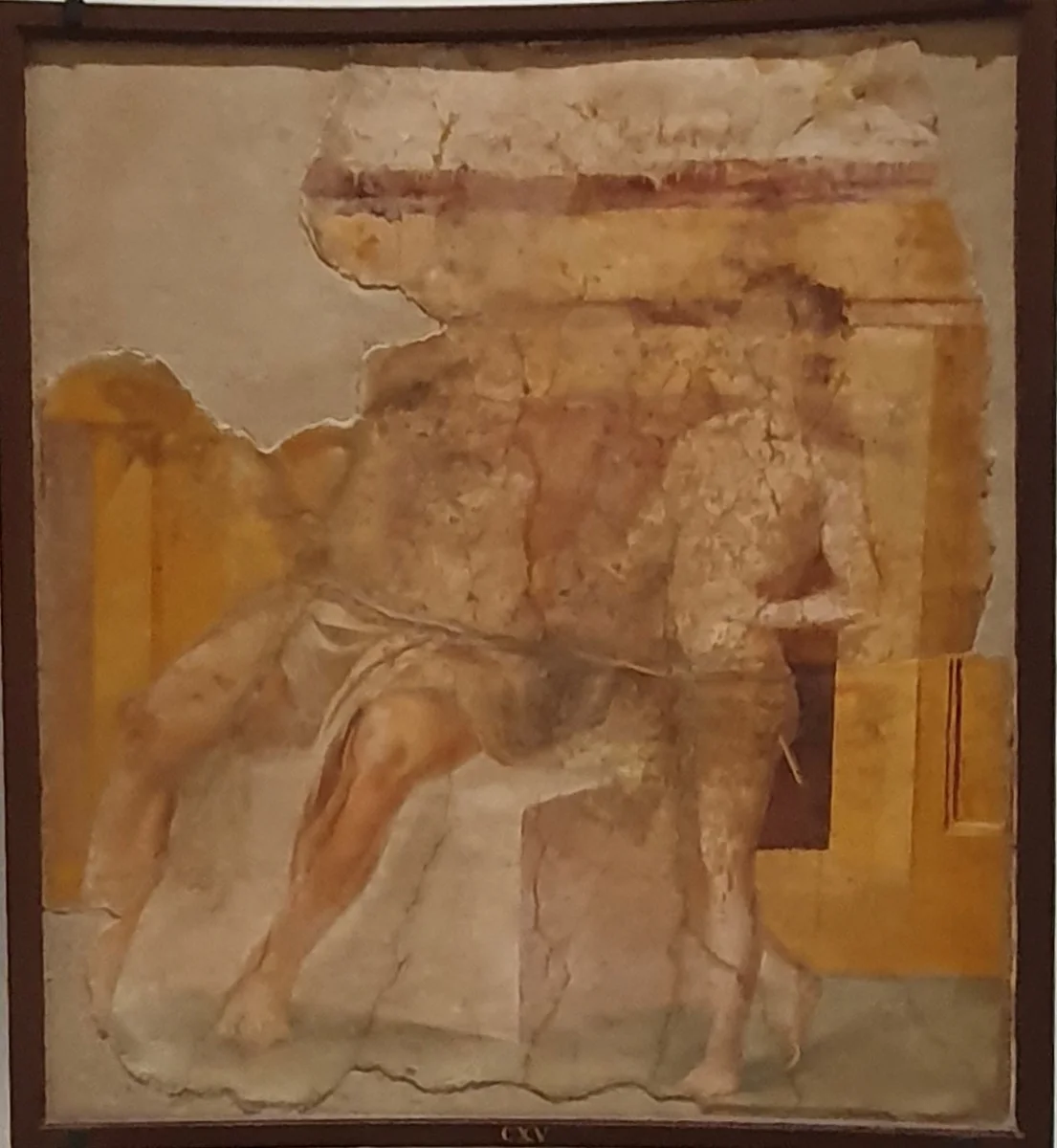
Shades
The diagram draws the inner notes at round values, but the theorists allowed them a range. Aristoxenus gives each genus bands within which the moving notes may lie. He names six “shades”:
- the enharmonic (¼, ¼, 2);
- three chromatics: soft, hemiolic and tonic, the last ½, ½, 1½;
- two diatonics: soft (½, ¾, 1¼) and tense (½, 1, 1).[13]
The Pythagoreans gave ratios instead. They were Philolaus, Archytas, Eratosthenes, Didymus and finally Ptolemy, who lists seven divisions, one of them his own invention.[14]
Notes
- ^ West 1992, pp. 160–161.
- ^ West 1992, p. 161.
- ^ a b West 1992, p. 162.
- ^ West 1992, p. 162; Anderson 1994, p. 198.
- ^ West 1992, p. 162 n. 1.
- ^ West 1992, pp. 161–162.
- ^ a b West 1992, pp. 163–164.
- ^ Hagel 2009, p. 443.
- ^ West 1992, pp. 164–165.
- ^ Hagel 2009, pp. 446–447.
- ^ West 1992, pp. 165–166.
- ^ Nowacki 2020, pp. 46–47.
- ^ West 1992, pp. 168–169.
- ^ West 1992, pp. 167–171; see the Aristoxenus and the Pythagoreans tab.
Scales · 2 of 5
The Perfect System and its note names
The Greek notes are named after the strings of the lyre. The names describe the string’s place, not its sound. On a seven-stringed instrument they ran, in descending pitch:
- nētē, “bottom”;
- paranētē, “beside bottom”;
- tritē, “third”;
- mesē, “middle”;
- lichanos, “forefinger”;
- parhypatē, “beside topmost”;
- hypatē, “topmost”.[1]
The topmost string is the lowest in pitch. The player held the lyre tilted away from him, so the string nearest him, the lowest-sounding, was uppermost.[2] The names are feminine adjectives, with chordē, “string”, understood.[3]
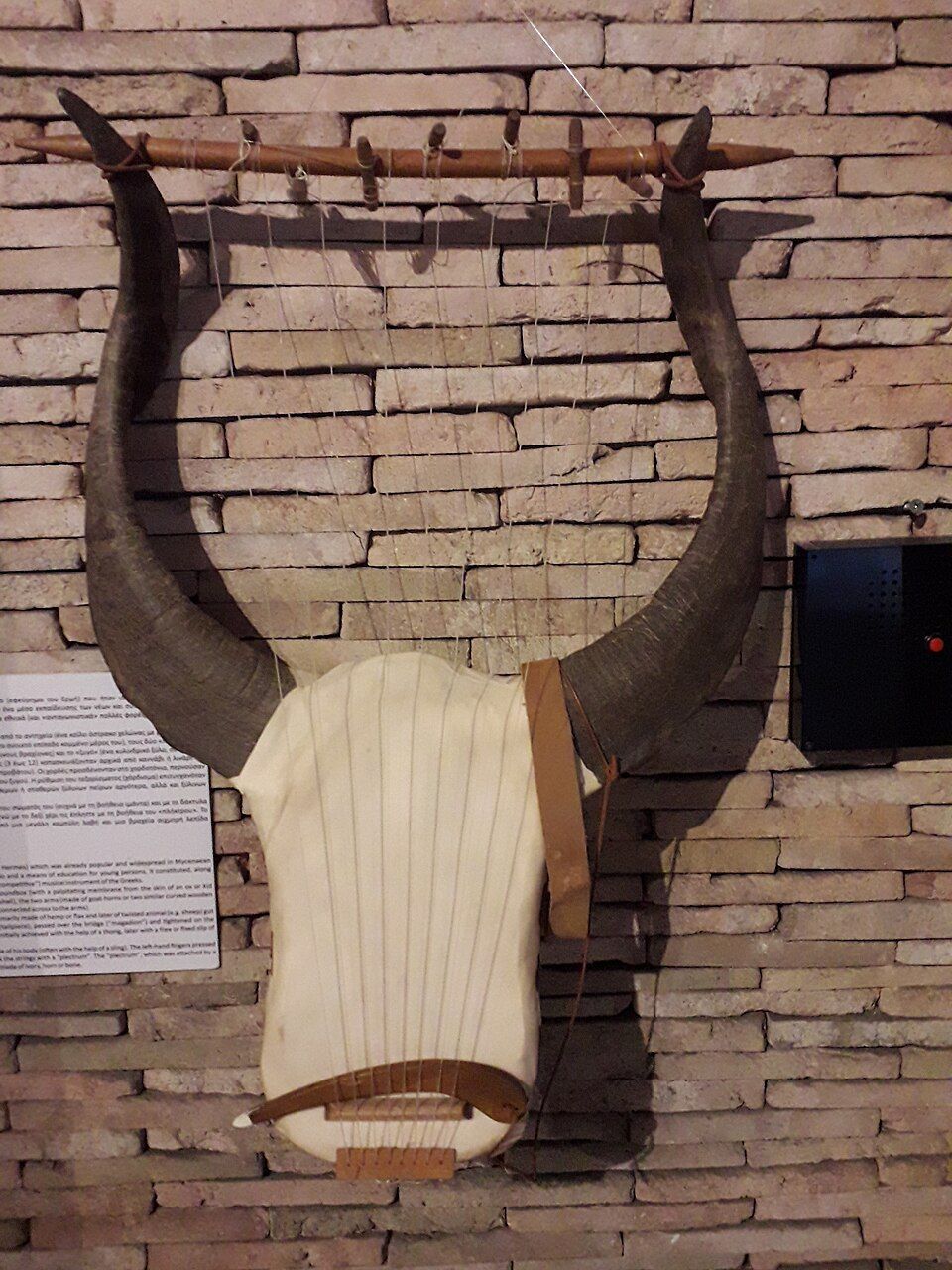
From seven strings to two octaves
A seven-note scale gives two tetrachords. They are either conjunct, sharing mesē, or disjunct, with a tone between them. The Peripatetic Problems know both forms as old heptachords.[4] An eighth note, paramesē, “beside the middle”, lay a tone above mesē. It made the two tetrachords disjunct, and it completed the octave.[5]
By the time of Aristoxenus the octave had grown to nearly two, by adding a conjunct tetrachord at each end. So each old name now needed a qualifier. Hypatē hypatōn is the lowest note of the low tetrachord, and hypatē mesōn the lowest of the middle one.
Above mesē the scale forks. One branch is a conjunct tetrachord of “joined” notes (synēmmenōn), going up a fourth from mesē itself. The other is a disjunct tetrachord of “separated” notes (diezeugmenōn). It starts a tone above mesē, and leads on to the “overshoot” tetrachord (hyperbolaiōn). Below everything stands the proslambanomenos, “the note taken in addition”, a tone under the lowest tetrachord.[6]
The result is the old Dorian octave e–e′, with a tetrachord hung on each end and a note added below. It was probably put together in the fourth century.[7]
The whole structure with the disjunct branch is the Greater Perfect System. The one with the conjunct branch is the Lesser. Together they make the Unmodulating System. It is so called because it treats the choice between the two branches as something other than a modulation.[8]
Mesē was the common tonal centre. The Problems observe that good melodies keep returning to it, and that if it is out of tune the whole melody suffers.[9]
What the system was for
The names define positions in a sequence of intervals, like do-re-mi. They are not absolute pitches. A singer pitched mesē where his voice was comfortable. The two-octave frame served for cutting regular scales out of, not for melodies spanning two octaves.[10]
Only the standing notes, the outer notes of each tetrachord, are fixed. The inner ones move with the genus. The lichanos in particular was its diagnostic, and it was named “enharmonic”, “chromatic” or “diatonic” accordingly.[11] A standard diagram of the scheme marks the central octave e–e′ as the region that the notation was designed around.[12]
An octave species is one of the seven different arrangements of tones and semitones that a diatonic octave can show. The seven species are simply the seven octaves that can be cut from this ladder, from B–b to a–a′.[13]
Notes
- ^ West 1992, pp. 64, 219.
- ^ West 1992, p. 64; Hagel 2009, p. 5 n. 21.
- ^ West 1992, p. 64.
- ^ West 1992, pp. 176–177; Anderson 1994, p. 199.
- ^ West 1992, p. 220.
- ^ West 1992, pp. 221–222.
- ^ Nowacki 2020, pp. 26–27.
- ^ West 1992, p. 223.
- ^ West 1992, p. 219.
- ^ West 1992, pp. 222–223.
- ^ West 1992, p. 222.
- ^ Hagel 2009, p. 6.
- ^ Anderson 1994, p. 201.
Scales · 3 of 5
Keys and octave species
Two different things carry the names Dorian, Phrygian and Lydian in Greek theory. Much confusion comes from mixing them. One is the species of the octave. This is the pattern of tones and semitones that an octave shows, depending on where in the ladder it is cut. The other is the tonos, the key. The key fixes the pitch at which the whole two-octave system is set.
Species
A diatonic octave can be cut from the Perfect System in seven places. Each gives a different sequence of five tones and two semitones.[1] Before Aristoxenus, Eratocles had already enumerated the seven species by cyclic transfer, and given them modal names. He did so in the enharmonic genus of his day.[2] Cyclic transfer means taking the lowest interval of a series and moving it to the top, one step at a time. In diatonic terms the species are these:
The Dorian species e–e′, with its two disjunct tetrachords and the tone in the middle, is the old central octave. The Hypolydian, Hypophrygian and Hypodorian are the species a fourth or a fifth away. “Hypolydian” may be Eratocles’ invention, made for the sake of symmetry rather than for a mode anyone sang.[3]
Keys
The species are a classification. The keys were a practical device. Once the modes were seen as overlapping segments of one master scale, a problem appeared. A melody in a high-lying species would sit too high, and one in a low species too low. The keys, or “pitches” (tonoi), were invented to counteract this. Each was named after the mode it was meant to carry. So the higher a mode lay in the composite scale, the lower its key.[4]
This is why the order of the keys is the reverse of the order of the species. Mixolydian is the lowest species and the highest key. Hypodorian is the highest species and the lowest key.[5] Put simply, a tonos is a transposition of the two-octave scale, like a modern key. A lyre tuned to a different tonos had its strings at a different tension.[6]
Aristoxenus complains that the older theorists could not agree how many keys there were. Nor could they agree why the keys stood a semitone, three quarter-tones or a tone apart. Their lists merely describe what the aulos-makers were producing, since a piper changed key by picking up another pipe.[7]
Aristoxenus himself laid out thirteen keys at semitone intervals over an octave, the highest repeating the lowest. A later reform brought in Ionian (Iastian) and Aeolian. These filled the places between Dorian and Phrygian and between Phrygian and Lydian. The reform also generalised the prefixes Hypo- and Hyper-, and it ended with fifteen keys in five triads.[8] The fifteen are the keys of Alypius’ tables, and of every surviving score.[9]
Ptolemy objected that only seven keys are needed, one for each species, to bring every species into the comfortable singing octave. The semitone keys, he said, were redundant. But his critique came too late to change the notation.[10]
Natural key: By modern convention the Hypolydian, written with the plain signs, is A minor. So Hypodorian starts on F, and the Dorian key, oddly, needs the most sharps. In practice the Dorian tuning was the first a boy learned, and the one the philosophers esteemed.[11]
What a key tells you
Not the mode. In the later documents the key is a notational fact, like a key signature. The Seikilos song is written in the Ionian key, and it runs in the Phrygian species. West finds its real tonic on the fourth degree of that species, in a “G mode” that no Greek term names.[12] Over half the surviving pieces are in the Lydian or Hypolydian key. That says nothing about their character. It says only that those keys suited the voices and instruments in use.[13] What the Greeks of the classical age had meant by Dorian or Lydian, the harmonia, is another matter.[14]
Notes
- ^ Anderson 1994, p. 201.
- ^ West 1992, p. 227.
- ^ West 1992, pp. 227–228.
- ^ West 1992, p. 228.
- ^ Anderson 1994, p. 202.
- ^ Nowacki 2020, pp. 24, 26–27.
- ^ West 1992, pp. 228–229; Nowacki 2020, p. 25.
- ^ West 1992, pp. 230–231; Hagel 2009, p. 4.
- ^ Nowacki 2020, p. 28.
- ^ West 1992, pp. 232–233; Nowacki 2020, pp. 29–31.
- ^ Hagel 2009, p. 9.
- ^ West 1992, pp. 185–186; Nowacki 2020, p. 29.
- ^ West 1992, p. 259 n. 9.
- ^ See the Harmoniai and ethos tab.
Scales · 4 of 5
The harmoniai and their characters
When Alcman speaks of a Phrygian tune, Pindar of a Dorian lyre, or Plato of the Lydian and Ionian harmoniai he wants banned, none of them is talking about a key or an octave species. The word harmonia means a “fitting together”, an attunement of the strings. It is usually translated “mode”. Nowacki argues for giving that translation up. The Greek term is vaguer and wider than any modern “mode”, and it has no connection with the church modes or modal jazz.[1]
What a harmonia was
Down to the fifth century, the harmoniai were individual and not interchangeable. Only late in that century did they come to be treated as segments of one scale, differing by their starting point.[2]
One document shows what the individuality consisted of. It is a list in Aristides Quintilianus of six scales “which the very ancient peoples used”, probably going back to Damon in the later fifth century. All six are enharmonic, and all are closed systems. Some span an octave, and some more or less. Some are stepwise, and some gapped.[3]
From them West concludes that the harmoniai differed in which notes they used, and over what range. So they differed in their characteristic intervals. To this came particular rhythms and melodic turns, and a tessitura, high or low.[4] The tessitura is the part of the range where a melody mostly lies.
Heraclides of Pontus defined the Dorian harmonia as the “conduct” of melody that the Dorians practised. Nowacki glosses this as an idiom, not just a tuning.[5] He adopts Henderson’s definition: the harmoniai were musical idioms together with the tunings they presupposed, and the tunings are unknowable.[6]
How much Aristides’ list can be trusted is disputed. He wrote some seven centuries after Damon. Most musicologists, Nowacki reports, will not accept the scales as evidence for fifth-century practice, though Hagel treats them as genuine.[7] West uses them with care. From them, and from the notation, he reconstructs the probable pentatonic shapes of the archaic modes.[8]
Franklin goes back further. He argues that the Greek diatonic heptachord, and the naming of tunings from a central string, descend from the Mesopotamian tuning cycle of the second millennium.[9] He presents this as a hypothesis, and so does this site.
Harmonia: An attunement: a set of notes, with their characteristic range, intervals and turns of melody, bearing an ethnic name. Later theory reduced the harmoniai to octave species and keys. The word came to mean the enharmonic genus, or simply “scale”.
The names
Dorian, Phrygian and Lydian are the names most often met. Ionian, Aeolian, Locrian and Mixolydian occur too.[10] Only Dorian names a mainland Greek people. Aeolian and Ionian belong to the Asia Minor coast and its islands, and Lydian and Phrygian to non-Greek peoples of the interior. The characters attached to the names owe much to Athenian stereotype: the stalwart Dorian against the soft Ionian.[11] Each name has its own history:
- Dorian. The Dorian was the most widely used and the best regarded. It was the tuning first taught to boys, solemn and manly. It is heard in Terpander, Alcman, Pindar and the laments of tragedy.[12]
- Phrygian. The Phrygian went with the aulos and the dithyramb, and it ranged from piety to frenzy. Sophocles brought it into tragedy. Aristotle tells how Philoxenus tried to write his Mysians in Dorian, and was forced back to Phrygian by the nature of the genre.[13]
- Lydian. The Lydian was slack and convivial for Plato, and celebratory for Pindar. For Aristotle it was high in pitch and suited to boys.[14]
- Mixolydian. The Mixolydian was, with the Dorian, the chief tragic mode before Sophocles. It was emotional and plaintive. Aristoxenus found it in Sappho, and supposed that the tragedians had taken it from her.[15]
Nowacki files that story, and the other stories of invention, as legends. The others make Terpander the inventor of the Mixolydian, Polymnestus of the Hypolydian, and Damon of the slack Lydian.[16]
Ethos
The belief that each harmonia moulds character is as old as the Pythagoreans. It was systematised by Damon, who held that the state should regulate music.[17]
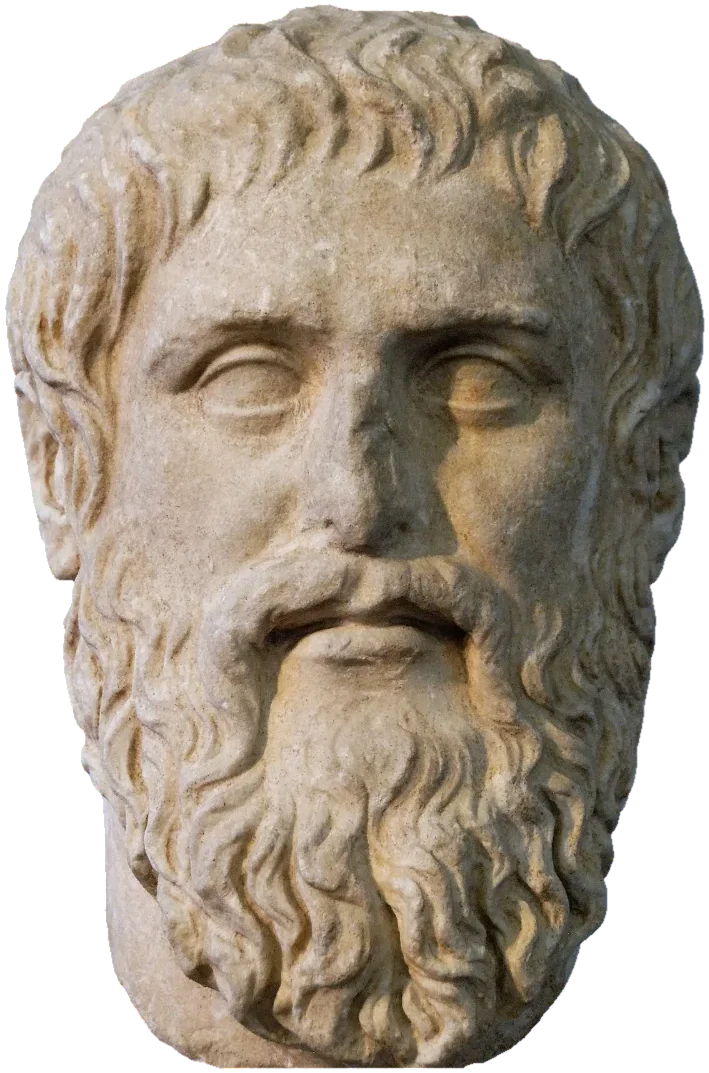
Plato has Socrates keep only the Dorian and the Phrygian, the modes of the brave man and of the man at peace. Socrates rejects the Mixolydian and the tense Lydian as lamentatory, and the slack Ionian and Lydian as fit for drinking parties.[18] Aristotle calls the Dorian the steadiest and most manly, and the Phrygian orgiastic.[19]
A papyrus of about 390 BC already mocks the experts who claimed that tunes make men brave or cowardly. The Epicurean Philodemus later denied that music without words had any moral effect at all.[20]
Nowacki’s caution bears repeating. Plato’s explicit citations of Damon concern rhythm. And Plato appeals to popular stereotype to make a point about education. Athens was a cosmopolitan city that admired Phrygian and Lydian music. For its actual scales in the fifth century, Plato is no witness.[21]
Notes
- ^ West 1992, p. 177; Nowacki 2020, p. 11.
- ^ Anderson 1994, p. 198.
- ^ West 1992, p. 174; Nowacki 2020, pp. 20–21.
- ^ West 1992, pp. 177–178.
- ^ West 1992, p. 178; Nowacki 2020, p. 20.
- ^ Nowacki 2020, pp. 22–23.
- ^ Nowacki 2020, pp. 13, 21.
- ^ West 1992, pp. 174–175.
- ^ Franklin 2018, pp. 17–25.
- ^ West 1992, p. 177.
- ^ Nowacki 2020, pp. 13–15.
- ^ West 1992, pp. 179–180.
- ^ West 1992, pp. 180–181; Nowacki 2020, p. 18.
- ^ West 1992, pp. 181–182.
- ^ West 1992, p. 182; Nowacki 2020, p. 19.
- ^ Nowacki 2020, pp. 18–19.
- ^ West 1992, pp. 246–247.
- ^ West 1992, p. 179; Nowacki 2020, p. 11.
- ^ West 1992, pp. 180–181.
- ^ West 1992, pp. 247–248, 251.
- ^ Nowacki 2020, pp. 14–16.
Scales · 5 of 5
Aristoxenus and the Pythagoreans
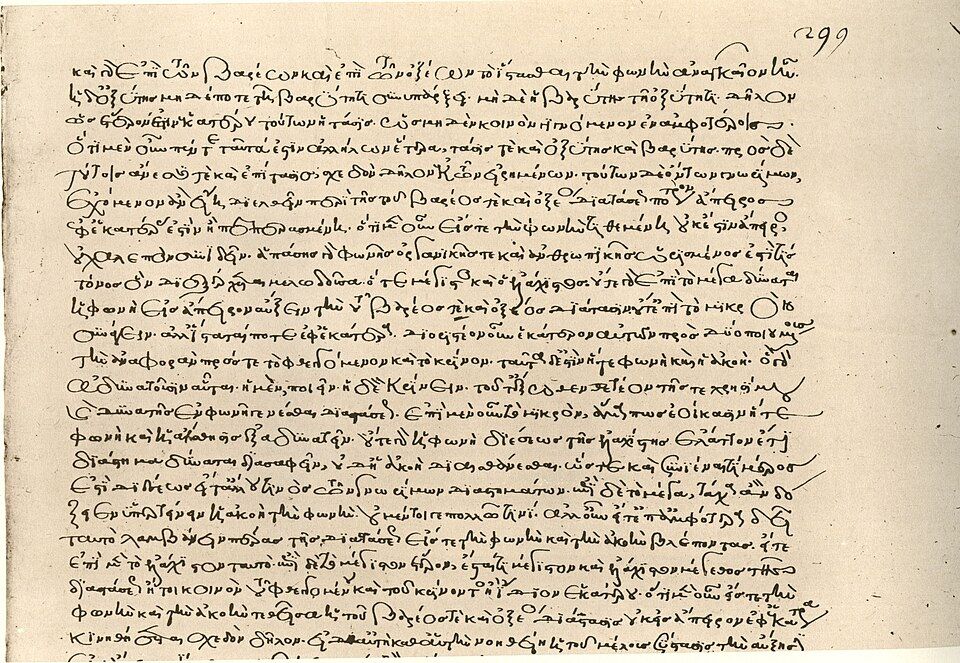
Greek harmonic theory came in two schools, which never agreed about what an interval is. The Pythagoreans measured it as a ratio of string lengths. Aristoxenus of Tarentum, Aristotle’s pupil, measured it by ear. Antiquity left far more of this theory than it did of music, which is an irony.[1]
Number
The Pythagorean starting point is the fact that the concords answer to the simplest ratios. The octave answers to 2:1, the fifth to 3:2 and the fourth to 4:3. The tone, which is the difference between a fifth and a fourth, answers to 9:8.[2]
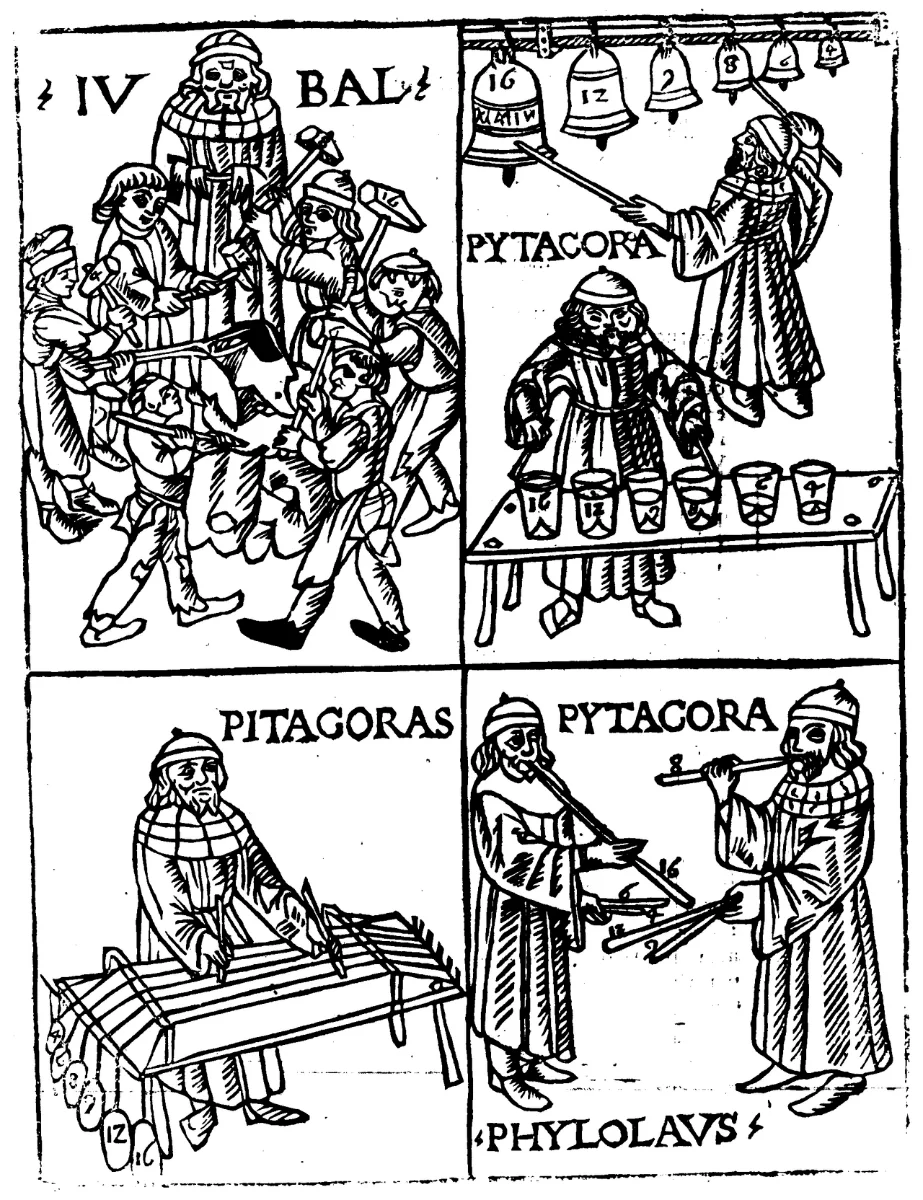
The famous story of Pythagoras hearing the concords in a blacksmith’s hammers is physically false, as Burkert showed. The bronze discs of Hippasus of Metapontum, however, would have worked.[3] From the numbers 1, 2, 3 and 4, the tetraktys, a mystical cosmology grew. In it the universe is a tuned instrument, and the harmony of the spheres is a diatonic octave.[4]
The arithmetic also produced an awkward fact. Two 9:8 tones do not fill a fourth. The remainder, 256:243, is about twelve per cent smaller than a true half-tone. A superparticular ratio is one whose first number is one more than the second, like 3:2, 4:3 or 9:8. Archytas proved that no superparticular ratio, 9:8 included, can be divided into two equal parts. So an exactly equal semitone is impossible.[5]
Philolaus, Archytas, the Sectio Canonis, Eratosthenes, Didymus and Ptolemy each proposed ratios for the moving notes of the tetrachord in every genus. Archytas insisted on superparticular ratios throughout, and so did Ptolemy, except for a single concession.[6] Their instrument was the monochord. This was a single string over a graduated rule, with a movable bridge. Ptolemy found no living tradition of its use, and he recommended a many-stringed canon instead.[7]
Cent: A hundredth of an equal-tempered semitone. It is Ellis’s unit for comparing intervals. The octave is 1200 cents, the fifth 702, the fourth 498, the 9:8 tone 204, and the Pythagorean remainder 90.[8]
Ear
Aristoxenus wanted none of this. Before him, the harmonikoi of Athens had packed diagrams with quarter-tones. In Plato’s phrase, they tortured their strings to find the smallest audible interval. Aristoxenus ridiculed the close-packed diagrams, and asked only what a melody needs.[9]
His axioms are musical, not arithmetical:
- scales are built of tetrachords, conjunct or a tone apart;
- the order of intervals follows the genus;
- every note must make a fourth with the fourth note along, or a fifth with the fifth.[10]
He works with a tone that can be halved and quartered, and with a fourth of two and a half tones. He dismisses the mathematicians’ proof that two tones and a semitone fall short of it.[11]
His demonstration comes at the end of the second book of the Harmonics. It tunes a ditone by concords, and asks the listener to hear the result as a fifth. The Pythagoreans replied that this “fifth” is short by a comma.[12] A comma is a very small interval, less than a quarter-tone.
Nowacki’s defence of Aristoxenus is the most interesting modern reading. The experiment, he argues, is not a measurement that happens to be wrong. It is a piece of reasoning from what the listener judges. The two schools are arguing from incompatible paradigms: the Pythagoreans are doing physical acoustics, and Aristoxenus something like cognitive science.[13]
Aristoxenus conceived pitch as a continuum, and intervals as distances along it. Perceptually equal intervals form a geometric series of string lengths. Modern logarithms show that this tracks the physical ratios exactly. And Western theory has in fact followed him. It hears a diminished fourth as larger than a major third, though the frequencies are the same.[14] His own first principle, Nowacki stresses, is what appears to the senses of the musician.[15]
Afterwards
Aristoxenus became the landmark of all later theory. The handbooks of Cleonides, Gaudentius, Bacchius and Alypius are Aristoxenian. Yet he himself despised notation, and Ptolemy would not use it.[16]
A female musicologist, Ptolemais of Cyrene, argued that reason and perception should go hand in hand. Didymus wrote on the difference between the two schools. Ptolemy’s Harmonics, in the second century AD, took the Pythagorean ratios and tested them against the tunings of working citharodes.[17] Hagel ranks Ptolemy’s book above every other treatise for clarity and method, precisely because it anchors its theory in concert practice.[18]
Notes
- ^ West 1992, p. 218.
- ^ West 1992, pp. 8–9, 235; Hagel 2009, p. 448.
- ^ West 1992, p. 234.
- ^ West 1992, pp. 233–234.
- ^ West 1992, pp. 11–12, 235–237.
- ^ West 1992, pp. 236–240.
- ^ West 1992, pp. 240–242.
- ^ West 1992, p. 12.
- ^ West 1992, pp. 225–226; Nowacki 2020, p. 25.
- ^ West 1992, p. 229.
- ^ West 1992, pp. 166–167.
- ^ Nowacki 2020, pp. 60–61.
- ^ Nowacki 2020, pp. 3, 61–62.
- ^ Nowacki 2020, pp. 62–67.
- ^ Nowacki 2020, p. 66.
- ^ Hagel 2009, p. 3.
- ^ West 1992, pp. 239–240.
- ^ Hagel 2009, p. 451.


