Poets and playwrightsWomen poets
Julia Balbilla
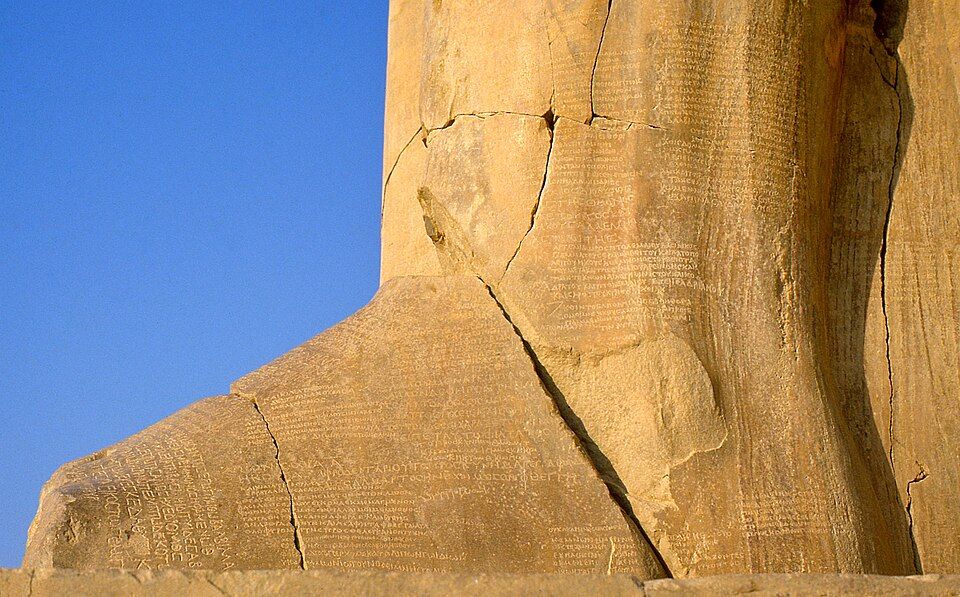
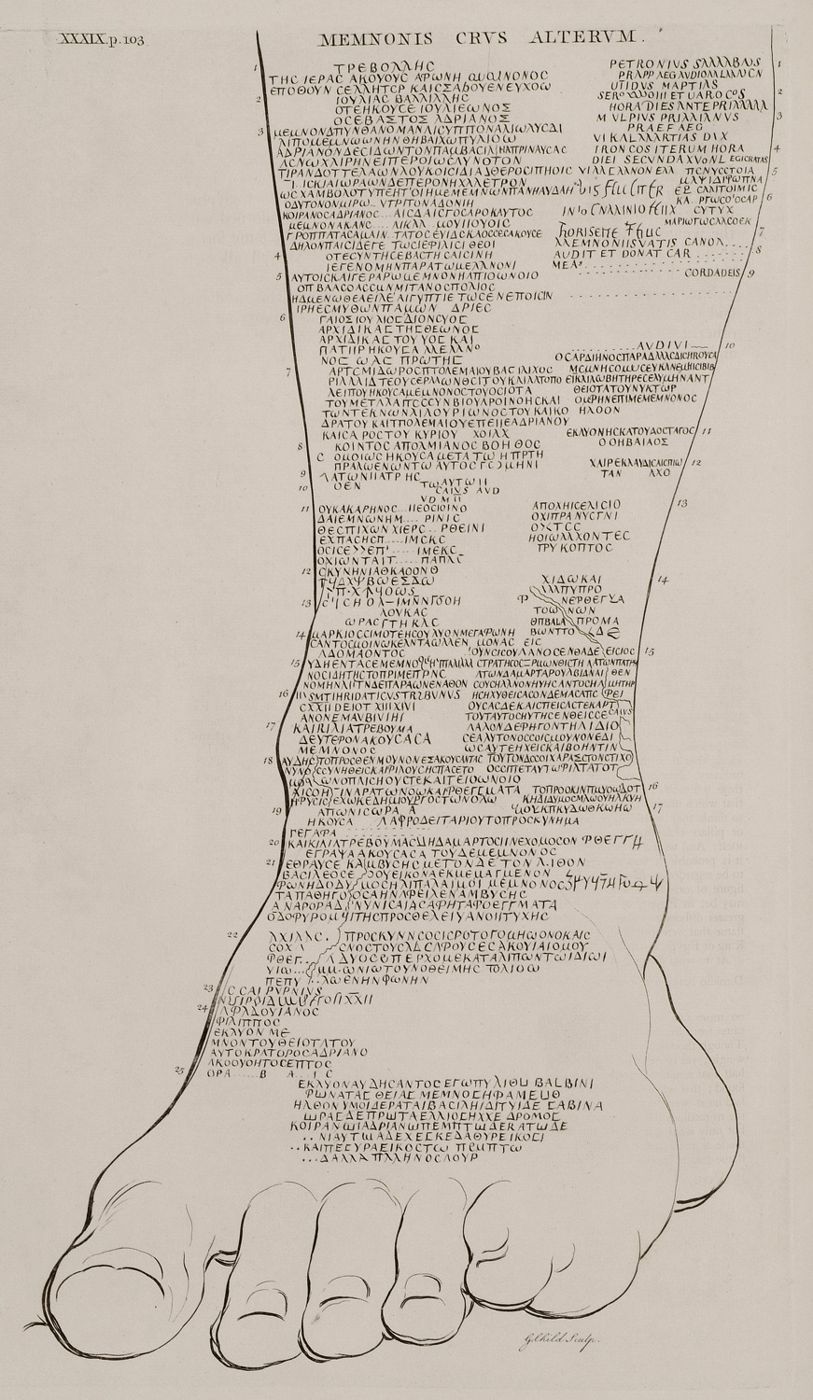
Julia Balbilla’s Aeolic epigrams on the Colossus of Memnon.
About · 1 of 1
Who Julia Balbilla was
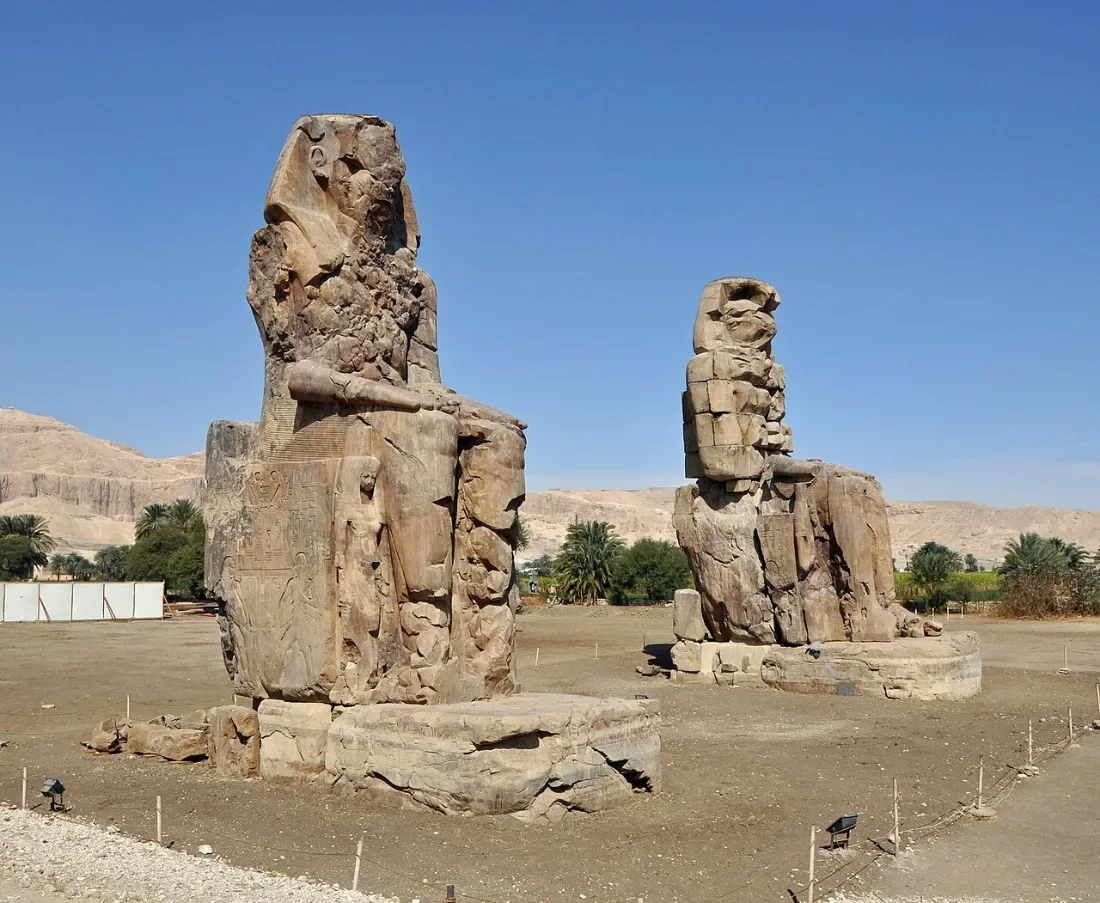
A poet on a statue. The Colossi of Memnon are two seated statues of quartzite, about sixty feet high. They stand on the Nile plain near Luxor and portray the deified pharaoh Amenhotep III. After an earthquake in 27/26 BCE the northern colossus began to give out a sound each morning. The sound came from the change of temperature and humidity at sunrise. People came to hear in it the voice of Memnon, the Ethiopian king killed at Troy, greeting his mother Dawn. Visitors who heard it took it as a sign of divine favour.[1]
Visitors marked their visits by carving inscriptions on the statue. A hundred and seven survive, dated between 20 and 205 CE: 61 in Greek, 45 in Latin and one in both languages. Thirty-nine of them are in verse, and eleven are by women.[2] The first and longest of the women’s poems are Julia Balbilla’s.[3]
Family. Balbilla came from the elite on both sides of her family. Her father’s father was Antiochus, the last king of Commagene in Syria. Her mother’s father was the astrologer Tiberius Claudius Balbillus, who was prefect of Egypt under Nero (55–59 CE) and head of the Museum at Alexandria. Her brother Philopappus was consul in 109 CE. He was a friend of Plutarch, who dedicated to him his essay on telling a flatterer from a friend.[4] Balbilla names both grandfathers in her own verse, as proof of her standing to make Memnon immortal.[5]
At Hadrian’s court. Two things are certain. She belonged to the entourage of Hadrian’s wife Sabina, and she enjoyed enough imperial favour to compose public verses on the imperial visit to Memnon.[6] Beyond that, “all is conjecture”.[6]
Scholars disagree about her place at court. Bowie suggested in 1990 that she was chiefly the empress’s companion, “perhaps her answer to Hadrian’s Antinous”. Rosenmeyer (2018) replies that such assumptions rest on only three facts: Balbilla was female, she wrote in an Aeolic dialect, and she was travelling with Sabina and Hadrian.[7]
The visit. Hadrian and Sabina were touring the eastern provinces, and in November 130 CE they came to Egyptian Thebes. Balbilla’s four poems record their visits to the colossus between 19 and 21 November.[8]
Romans of the time were fascinated by “all things Aeolic”, and Balbilla is “an enthusiastic representative” of that taste.[9] She was stricter about dialect than the Cretan court poet Mesomedes, who mixed his dialects freely. All four of her epigrams are in East Aeolic, the dialect of Sappho. She must have studied Sappho’s language and poetry and set out to imitate them, though she wrote in elegiac couplets rather than in Sappho’s stanzas.[10] The Aeolic dialect she chose and the elegiac metre of her epigrams make an odd pair.[11]
Why Sappho? Her choice of Sappho as a model, together with her erotic language about Sabina, has been used to argue for a homoerotic bond between the two women. It may also point to a literary canon of women writers, who looked to Sappho as men looked to Homer.[12]
Notes
- ^ Natoli et al. 2022, p. 301.
- ^ Natoli et al. 2022, pp. 301–302.
- ^ Natoli et al. 2022, p. 302.
- ^ Natoli et al. 2022, pp. 302–303.
- ^ Natoli et al. 2022, pp. 309, 311.
- ^ a b Natoli et al. 2022, p. 303.
- ^ Quoted in Natoli et al. 2022, p. 303.
- ^ Natoli et al. 2022, pp. 303, 305.
- ^ Tribulato 2021, p. 143.
- ^ de Kreij 2022, p. 160.
- ^ Bowie 2021, p. 317.
- ^ Natoli et al. 2022, pp. 305, 315.
Julia Balbilla, Memnon and Sabina (inscription 30)
Synopsis
Julia Balbilla was the granddaughter of the last king of Commagene and of a prefect of Egypt. She travelled in the entourage of the empress Sabina when Hadrian toured the eastern provinces.[1] In November 130 CE the imperial party came to the Colossi of Memnon at Egyptian Thebes, statues of the pharaoh Amenhotep III. Since an earthquake the northern statue had made a sound at sunrise. Visitors took it for Memnon greeting his mother Dawn, and many carved a record of their visit on it.[2] Balbilla’s four poems are in elegiac couplets and in an archaizing Aeolic that recalls Sappho. They are carved on the statue’s left leg and foot, where they can still be read. They record the visits of 19–21 November. Their order is disputed: Bernand and Bernand rearrange them, while Rosenmeyer reads them as they stand.[3]
This poem is carved below poem 29. It tells how Memnon kept silent when Sabina first came, so that the lovely empress would come again. Then, afraid of Hadrian’s anger, he suddenly spoke. Bernand and Bernand date the visit to 20 November, Rosenmeyer to the 21st.[4]
Text and translation
Χθίσδον μὲν Μέμνων σίγαις ἀπεδέξατ’ ἀκοίταν
Julia Balbilla · Colossus of Memnon · elegiac couplets in Aeolic dialect · Greek wording from Bodard and Vierros’s CC BY 4.0 corpus (Bernand 30)
How to read each line
A guide to the Greek, syllables, pitch marks and quantities.
Show the reading key
- Above each line: the line as the edition prints it, each word placed over its own syllables. The main row: the same Greek divided into metrical syllables, each written as it is pronounced. A consonant that closes a syllable is written with it (λόθ | ρο); an elided word is closed up with the next vowel (ν’ἀ); a final consonant carried into the next word is set with a thin space (ς ἰ). Wider gaps mark word-ends.
- Above the syllables: the pitch of each syllable, from the accents. Under them: the quantity of each syllable as it falls in the line, then the transliteration, syllable by syllable, with accented syllables in capitals.
- Under each line: a line-for-line translation. In the right margin of the scansion: the line type, its scheme, and its analysis into cola.
Key to the labels
The names, patterns and symbols used beside this poem.
Show the labels and symbols
The labels in the right margin of the scansion below name the line, its scheme, the feet as the line realises them, and the caesurae and diaereses (the named word-ends) that fall in it. In the scheme ⏔ is a biceps, two shorts that may be contracted to one long; ⏕ is a long that may be resolved into two shorts; × is an anceps, long or short. A click on any syllable highlights its metron or colon, or, with the switch, its foot.
| Label | Name and shape | What it is |
|---|---|---|
| hem1 | First hemiepes— ⏔ — ⏔ — | The first two and a half feet of the hexameter, up to the penthemimeral caesura; in the pentameter, its whole first half. |
| hem2 | Second half of the hexameter⏔ — ⏔ — ⏑ ⏑ — × | From the penthemimeral caesura to the line-end: the fifth foot is nearly always a dactyl, the sixth is — ×. |
| hemp | Second hemiepes— ⏑ ⏑ — ⏑ ⏑ × | The second half of the pentameter: two dactyls and a single syllable, with no contraction allowed. |
The traditional feet
| Foot and shape | Where |
|---|---|
| First foot: dactyl or spondee— ⏔ | Scheme positions 1–2. The biceps (⏑ ⏑) may be contracted to a single long, making a spondee. |
| Second foot: dactyl or spondee— ⏔ | Scheme positions 3–4. |
| Third foot: dactyl or spondee— ⏔ | Scheme positions 5–6. The penthemimeral caesura falls after its first syllable, the “trochaic” caesura after its second. |
| Fourth foot: dactyl or spondee— ⏔ | Scheme positions 7–8. Word-end at the end of this foot, when it is a dactyl, is the bucolic diaeresis (West’s “bucolic caesura”: word-end at the end of the fourth foot after an uncontracted biceps)[5]. |
| Fifth foot: dactyl— ⏑ ⏑ | Scheme positions 9–10. A spondee here (a “spondaic line”) is rare. |
| Sixth foot— × | Scheme positions 11–12: a long and the indifferent final syllable. |
| First foot: dactyl or spondee— ⏔ | Scheme positions 1–2 of the pentameter. |
| Second foot: dactyl or spondee— ⏔ | Scheme positions 3–4. |
| Half-foot before the diaeresis— | Scheme position 5: the long that closes the first hemiepes; word-end must follow. |
| Fourth foot: dactyl— ⏑ ⏑ | Scheme positions 6–8: no contraction after the diaeresis. |
| Fifth foot: dactyl— ⏑ ⏑ | Scheme positions 9–11. |
| Final syllable× | Scheme position 12. |
Scansion
Four couplets carved on the left foot of the Colossus of Memnon in November 130 CE: the statue, silent on the empress's first visit, greets her on the second for fear of Hadrian. Elegiacs, Sappho's dialect, scanned foot by foot.
Yesterday Memnon met the consort with silence,
so that lovely Sabina would come back here again.
For the beautiful looks of our queen give you pleasure:
when she comes, utter a sound from the gods,
in case the king grows angry with you; you have been bold long enough
in keeping his honoured wedded wife waiting.
And Memnon, in fear of great Hadrian’s power,
all at once found his voice, and she heard it with joy.
Metre
- The couplet. The poem is in elegiac couplets:[6] a hexameter followed by a “pentameter”, — ⏔ — ⏔ — | — ⏑ ⏑ — ⏑ ⏑ — ‖, two hemiepes always divided by word-end, of which only the first may contract its bicipitia.[7] Epigram was normally written in this metre, and from about the middle of the first century AD poets handled it less strictly.[8]
- Sappho’s dialect in a metre Sappho did not use. Balbilla wrote all four of her epigrams in East Aeolic, Sappho’s dialect, but cast them as elegiac couplets;[9] Bowie points out that the metre does not suit the dialect.[10] Tribulato finds in them every Aeolic feature and some over-Aeolicised (“hyper-Aeolic”) forms as well, among them the spelling σδ for ζ.[11] The forms are Aeolic, the metre and its prosody those of the elegiac tradition; the Workbench scans with the rules of epic (elegiac form). In this poem nothing needs a licence that “normal” Lesbian verse would refuse: there is no correption and no hiatus, and every stop + liquid that meets the metre (μένος Ἀδριάνοιο, 9) makes position.[12]
- Heavy openings. Line 3 begins with three spondees and line 9 with two, and the whole first half of the pentameter in line 6 is spondaic (ἐλθοίσαι δ’ αὔται).
- The text. The Greek wording follows Gabriel Bodard and Marja Vierros’s Balbilla corpus, linguistic statistics (2026, version 1.0), licensed CC BY 4.0. Its sentence-context fields contain the text of inscription 30, including the supplied letters. Lines 1–2 are a prose heading, Ὅτε τῇ πρώτῃ ἡμέρᾳ οὐκ ἀκούσαμεν τοῦ Μέμνονος, “When on the first day we did not hear Memnon”; the verses are lines 3–10. Punctuation, accents, capitalization, crasis and bracket presentation are normalized, underdots omitted, and teaching quantity marks added. The final ν of ἀκοίταν is a doubtful supplement. Line 9 reads Μέμνων, the subject of the sentence.
- Quantities. Where the quantity of an α ι υ in an open syllable is known, the input marks it so that the reason given on the page is the true one. Long: σῑ́γαις;[13] the Aeolic ᾱ where Attic has η (Natoli et al. 2022, App. A, p. 329) in the article ᾱ̓ (4, 10), κάλᾱ (4), ἐράτᾱ μόρφᾱ (5), ἐξαπίνᾱς and αὔδᾱσ’ (10), and ᾱ́χον (6)[14]; κᾱ́λα (4), which LSJ allows long in elegy and epigram (s.v. καλός, “Quantity”). Short: πᾰ́λῐν,[15] ἐρᾰ́τα.[16] The marks are not shown on the page.
Prosody, line by line
Every syllable, with the reason for its length. Quantities are read from the vowel where the spelling shows it, from the consonants that follow (“position”), from the accent where it tells, and from the metre where nothing else does. Editors’ notes on the text follow in the boxed paragraphs.
- 30.3
Line 30.3 · Χθίσδον μὲν Μέμνων σίγαις ἀπεδέξατ’ ἀκοίταν,
Χθίσδον μὲν Μέμνων σίγαις ἀπεδέξατ’ ἀκοίταν,
ΧθίσδονμὲνΜέμνωνσίγαιςἀπε[δέ][ξα][τ’ἀ][κ]οίτα[ν],spondee, spondee, spondee, dactyl, dactyl, — ×; penthemimeral caesura; hephthemimeral caesura.
- 1 —Χθίσί is a vowel of unknown length; closed by σ: long by position.
- 2 —δονο is short by nature; closed by ν: long by position; a single long contracts the two shorts of the biceps at position 2.
- 3 —μὲνὲ is short by nature; closed by ν: long by position.
- 4 —Μέμέ is short by nature; closed by μ: long by position; a single long contracts the two shorts of the biceps at position 4.
- 5 —νωνω is long by nature; closed by ν: long by position.
- 6 —σίῑ́ is long (its length is not shown by the ordinary spelling); a single long contracts the two shorts of the biceps at position 6.
- 7 —γαιςαι is a diphthong, long by nature.
- 8 ⏑ἀἀ is short by the metre (position 8 must be short); one of the two shorts of the biceps at position 8.
- 9 ⏑πεε is short by nature; one of the two shorts of the biceps at position 8.
- 10 —[δέ]έ is short by nature; ξ is a double consonant (two sounds) and closes the syllable: long by position.
- 11 ⏑[ξα]α is short by the metre (position 10 must be short); one of the two shorts of the biceps at position 10.
- 12 ⏑[τ’ἀ]ἀ is short by the metre (position 10 must be short); the apostrophe marks an elided vowel; the consonant before it joins this syllable; one of the two shorts of the biceps at position 10.
- 13 —[κ]οίοί is a diphthong, long by nature.
- 14 ×τα[ν],α is a vowel of unknown length; closed by ν: long by position; the position is anceps.
χθίσδον is the Aeolic form of χθιζόν, “yesterday”,[17] with the σδ that Tribulato describes as the grammarians’ spelling of Aeolic ζ;[11] as two consonants, σδ closes the first syllable.[18] The first three feet are spondees. σίγαις, “silent”, is Aeolic for σιγάς,[17] with the long ι of σῑγή.[19] Penthemimeral caesura after Μέμνων, hephthemimeral caesura after σίγαις.[20] ἀπε[δέξατ’ ἀκ]οίτα[ν]: the supplements agree with the licensed corpus; δέξατ’ is elided,[21] and ἀκοίταν is Aeolic for ἀκοιτήν.[17]
- 30.4
Line 30.4 · ὠς πάλιν ἀ κάλα τυῖδε Σάβιννα μόλοι.
ὠς πάλιν ἀ κάλα τυῖδε Σάβιννα μόλοι.
ὠςπάλιν ἀκάλατυῖδεΣάβινναμό[λοι].dactyl, spondee, —, dactyl, dactyl, ×; diaeresis after the first hemiepes.
- 1 —ὠςὠ is long by nature; closed by ς: long by position.
- 2 ⏑πάᾰ́ is short (its length is not shown by the ordinary spelling); one of the two shorts of the biceps at position 2.
- 3 ⏑λιῐ is short (its length is not shown by the ordinary spelling); one of the two shorts of the biceps at position 2.
- 4 —ν ἀᾱ̓ is long (its length is not shown by the ordinary spelling); the first consonant belongs to the previous word and is carried over to this vowel.
- 5 —κάᾱ́ is long (its length is not shown by the ordinary spelling); a single long contracts the two shorts of the biceps at position 4.
- 6 —λαᾱ is long (its length is not shown by the ordinary spelling).
- 7 —τυῖυῖ is a diphthong, long by nature.
- 8 ⏑δεε is short by nature.
- 9 ⏑Σάά is short by the metre (position 8 must be short).
- 10 —βινι is a vowel of unknown length; closed by ν: long by position.
- 11 ⏑ναα is short by the accent rule: acute on the antepenult requires a short final syllable.
- 12 ⏑μόό is short by nature.
- 13 ×[λοι].οι is a diphthong, long by nature; the position is anceps.
Both vowels of πάλιν are short,[19] and its ν is carried over to ἀ.[18] ἀ κάλα is Aeolic for ἡ καλή:[17] the article and the last syllable of κάλα have the long ᾱ of Aeolic (App. A, p. 329), and the κα is long too, as the contracted second biceps requires; LSJ notes that elegy and epigram use κα- either short or long (s.v. καλός). The first half thus runs — ⏑ ⏑ — — —, and the division follows κάλα. τυῖδε is the Aeolic adverb “hither”.[19] Σάβιννα is Aeolic for Σαβεῖνα.[17] μό[λοι], an optative of purpose,[17] is supplied.
- 30.5
Line 30.5 · Τέρπει γάρ σ’ ἐράτα μόρφα βασιλήϊδος ἄμμας·
Τέρπει γάρ σ’ ἐράτα μόρφα βασιλήϊδος ἄμμας·
Τέρπειγάρσ’ἐράταμόρφαβασιλήϊδος ἄμμας·spondee, dactyl, spondee, dactyl, dactyl, — ×; penthemimeral caesura; hephthemimeral caesura.
- 1 —Τέρέ is short by nature; closed by ρ: long by position.
- 2 —πειει is a diphthong, long by nature; a single long contracts the two shorts of the biceps at position 2.
- 3 —γάρά is a vowel of unknown length; closed by ρ: long by position.
- 4 ⏑σ’ἐἐ is short by nature; the apostrophe marks an elided vowel; the consonant before it joins this syllable; one of the two shorts of the biceps at position 4.
- 5 ⏑ράᾰ́ is short (its length is not shown by the ordinary spelling); one of the two shorts of the biceps at position 4.
- 6 —ταᾱ is long (its length is not shown by the ordinary spelling).
- 7 —μόρό is short by nature; closed by ρ: long by position; a single long contracts the two shorts of the biceps at position 6.
- 8 —φαᾱ is long (its length is not shown by the ordinary spelling).
- 9 ⏑βαα is short by the metre (position 8 must be short); one of the two shorts of the biceps at position 8.
- 10 ⏑σιι is short by the metre (position 8 must be short); one of the two shorts of the biceps at position 8.
- 11 —λήή is long by nature.
- 12 ⏑ϊϊ is short by the metre (position 10 must be short); one of the two shorts of the biceps at position 10.
- 13 ⏑δοο is short by nature; one of the two shorts of the biceps at position 10.
- 14 —ς ἄμἄ is a vowel of unknown length; closed by μ: long by position; the first consonant belongs to the previous word and is carried over to this vowel.
- 15 ×μας·α is a vowel of unknown length; closed by ς: long by position; the position is anceps.
σ’, elided σε, is carried over to ἐράτα.[21] ἐράτα μόρφα is Aeolic for ἐρατὴ μορφή,[17] the second α of ἐρατός short[19] and both final α long (App. A, p. 329). Natoli et al. compare Sappho’s μόρφαν ἐπήρατον (fr. 96.22) and report Rosenmeyer’s comparison with fr. 16.[17] Penthemimeral caesura after ἐράτα, hephthemimeral caesura after μόρφα. βασιλήϊδος has five syllables (βα-σι-λή-ϊ-δος); its ς is carried over to ἄμμας, Aeolic for “our” (Natoli et al. gloss it as ἐμῆς, p. 313).
- 30.6
Line 30.6 · ἐλθοίσαι δ’ αὔται θήϊον ἄχον ἴη,
ἐλθοίσαι δ’ αὔται θήϊον ἄχον ἴη,
ἐλθοίσαιδ’[α]ὔταιθήϊον ἄχον ἴη,spondee, spondee, —, dactyl, dactyl, ×; diaeresis after the first hemiepes.
- 1 —ἐλἐ is short by nature; closed by λ: long by position.
- 2 —θοίοί is a diphthong, long by nature; a single long contracts the two shorts of the biceps at position 2.
- 3 —σαιαι is a diphthong, long by nature.
- 4 —δ’[α]ὔαὔ is a diphthong, long by nature; the apostrophe marks an elided vowel; the consonant before it joins this syllable; a single long contracts the two shorts of the biceps at position 4.
- 5 —ταιαι is a diphthong, long by nature.
- 6 —θήή is long by nature.
- 7 ⏑ϊϊ is short by the metre (position 7 must be short).
- 8 ⏑οο is short by nature.
- 9 —ν ἄᾱ̓́ is long (its length is not shown by the ordinary spelling); the first consonant belongs to the previous word and is carried over to this vowel.
- 10 ⏑χοο is short by nature.
- 11 ⏑ν ἴἴ is short by the metre (position 11 must be short); the first consonant belongs to the previous word and is carried over to this vowel.
- 12 ×η,η is long by nature; the position is anceps.
The whole first half is spondaic, ἐλθοίσαι δ’ [α]ὔται, both bicipitia contracted, as the first half of the pentameter allows.[7] ἐλθοίσαι δ’ αὔται is Aeolic for ἐλθούσῃ δ’ αὐτῇ;[17] δέ is elided,[21] and the α of αὔται is supplied. The division follows αὔται, a diphthong. θήϊον has three syllables. ἄχον, Aeolic for “sound”,[17] has a long ᾱ (Natoli et al. print ἆχον in Bernand 28.11)[14], in the long fourth position of the second half. ἴη, “send forth”,[17] has its ι short.
- 30.7
Line 30.7 · μὴ καί τοι βασίλευς κοτέσῃ· τό νυ δᾶρον ἀτάρβης
μὴ καί τοι βασίλευς κοτέσῃ· τό νυ δᾶρον ἀτάρβης
μὴκαίτοιβασίλευςκοτέσῃ·τόνυδᾶρον ἀτά[ρ][βης]spondee, dactyl, dactyl, dactyl, dactyl, — ×; penthemimeral caesura; hephthemimeral caesura; bucolic diaeresis.
- 1 —μὴὴ is long by nature.
- 2 —καίαί is a diphthong, long by nature; a single long contracts the two shorts of the biceps at position 2.
- 3 —τοιοι is a diphthong, long by nature.
- 4 ⏑βαα is short by the metre (position 4 must be short); one of the two shorts of the biceps at position 4.
- 5 ⏑σίί is short by the metre (position 4 must be short); one of the two shorts of the biceps at position 4.
- 6 —λευςευ is a diphthong, long by nature; closed by ς: long by position.
- 7 ⏑κοο is short by nature; one of the two shorts of the biceps at position 6.
- 8 ⏑τέέ is short by nature; one of the two shorts of the biceps at position 6.
- 9 —σῃ·ῃ is long by nature.
- 10 ⏑τόό is short by nature; one of the two shorts of the biceps at position 8.
- 11 ⏑νυυ is short by the metre (position 8 must be short); one of the two shorts of the biceps at position 8.
- 12 —δᾶᾶ carries a circumflex, so it is long.
- 13 ⏑ροο is short by nature; one of the two shorts of the biceps at position 10.
- 14 ⏑ν ἀἀ is short by the metre (position 10 must be short); the first consonant belongs to the previous word and is carried over to this vowel; one of the two shorts of the biceps at position 10.
- 15 —τά[ρ]ά is a vowel of unknown length; closed by ρ: long by position.
- 16 ×[βης]η is long by nature; closed by ς: long by position; the position is anceps.
The first foot is a spondee, μὴ καί. τοι is the Aeolic form of σοι.[17] Penthemimeral caesura after βασίλευς, hephthemimeral caesura after κοτέσῃ, and word-end at the end of the fourth foot after τό νυ, the “bucolic caesura”;[22] νυ is enclitic.[17] δᾶρον is Aeolic for δηρόν;[23] its ν is carried over to ἀτά[ρβης], partly supplied.
- 30.8
Line 30.8 · τὰν σέμναν κατέχες κουριδίαν ἄλοχον.
τὰν σέμναν κατέχες κουριδίαν ἄλοχον.
τὰνσέμνανκατέχεςκουριδίανἄλοχον.spondee, dactyl, —, dactyl, dactyl, ×; diaeresis after the first hemiepes.
- 1 —τὰνὰ is a vowel of unknown length; closed by ν: long by position.
- 2 —σέμέ is short by nature; closed by μ: long by position; a single long contracts the two shorts of the biceps at position 2.
- 3 —νανα is a vowel of unknown length; closed by ν: long by position.
- 4 ⏑καα is short by the metre (position 4 must be short); one of the two shorts of the biceps at position 4.
- 5 ⏑τέέ is short by nature; one of the two shorts of the biceps at position 4.
- 6 —χεςε is short by nature; closed by ς: long by position.
- 7 —κουου is a diphthong, long by nature.
- 8 ⏑ριι is short by the metre (position 7 must be short).
- 9 ⏑δίί is short by the metre (position 8 must be short).
- 10 —ανα is long by the metre (position 9 must be long).
- 11 ⏑ἄἄ is short by the metre (position 10 must be short).
- 12 ⏑λοο is short by nature.
- 13 ×χον.ο is short by nature; closed by ν: long by position; the position is anceps.
τὰν σέμναν is Aeolic for τὴν σεμνήν, and κατέχες for κατεῖχες.[24] The first foot is a spondee. The division follows κατέχες, whose last syllable is long only because the next word begins with a consonant; West notes that Hellenistic poets came to favour a long vowel or diphthong at this point.[8] The α of κουριδίαν is long, as the fourth position of the second half requires, and its ν is carried over to ἄλοχον.
- 30.9
Line 30.9 · Κὠ Μέμνων τρέσσαις μεγάλω μένος Ἀδριάνοιο
Κὠ Μέμνων τρέσσαις μεγάλω μένος Ἀδριάνοιο
ΚὠΜέμνωντρέσσαιςμεγάλωμένος Ἀδρι[ά][νοι][ο]spondee, spondee, dactyl, dactyl, dactyl, — ×; penthemimeral caesura; hephthemimeral caesura; bucolic diaeresis.
- 1 —Κὠὠ is long by nature.
- 2 —Μέμέ is short by nature; closed by μ: long by position; a single long contracts the two shorts of the biceps at position 2.
- 3 —νωνω is long by nature; closed by ν: long by position.
- 4 —τρέσέ is short by nature; closed by σ: long by position; a single long contracts the two shorts of the biceps at position 4.
- 5 —σαιςαι is a diphthong, long by nature; closed by ς: long by position.
- 6 ⏑μεε is short by nature; one of the two shorts of the biceps at position 6.
- 7 ⏑γάά is short by the metre (position 6 must be short); one of the two shorts of the biceps at position 6.
- 8 —λωω is long by nature.
- 9 ⏑μέέ is short by nature; one of the two shorts of the biceps at position 8.
- 10 ⏑νοο is short by nature; one of the two shorts of the biceps at position 8.
- 11 —ς ἈδἈ is a vowel of unknown length; closed by δ before a liquid: stop + liquid makes position, as it usually does in epic; the first consonant belongs to the previous word and is carried over to this vowel.
- 12 ⏑ριι is short by the metre (position 10 must be short); one of the two shorts of the biceps at position 10.
- 13 ⏑[ά]ά is short by the metre (position 10 must be short); one of the two shorts of the biceps at position 10.
- 14 —[νοι]οι is a diphthong, long by nature.
- 15 ×[ο]ο is short by nature; the position is anceps.
Μέμνων is the subject: Memnon fears Hadrian’s anger. The licensed corpus reads ω here, replacing the ο formerly displayed on this page; both spellings scan long before the following consonant. κὠ is the crasis of καὶ ὁ,[24] crasis occurring most often after a one-syllable word such as καί.[25] The first two feet are spondees. Penthemimeral caesura after τρέσσαις, Aeolic for τρέσας;[24] hephthemimeral caesura after μεγάλω, Aeolic genitive.[24] The ς of μένος is carried over to Ἀδριάνοιο, whose first syllable is closed by the δ of δρ, the usual treatment in epic.[26] The α after -δρι- (supplied here) stands in the fifth biceps, so the metre requires it to be short, although the Latin name has a long ā (Hadriānus: Lewis and Short s.v. Hadria); no source used on this page discusses its quantity in Greek verse. Other Greek hexameters on Hadrian put it in a biceps too, e.g. Ἀδριανός προτέρων προφερέστερος ἡγεμονήων (Greek Anthology 7.158.4) and Ἀδριανοῦ βασιλῆος ἀμεμφέα νηὸν ἀείσεις (9.656.16, Paton’s text). Ἀδρι[άνοιο] has the epic genitive ending[24] and is largely supplied.
- 30.10
Line 30.10 · ἐξαπίνας αὔδασ’, ἀ δ’ ὀΐοισ’ ἐχάρη.
ἐξαπίνας αὔδασ’, ἀ δ’ ὀΐοισ’ ἐχάρη.
ἐξαπίναςαὔδασ’,ἀδ’ὀΐοισ’ἐχάρη.dactyl, spondee, —, dactyl, dactyl, ×; diaeresis after the first hemiepes (with elision).
- 1 —ἐἐ is short by nature; ξ is a double consonant (two sounds) and closes the syllable: long by position.
- 2 ⏑ξαα is short by the metre (position 2 must be short); one of the two shorts of the biceps at position 2.
- 3 ⏑πίί is short by the metre (position 2 must be short); one of the two shorts of the biceps at position 2.
- 4 —ναςᾱ is long (its length is not shown by the ordinary spelling).
- 5 —αὔαὔ is a diphthong, long by nature; a single long contracts the two shorts of the biceps at position 4.
- 6 —δαᾱ is long (its length is not shown by the ordinary spelling).
- 7 —σ’,ἀᾱ̓ is long (its length is not shown by the ordinary spelling); the apostrophe marks an elided vowel; the consonant before it joins this syllable.
- 8 ⏑δ’ὀὀ is short by nature; the apostrophe marks an elided vowel; the consonant before it joins this syllable.
- 9 ⏑ΐΐ is short by the metre (position 8 must be short).
- 10 —οιοι is a diphthong, long by nature.
- 11 ⏑σ’ἐἐ is short by nature; the apostrophe marks an elided vowel; the consonant before it joins this syllable.
- 12 ⏑χάά is short by the metre (position 11 must be short).
- 13 ×ρη.η is long by nature; the position is anceps.
ἐξαπίνας is Aeolic for ἐξαπίνης:[27] ξ counts as two consonants,[28] the ι is short and the final ᾱ long. αὔδασ’, Aeolic for ηὔδησ’,[24] with long ᾱ, is elided before ἀ, and the division of the pentameter follows it; elision at this caesura is admitted.[7] ἀ is the article ἡ, with long ᾱ. ὀΐοισ’, “hearing”, Aeolic for the participle of ἀΐω,[24] has three syllables, ὀ-ΐ-οισ’, and is elided before ἐχάρη.
Notes
- ^ Natoli et al. 2022, pp. 302–303.
- ^ Natoli et al. 2022, pp. 301, 303.
- ^ Natoli et al. 2022, pp. 302–305.
- ^ Natoli et al. 2022, pp. 303–305, 312–313.
- ^ West 1987, p. 21.
- ^ Natoli et al. 2022, p. 312.
- ^ a b c West 1987, p. 24.
- ^ a b West 1987, p. 80.
- ^ de Kreij 2022, p. 160.
- ^ Bowie 2021, p. 317.
- ^ a b Tribulato 2021, p. 145.
- ^ West 1987, pp. 16 with n. 7, 35 n. 2.
- ^ LSJ s.v. σιγή.
- ^ a b LSJ s.v. ἆχος, Doric for ἦχος.
- ^ LSJ s.v. πάλιν.
- ^ LSJ s.v. ἐρατός.
- ^ a b c d e f g h i j k l m Natoli et al. 2022, p. 313.
- ^ a b West 1987, p. 12.
- ^ a b c d LSJ s.v.
- ^ West 1987, p. 19.
- ^ a b c West 1987, p. 13.
- ^ West 1987, pp. 19, 21.
- ^ Natoli et al. 2022, p. 313; LSJ s.v. δηρός, Doric δᾱρός.
- ^ a b c d e f g Natoli et al. 2022, p. 314.
- ^ West 1987, p. 15.
- ^ West 1987, p. 16.
- ^ Natoli et al. 2022, p. 314; LSJ s.v.: Doric and Aeolic ἐξάπῐνας.
- ^ West 1987, p. 12 n. 1.
Text and sources
- Greek wording: Gabriel Bodard and Marja Vierros, Balbilla corpus, linguistic statistics, version 1.0 (2026), with research contribution by Polina Yordanova-Nanev. Zenodo dataset, CC BY 4.0: the sentence-context fields for Balbilla3, sentences 1–4, in the Case and Verbs_mood tables. Compared with Bodard’s EpiDoc edition of Bernand 30; presentation changes are listed above. The modern commentary is cited separately below.
- Notes and glosses: Natoli et al. 2022, pp. 302, 312–314; App. A, p. 329.
- Dialect: O. Tribulato, ‘Sappho’s Dialect’, in P. J. Finglass and A. Kelly (eds), The Cambridge Companion to Sappho (Cambridge 2021), p. 145; E. Bowie, ‘Sappho in Imperial Greek Literature’, ibid., p. 317; M. de Kreij, ‘The Lyric Dialects’, in L. Swift (ed.), A Companion to Greek Lyric (Wiley 2022), p. 160.
- Rules: M. L. West, Introduction to Greek Metre (Oxford 1987), pp. 12–13, 15–16 with n. 7 (prosody), 19, 21 (caesurae), 24 (the elegiac couplet), 35 n. 2 (Lesbian verse), 80 (later elegiacs), checked against the page images.
- Quantities: LSJ (Perseus Digital Library, CC BY-SA), s.vv. ἆχος, δηρός, ἐξαπίνης, ἐρατός, καλός, πάλιν, σιγή, τυῖδε.
- The quantity in other verse and in Latin: The Greek Anthology 7.158.4, 9.656.16, ed. W. R. Paton (Loeb Classical Library, London 1917), via the Perseus Digital Library (tlg7000.tlg001.perseus-grc7, -grc8), CC BY-SA 4.0 (as stated in the files’ TEI headers); C. T. Lewis and C. Short, A Latin Dictionary (Oxford 1879), s.v. Hadria, via the Perseus Digital Library, CC BY-SA 4.0 (the licence of the Perseus lexica repository).
Quotations from copyrighted works are not covered by this page’s licence.
Julia Balbilla, her own record (inscription 31)
Synopsis
Julia Balbilla was the granddaughter of the last king of Commagene and of a prefect of Egypt. She travelled in the entourage of the empress Sabina when Hadrian toured the eastern provinces.[1] In November 130 CE the imperial party came to the Colossi of Memnon at Egyptian Thebes, statues of the pharaoh Amenhotep III. Since an earthquake the northern statue had made a sound at sunrise. Visitors took it for Memnon greeting his mother Dawn, and many carved a record of their visit on it.[2] Balbilla’s four poems are in elegiac couplets and in an archaizing Aeolic that recalls Sappho. They are carved on the statue’s left leg and foot, where they can still be read. They record the visits of 19–21 November. Their order is disputed: Bernand and Bernand rearrange them, while Rosenmeyer reads them as they stand.[3]
This last poem is cut in larger letters, apparently by another hand. It is Balbilla’s own record: she heard Memnon’s voice in the first hour, with Sabina beside her. She dates the visit by Hadrian’s fifteenth year and by the 24th and 25th of the Egyptian month Hathyr, that is, 20 and 21 November 130.[4]
Text and translation
Ἔκλυον αὐδήσαντος ἔγω ’πυ λίθω Βάλβιλλα
Julia Balbilla · Colossus of Memnon · elegiac couplets and a closing pentameter, in Aeolic dialect · Greek wording from Kaibel 1878, no. 988 (= Bernand 31)
How to read each line
A guide to the Greek, syllables, pitch marks and quantities.
Show the reading key
- Above each line: the line as the edition prints it, each word placed over its own syllables. The main row: the same Greek divided into metrical syllables, each written as it is pronounced. A consonant that closes a syllable is written with it (λόθ | ρο); an elided word is closed up with the next vowel (ν’ἀ); a final consonant carried into the next word is set with a thin space (ς ἰ). Wider gaps mark word-ends.
- Above the syllables: the pitch of each syllable, from the accents. Under them: the quantity of each syllable as it falls in the line, then the transliteration, syllable by syllable, with accented syllables in capitals.
- Under each line: a line-for-line translation. In the right margin of the scansion: the line type, its scheme, and its analysis into cola.
Key to the labels
The names, patterns and symbols used beside this poem.
Show the labels and symbols
The labels in the right margin of the scansion below name the line, its scheme, the feet as the line realises them, and the caesurae and diaereses (the named word-ends) that fall in it. In the scheme ⏔ is a biceps, two shorts that may be contracted to one long; ⏕ is a long that may be resolved into two shorts; × is an anceps, long or short. A click on any syllable highlights its metron or colon, or, with the switch, its foot.
| Label | Name and shape | What it is |
|---|---|---|
| hem1 | First hemiepes— ⏔ — ⏔ — | The first two and a half feet of the hexameter, up to the penthemimeral caesura; in the pentameter, its whole first half. |
| hem2 | Second half of the hexameter⏔ — ⏔ — ⏑ ⏑ — × | From the penthemimeral caesura to the line-end: the fifth foot is nearly always a dactyl, the sixth is — ×. |
| hemp | Second hemiepes— ⏑ ⏑ — ⏑ ⏑ × | The second half of the pentameter: two dactyls and a single syllable, with no contraction allowed. |
The traditional feet
| Foot and shape | Where |
|---|---|
| First foot: dactyl or spondee— ⏔ | Scheme positions 1–2. The biceps (⏑ ⏑) may be contracted to a single long, making a spondee. |
| Second foot: dactyl or spondee— ⏔ | Scheme positions 3–4. |
| Third foot: dactyl or spondee— ⏔ | Scheme positions 5–6. The penthemimeral caesura falls after its first syllable, the “trochaic” caesura after its second. |
| Fourth foot: dactyl or spondee— ⏔ | Scheme positions 7–8. Word-end at the end of this foot, when it is a dactyl, is the bucolic diaeresis (West’s “bucolic caesura”: word-end at the end of the fourth foot after an uncontracted biceps)[5]. |
| Fifth foot: dactyl— ⏑ ⏑ | Scheme positions 9–10. A spondee here (a “spondaic line”) is rare. |
| Sixth foot— × | Scheme positions 11–12: a long and the indifferent final syllable. |
| First foot: dactyl or spondee— ⏔ | Scheme positions 1–2 of the pentameter. |
| Second foot: dactyl or spondee— ⏔ | Scheme positions 3–4. |
| Half-foot before the diaeresis— | Scheme position 5: the long that closes the first hemiepes; word-end must follow. |
| Fourth foot: dactyl— ⏑ ⏑ | Scheme positions 6–8: no contraction after the diaeresis. |
| Fifth foot: dactyl— ⏑ ⏑ | Scheme positions 9–11. |
| Final syllable× | Scheme position 12. |
Scansion
Balbilla's signed record of her visit with Sabina, dated by Hadrian's regnal year and the Egyptian month of Hathyr: three couplets and a second pentameter, scanned foot by foot.
From the stone, as it spoke, I, Balbilla, heard
the god-like voice of Memnon, or Phamenoth.
I had come here with Sabina, the beloved queen;
the sun’s course stood at the first hour,
in the fifteenth year of Hadrian’s rule,
and Hathyr had seen twenty-four of its days.
It was the twenty-fifth day of Hathyr.
Metre
- The form. Natoli et al. give the metre as elegiac couplets:[6] a hexameter and a “pentameter”, — ⏔ — ⏔ — | — ⏑ ⏑ — ⏑ ⏑ — ‖, the pentameter made of two hemiepes with word-end always between them, and contraction allowed only in the first of them.[7] After the three couplets the poem ends with a second pentameter (line 7, set as a pentameter by Natoli et al., p. 314), which gives the second of the two dates; the Workbench uses a plug-in form with that seventh line.
- Epic licences in Aeolic dress. The dialect is Aeolic,[8] but the prosody is that of the elegiac tradition, and here it needs two things that “normal” Lesbian verse avoids: a long vowel shortened before another vowel (Κοιράνω Ἀδριάνω, line 5), where Lesbian verse has elision or synecphonesis as the rule,[9] and a short syllable before stop + liquid at the beginning of a word (ἦχε δρόμος, line 4), which “normal” Lesbian lyric avoids.[10] In the same line δέ is long before πρώτας. The Workbench therefore scans with the rules of epic (elegiac form).
- A spondaic fifth foot. Line 1 ends θω Βάλ | βιλλα, with its fifth biceps contracted, where contraction is least common.[11]
- The text. The Greek follows the public-domain edition, with normalized accentuation, iota subscripts, capitalization, punctuation and teaching quantity marks. Its ἦνθον, “I came”, and κοιράνω, “of the lord”, are retained.[12] The inscription is numbered 31 by Bernand and Bernand, whose numbering Natoli et al. retain.[13]
- Quantities. Where the quantity of an α ι υ in an open syllable is known, the input marks it so that the reason given on the page is the true one. Long: the Aeolic ᾱ where Attic has η (Natoli et al. 2022, App. A, p. 329) in πρώτᾱς and ᾱ̓́λιος (4) and ᾱ̓́ματι (7). Short: ἐρᾰ́ται,[14] Κοιρᾰ́νωι.[15] In βασιλήιδι (3), printed without a diaeresis, the input keeps the ι apart from the η, so that the word has its five syllables. The marks are not shown on the page.
Prosody, line by line
Every syllable, with the reason for its length. Quantities are read from the vowel where the spelling shows it, from the consonants that follow (“position”), from the accent where it tells, and from the metre where nothing else does. Editors’ notes on the text follow in the boxed paragraphs.
- 31.1
Line 31.1 · Ἔκλυον αὐδήσαντος ἔγω ’πυ λίθω Βάλβιλλα
Ἔκλυον αὐδήσαντος ἔγω ’πυ λίθω Βάλβιλλα
Ἔκλυον αὐδήσαντος ἔγωπυλίθωΒάλβιλλαdactyl, spondee, dactyl, dactyl, spondee, — ×; caesura after the third trochee; hephthemimeral caesura.
- 1 —ἜκἜ is short by nature; closed by κ before a liquid: stop + liquid makes position, as it usually does in epic.
- 2 ⏑λυυ is short by the metre (position 2 must be short); one of the two shorts of the biceps at position 2.
- 3 ⏑οο is short by nature; one of the two shorts of the biceps at position 2.
- 4 —ν αὐαὐ is a diphthong, long by nature; the first consonant belongs to the previous word and is carried over to this vowel.
- 5 —δήή is long by nature; a single long contracts the two shorts of the biceps at position 4.
- 6 —σανα is a vowel of unknown length; closed by ν: long by position.
- 7 ⏑τοο is short by nature; one of the two shorts of the biceps at position 6.
- 8 ⏑ς ἔἔ is short by nature; the first consonant belongs to the previous word and is carried over to this vowel; one of the two shorts of the biceps at position 6.
- 9 —γωω is long by nature.
- 10 ⏑πυυ is short by the metre (position 8 must be short); one of the two shorts of the biceps at position 8.
- 11 ⏑λίί is short by the metre (position 8 must be short); one of the two shorts of the biceps at position 8.
- 12 —θωω is long by nature.
- 13 —Βάλά is a vowel of unknown length; closed by λ: long by position; a single long contracts the two shorts of the biceps at position 10.
- 14 —βιλι is a vowel of unknown length; closed by λ: long by position.
- 15 ×λαα is short by the accent rule: acute on the antepenult requires a short final syllable; the position is anceps.
Inside ἔκλυον the κλ closes the first syllable, as stop + liquid usually does in epic;[16] the ν is carried over to αὐδήσαντος. Feminine caesura after αὐδήσαντος, hephthemimeral caesura after ἔγω.[17] αὐδήσαντος may go with Μέμνονος in line 2 or with λίθω.[6] ’πυ is the Aeolic ἀπύ for ἀπό with its first vowel lost after the long ω of ἔγω,[18] the occlusion West calls prodelision or aphaeresis.[19] λίθω is an Aeolic genitive.[18] The fifth foot is a spondee, θω Βάλ-, a contraction least common in that foot.[11] The line ends with the poet’s name, Βάλβιλλα, in apposition to ἔγω.
- 31.2
Line 31.2 · φώνας τᾶς θείας Μέμνονος ἢ Φαμένωθ.
φώνας τᾶς θείας Μέμνονος ἢ Φαμένωθ.
φώναςτᾶςθείαςΜέμνονος ἢΦαμένωθ.spondee, spondee, —, dactyl, dactyl, ×; diaeresis after the first hemiepes.
- 1 —φώώ is long by nature.
- 2 —ναςα is a vowel of unknown length; closed by ς: long by position; a single long contracts the two shorts of the biceps at position 2.
- 3 —τᾶςᾶ carries a circumflex, so it is long; closed by ς: long by position.
- 4 —θείεί is a diphthong, long by nature; a single long contracts the two shorts of the biceps at position 4.
- 5 —αςα is a vowel of unknown length; closed by ς: long by position.
- 6 —Μέμέ is short by nature; closed by μ: long by position.
- 7 ⏑νοο is short by nature.
- 8 ⏑νοο is short by nature.
- 9 —ς ἢἢ is long by nature; the first consonant belongs to the previous word and is carried over to this vowel.
- 10 ⏑Φαα is short by the metre (position 10 must be short).
- 11 ⏑μέέ is short by nature.
- 12 ×νωθ.ω is long by nature; closed by θ: long by position; the position is anceps.
φώνας τᾶς θείας is an Aeolic genitive;[18] the whole first half is long, its second biceps contracted, and the division follows θείας. The ς of Μέμνονος is carried over to ἤ. Φαμένωθ: West (1978) read it as a name synonymous with Amenoth, the pharaoh’s name, taken from an Egyptian month more familiar to Greek speakers; Rosenmeyer, and Bagnall and Rathbone, take it as the stonecutter’s mistake for a particle followed by the name Amenoth.[18] Both readings scan alike, — ⏑ ⏑ —.
- 31.3
Line 31.3 · Ἦνθον ὔμοι δ’ ἐράται βασιλήιδι τυῖδε Σαβίννᾳ,
Ἦνθον ὔμοι δ’ ἐράται βασιλήιδι τυῖδε Σαβίννᾳ,
Ἦνθον ὔμοιδ’ἐράταιβασιλήιδιτυῖδεΣαβίννᾳ,dactyl, dactyl, dactyl, dactyl, dactyl, — ×; penthemimeral caesura; bucolic diaeresis.
- 1 —ἮνἮ is long by nature; closed by ν: long by position.
- 2 ⏑θοο is short by nature; one of the two shorts of the biceps at position 2.
- 3 ⏑ν ὔὔ is short by the metre (position 2 must be short); the first consonant belongs to the previous word and is carried over to this vowel; one of the two shorts of the biceps at position 2.
- 4 —μοιοι is a diphthong, long by nature.
- 5 ⏑δ’ἐἐ is short by nature; the apostrophe marks an elided vowel; the consonant before it joins this syllable; one of the two shorts of the biceps at position 4.
- 6 ⏑ράᾰ́ is short (its length is not shown by the ordinary spelling); one of the two shorts of the biceps at position 4.
- 7 —ταιαι is a diphthong, long by nature.
- 8 ⏑βαα is short by the metre (position 6 must be short); one of the two shorts of the biceps at position 6.
- 9 ⏑σιι is short by the metre (position 6 must be short); one of the two shorts of the biceps at position 6.
- 10 —λήή is long by nature.
- 11 ⏑ιι is short by the metre (position 8 must be short); one of the two shorts of the biceps at position 8.
- 12 ⏑διι is short by the accent rule: acute on the antepenult requires a short final syllable; one of the two shorts of the biceps at position 8.
- 13 —τυῖυῖ is a diphthong, long by nature.
- 14 ⏑δεε is short by nature; one of the two shorts of the biceps at position 10.
- 15 ⏑Σαα is short by the metre (position 10 must be short); one of the two shorts of the biceps at position 10.
- 16 —βίνί is a vowel of unknown length; closed by ν: long by position.
- 17 ×νᾳ,ᾳ is long by nature; the position is anceps.
The line is all dactyls. ὔμοι is Aeolic for ὁμοῦ;[18] its υ is short, and the ν of Ἦνθον is carried over to it. δέ is elided before ἐράται.[20] ἐράται βασιλήιδι … Σαβίννᾳ are Aeolic datives, “with the lovely, royal Sabina”.[18] Penthemimeral caesura after ἐράται; word-end after βασιλήιδι at the end of the fourth foot, the “bucolic caesura”.[5] τυῖδε, “hither”, is Aeolic.[21]
- 31.4
Line 31.4 · ὤρας δὲ πρώτας ἄλιος ἦχε δρόμος.
ὤρας δὲ πρώτας ἄλιος ἦχε δρόμος.
ὤραςδὲπρώταςἄλιος ἦχεδρόμος.spondee, spondee, —, dactyl, dactyl, ×; diaeresis after the first hemiepes.
- 1 —ὤὤ is long by nature.
- 2 —ραςα is a vowel of unknown length; closed by ς: long by position; a single long contracts the two shorts of the biceps at position 2.
- 3 —δὲὲ is short by nature; the next word begins with πρ: the syllable is closed before it: long by position.
- 4 —πρώώ is long by nature; a single long contracts the two shorts of the biceps at position 4.
- 5 —ταςᾱ is long (its length is not shown by the ordinary spelling).
- 6 —ἄᾱ̓́ is long (its length is not shown by the ordinary spelling).
- 7 ⏑λιι is short by the metre (position 7 must be short).
- 8 ⏑οο is short by nature.
- 9 —ς ἦἦ is long by nature; the first consonant belongs to the previous word and is carried over to this vowel.
- 10 ⏑χεε is short by nature; the next word begins with δρ, a stop + liquid that does not make position here, so the syllable stays short.
- 11 ⏑δρόό is short by nature.
- 12 ×μος.ο is short by nature; closed by ς: long by position; the position is anceps.
ὤρας … πρώτας, “in the first hour”, is a genitive of time,[18] with Aeolic ᾱ (App. A, p. 329). The whole first half is long: δέ is closed before the πρ of πρώτας, the treatment that is normal in epic,[16] and the ς of πρώτας is carried over to ἄλιος, so that the division falls on the long ᾱ of πρώτας. ἄλιος is Aeolic for ἥλιος,[18] with long ᾱ. In ἦχε δρόμος the ε stays short before δρ at the beginning of a word, the treatment of stop + liquid that early poetry normally admits only there.[16]
- 31.5
Line 31.5 · Κοιράνω Ἀδριάνω πέμπτῳ δεκότῳ δ’ ἐνιαύτῳ,
Κοιράνω Ἀδριάνω πέμπτῳ δεκότῳ δ’ ἐνιαύτῳ,
ΚοιράνωἈδριάνωπέμπτῳδεκότῳδ’ἐνιαύτῳ,dactyl, dactyl, spondee, dactyl, dactyl, — ×; penthemimeral caesura; hephthemimeral caesura.
- 1 —Κοιοι is a diphthong, long by nature.
- 2 ⏑ράᾰ́ is short (its length is not shown by the ordinary spelling); one of the two shorts of the biceps at position 2.
- 3 ⏑νωω is long by nature; shortened before the vowel that begins the next word (epic correption), as the metre requires; one of the two shorts of the biceps at position 2.
- 4 —ἈδἈ is a vowel of unknown length; closed by δ before a liquid: stop + liquid makes position, as it usually does in epic.
- 5 ⏑ριι is short by the metre (position 4 must be short); one of the two shorts of the biceps at position 4.
- 6 ⏑άά is short by the metre (position 4 must be short); one of the two shorts of the biceps at position 4.
- 7 —νωω is long by nature.
- 8 —πέμπέ is short by nature; closed by μπ: long by position; a single long contracts the two shorts of the biceps at position 6.
- 9 —τῳῳ is long by nature.
- 10 ⏑δεε is short by nature; one of the two shorts of the biceps at position 8.
- 11 ⏑κόό is short by nature; one of the two shorts of the biceps at position 8.
- 12 —τῳῳ is long by nature.
- 13 ⏑δ’ἐἐ is short by nature; the apostrophe marks an elided vowel; the consonant before it joins this syllable; one of the two shorts of the biceps at position 10.
- 14 ⏑νιι is short by the metre (position 10 must be short); one of the two shorts of the biceps at position 10.
- 15 —αύαύ is a diphthong, long by nature.
- 16 ×τῳ,ῳ is long by nature; the position is anceps.
Κοιράνω Ἀδριάνω, “of the lord Hadrian”, follows the spelling of the public-domain edition.[12] The ending -ω is an Aeolic genitive;[22] the first α of κοίρανος is short.[21] The final ω of Κοιράνω is shortened before Ἀδριάνω (epic correption)[23]. Ἀδ- is closed by the δ of δρ.[16] The α after -δρι- stands in the second biceps, so the metre requires it to be short, although the Latin name has a long ā (Hadriānus: Lewis and Short s.v. Hadria); no source used on this page discusses its quantity in Greek verse. Other Greek hexameters on Hadrian put it in a biceps too, e.g. Ἀδριανός προτέρων προφερέστερος ἡγεμονήων (Greek Anthology 7.158.4) and Ἀδριανοῦ βασιλῆος ἀμεμφέα νηὸν ἀείσεις (9.656.16, Paton’s text). Penthemimeral caesura after Ἀδριάνω, hephthemimeral caesura after πέμπτῳ. πέμπτῳ δεκότῳ … ἐνιαύτῳ, “in the fifteenth year”, is a dative of time, with δεκότῳ Aeolic for δεκάτῳ;[18] the fifteenth year of Hadrian’s reign places the inscription in 130 CE.[18] δέ is elided before ἐνιαύτῳ.[20]
- 31.6
Line 31.6 · φῶτα δ’ ἔχεσκεν Ἄθυρ εἴκοσι καὶ πέσυρα.
φῶτα δ’ ἔχεσκεν Ἄθυρ εἴκοσι καὶ πέσυρα.
φῶταδ’ἔχεσκεν Ἄθυρεἴκοσικαὶπέσυρα.dactyl, dactyl, —, dactyl, dactyl, ×; diaeresis after the first hemiepes.
- 1 —φῶῶ is long by nature.
- 2 ⏑ταα is short by the accent rule: circumflex on the penult requires a short final syllable; one of the two shorts of the biceps at position 2.
- 3 ⏑δ’ἔἔ is short by nature; the apostrophe marks an elided vowel; the consonant before it joins this syllable; one of the two shorts of the biceps at position 2.
- 4 —χεσε is short by nature; closed by σ: long by position.
- 5 ⏑κεε is short by nature; one of the two shorts of the biceps at position 4.
- 6 ⏑ν ἌἌ is short by the metre (position 4 must be short); the first consonant belongs to the previous word and is carried over to this vowel; one of the two shorts of the biceps at position 4.
- 7 —θυρυ is long by the metre (position 5 must be long).
- 8 —εἴεἴ is a diphthong, long by nature.
- 9 ⏑κοο is short by nature.
- 10 ⏑σιι is short by the accent rule: acute on the antepenult requires a short final syllable.
- 11 —καὶαὶ is a diphthong, long by nature.
- 12 ⏑πέέ is short by nature.
- 13 ⏑συυ is short by the metre (position 11 must be short).
- 14 ×ρα.α is short by the accent rule: acute on the antepenult requires a short final syllable; the position is anceps.
δέ is elided before ἔχεσκεν,[20] an imperfect of ἔχω;[24] its ν is carried over to Ἄθυρ, the Egyptian month of Hathyr.[18] The division follows Ἄθυρ, and since its ρ is carried over to εἴκοσι,[25] the syllable θυ is open: it scans long only if the υ is long. No source available to this site gives the quantity of the υ; if it were short, the line would have a short syllable at the pentameter’s caesura, a freedom West finds developing only in the third and fourth centuries AD.[26] πέσυρα is Aeolic for τέσσαρα.[24] The 24th and 25th of Hathyr in 130 CE were 20 and 21 November.[27]
- 31.7
Line 31.7 · Εἰκόστῳ πέμπτῳ δ’ ἄματι μῆνος Ἄθυρ.
Εἰκόστῳ πέμπτῳ δ’ ἄματι μῆνος Ἄθυρ.
Εἰκόστῳπέμπτῳδ’ἄματιμῆνος Ἄθυρ.spondee, spondee, —, dactyl, dactyl, ×; diaeresis after the first hemiepes.
- 1 —ΕἰΕἰ is a diphthong, long by nature.
- 2 —κόσό is short by nature; closed by σ: long by position; a single long contracts the two shorts of the biceps at position 2.
- 3 —τῳῳ is long by nature.
- 4 —πέμπέ is short by nature; closed by μπ: long by position; a single long contracts the two shorts of the biceps at position 4.
- 5 —τῳῳ is long by nature.
- 6 —δ’ἄᾱ̓́ is long (its length is not shown by the ordinary spelling); the apostrophe marks an elided vowel; the consonant before it joins this syllable.
- 7 ⏑μαα is short by the metre (position 7 must be short).
- 8 ⏑τιι is short by the accent rule: acute on the antepenult requires a short final syllable.
- 9 —μῆῆ is long by nature.
- 10 ⏑νοο is short by nature.
- 11 ⏑ς ἌἌ is short by the metre (position 11 must be short); the first consonant belongs to the previous word and is carried over to this vowel.
- 12 ×θυρ.υ is a vowel of unknown length; closed by ρ: long by position; the position is anceps.
The second pentameter gives the second date, the 25th of Hathyr.[24] The whole first half is long, Εἰκόστῳ πέμπτῳ, both bicipitia contracted.[7] δέ is elided before ἄματι, Aeolic for ἤματι,[24] with long ᾱ; the division falls after πέμπτῳ. The ς of μῆνος is carried over to Ἄθυρ, which ends the poem.
Notes
- ^ Natoli et al. 2022, pp. 302–303.
- ^ Natoli et al. 2022, pp. 301, 303.
- ^ Natoli et al. 2022, pp. 302–305.
- ^ Natoli et al. 2022, pp. 303, 314–316.
- ^ a b West 1987, p. 21.
- ^ a b Natoli et al. 2022, p. 314.
- ^ a b West 1987, p. 24.
- ^ Natoli et al. 2022, pp. 314–316; de Kreij 2022, p. 160.
- ^ West 1987, p. 35 n. 2.
- ^ West 1987, p. 16 with n. 7.
- ^ a b West 1987, p. 20.
- ^ a b Kaibel 1878, p. 414.
- ^ Natoli et al. 2022, p. 302.
- ^ LSJ s.v. ἐρατός.
- ^ LSJ s.v. κοίρανος.
- ^ a b c d West 1987, p. 16.
- ^ West 1987, p. 19.
- ^ a b c d e f g h i j k Natoli et al. 2022, p. 315.
- ^ West 1987, p. 15.
- ^ a b c West 1987, p. 13.
- ^ a b LSJ s.v.
- ^ Natoli et al. 2022, p. 329.
- ^ West 1987, p. 14.
- ^ a b c d Natoli et al. 2022, p. 316.
- ^ West 1987, p. 12.
- ^ West 1987, p. 80.
- ^ Natoli et al. 2022, pp. 315–316.
Text and sources
- Greek wording: G. Kaibel, Epigrammata graeca ex lapidibus conlecta (Berlin 1878), p. 414, no. 988, public domain. All seven lines read on the page image; normalized as explained above. Bernand 31 is the modern inscription number.
- Notes and glosses: Natoli et al. 2022, pp. 302, 314–316; App. A, p. 329.
- Dialect: M. de Kreij, ‘The Lyric Dialects’, in L. Swift (ed.), A Companion to Greek Lyric (Wiley 2022), p. 160.
- Rules: M. L. West, Introduction to Greek Metre (Oxford 1987), pp. 12–16 with n. 7 (prosody), 19–21 (the hexameter; p. 20 from a photograph), 24 (the elegiac couplet), 35 n. 2 (Lesbian verse), 80 (later elegiacs), checked against the page images.
- Quantities: LSJ (Perseus Digital Library, CC BY-SA), s.vv. ἐρατός, κοίρανος, τυῖδε.
- The quantity in other verse and in Latin: The Greek Anthology 7.158.4, 9.656.16, ed. W. R. Paton (Loeb Classical Library, London 1917), via the Perseus Digital Library (tlg7000.tlg001.perseus-grc7, -grc8), CC BY-SA 4.0 (as stated in the files’ TEI headers); C. T. Lewis and C. Short, A Latin Dictionary (Oxford 1879), s.v. Hadria, via the Perseus Digital Library, CC BY-SA 4.0 (the licence of the Perseus lexica repository).
Quotations from copyrighted works are not covered by this page’s licence.


