Poets and playwrightsChoral lyric
Corinna
Corinna of Tanagra: Boeotian legends, choral song and a disputed date.
About · 1 of 5
Who Corinna was, and when
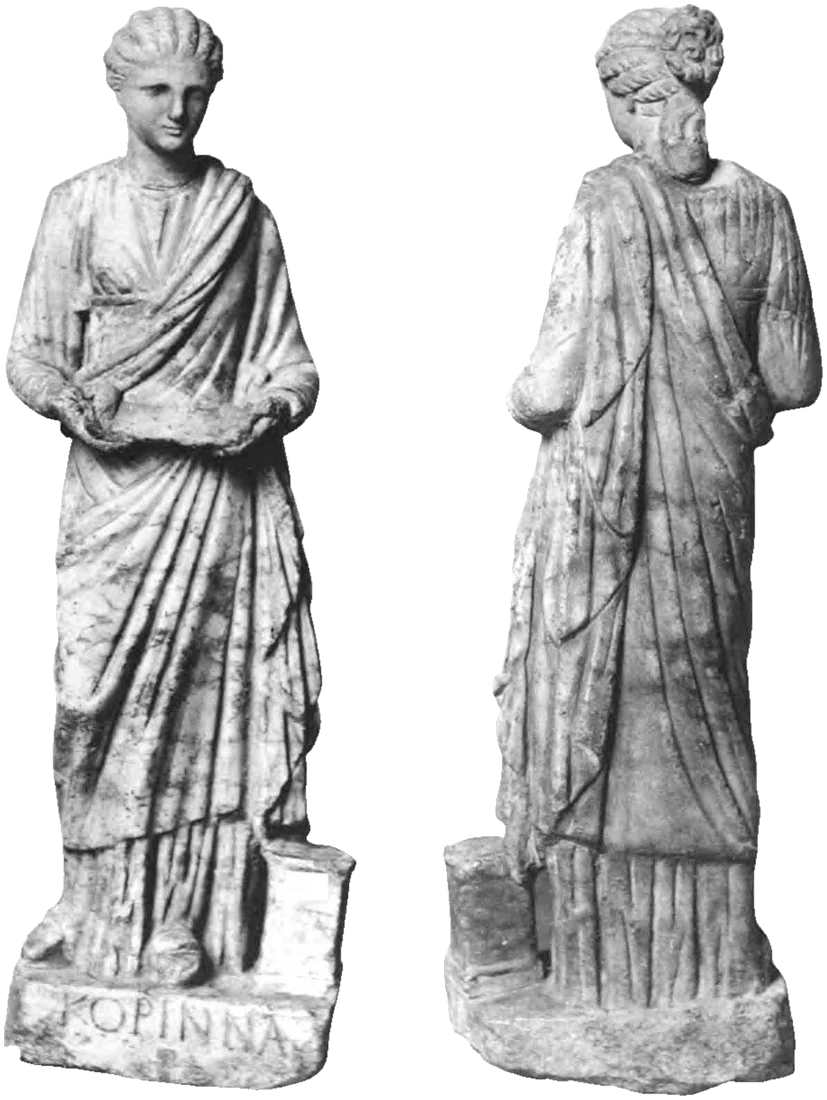
Corinna came from Tanagra in Boeotia, just over 50 km north-west of Athens. The Suda is a late lexicon. It (K 2087) says that she came from Tanagra or Thebes, and it names her parents as Acheloodorus and Procatia.[1] After Sappho she is the best-represented of the women poets of early Greece.[2]
Her own poems place her. In PMG 655 Terpsichore bids her sing “fine tales to the women of Tanagra in their white robes”, and she speaks of embellishing the stories of her forefathers for the girls. In 664a she blames the poet Myrtis, because she, “a woman”, went into competition with Pindar. In 664b she sings “the valour of heroes and of heroines”.[3] Her subjects are local legends about Boeotian heroes and minor gods. She also retells Panhellenic myths, such as the lineage of Orion, so as to connect them with her own city.[4]
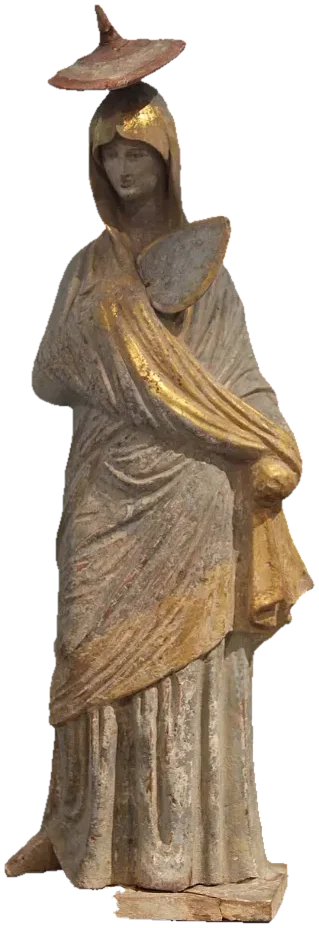
The testimonia. Testimonia are what ancient writers say about a poet. Pausanias (9.22.3) saw Corinna’s tomb in a conspicuous place at Tanagra. He also saw a painting in the gymnasium that showed her wearing the fillet of her victory over Pindar at Thebes. He put the victory down to her composing in a dialect the locals understood, and perhaps to her beauty.[5] Aelian (Varia historia 13.25) and the Suda say that she beat Pindar five times.[6]
Plutarch tells how she advised the young Pindar to tell myths. When he showed her a poem crammed with them, she laughed that “one should sow by the handful, not by emptying the whole sack” (De gloria Atheniensium 4.347f–348a).[7] Aelian tells that Pindar called her a sow. The story may have been prompted by Pindar’s own line about escaping the taunt of the Boeotian pig (Olympian 6.90).[7] Such testimonia are “notoriously inaccurate” on biographical detail.[8] But they show that antiquity saw her as Pindar’s contemporary and rival.
Her date is disputed. The ancient tradition makes her Pindar’s older contemporary. Since Lobel (1930), many scholars have placed her in the Hellenistic period, partly because the papyri write her Boeotian in the spelling of the third century BCE.[9] The editors of a 2020 volume on lyric’s ancient reception call the fifth-century date the one now generally believed.[10] The parties and their arguments, including Collins’s and Heath’s, are set out on the Date tab. The Pindar anecdotes above belong to the early-dating tradition.
How she has been read. Klinck finds in the anecdotes a woman of independent mind who championed her own sex. She detects a feminine irony in the grandiose contest of the mountains, which may parody heroic poetry, and in the pomposity of Acraephen and Asopus. And she asks how performance by a chorus of girls might have coloured the narrative.[7] Her Boeotian language and its spelling, which bear on both the date and the scansion, are described on the Transmission and Metres tabs.
Notes
- ^ Natoli et al. 2022, p. 59 with n. 1.
- ^ Klinck 2008, p. 3.
- ^ Klinck 2008, pp. 3, 153.
- ^ Natoli et al. 2022, p. 59.
- ^ Natoli et al. 2022, pp. 59–60.
- ^ Natoli et al. 2022, p. 60 with n. 6; Klinck 2008, p. 3.
- ^ a b c Klinck 2008, p. 153.
- ^ Henderson 1989, quoted by Natoli et al. 2022, p. 60.
- ^ Natoli et al. 2022, pp. 60–61; Klinck 2008, p. 3.
- ^ Currie and Rutherford 2020, p. 9.
About · 2 of 5
When did Corinna live?
Fixing Corinna’s date has absorbed scholars for the best part of a hundred years.[1] The ancient tradition makes her an older contemporary and rival of Pindar, in the early fifth century BCE. Since Lobel in 1930, many have put her in the Hellenistic period.[2] D’Alessio describes the “recent communis opinio” as Hellenistic. He points to a defence of the traditional date by Palumbo Stracca.[3] The question touches metre: West treats her glyconic stanzas among the aeolic of the Hellenistic age.[4]
| View | Who (as the sources report them) | Main grounds |
|---|---|---|
| Fifth century, Pindar’s older contemporary | Bowra 1931, Latte 1956, Davison 1968, Gerber 1970, Allen and Frel 1972;[5] Campbell 1967, Snyder 1989, Larson 2002;[6] Palumbo Stracca 1993;[3] “now generally believed”[7] | the testimonia (Pausanias, Aelian, Plutarch);[8] Tatian’s list of statues of women poets, which has a Corinna by the fourth-century sculptor Silanion (Tatian, Or. 33);[9] Propertius’ antiquae Corinnae, which Latte thought would make no sense of a third-century poet;[10] subject matter that suits the fifth century (Larson)[11] |
| Hellenistic, late in the third century BCE[1] | Lobel 1930, the first; Page 1953 on the dialect; West 1970 and 1990; Guillon 1958, Segal 1975 (reprinted 1998), Clayman 1993;[12] Campbell 1992, Kousoulini 2016[13] | the Boeotian spelling of the papyrus, which matches the orthography of the late third century (after Page);[1] no mention of her before the second half of the first century BCE;[14] PMG 655 read as the introduction to a collection;[15] the Curetes in Cithaeron’s song[16] |
The view in 2020. The editors of a recent Brill volume on the ancient reception of lyric describe Corinna as “now generally believed” to have lived in the fifth century. They cite Larson 2002, and note that West 1970 had argued for a Hellenistic date. They suggest that her songs may have been preserved in a local Boeotian archive, if they did not reach Alexandria. And they record that she was later called “the tenth” lyric poet.[17]
Nagy, in the same volume, explains the epithet. She was not one of the original nine, because her songs were never Panathenaic repertoire. The Alexandrians added her when their collecting outran the Athenian tradition.[18] This is a statement about the balance of opinion in 2020, not a new argument. It stands against D’Alessio’s report of a Hellenistic consensus a decade earlier.
Between the two. Page himself doubted that any firm date could be given. Henderson (1995) settled on a doubtful position between early and late. Davies (1988) resisted the late date, but left it in ambiguo.[19] Collins expects scholars to stay divided on the question for the foreseeable future.[1]
The Loeb edition. Campbell’s own introduction calls the date disputed, but a third-century date almost certain. The Alexandrian scholars seem not to have known her. No writer names her before about 50 BC. And the Boeotian spelling of the papyri sets a limit of about 200 BC, give or take twenty-five years.[20]
The early date, he argues, rests on weak evidence: the anecdotes of Plutarch, Aelian and Pausanias about her advice to the young Pindar and her victories over him (testimonia 2–4).[21] These stories may have grown from Pindar’s taunt of the “Boeotian sow” (Olympian 6.89–90). In favour of the early date he notes Propertius’ antiqua Corinna, and the testimony of Plutarch, himself a learned Boeotian. He gives her home as Tanagra and reports five books.[22]
Spelling is not composition. A poem can be copied in the spelling of a later age. This is called metagrammatism. Corinna’s dialect is a literary construction that conforms to no single spoken Boeotian. So Collins argues that a respelling “cannot be entirely rejected”. He notes that West’s own point makes it more likely if she is early: fifth-century Boeotian spelling differs greatly from that of later centuries.[23] Snyder made the same point about a third-century copyist.[24] D’Alessio treats her as a poet of the fifth century whose songs had a long history of reperformance at home, and may first have been put into writing in the early Hellenistic period.[25] Penney puts the Boeotian of our texts at “about 200 BC”.[26]
West’s arguments revisited. West’s case was set out in ‘Corinna’ (CQ 1970) and ‘Dating Corinna’ (CQ 1990). He later re-examined the Berlin papyrus (‘The Berlin Corinna’, ZPE 1996). He found a correction by a second hand in col. i 13 that allows a reading in line with archaic usage. In 1970 he had used the word there as evidence for a Hellenistic date.[27] Collins also answers the argument from the Curetes: Hesiod already knew them.[28]
Collins, Heath, Gentili and Lomiento. Collins adopts an early Corinna, unknown outside Boeotia, whose works were found and copied later, perhaps by the Alexandrians. He admits that the position “is not invulnerable”.[29] He reads her Oedipus against fifth-century Boeotian hostility to Athens.[30] Heath chooses not to enter the dispute over her date.[31] For Ovid’s choice of the name, it makes no difference. He calls the dialect of her fragments “a vernacular Boeotian of the third or second century B.C.”.[32] Gentili and Lomiento’s handbook treats Corinna as an archaic poet. Lidov lists this among the points that the handbook takes on ancient authority (Lidov 2004, BMCR 2004.09.09). This site reports the dispute without deciding it.
Notes
- ^ a b c d Collins 2006, p. 19.
- ^ Natoli et al. 2022, pp. 60–61, 82 n. 15.
- ^ a b D’Alessio 2009, p. 128 n. 58.
- ^ West 1987, p. 72.
- ^ Collins 2006, p. 19 n. 6.
- ^ Natoli et al. 2022, pp. 60, 81–82.
- ^ Currie and Rutherford 2020, p. 9.
- ^ See the Life tab.
- ^ Collins 2006, p. 19 n. 5; Heath 2013, p. 159.
- ^ Collins 2006, p. 19 n. 5.
- ^ Quoted by Natoli et al. 2022, p. 60.
- ^ Collins 2006, p. 19 nn. 1–3.
- ^ Natoli et al. 2022, pp. 81–82.
- ^ Collins 2006, p. 19; Klinck 2008, p. 3.
- ^ West 1970, 1990, as cited by Collins; Collins 2006, p. 22 n. 31.
- ^ West 1970, as cited by Collins; Collins 2006, p. 28.
- ^ Currie and Rutherford 2020, p. 9 with n. 54.
- ^ Nagy 2020, p. 110.
- ^ Collins 2006, p. 19 nn. 2, 6.
- ^ Campbell 1992, pp. 1–2.
- ^ Campbell 1992, pp. 18–21.
- ^ Campbell 1992, pp. 2–3.
- ^ Collins 2006, p. 19 with n. 7.
- ^ Natoli et al. 2022, p. 82 n. 16.
- ^ D’Alessio 2009, p. 128.
- ^ de Kreij 2022, p. 160 n. 53.
- ^ Collins 2006, p. 27 with nn. 71, 74.
- ^ Collins 2006, p. 28.
- ^ Collins 2006, pp. 19–20.
- ^ Collins 2006, p. 30.
- ^ Heath 2013, p. 158.
- ^ Heath 2013, p. 161.
About · 3 of 5
Papyri, quotations and the Boeotian spelling
The papyri. Almost everything substantial comes from papyri found in Egypt, all partly restored by editors.[1]
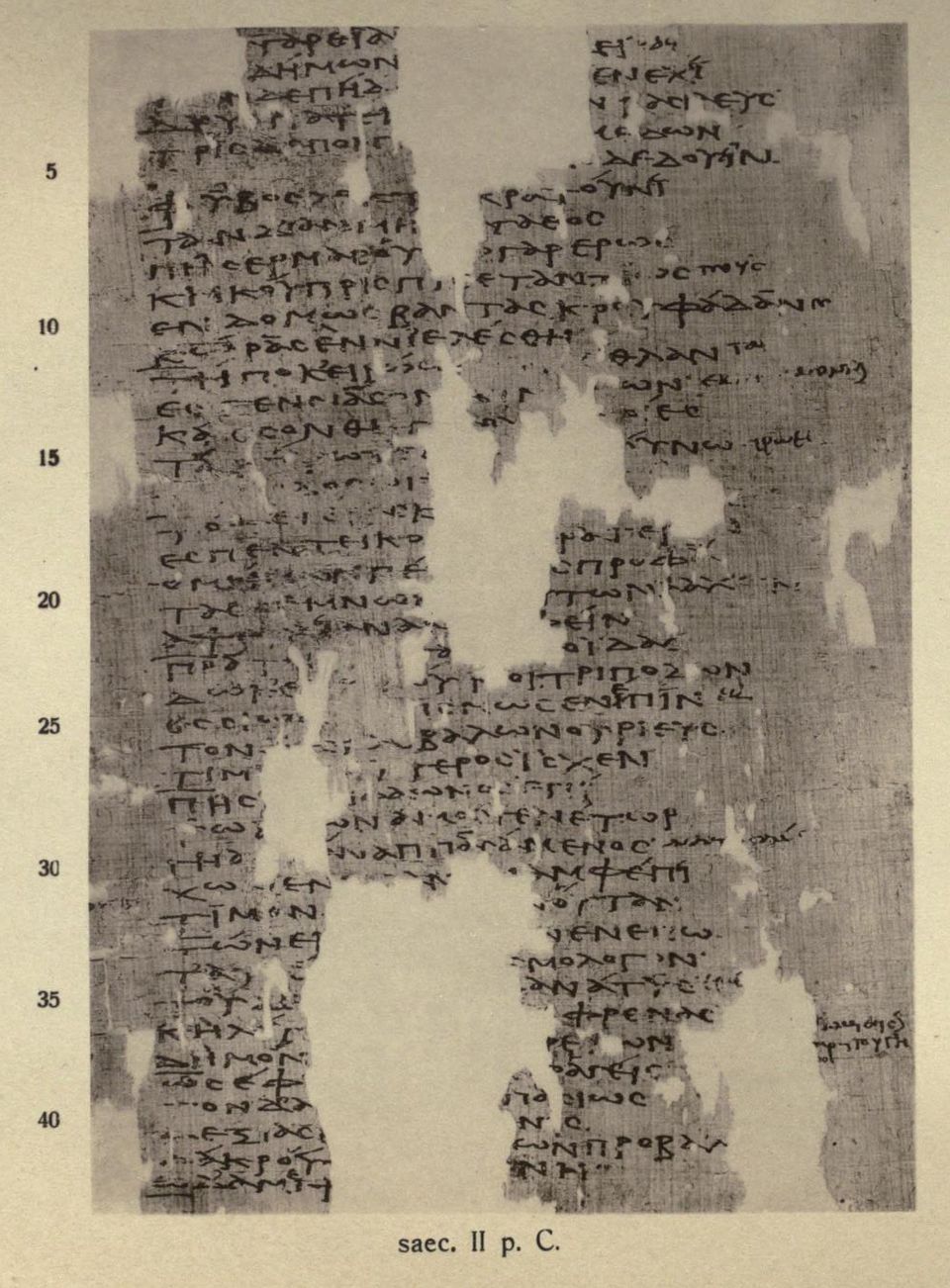
- PMG 654 is the “Berlin papyrus” (P. Berol. 13284) from Hermopolis, of the second century CE (the Berlin catalogue says first or second).[2] It was first published in 1907 by W. Schubart and U. von Wilamowitz-Moellendorff in the Berliner Klassikertexte (Berlin papyrus database, P. 13284).[3] The papyrus carries accents and marks of long and short. It also has scholia that translate Boeotian forms (Berlin papyrus database). Its first column holds the singing contest of Mount Helicon and Mount Cithaeron, judged by the gods. Cithaeron wins, and Helicon in his rage hurls a boulder into a myriad pieces. Its third column holds the prophecy of Acraephen to the river Asopus about his nine abducted daughters. Little survives of the first eleven lines of either poem, so editions begin at line 12. The legible text of the second poem breaks off just as Asopus is about to reply.[4]
- PMG 655 is P.Oxy. 2370, of about 200 CE. In it Terpsichore calls on the poet to sing for the women of Tanagra.[5] West treats it as the prefatory poem of her song-collection.[6] The speaker may be the poet or a chorus of girls. Many readers take it as a maiden-song (partheneion), and festivals such as the Mouseia at Thespiae or the Daedala at Plataea have been proposed for its performance. Those who date Corinna late see in it a conscious archaism, aimed at readers.[7]
- PMG 690, “Orestes”, is PSI 1174. PMG prints it among Boeotian fragments of uncertain authorship. But most scholars now give it to Corinna, following West’s 1970 arguments from spelling, metre and style.[8] Klinck prints it with Corinna too. She notes that an Orestes poem would be unusual in an oeuvre otherwise devoted to local Boeotian figures.[9]
Books and quotations. Hephaestion quotes a hexameter of hers “in the fifth book”,[10] so her poems were arranged in books. Antoninus Liberalis (25) names one book Ϝεροῖα (Weroia), probably “Tales”.[11] PMG 657, 664a–b and 674 are quotations in later authors. The grammarian Apollonius Dyscolus quotes 664a (the rebuke of Myrtis) and 664b (“I sing the valour of heroes and of heroines”) close together, and they may come from one poem. 674 praises Thespiae, under Helicon. In 657 someone calls Corinna a slug-a-bed; its context is unknown.[9]
Ancient grammarians, some of whom wrote on metre, stopped to explain her Boeotian spelling (PMG 658, 661, 664, 676, 684).[12] Hephaestion quotes 655.2–5 in ordinary, non-Boeotian spelling.[13] The two Hephaestion quotations are scanned on the Metres tabs.
Readers in Rome. Propertius (2.3.21) has his Cynthia rival the songs of antiquae Corinnae. Statius (Silvae 5.3.158) calls her poetry tenuis and arcana. Ovid gave her name to the mistress of his Amores. Antipater of Thessalonica, Clement of Alexandria and Eustathius treated her as canonical.[14] Alexander Polyhistor wrote a commentary on her (PMG 670).[15] Why Ovid chose her name is the subject of the Reception tab.
The spelling and its date. The text is transmitted in Boeotian spelling. It writes ου for both short and long u (so δουῖν, douin = δυεῖν, dyein, “two”; Κούπρις, Koupris = Κύπρις, Kypris; κρουφάδαν, krouphadān = κρυφάδαν, kryphadān, “in secret”). It writes η for αι, ει for η, ι for ε and ει, υ for οι, and ω for ου.[16]
| Boeotian spelling | Common spelling | Rule and meaning |
|---|---|---|
| ΚούπριςKoupris | ΚύπριςKypris | ου for υ: “Cypris” (PMG 654 iii 19) |
| κήkē | καίkai | η for αι: “and” (iii 19) |
| πατεὶ[ρ]patei[r] | πατήρpatēr | ει for η: “father” (iii 13) |
| ἐννί’enni’ | ἐννέαennea | ι for ε: “nine” (iii 21) |
| ἔχιechi | ἔχειechei | ι for ει: “holds” (iii 12) |
| ΦῦβοςPhȳbos | ΦοῖβοςPhoibos | υ for οι: “Phoebus” (iii 16) |
| δόμωςdomōs | δόμουςdomous | ω for ου: “house” (accusative plural, iii 20) |
Pindar keeps his language almost free of Boeotian, but Corinna is transmitted with this regional spelling.[18] It is “largely artificial and literary”, not the spoken Boeotian of any one period.[19] The spelling matters for scansion, because the letters do not show quantity.[20] It also matters for the date.[21]
Numbering. Fragment numbers are PMG numbers, as in West, Klinck and Natoli et al.
Notes
- ^ Natoli et al. 2022, p. 61 with n. 17.
- ^ Natoli et al. 2022, pp. 65, 70.
- ^ Natoli et al. 2022, p. 82 n. 20.
- ^ Natoli et al. 2022, pp. 65–66, 70; Klinck 2008.
- ^ Natoli et al. 2022, p. 74.
- ^ West 1987, p. 73.
- ^ Natoli et al. 2022, pp. 61, 84–85 nn. 38–40.
- ^ Natoli et al. 2022, p. 77.
- ^ a b Klinck 2008.
- ^ Hephaestion, Ench. 2.3.
- ^ Natoli et al. 2022, p. 75; Klinck 2008.
- ^ Natoli et al. 2022, p. 59 with n. 5.
- ^ Hephaestion, Ench. 16.3.
- ^ Natoli et al. 2022, pp. 61–62.
- ^ Collins 2006, p. 20 n. 9.
- ^ West 1987, p. 72 n. 5; Klinck 2008; Natoli et al. 2022, p. 331; de Kreij 2022, p. 160.
- ^ West 1987, p. 72.
- ^ de Kreij 2022, p. 160.
- ^ Natoli et al. 2022, pp. 65, 331.
- ^ See the Metres tabs.
- ^ See the Date tab.
About · 4 of 5
Corinna's myths: local stories, Panhellenic background
Page called Corinna’s way with myth “a law unto herself”, and regretted her “parochial stories”. Derek Collins argues instead that “the most distinctive feature of her poetry is her mythological innovation”. Her local versions, he argues, work against a background of Panhellenic myth: the tradition the Greeks knew from Homer and Hesiod, which her audience was expected to recognise.[1] Heath calls the case “convincingly demonstrated”.[2]
What she says she does. In PMG 655 the poet adorns, for the girls of Tanagra, λόγια (logia) handed down from the ancestors.[3] The word is usually translated “stories”. Collins takes it in its normal sense, “oracles”. He sees Corinna as a poet who elaborates the prophecies of her ancestors, as the prophet of the Asopus poem does.[4] Heath accepts the emphasis on myth. But he doubts that Statius meant oracles when he spoke of her arcana.[2]
The daughters of Asopus. In the common version, Zeus carries off Aegina. Asopus learns from Sisyphus who took her, and pursues Zeus, who drives him back to his river with a thunderbolt. Apollodorus gives Asopus twenty daughters (Apollodorus 3.12.6). Diodorus names twelve. He says that Apollo took Sinope, Poseidon took Corcyra and Salamis, and Zeus took Aegina (Diodorus 4.72.1–5).
Corinna has nine daughters: three for Zeus, three for Poseidon, two for Apollo and one for Hermes. A prophet explains this to Asopus, who takes his hand gladly, in tears (PMG 654 iii 12–21, 47–51). The poem is one of her departures from the usual version of a myth.[5]
Orion and the oracle. The prophet gives his credentials. The oracle passed from Apollo through Euonymus, son of the Boeotian river Cephisus, and Hyrieus, son of Poseidon and Alcyone, to Orion, “my father”. From Orion it came to the speaker (PMG 654 iii 32–41).[6] Orion is a Panhellenic figure, Homer’s and Hesiod’s hunter and constellation. But he is also a local hero, whose tomb was shown at Tanagra.
A fragment attributed to Hesiod tells of Orion’s birth from an ox-hide as Hyrieus’ son; Merkelbach and West doubted the attribution. So Corinna need not have invented that genealogy. But, as far as Collins knows, Orion is connected with an oracle nowhere else. In this poem the Panhellenic Orion becomes a holder of the Ptoian oracle of Boeotia, before he goes to the sky.[7]
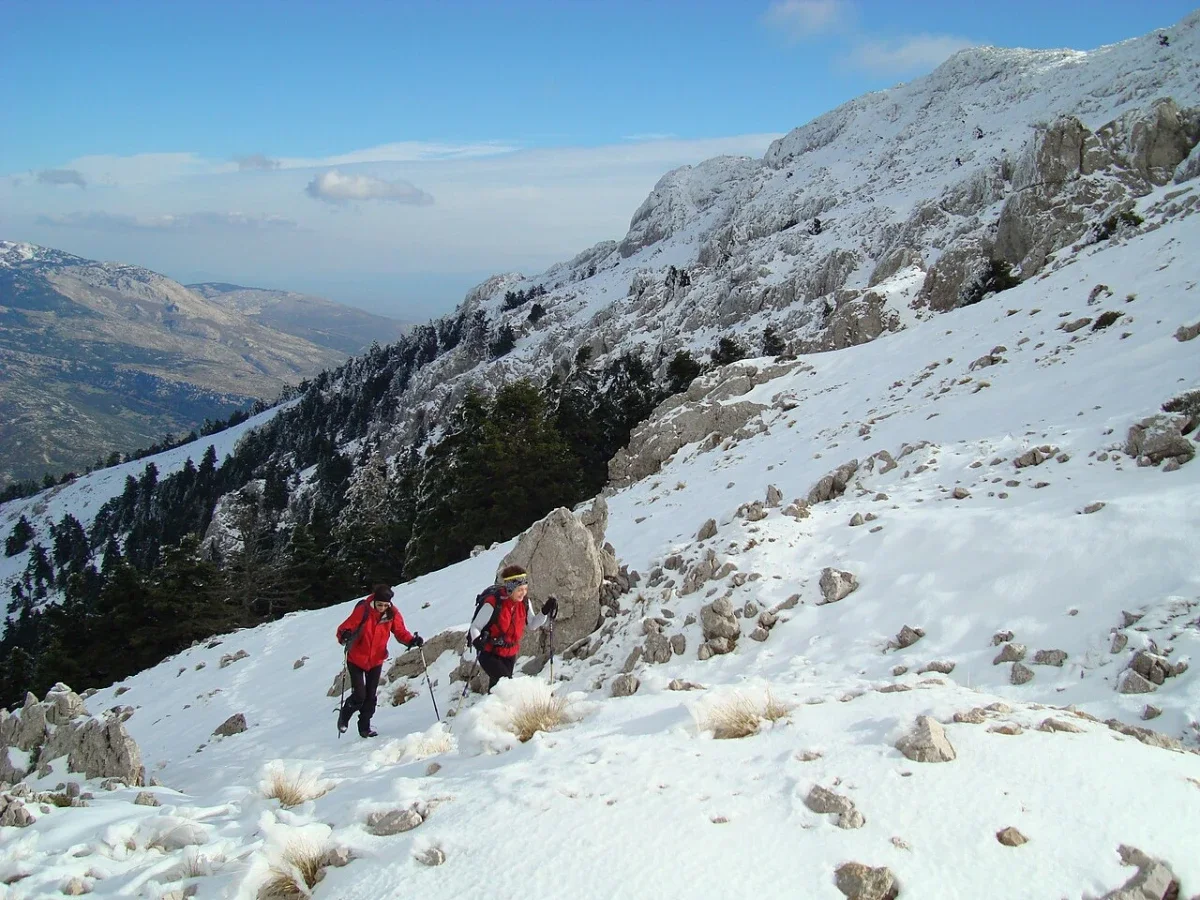
The mountains’ song. In its diction, Cithaeron’s song in PMG 654 i echoes Hesiod’s account of Rhea hiding Zeus (Theogony 482–3). But in it Rhea steals the child from the Curetes, perhaps a deliberate twist. Collins argues that Corinna drew on Hesiod or other early theogonies, not on Euripides, as Page had supposed.[8]
Oedipus and the fox. In the Epic Cycle the Athenian Cephalus rid Thebes of the Teumessian fox. For Corinna it was Oedipus (PMG 672). Collins reads the substitution as Boeotian resistance to an Athenian version. He sets it beside the Athenian domination of Boeotia from 458 to 447 BCE.[9]
Conclusion. Collins compares her handling of myth with Stesichorus’ Helen, Bacchylides’ Meleager and Pindar. In each there is a counterpoint between Panhellenic and local versions.[10] On gender he is cautious. If Corinna is “patriarchal” in some myths, in others she plainly is not. The singing contest of two male mountains, presided over by the Muses, could be read as a critique of male bravura.[11]
Notes
- ^ Collins 2006, pp. 21–22.
- ^ a b Heath 2013, p. 162.
- ^ Natoli et al. 2022, p. 74.
- ^ Collins 2006, pp. 22–23.
- ^ Collins 2006, p. 21.
- ^ Collins 2006, pp. 24–25; Natoli et al. 2022, p. 72.
- ^ Collins 2006, pp. 23–26 with n. 61.
- ^ Collins 2006, pp. 26–29.
- ^ Collins 2006, pp. 29–30.
- ^ Collins 2006, pp. 30–31.
- ^ Collins 2006, p. 20; on the date that his reading assumes, see the Date tab.
About · 5 of 5
Her metres: ionics and the hexameter
The ionics of the contest of the mountains
The ionic metron is ⏑ ⏑ — —.[1] PMG 654 i 11–52, the contest of Helicon and Cithaeron, is in “strict ionics”. Each strophe has five dimeters of the unvarying form ⏑ ⏑ — — ⏑ ⏑ — — ⁝. These are followed by a hypercatalectic dimeter, one syllable longer: ⏑ ⏑ — — ⏑ ⏑ — ⏑ — — |||. The sotadean of the same period is a shape-shifting metre, and these strict ionics are the sharpest possible contrast to it.[2] Here is the second strophe, in which the Muses call the vote (lines 17–22, Greek from Diehl’s public-domain edition):
μεγ]άλαν τ’ [ἀ]θανάτων ἔσ-
ς] ἕλε τιμάν· τάδ’ ἔμελψεμ·
μάκαρας δ’ αὐτίκα Μώση
φ]ερέμεν ψᾶφον ἔ[τ]αττον
κρ]ουφίαν κάλπιδας ἐν χρου-
σοφαῖς· τὺ δ’ ἅμα πάντε[ς] ὦρθεν·
meg]alan t’ [ā]thanatōn es- / s] hele timan; tad’ emelpsem; / makaras d’ autika Mōsē / ph]eremen psāphon e[t]atton / kr]ouphian kalpidas en chrou- / sophaïs; tȳ d’ hama pante[s] ōrthen;
“‘… and he won great honour from the immortals.’ Such was his song. At once the Muses bade the blessed gods cast their secret voting-pebbles into the gold-gleaming urns; and all of them rose together.”
Five ionic dimeters, ⏑ ⏑ — — ⏑ ⏑ — —, then a hypercatalectic dimeter one syllable longer, ⏑ ⏑ — — ⏑ ⏑ — ⏑ — —. Red: quantities that the spelling hides and the metre settles. The ἀ- of ἀθανάτων is long (line 1); κρου- has a short u and χρου- a long one (line 5); -φα-ῖς is two syllables and τύ is long (line 6).
Corinna, PMG 654 i 17–22, Greek from Diehl 1917, pp. 48–49; West’s metrical analysis
synthetic ∿
The papyrus divides words across lines (ἔσ-|ς, χρου-|σοφαῖς). The first strophe’s closing line, νίκα νιν κλέψε μάκηρα Ῥεία (nika nin klepse makēra Rheia) (after τα- at the end of 15), has the same ten-syllable shape.
Two quantities follow from the spelling. τύ (ty) here is the Boeotian spelling of τοί (toi), “they”,[3] so its υ is long. And -φαῖς must count as two syllables, -φα-ῖς, for the line to fill its ten positions (Natoli et al. gloss the word as χρυσοφαεῖς, chrysophaeis, “gold-gleaming”).[3] The ἀ- of ἀθανάτων is long. Note also κρουφίαν (krouphian) with short u and χρου- (chrou-) with long u, and Μώση (Mōsē) for Μοῦσαι (Mousai), “Muses”.
Another name for the closing line. Natoli, Pitts and Hallett give the same scheme: five dimeters of ionic a minore, and a sixth line ⏑ ⏑ — — ⏑ ⏑ — ⏑ — —. But they call the sixth line a “hypermetric glyconic clausula”.[4] The syllables are the same; only the name differs from West’s “hypercatalectic” ionic dimeter.[2] Their text prints the papyrus’s word-division with the accent σοφαίς,[5] where Klinck has σοφαῖς.
The hexameter
Hephaestion’s quotation of PMG 657 shows that she also wrote dactylic hexameters, “in the fifth book”. His point is about prosody. In his chapter on synecphonesis he notes that two shorts may run together into one short. This is found in other metres, but rarely in epic verse. He gives this line of Corinna’s as an instance, with δια- as one short syllable:[6]
ἢ διανεκῶς εὕδης; οὐ μὰν πάρος ἦσθα Κόριννα
ē dianekōs heudēs? ou man paros ēstha Korinna
“Are you sleeping on and on? You were not like that before, Corinna.”
δια- (red) runs together into one short syllable, as Hephaestion’s point requires. The line is then a regular hexameter with spondees in the second and third feet. Klinck prints ἦ … εὕδεις.[7]
Corinna, PMG 657, quoted by Hephaestion, Ench. 2.3 (text as in Consbruch)
synthetic ∿
In the same paragraph Hephaestion quotes a line of Praxilla’s with the same licence.[8]
Notes
The Asopids (654 iii) · 12–21 (the daughters)
Corinna, fr. 654 col. iii 12–21
Synopsis
The river god Asopus has come, it seems, to a sanctuary of Apollo. He asks the seer Acraephen, hero of the Boeotian town of Acraephia, where his nine lost daughters have gone. Acraephen tells him to be glad: Zeus, Poseidon, Apollo and Hermes have taken them as brides. To prove his authority, he traces his office as Apollo’s prophet back through Euonymus, Hyrieus and his own father Orion. Asopus takes his hand, weeping, and the text breaks off as he replies.[1] In the usual story Zeus carries off Aegina, and Asopus pursues him. Corinna’s version is one of her departures from the common myth. Orion appears nowhere else as the holder of an oracle.[2] The poem survives on a papyrus from Hermopolis in Egypt, of the second century AD, now in Berlin.[1] Corinna’s date is disputed. Ancient tradition makes her an older contemporary and rival of Pindar. Since Lobel in 1930, many have placed her in the Hellenistic period. Campbell thinks it almost certain that she wrote in the third century BC, since nobody names her before about 50 BC, and her poems are spelt as Boeotian was about 200 BC. The editors of a 2020 volume on the reception of lyric call the fifth-century date the one now generally believed.[3]
Col. iii 12–21 is given below in the wording of Diehl’s public-domain edition:[4] the seer’s opening, in which he shares out the nine daughters among the gods.[5]
Text and translation
τᾶν δὲ πήδω[ν τρῖς μ]ὲν ἔχῑ
Corinna · PMG 654 col. iii, lines 12–21 · two stanzas · Greek wording from Diehl 1917, p. 50; metrical analysis after West
How to read each line
A guide to the Greek, syllables, pitch marks and quantities.
Show the reading key
- Above each line: the line as the edition prints it, each word placed over its own syllables. The main row: the same Greek divided into metrical syllables, each written as it is pronounced. A consonant that closes a syllable is written with it (λόθ | ρο); an elided word is closed up with the next vowel (ν’ἀ); a final consonant carried into the next word is set with a thin space (ς ἰ). Wider gaps mark word-ends.
- Above the syllables: the pitch of each syllable, from the accents. Under them: the quantity of each syllable as it falls in the line, then the transliteration, syllable by syllable, with accented syllables in capitals.
- Under each line: a line-for-line translation. In the right margin of the scansion: the line type, its scheme, and its analysis into cola.
Key to the labels
The names, patterns and symbols used beside this poem.
Show the labels and symbols
The labels in the right margin of the scansion below give the line’s analysis as the scheme file states it, then its scheme and, where the analysis notes them, the period-end, a brevis in longo or a hiatus. ‖ marks the end of a period, ||| the end of the stanza; a line without a period-end runs on into the next (synapheia). × is an anceps, long or short; the last position of every period is indifferent. A click on any syllable highlights the colon it belongs to and explains it. The sources of the labels, with their page numbers, are given line by line under Prosody, line by line.
| Label | Name and shape | What it is |
|---|---|---|
| gla | Anaclastic glyconic (gl¨)○ ○ — × — ⏑ ⏑ — | West’s anaclastic glyconic, ○ ○ — × — ⏑ ⏑ —, beside the glyconic ○ ○ — ⏑ ⏑ — ⏑ —.[6] West says it becomes increasingly frequent in Hellenistic aeolic and gives this passage as his example.[7] The base ○ ○ is two positions of which at least one must be long.[8] Natoli, Pitts and Hallett give the same shape, x x — x — ⏑ ⏑ —, and call it “polyschematist”,[9] using the term Hephaestion applies to metres that take many shapes at the poet’s choice.[10] |
| ph | Pherecratean (ph)○ ○ — ⏑ ⏑ — — | The catalectic form of the glyconic, ○ ○ — ⏑ ⏑ — —.[6] It closes each stanza: Hellenistic aeolic is usually glyconics in short strophes with a pherecratean close.[7] |
| gl | Glyconic (gl)○ ○ — ⏑ ⏑ — ⏑ — | The standard glyconic.[6] “The only straight glyconic here is the third line of the second stanza”.[7] |
The feet
| Foot and shape | Where |
|---|---|
| Aeolic base○ ○ | The two opening positions, of which at least one must be long.[8] |
| Long and anceps— × | In the anaclastic glyconic, the long and the anceps between the base and the choriamb.[11] |
| Choriamb— ⏑ ⏑ — | The choriamb, — ⏑ ⏑ —.[8] |
| Close⏑ — or — | The positions after the choriamb: ⏑ — in the glyconic, a single long in the pherecratean.[6] |
Scansion
The prophet Acraephen tells the river Asopus where his nine daughters have gone: the two stanzas that West prints as his example of the anaclastic glyconic in Hellenistic aeolic, four glyconic lines and a pherecratean close, scanned position by position with the Boeotian spelling undone.
Three of the daughters belong
to father Zeus, who rules over all;
three were taken as brides by Poseidon,
lord of the sea; Phoebus commands the beds
of two of them,
and one is had by Maia’s noble
boy, Hermes. That is how Eros
and Cypris won them over, to steal
into your halls unseen
and carry off the nine girls.
Metre
- West’s analysis. West prints these ten lines in his chapter on the later centuries, under aeolic: aeolic lives on into the Hellenistic age mainly in conventional festival poems, mostly short glyconic strophes closed by a pherecratean, and the anaclastic glyconic (○ ○ — × — ⏑ ⏑ —, gl¨) grows more and more common; Corinna’s ten lines (PMG 654 iii 12–21) are his example, and in them, he notes, only one line, the third of the second stanza, is an ordinary glyconic.[7] West marks only the two stanza-ends, |||. The right margin of this page gives the colon that his description assigns to each line: gl¨ gl¨ gl¨ gl¨ ph ||| gl¨ gl¨ gl gl¨ ph |||.
- The three cola. In West’s key the glyconic (gl) is ○ ○ — ⏑ ⏑ — ⏑ —, the anaclastic glyconic (gl¨) ○ ○ — × — ⏑ ⏑ —, and the pherecratean (ph) ○ ○ — ⏑ ⏑ — —.[6] The sign ○ ○ stands for two positions of which at least one must be long.[8] The anaclastic glyconic has the same number of positions as the glyconic; its double short simply stands one place later, next to the last long.
- The base. Every base here has a long syllable in it: — ⏑ in lines 12, 13, 14, 17, 19 and 20, — — in 16, 18 and 21, and ⏑ — in 15, where West’s long ῑ in Ποτῑδᾱ́ων supplies the long.[12] The page cannot write “at least one long”, so the base appears in the margin as × ×.
- The anceps. In all seven anaclastic glyconics the anceps, the fourth position, happens to be long: πήδω[ν] (12), [πάν-] (13), [-τω] (14), -ων (15), Μή- (17), οὔ- (18), βάν- (20).
- Line-ends. West marks no period-end inside a stanza, and this page marks none. Every line inside a stanza ends in a syllable that is long whatever follows it (a long vowel, a diphthong, or a short vowel closed by ς or ν before a consonant), so no scansion here depends on whether the lines of a stanza run on. A period cannot end in the middle of a word,[13] but no word is divided between lines here, so the word-ends do not show where periods end. The last position of each pherecratean stands before the stanza-end and is shown as ×, since the last position of a period may hold a long or a short;[13] both are long here.
- Prosody. Syllables are divided without regard to word-division: a consonant before a vowel begins the syllable, and a syllable is long if it has a long vowel or diphthong or is closed by a consonant.[14] Two short vowels are elided, δ’ (17) and ἐννί’ (21).[15] A short vowel stays short before a word-initial stop + liquid in κρατούνῑ (16), the kind of correption West says early poetry admits at the beginning of a word.[16]
- The Boeotian spelling. The papyrus writes Corinna’s Boeotian vowels: de Kreij lists αι > η, οι > υ, η > ει, ει > ι, and υ > ου,[17] and Klinck adds ω for ου.[18] So πήδων is παίδων, Δεὺς πατείρ is Ζεὺς πατήρ, ἔχῑ is ἔχει, Φῦβος is Φοῖβος, πῆς is παῖς, κή is καί, ἑλέσθη is ἑλέσθαι, and πόντω, δόμως are πόντου, δόμους.[19] West adds that ου spells both short and long u: in δουῖν = δυεῖν it is short, and the same holds for Κούπρις and κρουφάδᾱν.[20] A spelling with ου therefore says nothing about length, and the notes to lines 15, 16, 19 and 20 give the length West marks.
- Marked quantities. West marks long ῑ in ἔχῑ (12) and κρατούνῑ (16), long ῑ and ᾱ in Ποτῑδᾱ́ων (15), long ου in κρατούνῑ (16), long ᾱ in τᾱ̀ν (17), Μή[ᾱς] (17), πιθέτᾱν (19), κρουφάδᾱν (20) and κώρᾱς (21), and short υ in δουῖν (15) and Κούπρις (19).[7] The input keeps these marks; they are not shown in the Greek line.
- Gentili and Lomiento’s table. Gentili and Lomiento print all eight stanzas of lines 12–51 with a table of the strophe that records, row by row, the lines in which a position takes its less usual quantity.[21] For these ten lines the table agrees with West’s marks position by position; the exceptions it lists among them are the short second position of 13, the short first and long second position of 15, the long fourth position of 14, and ⏑ — in place of — ⏑ in the fifth and sixth positions of 19, the straight glyconic.[22] Where West writes the line as a colon, gl¨ or gl, with the base ○ ○, Gentili and Lomiento’s table treats it as eight positions of a dimeter, the first four free except the third, the second half a choriamb or ⏑ — ⏑ —; the Metres: the Asopids tab sets out the two analyses side by side.
- Another analysis. Natoli, Pitts and Hallett call the first four lines of each stanza “polyschematic”, with the shape x x — x — ⏑ ⏑ —, and the fifth a pherecratean, and see in them elements of the ionic a minore and the glyconic.[9] The shape is West’s gl¨. Their marks over line 15 make the first two syllables of Ποτιδάων short; West marks the ι long, and his base, ○ ○, requires one long position.[12]
Prosody, line by line
Every syllable, with the reason for its length. Quantities are read from the vowel where the spelling shows it, from the consonants that follow (“position”), from the accent where it tells, and from the metre where nothing else does. Editors’ notes on the text follow in the boxed paragraphs.
- col. iii 12
Line col. iii 12 · τᾶν δὲ πήδων τρῖς μὲν ἔχι
τᾶν δὲ πήδων τρῖς μὲν ἔχι
τᾶνδὲπήδω[ν][τρῖς][μ]ὲν ἔχιthe period runs on into col. iii 13 (synapheia).
- 1 —τᾶνᾶ carries a circumflex, so it is long; closed by ν: long by position; the position is anceps.
- 2 ⏑δὲὲ is short by nature; the position is anceps.
- 3 —πήή is long by nature.
- 4 —δω[ν]ω is long by nature; closed by ν: long by position; the position is anceps.
- 5 —[τρῖς]ῖ carries a circumflex, so it is long; closed by ς: long by position.
- 6 ⏑[μ]ὲὲ is short by nature.
- 7 ⏑ν ἔἔ is short by nature; the first consonant belongs to the previous word and is carried over to this vowel.
- 8 —χιῑ is long (its length is not shown by the ordinary spelling); the line-end is not a period-end: the period runs on into the next line (synapheia), so this syllable keeps its own length, with no brevis in longo, and a word may run over into the next line.[23]
West’s first anaclastic glyconic, gl¨.[7] τᾶν πήδων is τῶν παίδων, “of the children”, here the daughters of Asopus;[19] the η of πήδων is Boeotian for αι.[17] The base is τᾶν δὲ, — ⏑. The ν of πήδω[ν] is supplied, and it closes the syllable before τρ-, so -δων is long and fills the anceps. τρῖς is τρεῖς and ἔχῑ is ἔχει, with Boeotian ι for ει;[24] West marks the ι of ἔχῑ long. The ν of μ]ὲν goes with the following ἔ-, so μέ- is an open short syllable and μέ ἔ make the choriamb’s two shorts.[14]- col. iii 13
Line col. iii 13 · Δεὺς πατεὶρ πάντων βασιλεύς,
Δεὺς πατεὶρ πάντων βασιλεύς,
Δεὺςπατεὶ[ρ][πάν][τω]νβασιλεύς,continues col. iii 12 · one period (synapheia); the period runs on into col. iii 14 (synapheia).
- 1 —Δεὺςεὺ is a diphthong, long by nature; closed by ς: long by position; the position is anceps.
- 2 ⏑παα is short: πατήρ has a short first α;[25] West marks nothing here. The syllable is open and short; it stands second in the base, where either length is admitted, since Δεὺς is long.[8]
- 3 —τεὶ[ρ]εὶ is a diphthong, long by nature; closed by ρ: long by position.
- 4 —[πάν]ά is a vowel of unknown length; closed by ν: long by position; the position is anceps.
- 5 —[τω]νω is long by nature; closed by ν: long by position.
- 6 ⏑βαα is short by the metre (position 6 must be short).
- 7 ⏑σιι is short by the metre (position 7 must be short).
- 8 —λεύς,εύ is a diphthong, long by nature; closed by ς: long by position; the line-end is not a period-end: the period runs on into the next line (synapheia), so this syllable keeps its own length, with no brevis in longo, and a word may run over into the next line.[23]
- col. iii 14
Line col. iii 14 · τρῖς δὲ πόντω γᾶμε μέδων
τρῖς δὲ πόντω γᾶμε μέδων
τρῖςδὲπόντ[ω][γᾶ][με]μέδωνcontinues col. iii 13 · one period (synapheia); the period runs on into col. iii 15 (synapheia).
- 1 —τρῖςῖ carries a circumflex, so it is long; closed by ς: long by position; the position is anceps.
- 2 ⏑δὲὲ is short by nature; the position is anceps.
- 3 —πόνό is short by nature; closed by ν: long by position.
- 4 —τ[ω]ω is long by nature; the position is anceps.
- 5 —[γᾶ]ᾶ carries a circumflex, so it is long.
- 6 ⏑[με]ε is short by nature.
- 7 ⏑μέέ is short by nature.
- 8 —δωνω is long by nature; closed by ν: long by position; the line-end is not a period-end: the period runs on into the next line (synapheia), so this syllable keeps its own length, with no brevis in longo, and a word may run over into the next line.[23]
- col. iii 15
Line col. iii 15 · Ποτιδάων, τᾶν δὲ δουῖν
Ποτιδάων, τᾶν δὲ δουῖν
Π[ο][τι][δά][ων],[τ]ᾶνδὲδουῖνcontinues col. iii 14 · one period (synapheia); the period runs on into col. iii 16 (synapheia).
- 1 ⏑Π[ο]ο is short by nature; the position is anceps.
- 2 —[τι]ῑ is long (its length is not shown by the ordinary spelling); the position is anceps.
- 3 —[δά]ᾱ́ is long (its length is not shown by the ordinary spelling).
- 4 —[ων],ω is long by nature; closed by ν: long by position; the position is anceps.
- 5 —[τ]ᾶνᾶ carries a circumflex, so it is long; closed by ν: long by position.
- 6 ⏑δὲὲ is short by nature.
- 7 ⏑δουου is here the Boeotian spelling of short υ: δουῖν is δυεῖν, “two”,[28] and West marks the υ short. The syllable is open, so it is short, as the double short of the choriamb requires.
- 8 —ῖνῖ carries a circumflex, so it is long; closed by ν: long by position; the line-end is not a period-end: the period runs on into the next line (synapheia), so this syllable keeps its own length, with no brevis in longo, and a word may run over into the next line.[23]
gl¨. Π[οτῑδᾱ́ων] is Poseidon, Doric Ποτιδάων;[27] West marks its ι and its α long, which gives the base ⏑ — and a long third position.[7] The ω of -ων fills the anceps. τ]ᾶν δὲ δουῖν, “and of two”, are genitives.[27] δουῖν is δυεῖν, the ου spelling a short u, which West marks with a breve.[20] The page therefore gives δου- as a short syllable; the scanner, reading ου as a diphthong, would have made it long, and its reason is replaced with West’s. The υ and the ι of δουῖν stand side by side as two syllables, δου-ῖν.- col. iii 16
Line col. iii 16 · Φῦβος λέκτρα κρατούνι,
Φῦβος λέκτρα κρατούνι,
Φῦβοςλέκτ[ρα]κρατούνι,continues col. iii 15 · one period (synapheia).
- 1 —Φῦῦ carries a circumflex, so it is long; the position is anceps.
- 2 —βοςο is short by nature; closed by ς: long by position; the position is anceps.
- 3 —λέκέ is short by nature; closed by κ: long by position.
- 4 ⏑τ[ρα]α is a vowel of unknown length; the next word begins with κρ, a stop + liquid that does not make position here, so the syllable stays short.
- 5 ⏑κραα is short by the metre (position 5 must be short).
- 6 —τούου is here the Boeotian spelling of long υ: κρατούνι is κρατύνει,[27] and West marks the vowel long.[29]
- 7 ×νι,ῑ is long (its length is not shown by the ordinary spelling); the last position of the period is indifferent.
The pherecratean, ph, that closes the stanza.[30] Φῦβος is Φοῖβος, Apollo, with Boeotian υ for οι.[31] Its -βος is closed by ς before λ- and long. λέκτ[ρα], “bed”, is divided λέκ-τρα: κ closes the first syllable, and -τρα is open and short. κρατούνῑ is κρατύνει, “is master of”:[27] ου for long u and ι for ει; West marks both long.[29] The α of -τρα stays short before the initial κρ- of κρατούνῑ, as early poetry admits at the beginning of a word,[16] and κρα- is short too: these are the pherecratean’s two shorts. The final ῑ stands before the stanza-end (×).- col. iii 17
Line col. iii 17 · τὰν δ’ ἴαν Μήας ἀγαθὸς
τὰν δ’ ἴαν Μήας ἀγαθὸς
τὰνδ’ἴανΜή[ας]ἀγαθὸςthe period runs on into col. iii 18 (synapheia).
- 1 —τὰνᾱ̀ is long (its length is not shown by the ordinary spelling); closed by ν: long by position; the position is anceps.
- 2 ⏑δ’ἴἴα, the epic feminine of “one”, has a short ι;[32] West marks nothing here, and the input marks the ι short from LSJ. δέ is elided before it and its δ joins this syllable.[15] The syllable is open and short; the position is the second of the base, where either length is admitted, since τᾱν is long.[8]
- 3 —ανα is a vowel of unknown length; closed by ν: long by position.
- 4 —Μήή is long by nature; the position is anceps.
- 5 —[ας]ᾱ is long (its length is not shown by the ordinary spelling).
- 6 ⏑ἀἀ is short by the metre (position 6 must be short).
- 7 ⏑γαα is short by the metre (position 7 must be short).
- 8 —θὸςὸ is short by nature; closed by ς: long by position; the line-end is not a period-end: the period runs on into the next line (synapheia), so this syllable keeps its own length, with no brevis in longo, and a word may run over into the next line.[23]
gl¨. τᾱ̀ν δ’ ἴαν is τὴν δὲ μίαν, “and one”:[27] ἴα is the epic feminine of “one”, with short ι.[32] δέ is elided before it,[15] so δ’ἴ- is one short syllable. The base is τᾱν δ’ἴ-, — ⏑, with West’s long ᾱ.[7] The ν of ἴαν closes its syllable before Μ- and gives the long third position. Μή[ᾱς] is Μαίας, “of Maia”, Hermes’ mother,[27] with η for αι; West marks the supplied ᾱ long. ἀγαθὸς, “good”, ends in ς before π- and is long.- col. iii 18
Line col. iii 18 · πῆς Ἑρμᾶς· οὔτω γὰρ Ἔρως
πῆς Ἑρμᾶς· οὔτω γὰρ Ἔρως
πῆςἙρμᾶς·οὔ[τ]ωγὰρ Ἔρωςcontinues col. iii 17 · one period (synapheia); the period runs on into col. iii 19 (synapheia).
- 1 —πῆςῆ is long by nature; the position is anceps.
- 2 —ἙρἙ is short by nature; closed by ρ: long by position; the position is anceps.
- 3 —μᾶς·ᾶ carries a circumflex, so it is long.
- 4 —οὔοὔ is a diphthong, long by nature; the position is anceps.
- 5 —[τ]ωω is long by nature.
- 6 ⏑γὰὰ is short by the metre (position 6 must be short).
- 7 ⏑ρ ἜἜ is short by nature; the first consonant belongs to the previous word and is carried over to this vowel.
- 8 —ρωςω is long by nature; closed by ς: long by position; the line-end is not a period-end: the period runs on into the next line (synapheia), so this syllable keeps its own length, with no brevis in longo, and a word may run over into the next line.[23]
gl¨. πῆς is παῖς, “son”.[27] The base, πῆς Ἑρ-, is — —, both syllables long, as ○ ○ allows.[8] οὔ[τ]ω fills the anceps with a long; West prints it with the smooth breathing, where Natoli et al.[33] and Klinck[34] have οὕ[τ]ω. The ρ of γὰρ goes with Ἔ-, so γὰ- and ρἜ- are the two shorts.Campbell too prints οὕ[τ]ω.[35]
- col. iii 19
Line col. iii 19 · κὴ Κούπρις πιθέταν, τιὼς
κὴ Κούπρις πιθέταν, τιὼς
κὴΚούπριςπιθέταν,τιὼcontinues col. iii 18 · one period (synapheia); the period runs on into col. iii 20 (synapheia).
The label in the margin, with its sources: the one straight glyconic (West 1987, p. 72).
- 1 —κὴὴ is long by nature; the position is anceps.
- 2 ⏑Κούου is here the Boeotian spelling of short υ: Κούπρις is Κύπρις, and West marks the υ short.[20] Before πρ a short vowel may end an open syllable or be closed by π, so the syllable could count either way;[16] it stands in the base, where either length is admitted so long as one of the two positions is long, and κή is long.[8] The page shows it as the open short syllable Κου-.
- 3 —πριςι is a vowel of unknown length; closed by ς: long by position.
- 4 ⏑πιι is short by the metre (position 4 must be short).
- 5 ⏑θέέ is short by nature.
- 6 —ταν,ᾱ is long (its length is not shown by the ordinary spelling); closed by ν: long by position.
- 7 ⏑τιι is short by the metre (position 7 must be short).
- 8 —ὼὼ is long by nature; the line-end is not a period-end: the period runs on into the next line (synapheia), so this syllable keeps its own length, with no brevis in longo, and a word may run over into the next line.[23]
The glyconic, gl: West singles out this line as the one ordinary glyconic among the ten.[7] κὴ is καί.[27] Κούπρις is Κύπρις, Aphrodite, and its ου spells a short u, marked so by West.[20] Before πρ that short vowel may end an open syllable or be closed by π;[16] the page shows it as the open short Κου-, but in the base, ○ ○, either length is admitted, since κὴ is long.[8] πιθέτᾱν is a dual aorist of πείθω, “the two of them persuaded”,[27] with West’s long ᾱ. τιὼς is σούς, “your”,[27] two syllables, τι-ὼς, giving the glyconic’s closing ⏑ —.- col. iii 20
Line col. iii 20 · ἐν δόμως βάντας κρουφάδαν
ἐν δόμως βάντας κρουφάδαν
ς ἐνδόμωςβάνταςκρουφάδανcontinues col. iii 19 · one period (synapheia); the period runs on into col. iii 21 (synapheia).
- 1 —ς ἐνἐ is short by nature; closed by ν: long by position; the first consonant belongs to the previous word and is carried over to this vowel; the position is anceps.
- 2 ⏑δόό is short by nature; the position is anceps.
- 3 —μωςω is long by nature; closed by ς: long by position.
- 4 —βάνά is a vowel of unknown length; closed by ν: long by position; the position is anceps.
- 5 —ταςα is a vowel of unknown length; closed by ς: long by position.
- 6 ⏑κρουου is here the Boeotian spelling of short υ: κρουφάδαν is the Boeotian adverb “secretly”,[27] and West names it with δουῖν and Κούπρις as a word whose ου spells u, marking the vowel short.[20] The syllable is open, so it is short, as the double short of the choriamb requires.
- 7 ⏑φάά is short by the metre (position 7 must be short).
- 8 —δανᾱ is long (its length is not shown by the ordinary spelling); closed by ν: long by position; the line-end is not a period-end: the period runs on into the next line (synapheia), so this syllable keeps its own length, with no brevis in longo, and a word may run over into the next line.[23]
gl¨. τιὼς ἐν δόμως, “into your house”;[27] δόμως is δόμους, with ω for ου.[18] The base is ἐν δό-, — ⏑: the ν of ἐν closes it before δ-. βάντας is the aorist participle of βαίνω, “going”. κρουφάδᾱν is the Boeotian adverb “secretly”;[27] its ου spells a short u,[20] so κρου- is a short open syllable before φ, and κρου φά are the choriamb’s two shorts. The scanner, reading ου as a diphthong, would have made it long; its reason is replaced with West’s. West marks the final ᾱ long. The ς of βάντας closes -τας before κρ-.- col. iii 21
Line col. iii 21 · κώρας ἐννί’ ἑλέσθη.
κώρας ἐννί’ ἑλέσθη.
κώραςἐννί’ἑλέσθη.continues col. iii 20 · one period (synapheia).
- 1 —κώώ is long by nature; the position is anceps.
- 2 —ραςᾱ is long (its length is not shown by the ordinary spelling); the position is anceps.
- 3 —ἐνἐ is short by nature; closed by ν: long by position.
- 4 ⏑νί’ί is short by the metre (position 4 must be short); the apostrophe marks an elided vowel; the consonant before it joins this syllable.
- 5 ⏑ἑἑ is short by nature.
- 6 —λέσέ is short by nature; closed by σ: long by position.
- 7 ×θη.η is long by nature; the last position of the period is indifferent.
The closing pherecratean, ph |||. κώρᾱς, “girls”, is κόρας,[27] with West’s long ᾱ. ἐννί’ is ἐννέα, “nine”, with ι for ε[18] and its final α elided before ἑλέσθη.[15] The ι left standing before ἑ- is short, and νι ἑ- are the pherecratean’s two shorts. ἑλέσθη is ἑλέσθαι, “to take”,[27] with η for αι. Its last syllable stands before the stanza-end (×).
The poem and this passage
The lines come from the third column of the Berlin papyrus of Corinna (PMG 654), a papyrus from Hermopolis in Egypt of the second century CE.[36] The river-god Asopus has come to the seer Acraephen to learn what has become of his nine missing daughters; Acraephen’s reply runs to line 46, and he tells Asopus that Zeus, Poseidon, Apollo and Hermes have taken them as consorts.[26] In Klinck’s summary, Eros and Aphrodite had persuaded the four gods to carry off the girls, nymphs associated with places in Boeotia, who will be granted semi-divine status.[18] Klinck asks whether a chorus of girls performing the poem would have set off the beauty and destiny of the daughters, and whether the pomposity of the seer and the father is ironic.[37]
Corinna’s date is disputed. The ancient tradition makes her Pindar’s contemporary; Lobel and West argued for a Hellenistic date, among other reasons because the papyrus is written in the Boeotian spelling of the third century BCE.[38] West places this passage among the Hellenistic examples of aeolic.[39]
The text
The Greek wording comes from Diehl’s public-domain edition: his lines 51–60 correspond to PMG 654 iii 12–21.[40] All ten lines, including the supplied words, agree with that edition. The display normalizes accents, breathings, punctuation and the boundaries of square brackets. In particular, it retains smooth breathing in οὔ[τ]ω (18), where Diehl prints rough breathing. The scansion uses West’s quantity marks; these are not part of the displayed Greek.[7] The modern editions remain sources for the metrical analysis and textual comparison.
Notes
- ^ a b Natoli et al. 2022, p. 70.
- ^ Collins 2006, pp. 21, 24–26.
- ^ Natoli et al. 2022, pp. 60–61; Collins 2006, p. 19; Campbell 1992, pp. 1–2; Currie and Rutherford 2020, p. 9.
- ^ Diehl 1917, p. 50.
- ^ West 1987, p. 72.
- ^ a b c d e West 1987, p. x.
- ^ a b c d e f g h i j West 1987, p. 72.
- ^ a b c d e f g h i West 1987, p. ix.
- ^ a b Natoli et al. 2022, p. 340.
- ^ Hephaestion, Ench. 16.1.
- ^ West 1987, p. x: ○ ○ — × — ⏑ ⏑ —.
- ^ a b West 1987, pp. ix, 72.
- ^ a b West 1987, p. 4.
- ^ a b West 1987, p. 12.
- ^ a b c d West 1987, p. 13.
- ^ a b c d West 1987, p. 16.
- ^ a b c de Kreij 2022, p. 160.
- ^ a b c d e Klinck 2008, p. 162.
- ^ a b Natoli et al. 2022, pp. 70–71.
- ^ a b c d e f West 1987, p. 72 n. 5.
- ^ Gentili and Lomiento 2001, p. 8; see the next tab of this work for the remaining stanzas.
- ^ Gentili and Lomiento 2001, p. 8; West 1987, p. 72.
- ^ a b c d e f g h West 1987, pp. 3–4.
- ^ Natoli et al. 2022, pp. 70–71; de Kreij 2022, p. 160.
- ^ a b LSJ s.v. πατήρ.
- ^ a b c d Natoli et al. 2022, p. 70.
- ^ a b c d e f g h i j k l m n o p Natoli et al. 2022, p. 71.
- ^ West 1987, p. 72 n. 5; Natoli et al. 2022, p. 71.
- ^ a b West 1987, p. 72 with n. 5.
- ^ West 1987, pp. x, 72.
- ^ Natoli et al. 2022, p. 71; de Kreij 2022, p. 160.
- ^ a b LSJ s.v. ἴα.
- ^ Natoli et al. 2022, p. 68.
- ^ Klinck 2008, p. 156.
- ^ Campbell 1992, p. 30.
- ^ Natoli et al. 2022, pp. 65, 70.
- ^ Klinck 2008, p. 153.
- ^ Natoli et al. 2022, pp. 60–61; de Kreij 2022, p. 160 n. 53.
- ^ West 1987, p. 72; on the dispute see the Life tab of this page.
- ^ Diehl 1917, p. 50.
Text and sources
- Greek wording: E. Diehl, Supplementum lyricum, third edition (Bonn 1917), p. 50, lines 51–60. Public domain. Original page image.
- Metrical analysis: M. L. West, Introduction to Greek Metre (Oxford 1987), p. 72 with n. 5 (Corinna PMG 654 iii 12–21; Hellenistic aeolic; the Boeotian ου); also pp. ix–x (symbols: ○ ○, gl, gl¨, ph), 4 (the last position of a period; division of words between lines), 12–13 (syllables; elision), 16 (stop + liquid). All checked against the page images; p. 72 at 1000 dpi. Also West 1987, p. 3 (synapheia and period-end); pp. 34 and 35 n. 1 (the third period of the Sapphic and Alcaic stanzas, divided between two lines of writing in antiquity).
- B. Gentili and L. Lomiento, ‘Corinna, Le Asopidi (PMG 654 col. III 12–51)’, Quaderni Urbinati di Cultura Classica 68.2 (2001), 7–20, at pp. 7–8 (text; metrical table), page images at 600 and 1200 dpi.
- B. A. Natoli, A. Pitts and J. P. Hallett, Ancient Women Writers of Greece and Rome (Routledge 2022), ch. 2 ‘Corinna’, pp. 60–61, 65, 68–71 (date; the papyrus; text and notes on PMG 654 iii), and App. B, p. 340 (the metre of 654 iii).
- M. de Kreij, ‘The Lyric Dialects’, in L. Swift (ed.), A Companion to Greek Lyric (Wiley 2022), ch. 10, p. 160 with n. 53.
- A. L. Klinck, Woman’s Songs in Ancient Greece (McGill-Queen’s 2008), Corinna chapter, pp. 153, 156, 162.
- LSJ (Perseus Digital Library, CC BY-SA), s.vv. ἴα, πατήρ.
- Translation: metrehelp.org, CC BY-SA 4.0.
- D. A. Campbell, Greek Lyric IV: Bacchylides, Corinna, and Others (Loeb Classical Library 461, Cambridge, MA 1992), Corinna fr. 654 col. iii 12–21 (pp. 30–31), compared line by line: the same words as West, without his quantity marks, and οὕ[τ]ω in line 18. Same fragment and line numbers.
Quotations from copyrighted works are not covered by this page’s licence.
The Asopids (654 iii) · 22–51 (the prophet's answer)
Corinna, fr. 654 col. iii 22–51
Synopsis
The river god Asopus has come, it seems, to a sanctuary of Apollo. He asks the seer Acraephen, hero of the Boeotian town of Acraephia, where his nine lost daughters have gone. Acraephen tells him to be glad: Zeus, Poseidon, Apollo and Hermes have taken them as brides. To prove his authority, he traces his office as Apollo’s prophet back through Euonymus, Hyrieus and his own father Orion. Asopus takes his hand, weeping, and the text breaks off as he replies.[1] In the usual story Zeus carries off Aegina, and Asopus pursues him. Corinna’s version is one of her departures from the common myth. Orion appears nowhere else as the holder of an oracle.[2] The poem survives on a papyrus from Hermopolis in Egypt, of the second century AD, now in Berlin.[1] Corinna’s date is disputed. Ancient tradition makes her an older contemporary and rival of Pindar. Since Lobel in 1930, many have placed her in the Hellenistic period. Campbell thinks it almost certain that she wrote in the third century BC, since nobody names her before about 50 BC, and her poems are spelt as Boeotian was about 200 BC. The editors of a 2020 volume on the reception of lyric call the fifth-century date the one now generally believed.[3]
Col. iii 22–51 is given below, in the text of Gentili and Lomiento: the seer’s promise of heroic grandsons, his line of prophets, and Asopus’ tearful answer.
Text and translation
τή ποκ’ εἱρώων γενέθλαν
Corinna · PMG 654 col. iii, lines 22–51 · stanzas 3–8 of the column · Greek after Diehl 1917, pp. 50–51; analysis compared with Gentili and Lomiento 2001, pp. 7–8
How to read each line
A guide to the Greek, syllables, pitch marks and quantities.
Show the reading key
- Above each line: the line as the edition prints it, each word placed over its own syllables. The main row: the same Greek divided into metrical syllables, each written as it is pronounced. A consonant that closes a syllable is written with it (λόθ | ρο); an elided word is closed up with the next vowel (ν’ἀ); a final consonant carried into the next word is set with a thin space (ς ἰ). Wider gaps mark word-ends.
- Above the syllables: the pitch of each syllable, from the accents. Under them: the quantity of each syllable as it falls in the line, then the transliteration, syllable by syllable, with accented syllables in capitals.
- Under each line: a line-for-line translation. In the right margin of the scansion: the line type, its scheme, and its analysis into cola.
Key to the labels
The names, patterns and symbols used beside this poem.
Show the labels and symbols
The labels in the right margin of the scansion below give the line’s analysis as the scheme file states it, then its scheme and, where the analysis notes them, the period-end, a brevis in longo or a hiatus. ‖ marks the end of a period, ||| the end of the stanza; a line without a period-end runs on into the next (synapheia). × is an anceps, long or short; the last position of every period is indifferent. A click on any syllable highlights the colon it belongs to and explains it.
| Label | Name and shape | What it is |
|---|---|---|
| gla | Anaclastic glyconic (gl¨)○ ○ — × — ⏑ ⏑ — | West’s anaclastic glyconic, ○ ○ — × — ⏑ ⏑ —, beside the glyconic ○ ○ — ⏑ ⏑ — ⏑ —;[4] his example is this poem, lines 12–21.[5] In Gentili and Lomiento’s table these lines are dimeters whose second half is the choriamb — ⏑ ⏑ —.[6] The third position is long in every one of them; the first, second and fourth vary from stanza to stanza. |
| ph | Pherecratean (ph)○ ○ — ⏑ ⏑ — — | The catalectic glyconic, ○ ○ — ⏑ ⏑ — —,[7] the fifth line of every stanza. In Gentili and Lomiento’s table its first two positions vary too: the first is resolved in line 26 and the second is short in lines 26, 46 and 51.[6] |
| gl | Glyconic (gl)○ ○ — ⏑ ⏑ — ⏑ — | The standard glyconic, ○ ○ — ⏑ ⏑ — ⏑ —.[4] In Gentili and Lomiento’s table it is the shape a dimeter of rows 3 and 4 takes when its second half is ⏑ — ⏑ — instead of the choriamb.[6] |
The feet
| Foot and shape | Where |
|---|---|
| Second epitrite— ⏑ — — | The first four positions of the dimeter: long, short, two longs, Hephaestion’s second epitrite.[8] |
| Choriamb— ⏑ ⏑ — | The second half of the dimeter: the choriamb, long, two shorts, long.[8] |
| Dispondee— — — — | The first four positions of the dimeter, all long: Hephaestion’s dispondee.[8] |
| Fourth epitrite— — — ⏑ | The first four positions of the dimeter: three longs and a short, Hephaestion’s fourth epitrite.[8] |
| First epitrite⏑ — — — | The first four positions of the dimeter as one foot: a short and three longs, which Hephaestion calls the first epitrite.[8] |
| Aeolic base○ ○ | The first two positions of the pherecratean, of which at least one must be long.[9] |
| Choriamb— ⏑ ⏑ — | The choriamb of the pherecratean.[4] |
| First metron (in part)⏕ ⏑ — | The surviving first three positions of the dimeter; the rest of the line is lost. |
| Antispast⏑ — — ⏑ | The first four positions of the dimeter: short, two longs, short, Hephaestion’s antispast.[8] |
| Diiamb⏑ — ⏑ — | The second half of the dimeter: two iambs, Hephaestion’s diiamb.[8] With it the dimeter is a glyconic. |
| Close— | The last position of the pherecratean, before the strophe-end.[10] |
| Ditrochee— ⏑ — ⏑ | The first four positions of the dimeter: two trochees, Hephaestion’s ditrochee.[8] In line 44 the first long is resolved into two shorts.[6] |
| Positions 1–2 and 6–8— ⏑ … ⏑ ⏑ — | Line 42: the first two positions and the last three survive; positions 3–5 are lost in the papyrus. The page numbers the five surviving syllables 1–5; they are positions 1, 2, 6, 7 and 8. |
Scansion
The rest of the prophet’s answer to Asopus, and Asopus’ reply beginning: six more stanzas of four glyconic lines and a pherecratean, scanned position by position as Gentili and Lomiento’s table records each line, with the Boeotian spelling undone.
In time to come they will bear a breed
of heroes, of half-divine men,
and they will be sown widely
and never grow old. From the tripod of prophecy …
… [lost]
This honour … [lost]
among fifty mighty
brothers, … a prophet
of the holy shrines, I was allotted
truthfulness: I, Acraephen.
For the son of Leto first
allowed Euonymus to speak his oracles
out of his own tripods;
Hyrieus, though, drove him from the country
and held the office after him,
Poseidon’s son. After him
Orion, my father,
took his own land back;
he now has his home in the heavens,
and this office came to me as my share.
For that reason … I speak
oracles with exactness:
So you, dear one, yield to the immortals
and wash your heart clean of grief,
for gods are now your sons-in-law.”
So spoke the seer, most holy;
and Asopus, with gladness,
took hold of his right hand
and, letting a tear fall from his eyes,
replied to him in these words:
Metre
- Gentili and Lomiento’s table. Under their text Gentili and Lomiento print a scheme of the strophe with one row for each of its five lines, and over each position that varies they print the numbers of the lines in which the less usual quantity occurs.[6] Read with the text, the rows are:
1 (lines 12, 17 … 47): ⏕ ⏒ — ⏓ — ⏑ ⏑ —, the first position resolved in 27, the second long in 32, the fourth short in 42;
2 (13, 18 … 48): — ⏓ — ⏓ — ⏑ ⏑ —, the second short in 13, 38, 43, the fourth short in 33, 48;
3 (14, 19 … 49): ⏕ ⏒ — ⏒ ⏓ ⏒ ⏑ —, resolved first position in 44, the second long in 24, 29, 39, the fourth long in 14, 34, 39, and ⏑ — instead of — ⏑ in the fifth and sixth positions in 19 and 29;
4 (15, 20 … 50): ⏓ ⏒ — ⏓ ⏓ ⏒ ⏑ —, the first short in 15 and 25, the second long in 15, 25, 30, 35, the fourth short in 30, 35, 40, 45, and ⏑ — in the fifth and sixth in 30, 40, 45;
5 (16, 21 … 51): ⏕ ⏓ — ⏑ ⏑ — — |||, resolved first position in 26, the second short in 26, 46, 51.
Their table describes their text; the older readings shown here differ at 23, 26, 29, 31, 44 and 45. In particular the restored ἵκε at 44 requires a long first iota in the scheme, and that uncertainty is retained. There is also a “29” printed over row 4, position 1, which belongs to row 3: line 29 begins with the short ὁ- of ὁμήμων. The right margin of this page gives each line the shape the table records for it. - What does not vary. In all the first four lines of every stanza the third position is long, and the lines end ⏑ ⏑ — or ⏑ — ⏑ —; in the fifth line positions 3–7, — ⏑ ⏑ — —, never change.[6] What varies is the beginning: the first two positions, the fourth, and in rows 3 and 4 the fifth and sixth.
- West’s terms. West prints the first two stanzas (lines 12–21) as his example of the anaclastic glyconic, gl¨ ○ ○ — × — ⏑ ⏑ —, with one straight glyconic, gl ○ ○ — ⏑ ⏑ — ⏑ —, and a pherecratean close.[5] Applied to these lines, his definitions give gl¨ wherever the line ends with the choriamb and gl where it ends ⏑ — ⏑ —, as in lines 29, 30, 40 and 45 (and 19). West allows the anaclastic and the standard form to answer each other in responsion,[11] and calls cola that “take various responding forms through anaclasis and the freedom of the base” polyschematist,[12] the ancient term: Hephaestion quotes Corinna’s glyconics as metres that take many shapes at the poet’s choice.[13]
- Where the two analyses differ. West describes each line as a colon: a base ○ ○, two positions of which at least one is long, and a fixed rest, with the anaclastic form beside the straight one.[14] Gentili and Lomiento’s table treats each line as eight positions of a dimeter and records the variation position by position, row by row;[6] their handbook, as Tessier’s review puts it, argues that even glyconics may properly be scanned by metra, kata metron (Tessier, BMCR 2009.11.31). The feet switch on this page shows that division: a first metron of four positions, which takes the shapes Hephaestion names first, second and fourth epitrite, dispondee, antispast and ditrochee,[8] and a second metron that is a choriamb or two iambs. The table is also more precise than West’s single ×: the fourth position is usually long in rows 1, 2 and 4 and usually short in row 3.
- Resolution. Three lines put two shorts in the first position: τόδε (27), τοὺ δέ (44) and τρίπο- (26).[6] The Lesbian poets never do this; their lines have a fixed number of syllables.[15]
- Lines and words. Gentili and Lomiento print the stanzas as blocks of five lines separated by a rule, and mark no period-end inside them; the page treats each stanza as one run, so that consonants pass from one line to the next.[16] Twice a word runs over the line-end: προφά-|τας (29–30) and ἔπι-|τ’ (37–38); a period cannot end inside a word.[17]
- Lacunae. Three lines have gaps that Gentili and Lomiento leave unfilled: 26 and 27 break off after three positions, and 42 lacks positions 3–5. The page scans what survives: for line 42 it numbers the five surviving syllables 1–5, but they are positions 1, 2, 6, 7 and 8.
- The Boeotian spelling. ου spells u, short or long;[18] η spells αι, ει spells η, ι spells ει, and before a vowel ι spells ε, υ spells οι.[19] Where the spelling hides a length the note on the syllable gives the Attic form[20] and the length the table requires.
Prosody, line by line
Every syllable, with the reason for its length. Quantities are read from the vowel where the spelling shows it, from the consonants that follow (“position”), from the accent where it tells, and from the metre where nothing else does. Editors’ notes on the text follow in the boxed paragraphs.
- col. iii 22
Line col. iii 22 · τή ποκ’ εἱρώων γενέθλαν
τή ποκ’ εἱρώων γενέθλαν
τήποκ’εἱρώωνγενέθλαthe period runs on into col. iii 23 (synapheia).
- 1 —τήή is long by nature.
- 2 ⏑ποο is short by nature.
- 3 —κ’εἱεἱ is the Boeotian spelling of η: εἱρώων is ἡρώων, “of heroes”;[21] the vowel is long. ποκ’ (ποκα, “one day”) is elided and its κ joins this syllable.[22]
- 4 —ρώώ is long by nature.
- 5 —ωνω is long by nature; closed by ν: long by position.
- 6 ⏑γεε is short by nature.
- 7 ⏑νέThe ε stays short before the stop + liquid θλ, which here does not close the syllable:[23] the choriamb needs a short, and Gentili and Lomiento’s table has this position short in every line of the row.[6]
- 8 —θλαγενέθλᾱν is γενέθλην, “race”:[21] the α is long, the Doric and Boeotian ᾱ where Attic has η. The final ν goes with the first vowel of the next line, since the lines of a stanza run on.
- col. iii 23
Line col. iii 23 · ἐσγεννάσονθ’ εἱμιθέων
ἐσγεννάσονθ’ εἱμιθέων
ν ἐσγεννάσονθ’εἱμ[ι][θέ]ωνcontinues col. iii 22 · one period (synapheia); the period runs on into col. iii 24 (synapheia).
- 1 —ν ἐσἐ is short by nature; closed by σ: long by position; the first consonant belongs to the previous word and is carried over to this vowel.
- 2 —γενε is short by nature; closed by ν: long by position.
- 3 —νάἐσγεννάσονθ’ is ἐκγεννήσουσι, “they will bring forth”:[24] the α is long, Doric ᾱ for Attic η.
- 4 —σονο is short by nature; closed by ν: long by position.
- 5 —θ’εἱεἱμιθέων is ἡμιθέων, “of demigods”:[21] εἱ is the Boeotian spelling of η, so the syllable is long; the θ of the elided ἐσγεννάσονθ’ joins it.[22]
- 6 ⏑μ[ι]ι is short by the metre (position 6 must be short).
- 7 ⏑[θέ]Diehl 1917 p. 50 prints εἱμ[ιθέ]ων. The epsilon before omega is short, in the second short of the choriamb..
- 8 —ωνω is long by nature; closed by ν: long by position; the line-end is not a period-end: the period runs on into the next line (synapheia), so this syllable keeps its own length, with no brevis in longo, and a word may run over into the next line.[25]
gl¨, colon 2, with a dispondee opening, — — — —. ἐσγεννάσονθ’ is ἐκγεννήσουσι, “they will bring forth”, and Diehl’s εἱμιθέων is ἡμιθέων, “of demigods”.[21] Every syllable of the first metron is long: ἐσ- and γεν- are closed, -νᾱ- has the Doric long α, -σον- is closed.- col. iii 24
Line col. iii 24 · κἄσσονθη πολουσπερίες
κἄσσονθη πολουσπερίες
κἄσσονθηπ[ο]λου[σ][π]ερίεςcontinues col. iii 23 · one period (synapheia); the period runs on into col. iii 25 (synapheia).
- 1 —κἄσἄ is a vowel of unknown length; closed by σ: long by position.
- 2 —σονο is short by nature; closed by ν: long by position.
- 3 —θηκἄσσονθη is καὶ ἔσσονται, “and they will be”:[21] η is the Boeotian spelling of αι, a long vowel.
- 4 ⏑π[ο]ο is short by nature.
- 5 —λου[σ]ου spells short υ here: πολουσπερίες is πολυσπερέες, “spread far and wide”.[26] The syllable is long by position, closed by the σ of σπ.[16]
- 6 ⏑[π]εε is short by nature.
- 7 ⏑ρίι stands for ε before a vowel: πολουσπερίες is πολυσπερέες.[27] The syllable is short.
- 8 —εςε is short by nature; closed by ς: long by position; the line-end is not a period-end: the period runs on into the next line (synapheia), so this syllable keeps its own length, with no brevis in longo, and a word may run over into the next line.[25]
gl¨, colon 3, opening with a fourth epitrite, — — — ⏑. κἄσσονθη is καὶ ἔσσονται, “and they will be”.[21] π[ο]λου[σπ]ερίες, πολυσπερέες, “spread far and wide”;[28] Klinck translates “most fertile”.[29] Its ου spells a short u, but the syllable is long, closed by σπ. Gentili and Lomiento’s table makes the second position long here.[6]- col. iii 25
Line col. iii 25 · τ’ ἀγείρω τ’ ἐς μαντοσούνω
τ’ ἀγείρω τ’ ἐς μαντοσούνω
τ’ἀγείρωτ’ἐς[μ]α[ν][το][σ]ούνωcontinues col. iii 24 · one period (synapheia); the period runs on into col. iii 26 (synapheia).
- 1 ⏑τ’ἀἀγείρω is ἀγήραοι, “ageless”.[21] The τ of the elided τε joins the syllable.[22] The α is short, and Gentili and Lomiento’s table makes this first position short in lines 15 and 25.[6]
- 2 —γείει is the Boeotian spelling of η: ἀγείρω is ἀγήραοι, “ageless”.[21] The syllable is long, and Gentili and Lomiento’s table makes this second position long in lines 15, 25, 30 and 35.[6]
- 3 —ρωω is long by nature.
- 4 —τ’ἐςἐ is short by nature; closed by ς: long by position; the apostrophe marks an elided vowel; the consonant before it joins this syllable.
- 5 —[μ]α[ν]α is a vowel of unknown length; closed by ν: long by position.
- 6 ⏑[το]ο is short by nature.
- 7 ⏑[σ]ούου spells short υ: μαντοσούνω is μαντοσύνου, “prophetic”,[21] and ου is the Boeotian spelling of u, short or long.[18] The syllable is open and short, the second short of the choriamb, as in every line of this row of Gentili and Lomiento’s table.[6]
- 8 —νωω is long by nature; the next word begins with τρ: the syllable is closed before it: long by position; the line-end is not a period-end: the period runs on into the next line (synapheia), so this syllable keeps its own length, with no brevis in longo, and a word may run over into the next line.[25]
- col. iii 26
Line col. iii 26 · τρίποδος ὤ…
τρίποδος ὤ…
τ[ρί][π]οδος ὤcontinues col. iii 25 · one period (synapheia).
- 1 ⏑τ[ρί]τρί-πο- fill the first position together: a long resolved into two shorts. Gentili and Lomiento’s table marks this resolution in line 26;[6] in the Lesbian poets the aeolic base is never resolved.[15]
- 2 ⏑[π]οο is short by nature; with its neighbour it resolves the long of position 1 into two shorts.
- 3 ⏑δοο is short by nature.
- 4 ×ς ὤDiehl 1917 p. 50 prints ὤ(σ)τ’ with a sigma added by the editor. Here only the omega is retained before the gap; omega is long..
The pherecratean of the third stanza, broken off after three positions. Diehl prints τ[ρίπ]οδος ὤ(σ)τ’ and supplies the rest.[32] Here only τρίποδος ὤ[…] is retained; neither his added sigma nor his conjectural ending is printed. τρί-πο- resolve the first long position into two shorts.[6]- col. iii 27
Line col. iii 27 · τόδε γέρας κ...........
τόδε γέρας κ...........
τόδεγέραςthe period runs on into col. iii 28 (synapheia).
- 1 ⏑τότό-δε fill the first position together: a long resolved into two shorts, as Gentili and Lomiento’s table marks for line 27.[6] The rest of the line after κ[ is lost; Gentili and Lomiento print no supplement.[33]
- 2 ⏑δεε is short by nature; with its neighbour it resolves the long of position 1 into two shorts.
- 3 ⏑γέέ is short by nature.
- 4 —ραςα is a vowel of unknown length; closed by ς: long by position; the line-end is not a period-end: the period runs on into the next line (synapheia), so this syllable keeps its own length, with no brevis in longo, and a word may run over into the next line.[25]
gl¨, colon 1 of the fourth stanza, broken off after its third position. τόδε γέρας, “this privilege”: τό-δε fill the first position together, the second resolution in the table.[6] Natoli, Pitts and Hallett print West’s supplement κ[εκράτειχ’, ἱὼ]ν, “I have won”;[34] Gentili and Lomiento leave the gap.[33]Campbell prints the supplement κ[εκράτειχ’ ἱὼ]ν (West, Lobel), where this page leaves a gap.[31]
- col. iii 28
Line col. iii 28 · ἐς πεντείκοντα κρατερῶν
ἐς πεντείκοντα κρατερῶν
κ ἐςπεντείκο[ν][τα]κρατερῶcontinues col. iii 27 · one period (synapheia); the period runs on into col. iii 29 (synapheia).
- 1 —κ ἐςἐ is short by nature; closed by ς: long by position; the first consonant belongs to the previous word and is carried over to this vowel.
- 2 —πενε is short by nature; closed by ν: long by position.
- 3 —τείεί is a diphthong, long by nature.
- 4 —κο[ν]ο is short by nature; closed by ν: long by position.
- 5 —[τα]The α of πεντείκοντα is short, but the syllable stands before κρ, a stop + liquid, and here counts long, as the long fifth position of the table requires.[35] πεντείκοντα is πεντήκοντα, “fifty”.[36]
- 6 ⏑κραα is short by the metre (position 6 must be short).
- 7 ⏑τεε is short by nature.
- 8 —ρῶῶ is long by nature; the line-end is not a period-end: the period runs on into the next line (synapheia), so this syllable keeps its own length, with no brevis in longo, and a word may run over into the next line.[25]
- col. iii 29
Line col. iii 29 · ὁμήμων πέδοχος προφά-
ὁμήμων πέδοχος προφά-
ν ὁμήμωνπέ[δο][χο]ςπροφά-continues col. iii 28 · one period (synapheia); the period runs on into col. iii 30 (synapheia).
- 1 ⏑ν ὁὁμήμων is ὁμαίμων, “kinsman”;[36] its ὁ- is short and opens a glyconic with the base ⏑ —. In Gentili and Lomiento’s table the figure 29 for this short first position is printed over row 4, the next row down; line 29 belongs to row 3.[38]
- 2 —μήη is the Boeotian spelling of αι: ὁμήμων is ὁμαίμων.[36] The syllable is long; the table makes this second position long in lines 24, 29 and 39.[6]
- 3 —μωνω is long by nature; closed by ν: long by position.
- 4 ⏑πέέ is short by nature.
- 5 ⏑[δο]ο is short by nature.
- 6 —[χο]ςο is short by nature; closed by ς: long by position.
- 7 ⏑προο is short by nature.
- 8 —φά-προφά-|τας is προφήτης, “prophet”,[36] with Doric ᾱ for Attic η: long. The word runs over into the next line, so there is no period-end here.[17]
A straight glyconic, ⏑ — — ⏑ ⏑ — ⏑ —. Diehl restores πέ[δοχο]ς, a different restored adjective, rather than the later πέρ[οχο]ς, “pre-eminent”.[32] Its precise sense is left open in the translation. ὁμήμων means “kinsman”, and προφά-|τας “prophet”.[36] The word προφάτας continues across the line-end.- col. iii 30
Line col. iii 30 · τας σεμνῶν ἀδούτων λαχὼν
τας σεμνῶν ἀδούτων λαχὼν
ταςσεμνῶν[ἀ][δο]ύτωνλαχὼcontinues col. iii 29 · one period (synapheia); the period runs on into col. iii 31 (synapheia).
- 1 —ταςᾱ is long (its length is not shown by the ordinary spelling); closed by ς: long by position.
- 2 —σεμε is short by nature; closed by μ: long by position.
- 3 —νῶνῶ is long by nature.
- 4 ⏑[ἀ]ἀ is short by the metre (position 4 must be short).
- 5 ⏑[δο]ύου spells short υ: [ἀδο]ύτων is ἀδύτων, “of the sanctuaries”.[39] The syllable is open and short; Gentili and Lomiento’s table makes the fifth position short in lines 30, 40 and 45.[6]
- 6 —τωνω is long by nature; closed by ν: long by position.
- 7 ⏑λαα is short by the metre (position 7 must be short).
- 8 —χὼὼ is long by nature; the line-end is not a period-end: the period runs on into the next line (synapheia), so this syllable keeps its own length, with no brevis in longo, and a word may run over into the next line.[25]
- col. iii 31
Line col. iii 31 · ἀψεύδιαν Ἀκρηφείν·
ἀψεύδιαν Ἀκρηφείν·
ν ἀψεύδιαν Ἀκ[ρη]φείν·continues col. iii 30 · one period (synapheia).
- 1 —ν ἀψ is a double consonant (two sounds) and closes the syllable: long by position; the first consonant belongs to the previous word and is carried over to this vowel.
- 2 —ψεύεύ is a diphthong, long by nature.
- 3 —διι is the Boeotian spelling of ει: ἀψεύδιαν is ἀψεύδειαν, “truthfulness”.[41] The syllable is long.
- 4 ⏑αα is short by the accent rule: acute on the antepenult requires a short final syllable.
- 5 ⏑ν ἈἈ is a vowel of unknown length; κρ is carried whole into the next syllable, so this syllable stays open and short (correption before a stop + liquid cluster, as the metre needs); the first consonant belongs to the previous word and is carried over to this vowel.
- 6 —κ[ρη]η is long by nature.
- 7 ×φείν·εί is a diphthong, long by nature; closed by ν: long by position; the last position of the period is indifferent.
- col. iii 32
Line col. iii 32 · πράτοι μὲν γὰρ Λατοΐδας
πράτοι μὲν γὰρ Λατοΐδας
πράτοι[μὲν]γὰ[ρ][Λα][τ]οΐδαςthe period runs on into col. iii 33 (synapheia).
- 1 —πράπράτοι is πρώτῳ, “first”,[36] Doric πρᾶτος with long ᾱ.
- 2 —τοιThe diphthong οι before a consonant is long. Gentili and Lomiento’s table makes this second position long only here, in line 32,[6] so the dimeter opens with four longs.
- 3 —[μὲν]ὲ is short by nature; closed by ν: long by position.
- 4 —γὰ[ρ]ὰ is a vowel of unknown length; closed by ρ: long by position.
- 5 —[Λα]Λατοΐδας is Λητοΐδης, “son of Leto”:[36] Doric ᾱ for Attic η, long.
- 6 ⏑[τ]οο is short by nature.
- 7 ⏑ΐΐ is short by the metre (position 7 must be short).
- 8 —δαςᾱ is long (its length is not shown by the ordinary spelling); closed by ς: long by position; the line-end is not a period-end: the period runs on into the next line (synapheia), so this syllable keeps its own length, with no brevis in longo, and a word may run over into the next line.[25]
- col. iii 33
Line col. iii 33 · δῶκ’ Εὐωνούμοι τριπόδων
δῶκ’ Εὐωνούμοι τριπόδων
δῶκ’Εὐωνούμοιτριπόδωcontinues col. iii 32 · one period (synapheia); the period runs on into col. iii 34 (synapheia).
- 1 —δῶῶ is long by nature.
- 2 —κ’ΕὐΕὐ is a diphthong, long by nature; the apostrophe marks an elided vowel; the consonant before it joins this syllable.
- 3 —ωω is long by nature.
- 4 ⏑νούου spells short υ: Εὐωνούμοι is Εὐωνύμῳ, “to Euonymus”.[43] The syllable is open and short: Gentili and Lomiento’s table makes this fourth position short in lines 33 and 48.[6]
- 5 —μοιοι is a diphthong, long by nature; the next word begins with τρ: the syllable is closed before it: long by position.
- 6 ⏑τριι is short by the metre (position 6 must be short).
- 7 ⏑πόό is short by nature.
- 8 —δωω is long by nature; the line-end is not a period-end: the period runs on into the next line (synapheia), so this syllable keeps its own length, with no brevis in longo, and a word may run over into the next line.[25]
- col. iii 34
Line col. iii 34 · ἐσς ἱῶν χρεισμὼς ἐνέπειν,
ἐσς ἱῶν χρεισμὼς ἐνέπειν,
ν ἐσς ἱῶν[χρε]ισμὼςἐνέπειν,continues col. iii 33 · one period (synapheia); the period runs on into col. iii 35 (synapheia).
- 1 —ν ἐσἐ is short by nature; closed by σ: long by position; the first consonant belongs to the previous word and is carried over to this vowel.
- 2 ⏑ς ἱἐσς ἱῶν is ἐκ ἑῶν, “from his own”:[36] ι for ε before a vowel.[44] The ς of ἐσς goes with this syllable, which is short.
- 3 —ῶνῶ is long by nature; closed by ν: long by position.
- 4 —[χρε]ισει is a diphthong, long by nature; closed by σ: long by position.
- 5 —μὼςὼ is long by nature.
- 6 ⏑ἐἐ is short by nature.
- 7 ⏑νέέ is short by nature.
- 8 —πειν,ει is a diphthong, long by nature; closed by ν: long by position; the line-end is not a period-end: the period runs on into the next line (synapheia), so this syllable keeps its own length, with no brevis in longo, and a word may run over into the next line.[25]
- col. iii 35
Line col. iii 35 · τὸν δ’ ἐς γᾶς βαλὼν Οὕριεὺς
τὸν δ’ ἐς γᾶς βαλὼν Οὕριεὺς
τὸνδ’ἐςγᾶςβαλὼνΟὕριεὺςcontinues col. iii 34 · one period (synapheia); the period runs on into col. iii 36 (synapheia).
- 1 —τὸνὸ is short by nature; closed by ν: long by position.
- 2 —δ’ἐςἐ is short by nature; closed by ς: long by position; the apostrophe marks an elided vowel; the consonant before it joins this syllable.
- 3 —γᾶςᾶ carries a circumflex, so it is long; closed by ς: long by position.
- 4 ⏑βαα is short by the metre (position 4 must be short).
- 5 —λὼνὼ is long by nature.
- 6 ⏑Οὕου spells short υ: Οὕριεὺς is Ὑριεύς, Hyrieus.[43] The syllable is open and short, the first short of the choriamb; the table makes this sixth position long only in lines 30, 40 and 45.[6]
- 7 ⏑ριι is short by the metre (position 7 must be short).
- 8 —εὺςεὺ is a diphthong, long by nature; closed by ς: long by position; the line-end is not a period-end: the period runs on into the next line (synapheia), so this syllable keeps its own length, with no brevis in longo, and a word may run over into the next line.[25]
- col. iii 36
Line col. iii 36 · τιμὰν δεύτερος ἴσχεν,
τιμὰν δεύτερος ἴσχεν,
τιμὰ[ν]δεύτερος ἴσχεν,continues col. iii 35 · one period (synapheia).
- 1 —τιτιμά is τιμή, “honour”, with long ι;[45] the syllable is long.
- 2 —μὰ[ν]ὰ is a vowel of unknown length; closed by ν: long by position.
- 3 —δεύεύ is a diphthong, long by nature.
- 4 ⏑τεε is short by nature.
- 5 ⏑ροο is short by nature.
- 6 —ς ἴσἴ is a vowel of unknown length; closed by σ: long by position; the first consonant belongs to the previous word and is carried over to this vowel.
- 7 ×χεν,ε is short by nature; closed by ν: long by position; the last position of the period is indifferent.
- col. iii 37
Line col. iii 37 · πῆς Ποτιδάωνος· ἔπι-
πῆς Ποτιδάωνος· ἔπι-
πῆς[Πο][τ]ιδάωνο·ς ἔπιthe period runs on into col. iii 38 (synapheia).
- 1 —πῆςῆ is long by nature; closed by ς: long by position.
- 2 ⏑[Πο]ο is short by nature.
- 3 —[τ]ιΠοτιδάων has long ι and long α; West marks both in line 15,[5] and Gentili and Lomiento print Ποτῑδάων there.[33]
- 4 —δάᾱ́ is long (its length is not shown by the ordinary spelling).
- 5 —ωω is long by nature.
- 6 ⏑νο·ο is short by nature.
- 7 ⏑ς ἔἔ is short by nature; the first consonant belongs to the previous word and is carried over to this vowel.
- 8 —πιἔπι-|τ’ is ἔπειτα, “then”:[36] ι is the Boeotian spelling of ει, so the syllable is long. The word runs over into the next line.
- col. iii 38
Line col. iii 38 · τ’ Ὡ‿αρίων ἁμὸς γενέτωρ
τ’ Ὡ‿αρίων ἁμὸς γενέτωρ
τ’Ὡ‿α[ρί]ωνἁμὸςγενέτωρcontinues col. iii 37 · one period (synapheia); the period runs on into col. iii 39 (synapheia).
- 1 —τ’Ὡ‿αGentili and Lomiento’s table gives this line eight positions with the second short,[6] but τ’ Ὡα[ρί]ων ἁμὸς γενέτωρ has nine vowels: two of them must be sung as one syllable (synizesis)[46]. This page joins Ὡα-, the pair that LSJ says was contracted in Homer’s Ὠρίων; joining -ιων instead gives the same pattern. Gentili and Lomiento’s pages here do not say which. LSJ s.v. Ὠρίων notes the form Ὠᾰρίων in Corinna.
- 2 ⏑[ρί]In Ὠαρίων the ι is short (Homer’s long ι is a metrical lengthening)[47]. The syllable is the short second position that the table gives line 38.[6]
- 3 —ωνω is long by nature.
- 4 —ἁἁμός, “our” (used also for “my”), has a long ᾱ;[48] Natoli et al. gloss it ἐμός.[49] Long.
- 5 —μὸςὸ is short by nature; closed by ς: long by position.
- 6 ⏑γεε is short by nature.
- 7 ⏑νέέ is short by nature.
- 8 —τωρω is long by nature; closed by ρ: long by position; the line-end is not a period-end: the period runs on into the next line (synapheia), so this syllable keeps its own length, with no brevis in longo, and a word may run over into the next line.[25]
- col. iii 39
Line col. iii 39 · γῆαν Ϝὰν ἀππασάμενος·
γῆαν Ϝὰν ἀππασάμενος·
γῆα[ν][Ϝ]ὰνἀππασάμενος·continues col. iii 38 · one period (synapheia); the period runs on into col. iii 40 (synapheia).
- 1 —γῆῆ is long by nature.
- 2 —α[ν]α is a vowel of unknown length; closed by ν: long by position.
- 3 —[Ϝ]ὰνϜὰν is the possessive “his own” with its old digamma:[36] γῆαν Ϝὰν, “his own land”. The digamma counts as a consonant, so γῆαν’s ν closes the syllable before it; the α of Ϝὰν is long, the Doric ᾱ of the feminine. The table makes the second and fourth positions long in this line.[6]
- 4 —ἀπἀ is a vowel of unknown length; closed by π: long by position.
- 5 —παἀππασάμενος is ἀναπασάμενος, “having won back”,[36] from πάομαι, whose aorist ἐπᾱσάμην has a long α.[53] Long, as the table requires.[6]
- 6 ⏑σάά is short by the metre (position 6 must be short).
- 7 ⏑μεε is short by nature.
- 8 —νος·ο is short by nature; closed by ς: long by position; the line-end is not a period-end: the period runs on into the next line (synapheia), so this syllable keeps its own length, with no brevis in longo, and a word may run over into the next line.[25]
- col. iii 40
Line col. iii 40 · χὢ μὲν ὠρανὸν ἀμφέπι
χὢ μὲν ὠρανὸν ἀμφέπι
χὢμὲν ὠραν[ὸ]ν ἀμφέπιcontinues col. iii 39 · one period (synapheia); the period runs on into col. iii 41 (synapheia).
- 1 —χὢὢ is long by nature.
- 2 ⏑μὲὲ is short by nature.
- 3 —ν ὠὠ is long by nature; the first consonant belongs to the previous word and is carried over to this vowel.
- 4 ⏑ραα is short by the metre (position 4 must be short).
- 5 ⏑ν[ὸ]ὸ is short by nature.
- 6 —ν ἀμἀ is a vowel of unknown length; closed by μ: long by position; the first consonant belongs to the previous word and is carried over to this vowel.
- 7 ⏑φέέ is short by nature.
- 8 —πιἀμφέπι is ἀμφέπει, “dwells in”:[55] ι is the Boeotian spelling of ει, so the last syllable is long.
- col. iii 41
Line col. iii 41 · τιμὰν δ’ ἔλλαχον οὕταν.
τιμὰν δ’ ἔλλαχον οὕταν.
τιμὰνδ’[ἔλ][λα][χο]ν οὕταν.continues col. iii 40 · one period (synapheia).
- 1 —τιτιμά is τιμή, “honour”, with long ι;[45] the syllable is long.
- 2 —μὰνὰ is a vowel of unknown length; closed by ν: long by position.
- 3 —δ’[ἔλ]ἔ is short by nature; closed by λ: long by position; the apostrophe marks an elided vowel; the consonant before it joins this syllable.
- 4 ⏑[λα]α is short by the metre (position 4 must be short).
- 5 ⏑[χο]ο is short by nature.
- 6 —ν οὕοὕ is a diphthong, long by nature; the first consonant belongs to the previous word and is carried over to this vowel.
- 7 ×ταν.α is a vowel of unknown length; closed by ν: long by position; the last position of the period is indifferent.
The pherecratean, ph, closing the sixth stanza. τιμὰν δ[’ ἔλλαχο]ν οὕταν is τιμὴν δ’ ἔλαχον ταύτην, “and I obtained this honour”.[55]- col. iii 42
Line col. iii 42 · τώνεκ.......ν ἐνέπω
τώνεκ.......ν ἐνέπω
τώνεκν ἐνέπωthe period runs on into col. iii 43 (synapheia).
- 1 —τώώ is long by nature.
- 2 ⏑νετώνεκ[ is τῶν ἕνεκα, “therefore”.[55] After κ[ seven letters are lost, and Gentili and Lomiento print no supplement;[6] their table makes the second position short and the fourth short in this line.[6] The page shows the surviving syllables only: τώ- and -νε- are positions 1 and 2, and the last three syllables, ]ν ἐνέπω, are positions 6, 7 and 8.
- 3 ⏑κν ἐἐ is short by nature; the first consonant belongs to the previous word and is carried over to this vowel.
- 4 ⏑νέέ is short by nature.
- 5 —πωω is long by nature; the line-end is not a period-end: the period runs on into the next line (synapheia), so this syllable keeps its own length, with no brevis in longo, and a word may run over into the next line.[25]
gl¨, colon 1 of the seventh stanza, with a gap. τώνεκ[ is τῶν ἕνεκα, “therefore”.[55] Gentili and Lomiento leave seven letters unsupplied and their table makes the fourth position short;[6] Natoli, Pitts and Hallett print τώνεκ’ [εὖ τ’ ἔγνω]ν,[52] which would make it long. The page shows the five surviving syllables as positions 1–5; they are positions 1, 2, 6, 7 and 8.Campbell prints Jurenka’s τώνεκ’ [εὖ τ’ ἔγνω]ν.[31]
- col. iii 43
Line col. iii 43 · τ’ ἀτρέκιαν χρεισμολόγον·
τ’ ἀτρέκιαν χρεισμολόγον·
τ’ἀτ[ρ]έκ[ι][αν][χρει]σμολόγον·continues col. iii 42 · one period (synapheia); the period runs on into col. iii 44 (synapheia).
- 1 —τ’ἀτBefore τρ, a stop + liquid, the syllable here counts long, closed by the τ,[23] as the table’s long first position requires.[6]
- 2 ⏑[ρ]έέ is short by nature.
- 3 —κ[ι]ἀτρέκιαν is ἀτρέκειαν, “exact truth”:[55] ι is the Boeotian spelling of ει, so the syllable is long.
- 4 —[αν]α is a vowel of unknown length; closed by ν: long by position.
- 5 —[χρει]σει is a diphthong, long by nature; closed by σ: long by position.
- 6 ⏑μοο is short by nature.
- 7 ⏑λόό is short by nature.
- 8 —γον·ο is short by nature; closed by ν: long by position; the line-end is not a period-end: the period runs on into the next line (synapheia), so this syllable keeps its own length, with no brevis in longo, and a word may run over into the next line.[25]
- col. iii 44
Line col. iii 44 · τοὺ δὲ φίλ’ ἵκε τ’ ἀθανάτυς
τοὺ δὲ φίλ’ ἵκε τ’ ἀθανάτυς
τοὺδὲ[φί][λ]’ἵκε[τ’ἀ]θανάτυςcontinues col. iii 43 · one period (synapheia); the period runs on into col. iii 45 (synapheia).
- 1 ⏑τοὺτού is τύ, “you”:[55] ου spells short υ.[18] τού and δέ fill the first position together, a long resolved into two shorts, which Gentili and Lomiento’s table marks for line 44.[6]
- 2 ⏑δὲὲ is short by nature; with its neighbour it resolves the long of position 1 into two shorts.
- 3 ⏑[φί]ί is short by the metre (position 2 must be short).
- 4 —[λ]’ἵἵ is long by the metre (position 3 must be long); the apostrophe marks an elided vowel; the consonant before it joins this syllable.
- 5 ⏑κεε is short by nature.
- 6 —[τ’ἀ]The first α of ἀθάνατος is long in verse: Herodian says that poets lengthened it because the word would otherwise have four shorts in a row (Herodian, De prosodia catholica 20, ed. Lentz). τε is elided before it and its τ joins this syllable.[22] The ἀ is the editors’ supplement.
- 7 ⏑θαα is short by the metre (position 6 must be short).
- 8 ⏑νάά is short by the metre (position 7 must be short).
- 9 —τυςἀθανάτυς is ἀθανάτοις, “to the immortals”:[55] υ is the Boeotian spelling of οι,[56] a long vowel.
The first position is resolved: τοὺ δέ gives two shorts.[6] Diehl’s supplement [φίλ’] gives “dear one”; ἵκε asks Asopus to yield to the immortals.[57] In this older reading the scheme requires the initial iota of ἵκε to be long. Its spelling alone does not establish that quantity: the displayed long is inferred from the scheme, not independently established by the spelling of the word. This conjectural passage remains uncertain. The λ of elided φίλε passes to the following vowel.[58]- col. iii 45
Line col. iii 45 · κὴ λούσον στουγεράς φρένας
κὴ λούσον στουγεράς φρένας
κὴλού[σον][στου][γε][ράς]φρέναςcontinues col. iii 44 · one period (synapheia); the period runs on into col. iii 46 (synapheia).
- 1 —κὴὴ is long by nature.
- 2 ⏑λούBoeotian ου spells u.[18] In Diehl’s λού[σον στουγεράς] the open first syllable fills the short second position; short..
- 3 —[σον]ο is short by nature; closed by ν: long by position.
- 4 ⏑[στου]Diehl 1917 p. 51 supplies στουγεράς; ου spells the short υ of στυγερός, in a short metrical position.[18].
- 5 ⏑[γε]ε is short by nature.
- 6 —[ράς]ά is a vowel of unknown length; closed by ς: long by position.
- 7 ⏑φρέέ is short by nature.
- 8 —ναςα is a vowel of unknown length; closed by ς: long by position; the line-end is not a period-end: the period runs on into the next line (synapheia), so this syllable keeps its own length, with no brevis in longo, and a word may run over into the next line.[25]
A straight glyconic, — ⏑ — ⏑ ⏑ — ⏑ —. Diehl supplies λού[σον στουγεράς], “wash away the hateful [feelings]”, with φρένας, “heart, mind”.[57] The translation makes the sense explicit as washing the heart clean of grief. Boeotian ου spells short u in λού- and στου-; the pattern requires both syllables short.[18]- col. iii 46
Line col. iii 46 · δημόνεσσ’ ἑκουρεύων·
δημόνεσσ’ ἑκουρεύων·
δημόν[εσ][σ’ἑ][κου]ρεύων·continues col. iii 45 · one period (synapheia).
- 1 —δηδημόνεσσ’ is δαιμόνεσσι, “to the gods”:[55] η is the Boeotian spelling of αι, a long vowel.
- 2 ⏑μόό is short by nature.
- 3 —ν[εσ]ε is short by nature; closed by σ: long by position.
- 4 ⏑[σ’ἑ]ἑ is short by nature; the apostrophe marks an elided vowel; the consonant before it joins this syllable.
- 5 ⏑[κου]ἑκουρεύων is ἑκυρεύων, “being father-in-law”:[59] ου spells short υ.[18] Open and short, the second short of the choriamb.
- 6 —ρεύεύ is a diphthong, long by nature.
- 7 ×ων·ω is long by nature; closed by ν: long by position; the last position of the period is indifferent.
- col. iii 47
Line col. iii 47 · ὣς ἔφα μάντις περαγείς·
ὣς ἔφα μάντις περαγείς·
ὣςἔφα[μάν][τις]π[ε]ραγείς·the period runs on into col. iii 48 (synapheia).
- 1 —ὣςὣ is long by nature.
- 2 ⏑ἔἔ is short by nature.
- 3 —φαἔφα is ἔφη, “he said”,[55] Doric ᾱ for Attic η: long.
- 4 —[μάν]ά is a vowel of unknown length; closed by ν: long by position.
- 5 —[τις]ι is a vowel of unknown length; closed by ς: long by position.
- 6 ⏑π[ε]ε is short by nature.
- 7 ⏑ραGentili and Lomiento print π[ε]ρᾰγείς with a breve on the α: short.[6] περαγής is “all-holy”.[55]
- 8 —γείς·εί is a diphthong, long by nature; closed by ς: long by position; the line-end is not a period-end: the period runs on into the next line (synapheia), so this syllable keeps its own length, with no brevis in longo, and a word may run over into the next line.[25]
- col. iii 48
Line col. iii 48 · τὸν δ’ Ἀσωπὸς ἀσπασίως
τὸν δ’ Ἀσωπὸς ἀσπασίως
τὸνδ’Ἀ[σω][πὸ][ς ἀσ]πασίωςcontinues col. iii 47 · one period (synapheia); the period runs on into col. iii 49 (synapheia).
- 1 —τὸνὸ is short by nature; closed by ν: long by position.
- 2 —δ’ἈThe Ἀ of Ἀσωπός is long here: Gentili and Lomiento’s table makes this second position short only in lines 13, 38 and 43.[6] Ἀ[σωπὸς is a supplement.
- 3 —[σω]ω is long by nature.
- 4 ⏑[πὸ]ὸ is short by nature.
- 5 —[ς ἀσ]ἀ is a vowel of unknown length; closed by σ: long by position; the first consonant belongs to the previous word and is carried over to this vowel.
- 6 ⏑παα is short by the metre (position 6 must be short).
- 7 ⏑σίί is short by the metre (position 7 must be short).
- 8 —ωςω is long by nature; closed by ς: long by position; the line-end is not a period-end: the period runs on into the next line (synapheia), so this syllable keeps its own length, with no brevis in longo, and a word may run over into the next line.[25]
gl¨, colon 2, opening — — — ⏑: the table makes the fourth position short here,[6] -πὸ- of Ἀ[σωπὸς, whose ς goes with ἀσ-. ἀσ]πασίως, “gladly”.- col. iii 49
Line col. iii 49 · δεξιᾶς ἐφαψάμενος
δεξιᾶς ἐφαψάμενος
δεξιᾶςἐ[φα][ψά][μ]ενοςcontinues col. iii 48 · one period (synapheia); the period runs on into col. iii 50 (synapheia).
- 1 —δεε is short by nature; ξ is a double consonant (two sounds) and closes the syllable: long by position.
- 2 ⏑ξιι is short by the metre (position 2 must be short).
- 3 —ᾶςᾶ carries a circumflex, so it is long.
- 4 ⏑ἐἐ is short by nature.
- 5 —[φα]ψ is a double consonant (two sounds) and closes the syllable: long by position.
- 6 ⏑[ψά]ά is short by the metre (position 6 must be short).
- 7 ⏑[μ]εε is short by nature.
- 8 —νοςο is short by nature; closed by ς: long by position; the line-end is not a period-end: the period runs on into the next line (synapheia), so this syllable keeps its own length, with no brevis in longo, and a word may run over into the next line.[25]
- col. iii 50
Line col. iii 50 · δάκρού τ’ ὀκτάλλων προβαλὼν
δάκρού τ’ ὀκτάλλων προβαλὼν
δάκρούτ’[ὀκ][τάλ]λωνπροβαλ[ὼ]continues col. iii 49 · one period (synapheia); the period runs on into col. iii 51 (synapheia).
- 1 —δάκBefore κρ, a stop + liquid, the syllable here counts long, closed by the κ,[23] as the table’s long first position requires.[6]
- 2 ⏑ρούδάκρού is δάκρυ, “tear”:[55] ου spells short υ.[18] Open and short, as the table requires.[6]
- 3 —τ’[ὀκ]ὀ is short by nature; closed by κ: long by position; the apostrophe marks an elided vowel; the consonant before it joins this syllable.
- 4 —[τάλ]ά is a vowel of unknown length; closed by λ: long by position.
- 5 —λωνω is long by nature; closed by ν: long by position.
- 6 ⏑προο is short by nature.
- 7 ⏑βαα is short by the metre (position 7 must be short).
- 8 —λ[ὼ]ὼ is long by nature; the line-end is not a period-end: the period runs on into the next line (synapheia), so this syllable keeps its own length, with no brevis in longo, and a word may run over into the next line.[25]
- col. iii 51
Line col. iii 51 · ὧδ’ ἀμίψατο φωνῆ·
ὧδ’ ἀμίψατο φωνῆ·
[ν] ὧδ’ἀμίψ[α][το][φ]ωνῆ·continues col. iii 50 · one period (synapheia).
- 1 —[ν] ὧὧ is long by nature; the first consonant belongs to the previous word and is carried over to this vowel.
- 2 ⏑δ’ἀἀ is short by the metre (position 2 must be short); the apostrophe marks an elided vowel; the consonant before it joins this syllable.
- 3 —μίψ is a double consonant (two sounds) and closes the syllable: long by position.
- 4 ⏑ψ[α]α is short by the metre (position 4 must be short).
- 5 ⏑[το]ο is short by nature.
- 6 —[φ]ωω is long by nature.
- 7 ×νῆ·ῆ is long by nature; the last position of the period is indifferent.
The poem and this passage
These lines continue the prophet’s answer to the river Asopus, whose nine daughters have been carried off by Zeus, Poseidon, Apollo and Hermes (lines 12–21)[62]. The prophet foretells that the daughters will bear a race of heroes, gives his credentials, and traces his oracle from Apollo through Euonymus, Hyrieus and Orion to himself; he tells Asopus to yield to the immortals, and Asopus takes his hand and begins to answer.[63] Collins reads the succession as Corinna’s own genealogy linking the Panhellenic Orion to the Boeotian oracle of the Ptoion.[64]
The text
The Greek follows Diehl’s older edition,[65] with its conjectural completions left unfilled at 26, 27 and 42. Brackets mark supplied letters; accents, breathing and vowel quantities are normalized. At 46 the ending -εσσιν is elided before the following vowel to fit the seven-position close. The later text of Gentili and Lomiento is cited for comparison and metrical analysis;[66] the different readings at 29, 31, 44 and 45 are explained above.
Translation
The translation is this site’s, line by line, following the older reading of Diehl,[65] with the uncertain adjective at 29 left untranslated; it has been compared with Klinck’s[29] and Natoli, Pitts and Hallett’s.[67]
Notes
- ^ a b Natoli et al. 2022, p. 70.
- ^ Collins 2006, pp. 21, 24–26.
- ^ Natoli et al. 2022, pp. 60–61; Collins 2006, p. 19; Campbell 1992, pp. 1–2; Currie and Rutherford 2020, p. 9.
- ^ a b c West 1987, p. x.
- ^ a b c d West 1987, p. 72.
- ^ a b c d e f g h i j k l m n o p q r s t u v w x y z aa ab ac ad ae af ag ah ai aj ak al am an ao ap aq ar as at au Gentili and Lomiento 2001, p. 8.
- ^ West 1987, pp. x, 33.
- ^ a b c d e f g h i j Hephaestion, Ench. 3.3.
- ^ West 1987, p. ix.
- ^ West 1987, pp. 4, x.
- ^ West 1987, p. 33.
- ^ West 1987, p. 89.
- ^ Hephaestion, Ench. 16.1, 16.3.
- ^ West 1987, pp. ix–x, 33, 72.
- ^ a b West 1987, p. 32.
- ^ a b c West 1987, p. 12.
- ^ a b West 1987, p. 4.
- ^ a b c d e f g h West 1987, p. 72 n. 5.
- ^ de Kreij 2022, p. 160; Klinck 2008, p. 162.
- ^ Natoli et al. 2022, pp. 71–73.
- ^ a b c d e f g h i j k l Natoli et al. 2022, p. 71.
- ^ a b c d West 1987, p. 13.
- ^ a b c d e f West 1987, p. 16.
- ^ Natoli et al. 2022, p. 71; LSJ s.v. ἐκγεννάω.
- ^ a b c d e f g h i j k l m n o p q r s West 1987, pp. 3–4.
- ^ Natoli et al. 2022, p. 71; LSJ s.v. πολυσπερής, which cites this line; for ου as the spelling of u see West 1987, p. 72 n. 5.
- ^ Natoli et al. 2022, p. 71; Klinck 2008, p. 162.
- ^ LSJ s.v. πολυσπερής, which cites this line.
- ^ a b Klinck 2008, p. 157.
- ^ Natoli et al. 2022, p. 71; Klinck 2008, p. 157.
- ^ a b c d e Campbell 1992, p. 32.
- ^ a b c Diehl 1917, p. 50.
- ^ a b c Gentili and Lomiento 2001, p. 7.
- ^ Natoli et al. 2022, pp. 68, 71.
- ^ Gentili and Lomiento 2001, p. 8; West 1987, p. 16.
- ^ a b c d e f g h i j k l m n o p q r s t Natoli et al. 2022, p. 72.
- ^ Natoli et al. 2022, pp. 71–72.
- ^ Gentili and Lomiento 2001, p. 8.
- ^ Natoli et al. 2022, p. 72; LSJ s.v. ἄδυτος, with short υ; for ου as the spelling of u see West 1987, p. 72 n. 5.
- ^ LSJ s.v. ἄδυτος.
- ^ Natoli et al. 2022, p. 72; LSJ s.v. ἀψεύδεια, which cites this line.
- ^ Natoli et al. 2022, pp. 68, 72; Collins 2006, p. 24.
- ^ a b Natoli et al. 2022, p. 72; for ου as the spelling of u see West 1987, p. 72 n. 5.
- ^ Klinck 2008, p. 162.
- ^ a b c LSJ s.v. τιμή.
- ^ West 1987, p. 15.
- ^ LSJ s.v. Ὠρίων: short in Attic.
- ^ LSJ s.v. ἁμός (A).
- ^ Natoli 2022, p. 72.
- ^ Natoli et al. 2022, p. 72, glossing ἁμός as ἐμός.
- ^ See the note on the syllable.
- ^ a b Natoli et al. 2022, p. 68.
- ^ LSJ s.v. πάομαι.
- ^ LSJ s.v.
- ^ a b c d e f g h i j k l m n o p q r Natoli et al. 2022, p. 73.
- ^ de Kreij 2022, p. 160.
- ^ a b Diehl 1917, p. 51.
- ^ West 1987, pp. 12–13.
- ^ Natoli et al. 2022, p. 73; LSJ s.v. ἑκυρεύω, with short υ, which cites this line.
- ^ Natoli et al. 2022, p. 73; LSJ s.v. ἑκυρεύω.
- ^ Gentili and Lomiento 2001, p. 8; Natoli et al. 2022, p. 73.
- ^ See the first tab of this work.
- ^ Natoli et al. 2022, pp. 70–73, 79–80; Klinck 2008, p. 157.
- ^ Collins 2006, pp. 24–25; on that see the Myth tab of this page.
- ^ a b Diehl 1917, pp. 50–51.
- ^ Gentili and Lomiento 2001, pp. 7–8.
- ^ Natoli et al. 2022, pp. 79–80.
Text and sources
Greek: Ernst Diehl, Supplementum lyricum (1917), pp. 50–51, public domain. Modern PMG lines 22–51 correspond to his 61–90. The gaps at 26, 27 and 42 remain unfilled instead of adopting his conjectural completions. Iota presentation, accents, breathing, punctuation and quantity marks normalized; at 46 the movable ν and final iota of -εσσιν are elided before the following vowel to show the seven-position close. The translation follows his readings at 31, 44 and 45 and leaves the restored adjective at 29 untranslated. Modern studies below are cited for analysis and comparison. Original edition.
- Critical comparison and metrical table: B. Gentili and L. Lomiento, ‘Corinna, Le Asopidi (PMG 654 col. III 12–51)’, Quaderni Urbinati di Cultura Classica 68.2 (2001), 7–20, at pp. 7–8 (text of lines 12–51; the table headed “Str.”), read from page images at 600 and 1200 dpi.
- M. L. West, Introduction to Greek Metre (Oxford 1987), pp. ix–x (symbols; gl, gl¨, ph), 4 (period-end), 12–13 (syllables, elision), 15 (synizesis), 16 (stop + liquid), 32–33 (Lesbian lyric; anaclastic forms in responsion), 72 with n. 5 (Corinna PMG 654 iii 12–21; the Boeotian ου), 89 (polyschematist); page images. Also West 1987, p. 3 (synapheia and period-end); pp. 34 and 35 n. 1 (the third period of the Sapphic and Alcaic stanzas, divided between two lines of writing in antiquity).
- B. A. Natoli, A. Pitts and J. P. Hallett, Ancient Women Writers of Greece and Rome (Routledge 2022), ch. 2 ‘Corinna’, pp. 68 (text), 70–73 (notes), 79–80 (translation).
- A. L. Klinck, Woman’s Songs in Ancient Greece (McGill-Queen’s 2008), Corinna chapter, pp. 157, 162.
- D. Collins, ‘Corinna and Mythological Innovation’, Classical Quarterly 56.1 (2006), 19–32, pp. 24–25.
- M. de Kreij, ‘The Lyric Dialects’, in L. Swift (ed.), A Companion to Greek Lyric (Wiley 2022), ch. 10, p. 160.
- A. Tessier, review of Gentili and Lomiento, Metrics and Rhythmics (2008), Bryn Mawr Classical Review 2009.11.31 (online; read 2026-10-11).
- Hephaestion, Enchiridion 3.3, 16.1–3 (ed. Consbruch, Leipzig 1906), public domain; Greek text from First1KGreek, CC BY-SA 4.0.
- Herodian, De prosodia catholica 20, ed. A. Lentz (Grammatici Graeci III.1, 1867), First1KGreek (tlg0087.tlg001), CC BY-SA 4.0.
- LSJ (Perseus Digital Library, CC BY-SA), s.vv. ἁμός (A), ἀκραιφνής, ἄδυτος, ἀψεύδεια, ἐκγεννάω, ἑκυρεύω, πάομαι, πολυσπερής, τιμή, Ὠρίων.
- Translation: metrehelp.org, CC BY-SA 4.0.
- D. A. Campbell, Greek Lyric IV: Bacchylides, Corinna, and Others (Loeb Classical Library 461, Cambridge, MA 1992), Corinna fr. 654 col. iii 22–51 (pp. 32–35), compared line by line: same line numbers; his supplements differ in lines 27, 42 and 45, and his line-division in 29–30 and 37–38 (see the notes).
Quotations from copyrighted works are not covered by this page’s licence.
654 i: the mountains' contest
Corinna, fr. 654 col. i 15–22
Synopsis
A singing contest, otherwise unknown, between two Boeotian mountains, Cithaeron and Helicon, judged by the gods. Cithaeron’s song tells how Rhea, with the help of the Curetes, hid the infant Zeus in a cave from his father Cronos. The gods vote, and Hermes declares Cithaeron the winner. Helicon in his rage tears off a boulder and shatters it into countless pieces.[1] Corinna adapts the story of Zeus’ birth in Hesiod’s Theogony. In her version Rhea steals the child, perhaps a deliberate twist. Collins argues that she drew on early theogonies, not on Euripides, as Page had thought.[2] The poem survives on a papyrus from Hermopolis in Egypt, of the second century AD, now in Berlin.[3] Corinna’s date is disputed. Ancient tradition makes her an older contemporary and rival of Pindar, in the early fifth century BC. Since Lobel in 1930, many have placed her in the Hellenistic period, partly because the Boeotian spelling of the papyri is that of about 200 BC. Campbell thinks it almost certain that she wrote in the third century BC. Collins expects scholars to stay divided. The editors of a 2020 volume on the reception of lyric call the fifth-century date the one now generally believed.[4]
Col. i 15–22 is given below: the end of Cithaeron’s song and the start of the vote.
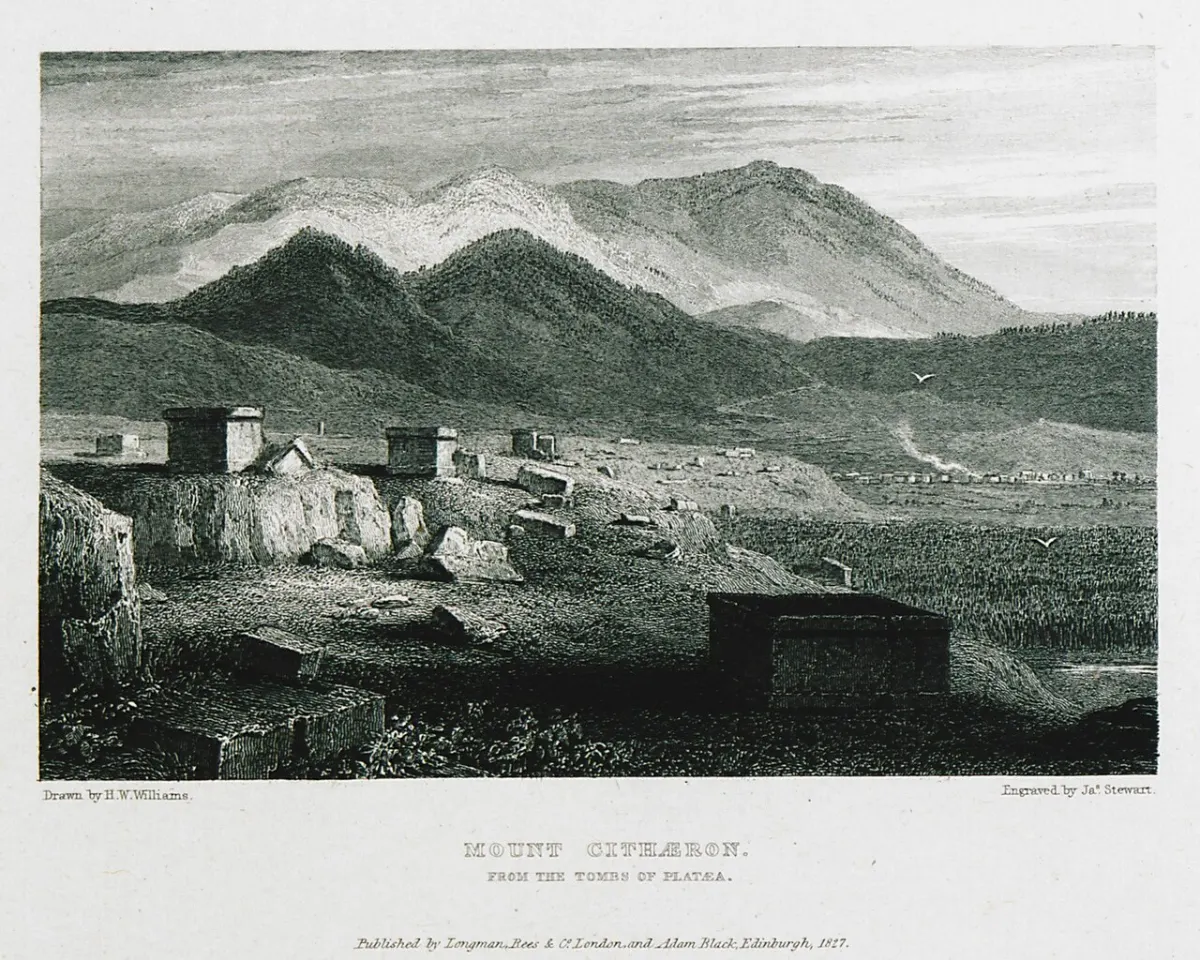
Text and translation
[κο]υλομείταο Κρόνω, [τα]-
Corinna · PMG 654 col. i, lines 15–22 · the end of one strophe and a whole strophe · Greek after Diehl 1917, pp. 48–49
How to read each line
A guide to the Greek, syllables, pitch marks and quantities.
Show the reading key
- Above each line: the line as the edition prints it, each word placed over its own syllables. The main row: the same Greek divided into metrical syllables, each written as it is pronounced. A consonant that closes a syllable is written with it (λόθ | ρο); an elided word is closed up with the next vowel (ν’ἀ); a final consonant carried into the next word is set with a thin space (ς ἰ). Wider gaps mark word-ends.
- Above the syllables: the pitch of each syllable, from the accents. Under them: the quantity of each syllable as it falls in the line, then the transliteration, syllable by syllable, with accented syllables in capitals.
- Under each line: a line-for-line translation. In the right margin of the scansion: the line type, its scheme, and its analysis into cola.
Key to the labels
The names, patterns and symbols used beside this poem.
Show the labels and symbols
The labels in the right margin of the scansion below give the line’s analysis as the scheme file states it, then its scheme and, where the analysis notes them, the period-end, a brevis in longo or a hiatus. ‖ marks the end of a period, ||| the end of the stanza; a line without a period-end runs on into the next (synapheia). × is an anceps, long or short; the last position of every period is indifferent. A click on any syllable highlights the colon it belongs to and explains it.
| Label | Name and shape | What it is |
|---|---|---|
| io2 | Ionic dimeter (2io)⏑ ⏑ — — ⏑ ⏑ — — | Two ionic metra a minore, each ⏑ ⏑ — —.[5] In this poem the dimeter has an “unvarying form”, with no anaclasis, contraction or resolution, and each strophe has five of them.[6] West marks its end with ⁝, his sign for a place where word-end is frequent;[7] in this papyrus a word may run on from one dimeter into the next. |
| io2h | Hypercatalectic ionic dimeter⏑ ⏑ — — ⏑ ⏑ — ⏑ — — | The sixth line of each strophe: an ionic dimeter with one more syllable, ⏑ ⏑ — — ⏑ ⏑ — ⏑ — —, which West calls hypercatalectic.[6] It closes the strophe. Natoli, Pitts and Hallett give the same shape and call it a “hypermetric glyconic clausula”.[8] |
The feet
| Foot and shape | Where |
|---|---|
| Ionic metron⏑ ⏑ — — | One ionic metron a minore, ⏑ ⏑ — —.[9] |
| Closing metron⏑ ⏑ — ⏑ — — | The second half of the hypercatalectic line, ⏑ ⏑ — ⏑ — —.[6] |
Scansion
The contest of Helicon and Cithaeron: Cithaeron’s song of the infant Zeus ends, and the Muses call the gods to vote. the strict ionics West finds in Corinna, five ionic dimeters and a hypercatalectic close in every strophe, scanned position by position with the Boeotian spelling undone.
of the crooked mind, at the time
when Rhea the blessed one took him by stealth;
and from the deathless ones she won great
honour.’ This was his song.
Straight away the Muses bade the blessed ones
bring their ballot-pebbles
secretly to the urns that shine
with gold; and all of them stood up at once.
Metre
- West’s analysis. West sets the loose sotadean of the Hellenistic age against Corinna’s ionics (PMG 654 i 11–52), which he finds strict: in each of her strophes five dimeters, always of the same shape ⏑ ⏑ — — ⏑ ⏑ — — ⁝, lead to a hypercatalectic close ⏑ ⏑ — — ⏑ ⏑ — ⏑ — — |||.[6] The ionic metron is ⏑ ⏑ — —.[9] The right margin of this page gives that scheme line by line.
- Unvarying. The ionic dimeter elsewhere admits anaclasis, contraction and resolution,[10] but none of them occurs here: every one of these eight lines has exactly the syllables of West’s scheme, eight in a dimeter and ten in the closing line. That is why the scansion of a few doubtful words can be read off the scheme: the notes to lines 15 and 22 show where a syllable count or a quantity depends on it.
- Where the lines join. West’s ⁝ after the dimeter is his sign for a place where word-end is frequent, not a period-end.[7] Within this extract three words run on across a line-end: τα-|νίκα (15–16), ἔσ-|ς (17–18) and χρου-|σοφαίς (21–22). The extract begins inside a word, whose first syllable is in the preceding, unprinted line. A period cannot end in the middle of a word,[11] so these lines at least belong together, and the page treats each strophe as one run of lines, with consonants carried across the line-ends.[12] The last position before each strophe-end is shown as ×.[11]
- Another name. Natoli, Pitts and Hallett give the same scheme, five dimeters of ionic a minore and a sixth line ⏑ ⏑ — — ⏑ ⏑ — ⏑ — —, but call the sixth line a “hypermetric glyconic clausula”.[8] The syllables are the same; only the name differs from West’s.
- Stop + liquid. A short vowel stays short before an initial stop + liquid in ο Κρόνω (15). According to West, early poets mostly confine this to the start of a word, Theognis, Solon and Pindar allow it more widely, and in ordinary Attic speech the short syllable normally stayed short before such a group.[13] In each case here the ionic metron requires the short.
- The Boeotian spelling. De Kreij lists the Boeotian shifts αι > η, οι > υ, η > ει, ει > ι and υ > ου;[14] Klinck adds ω for ου, ι for ε and οι for ῳ.[15] So Μώση is Μοῦσαι, Κρόνω Κρόνου, τύ τοί, κρουφίαν κρυφίαν,[16] and μάκηρα (16) is μάκαιρα, the feminine of μάκαρ.[17] Boeotian ου spells both short and long u:[18] it is short in ἀγκουλομείταο (15) and κρουφίαν (21), long in χρουσοφαίς (21–22). Where the scanner would read ου as a long diphthong, the page gives the length the word has and says why.
- Quantities. No edition used here marks quantities. Vowels α ι υ whose length is not shown by the spelling take the length the scheme requires, and those that matter are checked in LSJ (s.vv. τηνίκα, κρύφιος, χρυσοφαής, ἀγκύλος); the notes name them.
Prosody, line by line
Every syllable, with the reason for its length. Quantities are read from the vowel where the spelling shows it, from the consonants that follow (“position”), from the accent where it tells, and from the metre where nothing else does. Editors’ notes on the text follow in the boxed paragraphs.
- col. i 15
Line col. i 15 · κουλομείταο Κρόνω, τα-
κουλομείταο Κρόνω, τα-
[κο]υλομείταοΚρόνω,[τα]-the period runs on into col. i 16 (synapheia).
- 1 ⏑[κο]υου is here the Boeotian spelling of short υ: ἀγκουλομείταο is the genitive of ἀγκυλομήτης, “crooked of counsel”,[19] whose υ is short as in ἀγκύλος.[20] Boeotian ου stands for short and for long u alike.[18] The syllable is open, so it is short, as the ionic metron’s first position requires.
- 2 ⏑λοο is short by nature.
- 3 —μείεί is a diphthong, long by nature.
- 4 —ταα of the old genitive ending -ᾱο, which West writes with a long α;[21] the metre requires the long here.
- 5 ⏑οο is short by nature; the next word begins with Κρ, a stop + liquid that does not make position here, so the syllable stays short.
- 6 ⏑Κρόό is short by nature.
- 7 —νω,ω is long by nature.
- 8 —[τα]-The word runs on into the next line: τα-νίκα is τηνίκα, “then”,[16] Doric τᾱνίκα with a long α.[22]
2io ⁝. ἀγκουλομείταο is the genitive of ἀγκυλομήτης, “crooked of counsel”, an epithet of Cronos in Homer and Hesiod,[23] and Κρόνω is Κρόνου.[16] The ου of [κο]υ- spells a short u, as in ἀγκύλος,[20] so the first syllable of the line is short; the scanner, reading ου as a diphthong, would have made it long, and its reason is replaced. The genitive ending -ᾱο has a long α,[21] as the fourth position requires. The ο of -ταο stays short before the initial Κρ- of Κρόνω.[13] τα- begins τανίκα = τηνίκα, “then”,[16] Doric τᾱνίκα with long α.[22]- col. i 16
Line col. i 16 · νίκα νιν κλέψε μάκηρα Ῥεία
νίκα νιν κλέψε μάκηρα Ῥεία
νίκανινκλέψεμάκηραῬείαcontinues col. i 15 · one period (synapheia).
- 1 ⏑νίί is short by the metre (position 1 must be short).
- 2 ⏑καα is short by the metre (position 2 must be short).
- 3 —νινι is a vowel of unknown length; closed by ν: long by position.
- 4 —κλέέ is short by nature; ψ is a double consonant (two sounds) and closes the syllable: long by position.
- 5 ⏑ψεε is short by nature.
- 6 ⏑μάά is short by the metre (position 6 must be short).
- 7 —κηη is long by nature.
- 8 ⏑ραα is short by the accent rule: acute on the antepenult requires a short final syllable.
- 9 —Ῥείεί is a diphthong, long by nature.
- 10 ×αα is of unknown length; the position is anceps, so either scans; the last position of the period is indifferent.
The hypercatalectic close, ⏑ ⏑ — — ⏑ ⏑ — ⏑ — — |||.[6] -νίκα completes τανίκα; its ι is short.[22] νιν is the enclitic “him”.[24] κλέ- is closed by ψ, a double consonant.[25] μάκηρα is μάκαιρα, “blessed”,[17] with η for αι;[14] its final α is short and stays short before Ῥεία, although West notes that a short final vowel is often lengthened before initial ρ in iambus and lyric.[26] The last syllable of the strophe, the final α of Ῥεία, stands before the strophe-end (×).Campbell prints νικά and the Boeotian spelling Ῥία for Ῥεία.[27] The ι of Ῥία stands for ει and is long, so the scansion is the same.
- col. i 17
Line col. i 17 · μεγάλαν τ’ ἀθανάτων ἔσ-
μεγάλαν τ’ ἀθανάτων ἔσ-
[με][γ]άλαντ’[ἀ]θανάτωνἔσthe period runs on into col. i 18 (synapheia).
- 1 ⏑[με]ε is short by nature.
- 2 ⏑[γ]άά is short by the metre (position 2 must be short).
- 3 —λανα is a vowel of unknown length; closed by ν: long by position.
- 4 —τ’[ἀ]The first α of ἀθάνατος is long in verse: Herodian says that poets lengthened it because the word would otherwise have four shorts in a row (Herodian, De prosodia catholica 20, ed. Lentz). The ἀ is supplied by the editors. τε is elided before it and its τ joins this syllable.[21]
- 5 ⏑θαα is short by the metre (position 5 must be short).
- 6 ⏑νάά is short by the metre (position 6 must be short).
- 7 —τωνω is long by nature.
- 8 —ἔσἔ is short by nature; closed by σ: long by position; the line-end is not a period-end: the period runs on into the next line (synapheia), so this syllable keeps its own length, with no brevis in longo, and a word may run over into the next line.[28]
2io ⁝, the first dimeter of the second strophe. [μεγ]άλαν τ’ [ἀ]θανάτων: “and great … from the deathless ones”. τε is elided before ἀθανάτων.[21] The first α of ἀθανάτων, supplied here, must be long: the grammarian Herodian says that poets lengthened it because ἀθάνατος would otherwise begin with four shorts in a row (Herodian, De prosodia catholica 20, ed. Lentz). ἔσ- begins ἔσς, the Boeotian form of ἐξ, “from”,[16] and runs on into the next line; ἔσ- is closed by σ and long.- col. i 18
Line col. i 18 · ς ἕλε τιμάν.’ τάδ’ ἔμελψεμ·
ς ἕλε τιμάν.’ τάδ’ ἔμελψεμ·
[ς] ἕλετιμάντάδ’ἔμελψεμ·continues col. i 17 · one period (synapheia); the period runs on into col. i 19 (synapheia).
- 1 ⏑[ς] ἕἕ is short by nature; the first consonant belongs to the previous word and is carried over to this vowel.
- 2 ⏑λεε is short by nature.
- 3 —τιι is long by the metre (position 3 must be long).
- 4 —μάνά is a vowel of unknown length; closed by ν: long by position.
- 5 ⏑τάά is short by the metre (position 5 must be short).
- 6 ⏑δ’ἔἔ is short by nature; the apostrophe marks an elided vowel; the consonant before it joins this syllable.
- 7 —μελε is short by nature; closed by λ: long by position.
- 8 —ψεμ·ε is short by nature; closed by μ: long by position; the line-end is not a period-end: the period runs on into the next line (synapheia), so this syllable keeps its own length, with no brevis in longo, and a word may run over into the next line.[28]
2io ⁝. [ς] ἕλε τιμάν: the second σ of ἔσς, supplied, goes with ἕ-. τιμάν has a long ι,[29] as the third position requires. Cithaeron’s song ends here, “so he sang”, τάδ’ ἔμελψεμ, with ἔμελψεμ for ἔμελψεν[16] and τάδε elided.[21] Whether “he” who won honour is Zeus or Rhea is disputed: Klinck translates “he”, and notes Rayor’s argument that Rhea is the subject both of κλέψε (16) and of ἕλε.[15]- col. i 19
Line col. i 19 · μάκαρας δ’ αὐτίκα Μώση
μάκαρας δ’ αὐτίκα Μώση
μάκαραςδ’αὐτίκαΜώσηcontinues col. i 18 · one period (synapheia); the period runs on into col. i 20 (synapheia).
- 1 ⏑μάά is short by the metre (position 1 must be short).
- 2 ⏑καα is short by the metre (position 2 must be short).
- 3 —ραςα is a vowel of unknown length; closed by ς: long by position.
- 4 —δ’αὐαὐ is a diphthong, long by nature; the apostrophe marks an elided vowel; the consonant before it joins this syllable.
- 5 ⏑τίί is short by the metre (position 5 must be short).
- 6 ⏑καα is short by the metre (position 6 must be short).
- 7 —Μώώ is long by nature.
- 8 —σηη is long by nature; the line-end is not a period-end: the period runs on into the next line (synapheia), so this syllable keeps its own length, with no brevis in longo, and a word may run over into the next line.[28]
2io ⁝. μάκαρας, “the blessed ones”, the gods who will vote. αὐτίκα, “at once”. Μώση is Μοῦσαι, “the Muses”,[16] with ω for ου and η for αι. δέ is elided before αὐτίκα.- col. i 20
Line col. i 20 · φερέμεν ψᾶφον ἔταττον
φερέμεν ψᾶφον ἔταττον
[φ]ερέμενψᾶφον ἔ[τ]αττονcontinues col. i 19 · one period (synapheia); the period runs on into col. i 21 (synapheia).
- 1 ⏑[φ]εε is short by nature.
- 2 ⏑ρέέ is short by nature.
- 3 —μενε is short by nature; closed by ν: long by position.
- 4 —ψᾶᾶ carries a circumflex, so it is long.
- 5 ⏑φοο is short by nature.
- 6 ⏑ν ἔἔ is short by nature; the first consonant belongs to the previous word and is carried over to this vowel.
- 7 —[τ]ατα is a vowel of unknown length; closed by τ: long by position.
- 8 —τονο is short by nature; closed by ν: long by position; the line-end is not a period-end: the period runs on into the next line (synapheia), so this syllable keeps its own length, with no brevis in longo, and a word may run over into the next line.[28]
- col. i 21
Line col. i 21 · κρουφίαν κάλπιδας ἐν χρου-
κρουφίαν κάλπιδας ἐν χρου-
[κρ]ουφίανκάλπιδας ἐνχρου-continues col. i 20 · one period (synapheia); the period runs on into col. i 22 (synapheia).
- 1 ⏑[κρ]ουου is here the Boeotian spelling of short υ: κρουφίαν is κρυφίαν, “secret”,[16] and κρύφιος has a short υ.[32] Boeotian ου stands for short and for long u alike.[18] The syllable is open, so it is short, as the ionic metron’s first position requires.
- 2 ⏑φίί is short by the metre (position 2 must be short).
- 3 —ανα is a vowel of unknown length; closed by ν: long by position.
- 4 —κάλά is a vowel of unknown length; closed by λ: long by position.
- 5 ⏑πιι is short by the metre (position 5 must be short).
- 6 ⏑δαα is short by the accent rule: acute on the antepenult requires a short final syllable.
- 7 —ς ἐνἐ is short by nature; closed by ν: long by position; the first consonant belongs to the previous word and is carried over to this vowel.
- 8 —χρου-ου is here the Boeotian spelling of long υ: χρουσοφαίς is χρυσοφαεῖς, “gold-shining”.[33] Boeotian ου stands for short and for long u alike.[18] The word runs on into the next line.
2io ⁝. [κρ]ουφίαν is κρυφίαν, “secret”,[16] with a short υ,[32] so the first syllable is short; its reason is replaced, as in line 15. κάλπιδας, “urns”, here for collecting the votes.[31] The ς of κάλπιδας goes with ἐν. χρου- is the first part of χρουσοφαίς, “gold-shining”, with a long u;[34] the word runs on into the next line.Campbell prints κάλπιδας ἐν χρουσοφαῖς as one line and begins line 22 with τὺ δ’ ἅμα.[27]
- col. i 22
Line col. i 22 · σοφαίς· τὺ δ’ ἅμα πάντες ὦρθεν·
σοφαίς· τὺ δ’ ἅμα πάντες ὦρθεν·
σοφαίς·τὺδ’ἅμαπάντε[ς] ὦρθεν·continues col. i 21 · one period (synapheia).
- 1 ⏑σοο is short by nature.
- 2 ⏑φαα is short by the metre (position 2 must be short).
- 3 —ίς·ί is a vowel of unknown length; closed by ς: long by position.
- 4 —τὺτύ is the Boeotian spelling of τοί, “they”,[16] with υ for οι;[14] the vowel is long, as the metre requires.
- 5 ⏑δ’ἅἅ is short by the metre (position 5 must be short); the apostrophe marks an elided vowel; the consonant before it joins this syllable.
- 6 ⏑μαα is short by the metre (position 6 must be short).
- 7 —πάνά is a vowel of unknown length; closed by ν: long by position.
- 8 ⏑τεε is short by nature.
- 9 —[ς] ὦρὦ is long by nature; closed by ρ: long by position; the first consonant belongs to the previous word and is carried over to this vowel.
- 10 ×θεν·ε is short by nature; closed by ν: long by position; the last position of the period is indifferent.
The hypercatalectic close |||. σοφαίς completes χρουσοφαίς = χρυσοφαεῖς.[16] The line has its ten positions only if -φα-ίς is two syllables, as the uncontracted -φαεῖς is; the input keeps α and ι apart. Natoli et al. print σοφαίς with an acute, Klinck σοφαῖς with a circumflex.[35] τύ is the Boeotian spelling of τοί, “they”,[16] with υ for οι, and is long. δέ is elided before ἅμα. ὦρθεν, “rose”, ends the strophe; the ς of πάντε[ς], supplied, goes with ὦρ-.With Campbell’s circumflex, χρουσοφαῖς ends in a diphthong, -φαῖς, one syllable; his lines 21–22 then have one syllable fewer than the eight and ten of West’s scheme.[27] The scansion here needs -φα-ίς as two syllables.
The poem and this passage
The lines come from the first column of the Berlin papyrus of Corinna (PMG 654), from Hermopolis in Egypt, of the second century CE. The poem narrates a singing contest between two Boeotian mountains, Cithaeron and Helicon, judged by the gods.[31] The legible text begins at the end of Cithaeron’s song, which tells how Rhea, with the help of the Curetes, hid the infant Zeus in a cave from his father Cronos, a version of the story in Hesiod’s Theogony (453–506) that Corinna adapts.[36] The Muses then call the vote, the gods give the greater number to Cithaeron, Hermes proclaims his victory, and Helicon in his rage hurls a rock into a myriad pieces.[37] Klinck notes the suggestion that the sore loser is a thinly veiled allusion to a male poet, Pindar, and asks whether the grandiose style of the contest is a parody of heroic poetry.[38]
West sets these ionics, with Corinna’s glyconics, among the metres of the later centuries; Corinna’s date is disputed.[39]
The text
The displayed eight-line extract follows Diehl’s older text,[40] with brackets closed at line-ends and accents normalized. It starts inside a word. Later reconstructed lines13–14 are not supplied. Modern editions remain cited for comparison; the old supplements are not presented as certain.
Notes
- ^ Natoli et al. 2022, pp. 65–66.
- ^ Natoli et al. 2022, p. 66; Collins 2006, pp. 26–29.
- ^ Natoli et al. 2022, p. 65.
- ^ Natoli et al. 2022, pp. 60–61; Collins 2006, p. 19; Campbell 1992, pp. 1–2; Currie and Rutherford 2020, p. 9.
- ^ West 1987, p. x, “io”.
- ^ a b c d e West 1987, p. 74.
- ^ a b West 1987, pp. ix, 74.
- ^ a b Natoli et al. 2022, p. 340.
- ^ a b West 1987, p. x.
- ^ West 1987, pp. 73–74.
- ^ a b West 1987, p. 4.
- ^ West 1987, p. 12.
- ^ a b West 1987, p. 16.
- ^ a b c de Kreij 2022, p. 160.
- ^ a b Klinck 2008, p. 162.
- ^ a b c d e f g h i j k l Natoli et al. 2022, p. 66.
- ^ a b LSJ s.v. μάκαρ.
- ^ a b c d West 1987, p. 72 n. 5.
- ^ Natoli et al. 2022, p. 66; LSJ s.v. ἀγκυλομήτης.
- ^ a b LSJ.
- ^ a b c d e West 1987, p. 13.
- ^ a b c LSJ s.v. τηνίκα.
- ^ Natoli et al. 2022, p. 66; LSJ s.v.
- ^ Natoli et al. 2022, p. 67.
- ^ West 1987, p. 12 n. 1.
- ^ West 1987, p. 17.
- ^ a b c Campbell 1992, p. 26.
- ^ a b c d West 1987, pp. 3–4.
- ^ LSJ s.v. τιμή.
- ^ Natoli et al. 2022, p. 66; LSJ s.v. ψῆφος gives Doric ψᾶφος.
- ^ a b c Natoli et al. 2022, p. 65.
- ^ a b LSJ s.v. κρύφιος.
- ^ Natoli et al. 2022, p. 66; LSJ s.v. χρυσοφαής, which cites this line and marks the υ long.
- ^ LSJ s.v. χρυσοφαής, which cites this line.
- ^ Klinck 2008, p. 154.
- ^ Natoli et al. 2022, pp. 65–66.
- ^ Natoli et al. 2022, pp. 65–66; Klinck 2008, pp. 153, 155.
- ^ Klinck 2008, p. 153.
- ^ See the Life tab, and the notes to the tab on col. iii.
- ^ Diehl 1917, pp. 48–49.
Text and sources
Displayed Greek: Ernst Diehl, Supplementum lyricum (1917), pp. 48–49, public domain; modern PMG lines 15–22 = Diehl’s 14–21. Accents, brackets, quantity marks and line-end punctuation normalized. The extract starts inside a word. Lines 13–14 of the later reconstruction are not printed here. Original edition. Modern works below supply analysis, not the displayed Greek.
- Analysis: M. L. West, Introduction to Greek Metre (Oxford 1987), p. 74 (Corinna PMG 654 i 11–52, the strophe scheme; the ionic dimeter and its variants, pp. 73–74); also pp. ix–x (symbols: ⁝, io), 4 (period-end; the last position of a period), 12–13 with p. 12 n. 1 (syllables; double consonants; elision; the genitive -ᾱο), 15 (synizesis), 16–17 (stop + liquid; initial ρ), 72 with n. 5 (the Boeotian ου; κρουφάδᾱν). All checked against the page images; p. 74 at 600 dpi. Also West 1987, p. 3 (synapheia and period-end).
- Comparison and analysis: B. A. Natoli, A. Pitts and J. P. Hallett, Ancient Women Writers of Greece and Rome (Routledge 2022), ch. 2 ‘Corinna’, p. 64 (text of PMG 654 i 12–34), pp. 64–67 (introduction, vocabulary and notes), and App. B, p. 340 (the metre of 654 i).
- M. de Kreij, ‘The Lyric Dialects’, in L. Swift (ed.), A Companion to Greek Lyric (Wiley 2022), ch. 10, p. 160.
- A. L. Klinck, Woman’s Songs in Ancient Greece (McGill-Queen’s 2008), Corinna chapter, pp. 153–155, 162.
- Herodian, De prosodia catholica 20, ed. A. Lentz, Grammatici Graeci III.1 (Leipzig 1867), via First1KGreek (tlg0087.tlg001), CC BY-SA 4.0.
- LSJ (Perseus Digital Library, CC BY-SA), s.vv. ἀγκυλομήτης, ἀγκύλος, κρύφιος, μάκαρ, τηνίκα, τιμή, χρυσοφαής, ψῆφος.
- Translation: metrehelp.org, CC BY-SA 4.0.
- D. A. Campbell, Greek Lyric IV: Bacchylides, Corinna, and Others (Loeb Classical Library 461, Cambridge, MA 1992), Corinna fr. 654 col. i (pp. 26–29), compared line by line; his number is that of PMG. He heads the papyrus “P. Berol. 284”, gives the first edition as Wilamowitz, Berliner Klassikertexte v 2 (1907), and dates the papyrus from Hermopolis to the second century AD (pp. 26–27). Differences are in the notes on lines 13, 16, 21 and 22.
Quotations from copyrighted works are not covered by this page’s licence.


