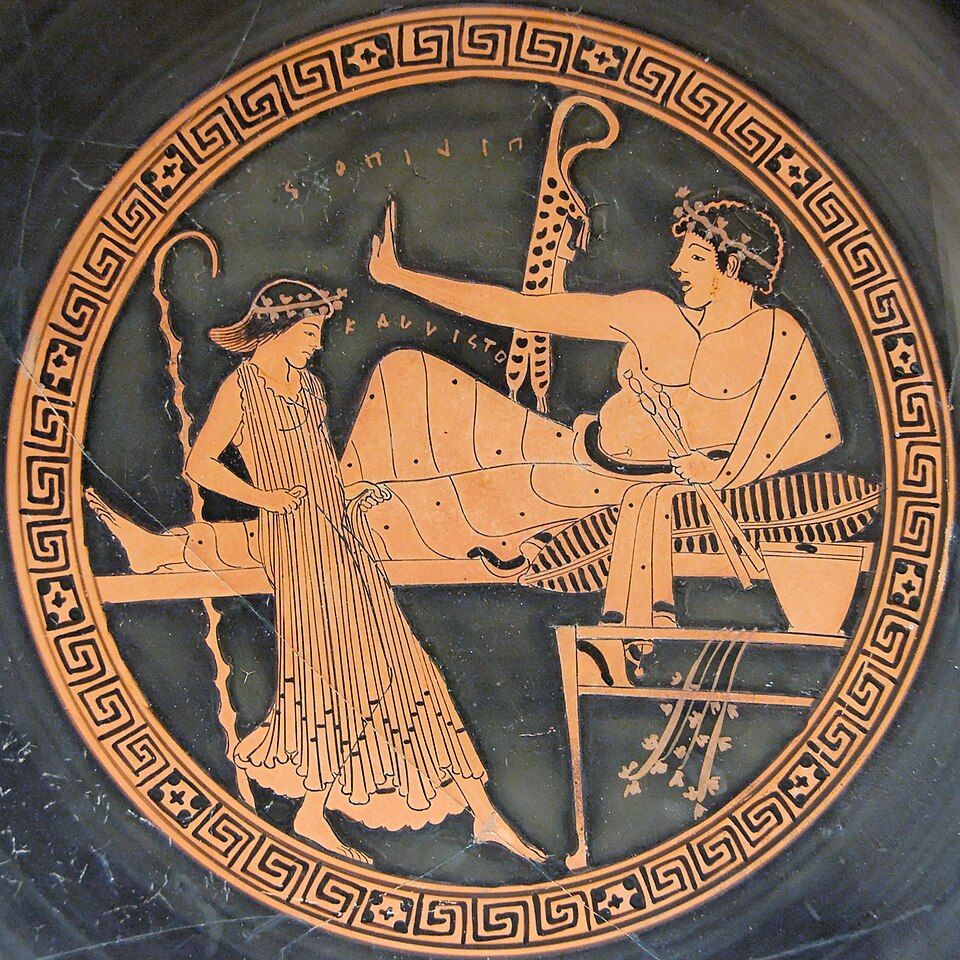
Poets and playwrightsElegy and iambus
The elegists: Callinus, Tyrtaeus, Mimnermus, Solon, Theognis, Xenophanes
Archaic elegiac poetry: war, politics, love and advice in hexameter–pentameter couplets.
About
Works
- Synopsis
- Text and translation
- How to read each line
- Key to the labels
- Scansion
- Metre
- Prosody, line by line
- Notes
- Synopsis
- Text and translation
- How to read each line
- Key to the labels
- Scansion
- Metre
- Prosody, line by line
- Notes
- Synopsis
- Text and translation
- How to read each line
- Key to the labels
- Scansion
- Metre
- Prosody, line by line
- What the input marks
- Notes
- Synopsis
- Text and translation
- How to read each line
- Key to the labels
- Scansion
- Metre
- Prosody, line by line
- Notes
- Synopsis
- Text and translation
- How to read each line
- Key to the labels
- Scansion
- Metre
- Prosody, line by line
- Notes
- Synopsis
- Text and translation
- How to read each line
- Key to the labels
- Scansion
- Metre
- Prosody, line by line
- Notes
About · 1 of 3
Elegy: the form, its occasions, its early poets
What makes a poem an elegy. The distinctive feature is the metre. A dactylic hexameter is followed by two hemiepes, and this second line is traditionally, but misleadingly, called a “pentameter”.[1] Elegies vary widely in length, subject and occasion. So the couplet is the only possible definition of the genre.[2] Elegy is poetry in elegiac couplets, and its associations of content are “disputed”.[3]
Archilochus, Tyrtaeus and many other poets used the couplet in the archaic period and the fifth century. From the middle of the sixth century it was chosen more and more often for verse inscriptions.[4] It was not the original metre of epigram, but it came to prevail in the sixth century.[5] Its archaic users include Tyrtaeus, Mimnermus and Solon.[6]
Elegy and lament (disputed). Ancient writers explained the names ἔλεγος (elegos), ἐλεγεῖον (elegeion) and ἐλεγεία (elegeia) as words of lamentation. Modern scholars doubt this for the archaic period; the earliest clear instance is Euripides’ Trojan Women of 415 BC. Bartol agrees with those, Bowie first, who posit an earlier sense with no link to mourning, and a later one tied to it.[7] Bowie defines elegy as a song usually accompanied by the aulos and sung chiefly at symposia. Aloni accepts that this definition prevails, but argues that some forms of elegy must have been dominated by lament.[8]
The earliest occurrence of ἔλεγος (elegos) is in the dedication of Echembrotus, quoted by Pausanias. Aloni dates it to 586 BC, Bartol to 585 BC.[9]
Where elegy was sung. Most elegies were sung to the aulos, at symposia and at public festivals.[10] The symposium was the main venue for shorter pieces. These include the martial exhortations of Callinus and Tyrtaeus, and Solon’s political poems. Long narrative elegies were performed at festivals and cult gatherings.[11] Accompaniment by the lyre has also been argued for.[12]
Language. The transmitted dialect is mainly Ionic, with many epic forms and some local ones. Aloni treats elegy and epic as related genres, developing side by side from a shared poetic heritage. He rejects both Dover’s derivation of elegiac diction directly from spoken Ionic, and a simple derivation from Homer.[13] Even Tyrtaeus at Sparta largely kept the Ionian dialect.[14] Simonides’ elegy is “basically Ionic”, beside his largely Doric melic poetry.[15]
Not one genre per poet. Archilochus and Semonides wrote both elegy and iambus. Simonides and Anacreon wrote both elegy and song, and Xenophanes both elegy and hexameters. The division into genre canons came later.[16]
Dates. Most of the dates are uncertain.[17] The sources give:
| Poet | Place | Dates given | Sources |
|---|---|---|---|
| Callinus | Ephesus | mid-7th c. (Bartol); first half of 7th c. (Aloni); “7th cent.” (chronology) | Bartol p. 224; Aloni p. 171; Budelmann p. 386 |
| Tyrtaeus | Sparta | latter part of 7th c. (Bartol); time of the Second Messenian War, which Aloni puts in the first half of the 7th c.; “7th cent.” (chronology) | Bartol p. 225; Aloni p. 173; Budelmann p. 386 |
| Mimnermus | Smyrna or Colophon (disputed) | second half of 7th c. | Bartol p. 227; Aloni p. 171; Budelmann p. 386 |
| Solon | Athens | about 630–560, archon probably 594/3 (Aloni); archon “traditionally” 594/3 (Bowie); third quarter of 7th to second quarter of 6th c. (chronology) | Aloni p. 172; Bowie p. 304; Budelmann p. 386 |
| Theognis | Megara | 552–541 BC in the ancient chronographers; c. 600 (Aloni); late 7th / early 6th c. (chronology)[18] | Bowie p. 309; Aloni p. 175; Budelmann p. 386 |
The lives of the five poets follow on the next two tabs.
Notes
- ^ Bartol 2022, p. 221 with n. 1; see the scheme on the Metres tab.
- ^ Aloni 2009, pp. 168, 188.
- ^ Budelmann 2009, p. 397.
- ^ West 1987, p. 24.
- ^ Aloni 2009, p. 170.
- ^ D’Angour 2022, p. 132.
- ^ Bartol 2022, pp. 221–222.
- ^ Aloni 2009, p. 169.
- ^ Aloni 2009, p. 168; Bartol 2022, p. 222.
- ^ Bartol 2022, p. 221.
- ^ Bartol 2022, pp. 222–223; Aloni 2009, p. 170.
- ^ Aloni 2009, p. 170 n. 11.
- ^ Aloni 2009, p. 185.
- ^ Bowie 2022, p. 303.
- ^ de Kreij 2022, p. 143.
- ^ Bartol 2022, p. 224.
- ^ Budelmann 2009, p. 386.
- ^ See the next tabs.
About · 2 of 3
The Theognidea and the rest
A book with a manuscript tradition. Greek lyric “consists primarily of fragments”. Apart from four books of Pindar’s epinicians and “the elegies attributed to Theognis”, it was until recently transmitted only through quotation.[1] Almost fifty medieval manuscripts preserve 1,220 lines ascribed to Theognis. One Paris manuscript of the early tenth century (A) calls them “Theognis, Elegies, Book One”. It adds 158 lines, first headed “Book Two”; the words “of Theognis” were later deleted (Aloni gives the first section as 1,230 lines).[2] The line numbers cited for Theognis are those of this book.
How the collection grew (disputed). Since Welcker (1826) the collection has been known to be composite.[3] Five passages are Solon’s, and others are Mimnermus’ and Tyrtaeus’.[4] Tyrtaeus 12.13–16 reappears as 1003–1006, with “wise man” for “young man”. The lines changed their function as they passed into another symposium.[5]
Bowie reconstructs the collection in layers. Lines 19–254 open with the “seal” poem and close with the poem that promises Cyrnus immortality. They look like a collection chiefly of Theognis’ own poems. Some (Reitzenstein, Rösler) think Theognis himself compiled it.[6]
Lines 255 to about 1000 form a wider anthology for the symposium, from Tyrtaeus to a poem of 480 BC. It includes two poems addressed to a Simonides, which Bowie assigns to the sophist Euenus of Paros. Bowie suggests Euenus as the compiler, around 400 BC. Bartol accepts this, while Murray has suggested the circle of Critias.[7]
About two hundred lines, with many duplicates, were added later. West held that both sections drew on a single Hellenistic florilegium magnum, a large anthology. This “has not convinced”, and most assume two similar collections.[8] Aloni sees a manual for symposiasts, reused at Megara and in Athenian oligarchic circles.[9]
Papyri. The papyri refute the theory that Book One took its present shape only in late antiquity or Byzantium. P.Oxy. 2380 (1956) shows lines 255–278 following 254 in the second century AD. A Berlin papyrus identified in 1993 covers 917–933. And P.Oxy. 5265 (2016) has 1117–1140 in the manuscript order.[10] “Book Two”, a collection of erotic poems, survives only in A. It contains a couplet of Solon (1253–1254), a piece probably by Euenus, and one addressed to Cyrnus. Bowie dates its compilation to the late fifth century.[11]
The other elegists. Callinus, Tyrtaeus, Mimnermus and Solon reach us by quotation. Callinus’ work was still extensively available to Strabo.[12] Stobaeus quotes Mimnermus. Tyrtaeus fr. 12 is assembled from two separate quotations in Stobaeus, joined by the Theognidea.[13] Solon fr. 36 is preserved by the Aristotelian Constitution of the Athenians, fr. 33 by Plutarch, and fr. 4 by Demosthenes.[14] A collection of Solon’s poems probably existed, but there is no evidence for it.[15] Papyri have restored narrative elegy: Simonides’ Plataea elegy (1992), and Archilochus’ Telephus poem (2005).[16]
Elegy in the ancient handbook. Hephaestion quotes no line of Callinus, Tyrtaeus, Mimnermus, Solon or Theognis. His elegiac examples are scanned under Metres: Sophocles on the name Archelaus, Critias’ iambic line for Alcibiades, and a couplet of Simonides with a word running over the verse-end.[17] Critias put a trimeter in place of the pentameter, and this is read as a touch of mockery aimed at Alcibiades.[18]
Editions. For elegy, West’s edition and Gentili and Prato’s are the rival choices.[19] They are the best editions, and Gerber’s Loeb adds a translation.[20] West’s Iambi et elegi Graeci (2nd edn, 1989–92) edits the elegiac and iambic poets. Gentili and Prato’s Teubner edition of the elegists excludes Theognis, but it gives full testimonia.[21] Theognis is cited here by West’s line numbers.
Notes
- ^ Sampson 2022, p. 91.
- ^ Bowie 2022, p. 306; Aloni 2009, p. 174.
- ^ Aloni 2009, pp. 174–175.
- ^ Bowie 2022, p. 310 with nn. 16–18.
- ^ Aloni 2009, p. 184.
- ^ Bowie 2022, p. 311 with n. 24.
- ^ Bowie 2022, pp. 310–311 with n. 22; Bartol 2022, p. 232 with n. 56.
- ^ Bowie 2022, p. 312 with n. 28.
- ^ Aloni 2009, p. 175.
- ^ Bowie 2022, pp. 312–313.
- ^ Bowie 2022, pp. 315–316.
- ^ Aloni 2009, p. 171.
- ^ Bartol 2022, p. 228; Bowie 2022, p. 310 n. 18.
- ^ Bowie 2022, pp. 303–304, 306.
- ^ Bowie 2022, p. 306.
- ^ Bartol 2022, p. 230.
- ^ Hephaestion, Ench. 1.5, 2.3, 4.6.
- ^ Aloni 2009, p. 177; Bartol 2022, p. 232.
- ^ Sampson 2022, p. 94.
- ^ Bartol 2022, p. 233.
- ^ Budelmann 2009, p. 388.
About · 3 of 3
The elegiac couplet, early and late
The form. Strictly, the couplet is a strophe, not a stichic metre: a hexameter alternates with a “pentameter”.[1] It is a short strophe, and the most important of the epodic strophes:[2]
| hexameter | — ⏔ — ⏔ — ¦ ⏑ ¦ ⏑ — ¦ ⏔ — ⏔ — × ‖ (the epic hexameter, with fewer prosodic licences)[3] |
| pentameter | — ⏔ — ⏔ — ¦ — ⏑ ⏑ — ⏑ ⏑ — ‖ |
In the scheme ⏔ is a biceps, a position filled by two shorts or one long, and ¦ marks a caesura.[4] The pentameter is two hemiepes (D ¦ D ‖), always divided by caesura; a hemiepes, “half-epic”, is the first half of a hexameter up to its masculine caesura, — ⏔ — ⏔ —. Only the first of the pair admits contraction of the biceps.[5] Battezzato writes the couplet hexameter ‖ D | D.[6]
Hephaestion says the same in his own terms. The elegeion is the dactylic penthemimer taken twice. “The second part always remains seven syllables, two dactyls and a syllable, while the first has its two feet variable.” And “the elegeion must always be cut at one or other of the penthemimers; otherwise it is faulty”, as in a line of Callimachus.[7]
The princeps of the pentameter enjoys the hexameter’s freedoms. But both lines of the couplet use them less often than stichic hexameters do, and hiatus at the pentameter caesura is especially rare.[5]
Theognis 19–24, a standard specimen, with notes:[5]
Κύρνε, σοφιζομένωι μὲν ἐμοὶ σφρηγὶς ἐπικείσθω
τοῖσδ’ ἔπεσιν· λήσει δ’ οὔποτε κλεπτόμενα,
οὐδέ τις ἀλλάξει κάκιον τοὐσθλοῦ παρεόντος,
ὧδε δὲ πᾶς τις ἐρεῖ· “Θεόγνιδός ἐστιν ἔπη
τοῦ Μεγαρέως”· πάντας δὲ κατ’ ἀνθρώπους ὀνομαστός·
ἀστοῖσιν δ’ οὔπω πᾶσιν ἁδεῖν δύναμαι.
Kyrne, sophizomenōi men emoi sphrēgis epikeisthō / toisd’ epesin; lēsei d’ oupote kleptomena, / oude tis allaxei kakion tousthlou pareontos, / hōde de pās tis erei; “Theognidos estin epē / tou Megareōs”; pantas de kat’ anthrōpous onomastos; / astoisin d’ oupō pāsin hadein dynamai.
“Cyrnus, as I ply my craft let a seal be set on these words of mine; so their theft will never go unnoticed, and no one will take something worse in exchange for the good that is there, but everyone will say, ‘These are the words of Theognis of Megara.’ Among all men my name is known, but I cannot yet please all my fellow-citizens.”
Three couplets: hexameter, then pentameter, — ⏔ — ⏔ — ¦ — ⏑ ⏑ — ⏑ ⏑ —. The pentameter’s caesura falls after the third long, between its two halves. Red: δ’ elided at that caesura and the short -να in the final long position, brevis in longo (line 20); Θεογ- and -ρέως, each sung as one syllable by synecphonesis (22, 23).
Theognis 19–24: Greek from Bergk 1882 II pp. 119–120; metrical analysis[5]
synthetic ∿
In line 20 there is elision at the pentameter caesura, allowed here as in the hexameter. The final -να is short in a long position. This is brevis in longo, allowed because the line ends a period. In line 22 Θεογ- is one syllable by synecphonesis, and so is (Μεγα)ρέως in 23. The couplet need not end with a pause in the sense, though it usually does.[5]
The pentameter’s licences. Thgn. 2:[5]
λήσομαι ἀρχόμενος οὐδ’ ἀποπαυόμενος
lēsomai archomenos oud’ apopauomenos
“[I shall never] forget [you], whether I am beginning or ending.”
Red: -μαι, shortened before ἀ- (correption); -νος, long at the caesura although a vowel follows.
Theognis 2: Greek from Bergk 1882 II p. 117; metrical analysis[5]
synthetic ∿
The final -ος of ἀρχόμενος stands in the princeps before the caesura. A final continuant (here ς) is now and then treated as closing the syllable, even though a vowel follows. This is a licence of epic, elegy, Pindar and Bacchylides.[8] The shortening of -μαι before ἀ- is correption, the normal treatment in double-short rhythm.[9]
The couplet in each poet. The metrical sources distinguish the poets only in details of prosody. Tyrtaeus shows correption inside the word (γεραιούς, geraious, “old men”, with -αι- short; ἥρωος, hērōos, “of a hero”, with -ω- short).[9] Theognis and Solon allow a short vowel to stay short before stop + liquid more freely than the Ionian iambographers.[10] Theognis admits the interrogative τί (ti), “what?”, which cannot be elided, before a vowel at 649.[11] He scans βρόχος (brochos), “noose”, as if it were βρόκχος (brokchos) at 1099, so that its first syllable is long.[12] The metrical sources say nothing specific about the couplets of Callinus or Mimnermus.
What a name could not do. Two of Hephaestion’s quotations show the couplet’s limits from inside. Critias:[13]
καὶ νῦν Κλεινίου υἱὸν Ἀθηναῖον στεφανώσω
Ἀλκιβιάδην νέοισιν ὑμνήσας τρόποις·
οὐ γάρ πως ἦν τοὔνομ’ ἐφαρμόζειν ἐλεγείῳ·
νῦν δ’ ἐν ἰαμβείῳ κείσεται οὐκ ἀμέτρως.
kai nȳn Kleiniou hyion Athēnaion stephanōsō / Alkibiadēn neoisin hymnēsas tropois; / ou gar pōs ēn tounom’ epharmozein elegeiōi; / nȳn d’ en iambeiōi keisetai ouk ametrōs.
“And now I will garland the Athenian, Cleinias’ son Alcibiades, singing his praise in a novel fashion; for there was no way to fit his name into elegiacs, so now it will rest in an iambic line, and scan.”
The name Ἀλκιβιάδην is — ⏑ ⏑ ⏑ —, and three shorts in a row cannot stand in dactyls. So line 2 is an iambic trimeter, and -κιβι- (red) fills one resolved position.
Critias, quoted by Hephaestion, Ench. 2.3
synthetic ∿
The name has the shape — ⏑ ⏑ ⏑ —, which cannot enter dactyls. In the trimeter the second position is resolved (-κιβι-). A couplet of Simonides is censured for a different fault. The name Ἀριστογείτων runs over the verse-end, against the rule that “every metre ends in a complete word”:[14]
ἦ μέγ’ Ἀθηναίοισι φόως γένετ’, ἡνίκ’ Ἀριστο-
γείτων Ἵππαρχον κτεῖνε καὶ Ἁρμόδιος.
ē meg’ Athēnaioisi phoōs genet’, hēnik’ Aristo- / geitōn Hipparchon kteine kai Harmodios.
“Truly a great light dawned for the Athenians when Aristogeiton and Harmodius slew Hipparchus.”
Red: the name Ἀριστογείτων, split across the end of the hexameter. The digitised text prints ἡ for ἦ and ἠνίκ’ for ἡνίκ’ (ἡνίκα, “when”).[15]
Simonides, quoted by Hephaestion, Ench. 4.6
synthetic ∿
Early versus later practice. In the Hellenistic period, elegiac versification is on the whole somewhat stricter than that of the hexameter poets. Hiatus is restricted. Correption is used less for words that would fit without it. The word before the feminine caesura of the hexameter is normally one that naturally ends — ⏑. After the late third century BC, the syllable at the pentameter caesura tends to contain a long vowel or diphthong, rather than depend on the following word. An accented final syllable in the pentameter is more and more avoided.
After about AD 50 standards grow laxer. In the third and fourth centuries there is “a surprising freedom” over hiatus and brevis in longo at the pentameter caesura. Then the sixth-century poets of Agathias’ Cycle return to strictness.[16]
Notes
- ^ West 1987, pp. 23–24.
- ^ Aloni 2009, p. 168; Battezzato 2009, p. 138.
- ^ West 1987, pp. 19, 24.
- ^ West 1987, p. ix.
- ^ a b c d e f g West 1987, p. 24.
- ^ Battezzato 2009, p. 138.
- ^ Hephaestion, Ench. 15.14–15.
- ^ West 1987, p. 18.
- ^ a b West 1987, p. 14.
- ^ West 1987, p. 16.
- ^ West 1987, p. 13.
- ^ West 2018, p. 371 n. 8.
- ^ Hephaestion, Ench. 2.3.
- ^ Hephaestion, Ench. 4.6.
- ^ LSJ s.v. ἡνίκα.
- ^ West 1987, pp. 80–81.
Theognis 19–24 and 2: couplets quoted in the sources
Synopsis
The Theognidea is the collection of elegiac poems that the medieval manuscripts ascribe to Theognis of Megara. It has 1,220 lines, and a single Paris manuscript adds 158 more as a “Book Two”.[1] Elegy of this kind was sung to the aulos, above all at the symposium. The book was evidently meant as a song-book for drinking-parties.[2] It gathers Theognis’ own poems, many of them addressed to a young man, Cyrnus. It adds pieces by Solon, Mimnermus, Tyrtaeus and later poets.[3] Theognis’ date is disputed. The Suda puts him in 544–541 BC, and the ancient chronographers in 552–541 BC. Some modern scholars argue for the 590s, or even before the 630s.[4] Aloni places him about 600 BC.[5]
Lines 19–24 are the “seal” poem. In it the singer marks his verses with his name, so that no one can steal or alter them.[1] Line 2 comes from the short hymn to Apollo (lines 1–4) that opens the collection. It is the kind of song that was sung at the start of a symposium.[6]
Text and translation
Κύρνε, σοφιζομένωι μὲν ἐμοὶ σφρηγὶς ἐπικείσθω
Theognis · 19–24 (the “seal”) and 2 · elegiac couplets · text as quoted by West, Introduction to Greek Metre (1987), p. 24
How to read each line
A guide to the Greek, syllables, pitch marks and quantities.
Show the reading key
- Above each line: the line as the edition prints it, each word placed over its own syllables. The main row: the same Greek divided into metrical syllables, each written as it is pronounced. A consonant that closes a syllable is written with it (λόθ | ρο); an elided word is closed up with the next vowel (ν’ἀ); a final consonant carried into the next word is set with a thin space (ς ἰ). Wider gaps mark word-ends.
- Above the syllables: the pitch of each syllable, from the accents. Under them: the quantity of each syllable as it falls in the line, then the transliteration, syllable by syllable, with accented syllables in capitals.
- Under each line: a line-for-line translation. In the right margin of the scansion: the line type, its scheme, and its analysis into cola.
Key to the labels
The names, patterns and symbols used beside this poem.
Show the labels and symbols
The labels in the right margin of the scansion below name the line, its scheme, the feet as the line realises them, and the caesurae and diaereses (the named word-ends) that fall in it. In the scheme ⏔ is a biceps, two shorts that may be contracted to one long; ⏕ is a long that may be resolved into two shorts; × is an anceps, long or short. A click on any syllable highlights its metron or colon, or, with the switch, its foot.
| Label | Name and shape | What it is |
|---|---|---|
| hem1 | First hemiepes— ⏔ — ⏔ — | The first two and a half feet of the hexameter, up to the penthemimeral caesura; in the pentameter, its whole first half. |
| hem2 | Second half of the hexameter⏔ — ⏔ — ⏑ ⏑ — × | From the penthemimeral caesura to the line-end: the fifth foot is nearly always a dactyl, the sixth is — ×. |
| hemp | Second hemiepes— ⏑ ⏑ — ⏑ ⏑ × | The second half of the pentameter: two dactyls and a single syllable, with no contraction allowed. |
The traditional feet
| Foot and shape | Where |
|---|---|
| First foot: dactyl or spondee— ⏔ | Scheme positions 1–2. The biceps (⏑ ⏑) may be contracted to a single long, making a spondee. |
| Second foot: dactyl or spondee— ⏔ | Scheme positions 3–4. |
| Third foot: dactyl or spondee— ⏔ | Scheme positions 5–6. The penthemimeral caesura falls after its first syllable, the “trochaic” caesura after its second. |
| Fourth foot: dactyl or spondee— ⏔ | Scheme positions 7–8. Word-end at the end of this foot, when it is a dactyl, is the bucolic diaeresis (West’s “bucolic caesura”: word-end at the end of the fourth foot after an uncontracted biceps)[7]. |
| Fifth foot: dactyl— ⏑ ⏑ | Scheme positions 9–10. A spondee here (a “spondaic line”) is rare. |
| Sixth foot— × | Scheme positions 11–12: a long and the indifferent final syllable. |
| First foot: dactyl or spondee— ⏔ | Scheme positions 1–2 of the pentameter. |
| Second foot: dactyl or spondee— ⏔ | Scheme positions 3–4. |
| Half-foot before the diaeresis— | Scheme position 5: the long that closes the first hemiepes; word-end must follow. |
| Fourth foot: dactyl— ⏑ ⏑ | Scheme positions 6–8: no contraction after the diaeresis. |
| Fifth foot: dactyl— ⏑ ⏑ | Scheme positions 9–11. |
| Final syllable× | Scheme position 12. |
Scansion
The elegiac lines West uses to teach the couplet, scanned foot by foot: the hexameter with its caesurae, the pentameter with its fixed diaeresis, elision at the caesura, synecphonesis, brevis in longo, and the freedom of the princeps.
Cyrnus, while I exercise my skill, let a seal be pressed
upon these lines; then no one will steal them unobserved,
nor swap the good that is there for something worse,
and every man will say: “These lines are by Theognis
the Megarian”; my name is known among all people,
but I cannot yet win the favour of every citizen.
[Never] shall I forget [you], whether I am beginning or ending.
Metre
- The couplet. A hexameter, with less prosodic licence than in epic, alternating with a “pentameter” of the form — ⏔ — ⏔ — | — ⏑ ⏑ — ⏑ ⏑ — ‖, two hemiepes cola (D | D ‖) always divided by a word-end; contraction of the bicipitia is limited to the first colon.[8] West points out that, strictly, it is a strophic rather than a stichic metre, and that Archilochus, Tyrtaeus and many others used it in the archaic period and the fifth century.[9] The name “pentameter” is traditional but misleading, since each half has two and a half dactyls; elegies were mostly sung to the aulos, at symposia and at public festivals.[10]
- What West notes in these lines. Elision at the caesura is admitted (l. 20, λήσει δ’ |); the last position, at period-end, may hold a short syllable, brevis in longo (l. 20, κλεπτόμενα); Θεογ- in l. 22 and -έως in l. 23 are single syllables by synecphonesis; the sense usually, though not necessarily, pauses at the end of the couplet.[11] Theognis 2 shows the freedom of the princeps: the short final syllable of ἀρχόμενος stands before the diaeresis in a long position. The couplet allows such freedoms less often than the hexameter used on its own, and hiatus at the division of the pentameter least of all.[11]
- Prosody. As in epic. A stop + liquid at the beginning of a word may leave the syllable before it short, as before κλεπτόμενα in l. 20; early poets generally keep this to the start of a word (or to a word that would not otherwise fit the verse), whereas Theognis, Solon and Pindar allow it more widely.[12]
- Couplets in Hephaestion. Hephaestion’s handbook quotes no couplet of Theognis, Tyrtaeus, Solon or Mimnermus; his elegiac examples are by Anacreon,[13] Critias (2.3), Simonides and Nicomachus (4.6) and Callimachus (15.14–15). This tab therefore has only the lines West prints.
- The “seal”. Lines 19–26 are a poem near the beginning of the collection in which the singer puts a seal (σφρηγίς) on his verses so that they will not be changed and all will know them as the work of Theognis of Megara; whether the vocative Κύρνε is itself the seal is debated.[14] The seal did not in fact protect the poems from additions and changes in later performance.[15]
- Word-ends after a carried consonant. When a word ending in a consonant is followed by a vowel, the consonant is carried into the next syllable;[16] the word still ends after its last vowel, and the margin counts the caesura or diaeresis there.
Prosody, line by line
Every syllable, with the reason for its length. Quantities are read from the vowel where the spelling shows it, from the consonants that follow (“position”), from the accent where it tells, and from the metre where nothing else does. Editors’ notes on the text follow in the boxed paragraphs.
- 19
Line 19 · Κύρνε, σοφιζομένωι μὲν ἐμοὶ σφρηγὶς ἐπικείσθω
Κύρνε, σοφιζομένωι μὲν ἐμοὶ σφρηγὶς ἐπικείσθω
Κύρνε,σοφιζομένωιμὲν ἐμοὶσφρηγὶςἐπικείσθωdactyl, dactyl, dactyl, spondee, dactyl, — ×; penthemimeral caesura; caesura after the third trochee; hephthemimeral caesura.
- 1 —Κύρύ is a vowel of unknown length; closed by ρ: long by position.
- 2 ⏑νε,ε is short by nature; one of the two shorts of the biceps at position 2.
- 3 ⏑σοο is short by nature; one of the two shorts of the biceps at position 2.
- 4 —φιζ is a double consonant (two sounds) and closes the syllable: long by position.
- 5 ⏑ζοο is short by nature; one of the two shorts of the biceps at position 4.
- 6 ⏑μέέ is short by nature; one of the two shorts of the biceps at position 4.
- 7 —νωιωι is a diphthong, long by nature.
- 8 ⏑μὲὲ is short by nature; one of the two shorts of the biceps at position 6.
- 9 ⏑ν ἐἐ is short by nature; the first consonant belongs to the previous word and is carried over to this vowel; one of the two shorts of the biceps at position 6.
- 10 —μοὶοὶ is a diphthong, long by nature; the next word begins with σφ: the syllable is closed before it: long by position.
- 11 —σφρηη is long by nature; a single long contracts the two shorts of the biceps at position 8.
- 12 —γὶςῑ̀ is long (its length is not shown by the ordinary spelling).
- 13 ⏑ἐἐ is short by nature; one of the two shorts of the biceps at position 10.
- 14 ⏑πιι is short by the metre (position 10 must be short); one of the two shorts of the biceps at position 10.
- 15 —κείσεί is a diphthong, long by nature; closed by σ: long by position.
- 16 ×θωω is long by nature; the position is anceps.
Theognis 19. The margin names three word-ends. After σοφιζομένωι (the penthemimeral position) the postpositive μὲν follows, and postpositives count with the word before them,[7] so the word-group ends after μὲν, in the third foot after its first short (the caesura after the third trochee); the third word-end, after ἐμοὶ, is hephthemimeral. West marks no caesura in this line.[11] φι is long before ζ, which counts as two consonants.[17] ἐμοὶ is long and closed before the σφ of σφρηγὶς; the fourth foot is a spondee (μοὶ σφρη). West prints the ι of σφρηγὶς with a long mark,[11] and the input marks it the same way. The dative σοφιζομένωι is written with iota adscript, as West prints it.
- 20
Line 20 · τοῖσδ’ ἔπεσιν· λήσει δ’ οὔποτε κλεπτόμενα,
τοῖσδ’ ἔπεσιν· λήσει δ’ οὔποτε κλεπτόμενα,
τοῖσδ’ἔπεσιν·λήσειδ’οὔποτεκλεπτόμενα,dactyl, spondee, —, dactyl, dactyl, ×; diaeresis after the first hemiepes.
- 1 —τοῖσοῖ is a diphthong, long by nature; closed by σ: long by position.
- 2 ⏑δ’ἔἔ is short by nature; the apostrophe marks an elided vowel; the consonant before it joins this syllable; one of the two shorts of the biceps at position 2.
- 3 ⏑πεε is short by nature; one of the two shorts of the biceps at position 2.
- 4 —σιν·ι is a vowel of unknown length; closed by ν: long by position.
- 5 —λήή is long by nature; a single long contracts the two shorts of the biceps at position 4.
- 6 —σειει is a diphthong, long by nature.
- 7 —δ’οὔοὔ is a diphthong, long by nature; the apostrophe marks an elided vowel; the consonant before it joins this syllable.
- 8 ⏑ποο is short by nature.
- 9 ⏑τεε is short by nature; the next word begins with κλ, a stop + liquid that does not make position here, so the syllable stays short.
- 10 —κλεπε is short by nature; closed by π: long by position.
- 11 ⏑τόό is short by nature.
- 12 ⏑μεε is short by nature.
- 13 ×να,α is short by the accent rule: acute on the antepenult requires a short final syllable; the position is anceps.
Theognis 20. The diaeresis falls after λήσει, with δ’ elided across it: West allows elision across this division, just as at a caesura of the hexameter.[11] τε stays short before the initial κλ of κλεπτόμενα.[12] The short final α of κλεπτόμενα at period-end is brevis in longo.[11] The second foot is a spondee (σιν λή).
- 21
Line 21 · οὐδέ τις ἀλλάξει κάκιον τοὐσθλοῦ παρεόντος,
οὐδέ τις ἀλλάξει κάκιον τοὐσθλοῦ παρεόντος,
οὐδέτις ἀλλάξεικάκιοντοὐσθλοῦπαρεόντος,dactyl, spondee, dactyl, spondee, dactyl, — ×; penthemimeral caesura; hephthemimeral caesura.
- 1 —οὐοὐ is a diphthong, long by nature.
- 2 ⏑δέέ is short by nature; one of the two shorts of the biceps at position 2.
- 3 ⏑τιι is short by the metre (position 2 must be short); one of the two shorts of the biceps at position 2.
- 4 —ς ἀλἀ is a vowel of unknown length; closed by λ: long by position; the first consonant belongs to the previous word and is carried over to this vowel.
- 5 —λάξ is a double consonant (two sounds) and closes the syllable: long by position; a single long contracts the two shorts of the biceps at position 4.
- 6 —ξειει is a diphthong, long by nature.
- 7 ⏑κάά is short by the metre (position 6 must be short); one of the two shorts of the biceps at position 6.
- 8 ⏑κιι is short by the metre (position 6 must be short); one of the two shorts of the biceps at position 6.
- 9 —ονο is short by nature; closed by ν: long by position.
- 10 —τοὐσοὐ is a diphthong, long by nature; closed by σ: long by position; a single long contracts the two shorts of the biceps at position 8.
- 11 —θλοῦοῦ is a diphthong, long by nature.
- 12 ⏑παα is short by the metre (position 10 must be short); one of the two shorts of the biceps at position 10.
- 13 ⏑ρεε is short by nature; one of the two shorts of the biceps at position 10.
- 14 —όνό is short by nature; closed by ν: long by position.
- 15 ×τος,ο is short by nature; closed by ς: long by position; the position is anceps.
- 22
Line 22 · ὧδε δὲ πᾶς τις ἐρεῖ· “Θε‿όγνιδός ἐστιν ἔπη
ὧδε δὲ πᾶς τις ἐρεῖ· “Θε‿όγνιδός ἐστιν ἔπη
ὧδεδὲπᾶςτις ἐρεῖ·Θε‿όγνιδός ἐστιν ἔπηdactyl, dactyl, —, dactyl, dactyl, ×; diaeresis after the first hemiepes.
- 1 —ὧὧ is long by nature.
- 2 ⏑δεε is short by nature; one of the two shorts of the biceps at position 2.
- 3 ⏑δὲὲ is short by nature; one of the two shorts of the biceps at position 2.
- 4 —πᾶςᾶ carries a circumflex, so it is long; closed by ς: long by position.
- 5 ⏑τιι is short by the metre (position 4 must be short); one of the two shorts of the biceps at position 4.
- 6 ⏑ς ἐἐ is short by nature; the first consonant belongs to the previous word and is carried over to this vowel; one of the two shorts of the biceps at position 4.
- 7 —ρεῖ·εῖ is a diphthong, long by nature.
- 8 —Θε‿όγεό is two vowels of one word pronounced together as one long syllable (synizesis); closed by γ: long by position; γν is one of the four clusters (γμ, γν, δμ, δν) that never leave the syllable before them short.[12]
- 9 ⏑νιι is short by the metre (position 7 must be short).
- 10 ⏑δόό is short by nature.
- 11 —ς ἐσἐ is short by nature; closed by σ: long by position; the first consonant belongs to the previous word and is carried over to this vowel.
- 12 ⏑τιι is short by the metre (position 10 must be short).
- 13 ⏑ν ἔἔ is short by nature; the first consonant belongs to the previous word and is carried over to this vowel.
- 14 ×πηη is long by nature; the position is anceps.
Theognis 22. The diaeresis follows ἐρεῖ. Θεογ- is one syllable by synecphonesis,[11] joined by a tie in West’s notation; Bowie’s text spells the name Θεύγνιδος, with the two vowels written as one diphthong.[19] The quoted words run on into the next line.
- 23
Line 23 · τοῦ Μεγαρέ‿ως”· πάντας δὲ κατ’ ἀνθρώπους ὀνομαστός·
τοῦ Μεγαρέ‿ως”· πάντας δὲ κατ’ ἀνθρώπους ὀνομαστός·
τοῦΜεγαρέ‿ως·πάνταςδὲκατ’ἀνθρώπουςὀνομαστός·dactyl, spondee, dactyl, spondee, dactyl, — ×; penthemimeral caesura; caesura after the third trochee.
- 1 —τοῦοῦ is a diphthong, long by nature.
- 2 ⏑Μεε is short by nature; one of the two shorts of the biceps at position 2.
- 3 ⏑γαα is short by the metre (position 2 must be short); one of the two shorts of the biceps at position 2.
- 4 —ρέ‿ως·έω is two vowels of one word pronounced together as one long syllable (synizesis); closed by ς: long by position.
- 5 —πάνά is a vowel of unknown length; closed by ν: long by position; a single long contracts the two shorts of the biceps at position 4.
- 6 —ταςα is a vowel of unknown length; closed by ς: long by position.
- 7 ⏑δὲὲ is short by nature; one of the two shorts of the biceps at position 6.
- 8 ⏑καα is short by the metre (position 6 must be short); one of the two shorts of the biceps at position 6.
- 9 —τ’ἀνἀ is a vowel of unknown length; closed by ν: long by position; the apostrophe marks an elided vowel; the consonant before it joins this syllable.
- 10 —θρώώ is long by nature; a single long contracts the two shorts of the biceps at position 8.
- 11 —πουςου is a diphthong, long by nature.
- 12 ⏑ὀὀ is short by nature; one of the two shorts of the biceps at position 10.
- 13 ⏑νοο is short by nature; one of the two shorts of the biceps at position 10.
- 14 —μασα is a vowel of unknown length; closed by σ: long by position.
- 15 ×τός·ό is short by nature; closed by ς: long by position; the position is anceps.
Theognis 23. -έως of Μεγαρέως is one syllable by synecphonesis,[11] marked with a tie. Penthemimeral caesura after πάντας, and with the postpositive δὲ the word-group ends at the feminine position.[7] The second and fourth feet are spondees (ρέως πάν, τ’ἀν θρώ). κατ’ is elided before ἀνθρώπους.[20]
Gerber prints πάντας δὲ κατ’ ἀνθρώπους ὀνομαστός as part of what everyone will say, so that it is Theognis who is famous.[21]
- 24
Line 24 · ἀστοῖσιν δ’ οὔπω πᾶσιν ἁδεῖν δύναμαι.
ἀστοῖσιν δ’ οὔπω πᾶσιν ἁδεῖν δύναμαι.
ἀστοῖσινδ’οὔπωπᾶσιν ἁδεῖνδύναμαι.spondee, spondee, —, dactyl, dactyl, ×; diaeresis after the first hemiepes.
- 1 —ἀσἀ is a vowel of unknown length; closed by σ: long by position.
- 2 —τοῖοῖ is a diphthong, long by nature; a single long contracts the two shorts of the biceps at position 2.
- 3 —σινι is a vowel of unknown length; closed by ν: long by position.
- 4 —δ’οὔοὔ is a diphthong, long by nature; the apostrophe marks an elided vowel; the consonant before it joins this syllable; a single long contracts the two shorts of the biceps at position 4.
- 5 —πωω is long by nature.
- 6 —πᾶᾶ carries a circumflex, so it is long.
- 7 ⏑σιι is short by the accent rule: circumflex on the penult requires a short final syllable.
- 8 ⏑ν ἁἁ is short by the metre (position 8 must be short); the first consonant belongs to the previous word and is carried over to this vowel.
- 9 —δεῖνεῖ is a diphthong, long by nature; closed by ν: long by position.
- 10 ⏑δύύ is short by the metre (position 10 must be short).
- 11 ⏑ναα is short by the metre (position 11 must be short).
- 12 ×μαι.αι is a diphthong, long by nature; the position is anceps.
Theognis 24. Two spondees before the diaeresis (ἀσ τοῖ, σιν δ’οὔ); δ’ is elided before οὔπω.[20] The diaeresis follows οὔπω.
- 2
Line 2 · λήσομαι ἀρχόμενος οὐδ’ ἀποπαυόμενος.
λήσομαι ἀρχόμενος οὐδ’ ἀποπαυόμενος.
λήσομαιἀρχόμενοςοὐδ’ἀποπαυόμενος.dactyl, dactyl, —, dactyl, dactyl, ×; diaeresis after the first hemiepes.
- 1 —λήή is long by nature.
- 2 ⏑σοο is short by nature; one of the two shorts of the biceps at position 2.
- 3 ⏑μαιαι is a diphthong, long by nature; shortened before the vowel that begins the next word (epic correption), as the metre requires; one of the two shorts of the biceps at position 2.
- 4 —ἀρἀ is a vowel of unknown length; closed by ρ: long by position.
- 5 ⏑χόό is short by nature; one of the two shorts of the biceps at position 4.
- 6 ⏑μεε is short by nature; one of the two shorts of the biceps at position 4.
- 7 —νοςο is short by nature, but the final ς is treated as closing the syllable although a vowel follows: lengthening by a final continuant.[22]
- 8 —οὐοὐ is a diphthong, long by nature.
- 9 ⏑δ’ἀἀ is short by the metre (position 7 must be short); the apostrophe marks an elided vowel; the consonant before it joins this syllable.
- 10 ⏑ποο is short by nature.
- 11 —παυαυ is a diphthong, long by nature.
- 12 ⏑όό is short by nature.
- 13 ⏑μεε is short by nature.
- 14 ×νος.ο is short by nature; closed by ς: long by position; the position is anceps.
Theognis 2, which West quotes for the freedom of the princeps.[11] The diaeresis falls after ἀρχόμενος, and the long position 5 before it is held by its final syllable -νος, whose ο is short: the final ς, although a vowel follows, is treated as closing the syllable, a lengthening by a final continuant that West finds in epic, elegy, Pindar and Bacchylides, nearly always in the princeps.[22] West prints the ἀρ- of ἀρχόμενος and the final ς with long marks (p. 24, read at 1200 dpi). The input marks the syllable as lengthened, so the workbench scans it long. μαι of λήσομαι is shortened before ἀρχόμενος (epic correption)[23]. οὐδ’ is elided.
Notes
- ^ a b Bowie 2022, p. 306.
- ^ Bartol 2022, pp. 221–223; Bowie 2022, p. 312.
- ^ Bowie 2022, pp. 306–307, 310–311.
- ^ Bowie 2022, p. 309 nn. 12–13.
- ^ Aloni 2009, p. 175.
- ^ Bowie 2022, p. 312.
- ^ a b c West 1987, p. 21.
- ^ West 1987, p. 24; Battezzato 2009, p. 138.
- ^ West 1987, pp. 23–24.
- ^ Bartol 2022, p. 221; Aloni 2009, p. 168.
- ^ a b c d e f g h i West 1987, p. 24.
- ^ a b c West 1987, p. 16.
- ^ Hephaestion, Ench. 1.6.
- ^ Bowie 2022, pp. 306–308.
- ^ Aloni 2009, p. 184.
- ^ West 1987, p. 12.
- ^ West 1987, p. 12 n. 1.
- ^ West 1987, pp. 14–15.
- ^ Bowie 2022, p. 306.
- ^ a b West 1987, p. 13.
- ^ Gerber 1999a, p. 178.
- ^ a b West 1987, pp. 18, 22.
- ^ West 1987, p. 14.
Text and sources
- Greek wording: T. Bergk, Poetae lyrici Graeci, fourth edition, vol. II (Leipzig 1882), pp. 117, 119–120, public domain; original scan. All seven lines checked against the page images. At 22 and 24 the display uses Θεόγνιδος and ἀστοῖσιν δ’, readings recorded in Bergk’s apparatus on p. 120, rather than his main text. Iota adscript, word division and the teaching quantity and synecphonesis marks are normalized for the existing display. West (1987, p. 24) remains the source of its metrical analysis.
- Rules: West 1987, pp. 4, 12–16, 18, 21–24 (checked against the page images; p. 24 at 600 and 1200 dpi).
- L. Battezzato, ‘Metre and music’, in F. Budelmann (ed.), The Cambridge Companion to Greek Lyric (Cambridge 2009), p. 138 (the elegiac distich as an epodic strophe, hexameter ‖ D | D |||; contraction avoided in the second half of the pentameter).
- K. Bartol, ‘Elegy’, in L. Swift (ed.), A Companion to Greek Lyric (Wiley 2022), ch. 15, p. 221; E. Bowie, ‘Solon and Theognis’, ibid., ch. 21, pp. 306–308.
- A. Aloni, ‘Elegy: forms, functions and communication’, in F. Budelmann (ed.), The Cambridge Companion to Greek Lyric (Cambridge 2009), pp. 168, 184.
- Hephaestion, Enchiridion de metris, ed. M. Consbruch (Leipzig 1906), via First1KGreek (CC BY-SA 4.0), searched for quotations of the elegists.
- D. E. Gerber, Greek Elegiac Poetry from the Seventh to the Fifth Centuries BC (Loeb Classical Library 258, Cambridge, MA 1999), Theognis 1–4 (pp. 174–175) and 19–38 (pp. 176–179), compared: the same words in lines 2 and 19–24.
Quotations from copyrighted works are not covered by this page’s licence.
Tyrtaeus fr. 10: “it is a fine thing to die” (Lycurgus, Against Leocrates 107)
Synopsis
Tyrtaeus composed elegies at Sparta in the seventh century BC. The Suda puts his floruit in 640–637 BC, and ancient writers connect him with the Second Messenian War. Bartol dates his activity to the latter part of the century. Aloni puts that war, and Tyrtaeus with it, in the first half.[1] The story that he came from Athens is a legend.[2] Most of what survives urges men to stand and fight. Frr. 10 and 11 run to over thirty lines each.[3] Such poems were sung at the symposium, the usual setting even for elegy about war.[4] The Athenian orator Lycurgus quotes fr. 10 whole in his speech Against Leocrates. He tells the jury that the Spartans made it a law that, on campaign, the army should gather at the king’s tent to hear Tyrtaeus’ poems (Against Leocrates 106–107).[5]
The whole fragment is scanned here. It tells of the shame of the exile who abandons his city, and calls on the young to stand together. It speaks of the disgrace of an old man fallen in front of them, and of the young man who is beautiful even in death.
Text and translation
τεθνάμεναι γὰρ καλὸν ἐνὶ προμάχοισι πεσόντα
Tyrtaeus · fr. 10 W · text of Lycurgus, Against Leocrates 107, ed. Burtt
How to read each line
A guide to the Greek, syllables, pitch marks and quantities.
Show the reading key
- Above each line: the line as the edition prints it, each word placed over its own syllables. The main row: the same Greek divided into metrical syllables, each written as it is pronounced. A consonant that closes a syllable is written with it (λόθ | ρο); an elided word is closed up with the next vowel (ν’ἀ); a final consonant carried into the next word is set with a thin space (ς ἰ). Wider gaps mark word-ends.
- Above the syllables: the pitch of each syllable, from the accents. Under them: the quantity of each syllable as it falls in the line, then the transliteration, syllable by syllable, with accented syllables in capitals.
- Under each line: a line-for-line translation. In the right margin of the scansion: the line type, its scheme, and its analysis into cola.
Key to the labels
The names, patterns and symbols used beside this poem.
Show the labels and symbols
The labels in the right margin of the scansion below name the line, its scheme, the feet as the line realises them, and the caesurae and diaereses (the named word-ends) that fall in it. In the scheme ⏔ is a biceps, two shorts that may be contracted to one long; ⏕ is a long that may be resolved into two shorts; × is an anceps, long or short. A click on any syllable highlights its metron or colon, or, with the switch, its foot.
| Label | Name and shape | What it is |
|---|---|---|
| hem1 | First hemiepes— ⏔ — ⏔ — | The first two and a half feet of the hexameter, up to the penthemimeral caesura; in the pentameter, its whole first half. |
| hem2 | Second half of the hexameter⏔ — ⏔ — ⏑ ⏑ — × | From the penthemimeral caesura to the line-end: the fifth foot is nearly always a dactyl, the sixth is — ×. |
| hemp | Second hemiepes— ⏑ ⏑ — ⏑ ⏑ × | The second half of the pentameter: two dactyls and a single syllable, with no contraction allowed. |
The traditional feet
| Foot and shape | Where |
|---|---|
| First foot: dactyl or spondee— ⏔ | Scheme positions 1–2. The biceps (⏑ ⏑) may be contracted to a single long, making a spondee. |
| Second foot: dactyl or spondee— ⏔ | Scheme positions 3–4. |
| Third foot: dactyl or spondee— ⏔ | Scheme positions 5–6. The penthemimeral caesura falls after its first syllable, the “trochaic” caesura after its second. |
| Fourth foot: dactyl or spondee— ⏔ | Scheme positions 7–8. Word-end at the end of this foot, when it is a dactyl, is the bucolic diaeresis (West’s “bucolic caesura”: word-end at the end of the fourth foot after an uncontracted biceps)[6]. |
| Fifth foot: dactyl— ⏑ ⏑ | Scheme positions 9–10. A spondee here (a “spondaic line”) is rare. |
| Sixth foot— × | Scheme positions 11–12: a long and the indifferent final syllable. |
| First foot: dactyl or spondee— ⏔ | Scheme positions 1–2 of the pentameter. |
| Second foot: dactyl or spondee— ⏔ | Scheme positions 3–4. |
| Half-foot before the diaeresis— | Scheme position 5: the long that closes the first hemiepes; word-end must follow. |
| Fourth foot: dactyl— ⏑ ⏑ | Scheme positions 6–8: no contraction after the diaeresis. |
| Fifth foot: dactyl— ⏑ ⏑ | Scheme positions 9–11. |
| Final syllable× | Scheme position 12. |
Scansion
Sixteen couplets of Spartan war elegy, quoted whole by the Athenian orator Lycurgus: the exile’s shame, the old man fallen in front of the young, the young man who stands his ground. Every line scanned, with two correptions in one hexameter, a word whose ϝ no longer counts, and the internal correption of γεραιούς that West quotes from this poem.
For it is a fine thing to die when a brave man has fallen
among the foremost ranks, fighting for his homeland.
But to abandon one’s own city and fertile fields
and live as a beggar is the most wretched lot of all,
roaming about with a dear mother and an old father,
with little children and the wife he wedded.
He will be met with hostility by those he comes to,
yielding as he does to want and loathsome poverty;
he brings shame on his line, belies his fine appearance,
and every kind of dishonour and misery goes with him.
If so, then, a vagrant man is given no thought
and no respect, nor are his descendants after him,
let us fight with all our heart for this land, and for our children
let us die, sparing our lives no longer.
You young men, fight, holding your ground side by side,
and do not be the first to turn in disgraceful flight or panic;
make the spirit in your breasts large and strong,
and do not cling to life when you fight against men;
the elders, whose knees have lost their quickness,
do not run off and leave them behind, the old men.
For it is a disgrace when, fallen among the foremost,
an older man lies out in front of the young,
with his head already white and his beard grey,
gasping out his brave spirit in the dust,
clutching his bloody private parts in his own hands
(a shameful thing for eyes to see, and an outrage),
his flesh laid bare. For the young, though, everything is becoming,
as long as he keeps the bright flower of lovely youth:
while he lives, men gaze at him in wonder and women desire him,
and he is beautiful when he falls among the foremost.
So let each man, well astride, hold his ground with both feet
fixed to the earth, biting his lip with his teeth.
Metre
- The couplet. A hexameter, with less prosodic licence than in epic, alternating with the “pentameter” — ⏔ — ⏔ — | — ⏑ ⏑ — ⏑ ⏑ — ‖, two hemiepes (D | D ‖) always divided by a word-end; contraction of the bicipitia is limited to the first colon.[7] West names Tyrtaeus among the poets who used it.[8] The hexameter has its caesura in the third foot, “feminine” after the first short or “masculine” after the princeps, or occasionally after the fourth princeps (hephthemimeral).[9] a prepositive is reckoned with the word after it, a postpositive with the word before it,[10] which the workbench cannot know: where its margin names a word-end after a preposition or before an enclitic, the notes say so.
- Tyrtaeus and Lycurgus. Tyrtaeus composed exhortatory elegies in Sparta, intended to be sung at symposia, in the later seventh century.[11] The orator Lycurgus quotes the whole poem in his speech against Leocrates, telling the jury that the Spartans took Tyrtaeus from Athens as their general and made a law that on campaign everyone should be called to the king’s tent to hear his poems (Against Leocrates 106–107). The Athenian origin is a legend: Tyrtaeus is generally accepted as a Spartan poet.[12] Kelly compares lines 21–30 with Priam’s words in Iliad 22.71–76: Tyrtaeus makes an old man’s death in the front line a disgrace, right after urging the young not to leave their elders behind (15–20).[13]
- Dialect. Tyrtaeus wrote in the same general Ionic as the other mainland elegists; original ᾱ is almost always transmitted as η, there are monosyllabic Ionic forms in -εω, and the digamma, which survived in Laconian long after Tyrtaeus, is often not operative in his verse.[14] All three can be seen here: μητρί, φίλῃ (l. 5), γῆς, τῆσδε (l. 13), ψυχέων (l. 14), ἀγλαὸν εἶδος (l. 9).
- Prosody. As in epic: a long vowel or diphthong ending a word normally becomes short when the next word begins with a vowel (epic correption)[15]; correption can also occur inside a word, “most prominent in Ionic”, and West quotes Tyrtaeus’ γεραιούς (l. 20) for it.[15] Inside a word a stop + liquid makes position in early poetry, while at the beginning of a word it may leave a short syllable short;[16] γλ always makes position in early poetry, and γμ, γν, δμ, δν always.[16] The last position of each line is indifferent at period-end.[17]
- Text and marks. Burtt’s text departs from the manuscripts of Lycurgus in seven places, all recorded in his notes: χρημοσύνῃ (Bergk; manuscripts χρησμοσύνῃ, l. 8), δὲ (Hartung; τε, l. 9), εἰ δʼ (Francke; εἴθʼ, l. 11), γένεος (Ahrens; τέλος, l. 12), ψυχέων (the Aldine edition; ψυχάων, l. 14), αἰσχρῆς (Sauppe; αἰσχρᾶς, l. 16), θηητὸς (Reiske; θνητοῖσιν, l. 29). In l. 14 the input marks the υ of ψυχέων long[18] and ties -έων into one syllable; the page does not show the marks.
Prosody, line by line
Every syllable, with the reason for its length. Quantities are read from the vowel where the spelling shows it, from the consonants that follow (“position”), from the accent where it tells, and from the metre where nothing else does. Editors’ notes on the text follow in the boxed paragraphs.
- 10.1
Line 10.1 · τεθνάμεναι γὰρ καλὸν ἐνὶ προμάχοισι πεσόντα
τεθνάμεναι γὰρ καλὸν ἐνὶ προμάχοισι πεσόντα
τεθνάμεναιγὰρκαλὸν ἐνὶπρομάχοισιπεσόνταdactyl, spondee, dactyl, dactyl, dactyl, — ×; caesura after the third trochee; hephthemimeral caesura.
- 1 —τεθε is short by nature; closed by θ before a nasal: stop + nasal makes position, as it usually does in epic.
- 2 ⏑νάά is short by the metre (position 2 must be short); one of the two shorts of the biceps at position 2.
- 3 ⏑μεε is short by nature; one of the two shorts of the biceps at position 2.
- 4 —ναιαι is a diphthong, long by nature.
- 5 —γὰρὰ is a vowel of unknown length; closed by ρ: long by position; a single long contracts the two shorts of the biceps at position 4.
- 6 —καα is long by the metre (position 5 must be long).
- 7 ⏑λὸὸ is short by nature; one of the two shorts of the biceps at position 6.
- 8 ⏑ν ἐἐ is short by nature; the first consonant belongs to the previous word and is carried over to this vowel; one of the two shorts of the biceps at position 6.
- 9 —νὶὶ is a vowel of unknown length; the next word begins with πρ: the syllable is closed before it: long by position.
- 10 ⏑προο is short by nature; one of the two shorts of the biceps at position 8.
- 11 ⏑μάά is short by the metre (position 8 must be short); one of the two shorts of the biceps at position 8.
- 12 —χοιοι is a diphthong, long by nature.
- 13 ⏑σιι is short by the accent rule: acute on the antepenult requires a short final syllable; one of the two shorts of the biceps at position 10.
- 14 ⏑πεε is short by nature; one of the two shorts of the biceps at position 10.
- 15 —σόνό is short by nature; closed by ν: long by position.
- 16 ×ταα is of unknown length; the position is anceps, so either scans.
fr. 10.1. τεθνάμεναι is the epic perfect infinitive, “to be dead”; its θν inside the word closes τεθ-.[16] The first α of καλόν fills the long princeps of the third foot, as the metre requires. The syllable νὶ of ἐνί is closed by the πρ of προμάχοισι and fills the long fourth princeps: at the beginning of a word a stop + liquid may make position or not, and here it does.[16] The margin names a caesura after the third trochee (after καλὸν) and a hephthemimeral one (after ἐνί); ἐνί is a prepositive and goes with προμάχοισι,[10] so the real break is the feminine caesura.[9]
- 10.2
Line 10.2 · ἄνδρʼ ἀγαθόν, περὶ ᾗ πατρίδι μαρνάμενον.
ἄνδρʼ ἀγαθόν, περὶ ᾗ πατρίδι μαρνάμενον.
ἄνδρ’ἀγαθόν,περὶᾗπατρίδιμαρνάμενον.dactyl, dactyl, —, dactyl, dactyl, ×; diaeresis after the first hemiepes.
- 1 —ἄνἄ is a vowel of unknown length; closed by ν: long by position.
- 2 ⏑δρ’ἀἀ is short by the metre (position 2 must be short); the apostrophe marks an elided vowel; the consonant before it joins this syllable; one of the two shorts of the biceps at position 2.
- 3 ⏑γαα is short by the metre (position 2 must be short); one of the two shorts of the biceps at position 2.
- 4 —θόν,ό is short by nature; closed by ν: long by position.
- 5 ⏑πεε is short by nature; one of the two shorts of the biceps at position 4.
- 6 ⏑ρὶὶ is short by the metre (position 4 must be short); the next word begins with a vowel and nothing is elided: hiatus; one of the two shorts of the biceps at position 4.
- 7 —ᾗᾗ is long by nature.
- 8 —πατα is a vowel of unknown length; closed by τ before a liquid: stop + liquid makes position, as it usually does in epic.
- 9 ⏑ρίί is short by the metre (position 7 must be short).
- 10 ⏑διι is short by the metre (position 8 must be short).
- 11 —μαρα is a vowel of unknown length; closed by ρ: long by position.
- 12 ⏑νάά is short by the metre (position 10 must be short).
- 13 ⏑μεε is short by nature.
- 14 ×νον.ο is short by nature; closed by ν: long by position; the position is anceps.
fr. 10.2. ἄνδρʼ is elided.[19] περί is one of the vowels that cannot be elided,[19] and it stands before ᾗ in hiatus, with its ι short in the biceps. ᾗ is the possessive ὅς, “his own”, a word that originally began with ϝ;[20] many hiatuses in epic and elegiac verse involve such words.[21] In πατρίδι the τρ inside the word makes position.[16]
- 10.3
Line 10.3 · τὴν δʼ αὐτοῦ προλιπόντα πόλιν καὶ πίονας ἀγροὺς
τὴν δʼ αὐτοῦ προλιπόντα πόλιν καὶ πίονας ἀγροὺς
τὴνδ’αὐτοῦπρολιπόνταπόλινκαὶπίονας ἀγροὺςspondee, dactyl, dactyl, spondee, dactyl, — ×; caesura after the third trochee; hephthemimeral caesura; word-end after a spondaic fourth foot.
- 1 —τὴνὴ is long by nature; closed by ν: long by position.
- 2 —δ’αὐαὐ is a diphthong, long by nature; the apostrophe marks an elided vowel; the consonant before it joins this syllable; a single long contracts the two shorts of the biceps at position 2.
- 3 —τοῦοῦ is a diphthong, long by nature; the next word begins with πρ: the syllable is closed before it: long by position.
- 4 ⏑προο is short by nature; one of the two shorts of the biceps at position 4.
- 5 ⏑λιι is short by the metre (position 4 must be short); one of the two shorts of the biceps at position 4.
- 6 —πόνό is short by nature; closed by ν: long by position.
- 7 ⏑ταα is short by the metre (position 6 must be short); one of the two shorts of the biceps at position 6.
- 8 ⏑πόό is short by nature; one of the two shorts of the biceps at position 6.
- 9 —λινι is a vowel of unknown length; closed by ν: long by position.
- 10 —καὶαὶ is a diphthong, long by nature; a single long contracts the two shorts of the biceps at position 8.
- 11 —πίί is long by the metre (position 9 must be long).
- 12 ⏑οο is short by nature; one of the two shorts of the biceps at position 10.
- 13 ⏑ναα is short by the accent rule: acute on the antepenult requires a short final syllable; one of the two shorts of the biceps at position 10.
- 14 —ς ἀγἀ is a vowel of unknown length; closed by γ before a liquid: stop + liquid makes position, as it usually does in epic; the first consonant belongs to the previous word and is carried over to this vowel.
- 15 ×ροὺςοὺ is a diphthong, long by nature; closed by ς: long by position; the position is anceps.
fr. 10.3. The fourth foot is contracted (λιν καὶ), and the margin names both the hephthemimeral caesura after πόλιν and a word-end after the contracted foot, after καί; West notes that word-division after a contracted biceps is frequent only in the first foot, and that where it occurs in the fourth the word usually has a long vowel in its final syllable.[22] In ἀγρούς the γρ inside the word makes position.[16] The ι of πίονας is long.[23]
- 10.4
Line 10.4 · πτωχεύειν πάντων ἔστʼ ἀνιηρότατον,
πτωχεύειν πάντων ἔστʼ ἀνιηρότατον,
πτωχεύεινπάντωνἔστ’ἀνιηρότατον,spondee, spondee, —, dactyl, dactyl, ×; diaeresis after the first hemiepes.
- 1 —πτωω is long by nature.
- 2 —χεύεύ is a diphthong, long by nature; a single long contracts the two shorts of the biceps at position 2.
- 3 —εινει is a diphthong, long by nature; closed by ν: long by position.
- 4 —πάνά is a vowel of unknown length; closed by ν: long by position; a single long contracts the two shorts of the biceps at position 4.
- 5 —τωνω is long by nature.
- 6 —ἔσἔ is short by nature; closed by σ: long by position.
- 7 ⏑τ’ἀἀ is short by the metre (position 7 must be short); the apostrophe marks an elided vowel; the consonant before it joins this syllable.
- 8 ⏑νιι is short by the metre (position 8 must be short).
- 9 —ηη is long by nature.
- 10 ⏑ρόό is short by nature.
- 11 ⏑ταα is short by the metre (position 11 must be short).
- 12 ×τον,ο is short by nature; closed by ν: long by position; the position is anceps.
fr. 10.4. Two contracted bicipitia in the first hemiepes (πτωχεύειν πάντων); contraction is allowed only in the first half of the pentameter.[8] ἔστʼ is elided before ἀνιηρότατον, the Ionic form of ἀνιαρός, “painful”.[24]
- 10.5
Line 10.5 · πλαζόμενον σὺν μητρὶ φίλῃ καὶ πατρὶ γέροντι
πλαζόμενον σὺν μητρὶ φίλῃ καὶ πατρὶ γέροντι
πλαζόμενονσὺνμητρὶφίλῃκαὶπατρὶγέροντιdactyl, spondee, dactyl, spondee, dactyl, — ×; caesura after the third trochee; hephthemimeral caesura; word-end after a spondaic fourth foot.
- 1 —πλαζ is a double consonant (two sounds) and closes the syllable: long by position.
- 2 ⏑ζόό is short by nature; one of the two shorts of the biceps at position 2.
- 3 ⏑μεε is short by nature; one of the two shorts of the biceps at position 2.
- 4 —νονο is short by nature; closed by ν: long by position.
- 5 —σὺνὺ is a vowel of unknown length; closed by ν: long by position; a single long contracts the two shorts of the biceps at position 4.
- 6 —μηη is long by nature.
- 7 ⏑τρὶὶ is short by the metre (position 6 must be short); one of the two shorts of the biceps at position 6.
- 8 ⏑φίί is short by the metre (position 6 must be short); one of the two shorts of the biceps at position 6.
- 9 —λῃῃ is long by nature.
- 10 —καὶαὶ is a diphthong, long by nature; a single long contracts the two shorts of the biceps at position 8.
- 11 —πατα is a vowel of unknown length; closed by τ before a liquid: stop + liquid makes position, as it usually does in epic.
- 12 ⏑ρὶὶ is short by the metre (position 10 must be short); one of the two shorts of the biceps at position 10.
- 13 ⏑γέέ is short by nature; one of the two shorts of the biceps at position 10.
- 14 —ρονο is short by nature; closed by ν: long by position.
- 15 ×τιι is short by the accent rule: acute on the antepenult requires a short final syllable; the position is anceps.
- 10.6
Line 10.6 · παισί τε σὺν μικροῖς κουριδίῃ τʼ ἀλόχῳ.
παισί τε σὺν μικροῖς κουριδίῃ τʼ ἀλόχῳ.
παισίτεσὺνμικροῖςκουριδίῃτ’ἀλόχῳ.dactyl, spondee, —, dactyl, dactyl, ×; diaeresis after the first hemiepes.
- 1 —παιαι is a diphthong, long by nature.
- 2 ⏑σίί is short by the metre (position 2 must be short); one of the two shorts of the biceps at position 2.
- 3 ⏑τεε is short by nature; one of the two shorts of the biceps at position 2.
- 4 —σὺνὺ is a vowel of unknown length; closed by ν: long by position.
- 5 —μικι is a vowel of unknown length; closed by κ before a liquid: stop + liquid makes position, as it usually does in epic; a single long contracts the two shorts of the biceps at position 4.
- 6 —ροῖςοῖ is a diphthong, long by nature; closed by ς: long by position.
- 7 —κουου is a diphthong, long by nature.
- 8 ⏑ριι is short by the metre (position 7 must be short).
- 9 ⏑δίί is short by the metre (position 8 must be short).
- 10 —ῃῃ is long by nature.
- 11 ⏑τ’ἀἀ is short by the metre (position 10 must be short); the apostrophe marks an elided vowel; the consonant before it joins this syllable.
- 12 ⏑λόό is short by nature.
- 13 ×χῳ.ῳ is long by nature; the position is anceps.
- 10.7
Line 10.7 · ἐχθρὸς μὲν γὰρ τοῖσι μετέσσεται, οὕς κεν ἵκηται
ἐχθρὸς μὲν γὰρ τοῖσι μετέσσεται, οὕς κεν ἵκηται
ἐχθρὸςμὲνγὰρτοῖσιμετέσσεται,οὕςκεν ἵκηταιspondee, spondee, dactyl, dactyl, dactyl, — ×; caesura after the third trochee; bucolic diaeresis.
- 1 —ἐχἐ is short by nature; closed by χ: long by position.
- 2 —θρὸςὸ is short by nature; closed by ς: long by position; a single long contracts the two shorts of the biceps at position 2.
- 3 —μὲνὲ is short by nature; closed by ν: long by position.
- 4 —γὰρὰ is a vowel of unknown length; closed by ρ: long by position; a single long contracts the two shorts of the biceps at position 4.
- 5 —τοῖοῖ is a diphthong, long by nature.
- 6 ⏑σιι is short by the accent rule: circumflex on the penult requires a short final syllable; one of the two shorts of the biceps at position 6.
- 7 ⏑μεε is short by nature; one of the two shorts of the biceps at position 6.
- 8 —τέσέ is short by nature; closed by σ: long by position.
- 9 ⏑σεε is short by nature; one of the two shorts of the biceps at position 8.
- 10 ⏑ται,αι is a diphthong, long by nature; shortened before the vowel that begins the next word (epic correption), as the metre requires; one of the two shorts of the biceps at position 8.
- 11 —οὕςοὕ is a diphthong, long by nature; closed by ς: long by position.
- 12 ⏑κεε is short by nature; one of the two shorts of the biceps at position 10.
- 13 ⏑ν ἵἵ is short by the metre (position 10 must be short); the first consonant belongs to the previous word and is carried over to this vowel; one of the two shorts of the biceps at position 10.
- 14 —κηη is long by nature.
- 15 ×ταιαι is a diphthong, long by nature; the position is anceps.
- 10.8
Line 10.8 · χρημοσύνῃ τʼ εἴκων καὶ στυγερῇ πενίῃ,
χρημοσύνῃ τʼ εἴκων καὶ στυγερῇ πενίῃ,
χρημοσύνῃτ’εἴκωνκαὶστυγερῇπενίῃ,dactyl, spondee, —, dactyl, dactyl, ×; diaeresis after the first hemiepes.
- 1 —χρηη is long by nature.
- 2 ⏑μοο is short by nature; one of the two shorts of the biceps at position 2.
- 3 ⏑σύύ is short by the metre (position 2 must be short); one of the two shorts of the biceps at position 2.
- 4 —νῃῃ is long by nature.
- 5 —τ’εἴεἴ is a diphthong, long by nature; the apostrophe marks an elided vowel; the consonant before it joins this syllable; a single long contracts the two shorts of the biceps at position 4.
- 6 —κωνω is long by nature; closed by ν: long by position.
- 7 —καὶαὶ is a diphthong, long by nature; the next word begins with στ: the syllable is closed before it: long by position.
- 8 ⏑στυυ is short by the metre (position 7 must be short).
- 9 ⏑γεε is short by nature.
- 10 —ρῇῇ is long by nature.
- 11 ⏑πεε is short by nature.
- 12 ⏑νίί is short by the metre (position 11 must be short).
- 13 ×ῃ,ῃ is long by nature; the position is anceps.
fr. 10.8. χρημοσύνῃ, “need”, is Bergk’s correction of the manuscripts’ χρησμοσύνῃ (Burtt’s note). τʼ is elided before εἴκων.
Gerber prints χρησμοσύνῃ and in line 9 αἰσχύνει τε;[26] the scansion is the same.
- 10.9
Line 10.9 · αἰσχύνει δὲ γένος, κατὰ δʼ ἀγλαὸν εἶδος ἐλέγχει,
αἰσχύνει δὲ γένος, κατὰ δʼ ἀγλαὸν εἶδος ἐλέγχει,
αἰσχύνειδὲγένος,κατὰδ’ἀγλαὸν εἶδος ἐλέγχει,spondee, dactyl, dactyl, dactyl, dactyl, — ×; penthemimeral caesura; bucolic diaeresis.
- 1 —αἰσαἰ is a diphthong, long by nature; closed by σ: long by position.
- 2 —χύύ is long by the metre (position 2 must be long); a single long contracts the two shorts of the biceps at position 2.
- 3 —νειει is a diphthong, long by nature.
- 4 ⏑δὲὲ is short by nature; one of the two shorts of the biceps at position 4.
- 5 ⏑γέέ is short by nature; one of the two shorts of the biceps at position 4.
- 6 —νος,ο is short by nature; closed by ς: long by position.
- 7 ⏑καα is short by the metre (position 6 must be short); one of the two shorts of the biceps at position 6.
- 8 ⏑τὰὰ is short by the metre (position 6 must be short); one of the two shorts of the biceps at position 6.
- 9 —δ’ἀγἀ is a vowel of unknown length; closed by γ before a liquid: stop + liquid makes position, as it usually does in epic; the apostrophe marks an elided vowel; the consonant before it joins this syllable.
- 10 ⏑λαα is short by the metre (position 8 must be short); one of the two shorts of the biceps at position 8.
- 11 ⏑ὸὸ is short by nature; one of the two shorts of the biceps at position 8.
- 12 —ν εἶεἶ is a diphthong, long by nature; the first consonant belongs to the previous word and is carried over to this vowel.
- 13 ⏑δοο is short by nature; one of the two shorts of the biceps at position 10.
- 14 ⏑ς ἐἐ is short by nature; the first consonant belongs to the previous word and is carried over to this vowel; one of the two shorts of the biceps at position 10.
- 15 —λέγέ is short by nature; closed by γ: long by position.
- 16 ×χει,ει is a diphthong, long by nature; the position is anceps.
fr. 10.9. δὲ is Hartung’s correction of the manuscripts’ τε (Burtt’s note). In ἀγλαόν the γλ makes position, as it always does in early poetry,[16] so δʼἀγ- is long. εἶδος originally began with ϝ,[20] but here the ϝ is not operative: the ν of ἀγλαὸν goes with εἶδος,[25] and ὸ stays short in the biceps. D’Alessio notes this treatment of the digamma in Tyrtaeus, whose Laconian kept the sound long after him.[14] Penthemimeral caesura after γένος.[9]
- 10.10
Line 10.10 · πᾶσα δʼ ἀτιμίη καὶ κακότης ἕπεται.
πᾶσα δʼ ἀτιμίη καὶ κακότης ἕπεται.
πᾶσαδ’ἀτιμίηκαὶκακότηςἕπεται.dactyl, spondee, —, dactyl, dactyl, ×; diaeresis after the first hemiepes.
- 1 —πᾶᾶ carries a circumflex, so it is long.
- 2 ⏑σαα is short by the accent rule: circumflex on the penult requires a short final syllable; one of the two shorts of the biceps at position 2.
- 3 ⏑δ’ἀἀ is short by the metre (position 2 must be short); the apostrophe marks an elided vowel; the consonant before it joins this syllable; one of the two shorts of the biceps at position 2.
- 4 —τιι is long by the metre (position 3 must be long).
- 5 —μίί is long by the metre (position 4 must be long); a single long contracts the two shorts of the biceps at position 4.
- 6 —ηη is long by nature.
- 7 —καὶαὶ is a diphthong, long by nature.
- 8 ⏑καα is short by the metre (position 7 must be short).
- 9 ⏑κόό is short by nature.
- 10 —τηςη is long by nature.
- 11 ⏑ἕἕ is short by nature.
- 12 ⏑πεε is short by nature.
- 13 ×ται.αι is a diphthong, long by nature; the position is anceps.
fr. 10.10. δʼ is elided before ἀτιμίη, which has the Ionic η for ᾱ.[14]
- 10.11
Line 10.11 · εἰ δʼ οὕτως ἀνδρός τοι ἀλωμένου οὐδεμίʼ ὤρη
εἰ δʼ οὕτως ἀνδρός τοι ἀλωμένου οὐδεμίʼ ὤρη
εἰδ’οὕτωςἀνδρόςτοιἀλωμένουοὐδεμί’ὤρηspondee, spondee, dactyl, dactyl, dactyl, — ×; penthemimeral caesura; caesura after the third trochee; bucolic diaeresis.
- 1 —εἰεἰ is a diphthong, long by nature.
- 2 —δ’οὕοὕ is a diphthong, long by nature; the apostrophe marks an elided vowel; the consonant before it joins this syllable; a single long contracts the two shorts of the biceps at position 2.
- 3 —τωςω is long by nature.
- 4 —ἀνἀ is a vowel of unknown length; closed by ν: long by position; a single long contracts the two shorts of the biceps at position 4.
- 5 —δρόςό is short by nature; closed by ς: long by position.
- 6 ⏑τοιοι is a diphthong, long by nature; shortened before the vowel that begins the next word (epic correption), as the metre requires; one of the two shorts of the biceps at position 6.
- 7 ⏑ἀἀ is short by the metre (position 6 must be short); one of the two shorts of the biceps at position 6.
- 8 —λωω is long by nature.
- 9 ⏑μέέ is short by nature; one of the two shorts of the biceps at position 8.
- 10 ⏑νουου is a diphthong, long by nature; shortened before the vowel that begins the next word (epic correption), as the metre requires; one of the two shorts of the biceps at position 8.
- 11 —οὐοὐ is a diphthong, long by nature.
- 12 ⏑δεε is short by nature; one of the two shorts of the biceps at position 10.
- 13 ⏑μί’ί is short by the metre (position 10 must be short); the apostrophe marks an elided vowel; the consonant before it joins this syllable; one of the two shorts of the biceps at position 10.
- 14 —ὤὤ is long by nature.
- 15 ×ρηη is long by nature; the position is anceps.
fr. 10.11. εἰ δʼ is Francke’s correction of the manuscripts’ εἴθʼ (Burtt’s note). Two epic correptions: τοι before ἀλωμένου, and -ου before οὐδεμί’, each a long diphthong shortened before the following vowel to fill a short of the biceps.[15] οὐδεμίʼ is elided before ὤρη, “care, regard”.
- 10.12
Line 10.12 · γίγνεται οὐδʼ αἰδώς, οὔτʼ ὀπίσω γένεος,
γίγνεται οὐδʼ αἰδώς, οὔτʼ ὀπίσω γένεος,
γίγνεταιοὐδ’αἰδώς,οὔτ’ὀπίσωγένεος,dactyl, spondee, —, dactyl, dactyl, ×; diaeresis after the first hemiepes.
- 1 —γίγί is a vowel of unknown length; closed by γ: long by position; γν is one of the four clusters (γμ, γν, δμ, δν) that never leave the syllable before them short.[16]
- 2 ⏑νεε is short by nature; one of the two shorts of the biceps at position 2.
- 3 ⏑ταιαι is a diphthong, long by nature; shortened before the vowel that begins the next word (epic correption), as the metre requires; one of the two shorts of the biceps at position 2.
- 4 —οὐοὐ is a diphthong, long by nature.
- 5 —δ’αἰαἰ is a diphthong, long by nature; the apostrophe marks an elided vowel; the consonant before it joins this syllable; a single long contracts the two shorts of the biceps at position 4.
- 6 —δώς,ώ is long by nature.
- 7 —οὔοὔ is a diphthong, long by nature.
- 8 ⏑τ’ὀὀ is short by nature; the apostrophe marks an elided vowel; the consonant before it joins this syllable.
- 9 ⏑πίί is short by the metre (position 8 must be short).
- 10 —σωω is long by nature.
- 11 ⏑γέέ is short by nature.
- 12 ⏑νεε is short by nature.
- 13 ×ος,ο is short by nature; closed by ς: long by position; the position is anceps.
fr. 10.12. γένεος is Ahrens’ correction of the manuscripts’ τέλος (Burtt’s note). In γίγνεται the γν makes position, one of the four clusters that never leave the syllable before them short;[16] its final -αι is shortened before οὐδ’ (epic correption, p. 14). οὐδʼ and οὔτʼ are elided.[19]
Gerber prints γίνεται οὔτ’ αἰδώς, οὐδ’ ὀπίσω γένεος, with Ahrens’s γένεος for the manuscripts’ τέλος;[27] the scansion is the same.
- 10.13
Line 10.13 · θυμῷ γῆς περὶ τῆσδε μαχώμεθα, καὶ περὶ παίδων
θυμῷ γῆς περὶ τῆσδε μαχώμεθα, καὶ περὶ παίδων
θυμῷγῆςπερὶτῆσδεμαχώμεθα,καὶπερὶπαίδωνspondee, dactyl, dactyl, dactyl, dactyl, — ×; caesura after the third trochee; bucolic diaeresis.
- 1 —θυυ is long by the metre (position 1 must be long).
- 2 —μῷῷ is long by nature; a single long contracts the two shorts of the biceps at position 2.
- 3 —γῆςῆ is long by nature; closed by ς: long by position.
- 4 ⏑πεε is short by nature; one of the two shorts of the biceps at position 4.
- 5 ⏑ρὶὶ is short by the metre (position 4 must be short); one of the two shorts of the biceps at position 4.
- 6 —τῆσῆ is long by nature; closed by σ: long by position.
- 7 ⏑δεε is short by nature; one of the two shorts of the biceps at position 6.
- 8 ⏑μαα is short by the metre (position 6 must be short); one of the two shorts of the biceps at position 6.
- 9 —χώώ is long by nature.
- 10 ⏑μεε is short by nature; one of the two shorts of the biceps at position 8.
- 11 ⏑θα,α is short by the accent rule: acute on the antepenult requires a short final syllable; one of the two shorts of the biceps at position 8.
- 12 —καὶαὶ is a diphthong, long by nature.
- 13 ⏑πεε is short by nature; one of the two shorts of the biceps at position 10.
- 14 ⏑ρὶὶ is short by the metre (position 10 must be short); one of the two shorts of the biceps at position 10.
- 15 —παίαί is a diphthong, long by nature.
- 16 ×δωνω is long by nature; closed by ν: long by position; the position is anceps.
- 10.14
Line 10.14 · θνῄσκωμεν ψυχέ‿ων μηκέτι φειδόμενοι.
θνῄσκωμεν ψυχέ‿ων μηκέτι φειδόμενοι.
θνῄσκωμενψυχέ‿ωνμηκέτιφειδόμενοι.spondee, spondee, —, dactyl, dactyl, ×; diaeresis after the first hemiepes.
- 1 —θνῄσῄ is long by nature; closed by σ: long by position.
- 2 —κωω is long by nature; a single long contracts the two shorts of the biceps at position 2.
- 3 —μενε is short by nature; closed by ν: long by position.
- 4 —ψυῡ is long (its length is not shown by the ordinary spelling); a single long contracts the two shorts of the biceps at position 4.
- 5 —χέ‿ωνέω is two vowels of one word pronounced together as one long syllable (synizesis); closed by ν: long by position.
- 6 —μηη is long by nature.
- 7 ⏑κέέ is short by nature.
- 8 ⏑τιι is short by the metre (position 8 must be short).
- 9 —φειει is a diphthong, long by nature.
- 10 ⏑δόό is short by nature.
- 11 ⏑μεε is short by nature.
- 12 ×νοι.οι is a diphthong, long by nature; the position is anceps.
fr. 10.14. ψυχέων is the reading of the Aldine edition; the manuscripts have ψυχάων (Burtt’s note). Its -έων is one syllable by synecphonesis (synizesis), which is frequent within a word when the first vowel is ε;[21] D’Alessio counts the monosyllabic Ionic forms in -εω among the Ionic features of the mainland elegists.[14] The υ of ψυχή is long,[18] so the first hemiepes has both bicipitia contracted, — — — — —, allowed in the first half of the pentameter.[8]
- 10.15
Line 10.15 · ὦ νέοι, ἀλλὰ μάχεσθε παρʼ ἀλλήλοισι μένοντες,
ὦ νέοι, ἀλλὰ μάχεσθε παρʼ ἀλλήλοισι μένοντες,
ὦνέοι,ἀλλὰμάχεσθεπαρ’ἀλλήλοισιμένοντες,dactyl, dactyl, dactyl, spondee, dactyl, — ×; caesura after the third trochee.
- 1 —ὦὦ is long by nature.
- 2 ⏑νέέ is short by nature; one of the two shorts of the biceps at position 2.
- 3 ⏑οι,οι is a diphthong, long by nature; shortened before the vowel that begins the next word (epic correption), as the metre requires; one of the two shorts of the biceps at position 2.
- 4 —ἀλἀ is a vowel of unknown length; closed by λ: long by position.
- 5 ⏑λὰὰ is short by the metre (position 4 must be short); one of the two shorts of the biceps at position 4.
- 6 ⏑μάά is short by the metre (position 4 must be short); one of the two shorts of the biceps at position 4.
- 7 —χεσε is short by nature; closed by σ: long by position.
- 8 ⏑θεε is short by nature; one of the two shorts of the biceps at position 6.
- 9 ⏑παα is short by the metre (position 6 must be short); one of the two shorts of the biceps at position 6.
- 10 —ρ’ἀλἀ is a vowel of unknown length; closed by λ: long by position; the apostrophe marks an elided vowel; the consonant before it joins this syllable.
- 11 —λήή is long by nature; a single long contracts the two shorts of the biceps at position 8.
- 12 —λοιοι is a diphthong, long by nature.
- 13 ⏑σιι is short by the accent rule: acute on the antepenult requires a short final syllable; one of the two shorts of the biceps at position 10.
- 14 ⏑μέέ is short by nature; one of the two shorts of the biceps at position 10.
- 15 —νονο is short by nature; closed by ν: long by position.
- 16 ×τες,ε is short by nature; closed by ς: long by position; the position is anceps.
- 10.16
Line 10.16 · μηδὲ φυγῆς αἰσχρῆς ἄρχετε μηδὲ φόβου,
μηδὲ φυγῆς αἰσχρῆς ἄρχετε μηδὲ φόβου,
μηδὲφυγῆςαἰσχρῆςἄρχετεμηδὲφόβου,dactyl, spondee, —, dactyl, dactyl, ×; diaeresis after the first hemiepes.
- 1 —μηη is long by nature.
- 2 ⏑δὲὲ is short by nature; one of the two shorts of the biceps at position 2.
- 3 ⏑φυυ is short by the metre (position 2 must be short); one of the two shorts of the biceps at position 2.
- 4 —γῆςῆ is long by nature.
- 5 —αἰσαἰ is a diphthong, long by nature; closed by σ: long by position; a single long contracts the two shorts of the biceps at position 4.
- 6 —χρῆςῆ is long by nature.
- 7 —ἄρἄ is a vowel of unknown length; closed by ρ: long by position.
- 8 ⏑χεε is short by nature.
- 9 ⏑τεε is short by nature.
- 10 —μηη is long by nature.
- 11 ⏑δὲὲ is short by nature.
- 12 ⏑φόό is short by nature.
- 13 ×βου,ου is a diphthong, long by nature; the position is anceps.
fr. 10.16. αἰσχρῆς is Sauppe’s correction of the manuscripts’ αἰσχρᾶς, giving the Ionic η (Burtt’s note). In αἰσχρῆς the σ closes the first syllable.
- 10.17
Line 10.17 · ἀλλὰ μέγαν ποιεῖσθε καὶ ἄλκιμον ἐν φρεσὶ θυμόν,
ἀλλὰ μέγαν ποιεῖσθε καὶ ἄλκιμον ἐν φρεσὶ θυμόν,
ἀλλὰμέγανποιεῖσθεκαὶἄλκιμον ἐνφρεσὶθυμόν,dactyl, spondee, dactyl, dactyl, dactyl, — ×; caesura after the third trochee; bucolic diaeresis.
- 1 —ἀλἀ is a vowel of unknown length; closed by λ: long by position.
- 2 ⏑λὰὰ is short by the metre (position 2 must be short); one of the two shorts of the biceps at position 2.
- 3 ⏑μέέ is short by nature; one of the two shorts of the biceps at position 2.
- 4 —γανα is a vowel of unknown length; closed by ν: long by position.
- 5 —ποιοι is a diphthong, long by nature; a single long contracts the two shorts of the biceps at position 4.
- 6 —εῖσεῖ is a diphthong, long by nature; closed by σ: long by position.
- 7 ⏑θεε is short by nature; one of the two shorts of the biceps at position 6.
- 8 ⏑καὶαὶ is a diphthong, long by nature; shortened before the vowel that begins the next word (epic correption), as the metre requires; one of the two shorts of the biceps at position 6.
- 9 —ἄλἄ is a vowel of unknown length; closed by λ: long by position.
- 10 ⏑κιι is short by the metre (position 8 must be short); one of the two shorts of the biceps at position 8.
- 11 ⏑μοο is short by nature; one of the two shorts of the biceps at position 8.
- 12 —ν ἐνἐ is short by nature; closed by ν: long by position; the first consonant belongs to the previous word and is carried over to this vowel.
- 13 ⏑φρεε is short by nature; one of the two shorts of the biceps at position 10.
- 14 ⏑σὶὶ is short by the metre (position 10 must be short); one of the two shorts of the biceps at position 10.
- 15 —θυυ is long by the metre (position 11 must be long).
- 16 ×μόν,ό is short by nature; closed by ν: long by position; the position is anceps.
fr. 10.17. καί is shortened before ἄλκιμον (epic correption)[15]. In ποιεῖσθε the οι stands before a vowel inside the word but is not shortened here: ποι- fills a contracted second biceps. Caesura after the third trochee (after ποιεῖσθε, p. 19), bucolic diaeresis after ἄλκιμον.
- 10.18
Line 10.18 · μηδὲ φιλοψυχεῖτʼ ἀνδράσι μαρνάμενοι·
μηδὲ φιλοψυχεῖτʼ ἀνδράσι μαρνάμενοι·
μηδὲφιλοψυχεῖτ’ἀνδράσιμαρνάμενοι·dactyl, spondee, —, dactyl, dactyl, ×; diaeresis after the first hemiepes (with elision).
- 1 —μηη is long by nature.
- 2 ⏑δὲὲ is short by nature; one of the two shorts of the biceps at position 2.
- 3 ⏑φιι is short by the metre (position 2 must be short); one of the two shorts of the biceps at position 2.
- 4 —λοο is short by nature; ψ is a double consonant (two sounds) and closes the syllable: long by position.
- 5 —ψυυ is long by the metre (position 4 must be long); a single long contracts the two shorts of the biceps at position 4.
- 6 —χεῖεῖ is a diphthong, long by nature.
- 7 —τ’ἀνἀ is a vowel of unknown length; closed by ν: long by position; the apostrophe marks an elided vowel; the consonant before it joins this syllable.
- 8 ⏑δράά is short by the metre (position 7 must be short).
- 9 ⏑σιι is short by the metre (position 8 must be short).
- 10 —μαρα is a vowel of unknown length; closed by ρ: long by position.
- 11 ⏑νάά is short by the metre (position 10 must be short).
- 12 ⏑μεε is short by nature.
- 13 ×νοι·οι is a diphthong, long by nature; the position is anceps.
- 10.19
Line 10.19 · τοὺς δὲ παλαιοτέρους, ὧν οὐκέτι γούνατʼ ἐλαφρά,
τοὺς δὲ παλαιοτέρους, ὧν οὐκέτι γούνατʼ ἐλαφρά,
τοὺςδὲπαλαιοτέρους,ὧνοὐκέτιγούνατ’ἐλαφρά,dactyl, dactyl, spondee, dactyl, dactyl, — ×; penthemimeral caesura; bucolic diaeresis.
- 1 —τοὺςοὺ is a diphthong, long by nature; closed by ς: long by position.
- 2 ⏑δὲὲ is short by nature; one of the two shorts of the biceps at position 2.
- 3 ⏑παα is short by the metre (position 2 must be short); one of the two shorts of the biceps at position 2.
- 4 —λαιαι is a diphthong, long by nature.
- 5 ⏑οο is short by nature; one of the two shorts of the biceps at position 4.
- 6 ⏑τέέ is short by nature; one of the two shorts of the biceps at position 4.
- 7 —ρους,ου is a diphthong, long by nature.
- 8 —ὧνὧ is long by nature; a single long contracts the two shorts of the biceps at position 6.
- 9 —οὐοὐ is a diphthong, long by nature.
- 10 ⏑κέέ is short by nature; one of the two shorts of the biceps at position 8.
- 11 ⏑τιι is short by the metre (position 8 must be short); one of the two shorts of the biceps at position 8.
- 12 —γούού is a diphthong, long by nature.
- 13 ⏑ναα is short by the metre (position 10 must be short); one of the two shorts of the biceps at position 10.
- 14 ⏑τ’ἐἐ is short by nature; the apostrophe marks an elided vowel; the consonant before it joins this syllable; one of the two shorts of the biceps at position 10.
- 15 —λαφα is a vowel of unknown length; closed by φ before a liquid: stop + liquid makes position, as it usually does in epic.
- 16 ×ρά,ᾰ́ is short (its length is not shown by the ordinary spelling); the position is anceps.
fr. 10.19. The αι of παλαιοτέρους is not shortened here, although it stands before a vowel inside the word: λαι fills the princeps of the second foot. γούνατʼ is elided.[19] In ἐλαφρά the φρ inside the word makes position.[16] Penthemimeral caesura after παλαιοτέρους,[9] bucolic diaeresis after οὐκέτι.
The ᾰ of ἐλαφρά is short;[30] the metre does not show it here, at the end of the period, and the input marks it.
- 10.20
Line 10.20 · μὴ καταλείποντες φεύγετε, τοὺς γεραιούς.
μὴ καταλείποντες φεύγετε, τοὺς γεραιούς.
μὴκαταλείποντεςφεύγετε,τοὺςγεραιούς.dactyl, spondee, —, dactyl, dactyl, ×; diaeresis after the first hemiepes.
- 1 —μὴὴ is long by nature.
- 2 ⏑καα is short by the metre (position 2 must be short); one of the two shorts of the biceps at position 2.
- 3 ⏑ταα is short by the metre (position 2 must be short); one of the two shorts of the biceps at position 2.
- 4 —λείεί is a diphthong, long by nature.
- 5 —πονο is short by nature; closed by ν: long by position; a single long contracts the two shorts of the biceps at position 4.
- 6 —τεςε is short by nature; closed by ς: long by position.
- 7 —φεύεύ is a diphthong, long by nature.
- 8 ⏑γεε is short by nature.
- 9 ⏑τε,ε is short by nature.
- 10 —τοὺςοὺ is a diphthong, long by nature; closed by ς: long by position.
- 11 ⏑γεε is short by nature.
- 12 ⏑ραιαι is a diphthong, long by nature; the diphthong is shortened before the vowel that follows it inside the word, as the metre requires (internal correption, frequent in Attic verse with words containing αι and οι)[15].
- 13 ×ούς.ού is a diphthong, long by nature; closed by ς: long by position; the position is anceps.
fr. 10.20. τοὺς γεραιούς: West quotes Tyrtaeus’ γεραιούς as an example of correption within a word, a tendency most prominent in Ionic: the diphthong αι before the vowel ου counts as short, γε-ραι-ούς ⏑ ⏑ —.[15] The same word-type is long in παλαιοτέρους in the line before.
- 10.21
Line 10.21 · αἰσχρὸν γὰρ δὴ τοῦτο, μετὰ προμάχοισι πεσόντα
αἰσχρὸν γὰρ δὴ τοῦτο, μετὰ προμάχοισι πεσόντα
αἰσχρὸνγὰρδὴτοῦτο,μετὰπρομάχοισιπεσόνταspondee, spondee, dactyl, dactyl, dactyl, — ×; caesura after the third trochee; hephthemimeral caesura.
- 1 —αἰσαἰ is a diphthong, long by nature; closed by σ: long by position.
- 2 —χρὸνὸ is short by nature; closed by ν: long by position; a single long contracts the two shorts of the biceps at position 2.
- 3 —γὰρὰ is a vowel of unknown length; closed by ρ: long by position.
- 4 —δὴὴ is long by nature; a single long contracts the two shorts of the biceps at position 4.
- 5 —τοῦοῦ is a diphthong, long by nature.
- 6 ⏑το,ο is short by nature; one of the two shorts of the biceps at position 6.
- 7 ⏑μεε is short by nature; one of the two shorts of the biceps at position 6.
- 8 —τὰὰ is a vowel of unknown length; the next word begins with πρ: the syllable is closed before it: long by position.
- 9 ⏑προο is short by nature; one of the two shorts of the biceps at position 8.
- 10 ⏑μάά is short by the metre (position 8 must be short); one of the two shorts of the biceps at position 8.
- 11 —χοιοι is a diphthong, long by nature.
- 12 ⏑σιι is short by the accent rule: acute on the antepenult requires a short final syllable; one of the two shorts of the biceps at position 10.
- 13 ⏑πεε is short by nature; one of the two shorts of the biceps at position 10.
- 14 —σόνό is short by nature; closed by ν: long by position.
- 15 ×ταα is of unknown length; the position is anceps, so either scans.
fr. 10.21. The theme of lines 21–30, the old man fallen in front of the young, is the one Kelly compares with Priam’s words in Iliad 22.71–76.[13] Two contracted feet open the line (αἰσχρὸν γὰρ δὴ). Caesura after the third trochee (after τοῦτο, p. 19); the margin’s hephthemimeral caesura after μετά is not a real break, since μετά is a prepositive and goes with προμάχοισι.[10]
- 10.22
Line 10.22 · κεῖσθαι πρόσθε νέων ἄνδρα παλαιότερον,
κεῖσθαι πρόσθε νέων ἄνδρα παλαιότερον,
κεῖσθαιπρόσθενέωνἄνδραπαλαιότερον,spondee, dactyl, —, dactyl, dactyl, ×; diaeresis after the first hemiepes.
- 1 —κεῖσεῖ is a diphthong, long by nature; closed by σ: long by position.
- 2 —θαιαι is a diphthong, long by nature; the next word begins with πρ: the syllable is closed before it: long by position; a single long contracts the two shorts of the biceps at position 2.
- 3 —πρόσό is short by nature; closed by σ: long by position.
- 4 ⏑θεε is short by nature; one of the two shorts of the biceps at position 4.
- 5 ⏑νέέ is short by nature; one of the two shorts of the biceps at position 4.
- 6 —ωνω is long by nature.
- 7 —ἄνἄ is a vowel of unknown length; closed by ν: long by position.
- 8 ⏑δραα is short by the metre (position 7 must be short).
- 9 ⏑παα is short by the metre (position 8 must be short).
- 10 —λαιαι is a diphthong, long by nature.
- 11 ⏑όό is short by nature.
- 12 ⏑τεε is short by nature.
- 13 ×ρον,ο is short by nature; closed by ν: long by position; the position is anceps.
fr. 10.22. νέων keeps its two syllables here (νέ-ων ⏑ —). The αι of παλαιότερον, before a vowel inside the word, stays long.
- 10.23
Line 10.23 · ἤδη λευκὸν ἔχοντα κάρη πολιόν τε γένειον,
ἤδη λευκὸν ἔχοντα κάρη πολιόν τε γένειον,
ἤδηλευκὸν ἔχοντακάρηπολιόντεγένειον,spondee, dactyl, dactyl, dactyl, dactyl, — ×; caesura after the third trochee; hephthemimeral caesura.
- 1 —ἤἤ is long by nature.
- 2 —δηη is long by nature; a single long contracts the two shorts of the biceps at position 2.
- 3 —λευευ is a diphthong, long by nature.
- 4 ⏑κὸὸ is short by nature; one of the two shorts of the biceps at position 4.
- 5 ⏑ν ἔἔ is short by nature; the first consonant belongs to the previous word and is carried over to this vowel; one of the two shorts of the biceps at position 4.
- 6 —χονο is short by nature; closed by ν: long by position.
- 7 ⏑ταα is short by the accent rule: acute on the antepenult requires a short final syllable; one of the two shorts of the biceps at position 6.
- 8 ⏑κάά is short by the metre (position 6 must be short); one of the two shorts of the biceps at position 6.
- 9 —ρηη is long by nature.
- 10 ⏑ποο is short by nature; one of the two shorts of the biceps at position 8.
- 11 ⏑λιι is short by the metre (position 8 must be short); one of the two shorts of the biceps at position 8.
- 12 —όνό is short by nature; closed by ν: long by position.
- 13 ⏑τεε is short by nature; one of the two shorts of the biceps at position 10.
- 14 ⏑γέέ is short by nature; one of the two shorts of the biceps at position 10.
- 15 —νειει is a diphthong, long by nature.
- 16 ×ον,ο is short by nature; closed by ν: long by position; the position is anceps.
fr. 10.23. The ν of λευκὸν goes with ἔχοντα.[25] Caesura after the third trochee (after ἔχοντα, p. 19); the margin’s hephthemimeral word-end after κάρη is also real.
- 10.24
Line 10.24 · θυμὸν ἀποπνείοντʼ ἄλκιμον ἐν κονίῃ,
θυμὸν ἀποπνείοντʼ ἄλκιμον ἐν κονίῃ,
θυμὸν ἀποπνείοντ’ἄλκιμον ἐνκονίῃ,dactyl, spondee, —, dactyl, dactyl, ×; diaeresis after the first hemiepes (with elision).
- 1 —θυυ is long by the metre (position 1 must be long).
- 2 ⏑μὸὸ is short by nature; one of the two shorts of the biceps at position 2.
- 3 ⏑ν ἀἀ is short by the metre (position 2 must be short); the first consonant belongs to the previous word and is carried over to this vowel; one of the two shorts of the biceps at position 2.
- 4 —ποπο is short by nature; closed by π before a nasal: stop + nasal makes position, as it usually does in epic.
- 5 —νείεί is a diphthong, long by nature; a single long contracts the two shorts of the biceps at position 4.
- 6 —ονο is short by nature; closed by ν: long by position.
- 7 —τ’ἄλἄ is a vowel of unknown length; closed by λ: long by position; the apostrophe marks an elided vowel; the consonant before it joins this syllable.
- 8 ⏑κιι is short by the metre (position 7 must be short).
- 9 ⏑μοο is short by nature.
- 10 —ν ἐνἐ is short by nature; closed by ν: long by position; the first consonant belongs to the previous word and is carried over to this vowel.
- 11 ⏑κοο is short by nature.
- 12 ⏑νίί is short by the metre (position 11 must be short).
- 13 ×ῃ,ῃ is long by nature; the position is anceps.
- 10.25
Line 10.25 · αἱματόεντʼ αἰδοῖα φίλαις ἐν χερσὶν ἔχοντα
αἱματόεντʼ αἰδοῖα φίλαις ἐν χερσὶν ἔχοντα
αἱματόεντ’αἰδοῖαφίλαιςἐνχερσὶν ἔχονταdactyl, spondee, dactyl, spondee, dactyl, — ×; caesura after the third trochee; hephthemimeral caesura; word-end after a spondaic fourth foot.
- 1 —αἱαἱ is a diphthong, long by nature.
- 2 ⏑μαα is short by the metre (position 2 must be short); one of the two shorts of the biceps at position 2.
- 3 ⏑τόό is short by nature; one of the two shorts of the biceps at position 2.
- 4 —ενε is short by nature; closed by ν: long by position.
- 5 —τ’αἰαἰ is a diphthong, long by nature; the apostrophe marks an elided vowel; the consonant before it joins this syllable; a single long contracts the two shorts of the biceps at position 4.
- 6 —δοῖοῖ is a diphthong, long by nature.
- 7 ⏑αα is short by the accent rule: circumflex on the penult requires a short final syllable; one of the two shorts of the biceps at position 6.
- 8 ⏑φίί is short by the metre (position 6 must be short); one of the two shorts of the biceps at position 6.
- 9 —λαιςαι is a diphthong, long by nature.
- 10 —ἐνἐ is short by nature; closed by ν: long by position; a single long contracts the two shorts of the biceps at position 8.
- 11 —χερε is short by nature; closed by ρ: long by position.
- 12 ⏑σὶὶ is short by the metre (position 10 must be short); one of the two shorts of the biceps at position 10.
- 13 ⏑ν ἔἔ is short by nature; the first consonant belongs to the previous word and is carried over to this vowel; one of the two shorts of the biceps at position 10.
- 14 —χονο is short by nature; closed by ν: long by position.
- 15 ×ταα is short by the accent rule: acute on the antepenult requires a short final syllable; the position is anceps.
fr. 10.25. αἱματόεντʼ is elided before αἰδοῖα.[19] The final α of αἰδοῖα is short, the first short of the third biceps. Caesura after the third trochee, after αἰδοῖα,[9] and hephthemimeral after φίλαις. The margin’s word-end after the contracted fourth foot (λαις ἐν) falls after ἐν, a preposition, which counts with the following word.[10]
- 10.26
Line 10.26 · (αἰσχρὰ τά γʼ ὀφθαλμοῖς καὶ νεμεσητὸν ἰδεῖν)
(αἰσχρὰ τά γʼ ὀφθαλμοῖς καὶ νεμεσητὸν ἰδεῖν)
αἰσχρὰτάγ’ὀφθαλμοῖςκαὶνεμεσητὸν ἰδεῖνdactyl, spondee, —, dactyl, dactyl, ×; diaeresis after the first hemiepes.
- 1 —αἰσαἰ is a diphthong, long by nature; closed by σ: long by position.
- 2 ⏑χρὰὰ is short by the metre (position 2 must be short); one of the two shorts of the biceps at position 2.
- 3 ⏑τάά is short by the metre (position 2 must be short); one of the two shorts of the biceps at position 2.
- 4 —γ’ὀφὀ is short by nature; closed by φ: long by position; the apostrophe marks an elided vowel; the consonant before it joins this syllable.
- 5 —θαλα is a vowel of unknown length; closed by λ: long by position; a single long contracts the two shorts of the biceps at position 4.
- 6 —μοῖςοῖ is a diphthong, long by nature; closed by ς: long by position.
- 7 —καὶαὶ is a diphthong, long by nature.
- 8 ⏑νεε is short by nature.
- 9 ⏑μεε is short by nature.
- 10 —σηη is long by nature.
- 11 ⏑τὸὸ is short by nature.
- 12 ⏑ν ἰἰ is short by the metre (position 11 must be short); the first consonant belongs to the previous word and is carried over to this vowel.
- 13 ×δεῖνεῖ is a diphthong, long by nature; closed by ν: long by position; the position is anceps.
fr. 10.26. Burtt prints the line in parentheses and reads τά γʼ; his note records τάδʼ (Baiter and Sauppe) and τά τʼ (G. Hermann). ἰδεῖν, another word that originally began with ϝ,[20] takes the ν of νεμεσητὸν into its first syllable, and τὸ is short: the ϝ is not operative.
- 10.27
Line 10.27 · καὶ χρόα γυμνωθέντα. νέοισι δὲ πάντʼ ἐπέοικεν,
καὶ χρόα γυμνωθέντα. νέοισι δὲ πάντʼ ἐπέοικεν,
καὶχρόαγυμνωθέντα.νέοισιδὲπάντ’ἐπέοικεν,dactyl, spondee, dactyl, dactyl, dactyl, — ×; caesura after the third trochee; bucolic diaeresis.
- 1 —καὶαὶ is a diphthong, long by nature; the next word begins with χρ: the syllable is closed before it: long by position.
- 2 ⏑χρόό is short by nature; one of the two shorts of the biceps at position 2.
- 3 ⏑αα is short by the metre (position 2 must be short); one of the two shorts of the biceps at position 2.
- 4 —γυμυ is a vowel of unknown length; closed by μ: long by position.
- 5 —νωω is long by nature; a single long contracts the two shorts of the biceps at position 4.
- 6 —θένέ is short by nature; closed by ν: long by position.
- 7 ⏑τα.α is short by the metre (position 6 must be short); one of the two shorts of the biceps at position 6.
- 8 ⏑νέέ is short by nature; one of the two shorts of the biceps at position 6.
- 9 —οιοι is a diphthong, long by nature.
- 10 ⏑σιι is short by the accent rule: acute on the antepenult requires a short final syllable; one of the two shorts of the biceps at position 8.
- 11 ⏑δὲὲ is short by nature; one of the two shorts of the biceps at position 8.
- 12 —πάνά is a vowel of unknown length; closed by ν: long by position.
- 13 ⏑τ’ἐἐ is short by nature; the apostrophe marks an elided vowel; the consonant before it joins this syllable; one of the two shorts of the biceps at position 10.
- 14 ⏑πέέ is short by nature; one of the two shorts of the biceps at position 10.
- 15 —οιοι is a diphthong, long by nature.
- 16 ×κεν,ε is short by nature; closed by ν: long by position; the position is anceps.
- 10.28
Line 10.28 · ὄφρʼ ἐρατῆς ἥβης ἀγλαὸν ἄνθος ἔχῃ·
ὄφρʼ ἐρατῆς ἥβης ἀγλαὸν ἄνθος ἔχῃ·
ὄφρ’ἐρατῆςἥβηςἀγλαὸν ἄνθος ἔχῃ·dactyl, spondee, —, dactyl, dactyl, ×; diaeresis after the first hemiepes.
- 1 —ὄφὄ is short by nature; closed by φ before a liquid: stop + liquid makes position, as it usually does in epic.
- 2 ⏑ρ’ἐἐ is short by nature; the apostrophe marks an elided vowel; the consonant before it joins this syllable; one of the two shorts of the biceps at position 2.
- 3 ⏑ραα is short by the metre (position 2 must be short); one of the two shorts of the biceps at position 2.
- 4 —τῆςῆ is long by nature.
- 5 —ἥἥ is long by nature; a single long contracts the two shorts of the biceps at position 4.
- 6 —βηςη is long by nature.
- 7 —ἀγἀ is a vowel of unknown length; closed by γ before a liquid: stop + liquid makes position, as it usually does in epic.
- 8 ⏑λαα is short by the metre (position 7 must be short).
- 9 ⏑ὸὸ is short by nature.
- 10 —ν ἄνἄ is a vowel of unknown length; closed by ν: long by position; the first consonant belongs to the previous word and is carried over to this vowel.
- 11 ⏑θοο is short by nature.
- 12 ⏑ς ἔἔ is short by nature; the first consonant belongs to the previous word and is carried over to this vowel.
- 13 ×χῃ·ῃ is long by nature; the position is anceps.
- 10.29
Line 10.29 · ἀνδράσι μὲν θηητὸς ἰδεῖν, ἐρατὸς δὲ γυναιξὶν
ἀνδράσι μὲν θηητὸς ἰδεῖν, ἐρατὸς δὲ γυναιξὶν
ἀνδράσιμὲνθηητὸς ἰδεῖν,ἐρατὸςδὲγυναιξὶνdactyl, spondee, dactyl, dactyl, dactyl, — ×; caesura after the third trochee; hephthemimeral caesura.
- 1 —ἀνἀ is a vowel of unknown length; closed by ν: long by position.
- 2 ⏑δράά is short by the metre (position 2 must be short); one of the two shorts of the biceps at position 2.
- 3 ⏑σιι is short by the metre (position 2 must be short); one of the two shorts of the biceps at position 2.
- 4 —μὲνὲ is short by nature; closed by ν: long by position.
- 5 —θηη is long by nature; a single long contracts the two shorts of the biceps at position 4.
- 6 —ηη is long by nature.
- 7 ⏑τὸὸ is short by nature; one of the two shorts of the biceps at position 6.
- 8 ⏑ς ἰἰ is short by the metre (position 6 must be short); the first consonant belongs to the previous word and is carried over to this vowel; one of the two shorts of the biceps at position 6.
- 9 —δεῖν,εῖ is a diphthong, long by nature.
- 10 ⏑ἐἐ is short by nature; one of the two shorts of the biceps at position 8.
- 11 ⏑ραα is short by the metre (position 8 must be short); one of the two shorts of the biceps at position 8.
- 12 —τὸςὸ is short by nature; closed by ς: long by position.
- 13 ⏑δὲὲ is short by nature; one of the two shorts of the biceps at position 10.
- 14 ⏑γυυ is short by the metre (position 10 must be short); one of the two shorts of the biceps at position 10.
- 15 —ναιαι is a diphthong, long by nature; ξ is a double consonant (two sounds) and closes the syllable: long by position.
- 16 ×ξὶνὶ is a vowel of unknown length; closed by ν: long by position; the position is anceps.
fr. 10.29. θηητός, “a wonder to look at”, Ionic for θεατός, is Reiske’s correction of the manuscripts’ θνητοῖσιν (Burtt’s note); LSJ cites this line for the word (s.v. θηητός). ἰδεῖν again takes the σ of θηητὸς (the ϝ not operative)[20]. Caesura after the third trochee, after θηητός,[9] and hephthemimeral after ἰδεῖν.
- 10.30
Line 10.30 · ζωὸς ἐών, καλὸς δʼ ἐν προμάχοισι πεσών.
ζωὸς ἐών, καλὸς δʼ ἐν προμάχοισι πεσών.
ζωὸς ἐών,καλὸςδ’ἐνπρομάχοισιπεσών.dactyl, spondee, —, dactyl, dactyl, ×; diaeresis after the first hemiepes.
- 1 —ζωω is long by nature.
- 2 ⏑ὸὸ is short by nature; one of the two shorts of the biceps at position 2.
- 3 ⏑ς ἐἐ is short by nature; the first consonant belongs to the previous word and is carried over to this vowel; one of the two shorts of the biceps at position 2.
- 4 —ών,ώ is long by nature; closed by ν: long by position.
- 5 —καα is long by the metre (position 4 must be long); a single long contracts the two shorts of the biceps at position 4.
- 6 —λὸςὸ is short by nature; closed by ς: long by position.
- 7 —δ’ἐνἐ is short by nature; closed by ν: long by position; the apostrophe marks an elided vowel; the consonant before it joins this syllable.
- 8 ⏑προο is short by nature.
- 9 ⏑μάά is short by the metre (position 8 must be short).
- 10 —χοιοι is a diphthong, long by nature.
- 11 ⏑σιι is short by the accent rule: acute on the antepenult requires a short final syllable.
- 12 ⏑πεε is short by nature.
- 13 ×σών.ώ is long by nature; closed by ν: long by position; the position is anceps.
fr. 10.30. The σ of ζωὸς goes with ἐών.[25] δʼ is elided. The line ends as the first line began, with the front-fighters (προμάχοισι πεσών).
- 10.31
Line 10.31 · ἀλλά τις εὖ διαβὰς μενέτω ποσὶν ἀμφοτέροισιν
ἀλλά τις εὖ διαβὰς μενέτω ποσὶν ἀμφοτέροισιν
ἀλλάτις εὖδιαβὰςμενέτωποσὶν ἀμφοτέροισινdactyl, dactyl, dactyl, dactyl, dactyl, — ×; penthemimeral caesura; hephthemimeral caesura; bucolic diaeresis.
- 1 —ἀλἀ is a vowel of unknown length; closed by λ: long by position.
- 2 ⏑λάά is short by the metre (position 2 must be short); one of the two shorts of the biceps at position 2.
- 3 ⏑τιι is short by the metre (position 2 must be short); one of the two shorts of the biceps at position 2.
- 4 —ς εὖεὖ is a diphthong, long by nature; the first consonant belongs to the previous word and is carried over to this vowel.
- 5 ⏑διι is short by the metre (position 4 must be short); one of the two shorts of the biceps at position 4.
- 6 ⏑αα is short by the metre (position 4 must be short); one of the two shorts of the biceps at position 4.
- 7 —βὰςὰ is a vowel of unknown length; closed by ς: long by position.
- 8 ⏑μεε is short by nature; one of the two shorts of the biceps at position 6.
- 9 ⏑νέέ is short by nature; one of the two shorts of the biceps at position 6.
- 10 —τωω is long by nature.
- 11 ⏑ποο is short by nature; one of the two shorts of the biceps at position 8.
- 12 ⏑σὶὶ is short by the metre (position 8 must be short); one of the two shorts of the biceps at position 8.
- 13 —ν ἀμἀ is a vowel of unknown length; closed by μ: long by position; the first consonant belongs to the previous word and is carried over to this vowel.
- 14 ⏑φοο is short by nature; one of the two shorts of the biceps at position 10.
- 15 ⏑τέέ is short by nature; one of the two shorts of the biceps at position 10.
- 16 —ροιοι is a diphthong, long by nature.
- 17 ×σινι is a vowel of unknown length; closed by ν: long by position; the position is anceps.
- 10.32
Line 10.32 · στηριχθεὶς ἐπὶ γῆς, χεῖλος ὀδοῦσι δακών.
στηριχθεὶς ἐπὶ γῆς, χεῖλος ὀδοῦσι δακών.
στηριχθεὶςἐπὶγῆς,χεῖλος ὀδοῦσιδακών.spondee, dactyl, —, dactyl, dactyl, ×; diaeresis after the first hemiepes.
- 1 —στηη is long by nature.
- 2 —ριχι is a vowel of unknown length; closed by χ: long by position; a single long contracts the two shorts of the biceps at position 2.
- 3 —θεὶςεὶ is a diphthong, long by nature.
- 4 ⏑ἐἐ is short by nature; one of the two shorts of the biceps at position 4.
- 5 ⏑πὶὶ is short by the metre (position 4 must be short); one of the two shorts of the biceps at position 4.
- 6 —γῆς,ῆ is long by nature; closed by ς: long by position.
- 7 —χεῖεῖ is a diphthong, long by nature.
- 8 ⏑λοο is short by nature.
- 9 ⏑ς ὀὀ is short by nature; the first consonant belongs to the previous word and is carried over to this vowel.
- 10 —δοῦοῦ is a diphthong, long by nature.
- 11 ⏑σιι is short by the accent rule: circumflex on the penult requires a short final syllable.
- 12 ⏑δαα is short by the metre (position 11 must be short).
- 13 ×κών.ώ is long by nature; closed by ν: long by position; the position is anceps.
fr. 10.32. In στηριχθείς the χθ closes ριχ-. The σ of χεῖλος goes with ὀδοῦσι.[25]
Notes
- ^ Bartol 2022, p. 225; Aloni 2009, p. 173.
- ^ Bartol 2022, p. 225.
- ^ Bartol 2022, p. 226.
- ^ Bartol 2022, pp. 223, 225; Aloni 2009, p. 173.
- ^ Gerber 1999a, pp. 50–51.
- ^ a b c West 1987, p. 21.
- ^ West 1987, p. 24; Battezzato 2009, p. 138.
- ^ a b c d e West 1987, p. 24.
- ^ a b c d e f g h i West 1987, p. 19.
- ^ a b c d e West 1987, pp. 20–21.
- ^ Bartol 2022, p. 225.
- ^ Hall 2022, p. 77 n. 3; Bartol 2022, p. 225.
- ^ a b Kelly 2022, p. 36.
- ^ a b c d e D’Alessio 2009, p. 122.
- ^ a b c d e f g West 1987, p. 14.
- ^ a b c d e f g h i j k l m n West 1987, p. 16.
- ^ West 1987, p. 4.
- ^ a b c LSJ s.v. ψυχή.
- ^ a b c d e f g h West 1987, p. 13.
- ^ a b c d e West 1987, p. 23.
- ^ a b West 1987, p. 15.
- ^ a b West 1987, p. 20.
- ^ LSJ s.v. πίων [ῑ].
- ^ LSJ s.v. ἀνιηρός.
- ^ a b c d e f West 1987, p. 12.
- ^ Gerber 1999a, p. 50.
- ^ Gerber 1999a, p. 52.
- ^ Kelly 2022, p. 36, translates “love their lives”.
- ^ West 1987, p. 12 n. 1.
- ^ West 1987, p. 11: -ᾰ of the neuter plural.
- ^ Gerber 1999a, pp. 52–54.
Text and sources
- Text: Lycurgus, Against Leocrates 107, ed. J. O. Burtt, Minor Attic Orators II (Loeb), Perseus Digital Library (tlg0034.tlg001.perseus-grc2), CC BY-SA 4.0; checked letter by letter, with Burtt’s notes on the readings. Lycurgus’ context: sections 106–107 of the same text.
- Metre and prosody: M. L. West, Introduction to Greek Metre (Oxford 1987), pp. 4, 12–16, 19–21, 23–24, checked against the page images (pp. 20–21 from a photograph).
- L. Battezzato, ‘Metre and music’, in F. Budelmann (ed.), The Cambridge Companion to Greek Lyric (Cambridge 2009), p. 138 (the elegiac distich as an epodic strophe, hexameter ‖ D | D |||; contraction avoided in the second half of the pentameter).
- K. Bartol, ‘Elegy’, ch. 15, p. 225; J. M. Hall, ‘Politics’, ch. 6, p. 77 n. 3; A. Kelly, ‘Epic and Lyric’, ch. 3, p. 36; all in L. Swift (ed.), A Companion to Greek Lyric (Wiley 2022).
- G. B. D’Alessio, ‘Language and pragmatics’, in F. Budelmann (ed.), The Cambridge Companion to Greek Lyric (Cambridge 2009), p. 122.
- Meanings and quantities: Liddell–Scott–Jones, Greek–English Lexicon, Perseus Digital Library (CC BY-SA), s.vv. ἀνιηρός, θηητός, πίων, ψυχή.
- D. E. Gerber, Greek Elegiac Poetry from the Seventh to the Fifth Centuries BC (Loeb Classical Library 258, Cambridge, MA 1999), Tyrtaeus fr. 10 (pp. 50–53), compared line by line: same number as West. Lycurgus, who quotes it, says that the Spartans made a law to summon all the army to the king’s tent to hear Tyrtaeus’ poems when they were on campaign (p. 50).
Quotations from copyrighted works are not covered by this page’s licence.
Tyrtaeus fr. 11.1–20: “you are the stock of Heracles” (Stobaeus 4.9.16)
Synopsis
Tyrtaeus composed elegies at Sparta in the seventh century BC. The Suda puts his floruit in 640–637 BC, and ancient writers connect him with the Second Messenian War. Bartol dates his activity to the latter part of the century. Aloni puts that war, and Tyrtaeus with it, in the first half.[1] The story that he came from Athens is a legend.[2] Most of what survives urges men to stand and fight. Frr. 10 and 11 run to over thirty lines each.[3] Such poems were sung at the symposium, the usual setting even for elegy about war.[4] Fr. 11 is preserved by the anthologist Stobaeus (4.9.16).
Scanned here are its first twenty lines. They remind the Spartans that they are the stock of unconquered Heracles. They tell them that those who stand fast together in the front rank die in fewer numbers. And they end on the shame of a man struck in the back as he runs.
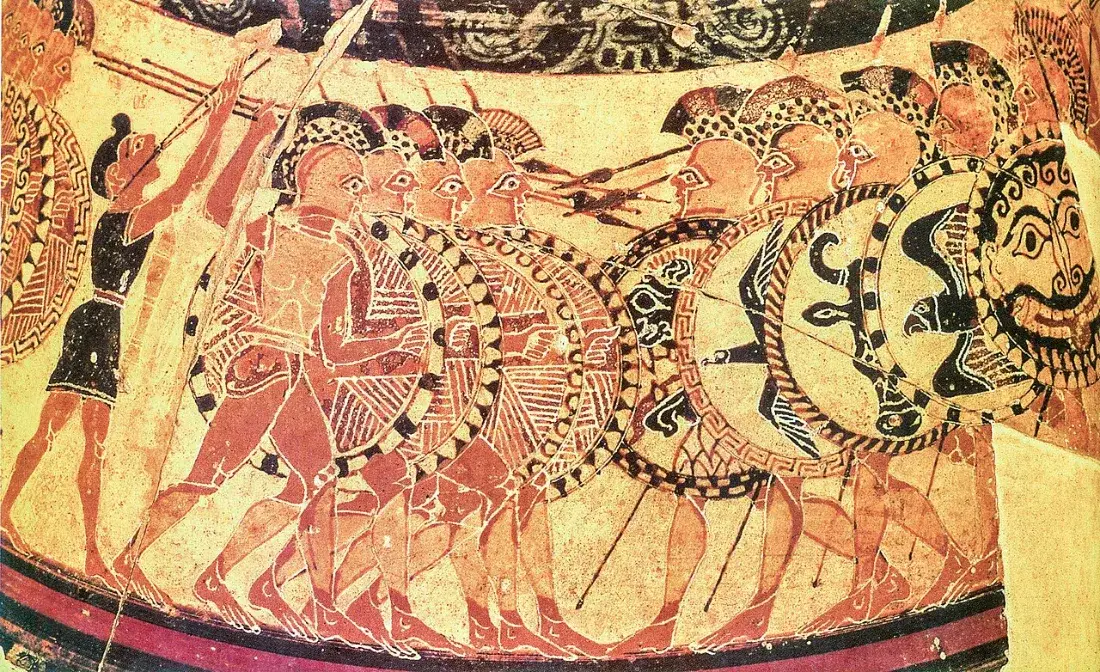
Text and translation
Ἀλλ’ Ἡρακλῆος γὰρ ἀνικήτου γένος ἐστέ
Tyrtaeus · fr. 11.1–20 W · elegiac couplets · quoted by Stobaeus · text of Bergk (1882), fr. 11
How to read each line
A guide to the Greek, syllables, pitch marks and quantities.
Show the reading key
- Above each line: the line as the edition prints it, each word placed over its own syllables. The main row: the same Greek divided into metrical syllables, each written as it is pronounced. A consonant that closes a syllable is written with it (λόθ | ρο); an elided word is closed up with the next vowel (ν’ἀ); a final consonant carried into the next word is set with a thin space (ς ἰ). Wider gaps mark word-ends.
- Above the syllables: the pitch of each syllable, from the accents. Under them: the quantity of each syllable as it falls in the line, then the transliteration, syllable by syllable, with accented syllables in capitals.
- Under each line: a line-for-line translation. In the right margin of the scansion: the line type, its scheme, and its analysis into cola.
Key to the labels
The names, patterns and symbols used beside this poem.
Show the labels and symbols
The labels in the right margin of the scansion below name the line, its scheme, the feet as the line realises them, and the caesurae and diaereses (the named word-ends) that fall in it. In the scheme ⏔ is a biceps, two shorts that may be contracted to one long; ⏕ is a long that may be resolved into two shorts; × is an anceps, long or short. A click on any syllable highlights its metron or colon, or, with the switch, its foot.
| Label | Name and shape | What it is |
|---|---|---|
| hem1 | First hemiepes— ⏔ — ⏔ — | The first two and a half feet of the hexameter, up to the penthemimeral caesura; in the pentameter, its whole first half. |
| hem2 | Second half of the hexameter⏔ — ⏔ — ⏑ ⏑ — × | From the penthemimeral caesura to the line-end: the fifth foot is nearly always a dactyl, the sixth is — ×. |
| hemp | Second hemiepes— ⏑ ⏑ — ⏑ ⏑ × | The second half of the pentameter: two dactyls and a single syllable, with no contraction allowed. |
The traditional feet
| Foot and shape | Where |
|---|---|
| First foot: dactyl or spondee— ⏔ | Scheme positions 1–2. The biceps (⏑ ⏑) may be contracted to a single long, making a spondee. |
| Second foot: dactyl or spondee— ⏔ | Scheme positions 3–4. |
| Third foot: dactyl or spondee— ⏔ | Scheme positions 5–6. The penthemimeral caesura falls after its first syllable, the “trochaic” caesura after its second. |
| Fourth foot: dactyl or spondee— ⏔ | Scheme positions 7–8. Word-end at the end of this foot, when it is a dactyl, is the bucolic diaeresis (West’s “bucolic caesura”: word-end at the end of the fourth foot after an uncontracted biceps)[5]. |
| Fifth foot: dactyl— ⏑ ⏑ | Scheme positions 9–10. A spondee here (a “spondaic line”) is rare. |
| Sixth foot— × | Scheme positions 11–12: a long and the indifferent final syllable. |
| First foot: dactyl or spondee— ⏔ | Scheme positions 1–2 of the pentameter. |
| Second foot: dactyl or spondee— ⏔ | Scheme positions 3–4. |
| Half-foot before the diaeresis— | Scheme position 5: the long that closes the first hemiepes; word-end must follow. |
| Fourth foot: dactyl— ⏑ ⏑ | Scheme positions 6–8: no contraction after the diaeresis. |
| Fifth foot: dactyl— ⏑ ⏑ | Scheme positions 9–11. |
| Final syllable× | Scheme position 12. |
Scansion
The opening of Tyrtaeus’ second long exhortation to the Spartans: take heart, stand fast in the front rank, and do not run. The first ten couplets are scanned, with a note on every line.
You are the stock of Heracles the unconquered,
so take heart: Zeus does not yet hold his head turned aside.
Do not shrink from the host of men, and do not be afraid;
let each man hold his shield straight towards the front line,
counting his own life hateful, and the black
spirits of death as dear as the beams of the sun.
For you know what ruin the works of tearful Ares bring,
and you have learned well the temper of cruel war;
often you have tasted both running away and giving chase,
young men, and of both you have had your fill.
Those who dare to stand fast beside one another
and advance to close quarters in the foremost rank
die in fewer numbers, and they keep the people behind them safe;
but when men take fright, all their worth is gone.
No one could ever finish telling, one by one,
all the evils that come upon a man once he suffers disgrace.
For it is a grievous thing to slash at the back
of a man in flight in the war against the foe;
and shameful is the corpse that lies stretched in the dust
with the spear’s point driven through its back from behind.
Metre
- The couplet. A hexameter alternating with the “pentameter”, — ⏔ — ⏔ — | — ⏑ ⏑ — ⏑ ⏑ —: two hemiepes, always divided by a word-end, with contraction allowed only in the first half. The elegiac hexameter takes less prosodic licence than the epic one, and each line is a period, so its last position may hold a short syllable.[6]
- Caesurae. Every hexameter has a third-foot caesura.[7] Counting a postpositive with the word before it,[5] it is feminine in 1, 9, 11, 13, 15 and 17, and masculine in 3, 5, 7 and 19. In 1 and 9 the written word-end at the masculine place is followed by γάρ or τε, so the real break is the feminine one after it.
- The pentameters. Every one keeps the word-end after the first hemiepes.[6] Both bicipitia of the first half are contracted in 2, 14 and 18; one in 4, 6, 8, 12, 16 and 20; none in 10.
- Prosody. Elision,[8] including ἔργ’ before ἀΐδηλα (7), where the old ϝ of ἔργον is ignored.[9] Epic correption[10] in 7, 10, 16 and 18. Stop + liquid inside a word makes position in Ἡρακλῆος (1), πολυδακρύου (7) and μετάφρενον (17).[11] There is no hiatus.
- Vowel quantities. Checked in LSJ: ἀνῑ́κητος (1; LSJ cites this line), ῑ̓θύς (4), ψῡχή (5), λᾱός (13), ἀνύω with ῠ (15). The α of Ἄρηος (7) must be long here; LSJ notes that Homer usually has ᾰ but gives the genitive Ἄ̄ρηος in Il. 2.767 (s.v. Ἄρης).
- The text. Bergk’s fourth edition,[12] pp. 15–16, with one change: in 17 Bergk prints his own conjecture ῥιγαλέον; his apparatus gives ἀργαλέον as the transmitted reading, and we print that (Ahrens conjectured ἁρπαλέον). The scansion is the same with all three.
- Gerber’s text. Compared with D. E. Gerber’s Loeb edition,[13] which also prints ἀργαλέον in 17. Differences that change the scansion: Differences without metrical effect: 4 ἐς; 5 ἐχθρήν (Ionic η); 6 ὁμῶς marked as a supplement; 9 καὶ μετὰ … διωκόντων τ’ ἐγένεσθε (the same shape, — ⏑ ⏑ … — ⏑ ⏑ — ×); 16 γίνεται.
Prosody, line by line
Every syllable, with the reason for its length. Quantities are read from the vowel where the spelling shows it, from the consonants that follow (“position”), from the accent where it tells, and from the metre where nothing else does. Editors’ notes on the text follow in the boxed paragraphs.
- 11.1
Line 11.1 · Ἀλλ’ Ἡρακλῆος γὰρ ἀνικήτου γένος ἐστέ,
Ἀλλ’ Ἡρακλῆος γὰρ ἀνικήτου γένος ἐστέ,
Ἀλλ’Ἡρακλῆοςγὰρ ἀνικήτουγένος ἐστέ,spondee, spondee, dactyl, spondee, dactyl, — ×; penthemimeral caesura; caesura after the third trochee.
- 1 —ἈλἈ is a vowel of unknown length; closed by λ: long by position.
- 2 —λ’ἩἩ is long by nature; the apostrophe marks an elided vowel; the consonant before it joins this syllable; a single long contracts the two shorts of the biceps at position 2.
- 3 —ρακα is a vowel of unknown length; closed by κ before a liquid: stop + liquid makes position, as it usually does in epic.
- 4 —λῆῆ is long by nature; a single long contracts the two shorts of the biceps at position 4.
- 5 —οςο is short by nature; closed by ς: long by position.
- 6 ⏑γὰὰ is short by the metre (position 6 must be short); one of the two shorts of the biceps at position 6.
- 7 ⏑ρ ἀἀ is short by the metre (position 6 must be short); the first consonant belongs to the previous word and is carried over to this vowel; one of the two shorts of the biceps at position 6.
- 8 —νιι is long by the metre (position 7 must be long).
- 9 —κήή is long by nature; a single long contracts the two shorts of the biceps at position 8.
- 10 —τουου is a diphthong, long by nature.
- 11 ⏑γέέ is short by nature; one of the two shorts of the biceps at position 10.
- 12 ⏑νοο is short by nature; one of the two shorts of the biceps at position 10.
- 13 —ς ἐσἐ is short by nature; closed by σ: long by position; the first consonant belongs to the previous word and is carried over to this vowel.
- 14 ×τέ,έ is short by nature; the position is anceps.
- 11.2
Line 11.2 · θαρσεῖτ’, οὔπω Ζεὺς αὐχένα λοξὸν ἔχει·
θαρσεῖτ’, οὔπω Ζεὺς αὐχένα λοξὸν ἔχει·
θαρσεῖτ’,οὔπωΖεὺςαὐχέναλοξὸν ἔχει·spondee, spondee, —, dactyl, dactyl, ×; diaeresis after the first hemiepes.
- 1 —θαρα is a vowel of unknown length; closed by ρ: long by position.
- 2 —σεῖεῖ is a diphthong, long by nature; a single long contracts the two shorts of the biceps at position 2.
- 3 —τ’,οὔοὔ is a diphthong, long by nature; the apostrophe marks an elided vowel; the consonant before it joins this syllable.
- 4 —πωω is long by nature; the next word begins with the double consonant Ζ: the syllable is closed before it: long by position; a single long contracts the two shorts of the biceps at position 4.
- 5 —Ζεὺςεὺ is a diphthong, long by nature.
- 6 —αὐαὐ is a diphthong, long by nature.
- 7 ⏑χέέ is short by nature.
- 8 ⏑ναα is short by the metre (position 8 must be short).
- 9 —λοο is short by nature; ξ is a double consonant (two sounds) and closes the syllable: long by position.
- 10 ⏑ξὸὸ is short by nature.
- 11 ⏑ν ἔἔ is short by nature; the first consonant belongs to the previous word and is carried over to this vowel.
- 12 ×χει·ει is a diphthong, long by nature; the position is anceps.
A pentameter with both bicipitia of the first half contracted (θαρ-σεῖτ’ οὔ-πω Ζεύς). θαρσεῖτ’ is elided.[8] The word-end after Ζεύς is the caesura of the pentameter.[6]- 11.3
Line 11.3 · μηδ’ ἀνδρῶν πληθὺν δειμαίνετε, μηδὲ φοβεῖσθε,
μηδ’ ἀνδρῶν πληθὺν δειμαίνετε, μηδὲ φοβεῖσθε,
μηδ’ἀνδρῶνπληθὺνδειμαίνετε,μηδὲφοβεῖσθε,spondee, spondee, spondee, dactyl, dactyl, — ×; penthemimeral caesura; bucolic diaeresis.
- 1 —μηη is long by nature.
- 2 —δ’ἀνἀ is a vowel of unknown length; closed by ν: long by position; the apostrophe marks an elided vowel; the consonant before it joins this syllable; a single long contracts the two shorts of the biceps at position 2.
- 3 —δρῶνῶ is long by nature; closed by ν: long by position.
- 4 —πληη is long by nature; a single long contracts the two shorts of the biceps at position 4.
- 5 —θὺνὺ is a vowel of unknown length; closed by ν: long by position.
- 6 —δειει is a diphthong, long by nature; a single long contracts the two shorts of the biceps at position 6.
- 7 —μαίαί is a diphthong, long by nature.
- 8 ⏑νεε is short by nature; one of the two shorts of the biceps at position 8.
- 9 ⏑τε,ε is short by nature; one of the two shorts of the biceps at position 8.
- 10 —μηη is long by nature.
- 11 ⏑δὲὲ is short by nature; one of the two shorts of the biceps at position 10.
- 12 ⏑φοο is short by nature; one of the two shorts of the biceps at position 10.
- 13 —βεῖσεῖ is a diphthong, long by nature; closed by σ: long by position.
- 14 ×θε,ε is short by nature; the position is anceps.
- 11.4
Line 11.4 · ἰθὺς δ’ εἰς προμάχους ἀσπίδ’ ἀνὴρ ἐχέτω,
ἰθὺς δ’ εἰς προμάχους ἀσπίδ’ ἀνὴρ ἐχέτω,
ἰθὺςδ’εἰςπρομάχουςἀσπίδ’ἀνὴρἐχέτω,spondee, dactyl, —, dactyl, dactyl, ×; diaeresis after the first hemiepes.
- 1 —ἰἰ is long by the metre (position 1 must be long).
- 2 —θὺςὺ is a vowel of unknown length; closed by ς: long by position; a single long contracts the two shorts of the biceps at position 2.
- 3 —δ’εἰςεἰ is a diphthong, long by nature; closed by ς: long by position; the apostrophe marks an elided vowel; the consonant before it joins this syllable.
- 4 ⏑προο is short by nature; one of the two shorts of the biceps at position 4.
- 5 ⏑μάά is short by the metre (position 4 must be short); one of the two shorts of the biceps at position 4.
- 6 —χουςου is a diphthong, long by nature.
- 7 —ἀσἀ is a vowel of unknown length; closed by σ: long by position.
- 8 ⏑πίί is short by the metre (position 7 must be short).
- 9 ⏑δ’ἀἀ is short by the metre (position 8 must be short); the apostrophe marks an elided vowel; the consonant before it joins this syllable.
- 10 —νὴρὴ is long by nature.
- 11 ⏑ἐἐ is short by nature.
- 12 ⏑χέέ is short by nature.
- 13 ×τω,ω is long by nature; the position is anceps.
- 11.5
Line 11.5 · ἐχθρὰν μὲν ψυχὴν θέμενος, θανάτου δὲ μελαίνας
ἐχθρὰν μὲν ψυχὴν θέμενος, θανάτου δὲ μελαίνας
ἐχθρὰνμὲνψυχὴνθέμενος,θανάτουδὲμελαίναςspondee, spondee, dactyl, dactyl, dactyl, — ×; penthemimeral caesura; hephthemimeral caesura.
- 1 —ἐχἐ is short by nature; closed by χ: long by position.
- 2 —θρὰνὰ is a vowel of unknown length; closed by ν: long by position; a single long contracts the two shorts of the biceps at position 2.
- 3 —μὲνὲ is short by nature; closed by ν: long by position.
- 4 —ψυυ is long by the metre (position 4 must be long); a single long contracts the two shorts of the biceps at position 4.
- 5 —χὴνὴ is long by nature; closed by ν: long by position.
- 6 ⏑θέέ is short by nature; one of the two shorts of the biceps at position 6.
- 7 ⏑μεε is short by nature; one of the two shorts of the biceps at position 6.
- 8 —νος,ο is short by nature; closed by ς: long by position.
- 9 ⏑θαα is short by the metre (position 8 must be short); one of the two shorts of the biceps at position 8.
- 10 ⏑νάά is short by the metre (position 8 must be short); one of the two shorts of the biceps at position 8.
- 11 —τουου is a diphthong, long by nature.
- 12 ⏑δὲὲ is short by nature; one of the two shorts of the biceps at position 10.
- 13 ⏑μεε is short by nature; one of the two shorts of the biceps at position 10.
- 14 —λαίαί is a diphthong, long by nature.
- 15 ×ναςα is a vowel of unknown length; closed by ς: long by position; the position is anceps.
- 11.6
Line 11.6 · κῆρας ὁμῶς αὐγαῖς ἠελίοιο φίλας.
κῆρας ὁμῶς αὐγαῖς ἠελίοιο φίλας.
κῆρας ὁμῶςαὐγαῖςἠελίοιοφίλας.dactyl, spondee, —, dactyl, dactyl, ×; diaeresis after the first hemiepes.
- 1 —κῆῆ is long by nature.
- 2 ⏑ραα is short by the accent rule: circumflex on the penult requires a short final syllable; one of the two shorts of the biceps at position 2.
- 3 ⏑ς ὁὁ is short by nature; the first consonant belongs to the previous word and is carried over to this vowel; one of the two shorts of the biceps at position 2.
- 4 —μῶςῶ is long by nature.
- 5 —αὐαὐ is a diphthong, long by nature; a single long contracts the two shorts of the biceps at position 4.
- 6 —γαῖςαῖ is a diphthong, long by nature.
- 7 —ἠἠ is long by nature.
- 8 ⏑εε is short by nature.
- 9 ⏑λίί is short by the metre (position 8 must be short).
- 10 —οιοι is a diphthong, long by nature.
- 11 ⏑οο is short by nature.
- 12 ⏑φίί is short by the metre (position 11 must be short).
- 13 ×λας.α is a vowel of unknown length; closed by ς: long by position; the position is anceps.
A pentameter with the second biceps contracted (αὐ-). The ς of κῆρας passes to ὁμῶς, so κῆ-ρα-σο- makes the first dactyl. The word-end after αὐγαῖς is the caesura.[6] ἠελίοιο is the epic genitive.- 11.7
Line 11.7 · ἴστε γὰρ Ἄρηος πολυδακρύου ἔργ’ ἀΐδηλα·
ἴστε γὰρ Ἄρηος πολυδακρύου ἔργ’ ἀΐδηλα·
ἴστεγὰρ Ἄρηοςπολυδακρύουἔργ’ἀΐδηλα·dactyl, spondee, dactyl, dactyl, dactyl, — ×; penthemimeral caesura; bucolic diaeresis.
- 1 —ἴσἴ is a vowel of unknown length; closed by σ: long by position.
- 2 ⏑τεε is short by nature; one of the two shorts of the biceps at position 2.
- 3 ⏑γὰὰ is short by the metre (position 2 must be short); one of the two shorts of the biceps at position 2.
- 4 —ρ ἌἌ is long by the metre (position 3 must be long); the first consonant belongs to the previous word and is carried over to this vowel.
- 5 —ρηη is long by nature; a single long contracts the two shorts of the biceps at position 4.
- 6 —οςο is short by nature; closed by ς: long by position.
- 7 ⏑ποο is short by nature; one of the two shorts of the biceps at position 6.
- 8 ⏑λυυ is short by the metre (position 6 must be short); one of the two shorts of the biceps at position 6.
- 9 —δακα is a vowel of unknown length; closed by κ before a liquid: stop + liquid makes position, as it usually does in epic.
- 10 ⏑ρύύ is short by the metre (position 8 must be short); one of the two shorts of the biceps at position 8.
- 11 ⏑ουου is a diphthong, long by nature; shortened before the vowel that begins the next word (epic correption), as the metre requires; one of the two shorts of the biceps at position 8.
- 12 —ἔρἔ is short by nature; closed by ρ: long by position.
- 13 ⏑γ’ἀἀ is short by the metre (position 10 must be short); the apostrophe marks an elided vowel; the consonant before it joins this syllable; one of the two shorts of the biceps at position 10.
- 14 ⏑ΐΐ is short by the metre (position 10 must be short); one of the two shorts of the biceps at position 10.
- 15 —δηη is long by nature.
- 16 ×λα·α is short by the accent rule: acute on the antepenult requires a short final syllable; the position is anceps.
A dactyl, a spondee and three dactyls. The ρ of γάρ passes to Ἄρηος, whose α must be long,[19] and ρη fills the contracted second biceps. The last syllable of Ἄρηος is long by position before the π of πολυδακρύου, and the penthemimeral caesura falls there.[20] The κρ of πολυδακρύου makes position inside the word;[11] its final -ου is shortened before ἔργ’ by correption,[10] and the word-end after it is the bucolic caesura.[5] ἔργ’ is elided, so the old ϝ of ἔργον has no effect.[21]- 11.8
Line 11.8 · εὖ δ’ ὀργὴν ἐδάητ’ ἀργαλέου πολέμου,
εὖ δ’ ὀργὴν ἐδάητ’ ἀργαλέου πολέμου,
εὖδ’ὀργὴνἐδάητ’ἀργαλέουπολέμου,spondee, dactyl, —, dactyl, dactyl, ×; diaeresis after the first hemiepes (with elision).
- 1 —εὖεὖ is a diphthong, long by nature.
- 2 —δ’ὀρὀ is short by nature; closed by ρ: long by position; the apostrophe marks an elided vowel; the consonant before it joins this syllable; a single long contracts the two shorts of the biceps at position 2.
- 3 —γὴνὴ is long by nature.
- 4 ⏑ἐἐ is short by nature; one of the two shorts of the biceps at position 4.
- 5 ⏑δάά is short by the metre (position 4 must be short); one of the two shorts of the biceps at position 4.
- 6 —ηη is long by nature.
- 7 —τ’ἀρἀ is a vowel of unknown length; closed by ρ: long by position; the apostrophe marks an elided vowel; the consonant before it joins this syllable.
- 8 ⏑γαα is short by the metre (position 7 must be short).
- 9 ⏑λέέ is short by nature.
- 10 —ουου is a diphthong, long by nature.
- 11 ⏑ποο is short by nature.
- 12 ⏑λέέ is short by nature.
- 13 ×μου,ου is a diphthong, long by nature; the position is anceps.
- 11.9
Line 11.9 · καὶ θαμὰ φευγόντων τε διωκόντων τε γέγευσθε,
καὶ θαμὰ φευγόντων τε διωκόντων τε γέγευσθε,
καὶθαμὰφευγόντωντεδιωκόντωντεγέγευσθε,dactyl, spondee, dactyl, spondee, dactyl, — ×; penthemimeral caesura; caesura after the third trochee.
- 1 —καὶαὶ is a diphthong, long by nature.
- 2 ⏑θαα is short by the metre (position 2 must be short); one of the two shorts of the biceps at position 2.
- 3 ⏑μὰὰ is short by the metre (position 2 must be short); one of the two shorts of the biceps at position 2.
- 4 —φευευ is a diphthong, long by nature.
- 5 —γόνό is short by nature; closed by ν: long by position; a single long contracts the two shorts of the biceps at position 4.
- 6 —τωνω is long by nature; closed by ν: long by position.
- 7 ⏑τεε is short by nature; one of the two shorts of the biceps at position 6.
- 8 ⏑διι is short by the metre (position 6 must be short); one of the two shorts of the biceps at position 6.
- 9 —ωω is long by nature.
- 10 —κόνό is short by nature; closed by ν: long by position; a single long contracts the two shorts of the biceps at position 8.
- 11 —τωνω is long by nature; closed by ν: long by position.
- 12 ⏑τεε is short by nature; one of the two shorts of the biceps at position 10.
- 13 ⏑γέέ is short by nature; one of the two shorts of the biceps at position 10.
- 14 —γευσευ is a diphthong, long by nature; closed by σ: long by position.
- 15 ×θε,ε is short by nature; the position is anceps.
- 11.10
Line 11.10 · ὦ νέοι, ἀμφοτέρων δ’ εἰς κόρον ἠλάσατε.
ὦ νέοι, ἀμφοτέρων δ’ εἰς κόρον ἠλάσατε.
ὦνέοι,ἀμφοτέρωνδ’εἰςκόρον ἠλάσατε.dactyl, dactyl, —, dactyl, dactyl, ×; diaeresis after the first hemiepes.
- 1 —ὦὦ is long by nature.
- 2 ⏑νέέ is short by nature; one of the two shorts of the biceps at position 2.
- 3 ⏑οι,οι is a diphthong, long by nature; shortened before the vowel that begins the next word (epic correption), as the metre requires; one of the two shorts of the biceps at position 2.
- 4 —ἀμἀ is a vowel of unknown length; closed by μ: long by position.
- 5 ⏑φοο is short by nature; one of the two shorts of the biceps at position 4.
- 6 ⏑τέέ is short by nature; one of the two shorts of the biceps at position 4.
- 7 —ρωνω is long by nature; closed by ν: long by position.
- 8 —δ’εἰςεἰ is a diphthong, long by nature; closed by ς: long by position; the apostrophe marks an elided vowel; the consonant before it joins this syllable.
- 9 ⏑κόό is short by nature.
- 10 ⏑ροο is short by nature.
- 11 —ν ἠἠ is long by nature; the first consonant belongs to the previous word and is carried over to this vowel.
- 12 ⏑λάά is short by the metre (position 10 must be short).
- 13 ⏑σαα is short by the metre (position 11 must be short).
- 14 ×τε.ε is short by nature; the position is anceps.
- 11.11
Line 11.11 · οἳ μὲν γὰρ τολμῶσι παρ’ ἀλλήλοισι μένοντες
οἳ μὲν γὰρ τολμῶσι παρ’ ἀλλήλοισι μένοντες
οἳμὲνγὰρτολμῶσιπαρ’ἀλλήλοισιμένοντεςspondee, spondee, dactyl, spondee, dactyl, — ×; caesura after the third trochee.
- 1 —οἳοἳ is a diphthong, long by nature.
- 2 —μὲνὲ is short by nature; closed by ν: long by position; a single long contracts the two shorts of the biceps at position 2.
- 3 —γὰρὰ is a vowel of unknown length; closed by ρ: long by position.
- 4 —τολο is short by nature; closed by λ: long by position; a single long contracts the two shorts of the biceps at position 4.
- 5 —μῶῶ is long by nature.
- 6 ⏑σιι is short by the accent rule: circumflex on the penult requires a short final syllable; one of the two shorts of the biceps at position 6.
- 7 ⏑παα is short by the metre (position 6 must be short); one of the two shorts of the biceps at position 6.
- 8 —ρ’ἀλἀ is a vowel of unknown length; closed by λ: long by position; the apostrophe marks an elided vowel; the consonant before it joins this syllable.
- 9 —λήή is long by nature; a single long contracts the two shorts of the biceps at position 8.
- 10 —λοιοι is a diphthong, long by nature.
- 11 ⏑σιι is short by the accent rule: acute on the antepenult requires a short final syllable; one of the two shorts of the biceps at position 10.
- 12 ⏑μέέ is short by nature; one of the two shorts of the biceps at position 10.
- 13 —νονο is short by nature; closed by ν: long by position.
- 14 ×τεςε is short by nature; closed by ς: long by position; the position is anceps.
- 11.12
Line 11.12 · ἔς τ’ αὐτοσχεδίην καὶ προμάχους ἰέναι,
ἔς τ’ αὐτοσχεδίην καὶ προμάχους ἰέναι,
ἔςτ’αὐτοσχεδίηνκαὶπρομάχουςἰέναι,spondee, dactyl, —, dactyl, dactyl, ×; diaeresis after the first hemiepes.
- 1 —ἔςἔ is short by nature; closed by ς: long by position.
- 2 —τ’αὐαὐ is a diphthong, long by nature; the apostrophe marks an elided vowel; the consonant before it joins this syllable; a single long contracts the two shorts of the biceps at position 2.
- 3 —τοσο is short by nature; closed by σ: long by position.
- 4 ⏑χεε is short by nature; one of the two shorts of the biceps at position 4.
- 5 ⏑δίί is short by the metre (position 4 must be short); one of the two shorts of the biceps at position 4.
- 6 —ηνη is long by nature; closed by ν: long by position.
- 7 —καὶαὶ is a diphthong, long by nature; the next word begins with πρ: the syllable is closed before it: long by position.
- 8 ⏑προο is short by nature.
- 9 ⏑μάά is short by the metre (position 8 must be short).
- 10 —χουςου is a diphthong, long by nature.
- 11 ⏑ἰἰ is short by the metre (position 10 must be short).
- 12 ⏑έέ is short by nature.
- 13 ×ναι,αι is a diphthong, long by nature; the position is anceps.
- 11.13
Line 11.13 · παυρότεροι θνήσκουσι, σαοῦσι δὲ λαὸν ὀπίσσω·
παυρότεροι θνήσκουσι, σαοῦσι δὲ λαὸν ὀπίσσω·
παυρότεροιθνήσκουσι,σαοῦσιδὲλαὸν ὀπίσσω·dactyl, spondee, dactyl, dactyl, dactyl, — ×; caesura after the third trochee; bucolic diaeresis.
- 1 —παυαυ is a diphthong, long by nature.
- 2 ⏑ρόό is short by nature; one of the two shorts of the biceps at position 2.
- 3 ⏑τεε is short by nature; one of the two shorts of the biceps at position 2.
- 4 —ροιοι is a diphthong, long by nature; the next word begins with θν: the syllable is closed before it: long by position.
- 5 —θνήσή is long by nature; closed by σ: long by position; a single long contracts the two shorts of the biceps at position 4.
- 6 —κουου is a diphthong, long by nature.
- 7 ⏑σι,ι is short by the accent rule: acute on the antepenult requires a short final syllable; one of the two shorts of the biceps at position 6.
- 8 ⏑σαα is short by the metre (position 6 must be short); one of the two shorts of the biceps at position 6.
- 9 —οῦοῦ is a diphthong, long by nature.
- 10 ⏑σιι is short by the accent rule: circumflex on the penult requires a short final syllable; one of the two shorts of the biceps at position 8.
- 11 ⏑δὲὲ is short by nature; one of the two shorts of the biceps at position 8.
- 12 —λαα is long by the metre (position 9 must be long).
- 13 ⏑ὸὸ is short by nature; one of the two shorts of the biceps at position 10.
- 14 ⏑ν ὀὀ is short by nature; the first consonant belongs to the previous word and is carried over to this vowel; one of the two shorts of the biceps at position 10.
- 15 —πίσί is a vowel of unknown length; closed by σ: long by position.
- 16 ×σω·ω is long by nature; the position is anceps.
A dactyl, a spondee and three dactyls. The caesura is feminine, at the comma after θνήσκουσι.[7] The written word-end after σαοῦσι falls between the shorts of the fourth biceps, but δέ is a postpositive and goes with it, so Hermann’s Bridge is kept and the word-group ends at the bucolic place.[5] The α of λαόν is long.[24] Bergk prints Buttmann’s σαοῦσι for the transmitted σάουσι.[25]- 11.14
Line 11.14 · τρεσσάντων δ’ ἀνδρῶν πᾶσ’ ἀπόλωλ’ ἀρετή.
τρεσσάντων δ’ ἀνδρῶν πᾶσ’ ἀπόλωλ’ ἀρετή.
τρεσσάντωνδ’ἀνδρῶνπᾶσ’ἀπόλωλ’ἀρετή.spondee, spondee, —, dactyl, dactyl, ×; diaeresis after the first hemiepes.
- 1 —τρεσε is short by nature; closed by σ: long by position.
- 2 —σάνά is a vowel of unknown length; closed by ν: long by position; a single long contracts the two shorts of the biceps at position 2.
- 3 —τωνω is long by nature; closed by ν: long by position.
- 4 —δ’ἀνἀ is a vowel of unknown length; closed by ν: long by position; the apostrophe marks an elided vowel; the consonant before it joins this syllable; a single long contracts the two shorts of the biceps at position 4.
- 5 —δρῶνῶ is long by nature; closed by ν: long by position.
- 6 —πᾶᾶ carries a circumflex, so it is long.
- 7 ⏑σ’ἀἀ is short by the metre (position 7 must be short); the apostrophe marks an elided vowel; the consonant before it joins this syllable.
- 8 ⏑πόό is short by nature.
- 9 —λωω is long by nature.
- 10 ⏑λ’ἀἀ is short by the metre (position 10 must be short); the apostrophe marks an elided vowel; the consonant before it joins this syllable.
- 11 ⏑ρεε is short by nature.
- 12 ×τή.ή is long by nature; the position is anceps.
- 11.15
Line 11.15 · οὐδεὶς ἄν ποτε ταῦτα λέγων ἀνύσειεν ἕκαστα,
οὐδεὶς ἄν ποτε ταῦτα λέγων ἀνύσειεν ἕκαστα,
οὐδεὶςἄνποτεταῦταλέγωνἀνύσειεν ἕκαστα,spondee, dactyl, dactyl, dactyl, dactyl, — ×; caesura after the third trochee; hephthemimeral caesura.
- 1 —οὐοὐ is a diphthong, long by nature.
- 2 —δεὶςεὶ is a diphthong, long by nature; a single long contracts the two shorts of the biceps at position 2.
- 3 —ἄνἄ is a vowel of unknown length; closed by ν: long by position.
- 4 ⏑ποο is short by nature; one of the two shorts of the biceps at position 4.
- 5 ⏑τεε is short by nature; one of the two shorts of the biceps at position 4.
- 6 —ταῦαῦ is a diphthong, long by nature.
- 7 ⏑ταα is short by the accent rule: circumflex on the penult requires a short final syllable; one of the two shorts of the biceps at position 6.
- 8 ⏑λέέ is short by nature; one of the two shorts of the biceps at position 6.
- 9 —γωνω is long by nature.
- 10 ⏑ἀἀ is short by the metre (position 8 must be short); one of the two shorts of the biceps at position 8.
- 11 ⏑νύύ is short by the metre (position 8 must be short); one of the two shorts of the biceps at position 8.
- 12 —σειει is a diphthong, long by nature.
- 13 ⏑εε is short by nature; one of the two shorts of the biceps at position 10.
- 14 ⏑ν ἕἕ is short by nature; the first consonant belongs to the previous word and is carried over to this vowel; one of the two shorts of the biceps at position 10.
- 15 —κασα is a vowel of unknown length; closed by σ: long by position.
- 16 ×τα,α is short by the accent rule: acute on the antepenult requires a short final syllable; the position is anceps.
- 11.16
Line 11.16 · ὅσσ’, ἢν αἰσχρὰ πάθῃ, γίγνεται ἀνδρὶ κακά.
ὅσσ’, ἢν αἰσχρὰ πάθῃ, γίγνεται ἀνδρὶ κακά.
ὅσσ’,ἢναἰσχρὰπάθῃ,γίγνεταιἀνδρὶκακά.spondee, dactyl, —, dactyl, dactyl, ×; diaeresis after the first hemiepes.
- 1 —ὅσὅ is short by nature; closed by σ: long by position.
- 2 —σ’,ἢνἢ is long by nature; the apostrophe marks an elided vowel; the consonant before it joins this syllable; a single long contracts the two shorts of the biceps at position 2.
- 3 —αἰσαἰ is a diphthong, long by nature; closed by σ: long by position.
- 4 ⏑χρὰὰ is short by the metre (position 4 must be short); one of the two shorts of the biceps at position 4.
- 5 ⏑πάά is short by the metre (position 4 must be short); one of the two shorts of the biceps at position 4.
- 6 —θῃ,ῃ is long by nature.
- 7 —γίγί is a vowel of unknown length; closed by γ: long by position; γν is one of the four clusters (γμ, γν, δμ, δν) that never leave the syllable before them short.[27]
- 8 ⏑νεε is short by nature.
- 9 ⏑ταιαι is a diphthong, long by nature; shortened before the vowel that begins the next word (epic correption), as the metre requires.
- 10 —ἀνἀ is a vowel of unknown length; closed by ν: long by position.
- 11 ⏑δρὶὶ is short by the metre (position 10 must be short).
- 12 ⏑καα is short by the metre (position 11 must be short).
- 13 ×κά.ᾰ́ is short (its length is not shown by the ordinary spelling); the position is anceps.
A pentameter with the first biceps contracted (ὅσσ’ ἤν). ὅσσ’ is elided.[8] The word-end after πάθῃ is the caesura.[6] -ται of γίγνεται is shortened before ἀνδρί by correption.[10] Bergk prints Valckenaer’s ἤν and γίγνεται for the transmitted ἄν and γίνεται;[25] Gerber prints γίνεται, with the same scansion.The final ᾰ of κακά is short;[28] the metre does not show it here, at the end of the period, and the input marks it.
- 11.17
Line 11.17 · ἀργαλέον γὰρ ὄπισθε μετάφρενόν ἐστι δαΐζειν
ἀργαλέον γὰρ ὄπισθε μετάφρενόν ἐστι δαΐζειν
ἀργαλέονγὰρ ὄπισθεμετάφρενόν ἐστιδαΐζεινdactyl, dactyl, dactyl, dactyl, dactyl, — ×; caesura after the third trochee; bucolic diaeresis.
- 1 —ἀρἀ is a vowel of unknown length; closed by ρ: long by position.
- 2 ⏑γαα is short by the metre (position 2 must be short); one of the two shorts of the biceps at position 2.
- 3 ⏑λέέ is short by nature; one of the two shorts of the biceps at position 2.
- 4 —ονο is short by nature; closed by ν: long by position.
- 5 ⏑γὰὰ is short by the metre (position 4 must be short); one of the two shorts of the biceps at position 4.
- 6 ⏑ρ ὄὄ is short by nature; the first consonant belongs to the previous word and is carried over to this vowel; one of the two shorts of the biceps at position 4.
- 7 —πισι is a vowel of unknown length; closed by σ: long by position.
- 8 ⏑θεε is short by nature; one of the two shorts of the biceps at position 6.
- 9 ⏑μεε is short by nature; one of the two shorts of the biceps at position 6.
- 10 —τάφά is a vowel of unknown length; closed by φ before a liquid: stop + liquid makes position, as it usually does in epic.
- 11 ⏑ρεε is short by nature; one of the two shorts of the biceps at position 8.
- 12 ⏑νόό is short by nature; one of the two shorts of the biceps at position 8.
- 13 —ν ἐσἐ is short by nature; closed by σ: long by position; the first consonant belongs to the previous word and is carried over to this vowel.
- 14 ⏑τιι is short by the metre (position 10 must be short); one of the two shorts of the biceps at position 10.
- 15 ⏑δαα is short by the metre (position 10 must be short); one of the two shorts of the biceps at position 10.
- 16 —ΐζ is a double consonant (two sounds) and closes the syllable: long by position.
- 17 ×ζεινει is a diphthong, long by nature; closed by ν: long by position; the position is anceps.
- 11.18
Line 11.18 · ἀνδρὸς φεύγοντος δηΐῳ ἐν πολέμῳ·
ἀνδρὸς φεύγοντος δηΐῳ ἐν πολέμῳ·
ἀνδρὸςφεύγοντοςδηΐῳἐνπολέμῳ·spondee, spondee, —, dactyl, dactyl, ×; diaeresis after the first hemiepes.
- 1 —ἀνἀ is a vowel of unknown length; closed by ν: long by position.
- 2 —δρὸςὸ is short by nature; closed by ς: long by position; a single long contracts the two shorts of the biceps at position 2.
- 3 —φεύεύ is a diphthong, long by nature.
- 4 —γονο is short by nature; closed by ν: long by position; a single long contracts the two shorts of the biceps at position 4.
- 5 —τοςο is short by nature; closed by ς: long by position.
- 6 —δηη is long by nature.
- 7 ⏑ΐΐ is short by the metre (position 7 must be short).
- 8 ⏑ῳῳ is long by nature; shortened before the vowel that begins the next word (epic correption), as the metre requires.
- 9 —ἐνἐ is short by nature; closed by ν: long by position.
- 10 ⏑ποο is short by nature.
- 11 ⏑λέέ is short by nature.
- 12 ×μῳ·ῳ is long by nature; the position is anceps.
- 11.19
Line 11.19 · αἰσχρὸς δ’ ἐστὶ νέκυς κακκείμενος ἐν κονίῃσιν
αἰσχρὸς δ’ ἐστὶ νέκυς κακκείμενος ἐν κονίῃσιν
αἰσχρὸςδ’ἐστὶνέκυςκακκείμενος ἐνκονίῃσινspondee, dactyl, spondee, dactyl, dactyl, — ×; penthemimeral caesura; bucolic diaeresis.
- 1 —αἰσαἰ is a diphthong, long by nature; closed by σ: long by position.
- 2 —χρὸςὸ is short by nature; closed by ς: long by position; a single long contracts the two shorts of the biceps at position 2.
- 3 —δ’ἐσἐ is short by nature; closed by σ: long by position; the apostrophe marks an elided vowel; the consonant before it joins this syllable.
- 4 ⏑τὶὶ is short by the metre (position 4 must be short); one of the two shorts of the biceps at position 4.
- 5 ⏑νέέ is short by nature; one of the two shorts of the biceps at position 4.
- 6 —κυςυ is a vowel of unknown length; closed by ς: long by position.
- 7 —κακα is a vowel of unknown length; closed by κ: long by position; a single long contracts the two shorts of the biceps at position 6.
- 8 —κείεί is a diphthong, long by nature.
- 9 ⏑μεε is short by nature; one of the two shorts of the biceps at position 8.
- 10 ⏑νοο is short by nature; one of the two shorts of the biceps at position 8.
- 11 —ς ἐνἐ is short by nature; closed by ν: long by position; the first consonant belongs to the previous word and is carried over to this vowel.
- 12 ⏑κοο is short by nature; one of the two shorts of the biceps at position 10.
- 13 ⏑νίί is short by the metre (position 10 must be short); one of the two shorts of the biceps at position 10.
- 14 —ῃῃ is long by nature.
- 15 ×σινι is a vowel of unknown length; closed by ν: long by position; the position is anceps.
- 11.20
Line 11.20 · νῶτον ὄπισθ’ αἰχμῇ δουρὸς ἐληλαμένος.
νῶτον ὄπισθ’ αἰχμῇ δουρὸς ἐληλαμένος.
νῶτον ὄπισθ’αἰχμῇδουρὸς ἐληλαμένος.dactyl, spondee, —, dactyl, dactyl, ×; diaeresis after the first hemiepes.
- 1 —νῶῶ is long by nature.
- 2 ⏑τοο is short by nature; one of the two shorts of the biceps at position 2.
- 3 ⏑ν ὄὄ is short by nature; the first consonant belongs to the previous word and is carried over to this vowel; one of the two shorts of the biceps at position 2.
- 4 —πισι is a vowel of unknown length; closed by σ: long by position.
- 5 —θ’αἰαἰ is a diphthong, long by nature; the apostrophe marks an elided vowel; the consonant before it joins this syllable; a single long contracts the two shorts of the biceps at position 4.
- 6 —χμῇῇ is long by nature.
- 7 —δουου is a diphthong, long by nature.
- 8 ⏑ρὸὸ is short by nature.
- 9 ⏑ς ἐἐ is short by nature; the first consonant belongs to the previous word and is carried over to this vowel.
- 10 —ληη is long by nature.
- 11 ⏑λαα is short by the metre (position 10 must be short).
- 12 ⏑μέέ is short by nature.
- 13 ×νος.ο is short by nature; closed by ς: long by position; the position is anceps.
What the input marks
The text is Bergk’s, read on the page images of his Poetae Lyrici Graeci II,[12] pp. 15–16, with the transmitted ἀργαλέον in 17. No quantity marks are needed: the workbench takes the α of Ἄρηος (7) as long by the metre, which LSJ supports.[19]
Notes
- ^ Bartol 2022, p. 225; Aloni 2009, p. 173.
- ^ Bartol 2022, p. 225.
- ^ Bartol 2022, p. 226.
- ^ Bartol 2022, pp. 223, 225; Aloni 2009, p. 173.
- ^ a b c d e f West 1987, p. 21.
- ^ a b c d e f g h i j k l m West 1987, p. 24.
- ^ a b c d e f g h West 1987, p. 19.
- ^ a b c d e f g h i j k l West 1987, p. 13.
- ^ West 1987, p. 23.
- ^ a b c d e West 1987, p. 14.
- ^ a b c d West 1987, pp. 16–17.
- ^ a b Bergk 1882.
- ^ Gerber 1999a, pp. 54–55.
- ^ a b West 1987, pp. 9, 19, 21.
- ^ LSJ s.v. ἀνίκητος, citing this line.
- ^ LSJ s.v. ἰθύς.
- ^ LSJ s.v. ψυχή.
- ^ a b c Gerber 1999a, p. 54.
- ^ a b See the Metre notes.
- ^ West 1987, pp. 12, 19.
- ^ West 1987, pp. 13, 23.
- ^ a b West 1987, p. 9.
- ^ West 1987, pp. 9, 13.
- ^ LSJ s.v. λαός.
- ^ a b c Bergk 1882, p. 16.
- ^ LSJ s.v. ἀνύω.
- ^ West 1987, p. 16.
- ^ West 1987, p. 11: -ᾰ of the neuter plural.
- ^ West 1987, p. 21; on the reading ἀργαλέον see the Metre notes.
Text and sources
- Text: T. Bergk, Poetae Lyrici Graeci, 4th ed., vol. II: Poetas elegiacos et iambographos continens (Leipzig 1882), Tyrtaeus fr. 11, pp. 15–16 (public domain; read on the page images of the archive.org scan poetaelyricigrae02berguoft). Source of the fragment: Stobaeus, Anthology 4.9.16 (Gerber 1999a, p. 54; Bergk’s “Stob. Flor. L 7”).
- M. L. West, Introduction to Greek Metre (Oxford 1987): pp. 9, 12–24 (appositives, syllables, elision, correption, stop + liquid, the hexameter, its caesurae and Hermann’s Bridge, digamma, the elegiac couplet). Cited as “West 1987”.
- D. E. Gerber (ed. and trans.), Greek Elegiac Poetry from the Seventh to the Fifth Centuries BC (Loeb Classical Library 258, Cambridge, MA 1999), pp. 54–55 (text of fr. 11 compared). Cited as “Gerber 1999a”.
- H. G. Liddell and R. Scott, A Greek-English Lexicon, revised by H. S. Jones (Oxford 1940), Perseus Digital Library edition (CC BY-SA 4.0): s.vv. ἀνίκητος, ἰθύς, ψυχή, λαός, ἀνύω, Ἄρης. Cited as “LSJ”.
- Translation: metrehelp.org, CC BY-SA 4.0.
Quotations from copyrighted works are not covered by this page’s licence.
Mimnermus: the Sun's golden bed and the taking of Smyrna (frr. 12, 9)
Synopsis
Mimnermus was an Ionian elegist of the second half of the seventh century BC. The Suda puts his floruit in 632–629 BC. He apparently refers to the Smyrnaeans’ fight against the Lydian king Gyges in the 660s, which points the same way.[1] Ancient sources make him a citizen of Colophon or of Smyrna. Bartol favours Smyrna; Aloni writes that he flourished at Colophon.[2] His poems filled two books. The short pieces were later called Nanno, perhaps after an aulos-player he loved. The Smyrneis was a long narrative elegy on the history of Smyrna.[3] Short elegies were sung to the aulos, mostly at symposia.[4] Strabo calls him both an aulos-player and an elegiac poet (Strabo 14.1.28).
Scanned here are two fragments that Athenaeus and Strabo both assign to the Nanno. In fr. 12 the Sun is carried each night across the ocean, asleep in a golden bed made by Hephaestus (Athenaeus 11.470a–b). Fr. 9 tells how the speaker’s people sailed from Pylos to Asia, settled at Colophon and took Smyrna (Strabo 14.1.4).
Text and translation
Ἠέλιος μὲν γὰρ ἔλαχεν πόνον ἤματα πάντα,
Mimnermus · fr. 12 (Athenaeus 11.470a–b, ed. Kaibel) · fr. 9 (Strabo 14.1.4, ed. Meineke) · both said to come from the Nanno
How to read each line
A guide to the Greek, syllables, pitch marks and quantities.
Show the reading key
- Above each line: the line as the edition prints it, each word placed over its own syllables. The main row: the same Greek divided into metrical syllables, each written as it is pronounced. A consonant that closes a syllable is written with it (λόθ | ρο); an elided word is closed up with the next vowel (ν’ἀ); a final consonant carried into the next word is set with a thin space (ς ἰ). Wider gaps mark word-ends.
- Above the syllables: the pitch of each syllable, from the accents. Under them: the quantity of each syllable as it falls in the line, then the transliteration, syllable by syllable, with accented syllables in capitals.
- Under each line: a line-for-line translation. In the right margin of the scansion: the line type, its scheme, and its analysis into cola.
Key to the labels
The names, patterns and symbols used beside this poem.
Show the labels and symbols
The labels in the right margin of the scansion below name the line, its scheme, the feet as the line realises them, and the caesurae and diaereses (the named word-ends) that fall in it. In the scheme ⏔ is a biceps, two shorts that may be contracted to one long; ⏕ is a long that may be resolved into two shorts; × is an anceps, long or short. A click on any syllable highlights its metron or colon, or, with the switch, its foot.
| Label | Name and shape | What it is |
|---|---|---|
| hem1 | First hemiepes— ⏔ — ⏔ — | The first two and a half feet of the hexameter, up to the penthemimeral caesura; in the pentameter, its whole first half. |
| hem2 | Second half of the hexameter⏔ — ⏔ — ⏑ ⏑ — × | From the penthemimeral caesura to the line-end: the fifth foot is nearly always a dactyl, the sixth is — ×. |
| hemp | Second hemiepes— ⏑ ⏑ — ⏑ ⏑ × | The second half of the pentameter: two dactyls and a single syllable, with no contraction allowed. |
The traditional feet
| Foot and shape | Where |
|---|---|
| First foot: dactyl or spondee— ⏔ | Scheme positions 1–2. The biceps (⏑ ⏑) may be contracted to a single long, making a spondee. |
| Second foot: dactyl or spondee— ⏔ | Scheme positions 3–4. |
| Third foot: dactyl or spondee— ⏔ | Scheme positions 5–6. The penthemimeral caesura falls after its first syllable, the “trochaic” caesura after its second. |
| Fourth foot: dactyl or spondee— ⏔ | Scheme positions 7–8. Word-end at the end of this foot, when it is a dactyl, is the bucolic diaeresis (West’s “bucolic caesura”: word-end at the end of the fourth foot after an uncontracted biceps)[5]. |
| Fifth foot: dactyl— ⏑ ⏑ | Scheme positions 9–10. A spondee here (a “spondaic line”) is rare. |
| Sixth foot— × | Scheme positions 11–12: a long and the indifferent final syllable. |
| First foot: dactyl or spondee— ⏔ | Scheme positions 1–2 of the pentameter. |
| Second foot: dactyl or spondee— ⏔ | Scheme positions 3–4. |
| Half-foot before the diaeresis— | Scheme position 5: the long that closes the first hemiepes; word-end must follow. |
| Fourth foot: dactyl— ⏑ ⏑ | Scheme positions 6–8: no contraction after the diaeresis. |
| Fifth foot: dactyl— ⏑ ⏑ | Scheme positions 9–11. |
| Final syllable× | Scheme position 12. |
Scansion
Two fragments of the Colophonian piper-poet: the Sun crossing the ocean asleep in a golden bed, which Athenaeus quotes for its cup-shaped vessel, and the migration from Pylos to Colophon and Smyrna, which Strabo quotes as history. Correption, hiatus in the princeps, synizesis and the two contractions of a pentameter’s first half, line by line.
For Helios is allotted labour day after day,
and never is there a moment’s respite
for his horses or for himself, from the time rosy-fingered Dawn
leaves Ocean behind and mounts into the heavens;
for across the swell he is borne by a much-loved bed,
intricately made, hammered by Hephaestus’ hands
out of precious gold, with wings, skimming the water’s top,
as he sleeps, at speed, from the country of the Hesperides
to the Ethiopians’ land, where the quick chariot and the horses
stand until Dawn, born early, arrives.
There Hyperion’s son climbs into his other car.
We, in our turn, left Pylos, the city of Neleus,
and reached desirable Asia in our ships;
and in lovely Colophon, with violence beyond measure,
we made our home, leaders in grievous outrage;
and starting out from there, from the river [ἀστήεντος, as Meineke prints it],
we seized Aeolian Smyrna by the gods’ will.
Metre
- The couplet. A hexameter, with less prosodic licence than in epic, alternating with the “pentameter” — ⏔ — ⏔ — | — ⏑ ⏑ — ⏑ ⏑ — ‖, two hemiepes (D | D ‖) always divided by a word-end; contraction of the bicipitia is limited to the first colon, and elision at the pentameter caesura is admitted.[6] The hexameter’s caesura falls in the third foot, after the princeps (penthemimeral) or after the first short (the “feminine” caesura after the third trochee), or occasionally after the fourth princeps (hephthemimeral).[7] a prepositive is reckoned with the word after it, a postpositive with the word before it.[8] Athenaeus’ quotation of fr. 12 ends with a hexameter; the next pentameter is not quoted.
- Mimnermus. An Ionian elegist of the second half of the seventh century, connected by the ancient sources with Colophon and Smyrna; Callimachus seems to distinguish two kinds of his poetry, the small-scale poems later called Nanno after the poet’s beloved aulos-player, and the longer narrative Smyrneis.[9] Bartol cites fr. 9 W for the Smyrnaeans’ voyage to Asia and their settlement at Colophon.[10] Athenaeus says that fr. 12 is from the Nanno (“Μίμνερμος δὲ Ναννοῖ”), and Strabo that fr. 9 is (“ἐν τῇ Ναννοῖ”, 14.1.4); Strabo also describes Mimnermus as both an aulos-player and an elegiac poet (14.1.28).
- Prosody. As in epic: a long vowel or diphthong ending a word normally becomes short when the next word begins with a vowel (epic correption)[11], five times here; hiatus with a long vowel is found mostly in the princeps,[5] as after ἐπέβη (l. 11); inside a word, two vowels are often run together into one syllable when the first is ε (synecphonesis, p. 15), as θεῶν (l. 17). Inside a word stop + liquid makes position in early poetry:[12] ἄκρον (l. 7), ὄφρ’ (l. 10), ὑπέροπλον (l. 14), ὕβριος (l. 15). The last position of each line is indifferent at period-end.[13]
- Marks in the input. Meineke prints Νηλήιον (l. 12) without a diaeresis; the input types Νηλήϊον so that the scanner reads ηι as two syllables, as the metre requires. In l. 17 the input ties θε‿ῶν into one syllable. The page shows Meineke’s spelling; the reason text speaks of the tie.
Prosody, line by line
Every syllable, with the reason for its length. Quantities are read from the vowel where the spelling shows it, from the consonants that follow (“position”), from the accent where it tells, and from the metre where nothing else does. Editors’ notes on the text follow in the boxed paragraphs.
- 12.1
Line 12.1 · Ἠέλιος μὲν γὰρ ἔλαχεν πόνον ἤματα πάντα,
Ἠέλιος μὲν γὰρ ἔλαχεν πόνον ἤματα πάντα,
Ἠέλιοςμὲνγὰρἔλαχενπόνον ἤματαπάντα,dactyl, spondee, dactyl, dactyl, dactyl, — ×; penthemimeral caesura; hephthemimeral caesura; bucolic diaeresis.
- 1 —ἨἨ is long by nature.
- 2 ⏑έέ is short by nature; one of the two shorts of the biceps at position 2.
- 3 ⏑λιι is short by the metre (position 2 must be short); one of the two shorts of the biceps at position 2.
- 4 —οςο is short by nature; closed by ς: long by position.
- 5 —μὲνὲ is short by nature; closed by ν: long by position; a single long contracts the two shorts of the biceps at position 4.
- 6 —γὰρὰ is long by the metre (position 5 must be long).
- 7 ⏑ἔἔ is short by nature; one of the two shorts of the biceps at position 6.
- 8 ⏑λαα is short by the metre (position 6 must be short); one of the two shorts of the biceps at position 6.
- 9 —χενε is short by nature; closed by ν: long by position.
- 10 ⏑πόό is short by nature; one of the two shorts of the biceps at position 8.
- 11 ⏑νοο is short by nature; one of the two shorts of the biceps at position 8.
- 12 —ν ἤἤ is long by nature; the first consonant belongs to the previous word and is carried over to this vowel.
- 13 ⏑μαα is short by the metre (position 10 must be short); one of the two shorts of the biceps at position 10.
- 14 ⏑ταα is short by the accent rule: acute on the antepenult requires a short final syllable; one of the two shorts of the biceps at position 10.
- 15 —πάνά is a vowel of unknown length; closed by ν: long by position.
- 16 ×τα,α is of unknown length; the position is anceps, so either scans.
fr. 12.1. Athenaeus quotes the lines because the Sun’s bed is “hollow”, like a cup (11.470a). Ἠέλιος is the epic and Ionic form of the Sun’s name. The movable ν of ἔλαχεν closes its syllable before πόνον.[14] μέν and γάρ are postpositives,[8] so the word-group ends after γάρ, the penthemimeral position; the margin also names the hephthemimeral (after ἔλαχεν) and the bucolic diaeresis (after πόνον).
- 12.2
Line 12.2 · οὐδέ ποτ’ ἄμπαυσις γίνεται οὐδεμία
οὐδέ ποτ’ ἄμπαυσις γίνεται οὐδεμία
οὐδέποτ’ἄμπαυσιςγίνεταιοὐδεμίαdactyl, spondee, —, dactyl, dactyl, ×; diaeresis after the first hemiepes.
- 1 —οὐοὐ is a diphthong, long by nature.
- 2 ⏑δέέ is short by nature; one of the two shorts of the biceps at position 2.
- 3 ⏑ποο is short by nature; one of the two shorts of the biceps at position 2.
- 4 —τ’ἄμἄ is a vowel of unknown length; closed by μ: long by position; the apostrophe marks an elided vowel; the consonant before it joins this syllable.
- 5 —παυαυ is a diphthong, long by nature; a single long contracts the two shorts of the biceps at position 4.
- 6 —σιςι is a vowel of unknown length; closed by ς: long by position.
- 7 —γίί is long by the metre (position 6 must be long).
- 8 ⏑νεε is short by nature.
- 9 ⏑ταιαι is a diphthong, long by nature; shortened before the vowel that begins the next word (epic correption), as the metre requires.
- 10 —οὐοὐ is a diphthong, long by nature.
- 11 ⏑δεε is short by nature.
- 12 ⏑μίί is short by the metre (position 11 must be short).
- 13 ×αα is of unknown length; the position is anceps, so either scans.
- 12.3
Line 12.3 · ἵπποισίν τε καὶ αὐτῷ, ἐπὴν ῥοδοδάκτυλος Ἠὼς
ἵπποισίν τε καὶ αὐτῷ, ἐπὴν ῥοδοδάκτυλος Ἠὼς
ἵπποισίντεκαὶαὐτῷ,ἐπὴνῥοδοδάκτυλος Ἠὼςspondee, dactyl, dactyl, dactyl, dactyl, — ×; caesura after the third trochee; hephthemimeral caesura.
- 1 —ἵπἵ is a vowel of unknown length; closed by π: long by position.
- 2 —ποιοι is a diphthong, long by nature; a single long contracts the two shorts of the biceps at position 2.
- 3 —σίνί is a vowel of unknown length; closed by ν: long by position.
- 4 ⏑τεε is short by nature; one of the two shorts of the biceps at position 4.
- 5 ⏑καὶαὶ is a diphthong, long by nature; shortened before the vowel that begins the next word (epic correption), as the metre requires; one of the two shorts of the biceps at position 4.
- 6 —αὐαὐ is a diphthong, long by nature.
- 7 ⏑τῷ,ῷ is long by nature; shortened before the vowel that begins the next word (epic correption), as the metre requires; one of the two shorts of the biceps at position 6.
- 8 ⏑ἐἐ is short by nature; one of the two shorts of the biceps at position 6.
- 9 —πὴνὴ is long by nature; closed by ν: long by position.
- 10 ⏑ῥοο is short by nature; one of the two shorts of the biceps at position 8.
- 11 ⏑δοο is short by nature; one of the two shorts of the biceps at position 8.
- 12 —δάκά is a vowel of unknown length; closed by κ: long by position.
- 13 ⏑τυυ is short by the metre (position 10 must be short); one of the two shorts of the biceps at position 10.
- 14 ⏑λοο is short by nature; one of the two shorts of the biceps at position 10.
- 15 —ς ἨἨ is long by nature; the first consonant belongs to the previous word and is carried over to this vowel.
- 16 ×ὼςὼ is long by nature; closed by ς: long by position; the position is anceps.
- 12.4
Line 12.4 · ὠκεανὸν προλιποῦσ’ οὐρανὸν εἰσαναβῇ·
ὠκεανὸν προλιποῦσ’ οὐρανὸν εἰσαναβῇ·
ὠκεανὸνπρολιποῦσ’οὐρανὸν εἰσαναβῇ·dactyl, dactyl, —, dactyl, dactyl, ×; diaeresis after the first hemiepes (with elision).
- 1 —ὠὠ is long by nature.
- 2 ⏑κεε is short by nature; one of the two shorts of the biceps at position 2.
- 3 ⏑αα is short by the metre (position 2 must be short); one of the two shorts of the biceps at position 2.
- 4 —νὸνὸ is short by nature; closed by ν: long by position.
- 5 ⏑προο is short by nature; one of the two shorts of the biceps at position 4.
- 6 ⏑λιι is short by the metre (position 4 must be short); one of the two shorts of the biceps at position 4.
- 7 —ποῦοῦ is a diphthong, long by nature.
- 8 —σ’οὐοὐ is a diphthong, long by nature; the apostrophe marks an elided vowel; the consonant before it joins this syllable.
- 9 ⏑ραα is short by the metre (position 7 must be short).
- 10 ⏑νὸὸ is short by nature.
- 11 —ν εἰεἰ is a diphthong, long by nature; the first consonant belongs to the previous word and is carried over to this vowel.
- 12 ⏑σαα is short by the metre (position 10 must be short).
- 13 ⏑ναα is short by the metre (position 11 must be short).
- 14 ×βῇ·ῇ is long by nature; the position is anceps.
- 12.5
Line 12.5 · τὸν μὲν γὰρ διὰ κῦμα φέρει πολυήρατος εὐνή,
τὸν μὲν γὰρ διὰ κῦμα φέρει πολυήρατος εὐνή,
τὸνμὲνγὰρδιὰκῦμαφέρειπολυήρατος εὐνή,spondee, dactyl, dactyl, dactyl, dactyl, — ×; caesura after the third trochee; hephthemimeral caesura.
- 1 —τὸνὸ is short by nature; closed by ν: long by position.
- 2 —μὲνὲ is short by nature; closed by ν: long by position; a single long contracts the two shorts of the biceps at position 2.
- 3 —γὰρὰ is a vowel of unknown length; closed by ρ: long by position.
- 4 ⏑διι is short by the metre (position 4 must be short); one of the two shorts of the biceps at position 4.
- 5 ⏑ὰὰ is short by the metre (position 4 must be short); one of the two shorts of the biceps at position 4.
- 6 —κῦῦ carries a circumflex, so it is long.
- 7 ⏑μαα is short by the accent rule: circumflex on the penult requires a short final syllable; one of the two shorts of the biceps at position 6.
- 8 ⏑φέέ is short by nature; one of the two shorts of the biceps at position 6.
- 9 —ρειει is a diphthong, long by nature.
- 10 ⏑ποο is short by nature; one of the two shorts of the biceps at position 8.
- 11 ⏑λυυ is short by the metre (position 8 must be short); one of the two shorts of the biceps at position 8.
- 12 —ήή is long by nature.
- 13 ⏑ραα is short by the metre (position 10 must be short); one of the two shorts of the biceps at position 10.
- 14 ⏑τοο is short by nature; one of the two shorts of the biceps at position 10.
- 15 —ς εὐεὐ is a diphthong, long by nature; the first consonant belongs to the previous word and is carried over to this vowel.
- 16 ×νή,ή is long by nature; the position is anceps.
- 12.6
Line 12.6 · ποικίλη Ἡφαίστου χερσὶν ἐληλαμένη
ποικίλη Ἡφαίστου χερσὶν ἐληλαμένη
ποικίληἩφαίστουχερσὶν ἐληλαμένηdactyl, spondee, —, dactyl, dactyl, ×; diaeresis after the first hemiepes.
- 1 —ποιοι is a diphthong, long by nature.
- 2 ⏑κίί is short by the metre (position 2 must be short); one of the two shorts of the biceps at position 2.
- 3 ⏑ληη is long by nature; shortened before the vowel that begins the next word (epic correption), as the metre requires; one of the two shorts of the biceps at position 2.
- 4 —ἩἩ is long by nature.
- 5 —φαίσαί is a diphthong, long by nature; closed by σ: long by position; a single long contracts the two shorts of the biceps at position 4.
- 6 —τουου is a diphthong, long by nature.
- 7 —χερε is short by nature; closed by ρ: long by position.
- 8 ⏑σὶὶ is short by the metre (position 7 must be short).
- 9 ⏑ν ἐἐ is short by nature; the first consonant belongs to the previous word and is carried over to this vowel.
- 10 —ληη is long by nature.
- 11 ⏑λαα is short by the metre (position 10 must be short).
- 12 ⏑μέέ is short by nature.
- 13 ×νηη is long by nature; the position is anceps.
fr. 12.6. The final η of ποικίλη is shortened before Ἡφαίστου (epic correption)[11]. ἐληλαμένη, “beaten out” (of the metal). The ν of χερσὶν goes with ἐληλαμένη.[14] Diaeresis after Ἡφαίστου.
Gerber prints κοιίλη, “hollow”, Meineke’s correction of the manuscripts’ κοίλη, and gives Kaibel’s ποικίλη, the reading here, in his apparatus.[18] Both scan — ⏑ —.
- 12.7
Line 12.7 · χρυσοῦ τιμήεντος, ὑπόπτερος, ἄκρον ἐφ’ ὕδωρ
χρυσοῦ τιμήεντος, ὑπόπτερος, ἄκρον ἐφ’ ὕδωρ
χρυσοῦτιμήεντο,ς ὑπόπτερο,ς ἄκρον ἐφ’ὕδωρspondee, spondee, dactyl, dactyl, dactyl, — ×; caesura after the third trochee; bucolic diaeresis.
- 1 —χρυυ is long by the metre (position 1 must be long).
- 2 —σοῦοῦ is a diphthong, long by nature; a single long contracts the two shorts of the biceps at position 2.
- 3 —τιι is long by the metre (position 3 must be long).
- 4 —μήή is long by nature; a single long contracts the two shorts of the biceps at position 4.
- 5 —ενε is short by nature; closed by ν: long by position.
- 6 ⏑το,ο is short by nature; one of the two shorts of the biceps at position 6.
- 7 ⏑ς ὑὑ is short by the metre (position 6 must be short); the first consonant belongs to the previous word and is carried over to this vowel; one of the two shorts of the biceps at position 6.
- 8 —πόπό is short by nature; closed by π: long by position.
- 9 ⏑τεε is short by nature; one of the two shorts of the biceps at position 8.
- 10 ⏑ρο,ο is short by nature; one of the two shorts of the biceps at position 8.
- 11 —ς ἄκἄ is a vowel of unknown length; closed by κ before a liquid: stop + liquid makes position, as it usually does in epic; the first consonant belongs to the previous word and is carried over to this vowel.
- 12 ⏑ροο is short by nature; one of the two shorts of the biceps at position 10.
- 13 ⏑ν ἐἐ is short by nature; the first consonant belongs to the previous word and is carried over to this vowel; one of the two shorts of the biceps at position 10.
- 14 —φ’ὕὕ is long by the metre (position 11 must be long); the apostrophe marks an elided vowel; the consonant before it joins this syllable.
- 15 ×δωρω is long by nature; closed by ρ: long by position; the position is anceps.
fr. 12.7. The ι of τιμήεντος is long.[19] ὑπόπτερος, “winged”: LSJ cites this line for the word (s.v. ὑπόπτερος). In ἄκρον the κρ inside the word makes position.[12] ἐφ’ is elided before ὕδωρ, with the aspirate.[20] Caesura after the third trochee, after τιμήεντος;[7] bucolic diaeresis after ὑπόπτερος.[5]
- 12.8
Line 12.8 · εὕδονθ’ ἁρπαλέως χώρου ἀφ’ Ἑσπερίδων
εὕδονθ’ ἁρπαλέως χώρου ἀφ’ Ἑσπερίδων
εὕδονθ’ἁρπαλέωςχώρουἀφ’Ἑσπερίδωνspondee, dactyl, —, dactyl, dactyl, ×; diaeresis after the first hemiepes.
- 1 —εὕεὕ is a diphthong, long by nature.
- 2 —δονο is short by nature; closed by ν: long by position; a single long contracts the two shorts of the biceps at position 2.
- 3 —θ’ἁρἁ is a vowel of unknown length; closed by ρ: long by position; the apostrophe marks an elided vowel; the consonant before it joins this syllable.
- 4 ⏑παα is short by the metre (position 4 must be short); one of the two shorts of the biceps at position 4.
- 5 ⏑λέέ is short by nature; one of the two shorts of the biceps at position 4.
- 6 —ωςω is long by nature; closed by ς: long by position.
- 7 —χώώ is long by nature.
- 8 ⏑ρουου is a diphthong, long by nature; shortened before the vowel that begins the next word (epic correption), as the metre requires.
- 9 ⏑ἀἀ is short by the metre (position 8 must be short).
- 10 —φ’ἙσἙ is short by nature; closed by σ: long by position; the apostrophe marks an elided vowel; the consonant before it joins this syllable.
- 11 ⏑πεε is short by nature.
- 12 ⏑ρίί is short by the metre (position 11 must be short).
- 13 ×δωνω is long by nature; closed by ν: long by position; the position is anceps.
fr. 12.8. εὕδονθ’ (εὕδοντα) is elided before ἁρπαλέως.[15] The ου of χώρου is shortened before ἀφ’ (epic correption, p. 14). Diaeresis after ἁρπαλέως.
- 12.9
Line 12.9 · γαῖαν ἐς Αἰθιόπων, ἵνα δὴ θοὸν ἅρμα καὶ ἵπποι
γαῖαν ἐς Αἰθιόπων, ἵνα δὴ θοὸν ἅρμα καὶ ἵπποι
γαῖαν ἐς Αἰθιόπων,ἵναδὴθοὸν ἅρμακαὶἵπποιdactyl, dactyl, dactyl, dactyl, dactyl, — ×; penthemimeral caesura; hephthemimeral caesura; bucolic diaeresis.
- 1 —γαῖαῖ is a diphthong, long by nature.
- 2 ⏑αα is short by the accent rule: circumflex on the penult requires a short final syllable; one of the two shorts of the biceps at position 2.
- 3 ⏑ν ἐἐ is short by nature; the first consonant belongs to the previous word and is carried over to this vowel; one of the two shorts of the biceps at position 2.
- 4 —ς ΑἰΑἰ is a diphthong, long by nature; the first consonant belongs to the previous word and is carried over to this vowel.
- 5 ⏑θιι is short by the metre (position 4 must be short); one of the two shorts of the biceps at position 4.
- 6 ⏑όό is short by nature; one of the two shorts of the biceps at position 4.
- 7 —πων,ω is long by nature.
- 8 ⏑ἵἵ is short by the metre (position 6 must be short); one of the two shorts of the biceps at position 6.
- 9 ⏑ναα is short by the metre (position 6 must be short); one of the two shorts of the biceps at position 6.
- 10 —δὴὴ is long by nature.
- 11 ⏑θοο is short by nature; one of the two shorts of the biceps at position 8.
- 12 ⏑ὸὸ is short by nature; one of the two shorts of the biceps at position 8.
- 13 —ν ἅρἅ is a vowel of unknown length; closed by ρ: long by position; the first consonant belongs to the previous word and is carried over to this vowel.
- 14 ⏑μαα is short by the metre (position 10 must be short); one of the two shorts of the biceps at position 10.
- 15 ⏑καὶαὶ is a diphthong, long by nature; shortened before the vowel that begins the next word (epic correption), as the metre requires; one of the two shorts of the biceps at position 10.
- 16 —ἵπἵ is a vowel of unknown length; closed by π: long by position.
- 17 ×ποιοι is a diphthong, long by nature; the position is anceps.
fr. 12.9. Five dactyls. καί is shortened before ἵπποι (epic correption)[11]. The ν of γαῖαν goes with ἐς, and the ν of θοὸν with ἅρμα.[14] The margin names penthemimeral (after Αἰθιόπων), hephthemimeral (after δή) and bucolic (after θοόν) word-ends; all three are real word-ends, since δή is a postpositive and goes with ἵνα.[8]
- 12.10
Line 12.10 · ἑστᾶσ᾽, ὄφρ’ Ἠὼς ἠριγένεια μόλῃ.
ἑστᾶσ᾽, ὄφρ’ Ἠὼς ἠριγένεια μόλῃ.
ἑστᾶσ’,ὄφρ’Ἠὼςἠριγένειαμόλῃ.spondee, spondee, —, dactyl, dactyl, ×; diaeresis after the first hemiepes.
- 1 —ἑσἑ is short by nature; closed by σ: long by position.
- 2 —τᾶᾶ carries a circumflex, so it is long; a single long contracts the two shorts of the biceps at position 2.
- 3 —σ’,ὄφὄ is short by nature; closed by φ before a liquid: stop + liquid makes position, as it usually does in epic; the apostrophe marks an elided vowel; the consonant before it joins this syllable.
- 4 —ρ’ἨἨ is long by nature; the apostrophe marks an elided vowel; the consonant before it joins this syllable; a single long contracts the two shorts of the biceps at position 4.
- 5 —ὼςὼ is long by nature.
- 6 —ἠἠ is long by nature.
- 7 ⏑ριι is short by the metre (position 7 must be short).
- 8 ⏑γέέ is short by nature.
- 9 —νειει is a diphthong, long by nature.
- 10 ⏑αα is short by the accent rule: acute on the antepenult requires a short final syllable.
- 11 ⏑μόό is short by nature.
- 12 ×λῃ.ῃ is long by nature; the position is anceps.
- 12.11
Line 12.11 · ἔνθ’ ἐπέβη ἑτέρων ὀχέων Ὑπερίονος υἱός.
ἔνθ’ ἐπέβη ἑτέρων ὀχέων Ὑπερίονος υἱός.
ἔνθ’ἐπέβηἑτέρωνὀχέωνὙπερίονος υἱός.dactyl, dactyl, dactyl, dactyl, dactyl, — ×; penthemimeral caesura; hephthemimeral caesura.
- 1 —ἔνἔ is short by nature; closed by ν: long by position.
- 2 ⏑θ’ἐἐ is short by nature; the apostrophe marks an elided vowel; the consonant before it joins this syllable; one of the two shorts of the biceps at position 2.
- 3 ⏑πέέ is short by nature; one of the two shorts of the biceps at position 2.
- 4 —βηη is long by nature; the next word begins with a vowel and nothing is elided: hiatus.
- 5 ⏑ἑἑ is short by nature; one of the two shorts of the biceps at position 4.
- 6 ⏑τέέ is short by nature; one of the two shorts of the biceps at position 4.
- 7 —ρωνω is long by nature.
- 8 ⏑ὀὀ is short by nature; one of the two shorts of the biceps at position 6.
- 9 ⏑χέέ is short by nature; one of the two shorts of the biceps at position 6.
- 10 —ωνω is long by nature.
- 11 ⏑ὙὙ is short by the metre (position 8 must be short); one of the two shorts of the biceps at position 8.
- 12 ⏑πεε is short by nature; one of the two shorts of the biceps at position 8.
- 13 —ρίί is long by the metre (position 9 must be long).
- 14 ⏑οο is short by nature; one of the two shorts of the biceps at position 10.
- 15 ⏑νοο is short by nature; one of the two shorts of the biceps at position 10.
- 16 —ς υἱυἱ is a diphthong, long by nature; the first consonant belongs to the previous word and is carried over to this vowel.
- 17 ×ός.ό is short by nature; closed by ς: long by position; the position is anceps.
fr. 12.11. ἔνθ’ is elided.[15] After ἐπέβη the next word begins with a vowel and nothing is elided: hiatus, with the long η kept in the princeps of the second foot, where West says hiatus with long vowels mostly occurs.[5] Ὑπερίονος: as written the word is five short syllables, and the metre needs its ι long (ρί fills the princeps of the fifth foot); the scanner reports it as long by the metre. The margin names penthemimeral (after ἑτέρων) and hephthemimeral (after ὀχέων) caesurae.
- 9.1
Line 9.1 · ἡμεῖς δηὖτε Πύλον Νηλήϊον ἄστυ λιπόντες
ἡμεῖς δηὖτε Πύλον Νηλήϊον ἄστυ λιπόντες
ἡμεῖςδηὖτεΠύλονΝηλήϊον ἄστυλιπόντεςspondee, dactyl, spondee, dactyl, dactyl, — ×; penthemimeral caesura; bucolic diaeresis.
- 1 —ἡἡ is long by nature.
- 2 —μεῖςεῖ is a diphthong, long by nature; closed by ς: long by position; a single long contracts the two shorts of the biceps at position 2.
- 3 —δηὖηὖ is a diphthong, long by nature.
- 4 ⏑τεε is short by nature; one of the two shorts of the biceps at position 4.
- 5 ⏑Πύύ is short by the metre (position 4 must be short); one of the two shorts of the biceps at position 4.
- 6 —λονο is short by nature; closed by ν: long by position.
- 7 —Νηη is long by nature; a single long contracts the two shorts of the biceps at position 6.
- 8 —λήή is long by nature.
- 9 ⏑ϊϊ is short by the metre (position 8 must be short); one of the two shorts of the biceps at position 8.
- 10 ⏑οο is short by nature; one of the two shorts of the biceps at position 8.
- 11 —ν ἄσἄ is a vowel of unknown length; closed by σ: long by position; the first consonant belongs to the previous word and is carried over to this vowel.
- 12 ⏑τυυ is short by the metre (position 10 must be short); one of the two shorts of the biceps at position 10.
- 13 ⏑λιι is short by the metre (position 10 must be short); one of the two shorts of the biceps at position 10.
- 14 —πόνό is short by nature; closed by ν: long by position.
- 15 ×τεςε is short by nature; closed by ς: long by position; the position is anceps.
fr. 9.1. Strabo quotes the lines from the Nanno to show that Smyrna was always fought over (14.1.4). δηὖτε is δὴ αὖτε run together, frequent in lyric.[21] Νηλήιον, “of Neleus”: four syllables, typed with a diaeresis in the input. Penthemimeral caesura after Πύλον,[7] bucolic diaeresis after Νηλήιον.[5]
Gerber obelizes the first word as corrupt; the manuscripts of Strabo have αἰπύτε or ἐπεί τε.[22]
- 9.2
Line 9.2 · ἱμερτὴν Ἀσίην νηυσὶν ἀφικόμεθα·
ἱμερτὴν Ἀσίην νηυσὶν ἀφικόμεθα·
ἱμερτὴνἈσίηννηυσὶν ἀφικόμεθα·spondee, dactyl, —, dactyl, dactyl, ×; diaeresis after the first hemiepes.
- 1 —ἱἱ is long by the metre (position 1 must be long).
- 2 —μερε is short by nature; closed by ρ: long by position; a single long contracts the two shorts of the biceps at position 2.
- 3 —τὴνὴ is long by nature.
- 4 ⏑ἈἈ is short by the metre (position 4 must be short); one of the two shorts of the biceps at position 4.
- 5 ⏑σίί is short by the metre (position 4 must be short); one of the two shorts of the biceps at position 4.
- 6 —ηνη is long by nature; closed by ν: long by position.
- 7 —νηυηυ is a diphthong, long by nature.
- 8 ⏑σὶὶ is short by the metre (position 7 must be short).
- 9 ⏑ν ἀἀ is short by the metre (position 8 must be short); the first consonant belongs to the previous word and is carried over to this vowel.
- 10 —φιι is long by the metre (position 9 must be long).
- 11 ⏑κόό is short by nature.
- 12 ⏑μεε is short by nature.
- 13 ×θα·α is short by the accent rule: acute on the antepenult requires a short final syllable; the position is anceps.
fr. 9.2. The ν of νηυσὶν goes with ἀφικόμεθα.[14] Diaeresis after Ἀσίην.
- 9.3
Line 9.3 · ἐς δʼ ἐρατὴν Κολοφῶνα βίην ὑπέροπλον ἔχοντες
ἐς δʼ ἐρατὴν Κολοφῶνα βίην ὑπέροπλον ἔχοντες
ἐςδ’ἐρατὴνΚολοφῶναβίηνὑπέροπλον ἔχοντεςdactyl, dactyl, dactyl, dactyl, dactyl, — ×; caesura after the third trochee; hephthemimeral caesura.
- 1 —ἐςἐ is short by nature; closed by ς: long by position.
- 2 ⏑δ’ἐἐ is short by nature; the apostrophe marks an elided vowel; the consonant before it joins this syllable; one of the two shorts of the biceps at position 2.
- 3 ⏑ραα is short by the metre (position 2 must be short); one of the two shorts of the biceps at position 2.
- 4 —τὴνὴ is long by nature; closed by ν: long by position.
- 5 ⏑Κοο is short by nature; one of the two shorts of the biceps at position 4.
- 6 ⏑λοο is short by nature; one of the two shorts of the biceps at position 4.
- 7 —φῶῶ is long by nature.
- 8 ⏑ναα is short by the accent rule: circumflex on the penult requires a short final syllable; one of the two shorts of the biceps at position 6.
- 9 ⏑βίί is short by the metre (position 6 must be short); one of the two shorts of the biceps at position 6.
- 10 —ηνη is long by nature.
- 11 ⏑ὑὑ is short by the metre (position 8 must be short); one of the two shorts of the biceps at position 8.
- 12 ⏑πέέ is short by nature; one of the two shorts of the biceps at position 8.
- 13 —ροπο is short by nature; closed by π before a liquid: stop + liquid makes position, as it usually does in epic.
- 14 ⏑λοο is short by nature; one of the two shorts of the biceps at position 10.
- 15 ⏑ν ἔἔ is short by nature; the first consonant belongs to the previous word and is carried over to this vowel; one of the two shorts of the biceps at position 10.
- 16 —χονο is short by nature; closed by ν: long by position.
- 17 ×τεςε is short by nature; closed by ς: long by position; the position is anceps.
- 9.4
Line 9.4 · ἑζόμεθʼ ἀργαλέης ὕβριος ἡγεμόνες.
ἑζόμεθʼ ἀργαλέης ὕβριος ἡγεμόνες.
ἑζόμεθ’ἀργαλέηςὕβριος ἡγεμόνες.dactyl, dactyl, —, dactyl, dactyl, ×; diaeresis after the first hemiepes.
- 1 —ἑἑ is short by nature; ζ is a double consonant (two sounds) and closes the syllable: long by position.
- 2 ⏑ζόό is short by nature; one of the two shorts of the biceps at position 2.
- 3 ⏑μεε is short by nature; one of the two shorts of the biceps at position 2.
- 4 —θ’ἀρἀ is a vowel of unknown length; closed by ρ: long by position; the apostrophe marks an elided vowel; the consonant before it joins this syllable.
- 5 ⏑γαα is short by the metre (position 4 must be short); one of the two shorts of the biceps at position 4.
- 6 ⏑λέέ is short by nature; one of the two shorts of the biceps at position 4.
- 7 —ηςη is long by nature.
- 8 —ὕβὕ is a vowel of unknown length; closed by β before a liquid: stop + liquid makes position, as it usually does in epic.
- 9 ⏑ριι is short by the metre (position 7 must be short).
- 10 ⏑οο is short by nature.
- 11 —ς ἡἡ is long by nature; the first consonant belongs to the previous word and is carried over to this vowel.
- 12 ⏑γεε is short by nature.
- 13 ⏑μόό is short by nature.
- 14 ×νες.ε is short by nature; closed by ς: long by position; the position is anceps.
- 9.5
Line 9.5 · κεῖθεν δʼ ἀστήεντος ἀπορνύμενοι ποταμοῖο
κεῖθεν δʼ ἀστήεντος ἀπορνύμενοι ποταμοῖο
κεῖθενδ’ἀστήεντος ἀπορνύμενοιποταμοῖοspondee, spondee, dactyl, dactyl, dactyl, — ×; caesura after the third trochee.
- 1 —κεῖεῖ is a diphthong, long by nature.
- 2 —θενε is short by nature; closed by ν: long by position; a single long contracts the two shorts of the biceps at position 2.
- 3 —δ’ἀσἀ is a vowel of unknown length; closed by σ: long by position; the apostrophe marks an elided vowel; the consonant before it joins this syllable.
- 4 —τήή is long by nature; a single long contracts the two shorts of the biceps at position 4.
- 5 —ενε is short by nature; closed by ν: long by position.
- 6 ⏑τοο is short by nature; one of the two shorts of the biceps at position 6.
- 7 ⏑ς ἀἀ is short by the metre (position 6 must be short); the first consonant belongs to the previous word and is carried over to this vowel; one of the two shorts of the biceps at position 6.
- 8 —πορο is short by nature; closed by ρ: long by position.
- 9 ⏑νύύ is short by the metre (position 8 must be short); one of the two shorts of the biceps at position 8.
- 10 ⏑μεε is short by nature; one of the two shorts of the biceps at position 8.
- 11 —νοιοι is a diphthong, long by nature.
- 12 ⏑ποο is short by nature; one of the two shorts of the biceps at position 10.
- 13 ⏑ταα is short by the metre (position 10 must be short); one of the two shorts of the biceps at position 10.
- 14 —μοῖοῖ is a diphthong, long by nature.
- 15 ×οο is short by nature; the position is anceps.
- 9.6
Line 9.6 · θε‿ῶν βουλῇ Σμύρνην εἵλομεν Αἰολίδα.
θε‿ῶν βουλῇ Σμύρνην εἵλομεν Αἰολίδα.
θε‿ῶνβουλῇΣμύρνηνεἵλομεν Αἰολίδα.spondee, spondee, —, dactyl, dactyl, ×; diaeresis after the first hemiepes.
- 1 —θε‿ῶνεῶ is two vowels of one word pronounced together as one long syllable (synizesis); closed by ν: long by position.
- 2 —βουου is a diphthong, long by nature; a single long contracts the two shorts of the biceps at position 2.
- 3 —λῇῇ is long by nature; the next word begins with Σμ: the syllable is closed before it: long by position.
- 4 —Σμύρύ is a vowel of unknown length; closed by ρ: long by position; a single long contracts the two shorts of the biceps at position 4.
- 5 —νηνη is long by nature.
- 6 —εἵεἵ is a diphthong, long by nature.
- 7 ⏑λοο is short by nature.
- 8 ⏑μεε is short by nature.
- 9 —ν ΑἰΑἰ is a diphthong, long by nature; the first consonant belongs to the previous word and is carried over to this vowel.
- 10 ⏑οο is short by nature.
- 11 ⏑λίί is short by the metre (position 11 must be short).
- 12 ×δα.α is of unknown length; the position is anceps, so either scans.
fr. 9.6. θεῶν is one syllable by synecphonesis (synizesis), frequent within the word when the first vowel is ε.[24] With it, both bicipitia of the first hemiepes are contracted (θεῶν βου|λῇ Σμύρ|νην), as the first colon allows.[16] The ν of εἵλομεν goes with Αἰολίδα.[14] Diaeresis after Σμύρνην.
Notes
- ^ Bartol 2022, p. 227.
- ^ Bartol 2022, p. 227; Aloni 2009, p. 171.
- ^ Bartol 2022, p. 227; Aloni 2009, pp. 171–172.
- ^ Bartol 2022, pp. 221–222.
- ^ a b c d e West 1987, p. 21.
- ^ West 1987, p. 24; Battezzato 2009, p. 138.
- ^ a b c d e f g West 1987, p. 19.
- ^ a b c West 1987, pp. 20–21.
- ^ Bartol 2022, pp. 227–228.
- ^ Bartol 2022, p. 227.
- ^ a b c d West 1987, p. 14.
- ^ a b c d e West 1987, p. 16.
- ^ West 1987, p. 4.
- ^ a b c d e f g h i West 1987, p. 12.
- ^ a b c d e f g West 1987, p. 13.
- ^ a b c d West 1987, p. 24.
- ^ LSJ s.v. οὐρανός.
- ^ Gerber 1999a, p. 92.
- ^ LSJ s.v. τιμήεις.
- ^ West 1987, pp. 12–13.
- ^ LSJ s.v. δηὖτε.
- ^ Gerber 1999a, p. 86.
- ^ Gerber 1999a, p. 88.
- ^ West 1987, p. 15.
Text and sources
- Text: Athenaeus, Deipnosophistae 11.39 (470a–b), ed. G. Kaibel (Leipzig 1887–1890), Perseus Digital Library (tlg0008.tlg001.perseus-grc3), CC BY-SA 4.0, with Kaibel’s reference “fr. 12 B4”; Strabo, Geography 14.1.4 and 14.1.28, ed. A. Meineke, Perseus Digital Library (tlg0099.tlg001.perseus-grc2), CC BY-SA 4.0 (the licence of the Perseus repository; the file’s TEI header states none), which labels the lines “Mimnermus fr. 9 (Bergk)”. Checked letter by letter.
- Metre and prosody: M. L. West, Introduction to Greek Metre (Oxford 1987), pp. 4, 12–16, 19–21, 24, checked against the page images.
- L. Battezzato, ‘Metre and music’, in F. Budelmann (ed.), The Cambridge Companion to Greek Lyric (Cambridge 2009), p. 138 (the elegiac distich as an epodic strophe, hexameter ‖ D | D |||; contraction avoided in the second half of the pentameter).
- K. Bartol, ‘Elegy’, ch. 15 in L. Swift (ed.), A Companion to Greek Lyric (Wiley 2022), pp. 227–228.
- Meanings and quantities: Liddell–Scott–Jones, Greek–English Lexicon, Perseus Digital Library (CC BY-SA), s.vv. δηὖτε, οὐρανός, τιμήεις, ὑπόπτερος.
- D. E. Gerber, Greek Elegiac Poetry from the Seventh to the Fifth Centuries BC (Loeb Classical Library 258, Cambridge, MA 1999), Mimnermus frr. 12 (pp. 90–93) and 9 (pp. 86–89), compared line by line: same numbers as West; both said by their sources to come from the Nanno.
Quotations from copyrighted works are not covered by this page’s licence.
Solon: couplets (frr. 4.1–10, 5, 6)
Synopsis
Solon was the Athenian poet who gave the city new laws. His archonship is traditionally dated to 594/3 BC, and Aloni dates his life to about 630–560 BC.[1] About 230 lines of his elegy survive, in thirty fragments.[2] It was sung mainly or entirely at the symposium. Yet Athens’ social and political troubles dominate what survives.[3] Aloni imagines his audience as a group of like-minded citizens, his hetaireia.[4] Fr. 4 is a long poem that has lost its opening. It blames the greed of the powerful for the city’s strife. It warns that the harm reaches everyone, down to the poor who are sold abroad in chains. And it praises Good Order, Eunomiē.[5] It survives because Demosthenes had it read out to the jury in On the False Embassy (19.254–255).
Scanned here are the first ten lines of fr. 4, on the citizens and leaders who are ruining a great city. Then come frr. 5 and 6, in which Solon defends the balance he kept between the people and the powerful. The Aristotelian Constitution of the Athenians quotes them as his own witness to his reforms (12.1–2).
Text and translation
ἡμετέρη δὲ πόλις κατὰ μὲν Διὸς οὔποτʼ ὀλεῖται
Solon · fr. 4.1–10 (Demosthenes 19.255, ed. Butcher) · frr. 5–6 (Athenaion Politeia 12.1–2, ed. Kenyon)
How to read each line
A guide to the Greek, syllables, pitch marks and quantities.
Show the reading key
- Above each line: the line as the edition prints it, each word placed over its own syllables. The main row: the same Greek divided into metrical syllables, each written as it is pronounced. A consonant that closes a syllable is written with it (λόθ | ρο); an elided word is closed up with the next vowel (ν’ἀ); a final consonant carried into the next word is set with a thin space (ς ἰ). Wider gaps mark word-ends.
- Above the syllables: the pitch of each syllable, from the accents. Under them: the quantity of each syllable as it falls in the line, then the transliteration, syllable by syllable, with accented syllables in capitals.
- Under each line: a line-for-line translation. In the right margin of the scansion: the line type, its scheme, and its analysis into cola.
Key to the labels
The names, patterns and symbols used beside this poem.
Show the labels and symbols
The labels in the right margin of the scansion below name the line, its scheme, the feet as the line realises them, and the caesurae and diaereses (the named word-ends) that fall in it. In the scheme ⏔ is a biceps, two shorts that may be contracted to one long; ⏕ is a long that may be resolved into two shorts; × is an anceps, long or short. A click on any syllable highlights its metron or colon, or, with the switch, its foot.
| Label | Name and shape | What it is |
|---|---|---|
| hem1 | First hemiepes— ⏔ — ⏔ — | The first two and a half feet of the hexameter, up to the penthemimeral caesura; in the pentameter, its whole first half. |
| hem2 | Second half of the hexameter⏔ — ⏔ — ⏑ ⏑ — × | From the penthemimeral caesura to the line-end: the fifth foot is nearly always a dactyl, the sixth is — ×. |
| hemp | Second hemiepes— ⏑ ⏑ — ⏑ ⏑ × | The second half of the pentameter: two dactyls and a single syllable, with no contraction allowed. |
The traditional feet
| Foot and shape | Where |
|---|---|
| First foot: dactyl or spondee— ⏔ | Scheme positions 1–2. The biceps (⏑ ⏑) may be contracted to a single long, making a spondee. |
| Second foot: dactyl or spondee— ⏔ | Scheme positions 3–4. |
| Third foot: dactyl or spondee— ⏔ | Scheme positions 5–6. The penthemimeral caesura falls after its first syllable, the “trochaic” caesura after its second. |
| Fourth foot: dactyl or spondee— ⏔ | Scheme positions 7–8. Word-end at the end of this foot, when it is a dactyl, is the bucolic diaeresis (West’s “bucolic caesura”: word-end at the end of the fourth foot after an uncontracted biceps)[6]. |
| Fifth foot: dactyl— ⏑ ⏑ | Scheme positions 9–10. A spondee here (a “spondaic line”) is rare. |
| Sixth foot— × | Scheme positions 11–12: a long and the indifferent final syllable. |
| First foot: dactyl or spondee— ⏔ | Scheme positions 1–2 of the pentameter. |
| Second foot: dactyl or spondee— ⏔ | Scheme positions 3–4. |
| Half-foot before the diaeresis— | Scheme position 5: the long that closes the first hemiepes; word-end must follow. |
| Fourth foot: dactyl— ⏑ ⏑ | Scheme positions 6–8: no contraction after the diaeresis. |
| Fifth foot: dactyl— ⏑ ⏑ | Scheme positions 9–11. |
| Final syllable× | Scheme position 12. |
Scansion
Solon’s political elegy in three fragments: the opening of the poem on the city’s good order, quoted by Demosthenes, and the two short pieces the Athenaion Politeia quotes to show how he held the balance between people and powerful. Twenty lines, with a synizesis, a metrical lengthening, three correptions and every stop + liquid inside a word making position.
Our city will never be destroyed by the decree of Zeus
or the intent of the blessed gods who do not die;
so mighty-spirited is the guardian, child of a powerful father,
Pallas Athena, who holds her hands above it.
It is the townsmen themselves who, through their own foolishness,
are bent on ruining a great city, swayed by wealth,
and the people’s leaders, whose minds are unjust; for them
much suffering lies in store as the price of great arrogance.
They have no idea how to keep their surfeit in check, or to enjoy
the good cheer before them in an orderly, quiet feast.
To the common people I granted as much privilege as was sufficient,
neither cutting down their honour nor grasping at more;
and as for those who held power and were envied for their riches,
I took care that they too should have nothing disgraceful done to them.
I took my stand, throwing a strong shield round both parties,
and allowed neither to prevail against justice.
This is how the people will best go along with their leaders:
if they are neither given too much rein nor held down by force.
For surfeit gives birth to outrage, whenever great wealth comes
to people who do not have a well-ordered mind.
Metre
- The couplet. A hexameter, with less prosodic licence than in epic, alternating with the “pentameter” — ⏔ — ⏔ — | — ⏑ ⏑ — ⏑ ⏑ — ‖, two hemiepes (D | D ‖) always divided by a word-end; contraction of the bicipitia is limited to the first colon; elision at the pentameter caesura is admitted.[7] The hexameter’s caesura falls in the third foot, after the princeps (penthemimeral) or after the first short (the “feminine” caesura after the third trochee), or occasionally after the fourth princeps (hephthemimeral).[8] a prepositive is reckoned with the word after it, a postpositive with the word before it.[9]
- Solon’s elegy. Bowie places Solon’s elegiac performances predominantly or exclusively in the symposium, though political themes dominate the surviving pieces; he calls frr. 4c, 5 and 6 “relatively unadorned political argument” similar to that of the iambics, and quotes fr. 4.5–10 as an example.[10] Demosthenes has the whole of fr. 4 read out to the jury in his speech On the False Embassy (19.254–255), and the Athenaion Politeia quotes frr. 5 and 6 as Solon’s own testimony to his settlement (12.1–2).
- Stop + liquid. West observes that Theognis, Solon and Pindar leave a short vowel short before stop + liquid more readily than earlier poets do.[11] These twenty lines do not show it: inside a word the group always makes position here (ὀβ-ριμοπάτρη, πάτ-ρη, l. 3; ἀφ-ραδίῃσιν, l. 5; ὕβ-ριος, ll. 8, 19; ἐφ-ρασάμην, l. 14).
- Prosody. As in epic: a long vowel or diphthong ending a word normally becomes short when the next word begins with a vowel (epic correption)[12]; inside a word, two vowels are often run together into one syllable when the first is ε (synecphonesis, p. 15), as in θεῶν (l. 2); words of the shape ⏑ ⏑ ⏑ may lengthen one vowel to enter the verse (metrical lengthening, p. 21), as ἀθανάτων (l. 2). The last position of each line is indifferent at period-end.[13]
- Text and marks. Butcher’s Demosthenes and Kenyon’s Athenaion Politeia are printed as Perseus gives them, with iota subscript; Bowie, quoting fr. 4.5–10, writes the Ionic datives with adscript (ἀφραδίηισιν, ἡσυχίηι) and has no comma after βούλονται and κόρον.[14] In l. 2 the input ties θε‿ῶν into one syllable and marks the first α of ἀθανάτων as metrically lengthened; the page does not show the marks.
Prosody, line by line
Every syllable, with the reason for its length. Quantities are read from the vowel where the spelling shows it, from the consonants that follow (“position”), from the accent where it tells, and from the metre where nothing else does. Editors’ notes on the text follow in the boxed paragraphs.
- 4.1
Line 4.1 · ἡμετέρη δὲ πόλις κατὰ μὲν Διὸς οὔποτʼ ὀλεῖται
ἡμετέρη δὲ πόλις κατὰ μὲν Διὸς οὔποτʼ ὀλεῖται
ἡμετέρηδὲπόλιςκατὰμὲνΔιὸς οὔποτ’ὀλεῖταιdactyl, dactyl, dactyl, dactyl, dactyl, — ×; penthemimeral caesura; hephthemimeral caesura; bucolic diaeresis.
- 1 —ἡἡ is long by nature.
- 2 ⏑μεε is short by nature; one of the two shorts of the biceps at position 2.
- 3 ⏑τέέ is short by nature; one of the two shorts of the biceps at position 2.
- 4 —ρηη is long by nature.
- 5 ⏑δὲὲ is short by nature; one of the two shorts of the biceps at position 4.
- 6 ⏑πόό is short by nature; one of the two shorts of the biceps at position 4.
- 7 —λιςι is a vowel of unknown length; closed by ς: long by position.
- 8 ⏑καα is short by the metre (position 6 must be short); one of the two shorts of the biceps at position 6.
- 9 ⏑τὰὰ is short by the metre (position 6 must be short); one of the two shorts of the biceps at position 6.
- 10 —μὲνὲ is short by nature; closed by ν: long by position.
- 11 ⏑Διι is short by the metre (position 8 must be short); one of the two shorts of the biceps at position 8.
- 12 ⏑ὸὸ is short by nature; one of the two shorts of the biceps at position 8.
- 13 —ς οὔοὔ is a diphthong, long by nature; the first consonant belongs to the previous word and is carried over to this vowel.
- 14 ⏑ποο is short by nature; one of the two shorts of the biceps at position 10.
- 15 ⏑τ’ὀὀ is short by nature; the apostrophe marks an elided vowel; the consonant before it joins this syllable; one of the two shorts of the biceps at position 10.
- 16 —λεῖεῖ is a diphthong, long by nature.
- 17 ×ταιαι is a diphthong, long by nature; the position is anceps.
fr. 4.1. Five dactyls. The σ of Διὸς goes with οὔποτ’;[15] οὔποτʼ is elided before ὀλεῖται.[16] The margin names penthemimeral (after πόλις), hephthemimeral (after μέν) and bucolic (after Διός) word-ends; μέν is a postpositive and goes with κατά,[9] so the hephthemimeral is not a real break, and the main caesura is the penthemimeral after πόλις.[8]
- 4.2
Line 4.2 · αἶσαν καὶ μακάρων θε‿ῶν φρένας ἀθανάτων·
αἶσαν καὶ μακάρων θε‿ῶν φρένας ἀθανάτων·
αἶσανκαὶμακάρωνθε‿ῶνφρένας ἀθανάτων·spondee, dactyl, —, dactyl, dactyl, ×; diaeresis after the first hemiepes.
- 1 —αἶαἶ is a diphthong, long by nature.
- 2 —σανα is a vowel of unknown length; closed by ν: long by position; a single long contracts the two shorts of the biceps at position 2.
- 3 —καὶαὶ is a diphthong, long by nature.
- 4 ⏑μαα is short by the metre (position 4 must be short); one of the two shorts of the biceps at position 4.
- 5 ⏑κάά is short by the metre (position 4 must be short); one of the two shorts of the biceps at position 4.
- 6 —ρωνω is long by nature; closed by ν: long by position.
- 7 —θε‿ῶνεῶ is two vowels of one word pronounced together as one long syllable (synizesis); closed by ν: long by position.
- 8 ⏑φρέέ is short by nature.
- 9 ⏑ναα is short by the metre (position 8 must be short).
- 10 —ς ἀἀ is short by nature; the syllable is lengthened metrically;[6] the first consonant belongs to the previous word and is carried over to this vowel.
- 11 ⏑θαα is short by the metre (position 10 must be short).
- 12 ⏑νάά is short by the metre (position 11 must be short).
- 13 ×των·ω is long by nature; closed by ν: long by position; the position is anceps.
fr. 4.2. θεῶν is one syllable by synecphonesis (synizesis), frequent within the word when the first vowel is ε; West’s first example is θεός.[17] The first α of ἀθανάτων, a word of four short syllables before its last, is lengthened metrically so that it can enter the verse.[6] The first biceps of the hemiepes is contracted (αἶ σαν), as the first colon allows.[18] Diaeresis after μακάρων.
- 4.3
Line 4.3 · τοίη γὰρ μεγάθυμος ἐπίσκοπος ὀβριμοπάτρη
τοίη γὰρ μεγάθυμος ἐπίσκοπος ὀβριμοπάτρη
τοίηγὰρμεγάθυμος ἐπίσκοπος ὀβριμοπάτρηspondee, dactyl, dactyl, dactyl, dactyl, — ×; caesura after the third trochee; bucolic diaeresis.
- 1 —τοίοί is a diphthong, long by nature.
- 2 —ηη is long by nature; a single long contracts the two shorts of the biceps at position 2.
- 3 —γὰρὰ is a vowel of unknown length; closed by ρ: long by position.
- 4 ⏑μεε is short by nature; one of the two shorts of the biceps at position 4.
- 5 ⏑γάά is short by the metre (position 4 must be short); one of the two shorts of the biceps at position 4.
- 6 —θυυ is long by the metre (position 5 must be long).
- 7 ⏑μοο is short by nature; one of the two shorts of the biceps at position 6.
- 8 ⏑ς ἐἐ is short by nature; the first consonant belongs to the previous word and is carried over to this vowel; one of the two shorts of the biceps at position 6.
- 9 —πίσί is a vowel of unknown length; closed by σ: long by position.
- 10 ⏑κοο is short by nature; one of the two shorts of the biceps at position 8.
- 11 ⏑ποο is short by nature; one of the two shorts of the biceps at position 8.
- 12 —ς ὀβὀ is short by nature; closed by β before a liquid: stop + liquid makes position, as it usually does in epic; the first consonant belongs to the previous word and is carried over to this vowel.
- 13 ⏑ριι is short by the metre (position 10 must be short); one of the two shorts of the biceps at position 10.
- 14 ⏑μοο is short by nature; one of the two shorts of the biceps at position 10.
- 15 —πάτά is a vowel of unknown length; closed by τ before a liquid: stop + liquid makes position, as it usually does in epic.
- 16 ×ρηη is long by nature; the position is anceps.
- 4.4
Line 4.4 · Παλλὰς Ἀθηναίη χεῖρας ὕπερθεν ἔχει.
Παλλὰς Ἀθηναίη χεῖρας ὕπερθεν ἔχει.
Παλλὰς Ἀθηναίηχεῖρας ὕπερθεν ἔχει.dactyl, spondee, —, dactyl, dactyl, ×; diaeresis after the first hemiepes.
- 1 —Παλα is a vowel of unknown length; closed by λ: long by position.
- 2 ⏑λὰὰ is short by the metre (position 2 must be short); one of the two shorts of the biceps at position 2.
- 3 ⏑ς ἈἈ is short by the metre (position 2 must be short); the first consonant belongs to the previous word and is carried over to this vowel; one of the two shorts of the biceps at position 2.
- 4 —θηη is long by nature.
- 5 —ναίαί is a diphthong, long by nature; a single long contracts the two shorts of the biceps at position 4.
- 6 —ηη is long by nature.
- 7 —χεῖεῖ is a diphthong, long by nature.
- 8 ⏑ραα is short by the accent rule: circumflex on the penult requires a short final syllable.
- 9 ⏑ς ὕὕ is short by the metre (position 8 must be short); the first consonant belongs to the previous word and is carried over to this vowel.
- 10 —περε is short by nature; closed by ρ: long by position.
- 11 ⏑θεε is short by nature.
- 12 ⏑ν ἔἔ is short by nature; the first consonant belongs to the previous word and is carried over to this vowel.
- 13 ×χει.ει is a diphthong, long by nature; the position is anceps.
- 4.5
Line 4.5 · αὐτοὶ δὲ φθείρειν μεγάλην πόλιν ἀφραδίῃσιν
αὐτοὶ δὲ φθείρειν μεγάλην πόλιν ἀφραδίῃσιν
αὐτοὶδὲφθείρεινμεγάληνπόλιν ἀφραδίῃσινspondee, spondee, dactyl, dactyl, dactyl, — ×; penthemimeral caesura; hephthemimeral caesura; bucolic diaeresis.
- 1 —αὐαὐ is a diphthong, long by nature.
- 2 —τοὶοὶ is a diphthong, long by nature; a single long contracts the two shorts of the biceps at position 2.
- 3 —δὲὲ is short by nature; the next word begins with φθ: the syllable is closed before it: long by position.
- 4 —φθείεί is a diphthong, long by nature; a single long contracts the two shorts of the biceps at position 4.
- 5 —ρεινει is a diphthong, long by nature; closed by ν: long by position.
- 6 ⏑μεε is short by nature; one of the two shorts of the biceps at position 6.
- 7 ⏑γάά is short by the metre (position 6 must be short); one of the two shorts of the biceps at position 6.
- 8 —ληνη is long by nature; closed by ν: long by position.
- 9 ⏑πόό is short by nature; one of the two shorts of the biceps at position 8.
- 10 ⏑λιι is short by the metre (position 8 must be short); one of the two shorts of the biceps at position 8.
- 11 —ν ἀφἀ is a vowel of unknown length; closed by φ before a liquid: stop + liquid makes position, as it usually does in epic; the first consonant belongs to the previous word and is carried over to this vowel.
- 12 ⏑ραα is short by the metre (position 10 must be short); one of the two shorts of the biceps at position 10.
- 13 ⏑δίί is short by the metre (position 10 must be short); one of the two shorts of the biceps at position 10.
- 14 —ῃῃ is long by nature.
- 15 ×σινι is a vowel of unknown length; closed by ν: long by position; the position is anceps.
fr. 4.5, quoted by Bowie 2022, p. 305 (ἀφραδίηισιν). δὲ stays long before φθ- (two consonants; not stop + liquid).[15] In ἀφραδίῃσιν the φρ inside the word makes position,[11] and the ν of πόλιν goes with it. The margin names penthemimeral (after φθείρειν), hephthemimeral (after μεγάλην) and bucolic (after πόλιν) word-ends.
- 4.6
Line 4.6 · ἀστοὶ βούλονται, χρήμασι πειθόμενοι,
ἀστοὶ βούλονται, χρήμασι πειθόμενοι,
ἀστοὶβούλονται,χρήμασιπειθόμενοι,spondee, spondee, —, dactyl, dactyl, ×; diaeresis after the first hemiepes.
- 1 —ἀσἀ is a vowel of unknown length; closed by σ: long by position.
- 2 —τοὶοὶ is a diphthong, long by nature; a single long contracts the two shorts of the biceps at position 2.
- 3 —βούού is a diphthong, long by nature.
- 4 —λονο is short by nature; closed by ν: long by position; a single long contracts the two shorts of the biceps at position 4.
- 5 —ται,αι is a diphthong, long by nature; the next word begins with χρ: the syllable is closed before it: long by position.
- 6 —χρήή is long by nature.
- 7 ⏑μαα is short by the metre (position 7 must be short).
- 8 ⏑σιι is short by the accent rule: acute on the antepenult requires a short final syllable.
- 9 —πειει is a diphthong, long by nature.
- 10 ⏑θόό is short by nature.
- 11 ⏑μεε is short by nature.
- 12 ×νοι,οι is a diphthong, long by nature; the position is anceps.
fr. 4.6. Two contracted bicipitia in the first hemiepes (ἀστοὶ βούλονται), as the first colon of the pentameter allows.[18] Diaeresis after βούλονται.
- 4.7
Line 4.7 · δήμου θʼ ἡγεμόνων ἄδικος νόος, οἷσιν ἑτοῖμον
δήμου θʼ ἡγεμόνων ἄδικος νόος, οἷσιν ἑτοῖμον
δήμουθ’ἡγεμόνωνἄδικοςνόο,ς οἷσιν ἑτοῖμονspondee, dactyl, dactyl, dactyl, dactyl, — ×; penthemimeral caesura; hephthemimeral caesura; bucolic diaeresis.
- 1 —δήή is long by nature.
- 2 —μουου is a diphthong, long by nature; a single long contracts the two shorts of the biceps at position 2.
- 3 —θ’ἡἡ is long by nature; the apostrophe marks an elided vowel; the consonant before it joins this syllable.
- 4 ⏑γεε is short by nature; one of the two shorts of the biceps at position 4.
- 5 ⏑μόό is short by nature; one of the two shorts of the biceps at position 4.
- 6 —νωνω is long by nature.
- 7 ⏑ἄἄ is short by the metre (position 6 must be short); one of the two shorts of the biceps at position 6.
- 8 ⏑διι is short by the metre (position 6 must be short); one of the two shorts of the biceps at position 6.
- 9 —κοςο is short by nature; closed by ς: long by position.
- 10 ⏑νόό is short by nature; one of the two shorts of the biceps at position 8.
- 11 ⏑ο,ο is short by nature; one of the two shorts of the biceps at position 8.
- 12 —ς οἷοἷ is a diphthong, long by nature; the first consonant belongs to the previous word and is carried over to this vowel.
- 13 ⏑σιι is short by the accent rule: circumflex on the penult requires a short final syllable; one of the two shorts of the biceps at position 10.
- 14 ⏑ν ἑἑ is short by nature; the first consonant belongs to the previous word and is carried over to this vowel; one of the two shorts of the biceps at position 10.
- 15 —τοῖοῖ is a diphthong, long by nature.
- 16 ×μονο is short by nature; closed by ν: long by position; the position is anceps.
fr. 4.7. θʼ is elided before ἡγεμόνων;[16] the rough breathing is not a consonant for this purpose.[20] The σ of νόος and the ν of οἷσιν go with the following vowels.[15] Penthemimeral caesura after ἡγεμόνων, bucolic diaeresis after νόος.
- 4.8
Line 4.8 · ὕβριος ἐκ μεγάλης ἄλγεα πολλὰ παθεῖν.
ὕβριος ἐκ μεγάλης ἄλγεα πολλὰ παθεῖν.
ὕβριος ἐκμεγάληςἄλγεαπολλὰπαθεῖν.dactyl, dactyl, —, dactyl, dactyl, ×; diaeresis after the first hemiepes.
- 1 —ὕβὕ is a vowel of unknown length; closed by β before a liquid: stop + liquid makes position, as it usually does in epic.
- 2 ⏑ριι is short by the metre (position 2 must be short); one of the two shorts of the biceps at position 2.
- 3 ⏑οο is short by nature; one of the two shorts of the biceps at position 2.
- 4 —ς ἐκἐ is short by nature; closed by κ: long by position; the first consonant belongs to the previous word and is carried over to this vowel.
- 5 ⏑μεε is short by nature; one of the two shorts of the biceps at position 4.
- 6 ⏑γάά is short by the metre (position 4 must be short); one of the two shorts of the biceps at position 4.
- 7 —ληςη is long by nature.
- 8 —ἄλἄ is a vowel of unknown length; closed by λ: long by position.
- 9 ⏑γεε is short by nature.
- 10 ⏑αα is short by the accent rule: acute on the antepenult requires a short final syllable.
- 11 —πολο is short by nature; closed by λ: long by position.
- 12 ⏑λὰὰ is short by the metre (position 10 must be short).
- 13 ⏑παα is short by the metre (position 11 must be short).
- 14 ×θεῖν.εῖ is a diphthong, long by nature; closed by ν: long by position; the position is anceps.
fr. 4.8. In ὕβριος the βρ inside the word makes position;[11] the σ goes with ἐκ. ἄλγεα has three syllables. Diaeresis after μεγάλης.
- 4.9
Line 4.9 · οὐ γὰρ ἐπίστανται κατέχειν κόρον, οὐδὲ παρούσας
οὐ γὰρ ἐπίστανται κατέχειν κόρον, οὐδὲ παρούσας
οὐγὰρ ἐπίστανταικατέχεινκόρο,ν οὐδὲπαρούσαςdactyl, spondee, dactyl, dactyl, dactyl, — ×; penthemimeral caesura; hephthemimeral caesura; bucolic diaeresis.
- 1 —οὐοὐ is a diphthong, long by nature.
- 2 ⏑γὰὰ is short by the metre (position 2 must be short); one of the two shorts of the biceps at position 2.
- 3 ⏑ρ ἐἐ is short by nature; the first consonant belongs to the previous word and is carried over to this vowel; one of the two shorts of the biceps at position 2.
- 4 —πίσί is a vowel of unknown length; closed by σ: long by position.
- 5 —τανα is a vowel of unknown length; closed by ν: long by position; a single long contracts the two shorts of the biceps at position 4.
- 6 —ταιαι is a diphthong, long by nature.
- 7 ⏑καα is short by the metre (position 6 must be short); one of the two shorts of the biceps at position 6.
- 8 ⏑τέέ is short by nature; one of the two shorts of the biceps at position 6.
- 9 —χεινει is a diphthong, long by nature; closed by ν: long by position.
- 10 ⏑κόό is short by nature; one of the two shorts of the biceps at position 8.
- 11 ⏑ρο,ο is short by nature; one of the two shorts of the biceps at position 8.
- 12 —ν οὐοὐ is a diphthong, long by nature; the first consonant belongs to the previous word and is carried over to this vowel.
- 13 ⏑δὲὲ is short by nature; one of the two shorts of the biceps at position 10.
- 14 ⏑παα is short by the metre (position 10 must be short); one of the two shorts of the biceps at position 10.
- 15 —ρούού is a diphthong, long by nature.
- 16 ×σαςα is a vowel of unknown length; closed by ς: long by position; the position is anceps.
- 4.10
Line 4.10 · εὐφροσύνας κοσμεῖν δαιτὸς ἐν ἡσυχίῃ.
εὐφροσύνας κοσμεῖν δαιτὸς ἐν ἡσυχίῃ.
εὐφροσύναςκοσμεῖνδαιτὸς ἐν ἡσυχίῃ.dactyl, spondee, —, dactyl, dactyl, ×; diaeresis after the first hemiepes.
- 1 —εὐεὐ is a diphthong, long by nature.
- 2 ⏑φροο is short by nature; one of the two shorts of the biceps at position 2.
- 3 ⏑σύύ is short by the metre (position 2 must be short); one of the two shorts of the biceps at position 2.
- 4 —ναςα is a vowel of unknown length; closed by ς: long by position.
- 5 —κοσο is short by nature; closed by σ: long by position; a single long contracts the two shorts of the biceps at position 4.
- 6 —μεῖνεῖ is a diphthong, long by nature; closed by ν: long by position.
- 7 —δαιαι is a diphthong, long by nature.
- 8 ⏑τὸὸ is short by nature.
- 9 ⏑ς ἐἐ is short by nature; the first consonant belongs to the previous word and is carried over to this vowel.
- 10 —ν ἡἡ is long by nature; the first consonant belongs to the previous word and is carried over to this vowel.
- 11 ⏑συυ is short by the metre (position 10 must be short).
- 12 ⏑χίί is short by the metre (position 11 must be short).
- 13 ×ῃ.ῃ is long by nature; the position is anceps.
- 5.1
Line 5.1 · δήμῳ μὲν γὰρ ἔδωκα τόσον γέρας, ὅσσον ἀπαρκεῖ,
δήμῳ μὲν γὰρ ἔδωκα τόσον γέρας, ὅσσον ἀπαρκεῖ,
δήμῳμὲνγὰρ ἔδωκατόσονγέρα,ς ὅσσον ἀπαρκεῖ,spondee, dactyl, dactyl, dactyl, dactyl, — ×; caesura after the third trochee; hephthemimeral caesura; bucolic diaeresis.
- 1 —δήή is long by nature.
- 2 —μῳῳ is long by nature; a single long contracts the two shorts of the biceps at position 2.
- 3 —μὲνὲ is short by nature; closed by ν: long by position.
- 4 ⏑γὰὰ is short by the metre (position 4 must be short); one of the two shorts of the biceps at position 4.
- 5 ⏑ρ ἔἔ is short by nature; the first consonant belongs to the previous word and is carried over to this vowel; one of the two shorts of the biceps at position 4.
- 6 —δωω is long by nature.
- 7 ⏑καα is short by the accent rule: acute on the antepenult requires a short final syllable; one of the two shorts of the biceps at position 6.
- 8 ⏑τόό is short by nature; one of the two shorts of the biceps at position 6.
- 9 —σονο is short by nature; closed by ν: long by position.
- 10 ⏑γέέ is short by nature; one of the two shorts of the biceps at position 8.
- 11 ⏑ρα,α is short by the metre (position 8 must be short); one of the two shorts of the biceps at position 8.
- 12 —ς ὅσὅ is short by nature; closed by σ: long by position; the first consonant belongs to the previous word and is carried over to this vowel.
- 13 ⏑σοο is short by nature; one of the two shorts of the biceps at position 10.
- 14 ⏑ν ἀἀ is short by the metre (position 10 must be short); the first consonant belongs to the previous word and is carried over to this vowel; one of the two shorts of the biceps at position 10.
- 15 —παρα is a vowel of unknown length; closed by ρ: long by position.
- 16 ×κεῖ,εῖ is a diphthong, long by nature; the position is anceps.
fr. 5.1. The Athenaion Politeia introduces the lines by saying that everyone else agrees this is what happened and that Solon himself refers to it in his poems (12.1). γέρας, “privilege, honour”. The ρ of γάρ and the σ of γέρας go with the following vowels.[15] Caesura after the third trochee, after ἔδωκα;[8] the margin’s hephthemimeral word-end after τόσον is also real.
Gerber prints Ziegler’s ἀπαρκεῖν;[21] the line-end is the same.
- 5.2
Line 5.2 · τιμῆς οὔτʼ ἀφελὼν οὔτʼ ἐπορεξάμενος·
τιμῆς οὔτʼ ἀφελὼν οὔτʼ ἐπορεξάμενος·
τιμῆςοὔτ’ἀφελὼνοὔτ’ἐπορεξάμενος·spondee, dactyl, —, dactyl, dactyl, ×; diaeresis after the first hemiepes.
- 1 —τιι is long by the metre (position 1 must be long).
- 2 —μῆςῆ is long by nature; a single long contracts the two shorts of the biceps at position 2.
- 3 —οὔοὔ is a diphthong, long by nature.
- 4 ⏑τ’ἀἀ is short by the metre (position 4 must be short); the apostrophe marks an elided vowel; the consonant before it joins this syllable; one of the two shorts of the biceps at position 4.
- 5 ⏑φεε is short by nature; one of the two shorts of the biceps at position 4.
- 6 —λὼνὼ is long by nature.
- 7 —οὔοὔ is a diphthong, long by nature.
- 8 ⏑τ’ἐἐ is short by nature; the apostrophe marks an elided vowel; the consonant before it joins this syllable.
- 9 ⏑ποο is short by nature.
- 10 —ρεε is short by nature; ξ is a double consonant (two sounds) and closes the syllable: long by position.
- 11 ⏑ξάά is short by the metre (position 10 must be short).
- 12 ⏑μεε is short by nature.
- 13 ×νος·ο is short by nature; closed by ς: long by position; the position is anceps.
fr. 5.2. οὔτʼ is elided twice.[16] The ι of τιμῆς is long (τιμή). Diaeresis after ἀφελών.
- 5.3
Line 5.3 · οἳ δʼ εἶχον δύναμιν καὶ χρήμασιν ἦσαν ἀγητοί,
οἳ δʼ εἶχον δύναμιν καὶ χρήμασιν ἦσαν ἀγητοί,
οἳδ’εἶχονδύναμινκαὶχρήμασιν ἦσαν ἀγητοί,spondee, dactyl, spondee, dactyl, dactyl, — ×; penthemimeral caesura; bucolic diaeresis.
- 1 —οἳοἳ is a diphthong, long by nature.
- 2 —δ’εἶεἶ is a diphthong, long by nature; the apostrophe marks an elided vowel; the consonant before it joins this syllable; a single long contracts the two shorts of the biceps at position 2.
- 3 —χονο is short by nature; closed by ν: long by position.
- 4 ⏑δύύ is short by the metre (position 4 must be short); one of the two shorts of the biceps at position 4.
- 5 ⏑ναα is short by the metre (position 4 must be short); one of the two shorts of the biceps at position 4.
- 6 —μινι is a vowel of unknown length; closed by ν: long by position.
- 7 —καὶαὶ is a diphthong, long by nature; the next word begins with χρ: the syllable is closed before it: long by position; a single long contracts the two shorts of the biceps at position 6.
- 8 —χρήή is long by nature.
- 9 ⏑μαα is short by the metre (position 8 must be short); one of the two shorts of the biceps at position 8.
- 10 ⏑σιι is short by the accent rule: acute on the antepenult requires a short final syllable; one of the two shorts of the biceps at position 8.
- 11 —ν ἦἦ is long by nature; the first consonant belongs to the previous word and is carried over to this vowel.
- 12 ⏑σαα is short by the accent rule: circumflex on the penult requires a short final syllable; one of the two shorts of the biceps at position 10.
- 13 ⏑ν ἀἀ is short by the metre (position 10 must be short); the first consonant belongs to the previous word and is carried over to this vowel; one of the two shorts of the biceps at position 10.
- 14 —γηη is long by nature.
- 15 ×τοί,οί is a diphthong, long by nature; the position is anceps.
- 5.4
Line 5.4 · καὶ τοῖς ἐφρασάμην μηδὲν ἀεικὲς ἔχειν.
καὶ τοῖς ἐφρασάμην μηδὲν ἀεικὲς ἔχειν.
καὶτοῖςἐφρασάμηνμηδὲν ἀεικὲς ἔχειν.spondee, dactyl, —, dactyl, dactyl, ×; diaeresis after the first hemiepes.
- 1 —καὶαὶ is a diphthong, long by nature.
- 2 —τοῖςοῖ is a diphthong, long by nature; a single long contracts the two shorts of the biceps at position 2.
- 3 —ἐφἐ is short by nature; closed by φ before a liquid: stop + liquid makes position, as it usually does in epic.
- 4 ⏑ραα is short by the metre (position 4 must be short); one of the two shorts of the biceps at position 4.
- 5 ⏑σάά is short by the metre (position 4 must be short); one of the two shorts of the biceps at position 4.
- 6 —μηνη is long by nature; closed by ν: long by position.
- 7 —μηη is long by nature.
- 8 ⏑δὲὲ is short by nature.
- 9 ⏑ν ἀἀ is short by the metre (position 8 must be short); the first consonant belongs to the previous word and is carried over to this vowel.
- 10 —ειει is a diphthong, long by nature.
- 11 ⏑κὲὲ is short by nature.
- 12 ⏑ς ἔἔ is short by nature; the first consonant belongs to the previous word and is carried over to this vowel.
- 13 ×χειν.ει is a diphthong, long by nature; closed by ν: long by position; the position is anceps.
- 5.5
Line 5.5 · ἔστην δʼ ἀμφιβαλὼν κρατερὸν σάκος ἀμφοτέροισι,
ἔστην δʼ ἀμφιβαλὼν κρατερὸν σάκος ἀμφοτέροισι,
ἔστηνδ’ἀμφιβαλὼνκρατερὸνσάκος ἀμφοτέροισι,spondee, dactyl, dactyl, dactyl, dactyl, — ×; penthemimeral caesura; hephthemimeral caesura; bucolic diaeresis.
- 1 —ἔσἔ is short by nature; closed by σ: long by position.
- 2 —τηνη is long by nature; closed by ν: long by position; a single long contracts the two shorts of the biceps at position 2.
- 3 —δ’ἀμἀ is a vowel of unknown length; closed by μ: long by position; the apostrophe marks an elided vowel; the consonant before it joins this syllable.
- 4 ⏑φιι is short by the metre (position 4 must be short); one of the two shorts of the biceps at position 4.
- 5 ⏑βαα is short by the metre (position 4 must be short); one of the two shorts of the biceps at position 4.
- 6 —λὼνὼ is long by nature; closed by ν: long by position.
- 7 ⏑κραα is short by the metre (position 6 must be short); one of the two shorts of the biceps at position 6.
- 8 ⏑τεε is short by nature; one of the two shorts of the biceps at position 6.
- 9 —ρὸνὸ is short by nature; closed by ν: long by position.
- 10 ⏑σάά is short by the metre (position 8 must be short); one of the two shorts of the biceps at position 8.
- 11 ⏑κοο is short by nature; one of the two shorts of the biceps at position 8.
- 12 —ς ἀμἀ is a vowel of unknown length; closed by μ: long by position; the first consonant belongs to the previous word and is carried over to this vowel.
- 13 ⏑φοο is short by nature; one of the two shorts of the biceps at position 10.
- 14 ⏑τέέ is short by nature; one of the two shorts of the biceps at position 10.
- 15 —ροιοι is a diphthong, long by nature.
- 16 ×σι,ι is short by the accent rule: acute on the antepenult requires a short final syllable; the position is anceps.
fr. 5.5, the image of the shield held over both sides. δʼ is elided.[16] The margin names penthemimeral (after ἀμφιβαλών), hephthemimeral (after κρατερόν) and bucolic (after σάκος) word-ends.
- 5.6
Line 5.6 · νικᾶν δʼ οὐκ εἴασʼ οὐδετέρους ἀδίκως.
νικᾶν δʼ οὐκ εἴασʼ οὐδετέρους ἀδίκως.
νικᾶνδ’οὐκεἴασ’οὐδετέρουςἀδίκως.spondee, spondee, —, dactyl, dactyl, ×; diaeresis after the first hemiepes (with elision).
- 1 —νιι is long by the metre (position 1 must be long).
- 2 —κᾶνᾶ carries a circumflex, so it is long; closed by ν: long by position; a single long contracts the two shorts of the biceps at position 2.
- 3 —δ’οὐκοὐ is a diphthong, long by nature; the apostrophe marks an elided vowel; the consonant before it joins this syllable.
- 4 —εἴεἴ is a diphthong, long by nature; a single long contracts the two shorts of the biceps at position 4.
- 5 —αα is long by the metre (position 5 must be long).
- 6 —σ’οὐοὐ is a diphthong, long by nature; the apostrophe marks an elided vowel; the consonant before it joins this syllable.
- 7 ⏑δεε is short by nature.
- 8 ⏑τέέ is short by nature.
- 9 —ρουςου is a diphthong, long by nature.
- 10 ⏑ἀἀ is short by the metre (position 10 must be short).
- 11 ⏑δίί is short by the metre (position 11 must be short).
- 12 ×κως.ω is long by nature; closed by ς: long by position; the position is anceps.
- 6.1
Line 6.1 · δῆμος δʼ ὧδʼ ἂν ἄριστα σὺν ἡγεμόνεσσιν ἕποιτο,
δῆμος δʼ ὧδʼ ἂν ἄριστα σὺν ἡγεμόνεσσιν ἕποιτο,
δῆμοςδ’ὧδ’ἂν ἄριστασὺν ἡγεμόνεσσιν ἕποιτο,spondee, dactyl, dactyl, dactyl, dactyl, — ×; caesura after the third trochee.
- 1 —δῆῆ is long by nature.
- 2 —μοςο is short by nature; closed by ς: long by position; a single long contracts the two shorts of the biceps at position 2.
- 3 —δ’ὧὧ is long by nature; the apostrophe marks an elided vowel; the consonant before it joins this syllable.
- 4 ⏑δ’ἂἂ is short by the metre (position 4 must be short); the apostrophe marks an elided vowel; the consonant before it joins this syllable; one of the two shorts of the biceps at position 4.
- 5 ⏑ν ἄἄ is short by the metre (position 4 must be short); the first consonant belongs to the previous word and is carried over to this vowel; one of the two shorts of the biceps at position 4.
- 6 —ρισι is a vowel of unknown length; closed by σ: long by position.
- 7 ⏑ταα is short by the accent rule: acute on the antepenult requires a short final syllable; one of the two shorts of the biceps at position 6.
- 8 ⏑σὺὺ is short by the metre (position 6 must be short); one of the two shorts of the biceps at position 6.
- 9 —ν ἡἡ is long by nature; the first consonant belongs to the previous word and is carried over to this vowel.
- 10 ⏑γεε is short by nature; one of the two shorts of the biceps at position 8.
- 11 ⏑μόό is short by nature; one of the two shorts of the biceps at position 8.
- 12 —νεσε is short by nature; closed by σ: long by position.
- 13 ⏑σιι is short by the accent rule: acute on the antepenult requires a short final syllable; one of the two shorts of the biceps at position 10.
- 14 ⏑ν ἕἕ is short by nature; the first consonant belongs to the previous word and is carried over to this vowel; one of the two shorts of the biceps at position 10.
- 15 —ποιοι is a diphthong, long by nature.
- 16 ×το,ο is short by nature; the position is anceps.
- 6.2
Line 6.2 · μήτε λίαν ἀνεθεὶς μήτε βιαζόμενος.
μήτε λίαν ἀνεθεὶς μήτε βιαζόμενος.
μήτελίανἀνεθεὶςμήτεβιαζόμενος.dactyl, dactyl, —, dactyl, dactyl, ×; diaeresis after the first hemiepes.
- 1 —μήή is long by nature.
- 2 ⏑τεε is short by nature; one of the two shorts of the biceps at position 2.
- 3 ⏑λίί is short by the metre (position 2 must be short); one of the two shorts of the biceps at position 2.
- 4 —ανα is long by the metre (position 3 must be long).
- 5 ⏑ἀἀ is short by the metre (position 4 must be short); one of the two shorts of the biceps at position 4.
- 6 ⏑νεε is short by nature; one of the two shorts of the biceps at position 4.
- 7 —θεὶςεὶ is a diphthong, long by nature; closed by ς: long by position.
- 8 —μήή is long by nature.
- 9 ⏑τεε is short by nature.
- 10 ⏑βιι is short by the metre (position 8 must be short).
- 11 —αζ is a double consonant (two sounds) and closes the syllable: long by position.
- 12 ⏑ζόό is short by nature.
- 13 ⏑μεε is short by nature.
- 14 ×νος.ο is short by nature; closed by ς: long by position; the position is anceps.
- 6.3
Line 6.3 · τίκτει γὰρ κόρος ὕβριν, ὅταν πολὺς ὄλβος ἕπηται
τίκτει γὰρ κόρος ὕβριν, ὅταν πολὺς ὄλβος ἕπηται
τίκτειγὰρκόρος ὕβρι,ν ὅτανπολὺς ὄλβος ἕπηταιspondee, dactyl, dactyl, dactyl, dactyl, — ×; caesura after the third trochee; hephthemimeral caesura; bucolic diaeresis.
- 1 —τίκί is a vowel of unknown length; closed by κ: long by position.
- 2 —τειει is a diphthong, long by nature; a single long contracts the two shorts of the biceps at position 2.
- 3 —γὰρὰ is a vowel of unknown length; closed by ρ: long by position.
- 4 ⏑κόό is short by nature; one of the two shorts of the biceps at position 4.
- 5 ⏑ροο is short by nature; one of the two shorts of the biceps at position 4.
- 6 —ς ὕβὕ is a vowel of unknown length; closed by β before a liquid: stop + liquid makes position, as it usually does in epic; the first consonant belongs to the previous word and is carried over to this vowel.
- 7 ⏑ρι,ι is short by the metre (position 6 must be short); one of the two shorts of the biceps at position 6.
- 8 ⏑ν ὅὅ is short by nature; the first consonant belongs to the previous word and is carried over to this vowel; one of the two shorts of the biceps at position 6.
- 9 —τανα is a vowel of unknown length; closed by ν: long by position.
- 10 ⏑ποο is short by nature; one of the two shorts of the biceps at position 8.
- 11 ⏑λὺὺ is short by the metre (position 8 must be short); one of the two shorts of the biceps at position 8.
- 12 —ς ὄλὄ is short by nature; closed by λ: long by position; the first consonant belongs to the previous word and is carried over to this vowel.
- 13 ⏑βοο is short by nature; one of the two shorts of the biceps at position 10.
- 14 ⏑ς ἕἕ is short by nature; the first consonant belongs to the previous word and is carried over to this vowel; one of the two shorts of the biceps at position 10.
- 15 —πηη is long by nature.
- 16 ×ταιαι is a diphthong, long by nature; the position is anceps.
fr. 6.3, the proverb “excess breeds insolence”. The σ of κόρος and of πολὺς and the ν of ὕβριν go with the following vowels;[15] in ὕβριν the βρ inside the word makes position.[11] Caesura after the third trochee, after ὕβριν;[8] the margin’s hephthemimeral (after ὅταν) and bucolic (after πολύς) word-ends are also real.
- 6.4
Line 6.4 · ἀνθρώποισιν, ὅσοις μὴ νόος ἄρτιος ᾖ.
ἀνθρώποισιν, ὅσοις μὴ νόος ἄρτιος ᾖ.
ἀνθρώποισι,ν ὅσοιςμὴνόος ἄρτιος ᾖ.spondee, dactyl, —, dactyl, dactyl, ×; diaeresis after the first hemiepes.
- 1 —ἀνἀ is a vowel of unknown length; closed by ν: long by position.
- 2 —θρώώ is long by nature; a single long contracts the two shorts of the biceps at position 2.
- 3 —ποιοι is a diphthong, long by nature.
- 4 ⏑σι,ι is short by the accent rule: acute on the antepenult requires a short final syllable; one of the two shorts of the biceps at position 4.
- 5 ⏑ν ὅὅ is short by nature; the first consonant belongs to the previous word and is carried over to this vowel; one of the two shorts of the biceps at position 4.
- 6 —σοιςοι is a diphthong, long by nature; closed by ς: long by position.
- 7 —μὴὴ is long by nature.
- 8 ⏑νόό is short by nature.
- 9 ⏑οο is short by nature.
- 10 —ς ἄρἄ is a vowel of unknown length; closed by ρ: long by position; the first consonant belongs to the previous word and is carried over to this vowel.
- 11 ⏑τιι is short by the metre (position 10 must be short).
- 12 ⏑οο is short by nature.
- 13 ×ς ᾖ.ᾖ is long by nature; the first consonant belongs to the previous word and is carried over to this vowel; the position is anceps.
Notes
- ^ Bowie 2022, p. 304; Aloni 2009, p. 172.
- ^ Aloni 2009, p. 172.
- ^ Bowie 2022, p. 304.
- ^ Aloni 2009, p. 173.
- ^ Bowie 2022, p. 306.
- ^ a b c d e f West 1987, p. 21.
- ^ West 1987, p. 24; Battezzato 2009, p. 138.
- ^ a b c d e f West 1987, p. 19.
- ^ a b West 1987, pp. 20–21.
- ^ Bowie 2022, pp. 304–305.
- ^ a b c d e f West 1987, p. 16.
- ^ West 1987, p. 14.
- ^ West 1987, p. 4.
- ^ a b Bowie 2022, p. 305.
- ^ a b c d e f g h i j k l m n West 1987, p. 12.
- ^ a b c d e West 1987, p. 13.
- ^ West 1987, p. 15.
- ^ a b c d West 1987, p. 24.
- ^ a b D’Alessio 2009, p. 122.
- ^ West 1987, p. 12 n. 1.
- ^ Gerber 1999a, p. 120.
- ^ a b Gerber 1999a, p. 122.
Text and sources
- Text: Demosthenes 19 (On the False Embassy) 255, ed. S. H. Butcher (Oxford Classical Texts, 1903), Perseus Digital Library (tlg0014.tlg019.perseus-grc2), CC BY-SA 4.0 (the licence of the Perseus repository; the file’s TEI header states none); [Aristotle], Athenaion Politeia 12.1–2, ed. F. G. Kenyon (Oxford Classical Texts, 1920), Perseus Digital Library (tlg0086.tlg003.perseus-grc2), CC BY-SA 4.0, which numbers the fragments “Sol. Fr. 5” and “Sol. Fr. 6”. Checked letter by letter.
- Metre and prosody: M. L. West, Introduction to Greek Metre (Oxford 1987), pp. 4, 12–16, 19–21, 24, checked against the page images.
- L. Battezzato, ‘Metre and music’, in F. Budelmann (ed.), The Cambridge Companion to Greek Lyric (Cambridge 2009), p. 138 (the elegiac distich as an epodic strophe, hexameter ‖ D | D |||; contraction avoided in the second half of the pentameter).
- E. Bowie, ‘Solon and Theognis’, ch. 21 in L. Swift (ed.), A Companion to Greek Lyric (Wiley 2022), pp. 304–305.
- G. B. D’Alessio, ‘Language and pragmatics’, in F. Budelmann (ed.), The Cambridge Companion to Greek Lyric (Cambridge 2009), p. 122.
- D. E. Gerber, Greek Elegiac Poetry from the Seventh to the Fifth Centuries BC (Loeb Classical Library 258, Cambridge, MA 1999), Solon frr. 4.1–10 (pp. 112–113), 5 and 6 (pp. 120–123), compared line by line: same numbers as West. Aristotle, who quotes 5 and 6, says that Solon could have become tyrant with the backing of either side (p. 120).
Quotations from copyrighted works are not covered by this page’s licence.
Solon fr. 4.11–39: Eunomia (Demosthenes 19.255)
Synopsis
Solon was the Athenian poet who gave the city new laws. His archonship is traditionally dated to 594/3 BC, and Aloni dates his life to about 630–560 BC.[1] About 230 lines of his elegy survive, in thirty fragments.[2] It was sung mainly or entirely at the symposium. Yet Athens’ social and political troubles dominate what survives.[3] Aloni imagines his audience as a group of like-minded citizens, his hetaireia.[4] Fr. 4 is a long poem that has lost its opening. It blames the greed of the powerful for the city’s strife. It warns that the harm reaches everyone, down to the poor who are sold abroad in chains. And it praises Good Order, Eunomiē.[5] It survives because Demosthenes had it read out to the jury in On the False Embassy (19.254–255).
Scanned here are lines 11–39, the rest of the poem as Demosthenes gives it. They tell of the plunder of sacred and public property, and of Justice, who waits in silence. The public evil leaps the courtyard wall into every house. The poem closes with the praise of Good Order.
Text and translation
πλουτοῦσιν δʼ ἀδίκοις ἔργμασι πειθόμενοι
Solon · fr. 4.11–39 W · elegiac couplets · quoted by Demosthenes, On the False Embassy 255 · text of Butcher
How to read each line
A guide to the Greek, syllables, pitch marks and quantities.
Show the reading key
- Above each line: the line as the edition prints it, each word placed over its own syllables. The main row: the same Greek divided into metrical syllables, each written as it is pronounced. A consonant that closes a syllable is written with it (λόθ | ρο); an elided word is closed up with the next vowel (ν’ἀ); a final consonant carried into the next word is set with a thin space (ς ἰ). Wider gaps mark word-ends.
- Above the syllables: the pitch of each syllable, from the accents. Under them: the quantity of each syllable as it falls in the line, then the transliteration, syllable by syllable, with accented syllables in capitals.
- Under each line: a line-for-line translation. In the right margin of the scansion: the line type, its scheme, and its analysis into cola.
Key to the labels
The names, patterns and symbols used beside this poem.
Show the labels and symbols
The labels in the right margin of the scansion below name the line, its scheme, the feet as the line realises them, and the caesurae and diaereses (the named word-ends) that fall in it. In the scheme ⏔ is a biceps, two shorts that may be contracted to one long; ⏕ is a long that may be resolved into two shorts; × is an anceps, long or short. A click on any syllable highlights its metron or colon, or, with the switch, its foot.
| Label | Name and shape | What it is |
|---|---|---|
| hem1 | First hemiepes— ⏔ — ⏔ — | The first two and a half feet of the hexameter, up to the penthemimeral caesura; in the pentameter, its whole first half. |
| hemp | Second hemiepes— ⏑ ⏑ — ⏑ ⏑ × | The second half of the pentameter: two dactyls and a single syllable, with no contraction allowed. |
| hem2 | Second half of the hexameter⏔ — ⏔ — ⏑ ⏑ — × | From the penthemimeral caesura to the line-end: the fifth foot is nearly always a dactyl, the sixth is — ×. |
The traditional feet
| Foot and shape | Where |
|---|---|
| First foot: dactyl or spondee— ⏔ | Scheme positions 1–2 of the pentameter. |
| Second foot: dactyl or spondee— ⏔ | Scheme positions 3–4. |
| Half-foot before the diaeresis— | Scheme position 5: the long that closes the first hemiepes; word-end must follow. |
| Fourth foot: dactyl— ⏑ ⏑ | Scheme positions 6–8: no contraction after the diaeresis. |
| Fifth foot: dactyl— ⏑ ⏑ | Scheme positions 9–11. |
| Final syllable× | Scheme position 12. |
| First foot: dactyl or spondee— ⏔ | Scheme positions 1–2. The biceps (⏑ ⏑) may be contracted to a single long, making a spondee. |
| Second foot: dactyl or spondee— ⏔ | Scheme positions 3–4. |
| Third foot: dactyl or spondee— ⏔ | Scheme positions 5–6. The penthemimeral caesura falls after its first syllable, the “trochaic” caesura after its second. |
| Fourth foot: dactyl or spondee— ⏔ | Scheme positions 7–8. Word-end at the end of this foot, when it is a dactyl, is the bucolic diaeresis (West’s “bucolic caesura”: word-end at the end of the fourth foot after an uncontracted biceps)[6]. |
| Fifth foot: dactyl— ⏑ ⏑ | Scheme positions 9–10. A spondee here (a “spondaic line”) is rare. |
| Sixth foot— × | Scheme positions 11–12: a long and the indifferent final syllable. |
Scansion
The second half of Solon’s poem on the city’s ruin and on Good Order (Eunomia), which Demosthenes had read out to the jury. The first ten lines are on the “frr. 4.1–10, 5, 6” tab under Solon. Every line is scanned, with notes.
… and they grow rich, yielding to unjust deeds …
sparing neither sacred possessions nor anything public,
they steal by plunder, one from here, another from there,
and they do not guard the holy foundations of Justice,
who knows in silence what is happening and what went before,
and in time comes without fail to exact the penalty.
This is coming now upon the whole city, a wound past escaping,
and it has quickly fallen into wretched slavery,
or it rouses strife among kinsmen and war that lay asleep,
the war that has destroyed the lovely youth of many.
For at the hands of its enemies the much-loved city
is quickly worn down in the gatherings that the unjust love.
These are the evils that roam among the people; and of the poor
many make their way to a foreign land,
sold, and bound in shameful fetters …
So the public evil comes home to every man,
and the courtyard gates will no longer hold it back;
it leaps over the high wall and finds him without fail,
even if he runs to hide in the inmost corner of his room.
This is what my heart bids me teach the Athenians:
that Bad Order brings the city very many evils,
but Good Order makes all things orderly and sound,
and often puts fetters round the unjust;
she makes rough places even, checks surfeit, darkens outrage,
and dries up the budding blossoms of ruin;
she sets crooked verdicts straight, and overbearing deeds
she softens; she ends the doings of discord,
she ends the bitterness of painful strife; and by her
all human affairs are made fitting and sensible.
Metre
- The couplet. A hexameter alternating with the “pentameter”, — ⏔ — ⏔ — | — ⏑ ⏑ — ⏑ ⏑ —. The pentameter is two hemiepes, always divided by a word-end, and contraction is allowed only in its first half. The elegiac hexameter takes less prosodic licence than the epic one.[7] Each line is a period: the last position may hold a short syllable (as in 15, 21, 35, 36, 39), and the next line starts afresh.[7]
- Gaps in the text. Butcher’s text, like Gerber’s, marks a gap after line 10 and another after 11, so that 11 and 12 are two pentameters with something lost between them. A third gap after 25 leaves two hexameters, 25 and 26, side by side.[8] The page groups the lines in the three runs that survive.
- Caesurae. All fourteen hexameters have a third-foot caesura. In 13, 15, 25, 28, 30 and 32 it is feminine; in the other eight it is masculine.[9] Every pentameter has its word-end after the first hemiepes.[7]
- Stop + liquid. West says that Theognis, Solon and Pindar leave a short vowel short before stop + liquid more freely than earlier poets.[10] In Butcher’s text, every stop + liquid inside a word makes position (θέμεθλα 14, πενιχρῶν 23, ἀνθρώπους 39). The short syllables before stop + liquid all come at the start of a word: δὲ χρόνῳ (16) and κακὰ πλεῖστα (31). In Gerber’s order for line 14, σεμνὰ Δίκης θέμεθλα, the ε of θέμεθλα must stay short before θλ inside the word, the freer treatment West describes.[11]
- Prosody. Elision,[12] including before ἔργα (36), whose old ϝ is ignored here; epic correption[13] in 13, 17, 26, 29 and 32; πρό unelided before a vowel (p. 13, where πρό is listed among the vowels that are not elided). There is no hiatus.
- Vowel quantities. Checked in LSJ: σῑγῶσα (15; s.v. σιγάω), τρῡ́χεται (22; s.v. τρύχω), τρᾱχέα (34; s.v. τραχύς), ἄτης with ᾱ (35; s.v. ἄτη), εὐθῡ́νει (36; s.v. εὐθύνω), πρᾱΰνει (37; s.v. πραΰνω), θῡμός (30). The ᾱ of πραθέντες (25) belongs to the stem πρᾱ- of πέρνημι, as in the perfect πέπρᾱκα.[14] The υ of φυόμενα (35) is long in the princeps; LSJ marks ῡ for the future of φύω and does not mark the present.
- Gerber’s text. Compared with D. E. Gerber’s Loeb edition.[15] The line numbers are the same. Differences that touch the metre:
- 11: Gerber prints πλουτέουσιν (Fick) for the manuscripts’ πλουτοῦσιν. It scans with synizesis.
- 14: Gerber prints σεμνὰ Δίκης θέμεθλα for σεμνὰ θέμεθλα Δίκης.[16]
- 22: Gerber prints West’s ἀδικέουσι, which scans with synizesis, for the manuscripts’ ἀδικοῦσι.
- 24: Gerber prints Fick’s ἱκνέονται, also with synizesis, for ἱκνοῦνται.
Prosody, line by line
Every syllable, with the reason for its length. Quantities are read from the vowel where the spelling shows it, from the consonants that follow (“position”), from the accent where it tells, and from the metre where nothing else does. Editors’ notes on the text follow in the boxed paragraphs.
- 4.11
Line 4.11 · πλουτοῦσιν δʼ ἀδίκοις ἔργμασι πειθόμενοι.
πλουτοῦσιν δʼ ἀδίκοις ἔργμασι πειθόμενοι.
πλουτοῦσινδ’ἀδίκοιςἔργμασιπειθόμενοι.spondee, dactyl, —, dactyl, dactyl, ×; diaeresis after the first hemiepes.
- 1 —πλουου is a diphthong, long by nature.
- 2 —τοῦοῦ is a diphthong, long by nature; a single long contracts the two shorts of the biceps at position 2.
- 3 —σινι is a vowel of unknown length; closed by ν: long by position.
- 4 ⏑δ’ἀἀ is short by the metre (position 4 must be short); the apostrophe marks an elided vowel; the consonant before it joins this syllable; one of the two shorts of the biceps at position 4.
- 5 ⏑δίί is short by the metre (position 4 must be short); one of the two shorts of the biceps at position 4.
- 6 —κοιςοι is a diphthong, long by nature.
- 7 —ἔρἔ is short by nature; closed by ρ: long by position.
- 8 ⏑γμαα is short by the metre (position 7 must be short).
- 9 ⏑σιι is short by the accent rule: acute on the antepenult requires a short final syllable.
- 10 —πειει is a diphthong, long by nature.
- 11 ⏑θόό is short by nature.
- 12 ⏑μεε is short by nature.
- 13 ×νοι.οι is a diphthong, long by nature; the position is anceps.
fr. 4.11, a pentameter standing between two gaps. The first hemiepes has its first biceps contracted (πλου-τοῦ-σιν), which the pentameter allows only in the first colon.[7] δ’ is elided.[12] The γμ of ἔργμασι goes with the next syllable, leaving ἔρ- long by its ρ.[17] The word-end after ἀδίκοις is the pentameter’s caesura.[7]- 4.12
Line 4.12 · οὔθʼ ἱερῶν κτεάνων οὔτε τι δημοσίων
οὔθʼ ἱερῶν κτεάνων οὔτε τι δημοσίων
οὔθ’ἱερῶνκτεάνωνοὔτετιδημοσίωνdactyl, dactyl, —, dactyl, dactyl, ×; diaeresis after the first hemiepes.
- 1 —οὔοὔ is a diphthong, long by nature.
- 2 ⏑θ’ἱἱ is short by the metre (position 2 must be short); the apostrophe marks an elided vowel; the consonant before it joins this syllable; one of the two shorts of the biceps at position 2.
- 3 ⏑εε is short by nature; one of the two shorts of the biceps at position 2.
- 4 —ρῶνῶ is long by nature; closed by ν: long by position.
- 5 ⏑κτεε is short by nature; one of the two shorts of the biceps at position 4.
- 6 ⏑άά is short by the metre (position 4 must be short); one of the two shorts of the biceps at position 4.
- 7 —νωνω is long by nature.
- 8 —οὔοὔ is a diphthong, long by nature.
- 9 ⏑τεε is short by nature.
- 10 ⏑τιι is short by the metre (position 8 must be short).
- 11 —δηη is long by nature.
- 12 ⏑μοο is short by nature.
- 13 ⏑σίί is short by the metre (position 11 must be short).
- 14 ×ωνω is long by nature; closed by ν: long by position; the position is anceps.
fr. 4.12, a pentameter. οὔθ’ is elided before ἱερῶν,[12] and ἱερῶν has three syllables. The word-end after κτεάνων is the caesura.[7] τι, a postpositive, goes with οὔτε.[18]- 4.13
Line 4.13 · φειδόμενοι κλέπτουσιν ἐφʼ ἁρπαγῇ ἄλλοθεν ἄλλος,
φειδόμενοι κλέπτουσιν ἐφʼ ἁρπαγῇ ἄλλοθεν ἄλλος,
φειδόμενοικλέπτουσιν ἐφ’ἁρπαγῇἄλλοθεν ἄλλος,dactyl, spondee, dactyl, dactyl, dactyl, — ×; caesura after the third trochee; bucolic diaeresis.
- 1 —φειει is a diphthong, long by nature.
- 2 ⏑δόό is short by nature; one of the two shorts of the biceps at position 2.
- 3 ⏑μεε is short by nature; one of the two shorts of the biceps at position 2.
- 4 —νοιοι is a diphthong, long by nature; the next word begins with κλ: the syllable is closed before it: long by position.
- 5 —κλέπέ is short by nature; closed by π: long by position; a single long contracts the two shorts of the biceps at position 4.
- 6 —τουου is a diphthong, long by nature.
- 7 ⏑σιι is short by the accent rule: acute on the antepenult requires a short final syllable; one of the two shorts of the biceps at position 6.
- 8 ⏑ν ἐἐ is short by nature; the first consonant belongs to the previous word and is carried over to this vowel; one of the two shorts of the biceps at position 6.
- 9 —φ’ἁρἁ is a vowel of unknown length; closed by ρ: long by position; the apostrophe marks an elided vowel; the consonant before it joins this syllable.
- 10 ⏑παα is short by the metre (position 8 must be short); one of the two shorts of the biceps at position 8.
- 11 ⏑γῇῇ is long by nature; shortened before the vowel that begins the next word (epic correption), as the metre requires; one of the two shorts of the biceps at position 8.
- 12 —ἄλἄ is a vowel of unknown length; closed by λ: long by position.
- 13 ⏑λοο is short by nature; one of the two shorts of the biceps at position 10.
- 14 ⏑θεε is short by nature; one of the two shorts of the biceps at position 10.
- 15 —ν ἄλἄ is a vowel of unknown length; closed by λ: long by position; the first consonant belongs to the previous word and is carried over to this vowel.
- 16 ×λος,ο is short by nature; closed by ς: long by position; the position is anceps.
fr. 4.13. A dactyl, a spondee and three dactyls. The ν of κλέπτουσιν passes to ἐφ’, but the word ends between the shorts of the third foot: a feminine caesura.[9] ἐφ’ is elided and goes with ἁρπαγῇ.[19] -γῇ is shortened before ἄλλοθεν by epic correption,[13] and the word-end after ἁρπαγῇ is the bucolic caesura.[6]- 4.14
Line 4.14 · οὐδὲ φυλάσσονται σεμνὰ θέμεθλα Δίκης,
οὐδὲ φυλάσσονται σεμνὰ θέμεθλα Δίκης,
οὐδὲφυλάσσονταισεμνὰθέμεθλαΔίκης,dactyl, spondee, —, dactyl, dactyl, ×; diaeresis after the first hemiepes.
- 1 —οὐοὐ is a diphthong, long by nature.
- 2 ⏑δὲὲ is short by nature; one of the two shorts of the biceps at position 2.
- 3 ⏑φυυ is short by the metre (position 2 must be short); one of the two shorts of the biceps at position 2.
- 4 —λάσά is a vowel of unknown length; closed by σ: long by position.
- 5 —σονο is short by nature; closed by ν: long by position; a single long contracts the two shorts of the biceps at position 4.
- 6 —ταιαι is a diphthong, long by nature.
- 7 —σεμε is short by nature; closed by μ: long by position.
- 8 ⏑νὰὰ is short by the metre (position 7 must be short).
- 9 ⏑θέέ is short by nature.
- 10 —μεθε is short by nature; closed by θ before a liquid: stop + liquid makes position, as it usually does in epic.
- 11 ⏑λαα is short by the accent rule: acute on the antepenult requires a short final syllable.
- 12 ⏑Δίί is short by the metre (position 11 must be short).
- 13 ×κης,η is long by nature; closed by ς: long by position; the position is anceps.
fr. 4.14, a pentameter with the second biceps contracted (-λάσ-σον-ται). The word-end after φυλάσσονται is the caesura.[7] The θλ of θέμεθλα makes position inside the word.[20] Gerber prints σεμνὰ Δίκης θέμεθλα.[21] In that order the ε before θλ must stay short (θέ-με-θλα, ⏑ ⏑ ×), the freedom with stop + liquid that West notes in Solon.[10]- 4.15
Line 4.15 · ἣ σιγῶσα σύνοιδε τὰ γιγνόμενα πρό τʼ ἐόντα,
ἣ σιγῶσα σύνοιδε τὰ γιγνόμενα πρό τʼ ἐόντα,
ἣσιγῶσασύνοιδετὰγιγνόμεναπρότ’ἐόντα,spondee, dactyl, dactyl, dactyl, dactyl, — ×; caesura after the third trochee.
- 1 —ἣἣ is long by nature.
- 2 —σιι is long by the metre (position 2 must be long); a single long contracts the two shorts of the biceps at position 2.
- 3 —γῶῶ is long by nature.
- 4 ⏑σαα is short by the accent rule: circumflex on the penult requires a short final syllable; one of the two shorts of the biceps at position 4.
- 5 ⏑σύύ is short by the metre (position 4 must be short); one of the two shorts of the biceps at position 4.
- 6 —νοιοι is a diphthong, long by nature.
- 7 ⏑δεε is short by nature; one of the two shorts of the biceps at position 6.
- 8 ⏑τὰὰ is short by the metre (position 6 must be short); one of the two shorts of the biceps at position 6.
- 9 —γιγι is a vowel of unknown length; closed by γ: long by position; γν is one of the four clusters (γμ, γν, δμ, δν) that never leave the syllable before them short.[10]
- 10 ⏑νόό is short by nature; one of the two shorts of the biceps at position 8.
- 11 ⏑μεε is short by nature; one of the two shorts of the biceps at position 8.
- 12 —ναα is short by the accent rule (the accent falls too far back for a long final syllable); the next word begins with πρ: the syllable is closed before it: long by position.
- 13 ⏑πρόό is short by nature; one of the two shorts of the biceps at position 10.
- 14 ⏑τ’ἐἐ is short by nature; the apostrophe marks an elided vowel; the consonant before it joins this syllable; one of the two shorts of the biceps at position 10.
- 15 —όνό is short by nature; closed by ν: long by position.
- 16 ×τα,α is of unknown length; the position is anceps, so either scans.
fr. 4.15. A spondee and four dactyls. The ι of σιγῶσα is long.[22] The caesura is feminine, after σύνοιδε.[9] The article τά goes with γιγνόμενα, whose γν always makes position.[23] πρό stays unelided before τ’ ἐόντα, since πρό is never elided.[12] The last syllable of ἐόντα is short at period-end.[7]- 4.16
Line 4.16 · τῷ δὲ χρόνῳ πάντως ἦλθʼ ἀποτεισομένη.
τῷ δὲ χρόνῳ πάντως ἦλθʼ ἀποτεισομένη.
τῷδὲχρόνῳπάντωςἦλθ’ἀποτεισομένη.dactyl, spondee, —, dactyl, dactyl, ×; diaeresis after the first hemiepes.
- 1 —τῷῷ is long by nature.
- 2 ⏑δὲὲ is short by nature; the next word begins with χρ, a stop + liquid that does not make position here, so the syllable stays short; one of the two shorts of the biceps at position 2.
- 3 ⏑χρόό is short by nature; one of the two shorts of the biceps at position 2.
- 4 —νῳῳ is long by nature.
- 5 —πάνά is a vowel of unknown length; closed by ν: long by position; a single long contracts the two shorts of the biceps at position 4.
- 6 —τωςω is long by nature.
- 7 —ἦλἦ is long by nature; closed by λ: long by position.
- 8 ⏑θ’ἀἀ is short by the metre (position 7 must be short); the apostrophe marks an elided vowel; the consonant before it joins this syllable.
- 9 ⏑ποο is short by nature.
- 10 —τειει is a diphthong, long by nature.
- 11 ⏑σοο is short by nature.
- 12 ⏑μέέ is short by nature.
- 13 ×νη.η is long by nature; the position is anceps.
- 4.17
Line 4.17 · τοῦτʼ ἤδη πάσῃ πόλει ἔρχεται ἕλκος ἄφυκτον,
τοῦτʼ ἤδη πάσῃ πόλει ἔρχεται ἕλκος ἄφυκτον,
τοῦτ’ἤδηπάσῃπόλειἔρχεταιἕλκος ἄφυκτον,spondee, spondee, dactyl, dactyl, dactyl, — ×; penthemimeral caesura; bucolic diaeresis.
- 1 —τοῦοῦ is a diphthong, long by nature.
- 2 —τ’ἤἤ is long by nature; the apostrophe marks an elided vowel; the consonant before it joins this syllable; a single long contracts the two shorts of the biceps at position 2.
- 3 —δηη is long by nature.
- 4 —πάά is long by the metre (position 4 must be long); a single long contracts the two shorts of the biceps at position 4.
- 5 —σῃῃ is long by nature.
- 6 ⏑πόό is short by nature; one of the two shorts of the biceps at position 6.
- 7 ⏑λειει is a diphthong, long by nature; shortened before the vowel that begins the next word (epic correption), as the metre requires; one of the two shorts of the biceps at position 6.
- 8 —ἔρἔ is short by nature; closed by ρ: long by position.
- 9 ⏑χεε is short by nature; one of the two shorts of the biceps at position 8.
- 10 ⏑ταιαι is a diphthong, long by nature; shortened before the vowel that begins the next word (epic correption), as the metre requires; one of the two shorts of the biceps at position 8.
- 11 —ἕλἕ is short by nature; closed by λ: long by position.
- 12 ⏑κοο is short by nature; one of the two shorts of the biceps at position 10.
- 13 ⏑ς ἄἄ is short by the metre (position 10 must be short); the first consonant belongs to the previous word and is carried over to this vowel; one of the two shorts of the biceps at position 10.
- 14 —φυκυ is a vowel of unknown length; closed by κ: long by position.
- 15 ×τον,ο is short by nature; closed by ν: long by position; the position is anceps.
- 4.18
Line 4.18 · εἰς δὲ κακὴν ταχέως ἤλυθε δουλοσύνην,
εἰς δὲ κακὴν ταχέως ἤλυθε δουλοσύνην,
εἰςδὲκακὴνταχέωςἤλυθεδουλοσύνην,dactyl, dactyl, —, dactyl, dactyl, ×; diaeresis after the first hemiepes.
- 1 —εἰςεἰ is a diphthong, long by nature; closed by ς: long by position.
- 2 ⏑δὲὲ is short by nature; one of the two shorts of the biceps at position 2.
- 3 ⏑καα is short by the metre (position 2 must be short); one of the two shorts of the biceps at position 2.
- 4 —κὴνὴ is long by nature; closed by ν: long by position.
- 5 ⏑ταα is short by the metre (position 4 must be short); one of the two shorts of the biceps at position 4.
- 6 ⏑χέέ is short by nature; one of the two shorts of the biceps at position 4.
- 7 —ωςω is long by nature.
- 8 —ἤἤ is long by nature.
- 9 ⏑λυυ is short by the metre (position 7 must be short).
- 10 ⏑θεε is short by nature.
- 11 —δουου is a diphthong, long by nature.
- 12 ⏑λοο is short by nature.
- 13 ⏑σύύ is short by the metre (position 11 must be short).
- 14 ×νην,η is long by nature; closed by ν: long by position; the position is anceps.
fr. 4.18, a pentameter. The word-end after ταχέως, which has three syllables here, is the caesura.[7]- 4.19
Line 4.19 · ἢ στάσιν ἔμφυλον πόλεμόν θʼ εὕδοντʼ ἐπεγείρει,
ἢ στάσιν ἔμφυλον πόλεμόν θʼ εὕδοντʼ ἐπεγείρει,
ἢστάσιν ἔμφυλονπόλεμόνθ’εὕδοντ’ἐπεγείρει,dactyl, spondee, dactyl, spondee, dactyl, — ×; penthemimeral caesura; hephthemimeral caesura.
- 1 —ἢἢ is long by nature; the next word begins with στ: the syllable is closed before it: long by position.
- 2 ⏑στάά is short by the metre (position 2 must be short); one of the two shorts of the biceps at position 2.
- 3 ⏑σιι is short by the metre (position 2 must be short); one of the two shorts of the biceps at position 2.
- 4 —ν ἔμἔ is short by nature; closed by μ: long by position; the first consonant belongs to the previous word and is carried over to this vowel.
- 5 —φυυ is long by the metre (position 4 must be long); a single long contracts the two shorts of the biceps at position 4.
- 6 —λονο is short by nature; closed by ν: long by position.
- 7 ⏑πόό is short by nature; one of the two shorts of the biceps at position 6.
- 8 ⏑λεε is short by nature; one of the two shorts of the biceps at position 6.
- 9 —μόνό is short by nature; closed by ν: long by position.
- 10 —θ’εὕεὕ is a diphthong, long by nature; the apostrophe marks an elided vowel; the consonant before it joins this syllable; a single long contracts the two shorts of the biceps at position 8.
- 11 —δονο is short by nature; closed by ν: long by position.
- 12 ⏑τ’ἐἐ is short by nature; the apostrophe marks an elided vowel; the consonant before it joins this syllable; one of the two shorts of the biceps at position 10.
- 13 ⏑πεε is short by nature; one of the two shorts of the biceps at position 10.
- 14 —γείεί is a diphthong, long by nature.
- 15 ×ρει,ει is a diphthong, long by nature; the position is anceps.
fr. 4.19. A dactyl, a spondee, a dactyl, a spondee and a dactyl. The caesura is penthemimeral, after ἔμφυλον, with a hephthemimeral word-end after πόλεμόν θ’.[9] θ’ is elided and goes with πόλεμον.[19] εὕδοντ’ is elided before ἐπεγείρει.[12] Butcher prints ἤ (“or”), which the translation follows; Gerber prints the relative ἥ, “(slavery) which wakes …”.[21]- 4.20
Line 4.20 · ὃς πολλῶν ἐρατὴν ὤλεσεν ἡλικίην.
ὃς πολλῶν ἐρατὴν ὤλεσεν ἡλικίην.
ὃςπολλῶνἐρατὴνὤλεσεν ἡλικίην.spondee, dactyl, —, dactyl, dactyl, ×; diaeresis after the first hemiepes.
- 1 —ὃςὃ is short by nature; closed by ς: long by position.
- 2 —πολο is short by nature; closed by λ: long by position; a single long contracts the two shorts of the biceps at position 2.
- 3 —λῶνῶ is long by nature.
- 4 ⏑ἐἐ is short by nature; one of the two shorts of the biceps at position 4.
- 5 ⏑ραα is short by the metre (position 4 must be short); one of the two shorts of the biceps at position 4.
- 6 —τὴνὴ is long by nature.
- 7 —ὤὤ is long by nature.
- 8 ⏑λεε is short by nature.
- 9 ⏑σεε is short by nature.
- 10 —ν ἡἡ is long by nature; the first consonant belongs to the previous word and is carried over to this vowel.
- 11 ⏑λιι is short by the metre (position 10 must be short).
- 12 ⏑κίί is short by the metre (position 11 must be short).
- 13 ×ην.η is long by nature; closed by ν: long by position; the position is anceps.
fr. 4.20, a pentameter with the first biceps contracted (πολ-). The word-end after ἐρατήν is the caesura.[7] The ν of ὤλεσεν passes to ἡλικίην.- 4.21
Line 4.21 · ἐκ γὰρ δυσμενέων ταχέως πολυήρατον ἄστυ
ἐκ γὰρ δυσμενέων ταχέως πολυήρατον ἄστυ
ἐκγὰρδυσμενέωνταχέωςπολυήρατον ἄστυspondee, dactyl, dactyl, dactyl, dactyl, — ×; penthemimeral caesura; hephthemimeral caesura.
- 1 —ἐκἐ is short by nature; closed by κ: long by position.
- 2 —γὰρὰ is a vowel of unknown length; closed by ρ: long by position; a single long contracts the two shorts of the biceps at position 2.
- 3 —δυσυ is a vowel of unknown length; closed by σ: long by position.
- 4 ⏑μεε is short by nature; one of the two shorts of the biceps at position 4.
- 5 ⏑νέέ is short by nature; one of the two shorts of the biceps at position 4.
- 6 —ωνω is long by nature; closed by ν: long by position.
- 7 ⏑ταα is short by the metre (position 6 must be short); one of the two shorts of the biceps at position 6.
- 8 ⏑χέέ is short by nature; one of the two shorts of the biceps at position 6.
- 9 —ωςω is long by nature; closed by ς: long by position.
- 10 ⏑ποο is short by nature; one of the two shorts of the biceps at position 8.
- 11 ⏑λυυ is short by the metre (position 8 must be short); one of the two shorts of the biceps at position 8.
- 12 —ήή is long by nature.
- 13 ⏑ραα is short by the metre (position 10 must be short); one of the two shorts of the biceps at position 10.
- 14 ⏑τοο is short by nature; one of the two shorts of the biceps at position 10.
- 15 —ν ἄσἄ is a vowel of unknown length; closed by σ: long by position; the first consonant belongs to the previous word and is carried over to this vowel.
- 16 ×τυυ is of unknown length; the position is anceps, so either scans.
- 4.22
Line 4.22 · τρύχεται ἐν συνόδοις τοῖς ἀδικοῦσι φίλαις.
τρύχεται ἐν συνόδοις τοῖς ἀδικοῦσι φίλαις.
τρύχεταιἐνσυνόδοιςτοῖςἀδικοῦσιφίλαις.dactyl, dactyl, —, dactyl, dactyl, ×; diaeresis after the first hemiepes.
- 1 —τρύύ is long by the metre (position 1 must be long).
- 2 ⏑χεε is short by nature; one of the two shorts of the biceps at position 2.
- 3 ⏑ταιαι is a diphthong, long by nature; shortened before the vowel that begins the next word (epic correption), as the metre requires; one of the two shorts of the biceps at position 2.
- 4 —ἐνἐ is short by nature; closed by ν: long by position.
- 5 ⏑συυ is short by the metre (position 4 must be short); one of the two shorts of the biceps at position 4.
- 6 ⏑νόό is short by nature; one of the two shorts of the biceps at position 4.
- 7 —δοιςοι is a diphthong, long by nature; closed by ς: long by position.
- 8 —τοῖςοῖ is a diphthong, long by nature.
- 9 ⏑ἀἀ is short by the metre (position 7 must be short).
- 10 ⏑διι is short by the metre (position 8 must be short).
- 11 —κοῦοῦ is a diphthong, long by nature.
- 12 ⏑σιι is short by the accent rule: circumflex on the penult requires a short final syllable.
- 13 ⏑φίί is short by the metre (position 11 must be short).
- 14 ×λαις.αι is a diphthong, long by nature; closed by ς: long by position; the position is anceps.
- 4.23
Line 4.23 · ταῦτα μὲν ἐν δήμῳ στρέφεται κακά· τῶν δὲ πενιχρῶν
ταῦτα μὲν ἐν δήμῳ στρέφεται κακά· τῶν δὲ πενιχρῶν
ταῦταμὲν ἐνδήμῳστρέφεταικακά·τῶνδὲπενιχρῶνdactyl, spondee, dactyl, dactyl, dactyl, — ×; penthemimeral caesura; hephthemimeral caesura; bucolic diaeresis.
- 1 —ταῦαῦ is a diphthong, long by nature.
- 2 ⏑ταα is short by the accent rule: circumflex on the penult requires a short final syllable; one of the two shorts of the biceps at position 2.
- 3 ⏑μὲὲ is short by nature; one of the two shorts of the biceps at position 2.
- 4 —ν ἐνἐ is short by nature; closed by ν: long by position; the first consonant belongs to the previous word and is carried over to this vowel.
- 5 —δήή is long by nature; a single long contracts the two shorts of the biceps at position 4.
- 6 —μῳῳ is long by nature; the next word begins with στ: the syllable is closed before it: long by position.
- 7 ⏑στρέέ is short by nature; one of the two shorts of the biceps at position 6.
- 8 ⏑φεε is short by nature; one of the two shorts of the biceps at position 6.
- 9 —ταιαι is a diphthong, long by nature.
- 10 ⏑καα is short by the metre (position 8 must be short); one of the two shorts of the biceps at position 8.
- 11 ⏑κά·ά is short by the metre (position 8 must be short); one of the two shorts of the biceps at position 8.
- 12 —τῶνῶ is long by nature; closed by ν: long by position.
- 13 ⏑δὲὲ is short by nature; one of the two shorts of the biceps at position 10.
- 14 ⏑πεε is short by nature; one of the two shorts of the biceps at position 10.
- 15 —νιχι is a vowel of unknown length; closed by χ before a liquid: stop + liquid makes position, as it usually does in epic.
- 16 ×ρῶνῶ is long by nature; closed by ν: long by position; the position is anceps.
- 4.24
Line 4.24 · ἱκνοῦνται πολλοὶ γαῖαν ἐς ἀλλοδαπήν,
ἱκνοῦνται πολλοὶ γαῖαν ἐς ἀλλοδαπήν,
ἱκνοῦνταιπολλοὶγαῖαν ἐς ἀλλοδαπήν,spondee, spondee, —, dactyl, dactyl, ×; diaeresis after the first hemiepes.
- 1 —ἱκἱ is a vowel of unknown length; closed by κ before a nasal: stop + nasal makes position, as it usually does in epic.
- 2 —νοῦνοῦ is a diphthong, long by nature; closed by ν: long by position; a single long contracts the two shorts of the biceps at position 2.
- 3 —ταιαι is a diphthong, long by nature.
- 4 —πολο is short by nature; closed by λ: long by position; a single long contracts the two shorts of the biceps at position 4.
- 5 —λοὶοὶ is a diphthong, long by nature.
- 6 —γαῖαῖ is a diphthong, long by nature.
- 7 ⏑αα is short by the accent rule: circumflex on the penult requires a short final syllable.
- 8 ⏑ν ἐἐ is short by nature; the first consonant belongs to the previous word and is carried over to this vowel.
- 9 —ς ἀλἀ is a vowel of unknown length; closed by λ: long by position; the first consonant belongs to the previous word and is carried over to this vowel.
- 10 ⏑λοο is short by nature.
- 11 ⏑δαα is short by the metre (position 11 must be short).
- 12 ×πήν,ή is long by nature; closed by ν: long by position; the position is anceps.
- 4.25
Line 4.25 · πραθέντες δεσμοῖσί τʼ ἀεικελίοισι δεθέντες.
πραθέντες δεσμοῖσί τʼ ἀεικελίοισι δεθέντες.
πραθέντεςδεσμοῖσίτ’ἀεικελίοισιδεθέντες.spondee, spondee, dactyl, dactyl, dactyl, — ×; caesura after the third trochee.
- 1 —πραα is long by the metre (position 1 must be long).
- 2 —θένέ is short by nature; closed by ν: long by position; a single long contracts the two shorts of the biceps at position 2.
- 3 —τεςε is short by nature; closed by ς: long by position.
- 4 —δεσε is short by nature; closed by σ: long by position; a single long contracts the two shorts of the biceps at position 4.
- 5 —μοῖοῖ is a diphthong, long by nature.
- 6 ⏑σίί is short by the accent rule: circumflex on the penult requires a short final syllable; one of the two shorts of the biceps at position 6.
- 7 ⏑τ’ἀἀ is short by the metre (position 6 must be short); the apostrophe marks an elided vowel; the consonant before it joins this syllable; one of the two shorts of the biceps at position 6.
- 8 —ειει is a diphthong, long by nature.
- 9 ⏑κεε is short by nature; one of the two shorts of the biceps at position 8.
- 10 ⏑λίί is short by the metre (position 8 must be short); one of the two shorts of the biceps at position 8.
- 11 —οιοι is a diphthong, long by nature.
- 12 ⏑σιι is short by the accent rule: acute on the antepenult requires a short final syllable; one of the two shorts of the biceps at position 10.
- 13 ⏑δεε is short by nature; one of the two shorts of the biceps at position 10.
- 14 —θένέ is short by nature; closed by ν: long by position.
- 15 ×τες.ε is short by nature; closed by ς: long by position; the position is anceps.
- 4.26
Line 4.26 · οὕτω δημόσιον κακὸν ἔρχεται οἴκαδʼ ἑκάστῳ,
οὕτω δημόσιον κακὸν ἔρχεται οἴκαδʼ ἑκάστῳ,
οὕτωδημόσιονκακὸν ἔρχεταιοἴκαδ’ἑκάστῳ,spondee, dactyl, dactyl, dactyl, dactyl, — ×; penthemimeral caesura; bucolic diaeresis.
- 1 —οὕοὕ is a diphthong, long by nature.
- 2 —τωω is long by nature; a single long contracts the two shorts of the biceps at position 2.
- 3 —δηη is long by nature.
- 4 ⏑μόό is short by nature; one of the two shorts of the biceps at position 4.
- 5 ⏑σιι is short by the metre (position 4 must be short); one of the two shorts of the biceps at position 4.
- 6 —ονο is short by nature; closed by ν: long by position.
- 7 ⏑καα is short by the metre (position 6 must be short); one of the two shorts of the biceps at position 6.
- 8 ⏑κὸὸ is short by nature; one of the two shorts of the biceps at position 6.
- 9 —ν ἔρἔ is short by nature; closed by ρ: long by position; the first consonant belongs to the previous word and is carried over to this vowel.
- 10 ⏑χεε is short by nature; one of the two shorts of the biceps at position 8.
- 11 ⏑ταιαι is a diphthong, long by nature; shortened before the vowel that begins the next word (epic correption), as the metre requires; one of the two shorts of the biceps at position 8.
- 12 —οἴοἴ is a diphthong, long by nature.
- 13 ⏑καα is short by the metre (position 10 must be short); one of the two shorts of the biceps at position 10.
- 14 ⏑δ’ἑἑ is short by nature; the apostrophe marks an elided vowel; the consonant before it joins this syllable; one of the two shorts of the biceps at position 10.
- 15 —κάσά is a vowel of unknown length; closed by σ: long by position.
- 16 ×τῳ,ῳ is long by nature; the position is anceps.
- 4.27
Line 4.27 · αὔλειοι δʼ ἔτʼ ἔχειν οὐκ ἐθέλουσι θύραι,
αὔλειοι δʼ ἔτʼ ἔχειν οὐκ ἐθέλουσι θύραι,
αὔλειοιδ’ἔτ’ἔχεινοὐκἐθέλουσιθύραι,spondee, dactyl, —, dactyl, dactyl, ×; diaeresis after the first hemiepes.
- 1 —αὔαὔ is a diphthong, long by nature.
- 2 —λειει is a diphthong, long by nature; a single long contracts the two shorts of the biceps at position 2.
- 3 —οιοι is a diphthong, long by nature.
- 4 ⏑δ’ἔἔ is short by nature; the apostrophe marks an elided vowel; the consonant before it joins this syllable; one of the two shorts of the biceps at position 4.
- 5 ⏑τ’ἔἔ is short by nature; the apostrophe marks an elided vowel; the consonant before it joins this syllable; one of the two shorts of the biceps at position 4.
- 6 —χεινει is a diphthong, long by nature.
- 7 —οὐκοὐ is a diphthong, long by nature.
- 8 ⏑ἐἐ is short by nature.
- 9 ⏑θέέ is short by nature.
- 10 —λουου is a diphthong, long by nature.
- 11 ⏑σιι is short by the accent rule: acute on the antepenult requires a short final syllable.
- 12 ⏑θύύ is short by the metre (position 11 must be short).
- 13 ×ραι,αι is a diphthong, long by nature; the position is anceps.
- 4.28
Line 4.28 · ὑψηλὸν δʼ ὑπὲρ ἕρκος ὑπέρθορεν, εὗρε δὲ πάντως,
ὑψηλὸν δʼ ὑπὲρ ἕρκος ὑπέρθορεν, εὗρε δὲ πάντως,
ὑψηλὸνδ’ὑπὲρ ἕρκος ὑπέρθορε,ν εὗρεδὲπάντως,spondee, dactyl, dactyl, dactyl, dactyl, — ×; caesura after the third trochee; bucolic diaeresis.
- 1 —ὑψ is a double consonant (two sounds) and closes the syllable: long by position.
- 2 —ψηη is long by nature; a single long contracts the two shorts of the biceps at position 2.
- 3 —λὸνὸ is short by nature; closed by ν: long by position.
- 4 ⏑δ’ὑὑ is short by the metre (position 4 must be short); the apostrophe marks an elided vowel; the consonant before it joins this syllable; one of the two shorts of the biceps at position 4.
- 5 ⏑πὲὲ is short by nature; one of the two shorts of the biceps at position 4.
- 6 —ρ ἕρἕ is short by nature; closed by ρ: long by position; the first consonant belongs to the previous word and is carried over to this vowel.
- 7 ⏑κοο is short by nature; one of the two shorts of the biceps at position 6.
- 8 ⏑ς ὑὑ is short by the metre (position 6 must be short); the first consonant belongs to the previous word and is carried over to this vowel; one of the two shorts of the biceps at position 6.
- 9 —πέρέ is short by nature; closed by ρ: long by position.
- 10 ⏑θοο is short by nature; one of the two shorts of the biceps at position 8.
- 11 ⏑ρε,ε is short by nature; one of the two shorts of the biceps at position 8.
- 12 —ν εὗεὗ is a diphthong, long by nature; the first consonant belongs to the previous word and is carried over to this vowel.
- 13 ⏑ρεε is short by nature; one of the two shorts of the biceps at position 10.
- 14 ⏑δὲὲ is short by nature; one of the two shorts of the biceps at position 10.
- 15 —πάνά is a vowel of unknown length; closed by ν: long by position.
- 16 ×τως,ω is long by nature; closed by ς: long by position; the position is anceps.
- 4.29
Line 4.29 · εἰ καί τις φεύγων ἐν μυχῷ ᾖ θαλάμου.
εἰ καί τις φεύγων ἐν μυχῷ ᾖ θαλάμου.
εἰκαίτιςφεύγωνἐνμυχῷᾖθαλάμου.spondee, spondee, —, dactyl, dactyl, ×; diaeresis after the first hemiepes.
- 1 —εἰεἰ is a diphthong, long by nature.
- 2 —καίαί is a diphthong, long by nature; a single long contracts the two shorts of the biceps at position 2.
- 3 —τιςι is a vowel of unknown length; closed by ς: long by position.
- 4 —φεύεύ is a diphthong, long by nature; a single long contracts the two shorts of the biceps at position 4.
- 5 —γωνω is long by nature.
- 6 —ἐνἐ is short by nature; closed by ν: long by position.
- 7 ⏑μυυ is short by the metre (position 7 must be short).
- 8 ⏑χῷῷ is long by nature; shortened before the vowel that begins the next word (epic correption), as the metre requires.
- 9 —ᾖᾖ is long by nature.
- 10 ⏑θαα is short by the metre (position 10 must be short).
- 11 ⏑λάά is short by the metre (position 11 must be short).
- 12 ×μου.ου is a diphthong, long by nature; the position is anceps.
- 4.30
Line 4.30 · ταῦτα διδάξαι θυμὸς Ἀθηναίους με κελεύει,
ταῦτα διδάξαι θυμὸς Ἀθηναίους με κελεύει,
ταῦταδιδάξαιθυμὸς Ἀθηναίουςμεκελεύει,dactyl, spondee, dactyl, spondee, dactyl, — ×; caesura after the third trochee.
- 1 —ταῦαῦ is a diphthong, long by nature.
- 2 ⏑ταα is short by the accent rule: circumflex on the penult requires a short final syllable; one of the two shorts of the biceps at position 2.
- 3 ⏑διι is short by the metre (position 2 must be short); one of the two shorts of the biceps at position 2.
- 4 —δάξ is a double consonant (two sounds) and closes the syllable: long by position.
- 5 —ξαιαι is a diphthong, long by nature; a single long contracts the two shorts of the biceps at position 4.
- 6 —θυυ is long by the metre (position 5 must be long).
- 7 ⏑μὸὸ is short by nature; one of the two shorts of the biceps at position 6.
- 8 ⏑ς ἈἈ is short by the metre (position 6 must be short); the first consonant belongs to the previous word and is carried over to this vowel; one of the two shorts of the biceps at position 6.
- 9 —θηη is long by nature.
- 10 —ναίαί is a diphthong, long by nature; a single long contracts the two shorts of the biceps at position 8.
- 11 —ουςου is a diphthong, long by nature; closed by ς: long by position.
- 12 ⏑μεε is short by nature; one of the two shorts of the biceps at position 10.
- 13 ⏑κεε is short by nature; one of the two shorts of the biceps at position 10.
- 14 —λεύεύ is a diphthong, long by nature.
- 15 ×ει,ει is a diphthong, long by nature; the position is anceps.
fr. 4.30. A dactyl, a spondee, a dactyl, a spondee and a dactyl. διδάξαι ends after the contracted second biceps. The υ of θυμός is long,[29] and its ς passes to Ἀθηναίους, so the word ends between the shorts of the third foot: a feminine caesura.[9] Ἀθηναίους runs from the third foot to the fifth princeps.- 4.31
Line 4.31 · ὡς κακὰ πλεῖστα πόλει δυσνομίη παρέχει,
ὡς κακὰ πλεῖστα πόλει δυσνομίη παρέχει,
ὡςκακὰπλεῖσταπόλειδυσνομίηπαρέχει,dactyl, dactyl, —, dactyl, dactyl, ×; diaeresis after the first hemiepes.
- 1 —ὡςὡ is long by nature; closed by ς: long by position.
- 2 ⏑καα is short by the metre (position 2 must be short); one of the two shorts of the biceps at position 2.
- 3 ⏑κὰὰ is a vowel of unknown length; the next word begins with πλ, a stop + liquid that does not make position here, so the syllable stays short; one of the two shorts of the biceps at position 2.
- 4 —πλεῖσεῖ is a diphthong, long by nature; closed by σ: long by position.
- 5 ⏑ταα is short by the accent rule: circumflex on the penult requires a short final syllable; one of the two shorts of the biceps at position 4.
- 6 ⏑πόό is short by nature; one of the two shorts of the biceps at position 4.
- 7 —λειει is a diphthong, long by nature.
- 8 —δυσυ is a vowel of unknown length; closed by σ: long by position.
- 9 ⏑νοο is short by nature.
- 10 ⏑μίί is short by the metre (position 8 must be short).
- 11 —ηη is long by nature.
- 12 ⏑παα is short by the metre (position 10 must be short).
- 13 ⏑ρέέ is short by nature.
- 14 ×χει,ει is a diphthong, long by nature; the position is anceps.
- 4.32
Line 4.32 · εὐνομίη δʼ εὔκοσμα καὶ ἄρτια πάντʼ ἀποφαίνει,
εὐνομίη δʼ εὔκοσμα καὶ ἄρτια πάντʼ ἀποφαίνει,
εὐνομίηδ’εὔκοσμακαὶἄρτιαπάντ’ἀποφαίνει,dactyl, spondee, dactyl, dactyl, dactyl, — ×; caesura after the third trochee; bucolic diaeresis.
- 1 —εὐεὐ is a diphthong, long by nature.
- 2 ⏑νοο is short by nature; one of the two shorts of the biceps at position 2.
- 3 ⏑μίί is short by the metre (position 2 must be short); one of the two shorts of the biceps at position 2.
- 4 —ηη is long by nature.
- 5 —δ’εὔεὔ is a diphthong, long by nature; the apostrophe marks an elided vowel; the consonant before it joins this syllable; a single long contracts the two shorts of the biceps at position 4.
- 6 —κοσο is short by nature; closed by σ: long by position.
- 7 ⏑μαα is short by the accent rule: acute on the antepenult requires a short final syllable; one of the two shorts of the biceps at position 6.
- 8 ⏑καὶαὶ is a diphthong, long by nature; shortened before the vowel that begins the next word (epic correption), as the metre requires; one of the two shorts of the biceps at position 6.
- 9 —ἄρἄ is a vowel of unknown length; closed by ρ: long by position.
- 10 ⏑τιι is short by the metre (position 8 must be short); one of the two shorts of the biceps at position 8.
- 11 ⏑αα is short by the accent rule: acute on the antepenult requires a short final syllable; one of the two shorts of the biceps at position 8.
- 12 —πάνά is a vowel of unknown length; closed by ν: long by position.
- 13 ⏑τ’ἀἀ is short by the metre (position 10 must be short); the apostrophe marks an elided vowel; the consonant before it joins this syllable; one of the two shorts of the biceps at position 10.
- 14 ⏑ποο is short by nature; one of the two shorts of the biceps at position 10.
- 15 —φαίαί is a diphthong, long by nature.
- 16 ×νει,ει is a diphthong, long by nature; the position is anceps.
- 4.33
Line 4.33 · καὶ θαμὰ τοῖς ἀδίκοις ἀμφιτίθησι πέδας,
καὶ θαμὰ τοῖς ἀδίκοις ἀμφιτίθησι πέδας,
καὶθαμὰτοῖςἀδίκοιςἀμφιτίθησιπέδας,dactyl, dactyl, —, dactyl, dactyl, ×; diaeresis after the first hemiepes.
- 1 —καὶαὶ is a diphthong, long by nature.
- 2 ⏑θαα is short by the metre (position 2 must be short); one of the two shorts of the biceps at position 2.
- 3 ⏑μὰὰ is short by the metre (position 2 must be short); one of the two shorts of the biceps at position 2.
- 4 —τοῖςοῖ is a diphthong, long by nature.
- 5 ⏑ἀἀ is short by the metre (position 4 must be short); one of the two shorts of the biceps at position 4.
- 6 ⏑δίί is short by the metre (position 4 must be short); one of the two shorts of the biceps at position 4.
- 7 —κοιςοι is a diphthong, long by nature.
- 8 —ἀμἀ is a vowel of unknown length; closed by μ: long by position.
- 9 ⏑φιι is short by the metre (position 7 must be short).
- 10 ⏑τίί is short by the metre (position 8 must be short).
- 11 —θηη is long by nature.
- 12 ⏑σιι is short by the accent rule: acute on the antepenult requires a short final syllable.
- 13 ⏑πέέ is short by nature.
- 14 ×δας,α is a vowel of unknown length; closed by ς: long by position; the position is anceps.
fr. 4.33, a pentameter. The word-end after ἀδίκοις is the caesura.[7]- 4.34
Line 4.34 · τραχέα λειαίνει, παύει κόρον, ὕβριν ἀμαυροῖ,
τραχέα λειαίνει, παύει κόρον, ὕβριν ἀμαυροῖ,
τραχέαλειαίνει,παύεικόρο,ν ὕβριν ἀμαυροῖ,dactyl, spondee, spondee, dactyl, dactyl, — ×; penthemimeral caesura; hephthemimeral caesura; bucolic diaeresis.
- 1 —τραα is long by the metre (position 1 must be long).
- 2 ⏑χέέ is short by nature; one of the two shorts of the biceps at position 2.
- 3 ⏑αα is short by the metre (position 2 must be short); one of the two shorts of the biceps at position 2.
- 4 —λειει is a diphthong, long by nature.
- 5 —αίαί is a diphthong, long by nature; a single long contracts the two shorts of the biceps at position 4.
- 6 —νει,ει is a diphthong, long by nature.
- 7 —παύαύ is a diphthong, long by nature; a single long contracts the two shorts of the biceps at position 6.
- 8 —ειει is a diphthong, long by nature.
- 9 ⏑κόό is short by nature; one of the two shorts of the biceps at position 8.
- 10 ⏑ρο,ο is short by nature; one of the two shorts of the biceps at position 8.
- 11 —ν ὕβὕ is a vowel of unknown length; closed by β before a liquid: stop + liquid makes position, as it usually does in epic; the first consonant belongs to the previous word and is carried over to this vowel.
- 12 ⏑ριι is short by the metre (position 10 must be short); one of the two shorts of the biceps at position 10.
- 13 ⏑ν ἀἀ is short by the metre (position 10 must be short); the first consonant belongs to the previous word and is carried over to this vowel; one of the two shorts of the biceps at position 10.
- 14 —μαυαυ is a diphthong, long by nature.
- 15 ×ροῖ,οῖ is a diphthong, long by nature; the position is anceps.
- 4.35
Line 4.35 · αὐαίνει δʼ ἄτης ἄνθεα φυόμενα,
αὐαίνει δʼ ἄτης ἄνθεα φυόμενα,
αὐαίνειδ’ἄτηςἄνθεαφυόμενα,spondee, spondee, —, dactyl, dactyl, ×; diaeresis after the first hemiepes.
- 1 —αὐαὐ is a diphthong, long by nature.
- 2 —αίαί is a diphthong, long by nature; a single long contracts the two shorts of the biceps at position 2.
- 3 —νειει is a diphthong, long by nature.
- 4 —δ’ἄἄ is long by the metre (position 4 must be long); the apostrophe marks an elided vowel; the consonant before it joins this syllable; a single long contracts the two shorts of the biceps at position 4.
- 5 —τηςη is long by nature.
- 6 —ἄνἄ is a vowel of unknown length; closed by ν: long by position.
- 7 ⏑θεε is short by nature.
- 8 ⏑αα is short by the accent rule: acute on the antepenult requires a short final syllable.
- 9 —φυυ is long by the metre (position 9 must be long).
- 10 ⏑όό is short by nature.
- 11 ⏑μεε is short by nature.
- 12 ×να,α is short by the accent rule: acute on the antepenult requires a short final syllable; the position is anceps.
- 4.36
Line 4.36 · εὐθύνει δὲ δίκας σκολιάς, ὑπερήφανά τʼ ἔργα
εὐθύνει δὲ δίκας σκολιάς, ὑπερήφανά τʼ ἔργα
εὐθύνειδὲδίκαςσκολιάς,ὑπερήφανάτ’ἔργαspondee, dactyl, dactyl, dactyl, dactyl, — ×; penthemimeral caesura; hephthemimeral caesura.
- 1 —εὐεὐ is a diphthong, long by nature.
- 2 —θύύ is long by the metre (position 2 must be long); a single long contracts the two shorts of the biceps at position 2.
- 3 —νειει is a diphthong, long by nature.
- 4 ⏑δὲὲ is short by nature; one of the two shorts of the biceps at position 4.
- 5 ⏑δίί is short by the metre (position 4 must be short); one of the two shorts of the biceps at position 4.
- 6 —καςα is a vowel of unknown length; closed by ς: long by position.
- 7 ⏑σκοο is short by nature; one of the two shorts of the biceps at position 6.
- 8 ⏑λιι is short by the metre (position 6 must be short); one of the two shorts of the biceps at position 6.
- 9 —άς,ά is long by the metre (position 7 must be long).
- 10 ⏑ὑὑ is short by the metre (position 8 must be short); one of the two shorts of the biceps at position 8.
- 11 ⏑πεε is short by nature; one of the two shorts of the biceps at position 8.
- 12 —ρήή is long by nature.
- 13 ⏑φαα is short by the metre (position 10 must be short); one of the two shorts of the biceps at position 10.
- 14 ⏑νάά is short by the accent rule: acute on the antepenult requires a short final syllable; one of the two shorts of the biceps at position 10.
- 15 —τ’ἔρἔ is short by nature; closed by ρ: long by position; the apostrophe marks an elided vowel; the consonant before it joins this syllable.
- 16 ×γαα is of unknown length; the position is anceps, so either scans.
fr. 4.36. A spondee and four dactyls. The υ of εὐθύνει is long.[32] The ς of δίκας makes position before σκ-. The caesura is penthemimeral, after δίκας, with a hephthemimeral word-end at the comma after σκολιάς.[9] τ’ is elided before ἔργα.[12] ἔργον once began with ϝ,[33] but here the elision shows that the ϝ is ignored.- 4.37
Line 4.37 · πραΰνει, παύει δʼ ἔργα διχοστασίης,
πραΰνει, παύει δʼ ἔργα διχοστασίης,
πραΰνει,παύειδ’ἔργαδιχοστασίης,spondee, spondee, —, dactyl, dactyl, ×; diaeresis after the first hemiepes.
- 1 —πραα is long by the metre (position 1 must be long).
- 2 —ΰΰ is long by the metre (position 2 must be long); a single long contracts the two shorts of the biceps at position 2.
- 3 —νει,ει is a diphthong, long by nature.
- 4 —παύαύ is a diphthong, long by nature; a single long contracts the two shorts of the biceps at position 4.
- 5 —ειει is a diphthong, long by nature.
- 6 —δ’ἔρἔ is short by nature; closed by ρ: long by position; the apostrophe marks an elided vowel; the consonant before it joins this syllable.
- 7 ⏑γαα is short by the metre (position 7 must be short).
- 8 ⏑διι is short by the metre (position 8 must be short).
- 9 —χοσο is short by nature; closed by σ: long by position.
- 10 ⏑ταα is short by the metre (position 10 must be short).
- 11 ⏑σίί is short by the metre (position 11 must be short).
- 12 ×ης,η is long by nature; closed by ς: long by position; the position is anceps.
- 4.38
Line 4.38 · παύει δʼ ἀργαλέης ἔριδος χόλον· ἔστι δʼ ὑπʼ αὐτῆς
παύει δʼ ἀργαλέης ἔριδος χόλον· ἔστι δʼ ὑπʼ αὐτῆς
παύειδ’ἀργαλέηςἔριδοςχόλο·ν ἔστιδ’ὑπ’αὐτῆςspondee, dactyl, dactyl, dactyl, dactyl, — ×; penthemimeral caesura; hephthemimeral caesura; bucolic diaeresis.
- 1 —παύαύ is a diphthong, long by nature.
- 2 —ειει is a diphthong, long by nature; a single long contracts the two shorts of the biceps at position 2.
- 3 —δ’ἀρἀ is a vowel of unknown length; closed by ρ: long by position; the apostrophe marks an elided vowel; the consonant before it joins this syllable.
- 4 ⏑γαα is short by the metre (position 4 must be short); one of the two shorts of the biceps at position 4.
- 5 ⏑λέέ is short by nature; one of the two shorts of the biceps at position 4.
- 6 —ηςη is long by nature.
- 7 ⏑ἔἔ is short by nature; one of the two shorts of the biceps at position 6.
- 8 ⏑ριι is short by the metre (position 6 must be short); one of the two shorts of the biceps at position 6.
- 9 —δοςο is short by nature; closed by ς: long by position.
- 10 ⏑χόό is short by nature; one of the two shorts of the biceps at position 8.
- 11 ⏑λο·ο is short by nature; one of the two shorts of the biceps at position 8.
- 12 —ν ἔσἔ is short by nature; closed by σ: long by position; the first consonant belongs to the previous word and is carried over to this vowel.
- 13 ⏑τιι is short by the metre (position 10 must be short); one of the two shorts of the biceps at position 10.
- 14 ⏑δ’ὑὑ is short by the metre (position 10 must be short); the apostrophe marks an elided vowel; the consonant before it joins this syllable; one of the two shorts of the biceps at position 10.
- 15 —π’αὐαὐ is a diphthong, long by nature; the apostrophe marks an elided vowel; the consonant before it joins this syllable.
- 16 ×τῆςῆ is long by nature; closed by ς: long by position; the position is anceps.
- 4.39
Line 4.39 · πάντα κατʼ ἀνθρώπους ἄρτια καὶ πινυτά.
πάντα κατʼ ἀνθρώπους ἄρτια καὶ πινυτά.
πάντακατ’ἀνθρώπουςἄρτιακαὶπινυτά.dactyl, spondee, —, dactyl, dactyl, ×; diaeresis after the first hemiepes.
- 1 —πάνά is a vowel of unknown length; closed by ν: long by position.
- 2 ⏑ταα is short by the metre (position 2 must be short); one of the two shorts of the biceps at position 2.
- 3 ⏑καα is short by the metre (position 2 must be short); one of the two shorts of the biceps at position 2.
- 4 —τ’ἀνἀ is a vowel of unknown length; closed by ν: long by position; the apostrophe marks an elided vowel; the consonant before it joins this syllable.
- 5 —θρώώ is long by nature; a single long contracts the two shorts of the biceps at position 4.
- 6 —πουςου is a diphthong, long by nature.
- 7 —ἄρἄ is a vowel of unknown length; closed by ρ: long by position.
- 8 ⏑τιι is short by the metre (position 7 must be short).
- 9 ⏑αα is short by the accent rule: acute on the antepenult requires a short final syllable.
- 10 —καὶαὶ is a diphthong, long by nature.
- 11 ⏑πιι is short by the metre (position 10 must be short).
- 12 ⏑νυυ is short by the metre (position 11 must be short).
- 13 ×τά.ᾰ́ is short (its length is not shown by the ordinary spelling); the position is anceps.
fr. 4.39, a pentameter with the second biceps contracted (-θρώ-). κατ’ is elided.[12] The θρ of ἀνθρώπους makes position inside the word.[20] The word-end after ἀνθρώπους is the caesura.[7] καί fills the fifth princeps, and the last syllable is short at period-end.[7]The ᾰ of πινυτά is short;[35] the metre does not show it here, at the end of the period, and the input marks it.
Notes
- ^ Bowie 2022, p. 304; Aloni 2009, p. 172.
- ^ Aloni 2009, p. 172.
- ^ Bowie 2022, p. 304.
- ^ Aloni 2009, p. 173.
- ^ Bowie 2022, p. 306.
- ^ a b c d e f g h i West 1987, p. 21.
- ^ a b c d e f g h i j k l m n o p q r s t u v w x y West 1987, p. 24.
- ^ Gerber 1999a, pp. 112–115.
- ^ a b c d e f g h i j k l m n West 1987, p. 19.
- ^ a b c d e West 1987, p. 16.
- ^ See the note on 14.
- ^ a b c d e f g h i j k l m n o p West 1987, p. 13.
- ^ a b c d e f West 1987, p. 14.
- ^ a b LSJ s.v. πέρνημι.
- ^ Gerber 1999a, pp. 112–117.
- ^ See the note on the line.
- ^ West 1987, pp. 12, 16.
- ^ West 1987, p. 9.
- ^ a b West 1987, pp. 9, 13.
- ^ a b c West 1987, pp. 16–17.
- ^ a b c d e Gerber 1999a, p. 114.
- ^ LSJ s.v. σιγάω.
- ^ West 1987, pp. 9, 16.
- ^ West 1987, p. 17.
- ^ LSJ s.v. τρύχω.
- ^ a b West 1987, p. 15.
- ^ West 1987, pp. 13, 19.
- ^ West 1987, p. 12 n. 1.
- ^ LSJ s.v. θυμός.
- ^ LSJ s.v. τραχύς.
- ^ LSJ s.v. ἄτη.
- ^ LSJ s.v. εὐθύνω.
- ^ West 1987, p. 23.
- ^ LSJ s.v. πραΰνω.
- ^ West 1987, p. 11: -ᾰ of the neuter plural.
Text and sources
- Text: Demosthenes, On the False Embassy (19) 255, ed. S. H. Butcher, Demosthenis Orationes I (Oxford 1903), from the Perseus Digital Library (urn:cts:greekLit:tlg0014.tlg019.perseus-grc2), licensed CC BY-SA 4.0 (the Perseus repository’s licence; the TEI header states none). Lines 4.1–10 are on the “frr. 4.1–10, 5, 6” tab under Solon.
- M. L. West, Introduction to Greek Metre (Oxford 1987): pp. 9, 12–24 (appositives, syllables, elision, correption, synizesis, stop + liquid, the hexameter and its caesurae, the elegiac couplet). Cited as “West 1987”.
- D. E. Gerber (ed. and trans.), Greek Elegiac Poetry from the Seventh to the Fifth Centuries BC (Loeb Classical Library 258, Cambridge, MA 1999), pp. 112–117 (text and apparatus of fr. 4 compared). Cited as “Gerber 1999a”.
- H. G. Liddell and R. Scott, A Greek-English Lexicon, revised by H. S. Jones (Oxford 1940), Perseus Digital Library edition (CC BY-SA 4.0): s.vv. σιγάω, τρύχω, πέρνημι, τραχύς, ἄτη, εὐθύνω, πραΰνω, φύω, θυμός. Cited as “LSJ”.
- Translation: metrehelp.org, CC BY-SA 4.0.
Quotations from copyrighted works are not covered by this page’s licence.
Xenophanes fr. 1: the well-ordered symposium (Athenaeus 11.462c–f)
Synopsis
Xenophanes came from Colophon in Ionia, but he spent most of his long life in South Italy and Sicily. He went there after the Persians took Colophon, about 540 BC. Diogenes Laertius puts his floruit in 540–537 BC.[1] His life ran from the second quarter of the sixth century into the first half of the fifth.[2] He was a wandering sage, whose thought helped to found Presocratic philosophy. He also performed elegies, and composed hexameter and iambic verse.[3] His elegies continue the tradition of moral advice at the symposium, and he judges everything by its usefulness.[1] Their subjects include the rules of the symposium and the honours given to athletes.[4] Fr. 1, quoted by Athenaeus (11.462c–f), is the best example of his skill. It has two parts, each picturing the ideal symposium. It ends with advice: leave aside the wars of Titans, Giants and Centaurs, in which there is nothing useful, and always keep the gods in mind.[1]
The whole poem, twelve couplets, is scanned here.
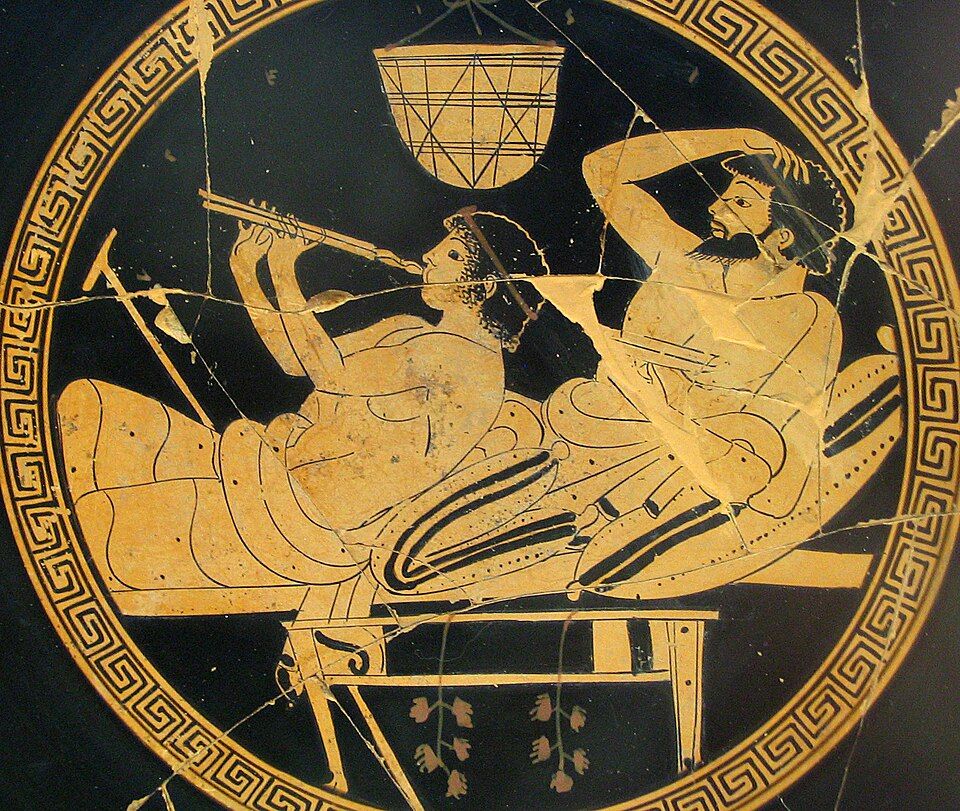
Text and translation
νῦν γὰρ δὴ ζάπεδον καθαρὸν καὶ χεῖρες ἁπάντων
Xenophanes · fr. 1 W · text of Athenaeus, Deipnosophistae 11.7 (462c–f), ed. Kaibel
How to read each line
A guide to the Greek, syllables, pitch marks and quantities.
Show the reading key
- Above each line: the line as the edition prints it, each word placed over its own syllables. The main row: the same Greek divided into metrical syllables, each written as it is pronounced. A consonant that closes a syllable is written with it (λόθ | ρο); an elided word is closed up with the next vowel (ν’ἀ); a final consonant carried into the next word is set with a thin space (ς ἰ). Wider gaps mark word-ends.
- Above the syllables: the pitch of each syllable, from the accents. Under them: the quantity of each syllable as it falls in the line, then the transliteration, syllable by syllable, with accented syllables in capitals.
- Under each line: a line-for-line translation. In the right margin of the scansion: the line type, its scheme, and its analysis into cola.
Key to the labels
The names, patterns and symbols used beside this poem.
Show the labels and symbols
The labels in the right margin of the scansion below name the line, its scheme, the feet as the line realises them, and the caesurae and diaereses (the named word-ends) that fall in it. In the scheme ⏔ is a biceps, two shorts that may be contracted to one long; ⏕ is a long that may be resolved into two shorts; × is an anceps, long or short. A click on any syllable highlights its metron or colon, or, with the switch, its foot.
| Label | Name and shape | What it is |
|---|---|---|
| hem1 | First hemiepes— ⏔ — ⏔ — | The first two and a half feet of the hexameter, up to the penthemimeral caesura; in the pentameter, its whole first half. |
| hem2 | Second half of the hexameter⏔ — ⏔ — ⏑ ⏑ — × | From the penthemimeral caesura to the line-end: the fifth foot is nearly always a dactyl, the sixth is — ×. |
| hemp | Second hemiepes— ⏑ ⏑ — ⏑ ⏑ × | The second half of the pentameter: two dactyls and a single syllable, with no contraction allowed. |
The traditional feet
| Foot and shape | Where |
|---|---|
| First foot: dactyl or spondee— ⏔ | Scheme positions 1–2. The biceps (⏑ ⏑) may be contracted to a single long, making a spondee. |
| Second foot: dactyl or spondee— ⏔ | Scheme positions 3–4. |
| Third foot: dactyl or spondee— ⏔ | Scheme positions 5–6. The penthemimeral caesura falls after its first syllable, the “trochaic” caesura after its second. |
| Fourth foot: dactyl or spondee— ⏔ | Scheme positions 7–8. Word-end at the end of this foot, when it is a dactyl, is the bucolic diaeresis (West’s “bucolic caesura”: word-end at the end of the fourth foot after an uncontracted biceps)[5]. |
| Fifth foot: dactyl— ⏑ ⏑ | Scheme positions 9–10. A spondee here (a “spondaic line”) is rare. |
| Sixth foot— × | Scheme positions 11–12: a long and the indifferent final syllable. |
| First foot: dactyl or spondee— ⏔ | Scheme positions 1–2 of the pentameter. |
| Second foot: dactyl or spondee— ⏔ | Scheme positions 3–4. |
| Half-foot before the diaeresis— | Scheme position 5: the long that closes the first hemiepes; word-end must follow. |
| Fourth foot: dactyl— ⏑ ⏑ | Scheme positions 6–8: no contraction after the diaeresis. |
| Fifth foot: dactyl— ⏑ ⏑ | Scheme positions 9–11. |
| Final syllable× | Scheme position 12. |
Scansion
Twelve couplets describing a symposium as it should be: clean floor, garlands, wine, incense, a hymn to the god, and then stories that are useful. The poem shows both treatments of a stop + liquid at the beginning of a word, a synizesis in the last line and a correption, and the uncontracted ἐυ- of epic.
Now the floor is swept clean, and everyone’s hands
and the cups; one puts woven wreaths about our heads,
another hands round sweet-smelling ointment in a dish;
the mixing-bowl stands brimming with good cheer,
and there is more wine at hand, which promises never to fail us,
soft in its jars, with a scent of flowers;
in our midst the incense gives off its sacred smell,
and there is water, cold, fresh and clean.
Brown loaves are set beside us, and a splendid table
weighed down with cheese and thick honey;
the altar in the centre is thickly decked with flowers on every side,
and singing and merriment fill the house.
Cheerful men should first sing hymns to the god
with words of good omen and with clean speech;
and when they have poured drink-offerings and prayed for the power
to do what is just (for that comes first to hand),
there is no outrage in drinking as much as still lets you get
home without a servant, unless you are very old.
Among men, praise the one who, after drinking, brings fine things to light,
as memory serves him, and the one who [strives] for excellence;
not to recount the wars of Titans or of Giants
or of Centaurs, inventions of earlier men,
or furious factional strife, in which there is no good;
but always to keep the gods in mind is a good thing.
Metre
- The couplet. A hexameter, with less prosodic licence than in epic, alternating with the “pentameter” — ⏔ — ⏔ — | — ⏑ ⏑ — ⏑ ⏑ — ‖, two hemiepes (D | D ‖) always divided by a word-end; contraction of the bicipitia is limited to the first colon.[6] The hexameter’s caesura falls in the third foot, after the princeps (penthemimeral) or after the first short (the “feminine” caesura after the third trochee), or occasionally after the fourth princeps (hephthemimeral).[7] a prepositive is reckoned with the word after it, a postpositive with the word before it.[8]
- Xenophanes and the poem. A Colophonian who spent most of his long life in South Italy and Sicily, a wandering sage and elegiac performer whose poetry turns on usefulness (χρηστόν); Bartol calls this elegy, quoted by Athenaeus (11.462c), the best example of his skill: two parts, each developing the image of an ideal symposium, ending in the blame of those who tell of Titans, Giants or Centaurs, tales with no good in them (l. 23), and the advice always to have good regard for the gods (l. 24).[9] Carey points to it as the elegy that lays down in detail how the drinking-party should be conducted, a theme that recurs in Anacreon PMG 356b and Theognis 467 ff..[10] Athenaeus introduces it as the symposium “of Xenophanes of Colophon”, Kaibel’s reference being “fr. 1 B4”; Bartol cites it as fr. 1 W.
- Stop + liquid at the beginning of a word. Early poets mostly let a syllable stay short before stop + liquid only when the group begins a word,[11] and this poem shows both treatments there: the short final vowel stays short before πρ- and τρ- in ll. 5 (φησι προδώσειν), 9 (τε τράπεζα), 16 (ἐστι προχειρότερον) and 24 (δὲ προμηθείην), but δέ is long before πρῶτον in l. 13. Inside a word the group makes position: ἐυφροσύνης (l. 4), ψυχρόν (l. 8), ὕβρις (l. 17).
- Prosody. As in epic: a final long vowel or diphthong may be shortened before a vowel (epic correption)[12], as καί in l. 15; inside a word, two vowels are often run together into one syllable when the first is ε (synecphonesis, p. 15), as θεῶν in l. 24. The last position of each line is indifferent at period-end.[13]
- Text and marks. Kaibel’s supplements ⟨τι⟩ (l. 22) and ⟨δὲ⟩ (l. 24) are printed in angle brackets as he marks them; Bartol quotes l. 24 with ⟨δὲ⟩ and ἀγαθήν where Kaibel has ἀγαθόν.[14] In l. 24 the input ties θε‿ῶν into one syllable; the page does not show the tie.
Prosody, line by line
Every syllable, with the reason for its length. Quantities are read from the vowel where the spelling shows it, from the consonants that follow (“position”), from the accent where it tells, and from the metre where nothing else does. Editors’ notes on the text follow in the boxed paragraphs.
- 1.1
Line 1.1 · νῦν γὰρ δὴ ζάπεδον καθαρὸν καὶ χεῖρες ἁπάντων
νῦν γὰρ δὴ ζάπεδον καθαρὸν καὶ χεῖρες ἁπάντων
νῦνγὰρδὴζάπεδονκαθαρὸνκαὶχεῖρες ἁπάντωνspondee, dactyl, dactyl, spondee, dactyl, — ×; penthemimeral caesura; hephthemimeral caesura; word-end after a spondaic fourth foot.
- 1 —νῦνῦ carries a circumflex, so it is long; closed by ν: long by position.
- 2 —γὰρὰ is a vowel of unknown length; closed by ρ: long by position; a single long contracts the two shorts of the biceps at position 2.
- 3 —δὴὴ is long by nature; the next word begins with the double consonant ζ: the syllable is closed before it: long by position.
- 4 ⏑ζάά is short by the metre (position 4 must be short); one of the two shorts of the biceps at position 4.
- 5 ⏑πεε is short by nature; one of the two shorts of the biceps at position 4.
- 6 —δονο is short by nature; closed by ν: long by position.
- 7 ⏑καα is short by the metre (position 6 must be short); one of the two shorts of the biceps at position 6.
- 8 ⏑θαα is short by the metre (position 6 must be short); one of the two shorts of the biceps at position 6.
- 9 —ρὸνὸ is short by nature; closed by ν: long by position.
- 10 —καὶαὶ is a diphthong, long by nature; a single long contracts the two shorts of the biceps at position 8.
- 11 —χεῖεῖ is a diphthong, long by nature.
- 12 ⏑ρεε is short by nature; one of the two shorts of the biceps at position 10.
- 13 ⏑ς ἁἁ is short by the metre (position 10 must be short); the first consonant belongs to the previous word and is carried over to this vowel; one of the two shorts of the biceps at position 10.
- 14 —πάνά is a vowel of unknown length; closed by ν: long by position.
- 15 ×τωνω is long by nature; closed by ν: long by position; the position is anceps.
fr. 1.1. ζάπεδον = δάπεδον, “floor”.[15] The fourth foot is contracted (ρὸν καί), with a word-end after it; West notes that word-division after a contracted biceps is frequent only in the first foot, and that in the fourth the word usually has a long vowel in its final syllable,[16] as καί has. Penthemimeral caesura after ζάπεδον,[7] hephthemimeral after καθαρόν. The σ of χεῖρες goes with ἁπάντων; the aspirate does not count.[17]
- 1.2
Line 1.2 · καὶ κύλικες· πλεκτοὺς δ’ ἀμφιτιθεῖ στεφάνους,
καὶ κύλικες· πλεκτοὺς δ’ ἀμφιτιθεῖ στεφάνους,
καὶκύλικες·πλεκτοὺςδ’ἀμφιτιθεῖστεφάνους,dactyl, spondee, —, dactyl, dactyl, ×; diaeresis after the first hemiepes.
- 1 —καὶαὶ is a diphthong, long by nature.
- 2 ⏑κύύ is short by the metre (position 2 must be short); one of the two shorts of the biceps at position 2.
- 3 ⏑λιι is short by the metre (position 2 must be short); one of the two shorts of the biceps at position 2.
- 4 —κες·ε is short by nature; closed by ς: long by position.
- 5 —πλεκε is short by nature; closed by κ: long by position; a single long contracts the two shorts of the biceps at position 4.
- 6 —τοὺςοὺ is a diphthong, long by nature; closed by ς: long by position.
- 7 —δ’ἀμἀ is a vowel of unknown length; closed by μ: long by position; the apostrophe marks an elided vowel; the consonant before it joins this syllable.
- 8 ⏑φιι is short by the metre (position 7 must be short).
- 9 ⏑τιι is short by the metre (position 8 must be short).
- 10 —θεῖεῖ is a diphthong, long by nature; the next word begins with στ: the syllable is closed before it: long by position.
- 11 ⏑στεε is short by nature.
- 12 ⏑φάά is short by the metre (position 11 must be short).
- 13 ×νους,ου is a diphthong, long by nature; closed by ς: long by position; the position is anceps.
- 1.3
Line 1.3 · ἄλλος δ’ εὐῶδες μύρον ἐν φιάλῃ παρατείνει·
ἄλλος δ’ εὐῶδες μύρον ἐν φιάλῃ παρατείνει·
ἄλλοςδ’εὐῶδεςμύρον ἐνφιάλῃπαρατείνει·spondee, spondee, dactyl, dactyl, dactyl, — ×; penthemimeral caesura; hephthemimeral caesura.
- 1 —ἄλἄ is a vowel of unknown length; closed by λ: long by position.
- 2 —λοςο is short by nature; closed by ς: long by position; a single long contracts the two shorts of the biceps at position 2.
- 3 —δ’εὐεὐ is a diphthong, long by nature; the apostrophe marks an elided vowel; the consonant before it joins this syllable.
- 4 —ῶῶ is long by nature; a single long contracts the two shorts of the biceps at position 4.
- 5 —δεςε is short by nature; closed by ς: long by position.
- 6 ⏑μύύ is short by the metre (position 6 must be short); one of the two shorts of the biceps at position 6.
- 7 ⏑ροο is short by nature; one of the two shorts of the biceps at position 6.
- 8 —ν ἐνἐ is short by nature; closed by ν: long by position; the first consonant belongs to the previous word and is carried over to this vowel.
- 9 ⏑φιι is short by the metre (position 8 must be short); one of the two shorts of the biceps at position 8.
- 10 ⏑άά is short by the metre (position 8 must be short); one of the two shorts of the biceps at position 8.
- 11 —λῃῃ is long by nature.
- 12 ⏑παα is short by the metre (position 10 must be short); one of the two shorts of the biceps at position 10.
- 13 ⏑ραα is short by the metre (position 10 must be short); one of the two shorts of the biceps at position 10.
- 14 —τείεί is a diphthong, long by nature.
- 15 ×νει·ει is a diphthong, long by nature; the position is anceps.
fr. 1.3. Two contracted feet open the line (ἄλλος δ’ εὐώ-). The ν of μύρον goes with ἐν.[21] Penthemimeral caesura after εὐῶδες;[7] the margin’s hephthemimeral word-end falls after ἐν, a prepositive that belongs with φιάλῃ,[8] so it is not a real break.
- 1.4
Line 1.4 · κρατὴρ δ’ ἕστηκεν μεστὸς ἐυφροσύνης·
κρατὴρ δ’ ἕστηκεν μεστὸς ἐυφροσύνης·
κρατὴρδ’ἕστηκενμεστὸς ἐυφροσύνης·spondee, spondee, —, dactyl, dactyl, ×; diaeresis after the first hemiepes.
- 1 —κραα is long by the metre (position 1 must be long).
- 2 —τὴρὴ is long by nature; closed by ρ: long by position; a single long contracts the two shorts of the biceps at position 2.
- 3 —δ’ἕσἕ is short by nature; closed by σ: long by position; the apostrophe marks an elided vowel; the consonant before it joins this syllable.
- 4 —τηη is long by nature; a single long contracts the two shorts of the biceps at position 4.
- 5 —κενε is short by nature; closed by ν: long by position.
- 6 —μεσε is short by nature; closed by σ: long by position.
- 7 ⏑τὸὸ is short by nature.
- 8 ⏑ς ἐἐ is short by nature; the first consonant belongs to the previous word and is carried over to this vowel.
- 9 —υφυ is a vowel of unknown length; closed by φ before a liquid: stop + liquid makes position, as it usually does in epic.
- 10 ⏑ροο is short by nature.
- 11 ⏑σύύ is short by the metre (position 11 must be short).
- 12 ×νης·η is long by nature; closed by ς: long by position; the position is anceps.
fr. 1.4. The first α of κρατήρ is long, as in its Ionic form κρητήρ, in which original ᾱ became η.[22] Both bicipitia of the first hemiepes are contracted (-τὴρ δ’ ἕσ-, -τη-), as the first colon allows.[19] ἐυφροσύνης is written with the smooth breathing on ε, so ε and υ are separate syllables, the uncontracted epic spelling; the φρ inside the word closes υφ-.[11]
- 1.5
Line 1.5 · ἄλλος δ’ οἶνος ἕτοιμος, ὃς οὔποτέ φησι προδώσειν,
ἄλλος δ’ οἶνος ἕτοιμος, ὃς οὔποτέ φησι προδώσειν,
ἄλλοςδ’οἶνος ἕτοιμο,ς ὃς οὔποτέφησιπροδώσειν,spondee, dactyl, dactyl, dactyl, dactyl, — ×; caesura after the third trochee; bucolic diaeresis.
- 1 —ἄλἄ is a vowel of unknown length; closed by λ: long by position.
- 2 —λοςο is short by nature; closed by ς: long by position; a single long contracts the two shorts of the biceps at position 2.
- 3 —δ’οἶοἶ is a diphthong, long by nature; the apostrophe marks an elided vowel; the consonant before it joins this syllable.
- 4 ⏑νοο is short by nature; one of the two shorts of the biceps at position 4.
- 5 ⏑ς ἕἕ is short by nature; the first consonant belongs to the previous word and is carried over to this vowel; one of the two shorts of the biceps at position 4.
- 6 —τοιοι is a diphthong, long by nature.
- 7 ⏑μο,ο is short by nature; one of the two shorts of the biceps at position 6.
- 8 ⏑ς ὃὃ is short by nature; the first consonant belongs to the previous word and is carried over to this vowel; one of the two shorts of the biceps at position 6.
- 9 —ς οὔοὔ is a diphthong, long by nature; the first consonant belongs to the previous word and is carried over to this vowel.
- 10 ⏑ποο is short by nature; one of the two shorts of the biceps at position 8.
- 11 ⏑τέέ is short by nature; one of the two shorts of the biceps at position 8.
- 12 —φηη is long by nature.
- 13 ⏑σιι is a vowel of unknown length; the next word begins with πρ, a stop + liquid that does not make position here, so the syllable stays short; one of the two shorts of the biceps at position 10.
- 14 ⏑προο is short by nature; one of the two shorts of the biceps at position 10.
- 15 —δώώ is long by nature.
- 16 ×σειν,ει is a diphthong, long by nature; closed by ν: long by position; the position is anceps.
- 1.6
Line 1.6 · μείλιχος ἐν κεράμοις, ἄνθεος ὀσδόμενος·
μείλιχος ἐν κεράμοις, ἄνθεος ὀσδόμενος·
μείλιχος ἐνκεράμοις,ἄνθεος ὀσδόμενος·dactyl, dactyl, —, dactyl, dactyl, ×; diaeresis after the first hemiepes.
- 1 —μείεί is a diphthong, long by nature.
- 2 ⏑λιι is short by the metre (position 2 must be short); one of the two shorts of the biceps at position 2.
- 3 ⏑χοο is short by nature; one of the two shorts of the biceps at position 2.
- 4 —ς ἐνἐ is short by nature; closed by ν: long by position; the first consonant belongs to the previous word and is carried over to this vowel.
- 5 ⏑κεε is short by nature; one of the two shorts of the biceps at position 4.
- 6 ⏑ράά is short by the metre (position 4 must be short); one of the two shorts of the biceps at position 4.
- 7 —μοις,οι is a diphthong, long by nature.
- 8 —ἄνἄ is a vowel of unknown length; closed by ν: long by position.
- 9 ⏑θεε is short by nature.
- 10 ⏑οο is short by nature.
- 11 —ς ὀσὀ is short by nature; closed by σ: long by position; the first consonant belongs to the previous word and is carried over to this vowel.
- 12 ⏑δόό is short by nature.
- 13 ⏑μεε is short by nature.
- 14 ×νος·ο is short by nature; closed by ς: long by position; the position is anceps.
fr. 1.6. The σ of μείλιχος and of ἄνθεος goes with the next vowel.[21] ὀσδόμενος, “smelling of”. Diaeresis after κεράμοις.
- 1.7
Line 1.7 · ἐν δὲ μέσοις ἁγνὴν ὀδμὴν λιβανωτὸς ἵησι·
ἐν δὲ μέσοις ἁγνὴν ὀδμὴν λιβανωτὸς ἵησι·
ἐνδὲμέσοιςἁγνὴνὀδμὴνλιβανωτὸς ἵησι·dactyl, spondee, spondee, dactyl, dactyl, — ×; penthemimeral caesura; hephthemimeral caesura.
- 1 —ἐνἐ is short by nature; closed by ν: long by position.
- 2 ⏑δὲὲ is short by nature; one of the two shorts of the biceps at position 2.
- 3 ⏑μέέ is short by nature; one of the two shorts of the biceps at position 2.
- 4 —σοιςοι is a diphthong, long by nature.
- 5 —ἁγἁ is a vowel of unknown length; closed by γ: long by position; γν is one of the four clusters (γμ, γν, δμ, δν) that never leave the syllable before them short;[11] a single long contracts the two shorts of the biceps at position 4.
- 6 —νὴνὴ is long by nature.
- 7 —ὀδὀ is short by nature; closed by δ: long by position; δμ is one of the four clusters (γμ, γν, δμ, δν) that never leave the syllable before them short;[11] a single long contracts the two shorts of the biceps at position 6.
- 8 —μὴνὴ is long by nature; closed by ν: long by position.
- 9 ⏑λιι is short by the metre (position 8 must be short); one of the two shorts of the biceps at position 8.
- 10 ⏑βαα is short by the metre (position 8 must be short); one of the two shorts of the biceps at position 8.
- 11 —νωω is long by nature.
- 12 ⏑τὸὸ is short by nature; one of the two shorts of the biceps at position 10.
- 13 ⏑ς ἵἵ is short by the metre (position 10 must be short); the first consonant belongs to the previous word and is carried over to this vowel; one of the two shorts of the biceps at position 10.
- 14 —ηη is long by nature.
- 15 ×σι·ι is short by the accent rule: acute on the antepenult requires a short final syllable; the position is anceps.
- 1.8
Line 1.8 · ψυχρὸν δ’ ἐστὶν ὕδωρ καὶ γλυκὺ καὶ καθαρόν.
ψυχρὸν δ’ ἐστὶν ὕδωρ καὶ γλυκὺ καὶ καθαρόν.
ψυχρὸνδ’ἐστὶν ὕδωρκαὶγλυκὺκαὶκαθαρόν.spondee, dactyl, —, dactyl, dactyl, ×; diaeresis after the first hemiepes.
- 1 —ψυχυ is a vowel of unknown length; closed by χ before a liquid: stop + liquid makes position, as it usually does in epic.
- 2 —ρὸνὸ is short by nature; closed by ν: long by position; a single long contracts the two shorts of the biceps at position 2.
- 3 —δ’ἐσἐ is short by nature; closed by σ: long by position; the apostrophe marks an elided vowel; the consonant before it joins this syllable.
- 4 ⏑τὶὶ is short by the metre (position 4 must be short); one of the two shorts of the biceps at position 4.
- 5 ⏑ν ὕὕ is short by the metre (position 4 must be short); the first consonant belongs to the previous word and is carried over to this vowel; one of the two shorts of the biceps at position 4.
- 6 —δωρω is long by nature; closed by ρ: long by position.
- 7 —καὶαὶ is a diphthong, long by nature; the next word begins with γλ: the syllable is closed before it: long by position.
- 8 ⏑γλυυ is short by the metre (position 7 must be short).
- 9 ⏑κὺὺ is short by the metre (position 8 must be short).
- 10 —καὶαὶ is a diphthong, long by nature.
- 11 ⏑καα is short by the metre (position 10 must be short).
- 12 ⏑θαα is short by the metre (position 11 must be short).
- 13 ×ρόν.ό is short by nature; closed by ν: long by position; the position is anceps.
- 1.9
Line 1.9 · πάρκεινται δ’ ἄρτοι ξανθοὶ γεραρή τε τράπεζα
πάρκεινται δ’ ἄρτοι ξανθοὶ γεραρή τε τράπεζα
πάρκεινταιδ’ἄρτοιξανθοὶγεραρήτετράπεζαspondee, spondee, spondee, dactyl, dactyl, — ×; penthemimeral caesura; hephthemimeral caesura.
- 1 —πάρά is a vowel of unknown length; closed by ρ: long by position.
- 2 —κεινει is a diphthong, long by nature; closed by ν: long by position; a single long contracts the two shorts of the biceps at position 2.
- 3 —ταιαι is a diphthong, long by nature.
- 4 —δ’ἄρἄ is a vowel of unknown length; closed by ρ: long by position; the apostrophe marks an elided vowel; the consonant before it joins this syllable; a single long contracts the two shorts of the biceps at position 4.
- 5 —τοιοι is a diphthong, long by nature; the next word begins with the double consonant ξ: the syllable is closed before it: long by position.
- 6 —ξανα is a vowel of unknown length; closed by ν: long by position; a single long contracts the two shorts of the biceps at position 6.
- 7 —θοὶοὶ is a diphthong, long by nature.
- 8 ⏑γεε is short by nature; one of the two shorts of the biceps at position 8.
- 9 ⏑ραα is short by the metre (position 8 must be short); one of the two shorts of the biceps at position 8.
- 10 —ρήή is long by nature.
- 11 ⏑τεε is short by nature; the next word begins with τρ, a stop + liquid that does not make position here, so the syllable stays short; one of the two shorts of the biceps at position 10.
- 12 ⏑τράά is short by the metre (position 10 must be short); one of the two shorts of the biceps at position 10.
- 13 —πεε is short by nature; ζ is a double consonant (two sounds) and closes the syllable: long by position.
- 14 ×ζαα is short by the accent rule: acute on the antepenult requires a short final syllable; the position is anceps.
- 1.10
Line 1.10 · τυροῦ καὶ μέλιτος πίονος ἀχθομένη·
τυροῦ καὶ μέλιτος πίονος ἀχθομένη·
τυροῦκαὶμέλιτοςπίονος ἀχθομένη·spondee, dactyl, —, dactyl, dactyl, ×; diaeresis after the first hemiepes.
- 1 —τυυ is long by the metre (position 1 must be long).
- 2 —ροῦοῦ is a diphthong, long by nature; a single long contracts the two shorts of the biceps at position 2.
- 3 —καὶαὶ is a diphthong, long by nature.
- 4 ⏑μέέ is short by nature; one of the two shorts of the biceps at position 4.
- 5 ⏑λιι is short by the metre (position 4 must be short); one of the two shorts of the biceps at position 4.
- 6 —τοςο is short by nature; closed by ς: long by position.
- 7 —πίί is long by the metre (position 6 must be long).
- 8 ⏑οο is short by nature.
- 9 ⏑νοο is short by nature.
- 10 —ς ἀχἀ is a vowel of unknown length; closed by χ: long by position; the first consonant belongs to the previous word and is carried over to this vowel.
- 11 ⏑θοο is short by nature.
- 12 ⏑μέέ is short by nature.
- 13 ×νη·η is long by nature; the position is anceps.
fr. 1.10. The υ of τυροῦ is long. The ι of πίονος is long.[23] Diaeresis after μέλιτος.
- 1.11
Line 1.11 · βωμὸς δ’ ἄνθεσιν ἀν τὸ μέσον πάντῃ πεπύκασται,
βωμὸς δ’ ἄνθεσιν ἀν τὸ μέσον πάντῃ πεπύκασται,
βωμὸςδ’ἄνθεσιν ἀντὸμέσονπάντῃπεπύκασται,spondee, dactyl, dactyl, spondee, dactyl, — ×; penthemimeral caesura; caesura after the third trochee; hephthemimeral caesura.
- 1 —βωω is long by nature.
- 2 —μὸςὸ is short by nature; closed by ς: long by position; a single long contracts the two shorts of the biceps at position 2.
- 3 —δ’ἄνἄ is a vowel of unknown length; closed by ν: long by position; the apostrophe marks an elided vowel; the consonant before it joins this syllable.
- 4 ⏑θεε is short by nature; one of the two shorts of the biceps at position 4.
- 5 ⏑σιι is short by the accent rule: acute on the antepenult requires a short final syllable; one of the two shorts of the biceps at position 4.
- 6 —ν ἀνἀ is a vowel of unknown length; closed by ν: long by position; the first consonant belongs to the previous word and is carried over to this vowel.
- 7 ⏑τὸὸ is short by nature; one of the two shorts of the biceps at position 6.
- 8 ⏑μέέ is short by nature; one of the two shorts of the biceps at position 6.
- 9 —σονο is short by nature; closed by ν: long by position.
- 10 —πάνά is a vowel of unknown length; closed by ν: long by position; a single long contracts the two shorts of the biceps at position 8.
- 11 —τῃῃ is long by nature.
- 12 ⏑πεε is short by nature; one of the two shorts of the biceps at position 10.
- 13 ⏑πύύ is short by the metre (position 10 must be short); one of the two shorts of the biceps at position 10.
- 14 —κασα is a vowel of unknown length; closed by σ: long by position.
- 15 ×ται,αι is a diphthong, long by nature; the position is anceps.
fr. 1.11. ἀν τὸ μέσον: ἀνά shortened to ἀν. The ν of ἄνθεσιν goes with ἀν.[21] The margin names penthemimeral (after ἀν), feminine (after τό) and hephthemimeral (after μέσον) word-ends; ἀν and τό are prepositives and belong with μέσον,[8] so the only real caesura is the hephthemimeral after μέσον, the one West says occasionally replaces the third-foot caesura.[7]
- 1.12
Line 1.12 · μολπὴ δ’ ἀμφὶς ἔχει δώματα καὶ θαλίη.
μολπὴ δ’ ἀμφὶς ἔχει δώματα καὶ θαλίη.
μολπὴδ’ἀμφὶς ἔχειδώματακαὶθαλίη.spondee, dactyl, —, dactyl, dactyl, ×; diaeresis after the first hemiepes.
- 1 —μολο is short by nature; closed by λ: long by position.
- 2 —πὴὴ is long by nature; a single long contracts the two shorts of the biceps at position 2.
- 3 —δ’ἀμἀ is a vowel of unknown length; closed by μ: long by position; the apostrophe marks an elided vowel; the consonant before it joins this syllable.
- 4 ⏑φὶὶ is short by the metre (position 4 must be short); one of the two shorts of the biceps at position 4.
- 5 ⏑ς ἔἔ is short by nature; the first consonant belongs to the previous word and is carried over to this vowel; one of the two shorts of the biceps at position 4.
- 6 —χειει is a diphthong, long by nature.
- 7 —δώώ is long by nature.
- 8 ⏑μαα is short by the metre (position 7 must be short).
- 9 ⏑ταα is short by the accent rule: acute on the antepenult requires a short final syllable.
- 10 —καὶαὶ is a diphthong, long by nature.
- 11 ⏑θαα is short by the metre (position 10 must be short).
- 12 ⏑λίί is short by the metre (position 11 must be short).
- 13 ×η.η is long by nature; the position is anceps.
- 1.13
Line 1.13 · χρὴ δὲ πρῶτον μὲν θεὸν ὑμνεῖν εὔφρονας ἄνδρας
χρὴ δὲ πρῶτον μὲν θεὸν ὑμνεῖν εὔφρονας ἄνδρας
χρὴδὲπρῶτονμὲνθεὸν ὑμνεῖνεὔφρονας ἄνδραςspondee, spondee, dactyl, spondee, dactyl, — ×; penthemimeral caesura; word-end after a spondaic fourth foot.
- 1 —χρὴὴ is long by nature.
- 2 —δὲὲ is short by nature; the next word begins with πρ: the syllable is closed before it: long by position; a single long contracts the two shorts of the biceps at position 2.
- 3 —πρῶῶ is long by nature.
- 4 —τονο is short by nature; closed by ν: long by position; a single long contracts the two shorts of the biceps at position 4.
- 5 —μὲνὲ is short by nature; closed by ν: long by position.
- 6 ⏑θεε is short by nature; one of the two shorts of the biceps at position 6.
- 7 ⏑ὸὸ is short by nature; one of the two shorts of the biceps at position 6.
- 8 —ν ὑμὑ is a vowel of unknown length; closed by μ: long by position; the first consonant belongs to the previous word and is carried over to this vowel.
- 9 —νεῖνεῖ is a diphthong, long by nature; a single long contracts the two shorts of the biceps at position 8.
- 10 —εὔεὔ is a diphthong, long by nature.
- 11 ⏑φροο is short by nature; one of the two shorts of the biceps at position 10.
- 12 ⏑ναα is short by the accent rule: acute on the antepenult requires a short final syllable; one of the two shorts of the biceps at position 10.
- 13 —ς ἄνἄ is a vowel of unknown length; closed by ν: long by position; the first consonant belongs to the previous word and is carried over to this vowel.
- 14 ×δραςα is a vowel of unknown length; closed by ς: long by position; the position is anceps.
fr. 1.13. Here δέ is long before the πρ of πρῶτον: at the beginning of a word the group may make position or not.[11] The ν of θεὸν goes with ὑμνεῖν, and the σ of εὔφρονας with ἄνδρας.[21] Penthemimeral caesura after πρῶτον μέν (μέν postpositive, pp. 20–21); the fourth foot is contracted (-μνεῖν), with word-end after it.
Gerber prints ὑμνὲν ἐύφρονας.[24] With the uncontracted ἐύφρονας the line has one syllable more, and its fourth and fifth feet are dactyls.
- 1.14
Line 1.14 · εὐφήμοις μύθοις καὶ καθαροῖσι λόγοις·
εὐφήμοις μύθοις καὶ καθαροῖσι λόγοις·
εὐφήμοιςμύθοιςκαὶκαθαροῖσιλόγοις·spondee, spondee, —, dactyl, dactyl, ×; diaeresis after the first hemiepes.
- 1 —εὐεὐ is a diphthong, long by nature.
- 2 —φήή is long by nature; a single long contracts the two shorts of the biceps at position 2.
- 3 —μοιςοι is a diphthong, long by nature; closed by ς: long by position.
- 4 —μύύ is long by the metre (position 4 must be long); a single long contracts the two shorts of the biceps at position 4.
- 5 —θοιςοι is a diphthong, long by nature; closed by ς: long by position.
- 6 —καὶαὶ is a diphthong, long by nature.
- 7 ⏑καα is short by the metre (position 7 must be short).
- 8 ⏑θαα is short by the metre (position 8 must be short).
- 9 —ροῖοῖ is a diphthong, long by nature.
- 10 ⏑σιι is short by the accent rule: circumflex on the penult requires a short final syllable.
- 11 ⏑λόό is short by nature.
- 12 ×γοις·οι is a diphthong, long by nature; closed by ς: long by position; the position is anceps.
fr. 1.14. The υ of μύθοις is long (μῦθος). Both bicipitia of the first hemiepes are contracted (εὐφή-, μύθ-), as the first colon allows.[19] Diaeresis after μύθοις.
- 1.15
Line 1.15 · σπείσαντας δὲ καὶ εὐξαμένους τὰ δίκαια δύνασθαι
σπείσαντας δὲ καὶ εὐξαμένους τὰ δίκαια δύνασθαι
σπείσανταςδὲκαὶεὐξαμένουςτὰδίκαιαδύνασθαιspondee, dactyl, dactyl, dactyl, dactyl, — ×; hephthemimeral caesura.
- 1 —σπείεί is a diphthong, long by nature.
- 2 —σανα is a vowel of unknown length; closed by ν: long by position; a single long contracts the two shorts of the biceps at position 2.
- 3 —ταςα is a vowel of unknown length; closed by ς: long by position.
- 4 ⏑δὲὲ is short by nature; one of the two shorts of the biceps at position 4.
- 5 ⏑καὶαὶ is a diphthong, long by nature; shortened before the vowel that begins the next word (epic correption), as the metre requires; one of the two shorts of the biceps at position 4.
- 6 —εὐεὐ is a diphthong, long by nature; ξ is a double consonant (two sounds) and closes the syllable: long by position.
- 7 ⏑ξαα is short by the metre (position 6 must be short); one of the two shorts of the biceps at position 6.
- 8 ⏑μέέ is short by nature; one of the two shorts of the biceps at position 6.
- 9 —νουςου is a diphthong, long by nature; closed by ς: long by position.
- 10 ⏑τὰὰ is short by the metre (position 8 must be short); one of the two shorts of the biceps at position 8.
- 11 ⏑δίί is short by the metre (position 8 must be short); one of the two shorts of the biceps at position 8.
- 12 —καιαι is a diphthong, long by nature.
- 13 ⏑αα is short by the accent rule: acute on the antepenult requires a short final syllable; one of the two shorts of the biceps at position 10.
- 14 ⏑δύύ is short by the metre (position 10 must be short); one of the two shorts of the biceps at position 10.
- 15 —νασα is a vowel of unknown length; closed by σ: long by position.
- 16 ×θαιαι is a diphthong, long by nature; the position is anceps.
fr. 1.15. καί is shortened before εὐξαμένους (epic correption)[12]. The only caesura the margin names is the hephthemimeral, after εὐξαμένους; no word ends in the third foot, which is filled by -ξαμέ-. West notes that occasionally a long word extends across the whole third foot and the caesura falls after the fourth princeps.[7]
- 1.16
Line 1.16 · πρήσσειν (ταῦτα γὰρ ὦν ἐστι προχειρότερον)
πρήσσειν (ταῦτα γὰρ ὦν ἐστι προχειρότερον)
πρήσσεινταῦταγὰρ ὦνἐστιπροχειρότερονspondee, dactyl, —, dactyl, dactyl, ×; diaeresis after the first hemiepes.
- 1 —πρήσή is long by nature; closed by σ: long by position.
- 2 —σεινει is a diphthong, long by nature; closed by ν: long by position; a single long contracts the two shorts of the biceps at position 2.
- 3 —ταῦαῦ is a diphthong, long by nature.
- 4 ⏑ταα is short by the accent rule: circumflex on the penult requires a short final syllable; one of the two shorts of the biceps at position 4.
- 5 ⏑γὰὰ is short by the metre (position 4 must be short); one of the two shorts of the biceps at position 4.
- 6 —ρ ὦνὦ is long by nature; the first consonant belongs to the previous word and is carried over to this vowel.
- 7 —ἐσἐ is short by nature; closed by σ: long by position.
- 8 ⏑τιι is a vowel of unknown length; the next word begins with πρ, a stop + liquid that does not make position here, so the syllable stays short.
- 9 ⏑προο is short by nature.
- 10 —χειει is a diphthong, long by nature.
- 11 ⏑ρόό is short by nature.
- 12 ⏑τεε is short by nature.
- 13 ×ρονο is short by nature; closed by ν: long by position; the position is anceps.
- 1.17
Line 1.17 · οὐχ ὕβρις πίνειν ὁπόσον κεν ἔχων ἀφίκοιο
οὐχ ὕβρις πίνειν ὁπόσον κεν ἔχων ἀφίκοιο
οὐχὕβριςπίνεινὁπόσονκεν ἔχωνἀφίκοιοspondee, spondee, dactyl, dactyl, dactyl, — ×; penthemimeral caesura; hephthemimeral caesura.
- 1 —οὐχοὐ is a diphthong, long by nature.
- 2 —ὕβὕ is a vowel of unknown length; closed by β before a liquid: stop + liquid makes position, as it usually does in epic; a single long contracts the two shorts of the biceps at position 2.
- 3 —ριςι is a vowel of unknown length; closed by ς: long by position.
- 4 —πίί is long by the metre (position 4 must be long); a single long contracts the two shorts of the biceps at position 4.
- 5 —νεινει is a diphthong, long by nature.
- 6 ⏑ὁὁ is short by nature; one of the two shorts of the biceps at position 6.
- 7 ⏑πόό is short by nature; one of the two shorts of the biceps at position 6.
- 8 —σονο is short by nature; closed by ν: long by position.
- 9 ⏑κεε is short by nature; one of the two shorts of the biceps at position 8.
- 10 ⏑ν ἔἔ is short by nature; the first consonant belongs to the previous word and is carried over to this vowel; one of the two shorts of the biceps at position 8.
- 11 —χωνω is long by nature.
- 12 ⏑ἀἀ is short by the metre (position 10 must be short); one of the two shorts of the biceps at position 10.
- 13 ⏑φίί is short by the metre (position 10 must be short); one of the two shorts of the biceps at position 10.
- 14 —κοιοι is a diphthong, long by nature.
- 15 ×οο is short by nature; the position is anceps.
fr. 1.17. In ὕβρις the βρ inside the word makes position.[11] The ι of πίνειν is long. The ν of κεν goes with ἔχων.[21] Penthemimeral caesura after πίνειν,[7] hephthemimeral after ὁπόσον.
Gerber takes οὐχ ὕβρεις with the sentence before, “not deeds of violence”, and begins a new clause with πίνειν.[24]
- 1.18
Line 1.18 · οἴκαδ’ ἄνευ προπόλου, μὴ πάνυ γηραλέος.
οἴκαδ’ ἄνευ προπόλου, μὴ πάνυ γηραλέος.
οἴκαδ’ἄνευπροπόλου,μὴπάνυγηραλέος.dactyl, dactyl, —, dactyl, dactyl, ×; diaeresis after the first hemiepes.
- 1 —οἴοἴ is a diphthong, long by nature.
- 2 ⏑καα is short by the metre (position 2 must be short); one of the two shorts of the biceps at position 2.
- 3 ⏑δ’ἄἄ is short by the metre (position 2 must be short); the apostrophe marks an elided vowel; the consonant before it joins this syllable; one of the two shorts of the biceps at position 2.
- 4 —νευευ is a diphthong, long by nature; the next word begins with πρ: the syllable is closed before it: long by position.
- 5 ⏑προο is short by nature; one of the two shorts of the biceps at position 4.
- 6 ⏑πόό is short by nature; one of the two shorts of the biceps at position 4.
- 7 —λου,ου is a diphthong, long by nature.
- 8 —μὴὴ is long by nature.
- 9 ⏑πάά is short by the metre (position 7 must be short).
- 10 ⏑νυυ is short by the metre (position 8 must be short).
- 11 —γηη is long by nature.
- 12 ⏑ραα is short by the metre (position 10 must be short).
- 13 ⏑λέέ is short by nature.
- 14 ×ος.ο is short by nature; closed by ς: long by position; the position is anceps.
fr. 1.18. οἴκαδ’ is elided before ἄνευ.[18] Diaeresis after προπόλου.
- 1.19
Line 1.19 · ἀνδρῶν δ’ αἰνεῖν τοῦτον ὃς ἐσθλὰ πιὼν ἀναφαίνῃ,
ἀνδρῶν δ’ αἰνεῖν τοῦτον ὃς ἐσθλὰ πιὼν ἀναφαίνῃ,
ἀνδρῶνδ’αἰνεῖντοῦτον ὃς ἐσθλὰπιὼνἀναφαίνῃ,spondee, spondee, dactyl, dactyl, dactyl, — ×; caesura after the third trochee.
- 1 —ἀνἀ is a vowel of unknown length; closed by ν: long by position.
- 2 —δρῶνῶ is long by nature; closed by ν: long by position; a single long contracts the two shorts of the biceps at position 2.
- 3 —δ’αἰαἰ is a diphthong, long by nature; the apostrophe marks an elided vowel; the consonant before it joins this syllable.
- 4 —νεῖνεῖ is a diphthong, long by nature; closed by ν: long by position; a single long contracts the two shorts of the biceps at position 4.
- 5 —τοῦοῦ is a diphthong, long by nature.
- 6 ⏑τοο is short by nature; one of the two shorts of the biceps at position 6.
- 7 ⏑ν ὃὃ is short by nature; the first consonant belongs to the previous word and is carried over to this vowel; one of the two shorts of the biceps at position 6.
- 8 —ς ἐσἐ is short by nature; closed by σ: long by position; the first consonant belongs to the previous word and is carried over to this vowel.
- 9 ⏑θλὰὰ is short by the metre (position 8 must be short); one of the two shorts of the biceps at position 8.
- 10 ⏑πιι is short by the metre (position 8 must be short); one of the two shorts of the biceps at position 8.
- 11 —ὼνὼ is long by nature.
- 12 ⏑ἀἀ is short by the metre (position 10 must be short); one of the two shorts of the biceps at position 10.
- 13 ⏑ναα is short by the metre (position 10 must be short); one of the two shorts of the biceps at position 10.
- 14 —φαίαί is a diphthong, long by nature.
- 15 ×νῃ,ῃ is long by nature; the position is anceps.
- 1.20
Line 1.20 · ὡς οἱ μνημοσύνη, καὶ τὸν ὃς ἀμφ’ ἀρετῆς.
ὡς οἱ μνημοσύνη, καὶ τὸν ὃς ἀμφ’ ἀρετῆς.
ὡςοἱμνημοσύνη,καὶτὸν ὃς ἀμφ’ἀρετῆς.spondee, dactyl, —, dactyl, dactyl, ×; diaeresis after the first hemiepes.
- 1 —ὡςὡ is long by nature.
- 2 —οἱοἱ is a diphthong, long by nature; the next word begins with μν: the syllable is closed before it: long by position; a single long contracts the two shorts of the biceps at position 2.
- 3 —μνηη is long by nature.
- 4 ⏑μοο is short by nature; one of the two shorts of the biceps at position 4.
- 5 ⏑σύύ is short by the metre (position 4 must be short); one of the two shorts of the biceps at position 4.
- 6 —νη,η is long by nature.
- 7 —καὶαὶ is a diphthong, long by nature.
- 8 ⏑τὸὸ is short by nature.
- 9 ⏑ν ὃὃ is short by nature; the first consonant belongs to the previous word and is carried over to this vowel.
- 10 —ς ἀμἀ is a vowel of unknown length; closed by μ: long by position; the first consonant belongs to the previous word and is carried over to this vowel.
- 11 ⏑φ’ἀἀ is short by the metre (position 10 must be short); the apostrophe marks an elided vowel; the consonant before it joins this syllable.
- 12 ⏑ρεε is short by nature.
- 13 ×τῆς.ῆ is long by nature; closed by ς: long by position; the position is anceps.
fr. 1.20. ὃς ἀμφ’ ἀρετῆς: Bartol takes the line to mean that the singer should keep excellence in memory and aim at it;[14] the translation supplies a verb in brackets. The ν of τὸν goes with ὃς;[21] ἀμφ’ is elided. Diaeresis after μνημοσύνη.
Gerber prints ὡς ᾖ μνημοσύνη καὶ τόνος ἀμφ’ ἀρετῆς, with the emendations of Ahrens and Koraes;[24] the scansion is the same.
- 1.21
Line 1.21 · οὔτι μάχας διέπειν Τιτήνων οὐδὲ Γιγάντων
οὔτι μάχας διέπειν Τιτήνων οὐδὲ Γιγάντων
οὔτιμάχαςδιέπεινΤιτήνωνοὐδὲΓιγάντωνdactyl, dactyl, spondee, spondee, dactyl, — ×; penthemimeral caesura; word-end after a spondaic fourth foot.
- 1 —οὔοὔ is a diphthong, long by nature.
- 2 ⏑τιι is short by the metre (position 2 must be short); one of the two shorts of the biceps at position 2.
- 3 ⏑μάά is short by the metre (position 2 must be short); one of the two shorts of the biceps at position 2.
- 4 —χαςα is a vowel of unknown length; closed by ς: long by position.
- 5 ⏑διι is short by the metre (position 4 must be short); one of the two shorts of the biceps at position 4.
- 6 ⏑έέ is short by nature; one of the two shorts of the biceps at position 4.
- 7 —πεινει is a diphthong, long by nature; closed by ν: long by position.
- 8 —Τιι is long by the metre (position 6 must be long); a single long contracts the two shorts of the biceps at position 6.
- 9 —τήή is long by nature.
- 10 —νωνω is long by nature; a single long contracts the two shorts of the biceps at position 8.
- 11 —οὐοὐ is a diphthong, long by nature.
- 12 ⏑δὲὲ is short by nature; one of the two shorts of the biceps at position 10.
- 13 ⏑Γιι is short by the metre (position 10 must be short); one of the two shorts of the biceps at position 10.
- 14 —γάνά is a vowel of unknown length; closed by ν: long by position.
- 15 ×τωνω is long by nature; closed by ν: long by position; the position is anceps.
- 1.22
Line 1.22 · οὐδέ ⟨τι⟩ Κενταύρων, πλάσματα τῶν προτέρων,
οὐδέ ⟨τι⟩ Κενταύρων, πλάσματα τῶν προτέρων,
οὐδέτιΚενταύρων,πλάσματατῶνπροτέρων,dactyl, spondee, —, dactyl, dactyl, ×; diaeresis after the first hemiepes.
- 1 —οὐοὐ is a diphthong, long by nature.
- 2 ⏑δέέ is short by nature; one of the two shorts of the biceps at position 2.
- 3 ⏑τιι is short by the metre (position 2 must be short); one of the two shorts of the biceps at position 2.
- 4 —Κενε is short by nature; closed by ν: long by position.
- 5 —ταύαύ is a diphthong, long by nature; a single long contracts the two shorts of the biceps at position 4.
- 6 —ρων,ω is long by nature; closed by ν: long by position.
- 7 —πλάσά is a vowel of unknown length; closed by σ: long by position.
- 8 ⏑μαα is short by the metre (position 7 must be short).
- 9 ⏑ταα is short by the accent rule: acute on the antepenult requires a short final syllable.
- 10 —τῶνῶ is long by nature; closed by ν: long by position.
- 11 ⏑προο is short by nature.
- 12 ⏑τέέ is short by nature.
- 13 ×ρων,ω is long by nature; closed by ν: long by position; the position is anceps.
fr. 1.22. ⟨τι⟩ is Kaibel’s supplement. The second biceps of the first hemiepes is contracted (-ταύ-). Diaeresis after Κενταύρων.
- 1.23
Line 1.23 · ἢ στάσιας σφεδανάς, τοῖς οὐδὲν χρηστὸν ἔνεστι,
ἢ στάσιας σφεδανάς, τοῖς οὐδὲν χρηστὸν ἔνεστι,
ἢστάσιαςσφεδανάς,τοῖςοὐδὲνχρηστὸν ἔνεστι,dactyl, dactyl, spondee, spondee, dactyl, — ×; penthemimeral caesura; word-end after a spondaic fourth foot.
- 1 —ἢἢ is long by nature; the next word begins with στ: the syllable is closed before it: long by position.
- 2 ⏑στάά is short by the metre (position 2 must be short); one of the two shorts of the biceps at position 2.
- 3 ⏑σιι is short by the metre (position 2 must be short); one of the two shorts of the biceps at position 2.
- 4 —αςα is a vowel of unknown length; closed by ς: long by position.
- 5 ⏑σφεε is short by nature; one of the two shorts of the biceps at position 4.
- 6 ⏑δαα is short by the metre (position 4 must be short); one of the two shorts of the biceps at position 4.
- 7 —νάς,ά is a vowel of unknown length; closed by ς: long by position.
- 8 —τοῖςοῖ is a diphthong, long by nature; a single long contracts the two shorts of the biceps at position 6.
- 9 —οὐοὐ is a diphthong, long by nature.
- 10 —δὲνὲ is short by nature; closed by ν: long by position; a single long contracts the two shorts of the biceps at position 8.
- 11 —χρηση is long by nature; closed by σ: long by position.
- 12 ⏑τὸὸ is short by nature; one of the two shorts of the biceps at position 10.
- 13 ⏑ν ἔἔ is short by nature; the first consonant belongs to the previous word and is carried over to this vowel; one of the two shorts of the biceps at position 10.
- 14 —νεσε is short by nature; closed by σ: long by position.
- 15 ×τι,ι is short by the accent rule: acute on the antepenult requires a short final syllable; the position is anceps.
fr. 1.23, the line Bartol cites for the poet’s test of usefulness (τοῖς οὐδὲν χρηστόν, “in which there is no good”)[14]. Before the σφ of σφεδανάς the syllable -ας of στάσιας is closed, and ἢ is long by nature.[21] Penthemimeral caesura after σφεδανάς;[7] the fourth foot is contracted, with word-end after it.
- 1.24
Line 1.24 · θε‿ῶν ⟨δὲ⟩ προμηθείην αἰὲν ἔχειν ἀγαθόν.
θε‿ῶν ⟨δὲ⟩ προμηθείην αἰὲν ἔχειν ἀγαθόν.
θε‿ῶνδὲπρομηθείηναἰὲν ἔχεινἀγαθόν.dactyl, spondee, —, dactyl, dactyl, ×; diaeresis after the first hemiepes.
- 1 —θε‿ῶνεῶ is two vowels of one word pronounced together as one long syllable (synizesis); closed by ν: long by position.
- 2 ⏑δὲὲ is short by nature; the next word begins with πρ, a stop + liquid that does not make position here, so the syllable stays short; one of the two shorts of the biceps at position 2.
- 3 ⏑προο is short by nature; one of the two shorts of the biceps at position 2.
- 4 —μηη is long by nature.
- 5 —θείεί is a diphthong, long by nature; a single long contracts the two shorts of the biceps at position 4.
- 6 —ηνη is long by nature.
- 7 —αἰαἰ is a diphthong, long by nature.
- 8 ⏑ὲὲ is short by nature.
- 9 ⏑ν ἔἔ is short by nature; the first consonant belongs to the previous word and is carried over to this vowel.
- 10 —χεινει is a diphthong, long by nature.
- 11 ⏑ἀἀ is short by the metre (position 10 must be short).
- 12 ⏑γαα is short by the metre (position 11 must be short).
- 13 ×θόν.ό is short by nature; closed by ν: long by position; the position is anceps.
fr. 1.24. θεῶν is one syllable by synecphonesis (synizesis), frequent within a word when the first vowel is ε.[27] ⟨δὲ⟩ is Kaibel’s supplement; its ε stays short before the πρ of προμηθείην, a stop + liquid at the beginning of a word.[11] Bartol quotes the line ending ἀγαθήν;[14] Kaibel has ἀγαθόν. Diaeresis after προμηθείην.
Gerber prints the manuscripts’ ἀγαθήν, with προμηθείην.[28]
Notes
- ^ a b c Bartol 2022, p. 229.
- ^ Budelmann 2009, p. 386.
- ^ Bartol 2022, p. 229 with n. 41.
- ^ Aloni 2009, p. 172.
- ^ West 1987, p. 21.
- ^ West 1987, p. 24; Battezzato 2009, p. 138.
- ^ a b c d e f g h i j k l West 1987, p. 19.
- ^ a b c West 1987, pp. 20–21.
- ^ Bartol 2022, pp. 229–230.
- ^ Carey 2009, p. 34.
- ^ a b c d e f g h i j k West 1987, p. 16.
- ^ a b West 1987, p. 14.
- ^ West 1987, p. 4.
- ^ a b c d Bartol 2022, p. 229.
- ^ LSJ s.v. ζάπεδον, citing this line.
- ^ a b West 1987, p. 20.
- ^ West 1987, p. 12 n. 1.
- ^ a b c West 1987, p. 13.
- ^ a b c West 1987, p. 24.
- ^ LSJ s.v. ἀμφιτίθημι cites this form from this line.
- ^ a b c d e f g h i j k l m West 1987, p. 12.
- ^ D’Alessio 2009, p. 122.
- ^ LSJ s.v. πίων [ῑ].
- ^ a b c Gerber 1999a, p. 412.
- ^ LSJ s.v. οὖν.
- ^ Cingano 2022, p. 299 n. 27.
- ^ West 1987, p. 15.
- ^ Gerber 1999a, p. 414.
Text and sources
- Text: Athenaeus, Deipnosophistae 11.7 (462c–f), ed. G. Kaibel (Leipzig 1887–1890), Perseus Digital Library (tlg0008.tlg001.perseus-grc3), CC BY-SA 4.0, with Kaibel’s reference “fr. 1 B4”; checked letter by letter, Kaibel’s supplements (⟨τι⟩, ⟨δὲ⟩) kept.
- Metre and prosody: M. L. West, Introduction to Greek Metre (Oxford 1987), pp. 4, 12–16, 19–21, 24, checked against the page images.
- L. Battezzato, ‘Metre and music’, in F. Budelmann (ed.), The Cambridge Companion to Greek Lyric (Cambridge 2009), p. 138 (the elegiac distich as an epodic strophe, hexameter ‖ D | D |||; contraction avoided in the second half of the pentameter).
- K. Bartol, ‘Elegy’, ch. 15, pp. 229–230, and E. Cingano, ‘Ibycus and Anacreon’, ch. 20, p. 299 n. 27, in L. Swift (ed.), A Companion to Greek Lyric (Wiley 2022).
- C. Carey, ‘Genre, occasion and performance’, and G. B. D’Alessio, ‘Language and pragmatics’, in F. Budelmann (ed.), The Cambridge Companion to Greek Lyric (Cambridge 2009), pp. 34 and 122.
- Meanings and quantities: Liddell–Scott–Jones, Greek–English Lexicon, Perseus Digital Library (CC BY-SA), s.vv. ἀμφιτίθημι, ζάπεδον, οὖν, πίων.
- D. E. Gerber, Greek Elegiac Poetry from the Seventh to the Fifth Centuries BC (Loeb Classical Library 258, Cambridge, MA 1999), Xenophanes fr. 1 (pp. 412–415), compared line by line: same number as West; Gerber also prints κρητὴρ (4), ἵησιν (7) and σπείσαντάς τε (15).
Quotations from copyrighted works are not covered by this page’s licence.
Xenophanes fr. 2: wisdom above athletes (Athenaeus 10.413f–414c)
Synopsis
Xenophanes came from Colophon in Ionia, but he spent most of his long life in South Italy and Sicily. He went there after the Persians took Colophon, about 540 BC. Diogenes Laertius puts his floruit in 540–537 BC.[1] His life ran from the second quarter of the sixth century into the first half of the fifth.[2] He was a wandering sage, whose thought helped to found Presocratic philosophy. He also performed elegies, and composed hexameter and iambic verse.[3] His elegies continue the tradition of moral advice at the symposium, and he judges everything by its usefulness.[1] Fr. 2, quoted by Athenaeus (10.413f–414c), attacks the honours a city heaps on athletes as useless to the community. It ranks the poet’s own wisdom above the strength of men and horses.[4] It is a rare voice questioning the prestige of athletic victory. It comes from a man who lived in two cities, Colophon and Elea, that made little mark in the games.[5]
The whole fragment, eleven couplets, is scanned here.
Text and translation
ἀλλ’ εἰ μὲν ταχυτῆτι ποδῶν νίκην τις ἄροιτο
Xenophanes · fr. 2 W · elegiac couplets · quoted by Athenaeus 10.413f–414c · text of Kaibel
How to read each line
A guide to the Greek, syllables, pitch marks and quantities.
Show the reading key
- Above each line: the line as the edition prints it, each word placed over its own syllables. The main row: the same Greek divided into metrical syllables, each written as it is pronounced. A consonant that closes a syllable is written with it (λόθ | ρο); an elided word is closed up with the next vowel (ν’ἀ); a final consonant carried into the next word is set with a thin space (ς ἰ). Wider gaps mark word-ends.
- Above the syllables: the pitch of each syllable, from the accents. Under them: the quantity of each syllable as it falls in the line, then the transliteration, syllable by syllable, with accented syllables in capitals.
- Under each line: a line-for-line translation. In the right margin of the scansion: the line type, its scheme, and its analysis into cola.
Key to the labels
The names, patterns and symbols used beside this poem.
Show the labels and symbols
The labels in the right margin of the scansion below name the line, its scheme, the feet as the line realises them, and the caesurae and diaereses (the named word-ends) that fall in it. In the scheme ⏔ is a biceps, two shorts that may be contracted to one long; ⏕ is a long that may be resolved into two shorts; × is an anceps, long or short. A click on any syllable highlights its metron or colon, or, with the switch, its foot.
| Label | Name and shape | What it is |
|---|---|---|
| hem1 | First hemiepes— ⏔ — ⏔ — | The first two and a half feet of the hexameter, up to the penthemimeral caesura; in the pentameter, its whole first half. |
| hem2 | Second half of the hexameter⏔ — ⏔ — ⏑ ⏑ — × | From the penthemimeral caesura to the line-end: the fifth foot is nearly always a dactyl, the sixth is — ×. |
| hemp | Second hemiepes— ⏑ ⏑ — ⏑ ⏑ × | The second half of the pentameter: two dactyls and a single syllable, with no contraction allowed. |
The traditional feet
| Foot and shape | Where |
|---|---|
| First foot: dactyl or spondee— ⏔ | Scheme positions 1–2. The biceps (⏑ ⏑) may be contracted to a single long, making a spondee. |
| Second foot: dactyl or spondee— ⏔ | Scheme positions 3–4. |
| Third foot: dactyl or spondee— ⏔ | Scheme positions 5–6. The penthemimeral caesura falls after its first syllable, the “trochaic” caesura after its second. |
| Fourth foot: dactyl or spondee— ⏔ | Scheme positions 7–8. Word-end at the end of this foot, when it is a dactyl, is the bucolic diaeresis (West’s “bucolic caesura”: word-end at the end of the fourth foot after an uncontracted biceps)[6]. |
| Fifth foot: dactyl— ⏑ ⏑ | Scheme positions 9–10. A spondee here (a “spondaic line”) is rare. |
| Sixth foot— × | Scheme positions 11–12: a long and the indifferent final syllable. |
| First foot: dactyl or spondee— ⏔ | Scheme positions 1–2 of the pentameter. |
| Second foot: dactyl or spondee— ⏔ | Scheme positions 3–4. |
| Half-foot before the diaeresis— | Scheme position 5: the long that closes the first hemiepes; word-end must follow. |
| Fourth foot: dactyl— ⏑ ⏑ | Scheme positions 6–8: no contraction after the diaeresis. |
| Fifth foot: dactyl— ⏑ ⏑ | Scheme positions 9–11. |
| Final syllable× | Scheme position 12. |
Scansion
Xenophanes sets his own wisdom above the strength of Olympic victors: eleven couplets that Athenaeus quotes as the source of a passage in Euripides’ Autolycus. Every line is scanned, with notes.
Now if someone carried off the prize for fleetness of foot,
or for the five events, there where Zeus has his sacred ground
by Pisa’s waters at Olympia, or for wrestling,
or for the painful art of boxing,
or for that fearsome contest men call the pankration,
his fellow citizens would find him a grander sight than before,
he would be given a seat of honour, plain to see, at the games,
and his meals out of the public stores
from the city, and a present to lay up as an heirloom;
or if it were with his horses, he would win all of this just the same,
without being worth what I am worth. For our skill is better
than the strength of men or of horses.
No, this is a custom held quite at random, and it is not just
to prefer strength to good skill.
For even if there were a good boxer among the people,
or a man good at the five events or at wrestling,
or in fleetness of foot, which is honoured above all
the deeds of strength that men show in the contest,
the city would not on that account be any better ordered.
The city would get little delight from it
if someone won the contest by the banks of Pisa;
for that does not fill the city’s storehouses with plenty.
Metre
- The couplet. A hexameter alternating with the “pentameter”, — ⏔ — ⏔ — | — ⏑ ⏑ — ⏑ ⏑ —. The pentameter is two hemiepes, always divided by a word-end, and contraction is allowed only in its first half.[7] Every pentameter here keeps that word-end. Ten of the eleven pentameters contract at least one biceps of the first half; only 10 has none. Eight contract both (2, 6, 8, 12, 14, 16, 18, 22); 4 and 20 contract the first only.
- Caesurae. Every hexameter has a third-foot caesura.[8] It is feminine in 1, 5, 9, 11, 13, 17 and 19, and masculine in 3, 7, 15 and 21. In line 3 the masculine caesura comes with an elision.
- Prosody.
- Elision.[9] In line 3 it removes the -ι of the dative plural ῥοῇσι. West counts that ι as unelidable on the whole, except in epic;[9] here the elegist uses the epic freedom.
- Epic correption[10] in 3, 10 and 13.
- Synizesis of ἐών (11)[11].
- Hiatus before the old ϝ-pronoun οἱ (9)[12].
- Crasis in τοὔνεκεν (19)[11].
- Vowel quantities. Checked in LSJ: νῑ́κη (1), σῑ́τησις (8), λᾱός (15), πρότῑμος (17; LSJ cites this very line), νῑκάω (21), πῑαίνω (22). Two long vowels rest on the metre alone. The ι of Πίσαο (3, 21) is long, as the circumflex of the nominative Πῖσα shows. The ι of προεδρίην (7) stands in a contracted biceps and must be long, but LSJ does not mark its quantity.
- Gerber’s text. Compared with D. E. Gerber’s Loeb edition.[13] The line numbers are the same, and Kaibel’s text agrees with Gerber’s in the readings that matter for the metre. Gerber prints ῥοῆς (3) without elision (his apparatus reports Schneidewin’s ῥοάς) and σῖτ’ εἴη (8) for Kaibel’s σίτησιν, both with the same scansion; and τούνεκεν (19). His apparatus credits εἴτε τό (5) to Wakefield, προσορᾶν (6) to Jacobs, κε πάντα (10) to Schweighäuser and λαοῖσι μετείη (15) to Stephanus; Kaibel prints all four. The Perseus text of Gulick’s Loeb Athenaeus has πόλιος (9) and ἀγαθῆς (15), which are not followed here.
Prosody, line by line
Every syllable, with the reason for its length. Quantities are read from the vowel where the spelling shows it, from the consonants that follow (“position”), from the accent where it tells, and from the metre where nothing else does. Editors’ notes on the text follow in the boxed paragraphs.
- 2.1
Line 2.1 · ἀλλ’ εἰ μὲν ταχυτῆτι ποδῶν νίκην τις ἄροιτο
ἀλλ’ εἰ μὲν ταχυτῆτι ποδῶν νίκην τις ἄροιτο
ἀλλ’εἰμὲνταχυτῆτιποδῶννίκηντις ἄροιτοspondee, dactyl, dactyl, spondee, dactyl, — ×; caesura after the third trochee; hephthemimeral caesura.
- 1 —ἀλἀ is a vowel of unknown length; closed by λ: long by position.
- 2 —λ’εἰεἰ is a diphthong, long by nature; the apostrophe marks an elided vowel; the consonant before it joins this syllable; a single long contracts the two shorts of the biceps at position 2.
- 3 —μὲνὲ is short by nature; closed by ν: long by position.
- 4 ⏑ταα is short by the metre (position 4 must be short); one of the two shorts of the biceps at position 4.
- 5 ⏑χυυ is short by the metre (position 4 must be short); one of the two shorts of the biceps at position 4.
- 6 —τῆῆ is long by nature.
- 7 ⏑τιι is short by the accent rule: circumflex on the penult requires a short final syllable; one of the two shorts of the biceps at position 6.
- 8 ⏑ποο is short by nature; one of the two shorts of the biceps at position 6.
- 9 —δῶνῶ is long by nature; closed by ν: long by position.
- 10 —νίί is long by the metre (position 8 must be long); a single long contracts the two shorts of the biceps at position 8.
- 11 —κηνη is long by nature; closed by ν: long by position.
- 12 ⏑τιι is short by the metre (position 10 must be short); one of the two shorts of the biceps at position 10.
- 13 ⏑ς ἄἄ is short by the metre (position 10 must be short); the first consonant belongs to the previous word and is carried over to this vowel; one of the two shorts of the biceps at position 10.
- 14 —ροιοι is a diphthong, long by nature.
- 15 ×τοο is short by nature; the position is anceps.
- 2.2
Line 2.2 · ἢ πενταθλεύων, ἔνθα Διὸς τέμενος
ἢ πενταθλεύων, ἔνθα Διὸς τέμενος
ἢπενταθλεύων,ἔνθαΔιὸςτέμενοςspondee, spondee, —, dactyl, dactyl, ×; diaeresis after the first hemiepes.
- 1 —ἢἢ is long by nature.
- 2 —πενε is short by nature; closed by ν: long by position; a single long contracts the two shorts of the biceps at position 2.
- 3 —ταθα is a vowel of unknown length; closed by θ before a liquid: stop + liquid makes position, as it usually does in epic.
- 4 —λεύεύ is a diphthong, long by nature; a single long contracts the two shorts of the biceps at position 4.
- 5 —ων,ω is long by nature.
- 6 —ἔνἔ is short by nature; closed by ν: long by position.
- 7 ⏑θαα is short by the metre (position 7 must be short).
- 8 ⏑Διι is short by the metre (position 8 must be short).
- 9 —ὸςὸ is short by nature; closed by ς: long by position.
- 10 ⏑τέέ is short by nature.
- 11 ⏑μεε is short by nature.
- 12 ×νοςο is short by nature; closed by ς: long by position; the position is anceps.
- 2.3
Line 2.3 · πὰρ Πίσαο ῥοῇσ’ ἐν Ὀλυμπίῃ, εἴτε παλαίων
πὰρ Πίσαο ῥοῇσ’ ἐν Ὀλυμπίῃ, εἴτε παλαίων
πὰρΠίσαοῥοῇσ’ἐν Ὀλυμπίῃ,εἴτεπαλαίωνspondee, dactyl, dactyl, dactyl, dactyl, — ×; penthemimeral caesura (with elision); caesura after the third trochee; bucolic diaeresis.
- 1 —πὰρὰ is a vowel of unknown length; closed by ρ: long by position.
- 2 —Πίί is long by the metre (position 2 must be long); a single long contracts the two shorts of the biceps at position 2.
- 3 —σαα is long by the metre (position 3 must be long).
- 4 ⏑οο is short by nature; one of the two shorts of the biceps at position 4.
- 5 ⏑ῥοο is short by nature; one of the two shorts of the biceps at position 4.
- 6 —ῇῇ is long by nature.
- 7 ⏑σ’ἐἐ is short by nature; the apostrophe marks an elided vowel; the consonant before it joins this syllable; one of the two shorts of the biceps at position 6.
- 8 ⏑ν ὈὈ is short by nature; the first consonant belongs to the previous word and is carried over to this vowel; one of the two shorts of the biceps at position 6.
- 9 —λυμυ is a vowel of unknown length; closed by μ: long by position.
- 10 ⏑πίί is short by the metre (position 8 must be short); one of the two shorts of the biceps at position 8.
- 11 ⏑ῃ,ῃ is long by nature; shortened before the vowel that begins the next word (epic correption), as the metre requires; one of the two shorts of the biceps at position 8.
- 12 —εἴεἴ is a diphthong, long by nature.
- 13 ⏑τεε is short by nature; one of the two shorts of the biceps at position 10.
- 14 ⏑παα is short by the metre (position 10 must be short); one of the two shorts of the biceps at position 10.
- 15 —λαίαί is a diphthong, long by nature.
- 16 ×ωνω is long by nature; closed by ν: long by position; the position is anceps.
A spondee and four dactyls. πάρ is the shortened form of παρά.[16] The ι of Πίσαο is long, as in Πῖσα, and so is the α of the old genitive ending -ᾱο, which fills the third princeps. ῥοῇσ’ is elided before ἐν, which goes with Ὀλυμπίῃ, so the caesura is penthemimeral, after ῥοῇσ’.[17] -ῃ of Ὀλυμπίῃ is shortened before εἴτε by epic correption,[10] and word-end after Ὀλυμπίῃ is the bucolic caesura.[6]- 2.4
Line 2.4 · ἢ καὶ πυκτοσύνην ἀλγινόεσσαν ἔχων,
ἢ καὶ πυκτοσύνην ἀλγινόεσσαν ἔχων,
ἢκαὶπυκτοσύνηνἀλγινόεσσαν ἔχων,spondee, dactyl, —, dactyl, dactyl, ×; diaeresis after the first hemiepes.
- 1 —ἢἢ is long by nature.
- 2 —καὶαὶ is a diphthong, long by nature; a single long contracts the two shorts of the biceps at position 2.
- 3 —πυκυ is a vowel of unknown length; closed by κ: long by position.
- 4 ⏑τοο is short by nature; one of the two shorts of the biceps at position 4.
- 5 ⏑σύύ is short by the metre (position 4 must be short); one of the two shorts of the biceps at position 4.
- 6 —νηνη is long by nature.
- 7 —ἀλἀ is a vowel of unknown length; closed by λ: long by position.
- 8 ⏑γιι is short by the metre (position 7 must be short).
- 9 ⏑νόό is short by nature.
- 10 —εσε is short by nature; closed by σ: long by position.
- 11 ⏑σαα is short by the accent rule: acute on the antepenult requires a short final syllable.
- 12 ⏑ν ἔἔ is short by nature; the first consonant belongs to the previous word and is carried over to this vowel.
- 13 ×χων,ω is long by nature; closed by ν: long by position; the position is anceps.
A pentameter with the first biceps contracted (καί). The word-end after πυκτοσύνην is the caesura.[7] The ν of ἀλγινόεσσαν passes to ἔχων.- 2.5
Line 2.5 · εἴτε τὸ δεινὸν ἄεθλον ὃ παγκράτιον καλέουσιν,
εἴτε τὸ δεινὸν ἄεθλον ὃ παγκράτιον καλέουσιν,
εἴτετὸδεινὸν ἄεθλον ὃπαγκράτιονκαλέουσιν,dactyl, dactyl, dactyl, dactyl, dactyl, — ×; caesura after the third trochee.
- 1 —εἴεἴ is a diphthong, long by nature.
- 2 ⏑τεε is short by nature; one of the two shorts of the biceps at position 2.
- 3 ⏑τὸὸ is short by nature; one of the two shorts of the biceps at position 2.
- 4 —δειει is a diphthong, long by nature.
- 5 ⏑νὸὸ is short by nature; one of the two shorts of the biceps at position 4.
- 6 ⏑ν ἄἄ is short by the metre (position 4 must be short); the first consonant belongs to the previous word and is carried over to this vowel; one of the two shorts of the biceps at position 4.
- 7 —εθε is short by nature; closed by θ before a liquid: stop + liquid makes position, as it usually does in epic.
- 8 ⏑λοο is short by nature; one of the two shorts of the biceps at position 6.
- 9 ⏑ν ὃὃ is short by nature; the first consonant belongs to the previous word and is carried over to this vowel; one of the two shorts of the biceps at position 6.
- 10 —παγα is a vowel of unknown length; closed by γ: long by position.
- 11 ⏑κράά is short by the metre (position 8 must be short); one of the two shorts of the biceps at position 8.
- 12 ⏑τιι is short by the metre (position 8 must be short); one of the two shorts of the biceps at position 8.
- 13 —ονο is short by nature; closed by ν: long by position.
- 14 ⏑καα is short by the metre (position 10 must be short); one of the two shorts of the biceps at position 10.
- 15 ⏑λέέ is short by nature; one of the two shorts of the biceps at position 10.
- 16 —ουου is a diphthong, long by nature.
- 17 ×σιν,ι is a vowel of unknown length; closed by ν: long by position; the position is anceps.
- 2.6
Line 2.6 · ἀστοῖσίν κ’ εἴη κυδρότερος προσορᾶν
ἀστοῖσίν κ’ εἴη κυδρότερος προσορᾶν
ἀστοῖσίνκ’εἴηκυδρότεροςπροσορᾶνspondee, spondee, —, dactyl, dactyl, ×; diaeresis after the first hemiepes.
- 1 —ἀσἀ is a vowel of unknown length; closed by σ: long by position.
- 2 —τοῖοῖ is a diphthong, long by nature; a single long contracts the two shorts of the biceps at position 2.
- 3 —σίνί is a vowel of unknown length; closed by ν: long by position.
- 4 —κ’εἴεἴ is a diphthong, long by nature; the apostrophe marks an elided vowel; the consonant before it joins this syllable; a single long contracts the two shorts of the biceps at position 4.
- 5 —ηη is long by nature.
- 6 —κυδυ is a vowel of unknown length; closed by δ before a liquid: stop + liquid makes position, as it usually does in epic.
- 7 ⏑ρόό is short by nature.
- 8 ⏑τεε is short by nature.
- 9 —ροςο is short by nature; closed by ς: long by position.
- 10 ⏑προο is short by nature.
- 11 ⏑σοο is short by nature.
- 12 ×ρᾶνᾶ carries a circumflex, so it is long; closed by ν: long by position; the position is anceps.
- 2.7
Line 2.7 · καί κε προεδρίην φανερὴν ἐν ἀγῶσιν ἄροιτο
καί κε προεδρίην φανερὴν ἐν ἀγῶσιν ἄροιτο
καίκεπροεδρίηνφανερὴνἐν ἀγῶσιν ἄροιτοdactyl, spondee, dactyl, dactyl, dactyl, — ×; penthemimeral caesura; hephthemimeral caesura.
- 1 —καίαί is a diphthong, long by nature.
- 2 ⏑κεε is short by nature; the next word begins with πρ, a stop + liquid that does not make position here, so the syllable stays short; one of the two shorts of the biceps at position 2.
- 3 ⏑προο is short by nature; one of the two shorts of the biceps at position 2.
- 4 —εδε is short by nature; closed by δ before a liquid: stop + liquid makes position, as it usually does in epic.
- 5 —ρίί is long by the metre (position 4 must be long); a single long contracts the two shorts of the biceps at position 4.
- 6 —ηνη is long by nature; closed by ν: long by position.
- 7 ⏑φαα is short by the metre (position 6 must be short); one of the two shorts of the biceps at position 6.
- 8 ⏑νεε is short by nature; one of the two shorts of the biceps at position 6.
- 9 —ρὴνὴ is long by nature.
- 10 ⏑ἐἐ is short by nature; one of the two shorts of the biceps at position 8.
- 11 ⏑ν ἀἀ is short by the metre (position 8 must be short); the first consonant belongs to the previous word and is carried over to this vowel; one of the two shorts of the biceps at position 8.
- 12 —γῶῶ is long by nature.
- 13 ⏑σιι is short by the accent rule: circumflex on the penult requires a short final syllable; one of the two shorts of the biceps at position 10.
- 14 ⏑ν ἄἄ is short by the metre (position 10 must be short); the first consonant belongs to the previous word and is carried over to this vowel; one of the two shorts of the biceps at position 10.
- 15 —ροιοι is a diphthong, long by nature.
- 16 ×τοο is short by nature; the position is anceps.
A dactyl, a spondee and three dactyls. κε is a postpositive.[18] The δρ of προεδρίην makes position,[15] and the ι after it must be long to fill the contracted second biceps.[19] The caesura is penthemimeral, after προεδρίην, with a hephthemimeral word-end after φανερήν.[8] The written word-end after ἐν falls between the shorts of the fourth biceps, but ἐν is a preposition going with ἀγῶσιν, so Hermann’s Bridge is not broken.[6]- 2.8
Line 2.8 · καί κεν σίτησιν δημοσίων κτεάνων
καί κεν σίτησιν δημοσίων κτεάνων
καίκενσίτησινδημοσίωνκτεάνωνspondee, spondee, —, dactyl, dactyl, ×; diaeresis after the first hemiepes.
- 1 —καίαί is a diphthong, long by nature.
- 2 —κενε is short by nature; closed by ν: long by position; a single long contracts the two shorts of the biceps at position 2.
- 3 —σίί is long by the metre (position 3 must be long).
- 4 —τηη is long by nature; a single long contracts the two shorts of the biceps at position 4.
- 5 —σινι is a vowel of unknown length; closed by ν: long by position.
- 6 —δηη is long by nature.
- 7 ⏑μοο is short by nature.
- 8 ⏑σίί is short by the metre (position 8 must be short).
- 9 —ωνω is long by nature; closed by ν: long by position.
- 10 ⏑κτεε is short by nature.
- 11 ⏑άά is short by the metre (position 11 must be short).
- 12 ×νωνω is long by nature; closed by ν: long by position; the position is anceps.
- 2.9
Line 2.9 · ἐκ πόλεως καὶ δῶρον ὅ οἱ κειμήλιον εἴη·
ἐκ πόλεως καὶ δῶρον ὅ οἱ κειμήλιον εἴη·
ἐκπόλεωςκαὶδῶρον ὅοἱκειμήλιον εἴη·dactyl, spondee, dactyl, spondee, dactyl, — ×; caesura after the third trochee; hephthemimeral caesura.
- 1 —ἐκἐ is short by nature; closed by κ: long by position.
- 2 ⏑πόό is short by nature; one of the two shorts of the biceps at position 2.
- 3 ⏑λεε is short by nature; one of the two shorts of the biceps at position 2.
- 4 —ωςω is long by nature; closed by ς: long by position.
- 5 —καὶαὶ is a diphthong, long by nature; a single long contracts the two shorts of the biceps at position 4.
- 6 —δῶῶ is long by nature.
- 7 ⏑ροο is short by nature; one of the two shorts of the biceps at position 6.
- 8 ⏑ν ὅὅ is short by nature; the first consonant belongs to the previous word and is carried over to this vowel; the next word begins with a vowel and nothing is elided: hiatus; one of the two shorts of the biceps at position 6.
- 9 —οἱοἱ is a diphthong, long by nature.
- 10 —κειει is a diphthong, long by nature; a single long contracts the two shorts of the biceps at position 8.
- 11 —μήή is long by nature.
- 12 ⏑λιι is short by the metre (position 10 must be short); one of the two shorts of the biceps at position 10.
- 13 ⏑οο is short by nature; one of the two shorts of the biceps at position 10.
- 14 —ν εἴεἴ is a diphthong, long by nature; the first consonant belongs to the previous word and is carried over to this vowel.
- 15 ×η·η is long by nature; the position is anceps.
A dactyl, a spondee, a dactyl, a spondee and a dactyl. The κ of ἐκ never belongs to the following syllable.[21] καί fills the contracted second biceps and goes with δῶρον.[18] The ν of δῶρον passes to the relative ὅ, so the word ends between the shorts of the third foot: a feminine caesura.[8] ὅ stays short and unelided before οἱ, the pronoun that once began with ϝ.[12] The hephthemimeral word-end follows the enclitic οἱ.- 2.10
Line 2.10 · εἴτε καὶ ἵπποισιν, ταῦτά κε πάντα λάχοι,
εἴτε καὶ ἵπποισιν, ταῦτά κε πάντα λάχοι,
εἴτεκαὶἵπποισιν,ταῦτάκεπάνταλάχοι,dactyl, spondee, —, dactyl, dactyl, ×; diaeresis after the first hemiepes.
- 1 —εἴεἴ is a diphthong, long by nature.
- 2 ⏑τεε is short by nature; one of the two shorts of the biceps at position 2.
- 3 ⏑καὶαὶ is a diphthong, long by nature; shortened before the vowel that begins the next word (epic correption), as the metre requires; one of the two shorts of the biceps at position 2.
- 4 —ἵπἵ is a vowel of unknown length; closed by π: long by position.
- 5 —ποιοι is a diphthong, long by nature; a single long contracts the two shorts of the biceps at position 4.
- 6 —σιν,ι is a vowel of unknown length; closed by ν: long by position.
- 7 —ταῦαῦ is a diphthong, long by nature.
- 8 ⏑τάά is short by the accent rule: circumflex on the penult requires a short final syllable.
- 9 ⏑κεε is short by nature.
- 10 —πάνά is a vowel of unknown length; closed by ν: long by position.
- 11 ⏑ταα is short by the metre (position 10 must be short).
- 12 ⏑λάά is short by the metre (position 11 must be short).
- 13 ×χοι,οι is a diphthong, long by nature; the position is anceps.
- 2.11
Line 2.11 · οὐκ ἐ‿ὼν ἄξιος ὥσπερ ἐγώ. ῥώμης γὰρ ἀμείνων
οὐκ ἐ‿ὼν ἄξιος ὥσπερ ἐγώ. ῥώμης γὰρ ἀμείνων
οὐκἐ‿ὼνἄξιος ὥσπερ ἐγώ.ῥώμηςγὰρ ἀμείνωνspondee, dactyl, dactyl, spondee, dactyl, — ×; caesura after the third trochee; hephthemimeral caesura.
- 1 —οὐκοὐ is a diphthong, long by nature.
- 2 —ἐ‿ὼνἐὼ is two vowels of one word pronounced together as one long syllable (synizesis); a single long contracts the two shorts of the biceps at position 2.
- 3 —ἄξ is a double consonant (two sounds) and closes the syllable: long by position.
- 4 ⏑ξιι is short by the metre (position 4 must be short); one of the two shorts of the biceps at position 4.
- 5 ⏑οο is short by nature; one of the two shorts of the biceps at position 4.
- 6 —ς ὥσὥ is long by nature; closed by σ: long by position; the first consonant belongs to the previous word and is carried over to this vowel.
- 7 ⏑πεε is short by nature; one of the two shorts of the biceps at position 6.
- 8 ⏑ρ ἐἐ is short by nature; the first consonant belongs to the previous word and is carried over to this vowel; one of the two shorts of the biceps at position 6.
- 9 —γώ.ώ is long by nature.
- 10 —ῥώώ is long by nature; a single long contracts the two shorts of the biceps at position 8.
- 11 —μηςη is long by nature; closed by ς: long by position.
- 12 ⏑γὰὰ is short by the metre (position 10 must be short); one of the two shorts of the biceps at position 10.
- 13 ⏑ρ ἀἀ is short by the metre (position 10 must be short); the first consonant belongs to the previous word and is carried over to this vowel; one of the two shorts of the biceps at position 10.
- 14 —μείεί is a diphthong, long by nature.
- 15 ×νωνω is long by nature; closed by ν: long by position; the position is anceps.
A spondee, two dactyls, a spondee and a dactyl. ἐών is one syllable by synizesis, as often where the first vowel is ε.[11] The input ties it. ἄ- of ἄξιος is long by position before ξ.[22] The caesura is feminine, after ὥσπερ, whose ρ passes to ἐγώ, and the hephthemimeral word-end follows ἐγώ at the strong stop.[8] γάρ is a postpositive.[18]- 2.12
Line 2.12 · ἀνδρῶν ἠδ’ ἵππων ἡμετέρη σοφίη.
ἀνδρῶν ἠδ’ ἵππων ἡμετέρη σοφίη.
ἀνδρῶνἠδ’ἵππωνἡμετέρησοφίη.spondee, spondee, —, dactyl, dactyl, ×; diaeresis after the first hemiepes.
- 1 —ἀνἀ is a vowel of unknown length; closed by ν: long by position.
- 2 —δρῶνῶ is long by nature; a single long contracts the two shorts of the biceps at position 2.
- 3 —ἠἠ is long by nature.
- 4 —δ’ἵπἵ is a vowel of unknown length; closed by π: long by position; the apostrophe marks an elided vowel; the consonant before it joins this syllable; a single long contracts the two shorts of the biceps at position 4.
- 5 —πωνω is long by nature.
- 6 —ἡἡ is long by nature.
- 7 ⏑μεε is short by nature.
- 8 ⏑τέέ is short by nature.
- 9 —ρηη is long by nature.
- 10 ⏑σοο is short by nature.
- 11 ⏑φίί is short by the metre (position 11 must be short).
- 12 ×η.η is long by nature; the position is anceps.
- 2.13
Line 2.13 · ἀλλ’ εἰκῇ μάλα τοῦτο νομίζεται, οὐδὲ δίκαιον
ἀλλ’ εἰκῇ μάλα τοῦτο νομίζεται, οὐδὲ δίκαιον
ἀλλ’εἰκῇμάλατοῦτονομίζεται,οὐδὲδίκαιονspondee, dactyl, dactyl, dactyl, dactyl, — ×; caesura after the third trochee; bucolic diaeresis.
- 1 —ἀλἀ is a vowel of unknown length; closed by λ: long by position.
- 2 —λ’εἰεἰ is a diphthong, long by nature; the apostrophe marks an elided vowel; the consonant before it joins this syllable; a single long contracts the two shorts of the biceps at position 2.
- 3 —κῇῇ is long by nature.
- 4 ⏑μάά is short by the metre (position 4 must be short); one of the two shorts of the biceps at position 4.
- 5 ⏑λαα is short by the metre (position 4 must be short); one of the two shorts of the biceps at position 4.
- 6 —τοῦοῦ is a diphthong, long by nature.
- 7 ⏑τοο is short by nature; one of the two shorts of the biceps at position 6.
- 8 ⏑νοο is short by nature; one of the two shorts of the biceps at position 6.
- 9 —μίζ is a double consonant (two sounds) and closes the syllable: long by position.
- 10 ⏑ζεε is short by nature; one of the two shorts of the biceps at position 8.
- 11 ⏑ται,αι is a diphthong, long by nature; shortened before the vowel that begins the next word (epic correption), as the metre requires; one of the two shorts of the biceps at position 8.
- 12 —οὐοὐ is a diphthong, long by nature.
- 13 ⏑δὲὲ is short by nature; one of the two shorts of the biceps at position 10.
- 14 ⏑δίί is short by the metre (position 10 must be short); one of the two shorts of the biceps at position 10.
- 15 —καιαι is a diphthong, long by nature.
- 16 ×ονο is short by nature; closed by ν: long by position; the position is anceps.
- 2.14
Line 2.14 · προκρίνειν ῥώμην τῆς ἀγαθῆς σοφίης.
προκρίνειν ῥώμην τῆς ἀγαθῆς σοφίης.
προκρίνεινῥώμηντῆςἀγαθῆςσοφίης.spondee, spondee, —, dactyl, dactyl, ×; diaeresis after the first hemiepes.
- 1 —προκο is short by nature; closed by κ before a liquid: stop + liquid makes position, as it usually does in epic.
- 2 —ρίί is long by the metre (position 2 must be long); a single long contracts the two shorts of the biceps at position 2.
- 3 —νεινει is a diphthong, long by nature; closed by ν: long by position.
- 4 —ῥώώ is long by nature; a single long contracts the two shorts of the biceps at position 4.
- 5 —μηνη is long by nature; closed by ν: long by position.
- 6 —τῆςῆ is long by nature.
- 7 ⏑ἀἀ is short by the metre (position 7 must be short).
- 8 ⏑γαα is short by the metre (position 8 must be short).
- 9 —θῆςῆ is long by nature; closed by ς: long by position.
- 10 ⏑σοο is short by nature.
- 11 ⏑φίί is short by the metre (position 11 must be short).
- 12 ×ης.η is long by nature; closed by ς: long by position; the position is anceps.
- 2.15
Line 2.15 · οὔτε γὰρ εἰ πύκτης ἀγαθὸς λαοῖσι μετείη
οὔτε γὰρ εἰ πύκτης ἀγαθὸς λαοῖσι μετείη
οὔτεγὰρ εἰπύκτηςἀγαθὸςλαοῖσιμετείηdactyl, spondee, dactyl, spondee, dactyl, — ×; penthemimeral caesura; hephthemimeral caesura.
- 1 —οὔοὔ is a diphthong, long by nature.
- 2 ⏑τεε is short by nature; one of the two shorts of the biceps at position 2.
- 3 ⏑γὰὰ is short by the metre (position 2 must be short); one of the two shorts of the biceps at position 2.
- 4 —ρ εἰεἰ is a diphthong, long by nature; the first consonant belongs to the previous word and is carried over to this vowel.
- 5 —πύκύ is a vowel of unknown length; closed by κ: long by position; a single long contracts the two shorts of the biceps at position 4.
- 6 —τηςη is long by nature.
- 7 ⏑ἀἀ is short by the metre (position 6 must be short); one of the two shorts of the biceps at position 6.
- 8 ⏑γαα is short by the metre (position 6 must be short); one of the two shorts of the biceps at position 6.
- 9 —θὸςὸ is short by nature; closed by ς: long by position.
- 10 —λαα is long by the metre (position 8 must be long); a single long contracts the two shorts of the biceps at position 8.
- 11 —οῖοῖ is a diphthong, long by nature.
- 12 ⏑σιι is short by the accent rule: circumflex on the penult requires a short final syllable; one of the two shorts of the biceps at position 10.
- 13 ⏑μεε is short by nature; one of the two shorts of the biceps at position 10.
- 14 —τείεί is a diphthong, long by nature.
- 15 ×ηη is long by nature; the position is anceps.
- 2.16
Line 2.16 · οὔτ’ εἰ πενταθλεῖν οὔτε παλαισμοσύνην,
οὔτ’ εἰ πενταθλεῖν οὔτε παλαισμοσύνην,
οὔτ’εἰπενταθλεῖνοὔτεπαλαισμοσύνην,spondee, spondee, —, dactyl, dactyl, ×; diaeresis after the first hemiepes.
- 1 —οὔοὔ is a diphthong, long by nature.
- 2 —τ’εἰεἰ is a diphthong, long by nature; the apostrophe marks an elided vowel; the consonant before it joins this syllable; a single long contracts the two shorts of the biceps at position 2.
- 3 —πενε is short by nature; closed by ν: long by position.
- 4 —ταθα is a vowel of unknown length; closed by θ before a liquid: stop + liquid makes position, as it usually does in epic; a single long contracts the two shorts of the biceps at position 4.
- 5 —λεῖνεῖ is a diphthong, long by nature.
- 6 —οὔοὔ is a diphthong, long by nature.
- 7 ⏑τεε is short by nature.
- 8 ⏑παα is short by the metre (position 8 must be short).
- 9 —λαισαι is a diphthong, long by nature; closed by σ: long by position.
- 10 ⏑μοο is short by nature.
- 11 ⏑σύύ is short by the metre (position 11 must be short).
- 12 ×νην,η is long by nature; closed by ν: long by position; the position is anceps.
- 2.17
Line 2.17 · οὐδὲ μὲν εἰ ταχυτῆτι ποδῶν, τόπερ ἐστὶ πρότιμον
οὐδὲ μὲν εἰ ταχυτῆτι ποδῶν, τόπερ ἐστὶ πρότιμον
οὐδὲμὲν εἰταχυτῆτιποδῶν,τόπερ ἐστὶπρότιμονdactyl, dactyl, dactyl, dactyl, dactyl, — ×; caesura after the third trochee; hephthemimeral caesura; bucolic diaeresis.
- 1 —οὐοὐ is a diphthong, long by nature.
- 2 ⏑δὲὲ is short by nature; one of the two shorts of the biceps at position 2.
- 3 ⏑μὲὲ is short by nature; one of the two shorts of the biceps at position 2.
- 4 —ν εἰεἰ is a diphthong, long by nature; the first consonant belongs to the previous word and is carried over to this vowel.
- 5 ⏑ταα is short by the metre (position 4 must be short); one of the two shorts of the biceps at position 4.
- 6 ⏑χυυ is short by the metre (position 4 must be short); one of the two shorts of the biceps at position 4.
- 7 —τῆῆ is long by nature.
- 8 ⏑τιι is short by the accent rule: circumflex on the penult requires a short final syllable; one of the two shorts of the biceps at position 6.
- 9 ⏑ποο is short by nature; one of the two shorts of the biceps at position 6.
- 10 —δῶν,ῶ is long by nature; closed by ν: long by position.
- 11 ⏑τόό is short by nature; one of the two shorts of the biceps at position 8.
- 12 ⏑πεε is short by nature; one of the two shorts of the biceps at position 8.
- 13 —ρ ἐσἐ is short by nature; closed by σ: long by position; the first consonant belongs to the previous word and is carried over to this vowel.
- 14 ⏑τὶὶ is a vowel of unknown length; the next word begins with πρ, a stop + liquid that does not make position here, so the syllable stays short; one of the two shorts of the biceps at position 10.
- 15 ⏑πρόό is short by nature; one of the two shorts of the biceps at position 10.
- 16 —τιι is long by the metre (position 11 must be long).
- 17 ×μονο is short by nature; closed by ν: long by position; the position is anceps.
All five feet are dactyls. The caesura is feminine, after ταχυτῆτι, with a hephthemimeral word-end at the comma after ποδῶν.[8] Word-end after τόπερ, with the postpositive περ, is the bucolic caesura.[25] The ι of ἐστί stays short before the initial πρ of πρότιμον.[12] The ι of πρότιμον is long.[26]- 2.18
Line 2.18 · ῥώμης ὅσσ’ ἀνδρῶν ἔργ’ ἐν ἀγῶνι πέλει,
ῥώμης ὅσσ’ ἀνδρῶν ἔργ’ ἐν ἀγῶνι πέλει,
ῥώμηςὅσσ’ἀνδρῶνἔργ’ἐν ἀγῶνιπέλει,spondee, spondee, —, dactyl, dactyl, ×; diaeresis after the first hemiepes.
- 1 —ῥώώ is long by nature.
- 2 —μηςη is long by nature; a single long contracts the two shorts of the biceps at position 2.
- 3 —ὅσὅ is short by nature; closed by σ: long by position.
- 4 —σ’ἀνἀ is a vowel of unknown length; closed by ν: long by position; the apostrophe marks an elided vowel; the consonant before it joins this syllable; a single long contracts the two shorts of the biceps at position 4.
- 5 —δρῶνῶ is long by nature.
- 6 —ἔρἔ is short by nature; closed by ρ: long by position.
- 7 ⏑γ’ἐἐ is short by nature; the apostrophe marks an elided vowel; the consonant before it joins this syllable.
- 8 ⏑ν ἀἀ is short by the metre (position 8 must be short); the first consonant belongs to the previous word and is carried over to this vowel.
- 9 —γῶῶ is long by nature.
- 10 ⏑νιι is short by the accent rule: circumflex on the penult requires a short final syllable.
- 11 ⏑πέέ is short by nature.
- 12 ×λει,ει is a diphthong, long by nature; the position is anceps.
- 2.19
Line 2.19 · τοὔνεκεν ἂν δὴ μᾶλλον ἐν εὐνομίῃ πόλις εἴη.
τοὔνεκεν ἂν δὴ μᾶλλον ἐν εὐνομίῃ πόλις εἴη.
τοὔνεκεν ἂνδὴμᾶλλον ἐν εὐνομίῃπόλις εἴη.dactyl, spondee, dactyl, dactyl, dactyl, — ×; caesura after the third trochee.
- 1 —τοὔοὔ is a diphthong, long by nature.
- 2 ⏑νεε is short by nature; one of the two shorts of the biceps at position 2.
- 3 ⏑κεε is short by nature; one of the two shorts of the biceps at position 2.
- 4 —ν ἂνἂ is a vowel of unknown length; closed by ν: long by position; the first consonant belongs to the previous word and is carried over to this vowel.
- 5 —δὴὴ is long by nature; a single long contracts the two shorts of the biceps at position 4.
- 6 —μᾶλᾶ carries a circumflex, so it is long; closed by λ: long by position.
- 7 ⏑λοο is short by nature; one of the two shorts of the biceps at position 6.
- 8 ⏑ν ἐἐ is short by nature; the first consonant belongs to the previous word and is carried over to this vowel; one of the two shorts of the biceps at position 6.
- 9 —ν εὐεὐ is a diphthong, long by nature; the first consonant belongs to the previous word and is carried over to this vowel.
- 10 ⏑νοο is short by nature; one of the two shorts of the biceps at position 8.
- 11 ⏑μίί is short by the metre (position 8 must be short); one of the two shorts of the biceps at position 8.
- 12 —ῃῃ is long by nature.
- 13 ⏑πόό is short by nature; one of the two shorts of the biceps at position 10.
- 14 ⏑λιι is short by the metre (position 10 must be short); one of the two shorts of the biceps at position 10.
- 15 —ς εἴεἴ is a diphthong, long by nature; the first consonant belongs to the previous word and is carried over to this vowel.
- 16 ×η.η is long by nature; the position is anceps.
- 2.20
Line 2.20 · σμικρὸν δ’ ἄν τι πόλει χάρμα γένοιτ’ ἐπὶ τῷ,
σμικρὸν δ’ ἄν τι πόλει χάρμα γένοιτ’ ἐπὶ τῷ,
σμικρὸνδ’ἄντιπόλειχάρμαγένοιτ’ἐπὶτῷ,spondee, dactyl, —, dactyl, dactyl, ×; diaeresis after the first hemiepes.
- 1 —σμικι is a vowel of unknown length; closed by κ before a liquid: stop + liquid makes position, as it usually does in epic.
- 2 —ρὸνὸ is short by nature; closed by ν: long by position; a single long contracts the two shorts of the biceps at position 2.
- 3 —δ’ἄνἄ is a vowel of unknown length; closed by ν: long by position; the apostrophe marks an elided vowel; the consonant before it joins this syllable.
- 4 ⏑τιι is short by the metre (position 4 must be short); one of the two shorts of the biceps at position 4.
- 5 ⏑πόό is short by nature; one of the two shorts of the biceps at position 4.
- 6 —λειει is a diphthong, long by nature.
- 7 —χάρά is a vowel of unknown length; closed by ρ: long by position.
- 8 ⏑μαα is short by the metre (position 7 must be short).
- 9 ⏑γέέ is short by nature.
- 10 —νοιοι is a diphthong, long by nature.
- 11 ⏑τ’ἐἐ is short by nature; the apostrophe marks an elided vowel; the consonant before it joins this syllable.
- 12 ⏑πὶὶ is short by the metre (position 11 must be short).
- 13 ×τῷ,ῷ is long by nature; the position is anceps.
- 2.21
Line 2.21 · εἴ τις ἀεθλεύων νικῷ Πίσαο παρ’ ὄχθας·
εἴ τις ἀεθλεύων νικῷ Πίσαο παρ’ ὄχθας·
εἴτις ἀεθλεύωννικῷΠίσαοπαρ’ὄχθας·dactyl, spondee, spondee, spondee, dactyl, — ×; penthemimeral caesura; hephthemimeral caesura.
- 1 —εἴεἴ is a diphthong, long by nature.
- 2 ⏑τιι is short by the metre (position 2 must be short); one of the two shorts of the biceps at position 2.
- 3 ⏑ς ἀἀ is short by the metre (position 2 must be short); the first consonant belongs to the previous word and is carried over to this vowel; one of the two shorts of the biceps at position 2.
- 4 —εθε is short by nature; closed by θ before a liquid: stop + liquid makes position, as it usually does in epic.
- 5 —λεύεύ is a diphthong, long by nature; a single long contracts the two shorts of the biceps at position 4.
- 6 —ωνω is long by nature; closed by ν: long by position.
- 7 —νιι is long by the metre (position 6 must be long); a single long contracts the two shorts of the biceps at position 6.
- 8 —κῷῷ is long by nature.
- 9 —Πίί is long by the metre (position 8 must be long); a single long contracts the two shorts of the biceps at position 8.
- 10 —σαα is long by the metre (position 9 must be long).
- 11 ⏑οο is short by nature; one of the two shorts of the biceps at position 10.
- 12 ⏑παα is short by the metre (position 10 must be short); one of the two shorts of the biceps at position 10.
- 13 —ρ’ὄχὄ is short by nature; closed by χ: long by position; the apostrophe marks an elided vowel; the consonant before it joins this syllable.
- 14 ×θας·α is a vowel of unknown length; closed by ς: long by position; the position is anceps.
A dactyl, three spondees and a dactyl. τις is a postpositive.[18] The caesura is penthemimeral, after ἀεθλεύων, with a hephthemimeral word-end after νικῷ;[8] the ι of νικῷ is long.[28] The ι of Πίσαο is long and fills the contracted fourth biceps, and the ᾱ of -ᾱο the fifth princeps. παρ’ is elided.[9]- 2.22
Line 2.22 · οὐ γὰρ πιαίνει ταῦτα μυχοὺς πόλεως.
οὐ γὰρ πιαίνει ταῦτα μυχοὺς πόλεως.
οὐγὰρπιαίνειταῦταμυχοὺςπόλεως.spondee, spondee, —, dactyl, dactyl, ×; diaeresis after the first hemiepes.
- 1 —οὐοὐ is a diphthong, long by nature.
- 2 —γὰρὰ is a vowel of unknown length; closed by ρ: long by position; a single long contracts the two shorts of the biceps at position 2.
- 3 —πιι is long by the metre (position 3 must be long).
- 4 —αίαί is a diphthong, long by nature; a single long contracts the two shorts of the biceps at position 4.
- 5 —νειει is a diphthong, long by nature.
- 6 —ταῦαῦ is a diphthong, long by nature.
- 7 ⏑ταα is short by the accent rule: circumflex on the penult requires a short final syllable.
- 8 ⏑μυυ is short by the metre (position 8 must be short).
- 9 —χοὺςοὺ is a diphthong, long by nature; closed by ς: long by position.
- 10 ⏑πόό is short by nature.
- 11 ⏑λεε is short by nature.
- 12 ×ως.ω is long by nature; closed by ς: long by position; the position is anceps.
Notes
- ^ a b Bartol 2022, p. 229.
- ^ Budelmann 2009, p. 386.
- ^ Bartol 2022, p. 229 with n. 41.
- ^ Bartol 2022, p. 229; Aloni 2009, p. 172.
- ^ Nicholson 2022, p. 47.
- ^ a b c d West 1987, p. 21.
- ^ a b c d e f g h i j k l m n West 1987, p. 24.
- ^ a b c d e f g h i j k West 1987, p. 19.
- ^ a b c d e f g h i j k West 1987, p. 13.
- ^ a b c d West 1987, p. 14.
- ^ a b c d West 1987, p. 15.
- ^ a b c West 1987, p. 16.
- ^ Gerber 1999a, pp. 414–417.
- ^ LSJ s.v. νίκη.
- ^ a b c d e f g West 1987, pp. 16–17.
- ^ LSJ s.v. παρά.
- ^ West 1987, pp. 9, 13, 19.
- ^ a b c d e f g h West 1987, p. 9.
- ^ See the Metre notes.
- ^ LSJ s.v. σίτησις.
- ^ West 1987, p. 17.
- ^ West 1987, p. 12 n. 1.
- ^ LSJ.
- ^ LSJ s.v. λαός.
- ^ West 1987, pp. 9, 21.
- ^ LSJ s.v. πρότιμος, which cites this line.
- ^ West 1987, p. 23.
- ^ LSJ s.v. νικάω.
- ^ LSJ s.v. πιαίνω.
Text and sources
- Text: Athenaeus, Deipnosophistae 10.413f–414c (10.6), ed. G. Kaibel (Leipzig 1887–1890), from the Perseus Digital Library (urn:cts:greekLit:tlg0008.tlg001.perseus-grc3), licensed CC BY-SA 4.0. Compared with Gulick’s text (perseus-grc4).
- M. L. West, Introduction to Greek Metre (Oxford 1987): pp. 9, 12–24 (appositives, syllables, elision, correption, synizesis and crasis, hiatus, stop + liquid, the hexameter and its caesurae, digamma, the elegiac couplet). Cited as “West 1987”.
- D. E. Gerber (ed. and trans.), Greek Elegiac Poetry from the Seventh to the Fifth Centuries BC (Loeb Classical Library 258, Cambridge, MA 1999), pp. 414–417 (text and apparatus of fr. 2 compared). Cited as “Gerber 1999a”.
- H. G. Liddell and R. Scott, A Greek-English Lexicon, revised by H. S. Jones (Oxford 1940), Perseus Digital Library edition (CC BY-SA 4.0): s.vv. νίκη, σίτησις, λαός, πρότιμος, νικάω, πιαίνω, κρίνω, προεδρία, παρά. Cited as “LSJ”.
- Translation: metrehelp.org, CC BY-SA 4.0.
Quotations from copyrighted works are not covered by this page’s licence.


