About
Works
- Synopsis
- Text and translation
- How to read each line
- Key to the labels
- Scansion
- Metre
- Prosody, line by line
- What the input marks
- Notes
- Synopsis
- Text and translation
- How to read each line
- Key to the labels
- Scansion
- Metre
- Prosody, line by line
- What the input marks
- Homer’s invocation in Hesiod
- Notes
About · 1 of 2
Text and editions
Two poems and a body of fragments. The Theogony and the Works and Days are transmitted complete. The Catalogue of Women survives only in fragments. The sources cite them by “F” numbers (F 198, 199, 204, 271, 272). West treats the poem as pseudo-Hesiodic and sixth-century.[1] West does not name the edition behind his “F” numbers. Elsewhere in the same volume Hesiod’s fragments are cited from Merkelbach and West, Fragmenta Hesiodea (Oxford 1967).[2]
Editions named in the sources. For the Theogony, the reference edition is West’s commentary (Oxford 1966). Katz uses it, for instance, on Hesiod’s genitive plural θεᾶν (theān), “of goddesses” (twice), against Homer’s consistent θεάων (theaōn).[3] Apart from the ancient editions described below, the sources on this site do not discuss the manuscript tradition of Hesiod, so this page says nothing about it.
Ancient editors. Hellenistic scholars worked on Hesiod from the start. At Alexandria, Apollonius of Rhodes, Aristophanes of Byzantium and Aristarchus all wrote on the poems. At Pergamon, Crates of Mallos did the same.[4] Only three poems were edited and commented on: the Theogony, the Works and Days and the Shield. These three alone have scholia in the medieval manuscripts. The Catalogue of Women was accepted as genuine at Alexandria and at Pergamon, yet no ancient commentary on it survives. Aristophanes of Byzantium judged the Shield spurious.[5]
Proems were doubted more than whole poems. Praxiphanes, Aristarchus and Crates all rejected the proem of the Works and Days, and Crates rejected the Theogony’s too. A proem could be dropped because it was tied to the occasion of a rhapsode’s performance.[6] The Works and Days reached Alexandria in a longer form, with a section on bird omens after line 828. Apollonius of Rhodes held that section spurious, and it is now lost.[7]
Papyri of the Hesiodic poems are plentiful. They were still circulating in Egypt in the fourth century AD.[8]
Text used here. Hesiod is quoted from the Perseus Digital Library, under CC BY-SA 4.0. The text is that of H. G. Evelyn-White, Hesiod, the Homeric Hymns and Homerica (Loeb Classical Library, London and New York 1914). The Perseus header names Evelyn-White as editor of the Theogony and as translator of the Works and Days. Where a metrical point depends on a reading, the line is checked against what West or Katz print.
Silence of the ancient handbook. Hephaestion’s Enchiridion draws most of its hexameter examples from Homer. It attributes no quotation to Hesiod. The Homer page gives the ancient metricians’ view of the hexameter. West’s Prosody chapter cites Hesiod twice. One citation is for the two lines below. The other is for words and names beginning with σκ- and ζ- that exceptionally fail to “make position” (lengthen the syllable before them) “in Hesiod and Homer”.[9]
A prosodic variant preserved in the tradition. At Theogony 319 the sequence stop + nasal (ἔτικτε πνέουσαν) is treated as releasing the syllable, so that -τε remains short. The same happens in ἀκροκνέφαιος at Works and Days 567 (scanned — ⏑ ⏑ — —). Both are “exceptional”, since the nasals are “seldom” so treated before the fifth century.[10] The Perseus text prints both lines as West reads them.
Notes
About · 2 of 2
Hesiod's hexameter
Hesiod uses the same hexameter as Homer. West’s description of the metre[1] applies to him without change, since the hexameter of the two poets is one metre.[2] The account of the epic line holds for both poets. The placing of — — — — words at the line-end is nearly identical in Hesiod and Homer.[3] What the sources say specifically about Hesiod is a short list of prosodic details. They are the whole of what this site can state.
The opening of the Theogony. The first four lines already show the main varieties of caesura.
Μουσάων Ἑλικωνιάδων ἀρχώμεθ’ ἀείδειν,
αἵθ’ Ἑλικῶνος ἔχουσιν ὄρος μέγα τε ζάθεόν τε
καί τε περὶ κρήνην ἰοειδέα πόσσ’ ἁπαλοῖσιν
ὀρχεῦνται καὶ βωμὸν ἐρισθενέος Κρονίωνος.
Mousaōn Helikōniadōn archōmeth’ aeidein, / haith’ Helikōnos echousin oros mega te zatheon te / kai te peri krēnēn ioeidea poss’ hapaloisin / orcheuntai kai bōmon eristheneos Kroniōnos.
“Let our singing start with the Muses of Helicon, who hold Helicon’s great and holy mountain and dance with tender feet about the violet-dark spring and the altar of Cronos’ mighty son.”
Line 1: Ἑλικωνιάδων fills the whole third foot (red), and the caesura comes after the fourth long. Line 2: feminine caesura after ἔχουσιν, bucolic after μέγα; τε (red) is long before ζ-. Line 3: masculine caesura after κρήνην; -ρὶ (red) is lengthened before κρ-. Line 4: feminine caesura; -ος (red) is lengthened before Κρ-.
Hesiod, Theogony 1–4, Evelyn-White’s text (Perseus)
synthetic ∿
Line 1 is the rarer type, in which one long word fills the entire third foot and the caesura comes after the fourth princeps.[2] Here Ἑλικωνιάδων occupies the third foot entirely. This caesura, after the seventh element, comes about once in a hundred lines. It is usually there to accommodate a proper name, as here.[4]
Line 2 has the feminine caesura, after the first short of the third foot. After μέγα it has word-end at the end of an uncontracted fourth foot: the bucolic caesura.[5] τε is long before ζ-.
Line 3 has the masculine caesura, after the long of the third foot. Its -ρὶ, in the princeps, is lengthened by the stop + liquid at the start of κρήνην. Lengthening of a final syllable by an initial stop + liquid is largely restricted to the princeps.[6] Early poetry normally lets a syllable stay short before stop + liquid only at the beginning of a word.[7] Line 4 has the feminine caesura, and -ος is lengthened, again in the princeps, before Κρ-.
Where Hesiod is laxer than Homer. A consonant group “makes position” when it lengthens the syllable before it. In two Hesiodic lines a stop followed by a nasal does not make position. This treatment is rare before the fifth century:[8]
ἣ δὲ Χίμαιραν ἔτικτε πνέουσαν ἀμαιμάκετον πῦρ,
πρῶτον παμφαίνων ἐπιτέλλεται ἀκροκνέφαιος.
hē de Chimairan etikte pneousan amaimaketon pyr, / prōton pamphainōn epitelletai akroknephaios.
“And she bore the Chimaera, breathing irresistible fire. — [Arcturus] first rises shining at dusk.”
Red: -τε before πν- and -ρο- before κν- stay short, since the stop + nasal does not make position. In Th. 319 a word also ends between the two shorts of the fourth foot (πνέουσα|ν ἀ-, red), against Hermann’s Bridge.
Hesiod, Theogony 319 and Works and Days 567, Evelyn-White’s text (Perseus)
synthetic ∿
Theogony 319 is also the line West quotes (without reference) as one that breaks Hermann’s Bridge. Hermann’s Bridge forbids word-end between the two shorts of the fourth biceps. Here word-end falls there (πνέουσαν ¦ ἀμαιμάκετον). Homer allows this only about once in 550 lines.[5] So the same line illustrates two licences at once.
Some metrically intractable words and names in the two poets begin with σκ- or ζ-. In them these groups exceptionally fail to make position: Σκάμανδρος (Skamandros) and Σκαμάνδριος (Skamandrios), σκέπαρνον (skeparnon), “adze”, σκιή (skiē), “shadow”, Ζάκυνθος (Zakynthos), Ζέλεια (Zeleia).[9] A short final vowel before such a word stays short.
Prosody that differs from Homer’s. Hesiod’s text has the same mixture of dialects as Homer’s, with Ionic as its base.[10] Some of the differences show in the scansion.
Short accusatives. The accusative plural of the first declension once ended in -ανς. Before a vowel the old ending gave a long syllable, and before a consonant a short one. Homer keeps this distinction faithfully: before a vowel his accusatives are always long, as in κούρᾱς ἀνέλοντο (kourās anelonto) (Od. 20.66). Hesiod has a number of short -ᾰς before a vowel, as in κούρᾰς ὁμόφρονας (kouras homophronas) (Th. 60).[11]
“(they) carried off the girls” · “girls of one mind”
The same ending before a vowel. In Homer -ᾱς is long, as the old -ανς was; in Hesiod -ᾰς is short, and κούρᾰς ὁ- makes a dactyl.
Ancient scholars called these short forms Doric. A modern explanation is that singers took a short form from a formula where a consonant followed, and reused it before a vowel. Hesiod’s μετὰ τροπὰς ἠελίοιο (meta tropas ēelioio), “after the sun’s turning” (Op. 564), may have arisen in this way.[12] The same uneven pattern, short -ᾰς in the first declension beside long -ους in the second, is common in Alcman and Stesichorus. Cassio takes it to link Hesiod with the traditions of lyric.[13]
κᾰλός and ῐσος. Hesiod sometimes scans the first syllable of καλός (kalos), “beautiful”, and ἴσος (isos), “equal”, short (Th. 585; Op. 63, 752). These forms are younger than Homer’s long ones. They come from a later way of dividing the old consonant groups lw and sw between syllables. Hesiod still prefers the Homeric prosody. In the Theogony and Works and Days ἶσος has its long first syllable eight times and the short one once; καλός has the long one twelve times and the short one twice.[14]
The lost [w]. Some words once began with the sound [w], which Ionic had lost. Hesiod ignores the lost sound more often than Homer does, and often in phrases of his own. In ἵν’ Ἑσπερίδες (hin’ Hesperides), “where the Hesperides …” (Th. 275), for example, ἵνα (hina) is elided before a word that once began with [w]. κᾰλὸν εἶδος (kalon eidos), “beautiful form” (Op. 63), is another example, since εἶδος too once began with [w].[15] Hesiod also has more contracted forms than Homer, such as λουτρῷ (loutrōi), “in a bath” (Op. 753), for Homer’s λοετρ- (loetr-).[16]
Forms chosen for the metre. The metre explains several of Hesiod’s forms. In many lines εἰς (eis), “into”, is required by the metre, as at Th. 292.[14] δίη (diē) (Th. 260) is a feminine of δῖος (dīos), “divine”, made to fit, since δῖά τε (dīa te) would not scan.[17] θεόσδοτος (theosdotos), “god-given” (Op. 320), stands where the regular θεόδοτος (theodotos) would not fit the hexameter.[18] For the coldest month Hesiod uses the Ionic name Ληναιών (Lēnaiōn) (Op. 504), not the Boeotian Βουκάτιον (Boukation), though Βουκάτιον would also have scanned.[16]
A rare word-end after a contracted fourth biceps. In the hexameter, word-division after a contracted biceps is frequent only in the first foot. In the fourth foot such a word usually has a long vowel in its final syllable. It practically never ends in a short open vowel (Wernicke’s Law). West’s example of the rare exception is Hesiodic:[19]
Θείαν τε Ῥείαν τε Θέμιν τε Μνημοσύνην τε
Theian te Rheian te Themin te Mnēmosynēn te
“Theia and Rhea and Themis and Mnemosyne.”
Θέμιν τε, with its postpositive, ends in the contracted fourth biceps: τε (red, second) is long before Μν-. The first τε (red) is lengthened before Ῥ-, in the second princeps.
Hesiod, Theogony 135, Evelyn-White’s text (Perseus)
synthetic ∿
A postpositive is a small word, like τε, that leans on the word before it. Θέμιν τε, counted with its postpositive, ends in the contracted fourth biceps, since τε is long before Μν-. West marks -μιν and Μνη- as the fourth and fifth principes. The first τε is lengthened before Ῥ-, in the second princeps.[20]
The pseudo-Hesiodic Catalogue. Its fragments fill the start of the line even less regularly than Homer does. F 199.3 and a line of F 204 clearly open with a trochaic first foot. These examples are late, from the sixth century. But West thinks such freedom in the first foot probably dates back to the beginnings of the hexameter.[21] In F 198.2, Ὀδυσσῆος ἱερὴ ἴς (Odyssēos hierē is), “the holy strength of Odysseus”, the final -ος of Ὀδυσσῆος is lengthened before ἱερή. West explains this by an aspirate that still had consonantal value when the formula was made.[22]
Composed as hexameter. Theogony 1–67 reads like a poem made in hexameters from the first.[23] Apart from the prosodic points above, this is the only general statement about Hesiod’s versification in these sources. Beyond single lines (Th. 135, 319; Op. 567), no source used here gives figures for Hesiod’s caesurae, contraction or Hermann’s Bridge. So none are given on this page.
Notes
- ^ See the Homer page.
- ^ a b West 1987, p. 19.
- ^ Horrocks 2010, p. 45; Devine and Stephens 1994, p. 105.
- ^ Maas 1962, p. 60.
- ^ a b West 1987, p. 21.
- ^ West 1987, p. 22.
- ^ West 1987, p. 16.
- ^ West 1987, p. 16 n. 6.
- ^ West 1987, p. 18.
- ^ Cassio 2009, p. 183.
- ^ Cassio 2009, pp. 187–188.
- ^ Cassio 2009, pp. 188–189.
- ^ Cassio 2009, pp. 200–201.
- ^ a b Cassio 2009, p. 191.
- ^ Cassio 2009, p. 192.
- ^ a b Cassio 2009, p. 193.
- ^ Cassio 2009, p. 198.
- ^ Cassio 2009, p. 194.
- ^ West 1987, p. 20.
- ^ West 1987, pp. 17, 22.
- ^ West 2018, p. 369.
- ^ West 2018, p. 375.
- ^ Tichy 2018, p. 356 n. 19.
Theogony 1–35 — the Muses of Helicon
Synopsis
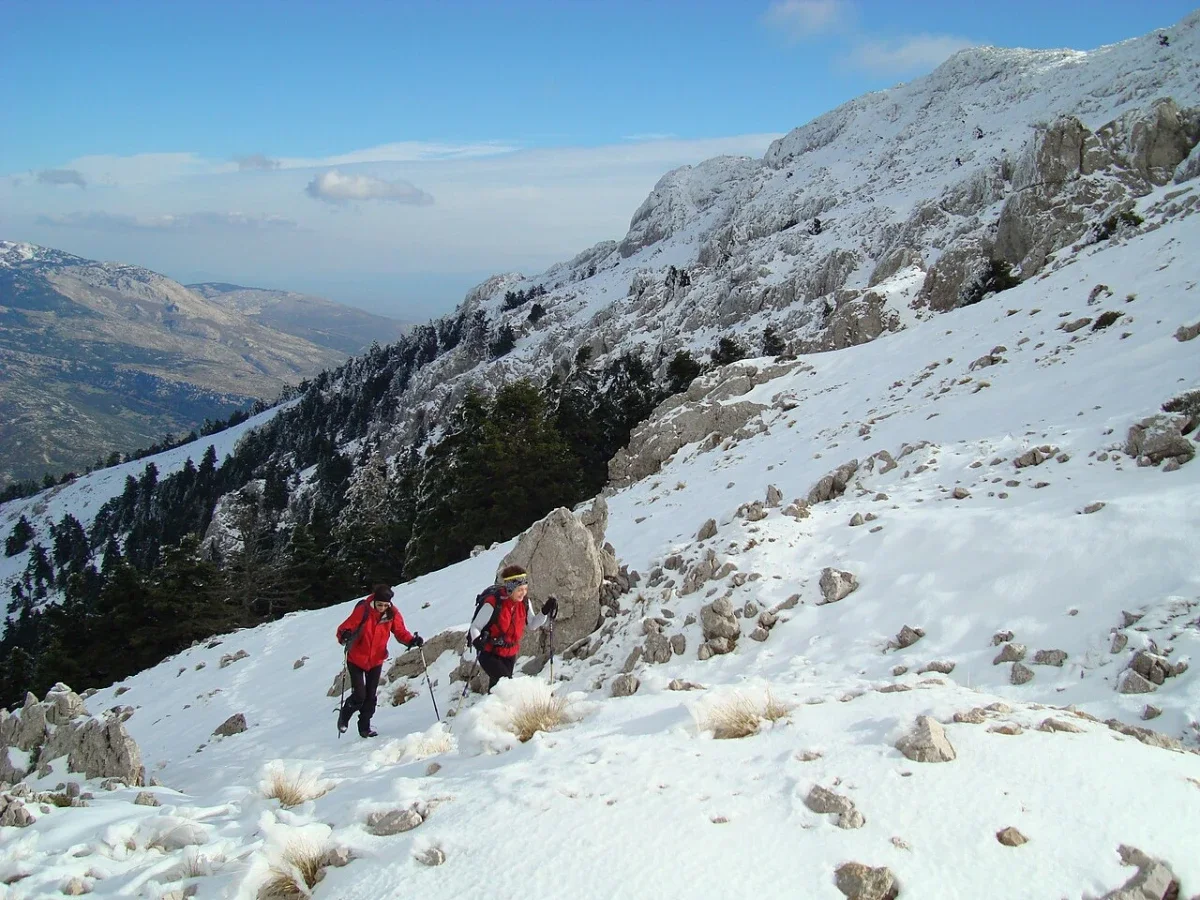
The Theogony, roughly 1,000 lines long, is one of the two poems treated as Hesiod’s.[1] It describes the earliest stages of the history of the cosmos.[2] It traces the descent of the gods from Chaos, Earth and Eros, through Heaven, the Titans and Cronus, to the reign of Zeus and his children. It ends with a call to the Muses to sing of women.[3] What is known of Hesiod comes from his poems. The Muses taught him song as he herded lambs under Mount Helicon. His father had settled at Ascra, a poor village near the mountain.[4] The date is uncertain. Herodotus put Homer and Hesiod four hundred years before his own time. Evelyn-White thought the Works and Days the older poem. He set it in the mid-ninth century BC, and the Theogony a century later.[5] Most takes each poet to belong to his region’s first generation touched by writing. He guesses the late eighth or very early seventh century BC for both. But he finds certainty, and their order, beyond reach.[6]
Scanned here is the hymn to the Muses of Helicon with which the poem opens. It tells of their dances on the mountain and their night song of the gods. It tells of the day they taught Hesiod song and gave him a laurel staff, probably a sign of poetic authority.[1]
Text and translation
Μουσάων Ἑλικωνιάδων ἀρχώμεθ’ ἀείδειν
Hesiod · Theogony 1–35 · dactylic hexameters · text of H. G. Evelyn-White (Loeb, 1914)
How to read each line
A guide to the Greek, syllables, pitch marks and quantities.
Show the reading key
- Above each line: the line as the edition prints it, each word placed over its own syllables. The main row: the same Greek divided into metrical syllables, each written as it is pronounced. A consonant that closes a syllable is written with it (λόθ | ρο); an elided word is closed up with the next vowel (ν’ἀ); a final consonant carried into the next word is set with a thin space (ς ἰ). Wider gaps mark word-ends.
- Above the syllables: the pitch of each syllable, from the accents. Under them: the quantity of each syllable as it falls in the line, then the transliteration, syllable by syllable, with accented syllables in capitals.
- Under each line: a line-for-line translation. In the right margin of the scansion: the line type, its scheme, and its analysis into cola.
Key to the labels
The names, patterns and symbols used beside this poem.
Show the labels and symbols
The labels in the right margin of the scansion below name the line, its scheme, the feet as the line realises them, and the caesurae and diaereses (the named word-ends) that fall in it. In the scheme ⏔ is a biceps, two shorts that may be contracted to one long; ⏕ is a long that may be resolved into two shorts; × is an anceps, long or short. A click on any syllable highlights its metron or colon, or, with the switch, its foot.
| Label | Name and shape | What it is |
|---|---|---|
| hem1 | First hemiepes— ⏔ — ⏔ — | The first two and a half feet of the hexameter, up to the penthemimeral caesura; in the pentameter, its whole first half. |
| hem2 | Second half of the hexameter⏔ — ⏔ — ⏑ ⏑ — × | From the penthemimeral caesura to the line-end: the fifth foot is nearly always a dactyl, the sixth is — ×. |
The traditional feet
| Foot and shape | Where |
|---|---|
| First foot: dactyl or spondee— ⏔ | Scheme positions 1–2. The biceps (⏑ ⏑) may be contracted to a single long, making a spondee. |
| Second foot: dactyl or spondee— ⏔ | Scheme positions 3–4. |
| Third foot: dactyl or spondee— ⏔ | Scheme positions 5–6. The penthemimeral caesura falls after its first syllable, the “trochaic” caesura after its second. |
| Fourth foot: dactyl or spondee— ⏔ | Scheme positions 7–8. Word-end at the end of this foot, when it is a dactyl, is the bucolic diaeresis (West’s “bucolic caesura”: word-end at the end of the fourth foot after an uncontracted biceps)[7]. |
| Fifth foot: dactyl— ⏑ ⏑ | Scheme positions 9–10. A spondee here (a “spondaic line”) is rare. |
| Sixth foot— × | Scheme positions 11–12: a long and the indifferent final syllable. |
Scansion
The hymn to the Muses that opens the Theogony, and their meeting with Hesiod on Helicon, scanned foot by foot: each syllable’s quantity and the reason for it, the feet, the caesurae, and a note on every line naming its prosodic licences.
Let us begin our singing from the Muses of Helicon,
who hold the great and holy mountain of Helicon
and dance on their soft feet around the violet-dark spring
and the altar of Cronus’ mighty son.
And when they have washed their tender skin in the Permessus
or the Horse’s Spring or holy Olmeius,
on the highest part of Helicon they make their dances,
beautiful and lovely, and their feet move nimbly.
Setting out from there, veiled in thick mist,
they go by night, sending out their beautiful voice,
singing of Zeus who holds the aegis and of lady Hera
of Argos, who walks in golden sandals,
and of the daughter of aegis-holding Zeus, grey-eyed Athena,
and Phoebus Apollo and Artemis who delights in arrows,
and Poseidon, who holds the earth and shakes it,
and revered Themis and Aphrodite of the darting glance,
and Hebe of the golden crown and fair Dione,
Leto and Iapetus and Cronus of the crooked counsel,
Dawn and the great Sun and the bright Moon,
Earth and great Ocean and black Night,
and the holy race of the other immortals who are for ever.
And once they taught Hesiod beautiful song
as he was shepherding his lambs under holy Helicon.
This was the first word the goddesses spoke to me,
the Olympian Muses, daughters of aegis-holding Zeus:
“Shepherds who live in the fields, wretched disgraces, nothing but bellies,
we know how to say many false things that look like the truth,
and we know, when we wish, how to utter what is true.”
So spoke the ready-voiced daughters of great Zeus,
and they gave me a staff, a branch of flourishing laurel,
which they had plucked, a marvel to see; and they breathed into me a voice
divine, so that I might celebrate what will be and what was before;
and they told me to sing of the race of the blessed ones who are for ever,
but always to sing of themselves first and last.
But why do I talk of these things about oak or rock?
Metre
- The line. Hesiod’s metre is Homer’s, the dactylic hexameter.[8] Each of the first five feet is a dactyl (— ⏑ ⏑) or, with its two shorts contracted, a spondee (— —); the sixth is — ×. West calls the long the princeps and the two shorts or their contraction the biceps. Contraction is least common in the fifth foot, about once in 20 lines in Homer,[9] and the poets prefer a dactylic fifth foot;[10] here ll. 5, 7 and 28 have a spondee there, each with a word of three or four long syllables at verse-end.
- Caesurae. There is always a word-end in the third foot, after its long (masculine or penthemimeral) or between its shorts (feminine, also called the caesura after the third trochee), the feminine being the more frequent in the proportion 4 : 3; occasionally a long word spans the third foot and the caesura falls after the fourth princeps (hephthemimeral).[11] This passage has that rarer shape three times, in ll. 1, 11 and 17. Word-end after an uncontracted fourth foot is the bucolic caesura;[7] the margin calls it the bucolic diaeresis.
- Wernicke’s Law. Where a word ends after a contracted fourth biceps, it mostly ends in a syllable with a long vowel, and hardly ever in a short vowel left open; a prepositive counts with the word that follows it.[9] All five such word-ends here keep the law: πεδίλοις (l. 12) and δρῦν (l. 35) end long, and καί (ll. 11, 20) and πρός (l. 24) are prepositives.
- Hermann’s bridge. No word ends between the two shorts of the fourth biceps, a prepositive being reckoned with the word after it and a postpositive with the word before; Homer breaks the rule about once in 550 lines.[12] L. 23 has a written word-end there, discussed in the note to that line.
- Prosody. Elision;[13] epic correption of a final long vowel or diphthong before a vowel;[14] synizesis;[15] hiatus, often where a word once began with ϝ;[16] stop + liquid, which normally makes position inside a word in early epic, while at the beginning of a word it may or may not.[17] A final short syllable lengthened by the initial stop + liquid of the next word stands mostly in the princeps,[18] as it does many times here. Metrical lengthening lets words such as Ἀπόλλωνα[7] and ἀθάνατος[19] into the line.
- Vowel quantities. Every α ι υ that the workbench makes long because the metre needs it has been checked in LSJ (Perseus edition), and none is marked short there: καλός (ᾱ in epic), ἵμερος (ῑ), χρῡσός, πέδῑλον, ἰοχέαιρα (ῑ, as in ἰός), Ποσειδάων (ᾱ), Ἀφροδίτη (ῑ), γηρύω (ῡ in the aorist). The α of the feminine participle in δρέψασαι and the -ά- of Μουσάων are not marked in LSJ; the name Ἰαπετός, whose Ἰ- stands in a princeps in l. 18, has no entry there.
- How to read the margin. A word counts as ending after the syllable that holds its last vowel, even when its final consonant passes to the next word’s vowel. A word-end after a contracted fourth foot is labelled as such, not as a bucolic caesura. The line notes say where a prepositive or postpositive means that a written word-end is no real break.
- Most’s text. Evelyn-White’s text has been compared with G. W. Most’s revised Loeb edition. The line numbers are the same. Most prints ἠ’ for ἢ twice in 6, ἠέρι πολλῷ (πολλῇ here) in 9, Ἀργείην in 12, γαιήοχον in 15 and τίη (τί ἦ here) in 35; lines 6, 12 and 15 are discussed in the notes, and the others scan the same. Like Evelyn-White he prints Goettling’s θέσπιν in 32, where the manuscripts have θείην, and δρέψασαι in 31, with δρέψασθαι in the apparatus.[20]
Prosody, line by line
Every syllable, with the reason for its length. Quantities are read from the vowel where the spelling shows it, from the consonants that follow (“position”), from the accent where it tells, and from the metre where nothing else does. Editors’ notes on the text follow in the boxed paragraphs.
- 1
Line 1 · Μουσάων Ἑλικωνιάδων ἀρχώμεθʼ ἀείδειν,
Μουσάων Ἑλικωνιάδων ἀρχώμεθʼ ἀείδειν,
ΜουσάωνἙλικωνιάδωνἀρχώμεθ’ἀείδειν,spondee, dactyl, dactyl, spondee, dactyl, — ×; hephthemimeral caesura.
- 1 —Μουου is a diphthong, long by nature.
- 2 —σάά is long by the metre (position 2 must be long); a single long contracts the two shorts of the biceps at position 2.
- 3 —ωνω is long by nature.
- 4 ⏑ἙἙ is short by nature; one of the two shorts of the biceps at position 4.
- 5 ⏑λιι is short by the metre (position 4 must be short); one of the two shorts of the biceps at position 4.
- 6 —κωω is long by nature.
- 7 ⏑νιι is short by the metre (position 6 must be short); one of the two shorts of the biceps at position 6.
- 8 ⏑άά is short by the metre (position 6 must be short); one of the two shorts of the biceps at position 6.
- 9 —δωνω is long by nature.
- 10 —ἀρἀ is a vowel of unknown length; closed by ρ: long by position; a single long contracts the two shorts of the biceps at position 8.
- 11 —χώώ is long by nature.
- 12 ⏑μεε is short by nature; one of the two shorts of the biceps at position 10.
- 13 ⏑θ’ἀἀ is short by the metre (position 10 must be short); the apostrophe marks an elided vowel; the consonant before it joins this syllable; one of the two shorts of the biceps at position 10.
- 14 —είεί is a diphthong, long by nature.
- 15 ×δειν,ει is a diphthong, long by nature; closed by ν: long by position; the position is anceps.
A spondee, two dactyls, a spondee and a dactyl. There is no word-end in the third foot: Ἑλικωνιάδων runs across it, and the caesura is the hephthemimeral one after the word, the case West describes as occasional.[8] ἀρχώμεθ’ is elided.[13] Katz notes that the poem opens, as the Iliad does, with a form of ἀείδω and a word from the root of Μοῦσα;[21] here the α of ἀείδειν is short, as it normally is.[22]- 2
Line 2 · αἵθʼ Ἑλικῶνος ἔχουσιν ὄρος μέγα τε ζάθεόν τε
αἵθʼ Ἑλικῶνος ἔχουσιν ὄρος μέγα τε ζάθεόν τε
αἵθ’Ἑλικῶνος ἔχουσιν ὄροςμέγατεζάθεόντεdactyl, dactyl, dactyl, dactyl, dactyl, — ×; caesura after the third trochee; hephthemimeral caesura; bucolic diaeresis.
- 1 —αἵαἵ is a diphthong, long by nature.
- 2 ⏑θ’ἙἙ is short by nature; the apostrophe marks an elided vowel; the consonant before it joins this syllable; one of the two shorts of the biceps at position 2.
- 3 ⏑λιι is short by the metre (position 2 must be short); one of the two shorts of the biceps at position 2.
- 4 —κῶῶ is long by nature.
- 5 ⏑νοο is short by nature; one of the two shorts of the biceps at position 4.
- 6 ⏑ς ἔἔ is short by nature; the first consonant belongs to the previous word and is carried over to this vowel; one of the two shorts of the biceps at position 4.
- 7 —χουου is a diphthong, long by nature.
- 8 ⏑σιι is short by the accent rule: acute on the antepenult requires a short final syllable; one of the two shorts of the biceps at position 6.
- 9 ⏑ν ὄὄ is short by nature; the first consonant belongs to the previous word and is carried over to this vowel; one of the two shorts of the biceps at position 6.
- 10 —ροςο is short by nature; closed by ς: long by position.
- 11 ⏑μέέ is short by nature; one of the two shorts of the biceps at position 8.
- 12 ⏑γαα is short by the metre (position 8 must be short); one of the two shorts of the biceps at position 8.
- 13 —τεε is short by nature; the next word begins with the double consonant ζ: the syllable is closed before it: long by position.
- 14 ⏑ζάά is short by the metre (position 10 must be short); one of the two shorts of the biceps at position 10.
- 15 ⏑θεε is short by nature; one of the two shorts of the biceps at position 10.
- 16 —όνό is short by nature; closed by ν: long by position.
- 17 ×τεε is short by nature; the position is anceps.
All five feet are dactyls. αἵθ’ is αἵ τε elided before the rough breathing of Ἑλικῶνος.[13] The ν of ἔχουσιν passes to ὄρος, but the word ends between the shorts of the third foot: a feminine caesura, followed by a hephthemimeral word-end after ὄρος.[8] The written word-end after μέγα is followed by the postpositive τε, so it is no real bucolic caesura;[12] that τε is long by position before ζ in the fifth princeps.[23]- 3
Line 3 · καί τε περὶ κρήνην ἰοειδέα πόσσʼ ἁπαλοῖσιν
καί τε περὶ κρήνην ἰοειδέα πόσσʼ ἁπαλοῖσιν
καίτεπερὶκρήνηνἰοειδέαπόσσ’ἁπαλοῖσινdactyl, spondee, dactyl, dactyl, dactyl, — ×; penthemimeral caesura; bucolic diaeresis.
- 1 —καίαί is a diphthong, long by nature.
- 2 ⏑τεε is short by nature; one of the two shorts of the biceps at position 2.
- 3 ⏑πεε is short by nature; one of the two shorts of the biceps at position 2.
- 4 —ρὶὶ is a vowel of unknown length; the next word begins with κρ: the syllable is closed before it: long by position.
- 5 —κρήή is long by nature; a single long contracts the two shorts of the biceps at position 4.
- 6 —νηνη is long by nature.
- 7 ⏑ἰἰ is short by the metre (position 6 must be short); one of the two shorts of the biceps at position 6.
- 8 ⏑οο is short by nature; one of the two shorts of the biceps at position 6.
- 9 —ειει is a diphthong, long by nature.
- 10 ⏑δέέ is short by nature; one of the two shorts of the biceps at position 8.
- 11 ⏑αα is short by the metre (position 8 must be short); one of the two shorts of the biceps at position 8.
- 12 —πόσό is short by nature; closed by σ: long by position.
- 13 ⏑σ’ἁἁ is short by the metre (position 10 must be short); the apostrophe marks an elided vowel; the consonant before it joins this syllable; one of the two shorts of the biceps at position 10.
- 14 ⏑παα is short by the metre (position 10 must be short); one of the two shorts of the biceps at position 10.
- 15 —λοῖοῖ is a diphthong, long by nature.
- 16 ×σινι is a vowel of unknown length; closed by ν: long by position; the position is anceps.
A dactyl, a spondee and three dactyls. The last syllable of περί is long by position before the initial κρ- of κρήνην, in the second princeps.[18] The caesura is penthemimeral, after κρήνην,[8] and word-end after ἰοειδέα is the bucolic caesura.[7] πόσσ’ is the dative πόσσι elided, which epic allows.[13]- 4
Line 4 · ὀρχεῦνται καὶ βωμὸν ἐρισθενέος Κρονίωνος.
ὀρχεῦνται καὶ βωμὸν ἐρισθενέος Κρονίωνος.
ὀρχεῦνταικαὶβωμὸν ἐρισθενέοςΚρονίωνος.spondee, spondee, dactyl, dactyl, dactyl, — ×; caesura after the third trochee.
- 1 —ὀρὀ is short by nature; closed by ρ: long by position.
- 2 —χεῦνεῦ is a diphthong, long by nature; closed by ν: long by position; a single long contracts the two shorts of the biceps at position 2.
- 3 —ταιαι is a diphthong, long by nature.
- 4 —καὶαὶ is a diphthong, long by nature; a single long contracts the two shorts of the biceps at position 4.
- 5 —βωω is long by nature.
- 6 ⏑μὸὸ is short by nature; one of the two shorts of the biceps at position 6.
- 7 ⏑ν ἐἐ is short by nature; the first consonant belongs to the previous word and is carried over to this vowel; one of the two shorts of the biceps at position 6.
- 8 —ρισι is a vowel of unknown length; closed by σ: long by position.
- 9 ⏑θεε is short by nature; one of the two shorts of the biceps at position 8.
- 10 ⏑νέέ is short by nature; one of the two shorts of the biceps at position 8.
- 11 —οςο is short by nature; closed by ς: long by position.
- 12 ⏑Κροο is short by nature; one of the two shorts of the biceps at position 10.
- 13 ⏑νίί is short by the metre (position 10 must be short); one of the two shorts of the biceps at position 10.
- 14 —ωω is long by nature.
- 15 ×νος.ο is short by nature; closed by ς: long by position; the position is anceps.
Two spondees and three dactyls. The ν of βωμόν passes to ἐρισθενέος, but the word ends between the shorts of the third foot: a feminine caesura.[8] ἐρισθενέος then runs into the fifth foot, so there is no further word-end at a caesura place.- 5
Line 5 · καί τε λοεσσάμεναι τέρενα χρόα Περμησσοῖο
καί τε λοεσσάμεναι τέρενα χρόα Περμησσοῖο
καίτελοεσσάμεναιτέρεναχρόαΠερμησσοῖοdactyl, dactyl, dactyl, dactyl, spondee, — ×; penthemimeral caesura; hephthemimeral caesura; bucolic diaeresis.
- 1 —καίαί is a diphthong, long by nature.
- 2 ⏑τεε is short by nature; one of the two shorts of the biceps at position 2.
- 3 ⏑λοο is short by nature; one of the two shorts of the biceps at position 2.
- 4 —εσε is short by nature; closed by σ: long by position.
- 5 ⏑σάά is short by the metre (position 4 must be short); one of the two shorts of the biceps at position 4.
- 6 ⏑μεε is short by nature; one of the two shorts of the biceps at position 4.
- 7 —ναιαι is a diphthong, long by nature.
- 8 ⏑τέέ is short by nature; one of the two shorts of the biceps at position 6.
- 9 ⏑ρεε is short by nature; one of the two shorts of the biceps at position 6.
- 10 —ναα is short by the accent rule (the accent falls too far back for a long final syllable); the next word begins with χρ: the syllable is closed before it: long by position.
- 11 ⏑χρόό is short by nature; one of the two shorts of the biceps at position 8.
- 12 ⏑αα is short by the metre (position 8 must be short); one of the two shorts of the biceps at position 8.
- 13 —Περε is short by nature; closed by ρ: long by position.
- 14 —μηση is long by nature; closed by σ: long by position; a single long contracts the two shorts of the biceps at position 10.
- 15 —σοῖοῖ is a diphthong, long by nature.
- 16 ×οο is short by nature; the position is anceps.
A spondaic line: four dactyls and a spondee in the fifth foot, filled by Περμησ- of Περμησσοῖο. Contraction is least common in the fifth foot,[9] and the poets prefer a dactyl there;[10] Περμησσοῖο has three long syllables in a row and stands so that only one contraction is needed, — ⏔ —.[9] The caesura is penthemimeral, after λοεσσάμεναι.[8] The last syllable of τέρενα is long by position before the initial χρ- of χρόα in the fourth princeps,[18] giving a hephthemimeral word-end, and word-end after χρόα is the bucolic caesura.[24]- 6
Line 6 · ἢ Ἵππου κρήνης ἢ Ὀλμειοῦ ζαθέοιο
ἢ Ἵππου κρήνης ἢ Ὀλμειοῦ ζαθέοιο
ἢἽππουκρήνηςἢὈλμειοῦζαθέοιοspondee, spondee, spondee, spondee, dactyl, — ×; penthemimeral caesura.
- 1 —ἢἢ is long by nature; the next word begins with a vowel and nothing is elided: hiatus.
- 2 —ἽπἽ is a vowel of unknown length; closed by π: long by position; a single long contracts the two shorts of the biceps at position 2.
- 3 —πουου is a diphthong, long by nature; the next word begins with κρ: the syllable is closed before it: long by position.
- 4 —κρήή is long by nature; a single long contracts the two shorts of the biceps at position 4.
- 5 —νηςη is long by nature.
- 6 —ἢἢ is long by nature; the next word begins with a vowel and nothing is elided: hiatus; a single long contracts the two shorts of the biceps at position 6.
- 7 —ὈλὈ is short by nature; closed by λ: long by position.
- 8 —μειει is a diphthong, long by nature; a single long contracts the two shorts of the biceps at position 8.
- 9 —οῦοῦ is a diphthong, long by nature; the next word begins with the double consonant ζ: the syllable is closed before it: long by position.
- 10 ⏑ζαα is short by the metre (position 10 must be short); one of the two shorts of the biceps at position 10.
- 11 ⏑θέέ is short by nature; one of the two shorts of the biceps at position 10.
- 12 —οιοι is a diphthong, long by nature.
- 13 ×οο is short by nature; the position is anceps.
Four of the five feet are contracted, the only such line in the eight epic passages on this site. ἤ keeps its long vowel before Ἵππου in the first princeps and again before Ὀλμειοῦ in the contracted third biceps: West notes that hiatus after ἤ occurs in epic and may really be an elided ἠέ.[25] The caesura is penthemimeral, after κρήνης.[8]Most prints ἠ’ in both places, the elided ἠέ that West thinks may lie behind the hiatus; the syllable is long either way.[26]
- 7
Line 7 · ἀκροτάτῳ Ἑλικῶνι χοροὺς ἐνεποιήσαντο
ἀκροτάτῳ Ἑλικῶνι χοροὺς ἐνεποιήσαντο
ἀκροτάτῳἙλικῶνιχοροὺςἐνεποιήσαντοdactyl, dactyl, dactyl, dactyl, spondee, — ×; caesura after the third trochee; hephthemimeral caesura.
- 1 —ἀκἀ is a vowel of unknown length; closed by κ before a liquid: stop + liquid makes position, as it usually does in epic.
- 2 ⏑ροο is short by nature; one of the two shorts of the biceps at position 2.
- 3 ⏑τάά is short by the metre (position 2 must be short); one of the two shorts of the biceps at position 2.
- 4 —τῳῳ is long by nature; the next word begins with a vowel and nothing is elided: hiatus.
- 5 ⏑ἙἙ is short by nature; one of the two shorts of the biceps at position 4.
- 6 ⏑λιι is short by the metre (position 4 must be short); one of the two shorts of the biceps at position 4.
- 7 —κῶῶ is long by nature.
- 8 ⏑νιι is short by the accent rule: circumflex on the penult requires a short final syllable; one of the two shorts of the biceps at position 6.
- 9 ⏑χοο is short by nature; one of the two shorts of the biceps at position 6.
- 10 —ροὺςοὺ is a diphthong, long by nature.
- 11 ⏑ἐἐ is short by nature; one of the two shorts of the biceps at position 8.
- 12 ⏑νεε is short by nature; one of the two shorts of the biceps at position 8.
- 13 —ποιοι is a diphthong, long by nature.
- 14 —ήή is long by nature; a single long contracts the two shorts of the biceps at position 10.
- 15 —σανα is a vowel of unknown length; closed by ν: long by position.
- 16 ×τοο is short by nature; the position is anceps.
A spondaic line: four dactyls and a spondee in the fifth foot, filled by -ποιή- of ἐνεποιήσαντο, rare in the fifth foot.[27] The κρ of ἀκροτάτῳ makes position inside the word.[17] The -ῳ of ἀκροτάτῳ keeps its length before Ἑλικῶνι in the second princeps, where long vowels in hiatus mostly stand.[7] The caesura is feminine, after Ἑλικῶνι, with a hephthemimeral word-end after χορούς.[8]- 8
Line 8 · καλούς, ἱμερόεντας· ἐπερρώσαντο δὲ ποσσίν.
καλούς, ἱμερόεντας· ἐπερρώσαντο δὲ ποσσίν.
καλούς,ἱμερόεντα·ς ἐπερρώσαντοδὲποσσίν.spondee, dactyl, dactyl, spondee, dactyl, — ×; caesura after the third trochee.
- 1 —καα is long by the metre (position 1 must be long).
- 2 —λούς,ού is a diphthong, long by nature; a single long contracts the two shorts of the biceps at position 2.
- 3 —ἱἱ is long by the metre (position 3 must be long).
- 4 ⏑μεε is short by nature; one of the two shorts of the biceps at position 4.
- 5 ⏑ρόό is short by nature; one of the two shorts of the biceps at position 4.
- 6 —ενε is short by nature; closed by ν: long by position.
- 7 ⏑τα·α is short by the accent rule: acute on the antepenult requires a short final syllable; one of the two shorts of the biceps at position 6.
- 8 ⏑ς ἐἐ is short by nature; the first consonant belongs to the previous word and is carried over to this vowel; one of the two shorts of the biceps at position 6.
- 9 —περε is short by nature; closed by ρ: long by position.
- 10 —ρώώ is long by nature; a single long contracts the two shorts of the biceps at position 8.
- 11 —σανα is a vowel of unknown length; closed by ν: long by position.
- 12 ⏑τοο is short by nature; one of the two shorts of the biceps at position 10.
- 13 ⏑δὲὲ is short by nature; one of the two shorts of the biceps at position 10.
- 14 —ποσο is short by nature; closed by σ: long by position.
- 15 ×σίν.ί is a vowel of unknown length; closed by ν: long by position; the position is anceps.
A spondee, two dactyls, a spondee and a dactyl. The ς of ἱμερόεντας passes to ἐπερρώσαντο, but the word ends between the shorts of the third foot: a feminine caesura at the strong stop.[8] ἐπερρώσαντο then runs into the fifth foot.- 9
Line 9 · ἔνθεν ἀπορνύμεναι, κεκαλυμμέναι ἠέρι πολλῇ,
ἔνθεν ἀπορνύμεναι, κεκαλυμμέναι ἠέρι πολλῇ,
ἔνθεν ἀπορνύμεναι,κεκαλυμμέναιἠέριπολλῇ,dactyl, dactyl, dactyl, dactyl, dactyl, — ×; penthemimeral caesura; bucolic diaeresis.
- 1 —ἔνἔ is short by nature; closed by ν: long by position.
- 2 ⏑θεε is short by nature; one of the two shorts of the biceps at position 2.
- 3 ⏑ν ἀἀ is short by the metre (position 2 must be short); the first consonant belongs to the previous word and is carried over to this vowel; one of the two shorts of the biceps at position 2.
- 4 —πορο is short by nature; closed by ρ: long by position.
- 5 ⏑νύύ is short by the metre (position 4 must be short); one of the two shorts of the biceps at position 4.
- 6 ⏑μεε is short by nature; one of the two shorts of the biceps at position 4.
- 7 —ναι,αι is a diphthong, long by nature.
- 8 ⏑κεε is short by nature; one of the two shorts of the biceps at position 6.
- 9 ⏑καα is short by the metre (position 6 must be short); one of the two shorts of the biceps at position 6.
- 10 —λυμυ is a vowel of unknown length; closed by μ: long by position.
- 11 ⏑μέέ is short by nature; one of the two shorts of the biceps at position 8.
- 12 ⏑ναιαι is a diphthong, long by nature; shortened before the vowel that begins the next word (epic correption), as the metre requires; one of the two shorts of the biceps at position 8.
- 13 —ἠἠ is long by nature.
- 14 ⏑έέ is short by nature; one of the two shorts of the biceps at position 10.
- 15 ⏑ριι is short by the metre (position 10 must be short); one of the two shorts of the biceps at position 10.
- 16 —πολο is short by nature; closed by λ: long by position.
- 17 ×λῇ,ῇ is long by nature; the position is anceps.
All five feet are dactyls. The caesura is penthemimeral, at the comma after ἀπορνύμεναι.[8] -ναι of κεκαλυμμέναι is shortened before ἠέρι by epic correption,[14] and the word-end after it is the bucolic caesura.[7]- 10
Line 10 · ἐννύχιαι στεῖχον περικαλλέα ὄσσαν ἱεῖσαι,
ἐννύχιαι στεῖχον περικαλλέα ὄσσαν ἱεῖσαι,
ἐννύχιαιστεῖχονπερικαλλέαὄσσαν ἱεῖσαι,dactyl, spondee, dactyl, dactyl, dactyl, — ×; penthemimeral caesura; bucolic diaeresis.
- 1 —ἐνἐ is short by nature; closed by ν: long by position.
- 2 ⏑νύύ is short by the metre (position 2 must be short); one of the two shorts of the biceps at position 2.
- 3 ⏑χιι is short by the metre (position 2 must be short); one of the two shorts of the biceps at position 2.
- 4 —αιαι is a diphthong, long by nature; the next word begins with στ: the syllable is closed before it: long by position.
- 5 —στεῖεῖ is a diphthong, long by nature; a single long contracts the two shorts of the biceps at position 4.
- 6 —χονο is short by nature; closed by ν: long by position.
- 7 ⏑πεε is short by nature; one of the two shorts of the biceps at position 6.
- 8 ⏑ριι is short by the metre (position 6 must be short); one of the two shorts of the biceps at position 6.
- 9 —καλα is a vowel of unknown length; closed by λ: long by position.
- 10 ⏑λέέ is short by nature; one of the two shorts of the biceps at position 8.
- 11 ⏑αα is short by the metre (position 8 must be short); the next word begins with a vowel and nothing is elided: hiatus; one of the two shorts of the biceps at position 8.
- 12 —ὄσὄ is short by nature; closed by σ: long by position.
- 13 ⏑σαα is short by the metre (position 10 must be short); one of the two shorts of the biceps at position 10.
- 14 ⏑ν ἱἱ is short by the metre (position 10 must be short); the first consonant belongs to the previous word and is carried over to this vowel; one of the two shorts of the biceps at position 10.
- 15 —εῖεῖ is a diphthong, long by nature.
- 16 ×σαι,αι is a diphthong, long by nature; the position is anceps.
- 11
Line 11 · ὑμνεῦσαι Δία τʼ αἰγίοχον καὶ πότνιαν Ἥρην
ὑμνεῦσαι Δία τʼ αἰγίοχον καὶ πότνιαν Ἥρην
ὑμνεῦσαιΔίατ’αἰγίοχονκαὶπότνιαν Ἥρηνspondee, dactyl, dactyl, spondee, dactyl, — ×; hephthemimeral caesura; word-end after a spondaic fourth foot.
- 1 —ὑμὑ is a vowel of unknown length; closed by μ: long by position.
- 2 —νεῦεῦ is a diphthong, long by nature; a single long contracts the two shorts of the biceps at position 2.
- 3 —σαιαι is a diphthong, long by nature.
- 4 ⏑Δίί is short by the metre (position 4 must be short); one of the two shorts of the biceps at position 4.
- 5 ⏑αα is short by the metre (position 4 must be short); one of the two shorts of the biceps at position 4.
- 6 —τ’αἰαἰ is a diphthong, long by nature; the apostrophe marks an elided vowel; the consonant before it joins this syllable.
- 7 ⏑γίί is short by the metre (position 6 must be short); one of the two shorts of the biceps at position 6.
- 8 ⏑οο is short by nature; one of the two shorts of the biceps at position 6.
- 9 —χονο is short by nature; closed by ν: long by position.
- 10 —καὶαὶ is a diphthong, long by nature; a single long contracts the two shorts of the biceps at position 8.
- 11 —πότό is short by nature; closed by τ before a nasal: stop + nasal makes position, as it usually does in epic.
- 12 ⏑νιι is short by the metre (position 10 must be short); one of the two shorts of the biceps at position 10.
- 13 ⏑αα is short by the accent rule: acute on the antepenult requires a short final syllable; one of the two shorts of the biceps at position 10.
- 14 —ν ἭἭ is long by nature; the first consonant belongs to the previous word and is carried over to this vowel.
- 15 ×ρηνη is long by nature; closed by ν: long by position; the position is anceps.
A spondee, two dactyls, a spondee and a dactyl. Δία τ’ ends with the second foot, and αἰγίοχον runs across the whole third foot, so the caesura is the hephthemimeral one after it.[8] τ’ is elided.[13] The word-end after καί follows a contracted fourth foot, but καί is a prepositive that counts with πότνιαν, so Wernicke’s Law is kept.[9] The τν of πότνιαν makes position, as a stop + nasal seldom fails to do before the fifth century.[25]- 12
Line 12 · Ἀργεΐην, χρυσέ‿οισι πεδίλοις ἐμβεβαυῖαν,
Ἀργεΐην, χρυσέ‿οισι πεδίλοις ἐμβεβαυῖαν,
Ἀργεΐην,χρυσέ‿οισιπεδίλοιςἐμβεβαυῖαν,dactyl, spondee, dactyl, spondee, dactyl, — ×; caesura after the third trochee; word-end after a spondaic fourth foot.
- 1 —ἈρἈ is a vowel of unknown length; closed by ρ: long by position.
- 2 ⏑γεε is short by nature; one of the two shorts of the biceps at position 2.
- 3 ⏑ΐΐ is short by the metre (position 2 must be short); one of the two shorts of the biceps at position 2.
- 4 —ην,η is long by nature; closed by ν: long by position.
- 5 —χρυυ is long by the metre (position 4 must be long); a single long contracts the two shorts of the biceps at position 4.
- 6 —σέ‿οιέοι is two vowels of one word pronounced together as one long syllable (synizesis).
- 7 ⏑σιι is short by the metre (position 6 must be short); one of the two shorts of the biceps at position 6.
- 8 ⏑πεε is short by nature; one of the two shorts of the biceps at position 6.
- 9 —δίί is long by the metre (position 7 must be long).
- 10 —λοιςοι is a diphthong, long by nature; a single long contracts the two shorts of the biceps at position 8.
- 11 —ἐμἐ is short by nature; closed by μ: long by position.
- 12 ⏑βεε is short by nature; one of the two shorts of the biceps at position 10.
- 13 ⏑βαα is short by the metre (position 10 must be short); one of the two shorts of the biceps at position 10.
- 14 —υῖυῖ is a diphthong, long by nature.
- 15 ×αν,α is a vowel of unknown length; closed by ν: long by position; the position is anceps.
A dactyl, a spondee, a dactyl, a spondee and a dactyl. χρυσέοισι is read with synizesis of -εοι- into one syllable.[15] The caesura is feminine, after χρυσέοισι;[8] the word-end after πεδίλοις follows a contracted fourth foot, and πεδίλοις ends long, as Wernicke’s Law expects.[9] The ι of πεδίλοις is long by nature.[28] In ἐμβεβαυῖαν the α and the υ belong to different syllables (βα-υῖ-), and the input marks the α so that the workbench does not read αυ as a diphthong.Most prints Ἀργείην, in three syllables, where Evelyn-White has Ἀργεΐην in four. With Most’s text the first foot is a spondee (Ἀρ-γεί-), and the rest of the line scans as here, with the same synizesis in χρυσέοισι.[26]
- 13
Line 13 · κούρην τʼ αἰγιόχοιο Διὸς γλαυκῶπιν Ἀθήνην
κούρην τʼ αἰγιόχοιο Διὸς γλαυκῶπιν Ἀθήνην
κούρηντ’αἰγιόχοιοΔιὸςγλαυκῶπιν Ἀθήνηνspondee, dactyl, dactyl, spondee, dactyl, — ×; caesura after the third trochee; hephthemimeral caesura.
- 1 —κούού is a diphthong, long by nature.
- 2 —ρηνη is long by nature; closed by ν: long by position; a single long contracts the two shorts of the biceps at position 2.
- 3 —τ’αἰαἰ is a diphthong, long by nature; the apostrophe marks an elided vowel; the consonant before it joins this syllable.
- 4 ⏑γιι is short by the metre (position 4 must be short); one of the two shorts of the biceps at position 4.
- 5 ⏑όό is short by nature; one of the two shorts of the biceps at position 4.
- 6 —χοιοι is a diphthong, long by nature.
- 7 ⏑οο is short by nature; one of the two shorts of the biceps at position 6.
- 8 ⏑Διι is short by the metre (position 6 must be short); one of the two shorts of the biceps at position 6.
- 9 —ὸςὸ is short by nature; closed by ς: long by position.
- 10 —γλαυαυ is a diphthong, long by nature; a single long contracts the two shorts of the biceps at position 8.
- 11 —κῶῶ is long by nature.
- 12 ⏑πιι is short by the accent rule: circumflex on the penult requires a short final syllable; one of the two shorts of the biceps at position 10.
- 13 ⏑ν ἈἈ is short by the metre (position 10 must be short); the first consonant belongs to the previous word and is carried over to this vowel; one of the two shorts of the biceps at position 10.
- 14 —θήή is long by nature.
- 15 ×νηνη is long by nature; closed by ν: long by position; the position is anceps.
- 14
Line 14 · Φοῖβόν τʼ Ἀπόλλωνα καὶ Ἄρτεμιν ἰοχέαιραν
Φοῖβόν τʼ Ἀπόλλωνα καὶ Ἄρτεμιν ἰοχέαιραν
Φοῖβόντ’ἈπόλλωνακαὶἌρτεμιν ἰοχέαιρανspondee, spondee, dactyl, dactyl, dactyl, — ×; caesura after the third trochee; bucolic diaeresis.
- 1 —Φοῖοῖ is a diphthong, long by nature.
- 2 —βόνό is short by nature; closed by ν: long by position; a single long contracts the two shorts of the biceps at position 2.
- 3 —τ’ἈἈ is short by nature in Ἀπόλλων, but here it is lengthened in the princeps so that the word (⏑ — — ⏑) can stand in the verse: metrical lengthening, with Ἀπόλλωνα as West’s own example (the input marks it as lengthened)[7]; the apostrophe marks an elided vowel; the consonant before it joins this syllable.
- 4 —πόλό is short by nature; closed by λ: long by position; a single long contracts the two shorts of the biceps at position 4.
- 5 —λωω is long by nature.
- 6 ⏑ναα is short by the accent rule: acute on the antepenult requires a short final syllable; one of the two shorts of the biceps at position 6.
- 7 ⏑καὶαὶ is a diphthong, long by nature; shortened before the vowel that begins the next word (epic correption), as the metre requires; one of the two shorts of the biceps at position 6.
- 8 —ἌρἌ is a vowel of unknown length; closed by ρ: long by position.
- 9 ⏑τεε is short by nature; one of the two shorts of the biceps at position 8.
- 10 ⏑μιι is short by the accent rule: acute on the antepenult requires a short final syllable; one of the two shorts of the biceps at position 8.
- 11 —ν ἰἰ is long by the metre (position 9 must be long); the first consonant belongs to the previous word and is carried over to this vowel.
- 12 ⏑οο is short by nature; one of the two shorts of the biceps at position 10.
- 13 ⏑χέέ is short by nature; one of the two shorts of the biceps at position 10.
- 14 —αιαι is a diphthong, long by nature.
- 15 ×ρανα is a vowel of unknown length; closed by ν: long by position; the position is anceps.
Ἀπόλλωνα has a short first vowel, but here its Ἀ- stands in the second princeps: metrical lengthening, for which West gives this very word as an example.[29] The input marks it as lengthened. τ’ is elided,[13] and καί is shortened before Ἄρτεμιν by epic correption.[14] The caesura is feminine, after Ἀπόλλωνα,[8] and word-end after Ἄρτεμιν is the bucolic caesura.[7] The ι of ἰοχέαιραν is long, as in ἰός “arrow”.[30]- 15
Line 15 · ἠδὲ Ποσειδάωνα γεήοχον, ἐννοσίγαιον,
ἠδὲ Ποσειδάωνα γεήοχον, ἐννοσίγαιον,
ἠδὲΠοσειδάωναγεήοχο,ν ἐννοσίγαιον,dactyl, spondee, dactyl, dactyl, dactyl, — ×; caesura after the third trochee; bucolic diaeresis.
- 1 —ἠἠ is long by nature.
- 2 ⏑δὲὲ is short by nature; one of the two shorts of the biceps at position 2.
- 3 ⏑Ποο is short by nature; one of the two shorts of the biceps at position 2.
- 4 —σειει is a diphthong, long by nature.
- 5 —δάά is long by the metre (position 4 must be long); a single long contracts the two shorts of the biceps at position 4.
- 6 —ωω is long by nature.
- 7 ⏑ναα is short by the accent rule: acute on the antepenult requires a short final syllable; one of the two shorts of the biceps at position 6.
- 8 ⏑γεε is short by nature; one of the two shorts of the biceps at position 6.
- 9 —ήή is long by nature.
- 10 ⏑οο is short by nature; one of the two shorts of the biceps at position 8.
- 11 ⏑χο,ο is short by nature; one of the two shorts of the biceps at position 8.
- 12 —ν ἐνἐ is short by nature; closed by ν: long by position; the first consonant belongs to the previous word and is carried over to this vowel.
- 13 ⏑νοο is short by nature; one of the two shorts of the biceps at position 10.
- 14 ⏑σίί is short by the metre (position 10 must be short); one of the two shorts of the biceps at position 10.
- 15 —γαιαι is a diphthong, long by nature.
- 16 ×ον,ο is short by nature; closed by ν: long by position; the position is anceps.
A dactyl, a spondee and three dactyls. The -δά- of Ποσειδάωνα fills the contracted second biceps. The caesura is feminine, after Ποσειδάωνα,[8] and word-end after γεήοχον is the bucolic caesura.[7]Most prints γαιήοχον; LSJ records γεήοχος, printed here, as a variant reading in this line (s.v. γεήοχος). With γαιήοχον the diphthong αι has to be shortened before the vowel that follows, a correption within the word of the kind West notes in a few Homeric words;[14] the quantities are then the same as here.[26]
- 16
Line 16 · καὶ Θέμιν αἰδοίην ἑλικοβλέφαρόν τʼ Ἀφροδίτην
καὶ Θέμιν αἰδοίην ἑλικοβλέφαρόν τʼ Ἀφροδίτην
καὶΘέμιν αἰδοίηνἑλικοβλέφαρόντ’Ἀφροδίτηνdactyl, spondee, dactyl, dactyl, dactyl, — ×; penthemimeral caesura.
- 1 —καὶαὶ is a diphthong, long by nature.
- 2 ⏑Θέέ is short by nature; one of the two shorts of the biceps at position 2.
- 3 ⏑μιι is short by the metre (position 2 must be short); one of the two shorts of the biceps at position 2.
- 4 —ν αἰαἰ is a diphthong, long by nature; the first consonant belongs to the previous word and is carried over to this vowel.
- 5 —δοίοί is a diphthong, long by nature; a single long contracts the two shorts of the biceps at position 4.
- 6 —ηνη is long by nature.
- 7 ⏑ἑἑ is short by nature; one of the two shorts of the biceps at position 6.
- 8 ⏑λιι is short by the metre (position 6 must be short); one of the two shorts of the biceps at position 6.
- 9 —κοβο is short by nature; closed by β before a liquid: stop + liquid makes position, as it usually does in epic.
- 10 ⏑λέέ is short by nature; one of the two shorts of the biceps at position 8.
- 11 ⏑φαα is short by the metre (position 8 must be short); one of the two shorts of the biceps at position 8.
- 12 —ρόνό is short by nature; closed by ν: long by position.
- 13 ⏑τ’ἈἈ is a vowel of unknown length; φρ is carried whole into the next syllable, so this syllable stays open and short (correption before a stop + liquid cluster, as the metre needs); the apostrophe marks an elided vowel; the consonant before it joins this syllable; one of the two shorts of the biceps at position 10.
- 14 ⏑φροο is short by nature; one of the two shorts of the biceps at position 10.
- 15 —δίί is long by the metre (position 11 must be long).
- 16 ×τηνη is long by nature; closed by ν: long by position; the position is anceps.
A dactyl, a spondee and three dactyls. The caesura is penthemimeral, after αἰδοίην.[8] The βλ of ἑλικοβλέφαρον makes position, as βλ always does before the fifth century.[25] The syllable τ’ Ἀ- stays short before the φρ inside Ἀφροδίτην: West cites Ἀφροδίτη as a word the verse would not admit otherwise, one of the few places where early poetry lets a stop + liquid inside a word leave the syllable before it short.[25]- 17
Line 17 · Ἥβην τε χρυσοστέφανον καλήν τε Διώνην
Ἥβην τε χρυσοστέφανον καλήν τε Διώνην
ἭβηντεχρυσοστέφανονκαλήντεΔιώνηνspondee, spondee, dactyl, spondee, dactyl, — ×; hephthemimeral caesura.
- 1 —ἭἭ is long by nature.
- 2 —βηνη is long by nature; closed by ν: long by position; a single long contracts the two shorts of the biceps at position 2.
- 3 —τεε is short by nature; the next word begins with χρ: the syllable is closed before it: long by position.
- 4 —χρυυ is long by the metre (position 4 must be long); a single long contracts the two shorts of the biceps at position 4.
- 5 —σοσο is short by nature; closed by σ: long by position.
- 6 ⏑τέέ is short by nature; one of the two shorts of the biceps at position 6.
- 7 ⏑φαα is short by the metre (position 6 must be short); one of the two shorts of the biceps at position 6.
- 8 —νονο is short by nature; closed by ν: long by position.
- 9 —καα is long by the metre (position 8 must be long); a single long contracts the two shorts of the biceps at position 8.
- 10 —λήνή is long by nature; closed by ν: long by position.
- 11 ⏑τεε is short by nature; one of the two shorts of the biceps at position 10.
- 12 ⏑Διι is short by the metre (position 10 must be short); one of the two shorts of the biceps at position 10.
- 13 —ώώ is long by nature.
- 14 ×νηνη is long by nature; closed by ν: long by position; the position is anceps.
- 18
Line 18 · Λητώ τʼ Ἰαπετόν τε ἰδὲ Κρόνον ἀγκυλομήτην
Λητώ τʼ Ἰαπετόν τε ἰδὲ Κρόνον ἀγκυλομήτην
Λητώτ’ἸαπετόντεἰδὲΚρόνον ἀγκυλομήτηνspondee, dactyl, dactyl, dactyl, dactyl, — ×; penthemimeral caesura; caesura after the third trochee; hephthemimeral caesura; bucolic diaeresis.
- 1 —Ληη is long by nature.
- 2 —τώώ is long by nature; a single long contracts the two shorts of the biceps at position 2.
- 3 —τ’ἸἸ is long by the metre (position 3 must be long); the apostrophe marks an elided vowel; the consonant before it joins this syllable.
- 4 ⏑αα is short by the metre (position 4 must be short); one of the two shorts of the biceps at position 4.
- 5 ⏑πεε is short by nature; one of the two shorts of the biceps at position 4.
- 6 —τόνό is short by nature; closed by ν: long by position.
- 7 ⏑τεε is short by nature; the next word begins with a vowel and nothing is elided: hiatus; one of the two shorts of the biceps at position 6.
- 8 ⏑ἰἰ is short by the metre (position 6 must be short); one of the two shorts of the biceps at position 6.
- 9 —δὲὲ is short by nature; the next word begins with Κρ: the syllable is closed before it: long by position.
- 10 ⏑Κρόό is short by nature; one of the two shorts of the biceps at position 8.
- 11 ⏑νοο is short by nature; one of the two shorts of the biceps at position 8.
- 12 —ν ἀγἀ is a vowel of unknown length; closed by γ: long by position; the first consonant belongs to the previous word and is carried over to this vowel.
- 13 ⏑κυυ is short by the metre (position 10 must be short); one of the two shorts of the biceps at position 10.
- 14 ⏑λοο is short by nature; one of the two shorts of the biceps at position 10.
- 15 —μήή is long by nature.
- 16 ×τηνη is long by nature; closed by ν: long by position; the position is anceps.
A spondee and four dactyls. τ’ is elided.[13] The written word-end after Ἰαπετόν is followed by the postpositive τε, so the real caesura is the feminine one after τε.[31] There τε stands unelided before ἰδέ: a short vowel in hiatus at the feminine caesura, where West finds such hiatus most often.[7] The last syllable of ἰδέ is long by position before the initial Κρ- of Κρόνον in the fourth princeps;[18] being a conjunction, it goes with Κρόνον, so the word-end after it is no real hephthemimeral caesura.[32] Word-end after Κρόνον is the bucolic caesura.[7]- 19
Line 19 · Ἠῶ τʼ Ἠέλιόν τε μέγαν λαμπράν τε Σελήνην
Ἠῶ τʼ Ἠέλιόν τε μέγαν λαμπράν τε Σελήνην
Ἠῶτ’ἨέλιόντεμέγανλαμπράντεΣελήνηνspondee, dactyl, dactyl, spondee, dactyl, — ×; penthemimeral caesura; caesura after the third trochee; hephthemimeral caesura.
- 1 —ἨἨ is long by nature.
- 2 —ῶῶ is long by nature; a single long contracts the two shorts of the biceps at position 2.
- 3 —τ’ἨἨ is long by nature; the apostrophe marks an elided vowel; the consonant before it joins this syllable.
- 4 ⏑έέ is short by nature; one of the two shorts of the biceps at position 4.
- 5 ⏑λιι is short by the metre (position 4 must be short); one of the two shorts of the biceps at position 4.
- 6 —όνό is short by nature; closed by ν: long by position.
- 7 ⏑τεε is short by nature; one of the two shorts of the biceps at position 6.
- 8 ⏑μέέ is short by nature; one of the two shorts of the biceps at position 6.
- 9 —γανα is a vowel of unknown length; closed by ν: long by position.
- 10 —λαμα is a vowel of unknown length; closed by μ: long by position; a single long contracts the two shorts of the biceps at position 8.
- 11 —πράνά is a vowel of unknown length; closed by ν: long by position.
- 12 ⏑τεε is short by nature; one of the two shorts of the biceps at position 10.
- 13 ⏑Σεε is short by nature; one of the two shorts of the biceps at position 10.
- 14 —λήή is long by nature.
- 15 ×νηνη is long by nature; closed by ν: long by position; the position is anceps.
A spondee, two dactyls, a spondee and a dactyl. Ἠῶ fills the first foot with a contracted biceps; West explains this accusative as a contraction of an earlier Ἠόα.[9] τ’ is elided.[13] The written word-end after Ἠέλιον is followed by the postpositive τε, so the real caesura is the feminine one after τε, with a hephthemimeral word-end after μέγαν.[33]- 20
Line 20 · Γαῖάν τʼ Ὠκεανόν τε μέγαν καὶ Νύκτα μέλαιναν
Γαῖάν τʼ Ὠκεανόν τε μέγαν καὶ Νύκτα μέλαιναν
Γαῖάντ’ὨκεανόντεμέγανκαὶΝύκταμέλαινανspondee, dactyl, dactyl, spondee, dactyl, — ×; penthemimeral caesura; caesura after the third trochee; hephthemimeral caesura; word-end after a spondaic fourth foot.
- 1 —Γαῖαῖ is a diphthong, long by nature.
- 2 —άνά is a vowel of unknown length; closed by ν: long by position; a single long contracts the two shorts of the biceps at position 2.
- 3 —τ’ὨὨ is long by nature; the apostrophe marks an elided vowel; the consonant before it joins this syllable.
- 4 ⏑κεε is short by nature; one of the two shorts of the biceps at position 4.
- 5 ⏑αα is short by the metre (position 4 must be short); one of the two shorts of the biceps at position 4.
- 6 —νόνό is short by nature; closed by ν: long by position.
- 7 ⏑τεε is short by nature; one of the two shorts of the biceps at position 6.
- 8 ⏑μέέ is short by nature; one of the two shorts of the biceps at position 6.
- 9 —γανα is a vowel of unknown length; closed by ν: long by position.
- 10 —καὶαὶ is a diphthong, long by nature; a single long contracts the two shorts of the biceps at position 8.
- 11 —Νύκύ is a vowel of unknown length; closed by κ: long by position.
- 12 ⏑ταα is short by the metre (position 10 must be short); one of the two shorts of the biceps at position 10.
- 13 ⏑μέέ is short by nature; one of the two shorts of the biceps at position 10.
- 14 —λαιαι is a diphthong, long by nature.
- 15 ×νανα is a vowel of unknown length; closed by ν: long by position; the position is anceps.
A spondee, two dactyls, a spondee and a dactyl, the same shape as l. 19. τ’ is elided.[13] The real caesura is the feminine one after Ὠκεανόν τε, with a hephthemimeral word-end after μέγαν.[33] The word-end after καί follows a contracted fourth foot, but καί is a prepositive, so Wernicke’s Law is kept.[9]- 21
Line 21 · ἄλλων τʼ ἀθανάτων ἱερὸν γένος αἰὲν ἐόντων.
ἄλλων τʼ ἀθανάτων ἱερὸν γένος αἰὲν ἐόντων.
ἄλλωντ’ἀθανάτωνἱερὸνγένος αἰὲν ἐόντων.spondee, dactyl, dactyl, dactyl, dactyl, — ×; penthemimeral caesura; hephthemimeral caesura; bucolic diaeresis.
- 1 —ἄλἄ is a vowel of unknown length; closed by λ: long by position.
- 2 —λωνω is long by nature; closed by ν: long by position; a single long contracts the two shorts of the biceps at position 2.
- 3 —τ’ἀἀ, the short negative prefix, stands in the princeps: ἀθάνατος has three short syllables in a row and cannot enter the hexameter unchanged, so its first vowel is lengthened: metrical lengthening (LSJ gives ᾱθ- as the constant quantity of the adjective; the input marks it as lengthened)[34]; the apostrophe marks an elided vowel; the consonant before it joins this syllable.
- 4 ⏑θαα is short by the metre (position 4 must be short); one of the two shorts of the biceps at position 4.
- 5 ⏑νάά is short by the metre (position 4 must be short); one of the two shorts of the biceps at position 4.
- 6 —τωνω is long by nature.
- 7 ⏑ἱἱ is short by the metre (position 6 must be short); one of the two shorts of the biceps at position 6.
- 8 ⏑εε is short by nature; one of the two shorts of the biceps at position 6.
- 9 —ρὸνὸ is short by nature; closed by ν: long by position.
- 10 ⏑γέέ is short by nature; one of the two shorts of the biceps at position 8.
- 11 ⏑νοο is short by nature; one of the two shorts of the biceps at position 8.
- 12 —ς αἰαἰ is a diphthong, long by nature; the first consonant belongs to the previous word and is carried over to this vowel.
- 13 ⏑ὲὲ is short by nature; one of the two shorts of the biceps at position 10.
- 14 ⏑ν ἐἐ is short by nature; the first consonant belongs to the previous word and is carried over to this vowel; one of the two shorts of the biceps at position 10.
- 15 —όνό is short by nature; closed by ν: long by position.
- 16 ×των.ω is long by nature; closed by ν: long by position; the position is anceps.
ἀθανάτων has three short syllables in a row, and its first vowel is lengthened in the second princeps: metrical lengthening,[7] with ἀθάνατος among West’s examples in West 2018, p. 364. LSJ gives ᾱθ- as the constant quantity of the adjective (s.v. ἀθάνατος). The input marks the syllable as lengthened. τ’ is elided.[13] The caesura is penthemimeral, after ἀθανάτων, with word-ends at the hephthemimeral place, after ἱερόν, and at the bucolic caesura, after γένος.[24]- 22
Line 22 · αἵ νύ ποθʼ Ἡσίοδον καλὴν ἐδίδαξαν ἀοιδήν,
αἵ νύ ποθʼ Ἡσίοδον καλὴν ἐδίδαξαν ἀοιδήν,
αἵνύποθ’Ἡσίοδονκαλὴνἐδίδαξαν ἀοιδήν,dactyl, dactyl, spondee, dactyl, dactyl, — ×; penthemimeral caesura; hephthemimeral caesura.
- 1 —αἵαἵ is a diphthong, long by nature.
- 2 ⏑νύύ is short by the metre (position 2 must be short); one of the two shorts of the biceps at position 2.
- 3 ⏑ποο is short by nature; one of the two shorts of the biceps at position 2.
- 4 —θ’ἩἩ is long by nature; the apostrophe marks an elided vowel; the consonant before it joins this syllable.
- 5 ⏑σίί is short by the metre (position 4 must be short); one of the two shorts of the biceps at position 4.
- 6 ⏑οο is short by nature; one of the two shorts of the biceps at position 4.
- 7 —δονο is short by nature; closed by ν: long by position.
- 8 —καα is long by the metre (position 6 must be long); a single long contracts the two shorts of the biceps at position 6.
- 9 —λὴνὴ is long by nature.
- 10 ⏑ἐἐ is short by nature; one of the two shorts of the biceps at position 8.
- 11 ⏑δίί is short by the metre (position 8 must be short); one of the two shorts of the biceps at position 8.
- 12 —δαξ is a double consonant (two sounds) and closes the syllable: long by position.
- 13 ⏑ξαα is short by the accent rule: acute on the antepenult requires a short final syllable; one of the two shorts of the biceps at position 10.
- 14 ⏑ν ἀἀ is short by the metre (position 10 must be short); the first consonant belongs to the previous word and is carried over to this vowel; one of the two shorts of the biceps at position 10.
- 15 —οιοι is a diphthong, long by nature.
- 16 ×δήν,ή is long by nature; closed by ν: long by position; the position is anceps.
- 23
Line 23 · ἄρνας ποιμαίνονθʼ Ἑλικῶνος ὕπο ζαθέοιο.
ἄρνας ποιμαίνονθʼ Ἑλικῶνος ὕπο ζαθέοιο.
ἄρναςποιμαίνονθ’Ἑλικῶνος ὕποζαθέοιο.spondee, spondee, dactyl, dactyl, dactyl, — ×; penthemimeral caesura (with elision).
- 1 —ἄρἄ is a vowel of unknown length; closed by ρ: long by position.
- 2 —ναςα is a vowel of unknown length; closed by ς: long by position; a single long contracts the two shorts of the biceps at position 2.
- 3 —ποιοι is a diphthong, long by nature.
- 4 —μαίαί is a diphthong, long by nature; a single long contracts the two shorts of the biceps at position 4.
- 5 —νονο is short by nature; closed by ν: long by position.
- 6 ⏑θ’ἙἙ is short by nature; the apostrophe marks an elided vowel; the consonant before it joins this syllable; one of the two shorts of the biceps at position 6.
- 7 ⏑λιι is short by the metre (position 6 must be short); one of the two shorts of the biceps at position 6.
- 8 —κῶῶ is long by nature.
- 9 ⏑νοο is short by nature; one of the two shorts of the biceps at position 8.
- 10 ⏑ς ὕὕ is short by the metre (position 8 must be short); the first consonant belongs to the previous word and is carried over to this vowel; one of the two shorts of the biceps at position 8.
- 11 —ποο is short by nature; the next word begins with the double consonant ζ: the syllable is closed before it: long by position.
- 12 ⏑ζαα is short by the metre (position 10 must be short); one of the two shorts of the biceps at position 10.
- 13 ⏑θέέ is short by nature; one of the two shorts of the biceps at position 10.
- 14 —οιοι is a diphthong, long by nature.
- 15 ×ο.ο is short by nature; the position is anceps.
Two spondees and three dactyls. ποιμαίνονθ’ is elided before the rough breathing of Ἑλικῶνος, and its word-end is the penthemimeral caesura, with elision.[35] The ς of Ἑλικῶνος passes to ὕπο, so the written word-end falls between the two shorts of the fourth biceps, the place that Hermann’s bridge keeps free; Homer breaks the rule about once in 550 lines.[7] ὕπο follows its noun, so it is not a prepositive,[36] and West’s list of postpositives does not include prepositions,[36] so the sources used here do not settle whether this word-end counts as a breach. The last syllable of ὕπο is long by position before ζ in the fifth princeps.[23]- 24
Line 24 · τόνδε δέ με πρώτιστα θεαὶ πρὸς μῦθον ἔειπον,
τόνδε δέ με πρώτιστα θεαὶ πρὸς μῦθον ἔειπον,
τόνδεδέμεπρώτισταθεαὶπρὸςμῦθον ἔειπον,dactyl, spondee, dactyl, spondee, dactyl, — ×; caesura after the third trochee; hephthemimeral caesura; word-end after a spondaic fourth foot.
- 1 —τόνό is short by nature; closed by ν: long by position.
- 2 ⏑δεε is short by nature; one of the two shorts of the biceps at position 2.
- 3 ⏑δέέ is short by nature; one of the two shorts of the biceps at position 2.
- 4 —μεε is short by nature; the next word begins with πρ: the syllable is closed before it: long by position.
- 5 —πρώώ is long by nature; a single long contracts the two shorts of the biceps at position 4.
- 6 —τισι is a vowel of unknown length; closed by σ: long by position.
- 7 ⏑ταα is short by the accent rule: acute on the antepenult requires a short final syllable; one of the two shorts of the biceps at position 6.
- 8 ⏑θεε is short by nature; one of the two shorts of the biceps at position 6.
- 9 —αὶαὶ is a diphthong, long by nature; the next word begins with πρ: the syllable is closed before it: long by position.
- 10 —πρὸςὸ is short by nature; closed by ς: long by position; a single long contracts the two shorts of the biceps at position 8.
- 11 —μῦῦ carries a circumflex, so it is long.
- 12 ⏑θοο is short by nature; one of the two shorts of the biceps at position 10.
- 13 ⏑ν ἔἔ is short by nature; the first consonant belongs to the previous word and is carried over to this vowel; one of the two shorts of the biceps at position 10.
- 14 —ειει is a diphthong, long by nature.
- 15 ×πον,ο is short by nature; closed by ν: long by position; the position is anceps.
A dactyl, a spondee, a dactyl, a spondee and a dactyl. με is long by position before the initial πρ- of πρώτιστα in the second princeps.[18] The caesura is feminine, after πρώτιστα, with a hephthemimeral word-end after θεαί, which has two syllables here.[8] The word-end after πρός follows a contracted fourth foot; πρός is a prepositive, so Wernicke’s Law is kept.[37]- 25
Line 25 · Μοῦσαι Ὀλυμπιάδες, κοῦραι Διὸς αἰγιόχοιο·
Μοῦσαι Ὀλυμπιάδες, κοῦραι Διὸς αἰγιόχοιο·
ΜοῦσαιὈλυμπιάδες,κοῦραιΔιὸς αἰγιόχοιο·dactyl, dactyl, spondee, dactyl, dactyl, — ×; penthemimeral caesura; hephthemimeral caesura; bucolic diaeresis.
- 1 —Μοῦοῦ is a diphthong, long by nature.
- 2 ⏑σαιαι is a diphthong, long by nature; shortened before the vowel that begins the next word (epic correption), as the metre requires; one of the two shorts of the biceps at position 2.
- 3 ⏑ὈὈ is short by nature; one of the two shorts of the biceps at position 2.
- 4 —λυμυ is a vowel of unknown length; closed by μ: long by position.
- 5 ⏑πιι is short by the metre (position 4 must be short); one of the two shorts of the biceps at position 4.
- 6 ⏑άά is short by the metre (position 4 must be short); one of the two shorts of the biceps at position 4.
- 7 —δες,ε is short by nature; closed by ς: long by position.
- 8 —κοῦοῦ is a diphthong, long by nature; a single long contracts the two shorts of the biceps at position 6.
- 9 —ραιαι is a diphthong, long by nature.
- 10 ⏑Διι is short by the metre (position 8 must be short); one of the two shorts of the biceps at position 8.
- 11 ⏑ὸὸ is short by nature; one of the two shorts of the biceps at position 8.
- 12 —ς αἰαἰ is a diphthong, long by nature; the first consonant belongs to the previous word and is carried over to this vowel.
- 13 ⏑γιι is short by the metre (position 10 must be short); one of the two shorts of the biceps at position 10.
- 14 ⏑όό is short by nature; one of the two shorts of the biceps at position 10.
- 15 —χοιοι is a diphthong, long by nature.
- 16 ×ο·ο is short by nature; the position is anceps.
- 26
Line 26 · ποιμένες ἄγραυλοι, κάκʼ ἐλέγχεα, γαστέρες οἶον,
ποιμένες ἄγραυλοι, κάκʼ ἐλέγχεα, γαστέρες οἶον,
ποιμένες ἄγραυλοι,κάκ’ἐλέγχεα,γαστέρες οἶον,dactyl, spondee, dactyl, dactyl, dactyl, — ×; penthemimeral caesura; caesura after the third trochee (with elision); bucolic diaeresis.
- 1 —ποιοι is a diphthong, long by nature.
- 2 ⏑μέέ is short by nature; one of the two shorts of the biceps at position 2.
- 3 ⏑νεε is short by nature; one of the two shorts of the biceps at position 2.
- 4 —ς ἄγἄ is a vowel of unknown length; closed by γ before a liquid: stop + liquid makes position, as it usually does in epic; the first consonant belongs to the previous word and is carried over to this vowel.
- 5 —ραυαυ is a diphthong, long by nature; a single long contracts the two shorts of the biceps at position 4.
- 6 —λοι,οι is a diphthong, long by nature.
- 7 ⏑κάά is short by the metre (position 6 must be short); one of the two shorts of the biceps at position 6.
- 8 ⏑κ’ἐἐ is short by nature; the apostrophe marks an elided vowel; the consonant before it joins this syllable; one of the two shorts of the biceps at position 6.
- 9 —λέγέ is short by nature; closed by γ: long by position.
- 10 ⏑χεε is short by nature; one of the two shorts of the biceps at position 8.
- 11 ⏑α,α is short by the accent rule: acute on the antepenult requires a short final syllable; one of the two shorts of the biceps at position 8.
- 12 —γασα is a vowel of unknown length; closed by σ: long by position.
- 13 ⏑τέέ is short by nature; one of the two shorts of the biceps at position 10.
- 14 ⏑ρεε is short by nature; one of the two shorts of the biceps at position 10.
- 15 —ς οἶοἶ is a diphthong, long by nature; the first consonant belongs to the previous word and is carried over to this vowel.
- 16 ×ον,ο is short by nature; closed by ν: long by position; the position is anceps.
A dactyl, a spondee and three dactyls. The γρ of ἄγραυλοι makes position in the second princeps.[17] The caesura is penthemimeral, at the comma after ἄγραυλοι; κάκ’ (κακά) is elided and ends a word between the shorts of the third foot, a feminine word-end with elision.[35] Word-end after ἐλέγχεα is the bucolic caesura.[7]- 27
Line 27 · ἴδμεν ψεύδεα πολλὰ λέγειν ἐτύμοισιν ὁμοῖα,
ἴδμεν ψεύδεα πολλὰ λέγειν ἐτύμοισιν ὁμοῖα,
ἴδμενψεύδεαπολλὰλέγεινἐτύμοισιν ὁμοῖα,spondee, dactyl, dactyl, dactyl, dactyl, — ×; caesura after the third trochee; hephthemimeral caesura.
- 1 —ἴδἴ is a vowel of unknown length; closed by δ: long by position; δμ is one of the four clusters (γμ, γν, δμ, δν) that never leave the syllable before them short.[25]
- 2 —μενε is short by nature; closed by ν: long by position; a single long contracts the two shorts of the biceps at position 2.
- 3 —ψεύεύ is a diphthong, long by nature.
- 4 ⏑δεε is short by nature; one of the two shorts of the biceps at position 4.
- 5 ⏑αα is short by the accent rule: acute on the antepenult requires a short final syllable; one of the two shorts of the biceps at position 4.
- 6 —πολο is short by nature; closed by λ: long by position.
- 7 ⏑λὰὰ is short by the metre (position 6 must be short); one of the two shorts of the biceps at position 6.
- 8 ⏑λέέ is short by nature; one of the two shorts of the biceps at position 6.
- 9 —γεινει is a diphthong, long by nature.
- 10 ⏑ἐἐ is short by nature; one of the two shorts of the biceps at position 8.
- 11 ⏑τύύ is short by the metre (position 8 must be short); one of the two shorts of the biceps at position 8.
- 12 —μοιοι is a diphthong, long by nature.
- 13 ⏑σιι is short by the accent rule: acute on the antepenult requires a short final syllable; one of the two shorts of the biceps at position 10.
- 14 ⏑ν ὁὁ is short by nature; the first consonant belongs to the previous word and is carried over to this vowel; one of the two shorts of the biceps at position 10.
- 15 —μοῖοῖ is a diphthong, long by nature.
- 16 ×α,α is short by the accent rule: circumflex on the penult requires a short final syllable; the position is anceps.
- 28
Line 28 · ἴδμεν δʼ, εὖτʼ ἐθέλωμεν, ἀληθέα γηρύσασθαι.
ἴδμεν δʼ, εὖτʼ ἐθέλωμεν, ἀληθέα γηρύσασθαι.
ἴδμενδ’,εὖτ’ἐθέλωμε,ν ἀληθέαγηρύσασθαι.spondee, dactyl, dactyl, dactyl, spondee, — ×; caesura after the third trochee; bucolic diaeresis.
- 1 —ἴδἴ is a vowel of unknown length; closed by δ: long by position; δμ is one of the four clusters (γμ, γν, δμ, δν) that never leave the syllable before them short.[25]
- 2 —μενε is short by nature; closed by ν: long by position; a single long contracts the two shorts of the biceps at position 2.
- 3 —δ’,εὖεὖ is a diphthong, long by nature; the apostrophe marks an elided vowel; the consonant before it joins this syllable.
- 4 ⏑τ’ἐἐ is short by nature; the apostrophe marks an elided vowel; the consonant before it joins this syllable; one of the two shorts of the biceps at position 4.
- 5 ⏑θέέ is short by nature; one of the two shorts of the biceps at position 4.
- 6 —λωω is long by nature.
- 7 ⏑με,ε is short by nature; one of the two shorts of the biceps at position 6.
- 8 ⏑ν ἀἀ is short by the metre (position 6 must be short); the first consonant belongs to the previous word and is carried over to this vowel; one of the two shorts of the biceps at position 6.
- 9 —ληη is long by nature.
- 10 ⏑θέέ is short by nature; one of the two shorts of the biceps at position 8.
- 11 ⏑αα is short by the metre (position 8 must be short); one of the two shorts of the biceps at position 8.
- 12 —γηη is long by nature.
- 13 —ρύύ is long by the metre (position 10 must be long); a single long contracts the two shorts of the biceps at position 10.
- 14 —σασα is a vowel of unknown length; closed by σ: long by position.
- 15 ×θαι.αι is a diphthong, long by nature; the position is anceps.
A spondaic line: the fifth foot is γηρυ- of γηρύσασθαι. The word has four long syllables (ῡ in the aorist)[38], and West notes that such words normally go at verse-end as — ⏔ — —, like εἰρύσσασθαι in Il. 1.216, so that only one contraction is needed;[9] that contraction falls in the fifth foot, where it is rare.[27] The δμ of ἴδμεν makes position,[25] and δ’ and εὖτ’ are elided.[13] The ν of ἐθέλωμεν passes to ἀληθέα, but the word ends between the shorts of the third foot: a feminine caesura at the comma.[8] Word-end after ἀληθέα is the bucolic caesura.[7]- 29
Line 29 · ὣς ἔφασαν κοῦραι μεγάλου Διὸς ἀρτιέπειαι·
ὣς ἔφασαν κοῦραι μεγάλου Διὸς ἀρτιέπειαι·
ὣςἔφασανκοῦραιμεγάλουΔιὸς ἀρτιέπειαι·dactyl, spondee, dactyl, dactyl, dactyl, — ×; penthemimeral caesura; hephthemimeral caesura; bucolic diaeresis.
- 1 —ὣςὣ is long by nature.
- 2 ⏑ἔἔ is short by nature; one of the two shorts of the biceps at position 2.
- 3 ⏑φαα is short by the metre (position 2 must be short); one of the two shorts of the biceps at position 2.
- 4 —σανα is a vowel of unknown length; closed by ν: long by position.
- 5 —κοῦοῦ is a diphthong, long by nature; a single long contracts the two shorts of the biceps at position 4.
- 6 —ραιαι is a diphthong, long by nature.
- 7 ⏑μεε is short by nature; one of the two shorts of the biceps at position 6.
- 8 ⏑γάά is short by the metre (position 6 must be short); one of the two shorts of the biceps at position 6.
- 9 —λουου is a diphthong, long by nature.
- 10 ⏑Διι is short by the metre (position 8 must be short); one of the two shorts of the biceps at position 8.
- 11 ⏑ὸὸ is short by nature; one of the two shorts of the biceps at position 8.
- 12 —ς ἀρἀ is a vowel of unknown length; closed by ρ: long by position; the first consonant belongs to the previous word and is carried over to this vowel.
- 13 ⏑τιι is short by the metre (position 10 must be short); one of the two shorts of the biceps at position 10.
- 14 ⏑έέ is short by nature; one of the two shorts of the biceps at position 10.
- 15 —πειει is a diphthong, long by nature.
- 16 ×αι·αι is a diphthong, long by nature; the position is anceps.
A dactyl, a spondee and three dactyls. The caesura is penthemimeral, after κοῦραι, with word-ends at the hephthemimeral place, after μεγάλου, and at the bucolic caesura, after Διός.[24]- 30
Line 30 · καί μοι σκῆπτρον ἔδον δάφνης ἐριθηλέος ὄζον
καί μοι σκῆπτρον ἔδον δάφνης ἐριθηλέος ὄζον
καίμοισκῆπτρον ἔδονδάφνηςἐριθηλέος ὄζονspondee, dactyl, spondee, dactyl, dactyl, — ×; penthemimeral caesura; hephthemimeral caesura.
- 1 —καίαί is a diphthong, long by nature.
- 2 —μοιοι is a diphthong, long by nature; the next word begins with σκ: the syllable is closed before it: long by position; a single long contracts the two shorts of the biceps at position 2.
- 3 —σκῆπῆ is long by nature; closed by π: long by position.
- 4 ⏑τροο is short by nature; one of the two shorts of the biceps at position 4.
- 5 ⏑ν ἔἔ is short by nature; the first consonant belongs to the previous word and is carried over to this vowel; one of the two shorts of the biceps at position 4.
- 6 —δονο is short by nature; closed by ν: long by position.
- 7 —δάφά is a vowel of unknown length; closed by φ before a nasal: stop + nasal makes position, as it usually does in epic; a single long contracts the two shorts of the biceps at position 6.
- 8 —νηςη is long by nature.
- 9 ⏑ἐἐ is short by nature; one of the two shorts of the biceps at position 8.
- 10 ⏑ριι is short by the metre (position 8 must be short); one of the two shorts of the biceps at position 8.
- 11 —θηη is long by nature.
- 12 ⏑λέέ is short by nature; one of the two shorts of the biceps at position 10.
- 13 ⏑οο is short by nature; one of the two shorts of the biceps at position 10.
- 14 —ς ὄὄ is short by nature; ζ is a double consonant (two sounds) and closes the syllable: long by position; the first consonant belongs to the previous word and is carried over to this vowel.
- 15 ×ζονο is short by nature; closed by ν: long by position; the position is anceps.
- 31
Line 31 · δρέψασαι, θηητόν· ἐνέπνευσαν δέ μοι αὐδὴν
δρέψασαι, θηητόν· ἐνέπνευσαν δέ μοι αὐδὴν
δρέψασαι,θηητό·ν ἐνέπνευσανδέμοιαὐδὴνspondee, spondee, dactyl, spondee, dactyl, — ×; caesura after the third trochee.
- 1 —δρέέ is short by nature; ψ is a double consonant (two sounds) and closes the syllable: long by position.
- 2 —ψαα is long by the metre (position 2 must be long); a single long contracts the two shorts of the biceps at position 2.
- 3 —σαι,αι is a diphthong, long by nature.
- 4 —θηη is long by nature; a single long contracts the two shorts of the biceps at position 4.
- 5 —ηη is long by nature.
- 6 ⏑τό·ό is short by nature; one of the two shorts of the biceps at position 6.
- 7 ⏑ν ἐἐ is short by nature; the first consonant belongs to the previous word and is carried over to this vowel; one of the two shorts of the biceps at position 6.
- 8 —νέπέ is short by nature; closed by π before a nasal: stop + nasal makes position, as it usually does in epic.
- 9 —νευευ is a diphthong, long by nature; a single long contracts the two shorts of the biceps at position 8.
- 10 —σανα is a vowel of unknown length; closed by ν: long by position.
- 11 ⏑δέέ is short by nature; one of the two shorts of the biceps at position 10.
- 12 ⏑μοιοι is a diphthong, long by nature; shortened before the vowel that begins the next word (epic correption), as the metre requires; one of the two shorts of the biceps at position 10.
- 13 —αὐαὐ is a diphthong, long by nature.
- 14 ×δὴνὴ is long by nature; closed by ν: long by position; the position is anceps.
Three of the five feet are contracted: the first, second and fourth. θηητόν has three syllables. The ν of θηητόν passes to ἐνέπνευσαν, but the word ends between the shorts of the third foot: a feminine caesura at the strong stop.[8] The πν of ἐνέπνευσαν makes position,[25] and μοι is shortened before αὐδήν by epic correption.[14]- 32
Line 32 · θέσπιν, ἵνα κλείοιμι τά τʼ ἐσσόμενα πρό τʼ ἐόντα.
θέσπιν, ἵνα κλείοιμι τά τʼ ἐσσόμενα πρό τʼ ἐόντα.
θέσπι,ν ἵνακλείοιμιτάτ’ἐσσόμεναπρότ’ἐόντα.dactyl, spondee, dactyl, dactyl, dactyl, — ×; caesura after the third trochee.
- 1 —θέσέ is short by nature; closed by σ: long by position.
- 2 ⏑πι,ι is short by the metre (position 2 must be short); one of the two shorts of the biceps at position 2.
- 3 ⏑ν ἵἵ is short by the metre (position 2 must be short); the first consonant belongs to the previous word and is carried over to this vowel; one of the two shorts of the biceps at position 2.
- 4 —ναα is a vowel of unknown length; the next word begins with κλ: the syllable is closed before it: long by position.
- 5 —κλείεί is a diphthong, long by nature; a single long contracts the two shorts of the biceps at position 4.
- 6 —οιοι is a diphthong, long by nature.
- 7 ⏑μιι is short by the accent rule: acute on the antepenult requires a short final syllable; one of the two shorts of the biceps at position 6.
- 8 ⏑τάά is short by the metre (position 6 must be short); one of the two shorts of the biceps at position 6.
- 9 —τ’ἐσἐ is short by nature; closed by σ: long by position; the apostrophe marks an elided vowel; the consonant before it joins this syllable.
- 10 ⏑σόό is short by nature; one of the two shorts of the biceps at position 8.
- 11 ⏑μεε is short by nature; one of the two shorts of the biceps at position 8.
- 12 —ναα is short by the accent rule (the accent falls too far back for a long final syllable); the next word begins with πρ: the syllable is closed before it: long by position.
- 13 ⏑πρόό is short by nature; one of the two shorts of the biceps at position 10.
- 14 ⏑τ’ἐἐ is short by nature; the apostrophe marks an elided vowel; the consonant before it joins this syllable; one of the two shorts of the biceps at position 10.
- 15 —όνό is short by nature; closed by ν: long by position.
- 16 ×τα.α is of unknown length; the position is anceps, so either scans.
- 33
Line 33 · καί μʼ ἐκέλονθʼ ὑμνεῖν μακάρων γένος αἰὲν ἐόντων,
καί μʼ ἐκέλονθʼ ὑμνεῖν μακάρων γένος αἰὲν ἐόντων,
καίμ’ἐκέλονθ’ὑμνεῖνμακάρωνγένος αἰὲν ἐόντων,dactyl, spondee, dactyl, dactyl, dactyl, — ×; penthemimeral caesura; hephthemimeral caesura; bucolic diaeresis.
- 1 —καίαί is a diphthong, long by nature.
- 2 ⏑μ’ἐἐ is short by nature; the apostrophe marks an elided vowel; the consonant before it joins this syllable; one of the two shorts of the biceps at position 2.
- 3 ⏑κέέ is short by nature; one of the two shorts of the biceps at position 2.
- 4 —λονο is short by nature; closed by ν: long by position.
- 5 —θ’ὑμὑ is a vowel of unknown length; closed by μ: long by position; the apostrophe marks an elided vowel; the consonant before it joins this syllable; a single long contracts the two shorts of the biceps at position 4.
- 6 —νεῖνεῖ is a diphthong, long by nature; closed by ν: long by position.
- 7 ⏑μαα is short by the metre (position 6 must be short); one of the two shorts of the biceps at position 6.
- 8 ⏑κάά is short by the metre (position 6 must be short); one of the two shorts of the biceps at position 6.
- 9 —ρωνω is long by nature; closed by ν: long by position.
- 10 ⏑γέέ is short by nature; one of the two shorts of the biceps at position 8.
- 11 ⏑νοο is short by nature; one of the two shorts of the biceps at position 8.
- 12 —ς αἰαἰ is a diphthong, long by nature; the first consonant belongs to the previous word and is carried over to this vowel.
- 13 ⏑ὲὲ is short by nature; one of the two shorts of the biceps at position 10.
- 14 ⏑ν ἐἐ is short by nature; the first consonant belongs to the previous word and is carried over to this vowel; one of the two shorts of the biceps at position 10.
- 15 —όνό is short by nature; closed by ν: long by position.
- 16 ×των,ω is long by nature; closed by ν: long by position; the position is anceps.
- 34
Line 34 · σφᾶς δʼ αὐτὰς πρῶτόν τε καὶ ὕστατον αἰὲν ἀείδειν.
σφᾶς δʼ αὐτὰς πρῶτόν τε καὶ ὕστατον αἰὲν ἀείδειν.
σφᾶςδ’αὐτὰςπρῶτόντεκαὶὕστατον αἰὲν ἀείδειν.spondee, spondee, dactyl, dactyl, dactyl, — ×; penthemimeral caesura; caesura after the third trochee; bucolic diaeresis.
- 1 —σφᾶςᾶ carries a circumflex, so it is long; closed by ς: long by position.
- 2 —δ’αὐαὐ is a diphthong, long by nature; the apostrophe marks an elided vowel; the consonant before it joins this syllable; a single long contracts the two shorts of the biceps at position 2.
- 3 —τὰςὰ is a vowel of unknown length; closed by ς: long by position.
- 4 —πρῶῶ is long by nature; a single long contracts the two shorts of the biceps at position 4.
- 5 —τόνό is short by nature; closed by ν: long by position.
- 6 ⏑τεε is short by nature; one of the two shorts of the biceps at position 6.
- 7 ⏑καὶαὶ is a diphthong, long by nature; shortened before the vowel that begins the next word (epic correption), as the metre requires; one of the two shorts of the biceps at position 6.
- 8 —ὕσὕ is a vowel of unknown length; closed by σ: long by position.
- 9 ⏑ταα is short by the metre (position 8 must be short); one of the two shorts of the biceps at position 8.
- 10 ⏑τοο is short by nature; one of the two shorts of the biceps at position 8.
- 11 —ν αἰαἰ is a diphthong, long by nature; the first consonant belongs to the previous word and is carried over to this vowel.
- 12 ⏑ὲὲ is short by nature; one of the two shorts of the biceps at position 10.
- 13 ⏑ν ἀἀ is short by the metre (position 10 must be short); the first consonant belongs to the previous word and is carried over to this vowel; one of the two shorts of the biceps at position 10.
- 14 —είεί is a diphthong, long by nature.
- 15 ×δειν.ει is a diphthong, long by nature; closed by ν: long by position; the position is anceps.
- 35
Line 35 · ἀλλὰ τί ἦ μοι ταῦτα περὶ δρῦν ἢ περὶ πέτρην;
ἀλλὰ τί ἦ μοι ταῦτα περὶ δρῦν ἢ περὶ πέτρην;
ἀλλὰτίἦμοιταῦταπερὶδρῦνἢπερὶπέτρην;dactyl, spondee, dactyl, spondee, dactyl, — ×; caesura after the third trochee; hephthemimeral caesura; word-end after a spondaic fourth foot.
- 1 —ἀλἀ is a vowel of unknown length; closed by λ: long by position.
- 2 ⏑λὰὰ is short by the metre (position 2 must be short); one of the two shorts of the biceps at position 2.
- 3 ⏑τίί is short by the metre (position 2 must be short); the next word begins with a vowel and nothing is elided: hiatus; one of the two shorts of the biceps at position 2.
- 4 —ἦἦ is long by nature.
- 5 —μοιοι is a diphthong, long by nature; a single long contracts the two shorts of the biceps at position 4.
- 6 —ταῦαῦ is a diphthong, long by nature.
- 7 ⏑ταα is short by the accent rule: circumflex on the penult requires a short final syllable; one of the two shorts of the biceps at position 6.
- 8 ⏑πεε is short by nature; one of the two shorts of the biceps at position 6.
- 9 —ρὶὶ is a vowel of unknown length; the next word begins with δρ: the syllable is closed before it: long by position.
- 10 —δρῦνῦ carries a circumflex, so it is long; a single long contracts the two shorts of the biceps at position 8.
- 11 —ἢἢ is long by nature.
- 12 ⏑πεε is short by nature; one of the two shorts of the biceps at position 10.
- 13 ⏑ρὶὶ is short by the metre (position 10 must be short); one of the two shorts of the biceps at position 10.
- 14 —πέτέ is short by nature; closed by τ before a liquid: stop + liquid makes position, as it usually does in epic.
- 15 ×ρην;η is long by nature; closed by ν: long by position; the position is anceps.
A dactyl, a spondee, a dactyl, a spondee and a dactyl. τί stands unelided before ἦ: West lists τί among the words that are not elided and notes that Homer lets it stand before a vowel.[13] The caesura is feminine, after ταῦτα.[8] The last syllable of περί is long by position before the initial δρ- of δρῦν in the fourth princeps,[18] but as a preposition it goes with δρῦν, so the word-end after it is no real hephthemimeral caesura.[32] δρῦν fills the contracted fourth biceps and ends long, as Wernicke’s Law expects.[9] The τρ of πέτρην makes position in the sixth princeps.[17]
What the input marks
The text is Evelyn-White’s, with his elision marks, checked letter by letter against the Perseus file. Three things are added to the workbench’s copy and are not shown on the page. A tie marks the synizesis of χρυσέοισι (l. 12). In ἐμβεβαυῖαν (l. 12) the α and υ belong to different syllables, and a mark under the α tells the workbench not to read them as a diphthong. A lengthening mark (a macron below the vowel) marks the metrically lengthened first vowel of Ἀπόλλωνα (l. 14) and of ἀθανάτων (l. 21).
Notes
- ^ a b Kelly 2022, p. 35.
- ^ Graziosi and Haubold 2009, p. 100.
- ^ Evelyn-White 1914, pp. xx–xxi.
- ^ Most 2018, pp. x–xi.
- ^ Evelyn-White 1914, pp. xxv–xxvi.
- ^ Most 2018, pp. xxii–xxiv.
- ^ a b c d e f g h i j k l m n o p q West 1987, p. 21.
- ^ a b c d e f g h i j k l m n o p q r s t u v w x y z aa West 1987, p. 19.
- ^ a b c d e f g h i j West 1987, p. 20.
- ^ a b West 2018, p. 370.
- ^ West 1987, p. 19; Battezzato 2009, p. 138, on the masculine and feminine caesurae as the two commonest shapes of the line.
- ^ a b West 1987, pp. 9, 21.
- ^ a b c d e f g h i j k l m n o p q West 1987, p. 13.
- ^ a b c d e f g West 1987, p. 14.
- ^ a b West 1987, p. 15.
- ^ West 1987, pp. 15–16, 22–23.
- ^ a b c d West 1987, pp. 16–17.
- ^ a b c d e f g h West 1987, p. 22.
- ^ West 2018, p. 364.
- ^ Most 2018, pp. 2–5.
- ^ Katz 2018, pp. 57, 59.
- ^ LSJ s.v. ἀείδω.
- ^ a b West 1987, p. 12 n. 1.
- ^ a b c d e West 1987, pp. 19, 21.
- ^ a b c d e f g h i j West 1987, p. 16.
- ^ a b c Most 2018, p. 2.
- ^ a b West 1987, p. 20; West 2018, p. 370.
- ^ LSJ s.v. πέδιλον.
- ^ West 1987, p. 21; West 2018, p. 365.
- ^ LSJ s.v. ἰοχέαιρα.
- ^ West 1987, pp. 9, 19, 21.
- ^ a b West 1987, p. 9.
- ^ a b c West 1987, pp. 9, 19.
- ^ West 1987, p. 21; West 2018, p. 364, where ἀθάνατος is one of the examples.
- ^ a b West 1987, pp. 13, 19.
- ^ a b West 1987, p. 9 n. 2.
- ^ West 1987, pp. 9, 20.
- ^ LSJ s.v. γηρύω.
Text and sources
- Text: Hesiod, Theogony, in Hesiod, the Homeric Hymns and Homerica, ed. H. G. Evelyn-White (Loeb Classical Library, 1914), from the Perseus Digital Library (urn:cts:greekLit:tlg0020.tlg001.perseus-grc2), licensed CC BY-SA 4.0 (the licence of the Perseus repository; the file’s TEI header states none).
- M. L. West, Introduction to Greek Metre (Oxford 1987), checked against the page images: p. 9 (appositives), pp. 12–17 (syllables, elision, correption, synecphonesis, hiatus, stop + liquid), p. 19 (the hexameter of Homer and Hesiod; caesurae), p. 20 (contraction, words of three and four long syllables, Wernicke’s Law), pp. 21–23 (Hermann’s bridge, metrical lengthening, licences, digamma). Cited as “West 1987”.
- M. L. West, “Unmetrical Verses in Homer”, in D. Gunkel and O. Hackstein (eds), Language and Meter (Leiden 2018), ch. 14: pp. 364–365 (metrical lengthening), p. 370 (the fifth foot). Cited as “West 2018”.
- J. T. Katz, “Μῆνιν ἄειδε, θεά and the Form of the Homeric Word for ‘Goddess’”, in Gunkel and Hackstein (eds), Language and Meter, ch. 3: pp. 57, 59. Cited as “Katz 2018”.
- H. G. Liddell and R. Scott, A Greek-English Lexicon, revised by H. S. Jones with R. McKenzie (Oxford 1940), in the Perseus Digital Library edition (CC BY-SA 4.0), for vowel quantities. Cited as “LSJ”.
- L. Battezzato, ‘Metre and music’, in F. Budelmann (ed.), The Cambridge Companion to Greek Lyric (Cambridge 2009), ch. 7, p. 138 (the hexameter: its two commonest caesurae; contraction).
- Translation: metrehelp.org, CC BY-SA 4.0.
- Compared with: G. W. Most (ed. and trans.), Hesiod I: Theogony, Works and Days, Testimonia (Loeb Classical Library 57, revised ed., Cambridge, MA 2018), pp. 2–5 (text and apparatus).
Quotations from copyrighted works are not covered by this page’s licence.
Theogony 104–115 — the invocation
Synopsis
The Theogony, roughly 1,000 lines long, is one of the two poems treated as Hesiod’s.[1] It describes the earliest stages of the history of the cosmos.[2] It traces the descent of the gods from Chaos, Earth and Eros, through Heaven, the Titans and Cronus, to the reign of Zeus and his children. It ends with a call to the Muses to sing of women.[3] What is known of Hesiod comes from his poems. The Muses taught him song as he herded lambs under Mount Helicon. His father had settled at Ascra, a poor village near the mountain.[4] The date is uncertain. Herodotus put Homer and Hesiod four hundred years before his own time. Evelyn-White thought the Works and Days the older poem. He set it in the mid-ninth century BC, and the Theogony a century later.[5] Most takes each poet to belong to his region’s first generation touched by writing. He guesses the late eighth or very early seventh century BC for both. But he finds certainty, and their order, beyond reach.[6]
Scanned here are lines 104–115, the close of the proem (1–115 in Most’s analysis).[7] The poet hails the Muses. He asks them to tell how the gods, the earth, the rivers, the sea and the stars first came to be.
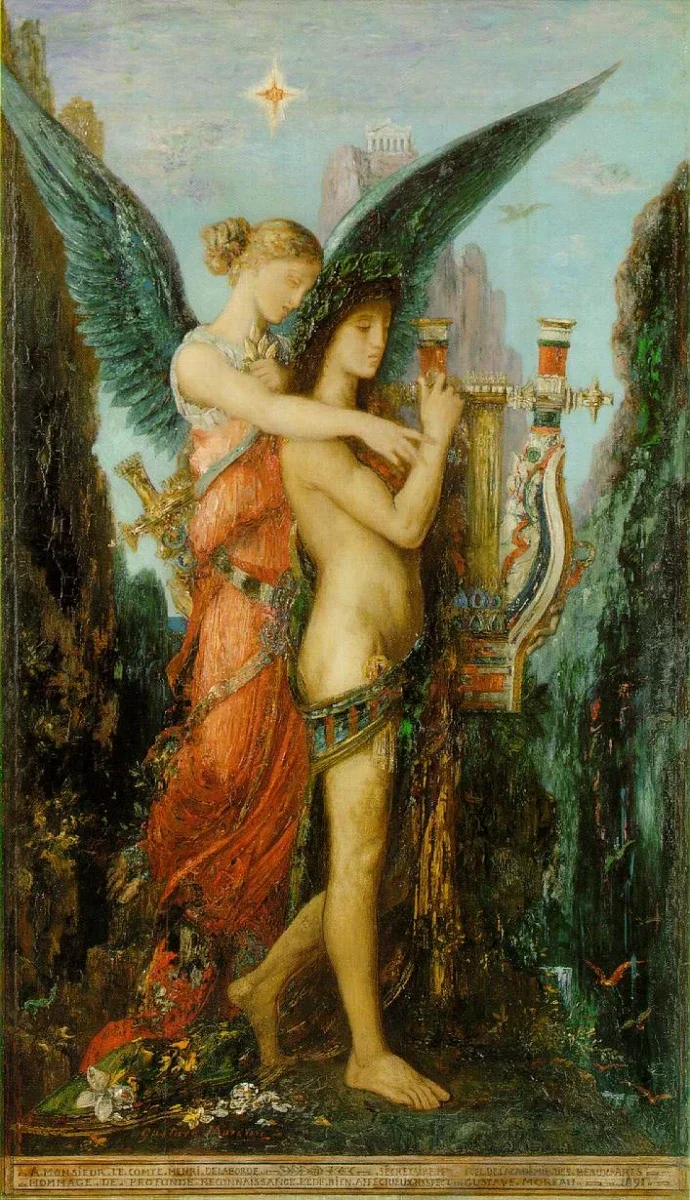
Text and translation
χαίρετε, τέκνα Διός, δότε δʼ ἱμερόεσσαν ἀοιδήν.
Hesiod · Theogony 104–115 · dactylic hexameters · text of Evelyn-White (Loeb, 1914)
How to read each line
A guide to the Greek, syllables, pitch marks and quantities.
Show the reading key
- Above each line: the line as the edition prints it, each word placed over its own syllables. The main row: the same Greek divided into metrical syllables, each written as it is pronounced. A consonant that closes a syllable is written with it (λόθ | ρο); an elided word is closed up with the next vowel (ν’ἀ); a final consonant carried into the next word is set with a thin space (ς ἰ). Wider gaps mark word-ends.
- Above the syllables: the pitch of each syllable, from the accents. Under them: the quantity of each syllable as it falls in the line, then the transliteration, syllable by syllable, with accented syllables in capitals.
- Under each line: a line-for-line translation. In the right margin of the scansion: the line type, its scheme, and its analysis into cola.
Key to the labels
The names, patterns and symbols used beside this poem.
Show the labels and symbols
The labels in the right margin of the scansion below name the line, its scheme, the feet as the line realises them, and the caesurae and diaereses (the named word-ends) that fall in it. In the scheme ⏔ is a biceps, two shorts that may be contracted to one long; ⏕ is a long that may be resolved into two shorts; × is an anceps, long or short. A click on any syllable highlights its metron or colon, or, with the switch, its foot.
| Label | Name and shape | What it is |
|---|---|---|
| hem1 | First hemiepes— ⏔ — ⏔ — | The first two and a half feet of the hexameter, up to the penthemimeral caesura; in the pentameter, its whole first half. |
| hem2 | Second half of the hexameter⏔ — ⏔ — ⏑ ⏑ — × | From the penthemimeral caesura to the line-end: the fifth foot is nearly always a dactyl, the sixth is — ×. |
The traditional feet
| Foot and shape | Where |
|---|---|
| First foot: dactyl or spondee— ⏔ | Scheme positions 1–2. The biceps (⏑ ⏑) may be contracted to a single long, making a spondee. |
| Second foot: dactyl or spondee— ⏔ | Scheme positions 3–4. |
| Third foot: dactyl or spondee— ⏔ | Scheme positions 5–6. The penthemimeral caesura falls after its first syllable, the “trochaic” caesura after its second. |
| Fourth foot: dactyl or spondee— ⏔ | Scheme positions 7–8. Word-end at the end of this foot, when it is a dactyl, is the bucolic diaeresis (West’s “bucolic caesura”: word-end at the end of the fourth foot after an uncontracted biceps)[8]. |
| Fifth foot: dactyl— ⏑ ⏑ | Scheme positions 9–10. A spondee here (a “spondaic line”) is rare. |
| Sixth foot— × | Scheme positions 11–12: a long and the indifferent final syllable. |
Scansion
The end of the proem: Hesiod greets the Muses and asks them to tell the story the poem will tell, from the first gods to the sharing of honours on Olympus. The last two lines take up the language of Homer’s invocation before the Catalogue of Ships.
Hail, children of Zeus; give me a song that stirs longing.
Celebrate the holy race of the immortals who are for ever,
those who were born from Earth and from starry Heaven
and from dark Night, and those whom the salt Sea reared.
Say how, at the first, the gods and the earth came to be,
and the rivers and the endless sea, raging in its swell,
and the gleaming stars and the wide heaven overhead,
[and the gods born from these, the givers of good things,]
and how they split their riches and parcelled out their privileges,
and how in the beginning they came to hold Olympus with its many ridges.
Tell me these things, Muses whose homes are on Olympus,
from their start, and say which of them was the first to come into being.
Metre
- The line. Six feet. Each of the first five is a dactyl (— ⏑ ⏑) or, with its two shorts contracted, a spondee (— —); the sixth is — ×.[9] West introduces it as the metre of Homer and Hesiod alike.[9] None of these twelve lines has a spondaic fifth foot, and four (104, 105, 110, 114) are all dactyls.
- Caesurae. Every line has a word-end in the third foot, after its long (masculine, or penthemimeral) or between its two shorts (feminine); West gives the proportion of feminine to masculine as about 4 : 3.[9] Here nine lines have the feminine caesura (106, 108–115) and three the masculine (104, 105, 107), counting prepositives with the word after them and postpositives with the word before.[8]
- Hermann’s Bridge (no word-end between the two shorts of the fourth biceps)[8] is kept in every line.
- Contracted bicipitia and the strict hexameter. Callimachus and Nonnus avoid word-end after a contracted second or fourth biceps (Hilberg’s and Naeke’s Laws)[10]. In these lines the syllable in those places is always a prepositive (καί in 108, 109, 115; the article τά in 108 and 113), which goes with the next word, so no word really ends there. Word-end after a contracted first biceps (106 Γῆς, 107 Νυκτός) is frequent in Homer too.[11]
- τὰ πρῶτα. In 108 and 113 the article τά, short by nature, fills a contracted biceps because the next word begins with πρ-. West says that lengthening by an initial stop + liquid is normally confined to the princeps,[12] and in a later study that exceptions seldom occur outside the first foot.[13] These two lines, both in the second foot, are such exceptions; the phrase ὡς τὰ πρῶτα fills the same place in both.
- Prosody. Elision;[14] epic correption of a final long vowel or diphthong before a vowel;[15] hiatus before a word that once began with ϝ (p. 23: εἰπεῖν, in 115); δν, which always makes position;[16] stop + liquid inside a word.[17]
- Vowel quantities. The vowels the metre alone makes long were checked in LSJ: ἱμερόεσσαν (104; s.v. ἵμερος), ἀθανάτων (105; LSJ says the first α of ἀθάνατος is always long, a metrical lengthening of a word that would otherwise begin with three shorts)[18], τιμάς (112). The α of ἐάων (111) must be long; LSJ records the form (s.v. ἐΰς) without marking it.
- Most’s text and apparatus. Compared with G. W. Most’s Loeb.[19] The words and line numbers are the same; only the punctuation differs. Most’s apparatus records that Goettling deleted 105–115 (adding that no line of the passage has escaped deletion or transposition by some scholar), that Ellger, Wilamowitz and others deleted 108–110, that 111 repeats line 46 and is missing from a papyrus, from manuscript B and from the quotations in Theophilus and Hippolytus, and that the ancient critics Seleucus and Aristarchus condemned 114–115 (Seleucus 114 and what follows, Aristarchus 115). The square brackets in the translation of 111 show that the line is suspect; the Greek is printed as Evelyn-White prints it.
Prosody, line by line
Every syllable, with the reason for its length. Quantities are read from the vowel where the spelling shows it, from the consonants that follow (“position”), from the accent where it tells, and from the metre where nothing else does. Editors’ notes on the text follow in the boxed paragraphs.
- 104
Line 104 · χαίρετε, τέκνα Διός, δότε δʼ ἱμερόεσσαν ἀοιδήν.
χαίρετε, τέκνα Διός, δότε δʼ ἱμερόεσσαν ἀοιδήν.
χαίρετε,τέκναΔιός,δότεδ’ἱμερόεσσαν ἀοιδήν.dactyl, dactyl, dactyl, dactyl, dactyl, — ×; penthemimeral caesura.
- 1 —χαίαί is a diphthong, long by nature.
- 2 ⏑ρεε is short by nature; one of the two shorts of the biceps at position 2.
- 3 ⏑τε,ε is short by nature; one of the two shorts of the biceps at position 2.
- 4 —τέκέ is short by nature; closed by κ before a nasal: stop + nasal makes position, as it usually does in epic.
- 5 ⏑ναα is short by the metre (position 4 must be short); one of the two shorts of the biceps at position 4.
- 6 ⏑Διι is short by the metre (position 4 must be short); one of the two shorts of the biceps at position 4.
- 7 —ός,ό is short by nature; closed by ς: long by position.
- 8 ⏑δόό is short by nature; one of the two shorts of the biceps at position 6.
- 9 ⏑τεε is short by nature; one of the two shorts of the biceps at position 6.
- 10 —δ’ἱι is long: LSJ marks ἵμερος with a long ι (s.v. ἵμερος), and ἱμερόεις is formed from it (s.v. ἱμερόεις); the apostrophe marks an elided vowel and the δ joins this syllable.
- 11 ⏑μεε is short by nature; one of the two shorts of the biceps at position 8.
- 12 ⏑ρόό is short by nature; one of the two shorts of the biceps at position 8.
- 13 —εσε is short by nature; closed by σ: long by position.
- 14 ⏑σαα is short by the accent rule: acute on the antepenult requires a short final syllable; one of the two shorts of the biceps at position 10.
- 15 ⏑ν ἀἀ is short by the metre (position 10 must be short); the first consonant belongs to the previous word and is carried over to this vowel; one of the two shorts of the biceps at position 10.
- 16 —οιοι is a diphthong, long by nature.
- 17 ×δήν.ή is long by nature; closed by ν: long by position; the position is anceps.
All five feet are dactyls. The κν of τέκνα makes position inside the word.[17] The caesura is penthemimeral, at the comma after Διός.[9] δ’ is elided.[14] The ι of ἱμερόεσσαν is long in the fourth princeps.[20] ἱμερόεσσαν runs across the fourth biceps, so Hermann’s Bridge is kept and there is no bucolic caesura.[8]- 105
Line 105 · κλείετε δʼ ἀθανάτων ἱερὸν γένος αἰὲν ἐόντων,
κλείετε δʼ ἀθανάτων ἱερὸν γένος αἰὲν ἐόντων,
κλείετεδ’ἀθανάτωνἱερὸνγένος αἰὲν ἐόντων,dactyl, dactyl, dactyl, dactyl, dactyl, — ×; penthemimeral caesura; hephthemimeral caesura; bucolic diaeresis.
- 1 —κλείεί is a diphthong, long by nature.
- 2 ⏑εε is short by nature; one of the two shorts of the biceps at position 2.
- 3 ⏑τεε is short by nature; one of the two shorts of the biceps at position 2.
- 4 —δ’ἀα is long: LSJ says the first α of ἀθάνατος is always long (s.v. ἀθάνατος), a metrical lengthening of a word with three short syllables in a row;[18] the apostrophe marks an elided vowel and the δ joins this syllable.
- 5 ⏑θαα is short by the metre (position 4 must be short); one of the two shorts of the biceps at position 4.
- 6 ⏑νάά is short by the metre (position 4 must be short); one of the two shorts of the biceps at position 4.
- 7 —τωνω is long by nature.
- 8 ⏑ἱἱ is short by the metre (position 6 must be short); one of the two shorts of the biceps at position 6.
- 9 ⏑εε is short by nature; one of the two shorts of the biceps at position 6.
- 10 —ρὸνὸ is short by nature; closed by ν: long by position.
- 11 ⏑γέέ is short by nature; one of the two shorts of the biceps at position 8.
- 12 ⏑νοο is short by nature; one of the two shorts of the biceps at position 8.
- 13 —ς αἰαἰ is a diphthong, long by nature; the first consonant belongs to the previous word and is carried over to this vowel.
- 14 ⏑ὲὲ is short by nature; one of the two shorts of the biceps at position 10.
- 15 ⏑ν ἐἐ is short by nature; the first consonant belongs to the previous word and is carried over to this vowel; one of the two shorts of the biceps at position 10.
- 16 —όνό is short by nature; closed by ν: long by position.
- 17 ×των,ω is long by nature; closed by ν: long by position; the position is anceps.
All five feet are dactyls. δ’ is elided.[14] The first α of ἀθανάτων is long in the second princeps: LSJ says it is always long in this word (s.v. ἀθάνατος), a metrical lengthening of a word that would otherwise begin with three shorts.[18] The caesura is penthemimeral, after ἀθανάτων, with a hephthemimeral word-end after ἱερόν.[9] Word-end after γένος, whose ς passes to αἰέν, is the bucolic caesura.[8]- 106
Line 106 · οἳ Γῆς τʼ ἐξεγένοντο καὶ Οὐρανοῦ ἀστερόεντος,
οἳ Γῆς τʼ ἐξεγένοντο καὶ Οὐρανοῦ ἀστερόεντος,
οἳΓῆςτ’ἐξεγένοντοκαὶΟὐρανοῦἀστερόεντος,spondee, dactyl, dactyl, dactyl, dactyl, — ×; caesura after the third trochee; bucolic diaeresis.
- 1 —οἳοἳ is a diphthong, long by nature.
- 2 —Γῆςῆ is long by nature; closed by ς: long by position; a single long contracts the two shorts of the biceps at position 2.
- 3 —τ’ἐἐ is short by nature; ξ is a double consonant (two sounds) and closes the syllable: long by position; the apostrophe marks an elided vowel; the consonant before it joins this syllable.
- 4 ⏑ξεε is short by nature; one of the two shorts of the biceps at position 4.
- 5 ⏑γέέ is short by nature; one of the two shorts of the biceps at position 4.
- 6 —νονο is short by nature; closed by ν: long by position.
- 7 ⏑τοο is short by nature; one of the two shorts of the biceps at position 6.
- 8 ⏑καὶαὶ is a diphthong, long by nature; shortened before the vowel that begins the next word (epic correption), as the metre requires; one of the two shorts of the biceps at position 6.
- 9 —ΟὐΟὐ is a diphthong, long by nature.
- 10 ⏑ραα is short by the metre (position 8 must be short); one of the two shorts of the biceps at position 8.
- 11 ⏑νοῦοῦ is a diphthong, long by nature; shortened before the vowel that begins the next word (epic correption), as the metre requires; one of the two shorts of the biceps at position 8.
- 12 —ἀσἀ is a vowel of unknown length; closed by σ: long by position.
- 13 ⏑τεε is short by nature; one of the two shorts of the biceps at position 10.
- 14 ⏑ρόό is short by nature; one of the two shorts of the biceps at position 10.
- 15 —ενε is short by nature; closed by ν: long by position.
- 16 ×τος,ο is short by nature; closed by ς: long by position; the position is anceps.
A spondee and four dactyls. Γῆς ends after the contracted first biceps.[11] τ’ is elided;[14] the ξ of ἐξεγένοντο counts as two consonants.[21] ἐξεγένοντο ends between the shorts of the third foot, a feminine caesura.[9] καί is shortened before Οὐρανοῦ, and -νοῦ before ἀστερόεντος, by epic correption.[15] Word-end after Οὐρανοῦ is the bucolic caesura.[8]- 107
Line 107 · Νυκτός τε δνοφερῆς, οὕς θʼ ἁλμυρὸς ἔτρεφε Πόντος.
Νυκτός τε δνοφερῆς, οὕς θʼ ἁλμυρὸς ἔτρεφε Πόντος.
Νυκτόςτεδνοφερῆς,οὕςθ’ἁλμυρὸς ἔτρεφεΠόντος.spondee, dactyl, spondee, dactyl, dactyl, — ×; penthemimeral caesura; bucolic diaeresis.
- 1 —Νυκυ is a vowel of unknown length; closed by κ: long by position.
- 2 —τόςό is short by nature; closed by ς: long by position; a single long contracts the two shorts of the biceps at position 2.
- 3 —τεε is short by nature; the next word begins with δν: the syllable is closed before it: long by position; δν is one of the four clusters (γμ, γν, δμ, δν) that never leave the syllable before them short.[16]
- 4 ⏑δνοο is short by nature; one of the two shorts of the biceps at position 4.
- 5 ⏑φεε is short by nature; one of the two shorts of the biceps at position 4.
- 6 —ρῆς,ῆ is long by nature.
- 7 —οὕςοὕ is a diphthong, long by nature; closed by ς: long by position; a single long contracts the two shorts of the biceps at position 6.
- 8 —θ’ἁλἁ is a vowel of unknown length; closed by λ: long by position; the apostrophe marks an elided vowel; the consonant before it joins this syllable.
- 9 ⏑μυυ is short by the metre (position 8 must be short); one of the two shorts of the biceps at position 8.
- 10 ⏑ρὸὸ is short by nature; one of the two shorts of the biceps at position 8.
- 11 —ς ἔτἔ is short by nature; closed by τ before a liquid: stop + liquid makes position, as it usually does in epic; the first consonant belongs to the previous word and is carried over to this vowel.
- 12 ⏑ρεε is short by nature; one of the two shorts of the biceps at position 10.
- 13 ⏑φεε is short by nature; one of the two shorts of the biceps at position 10.
- 14 —Πόνό is short by nature; closed by ν: long by position.
- 15 ×τος.ο is short by nature; closed by ς: long by position; the position is anceps.
A spondee, a dactyl, a spondee and two dactyls. Νυκτός ends after the contracted first biceps.[11] τε is long in the second princeps before δν-: δν is one of the clusters that always make position.[16] The caesura is penthemimeral, after δνοφερῆς.[9] οὕς fills the contracted third biceps; θ’ is elided.[14] Word-end after ἁλμυρός is the bucolic caesura.[8]- 108
Line 108 · εἴπατε δʼ, ὡς τὰ πρῶτα θεοὶ καὶ γαῖα γένοντο
εἴπατε δʼ, ὡς τὰ πρῶτα θεοὶ καὶ γαῖα γένοντο
εἴπατεδ’,ὡςτὰπρῶταθεοὶκαὶγαῖαγένοντοdactyl, spondee, dactyl, spondee, dactyl, — ×; caesura after the third trochee; hephthemimeral caesura; word-end after a spondaic fourth foot.
- 1 —εἴεἴ is a diphthong, long by nature.
- 2 ⏑παα is short by the metre (position 2 must be short); one of the two shorts of the biceps at position 2.
- 3 ⏑τεε is short by nature; one of the two shorts of the biceps at position 2.
- 4 —δ’,ὡςὡ is long by nature; closed by ς: long by position; the apostrophe marks an elided vowel; the consonant before it joins this syllable.
- 5 —τὰα is short by nature, but the syllable is long before the initial πρ- of πρῶτα and fills a contracted biceps (position 4); lengthening by an initial stop + liquid normally stands in the princeps and is seldom found in a biceps outside the first foot.[22]
- 6 —πρῶῶ is long by nature.
- 7 ⏑ταα is short by the accent rule: circumflex on the penult requires a short final syllable; one of the two shorts of the biceps at position 6.
- 8 ⏑θεε is short by nature; one of the two shorts of the biceps at position 6.
- 9 —οὶοὶ is a diphthong, long by nature.
- 10 —καὶαὶ is a diphthong, long by nature; a single long contracts the two shorts of the biceps at position 8.
- 11 —γαῖαῖ is a diphthong, long by nature.
- 12 ⏑αα is short by the accent rule: circumflex on the penult requires a short final syllable; one of the two shorts of the biceps at position 10.
- 13 ⏑γέέ is short by nature; one of the two shorts of the biceps at position 10.
- 14 —νονο is short by nature; closed by ν: long by position.
- 15 ×τοο is short by nature; the position is anceps.
A dactyl, a spondee, a dactyl, a spondee and a dactyl. δ’ is elided.[14] τά fills the contracted second biceps: it is long before the πρ- of πρῶτα, a lengthening West finds normally in the princeps and seldom in a biceps outside the first foot.[22] As the article it goes with πρῶτα.[8] πρῶτα ends between the shorts of the third foot, a feminine caesura,[9] with a hephthemimeral word-end after θεοί. καί fills the contracted fourth biceps but goes with γαῖα as a prepositive.[8]- 109
Line 109 · καὶ ποταμοὶ καὶ πόντος ἀπείριτος, οἴδματι θυίων,
καὶ ποταμοὶ καὶ πόντος ἀπείριτος, οἴδματι θυίων,
καὶποταμοὶκαὶπόντος ἀπείριτο,ς οἴδματιθυίων,dactyl, spondee, dactyl, dactyl, dactyl, — ×; caesura after the third trochee; bucolic diaeresis.
- 1 —καὶαὶ is a diphthong, long by nature.
- 2 ⏑ποο is short by nature; one of the two shorts of the biceps at position 2.
- 3 ⏑ταα is short by the metre (position 2 must be short); one of the two shorts of the biceps at position 2.
- 4 —μοὶοὶ is a diphthong, long by nature.
- 5 —καὶαὶ is a diphthong, long by nature; a single long contracts the two shorts of the biceps at position 4.
- 6 —πόνό is short by nature; closed by ν: long by position.
- 7 ⏑τοο is short by nature; one of the two shorts of the biceps at position 6.
- 8 ⏑ς ἀἀ is short by the metre (position 6 must be short); the first consonant belongs to the previous word and is carried over to this vowel; one of the two shorts of the biceps at position 6.
- 9 —πείεί is a diphthong, long by nature.
- 10 ⏑ριι is short by the metre (position 8 must be short); one of the two shorts of the biceps at position 8.
- 11 ⏑το,ο is short by nature; one of the two shorts of the biceps at position 8.
- 12 —ς οἴδοἴ is a diphthong, long by nature; closed by δ: long by position; δμ is one of the four clusters (γμ, γν, δμ, δν) that never leave the syllable before them short;[16] the first consonant belongs to the previous word and is carried over to this vowel.
- 13 ⏑μαα is short by the metre (position 10 must be short); one of the two shorts of the biceps at position 10.
- 14 ⏑τιι is short by the accent rule: acute on the antepenult requires a short final syllable; one of the two shorts of the biceps at position 10.
- 15 —θυίυί is a diphthong, long by nature.
- 16 ×ων,ω is long by nature; closed by ν: long by position; the position is anceps.
A dactyl, a spondee and three dactyls. καί fills the contracted second biceps and goes with πόντος.[8] The ς of πόντος passes to ἀπείριτος, and πόντος ends between the shorts of the third foot, a feminine caesura.[9] Word-end at the comma after ἀπείριτος is the bucolic caesura.[8] The δμ of οἴδματι always makes position.[16] LSJ cites this line s.v. ἀπείριτος.- 110
Line 110 · ἄστρα τε λαμπετόωντα καὶ οὐρανὸς εὐρὺς ὕπερθεν
ἄστρα τε λαμπετόωντα καὶ οὐρανὸς εὐρὺς ὕπερθεν
ἄστρατελαμπετόωντακαὶοὐρανὸς εὐρὺς ὕπερθενdactyl, dactyl, dactyl, dactyl, dactyl, — ×; caesura after the third trochee; bucolic diaeresis.
- 1 —ἄσἄ is a vowel of unknown length; closed by σ: long by position.
- 2 ⏑τραα is short by the metre (position 2 must be short); one of the two shorts of the biceps at position 2.
- 3 ⏑τεε is short by nature; one of the two shorts of the biceps at position 2.
- 4 —λαμα is a vowel of unknown length; closed by μ: long by position.
- 5 ⏑πεε is short by nature; one of the two shorts of the biceps at position 4.
- 6 ⏑τόό is short by nature; one of the two shorts of the biceps at position 4.
- 7 —ωνω is long by nature; closed by ν: long by position.
- 8 ⏑ταα is short by the accent rule: acute on the antepenult requires a short final syllable; one of the two shorts of the biceps at position 6.
- 9 ⏑καὶαὶ is a diphthong, long by nature; shortened before the vowel that begins the next word (epic correption), as the metre requires; one of the two shorts of the biceps at position 6.
- 10 —οὐοὐ is a diphthong, long by nature.
- 11 ⏑ραα is short by the metre (position 8 must be short); one of the two shorts of the biceps at position 8.
- 12 ⏑νὸὸ is short by nature; one of the two shorts of the biceps at position 8.
- 13 —ς εὐεὐ is a diphthong, long by nature; the first consonant belongs to the previous word and is carried over to this vowel.
- 14 ⏑ρὺὺ is short by the metre (position 10 must be short); one of the two shorts of the biceps at position 10.
- 15 ⏑ς ὕὕ is short by the metre (position 10 must be short); the first consonant belongs to the previous word and is carried over to this vowel; one of the two shorts of the biceps at position 10.
- 16 —περε is short by nature; closed by ρ: long by position.
- 17 ×θενε is short by nature; closed by ν: long by position; the position is anceps.
All five feet are dactyls. The σ of ἄστρα closes the first syllable and τρ- begins the second.[23] λαμπετόωντα ends between the shorts of the third foot, a feminine caesura.[9] καί is shortened before οὐρανός by correption.[15] Word-end after οὐρανός, whose ς passes to εὐρύς, is the bucolic caesura.[8]- 111
Line 111 · οἵ τʼ ἐκ τῶν ἐγένοντο θεοί, δωτῆρες ἐάων
οἵ τʼ ἐκ τῶν ἐγένοντο θεοί, δωτῆρες ἐάων
οἵτ’ἐκτῶνἐγένοντοθεοί,δωτῆρες ἐάωνspondee, dactyl, dactyl, spondee, dactyl, — ×; caesura after the third trochee; hephthemimeral caesura.
- 1 —οἵοἵ is a diphthong, long by nature.
- 2 —τ’ἐκἐ is short by nature; closed by κ: long by position; the apostrophe marks an elided vowel; the consonant before it joins this syllable; a single long contracts the two shorts of the biceps at position 2.
- 3 —τῶνῶ is long by nature.
- 4 ⏑ἐἐ is short by nature; one of the two shorts of the biceps at position 4.
- 5 ⏑γέέ is short by nature; one of the two shorts of the biceps at position 4.
- 6 —νονο is short by nature; closed by ν: long by position.
- 7 ⏑τοο is short by nature; one of the two shorts of the biceps at position 6.
- 8 ⏑θεε is short by nature; one of the two shorts of the biceps at position 6.
- 9 —οί,οί is a diphthong, long by nature.
- 10 —δωω is long by nature; a single long contracts the two shorts of the biceps at position 8.
- 11 —τῆῆ is long by nature.
- 12 ⏑ρεε is short by nature; one of the two shorts of the biceps at position 10.
- 13 ⏑ς ἐἐ is short by nature; the first consonant belongs to the previous word and is carried over to this vowel; one of the two shorts of the biceps at position 10.
- 14 —άα must be long to fill the sixth princeps; LSJ (s.v. ἐΰς) records the form ἑάων but marks no quantity.
- 15 ×ωνω is long by nature; closed by ν: long by position; the position is anceps.
A spondee, two dactyls, a spondee and a dactyl. τ’ is elided;[14] ἐκ ends after the contracted first biceps, but as a preposition it goes with τῶν.[24] ἐγένοντο ends between the shorts of the third foot, a feminine caesura,[9] with a hephthemimeral word-end at the comma after θεοί. The α of ἐάων must be long in the sixth princeps; LSJ records the form (s.v. ἐΰς) without marking its quantity. Most notes that this line repeats line 46 and is missing from a papyrus, a manuscript and two ancient quotations.[25]- 112
Line 112 · ὥς τʼ ἄφενος δάσσαντο καὶ ὡς τιμὰς διέλοντο
ὥς τʼ ἄφενος δάσσαντο καὶ ὡς τιμὰς διέλοντο
ὥςτ’ἄφενοςδάσσαντοκαὶὡςτιμὰςδιέλοντοdactyl, spondee, dactyl, spondee, dactyl, — ×; caesura after the third trochee; hephthemimeral caesura.
- 1 —ὥςὥ is long by nature; closed by ς: long by position.
- 2 ⏑τ’ἄἄ is short by the metre (position 2 must be short); the apostrophe marks an elided vowel; the consonant before it joins this syllable; one of the two shorts of the biceps at position 2.
- 3 ⏑φεε is short by nature; one of the two shorts of the biceps at position 2.
- 4 —νοςο is short by nature; closed by ς: long by position.
- 5 —δάσά is a vowel of unknown length; closed by σ: long by position; a single long contracts the two shorts of the biceps at position 4.
- 6 —σανα is a vowel of unknown length; closed by ν: long by position.
- 7 ⏑τοο is short by nature; one of the two shorts of the biceps at position 6.
- 8 ⏑καὶαὶ is a diphthong, long by nature; shortened before the vowel that begins the next word (epic correption), as the metre requires; one of the two shorts of the biceps at position 6.
- 9 —ὡςὡ is long by nature; closed by ς: long by position.
- 10 —τιι is long by nature;[26] a single long contracts the two shorts of the biceps at position 8.
- 11 —μὰςὰ is a vowel of unknown length; closed by ς: long by position.
- 12 ⏑διι is short by the metre (position 10 must be short); one of the two shorts of the biceps at position 10.
- 13 ⏑έέ is short by nature; one of the two shorts of the biceps at position 10.
- 14 —λονο is short by nature; closed by ν: long by position.
- 15 ×τοο is short by nature; the position is anceps.
A dactyl, a spondee, a dactyl, a spondee and a dactyl. τ’ is elided.[14] δάσσαντο ends between the shorts of the third foot, a feminine caesura.[9] καί is shortened before ὡς by correption.[15] ὡς, a conjunction, goes with what follows, so the word-end after the fourth princeps is not a real caesura.[8] The ι of τιμάς is long and fills the contracted fourth biceps;[26] the word runs on into the fifth foot.- 113
Line 113 · ἠδὲ καὶ ὡς τὰ πρῶτα πολύπτυχον ἔσχον Ὄλυμπον.
ἠδὲ καὶ ὡς τὰ πρῶτα πολύπτυχον ἔσχον Ὄλυμπον.
ἠδὲκαὶὡςτὰπρῶταπολύπτυχον ἔσχον Ὄλυμπον.dactyl, spondee, dactyl, dactyl, dactyl, — ×; caesura after the third trochee; bucolic diaeresis.
- 1 —ἠἠ is long by nature.
- 2 ⏑δὲὲ is short by nature; one of the two shorts of the biceps at position 2.
- 3 ⏑καὶαὶ is a diphthong, long by nature; shortened before the vowel that begins the next word (epic correption), as the metre requires; one of the two shorts of the biceps at position 2.
- 4 —ὡςὡ is long by nature; closed by ς: long by position.
- 5 —τὰα is short by nature, but the syllable is long before the initial πρ- of πρῶτα and fills a contracted biceps (position 4), as in line 108.[22]
- 6 —πρῶῶ is long by nature.
- 7 ⏑ταα is short by the accent rule: circumflex on the penult requires a short final syllable; one of the two shorts of the biceps at position 6.
- 8 ⏑ποο is short by nature; one of the two shorts of the biceps at position 6.
- 9 —λύπύ is a vowel of unknown length; closed by π: long by position.
- 10 ⏑τυυ is short by the metre (position 8 must be short); one of the two shorts of the biceps at position 8.
- 11 ⏑χοο is short by nature; one of the two shorts of the biceps at position 8.
- 12 —ν ἔσἔ is short by nature; closed by σ: long by position; the first consonant belongs to the previous word and is carried over to this vowel.
- 13 ⏑χοο is short by nature; one of the two shorts of the biceps at position 10.
- 14 ⏑ν ὌὌ is short by nature; the first consonant belongs to the previous word and is carried over to this vowel; one of the two shorts of the biceps at position 10.
- 15 —λυμυ is a vowel of unknown length; closed by μ: long by position.
- 16 ×πον.ο is short by nature; closed by ν: long by position; the position is anceps.
A dactyl, a spondee and three dactyls. καί is shortened before ὡς by correption.[15] τά again fills the contracted second biceps before the πρ- of πρῶτα, as in 108.[22] πρῶτα ends between the shorts of the third foot, a feminine caesura.[9] Word-end after πολύπτυχον, whose ν passes to ἔσχον, is the bucolic caesura.[8]- 114
Line 114 · ταῦτά μοι ἔσπετε Μοῦσαι, Ὀλύμπια δώματʼ ἔχουσαι
ταῦτά μοι ἔσπετε Μοῦσαι, Ὀλύμπια δώματʼ ἔχουσαι
ταῦτάμοιἔσπετεΜοῦσαι,Ὀλύμπιαδώματ’ἔχουσαιdactyl, dactyl, dactyl, dactyl, dactyl, — ×; caesura after the third trochee; bucolic diaeresis.
- 1 —ταῦαῦ is a diphthong, long by nature.
- 2 ⏑τάά is short by the accent rule: circumflex on the penult requires a short final syllable; one of the two shorts of the biceps at position 2.
- 3 ⏑μοιοι is a diphthong, long by nature; shortened before the vowel that begins the next word (epic correption), as the metre requires; one of the two shorts of the biceps at position 2.
- 4 —ἔσἔ is short by nature; closed by σ: long by position.
- 5 ⏑πεε is short by nature; one of the two shorts of the biceps at position 4.
- 6 ⏑τεε is short by nature; one of the two shorts of the biceps at position 4.
- 7 —Μοῦοῦ is a diphthong, long by nature.
- 8 ⏑σαι,αι is a diphthong, long by nature; shortened before the vowel that begins the next word (epic correption), as the metre requires; one of the two shorts of the biceps at position 6.
- 9 ⏑ὈὈ is short by nature; one of the two shorts of the biceps at position 6.
- 10 —λύμύ is a vowel of unknown length; closed by μ: long by position.
- 11 ⏑πιι is short by the metre (position 8 must be short); one of the two shorts of the biceps at position 8.
- 12 ⏑αα is short by the accent rule: acute on the antepenult requires a short final syllable; one of the two shorts of the biceps at position 8.
- 13 —δώώ is long by nature.
- 14 ⏑μαα is short by the metre (position 10 must be short); one of the two shorts of the biceps at position 10.
- 15 ⏑τ’ἔἔ is short by nature; the apostrophe marks an elided vowel; the consonant before it joins this syllable; one of the two shorts of the biceps at position 10.
- 16 —χουου is a diphthong, long by nature.
- 17 ×σαιαι is a diphthong, long by nature; the position is anceps.
All five feet are dactyls. μοι is an enclitic going with ταῦτα[8] and is shortened before ἔσπετε by correption.[15] Μοῦσαι ends between the shorts of the third foot, a feminine caesura,[9] and its -αι is shortened before Ὀλύμπια.[15] Word-end after Ὀλύμπια is the bucolic caesura.[8] δώματ’ is elided.[14] From the caesura on, the line is the same as Iliad 2.484.- 115
Line 115 · ἐξ ἀρχῆς, καὶ εἴπαθʼ, ὅ τι πρῶτον γένετʼ αὐτῶν.
ἐξ ἀρχῆς, καὶ εἴπαθʼ, ὅ τι πρῶτον γένετʼ αὐτῶν.
ἐξἀρχῆς,καὶεἴπαθ’,ὅτιπρῶτονγένετ’αὐτῶν.spondee, spondee, dactyl, spondee, dactyl, — ×; caesura after the third trochee (with elision); hephthemimeral caesura.
- 1 —ἐξἐ is short by nature; ξ is a double consonant (two sounds) and closes the syllable: long by position.
- 2 —ἀρἀ is a vowel of unknown length; closed by ρ: long by position; a single long contracts the two shorts of the biceps at position 2.
- 3 —χῆς,ῆ is long by nature; closed by ς: long by position.
- 4 —καὶαι is a diphthong, long by nature, and keeps its length before εἴπαθ’: εἰπεῖν once began with ϝ;[27] a single long contracts the two shorts of the biceps at position 4.
- 5 —εἴεἴ is a diphthong, long by nature.
- 6 ⏑παα is short by the metre (position 6 must be short); one of the two shorts of the biceps at position 6.
- 7 ⏑θ’,ὅὅ is short by nature; the apostrophe marks an elided vowel; the consonant before it joins this syllable; one of the two shorts of the biceps at position 6.
- 8 —τιι is a vowel of unknown length; the next word begins with πρ: the syllable is closed before it: long by position.
- 9 —πρῶῶ is long by nature; a single long contracts the two shorts of the biceps at position 8.
- 10 —τονο is short by nature; closed by ν: long by position.
- 11 ⏑γέέ is short by nature; one of the two shorts of the biceps at position 10.
- 12 ⏑νεε is short by nature; one of the two shorts of the biceps at position 10.
- 13 —τ’αὐαὐ is a diphthong, long by nature; the apostrophe marks an elided vowel; the consonant before it joins this syllable.
- 14 ×τῶν.ῶ is long by nature; closed by ν: long by position; the position is anceps.
Two spondees, a dactyl, a spondee and a dactyl. ἀρχῆς ends after the second princeps. καί fills the contracted second biceps and keeps its length before εἴπαθ’: εἰπεῖν once began with ϝ,[27] and hiatus after καί is rare except before such words.[16] εἴπαθ’ (for εἴπατε) is elided and ends between the shorts of the third foot, a feminine caesura.[28] The last syllable of ὅ τι is long in the fourth princeps before the πρ- of πρῶτον.[12] γένετ’ is elided before αὐτῶν.
What the input marks
The text is Evelyn-White’s, with his elision marks, checked letter by letter against the Perseus file. The input adds no marks; the page explains the long syllables the scanner cannot account for itself (ἱμερόεσσαν, ἀθανάτων, τὰ πρῶτα twice, ἐάων, τιμάς, the hiatus after καί in 115).
Homer’s invocation in Hesiod
Line 114 ends Μοῦσαι, Ὀλύμπια δώματ’ ἔχουσαι, the same words in the same place as Homer’s call to the Muses before the Catalogue of Ships (Iliad 2.484)[29], and in both lines Μοῦσαι ends at the feminine caesura. West notes that the two halves of the hexameter are its real units and that many repeated phrases of epic are made to fill one of them.[9]
Notes
- ^ Kelly 2022, p. 35.
- ^ Graziosi and Haubold 2009, p. 100.
- ^ Evelyn-White 1914, pp. xx–xxi.
- ^ Most 2018, pp. x–xi.
- ^ Evelyn-White 1914, pp. xxv–xxvi.
- ^ Most 2018, pp. xxii–xxiv.
- ^ Most 2018, p. xxiv.
- ^ a b c d e f g h i j k l m n o p West 1987, p. 21.
- ^ a b c d e f g h i j k l m n o West 1987, p. 19.
- ^ Maas 1962, p. 62, § 92; West 1987, p. 78.
- ^ a b c West 1987, p. 20.
- ^ a b West 1987, p. 22.
- ^ West 2018, p. 369.
- ^ a b c d e f g h i West 1987, p. 13.
- ^ a b c d e f g West 1987, p. 14.
- ^ a b c d e f West 1987, p. 16.
- ^ a b West 1987, pp. 16–17.
- ^ a b c West 2018, p. 364.
- ^ Most 2018, pp. 10–11.
- ^ LSJ s.v. ἵμερος.
- ^ West 1987, p. 12.
- ^ a b c d West 1987, pp. 16, 22; West 2018, p. 369.
- ^ West 1987, pp. 12, 16.
- ^ West 1987, pp. 20–21.
- ^ Most 2018, p. 10.
- ^ a b LSJ s.v. τιμή.
- ^ a b West 1987, p. 23.
- ^ West 1987, pp. 13, 19.
- ^ See the Homer page.
Text and sources
- Text: Hesiod, Theogony, ed. H. G. Evelyn-White, Hesiod, the Homeric Hymns and Homerica (Loeb Classical Library, 1914), from the Perseus Digital Library (urn:cts:greekLit:tlg0020.tlg001.perseus-grc2), licensed CC BY-SA 4.0 (the licence of the Perseus repository).
- M. L. West, Introduction to Greek Metre (Oxford 1987): p. 12 (syllables, double consonants), pp. 13–17 (elision, correption, hiatus, stop + liquid), p. 19 (the hexameter, its caesurae and cola), p. 20 (contraction; a photograph of pp. 20–21), pp. 21–23 (Hermann’s Bridge, appositives, licences, digamma), p. 78 (Naeke’s Law). Cited as “West 1987”.
- M. L. West, “Unmetrical Verses in Homer”, in D. Gunkel and O. Hackstein (eds), Language and Meter (Leiden 2018), ch. 14, p. 364 (metrical lengthening, ἀθάνατος), p. 369 (initial stop + liquid in the biceps). Cited as “West 2018”.
- P. Maas, Greek Metre, trans. H. Lloyd-Jones (Oxford 1962; 1972 reprint): p. 62 (§ 92, Naeke’s and Hilberg’s Laws). Cited as “Maas 1962”.
- H. G. Liddell and R. Scott, A Greek-English Lexicon, revised by H. S. Jones with R. McKenzie (Oxford 1940), in the Perseus Digital Library edition (CC BY-SA 4.0), for vowel quantities: s.vv. ἵμερος, ἀθάνατος, τιμή, ἐΰς, ἀπείριτος. Cited as “LSJ”.
- Translation: metrehelp.org, CC BY-SA 4.0.
- Compared with: G. W. Most (ed. and trans.), Hesiod I: Theogony, Works and Days, Testimonia (Loeb Classical Library 57, revised ed., Cambridge, MA 2018), pp. 10–11 (text and apparatus of Theogony 89–115).
Quotations from copyrighted works are not covered by this page’s licence.
Works and Days 1–26 — Zeus and the two Strifes
Synopsis
The Works and Days is roughly 800 lines long.[1] It describes life as it is now, in the age of iron. It is addressed to the poet’s brother Perses, and Ascra, where both live, is its setting.[2] It begins with the two Strifes, Pandora, the Five Ages and the fable of the hawk and the nightingale. It moves on to advice on farming and seafaring, precepts for daily life, and a calendar of lucky and unlucky days. Evelyn-White saw its aim as moral: to show how best to live in a hard world.[3] Its date is uncertain. Herodotus put Homer and Hesiod four hundred years before his own time. Evelyn-White set the poem in the mid-ninth century BC. Lines 654–662 name an Amphidamas. Many critics identify him with a hero of the Lelantine War who died about 705 BC, and so have rejected those lines as too late for Hesiod.[4] Most uses those lines in sketching Hesiod’s life (a victory in a poetic contest at Chalcis). He guesses the late eighth or very early seventh century BC, though certainty is impossible.[5]
Scanned here are lines 1–26. They begin with the opening hymn to Zeus, who raises and humbles men at will.[6] Then come the first words to Perses. Last come the two kinds of Strife: the one that breeds war, and the one that drives even the idle to work.
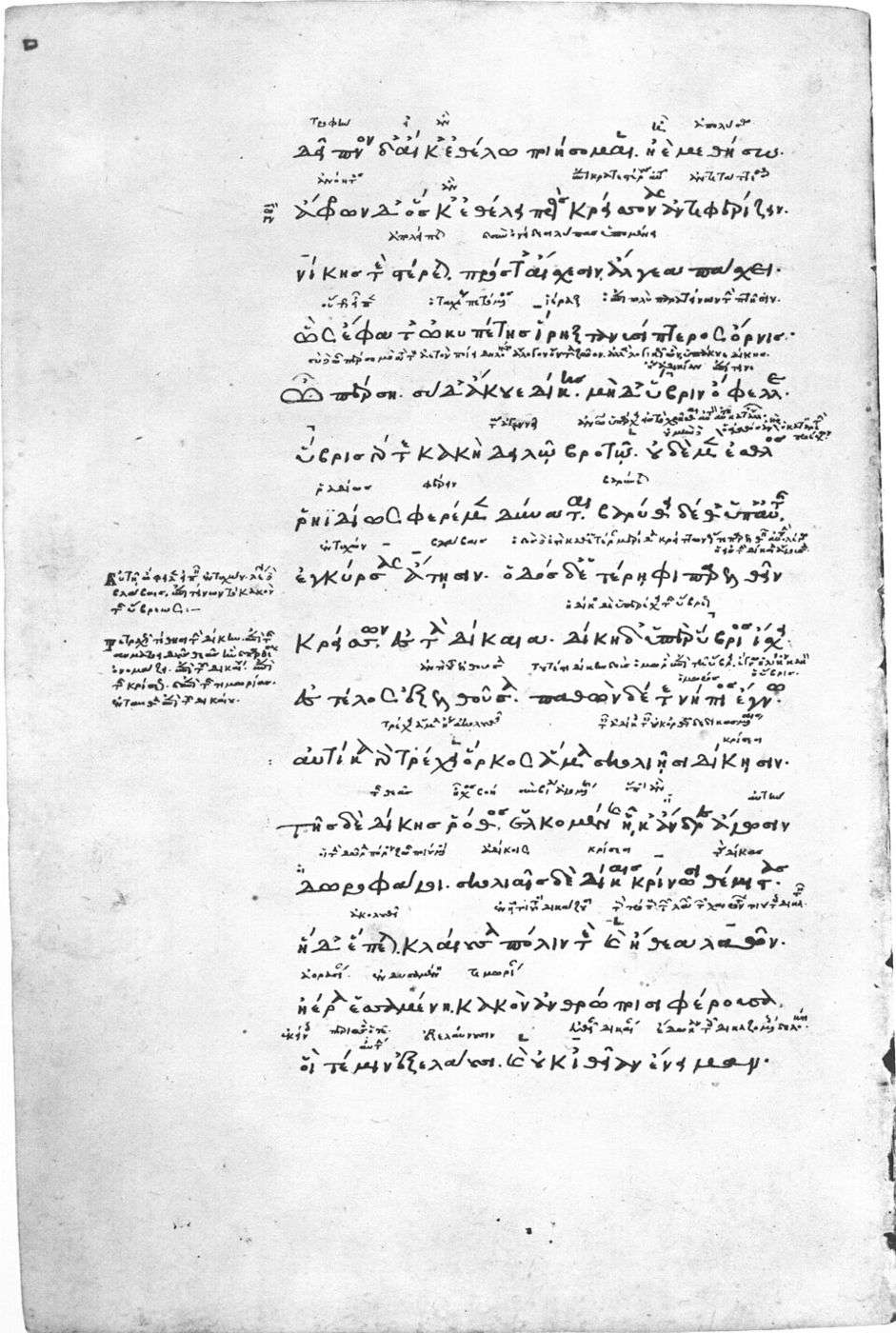
Text and translation
μοῦσαι Πιερίηθεν ἀοιδῇσιν κλείουσαι
Hesiod · Works and Days 1–26 · dactylic hexameters · text of H. G. Evelyn-White (Loeb, 1914)
How to read each line
A guide to the Greek, syllables, pitch marks and quantities.
Show the reading key
- Above each line: the line as the edition prints it, each word placed over its own syllables. The main row: the same Greek divided into metrical syllables, each written as it is pronounced. A consonant that closes a syllable is written with it (λόθ | ρο); an elided word is closed up with the next vowel (ν’ἀ); a final consonant carried into the next word is set with a thin space (ς ἰ). Wider gaps mark word-ends.
- Above the syllables: the pitch of each syllable, from the accents. Under them: the quantity of each syllable as it falls in the line, then the transliteration, syllable by syllable, with accented syllables in capitals.
- Under each line: a line-for-line translation. In the right margin of the scansion: the line type, its scheme, and its analysis into cola.
Key to the labels
The names, patterns and symbols used beside this poem.
Show the labels and symbols
The labels in the right margin of the scansion below name the line, its scheme, the feet as the line realises them, and the caesurae and diaereses (the named word-ends) that fall in it. In the scheme ⏔ is a biceps, two shorts that may be contracted to one long; ⏕ is a long that may be resolved into two shorts; × is an anceps, long or short. A click on any syllable highlights its metron or colon, or, with the switch, its foot.
| Label | Name and shape | What it is |
|---|---|---|
| hem1 | First hemiepes— ⏔ — ⏔ — | The first two and a half feet of the hexameter, up to the penthemimeral caesura; in the pentameter, its whole first half. |
| hem2 | Second half of the hexameter⏔ — ⏔ — ⏑ ⏑ — × | From the penthemimeral caesura to the line-end: the fifth foot is nearly always a dactyl, the sixth is — ×. |
The traditional feet
| Foot and shape | Where |
|---|---|
| First foot: dactyl or spondee— ⏔ | Scheme positions 1–2. The biceps (⏑ ⏑) may be contracted to a single long, making a spondee. |
| Second foot: dactyl or spondee— ⏔ | Scheme positions 3–4. |
| Third foot: dactyl or spondee— ⏔ | Scheme positions 5–6. The penthemimeral caesura falls after its first syllable, the “trochaic” caesura after its second. |
| Fourth foot: dactyl or spondee— ⏔ | Scheme positions 7–8. Word-end at the end of this foot, when it is a dactyl, is the bucolic diaeresis (West’s “bucolic caesura”: word-end at the end of the fourth foot after an uncontracted biceps)[7]. |
| Fifth foot: dactyl— ⏑ ⏑ | Scheme positions 9–10. A spondee here (a “spondaic line”) is rare. |
| Sixth foot— × | Scheme positions 11–12: a long and the indifferent final syllable. |
Scansion
The hymn to Zeus that opens the Works and Days, and the two kinds of Strife, scanned foot by foot: each syllable’s quantity and the reason for it, the feet, the caesurae, and a note on every line naming its prosodic licences.
Muses from Pieria, who give glory in song,
come, tell of Zeus, sing a hymn to your father,
through whom mortal men are alike unnamed and named,
spoken of and unspoken, as great Zeus wills.
For easily he makes strong, and easily he crushes the strong,
easily he makes the conspicuous small and makes the obscure grow,
and easily he straightens the crooked and withers the proud:
Zeus who thunders on high, who dwells in the highest house.
Hear me, as you see and listen, and make judgements straight with justice,
you; and I, Perses, would speak of things that are true.
So there was not only one kind of Strife after all, but on earth
there are two: the one a man would praise when he came to know her,
the other is to be blamed; and they have quite different natures.
For the one fosters evil war and conflict,
cruel as she is; no mortal loves her, but under compulsion,
by the will of the immortals, they honour this oppressive Strife.
But the other, the elder, dark Night bore,
and the son of Cronus who sits on high and dwells in the upper air set her
in the roots of the earth, and she is far better for men.
She stirs up even the shiftless man to work;
for a man who lacks work looks at another
who is rich, who is eager to plough and to plant
and to put his house in order; and neighbour vies with neighbour
as he hastens after wealth; this Strife is good for mortals.
And potter is angry with potter, and carpenter with carpenter,
and beggar envies beggar, and singer singer.
Metre
- The line. Hesiod’s metre is Homer’s, the dactylic hexameter.[8] Each of the first five feet is a dactyl (— ⏑ ⏑) or, with its two shorts contracted, a spondee (— —); the sixth is — ×. West calls the long the princeps and the two shorts or their contraction the biceps. Contraction is least common in the fifth foot, about once in 20 lines in Homer,[9] and the poets prefer a dactylic fifth foot;[10] three lines of this opening (1, 2 and 10) have a spondee there, each ending in a word of three or four long syllables placed as West describes.[9]
- Caesurae. There is always a word-end in the third foot, after its long (masculine or penthemimeral) or between its shorts (feminine, also called the caesura after the third trochee), the feminine being the more frequent in the proportion 4 : 3; occasionally a long word spans the third foot and the caesura falls after the fourth princeps (hephthemimeral).[11] Word-end after an uncontracted fourth foot is the bucolic caesura;[7] the margin calls it the bucolic diaeresis.
- Wernicke’s Law. Where a word ends after a contracted fourth biceps, it mostly ends in a syllable with a long vowel, and hardly ever in a short vowel left open; a prepositive counts with the word that follows it.[9] The two such word-ends here (ll. 14, 25) come after καί, a prepositive.
- Hermann’s bridge. No word ends between the two shorts of the fourth biceps, a prepositive being reckoned with the word after it and a postpositive with the word before.[12] The written word-ends there in ll. 6, 7, 23 and 26 all involve καί or postpositives, so none is a breach.
- Prosody. Elision;[13] epic correption of a final long vowel or diphthong before a vowel;[14] synizesis;[15] hiatus, often where a word once began with ϝ;[16] stop + liquid, which normally makes position inside a word in early epic, while at the beginning of a word it may or may not.[17] Metrical lengthening[7] lets ἀθάνατος (one of the examples in West 2018, p. 364) and ἀπάλαμος (for which LSJ notes the lengthening in this very passage) into the line.
- Vowel quantities. Every α ι υ that the workbench makes long because the metre needs it has been checked in LSJ (Perseus edition), and none is marked short there: Πιερίη (ῑ), ἰθύνω (ῑ, ῡ), θῡμός, τύνη (ῡ), μῡθέομαι, τῑμάω.
- How to read the margin. A word counts as ending after the syllable that holds its last vowel, even when its final consonant passes to the next word’s vowel. A word-end after a contracted fourth foot is labelled as such, not as a bucolic caesura. The line notes say where a prepositive or postpositive means that a written word-end is no real break.
- Most’s text. Evelyn-White’s text has been compared with G. W. Most’s revised Loeb edition. The line numbers are the same. Most prints ἀοιδῇσι in 1,[18] ὅν τε in 3, the dative Πέρσῃ in 10,[18] ἐπαινήσειε in 12 (ἐπαινέσσειε here, the same quantities), γαίης τ’ ἐν in 19 and χατίζων in 21 (χατίζει here); only line 1 scans differently. His apparatus records that Praxiphanes, Aristarchus and Crates athetized lines 1–10 and that the copies Praxiphanes and Pausanias saw lacked them.[19]
Prosody, line by line
Every syllable, with the reason for its length. Quantities are read from the vowel where the spelling shows it, from the consonants that follow (“position”), from the accent where it tells, and from the metre where nothing else does. Editors’ notes on the text follow in the boxed paragraphs.
- 1
Line 1 · μοῦσαι Πιερίηθεν ἀοιδῇσιν κλείουσαι
μοῦσαι Πιερίηθεν ἀοιδῇσιν κλείουσαι
μοῦσαιΠιερίηθεν ἀοιδῇσινκλείουσαιspondee, dactyl, dactyl, spondee, spondee, — ×; caesura after the third trochee.
- 1 —μοῦοῦ is a diphthong, long by nature.
- 2 —σαιαι is a diphthong, long by nature; a single long contracts the two shorts of the biceps at position 2.
- 3 —Πιι is long by the metre (position 3 must be long).
- 4 ⏑εε is short by nature; one of the two shorts of the biceps at position 4.
- 5 ⏑ρίί is short by the metre (position 4 must be short); one of the two shorts of the biceps at position 4.
- 6 —ηη is long by nature.
- 7 ⏑θεε is short by nature; one of the two shorts of the biceps at position 6.
- 8 ⏑ν ἀἀ is short by the metre (position 6 must be short); the first consonant belongs to the previous word and is carried over to this vowel; one of the two shorts of the biceps at position 6.
- 9 —οιοι is a diphthong, long by nature.
- 10 —δῇῇ is long by nature; a single long contracts the two shorts of the biceps at position 8.
- 11 —σινι is a vowel of unknown length; closed by ν: long by position.
- 12 —κλείεί is a diphthong, long by nature; a single long contracts the two shorts of the biceps at position 10.
- 13 —ουου is a diphthong, long by nature.
- 14 ×σαιαι is a diphthong, long by nature; the position is anceps.
A spondaic line: spondees fill the first, fourth and fifth feet, and the fifth is -σιν κλει-, the last syllable of ἀοιδῇσιν closed by its ν. Contraction is rare in the fifth foot;[20] κλείουσαι, three long syllables at verse-end, stands as ⏔ — —, one of the two placements West gives for such words.[9] The ν of Πιερίηθεν passes to ἀοιδῇσιν, but the word ends between the shorts of the third foot: a feminine caesura, the only one in the line.[8] Katz quotes this line beside the first line of the Theogony: both begin with the Muses and use a word for song, though the proem of the Works and Days is, in the classification he reports, generically mixed rather than purely hymnal.[21]Most prints ἀοιδῇσι, as Katz quotes the line. The fifth foot is then σι κλει-, and the σι is long only because κλείουσαι begins with κλ: lengthening before an initial stop + liquid, which epic admits almost only in the princeps[22].[23]
- 2
Line 2 · δεῦτε, Δίʼ ἐννέπετε, σφέτερον πατέρʼ ὑμνείουσαι·
δεῦτε, Δίʼ ἐννέπετε, σφέτερον πατέρʼ ὑμνείουσαι·
δεῦτε,Δί’ἐννέπετε,σφέτερονπατέρ’ὑμνείουσαι·dactyl, dactyl, dactyl, dactyl, spondee, — ×; penthemimeral caesura; hephthemimeral caesura; bucolic diaeresis (with elision).
- 1 —δεῦεῦ is a diphthong, long by nature.
- 2 ⏑τε,ε is short by nature; one of the two shorts of the biceps at position 2.
- 3 ⏑Δί’ί is short by the metre (position 2 must be short); the apostrophe marks an elided vowel; the consonant before it joins this syllable; one of the two shorts of the biceps at position 2.
- 4 —ἐνἐ is short by nature; closed by ν: long by position.
- 5 ⏑νέέ is short by nature; one of the two shorts of the biceps at position 4.
- 6 ⏑πεε is short by nature; one of the two shorts of the biceps at position 4.
- 7 —τε,ε is short by nature; the next word begins with σφ: the syllable is closed before it: long by position.
- 8 ⏑σφέέ is short by nature; one of the two shorts of the biceps at position 6.
- 9 ⏑τεε is short by nature; one of the two shorts of the biceps at position 6.
- 10 —ρονο is short by nature; closed by ν: long by position.
- 11 ⏑παα is short by the metre (position 8 must be short); one of the two shorts of the biceps at position 8.
- 12 ⏑τέέ is short by nature; one of the two shorts of the biceps at position 8.
- 13 —ρ’ὑμὑ is a vowel of unknown length; closed by μ: long by position; the apostrophe marks an elided vowel; the consonant before it joins this syllable.
- 14 —νείεί is a diphthong, long by nature; a single long contracts the two shorts of the biceps at position 10.
- 15 —ουου is a diphthong, long by nature.
- 16 ×σαι·αι is a diphthong, long by nature; the position is anceps.
A spondaic line: four dactyls and a spondee in the fifth foot, -ρ’ ὑμνει-. ὑμνείουσαι has four long syllables and stands at verse-end as — ⏔ — —, as West says such words normally do, so that only one contraction is needed;[9] that contraction falls in the fifth foot, where it is rare.[20] Δί’ (Δία) and πατέρ’ are elided.[13] The last syllable of ἐννέπετε is long by position before the σφ- of σφέτερον,[24] and the word-end after ἐννέπετε is the penthemimeral caesura. A hephthemimeral word-end follows after σφέτερον, and the word-end after the elided πατέρ’ is the bucolic caesura.[25] Katz reads ll. 1–10 as a hymn to Zeus.[26]- 3
Line 3 · ὅντε διὰ βροτοὶ ἄνδρες ὁμῶς ἄφατοί τε φατοί τε,
ὅντε διὰ βροτοὶ ἄνδρες ὁμῶς ἄφατοί τε φατοί τε,
ὅντεδιὰβροτοὶἄνδρες ὁμῶςἄφατοίτεφατοίτε,dactyl, dactyl, dactyl, dactyl, dactyl, — ×; caesura after the third trochee; hephthemimeral caesura.
- 1 —ὅνὅ is short by nature; closed by ν: long by position.
- 2 ⏑τεε is short by nature; one of the two shorts of the biceps at position 2.
- 3 ⏑διι is short by the metre (position 2 must be short); one of the two shorts of the biceps at position 2.
- 4 —ὰὰ is a vowel of unknown length; the next word begins with βρ: the syllable is closed before it: long by position.
- 5 ⏑βροο is short by nature; one of the two shorts of the biceps at position 4.
- 6 ⏑τοὶοὶ is a diphthong, long by nature; shortened before the vowel that begins the next word (epic correption), as the metre requires; one of the two shorts of the biceps at position 4.
- 7 —ἄνἄ is a vowel of unknown length; closed by ν: long by position.
- 8 ⏑δρεε is short by nature; one of the two shorts of the biceps at position 6.
- 9 ⏑ς ὁὁ is short by nature; the first consonant belongs to the previous word and is carried over to this vowel; one of the two shorts of the biceps at position 6.
- 10 —μῶςῶ is long by nature.
- 11 ⏑ἄἄ is short by the metre (position 8 must be short); one of the two shorts of the biceps at position 8.
- 12 ⏑φαα is short by the metre (position 8 must be short); one of the two shorts of the biceps at position 8.
- 13 —τοίοί is a diphthong, long by nature.
- 14 ⏑τεε is short by nature; one of the two shorts of the biceps at position 10.
- 15 ⏑φαα is short by the metre (position 10 must be short); one of the two shorts of the biceps at position 10.
- 16 —τοίοί is a diphthong, long by nature.
- 17 ×τε,ε is short by nature; the position is anceps.
All five feet are dactyls. The last syllable of διά is long by position before the initial βρ- of βροτοί in the second princeps.[27] -τοί is shortened before ἄνδρες by epic correption.[14] The ς of ἄνδρες passes to ὁμῶς, but the word ends between the shorts of the third foot: a feminine caesura, followed by a hephthemimeral word-end after ὁμῶς.[8]- 4
Line 4 · ῥητοί τʼ ἄρρητοί τε Διὸς μεγάλοιο ἕκητι.
ῥητοί τʼ ἄρρητοί τε Διὸς μεγάλοιο ἕκητι.
ῥητοίτ’ἄρρητοίτεΔιὸςμεγάλοιοἕκητι.spondee, spondee, dactyl, dactyl, dactyl, — ×; penthemimeral caesura; caesura after the third trochee; hephthemimeral caesura.
- 1 —ῥηη is long by nature.
- 2 —τοίοί is a diphthong, long by nature; a single long contracts the two shorts of the biceps at position 2.
- 3 —τ’ἄρἄ is a vowel of unknown length; closed by ρ: long by position; the apostrophe marks an elided vowel; the consonant before it joins this syllable.
- 4 —ρηη is long by nature; a single long contracts the two shorts of the biceps at position 4.
- 5 —τοίοί is a diphthong, long by nature.
- 6 ⏑τεε is short by nature; one of the two shorts of the biceps at position 6.
- 7 ⏑Διι is short by the metre (position 6 must be short); one of the two shorts of the biceps at position 6.
- 8 —ὸςὸ is short by nature; closed by ς: long by position.
- 9 ⏑μεε is short by nature; one of the two shorts of the biceps at position 8.
- 10 ⏑γάά is short by the metre (position 8 must be short); one of the two shorts of the biceps at position 8.
- 11 —λοιοι is a diphthong, long by nature.
- 12 ⏑οο is short by nature; the next word begins with a vowel and nothing is elided: hiatus; one of the two shorts of the biceps at position 10.
- 13 ⏑ἕἕ is short by nature; one of the two shorts of the biceps at position 10.
- 14 —κηη is long by nature.
- 15 ×τι.ι is short by the accent rule: acute on the antepenult requires a short final syllable; the position is anceps.
Two spondees and three dactyls. τ’ is elided.[13] The written word-end after ἄρρητοι is followed by the postpositive τε, so the real caesura is the feminine one after τε, with a hephthemimeral word-end after Διός.[28] The -ο of μεγάλοιο stands unelided before ἕκητι, which belongs with ἑκών, a word West lists as having begun with ϝ.[29]- 5
Line 5 · ῥέ‿α μὲν γὰρ βριάει, ῥέ‿α δὲ βριάοντα χαλέπτει,
ῥέ‿α μὲν γὰρ βριάει, ῥέ‿α δὲ βριάοντα χαλέπτει,
ῥέ‿αμὲνγὰρβριάει,ῥέ‿αδὲβριάονταχαλέπτει,spondee, dactyl, spondee, dactyl, dactyl, — ×; penthemimeral caesura; hephthemimeral caesura.
- 1 —ῥέ‿αέα is two vowels of one word pronounced together as one long syllable (synizesis).
- 2 —μὲνὲ is short by nature; closed by ν: long by position; a single long contracts the two shorts of the biceps at position 2.
- 3 —γὰρὰ is a vowel of unknown length; closed by ρ: long by position.
- 4 ⏑βριι is short by the metre (position 4 must be short); one of the two shorts of the biceps at position 4.
- 5 ⏑άά is short by the metre (position 4 must be short); one of the two shorts of the biceps at position 4.
- 6 —ει,ει is a diphthong, long by nature.
- 7 —ῥέ‿αέα is two vowels of one word pronounced together as one long syllable (synizesis); a single long contracts the two shorts of the biceps at position 6.
- 8 —δὲὲ is short by nature; the next word begins with βρ: the syllable is closed before it: long by position.
- 9 ⏑βριι is short by the metre (position 8 must be short); one of the two shorts of the biceps at position 8.
- 10 ⏑άά is short by the metre (position 8 must be short); one of the two shorts of the biceps at position 8.
- 11 —ονο is short by nature; closed by ν: long by position.
- 12 ⏑ταα is short by the accent rule: acute on the antepenult requires a short final syllable; one of the two shorts of the biceps at position 10.
- 13 ⏑χαα is short by the metre (position 10 must be short); one of the two shorts of the biceps at position 10.
- 14 —λέπέ is short by nature; closed by π: long by position.
- 15 ×τει,ει is a diphthong, long by nature; the position is anceps.
- 6
Line 6 · ῥεῖα δʼ ἀρίζηλον μινύθει καὶ ἄδηλον ἀέξει,
ῥεῖα δʼ ἀρίζηλον μινύθει καὶ ἄδηλον ἀέξει,
ῥεῖαδ’ἀρίζηλονμινύθεικαὶἄδηλον ἀέξει,dactyl, spondee, dactyl, dactyl, dactyl, — ×; penthemimeral caesura; hephthemimeral caesura.
- 1 —ῥεῖεῖ is a diphthong, long by nature.
- 2 ⏑αα is short by the accent rule: circumflex on the penult requires a short final syllable; one of the two shorts of the biceps at position 2.
- 3 ⏑δ’ἀἀ is short by the metre (position 2 must be short); the apostrophe marks an elided vowel; the consonant before it joins this syllable; one of the two shorts of the biceps at position 2.
- 4 —ρίζ is a double consonant (two sounds) and closes the syllable: long by position.
- 5 —ζηη is long by nature; a single long contracts the two shorts of the biceps at position 4.
- 6 —λονο is short by nature; closed by ν: long by position.
- 7 ⏑μιι is short by the metre (position 6 must be short); one of the two shorts of the biceps at position 6.
- 8 ⏑νύύ is short by the metre (position 6 must be short); one of the two shorts of the biceps at position 6.
- 9 —θειει is a diphthong, long by nature.
- 10 ⏑καὶαὶ is a diphthong, long by nature; shortened before the vowel that begins the next word (epic correption), as the metre requires; one of the two shorts of the biceps at position 8.
- 11 ⏑ἄἄ is short by the metre (position 8 must be short); one of the two shorts of the biceps at position 8.
- 12 —δηη is long by nature.
- 13 ⏑λοο is short by nature; one of the two shorts of the biceps at position 10.
- 14 ⏑ν ἀἀ is short by the metre (position 10 must be short); the first consonant belongs to the previous word and is carried over to this vowel; one of the two shorts of the biceps at position 10.
- 15 —έέ is short by nature; ξ is a double consonant (two sounds) and closes the syllable: long by position.
- 16 ×ξει,ει is a diphthong, long by nature; the position is anceps.
A dactyl, a spondee and three dactyls. δ’ is elided,[13] and the ρι of ἀρίζηλον is long by position before the double consonant ζ.[30] The caesura is penthemimeral, after ἀρίζηλον, with a hephthemimeral word-end after μινύθει.[8] καί is shortened before ἄδηλον by epic correption;[14] the written word-end after καί, between the shorts of the fourth biceps, is no breach of Hermann’s bridge, since καί is a prepositive.[7]- 7
Line 7 · ῥεῖα δέ τʼ ἰθύνει σκολιὸν καὶ ἀγήνορα κάρφει
ῥεῖα δέ τʼ ἰθύνει σκολιὸν καὶ ἀγήνορα κάρφει
ῥεῖαδέτ’ἰθύνεισκολιὸνκαὶἀγήνορακάρφειdactyl, spondee, dactyl, dactyl, dactyl, — ×; penthemimeral caesura; hephthemimeral caesura.
- 1 —ῥεῖεῖ is a diphthong, long by nature.
- 2 ⏑αα is short by the accent rule: circumflex on the penult requires a short final syllable; one of the two shorts of the biceps at position 2.
- 3 ⏑δέέ is short by nature; one of the two shorts of the biceps at position 2.
- 4 —τ’ἰἰ is long by the metre (position 3 must be long); the apostrophe marks an elided vowel; the consonant before it joins this syllable.
- 5 —θύύ is long by the metre (position 4 must be long); a single long contracts the two shorts of the biceps at position 4.
- 6 —νειει is a diphthong, long by nature; the next word begins with σκ: the syllable is closed before it: long by position.
- 7 ⏑σκοο is short by nature; one of the two shorts of the biceps at position 6.
- 8 ⏑λιι is short by the metre (position 6 must be short); one of the two shorts of the biceps at position 6.
- 9 —ὸνὸ is short by nature; closed by ν: long by position.
- 10 ⏑καὶαὶ is a diphthong, long by nature; shortened before the vowel that begins the next word (epic correption), as the metre requires; one of the two shorts of the biceps at position 8.
- 11 ⏑ἀἀ is short by the metre (position 8 must be short); one of the two shorts of the biceps at position 8.
- 12 —γήή is long by nature.
- 13 ⏑νοο is short by nature; one of the two shorts of the biceps at position 10.
- 14 ⏑ραα is short by the accent rule: acute on the antepenult requires a short final syllable; one of the two shorts of the biceps at position 10.
- 15 —κάρά is a vowel of unknown length; closed by ρ: long by position.
- 16 ×φειει is a diphthong, long by nature; the position is anceps.
A dactyl, a spondee and three dactyls. τ’ is elided.[13] The caesura is penthemimeral, after ἰθύνει, with a hephthemimeral word-end after σκολιόν.[8] As in l. 6, καί is shortened before ἀγήνορα,[14] and the written word-end after it does not break Hermann’s bridge.[7] Both vowels of ἰθύνει are long by nature.[31]- 8
Line 8 · Ζεὺς ὑψιβρεμέτης, ὃς ὑπέρτατα δώματα ναίει.
Ζεὺς ὑψιβρεμέτης, ὃς ὑπέρτατα δώματα ναίει.
Ζεὺςὑψιβρεμέτης,ὃς ὑπέρταταδώματαναίει.spondee, dactyl, dactyl, dactyl, dactyl, — ×; penthemimeral caesura; caesura after the third trochee; bucolic diaeresis.
- 1 —Ζεὺςεὺ is a diphthong, long by nature.
- 2 —ὑψ is a double consonant (two sounds) and closes the syllable: long by position; a single long contracts the two shorts of the biceps at position 2.
- 3 —ψιβι is a vowel of unknown length; closed by β before a liquid: stop + liquid makes position, as it usually does in epic.
- 4 ⏑ρεε is short by nature; one of the two shorts of the biceps at position 4.
- 5 ⏑μέέ is short by nature; one of the two shorts of the biceps at position 4.
- 6 —της,η is long by nature.
- 7 ⏑ὃὃ is short by nature; one of the two shorts of the biceps at position 6.
- 8 ⏑ς ὑὑ is short by the metre (position 6 must be short); the first consonant belongs to the previous word and is carried over to this vowel; one of the two shorts of the biceps at position 6.
- 9 —πέρέ is short by nature; closed by ρ: long by position.
- 10 ⏑ταα is short by the metre (position 8 must be short); one of the two shorts of the biceps at position 8.
- 11 ⏑ταα is short by the accent rule: acute on the antepenult requires a short final syllable; one of the two shorts of the biceps at position 8.
- 12 —δώώ is long by nature.
- 13 ⏑μαα is short by the metre (position 10 must be short); one of the two shorts of the biceps at position 10.
- 14 ⏑ταα is short by the accent rule: acute on the antepenult requires a short final syllable; one of the two shorts of the biceps at position 10.
- 15 —ναίαί is a diphthong, long by nature.
- 16 ×ει.ει is a diphthong, long by nature; the position is anceps.
A spondee and four dactyls. The first syllable of ὑψιβρεμέτης is long by position before ψ,[30] and the βρ inside the word makes position.[17] The caesura is penthemimeral, at the comma after ὑψιβρεμέτης; the written word-end after the relative ὅς is no feminine caesura, ὅς being a prepositive.[32] Word-end after ὑπέρτατα is the bucolic caesura.[7]- 9
Line 9 · κλῦθι ἰδὼν ἀίων τε, δίκῃ δʼ ἴθυνε θέμιστας
κλῦθι ἰδὼν ἀίων τε, δίκῃ δʼ ἴθυνε θέμιστας
κλῦθιἰδὼνἀίωντε,δίκῃδ’ἴθυνεθέμισταςdactyl, dactyl, dactyl, spondee, dactyl, — ×; penthemimeral caesura; caesura after the third trochee; hephthemimeral caesura.
- 1 —κλῦῦ carries a circumflex, so it is long.
- 2 ⏑θιι is short by the accent rule: circumflex on the penult requires a short final syllable; the next word begins with a vowel and nothing is elided: hiatus; one of the two shorts of the biceps at position 2.
- 3 ⏑ἰἰ is short by the metre (position 2 must be short); one of the two shorts of the biceps at position 2.
- 4 —δὼνὼ is long by nature.
- 5 ⏑ἀἀ is short by the metre (position 4 must be short); one of the two shorts of the biceps at position 4.
- 6 ⏑ίί is short by the metre (position 4 must be short); one of the two shorts of the biceps at position 4.
- 7 —ωνω is long by nature; closed by ν: long by position.
- 8 ⏑τε,ε is short by nature; one of the two shorts of the biceps at position 6.
- 9 ⏑δίί is short by the metre (position 6 must be short); one of the two shorts of the biceps at position 6.
- 10 —κῃῃ is long by nature.
- 11 —δ’ἴἴ is long by the metre (position 8 must be long); the apostrophe marks an elided vowel; the consonant before it joins this syllable; a single long contracts the two shorts of the biceps at position 8.
- 12 —θυυ is long by the metre (position 9 must be long).
- 13 ⏑νεε is short by nature; one of the two shorts of the biceps at position 10.
- 14 ⏑θέέ is short by nature; one of the two shorts of the biceps at position 10.
- 15 —μισι is a vowel of unknown length; closed by σ: long by position.
- 16 ×ταςα is a vowel of unknown length; closed by ς: long by position; the position is anceps.
Three dactyls, a spondee and a dactyl. κλῦθι stands unelided before ἰδών, which belongs with ἰδεῖν, a word that once began with ϝ.[29] West notes that the tradition accents κλῦθι as if its root vowel were long, although it was historically short;[33] LSJ gives the verb ῠ except in the imperatives κλῦθι and κλῦτε (s.v. κλύω). The written word-end after ἀίων is followed by the postpositive τε, so the real caesura is the feminine one after τε; a hephthemimeral word-end follows after δίκῃ δ’.[32]- 10
Line 10 · τύνη· ἐγὼ δέ κε, Πέρση, ἐτήτυμα μυθησαίμην.
τύνη· ἐγὼ δέ κε, Πέρση, ἐτήτυμα μυθησαίμην.
τύνη·ἐγὼδέκε,Πέρση,ἐτήτυμαμυθησαίμην.dactyl, dactyl, dactyl, dactyl, spondee, — ×; caesura after the third trochee; bucolic diaeresis.
- 1 —τύύ is long by the metre (position 1 must be long).
- 2 ⏑νη·η is long by nature; shortened before the vowel that begins the next word (epic correption), as the metre requires; one of the two shorts of the biceps at position 2.
- 3 ⏑ἐἐ is short by nature; one of the two shorts of the biceps at position 2.
- 4 —γὼὼ is long by nature.
- 5 ⏑δέέ is short by nature; one of the two shorts of the biceps at position 4.
- 6 ⏑κε,ε is short by nature; one of the two shorts of the biceps at position 4.
- 7 —Πέρέ is short by nature; closed by ρ: long by position.
- 8 ⏑ση,η is long by nature; shortened before the vowel that begins the next word (epic correption), as the metre requires; one of the two shorts of the biceps at position 6.
- 9 ⏑ἐἐ is short by nature; one of the two shorts of the biceps at position 6.
- 10 —τήή is long by nature.
- 11 ⏑τυυ is short by the metre (position 8 must be short); one of the two shorts of the biceps at position 8.
- 12 ⏑μαα is short by the accent rule: acute on the antepenult requires a short final syllable; one of the two shorts of the biceps at position 8.
- 13 —μυυ is long by the metre (position 9 must be long).
- 14 —θηη is long by nature; a single long contracts the two shorts of the biceps at position 10.
- 15 —σαίαί is a diphthong, long by nature.
- 16 ×μην.η is long by nature; closed by ν: long by position; the position is anceps.
A spondaic line: four dactyls and a spondee in the fifth foot, μυθη-. μυθησαίμην has four long syllables and stands at verse-end as — ⏔ — —, as West says such words normally do;[9] the contraction falls in the fifth foot, where it is rare.[20] The υ of τύνη, the epic form of σύ, is long.[34] τύνη is shortened before ἐγώ, and the vocative Πέρση before ἐτήτυμα, by epic correption, both across a pause.[14] The caesura is feminine, at the comma after Πέρση,[8] and word-end after ἐτήτυμα is the bucolic caesura.[7]Most prints Πέρσῃ, the dative, so that the line says “I would tell true things to Perses”; Evelyn-White’s vocative Πέρση, printed here, addresses him, and the translation follows it. The scansion is the same: -ῃ and -η are both shortened before ἐτήτυμα.[23]
- 11
Line 11 · οὐκ ἄρα μοῦνον ἔην Ἐρίδων γένος, ἀλλʼ ἐπὶ γαῖαν
οὐκ ἄρα μοῦνον ἔην Ἐρίδων γένος, ἀλλʼ ἐπὶ γαῖαν
οὐκἄραμοῦνον ἔηνἘρίδωνγένο,ς ἀλλ’ἐπὶγαῖανdactyl, dactyl, dactyl, dactyl, dactyl, — ×; penthemimeral caesura; hephthemimeral caesura; bucolic diaeresis.
- 1 —οὐκοὐ is a diphthong, long by nature.
- 2 ⏑ἄἄ is short by the metre (position 2 must be short); one of the two shorts of the biceps at position 2.
- 3 ⏑ραα is short by the metre (position 2 must be short); one of the two shorts of the biceps at position 2.
- 4 —μοῦοῦ is a diphthong, long by nature.
- 5 ⏑νοο is short by nature; one of the two shorts of the biceps at position 4.
- 6 ⏑ν ἔἔ is short by nature; the first consonant belongs to the previous word and is carried over to this vowel; one of the two shorts of the biceps at position 4.
- 7 —ηνη is long by nature.
- 8 ⏑ἘἘ is short by nature; one of the two shorts of the biceps at position 6.
- 9 ⏑ρίί is short by the metre (position 6 must be short); one of the two shorts of the biceps at position 6.
- 10 —δωνω is long by nature; closed by ν: long by position.
- 11 ⏑γέέ is short by nature; one of the two shorts of the biceps at position 8.
- 12 ⏑νο,ο is short by nature; one of the two shorts of the biceps at position 8.
- 13 —ς ἀλἀ is a vowel of unknown length; closed by λ: long by position; the first consonant belongs to the previous word and is carried over to this vowel.
- 14 ⏑λ’ἐἐ is short by nature; the apostrophe marks an elided vowel; the consonant before it joins this syllable; one of the two shorts of the biceps at position 10.
- 15 ⏑πὶὶ is short by the metre (position 10 must be short); one of the two shorts of the biceps at position 10.
- 16 —γαῖαῖ is a diphthong, long by nature.
- 17 ×ανα is a vowel of unknown length; closed by ν: long by position; the position is anceps.
- 12
Line 12 · εἰσὶ δύω· τὴν μέν κεν ἐπαινέσσειε νοήσας,
εἰσὶ δύω· τὴν μέν κεν ἐπαινέσσειε νοήσας,
εἰσὶδύω·τὴνμένκεν ἐπαινέσσειενοήσας,dactyl, spondee, dactyl, spondee, dactyl, — ×; penthemimeral caesura; caesura after the third trochee.
- 1 —εἰεἰ is a diphthong, long by nature.
- 2 ⏑σὶὶ is short by the metre (position 2 must be short); one of the two shorts of the biceps at position 2.
- 3 ⏑δύύ is short by the metre (position 2 must be short); one of the two shorts of the biceps at position 2.
- 4 —ω·ω is long by nature.
- 5 —τὴνὴ is long by nature; closed by ν: long by position; a single long contracts the two shorts of the biceps at position 4.
- 6 —μένέ is short by nature; closed by ν: long by position.
- 7 ⏑κεε is short by nature; one of the two shorts of the biceps at position 6.
- 8 ⏑ν ἐἐ is short by nature; the first consonant belongs to the previous word and is carried over to this vowel; one of the two shorts of the biceps at position 6.
- 9 —παιαι is a diphthong, long by nature.
- 10 —νέσέ is short by nature; closed by σ: long by position; a single long contracts the two shorts of the biceps at position 8.
- 11 —σειει is a diphthong, long by nature.
- 12 ⏑εε is short by nature; one of the two shorts of the biceps at position 10.
- 13 ⏑νοο is short by nature; one of the two shorts of the biceps at position 10.
- 14 —ήή is long by nature.
- 15 ×σας,α is a vowel of unknown length; closed by ς: long by position; the position is anceps.
A dactyl, a spondee, a dactyl, a spondee and a dactyl. The written word-end after μέν is followed by the postpositive κεν, so the real caesura is the feminine one after κεν.[32] ἐπαινέσσειε then runs through the contracted fourth foot into the fifth.- 13
Line 13 · ἣ δʼ ἐπιμωμητή· διὰ δʼ ἄνδιχα θυμὸν ἔχουσιν.
ἣ δʼ ἐπιμωμητή· διὰ δʼ ἄνδιχα θυμὸν ἔχουσιν.
ἣδ’ἐπιμωμητή·διὰδ’ἄνδιχαθυμὸν ἔχουσιν.dactyl, spondee, dactyl, dactyl, dactyl, — ×; penthemimeral caesura; bucolic diaeresis.
- 1 —ἣἣ is long by nature.
- 2 ⏑δ’ἐἐ is short by nature; the apostrophe marks an elided vowel; the consonant before it joins this syllable; one of the two shorts of the biceps at position 2.
- 3 ⏑πιι is short by the metre (position 2 must be short); one of the two shorts of the biceps at position 2.
- 4 —μωω is long by nature.
- 5 —μηη is long by nature; a single long contracts the two shorts of the biceps at position 4.
- 6 —τή·ή is long by nature.
- 7 ⏑διι is short by the metre (position 6 must be short); one of the two shorts of the biceps at position 6.
- 8 ⏑ὰὰ is short by the metre (position 6 must be short); one of the two shorts of the biceps at position 6.
- 9 —δ’ἄνἄ is a vowel of unknown length; closed by ν: long by position; the apostrophe marks an elided vowel; the consonant before it joins this syllable.
- 10 ⏑διι is short by the metre (position 8 must be short); one of the two shorts of the biceps at position 8.
- 11 ⏑χαα is short by the accent rule: acute on the antepenult requires a short final syllable; one of the two shorts of the biceps at position 8.
- 12 —θυυ is long by the metre (position 9 must be long).
- 13 ⏑μὸὸ is short by nature; one of the two shorts of the biceps at position 10.
- 14 ⏑ν ἔἔ is short by nature; the first consonant belongs to the previous word and is carried over to this vowel; one of the two shorts of the biceps at position 10.
- 15 —χουου is a diphthong, long by nature.
- 16 ×σιν.ι is a vowel of unknown length; closed by ν: long by position; the position is anceps.
- 14
Line 14 · ἣ μὲν γὰρ πόλεμόν τε κακὸν καὶ δῆριν ὀφέλλει,
ἣ μὲν γὰρ πόλεμόν τε κακὸν καὶ δῆριν ὀφέλλει,
ἣμὲνγὰρπόλεμόντεκακὸνκαὶδῆριν ὀφέλλει,spondee, dactyl, dactyl, spondee, dactyl, — ×; penthemimeral caesura; caesura after the third trochee; hephthemimeral caesura; word-end after a spondaic fourth foot.
- 1 —ἣἣ is long by nature.
- 2 —μὲνὲ is short by nature; closed by ν: long by position; a single long contracts the two shorts of the biceps at position 2.
- 3 —γὰρὰ is a vowel of unknown length; closed by ρ: long by position.
- 4 ⏑πόό is short by nature; one of the two shorts of the biceps at position 4.
- 5 ⏑λεε is short by nature; one of the two shorts of the biceps at position 4.
- 6 —μόνό is short by nature; closed by ν: long by position.
- 7 ⏑τεε is short by nature; one of the two shorts of the biceps at position 6.
- 8 ⏑καα is short by the metre (position 6 must be short); one of the two shorts of the biceps at position 6.
- 9 —κὸνὸ is short by nature; closed by ν: long by position.
- 10 —καὶαὶ is a diphthong, long by nature; a single long contracts the two shorts of the biceps at position 8.
- 11 —δῆῆ is long by nature.
- 12 ⏑ριι is short by the accent rule: circumflex on the penult requires a short final syllable; one of the two shorts of the biceps at position 10.
- 13 ⏑ν ὀὀ is short by nature; the first consonant belongs to the previous word and is carried over to this vowel; one of the two shorts of the biceps at position 10.
- 14 —φέλέ is short by nature; closed by λ: long by position.
- 15 ×λει,ει is a diphthong, long by nature; the position is anceps.
A spondee, two dactyls, a spondee and a dactyl. The written word-end after πόλεμον is followed by the postpositive τε, so the real caesura is the feminine one after τε, with a hephthemimeral word-end after κακόν.[32] The word-end after καί follows a contracted fourth foot, but καί is a prepositive, so Wernicke’s Law is kept.[9]- 15
Line 15 · σχετλίη· οὔτις τήν γε φιλεῖ βροτός, ἀλλʼ ὑπʼ ἀνάγκης
σχετλίη· οὔτις τήν γε φιλεῖ βροτός, ἀλλʼ ὑπʼ ἀνάγκης
σχετλίη·οὔτιςτήνγεφιλεῖβροτό,ς ἀλλ’ὑπ’ἀνάγκηςdactyl, spondee, dactyl, dactyl, dactyl, — ×; penthemimeral caesura; caesura after the third trochee; hephthemimeral caesura; bucolic diaeresis.
- 1 —σχετε is short by nature; closed by τ before a liquid: stop + liquid makes position, as it usually does in epic.
- 2 ⏑λίί is short by the metre (position 2 must be short); one of the two shorts of the biceps at position 2.
- 3 ⏑η·η is long by nature; shortened before the vowel that begins the next word (epic correption), as the metre requires; one of the two shorts of the biceps at position 2.
- 4 —οὔοὔ is a diphthong, long by nature.
- 5 —τιςι is a vowel of unknown length; closed by ς: long by position; a single long contracts the two shorts of the biceps at position 4.
- 6 —τήνή is long by nature; closed by ν: long by position.
- 7 ⏑γεε is short by nature; one of the two shorts of the biceps at position 6.
- 8 ⏑φιι is short by the metre (position 6 must be short); one of the two shorts of the biceps at position 6.
- 9 —λεῖεῖ is a diphthong, long by nature; the next word begins with βρ: the syllable is closed before it: long by position.
- 10 ⏑βροο is short by nature; one of the two shorts of the biceps at position 8.
- 11 ⏑τό,ό is short by nature; one of the two shorts of the biceps at position 8.
- 12 —ς ἀλἀ is a vowel of unknown length; closed by λ: long by position; the first consonant belongs to the previous word and is carried over to this vowel.
- 13 ⏑λ’ὑὑ is short by the metre (position 10 must be short); the apostrophe marks an elided vowel; the consonant before it joins this syllable; one of the two shorts of the biceps at position 10.
- 14 ⏑π’ἀἀ is short by the metre (position 10 must be short); the apostrophe marks an elided vowel; the consonant before it joins this syllable; one of the two shorts of the biceps at position 10.
- 15 —νάγά is a vowel of unknown length; closed by γ: long by position.
- 16 ×κηςη is long by nature; closed by ς: long by position; the position is anceps.
A dactyl, a spondee and three dactyls. The τλ of σχετλίη makes position,[17] and its -η is shortened before οὔτις by epic correption across the strong stop.[14] The word-end after τήν γε, the particle going with τήν, is the feminine caesura.[32] Further word-ends fall at the hephthemimeral place, after φιλεῖ, and at the bucolic caesura, after βροτός.[25] ἀλλ’ and ὑπ’ are elided.[13]- 16
Line 16 · ἀθανάτων βουλῇσιν Ἔριν τιμῶσι βαρεῖαν.
ἀθανάτων βουλῇσιν Ἔριν τιμῶσι βαρεῖαν.
ἀθανάτωνβουλῇσιν Ἔριντιμῶσιβαρεῖαν.dactyl, spondee, dactyl, spondee, dactyl, — ×; caesura after the third trochee; hephthemimeral caesura.
- 1 —ἀἀ, the short negative prefix, stands in the princeps: ἀθάνατος has three short syllables in a row and cannot enter the hexameter unchanged, so its first vowel is lengthened: metrical lengthening (LSJ gives ᾱθ- as the constant quantity of the adjective; the input marks it as lengthened)[35].
- 2 ⏑θαα is short by the metre (position 2 must be short); one of the two shorts of the biceps at position 2.
- 3 ⏑νάά is short by the metre (position 2 must be short); one of the two shorts of the biceps at position 2.
- 4 —τωνω is long by nature; closed by ν: long by position.
- 5 —βουου is a diphthong, long by nature; a single long contracts the two shorts of the biceps at position 4.
- 6 —λῇῇ is long by nature.
- 7 ⏑σιι is short by the accent rule: circumflex on the penult requires a short final syllable; one of the two shorts of the biceps at position 6.
- 8 ⏑ν ἜἜ is short by nature; the first consonant belongs to the previous word and is carried over to this vowel; one of the two shorts of the biceps at position 6.
- 9 —ρινι is a vowel of unknown length; closed by ν: long by position.
- 10 —τιι is long by the metre (position 8 must be long); a single long contracts the two shorts of the biceps at position 8.
- 11 —μῶῶ is long by nature.
- 12 ⏑σιι is short by the accent rule: circumflex on the penult requires a short final syllable; one of the two shorts of the biceps at position 10.
- 13 ⏑βαα is short by the metre (position 10 must be short); one of the two shorts of the biceps at position 10.
- 14 —ρεῖεῖ is a diphthong, long by nature.
- 15 ×αν.α is a vowel of unknown length; closed by ν: long by position; the position is anceps.
ἀθανάτων has three short syllables in a row, and its first vowel is lengthened in the first princeps: metrical lengthening,[7] with ἀθάνατος among West’s examples in West 2018, p. 364. LSJ gives ᾱθ- as the constant quantity of the adjective (s.v. ἀθάνατος). The input marks the syllable as lengthened. The ν of βουλῇσιν passes to Ἔριν, but the word ends between the shorts of the third foot: a feminine caesura, followed by a hephthemimeral word-end after Ἔριν.[8]- 17
Line 17 · τὴν δʼ ἑτέρην προτέρην μὲν ἐγείνατο Νὺξ ἐρεβεννή,
τὴν δʼ ἑτέρην προτέρην μὲν ἐγείνατο Νὺξ ἐρεβεννή,
τὴνδ’ἑτέρηνπροτέρηνμὲν ἐγείνατοΝὺξἐρεβεννή,dactyl, dactyl, dactyl, dactyl, dactyl, — ×; penthemimeral caesura; caesura after the third trochee; bucolic diaeresis.
- 1 —τὴνὴ is long by nature; closed by ν: long by position.
- 2 ⏑δ’ἑἑ is short by nature; the apostrophe marks an elided vowel; the consonant before it joins this syllable; one of the two shorts of the biceps at position 2.
- 3 ⏑τέέ is short by nature; one of the two shorts of the biceps at position 2.
- 4 —ρηνη is long by nature; closed by ν: long by position.
- 5 ⏑προο is short by nature; one of the two shorts of the biceps at position 4.
- 6 ⏑τέέ is short by nature; one of the two shorts of the biceps at position 4.
- 7 —ρηνη is long by nature; closed by ν: long by position.
- 8 ⏑μὲὲ is short by nature; one of the two shorts of the biceps at position 6.
- 9 ⏑ν ἐἐ is short by nature; the first consonant belongs to the previous word and is carried over to this vowel; one of the two shorts of the biceps at position 6.
- 10 —γείεί is a diphthong, long by nature.
- 11 ⏑ναα is short by the metre (position 8 must be short); one of the two shorts of the biceps at position 8.
- 12 ⏑τοο is short by nature; one of the two shorts of the biceps at position 8.
- 13 —Νὺξξ is a double consonant (two sounds) and closes the syllable: long by position.
- 14 ⏑ἐἐ is short by nature; one of the two shorts of the biceps at position 10.
- 15 ⏑ρεε is short by nature; one of the two shorts of the biceps at position 10.
- 16 —βενε is short by nature; closed by ν: long by position.
- 17 ×νή,ή is long by nature; the position is anceps.
All five feet are dactyls. δ’ is elided before the rough breathing of ἑτέρην.[13] The written word-end after προτέρην is followed by the postpositive μέν, so the real caesura is the feminine one after μέν.[32] Word-end after ἐγείνατο is the bucolic caesura.[7]- 18
Line 18 · θῆκε δέ μιν Κρονίδης ὑψίζυγος, αἰθέρι ναίων,
θῆκε δέ μιν Κρονίδης ὑψίζυγος, αἰθέρι ναίων,
θῆκεδέμινΚρονίδηςὑψίζυγο,ς αἰθέριναίων,dactyl, dactyl, spondee, dactyl, dactyl, — ×; penthemimeral caesura; bucolic diaeresis.
- 1 —θῆῆ is long by nature.
- 2 ⏑κεε is short by nature; one of the two shorts of the biceps at position 2.
- 3 ⏑δέέ is short by nature; one of the two shorts of the biceps at position 2.
- 4 —μινι is a vowel of unknown length; closed by ν: long by position.
- 5 ⏑Κροο is short by nature; one of the two shorts of the biceps at position 4.
- 6 ⏑νίί is short by the metre (position 4 must be short); one of the two shorts of the biceps at position 4.
- 7 —δηςη is long by nature.
- 8 —ὑψ is a double consonant (two sounds) and closes the syllable: long by position; a single long contracts the two shorts of the biceps at position 6.
- 9 —ψίζ is a double consonant (two sounds) and closes the syllable: long by position.
- 10 ⏑ζυυ is short by the metre (position 8 must be short); one of the two shorts of the biceps at position 8.
- 11 ⏑γο,ο is short by nature; one of the two shorts of the biceps at position 8.
- 12 —ς αἰαἰ is a diphthong, long by nature; the first consonant belongs to the previous word and is carried over to this vowel.
- 13 ⏑θέέ is short by nature; one of the two shorts of the biceps at position 10.
- 14 ⏑ριι is short by the metre (position 10 must be short); one of the two shorts of the biceps at position 10.
- 15 —ναίαί is a diphthong, long by nature.
- 16 ×ων,ω is long by nature; closed by ν: long by position; the position is anceps.
- 19
Line 19 · γαίης ἐν ῥίζῃσι, καὶ ἀνδράσι πολλὸν ἀμείνω·
γαίης ἐν ῥίζῃσι, καὶ ἀνδράσι πολλὸν ἀμείνω·
γαίηςἐνῥίζῃσι,καὶἀνδράσιπολλὸν ἀμείνω·spondee, spondee, dactyl, dactyl, dactyl, — ×; caesura after the third trochee; bucolic diaeresis.
- 1 —γαίαί is a diphthong, long by nature.
- 2 —ηςη is long by nature; a single long contracts the two shorts of the biceps at position 2.
- 3 —ἐνἐ is short by nature; closed by ν: long by position.
- 4 —ῥίζ is a double consonant (two sounds) and closes the syllable: long by position; a single long contracts the two shorts of the biceps at position 4.
- 5 —ζῃῃ is long by nature.
- 6 ⏑σι,ι is short by the accent rule: acute on the antepenult requires a short final syllable; one of the two shorts of the biceps at position 6.
- 7 ⏑καὶαὶ is a diphthong, long by nature; shortened before the vowel that begins the next word (epic correption), as the metre requires; one of the two shorts of the biceps at position 6.
- 8 —ἀνἀ is a vowel of unknown length; closed by ν: long by position.
- 9 ⏑δράά is short by the metre (position 8 must be short); one of the two shorts of the biceps at position 8.
- 10 ⏑σιι is short by the metre (position 8 must be short); one of the two shorts of the biceps at position 8.
- 11 —πολο is short by nature; closed by λ: long by position.
- 12 ⏑λὸὸ is short by nature; one of the two shorts of the biceps at position 10.
- 13 ⏑ν ἀἀ is short by the metre (position 10 must be short); the first consonant belongs to the previous word and is carried over to this vowel; one of the two shorts of the biceps at position 10.
- 14 —μείεί is a diphthong, long by nature.
- 15 ×νω·ω is long by nature; the position is anceps.
- 20
Line 20 · ἥτε καὶ ἀπάλαμόν περ ὁμῶς ἐπὶ ἔργον ἔγειρεν.
ἥτε καὶ ἀπάλαμόν περ ὁμῶς ἐπὶ ἔργον ἔγειρεν.
ἥτεκαὶἀπάλαμόνπερ ὁμῶςἐπὶἔργον ἔγειρεν.dactyl, dactyl, dactyl, dactyl, dactyl, — ×; penthemimeral caesura; caesura after the third trochee; hephthemimeral caesura; bucolic diaeresis.
- 1 —ἥἥ is long by nature.
- 2 ⏑τεε is short by nature; one of the two shorts of the biceps at position 2.
- 3 ⏑καὶαὶ is a diphthong, long by nature; shortened before the vowel that begins the next word (epic correption), as the metre requires; one of the two shorts of the biceps at position 2.
- 4 —ἀἀ is short by nature in ἀπάλαμος, whose first three syllables are short; the first vowel is lengthened in the princeps: metrical lengthening,[7] as in ἀθάνατος;[36] LSJ notes ᾱπ- “metri gratia” in this very line (s.v. ἀπάλαμος); the input marks it as lengthened.
- 5 ⏑πάά is short by the metre (position 4 must be short); one of the two shorts of the biceps at position 4.
- 6 ⏑λαα is short by the metre (position 4 must be short); one of the two shorts of the biceps at position 4.
- 7 —μόνό is short by nature; closed by ν: long by position.
- 8 ⏑πεε is short by nature; one of the two shorts of the biceps at position 6.
- 9 ⏑ρ ὁὁ is short by nature; the first consonant belongs to the previous word and is carried over to this vowel; one of the two shorts of the biceps at position 6.
- 10 —μῶςῶ is long by nature.
- 11 ⏑ἐἐ is short by nature; one of the two shorts of the biceps at position 8.
- 12 ⏑πὶὶ is short by the metre (position 8 must be short); the next word begins with a vowel and nothing is elided: hiatus; one of the two shorts of the biceps at position 8.
- 13 —ἔρἔ is short by nature; closed by ρ: long by position.
- 14 ⏑γοο is short by nature; one of the two shorts of the biceps at position 10.
- 15 ⏑ν ἔἔ is short by nature; the first consonant belongs to the previous word and is carried over to this vowel; one of the two shorts of the biceps at position 10.
- 16 —γειει is a diphthong, long by nature.
- 17 ×ρεν.ε is short by nature; closed by ν: long by position; the position is anceps.
All five feet are dactyls. καί is shortened before ἀπάλαμον by epic correption.[14] ἀπάλαμον begins with three short syllables, and its first vowel is lengthened in the second princeps: metrical lengthening,[7] as in ἀθάνατος.[36] LSJ notes ᾱπ- “metri gratia” in this very line (s.v. ἀπάλαμος); the input marks the syllable as lengthened. The written word-end after ἀπάλαμον is followed by the postpositive περ, so the real caesura is the feminine one after περ, with a hephthemimeral word-end after ὁμῶς.[32] ἐπί stands unelided before ἔργον, which once began with ϝ.[29] The word-end after ἐπί falls before ἔργον, the noun the preposition governs, so it is no real bucolic caesura.[12]- 21
Line 21 · εἰς ἕτερον γάρ τίς τε ἰδὼν ἔργοιο χατίζει
εἰς ἕτερον γάρ τίς τε ἰδὼν ἔργοιο χατίζει
εἰςἕτερονγάρτίςτεἰδὼνἔργοιοχατίζειdactyl, spondee, dactyl, spondee, dactyl, — ×; penthemimeral caesura; caesura after the third trochee; hephthemimeral caesura.
- 1 —εἰςεἰ is a diphthong, long by nature.
- 2 ⏑ἕἕ is short by nature; one of the two shorts of the biceps at position 2.
- 3 ⏑τεε is short by nature; one of the two shorts of the biceps at position 2.
- 4 —ρονο is short by nature; closed by ν: long by position.
- 5 —γάρά is a vowel of unknown length; closed by ρ: long by position; a single long contracts the two shorts of the biceps at position 4.
- 6 —τίςί is a vowel of unknown length; closed by ς: long by position.
- 7 ⏑τεε is short by nature; the next word begins with a vowel and nothing is elided: hiatus; one of the two shorts of the biceps at position 6.
- 8 ⏑ἰἰ is short by the metre (position 6 must be short); one of the two shorts of the biceps at position 6.
- 9 —δὼνὼ is long by nature.
- 10 —ἔρἔ is short by nature; closed by ρ: long by position; a single long contracts the two shorts of the biceps at position 8.
- 11 —γοιοι is a diphthong, long by nature.
- 12 ⏑οο is short by nature; one of the two shorts of the biceps at position 10.
- 13 ⏑χαα is short by the metre (position 10 must be short); one of the two shorts of the biceps at position 10.
- 14 —τίζ is a double consonant (two sounds) and closes the syllable: long by position.
- 15 ×ζειει is a diphthong, long by nature; the position is anceps.
A dactyl, a spondee, a dactyl, a spondee and a dactyl. The written word-end after τίς is followed by the postpositive τε, so the real caesura is the feminine one after τε.[32] There τε stands unelided before ἰδών, which belongs with ἰδεῖν, a word that once began with ϝ.[29] A hephthemimeral word-end follows after ἰδών.[8]- 22
Line 22 · πλούσιον, ὃς σπεύδει μὲν ἀρώμεναι ἠδὲ φυτεύειν
πλούσιον, ὃς σπεύδει μὲν ἀρώμεναι ἠδὲ φυτεύειν
πλούσιο,ν ὃςσπεύδειμὲν ἀρώμεναιἠδὲφυτεύεινdactyl, spondee, dactyl, dactyl, dactyl, — ×; penthemimeral caesura; caesura after the third trochee; bucolic diaeresis.
- 1 —πλούού is a diphthong, long by nature.
- 2 ⏑σιι is short by the metre (position 2 must be short); one of the two shorts of the biceps at position 2.
- 3 ⏑ο,ο is short by nature; one of the two shorts of the biceps at position 2.
- 4 —ν ὃςὃ is short by nature; closed by ς: long by position; the first consonant belongs to the previous word and is carried over to this vowel.
- 5 —σπεύεύ is a diphthong, long by nature; a single long contracts the two shorts of the biceps at position 4.
- 6 —δειει is a diphthong, long by nature.
- 7 ⏑μὲὲ is short by nature; one of the two shorts of the biceps at position 6.
- 8 ⏑ν ἀἀ is short by the metre (position 6 must be short); the first consonant belongs to the previous word and is carried over to this vowel; one of the two shorts of the biceps at position 6.
- 9 —ρώώ is long by nature.
- 10 ⏑μεε is short by nature; one of the two shorts of the biceps at position 8.
- 11 ⏑ναιαι is a diphthong, long by nature; shortened before the vowel that begins the next word (epic correption), as the metre requires; one of the two shorts of the biceps at position 8.
- 12 —ἠἠ is long by nature.
- 13 ⏑δὲὲ is short by nature; one of the two shorts of the biceps at position 10.
- 14 ⏑φυυ is short by the metre (position 10 must be short); one of the two shorts of the biceps at position 10.
- 15 —τεύεύ is a diphthong, long by nature.
- 16 ×εινει is a diphthong, long by nature; closed by ν: long by position; the position is anceps.
- 23
Line 23 · οἶκόν τʼ εὖ θέσθαι· ζηλοῖ δέ τε γείτονα γείτων
οἶκόν τʼ εὖ θέσθαι· ζηλοῖ δέ τε γείτονα γείτων
οἶκόντ’εὖθέσθαι·ζηλοῖδέτεγείτοναγείτωνspondee, spondee, spondee, dactyl, dactyl, — ×; penthemimeral caesura; hephthemimeral caesura; bucolic diaeresis.
- 1 —οἶοἶ is a diphthong, long by nature.
- 2 —κόνό is short by nature; closed by ν: long by position; a single long contracts the two shorts of the biceps at position 2.
- 3 —τ’εὖεὖ is a diphthong, long by nature; the apostrophe marks an elided vowel; the consonant before it joins this syllable.
- 4 —θέσέ is short by nature; closed by σ: long by position; a single long contracts the two shorts of the biceps at position 4.
- 5 —θαι·αι is a diphthong, long by nature; the next word begins with the double consonant ζ: the syllable is closed before it: long by position.
- 6 —ζηη is long by nature; a single long contracts the two shorts of the biceps at position 6.
- 7 —λοῖοῖ is a diphthong, long by nature.
- 8 ⏑δέέ is short by nature; one of the two shorts of the biceps at position 8.
- 9 ⏑τεε is short by nature; one of the two shorts of the biceps at position 8.
- 10 —γείεί is a diphthong, long by nature.
- 11 ⏑τοο is short by nature; one of the two shorts of the biceps at position 10.
- 12 ⏑ναα is short by the accent rule: acute on the antepenult requires a short final syllable; one of the two shorts of the biceps at position 10.
- 13 —γείεί is a diphthong, long by nature.
- 14 ×τωνω is long by nature; closed by ν: long by position; the position is anceps.
The first three feet are spondees. τ’ is elided.[13] The caesura is penthemimeral, at the strong stop after θέσθαι.[8] The postpositives δέ and τε go with ζηλοῖ, so the written word-ends after ζηλοῖ and after δέ are no hephthemimeral caesura and no breach of Hermann’s bridge;[12] word-end after ζηλοῖ δέ τε is the bucolic caesura.[7]- 24
Line 24 · εἰς ἄφενος σπεύδοντʼ· ἀγαθὴ δʼ Ἔρις ἥδε βροτοῖσιν.
εἰς ἄφενος σπεύδοντʼ· ἀγαθὴ δʼ Ἔρις ἥδε βροτοῖσιν.
εἰςἄφενοςσπεύδοντ’·ἀγαθὴδ’Ἔρις ἥδεβροτοῖσιν.dactyl, spondee, dactyl, dactyl, dactyl, — ×; penthemimeral caesura (with elision); hephthemimeral caesura; bucolic diaeresis.
- 1 —εἰςεἰ is a diphthong, long by nature.
- 2 ⏑ἄἄ is short by the metre (position 2 must be short); one of the two shorts of the biceps at position 2.
- 3 ⏑φεε is short by nature; one of the two shorts of the biceps at position 2.
- 4 —νοςο is short by nature; closed by ς: long by position.
- 5 —σπεύεύ is a diphthong, long by nature; a single long contracts the two shorts of the biceps at position 4.
- 6 —δονο is short by nature; closed by ν: long by position.
- 7 ⏑τ’·ἀἀ is short by the metre (position 6 must be short); the apostrophe marks an elided vowel; the consonant before it joins this syllable; one of the two shorts of the biceps at position 6.
- 8 ⏑γαα is short by the metre (position 6 must be short); one of the two shorts of the biceps at position 6.
- 9 —θὴὴ is long by nature.
- 10 ⏑δ’ἜἜ is short by nature; the apostrophe marks an elided vowel; the consonant before it joins this syllable; one of the two shorts of the biceps at position 8.
- 11 ⏑ριι is short by the metre (position 8 must be short); one of the two shorts of the biceps at position 8.
- 12 —ς ἥἥ is long by nature; the first consonant belongs to the previous word and is carried over to this vowel.
- 13 ⏑δεε is short by nature; the next word begins with βρ, a stop + liquid that does not make position here, so the syllable stays short; one of the two shorts of the biceps at position 10.
- 14 ⏑βροο is short by nature; one of the two shorts of the biceps at position 10.
- 15 —τοῖοῖ is a diphthong, long by nature.
- 16 ×σιν.ι is a vowel of unknown length; closed by ν: long by position; the position is anceps.
A dactyl, a spondee and three dactyls. σπεύδοντ’ is elided at the strong stop, and its word-end is the penthemimeral caesura, with elision.[37] A hephthemimeral word-end follows after ἀγαθὴ δ’, and word-end after Ἔρις is the bucolic caesura.[25] The last syllable of ἥδε stays short before the initial βρ- of βροτοῖσιν, in the fifth biceps: at the beginning of a word a stop + liquid need not make position.[38]- 25
Line 25 · καὶ κεραμεὺς κεραμεῖ κοτέει καὶ τέκτονι τέκτων,
καὶ κεραμεὺς κεραμεῖ κοτέει καὶ τέκτονι τέκτων,
καὶκεραμεὺςκεραμεῖκοτέεικαὶτέκτονιτέκτων,dactyl, dactyl, dactyl, spondee, dactyl, — ×; penthemimeral caesura; hephthemimeral caesura; word-end after a spondaic fourth foot.
- 1 —καὶαὶ is a diphthong, long by nature.
- 2 ⏑κεε is short by nature; one of the two shorts of the biceps at position 2.
- 3 ⏑ραα is short by the metre (position 2 must be short); one of the two shorts of the biceps at position 2.
- 4 —μεὺςεὺ is a diphthong, long by nature; closed by ς: long by position.
- 5 ⏑κεε is short by nature; one of the two shorts of the biceps at position 4.
- 6 ⏑ραα is short by the metre (position 4 must be short); one of the two shorts of the biceps at position 4.
- 7 —μεῖεῖ is a diphthong, long by nature.
- 8 ⏑κοο is short by nature; one of the two shorts of the biceps at position 6.
- 9 ⏑τέέ is short by nature; one of the two shorts of the biceps at position 6.
- 10 —ειει is a diphthong, long by nature.
- 11 —καὶαὶ is a diphthong, long by nature; a single long contracts the two shorts of the biceps at position 8.
- 12 —τέκέ is short by nature; closed by κ: long by position.
- 13 ⏑τοο is short by nature; one of the two shorts of the biceps at position 10.
- 14 ⏑νιι is short by the accent rule: acute on the antepenult requires a short final syllable; one of the two shorts of the biceps at position 10.
- 15 —τέκέ is short by nature; closed by κ: long by position.
- 16 ×των,ω is long by nature; closed by ν: long by position; the position is anceps.
- 26
Line 26 · καὶ πτωχὸς πτωχῷ φθονέει καὶ ἀοιδὸς ἀοιδῷ.
καὶ πτωχὸς πτωχῷ φθονέει καὶ ἀοιδὸς ἀοιδῷ.
καὶπτωχὸςπτωχῷφθονέεικαὶἀοιδὸς ἀοιδῷ.spondee, spondee, dactyl, dactyl, dactyl, — ×; penthemimeral caesura; hephthemimeral caesura.
- 1 —καὶαὶ is a diphthong, long by nature; the next word begins with πτ: the syllable is closed before it: long by position.
- 2 —πτωω is long by nature; a single long contracts the two shorts of the biceps at position 2.
- 3 —χὸςὸ is short by nature; closed by ς: long by position.
- 4 —πτωω is long by nature; a single long contracts the two shorts of the biceps at position 4.
- 5 —χῷῷ is long by nature; the next word begins with φθ: the syllable is closed before it: long by position.
- 6 ⏑φθοο is short by nature; one of the two shorts of the biceps at position 6.
- 7 ⏑νέέ is short by nature; one of the two shorts of the biceps at position 6.
- 8 —ειει is a diphthong, long by nature.
- 9 ⏑καὶαὶ is a diphthong, long by nature; shortened before the vowel that begins the next word (epic correption), as the metre requires; one of the two shorts of the biceps at position 8.
- 10 ⏑ἀἀ is short by the metre (position 8 must be short); one of the two shorts of the biceps at position 8.
- 11 —οιοι is a diphthong, long by nature.
- 12 ⏑δὸὸ is short by nature; one of the two shorts of the biceps at position 10.
- 13 ⏑ς ἀἀ is short by the metre (position 10 must be short); the first consonant belongs to the previous word and is carried over to this vowel; one of the two shorts of the biceps at position 10.
- 14 —οιοι is a diphthong, long by nature.
- 15 ×δῷ.ῷ is long by nature; the position is anceps.
What the input marks
The text is Evelyn-White’s, with his elision marks, checked letter by letter against the Perseus file. Two things are added to the workbench’s copy and are not shown on the page: a tie marks the synizesis of ῥέα, twice in l. 5, and a lengthening mark (a macron below the vowel) marks the metrically lengthened first vowel of ἀθανάτων (l. 16) and of ἀπάλαμον (l. 20).
Notes
- ^ Kelly 2022, p. 35.
- ^ Graziosi and Haubold 2009, p. 100.
- ^ Evelyn-White 1914, pp. xviii–xix.
- ^ Evelyn-White 1914, pp. xvi, xxvi.
- ^ Most 2018, pp. x, xxii–xxiii.
- ^ Katz 2018, p. 62.
- ^ a b c d e f g h i j k l m n o p q West 1987, p. 21.
- ^ a b c d e f g h i j k l m n o West 1987, p. 19.
- ^ a b c d e f g h West 1987, p. 20.
- ^ West 2018, p. 370.
- ^ West 1987, p. 19; Battezzato 2009, p. 138, on the masculine and feminine caesurae as the two commonest shapes of the line.
- ^ a b c West 1987, pp. 9, 21.
- ^ a b c d e f g h i j West 1987, p. 13.
- ^ a b c d e f g h i j West 1987, p. 14.
- ^ a b West 1987, p. 15.
- ^ West 1987, pp. 15–16, 22–23.
- ^ a b c West 1987, pp. 16–17.
- ^ a b See the note.
- ^ Most 2018, pp. 86–89.
- ^ a b c West 1987, p. 20; West 2018, p. 370.
- ^ Katz 2018, p. 57.
- ^ West 1987, pp. 17, 22.
- ^ a b Most 2018, p. 86.
- ^ West 1987, p. 12.
- ^ a b c d West 1987, pp. 19, 21.
- ^ Katz 2018, p. 62.
- ^ a b West 1987, p. 22.
- ^ West 1987, pp. 9, 19, 21.
- ^ a b c d West 1987, p. 23.
- ^ a b c West 1987, p. 12 n. 1.
- ^ LSJ s.v. ἰθύνω.
- ^ a b c d e f g h i West 1987, pp. 9, 19.
- ^ West 2018, p. 368.
- ^ LSJ s.v. σύ.
- ^ West 1987, p. 21; West 2018, p. 364, where ἀθάνατος is one of the examples.
- ^ a b West 2018, p. 364.
- ^ West 1987, pp. 13, 19.
- ^ West 1987, p. 16.
Text and sources
- Text: Hesiod, Works and Days, in Hesiod, the Homeric Hymns and Homerica, ed. H. G. Evelyn-White (Loeb Classical Library, 1914), from the Perseus Digital Library (urn:cts:greekLit:tlg0020.tlg002.perseus-grc2), licensed CC BY-SA 4.0 (the licence of the Perseus repository; the file’s TEI header states none).
- M. L. West, Introduction to Greek Metre (Oxford 1987), checked against the page images: p. 9 (appositives), pp. 12–17 (syllables, elision, correption, synecphonesis, hiatus, stop + liquid), p. 19 (the hexameter of Homer and Hesiod; caesurae), p. 20 (contraction, words of three and four long syllables, Wernicke’s Law), pp. 21–23 (Hermann’s bridge, metrical lengthening, licences, digamma). Cited as “West 1987”.
- M. L. West, “Unmetrical Verses in Homer”, in D. Gunkel and O. Hackstein (eds), Language and Meter (Leiden 2018), ch. 14: p. 364 (metrical lengthening), p. 368 (κλῦθι), p. 370 (the fifth foot). Cited as “West 2018”.
- J. T. Katz, “Μῆνιν ἄειδε, θεά and the Form of the Homeric Word for ‘Goddess’”, in Gunkel and Hackstein (eds), Language and Meter, ch. 3: pp. 57, 62. Cited as “Katz 2018”.
- H. G. Liddell and R. Scott, A Greek-English Lexicon, revised by H. S. Jones with R. McKenzie (Oxford 1940), in the Perseus Digital Library edition (CC BY-SA 4.0), for vowel quantities. Cited as “LSJ”.
- L. Battezzato, ‘Metre and music’, in F. Budelmann (ed.), The Cambridge Companion to Greek Lyric (Cambridge 2009), ch. 7, p. 138 (the hexameter: its two commonest caesurae; contraction).
- Translation: metrehelp.org, CC BY-SA 4.0.
- Compared with: G. W. Most (ed. and trans.), Hesiod I: Theogony, Works and Days, Testimonia (Loeb Classical Library 57, revised ed., Cambridge, MA 2018), pp. 86–89 (text and apparatus).
Quotations from copyrighted works are not covered by this page’s licence.
Works and Days 633–662 — Ascra and the voyage to Chalcis
Synopsis
The Works and Days is roughly 800 lines long.[1] It describes life as it is now, in the age of iron. It is addressed to the poet’s brother Perses, and Ascra, where both live, is its setting.[2] It begins with the two Strifes, Pandora, the Five Ages and the fable of the hawk and the nightingale. It moves on to advice on farming and seafaring, precepts for daily life, and a calendar of lucky and unlucky days. Evelyn-White saw its aim as moral: to show how best to live in a hard world.[3] Its date is uncertain. Herodotus put Homer and Hesiod four hundred years before his own time. Evelyn-White set the poem in the mid-ninth century BC. Lines 654–662 name an Amphidamas. Many critics identify him with a hero of the Lelantine War who died about 705 BC, and so have rejected those lines as too late for Hesiod.[4] Most uses those lines in sketching Hesiod’s life (a victory in a poetic contest at Chalcis). He guesses the late eighth or very early seventh century BC, though certainty is impossible.[5]
Scanned here are lines 633–662. The poet’s father came from Aeolian Cyme to Ascra. The poet himself crossed the sea only once, to win a tripod at the funeral games of Amphidamas at Chalcis. He is no expert in ships, but he will still teach seafaring, because the Muses taught him.[6]
Text and translation
ὥς περ ἐμός τε πατὴρ καὶ σός, μέγα νήπιε Πέρσῃ
Hesiod · Works and Days 633–662 · dactylic hexameters · text of Evelyn-White (Loeb, 1914)
How to read each line
A guide to the Greek, syllables, pitch marks and quantities.
Show the reading key
- Above each line: the line as the edition prints it, each word placed over its own syllables. The main row: the same Greek divided into metrical syllables, each written as it is pronounced. A consonant that closes a syllable is written with it (λόθ | ρο); an elided word is closed up with the next vowel (ν’ἀ); a final consonant carried into the next word is set with a thin space (ς ἰ). Wider gaps mark word-ends.
- Above the syllables: the pitch of each syllable, from the accents. Under them: the quantity of each syllable as it falls in the line, then the transliteration, syllable by syllable, with accented syllables in capitals.
- Under each line: a line-for-line translation. In the right margin of the scansion: the line type, its scheme, and its analysis into cola.
Key to the labels
The names, patterns and symbols used beside this poem.
Show the labels and symbols
The labels in the right margin of the scansion below name the line, its scheme, the feet as the line realises them, and the caesurae and diaereses (the named word-ends) that fall in it. In the scheme ⏔ is a biceps, two shorts that may be contracted to one long; ⏕ is a long that may be resolved into two shorts; × is an anceps, long or short. A click on any syllable highlights its metron or colon, or, with the switch, its foot.
| Label | Name and shape | What it is |
|---|---|---|
| hem1 | First hemiepes— ⏔ — ⏔ — | The first two and a half feet of the hexameter, up to the penthemimeral caesura; in the pentameter, its whole first half. |
| hem2 | Second half of the hexameter⏔ — ⏔ — ⏑ ⏑ — × | From the penthemimeral caesura to the line-end: the fifth foot is nearly always a dactyl, the sixth is — ×. |
The traditional feet
| Foot and shape | Where |
|---|---|
| First foot: dactyl or spondee— ⏔ | Scheme positions 1–2. The biceps (⏑ ⏑) may be contracted to a single long, making a spondee. |
| Second foot: dactyl or spondee— ⏔ | Scheme positions 3–4. |
| Third foot: dactyl or spondee— ⏔ | Scheme positions 5–6. The penthemimeral caesura falls after its first syllable, the “trochaic” caesura after its second. |
| Fourth foot: dactyl or spondee— ⏔ | Scheme positions 7–8. Word-end at the end of this foot, when it is a dactyl, is the bucolic diaeresis (West’s “bucolic caesura”: word-end at the end of the fourth foot after an uncontracted biceps)[7]. |
| Fifth foot: dactyl— ⏑ ⏑ | Scheme positions 9–10. A spondee here (a “spondaic line”) is rare. |
| Sixth foot— × | Scheme positions 11–12: a long and the indifferent final syllable. |
Scansion
Hesiod’s father leaves Cyme for Ascra; Perses is told to sail in season; and the poet’s one voyage, from Aulis to Chalcis, where he won a tripod with a song. The passage is scanned foot by foot, with a note on every line.
as your father and mine used to do, Perses, you utter fool,
who went to sea in ships, short of a good livelihood;
and once he came here too, having made the long passage over the sea,
leaving behind Aeolian Cyme in a dark ship;
it was not riches he ran from, nor wealth and good fortune,
but grim want, the gift of Zeus to men;
and he made his home near Helicon in a sorry village,
Ascra, harsh in winter, hard in summer, good at no time.
As for you, Perses, keep in mind every task
at its proper season, and seafaring above all.
Speak well of a small ship, but load your goods on a big one:
the larger the freight, the larger the profit piled
on profit, so long as the winds keep their foul gusts away.
Whenever you set your witless heart on trading
and wish to get clear of debts and cheerless hunger,
I shall teach you the rules of the loud-booming sea,
though I am no expert at all in sailing or in ships.
For I have never once crossed the wide sea by ship,
except from Aulis to Euboea, where the Achaeans once
sat out a long spell of storms and gathered their army
out of sacred Hellas to go to Troy, the land of lovely women.
From there I crossed to Chalcis for the games
of warlike Amphidamas; the sons of that great-hearted man
had announced and set out many prizes; and there, I tell you,
my song won the contest, and I took away an eared tripod.
I gave it as an offering to the Muses of Helicon,
on the spot where they first started me on clear-toned song.
That is the sum of my dealings with ships held with many bolts;
yet even so I shall declare the mind of Zeus who holds the aegis,
because the Muses taught me to sing a song beyond telling.
Metre
- The line. Six feet. Each of the first five is a dactyl (— ⏑ ⏑) or a spondee (— —); the sixth is — ×.[8] It is the metre of Homer and Hesiod alike.[8] Here the fifth foot is a spondee only in line 657.
- Caesurae. Every line has a word-end in the third foot, either after its long (penthemimeral) or between its two shorts (feminine).[8] Prepositives count with the word after them and postpositives with the word before.[9] The line notes say where an appositive moves the real break.
- Hermann’s Bridge. No word ends between the two shorts of the fourth biceps.[10] There is no breach here. Maas cites Hes. Th. 319 as one of the rare exceptions.
- Wernicke’s Law. When a word ends after a contracted fourth biceps, its last syllable usually has a long vowel.[11] ἐπέπλων (650) ends there in -ων. In lines 636, 647 and 653 the syllable in that place is a prepositive (ἐν, καί, ἐς).
- Hesiod and the stricter hexameter. The Alexandrians and Nonnus later kept rules that early epic does not.[12]
- Naeke’s Law forbids word-end after a contracted fourth biceps.[13] ἐπέπλων (650) breaks it. In 652 the monosyllable σύν fills the contracted fourth biceps and is followed by a word-end. Maas notes that Homer, too, tends to avoid word-end or sentence-end after a monosyllabic fourth biceps.[14]
- Hilberg’s Law forbids word-end after a contracted second biceps.[15] It is broken by τῇδ’ (635) and by δή τοι (648). In 634 the syllable is the preposition ἐν, which goes with νηυσί.
- Prosody.
- Elision.[16]
- Epic correption.[17]
- Synizesis:[18] ἀργαλέ‿ῃ (640), which LSJ marks as three syllables in this line (s.v. ἀργαλέος); ἀτερπέ‿α (647); ἄ‿εθλ’ (656).
- Hiatus, sometimes where a word once began with ϝ.[19]
- Stop + liquid.[20] Inside a word it normally makes position, but προπεφραδμένα (655) leaves πε short before φρ. West allows this in early poetry in words the verse would not otherwise admit.[21]
- Lengthening by a final continuant:[22] the ν of Εὔβοιαν (651).
- Vowel quantities. The input marks one quantity: λῑμός (647)[23]. The metre needs the υ of ὀϊζυρός long (639), and LSJ marks it long. The metre needs the υ of the epic pronoun τύνη long (641), and LSJ marks it so (s.v. σύ, τύνη [ῡ]). It also needs the υ of Κύμη long (636); LSJ has no entry for the name, so this rests on the metre alone.
- The text. Perseus gives Evelyn-White’s text with no diaeresis in πλωίζεσκ’, νηί and ὀιζυρῇ. The input adds it (πλωΐζεσκ’, νηΐ in 636 and 650, ὀϊζυρῇ), as LSJ prints πλωΐζω and ὀϊζυρός, so that the workbench does not read ωι, ηι and οι as diphthongs.
- Most’s text. Compared with G. W. Most’s revised Loeb edition.[24] The line numbers are the same.
- 633: Most prints the vocative Πέρση; the digitized Evelyn-White has Πέρσῃ. The translation takes it as a vocative, as μέγα νήπιε requires. The scansion is the same.
- 635: Most prints τύιδ’ for τῇδ’. This changes the metre: two short syllables replace the contracted second biceps, and the Hilberg-type word-end disappears.
- 656: Most prints ἆθλ’, the contracted form, for ἄεθλ’. The scansion is the same as ours with synizesis.
- 661: Most prints ὧς for ὣς. 649: he accents οὔτέ τι. Neither changes the metre.
- Most’s apparatus reports that Plutarch rejected 650–662 and others 651–660.
Prosody, line by line
Every syllable, with the reason for its length. Quantities are read from the vowel where the spelling shows it, from the consonants that follow (“position”), from the accent where it tells, and from the metre where nothing else does. Editors’ notes on the text follow in the boxed paragraphs.
- 633
Line 633 · ὥς περ ἐμός τε πατὴρ καὶ σός, μέγα νήπιε Πέρσῃ,
ὥς περ ἐμός τε πατὴρ καὶ σός, μέγα νήπιε Πέρσῃ,
ὥςπερ ἐμόςτεπατὴρκαὶσός,μέγανήπιεΠέρσῃ,dactyl, dactyl, spondee, dactyl, dactyl, — ×; penthemimeral caesura; hephthemimeral caesura; bucolic diaeresis.
- 1 —ὥςὥ is long by nature; closed by ς: long by position.
- 2 ⏑πεε is short by nature; one of the two shorts of the biceps at position 2.
- 3 ⏑ρ ἐἐ is short by nature; the first consonant belongs to the previous word and is carried over to this vowel; one of the two shorts of the biceps at position 2.
- 4 —μόςό is short by nature; closed by ς: long by position.
- 5 ⏑τεε is short by nature; one of the two shorts of the biceps at position 4.
- 6 ⏑παα is short by the metre (position 4 must be short); one of the two shorts of the biceps at position 4.
- 7 —τὴρὴ is long by nature; closed by ρ: long by position.
- 8 —καὶαὶ is a diphthong, long by nature; a single long contracts the two shorts of the biceps at position 6.
- 9 —σός,ό is short by nature; closed by ς: long by position.
- 10 ⏑μέέ is short by nature; one of the two shorts of the biceps at position 8.
- 11 ⏑γαα is short by the metre (position 8 must be short); one of the two shorts of the biceps at position 8.
- 12 —νήή is long by nature.
- 13 ⏑πιι is short by the metre (position 10 must be short); one of the two shorts of the biceps at position 10.
- 14 ⏑εε is short by nature; one of the two shorts of the biceps at position 10.
- 15 —Πέρέ is short by nature; closed by ρ: long by position.
- 16 ×σῃ,ῃ is long by nature; the position is anceps.
Two dactyls, a spondee and two dactyls. The ρ of περ passes to ἐμός, and τε goes with ἐμός as a postpositive.[9] The caesura is penthemimeral, after πατήρ, whose ρ makes position before καί.[8] καί fills the contracted third biceps. Word-ends come after σός (hephthemimeral) and after μέγα (bucolic).[25]- 634
Line 634 · πλωΐζεσκʼ ἐν νηυσί, βίου κεχρημένος ἐσθλοῦ·
πλωΐζεσκʼ ἐν νηυσί, βίου κεχρημένος ἐσθλοῦ·
πλωΐζεσκ’ἐννηυσί,βίουκεχρημένος ἐσθλοῦ·spondee, spondee, dactyl, spondee, dactyl, — ×; caesura after the third trochee; hephthemimeral caesura.
- 1 —πλωω is long by nature.
- 2 —ΐζ is a double consonant (two sounds) and closes the syllable: long by position; a single long contracts the two shorts of the biceps at position 2.
- 3 —ζεσε is short by nature; closed by σ: long by position.
- 4 —κ’ἐνἐ is short by nature; closed by ν: long by position; the apostrophe marks an elided vowel; the consonant before it joins this syllable; a single long contracts the two shorts of the biceps at position 4.
- 5 —νηυηυ is a diphthong, long by nature.
- 6 ⏑σί,ί is short by the metre (position 6 must be short); one of the two shorts of the biceps at position 6.
- 7 ⏑βίί is short by the metre (position 6 must be short); one of the two shorts of the biceps at position 6.
- 8 —ουου is a diphthong, long by nature.
- 9 —κεχε is short by nature; closed by χ before a liquid: stop + liquid makes position, as it usually does in epic; a single long contracts the two shorts of the biceps at position 8.
- 10 —ρηη is long by nature.
- 11 ⏑μέέ is short by nature; one of the two shorts of the biceps at position 10.
- 12 ⏑νοο is short by nature; one of the two shorts of the biceps at position 10.
- 13 —ς ἐσἐ is short by nature; closed by σ: long by position; the first consonant belongs to the previous word and is carried over to this vowel.
- 14 ×θλοῦ·οῦ is a diphthong, long by nature; the position is anceps.
Two spondees, a dactyl, a spondee and a dactyl. The ΐ of πλωΐζεσκ’[26] makes a long syllable before ζ, a double consonant.[27] πλωΐζεσκ’ is elided.[16] ἐν fills the contracted second biceps, but as a preposition it goes with νηυσί,[7] so this is no real word-end there. The caesura is feminine, after νηυσί,[8] with a hephthemimeral word-end after βίου. The χρ of κεχρημένος makes position inside the word.[20]- 635
Line 635 · ὅς ποτε καὶ τῇδʼ ἦλθε, πολὺν διὰ πόντον ἀνύσσας,
ὅς ποτε καὶ τῇδʼ ἦλθε, πολὺν διὰ πόντον ἀνύσσας,
ὅςποτεκαὶτῇδ’ἦλθε,πολὺνδιὰπόντον ἀνύσσας,dactyl, spondee, dactyl, dactyl, dactyl, — ×; caesura after the third trochee; hephthemimeral caesura; bucolic diaeresis.
- 1 —ὅςὅ is short by nature; closed by ς: long by position.
- 2 ⏑ποο is short by nature; one of the two shorts of the biceps at position 2.
- 3 ⏑τεε is short by nature; one of the two shorts of the biceps at position 2.
- 4 —καὶαὶ is a diphthong, long by nature.
- 5 —τῇῇ is long by nature; a single long contracts the two shorts of the biceps at position 4.
- 6 —δ’ἦλἦ is long by nature; closed by λ: long by position; the apostrophe marks an elided vowel; the consonant before it joins this syllable.
- 7 ⏑θε,ε is short by nature; one of the two shorts of the biceps at position 6.
- 8 ⏑ποο is short by nature; one of the two shorts of the biceps at position 6.
- 9 —λὺνὺ is a vowel of unknown length; closed by ν: long by position.
- 10 ⏑διι is short by the metre (position 8 must be short); one of the two shorts of the biceps at position 8.
- 11 ⏑ὰὰ is short by the metre (position 8 must be short); one of the two shorts of the biceps at position 8.
- 12 —πόνό is short by nature; closed by ν: long by position.
- 13 ⏑τοο is short by nature; one of the two shorts of the biceps at position 10.
- 14 ⏑ν ἀἀ is short by the metre (position 10 must be short); the first consonant belongs to the previous word and is carried over to this vowel; one of the two shorts of the biceps at position 10.
- 15 —νύσύ is a vowel of unknown length; closed by σ: long by position.
- 16 ×σας,α is a vowel of unknown length; closed by ς: long by position; the position is anceps.
A dactyl, a spondee and three dactyls. καί is long before the τ of τῇδ’. τῇδ’ fills the contracted second biceps. It is elided,[16] so the word ends there, a word-end that the strict hexameter avoids by Hilberg’s Law.[15] Most prints τύιδ’, which gives a dactyl instead.[28] The caesura is feminine, at the comma after ἦλθε,[8] with a hephthemimeral word-end after πολύν. The word-end after διά, a preposition going with πόντον, is no real bucolic caesura.[9]- 636
Line 636 · Κύμην Αἰολίδα προλιπών, ἐν νηῒ μελαίνῃ·
Κύμην Αἰολίδα προλιπών, ἐν νηῒ μελαίνῃ·
ΚύμηνΑἰολίδαπρολιπών,ἐννηῒμελαίνῃ·spondee, dactyl, dactyl, spondee, dactyl, — ×; penthemimeral caesura; hephthemimeral caesura; word-end after a spondaic fourth foot.
- 1 —Κύύ is long by the metre (position 1 must be long).
- 2 —μηνη is long by nature; a single long contracts the two shorts of the biceps at position 2.
- 3 —ΑἰΑἰ is a diphthong, long by nature.
- 4 ⏑οο is short by nature; one of the two shorts of the biceps at position 4.
- 5 ⏑λίί is short by the metre (position 4 must be short); one of the two shorts of the biceps at position 4.
- 6 —δαα is a vowel of unknown length; the next word begins with πρ: the syllable is closed before it: long by position.
- 7 ⏑προο is short by nature; one of the two shorts of the biceps at position 6.
- 8 ⏑λιι is short by the metre (position 6 must be short); one of the two shorts of the biceps at position 6.
- 9 —πών,ώ is long by nature.
- 10 —ἐνἐ is short by nature; closed by ν: long by position; a single long contracts the two shorts of the biceps at position 8.
- 11 —νηη is long by nature.
- 12 ⏑ῒῒ is short by the metre (position 10 must be short); one of the two shorts of the biceps at position 10.
- 13 ⏑μεε is short by nature; one of the two shorts of the biceps at position 10.
- 14 —λαίαί is a diphthong, long by nature.
- 15 ×νῃ·ῃ is long by nature; the position is anceps.
A spondee, two dactyls, a spondee and a dactyl. The υ of Κύμην is long by the metre.[29] The last syllable of Αἰολίδα is long by position before the initial πρ- of προλιπών, in the third princeps.[30] The penthemimeral caesura falls there, and the hephthemimeral one after προλιπών.[8] ἐν fills the contracted fourth biceps, but it goes with νηΐ.[7] νηΐ has two syllables (νη-ΐ).- 637
Line 637 · οὐκ ἄφενος φεύγων οὐδὲ πλοῦτόν τε καὶ ὄλβον,
οὐκ ἄφενος φεύγων οὐδὲ πλοῦτόν τε καὶ ὄλβον,
οὐκἄφενοςφεύγωνοὐδὲπλοῦτόντεκαὶὄλβον,dactyl, spondee, spondee, spondee, dactyl, — ×; penthemimeral caesura; hephthemimeral caesura.
- 1 —οὐκοὐ is a diphthong, long by nature.
- 2 ⏑ἄἄ is short by the metre (position 2 must be short); one of the two shorts of the biceps at position 2.
- 3 ⏑φεε is short by nature; one of the two shorts of the biceps at position 2.
- 4 —νοςο is short by nature; closed by ς: long by position.
- 5 —φεύεύ is a diphthong, long by nature; a single long contracts the two shorts of the biceps at position 4.
- 6 —γωνω is long by nature.
- 7 —οὐοὐ is a diphthong, long by nature; a single long contracts the two shorts of the biceps at position 6.
- 8 —δὲὲ is short by nature; the next word begins with πλ: the syllable is closed before it: long by position.
- 9 —πλοῦοῦ is a diphthong, long by nature; a single long contracts the two shorts of the biceps at position 8.
- 10 —τόνό is short by nature; closed by ν: long by position.
- 11 ⏑τεε is short by nature; one of the two shorts of the biceps at position 10.
- 12 ⏑καὶαὶ is a diphthong, long by nature; shortened before the vowel that begins the next word (epic correption), as the metre requires; one of the two shorts of the biceps at position 10.
- 13 —ὄλὄ is short by nature; closed by λ: long by position.
- 14 ×βον,ο is short by nature; closed by ν: long by position; the position is anceps.
- 638
Line 638 · ἀλλὰ κακὴν πενίην, τὴν Ζεὺς ἄνδρεσσι δίδωσιν·
ἀλλὰ κακὴν πενίην, τὴν Ζεὺς ἄνδρεσσι δίδωσιν·
ἀλλὰκακὴνπενίην,τὴνΖεὺςἄνδρεσσιδίδωσιν·dactyl, dactyl, spondee, spondee, dactyl, — ×; penthemimeral caesura; hephthemimeral caesura.
- 1 —ἀλἀ is a vowel of unknown length; closed by λ: long by position.
- 2 ⏑λὰὰ is short by the metre (position 2 must be short); one of the two shorts of the biceps at position 2.
- 3 ⏑καα is short by the metre (position 2 must be short); one of the two shorts of the biceps at position 2.
- 4 —κὴνὴ is long by nature; closed by ν: long by position.
- 5 ⏑πεε is short by nature; one of the two shorts of the biceps at position 4.
- 6 ⏑νίί is short by the metre (position 4 must be short); one of the two shorts of the biceps at position 4.
- 7 —ην,η is long by nature; closed by ν: long by position.
- 8 —τὴνὴ is long by nature; closed by ν: long by position; a single long contracts the two shorts of the biceps at position 6.
- 9 —Ζεὺςεὺ is a diphthong, long by nature.
- 10 —ἄνἄ is a vowel of unknown length; closed by ν: long by position; a single long contracts the two shorts of the biceps at position 8.
- 11 —δρεσε is short by nature; closed by σ: long by position.
- 12 ⏑σιι is short by the accent rule: acute on the antepenult requires a short final syllable; one of the two shorts of the biceps at position 10.
- 13 ⏑δίί is short by the metre (position 10 must be short); one of the two shorts of the biceps at position 10.
- 14 —δωω is long by nature.
- 15 ×σιν·ι is a vowel of unknown length; closed by ν: long by position; the position is anceps.
- 639
Line 639 · νάσσατο δʼ ἄγχʼ Ἑλικῶνος ὀϊζυρῇ ἐνὶ κώμῃ,
νάσσατο δʼ ἄγχʼ Ἑλικῶνος ὀϊζυρῇ ἐνὶ κώμῃ,
νάσσατοδ’ἄγχ’Ἑλικῶνος ὀϊζυρῇἐνὶκώμῃ,dactyl, dactyl, dactyl, spondee, dactyl, — ×; caesura after the third trochee.
- 1 —νάσά is a vowel of unknown length; closed by σ: long by position.
- 2 ⏑σαα is short by the metre (position 2 must be short); one of the two shorts of the biceps at position 2.
- 3 ⏑τοο is short by nature; one of the two shorts of the biceps at position 2.
- 4 —δ’ἄγἄ is a vowel of unknown length; closed by γ: long by position; the apostrophe marks an elided vowel; the consonant before it joins this syllable.
- 5 ⏑χ’ἙἙ is short by nature; the apostrophe marks an elided vowel; the consonant before it joins this syllable; one of the two shorts of the biceps at position 4.
- 6 ⏑λιι is short by the metre (position 4 must be short); one of the two shorts of the biceps at position 4.
- 7 —κῶῶ is long by nature.
- 8 ⏑νοο is short by nature; one of the two shorts of the biceps at position 6.
- 9 ⏑ς ὀὀ is short by nature; the first consonant belongs to the previous word and is carried over to this vowel; one of the two shorts of the biceps at position 6.
- 10 —ϊζ is a double consonant (two sounds) and closes the syllable: long by position.
- 11 —ζυυ is long by the metre (position 8 must be long); a single long contracts the two shorts of the biceps at position 8.
- 12 —ρῇῇ is long by nature; the next word begins with a vowel and nothing is elided: hiatus.
- 13 ⏑ἐἐ is short by nature; one of the two shorts of the biceps at position 10.
- 14 ⏑νὶὶ is short by the metre (position 10 must be short); one of the two shorts of the biceps at position 10.
- 15 —κώώ is long by nature.
- 16 ×μῃ,ῃ is long by nature; the position is anceps.
Three dactyls, a spondee and a dactyl. δ’ and ἄγχ’ are elided.[16] The ς of Ἑλικῶνος passes to ὀϊζυρῇ, but the word ends between the shorts of the third foot: a feminine caesura.[8] The ϊ of ὀϊζυρῇ is long by position before ζ,[27] and its υ is long.[32] -ῇ keeps its length before ἐνί in the fifth princeps: hiatus with a long vowel, mostly found in the princeps.[7] ὀϊζυρῇ runs from the fourth foot to the fifth, so there is no bucolic caesura.- 640
Line 640 · Ἄσκρῃ, χεῖμα κακῇ, θέρει ἀργαλέ‿ῃ, οὐδέ ποτʼ ἐσθλῇ.
Ἄσκρῃ, χεῖμα κακῇ, θέρει ἀργαλέ‿ῃ, οὐδέ ποτʼ ἐσθλῇ.
Ἄσκρῃ,χεῖμακακῇ,θέρειἀργαλέ‿ῃ,οὐδέποτ’ἐσθλῇ.spondee, dactyl, dactyl, dactyl, dactyl, — ×; penthemimeral caesura; bucolic diaeresis.
- 1 —ἌσἌ is a vowel of unknown length; closed by σ: long by position.
- 2 —κρῃ,ῃ is long by nature; a single long contracts the two shorts of the biceps at position 2.
- 3 —χεῖεῖ is a diphthong, long by nature.
- 4 ⏑μαα is short by the accent rule: circumflex on the penult requires a short final syllable; one of the two shorts of the biceps at position 4.
- 5 ⏑καα is short by the metre (position 4 must be short); one of the two shorts of the biceps at position 4.
- 6 —κῇ,ῇ is long by nature.
- 7 ⏑θέέ is short by nature; one of the two shorts of the biceps at position 6.
- 8 ⏑ρειει is a diphthong, long by nature; shortened before the vowel that begins the next word (epic correption), as the metre requires; one of the two shorts of the biceps at position 6.
- 9 —ἀρἀ is a vowel of unknown length; closed by ρ: long by position.
- 10 ⏑γαα is short by the metre (position 8 must be short); one of the two shorts of the biceps at position 8.
- 11 ⏑λέ‿ῃ,έῃ is two vowels of one word pronounced together as one long syllable (synizesis); shortened before the vowel that begins the next word (epic correption), as the metre requires; one of the two shorts of the biceps at position 8.
- 12 —οὐοὐ is a diphthong, long by nature.
- 13 ⏑δέέ is short by nature; one of the two shorts of the biceps at position 10.
- 14 ⏑ποο is short by nature; one of the two shorts of the biceps at position 10.
- 15 —τ’ἐσἐ is short by nature; closed by σ: long by position; the apostrophe marks an elided vowel; the consonant before it joins this syllable.
- 16 ×θλῇ.ῇ is long by nature; the position is anceps.
A spondee and four dactyls. The κρ of Ἄσκρῃ belongs to the next syllable, and Ἄσ- is long by its σ. The caesura is penthemimeral, at the comma after κακῇ.[8] -ρει of θέρει is shortened before ἀργαλέῃ by epic correption.[17] In ἀργαλέῃ the vowels -έῃ are sung as one syllable by synizesis,[18] and LSJ notes this line as having the word in three syllables (s.v. ἀργαλέος). That syllable is in turn shortened before οὐδέ by correption.[17] Word-end after ἀργαλέῃ is the bucolic caesura.[7] ποτ’ is elided.[16]- 641
Line 641 · τύνη δʼ, ὦ Πέρση, ἔργων μεμνημένος εἶναι
τύνη δʼ, ὦ Πέρση, ἔργων μεμνημένος εἶναι
τύνηδ’,ὦΠέρση,ἔργωνμεμνημένος εἶναιspondee, spondee, spondee, spondee, dactyl, — ×; penthemimeral caesura; hephthemimeral caesura.
- 1 —τύύ is long by the metre (position 1 must be long).
- 2 —νηη is long by nature; a single long contracts the two shorts of the biceps at position 2.
- 3 —δ’,ὦὦ is long by nature; the apostrophe marks an elided vowel; the consonant before it joins this syllable.
- 4 —Πέρέ is short by nature; closed by ρ: long by position; a single long contracts the two shorts of the biceps at position 4.
- 5 —ση,η is long by nature and keeps its length before ἔργων: ἔργον once began with ϝ, so the vowel stood before a consonant and there is no true hiatus.[33]
- 6 —ἔρἔ is short by nature; closed by ρ: long by position; a single long contracts the two shorts of the biceps at position 6.
- 7 —γωνω is long by nature; closed by ν: long by position.
- 8 —μεμε is short by nature; closed by μ: long by position; a single long contracts the two shorts of the biceps at position 8.
- 9 —νηη is long by nature.
- 10 ⏑μέέ is short by nature; one of the two shorts of the biceps at position 10.
- 11 ⏑νοο is short by nature; one of the two shorts of the biceps at position 10.
- 12 —ς εἶεἶ is a diphthong, long by nature; the first consonant belongs to the previous word and is carried over to this vowel.
- 13 ×ναιαι is a diphthong, long by nature; the position is anceps.
Four spondees and a dactyl. δ’ is elided before ὦ.[16] The vocative Πέρση keeps its long η before ἔργων: ἔργον is one of the words West lists as having once begun with ϝ.[33] The caesura is penthemimeral, at the comma after Πέρση, with a hephthemimeral word-end after ἔργων.[8] μεμνημένος runs from the fourth foot to the fifth.- 642
Line 642 · ὡραίων πάντων, περὶ ναυτιλίης δὲ μάλιστα.
ὡραίων πάντων, περὶ ναυτιλίης δὲ μάλιστα.
ὡραίωνπάντων,περὶναυτιλίηςδὲμάλιστα.spondee, spondee, dactyl, dactyl, dactyl, — ×; penthemimeral caesura.
- 1 —ὡὡ is long by nature.
- 2 —ραίαί is a diphthong, long by nature; a single long contracts the two shorts of the biceps at position 2.
- 3 —ωνω is long by nature; closed by ν: long by position.
- 4 —πάνά is a vowel of unknown length; closed by ν: long by position; a single long contracts the two shorts of the biceps at position 4.
- 5 —των,ω is long by nature; closed by ν: long by position.
- 6 ⏑πεε is short by nature; one of the two shorts of the biceps at position 6.
- 7 ⏑ρὶὶ is short by the metre (position 6 must be short); one of the two shorts of the biceps at position 6.
- 8 —ναυαυ is a diphthong, long by nature.
- 9 ⏑τιι is short by the metre (position 8 must be short); one of the two shorts of the biceps at position 8.
- 10 ⏑λίί is short by the metre (position 8 must be short); one of the two shorts of the biceps at position 8.
- 11 —ηςη is long by nature; closed by ς: long by position.
- 12 ⏑δὲὲ is short by nature; one of the two shorts of the biceps at position 10.
- 13 ⏑μάά is short by the metre (position 10 must be short); one of the two shorts of the biceps at position 10.
- 14 —λισι is a vowel of unknown length; closed by σ: long by position.
- 15 ×τα.α is short by the accent rule: acute on the antepenult requires a short final syllable; the position is anceps.
- 643
Line 643 · νῆʼ ὀλίγην αἰνεῖν, μεγάλῃ δʼ ἐνὶ φορτία θέσθαι.
νῆʼ ὀλίγην αἰνεῖν, μεγάλῃ δʼ ἐνὶ φορτία θέσθαι.
νῆ’ὀλίγηναἰνεῖν,μεγάλῃδ’ἐνὶφορτίαθέσθαι.dactyl, spondee, dactyl, dactyl, dactyl, — ×; penthemimeral caesura; hephthemimeral caesura; bucolic diaeresis.
- 1 —νῆ’ῆ is long by nature; the apostrophe marks an elided vowel; the consonant before it joins this syllable.
- 2 ⏑ὀὀ is short by nature; one of the two shorts of the biceps at position 2.
- 3 ⏑λίί is short by the metre (position 2 must be short); one of the two shorts of the biceps at position 2.
- 4 —γηνη is long by nature.
- 5 —αἰαἰ is a diphthong, long by nature; a single long contracts the two shorts of the biceps at position 4.
- 6 —νεῖν,εῖ is a diphthong, long by nature; closed by ν: long by position.
- 7 ⏑μεε is short by nature; one of the two shorts of the biceps at position 6.
- 8 ⏑γάά is short by the metre (position 6 must be short); one of the two shorts of the biceps at position 6.
- 9 —λῃῃ is long by nature.
- 10 ⏑δ’ἐἐ is short by nature; the apostrophe marks an elided vowel; the consonant before it joins this syllable; one of the two shorts of the biceps at position 8.
- 11 ⏑νὶὶ is short by the metre (position 8 must be short); one of the two shorts of the biceps at position 8.
- 12 —φορο is short by nature; closed by ρ: long by position.
- 13 ⏑τίί is short by the metre (position 10 must be short); one of the two shorts of the biceps at position 10.
- 14 ⏑αα is short by the metre (position 10 must be short); one of the two shorts of the biceps at position 10.
- 15 —θέσέ is short by nature; closed by σ: long by position.
- 16 ×θαι.αι is a diphthong, long by nature; the position is anceps.
A dactyl, a spondee and three dactyls. νῆ’ is νῆα elided, and δ’ is elided too.[16] The caesura is penthemimeral, at the comma after αἰνεῖν.[8] The hephthemimeral word-end follows μεγάλῃ δ’. ἐνί here governs μεγάλῃ, which comes before it. A preposition that follows its case is not a prepositive,[34] so the word-end after ἐνί is a real bucolic caesura.[7]- 644
Line 644 · μείζων μὲν φόρτος, μεῖζον δʼ ἐπὶ κέρδεϊ κέρδος
μείζων μὲν φόρτος, μεῖζον δʼ ἐπὶ κέρδεϊ κέρδος
μείζωνμὲνφόρτος,μεῖζονδ’ἐπὶκέρδεϊκέρδοςspondee, spondee, spondee, dactyl, dactyl, — ×; penthemimeral caesura; hephthemimeral caesura; bucolic diaeresis.
- 1 —μείεί is a diphthong, long by nature; ζ is a double consonant (two sounds) and closes the syllable: long by position.
- 2 —ζωνω is long by nature; closed by ν: long by position; a single long contracts the two shorts of the biceps at position 2.
- 3 —μὲνὲ is short by nature; closed by ν: long by position.
- 4 —φόρό is short by nature; closed by ρ: long by position; a single long contracts the two shorts of the biceps at position 4.
- 5 —τος,ο is short by nature; closed by ς: long by position.
- 6 —μεῖεῖ is a diphthong, long by nature; ζ is a double consonant (two sounds) and closes the syllable: long by position; a single long contracts the two shorts of the biceps at position 6.
- 7 —ζονο is short by nature; closed by ν: long by position.
- 8 ⏑δ’ἐἐ is short by nature; the apostrophe marks an elided vowel; the consonant before it joins this syllable; one of the two shorts of the biceps at position 8.
- 9 ⏑πὶὶ is short by the metre (position 8 must be short); one of the two shorts of the biceps at position 8.
- 10 —κέρέ is short by nature; closed by ρ: long by position.
- 11 ⏑δεε is short by nature; one of the two shorts of the biceps at position 10.
- 12 ⏑ϊϊ is short by the accent rule: acute on the antepenult requires a short final syllable; one of the two shorts of the biceps at position 10.
- 13 —κέρέ is short by nature; closed by ρ: long by position.
- 14 ×δοςο is short by nature; closed by ς: long by position; the position is anceps.
- 645
Line 645 · ἔσσεται, εἴ κʼ ἄνεμοί γε κακὰς ἀπέχωσιν ἀήτας.
ἔσσεται, εἴ κʼ ἄνεμοί γε κακὰς ἀπέχωσιν ἀήτας.
ἔσσεται,εἴκ’ἄνεμοίγεκακὰςἀπέχωσιν ἀήτας.dactyl, dactyl, dactyl, dactyl, dactyl, — ×; penthemimeral caesura; caesura after the third trochee; hephthemimeral caesura.
- 1 —ἔσἔ is short by nature; closed by σ: long by position.
- 2 ⏑σεε is short by nature; one of the two shorts of the biceps at position 2.
- 3 ⏑ται,αι is a diphthong, long by nature; shortened before the vowel that begins the next word (epic correption), as the metre requires; one of the two shorts of the biceps at position 2.
- 4 —εἴεἴ is a diphthong, long by nature.
- 5 ⏑κ’ἄἄ is short by the metre (position 4 must be short); the apostrophe marks an elided vowel; the consonant before it joins this syllable; one of the two shorts of the biceps at position 4.
- 6 ⏑νεε is short by nature; one of the two shorts of the biceps at position 4.
- 7 —μοίοί is a diphthong, long by nature.
- 8 ⏑γεε is short by nature; one of the two shorts of the biceps at position 6.
- 9 ⏑καα is short by the metre (position 6 must be short); one of the two shorts of the biceps at position 6.
- 10 —κὰςὰ is long by the metre (position 7 must be long).
- 11 ⏑ἀἀ is short by the metre (position 8 must be short); one of the two shorts of the biceps at position 8.
- 12 ⏑πέέ is short by nature; one of the two shorts of the biceps at position 8.
- 13 —χωω is long by nature.
- 14 ⏑σιι is short by the accent rule: acute on the antepenult requires a short final syllable; one of the two shorts of the biceps at position 10.
- 15 ⏑ν ἀἀ is short by the metre (position 10 must be short); the first consonant belongs to the previous word and is carried over to this vowel; one of the two shorts of the biceps at position 10.
- 16 —ήή is long by nature.
- 17 ×τας.α is a vowel of unknown length; closed by ς: long by position; the position is anceps.
- 646
Line 646 · εὖτʼ ἂν ἐπʼ ἐμπορίην τρέψας ἀεσίφρονα θυμὸν
εὖτʼ ἂν ἐπʼ ἐμπορίην τρέψας ἀεσίφρονα θυμὸν
εὖτ’ἂν ἐπ’ἐμπορίηντρέψαςἀεσίφροναθυμὸνdactyl, dactyl, spondee, dactyl, dactyl, — ×; penthemimeral caesura; hephthemimeral caesura.
- 1 —εὖεὖ is a diphthong, long by nature.
- 2 ⏑τ’ἂἂ is short by the metre (position 2 must be short); the apostrophe marks an elided vowel; the consonant before it joins this syllable; one of the two shorts of the biceps at position 2.
- 3 ⏑ν ἐἐ is short by nature; the first consonant belongs to the previous word and is carried over to this vowel; one of the two shorts of the biceps at position 2.
- 4 —π’ἐμἐ is short by nature; closed by μ: long by position; the apostrophe marks an elided vowel; the consonant before it joins this syllable.
- 5 ⏑ποο is short by nature; one of the two shorts of the biceps at position 4.
- 6 ⏑ρίί is short by the metre (position 4 must be short); one of the two shorts of the biceps at position 4.
- 7 —ηνη is long by nature; closed by ν: long by position.
- 8 —τρέέ is short by nature; ψ is a double consonant (two sounds) and closes the syllable: long by position; a single long contracts the two shorts of the biceps at position 6.
- 9 —ψαςα is long by the metre (position 7 must be long).
- 10 ⏑ἀἀ is short by the metre (position 8 must be short); one of the two shorts of the biceps at position 8.
- 11 ⏑εε is short by nature; one of the two shorts of the biceps at position 8.
- 12 —σίφί is a vowel of unknown length; closed by φ before a liquid: stop + liquid makes position, as it usually does in epic.
- 13 ⏑ροο is short by nature; one of the two shorts of the biceps at position 10.
- 14 ⏑ναα is short by the accent rule: acute on the antepenult requires a short final syllable; one of the two shorts of the biceps at position 10.
- 15 —θυυ is long by the metre (position 11 must be long).
- 16 ×μὸνὸ is short by nature; closed by ν: long by position; the position is anceps.
- 647
Line 647 · βούληαι χρέα τε προφυγεῖν καὶ λιμὸν ἀτερπέ‿α,
βούληαι χρέα τε προφυγεῖν καὶ λιμὸν ἀτερπέ‿α,
βούληαιχρέατεπροφυγεῖνκαὶλιμὸν ἀτερπέ‿α,spondee, dactyl, dactyl, spondee, dactyl, — ×; penthemimeral caesura; hephthemimeral caesura; word-end after a spondaic fourth foot.
- 1 —βούού is a diphthong, long by nature.
- 2 —ληη is long by nature; a single long contracts the two shorts of the biceps at position 2.
- 3 —αιαι is a diphthong, long by nature; the next word begins with χρ: the syllable is closed before it: long by position.
- 4 ⏑χρέέ is short by nature; one of the two shorts of the biceps at position 4.
- 5 ⏑αα is short by the metre (position 4 must be short); one of the two shorts of the biceps at position 4.
- 6 —τεε is short by nature; the next word begins with πρ: the syllable is closed before it: long by position.
- 7 ⏑προο is short by nature; one of the two shorts of the biceps at position 6.
- 8 ⏑φυυ is short by the metre (position 6 must be short); one of the two shorts of the biceps at position 6.
- 9 —γεῖνεῖ is a diphthong, long by nature; closed by ν: long by position.
- 10 —καὶαὶ is a diphthong, long by nature; a single long contracts the two shorts of the biceps at position 8.
- 11 —λιῑ is long (its length is not shown by the ordinary spelling).
- 12 ⏑μὸὸ is short by nature; one of the two shorts of the biceps at position 10.
- 13 ⏑ν ἀἀ is short by the metre (position 10 must be short); the first consonant belongs to the previous word and is carried over to this vowel; one of the two shorts of the biceps at position 10.
- 14 —τερε is short by nature; closed by ρ: long by position.
- 15 ×πέ‿α,έα is two vowels of one word pronounced together as one long syllable (synizesis); the position is anceps.
A spondee, two dactyls, a spondee and a dactyl. In βούληαι the η keeps its length before αι inside the word, and the αι is long before χρ-. The penthemimeral caesura falls after τε, which is long in the third princeps before the initial πρ- of προφυγεῖν.[36] The hephthemimeral word-end follows προφυγεῖν. καί fills the contracted fourth biceps but goes with λιμόν.[7] The ι of λιμόν is long,[23] and the -έα of ἀτερπέα is one syllable by synizesis.[18] Without both, the line would not scan.- 648
Line 648 · δείξω δή τοι μέτρα πολυφλοίσβοιο θαλάσσης,
δείξω δή τοι μέτρα πολυφλοίσβοιο θαλάσσης,
δείξωδήτοιμέτραπολυφλοίσβοιοθαλάσσης,spondee, spondee, dactyl, spondee, dactyl, — ×; caesura after the third trochee.
- 1 —δείεί is a diphthong, long by nature; ξ is a double consonant (two sounds) and closes the syllable: long by position.
- 2 —ξωω is long by nature; a single long contracts the two shorts of the biceps at position 2.
- 3 —δήή is long by nature.
- 4 —τοιοι is a diphthong, long by nature; a single long contracts the two shorts of the biceps at position 4.
- 5 —μέτέ is short by nature; closed by τ before a liquid: stop + liquid makes position, as it usually does in epic.
- 6 ⏑ραα is short by the metre (position 6 must be short); one of the two shorts of the biceps at position 6.
- 7 ⏑ποο is short by nature; one of the two shorts of the biceps at position 6.
- 8 —λυφυ is a vowel of unknown length; closed by φ before a liquid: stop + liquid makes position, as it usually does in epic.
- 9 —λοίσοί is a diphthong, long by nature; closed by σ: long by position; a single long contracts the two shorts of the biceps at position 8.
- 10 —βοιοι is a diphthong, long by nature.
- 11 ⏑οο is short by nature; one of the two shorts of the biceps at position 10.
- 12 ⏑θαα is short by the metre (position 10 must be short); one of the two shorts of the biceps at position 10.
- 13 —λάσά is a vowel of unknown length; closed by σ: long by position.
- 14 ×σης,η is long by nature; closed by ς: long by position; the position is anceps.
Two spondees, a dactyl, a spondee and a dactyl. δή and the enclitic τοι fill the second foot, and the word-group ends after the contracted second biceps. Strict hexameter poets avoid this by Hilberg’s Law;[15] West notes that even in early epic word-end after a contracted biceps is frequent only in the first foot.[37] The τρ of μέτρα and the φλ of πολυφλοίσβοιο make position inside the word.[20] The caesura is feminine, after μέτρα.[8] πολυφλοίσβοιο runs from the third foot into the fifth.- 649
Line 649 · οὔτε τι ναυτιλίης σεσοφισμένος οὔτε τι νηῶν.
οὔτε τι ναυτιλίης σεσοφισμένος οὔτε τι νηῶν.
οὔτετιναυτιλίηςσεσοφισμένος οὔτετινηῶν.dactyl, dactyl, dactyl, dactyl, dactyl, — ×; penthemimeral caesura; bucolic diaeresis.
- 1 —οὔοὔ is a diphthong, long by nature.
- 2 ⏑τεε is short by nature; one of the two shorts of the biceps at position 2.
- 3 ⏑τιι is short by the metre (position 2 must be short); one of the two shorts of the biceps at position 2.
- 4 —ναυαυ is a diphthong, long by nature.
- 5 ⏑τιι is short by the metre (position 4 must be short); one of the two shorts of the biceps at position 4.
- 6 ⏑λίί is short by the metre (position 4 must be short); one of the two shorts of the biceps at position 4.
- 7 —ηςη is long by nature; closed by ς: long by position.
- 8 ⏑σεε is short by nature; one of the two shorts of the biceps at position 6.
- 9 ⏑σοο is short by nature; one of the two shorts of the biceps at position 6.
- 10 —φισι is a vowel of unknown length; closed by σ: long by position.
- 11 ⏑μέέ is short by nature; one of the two shorts of the biceps at position 8.
- 12 ⏑νοο is short by nature; one of the two shorts of the biceps at position 8.
- 13 —ς οὔοὔ is a diphthong, long by nature; the first consonant belongs to the previous word and is carried over to this vowel.
- 14 ⏑τεε is short by nature; one of the two shorts of the biceps at position 10.
- 15 ⏑τιι is short by the metre (position 10 must be short); one of the two shorts of the biceps at position 10.
- 16 —νηη is long by nature.
- 17 ×ῶν.ῶ is long by nature; closed by ν: long by position; the position is anceps.
- 650
Line 650 · οὐ γάρ πώ ποτε νηΐ γʼ ἐπέπλων εὐρέα πόντον,
οὐ γάρ πώ ποτε νηΐ γʼ ἐπέπλων εὐρέα πόντον,
οὐγάρπώποτενηΐγ’ἐπέπλωνεὐρέαπόντον,spondee, dactyl, dactyl, spondee, dactyl, — ×; caesura after the third trochee; word-end after a spondaic fourth foot.
- 1 —οὐοὐ is a diphthong, long by nature.
- 2 —γάρά is a vowel of unknown length; closed by ρ: long by position; a single long contracts the two shorts of the biceps at position 2.
- 3 —πώώ is long by nature.
- 4 ⏑ποο is short by nature; one of the two shorts of the biceps at position 4.
- 5 ⏑τεε is short by nature; one of the two shorts of the biceps at position 4.
- 6 —νηη is long by nature.
- 7 ⏑ΐΐ is short by the metre (position 6 must be short); one of the two shorts of the biceps at position 6.
- 8 ⏑γ’ἐἐ is short by nature; the apostrophe marks an elided vowel; the consonant before it joins this syllable; one of the two shorts of the biceps at position 6.
- 9 —πέπέ is short by nature; closed by π before a liquid: stop + liquid makes position, as it usually does in epic.
- 10 —λωνω is long by nature; a single long contracts the two shorts of the biceps at position 8.
- 11 —εὐεὐ is a diphthong, long by nature.
- 12 ⏑ρέέ is short by nature; one of the two shorts of the biceps at position 10.
- 13 ⏑αα is short by the metre (position 10 must be short); one of the two shorts of the biceps at position 10.
- 14 —πόνό is short by nature; closed by ν: long by position.
- 15 ×τον,ο is short by nature; closed by ν: long by position; the position is anceps.
A spondee, two dactyls, a spondee and a dactyl. γάρ, a postpositive, goes with οὐ.[31] νηΐ has two syllables. With γ’ elided before ἐπέπλων,[16] the word ends between the shorts of the third foot: a feminine caesura.[8] The πλ of ἐπέπλων makes position inside the word.[20] ἐπέπλων ends after the contracted fourth biceps. Its last syllable has the long vowel Wernicke’s Law expects,[37] but the strict hexameter would avoid the word-end by Naeke’s Law.[38]- 651
Line 651 · εἰ μὴ ἐς Εὔβοιαν ἐξ Αὐλίδος, ᾗ ποτʼ Ἀχαιοὶ
εἰ μὴ ἐς Εὔβοιαν ἐξ Αὐλίδος, ᾗ ποτʼ Ἀχαιοὶ
εἰμὴἐς ΕὔβοιανἐξΑὐλίδο,ς ᾗποτ’Ἀχαιοὶdactyl, spondee, spondee, dactyl, dactyl, — ×; penthemimeral caesura; bucolic diaeresis.
- 1 —εἰεἰ is a diphthong, long by nature.
- 2 ⏑μὴὴ is long by nature; shortened before the vowel that begins the next word (epic correption), as the metre requires; one of the two shorts of the biceps at position 2.
- 3 ⏑ἐἐ is short by nature; one of the two shorts of the biceps at position 2.
- 4 —ς ΕὔΕὔ is a diphthong, long by nature; the first consonant belongs to the previous word and is carried over to this vowel.
- 5 —βοιοι is a diphthong, long by nature; a single long contracts the two shorts of the biceps at position 4.
- 6 —ανα is short by nature, but the final ν is treated as closing the syllable although a vowel follows: lengthening by a final continuant.[22]
- 7 —ἐξἐ is short by nature; ξ is a double consonant (two sounds) and closes the syllable: long by position; a single long contracts the two shorts of the biceps at position 6.
- 8 —ΑὐΑὐ is a diphthong, long by nature.
- 9 ⏑λίί is short by the metre (position 8 must be short); one of the two shorts of the biceps at position 8.
- 10 ⏑δο,ο is short by nature; one of the two shorts of the biceps at position 8.
- 11 —ς ᾗᾗ is long by nature; the first consonant belongs to the previous word and is carried over to this vowel.
- 12 ⏑ποο is short by nature; one of the two shorts of the biceps at position 10.
- 13 ⏑τ’ἈἈ is short by the metre (position 10 must be short); the apostrophe marks an elided vowel; the consonant before it joins this syllable; one of the two shorts of the biceps at position 10.
- 14 —χαιαι is a diphthong, long by nature.
- 15 ×οὶοὶ is a diphthong, long by nature; the position is anceps.
A dactyl, two spondees and two dactyls. μή is shortened before ἐς by epic correption.[17] The last syllable of Εὔβοιαν is long in the third princeps although its α is short: the final ν counts as closing the syllable, though a vowel follows. West calls this lengthening by a final continuant and says it comes nearly always in the princeps.[22] The input marks it. The penthemimeral caesura falls at that word-end.[8] Without the licence the line would not scan. ἐξ fills the contracted third biceps. Word-end after Αὐλίδος is the bucolic caesura.[7] ποτ’ is elided.[16]- 652
Line 652 · μείναντες χειμῶνα πολὺν σὺν λαὸν ἄγειραν
μείναντες χειμῶνα πολὺν σὺν λαὸν ἄγειραν
μείναντεςχειμῶναπολὺνσὺνλαὸν ἄγειρανspondee, spondee, dactyl, spondee, dactyl, — ×; caesura after the third trochee; hephthemimeral caesura; word-end after a spondaic fourth foot.
- 1 —μείεί is a diphthong, long by nature.
- 2 —νανα is a vowel of unknown length; closed by ν: long by position; a single long contracts the two shorts of the biceps at position 2.
- 3 —τεςε is short by nature; closed by ς: long by position.
- 4 —χειει is a diphthong, long by nature; a single long contracts the two shorts of the biceps at position 4.
- 5 —μῶῶ is long by nature.
- 6 ⏑ναα is short by the accent rule: circumflex on the penult requires a short final syllable; one of the two shorts of the biceps at position 6.
- 7 ⏑ποο is short by nature; one of the two shorts of the biceps at position 6.
- 8 —λὺνὺ is a vowel of unknown length; closed by ν: long by position.
- 9 —σὺνὺ is a vowel of unknown length; closed by ν: long by position; a single long contracts the two shorts of the biceps at position 8.
- 10 —λαα is long by the metre (position 9 must be long).
- 11 ⏑ὸὸ is short by nature; one of the two shorts of the biceps at position 10.
- 12 ⏑ν ἄἄ is short by the metre (position 10 must be short); the first consonant belongs to the previous word and is carried over to this vowel; one of the two shorts of the biceps at position 10.
- 13 —γειει is a diphthong, long by nature.
- 14 ×ρανα is a vowel of unknown length; closed by ν: long by position; the position is anceps.
Two spondees, a dactyl, a spondee and a dactyl. The caesura is feminine, after χειμῶνα, with a hephthemimeral word-end after πολύν.[8] σύν fills the contracted fourth biceps and ends a word there. It belongs with ἄγειραν (“gathered together”). Maas notes Homer’s tendency to avoid word-end after a monosyllabic fourth biceps.[14] The ν of λαόν passes to ἄγειραν.- 653
Line 653 · Ἑλλάδος ἐξ ἱερῆς Τροίην ἐς καλλιγύναικα.
Ἑλλάδος ἐξ ἱερῆς Τροίην ἐς καλλιγύναικα.
Ἑλλάδος ἐξἱερῆςΤροίηνἐςκαλλιγύναικα.dactyl, dactyl, spondee, spondee, dactyl, — ×; penthemimeral caesura; hephthemimeral caesura; word-end after a spondaic fourth foot.
- 1 —ἙλἙ is short by nature; closed by λ: long by position.
- 2 ⏑λάά is short by the metre (position 2 must be short); one of the two shorts of the biceps at position 2.
- 3 ⏑δοο is short by nature; one of the two shorts of the biceps at position 2.
- 4 —ς ἐξἐ is short by nature; ξ is a double consonant (two sounds) and closes the syllable: long by position; the first consonant belongs to the previous word and is carried over to this vowel.
- 5 ⏑ἱἱ is short by the metre (position 4 must be short); one of the two shorts of the biceps at position 4.
- 6 ⏑εε is short by nature; one of the two shorts of the biceps at position 4.
- 7 —ρῆςῆ is long by nature; closed by ς: long by position.
- 8 —Τροίοί is a diphthong, long by nature; a single long contracts the two shorts of the biceps at position 6.
- 9 —ηνη is long by nature.
- 10 —ἐςἐ is short by nature; closed by ς: long by position; a single long contracts the two shorts of the biceps at position 8.
- 11 —καλα is a vowel of unknown length; closed by λ: long by position.
- 12 ⏑λιι is short by the metre (position 10 must be short); one of the two shorts of the biceps at position 10.
- 13 ⏑γύύ is short by the metre (position 10 must be short); one of the two shorts of the biceps at position 10.
- 14 —ναιαι is a diphthong, long by nature.
- 15 ×κα.α is short by the accent rule: acute on the antepenult requires a short final syllable; the position is anceps.
- 654
Line 654 · ἔνθα δʼ ἐγὼν ἐπʼ ἄεθλα δαΐφρονος Ἀμφιδάμαντος
ἔνθα δʼ ἐγὼν ἐπʼ ἄεθλα δαΐφρονος Ἀμφιδάμαντος
ἔνθαδ’ἐγὼνἐπ’ἄεθλαδαΐφρονος Ἀμφιδάμαντοςdactyl, dactyl, dactyl, dactyl, dactyl, — ×; caesura after the third trochee; bucolic diaeresis.
- 1 —ἔνἔ is short by nature; closed by ν: long by position.
- 2 ⏑θαα is short by the metre (position 2 must be short); one of the two shorts of the biceps at position 2.
- 3 ⏑δ’ἐἐ is short by nature; the apostrophe marks an elided vowel; the consonant before it joins this syllable; one of the two shorts of the biceps at position 2.
- 4 —γὼνὼ is long by nature.
- 5 ⏑ἐἐ is short by nature; one of the two shorts of the biceps at position 4.
- 6 ⏑π’ἄἄ is short by the metre (position 4 must be short); the apostrophe marks an elided vowel; the consonant before it joins this syllable; one of the two shorts of the biceps at position 4.
- 7 —εθε is short by nature; closed by θ before a liquid: stop + liquid makes position, as it usually does in epic.
- 8 ⏑λαα is short by the accent rule: acute on the antepenult requires a short final syllable; one of the two shorts of the biceps at position 6.
- 9 ⏑δαα is short by the metre (position 6 must be short); one of the two shorts of the biceps at position 6.
- 10 —ΐφΐ is a vowel of unknown length; closed by φ before a liquid: stop + liquid makes position, as it usually does in epic.
- 11 ⏑ροο is short by nature; one of the two shorts of the biceps at position 8.
- 12 ⏑νοο is short by nature; one of the two shorts of the biceps at position 8.
- 13 —ς ἈμἈ is a vowel of unknown length; closed by μ: long by position; the first consonant belongs to the previous word and is carried over to this vowel.
- 14 ⏑φιι is short by the metre (position 10 must be short); one of the two shorts of the biceps at position 10.
- 15 ⏑δάά is short by the metre (position 10 must be short); one of the two shorts of the biceps at position 10.
- 16 —μανα is a vowel of unknown length; closed by ν: long by position.
- 17 ×τοςο is short by nature; closed by ς: long by position; the position is anceps.
- 655
Line 655 · Χαλκίδα τʼ εἲς ἐπέρησα· τὰ δὲ προπεφραδμένα πολλὰ
Χαλκίδα τʼ εἲς ἐπέρησα· τὰ δὲ προπεφραδμένα πολλὰ
Χαλκίδατ’εἲςἐπέρησα·τὰδὲπροπεφραδμέναπολλὰdactyl, dactyl, dactyl, dactyl, dactyl, — ×; caesura after the third trochee; hephthemimeral caesura.
- 1 —Χαλα is a vowel of unknown length; closed by λ: long by position.
- 2 ⏑κίί is short by the metre (position 2 must be short); one of the two shorts of the biceps at position 2.
- 3 ⏑δαα is short by the metre (position 2 must be short); one of the two shorts of the biceps at position 2.
- 4 —τ’εἲςεἲ is a diphthong, long by nature; the apostrophe marks an elided vowel; the consonant before it joins this syllable.
- 5 ⏑ἐἐ is short by nature; one of the two shorts of the biceps at position 4.
- 6 ⏑πέέ is short by nature; one of the two shorts of the biceps at position 4.
- 7 —ρηη is long by nature.
- 8 ⏑σα·α is short by the accent rule: acute on the antepenult requires a short final syllable; one of the two shorts of the biceps at position 6.
- 9 ⏑τὰὰ is short by the metre (position 6 must be short); one of the two shorts of the biceps at position 6.
- 10 —δὲὲ is short by nature; the next word begins with πρ: the syllable is closed before it: long by position.
- 11 ⏑προο is short by nature; one of the two shorts of the biceps at position 8.
- 12 ⏑πεε is short by nature; φρ is carried whole into the next syllable, so this syllable stays open and short (correption before a stop + liquid cluster, as the metre needs); one of the two shorts of the biceps at position 8.
- 13 —φραδα is a vowel of unknown length; closed by δ: long by position; δμ is one of the four clusters (γμ, γν, δμ, δν) that never leave the syllable before them short.[21]
- 14 ⏑μέέ is short by nature; one of the two shorts of the biceps at position 10.
- 15 ⏑ναα is short by the metre (position 10 must be short); one of the two shorts of the biceps at position 10.
- 16 —πολο is short by nature; closed by λ: long by position.
- 17 ×λὰὰ is of unknown length; the position is anceps, so either scans.
All five feet are dactyls. τ’ is elided.[16] The caesura is feminine, at the strong stop after ἐπέρησα.[8] The hephthemimeral word-end follows τὰ δέ, whose δέ is long in the fourth princeps before the initial πρ- of προπεφραδμένα.[30] Inside that word the φρ leaves the πε before it short. West says early poets allow this inside a word only where the verse would not otherwise admit the word,[21] and προπεφραδμένα would not fit otherwise. The δμ that follows makes position, as δμ always does.[21]- 656
Line 656 · ἄ‿εθλʼ ἔθεσαν παῖδες μεγαλήτορος· ἔνθα μέ φημι
ἄ‿εθλʼ ἔθεσαν παῖδες μεγαλήτορος· ἔνθα μέ φημι
ἄ‿εθλ’ἔθεσανπαῖδεςμεγαλήτορο·ς ἔνθαμέφημιdactyl, spondee, dactyl, dactyl, dactyl, — ×; penthemimeral caesura; bucolic diaeresis.
- 1 —ἄ‿εἄε is two vowels of one word pronounced together as one long syllable (synizesis).
- 2 ⏑θλ’ἔἔ is short by nature; the apostrophe marks an elided vowel; the consonant before it joins this syllable; one of the two shorts of the biceps at position 2.
- 3 ⏑θεε is short by nature; one of the two shorts of the biceps at position 2.
- 4 —σανα is a vowel of unknown length; closed by ν: long by position.
- 5 —παῖαῖ is a diphthong, long by nature; a single long contracts the two shorts of the biceps at position 4.
- 6 —δεςε is short by nature; closed by ς: long by position.
- 7 ⏑μεε is short by nature; one of the two shorts of the biceps at position 6.
- 8 ⏑γαα is short by the metre (position 6 must be short); one of the two shorts of the biceps at position 6.
- 9 —λήή is long by nature.
- 10 ⏑τοο is short by nature; one of the two shorts of the biceps at position 8.
- 11 ⏑ρο·ο is short by nature; one of the two shorts of the biceps at position 8.
- 12 —ς ἔνἔ is short by nature; closed by ν: long by position; the first consonant belongs to the previous word and is carried over to this vowel.
- 13 ⏑θαα is short by the metre (position 10 must be short); one of the two shorts of the biceps at position 10.
- 14 ⏑μέέ is short by nature; one of the two shorts of the biceps at position 10.
- 15 —φηη is long by nature.
- 16 ×μιι is of unknown length; the position is anceps, so either scans.
A dactyl, a spondee and three dactyls. ἄεθλ’ is elided.[16] Its first two vowels are sung as one long syllable by synizesis,[18] and the θλ then belongs to the next syllable. Most prints the contracted form ἆθλ’,[39] which LSJ gives as the Attic contraction of ἄεθλον (s.v. ἆθλον). The caesura is penthemimeral, after παῖδες,[40] and word-end after μεγαλήτορος is the bucolic caesura.[41]- 657
Line 657 · ὕμνῳ νικήσαντα φέρειν τρίποδʼ ὠτώεντα.
ὕμνῳ νικήσαντα φέρειν τρίποδʼ ὠτώεντα.
ὕμνῳνικήσανταφέρειντρίποδ’ὠτώεντα.spondee, spondee, dactyl, dactyl, spondee, — ×; caesura after the third trochee; hephthemimeral caesura; bucolic diaeresis (with elision).
- 1 —ὕμὕ is a vowel of unknown length; closed by μ: long by position.
- 2 —νῳῳ is long by nature; a single long contracts the two shorts of the biceps at position 2.
- 3 —νιι is long by the metre (position 3 must be long).
- 4 —κήή is long by nature; a single long contracts the two shorts of the biceps at position 4.
- 5 —σανα is a vowel of unknown length; closed by ν: long by position.
- 6 ⏑ταα is short by the accent rule: acute on the antepenult requires a short final syllable; one of the two shorts of the biceps at position 6.
- 7 ⏑φέέ is short by nature; one of the two shorts of the biceps at position 6.
- 8 —ρεινει is a diphthong, long by nature; closed by ν: long by position.
- 9 ⏑τρίί is short by the metre (position 8 must be short); one of the two shorts of the biceps at position 8.
- 10 ⏑ποο is short by nature; one of the two shorts of the biceps at position 8.
- 11 —δ’ὠὠ is long by nature; the apostrophe marks an elided vowel; the consonant before it joins this syllable.
- 12 —τώώ is long by nature; a single long contracts the two shorts of the biceps at position 10.
- 13 —ενε is short by nature; closed by ν: long by position.
- 14 ×τα.α is short by the accent rule: acute on the antepenult requires a short final syllable; the position is anceps.
Two spondees, two dactyls and a spondee. The ῑ of νικήσαντα is long.[42] The caesura is feminine, after νικήσαντα,[8] with a hephthemimeral word-end after φέρειν. τρίποδ’ is elided before ὠτώεντα,[16] and the bucolic word-end falls after it. The fifth foot is contracted, as it is only about once in 20 lines.[37] The line ends with a four-syllable word after a dactylic fourth foot. West says some Alexandrian poets liked this kind of line, called σπονδειάζων.[38]- 658
Line 658 · τὸν μὲν ἐγὼ Μούσῃς Ἑλικωνιάδεσσʼ ἀνέθηκα,
τὸν μὲν ἐγὼ Μούσῃς Ἑλικωνιάδεσσʼ ἀνέθηκα,
τὸνμὲν ἐγὼΜούσῃςἙλικωνιάδεσσ’ἀνέθηκα,dactyl, spondee, dactyl, dactyl, dactyl, — ×; penthemimeral caesura.
- 1 —τὸνὸ is short by nature; closed by ν: long by position.
- 2 ⏑μὲὲ is short by nature; one of the two shorts of the biceps at position 2.
- 3 ⏑ν ἐἐ is short by nature; the first consonant belongs to the previous word and is carried over to this vowel; one of the two shorts of the biceps at position 2.
- 4 —γὼὼ is long by nature.
- 5 —Μούού is a diphthong, long by nature; a single long contracts the two shorts of the biceps at position 4.
- 6 —σῃςῃ is long by nature.
- 7 ⏑ἙἙ is short by nature; one of the two shorts of the biceps at position 6.
- 8 ⏑λιι is short by the metre (position 6 must be short); one of the two shorts of the biceps at position 6.
- 9 —κωω is long by nature.
- 10 ⏑νιι is short by the metre (position 8 must be short); one of the two shorts of the biceps at position 8.
- 11 ⏑άά is short by the metre (position 8 must be short); one of the two shorts of the biceps at position 8.
- 12 —δεσε is short by nature; closed by σ: long by position.
- 13 ⏑σ’ἀἀ is short by the metre (position 10 must be short); the apostrophe marks an elided vowel; the consonant before it joins this syllable; one of the two shorts of the biceps at position 10.
- 14 ⏑νέέ is short by nature; one of the two shorts of the biceps at position 10.
- 15 —θηη is long by nature.
- 16 ×κα,α is short by the accent rule: acute on the antepenult requires a short final syllable; the position is anceps.
- 659
Line 659 · ἔνθα με τὸ πρῶτον λιγυρῆς ἐπέβησαν ἀοιδῆς.
ἔνθα με τὸ πρῶτον λιγυρῆς ἐπέβησαν ἀοιδῆς.
ἔνθαμετὸπρῶτονλιγυρῆςἐπέβησαν ἀοιδῆς.dactyl, spondee, dactyl, dactyl, dactyl, — ×; penthemimeral caesura; hephthemimeral caesura.
- 1 —ἔνἔ is short by nature; closed by ν: long by position.
- 2 ⏑θαα is short by the metre (position 2 must be short); one of the two shorts of the biceps at position 2.
- 3 ⏑μεε is short by nature; one of the two shorts of the biceps at position 2.
- 4 —τὸὸ is short by nature; the next word begins with πρ: the syllable is closed before it: long by position.
- 5 —πρῶῶ is long by nature; a single long contracts the two shorts of the biceps at position 4.
- 6 —τονο is short by nature; closed by ν: long by position.
- 7 ⏑λιι is short by the metre (position 6 must be short); one of the two shorts of the biceps at position 6.
- 8 ⏑γυυ is short by the metre (position 6 must be short); one of the two shorts of the biceps at position 6.
- 9 —ρῆςῆ is long by nature.
- 10 ⏑ἐἐ is short by nature; one of the two shorts of the biceps at position 8.
- 11 ⏑πέέ is short by nature; one of the two shorts of the biceps at position 8.
- 12 —βηη is long by nature.
- 13 ⏑σαα is short by the accent rule: acute on the antepenult requires a short final syllable; one of the two shorts of the biceps at position 10.
- 14 ⏑ν ἀἀ is short by the metre (position 10 must be short); the first consonant belongs to the previous word and is carried over to this vowel; one of the two shorts of the biceps at position 10.
- 15 —οιοι is a diphthong, long by nature.
- 16 ×δῆς.ῆ is long by nature; closed by ς: long by position; the position is anceps.
- 660
Line 660 · τόσσον τοι νηῶν γε πεπείρημαι πολυγόμφων·
τόσσον τοι νηῶν γε πεπείρημαι πολυγόμφων·
τόσσοντοινηῶνγεπεπείρημαιπολυγόμφων·spondee, spondee, dactyl, spondee, dactyl, — ×; penthemimeral caesura; caesura after the third trochee.
- 1 —τόσό is short by nature; closed by σ: long by position.
- 2 —σονο is short by nature; closed by ν: long by position; a single long contracts the two shorts of the biceps at position 2.
- 3 —τοιοι is a diphthong, long by nature.
- 4 —νηη is long by nature; a single long contracts the two shorts of the biceps at position 4.
- 5 —ῶνῶ is long by nature; closed by ν: long by position.
- 6 ⏑γεε is short by nature; one of the two shorts of the biceps at position 6.
- 7 ⏑πεε is short by nature; one of the two shorts of the biceps at position 6.
- 8 —πείεί is a diphthong, long by nature.
- 9 —ρηη is long by nature; a single long contracts the two shorts of the biceps at position 8.
- 10 —μαιαι is a diphthong, long by nature.
- 11 ⏑ποο is short by nature; one of the two shorts of the biceps at position 10.
- 12 ⏑λυυ is short by the metre (position 10 must be short); one of the two shorts of the biceps at position 10.
- 13 —γόμό is short by nature; closed by μ: long by position.
- 14 ×φων·ω is long by nature; closed by ν: long by position; the position is anceps.
- 661
Line 661 · ἀλλὰ καὶ ὣς ἐρέω Ζηνὸς νόον αἰγιόχοιο·
ἀλλὰ καὶ ὣς ἐρέω Ζηνὸς νόον αἰγιόχοιο·
ἀλλὰκαὶὣςἐρέωΖηνὸςνόον αἰγιόχοιο·dactyl, dactyl, spondee, dactyl, dactyl, — ×; penthemimeral caesura; hephthemimeral caesura; bucolic diaeresis.
- 1 —ἀλἀ is a vowel of unknown length; closed by λ: long by position.
- 2 ⏑λὰὰ is short by the metre (position 2 must be short); one of the two shorts of the biceps at position 2.
- 3 ⏑καὶαὶ is a diphthong, long by nature; shortened before the vowel that begins the next word (epic correption), as the metre requires; one of the two shorts of the biceps at position 2.
- 4 —ὣςὣ is long by nature.
- 5 ⏑ἐἐ is short by nature; one of the two shorts of the biceps at position 4.
- 6 ⏑ρέέ is short by nature; one of the two shorts of the biceps at position 4.
- 7 —ωω is long by nature; the next word begins with the double consonant Ζ: the syllable is closed before it: long by position.
- 8 —Ζηη is long by nature; a single long contracts the two shorts of the biceps at position 6.
- 9 —νὸςὸ is short by nature; closed by ς: long by position.
- 10 ⏑νόό is short by nature; one of the two shorts of the biceps at position 8.
- 11 ⏑οο is short by nature; one of the two shorts of the biceps at position 8.
- 12 —ν αἰαἰ is a diphthong, long by nature; the first consonant belongs to the previous word and is carried over to this vowel.
- 13 ⏑γιι is short by the metre (position 10 must be short); one of the two shorts of the biceps at position 10.
- 14 ⏑όό is short by nature; one of the two shorts of the biceps at position 10.
- 15 —χοιοι is a diphthong, long by nature.
- 16 ×ο·ο is short by nature; the position is anceps.
- 662
Line 662 · Μοῦσαι γάρ μʼ ἐδίδαξαν ἀθέσφατον ὕμνον ἀείδειν.
Μοῦσαι γάρ μʼ ἐδίδαξαν ἀθέσφατον ὕμνον ἀείδειν.
Μοῦσαιγάρμ’ἐδίδαξαν ἀθέσφατον ὕμνον ἀείδειν.spondee, dactyl, dactyl, dactyl, dactyl, — ×; caesura after the third trochee; bucolic diaeresis.
- 1 —Μοῦοῦ is a diphthong, long by nature.
- 2 —σαιαι is a diphthong, long by nature; a single long contracts the two shorts of the biceps at position 2.
- 3 —γάρά is a vowel of unknown length; closed by ρ: long by position.
- 4 ⏑μ’ἐἐ is short by nature; the apostrophe marks an elided vowel; the consonant before it joins this syllable; one of the two shorts of the biceps at position 4.
- 5 ⏑δίί is short by the metre (position 4 must be short); one of the two shorts of the biceps at position 4.
- 6 —δαξ is a double consonant (two sounds) and closes the syllable: long by position.
- 7 ⏑ξαα is short by the accent rule: acute on the antepenult requires a short final syllable; one of the two shorts of the biceps at position 6.
- 8 ⏑ν ἀἀ is short by the metre (position 6 must be short); the first consonant belongs to the previous word and is carried over to this vowel; one of the two shorts of the biceps at position 6.
- 9 —θέσέ is short by nature; closed by σ: long by position.
- 10 ⏑φαα is short by the metre (position 8 must be short); one of the two shorts of the biceps at position 8.
- 11 ⏑τοο is short by nature; one of the two shorts of the biceps at position 8.
- 12 —ν ὕμὕ is a vowel of unknown length; closed by μ: long by position; the first consonant belongs to the previous word and is carried over to this vowel.
- 13 ⏑νοο is short by nature; one of the two shorts of the biceps at position 10.
- 14 ⏑ν ἀἀ is short by the metre (position 10 must be short); the first consonant belongs to the previous word and is carried over to this vowel; one of the two shorts of the biceps at position 10.
- 15 —είεί is a diphthong, long by nature.
- 16 ×δειν.ει is a diphthong, long by nature; closed by ν: long by position; the position is anceps.
What the input marks
The text is Evelyn-White’s, checked letter by letter against the Perseus file. Three diaereses are added.[29] Three syllables are tied by synizesis: ἀργαλέ‿ῃ (640), ἀτερπέ‿α (647) and ἄ‿εθλ’ (656). The ῑ of λῑμόν is marked long (647). The final syllable of Εὔβοιαν (651) has a lengthening mark (a macron below the α), because it is long by the licence of a final continuant.[22] None of these marks is shown on the page.
Notes
- ^ Kelly 2022, p. 35.
- ^ Graziosi and Haubold 2009, p. 100.
- ^ Evelyn-White 1914, pp. xviii–xix.
- ^ Evelyn-White 1914, pp. xvi, xxvi.
- ^ Most 2018, pp. x, xxii–xxiii.
- ^ Graziosi and Haubold 2009, p. 97.
- ^ a b c d e f g h i j k l m West 1987, p. 21.
- ^ a b c d e f g h i j k l m n o p q r s t u v w x y z aa ab ac West 1987, p. 19.
- ^ a b c d West 1987, pp. 9, 21.
- ^ West 1987, p. 21; Maas 1962, p. 60, § 87.
- ^ West 1987, p. 20; Maas 1962, p. 77, § 125.
- ^ West 1987, pp. 78–79; Maas 1962, pp. 61–62, §§ 89–92.
- ^ West 1987, p. 78; Maas 1962, p. 62, § 92.
- ^ a b Maas 1962, p. 35.
- ^ a b c Maas 1962, p. 62, § 92.
- ^ a b c d e f g h i j k l m n o p q West 1987, p. 13.
- ^ a b c d e f g West 1987, p. 14.
- ^ a b c d West 1987, p. 15.
- ^ West 1987, pp. 15–16, 21–23.
- ^ a b c d e f West 1987, pp. 16–17.
- ^ a b c d West 1987, p. 16.
- ^ a b c d West 1987, pp. 18, 22.
- ^ a b LSJ s.v. λιμός.
- ^ Most 2018, pp. 138–141.
- ^ a b c West 1987, pp. 19, 21.
- ^ LSJ s.v. πλωΐζω, citing this line.
- ^ a b West 1987, p. 12 n. 1.
- ^ Most 2018, p. 138.
- ^ a b See the Metre notes.
- ^ a b c d West 1987, p. 22.
- ^ a b c d e f West 1987, p. 9.
- ^ LSJ s.v. ὀϊζυρός.
- ^ a b West 1987, p. 23.
- ^ West 1987, p. 9 n. 2.
- ^ LSJ s.v. θυμός.
- ^ West 1987, pp. 19, 22.
- ^ a b c West 1987, p. 20.
- ^ a b West 1987, p. 78.
- ^ Most 2018, p. 140.
- ^ Most 2018, p. 19.
- ^ Most 2018, p. 21.
- ^ LSJ s.v. νικάω.
Text and sources
- Text: Hesiod, Works and Days, in H. G. Evelyn-White (ed. and trans.), Hesiod, the Homeric Hymns and Homerica (London and Cambridge, MA 1914), from the Perseus Digital Library (urn:cts:greekLit:tlg0020.tlg002.perseus-grc2), licensed CC BY-SA 4.0 (the Perseus repository’s licence).
- M. L. West, Introduction to Greek Metre (Oxford 1987): pp. 9, 12–23 (appositives, syllables, elision, correption, synizesis, hiatus, stop + liquid, final continuants, the hexameter, Wernicke’s Law, Hermann’s Bridge, licences, digamma; pp. 20–21 from a photograph), p. 78 (Naeke’s Law; σπονδειάζοντες). Cited as “West 1987”.
- P. Maas, Greek Metre, trans. H. Lloyd-Jones (Oxford 1962; 1972 reprint): p. 35 (§ 48, Homer and the monosyllabic fourth biceps), p. 60 (§ 87, Hermann’s Bridge), pp. 61–62 (§§ 89–92, Naeke’s and Hilberg’s Laws), p. 77 (§ 125, Wernicke’s Law). Cited as “Maas 1962”.
- G. W. Most (ed. and trans.), Hesiod: Theogony, Works and Days, Testimonia (Loeb Classical Library 57, revised ed., Cambridge, MA 2018), pp. 138–141 (text and apparatus of 625–677 compared). Cited as “Most 2018”.
- H. G. Liddell and R. Scott, A Greek-English Lexicon, revised by H. S. Jones (Oxford 1940), Perseus Digital Library edition (CC BY-SA 4.0): s.vv. πλωΐζω, ὀϊζυρός, ἀργαλέος, λιμός, ἆθλον, νικάω, θυμός, σύ. Cited as “LSJ”.
- Translation: metrehelp.org, CC BY-SA 4.0.
Quotations from copyrighted works are not covered by this page’s licence.


