Poets and playwrightsLate classical lyric
Timotheus and the New Music
Timotheus of Miletus, the Persians and the changing forms of the New Music.
About · 1 of 4
Timotheus of Miletus
Dates. Timotheus was born in Miletus about 450 BC and died about 360. His professional activity can be traced from about 415 into the fourth century.[1] The Cambridge Companion’s chronology places his activity in the late fifth and early fourth centuries.[2] He is the latest poet that the Cambridge Companion to Greek Lyric treats at length. He marks its cut-off for “early Greek lyric”.[3]
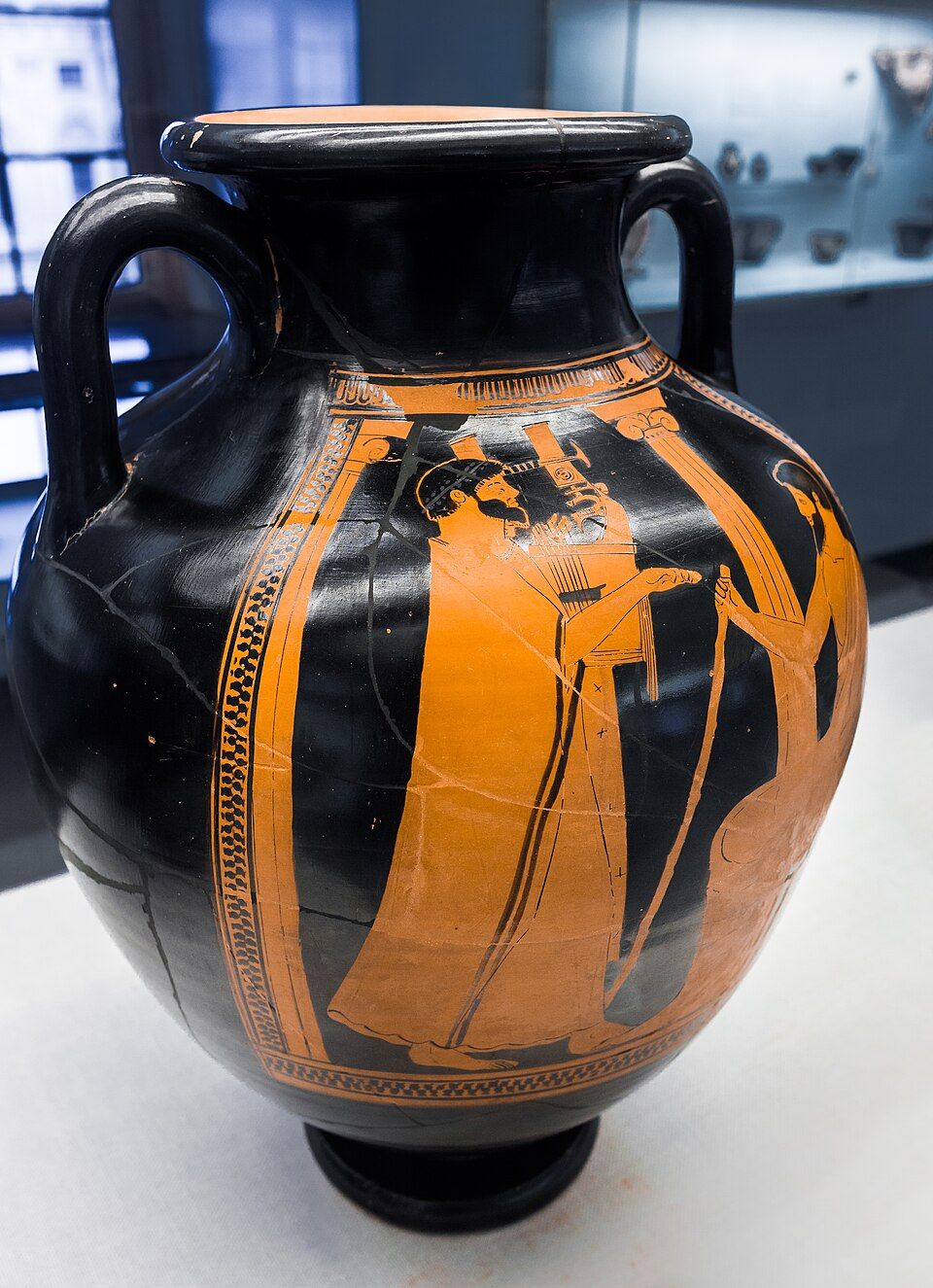
What he wrote. A citharodic nome was a song for a solo singer who accompanied himself on the cithara. The Suda credits Timotheus with nineteen of them. It also lists eighteen dithyrambs, twenty-one hymns, encomia, thirty-six preludes “and some other pieces”.[4]
Of the nomes we have roughly a third of the Persians, one line of Artemis (if that was not a hymn), and the titles Nauplius and Niobe. Dithyrambs known by title are Mad Ajax, Elpenor, Birthpangs of Semele and Scylla. The Cyclops, of which six lines survive, may also be a dithyramb. Laertes and Sons of Phineus are of unknown genre.[4]
The New Music. The term is modern. It refers to a group of composers active on the Athenian stage between about 430 and 380 BC. It also refers to changes in the dithyramb, the citharodic nome and the sung parts of tragedy. Ancient critics spoke instead of “theatre music”.[5] The group’s other names are Melanippides, Phrynis, Cinesias, Telestes, Crexus, Philoxenus and Agathon. LeVen adds Euripides.[6]
The term suggests a coherent movement with a programme, but there is no trace of one. Relations within the group look more like rivalry.[7] Of them all, the ancients thought Timotheus the most innovative. He came to symbolise the New Music as a whole.[4]
Career. His own words (PMG 802) record an early victory, probably around 415, over Phrynis. Phrynis was then the most famous citharode in Greece, and Aristotle notes his influence on Timotheus.[8] By about 400 Pherecrates’ comedy Chiron made him the most notorious lyricist of the day.[9] The Ephesians paid him a thousand gold shekels for a hymn to Artemis.[10]
He was invited to the court of Archelaus of Macedon, an honour he shared with Euripides and Agathon. Csapo and Wilson date the invitation to the last decade of the fifth century. LeVen says he spent the end of his life there.[11] He and Euripides worked together actively and imitated each other deliberately. The two were said to have been friends.[12]
Sparta and the strings. Six ancient authors, from the second century BC on, tell the same story. Timotheus competed at a Spartan festival, and was charged with an offence against music for having four strings more than the traditional seven. In some versions the extra strings were cut off.[13] Another tradition says that he was expelled from Sparta.[14]
The closing section of a poem, in which the poet speaks of himself, is called the sphragis or “seal”. Csapo and Wilson and LeVen think the story grew out of the sphragis of the Persians. There Timotheus speaks of Spartan hostility, and of a cithara with “metres and rhythms of eleven strokes” (our translation).
The same tales were told of Terpander and Phrynis. The critics could not agree which string he added: the seventh, ninth, tenth, eleventh or twelfth. Melanippides had used twelve strings, and Ion of Chios (died 422) addressed an “eleven-stringed lyre”. So these scholars are sure that Timotheus added no strings at all.[15] Most scholars, though, accept the prosecution in one form or another.[16] Its historicity is disputed.
Notes
- ^ Csapo and Wilson 2009, p. 277; LeVen 2022, p. 363.
- ^ Budelmann 2009, p. 387.
- ^ Budelmann 2009, p. 4.
- ^ a b c Csapo and Wilson 2009, p. 277.
- ^ LeVen 2022, pp. 362–363.
- ^ LeVen 2022, pp. 363–365; Csapo and Wilson 2009, p. 277.
- ^ Csapo and Wilson 2009, p. 278.
- ^ Csapo and Wilson 2009, p. 280; LeVen 2022, p. 365.
- ^ Csapo and Wilson 2009, p. 280.
- ^ LeVen 2022, p. 363.
- ^ Csapo and Wilson 2009, p. 280; LeVen 2022, p. 363.
- ^ Csapo and Wilson 2009, p. 278; LeVen 2022, p. 364.
- ^ Csapo and Wilson 2009, pp. 284–285.
- ^ Battezzato 2009, p. 145.
- ^ Csapo and Wilson 2009, pp. 283–286; LeVen 2022, p. 363.
- ^ Csapo and Wilson 2009, p. 285.
About · 2 of 4
The Persians papyrus and the survival of the New Music
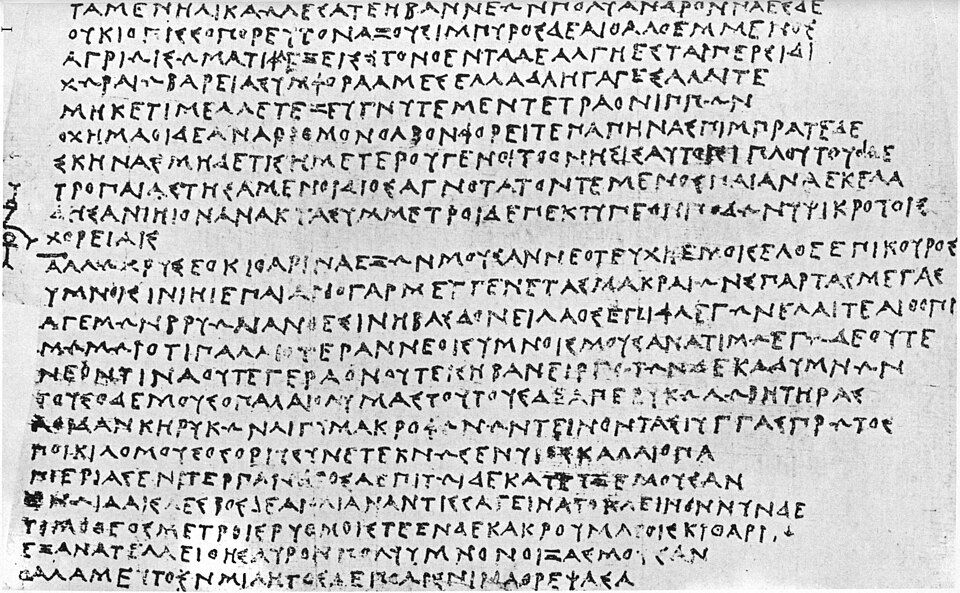
The papyrus. Most of what we can read of Timotheus comes from one roll, P.Berol. inv. 9875. It preserves the last 240 lines of the Persians, about a third of the poem.[1] It was excavated by Ludwig Borchardt in the Greek necropolis at Abusir.
Archaeological evidence shows that it was deposited before the Ptolemaic period, when that cemetery was not in use. It lay not in one of the Greek sarcophagi, but on the ground north of a sarcophagus of the Egyptian Middle Kingdom. So its funerary context is less straightforward than it looks.[2] Its date is given in three ways. Sampson dates it to the fourth century BC. Csapo and Wilson call it the earliest Greek papyrus found in Egypt, and date it c. 350–325 BCE. For LeVen it is “the oldest surviving ancient ‘book’”.[3]
When was it found? Sampson and Csapo and Wilson give 1902 as the year of the find. LeVen gives 1904.[4] The sources differ.
The Loeb edition gives 1902 for the find and 1903 for Wilamowitz’s first edition. It dates the papyrus to the fourth century BC. Wilamowitz counted 253 verses, where Page counts 240, and the Loeb uses Page’s numbers. If the opening stood in a single lost roll, the whole poem ran to about 650 verses.[5]
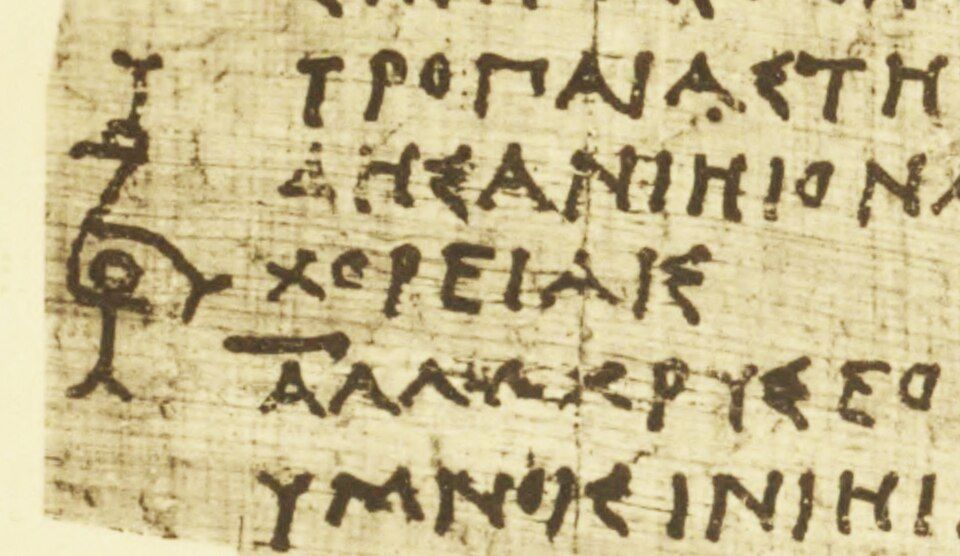
Written as prose. The roll is in scriptio continua, with no colometry, no marginal signs and no commentary.[6] Scriptio continua is writing without spaces between words. A colon is a short metrical unit, and colometry is the division of a lyric text into cola. Before the second century BC lyric was regularly transcribed as prose. Such early texts leave the whole metrical analysis to their modern editors. That is a heavy task for a polymetric poem, in which many different cola must be recognised and told apart.[7]
The roll is the standard example of the older, prose-like presentation that the Alexandrian division into cola replaced.[8] So the line numbers and colometry of modern editions are an editor’s work. West’s analysis is on the Metres tab.
Quotations. Apart from the papyrus, the New Music survives only in quotations. There are about fifty passages, some 170 lines. Most come from the musical sections of Athenaeus and from the pseudo-Plutarchan On Music, with Plutarch and Stobaeus. Unlike archaic lyric, these poets were never catalogued by the Alexandrian scholars. Nor were they given an official edition, as Athenian tragedy was by Lycurgus in 330 BC. With the papyrus, the total is a little over 400 lines, besides the choral odes of Euripides in the new style.[9]
Some papyri have been ascribed to lost works: P.Berol. 6870 to Mad Ajax, and P.Hibeh 693 with P.Heidelb. 178 to Elpenor or Scylla. But the ascriptions are uncertain.[10]
Editions. Wilamowitz’s edition of the Persians appeared in 1903. Editions with commentary are by Janssen (1984) and Hordern (2002). The Loeb edition edits and translates all the texts of the New Music.[11]
Notes
- ^ Csapo and Wilson 2009, pp. 277–278.
- ^ Sampson 2022, pp. 115–116.
- ^ Sampson 2022, p. 114; Csapo and Wilson 2009, p. 279; LeVen 2022, p. 365.
- ^ Sampson 2022, p. 115; Csapo and Wilson 2009, p. 278; LeVen 2022, p. 365.
- ^ Campbell 1993, p. 95.
- ^ Phillips 2022, p. 120.
- ^ Sampson 2022, p. 114.
- ^ Morrison 2022, p. 400.
- ^ LeVen 2022, p. 365.
- ^ Csapo and Wilson 2009, p. 277 n. 3.
- ^ Budelmann 2009, p. 394; LeVen 2022, p. 376.
About · 3 of 4
The metres of the New Music
No strophes. The old choral lyric repeated one metrical pattern from strophe to antistrophe. This repetition is called responsion. Its predictability had made collective performance by amateur citizens possible. Timotheus was remembered above all for abandoning it. He became the standard textbook case of formless, unruly “free verse”, though he was far from the first to use it.[1]
Song without strophes is called astrophic. The Persians is an example of astrophic composition.[2] D’Angour calls Timotheus’ metrically free writing monostrophic, and sets it beside the arias of late Euripides.[3] The Aristotelian Problems (918b) explains why the nome and the dithyramb left strophic form. They were performed by professionals, who could imitate, and so their song “became long and varied”. The music had to change as the imitation did.[4] From the composer’s side there was a gain. In astrophic song the words never had to fit a melody fixed in advance. The use of many metres in one song is called polymetry. In those conditions it came naturally.[5]
The Persians analysed. West’s account is the only one in these sources. The poem opened with a hexameter, or perhaps with more than one. In the papyrus the metres change by sections (gl glyconic, ph pherecratean):[6]
- Lines 1–126 and 139–77 are mostly iambic. There is a choriamb here and there, some trochaic division, and now and then a run of cretics, dochmiacs, dactyls, anapaests or aeolic cola.
- Lines 127–38 and 178–201 are chiefly aeolic, with a few iambics and dactyls.
- In the conclusion (202–40) Timotheus turns wholly to aeolic. Mainly gl and ph alternate, either separated or dovetailed.
Such virtuoso compositions do not represent fourth-century song in general.[6] A stretch of the mostly iambic part, the Phrygian’s speech (162–173 in Wilamowitz’s numbering), is scanned line by line on the works tab of this page.
The monodies. Between the clash of the fleets and his self-defence, Timotheus sets four speeches in direct speech. The speakers are a drowning islander (72–81), a Mysian (105–38), a Celaenaean begging for his life in broken Greek (150–61), and the Persian king (178–95). Csapo and Wilson describe these speeches as “largely iambo-trochaic mixed with runs of the distinctly tragic dochmiac”.[7] West’s analysis assigns 127–38 and 178–201 mainly to aeolic. These lines include the end of the second speech and the king’s.[6] The two descriptions differ.
The dochmiac. The basic rhythm of the dochmiac is ⏑ — — ⏑ —. Any long can be resolved, and either short can be replaced by a long. It is “typically tragic”, and outside drama dochmiacs “scarcely occur”.[8] The pattern can also be written × — — ⏑ —, and Timotheus uses it.[9] After the classical period dochmiacs recur outside drama only in the Hellenistic Grenfell fragment.[10] Dochmiacs from Euripides’ Orestes are scanned on the Euripides page (Metres: sung).
A citharode’s opening. Plutarch tells how the singer Pylades, performing Timotheus’ Persians, began with this line (Philopoemen 11, PMG 788):
κλεινὸν ἐλευθερίας τεύχων μέγαν Ἑλλάδι κόσμον
kleinon eleutherias teuchōn megan Helladi kosmon
“fashioning for Greece the great and glorious ornament of freedom”
Dactylic hexameter, with the third foot a spondee (-ας τεύ-). Masculine caesura after ἐλευθερίας. Red: -ρι- of ἐλευθερίας and -λα- of Ἑλλάδι, both short. The ν of κλεινόν and of μέγαν goes with the next syllable.
Timotheus, PMG 788, quoted by Plutarch, Philopoemen 11, Perrin’s text (Perseus); translation ours
synthetic ∿
This is a dactylic hexameter. A caesura is a word-end at a regular place inside the line, and here it is a masculine caesura, after ἐλευθερίας (eleutherias, “of freedom”).[11] The final ν (n) of κλεινόν (kleinon) and of μέγαν (megan) goes with the next syllable. The metre requires short ῐ (i) in ἐλευθερίας and short ᾰ (a) in Ἑλλάδι (Helladi). Its “seemly dactylic rhythms” match the decorous theme and the weight of the hexameter tradition.[12]
Music over words. According to the ancient critics, in the old song the words governed the music. There was one note to a syllable, and the melody followed the pitch accents. In the new song, music governed language, and any number of notes might fall on a syllable.[4] Dionysius of Halicarnassus says this of Euripides’ Orestes: its melody did not respect the word accents.[13]
Polymetry is one of the innovations the critics itemised, beside many strings and modulation.[14] West supposes that the polymetric passages of late tragedy also required changes of mode. Such changes were one of the marks of the “new music”.[15] Timotheus speaks of his own “metres and rhythms of eleven strokes”. Csapo and Wilson argue that the phrase refers to the variety of his songs, not to a new instrument.[16]

Notes
- ^ Csapo and Wilson 2009, p. 284.
- ^ Battezzato 2009, p. 133.
- ^ D’Angour 2022, p. 138.
- ^ a b Csapo and Wilson 2009, p. 287.
- ^ West 1987, p. 66.
- ^ a b c West 1987, p. 70.
- ^ Csapo and Wilson 2009, p. 289.
- ^ West 1987, p. 56.
- ^ Battezzato 2009, p. 142.
- ^ West 1987, p. 68 n. 1.
- ^ West 1987, p. 19.
- ^ LeVen 2022, p. 373.
- ^ LeVen 2022, p. 368.
- ^ LeVen 2022, p. 367.
- ^ West 1987, p. 67.
- ^ Csapo and Wilson 2009, p. 286.
About · 4 of 4
Reputation and context
Performed again and again. Sources attest as many as fifteen revivals of his music in public theatres, from the fourth century BC to the third AD. No other lyric poet comes near that record. Timotheus’ songs may have been reperformed with their original music.[1] His Elpenor won first prize with a boys’ chorus in 320/319. Polybius’ fellow Arcadians learned his songs by heart from childhood. Around 170 BC Cretan cities honoured an envoy who performed Timotheus in the theatre.[2]
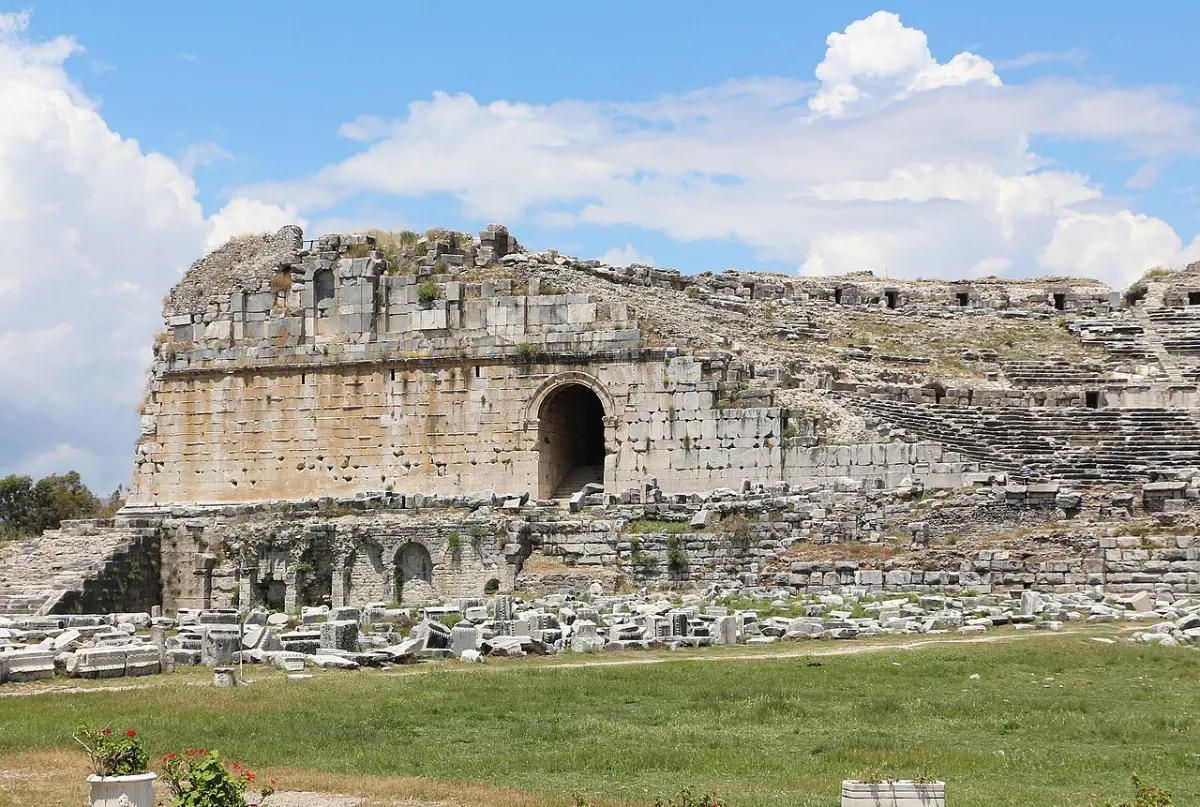
Aristotle cites him six times, and fourth-century comedy quoted him. A statue of him stood in the library at Pergamon. In Miletus, musicians called “Timotheasts” are attested as late as the third century AD.[3] He stayed popular in an age when early lyric was otherwise no longer performed.[4]
Innovator? Ancient critics were conservative almost without exception. They cast him as the destroyer of the old music.[5] Csapo and Wilson argue that his innovation is “much exaggerated”. In their view, developments two or more generations in the making came to a head in his time.[6] LeVen, following D’Angour, describes a “tradition of innovations” going back to Lasus of Hermione. She finds the novelty above all in “the rhetoric of the new”.[7]
Not everyone was hostile. A speaker in Xenophon sets Melanippides beside Homer and Sophocles. And the public must have admired the new music, or it would never have won out.[8]
Why Athens? Timotheus was not an Athenian. But Csapo and Wilson tie his career to the democratic city. By the end of the fifth century at least six annual festivals in Attica showcased theatre and dithyramb. The prize for citharody at the Panathenaea was a wreath of solid gold worth 1,000 drachmas, plus 500 drachmas in cash. It might equal five years’ wages of a skilled worker.[9]
The new musicians, especially the aulos-players, came from more varied and often lower-class backgrounds than the old cultural elite. Csapo and Wilson read the critics’ venom as a form of cultural class conflict. They judge this music perhaps the most genuinely popular, “demotic”, art that Athens has left us.[10] Csapo had argued earlier that larger theatres and the sonic range of the aulos were the “material cause” of the new style. Plato’s pun on nomoi, which means both “tunes” and “laws”, turned musical change into a political threat.[11]
Modern verdicts. When the papyrus appeared, scholarship “showed little pleasure”. Kenyon called Timotheus “a curiosity, a monstrosity”. Rose likened his metre to “jazz”. Many literary histories ignored him. West, by contrast, compared the criticism he received to that aimed at Beethoven.[12] The modern reception of the New Music is “virtually unexplored”. It runs from the Franco-German controversies that followed the discovery to the renewed interest of the twenty-first century.[13]
Notes
- ^ Csapo and Wilson 2009, p. 279 with nn. 16–17.
- ^ LeVen 2022, p. 363; Csapo and Wilson 2009, p. 279.
- ^ Csapo and Wilson 2009, pp. 279–280.
- ^ Barbantani 2009, p. 314 n. 71.
- ^ Csapo and Wilson 2009, p. 281.
- ^ Csapo and Wilson 2009, p. 282.
- ^ LeVen 2022, pp. 368–369.
- ^ Carey 2009, p. 22 n. 4.
- ^ Csapo and Wilson 2009, pp. 290, 292.
- ^ Csapo and Wilson 2009, pp. 291, 293.
- ^ LeVen 2022, pp. 367–370.
- ^ Csapo and Wilson 2009, p. 278.
- ^ LeVen 2022, p. 375.
Timotheus, Persians 162–173 (the Phrygian's speech)
Synopsis
A citharodic nome is a solo song to the kithara. The Persians is one, by Timotheus of Miletus, who was born about 450 BC and died about 360. About a third of it survives.[1] It celebrates the Greek victory at Salamis, some eighty years after the battle.[2] It does not so much tell the story as act out the experience of the sea battle in a series of scenes. A drowning islander rages at the sea, a Mysian laments, a man of Celaenae begs for his life, and the Persian king despairs.[3] The poem ends with a “signature”, in which the poet answers the Spartans’ censure of his new music. Later stories of his prosecution at Sparta probably grew out of that passage.[4] The last 240 lines survive on a papyrus written about 350–325 BC, the earliest Greek papyrus found in Egypt. Csapo and Wilson date the find to 1902, LeVen to 1904.[5]
Lines 162–173 in Wilamowitz’s numbering are scanned below. They come from the third of the four monodies, in which the Phrygian from Celaenae pleads with his Greek captor in a comically broken Greek.[6]
Text and translation
ἐγώ μοί σοι κῶς καὶ τί πρᾶγμ’
Timotheus · Persians 162–173 Wilamowitz (= PMG 791.150–161) · astrophic, iambic · Greek text and scheme after Wilamowitz 1903 (public domain)
How to read each line
A guide to the Greek, syllables, pitch marks and quantities.
Show the reading key
- Above each line: the line as the edition prints it, each word placed over its own syllables. The main row: the same Greek divided into metrical syllables, each written as it is pronounced. A consonant that closes a syllable is written with it (λόθ | ρο); an elided word is closed up with the next vowel (ν’ἀ); a final consonant carried into the next word is set with a thin space (ς ἰ). Wider gaps mark word-ends.
- Above the syllables: the pitch of each syllable, from the accents. Under them: the quantity of each syllable as it falls in the line, then the transliteration, syllable by syllable, with accented syllables in capitals.
- Under each line: a line-for-line translation. In the right margin of the scansion: the line type, its scheme, and its analysis into cola.
Key to the labels
The names, patterns and symbols used beside this poem.
Show the labels and symbols
The labels in the right margin of the scansion below give the line’s analysis as the scheme file states it, then its scheme and, where the analysis notes them, the period-end, a brevis in longo or a hiatus. ‖ marks the end of a period, ||| the end of the stanza; a line without a period-end runs on into the next (synapheia). × is an anceps, long or short; the last position of every period is indifferent. A click on any syllable highlights the colon it belongs to and explains it.
| Label | Name and shape | What it is |
|---|---|---|
| iasy | Iambic metron with a suppressed position— — or — ⏑ — or ⏑ — — | An iambic metron with one position suppressed: West’s syncopated forms, the spondee ∧ia∧-like — —, the cretic ∧ia and the bacchiac ia∧.[7] Wilamowitz prints the quantities without naming the forms.[8] |
| ia | Iambic metron (ia)× — ⏑ — | One iambic metron.[9] Wilamowitz counts the Phrygian’s speech as iambs only.[10] |
| ch | Choriamb (ch)— ⏑ ⏑ — | Wilamowitz’s “choriambic monometer”.[11] |
The feet
| Foot and shape | Where |
|---|---|
| Bacchiac⏑ — — | An iambic metron whose last short is suppressed.[7] At the end of a period it is the catalectic close Wilamowitz notes for the dimeters before this passage.[12] |
| Spondee— — | An iambic metron with both the anceps and the short suppressed.[13] |
| Cretic— ⏑ — | An iambic metron whose first position is suppressed.[7] |
| Iambic metron× — ⏑ — | Four positions.[9] |
| Choriamb— ⏑ ⏑ — | A long, two shorts, a long.[9] |
Scansion
A captured Phrygian from Celaenae, dragged off by the hair, begs a Greek for his life in broken Greek. Wilamowitz hears nothing but iambs, chopped into short metra, with one choriamb set off by hiatus, and prints the quantities line by line; the page scans his text against his own scheme.
“Me yours, me — how, and what the business?
Not ever again I come.
And now my master
fetch me this place, here;
the rest — no more, father, no-
more I come here to fight again,
but I sit down;
me not here for you, me
yonder beside Sardi, beside
Susa, living Agbatana.
Artimis, my big god,
by Ephesus keep me safe.”
Metre
- Astrophic song. The Persians has no strophes: Timotheus was remembered above all for giving up strophic responsion.[14] Writing of the late tragedians, West explains what astrophic composition gave a poet: the words never had to fit a melody fixed in advance, and polymetry came naturally.[15] Battezzato notes that Timotheus mixes different rhythms and even uses the dochmiac.[16] There is no antistrophe, so this page has no side-by-side view.
- Iambs only. West describes Page’s lines 139–77, which include this speech, as mainly iambic, with occasional choriambs, some trochaic division and short runs of other metres.[17] Csapo and Wilson call the monodies of the Persians largely iambo-trochaic with runs of dochmiacs.[18] Wilamowitz says that the Phrygian speaks in iambs only, and that the metre, like the language, serves an almost comic portrait. For him the effect comes from the handling, above all the choriambic monometer of 168, set apart by hiatus.[10]
- Wilamowitz’s scheme. Wilamowitz prints the quantities of 162–173 in six rows, divided into metra by bars.[8] Each row is one of the periods of his text. There a line at the left margin begins a period, and an indented line runs on from the one before it, so that the synapheia is not overlooked.[19] The scheme of each line on this page is taken from his rows. Where he prints two shorts in a long position, the position is a resolved long (⏕). Every line scans against his rows without a conflict.
- Short metra. Most of Wilamowitz’s metra have fewer than four positions: ⏑ — —, — ⏑ — and — —. West calls such metra syncopated: in iambic song they stand beside the full × — ⏑ — and count as its equal, with a long that is held for three units.[20] In the margin, Wilamowitz’s metra are named with West’s signs: ∧ia for — ⏑ —, ia∧ for ⏑ — —, ∧ia∧ for — —.[7] The names are this page’s, not Wilamowitz’s. Four of the six periods end in ia∧ (⏑ — —), the catalectic close that Wilamowitz notes for the choriambic dimeters before this passage.[12] The choriamb of 168 is a period by itself, and 171 ends — —.
- Resolution. Three shorts in a row inside a colon nearly always mean resolution.[21] Here they come in 166–167 (κέτι πάτερ, κέτι μά-), 170 (twice σε παρὰ, δι παρὰ), 171 (βάτανα), 172 (τιμις ἐ-) and 173 (παρ’ Ἔφε-).
- Prosody. Inside a period, syllables run on across word-end and line-end.[22] Elision is frequent: μ’ (163, 165), δ’ (165–167), θ’ (167), ρ’ (169), σ’ (171), ρ’ (173).[23] Wilamowitz prints some elided vowels in round brackets, πρᾶγμ(α) and Σοῦσ(α). Here they are written with the apostrophe, so that the scansion shows the elision. For Σοῦσ(α) he weighed hiatus, which Aristophanes allows his barbarians, and preferred elision.[8]
Prosody, line by line
Every syllable, with the reason for its length. Quantities are read from the vowel where the spelling shows it, from the consonants that follow (“position”), from the accent where it tells, and from the metre where nothing else does. Editors’ notes on the text follow in the boxed paragraphs.
- 162
Line 162 · „ἐγώ μοί σοι κῶς καὶ τί πρᾶγμ’,
„ἐγώ μοί σοι κῶς καὶ τί πρᾶγμ’,
ἐγώμοίσοικῶςκαὶτίπρᾶγthe period runs on into l. 163 (synapheia).
- 1 ⏑ἐἐ is short by nature.
- 2 —γώώ is long by nature.
- 3 —μοίοί is a diphthong, long by nature.
- 4 —σοιοι is a diphthong, long by nature.
- 5 —κῶςῶ is long by nature; closed by ς: long by position.
- 6 —καὶαὶ is a diphthong, long by nature.
- 7 ⏑τίί is a vowel of unknown length; the next word begins with πρ, a stop + liquid that does not make position here, so the syllable stays short.
- 8 —πρᾶγᾶ carries a circumflex, so it is long; closed by γ: long by position; γμ is one of the four clusters (γμ, γν, δμ, δν) that never leave the syllable before them short;[24] the line-end is not a period-end: the period runs on into the next line (synapheia), so this syllable keeps its own length, with no brevis in longo, and a word may run over into the next line.[25]
The first line of a period, ia∧ ∧ia∧ ∧ia.[8] The Phrygian’s Greek breaks down at once: a string of pronouns and questions. Wilamowitz prints ἐγώ; Campbell prints ἔπω, with the same quantities ⏑ —, and a question mark after πρᾶγμα.[26] Wilamowitz’s paraphrase takes the first words as “I am yours” (ἔγωγε σός εἰμι)[27]. Wilamowitz writes πρᾶγμ(α). The α is elided, and the μ goes with αὖ- in the next line.[28] This is PMG 791.150 in Campbell.[26]- 163
Line 163 · αὖτις οὐδάμ’ ἔλθω.
αὖτις οὐδάμ’ ἔλθω.
μ’,αὖτις οὐδάμ’ἔλθω.continues l. 162 · one period (synapheia).
- 1 —μ’,αὖαὖ is a diphthong, long by nature; the apostrophe marks an elided vowel; the consonant before it joins this syllable.
- 2 ⏑τιι is short by the accent rule: circumflex on the penult requires a short final syllable.
- 3 —ς οὐοὐ is a diphthong, long by nature; the first consonant belongs to the previous word and is carried over to this vowel.
- 4 ⏑δάά is short by the metre (position 4 must be short).
- 5 —μ’ἔλἔ is short by nature; closed by λ: long by position; the apostrophe marks an elided vowel; the consonant before it joins this syllable.
- 6 ×θω.ω is long by nature; the last position of the period is indifferent.
- 164
Line 164 · καὶ νῦν ἐμὸς δεσπότης
καὶ νῦν ἐμὸς δεσπότης
καὶνῦνἐμὸςδεσπότηςthe period runs on into l. 165 (synapheia).
- 1 —καὶαὶ is a diphthong, long by nature.
- 2 —νῦνῦ carries a circumflex, so it is long.
- 3 ⏑ἐἐ is short by nature.
- 4 —μὸςὸ is short by nature; closed by ς: long by position.
- 5 —δεσε is short by nature; closed by σ: long by position.
- 6 ⏑πόό is short by nature.
- 7 —τηςη is long by nature; closed by ς: long by position; the line-end is not a period-end: the period runs on into the next line (synapheia), so this syllable keeps its own length, with no brevis in longo, and a word may run over into the next line.[25]
- 165
Line 165 · δεῦρό μ’ ἐνθάδ’ ἦξε,
δεῦρό μ’ ἐνθάδ’ ἦξε,
δεῦρόμ’ἐνθάδ’ἦξε,continues l. 164 · one period (synapheia); brevis in longo at period-end (a short in the final long position).
- 1 —δεῦεῦ is a diphthong, long by nature.
- 2 ⏑ρόό is short by nature.
- 3 —μ’ἐνἐ is short by nature; closed by ν: long by position; the apostrophe marks an elided vowel; the consonant before it joins this syllable.
- 4 ⏑θάά is short by the metre (position 4 must be short).
- 5 —δ’ἦἦ is long by nature; ξ is a double consonant (two sounds) and closes the syllable: long by position; the apostrophe marks an elided vowel; the consonant before it joins this syllable.
- 6 ×ξε,ε is short by nature; the last position of the period is indifferent; a short here is brevis in longo.
- 166
Line 166 · τὰ λοιπὰ δ’ οὐκέτι πάτερ, οὐ-
τὰ λοιπὰ δ’ οὐκέτι πάτερ, οὐ-
τὰλοιπὰδ’οὐκέτιπάτε,ρ οὐ-the period runs on into l. 167 (synapheia).
- 1 ⏑τὰὰ is short by the metre (position 1 must be short).
- 2 —λοιοι is a diphthong, long by nature.
- 3 ⏑πὰὰ is short by the metre (position 3 must be short).
- 4 —δ’οὐοὐ is a diphthong, long by nature; the apostrophe marks an elided vowel; the consonant before it joins this syllable.
- 5 ⏑κέέ is short by nature.
- 6 ⏑τιι is short by the metre (position 6 must be short); with its neighbour it resolves the long of position 6 into two shorts.
- 7 ⏑πάά is short by the metre (position 6 must be short); with its neighbour it resolves the long of position 6 into two shorts.
- 8 ⏑τε,ε is short by nature.
- 9 —ρ οὐ-οὐ is a diphthong, long by nature; the first consonant belongs to the previous word and is carried over to this vowel; the line-end is not a period-end: the period runs on into the next line (synapheia), so this syllable keeps its own length, with no brevis in longo, and a word may run over into the next line.[25]
- 167
Line 167 · κέτι μάχεσθ’ αὖτις ἐνθάδ’ ἔρχω,
κέτι μάχεσθ’ αὖτις ἐνθάδ’ ἔρχω,
κέτιμάχεσθ’αὖτις ἐνθάδ’ἔρχω,continues l. 166 · one period (synapheia).
- 1 ⏑κέέ is short by nature; with its neighbour it resolves the long of position 1 into two shorts.
- 2 ⏑τιι is short by the metre (position 1 must be short); with its neighbour it resolves the long of position 1 into two shorts.
- 3 ⏑μάά is short by the metre (position 2 must be short).
- 4 —χεσε is short by nature; closed by σ: long by position.
- 5 —θ’αὖαὖ is a diphthong, long by nature; the apostrophe marks an elided vowel; the consonant before it joins this syllable.
- 6 ⏑τιι is short by the accent rule: circumflex on the penult requires a short final syllable.
- 7 —ς ἐνἐ is short by nature; closed by ν: long by position; the first consonant belongs to the previous word and is carried over to this vowel.
- 8 ⏑θάά is short by the metre (position 7 must be short).
- 9 —δ’ἔρἔ is short by nature; closed by ρ: long by position; the apostrophe marks an elided vowel; the consonant before it joins this syllable.
- 10 ×χω,ω is long by nature; the last position of the period is indifferent.
∧ia ∧ia ia∧ ‖.[8] κέτι μά- are three shorts, a resolved long and then a short;[21] μάχεσθ’ has short α.[32] The papyrus has μαχεσαυ,[33] and Campbell prints μαχέσ’ αὖτις.[26] That reading changes the metre: μα χέ σ’αὖ gives ⏑ ⏑ — where Wilamowitz’s μά χεσ θ’αὖ gives ⏑ — —. ἔρχω is a barbarism for ἔρχομαι, as LSJ notes, citing this line.[34]- 168
Line 168 · ἀλλὰ κάθω·
ἀλλὰ κάθω·
ἀλλὰκάθω·- 1 —ἀλἀ is a vowel of unknown length; closed by λ: long by position.
- 2 ⏑λὰὰ is short by the metre (position 2 must be short).
- 3 ⏑κάά is short by the metre (position 3 must be short).
- 4 ×θω·ω is long by nature; the last position of the period is indifferent.
- 169
Line 169 · ἐγώ σοι μὴ δεῦρ’, ἐγὼ
ἐγώ σοι μὴ δεῦρ’, ἐγὼ
ἐγώσοιμὴδεῦρ’,ἐγὼthe period runs on into l. 170 (synapheia).
- 1 ⏑ἐἐ is short by nature.
- 2 —γώώ is long by nature.
- 3 —σοιοι is a diphthong, long by nature.
- 4 —μὴὴ is long by nature.
- 5 —δεῦεῦ is a diphthong, long by nature.
- 6 ⏑ρ’,ἐἐ is short by nature; the apostrophe marks an elided vowel; the consonant before it joins this syllable.
- 7 —γὼὼ is long by nature; the line-end is not a period-end: the period runs on into the next line (synapheia), so this syllable keeps its own length, with no brevis in longo, and a word may run over into the next line.[25]
- 170
Line 170 · κεῖσε παρὰ Σάρδι, παρὰ
κεῖσε παρὰ Σάρδι, παρὰ
κεῖσεπαρὰΣάρδι,παρὰcontinues l. 169 · one period (synapheia); the period runs on into l. 171 (synapheia).
- 1 —κεῖεῖ is a diphthong, long by nature.
- 2 ⏑σεε is short by nature.
- 3 ⏑παα is short by the metre (position 3 must be short); with its neighbour it resolves the long of position 3 into two shorts.
- 4 ⏑ρὰὰ is short by the metre (position 3 must be short); with its neighbour it resolves the long of position 3 into two shorts.
- 5 —Σάρά is a vowel of unknown length; closed by ρ: long by position.
- 6 ⏑δι,ι is short by the metre (position 5 must be short).
- 7 ⏑παα is short by the metre (position 6 must be short); with its neighbour it resolves the long of position 6 into two shorts.
- 8 ⏑ρὰὰ is short by the metre (position 6 must be short); with its neighbour it resolves the long of position 6 into two shorts; the line-end is not a period-end: the period runs on into the next line (synapheia), so this syllable keeps its own length, with no brevis in longo, and a word may run over into the next line.[25]
- 171
Line 171 · Σοῦσ’, Ἀγβάτανα ναίων.
Σοῦσ’, Ἀγβάτανα ναίων.
Σοῦσ’,Ἀγβάταναναίων.continues l. 170 · one period (synapheia).
- 1 —Σοῦοῦ is a diphthong, long by nature.
- 2 —σ’,ἈγἈ is a vowel of unknown length; closed by γ: long by position; the apostrophe marks an elided vowel; the consonant before it joins this syllable.
- 3 ⏑βάά is short by the metre (position 3 must be short).
- 4 ⏑ταα is short by the metre (position 4 must be short); with its neighbour it resolves the long of position 4 into two shorts.
- 5 ⏑ναα is short by the accent rule: acute on the antepenult requires a short final syllable; with its neighbour it resolves the long of position 4 into two shorts.
- 6 —ναίαί is a diphthong, long by nature.
- 7 ×ων.ω is long by nature; closed by ν: long by position; the last position of the period is indifferent.
- 172
Line 172 · Ἄρτιμις, ἐμὸς μέγας θεός,
Ἄρτιμις, ἐμὸς μέγας θεός,
Ἄρτιμι,ς ἐμὸςμέγαςθεός,the period runs on into l. 173 (synapheia).
- 1 —ἌρἌ is a vowel of unknown length; closed by ρ: long by position.
- 2 ⏑τιι is short by the metre (position 2 must be short); with its neighbour it resolves the long of position 2 into two shorts.
- 3 ⏑μι,ι is short by the accent rule: acute on the antepenult requires a short final syllable; with its neighbour it resolves the long of position 2 into two shorts.
- 4 ⏑ς ἐἐ is short by nature; the first consonant belongs to the previous word and is carried over to this vowel.
- 5 —μὸςὸ is short by nature; closed by ς: long by position.
- 6 ⏑μέέ is short by nature.
- 7 —γαςα is a vowel of unknown length; closed by ς: long by position.
- 8 ⏑θεε is short by nature.
- 9 —ός,ό is short by nature; closed by ς: long by position; the line-end is not a period-end: the period runs on into the next line (synapheia), so this syllable keeps its own length, with no brevis in longo, and a word may run over into the next line.[25]
- 173
Line 173 · παρ’ Ἔφεσον φυλάξει.“
παρ’ Ἔφεσον φυλάξει.“
παρ’Ἔφεσονφυλάξειcontinues l. 172 · one period (synapheia).
- 1 ⏑παα is short by the metre (position 1 must be short); with its neighbour it resolves the long of position 1 into two shorts.
- 2 ⏑ρ’ἜἜ is short by nature; the apostrophe marks an elided vowel; the consonant before it joins this syllable; with its neighbour it resolves the long of position 1 into two shorts.
- 3 ⏑φεε is short by nature.
- 4 —σονο is short by nature; closed by ν: long by position.
- 5 ⏑φυυ is short by the metre (position 4 must be short).
- 6 —λάξ is a double consonant (two sounds) and closes the syllable: long by position.
- 7 ×ξειει is a diphthong, long by nature; the last position of the period is indifferent.
The scene
After the battle the Persians lament. Whenever a Greek seizes a man from Celaenae and drags him off by the hair, the captive clasps his knees and pleads, mixing Greek with his Asian speech (Wilamowitz 151–161 = PMG 791.139–149). LeVen takes the scene as an example of the New Music’s attention to single individuals, and of how it treats language as something physical and wild. In the broken Greek she sees the poet pushing language to the limits of sense.[39] Wilamowitz hears the metre of the preceding narrative, 151–161, as tragic: a dactylic tetrameter and then quick iambs, which he says could well be a Euripidean choral strophe. The Phrygian’s own iambs he calls almost comic.[10]
The text
The Greek is from U. von Wilamowitz-Moellendorff, Timotheos. Die Perser, aus einem Papyrus von Abusir (Leipzig 1903), pp. 24–25, the first edition. It is in the public domain, and was read in the scan on archive.org (dieperserauseine00timouoft). Wilamowitz numbers 253 lines where Page numbers 240.[40] Here Wilamowitz’s 162–173 are Page’s 150–161, the numbers Campbell uses.[41] Two of the text’s marks are changed: the elided vowels Wilamowitz prints in round brackets are written with the apostrophe, and his inverted commas are kept.
Campbell’s Loeb was compared line by line.[41] It differs from Wilamowitz in six places: ἔπω for ἐγώ (162), πρᾶγμα unelided before a question mark (162), ἤξει for ἦξε (165), μαχέσ’ for μάχεσθ’ (167; this one changes the scansion), Σοῦσα unelided at line-end (171), and the punctuation and the line-ends at 166–167 and 170–171.[42]
Notes
- ^ Csapo and Wilson 2009, p. 277.
- ^ Csapo and Wilson 2009, p. 290.
- ^ Csapo and Wilson 2009, pp. 288–289; LeVen 2022, p. 374.
- ^ LeVen 2022, p. 363; Csapo and Wilson 2009, p. 285.
- ^ Csapo and Wilson 2009, pp. 278–279; LeVen 2022, p. 365.
- ^ Csapo and Wilson 2009, p. 289.
- ^ a b c d West 1987, pp. x, 7.
- ^ a b c d e f g h i j k l m n o p q r s Wilamowitz 1903, p. 33.
- ^ a b c West 1987, p. ix.
- ^ a b c Wilamowitz 1903, pp. 32–33.
- ^ Wilamowitz 1903, p. 33; West 1987, p. ix.
- ^ a b Wilamowitz 1903, p. 32.
- ^ West 1987, pp. x, 7, “∧ia∧”.
- ^ Csapo and Wilson 2009, p. 284.
- ^ West 1987, p. 66.
- ^ Battezzato 2009, p. 142.
- ^ West 1987, p. 70.
- ^ Csapo and Wilson 2009, p. 289.
- ^ Wilamowitz 1903, p. 18.
- ^ West 1987, p. 7.
- ^ a b West 1987, p. 6.
- ^ a b c West 1987, p. 12.
- ^ West 1987, p. 13.
- ^ West 1987, p. 16.
- ^ a b c d e f West 1987, pp. 3–4.
- ^ a b c d e Campbell 1993, p. 104.
- ^ a b Wilamowitz 1903, p. 24.
- ^ West 1987, pp. 12–13.
- ^ LSJ s.v. οὐδαμά.
- ^ a b West 1987, p. 4.
- ^ LSJ s.v. πατήρ, voc. πάτερ.
- ^ LSJ s.v. μάχομαι.
- ^ a b c d Wilamowitz 1903, p. 25.
- ^ LSJ s.v. ἔρχομαι.
- ^ a b c Campbell 1993, p. 106.
- ^ LSJ s.v. παρά.
- ^ LSJ s.v. Σάρδεις.
- ^ LSJ s.v. Ἄρτεμις.
- ^ LeVen 2022, pp. 374–375.
- ^ Campbell 1993, p. 95.
- ^ a b Campbell 1993, pp. 104–107.
- ^ See the notes on those lines.
Text and sources
- Text, colometry and metrical scheme: U. von Wilamowitz-Moellendorff, Timotheos. Die Perser, aus einem Papyrus von Abusir im Auftrage der Deutschen Orientgesellschaft (Leipzig: Hinrichs 1903), public domain: pp. 18 (the layout: indentation for synapheia), 24–25 (text, apparatus and paraphrase of 151–173), 32–33 (metrical analysis of 151–174, with the scheme of 162–173). Page images of the archive.org scan (dieperserauseine00timouoft), read at full resolution.
- M. L. West, Introduction to Greek Metre (Oxford 1987), pp. 4 (period-end), 6 (resolution), 7 (syncopated metra), 12–13 (syllables across word-end; elision), 66 (astrophic song and polymetry), 70 (the Persians), ix–x (signs). Also West 1987, p. 3 (synapheia and period-end); pp. 34 and 35 n. 1 (the third period of the Sapphic and Alcaic stanzas, divided between two lines of writing in antiquity).
- E. Csapo and P. Wilson, ‘Timotheus the New Musician’, in F. Budelmann (ed.), The Cambridge Companion to Greek Lyric (Cambridge 2009), pp. 284, 289.
- L. Battezzato, ‘Metre and music’, ibid., p. 142.
- P. A. LeVen, ‘The New Music’, in L. Swift (ed.), A Companion to Greek Lyric (Wiley 2022), ch. 25, pp. 374–375.
- LSJ (Perseus Digital Library, CC BY-SA), s.vv. Ἄρτεμις, ἔρχομαι, μάχομαι, οὐδαμά, παρά, πατήρ, Σάρδεις.
- D. A. Campbell, Greek Lyric V: The New School of Poetry and Anonymous Songs and Hymns (Loeb Classical Library 144, Cambridge, MA 1993), pp. 95, 104–107 (Timotheus fr. 791.139–161), compared line by line.
- Translation: metrehelp.org, CC BY-SA 4.0. It imitates the broken Greek; Wilamowitz’s paraphrase (pp. 24–25) was used for the sense.
Quotations from copyrighted works are not covered by this page’s licence.


