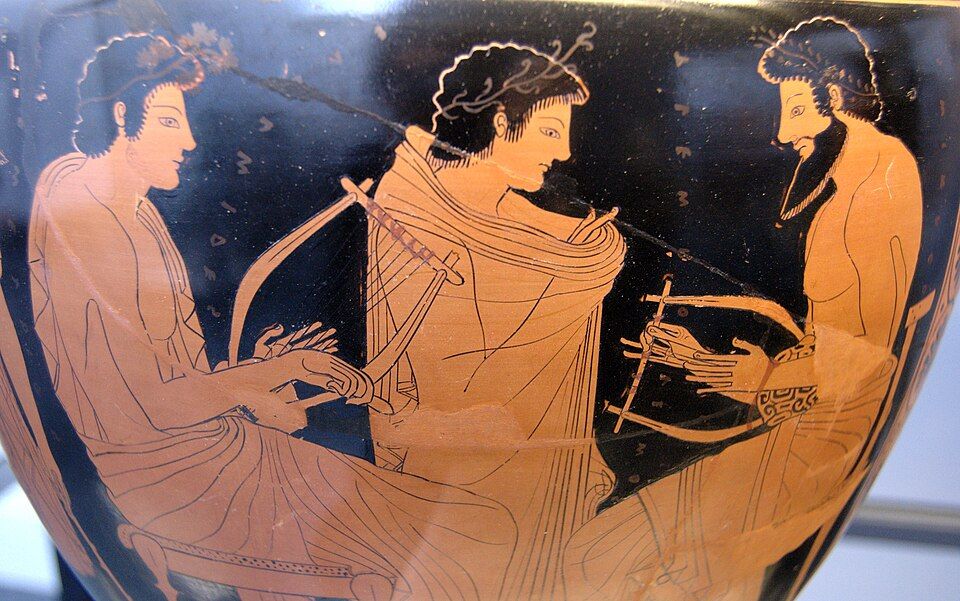
First steps for beginners, from rhythm to scanning a line; what metre is, how syllables are weighed, the notation and the rules of prosody; the Greek word accent; and how the texts reached us.
Metre: a guide to this section
This section teaches the ground rules of Greek metre. It explains how syllables are weighed, how the signs of a metrical scheme are read, and how lines are built from smaller units. Two further pages take up the Greek word accent and its relation to metre, and the long journey of the texts from the poets to our editions.
Where to begin. If you have not met long and short syllables before, begin with First steps. It is a gentle tour in seven short steps: rhythm by length rather than loudness, the few signs you need, how to tell long syllables from short, then one line each of Homer, Sappho and Euripides, scanned step by step with recordings, and a line to scan yourself. If the sounds of Greek are new to you as well, read Phonology › First steps before it. This guide explains the words the menu uses, shows how the pages are arranged, and suggests an order.
Quantity: what Greek metre counts
English verse is built from stressed and unstressed syllables. Greek verse is built from long and short ones.[1] Each syllable has a relative duration, and this duration is called its quantity.[2] A long syllable was heard as taking twice as long as a short one.[3] A syllable is long if it has a long vowel or a diphthong, or if it ends in a consonant. Otherwise it is short.[4]
So the opening of the Iliad falls into long and short syllables like this:
μῆνιν ἄειδε θεὰ
Sing, goddess, …
Homer, Iliad 1.1, the first three words. Under each syllable: why it is long or short. The ν of μῆνιν is said with the next word, so νι is open.
David Chamberlain, Iliad 1.1 · CC BY 4.0
The rules that decide each syllable’s length are called prosody. They cover vowels (when a long vowel is shortened before another vowel) and consonants (when two consonants make a syllable long). The two Prosody tabs of the Introduction set them out.[5]
Notation: the signs
A metrical scheme is the abstract pattern of a verse. It is made of positions, and each position is filled by a syllable of the right length. A position is long, short, or anceps. An anceps position may take either a long or a short syllable.[6] Each kind has its sign:
The Notation tab gives every sign, with an example of each.
Units of verse
A foot is a small group of positions, such as the dactyl — ⏑ ⏑. A metron is the unit of three to six syllables that repeats through a regular line. In some rhythms the two are the same. In iambic, trochaic and anapaestic verse, two feet make one metron.[6]
A colon is a phrase of up to about twelve syllables, recognised because it recurs.[7] A period is a stretch of verse in which the scansion runs on without a break. At its end there is a metrical pause, and the last syllable may be long or short.[8] In a scheme, period-end is written ‖.
A strophe is a stanza: a group of one or more periods that recurs in the same form. Its single recurrence is the antistrophe, and their metrical agreement is responsion.[7]
The diagram shows how these units nest inside each other, using the first line of the Iliad:
Accent: pitch or stress?
The Accent page is about the Greek word accent. In ancient Greek the accented syllable was said on a higher note, not more loudly.[9] The page asks how that pitch sat with the rhythm of verse.
Two words in its menu need explaining. Contonation is W. S. Allen’s name for the high tone and the fall after it, taken as one unit. After it, no more than one short vowel may follow in the word.[10] So ἄνθρωπος (anthrōpos), “human being”, has the high on its first syllable, but ἀνθρώπου (anthrōpou), “of a human being”, moves it one syllable on.
Ictus is an old word for the beat of the verse. It is harmless if it means only “beat”. It misleads if it suggests a stress strong enough to make a short syllable long.[11] The Stress and ictus and Ictus tested tabs weigh the evidence.
Transmission: how the texts reached us
The Transmission page follows the texts from the poets to the printed page. A classical book was a papyrus roll, written on one side, without word-division.[12] Lyric was written out like prose.[13]
Dividing a poem into lines of verse on the page is called colometry. A tradition credits it to Aristophanes of Byzantium, the Alexandrian scholar.[14] The Colometry tab asks whether his cola keep anything of the poets’ music.
Below the text of a modern edition runs the apparatus criticus. It records where the manuscripts differ and what the editor has done.[15] The Apparatus tab shows how to read one.
The pages
 First stepsFor beginners: rhythm to scansionThe first steps in Greek metre: syllable length, rhythm and scansion.
Tabs: 1. Rhythm · 2. The signs · 3. Long or short? · 4. Homer · 5. Sappho · 6. Drama · 7. Your turn
 IntroductionThe ground rulesHow syllable length shapes Greek verse, and how metrical signs describe its rhythm.
Tabs: What metre is · Quantity · Terms and analyses · Published schemes · Prosody: vowels · Prosody: consonants · Feet, metra, cola, periods · Stanzas and responsion · Glossary · Ancient metricians · Modern theory · Linguistic theories · Rhythm and music · Speech and song
 AccentPitch or stress?Greek word accent, musical pitch and their relation to verse.
Tabs: Evidence · Contonation · Stress · Stress and ictus · Ictus tested · Melody · Metre · Disputes · On this site
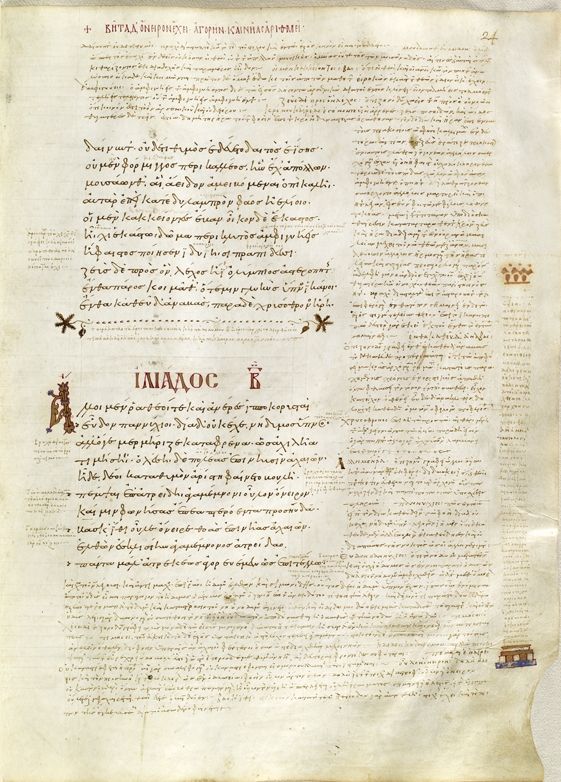 TransmissionHow the texts reached usThe journey of Greek verse from performance and papyrus to the modern critical edition.
Tabs: Alexandria · Six stages · Colometry · Byzantium · Renaissance · Printing · Apparatus · Discoveries · Poet by poet
A suggested path
- First steps, if you are new to metre: the seven steps in order, from Rhythm to Your turn.
- Introduction › What metre is, Quantity and Notation. With these three tabs you can follow any scansion on the site.
- Introduction › the two Prosody tabs, then Feet, metra, cola, periods and Stanzas and responsion.
- Keep Introduction › Glossary open in another window as you read on.
- Try a scansion: Verse forms › Dactylic, then a poem under Poets and playwrights.
- Accent: start with Evidence and Pitch accent, then the tabs on stress and melody. Read Phonology › Accent and morae first if the accent marks are new to you.
- Transmission: read it when you open an edition, or when a scansion on the site says that editors disagree.
- The last Introduction tabs, Ancient metricians, Modern theory and Linguistic theories, show how the subject has been studied.
Notes
- ^ West 1987, p. 7; D’Angour 2022, p. 133.
- ^ West 1987, p. 10.
- ^ D’Angour 2022, p. 132.
- ^ West 1987, pp. 10–12.
- ^ West 1987, pp. 10–18.
- ^ a b West 1987, p. 5.
- ^ a b West 1987, p. 4.
- ^ West 1987, pp. 3–4.
- ^ Probert 2006, pp. 55–56.
- ^ Allen 1968, p. 114.
- ^ West 1987, pp. 87–88.
- ^ Reynolds and Wilson 1991, pp. 2–4.
- ^ Reynolds and Wilson 1991, p. 4.
- ^ Reynolds and Wilson 1991, pp. 4–5.
- ^ Reynolds and Wilson 1991, p. 237.


