First steps for beginners, from rhythm to scanning a line; what metre is, how syllables are weighed, the notation and the rules of prosody; the Greek word accent; and how the texts reached us.
Accent · 1 of 9
The question and the evidence
Every Greek word that is not a clitic has one accented syllable.[1] Our texts mark it with an acute (ά), a circumflex (ᾶ) or a grave (ὰ). In Modern Greek that accent is a stress. It is carried by length and loudness as well as by pitch.[2]
For the classical language the handbooks say something else. The word accent was a matter of musical pitch, not of stress, and verse took no account of it.[3] The accented syllable was pitched higher than the unaccented syllables beside it.[4] Whether that is the whole story, and whether Greek also had a stress, has been argued for decades.[5] Stress in Greek is still a controversial subject.[6] The tabs that follow take the evidence, the pitch accent, the case for a stress, melody, metre, and the points in dispute.
Pitch and stress. A pitch accent is a word accent carried by pitch alone. It lacks the extra duration or intensity that make a stress.[7] In English, stressed vowels are generally longer and more intense than unstressed ones, while their pitch varies with the intonation.[2] “Stress” is a slippery word. It is sometimes used for acoustic intensity alone, as against pitch and duration.[8]
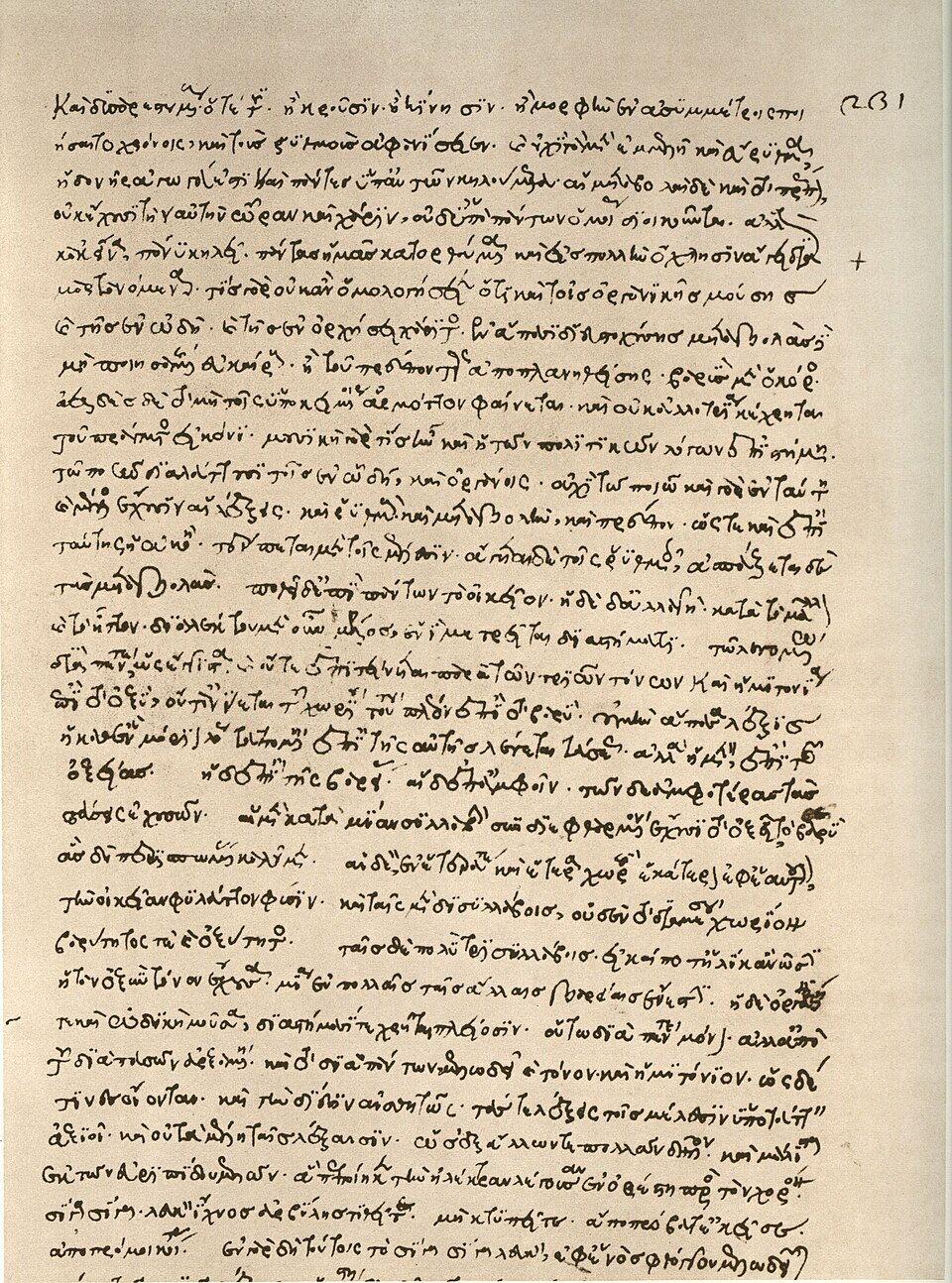
What the ancients said. The first reference to the accent in Greek literature is in Plato.[9] Socrates explains how a phrase becomes a name:
οἷον Διὶ φίλος — τοῦτο ἵνα ἀντὶ ῥήματος ὄνομα ἡμῖν γένηται, τό τε ἕτερον αὐτόθεν ἰῶτα ἐξείλομεν καὶ ἀντὶ ὀξείας τῆς μέσης συλλαβῆς βαρεῖαν ἐφθεγξάμεθα.
Take “dear to Zeus”: to turn it from a phrase into a name [Δίφιλος, Diphilos] we took out one of the iotas, and spoke the middle syllable low instead of high.
(Plato, Cratylus 399a–b, ed. Burnet)
The words for the accents, ὀξεῖα (oxeia) “sharp, high” and βαρεῖα (bareia) “heavy, low”, are words for the pitch of a voice. Aristotle was the first to use προσῳδία (prosōidia) of the pitch accent of syllables.[10] The grammarians’ terms τόνος (tonos), τάσις and προσῳδία all come from pitch and melody (so also Allen 1968, p. 106). Plato (Phaedrus 268d) and Aristotle (Rhetoric 1403b) describe the accent as melodic. They never mention loudness or extra length.[11] Aristoxenus allowed that speech has a melody of a sort. But he distinguished the gliding voice of speech from the voice of song, which moves by intervals and pauses on each note.[12] The fullest statement comes from Dionysius of Halicarnassus, writing at the end of the first century BC:[13]
διαλέκτου μὲν οὖν μέλος ἑνὶ μετρεῖται διαστήματι τῷ λεγομένῳ διὰ πέντε ὡς ἔγγιστα, καὶ οὔτε ἐπιτείνεται πέρα τῶν τριῶν τόνων καὶ ἡμιτονίου ἐπὶ τὸ ὀξὺ οὔτʼ ἀνίεται τοῦ χωρίου τούτου πλέον ἐπὶ τὸ βαρύ.
The melody of speech is measured by a single interval, very nearly the one called the fifth: it is not raised more than three tones and a semitone towards the high, nor lowered more than this towards the low.
(Dionysius, De compositione verborum 11, pp. 40–41 Usener–Radermacher)
He goes on to say three things. A word is spoken high, or low, or both. Where high and low are blended on one syllable, we call it περισπωμένη, the circumflex. And a word of any length has only one high syllable “among many low ones”.[14]
The fifth is read in two ways, and the readings are disputed. Devine and Stephens read it as the span between high and low within one word. This fits accentual movements measured in living languages. The other reading is a fifth up and a fifth down from a middle line.[15] Devine and Stephens think this less likely.[16] Allen had it from Carson in correspondence. He thought it worth considering, since it keeps the second half of Dionysius’ sentence from repeating the first.[17] Anderson also reads a single interval, and takes it as a maximum rather than a norm. But he warns that Dionysius wrote three centuries after Aristotle, about oratory, and as a champion of Atticism.[18] In the second or third century AD Aristides Quintilianus describes a third kind of voice, between speech and song, used for reading poetry.[19]
The written accents. The system of accent marks was invented in the Hellenistic period and is usually credited to Aristophanes of Byzantium.[20] Anderson dates it to about 200 BC.[12] D’Angour speaks of the accents marking pitch from the third century BC.[21] Allen also puts it at Alexandria about 200 BC. He links it with the decline of oral epic and the teaching of Greek to foreigners.[22]
The marks were written only sporadically until the early Middle Ages. In Reynolds and Wilson’s account they were written regularly from the beginning of the tenth century.[23] In Anderson’s they were so from the sixth century AD.[12] The circumflex was at first written as an angle, with the acute and grave joined on one syllable.[12]
For Sappho and Alcaeus the Alexandrian editors must have drawn on knowledge of the spoken Lesbian dialect. Its accent was recessive, so the Lesbian poets have no oxytone words.[24]
| Evidence | What it shows | Tab |
|---|---|---|
| Plato, Aristotle, Aristoxenus, Dionysius, the grammarians | the accent described in terms of pitch; a span of about a fifth; one high syllable per word | this tab |
| the accent marks (from about 200 BC) | where the accent stood and of which kind | Pitch accent |
| about forty musical documents, third century BC to third or fourth AD[25] | how far melody followed the accent | Melody |
| verse | classical metre counts quantity, not accent; later verse counts accents | Metre |
| the accent rules and later spellings | the accent sensitive to syllable weight; when long and short merged | Metre |
Notes
- ^ Devine and Stephens 1994, p. 152.
- ^ a b Devine and Stephens 1994, p. 204.
- ^ West 1987, p. 2.
- ^ West 1987, p. 68; Battezzato 2009, p. 143.
- ^ Abritta 2014, p. 1.
- ^ Devine and Stephens 1994, p. ix.
- ^ Devine and Stephens 1994, p. 211.
- ^ Abritta 2014, p. 1 n. 4.
- ^ Anderson 1973, p. 199 n. 4.
- ^ Anderson 1973, p. 189.
- ^ Devine and Stephens 1994, p. 208.
- ^ a b c d Anderson 1973, p. 190.
- ^ Anderson 1973, p. 191.
- ^ Anderson 1973, p. 41 U–R.
- ^ Carson 1969.
- ^ Devine and Stephens 1994, pp. 171–172.
- ^ Allen 1968, p. 109.
- ^ Anderson 1973, pp. 191–192.
- ^ Anderson 1973, p. 192; Devine and Stephens 1994, p. 164.
- ^ Reynolds and Wilson 1991, pp. 4, 9; Tribulato 2021, p. 143.
- ^ D’Angour 2022, p. 132.
- ^ Allen 1968, p. 114.
- ^ Reynolds and Wilson 1991, pp. 4, 9.
- ^ Tribulato 2021, pp. 143–144.
- ^ Anderson 1973, p. 186.
Accent · 2 of 9
High tone, falling tone: the contonation
Here is W. S. Allen’s account of the accent, in the form he gave it in 1968. It starts from the ancient descriptions and from the closely related accent of Vedic Sanskrit. It explains the familiar rules by one idea, which Allen calls the contonation.
High and low
The Greek terms are terms of pitch. If ὀξύς (oxys) “sharp” had meant loud, βαρύς (barys) “heavy” would mean quiet, and it never does. In βαρυβρεμέτης, an epithet of Zeus, it describes a sound both low and loud. Aristotle treats the accent as a kind of ἁρμονία (harmonia), and he calls loudness something else, μέγεθος (megethos). τόνος (tonos) and τάσις (tasis), “stretching”, come from the tension of a string, raised (ἐπίτασις, epitasis) or slackened (ἄνεσις, anesis).[1]
The accent was the one high-toned syllable of the word, its κύριος τόνος (kyrios tonos). The rest were low, and low is simply the absence of the high tone.[2] The Indian phoneticians described Vedic in terms of high and low pitch, and Vedic matches Greek closely: πατήρ, πάτερ, πατέρα, πατρί beside pitā́, pítar, pitáram, pitré.[3]
The unit that carries the tone is the mora, not the syllable. A short vowel has one mora, and a long vowel or diphthong two.[4] The accent rules look only at vowels. In φοῖνιξ the last syllable counts as short because its vowel is short, though the syllable -νιξ is heavy.[5]
The fall
In Vedic the syllable after a high tone did not simply return to low. It carried a falling glide, which the Indian phoneticians called svarita. Since the glide was automatic, it was not written. Allen thinks Greek had it too.[6] On a long vowel the high could stand on either mora. On the second mora it is the acute (optative λήξαι, low then high). On the first, with the fall on the second, it is the “compound” tone written with the circumflex (infinitive λῆξαι).[7] Phonetically the fall inside a circumflex and the fall after an acute were probably the same glide. The Indian writers used the same name for both.[8] Dionysius’ account of speech melody fits a voice that climbs gradually towards the high and then falls back.[9]
The rule
What comes before the high tone never limits where it stands. What comes after it does. Allen treats the high tone and the fall that follows it as one unit, and this unit is the contonation. It takes one syllable (the circumflex) or two (an acute and the next syllable). The rule is then simple: after the contonation there may be no more than one short vowel.[10] So we have ἄνθρωπος (high on ἀν-, fall on -θρω-, then one short), but ἀνθρώπου (high on the second mora of -θρω-, fall on the first mora of -που, one mora left). So also δῶρον, but δώρου. For this rule final -αι and -οι count as a short vowel followed by a consonantal glide.[11]
The grave
One early system of marking put a grave on every low syllable (Θὲόδὼρὸς). The Byzantine system marks only the acute and the circumflex. It writes a grave for an acute on a final syllable, except before an enclitic or a pause and in interrogative τίς.[12]
Allen explains this as follows. A high tone on the last syllable could not be followed by its fall, since Greek did not let the fall run into the next word as Vedic did. So the high was changed in some way. How it changed is unknown, and he declines to guess.[13] The measurements, too, show the fall staying inside the word unless a clitic follows.[14] Disputed. For Devine and Stephens the grave was a lowered high.[15] Cosgrove and Meyer think the voice dropped on it in speech.[16] Before a pause and in τίς the high needed no fall. Allen takes the pre-pausal acute as part of the sentence intonation. He compares Norwegian, whose statements end on a rise.[17]
Enclitics
An enclitic has no accent and makes one unit with its host. So the fall can go onto it. In ἀγαθός ἐστιν the first syllable of ἐστιν carries the fall. In ἄνθρωποί τινες and δῶρόν ἐστιν a second contonation is needed, or more than one mora would follow the first. And the language says μεγάλοι τινές, not μεγάλοί τινες, which would rob μεγάλοι of its fall.[18]
Allen holds the written accents a faithful record of the word tones. But he thought almost nothing could be known of how they combined with each other and with the intonation of the sentence.[19]
Notes
- ^ Allen 1968, p. 106.
- ^ Allen 1968, p. 108.
- ^ Allen 1968, p. 107.
- ^ Allen 1968, pp. 81, 107.
- ^ Allen 1968, pp. 106–107.
- ^ Allen 1968, p. 111.
- ^ Allen 1968, pp. 111–112, 115.
- ^ Allen 1968, p. 112.
- ^ Allen 1968, p. 113.
- ^ Allen 1968, p. 114.
- ^ Allen 1968, p. 114 n. 2.
- ^ Allen 1968, p. 115.
- ^ Allen 1968, pp. 115–116.
- ^ Devine and Stephens 1994, p. 180.
- ^ Devine and Stephens 1994, pp. 181–182.
- ^ Cosgrove and Meyer 2006, p. 69 n. 12.
- ^ Allen 1968, p. 117.
- ^ Allen 1968, p. 116.
- ^ Allen 1968, pp. 117–118.
Accent · 3 of 9
Was there also a stress?
Two questions need to be kept apart. First, did the accented syllable carry extra loudness or length as well as high pitch? Second, apart from the accent, did Greek words have rhythmically prominent syllables, and were they stressed[1]? Both are disputed.
1. A stress in the accent itself? For West the classical accent was carried by pitch, not by stress. The accented syllable was spoken on a higher note. It took on an element of stress only from the Hellenistic period on.[2] The ancient descriptions mention only pitch.[3]
Serbo-Croatian, Lithuanian and Swedish are often said to have a pitch accent. They are better called pitch-differentiated stress languages. These are stress languages whose pitch is split into two distinctive accents.[4] They are commonly cited as parallels for Greek.[5] They match its rising and falling accents. But the comparison goes no further unless the Greek accent had a significant element of stress.[6] Arguments have been offered for such a stress.[7] They have not won wide support, and nothing in the metre points to such a stress.[3]
Anderson, on the other hand, assumed that the Greek accent had an extra element of stress from the start. In the end, on his view, this stress replaced the pitch.[8] He pointed to W. S. Allen’s argument (1967) that stress was closely allied with the accent, above all with the circumflex.[9] Allen himself kept the stress he posited apart from the accent. For him the classical accent was tonal, and Greek stress was unconnected with its high tone.[10]
2. An independent rhythm of strong and weak syllables? Allen’s Accent and Rhythm (1973) gave Greek words a stress independent of the pitch accent. The stress was located by syllable weight. Allen summarises its rules himself,[11] and Abritta reports them in the same form.[12] They are these:
- A stress matrix is one heavy or two light syllables.
- A word longer than one matrix contains both stressed and unstressed parts.
- A heavy final syllable is stressed.
- After a light final, the preceding matrix is stressed (in words shaped — ⏑ ⏑ ⏑ the final two shorts may be).
λέγω · θάλασσα · ἀνθρώπου
Our examples, worked by Allen’s rules as the text gives them.[13] Capitals mark the stress the rules give; the written accent shows where the pitch peak was. The two fall on different syllables in all three words.
synthetic ∿
An earlier, shorter statement of the theory appears in Vox Graeca.[14] Allen found that classical spoken verse makes no effort to bring accent and metre into agreement.[15] Golston and Riad likewise separate the high tone of the pitch accent from a stress. As in Latin, this stress lands on moraic trochees.[16] They build their account of metre on it.[17]
Devine and Stephens also give Greek words rhythmically prominent syllables, but as a matter of duration. Heavy and light syllables are mapped onto long and short rhythmic units, thesis and arsis, as in verse.[18] Their rules and Allen’s put the prominences in practically the same places. They differ over what the prominence is.[12] For Devine and Stephens the prominence is independent of the pitch accent.[19] It is like the durational rhythm that coexists with a pure pitch accent in Japanese, their closest parallel.[20] Whether to call it “stress” is partly a matter of terms.[21]
They applied Allen’s rules to Plato’s Republic. They found only tendencies that follow from syllable shape. Circumflexes always stand on heavy syllables, and acutes often on light ones:[22]
| Syllable | % rhythmically prominent |
|---|---|
| with circumflex | 87 |
| after a circumflex, or second after an acute | 81 |
| after an acute | 65 |
| with grave | 65 |
| before any accent | 33 |
| with acute | 23 |
3. A rhythm that depends on the accent. A. P. David (2006) proposes such a rhythm, as quoted by Abritta[23]. He stresses a circumflex syllable strongly. He leaves a grave unstressed or lightly stressed. With an acute, he stresses the next syllable if it is heavy or before a pause, and otherwise the acute syllable itself. The theories part company over oxytones ending in a trochee. These are words ending — ⏑ with the accent on the last syllable. David’s rule makes their short final prominent.[23] So Abritta counted trochaic-ending words in prose and verse:
| Sample | other accents : oxytone |
|---|---|
| Herodotus | 7.87 : 1 |
| Iliad, about 1,200 lines | 4.53 : 1 |
| Homeric Hymn to Hermes | 4.14 : 1 |
| Sophocles, about 2,000 trimeters | 3.56 : 1 |
Oxytones of this shape are about twice as frequent in the poets as in Herodotus. Their spread over the positions of the line is unlikely to be random.[24] He concludes, against Allen and against Devine and Stephens, that the tonal accent is probably linked in some way to poetic rhythm. But he admits that his tests do not settle the question.[25] The paper is a conference typescript, not a refereed publication.
Notes
- ^ Devine and Stephens 1994, pp. 195, 206–208.
- ^ West 1987, p. 68.
- ^ a b Devine and Stephens 1994, p. 208.
- ^ Devine and Stephens 1994, pp. 206–207.
- ^ Sealey 1963, as cited by Devine and Stephens; Devine and Stephens 1994, p. 207.
- ^ Devine and Stephens 1994, pp. 207–208.
- ^ Ehrlich 1912; Schmitt 1953; Szemerényi 1964, as cited there.
- ^ Anderson 1973, p. 187.
- ^ Anderson 1973, pp. 197, 202 n. 19.
- ^ Allen 1968, p. 120.
- ^ Allen 1973, pp. 333–334.
- ^ a b Abritta 2014, p. 2.
- ^ Allen 1968, p. 121; Allen 1973, pp. 333–334.
- ^ Allen 1968, pp. 120–124.
- ^ Allen 1973, p. 261; quoted in Golston and Riad 2005, p. 79.
- ^ Golston and Riad 2005, p. 80.
- ^ Golston and Riad 2005, p. 97.
- ^ Devine and Stephens 1994, pp. 117–121, 206.
- ^ Devine and Stephens 1994, p. 209.
- ^ Devine and Stephens 1994, p. 214.
- ^ Devine and Stephens 1994, pp. 214–215, 223.
- ^ Devine and Stephens 1994, pp. 209–210.
- ^ a b Abritta 2014, p. 3.
- ^ Abritta 2014, pp. 4–7 and table 1, p. 10.
- ^ Abritta 2014, p. 8.
Accent · 4 of 9
A stress rhythm beside the pitch accent
In Vox Graeca (1968) Allen gave a first, short statement of a theory. He developed it in Accent and Rhythm (1973). On this theory classical Greek had a stress fixed by syllable weight, besides its pitch accent. Verse was recited with that stress on the beat.
The argument
The pitch accent cannot have carried a stress, Allen argued, since in classical verse it does not line up with the beat.[1] That the word accent plays no part in ancient metre is common ground.[2] The quantitative verse of early Greece can be explained by the absence of contrastive stress. That absence left the language with a syllable-timed rhythm of light and heavy syllables.[3]
But a tonal language, Allen went on, may have a stress pattern unconnected with its accent. It would be strange if Greek had none. He thought it unlikely that Greek verse had no beat at all, only measured time.[4] Duration cannot be the whole of quantity. In iambics a heavy syllable can stand where a light one is expected (a long anceps). In the hexameter one heavy may be replaced by two lights only in the second half of the foot. What fits both facts is stressability. Heavy syllables could bear a stress in speech, and light ones generally did not. Verse rhythm alternated stressed and unstressed syllables, with an ictus on the strong part of the foot.[5]
The rules
Allen studied where words of each shape stand in the verse. From these statistics he drew two rules for words of more than one syllable:[6]
- The main stress falls on the last heavy syllable of the word.
- A weaker stress falls on an earlier heavy syllable if at least one mora separates it from the main one.
λέγω · θάλασσα · ἀνθρώπου
Our examples, worked by Allen’s rules as the text gives them.[7] Capitals mark the stress the rules give; the written accent shows where the pitch peak was. The two fall on different syllables in all three words.
synthetic ∿
A light first syllable before two light ones could also be stressed, more weakly. All these stresses were weak beside those of English or Latin.[6] On these rules speech rhythm and the beat agree in 90–95% of cases in the trimeter and the hexameter, and almost always in the second half of the line.[6] A final syllable with a short vowel and one consonant is heavy before a consonant and light before a vowel. So a word’s stresses would shift with its neighbours.[8]
Devine and Stephens keep the first rule as the pivot of their own account, in their terms of thesis and arsis. The rightmost syllable that can carry a thesis is found first, and the word’s rhythm is built back from it. They credit the principle to Allen’s book of 1973.[9]
The 1973 book states the rules in terms of a stress matrix. A matrix is one heavy syllable or two light ones.[10] The rules are these:
- A word longer than a matrix has internal contrasts of stress.
- A heavy final syllable is stressed.
- If the final is light, the matrix before it is stressed. But a word shaped — ⏑ ⏑ ⏑ may stress its final two lights instead.
- A matrix preceding and separated from the primary stress is stressed too.
- A terminal rule carries the alternation on from the previous word’s stress. So a final light syllable not preceded by a matrix is stressed by it.
The three words above come out the same way in these terms. The heavy final of λέγω is stressed. The final of θάλασσα is light, so the matrix before it, λασ, is stressed. In ἀνθρώπου the matrix ἀν stands apart from the main stress on ποῦ, and is stressed too.
Devine and Stephens take over the matrix, but not its cause. In Allen’s theory a matrix is formed by stress. They point instead to Efik, which forms matrices without a Germanic kind of stress. They conclude that stress is not a precondition.[11] Metrical-phonology analyses by Sauzet and Golston add a further point. The pitch accent need not fall on the metrically prominent syllable at all. The recessive accent sits on the syllable before the final foot.[12]
Allen’s own caveat stands at the head of the trimeter chapter. Nothing in the discussion implies that Greek verse was basically stressed. Structurally it was quantitative. The compositional practice of serious spoken poetry is best explained by a wish that the stress of speech should reinforce the quantitative pattern in performance, rather than contradict it.[13]
Notes
- ^ Allen 1968, p. 120; Allen 1973, p. 261.
- ^ Probert 2006, p. 50.
- ^ Horrocks 2010, pp. 41 n. 4, 45.
- ^ Allen 1968, p. 120.
- ^ Allen 1968, pp. 104–105.
- ^ a b c Allen 1968, p. 121.
- ^ Allen 1968, p. 121; Allen 1973, pp. 333–334.
- ^ Allen 1968, p. 122.
- ^ Devine and Stephens 1994, p. 125.
- ^ Allen 1973, pp. 333–334.
- ^ Devine and Stephens 1994, p. 134.
- ^ Probert 2006, pp. 122–123.
- ^ Allen 1973, p. 304.
Accent · 5 of 9
The ictus tested: what it explains, and the objections
Here is what he claimed they explain, and what others have said.
What it explains
Allen reads the metrical “laws” and bridges as ways of avoiding a clash between speech stress and beat, above all near the end of the line. Porson’s Law forbids word-end after a long fifth anceps of the tragic trimeter. The reason, on this view, is that the last, heavy syllable of a word there would be stressed and would put a beat on a weak position. The hexameter avoids word-end after a spondaic fifth foot for the same reason.[1] The rules would also explain why only short vowels are elided in Greek, since only unstressed syllables lose their vowel.[2]
The commonest clash in the trimeter comes where the third foot is a spondee and a word ends at the penthemimeral caesura. That word’s last syllable is heavy and so stressed, and it stands on the weak first half of the foot. This happens about 15% more often than chance would give, perhaps on purpose. Sophocles likes to put a repeated word there:[3]
αἰτεῖς· ἃ δʼ αἰτεῖς, τἄμʼ ἐὰν θέλῃς ἔπη
You pray; and what you pray for, if you will take my words …
Sophocles, Oedipus Tyrannus 216, ed. Storr
synthetic ∿
A reader may keep to the strict beat here. Or the reader may give the second αἰτεῖς its speech stress and let the tension resolve at the end of the line. There Porson’s Law brings speech and beat back together.[4]
Cautions and objections
Allen himself held that the theory had not yet been tested by discussion. It left details open, and it should not be applied to reading prose. For verse, if it is wrong, a reading in strict rhythm could not be wrong by more than 5–10%.[3]
The obvious objection comes from Modern Greek. Modern Greek stresses the syllable of the old accent, and that is often a different syllable from the one the rules give. ἕτοιμα, for example, is ἑ-ΤΟΙ-μα by the rules, but Modern [étima]. Allen answers that the change from the old system to the new was not simple.[2] In 1973 he added that his stress bears no relation to the modern one, which keeps the place of the old pitch peak. The classical stresses were non-accentual and weak. They could simply have been suppressed when stress became the accent. Falling pitch and the hypothetical stress tended to coincide, and this smoothed the transition.[5]
ἕτοιμα
The objection in one word, “ready” (neuter plural). Allen’s rules put the stress on the heavy τοι (red, left); the accent is written on ἑ-, and Modern Greek stresses that syllable, [étima] (red, right). Allen 1968, p. 124.
synthetic ∿
Others question the foundations. West calls ictus misleading if it suggests a stress able to lengthen a syllable.[6] Devine and Stephens find the rhythmic prominences in the same places as Allen. But they make them a matter of duration, not of loudness, and they leave the word “stress” open.[7] Abritta objects that rules drawn from metre cannot be confirmed by the same metre. He thinks the pitch accent was linked to verse rhythm after all.[8] D’Angour doubts that the Greeks heard the downbeat as stressed.[9]
The historians of the language agree with Allen on the ground he starts from. The word accent played no role in classical metre, which counted syllable weight in a language without contrastive stress.[10] But they do not take up the ictus. Itsumi comes at the beat from the other side. His statistics of the anceps in tragic lyric persuade him that a long syllable in anceps kept its full two morae. So the metra were not of equal time. He warns against the craving, in Dale’s phrase, for an equidistant beat.[11] Disputed.
Notes
- ^ Allen 1968, p. 122.
- ^ a b Allen 1968, p. 124.
- ^ a b Allen 1968, p. 123.
- ^ Allen 1968, pp. 123–124.
- ^ Allen 1973, p. 334.
- ^ West 1987, pp. 87–88.
- ^ Devine and Stephens 1994, pp. 117–121, 214–215; Abritta 2014, p. 2.
- ^ Abritta 2014, pp. 4, 8.
- ^ D’Angour 2022, p. 139 n. 6.
- ^ Probert 2006, p. 50; Horrocks 2010, pp. 41 n. 4, 45; Vandiver 2023, p. 155.
- ^ Itsumi 2020, pp. 2, 29.
Accent · 6 of 9
Accent and melody: the musical documents
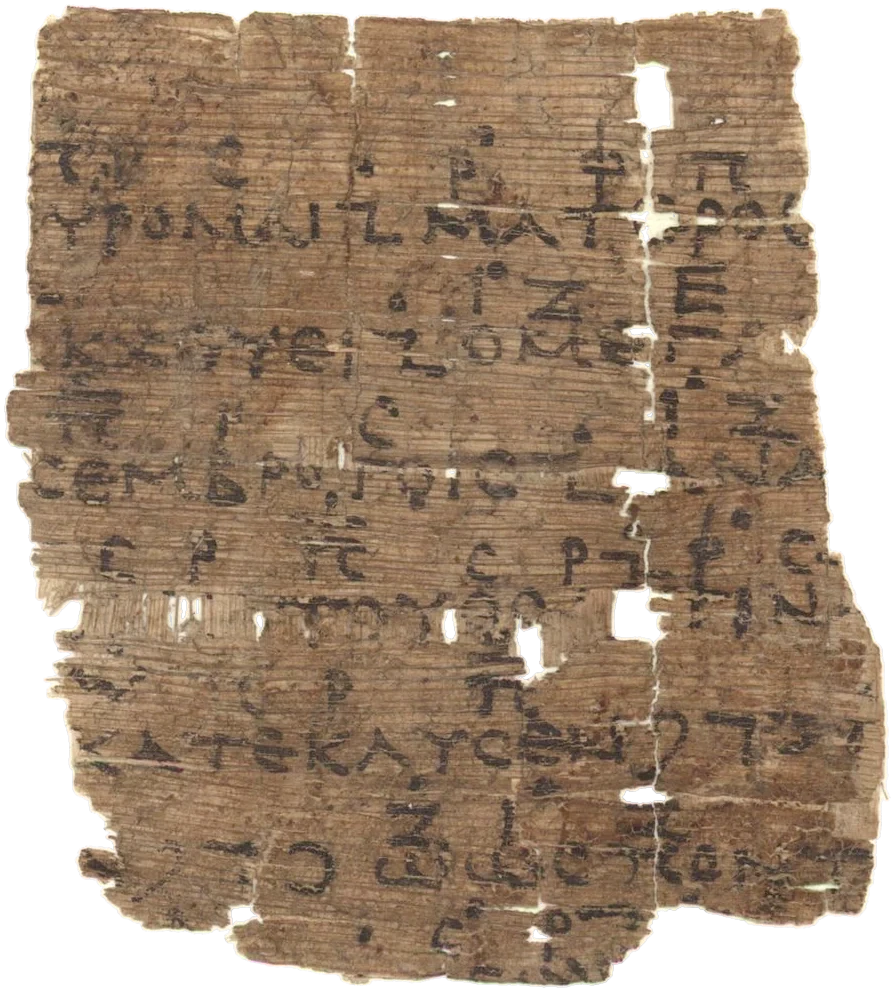
About forty papyri, inscriptions and manuscripts with musical notation survive, from the third century BC to the third or fourth AD.[1] They are the main evidence for the pitch of Greek words,[2] though composers did not always follow it.
The conventions. Where composers followed the accent, they kept four rules. The rules go back to Winnington-Ingram:[3]
- The accented syllable of a word of two or more syllables carries a note as high as, or higher than, any other syllable of the word. This is called the pitch-height rule.
- The melody often falls after an acute. In longer words it rises to the acute and falls from it.
- A circumflex is usually set to a falling figure.
- After a grave the melody does not fall again until after the next accent, except at a grammatical pause.
Chance. Greek melodies move in small steps and repeat notes. So a tune that ignored the accent would still keep rule 1 more than half the time. Simulations show this. The most frequent chance result averaged 58% over thirteen pieces, and ranged from 44% to 80% by piece.[4] A high count proves design only if it beats chance.
| Document | Date | Rule 1 kept | Verdict |
|---|---|---|---|
| Euripides, Orestes 338–44 | play of 408 BC | 3 of 7 | no sign of the rule |
| Delphic paean of Athenaeus | 127 BC | 77 of 79 | design |
| Delphic paean of Limenius | 127 BC | 100 of 101 | design |
| Seikilos epitaph | perhaps 1st c. AD | 8 of 10 | likely, not proved |
| Mesomedes’ three hymns | 2nd c. AD | — | design |
| P.Berlin 6870, lines 16–19 (Ajax lament) | papyrus 2nd c. AD | 0 of 9 | rule inverted on purpose? |
| P.Oxy. 1786 (Christian hymn) | 3rd c. AD | 13 of 20 | design not shown |
Cosgrove and Meyer 2006, pp. 68, 73–75, 79–81. Dates: West 1987, pp. 71–72; Orestes, Anderson 1973, p. 193; the two papyri, Cosgrove and Meyer, pp. 80–81, who date the paeans 128/27 BC (138 and 128 BC).[5]
Cosgrove and Meyer suggest that the Ajax lament, with nine clashes in nine, distorts the words’ natural melody to express a woman’s grief.[6]
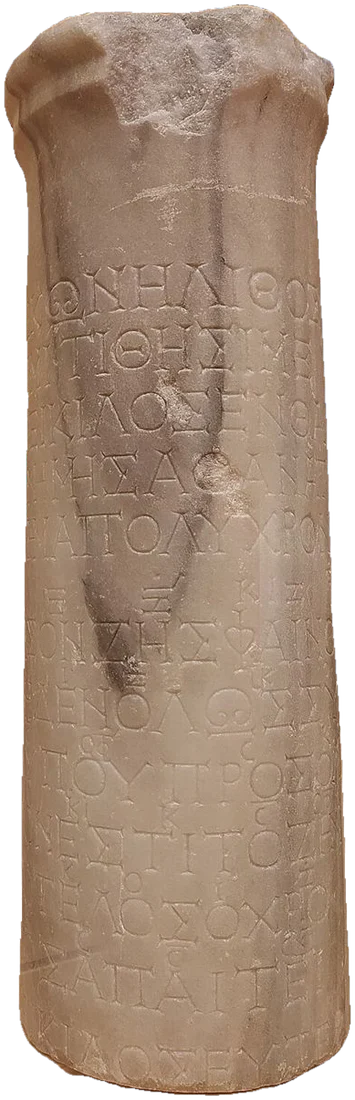
Allen had already noted the contrast between the Orestes papyrus and the Delphic inscriptions. He also noted that in the Seikilos epitaph an acute syllable is nearly always set higher than the rest of its word (ὅλως, ὀλίγον, χρόνος). He read the music’s way with circumflexes and with the syllable after an accent (λυποῦ, ζῆν, ἀπαιτεῖ; the second syllable of ὅλως) as signs of a falling glide.[7]
ὅλως · ὀλίγον · ὁ χρόνος
The Song of Seikilos, three words with their notes.[8] The accented syllable (red, capitals in the transliteration) has the highest note of its word: e′ above d′ and c♯′. That is rule 1, the pitch-height rule.
synthetic ∿
Strophic and astrophic song. There is no certain exception to one rule. Pieces with little or no respect for the accent come from compositions that are, or could be, strophic. Pieces that respect it most strictly are surely or probably not strophic.[9] The reason is simple. An antistrophe sung to the strophe’s tune brings new words with new accents. In astrophic song the accent can shape the melody, since the words need not fit a melody fixed in advance.[10]
Pindar’s Olympian 9 gives an instance. Πυθῶνάδε “at Pytho” and Πύθωνάδε “at Python” differ only in accent. But in strophic song the melody overrides the accent.[11] Strophe and antistrophe do match in accent more often than chance. In Orestes 316–31 ~ 332–47 they match on 57% of syllables, against 44% expected. But this may be a side effect of parallel phrasing and word-ends. It is in any case far weaker than in astrophic song.[12]
Dionysius on the Orestes. Dionysius says that music “thinks fit to subordinate the words to the melodies, not the melodies to the words” (τάς τε λέξεις τοῖς μέλεσιν ὑποτάττειν ἀξιοῖ καὶ οὐ τὰ μέλη ταῖς λέξεσιν). He cites Orestes 140–142 to show it. σίγα σῖγα λευκὸν is sung on one note, though each word has high and low pitches. ἀρβύλης has its third syllable on the same note as its accented second. The circumflex of κτυπεῖτε has vanished. In ἀποπρὸ βᾶτε the high has moved from the third syllable to the fourth (Comp. 11, pp. 41–42 U–R; Murray reads σῖγα σῖγα, λεπτὸν).
Henderson argued that Dionysius had a Hellenistic setting, not Euripides’ music (as cited by Devine and Stephens).[13] For Anderson, if the score was genuine, Euripides’ disregard of the accent was typical.[14] D’Angour thinks the papyrus melody (338–45 in his numbering) probably Euripides’ own. In his view it follows the accents to a moderate degree and paints the words.[15]
Before and after. Disputed. No certain use of the pitch-height rule is found before the Delphic paeans. From then to the second century AD its use is clear.[16] Whether archaic song followed the accent is disputed. D’Angour judges it most plausible that early melody followed the words’ natural pitches within a fixed tuning.[17] This is the picture the critics of the New Music drew of the old style.[18] Anderson saw no grounds for assuming any inherent link between accent and melody. He read the accord of the late hymns as archaism, from a time when stress was replacing pitch in speech.[19]
Modern performances
Modern performances, not ancient music: no melody for these words survives. They are shown for listening; each makes its own choices, described under it.
Jump to Stanza 1 0:32 · 2 0:56 · 3 1:20 · 4 1:50 · 5 2:12 · 6 2:38 · 7 3:08
Notes
- ^ Anderson 1973, p. 186.
- ^ Devine and Stephens 1994, p. 160.
- ^ Cosgrove and Meyer 2006, p. 66.
- ^ Cosgrove and Meyer 2006, pp. 67–68, 79.
- ^ Anderson 1973, p. 192.
- ^ Cosgrove and Meyer 2006, p. 75.
- ^ Allen 1968, pp. 108–109, 111–112.
- ^ Pöhlmann and West 2001, pp. 88–91, as on the site’s Notation page.
- ^ Devine and Stephens 1994, p. 168; so Anderson 1973, p. 194; Battezzato 2009, p. 143.
- ^ West 1987, pp. 66, 68 n. 2.
- ^ Pelliccia 2009, p. 256 n. 36.
- ^ Devine and Stephens 1994, pp. 169–170.
- ^ Devine and Stephens 1994, p. 169.
- ^ Anderson 1973, p. 196.
- ^ D’Angour 2022, pp. 139–140.
- ^ Cosgrove and Meyer 2006, pp. 80–81.
- ^ D’Angour 2022, pp. 140–141.
- ^ Csapo and Wilson 2009, p. 287.
- ^ Anderson 1973, pp. 197–198.
Accent · 7 of 9
Accent and metre
Classical verse ignores the accent. Greek verse of the classical period is built from long and short syllables. The word accent plays no part in it.[1] There is at most one doubtful exception: one or two passages in drama where short, mostly accented syllables stand in principes.[2] Every pattern of accent can occur with every rhythmic shape.[3] Abritta’s counts suggest that the accent nevertheless influenced where poets placed some words (2014). So even this is disputed.
| Shape | Words | Accent on |
|---|---|---|
| — — | κῆρυξ · φεύγειν · ψευδεῖς · πλευράς | first (circumflex) · first (acute) · second (circumflex) · second (acute) |
| ⏑ ⏑ ⏑ | ἔλαβε · φυγάδα · ὑγιές | first · second · third |
Examples from Devine and Stephens 1994, p. 209.
Weight in the language. The accent rules themselves count syllable weight. The accent cannot recede beyond the penult if the final syllable is heavy. By Vendryes’ Law, Attic draws the accent of ἑτοῖμος and ἐρῆμος back onto a light antepenult: ἕτοιμος, ἔρημος. By Wheeler’s Law, old oxytones ending in a dactylic sequence became paroxytone, as in ποικίλος.[4] For Devine and Stephens such rules show that heavy and light syllables were units of the rhythm of ordinary speech. They were not merely durations measured off to fit verse.[5] Verse rhythm, on this view, is a stricter form of speech rhythm.[6] In their analysis, however, the span over which the accent falls is not aligned with the rhythmic foot.[7]
ἑτοῖμος → ἕτοιμος
Vendryes’ Law in one word, “ready”.[4] Attic moves the accent (red, capitals) back from the heavy penult onto the light antepenult. The weights of the syllables, ⏑ — ⏑, do not change, so the metre does not change either.
synthetic ∿
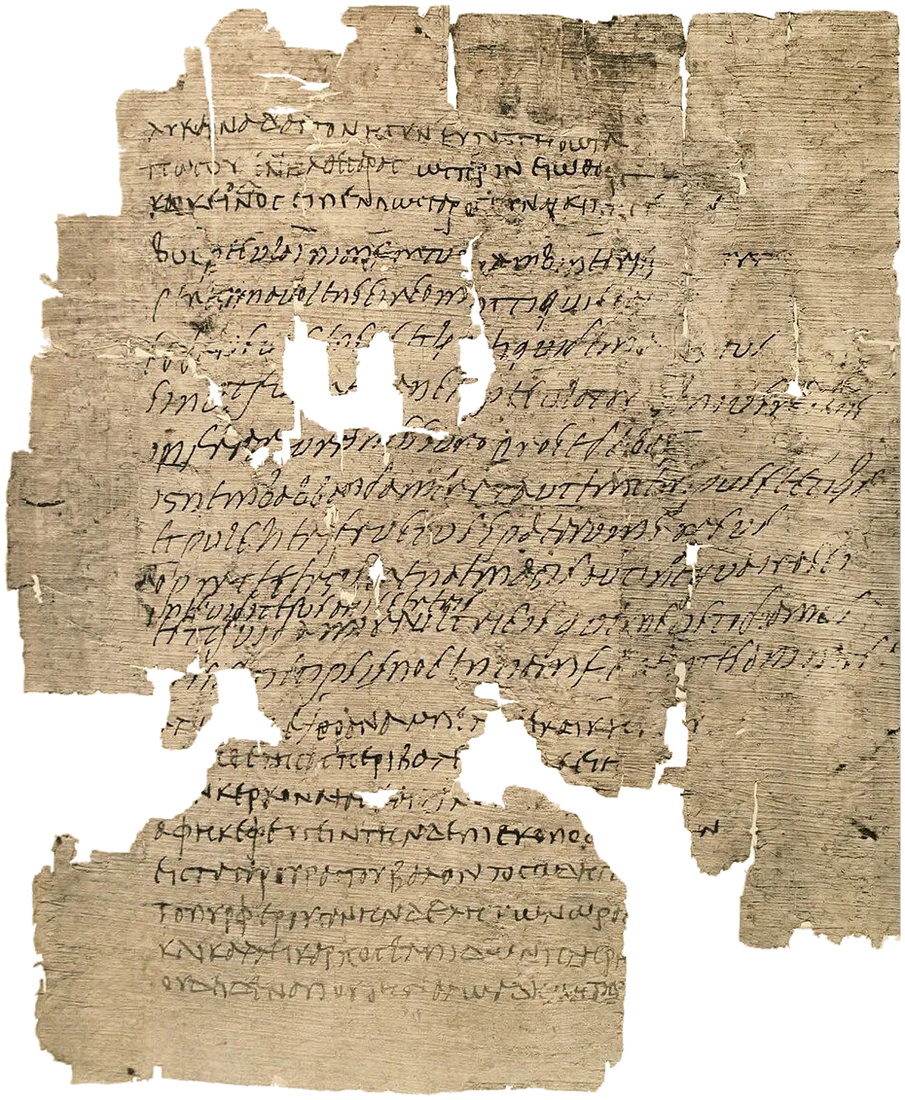
When the accent began to count. From the Hellenistic period the accent gradually acquired an element of stress. Accented syllables tended to lengthen, and unaccented ones to shorten. By about the third century AD the old opposition of long and short had more or less disappeared from speech.[8] In the following line every accented syllable is short in classical scansion. So in the new pronunciation nothing of the metrical pattern was left:[9]
Ἰλιόθεν με φέρων ἄνεμος Κικόνεσσι πέλασσεν,
The wind carried me from Ilium and brought me to the Cicones.
Homer, Odyssey 9.39, ed. Murray
synthetic ∿
The change in verse came in three stages, from accent preferences at line-end in strict verse to metres that count only accents. From the first century BC trimeter poets tended to avoid an accented final syllable.[10] Babrius (first century AD) always has an accented penultimate syllable in his choliambics. The vowel of that syllable is usually long or a diphthong, and the vowel of the final syllable almost always is.[10] Hipponax’s line is “un-Babrian” in four respects: the long ninth position (ischiorrhogic), the proparoxytone ending, and the short vowels of the last two syllables:[11]
πάλαι γὰρ αὐτοὺς προσδέκονται χάσκοντες
They have long been waiting for them, open-mouthed.
ὦ Βράγχε τέκνον, ἣν καλοῦσι χρυσείην.
Branchus, my child, the race they call golden.
Hipponax 9.1, as West quotes it, and Babrius, prologue 2, ed. Crusius: choliambs, the iambic trimeter with its penultimate position long (red).
synthetic ∿
The Greek follows Bergk’s text with προσδέκονται from his apparatus.[12] The metrical analysis follows West.[13]
The last syllable of the choliamb has a long vowel in 59.58% of Hipponax’s lines, 61.79% of Callimachus’, 64.36% of Herodas’ and 97.33% of Babrius’. In Babrius the paroxytone ending is nearly without exception. Devine and Stephens ascribe the rise to syllable weight before a pause, not to the accent alone. The earlier poets show no trend towards paroxytone endings.[14] Allen too refused to read Babrius’ endings as evidence of stress. For him they could be explained by a tonal accent.[15]
The paroxytone trimeter ending became standard in George Pisides’ time, the seventh century.[11] Correct quantity had long been a rule kept for learning’s sake, which the ear no longer heard. The metre became in effect × × × × × ⁝ × × : × × × ×́ ×. This is the Byzantine dodecasyllable: twelve syllables with the accent on the penultimate (⁝ and : mark more and less frequent word-end).[16]
How and when the stress came. Disputed. Devine and Stephens date the beginnings of the change to less educated speech, perhaps as early as fourth-century BC vulgar Attic. Bilingual speakers, such as those of Coptic in Egypt, helped it along. It reached the literary register only with Christian writers of the early fourth century AD, such as Methodius and Gregory of Nazianzus.[17] Anderson too dates the first stress-accented poetry to the fourth century AD.[18]
Allen found no convincing evidence for the change before the hymns of Clement of Alexandria (late second or early third century) and an early fourth-century Christian hymn on papyrus. The change was complete by the time of Gregory of Nazianzus, late in the fourth century. The accentual habits of Nonnus’ hexameters (fifth century) reflect stress. Allen linked the loss of distinctive vowel length, which he put about the third century AD, to the same change.[19]
Which came first is also disputed. Did the loss of vowel length come first[20]? Or was it a change in the accent, which then lengthened accented and shortened unaccented vowels[21]? All these views are as cited by Devine and Stephens.[22] Their test of misspelled vowels in Attic inscriptions and Ptolemaic papyri gives “some support” to the second view.[23] In the miuric paroemiacs of GDK 3–4 the last thesis is replaced by a light syllable (GDK = Heitsch 1961; second to third century AD). There the poets keep a quantitative pattern but use accented short syllables as longs. In the fourth-century hymn GDK 45.4 the accent itself marks the strong position.[24]
Notes
- ^ West 1987, p. 2.
- ^ West 1987, p. 68 n. 2.
- ^ Devine and Stephens 1994, p. 209.
- ^ a b Devine and Stephens 1994, pp. 102–103.
- ^ Devine and Stephens 1994, p. 118.
- ^ Devine and Stephens 1994, pp. 100–101.
- ^ Devine and Stephens 1994, pp. 153–154.
- ^ West 1987, pp. 68–69.
- ^ West 1987, p. 69.
- ^ a b West 1987, p. 82.
- ^ a b West 1987, pp. 82–83.
- ^ Bergk 1882, p. 463.
- ^ West 1987, pp. 30, 82.
- ^ Devine and Stephens 1994, pp. 83–84.
- ^ Allen 1968, p. 119.
- ^ West 1987, p. 83; West 1987, p. ix.
- ^ Devine and Stephens 1994, p. 215.
- ^ Anderson 1973, p. 197.
- ^ Allen 1968, pp. 88–89, 119–120.
- ^ Schwyzer 1959; Teodorsson 1974.
- ^ Kretschmer, Drerup 1929, Allen 1973.
- ^ Devine and Stephens 1994, p. 216.
- ^ Devine and Stephens 1994, pp. 217–218.
- ^ Devine and Stephens 1994, pp. 218–220.
Accent · 8 of 9
Where scholars disagree
Why it is hard. Ancient Greek has no native speakers, so every statement about its accent is an inference. The evidence is indirect and mostly late: descriptions from Plato to Dionysius and the grammarians; accent marks invented in the Hellenistic period; about forty musical documents, nearly all later than the classical poets;[1] and the verse itself. Each has its trap. A melody that moves in small steps keeps the accent’s “rules” much of the time by chance.[2] Rules of speech rhythm drawn from metre cannot be tested against the same metre without arguing in a circle. Abritta makes this objection to Allen and to Devine and Stephens.[3] Anderson granted that his own conclusions could not do without conjecture.[4]
Every row below is disputed. The third column names the parties. “As cited by” means that the view is known here only through the author named.
| Question | Position | Held by | Where |
|---|---|---|---|
| 1. Was the classical accent pitch alone? | Pitch only; no stress element, no effect on metre | West; Devine and Stephens; Golston and Riad; Allen 1968 (his stress lies outside the accent) | West 1987, pp. 2, 68; D&S 1994, p. 208; G&R 2005, pp. 79–80; Allen 1968, pp. 106, 120 |
| Pitch, with an element of stress from the beginning | Anderson (citing Allen 1967 on stress and the circumflex) | Anderson 1973, pp. 187, 197 with p. 202 n. 19 | |
| 2. Did words also have a rhythmic prominence? | Yes: a stress placed by syllable weight | Allen 1968; Allen 1973; Golston and Riad | Allen 1968, pp. 104–105, 120–122; Allen 1973, pp. 333–334; Abritta 2014, p. 2; G&R 2005, p. 80 |
| Yes, carried by duration; “stress” partly a matter of terms | Devine and Stephens | D&S 1994, pp. 117–121, 214–215 | |
| 3. Was that prominence independent of the accent? | Independent | Allen; Devine and Stephens | D&S 1994, p. 209; Abritta 2014, p. 3 |
| Tied to the accent | David 2006 (as quoted by Abritta); Abritta, tentatively | Abritta 2014, pp. 3, 8 | |
| 4. What does Dionysius’ “fifth” measure? | One interval from high to low, an upper limit (for D&S, within the word) | Devine and Stephens; Anderson | D&S 1994, pp. 171–172; Anderson 1973, pp. 191–192 |
| A fifth up and a fifth down from a middle line | Carson 1969 (as cited by D&S, “less likely”); Allen, who found the idea worth considering | D&S 1994, p. 172; Allen 1968, p. 109 | |
| 5. An acute on a long vowel or diphthong | A rise inside the syllable | Devine and Stephens | D&S 1994, p. 193 |
| Perhaps a sustained high | Anderson | Anderson 1973, p. 190 | |
| 6. The grave | A lowered high | Devine and Stephens | D&S 1994, pp. 181–182 |
| A fall in speech, though set high in music | Cosgrove and Meyer | C&M 2006, p. 69 n. 12 | |
| A high that could not be followed by its fall, and so was changed in some unknown way | Allen | Allen 1968, pp. 115–116 | |
| 7. Did a strophic melody change with each stanza? | No: one melody for strophe and antistrophe | Dionysius (as usually read); West 1992 and others (as cited by Battezzato) | Comp. 19; Battezzato 2021, p. 133 n. 60 |
| Yes: it varied with each stanza’s accents | Ruijgh 2001; D’Angour 2006 (as cited by Battezzato) | Battezzato 2021, p. 133 n. 61 | |
| Dionysius requires the same genus, not the same tune | Richter (as cited by Anderson); Anderson | Anderson 1973, p. 200 n. 11 | |
| 8. Did early melody follow the accent? | Probably, within a fixed tuning | D’Angour | D’Angour 2022, pp. 140–141 |
| No organic link; the late hymns’ accord is archaism | Anderson | Anderson 1973, pp. 197–198 | |
| Not demonstrable before the Delphic paeans (128/27 BC in their dating) | Cosgrove and Meyer | C&M 2006, pp. 80–81 | |
| 9. Is the Orestes music Euripides’ own? | Probably, for the papyrus of 338–45 | D’Angour | D’Angour 2022, p. 139 |
| Open: the papyrus is from about 280 BC at the earliest, but reperformance may have kept the music alive | Wilson | Wilson 2005, pp. 191–192 | |
| Dionysius’ score of 140–142 was a Hellenistic setting | Henderson (as cited by D&S) | D&S 1994, p. 169 | |
| 10. Did the accent shape classical verse? | No, apart from a doubtful passage or two in drama | West; Devine and Stephens; Allen 1973 | West 1987, p. 68 n. 2; D&S 1994, pp. 208–209; Allen 1973, p. 261; G&R 2005, p. 79 |
| It influenced where poets placed some words | Abritta | Abritta 2014, pp. 4–8 | |
| 11. Which came first, stress or the loss of length? | Loss of vowel length | Schwyzer 1959; Teodorsson 1974 (as cited by D&S) | D&S 1994, p. 216 |
| A change in the accent; the spelling test gives “some support” | Kretschmer; Drerup 1929; Allen 1973 (as cited by D&S); D&S; Allen 1968 links the loss of length to the change of accent | D&S 1994, pp. 216–218; Allen 1968, pp. 88–89 | |
| 12. Was the metrical beat a stress? | “Ictus” misleading if taken to mean a stress on certain positions strong enough to lengthen a short | West | West 1987, pp. 87–88 |
| The Greeks may not have heard the down-beat as stressed; arsis and thesis tied to pitch | D’Angour; Lynch 2016 (as cited by D’Angour) | D’Angour 2022, p. 139 n. 6 | |
| Metrical units defined by stress clash and stress lapse | Golston and Riad | G&R 2005, pp. 77–78 | |
| Yes: verse was recited with an ictus on the strong position, where stressable heavy syllables stand | Allen | Allen 1968, pp. 104–105, 120–123 |
D&S = Devine and Stephens; G&R = Golston and Riad; C&M = Cosgrove and Meyer.
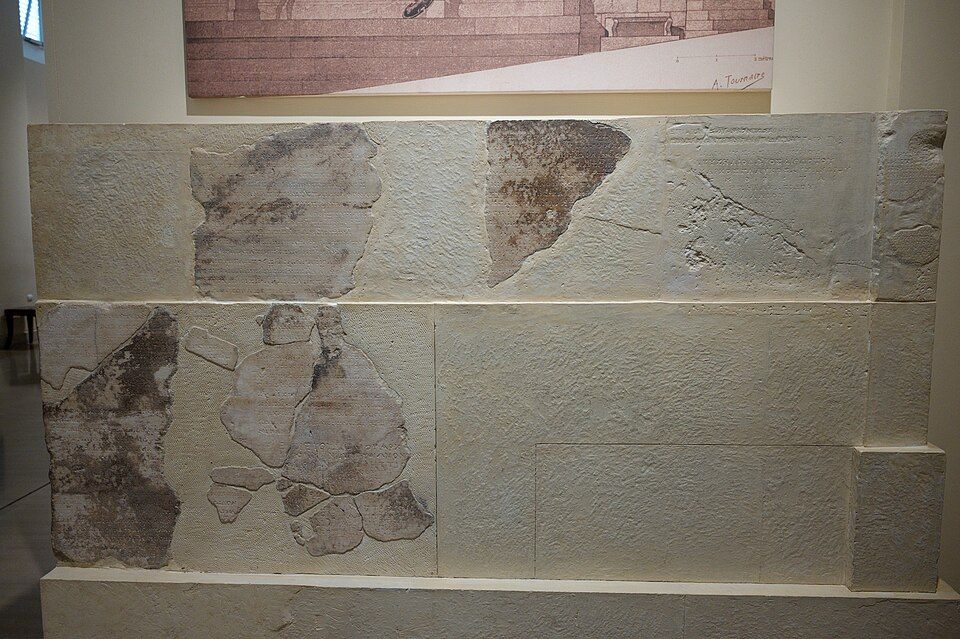
Dionysius on strophic song. The ancient statement behind question 7 comes from the same treatise as his account of the fifth:
τοῖς δὲ τὰ μέλη γράφουσιν τὸ μὲν τῶν στροφῶν τε καὶ ἀντιστρόφων οὐχ οἷόν τε ἀλλάξαι μέλος
For those who write songs it is not possible to change the melody of the strophes and antistrophes.
(Dionysius, De compositione verborum 19, p. 84 Usener–Radermacher)
Battezzato cites it for the first view.[5] Anderson followed a then unpublished study by L. Richter. He read μέλος here as the genus (enharmonic, chromatic, diatonic), as distinct from the μελῳδίαι (melōidiai) of the next clause. On this reading Dionysius would require one genus for strophe and antistrophe, but not one tune.[6] Dionysius wrote at the end of the first century BC. We do not know how accurately he could speak for the classical or even the Hellenistic age.[7]
Common ground. Beneath the disputes the main authors cited here share a core. The written accents record a word accent of pitch. There is one peak to a word, and its place is limited by syllable weight.[8] Classical verse is built on quantity. Whatever part the accent played, it did not make a syllable long or short in the metre.[9] Some composers from the late second century BC to the second century AD set the words so that the melody follows the accent. The composers of the Delphic paeans are the chief examples.[10] In later antiquity the accent became a stress, and the old distinction of long and short was lost from speech.[11]
ἄνθρωπος · ἀνθρώπου
One peak to a word, its place limited by weight: the same word, “human being”, in the nominative and the genitive. With a heavy final, -που, the peak (red) cannot stand on ἀν-. Final -ος counts as light for the accent. Devine and Stephens 1994, pp. 102, 152, as cited in the text.
synthetic ∿
Notes
- ^ Anderson 1973, p. 186.
- ^ Cosgrove and Meyer 2006, pp. 67–68.
- ^ Abritta 2014, p. 4.
- ^ Anderson 1973, p. 197.
- ^ Battezzato 2021, p. 133 n. 60.
- ^ Anderson 1973, p. 200 n. 11.
- ^ Anderson 1973, pp. 191–192.
- ^ Devine and Stephens 1994, pp. 102, 152, 208; West 1987, p. 68.
- ^ West 1987, p. 2; Devine and Stephens 1994, p. 209.
- ^ Cosgrove and Meyer 2006, pp. 66, 80–81; Anderson 1973, p. 197.
- ^ West 1987, pp. 68–69; Devine and Stephens 1994, p. 215; Anderson 1973, p. 197.
Accent · 9 of 9
How this site shows pitch
Every scanned passage on the poets’ pages, from Sappho, fr. 1 to Homer, Iliad 1, prints a row of small pitch signs above the syllables. It also sets the accented syllables in capitals on the transliteration row. The row is computed by the site’s scansion engine, which is called the Sapphic Workbench. The engine works from the accent marks printed in the edition used on that page, syllable by syllable and by fixed rules. The row shows pitch only. Nothing on the pages marks a stress, since whether there was one is disputed. The capitals mark the high-pitched syllable, not a stress in the English sense.
| Sign | Drawn on | Basis |
|---|---|---|
| an acute on a short vowel | the accented syllable spoken higher than its neighbours[1] | |
| an acute on a long vowel or diphthong | high on the second half of the syllable (doubted by Anderson)[2] | |
| an acute on α, ι or υ whose length the page cannot tell | high if the vowel is short, a rise if it is long; dotted because the page does not choose[3] | |
| a circumflex | high and low joined on one syllable (Dionysius, Comp. 11, p. 41 U–R): the high on the first mora, the fall on the second[4] | |
| the unaccented syllable just after an acute in the same word, or the first syllable of an enclitic after it; never a following word, and nothing after a final acute before a pause or punctuation or after interrogative τίς | the steep first fall after the peak;[5] Allen’s falling glide after a high tone;[6] the fall does not run into the next word unless that is a clitic[7] | |
| every other syllable, and every grave |
The key on the works pages calls the circumflex sign “high, then falling within the long syllable: the circumflex”, and the pitch row labels each such syllable “high, then falling (circumflex)”. As drawn, the sign starts high and falls within the syllable. Sappho fr. 1.2 shows all five:
| παῖ | Δί | ος | δο | λόπ | λο | κε | λίσ | σο | μαί | σε | |
|---|---|---|---|---|---|---|---|---|---|---|---|
| pitch | |||||||||||
| quantity | — | ⏑ | — | ⏑ | — | ⏑ | ⏑ | — | ⏑ | — | × |
Child of Zeus, weaver of wiles, I beg you (Sappho fr. 1.2 Voigt). In λίσσομαί σε the proparoxytone host takes a second acute before the enclitic, like ἄνθρωπός τις.[8] The row lets the pitch fall onto σε, as the musical documents do with enclitics.[9]
What the row leaves out. The row is a simplification, and each simplification takes a side or ignores a detail:
- Syllables before the accent are drawn low. Devine and Stephens, however, reconstruct a rise to the peak from a middle level, and a fall from one accent to the next through the phrase.[10]
- The grave is drawn low, as its name βαρεῖα and Cosgrove and Meyer’s view of speech suggest.[11] Devine and Stephens hold that it was a lowered high.[12] Disputed.
- Only the first fall after an acute is drawn, and only within the line. The flatter fall to the end of the word, and the size of each rise and fall, are not shown.[13] The fall after a circumflex lies inside the circumflex sign.
- Lesbian accentuation is recessive, with no oxytones (ἔμας for ἐμᾶς, fr. 1.6). Our knowledge of it goes back to Alexandrian scholars, who must have learned it from the spoken dialect.[14]
An acute on a vowel of unknown length. The two acute signs depend on the length of the vowel. α, ι and υ are long in some words and short in others, so their length has to be known word by word.[15] Sometimes the spelling does not show it. Sometimes, too, the passage’s own metre does not settle it, because the syllable stands in an anceps (or in the last position of a period). Then the quantity row draws the syllable ○, and the transliteration gives the vowel no macron. The pitch row draws the dotted sign above, which shows both shapes at once. Its label and tooltip say “acute, vowel length unknown: high if the vowel is short, rising if it is long”.
Wherever a lexicon, a grammar or the metre of other verse settles the vowel, the page marks it in the input and says so in the note on the line. The sign then becomes the high or the rise. Three syllables keep the dotted sign: πρί- of πρίων at Acharnians 36 (a pun on two nouns whose ι differs in length), -ξί- of ἐξίκοντο at Bacchylides 13.132 (the ι of ἱκέσθαι varies), and πά- of πάον’ at Sappho fr. 44.15 (no length recorded for the word). Each line’s note gives the evidence searched.
Accent and quantity. The engine also uses the accent as evidence for vowel length. A vowel with a circumflex is long. An acute on the antepenult, or a circumflex on the penult, shows that the vowel of the final syllable is short, unless it is αι or οι.[15] The engine never counts a syllable long because it is accented, as some poets of late antiquity did. In classical verse the accent had no effect on the metre.[16]
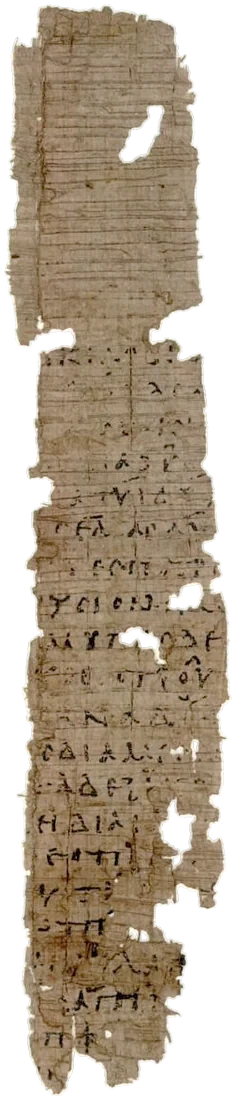
Speech, not song. The row gives the pitch of the words as spoken. It is not the tune. In strophic song the melody probably overrode the accent. The Orestes papyrus is almost the only direct witness to the music of classical lyric.[17]
Notes
- ^ West 1987, p. 68; Battezzato 2009, p. 143.
- ^ Devine and Stephens 1994, p. 193; Allen 1968, p. 115; Anderson 1973, p. 190.
- ^ See below.
- ^ Allen 1968, pp. 111–112, 115.
- ^ Devine and Stephens 1994, pp. 187–189.
- ^ Allen 1968, pp. 111, 114.
- ^ Devine and Stephens 1994, p. 180; Allen 1968, pp. 115–117.
- ^ Devine and Stephens 1994, p. 222.
- ^ Devine and Stephens 1994, p. 354.
- ^ Devine and Stephens 1994, pp. 182–185.
- ^ Cosgrove and Meyer 2006, p. 69 n. 12.
- ^ Devine and Stephens 1994, pp. 181–182.
- ^ Devine and Stephens 1994, pp. 184–185, 187–189.
- ^ Tribulato 2021, pp. 143–144 with n. 24.
- ^ a b West 1987, p. 10.
- ^ West 1987, pp. 2, 68.
- ^ D’Angour 2022, p. 139.


