How the texts reached us
The journey of Greek verse from performance and papyrus to the modern critical edition.
First steps for beginners, from rhythm to scanning a line; what metre is, how syllables are weighed, the notation and the rules of prosody; the Greek word accent; and how the texts reached us.
Transmission · 1 of 9
Alexandria: the first scholarly editions
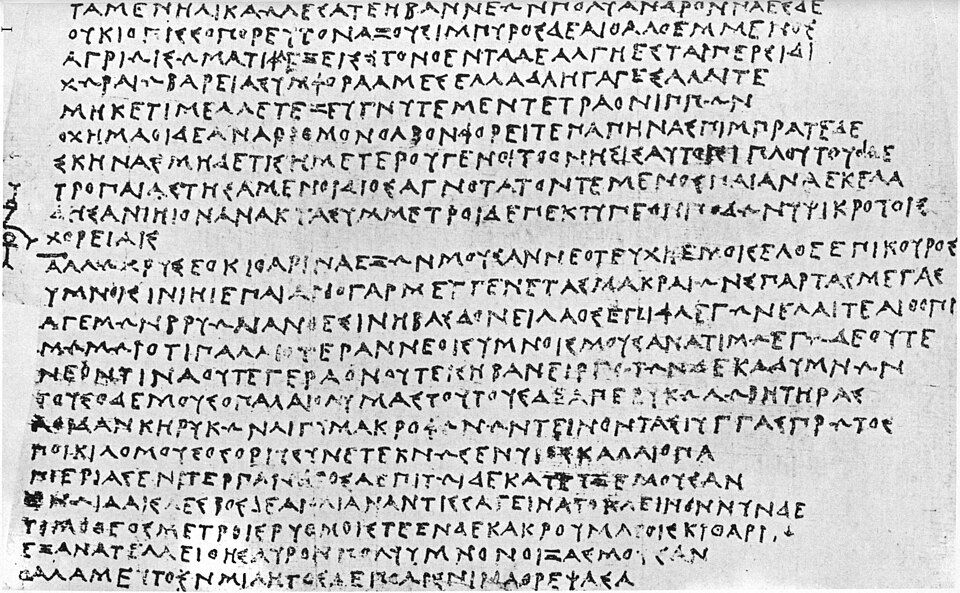
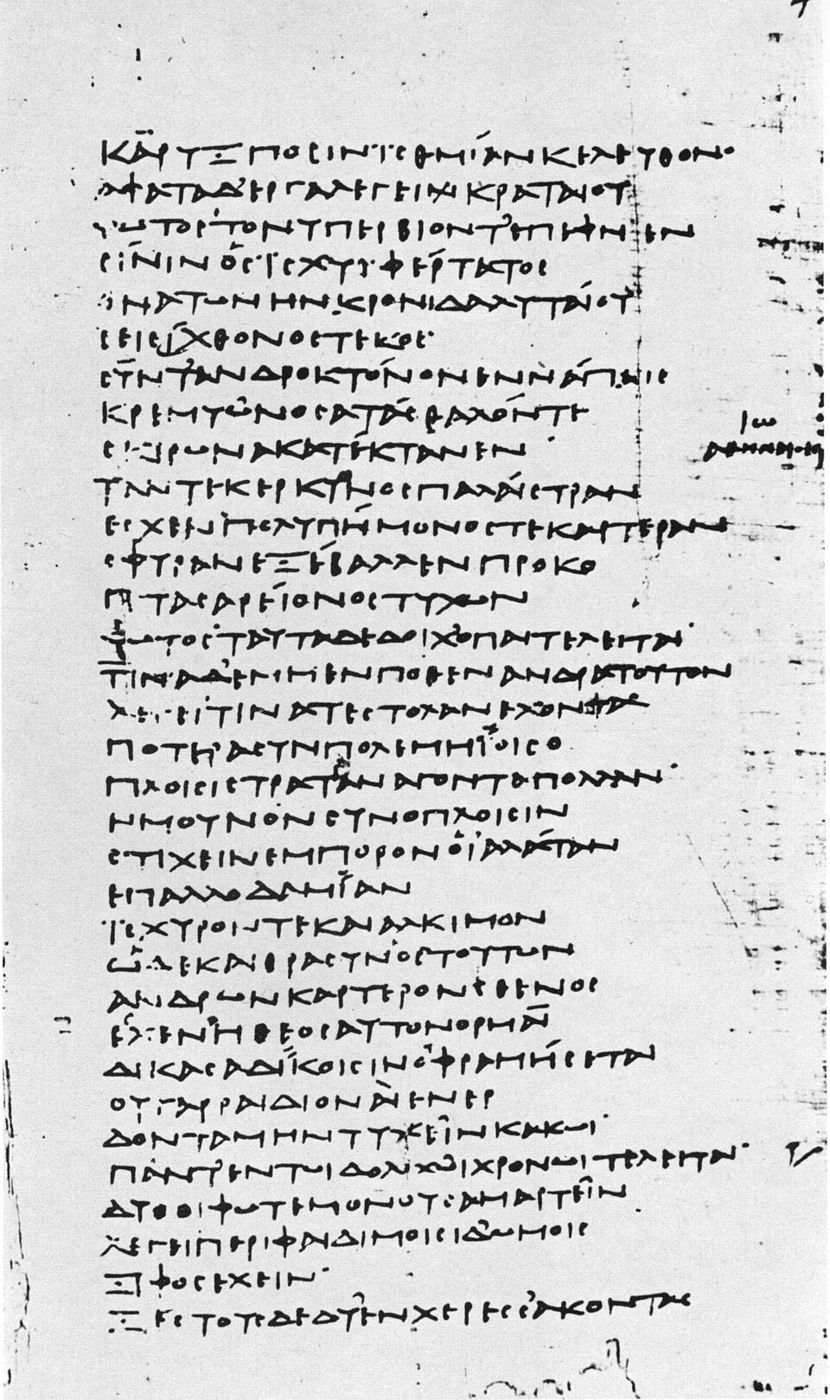
Books before Alexandria. A classical Greek book was a papyrus roll, written on one side, with no word-division, rudimentary punctuation and, before the Hellenistic period, no accents.[1] Lyric was stranger still. It was set out on the page like prose. An example is the fourth-century BC papyrus of Timotheus’ Persians (P.Berol. 9875).[2] It is written in running script, without colometry, marginal signs or comments. Many lyric books probably looked like this well into the third century.[3] Many of the worst errors in classical texts arose in this early period, before the books reached Alexandria.[4]
As an early book wrote it: capitals, no gaps, no accents
ΜΗΝΙΝΑΕΙΔΕΘΕΑΠΗΛΗΙΑΔΕΩΑΧΙΛΗΟΣ
As a modern edition prints it: words divided, accents and breathings, punctuation
μῆνιν ἄειδε θεὰ Πηληϊάδεω Ἀχιλῆος
Sing, goddess, the wrath of Achilles, son of Peleus,
An illustration, not a transcription of a papyrus: Iliad 1.1 written in the manner Reynolds and Wilson describe for the books of the classical period (no word-division, no accents), then in Monro’s text.
David Chamberlain, Iliad 1.1 · CC BY 4.0
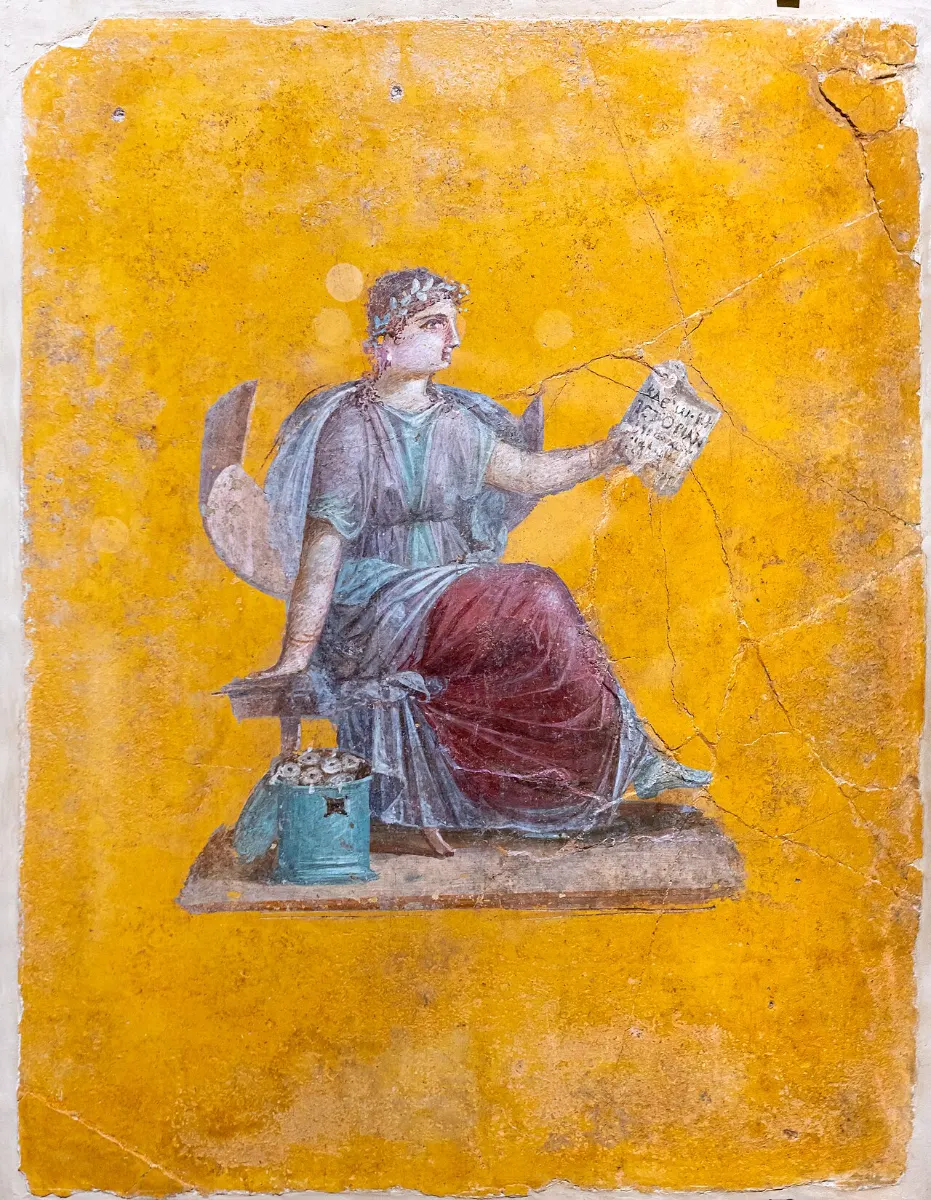
The Library. Under the first Ptolemies the Museum at Alexandria became a community of scholars, with a great library beside it.[5] Callimachus catalogued Greek literature in his Pinakes, which ran to 120 books.[6] For each author the Pinakes listed the incipit and the works, with a short biography. Aristophanes of Byzantium later wrote a supplement.[7] Five of the first six librarians were leading literary men of their day: Zenodotus, Apollonius of Rhodes, Eratosthenes, Aristophanes and Aristarchus.[8] The systematic work on the canonical lyric poets can be dated to about 285–145 BC. It produced a scholarly text of each author on papyrus rolls, laid out in cola, with critical signs.[9]
Ordering a corpus. The editors needed a principle for arranging each poet. Books of Alcman, Alcaeus, Ibycus, Sappho and Anacreon are quoted only by number. Pindar, Bacchylides and Simonides were arranged by genre and occasion.[10] Sappho’s books were divided chiefly by metre, and Alcaeus’ by content.[11] The poet pages give the details.
Readers’ aids. Aristophanes is commonly credited with improved punctuation and with the accent system. Accents were nevertheless not written regularly until the tenth century.[12] He is also credited with prosodic signs, which mark the quantity of syllables in complex metres. They appear only occasionally in later papyri, and never systematically.[10] Commentaries were separate books. Signs in the margin of the text pointed the reader to them.[13]
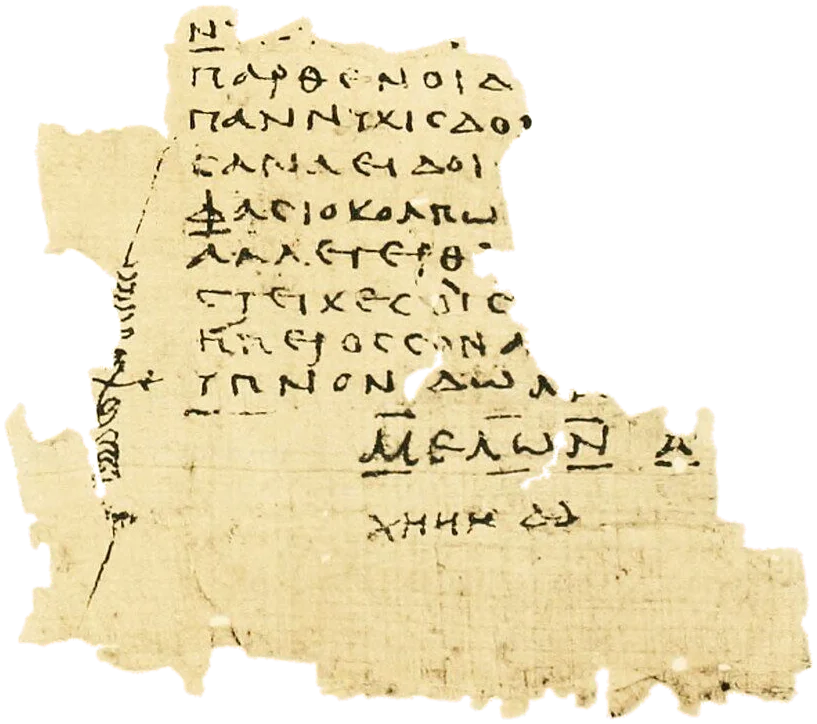
Signs for stanzas and poems. Hephaestion’s short treatise On Signs sets out the system for lyric. In a poem of repeated stanzas a paragraphos stands after each stanza, and a coronis at the end of the song. In triadic poems the paragraphos follows strophe and antistrophe, and the coronis follows the epode. An asterisk marks the end of a poem, above all when the next poem is in a different metre, as in the stanzaic poems of Sappho, Anacreon and Alcaeus. In Aristophanes’ edition of Alcaeus the asterisk stood only at a change of metre. In Aristarchus’ edition, the one current in Hephaestion’s day, it stood at every change of poem (On Signs 2–3).[14] Both scholars helped to make these signs systematic.[15] The same signs are found in the papyri of Bacchylides as in those of Pindar.[16]
Notes
- ^ Reynolds and Wilson 1991, pp. 2–4.
- ^ Reynolds and Wilson 1991, p. 4.
- ^ Phillips 2022, p. 120.
- ^ Reynolds and Wilson 1991, p. 5.
- ^ Reynolds and Wilson 1991, pp. 6–7.
- ^ Reynolds and Wilson 1991, p. 7; Maehler 2004, p. 26.
- ^ Barbantani 2009, p. 299.
- ^ Reynolds and Wilson 1991, p. 8.
- ^ Prauscello 2021, pp. 219–220.
- ^ a b Barbantani 2009, p. 300.
- ^ Prauscello 2021, p. 221; Phillips 2022, p. 121.
- ^ Reynolds and Wilson 1991, p. 9.
- ^ Reynolds and Wilson 1991, p. 10; Barbantani 2009, p. 300.
- ^ a b Prauscello 2021, p. 221.
- ^ Phillips 2022, p. 121.
- ^ Maehler 2004, p. 27.
Transmission · 2 of 9
Six stages: from song to text
A recent collection on the ancient reception of Greek lyric opens with a map of its transmission in six stages. The stages run from performances that were sung and danced to “written texts lacking any form of musical (or choreographical) notation”.[1] The map is worth having whole. The metre a reader meets in a modern edition passed through every one of the stages. Whether the editors’ cola preserve anything of the poets’ music is a question about the join between the third stage and the fourth.
1. The archaic poets and their first audiences
In the seventh and sixth centuries songs were selected and made Panhellenic. They were transmitted orally, in reperformance, or by early writing, which Theognis’ “seal” may attest. Poets cited poets, home cities preserved their own, and sympotic anthologies catered for reperformance. Early transmission was unstable. The same lines of Alcaeus stand in a Hellenistic book papyrus (fr. 249), and also, in another dialect and a different shape, as an Attic drinking-song.[2]
2. Fifth-century Athens
None of the nine canonical poets was Athenian, but Athens became the centre. Anacreon and Simonides lived there under Hipparchus. Pindar and Bacchylides wrote dithyrambs for it. Comedy knew most of the future canon, and preferred the dead poets to the New Music. Herodotus and Plato quoted lyric. The Scopas ode in Plato’s Protagoras is the first recorded piece of textual exegesis.[3]
Nagy argues that the canon was performative before it was textual. On his view the lyric poets were heard as repertoire at the Panathenaic contests for kitharodes, aulodes and the rest (IG II² 2311), and later in Pericles’ Odeion. The pseudo-Platonic Hipparchus has the tyrant’s son fetch Anacreon from Samos by state ship and keep Simonides at his side. Nagy reads the pair, with Hipparchus’ Homer, as a Panathenaic programme.[4] Nagy and Hadjimichael weigh Athens’ part very differently.[5]
3. The fourth century
The first surviving texts of melic poets are of non-canonical innovators: the Timotheus papyrus and Philodamus’ paean on stone. The earliest text of a canonical poet is the Cologne Sappho of the early third century.[6] The Peripatetics wrote monographs. Chamaeleon wrote on Anacreon, Sappho, Lasus, Simonides, Pindar and Stesichorus, and Dicaearchus on Alcaeus. None of them wrote on the New Music, or on Alcman, Ibycus or Bacchylides, whose texts may not have reached Athens. They quoted the poems but did not edit or classify them.[7]
4. Alexandria
The Hellenistic scholars, above all Aristophanes of Byzantium and Aristarchus, produced the standard editions. These editions had four marks:
- The poems were grouped by genre into books, with some admitted compromises (Nemeans 9–11).
- There was no attempt to notate the music, though notation existed, since Aristoxenus disapproved of it.
- The texts were arranged in cola.
- There was a canon of nine melic poets, with no one later than Bacchylides.
So Timotheus was excluded. Corinna, now generally believed a fifth-century poet, may have survived in a Boeotian archive, and was later called “the tenth”.[8]
5 and 6. Rome, late antiquity, Byzantium
Papyri of all nine melic poets, and of Corinna, survive from the Roman period. From the same period come the commentaries of Didymus and Theon, and Tryphon’s work on the lyric dialects. Catullus and Horace imported the poets. The Second Sophistic used them as sources of morals, sympotic lore and religion.[9]
After the third or fourth century AD the lyric poets fade. Sappho was still copied in a codex of the sixth or seventh century, but she did not reach later Byzantium. Pindar’s victory odes probably survived on the strength of a continuing interest in the games. Theognis and perhaps a book of Hipponax came through. Stobaeus’ anthology kept excerpts of most of the rest.[10] The later stages, poet by poet, are on the Papyri, Byzantium and Poet by poet tabs.
Notes
- ^ Currie and Rutherford 2020, pp. 1–2.
- ^ Currie and Rutherford 2020, pp. 2–5.
- ^ Currie and Rutherford 2020, pp. 5–7.
- ^ Nagy 2020, pp. 95–98, 100–102, 106–109.
- ^ Currie and Rutherford 2020, p. 13.
- ^ Currie and Rutherford 2020, p. 7.
- ^ Hadjimichael 2020, pp. 158–161, 174–177.
- ^ Currie and Rutherford 2020, pp. 7–10; Nagy 2020, p. 110.
- ^ Currie and Rutherford 2020, pp. 11–12.
- ^ Currie and Rutherford 2020, pp. 12–13.
Transmission · 3 of 9
Colometry: why metre matters to an editor
Lines and verses. Our printed texts set lyric out in short lines, and every line looks like a unit of rhythm. It may not be one. The word “verse” is best kept for a stretch with prosodic continuity. It should not be applied to whatever happens to be written as one line.[1] A verse, in this sense, is a metrical sequence between two pauses. A line is the words that an ancient or modern editor wrote on one line. The division of a poem into lines is called colometry. Where verse-end is uncertain, editors divide differently, and so they analyse the metre differently.[2]
1.11 πύκνα δίννεντες πτέρ’ ἀπ’ ὠράνω‿αἴθε-
1.12 ρος διὰ μέσσω·
beating their wings thick and fast, down from heaven through the middle air.
Sappho fr. 1.11–12, from the site’s scansion. Red: the word αἴθερος, “air”, begins on line 11 and ends on line 12. Two lines, one verse: there is no pause between them, so the line-end here is not a verse-end.
synthetic ∿
Who first divided the cola? The earliest lyric papyri were written out as prose.[3] A tradition reported by Dionysius of Halicarnassus credits Aristophanes of Byzantium with the colometry that shows the reader the metrical units of a poem.[4] Aristophanes’ dates are given as c. 257–180 BC by Reynolds and Wilson, c. 260–180 by Maehler, and c. 255–180 by Barbantani and Sampson.
Aristophanes probably followed this method. He divided a poem into strophes and triads, and the strophes into periods. He found the periods by the recurrence of identical patterns (responsion) and by the pauses that hiatus and brevis in longo reveal. Then he divided long periods into shorter cola at regular word-ends.[5]
Disputed. Dionysius in fact leaves the attribution open, naming Aristophanes or some other scholar.[6] Phillips reads the phrase as disparaging rather than doubtful (as reported by Morrison).[7] Reynolds and Wilson regard an early papyrus of Stesichorus, P.Lille 76a + 73, as a serious difficulty for giving Aristophanes the credit, because it is already laid out in cola.[8] Barbantani notes that the argument holds if Turner’s third-century date for the papyrus is right. Phillips notes that some third-century papyri are colometric.[9] It is agreed that from the second century BC the colometric layout became the norm.[10] Whether Alexandrian cola reproduce the poets’ own rhythmic and musical intentions is debated.[6]
The question as it stands. Aristophanes of Byzantium is usually said to have established the practice of writing lyric in cola. But an early Hellenistic papyrus of Sappho, already arranged in cola, predates him, and the Lille Stesichorus may do so too. Whether the Hellenistic colometry reflects the poets’ musical practice is unknown. A century ago Wilamowitz was sure there was no connection. Today many scholars will allow at least an element of continuity.[11] The papyri add one detail. The two earliest manuscripts of choral lyric, the London Bacchylides and the Oxyrhynchus Ibycus, lack the marginal metrical marks that almost all later papyri carry.[12]
Metre as a tool of criticism. The Alexandrians used the metre to correct the words. A phrase in Pindar’s second Olympian did not correspond with the antistrophe. Aristophanes correctly used colometry to show that it should be deleted (scholion on Ol. 2.48).[13] The scholion says that he athetised the colon.[7] Responsion probably guided Aristophanes in correcting the text.[14]
Roman schoolmasters understood responsion too. Statius says that his father taught his pupils by what law the turning voice of Pindar’s lyre comes back. Holford-Strevens reads this as a claim to know how Pindaric metre works, with the strophe returning to its start. Horace, by contrast, had called Pindar’s numbers free of law.[15]
At Pindar Nemean 1.24 (λέλογχε δὲ μεμφομένοις ἐσλοὺς ὕδωρ καπνῷ φέρειν) Aristarchus saw that a nominative ἐσλός would not fit the metre. He read the accusative plural ἐσλούς instead. He explained the error from the old Attic alphabet, in which Ο could stand for ου:[16]
| Reading | Before ὕδωρ | Why |
|---|---|---|
| ἐσλός | — ⏑ | -λο- is open, its vowel short |
| ἐσλούς | — — | -λου- has a long vowel (ου) |
The rules at work are these. A syllable is long if its vowel is long or a diphthong, or if two or more consonants come between its vowel and the next. Syllables are divided across word-ends.[17]
Where the method fails. Responsion is a strong check only when strophes repeat often. In tragedy no strophe occurs more than twice. So the signs of period-end appear only now and then. When corruption destroys responsion, it may be impossible to tell which of the pair keeps the true scheme.[18] The medieval manuscripts of tragedy agree fairly well on the colometry of easy metres such as anapaests and dochmiacs. But they vary so widely in difficult ones that they may go back to quite different ancient colometries. It is not certain that Aristophanes’ colometry was the only one.[19]
Notes
- ^ West 1987, p. 3.
- ^ Battezzato 2009, p. 132.
- ^ Maehler 2004, p. 14; Sampson 2022, p. 114.
- ^ Reynolds and Wilson 1991, pp. 4–5.
- ^ Maehler 2004, p. 14.
- ^ a b Barbantani 2009, p. 301.
- ^ a b Morrison 2022, p. 399 n. 64.
- ^ Reynolds and Wilson 1991, p. 14.
- ^ Barbantani 2009, p. 301; Phillips 2022, p. 120.
- ^ Barbantani 2009, p. 301; Sampson 2022, p. 114.
- ^ Currie and Rutherford 2020, pp. 8–9.
- ^ Prodi 2020, p. 464.
- ^ Reynolds and Wilson 1991, p. 15.
- ^ Maehler 2004, p. 27.
- ^ Bitto 2020, p. 307.
- ^ Reynolds and Wilson 1991, pp. 8–9.
- ^ West 1987, p. 2; Battezzato 2009, pp. 130–131.
- ^ West 1987, pp. 51–52.
- ^ Kovacs 2005, pp. 385–386.
Transmission · 4 of 9
Byzantium and the medieval manuscripts
A narrowing curriculum. From the third century AD fewer and fewer readers show knowledge of texts that have not reached us. Wilamowitz explained this by a single influential school selection. It held seven plays each of Aeschylus and Sophocles, and nine or ten of Euripides. Reynolds and Wilson think the theory oversimplifies. They mention one possible compiler, Eugenius, a fifth-century writer on the colometry of fifteen plays. But they conclude that a deliberate act of selection by one person was probably not a primary cause of loss.[1] Kovacs is as cautious. From about AD 250, quotation is confined to the seven, seven and ten plays we have. But without a uniform system of education it is hard to see how one decision could have had such reach. The selecting may have been done by the popularity of the plays, the commentaries available for them, and the new codex, which bound seven or ten plays in one book.[2]
More important was indifference. Most Christians had no interest in reading pagan books, so too few new copies were made.[3] There is no reliable evidence of church censorship of the classics. The humanist Petrus Alcyonius reported that churchmen burned the texts of pagan poets. His report is supported by no other evidence and goes back to a remark of Demetrius Chalcondyles. The poets in question had probably been lost by other causes.[4]
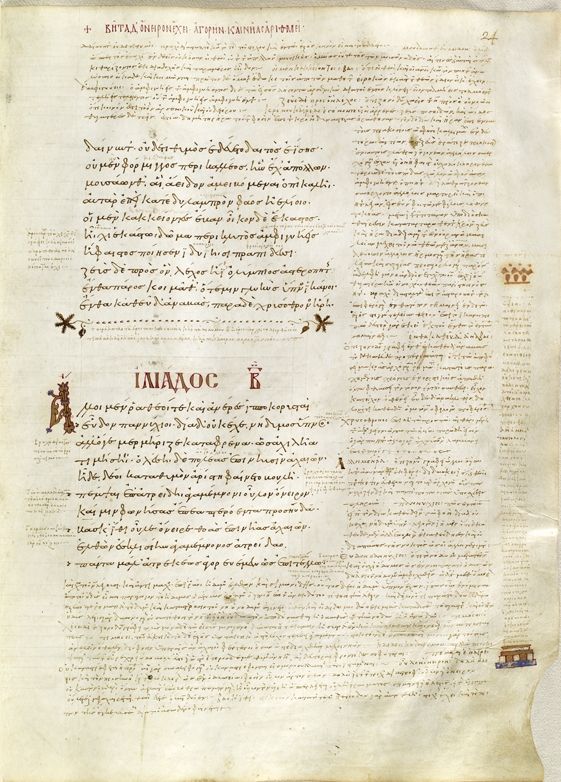
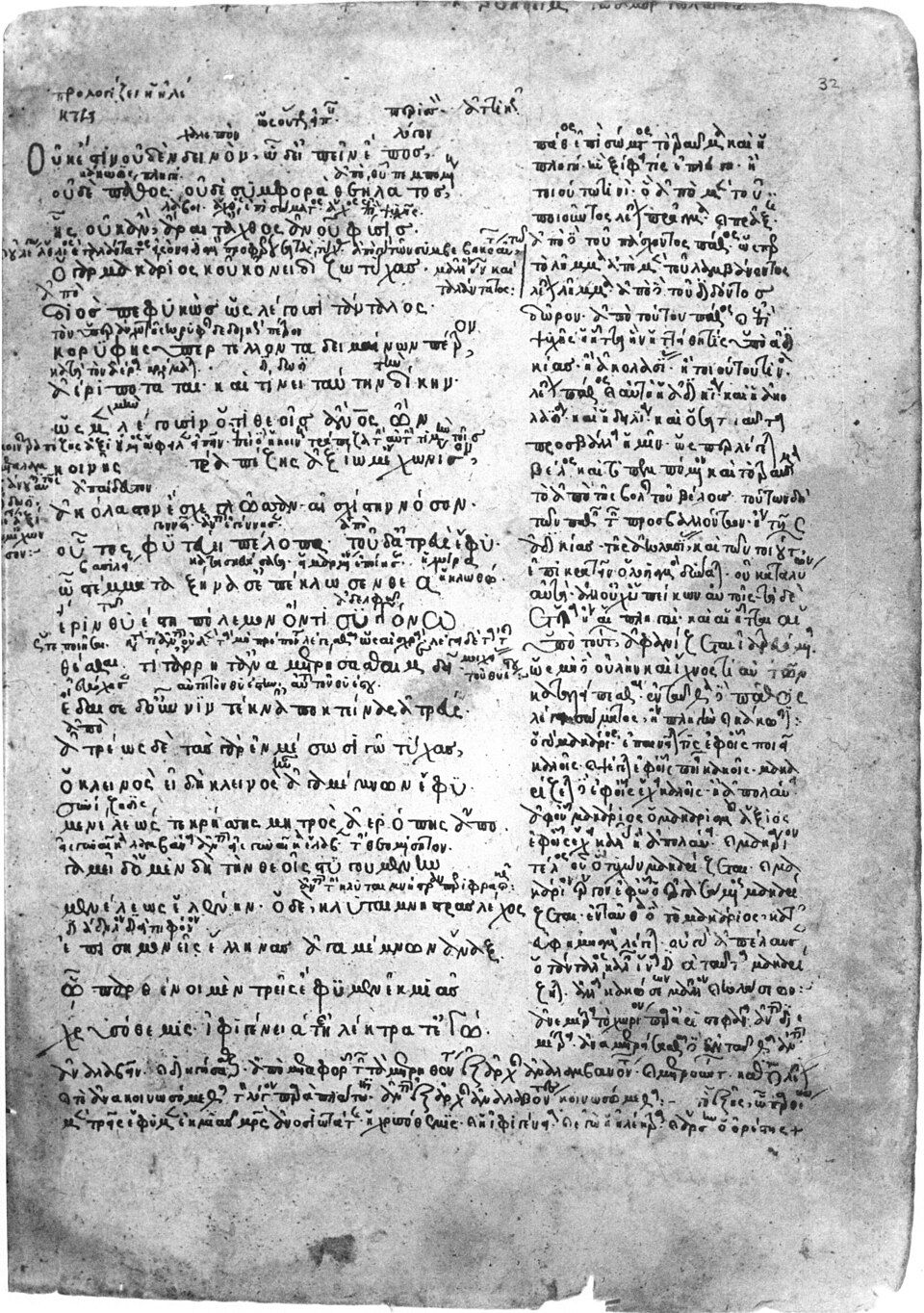
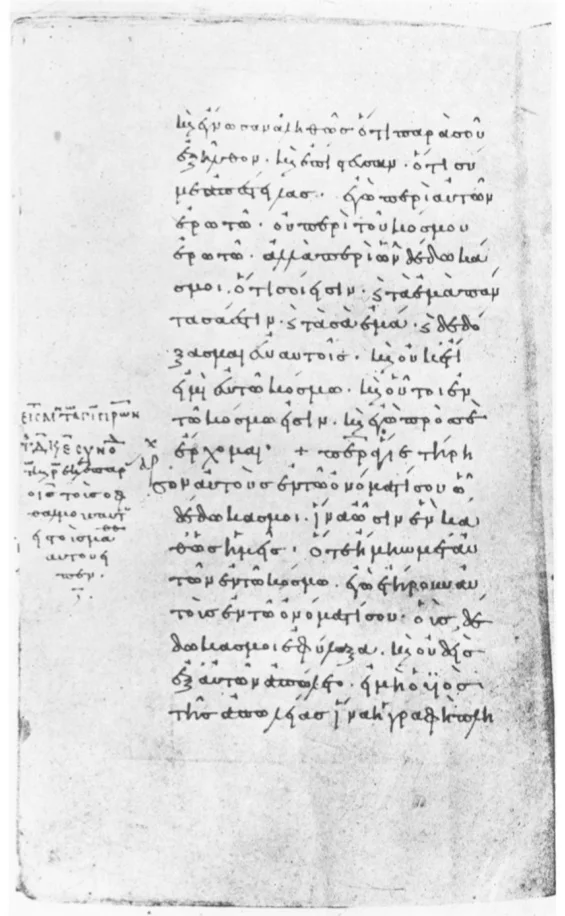
The scholia. Ancient commentaries filled separate books. At some uncertain date, perhaps the fourth or fifth century, they were cut down and copied into the margins of the texts. Notes copied in this way are called scholia. Copious marginal scholia are not common, however, before the ninth century.[5] Byzantine scholars distilled the commentary until it fitted the margins. The text was written in a larger hand, and the notes in tiny letters around it.[2] The process was one of repeated redaction. So the scholia show ancient scholarship only partially and through a filter, at best.[6] Metrical commentary survived in the same way. Heliodorus’ commentary on the metres of Aristophanes, written in the early Roman empire, is partly preserved in the scholia.[7]
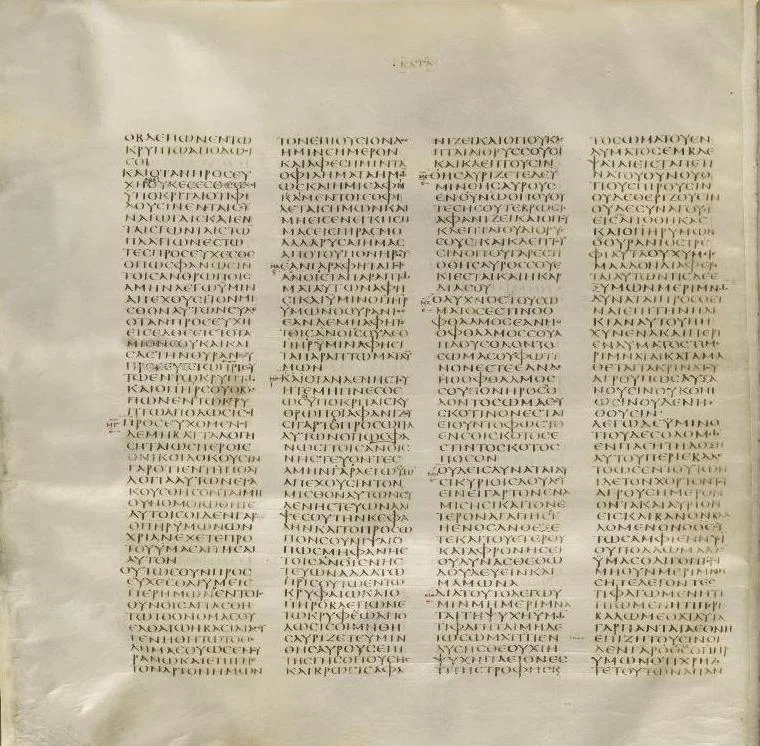
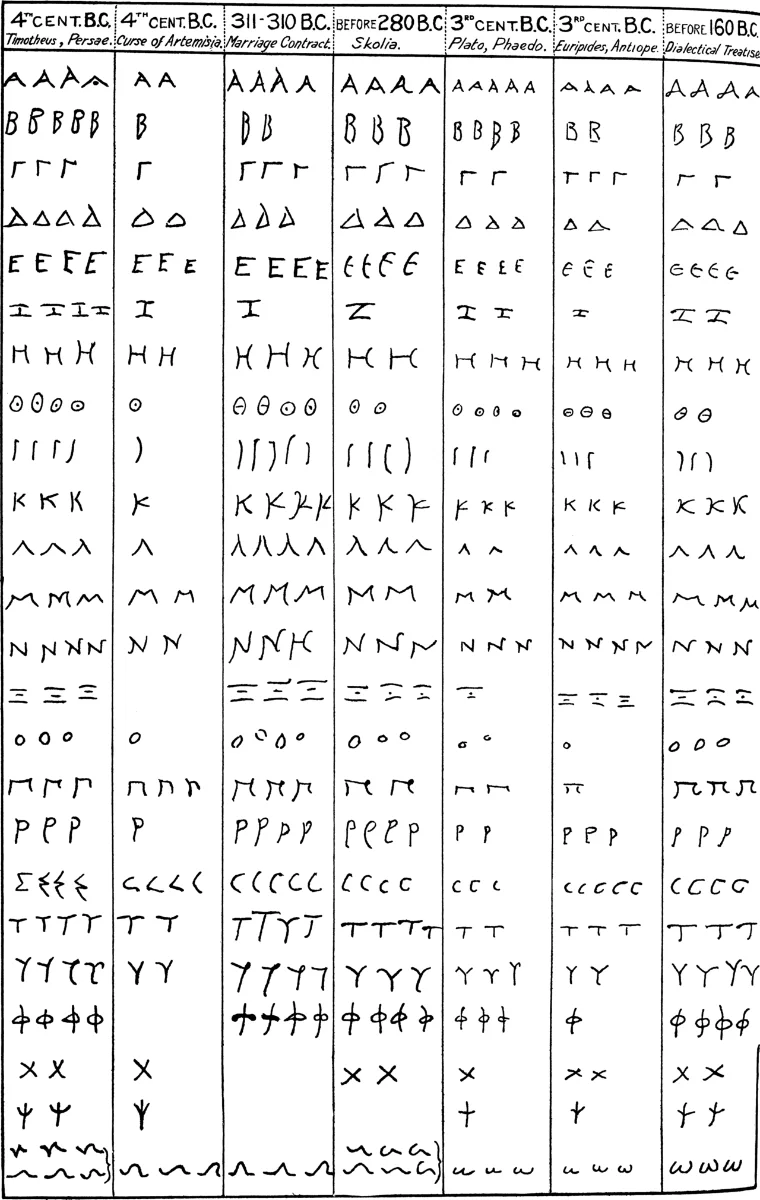
Transliteration. In the ninth century the large uncial script gave way to minuscule. The first dated minuscule book is of 835.[8] The change had a consequence for the accents. They had rarely been written in uncials, but now they were written consistently on every word. The scribes took them from the ancient grammarians rather than from their own speech. The Venetus A of the Iliad names Aristonicus, Didymus, Herodian and Nicanor as its sources at the end of each book.[9]
Uncial: capitals, accents rarely written
ΜΗΝΙΝΑΕΙΔΕΘΕΑ
Minuscule, from the ninth century: small letters, an accent on every word
μῆνιν ἄειδε θεά
An illustration of the change of script,[10] using the first words of the Iliad; not a facsimile of any manuscript.
David Chamberlain, Iliad 1.1 · CC BY 4.0
Old books were transcribed into the new script. The text of almost every author depends on one or more minuscule copies made then or shortly after. Errors shared by all our manuscripts often go back to misreadings of uncial letters at this stage.[11] Byzantine scholars of this period cared little for poetry. Photius’ great survey of his reading almost wholly omits it, and so does the library of Arethas.[12] Yet some of the most valuable manuscripts of poetry were written in the tenth century: the earliest copies of Theognis and Musaeus, the Palatine Anthology, the Venice Iliad, the Ravenna Aristophanes and Laur. 32.9 of Aeschylus, Sophocles and Apollonius.[13]
Losses in 1204. In the twelfth century Eustathius probably read more of Pindar’s victory odes than we have. John Tzetzes and Michael Choniates still read some Callimachus and Hipponax. After them no Byzantine is known to have had more classical poetry to read than we do. These texts did not survive the sack of Constantinople by the Fourth Crusade in 1204. The sack did more harm to literature than the fall of 1453.[14]
Triclinius, the first Byzantine metrician-editor. Demetrius Triclinius was a schoolmaster at Thessalonica about 1305–20. He was the first Byzantine to grasp the metres of classical poetry and use them. He found a copy of Hephaestion’s handbook, and with it he corrected iambics, sometimes well, often by inserting stopgap words. In lyric he knew that strophe and antistrophe should respond exactly. In his autograph Euripides (Laur. 32.2) he forced the text into responsion without mercy. He also wrote metrical commentaries on many plays, guided for Aristophanes by Heliodorus. Reynolds and Wilson call his metrical criticism, for all its errors, the most important advance in the treatment of poetic texts at the time.[15]
By the late thirteenth century school reading had shrunk to a “triad” of three plays for each tragedian and for Aristophanes. The other plays survived just long enough to be rescued by Italian collectors (the thirteenth-century triad also in Kovacs 2005, p. 387).[16]
Notes
- ^ Reynolds and Wilson 1991, pp. 53–54.
- ^ a b Kovacs 2005, p. 387.
- ^ Reynolds and Wilson 1991, p. 48.
- ^ Reynolds and Wilson 1991, pp. 50–51.
- ^ Reynolds and Wilson 1991, pp. 52–53.
- ^ Phillips 2022, p. 122.
- ^ Reynolds and Wilson 1991, pp. 45, 77.
- ^ Reynolds and Wilson 1991, pp. 58–59; Kovacs 2005, p. 387.
- ^ Probert 2006, pp. 48–50.
- ^ Reynolds and Wilson 1991, pp. 58–60; Probert 2006, pp. 48–50.
- ^ Reynolds and Wilson 1991, p. 60.
- ^ Reynolds and Wilson 1991, pp. 63, 65.
- ^ Reynolds and Wilson 1991, p. 66.
- ^ Reynolds and Wilson 1991, pp. 70–72.
- ^ Reynolds and Wilson 1991, pp. 75–77.
- ^ Reynolds and Wilson 1991, p. 78.
Transmission · 5 of 9
The Renaissance: Greek texts reach Italy
From Constantinople to Italy. By the late thirteenth century Byzantine schools read only three plays of each tragedian and of Aristophanes, and the rest might easily have been lost through neglect.[1] The nine “alphabetic” plays of Euripides, with the Bacchae, hang on a single fourteenth-century manuscript in Florence.[2] The plays survived barely long enough to be rescued by Italian visitors and collectors. Every one of the chief manuscripts of the dramatists came to Italy in the Renaissance, and many have stayed there.[1] So many manuscripts were brought west, then and later, that the libraries of the Greek East have today been almost stripped of classical texts.[1] That is why the chief witnesses named on this site’s poet pages carry Italian shelfmarks: Laur. 32.9 for Aeschylus and Sophocles, Laur. 32.2 for Triclinius’ Euripides, Ravenna 429 and Marc. gr. 474 for Aristophanes.[3]
Learning Greek. The first teachers were diplomats and refugees. Petrarch met the monk Barlaam at the papal court in Avignon and was taught by him. But he never got far enough in Greek to read the Homer given to him by a Byzantine ambassador. In 1360 Boccaccio persuaded Barlaam’s pupil Leonzio Pilato to lecture in Florence. For Boccaccio he translated Homer and about four hundred lines of Euripides’ Hecuba, in a very rough Latin.[4] The decisive date is 1397. In that year the Byzantine diplomat Manuel Chrysoloras began the first regular lectures on Greek in Italy, at Florence. His grammar, the Erotemata, became in 1471 the first Greek grammar to be printed.[5]
After the fall of Constantinople in 1453 a stream of refugees, travelling by way of Crete and Venice, earned their living by teaching Greek or copying texts. How many Italians learned to read Greek with ease is hard to say. Some, Politian among them, taught themselves with a Latin translation as a key. Many must have been content with translations.[6]
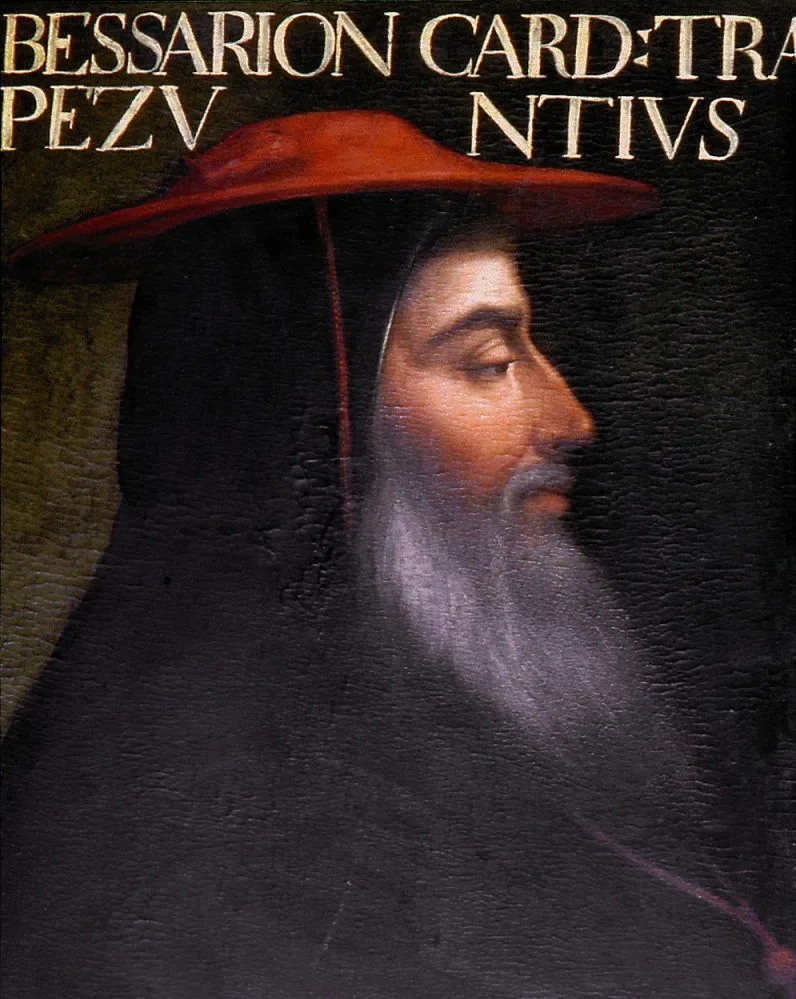
Collectors. Manuscripts were sought in the East as eagerly as teachers. In 1423 Giovanni Aurispa brought 238 volumes of pagan Greek texts back to Italy. Filelfo’s forty Greek books were probably more typical of a private library.[7] A second account gives the same figure of 238. It also has Aurispa in Greece in 1413 and 1421, buying manuscripts of Sophocles and Euripides, at a time when Greek scholars in Italy were very few (Di Maria 2005, p. 428). In 1492 Lorenzo de’ Medici sent the refugee scholar Janus Lascaris through the Byzantine provinces in search of manuscripts.[7] Cardinal Bessarion (1403–1472) aimed at a complete library of Greek literature. He gave his collection to Venice in 1468. Part of it, perhaps including the codex Venetus of Aristophanes, came from the monastery of Saint Nicholas at Otranto.[8]
How the refugees pronounced Greek. The exiles as a rule taught classical Greek in the pronunciation of their own day. It was clearly far removed from the ancient one. β δ γ φ θ χ were fricatives. ι η υ ει οι υι were all one i-sound. And a stress lengthened the syllable it fell on. So the ancient metres made no sense when read that way.[9] The evidence against this pronunciation had been noticed before Erasmus, by Antonio Nebrija and by members of the Aldine circle. Erasmus then wrote the pamphlet that gave its name to the “Erasmian” pronunciation.[10] Nebrija’s criticisms date from 1486 and 1503, and Aldus’ from 1508.[11]
| classical Attic | as the refugees read it | |
|---|---|---|
| μῆνιν | [mɛ̂ːnin]: η a long open e, pitch rising and falling on it | [ˈminin]: η is [i], the accent a stress, no length |
| θεά | [tʰeáː]: θ an aspirated t | [θeˈa]: θ a fricative, as in thin [θɪn] |
Read the second way, μῆ- takes no longer to say than -νιν, and the dactyl μῆ-νιν ἄ- can no longer be heard.
The classical values as on the site’s Phonology pages;[12] the later values follow the features listed in the text: η as [i], θ as a fricative, a stress accent without length.[9]
μῆνιν, classical: David Chamberlain, Iliad 1.1 · CC BY 4.0μῆνιν as the refugees read it ∿θεά, classical: David Chamberlain, Iliad 1.1 · CC BY 4.0θεά as the refugees read it ∿
Manuscripts and print. Scholars of the fifteenth century still worked from manuscripts. From the 1490s the Aldine press in Venice gave most of the major authors their first printed editions.
Notes
- ^ a b c Reynolds and Wilson 1991, p. 78.
- ^ Kovacs 2005, p. 387.
- ^ Reynolds and Wilson 1991, pp. 66, 76, 149.
- ^ Reynolds and Wilson 1991, pp. 146–147.
- ^ Reynolds and Wilson 1991, p. 147.
- ^ Reynolds and Wilson 1991, p. 148.
- ^ a b Reynolds and Wilson 1991, pp. 148–149.
- ^ Reynolds and Wilson 1991, p. 149.
- ^ a b Allen 1968, p. 125; Probert 2006, pp. 98–99.
- ^ Reynolds and Wilson 1991, p. 159.
- ^ Allen 1968, pp. 126–128.
- ^ Allen 1968.
Transmission · 6 of 9
Printing: the first editions
Why Greek came late to print. Latin classics were printed in quantity from the 1470s. The first printed editions of Cicero appeared in 1465.[1] Greek lagged behind. Its type was hard to design, since the combinations of letters with accents and breathings multiplied the number of separate pieces a fount required. Printers who imitated contemporary Greek handwriting made founts that were expensive to use and unsatisfactory in appearance. The famous Aldine founts were among them.[2] Demand was small. Plato’s Greek text was not printed until 1513, while Ficino’s Latin translation sold out an edition of 1,025 copies within six years. The first edition of Isocrates (Milan 1493) sold so slowly that its remaining copies were reissued in 1535. Before the Aldine press scarcely a dozen books had been printed in Greek: grammars, Homer, Theocritus, the Greek Anthology and Isocrates.[3]
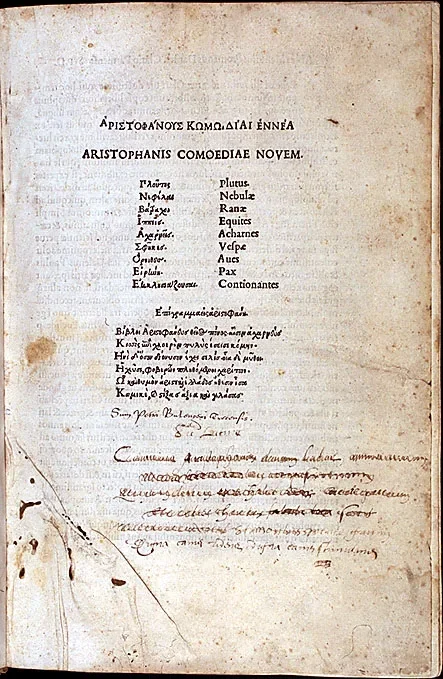
Aldus and Musurus. Aldus Manutius (1449–1515) set up his house in Venice, which was then the centre of the printing trade. Between 1494 and 1515 he issued the first editions of almost every major Greek author.[4] The largest single share of the editorial work fell to the Cretan Marcus Musurus (c. 1470–1517). He worked within a circle of Greek and Italian scholars called the Neakademia. Its rules required members to speak Greek at meetings.[5] The first Greek book was the short poem of Musaeus. Then came Theocritus and Hesiod, and five folio volumes of Aristotle and Theophrastus (1495–1498). Sophocles, Euripides, Herodotus, Thucydides and Demosthenes were first printed in 1502–1504.[6]
Musurus’ Aristophanes of 1498 was made from at least four manuscripts. It printed the scholia in the margins, as a medieval manuscript had them.[7] The 1503 Aldine Euripides left out the Electra. That play was first printed by Pietro Vettori in 1545.[8] Lyric came into print inside other books. Sappho’s Hymn to Aphrodite first appeared in 1508, in the Aldine collection of Greek rhetorical works, where Dionysius of Halicarnassus quotes it. It was set as prose, and it was faulty in metre and dialect.[9]
The first edition is not the best. A first printed edition is called an editio princeps. It was usually not much more than a copy of whatever humanist manuscript the printer happened to use. Print gave that text an authority it rarely deserved. Reprinted with small changes, it became a vulgate. A vulgate is a standard text that later scholars emended piece by piece but found hard to abandon.[10] There is another side. Printing arrived in time to make the survival of tragedy certain. From then on corruption could be halted, and corrections could be passed to the next generation.[11]
Editors of the sixteenth century. Adrianus Turnebus was director of the Royal Press in Paris. He published Aeschylus and Sophocles. His Sophocles (1553) was the first printed edition of Triclinius’ scholia, and its text is too heavily marked by Triclinius’ work.[12] Vettori and Henri Estienne produced the first Aeschylus with the full Agamemnon. Until then its lines 323–1050 had been missing.[13] Wilhelm Canter’s Euripides (Plantin, 1571) was the first edition to take real notice of responsion and to use it for emending the text.[14]
The first editions of the lyric poets were these: Theognis (Venice 1495), Solon, Tyrtaeus, Mimnermus and Simonides (Paris 1512), Pindar (Venice 1513), Anacreon (Paris 1554), and Alcaeus, Sappho, Bacchylides, Stesichorus, Ibycus and Alcman (Paris 1560).[15] The last is Henri Estienne’s Pindar with the fragments of the lyric poets. It was the first large collection of Sappho. Single poems of hers had appeared earlier, inside Dionysius in 1508 and at the end of Estienne’s Anacreon in 1554.[16] The Plantin Horace of 1566 was the first book to use sigla in the modern manner. Sigla are letters standing for manuscripts.[14]
Notes
- ^ Reynolds and Wilson 1991, pp. 154, 208.
- ^ Reynolds and Wilson 1991, p. 154.
- ^ Reynolds and Wilson 1991, p. 155.
- ^ Reynolds and Wilson 1991, pp. 155–156.
- ^ Reynolds and Wilson 1991, p. 156.
- ^ Reynolds and Wilson 1991, pp. 156–157.
- ^ Reynolds and Wilson 1991, p. 157.
- ^ Kovacs 2005, p. 390.
- ^ Finglass 2021, pp. 247–248.
- ^ Reynolds and Wilson 1991, p. 208.
- ^ Kovacs 2005, p. 388.
- ^ Reynolds and Wilson 1991, pp. 173–174.
- ^ Reynolds and Wilson 1991, p. 166.
- ^ a b Reynolds and Wilson 1991, p. 179.
- ^ a b Allan 2022, p. 469.
- ^ Finglass 2021, pp. 247, 251–252.
Transmission · 7 of 9
Reading an apparatus criticus
Below the text of a critical edition runs the apparatus criticus. It is a compressed record of where the witnesses differ and of what the editor has done. A reader may find it uncomfortable going at first, especially in authors read in medieval schools, whose traditions are complicated.[1]
How an entry is built. In a full apparatus each entry begins by repeating the word or words of the text concerned. To save space some editors list only the readings they reject, and this sometimes leaves the entry unclear. The chief manuscripts are named by sigla, normally capital letters. Lower-case or Greek letters are used when there are many. A Greek letter or bold type may stand for a whole family.[2] Editors of Sophocles call Laur. 32.9 “L”. It is so much more important than any other witness that even its minor errors are reported.[3]
The usual abbreviations are these:[4]
| Sign | Meaning |
|---|---|
| cod., codd.; ms., mss. | manuscript(s) |
| om. · add. | omits · adds |
| P., Pap. | papyrus |
| coni. · suppl. · secl. · del. | conjectured · supplied · bracketed as spurious · deleted |
| gl. | an interlinear gloss, which may have displaced the true reading |
| sch. · lm. | scholia · lemma (the words a scholium quotes from the text) |
| edd. · ed. pr. | editors · first printed edition (editio princeps) |
| cett. | the other manuscripts (ceteri) |
| ϛ, recc. | later manuscripts, cited as less important |
| s.v. | under the headword, in a lexicon such as the Suda |
| s.l. | written above the line |
| Mᵃᶜ · Mᵖᶜ | M before · after correction |
| M¹ · M² | the first hand (instead of Mᵃᶜ) · a second hand |
| v.l. · γρ. (γράφεται) | variant reading, in the scholia · a variant noted in a Greek manuscript |
| ⟨ ⟩ | words the manuscripts omit, supplied by scholars |
| [ ] | words transmitted by all or most witnesses but judged spurious |
| † † | serious corruption: the archetype’s text printed between obeli, with the best conjectures in the apparatus[5] |
Read the edition’s own list first. Abbreviations are not uniform. Voigt’s Sappho and Alcaeus has its own list. There coni. means coniunxit, “joined” (fragments), not “conjectured”. rec., recc. means recepit, -erunt, “adopted into the text or edition”, not “later manuscripts”. Ω stands for all the manuscripts not listed individually. An asterisk marks books she did not inspect herself. Signs concerning metre are explained in her Conspectus metrorum, which this site cites for the Lesbian stanzas.[6]
Papyrus editions use the Leiden conventions. In them square brackets mark a gap in the papyrus and the letters an editor supplies there, not words to be deleted.[7] Papyrological conventions do not wholly agree with those above.[2]
One edition, three apparatus. Voigt gives each poem three apparatus: the sources that quote it and their readings, parallel passages, and bibliography, all in Latin.[8] Editions of drama and lyric often add metrical analyses. For the tragedians, A. M. Dale’s Metrical Analyses of Tragic Choruses and R. D. Dawe’s Teubner Sophocles are recommended.[9]
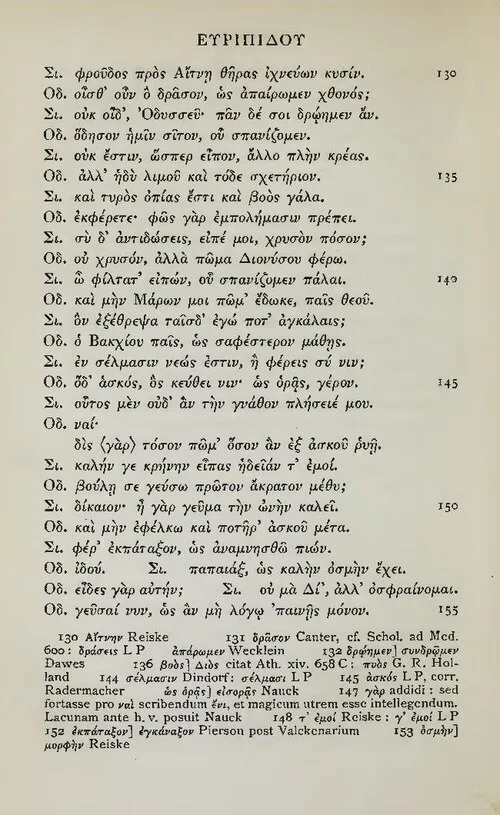
Two cases to read with the apparatus in mind. At Knights 254 the Oxford text prints ἔφευγεν, the reading of the Suda, against the unmetrical ἔφυγε of the manuscripts. So a printed text may follow an indirect witness against every manuscript.[10] At Bacchae 199–203 the two kinds of bracket above meet. Diggle’s Oxford text brackets the lines as spurious. Kovacs assumes, with Kirchhoff, that a line has been lost after 200. He supplies its sense between angle brackets.[11]
ἅσπερ Εὐκράτης ἔφευγεν εὐθὺ τῶν κυρηβίων.
hasper Eukratēs epheugen euthy tōn kyrēbiōn.
“(he knows the roads) by which Eucrates used to run off, straight to the bran-sellers.”
The seventh position (red) must be long, and the Suda’s ἔφευγεν gives it the long diphthong -φευ-. The manuscripts’ ἔφυγε (ephyge) would put the short φυ there.
Aristophanes, Knights 254, as the Oxford text prints it
ἔφευγεν ∿ἔφυγε ∿
An entry in the form an apparatus gives it
254 ἔφευγεν Suda : ἔφυγε codd.
Read: “At line 254 the text prints ἔφευγεν, the reading of the Suda; the manuscripts (codd.) have ἔφυγε.” The mark “:” divides the reading printed from the reading rejected.
An illustration built from the case in the text[10] and the abbreviations in the table above; not quoted from an edition.
ἔφευγεν ∿ἔφυγε ∿
Notes
- ^ Reynolds and Wilson 1991, p. 237.
- ^ a b Reynolds and Wilson 1991, p. 238.
- ^ Reynolds and Wilson 1991, p. 239.
- ^ Reynolds and Wilson 1991, pp. 237–238.
- ^ Reynolds and Wilson 1991, p. 233.
- ^ Voigt 1971, pp. 14–15.
- ^ Sampson 2022, p. 92.
- ^ Finglass 2021, pp. 257–258.
- ^ West 1987, p. 52.
- ^ a b Reynolds and Wilson 1991, p. 219.
- ^ Kovacs 2005, pp. 390–392.
Transmission · 8 of 9
Discoveries since the Renaissance
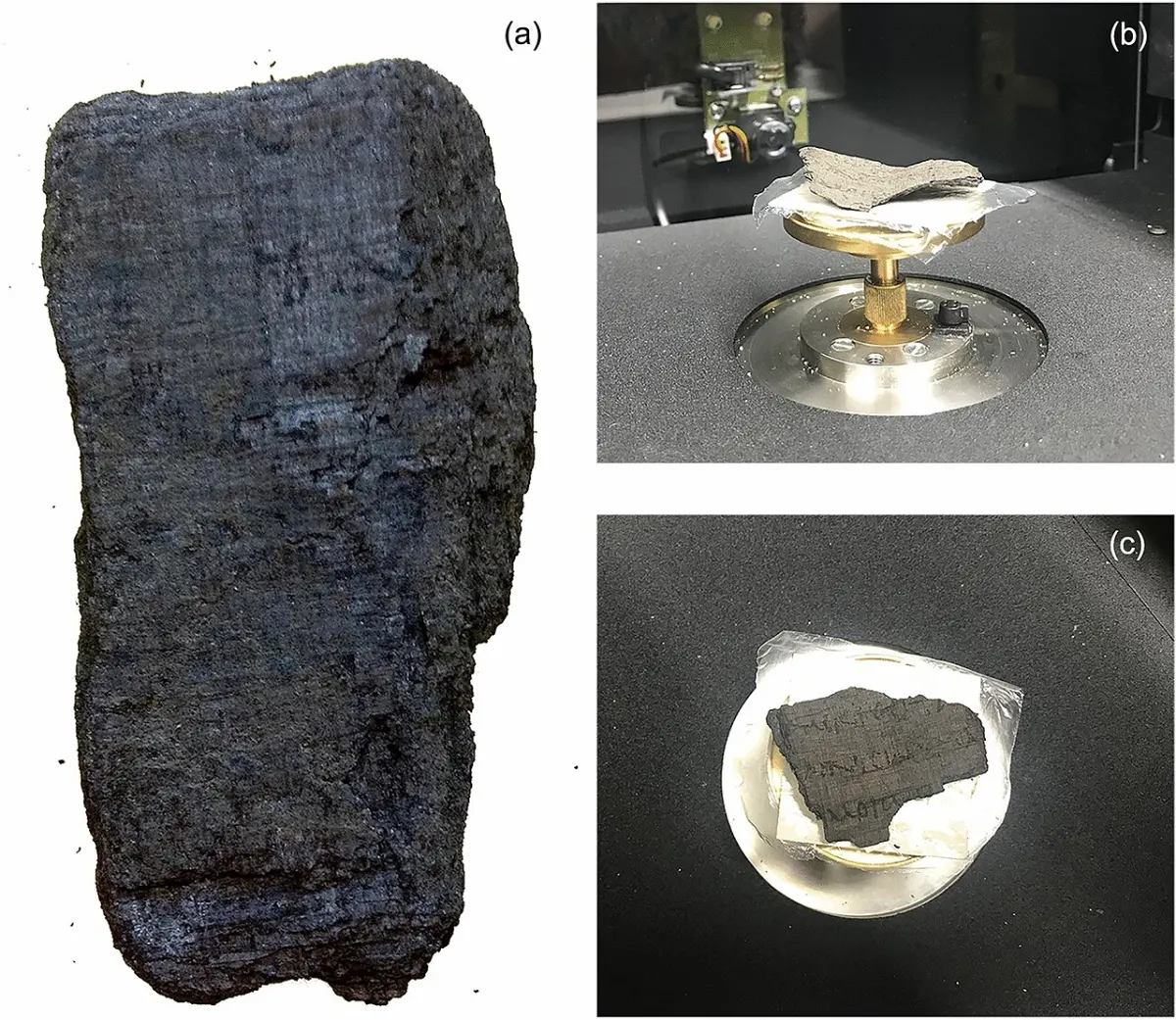
After the Renaissance new Greek poetry came to light in three ways: in the erased lower writing of palimpsests, in manuscripts overlooked in libraries, and, from the nineteenth century, in papyri from Egypt. What the papyri show about ancient books is on the Papyri tab. Here are the finds themselves.
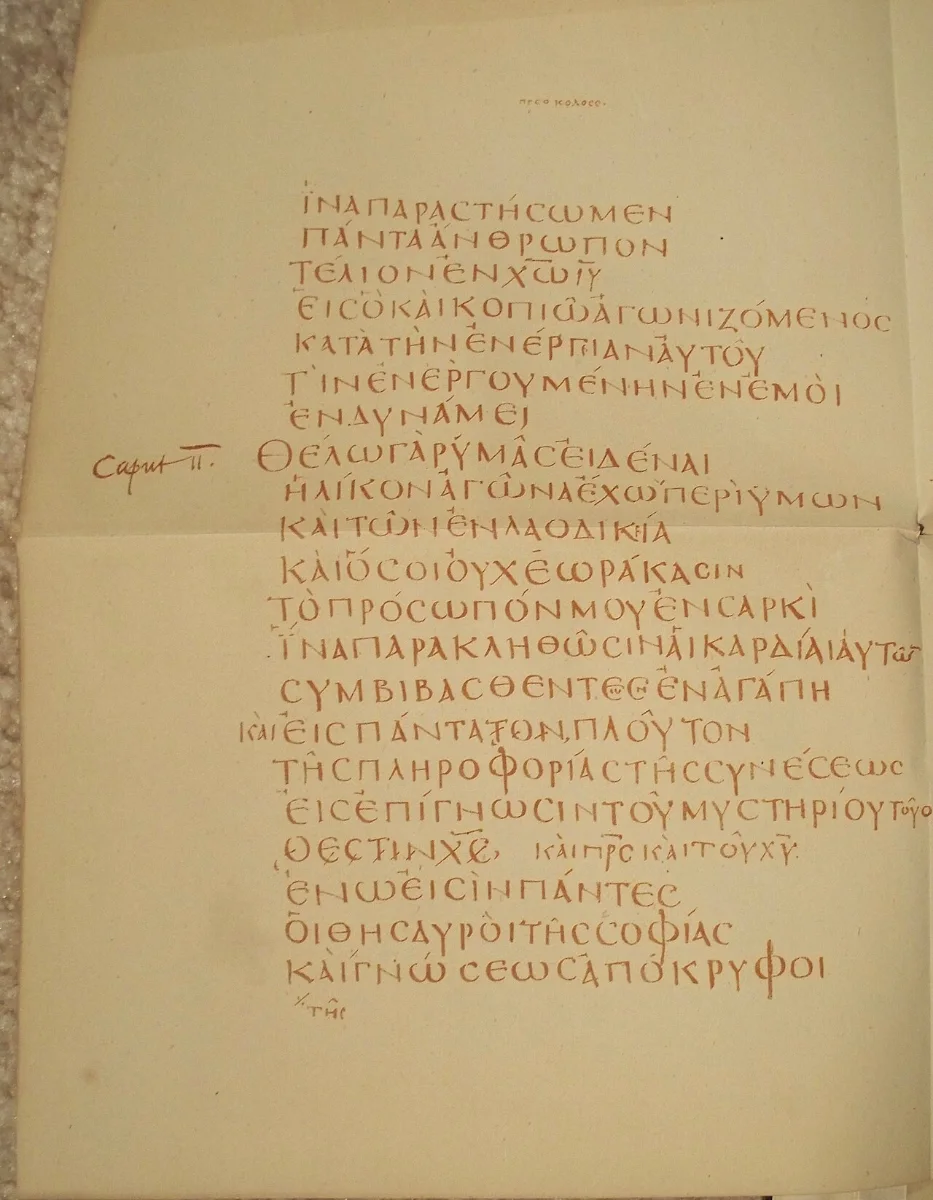
Palimpsests. The first new classical text recovered from a palimpsest was Greek. It was two fifth-century leaves of Euripides’ Phaethon, reused to patch a sixth-century manuscript of St Paul’s letters. J. J. Wettstein found them in Paris in 1715–1716, though he did not identify them correctly.[1] From 1814 Angelo Mai used chemical reagents to publish a series of Latin texts from palimpsests, crowned by Cicero’s De republica. The reagents stained and corroded the parchment. They spoiled it for the safer methods that came later, such as ultra-violet photography.[2] More recently identified palimpsests carry parts of several plays of Euripides (Jerusalem, eleventh century) and of Sophocles (Leiden, a near twin of the Laurentian manuscript).[3]
In the libraries. The Homeric Hymn to Demeter came to light in 1777 in a manuscript now in Leiden. C. F. Matthaei claimed to have found it in a farmhouse among pigs and chickens, a story not everyone has accepted. In 1788 Villoison published the scholia of the Venice Iliad (Venetus A). Their news of the Alexandrian critics stimulated F. A. Wolf’s Prolegomena ad Homerum (1795) and the modern Homeric Question. The verse fables of Babrius were found on Mount Athos in the nineteenth century.[4]
Papyri: some dates.
| Year (find or publication) | Find | Source |
|---|---|---|
| 1855 | Alcman’s partheneion, found by Auguste Mariette in a tomb at Saqqara (the “Louvre partheneion”) | Athanassaki 2022, pp. 5, 11 |
| 1880 | first Sappho fragment, P.Berol. inv. 5006, a seventh-century parchment, published by Blass | Finglass 2021, p. 232 |
| 1896–1897 | the Bacchylides roll (P.Lond.Lit. 46), bought by E. A. Wallis Budge and published the next year | Sampson 2022, pp. 114–115 |
| 1898 | first volume of The Oxyrhynchus Papyri (Grenfell and Hunt), with Sappho in P.Oxy. 7 | Finglass 2021, p. 233 |
| 1901 | cartonnage containing the Lille Stesichorus excavated by Jouguet and Lefebvre | Sampson 2022, p. 116 |
| 1902 | the Timotheus papyrus excavated at Abusir by Ludwig Borchardt | Sampson 2022, p. 115 |
| 1905 | the Cairo codex of Menander (first edition 1907) | Allinson 1921, Introduction |
| 1914 | two Sappho rolls, P.Oxy. 1231 (with most of fr. 16) and 1232 (fr. 44) | Finglass 2021, p. 234 |
| 1992, 2005 | the “new” Simonides elegy on Plataea; the “new” Archilochus elegy on Telephus | Sampson 2022, p. 113 |
| 2004, 2014 | the “New Sappho” (P.Köln 429 + 430, from cartonnage); the “Newest Sappho” | Finglass 2021, pp. 237–238 |
Grenfell and Hunt’s excavations at Oxyrhynchus (al-Bahnasa) brought up such a “torrent” of papyri that find-spots could not be recorded.[5] Other important drama papyri, Sophocles’ Ichneutae (P.Oxy. 1174), Euripides’ Hypsipyle (P.Oxy. 852) and Menander’s Dyscolus (P. Bodmer 4), are listed by Reynolds and Wilson[6].
Metre and the new finds. Metre helps to assign and judge a find. The metre of the last poem on the Cologne papyrus shows that it is not Sappho’s.[7] The provenance of the “Newest Sappho” is unknown. One argument for its authenticity is that its language and metre are free of any slip. The editors of the Cambridge Companion treat it as genuine, but they stress that the circumstances of its discovery were far from ideal.[8]
The ethics of the trade. Budge smuggled the Bacchylides roll out of Egypt past the Antiquities Service. The episode is shocking today, but it was typical of its era. Egypt’s laws of 1912 and 1951 were weak. Since 1983 Egyptian law has in effect banned the antiquities trade inside the country. Extracting papyri from cartonnage destroys the cartonnage, and it is no longer common in responsible collections.[9]
Notes
Transmission · 9 of 9
Poet by poet: three routes to the present
The poets on this site reached us by three routes, and the route decides what kind of text a reader has in front of them.
Through the medieval manuscripts. Authors who went on being read and copied in Byzantium survive in medieval manuscripts. They are these:
- Homer, the first of the school poets.
- Hesiod, on whom Tzetzes wrote a commentary.
- Theognis.
- Pindar’s victory odes, though Eustathius probably read more of them than we have.
- A selection of the dramatists: seven plays each of Aeschylus and Sophocles, ten of Euripides with nine more preserved by chance, and eleven of Aristophanes.[1]
For these authors an edition rests on medieval copies. The editor’s task is the one described on the Editions and Apparatus tabs.
Through quotation and papyrus only. Of the lyric poets, only Pindar and Theognis were transmitted through the Middle Ages in a manuscript tradition of their own. Of Pindar, only the four books of victory odes came through in this way.[2] None of Sappho’s books came down in medieval manuscripts.[3] The other lyric poets survive in two ways. One is quotation by ancient writers. Dionysius of Halicarnassus, for example, quoted Sappho’s Hymn to Aphrodite, and the treatise On the Sublime quoted her fr. 31.[4] The other is papyri from Egypt.[5]
The papyri of some poets end early. Stesichorus leaves no trace beyond the third century AD, and Alcaeus is not securely attested after it. Sappho was still read in the seventh.[6] Menander was read in a school at Gaza in the sixth century, but he did not survive into the Middle Ages.[7]
Through a single late witness. A few texts hang on one manuscript. One is the Homeric Hymn to Demeter, found in 1777.[8] The others are nine “alphabetic” plays of Euripides, preserved only in a fourteenth-century manuscript in Florence.[9]
| Poet | How the text reached us | Read more |
|---|---|---|
| Homer | hundreds of papyri; the Venice Iliad of the tenth century with its scholia[10] | Homer › Transmission |
| Hesiod | copied in Byzantium; Tzetzes, who appears to have run a school, wrote a commentary on him[11] | Hesiod › Transmission |
| Elegists | the earliest manuscript of Theognis is almost certainly of the early tenth century[12] | Elegists › Transmission |
| Sappho | quotations and papyri; the latest papyri of the seventh century[13] | Sappho › Papyri, Editions |
| Alcaeus | quotations and papyri, none securely later than the third century[13] | Alcaeus › Transmission |
| Stesichorus | papyri to the third century, including the early Lille papyrus[14] | Stesichorus and Ibycus › Transmission |
| Pindar | the four books of victory odes in manuscripts, of which Eustathius probably read more than we have; paeans, dithyrambs and other cult songs on papyrus[15] | Pindar › Transmission |
| Bacchylides | the papyrus roll published in 1897[16] | Bacchylides › Transmission |
| Timotheus | a fourth-century BC papyrus, written as prose[17] | Timotheus › Transmission |
| Aeschylus, Sophocles | seven plays each; Laur. 32.9[12] | Aeschylus › Manuscripts, Sophocles › Manuscripts |
| Euripides | ten select plays and nine “alphabetic” ones[9] | Euripides › Manuscripts |
| Aristophanes | eleven plays; the Ravenna manuscript[12] | Aristophanes › Manuscripts |
| Menander | papyri only[18] | Menander › Plays and papyri |
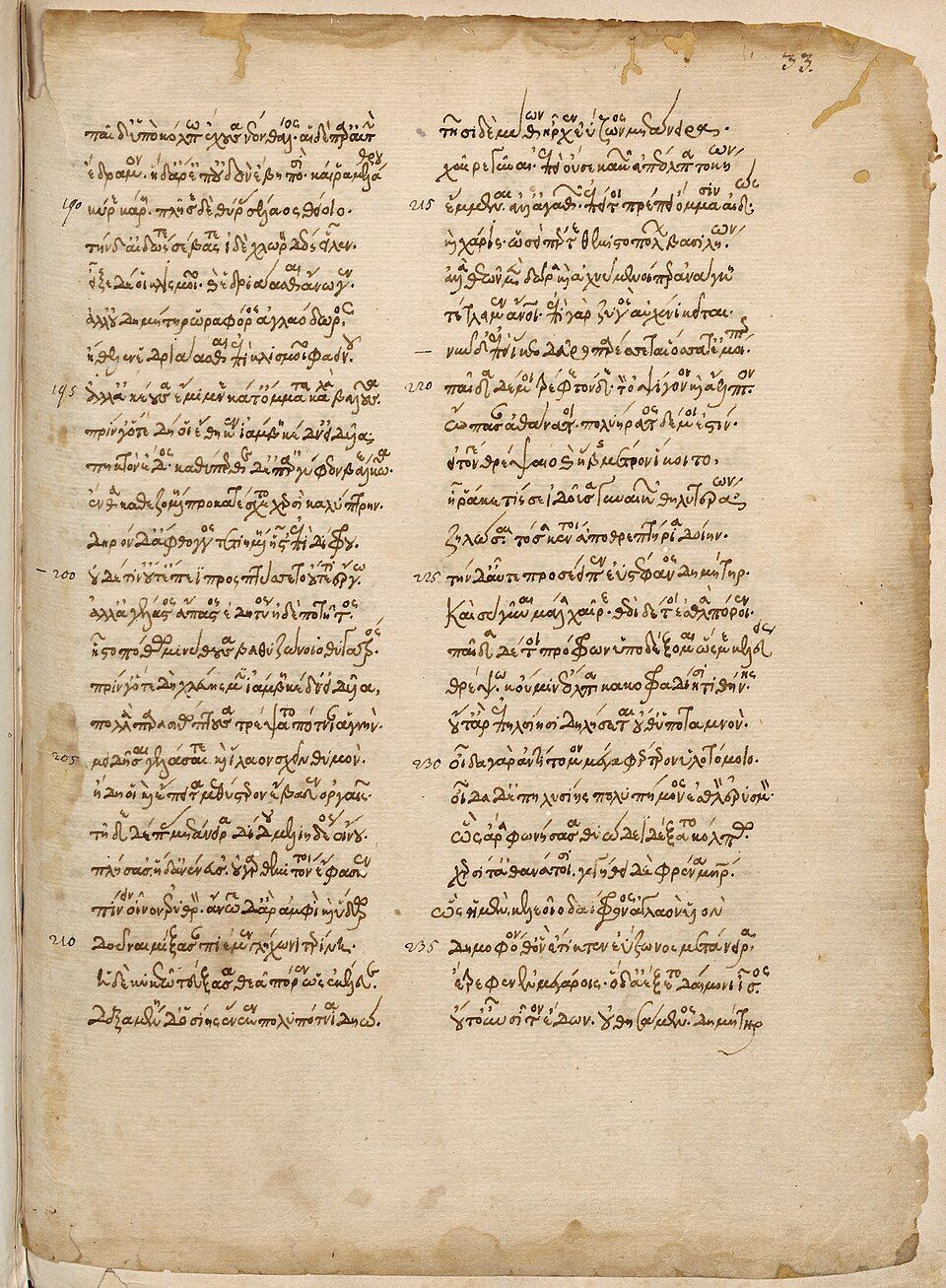
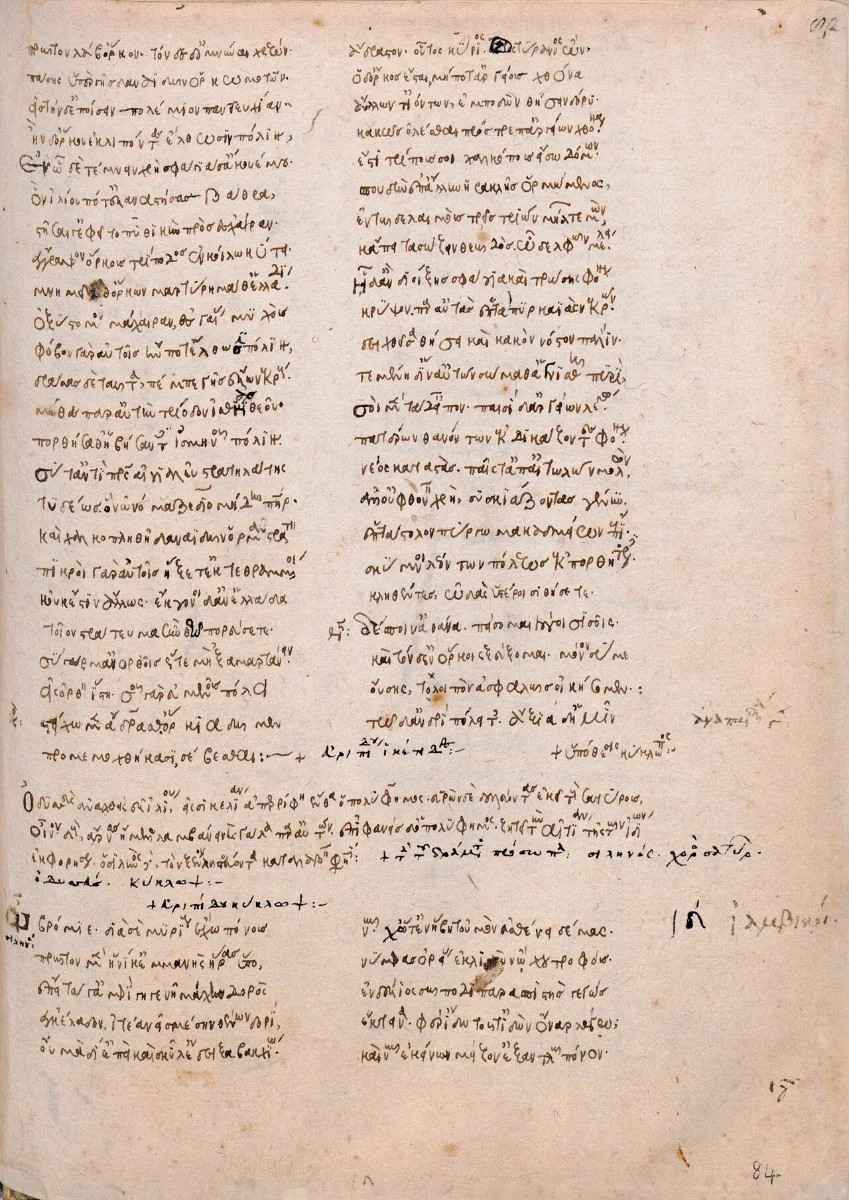
Why it matters for metre. A papyrus written before the second century BC gives no colometry at all, and leaves the metrical analysis to its editor.[19] The medieval manuscripts of tragedy disagree so widely on the colometry of difficult lyrics that they may go back to different ancient colometries.[20] The metrical analyses on this site therefore say, poem by poem, which edition they follow.
Notes
- ^ Reynolds and Wilson 1991, pp. 66, 70–71, 78; Kovacs 2005, p. 387.
- ^ Allan 2022, p. 469; Brown 2022, pp. 335–336.
- ^ Lardinois 2022, p. 265.
- ^ Finglass 2021a, pp. 247, 250.
- ^ Reynolds and Wilson 1991, pp. 4, 196.
- ^ Finglass 2021b, p. 232; Barbantani 2009, p. 313.
- ^ Reynolds and Wilson 1991, p. 54.
- ^ Reynolds and Wilson 1991, p. 198.
- ^ a b Kovacs 2005, p. 387.
- ^ Reynolds and Wilson 1991, pp. 66, 196.
- ^ Reynolds and Wilson 1991, p. 71.
- ^ a b c Reynolds and Wilson 1991, p. 66.
- ^ a b Finglass 2021b, p. 232.
- ^ Finglass 2021b, p. 232; Reynolds and Wilson 1991, p. 14.
- ^ Brown 2022, pp. 335–336; Reynolds and Wilson 1991, p. 70; Furley 2022, p. 31.
- ^ Sampson 2022, pp. 114–115.
- ^ Reynolds and Wilson 1991, p. 4.
- ^ Reynolds and Wilson 1991, pp. 54, 196.
- ^ Sampson 2022, p. 114.
- ^ Kovacs 2005, pp. 385–386.


).jpg)