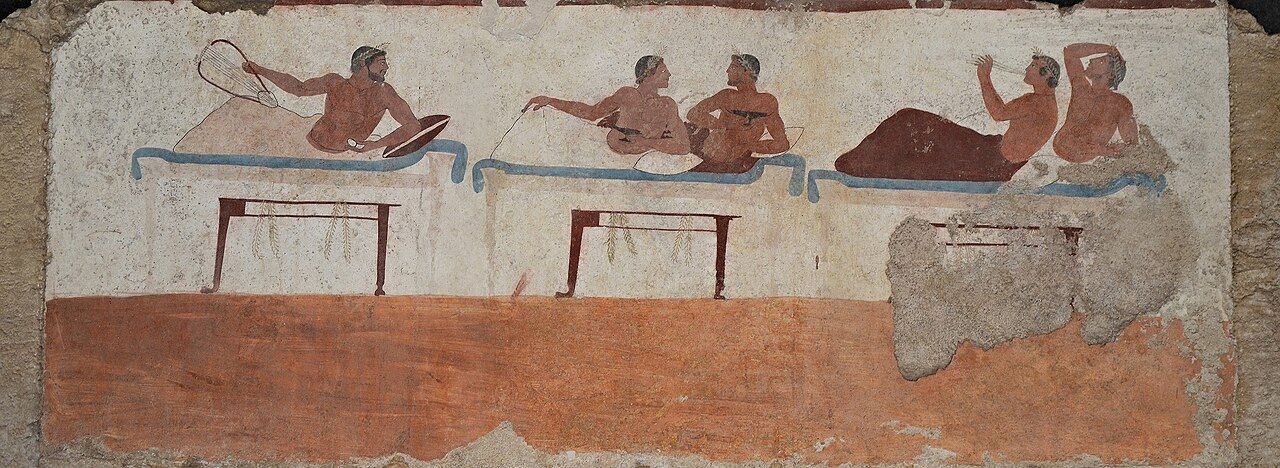
Poets and playwrightsLesbian monody
Alcaeus
Alcaeus of Lesbos: political songs, drinking songs and the Alcaic stanza.
About
Works
- Synopsis
- Text and translation
- How to read each line
- Key to the labels
- Scansion
- Metre
- Prosody, line by line
- The poem
- Notes
- Synopsis
- Text and translation
- How to read each line
- Key to the labels
- Scansion
- Metre
- Prosody, line by line
- The poem
- Notes
- Synopsis
- Text and translation
- How to read each line
- Key to the labels
- Scansion
- Metre
- Prosody, line by line
- The source and the occasion
- Notes
- Synopsis
- Text and translation
- How to read each line
- Key to the labels
- Scansion
- Metre
- Prosody, line by line
- The source
- Notes
About · 1 of 9
Who Alcaeus was
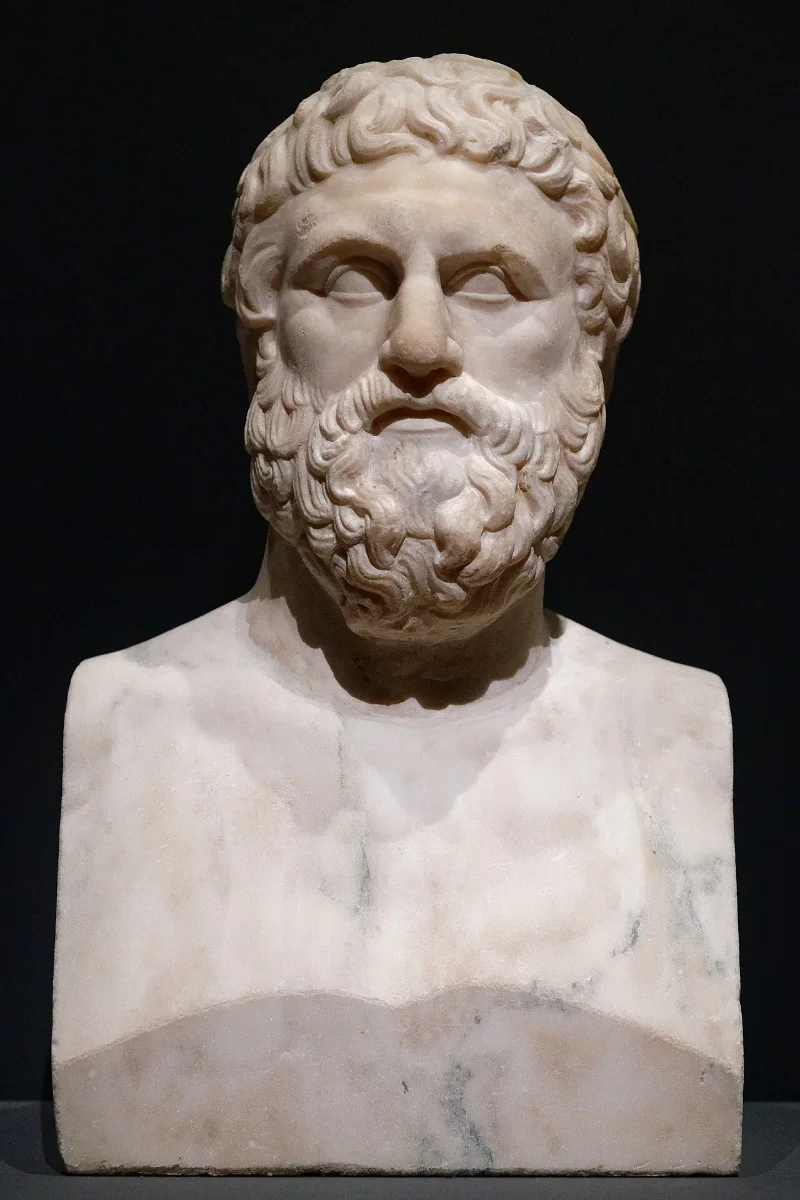
Alcaeus came from a rich family of Mytilene, the chief city of Lesbos. His fragments and other evidence put his activity around 600 BC.[1] His chronology is hard to fix, but many of his songs can safely be placed between c. 600 and 580.[2] He was a contemporary of Sappho and of his political rival Pittacus.[3] Alcaeus and Sappho are “the two Lesbian musicians” through whom alone we know the Aeolian tradition of Greek verse.[4]
A life read from the poems. The Alexandrian edition had ten books or more, and a life-story framed them. There were poems on his childhood and his old age, and on his exile in a Lesbian sanctuary. Others told of his brother’s return from fighting in the Near East, and of his own fighting against the Athenians in the Troad.[5] The Peripatetic Aristoxenus quipped that Alcaeus treated his books as his companions.[5]
Herodotus tells how Alcaeus lost his shield in the war for Sigeum. The shield was then hung in Athena’s temple there. Alcaeus told the story in a song sent to his friend Melanippus.[6]
Two warnings apply. Modern accounts of his life are often built by “emplotment”: heavily supplemented fragments are joined into continuous plots.[7] And the lyric “I” cannot always be turned into literal biography.[8]
Family. Strabo paraphrases a lost poem about Alcaeus’ brother Antimenidas. In it Antimenidas fights on the side of the Babylonians and kills a warrior of giant size. Aristotle names Antimenidas and Alcaeus as the leaders of the exiles whom Pittacus was elected to deal with.[9] Fr. 350 welcomes Antimenidas home from service with the Babylonian army.[10]
Disputed: the link with Nebuchadnezzar’s campaign is a modern conjecture. There is no other evidence of Greek mercenaries in Babylonian service. Fantalkin and Lytle suggest that Antimenidas was rather among the Greek mercenaries of Egypt at Askelon. Strabo may have mistaken which side he was on.[11]
Alcaeus belonged, or claimed to belong, to the old aristocracy of Mytilene.[12] His songs appeal to his fathers and forefathers against the “base-born” Pittacus.[13]
A musical island. His metre and dialect imply a long tradition before him.[5] Earlier Lesbian poets were remembered. A kitharode sang to his own kithara, the large concert lyre. The kitharodes Terpander and Arion left Lesbos for the Peloponnese; Lesches is a shadowy figure. “The Lesbian singer” was proverbial.[14] The island’s writers of Panhellenic stature include Terpander, Lesches, Arion, Hellanicus, Theophrastus and Phaenias.[15]
Language. His songs, like Sappho’s, are transmitted in the East Aeolic dialect, which is often simply called Lesbian. Epic has a limited influence on them, mostly in the fragments in dactylic metres. How far this poetic language reflects the speech of sixth-century Lesbos is hard to establish.[16] The dialect is described on the Lesbian Aeolic page.
Later readers. In Aristophanes’ Wasps, at an Athenian symposium, Philocleon adapts Alcaeus’ warning about Pittacus and turns it against Cleon.[5] Around 25 BC his poems mattered to Horace.[17] Dionysius of Halicarnassus set an “austere” style, like Pindar’s, against a “smooth” style, like Sappho’s. He counted Alcaeus, with Homer, among the poets who achieve a “blend” of the two.[18]
Notes
- ^ Spelman 2022, p. 275.
- ^ Yatromanolakis 2009, p. 207.
- ^ Lardinois 2022, p. 264; Campbell 1982, p. x.
- ^ West 1987, pp. 3, 32.
- ^ a b c d Spelman 2022, p. 276.
- ^ Thomas 2021, p. 27; Spelman 2022, p. 283.
- ^ Yatromanolakis 2009, pp. 206–207.
- ^ Thomas 2021, p. 32.
- ^ Thomas 2021, pp. 30, 32.
- ^ Campbell 1982, pp. xiv–xv.
- ^ Thomas 2021, pp. 30–32.
- ^ Thomas 2021, p. 33.
- ^ Yatromanolakis 2009, p. 210.
- ^ Yatromanolakis 2009, pp. 207–208; Spelman 2022, p. 276.
- ^ Thomas 2021, p. 26.
- ^ de Kreij 2022, pp. 146–147.
- ^ Spelman 2022, p. 282.
- ^ Phillips 2022, p. 121.
About · 2 of 9
Faction, tyrants and exile
For the politics of Mytilene around 600 BC we depend heavily on Alcaeus’ poems, which are one-sided and often vitriolic.[1] His faction is almost the only one whose activities and point of view we hear.[2]
The rulers. Mytilene was deeply unsettled at the end of the seventh century and the beginning of the sixth. Alcaeus opposed in turn the tyrants Melanchros and Myrsilos, and then Pittacus. After Myrsilos’ death Pittacus was chosen aisymnētēs. An aisymnētēs was a ruler elected by the citizens. Pittacus was later counted among the Seven Sages.[3] Clans such as the Penthilids, the Cleanactids, the Archeanactids and Alcaeus’ own struggled for control.[4]
Pittacus had joined Alcaeus in expelling Myrsilus, and then he turned against him. He married into the Penthilids, the leading clan (an alliance that also figures in Sappho’s poems).[5] He may have had a Thracian father.[1] Alcaeus called him “tyrant” and “base-born”, yet admits that the people chose him (fr. 348). The abuse can be read as that of the party with most to lose, in a city that was beginning to be ruled by offices rather than by birth.[6] When Myrsilus died, Alcaeus sang that now one must get drunk (fr. 332).[7]
Oath and exile. Members of the faction seem to have gone into exile more than once.[2] An ancient commentary speaks of his “second exile” and “third return” (test. 9c).[8]
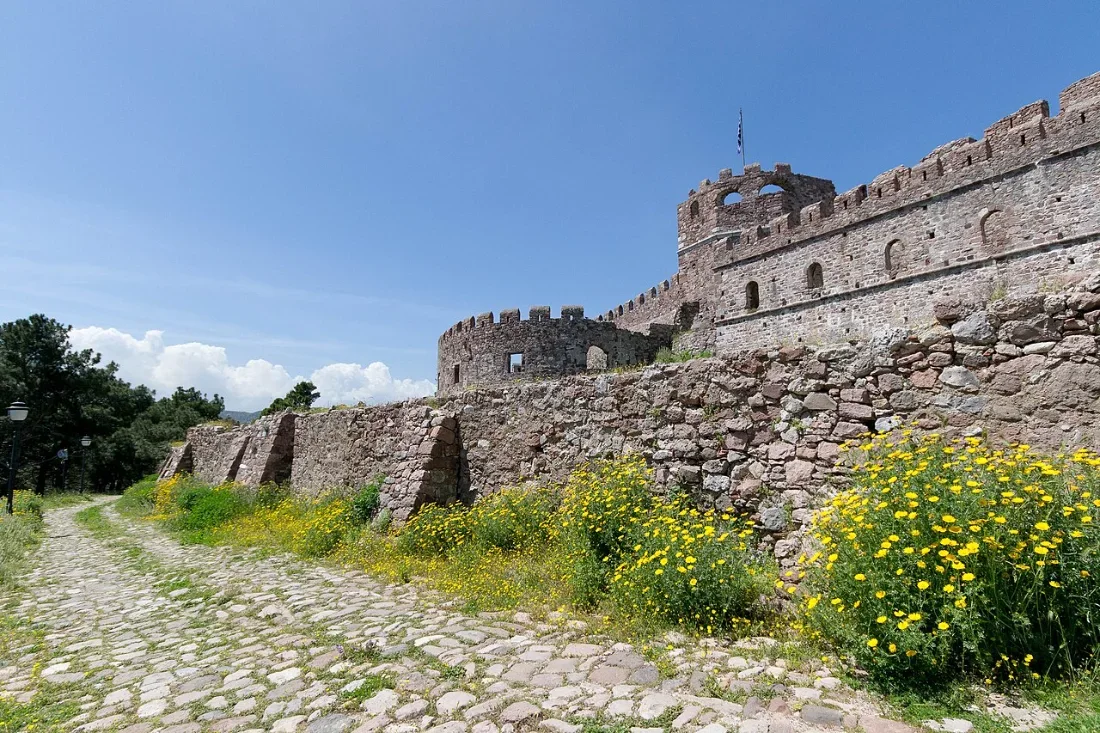
In fr. 129 Alcaeus prays at the common sanctuary of the Lesbians to be saved from exile. He calls the Erinys down on Pittacus for breaking the oath that the companions had once sworn there. In fr. 130b he is at the sanctuary again, alone, cut off from his friends.[9] The sanctuary stood at Messon, in the middle of the island, and its cities shared it. The three gods worshipped there make a unique group: Zeus, Hera as “the Aeolian goddess”, and Dionysus.[10]
In fr. 298 the Greeks would have done better to stone Locrian Ajax for his sacrilege against Athena. The lesson is turned on Pittacus, whom the community should kill.[11] Fr. 129 is scanned on the works page.
Mytilene abroad. The poems also show a city looking outward.[12] One fragment tells of two thousand staters that the Lydians gave to Alcaeus’ side, and of Pittacus’ fox-like cunning (fr. 69). Lydian money was at work in Mytilene’s strife.[13]
Mytilene fought Athens for Sigeum on the Hellespont. There Pittacus was said to have killed the Athenian leader Phrynon in single combat.[14] Alcaeus mentions Phrynon, and the presence of Alcaeus and Pittacus fixes the episode in time.[15] The wealth and honours that men such as Alcaeus’ brother Antimenidas won abroad may have unsettled the old families at home.[16]
Allegory. Ship-of-state allegories occur in several fragments.[17] For an island audience the storm metaphors had natural force.[18]
Reading the political songs. The sources differ in emphasis. Yatromanolakis warns that the songs have often been read as plain records of a faction’s history. The reconstructions, he adds, rest on so many emendations and supplements that some must mislead.[19] Thomas finds that the references to Lydian money, Babylon and Askelon point to something more specific than generic themes.[20] Yet Alcaeus’ style “does not spell things out” for those who did not already know.[21]
Pittacus remembered. Later tradition made Pittacus a sage and lawgiver. As Aristotle noted, he wrote laws but no constitution. Wise sayings were attributed to him.[22]
Notes
- ^ a b Thomas 2021, p. 33.
- ^ a b Yatromanolakis 2009, p. 208.
- ^ Yatromanolakis 2009, p. 207; Campbell 1982, pp. xiii, xv.
- ^ Yatromanolakis 2009, p. 210.
- ^ Lardinois 2022, p. 267.
- ^ Thomas 2021, pp. 33–34.
- ^ Spelman 2022, p. 275; Campbell 1982, p. xv.
- ^ Campbell 1982, p. xvi.
- ^ Rösler 2021, pp. 68–69; Yatromanolakis 2009, pp. 211–212.
- ^ Thomas 2021, pp. 24–25.
- ^ Spelman 2022, pp. 284–286.
- ^ Thomas 2021, pp. 26–29.
- ^ Thomas 2021, p. 29.
- ^ Campbell 1982, p. xiv.
- ^ Thomas 2021, pp. 27–28.
- ^ Thomas 2021, pp. 32–33, 35.
- ^ Yatromanolakis 2009, p. 213.
- ^ Thomas 2021, p. 24.
- ^ Yatromanolakis 2009, pp. 206–207.
- ^ Thomas 2021, p. 32.
- ^ Thomas 2021, p. 31.
- ^ Thomas 2021, p. 34.
About · 3 of 9
Songs for the companions
Who heard them. Most of Alcaeus’ poems, perhaps all, appear to have been written for a single singer. They were sung at the private drinking-parties of his hetaireia. A hetaireia was an aristocratic club with a political purpose. The poems express the faction’s ideology, and they probably helped to hold it together.[1] Scholars generally assume this setting.[2] The group was an all-male club that agitated and fought for political goals in the social form of the time, the symposium.[3]
The songs were one of the means by which the club worked out its ideas about political action. The audience was the group itself, so the “I” and the “we” of the poems merge. Some songs could have been sung by the whole group together.[4]
Range. Seeing Alcaeus only as a political poet hides the variety of his work.[5] The fragments include hymns, of which only the openings survive, and erotic and drinking songs. There is a lament in the voice of a woman (fr. 10 V). There is the old theme of the poet who throws away his shield, and there are many proverbs and traditional images.[6] Fr. 140 describes a hall gleaming with bronze arms, and the companions’ unwavering dedication to their cause.[1]
Fr. 119 is an earthy metaphor of vines and unripe grapes. Its author, Alcaeus or Sappho, is not certain. Against the allegorical readings, Spelman argues that it is more probably erotic than political.[7]
Myth. Alcaeus told traditional stories as parallels for present concerns, as lessons from the past, and sometimes for their own sake.[8] Greek lyric often uses a three-part shape: a present situation, a tale from the past, and a lesson linking the two. Fr. 298 can be read in this shape.[9] Two fragments make Helen the cause of the Trojans’ destruction (frr. 42, 283).[10]
Alcaeus and Hesiod. Authorities differ. Fr. 347 recasts the summer scene of Hesiod’s Works and Days (582–589). Both have the thistle, the cicada, women at their most wanton, men at their weakest, and the Dog Star parching head and knees. Page found nothing so close in Greek poetry outside deliberate parody. Some scholars derive both passages from a common source, or from a shared store of traditional language. Spelman argues that so much verbal agreement makes allusion to a fixed text of Hesiod the likelier explanation.[11] The poem is scanned on the works page.
Re-performance. Many of his songs came to be heard as skolia, drinking songs. Aristotle calls fr. 348 a skolion. A shortened version of fr. 249 entered a collection of skolia preserved by Athenaeus. Aristophanes refers to the singing of skolia of Alcaeus and Anacreon at drinking-parties.[12]
The collection’s version of fr. 249 can be set beside the papyrus. In the collection, the four lines have been cut loose from their poem and from Alcaeus’ dialect. They stand beside solidly democratic songs, far from his own politics.[13] Music may have been central to the early popularity and transmission of his songs.[14]
Notes
- ^ a b Spelman 2022, p. 275.
- ^ Kurke 2021, p. 95.
- ^ Rösler 2021, p. 67.
- ^ Yatromanolakis 2009, pp. 208–209.
- ^ Spelman 2022, p. 275; Yatromanolakis 2009, p. 209.
- ^ Yatromanolakis 2009, pp. 209–210; Spelman 2022, p. 276.
- ^ Spelman 2022, pp. 287–288.
- ^ Spelman 2022, p. 276.
- ^ Spelman 2022, p. 285.
- ^ Spelman 2022, p. 286; Rösler 2021, pp. 72–74; see the “Alcaeus and Sappho” tab.
- ^ Spelman 2022, pp. 277–278.
- ^ Yatromanolakis 2009, pp. 213–214.
- ^ Spelman 2022, pp. 281–282.
- ^ Yatromanolakis 2009, p. 214.
About · 4 of 9
Alcaeus and Sappho
Since antiquity Alcaeus and Sappho have been treated as contemporaries.[1]
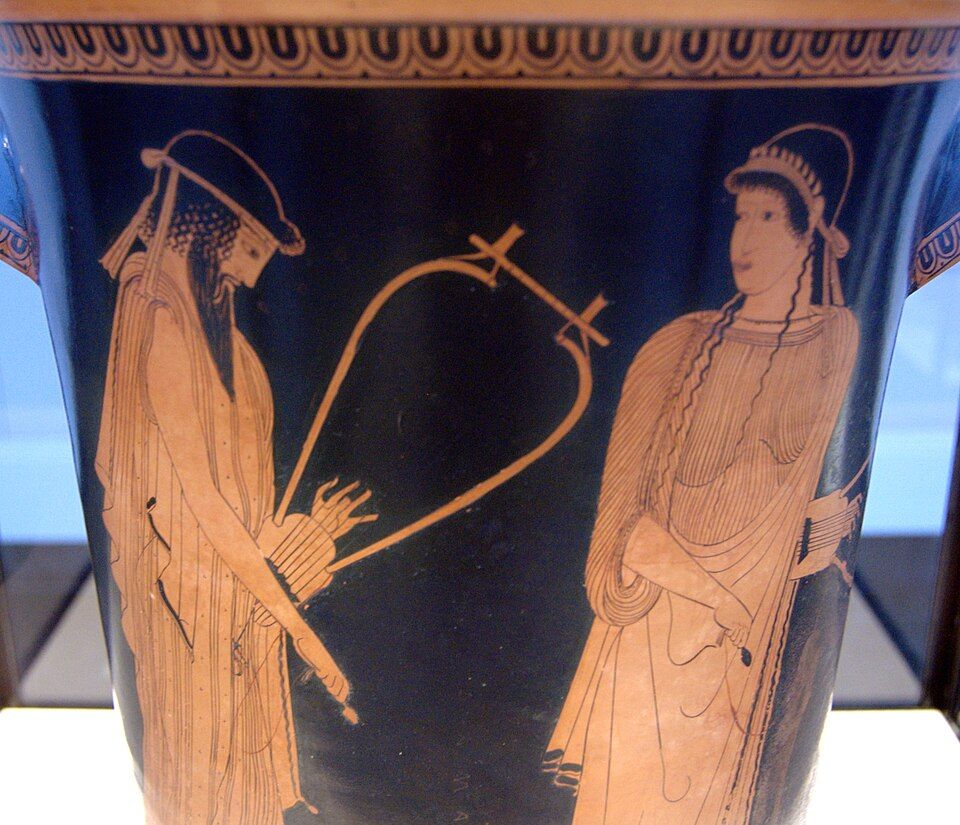
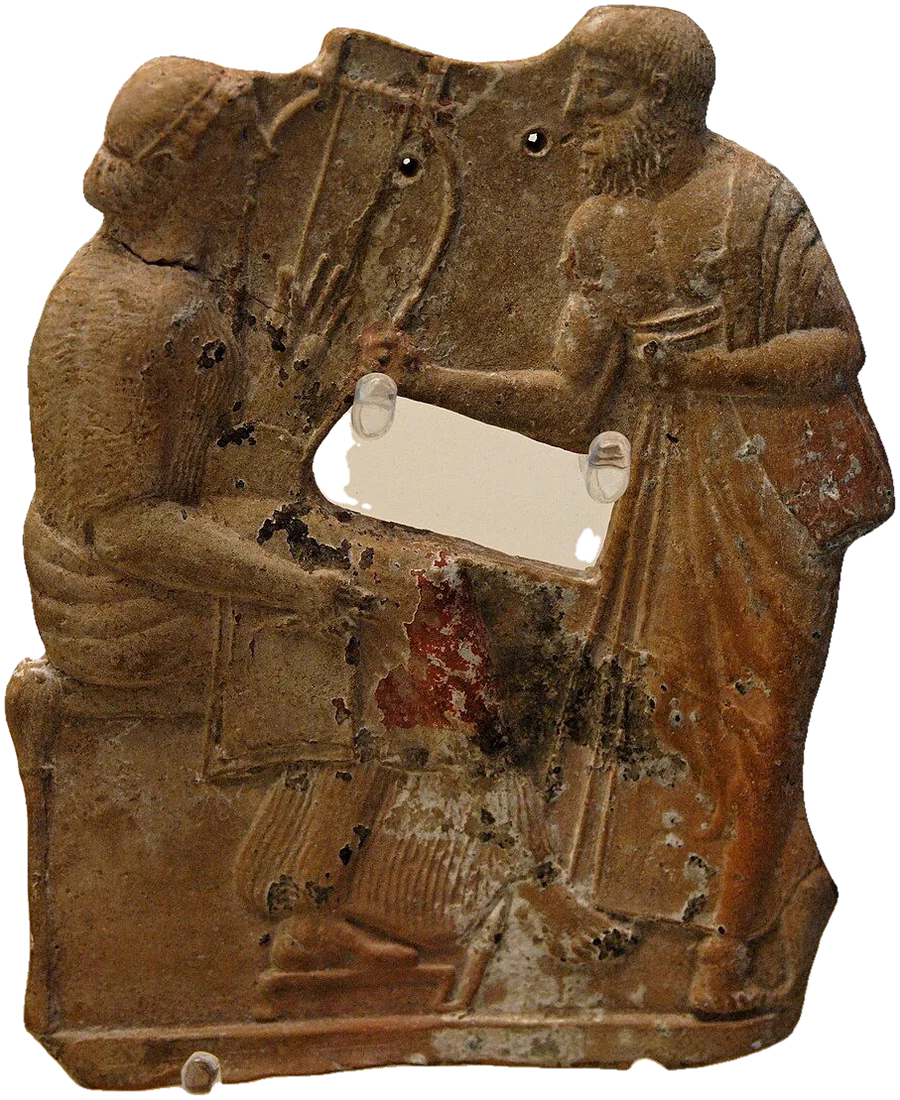
The vase. A red-figure kalathos of about 480–470 BC shows the two poets, named, each with a barbitos. It is attributed to the Brygos or the Dokimasia Painter. Alcaeus sings with his head lowered, and Sappho listens.[2] The vase was painted a century after the poets lived. It shows not a historical meeting but the fact that they were contemporaries and close in their art.[1] It is also evidence that their poetry was closely linked in Athens, and perhaps reperformed together there.[3]
A dialogue and a greeting. Aristotle’s Rhetoric quotes an exchange between the two poets. Alcaeus wishes to say something, but shame prevents him. Sappho replies that if his desire were noble, shame would not hold his eyes (fr. 137). Rösler thinks the two cannot have composed it together. In his view a poem for two speakers, perhaps by Sappho, was later relabelled “Alcaeus” and “Sappho”.[4] A number of editors give it to Sappho.[5]
Hephaestion quotes a single line as his example of the “Alcaic dodecasyllable”:[6]
ἰόπλοκ’, ἁγνά, μελλιχόμειδε Σαπφοῖ
ioplok’, hagna, mellichomeide Sapphoi
“violet-tressed, pure, softly smiling Sappho”
ἰ- (red) is short, though it stands in an anceps position; -όπ- (red) is long by position before πλ.
Alcaeus fr. 384, quoted by Hephaestion, Ench. 14.4
synthetic ∿
The ι of ἰόπλοκ- (ioplok-; from ἴον, ion, “violet”) is short,[7] though it stands in an anceps position. The ο is long by position before πλ (pl), as is normal in Lesbian verse.[8] Voigt analyses the line as ia ∧hipp (Conspectus C 2 a).
If the line is Alcaeus’, it may show his regard for Sappho.[9] But its reading is contested.[10] Spelman thinks both pieces of evidence for direct contact between the poets problematic.[11]
Where might they have met? Page judged that they certainly lived part of their lives in the same city, probably in the same aristocratic circle.[12] Rösler argues for the common sanctuary at Messon. Alcaeus, in exile there, mentions the women’s gatherings and their annual beauty contest (fr. 130B). Sappho’s fr. 17, newly supplemented from papyrus, concerns the festival there. So both poets may have performed at it.[13] Rösler admits that there can be no certainty.[14] He regards Nagy’s “staged musical event” at Messon as part of a trend to fictionalise lyric.[15]
Poems in conversation? Alcaeus fr. 283 condemns Paris and the “crazed” Helen, and counts the Trojan dead. Sappho fr. 16 tells of Helen leaving everything, without reproach. It does so to show that the most beautiful thing is whatever one desires. Alcaeus fr. 42 sets the blameless Thetis against Helen.
Rösler suggests, as a hypothesis, that frr. 41 and 42 come from one poem of ten Sapphic stanzas addressed to Aphrodite. He concludes that the three poems seem to have been composed in mutual awareness, even in artistic interaction.[16]
The romance. Later tradition made Alcaeus and Anacreon rivals for Sappho’s attention.[17] Alcaeus is one of the four poets most often linked with her as lovers.[18]
Whose fragment? The two poets used the same dialect, so it is sometimes impossible to say which of them a scrap belongs to. Editions have a section of “uncertain fragments of either poet”. Lardinois suspects that editors, ancient and modern, gave “feminine” lines to Sappho and “male” topics to Alcaeus.[3] Two of the twenty-four Sappho papyri may contain Alcaeus.[19]
P.Fouad inv. 239 (Sappho fr. 44A) is a disputed case. Lobel and Page tentatively gave it to Alcaeus, and many editors since have given it to Sappho. It carries an asterisk that makes the case for Sappho problematic.[20] De Kreij concludes that, if no change of metre follows the asterisk, the papyrus most naturally belongs to an Aristarchean edition of Alcaeus.[21] The case for Alcaeus’ authorship of fr. 119 is usually taken to be the stronger.[22] Hephaestion already doubted whose invention the Sapphic stanza was.[23]
Notes
- ^ a b Rösler 2021, p. 65.
- ^ Rösler 2021, p. 65; Yatromanolakis 2009, pp. 204–205.
- ^ a b Lardinois 2022, p. 266.
- ^ Rösler 2021, pp. 65–66.
- ^ Yatromanolakis 2009, p. 204.
- ^ Hephaestion, Ench. 14.4.
- ^ LSJ s.v. ἴον.
- ^ West 1987, p. 16 n. 7.
- ^ Rösler 2021, p. 67.
- ^ Kivilo 2021, p. 15 n. 31.
- ^ Spelman 2022, p. 277 n. 5.
- ^ Quoted by Rösler 2021, p. 66.
- ^ Rösler 2021, pp. 68–71.
- ^ Rösler 2021, p. 71 n. 22.
- ^ Rösler 2021, p. 71 n. 23.
- ^ Rösler 2021, pp. 72–75.
- ^ Kivilo 2021, p. 15.
- ^ Steiner 2021, p. 77.
- ^ Finglass 2021, p. 239.
- ^ Sampson 2022, p. 92.
- ^ de Kreij 2022, pp. 603–609.
- ^ Spelman 2022, p. 287.
- ^ Hephaestion, Ench. 14.1.
About · 5 of 9
His metres: the Alcaic stanza
Alcaeus shares Sappho’s prosody. Lesbian verse admits no resolution of a long into two shorts, and no contraction of two shorts into a long. So every line has a fixed number of syllables. Its cola are related to those of Vedic poetry. Some of them begin with the free “aeolic base” of two positions, in which both syllables are rarely short. Hiatus is the meeting of two vowels across a word-end. Lesbian verse avoids it altogether: it elides the first vowel or runs the two together.[1]
In normal Lesbian lyric a syllable is not left short even before a stop + liquid at the start of a word.[2] There are two oddities. At fr. 366, in a proverb, a single καί is shortened before a vowel; this shortening is called correption. At fr. 10.7 υ is written for a digamma between vowels, in ἀυάτα (auata), scanned ⏑ ⏑ —.[3]
The Alcaic stanza
The stanza can be analysed as three periods on the pattern aaA:[4]
| Period | Scheme (West) | West’s label |
|---|---|---|
| 1 | × — ⏑ ⁝ — × ⁝ — ⏑ ⏑ — ⏑ — ‖ | pe ⁝ dod |
| 2 | × — ⏑ ⁝ — × ⁝ — ⏑ ⏑ — ⏑ — ‖ | pe ⁝ dod |
| 3 | × — ⏑ ⁝ —⁀× — ⏑ —⁀× ⁝ — ⏑ ⏑ — ⏑ ⏑ — ⏑ — — ||| | none printed |
A bridge (⁀) is a place where word-end is avoided.[5] The third period has two bridges: between positions 4 and 5, and between 8 and 9. West prints no label against this period. He has described the third Sapphic period as a stretched-out version of the first two, and he introduces the Alcaic with a bare “similarly”.[4]
Voigt labels the three periods ia ∧gl ‖ ia ∧gl ‖ 2ia ∧hippᵈ |||. She marks word-end after the ninth position of the third period as constant; it is missing only at fr. 75.12 f. (Conspectus A 1). The whole third period runs to nineteen syllables without a pause, and it is one of the parallels for very long verses.[6]
In antiquity the third period was written as two lines, divided after the ninth position. That is why Horace’s Alcaics have four lines, and why modern editions print four.[7] Read in this way, the stanza has four lines, AABC. The first two mix a slow iambic opening with a faster double-short centre and a blunt close. The nine-syllable third line slows the rhythm “as if gathering force” for the dactylic finale.[8]
Hephaestion uses his own terms. He calls the eleven-syllable line an “epionic trimeter catalectic from the greater ionic”: an iambic syzygy, an ionic a maiore or second paeon, a trochee and an indifferent syllable. He allows it four variants.[9] He calls the closing ten-syllable line a “logaoedic dactylic”.[10]
A whole stanza, fr. 338.5–8, shows the shape. The Greek follows the old teaching edition, with normalized accentuation and editorial signs.[11] Each syllable stands over its position in West’s scheme.
Alcaeus fr. 338.5–8 on West’s scheme (aaA). The third period runs nineteen positions without a pause; ancient copies split it after the ninth position, into lines 3 and 4, and so arose the four-line stanza of Horace and our editions. The curved ties mark the bridges. βάλων, after ἀμφι-, is Grotefend’s supplement.
kabballe ton cheimōn’, epi men titheis / pyr, en de kernais oinon apheideōs / melichron, autar amphi korsāi / malthakon amphi[balōn] gnophallon
“Beat down the storm: pile on the fire, mix the honey-sweet wine without stint, and about your temples [put] a soft cushion of fleece.”
The supplied βάλων, giving ἀμφι[βάλων] (amphibalōn), “putting around”, is printed in the old edition.[11] It gives the scansion shown. In μέλιχρον (melichron), “honey-sweet”, the stop + liquid χρ makes -λιχ- long. Line 7 keeps West’s pattern exactly. Word-end falls after position 3 (μέλιχρον) and position 9 (κόρσᾳ (korsāi), “temple”). There is none across the bridges, which fall inside αὐ|τὰρ (autar) (positions 4–5) and κόρ|σᾳ (8–9). The poem is scanned in full on the works page.
The other strophes and lines that Hephaestion quotes from Alcaeus are on the next tab.
Notes
About · 6 of 9
His other strophes and lines
Nearly all Lesbian verse was strophic, in stanzas of two, three or four verses.[1] Besides the Alcaic stanza, Alcaeus used the Sapphic stanza (Voigt, Conspectus A 2);[2] fr. 34 on the works page is an example.
Fr. 140 describes a hall full of armour.[3] Its strophe is a single verse of twenty syllables, 2gl ia, without a metrical pause (Voigt C 6, who notes that the papyri set it out as hipp / ∧gl ia).[4] Fr. 10B (Voigt lists it as fr. 10) combines ionics in a three-verse strophe, 3io ‖ 3io ‖ 4io ||| (Voigt A 10).
The gl²ᵈ filled Sappho’s second book, but it was not hers alone. Alcaeus frr. 141, 365 and probably 38 are in it too. This goes against Treu’s claim that he never used it (Voigt C 3 a).[5] Sappho’s “aiolikon” is the ∧hipp²ᶜ. There is no firm evidence that Alcaeus used it.[6]
Lines quoted by Hephaestion
Hephaestion preserves lines of Alcaeus in a wide range of forms. The labels below are in West’s notation, and each assignment agrees with Voigt’s conspectus.
| Fragment (V; Consbruch no.) | Line | Scansion | Form |
|---|---|---|---|
| 374 (56), Ench. 5.2 | δέξαι με κωμάζοντα, δέξαι, λίσσομαί σε, λίσσομαι dexai me kōmazonta, dexai, lissomai se, lissomai “Let me in, reveller that I am; let me in, I implore you, implore you” |
— — ⏑ — — — ⏑ — — — ⏑ — ⏑ — ⏑ — | iambic tetrameter, 4ia (Voigt B 3 c) |
| 350 (33), Ench. 10.3 | ἦλθες ἐκ περάτων γᾶς, ἐλεφαντίναν ēlthes ek peratōn gās, elephantinan “From the far limits of the earth you are home, and your sword has a hilt of ivory bound in gold” |
— ⏑ — ⏑ ⏑ — ¦ — ⏑ ⏑ — ⏑ — | glᶜ, the asclepiad (C 3 c) |
| 343 (85), Ench. 10.6 | Νύμφαις ταὶς Διὸς ἐξ αἰγιόχω φαῖσι τετυγμέναις Nymphais tais Dios ex aigiochō phaisi tetygmenais “to the Nymphs, sprung, so men say, from Zeus who holds the aegis” |
— — — ⏑ ⏑ — ¦ — ⏑ ⏑ — ¦ — ⏑ ⏑ — ⏑ — | gl²ᶜ, Hephaestion’s “Sapphic sixteen-syllable” (C 3 d) |
| 387 (48a), Ench. 10.7 | Κρονίδα βασιλῆος γένος Αἶαν, τὸν ἄριστον πέδ’ Ἀχιλλέα Kronida basilēos genos Aian, ton ariston ped’ Achillea “Ajax, scion of the royal son of Kronos, noblest of men after Achilles” |
⏑ ⏑ — ⏑ ⏑ — ¦ — ⏑ ⏑ — ¦ — ⏑ ⏑ — ¦ — ⏑ ⏑ — ⏑ ⏑ | gl³ᶜ, Hephaestion’s “pentameter” (C 3 e) |
| 368 (46), Ench. 7.6 | κέλομαί τινα τὸν χαρίεντα Μένωνα καλέσσαι kelomai tina ton charienta Menōna kalessai “Someone go and summon charming Menon, I say, if the drinking is to bring me any joy” |
⏑ ⏑ — ⏑ ⏑ — ⏑ ⏑ — ⏑ ⏑ — ⏑ ⏑ — — | ph³ᵈ, Hephaestion’s “Aeolic epos” (C 3 b) |
| 328 (69), Ench. 7.8 | καί τις ἐπ’ ἐσχατιαῖσιν οἴκεις kai tis ep’ eschatiaisin oikeis “and you make your home out on the farthest borders” |
— ⏑ ⏑ — ⏑ ⏑ — ⏑ — — | the Alcaic decasyllable alone (A 1) |
| 10B (59), Ench. 12.2 | ἔμε δείλαν, ἔμε πάσαν κακοτάτων πεδέχοισαν eme deilan, eme pasan kakotatōn pedechoisan “poor me, a woman with her part in every sorrow” |
⏑ ⏑ — — ⏑ ⏑ — — ⏑ ⏑ — — ⏑ ⏑ — — | four ionics a minore, 4io (A 10) |
| 383 (94), Ench. 15.10 | ἦ ῥ’ ἔτι Διννομένῃ τῶ Τυρρακῄω ē rh’ eti Dinnomenēi tō Tyrrakēiō “so the bright gear of Dinnomenes, Tyrrhakes’ son, still lies there in the Myrsineion” |
— ⏑ ⏑ — ⏑ ⏑ — ¦ — — ⏑ — — | D ¦ pe, Hephaestion’s “encomiologic” (D) |
| 308b (5), Ench. 14.1 | χαῖρε Κυλλάνας ὃ μέδεις, σὲ γάρ μοι chaire Kyllanas ho medeis, se gar moi “Hail, lord of Cyllene! It is you that my ⟨heart would hymn⟩” |
— ⏑ — — — ⏑ ⏑ — ⏑ — — | Sapphic hendecasyllable (A 2) |
Some translations run on beyond the line quoted. For 383 the digitised Consbruch text has Ἣ for ἦ.
Three observations follow.
First, Hephaestion says that the sixteen-syllable gl²ᶜ is the metre of the whole of Sappho’s third book “and many songs of Alcaeus”.[7] Voigt assigns frr. 343, 346 and 347 to it, among others (C 3 d). So the drinking-songs 346 and 347 on the works page are gl²ᶜ.
Second, in 368 (κέλο-) and 387 (Κρονί-) both syllables of the base are short. This licence is uncommon in the Lesbian poets, and later poets avoided it almost completely.[8]
Third, 383 joins a dactylic colon to an iambic one. Asynarteta, “unconnected” verses, are lines made of two such different cola. Hephaestion treats 383 in his chapter on asynarteta, and Voigt lists it under “asynarteta” (D). West’s general view is that such “disconnection” is period-end between cola written on one line.[9]
Notes
About · 7 of 9
Alcaeus' metres in numbers
The corpus. The Alexandrian edition had ten books,[1] “or more”.[2] About four hundred fragments survive.[3]
Voigt’s inventory. Voigt’s edition has a conspectus, a table of each poet’s metres. Her conspectus of Alcaeus’ metres has 39 entries. There are 11 kinds of strophe (A 1–11), besides three fragments in strophes she cannot identify. There are 8 lines repeated κατὰ μέτρον (kata metron), that is, line after line in the same metre (B). There are 19 aeolic lines (C), and one asynartete (D, fr. 383).[4] For Sappho the same conspectus has 49 entries.[5]
| Form | Fragments Voigt assigns to it | Fragments she marks “perhaps” |
|---|---|---|
| Alcaic stanza (A 1) | 25 (frr. 6, 58, 71–73, 75, 76, 119, 129, 206, 208, 249, 298, 307, 310, 311, 325, 327, 328, 331, 332, 334, 335, 338, 382) | 18 more |
| Sapphic stanza (A 2) | 11 (frr. 34, 41, 42, 45, 66, 68, 69, 150, 283, 308, 362) | 10 more, and fr. 323 perhaps from such a stanza |
| gl²ᶜ (C 3 d) | 11 short pieces (frr. 50, 340–348, 349b), totalling some 22 lines | 5 more |
For the gl²ᶜ pieces Voigt gives the number of lines. None has more than five (frr. 346, 347), and most have one or two (C 3 d). The count of 11 to 22 Sapphic-stanza fragments in Alcaeus follows Voigt’s list.[3]
The Sapphic hendecasyllable in Alcaeus and in Sappho. Ten certain Sapphic fragments of Alcaeus (61 lines) and seven probable ones (22 lines) could be analysed. They can be set against 384 certain lines of Sappho.[3]
The fourth position of the line is an anceps. In it Alcaeus has a heavy syllable in 83.93% of cases (82.61% with the doubtful lines), and Sappho in 68.24%. At line-end the figures are 90.48% (90.32%) and 80.79%.[6]
Alcaeus’ samples are small: 56 anceps positions and 21 line-ends.[7] Fewer than ten of his Sapphic stanzas are well preserved.[8] With that caution, he favours heavy syllables in the free positions more than Sappho does.[9] His fr. 361, which Voigt places only “perhaps” in a Sapphic stanza, is a rare line with both free positions light.[10]
Long verses. The third period of the Alcaic stanza runs to nineteen syllables without a pause. Fr. 140 has a one-verse strophe of twenty.[11] In the third Alcaic period Voigt finds word-end after the ninth position in every case but one, fr. 75.12 f. (A 1).
Notes
About · 8 of 9
How the poems reached us
Written from the start? Authorities differ. There are three positions. Alcaeus may have written or dictated his poems around 600 BC. The poems may have existed only orally and been written down much later. Or we cannot know.[1]
Spelman argues for early writing. Short oral songs are not passed on word for word, yet the poems show little of the repetition typical of oral poetry. A long and specific song such as fr. 298 had no ritual setting to preserve it. The fine linguistic detail of the texts, such as the rare old form καταήσσατο (kataēssato), ties them to one time and place. Herodotus treats one poem as a letter. And quotations older than the Alexandrian edition differ little from its text.[2]
Yatromanolakis, by contrast, holds that oral transmission was at first the most common and the most resilient. Still, Alcaeus’ companions and later Lesbians may have kept some songs in writing. A fourth-century researcher, Agenor of Mytilene, probably worked from written texts.[3] Prauscello thinks that local written copies at Mytilene were a primary source of the Alexandrian editions.[4]
The Alexandrian edition. Alcaeus’ ten books were arranged by content, at least partly to fit a chronology of his life.[5] Both Aristophanes of Byzantium and Aristarchus edited him. Hephaestion reports how their editions marked the poems. Aristophanes put an asterisk only where the next poem changed metre; Aristarchus put one at the end of every poem.[6]
A paragraphos is a short stroke in the left margin of a papyrus. Most of Alcaeus’ books were not ordered by metre, so his papyri normally use paragraphoi to show the length of the metrical units.[7] Ancient interest in his chronology survives in a papyrus discussion based on his poems (P.Oxy. 2506).[8]
On papyrus. Alcaeus is not securely attested on papyrus after the third century AD, whereas Sappho was copied until the seventh.[9] Ancient commentary on Alcaeus is much better represented on papyrus than commentary on Sappho.[10] The commentaries on his poems have been published in the Commentaria et lexica Graeca in papyris reperta.[11]
Papyri can be densely annotated. P.Köln 2.59 (fr. 298) marks accents and long and short quantities. P.Oxy. 2295 has metrical notes and a variant reading from the grammarian Apion.[12] An obelos is a dash in the margin that marks a line as suspect. Obeloi in the Cologne papyrus may show that lines 25–31 of fr. 298 were thought spurious in antiquity.[13]
The Alexandrian spelling. All the lyric poets, Alcaeus among them, passed through the Alexandrian normalisation of spelling. The editors spelt by dialect rules that they had worked out themselves. The result contains forms that comparative linguistics shows to be impossible. These forms are called “hyperaeolicisms”. Even in most papyri we read Sappho’s language through the Alexandrian idea of sixth-century Lesbian, and the same normalisation applied to all the lyric poets.[14]
The spelling σδ (sd) for ζ (z) is probably a later intrusion, made when ζ was no longer pronounced [zd]. Example: πέσδων (pesdōn), “of foot-soldiers”, for Attic πεζῶν (pezōn).[15] The papyri sometimes write βρ- (br-) for an original ϝρ- (wr-), as in βρόδον (brodon), “rose”.[16]
Quotations. A large share of what survives comes from quotation in later authors.[17] A quotation is not a neutral witness. Later authors did not always reproduce an original exactly, and dialect forms were liable to be normalised or misunderstood in copying.[14] Athenaeus quotes a collection of drinking-songs, and it keeps a version of fr. 249 that has lost Alcaeus’ dialect and context.[18]
Fr. 249 and the Attic skolion. A skolion is a drinking-song sung at a symposium. Fr. 249 is the textbook example of how a song could change in transmission. Its four lines advise watching for a good voyage from land, and running with the conditions once at sea. In Athenaeus they stand as an Athenian drinking-song (PMG 891), mostly in Attic or Ionic. On a Hellenistic papyrus (P.Oxy. 2298) they are part of a longer poem of Alcaeus in Lesbian, with a different verb (προΐδην (proïdēn), “to foresee”, for κατίδην (katidēn), “to look out for”).
The case shows that lyric poems were easily excerpted and their dialect changed. So the “original” dialect should not be restored in quotations. Olson’s Loeb Athenaeus re-Aeolicises its quotations of Sappho and Alcaeus and imports Voigt’s reconstructions, so that what Athenaeus wrote can no longer be seen.[19] These lines also serve to illustrate how unstable early transmission was.[20]
In the Peripatos, the school of Aristotle, Dicaearchus wrote a monograph On Alcaeus. It filled a gap that Chamaeleon’s series had left.[21]
Notes
- ^ Spelman 2022, p. 279.
- ^ Spelman 2022, pp. 279–284.
- ^ Yatromanolakis 2009, p. 214.
- ^ Prauscello 2021, pp. 220–221.
- ^ Phillips 2022, p. 121; Prauscello 2021, p. 221.
- ^ de Kreij 2022a, p. 607; Prauscello 2021, p. 221; Phillips 2022, p. 120.
- ^ de Kreij 2022a, p. 605.
- ^ Spelman 2022, p. 276 n. 2.
- ^ Finglass 2021, p. 232.
- ^ Tribulato 2021, p. 141.
- ^ Sampson 2022, p. 110.
- ^ Sampson 2022, pp. 108, 111.
- ^ Spelman 2022, p. 281 n. 16.
- ^ a b de Kreij 2022b, p. 143.
- ^ Natoli et al. 2022, p. 330.
- ^ de Kreij 2022b, pp. 147–148.
- ^ See the Editions tab for Hephaestion.
- ^ Spelman 2022, pp. 281–282.
- ^ Lardinois 2020, pp. 60–62 with nn. 77, 79.
- ^ Currie and Rutherford 2020, p. 4.
- ^ Hadjimichael 2020, pp. 159–160.
About · 9 of 9
Quotations and editions
Quotations. Much of Alcaeus survives because later writers quoted him. The metrician Hephaestion is one of the richest sources. He cites Alcaeus for many lines: the iambic tetrameter, the “Aeolic” dactylic line, the Alcaic decasyllable, the asclepiad, the sixteen-syllable glyconic, a twenty-syllable “pentameter”, a line of ionics, the Sapphic hendecasyllable, both the Alcaic hendecasyllable and the dodecasyllable, and the encomiologic.[1] These lines are scanned on the Other forms tab. Athenaeus quotes three of his seasonal invitations to drink, frr. 338, 347 and 367.[2]
Modern editions. Lobel and Page’s Poetarum Lesbiorum Fragmenta (1955, corrected 1963) set Alcaeus beside Sappho. It has a section for fragments that could belong to either poet.[3] Voigt’s edition of both poets (1971) prints the testimonia as well as the fragments. It has three apparatus: for the sources, for parallels and for bibliography.[4] Campbell’s Loeb volume contains Sappho, Alcaeus and the fragments of either, with an English translation.[5]
Liberman’s text with commentary (1999) is excellent, but its format necessarily limits it. A full commentary based on a fresh inspection of the papyri would meet a real need. Page’s Sappho and Alcaeus (1955) remains fundamental, and Rösler (1980) is the best monograph on Alcaeus.[6] The editions contain so many interventions, emendations and reconstructions from prose paraphrase that at least a few must mislead.[7]
Numbering. Editions differ. Scholars cite Sappho and Alcaeus from either Lobel–Page or Voigt.[8] De Kreij uses Voigt for most fragments of both poets.[9] Spelman and the Cambridge Companion to Sappho use Campbell’s numbers.[10] For some fragments the numbering differs: Spelman’s fr. 347a is Voigt’s fr. 347.
On this site. Fragment numbers follow Voigt (“V”). Where we cite a scholar who uses Campbell’s numbers, we give the number as he or she gives it. For lines quoted from Hephaestion we also give the number printed beside them in Consbruch’s edition, so that a reader can find the passage in the handbook.
Notes
- ^ Hephaestion, Ench. 5.2, 7.6, 7.8, 10.3, 10.6–7, 12.2, 14.1, 14.3–4, 15.10.
- ^ Spelman 2022, p. 278.
- ^ Finglass 2021, p. 257.
- ^ Finglass 2021, pp. 257–258.
- ^ Finglass and Kelly 2021, p. 5.
- ^ Spelman 2022, p. 289; cf. Yatromanolakis 2009, p. 226.
- ^ Yatromanolakis 2009, p. 206.
- ^ Sampson 2022, p. 94.
- ^ de Kreij 2022, p. 147.
- ^ Spelman 2022, p. 276 n. 1; Finglass and Kelly 2021, p. 5.
Fr. 34 (Sapphic stanzas)
Fr. 34, lines 1–12 — hymn to the Dioscuri
Synopsis
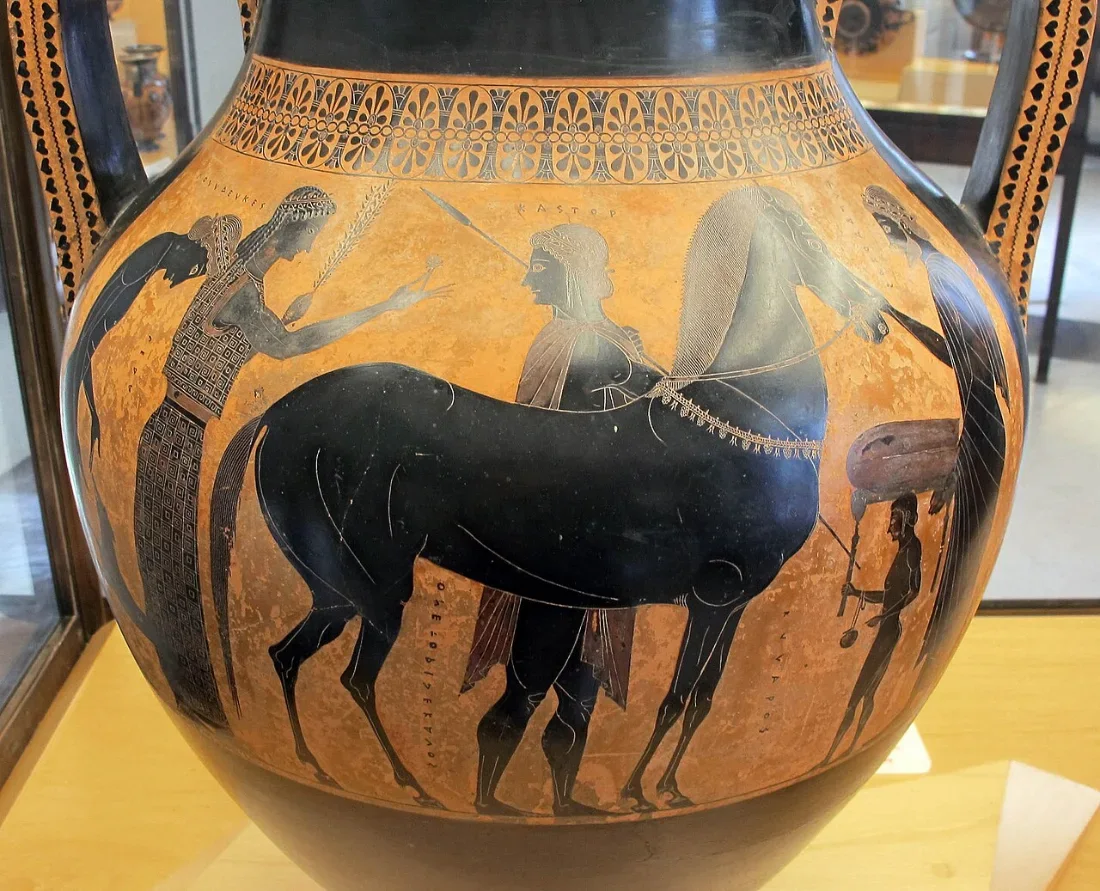
A hymn to the Dioscuri, Castor and Polydeuces, sons of Zeus and Leda. The singer calls them to leave the island of Pelops and to appear with kindly heart. They travel over the wide earth and the whole sea on swift horses, and easily save men from chilling death. They leap onto the high points of the well-benched ships, shining from afar, and bring light in the hard night to the black ship.[1] Alcaeus’ prayers to the Dioscuri and to Dionysus call the gods for the singer and for the group of fellow-worshippers, present or imagined.[2] Alcaeus was active at Mytilene around 600 BC, and most of his songs were sung at the drinking-parties of his political club.[3] No particular occasion is known for this one. It survives on two Oxyrhynchus papyri, P.Oxy. 1233 fr. 4 (lines 1–14) and P.Oxy. 2166(b). Voigt marks the beginning and the end of the poem. She notes that perhaps eight lines are lost before its last two.[1]
Lines 1–12, the three stanzas that can be read, are scanned below.
Text and translation
Δεῦτέ μοι νᾶσον Πέλοπος λίποντες
Alcaeus · fr. 34 (34a Lobel–Page), lines 1–12 · three Sapphic stanzas · Greek after Kurke 2016, p. 262, with ὂν from Diehl 1917, p. 18
How to read each line
A guide to the Greek, syllables, pitch marks and quantities.
Show the reading key
- Above each line: the line as the edition prints it, each word placed over its own syllables. The main row: the same Greek divided into metrical syllables, each written as it is pronounced. A consonant that closes a syllable is written with it (λόθ | ρο); an elided word is closed up with the next vowel (ν’ἀ); a final consonant carried into the next word is set with a thin space (ς ἰ). Wider gaps mark word-ends.
- Above the syllables: the pitch of each syllable, from the accents. Under them: the quantity of each syllable as it falls in the line, then the transliteration, syllable by syllable, with accented syllables in capitals.
- Under each line: a line-for-line translation. In the right margin of the scansion: the line type, its scheme, and its analysis into cola.
Key to the labels
The names, patterns and symbols used beside this poem.
Show the labels and symbols
The labels in the right margin of the scansion below name the cola, the rhythmic units each line is built from (Voigt’s and West’s analysis). A caret before a name (∧hipp) means the colon has lost its first position (acephalous). × marks an anceps position, which takes a long or a short. A click on any syllable highlights its colon, or, with the colon/foot switch, its foot. After the scheme, ‖ marks the end of a period and ||| the end of the strophe.[4] A line that ends without either runs on into the next line (synapheia): the two are one period, with no metrical break between them,[5] and the page sets them together and links them. The sources of the labels, with their page numbers, are given line by line under Prosody, line by line.
| Label | Name and shape | What it is |
|---|---|---|
| alc-cr | Cretic (cr)— ⏑ — | Positions 1–3 of the Sapphic hendecasyllable. Voigt (Conspectus, Alcaeus A 2) analyses the line cr ∧hipp; West[6] the same shape as ∧ia hag. |
| alc-hipp | Acephalous hipponactean (∧hipp), West’s hagesichorean× — ⏑ ⏑ — ⏑ — × | Positions 4–11, with the choriamb at 5–8. In Alcaeus Voigt marks position 4 ⏓, long in at least 8 of 12 lines, in all three hendecasyllables (Conspectus, Alcaeus A 2). Arukask[7] counts a heavy syllable there in 83.93% of Alcaeus’ Sapphic hendecasyllables, against 68.24% in Sappho’s. |
| alc-gl | Acephalous glyconic (∧gl)× — ⏑ ⏑ — ⏑ — | Positions 4–10 of the third hendecasyllable (Voigt, Conspectus, Alcaeus A 2: cr ∧gl ∧pher). Voigt marks frequent word-end after position 8 in Alcaeus. West[6] marks it after position 9, with a bridge between 10 and 11. |
| alc-pher | Acephalous pherecratean (∧pher)× | — ⏑ ⏑ — × | It begins on the last position of the third line and is completed by the adonean (Voigt, Conspectus, Alcaeus A 2). In Alcaeus Voigt marks word-end at the line-break as constant, frequent after the third position of the adonean, and never between its first two positions. West[6] says that the third period could be described as ∧ia hag ⁝ ad, but that this obscures its being a distended form of the first two. |
The feet
| Foot and shape | Where |
|---|---|
| Trochaic syzygy— ⏑ — × | Positions 1–4. Hephaestion[8] analyses the Sapphic hendecasyllable as a trochaic syzygy of six or seven morae, a choriamb, and a close of iamb and indifferent syllable, and notes that Alcaeus uses it too. |
| Choriamb— ⏑ ⏑ — | Positions 5–8.[8] |
| Close⏑ — × | Positions 9–11: an iamb and an indifferent syllable.[8] |
| Adonean— ⏑ ⏑ — × | Hephaestion[8] calls the fourth line a choriambic penthemimer that coincides with a dactyl and a trochee. |
Scansion
Full metrical scansion of the first three stanzas as Voigt prints them from the papyrus: Greek in metrical syllables, the quantity and pitch of each syllable, a syllabified transliteration and a line-for-line translation, with the line type and its cola in the right margin. The adonean of each stanza continues its third line as one period. Supplements are shown in brackets and italics.
Come here to me, away from the isle of Pelops,
strong sons of Zeus and Leda,
and with favouring spirit appear, Castor
and Polydeuces,
you who range over the wide earth and the sea,
all of it, mounted on fleet-footed horses,
and without effort save mortals from death,
that icy death,
leaping up onto the heights of ships with good benches,
bright from a distance, racing up the forestays,
and in the grim night carrying light
to the dark ship.
Metre
- Alcaeus’ Sapphic stanza. Voigt’s Conspectus metrorum (Alcaeus A 2, p. 21) lists fr. 34 among the poems in the Sapphic stanza, which Alcaeus used as well as Sappho: — ⏑ — ⏓ — ⁝ ⏑ ⏑ — ⏑ — ⏓ ‖ (twice) and — ⏑ — ⏓ — ⏑ ⏑ — ⁝ ⏑ — ⏓ | —⁀⏑ ⏑ ⁝ — × |||, analysed as cr ∧hipp ‖ cr ∧hipp ‖ cr ∧gl ∧pher |||, the third hendecasyllable and the adonean forming one period. (Her second line has ⏑ at position 10, evidently a misprint.) West[6] gives the same shape as ∧ia hag ‖ ∧ia hag ‖ and a third period that expands on the first two; in antiquity it was written as two lines, broken after the eleventh position, where caesura is frequent.[9] Battezzato[10] also takes the third and fourth lines as a single verse, written on two lines for practical reasons. The right margin gives both analyses.
- One period in two lines (synapheia). The adonean continues the third line (one period)[6]: the third line has no period-end, its last syllable keeps its own quantity, and a consonant may pass across the line-break. In this poem the last syllable of every third line is long (ll. 3, 7, 11). The first two lines of each stanza end a period, so their last position is indifferent.[4]
- Word-end and bridges. Voigt’s signs (Conspectus, p. 15): ⏓ at least 8 of 12 syllables long; | word-end always; ⁝ word-end in at least half the lines; her tie (here ⁀) word-end never. For Alcaeus she marks ⁝ after position 5 of the first two lines, ⁝ after position 8 of the third, | at its end, a tie between the first two positions of the adonean and ⁝ after its third. West’s scheme of the Sapphic (p. 34, with the key on p. ix) marks ⁝ after position 9 of the third line, a bridge (⁀) between 10 and 11, and ⁝ after 11. The margin shows both. In this poem word-end follows position 5 in five of the six first and second lines (not l. 9); in the third lines it follows position 8 in ll. 7 and 11 and position 9 in l. 3; no third line has word-end between 10 and 11, and every one has word-end at its end. Inside the adonean the only word-end before the third position is after καί (l. 4), a prepositive that counts with the following word.[11]
- Hephaestion. Hephaestion describes the Sapphic hendecasyllable as a trochaic syzygy of six or seven morae, that is, with position 4 short or long, a choriamb, and a close of iamb and indifferent syllable; three such lines are followed by a five-syllable line, the adonean. He adds that the line occurs in Alcaeus too, “and it is unclear whose invention it is, even though it is called Sapphic”, and quotes Alcaeus fr. 308 Voigt (= 308b Lobel–Page), χαῖρε Κυλλάνας ὀ μέδεις (Ench. 14.1, p. 44 Consbruch). The click panel’s “foot” view follows his analysis.
- Position 4. Voigt marks position 4 ⏓, long in at least 8 of 12 lines, in all three hendecasyllables of Alcaeus’ stanza. Here it is long in all nine, if [ἴφθ]ιμοι is read in line 2.[12] Arukask[7] counts a heavy syllable at this position in 83.93% of Alcaeus’ Sapphic hendecasyllables, against 68.24% in Sappho’s.
- Lesbian prosody. No resolution or contraction: in Sappho and Alcaeus every line has a fixed number of syllables.[13] The period is divided into syllables without regard to word-division.[14] Vowels that meet across a word-boundary are elided; hiatus is avoided.[15] A stop followed by a liquid makes position, even at the start of a word.[16]
- The text. Voigt prints the poem from POxy. 1233 fr. 4, with POxy. 2166(b) 9 for line 1 and POxy. 2166(b) 3 for lines 5–7 (her testimonia). Square brackets mark the letters supplied by editors and printed in her text. Where she prints a gap (ll. 2, 3, 9, 10), we print a supplement from her apparatus, named in the note on the line, so that the line can be scanned.
Dialect and transliteration
- Lesbian forms. The long ᾱ of νᾶσον, νάων, νᾶϊ (Attic η)[17]; παῖσαν for πᾶσαν, with the Lesbian diphthong (p. 147: παίσαις for πάσας); psilosis (οἲ, εὐσδύγων)[18]; the genitive in -ω (θανάτω)[18]; σδ for ζ in εὐσδύγων;[17] apocope in κὰτ.[18] εὐσδύγων is εὐζύγων,[19] ζακρυόεντος is ζα- (Aeolic for δια-)[20] with κρυόεις, and ὀν- is ἀνα-.[21]
- Key. η = ē, ω = ō, long α ι υ = ā ī ȳ, υ = y, χ = ch. Accented syllables are in capitals.
Prosody, line by line
Every syllable, with the reason for its length. Quantities are read from the vowel where the spelling shows it, from the consonants that follow (“position”), from the accent where it tells, and from the metre where nothing else does. Editors’ notes on the text follow in the boxed paragraphs.
- 34.1
Line 34.1 · Δεῦτέ μοι νᾶσον Πέλοπος λίποντες
Δεῦτέ μοι νᾶσον Πέλοπος λίποντες
[Δεῦ][τέ][μοι][νᾶ]σονΠέλοποςλίποντε[ς]The label in the margin, with its sources: cr ∧hipp (Voigt) · ∧ia hag (West).
- 1 —[Δεῦ]εῦ is a diphthong, long by nature.
- 2 ⏑[τέ]έ is short by nature.
- 3 —[μοι]οι is a diphthong, long by nature.
- 4 —[νᾶ]ᾶ carries a circumflex, so it is long; the position is anceps.
- 5 —σονο is short by nature; closed by ν: long by position.
- 6 ⏑Πέέ is short by nature.
- 7 ⏑λοο is short by nature.
- 8 —ποςο is short by nature; closed by ς: long by position.
- 9 ⏑λίί is short by the metre (position 9 must be short).
- 10 —πονο is short by nature; closed by ν: long by position.
- 11 ×τε[ς]ε is short by nature; closed by ς: long by position; the position is anceps.
The beginning, Δεῦτέ μοι νᾶ-, is supplied: δεῦτέ μοι is Gallavotti’s, supported by an unpublished Michigan papyrus (δεῦτ’ already Wilamowitz), and νᾶσον Πέλοπος was read and restored by Lobel before a second papyrus fragment, POxy. 2166(b) 9, was joined to the first (Voigt’s apparatus). Voigt compares Tyrtaeus 2.4, Πέλοπος νῆσον. μοι is long at position 3, a diphthong; νᾶ- is long at the position 4 that Voigt marks ⏓. The ν of νᾶσον closes its syllable before Π, and word-end follows position 5, where Voigt marks ⁝. Πέλοπος: the ς closes -πος before λ at 8. λί- is short at 9. The final -τες is indifferent at period-end.
- 34.2
Line 34.2 · παῖδες ἴφθιμοι Δίος ἠδὲ Λήδας
παῖδες ἴφθιμοι Δίος ἠδὲ Λήδας
παῖδες [ἴφ][θ]ιμοιΔ[ί][ο][ς] ἠδὲΛήδαςThe label in the margin, with its sources: cr ∧hipp (Voigt) · ∧ia hag (West).
- 1 —παῖαῖ is a diphthong, long by nature.
- 2 ⏑δεε is short by nature.
- 3 —ς [ἴφ]ἴ is a vowel of unknown length; closed by φ: long by position; the first consonant belongs to the previous word and is carried over to this vowel.
- 4 —[θ]ιῑ is long (its length is not shown by the ordinary spelling); the position is anceps.
- 5 —μοιοι is a diphthong, long by nature.
- 6 ⏑Δ[ί]ί is short by the metre (position 6 must be short).
- 7 ⏑[ο]ο is short by nature.
- 8 —[ς] ἠἠ is long by nature; the first consonant belongs to the previous word and is carried over to this vowel.
- 9 ⏑δὲὲ is short by nature.
- 10 —Λήή is long by nature.
- 11 ×δαςα is a vowel of unknown length; closed by ς: long by position; the position is anceps.
After παῖδες the papyrus is lost for one word-beginning; Voigt prints a gap and records Wilamowitz’s view that ἴφθ]ιμοι is likelier than Jurenka’s ὄβρ]ιμοι or ἄλκ]ιμοι. We print [ἴφθ]ιμοι. The ς of παῖδες passes to it, so δε is short at 2, and φθ closes ἴφ- at 3. The ι of ἴφθιμος is long,[22] so -θι- is long at position 4 and is marked with a macron here; with ὄβριμοι or ἄλκιμοι, whose ι is short,[23] position 4 would be short.
The ς of Δ[ίος] passes to ἠδέ, so -ο- is short at 7. Voigt’s apparatus calls ἠδέ an epic word. The final -δας is indifferent.
- 34.3
Line 34.3 · εὐνόωι θύμωι προφάνητε, Κάστορ
εὐνόωι θύμωι προφάνητε, Κάστορ
[εὐ][νό][ω]ιθύ[μ]ωιπρο[φά]νητε,Κάστορthe period runs on into 34.4 (synapheia).
The label in the margin, with its sources: cr ∧gl ∧pher… (Voigt); ⁝ after 9, ⁀ West p. 34.
- 1 —[εὐ]εὐ is a diphthong, long by nature.
- 2 ⏑[νό]ό is short by nature.
- 3 —[ω]ιωι is a diphthong, long by nature.
- 4 —θύῡ́ is long (its length is not shown by the ordinary spelling); the position is anceps.
- 5 —[μ]ωιωι is a diphthong, long by nature; the next word begins with πρ: the syllable is closed before it: long by position.
- 6 ⏑προο is short by nature.
- 7 ⏑[φά]ά is short by the metre (position 7 must be short).
- 8 —νηη is long by nature.
- 9 ⏑τε,ε is short by nature.
- 10 —Κάσά is a vowel of unknown length; closed by σ: long by position.
- 11 —τορο is short by nature; closed by ρ: long by position; the position is anceps; the line-end is not a period-end: the period runs on into the next line (synapheia), so this syllable keeps its own length, with no brevis in longo, and a word may run over into the next line.[24]
The first five letters are lost; Voigt prints dots and records Diehl’s εὐνόω]ι, with a query (Wilamowitz’s ἰλλάω]ι, Hunt observed, is too short). We print Diehl’s in brackets; it gives — ⏑ — at positions 1–3. The papyrus wrote ]ΩΙΘΥΜΩΙ and deleted both iotas, but Voigt thinks the dative right. θύμωι has a long υ,[25] marked with a macron, at position 4, and -μωι is long at 5, a diphthong. -φά- is short at 7.
The line runs on into the adonean (one period)[6], so Κάστορ’s last syllable is not indifferent: -τορ is closed by ρ before the κ of καί and is long. Word-end follows it, as Voigt’s | requires; in this line it also falls after position 9 (-τε, West’s ⁝), not after 8.
- 34.4
Line 34.4 · καὶ Πολύδευκες,
καὶ Πολύδευκες,
καὶΠολύδε[υ]κες,continues 34.3 · one period (synapheia).
The label in the margin, with its sources: end of ∧pher (Voigt; West p. 34).
- 1 —καὶαὶ is a diphthong, long by nature.
- 2 ⏑Ποο is short by nature.
- 3 ⏑λύύ is short by the metre (position 3 must be short).
- 4 —δε[υ]ευ is a diphthong, long by nature.
- 5 ×κες,ε is short by nature; closed by ς: long by position; the position is anceps.
The adonean, — ⏑ ⏑ — ×, continues line 3. καί is long before Π; it is a prepositive, so the word-end after it does not break Voigt’s tie between the first two positions.[11] Πολύδευκες: -λύ- short at 3, -δευ- (the υ supplied) long at 4. The last syllable ends the stanza.
- 34.5
Line 34.5 · οἲ κὰτ εὔρηαν χθόνα καὶ θάλασσαν
οἲ κὰτ εὔρηαν χθόνα καὶ θάλασσαν
οἲκὰτ εὔρηανχ[θό][να]καὶθάλασσανThe label in the margin, with its sources: cr ∧hipp (Voigt) · ∧ia hag (West).
- 1 —οἲοἲ is a diphthong, long by nature.
- 2 ⏑κὰὰ is short by the metre (position 2 must be short).
- 3 —τ εὔεὔ is a diphthong, long by nature; the first consonant belongs to the previous word and is carried over to this vowel.
- 4 —ρηη is long by nature; the position is anceps.
- 5 —ανα is a vowel of unknown length; closed by ν: long by position.
- 6 ⏑χ[θό]ό is short by nature.
- 7 ⏑[να]α is short by the metre (position 7 must be short).
- 8 —καὶαὶ is a diphthong, long by nature.
- 9 ⏑θάά is short by the metre (position 9 must be short).
- 10 —λασα is a vowel of unknown length; closed by σ: long by position.
- 11 ×σανα is a vowel of unknown length; closed by ν: long by position; the position is anceps.
οἲ κὰτ εὔρηαν: the τ of κὰτ (κατά) passes to εὔρηαν, so κὰ is short at 2. εὔρηαν has three syllables, εὔ-ρη-αν; η is long at 4, and -αν is closed by ν before χθ at 5; word-end follows it. Voigt compares Il. 4.182 εὐρεῖα χθών. χθόνα and καί: -να short at 7, καί long before θ at 8. σσ closes θάλασ- at 10.
- 34.6
Line 34.6 · παῖσαν ἔρχεσθ’ ὠκυπόδων ἐπ’ ἴππων,
παῖσαν ἔρχεσθ’ ὠκυπόδων ἐπ’ ἴππων,
παῖσαν ἔρχεσθ’ὠ[κυ][πό]δωνἐπ’ἴππων,The label in the margin, with its sources: cr ∧hipp (Voigt) · ∧ia hag (West).
- 1 —παῖαῖ is a diphthong, long by nature.
- 2 ⏑σαα is short by the accent rule: circumflex on the penult requires a short final syllable.
- 3 —ν ἔρἔ is short by nature; closed by ρ: long by position; the first consonant belongs to the previous word and is carried over to this vowel.
- 4 —χεσε is short by nature; closed by σ: long by position; the position is anceps.
- 5 —θ’ὠὠ is long by nature; the apostrophe marks an elided vowel; the consonant before it joins this syllable.
- 6 ⏑[κυ]υ is short by the metre (position 6 must be short).
- 7 ⏑[πό]ό is short by nature.
- 8 —δωνω is long by nature.
- 9 ⏑ἐἐ is short by nature.
- 10 —π’ἴπἴ is a vowel of unknown length; closed by π: long by position; the apostrophe marks an elided vowel; the consonant before it joins this syllable.
- 11 ×πων,ω is long by nature; closed by ν: long by position; the position is anceps.
The ν of παῖσαν passes to ἔρχεσθ’, whose ρχ closes ἔρ- at 3. ἔρχεσθ’ is ἔρχεσθε with ε elided before ὠκυπόδων;[26] the σθ closes -χεσ- at 4, and the θ joins ὠ at 5; word-end follows position 5. ἐπ’ is ἐπί elided before ἴππων, whose ππ closes the syllable at 10. The ν of -δων passes to ἐπ’, leaving -δω long by nature at 8. Voigt compares Il. 8.128 ἵππων ὠκυπόδων.
- 34.7
Line 34.7 · ῥῆα δ’ ἀνθρώποις θανάτω ῥύεσθε
ῥῆα δ’ ἀνθρώποις θανάτω ῥύεσθε
ῥῆαδ’ἀνθρώποι[ς]θα[ν]άτωῥύεσθεthe period runs on into 34.8 (synapheia).
The label in the margin, with its sources: cr ∧gl ∧pher… (Voigt); ⁝ after 9, ⁀ West p. 34.
- 1 —ῥῆῆ is long by nature.
- 2 ⏑αα is short by the accent rule: circumflex on the penult requires a short final syllable.
- 3 —δ’ἀνἀ is a vowel of unknown length; closed by ν: long by position; the apostrophe marks an elided vowel; the consonant before it joins this syllable.
- 4 —θρώώ is long by nature; the position is anceps.
- 5 —ποι[ς]οι is a diphthong, long by nature; closed by ς: long by position.
- 6 ⏑θαα is short by the metre (position 6 must be short).
- 7 ⏑[ν]άά is short by the metre (position 7 must be short).
- 8 —τωω is long by nature.
- 9 ⏑ῥύύ is short by the metre (position 9 must be short).
- 10 —εσε is short by nature; closed by σ: long by position.
- 11 —θεε is short by nature; the next word begins with the double consonant ζ: the syllable is closed before it: long by position; the position is anceps; the line-end is not a period-end: the period runs on into the next line (synapheia), so this syllable keeps its own length, with no brevis in longo, and a word may run over into the next line.[24]
ῥῆα (ῥεῖα, “easily”): ῥῆ- is long by nature, and -α is short at 2 before δ’. The papyrus has ΡΉΑ, with an acute accent, which Hunt corrected to ῥῆα; Voigt refers to Risch on the epic form and to Hamm on the accent. In δ’ ἀνθρώποι[ς] the δέ is elided,[26] and ν closes ἀν- at 3. θα[ν]άτω has -θα-νά- short at 6–7 and -τω long at 8. ῥύεσθε: -ρύ- is short at 9 by the metre, and σθ closes -εσ- at 10. The papyrus has λυ- with ρ written above, as at fr. 129.20; Voigt also compares fr. 129.12, where a variant σ[άωτε] is written above (Voigt’s apparatus). Voigt compares Od. 3.231 ῥεῖα θεός γ’ … ἄνδρα σαῶσαι.
The line runs on into the adonean (one period): the ζ that begins ζακρυόεντος counts as two consonants,[27] so the last syllable, -θε, is closed and long.
- 34.8
Line 34.8 · ζακρυόεντος
ζακρυόεντος
ζακρυόεντοςcontinues 34.7 · one period (synapheia).
The label in the margin, with its sources: end of ∧pher (Voigt; West p. 34).
- 1 —ζακα is a vowel of unknown length; closed by κ before a liquid: stop + liquid makes position in Lesbian verse, so the syllable is long whatever the vowel.
- 2 ⏑ρυυ is short by the metre (position 2 must be short).
- 3 ⏑όό is short by nature.
- 4 —ενε is short by nature; closed by ν: long by position.
- 5 ×τοςο is short by nature; closed by ς: long by position; the position is anceps.
The adonean continues line 7. ζακρυόεντος, “very numbing, freezing”,[28] is ζα- (= δια-) with κρυόεις, as Wilamowitz explained it (Voigt’s apparatus). Inside the word the stop + liquid κρ makes position, so ζακ- is long at 1;[29] -ρυ-ό- are short at 2–3, and ν closes -εν- at 4. The last syllable ends the stanza.
- 34.9
Line 34.9 · εὐσδύγων θρώσκοντες ὂν ἄκρα νάων
εὐσδύγων θρώσκοντες ὂν ἄκρα νάων
εὐσδ[ύ][γ]ωνθρώσκοντ[ε][ς ὂ][ν] ἄκρανάωνThe label in the margin, with its sources: cr ∧hipp (Voigt) · ∧ia hag (West).
- 1 —εὐσεὐ is a diphthong, long by nature; closed by σ: long by position.
- 2 ⏑δ[ύ]ύ is short by the metre (position 2 must be short).
- 3 —[γ]ωνω is long by nature; closed by ν: long by position.
- 4 —θρώσώ is long by nature; closed by σ: long by position; the position is anceps.
- 5 —κονο is short by nature; closed by ν: long by position.
- 6 ⏑τ[ε]ε is short by nature.
- 7 ⏑[ς ὂ]ὂ is short by nature; the first consonant belongs to the previous word and is carried over to this vowel.
- 8 —[ν] ἄκἄ is a vowel of unknown length; closed by κ before a liquid: stop + liquid makes position in Lesbian verse, so the syllable is long whatever the vowel; the first consonant belongs to the previous word and is carried over to this vowel.
- 9 ⏑ραα is short by the metre (position 9 must be short).
- 10 —νάά is long by the metre (position 10 must be long).
- 11 ×ωνω is long by nature; closed by ν: long by position; the position is anceps.
εὐσδ[ύγ]ων (εὐζύγων, “well-benched”), read and restored by Edmonds (Hunt had read εὐέδρων): εὐσ- is long, and -δύ- short at 2. Voigt prints θρώσκοντ[ες . .] with a two-letter gap and records Hunt’s ὂν (= ἀνά) and Jurenka’s ἐπ’; we print Hunt’s. The papyrus has an ι written above, which gives θρώισκ- (read so by Diehl and Lobel). The ς of θρώσκοντες passes to ὂν, so -τε- and ὂ are short at 6–7, and the ν of ὂν passes to ἄκρα, where κρ makes position: ἄκ- is long at 8. νάων: the α is long at 10 (Lesbian ᾱ). The final -ων is indifferent.
Campbell prints Jurenka’s [ἐπ’].[30]
- 34.10
Line 34.10 · πήλοθεν λάμπροι πρότον’ ὀντρέχοντες,
πήλοθεν λάμπροι πρότον’ ὀντρέχοντες,
[π]ήλοθενλάμπροιπρό[το][ν’ὀν]τρ[έ][χο]ντες,The label in the margin, with its sources: cr ∧hipp (Voigt) · ∧ia hag (West).
- 1 —[π]ήή is long by nature.
- 2 ⏑λοο is short by nature.
- 3 —θενε is short by nature; closed by ν: long by position.
- 4 —λάμά is a vowel of unknown length; closed by μ: long by position; the position is anceps.
- 5 —προιοι is a diphthong, long by nature; the next word begins with πρ: the syllable is closed before it: long by position.
- 6 ⏑πρόό is short by nature.
- 7 ⏑[το]ο is short by nature.
- 8 —[ν’ὀν]ὀ is short by nature; closed by ν: long by position; the apostrophe marks an elided vowel; the consonant before it joins this syllable.
- 9 ⏑τρ[έ]έ is short by nature.
- 10 —[χο]νο is short by nature; closed by ν: long by position.
- 11 ×τες,ε is short by nature; closed by ς: long by position; the position is anceps.
Voigt prints π]ήλοθεν λάμπροι προ[ ]τρ[. . . .]ντες (π- is Edmonds’s, τ- Hunt’s), and her apparatus records several restorations of the gap; we print Bowra’s πρό[τον’ ὀν]τρ[έχο]ντες, “running up the forestays”. πήλοθεν: ν closes -θεν before λ at 3. λάμπροι: μ closes λάμ- at 4. -προι is long at 5, a diphthong, and word-end follows it. πρότον’ is πρότονα with α elided;[26] its ν joins ὀν-, which is closed by ν before τρ at 8. -τρέ- is short at 9. The final -τες is indifferent.
- 34.11
Line 34.11 · ἀργαλέ‿αι δ’ ἐν νύκτι φάος φέροντες
ἀργαλέ‿αι δ’ ἐν νύκτι φάος φέροντες
ἀργαλέ‿αιδ’ἐννύκτιφ[ά][ος][φέ]ροντεςthe period runs on into 34.12 (synapheia).
The label in the margin, with its sources: cr ∧gl ∧pher… (Voigt); ⁝ after 9, ⁀ West p. 34.
- 1 —ἀρἀ is a vowel of unknown length; closed by ρ: long by position.
- 2 ⏑γαα is short by the metre (position 2 must be short).
- 3 —λέ‿αιέαι is two vowels of one word pronounced together as one long syllable (synizesis).
- 4 —δ’ἐνἐ is short by nature; closed by ν: long by position; the apostrophe marks an elided vowel; the consonant before it joins this syllable; the position is anceps.
- 5 —νύκύ is a vowel of unknown length; closed by κ: long by position.
- 6 ⏑τιι is short by the metre (position 6 must be short).
- 7 ⏑φ[ά]ά is short by the metre (position 7 must be short).
- 8 —[ος]ο is short by nature; closed by ς: long by position.
- 9 ⏑[φέ]έ is short by nature.
- 10 —ρονο is short by nature; closed by ν: long by position.
- 11 —τεςε is short by nature; closed by ς: long by position; the position is anceps; the line-end is not a period-end: the period runs on into the next line (synapheia), so this syllable keeps its own length, with no brevis in longo, and a word may run over into the next line.[24]
ἀργαλέαι must give one syllable for -λέ-αι: the line has eleven positions, and ἀργαλέαι δ’ ἐν νύκτι φάος φέροντες has twelve syllables unless ε and αι are pronounced together. This is synizesis, marked here with a tie; within a word it is frequent when the first vowel is ε.[31] Compare ἀργαλέας with four syllables at fr. 129.12.
δ’ is δέ elided before ἐν,[26] and νν closes δ’ἐν at 4. φ[άος]: φά- is short at 7, and the ς closes -ος before φ at 8, where Voigt’s ⁝ falls. The line runs on into the adonean (one period): -τες is closed by ς before ν and is long. Voigt compares Il. 16.95 ἐπὴν φάος ἐν νήεσσι θήῃς.
- 34.12
Line 34.12 · νᾶϊ μελαίναι·
νᾶϊ μελαίναι·
νᾶϊμ[ε]λαίναι·continues 34.11 · one period (synapheia).
The label in the margin, with its sources: end of ∧pher (Voigt; West p. 34).
- 1 —νᾶᾶ carries a circumflex, so it is long.
- 2 ⏑ϊϊ is short by the accent rule: circumflex on the penult requires a short final syllable.
- 3 ⏑μ[ε]ε is short by nature.
- 4 —λαίαί is a diphthong, long by nature.
- 5 ×ναι·αι is a diphthong, long by nature; the position is anceps.
The adonean continues line 11. νᾶϊ: the diaeresis makes ϊ a syllable of its own, so νᾶ-ϊ is — ⏑. μ[ε]λαίναι: -με- short at 3, -λαί- long at 4. The last syllable ends the stanza. Voigt prints two more scraps of lines, a gap of perhaps eight lines, and two more scraps before the sign ⊗ (beginning or end of a poem); Lobel thought those last two lines the end of this poem, line 16 being an adonean. They are not scanned here.
The poem
Most scholars, Voigt notes, take the poem as a hymn summoning the gods (a “cletic” hymn); Luria suspected an allegory beneath it (her apparatus). She compares, among other poems, the Homeric Hymn to the Dioscuri (33), Euripides’ Electra and Helen, and Theocritus 22. Griffith[32] groups it with the prayer to Dionysus in fr. 129: both ask the gods to appear and help the singer and the fellow worshippers he speaks for, gathered in person or in imagination.
Notes
- ^ a b Voigt 1971, p. 186.
- ^ Griffith 2009, p. 83.
- ^ Spelman 2022, p. 275.
- ^ a b West 1987, p. 4.
- ^ West 1987, p. 3.
- ^ a b c d e f West 1987, p. 34.
- ^ a b Arukask 2020, pp. 104, 106.
- ^ a b c d Hephaestion, Ench. 14.1.
- ^ West 1987, p. 35 n. 1.
- ^ Battezzato 2009, p. 135.
- ^ a b West 1987, p. 21.
- ^ See the note there.
- ^ West 1987, p. 32; Battezzato 2021, p. 121.
- ^ West 1987, p. 12.
- ^ West 1987, pp. 13–16; p. 35 n. 2.
- ^ West 1987, p. 16 and n. 7.
- ^ a b de Kreij 2022, p. 147.
- ^ a b c de Kreij 2022, p. 148.
- ^ LSJ s.v. εὔζυγος, which notes this line.
- ^ LSJ s.v. ζά.
- ^ LSJ s.v. ἀνά.
- ^ LSJ: ἴφθῑμος.
- ^ LSJ.
- ^ a b c West 1987, pp. 3–4.
- ^ LSJ s.v. θυμός.
- ^ a b c d West 1987, p. 13.
- ^ West 1987, p. 12 n. 1.
- ^ LSJ s.v. ζακρυόεις, which cites this line.
- ^ West 1987, p. 16 n. 7.
- ^ Campbell 1982, p. 246.
- ^ West 1987, p. 15.
- ^ Griffith 2009, p. 83.
Text and sources
- Greek: Leslie Kurke, “Gendered Spheres and Mythic Models in Sappho’s Brothers Poem”, in The Newest Sappho (2016), p. 262, publisher, CC BY-NC 3.0; the preposition ὂν at 9 is from Ernst Diehl, Supplementum lyricum (1917), p. 18, public domain, where Kurke has ἐπ’. Adscript iota, brackets, accents, punctuation and quantity marks normalized. The two-syllable ending of ἀργαλέαι at 11 is joined by an explicit synizesis mark; Diehl also prints this spelling. Greek and adapted metrical presentation: CC BY-NC 3.0. The following modern scholarship supplies analysis and comparison.
- M. L. West, Introduction to Greek Metre (Oxford 1987), pp. ix (signs), 4 (period-end), 12–17 (syllables, elision, synizesis, stop + liquid), 21 (prepositives), 32–35 (Lesbian lyric; the Sapphic stanza and its marks, p. 34; p. 35 nn. 1–2); checked against the page images. Also West 1987, p. 3 (synapheia and period-end).
- Hephaestion, Enchiridion 14.1, ed. M. Consbruch (Leipzig 1906), p. 44, public domain; Greek text from First1KGreek, CC BY-SA 4.0.
- A. Arukask, “The Metrical Structure of the Sapphic Hendecasyllable and Sappho’s Aiolikon in Lesbian Poetry”, Studia Metrica et Poetica 7.1 (2020), pp. 104, 106.
- M. Griffith, “Greek lyric and the place of humans in the world”, and L. Battezzato, “Metre and music”, in F. Budelmann (ed.), The Cambridge Companion to Greek Lyric (Cambridge 2009), p. 83 and p. 135.
- L. Battezzato, “Sappho’s Metres and Music”, in P. J. Finglass and A. Kelly (eds), The Cambridge Companion to Sappho (Cambridge 2021), p. 121.
- M. de Kreij, “The Lyric Dialects”, in L. Swift (ed.), A Companion to Greek Lyric (Wiley 2022), ch. 10, pp. 147–148.
- LSJ (Perseus Digital Library, CC BY-SA), s.vv. ἀνά, ἄλκιμος, ζά, ζακρυόεις, εὔζυγος, θυμός, ἴφθιμος, ὄβριμος.
- D. A. Campbell, Greek Lyric I: Sappho and Alcaeus (Loeb Classical Library 142, Cambridge, MA 1982), fr. 34 (pp. 246–247): his number is 34, Voigt’s, not 34a as in Lobel and Page. Same wording as Voigt in ll. 1–12 except the supplement in l. 9 (see the note).
Quotations from copyrighted works are not covered by this page’s licence.
Fr. 129 (Alcaic)
Fr. 129, lines 1–24 — the prayer at the common precinct
Synopsis
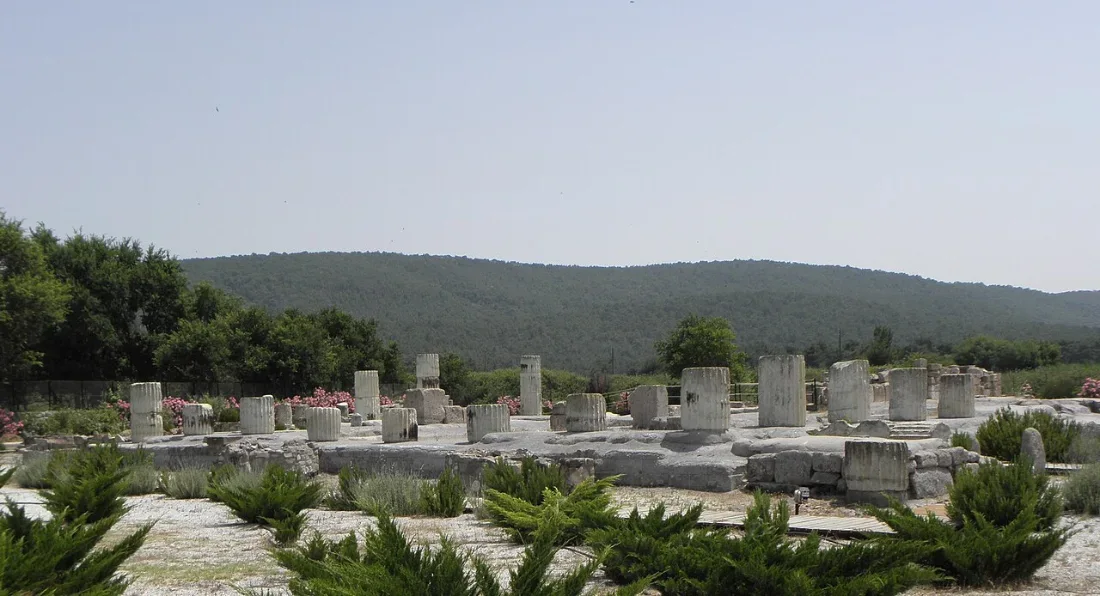
A prayer sung at the great common sanctuary of the Lesbians. It names the gods the Lesbians set up there: Zeus, Hera “the Aeolian” and Dionysus. It asks them to hear “our” curses, and to free the singers from their troubles and from exile. Then it calls the Erinys down on Pittacus. He had sworn with the companions in that place never to abandon each other, and then he went over to their enemy Myrsilus.[1] The words “this precinct” and “our curses” suggest that the friends, now without Pittacus, are gathered at the shrine itself.[2] The sanctuary lay at Messon (modern Mesa), in the middle of the island. It was neutral ground, shared by the island’s cities, and the triad of gods worshipped there is unique.[3] Alcaeus came from a wealthy family of Mytilene and was active around 600 BC.[4] Many of his songs can be placed between about 600 and 580.[5] This poem is one of those that tell of the poet’s own exile.[6] It survives on P.Oxy. 2165, in 32 lines, with Myrsilus named in line 28, and in scraps of P.Oxy. 2166(c).[7]
Text and translation
… τόδε Λέσβιοι
Alcaeus · fr. 129, lines 1–24 · six Alcaic stanzas · Greek after Yatromanolakis 2008, p. 176; line 20 after Torres 2022, p. 129
How to read each line
A guide to the Greek, syllables, pitch marks and quantities.
Show the reading key
- Above each line: the line as the edition prints it, each word placed over its own syllables. The main row: the same Greek divided into metrical syllables, each written as it is pronounced. A consonant that closes a syllable is written with it (λόθ | ρο); an elided word is closed up with the next vowel (ν’ἀ); a final consonant carried into the next word is set with a thin space (ς ἰ). Wider gaps mark word-ends.
- Above the syllables: the pitch of each syllable, from the accents. Under them: the quantity of each syllable as it falls in the line, then the transliteration, syllable by syllable, with accented syllables in capitals.
- Under each line: a line-for-line translation. In the right margin of the scansion: the line type, its scheme, and its analysis into cola.
Key to the labels
The names, patterns and symbols used beside this poem.
Show the labels and symbols
The labels in the right margin of the scansion below name the cola, the rhythmic units each line is built from (Voigt’s and West’s analysis). A caret before a name (∧hipp) means the colon has lost its first position (acephalous). × marks an anceps position, which takes a long or a short. A click on any syllable highlights its colon, or, with the colon/foot switch, its foot. After the scheme, ‖ marks the end of a period and ||| the end of the strophe.[8] A line that ends without either runs on into the next line (synapheia): the two are one period, with no metrical break between them,[9] and the page sets them together and links them. The sources of the labels, with their page numbers, are given line by line under Prosody, line by line.
| Label | Name and shape | What it is |
|---|---|---|
| alc-dod | Dodrans (dod)— ⏑ ⏑ — ⏑ — | Positions 6–11: a choriamb and ⏑ —, the Aeolic close of the line.[10] The line ends a period, so its last position is indifferent. |
| alc-pe | Penthemimer (pe)× — ⏑ — × | Positions 1–5 of the Alcaic hendecasyllable, an iambic opening. West[11] divides the line pe ⁝ dod. Voigt’s Conspectus (Alcaeus A 1) divides it after position 4 instead, as ia ∧gl. Both mark frequent word-end (⁝, in Voigt at least half the lines) after positions 3 and 5, not after 4. |
| alc-2ia | Iambic dimeter (2ia)× — ⏑ — × — ⏑ — | Positions 1–8 of the third line. Voigt (Conspectus, Alcaeus A 1) analyses the third and fourth lines as one period, 2ia ∧hippᵈ. West[11] calls that period a distended form of the first two. Voigt marks position 5 ⏒, short in at least 8 of 12 lines. Both mark frequent word-end (⁝) after position 3; West also marks bridges (⁀, word-end avoided) between positions 4 and 5 and between 8 and 9 (p. 34, key p. ix). |
| alc-hippd | Acephalous hipponactean with dactylic expansion (∧hippᵈ)× | — ⏑ ⏑ — ⏑ ⏑ — ⏑ — × | It begins on the ninth and last position of the third line and runs on, without a pause, through the whole fourth line (Voigt, Conspectus, Alcaeus A 1). Voigt marks word-end after the ninth position as regular, missing only at fr. 75.12, and never between the eighth and ninth. In antiquity the period was written as two lines at that point.[12] |
The feet
| Foot and shape | Where |
|---|---|
| Ionic a maiore or second paeon— — ⏑ ⏑ / ⏑ — ⏑ ⏑ | Positions 5–8, Hephaestion’s second syzygy:[13] an ionic a maiore when position 5 is long, a second paeon when it is short. |
| Close— ⏑ × | Positions 9–11: a trochee and an indifferent syllable.[13] |
| Iambic syzygy× — ⏑ — | Positions 1–4. Hephaestion[13] calls the Alcaic hendecasyllable an epionic trimeter catalectic a maiore: first an iambic syzygy of six or seven morae, that is, with position 1 short or long. |
| Iambic metron× — ⏑ — | Positions 1–4 of the enneasyllable, the first metron of Voigt’s 2ia. |
| Iambic metron× — ⏑ — | Positions 5–8 of the enneasyllable, the second metron of Voigt’s 2ia. Voigt marks position 5 usually short. |
| Final anceps× | Position 9: the anceps that begins Voigt’s ∧hippᵈ. The line runs on into the decasyllable. |
| Dactyl— ⏑ ⏑ | Positions 1–3. Hephaestion[14] calls the line the Alcaic decasyllable, a logaoedic dactylic verse: two dactyls and a trochaic syzygy. |
| Dactyl— ⏑ ⏑ | Positions 4–6.[14] |
| Trochaic syzygy— ⏑ — × | Positions 7–10.[14] The last position ends the stanza and is indifferent. |
Scansion
Metrical scansion of the first twenty-four lines from two papyri, leaving unverified supplements unfilled: Greek in metrical syllables, the quantity and pitch of each syllable, a syllabified transliteration and a line-for-line translation, with the line type and its cola in the right margin. The third line of every stanza runs on into the fourth as one period. Where the papyri are broken only the surviving positions are scanned.
- line 129.18, position 9 (πι): scans S but the scheme needs L
… this … the Lesbians …
… this great sanctuary, visible from afar,
they set up for everyone to share, and placed in it altars
of the happy gods who never die,
and named Zeus the god who receives suppliants,
and you, the renowned Aeolian goddess,
from whom all things are born; and the third,
this one, they named Kemelios,
Dionysus who eats flesh raw. Come, with goodwill
in your hearts, to our prayer
lend your ears, and from these hardships
and from painful exile deliver us.
And may the son of Hyrras be hunted down
by the Erinys of those men, as we swore long ago,
as we cut [the victims] …
never … a single one of our companions,
but either, dead, with earth for our covering,
to lie, struck down by the men who then …
or else, once we had slain them,
to set the people free from their miseries.
But Potbelly held no debate about these things
with his heart, but, casually planting his foot
upon the oaths, he gnaws away at
our city …
Metre
- The stanza. Voigt’s Conspectus metrorum (Alcaeus A 1, p. 20) puts fr. 129 among the poems in the Alcaic stanza: ⏓ — ⏑ ⁝ — ⏓ ⁝ — ⏑ ⏑ — ⏑ ⏓ ‖ ⏓ — ⏑ ⁝ — — ⁝ — ⏑ ⏑ — ⏑ ⏓ ‖ ⏓ — ⏑ ⁝ — ⏒ — ⏑ —⁀⏓ | — ⏑ ⏑ — ⁝ ⏑ ⏑ — ⁝ ⏑ — ⏓ |||, analysed as ia ∧gl ‖ ia ∧gl ‖ 2ia ∧hippd |||. West[11] divides the hendecasyllable pe ⁝ dod and regards the third period as the first two stretched out; in antiquity it was written as two lines, broken after the ninth position, where caesura is frequent.[12] Battezzato[15] gives the same shape: lines 1 and 2 an iamb with a headless glyconic, lines 3 and 4 a single verse of two iambs and a headless hipponactean expanded by a dactyl, written on two lines for practical reasons. The right margin gives both analyses.
- Word-end and bridges. Voigt’s signs: ⏓ at least 8 of 12 syllables long; ⏒ at least 8 of 12 short; | word-end always; ⁝ word-end in at least half the lines; her tie (here ⁀) word-end never (Conspectus, p. 15). West marks ⁝ after positions 3 and 5 of the first two lines, and in the third period ⁝ after 3 and 9 with bridges (⁀, word-end avoided, p. ix) between positions 4 and 5 and between 8 and 9.[11] Voigt notes that word-end after the ninth position of the third period is missing only at fr. 75.12.[16] In this poem every surviving third line (ll. 3, 7, 11, 19, 23) has word-end after position 9 and none after position 8; after position 4 there is word-end only once, after the preposition ἐκ (l. 11), a prepositive that counts with the following word.[17] In the second line Voigt prints — at position 5 where the first line has ⏓; here that position is long in ll. 2, 6, 18 and 22 and short in ll. 10 and 14. Position 5 of the third line, her ⏒, is short in four of the five lines that keep it (ll. 3, 11, 19, 23; long in l. 7).
- One period in two lines (synapheia). The third and fourth lines of each stanza are one period: the third line has no period-end, its last syllable keeps its own quantity, and a final consonant passes into the fourth line (ll. 3–4, 11–12, 19–20); the fourth line continues line 3, as West[12] and Voigt (one verse, 2ia ∧hippd) both treat it. The first and second lines each end a period, so their last position is indifferent.[8]
- Hephaestion. The hendecasyllable is his epionic trimeter catalectic a maiore, with positions 1 and 5 free (Ench. 14.3, pp. 44–45 Consbruch); the decasyllable his “Alcaic decasyllable”, two dactyls and a trochaic syzygy.[14] The click panel’s “foot” view follows him.
- Lesbian prosody. No resolution or contraction: every line has a fixed number of syllables.[18] The period is divided into syllables without regard to word-division.[19] Vowels that meet across a word-boundary are elided, never left in hiatus.[20] A stop followed by a liquid makes position, even at the start of a word.[21]
- The text and its gaps. Voigt prints the poem from POxy. 2165 fr. 1 col. I, with the overlapping POxy. 2166(c) 6; the letters between half-brackets ⌊ ⌋ are those that the second papyrus preserves (Voigt’s testimonia). Square brackets mark supplements. Where the papyri are broken, the scheme on this page covers only the positions that survive: line 1 from position 7, line 2 from position 4, line 15 to position 4, line 18 to position 9, line 24 to position 6. Line 15 therefore does not run on into line 16 on this page. One real clash remains, in line 18, and is explained there.
Dialect and transliteration
- Lesbian forms. Psilosis throughout (ὤς, ὐπὲξ, ὀ, οἲ)[22]; κῆνος for ἐκεῖνος;[23] ἄμμι for ἡμῖν;[22] apocope with assimilation in κακκτάνοντες for κατα-;[22] τέρτος for τρίτος, which Voigt supports from the grammarians (Choeroboscus: οἱ Αἰολεῖς … τρίτος τέρτος; Hesychius τέρτα· ἡ τρίτη); the long ᾱ of ὠμήσταν, γενέθλαν, ἀμμετέρας ἄρας, δᾶμον;[24] βραϊδίως, with βρ- for an old ϝρ-.[25] ὐπὲξ is ὑπέκ in its form before a vowel.[26]
- Key. η = ē, ω = ō, long α ι υ = ā ī ȳ, υ = y, χ = ch. Accented syllables are in capitals.
Prosody, line by line
Every syllable, with the reason for its length. Quantities are read from the vowel where the spelling shows it, from the consonants that follow (“position”), from the accent where it tells, and from the metre where nothing else does. Editors’ notes on the text follow in the boxed paragraphs.
- 129.1
Line 129.1 · … τόδε Λέσβιο⌊ι
… τόδε Λέσβιο⌊ι
τόδεΛέσβιοι- 1 ⏑τόό is short by nature.
- 2 ⏑δεε is short by nature.
- 3 —Λέσέ is short by nature; closed by σ: long by position.
- 4 ⏑βιῐ is short (its length is not shown by the ordinary spelling).
- 5 ×οιοι is a diphthong, long by nature; the position is anceps.
Voigt prints ].ρα.α τόδε Λέσβιο⌊ι: before τόδε only scattered letters survive, and the supplements in her apparatus (Ἄνδρες ποτ’ ὦ …]ράξα Diehl, Ὄχθαις παρ’ Ἀ]ράξα Collart, Ὦ πότνι’ Ἤ]ρα Gallavotti) are uncertain; Diehl’s seems too long for the space. Voigt thinks that the word Λέσβιοι (like Λεσβίαδες at fr. 130b.17) points to a precinct in some Aeolic colony rather than on Lesbos itself (her apparatus). Only τόδε Λέσβιοι is scanned here. It fills positions 7–11, ⏑ ⏑ — ⏑ ×: the ι of Λέσβιοι is short (marked with a breve), and σ closes Λέσ-. The syllable numbers on this line count from τό.
- 129.2
Line 129.2 · … εὔ⌊δει⌋λον τέμενο⌊ς μέγα
… εὔ⌊δει⌋λον τέμενο⌊ς μέγα
εὔδειλοντέμενοςμέγα- 1 —εὔεὔ is a diphthong, long by nature.
- 2 —δειει is a diphthong, long by nature; the position is anceps.
- 3 —λονο is short by nature; closed by ν: long by position.
- 4 ⏑τέέ is short by nature.
- 5 ⏑μεε is short by nature.
- 6 —νοςο is short by nature; closed by ς: long by position.
- 7 ⏑μέέ is short by nature.
- 8 ×γαα is of unknown length; the position is anceps, so either scans.
The first three positions are missing in the licensed source.[27] They are left as a gap here. εὔδειλον τέμενος μέγα fills positions 4–11, not a complete hendecasyllable. The diagram numbers the eight surviving syllables locally; its first syllable belongs to position 4 of the full line. No conjectural mountain or preposition is supplied.
- 129.3
Line 129.3 · ξῦ⌋νον κάτε⌊σσα⌋ν, ἐν δὲ βώ⌊μοις
ξῦ⌋νον κάτε⌊σσα⌋ν, ἐν δὲ βώ⌊μοις
ξῦνονκά[τε]σσα,ν ἐνδὲβώμοιthe period runs on into 129.4 (synapheia).
The label in the margin, with its sources: 2ia ∧hippᵈ… (Voigt); ⁀ 4–5 West p. 34.
- 1 —ξῦῦ carries a circumflex, so it is long; the position is anceps.
- 2 —νονο is short by nature; closed by ν: long by position.
- 3 ⏑κάά is short by the metre (position 3 must be short).
- 4 —[τε]σε is short by nature; closed by σ: long by position.
- 5 ⏑σα,α is short by the accent rule: acute on the antepenult requires a short final syllable; the position is anceps.
- 6 —ν ἐνἐ is short by nature; closed by ν: long by position; the first consonant belongs to the previous word and is carried over to this vowel.
- 7 ⏑δὲὲ is short by nature.
- 8 —βώώ is long by nature.
- 9 —μοιοι is a diphthong, long by nature; the position is anceps; the line-end is not a period-end: the period runs on into the next line (synapheia), so this syllable keeps its own length, with no brevis in longo, and a word may run over into the next line.[28]
σσ closes κά[τε]σ- at position 4, and the ν of κάτεσσαν passes to ἐν, so σα is open and short at 5, as Voigt’s ⏒ leads one to expect. ἐν is closed before δ. Voigt’s apparatus suggests that κά[τη]σσαν may be preferable; it would scan the same. βώ- is long by nature at 8, and word-end follows the ninth position, as her | requires. The line runs on into line 4 (one period): the ς of βώμοις passes to ἀθανάτων, and -μοι is long, a diphthong.
- 129.4
Line 129.4 · ἀθανάτων ⌊μακά⌋ρων ἔθη⌊καν
ἀθανάτων ⌊μακά⌋ρων ἔθη⌊καν
ς ἀθανάτωνμακάρωνἔθηκανcontinues 129.3 · one period (synapheia).
The label in the margin, with its sources: end of ∧hippᵈ (Voigt; West pp. 34–35).
- 1 —ς ἀἀ is long by the metre (position 1 must be long); the first consonant belongs to the previous word and is carried over to this vowel.
- 2 ⏑θαα is short by the metre (position 2 must be short).
- 3 ⏑νάά is short by the metre (position 3 must be short).
- 4 —τωνω is long by nature; closed by ν: long by position.
- 5 ⏑μαα is short by the metre (position 5 must be short).
- 6 ⏑κάά is short by the metre (position 6 must be short).
- 7 —ρωνω is long by nature.
- 8 ⏑ἔἔ is short by nature.
- 9 —θηη is long by nature.
- 10 ×κανα is a vowel of unknown length; closed by ν: long by position; the position is anceps.
This line continues line 3 (one period)[12]. Position 1 must be long: the first syllable of ἀθανάτων, short in origin, has the metrical lengthening that epic gives words with three shorts in a row,[17] as in ἀθανάτ’ at Sappho 1.1. The ν of μακάρων passes to ἔθηκαν, so ρω stands open and is long by nature at 7, and ἔ is short at 8. The final syllable ends the stanza and is indifferent.
- 129.5
Line 129.5 · κἀ⌋πωνύ⌊μασσα⌋ν ἀντί⌊αον⌋ Δ⌊ία⌋
κἀ⌋πωνύ⌊μασσα⌋ν ἀντί⌊αον⌋ Δ⌊ία⌋
κἀπωνύμασσαν ἀντίαονΔίαThe label in the margin, with its sources: pe ⁝ dod (West) · ia ∧gl (Voigt).
- 1 —κἀᾱ̓ is long (its length is not shown by the ordinary spelling); the position is anceps.
- 2 —πωω is long by nature.
- 3 ⏑νύύ is short by the metre (position 3 must be short).
- 4 —μασα is a vowel of unknown length; closed by σ: long by position.
- 5 ⏑σαα is short by the accent rule: acute on the antepenult requires a short final syllable; the position is anceps.
- 6 —ν ἀνἀ is a vowel of unknown length; closed by ν: long by position; the first consonant belongs to the previous word and is carried over to this vowel.
- 7 ⏑τίί is short by the metre (position 7 must be short).
- 8 ⏑αα is short by the metre (position 8 must be short).
- 9 —ονο is short by nature; closed by ν: long by position.
- 10 ⏑Δίί is short by the metre (position 10 must be short).
- 11 ×αα is of unknown length; the position is anceps, so either scans.
κἀπωνύμασσαν is καὶ ἐπωνύμασσαν run together by crasis, marked by the coronis on α; the two vowels become one long syllable,[29] and the α is marked long for the scanner. σσ closes -μασ- at 4. Voigt calls ἀντίαος a new word; the parallels she cites have ἀνταῖος, glossed ἱκέσιος, “of suppliants”, and a note in the margin of the second papyrus glosses the word ἱκέσιον (her testimonia and parallels). Its -τί-α- are short at 7–8, as the metre needs, and the ν of -ον closes the syllable before Δ. The final α of Δία is indifferent.
- 129.6
Line 129.6 · σὲ δ’ Α⌋ἰολήιαν ⌊κυδα⌋λίμα⌊ν θ⌋έο⌊ν
σὲ δ’ Α⌋ἰολήιαν ⌊κυδα⌋λίμα⌊ν θ⌋έο⌊ν
σὲδ’Αἰολήιαν[κ]υδαλίμανθέονThe label in the margin, with its sources: pe ⁝ dod (West) · ia ∧gl (Voigt).
- 1 ⏑σὲὲ is short by nature; the position is anceps.
- 2 —δ’ΑἰΑἰ is a diphthong, long by nature; the apostrophe marks an elided vowel; the consonant before it joins this syllable.
- 3 ⏑οο is short by nature.
- 4 —λήιήι is a diphthong, long by nature.
- 5 —ανα is a vowel of unknown length; closed by ν: long by position; the position is anceps.
- 6 —[κ]υῡ is long (its length is not shown by the ordinary spelling).
- 7 ⏑δαα is short by the metre (position 7 must be short).
- 8 ⏑λίί is short by the metre (position 8 must be short).
- 9 —μανα is a vowel of unknown length; closed by ν: long by position.
- 10 ⏑θέέ is short by nature.
- 11 ×ονο is short by nature; closed by ν: long by position; the position is anceps.
In σὲ δ’ Αἰολήιαν the δέ is elided before Αἰ-.[30] The line needs eleven syllables, so ηι in -λήιαν counts as one long syllable at position 4 (Voigt refers to Hamm § 58a for the spelling); the scanner reads an unmarked ι after η in this way. -αν is closed before κ at 5. κῡδαλίμαν has a long υ (marked with a macron)[31] at 6, then δα and λί short at 7–8. The first papyrus first wrote -λαμ- and then inserted ι (Voigt’s apparatus). The final -ον is indifferent. Voigt notes that almost all scholars take this to be the cult whose founding Sappho fr. 17 is thought to recall, so that the Aeolian goddess is Hera; Stella objected.
- 129.7
Line 129.7 · π⌊ά⌋ντων γενέθλαν, τὸν δὲ ⌊τέρ⌋το⌊ν
π⌊ά⌋ντων γενέθλαν, τὸν δὲ ⌊τέρ⌋το⌊ν
πάντωνγενέθλαν,τὸνδὲτέρτονthe period runs on into 129.8 (synapheia).
The label in the margin, with its sources: 2ia ∧hippᵈ… (Voigt); ⁀ 4–5 West p. 34.
- 1 —πάνά is a vowel of unknown length; closed by ν: long by position; the position is anceps.
- 2 —τωνω is long by nature; closed by ν: long by position.
- 3 ⏑γεε is short by nature.
- 4 —νέθέ is short by nature; closed by θ before a liquid: stop + liquid makes position in Lesbian verse, so the syllable is long whatever the vowel.
- 5 —λαν,α is a vowel of unknown length; closed by ν: long by position; the position is anceps.
- 6 —τὸνὸ is short by nature; closed by ν: long by position.
- 7 ⏑δὲὲ is short by nature.
- 8 —τέρέ is short by nature; closed by ρ: long by position.
- 9 —τονο is short by nature; closed by ν: long by position; the position is anceps; the line-end is not a period-end: the period runs on into the next line (synapheia), so this syllable keeps its own length, with no brevis in longo, and a word may run over into the next line.[28]
Inside γενέθλαν the stop + liquid θλ makes position: θ closes νέθ- at 4.[32] -λαν is closed before τ at 5, where Voigt’s ⏒ expects a short; this is the one third line of the poem with a long there. Word-end follows the ninth position. The line runs on into 8: -τον is closed by ν before τ. Voigt cites the grammarians for τέρτος as the Aeolic form of τρίτος.
- 129.8
Line 129.8 · τόνδε κεμήλιον ⌊ὠ⌋ν⌊ύμα⌋σσαν
τόνδε κεμήλιον ⌊ὠ⌋ν⌊ύμα⌋σσαν
τόνδεκεμήλιον ὠνύμασσ[α]νcontinues 129.7 · one period (synapheia).
The label in the margin, with its sources: end of ∧hippᵈ (Voigt; West pp. 34–35).
- 1 —τόνό is short by nature; closed by ν: long by position.
- 2 ⏑δεε is short by nature.
- 3 ⏑κεε is short by nature.
- 4 —μήή is long by nature.
- 5 ⏑λιι is short by the metre (position 5 must be short).
- 6 ⏑οο is short by nature.
- 7 —ν ὠὠ is long by nature; the first consonant belongs to the previous word and is carried over to this vowel.
- 8 ⏑νύύ is short by the metre (position 8 must be short).
- 9 —μασα is a vowel of unknown length; closed by σ: long by position.
- 10 ×σ[α]να is a vowel of unknown length; closed by ν: long by position; the position is anceps.
This line continues line 7 (one period). κεμήλιον is an epithet of Dionysus not yet explained (Voigt’s apparatus); Lobel thought τόνδε might be divided as τὸν δέ. Its ν passes to ὠνύμασσαν, so -ο- is short at 6 and ὠ long at 7. σσ closes -μασ- at 9; the last syllable ends the stanza.
- 129.9
Line 129.9 · Ζόννυσον ὠμήσ⌊ταν. ἄγ⌋ιτ’ εὔνοο⌊ν
Ζόννυσον ὠμήσ⌊ταν. ἄγ⌋ιτ’ εὔνοο⌊ν
Ζόννυσον ὠμήσταν.ἄ[γι]τ’εὔνοονThe label in the margin, with its sources: pe ⁝ dod (West) · ia ∧gl (Voigt).
- 1 —Ζόνό is short by nature; closed by ν: long by position; the position is anceps.
- 2 —νυυ is long by the metre (position 2 must be long).
- 3 ⏑σοο is short by nature.
- 4 —ν ὠὠ is long by nature; the first consonant belongs to the previous word and is carried over to this vowel.
- 5 —μήσή is long by nature; closed by σ: long by position; the position is anceps.
- 6 —ταν.α is long by the metre (position 6 must be long).
- 7 ⏑ἄἄ is short by the metre (position 7 must be short).
- 8 ⏑[γι]ι is short by the metre (position 8 must be short).
- 9 —τ’εὔεὔ is a diphthong, long by nature; the apostrophe marks an elided vowel; the consonant before it joins this syllable.
- 10 ⏑νοο is short by nature.
- 11 ×ονο is short by nature; closed by ν: long by position; the position is anceps.
Ζόννυσον: νν closes Ζόν- at 1, and position 2 needs a long: the υ is long, as in Διόνῡσος.[33] ὠμήσταν (“eater of raw flesh”)[34] is closed by ν at 6; the full stop after it does not end the period. Voigt cites Plutarch for Dionysus called Ὠμηστής. In ἄ[γι]τ’ εὔνοον the final ε of ἄγιτε is elided,[30] and ἄ-γι- are short at 7–8. The final -ον is indifferent.
Campbell prints Ζόννυσσον,[35] where the double σ makes position 2 long by position; the scansion is the same.
- 129.10
Line 129.10 · θῦμον σκέθοντε⌊ς ἀμμετ⌋έρας ἄρας
θῦμον σκέθοντε⌊ς ἀμμετ⌋έρας ἄρας
θῦμονσκέθοντες ἀμμετέρα[ς]ἄραςThe label in the margin, with its sources: pe ⁝ dod (West) · ia ∧gl (Voigt).
- 1 —θῦῦ carries a circumflex, so it is long; the position is anceps.
- 2 —μονο is short by nature; closed by ν: long by position.
- 3 ⏑σκέέ is short by nature.
- 4 —θονο is short by nature; closed by ν: long by position.
- 5 ⏑τεε is short by nature; the position is anceps.
- 6 —ς ἀμἀ is a vowel of unknown length; closed by μ: long by position; the first consonant belongs to the previous word and is carried over to this vowel.
- 7 ⏑μεε is short by nature.
- 8 ⏑τέέ is short by nature.
- 9 —ρα[ς]α is long by the metre (position 9 must be long).
- 10 ⏑ἄἄ is short by the metre (position 10 must be short).
- 11 ×ραςα is a vowel of unknown length; closed by ς: long by position; the position is anceps.
θῦμον σκέθοντες: ν closes θῦμον’s last syllable before σκ, and σκέ- is open and short at 3. The ς of σκέθοντες passes to ἀμμετέρας (τε short at 5, although Voigt prints — at this position of the second line), and the ς of ἀμμετέρας to ἄρας, leaving -ρα open; position 9 must be long. ἀμμετέρας ἄρας is a genitive singular with the Lesbian long ᾱ,[24] not an accusative plural, which in Lesbian would end in -αις.[22] The papyrus wrote σχέθ- and corrected it to σκέθ- (Voigt’s apparatus).
- 129.11
Line 129.11 · ἀκούσατ’, ἐκ δὲ τῶ⌊νδε μό⌋χθων
ἀκούσατ’, ἐκ δὲ τῶ⌊νδε μό⌋χθων
ἀκούσατ’,ἐκδὲτῶν[δ]εμόχθωthe period runs on into 129.12 (synapheia).
The label in the margin, with its sources: 2ia ∧hippᵈ… (Voigt); ⁀ 4–5 West p. 34.
- 1 ⏑ἀᾰ̓ is short (its length is not shown by the ordinary spelling); the position is anceps.
- 2 —κούού is a diphthong, long by nature.
- 3 ⏑σαα is short by the metre (position 3 must be short).
- 4 —τ’,ἐκἐ is short by nature; closed by κ: long by position; the apostrophe marks an elided vowel; the consonant before it joins this syllable.
- 5 ⏑δὲὲ is short by nature; the position is anceps.
- 6 —τῶνῶ is long by nature; closed by ν: long by position.
- 7 ⏑[δ]εε is short by nature.
- 8 —μόχό is short by nature; closed by χ: long by position.
- 9 —θωω is long by nature; the position is anceps; the line-end is not a period-end: the period runs on into the next line (synapheia), so this syllable keeps its own length, with no brevis in longo, and a word may run over into the next line.[28]
ἀκούσατ’ is ἀκούσατε with ε elided before ἐκ,[30] and the κ of ἐκ closes its syllable before δ.[19] Position 5, δὲ, is short, Voigt’s ⏒. Word-end follows the ninth position. The line runs on into line 12 (one period): the ν of μόχθων passes to ἀργαλέας, and -χθω is long by nature.
The ᾰ of ἀκούσατ is short (the metre: ἄκουσον fills the short third position of the trimeter at E. Cyc. 253, ἀκούσας a short of the dactyl at A.R. 1.1087); the metre does not show it here, and the input marks it.
- 129.12
Line 129.12 · ἀργαλέας τε φύγας ῥύεσθε·
ἀργαλέας τε φύγας ῥύεσθε·
ν ἀργαλέαςτεφύγαςῥ[ύ][εσ][θε]·continues 129.11 · one period (synapheia).
The label in the margin, with its sources: end of ∧hippᵈ (Voigt; West pp. 34–35).
- 1 —ν ἀρἀ is a vowel of unknown length; closed by ρ: long by position; the first consonant belongs to the previous word and is carried over to this vowel.
- 2 ⏑γαα is short by the metre (position 2 must be short).
- 3 ⏑λέέ is short by nature.
- 4 —αςα is a vowel of unknown length; closed by ς: long by position.
- 5 ⏑τεε is short by nature.
- 6 ⏑φύύ is short by the metre (position 6 must be short).
- 7 —γαςα is a vowel of unknown length; closed by ς: long by position.
- 8 ⏑ῥ[ύ]ύ is short by the metre (position 8 must be short).
- 9 —[εσ]ε is short by nature; closed by σ: long by position.
- 10 ×[θε]·ε is short by nature; the position is anceps.
This line continues line 11 (one period). ἀργαλέας has four syllables here, -λέ-ας, without the synizesis of ἀργαλέαι in fr. 34.11. The ς of ἀργαλέας and of φύγας close their syllables before τ and ῥ. ῥ[ύεσθε·] is supplied; above the Ρ[ the papyrus has σ[ written, apparently a variant σ[άωτε] (Voigt’s apparatus). The last syllable ends the stanza.
- 129.13
Line 129.13 · τὸν Ὕρραον δὲ παῖδα ⌊πεδελθ⌋έτω
τὸν Ὕρραον δὲ παῖδα ⌊πεδελθ⌋έτω
τὸν Ὕρραονδὲπα[ῖ][δ]απεδελθέτωThe label in the margin, with its sources: pe ⁝ dod (West) · ia ∧gl (Voigt).
- 1 ⏑τὸὸ is short by nature; the position is anceps.
- 2 —ν ὝρὝ is a vowel of unknown length; closed by ρ: long by position; the first consonant belongs to the previous word and is carried over to this vowel.
- 3 ⏑ραα is short by the metre (position 3 must be short).
- 4 —ονο is short by nature; closed by ν: long by position.
- 5 ⏑δὲὲ is short by nature; the position is anceps.
- 6 —πα[ῖ]αῖ is a diphthong, long by nature.
- 7 ⏑[δ]αα is short by the accent rule: circumflex on the penult requires a short final syllable.
- 8 ⏑πεε is short by nature.
- 9 —δελε is short by nature; closed by λ: long by position.
- 10 ⏑θέέ is short by nature.
- 11 ×τωω is long by nature; the position is anceps.
The ν of τὸν passes to Ὕρραον, whose ρρ closes Ὕρ- at 2. Ὕρραον, “son of Hyrras”, is Pittacus (Voigt’s apparatus; she cites Callimachus, Epigram 1, where Pittacus is παῖδα τὸν Ὑρράδιον). The ν of Ὕρραον closes its syllable before δ. πα[ῖδ]α: the circumflex on the penult shows that the final α is short (7). The final -τω is indifferent.
- 129.14
Line 129.14 · κήνων Ἐρίννυς ὤς πο⌊τ’ ἀπώμ⌋νυ⌊μεν
κήνων Ἐρίννυς ὤς πο⌊τ’ ἀπώμ⌋νυ⌊μεν
κήνωνἘ[ρίν][νυ]ςὤςποτ’ἀπώμνυμενThe label in the margin, with its sources: pe ⁝ dod (West) · ia ∧gl (Voigt).
- 1 —κήή is long by nature; the position is anceps.
- 2 —νωνω is long by nature.
- 3 ⏑ἘἘ is short by nature.
- 4 —[ρίν]ί is a vowel of unknown length; closed by ν: long by position.
- 5 —[νυ]ςῡ is long (its length is not shown by the ordinary spelling); the position is anceps.
- 6 —ὤςὤ is long by nature; closed by ς: long by position.
- 7 ⏑ποο is short by nature.
- 8 ⏑τ’ἀἀ is short by the metre (position 8 must be short); the apostrophe marks an elided vowel; the consonant before it joins this syllable.
- 9 —πώμώ is long by nature; closed by μ: long by position.
- 10 ⏑νυυ is short by the metre (position 10 must be short).
- 11 ×μενε is short by nature; closed by ν: long by position; the position is anceps.
κήνων: -νων is long by nature at 2, and Ἐ- is short at 3; νν closes -ρίν- at 4. The ς of Ἐρίννυς passes to ὤς. In πο⌊τ’ ἀπώμ⌋νυμεν the ε of ποτε is elided;[30] μν closes -πώμ- at 9. Voigt’s apparatus records one view that κήνων here and in line 21 is neuter, and another that refers it to the immortals of line 4; she thinks neither likely.
The ῡ of Ἐ[ρίννυ]ς is long;[36] the metre does not show it here, and the input marks it.
- 129.15
Line 129.15 · τόμοντες ἄ…
τόμοντες ἄ…
τόμοντες ἄ- 1 ⏑τόό is short by nature; the position is anceps.
- 2 —μονο is short by nature; closed by ν: long by position.
- 3 ⏑τεε is short by nature.
- 4 ×ς ἄἄ is long by the metre (position 4 must be long); the first consonant belongs to the previous word and is carried over to this vowel.
Only τόμοντες and the beginning of the next word can be read here.[27] The following letters remain a gap. The final ς of τόμοντες joins the next vowel, leaving -τε- short.[19] The displayed ἄ is the beginning of a damaged word: its quantity is uncertain, and no following consonant is supplied to force it long. This broken line is treated as a separate period for scanning.
- 129.16
Line 129.16 · μηδάμα μηδ’ ἔνα τὼν ἐταίρων
μηδάμα μηδ’ ἔνα τὼν ἐταίρων
μηδάμαμηδ’ἔνατὼνἐταίρωνThe label in the margin, with its sources: end of ∧hippᵈ (Voigt; West pp. 34–35).
- 1 —μηη is long by nature.
- 2 ⏑δάά is short by the metre (position 2 must be short).
- 3 ⏑μαα is short by the metre (position 3 must be short).
- 4 —μηη is long by nature.
- 5 ⏑δ’ἔἔ is short by nature; the apostrophe marks an elided vowel; the consonant before it joins this syllable.
- 6 ⏑ναα is short by the metre (position 6 must be short).
- 7 —τὼνὼ is long by nature.
- 8 ⏑ἐἐ is short by nature.
- 9 —ταίαί is a diphthong, long by nature.
- 10 ×ρωνω is long by nature; closed by ν: long by position; the position is anceps.
μηδάμα: -δά-μα are short at 2–3. μηδ’ is μηδέ elided before ἔνα.[30] The ν of τὼν passes to ἐταίρων, so τὼ is long by nature at 7 and ἐ- short at 8. The last syllable ends the stanza.
- 129.17
Line 129.17 · ἀλλ’ ἢ θάνοντες γᾶν ἐπιέμμενοι
ἀλλ’ ἢ θάνοντες γᾶν ἐπιέμμενοι
ἀλλ’ἢθάνοντεςγᾶνἐπιέμμενοιThe label in the margin, with its sources: pe ⁝ dod (West) · ia ∧gl (Voigt).
- 1 —ἀλἀ is a vowel of unknown length; closed by λ: long by position; the position is anceps.
- 2 —λ’ἢἢ is long by nature; the apostrophe marks an elided vowel; the consonant before it joins this syllable.
- 3 ⏑θάά is short by the metre (position 3 must be short).
- 4 —νονο is short by nature; closed by ν: long by position.
- 5 —τεςε is short by nature; closed by ς: long by position; the position is anceps.
- 6 —γᾶνᾶ carries a circumflex, so it is long.
- 7 ⏑ἐἐ is short by nature.
- 8 ⏑πιι is short by the metre (position 8 must be short).
- 9 —έμέ is short by nature; closed by μ: long by position.
- 10 ⏑μεε is short by nature.
- 11 ×νοιοι is a diphthong, long by nature; the position is anceps.
- 129.18
Line 129.18 · κείσεσθ’ ὐπ’ ἄνδρων οἲ τότ’ ἐπι
κείσεσθ’ ὐπ’ ἄνδρων οἲ τότ’ ἐπι
κείσεσθ’ὐπ’ἄνδρωνοἲτότ’ἐπι- 1 —κείεί is a diphthong, long by nature; the position is anceps.
- 2 —σεσε is short by nature; closed by σ: long by position.
- 3 ⏑θ’ὐὐ is short by the metre (position 3 must be short); the apostrophe marks an elided vowel; the consonant before it joins this syllable.
- 4 —π’ἄνἄ is a vowel of unknown length; closed by ν: long by position; the apostrophe marks an elided vowel; the consonant before it joins this syllable.
- 5 —δρωνω is long by nature; the position is anceps.
- 6 —οἲοἲ is a diphthong, long by nature.
- 7 ⏑τόό is short by nature.
- 8 ⏑τ’ἐἐ is short by nature; the apostrophe marks an elided vowel; the consonant before it joins this syllable.
- 9 ×πιῐ is short (its length is not shown by the ordinary spelling); but the scheme needs a long syllable in this position: the line does not scan as given and is listed under Scansion problems.
⚠ line 129.18, position 9 (πι): scans S but the scheme needs L
κείσεσθ’ is κείσεσθαι with -αι elided before ὐπ’, an elision of -αι that Lesbian lyric allows in middle and passive endings;[30] ὐπ’ is ὐπό elided before ἄνδρων. The ν of ἄνδρων closes ἄν- at 4. τότ’ is τότε elided before the last word.
That word is damaged. Voigt prints ἐπικ’..ην: after κ only traces of letters remain. Lobel and Page, comparing a scrap of the second papyrus (]ΙΚΑ[) that may come from the same lines, took it as the imperfect ἐπικάνην; Lobel had earlier expected ἐπεκρέτην; Page read ε or ο and then μ or ν after κ, a word otherwise unknown (Voigt’s apparatus). With ἐπικ- followed by a vowel, as in Voigt’s text, Lobel and Page’s ἐπικάνην and Page’s reading, the syllable πι at position 9 is open and its ι short, but position 9 must be long. The scanner reports that clash, and it is real: with ἐπεκρέτην the κρ would close πεκ- and the line would scan. Only positions 1–9 are scanned here.
- 129.19
Line 129.19 · ἤπειτα κακκτάνοντες αὔτοις
ἤπειτα κακκτάνοντες αὔτοις
ἤπειτακακκτάνοντες αὔτοιςthe period runs on into 129.20 (synapheia).
The label in the margin, with its sources: 2ia ∧hippᵈ… (Voigt); ⁀ 4–5 West p. 34.
- 1 —ἤἤ is long by nature; the position is anceps.
- 2 —πειει is a diphthong, long by nature.
- 3 ⏑ταα is short by the accent rule: acute on the antepenult requires a short final syllable.
- 4 —κακκα is a vowel of unknown length; closed by κκ: long by position.
- 5 ⏑τάᾰ́ is short (its length is not shown by the ordinary spelling); the position is anceps.
- 6 —νονο is short by nature; closed by ν: long by position.
- 7 ⏑τεε is short by nature.
- 8 —ς αὔαὔ is a diphthong, long by nature; the first consonant belongs to the previous word and is carried over to this vowel.
- 9 —τοιςοι is a diphthong, long by nature; closed by ς: long by position; the position is anceps; the line-end is not a period-end: the period runs on into the next line (synapheia), so this syllable keeps its own length, with no brevis in longo, and a word may run over into the next line.[28]
ἤπειτα is ἢ ἔπειτα run together, the second vowel absorbed by the first: synecphonesis, which West[29] finds commonest after monosyllables such as ἤ. Voigt prints the accent the papyrus gives (ΉΠ) and her apparatus gives the equation; Gallavotti wrote ἢ. In κακκτάνοντες (κατακτάνοντες) κκ closes κακ- at 4, and τά- is short at 5, Voigt’s ⏒. The ς of κακκτάνοντες passes to αὔτοις, so τε is short at 7 and αὔ- long at 8. Word-end follows the ninth position, and the line runs on into 20 (one period): the ς of αὔτοις closes its syllable before δ.
The ᾰ of κακκτάνοντες is short;[38] the metre does not show it here, and the input marks it.
- 129.20
Line 129.20 · δᾶμον ὐπὲξ ἀχέων ῥύεσθαι.
δᾶμον ὐπὲξ ἀχέων ῥύεσθαι.
δᾶμον ὐπὲξἀχέωνῥύεσθαι.continues 129.19 · one period (synapheia).
The label in the margin, with its sources: end of ∧hippᵈ (Voigt; West pp. 34–35).
- 1 —δᾶᾶ carries a circumflex, so it is long.
- 2 ⏑μοο is short by nature.
- 3 ⏑ν ὐὐ is short by the metre (position 3 must be short); the first consonant belongs to the previous word and is carried over to this vowel.
- 4 —πὲξὲ is short by nature; ξ is a double consonant (two sounds) and closes the syllable: long by position.
- 5 ⏑ἀἀ is short by the metre (position 5 must be short).
- 6 ⏑χέέ is short by nature.
- 7 —ωνω is long by nature; closed by ν: long by position.
- 8 ⏑ῥύύ is short by the metre (position 8 must be short).
- 9 —εσε is short by nature; closed by σ: long by position.
- 10 ×θαι.αι is a diphthong, long by nature; the position is anceps.
The infinitive ῥύεσθαι, “to rescue”, is printed in Torres’s quotation of this complete line.[39] That source is followed here rather than the imperative printed by Yatromanolakis. The line continues 19 as one period. The ν of δᾶμον passes to ὐπὲξ; ξ counts as two consonants.[40] The last syllable ends the stanza.
- 129.21
Line 129.21 · κήνων ὀ φύσκων οὐ διελέξατο
κήνων ὀ φύσκων οὐ διελέξατο
κήνωνὀφύσκωνοὐδιελέξατοThe label in the margin, with its sources: pe ⁝ dod (West) · ia ∧gl (Voigt).
- 1 —κήή is long by nature; the position is anceps.
- 2 —νωνω is long by nature.
- 3 ⏑ὀὀ is short by nature.
- 4 —φύσύ is a vowel of unknown length; closed by σ: long by position.
- 5 —κωνω is long by nature; the position is anceps.
- 6 —οὐοὐ is a diphthong, long by nature.
- 7 ⏑διι is short by the metre (position 7 must be short).
- 8 ⏑εε is short by nature.
- 9 —λέέ is short by nature; ξ is a double consonant (two sounds) and closes the syllable: long by position.
- 10 ⏑ξαα is short by the metre (position 10 must be short).
- 11 ×τοο is short by nature; the position is anceps.
ὀ φύσκων, “Potbelly”: the papyrus has ΦΥϹΓ-, which Lobel corrected to φύσ⟨κ⟩ων after fr. 429, which has φύσκων; Specht objected (Voigt’s apparatus). σκ closes φύσ- at 4 either way. The ν of φύσκων passes to οὐ. διελέξατο: δι-ε- are two short syllables at 7–8, and ξ closes -λέξ- at 9.[41] Voigt compares the Homeric διελέξατο θυμός (Il. 11.407). The final -το is indifferent.
Campbell prints the papyrus’s φύσγων.[35]
- 129.22
Line 129.22 · πρὸς θῦμον, ἀλλὰ βραϊδίως πόσιν
πρὸς θῦμον, ἀλλὰ βραϊδίως πόσιν
πρὸςθῦμο,ν ἀλλὰβραϊδίωςπόσινThe label in the margin, with its sources: pe ⁝ dod (West) · ia ∧gl (Voigt).
- 1 —πρὸςὸ is short by nature; closed by ς: long by position; the position is anceps.
- 2 —θῦῦ carries a circumflex, so it is long.
- 3 ⏑μο,ο is short by nature.
- 4 —ν ἀλἀ is a vowel of unknown length; closed by λ: long by position; the first consonant belongs to the previous word and is carried over to this vowel.
- 5 —λὰthe next word begins with βρ: the syllable is closed before it: long by position; the position is anceps.
- 6 —βραα is long by the metre (position 6 must be long).
- 7 ⏑ϊϊ is short by the metre (position 7 must be short).
- 8 ⏑δίί is short by the metre (position 8 must be short).
- 9 —ωςω is long by nature; closed by ς: long by position.
- 10 ⏑πόό is short by nature.
- 11 ×σινι is a vowel of unknown length; closed by ν: long by position; the position is anceps.
The ν of θῦμον passes to ἀλλά, so -μο- is short at 3. ἀλλὰ βραϊδίως: the next word begins with βρ, and in Lesbian verse a stop + liquid makes position even across a word-boundary, so λὰ is long at 5.[32] Position 6 needs a long: the α of βρα- corresponds to the η of epic ῥηΐδιος,[42] the Lesbian long ᾱ. The diaeresis makes ϊ a syllable of its own, short at 7 (LSJ marks the ι of ῥηΐδιος short). The final -σιν is indifferent.
- 129.23
Line 129.23 · ἔμβαις ἐπ’ ὀρκίοισι δάπτει
ἔμβαις ἐπ’ ὀρκίοισι δάπτει
[ἔ]μβαιςἐπ’ὀρκίοισιδάπτειthe period runs on into 129.24 (synapheia).
The label in the margin, with its sources: 2ia ∧hippᵈ… (Voigt); ⁀ 4–5 West p. 34.
- 1 —[ἔ]μἔ is short by nature; closed by μ: long by position; the position is anceps.
- 2 —βαιςαι is a diphthong, long by nature.
- 3 ⏑ἐἐ is short by nature.
- 4 —π’ὀρὀ is short by nature; closed by ρ: long by position; the apostrophe marks an elided vowel; the consonant before it joins this syllable.
- 5 ⏑κίῐ́ is short (its length is not shown by the ordinary spelling); the position is anceps.
- 6 —οιοι is a diphthong, long by nature.
- 7 ⏑σιι is short by the accent rule: acute on the antepenult requires a short final syllable.
- 8 —δάπά is a vowel of unknown length; closed by π: long by position.
- 9 —τειει is a diphthong, long by nature; the position is anceps; the line-end is not a period-end: the period runs on into the next line (synapheia), so this syllable keeps its own length, with no brevis in longo, and a word may run over into the next line.[28]
ἔ]μβαις is Lobel’s correction of the papyrus’ ]νβαις; μβ closes ἔμ- at 1. The ς of ἔμβαις passes to ἐπ’, and ἐπ’ is ἐπί elided before ὀρκίοισι.[30] κί- is short at 5, Voigt’s ⏒. πτ closes δάπ- at 8, and word-end follows the ninth position; the line runs on into 24 (one period). Voigt compares Il. 4.157 κατὰ δ’ ὅρκια πιστὰ πάτησαν.
The ῐ of ὀρκίοισι is short;[43] the metre does not show it here, and the input marks it.
- 129.24
Line 129.24 · τὰν πόλιν ἄμμι δέ
τὰν πόλιν ἄμμι δέ
τὰνπόλιν ἄμμιδέcontinues 129.23 · one period (synapheia).
- 1 —τὰνὰ is a vowel of unknown length; closed by ν: long by position.
- 2 ⏑πόό is short by nature.
- 3 ⏑λιι is short by the metre (position 3 must be short).
- 4 —ν ἄμἄ is a vowel of unknown length; closed by μ: long by position; the first consonant belongs to the previous word and is carried over to this vowel.
- 5 ⏑μιι is short by the metre (position 5 must be short).
- 6 ×δέέ is short by nature.
This line continues line 23 (one period). τὰν πόλιν ἄμμι survives whole: τὰν is closed before π, the ν of πόλιν passes to ἄμμι, μμ closes ἄμ- at 4, and -μι is short at 5. Voigt prints δέ̣δ̣[.]..[.].ι.αις: after δέ only traces remain, and the supplements in her apparatus are uncertain (π[ολ]ίταις? Gallavotti; δό[λοι]ς π[ρο]είπαις Kamerbeek, which she thinks too long). Only positions 1–6 are scanned.
The poem
Spelman[44] counts the poem among those that tell Alcaeus’ life, as the poem of his exile in a Lesbian sanctuary, and reads it as an appeal to the gods to punish Pittacus for breaking his oath.[45] Voigt, on the other hand, thinks that the word Λέσβιοι (like Λεσβίαδες at fr. 130b.17) points to a precinct in some Aeolic colony rather than on Lesbos itself (her apparatus on l. 1): authorities differ. Griffith[46] takes Alcaeus’ prayers to the Dioscuri and to Dionysus (frr. 34 and 129) as calls for the gods to come and help the singer together with his fellow worshippers, whether these are present or only imagined.
Notes
- ^ Rösler 2021, pp. 68–69.
- ^ Rösler 2021, p. 69.
- ^ Thomas 2021, pp. 24–25.
- ^ Spelman 2022, p. 275.
- ^ Yatromanolakis 2009, p. 207.
- ^ Spelman 2022, p. 276.
- ^ Voigt 1971, pp. 233–234.
- ^ a b West 1987, p. 4.
- ^ West 1987, p. 3.
- ^ West 1987, pp. 33–34.
- ^ a b c d West 1987, p. 34.
- ^ a b c d West 1987, p. 35 n. 1.
- ^ a b c Hephaestion, Ench. 14.3.
- ^ a b c d Hephaestion, Ench. 7.8.
- ^ Battezzato 2009, pp. 135–136.
- ^ West 1987, p. 20.
- ^ a b West 1987, p. 21.
- ^ West 1987, p. 32; Battezzato 2009, p. 134.
- ^ a b c West 1987, p. 12.
- ^ West 1987, pp. 13–16 and p. 35 n. 2.
- ^ West 1987, p. 16 and n. 7.
- ^ a b c d de Kreij 2022, p. 148.
- ^ LSJ s.v. ἐκεῖνος.
- ^ a b de Kreij 2022, p. 147.
- ^ cf. epic ῥηΐδιος, LSJ s.v. ῥᾴδιος; de Kreij 2022, p. 148 with n. 11.
- ^ LSJ s.v. ὑπέκ.
- ^ a b c Yatromanolakis 2008, p. 176.
- ^ a b c d e West 1987, pp. 3–4.
- ^ a b West 1987, p. 15.
- ^ a b c d e f g West 1987, p. 13.
- ^ LSJ s.v. κυδάλιμος.
- ^ a b West 1987, p. 16 n. 7.
- ^ LSJ s.v. Διόνυσος.
- ^ LSJ s.v. ὠμηστής, Doric ὠμηστάς.
- ^ a b Campbell 1982, p. 298.
- ^ LSJ s.v. Ἐρινύς: ῡ in the trisyllabic cases, nom. -ῡς at E. Med. 1389.
- ^ West 1987, pp. 12–13.
- ^ LSJ s.v. κτείνω: aor. 2 ἔκτᾰνον.
- ^ Torres 2022, p. 129.
- ^ West 1987, pp. 12, 34.
- ^ West 1987, p. 12 n. 1.
- ^ LSJ s.v. ῥᾴδιος.
- ^ West 1987, p. 11: adjectival suffix -ῐος.
- ^ Spelman 2022, p. 276.
- ^ Spelman 2022, p. 286, with frr. 67, 130b.21–22, 167.1.
- ^ Griffith 2009, p. 83.
Text and sources
- Greek: Dimitrios Yatromanolakis, “Genre Categories and Interdiscursivity in Alkaios and Archaic Greece”, Comparison 19 (2008), p. 176, publisher, CC BY-NC-SA 4.0. Line 20: Daniel Torres, “Safo, el nuevo ‘Poema de los hermanos’…”, Circe 26.1 (2022), p. 129, publisher, CC BY-NC-SA 4.0. Critical brackets, half-brackets, accents and quantity marks normalized. Gaps at 2 and 15 remain unfilled. The Greek and its adapted metrical presentation are CC BY-NC-SA 4.0. Voigt 1971, pp. 233–236 and Conspectus pp. 15, 20 are used for analysis and comparison.
- M. L. West, Introduction to Greek Metre (Oxford 1987), pp. ix (signs), 4 (period-end), 12–17 (syllables, elision, crasis, synecphonesis, stop + liquid), 21 (metrical lengthening) and 32–35 (Lesbian lyric; the Alcaic stanza and its marks, p. 34; p. 35 nn. 1–2); checked against the page images. Also West 1987, p. 3 (synapheia and period-end).
- Hephaestion, Enchiridion 7.8 and 14.3, ed. M. Consbruch (Leipzig 1906), pp. 44–45 for 14.3, public domain; Greek text from First1KGreek, CC BY-SA 4.0.
- M. de Kreij, “The Lyric Dialects”, in L. Swift (ed.), A Companion to Greek Lyric (Wiley 2022), ch. 10, pp. 147–148 (with n. 11).
- H. Spelman, “Alcaeus”, in Swift (ed.), A Companion to Greek Lyric (Wiley 2022), ch. 19, pp. 276, 286.
- M. Griffith, “Greek lyric and the place of humans in the world”, and L. Battezzato, “Metre and music”, in F. Budelmann (ed.), The Cambridge Companion to Greek Lyric (Cambridge 2009), p. 83 and pp. 134–136.
- LSJ (Perseus Digital Library, CC BY-SA), s.vv. Διόνυσος, ἐκεῖνος, κυδάλιμος, ῥᾴδιος, ὑπέκ, ὠμηστής.
- D. A. Campbell, Greek Lyric I: Sappho and Alcaeus (Loeb Classical Library 142, Cambridge, MA 1982), fr. 129 (pp. 296–299), compared line by line: his wording differs from Voigt’s at ll. 9, 17 and 21 (see the notes). Same fragment number as Voigt.
Quotations from copyrighted works are not covered by this page’s licence.
Fr. 332 (Alcaic)
Fr. 332 — “Now we must get drunk”
Synopsis
The opening of a song: now one must get drunk and drink with all one’s strength, since Myrsilus is dead.[1] Myrsilus ruled Mytilene before Pittacus. Alcaeus and his political club opposed him, and they greeted his death with joy.[2] The song belongs to the drinking-parties of that club, around 600 BC, where a single singer sang most of Alcaeus’ poems.[1] Many of his songs can be dated between about 600 and 580.[3] The call to drink is one of Alcaeus’ favourite themes.[4] The “now” points to a historical event, though D’Alessio treats such pointers as generic.[5] The two lines survive because Athenaeus quotes them (10.430c) in his list of the occasions on which Alcaeus drinks. Voigt marks them as the beginning of a poem in Alcaic stanzas, and lists Horace, Odes 1.37, among the parallels.[6]
Both lines are scanned below.
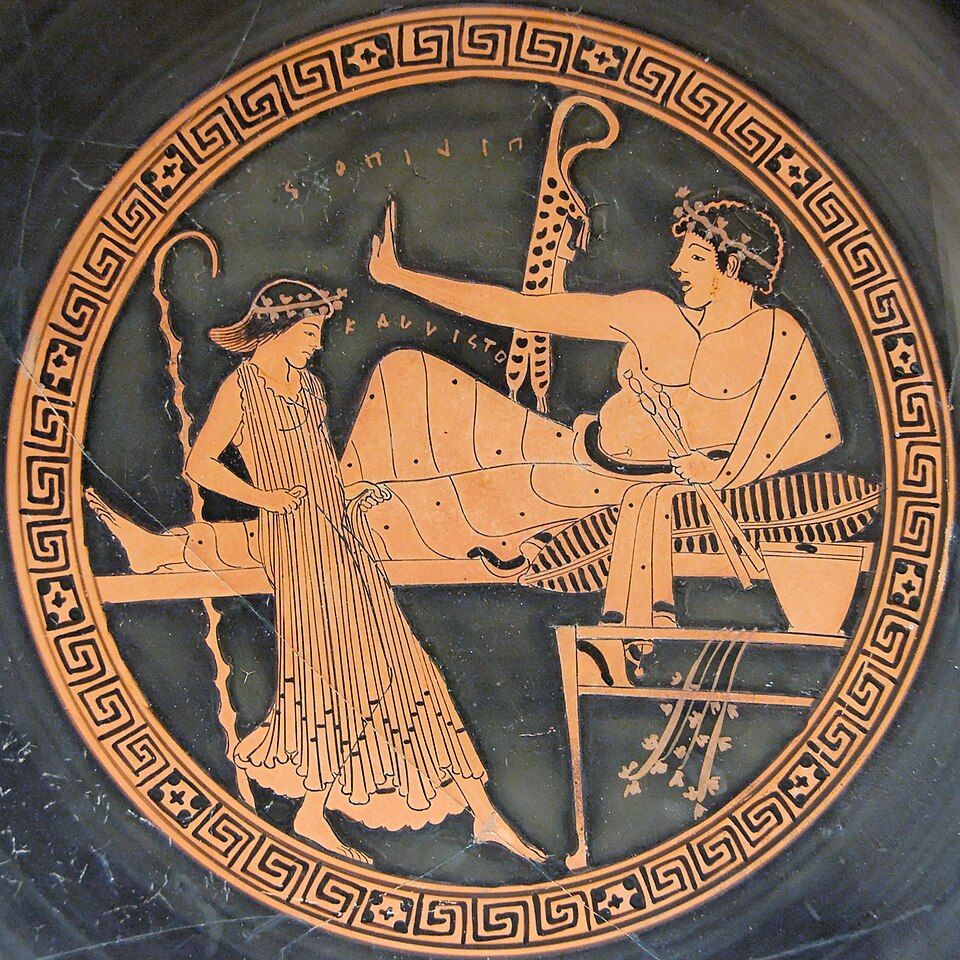
Text and translation
Νῦν χρῆ μεθύσθην καί τινα πρὸς βίαν
Alcaeus · fr. 332 · the first two lines of an Alcaic stanza · Greek wording verified against Smyth 1900, p. 17
How to read each line
A guide to the Greek, syllables, pitch marks and quantities.
Show the reading key
- Above each line: the line as the edition prints it, each word placed over its own syllables. The main row: the same Greek divided into metrical syllables, each written as it is pronounced. A consonant that closes a syllable is written with it (λόθ | ρο); an elided word is closed up with the next vowel (ν’ἀ); a final consonant carried into the next word is set with a thin space (ς ἰ). Wider gaps mark word-ends.
- Above the syllables: the pitch of each syllable, from the accents. Under them: the quantity of each syllable as it falls in the line, then the transliteration, syllable by syllable, with accented syllables in capitals.
- Under each line: a line-for-line translation. In the right margin of the scansion: the line type, its scheme, and its analysis into cola.
Key to the labels
The names, patterns and symbols used beside this poem.
Show the labels and symbols
The labels in the right margin of the scansion below name the cola, the rhythmic units each line is built from (Voigt’s and West’s analysis). A caret before a name (∧hipp) means the colon has lost its first position (acephalous). × marks an anceps position, which takes a long or a short. A click on any syllable highlights its colon, or, with the colon/foot switch, its foot. The sources of the labels, with their page numbers, are given line by line under Prosody, line by line.
| Label | Name and shape | What it is |
|---|---|---|
| alc-pe | Penthemimer (pe)× — ⏑ — × | Positions 1–5 of the Alcaic hendecasyllable, an iambic opening. West[7] divides the line pe ⁝ dod. Voigt’s Conspectus (Alcaeus A 1) divides it after position 4 instead, as ia ∧gl. Both mark frequent word-end (⁝, in Voigt at least half the lines) after positions 3 and 5, not after 4. |
| alc-dod | Dodrans (dod)— ⏑ ⏑ — ⏑ — | Positions 6–11: a choriamb and ⏑ —, the Aeolic close of the line.[8] The line ends a period, so its last position is indifferent. |
| alc-2ia | Iambic dimeter (2ia)× — ⏑ — × — ⏑ — | Positions 1–8 of the third line. Voigt (Conspectus, Alcaeus A 1) analyses the third and fourth lines as one period, 2ia ∧hippᵈ. West[7] calls that period a distended form of the first two. Voigt marks position 5 ⏒, short in at least 8 of 12 lines. Both mark frequent word-end (⁝) after position 3; West also marks bridges (⁀, word-end avoided) between positions 4 and 5 and between 8 and 9 (p. 34, key p. ix). |
| alc-hippd | Acephalous hipponactean with dactylic expansion (∧hippᵈ)× | — ⏑ ⏑ — ⏑ ⏑ — ⏑ — × | It begins on the ninth and last position of the third line and runs on, without a pause, through the whole fourth line (Voigt, Conspectus, Alcaeus A 1). Voigt marks word-end after the ninth position as regular, missing only at fr. 75.12, and never between the eighth and ninth. In antiquity the period was written as two lines at that point.[9] |
The feet
| Foot and shape | Where |
|---|---|
| Iambic syzygy× — ⏑ — | Positions 1–4. Hephaestion[10] calls the Alcaic hendecasyllable an epionic trimeter catalectic a maiore: first an iambic syzygy of six or seven morae, that is, with position 1 short or long. |
| Ionic a maiore or second paeon— — ⏑ ⏑ / ⏑ — ⏑ ⏑ | Positions 5–8, Hephaestion’s second syzygy:[10] an ionic a maiore when position 5 is long, a second paeon when it is short. |
| Close— ⏑ × | Positions 9–11: a trochee and an indifferent syllable.[10] |
| Iambic metron× — ⏑ — | Positions 1–4 of the enneasyllable, the first metron of Voigt’s 2ia. |
| Iambic metron× — ⏑ — | Positions 5–8 of the enneasyllable, the second metron of Voigt’s 2ia. Voigt marks position 5 usually short. |
| Final anceps× | Position 9: the anceps that begins Voigt’s ∧hippᵈ. The line runs on into the decasyllable. |
| Dactyl— ⏑ ⏑ | Positions 1–3. Hephaestion[11] calls the line the Alcaic decasyllable, a logaoedic dactylic verse: two dactyls and a trochaic syzygy. |
| Dactyl— ⏑ ⏑ | Positions 4–6.[11] |
| Trochaic syzygy— ⏑ — × | Positions 7–10.[11] The last position ends the stanza and is indifferent. |
Scansion
Full metrical scansion of the opening of the song as Athenaeus quotes it: Greek in metrical syllables, the quantity and pitch of each syllable, a syllabified transliteration and a line-for-line translation, with the line type and its cola in the right margin. One syllable in line 1 breaks the normal Lesbian rule for a stop + liquid, and the page reports it.
- line 332.1, position 8 (να): scans L but the scheme needs S
Now we must get drunk, and everyone must, even by force,
drink, since Myrsilus is dead.
Metre
- The stanza. Voigt’s Conspectus metrorum (Alcaeus A 1, p. 20) puts fr. 332 among the poems in the Alcaic stanza, and her ⊗ marks line 1 as the beginning of a poem. Athenaeus quotes only the first two lines, the two hendecasyllables: ⏓ — ⏑ ⁝ — ⏓ ⁝ — ⏑ ⏑ — ⏑ ⏓ ‖ ⏓ — ⏑ ⁝ — — ⁝ — ⏑ ⏑ — ⏑ ⏓ ‖ in Voigt’s notation, where ‖ marks the end of a colon (key, p. 15). Voigt analyses each as ia ∧gl, as does Battezzato (2009, p. 136: iamb + headless glyconic), West[7] as pe ⁝ dod; both mark frequent word-end after positions 3 and 5, and the right margin gives both analyses. Here neither line has word-end after position 3; both have it after 5 (μεθύσθην, δή). Each line is a period, so its last position is indifferent.[12]
- Voigt’s signs. ⏓ means that at least 8 of 12 syllables in that position are long; | marks constant word-end, ⁝ word-end in at least half the lines (Conspectus, p. 15). In the second line Voigt prints position 5 as a plain —, not ⏓. Here both lines have a long at 5.
- Hephaestion. Hephaestion’s analysis of the Alcaic hendecasyllable leaves positions 1 and 5 free: an iambic syzygy, an ionic a maiore or second paeon, a trochee and an indifferent syllable (Ench. 14.3, pp. 44–45 Consbruch). The click panel’s “foot” view follows him.
- Lesbian prosody and the problem in line 1. Lesbian verse has no resolution or contraction,[13] and in “normal” Lesbian lyric a stop + liquid makes position even at the start of a word: the opposite treatment, common elsewhere at the beginning of a word, is avoided there.[14] The scanner applies that rule to τινα πρὸς and finds a long syllable where the line needs a short one. The poem has a real exception here: Voigt’s apparatus records Lobel’s conjectural preposition meaning “beyond [his strength]”, proposed “to avoid the correption”, approved by Pfeiffer and rejected by Marzullo, and compares Sappho fr. 16.19, where the ὀ of ὄπλοισι stays short before πλ. The problem is therefore left visible on this page.
Dialect and transliteration
- Lesbian forms. χρῆ (Attic χρή); μεθύσθην and πώνην, infinitives in -ην (Attic μεθυσθῆναι, πίνειν; the thematic infinitive in -ην)[15]; κάτθανε (κατέθανε), with the preverb cut short and assimilated and no augment; the recessive accent of Μύρσιλος.[15] μεθύσθην and πώνην are editors’ restorations.[16]
- Key. η = ē, ω = ō, long α ι υ = ā ī ȳ, υ = y, χ = ch. Accented syllables are in capitals.
Prosody, line by line
Every syllable, with the reason for its length. Quantities are read from the vowel where the spelling shows it, from the consonants that follow (“position”), from the accent where it tells, and from the metre where nothing else does. Editors’ notes on the text follow in the boxed paragraphs.
- 332.1
Line 332.1 · Νῦν χρῆ μεθύσθην καί τινα πρὸς βίαν
Νῦν χρῆ μεθύσθην καί τινα πρὸς βίαν
ΝῦνχρῆμεθύσθηνκαίτιναπρὸςβίανThe label in the margin, with its sources: pe ⁝ dod (West) · ia ∧gl (Voigt).
- 1 —Νῦνῦ carries a circumflex, so it is long; closed by ν: long by position; the position is anceps.
- 2 —χρῆῆ is long by nature.
- 3 ⏑μεε is short by nature.
- 4 —θύσύ is a vowel of unknown length; closed by σ: long by position.
- 5 —θηνη is long by nature; closed by ν: long by position; the position is anceps.
- 6 —καίαί is a diphthong, long by nature.
- 7 ⏑τιι is short by the metre (position 7 must be short).
- 8 —ναᾰ is short (its length is not shown by the ordinary spelling); the next word begins with πρ: the syllable is closed before it: long by position; but the scheme needs a short syllable in this position: the line does not scan as given and is listed under Scansion problems.
- 9 —πρὸςὸ is short by nature; closed by ς: long by position.
- 10 ⏑βίί is short by the metre (position 10 must be short).
- 11 ×ανα is a vowel of unknown length; closed by ν: long by position; the position is anceps.
⚠ line 332.1, position 8 (να): scans L but the scheme needs S
Νῦν is long both by nature and by position before χρ, and χρῆ is long by nature. σθ closes -θύσ- at position 4. μεθύσθην is Buttmann’s form (Voigt’s apparatus); the manuscript of Athenaeus has μεθύσκειν, though according to Welcker and Ahrens μεθύσθην is in the printed books.
The anomaly is position 8. τινα ends in a short vowel (marked with a breve for the scanner), and the next word begins with πρ. Under the normal Lesbian rule the π would close the syllable and make it long;[17] the metre needs a short here, so πρ must here be treated as beginning the next syllable, a correption the Lesbians normally avoid. The scanner, which follows the normal rule, reports the clash. Lobel’s alternative preposition would remove it; Voigt keeps πρὸς and compares Sappho fr. 16.19.
πρὸς is closed by ς before β at position 9, and βί- is short at 10. The final -αν is indifferent at period-end.
Campbell adopts Lobel’s conjecture meaning “beyond strength”, while recording the manuscript’s preposition in his apparatus.[18] That conjecture would leave τινα open before a single consonant, making position 8 regularly short.
- 332.2
Line 332.2 · πώνην, ἐπεὶ δὴ κάτθανε Μύρσιλος
πώνην, ἐπεὶ δὴ κάτθανε Μύρσιλος
πώνην,ἐπεὶδὴκάτθανεΜύρσιλοςThe label in the margin, with its sources: pe ⁝ dod (West) · ia ∧gl (Voigt).
- 1 —πώώ is long by nature; the position is anceps.
- 2 —νην,η is long by nature.
- 3 ⏑ἐἐ is short by nature.
- 4 —πεὶεὶ is a diphthong, long by nature.
- 5 —δὴὴ is long by nature; the position is anceps.
- 6 —κάτά is a vowel of unknown length; closed by τ: long by position.
- 7 ⏑θαα is short by the metre (position 7 must be short).
- 8 ⏑νεε is short by nature.
- 9 —Μύρύ is a vowel of unknown length; closed by ρ: long by position.
- 10 ⏑σιι is short by the metre (position 10 must be short).
- 11 ×λοςο is short by nature; closed by ς: long by position; the position is anceps.
πώνην is Ahrens’s Lesbian form; the manuscript of Athenaeus has πονεῖν, and Stephanus had already restored πίνειν (Voigt’s apparatus). Its second syllable is long at position 2 (η long by nature), the ἐ- of ἐπεί is short at 3, and -πεί, a diphthong, long at 4. δή is long at 5. In κάτθανε (κατέθανε) τθ closes κάτ-, so position 6 is long; θα and νε are short at 7–8. ρσ closes Μύρ- at 9. The final -λος is indifferent at period-end.
The source and the occasion
Athenaeus quotes the two lines in his list of the occasions on which Alcaeus is found drinking (10.430c; Voigt’s testimonia). Voigt’s parallels are Horace, Odes 1.37, for the poem, and, for πρὸς βίαν, Sophocles fr. 669 N.² and Aristophanes, Acharnians 73 (πρὸς βίαν ἐπίνομεν).
Myrsilus was one of the rulers of Mytilene whom Alcaeus and his political club opposed; after his death Pittacus became the elected ruler, and Alcaeus turned his invective on him.[19] The song is an invitation to drink, a theme especially frequent in Alcaeus,[20] and its opening “now” ties it to a historical event.[21]
Notes
- ^ a b Spelman 2022, p. 275.
- ^ Spelman 2022, p. 275; Yatromanolakis 2009, p. 207.
- ^ Yatromanolakis 2009, p. 207.
- ^ Carey 2009, p. 35.
- ^ D’Alessio 2009, p. 118.
- ^ Voigt 1971, pp. 308–309.
- ^ a b c West 1987, p. 34.
- ^ West 1987, pp. 33–34.
- ^ West 1987, p. 35 n. 1.
- ^ a b c Hephaestion, Ench. 14.3.
- ^ a b c Hephaestion, Ench. 7.8.
- ^ West 1987, p. 4.
- ^ West 1987, p. 32; Battezzato 2009, p. 134.
- ^ West 1987, p. 16 with n. 7.
- ^ a b de Kreij 2022, p. 148.
- ^ See the notes on the lines.
- ^ West 1987, p. 16 n. 7.
- ^ Campbell 1982, p. 372.
- ^ Yatromanolakis 2009, p. 207; Spelman 2022, p. 275, who quotes these lines.
- ^ Carey 2009, pp. 34–35.
- ^ D’Alessio 2009, p. 118.
Text and sources
- Greek wording: H. W. Smyth, Greek Melic Poets (London 1900), p. 17, Alcaeus VI (Bergk 20), public domain; original scan. Both lines checked against the page image. Smyth’s ἐπειδὴ is divided as ἐπεὶ δή in the existing display; punctuation is normalized. The Greek words and scansion are unchanged.
- Scholarly comparison: E.-M. Voigt, Sappho et Alcaeus: Fragmenta (Amsterdam 1971), fr. 332 with testimonia, parallels and apparatus (pp. 308–309), and Conspectus metrorum, Alcaeus A 1 (p. 20) and key (p. 15), checked against the page images. Printed with ordinary sigma; a breve added on τινᾰ (hidden on the page).
- M. L. West, Introduction to Greek Metre (Oxford 1987), pp. 4 (period-end), 12–17 (syllables, stop + liquid) and 32–35 (Lesbian lyric; the Alcaic stanza), checked against the page images.
- H. Spelman, ‘Alcaeus’, ch. 19, p. 275, and M. de Kreij, ‘The Lyric Dialects’, ch. 10, p. 148, in L. Swift (ed.), A Companion to Greek Lyric (Wiley 2022); D. Yatromanolakis, ‘Alcaeus and Sappho’, p. 207, C. Carey, ‘Genre, occasion and performance’, pp. 34–35, G. B. D’Alessio, ‘Language and pragmatics’, p. 118, and L. Battezzato, ‘Metre and music’, pp. 134–136, in F. Budelmann (ed.), The Cambridge Companion to Greek Lyric (Cambridge 2009).
- Hephaestion, Enchiridion 14.3, ed. M. Consbruch (Leipzig 1906), pp. 44–45; public domain; Greek text from First1KGreek, CC BY-SA 4.0.
- D. A. Campbell, Greek Lyric I: Sappho and Alcaeus (Loeb Classical Library 142, Cambridge, MA 1982), fr. 332 (pp. 372–373), compared: see the note on l. 1. Same fragment number as Voigt.
Quotations from copyrighted works are not covered by this page’s licence.
Fr. 338 (Alcaic stanzas)
Fr. 338 — the winter drinking-song
Synopsis
A winter drinking song. Zeus is raining, a great storm comes from the sky, and the streams are frozen. The singer bids his companion throw down the storm: heap up the fire, mix honey-sweet wine without stint, and put a soft cushion about his temples.[1] The weather is one of the generic markers of time in drinking songs. Stoking the fire and fetching cushions are among the routine orders of the symposium.[2] The poem can also be read as an encouragement to drink, cast in the form of a political imperative.[3] Alcaeus composed it, like most of his songs, for the drinking-parties of his political club at Mytilene around 600 BC.[4] Athenaeus quotes lines 1–2 and 5–8 (10.430a–b) among Alcaeus’ seasonal invitations to drink. A papyrus, P.Bouriant 8, quotes words of lines 2–3. Voigt lists Horace’s Soracte ode (Odes 1.9) as a parallel.[5]
The passage is scanned below, with two blank lines marking the lost part of the first stanza.
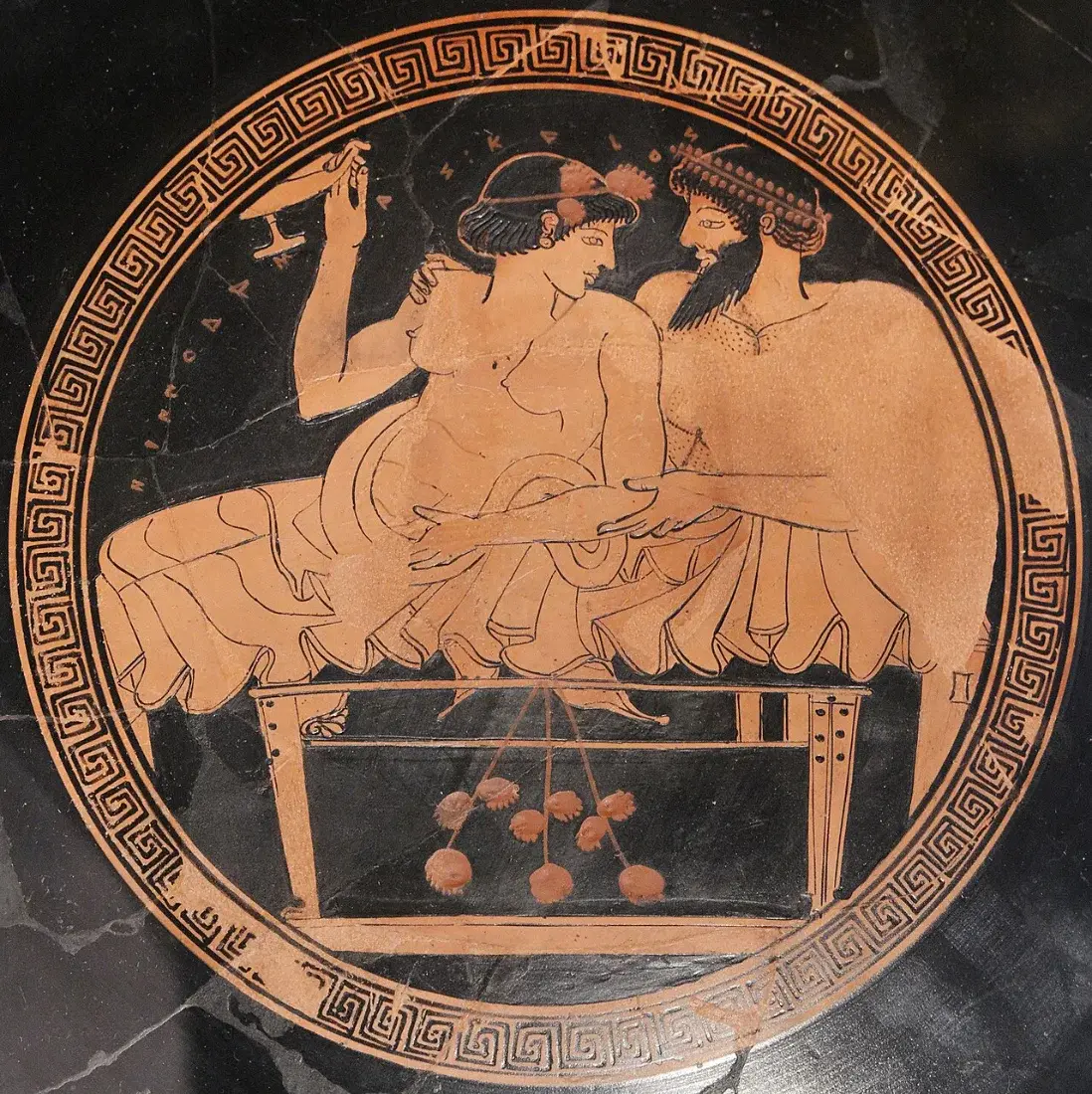
Text and translation
Υ̓́ει μὲν ὀ Ζεῦς, ἐκ δ’ ὀράνω μέγας
Alcaeus · fr. 338 · two Alcaic stanzas, lines 3–4 lost · Greek wording from Smyth 1900
How to read each line
A guide to the Greek, syllables, pitch marks and quantities.
Show the reading key
- Above each line: the line as the edition prints it, each word placed over its own syllables. The main row: the same Greek divided into metrical syllables, each written as it is pronounced. A consonant that closes a syllable is written with it (λόθ | ρο); an elided word is closed up with the next vowel (ν’ἀ); a final consonant carried into the next word is set with a thin space (ς ἰ). Wider gaps mark word-ends.
- Above the syllables: the pitch of each syllable, from the accents. Under them: the quantity of each syllable as it falls in the line, then the transliteration, syllable by syllable, with accented syllables in capitals.
- Under each line: a line-for-line translation. In the right margin of the scansion: the line type, its scheme, and its analysis into cola.
Key to the labels
The names, patterns and symbols used beside this poem.
Show the labels and symbols
The labels in the right margin of the scansion below name the cola, the rhythmic units each line is built from (Voigt’s and West’s analysis). A caret before a name (∧hipp) means the colon has lost its first position (acephalous). × marks an anceps position, which takes a long or a short. A click on any syllable highlights its colon, or, with the colon/foot switch, its foot. After the scheme, ‖ marks the end of a period and ||| the end of the strophe.[6] A line that ends without either runs on into the next line (synapheia): the two are one period, with no metrical break between them,[7] and the page sets them together and links them. The sources of the labels, with their page numbers, are given line by line under Prosody, line by line.
| Label | Name and shape | What it is |
|---|---|---|
| alc-pe | Penthemimer (pe)× — ⏑ — × | Positions 1–5 of the Alcaic hendecasyllable, an iambic opening. West[8] divides the line pe ⁝ dod. Voigt’s Conspectus (Alcaeus A 1) divides it after position 4 instead, as ia ∧gl. Both mark frequent word-end (⁝, in Voigt at least half the lines) after positions 3 and 5, not after 4. |
| alc-dod | Dodrans (dod)— ⏑ ⏑ — ⏑ — | Positions 6–11: a choriamb and ⏑ —, the Aeolic close of the line.[9] The line ends a period, so its last position is indifferent. |
| alc-2ia | Iambic dimeter (2ia)× — ⏑ — × — ⏑ — | Positions 1–8 of the third line. Voigt (Conspectus, Alcaeus A 1) analyses the third and fourth lines as one period, 2ia ∧hippᵈ. West[8] calls that period a distended form of the first two. Voigt marks position 5 ⏒, short in at least 8 of 12 lines. Both mark frequent word-end (⁝) after position 3; West also marks bridges (⁀, word-end avoided) between positions 4 and 5 and between 8 and 9 (p. 34, key p. ix). |
| alc-hippd | Acephalous hipponactean with dactylic expansion (∧hippᵈ)× | — ⏑ ⏑ — ⏑ ⏑ — ⏑ — × | It begins on the ninth and last position of the third line and runs on, without a pause, through the whole fourth line (Voigt, Conspectus, Alcaeus A 1). Voigt marks word-end after the ninth position as regular, missing only at fr. 75.12, and never between the eighth and ninth. In antiquity the period was written as two lines at that point.[10] |
The feet
| Foot and shape | Where |
|---|---|
| Iambic syzygy× — ⏑ — | Positions 1–4. Hephaestion[11] calls the Alcaic hendecasyllable an epionic trimeter catalectic a maiore: first an iambic syzygy of six or seven morae, that is, with position 1 short or long. |
| Ionic a maiore or second paeon— — ⏑ ⏑ / ⏑ — ⏑ ⏑ | Positions 5–8, Hephaestion’s second syzygy:[11] an ionic a maiore when position 5 is long, a second paeon when it is short. |
| Close— ⏑ × | Positions 9–11: a trochee and an indifferent syllable.[11] |
| Iambic metron× — ⏑ — | Positions 1–4 of the enneasyllable, the first metron of Voigt’s 2ia. |
| Iambic metron× — ⏑ — | Positions 5–8 of the enneasyllable, the second metron of Voigt’s 2ia. Voigt marks position 5 usually short. |
| Final anceps× | Position 9: the anceps that begins Voigt’s ∧hippᵈ. The line runs on into the decasyllable. |
| Dactyl— ⏑ ⏑ | Positions 1–3. Hephaestion[12] calls the line the Alcaic decasyllable, a logaoedic dactylic verse: two dactyls and a trochaic syzygy. |
| Dactyl— ⏑ ⏑ | Positions 4–6.[12] |
| Trochaic syzygy— ⏑ — × | Positions 7–10.[12] The last position ends the stanza and is indifferent. |
Scansion
Scansion of the surviving passage: Greek in metrical syllables, the quantity and pitch of each syllable, a syllabified transliteration and a line-for-line translation, with the line type and its cola in the right margin. Lines 3–4 are lost and are shown as gaps.
- line 338.3: 0 syllables but the scheme has 9 positions
- line 338.4: 0 syllables but the scheme has 10 positions
Zeus sends rain; from heaven comes a mighty
winter storm, and the running waters are locked in ice.
[Lost. A papyrus keeps one word of this line: ἔνθεν, “from there”.]
[Lost.]
Throw the storm down: heap up
the fire, and mix the wine, not sparing it,
sweet as honey, and at your temples
wrap a soft woollen pad.
Metre
Text. The Greek follows the public-domain teaching edition, including κόρσᾳ and μάλθακον. Accents, smooth breathings, iota presentation, punctuation, brackets and teaching quantity marks are normalized. The supplement βάλων is printed there in angle brackets and here in square brackets.[13] The modern edition remains a source for metrical analysis and the discussion of variants.
- The stanza. Voigt’s Conspectus metrorum (Alcaeus A 1, p. 20) puts fr. 338 among the poems in the Alcaic stanza. She sets it out as ia ∧gl ‖ ia ∧gl ‖ 2ia ∧hippd |||, where ‖ marks the end of a colon and ||| the end of the stanza (key, p. 15): ⏓ — ⏑ ⁝ — ⏓ ⁝ — ⏑ ⏑ — ⏑ ⏓ ‖ ⏓ — ⏑ ⁝ — — ⁝ — ⏑ ⏑ — ⏑ ⏓ ‖ ⏓ — ⏑ ⁝ — ⏒ — ⏑ — ⏓ | — ⏑ ⏑ — ⁝ ⏑ ⏑ — ⁝ ⏑ — ⏓ |||, with a tie over the eighth and ninth positions of the third unit (word-end never falls there). Battezzato[14] analyses the stanza the same way, lines 3 and 4 being one verse.
- West’s analysis. West[8] divides the hendecasyllable pe ⁝ dod and describes the stanza as aaA: two equal periods, then a third that lengthens them. He prints no label for the third period. His scheme marks frequent word-end (⁝) after positions 3 and 5 of the first two lines, and in the third period after positions 3 and 9, with a bridge (⁀, a place where word-end is avoided: p. ix) between positions 4 and 5 and between 8 and 9. The right margin gives both analyses, with Voigt’s word-end signs and ⁀ where both editors exclude word-end.
- Four lines or three periods. In antiquity the third period was written as two lines, broken after its ninth position, where caesura is frequent; hence the four-line stanza of Horace and of modern editions.[10]
- Voigt’s signs. ⏓ means that at least 8 of 12 syllables in that position are long, ⏒ that at least 8 of 12 are short, × that no more than 7 of 12 are long. | marks constant word-end, ⁝ word-end in at least half the lines (Conspectus, p. 15). These are statistics of Alcaeus’ practice. The positions remain anceps, and the scheme row on this page writes them ×. Word-end after the ninth position of the third line is missing only at fr. 75.12 f. (Conspectus, p. 20).
- Hephaestion. Hephaestion calls the hendecasyllable an epionic trimeter catalectic a maiore: an iambic syzygy of six or seven morae, an ionic a maiore or a second paeon, and a close of trochee and indifferent syllable, so that positions 1 and 5 are free (Ench. 14.3, pp. 44–45 Consbruch). He calls the fourth line the Alcaic decasyllable, two dactyls and a trochaic syzygy.[12] The “foot” view of the click panel follows him.
- Lesbian prosody. Lesbian verse admits neither resolution nor contraction, so every line has a fixed number of syllables.[15] Vowels that meet across a word-boundary are elided or run together; in Lesbian lyric hiatus is avoided altogether (the one exception he notes is a καί shortened before a vowel in a proverb, Alc. 366: p. 35 n. 2)[16]. In “normal” Lesbian lyric a stop followed by a liquid makes position even at the start of a word.[17]
- Period-end and synapheia. The first and second lines each end a period, so their last position is indifferent and nothing links them to the next line.[6] The third line runs on into the fourth without a pause: its last syllable keeps its real quantity, and a final consonant may pass across the line-break.[18]
- Lines 3–4. Athenaeus, who quotes the poem, gives lines 1–2 and 5–8; a grammatical papyrus (PBouriant 8), discussing -αισι for -ασι, quotes line 2 and then has ἔνθεν, which Voigt, following Lobel, prints in line 3 between angle brackets (Voigt’s testimonia and apparatus). The scanner reports both lines as unfilled; that report is the lacuna, not a fault in the metre.
Dialect and transliteration
- Psilosis. East Aeolic has lost the aspiration at the beginning of a word,[19] so Voigt prints ὔει, ὀ (the article), ὐδάτων with smooth breathing, and the transliteration has no h. Editors apply psilosis throughout the Lesbian poets; Hooker has criticised the practice (cited by de Kreij 2022, p. 148 n. 14).
- Recessive accent. Lesbian accents a word as far from its end as the general rules allow, except prepositions, particles and a few other words.[19] So Voigt prints the participles τίθεις and κέρναις with the accent on the first syllable, and the supplement in l. 8 is given the same accent.
- Long α. Lesbian keeps the long α that Attic and Ionic turn into η:[20] πεπάγαισιν (Attic πεπήγασιν).
- Key. η = ē, ω = ō, long α ι υ = ā ī ȳ, υ = y, χ = ch. Accented syllables are in capitals.
Prosody, line by line
Every syllable, with the reason for its length. Quantities are read from the vowel where the spelling shows it, from the consonants that follow (“position”), from the accent where it tells, and from the metre where nothing else does. Editors’ notes on the text follow in the boxed paragraphs.
- 338.1
Line 338.1 · Υ̓́ει μὲν ὀ Ζεῦς, ἐκ δ’ ὀράνω μέγας
Υ̓́ει μὲν ὀ Ζεῦς, ἐκ δ’ ὀράνω μέγας
Υ̓́ειμὲν ὀΖεῦς,ἐκδ’ὀράνωμέγαςThe label in the margin, with its sources: pe ⁝ dod (West) · ia ∧gl (Voigt).
- 1 —Υ̓́Ῡ̓́ is long (its length is not shown by the ordinary spelling); the position is anceps.
- 2 —ειει is a diphthong, long by nature.
- 3 ⏑μὲὲ is short by nature.
- 4 —ν ὀὀ is short by nature; the next word begins with the double consonant Ζ: the syllable is closed before it: long by position; the first consonant belongs to the previous word and is carried over to this vowel.
- 5 —Ζεῦς,εῦ is a diphthong, long by nature; the position is anceps.
- 6 —ἐκἐ is short by nature; closed by κ: long by position.
- 7 ⏑δ’ὀὀ is short by nature; the apostrophe marks an elided vowel; the consonant before it joins this syllable.
- 8 ⏑ράά is short by the metre (position 8 must be short).
- 9 —νωω is long by nature.
- 10 ⏑μέέ is short by nature.
- 11 ×γαςα is a vowel of unknown length; closed by ς: long by position; the position is anceps.
Position 1 holds ὔ-, a syllable of its own before the diphthong ει. The υ of ὔω is long in the present,[21] so the syllable is long; it is marked long for the scanner. In μὲν ὀ the ν passes to the next word, leaving μὲ short at position 3. The article ὀ has a short vowel, but its syllable is long by position at 4, because ζ counts as two consonants.[22]
In ἐκ δ’ ὀράνω the δέ is elided before a vowel,[23] and the κ of ἐκ closes its syllable before δ: two consonants are divided between syllables.[18] Voigt prints ὀράνω with the later manuscripts of Athenaeus; the main ones (A, C, B, P) have ὠρανῶ, whose long first syllable would not fit position 7, which must be short. Line 1 ends a period, so the final -ας is indifferent.[6]
- 338.2
Line 338.2 · χείμων, πεπάγαισιν δ’ ὐδάτων ῥόαι
χείμων, πεπάγαισιν δ’ ὐδάτων ῥόαι
χείμων,πεπάγαισινδ’ὐδάτωνῥόαιThe label in the margin, with its sources: pe ⁝ dod (West) · ia ∧gl (Voigt).
- 1 —χείεί is a diphthong, long by nature; the position is anceps.
- 2 —μων,ω is long by nature; closed by ν: long by position.
- 3 ⏑πεε is short by nature.
- 4 —πάά is long by the metre (position 4 must be long).
- 5 —γαιαι is a diphthong, long by nature; the position is anceps.
- 6 —σινι is a vowel of unknown length; closed by ν: long by position.
- 7 ⏑δ’ὐὐ is short by the metre (position 7 must be short); the apostrophe marks an elided vowel; the consonant before it joins this syllable.
- 8 ⏑δάά is short by the metre (position 8 must be short).
- 9 —τωνω is long by nature; closed by ν: long by position.
- 10 ⏑ῥόό is short by nature.
- 11 ×αιαι is a diphthong, long by nature; the position is anceps.
The ν of πεπάγαισιν closes its syllable before δ’, and δ’ is δέ elided before ὐδάτων.[23] Position 4, πά, must be long: the α is the Lesbian long α of the perfect (Attic πέπηγα); the scanner takes the length from the metre, since the spelling does not show it. πεπάγαισιν is a verb, “they have frozen”, with the Lesbian ending -αισι(ν) for -ασι(ν); Voigt prints it from the papyrus, which quotes this line in a discussion of that ending (Ahrens had conjectured it). Athenaeus has -γασιν, which would also scan, with a short syllable at the anceps position 5.
The line ends a period. The final -αι of ῥόαι is indifferent.
- 338.3
Line 338.3 · ⟨ … ⟩
⟨ … ⟩
the period runs on into 338.4 (synapheia).
The label in the margin, with its sources: 2ia ∧hippᵈ… (Voigt); ⁀ 4–5 West p. 34.
⚠ line 338.3: 0 syllables but the scheme has 9 positions
Lost: Athenaeus does not quote it. The third line of an Alcaic stanza is the enneasyllable × — ⏑ — × — ⏑ — ×, which runs on into the fourth. Of this line only ἔνθεν, “from there”, survives, in the papyrus, and its place in the line is unknown, so it is not scanned here.
- 338.4
Line 338.4 · ⟨ … ⟩
⟨ … ⟩
continues 338.3 · one period (synapheia).
The label in the margin, with its sources: end of ∧hippᵈ (Voigt; West pp. 34–35).
⚠ line 338.4: 0 syllables but the scheme has 10 positions
Lost. The fourth line would be the decasyllable — ⏑ ⏑ — ⏑ ⏑ — ⏑ — ×, the end of the period that begins in line 3.
- 338.5
Line 338.5 · κάββαλλε τὸν χείμων’, ἐπὶ μὲν τίθεις
κάββαλλε τὸν χείμων’, ἐπὶ μὲν τίθεις
κάββαλλετὸνχείμων’,ἐπὶμὲντίθειςThe label in the margin, with its sources: pe ⁝ dod (West) · ia ∧gl (Voigt).
- 1 —κάβά is a vowel of unknown length; closed by β: long by position; the position is anceps.
- 2 —βαλα is a vowel of unknown length; closed by λ: long by position.
- 3 ⏑λεε is short by nature.
- 4 —τὸνὸ is short by nature; closed by ν: long by position.
- 5 —χείεί is a diphthong, long by nature; the position is anceps.
- 6 —μωω is long by nature.
- 7 ⏑ν’,ἐἐ is short by nature; the apostrophe marks an elided vowel; the consonant before it joins this syllable.
- 8 ⏑πὶὶ is short by the metre (position 8 must be short).
- 9 —μὲνὲ is short by nature; closed by ν: long by position.
- 10 ⏑τίί is short by the metre (position 10 must be short).
- 11 ×θειςει is a diphthong, long by nature; closed by ς: long by position; the position is anceps.
The doubled consonants ββ and λλ close the first two syllables, κάβ-βαλ-, so positions 1 and 2 are both long. Voigt prints -βαλλε with the later manuscripts of Athenaeus; the main ones (A, C) have -βαλε, which would give a short second syllable where the metre needs a long one.
χείμων’ is χείμωνα with its final α elided before ἐπὶ,[23] and its ν joins the next syllable (μω-νἐ). τὸν is closed by ν before χ, so position 4 is long. ἐπὶ … τίθεις is split by μέν (“putting on”). The line ends a period; τίθεις is indifferent.
- 338.6
Line 338.6 · πῦρ, ἐν δὲ κέρναις οἶνον ἀφειδέως
πῦρ, ἐν δὲ κέρναις οἶνον ἀφειδέως
πῦρ,ἐνδὲκέρναιςοἶνον ἀφειδέωςThe label in the margin, with its sources: pe ⁝ dod (West) · ia ∧gl (Voigt).
- 1 —πῦρ,ῦ carries a circumflex, so it is long; the position is anceps.
- 2 —ἐνἐ is short by nature; closed by ν: long by position.
- 3 ⏑δὲὲ is short by nature.
- 4 —κέρέ is short by nature; closed by ρ: long by position.
- 5 —ναιςαι is a diphthong, long by nature; the position is anceps.
- 6 —οἶοἶ is a diphthong, long by nature.
- 7 ⏑νοο is short by nature.
- 8 ⏑ν ἀἀ is short by the metre (position 8 must be short); the first consonant belongs to the previous word and is carried over to this vowel.
- 9 —φειει is a diphthong, long by nature.
- 10 ⏑δέέ is short by nature.
- 11 ×ωςω is long by nature; closed by ς: long by position; the position is anceps.
The ρ of πῦρ passes to ἐν, and πῦ is long by nature. κέρναις is the participle as Meister restored it (Jani had already recognised a participle here); the manuscripts of Athenaeus have κίρνας (A) or κιρνὰς (C) (Voigt’s apparatus). Either way the syllable is long. The ς of κέρναις and the ν of οἶνον pass to the following vowels, so νο and νἀ are short at positions 7 and 8.
ἀφειδέως has four syllables, with -δέ- and -ως not contracted; the line ends a period, and -ως is indifferent.
- 338.7
Line 338.7 · μέλιχρον, αὐτὰρ ἀμφὶ κόρσᾳ
μέλιχρον, αὐτὰρ ἀμφὶ κόρσᾳ
μέλιχρο,ν αὐτὰρ ἀμφὶκόρσᾳthe period runs on into 338.8 (synapheia).
The label in the margin, with its sources: 2ia ∧hippᵈ… (Voigt); ⁀ 4–5 West p. 34.
- 1 ⏑μέέ is short by nature; the position is anceps.
- 2 —λιχι is a vowel of unknown length; closed by χ before a liquid: stop + liquid makes position in Lesbian verse, so the syllable is long whatever the vowel.
- 3 ⏑ρο,ο is short by nature.
- 4 —ν αὐαὐ is a diphthong, long by nature; the first consonant belongs to the previous word and is carried over to this vowel.
- 5 ⏑τὰᾰ̀ is short (its length is not shown by the ordinary spelling); the position is anceps.
- 6 —ρ ἀμἀ is a vowel of unknown length; closed by μ: long by position; the first consonant belongs to the previous word and is carried over to this vowel.
- 7 ⏑φὶὶ is short by the metre (position 7 must be short).
- 8 —κόρό is short by nature; closed by ρ: long by position.
- 9 —σᾳᾳ is long by nature; the position is anceps; the line-end is not a period-end: the period runs on into the next line (synapheia), so this syllable keeps its own length, with no brevis in longo, and a word may run over into the next line.[24]
Inside μέλιχρον the stop + liquid χρ makes position: the χ closes the second syllable, μέ-λιχ-ρον, so position 2 is long, as it must be.[17] The ν of -ρον passes to αὐτάρ, and the ρ of αὐτάρ passes to ἀμφί, so ρο and τὰ are open and short. Position 5, τὰ, is the place Voigt marks ⏒, usually short.
Voigt notes that αὐτάρ occurs nowhere else in Sappho and Alcaeus. κόρσᾳ (“temple”) ends the line with a word-end, as Voigt’s | requires after the ninth position. The line runs on into line 8 (synapheia), so -σᾳ is not at a period-end: its long vowel with iota subscript remains long before the μ of μάλθακον, at a position that is anceps (Voigt’s ⏓).
The ᾰ of αὐτὰρ is short (the metre: αὐτάρ fills a short of the dactyl in Iliad 6.474 and Odyssey 1.9, both on this site); the metre does not show it here, and the input marks it.
- 338.8
Line 338.8 · μάλθακον ἀμφιβάλων γνόφαλλον
μάλθακον ἀμφιβάλων γνόφαλλον
μάλθακον ἀμφι[βά][λων]γνόφαλλονcontinues 338.7 · one period (synapheia).
The label in the margin, with its sources: end of ∧hippᵈ (Voigt; West pp. 34–35).
- 1 —μάλά is a vowel of unknown length; closed by λ: long by position.
- 2 ⏑θαα is short by the metre (position 2 must be short).
- 3 ⏑κοο is short by nature.
- 4 —ν ἀμἀ is a vowel of unknown length; closed by μ: long by position; the first consonant belongs to the previous word and is carried over to this vowel.
- 5 ⏑φιι is short by the metre (position 5 must be short).
- 6 ⏑[βά]ά is short by the metre (position 6 must be short).
- 7 —[λων]ω is long by nature; closed by ν: long by position.
- 8 ⏑γνόό is short by nature.
- 9 —φαλα is a vowel of unknown length; closed by λ: long by position.
- 10 ×λονο is short by nature; closed by ν: long by position; the position is anceps.
The display keeps μάλθακον from the public-domain edition. The manuscripts run ἀμφι- straight into γνόφαλλον, leaving the line two syllables short. The supplement βάλων fills the gap, giving ἀμφι[βάλων], “putting around”.[13] The displayed recessive accent follows the Lesbian convention. The supplied syllables give ⏑ — at positions 6–7. Modern editors discuss other supplements and a different spelling of the adjective.[25]
The ν of μάλθακον passes to ἀμφι, so κο is short at 3. γν never lets the syllable before it stay short,[26] but λων is long anyway. γνό is open and short at 8; the double λ closes φαλ at 9. The last syllable ends the period and the stanza and is indifferent.
The source
Athenaeus quotes the poem as an example of Alcaeus drinking in winter (χειμῶνος, in Voigt’s testimonia to fr. 338). Seasonal invitations to drink were at home in Alcaeus’ sympotic songs: the same passage of Athenaeus (10.430a–b) also quotes the summer song fr. 347 and fr. 367.[27] Voigt’s list of parallels begins with Horace, Odes 1.9.
Notes
- ^ Voigt 1971, p. 311.
- ^ D’Alessio 2009, pp. 117 n. 13, 118.
- ^ Carey 2009, p. 35.
- ^ Spelman 2022, p. 275.
- ^ Voigt 1971, p. 311; Spelman 2022, p. 278.
- ^ a b c West 1987, p. 4.
- ^ West 1987, p. 3.
- ^ a b c West 1987, p. 34.
- ^ West 1987, pp. 33–34.
- ^ a b West 1987, p. 35 n. 1.
- ^ a b c Hephaestion, Ench. 14.3.
- ^ a b c d Hephaestion, Ench. 7.8.
- ^ a b Smyth 1900, pp. 18, 217.
- ^ Battezzato 2009, pp. 135–136.
- ^ West 1987, p. 32; Battezzato 2009, p. 134.
- ^ West 1987, pp. 15–16.
- ^ a b West 1987, p. 16 with n. 7.
- ^ a b West 1987, p. 12.
- ^ a b de Kreij 2022, p. 148.
- ^ de Kreij 2022, p. 147.
- ^ LSJ s.v. ὕω.
- ^ West 1987, p. 12 n. 1.
- ^ a b c West 1987, p. 13.
- ^ West 1987, pp. 3–4.
- ^ Voigt 1971, p. 311.
- ^ West 1987, p. 16.
- ^ Spelman 2022, p. 278.
Text and sources
- Greek wording: H. W. Smyth, Greek Melic Poets (London 1900), p. 18, with notes on p. 217. Public domain; normalized as explained above.
- Scholarly comparison: E.-M. Voigt, Sappho et Alcaeus: Fragmenta (Amsterdam 1971), fr. 338 with testimonia and apparatus (p. 311), and Conspectus metrorum, Alcaeus A 1 (p. 20) and key (p. 15), checked against the page images. Printed with ordinary sigma; ⟨ ⟩ for the lost lines as in Voigt; the supplement in l. 8 also printed by Smyth, here in square brackets; a macron added on ὔει (hidden on the page).
- M. L. West, Introduction to Greek Metre (Oxford 1987), pp. ix (the bridge sign), 4 (period, period-end), 12–17 (syllables, elision, hiatus, stop + liquid) and 32–35 (Lesbian lyric; the Alcaic stanza), checked against the page images. Also West 1987, p. 3 (synapheia and period-end).
- M. de Kreij, ‘The Lyric Dialects’, in L. Swift (ed.), A Companion to Greek Lyric (Wiley 2022), ch. 10, pp. 147–148; H. Spelman, ‘Alcaeus’, ibid., ch. 19, p. 278.
- L. Battezzato, ‘Metre and music’, in F. Budelmann (ed.), The Cambridge Companion to Greek Lyric (Cambridge 2009), pp. 134–136.
- LSJ s.v. ὕω (Perseus Digital Library, CC BY-SA).
- Hephaestion, Enchiridion 7.8 and 14.3, ed. M. Consbruch (Leipzig 1906), public domain; Greek text from First1KGreek, CC BY-SA 4.0.
- D. A. Campbell, Greek Lyric I: Sappho and Alcaeus (Loeb Classical Library 142, Cambridge, MA 1982), fr. 338 (pp. 374–375), compared line by line: same wording as Voigt. Same fragment number.
Quotations from copyrighted works are not covered by this page’s licence.
Fr. 346 (gl²ᶜ)
Fr. 346 — “Let us drink: the day is a finger’s breadth”
Synopsis
A drinking song for nightfall: let us drink; why wait for the lamps? There is a finger’s breadth of daylight left. The singer calls for the big painted cups, for the son of Semele and Zeus gave men wine to forget their cares. He bids his friend pour, mixing one measure to two, full to the brim, and let one cup drive on the next.[1] It is one of the many calls to drink in which Alcaeus finds ever new reasons for drinking.[2] It marks the time of day, and it gives orders for cups and for mixing, the standard tasks of the symposium.[3] Like most of Alcaeus’ songs it belongs to the drinking-parties of his political club at Mytilene, around 600 BC.[4] Athenaeus quotes it twice: all six lines at 10.430d, and lines 1–5 at 11.480f–481a. Voigt marks it as the beginning of a poem, and lists Horace, Odes 2.7, among the parallels.[1]
All six lines are scanned below.
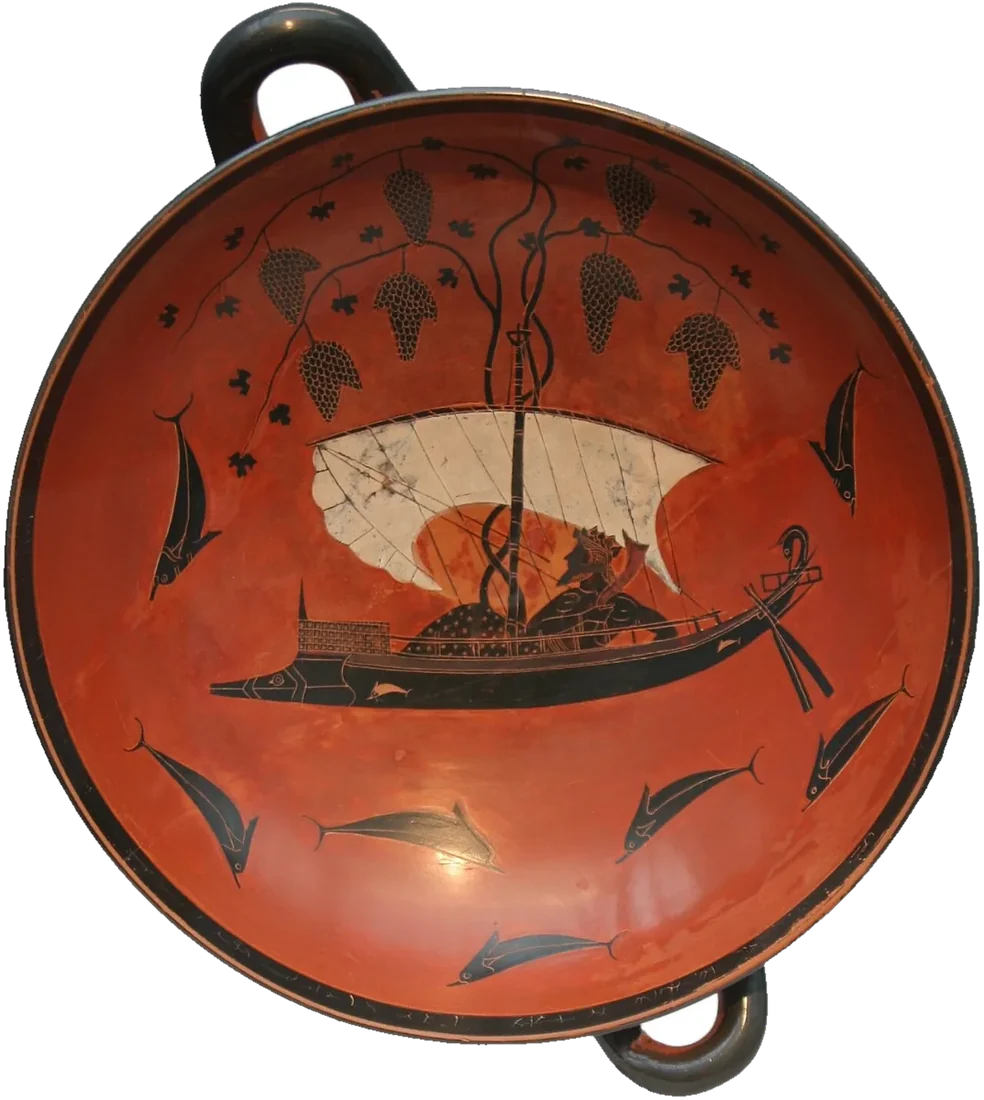
Text and translation
Πώνωμεν· τί τὰ λύχν’ ὀμμένομεν; δάκτυλος ἀμέρα·
Alcaeus · fr. 346 · gl²ᶜ used line by line · Greek wording from Smyth 1900 with old variants
How to read each line
A guide to the Greek, syllables, pitch marks and quantities.
Show the reading key
- Above each line: the line as the edition prints it, each word placed over its own syllables. The main row: the same Greek divided into metrical syllables, each written as it is pronounced. A consonant that closes a syllable is written with it (λόθ | ρο); an elided word is closed up with the next vowel (ν’ἀ); a final consonant carried into the next word is set with a thin space (ς ἰ). Wider gaps mark word-ends.
- Above the syllables: the pitch of each syllable, from the accents. Under them: the quantity of each syllable as it falls in the line, then the transliteration, syllable by syllable, with accented syllables in capitals.
- Under each line: a line-for-line translation. In the right margin of the scansion: the line type, its scheme, and its analysis into cola.
Key to the labels
The names, patterns and symbols used beside this poem.
Show the labels and symbols
The labels in the right margin of the scansion below name the cola, the rhythmic units each line is built from (Voigt’s and West’s analysis). A caret before a name (∧hipp) means the colon has lost its first position (acephalous). × marks an anceps position, which takes a long or a short. A click on any syllable highlights its colon, or, with the colon/foot switch, its foot. The sources of the labels, with their page numbers, are given line by line under Prosody, line by line.
| Label | Name and shape | What it is |
|---|---|---|
| alc-base | Aeolic base× × | Two positions free in quantity; in practice the first is more often long, and both short is uncommon in the Lesbians.[5] In Alcaeus’ gl²ᶜ Voigt marks the first position — and the second ⏓ (Conspectus, Alcaeus C 3 d). |
| alc-ch1 | First choriamb— ⏑ ⏑ — | Positions 3–6: the choriamb of the glyconic. Voigt marks word-end after position 6 in at least half the lines (C 3 d). |
| alc-ch2 | Second choriamb (expansion)— ⏑ ⏑ — | Positions 7–10, the first of the two inserted choriambs.[6] Voigt marks word-end after position 10 in at least half the lines, and never between the two shorts. |
| alc-ch3 | Third choriamb (expansion)— ⏑ ⏑ — | Positions 11–14, the second inserted choriamb. |
| alc-g-cl | Close⏑ × | Positions 15–16, the ⏑ — ending of the glyconic; at period-end the last position is indifferent. |
The feet
| Foot and shape | Where |
|---|---|
| First syzygy× × — ⏑ | Positions 1–4. Hephaestion[7] treats this line as an antispastic tetrameter acatalectic, the “Sapphic sixteen-syllable”: the first foot takes any of the four disyllabic shapes. |
| Antispast⏑ — — ⏑ | Positions 5–8: a pure antispast.[8] |
| Antispast⏑ — — ⏑ | Positions 9–12: a pure antispast.[8] |
| Iambic syzygy⏑ — ⏑ × | Positions 13–16: the last syzygy of the acatalectic line is iambic.[8] |
Scansion
Full metrical scansion of the fragment: Greek in metrical syllables, the quantity and pitch of each syllable, a syllabified transliteration and a line-for-line translation, with the line type and its cola in the right margin. The quotation in Athenaeus stops after the first word of line 6.
Let us drink! Why are we waiting for the lamps? The day is a finger’s breadth.
Lift down the great cups, comrade, the decorated ones;
for the son of Semele and Zeus gave wine, the care-dispeller,
to humankind. Pour, mixing one part to two,
brimful, right to the top, and let each cup the next
keep pushing.
Metre
- The line. Voigt’s Conspectus metrorum lists fr. 346 under C 3 d, the glyconic with double choriambic expansion, gl2c, used line by line:[9] — ⏓ — ⏑ ⏑ — ⁝ — ⏑ ⏑ — ⁝ — ⏑ ⏑ — ⏑ ⏓ ‖, where ‖ marks the end of a colon (key, p. 15). The glyconic × × — ⏑ ⏑ — ⏑ — is expanded from within by repeating its choriamb twice,[10] and West observes that word-end commonly separates the choriambs in such lines.[11] Voigt’s ⁝ after positions 6 and 10 records exactly that: word-end in at least half the lines. Her ⌒ over the two shorts of the middle choriamb marks a place where word-end never falls (Conspectus, p. 15).
- Hephaestion’s name for it. Hephaestion calls this line the “Sapphic sixteen-syllable”, an antispastic tetrameter acatalectic in which the whole third book of Sappho was written, “and many songs of Alcaeus” (Ench. 10.6, p. 34 Consbruch). His example is an Alcaeus line, fr. 343 Voigt (her testimonia to fr. 343). In his antispastic analysis the first syzygy varies, the middle ones are pure antispasts (⏑ — — ⏑) and the last is iambic;[8] the click panel’s “foot” view follows him.
- The aeolic base. In Sappho and Alcaeus the quantity of the first two positions is free,[12] though the Lesbian poets mostly make the first long and rarely make both short.[5] Voigt prints Alcaeus’ first position as — and the second as ⏓, long in at least 8 of 12 lines. In this fragment the base is — — in five lines and — ⏑ in line 2. The scheme row writes both positions ×.
- Lesbian prosody. No resolution and no contraction, so every line has sixteen syllables.[13] Vowels that meet across a word-boundary inside the line are elided; in Lesbian lyric hiatus is avoided altogether (one καί in correption at Alc. 366, p. 35 n. 2)[14]. Each line is a period of its own, so its last position is indifferent and nothing links it to the next line.[15]
Dialect and transliteration
- Lesbian forms. πώνωμεν (Attic πίνωμεν; Meineke’s correction of the manuscripts’ πίνωμεν), ὀμμένομεν (ἀναμένομεν), ἀμέρα (ἡμέρα, with the long α that Attic turns into η), κὰδ and κὰκ (κατά, cut short and assimilated), ἔνα (ἕνα) without aspiration, ἀ for ἡ;[16] ἀτέρα for ἑτέρα (Aeolic ἄτερος)[17].
- Key. η = ē, ω = ō, long α ι υ = ā ī ȳ, υ = y, χ = ch. Accented syllables are in capitals.
Prosody, line by line
Every syllable, with the reason for its length. Quantities are read from the vowel where the spelling shows it, from the consonants that follow (“position”), from the accent where it tells, and from the metre where nothing else does. Editors’ notes on the text follow in the boxed paragraphs.
- 346.1
Line 346.1 · Πώνωμεν· τί τὰ λύχν’ ὀμμένομεν; δάκτυλος ἀμέρα·
Πώνωμεν· τί τὰ λύχν’ ὀμμένομεν; δάκτυλος ἀμέρα·
Πώνωμεν·τίτὰλύχν’ὀμμένομεν;δάκτυλος ἀμέρα·The label in the margin, with its sources: gl²ᶜ (Voigt C 3 d; ⁝ also West p. 34).
- 1 —Πώώ is long by nature; the position is anceps.
- 2 —νωω is long by nature; the position is anceps.
- 3 —μεν·ε is short by nature; closed by ν: long by position.
- 4 ⏑τίί is short by the metre (position 4 must be short).
- 5 ⏑τὰὰ is short by the metre (position 5 must be short).
- 6 —λύχύ is a vowel of unknown length; closed by χ before a nasal: stop + nasal makes position in Lesbian verse, so the syllable is long whatever the vowel.
- 7 —ν’ὀμὀ is short by nature; closed by μ: long by position; the apostrophe marks an elided vowel; the consonant before it joins this syllable.
- 8 ⏑μέέ is short by nature.
- 9 ⏑νοο is short by nature.
- 10 —μεν;ε is short by nature; closed by ν: long by position.
- 11 —δάκά is a vowel of unknown length; closed by κ: long by position.
- 12 ⏑τυυ is short by the metre (position 12 must be short).
- 13 ⏑λοο is short by nature.
- 14 —ς ἀἀ is long by the metre (position 14 must be long); the first consonant belongs to the previous word and is carried over to this vowel.
- 15 ⏑μέέ is short by nature.
- 16 ×ρα·α is of unknown length; the position is anceps, so either scans.
The base, Πώ-νω-, is long by nature, and the ν of πώνωμεν closes its syllable before τ at position 3. λύχν’ is λύχνα with its final α elided before ὀμμένομεν;[18] χν closes λύχ-, and the ν joins the next syllable (λύχ-νὀμ-). The opening rests on three corrections recorded by Voigt: Πώνωμεν (Meineke) for πίνωμεν, τὰ λύχν’ (Porson) for τὸν λύχνον, and ὀμμένομεν (Ahrens), where one of the two passages of Athenaeus that quote the line has ἀμμένομεν and the other σβέννυμεν.
In δάκτυλος ἀμέρα the ς passes to the next word, so λο is open and short at 13. Position 14 must be long, and the scanner takes the α of ἀμέρα as long from the metre (Lesbian ᾱ for the η of ἡμέρα). Word-end after position 10, and after 6 apart from the elision, matches Voigt’s ⁝ marks.
- 346.2
Line 346.2 · κὰδ δ’ ἄερρε κυλίχναις μεγάλαις, αὔϊτα, ποικίλαις·
κὰδ δ’ ἄερρε κυλίχναις μεγάλαις, αὔϊτα, ποικίλαις·
κὰδδ’ἄερρεκυλίχναιςμεγάλαις,αὔϊτα,ποικίλαις·The label in the margin, with its sources: gl²ᶜ (Voigt C 3 d; ⁝ also West p. 34).
- 1 —κὰδὰ is a vowel of unknown length; closed by δ: long by position; the position is anceps.
- 2 ⏑δ’ἄᾰ̓́ is short (its length is not shown by the ordinary spelling); the apostrophe marks an elided vowel; the consonant before it joins this syllable; the position is anceps.
- 3 —ερε is short by nature; closed by ρ: long by position.
- 4 ⏑ρεε is short by nature.
- 5 ⏑κυυ is short by the metre (position 5 must be short).
- 6 —λίχί is a vowel of unknown length; closed by χ before a nasal: stop + nasal makes position in Lesbian verse, so the syllable is long whatever the vowel.
- 7 —ναιςαι is a diphthong, long by nature; closed by ς: long by position.
- 8 ⏑μεε is short by nature.
- 9 ⏑γάά is short by the metre (position 9 must be short).
- 10 —λαις,αι is a diphthong, long by nature.
- 11 —αὔαὔ is a diphthong, long by nature.
- 12 ⏑ϊϊ is short by the metre (position 12 must be short).
- 13 ⏑τα,α is short by the accent rule: acute on the antepenult requires a short final syllable.
- 14 —ποιοι is a diphthong, long by nature.
- 15 ⏑κίί is short by the metre (position 15 must be short).
- 16 ×λαις·αι is a diphthong, long by nature; closed by ς: long by position; the position is anceps.
The second position of the base is short here: δ’ ἄερρε has δέ elided,[18] and the α of ἄερρε is short, as in the epic ἄειρε (Il. 6.264, οἶνον ἄειρε, — ⏑ ⏑), marked with a breve for the scanner. A short in the base is allowed; both base positions short would be uncommon.[5] Voigt prints Ahrens’s ἄερρε; the two passages of Athenaeus have ἄειρε and ἀνάειρε, and Lobel suspected δή behind ἀνα- (δἄερρε).
The double ρ closes ερ- at position 3, and χν closes λίχ- at 6. In μεγάλαις αὔϊτα the ς passes to the next word. αὔϊτα addresses the singer’s companion. It has three syllables: the diphthong αυ is long, the diaeresis keeps ι separate, and the metre requires short ι and α. This is the reading printed in the public-domain text.[19] The last syllable of ποικίλαις ends the period and is indifferent.
Campbell joins the emphatic particle to the following verb by crasis;[20] that reading would make the second position of the base long.
- 346.3
Line 346.3 · οἶνον γὰρ Σεμέλας καὶ Δίος υἶος λαθικάδεα
οἶνον γὰρ Σεμέλας καὶ Δίος υἶος λαθικάδεα
οἶνονγὰρΣεμέλαςκαὶΔίος υἶοςλαθικάδεαThe label in the margin, with its sources: gl²ᶜ (Voigt C 3 d; ⁝ also West p. 34).
- 1 —οἶοἶ is a diphthong, long by nature; the position is anceps.
- 2 —νονο is short by nature; closed by ν: long by position; the position is anceps.
- 3 —γὰρὰ is a vowel of unknown length; closed by ρ: long by position.
- 4 ⏑Σεε is short by nature.
- 5 ⏑μέέ is short by nature.
- 6 —λαςα is a vowel of unknown length; closed by ς: long by position.
- 7 —καὶαὶ is a diphthong, long by nature.
- 8 ⏑Δίί is short by the metre (position 8 must be short).
- 9 ⏑οο is short by nature.
- 10 —ς υἶυἶ is a diphthong, long by nature; the first consonant belongs to the previous word and is carried over to this vowel.
- 11 —οςο is short by nature; closed by ς: long by position.
- 12 ⏑λαα is short by the metre (position 12 must be short).
- 13 ⏑θιι is short by the metre (position 13 must be short).
- 14 —κάά is long by the metre (position 14 must be long).
- 15 ⏑δεε is short by nature.
- 16 ×αα is short by the accent rule: acute on the antepenult requires a short final syllable; the position is anceps.
The ς of Δίος passes to υἶος, so -ος is short at position 9, and υἶ- is a diphthong; υἶος is in one passage of Athenaeus only (Voigt’s apparatus). Position 14, -κά- of λαθικάδεα, must be long: the Lesbian ᾱ answers to the η of the epic λαθικηδής, and Voigt’s apparatus calls the word epic in form and vocabulary. λαθικάδεα has five syllables, -δε-α uncontracted.
The line ends in a vowel and line 4 begins with one. That meeting is not hiatus inside a period, because every line is a period of its own;[21] Voigt notes, however, that Lobel proposed -δεον to avoid it.
- 346.4
Line 346.4 · ἀνθρώποισιν ἔδωκ’. ἔγχεε κέρναις ἔνα καὶ δύο
ἀνθρώποισιν ἔδωκ’. ἔγχεε κέρναις ἔνα καὶ δύο
ἀνθρώποισιν ἔδωκ’.ἔγχεεκέρναιςἔνακαὶδύοThe label in the margin, with its sources: gl²ᶜ (Voigt C 3 d; ⁝ also West p. 34).
- 1 —ἀνἀ is a vowel of unknown length; closed by ν: long by position; the position is anceps.
- 2 —θρώώ is long by nature; the position is anceps.
- 3 —ποιοι is a diphthong, long by nature.
- 4 ⏑σιι is short by the accent rule: acute on the antepenult requires a short final syllable.
- 5 ⏑ν ἔἔ is short by nature; the first consonant belongs to the previous word and is carried over to this vowel.
- 6 —δωω is long by nature.
- 7 —κ’.ἔγἔ is short by nature; closed by γ: long by position; the apostrophe marks an elided vowel; the consonant before it joins this syllable.
- 8 ⏑χεε is short by nature.
- 9 ⏑εε is short by nature.
- 10 —κέρέ is short by nature; closed by ρ: long by position.
- 11 —ναιςαι is a diphthong, long by nature.
- 12 ⏑ἔἔ is short by nature.
- 13 ⏑ναα is short by the metre (position 13 must be short).
- 14 —καὶαὶ is a diphthong, long by nature.
- 15 ⏑δύύ is short by the metre (position 15 must be short).
- 16 ×οο is short by nature; the position is anceps.
ἀνθρώποισιν: ν θρ is three consonants, so the first syllable is closed and long; the ν of -σιν passes to ἔδωκ’. ἔδωκ’ is ἔδωκε with its ε elided before ἔγχεε, and the elision runs straight through the full stop, since only period-end prevents it.[18] γχ closes the syllable κἔγ- at position 7; ἔγχεε then has two short syllables, -χε-ε, at 8 and 9, not contracted.
κέρναις, “mixing”, is restored, as in fr. 338.6, from the κέρνα εἰς of one passage of Athenaeus (Meister; the participle recognised by Jani; Voigt’s apparatus). The ς of κέρναις passes to ἔνα, so ἔ is short at 12. καὶ before δ is long at 14. The final -ο of δύο is indifferent at period-end.
- 346.5
Line 346.5 · πλήαις κὰκ κεφάλας, ἀ δ’ ἀτέρα τὰν ἀτέραν κύλιξ
πλήαις κὰκ κεφάλας, ἀ δ’ ἀτέρα τὰν ἀτέραν κύλιξ
πλήαιςκὰκκεφάλας,[ἀ]δ’ἀτέρατὰνἀτέρανκύλιξThe label in the margin, with its sources: gl²ᶜ (Voigt C 3 d; ⁝ also West p. 34).
- 1 —πλήή is long by nature; the position is anceps.
- 2 —αιςαι is a diphthong, long by nature; closed by ς: long by position; the position is anceps.
- 3 —κὰκὰ is a vowel of unknown length; closed by κ: long by position.
- 4 ⏑κεε is short by nature.
- 5 ⏑φάά is short by the metre (position 5 must be short).
- 6 —λας,α is long by the metre (position 6 must be long).
- 7 —[ἀ]ἀ is long by the metre (position 7 must be long).
- 8 ⏑δ’ἀἀ is short by the metre (position 8 must be short); the apostrophe marks an elided vowel; the consonant before it joins this syllable.
- 9 ⏑τέέ is short by nature.
- 10 —ραα is long by the metre (position 10 must be long).
- 11 —τὰνὰ is long by the metre (position 11 must be long).
- 12 ⏑ἀἀ is short by the metre (position 12 must be short).
- 13 ⏑τέέ is short by nature.
- 14 —ρανα is a vowel of unknown length; closed by ν: long by position.
- 15 ⏑κύύ is short by the metre (position 15 must be short).
- 16 ×λιξι is a vowel of unknown length; closed by ξ: long by position; the position is anceps.
Voigt prints πλήαις (Fick, for πλέαις and πλείους in Athenaeus) and κὰκ κεφάλας with the later manuscripts; κὰκ is κατά, apocopated and assimilated,[22] and its κ closes the syllable at position 3. The ς of κεφάλας passes to the article, so -λα stands open at 6 and is long by the metre (Lesbian ᾱ of the genitive). ⟨ἀ⟩, the article, is Porson’s addition, printed by Voigt in angle brackets and here in square ones; its α is long by the metre at 7.
δ’ is δέ elided. The -ρα of ἀτέρα (position 10) and τὰν (11) are long by the metre, Lesbian ᾱ; the ν of τὰν passes to ἀτέραν, which leaves τὰ an open syllable with a long vowel. The first α of ἀτέρα and ἀτέραν is short,[17] at 8 and 12. ἀτέραν is Bergk’s, for the ἑτέραν of Athenaeus. The final -λιξ is indifferent.
- 346.6
Line 346.6 · ὠθήτω
ὠθήτω
ὠθήτω- 1 —ὠὠ is long by nature; the position is anceps.
- 2 —θήή is long by nature; the position is anceps.
- 3 ×τωω is long by nature.
Only the first word of the line is quoted. ὠθήτω fills positions 1–3, — — —; the last mark shows where the quotation stops, not a line-end. Voigt’s Conspectus counts the fragment as five lines (C 3 d).
The occasion
The song is an exhortation to drink addressed to the company, a theme especially prominent in Alcaeus.[23] It gives the usual sympotic orders, to bring the cups (l. 2) and to mix and pour (ll. 4–5), and it fixes the time of day: the lamps are not yet lit and only a finger’s breadth of daylight is left.[24] Voigt’s parallels include Asclepiades (Anth. Pal. 12.50.5–6: πίνωμεν … δάκτυλος ἀώς) and Horace, Odes 2.7.6–7; she records the proverb “a finger’s day” in the paroemiographers, which Wilhelm denied had anything to do with Alcaeus’ line.
Notes
- ^ a b Voigt 1971, p. 314.
- ^ Carey 2009, pp. 34–35.
- ^ D’Alessio 2009, pp. 117 nn. 9–10, 118.
- ^ Spelman 2022, p. 275.
- ^ a b c West 1987, p. 33.
- ^ West 1987, p. 34: choriambic expansion, often with caesura between the choriambs.
- ^ Hephaestion, Ench. 10.1, 10.6.
- ^ a b c d Hephaestion, Ench. 10.1.
- ^ Voigt 1971, p. 23.
- ^ West 1987, pp. 33–34; Battezzato 2009, p. 135, who calls the line the greater asclepiad.
- ^ West 1987, p. 34.
- ^ Battezzato 2009, p. 134.
- ^ West 1987, p. 32; Battezzato 2009, p. 134.
- ^ West 1987, pp. 13–16.
- ^ West 1987, p. 4.
- ^ de Kreij 2022, pp. 147–148.
- ^ a b LSJ s.v. ἅτερος.
- ^ a b c West 1987, p. 13.
- ^ Smyth 1900, pp. 21, 221–222.
- ^ Campbell 1982, p. 378.
- ^ West 1987, pp. 4, 13.
- ^ de Kreij 2022, p. 148.
- ^ Carey 2009, pp. 34–35.
- ^ D’Alessio 2009, pp. 117–118.
Text and sources
- Greek wording: H. W. Smyth, Greek Melic Poets (London 1900), p. 21, with πλήαις from his commentary (p. 222) and Πώνωμεν from Meineke’s reading recorded in T. Bergk, Poetae lyrici Graeci, fourth edition, III (Leipzig 1882), p. 165. Both editions are public domain. Accents, punctuation and bracket style are normalized; a breve marks the short vowel of ἄερρε. Smyth’s text.
- Textual and metrical comparison: E.-M. Voigt, Sappho et Alcaeus: Fragmenta (Amsterdam 1971), pp. 314–315; Conspectus metrorum, pp. 15, 23. The Greek wording is independently sourced to the old editions above.
- M. L. West, Introduction to Greek Metre (Oxford 1987), pp. 4 (period-end), 12–17 (syllables, elision, hiatus) and 32–35 (Lesbian lyric, the aeolic base, choriambic expansion), checked against the page images.
- C. Carey, ‘Genre, occasion and performance’, pp. 34–35, G. B. D’Alessio, ‘Language and pragmatics’, pp. 117–118, and L. Battezzato, ‘Metre and music’, pp. 134–135, in F. Budelmann (ed.), The Cambridge Companion to Greek Lyric (Cambridge 2009); M. de Kreij, ‘The Lyric Dialects’, in L. Swift (ed.), A Companion to Greek Lyric (Wiley 2022), pp. 147–148.
- LSJ s.vv. ἀΐτας, ἅτερος (Perseus Digital Library, CC BY-SA); Homer, Iliad 6.264 (Perseus, ed. Monro–Allen, CC BY-SA 4.0 (the licence of the Perseus repository; the file’s TEI header states none)).
- Hephaestion, Enchiridion 10.1 and 10.6, ed. M. Consbruch (Leipzig 1906), public domain; Greek text from First1KGreek, CC BY-SA 4.0.
- D. A. Campbell, Greek Lyric I: Sappho and Alcaeus (Loeb Classical Library 142, Cambridge, MA 1982), fr. 346 (pp. 378–381), compared: same wording as Voigt apart from l. 2 (see the note). Same fragment number.
Quotations from copyrighted works are not covered by this page’s licence.
Fr. 347 (gl²ᶜ)
Fr. 347 — “Soak your lungs in wine”
Synopsis
A summer drinking song: wet your lungs with wine, for the Dog Star is coming round, the season is hard, and everything thirsts in the heat. The cicada sings sweetly from the leaves, and the thistle is in flower. Women are at their most wanton and men are lean, since Sirius parches head and knees.[1] The poem recasts the summer scene of Hesiod’s Works and Days (582–589). Page found nothing so close in Greek poetry outside deliberate parody. Some scholars derive both passages from a shared source, or from a common stock of traditional language. Spelman argues that so much shared wording makes allusion to Hesiod’s text the likelier explanation.[2] Seasonal invitations to drink were at home in the songs Alcaeus made for the drinking-parties of his club at Mytilene around 600 BC.[3] Proclus quotes all six lines in his commentary on Hesiod. Athenaeus (1.22e–f, 10.430b), Plutarch and others quote parts.[4]
All six lines are scanned below (Voigt’s fr. 347, Lobel and Page’s 347a).
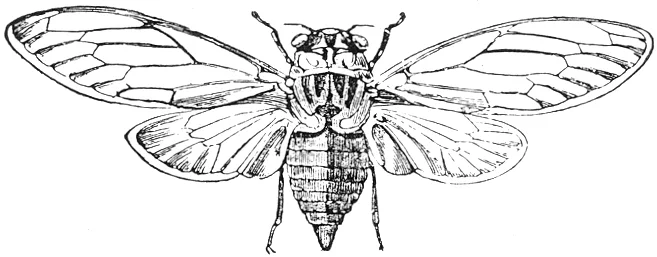
Text and translation
Τέγγε πλεύμονας οἴνωι, τὸ γὰρ ἄστρον περιτέλλεται
Alcaeus · fr. 347 (347a Lobel–Page) · gl²ᶜ used line by line · Greek wording from public-domain editions
How to read each line
A guide to the Greek, syllables, pitch marks and quantities.
Show the reading key
- Above each line: the line as the edition prints it, each word placed over its own syllables. The main row: the same Greek divided into metrical syllables, each written as it is pronounced. A consonant that closes a syllable is written with it (λόθ | ρο); an elided word is closed up with the next vowel (ν’ἀ); a final consonant carried into the next word is set with a thin space (ς ἰ). Wider gaps mark word-ends.
- Above the syllables: the pitch of each syllable, from the accents. Under them: the quantity of each syllable as it falls in the line, then the transliteration, syllable by syllable, with accented syllables in capitals.
- Under each line: a line-for-line translation. In the right margin of the scansion: the line type, its scheme, and its analysis into cola.
Key to the labels
The names, patterns and symbols used beside this poem.
Show the labels and symbols
The labels in the right margin of the scansion below name the cola, the rhythmic units each line is built from (Voigt’s and West’s analysis). A caret before a name (∧hipp) means the colon has lost its first position (acephalous). × marks an anceps position, which takes a long or a short. A click on any syllable highlights its colon, or, with the colon/foot switch, its foot. The sources of the labels, with their page numbers, are given line by line under Prosody, line by line.
| Label | Name and shape | What it is |
|---|---|---|
| alc-base | Aeolic base× × | Two positions free in quantity; in practice the first is more often long, and both short is uncommon in the Lesbians.[5] In Alcaeus’ gl²ᶜ Voigt marks the first position — and the second ⏓ (Conspectus, Alcaeus C 3 d). |
| alc-ch1 | First choriamb— ⏑ ⏑ — | Positions 3–6: the choriamb of the glyconic. Voigt marks word-end after position 6 in at least half the lines (C 3 d). |
| alc-ch2 | Second choriamb (expansion)— ⏑ ⏑ — | Positions 7–10, the first of the two inserted choriambs.[6] Voigt marks word-end after position 10 in at least half the lines, and never between the two shorts. |
| alc-ch3 | Third choriamb (expansion)— ⏑ ⏑ — | Positions 11–14, the second inserted choriamb. |
| alc-g-cl | Close⏑ × | Positions 15–16, the ⏑ — ending of the glyconic; at period-end the last position is indifferent. |
The feet
| Foot and shape | Where |
|---|---|
| First syzygy× × — ⏑ | Positions 1–4. Hephaestion[7] treats this line as an antispastic tetrameter acatalectic, the “Sapphic sixteen-syllable”: the first foot takes any of the four disyllabic shapes. |
| Antispast⏑ — — ⏑ | Positions 5–8: a pure antispast.[8] |
| Antispast⏑ — — ⏑ | Positions 9–12: a pure antispast.[8] |
| Iambic syzygy⏑ — ⏑ × | Positions 13–16: the last syzygy of the acatalectic line is iambic.[8] |
Scansion
Scansion of the surviving passage: Greek in metrical syllables, the quantity and pitch of each syllable, a syllabified transliteration and a line-for-line translation, with the line type and its cola in the right margin. The end of line 3 is lost, and Proclus’ quotation stops after the first word of line 6.
Soak your lungs in wine, for the star is making its round,
and the season is cruel, and all things thirst beneath the heat,
and from among the leaves the cicada shrills sweetly …
The artichoke is blooming; now women are most depraved,
and men are weak, because head and knees alike Sirius
scorches.
Metre
Text. The wording is drawn from the old edition and its recorded variants.[9] The display takes πλεύμονας from the apparatus, keeps δέ after ἄνθει while omitting the accompanying καί, and leaves out the conjectural continuation after τέττιξ. The supplement καί in line 5 is printed in the old teaching edition.[10] Accents, smooth breathings, σδ for ζ in ἄσδει, iota presentation, punctuation, brackets and quantity marks are normalized. The modern edition remains the source for the metrical analysis and discussion of variants.
- The line. Voigt’s Conspectus metrorum lists fr. 347 under C 3 d, the glyconic with double choriambic expansion, gl2c, used line by line:[11] — ⏓ — ⏑ ⏑ — ⁝ — ⏑ ⏑ — ⁝ — ⏑ ⏑ — ⏑ ⏓ ‖, where ‖ marks the end of a colon (key, p. 15). The glyconic × × — ⏑ ⏑ — ⏑ — is expanded from within by two further choriambs,[12] and in lines of this kind word-end often falls between one choriamb and the next (West, p. 34); Voigt’s ⁝ after positions 6 and 10 records word-end there in at least half the lines, and her tie over the two shorts of the middle choriamb a place where word-end never falls (Conspectus, p. 15).
- Hephaestion’s name for it. Hephaestion calls the line the “Sapphic sixteen-syllable”, an antispastic tetrameter acatalectic used for the whole of Sappho’s third book “and many songs of Alcaeus” (Ench. 10.6, p. 34 Consbruch); his example there is Alcaeus fr. 343 (Voigt’s testimonia to fr. 343). The click panel’s “foot” view gives his four syzygies.[8]
- The aeolic base. The first two positions are free in Sappho and Alcaeus,[13] though two shorts together are rare in the Lesbian poets.[5] Voigt prints Alcaeus’ first position as — and the second as ⏓. Here the base is long–long in every line; in line 1 the second syllable is long only by position, before the πλ of πλεύμονας.
- Lesbian prosody. No resolution or contraction;[14] elision instead of hiatus, which Lesbian lyric avoids altogether;[15] in “normal” Lesbian lyric a stop followed by a liquid makes position even across a word-boundary.[16] Each line is a period, so its last position is indifferent.[17]
- Gaps. Line 3 survives to position 11, line 6 to position 2. Their schemes on this page stop where the text stops; the last mark of each is the end of what survives, not a line-end. In line 5 one syllable is missing in all the manuscripts; the supplement shown is one of those recorded by Voigt.
Dialect and transliteration
- Forms. πλεύμονας is the old form of the word for “lungs”, Homeric and, by the grammarians’ account, the true Attic form, later altered to πνεύμων.[18] Lesbian: ἀ (ἡ), χαλέπα (χαλεπή), ἄχει (ἠχεῖ), ἄδεα (ἡδέα), κεφάλαν, with the long α that Attic turns into η; ὐπά (ὑπό), without aspiration; ἄσδει with σδ for ζ.[19] δίψαισ’, ὐπά, γόνα and ἄσδει are editors’ restorations of the Lesbian forms (Voigt’s apparatus).
- Key. η = ē, ω = ō, long α ι υ = ā ī ȳ, υ = y, χ = ch. Accented syllables are in capitals.
Prosody, line by line
Every syllable, with the reason for its length. Quantities are read from the vowel where the spelling shows it, from the consonants that follow (“position”), from the accent where it tells, and from the metre where nothing else does. Editors’ notes on the text follow in the boxed paragraphs.
- 347.1
Line 347.1 · Τέγγε πλεύμονας οἴνωι, τὸ γὰρ ἄστρον περιτέλλεται,
Τέγγε πλεύμονας οἴνωι, τὸ γὰρ ἄστρον περιτέλλεται,
Τέγγεπλεύμονας οἴνωι,τὸγὰρ ἄστρονπεριτέλλεται,The label in the margin, with its sources: gl²ᶜ (Voigt C 3 d; ⁝ also West p. 34).
- 1 —Τέγέ is short by nature; closed by γ: long by position; the position is anceps.
- 2 —γεε is short by nature; the next word begins with πλ: the syllable is closed before it: long by position; the position is anceps.
- 3 —πλεύεύ is a diphthong, long by nature.
- 4 ⏑μοο is short by nature.
- 5 ⏑ναα is short by the accent rule: acute on the antepenult requires a short final syllable.
- 6 —ς οἴοἴ is a diphthong, long by nature; the first consonant belongs to the previous word and is carried over to this vowel.
- 7 —νωι,ωι is a diphthong, long by nature.
- 8 ⏑τὸὸ is short by nature.
- 9 ⏑γὰὰ is short by the metre (position 9 must be short).
- 10 —ρ ἄσἄ is a vowel of unknown length; closed by σ: long by position; the first consonant belongs to the previous word and is carried over to this vowel.
- 11 —τρονο is short by nature; closed by ν: long by position.
- 12 ⏑πεε is short by nature.
- 13 ⏑ριι is short by the metre (position 13 must be short).
- 14 —τέλέ is short by nature; closed by λ: long by position.
- 15 ⏑λεε is short by nature.
- 16 ×ται,αι is a diphthong, long by nature; the position is anceps.
γγ closes Τέγ-, and the second syllable, γε, is short by nature but long by position: the next word begins with πλ, and in Lesbian verse a stop + liquid makes position even at the start of a word.[16] So the base is — —. Voigt prints πλεύμονας with two of the sources (Athenaeus 10.430b and Plutarch); the others have πνεύμονα(ς) (Voigt’s apparatus).
The ς of πλεύμονας and the ρ of γάρ pass to the following vowels, so να and γὰ are short at 5 and 9. In ἄστρον the σ closes ἄσ- and τρ begins the next syllable; τρον is closed by ν before π. Here word-end falls after positions 7 and 11, not at the places Voigt marks ⁝ (after 6 and 10): her sign describes a majority of lines, not a rule. The final -ται is indifferent.
- 347.2
Line 347.2 · ἀ δ’ ὤρα χαλέπα, πάντα δὲ δίψαισ’ ὐπὰ καύματος,
ἀ δ’ ὤρα χαλέπα, πάντα δὲ δίψαισ’ ὐπὰ καύματος,
ἀδ’ὤραχαλέπα,πάνταδὲδίψαισ’ὐπὰκαύματος,The label in the margin, with its sources: gl²ᶜ (Voigt C 3 d; ⁝ also West p. 34).
- 1 —ἀᾱ̓ is long (its length is not shown by the ordinary spelling); the position is anceps.
- 2 —δ’ὤὤ is long by nature; the apostrophe marks an elided vowel; the consonant before it joins this syllable; the position is anceps.
- 3 —ραα is long by the metre (position 3 must be long).
- 4 ⏑χαα is short by the metre (position 4 must be short).
- 5 ⏑λέέ is short by nature.
- 6 —πα,α is long by the metre (position 6 must be long).
- 7 —πάνά is a vowel of unknown length; closed by ν: long by position.
- 8 ⏑ταα is short by the metre (position 8 must be short).
- 9 ⏑δὲὲ is short by nature.
- 10 —δίψ is a double consonant (two sounds) and closes the syllable: long by position.
- 11 —ψαιαι is a diphthong, long by nature.
- 12 ⏑σ’ὐὐ is short by the metre (position 12 must be short); the apostrophe marks an elided vowel; the consonant before it joins this syllable.
- 13 ⏑πὰὰ is short by the metre (position 13 must be short).
- 14 —καύαύ is a diphthong, long by nature.
- 15 ⏑μαα is short by the metre (position 15 must be short).
- 16 ×τος,ο is short by nature; closed by ς: long by position; the position is anceps.
ἀ is the article (Attic ἡ); its α is long, marked with a macron, at position 1. In δ’ ὤρα the δέ is elided.[20] ὤρα, χαλέπα: positions 3 and 6 must be long, and the scanner takes the final α of each from the metre: ὤρα has the long α of Attic ὥρα, χαλέπα the Lesbian long α for Attic η (χαλεπή) and the recessive accent.[19]
δίψαισ’ is elided before ὐπά;[20] ψ counts as two consonants,[21] so δίψ- is long at 10. Voigt’s reading starts from the δίψαις of one manuscript of Athenaeus, recognised as a form by Neue; other manuscripts have διψᾷ or ἐδίψουν, and Voigt notes that the verb may be singular. ὐπά is Ahrens’s Lesbian form for the transmitted ὑπό. The words πάντα … καύματος are missing in Proclus and in one manuscript of Athenaeus (Voigt’s apparatus). The last syllable is indifferent.
- 347.3
Line 347.3 · ἄχει δ’ ἐκ πετάλων ἄδεα τέττιξ …
ἄχει δ’ ἐκ πετάλων ἄδεα τέττιξ …
ἄχειδ’ἐκπετάλωνἄδεατέττιξ- 1 —ἄᾱ̓́ is long (its length is not shown by the ordinary spelling); the position is anceps.
- 2 —χειει is a diphthong, long by nature; the position is anceps.
- 3 —δ’ἐκἐ is short by nature; closed by κ: long by position; the apostrophe marks an elided vowel; the consonant before it joins this syllable.
- 4 ⏑πεε is short by nature.
- 5 ⏑τάά is short by the metre (position 5 must be short).
- 6 —λωνω is long by nature.
- 7 —ἄἄ is long by the metre (position 7 must be long).
- 8 ⏑δεε is short by nature.
- 9 ⏑αα is short by the accent rule: acute on the antepenult requires a short final syllable.
- 10 —τέτέ is short by nature; closed by τ: long by position.
- 11 ×τιξι is a vowel of unknown length; closed by ξ: long by position.
ἄχει (ἠχεῖ) has a long ᾱ, marked with a macron, in the base. In δ’ ἐκ the δέ is elided, and the κ of ἐκ closes its syllable before π: two consonants are divided between syllables.[22] The ν of πετάλων passes to ἄδεα, whose α is long by the metre at position 7; ἄδεα then has two short syllables, -δε-α. ττ closes τέτ-, and ξ, two consonants, closes the last surviving syllable.
The rest of the line is lost. Voigt prints ἄδεα τέττιξ (Barker; the manuscripts of Proclus have τάδεάντ- and the like) followed by dots; her apparatus records the supplements ⟨ὐπὸ τῶν πτέρων⟩ (Blomfield) and ⟨πτερύγων ὔπο⟩ (Seidler), both from Hesiod’s description of the cicada, among others.
- 347.4
Line 347.4 · ἄνθει δὲ σκόλυμος, νῦν δὲ γύναικες μιαρώταται
ἄνθει δὲ σκόλυμος, νῦν δὲ γύναικες μιαρώταται
ἄνθειδὲσκόλυμος,νῦνδὲγύναικεςμιαρώταταιThe label in the margin, with its sources: gl²ᶜ (Voigt C 3 d; ⁝ also West p. 34).
- 1 —ἄνἄ is a vowel of unknown length; closed by ν: long by position; the position is anceps.
- 2 —θειει is a diphthong, long by nature; the position is anceps.
- 3 —δὲὲ is short by nature; the next word begins with σκ: the syllable is closed before it: long by position.
- 4 ⏑σκόό is short by nature.
- 5 ⏑λυυ is short by the metre (position 5 must be short).
- 6 —μος,ο is short by nature; closed by ς: long by position.
- 7 —νῦνῦ carries a circumflex, so it is long; closed by ν: long by position.
- 8 ⏑δὲὲ is short by nature.
- 9 ⏑γύύ is short by the metre (position 9 must be short).
- 10 —ναιαι is a diphthong, long by nature.
- 11 —κεςε is short by nature; closed by ς: long by position.
- 12 ⏑μιι is short by the metre (position 12 must be short).
- 13 ⏑αα is short by the metre (position 13 must be short).
- 14 —ρώώ is long by nature.
- 15 ⏑ταα is short by the metre (position 15 must be short).
- 16 ×ταιαι is a diphthong, long by nature; the position is anceps.
Voigt prints ἄνθει δὲ with two manuscripts of Proclus (the others add καί). δὲ is long at position 3 because σκ follows: two consonants close the syllable. The ς of σκόλυμος closes its syllable before ν, and the ς of γύναικες before μ, so positions 6 and 11 are long. μιαρώταται has five syllables, μι-α-ρώ-τα-ται; the last is indifferent.
- 347.5
Line 347.5 · λέπτοι δ’ ἄνδρες, ἐπεὶ καὶ κεφάλαν καὶ γόνα Σείριος
λέπτοι δ’ ἄνδρες, ἐπεὶ καὶ κεφάλαν καὶ γόνα Σείριος
λέπτοιδ’ἄνδρε,ς ἐπεὶ[καὶ]κεφάλανκαὶγόναΣείριοςThe label in the margin, with its sources: gl²ᶜ (Voigt C 3 d; ⁝ also West p. 34).
- 1 —λέπέ is short by nature; closed by π: long by position; the position is anceps.
- 2 —τοιοι is a diphthong, long by nature; the position is anceps.
- 3 —δ’ἄνἄ is a vowel of unknown length; closed by ν: long by position; the apostrophe marks an elided vowel; the consonant before it joins this syllable.
- 4 ⏑δρε,ε is short by nature.
- 5 ⏑ς ἐἐ is short by nature; the first consonant belongs to the previous word and is carried over to this vowel.
- 6 —πεὶεὶ is a diphthong, long by nature.
- 7 —[καὶ]αὶ is a diphthong, long by nature.
- 8 ⏑κεε is short by nature.
- 9 ⏑φάά is short by the metre (position 9 must be short).
- 10 —λανα is a vowel of unknown length; closed by ν: long by position.
- 11 —καὶαὶ is a diphthong, long by nature.
- 12 ⏑γόό is short by nature.
- 13 ⏑ναα is short by the metre (position 13 must be short).
- 14 —Σείεί is a diphthong, long by nature.
- 15 ⏑ριι is short by the metre (position 15 must be short).
- 16 ×οςο is short by nature; closed by ς: long by position; the position is anceps.
ἄνδρες: ν closes ἄν-, and the ς passes to ἐπεί, so δρε is short at 4. After ἐπεί one syllable is missing in the manuscripts: Voigt prints ⟨ ⟩ and records ⟨καὶ⟩ (Seidler), ⟨δὴ⟩ (Bergk), ⟨τοι⟩ (Wilamowitz) and ⟨κὰκ⟩ (Marzullo). Any long syllable fills position 7; Seidler’s καί, shown here in brackets, gives “both head and knees”. Spelman[23] prints Bergk’s δή. The manuscripts of Proclus also have κεφαλήν, which editors give its Lesbian form κεφάλαν.
γόνα is Bergk’s Lesbian form (the manuscripts have γόνατα or γούνατα, too long for the line). The final -ος of Σείριος is indifferent.
Campbell prints Bergk’s ⟨δὴ⟩.[24]
- 347.6
Line 347.6 · ἄσδει
ἄσδει
ἄσδει- 1 —ἄσἄ is a vowel of unknown length; closed by σ: long by position; the position is anceps.
- 2 ×δειει is a diphthong, long by nature; the position is anceps.
Only the first word survives: ἄσδει, Meister’s Lesbian spelling (σδ for ζ) of the transmitted ἄζει. σδ closes ἄσ-, so the base is — —. The last mark shows where the quotation stops.
Hesiod behind the song
The fullest quotation of the song is in Proclus’ commentary on Hesiod’s Works and Days, at line 584 (Voigt’s testimonia). Voigt’s parallels show how closely it follows Hesiod’s description of high summer (Works and Days 582 ff.): the artichoke in flower, the cicada singing from the tree, the women “most lustful” and the men “weakest, since Sirius parches head and knees”. Pliny, quoted in her testimonia, cites Hesiod and Alcaeus as witnesses that the artichoke, taken in wine, stirs desire.
How the two passages are related is disputed. Some scholars think that both poets draw on a shared source or on common traditional language; Spelman argues that so many shared words point to a deliberate allusion by Alcaeus to Hesiod’s text, an early stage in the history of allusion.[25] Yatromanolakis speaks of Alcaeus’ “rehandling of traditional images” here (2009, p. 210). The song fixes its time of year:[26] Athenaeus quotes its opening for Alcaeus drinking in summer, in the same passage as fr. 338 for winter (Voigt’s testimonia)[27].
Notes
- ^ Spelman 2022, p. 277.
- ^ Spelman 2022, pp. 277–278.
- ^ Spelman 2022, pp. 275, 278.
- ^ Voigt 1971, p. 315.
- ^ a b West 1987, p. 33.
- ^ West 1987, p. 34: choriambic expansion, often with caesura between the choriambs.
- ^ Hephaestion, Ench. 10.1, 10.6.
- ^ a b c d Hephaestion, Ench. 10.1.
- ^ Bergk 1882, pp. 163–165.
- ^ Smyth 1900, p. 20.
- ^ Voigt 1971, p. 23.
- ^ West 1987, pp. 33–34; Battezzato 2009, p. 135.
- ^ Battezzato 2009, p. 134.
- ^ West 1987, p. 32; Battezzato 2009, p. 134.
- ^ West 1987, pp. 13–16.
- ^ a b West 1987, p. 16 n. 7.
- ^ West 1987, p. 4.
- ^ LSJ s.v. πλεύμων.
- ^ a b de Kreij 2022, pp. 147–148.
- ^ a b West 1987, p. 13.
- ^ West 1987, p. 12 n. 1.
- ^ West 1987, p. 12.
- ^ Spelman 2022, p. 277.
- ^ Campbell 1982, p. 380.
- ^ Spelman 2022, pp. 277–278, citing Page’s judgement that no closer copy of one poet by another exists outside parody.
- ^ D’Alessio 2009, p. 118.
- ^ Spelman 2022, p. 278.
Text and sources
- Greek wording: T. Bergk, Poetae lyrici Graeci, fourth edition, vol. III (Leipzig 1882), pp. 163–165, main text and apparatus variants; H. W. Smyth, Greek Melic Poets (London 1900), p. 20, for καί in line 5. Public domain; selected and normalized as described above.
- Scholarly comparison: E.-M. Voigt, Sappho et Alcaeus: Fragmenta (Amsterdam 1971), fr. 347 with testimonia, parallels and apparatus (pp. 315–316), and Conspectus metrorum, Alcaeus C 3 d (p. 23) and key (p. 15), checked against the page images. Printed with ordinary sigma; Seidler’s supplement in l. 5 from her apparatus, in square brackets (Voigt prints a gap, ⟨ ⟩); macrons added on ἀ (l. 2) and ἄχει (l. 3).
- M. L. West, Introduction to Greek Metre (Oxford 1987), pp. 4 (period-end), 12–17 (syllables, elision, stop + liquid) and 32–35 (Lesbian lyric, the aeolic base, choriambic expansion), checked against the page images.
- H. Spelman, ‘Alcaeus’, ch. 19, pp. 277–278, and M. de Kreij, ‘The Lyric Dialects’, ch. 10, pp. 147–148, in L. Swift (ed.), A Companion to Greek Lyric (Wiley 2022); D. Yatromanolakis, ‘Alcaeus and Sappho’, p. 210, G. B. D’Alessio, ‘Language and pragmatics’, p. 118, and L. Battezzato, ‘Metre and music’, pp. 134–135, in F. Budelmann (ed.), The Cambridge Companion to Greek Lyric (Cambridge 2009).
- LSJ s.v. πλεύμων (Perseus Digital Library, CC BY-SA).
- Hephaestion, Enchiridion 10.1 and 10.6, ed. M. Consbruch (Leipzig 1906), public domain; Greek text from First1KGreek, CC BY-SA 4.0.
- D. A. Campbell, Greek Lyric I: Sappho and Alcaeus (Loeb Classical Library 142, Cambridge, MA 1982), fr. 347(a) (pp. 380–381), as in Lobel and Page; Voigt numbers it 347. Same wording as Voigt apart from the supplement in l. 5 (see the note).
Quotations from copyrighted works are not covered by this page’s licence.


