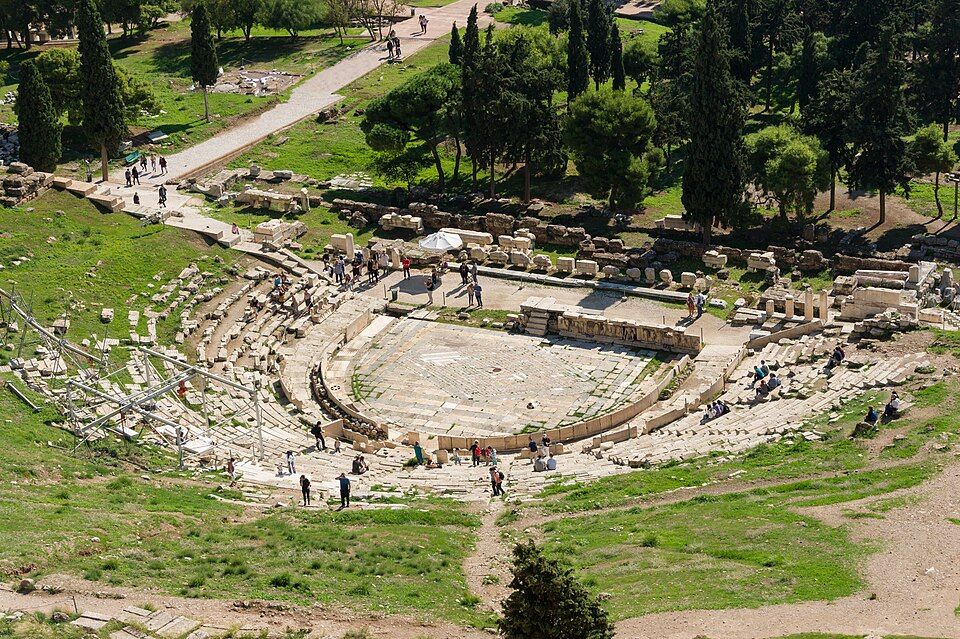
Poets and playwrightsTragedy
Euripides
Euripides’ spoken and sung verse: trimeters, lyric metres and their variations.
Works
- Synopsis
- Text and translation
- How to read each line
- Key to the labels
- Scansion
- Metre
- Prosody, line by line
- How this page was scanned
- Notes
- Synopsis
- Text and translation
- How to read each line
- Key to the labels
- Scansion
- Metre
- Prosody, line by line
- The chorus’s entry (131–138)
- Strophe and antistrophe
- Notes
- Synopsis
- Text and translation
- How to read each line
- Key to the labels
- Scansion
- Metre
- Prosody, line by line
- Strophe and antistrophe
- Notes
- Synopsis
- Text and translation
- How to read each line
- Key to the labels
- Scansion
- Metre
- Prosody, line by line
- Notes
- Synopsis
- Text and translation
- How to read each line
- Key to the labels
- Scansion
- Metre
- Prosody, line by line
- Strophe and antistrophe
- Notes
- Synopsis
- Text and translation
- How to read each line
- Key to the labels
- Scansion
- Metre
- Prosody, line by line
- Notes
- Synopsis
- Text and translation
- How to read each line
- Key to the labels
- Scansion
- Metre
- Prosody, line by line
- Strophe and antistrophe
- The first strophic pair (1251–1270)
- Notes
- Synopsis
- Text and translation
- How to read each line
- Key to the labels
- Scansion
- Metre
- Prosody, line by line
- How this page was scanned
- Notes
- Synopsis
- Text and translation
- How to read each line
- Key to the labels
- Scansion
- Metre
- Prosody, line by line
- Strophe and antistrophe
- Notes
- Synopsis
- Text and translation
- How to read each line
- Key to the labels
- Scansion
- Metre
- Prosody, line by line
- Strophe and antistrophe
- Notes
- Synopsis
- Text and translation
- How to read each line
- Key to the labels
- Scansion
- Metre
- Prosody, line by line
- Strophe and antistrophe
- Notes
- Synopsis
- Text and translation
- How to read each line
- Key to the labels
- Scansion
- Metre
- Prosody, line by line
- Strophe and antistrophe
- Notes
About · 1 of 8
The plays and their dates
Nineteen plays survive under Euripides’ name, eighteen tragedies and the satyr-play Cyclops.[1] The Greek text on this site is Gilbert Murray’s Oxford edition (Euripidis Fabulae) in the Perseus Digital Library. Gregory counts nine plays datable from external evidence;[2] the Cambridge Companion’s chronology dates more, several with a query.
| Play | Date | Production, where recorded | Source |
|---|---|---|---|
| Alcestis | 438 | second prize; fourth play, in place of a satyr-play, after Cretan Women, Alcmaeon in Psophis, Telephus | Chronology, p. 353; Gregory, p. 258 |
| Medea | 431 | third prize, with Philoctetes, Dictys, satyric Theristai | Chronology, p. 353 |
| Children of Heracles | 430–428? | Chronology, p. 353 | |
| Hippolytus | 428 | first prize (the revised version) | Chronology, p. 353 |
| Andromache | 425? | Chronology, p. 353 | |
| Hecuba | before 423? | Chronology, p. 353 | |
| Suppliant Women | 423? | Chronology, p. 353 | |
| Electra, Heracles | before 415? | Chronology, p. 353 | |
| Trojan Women | 415 | second prize, with Alexander, Palamedes, satyric Sisyphus | Chronology, p. 353 |
| Iphigenia among the Taurians | c. 413 | Chronology, p. 353 | |
| Helen | 412 | with Andromeda and perhaps Cyclops | Chronology, p. 353 |
| Phoenician Women | 409? | with Antiope and Hypsipyle | Chronology, p. 353 |
| Orestes | 408 | Chronology, p. 353 | |
| Bacchae, Iphigenia at Aulis | after 406 (Chronology); c. 407 (Gregory) | produced after his death; the Bacchae won first prize | Chronology, p. 353; Gregory, p. 269 n. 4 |
(Chronology = Easterling 1997; Gregory = Gregory 2005.) Gregory’s nine securely datable plays are Alcestis, Medea, Hippolytus, Trojan Women, Helen, Phoenician Women, Orestes, Bacchae and Iphigenia at Aulis. She gives the Phoenician Women as 409 without a query. She gives the two posthumous plays as “ca. 407”, where the chronology has “after 406”.[2] The Ion is not dated in either list.
Dating by metre. For the rest, the trimeter is the clock. After the Hippolytus (428) resolution becomes steadily more frequent. By the Orestes (408) some 35% of trimeters show it. So it offers a useful way of dating plays for which there is no direct evidence.[3] The undated plays are placed by it against the dated ones (Gregory, citing the table of Cropp and Fick 1985).[4]
The method goes back to Zielinski (1925). He divided the plays into four periods by the growing share of resolved long elements in the spoken trimeter.[5]
The figures differ. Halleran, citing the same table, gives the rise as from about 7% in the early plays to over 40% in the later ones.[6] West’s figure for the Orestes is 35%. West also speaks of a “transitional period” (Hecuba, Troades, IT, Ion) in which lyric anapaests are most used.[7] The plays after Andromache have astrophic dochmiacs.[8] Dactylo-epitrite is rare after 415.[9]
Groupings. The plays of 415 seem to have formed a connected set on the Trojan War, reminiscent of an Aeschylean trilogy.[10] The Alcestis of 438 combines tragic and satyric elements. Heracles plays his satyr-play role of the strongman who overpowers the ogre.[11]
Doubtful pieces. Authorship of the Rhesus is disputed. Easterling thinks it probably a fourth-century play. Cropp takes it to be (probably) a fourth-century play that replaced Euripides’ own Rhesus in the corpus. Burnett argued that Euripides wrote it young and made it perverse on purpose. Liapis argued that it was composed for a Macedonian production under Philip II.[12] West names it separately from the plays of Euripides.[9]
Finglass leaves the Rhesus out of his count as wrongly attributed. On that count eighteen of about ninety plays survive, about a fifth of the whole.[13] Most scholars now think the transmitted Rhesus spurious, though Euripides did write a play of that name.[14]
The transmitted ending of Iphigenia at Aulis (1578–1629) is in West’s view a wretched makeshift. Its author admitted features of the comic trimeter.[15] Both the Iphigenia at Aulis and the Phoenician Women are heavily interpolated.[16]
The lost plays. Papyri and ancient information give substantial insight into several lost plays. These are the Telephus (438), Phaethon and Erechtheus (around 420), Alexandros (415), Hypsipyle and Antiope, and the late Captive Melanippe. Papyri also supply scenes from Cretans (430s?) and Cresphontes (mid-420s).[17] The Archelaus, for the Macedonian king, was supposedly produced shortly before his death.[18]
Notes
- ^ Kovacs 2005, p. 379.
- ^ a b Gregory 2005, p. 269 n. 4.
- ^ West 1987, pp. 25–26.
- ^ Gregory 2005, p. 257.
- ^ Tyrrell 2020, p. 23.
- ^ Halleran 2005, p. 170.
- ^ West 1987, p. 61.
- ^ West 1987, p. 57.
- ^ a b West 1987, p. 65.
- ^ Gregory 2005, p. 258.
- ^ Seidensticker 2005, p. 50.
- ^ Easterling 1997, p. 211 n. 2; Cropp 2005, pp. 288, 292.
- ^ Finglass 2020, p. 29.
- ^ Scodel 2017, ch. 3, § 2.
- ^ West 1987, pp. 81–82.
- ^ Gregory 2005, p. 259; Kovacs 2005, p. 382.
- ^ Cropp 2005, pp. 280–281.
- ^ Cropp 2005, p. 282.
About · 2 of 8
The text in antiquity
What follows traces Euripides’ text through antiquity. The selection of plays, the Byzantine manuscripts and the modern editions are on the Manuscripts tab. The general story is on How the texts reached us.
The most performed tragedian. From 386 one “old” tragedy was revived each year at the City Dionysia. The provision was used mostly for Euripides. One of his Iphigenia plays was put on in 341, and the Orestes in 340 and again in the third century.[1] An inscription records the festivals of 341–339. It shows Euripides chosen for the revival in each year, by the actor Neoptolemus in 341 and 340.[2] His songs travelled too. Athenians captured in Sicily are supposed to have saved their lives by singing them.[3] Lucian tells of a craze for them centuries later.[4]
Actors’ lines. Popularity had a cost. Euripides was the most popular of the dramatists. So the Alexandrian critics found more lines altered or added by actors in his plays than anywhere else.[5] The scholia are the ancient notes copied in the margins of the manuscripts. They blame actors for Medea 85–88, and for Orestes 1366–1368. These lines are said to have been composed so that the actor playing the Phrygian need not jump from the roof.[5]
Lines added to a text by a later hand are called interpolations. Several kinds are recognised. Some are lines repeated from elsewhere in the play (Medea 1324 at 468) or from another play (Phoenician Women 972 at Helen 780). Some are additions for pathos (Medea 1233–1235). Some are whole passages that fit another poet’s plot (Phoenician Women 1625–1757, after Sophocles). And some are political reflections (Orestes 907–913).[6]
An official copy. About 330 the orator Lycurgus had an official copy of the three tragedians made. Actors were not to depart from it. His one surviving speech quotes fifty-five lines of Euripides’ Erechtheus.[7] Whether musical notation survived in such copies and reached Alexandria is disputed. Fleming and Kopff argue that musical and metrical knowledge was handed down; Parker and Prauscello, that it was lost.[8] Wilson thinks it “may well be” that it was transmitted with the texts.[9]
Alexandria. Aristophanes of Byzantium devoted himself to tragedy, and material from him reaches us in the scholia to Euripides. A hypothesis is a short introduction to a play. The scholarly hypotheses prefixed to some plays give the date, the other plays of the year and the prize, and they go back to him. He also discussed variant readings at Orestes 713, 1038 and 1287.[10]
The notes at the end of the Medea and Orestes name Dionysius and Didymus as the immediate sources of the scholia.[11] An inscription advertises volumes of Euripides. It shows that plays were sometimes sold in rough alphabetical order, five or six to a roll, perhaps following an Alexandrian edition.[11]
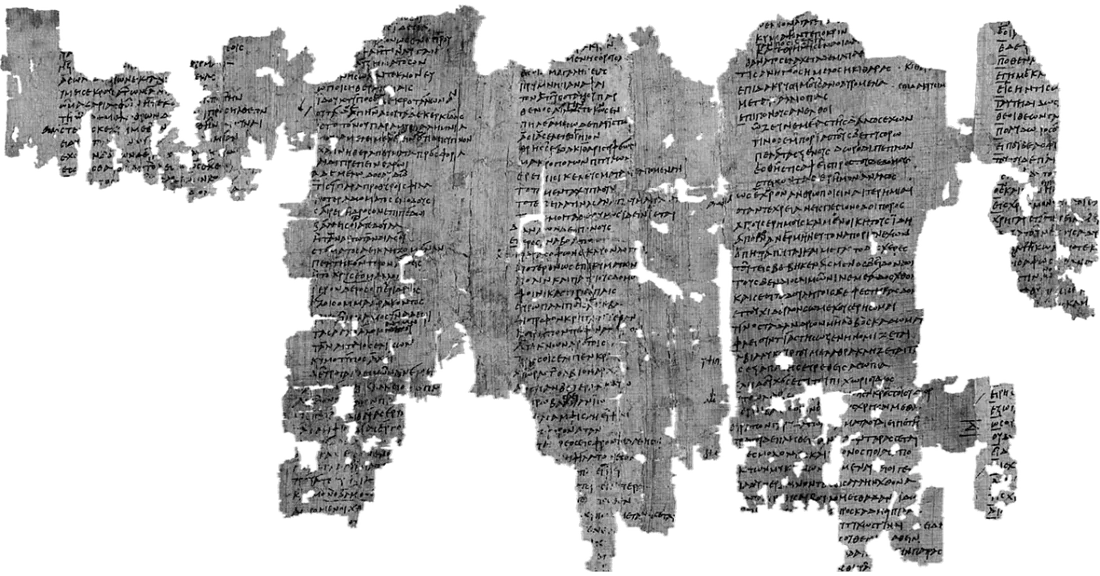
Ancient copies. Euripides is unusually well represented by ancient books. A fragment of the Cretans is an early example of a parchment book (P.Berol. 13217). The Hypsipyle is written on the back of a roll, across the fibres, when material was short (P.Oxy. 852).[12] Fragments of the Phaethon and Melanippe Desmotis from the fifth century AD show that plays outside the school selection were still read.[13]
Colometry is the division of lyric into its metrical units, or cola, set out line by line. Lyric was written as prose until the colometrized editions associated with Aristophanes of Byzantium.[14]
After about 200 BC the papyri and the medieval manuscripts divide tragic lyric into cola in much the same way. That uniformity seems to come from Alexandrian editing, and the name attached to it is Aristophanes of Byzantium’s.[15] The short cola helped readers to recognise familiar rhythms inside longer periods. The layout also used indentation. Trimeters stood at the normal margin, longer lines such as trochaic tetrameters stood out to the left, and lyric cola were set in to the right. Accents and breathings, also credited to Aristophanes, were used far less in drama than in Homer.[15]
Finglass urges caution. There is no hard evidence that Aristophanes edited all of Euripides, and confident claims about his editorial work in tragedy should be treated sceptically.[16]
A papyrus of Orestes 338–345 has musical notation. It is the oldest substantial stretch of written melody on papyrus, and it may preserve Euripides’ own melody. Points over some syllables apparently mark a rising beat (arsis) on the first and third elements of the dochmiac.[17] The papyrus dates from no earlier than about 280 BC. It writes the monosyllable ἐν (en), “in”, as e-en, sung to two notes.[3]
School author. In the schools of the Hellenistic kingdoms Euripides was among the most read authors, with Homer, Hesiod, Menander and Pindar.[18] His corpus, like others, came to include inauthentic material.[19]
Notes
- ^ Kovacs 2005, p. 381.
- ^ Easterling 1997, pp. 214–215.
- ^ a b Wilson 2005, p. 191.
- ^ Wilson 2005, p. 183.
- ^ a b Reynolds and Wilson 1991, p. 15.
- ^ Kovacs 2005, p. 382.
- ^ Kovacs 2005, p. 382; LeVen 2022, p. 365.
- ^ Barbantani 2009, p. 301.
- ^ Wilson 2005, p. 192.
- ^ Kovacs 2005, pp. 384–386.
- ^ a b Kovacs 2005, p. 386.
- ^ Reynolds and Wilson 1991, pp. 3–4.
- ^ Reynolds and Wilson 1991, p. 54.
- ^ Sampson 2022, ch. 7, §’Dialect and Meter’.
- ^ a b Mastronarde 2017, ch. 2, § 2.
- ^ Finglass 2020, pp. 34–35.
- ^ D’Angour 2022, ch. 9, §’From Meter to Music’.
- ^ Barbantani 2009, p. 312.
- ^ Spelman 2022, p. 281.
About · 3 of 8
Manuscripts and editions
This tells how the plays came through late antiquity and Byzantium to the printed page. The general history is on How the texts reached us.
Two routes. From about AD 250 quotation narrows to ten plays of Euripides. Nine of them carry ancient scholia, the notes of ancient commentators: Hecuba, Orestes, Phoenician Women, Hippolytus, Medea, Alcestis, Andromache, Rhesus and Trojan Women. The tenth is the Bacchae.[1]
By a happy accident nine more survived from the end of antiquity. Their titles begin with epsilon, eta, iota and kappa: Helen, Electra, Heracles, Children of Heracles, Suppliants, Ion, Iphigenia among the Taurians, Iphigenia at Aulis and Cyclops. They have no scholia. They are thought to be the remnant of an Alexandrian edition arranged in rough alphabetical order. These “alphabetic” plays survive only in one fourteenth-century manuscript in Florence. The Bacchae survives only in it and a copy of it.[1]
The two groups had different fates. The “selected” plays are found in many manuscripts, and the triad far more often than the rest. The alphabetic plays were one volume of an alphabetical complete edition, and they survive in a single manuscript and its copies.[2] The Bacchae belongs to the selection even though only two manuscripts preserve it.[3] Both of them date from the early fourteenth century. One breaks off at line 755, and the text has a large gap in the final scenes.[4]
Finglass thinks a single “selector” choosing plays for schools unlikely. The selection, in his view, happened gradually and naturally.[5]
The find was made by Demetrius Triclinius at Thessalonica. He had copies made by his pupils or in a local scriptorium, with many alterations in his own hand. These copies are our only source for the alphabetic plays. So for about half of Euripides’ surviving work we depend largely on Triclinius.[6]
Triclinius and responsion. Triclinius had studied Hephaestion’s metrical handbook. He knew that the lyrics of tragedy should respond exactly: the antistrophe should repeat the metre of the strophe. In his autograph Euripides (Laur. 32.2) he enforced this with “Procrustean violence”.[7] At Electra 435–437 he used responsion, and the parody of the passage in Aristophanes’ Frogs (1314 ff.). With them he made one good correction, then a bad one.[8]
Triclinius rediscovered strophic responsion in tragic lyric and used it to emend the text. Modern scholarship on Euripides begins with him.[9]
The school plays. The manuscripts of the plays read in Byzantine schools cannot be sorted into clean families. Readers compared copies and entered variants, so the tradition is “contaminated”.[10] In the thirteenth century the syllabus narrowed to a “triad”. For Euripides this was the Hecuba, Orestes and Phoenician Women, copied in hundreds.[11]
Byzantine appreciation was “superficial in the extreme”. Michael Psellus seriously compared Euripides’ iambics with those of the seventh-century George of Pisidia.[12] A palimpsest is a manuscript whose first text was scraped off and written over. One in Jerusalem preserves parts of several plays copied in the eleventh century, without improving the text much.[13]
Print. The first printed edition of the extant plays was the Aldine of 1503. It overlooked the Electra, which Petrus Victorius first printed in 1545.[14]
Four plays had already been printed, in Janus Lascaris’ edition (Florence, 1494): Alcestis, Andromache, Hippolytus and Medea. The sources differ on the first Electra: Finglass dates it to 1546. Willem Canter’s edition of 1571 was the first to print the lyrics in responding verse.[15]
Modern editions. The standard text is James Diggle’s Oxford edition in three volumes. The sources differ on its dates: 1982–1994 in the Cambridge Companion, 1984–1994 in Gregory.[16] Kovacs’s bilingual Loeb (1994–2004) is attentive to Diggle’s text but independent of it.[17]
The fragments are in Tragicorum Graecorum Fragmenta (1971–2004). It has replaced Nauck’s edition of 1889.[18] In 1997 Kannicht’s Euripides volume was still forthcoming.[19] Zuntz (1965) settled the relation of two key manuscripts. He showed that a supposed punctuation mark was a piece of straw.[20]
This site quotes Gilbert Murray’s text, which Perseus makes openly available. Editors differ at Bacchae 199–203. Murray printed the transmitted text, Diggle brackets the lines, and Kovacs proposes a lost line instead.[21]
Metre as evidence. Editors test the text against the regularities of tragic metre. At Iphigenia at Aulis 1578–1614 Porson’s Law and other rules are broken again and again, and editors diagnose a later hand. In Ion 1 they emend to restore the rule.[22]
At Helen 174 ~ 186 a syncopated metron answers a full one. A syncopated metron has lost one of its short or anceps elements. The text has been doubted, and many scholars reject the few parallels in Euripides and Aeschylus.[23] In Orestes 140–152 line 145 responds with 157. This shows that a doubtful sequence there is a baccheus.[24] An elision at Troades 129 is queried as “corrupt?”.[25] At Andromache 1035 ~ 1045 West suspects the text.[26]
Notes
- ^ a b Kovacs 2005, p. 387.
- ^ Finglass 2020, pp. 35–36.
- ^ Finglass 2020, p. 36 n. 34.
- ^ Mastronarde 2017, ch. 2, § 3.
- ^ Finglass 2020, p. 39.
- ^ Reynolds and Wilson 1991, p. 77; Gregory 2005, p. 254.
- ^ Reynolds and Wilson 1991, p. 76.
- ^ Reynolds and Wilson 1991, pp. 232–233.
- ^ Finglass 2020, p. 42.
- ^ Reynolds and Wilson 1991, pp. 61, 214–215.
- ^ Gregory 2005, p. 255; Kovacs 2005, p. 387.
- ^ Gregory 2005, pp. 254–255; Reynolds and Wilson 1991, pp. 68–69.
- ^ Reynolds and Wilson 1991, p. 195.
- ^ Kovacs 2005, p. 390; Reynolds and Wilson 1991, p. 156; see Printing.
- ^ Finglass 2020, pp. 42–43.
- ^ Easterling 1997, p. 357; Gregory 2005, p. 270.
- ^ Gregory 2005, p. 270; Easterling 1997, p. 358.
- ^ Cropp 2005, p. 291.
- ^ Easterling 1997, p. 357.
- ^ Kovacs 2005, p. 393.
- ^ Kovacs 2005, pp. 390–392.
- ^ Kovacs 2005, p. 389.
- ^ West 1987, p. 54.
- ^ West 1987, p. 58.
- ^ West 1987, p. 60.
- ^ West 1987, p. 66.
About · 4 of 8
His metres: speech and recitative
The trimeter and its chronology
The Nurse’s prologue to the Medea shows the early Euripidean trimeter, still close to Aeschylus and Sophocles:
Εἴθ’ ὤφελ’ Ἀργοῦς μὴ διαπτάσθαι σκάφος
Κόλχων ἐς αἶαν κυανέας Συμπληγάδας,
μηδ’ ἐν νάπαισι Πηλίου πεσεῖν ποτε
τμηθεῖσα πεύκη, μηδ’ ἐρετμῶσαι χέρας
Eith’ ōphel’ Argous mē diaptasthai skaphos / Kolchōn es aian kyaneas Symplēgadas, / mēd’ en napaisi Pēliou pesein pote / tmētheisa peukē, mēd’ eretmōsai cheras
“Would that the Argo’s hull had never flown through the dark Symplegades to the land of the Colchians, nor the cut pine ever fallen in the glens of Pelion, nor furnished with oars the hands …”
Iambic trimeters, × — ⏑ — × — ⏑ — × — ⏑ —. Every line has the penthemimeral caesura, after the fifth element. Red: the one resolution, κυ-α- in place of the third long (line 2), and the short -τε in the final long position (line 3).
Euripides, Medea 1–4, Murray’s text (Perseus)
synthetic ∿
Every line has the penthemimeral caesura, a word-end after the fifth element. A resolution is a long element replaced by two shorts. There is one, in line 2: κυ-α- of κυανέας, in the third princeps (the third long of the line). It falls within a word of three or more syllables, as resolutions usually do.[1] Line 3 ends with brevis in longo (-τε): a short syllable stands in the final long position.
That restraint does not last. In Aeschylus and Sophocles there is on average at most one resolved line in ten. In Euripides resolution grows steadily more frequent after the Hippolytus (428 BC). By the Orestes of 408 about 35% of the trimeters have it, some of them two or three times over, as Or. 643:[2]
ἃ δ’ ἔλαβες ἀπόδος πατρὸς ἐμοῦ λαβὼν πάρα.
ha d’ elabes apodos patros emou labōn para.
“but give back what you took from my father’s hands.”
Fifteen syllables for the trimeter’s twelve elements: three longs are resolved into ⏑ ⏑ (red), in the second, fourth and sixth elements.
Euripides, Orestes 643, Murray’s text (Perseus)
synthetic ∿
The two syllables of a resolution normally belong to one word. Where they are split, the first word is a monosyllable, or at most a disyllable closely linked to the next, as Or. 2:[1]
οὐδὲ πάθος οὐδὲ ξυμφορὰ θεήλατος,
oude pathos oude xymphora theēlatos,
“nor any suffering, nor any calamity sent by the gods,”
The resolution (red) is split between two words: -δὲ ends οὐδέ, a disyllable that belongs closely with the next word, and πά- begins πάθος.
Euripides, Orestes 2, Murray’s text (Perseus)
synthetic ∿
A prepositive is a short word, such as an article or preposition, that leans on the word after it. Euripides lets a prepositive supply the first syllable or two of an anapaestic foot. In tragedy this licence is otherwise confined to proper names.[3] Porson’s Law holds: when the ninth element, the last anceps, is long, no word may end after it. Andr. 230, where γάρ (gar) adheres to the preceding word, is tolerated:[4]
ζήτει παρελθεῖν· τῶν κακῶν γὰρ μητέρων
zētei parelthein; tōn kakōn gar mēterōn
“seek to outdo (your mother); for of bad mothers …”
The ninth element is long (γὰρ, red) and a word ends after it, against Porson’s Law. It is tolerated because γάρ leans on the word before it, so κακῶν γάρ counts as one word.
Euripides, Andromache 230, Murray’s text (Perseus)
synthetic ∿
Trochaic tetrameters return in his later plays.[5] Havet’s Law governs the line-opening, and it has three seeming exceptions in Euripides. A double short in the first three metra is admitted in tragedy only for a name, as IA 882:[6]
εἰς ἄρ’ Ἰφιγένειαν Ἑλένης νόστος ἦν πεπρωμένος;
eis ar’ Iphigeneian Helenēs nostos ēn peprōmenos?
“So Helen’s homecoming was fated to fall upon Iphigenia?”
A trochaic tetrameter catalectic, — ⏑ — × — ⏑ — × — ⏑ — × — ⏑ —. In the first metron the name Ἰφιγένειαν puts two shorts, φι-γε- (red), into the single fourth element.
Euripides, Iphigenia at Aulis 882, Murray’s text (Perseus)
synthetic ∿
A wider range of words. As resolution increases, the trimeters also admit differently shaped words and show increasing rhythmic variety.[7] The increase let a larger vocabulary into the line, and made the speech sound more natural.[8]
Stichomythia is line-by-line dialogue, and it is a Euripidean favourite. His later plays have scenes of more than a hundred consecutive lines of it (Ion 262–368). The Ion also has a very extended run of lines split between speakers (530–562).[9]
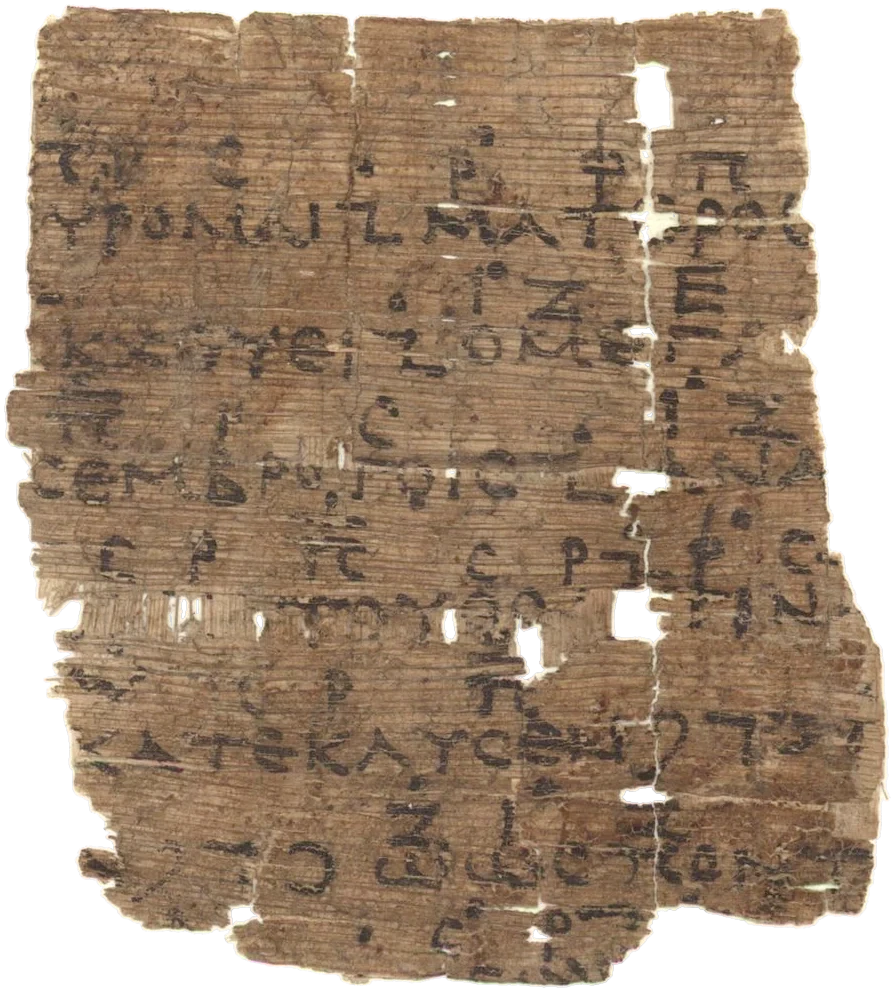
Speech, recitative and song
The three modes of delivery could alternate within a single scene. Recitative is chanted verse, between speech and full song. The opening of the Medea shows how the metres and dialect forms differentiate the action:[10]
| Lines | Mode | What happens |
|---|---|---|
| 1–95 | spoken iambics | the Nurse’s formal opening speech (1–48), then a more naturalistic conversation with the Tutor (49–95) |
| 96–130 | anapaests: song and recitative | Medea sings from inside the house; the Nurse answers in chanted recitative |
| 131–213 | choral song and dance; solo song; recitative | the chorus enters in the same anapaestic rhythm, then two responding stanzas (148–159 = 173–184), with Medea singing off stage and the Nurse in recitative |
| 214–266 | spoken iambics | Medea comes out and speaks in an orderly, analytical style |
All of Medea’s utterances up to 213 are sung. The Nurse only speaks and chants, which marks her subordinate role. But her chants are in the same metre as Medea’s songs.[11] Whether the Nurse’s lines are wholly recitative depends on the edition. Easterling follows Diggle’s text, which gives her non-lyric dialect throughout. Some manuscripts imply a mixture of recitative and lyric.[12]
Notes
- ^ a b West 1987, p. 26.
- ^ West 1987, pp. 25–26; Halleran 2005, p. 170.
- ^ West 1987, p. 26 n. 3.
- ^ West 1987, p. 25.
- ^ Gregory 2005, p. 257; Halleran 2005, p. 170.
- ^ West 1987, pp. 28–29.
- ^ Gregory 2005, p. 257.
- ^ Halleran 2005, p. 170.
- ^ Halleran 2005, p. 169.
- ^ Easterling 1997, pp. 159–160.
- ^ Easterling 1997, p. 160.
- ^ Easterling 1997, p. 159 n. 18.
About · 5 of 8
His metres: song
The lyric cola of Euripides are described below. How much of each play is sung, and by whom, is on the Chorus and Actors’ song tabs.
Dochmiacs. The dochmiac is the metre of excited song in tragedy. In dochmiac contexts Euripides also uses an anapaestic metron or dimeter + iambic colon. After Andromache his dochmiacs are mostly astrophic, that is, not set in strophes. Or. 140–152 is a worked example.[1] Euripides’ characteristic sung exchanges are mostly astrophic and often in dochmiacs.[2] Two short lines from that passage show the basic unit, the dochmius:
τίθετε, μὴ κτυπεῖτ’.
ἰδού, πείθομαι.
tithete, mē ktypeit’. / idou, peithomai.
“… set (your step) down, make no noise. … There, I obey.”
Each line is one dochmius, ⏑ — — ⏑ —. In 141 its first long is resolved into two shorts (red); 143 has the plain form.
Euripides, Orestes 141 and 143, Murray’s text (Perseus), scanned for this page
synthetic ∿
Astrophic song and the editor. From the plays after Andromache onwards, Euripides’ dochmiacs mostly stand outside strophes. They come in long arias and dialogues full of problems.[3] There is then no antistrophe to check against. The practical method is to count off runs of short syllables in eights, and to look for coincidence of word-end and metron-end. If the sum fails, try an iambic dimeter, or cretic plus dochmius.[4] The music leads to the same difficulty. With the New Music it can be hard, and sometimes impossible, to be sure what the cola are.[5]
Lyric iambics. In the later plays, above all in solo arias, the iambic sequence is divided so that trochaic phrasing proliferates. A πνῖγος (pnigos, “choker”) is a long run of verse with no pause for breath. Hel. 167–178 runs lekythia and trochaic metra together into a true πνῖγος, with no pause possible. Yet “it has to end iambic”.[6]
Aeolic strophes are typical above all of late Euripides. There their even, unchanging rhythm can be almost hypnotic. Phoen. 202–213 is glyconics and pherecrateans. Resolution is admitted most often before the choriamb. It yields shapes like ⏑ — ⏖ — ⏖ ⏑ ⏑ ⏖ at Ba. 427.[7]
Lyric anapaests. Euripides uses them more than any other poet, above all in Hecuba, Troades, IT and Ion. Ion 154–169 is the specimen. It has catalectic dimeters of seven longs and no caesura.[8]
Ionics are occasional elsewhere, but Euripides uses them most in the Bacchae. Their association with devotional cult, and perhaps a sense of the Asiatic, explains their prominence there.[9] Ionics can suggest a menacing or exotic Asian rhythm, of the kind used in ecstatic worship, as at Ba. 64–72.[10] The metre of the parodos is a traditional cult metre. It is used elsewhere in orientalizing and Dionysiac contexts.[11] From the parodos:
τίς ὁδῷ τίς ὁδῷ; τίς;
μελάθροις ἔκτοπος ἔστω, στόμα τ’ εὔφη-
μον ἅπας ἐξοσιούσθω·
τὰ νομισθέντα γὰρ αἰεὶ
Διόνυσον ὑμνήσω.
tis hodōi tis hodōi? tis? / melathrois ektopos estō, stoma t’ euphē- / mon hāpas exosiousthō; / ta nomisthenta gar aiei / Dionȳson hymnēsō.
“Who is on the way, who is on the way? Who? Let him stand aside indoors, and let every mouth be kept pure in holy silence; for I shall hymn Dionysus always with the songs that custom ordains.”
Ionic metra, ⏑ ⏑ — —. The first colon opens with the short metron ⏑ ⏑ — (io∧, red). The close, ⏑ ⏑ — ⏑ — — —, is a recognised ionic strophe-ending. The scansion needs long ᾱ in ἅπας and long ῡ in Διόνυσον (red).
Euripides, Bacchae 68–72, Murray’s text (Perseus)
synthetic ∿
The first colon is io∧ io. It has the short metron ⏑ ⏑ — (io∧), which is also found in Aeschylus.[12] The close ⏑ ⏑ — ⏑ — ⏒ — is one of the recognised ionic strophe-endings.[13] The scansion needs long ᾱ in ἅπας (70) and long ῡ in Διόνυσον (72).
In Phoen. and Ba. Euripides admits the resolutions ⏑ ⏑ ⏖ — and ⏑ ⏑ — ⏖. Late in the century a single short may replace the initial double short (Phoen. 1539 f.).[12]
Dactyls and dactylo-epitrite. A dactyl resolved to four shorts may occur at Andr. 490.[14] Dactylo-epitrite is rare after 415. It is seen in Med. 410–420, where colon-division coincides with word-division throughout:[15]
ἄνω ποταμῶν ἱερῶν χωροῦσι παγαί,
καὶ δίκα καὶ πάντα πάλιν στρέφεται.
anō potamōn hierōn chōrousi pagai, / kai dika kai panta palin strephetai.
“Upward flow the springs of the holy rivers, and justice and all things are turned back again.”
Dactylo-epitrite: ∪ D — e — ‖ e — D. The hemiepes D, — ⏑ ⏑ — ⏑ ⏑ —, and the cretic e, — ⏑ —, are joined by link syllables (—). Red: D in line 410, e in line 411.
Euripides, Medea 410–411, Murray’s text (Perseus), analysis as on this site’s Medea 410–445 tab, which follows Lourenço’s
synthetic ∿
In the Medea dactylo-epitrite runs through all four stasima, which Dale analyses in her Metrical Analyses.[16] In the second stasimon (627–662) the first strophic pair is dactylo-epitrite and ends in an ithyphallic. The second pair is first choriambic, then iambo-anapaestic, then choriambic again.[17] The fourth stasimon (976–1001) is dactylo-epitrite. Its closing cola are catalectic iambic trimeters, which Dale treats as virtually equivalent to an epitrite and an ithyphallic.[18]
Old forms too. Euripides does not move only towards metrical freedom. Some songs use metres traditionally associated with cult songs. Two are Ion’s paean to Apollo (Ion 112–143) and the hymn to Dionysus that forms the parodos of the Bacchae.[19] The refrain of Ion’s paean is a molossus, — — —. It is a metre that recalls archaic invocations of the gods:[20]
ὦ Παιὰν ὦ Παιάν,
εὐαίων εὐαίων
εἴης, ὦ Λατοῦς παῖ.
ō Paian ō Paian, / euaiōn euaiōn / eiēs, ō Lātous pai.
“O Paean, O Paean, may you be blessed, blessed, O son of Leto.”
Nothing but longs: each line is two molossi, — — — | — — —.
Euripides, Ion 125–127, Murray’s text (Perseus)
synthetic ∿
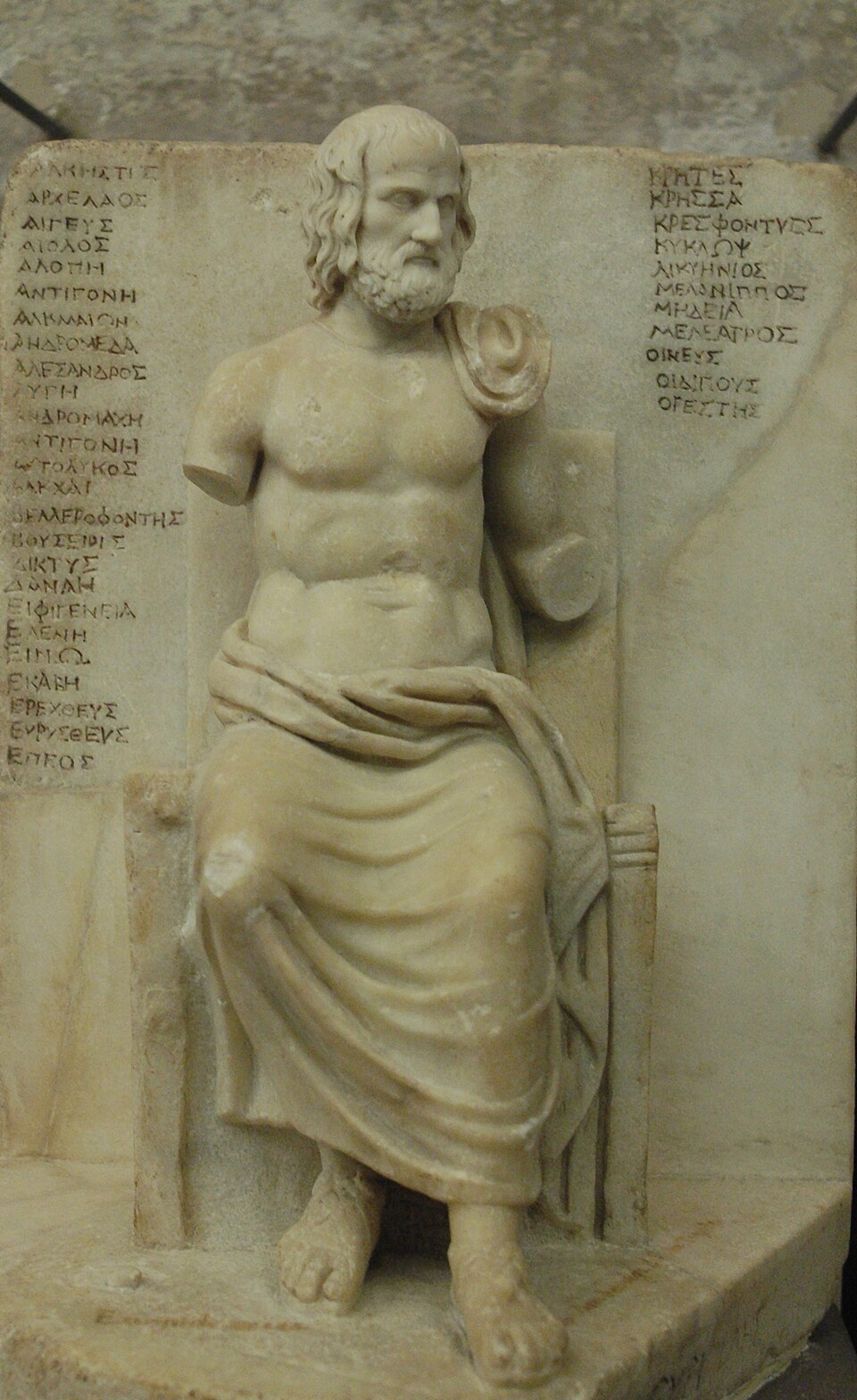
Notes
- ^ West 1987, pp. 57–58; see below.
- ^ Battezzato 2005, p. 158.
- ^ West 1987, p. 57.
- ^ West 1987, p. 58.
- ^ D’Angour 2022, ch. 9, §’Classical Lyric Meters’.
- ^ West 1987, pp. 53–54.
- ^ West 1987, pp. 58–59.
- ^ West 1987, pp. 60–61.
- ^ West 1987, pp. 61–62.
- ^ D’Angour 2022, ch. 9, §’Archaic Lyric Meters’.
- ^ Battezzato 2005, p. 164.
- ^ a b West 1987, p. 62.
- ^ West 1987, p. 63.
- ^ West 1987, p. 64.
- ^ West 1987, p. 65.
- ^ Dale 1971, pp. 50–57.
- ^ Dale 1971, pp. 52–53.
- ^ Dale 1971, pp. 56–57.
- ^ Gregory 2005, p. 257.
- ^ Battezzato 2005, p. 163.
About · 6 of 8
Euripides and the New Music
Three things set the later Euripides apart. His songs stop responding, they mix their metres, and his spoken verse loosens. The sources connect the first two with the “new music” of the second half of the fifth century.[1] They do not connect the third.
From strophe to aria. In a strophic song the antistrophe repeats the metre of the strophe; this repetition is called responsion. In fifth-century tragedy it is eventually given up for “metrically free (monostrophic) composition”. That is the form of the arias of late Euripidean tragedy. It is also the form of the lyrics of Timotheus of Miletus, the avant-garde musician of the late fifth century.[2]
The same change looks different from the composer’s side. Without strophes, the words never had to be fitted to a melody fixed in advance. The tune could follow every shade of feeling in the words. In such conditions a change of metre came naturally.[3] In astrophic song, song without strophes, the word accent had some effect on the melody.[4]
Polymetry. Polymetry is the use of many metres in one song. The long astrophic monodies (solo songs) and lyric dialogues of the last plays of Euripides and Sophocles show more of it than anything else.[3] The same polymetry was characteristic of the dithyrambic poets of the age. Timotheus’ Persae moves through iambic, choriambic, trochaic, cretic, dochmiac, dactylic, anapaestic and aeolic sequences before settling into aeolic.[5] A Hellenistic papyrus aria, P.Dryton 50, is polymetric and has no strophes, in the manner of the late classical New Music. It is full of dochmiacs.[6]
From the plays after Andromache, Euripides’ dochmiacs are “predominantly astrophic”.[7] In the later arias, iambic sequences are cut into trochaic phrasing that overruns the trimeter. Helen 167–178 is a headlong example.[8]
Melody over rhythm. The ancient testimonies show poets turning from display of rhythm to display of melody and harmony.[2] Euripides gave the first syllable of εἱλίσσετε (heilissete), “twirl”, a prolonged setting, a departure from one note per syllable. Aristophanes parodied it repeatedly (Frogs 1314, 1348):
“twirl!” (said to spiders spinning)
Aristophanes spells the stretched first syllable out vowel by vowel, εἱ-ει-ει-ει-, as a singer would hold it over several notes; at 1349 he does the same with εἱειειειλίσσουσα, “twirling”. Text of Hall and Geldart (Perseus).
Dionysius of Halicarnassus (On Literary Composition 64) says that music and rhythm, unlike prose, alter the natural quantities of words. They fit the syllables to the time-values, rather than the reverse.[2]
The singers of such passages, West supposes, had to manage changes of mode as well, a feature of the new music.[9] Earlier lyric, by contrast, is said to have been simpler. It kept to one harmonia, or mode, and probably followed the natural pitches of the words.[10]
The Orestes papyrus. The papyrus of Or. 338–345 is the earliest papyrus to preserve any length of notated music. It shows the influence of the New Musical style fashionable in Athens in the second half of the fifth century. Its melody conforms only moderately to the word accents, since it served strophe and antistrophe alike. It also shows word-painting. There is a falling cadence on the last syllables of κατολοφύρομαι (katolophyromai), “I bewail”. And there is a high note on ἀναβακχεύει (anabakcheuei), “stirs you to Bacchic frenzy”, reached by a melodic upward leap of a large interval, perhaps a fifth.[10]
Resolution as a clock. In the spoken verse the change is the steady rise of resolution. After the Hippolytus (428 BC) it rises to some 35% of trimeters in the Orestes of 408. The rise lets plays without external evidence be dated.[11] The sources do not link this to the music, and this site makes no such claim.
Notes
- ^ West 1987, p. 67; D’Angour 2022.
- ^ a b c D’Angour 2022, ch. 9, §’Classical Lyric Meters’.
- ^ a b West 1987, p. 66.
- ^ West 1987, p. 68 n. 2.
- ^ West 1987, p. 70.
- ^ Sampson 2022, ch. 7, §’Dialect and Meter’.
- ^ West 1987, p. 57.
- ^ West 1987, pp. 53–54.
- ^ West 1987, p. 67.
- ^ a b D’Angour 2022, ch. 9, §’From Meter to Music’.
- ^ West 1987, pp. 25–26; Gregory 2005, p. 257; Halleran 2005, p. 170.
About · 7 of 8
The chorus in Euripides
The Metres tabs describe Euripides’ cola, and the Style tab his late manner. His choruses are described below. Songs for actors are on the next tab.
How much the chorus sings. Choral lyric fills on average 15% of the lines of a Euripidean play. In Sophocles it fills 17%, and in Aeschylus 34–55%. Yet the odes still carry reflection and feeling.[1] In the Medea the figure is 19%.[2] In the later plays the proportion of song to speech changes little overall. Actors’ songs make up for the shrinking choral lyric (Battezzato, citing Csapo).[2]
Aristotle judged that Sophocles treated the chorus as “one of the actors”, and that Euripides did so less successfully (Poetics 1456a25–27).[3] Where their identity is certain, Euripides has fifteen male and twenty-six female choruses.[4]
Aristotle also complains that in later poets the songs became embolima, interludes that belong no more to one play than to another.[5] Calame argues the opposite for Euripides. In his view the chorus is woven into the drama and its music, and its songs are not mere interludes written under the influence of the New Music.[6]
Entrances. The parodos is the chorus’s entrance-song. In eight of the plays it is a dialogue between the chorus and a character already on stage. In some plays the chorus shares the protagonist’s fate, as the enslaved women of the Hecuba and Trojan Women do.[7] The Hecuba has the only extant parodos with no singing: the chorus enters in recitative anapaests.[8]
Metre and mood. A stasimon is a choral song sung after the chorus has entered. The third stasimon of the Medea (824–865) opens with praise of Athens in dactylo-epitrite, the metre of victory odes. In the second strophic pair the chorus asks how Medea can kill her children. There shorter aeolic measures make “a choppier rhythm”.[9] Many odes start far from the action and make the connection only in their second pair. The first and second stasima of the Medea do this.[9]
Songs of ritual. Odes borrow ritual genres. The Children of Heracles has the wedding cry ὦ Ὑμέναιε (917). In the Hippolytus (553–554) a wedding blessing is turned into a cry over an ill-fated marriage.[10] Later in the same play the chorus sings a hymn to Aphrodite and Eros (1268–1281). It is a single strophe in dochmiacs, the rhythm of strong emotion.[11] The old men of the Heracles sing what looks like an epinician (348–450). The entrance-song of the Bacchae (64–169) is in effect a dithyramb on the tragic stage.[12] It transposes a cult song in a traditional cult metre, ionics.[13]
Euripides also reshapes the lament. In the Andromache Peleus starts it (1172–1196). In the Suppliant Women Adrastus leads the female chorus (798–814). Each ends in a subordinate position.[14]
Choral narrative. In some plays the odes are linked by a single story told out of order. In the Hecuba and Trojan Women it is the fall of Troy; in the Phoenician Women, the story of Cadmus and Thebes.[15]
Some odes are almost all mythical narrative. Since Kranz they have been called “dithyrambic”, and they are characteristic of the late style. They have been compared with what Aristotle calls embolima, “things thrown in”: songs that could be performed in different plays.[16] But on close reading they are linked to the plot. The second stasimon of the Helen (1301–1368) and the third of Iphigenia among the Taurians are examples.[17]
A song for a city. In the Trojan Women it is the chorus that brings Troy into the play. Its song of the Wooden Horse (511–576) begins, unusually, with an appeal to the Muse for a new kind of song: a dirge for a city.[18]
Women’s songs imagined. Euripides’ female choruses sometimes imagine forms of women’s song that do not yet exist. The women of Corinth wish that Apollo had given them the lyre. Then they could answer the male poets’ tales of women’s faithlessness (Medea 414–428). The chorus of the Ion turns the “cacophonous muse” against men (1090–1098).[19]
Notes
- ^ Swift 2022, p. 378.
- ^ a b Battezzato 2005, p. 160.
- ^ Battezzato 2005, p. 161.
- ^ Battezzato 2005, p. 156.
- ^ Calame 2020, p. 775.
- ^ Calame 2020, p. 794.
- ^ Battezzato 2005, p. 157.
- ^ Battezzato 2005, p. 151.
- ^ a b Swift 2022, p. 379.
- ^ Swift 2022, pp. 381–382.
- ^ Calame 2020, p. 787.
- ^ Wilson 2005, p. 188.
- ^ Battezzato 2005, pp. 163–164.
- ^ Battezzato 2005, p. 162.
- ^ Battezzato 2005, p. 159.
- ^ Easterling 1997, p. 155.
- ^ Battezzato 2005, p. 164; Gregory 2005, p. 258.
- ^ Easterling 1997, pp. 176–177.
- ^ Wilson 2005, pp. 189–190.
About · 8 of 8
Songs for actors
Songs for actors are the most conspicuous change in Euripides’ drama. The chorus is on the previous tab.
A rising share. Over his career the share of lyric sung by actors rises from 13.3% in plays before the mid-420s to 47.1% in his last plays (Swift, citing Csapo).[1] The trend is reversed in the two plays produced after his death, the Bacchae and Iphigenia at Aulis. Euripides moved back and forth between new ways and old (Gregory, citing Csapo).[2]
The first monodies. A monody is a self-contained song for a single actor. Aeschylus and Sophocles have none. The first lyric monodies come in the Hippolytus of 428. There Phaedra sings 669–679, the long-postponed antistrophe to a choral song (362–372). Hippolytus has a long astrophic passage (1347–1388).[3] When an adult Greek man sings in Euripides, the song is brief, as at 1370–1388.[4]
Other monodies are Andromache’s (Andr. 103–116), Cassandra’s (Tro. 308–341) and Creusa’s (Ion 859–922).[3] Creusa’s is, in K. H. Lee’s view, the emotional and structural heart of the play.[5]
Early in the same play Ion himself sings a monody (112–143). It is in aeolic rhythm built on the choriamb, with a paean refrain at 141–143.[6]
Who sings. In Euripides, as in Aeschylus, song mostly belongs to characters who are not adult Greek men.[4] Boys, young adults and old men often have lyric parts. Among them are the children of Alcestis and Andromache, Ion and Hippolytus, Peleus, and the Oedipus of the Phoenician Women. Slaves are not given lyric, with one exception: the Phrygian slave of the Orestes.[7] Euripides may have been the first to give children singing parts.[8] In the Trojan Women Hecuba speaks, chants or sings almost a quarter of the lines.[9]
Forms. Euripides developed a mostly astrophic form in which an actor receives news and reacts in song, often in dochmiacs. Desperation is the usual reaction (Hec. 684–720, Tro. 239–291, Ion 763–799). In late plays the reaction may be joy, as in the recognition of Iphigenia among the Taurians (827–899) and Helen’s reunion with Menelaus (Hel. 627–697).[10]
Monodies are often astrophic, and so freer still in metre. The blinded Polymestor’s lament in the Hecuba (1056–1106) uses six types of metre.[4] The Phrygian slave’s song in the Orestes (1368–1502) takes the place of a messenger speech. It is in contorted Greek and a variety of metres.[11] It is one of the pieces inspired by the new dithyramb.[12]
Elegiacs in a tragedy. Andromache’s lament (Andr. 103–116) is in elegiac couplets. Euripides uses the word ἔλεγος (elegos) only of sad, mournful song.[13] The earliest instance of that sense is Trojan Women 119, of 415 BC.[14] The lament begins:
Ἰλίῳ αἰπεινᾷ Πάρις οὐ γάμον ἀλλά τιν’ ἄταν
ἠγάγετ’ εὐναίαν εἰς θαλάμους Ἑλέναν.
Iliōi aipeināi Paris ou gamon alla tin’ ātān / ēgaget’ eunaiān eis thalamous Helenān.
“To steep Ilium Paris brought no marriage but a ruin for his bed, when he led Helen into his chambers.”
Red, hexameter: -ῳ of Ἰλίῳ, shortened before αἰ- (correption); ἀ- of ἄταν, long ᾱ. Red, pentameter: the contracted foot τ’εὐ-ναί-, allowed only in the first half, and -ᾱ- of εὐναίαν, the long that ends that half before the caesura.
Euripides, Andromache 103–104, Murray’s text (Perseus)
synthetic ∿
In the hexameter the final -ῳ of Ἰλίῳ is shortened before αἰπεινᾷ. This shortening of a long vowel or diphthong before a vowel is called correption.[15] The masculine caesura falls after αἰπεινᾷ in the third foot.[16] The metre requires long ᾱ in ἄταν.
In the pentameter the contraction stands in the first half, the only place where the pentameter admits it. The two halves are divided by the caesura that is invariable in this line.[17] The last syllable before it, the -ᾱ- of εὐναίαν, must be long.
The New Music. The growth of solo song reflects the New Music of the later fifth century, with its virtuoso performers.[18] Its influence is clear from the Trojan Women of 415 on. The leading actor-singers became international stars.[19]
Euripides can be counted among the New Musicians. The Frogs mocks him for taking his songs from everywhere: “harlots’ ditties, drinking-songs … laments, dances” (1301–1303). The chorus of the Trojan Women calls its dirge “new” (καινῶν ὕμνων, kainōn hymnōn, 512). And his late tragedies show melisms, several notes on one syllable.[20] Timotheus’ monodies in the Persians are like those of Euripides’ later tragedies.[21]
Notes
- ^ Swift 2022, p. 383.
- ^ Gregory 2005, p. 258.
- ^ a b Battezzato 2005, p. 153.
- ^ a b c Swift 2022, p. 384.
- ^ Quoted by Wilson 2005, p. 189.
- ^ Calame 2020, pp. 784–785.
- ^ Battezzato 2005, p. 156.
- ^ Gregory 2005, p. 262.
- ^ Easterling 1997, p. 174.
- ^ Battezzato 2005, p. 158.
- ^ Swift 2022, p. 385.
- ^ Seidensticker 2005, p. 50.
- ^ Aloni 2009, pp. 169, 179.
- ^ Bartol 2022, p. 221.
- ^ West 1987, p. 14.
- ^ West 1987, p. 19.
- ^ West 1987, p. 24.
- ^ Swift 2022, pp. 384–385.
- ^ Wilson 2005, p. 190.
- ^ LeVen 2022, pp. 364, 368, 370.
- ^ Csapo and Wilson 2009, p. 289.
Medea 1–48 — the Nurse's prologue
Synopsis
Medea is a foreigner who gave up family and homeland to save Jason. Now he has abandoned her in Corinth. He is marrying the king’s daughter, and King Creon orders Medea into exile.[1] She wins a day’s reprieve from Creon, and a promise of refuge in Athens from King Aegeus. Then she takes her revenge. Her sons carry her gifts of a robe and a crown, which kill the princess and her father. To wound Jason most, she then kills her own children. She escapes with their bodies in the chariot of the Sun, her grandfather.[2] Euripides produced the play at the City Dionysia of 431 BC. That was a fortnight before the attack on Plataea that opened the Peloponnesian War. The other plays were Philoctetes, Dictys and the satyr-play Reapers, and Euripides won only third prize.[3]
These lines are the prologue, spoken by the Nurse. From her sympathetic point of view she tells Medea’s story and present plight, framed as a wish that none of it had happened. She fears that Medea may harm her children.[4]
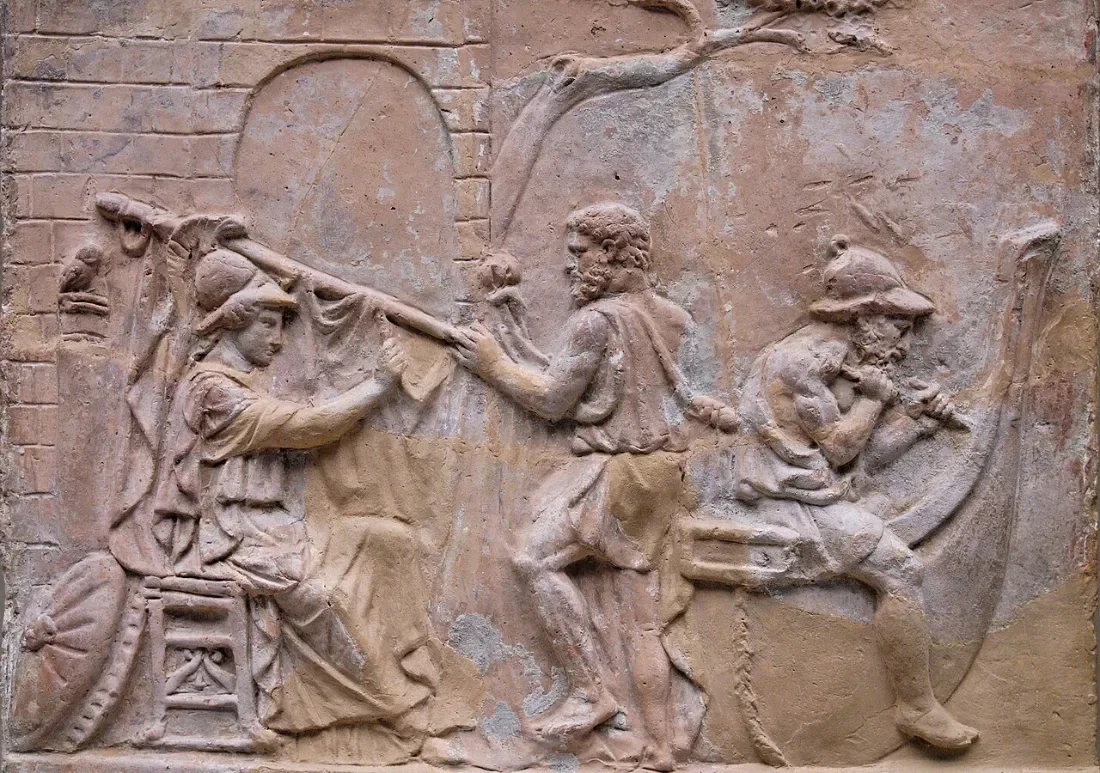
Text and translation
Εἴθ’ ὤφελ’ Ἀργοῦς μὴ διαπτάσθαι σκάφος
Euripides · Medea 1–48 · iambic trimeters · text of Murray (Oxford, via Perseus)
How to read each line
A guide to the Greek, syllables, pitch marks and quantities.
Show the reading key
- Above each line: the line as the edition prints it, each word placed over its own syllables. The main row: the same Greek divided into metrical syllables, each written as it is pronounced. A consonant that closes a syllable is written with it (λόθ | ρο); an elided word is closed up with the next vowel (ν’ἀ); a final consonant carried into the next word is set with a thin space (ς ἰ). Wider gaps mark word-ends.
- Above the syllables: the pitch of each syllable, from the accents. Under them: the quantity of each syllable as it falls in the line, then the transliteration, syllable by syllable, with accented syllables in capitals.
- Under each line: a line-for-line translation. In the right margin of the scansion: the line type, its scheme, and its analysis into cola.
Key to the labels
The names, patterns and symbols used beside this poem.
Show the labels and symbols
The labels in the right margin of the scansion below name the line, its scheme, the feet as the line realises them, and the caesurae and diaereses (the named word-ends) that fall in it. In the scheme — is a long position, ⏑ a short one and × an anceps, long or short; the descriptions below say where a long may be resolved into two shorts and where two shorts may stand in place of an anceps or a short.[5] A click on any syllable highlights its metron or colon, or, with the switch, its foot.
| Label | Name and shape | What it is |
|---|---|---|
| im1 | First iambic metron× — ⏑ — | Positions 1–4. The anceps may be long or short, and in the first foot it may be replaced by two shorts, which makes the foot an anapaest (⏑ ⏑ —). Either long may be resolved into two shorts. |
| im2 | Second iambic metron× — ⏑ — | Positions 5–8. The main caesura falls inside it, after position 5 (penthemimeral) or 7 (hephthemimeral). Either long may be resolved into two shorts. Outside the first foot tragedy admits an anapaest only for a proper name. |
| im3 | Third iambic metron× — ⏑ × | Positions 9–12, the last syllable indifferent (period-end). Porson’s law: when the anceps at 9 is long, it and the following syllable belong to the same word, unless one of them is a monosyllable. The long at 10 may be resolved only when the anceps at 9 is short. |
Scansion
The Nurse’s prologue, from the wish that the Argo had never sailed to the children’s return from play. Euripides opens almost every play with a monologue; here the speaker is a minor character, who tells the story as a wish that the whole chain of events had never begun.[6] Easterling 1997, pp. 158–159 classes lines 1–48 as a set opening speech in the elevated manner, spoken with no one else on stage, before the more naturalistic conversation of the two slaves (49–95) and the sung and chanted anapaests that follow. Each trimeter is scanned metron by metron, with its caesura, the third anceps checked against Porson’s law, and every resolution, anapaest and prosodic licence named.
If only the hull of the Argo had never flown through
the dark Clashing Rocks to the land of the Colchians,
and the pine had never fallen in the glens of Pelion,
cut down, nor put oars into the hands
of the best of men, who went after the all-golden fleece
for Pelias. For then my mistress
Medea would not have sailed to the towers of the land of Iolcus,
her heart struck with love for Jason;
nor, having persuaded the daughters of Pelias to kill
their father, would she be living in this land of Corinth
with her husband and her children, pleasing
in her exile the citizens of the land she came to,
and herself agreeing with Jason in everything;
and that is the greatest safety there is,
when a wife does not stand apart from her husband.
But now all is enmity, and what is dearest is sick.
For Jason has betrayed his own children and my mistress,
and goes to bed in a royal marriage,
wedded to the daughter of Creon, who rules the land;
and Medea, wretched, dishonoured,
cries out the oaths, calls on the right hands,
the greatest pledge, and calls the gods to witness
what return she meets with from Jason.
She lies without food, her body given up to pains,
wasting away all the time in tears,
since she learned that she was wronged by her husband,
neither lifting her eye nor raising her face
from the ground; and like a rock or a wave
of the sea she listens when her friends advise her;
except when at times she turns her pure white neck
and to herself bewails her dear father,
her land and her home, which she betrayed to come here
with a man who now holds her in dishonour.
The poor woman has learned from misfortune
what it is not to be cut off from one's father's land.
She hates her children and takes no joy in seeing them.
I fear she may be planning something new;
for her mind is heavy, and she will not endure
ill-treatment; I know her, and I fear her,
that she may drive a sharpened sword through the liver,
going silently into the house where the bed is spread,
or even kill the king and the bridegroom,
and then meet some greater misfortune.
For she is terrible: no one who joins in
enmity with her will easily carry off the song of victory.
But here are the children, done with their running,
coming in, with no thought at all of their mother's
troubles; for a young mind does not like to grieve.
Metre
- The line. Three iambic metra, × — ⏑ — | × — ⏑ — | × — ⏑ —, with period-end at the end of each line.[7] The trimeter is the metre of the spoken parts of tragedy: the iambics were spoken, not sung, and were felt to come closer than other metres to the rhythm of ordinary speech.[8] A set speech (rhēsis) such as this one is almost always in iambic trimeters, in the Attic dialect of the audience.[9]
- Caesura. Word-end after position 5 (penthemimeral) or else after position 7 (hephthemimeral).[10] Lines 9, 11, 20, 25, 30, 34 and 41 have only the hephthemimeral word-end. In line 15 the word before the penthemimeral place is the prepositive πρός, a single monosyllabic prepositive, which West 1987, p. 27 calls exceptional there; the stronger division is after ἄνδρα. In line 41 the word before the hephthemimeral place is the elided prepositive ἵν’ (ἵνα), and prepositives are not normally placed immediately before a caesura;[11] the line also divides after the elided εἰσβᾶσ’, at the end of the third foot, a rarer caesura, found in few tragic lines and nearly all of them with an elided word before it.[10]
- Porson’s law. When the anceps at position 9 is long, no word may end between it and the next syllable, except where one of the two is a monosyllable.[10] Position 9 is long in 21 of the 48 lines, and in every one of them the long syllable stands inside a word. Kovacs 2005, pp. 388–389, uses the same law, with its exception for monosyllables, to show how editors test transmitted lines against the regularities of tragic metre.
- Resolution. Six resolved longs in 48 lines: the first princeps in line 10 (πατέρα), the third in lines 2 (κυανέας), 18 (βασιλικοῖς), 21 (ἀνακαλεῖ) and 31 (πατέρ’), the fourth in line 9 (Πελιάδας). In each the two shorts belong to one word, the usual case.[12] So 6 of the 48 lines (one in eight) are resolved. The Medea was produced in 431 BC,[13] before the steady rise in Euripides’ resolutions that West traces from the Hippolytus of 428 BC to some 35% of the trimeters of the Orestes of 408;[10] Halleran 2005, p. 170, after Cropp and Fick 1985, puts the figure at about 7 per cent in the early plays and over 40 per cent in the late ones. Because the rise is steady, the rate of resolution serves to date the plays for which external evidence is lacking.[14] Line 6 opens with an anapaest in the name Πελίᾳ: in tragedy the anapaest is admitted in the first foot, and in the other feet only for proper names.[12]
- Prosody. A stop + liquid inside a word may make position (ἐρετμῶσαι 4, τέκνα 17, δακρύοις 25, πέτρος 28) or not (ἔπλευσ’ 7, τέκνοισιν 11, πατρῴας 35);[15] γν always makes position (γίγνεται 14, ἔγνωκε 34)[16], and the κ of ἐκ always closes its own syllable (ἐκ τρόχων 46)[17]. Crasis in ἐγᾦδα (39) and κἄπειτα (43), synecphonesis of μὴ ἀπο- (35).[18]
- Vowel lengths. An α, ι or υ whose length the spelling does not show takes its length from the metre wherever the metre decides it; every such length here agrees with LSJ or with West’s rules for endings,[19] and the less obvious ones are noted under their lines (πολιτῶν, ἀφίκετο 12, 32; μαρτύρεται 22; ἄσιτος 24; καλλίνικον 45; νέα 48). Where the metre does not decide it (at an anceps, or in the last position of the line), the note on the line gives the source for a long vowel, or a short one at the line-end: long in πάγχρυσον (5), σωτηρία (14), ἠτιμασμένη (20) and σιγῇ (41).
- Kovacs’s text. Murray’s text has been compared with D. Kovacs’s Loeb edition of 1994. The line numbers are the same, except that Kovacs adds two supplemented lines as 10b and brackets 41. None of his readings in 1–48 changes a quantity[20].[21]
Prosody, line by line
Every syllable, with the reason for its length. Quantities are read from the vowel where the spelling shows it, from the consonants that follow (“position”), from the accent where it tells, and from the metre where nothing else does. Editors’ notes on the text follow in the boxed paragraphs.
- 1
Line 1 · Εἴθ’ ὤφελ’ Ἀργοῦς μὴ διαπτάσθαι σκάφος
Εἴθ’ ὤφελ’ Ἀργοῦς μὴ διαπτάσθαι σκάφος
Εἴθ’ὤφελ’Ἀργοῦςμὴδιαπτάσθαισκάφοςpenthemimeral caesura.
- 1 —ΕἴΕἴ is a diphthong, long by nature; the position is anceps.
- 2 —θ’ὤὤ is long by nature; the apostrophe marks an elided vowel; the consonant before it joins this syllable.
- 3 ⏑φεε is short by nature.
- 4 —λ’ἈρἈ is a vowel of unknown length; closed by ρ: long by position; the apostrophe marks an elided vowel; the consonant before it joins this syllable.
- 5 —γοῦςοῦ is a diphthong, long by nature; closed by ς: long by position; the position is anceps.
- 6 —μὴὴ is long by nature.
- 7 ⏑διι is short by the metre (position 7 must be short).
- 8 —απα is a vowel of unknown length; closed by π: long by position.
- 9 —τάσά is a vowel of unknown length; closed by σ: long by position; the position is anceps.
- 10 —θαιαι is a diphthong, long by nature; the next word begins with σκ: the syllable is closed before it: long by position.
- 11 ⏑σκάά is short by the metre (position 11 must be short).
- 12 ×φοςο is short by nature; closed by ς: long by position; the last position of the line is indifferent (period-end).
The Nurse speaks. The δια- of διαπτάσθαι is two syllables: δι- is short, and ἀπ- is closed by the π of πτ, which is not a stop + liquid, so that the two consonants are divided between the syllables and ἀπ- is long by position.[22] Penthemimeral caesura after Ἀργοῦς (word-end after position 5)[10]. The anceps at position 9 is long (τάσ) and inside the word διαπτάσθαι, as Porson’s law requires.[10] Elision: Εἴθ’, ὤφελ’ lose their final vowel before the vowel that begins the next word.[23]
- 2
Line 2 · Κόλχων ἐς αἶαν κυανέας Συμπληγάδας,
Κόλχων ἐς αἶαν κυανέας Συμπληγάδας,
Κόλχωνἐς αἶανκυανέαςΣυμπληγάδας,penthemimeral caesura.
- 1 —Κόλό is short by nature; closed by λ: long by position; the position is anceps.
- 2 —χωνω is long by nature.
- 3 ⏑ἐἐ is short by nature.
- 4 —ς αἶαἶ is a diphthong, long by nature; the first consonant belongs to the previous word and is carried over to this vowel.
- 5 —ανα is a vowel of unknown length; closed by ν: long by position; the position is anceps.
- 6 ⏑κυυ is short by the metre (position 6 must be short); with its neighbour it resolves the long of position 6 into two shorts.
- 7 ⏑αα is short by the metre (position 6 must be short); with its neighbour it resolves the long of position 6 into two shorts.
- 8 ⏑νέέ is short by nature.
- 9 —αςα is a vowel of unknown length; closed by ς: long by position.
- 10 —Συμυ is a vowel of unknown length; closed by μ: long by position; the position is anceps.
- 11 —πληη is long by nature.
- 12 ⏑γάά is short by the metre (position 11 must be short).
- 13 ×δας,α is a vowel of unknown length; closed by ς: long by position; the last position of the line is indifferent (period-end).
Penthemimeral caesura after αἶαν (word-end after position 5)[10]. The anceps at position 9 is long (Συμ) and inside the word Συμπληγάδας, as Porson’s law requires.[10] The third princeps (position 6) is resolved into two shorts, κυ–α, both in the word κυανέας, a word of three or more syllables, as is usual;[12] the third foot is a dactyl (— ⏑ ⏑).
- 3
Line 3 · μηδ’ ἐν νάπαισι Πηλίου πεσεῖν ποτε
μηδ’ ἐν νάπαισι Πηλίου πεσεῖν ποτε
μηδ’ἐννάπαισιΠηλίουπεσεῖνποτεpenthemimeral caesura.
- 1 —μηη is long by nature; the position is anceps.
- 2 —δ’ἐνἐ is short by nature; closed by ν: long by position; the apostrophe marks an elided vowel; the consonant before it joins this syllable.
- 3 ⏑νάά is short by the metre (position 3 must be short).
- 4 —παιαι is a diphthong, long by nature.
- 5 ⏑σιι is short by the accent rule: acute on the antepenult requires a short final syllable; the position is anceps.
- 6 —Πηη is long by nature.
- 7 ⏑λίί is short by the metre (position 7 must be short).
- 8 —ουου is a diphthong, long by nature.
- 9 ⏑πεε is short by nature; the position is anceps.
- 10 —σεῖνεῖ is a diphthong, long by nature; closed by ν: long by position.
- 11 ⏑ποο is short by nature.
- 12 ×τεε is short by nature; the last position of the line is indifferent (period-end): a short syllable here is brevis in longo.[24]
- 4
Line 4 · τμηθεῖσα πεύκη, μηδ’ ἐρετμῶσαι χέρας
τμηθεῖσα πεύκη, μηδ’ ἐρετμῶσαι χέρας
τμηθεῖσαπεύκη,μηδ’ἐρετμῶσαιχέραςpenthemimeral caesura.
- 1 —τμηη is long by nature; the position is anceps.
- 2 —θεῖεῖ is a diphthong, long by nature.
- 3 ⏑σαα is short by the accent rule: circumflex on the penult requires a short final syllable.
- 4 —πεύεύ is a diphthong, long by nature.
- 5 —κη,η is long by nature; the position is anceps.
- 6 —μηη is long by nature.
- 7 ⏑δ’ἐἐ is short by nature; the apostrophe marks an elided vowel; the consonant before it joins this syllable.
- 8 —ρετε is short by nature; closed by τ before a nasal: the stop + nasal cluster makes position here, as the metre requires (tragedy allows either).
- 9 —μῶῶ is long by nature; the position is anceps.
- 10 —σαιαι is a diphthong, long by nature.
- 11 ⏑χέέ is short by nature.
- 12 ×ραςα is a vowel of unknown length; closed by ς: long by position; the last position of the line is indifferent (period-end).
Penthemimeral caesura after πεύκη (word-end after position 5)[10]. The anceps at position 9 is long (μῶ) and inside the word ἐρετμῶσαι, as Porson’s law requires.[10] In ἐρετμῶσαι the τμ makes position, so ρετ is long: tragedy allows this inside a word.[15] Elision: μηδ’ loses its final vowel before the vowel that begins the next word.[23]
- 5
Line 5 · ἀνδρῶν ἀρίστων, οἳ τὸ πάγχρυσον δέρας
ἀνδρῶν ἀρίστων, οἳ τὸ πάγχρυσον δέρας
ἀνδρῶνἀρίστων,οἳτὸπάγχρυσονδέραςpenthemimeral caesura; hephthemimeral caesura.
- 1 —ἀνἀ is a vowel of unknown length; closed by ν: long by position; the position is anceps.
- 2 —δρῶνῶ is long by nature.
- 3 ⏑ἀἀ is short by the metre (position 3 must be short).
- 4 —ρίσί is a vowel of unknown length; closed by σ: long by position.
- 5 —των,ω is long by nature; the position is anceps.
- 6 —οἳοἳ is a diphthong, long by nature.
- 7 ⏑τὸὸ is short by nature.
- 8 —πάγά is a vowel of unknown length; closed by γ: long by position.
- 9 —χρυῡ is long (its length is not shown by the ordinary spelling); the position is anceps.
- 10 —σονο is short by nature; closed by ν: long by position.
- 11 ⏑δέέ is short by nature.
- 12 ×ραςα is a vowel of unknown length; closed by ς: long by position; the last position of the line is indifferent (period-end).
Kovacs prints Wakefield’s ἀριστέων, with -έων in synizesis (one long syllable), for ἀρίστων, and δέρος for δέρας; the scansion is the same.[25] The υ of πάγχρυσον is long.[26] Position 9 is anceps, so the metre does not show it; the input marks it long. Penthemimeral caesura after ἀρίστων (word-end after position 5)[10]; a word also ends at the hephthemimeral place, after τὸ. The anceps at position 9 is long (χρυ) and inside the word πάγχρυσον, as Porson’s law requires.[10]
- 6
Line 6 · Πελίᾳ μετῆλθον. οὐ γὰρ ἂν δέσποιν’ ἐμὴ
Πελίᾳ μετῆλθον. οὐ γὰρ ἂν δέσποιν’ ἐμὴ
Πελίᾳμετῆλθο.ν οὐγὰρ ἂνδέσποιν’ἐμὴpenthemimeral caesura; hephthemimeral caesura.
- 1 ⏑Πεε is short by nature; with its neighbour it fills the anceps of position 1 with two shorts, making an anapaest (⏑ ⏑ —) of the foot.
- 2 ⏑λίί is short by the metre (position 1 must be short); with its neighbour it fills the anceps of position 1 with two shorts, making an anapaest (⏑ ⏑ —) of the foot.
- 3 —ᾳᾳ is long by nature.
- 4 ⏑μεε is short by nature.
- 5 —τῆλῆ is long by nature; closed by λ: long by position.
- 6 ⏑θο.ο is short by nature; the position is anceps.
- 7 —ν οὐοὐ is a diphthong, long by nature; the first consonant belongs to the previous word and is carried over to this vowel.
- 8 ⏑γὰὰ is short by the metre (position 7 must be short).
- 9 —ρ ἂνἂ is a vowel of unknown length; closed by ν: long by position; the first consonant belongs to the previous word and is carried over to this vowel.
- 10 —δέσέ is short by nature; closed by σ: long by position; the position is anceps.
- 11 —ποιοι is a diphthong, long by nature.
- 12 ⏑ν’ἐἐ is short by nature; the apostrophe marks an elided vowel; the consonant before it joins this syllable.
- 13 ×μὴὴ is long by nature; the last position of the line is indifferent (period-end).
Penthemimeral caesura after μετῆλθον (word-end after position 5)[10]; a word also ends at the hephthemimeral place, after γὰρ. The anceps at position 9 is long (δέσ) and inside the word δέσποιν’, as Porson’s law requires.[10] The first foot is an anapaest (⏑ ⏑ —): the anceps (position 1) is filled by two shorts, Πε–λί, in Πελίᾳ; in tragedy the anapaest is admitted in the first foot without the restriction to proper names that applies in the other feet, and here its three syllables lie within one word.[12] Elision: δέσποιν’ loses its final vowel before the vowel that begins the next word.[23]
- 7
Line 7 · Μήδεια πύργους γῆς ἔπλευσ’ Ἰωλκίας
Μήδεια πύργους γῆς ἔπλευσ’ Ἰωλκίας
Μήδειαπύργουςγῆςἔπλευσ’Ἰωλκίαςpenthemimeral caesura.
- 1 —Μήή is long by nature; the position is anceps.
- 2 —δειει is a diphthong, long by nature.
- 3 ⏑αα is short by the accent rule: acute on the antepenult requires a short final syllable.
- 4 —πύρύ is a vowel of unknown length; closed by ρ: long by position.
- 5 —γουςου is a diphthong, long by nature; closed by ς: long by position; the position is anceps.
- 6 —γῆςῆ is long by nature.
- 7 ⏑ἔἔ is short by nature; πλ is carried whole into the next syllable, so this syllable stays open and short (Attic correption of a stop + liquid cluster).
- 8 —πλευευ is a diphthong, long by nature.
- 9 ⏑σ’ἸῘ̓ is short (its length is not shown by the ordinary spelling); the apostrophe marks an elided vowel; the consonant before it joins this syllable; the position is anceps.
- 10 —ωλω is long by nature; closed by λ: long by position.
- 11 ⏑κίί is short by the metre (position 11 must be short).
- 12 ×αςα is a vowel of unknown length; closed by ς: long by position; the last position of the line is indifferent (period-end).
The ι of Ἰωλκίας stands at the anceps (position 9), where the metre does not show its length, and the page shows it short. It is short: Apollonius, Argonautica 3.2 has ἐς Ἰωλκὸν with it in the second short of a dactyl (Perseus text, ed. Mooney). Penthemimeral caesura after πύργους (word-end after position 5)[10]. In ἔπλευσ’ the πλ goes whole with the next syllable, so ἔ stays short (Attic correption)[15]. Elision: ἔπλευσ’ loses its final vowel before the vowel that begins the next word.[23]
- 8
Line 8 · ἔρωτι θυμὸν ἐκπλαγεῖσ’ Ἰάσονος·
ἔρωτι θυμὸν ἐκπλαγεῖσ’ Ἰάσονος·
ἔρωτιθυμὸν ἐκπλαγεῖσ’Ἰάσονος·penthemimeral caesura.
- 1 ⏑ἔἔ is short by nature; the position is anceps.
- 2 —ρωω is long by nature.
- 3 ⏑τιι is short by the accent rule: acute on the antepenult requires a short final syllable.
- 4 —θυυ is long by the metre (position 4 must be long).
- 5 ⏑μὸὸ is short by nature; the position is anceps.
- 6 —ν ἐκἐ is short by nature; closed by κ: long by position; the first consonant belongs to the previous word and is carried over to this vowel.
- 7 ⏑πλαα is short by the metre (position 7 must be short).
- 8 —γεῖεῖ is a diphthong, long by nature.
- 9 ⏑σ’ἸῘ̓ is short (its length is not shown by the ordinary spelling); the apostrophe marks an elided vowel; the consonant before it joins this syllable; the position is anceps.
- 10 —άά is long by the metre (position 10 must be long).
- 11 ⏑σοο is short by nature.
- 12 ×νος·ο is short by nature; closed by ς: long by position; the last position of the line is indifferent (period-end).
The first syllable of Ἰάσονος stands at the anceps (position 9), where the metre does not show its length; its initial Ἰ is short, as lines 18 and 23 show, where it stands at positions 3 and 7, which must be short. The ᾱ (position 10) is long, as the metre requires. Penthemimeral caesura after θυμὸν (word-end after position 5)[10]. Elision: ἐκπλαγεῖσ’ loses its final vowel before the vowel that begins the next word.[23]
- 9
Line 9 · οὐδ’ ἂν κτανεῖν πείσασα Πελιάδας κόρας
οὐδ’ ἂν κτανεῖν πείσασα Πελιάδας κόρας
οὐδ’ἂνκτανεῖνπείσασαΠελιάδαςκόραςhephthemimeral caesura.
- 1 —οὐοὐ is a diphthong, long by nature; the position is anceps.
- 2 —δ’ἂνἂ is a vowel of unknown length; closed by ν: long by position; the apostrophe marks an elided vowel; the consonant before it joins this syllable.
- 3 ⏑κταα is short by the metre (position 3 must be short).
- 4 —νεῖνεῖ is a diphthong, long by nature; closed by ν: long by position.
- 5 —πείεί is a diphthong, long by nature; the position is anceps.
- 6 —σαα is long by the metre (position 6 must be long).
- 7 ⏑σαα is short by the accent rule: acute on the antepenult requires a short final syllable.
- 8 ⏑Πεε is short by nature; with its neighbour it resolves the long of position 8 into two shorts.
- 9 ⏑λιι is short by the metre (position 8 must be short); with its neighbour it resolves the long of position 8 into two shorts.
- 10 ⏑άᾰ́ is short (its length is not shown by the ordinary spelling); the position is anceps.
- 11 —δαςα is a vowel of unknown length; closed by ς: long by position.
- 12 ⏑κόό is short by nature.
- 13 ×ραςα is a vowel of unknown length; closed by ς: long by position; the last position of the line is indifferent (period-end).
The α of Πελιάδας stands at the anceps (position 9) and the page shows it short. It is short: in line 504 of the play, ἢ πρὸς ταλαίνας Πελιάδας, the same syllable stands at position 7, which must be short. No word ends after position 5, so the caesura is hephthemimeral, after πείσασα (word-end after position 7)[10]. The fourth princeps (position 8) is resolved into two shorts, Πε–λι, both in the word Πελιάδας, a word of three or more syllables, as is usual;[12] the fourth foot is a tribrach (⏑ ⏑ ⏑). Elision: οὐδ’ loses its final vowel before the vowel that begins the next word.[23]
- 10
Line 10 · πατέρα κατῴκει τήνδε γῆν Κορινθίαν
πατέρα κατῴκει τήνδε γῆν Κορινθίαν
πατέρακατῴκειτήνδεγῆνΚορινθίανpenthemimeral caesura; hephthemimeral caesura.
- 1 ⏑παᾰ is short (its length is not shown by the ordinary spelling); the position is anceps.
- 2 ⏑τέέ is short by nature; with its neighbour it resolves the long of position 2 into two shorts.
- 3 ⏑ραα is short by the metre (position 2 must be short); with its neighbour it resolves the long of position 2 into two shorts.
- 4 ⏑καα is short by the metre (position 3 must be short).
- 5 —τῴῴ is long by nature.
- 6 —κειει is a diphthong, long by nature; the position is anceps.
- 7 —τήνή is long by nature; closed by ν: long by position.
- 8 ⏑δεε is short by nature.
- 9 —γῆνῆ is long by nature; closed by ν: long by position.
- 10 ⏑Κοο is short by nature; the position is anceps.
- 11 —ρινι is a vowel of unknown length; closed by ν: long by position.
- 12 ⏑θίί is short by the metre (position 11 must be short).
- 13 ×ανα is a vowel of unknown length; closed by ν: long by position; the last position of the line is indifferent (period-end).
The α of πατέρα is short.[27] Position 1 is anceps, so the metre does not show it; the input marks it short. Penthemimeral caesura after κατῴκει (word-end after position 5)[10]; a word also ends at the hephthemimeral place, after τήνδε. The anceps at position 9 is short (Κο). The first princeps (position 2) is resolved into two shorts, τέ–ρα, both in the word πατέρα, a word of three or more syllables, as is usual;[12] the first foot is a tribrach (⏑ ⏑ ⏑).
- 11
Line 11 · ξὺν ἀνδρὶ καὶ τέκνοισιν, ἁνδάνουσα μὲν
ξὺν ἀνδρὶ καὶ τέκνοισιν, ἁνδάνουσα μὲν
ξὺν ἀνδρὶκαὶτέκνοισι,ν ἁνδάνουσαμὲνhephthemimeral caesura.
- 1 ⏑ξὺῠ̀ is short (its length is not shown by the ordinary spelling); the position is anceps.
- 2 —ν ἀνἀ is a vowel of unknown length; closed by ν: long by position; the first consonant belongs to the previous word and is carried over to this vowel.
- 3 ⏑δρὶὶ is short by the metre (position 3 must be short).
- 4 —καὶαὶ is a diphthong, long by nature.
- 5 ⏑τέέ is short by nature; κν is carried whole into the next syllable, so this syllable stays open and short (Attic correption of a stop + nasal cluster); the position is anceps.
- 6 —κνοιοι is a diphthong, long by nature.
- 7 ⏑σι,ι is short by the accent rule: acute on the antepenult requires a short final syllable.
- 8 —ν ἁνἁ is a vowel of unknown length; closed by ν: long by position; the first consonant belongs to the previous word and is carried over to this vowel.
- 9 ⏑δάᾰ́ is short (its length is not shown by the ordinary spelling); the position is anceps.
- 10 —νουου is a diphthong, long by nature.
- 11 ⏑σαα is short by the accent rule: acute on the antepenult requires a short final syllable.
- 12 ×μὲνὲ is short by nature; closed by ν: long by position; the last position of the line is indifferent (period-end).
Kovacs marks a gap before this line and prints in angle brackets, as 10b, a two-line supplement of Willink’s; our text has no gap.[25] The υ of ξὺν is short.[28] Position 1 is anceps, so the metre does not show it; the input marks it short. The α of ἁνδάνουσα is short.[29] Position 9 is anceps, so the metre does not show it; the input marks it short. No word ends after position 5, so the caesura is hephthemimeral, after τέκνοισιν (word-end after position 7)[10]. In τέκνοισιν the κν goes whole with the next syllable, so τέ stays short (Attic correption)[15]. Position 5 is anceps, so the metre does not decide here, and tragedy would allow the syllable to be long by position inside the word.[17]
- 12
Line 12 · φυγῇ πολιτῶν ὧν ἀφίκετο χθόνα,
φυγῇ πολιτῶν ὧν ἀφίκετο χθόνα,
φυγῇπολιτῶνὧνἀφίκετοχθόνα,penthemimeral caesura.
- 1 ⏑φυῠ is short (its length is not shown by the ordinary spelling); the position is anceps.
- 2 —γῇῇ is long by nature.
- 3 ⏑ποο is short by nature.
- 4 —λιι is long by the metre (position 4 must be long).
- 5 —τῶνῶ is long by nature; the position is anceps.
- 6 —ὧνὧ is long by nature.
- 7 ⏑ἀἀ is short by the metre (position 7 must be short).
- 8 —φίί is long by the metre (position 8 must be long).
- 9 ⏑κεε is short by nature; the position is anceps.
- 10 —τοο is short by nature; the next word begins with χθ: the syllable is closed before it: long by position.
- 11 ⏑χθόό is short by nature.
- 12 ×να,ᾰ is short (its length is not shown by the ordinary spelling); the last position of the line is indifferent (period-end): a short syllable here is brevis in longo.[24]
The ι of πολιτῶν is long, as position 4 requires,[30] and so is the ι of ἀφίκετο at position 8, lengthened by the augment.[31] Kovacs prints φυγὰς πολίταις (S. Harrison, after Pierson), “an exile pleasing to the citizens”, for φυγῇ πολιτῶν; the quantities are the same.[25] The υ of φυγῇ is short.[32] Position 1 is anceps, so the metre does not show it; the input marks it short. The α of χθόνα is short.[33] It stands in the last position of the line, where the metre does not show its length; the input marks it short. Penthemimeral caesura after πολιτῶν (word-end after position 5)[10]. The anceps at position 9 is short (κε). The last syllable, να, is short: brevis in longo, allowed at the period-end that closes every line.[24]
- 13
Line 13 · αὐτή τε πάντα ξυμφέρουσ’ Ἰάσονι·
αὐτή τε πάντα ξυμφέρουσ’ Ἰάσονι·
αὐτήτεπάνταξυμφέρουσ’Ἰάσονι·penthemimeral caesura.
- 1 —αὐαὐ is a diphthong, long by nature; the position is anceps.
- 2 —τήή is long by nature.
- 3 ⏑τεε is short by nature.
- 4 —πάνά is a vowel of unknown length; closed by ν: long by position.
- 5 —ταthe next word begins with the double consonant ξ: the syllable is closed before it: long by position; the position is anceps.
- 6 —ξυμυ is a vowel of unknown length; closed by μ: long by position.
- 7 ⏑φέέ is short by nature.
- 8 —ρουου is a diphthong, long by nature.
- 9 ⏑σ’ἸῘ̓ is short (its length is not shown by the ordinary spelling); the apostrophe marks an elided vowel; the consonant before it joins this syllable; the position is anceps.
- 10 —άά is long by the metre (position 10 must be long).
- 11 ⏑σοο is short by nature.
- 12 ×νι·ῐ is short (its length is not shown by the ordinary spelling); the last position of the line is indifferent (period-end): a short syllable here is brevis in longo.[24]
The first syllable of Ἰάσονι stands at the anceps (position 9), where the metre does not show its length; its initial Ἰ is short, as lines 18 and 23 show, where it stands at positions 3 and 7, which must be short, and its final ι is short too.[34] Kovacs prints Sakorraphos’ αὐτῷ, “to Jason himself”, for αὐτή; the syllable is long either way.[25] Penthemimeral caesura after πάντα (word-end after position 5)[10]. Elision: ξυμφέρουσ’ loses its final vowel before the vowel that begins the next word.[23] The last syllable, νι, is short: brevis in longo, allowed at the period-end that closes every line.[24]
- 14
Line 14 · ἥπερ μεγίστη γίγνεται σωτηρία,
ἥπερ μεγίστη γίγνεται σωτηρία,
ἥπερμεγίστηγίγνεταισωτηρία,penthemimeral caesura.
- 1 —ἥἥ is long by nature; the position is anceps.
- 2 —περε is short by nature; closed by ρ: long by position.
- 3 ⏑μεε is short by nature.
- 4 —γίσί is a vowel of unknown length; closed by σ: long by position.
- 5 —τηη is long by nature; the position is anceps.
- 6 —γίγί is a vowel of unknown length; closed by γ: long by position; γν is one of the four clusters (γμ, γν, δμ, δν) that never leave the syllable before them short.[16]
- 7 ⏑νεε is short by nature.
- 8 —ταιαι is a diphthong, long by nature.
- 9 —σωω is long by nature; the position is anceps.
- 10 —τηη is long by nature.
- 11 ⏑ρίί is short by the metre (position 11 must be short).
- 12 ×α,ᾱ is long (its length is not shown by the ordinary spelling); the last position of the line is indifferent (period-end).
The α of σωτηρία is long.[35] It stands in the last position of the line, where the metre does not show its length; the input marks it long. Penthemimeral caesura after μεγίστη (word-end after position 5)[10]. The anceps at position 9 is long (σω) and inside the word σωτηρία, as Porson’s law requires.[10] In γίγνεται the γν makes position, as γμ, γν, δμ, δν always do.[16]
- 15
Line 15 · ὅταν γυνὴ πρὸς ἄνδρα μὴ διχοστατῇ.
ὅταν γυνὴ πρὸς ἄνδρα μὴ διχοστατῇ.
ὅτανγυνὴπρὸς ἄνδραμὴδιχοστατῇ.penthemimeral caesura; hephthemimeral caesura.
- 1 ⏑ὅὅ is short by nature; the position is anceps.
- 2 —τανα is a vowel of unknown length; closed by ν: long by position.
- 3 ⏑γυυ is short by the metre (position 3 must be short).
- 4 —νὴὴ is long by nature.
- 5 ⏑πρὸὸ is short by nature; the position is anceps.
- 6 —ς ἄνἄ is a vowel of unknown length; closed by ν: long by position; the first consonant belongs to the previous word and is carried over to this vowel.
- 7 ⏑δραα is short by the metre (position 7 must be short).
- 8 —μὴὴ is long by nature.
- 9 ⏑διῐ is short (its length is not shown by the ordinary spelling); the position is anceps.
- 10 —χοσο is short by nature; closed by σ: long by position.
- 11 ⏑ταα is short by the metre (position 11 must be short).
- 12 ×τῇ.ῇ is long by nature; the last position of the line is indifferent (period-end).
A word ends after position 5, but it is the prepositive πρός,[36] and West 1987, p. 27 calls a single monosyllabic prepositive before the caesura exceptional; the stronger division is the hephthemimeral caesura after ἄνδρα (word-end after position 7)[10]. The ι of διχοστατῇ is short.[37] Position 9 is anceps, so the metre does not show it; the input marks it short.
- 16
Line 16 · νῦν δ’ ἐχθρὰ πάντα, καὶ νοσεῖ τὰ φίλτατα.
νῦν δ’ ἐχθρὰ πάντα, καὶ νοσεῖ τὰ φίλτατα.
νῦνδ’ἐχθρὰπάντα,καὶνοσεῖτὰφίλτατα.penthemimeral caesura.
- 1 —νῦνῦ carries a circumflex, so it is long; closed by ν: long by position; the position is anceps.
- 2 —δ’ἐχἐ is short by nature; closed by χ: long by position; the apostrophe marks an elided vowel; the consonant before it joins this syllable.
- 3 ⏑θρὰὰ is short by the metre (position 3 must be short).
- 4 —πάνά is a vowel of unknown length; closed by ν: long by position.
- 5 ⏑τα,ᾰ is short (its length is not shown by the ordinary spelling); the position is anceps.
- 6 —καὶαὶ is a diphthong, long by nature.
- 7 ⏑νοο is short by nature.
- 8 —σεῖεῖ is a diphthong, long by nature.
- 9 ⏑τὰᾰ̀ is short (its length is not shown by the ordinary spelling); the position is anceps.
- 10 —φίλί is a vowel of unknown length; closed by λ: long by position.
- 11 ⏑ταα is short by the metre (position 11 must be short).
- 12 ×τα.ᾰ is short (its length is not shown by the ordinary spelling); the last position of the line is indifferent (period-end): a short syllable here is brevis in longo.[24]
The α of πάντα is short.[38] Position 5 is anceps, so the metre does not show it; the input marks it short. The α of τὰ is short.[38] Position 9 is anceps, so the metre does not show it; the input marks it short. The α of φίλτατα is short.[39] It stands in the last position of the line, where the metre does not show its length; the input marks it short. Penthemimeral caesura after πάντα (word-end after position 5)[10]. Elision: δ’ loses its final vowel before the vowel that begins the next word.[23] The last syllable, τα, is short: brevis in longo, allowed at the period-end that closes every line.[24]
- 17
Line 17 · προδοὺς γὰρ αὑτοῦ τέκνα δεσπότιν τ’ ἐμὴν
προδοὺς γὰρ αὑτοῦ τέκνα δεσπότιν τ’ ἐμὴν
προδοὺςγὰρ αὑτοῦτέκναδεσπότιντ’ἐμὴνpenthemimeral caesura; hephthemimeral caesura.
- 1 ⏑προο is short by nature; the position is anceps.
- 2 —δοὺςοὺ is a diphthong, long by nature; closed by ς: long by position.
- 3 ⏑γὰὰ is short by the metre (position 3 must be short).
- 4 —ρ αὑαὑ is a diphthong, long by nature; the first consonant belongs to the previous word and is carried over to this vowel.
- 5 —τοῦοῦ is a diphthong, long by nature; the position is anceps.
- 6 —τέκέ is short by nature; closed by κ before a nasal: the stop + nasal cluster makes position here, as the metre requires (tragedy allows either).
- 7 ⏑ναα is short by the metre (position 7 must be short).
- 8 —δεσε is short by nature; closed by σ: long by position.
- 9 ⏑πόό is short by nature; the position is anceps.
- 10 —τινι is a vowel of unknown length; closed by ν: long by position.
- 11 ⏑τ’ἐἐ is short by nature; the apostrophe marks an elided vowel; the consonant before it joins this syllable.
- 12 ×μὴνὴ is long by nature; closed by ν: long by position; the last position of the line is indifferent (period-end).
Penthemimeral caesura after αὑτοῦ (word-end after position 5)[10]; a word also ends at the hephthemimeral place, after τέκνα. The anceps at position 9 is short (πό). In τέκνα the κν makes position, so τέκ is long: tragedy allows this inside a word.[15] Elision: τ’ loses its final vowel before the vowel that begins the next word.[23]
- 18
Line 18 · γάμοις Ἰάσων βασιλικοῖς εὐνάζεται,
γάμοις Ἰάσων βασιλικοῖς εὐνάζεται,
γάμοιςἸάσωνβασιλικοῖςεὐνάζεται,penthemimeral caesura.
- 1 ⏑γάᾰ́ is short (its length is not shown by the ordinary spelling); the position is anceps.
- 2 —μοιςοι is a diphthong, long by nature.
- 3 ⏑ἸἸ is short by the metre (position 3 must be short).
- 4 —άά is long by the metre (position 4 must be long).
- 5 —σωνω is long by nature; closed by ν: long by position; the position is anceps.
- 6 ⏑βαα is short by the metre (position 6 must be short); with its neighbour it resolves the long of position 6 into two shorts.
- 7 ⏑σιι is short by the metre (position 6 must be short); with its neighbour it resolves the long of position 6 into two shorts.
- 8 ⏑λιι is short by the metre (position 7 must be short).
- 9 —κοῖςοῖ is a diphthong, long by nature.
- 10 —εὐεὐ is a diphthong, long by nature; the position is anceps.
- 11 —νάζ is a double consonant (two sounds) and closes the syllable: long by position.
- 12 ⏑ζεε is short by nature.
- 13 ×ται,αι is a diphthong, long by nature; the last position of the line is indifferent (period-end).
The α of γάμοις is short.[40] Position 1 is anceps, so the metre does not show it; the input marks it short. Penthemimeral caesura after Ἰάσων (word-end after position 5)[10]. The anceps at position 9 is long (εὐ) and inside the word εὐνάζεται, as Porson’s law requires.[10] The third princeps (position 6) is resolved into two shorts, βα–σι, both in the word βασιλικοῖς, a word of three or more syllables, as is usual;[12] the third foot is a dactyl (— ⏑ ⏑).
- 19
Line 19 · γήμας Κρέοντος παῖδ’, ὃς αἰσυμνᾷ χθονός·
γήμας Κρέοντος παῖδ’, ὃς αἰσυμνᾷ χθονός·
γήμαςΚρέοντοςπαῖδ’,ὃς αἰσυμνᾷχθονός·penthemimeral caesura; hephthemimeral caesura.
- 1 —γήή is long by nature; the position is anceps.
- 2 —μαςα is a vowel of unknown length; closed by ς: long by position.
- 3 ⏑Κρέέ is short by nature.
- 4 —ονο is short by nature; closed by ν: long by position.
- 5 —τοςο is short by nature; closed by ς: long by position; the position is anceps.
- 6 —παῖαῖ is a diphthong, long by nature.
- 7 ⏑δ’,ὃὃ is short by nature; the apostrophe marks an elided vowel; the consonant before it joins this syllable.
- 8 —ς αἰαἰ is a diphthong, long by nature; the first consonant belongs to the previous word and is carried over to this vowel.
- 9 —συμυ is a vowel of unknown length; closed by μ: long by position; the position is anceps.
- 10 —νᾷᾷ is long by nature; the next word begins with χθ: the syllable is closed before it: long by position.
- 11 ⏑χθοο is short by nature.
- 12 ×νός·ό is short by nature; closed by ς: long by position; the last position of the line is indifferent (period-end).
Perseus’s digital text of Murray prints αἰσύμνᾷ, with two accents, an error of the transcription (a Greek word carries one accent, unless an enclitic follows). The page prints αἰσυμνᾷ, the form LSJ s.v. αἰσυμνάω quotes from this line (αἰσυμνᾷ χθονός). Penthemimeral caesura after Κρέοντος (word-end after position 5)[10]; a word also ends at the hephthemimeral place, after ὃς. The anceps at position 9 is long (συμ) and inside the word αἰσυμνᾷ, as Porson’s law requires.[10] Elision: παῖδ’ loses its final vowel before the vowel that begins the next word.[23]
- 20
Line 20 · Μήδεια δ’ ἡ δύστηνος ἠτιμασμένη
Μήδεια δ’ ἡ δύστηνος ἠτιμασμένη
Μήδειαδ’ἡδύστηνος ἠτιμασμένηhephthemimeral caesura.
- 1 —Μήή is long by nature; the position is anceps.
- 2 —δειει is a diphthong, long by nature.
- 3 ⏑αα is short by the accent rule: acute on the antepenult requires a short final syllable.
- 4 —δ’ἡἡ is long by nature; the apostrophe marks an elided vowel; the consonant before it joins this syllable.
- 5 —δύσύ is a vowel of unknown length; closed by σ: long by position; the position is anceps.
- 6 —τηη is long by nature.
- 7 ⏑νοο is short by nature.
- 8 —ς ἠἠ is long by nature; the first consonant belongs to the previous word and is carried over to this vowel.
- 9 —τιῑ is long (its length is not shown by the ordinary spelling); the position is anceps.
- 10 —μασα is a vowel of unknown length; closed by σ: long by position.
- 11 ⏑μέέ is short by nature.
- 12 ×νηη is long by nature; the last position of the line is indifferent (period-end).
The ι of ἠτιμασμένη is long.[41] Position 9 is anceps, so the metre does not show it; the input marks it long. No word ends after position 5, so the caesura is hephthemimeral, after δύστηνος (word-end after position 7)[10]. The anceps at position 9 is long (τι) and inside the word ἠτιμασμένη, as Porson’s law requires.[10] Elision: δ’ loses its final vowel before the vowel that begins the next word.[23]
- 21
Line 21 · βοᾷ μὲν ὅρκους, ἀνακαλεῖ δὲ δεξιάς,
βοᾷ μὲν ὅρκους, ἀνακαλεῖ δὲ δεξιάς,
βοᾷμὲν ὅρκους,ἀνακαλεῖδὲδεξιάς,penthemimeral caesura.
- 1 ⏑βοο is short by nature; the position is anceps.
- 2 —ᾷᾷ is long by nature.
- 3 ⏑μὲὲ is short by nature.
- 4 —ν ὅρὅ is short by nature; closed by ρ: long by position; the first consonant belongs to the previous word and is carried over to this vowel.
- 5 —κους,ου is a diphthong, long by nature; the position is anceps.
- 6 ⏑ἀἀ is short by the metre (position 6 must be short); with its neighbour it resolves the long of position 6 into two shorts.
- 7 ⏑ναα is short by the metre (position 6 must be short); with its neighbour it resolves the long of position 6 into two shorts.
- 8 ⏑καα is short by the metre (position 7 must be short).
- 9 —λεῖεῖ is a diphthong, long by nature.
- 10 ⏑δὲὲ is short by nature; the position is anceps.
- 11 —δεε is short by nature; ξ is a double consonant (two sounds) and closes the syllable: long by position.
- 12 ⏑ξιι is short by the metre (position 11 must be short).
- 13 ×άς,ά is a vowel of unknown length; closed by ς: long by position; the last position of the line is indifferent (period-end).
Kovacs prints the genitive δεξιᾶς, “the pledge of his right hand”; the syllable is long either way.[42] Penthemimeral caesura after ὅρκους (word-end after position 5)[10]. The anceps at position 9 is short (δὲ). The third princeps (position 6) is resolved into two shorts, ἀ–να, both in the word ἀνακαλεῖ, a word of three or more syllables, as is usual;[12] the third foot is a dactyl (— ⏑ ⏑).
- 22
Line 22 · πίστιν μεγίστην, καὶ θεοὺς μαρτύρεται
πίστιν μεγίστην, καὶ θεοὺς μαρτύρεται
πίστινμεγίστην,καὶθεοὺςμαρτύρεταιpenthemimeral caesura.
- 1 —πίσί is a vowel of unknown length; closed by σ: long by position; the position is anceps.
- 2 —τινι is a vowel of unknown length; closed by ν: long by position.
- 3 ⏑μεε is short by nature.
- 4 —γίσί is a vowel of unknown length; closed by σ: long by position.
- 5 —την,η is long by nature; closed by ν: long by position; the position is anceps.
- 6 —καὶαὶ is a diphthong, long by nature.
- 7 ⏑θεε is short by nature.
- 8 —οὺςοὺ is a diphthong, long by nature; closed by ς: long by position.
- 9 —μαρα is a vowel of unknown length; closed by ρ: long by position; the position is anceps.
- 10 —τύύ is long by the metre (position 10 must be long).
- 11 ⏑ρεε is short by nature.
- 12 ×ταιαι is a diphthong, long by nature; the last position of the line is indifferent (period-end).
- 23
Line 23 · οἵας ἀμοιβῆς ἐξ Ἰάσονος κυρεῖ.
οἵας ἀμοιβῆς ἐξ Ἰάσονος κυρεῖ.
οἵαςἀμοιβῆςἐξἸάσονοςκυρεῖ.penthemimeral caesura.
- 1 —οἵοἵ is a diphthong, long by nature; the position is anceps.
- 2 —αςα is long by the metre (position 2 must be long).
- 3 ⏑ἀἀ is short by the metre (position 3 must be short).
- 4 —μοιοι is a diphthong, long by nature.
- 5 —βῆςῆ is long by nature; the position is anceps.
- 6 —ἐξἐ is short by nature; ξ is a double consonant (two sounds) and closes the syllable: long by position.
- 7 ⏑ἸἸ is short by the metre (position 7 must be short).
- 8 —άά is long by the metre (position 8 must be long).
- 9 ⏑σοο is short by nature; the position is anceps.
- 10 —νοςο is short by nature; closed by ς: long by position.
- 11 ⏑κυυ is short by the metre (position 11 must be short).
- 12 ×ρεῖ.εῖ is a diphthong, long by nature; the last position of the line is indifferent (period-end).
Penthemimeral caesura after ἀμοιβῆς (word-end after position 5)[10]. The anceps at position 9 is short (σο).
- 24
Line 24 · κεῖται δ’ ἄσιτος, σῶμ’ ὑφεῖσ’ ἀλγηδόσι,
κεῖται δ’ ἄσιτος, σῶμ’ ὑφεῖσ’ ἀλγηδόσι,
κεῖταιδ’ἄσιτος,σῶμ’ὑφεῖσ’ἀλγηδόσι,penthemimeral caesura.
- 1 —κεῖεῖ is a diphthong, long by nature; the position is anceps.
- 2 —ταιαι is a diphthong, long by nature.
- 3 ⏑δ’ἄἄ is short by the metre (position 3 must be short); the apostrophe marks an elided vowel; the consonant before it joins this syllable.
- 4 —σιι is long by the metre (position 4 must be long).
- 5 —τος,ο is short by nature; closed by ς: long by position; the position is anceps.
- 6 —σῶῶ is long by nature.
- 7 ⏑μ’ὑὑ is short by the metre (position 7 must be short); the apostrophe marks an elided vowel; the consonant before it joins this syllable.
- 8 —φεῖεῖ is a diphthong, long by nature.
- 9 —σ’ἀλἀ is a vowel of unknown length; closed by λ: long by position; the apostrophe marks an elided vowel; the consonant before it joins this syllable; the position is anceps.
- 10 —γηη is long by nature.
- 11 ⏑δόό is short by nature.
- 12 ×σι,ῐ is short (its length is not shown by the ordinary spelling); the last position of the line is indifferent (period-end): a short syllable here is brevis in longo.[24]
The ι of ἄσιτος is long, as position 4 requires.[44] The ι of ἀλγηδόσι is short.[34] It stands in the last position of the line, where the metre does not show its length; the input marks it short. Penthemimeral caesura after ἄσιτος (word-end after position 5)[10]. The anceps at position 9 is long (σ’ἀλ) and inside the word ἀλγηδόσι, as Porson’s law requires.[10] Elision: δ’, σῶμ’, ὑφεῖσ’ lose their final vowel before the vowel that begins the next word.[23] The last syllable, σι, is short: brevis in longo, allowed at the period-end that closes every line.[24]
- 25
Line 25 · τὸν πάντα συντήκουσα δακρύοις χρόνον,
τὸν πάντα συντήκουσα δακρύοις χρόνον,
τὸνπάντασυντήκουσαδακρύοιςχρόνον,hephthemimeral caesura.
- 1 —τὸνὸ is short by nature; closed by ν: long by position; the position is anceps.
- 2 —πάνά is a vowel of unknown length; closed by ν: long by position.
- 3 ⏑ταα is short by the metre (position 3 must be short).
- 4 —συνυ is a vowel of unknown length; closed by ν: long by position.
- 5 —τήή is long by nature; the position is anceps.
- 6 —κουου is a diphthong, long by nature.
- 7 ⏑σαα is short by the accent rule: acute on the antepenult requires a short final syllable.
- 8 —δακα is a vowel of unknown length; closed by κ before a liquid: the stop + liquid cluster makes position here, as the metre requires (tragedy allows either).
- 9 ⏑ρύῠ́ is short (its length is not shown by the ordinary spelling); the position is anceps.
- 10 —οιςοι is a diphthong, long by nature; closed by ς: long by position.
- 11 ⏑χρόό is short by nature.
- 12 ×νον,ο is short by nature; closed by ν: long by position; the last position of the line is indifferent (period-end).
The υ of δακρύοις stands at the anceps (position 9) and the page shows it short. It is short: in line 922 of the play, τί χλωροῖς δακρύοις τέγγεις κόρας, the same syllable stands at position 7, which must be short. No word ends after position 5, so the caesura is hephthemimeral, after συντήκουσα (word-end after position 7)[10]. In δακρύοις the κρ makes position, so δακ is long: tragedy allows this inside a word.[15]
- 26
Line 26 · ἐπεὶ πρὸς ἀνδρὸς ᾔσθετ’ ἠδικημένη,
ἐπεὶ πρὸς ἀνδρὸς ᾔσθετ’ ἠδικημένη,
ἐπεὶπρὸς ἀνδρὸς ᾔσθετ’ἠδικημένη,penthemimeral caesura; hephthemimeral caesura (with elision).
- 1 ⏑ἐἐ is short by nature; the position is anceps.
- 2 —πεὶεὶ is a diphthong, long by nature.
- 3 ⏑πρὸὸ is short by nature.
- 4 —ς ἀνἀ is a vowel of unknown length; closed by ν: long by position; the first consonant belongs to the previous word and is carried over to this vowel.
- 5 ⏑δρὸὸ is short by nature; the position is anceps.
- 6 —ς ᾔσᾔ is long by nature; closed by σ: long by position; the first consonant belongs to the previous word and is carried over to this vowel.
- 7 ⏑θεε is short by nature.
- 8 —τ’ἠἠ is long by nature; the apostrophe marks an elided vowel; the consonant before it joins this syllable.
- 9 ⏑διῐ is short (its length is not shown by the ordinary spelling); the position is anceps.
- 10 —κηη is long by nature.
- 11 ⏑μέέ is short by nature.
- 12 ×νη,η is long by nature; the last position of the line is indifferent (period-end).
The ι of ἠδικημένη is short.[45] Position 9 is anceps, so the metre does not show it; the input marks it short. Penthemimeral caesura after ἀνδρὸς (word-end after position 5)[10]; a word also ends at the hephthemimeral place, after the elided ᾔσθετ’. Elision: ᾔσθετ’ loses its final vowel before the vowel that begins the next word.[23]
- 27
Line 27 · οὔτ’ ὄμμ’ ἐπαίρουσ’ οὔτ’ ἀπαλλάσσουσα γῆς
οὔτ’ ὄμμ’ ἐπαίρουσ’ οὔτ’ ἀπαλλάσσουσα γῆς
οὔτ’ὄμμ’ἐπαίρουσ’οὔτ’ἀπαλλάσσουσαγῆςpenthemimeral caesura (with elision).
- 1 —οὔοὔ is a diphthong, long by nature; the position is anceps.
- 2 —τ’ὄμὄ is short by nature; closed by μ: long by position; the apostrophe marks an elided vowel; the consonant before it joins this syllable.
- 3 ⏑μ’ἐἐ is short by nature; the apostrophe marks an elided vowel; the consonant before it joins this syllable.
- 4 —παίαί is a diphthong, long by nature.
- 5 —ρουου is a diphthong, long by nature; the position is anceps.
- 6 —σ’οὔοὔ is a diphthong, long by nature; the apostrophe marks an elided vowel; the consonant before it joins this syllable.
- 7 ⏑τ’ἀἀ is short by the metre (position 7 must be short); the apostrophe marks an elided vowel; the consonant before it joins this syllable.
- 8 —παλα is a vowel of unknown length; closed by λ: long by position.
- 9 —λάσά is a vowel of unknown length; closed by σ: long by position; the position is anceps.
- 10 —σουου is a diphthong, long by nature.
- 11 ⏑σαα is short by the accent rule: acute on the antepenult requires a short final syllable.
- 12 ×γῆςῆ is long by nature; closed by ς: long by position; the last position of the line is indifferent (period-end).
Penthemimeral caesura after the elided ἐπαίρουσ’ (word-end after position 5, with elision, which is quite common at the caesura)[46]. The anceps at position 9 is long (λάσ) and inside the word ἀπαλλάσσουσα, as Porson’s law requires.[10] Elision: οὔτ’ (twice), ὄμμ’, ἐπαίρουσ’ lose their final vowel before the vowel that begins the next word.[23]
- 28
Line 28 · πρόσωπον· ὡς δὲ πέτρος ἢ θαλάσσιος
πρόσωπον· ὡς δὲ πέτρος ἢ θαλάσσιος
πρόσωπο·ν ὡςδὲπέτρος ἢθαλάσσιοςpenthemimeral caesura; hephthemimeral caesura.
- 1 ⏑πρόό is short by nature; the position is anceps.
- 2 —σωω is long by nature.
- 3 ⏑πο·ο is short by nature.
- 4 —ν ὡςὡ is long by nature; closed by ς: long by position; the first consonant belongs to the previous word and is carried over to this vowel.
- 5 ⏑δὲὲ is short by nature; the position is anceps.
- 6 —πέτέ is short by nature; closed by τ before a liquid: the stop + liquid cluster makes position here, as the metre requires (tragedy allows either).
- 7 ⏑ροο is short by nature.
- 8 —ς ἢἢ is long by nature; the first consonant belongs to the previous word and is carried over to this vowel.
- 9 ⏑θαᾰ is short (its length is not shown by the ordinary spelling); the position is anceps.
- 10 —λάσά is a vowel of unknown length; closed by σ: long by position.
- 11 ⏑σιι is short by the metre (position 11 must be short).
- 12 ×οςο is short by nature; closed by ς: long by position; the last position of the line is indifferent (period-end).
The α of θαλάσσιος is short.[47] Position 9 is anceps, so the metre does not show it; the input marks it short. Penthemimeral caesura after δὲ (word-end after position 5)[10]; a word also ends at the hephthemimeral place, after πέτρος. In πέτρος the τρ makes position, so πέτ is long: tragedy allows this inside a word.[15]
- 29
Line 29 · κλύδων ἀκούει νουθετουμένη φίλων·
κλύδων ἀκούει νουθετουμένη φίλων·
κλύδωνἀκούεινουθετουμένηφίλων·penthemimeral caesura.
- 1 ⏑κλύῠ́ is short (its length is not shown by the ordinary spelling); the position is anceps.
- 2 —δωνω is long by nature.
- 3 ⏑ἀἀ is short by the metre (position 3 must be short).
- 4 —κούού is a diphthong, long by nature.
- 5 —ειει is a diphthong, long by nature; the position is anceps.
- 6 —νουου is a diphthong, long by nature.
- 7 ⏑θεε is short by nature.
- 8 —τουου is a diphthong, long by nature.
- 9 ⏑μέέ is short by nature; the position is anceps.
- 10 —νηη is long by nature.
- 11 ⏑φίί is short by the metre (position 11 must be short).
- 12 ×λων·ω is long by nature; closed by ν: long by position; the last position of the line is indifferent (period-end).
- 30
Line 30 · ἢν μή ποτε στρέψασα πάλλευκον δέρην
ἢν μή ποτε στρέψασα πάλλευκον δέρην
ἢνμήποτεστρέψασαπάλλευκονδέρηνhephthemimeral caesura.
- 1 —ἢνἢ is long by nature; closed by ν: long by position; the position is anceps.
- 2 —μήή is long by nature.
- 3 ⏑ποο is short by nature.
- 4 —τεε is short by nature; the next word begins with στ: the syllable is closed before it: long by position.
- 5 —στρέέ is short by nature; ψ is a double consonant (two sounds) and closes the syllable: long by position; the position is anceps.
- 6 —ψαα is long by the metre (position 6 must be long).
- 7 ⏑σαα is short by the accent rule: acute on the antepenult requires a short final syllable.
- 8 —πάλά is a vowel of unknown length; closed by λ: long by position.
- 9 —λευευ is a diphthong, long by nature; the position is anceps.
- 10 —κονο is short by nature; closed by ν: long by position.
- 11 ⏑δέέ is short by nature.
- 12 ×ρηνη is long by nature; closed by ν: long by position; the last position of the line is indifferent (period-end).
- 31
Line 31 · αὐτὴ πρὸς αὑτὴν πατέρ’ ἀποιμώξῃ φίλον
αὐτὴ πρὸς αὑτὴν πατέρ’ ἀποιμώξῃ φίλον
αὐτὴπρὸς αὑτὴνπατέρ’ἀποιμώξῃφίλονpenthemimeral caesura.
- 1 —αὐαὐ is a diphthong, long by nature; the position is anceps.
- 2 —τὴὴ is long by nature.
- 3 ⏑πρὸὸ is short by nature.
- 4 —ς αὑαὑ is a diphthong, long by nature; the first consonant belongs to the previous word and is carried over to this vowel.
- 5 —τὴνὴ is long by nature; closed by ν: long by position; the position is anceps.
- 6 ⏑παα is short by the metre (position 6 must be short); with its neighbour it resolves the long of position 6 into two shorts.
- 7 ⏑τέέ is short by nature; with its neighbour it resolves the long of position 6 into two shorts.
- 8 ⏑ρ’ἀἀ is short by the metre (position 7 must be short); the apostrophe marks an elided vowel; the consonant before it joins this syllable.
- 9 —ποιοι is a diphthong, long by nature.
- 10 —μώώ is long by nature; ξ is a double consonant (two sounds) and closes the syllable: long by position; the position is anceps.
- 11 —ξῃῃ is long by nature.
- 12 ⏑φίί is short by the metre (position 11 must be short).
- 13 ×λονο is short by nature; closed by ν: long by position; the last position of the line is indifferent (period-end).
The third princeps (position 6) is resolved into two shorts, πα–τέ, the first two syllables of πατέρ’ (πατέρα with its final α elided, so that its ρ is spoken with the ἀ- of ἀποιμώξῃ); the two shorts thus belong to one word of three syllables, as is usual,[12] and the third foot is a dactyl (— ⏑ ⏑). Penthemimeral caesura after αὑτὴν (word-end after position 5)[10]. The anceps at position 9 is long (μώ) and inside the word ἀποιμώξῃ, as Porson’s law requires.[10] Elision: πατέρ’ loses its final vowel before the vowel that begins the next word.[23]
- 32
Line 32 · καὶ γαῖαν οἴκους θ’, οὓς προδοῦσ’ ἀφίκετο
καὶ γαῖαν οἴκους θ’, οὓς προδοῦσ’ ἀφίκετο
καὶγαῖαν οἴκουςθ’,οὓςπροδοῦσ’ἀφίκετοpenthemimeral caesura.
- 1 —καὶαὶ is a diphthong, long by nature; the position is anceps.
- 2 —γαῖαῖ is a diphthong, long by nature.
- 3 ⏑αα is short by the accent rule: circumflex on the penult requires a short final syllable.
- 4 —ν οἴοἴ is a diphthong, long by nature; the first consonant belongs to the previous word and is carried over to this vowel.
- 5 —κουςου is a diphthong, long by nature; closed by ς: long by position; the position is anceps.
- 6 —θ’,οὓςοὓ is a diphthong, long by nature; closed by ς: long by position; the apostrophe marks an elided vowel; the consonant before it joins this syllable.
- 7 ⏑προο is short by nature.
- 8 —δοῦοῦ is a diphthong, long by nature.
- 9 ⏑σ’ἀᾰ̓ is short (its length is not shown by the ordinary spelling); the apostrophe marks an elided vowel; the consonant before it joins this syllable; the position is anceps.
- 10 —φίί is long by the metre (position 10 must be long).
- 11 ⏑κεε is short by nature.
- 12 ×τοο is short by nature; the last position of the line is indifferent (period-end): a short syllable here is brevis in longo.[24]
The ι of ἀφίκετο is long, as position 10 requires: it is lengthened by the augment.[31] The α of ἀφίκετο is short.[49] Position 9 is anceps, so the metre does not show it; the input marks it short. Penthemimeral caesura after οἴκους (word-end after position 5)[10]. Elision: θ’, προδοῦσ’ lose their final vowel before the vowel that begins the next word.[23] The last syllable, το, is short: brevis in longo, allowed at the period-end that closes every line.[24]
- 33
Line 33 · μετ’ ἀνδρὸς ὅς σφε νῦν ἀτιμάσας ἔχει.
μετ’ ἀνδρὸς ὅς σφε νῦν ἀτιμάσας ἔχει.
μετ’ἀνδρὸς ὅςσφενῦνἀτιμάσαςἔχει.penthemimeral caesura.
- 1 ⏑μεε is short by nature; the position is anceps.
- 2 —τ’ἀνἀ is a vowel of unknown length; closed by ν: long by position; the apostrophe marks an elided vowel; the consonant before it joins this syllable.
- 3 ⏑δρὸὸ is short by nature.
- 4 —ς ὅςὅ is short by nature; closed by ς: long by position; the first consonant belongs to the previous word and is carried over to this vowel.
- 5 ⏑σφεε is short by nature; the position is anceps.
- 6 —νῦνῦ carries a circumflex, so it is long.
- 7 ⏑ἀἀ is short by the metre (position 7 must be short).
- 8 —τιι is long by the metre (position 8 must be long).
- 9 ⏑μάᾰ́ is short (its length is not shown by the ordinary spelling); the position is anceps.
- 10 —σαςα is long by the metre (position 10 must be long).
- 11 ⏑ἔἔ is short by nature.
- 12 ×χει.ει is a diphthong, long by nature; the last position of the line is indifferent (period-end).
The α of -μάσ- in ἀτιμάσας stands at the anceps (position 9) and the page shows it short. It is short: in line 611 of the play, ὅρκους μηδαμῶς ἀτιμάσῃς, it stands at position 11, which must be short. The ι is long, as position 8 requires,[41] and the α of the participle ending -ᾱς is long at position 10. Penthemimeral caesura after σφε (word-end after position 5)[10]. Elision: μετ’ loses its final vowel before the vowel that begins the next word.[23]
- 34
Line 34 · ἔγνωκε δ’ ἡ τάλαινα συμφορᾶς ὕπο
ἔγνωκε δ’ ἡ τάλαινα συμφορᾶς ὕπο
ἔγνωκεδ’ἡτάλαινασυμφορᾶςὕποhephthemimeral caesura.
- 1 —ἔγἔ is short by nature; closed by γ: long by position; γν is one of the four clusters (γμ, γν, δμ, δν) that never leave the syllable before them short;[16] the position is anceps.
- 2 —νωω is long by nature.
- 3 ⏑κεε is short by nature.
- 4 —δ’ἡἡ is long by nature; the apostrophe marks an elided vowel; the consonant before it joins this syllable.
- 5 ⏑τάᾰ́ is short (its length is not shown by the ordinary spelling); the position is anceps.
- 6 —λαιαι is a diphthong, long by nature.
- 7 ⏑ναα is short by the accent rule: acute on the antepenult requires a short final syllable.
- 8 —συμυ is a vowel of unknown length; closed by μ: long by position.
- 9 ⏑φοο is short by nature; the position is anceps.
- 10 —ρᾶςᾶ carries a circumflex, so it is long.
- 11 ⏑ὕὕ is short by the metre (position 11 must be short).
- 12 ×ποο is short by nature; the last position of the line is indifferent (period-end): a short syllable here is brevis in longo.[24]
The α of τάλαινα is short.[50] Position 5 is anceps, so the metre does not show it; the input marks it short. No word ends after position 5, so the caesura is hephthemimeral, after τάλαινα (word-end after position 7)[10]. The anceps at position 9 is short (φο). In ἔγνωκε the γν makes position, as γμ, γν, δμ, δν always do.[16] Elision: δ’ loses its final vowel before the vowel that begins the next word.[23] The last syllable, πο, is short: brevis in longo, allowed at the period-end that closes every line.[24]
- 35
Line 35 · οἷον πατρῴας μὴ‿ ἀπολείπεσθαι χθονός.
οἷον πατρῴας μὴ‿ ἀπολείπεσθαι χθονός.
οἷονπατρῴαςμὴ‿ἀπολείπεσθαιχθονός.penthemimeral caesura.
- 1 —οἷοἷ is a diphthong, long by nature; the position is anceps.
- 2 —ονο is short by nature; closed by ν: long by position.
- 3 ⏑παα is a vowel of unknown length; τρ is carried whole into the next syllable, so this syllable stays open and short (Attic correption of a stop + liquid cluster).
- 4 —τρῴῴ is long by nature.
- 5 —αςα is a vowel of unknown length; closed by ς: long by position; the position is anceps.
- 6 —μὴ‿ἀὴἀ is two vowels run together across the word-boundary into one long syllable (synecphonesis).
- 7 ⏑ποο is short by nature.
- 8 —λείεί is a diphthong, long by nature.
- 9 —πεσε is short by nature; closed by σ: long by position; the position is anceps.
- 10 —θαιαι is a diphthong, long by nature; the next word begins with χθ: the syllable is closed before it: long by position.
- 11 ⏑χθοο is short by nature.
- 12 ×νός.ό is short by nature; closed by ς: long by position; the last position of the line is indifferent (period-end).
Penthemimeral caesura after πατρῴας (word-end after position 5)[10]. The anceps at position 9 is long (πεσ) and inside the word ἀπολείπεσθαι, as Porson’s law requires.[10] In πατρῴας the τρ goes whole with the next syllable, so πα stays short (Attic correption)[15]. Synecphonesis: the final vowel of μὴ and the first vowel of ἀπολείπεσθαι are run together into one long syllable, μὴ‿ἀ, as happens most often when the first word is a monosyllable.[18]
- 36
Line 36 · στυγεῖ δὲ παῖδας οὐδ’ ὁρῶσ’ εὐφραίνεται.
στυγεῖ δὲ παῖδας οὐδ’ ὁρῶσ’ εὐφραίνεται.
στυγεῖδὲπαῖδας οὐδ’ὁρῶσ’εὐφραίνεται.penthemimeral caesura.
- 1 ⏑στυῠ is short (its length is not shown by the ordinary spelling); the position is anceps.
- 2 —γεῖεῖ is a diphthong, long by nature.
- 3 ⏑δὲὲ is short by nature.
- 4 —παῖαῖ is a diphthong, long by nature.
- 5 ⏑δαα is short by the accent rule: circumflex on the penult requires a short final syllable; the position is anceps.
- 6 —ς οὐοὐ is a diphthong, long by nature; the first consonant belongs to the previous word and is carried over to this vowel.
- 7 ⏑δ’ὁὁ is short by nature; the apostrophe marks an elided vowel; the consonant before it joins this syllable.
- 8 —ρῶῶ is long by nature.
- 9 —σ’εὐεὐ is a diphthong, long by nature; the apostrophe marks an elided vowel; the consonant before it joins this syllable; the position is anceps.
- 10 —φραίαί is a diphthong, long by nature.
- 11 ⏑νεε is short by nature.
- 12 ×ται.αι is a diphthong, long by nature; the last position of the line is indifferent (period-end).
The υ of στυγεῖ is short.[51] Position 1 is anceps, so the metre does not show it; the input marks it short. Penthemimeral caesura after παῖδας (word-end after position 5)[10]. The anceps at position 9 is long (σ’εὐ) and inside the word εὐφραίνεται, as Porson’s law requires.[10] Elision: οὐδ’, ὁρῶσ’ lose their final vowel before the vowel that begins the next word.[23]
- 37
Line 37 · δέδοικα δ’ αὐτὴν μή τι βουλεύσῃ νέον·
δέδοικα δ’ αὐτὴν μή τι βουλεύσῃ νέον·
δέδοικαδ’αὐτὴνμήτιβουλεύσῃνέον·penthemimeral caesura; hephthemimeral caesura.
- 1 ⏑δέέ is short by nature; the position is anceps.
- 2 —δοιοι is a diphthong, long by nature.
- 3 ⏑καα is short by the accent rule: acute on the antepenult requires a short final syllable.
- 4 —δ’αὐαὐ is a diphthong, long by nature; the apostrophe marks an elided vowel; the consonant before it joins this syllable.
- 5 —τὴνὴ is long by nature; closed by ν: long by position; the position is anceps.
- 6 —μήή is long by nature.
- 7 ⏑τιι is short by the metre (position 7 must be short).
- 8 —βουου is a diphthong, long by nature.
- 9 —λεύεύ is a diphthong, long by nature; the position is anceps.
- 10 —σῃῃ is long by nature.
- 11 ⏑νέέ is short by nature.
- 12 ×ον·ο is short by nature; closed by ν: long by position; the last position of the line is indifferent (period-end).
Penthemimeral caesura after αὐτὴν (word-end after position 5)[10]; a word also ends at the hephthemimeral place, after τι. The anceps at position 9 is long (λεύ) and inside the word βουλεύσῃ, as Porson’s law requires.[10] Elision: δ’ loses its final vowel before the vowel that begins the next word.[23]
- 38
Line 38 · βαρεῖα γὰρ φρήν, οὐδ’ ἀνέξεται κακῶς
βαρεῖα γὰρ φρήν, οὐδ’ ἀνέξεται κακῶς
βαρεῖαγὰρφρήν,οὐδ’ἀνέξεταικακῶςpenthemimeral caesura.
- 1 ⏑βαᾰ is short (its length is not shown by the ordinary spelling); the position is anceps.
- 2 —ρεῖεῖ is a diphthong, long by nature.
- 3 ⏑αα is short by the accent rule: circumflex on the penult requires a short final syllable.
- 4 —γὰρὰ is a vowel of unknown length; closed by ρ: long by position.
- 5 —φρήν,ή is long by nature; the position is anceps.
- 6 —οὐοὐ is a diphthong, long by nature.
- 7 ⏑δ’ἀἀ is short by the metre (position 7 must be short); the apostrophe marks an elided vowel; the consonant before it joins this syllable.
- 8 —νέέ is short by nature; ξ is a double consonant (two sounds) and closes the syllable: long by position.
- 9 ⏑ξεε is short by nature; the position is anceps.
- 10 —ταιαι is a diphthong, long by nature.
- 11 ⏑καα is short by the metre (position 11 must be short).
- 12 ×κῶςῶ is long by nature; closed by ς: long by position; the last position of the line is indifferent (period-end).
- 39
Line 39 · πάσχουσ’· ἐγᾦδα τήνδε, δειμαίνω τέ νιν
πάσχουσ’· ἐγᾦδα τήνδε, δειμαίνω τέ νιν
πάσχουσ’·ἐγᾦδατήνδε,δειμαίνωτένινpenthemimeral caesura; hephthemimeral caesura.
- 1 —πάσά is a vowel of unknown length; closed by σ: long by position; the position is anceps.
- 2 —χουου is a diphthong, long by nature.
- 3 ⏑σ’·ἐἐ is short by nature; the apostrophe marks an elided vowel; the consonant before it joins this syllable.
- 4 —γᾦᾦ is long by nature.
- 5 ⏑δαα is short by the accent rule: circumflex on the penult requires a short final syllable; the position is anceps.
- 6 —τήνή is long by nature; closed by ν: long by position.
- 7 ⏑δε,ε is short by nature.
- 8 —δειει is a diphthong, long by nature.
- 9 —μαίαί is a diphthong, long by nature; the position is anceps.
- 10 —νωω is long by nature.
- 11 ⏑τέέ is short by nature.
- 12 ×νινι is a vowel of unknown length; closed by ν: long by position; the last position of the line is indifferent (period-end).
Penthemimeral caesura after ἐγᾦδα (word-end after position 5)[10]; a word also ends at the hephthemimeral place, after τήνδε. The anceps at position 9 is long (μαί) and inside the word δειμαίνω, as Porson’s law requires.[10] Elision: πάσχουσ’ loses its final vowel before the vowel that begins the next word.[23] Crasis: ἐγᾦδα is ἐγὼ οἶδα run together into one word, the merged vowel long.[53]
- 40
Line 40 · μὴ θηκτὸν ὤσῃ φάσγανον δι’ ἥπατος,
μὴ θηκτὸν ὤσῃ φάσγανον δι’ ἥπατος,
μὴθηκτὸν ὤσῃφάσγανονδι’ἥπατος,penthemimeral caesura.
- 1 —μὴὴ is long by nature; the position is anceps.
- 2 —θηκη is long by nature; closed by κ: long by position.
- 3 ⏑τὸὸ is short by nature.
- 4 —ν ὤὤ is long by nature; the first consonant belongs to the previous word and is carried over to this vowel.
- 5 —σῃῃ is long by nature; the position is anceps.
- 6 —φάσά is a vowel of unknown length; closed by σ: long by position.
- 7 ⏑γαα is short by the metre (position 7 must be short).
- 8 —νονο is short by nature; closed by ν: long by position.
- 9 ⏑δι’ῐ is short (its length is not shown by the ordinary spelling); the apostrophe marks an elided vowel; the consonant before it joins this syllable; the position is anceps.
- 10 —ἥἥ is long by nature.
- 11 ⏑παα is short by the metre (position 11 must be short).
- 12 ×τος,ο is short by nature; closed by ς: long by position; the last position of the line is indifferent (period-end).
δι’ is διά with its α elided: δι- remains a syllable of its own, short, at position 9 (all prepositions have short vowels)[54]. The ι of δι’ is short.[55] Position 9 is anceps, so the metre does not show it; the input marks it short. Penthemimeral caesura after ὤσῃ (word-end after position 5)[10]. Elision: δι’ loses its final vowel before the vowel that begins the next word.[23]
- 41
Line 41 · σιγῇ δόμους εἰσβᾶσ’, ἵν’ ἔστρωται λέχος,
σιγῇ δόμους εἰσβᾶσ’, ἵν’ ἔστρωται λέχος,
σιγῇδόμουςεἰσβᾶσ’,ἵν’ἔστρωταιλέχος,hephthemimeral caesura (with elision).
- 1 —σιῑ is long (its length is not shown by the ordinary spelling); the position is anceps.
- 2 —γῇῇ is long by nature.
- 3 ⏑δόό is short by nature.
- 4 —μουςου is a diphthong, long by nature.
- 5 —εἰσεἰ is a diphthong, long by nature; closed by σ: long by position; the position is anceps.
- 6 —βᾶᾶ carries a circumflex, so it is long.
- 7 ⏑σ’,ἵἵ is short by the metre (position 7 must be short); the apostrophe marks an elided vowel; the consonant before it joins this syllable.
- 8 —ν’ἔσἔ is short by nature; closed by σ: long by position; the apostrophe marks an elided vowel; the consonant before it joins this syllable.
- 9 —τρωω is long by nature; the position is anceps.
- 10 —ταιαι is a diphthong, long by nature.
- 11 ⏑λέέ is short by nature.
- 12 ×χος,ο is short by nature; closed by ς: long by position; the last position of the line is indifferent (period-end).
Two words end with elision here: εἰσβᾶσ’ after position 6 and ἵν’ (ἵνα) after position 7. The second is the hephthemimeral place, but the word is a prepositive, and prepositives are not normally placed immediately before a caesura;[11] the first is the caesura at the end of the third foot, which West 1987, p. 25 finds in only a few tragic lines, and then almost always after an elided word. Kovacs prints the line in square brackets, as an interpolation (Musgrave’s deletion).[42] The ι of σιγῇ is long.[56] Position 1 is anceps, so the metre does not show it; the input marks it long. The anceps at position 9 is long (τρω) and inside the word ἔστρωται, as Porson’s law requires.[10] Elision: εἰσβᾶσ’, ἵν’ lose their final vowel before the vowel that begins the next word.[23]
- 42
Line 42 · ἢ καὶ τύραννον τόν τε γήμαντα κτάνῃ,
ἢ καὶ τύραννον τόν τε γήμαντα κτάνῃ,
ἢκαὶτύραννοντόντεγήμαντακτάνῃ,penthemimeral caesura; hephthemimeral caesura.
- 1 —ἢἢ is long by nature; the position is anceps.
- 2 —καὶαὶ is a diphthong, long by nature.
- 3 ⏑τύύ is short by the metre (position 3 must be short).
- 4 —ρανα is a vowel of unknown length; closed by ν: long by position.
- 5 —νονο is short by nature; closed by ν: long by position; the position is anceps.
- 6 —τόνό is short by nature; closed by ν: long by position.
- 7 ⏑τεε is short by nature.
- 8 —γήή is long by nature.
- 9 —μανα is a vowel of unknown length; closed by ν: long by position; the position is anceps.
- 10 —ταthe next word begins with κτ: the syllable is closed before it: long by position.
- 11 ⏑κτάά is short by the metre (position 11 must be short).
- 12 ×νῃ,ῃ is long by nature; the last position of the line is indifferent (period-end).
Kovacs prints Hermann’s τυράννους for τύραννον; the scansion is the same.[57] Penthemimeral caesura after τύραννον (word-end after position 5)[10]; a word also ends at the hephthemimeral place, after τε. The anceps at position 9 is long (μαν) and inside the word γήμαντα, as Porson’s law requires.[10]
- 43
Line 43 · κἄπειτα μείζω συμφορὰν λάβῃ τινά.
κἄπειτα μείζω συμφορὰν λάβῃ τινά.
κἄπειταμείζωσυμφορὰνλάβῃτινά.penthemimeral caesura.
- 1 —κἄἄ is long by crasis: the coronis marks two words contracted into one long vowel; the position is anceps.
- 2 —πειει is a diphthong, long by nature.
- 3 ⏑ταα is short by the accent rule: acute on the antepenult requires a short final syllable.
- 4 —μείεί is a diphthong, long by nature; ζ is a double consonant (two sounds) and closes the syllable: long by position.
- 5 —ζωω is long by nature; the position is anceps.
- 6 —συμυ is a vowel of unknown length; closed by μ: long by position.
- 7 ⏑φοο is short by nature.
- 8 —ρὰνὰ is a vowel of unknown length; closed by ν: long by position.
- 9 ⏑λάᾰ́ is short (its length is not shown by the ordinary spelling); the position is anceps.
- 10 —βῃῃ is long by nature.
- 11 ⏑τιι is short by the metre (position 11 must be short).
- 12 ×νά.ᾰ́ is short (its length is not shown by the ordinary spelling); the last position of the line is indifferent (period-end): a short syllable here is brevis in longo.[24]
The α of λάβῃ is short (the metre: λαβών fills the short third position of the trimeter at E. Cyc. 15 and 570; λάβε a short of the dactyl at A.R. 3.76). Position 9 is anceps, so the metre does not show it; the input marks it short. The α of τινά is short.[33] It stands in the last position of the line, where the metre does not show its length; the input marks it short. Penthemimeral caesura after μείζω (word-end after position 5)[10]. Crasis: κἄπειτα is καὶ ἔπειτα run together into one word, the merged vowel long.[53] The last syllable, νά, is short: brevis in longo, allowed at the period-end that closes every line.[24]
- 44
Line 44 · δεινὴ γάρ· οὔτοι ῥᾳδίως γε συμβαλὼν
δεινὴ γάρ· οὔτοι ῥᾳδίως γε συμβαλὼν
δεινὴγά·ρ οὔτοιῥᾳδίωςγεσυμβαλὼνpenthemimeral caesura.
- 1 —δειει is a diphthong, long by nature; the position is anceps.
- 2 —νὴὴ is long by nature.
- 3 ⏑γά·ά is short by the metre (position 3 must be short).
- 4 —ρ οὔοὔ is a diphthong, long by nature; the first consonant belongs to the previous word and is carried over to this vowel.
- 5 —τοιοι is a diphthong, long by nature; the position is anceps.
- 6 —ῥᾳᾳ is long by nature.
- 7 ⏑δίί is short by the metre (position 7 must be short).
- 8 —ωςω is long by nature; closed by ς: long by position.
- 9 ⏑γεε is short by nature; the position is anceps.
- 10 —συμυ is a vowel of unknown length; closed by μ: long by position.
- 11 ⏑βαα is short by the metre (position 11 must be short).
- 12 ×λὼνὼ is long by nature; closed by ν: long by position; the last position of the line is indifferent (period-end).
Penthemimeral caesura after οὔτοι (word-end after position 5)[10]. The anceps at position 9 is short (γε).
- 45
Line 45 · ἔχθραν τις αὐτῇ καλλίνικον οἴσεται.
ἔχθραν τις αὐτῇ καλλίνικον οἴσεται.
ἔχθραντις αὐτῇκαλλίνικον οἴσεται.penthemimeral caesura.
- 1 —ἔχἔ is short by nature; closed by χ: long by position; the position is anceps.
- 2 —θρανα is a vowel of unknown length; closed by ν: long by position.
- 3 ⏑τιι is short by the metre (position 3 must be short).
- 4 —ς αὐαὐ is a diphthong, long by nature; the first consonant belongs to the previous word and is carried over to this vowel.
- 5 —τῇῇ is long by nature; the position is anceps.
- 6 —καλα is a vowel of unknown length; closed by λ: long by position.
- 7 ⏑λίί is short by the metre (position 7 must be short).
- 8 —νιι is long by the metre (position 8 must be long).
- 9 ⏑κοο is short by nature; the position is anceps.
- 10 —ν οἴοἴ is a diphthong, long by nature; the first consonant belongs to the previous word and is carried over to this vowel.
- 11 ⏑σεε is short by nature.
- 12 ×ται.αι is a diphthong, long by nature; the last position of the line is indifferent (period-end).
The ι of καλλίνικον is long, as position 8 requires.[58] Kovacs prints καλλίνικος ᾄσεται (Willink and Muretus), “will sing a victor’s song”, for καλλίνικον οἴσεται; the quantities are the same.[57] Penthemimeral caesura after αὐτῇ (word-end after position 5)[10]. The anceps at position 9 is short (κο).
- 46
Line 46 · ἀλλ’ οἵδε παῖδες ἐκ τρόχων πεπαυμένοι
ἀλλ’ οἵδε παῖδες ἐκ τρόχων πεπαυμένοι
ἀλλ’οἵδεπαῖδες ἐκτρόχωνπεπαυμένοιpenthemimeral caesura.
- 1 —ἀλἀ is a vowel of unknown length; closed by λ: long by position; the position is anceps.
- 2 —λ’οἵοἵ is a diphthong, long by nature; the apostrophe marks an elided vowel; the consonant before it joins this syllable.
- 3 ⏑δεε is short by nature.
- 4 —παῖαῖ is a diphthong, long by nature.
- 5 ⏑δεε is short by nature; the position is anceps.
- 6 —ς ἐκἐ is short by nature; closed by κ: long by position; the first consonant belongs to the previous word and is carried over to this vowel.
- 7 ⏑τρόό is short by nature.
- 8 —χωνω is long by nature; closed by ν: long by position.
- 9 ⏑πεε is short by nature; the position is anceps.
- 10 —παυαυ is a diphthong, long by nature.
- 11 ⏑μέέ is short by nature.
- 12 ×νοιοι is a diphthong, long by nature; the last position of the line is indifferent (period-end).
The κ of ἐκ is never carried into the next syllable,[17] so ἐκ is closed and long before τρόχων, at position 6. Penthemimeral caesura after παῖδες (word-end after position 5)[10]. The anceps at position 9 is short (πε). Elision: ἀλλ’ loses its final vowel before the vowel that begins the next word.[23]
- 47
Line 47 · στείχουσι, μητρὸς οὐδὲν ἐννοούμενοι
στείχουσι, μητρὸς οὐδὲν ἐννοούμενοι
στείχουσι,μητρὸς οὐδὲν ἐννοούμενοιpenthemimeral caesura; hephthemimeral caesura.
- 1 —στείεί is a diphthong, long by nature; the position is anceps.
- 2 —χουου is a diphthong, long by nature.
- 3 ⏑σι,ι is short by the accent rule: acute on the antepenult requires a short final syllable.
- 4 —μηη is long by nature.
- 5 ⏑τρὸὸ is short by nature; the position is anceps.
- 6 —ς οὐοὐ is a diphthong, long by nature; the first consonant belongs to the previous word and is carried over to this vowel.
- 7 ⏑δὲὲ is short by nature.
- 8 —ν ἐνἐ is short by nature; closed by ν: long by position; the first consonant belongs to the previous word and is carried over to this vowel.
- 9 ⏑νοο is short by nature; the position is anceps.
- 10 —ούού is a diphthong, long by nature.
- 11 ⏑μεε is short by nature.
- 12 ×νοιοι is a diphthong, long by nature; the last position of the line is indifferent (period-end).
Penthemimeral caesura after μητρὸς (word-end after position 5)[10]; a word also ends at the hephthemimeral place, after οὐδὲν. The anceps at position 9 is short (νο).
- 48
Line 48 · κακῶν· νέα γὰρ φροντὶς οὐκ ἀλγεῖν φιλεῖ.
κακῶν· νέα γὰρ φροντὶς οὐκ ἀλγεῖν φιλεῖ.
κακῶν·νέαγὰρφροντὶς οὐκἀλγεῖνφιλεῖ.penthemimeral caesura; hephthemimeral caesura.
- 1 ⏑καᾰ is short (its length is not shown by the ordinary spelling); the position is anceps.
- 2 —κῶν·ῶ is long by nature; closed by ν: long by position.
- 3 ⏑νέέ is short by nature.
- 4 —αα is long by the metre (position 4 must be long).
- 5 —γὰρὰ is a vowel of unknown length; closed by ρ: long by position; the position is anceps.
- 6 —φρονο is short by nature; closed by ν: long by position.
- 7 ⏑τὶὶ is short by the metre (position 7 must be short).
- 8 —ς οὐκοὐ is a diphthong, long by nature; the first consonant belongs to the previous word and is carried over to this vowel.
- 9 —ἀλἀ is a vowel of unknown length; closed by λ: long by position; the position is anceps.
- 10 —γεῖνεῖ is a diphthong, long by nature; closed by ν: long by position.
- 11 ⏑φιι is short by the metre (position 11 must be short).
- 12 ×λεῖ.εῖ is a diphthong, long by nature; the last position of the line is indifferent (period-end).
The α of νέα, feminine, is long, as position 4 requires; West 1987, p. 25 marks the same form long in Sophocles, Oedipus Tyrannus 1. The α of κακῶν is short.[59] Position 1 is anceps, so the metre does not show it; the input marks it short. Penthemimeral caesura after γὰρ (word-end after position 5)[10]; a word also ends at the hephthemimeral place, after φροντὶς. The anceps at position 9 is long (ἀλ) and inside the word ἀλγεῖν, as Porson’s law requires.[10]
How this page was scanned
The scansion follows these rules of West 1987: the clusters γμ, γν, δμ, δν always make position;[16] a long vowel or diphthong before a word beginning with a stop + liquid is long by nature, not by position; a word ending in a consonant carried into the next syllable, or in an elided vowel, still ends there, so that caesurae and Porson’s law are judged correctly;[46] and an anceps filled by two shorts is named an anapaest.[12] In line 35, the final vowel of μή and the first vowel of ἀπο- are read as one syllable (μὴ‿ ἀπολείπεσθαι). Where the spelling and metre leave a vowel’s length undecided, the line note gives the source for a long vowel or a vowel at the line-end (LSJ, or West 1987, pp. 10–11). Every other open α, ι, υ either takes its length from the metre, which agrees with LSJ or West’s rules wherever they give it, or stands short at an anceps, where the page shows it short; that it is short there is confirmed by LSJ or West’s rules, or, where they are silent, by another line in which the same syllable stands in a short position (noted under lines 7, 8, 9, 25 and 33).
Notes
- ^ Halleran 2005, pp. 177–178.
- ^ Halleran 2005, pp. 178–181.
- ^ Debnar 2005, pp. 3–4; Easterling 1997, Chronology, p. 353.
- ^ Halleran 2005, pp. 177–178; Roberts 2005, p. 138.
- ^ West 1987, pp. 24–27.
- ^ Roberts 2005, p. 138.
- ^ West 1987, pp. 4, 24–25.
- ^ Swift 2022, p. 378, citing Aristotle, Poetics 1449a and Rhetoric 1408b.
- ^ Goldhill 1997, p. 127.
- ^ a b c d e f g h i j k l m n o p q r s t u v w x y z aa ab ac ad ae af ag ah ai aj ak al am an ao ap aq ar as at au av aw ax ay az ba bb bc bd be bf bg bh bi bj bk bl bm bn bo bp bq br bs West 1987, p. 25.
- ^ a b West 1987, p. 9.
- ^ a b c d e f g h i j West 1987, p. 26.
- ^ Gregory 2005, p. 269 n. 4.
- ^ West 1987, p. 26; Gregory 2005, p. 257.
- ^ a b c d e f g h West 1987, pp. 16–17.
- ^ a b c d e f West 1987, p. 16.
- ^ a b c West 1987, p. 17.
- ^ a b West 1987, pp. 14–15.
- ^ West 1987, pp. 10–11.
- ^ See the notes.
- ^ Kovacs 1994, pp. 284–289.
- ^ West 1987, p. 12.
- ^ a b c d e f g h i j k l m n o p q r s t u v w x y z West 1987, p. 13.
- ^ a b c d e f g h i j k l m n o p West 1987, pp. 4, 25, 27.
- ^ a b c d Kovacs 1994, p. 284.
- ^ LSJ s.v. χρυσός: χρῡσός.
- ^ LSJ s.v. πατήρ: πᾰτήρ.
- ^ West 1987, p. 11: all prepositions have short vowels, here σύν.
- ^ LSJ s.v. ἁνδάνω: [δᾰ].
- ^ LSJ s.v. πολίτης: ῑ.
- ^ a b LSJ s.v. ἱκνέομαι.
- ^ LSJ s.v. φυγή: φῠγή.
- ^ a b West 1987, p. 11: the -α of the accusative singular is short.
- ^ a b West 1987, p. 11: final -ι is short in most words.
- ^ West 1987, p. 11: the noun suffix -ῐᾱ has a long α.
- ^ West 1987, p. 9 n. 2.
- ^ LSJ s.v. διχοστατέω: δῐχο-.
- ^ a b West 1987, p. 11: -ᾰ of the neuter plural.
- ^ West 1987, p. 11: the -α of the neuter plural is short.
- ^ LSJ s.v. γάμος: [ᾰ].
- ^ a b LSJ s.v. ἀτιμάζω: ἀτῑμ-.
- ^ a b Kovacs 1994, p. 286.
- ^ LSJ s.v. μαρτύρομαι: ῡ.
- ^ LSJ s.v. ἄσιτος: ἄσῑτος, citing this line.
- ^ LSJ s.v. ἀδικέω: ἀδῐκέω.
- ^ a b West 1987, pp. 25, 27.
- ^ LSJ s.v. θάλασσα: [θᾰ].
- ^ LSJ s.v. κλύδων: [ῠ].
- ^ West 1987, p. 11: all prepositions have short vowels, here ἀπό.
- ^ LSJ s.v. τάλας: τᾰ-.
- ^ LSJ s.v. στυγέω: στῠγέω.
- ^ LSJ s.v. βαρύς: βᾰρύς.
- ^ a b West 1987, pp. 10, 14–15.
- ^ West 1987, p. 11.
- ^ West 1987, p. 11: all prepositions have short vowels, here διά.
- ^ LSJ s.v. σιγή: σῑγή.
- ^ a b Kovacs 1994, p. 288.
- ^ LSJ s.v. καλλίνικος: -νῑκος.
- ^ LSJ s.v. κακός: κᾰκός.
Text and sources
- Text: Euripides, Euripidis Fabulae, vol. 1, ed. G. Murray (Oxford Classical Texts), from the Perseus Digital Library (urn:cts:greekLit:tlg0006.tlg003.perseus-grc2), licensed CC BY-SA 4.0 (as stated in the file’s TEI header).
- Rules: M. L. West, Introduction to Greek Metre (Oxford 1987), pp. 4 (brevis in longo), 9 (prepositives), 10–17 (prosody; vowel lengths of endings pp. 10–11), 24–27 (the iambic trimeter), 25 (νέᾱ in OT 1); checked against the page images.
- Vowel lengths: H. G. Liddell, R. Scott, H. S. Jones, A Greek–English Lexicon (LSJ), Perseus Digital Library edition, CC BY-SA 4.0.
- The trimeter as spoken verse: L. Swift, ‘Dramatic Lyric’, in L. Swift (ed.), A Companion to Greek Lyric (Wiley 2022), ch. 26, p. 378.
- Tragedy: D. H. Roberts, ‘Beginnings and Endings’, in J. Gregory (ed.), A Companion to Greek Tragedy (Blackwell 2005), ch. 9, p. 138; M. R. Halleran, ‘Episodes’, ibid., ch. 11, p. 170; J. Gregory, ‘Euripidean Tragedy’, ibid., ch. 16, p. 257 and p. 269 n. 4; S. Goldhill, ‘The language of tragedy: rhetoric and communication’, in P. E. Easterling (ed.), The Cambridge Companion to Greek Tragedy (Cambridge 1997), ch. 6, p. 127; P. E. Easterling, ‘Form and performance’, ibid., ch. 7, pp. 158–159; D. Kovacs, ‘Text and Transmission’, in J. Gregory (ed.), A Companion to Greek Tragedy (Blackwell 2005), ch. 24, pp. 388–389.
- Other passages cited for vowel lengths: Euripides, Medea 504, 611, 922 (ed. Murray, Perseus); Apollonius Rhodius, Argonautica 3.2 (ed. G. W. Mooney, Perseus Digital Library, urn:cts:greekLit:tlg0001.tlg001.perseus-grc2), CC BY-SA 4.0 (as stated in the file’s TEI header).
- Translation: © metrehelp.org, CC BY-SA 4.0.
- Compared with: D. Kovacs (ed. and trans.), Euripides I: Cyclops, Alcestis, Medea (Loeb Classical Library 12, Cambridge, MA 1994), pp. 284–289.
Quotations from copyrighted works are not covered by this page’s licence.
Medea 131–213 — the parodos (lyric anapaests, enoplian and aeolic cola)
Synopsis
Medea is a foreigner who gave up family and homeland to save Jason. Now he has abandoned her in Corinth. He is marrying the king’s daughter, and King Creon orders Medea into exile.[1] She wins a day’s reprieve from Creon, and a promise of refuge in Athens from King Aegeus. Then she takes her revenge. Her sons carry her gifts of a robe and a crown, which kill the princess and her father. To wound Jason most, she then kills her own children. She escapes with their bodies in the chariot of the Sun, her grandfather.[2] Euripides produced the play at the City Dionysia of 431 BC. That was a fortnight before the attack on Plataea that opened the Peloponnesian War. The other plays were Philoctetes, Dictys and the satyr-play Reapers, and Euripides won only third prize.[3]
Medea’s cries have been heard from inside the house. Now the chorus of Corinthian women enter. Their song is broken by her anapaests from within, and by the Nurse’s fears.[4]
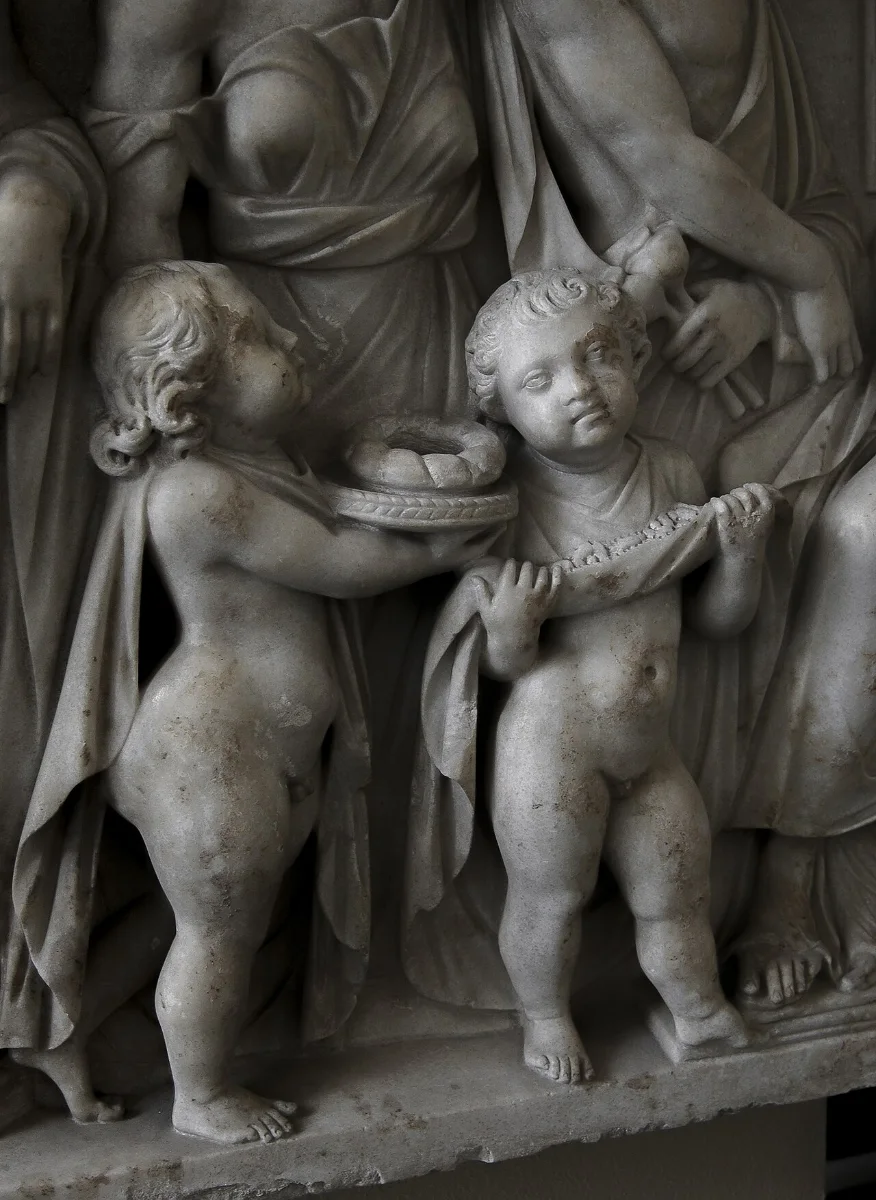
Text and translation
ἔκλυον φωνάν, ἔκλυον δὲ βοὰν
Euripides · Medea · parodos, the entrance of the chorus of Corinthian women, with Medea singing from inside the house · lyric anapaests, a strophic pair and an epode · enoplian, aeolic, iambic, trochaic and dactylo-epitrite cola · Murray’s text (Perseus), Lourenço’s colon analysis (2011)
How to read each line
A guide to the Greek, syllables, pitch marks and quantities.
Show the reading key
- Above each line: the line as the edition prints it, each word placed over its own syllables. The main row: the same Greek divided into metrical syllables, each written as it is pronounced. A consonant that closes a syllable is written with it (λόθ | ρο); an elided word is closed up with the next vowel (ν’ἀ); a final consonant carried into the next word is set with a thin space (ς ἰ). Wider gaps mark word-ends.
- Above the syllables: the pitch of each syllable, from the accents. Under them: the quantity of each syllable as it falls in the line, then the transliteration, syllable by syllable, with accented syllables in capitals.
- Under each line: a line-for-line translation. In the right margin of the scansion: the line type, its scheme, and its analysis into cola.
Key to the labels
The names, patterns and symbols used beside this poem.
Show the labels and symbols
The labels in the right margin of the scansion below give the line’s analysis as the scheme file states it, then its scheme and, where the analysis notes them, the period-end, a brevis in longo or a hiatus. ‖ marks the end of a period, ||| the end of the stanza; a line without a period-end runs on into the next (synapheia). × is an anceps, long or short; the last position of every period is indifferent. A click on any syllable highlights the colon it belongs to and explains it. The sources of the labels, with their page numbers, are given line by line under Prosody, line by line.
| Label | Name and shape | What it is |
|---|---|---|
| em2 | Extra metrum (e. m.)— — | Outside the metre: Lourenço prints the cry as two longs without a number before 144.[5] His e. m. is extra metrum.[6] |
| nocol | Not in Lourenço’s analysis | Murray prints these words here, but Lourenço’s analysis, made on another text, has no colon for them. The quantities shown are the workbench’s reading of Murray’s words, for reference only; they are not an analysis. |
| an2 | Anapaestic dimeter (2 an)⏑ ⏑ — ⏑ ⏑ — ⏑ ⏑ — ⏑ ⏑ — | Two anapaestic metra, ⏑ ⏑ — ⏑ ⏑ — each.[7] A biceps may be contracted to one long and a long resolved into two shorts. Lourenço uses labels such as 2 an only as shorthand for an an: there are probably no anapaestic dimeters as such.[8] Lyric anapaests, unlike the marching kind, have a Doric colouring, frequent dimeters without word-end between the metra, and much contraction, so that all eight positions of a dimeter are often long.[9] |
| prm | Paroemiac (prm)⏑ ⏑ — ⏑ ⏑ — ⏑ ⏑ — — | The catalectic anapaestic dimeter (West’s an∧)[10]. In lyric it is frequently a period-closing phrase, sometimes with breuis in longo.[11] |
| an1 | Anapaestic metron (an)⏑ ⏑ — ⏑ ⏑ — | A single anapaestic metron.[6] Here all four positions are long, a contracted form Lourenço lists at 150 ~ 175.[12] |
| hag | Hagesichorean (hag)× — ⏑ ⏑ — ⏑ — — | West’s name, from Alcman’s Partheneion.[13] In tragedy it belongs both to aeolic and to enoplian contexts; Lourenço counts the hagesichoreans of this parodos as enoplian and calls the colon a rhythmic Leitmotiv of the Medea.[14] Examples with short anceps are rare.[15] |
| reiz | Reizianum (reiz)× — ⏑ ⏑ — — | The reizianum.[16] Euripides has about 30 of the shape — — ⏑ ⏑ — —, among them 154, and 17 with short anceps, among them 179.[17] |
| cret | Cretic (cr)— ⏑ — | The cretic.[7] |
| hippon | Hipponactean (hipp)○○ — ⏑ ⏑ — ⏑ — — | The hipponactean:[18] a glyconic with one more long at the end. Lourenço’s oo is the aeolic base, — —, — ⏑, ⏑ — or ⏑ ⏑ ⏑;[6] West writes ○○, a pair of positions that may not both be short.[19] |
| glyc | Glyconic (gl)○○ — ⏑ ⏑ — ⏑ — | The glyconic.[20] Lourenço’s oo is the aeolic base;[6] West writes ○○.[19] |
| sp | Spondee (sp)— — | Two longs.[20] |
| mol | Molossus (mol)— — — | Three longs.[20] |
| ia2 | Iambic dimeter (2 ia)× — ⏑ — × — ⏑ — | Two iambic metra.[21] Either long may be resolved into two shorts; Lourenço lists 206 and 211 among the Euripidean shapes with resolution.[22] |
| ace | Acephalous e (∧e)⏑ — | An e-unit (— ⏑ —) without its first long; Lourenço uses ∧ as a general sign for syncopation.[23] |
| link | Link anceps× | The single syllable that joins the units of dactylo-epitrite and enoplian phrases.[24] |
| De | Hemiepes (D)— ⏑ ⏑ — ⏑ ⏑ — | Lourenço’s and West’s D.[25] Lourenço lists 210 among about seventy Euripidean hemiepe.[26] |
| tr2 | Trochaic dimeter (2 tr)— ⏑ — × — ⏑ — × | Two trochaic metra.[20] Lourenço lists 208, with both first longs resolved, among the non-syncopated trochaic dimeters.[27] |
| e | Epitrite unit (e)— ⏑ — | The cretic unit of dactylo-epitrite.[21] |
| ph2 | Pherecratean (ph)○○ — ⏑ ⏑ — — | The pherecratean, the catalectic form of the glyconic; in Euripides’ aeolic songs it regularly closes a period.[28] Its base is most often — —, as here; Lourenço lists Med. 212 with that shape.[29] |
Scansion
The sung parts of the entrance song laid out colon by colon as Lourenço analyses them: Medea’s anapaests from inside the house, the chorus’s strophe and antistrophe set against each other, and the epode. The chorus’s opening (131–138), where Murray’s text will not divide into Lourenço’s cola, is given in a table at the end; the Nurse’s chanted anapaests are not part of the analysis and are not scanned.
- line 167, position 7 (να): scans L but the scheme needs S
- line 167, position 9 (κά): scans S but the scheme needs L
- line 182: 7 syllables cannot be fitted to the scheme — — ⏑ ⏑ — ⏑ — —; the best attempt leaves 1 position unfilled (3)
- line 182, position 4 (πρίν): scans L but the scheme needs S
- line 183, position 2 (εἴ): scans L but the scheme needs S
- line 205: 12 syllables cannot be fitted to the scheme — — — ⏑ — ⏑ — ⏑ — ⏑ —; the best attempt leaves 1 syllable unplaced (ἰ)
- line 205, position 1 (α): scans S but the scheme needs L
Aiai!
O Zeus and Earth and Light!
Fire from heaven, through my head
may it pass! What profit is there for me in living any longer?
Ah, ah! May I find my rest in death,
leaving behind a hateful life.
Did you hear, O Zeus and earth and light,
what a cry the unhappy
bride sends up?
What longing for that bed no one should come near
has hold of you, foolish woman?
The end that is death will come fast enough;
do not pray for this.
If your husband honours a new bed,
that is his affair: do not be angry.
Zeus will be your advocate in this.
Do not waste away too much in mourning for your husband.
O great Themis and lady Artemis,
do you see what I suffer, though I bound with great oaths
my accursed
husband? May I one day see him and his bride
ground to pieces, palace and all,
for the wrongs they dare to do me unprovoked.
O father, O city, which I left
in shame, when I had killed my own brother!
If only she would come before our eyes
and take in the sound of the words
we speak!
If somehow she might let go her heavy anger
and the temper of her mind…
May my goodwill never
be absent from my friends.
But go and bring her here out of the house,
outside; tell her that we too are friends.
Hurry, before she does some harm
to those inside; for this grief of hers is surging high.
I heard a cry of laments, full of groans;
shrill and wretched are the griefs she cries out
against the betrayer of her bed, her evil husband;
wronged, she calls on the gods,
on Themis, Zeus’ goddess of oaths, who brought her
over to Greece across the water,
over the sea by night, through the salt,
endless gateway of the sea.
Metre
- The scene. Easterling’s outline of the scene: in 96–130 voices alternate in anapaests, Medea singing off stage and the Nurse replying in recitative; from 131 to 213 there is choral song and dance, solo song and recitative. The chorus come in on the anapaests already in use and move before long into freer lyric (131–8); the Nurse replies in recited anapaests (139–43); Medea, still unseen, sings once more (144–7). Strophe (148–59), Medea’s song (160–7) and the Nurse’s recitative (168–72) are followed by antistrophe (173–84) and a longer stretch of recitative from the Nurse, and the chorus close the sequence by summing up the song they have heard from Medea (204–13). Set out by voice, the order is M N M N CMN CMN C.[30] Halleran describes the same sequence: Medea’s lyric anapaests, a rhythm that stands halfway between the spoken iambics of the scene before and the full song of the parodos after it, the Nurse’s anapaests of a slightly different variety, and a chorus that begins with anapaests and moves into aeolic verse for the strophic part.[31] Battezzato gives the Medea as an example of a chorus that enters because it has heard a woman crying out in distress.[32]
- Whose analysis. Every scanned colon is scanned against the analysis printed by F. Lourenço, The Lyric Metres of Euripidean Drama (Coimbra 2011), pp. 147–148, which is made on Diggle’s Oxford text and takes as a colon whatever Diggle prints as a lyric line;[33] the line numbers are his. The right margin gives his label, and each note opens with his pattern as he prints it. The syllables and their lengths are the workbench’s scansion of Murray’s Greek. His analysis covers the sung lines only: the Nurse’s lines are chanted recitative, given non-lyric dialect throughout in Diggle’s text,[34] and they are neither analysed by Lourenço nor scanned here.
- Signs. Lourenço’s list is on pp. 13–15: ∪ is this site’s ⏑, ∪∪ a resolved long, ∩ a short syllable in a long position at period-end (breuis in longo), ‖ period-end, ‖ᴴ a period-end that hiatus shows, ‖ᴮ one that breuis in longo shows, oo the aeolic base (West’s ○○)[19], ∧ syncopation of any kind, e. m. extra metrum. His labels such as 2 an are only shorthand for “an an”: there are probably no anapaestic “dimeters” as such.[8] On this page the last position of every period is drawn as × (indifferent).
- Lyric anapaests. Medea sings anapaests throughout, and the chorus begins each stanza with them. West lists what marks lyric anapaests off from the marching kind: Doric colouring, frequent dimeters without word-end between the metra, much contraction (all eight positions of a dimeter are often long), catalectic dimeters anywhere, acatalectic dimeters in final place, sequences of four shorts, and an admixture of other cola.[9] In tragedy they are practically confined to songs in which an actor sings, Euripides uses them most, and a passage can move easily between sung and recited anapaests as the emotion rises and falls:[35] here Medea’s sung anapaests alternate with the Nurse’s recited ones. Lourenço links lyric anapaests mainly with lamentation and profound distress, citing Medea’s anapaests among his examples.[36] Here 149 ~ 174 are dimeters of eight longs and 150 ~ 175 a single metron of four.[37]
- The strophic pair. After their anapaests the strophe and antistrophe move into hagesichoreans (× — ⏑ ⏑ — ⏑ — —), a reizianum, a cretic with a hipponactean, and a closing cretic, glyconic and spondee. Lourenço counts the hagesichoreans of this song as enoplian phrases and calls the colon a rhythmic Leitmotiv of the Medea;[14] he also notes that the colon belongs to aeolic as well as enoplian contexts,[13] and Halleran calls the strophic part aeolic.[31] Lourenço quotes 151–153 for their “direct” mode of utterance, three questions and commands in three hagesichoreans.[15]
- The epode changes metre with almost every colon: a molossus with an iambic dimeter, a fully resolved iambic dimeter, an enoplian phrase (∧e ∪ D —), a trochaic dimeter, a dactylo-epitrite phrase (— e ∪ D ∪), a hemiepes, an iambic dimeter and a closing pherecratean.[38]
- Responsion. The antistrophe answers the strophe colon for colon. The anapaests do not match syllable for syllable: 148 and 173 have different shapes (Lourenço lists them separately, p. 49), while 149 ~ 174 and 150 ~ 175 are identical.[37] The reizianum has a long first syllable at 154 and a short one at 179; Lourenço lists both shapes, referring to Diggle’s discussion of a long anceps answering a short one in the reizianum.[39] The last colon (159 ~ 183) is a notorious problem.[40]
- Periods. Lourenço marks period-end with breuis in longo after 147, the open short -σα, which he lists among his “open” cases,[41] and with hiatus after the reiziana 154 ~ 179 (λίσσου. | εἰ; ἀπέστω. | ἀλλά). He says that Euripides puts the hagesichorean at the end of a period[42] and prints 151–153 each with ‖ when he quotes them,[15] but his scheme of the parodos marks no period-end there;[5] the page follows the scheme.
- Murray’s text and Lourenço’s. Murray’s text (1902, the date in the Perseus file) and Diggle’s, on which Lourenço’s analysis is made, differ in several places in this song, and Lourenço calls the text and colometry of the opening contentious.[43] (1) The chorus’s opening, 131–138: Murray’s lines will not divide into Lourenço’s cola (his 133 has eight syllables where Lourenço’s colon has eleven), so these lines are given in a table below, not scanned. (2) After Medea’s cry Murray prints ὦ Ζεῦ καὶ Γᾶ καὶ Φῶς (his 144), for which Lourenço’s analysis has no colon. (3) Four lines do not fit Lourenço’s scheme and are reported as problems: 167, where Lourenço’s printed shape needs a short νᾰ and a long κᾱ that the words do not have; 182, a syllable short of the hagesichorean; 183, where Lourenço quotes Diggle’s τοὺς ἔσω against Murray’s τοὺς εἴσω;[44] and 205, where Murray’s ἰαχάν gives one syllable more than the molossus. Each is explained in its note. (4) At 159 Murray prints εὐνάταν, the reading Lourenço prefers to Diggle’s εὐνέταν,[44] and the scheme used is the one he prefers. Murray’s line-divisions differ from Lourenço’s at 144, 155–6, 158–159, 180–181, 182–183 and 209; the lines here are divided as Lourenço divides them, and the Perseus text numbers some lines differently (noted line by line).
- Prosody. The workbench uses the Attic rules (README). Doric α for Attic-Ionic η, the original long ᾱ,[45] runs through the song: ἀχᾱ́ν, ἁ, δύστᾱνος, νύμφᾱ, τελευτᾱ́, τᾱ́κου, δυρομένᾱ, εὐνᾱ́τᾱν, μεγάλᾱ, ἐνδησαμένᾱ, τᾱ̀ν ἁμετέρᾱν, αὐδᾱθέντων, ὀμφᾱ́ν, ὀργᾱ́ν, ἰαχᾱ́ν, προδότᾱν, ἔβᾱσεν; Doric colouring is the first mark of lyric anapaests in West’s list[9] and a mark of sung lines in tragedy.[46] A stop with a liquid or nasal leaves the syllable before it short in ἀπλάτου (151), πότνι’ (160), μελάθροις and διακναιομένους (164), θεοκλυτεῖ (208), as tragedy allows.[47] Hiatus after the cry αἰαῖ is of the kind West allows in tragedy around exclamations.[48]
- Dale’s analysis. Dale touches three places. (1) 135–6, given here unscanned: she thinks the weakly repetitive transmitted text is probably false and would adopt Elmsley’s γόον.[49] (2) The first line of the epode (205 here, Perseus 204): she suspects that it should be an enoplian, ἰαχὰν ἄιον πολύστονον ⏑ ⏑ — ⏑ ⏑ — ⏑ — ⏑ —, with γόων deleted.[50] Lourenço’s scheme for the line is a molossus and two iambic metra, which Murray’s text overruns by one syllable.[51] Dale’s scheme takes the first syllable of ἄιον as short, where this page scans it long after LSJ s.v. ἀΐω; her proposal is reported here, not adopted. (3) 207 here (Perseus 206), τὸν ἐν λέχει προδόταν κακόνυμφον: Dale’s quantities are the ones scanned here, ⏑ — ⏑ — ⏑ ⏑ — ⏑ ⏑ — —, but she names the colon the pendant form of the ‘blunt inversion’ of the enoplian,[52] where Lourenço writes it as dactylo-epitrite, ∧e ⏑ D —.
- Dale’s later analysis. In the Metrical Analyses, published after her death, Dale prints the epode with the scansion she argued for in the Lyric Metres: without γόων, and with the first syllable of ἄιον short. She describes the stanza as dactylo-epitrite with an admixture of iambic and anapaestic rhythm. The quantities of the rest agree with Lourenço’s.[53]
- Kovacs’s text. D. Kovacs’s Loeb edition of 1994 agrees with Diggle’s text, as Lourenço quotes it, at 153 and 183, and at 205 divides the line where Dale wished. It differs from Murray’s also at 157 (punctuation), 166–7 (word order), 182, 208 and 212, and in line division at 151–9 and 175–81.[54] The line numbers agree.[55]
Prosody, line by line
Every syllable, with the reason for its length. Quantities are read from the vowel where the spelling shows it, from the consonants that follow (“position”), from the accent where it tells, and from the metre where nothing else does. Editors’ notes on the text follow in the boxed paragraphs.
- (e. m.)
Line (e. m.) · αἰαῖ·
αἰαῖ·
αἰαῖ·hiatus inside the line; the period runs on into l. M 144 (synapheia).
The label in the margin, with its sources: Lourenço 2011, p. 147 (unnumbered).
- 1 —αἰαἰ is a diphthong, long by nature.
- 2 —αῖ·αῖ is a diphthong, long by nature; the next word begins with a vowel and nothing is elided: hiatus; the line-end is not a period-end: the period runs on into the next line (synapheia), so this syllable keeps its own length, with no brevis in longo, and a word may run over into the next line.[56]
- (144)
Line (144) · ὦ Ζεῦ καὶ Γᾶ καὶ Φῶς·
ὦ Ζεῦ καὶ Γᾶ καὶ Φῶς·
ὦΖεῦκαὶΓᾶκαὶΦῶς·continues (e. m.) · one period (synapheia); the period runs on into l. 144 (synapheia).
The label in the margin, with its sources: not in Lourenço · no colon in Lourenço 2011.
- 1 —ὦὦ is long by nature; the next word begins with the double consonant Ζ: the syllable is closed before it: long by position.
- 2 —Ζεῦεῦ is a diphthong, long by nature.
- 3 —καὶαὶ is a diphthong, long by nature.
- 4 —Γᾶᾶ carries a circumflex, so it is long.
- 5 —καὶαὶ is a diphthong, long by nature.
- 6 —Φῶς·ῶ is long by nature; closed by ς: long by position; the line-end is not a period-end: the period runs on into the next line (synapheia), so this syllable keeps its own length, with no brevis in longo, and a word may run over into the next line.[56]
The line marked (144) is the rest of Murray’s line 144. Murray prints these words after αἰαῖ as the rest of his line 144; Lourenço’s analysis, made on Diggle’s text, has no colon for them, and passes from the cry to the dimeter διά μου κεφαλᾶς φλὸξ οὐρανία, which he numbers 144.[5] Our sources do not say how Diggle prints the words. The quantities shown are only the workbench’s reading of Murray’s words, six long syllables, not an analysis. The chorus repeats the invocation at 148. Kovacs’s text, like Diggle’s, has no such words after the cry.[57]- 144
Line 144 · διά μου κεφαλᾶς φλὸξ οὐρανία
διά μου κεφαλᾶς φλὸξ οὐρανία
διάμουκεφαλᾶςφλὸξοὐρανίαcontinues (144) · one period (synapheia); the period runs on into l. 145 (synapheia).
The label in the margin, with its sources: Lourenço 2011, p. 147.
- 1 ⏑διι is short by the metre (position 1 must be short).
- 2 ⏑άά is short by the metre (position 2 must be short).
- 3 —μουου is a diphthong, long by nature.
- 4 ⏑κεε is short by nature.
- 5 ⏑φαα is short by the metre (position 5 must be short).
- 6 —λᾶςᾶ carries a circumflex, so it is long; closed by ς: long by position.
- 7 —φλὸξὸ is short by nature; ξ is a double consonant (two sounds) and closes the syllable: long by position.
- 8 —οὐοὐ is a diphthong, long by nature.
- 9 ⏑ραα is short by the metre (position 9 must be short).
- 10 ⏑νίί is short by the metre (position 10 must be short).
- 11 —αα is long by the metre (position 11 must be long); the line-end is not a period-end: the period runs on into the next line (synapheia), so this syllable keeps its own length, with no brevis in longo, and a word may run over into the next line.[56]
- 145
Line 145 · βαίη· τί δέ μοι ζῆν ἔτι κέρδος;
βαίη· τί δέ μοι ζῆν ἔτι κέρδος;
βαίη·τίδέμοιζῆνἔτικέρδος;continues l. 144 · one period (synapheia); the period runs on into l. 146 (synapheia).
The label in the margin, with its sources: Lourenço 2011, p. 147.
- 1 —βαίαί is a diphthong, long by nature.
- 2 —η·η is long by nature.
- 3 ⏑τίί is short by the metre (position 3 must be short).
- 4 ⏑δέέ is short by nature.
- 5 —μοιοι is a diphthong, long by nature; the next word begins with the double consonant ζ: the syllable is closed before it: long by position.
- 6 —ζῆνῆ is long by nature.
- 7 ⏑ἔἔ is short by nature.
- 8 ⏑τιι is short by the metre (position 8 must be short).
- 9 —κέρέ is short by nature; closed by ρ: long by position.
- 10 —δος;ο is short by nature; closed by ς: long by position; the line-end is not a period-end: the period runs on into the next line (synapheia), so this syllable keeps its own length, with no brevis in longo, and a word may run over into the next line.[56]
- 146
Line 146 · φεῦ φεῦ· θανάτῳ καταλυσαίμαν
φεῦ φεῦ· θανάτῳ καταλυσαίμαν
φεῦφεῦ·θανάτῳκαταλυσαίμανcontinues l. 145 · one period (synapheia); the period runs on into l. 147 (synapheia).
The label in the margin, with its sources: Lourenço 2011, p. 147.
- 1 —φεῦεῦ is a diphthong, long by nature.
- 2 —φεῦ·εῦ is a diphthong, long by nature.
- 3 ⏑θαα is short by the metre (position 3 must be short).
- 4 ⏑νάά is short by the metre (position 4 must be short).
- 5 —τῳῳ is long by nature.
- 6 ⏑καα is short by the metre (position 6 must be short).
- 7 ⏑ταα is short by the metre (position 7 must be short).
- 8 —λυυ is long by the metre (position 8 must be long).
- 9 —σαίαί is a diphthong, long by nature.
- 10 —μανα is a vowel of unknown length; closed by ν: long by position; the line-end is not a period-end: the period runs on into the next line (synapheia), so this syllable keeps its own length, with no brevis in longo, and a word may run over into the next line.[56]
- 147
Line 147 · βιοτὰν στυγερὰν προλιποῦσα.
βιοτὰν στυγερὰν προλιποῦσα.
βιοτὰνστυγερὰνπρολιποῦσα.continues l. 146 · one period (synapheia); brevis in longo at period-end (a short in the final long position).
The label in the margin, with its sources: Lourenço 2011, p. 147.
- 1 ⏑βιι is short by the metre (position 1 must be short).
- 2 ⏑οο is short by nature.
- 3 —τὰνὰ is a vowel of unknown length; closed by ν: long by position.
- 4 ⏑στυυ is short by the metre (position 4 must be short).
- 5 ⏑γεε is short by nature.
- 6 —ρὰνὰ is a vowel of unknown length; closed by ν: long by position.
- 7 ⏑προο is short by nature.
- 8 ⏑λιι is short by the metre (position 8 must be short).
- 9 —ποῦοῦ is a diphthong, long by nature.
- 10 ×σα.α is short by the accent rule: circumflex on the penult requires a short final syllable; the last position of the period is indifferent; a short here is brevis in longo.
∪ ∪ — ∪ ∪ — ∪ ∪ — ∩, prm ‖ᴮ:[60] a paroemiac, the catalectic anapaestic dimeter. Its last syllable, -σα of προλιποῦσα, is short in a long position, breuis in longo, and proves the period-end; Lourenço lists Med. 147 among his “open” cases[41] and the paroemiac as frequently period-closing in lyric.[11] βιοτάν and στυγεράν have the Doric long ᾱ; the ρὰν of στυγεράν is closed by ν before πρ.- 148
Line 148 · ἄιες· ὦ Ζεῦ καὶ γᾶ καὶ φῶς·
ἄιες· ὦ Ζεῦ καὶ γᾶ καὶ φῶς·
ἄιε·ς ὦΖεῦκαὶγᾶκαὶφῶ·the period runs on into l. 149 (synapheia).
The label in the margin, with its sources: Lourenço 2011, p. 147.
- 1 —ἄἄ is long by the metre (position 1 must be long).
- 2 ⏑ιι is short by the metre (position 2 must be short).
- 3 ⏑ε·ε is short by nature.
- 4 —ς ὦὦ is long by nature; the next word begins with the double consonant Ζ: the syllable is closed before it: long by position; the first consonant belongs to the previous word and is carried over to this vowel.
- 5 —Ζεῦεῦ is a diphthong, long by nature.
- 6 —καὶαὶ is a diphthong, long by nature.
- 7 —γᾶᾶ carries a circumflex, so it is long.
- 8 —καὶαὶ is a diphthong, long by nature.
- 9 —φῶ·ῶ is long by nature; the line-end is not a period-end: the period runs on into the next line (synapheia), so this syllable keeps its own length, with no brevis in longo, and a word may run over into the next line.[56]
— ∪ ∪ — — — — — —, 2 an.[62] The chorus echo Medea’s invocation. ἄιες (from ἀΐω, “hear”)[63] has three syllables; its first is long, as the scheme requires. Murray marks each change of speaker inside the chorus with a dash at the head of the line (here and at 151, 155–6, 158, 173, 176, 180, 182); the dashes are left out of the Greek on this page, because the line display cannot set them without crowding the first word.- 149
Line 149 · ἀχὰν οἵαν ἁ δύστανος
ἀχὰν οἵαν ἁ δύστανος
ς ἀχὰνοἵανἁδύστανοςcontinues l. 148 · one period (synapheia); the period runs on into l. 150 (synapheia).
The label in the margin, with its sources: Lourenço 2011, p. 147.
- 1 —ς ἀἀ is long by the metre (position 1 must be long); the first consonant belongs to the previous word and is carried over to this vowel.
- 2 —χὰνὰ is long by the metre (position 2 must be long).
- 3 —οἵοἵ is a diphthong, long by nature.
- 4 —ανα is long by the metre (position 4 must be long).
- 5 —ἁἁ is long by the metre (position 5 must be long).
- 6 —δύσύ is a vowel of unknown length; closed by σ: long by position.
- 7 —ταα is long by the metre (position 7 must be long).
- 8 —νοςο is short by nature; closed by ς: long by position; the line-end is not a period-end: the period runs on into the next line (synapheia), so this syllable keeps its own length, with no brevis in longo, and a word may run over into the next line.[56]
- 150
Line 150 · μέλπει νύμφα;
μέλπει νύμφα;
μέλπεινύμφα;continues l. 149 · one period (synapheia); the period runs on into l. 151 (synapheia).
The label in the margin, with its sources: Lourenço 2011, p. 147.
- 1 —μέλέ is short by nature; closed by λ: long by position.
- 2 —πειει is a diphthong, long by nature.
- 3 —νύμύ is a vowel of unknown length; closed by μ: long by position.
- 4 —φα;α is long by the metre (position 4 must be long); the line-end is not a period-end: the period runs on into the next line (synapheia), so this syllable keeps its own length, with no brevis in longo, and a word may run over into the next line.[56]
- 151
Line 151 · τίς σοί ποτε τᾶς ἀπλάτου
τίς σοί ποτε τᾶς ἀπλάτου
τίςσοίποτετᾶςἀπλάτουcontinues l. 150 · one period (synapheia); the period runs on into l. 152 (synapheia).
The label in the margin, with its sources: Lourenço 2011, p. 147.
- 1 —τίςί is a vowel of unknown length; closed by ς: long by position.
- 2 —σοίοί is a diphthong, long by nature.
- 3 ⏑ποο is short by nature.
- 4 ⏑τεε is short by nature.
- 5 —τᾶςᾶ carries a circumflex, so it is long.
- 6 ⏑ἀἀ is a vowel of unknown length; πλ is carried whole into the next syllable, so this syllable stays open and short (Attic correption of a stop + liquid cluster).
- 7 —πλάά is long by the metre (position 7 must be long).
- 8 —τουου is a diphthong, long by nature; the line-end is not a period-end: the period runs on into the next line (synapheia), so this syllable keeps its own length, with no brevis in longo, and a word may run over into the next line.[56]
— — ∪ ∪ — ∪ — —, hag.[69] ἀπλάτου[70] has its first syllable short before πλ.[47] Lourenço quotes 151–153 as an example of the hagesichorean’s “direct” mode of utterance.[15]- 152
Line 152 · κοίτας ἔρος, ὦ ματαία;
κοίτας ἔρος, ὦ ματαία;
κοίταςἔρο,ς ὦματαία;continues l. 151 · one period (synapheia); the period runs on into l. 153 (synapheia).
The label in the margin, with its sources: Lourenço 2011, p. 147.
- 1 —κοίοί is a diphthong, long by nature.
- 2 —ταςα is long by the metre (position 2 must be long).
- 3 ⏑ἔἔ is short by nature.
- 4 ⏑ρο,ο is short by nature.
- 5 —ς ὦὦ is long by nature; the first consonant belongs to the previous word and is carried over to this vowel.
- 6 ⏑μαα is short by the metre (position 6 must be short).
- 7 —ταίαί is a diphthong, long by nature.
- 8 —α;the next word begins with σπ: the syllable is closed before it: long by position; the line-end is not a period-end: the period runs on into the next line (synapheia), so this syllable keeps its own length, with no brevis in longo, and a word may run over into the next line.[56]
- 153
Line 153 · σπεύσει θανάτου τελευτά·
σπεύσει θανάτου τελευτά·
σπεύσειθανάτουτελευτά·continues l. 152 · one period (synapheia); the period runs on into l. 154 (synapheia).
The label in the margin, with its sources: Lourenço 2011, p. 148.
- 1 —σπεύεύ is a diphthong, long by nature.
- 2 —σειει is a diphthong, long by nature.
- 3 ⏑θαα is short by the metre (position 3 must be short).
- 4 ⏑νάά is short by the metre (position 4 must be short).
- 5 —τουου is a diphthong, long by nature.
- 6 ⏑τεε is short by nature.
- 7 —λευευ is a diphthong, long by nature.
- 8 —τά·ά is long by the metre (position 8 must be long); the line-end is not a period-end: the period runs on into the next line (synapheia), so this syllable keeps its own length, with no brevis in longo, and a word may run over into the next line.[56]
— — ∪ ∪ — ∪ — —, hag.[74] τελευτά is Doric for τελευτή, with long ᾱ. Lourenço quotes Diggle’s text as σπεύσεις θανάτου τελευτάν,[15] against Murray’s σπεύσει θανάτου τελευτά; the two scan alike. Kovacs prints Blaydes’s σπεύσεις … τελευτάν; (“will you hasten death’s end?”), the text Lourenço quotes from Diggle; it scans as Murray’s.[75]- 154
Line 154 · μηδὲν τόδε λίσσου.
μηδὲν τόδε λίσσου.
μηδὲντόδελίσσου.continues l. 153 · one period (synapheia).
The label in the margin, with its sources: Lourenço 2011, p. 148.
- 1 —μηη is long by nature.
- 2 —δὲνὲ is short by nature; closed by ν: long by position.
- 3 ⏑τόό is short by nature.
- 4 ⏑δεε is short by nature.
- 5 —λίσί is a vowel of unknown length; closed by σ: long by position.
- 6 ×σου.ου is a diphthong, long by nature; the last position of the period is indifferent.
- 155–6
Line 155–6 · εἰ δὲ σὸς πόσις καινὰ λέχη σεβίζει,
εἰ δὲ σὸς πόσις καινὰ λέχη σεβίζει,
εἰδὲσὸςπόσιςκαινὰλέχησεβίζει,the period runs on into l. 157 (synapheia).
The label in the margin, with its sources: Lourenço 2011, p. 148.
- 1 —εἰεἰ is a diphthong, long by nature.
- 2 ⏑δὲὲ is short by nature.
- 3 —σὸςὸ is short by nature; closed by ς: long by position.
- 4 ⏑πόό is short by nature.
- 5 —σιςι is a vowel of unknown length; closed by ς: long by position.
- 6 —καιαι is a diphthong, long by nature.
- 7 ⏑νὰὰ is short by the metre (position 7 must be short).
- 8 ⏑λέέ is short by nature.
- 9 —χηη is long by nature.
- 10 ⏑σεε is short by nature.
- 11 —βίζ is a double consonant (two sounds) and closes the syllable: long by position.
- 12 —ζει,ει is a diphthong, long by nature; the line-end is not a period-end: the period runs on into the next line (synapheia), so this syllable keeps its own length, with no brevis in longo, and a word may run over into the next line.[56]
— ∪ — ∪ — — ∪ ∪ — ∪ — —, cr + hipp:[77] a cretic (εἰ δὲ σός) and a hipponactean with the base ⏑ — (πόσις). καινά is neuter plural, with short final α.[72] Murray prints the colon as two lines (155, 156).- 157
Line 157 · κείνῳ τόδε· μὴ χαράσσου·
κείνῳ τόδε· μὴ χαράσσου·
κείνῳτόδε·μὴχαράσσου·continues l. 155–6 · one period (synapheia); the period runs on into l. 158 (synapheia).
The label in the margin, with its sources: Lourenço 2011, p. 148.
- 1 —κείεί is a diphthong, long by nature.
- 2 —νῳῳ is long by nature.
- 3 ⏑τόό is short by nature.
- 4 ⏑δε·ε is short by nature.
- 5 —μὴὴ is long by nature.
- 6 ⏑χαα is short by the metre (position 6 must be short).
- 7 —ράσά is a vowel of unknown length; closed by σ: long by position.
- 8 —σου·ου is a diphthong, long by nature; the next word begins with the double consonant Ζ: the syllable is closed before it: long by position; the line-end is not a period-end: the period runs on into the next line (synapheia), so this syllable keeps its own length, with no brevis in longo, and a word may run over into the next line.[56]
- 158
Line 158 · Ζεύς σοι τάδε συνδικήσει.
Ζεύς σοι τάδε συνδικήσει.
Ζεύςσοιτάδεσυνδικήσει.continues l. 157 · one period (synapheia); the period runs on into l. 159 (synapheia).
The label in the margin, with its sources: Lourenço 2011, p. 148.
- 1 —Ζεύςεύ is a diphthong, long by nature; closed by ς: long by position.
- 2 —σοιοι is a diphthong, long by nature.
- 3 ⏑τάά is short by the metre (position 3 must be short).
- 4 ⏑δεε is short by nature.
- 5 —συνυ is a vowel of unknown length; closed by ν: long by position.
- 6 ⏑διι is short by the metre (position 6 must be short).
- 7 —κήή is long by nature.
- 8 —σει.ει is a diphthong, long by nature; the line-end is not a period-end: the period runs on into the next line (synapheia), so this syllable keeps its own length, with no brevis in longo, and a word may run over into the next line.[56]
- 159
Line 159 · μὴ λίαν τάκου δυρομένα σὸν εὐνάταν.
μὴ λίαν τάκου δυρομένα σὸν εὐνάταν.
μὴλίαντάκουδυρομένασὸν εὐνάταν.continues l. 158 · one period (synapheia).
The label in the margin, with its sources: Lourenço 2011, pp. 114, 148.
- 1 —μὴὴ is long by nature.
- 2 ⏑λίί is short by the metre (position 2 must be short).
- 3 —ανα is a vowel of unknown length; closed by ν: long by position.
- 4 —τάά is long by the metre (position 4 must be long).
- 5 —κουου is a diphthong, long by nature.
- 6 —δυυ is long by the metre (position 6 must be long).
- 7 ⏑ροο is short by nature.
- 8 ⏑μέέ is short by nature.
- 9 —ναα is long by the metre (position 9 must be long).
- 10 ⏑σὸὸ is short by nature.
- 11 —ν εὐεὐ is a diphthong, long by nature; the first consonant belongs to the previous word and is carried over to this vowel.
- 12 —νάά is long by the metre (position 12 must be long).
- 13 ×ταν.α is a vowel of unknown length; closed by ν: long by position; the last position of the period is indifferent.
Lourenço’s scheme for this colon in Diggle’s text is — ∪ — — — — ∪ ∪ — ∪ — ∪ —, with a query and a note.[81] In his discussion he calls 159 ~ 183 a notorious problem: Diggle printed εὐνέταν, which gives a “blunt” ending and responds unevenly with the antistrophe; εὐνάταν, found in two manuscripts and conjectured by Tyrwhitt, was printed by Page, Kovacs and Mastronarde, and Diggle later came to accept it; Lourenço thinks Mastronarde’s text and analysis, cr + gl + sp, the best option.[44] Murray prints εὐνάταν (so also LSJ s.v. εὐνήτης, “Dor. εὐνάτας”, citing this line), and the page scans it with that analysis: — ⏑ — | — — — ⏑ ⏑ — ⏑ — | — —, the same shape as 183. λίαν has a short first syllable here;[82] τάκου is Doric for τήκου;[83] δυρομένα has a long υ[84] and the Doric feminine ending.- 160
Line 160 · ὦ μεγάλα Θέμι καὶ πότνι’ Ἄρτεμι
ὦ μεγάλα Θέμι καὶ πότνι’ Ἄρτεμι
ὦμεγάλαΘέμικαὶπότνι’Ἄρτεμιthe period runs on into l. 161 (synapheia).
The label in the margin, with its sources: Lourenço 2011, pp. 49, 148.
- 1 —ὦὦ is long by nature.
- 2 ⏑μεε is short by nature.
- 3 ⏑γάά is short by the metre (position 3 must be short).
- 4 —λαα is long by the metre (position 4 must be long).
- 5 ⏑Θέέ is short by nature.
- 6 ⏑μιι is short by the metre (position 6 must be short).
- 7 —καὶαὶ is a diphthong, long by nature.
- 8 ⏑πόό is short by nature; τν is carried whole into the next syllable, so this syllable stays open and short (Attic correption of a stop + nasal cluster).
- 9 ⏑τνι’ι is short by the metre (position 9 must be short); the apostrophe marks an elided vowel; the consonant before it joins this syllable.
- 10 —ἌρἌ is a vowel of unknown length; closed by ρ: long by position.
- 11 ⏑τεε is short by nature.
- 12 ⏑μιι is short by the accent rule: acute on the antepenult requires a short final syllable; the line-end is not a period-end: the period runs on into the next line (synapheia), so this syllable keeps its own length, with no brevis in longo, and a word may run over into the next line.[56]
- 161
Line 161 · λεύσσεθ’ ἃ πάσχω, μεγάλοις ὅρκοις
λεύσσεθ’ ἃ πάσχω, μεγάλοις ὅρκοις
λεύσσεθ’ἃπάσχω,μεγάλοιςὅρκοιcontinues l. 160 · one period (synapheia); the period runs on into l. 162 (synapheia).
The label in the margin, with its sources: Lourenço 2011, pp. 49, 148.
- 1 —λεύσεύ is a diphthong, long by nature; closed by σ: long by position.
- 2 ⏑σεε is short by nature.
- 3 ⏑θ’ἃἃ is short by the metre (position 3 must be short); the apostrophe marks an elided vowel; the consonant before it joins this syllable.
- 4 —πάσά is a vowel of unknown length; closed by σ: long by position.
- 5 —χω,ω is long by nature.
- 6 ⏑μεε is short by nature.
- 7 ⏑γάά is short by the metre (position 7 must be short).
- 8 —λοιςοι is a diphthong, long by nature.
- 9 —ὅρὅ is short by nature; closed by ρ: long by position.
- 10 —κοιοι is a diphthong, long by nature; the line-end is not a period-end: the period runs on into the next line (synapheia), so this syllable keeps its own length, with no brevis in longo, and a word may run over into the next line.[56]
— ∪ ∪ — — ∪ ∪ — — —, 2 an. Lourenço’s scheme on p. 148 prints eleven signs here (— ∪ ∪ — — — ∪ ∪ — — —), but his repertory lists Med. 161 under the ten-position shape — ∪ ∪ — — ∪ ∪ — — —,[59] and Murray’s text has ten syllables; the ten-position form is used. The ς of ὅρκοις passes to the next line.- 162
Line 162 · ἐνδησαμένα τὸν κατάρατον
ἐνδησαμένα τὸν κατάρατον
ς ἐνδησαμένατὸνκατάρατονcontinues l. 161 · one period (synapheia); the period runs on into l. 163 (synapheia).
The label in the margin, with its sources: Lourenço 2011, pp. 50, 148.
- 1 —ς ἐνἐ is short by nature; closed by ν: long by position; the first consonant belongs to the previous word and is carried over to this vowel.
- 2 —δηη is long by nature.
- 3 ⏑σαα is short by the metre (position 3 must be short).
- 4 ⏑μέέ is short by nature.
- 5 —ναα is long by the metre (position 5 must be long).
- 6 —τὸνὸ is short by nature; closed by ν: long by position.
- 7 ⏑καα is short by the metre (position 7 must be short).
- 8 ⏑τάά is short by the metre (position 8 must be short).
- 9 —ραα is long by the metre (position 9 must be long).
- 10 —τονο is short by nature; closed by ν: long by position; the line-end is not a period-end: the period runs on into the next line (synapheia), so this syllable keeps its own length, with no brevis in longo, and a word may run over into the next line.[56]
- 163
Line 163 · πόσιν; ὅν ποτ’ ἐγὼ νύμφαν τ’ ἐσίδοιμ’
πόσιν; ὅν ποτ’ ἐγὼ νύμφαν τ’ ἐσίδοιμ’
πόσι;ν ὅνποτ’ἐγὼνύμφαντ’ἐσίδοιcontinues l. 162 · one period (synapheia); the period runs on into l. 164 (synapheia).
The label in the margin, with its sources: Lourenço 2011, pp. 49, 148.
- 1 ⏑πόό is short by nature.
- 2 ⏑σι;ι is short by the metre (position 2 must be short).
- 3 —ν ὅνὅ is short by nature; closed by ν: long by position; the first consonant belongs to the previous word and is carried over to this vowel.
- 4 ⏑ποο is short by nature.
- 5 ⏑τ’ἐἐ is short by nature; the apostrophe marks an elided vowel; the consonant before it joins this syllable.
- 6 —γὼὼ is long by nature.
- 7 —νύμύ is a vowel of unknown length; closed by μ: long by position.
- 8 —φανα is a vowel of unknown length; closed by ν: long by position.
- 9 ⏑τ’ἐἐ is short by nature; the apostrophe marks an elided vowel; the consonant before it joins this syllable.
- 10 ⏑σίί is short by the metre (position 10 must be short).
- 11 —δοιοι is a diphthong, long by nature; the line-end is not a period-end: the period runs on into the next line (synapheia), so this syllable keeps its own length, with no brevis in longo, and a word may run over into the next line.[56]
∪ ∪ — ∪ ∪ — — — ∪ ∪ —, 2 an,[62] the same shape as 144. The ν of πόσιν passes to ὅν. The elided ἐσίδοιμ’ runs on: its μ’ belongs to the first syllable of 164.- 164
Line 164 · αὐτοῖς μελάθροις διακναιομένους,
αὐτοῖς μελάθροις διακναιομένους,
μ’αὐτοῖςμελάθροιςδιακναιομένου,continues l. 163 · one period (synapheia); the period runs on into l. 165 (synapheia).
The label in the margin, with its sources: Lourenço 2011, pp. 49, 148.
- 1 —μ’αὐαὐ is a diphthong, long by nature; the apostrophe marks an elided vowel; the consonant before it joins this syllable.
- 2 —τοῖςοῖ is a diphthong, long by nature; closed by ς: long by position.
- 3 ⏑μεε is short by nature.
- 4 ⏑λάά is a vowel of unknown length; θρ is carried whole into the next syllable, so this syllable stays open and short (Attic correption of a stop + liquid cluster).
- 5 —θροιςοι is a diphthong, long by nature; closed by ς: long by position.
- 6 ⏑διι is short by the metre (position 6 must be short).
- 7 ⏑αα is a vowel of unknown length; κν is carried whole into the next syllable, so this syllable stays open and short (Attic correption of a stop + nasal cluster).
- 8 —κναιαι is a diphthong, long by nature.
- 9 ⏑οο is short by nature.
- 10 ⏑μέέ is short by nature.
- 11 —νου,ου is a diphthong, long by nature; the line-end is not a period-end: the period runs on into the next line (synapheia), so this syllable keeps its own length, with no brevis in longo, and a word may run over into the next line.[56]
- 165
Line 165 · οἷ’ ἐμὲ πρόσθεν τολμῶσ’ ἀδικεῖν.
οἷ’ ἐμὲ πρόσθεν τολμῶσ’ ἀδικεῖν.
ς οἷ’ἐμὲπρόσθεντολμῶσ’ἀδικεῖ.continues l. 164 · one period (synapheia); the period runs on into l. 166 (synapheia).
The label in the margin, with its sources: Lourenço 2011, pp. 49, 148.
- 1 —ς οἷ’οἷ is a diphthong, long by nature; the apostrophe marks an elided vowel; the consonant before it joins this syllable; the first consonant belongs to the previous word and is carried over to this vowel.
- 2 ⏑ἐἐ is short by nature.
- 3 ⏑μὲὲ is short by nature; the next word begins with πρ, a stop + liquid that does not make position here, so the syllable stays short.
- 4 —πρόσό is short by nature; closed by σ: long by position.
- 5 —θενε is short by nature; closed by ν: long by position.
- 6 —τολο is short by nature; closed by λ: long by position.
- 7 —μῶῶ is long by nature.
- 8 ⏑σ’ἀἀ is short by the metre (position 8 must be short); the apostrophe marks an elided vowel; the consonant before it joins this syllable.
- 9 ⏑διι is short by the metre (position 9 must be short).
- 10 —κεῖ.εῖ is a diphthong, long by nature; the line-end is not a period-end: the period runs on into the next line (synapheia), so this syllable keeps its own length, with no brevis in longo, and a word may run over into the next line.[56]
— ∪ ∪ — — — — ∪ ∪ —, 2 an,[62] the shape he lists with 173. The μέ of ἐμέ stays short before πρ.- 166
Line 166 · ὦ πάτερ, ὦ πόλις, ὧν ἀπενάσθην
ὦ πάτερ, ὦ πόλις, ὧν ἀπενάσθην
ν ὦπάτε,ρ ὦπόλι,ς ὧνἀπενάσθηcontinues l. 165 · one period (synapheia); the period runs on into l. 167 (synapheia).
The label in the margin, with its sources: Lourenço 2011, pp. 49, 148.
- 1 —ν ὦὦ is long by nature; the first consonant belongs to the previous word and is carried over to this vowel.
- 2 ⏑πάά is short by the metre (position 2 must be short).
- 3 ⏑τε,ε is short by nature.
- 4 —ρ ὦὦ is long by nature; the first consonant belongs to the previous word and is carried over to this vowel.
- 5 ⏑πόό is short by nature.
- 6 ⏑λι,ι is short by the metre (position 6 must be short).
- 7 —ς ὧνὧ is long by nature; the first consonant belongs to the previous word and is carried over to this vowel.
- 8 ⏑ἀἀ is short by the metre (position 8 must be short).
- 9 ⏑πεε is short by nature.
- 10 —νάσά is a vowel of unknown length; closed by σ: long by position.
- 11 —θηη is long by nature; the line-end is not a period-end: the period runs on into the next line (synapheia), so this syllable keeps its own length, with no brevis in longo, and a word may run over into the next line.[56]
- 167
Line 167 · αἰσχρῶς τὸν ἐμὸν κτείνασα κάσιν.
αἰσχρῶς τὸν ἐμὸν κτείνασα κάσιν.
ν αἰσχρῶςτὸν ἐμὸνκτείνασακάσιν.continues l. 166 · one period (synapheia).
The label in the margin, with its sources: Lourenço 2011, pp. 50, 148.
- 1 —ν αἰσαἰ is a diphthong, long by nature; closed by σ: long by position; the first consonant belongs to the previous word and is carried over to this vowel.
- 2 —χρῶςῶ is long by nature; closed by ς: long by position.
- 3 ⏑τὸὸ is short by nature.
- 4 ⏑ν ἐἐ is short by nature; the first consonant belongs to the previous word and is carried over to this vowel.
- 5 —μὸνὸ is short by nature; closed by ν: long by position.
- 6 —κτείεί is a diphthong, long by nature.
- 7 —ναᾱ is long (its length is not shown by the ordinary spelling); but the scheme needs a short syllable in this position: the line does not scan as given and is listed under Scansion problems.
- 8 ⏑σαα is short by the accent rule: acute on the antepenult requires a short final syllable.
- 9 ⏑κάᾰ́ is short (its length is not shown by the ordinary spelling); but the scheme needs a long syllable in this position: the line does not scan as given and is listed under Scansion problems.
- 10 ×σιν.ι is a vowel of unknown length; closed by ν: long by position; the last position of the period is indifferent.
⚠ line 167, position 7 (να): scans L but the scheme needs S; line 167, position 9 (κά): scans S but the scheme needs L
Lourenço prints — — ∪ ∪ — — ∪ ∪ — —, 2 an,[77] and lists 167 with 162 under that shape.[86] Murray’s words do not give it. κτείνασα is an aorist participle, with the long ᾱ of -ᾱσα, as in κυρώσᾱς, which West marks long;[87] κάσιν has a short first syllable.[88] The input marks both, and the page shows the colon as it scans, — — ⏑ ⏑ — | — — ⏑ ⏑ —, also an anapaestic dimeter, but with the contraction in a different place from Lourenço’s; the two conflicts with his scheme (positions 7 and 9) are reported above the poem. Whether Diggle’s text differs here our sources do not show. In Kovacs’s text[89] this colon is τὸν ἐμὸν κτείνασ’ ἀπενάσθην, ⏑ ⏑ — — — ⏑ ⏑ — —, a paroemiac, and not the shape Lourenço prints either.[75]- 173
Line 173 · πῶς ἂν ἐς ὄψιν τὰν ἁμετέραν
πῶς ἂν ἐς ὄψιν τὰν ἁμετέραν
πῶςἂν ἐς ὄψιντὰνἁμετέραthe period runs on into l. 174 (synapheia).
The label in the margin, with its sources: Lourenço 2011, p. 148.
- 1 —πῶςῶ is long by nature.
- 2 ⏑ἂἂ is short by the metre (position 2 must be short).
- 3 ⏑ν ἐἐ is short by nature; the first consonant belongs to the previous word and is carried over to this vowel.
- 4 —ς ὄὄ is short by nature; ψ is a double consonant (two sounds) and closes the syllable: long by position; the first consonant belongs to the previous word and is carried over to this vowel.
- 5 —ψινι is a vowel of unknown length; closed by ν: long by position.
- 6 —τὰνὰ is long by the metre (position 6 must be long).
- 7 —ἁἁ is long by the metre (position 7 must be long).
- 8 ⏑μεε is short by nature.
- 9 ⏑τέέ is short by nature.
- 10 —ραα is long by the metre (position 10 must be long); the line-end is not a period-end: the period runs on into the next line (synapheia), so this syllable keeps its own length, with no brevis in longo, and a word may run over into the next line.[56]
- 174
Line 174 · ἔλθοι μύθων τ’ αὐδαθέντων
ἔλθοι μύθων τ’ αὐδαθέντων
ν ἔλθοιμύθωντ’αὐδαθέντωνcontinues l. 173 · one period (synapheia); the period runs on into l. 175 (synapheia).
The label in the margin, with its sources: Lourenço 2011, p. 148.
- 1 —ν ἔλἔ is short by nature; closed by λ: long by position; the first consonant belongs to the previous word and is carried over to this vowel.
- 2 —θοιοι is a diphthong, long by nature.
- 3 —μύύ is long by the metre (position 3 must be long).
- 4 —θωνω is long by nature; closed by ν: long by position.
- 5 —τ’αὐαὐ is a diphthong, long by nature; the apostrophe marks an elided vowel; the consonant before it joins this syllable.
- 6 —δαα is long by the metre (position 6 must be long).
- 7 —θένέ is short by nature; closed by ν: long by position.
- 8 —τωνω is long by nature; closed by ν: long by position; the line-end is not a period-end: the period runs on into the next line (synapheia), so this syllable keeps its own length, with no brevis in longo, and a word may run over into the next line.[56]
- 175
Line 175 · δέξαιτ’ ὀμφάν;
δέξαιτ’ ὀμφάν;
δέξαιτ’ὀμφά;continues l. 174 · one period (synapheia); the period runs on into l. 176 (synapheia).
The label in the margin, with its sources: Lourenço 2011, p. 148.
- 1 —δέέ is short by nature; ξ is a double consonant (two sounds) and closes the syllable: long by position.
- 2 —ξαιαι is a diphthong, long by nature.
- 3 —τ’ὀμὀ is short by nature; closed by μ: long by position; the apostrophe marks an elided vowel; the consonant before it joins this syllable.
- 4 —φά;ά is long by the metre (position 4 must be long); the line-end is not a period-end: the period runs on into the next line (synapheia), so this syllable keeps its own length, with no brevis in longo, and a word may run over into the next line.[56]
— — — —, an,[67] answering 150. ὀμφάν is Doric for ὀμφήν.- 176
Line 176 · εἴ πως βαρύθυμον ὀργὰν
εἴ πως βαρύθυμον ὀργὰν
ν εἴπωςβαρύθυμον ὀργὰνcontinues l. 175 · one period (synapheia); the period runs on into l. 177 (synapheia).
The label in the margin, with its sources: Lourenço 2011, p. 148.
- 1 —ν εἴεἴ is a diphthong, long by nature; the first consonant belongs to the previous word and is carried over to this vowel.
- 2 —πωςω is long by nature; closed by ς: long by position.
- 3 ⏑βαα is short by the metre (position 3 must be short).
- 4 ⏑ρύύ is short by the metre (position 4 must be short).
- 5 —θυυ is long by the metre (position 5 must be long).
- 6 ⏑μοο is short by nature.
- 7 —ν ὀρὀ is short by nature; closed by ρ: long by position; the first consonant belongs to the previous word and is carried over to this vowel.
- 8 —γὰνὰ is a vowel of unknown length; closed by ν: long by position; the line-end is not a period-end: the period runs on into the next line (synapheia), so this syllable keeps its own length, with no brevis in longo, and a word may run over into the next line.[56]
- 177
Line 177 · καὶ λῆμα φρενῶν μεθείη,
καὶ λῆμα φρενῶν μεθείη,
καὶλῆμαφρενῶνμεθείη,continues l. 176 · one period (synapheia); the period runs on into l. 178 (synapheia).
The label in the margin, with its sources: Lourenço 2011, p. 148.
- 1 —καὶαὶ is a diphthong, long by nature.
- 2 —λῆῆ is long by nature.
- 3 ⏑μαα is short by the accent rule (the accent falls too far back for a long final syllable); the next word begins with φρ, a stop + liquid that does not make position here, so the syllable stays short.
- 4 ⏑φρεε is short by nature.
- 5 —νῶνῶ is long by nature; closed by ν: long by position.
- 6 ⏑μεε is short by nature.
- 7 —θείεί is a diphthong, long by nature.
- 8 —η,η is long by nature; the line-end is not a period-end: the period runs on into the next line (synapheia), so this syllable keeps its own length, with no brevis in longo, and a word may run over into the next line.[56]
— — ∪ ∪ — ∪ — —, hag.[78] The μα of λῆμα stays short before φρ.- 178
Line 178 · μήτοι τό γ’ ἐμὸν πρόθυμον
μήτοι τό γ’ ἐμὸν πρόθυμον
μήτοιτόγ’ἐμὸνπρόθυμονcontinues l. 177 · one period (synapheia); the period runs on into l. 179 (synapheia).
The label in the margin, with its sources: Lourenço 2011, p. 148.
- 1 —μήή is long by nature.
- 2 —τοιοι is a diphthong, long by nature.
- 3 ⏑τόό is short by nature.
- 4 ⏑γ’ἐἐ is short by nature; the apostrophe marks an elided vowel; the consonant before it joins this syllable.
- 5 —μὸνὸ is short by nature; closed by ν: long by position.
- 6 ⏑πρόό is short by nature.
- 7 —θυυ is long by the metre (position 7 must be long).
- 8 —μονο is short by nature; closed by ν: long by position; the line-end is not a period-end: the period runs on into the next line (synapheia), so this syllable keeps its own length, with no brevis in longo, and a word may run over into the next line.[56]
— — ∪ ∪ — ∪ — —, hag.[78] The υ of πρόθυμον is long, as in βαρύθυμον (176).- 179
Line 179 · φίλοισιν ἀπέστω.
φίλοισιν ἀπέστω.
φίλοισιν ἀπέστω.continues l. 178 · one period (synapheia).
The label in the margin, with its sources: Lourenço 2011, p. 148.
- 1 ⏑φίί is short by the metre (position 1 must be short).
- 2 —λοιοι is a diphthong, long by nature.
- 3 ⏑σιι is short by the accent rule: acute on the antepenult requires a short final syllable.
- 4 ⏑ν ἀἀ is short by the metre (position 4 must be short); the first consonant belongs to the previous word and is carried over to this vowel.
- 5 —πέσέ is short by nature; closed by σ: long by position.
- 6 ×τω.ω is long by nature; the last position of the period is indifferent.
- 180
Line 180 · ἀλλὰ βᾶσά νιν δεῦρο πόρευσον οἴκων
ἀλλὰ βᾶσά νιν δεῦρο πόρευσον οἴκων
ἀλλὰβᾶσάνινδεῦροπόρευσον οἴκωthe period runs on into l. 181 (synapheia).
The label in the margin, with its sources: Lourenço 2011, p. 148.
- 1 —ἀλἀ is a vowel of unknown length; closed by λ: long by position.
- 2 ⏑λὰὰ is short by the metre (position 2 must be short).
- 3 —βᾶᾶ carries a circumflex, so it is long.
- 4 ⏑σάά is short by the accent rule: circumflex on the penult requires a short final syllable.
- 5 —νινι is a vowel of unknown length; closed by ν: long by position.
- 6 —δεῦεῦ is a diphthong, long by nature.
- 7 ⏑ροο is short by nature.
- 8 ⏑πόό is short by nature.
- 9 —ρευευ is a diphthong, long by nature.
- 10 ⏑σοο is short by nature.
- 11 —ν οἴοἴ is a diphthong, long by nature; the first consonant belongs to the previous word and is carried over to this vowel.
- 12 —κωω is long by nature; the line-end is not a period-end: the period runs on into the next line (synapheia), so this syllable keeps its own length, with no brevis in longo, and a word may run over into the next line.[56]
— ∪ — ∪ — — ∪ ∪ — ∪ — —, cr + hipp,[77] answering 155–6. βᾶσα has a long ᾱ. Murray prints the colon as two lines (180, 181).- 181
Line 181 · ἔξω· φίλα καὶ τάδ’ αὔδα.
ἔξω· φίλα καὶ τάδ’ αὔδα.
ν ἔξω·φίλακαὶτάδ’αὔδα.continues l. 180 · one period (synapheia); the period runs on into l. 182 (synapheia).
The label in the margin, with its sources: Lourenço 2011, p. 148.
- 1 —ν ἔἔ is short by nature; ξ is a double consonant (two sounds) and closes the syllable: long by position; the first consonant belongs to the previous word and is carried over to this vowel.
- 2 —ξω·ω is long by nature.
- 3 ⏑φίί is short by the metre (position 3 must be short).
- 4 ⏑λαα is short by the metre (position 4 must be short).
- 5 —καὶαὶ is a diphthong, long by nature.
- 6 ⏑τάά is short by the metre (position 6 must be short).
- 7 —δ’αὔαὔ is a diphthong, long by nature; the apostrophe marks an elided vowel; the consonant before it joins this syllable.
- 8 —δα.the next word begins with σπ: the syllable is closed before it: long by position; the line-end is not a period-end: the period runs on into the next line (synapheia), so this syllable keeps its own length, with no brevis in longo, and a word may run over into the next line.[56]
— — ∪ ∪ — ∪ — —, hag,[78] answering 157. φίλα (neuter plural) has two short syllables; the elided τάδ’ joins αὔδα. The Perseus text numbers this line 182.- 182
Line 182 · σπεῦσον πρίν τι κακῶσαι
σπεῦσον πρίν τι κακῶσαι
σπεῦσονπρίντικακῶσαιcontinues l. 181 · one period (synapheia); the period runs on into l. 183 (synapheia).
The label in the margin, with its sources: Lourenço 2011, p. 148.
- 1 —σπεῦεῦ is a diphthong, long by nature.
- 2 —σονο is short by nature; closed by ν: long by position.
- 3 —πρίνί is a vowel of unknown length; closed by ν: long by position; but the scheme needs a short syllable in this position: the line does not scan as given and is listed under Scansion problems.
- 4 —τιι is long by the metre (position 5 must be long).
- 5 ⏑καα is short by the metre (position 6 must be short).
- 6 —κῶῶ is long by nature.
- 7 —σαιαι is a diphthong, long by nature; the line-end is not a period-end: the period runs on into the next line (synapheia), so this syllable keeps its own length, with no brevis in longo, and a word may run over into the next line.[56]
⚠ line 182: 7 syllables cannot be fitted to the scheme — — ⏑ ⏑ — ⏑ — —; the best attempt leaves 1 position unfilled (3); line 182, position 4 (πρίν): scans L but the scheme needs S
— — ∪ ∪ — ∪ — —, hag.[78] Murray’s σπεῦσον πρίν τι κακῶσαι has seven syllables where the hagesichorean has eight, and its third syllable, πρίν, is long where the scheme needs a short; the workbench reports both conflicts and leaves one position unfilled. The text Lourenço scans must differ here, but our sources do not show it. Murray’s line (183) continues τοὺς εἴσω·, which Lourenço puts at the head of 183. Kovacs prints Schöne’s σπεύσασά τι πρὶν κακῶσαι (the manuscripts have σπεῦσαι, σπεῦσον or σπεῦδε), which has the eight syllables of the hagesichorean but scans — ⏑ ⏑ ⏑ — ⏑ — —.[94]- 183
Line 183 · τοὺς εἴσω· πένθος γὰρ μεγάλως τόδ’ ὁρμᾶται.
τοὺς εἴσω· πένθος γὰρ μεγάλως τόδ’ ὁρμᾶται.
τοὺςεἴσω·πένθοςγὰρμεγάλωςτόδ’ὁρμᾶται.continues l. 182 · one period (synapheia).
The label in the margin, with its sources: Lourenço 2011, pp. 114, 148.
- 1 —τοὺςοὺ is a diphthong, long by nature.
- 2 —εἴεἴ is a diphthong, long by nature; but the scheme needs a short syllable in this position: the line does not scan as given and is listed under Scansion problems.
- 3 —σω·ω is long by nature.
- 4 —πένέ is short by nature; closed by ν: long by position.
- 5 —θοςο is short by nature; closed by ς: long by position.
- 6 —γὰρὰ is a vowel of unknown length; closed by ρ: long by position.
- 7 ⏑μεε is short by nature.
- 8 ⏑γάά is short by the metre (position 8 must be short).
- 9 —λωςω is long by nature; closed by ς: long by position.
- 10 ⏑τόό is short by nature.
- 11 —δ’ὁρὁ is short by nature; closed by ρ: long by position; the apostrophe marks an elided vowel; the consonant before it joins this syllable.
- 12 —μᾶᾶ carries a circumflex, so it is long.
- 13 ×ται.αι is a diphthong, long by nature; the last position of the period is indifferent.
⚠ line 183, position 2 (εἴ): scans L but the scheme needs S
— ∪ — — — — ∪ ∪ — ∪ — — —, cr + gl + sp,[95] answering 159. Lourenço quotes Diggle’s text here as τοὺς ἔσω· πένθος γὰρ μεγάλως τόδ’ ὁρμᾶται,[44] with short ἔ-; Murray prints εἴσω, whose first syllable is long, so the cretic’s short position is filled by a long and the workbench reports the conflict. The Perseus text numbers the second half of the line (πένθος …) 183a. Kovacs prints τοὺς ἔσω, with short ἔ-, as Lourenço quotes from Diggle.[94]- 205
Line 205 · ἰαχὰν ἄιον πολύστονον γόων,
ἰαχὰν ἄιον πολύστονον γόων,
ἰαχὰνἄιονπολύστονονγόων,the period runs on into l. 206 (synapheia).
The label in the margin, with its sources: Lourenço 2011, p. 148.
- 1 ⏑ἰἰ̆ is short (its length is not shown by the ordinary spelling); it could not be fitted into the scheme; the position is anceps.
- 2 ⏑αᾰ is short (its length is not shown by the ordinary spelling); but the scheme needs a long syllable in this position: the line does not scan as given and is listed under Scansion problems.
- 3 —χὰνὰ is long by the metre (position 2 must be long).
- 4 —ἄἄ is long by the metre (position 3 must be long).
- 5 ⏑ιι is short by the metre (position 4 must be short).
- 6 —ονο is short by nature; closed by ν: long by position.
- 7 ⏑ποο is short by nature.
- 8 —λύσύ is a vowel of unknown length; closed by σ: long by position.
- 9 ⏑τοο is short by nature.
- 10 —νονο is short by nature; closed by ν: long by position.
- 11 ⏑γόό is short by nature.
- 12 —ων,ω is long by nature; closed by ν: long by position; the line-end is not a period-end: the period runs on into the next line (synapheia), so this syllable keeps its own length, with no brevis in longo, and a word may run over into the next line.[56]
⚠ line 205: 12 syllables cannot be fitted to the scheme — — — ⏑ — ⏑ — ⏑ — ⏑ —; the best attempt leaves 1 syllable unplaced (ἰ); line 205, position 1 (α): scans S but the scheme needs L
— — — ∪ — ∪ — ∪ — ∪ —, mol + 2 ia.[77] Murray’s ἰαχάν[96] gives two short syllables and one long where the molossus has three longs, so the colon has one syllable too many; the workbench reports it and leaves the first syllable unplaced. The text Lourenço scans presumably has a shorter word here; our sources do not show it. ἄιον (ἀΐω) has a long first and a short second syllable. The Perseus text numbers this line 204. Dale proposes ἰαχὰν ἄιον πολύστονον without γόων, ⏑ ⏑ — ⏑ ⏑ — ⏑ — ⏑ —, an enoplian (her 204)[97]. Kovacs ends the colon at πολύστονον and begins 206 with γόων, so that his 205 has the words Dale scans as an enoplian (she deletes γόων).[98]- 206
Line 206 · λιγυρὰ δ’ ἄχεα μογερὰ βοᾷ
λιγυρὰ δ’ ἄχεα μογερὰ βοᾷ
λιγυρὰδ’ἄχεαμογερὰβοᾷcontinues l. 205 · one period (synapheia); the period runs on into l. 207 (synapheia).
The label in the margin, with its sources: Lourenço 2011, pp. 29 n. 28, 119, 148.
- 1 ⏑λιι is short by the metre (position 1 must be short).
- 2 ⏑γυυ is short by the metre (position 2 must be short); with its neighbour it resolves the long of position 2 into two shorts.
- 3 ⏑ρὰὰ is short by the metre (position 2 must be short); with its neighbour it resolves the long of position 2 into two shorts.
- 4 ⏑δ’ἄἄ is short by the metre (position 3 must be short); the apostrophe marks an elided vowel; the consonant before it joins this syllable.
- 5 ⏑χεε is short by nature; with its neighbour it resolves the long of position 4 into two shorts.
- 6 ⏑αα is short by the accent rule: acute on the antepenult requires a short final syllable; with its neighbour it resolves the long of position 4 into two shorts.
- 7 ⏑μοο is short by nature.
- 8 ⏑γεε is short by nature; with its neighbour it resolves the long of position 6 into two shorts.
- 9 ⏑ρὰὰ is short by the metre (position 6 must be short); with its neighbour it resolves the long of position 6 into two shorts.
- 10 ⏑βοο is short by nature.
- 11 —ᾷᾷ is long by nature; the line-end is not a period-end: the period runs on into the next line (synapheia), so this syllable keeps its own length, with no brevis in longo, and a word may run over into the next line.[56]
- 207
Line 207 · τὸν ἐν λέχει προδόταν κακόνυμφον·
τὸν ἐν λέχει προδόταν κακόνυμφον·
τὸν ἐνλέχειπροδότανκακόνυμφον·continues l. 206 · one period (synapheia); the period runs on into l. 208 (synapheia).
The label in the margin, with its sources: Lourenço 2011, pp. 78, 148.
- 1 ⏑τὸὸ is short by nature.
- 2 —ν ἐνἐ is short by nature; closed by ν: long by position; the first consonant belongs to the previous word and is carried over to this vowel.
- 3 ⏑λέέ is short by nature.
- 4 —χειει is a diphthong, long by nature.
- 5 ⏑προο is short by nature.
- 6 ⏑δόό is short by nature.
- 7 —τανα is a vowel of unknown length; closed by ν: long by position.
- 8 ⏑καα is short by the metre (position 8 must be short).
- 9 ⏑κόό is short by nature.
- 10 —νυμυ is a vowel of unknown length; closed by μ: long by position.
- 11 —φον·ο is short by nature; closed by ν: long by position; the line-end is not a period-end: the period runs on into the next line (synapheia), so this syllable keeps its own length, with no brevis in longo, and a word may run over into the next line.[56]
∪ — ∪ — ∪ ∪ — ∪ ∪ — —, ∧e ∪ D —:[78] an e-unit without its first long, a short link, a hemiepes and a final long; Lourenço lists the colon among the rarer enoplian cola beginning with a single short, with Phoen. 128.[80] The ν of τόν passes to ἐν; προδόταν has the Doric ending -ᾱν. LSJ cites the line for κακόνυμφος (“unhappy bridegroom”). The Perseus text numbers this line 206. Dale: ⏑ — ⏑ — ⏑ ⏑ — ⏑ ⏑ — —, the pendant form of the inverted enoplian (her 206)[52].- 208
Line 208 · θεοκλυτεῖ δ’ ἄδικα παθοῦσα
θεοκλυτεῖ δ’ ἄδικα παθοῦσα
θεοκλυτεῖδ’ἄδικαπαθοῦσαcontinues l. 207 · one period (synapheia); the period runs on into l. 209 (synapheia).
The label in the margin, with its sources: Lourenço 2011, pp. 37, 148.
- 1 ⏑θεε is short by nature; with its neighbour it resolves the long of position 1 into two shorts.
- 2 ⏑οο is short by nature; κλ is carried whole into the next syllable, so this syllable stays open and short (Attic correption of a stop + liquid cluster); with its neighbour it resolves the long of position 1 into two shorts.
- 3 ⏑κλυυ is short by the metre (position 2 must be short).
- 4 —τεῖεῖ is a diphthong, long by nature.
- 5 ⏑δ’ἄἄ is short by the metre (position 4 must be short); the apostrophe marks an elided vowel; the consonant before it joins this syllable.
- 6 ⏑διι is short by the metre (position 5 must be short); with its neighbour it resolves the long of position 5 into two shorts.
- 7 ⏑καα is short by the accent rule: acute on the antepenult requires a short final syllable; with its neighbour it resolves the long of position 5 into two shorts.
- 8 ⏑παα is short by the metre (position 6 must be short).
- 9 —θοῦοῦ is a diphthong, long by nature.
- 10 ⏑σαα is short by the accent rule: circumflex on the penult requires a short final syllable; the line-end is not a period-end: the period runs on into the next line (synapheia), so this syllable keeps its own length, with no brevis in longo, and a word may run over into the next line.[56]
∪∪ ∪ — ∪ ∪∪ ∪ — ∪, 2 tr:[103] a trochaic dimeter with the first long of each metron resolved; Lourenço lists Med. 208 with Hel. 349, 371, 372 and Phaeth. 99.[27] The ο of θεοκλυτεῖ stays short before κλ. LSJ cites the line for θεοκλυτέω, “call on the gods”. The Perseus text numbers this line 207. Kovacs prints Willink’s supplement <πάθη>: θεοκλυτεῖ δ’ ἄδικα <πάθη> | παθοῦσα.[98]- 209
Line 209 · τὰν Ζηνὸς ὁρκίαν Θέμιν, ἅ νιν ἔβασεν
τὰν Ζηνὸς ὁρκίαν Θέμιν, ἅ νιν ἔβασεν
τὰνΖηνὸς ὁρκίανΘέμι,ν ἅνιν ἔβασεcontinues l. 208 · one period (synapheia); the period runs on into l. 210 (synapheia).
The label in the margin, with its sources: Lourenço 2011, pp. 84, 148.
- 1 —τὰνὰ is a vowel of unknown length; closed by ν: long by position.
- 2 —Ζηη is long by nature.
- 3 ⏑νὸὸ is short by nature.
- 4 —ς ὁρὁ is short by nature; closed by ρ: long by position; the first consonant belongs to the previous word and is carried over to this vowel.
- 5 ⏑κίί is short by the metre (position 5 must be short).
- 6 —ανα is a vowel of unknown length; closed by ν: long by position.
- 7 ⏑Θέέ is short by nature.
- 8 ⏑μι,ι is short by the metre (position 8 must be short).
- 9 —ν ἅἅ is long by the metre (position 9 must be long); the first consonant belongs to the previous word and is carried over to this vowel.
- 10 ⏑νιι is short by the metre (position 10 must be short).
- 11 ⏑ν ἔἔ is short by nature; the first consonant belongs to the previous word and is carried over to this vowel.
- 12 —βαα is long by the metre (position 12 must be long).
- 13 ⏑σεε is short by nature; the line-end is not a period-end: the period runs on into the next line (synapheia), so this syllable keeps its own length, with no brevis in longo, and a word may run over into the next line.[56]
— — ∪ — ∪ — ∪ ∪ — ∪ ∪ — ∪, — e ∪ D ∪,[104] the only Euripidean example he lists of this dactylo-epitrite phrase.[105] The ς of Ζηνός and the ν of Θέμιν and νιν pass to the following vowels. ἔβασεν (Doric for ἔβησεν) has the long ᾱ; its final -σεν is short before the vowel of Ἑλλάδ’. Murray prints the colon as two lines (208, 209).- 210
Line 210 · Ἑλλάδ’ ἐς ἀντίπορον
Ἑλλάδ’ ἐς ἀντίπορον
ν Ἑλλάδ’ἐς ἀντίπορονcontinues l. 209 · one period (synapheia); the period runs on into l. 211 (synapheia).
The label in the margin, with its sources: Lourenço 2011, pp. 72 n. 149, 148.
- 1 —ν ἙλἙ is short by nature; closed by λ: long by position; the first consonant belongs to the previous word and is carried over to this vowel.
- 2 ⏑λάά is short by the metre (position 2 must be short).
- 3 ⏑δ’ἐἐ is short by nature; the apostrophe marks an elided vowel; the consonant before it joins this syllable.
- 4 —ς ἀνἀ is a vowel of unknown length; closed by ν: long by position; the first consonant belongs to the previous word and is carried over to this vowel.
- 5 ⏑τίί is short by the metre (position 5 must be short).
- 6 ⏑ποο is short by nature.
- 7 —ρονο is short by nature; closed by ν: long by position; the line-end is not a period-end: the period runs on into the next line (synapheia), so this syllable keeps its own length, with no brevis in longo, and a word may run over into the next line.[56]
- 211
Line 211 · δι’ ἅλα νύχιον ἐφ’ ἁλμυρὰν
δι’ ἅλα νύχιον ἐφ’ ἁλμυρὰν
δι’ἅλανύχιον ἐφ’ἁλμυρὰνcontinues l. 210 · one period (synapheia); the period runs on into l. 212 (synapheia).
The label in the margin, with its sources: Lourenço 2011, pp. 119, 148.
- 1 ⏑δι’ι is short by the metre (position 1 must be short); the apostrophe marks an elided vowel; the consonant before it joins this syllable.
- 2 ⏑ἅἅ is short by the metre (position 2 must be short); with its neighbour it resolves the long of position 2 into two shorts.
- 3 ⏑λαα is short by the metre (position 2 must be short); with its neighbour it resolves the long of position 2 into two shorts.
- 4 ⏑νύύ is short by the metre (position 3 must be short).
- 5 ⏑χιι is short by the metre (position 4 must be short); with its neighbour it resolves the long of position 4 into two shorts.
- 6 ⏑οο is short by nature; with its neighbour it resolves the long of position 4 into two shorts.
- 7 ⏑ν ἐἐ is short by nature; the first consonant belongs to the previous word and is carried over to this vowel.
- 8 —φ’ἁλἁ is a vowel of unknown length; closed by λ: long by position; the apostrophe marks an elided vowel; the consonant before it joins this syllable.
- 9 ⏑μυυ is short by the metre (position 7 must be short).
- 10 —ρὰνὰ is a vowel of unknown length; closed by ν: long by position; the line-end is not a period-end: the period runs on into the next line (synapheia), so this syllable keeps its own length, with no brevis in longo, and a word may run over into the next line.[56]
- 212
Line 212 · πόντου κλῇδ’ ἀπέραντον.
πόντου κλῇδ’ ἀπέραντον.
πόντουκλῇδ’ἀπέραντον.continues l. 211 · one period (synapheia).
The label in the margin, with its sources: Lourenço 2011, pp. 95, 148.
- 1 —πόνό is short by nature; closed by ν: long by position.
- 2 —τουου is a diphthong, long by nature.
- 3 —κλῇῇ is long by nature.
- 4 ⏑δ’ἀἀ is short by the metre (position 4 must be short); the apostrophe marks an elided vowel; the consonant before it joins this syllable.
- 5 ⏑πέέ is short by nature.
- 6 —ρανα is a vowel of unknown length; closed by ν: long by position.
- 7 ×τον.ο is short by nature; closed by ν: long by position; the last position of the period is indifferent.
— — — ∪ ∪ — —, ph:[110] a pherecratean with the base — —, the commonest form.[111] LSJ cites the phrase for ἀπέραντος (“boundless”; LSJ numbers it 213). The song ends here; Medea comes out of the house and speaks at 214. Kovacs prints Blaydes’s ἀπέρατον, “that cannot be crossed”, for ἀπέραντον; its α is long,[112] so the colon scans the same, — — — ⏑ ⏑ — —.[98]
The chorus’s entry (131–138)
The chorus come on singing in the anapaestic metre of Medea and the Nurse and soon modulate into more varied lyric.[113] Lourenço’s analysis of these lines is given below exactly as he prints it;[5] it is not drawn over the Greek, because Murray’s lines will not divide into these cola: Murray’s 133 has eight syllables where Lourenço’s colon 133 has eleven, and the six lines have one syllable fewer than the seven cola. Lourenço himself notes that the colometry and text of 133 are contentious, referring to Diggle.[43] He quotes 131 in the same words as Murray, ἔκλυον φωνάν, : ἔκλυον δὲ βοὰν, as an example of anaphora with word-end between the metra;[114] he lists 132 as a period-end shown by hiatus, while granting that the case is not quite the same, because the vowel here is shortened (correption), and 133 as an anapaestic dimeter ending in breuis in longo;[43] 134–5 and 136 among his dactylic tetrameters,[115] and 137 among the few dactylic cola in Euripides followed by hiatus.[116]
ἔκλυον φωνάν, ἔκλυον δὲ βοὰν
τᾶς δυστάνου Κολχίδος, οὐδέ πω
ἤπιος· ἀλλ’ ὦ γηραιά,
λέξον· ἐπ’ ἀμφιπύλου γὰρ ἔσω μελάθρου βοὰν
ἔκλυον· οὐδὲ συνήδομαι, ὦ γύναι, ἄλγεσιν
δώματος· ἐπεί μοι φίλον κέκρανται.
Murray’s text, 131–136 (Perseus; the Perseus text numbers the last line 136). “I heard the voice, I heard the shout / of the ill-starred woman of Colchis; not yet / is she calm. Come, aged one, / speak: from within the double-gated hall I heard a cry, / and I take no pleasure, woman, in the pains / of the house, since it has become a friend to me.”
| Line | Lourenço’s scheme | Label |
|---|---|---|
| 131 | ⏑ ⏑ — — — ⏑ ⏑ — ⏑ ⏑ — | 2 an |
| 132 | — — — — — ⏑ ⏑ — ⏑ ⏑ | 2 an ‖ᴴ |
| 133 | — ⏑ ⏑ — — — ⏑ ⏑ — — ∩ | 2 an ‖ᴮ |
| 134-5 | — ⏑ ⏑ — ⏑ ⏑ — ⏑ ⏑ — ⏑ ⏑ | 4 da |
| 136 | — ⏑ ⏑ — ⏑ ⏑ — ⏑ ⏑ — ⏑ ⏑ | 4 da ‖ᴴ |
| 137 | — ⏑ ⏑ — ⏑ ⏑ | 2 da |
| 138 | ⏑ — — ⏑ ⏑ — ⏑ — — | hipp |
D. Kovacs’s Loeb edition of 1994 prints these lines as seven, with Badham’s ἔτ’ (134), Wilamowitz’s μελάθροιο (135) and Porson’s φιλία (138); his 133, Κολχίδος· οὐδέπω ἤπιος;, has nine syllables, so his text too is not the one Lourenço scans at that point.[57]
The Nurse answers in recitative anapaests (139–143), which, like her later lines (168–172, 184–203), are not part of Lourenço’s analysis.[117]
Strophe and antistrophe
The antistrophe (173–183) repeats the metre of the strophe (148–159) colon for colon. The table sets the two side by side with Lourenço’s schemes and labels as he prints them,[118] except at 159 and 161;[54] a scheme printed in the accent colour differs from its partner.
Strophe (148–159) ~ Antistrophe (173–183)
| Line | Lourenço’s scheme | Label | Line | Lourenço’s scheme | Label |
|---|---|---|---|---|---|
| 148 | — ⏑ ⏑ — — — — — — | 2 an | 173 | — ⏑ ⏑ — — — — ⏑ ⏑ — | 2 an |
| 149 | — — — — — — — — | 2 an | 174 | — — — — — — — — | 2 an |
| 150 | — — — — | an | 175 | — — — — | an |
| 151 | — — ⏑ ⏑ — ⏑ — — | hag | 176 | — — ⏑ ⏑ — ⏑ — — | hag |
| 152 | — — ⏑ ⏑ — ⏑ — — | hag | 177 | — — ⏑ ⏑ — ⏑ — — | hag |
| 153 | — — ⏑ ⏑ — ⏑ — — | hag | 178 | — — ⏑ ⏑ — ⏑ — — | hag |
| 154 | — — ⏑ ⏑ — — | reiz ‖ᴴ | 179 | ⏑ — ⏑ ⏑ — — | reiz ‖ᴴ |
| 155-6 | — ⏑ — ⏑ — — ⏑ ⏑ — ⏑ — — | cr + hipp | 180 | — ⏑ — ⏑ — — ⏑ ⏑ — ⏑ — — | cr + hipp |
| 157 | — — ⏑ ⏑ — ⏑ — — | hag | 181 | — — ⏑ ⏑ — ⏑ — — | hag |
| 158 | — — ⏑ ⏑ — ⏑ — — | hag | 182 | — — ⏑ ⏑ — ⏑ — — | hag |
| 159 | — ⏑ — — — — ⏑ ⏑ — ⏑ — — — | cr + gl + sp | 183 | — ⏑ — — — — ⏑ ⏑ — ⏑ — — — | cr + gl + sp |
Notes
- ^ Halleran 2005, pp. 177–178.
- ^ Halleran 2005, pp. 178–181.
- ^ Debnar 2005, pp. 3–4; Easterling 1997, Chronology, p. 353.
- ^ Halleran 2005, p. 178.
- ^ a b c d e f Lourenço 2011, p. 147.
- ^ a b c d Lourenço 2011, p. 13.
- ^ a b Lourenço 2011, p. 13; West 1987, p. ix.
- ^ a b Lourenço 2011, p. 10.
- ^ a b c d West 1987, p. 60.
- ^ Lourenço 2011, p. 15; West 1987, p. ix.
- ^ a b Lourenço 2011, p. 45.
- ^ a b Lourenço 2011, p. 48.
- ^ a b Lourenço 2011, p. 100.
- ^ a b Lourenço 2011, pp. 78, 100–101.
- ^ a b c d e Lourenço 2011, p. 102.
- ^ Lourenço 2011, p. 15; West 1987, p. x.
- ^ Lourenço 2011, p. 108 with nn. 230–231.
- ^ Lourenço 2011, p. 15.
- ^ a b c West 1987, p. ix.
- ^ a b c d Lourenço 2011, p. 14.
- ^ a b Lourenço 2011, p. 14; West 1987, p. x.
- ^ Lourenço 2011, p. 119.
- ^ Lourenço 2011, pp. 13–14.
- ^ Lourenço 2011, p. 81; West 1987, p. 65.
- ^ Lourenço 2011, p. 14; West 1987, p. ix.
- ^ Lourenço 2011, p. 72 n. 149.
- ^ a b Lourenço 2011, p. 37.
- ^ Lourenço 2011, pp. 15, 95.
- ^ Lourenço 2011, p. 95 n. 203.
- ^ Easterling 1997, pp. 159–160.
- ^ a b Halleran 2005, p. 178.
- ^ Battezzato 2005, p. 159.
- ^ Lourenço 2011, pp. 9–10.
- ^ Easterling 1997, p. 159 n. 18.
- ^ West 1987, p. 61.
- ^ Lourenço 2011, p. 31 with n. 35.
- ^ a b Lourenço 2011, pp. 48, 50.
- ^ Lourenço 2011, pp. 37, 72, 78, 84, 95, 119, 148.
- ^ a b c Lourenço 2011, p. 108.
- ^ Lourenço 2011, p. 114; see the note on 159.
- ^ a b Lourenço 2011, p. 22.
- ^ Lourenço 2011, p. 101.
- ^ a b c Lourenço 2011, p. 45 n. 74.
- ^ a b c d Lourenço 2011, p. 114.
- ^ D’Alessio 2009, p. 122.
- ^ Battezzato 2005, pp. 149–150.
- ^ a b c d West 1987, pp. 16–17.
- ^ a b West 1987, p. 16.
- ^ Dale 1968, p. 167; cf. p. 30 n. 3.
- ^ Dale 1968, p. 171 n. 1.
- ^ See the note on 205.
- ^ a b Dale 1968, p. 171.
- ^ Dale 1971, pp. 48–49.
- ^ a b See the notes.
- ^ Kovacs 1994, pp. 296–303.
- ^ a b c d e f g h i j k l m n o p q r s t u v w x y z aa ab ac ad ae af ag ah ai aj ak West 1987, pp. 3–4.
- ^ a b c Kovacs 1994, p. 296.
- ^ Lourenço 2011, pp. 49, 147.
- ^ a b Lourenço 2011, p. 49.
- ^ a b Lourenço 2011, pp. 50, 147.
- ^ LSJ s.v. λύω: [ῡ] in future and aorist.
- ^ a b c d e f g Lourenço 2011, pp. 49, 148.
- ^ LSJ s.v. ἀΐω (A) cites this line.
- ^ a b c Lourenço 2011, pp. 50, 148.
- ^ LSJ s.v. ἠχή, “Dor. ἀχά”, citing this line.
- ^ LSJ s.v. δύστηνος.
- ^ a b Lourenço 2011, pp. 48, 148.
- ^ LSJ s.v. νύμφη, “Dor. νύμφᾱ”.
- ^ Lourenço 2011, pp. 78, 100, 148.
- ^ LSJ s.v. ἄπλατος, [ᾱ] in the second syllable, the Doric and tragic form of ἄπλητος.
- ^ Lourenço 2011, pp. 100, 148.
- ^ a b West 1987, p. 11.
- ^ LSJ s.v. ματαῖος, [μᾰ].
- ^ Lourenço 2011, pp. 100, 102, 148.
- ^ a b c d Kovacs 1994, p. 298.
- ^ Lourenço 2011, pp. 108 n. 230, 148.
- ^ a b c d Lourenço 2011, p. 148.
- ^ a b c d e f g h Lourenço 2011, pp. 78, 148.
- ^ LSJ s.v. χαράσσω, [χᾰ].
- ^ a b Lourenço 2011, p. 78.
- ^ Lourenço 2011, p. 148 with n. 20.
- ^ LSJ s.v. λίαν: either quantity in tragedy, ᾱ always.
- ^ LSJ s.v. τήκω, “Dor. τάκω [ᾱ]”.
- ^ LSJ s.v. δύρομαι, [ῡ].
- ^ LSJ s.v. κατάρατος, which cites Med. 112.
- ^ Lourenço 2011, p. 50.
- ^ West 1987, p. 28.
- ^ LSJ s.v. κάσις, [ᾰ].
- ^ See 166.
- ^ LSJ s.v. ἡμέτερος, “Dor. ἁμέτ-”.
- ^ LSJ s.v. αὐδάω gives the Doric ᾱ of the future and aorist.
- ^ LSJ s.v. βαρύθυμος, citing this line.
- ^ Lourenço 2011, pp. 108 n. 231, 148.
- ^ a b Kovacs 1994, p. 300.
- ^ Lourenço 2011, pp. 114, 148.
- ^ LSJ s.v. ἰαχή: ῐ ᾰ, as in ἰάχω.
- ^ Dale 1968, p. 171 n. 1; see Dale’s analysis above.
- ^ a b c Kovacs 1994, p. 302.
- ^ a b Lourenço 2011, pp. 119, 148.
- ^ Lourenço 2011, p. 29 n. 28.
- ^ LSJ s.v. λιγυρός.
- ^ LSJ s.v. ἄχος.
- ^ Lourenço 2011, pp. 37, 148.
- ^ Lourenço 2011, pp. 84, 148.
- ^ Lourenço 2011, p. 84.
- ^ Lourenço 2011, pp. 72 n. 149, 148.
- ^ Lourenço 2011, p. 72.
- ^ LSJ s.v. νύχιος.
- ^ LSJ s.v. ἁλμυρός.
- ^ Lourenço 2011, pp. 95 n. 203, 148.
- ^ Lourenço 2011, p. 95.
- ^ LSJ s.v. ἀπέρατος, ἀπέρᾱτος, from περάω.
- ^ Easterling 1997, p. 159.
- ^ Lourenço 2011, p. 46 n. 78.
- ^ Lourenço 2011, p. 67 n. 138.
- ^ Lourenço 2011, p. 65.
- ^ See the Metre section.
- ^ Lourenço 2011, pp. 147–148.
Text and sources
- Text: Euripides, Medea 131–212, ed. G. Murray, Euripidis Fabulae vol. 1 (Oxford), from the Perseus Digital Library (tlg0006.tlg003.perseus-grc2), licensed CC BY-SA 4.0 (the licence stated in the Perseus file). Lines re-divided to Lourenço’s colometry; Murray’s dashes marking a change of speaker inside the chorus are omitted (see the note on 148). Ties, macrons, breves and dots below are editorial aids to the scansion and are not shown on the page.
- Colon analysis: F. Lourenço, The Lyric Metres of Euripidean Drama (Coimbra 2011), DOI 10.14195/978-989-721-002-0, pp. 147–148 (Medea 131–212, made on Diggle’s Oxford text), transcribed from the page images; also pp. 9–10 (colometry), 13–15 (metrical symbols), 22 (breuis in longo), 29 n. 28, 31 with n. 35, 37 (trochaic), 45–50 (lyric anapaests), 65, 67 n. 138 (dactylic), 72 n. 149, 78 (enoplian; the hagesichorean), 81, 84 (dactylo-epitrite: units and link anceps), 95 (pherecratean), 100–102 (hagesichorean), 108 (reizianum), 114 (Med. 159 ~ 183), 119 (iambic).
- M. L. West, Introduction to Greek Metre (Oxford 1987), pp. ix–x (symbols), 3–4 (period, responsion), 11 (vowel lengths of endings), 16–17 (hiatus; stop + liquid), 28 (κυρώσᾱς), 48 (marching anapaests), 60–61 (lyric anapaests), 65 (dactylo-epitrite in drama; the link-syllable); checked against the page images. Also West 1987, pp. 34 and 35 n. 1 (the third period of the Sapphic and Alcaic stanzas, divided between two lines of writing in antiquity).
- Context: P. E. Easterling, ‘Form and performance’, in P. E. Easterling (ed.), The Cambridge Companion to Greek Tragedy (Cambridge 1997), pp. 159–160 with n. 18; M. R. Halleran, ‘Episodes’, in J. Gregory (ed.), A Companion to Greek Tragedy (Oxford 2005), p. 178; L. Battezzato, ‘Lyric’, ibid., pp. 149–150, 159; G. B. D’Alessio, ‘Language and pragmatics’, in F. Budelmann (ed.), The Cambridge Companion to Greek Lyric (Cambridge 2009), p. 122.
- Vowel lengths not shown by the spelling: Liddell–Scott–Jones, Greek–English Lexicon, Perseus Digital Library edition (s.vv. λύω, ἀΐω, ἠχή, δύστηνος, νύμφη, ἄπλατος, ματαῖος, χαράσσω, εὐνήτης, λίαν, τήκω, δύρομαι, κατάρατος, κάσις, ἡμέτερος, αὐδάω, βαρύθυμος, ἰαχή, ἰάχω, λιγυρός, ἄχος, κακόνυμφος, θεοκλυτέω, νύχιος, ἁλμυρός, ἀπέραντος).
- Translation: metrehelp.org, CC BY-SA 4.0.
- Comparison: A. M. Dale, The Lyric Metres of Greek Drama, 2nd edn (Cambridge 1968), pp. 30 n. 3, 167, 171 with n. 1 (Med. 135–6, 204, 206), read from the page images (archive.org).
- Comparison: A. M. Dale, Metrical Analyses of Tragic Choruses, fasc. 1: Dactylo-Epitrite, ed. T. B. L. Webster (BICS Supplement 21.1, London 1971), pp. 48–49 (Med. 204–12), read page by page in the archive.org lending copy.
- Compared with: D. Kovacs (ed. and trans.), Euripides I: Cyclops, Alcestis, Medea (Loeb Classical Library 12, Cambridge, MA 1994), pp. 296–303.
Quotations from copyrighted works are not covered by this page’s licence.
Medea 410–445 — the first stasimon (dactylo-epitrite and aeolic)
Synopsis
Medea is a foreigner who gave up family and homeland to save Jason. Now he has abandoned her in Corinth. He is marrying the king’s daughter, and King Creon orders Medea into exile.[1] She wins a day’s reprieve from Creon, and a promise of refuge in Athens from King Aegeus. Then she takes her revenge. Her sons carry her gifts of a robe and a crown, which kill the princess and her father. To wound Jason most, she then kills her own children. She escapes with their bodies in the chariot of the Sun, her grandfather.[2] Euripides produced the play at the City Dionysia of 431 BC. That was a fortnight before the attack on Plataea that opened the Peloponnesian War. The other plays were Philoctetes, Dictys and the satyr-play Reapers, and Euripides won only third prize.[3]
Medea has won her day from Creon, and resolved to kill Jason, Creon and the princess. In this first stasimon the women of Corinth sing that oaths and justice have vanished from Greece. Jason at once arrives.[4]
Text and translation
ἄνω ποταμῶν ἱερῶν χωροῦσι παγαί
Euripides · Medea · first stasimon, the chorus of Corinthian women · two strophic pairs · dactylo-epitrite, then iambic and aeolic cola · Murray’s text (Perseus), Lourenço’s colon analysis (2011), West’s for 410–420
How to read each line
A guide to the Greek, syllables, pitch marks and quantities.
Show the reading key
- Above each line: the line as the edition prints it, each word placed over its own syllables. The main row: the same Greek divided into metrical syllables, each written as it is pronounced. A consonant that closes a syllable is written with it (λόθ | ρο); an elided word is closed up with the next vowel (ν’ἀ); a final consonant carried into the next word is set with a thin space (ς ἰ). Wider gaps mark word-ends.
- Above the syllables: the pitch of each syllable, from the accents. Under them: the quantity of each syllable as it falls in the line, then the transliteration, syllable by syllable, with accented syllables in capitals.
- Under each line: a line-for-line translation. In the right margin of the scansion: the line type, its scheme, and its analysis into cola.
Key to the labels
The names, patterns and symbols used beside this poem.
Show the labels and symbols
The labels in the right margin of the scansion below give the line’s analysis as the scheme file states it, then its scheme and, where the analysis notes them, the period-end, a brevis in longo or a hiatus. ‖ marks the end of a period, ||| the end of the stanza; a line without a period-end runs on into the next (synapheia). × is an anceps, long or short; the last position of every period is indifferent. A click on any syllable highlights the colon it belongs to and explains it. The sources of the labels, with their page numbers, are given line by line under Prosody, line by line.
| Label | Name and shape | What it is |
|---|---|---|
| link | Link anceps (— or ⏑)× | The single syllable that joins the units of dactylo-epitrite. Lourenço prints it as the poet uses it, — or ⏑; West writes it — where it is normally long, and × where it is not.[5] Euripides prefers it long: Lourenço counts about 280 long and 70 short ancipitia in his dactylo-epitrite.[6] |
| De | Hemiepes (D)— ⏑ ⏑ — ⏑ ⏑ — | The dactylic unit of dactylo-epitrite, Lourenço’s and West’s D.[7] As a dactylic phrase its longs are not resolved, but a contracted hemiepes occurs occasionally.[8] |
| e | Epitrite unit (e)— ⏑ — | The cretic unit of dactylo-epitrite.[9] |
| ba | Bacchiac (ba)⏑ — — | The bacchiac.[10] Lourenço’s “e + ba” at 419–20 ~ 430–1 is West’s ithyphallic after a link (“— ith”)[5]; in his repertory Lourenço himself lists the colon as “D — ith” and notes that Parker prefers “D — e + ba”.[11] |
| iam | Iambic metron (ia)× — ⏑ — | The iambic metron.[9] |
| arist | Aristophanean (ar)— ⏑ ⏑ — ⏑ — — | A choriamb followed by a bacchiac.[7] Lourenço lists “ia + ar” at 432 ~ 439 with the iambic metron marked off by word-end in both stanzas.[12] |
| praxp | Praxillean, prolonged (prax)— ⏑ ⏑ — ⏑ ⏑ — ⏑ ⏑ — ⏑ ⏑ — ⏑ — — | The praxillean is — ⏑ ⏑ — ⏑ ⏑ — ⏑ ⏑ — ⏑ — —.[13] Here it has one dactyl more: Lourenço calls 433–4 ~ 440–1 a “prolonged” praxillean, lengthened by a further dactyl, and notes that this colon usually stands at the end of a period.[14] |
| tele | Telesillean (tel)× — ⏑ ⏑ — ⏑ — | The headless glyconic;[15] West’s tl.[16] Euripides most often gives it a long first syllable.[17] As with the glyconic, a word often runs on from it into the next colon (synartesis), as at Med. 436 ~ 443.[18] |
| glyc | Glyconic (gl)oo — ⏑ ⏑ — ⏑ — | The glyconic.[19] Lourenço’s oo is the aeolic base, which may be — —, — ⏑, ⏑ — or ⏑ ⏑ ⏑;[10] West writes it ○○, a pair of positions that may not both be short.[20] Euripides prefers the base — — (about 200 glyconics) to — ⏑ (about 70) and ⏑ — (30).[21] West: Euripides often resolves the base, usually as ⏑ ⏑ ⏑, which can answer — ⏑ or ⏑ —.[22] Now and then Sophocles and Euripides lengthen the short before a colon’s last long, so that it ends — — — (a dragged close), and those longs are then never resolved;[23] Lourenço’s term for this is cholosis.[24] |
| ph | Pherecratean (ph)oo — ⏑ ⏑ — — | The pherecratean.[25] Lourenço observes that in his last trilogy Euripides exploits the ambiguity of oo — ⏑ ⏑ — — for “transitional” effects: in the parodos of the Bacchae it closes the second strophic pair (119~134, as part of a “priapean” clausula with the glyconic before it) and follows ionics in the epode at 146–7.[26] |
Scansion
The first choral song after Medea’s plan is made: the whole stasimon laid out colon by colon as Lourenço analyses it, with West’s analysis of the first strophe beside his, strophe set against antistrophe, the evidence for every period-end, and the few places where the two stanzas, or Murray’s text and Lourenço’s scheme, do not match.
Upward flow the springs of the holy rivers,
and justice and all things are turned back again.
Men’s counsels are deceitful, and faith sworn by the gods
stands firm no longer.
Stories will turn my life about, so that it has a good name:
honour is coming to the race of women;
no longer will ill-sounding report hold women fast.
The Muses of the poets of old will cease
to sing of my faithlessness.
For not on our minds did he bestow the lyre’s
inspired song,
Phoebus, leader of songs; otherwise I would have rung out a hymn in reply
to the race of men. Long time has much to tell
of our lot, and of the lot of men.
You sailed away from your father’s house
with a maddened heart, passing between the twin rocks
of the sea; and in a foreign
land you dwell, having lost the bed
of a couch now without a husband,
poor woman; and an exile from the land,
you are driven out without honour.
Gone is the grace of oaths; shame no longer
stays in great Greece, but has flown away into the air.
For you there is no father’s house,
unhappy one, at hand to give you
harbour from your troubles; and, stronger than your marriage,
another, a princess,
has taken command of the house.
Metre
- The song. The chorus of Corinthian women sing this first stasimon after the first episode, in which Medea has won a day’s reprieve from Creon and declared that she will kill Jason, Creon and his daughter; its last stanza says that oaths and shame have left Greece, and Jason, the living proof, enters at once.[27] Swift reads it, like the second stasimon, as moving from general statements in the first pair (nature overturned, the position of the sexes reversed) to Medea’s own plight as an exile betrayed by Jason in the second.[28] Choral lyric makes up about 19 percent of the Medea.[29]
- Whose analysis. Every colon is scanned against the analysis printed by F. Lourenço, The Lyric Metres of Euripidean Drama (Coimbra 2011), p. 149, which is made on Diggle’s Oxford text and takes as a colon whatever Diggle prints as a lyric line;[30] the line numbers are his. The right margin gives Lourenço’s label; his page and, for the first strophe, the label West prints for the same colon in his own analysis of Med. 410–20[5] are given with each line under Prosody, line by line. The syllables and their lengths are the workbench’s scansion of Murray’s Greek; each note opens with Lourenço’s pattern as he prints it.
- Signs. Lourenço’s list is on pp. 13–15: ∪ is this site’s ⏑, ∩ a short syllable in a long position at period-end (breuis in longo), ∫ a word overlapping the colon-end, ‖ period-end, with ‖ᴴ for a period-end shown by hiatus, ‖ᴮ for one shown by breuis in longo, and a small s or a after the letter when the evidence is in the strophe or in the antistrophe only. His | inside a label (421–2) is colon-end. West’s | is word-end,[20] so his labels show where words end between the units. On this page the last position of every period is drawn as × (indifferent).
- Dactylo-epitrite. The first pair is built from three units, the hemiepes D (— ⏑ ⏑ — ⏑ ⏑ —), the e-unit (— ⏑ —) and the single “link” syllable that joins them.[31] Lourenço calls dactylo-epitrite the rhythm most associated with the Dorian tradition of choral lyric and with Pindar, used frequently by Euripides (less in his later plays) and implying dignified, “high” diction;[6] West finds it in the earlier plays of Sophocles and Euripides and scarcely at all after 415.[32] Lourenço calls the lyrics of the Medea almost exclusively dactylo-epitrite.[33] Euripides prefers the link long, about 280 long against 70 short in his plays;[6] here it is short only at 410 and (in Murray’s text) 414. West quotes this strophe as his example of colon-division that coincides with word-division “throughout”, and adds that word-break comes more readily after a short link than after a long one.[5] No long is resolved and no biceps contracted anywhere in the first pair.
- The second pair changes to shorter cola: an iambic metron and an aristophanean (ia + ar), a “prolonged” praxillean that closes the first period, then two telesilleans, two glyconics and a pherecratean bound together by words running over the colon-ends.[34] In Euripides’ aeolic songs the pherecratean regularly closes a period, Lourenço observes, and here it ends the stanza.[35]
- Responsion. The antistrophes repeat their strophes syllable for syllable, with three exceptions, all in anceps positions or in the aeolic base: the first link is short at 410 and long at 421–2 (Lourenço lists the two cola separately, p. 83); the link at the end of 414 is short in Murray’s text, long at 425;[36] and the second glyconic has the base — ⏑ at 437b, — — at 444b.[37] Lourenço also counts 435 among the telesilleans that may begin with a short, against the long of 442.[17] In dactylo-epitrite West allows no resolved form to answer an unresolved one, and no contracted form an uncontracted one;[5] there is no resolution or contraction in this song.
- Periods. Lourenço marks the periods of the first pair with their proof. Hiatus proves period-end after 411 (στρέφεται. | ἀνδράσι), after 415–6 (φᾶμαι· | ἔρχεται) and after 417–8 (γένει· | οὐκέτι), all in the strophe; since the antistrophe repeats the form of the strophe, they hold for it as well.[38] At 426–7 he marks ὕμνον as breuis in longo and lists it among his cases ending in -ν.[39] West and Willink hold that a closed syllable such as -ον at period-end is long, not brevis in longo;[40] the workbench follows West, for whom the last word of a period scans as it would before a consonant:[41] authorities differ. West’s periods for the strophe are the same as Lourenço’s: ‖ after 411, 415–6 and 417–8, ||| after 419–20.[5] In the second pair Lourenço marks period-end only after the praxillean (433–4 ~ 440–1), without hiatus or breuis in longo, since the praxillean is a colon that usually ends a period.[14]
- Murray’s text and Lourenço’s. The Greek is Murray’s, letter for letter. His colometry agrees with Lourenço’s in the first pair and at 432–435, 439–442. In the rest of the second pair Murray ends every line at a word-end (ναίεις χθονί, τᾶς ἀνάνδρου | κοίτας ὀλέσασα λέκτρον | τάλαινα, φυγὰς δὲ χώρας | ἄτιμος ἐλαύνῃ, and the same in the antistrophe); the lines here are re-divided as Lourenço divides them, with the words running over the colon-ends, as his ∫ shows. At 414 Murray’s ἄραρε ends in a short syllable where Lourenço’s scheme has a long.[42] Lourenço’s numbers are used throughout; the Perseus file numbers several of these lines differently.
- Prosody. The workbench uses the Attic rules (README). The language of tragic song has a Doric colouring,[43] and Doric α, where Attic-Ionic has η, is the original long ᾱ:[44] πᾱγαί, δίκᾱ, τᾱ̀ν, ἐμᾱ̀ν, βιοτᾱ̀ν, τῑμᾱ̀, φᾱ́μᾱ, which West marks long in his quotation of the strophe (long α ι υ are marked throughout his book, p. 11)[5], and in the rest of the song ἁμετέρᾳ, ἀοιδᾱ̀ν, ἀντᾱ́χησ’, βέβᾱκε, δύστᾱνε, ἄλλᾱ, ἐπέστᾱ. Correption of a word-final diphthong before a vowel comes twice, both times inside a hemiepes (ἐπεὶ ἀντάχησ’, 426–7; μένει, αἰθερία, 440–1): West finds such correption in some lyric, and there almost only in double-short rhythm.[45] A stop with a liquid leaves the syllable before it short in πατρίων (432), μακρός (428–9), πατρός (442) and κραδίᾳ (433–4), as tragedy allows.[46]
- Dale’s analysis. Dale lists Med. 432 among the places where the praxillean, — ⏑ ⏑ — ⏑ ⏑ — ⏑ ⏑ — ⏑ — —, occurs among aeolo-choriambic cola.[47] She prints no scheme there, so her exact division is not shown; the praxillean-type colon at this point of the strophe is 433–4 here (Lourenço’s ‘prolonged’ praxillean, one dactyl longer), so the two appear to agree on the kind of colon.
- Dale’s later analysis. Dale’s full scheme of this ode in the Metrical Analyses, published after her death, agrees with this page in every quantity. The differences are of division and naming. She takes 412–414 as a single period, with period-end only after ἄραρε.[48] She calls the long colon of 433–434 a prosodiac, and compares Euripides, Children of Heracles 356, as a parallel.[49] She divides 435–438 at word-end, not across it: three short cola of the same shape, each closing a period, and a final reizianum, ⏑ — ⏑⏑ — —.[48] In her notes the first strophe runs in long rolling periods, with caesurae inside the cola. The ode then turns to cola divided at word-end, some shorter and some longer than the usual dactylo-epitrite units.[50]
- Kovacs’s text. D. Kovacs’s Loeb edition of 1994 prints ἄραρεν at 414, which gives the long Lourenço prints;[42] it differs from Murray’s text otherwise only at 426 and 443 and in line division (415–16, 433–7, 440–1). The line numbers agree.[51]
Prosody, line by line
Every syllable, with the reason for its length. Quantities are read from the vowel where the spelling shows it, from the consonants that follow (“position”), from the accent where it tells, and from the metre where nothing else does. Editors’ notes on the text follow in the boxed paragraphs.
- 410
Line 410 · ἄνω ποταμῶν ἱερῶν χωροῦσι παγαί,
ἄνω ποταμῶν ἱερῶν χωροῦσι παγαί,
ἄνωποταμῶνἱερῶνχωροῦσιπαγαί,the period runs on into l. 411 (synapheia).
The label in the margin, with its sources: Lourenço 2011, p. 149; West 1987, p. 65: × D | — e — |.
- 1 ⏑ἄᾰ̓́ is short (its length is not shown by the ordinary spelling); the position is anceps.
- 2 —νωω is long by nature.
- 3 ⏑ποο is short by nature.
- 4 ⏑ταα is short by the metre (position 4 must be short).
- 5 —μῶνῶ is long by nature.
- 6 ⏑ἱἱ is short by the metre (position 6 must be short).
- 7 ⏑εε is short by nature.
- 8 —ρῶνῶ is long by nature; closed by ν: long by position.
- 9 —χωω is long by nature.
- 10 —ροῦοῦ is a diphthong, long by nature.
- 11 ⏑σιι is short by the accent rule: circumflex on the penult requires a short final syllable.
- 12 —παα is long by the metre (position 12 must be long).
- 13 —γαί,αί is a diphthong, long by nature; the line-end is not a period-end: the period runs on into the next line (synapheia), so this syllable keeps its own length, with no brevis in longo, and a word may run over into the next line.[41]
∪ — ∪ ∪ — ∪ ∪ — — — ∪ — —, ∪ D — e —.[52] West: × D | — e — |,[5] with the quantities marked in his Greek. The first link is short: the ἀ of ἄνω, which West marks short. ἱερῶν has three syllables with ῐ, as West marks it.[53] παγαί is the Doric form of πηγαί,[54] and West marks its ᾱ long; its last syllable, the diphthong -γαί, is the final link. Word-end falls between the units, as West’s bars show: ἱερῶν | χωροῦσι.- 411
Line 411 · καὶ δίκα καὶ πάντα πάλιν στρέφεται.
καὶ δίκα καὶ πάντα πάλιν στρέφεται.
καὶδίκακαὶπάνταπάλινστρέφεται.continues l. 410 · one period (synapheia).
The label in the margin, with its sources: Lourenço 2011, p. 149; West 1987, p. 65: e | — D ‖.
- 1 —καὶαὶ is a diphthong, long by nature.
- 2 ⏑δίί is short by the metre (position 2 must be short).
- 3 —καα is long by the metre (position 3 must be long).
- 4 —καὶαὶ is a diphthong, long by nature.
- 5 —πάνά is a vowel of unknown length; closed by ν: long by position.
- 6 ⏑ταα is short by the metre (position 6 must be short).
- 7 ⏑πάά is short by the metre (position 7 must be short).
- 8 —λινι is a vowel of unknown length; closed by ν: long by position.
- 9 ⏑στρέέ is short by nature.
- 10 ⏑φεε is short by nature.
- 11 ×ται.αι is a diphthong, long by nature; the last position of the period is indifferent.
- 412–3
Line 412–3 · ἀνδράσι μὲν δόλιαι βουλαί, θεῶν
ἀνδράσι μὲν δόλιαι βουλαί, θεῶν
ἀνδράσιμὲνδόλιαιβουλαί,θεῶνthe period runs on into l. 414 (synapheia).
The label in the margin, with its sources: Lourenço 2011, p. 149; West 1987, p. 65: D | — e |.
- 1 —ἀνἀ is a vowel of unknown length; closed by ν: long by position.
- 2 ⏑δράά is short by the metre (position 2 must be short).
- 3 ⏑σιι is short by the metre (position 3 must be short).
- 4 —μὲνὲ is short by nature; closed by ν: long by position.
- 5 ⏑δόό is short by nature.
- 6 ⏑λιι is short by the metre (position 6 must be short).
- 7 —αιαι is a diphthong, long by nature.
- 8 —βουου is a diphthong, long by nature.
- 9 —λαί,αί is a diphthong, long by nature.
- 10 ⏑θεε is short by nature.
- 11 —ῶνῶ is long by nature; closed by ν: long by position; the line-end is not a period-end: the period runs on into the next line (synapheia), so this syllable keeps its own length, with no brevis in longo, and a word may run over into the next line.[41]
— ∪ ∪ — ∪ ∪ — — — ∪ —, D — e.[56] West: D | — e | (in our copy the bar after D is printed broken)[5]. Lourenço lists the colon with Phaeth. 237 and compares Pindar.[57] Murray, like West,[5] ends this line with δ’ (θεῶν δ’); the page shows the elided δ’ at the head of 414, in the syllable δ’ οὐ- to which it belongs. Swift takes 413–14, where the chorus sing that it is now men who plot deceit and whose oaths sworn by the gods no longer hold, as the general truth that Medea’s plight and Jason’s conduct have drawn from them.[28]- 414
Line 414 · δ’ οὐκέτι πίστις ἄραρε·
δ’ οὐκέτι πίστις ἄραρε·
δ’οὐκέτιπίστις ἄραρε·continues l. 412–3 · one period (synapheia); the period runs on into l. 415–6 (synapheia).
The label in the margin, with its sources: Lourenço 2011, p. 149; West 1987, p. 65: D × |.
- 1 —δ’οὐοὐ is a diphthong, long by nature; the apostrophe marks an elided vowel; the consonant before it joins this syllable.
- 2 ⏑κέέ is short by nature.
- 3 ⏑τιι is short by the metre (position 3 must be short).
- 4 —πίσί is a vowel of unknown length; closed by σ: long by position.
- 5 ⏑τιι is short by the metre (position 5 must be short).
- 6 ⏑ς ἄἄ is short by the metre (position 6 must be short); the first consonant belongs to the previous word and is carried over to this vowel.
- 7 —ραα is long by the metre (position 7 must be long).
- 8 ⏑ρε·ε is short by nature; the position is anceps; the line-end is not a period-end: the period runs on into the next line (synapheia), so this syllable keeps its own length, with no brevis in longo, and a word may run over into the next line.[41]
— ∪ ∪ — ∪ ∪ — —, D —.[58] West: D × |.[5] ἄραρε is the perfect of ἀραρίσκω, with ᾱ (West marks it)[59]. Its last syllable, -ρε, is short and open, and no period ends here (the sentence runs on into 415), so it cannot count as long. Lourenço prints a long in this position and in the responding 425, where ἀοιδᾱ́ν gives one; West’s analysis of the strophe gives the position as anceps, ×. The page follows West here and draws the position as a short link: the text Lourenço scans presumably differs from Murray’s, but our sources do not show it. Kovacs prints ἄραρεν: its last syllable, closed by ν before τάν, is long, the length Lourenço prints, answering ἀοιδάν in 425.[60]- 415–6
Line 415–6 · τὰν δ’ ἐμὰν εὔκλειαν ἔχειν βιοτὰν στρέψουσι φᾶμαι·
τὰν δ’ ἐμὰν εὔκλειαν ἔχειν βιοτὰν στρέψουσι φᾶμαι·
τὰνδ’ἐμὰνεὔκλειαν ἔχεινβιοτὰνστρέψουσιφᾶμαι·continues l. 414 · one period (synapheia).
The label in the margin, with its sources: Lourenço 2011, p. 149; West 1987, p. 65: e | — D | — e — ‖.
- 1 —τὰνὰ is a vowel of unknown length; closed by ν: long by position.
- 2 ⏑δ’ἐἐ is short by nature; the apostrophe marks an elided vowel; the consonant before it joins this syllable.
- 3 —μὰνὰ is long by the metre (position 3 must be long).
- 4 —εὔεὔ is a diphthong, long by nature.
- 5 —κλειει is a diphthong, long by nature.
- 6 ⏑αα is short by the accent rule: acute on the antepenult requires a short final syllable.
- 7 ⏑ν ἔἔ is short by nature; the first consonant belongs to the previous word and is carried over to this vowel.
- 8 —χεινει is a diphthong, long by nature; closed by ν: long by position.
- 9 ⏑βιι is short by the metre (position 9 must be short).
- 10 ⏑οο is short by nature.
- 11 —τὰνὰ is a vowel of unknown length; closed by ν: long by position.
- 12 —στρέέ is short by nature; ψ is a double consonant (two sounds) and closes the syllable: long by position.
- 13 —ψουου is a diphthong, long by nature.
- 14 ⏑σιι is short by the accent rule: acute on the antepenult requires a short final syllable.
- 15 —φᾶᾶ carries a circumflex, so it is long.
- 16 ×μαι·αι is a diphthong, long by nature; the last position of the period is indifferent.
— ∪ — — — ∪ ∪ — ∪ ∪ — — — ∪ — —, e — D — e — ‖ᴴᴮᵃ.[61] West: e | — D | — e — ‖.[5] Lourenço lists the colon with its antistrophe 426–7 and Med. 633–4 ~ 642–3.[62] τάν, ἐμάν, βιοτάν have the Doric long ᾱ of the accusative ending, marked by West; the βι- is short.[63] The ν of εὔκλειαν passes to ἔχειν, and the hemiepes ends with βιοτάν. Period-end: hiatus here (φᾶμαι· | ἔρχεται) and, according to Lourenço, breuis in longo in the antistrophe (426–7).- 417–8
Line 417–8 · ἔρχεται τιμὰ γυναικείῳ γένει·
ἔρχεται τιμὰ γυναικείῳ γένει·
ἔρχεταιτιμὰγυναικείῳγένει·The label in the margin, with its sources: Lourenço 2011, p. 149; West 1987, p. 65: e | — E ‖.
- 1 —ἔρἔ is short by nature; closed by ρ: long by position.
- 2 ⏑χεε is short by nature.
- 3 —ταιαι is a diphthong, long by nature.
- 4 —τιι is long by the metre (position 4 must be long).
- 5 —μὰὰ is long by the metre (position 5 must be long).
- 6 ⏑γυυ is short by the metre (position 6 must be short).
- 7 —ναιαι is a diphthong, long by nature.
- 8 —κείεί is a diphthong, long by nature.
- 9 —ῳῳ is long by nature.
- 10 ⏑γέέ is short by nature.
- 11 ×νει·ει is a diphthong, long by nature; the last position of the period is indifferent.
— ∪ — — — ∪ — — — ∪ —, e — e — e ‖ᴴ.[52] West: e | — E ‖, where his E is two e-units with their link.[64] Lourenço lists the colon with its antistrophe and compares Pindar.[65] τῑμᾱ́ has both vowels long, as West marks them;[66] γυναικείῳ γένει: the ῳ is long, the γε- short. Period-end shown by hiatus: γένει· | οὐκέτι.- 419–20
Line 419–20 · οὐκέτι δυσκέλαδος φάμα γυναῖκας ἕξει.
οὐκέτι δυσκέλαδος φάμα γυναῖκας ἕξει.
οὐκέτιδυσκέλαδοςφάμαγυναῖκας ἕξει.The label in the margin, with its sources: Lourenço 2011, p. 149; West 1987, p. 65: D | — ith |||.
- 1 —οὐοὐ is a diphthong, long by nature.
- 2 ⏑κέέ is short by nature.
- 3 ⏑τιι is short by the metre (position 3 must be short).
- 4 —δυσυ is a vowel of unknown length; closed by σ: long by position.
- 5 ⏑κέέ is short by nature.
- 6 ⏑λαα is short by the metre (position 6 must be short).
- 7 —δοςο is short by nature; closed by ς: long by position.
- 8 —φάά is long by the metre (position 8 must be long).
- 9 —μαα is long by the metre (position 9 must be long).
- 10 ⏑γυυ is short by the metre (position 10 must be short).
- 11 —ναῖαῖ is a diphthong, long by nature.
- 12 ⏑καα is short by the accent rule: circumflex on the penult requires a short final syllable.
- 13 —ς ἕἕ is short by nature; ξ is a double consonant (two sounds) and closes the syllable: long by position; the first consonant belongs to the previous word and is carried over to this vowel.
- 14 ×ξει.ει is a diphthong, long by nature; the last position of the period is indifferent.
— ∪ ∪ — ∪ ∪ — — — ∪ — ∪ — —, D — e + ba,[67] the end of the strophe. West: D | — ith |||:[5] the same syllables, — ⏑ — ⏑ — — after the link counted as one ithyphallic. In his repertory Lourenço himself lists the colon as “D — ith” and notes that Parker prefers the notation “D — e + ba”.[11] West says that the dramatists use the ithyphallic at the end of a strophe and in other places, where it probably always closes a period.[5] φᾱ́μᾱ, Doric for φήμη,[68] has both vowels long, as West marks them. The ς of γυναῖκας passes to ἕξει, whose ἕ is long before ξ.- 421–2
Line 421–2 · μοῦσαι δὲ παλαιγενέων λήξουσ’ ἀοιδῶν
μοῦσαι δὲ παλαιγενέων λήξουσ’ ἀοιδῶν
μοῦσαιδὲπαλαιγενέωνλήξουσ’ἀοιδῶνthe period runs on into l. 423 (synapheia).
The label in the margin, with its sources: Lourenço 2011, p. 149.
- 1 —μοῦοῦ is a diphthong, long by nature; the position is anceps.
- 2 —σαιαι is a diphthong, long by nature.
- 3 ⏑δὲὲ is short by nature.
- 4 ⏑παα is short by the metre (position 4 must be short).
- 5 —λαιαι is a diphthong, long by nature.
- 6 ⏑γεε is short by nature.
- 7 ⏑νέέ is short by nature.
- 8 —ωνω is long by nature; closed by ν: long by position.
- 9 —λήή is long by nature; ξ is a double consonant (two sounds) and closes the syllable: long by position.
- 10 —ξουου is a diphthong, long by nature.
- 11 ⏑σ’ἀἀ is short by the metre (position 11 must be short); the apostrophe marks an elided vowel; the consonant before it joins this syllable.
- 12 —οιοι is a diphthong, long by nature.
- 13 —δῶνῶ is long by nature; closed by ν: long by position; the line-end is not a period-end: the period runs on into the next line (synapheia), so this syllable keeps its own length, with no brevis in longo, and a word may run over into the next line.[41]
- 423
Line 423 · τὰν ἐμὰν ὑμνεῦσαι ἀπιστοσύναν.
τὰν ἐμὰν ὑμνεῦσαι ἀπιστοσύναν.
τὰνἐμὰνὑμνεῦσαιἀπιστοσύναν.continues l. 421–2 · one period (synapheia).
The label in the margin, with its sources: Lourenço 2011, p. 149.
- 1 —τὰνὰ is long by the metre (position 1 must be long).
- 2 ⏑ἐἐ is short by nature.
- 3 —μὰνὰ is long by the metre (position 3 must be long).
- 4 —ὑμὑ is a vowel of unknown length; closed by μ: long by position.
- 5 —νεῦεῦ is a diphthong, long by nature.
- 6 ⏑σαιαι is a diphthong, long by nature; shortened before the vowel that begins the next word (correption, which West 1987, p. 14, finds in epic, elegy and some lyric), as the metre requires.
- 7 ⏑ἀἀ is short by the metre (position 7 must be short).
- 8 —πισι is a vowel of unknown length; closed by σ: long by position.
- 9 ⏑τοο is short by nature.
- 10 ⏑σύύ is short by the metre (position 10 must be short).
- 11 ×ναν.α is a vowel of unknown length; closed by ν: long by position; the last position of the period is indifferent.
- 424
Line 424 · οὐ γὰρ ἐν ἁμετέρᾳ γνώμᾳ λύρας
οὐ γὰρ ἐν ἁμετέρᾳ γνώμᾳ λύρας
οὐγὰρ ἐν ἁμετέρᾳγνώμᾳλύραthe period runs on into l. 425 (synapheia).
The label in the margin, with its sources: Lourenço 2011, p. 149.
- 1 —οὐοὐ is a diphthong, long by nature.
- 2 ⏑γὰὰ is short by the metre (position 2 must be short).
- 3 ⏑ρ ἐἐ is short by nature; the first consonant belongs to the previous word and is carried over to this vowel.
- 4 —ν ἁἁ is long by the metre (position 4 must be long); the first consonant belongs to the previous word and is carried over to this vowel.
- 5 ⏑μεε is short by nature.
- 6 ⏑τέέ is short by nature.
- 7 —ρᾳᾳ is long by nature.
- 8 —γνώώ is long by nature.
- 9 —μᾳᾳ is long by nature.
- 10 ⏑λύύ is short by the metre (position 10 must be short).
- 11 —ραα is long by the metre (position 11 must be long); the line-end is not a period-end: the period runs on into the next line (synapheia), so this syllable keeps its own length, with no brevis in longo, and a word may run over into the next line.[41]
- 425
Line 425 · ὤπασε θέσπιν ἀοιδὰν
ὤπασε θέσπιν ἀοιδὰν
ς ὤπασεθέσπιν ἀοιδὰνcontinues l. 424 · one period (synapheia); the period runs on into l. 426–7 (synapheia).
The label in the margin, with its sources: Lourenço 2011, p. 149.
- 1 —ς ὤὤ is long by nature; the first consonant belongs to the previous word and is carried over to this vowel.
- 2 ⏑παα is short by the metre (position 2 must be short).
- 3 ⏑σεε is short by nature.
- 4 —θέσέ is short by nature; closed by σ: long by position.
- 5 ⏑πιι is short by the metre (position 5 must be short).
- 6 ⏑ν ἀἀ is short by the metre (position 6 must be short); the first consonant belongs to the previous word and is carried over to this vowel.
- 7 —οιοι is a diphthong, long by nature.
- 8 —δὰνὰ is a vowel of unknown length; closed by ν: long by position; the position is anceps; the line-end is not a period-end: the period runs on into the next line (synapheia), so this syllable keeps its own length, with no brevis in longo, and a word may run over into the next line.[41]
- 426–7
Line 426–7 · Φοῖβος, ἀγήτωρ μελέων· ἐπεὶ ἀντάχησ’ ἂν ὕμνον
Φοῖβος, ἀγήτωρ μελέων· ἐπεὶ ἀντάχησ’ ἂν ὕμνον
Φοῖβο,ς ἀγήτωρμελέων·ἐπεὶἀντάχησ’ἂν ὕμνονcontinues l. 425 · one period (synapheia).
The label in the margin, with its sources: Lourenço 2011, p. 149.
- 1 —Φοῖοῖ is a diphthong, long by nature.
- 2 ⏑βο,ο is short by nature.
- 3 —ς ἀἀ is long by the metre (position 3 must be long); the first consonant belongs to the previous word and is carried over to this vowel.
- 4 —γήή is long by nature.
- 5 —τωρω is long by nature; closed by ρ: long by position.
- 6 ⏑μεε is short by nature.
- 7 ⏑λέέ is short by nature.
- 8 —ων·ω is long by nature.
- 9 ⏑ἐἐ is short by nature.
- 10 ⏑πεὶεὶ is a diphthong, long by nature; shortened before the vowel that begins the next word (correption, which West 1987, p. 14, finds in epic, elegy and some lyric), as the metre requires.
- 11 —ἀνἀ is a vowel of unknown length; closed by ν: long by position.
- 12 —τάά is long by the metre (position 12 must be long).
- 13 —χηη is long by nature.
- 14 ⏑σ’ἂἂ is short by the metre (position 14 must be short); the apostrophe marks an elided vowel; the consonant before it joins this syllable.
- 15 —ν ὕμὕ is a vowel of unknown length; closed by μ: long by position; the first consonant belongs to the previous word and is carried over to this vowel.
- 16 ×νονο is short by nature; closed by ν: long by position; the last position of the period is indifferent.
— ∪ — — — ∪ ∪ — ∪ ∪ — — — ∪ — ∩, e — D — e — ‖ᴴᴮˢ,[61] answering 415–6. Murray prints ἀγήτωρ; LSJ gives ἡγήτωρ with a Doric form ἁγ-,[75] so the first syllable is Doric ᾱ for η and fills a long position, the third of the colon. The ει of ἐπεί is shortened before ἀντάχησ’ (correption)[45] and fills a short of the hemiepes. ἀντάχησ’ is Doric ἀντᾱχέω for ἀντηχέω, “sing in answer”, and LSJ cites this passage;[76] its ᾱ is the following link. Lourenço marks the last syllable, -ον of ὕμνον, as breuis in longo (his ∩), and lists Med. 427 among the cases ending in -ν;[39] the page follows West, for whom a syllable closed by a consonant at period-end is long, and draws ×: authorities differ.[77] The Perseus text numbers this line 426. Kovacs prints ἁγήτωρ with the rough breathing; the scansion is the same.[78]- 428–9
Line 428–9 · ἀρσένων γέννᾳ. μακρὸς δ’ αἰὼν ἔχει
ἀρσένων γέννᾳ. μακρὸς δ’ αἰὼν ἔχει
ἀρσένωνγέννᾳ.μακρὸςδ’αἰὼνἔχειThe label in the margin, with its sources: Lourenço 2011, p. 149.
- 1 —ἀρἀ is a vowel of unknown length; closed by ρ: long by position.
- 2 ⏑σέέ is short by nature.
- 3 —νωνω is long by nature; closed by ν: long by position.
- 4 —γένέ is short by nature; closed by ν: long by position.
- 5 —νᾳ.ᾳ is long by nature.
- 6 ⏑μαα is a vowel of unknown length; κρ is carried whole into the next syllable, so this syllable stays open and short (Attic correption of a stop + liquid cluster).
- 7 —κρὸςὸ is short by nature; closed by ς: long by position.
- 8 —δ’αἰαἰ is a diphthong, long by nature; the apostrophe marks an elided vowel; the consonant before it joins this syllable.
- 9 —ὼνὼ is long by nature.
- 10 ⏑ἔἔ is short by nature.
- 11 ×χειει is a diphthong, long by nature; the last position of the period is indifferent.
- 430–1
Line 430–1 · πολλὰ μὲν ἁμετέραν ἀνδρῶν τε μοῖραν εἰπεῖν.
πολλὰ μὲν ἁμετέραν ἀνδρῶν τε μοῖραν εἰπεῖν.
πολλὰμὲν ἁμετέρανἀνδρῶντεμοῖραν εἰπεῖν.The label in the margin, with its sources: Lourenço 2011, p. 149.
- 1 —πολο is short by nature; closed by λ: long by position.
- 2 ⏑λὰὰ is short by the metre (position 2 must be short).
- 3 ⏑μὲὲ is short by nature.
- 4 —ν ἁἁ is long by the metre (position 4 must be long); the first consonant belongs to the previous word and is carried over to this vowel.
- 5 ⏑μεε is short by nature.
- 6 ⏑τέέ is short by nature.
- 7 —ρανα is long by the metre (position 7 must be long).
- 8 —ἀνἀ is a vowel of unknown length; closed by ν: long by position.
- 9 —δρῶνῶ is long by nature; closed by ν: long by position.
- 10 ⏑τεε is short by nature.
- 11 —μοῖοῖ is a diphthong, long by nature.
- 12 ⏑ραα is short by the accent rule: circumflex on the penult requires a short final syllable.
- 13 —ν εἰεἰ is a diphthong, long by nature; the first consonant belongs to the previous word and is carried over to this vowel.
- 14 ×πεῖν.εῖ is a diphthong, long by nature; closed by ν: long by position; the last position of the period is indifferent.
— ∪ ∪ — ∪ ∪ — — — ∪ — ∪ — —, D — e + ba,[67] answering 419–20; the end of the antistrophe. ἁμετέραν has the Doric long ᾱ in its first syllable[80] and the long ᾱ of the accusative ending; the ν of the ending passes to ἀνδρῶν, so the syllable is long by nature. The ν of μοῖραν passes to εἰπεῖν. The Perseus text numbers this line 430.- 432
Line 432 · σὺ δ’ ἐκ μὲν οἴκων πατρίων ἔπλευσας
σὺ δ’ ἐκ μὲν οἴκων πατρίων ἔπλευσας
σὺδ’ἐκμὲν οἴκωνπατρίωνἔπλευσαςthe period runs on into l. 433–4 (synapheia).
The label in the margin, with its sources: Lourenço 2011, p. 149.
- 1 ⏑σὺὺ is short by the metre (position 1 must be short).
- 2 —δ’ἐκἐ is short by nature; closed by κ: long by position; the apostrophe marks an elided vowel; the consonant before it joins this syllable.
- 3 ⏑μὲὲ is short by nature.
- 4 —ν οἴοἴ is a diphthong, long by nature; the first consonant belongs to the previous word and is carried over to this vowel.
- 5 —κωνω is long by nature; closed by ν: long by position.
- 6 ⏑παα is a vowel of unknown length; τρ is carried whole into the next syllable, so this syllable stays open and short (Attic correption of a stop + liquid cluster).
- 7 ⏑τρίί is short by the metre (position 7 must be short).
- 8 —ωνω is long by nature.
- 9 ⏑ἔἔ is short by nature; πλ is carried whole into the next syllable, so this syllable stays open and short (Attic correption of a stop + liquid cluster).
- 10 —πλευευ is a diphthong, long by nature.
- 11 —σαςα is a vowel of unknown length; closed by ς: long by position; the line-end is not a period-end: the period runs on into the next line (synapheia), so this syllable keeps its own length, with no brevis in longo, and a word may run over into the next line.[41]
∪ — ∪ — — ∪ ∪ — ∪ — —, ia + ar.[81] Lourenço notes the “significant” word-end that divides the iambic metron from the aristophanean in both stanzas, οἴκων : πατρίων ~ ὅρκων : χάρις, and asks whether the colon is a headless version of Med. 155–6 ~ 180.[12] The ν of μέν passes to οἴκων. The πα of πατρίων stays short before τρ, and so does the ἔ of ἔπλευσας before πλ;[79] the ι of πατρίων is short, as the scheme requires. The -σας of ἔπλευσας has the short α of the aorist ending[71] and is long by position before the μ of 433. The Perseus text numbers this line 431.- 433–4
Line 433–4 · μαινομένᾳ κραδίᾳ, διδύμους ὁρίσασα πόντου
μαινομένᾳ κραδίᾳ, διδύμους ὁρίσασα πόντου
μαινομένᾳκραδίᾳ,διδύμουςὁρίσασαπόντουcontinues l. 432 · one period (synapheia).
The label in the margin, with its sources: Lourenço 2011, p. 149.
- 1 —μαιαι is a diphthong, long by nature.
- 2 ⏑νοο is short by nature.
- 3 ⏑μέέ is short by nature.
- 4 —νᾳᾳ is long by nature.
- 5 ⏑κραα is short by the metre (position 5 must be short).
- 6 ⏑δίί is short by the metre (position 6 must be short).
- 7 —ᾳ,ᾳ is long by nature.
- 8 ⏑διι is short by the metre (position 8 must be short).
- 9 ⏑δύύ is short by the metre (position 9 must be short).
- 10 —μουςου is a diphthong, long by nature.
- 11 ⏑ὁὁ is short by nature.
- 12 ⏑ρίί is short by the metre (position 12 must be short).
- 13 —σαα is long by the metre (position 13 must be long).
- 14 ⏑σαα is short by the accent rule: acute on the antepenult requires a short final syllable.
- 15 —πόνό is short by nature; closed by ν: long by position.
- 16 ×τουου is a diphthong, long by nature; the last position of the period is indifferent.
— ∪ ∪ — ∪ ∪ — ∪ ∪ — ∪ ∪ — ∪ — —, prax ‖.[82] The praxillean is — ⏑ ⏑ — ⏑ ⏑ — ⏑ ⏑ — ⏑ — —;[13] this one has one dactyl more, and Lourenço calls it a “prolonged” praxillean, lengthened by one more dactyl, the only example he cites; his note on this line refers to that page.[83] The κρα of κραδίᾳ (Doric)[84] is short, the ᾳ long; δίδυμος has ῐ and ῠ.[85] ὁρίσασα is an aorist participle with the long ᾱ of -σᾱσα, which fills a long, as the masculine κυρώσᾱς that West marks.[86] Lourenço marks period-end here without proof, on the strength of the colon’s usual place at a period’s close.[14] The Perseus text numbers this line 432.- 435
Line 435 · πέτρας· ἐπὶ δὲ ξένᾳ
πέτρας· ἐπὶ δὲ ξένᾳ
πέτρας·ἐπὶδὲξένᾳthe period runs on into l. 436 (synapheia).
The label in the margin, with its sources: Lourenço 2011, p. 149.
- 1 —πέτέ is short by nature; closed by τ before a liquid: the stop + liquid cluster makes position here, as the metre requires (tragedy allows either).
- 2 —ρας·α is long by the metre (position 2 must be long).
- 3 ⏑ἐἐ is short by nature.
- 4 ⏑πὶὶ is short by the metre (position 4 must be short).
- 5 —δὲὲ is short by nature; the next word begins with the double consonant ξ: the syllable is closed before it: long by position.
- 6 ⏑ξέέ is short by nature.
- 7 —νᾳᾳ is long by nature; the line-end is not a period-end: the period runs on into the next line (synapheia), so this syllable keeps its own length, with no brevis in longo, and a word may run over into the next line.[41]
— — ∪ ∪ — ∪ —, tel.[87] Lourenço’s scheme takes πέ- long, by position before τρ; in his discussion of the telesillean he lists Med. 435 as one with an initial short, answering a long first syllable, and calls the case ambiguous.[17] Either scansion is possible, since a short vowel before a stop with a liquid may make a short or a long syllable in tragedy;[79] the page follows the scheme. πέτρας is accusative plural, with long ᾱ.[71] δέ is long by position before the ξ of ξένᾳ. The Perseus text numbers this line 433.- 436
Line 436 · ναίεις χθονί, τᾶς ἀνάν-
ναίεις χθονί, τᾶς ἀνάν-
ναίειςχθονί,τᾶςἀνάν-continues l. 435 · one period (synapheia); the period runs on into l. 437a (synapheia).
The label in the margin, with its sources: Lourenço 2011, p. 149.
- 1 —ναίαί is a diphthong, long by nature.
- 2 —ειςει is a diphthong, long by nature; closed by ς: long by position.
- 3 ⏑χθοο is short by nature.
- 4 ⏑νί,ί is short by the metre (position 4 must be short).
- 5 —τᾶςᾶ carries a circumflex, so it is long.
- 6 ⏑ἀἀ is short by the metre (position 6 must be short).
- 7 —νάν-ά is a vowel of unknown length; closed by ν: long by position; the line-end is not a period-end: the period runs on into the next line (synapheia), so this syllable keeps its own length, with no brevis in longo, and a word may run over into the next line.[41]
— — ∪ ∪ — ∪ —, tel ∫.[88] The word ἀνάνδρου overlaps the colon-end. Lourenço gives 436 ~ 443 as an example of a telesillean in synartesis, joined to the following colon.[18] The final ι of χθονί is short.[71] Murray’s line (435) ends at ἀνάνδρου.- 437a
Line 437a · δρου κοίτας ὀλέσασα λέκ-
δρου κοίτας ὀλέσασα λέκ-
δρουκοίταςὀλέσασαλέκ-continues l. 436 · one period (synapheia); the period runs on into l. 437b (synapheia).
The label in the margin, with its sources: Lourenço 2011, p. 149.
- 1 —δρουου is a diphthong, long by nature.
- 2 —κοίοί is a diphthong, long by nature.
- 3 —ταςα is long by the metre (position 3 must be long).
- 4 ⏑ὀὀ is short by nature.
- 5 ⏑λέέ is short by nature.
- 6 —σαα is long by the metre (position 6 must be long).
- 7 ⏑σαα is short by the accent rule: acute on the antepenult requires a short final syllable.
- 8 —λέκ-έ is short by nature; closed by κ: long by position; the line-end is not a period-end: the period runs on into the next line (synapheia), so this syllable keeps its own length, with no brevis in longo, and a word may run over into the next line.[41]
- 437b
Line 437b · τρον, τάλαινα, φυγὰς δὲ χώ-
τρον, τάλαινα, φυγὰς δὲ χώ-
τρον,τάλαινα,φυγὰςδὲχώ-continues l. 437a · one period (synapheia); the period runs on into l. 438 (synapheia).
The label in the margin, with its sources: Lourenço 2011, p. 149.
- 1 —τρον,ο is short by nature; closed by ν: long by position.
- 2 ⏑τάά is short by the metre (position 2 must be short).
- 3 —λαιαι is a diphthong, long by nature.
- 4 ⏑να,α is short by the accent rule: acute on the antepenult requires a short final syllable.
- 5 ⏑φυυ is short by the metre (position 5 must be short).
- 6 —γὰςὰ is a vowel of unknown length; closed by ς: long by position.
- 7 ⏑δὲὲ is short by nature.
- 8 —χώ-ώ is long by nature; the line-end is not a period-end: the period runs on into the next line (synapheia), so this syllable keeps its own length, with no brevis in longo, and a word may run over into the next line.[41]
— ∪ — ∪ ∪ — ∪ —, gl ∫:[91] a glyconic with the base — ⏑, in responsion with the base — — of 444b. Lourenço lists the two lines under different shapes.[37] τάλαινα has a short first syllable[92] and a short ending, as the scheme requires; the υ of φυγάς is short, and -γάς is long by position before δ. χώρας overlaps the colon-end. Murray’s line (437) is τάλαινα, φυγὰς δὲ χώρας.- 438
Line 438 · ρας ἄτιμος ἐλαύνῃ.
ρας ἄτιμος ἐλαύνῃ.
ραςἄτιμος ἐλαύνῃ.continues l. 437b · one period (synapheia).
The label in the margin, with its sources: Lourenço 2011, p. 149.
- 1 —ραςα is long by the metre (position 1 must be long).
- 2 ⏑ἄἄ is short by the metre (position 2 must be short).
- 3 —τιι is long by the metre (position 3 must be long).
- 4 ⏑μοο is short by nature.
- 5 ⏑ς ἐἐ is short by nature; the first consonant belongs to the previous word and is carried over to this vowel.
- 6 —λαύαύ is a diphthong, long by nature.
- 7 ×νῃ.ῃ is long by nature; the last position of the period is indifferent.
— ∪ — ∪ ∪ — —, ph:[93] a pherecratean with the base — ⏑, a shape Lourenço finds fairly common and lists with its antistrophe 445.[94] ἄτιμος has ᾰ and ῑ;[95] the ῑ fills the third, long position. The stanza ends here.- 439
Line 439 · βέβακε δ’ ὅρκων χάρις, οὐδ’ ἔτ’ αἰδὼς
βέβακε δ’ ὅρκων χάρις, οὐδ’ ἔτ’ αἰδὼς
βέβακεδ’ὅρκωνχάρι,ς οὐδ’ἔτ’αἰδὼthe period runs on into l. 440–1 (synapheia).
The label in the margin, with its sources: Lourenço 2011, p. 149.
- 1 ⏑βέέ is short by nature.
- 2 —βαα is long by the metre (position 2 must be long).
- 3 ⏑κεε is short by nature.
- 4 —δ’ὅρὅ is short by nature; closed by ρ: long by position; the apostrophe marks an elided vowel; the consonant before it joins this syllable.
- 5 —κωνω is long by nature; closed by ν: long by position.
- 6 ⏑χάά is short by the metre (position 6 must be short).
- 7 ⏑ρι,ι is short by the metre (position 7 must be short).
- 8 —ς οὐοὐ is a diphthong, long by nature; the first consonant belongs to the previous word and is carried over to this vowel.
- 9 ⏑δ’ἔἔ is short by nature; the apostrophe marks an elided vowel; the consonant before it joins this syllable.
- 10 —τ’αἰαἰ is a diphthong, long by nature; the apostrophe marks an elided vowel; the consonant before it joins this syllable.
- 11 —δὼὼ is long by nature; the line-end is not a period-end: the period runs on into the next line (synapheia), so this syllable keeps its own length, with no brevis in longo, and a word may run over into the next line.[41]
- 440–1
Line 440–1 · Ἑλλάδι τᾷ μεγάλᾳ μένει, αἰθερία δ’ ἀνέπτα.
Ἑλλάδι τᾷ μεγάλᾳ μένει, αἰθερία δ’ ἀνέπτα.
ς Ἑλλάδιτᾷμεγάλᾳμένει,αἰθερίαδ’ἀνέπτα.continues l. 439 · one period (synapheia).
The label in the margin, with its sources: Lourenço 2011, p. 149.
- 1 —ς ἙλἙ is short by nature; closed by λ: long by position; the first consonant belongs to the previous word and is carried over to this vowel.
- 2 ⏑λάά is short by the metre (position 2 must be short).
- 3 ⏑διι is short by the metre (position 3 must be short).
- 4 —τᾷᾷ is long by nature.
- 5 ⏑μεε is short by nature.
- 6 ⏑γάά is short by the metre (position 6 must be short).
- 7 —λᾳᾳ is long by nature.
- 8 ⏑μέέ is short by nature.
- 9 ⏑νει,ει is a diphthong, long by nature; shortened before the vowel that begins the next word (correption, which West 1987, p. 14, finds in epic, elegy and some lyric), as the metre requires.
- 10 —αἰαἰ is a diphthong, long by nature.
- 11 ⏑θεε is short by nature.
- 12 ⏑ρίί is short by the metre (position 12 must be short).
- 13 —αα is long by the metre (position 13 must be long).
- 14 ⏑δ’ἀἀ is short by the metre (position 14 must be short); the apostrophe marks an elided vowel; the consonant before it joins this syllable.
- 15 —νέπέ is short by nature; closed by π: long by position.
- 16 ×τα.ᾱ is long (its length is not shown by the ordinary spelling); the last position of the period is indifferent.
— ∪ ∪ — ∪ ∪ — ∪ ∪ — ∪ ∪ — ∪ — —, prax ‖,[82] answering 433–4. The ει of μένει is shortened before αἰθερία (correption)[45]. αἰθερία has a short ι and the long ᾱ of the feminine ending.[98] ἀνέπτα is Doric for ἀνέπτη, with long ᾱ, as in Doric ἔβᾱ;[71] it stands at period-end, so the position is drawn × in any case. The ς of αἰδώς (439) passes to Ἑλλάδι.- 442
Line 442 · σοὶ δ’ οὔτε πατρὸς δόμοι,
σοὶ δ’ οὔτε πατρὸς δόμοι,
σοὶδ’οὔτεπατρὸςδόμοι,the period runs on into l. 443 (synapheia).
The label in the margin, with its sources: Lourenço 2011, p. 149.
- 1 —σοὶοὶ is a diphthong, long by nature.
- 2 —δ’οὔοὔ is a diphthong, long by nature; the apostrophe marks an elided vowel; the consonant before it joins this syllable.
- 3 ⏑τεε is short by nature.
- 4 ⏑παα is a vowel of unknown length; τρ is carried whole into the next syllable, so this syllable stays open and short (Attic correption of a stop + liquid cluster).
- 5 —τρὸςὸ is short by nature; closed by ς: long by position.
- 6 ⏑δόό is short by nature.
- 7 —μοι,οι is a diphthong, long by nature; the line-end is not a period-end: the period runs on into the next line (synapheia), so this syllable keeps its own length, with no brevis in longo, and a word may run over into the next line.[41]
— — ∪ ∪ — ∪ —, tel,[87] answering 435, with an initial long. The πα of πατρός stays short before τρ. The Perseus text numbers this line 441.- 443
Line 443 · δύστανε, μεθορμίσα-
δύστανε, μεθορμίσα-
δύστανε,μεθορμίσασ-continues l. 442 · one period (synapheia); the period runs on into l. 444a (synapheia).
The label in the margin, with its sources: Lourenço 2011, p. 149.
- 1 —δύσύ is a vowel of unknown length; closed by σ: long by position.
- 2 —ταα is long by the metre (position 2 must be long).
- 3 ⏑νε,ε is short by nature.
- 4 ⏑μεε is short by nature.
- 5 —θορο is short by nature; closed by ρ: long by position.
- 6 ⏑μίί is short by the metre (position 6 must be short).
- 7 —σασ-α is a vowel of unknown length; closed by σ: long by position; the line-end is not a period-end: the period runs on into the next line (synapheia), so this syllable keeps its own length, with no brevis in longo, and a word may run over into the next line.[41]
— — ∪ ∪ — ∪ —, tel ∫,[88] answering 436. δύστανε is Doric δύστᾱνος for δύστηνος:[99] its ᾱ fills the second long. μεθορμίσασθαι overlaps the colon-end; its -σας- is closed by σ and long. Murray’s line (442) is δύστανε, μεθορμίσασθαι. Kovacs prints Porson’s σῶν τε λέκτρων, “than your marriage”, for τῶν τε; the syllable is long either way.[78]- 444a
Line 444a · σθαι μόχθων πάρα, τῶν τε λέκ-
σθαι μόχθων πάρα, τῶν τε λέκ-
θαιμόχθωνπάρα,τῶντελέκ-continues l. 443 · one period (synapheia); the period runs on into l. 444b (synapheia).
The label in the margin, with its sources: Lourenço 2011, p. 149.
- 1 —θαιαι is a diphthong, long by nature.
- 2 —μόχό is short by nature; closed by χ: long by position.
- 3 —θωνω is long by nature; closed by ν: long by position.
- 4 ⏑πάά is short by the metre (position 4 must be short).
- 5 ⏑ρα,α is short by the metre (position 5 must be short).
- 6 —τῶνῶ is long by nature; closed by ν: long by position.
- 7 ⏑τεε is short by nature.
- 8 —λέκ-έ is short by nature; closed by κ: long by position; the line-end is not a period-end: the period runs on into the next line (synapheia), so this syllable keeps its own length, with no brevis in longo, and a word may run over into the next line.[41]
— — — ∪ ∪ — ∪ —, gl ∫,[89] answering 437a. πάρα (for πάρεστι) has two short syllables. λέκτρων overlaps the colon-end. Murray’s line (443) is μόχθων πάρα, τῶν τε λέκτρων.- 444b
Line 444b · τρων ἄλλα βασίλεια κρείσ-
τρων ἄλλα βασίλεια κρείσ-
τρωνἄλλαβασίλειακρείσ-continues l. 444a · one period (synapheia); the period runs on into l. 445 (synapheia).
The label in the margin, with its sources: Lourenço 2011, p. 149.
- 1 —τρωνω is long by nature.
- 2 —ἄλἄ is a vowel of unknown length; closed by λ: long by position.
- 3 —λαᾱ is long (its length is not shown by the ordinary spelling).
- 4 ⏑βαα is short by the metre (position 4 must be short).
- 5 ⏑σίί is short by the metre (position 5 must be short).
- 6 —λειει is a diphthong, long by nature.
- 7 ⏑αα is short by the accent rule (the accent falls too far back for a long final syllable); the next word begins with κρ, a stop + liquid that does not make position here, so the syllable stays short.
- 8 —κρείσ-εί is a diphthong, long by nature; closed by σ: long by position; the line-end is not a period-end: the period runs on into the next line (synapheia), so this syllable keeps its own length, with no brevis in longo, and a word may run over into the next line.[41]
— — — ∪ ∪ — ∪ —, gl ∫,[89] answering 437b with the base — — against — ⏑. ἄλλα here is the feminine nominative, with the Doric long ᾱ for η,[44] filling the third, long position of the glyconic; the input marks it long. The ει of βασίλεια is long, its final α short before κρ. κρείσσων overlaps the colon-end. Murray’s line (444) is ἄλλα βασίλεια κρείσσων.- 445
Line 445 · σων δόμοισιν ἐπέστα.
σων δόμοισιν ἐπέστα.
σωνδόμοισιν ἐπέστα.continues l. 444b · one period (synapheia).
The label in the margin, with its sources: Lourenço 2011, p. 149.
- 1 —σωνω is long by nature; closed by ν: long by position.
- 2 ⏑δόό is short by nature.
- 3 —μοιοι is a diphthong, long by nature.
- 4 ⏑σιι is short by the accent rule: acute on the antepenult requires a short final syllable.
- 5 ⏑ν ἐἐ is short by nature; the first consonant belongs to the previous word and is carried over to this vowel.
- 6 —πέσέ is short by nature; closed by σ: long by position.
- 7 ×τα.ᾱ is long (its length is not shown by the ordinary spelling); the last position of the period is indifferent.
Strophe and antistrophe
Each antistrophe repeats the metre of its strophe colon for colon. The tables set the two side by side with Lourenço’s schemes and labels as he prints them;[58] a scheme printed in the accent colour differs from its partner. In the first pair the differences are the first link (∪ at 410, — at 421–2) and the period signs, which say in which stanza the proof stands; in the second pair the base of the second glyconic (— ∪ at 437b, — — at 444b).
Strophe α′ (410–420) ~ Antistrophe α′ (421–431)
| Line | Lourenço’s scheme | Label | Line | Lourenço’s scheme | Label |
|---|---|---|---|---|---|
| 410 | ⏑ — ⏑ ⏑ — ⏑ ⏑ — — — ⏑ — — | ∪ D — e — | 421-2 | — — ⏑ ⏑ — ⏑ ⏑ — — — ⏑ — — | — D|— e — |
| 411 | — ⏑ — — — ⏑ ⏑ — ⏑ ⏑ — | e — D ‖ᴴ | 423 | — ⏑ — — — ⏑ ⏑ — ⏑ ⏑ — | e — D ‖ᴴˢ |
| 412-3 | — ⏑ ⏑ — ⏑ ⏑ — — — ⏑ — | D — e | 424 | — ⏑ ⏑ — ⏑ ⏑ — — — ⏑ — | D — e |
| 414 | — ⏑ ⏑ — ⏑ ⏑ — — | D — | 425 | — ⏑ ⏑ — ⏑ ⏑ — — | D — |
| 415-6 | — ⏑ — — — ⏑ ⏑ — ⏑ ⏑ — — — ⏑ — — | e — D — e — ‖ᴴᴮᵃ | 426-7 | — ⏑ — — — ⏑ ⏑ — ⏑ ⏑ — — — ⏑ — ∩ | e — D — e — ‖ᴴᴮˢ |
| 417-8 | — ⏑ — — — ⏑ — — — ⏑ — | e — e — e ‖ᴴ | 428-9 | — ⏑ — — — ⏑ — — — ⏑ — | e — e — e ‖ᴴˢ |
| 419-20 | — ⏑ ⏑ — ⏑ ⏑ — — — ⏑ — ⏑ — — | D — e + ba | 430-1 | — ⏑ ⏑ — ⏑ ⏑ — — — ⏑ — ⏑ — — | D — e + ba |
Strophe β′ (432–438) ~ Antistrophe β′ (439–445)
| Line | Lourenço’s scheme | Label | Line | Lourenço’s scheme | Label |
|---|---|---|---|---|---|
| 432 | ⏑ — ⏑ — — ⏑ ⏑ — ⏑ — — | ia + ar | 439 | ⏑ — ⏑ — — ⏑ ⏑ — ⏑ — — | ia + ar |
| 433-4 | — ⏑ ⏑ — ⏑ ⏑ — ⏑ ⏑ — ⏑ ⏑ — ⏑ — — | prax ‖ | 440-1 | — ⏑ ⏑ — ⏑ ⏑ — ⏑ ⏑ — ⏑ ⏑ — ⏑ — — | prax ‖ |
| 435 | — — ⏑ ⏑ — ⏑ — | tel | 442 | — — ⏑ ⏑ — ⏑ — | tel |
| 436 | — — ⏑ ⏑ — ⏑ — | tel ∫ | 443 | — — ⏑ ⏑ — ⏑ — | tel ∫ |
| 437a | — — — ⏑ ⏑ — ⏑ — | gl ∫ | 444a | — — — ⏑ ⏑ — ⏑ — | gl ∫ |
| 437b | — ⏑ — ⏑ ⏑ — ⏑ — | gl ∫ | 444b | — — — ⏑ ⏑ — ⏑ — | gl ∫ |
| 438 | — ⏑ — ⏑ ⏑ — — | ph | 445 | — ⏑ — ⏑ ⏑ — — | ph |
Notes
- ^ Halleran 2005, pp. 177–178.
- ^ Halleran 2005, pp. 178–181.
- ^ Debnar 2005, pp. 3–4; Easterling 1997, Chronology, p. 353.
- ^ Halleran 2005, p. 178.
- ^ a b c d e f g h i j k l m n o West 1987, p. 65.
- ^ a b c Lourenço 2011, p. 81.
- ^ a b Lourenço 2011, p. 14; West 1987, p. ix.
- ^ Lourenço 2011, p. 72.
- ^ a b Lourenço 2011, p. 14; West 1987, p. x.
- ^ a b Lourenço 2011, p. 13.
- ^ a b Lourenço 2011, p. 85 with n. 178.
- ^ a b Lourenço 2011, p. 112.
- ^ a b Lourenço 2011, p. 15.
- ^ a b c Lourenço 2011, p. 74.
- ^ Lourenço 2011, pp. 15, 96.
- ^ West 1987, p. x.
- ^ a b c Lourenço 2011, p. 96.
- ^ a b Lourenço 2011, p. 97.
- ^ Lourenço 2011, p. 14; Battezzato 2009, p. 134.
- ^ a b West 1987, p. ix.
- ^ a b Lourenço 2011, p. 92.
- ^ West 1987, p. 58.
- ^ West 1987, p. 59.
- ^ Lourenço 2011, pp. 93–94.
- ^ Lourenço 2011, p. 15; West 1987, p. x.
- ^ Lourenço 2011, p. 28 n. 24.
- ^ a b Halleran 2005, p. 178.
- ^ a b Swift 2022, p. 379.
- ^ Battezzato 2005, p. 160, after Griffith.
- ^ Lourenço 2011, pp. 9–10.
- ^ Lourenço 2011, pp. 14, 81; West 1987, pp. ix–x, 65.
- ^ West 1987, p. 65; Lourenço 2011, p. 20, likewise notes that Euripides lost interest in dactylo-epitrite in his last period.
- ^ Lourenço 2011, p. 20.
- ^ Lourenço 2011, pp. 74, 92, 95–97, 112.
- ^ Lourenço 2011, p. 95.
- ^ See the note on 414.
- ^ a b Lourenço 2011, p. 92 nn. 190–191.
- ^ West 1987, p. 4; compare Lourenço 2011, p. 21.
- ^ a b Lourenço 2011, p. 22.
- ^ Lourenço 2011, p. 21.
- ^ a b c d e f g h i j k l m n o p q West 1987, pp. 3–4.
- ^ a b See the note.
- ^ Battezzato 2005, p. 149.
- ^ a b c D’Alessio 2009, p. 122.
- ^ a b c West 1987, p. 14.
- ^ West 1987, pp. 16–17; on πέτρας (435) see the note.
- ^ Dale 1968, p. 161.
- ^ a b Dale 1971, p. 50.
- ^ Dale 1971, pp. 50–51.
- ^ Dale 1971, p. 51.
- ^ Kovacs 1994, pp. 320–323.
- ^ a b c d e f Lourenço 2011, pp. 83, 149.
- ^ LSJ s.v. ἱερός: ῐ by nature.
- ^ LSJ s.v. πηγή, “Dor. πᾱγά”.
- ^ LSJ s.v. δίκη, [ῐ].
- ^ a b Lourenço 2011, pp. 82, 149.
- ^ Lourenço 2011, p. 82.
- ^ a b c Lourenço 2011, p. 149.
- ^ LSJ s.v. ἀραρίσκω.
- ^ Kovacs 1994, p. 320.
- ^ a b Lourenço 2011, pp. 84, 149.
- ^ Lourenço 2011, p. 84.
- ^ LSJ s.v. βίοτος, [ῐ].
- ^ West 1987, pp. x, 65.
- ^ a b Lourenço 2011, p. 83.
- ^ LSJ s.v. τιμή.
- ^ a b Lourenço 2011, pp. 85, 149.
- ^ LSJ s.v. φήμη, “Dor. φάμα”.
- ^ LSJ s.v. ἀοιδή, [ᾰ].
- ^ LSJ s.v. ἀπιστοσύνη, citing this passage.
- ^ a b c d e f g h West 1987, p. 11.
- ^ LSJ s.v. ἡμέτερος, “Dor. ἁμέτ-”.
- ^ LSJ s.v. λύρα, [ῠ].
- ^ See 414.
- ^ LSJ s.v. ἡγήτωρ.
- ^ LSJ s.v. ἀντηχέω.
- ^ See the Metre section.
- ^ a b Kovacs 1994, p. 322.
- ^ a b c West 1987, pp. 16–17.
- ^ See 424.
- ^ a b Lourenço 2011, pp. 112, 149.
- ^ a b Lourenço 2011, pp. 74, 149.
- ^ Lourenço 2011, pp. 74, 149 n. 21.
- ^ LSJ s.v. κραδία, [ᾰ].
- ^ LSJ s.v. δίδυμος.
- ^ West 1987, p. 28.
- ^ a b Lourenço 2011, pp. 96, 149.
- ^ a b Lourenço 2011, pp. 97, 149.
- ^ a b c Lourenço 2011, pp. 92 n. 190, 149.
- ^ See 433–4.
- ^ Lourenço 2011, pp. 92 n. 191, 149.
- ^ LSJ s.v. τάλας, [τᾰ].
- ^ a b Lourenço 2011, pp. 96 n. 204, 149.
- ^ Lourenço 2011, pp. 95–96.
- ^ LSJ s.v. ἄτιμος.
- ^ LSJ s.v. βαίνω.
- ^ LSJ s.v. χάρις, [ᾰ].
- ^ LSJ s.v. αἰθέριος, which cites this line: “flew up into the air”.
- ^ LSJ s.v. δύστηνος, “Dor. δύστᾱνος”.
Text and sources
- Text: Euripides, Medea 410–445, ed. G. Murray, Euripidis Fabulae vol. 1 (Oxford), from the Perseus Digital Library (tlg0006.tlg003.perseus-grc2), licensed CC BY-SA 4.0 (the licence stated in the Perseus file). Lines re-divided to Lourenço’s colometry. Ties and macrons are editorial aids to the scansion and are not shown on the page.
- Colon analysis: F. Lourenço, The Lyric Metres of Euripidean Drama (Coimbra 2011), DOI 10.14195/978-989-721-002-0, p. 149 (Medea 410–445, made on Diggle’s Oxford text), transcribed from the page image; also pp. 9–10 (colometry), 13–15 (metrical symbols), 20 (the lyrics of Medea), 21–22 (breuis in longo), 28 n. 24 (the pherecratean as a transitional rhythm), 72 (D, the hemiepes), 74 (praxillean), 81–85 (dactylo-epitrite), 92–97 (glyconic, with cholosis pp. 93–94; pherecratean, telesillean), 112 (ia + ar).
- M. L. West, Introduction to Greek Metre (Oxford 1987), p. 65 (dactylo-epitrite in drama; analysis of Med. 410–20, with its quantity marks), pp. ix–x (symbols), pp. 3–4 (period, brevis in longo, responsion), p. 11 (vowel lengths of endings; long α ι υ marked), p. 14 (correption), pp. 16–17 (stop + liquid), p. 28 (κυρώσᾱς), pp. 58–59 (aeolic in drama: the resolved base, dragged endings); checked against the page images. Also West 1987, pp. 34 and 35 n. 1 (the third period of the Sapphic and Alcaic stanzas, divided between two lines of writing in antiquity).
- The glyconic: L. Battezzato, ‘Metre and music’, in F. Budelmann (ed.), The Cambridge Companion to Greek Lyric (Cambridge 2009), ch. 7, p. 134.
- Context: L. Battezzato, ‘Lyric’, in J. Gregory (ed.), A Companion to Greek Tragedy (Oxford 2005), pp. 149, 160; M. R. Halleran, ‘Episodes’, ibid., p. 178; L. Swift, ‘Dramatic Lyric’, in L. Swift (ed.), A Companion to Greek Lyric (Hoboken 2022), ch. 26, p. 379; G. B. D’Alessio, ‘Language and pragmatics’, in F. Budelmann (ed.), The Cambridge Companion to Greek Lyric (Cambridge 2009), p. 122.
- Vowel lengths not shown by the spelling: Liddell–Scott–Jones, Greek–English Lexicon, Perseus Digital Library edition (s.vv. ἱερός, πηγή, δίκη, βίοτος, ἀραρίσκω, τιμή, φήμη, ἀοιδή, ἀπιστοσύνη, ἡμέτερος, λύρα, ἡγήτωρ, ἀντηχέω, κραδία, δίδυμος, τάλας, ἄτιμος, χάρις, βαίνω, αἰθέριος, δύστηνος).
- Translation: metrehelp.org, CC BY-SA 4.0.
- Comparison: A. M. Dale, The Lyric Metres of Greek Drama, 2nd edn (Cambridge 1968), p. 161 (Med. 432), read from the page images (archive.org).
- Comparison: A. M. Dale, Metrical Analyses of Tragic Choruses, fasc. 1: Dactylo-Epitrite, ed. T. B. L. Webster (BICS Supplement 21.1, London 1971), pp. 50–51 (Med. 410–45), read page by page in the archive.org lending copy.
- Compared with: D. Kovacs (ed. and trans.), Euripides I: Cyclops, Alcestis, Medea (Loeb Classical Library 12, Cambridge, MA 1994), pp. 320–323.
Quotations from copyrighted works are not covered by this page’s licence.
Medea 627–662 — the second stasimon
Synopsis
Medea is a foreigner who gave up family and homeland to save Jason. Now he has abandoned her in Corinth. He is marrying the king’s daughter, and King Creon orders Medea into exile.[1] She wins a day’s reprieve from Creon, and a promise of refuge in Athens from King Aegeus. Then she takes her revenge. Her sons carry her gifts of a robe and a crown, which kill the princess and her father. To wound Jason most, she then kills her own children. She escapes with their bodies in the chariot of the Sun, her grandfather.[2] Euripides produced the play at the City Dionysia of 431 BC. That was a fortnight before the attack on Plataea that opened the Peloponnesian War. The other plays were Philoctetes, Dictys and the satyr-play Reapers, and Euripides won only third prize.[3]
The chorus asks for love in moderation, then turns to exile and the loss of friends. Its long dactylo-epitrite lines give way to choriambic and iambo-anapaestic passages.[4]
Text and translation
ἔρωτες ὑπὲρ μὲν ἄγαν ἐλθόντες οὐκ εὐδοξίαν
Euripides · Medea · second stasimon · chorus of Corinthian women · two strophic pairs · Murray’s Greek · Dale’s analysis
How to read each line
A guide to the Greek, syllables, pitch marks and quantities.
Show the reading key
- Above each line: the line as the edition prints it, each word placed over its own syllables. The main row: the same Greek divided into metrical syllables, each written as it is pronounced. A consonant that closes a syllable is written with it (λόθ | ρο); an elided word is closed up with the next vowel (ν’ἀ); a final consonant carried into the next word is set with a thin space (ς ἰ). Wider gaps mark word-ends.
- Above the syllables: the pitch of each syllable, from the accents. Under them: the quantity of each syllable as it falls in the line, then the transliteration, syllable by syllable, with accented syllables in capitals.
- Under each line: a line-for-line translation. In the right margin of the scansion: the line type, its scheme, and its analysis into cola.
Key to the labels
The names, patterns and symbols used beside this poem.
Show the labels and symbols
The labels in the right margin of the scansion below give the line’s analysis as the scheme file states it, then its scheme and, where the analysis notes them, the period-end, a brevis in longo or a hiatus. ‖ marks the end of a period, ||| the end of the stanza; a line without a period-end runs on into the next (synapheia). × is an anceps, long or short; the last position of every period is indifferent. A click on any syllable highlights the colon it belongs to and explains it. The sources of the labels, with their page numbers, are given line by line under Prosody, line by line.
| Label | Name and shape | What it is |
|---|---|---|
| de1 | Dactylo-epitrite× — ⏑ ⏑ — ⏑ ⏑ — × — ⏑ — × — ⏑ — | A dactylic hemiepes followed by two cretic units, joined by single syllables..[5] |
| dd | Two hemiepe, with pendant close— ⏑ ⏑ — ⏑ ⏑ — × — ⏑ ⏑ — ⏑ ⏑ — — | Two dactylic phrases, joined by one syllable and followed by a final long..[5] |
| de2 | Iambelegus with pendant close— ⏑ — × — ⏑ ⏑ — ⏑ ⏑ — — | A cretic unit, a linking syllable, a dactylic hemiepes, and a closing long..[5] |
| de3 | Dactylo-epitrite— ⏑ — × — ⏑ ⏑ — ⏑ ⏑ — × — ⏑ — × | A hemiepes between two cretic units; single syllables link the units and close the colon..[5] |
| epith | Epitrite and ithyphallic— ⏑ — × — ⏑ — ⏑ — — | A cretic unit and link lead into the six-syllable ithyphallic cadence..[5] |
| ch4 | Catalectic choriambic tetrameter— ⏑ ⏑ — — ⏑ ⏑ — — ⏑ ⏑ — ⏑ — — | Two choriambs lead into an Aristophanean ending. Dale treats the whole fifteen-syllable line as a catalectic choriambic tetrameter..[5] |
| ian1 | Iambo-anapaestic colon⏑ ⏑ — ⏑ ⏑ — ⏑ — ⏑ — ⏑ — ⏑ — — | Two double-short groups give way to alternating shorts and longs; the final long gives the cadence an extra syllable..[5] |
| hem | Hemiepes— ⏑ ⏑ — ⏑ ⏑ — | Two double-short groups between three longs: the dactylic phrase heard throughout the first pair..[5] |
| ian2 | Iambo-anapaestic colon⏑ ⏑ — ⏑ ⏑ — ⏑ — ⏑ — — | Two double-short groups lead into an ithyphallic-shaped ending; the last long of the second group is shared with that ending..[5] |
| ch10 | Choriambic decasyllable— ⏑ — × — ⏑ ⏑ — ⏑ — | A cretic unit and link precede a choriamb and a short–long close. The word at the end continues into the next colon..[5] |
| gly | Glyconic— × — ⏑ ⏑ — ⏑ — | A two-position opening followed by a choriamb and a short–long close. This colon continues the word begun in the preceding line..[5] |
| ar | Aristophanean— ⏑ ⏑ — ⏑ — — | A choriamb followed by short–long–long closes the stanza..[5] |
Scansion
The chorus prays for moderate love, then fears exile: two strophic pairs, with Dale’s metrical analysis and Murray’s Greek.
Love that comes in excess brings neither good repute
nor virtue to men. But if Cypris comes in moderation,
no other goddess is so gracious.
Never, mistress, shoot at me from your golden bow
an inescapable arrow, anointed with desire.
May moderation cherish me, the fairest gift of the gods;
and never may terrible Cypris bring quarrelsome anger and insatiable strife,
striking my heart with desire for another bed;
may she instead respect peaceful unions
and judge women’s marriages with a clear mind.
O homeland, O home, may I never be without a city,
living through a life of helplessness, hard to cross,
a life of most pitiable griefs.
By death, by death may I be overcome before
I reach that day. No other suffering
surpasses this:
to be deprived of one’s own fatherland.
We have seen it: I have no tale from others to tell.
For neither your city nor any friend pitied you when you suffered
the most dreadful of sufferings.
May the thankless person perish, who can
dishonour friends instead of opening
an honest heart to them. To me
such a person will never be a friend.
Metre
The chorus asks for love in moderation, then fears the loss of home. The first strophe and antistrophe use long dactylo-epitrite lines. The second pair moves through choriambic and iambo-anapaestic rhythms, ending in three short linked cola.[6]
A colon is a small metrical phrase. Here a printed row follows Dale’s division into cola, which can join two numbered lines or divide a word. The numbers identify the Greek in Murray’s Perseus text. They sometimes differ from the numbers in later editions.
Dactylo-epitrite combines phrases with two shorts between longs and phrases with one short. In 627–628, find the hemiepes — ⏑ ⏑ — ⏑ ⏑ —, followed by two cretics, each — ⏑ —. Single linking syllables join them. The matching antistrophe, 635–636, repeats this arrangement.[5]
Opening-colon rhythm. The tones follow the quantities of 627–628: ⏑ — ⏑ ⏑ — ⏑ ⏑ — — — ⏑ — — — ⏑ —. A long lasts twice as long as a short. This is a synthetic timing model, not a surviving tune or a spoken reading.
Synthetic ∿ · opening-colon quantity pattern
The end of 633 gives an ithyphallic cadence, — ⏑ — ⏑ — —. It follows a cretic and a linking syllable. The same ending returns in 641; Dale compares this close with the end of the first stasimon’s first strophe.[7]
The next stanza begins with two choriambs, each — ⏑ ⏑ —, followed by — ⏑ ⏑ — ⏑ — —. This is Dale’s catalectic choriambic tetrameter. “Catalectic” means that its ending is shortened from the full repeating measure.[5]
At 649–650, μό- / χθων is one word divided between two cola. Read straight across the division. The second colon has the glyconic shape — × — ⏑ ⏑ — ⏑ —; the final Aristophanean, — ⏑ ⏑ — ⏑ — —, closes the stanza. The antistrophe has the same word-overlap at ἀνοί- / ξαντα.[5]
The analysis. Dale expressly follows Murray’s text and division here. She also prints another possible division of the second pair using different readings at 656–657. This page follows her main analysis throughout; it does not combine the alternatives.[7] Lourenço’s analysis offers a comparison, using his own edition and numbering.[8]
The signs. — marks a long position, ⏑ a short position, and × a position admitting either quantity. A period is a continuous stretch of verse: its final position is shown as ×. Dale marks internal period-ends after 643–644 and 648, with the corresponding ends after 652–653 and 658.[5]
Prosody, line by line
Every syllable, with the reason for its length. Quantities are read from the vowel where the spelling shows it, from the consonants that follow (“position”), from the accent where it tells, and from the metre where nothing else does. Editors’ notes on the text follow in the boxed paragraphs.
- 627–628
Line 627–628 · ἔρωτες ὑπὲρ μὲν ἄγαν ἐλθόντες οὐκ εὐδοξίαν
ἔρωτες ὑπὲρ μὲν ἄγαν ἐλθόντες οὐκ εὐδοξίαν
ἔρωτες ὑπὲρμὲν ἄγανἐλθόντες οὐκεὐδοξίαthe period runs on into l. 629–630 (synapheia).
The label in the margin, with its sources: Dale 1971, p. 52.
- 1 ⏑ἔἔ is short by nature; the position is anceps.
- 2 —ρωω is long by nature.
- 3 ⏑τεε is short by nature.
- 4 ⏑ς ὑὑ is short by the metre (position 4 must be short); the first consonant belongs to the previous word and is carried over to this vowel.
- 5 —πὲρὲ is short by nature; closed by ρ: long by position.
- 6 ⏑μὲὲ is short by nature.
- 7 ⏑ν ἄἄ is short by the metre (position 7 must be short); the first consonant belongs to the previous word and is carried over to this vowel.
- 8 —γανα is long by the metre (position 8 must be long).
- 9 —ἐλἐ is short by nature; closed by λ: long by position; the position is anceps.
- 10 —θόνό is short by nature; closed by ν: long by position.
- 11 ⏑τεε is short by nature.
- 12 —ς οὐκοὐ is a diphthong, long by nature; the first consonant belongs to the previous word and is carried over to this vowel.
- 13 —εὐεὐ is a diphthong, long by nature; the position is anceps.
- 14 —δοο is short by nature; ξ is a double consonant (two sounds) and closes the syllable: long by position.
- 15 ⏑ξίί is short by the metre (position 15 must be short).
- 16 —αα is long by the metre (position 16 must be long); the line-end is not a period-end: the period runs on into the next line (synapheia), so this syllable keeps its own length, with no brevis in longo, and a word may run over into the next line.[9]
× — ⏑ ⏑ — ⏑ ⏑ — × — ⏑ — × — ⏑ —: dactylo-epitrite.[5] The opening syllable of ἔρωτες is short; its answering opening at στέργοι is long. The shared × accommodates the difference.- 629–630
Line 629–630 · οὐδ’ ἀρετὰν παρέδωκαν ἀνδράσιν· εἰ δ’ ἅλις ἔλθοι
οὐδ’ ἀρετὰν παρέδωκαν ἀνδράσιν· εἰ δ’ ἅλις ἔλθοι
ν οὐδ’ἀρετὰνπαρέδωκαν ἀνδράσι·ν εἰδ’ἅλις ἔλθοιcontinues l. 627–628 · one period (synapheia); the period runs on into l. 631 (synapheia).
The label in the margin, with its sources: Dale 1971, p. 52.
- 1 —ν οὐοὐ is a diphthong, long by nature; the first consonant belongs to the previous word and is carried over to this vowel.
- 2 ⏑δ’ἀἀ is short by the metre (position 2 must be short); the apostrophe marks an elided vowel; the consonant before it joins this syllable.
- 3 ⏑ρεε is short by nature.
- 4 —τὰνὰ is a vowel of unknown length; closed by ν: long by position.
- 5 ⏑παα is short by the metre (position 5 must be short).
- 6 ⏑ρέέ is short by nature.
- 7 —δωω is long by nature.
- 8 ⏑καα is short by the accent rule: acute on the antepenult requires a short final syllable; the position is anceps.
- 9 —ν ἀνἀ is a vowel of unknown length; closed by ν: long by position; the first consonant belongs to the previous word and is carried over to this vowel.
- 10 ⏑δράά is short by the metre (position 10 must be short).
- 11 ⏑σι·ι is short by the metre (position 11 must be short).
- 12 —ν εἰεἰ is a diphthong, long by nature; the first consonant belongs to the previous word and is carried over to this vowel.
- 13 ⏑δ’ἅἅ is short by the metre (position 13 must be short); the apostrophe marks an elided vowel; the consonant before it joins this syllable.
- 14 ⏑λιι is short by the metre (position 14 must be short).
- 15 —ς ἔλἔ is short by nature; closed by λ: long by position; the first consonant belongs to the previous word and is carried over to this vowel.
- 16 —θοιοι is a diphthong, long by nature; the line-end is not a period-end: the period runs on into the next line (synapheia), so this syllable keeps its own length, with no brevis in longo, and a word may run over into the next line.[9]
- 631
Line 631 · Κύπρις, οὐκ ἄλλα θεὸς εὔχαρις οὕτως.
Κύπρις, οὐκ ἄλλα θεὸς εὔχαρις οὕτως.
Κύπρι,ς οὐκἄλλαθεὸς εὔχαρις οὕτως.continues l. 629–630 · one period (synapheia); the period runs on into l. 632 (synapheia).
The label in the margin, with its sources: Dale 1971, p. 52.
- 1 —Κύπύ is a vowel of unknown length; closed by π before a liquid: the stop + liquid cluster makes position here, as the metre requires (tragedy allows either).
- 2 ⏑ρι,ι is short by the metre (position 2 must be short).
- 3 —ς οὐκοὐ is a diphthong, long by nature; the first consonant belongs to the previous word and is carried over to this vowel.
- 4 —ἄλἄ is a vowel of unknown length; closed by λ: long by position; the position is anceps.
- 5 —λαα is long by the metre (position 5 must be long).
- 6 ⏑θεε is short by nature.
- 7 ⏑ὸὸ is short by nature.
- 8 —ς εὔεὔ is a diphthong, long by nature; the first consonant belongs to the previous word and is carried over to this vowel.
- 9 ⏑χαα is short by the metre (position 9 must be short).
- 10 ⏑ριι is short by the accent rule: acute on the antepenult requires a short final syllable.
- 11 —ς οὕοὕ is a diphthong, long by nature; the first consonant belongs to the previous word and is carried over to this vowel.
- 12 —τως.ω is long by nature; closed by ς: long by position; the line-end is not a period-end: the period runs on into the next line (synapheia), so this syllable keeps its own length, with no brevis in longo, and a word may run over into the next line.[9]
- 632
Line 632 · μήποτ’, ὦ δέσποιν’, ἐπ’ ἐμοὶ χρυσέων τόξων ἐφείης
μήποτ’, ὦ δέσποιν’, ἐπ’ ἐμοὶ χρυσέων τόξων ἐφείης
μήποτ’,ὦδέσποιν’,ἐπ’ἐμοὶχρυσέωντόξωνἐφείηcontinues l. 631 · one period (synapheia); the period runs on into l. 633 (synapheia).
The label in the margin, with its sources: Dale 1971, p. 52.
- 1 —μήή is long by nature.
- 2 ⏑ποο is short by nature.
- 3 —τ’,ὦὦ is long by nature; the apostrophe marks an elided vowel; the consonant before it joins this syllable.
- 4 —δέσέ is short by nature; closed by σ: long by position; the position is anceps.
- 5 —ποιοι is a diphthong, long by nature.
- 6 ⏑ν’,ἐἐ is short by nature; the apostrophe marks an elided vowel; the consonant before it joins this syllable.
- 7 ⏑π’ἐἐ is short by nature; the apostrophe marks an elided vowel; the consonant before it joins this syllable.
- 8 —μοὶοὶ is a diphthong, long by nature.
- 9 ⏑χρυυ is short by the metre (position 9 must be short).
- 10 ⏑σέέ is short by nature.
- 11 —ωνω is long by nature; closed by ν: long by position.
- 12 —τόό is short by nature; ξ is a double consonant (two sounds) and closes the syllable: long by position; the position is anceps.
- 13 —ξωνω is long by nature.
- 14 ⏑ἐἐ is short by nature.
- 15 —φείεί is a diphthong, long by nature.
- 16 —ηη is long by nature; the position is anceps; the line-end is not a period-end: the period runs on into the next line (synapheia), so this syllable keeps its own length, with no brevis in longo, and a word may run over into the next line.[9]
- 633
Line 633 · ἱμέρῳ χρίσασ’ ἄφυκτον οἰστόν.
ἱμέρῳ χρίσασ’ ἄφυκτον οἰστόν.
ς ἱμέρῳχρίσασ’ἄφυκτον οἰστόν.continues l. 632 · one period (synapheia).
The label in the margin, with its sources: Dale 1971, p. 52.
- 1 —ς ἱἱ is long by the metre (position 1 must be long); the first consonant belongs to the previous word and is carried over to this vowel.
- 2 ⏑μέέ is short by nature.
- 3 —ρῳῳ is long by nature.
- 4 ○χρίί is of unknown length; the position is anceps, so either scans.
- 5 —σαα is long by the metre (position 5 must be long).
- 6 ⏑σ’ἄἄ is short by the metre (position 6 must be short); the apostrophe marks an elided vowel; the consonant before it joins this syllable.
- 7 —φυκυ is a vowel of unknown length; closed by κ: long by position.
- 8 ⏑τοο is short by nature.
- 9 —ν οἰσοἰ is a diphthong, long by nature; closed by σ: long by position; the first consonant belongs to the previous word and is carried over to this vowel.
- 10 ×τόν.ό is short by nature; closed by ν: long by position; the last position of the period is indifferent.
— ⏑ — × — ⏑ — ⏑ — —: epitrite and ithyphallic.[5] The six-syllable ithyphallic at the end closes both the prayer and the stanza.- 635–636
Line 635–636 · στέργοι δέ με σωφροσύνα, δώρημα κάλλιστον θεῶν·
στέργοι δέ με σωφροσύνα, δώρημα κάλλιστον θεῶν·
στέργοιδέμεσωφροσύνα,δώρημακάλλιστονθεῶν·the period runs on into l. 637–638 (synapheia).
The label in the margin, with its sources: Dale 1971, p. 52.
- 1 —στέρέ is short by nature; closed by ρ: long by position; the position is anceps.
- 2 —γοιοι is a diphthong, long by nature.
- 3 ⏑δέέ is short by nature.
- 4 ⏑μεε is short by nature.
- 5 —σωω is long by nature.
- 6 ⏑φροο is short by nature.
- 7 ⏑σύύ is short by the metre (position 7 must be short).
- 8 —να,α is long by the metre (position 8 must be long).
- 9 —δώώ is long by nature; the position is anceps.
- 10 —ρηη is long by nature.
- 11 ⏑μαα is short by the accent rule: acute on the antepenult requires a short final syllable.
- 12 —κάλά is a vowel of unknown length; closed by λ: long by position.
- 13 —λισι is a vowel of unknown length; closed by σ: long by position; the position is anceps.
- 14 —τονο is short by nature; closed by ν: long by position.
- 15 ⏑θεε is short by nature.
- 16 —ῶν·ῶ is long by nature; closed by ν: long by position; the line-end is not a period-end: the period runs on into the next line (synapheia), so this syllable keeps its own length, with no brevis in longo, and a word may run over into the next line.[9]
× — ⏑ ⏑ — ⏑ ⏑ — × — ⏑ — × — ⏑ —: dactylo-epitrite.[5] This answers 627–628. The first syllable στέρ- is long before the two consonants ργ.- 637–638
Line 637–638 · μηδέ ποτ’ ἀμφιλόγους ὀργὰς ἀκόρεστά τε νείκη
μηδέ ποτ’ ἀμφιλόγους ὀργὰς ἀκόρεστά τε νείκη
μηδέποτ’ἀμφιλόγουςὀργὰςἀκόρεστάτενείκηcontinues l. 635–636 · one period (synapheia); the period runs on into l. 639 (synapheia).
The label in the margin, with its sources: Dale 1971, p. 52.
- 1 —μηη is long by nature.
- 2 ⏑δέέ is short by nature.
- 3 ⏑ποο is short by nature.
- 4 —τ’ἀμἀ is a vowel of unknown length; closed by μ: long by position; the apostrophe marks an elided vowel; the consonant before it joins this syllable.
- 5 ⏑φιι is short by the metre (position 5 must be short).
- 6 ⏑λόό is short by nature.
- 7 —γουςου is a diphthong, long by nature.
- 8 —ὀρὀ is short by nature; closed by ρ: long by position; the position is anceps.
- 9 —γὰςὰ is long by the metre (position 9 must be long).
- 10 ⏑ἀἀ is short by the metre (position 10 must be short).
- 11 ⏑κόό is short by nature.
- 12 —ρεσε is short by nature; closed by σ: long by position.
- 13 ⏑τάά is short by the accent rule: acute on the antepenult requires a short final syllable.
- 14 ⏑τεε is short by nature.
- 15 —νείεί is a diphthong, long by nature.
- 16 —κηη is long by nature; the line-end is not a period-end: the period runs on into the next line (synapheia), so this syllable keeps its own length, with no brevis in longo, and a word may run over into the next line.[9]
— ⏑ ⏑ — ⏑ ⏑ — × — ⏑ ⏑ — ⏑ ⏑ — —: two hemiepe, with pendant close.[5] This answers 629–630 with the same two-hemiepes shape.- 639
Line 639 · θυμὸν ἐκπλήξασ’ ἑτέροις ἐπὶ λέκτροις
θυμὸν ἐκπλήξασ’ ἑτέροις ἐπὶ λέκτροις
θυμὸν ἐκπλήξασ’ἑτέροιςἐπὶλέκτροιςcontinues l. 637–638 · one period (synapheia); the period runs on into l. 640 (synapheia).
The label in the margin, with its sources: Dale 1971, p. 52.
- 1 —θυυ is long by the metre (position 1 must be long).
- 2 ⏑μὸὸ is short by nature.
- 3 —ν ἐκἐ is short by nature; closed by κ: long by position; the first consonant belongs to the previous word and is carried over to this vowel.
- 4 —πλήή is long by nature; ξ is a double consonant (two sounds) and closes the syllable: long by position; the position is anceps.
- 5 —ξαα is long by the metre (position 5 must be long).
- 6 ⏑σ’ἑἑ is short by nature; the apostrophe marks an elided vowel; the consonant before it joins this syllable.
- 7 ⏑τέέ is short by nature.
- 8 —ροιςοι is a diphthong, long by nature.
- 9 ⏑ἐἐ is short by nature.
- 10 ⏑πὶὶ is short by the metre (position 10 must be short).
- 11 —λέκέ is short by nature; closed by κ: long by position.
- 12 —τροιςοι is a diphthong, long by nature; closed by ς: long by position; the line-end is not a period-end: the period runs on into the next line (synapheia), so this syllable keeps its own length, with no brevis in longo, and a word may run over into the next line.[9]
— ⏑ — × — ⏑ ⏑ — ⏑ ⏑ — —: dactylo-epitrite.[5] This answers 631. The sentence runs on into the next colon; its verb is προσβάλοι.- 640
Line 640 · προσβάλοι δεινὰ Κύπρις, ἀπτολέμους δ’ εὐνὰς σεβίζουσ’
προσβάλοι δεινὰ Κύπρις, ἀπτολέμους δ’ εὐνὰς σεβίζουσ’
προσβάλοιδεινὰΚύπρι,ς ἀπτολέμουςδ’εὐνὰςσεβίζουcontinues l. 639 · one period (synapheia); the period runs on into l. 641 (synapheia).
The label in the margin, with its sources: Dale 1971, p. 52.
- 1 —προσο is short by nature; closed by σ: long by position.
- 2 ⏑βάά is short by the metre (position 2 must be short).
- 3 —λοιοι is a diphthong, long by nature.
- 4 —δειει is a diphthong, long by nature; the position is anceps.
- 5 —νὰὰ is long by the metre (position 5 must be long).
- 6 ⏑Κύύ is a vowel of unknown length; πρ is carried whole into the next syllable, so this syllable stays open and short (Attic correption of a stop + liquid cluster).
- 7 ⏑πρι,ι is short by the metre (position 7 must be short).
- 8 —ς ἀπἀ is a vowel of unknown length; closed by π: long by position; the first consonant belongs to the previous word and is carried over to this vowel.
- 9 ⏑τοο is short by nature.
- 10 ⏑λέέ is short by nature.
- 11 —μουςου is a diphthong, long by nature; closed by ς: long by position.
- 12 —δ’εὐεὐ is a diphthong, long by nature; the apostrophe marks an elided vowel; the consonant before it joins this syllable; the position is anceps.
- 13 —νὰςὰ is a vowel of unknown length; closed by ς: long by position.
- 14 ⏑σεε is short by nature.
- 15 —βίζ is a double consonant (two sounds) and closes the syllable: long by position.
- 16 —ζουου is a diphthong, long by nature; the position is anceps; the line-end is not a period-end: the period runs on into the next line (synapheia), so this syllable keeps its own length, with no brevis in longo, and a word may run over into the next line.[9]
— ⏑ — × — ⏑ ⏑ — ⏑ ⏑ — × — ⏑ — ×: dactylo-epitrite.[5] This answers 632, placing the hemiepes between two cretics.- 641
Line 641 · ὀξύφρων κρίνοι λέχη γυναικῶν.
ὀξύφρων κρίνοι λέχη γυναικῶν.
σ’ὀξύφρωνκρίνοιλέχηγυναικῶν.continues l. 640 · one period (synapheia).
The label in the margin, with its sources: Dale 1971, p. 52.
- 1 —σ’ὀὀ is short by nature; ξ is a double consonant (two sounds) and closes the syllable: long by position; the apostrophe marks an elided vowel; the consonant before it joins this syllable.
- 2 ⏑ξύύ is a vowel of unknown length; φρ is carried whole into the next syllable, so this syllable stays open and short (Attic correption of a stop + liquid cluster).
- 3 —φρωνω is long by nature; closed by ν: long by position.
- 4 ○κρίί is of unknown length; the position is anceps, so either scans.
- 5 —νοιοι is a diphthong, long by nature.
- 6 ⏑λέέ is short by nature.
- 7 —χηη is long by nature.
- 8 ⏑γυυ is short by the metre (position 8 must be short).
- 9 —ναιαι is a diphthong, long by nature.
- 10 ×κῶν.ῶ is long by nature; closed by ν: long by position; the last position of the period is indifferent.
— ⏑ — × — ⏑ — ⏑ — —: epitrite and ithyphallic.[5] This answers 633, with the same ithyphallic cadence.- 643–644
Line 643–644 · ὦ πατρίς, ὦ δώματα, μὴ δῆτ’ ἄπολις γενοίμαν
ὦ πατρίς, ὦ δώματα, μὴ δῆτ’ ἄπολις γενοίμαν
ὦπατρί,ς ὦδώματα,μὴδῆτ’ἄπολιςγενοίμανThe label in the margin, with its sources: Dale 1971, p. 52.
- 1 —ὦὦ is long by nature.
- 2 ⏑παα is a vowel of unknown length; τρ is carried whole into the next syllable, so this syllable stays open and short (Attic correption of a stop + liquid cluster).
- 3 ⏑τρί,ί is short by the metre (position 3 must be short).
- 4 —ς ὦὦ is long by nature; the first consonant belongs to the previous word and is carried over to this vowel.
- 5 —δώώ is long by nature.
- 6 ⏑μαα is short by the metre (position 6 must be short).
- 7 ⏑τα,α is short by the accent rule: acute on the antepenult requires a short final syllable.
- 8 —μὴὴ is long by nature.
- 9 —δῆῆ is long by nature.
- 10 ⏑τ’ἄἄ is short by the metre (position 10 must be short); the apostrophe marks an elided vowel; the consonant before it joins this syllable.
- 11 ⏑ποο is short by nature.
- 12 —λιςι is a vowel of unknown length; closed by ς: long by position.
- 13 ⏑γεε is short by nature.
- 14 —νοίοί is a diphthong, long by nature.
- 15 ×μανα is a vowel of unknown length; closed by ν: long by position; the last position of the period is indifferent.
— ⏑ ⏑ — — ⏑ ⏑ — — ⏑ ⏑ — ⏑ — —: catalectic choriambic tetrameter.[5] Two choriambs lead into the seven-syllable Aristophanean ending. Dale marks a period-end here.- 645–646
Line 645–646 · τὸν ἀμηχανίας ἔχουσα δυσπέρατον αἰῶν’,
τὸν ἀμηχανίας ἔχουσα δυσπέρατον αἰῶν’,
τὸν ἀμηχανίαςἔχουσαδυσπέρατον αἰῶthe period runs on into l. 647 (synapheia).
The label in the margin, with its sources: Dale 1971, p. 52.
- 1 ⏑τὸὸ is short by nature.
- 2 ⏑ν ἀἀ is short by the metre (position 2 must be short); the first consonant belongs to the previous word and is carried over to this vowel.
- 3 —μηη is long by nature.
- 4 ⏑χαα is short by the metre (position 4 must be short).
- 5 ⏑νίί is short by the metre (position 5 must be short).
- 6 —αςα is long by the metre (position 6 must be long).
- 7 ⏑ἔἔ is short by nature.
- 8 —χουου is a diphthong, long by nature.
- 9 ⏑σαα is short by the accent rule: acute on the antepenult requires a short final syllable.
- 10 —δυσυ is a vowel of unknown length; closed by σ: long by position.
- 11 ⏑πέέ is short by nature.
- 12 —ραα is long by the metre (position 12 must be long).
- 13 ⏑τοο is short by nature.
- 14 —ν αἰαἰ is a diphthong, long by nature; the first consonant belongs to the previous word and is carried over to this vowel.
- 15 —ῶῶ is long by nature; the line-end is not a period-end: the period runs on into the next line (synapheia), so this syllable keeps its own length, with no brevis in longo, and a word may run over into the next line.[9]
⏑ ⏑ — ⏑ ⏑ — ⏑ — ⏑ — ⏑ — ⏑ — —: iambo-anapaestic.[5] The two initial double-short groups are followed by alternating shorts and longs. There is no period-end before the following hemiepes.- 647
Line 647 · οἰκτροτάτων ἀχέων.
οἰκτροτάτων ἀχέων.
ν’,οἰκτροτάτωνἀχέων.continues l. 645–646 · one period (synapheia); the period runs on into l. 648 (synapheia).
The label in the margin, with its sources: Dale 1971, p. 52.
- 1 —ν’,οἰκοἰ is a diphthong, long by nature; closed by κ: long by position; the apostrophe marks an elided vowel; the consonant before it joins this syllable.
- 2 ⏑τροο is short by nature.
- 3 ⏑τάά is short by the metre (position 3 must be short).
- 4 —τωνω is long by nature.
- 5 ⏑ἀἀ is short by the metre (position 5 must be short).
- 6 ⏑χέέ is short by nature.
- 7 —ων.ω is long by nature; closed by ν: long by position; the line-end is not a period-end: the period runs on into the next line (synapheia), so this syllable keeps its own length, with no brevis in longo, and a word may run over into the next line.[9]
— ⏑ ⏑ — ⏑ ⏑ —: hemiepes.[5] A seven-syllable hemiepes completes the description of life away from home.- 648
Line 648 · θανάτῳ θανάτῳ πάρος δαμείην
θανάτῳ θανάτῳ πάρος δαμείην
θανάτῳθανάτῳπάροςδαμείηνcontinues l. 647 · one period (synapheia).
The label in the margin, with its sources: Dale 1971, p. 52.
- 1 ⏑θαα is short by the metre (position 1 must be short).
- 2 ⏑νάά is short by the metre (position 2 must be short).
- 3 —τῳῳ is long by nature.
- 4 ⏑θαα is short by the metre (position 4 must be short).
- 5 ⏑νάά is short by the metre (position 5 must be short).
- 6 —τῳῳ is long by nature.
- 7 ⏑πάά is short by the metre (position 7 must be short).
- 8 —ροςο is short by nature; closed by ς: long by position.
- 9 ⏑δαα is short by the metre (position 9 must be short).
- 10 —μείεί is a diphthong, long by nature.
- 11 ×ηνη is long by nature; closed by ν: long by position; the last position of the period is indifferent.
⏑ ⏑ — ⏑ ⏑ — ⏑ — ⏑ — —: iambo-anapaestic.[5] The repeated θανάτῳ fills the opening two double-short groups. Dale marks a period-end here.- 649
Line 649 · ἁμέραν τάνδ’ ἐξανύσασα· μό-
ἁμέραν τάνδ’ ἐξανύσασα· μό-
ἁμέραντάνδ’ἐξανύσασα·μόχ-the period runs on into l. 650 (synapheia).
The label in the margin, with its sources: Dale 1971, p. 52.
- 1 —ἁἁ is long by the metre (position 1 must be long).
- 2 ⏑μέέ is short by nature.
- 3 —ρανα is a vowel of unknown length; closed by ν: long by position.
- 4 —τάνά is a vowel of unknown length; closed by ν: long by position; the position is anceps.
- 5 —δ’ἐἐ is short by nature; ξ is a double consonant (two sounds) and closes the syllable: long by position; the apostrophe marks an elided vowel; the consonant before it joins this syllable.
- 6 ⏑ξαα is short by the metre (position 6 must be short).
- 7 ⏑νύύ is short by the metre (position 7 must be short).
- 8 —σαα is long by the metre (position 8 must be long).
- 9 ⏑σα·α is short by the accent rule: acute on the antepenult requires a short final syllable.
- 10 —μόχ-ό is short by nature; closed by χ: long by position; the line-end is not a period-end: the period runs on into the next line (synapheia), so this syllable keeps its own length, with no brevis in longo, and a word may run over into the next line.[9]
— ⏑ — × — ⏑ ⏑ — ⏑ —: choriambic decasyllable.[5] The last syllable μό- belongs to μόχθων. Its consonants χθ begin the next colon, so the word continues across the row division.- 650
Line 650 · χθων δ’ οὐκ ἄλλος ὕπερθεν ἢ
χθων δ’ οὐκ ἄλλος ὕπερθεν ἢ
θωνδ’οὐκἄλλος ὕπερθεν ἢcontinues l. 649 · one period (synapheia); the period runs on into l. 651 (synapheia).
The label in the margin, with its sources: Dale 1971, p. 52.
- 1 —θωνω is long by nature; closed by ν: long by position.
- 2 —δ’οὐκοὐ is a diphthong, long by nature; the apostrophe marks an elided vowel; the consonant before it joins this syllable; the position is anceps.
- 3 —ἄλἄ is a vowel of unknown length; closed by λ: long by position.
- 4 ⏑λοο is short by nature.
- 5 ⏑ς ὕὕ is short by the metre (position 5 must be short); the first consonant belongs to the previous word and is carried over to this vowel.
- 6 —περε is short by nature; closed by ρ: long by position.
- 7 ⏑θεε is short by nature.
- 8 —ν ἢἢ is long by nature; the first consonant belongs to the previous word and is carried over to this vowel; the line-end is not a period-end: the period runs on into the next line (synapheia), so this syllable keeps its own length, with no brevis in longo, and a word may run over into the next line.[9]
- 651
Line 651 · γᾶς πατρίας στέρεσθαι.
γᾶς πατρίας στέρεσθαι.
γᾶςπατρίαςστέρεσθαι.continues l. 650 · one period (synapheia).
The label in the margin, with its sources: Dale 1971, p. 52.
- 1 —γᾶςᾶ carries a circumflex, so it is long; closed by ς: long by position.
- 2 ⏑παα is a vowel of unknown length; τρ is carried whole into the next syllable, so this syllable stays open and short (Attic correption of a stop + liquid cluster).
- 3 ⏑τρίί is short by the metre (position 3 must be short).
- 4 —αςα is a vowel of unknown length; closed by ς: long by position.
- 5 ⏑στέέ is short by nature.
- 6 —ρεσε is short by nature; closed by σ: long by position.
- 7 ×θαι.αι is a diphthong, long by nature; the last position of the period is indifferent.
— ⏑ ⏑ — ⏑ — —: aristophanean.[5] The seven-syllable Aristophanean gives the stanza its final cadence.- 652–653
Line 652–653 · εἴδομεν, οὐκ ἐξ ἑτέρων μῦθον ἔχω φράσασθαι·
εἴδομεν, οὐκ ἐξ ἑτέρων μῦθον ἔχω φράσασθαι·
εἴδομε,ν οὐκἐξἑτέρωνμῦθον ἔχωφράσασθαι·The label in the margin, with its sources: Dale 1971, p. 52.
- 1 —εἴεἴ is a diphthong, long by nature.
- 2 ⏑δοο is short by nature.
- 3 ⏑με,ε is short by nature.
- 4 —ν οὐκοὐ is a diphthong, long by nature; the first consonant belongs to the previous word and is carried over to this vowel.
- 5 —ἐξἐ is short by nature; ξ is a double consonant (two sounds) and closes the syllable: long by position.
- 6 ⏑ἑἑ is short by nature.
- 7 ⏑τέέ is short by nature.
- 8 —ρωνω is long by nature; closed by ν: long by position.
- 9 —μῦῦ carries a circumflex, so it is long.
- 10 ⏑θοο is short by nature.
- 11 ⏑ν ἔἔ is short by nature; the first consonant belongs to the previous word and is carried over to this vowel.
- 12 —χωω is long by nature.
- 13 ⏑φράά is short by the metre (position 13 must be short).
- 14 —σασα is a vowel of unknown length; closed by σ: long by position.
- 15 ×θαι·αι is a diphthong, long by nature; the last position of the period is indifferent.
— ⏑ ⏑ — — ⏑ ⏑ — — ⏑ ⏑ — ⏑ — —: catalectic choriambic tetrameter.[5] This answers 643–644 and ends a period.- 655–656
Line 655–656 · σὲ γὰρ οὐ πόλις, οὐ φίλων τις ᾤκτισεν παθοῦσαν
σὲ γὰρ οὐ πόλις, οὐ φίλων τις ᾤκτισεν παθοῦσαν
σὲγὰρ οὐπόλι,ς οὐφίλωντις ᾤκτισενπαθοῦσανthe period runs on into l. 657 (synapheia).
The label in the margin, with its sources: Dale 1971, p. 52.
- 1 ⏑σὲὲ is short by nature.
- 2 ⏑γὰὰ is short by the metre (position 2 must be short).
- 3 —ρ οὐοὐ is a diphthong, long by nature; the first consonant belongs to the previous word and is carried over to this vowel.
- 4 ⏑πόό is short by nature.
- 5 ⏑λι,ι is short by the metre (position 5 must be short).
- 6 —ς οὐοὐ is a diphthong, long by nature; the first consonant belongs to the previous word and is carried over to this vowel.
- 7 ⏑φίί is short by the metre (position 7 must be short).
- 8 —λωνω is long by nature; closed by ν: long by position.
- 9 ⏑τιι is short by the metre (position 9 must be short).
- 10 —ς ᾤκᾤ is long by nature; closed by κ: long by position; the first consonant belongs to the previous word and is carried over to this vowel.
- 11 ⏑τιι is short by the metre (position 11 must be short).
- 12 —σενε is short by nature; closed by ν: long by position.
- 13 ⏑παα is short by the metre (position 13 must be short).
- 14 —θοῦοῦ is a diphthong, long by nature.
- 15 —σανα is a vowel of unknown length; closed by ν: long by position; the line-end is not a period-end: the period runs on into the next line (synapheia), so this syllable keeps its own length, with no brevis in longo, and a word may run over into the next line.[9]
⏑ ⏑ — ⏑ ⏑ — ⏑ — ⏑ — ⏑ — ⏑ — —: iambo-anapaestic.[5] This follows Murray’s wording, which Dale adopts for her main analysis. Her alternative division on p. 53 uses different readings.- 657
Line 657 · δεινότατον παθέων.
δεινότατον παθέων.
δεινότατονπαθέω.continues l. 655–656 · one period (synapheia); the period runs on into l. 658 (synapheia).
The label in the margin, with its sources: Dale 1971, p. 52.
- 1 —δειει is a diphthong, long by nature.
- 2 ⏑νόό is short by nature.
- 3 ⏑ταα is short by the metre (position 3 must be short).
- 4 —τονο is short by nature; closed by ν: long by position.
- 5 ⏑παα is short by the metre (position 5 must be short).
- 6 ⏑θέέ is short by nature.
- 7 —ω.ω is long by nature; the line-end is not a period-end: the period runs on into the next line (synapheia), so this syllable keeps its own length, with no brevis in longo, and a word may run over into the next line.[9]
— ⏑ ⏑ — ⏑ ⏑ —: hemiepes.[5] This hemiepes answers 647, again without a preceding period break.- 658
Line 658 · ἀχάριστος ὄλοιθ’, ὅτῳ πάρεστιν
ἀχάριστος ὄλοιθ’, ὅτῳ πάρεστιν
ν ἀχάριστος ὄλοιθ’,ὅτῳπάρεστινcontinues l. 657 · one period (synapheia).
The label in the margin, with its sources: Dale 1971, p. 52.
- 1 ⏑ν ἀἀ is short by the metre (position 1 must be short); the first consonant belongs to the previous word and is carried over to this vowel.
- 2 ⏑χάά is short by the metre (position 2 must be short).
- 3 —ρισι is a vowel of unknown length; closed by σ: long by position.
- 4 ⏑τοο is short by nature.
- 5 ⏑ς ὄὄ is short by nature; the first consonant belongs to the previous word and is carried over to this vowel.
- 6 —λοιοι is a diphthong, long by nature.
- 7 ⏑θ’,ὅὅ is short by nature; the apostrophe marks an elided vowel; the consonant before it joins this syllable.
- 8 —τῳῳ is long by nature.
- 9 ⏑πάά is short by the metre (position 9 must be short).
- 10 —ρεσε is short by nature; closed by σ: long by position.
- 11 ×τινι is a vowel of unknown length; closed by ν: long by position; the last position of the period is indifferent.
⏑ ⏑ — ⏑ ⏑ — ⏑ — ⏑ — —: iambo-anapaestic.[5] This answers 648 and ends a period. The curse’s sentence continues beyond that metrical boundary.- 660
Line 660 · μὴ φίλους τιμᾶν καθαρᾶν ἀνοί-
μὴ φίλους τιμᾶν καθαρᾶν ἀνοί-
μὴφίλουςτιμᾶνκαθαρᾶνἀνοί-the period runs on into l. 661 (synapheia).
The label in the margin, with its sources: Dale 1971, p. 52.
- 1 —μὴὴ is long by nature.
- 2 ⏑φίί is short by the metre (position 2 must be short).
- 3 —λουςου is a diphthong, long by nature; closed by ς: long by position.
- 4 ○τιι is of unknown length; the position is anceps, so either scans.
- 5 —μᾶνᾶ carries a circumflex, so it is long; closed by ν: long by position.
- 6 ⏑καα is short by the metre (position 6 must be short).
- 7 ⏑θαα is short by the metre (position 7 must be short).
- 8 —ρᾶνᾶ carries a circumflex, so it is long.
- 9 ⏑ἀἀ is short by the metre (position 9 must be short).
- 10 —νοί-οί is a diphthong, long by nature; ξ is a double consonant (two sounds) and closes the syllable: long by position; the line-end is not a period-end: the period runs on into the next line (synapheia), so this syllable keeps its own length, with no brevis in longo, and a word may run over into the next line.[9]
— ⏑ — × — ⏑ ⏑ — ⏑ —: choriambic decasyllable.[5] The final ἀνοί- belongs to ἀνοίξαντα. The word crosses the boundary into the next colon, answering the divided μόχθων in the strophe.- 661
Line 661 · ξαντα κλῇδα φρενῶν· ἐμοὶ
ξαντα κλῇδα φρενῶν· ἐμοὶ
ξαντακλῇδαφρενῶν·ἐμοὶcontinues l. 660 · one period (synapheia); the period runs on into l. 662 (synapheia).
The label in the margin, with its sources: Dale 1971, p. 52.
- 1 —ξανα is a vowel of unknown length; closed by ν: long by position.
- 2 ⏑ταα is short by the accent rule (the accent falls too far back for a long final syllable); the next word begins with κλ, a stop + liquid that does not make position here, so the syllable stays short; the position is anceps.
- 3 —κλῇῇ is long by nature.
- 4 ⏑δαα is short by the accent rule (the accent falls too far back for a long final syllable); the next word begins with φρ, a stop + liquid that does not make position here, so the syllable stays short.
- 5 ⏑φρεε is short by nature.
- 6 —νῶν·ῶ is long by nature.
- 7 ⏑ἐἐ is short by nature.
- 8 —μοὶοὶ is a diphthong, long by nature; the line-end is not a period-end: the period runs on into the next line (synapheia), so this syllable keeps its own length, with no brevis in longo, and a word may run over into the next line.[9]
— × — ⏑ ⏑ — ⏑ —: glyconic.[5] The row begins with the rest of ἀνοίξαντα. The final ἐμοί continues syntactically into the last colon.- 662
Line 662 · μὲν φίλος οὔποτ’ ἔσται.
μὲν φίλος οὔποτ’ ἔσται.
μὲνφίλος οὔποτ’ἔσται.continues l. 661 · one period (synapheia).
The label in the margin, with its sources: Dale 1971, p. 52.
- 1 —μὲνὲ is short by nature; closed by ν: long by position.
- 2 ⏑φίί is short by the metre (position 2 must be short).
- 3 ⏑λοο is short by nature.
- 4 —ς οὔοὔ is a diphthong, long by nature; the first consonant belongs to the previous word and is carried over to this vowel.
- 5 ⏑ποο is short by nature.
- 6 —τ’ἔσἔ is short by nature; closed by σ: long by position; the apostrophe marks an elided vowel; the consonant before it joins this syllable.
- 7 ×ται.αι is a diphthong, long by nature; the last position of the period is indifferent.
— ⏑ ⏑ — ⏑ — —: aristophanean.[5] This Aristophanean answers 651 and closes the song.
Notes
- ^ Halleran 2005, pp. 177–178.
- ^ Halleran 2005, pp. 178–181.
- ^ Debnar 2005, pp. 3–4; Easterling 1997, Chronology, p. 353.
- ^ Dale 1971, pp. 52–53.
- ^ a b c d e f g h i j k l m n o p q r s t u v w x y z aa ab ac ad ae af ag ah ai aj ak al am an Dale 1971, p. 52.
- ^ Dale 1971, pp. 52–53.
- ^ a b Dale 1971, p. 53.
- ^ Lourenço 2011, p. 150.
- ^ a b c d e f g h i j k l m n o p West 1987, pp. 3–4.
Text and sources
- Greek: Euripides, Medea 627–662, ed. G. Murray, Euripidis Fabulae, vol. 1 (Oxford 1902), Perseus Digital Library, tlg0006.tlg003.perseus-grc2, CC BY-SA 4.0. The Greek is redivided into Dale’s cola; line numbers refer to Murray’s Perseus text. No Greek words are added or omitted.
- Analysis: A. M. Dale, Metrical Analyses of Tragic Choruses, fasc. 1: Dactylo-Epitrite, ed. T. B. L. Webster (BICS Supplement 21.1, London 1971), pp. 52–53. Schemes and commentary on the two strophic pairs.
- Comparison: F. Lourenço, The Lyric Metres of Euripidean Drama (Coimbra 2011), DOI 10.14195/978-989-721-002-0, p. 150, checked in the publisher’s public page-image viewer. The main analysis here follows Dale’s Murray-based division throughout.
- Rhythm example: metrehelp.org, CC BY-SA 4.0. Synthetic long and short tones; the realized quantities follow the opening Greek colon and Dale’s scheme.
- Translation and explanatory wording: metrehelp.org, CC BY-SA 4.0.
- M. L. West, Introduction to Greek Metre (Oxford 1987), pp. 3–4 (synapheia and period-end); pp. 34 and 35 n. 1 (the third period of the Sapphic and Alcaic stanzas, divided between two lines of writing in antiquity); checked against the page images.
Quotations from copyrighted works are not covered by this page’s licence.
Medea 824–865 — the third stasimon (dactylo-epitrite and aeolic)
Synopsis
Medea is a foreigner who gave up family and homeland to save Jason. Now he has abandoned her in Corinth. He is marrying the king’s daughter, and King Creon orders Medea into exile.[1] She wins a day’s reprieve from Creon, and a promise of refuge in Athens from King Aegeus. Then she takes her revenge. Her sons carry her gifts of a robe and a crown, which kill the princess and her father. To wound Jason most, she then kills her own children. She escapes with their bodies in the chariot of the Sun, her grandfather.[2] Euripides produced the play at the City Dionysia of 431 BC. That was a fortnight before the attack on Plataea that opened the Peloponnesian War. The other plays were Philoctetes, Dictys and the satyr-play Reapers, and Euripides won only third prize.[3]
Aegeus has promised Medea refuge, and she has announced that she will kill her children. The chorus answers with this song in praise of Athens. It asks how such a city could receive a child-murderer.[4]
Text and translation
Ἐρεχθεΐδαι τὸ παλαιὸν ὄλβιοι
Euripides · Medea · third stasimon, the chorus of Corinthian women · two strophic pairs · dactylo-epitrite, then aeolic and enoplian cola · Murray’s text (Perseus), Lourenço’s colon analysis (2011)
How to read each line
A guide to the Greek, syllables, pitch marks and quantities.
Show the reading key
- Above each line: the line as the edition prints it, each word placed over its own syllables. The main row: the same Greek divided into metrical syllables, each written as it is pronounced. A consonant that closes a syllable is written with it (λόθ | ρο); an elided word is closed up with the next vowel (ν’ἀ); a final consonant carried into the next word is set with a thin space (ς ἰ). Wider gaps mark word-ends.
- Above the syllables: the pitch of each syllable, from the accents. Under them: the quantity of each syllable as it falls in the line, then the transliteration, syllable by syllable, with accented syllables in capitals.
- Under each line: a line-for-line translation. In the right margin of the scansion: the line type, its scheme, and its analysis into cola.
Key to the labels
The names, patterns and symbols used beside this poem.
Show the labels and symbols
The labels in the right margin of the scansion below give the line’s analysis as the scheme file states it, then its scheme and, where the analysis notes them, the period-end, a brevis in longo or a hiatus. ‖ marks the end of a period, ||| the end of the stanza; a line without a period-end runs on into the next (synapheia). × is an anceps, long or short; the last position of every period is indifferent. A click on any syllable highlights the colon it belongs to and explains it. The sources of the labels, with their page numbers, are given line by line under Prosody, line by line.
| Label | Name and shape | What it is |
|---|---|---|
| link | Link anceps× | The single syllable that joins the units of dactylo-epitrite.[5] West writes it — where it is long, since the link-syllable is normally long.[6] Euripides prefers it long: Lourenço counts about 280 long and 70 short ancipitia in his dactylo-epitrite.[5] |
| De | Hemiepes (D)— ⏑ ⏑ — ⏑ ⏑ — | The dactylic unit of dactylo-epitrite, Lourenço’s and West’s D.[7] As a dactylic phrase its longs are not resolved, but a contracted hemiepes occurs occasionally.[8] |
| e | Epitrite unit (e)— ⏑ — | The cretic unit of dactylo-epitrite.[9] |
| hippon | Hipponactean (hipp)○○ — ⏑ ⏑ — ⏑ — — | The hipponactean.[10] — — — ⏑ ⏑ — ⏑ — —, the shape here, is the only one at all common in Euripides.[11] At 834 ~ 845 Lourenço also considers reading a contracted hemiepes with a bacchiac (D + ba), which he thinks possible but uncertain, and says that Page analyses the colon as a hipponactean, probably correctly, as does Mastronarde.[12] |
| Dc | Contracted hemiepes (D)— ⏑ ⏑ — — — | A hemiepes whose second double short is contracted to one long. Lourenço lists Med. 840 as the one Euripidean example of this shape, and it answers an uncontracted hemiepes.[8] West, writing of dactylo-epitrite in drama, finds contraction early in the D-colon only occasionally and allows no contracted form to answer an uncontracted one.[6] |
| dod | Dodrans (dod)— ⏑ ⏑ — ⏑ — | The dodrans.[13] Lourenço lists 847 ~ 857 among the Euripidean instances not joined to a following colon, with 857 between daggers.[14] |
| ith | Ithyphallic (ith)— ⏑ — ⏑ — — | The ithyphallic, a syncopated iambic dimeter.[15] Lourenço lists 848 ~ 858 with the shape — ⏑ — ⏑ — —.[16] |
| hag | Hagesichorean (hag)× — ⏑ ⏑ — ⏑ — — | West’s name, from Alcman’s Partheneion.[17] In tragedy it belongs both to aeolic and to enoplian contexts; Lourenço counts 849 ~ 859, 850 ~ 860, 852 ~ 862 and 853 ~ 863 among its enoplian uses and calls it a rhythmic Leitmotiv of the Medea.[18] Euripides uses it as a period-closing colon.[19] |
| tel | Telesillean (tel)× — ⏑ ⏑ — ⏑ — | The headless glyconic;[20] West’s tl.[21] At 851 ~ 861 its last ⏑ — is “dragged” to — —: Lourenço calls this cholosis in the penultimate position and lists Med. 851 ~ 861 as one of two instances;[22] West describes such dragged endings in Sophocles and Euripides.[23] |
| ad | Adonean (ad)— ⏑ ⏑ — — | The adonean, a period-closing colarion; Lourenço counts Med. 855 ~ 865, as a clausula, among the few certain Euripidean examples of its use as an aeolic phrase.[24] West: — ⏑ ⏑ — ×.[25] |
Scansion
The song in praise of Athens that turns to Medea’s plan to kill her children, laid out colon by colon as Lourenço analyses it, with strophe set against antistrophe: dactylo-epitrite for the first pair, short aeolic and enoplian cola for the second, the one contracted hemiepes in Euripides that answers an uncontracted one, and the same word τέκνα scanned both ways.
The sons of Erechtheus, prosperous from of old,
and children of the blessed gods, who from a holy
and unconquered land feed upon
the most glorious wisdom, ever stepping delicately
through the brightest air, where once, they say, the holy
nine Pierian Muses gave birth to
golden-haired Harmonia;
And at the streams of the fair-flowing Cephisus
they tell how Cypris drew water and
breathed over the land gentle,
sweet-breathing breezes; and ever, setting
on her hair a fragrant garland of roses,
she sends the Loves to sit beside Wisdom,
helpers in every kind of excellence.
How then will the city of sacred rivers,
or the land that gives safe conduct
to its friends,
receive you, the killer of your children,
unholy among the rest?
Think of the blow struck at children,
think what murder you take upon yourself.
No, by your knees we beg you,
in every way, by every means:
do not murder your children!
Where will you find the boldness of mind, or for your hand
against your children,
and for your heart,
as you bring your terrible boldness to bear?
How, when you turn your eyes
on your children, will you keep your part in murder
tearless? You will not be able,
when your children fall before you as suppliants,
to stain your hand with blood
with a hardened heart.
Metre
- The song. After Aegeus has promised Medea a refuge in Athens and she has resolved to kill her children, the chorus answer with an encomium of Athens, and wonder how this city could receive a child-murderer.[26] Swift uses it to show how metre can set the mood: Athens is praised in dactylo-epitrite, the victory-ode metre, which suits the calm of the scene and calls up the older genre of praise poetry; when the second pair turns to the killing of the children and puts questions to Medea, short aeolic cola make the movement jerkier, dispel the idyll and match the chorus’s worry.[27] Allan cites the first pair, with Sophocles’ Oedipus at Colonus, for choral praise of Athens as a home of invention and thought.[28] Battezzato cites the scholion on Medea 823, the line before this song, as an ancient instance of hearing the poet himself speak through a choral passage.[29]
- Whose analysis. Every colon is scanned against the analysis printed by F. Lourenço, The Lyric Metres of Euripidean Drama (Coimbra 2011), pp. 150–151, which is made on Diggle’s Oxford text and takes as a colon whatever Diggle prints as a lyric line;[30] the line numbers are his. The right margin gives his label; the note on each line opens with his pattern as he prints it. The syllables and their lengths are the workbench’s scansion of Murray’s Greek. Every line scans against the scheme without a conflict (at 840 with the shape Lourenço gives on p. 72)[31].
- Signs. Lourenço’s list is on pp. 13–15: ∪ is this site’s ⏑, ∩ a short syllable in a long position at period-end (breuis in longo), ‖ period-end. On this page the last position of every period is drawn as × (indifferent).
- Dactylo-epitrite. The first pair is built from the hemiepes D (— ⏑ ⏑ — ⏑ ⏑ —), the e-unit (— ⏑ —) and single link syllables.[32] Lourenço finds dactylo-epitrite the rhythm most associated with the Dorian tradition of choral lyric and with Pindar, and implying dignified, “high” diction,[5] and calls the lyrics of the Medea almost exclusively dactylo-epitrite.[33] For most of the cola he cites Pindaric parallels.[34] The links are long except the two of 824, which are short; Euripides prefers the long link, about 280 against 70.[5]
- The second pair changes to short cola: a hemiepes with a link, a dodrans, an ithyphallic, hagesichoreans, telesilleans (two with the ending dragged to — —) and an adonean as the closing clausula.[35] Lourenço counts the hagesichoreans here among the colon’s enoplian uses, and calls the hagesichorean a rhythmic Leitmotiv of the Medea;[18] Swift describes the pair as aeolic:[27] the hagesichorean belongs to both families.[17]
- Responsion. The antistrophes repeat their strophes syllable for syllable except in three places. (1) The two links of 824 are short, those of 835 long (Lourenço lists the two cola under different shapes, pp. 82–83), and the first link of 856 is short against the long of 846.[8] (2) At 840 the first hemiepes has its second double short contracted (— ⏑ ⏑ — — —) against the uncontracted hemiepes of 828–9. Lourenço gives Med. 840 as the only Euripidean example of this shape, “in responsion with uncontracted D”;[36] West says of dactylo-epitrite in drama that contraction early in the D-colon is occasional, and that a resolved or contracted form never answers an unresolved or uncontracted one.[6] Lourenço’s own scheme on p. 151 prints 840 uncontracted, but Murray’s words have the contraction: authorities differ, and the page follows the words. (3) 852 φόνον ~ 862 φόνου is one of Euripides’ “mirror” effects, the same sound at the same point of strophe and antistrophe.[37]
- Periods. Inside the stanzas Lourenço marks one period-end, after the hagesichoreans 850 ~ 860, proved by breuis in longo in the antistrophe (προσβαλοῦσα, 860, which he lists among his “open” cases, p. 22); he says that Euripides places the hagesichorean at the close of a period.[19] The adonean that ends each of the second stanzas is a period-closing colarion.[24]
- Murray’s text and Lourenço’s. The Greek is Murray’s, letter for letter, and his colometry is the same as Lourenço’s throughout; the Perseus text numbers the lines of the first pair differently (826 for Lourenço’s 826–7, 827 for 828–9, and so on; noted line by line). In Diggle’s text 856 and 857 are marked as corrupt: Lourenço cites them between daggers in his discussion,[38] though his scheme gives both a full scansion,[39] and Murray’s words fit it.
- Prosody. The workbench uses the Attic rules (README). Doric α for Attic-Ionic η, the original long ᾱ,[40] runs through the song: κλεινοτάταν, ἁγνάς, ξανθάν, τάν, ἀφυσσαμέναν, ἐπιβαλλομέναν, ἀρετᾶς, τάν (849, 850), πλαγάν, δεινάν, ἱκετᾶν, δυνάσῃ, τλάμονι. A stop with a liquid or nasal may leave the syllable before it short or make it long,[41] and West’s own example, τέκνα, is scanned both ways here: τέκ-να (— ⏑) at 855 and τέκ-νοις at 861, τε-κνων (⏑ —) at 857; so too πν, which leaves ἡδυ- short at 840 and makes καταπ- long at 838–9. Synizesis joins ε and ω in ἀνθέ‿ων (841–2), as West finds frequent when the first vowel is ε.[42] Correption of a final diphthong before a vowel shortens φόνου before οὐ (862), inside the double short of a hagesichorean, where West’s observation would lead us to expect it, since he finds this correption almost only in double-short rhythm.[43]
- Dale’s analysis. Dale gives ξανθὰν Ἁρμονίαν φυτεῦσαι (her 832; 834 here) as a hipponactean, — × — ⏑ ⏑ — ⏑ — —, the commonest of the nine-syllable aeolic lines,[44] and uses it to show how a colon familiar from aeolic can close a dactylo-epitrite strophe: a hipponactean with a long anceps is easily absorbed into dactylo-epitrite.[45] This agrees with Lourenço’s hipp as the clausula of the strophe.
- Dale’s later analysis. Dale’s full scheme of this ode in the Metrical Analyses, published after her death, agrees with this page in every quantity. She describes the first pair as simple dactylo-epitrites closed by a hipponactean. The second pair opens in dactylo-epitrite and passes into choriambic rhythm, closed by an adonean.[46] She gives 847 ~ 857 no scheme and marks it as corrupt in both stanzas, where this page prints Lourenço’s analysis. She also marks a period-end after each of 849–853, where this page has one only after 850.[47]
- Kovacs’s text. D. Kovacs’s Loeb edition of 1994 prints Page’s ἀέρας ἡδυπνόους at 840, which gives the uncontracted hemiepes of Lourenço’s scheme;[31] other differences at 838, 847, 850 and 857, and in line division at 853–4 and 863–4. The line numbers agree.[48]
Prosody, line by line
Every syllable, with the reason for its length. Quantities are read from the vowel where the spelling shows it, from the consonants that follow (“position”), from the accent where it tells, and from the metre where nothing else does. Editors’ notes on the text follow in the boxed paragraphs.
- 824
Line 824 · Ἐρεχθεΐδαι τὸ παλαιὸν ὄλβιοι
Ἐρεχθεΐδαι τὸ παλαιὸν ὄλβιοι
Ἐρεχθεΐδαιτὸπαλαιὸν ὄλβιοιthe period runs on into l. 825 (synapheia).
The label in the margin, with its sources: Lourenço 2011, pp. 82, 150.
- 1 ⏑ἘἘ is short by nature.
- 2 —ρεχε is short by nature; closed by χ: long by position.
- 3 ⏑θεε is short by nature.
- 4 ⏑ΐΐ is short by the metre (position 4 must be short).
- 5 —δαιαι is a diphthong, long by nature.
- 6 ⏑τὸὸ is short by nature.
- 7 ⏑παα is short by the metre (position 7 must be short).
- 8 —λαιαι is a diphthong, long by nature.
- 9 ⏑ὸὸ is short by nature.
- 10 —ν ὄλὄ is short by nature; closed by λ: long by position; the first consonant belongs to the previous word and is carried over to this vowel.
- 11 ⏑βιι is short by the metre (position 11 must be short).
- 12 —οιοι is a diphthong, long by nature; the line-end is not a period-end: the period runs on into the next line (synapheia), so this syllable keeps its own length, with no brevis in longo, and a word may run over into the next line.[49]
- 825
Line 825 · καὶ θεῶν παῖδες μακάρων, ἱερᾶς
καὶ θεῶν παῖδες μακάρων, ἱερᾶς
καὶθεῶνπαῖδεςμακάρων,ἱερᾶςcontinues l. 824 · one period (synapheia); the period runs on into l. 826–7 (synapheia).
The label in the margin, with its sources: Lourenço 2011, pp. 83, 150.
- 1 —καὶαὶ is a diphthong, long by nature.
- 2 ⏑θεε is short by nature.
- 3 —ῶνῶ is long by nature; closed by ν: long by position.
- 4 —παῖαῖ is a diphthong, long by nature.
- 5 —δεςε is short by nature; closed by ς: long by position.
- 6 ⏑μαα is short by the metre (position 6 must be short).
- 7 ⏑κάά is short by the metre (position 7 must be short).
- 8 —ρων,ω is long by nature.
- 9 ⏑ἱἱ is short by the metre (position 9 must be short).
- 10 ⏑εε is short by nature.
- 11 —ρᾶςᾶ carries a circumflex, so it is long; closed by ς: long by position; the line-end is not a period-end: the period runs on into the next line (synapheia), so this syllable keeps its own length, with no brevis in longo, and a word may run over into the next line.[49]
- 826–7
Line 826–7 · χώρας ἀπορθήτου τ’ ἄπο, φερβόμενοι
χώρας ἀπορθήτου τ’ ἄπο, φερβόμενοι
χώραςἀπορθήτουτ’ἄπο,φερβόμενοιcontinues l. 825 · one period (synapheia); the period runs on into l. 828–9 (synapheia).
The label in the margin, with its sources: Lourenço 2011, p. 150.
- 1 —χώώ is long by nature.
- 2 —ραςα is long by the metre (position 2 must be long).
- 3 ⏑ἀἀ is short by the metre (position 3 must be short).
- 4 —πορο is short by nature; closed by ρ: long by position.
- 5 —θήή is long by nature.
- 6 —τουου is a diphthong, long by nature.
- 7 ⏑τ’ἄἄ is short by the metre (position 7 must be short); the apostrophe marks an elided vowel; the consonant before it joins this syllable.
- 8 ⏑πο,ο is short by nature.
- 9 —φερε is short by nature; closed by ρ: long by position.
- 10 ⏑βόό is short by nature.
- 11 ⏑μεε is short by nature.
- 12 —νοιοι is a diphthong, long by nature; the line-end is not a period-end: the period runs on into the next line (synapheia), so this syllable keeps its own length, with no brevis in longo, and a word may run over into the next line.[49]
- 828–9
Line 828–9 · κλεινοτάταν σοφίαν, αἰεὶ διὰ λαμπροτάτου
κλεινοτάταν σοφίαν, αἰεὶ διὰ λαμπροτάτου
κλεινοτάτανσοφίαν,αἰεὶδιὰλαμπροτάτουcontinues l. 826–7 · one period (synapheia); the period runs on into l. 830–1 (synapheia).
The label in the margin, with its sources: Lourenço 2011, pp. 82, 150.
- 1 —κλειει is a diphthong, long by nature.
- 2 ⏑νοο is short by nature.
- 3 ⏑τάά is short by the metre (position 3 must be short).
- 4 —τανα is a vowel of unknown length; closed by ν: long by position.
- 5 ⏑σοο is short by nature.
- 6 ⏑φίί is short by the metre (position 6 must be short).
- 7 —αν,α is long by the metre (position 7 must be long).
- 8 —αἰαἰ is a diphthong, long by nature.
- 9 —εὶεὶ is a diphthong, long by nature.
- 10 ⏑διι is short by the metre (position 10 must be short).
- 11 ⏑ὰὰ is short by the metre (position 11 must be short).
- 12 —λαμα is a vowel of unknown length; closed by μ: long by position.
- 13 ⏑προο is short by nature.
- 14 ⏑τάά is short by the metre (position 14 must be short).
- 15 —τουου is a diphthong, long by nature; the line-end is not a period-end: the period runs on into the next line (synapheia), so this syllable keeps its own length, with no brevis in longo, and a word may run over into the next line.[49]
- 830–1
Line 830–1 · βαίνοντες ἁβρῶς αἰθέρος, ἔνθα ποθ’ ἁγνὰς
βαίνοντες ἁβρῶς αἰθέρος, ἔνθα ποθ’ ἁγνὰς
βαίνοντες ἁβρῶςαἰθέρο,ς ἔνθαποθ’ἁγνὰcontinues l. 828–9 · one period (synapheia); the period runs on into l. 832–3 (synapheia).
The label in the margin, with its sources: Lourenço 2011, p. 151.
- 1 —βαίαί is a diphthong, long by nature.
- 2 —νονο is short by nature; closed by ν: long by position.
- 3 ⏑τεε is short by nature.
- 4 —ς ἁβἁ is a vowel of unknown length; closed by β before a liquid: the stop + liquid cluster makes position here, as the metre requires (tragedy allows either); the first consonant belongs to the previous word and is carried over to this vowel.
- 5 —ρῶςῶ is long by nature.
- 6 —αἰαἰ is a diphthong, long by nature.
- 7 ⏑θέέ is short by nature.
- 8 ⏑ρο,ο is short by nature.
- 9 —ς ἔνἔ is short by nature; closed by ν: long by position; the first consonant belongs to the previous word and is carried over to this vowel.
- 10 ⏑θαα is short by the metre (position 10 must be short).
- 11 ⏑ποο is short by nature.
- 12 —θ’ἁγἁ is a vowel of unknown length; closed by γ: long by position; γν is one of the four clusters (γμ, γν, δμ, δν) that never leave the syllable before them short;[41] the apostrophe marks an elided vowel; the consonant before it joins this syllable.
- 13 —νὰὰ is long by the metre (position 13 must be long); the line-end is not a period-end: the period runs on into the next line (synapheia), so this syllable keeps its own length, with no brevis in longo, and a word may run over into the next line.[49]
- 832–3
Line 832–3 · ἐννέα Πιερίδας Μούσας λέγουσι
ἐννέα Πιερίδας Μούσας λέγουσι
ς ἐννέαΠιερίδαςΜούσαςλέγουσιcontinues l. 830–1 · one period (synapheia); the period runs on into l. 834 (synapheia).
The label in the margin, with its sources: Lourenço 2011, pp. 82, 151.
- 1 —ς ἐνἐ is short by nature; closed by ν: long by position; the first consonant belongs to the previous word and is carried over to this vowel.
- 2 ⏑νέέ is short by nature.
- 3 ⏑αα is short by the metre (position 3 must be short).
- 4 —Πιι is long by the metre (position 4 must be long).
- 5 ⏑εε is short by nature.
- 6 ⏑ρίί is short by the metre (position 6 must be short).
- 7 —δαςα is a vowel of unknown length; closed by ς: long by position.
- 8 —Μούού is a diphthong, long by nature.
- 9 —σαςα is a vowel of unknown length; closed by ς: long by position.
- 10 ⏑λέέ is short by nature.
- 11 —γουου is a diphthong, long by nature.
- 12 —σιthe next word begins with the double consonant ξ: the syllable is closed before it: long by position; the line-end is not a period-end: the period runs on into the next line (synapheia), so this syllable keeps its own length, with no brevis in longo, and a word may run over into the next line.[49]
— ∪ ∪ — ∪ ∪ — — — ∪ — —, D — e —.[56] The ς of ἁγνάς (830–1) passes to ἐννέα. The last syllable, -σι of λέγουσι, is long before the ξ of ξανθάν (834). The Perseus text numbers this line 831.- 834
Line 834 · ξανθὰν Ἁρμονίαν φυτεῦσαι·
ξανθὰν Ἁρμονίαν φυτεῦσαι·
ξανθὰνἉρμονίανφυτεῦσαι·continues l. 832–3 · one period (synapheia).
The label in the margin, with its sources: Lourenço 2011, pp. 72–73, 99, 151.
- 1 —ξανα is a vowel of unknown length; closed by ν: long by position.
- 2 —θὰνὰ is long by the metre (position 2 must be long).
- 3 —ἉρἉ is a vowel of unknown length; closed by ρ: long by position.
- 4 ⏑μοο is short by nature.
- 5 ⏑νίί is short by the metre (position 5 must be short).
- 6 —ανα is a vowel of unknown length; closed by ν: long by position.
- 7 ⏑φυυ is short by the metre (position 7 must be short).
- 8 —τεῦεῦ is a diphthong, long by nature.
- 9 ×σαι·αι is a diphthong, long by nature; the last position of the period is indifferent.
— — — ∪ ∪ — ∪ — —, hipp.[57] Lourenço also considers reading the colon as a contracted hemiepes with a bacchiac (D + ba), possible but uncertain in his view, and reports that Page analyses it as a hipponactean, which he thinks likely to be right, as does Mastronarde;[58] his list of hipponacteans includes 834 ~ 845, with the reservation that it may be dactylo-epitrite.[59] ξανθάν has the Doric long ᾱ. The Perseus text numbers this line 832. Dale: a hipponactean, — × — ⏑ ⏑ — ⏑ — —, closing the dactylo-epitrite strophe (her 832)[60].- 835
Line 835 · τοῦ καλλινάου τ’ ἐπὶ Κηφισοῦ ῥοαῖς
τοῦ καλλινάου τ’ ἐπὶ Κηφισοῦ ῥοαῖς
τοῦκαλλινάουτ’ἐπὶΚηφισοῦῥοαῖςthe period runs on into l. 836–7 (synapheia).
The label in the margin, with its sources: Lourenço 2011, pp. 83, 151.
- 1 —τοῦοῦ is a diphthong, long by nature.
- 2 —καλα is a vowel of unknown length; closed by λ: long by position.
- 3 ⏑λιι is short by the metre (position 3 must be short).
- 4 ⏑νάά is short by the metre (position 4 must be short).
- 5 —ουου is a diphthong, long by nature.
- 6 ⏑τ’ἐἐ is short by nature; the apostrophe marks an elided vowel; the consonant before it joins this syllable.
- 7 ⏑πὶὶ is short by the metre (position 7 must be short).
- 8 —Κηη is long by nature.
- 9 —φιι is long by the metre (position 9 must be long).
- 10 —σοῦοῦ is a diphthong, long by nature.
- 11 ⏑ῥοο is short by nature.
- 12 —αῖςαῖ is a diphthong, long by nature; closed by ς: long by position; the line-end is not a period-end: the period runs on into the next line (synapheia), so this syllable keeps its own length, with no brevis in longo, and a word may run over into the next line.[49]
- 836–7
Line 836–7 · τὰν Κύπριν κλῄζουσιν ἀφυσσαμέναν
τὰν Κύπριν κλῄζουσιν ἀφυσσαμέναν
τὰνΚύπρινκλῄζουσιν ἀφυσσαμένανcontinues l. 835 · one period (synapheia); the period runs on into l. 838–9 (synapheia).
The label in the margin, with its sources: Lourenço 2011, pp. 83, 151.
- 1 —τὰνὰ is a vowel of unknown length; closed by ν: long by position.
- 2 ⏑Κύύ is a vowel of unknown length; πρ is carried whole into the next syllable, so this syllable stays open and short (Attic correption of a stop + liquid cluster).
- 3 —πρινι is a vowel of unknown length; closed by ν: long by position.
- 4 —κλῄῄ is long by nature; ζ is a double consonant (two sounds) and closes the syllable: long by position.
- 5 —ζουου is a diphthong, long by nature.
- 6 ⏑σιι is short by the accent rule: acute on the antepenult requires a short final syllable.
- 7 ⏑ν ἀἀ is short by the metre (position 7 must be short); the first consonant belongs to the previous word and is carried over to this vowel.
- 8 —φυσυ is a vowel of unknown length; closed by σ: long by position.
- 9 ⏑σαα is short by the metre (position 9 must be short).
- 10 ⏑μέέ is short by nature.
- 11 —νανα is a vowel of unknown length; closed by ν: long by position; the line-end is not a period-end: the period runs on into the next line (synapheia), so this syllable keeps its own length, with no brevis in longo, and a word may run over into the next line.[49]
- 838–9
Line 838–9 · χώραν καταπνεῦσαι μετρίας ἀνέμων
χώραν καταπνεῦσαι μετρίας ἀνέμων
χώρανκαταπνεῦσαιμετρίαςἀνέμωcontinues l. 836–7 · one period (synapheia); the period runs on into l. 840 (synapheia).
The label in the margin, with its sources: Lourenço 2011, p. 151.
- 1 —χώώ is long by nature.
- 2 —ρανα is a vowel of unknown length; closed by ν: long by position.
- 3 ⏑καα is short by the metre (position 3 must be short).
- 4 —ταπα is a vowel of unknown length; closed by π before a nasal: the stop + nasal cluster makes position here, as the metre requires (tragedy allows either).
- 5 —νεῦεῦ is a diphthong, long by nature.
- 6 —σαιαι is a diphthong, long by nature.
- 7 ⏑μεε is short by nature; τρ is carried whole into the next syllable, so this syllable stays open and short (Attic correption of a stop + liquid cluster).
- 8 ⏑τρίί is short by the metre (position 8 must be short).
- 9 —αςα is long by the metre (position 9 must be long).
- 10 ⏑ἀἀ is short by the metre (position 10 must be short).
- 11 ⏑νέέ is short by nature.
- 12 —μωω is long by nature; the line-end is not a period-end: the period runs on into the next line (synapheia), so this syllable keeps its own length, with no brevis in longo, and a word may run over into the next line.[49]
- 840
Line 840 · ἡδυπνόους αὔρας· αἰεὶ δ’ ἐπιβαλλομέναν
ἡδυπνόους αὔρας· αἰεὶ δ’ ἐπιβαλλομέναν
ν ἡδυπνόουςαὔρας·αἰεὶδ’ἐπιβαλλομένανcontinues l. 838–9 · one period (synapheia); the period runs on into l. 841–2 (synapheia).
The label in the margin, with its sources: Lourenço 2011, pp. 72, 82, 151.
- 1 —ν ἡἡ is long by nature; the first consonant belongs to the previous word and is carried over to this vowel.
- 2 ⏑δυυ is a vowel of unknown length; πν is carried whole into the next syllable, so this syllable stays open and short (Attic correption of a stop + nasal cluster).
- 3 ⏑πνόό is short by nature.
- 4 —ουςου is a diphthong, long by nature.
- 5 —αὔαὔ is a diphthong, long by nature.
- 6 —ρας·α is long by the metre (position 6 must be long).
- 7 —αἰαἰ is a diphthong, long by nature.
- 8 —εὶεὶ is a diphthong, long by nature.
- 9 ⏑δ’ἐἐ is short by nature; the apostrophe marks an elided vowel; the consonant before it joins this syllable.
- 10 ⏑πιι is short by the metre (position 10 must be short).
- 11 —βαλα is a vowel of unknown length; closed by λ: long by position.
- 12 ⏑λοο is short by nature.
- 13 ⏑μέέ is short by nature.
- 14 —νανα is a vowel of unknown length; closed by ν: long by position; the line-end is not a period-end: the period runs on into the next line (synapheia), so this syllable keeps its own length, with no brevis in longo, and a word may run over into the next line.[49]
Lourenço’s scheme on p. 151 prints — ∪ ∪ — ∪ ∪ — — — ∪ ∪ — ∪ ∪ —, D — D, the same as 828–9; but in his discussion of the hemiepes he lists Med. 840 as — ∪ ∪ — — —, a contracted hemiepes answering an uncontracted one.[65] Murray’s words have fourteen syllables, and ἡδυπνόους αὔρας is — ⏑ ⏑ — — —, so the page uses that shape: — ⏑ ⏑ — — — | — | — ⏑ ⏑ — ⏑ ⏑ —. West holds that contracted does not respond with uncontracted in dactylo-epitrite:[6] this colon is the exception Lourenço records. The δυ of ἡδυπνόους stays short before πν.[41] ἐπιβαλλομέναν has the Doric long ᾱ. Kovacs prints Page’s ἀέρας ἡδυπνόους for ἡδυπνόους αὔρας: with the long ᾱ of ἀήρ[66] the words scan — ⏑ ⏑ — ⏑ ⏑ —, an uncontracted hemiepes like 828–9, the shape of Lourenço’s scheme on p. 151.[64]- 841–2
Line 841–2 · χαίταισιν εὐώδη ῥοδέων πλόκον ἀνθέ‿ων
χαίταισιν εὐώδη ῥοδέων πλόκον ἀνθέ‿ων
χαίταισιν εὐώδηῥοδέωνπλόκον ἀνθέ‿ωνcontinues l. 840 · one period (synapheia); the period runs on into l. 843–4 (synapheia).
The label in the margin, with its sources: Lourenço 2011, p. 151.
- 1 —χαίαί is a diphthong, long by nature.
- 2 —ταιαι is a diphthong, long by nature.
- 3 ⏑σιι is short by the accent rule: acute on the antepenult requires a short final syllable.
- 4 —ν εὐεὐ is a diphthong, long by nature; the first consonant belongs to the previous word and is carried over to this vowel.
- 5 —ώώ is long by nature.
- 6 —δηη is long by nature.
- 7 ⏑ῥοο is short by nature.
- 8 ⏑δέέ is short by nature.
- 9 —ωνω is long by nature; closed by ν: long by position.
- 10 ⏑πλόό is short by nature.
- 11 ⏑κοο is short by nature.
- 12 —ν ἀνἀ is a vowel of unknown length; closed by ν: long by position; the first consonant belongs to the previous word and is carried over to this vowel.
- 13 —θέ‿ωνέω is two vowels of one word pronounced together as one long syllable (synizesis); closed by ν: long by position; the line-end is not a period-end: the period runs on into the next line (synapheia), so this syllable keeps its own length, with no brevis in longo, and a word may run over into the next line.[49]
- 843–4
Line 843–4 · τᾷ Σοφίᾳ παρέδρους πέμπειν Ἔρωτας,
τᾷ Σοφίᾳ παρέδρους πέμπειν Ἔρωτας,
τᾷΣοφίᾳπαρέδρουςπέμπεινἜρωτας,continues l. 841–2 · one period (synapheia); the period runs on into l. 845 (synapheia).
The label in the margin, with its sources: Lourenço 2011, pp. 82, 151.
- 1 —τᾷᾷ is long by nature.
- 2 ⏑Σοο is short by nature.
- 3 ⏑φίί is short by the metre (position 3 must be short).
- 4 —ᾳᾳ is long by nature.
- 5 ⏑παα is short by the metre (position 5 must be short).
- 6 ⏑ρέέ is short by nature; δρ is carried whole into the next syllable, so this syllable stays open and short (Attic correption of a stop + liquid cluster).
- 7 —δρουςου is a diphthong, long by nature; closed by ς: long by position.
- 8 —πέμέ is short by nature; closed by μ: long by position.
- 9 —πεινει is a diphthong, long by nature.
- 10 ⏑ἜἜ is short by nature.
- 11 —ρωω is long by nature.
- 12 —τας,α is a vowel of unknown length; closed by ς: long by position; the line-end is not a period-end: the period runs on into the next line (synapheia), so this syllable keeps its own length, with no brevis in longo, and a word may run over into the next line.[49]
- 845
Line 845 · παντοίας ἀρετᾶς ξυνεργούς.
παντοίας ἀρετᾶς ξυνεργούς.
παντοίαςἀρετᾶςξυνεργούς.continues l. 843–4 · one period (synapheia).
The label in the margin, with its sources: Lourenço 2011, pp. 72–73, 99, 151.
- 1 —πανα is a vowel of unknown length; closed by ν: long by position.
- 2 —τοίοί is a diphthong, long by nature.
- 3 —αςα is long by the metre (position 3 must be long).
- 4 ⏑ἀἀ is short by the metre (position 4 must be short).
- 5 ⏑ρεε is short by nature.
- 6 —τᾶςᾶ carries a circumflex, so it is long; closed by ς: long by position.
- 7 ⏑ξυυ is short by the metre (position 7 must be short).
- 8 —νερε is short by nature; closed by ρ: long by position.
- 9 ×γούς.ού is a diphthong, long by nature; closed by ς: long by position; the last position of the period is indifferent.
- 846
Line 846 · πῶς οὖν ἱερῶν ποταμῶν
πῶς οὖν ἱερῶν ποταμῶν
πῶςοὖνἱερῶνποταμῶthe period runs on into l. 847 (synapheia).
The label in the margin, with its sources: Lourenço 2011, pp. 72, 151.
- 1 —πῶςῶ is long by nature.
- 2 —οὖνοὖ is a diphthong, long by nature.
- 3 ⏑ἱἱ is short by the metre (position 3 must be short).
- 4 ⏑εε is short by nature.
- 5 —ρῶνῶ is long by nature; closed by ν: long by position.
- 6 ⏑ποο is short by nature.
- 7 ⏑ταα is short by the metre (position 7 must be short).
- 8 —μῶῶ is long by nature; the line-end is not a period-end: the period runs on into the next line (synapheia), so this syllable keeps its own length, with no brevis in longo, and a word may run over into the next line.[49]
— — ∪ ∪ — ∪ ∪ —, — D:[69] a hemiepes with a long link before it, a shape Lourenço lists with Alc. 588 ~ 597 and others.[8] The ν of οὖν passes to ἱερῶν, whose ι is short.[70] The antistrophe has a short link here (856).- 847
Line 847 · ἢ πόλις; ἦ φίλων
ἢ πόλις; ἦ φίλων
ν ἢπόλι;ς ἦφίλωνcontinues l. 846 · one period (synapheia); the period runs on into l. 848 (synapheia).
The label in the margin, with its sources: Lourenço 2011, pp. 105, 151.
- 1 —ν ἢἢ is long by nature; the first consonant belongs to the previous word and is carried over to this vowel.
- 2 ⏑πόό is short by nature.
- 3 ⏑λι;ι is short by the metre (position 3 must be short).
- 4 —ς ἦἦ is long by nature; the first consonant belongs to the previous word and is carried over to this vowel.
- 5 ⏑φίί is short by the metre (position 5 must be short).
- 6 —λωνω is long by nature; closed by ν: long by position; the line-end is not a period-end: the period runs on into the next line (synapheia), so this syllable keeps its own length, with no brevis in longo, and a word may run over into the next line.[49]
- 848
Line 848 · πόμπιμός σε χώρα
πόμπιμός σε χώρα
πόμπιμόςσεχώραcontinues l. 847 · one period (synapheia); the period runs on into l. 849 (synapheia).
The label in the margin, with its sources: Lourenço 2011, pp. 120, 151.
- 1 —πόμό is short by nature; closed by μ: long by position.
- 2 ⏑πιι is short by the metre (position 2 must be short).
- 3 —μόςό is short by nature; closed by ς: long by position.
- 4 ⏑σεε is short by nature.
- 5 —χώώ is long by nature.
- 6 —ραα is long by the metre (position 6 must be long); the line-end is not a period-end: the period runs on into the next line (synapheia), so this syllable keeps its own length, with no brevis in longo, and a word may run over into the next line.[49]
— ∪ — ∪ — —, ith.[72] The ς of πόμπιμος closes its syllable before σε.- 849
Line 849 · τὰν παιδολέτειραν ἕξει,
τὰν παιδολέτειραν ἕξει,
τὰνπαιδολέτειραν ἕξει,continues l. 848 · one period (synapheia); the period runs on into l. 850 (synapheia).
The label in the margin, with its sources: Lourenço 2011, pp. 78, 151.
- 1 —τὰνὰ is a vowel of unknown length; closed by ν: long by position.
- 2 —παιαι is a diphthong, long by nature.
- 3 ⏑δοο is short by nature.
- 4 ⏑λέέ is short by nature.
- 5 —τειει is a diphthong, long by nature.
- 6 ⏑ραα is short by the accent rule: acute on the antepenult requires a short final syllable.
- 7 —ν ἕἕ is short by nature; ξ is a double consonant (two sounds) and closes the syllable: long by position; the first consonant belongs to the previous word and is carried over to this vowel.
- 8 —ξει,ει is a diphthong, long by nature; the line-end is not a period-end: the period runs on into the next line (synapheia), so this syllable keeps its own length, with no brevis in longo, and a word may run over into the next line.[49]
— — ∪ ∪ — ∪ — —, hag.[73] τάν has the Doric long ᾱ.- 850
Line 850 · τὰν οὐχ ὁσίαν μετ’ ἄλλων;
τὰν οὐχ ὁσίαν μετ’ ἄλλων;
τὰνοὐχὁσίανμετ’ἄλλων;continues l. 849 · one period (synapheia).
The label in the margin, with its sources: Lourenço 2011, pp. 78, 151.
- 1 —τὰνὰ is long by the metre (position 1 must be long).
- 2 —οὐχοὐ is a diphthong, long by nature.
- 3 ⏑ὁὁ is short by nature.
- 4 ⏑σίί is short by the metre (position 4 must be short).
- 5 —ανα is a vowel of unknown length; closed by ν: long by position.
- 6 ⏑μεε is short by nature.
- 7 —τ’ἄλἄ is a vowel of unknown length; closed by λ: long by position; the apostrophe marks an elided vowel; the consonant before it joins this syllable.
- 8 ×λων;ω is long by nature; closed by ν: long by position; the last position of the period is indifferent.
- 851
Line 851 · σκέψαι τεκέων πλαγάν,
σκέψαι τεκέων πλαγάν,
σκέψαιτεκέωνπλαγάν,the period runs on into l. 852 (synapheia).
The label in the margin, with its sources: Lourenço 2011, pp. 96, 151.
- 1 —σκέέ is short by nature; ψ is a double consonant (two sounds) and closes the syllable: long by position.
- 2 —ψαιαι is a diphthong, long by nature.
- 3 ⏑τεε is short by nature.
- 4 ⏑κέέ is short by nature.
- 5 —ωνω is long by nature; closed by ν: long by position.
- 6 —πλαα is long by the metre (position 6 must be long).
- 7 —γάν,ά is a vowel of unknown length; closed by ν: long by position; the line-end is not a period-end: the period runs on into the next line (synapheia), so this syllable keeps its own length, with no brevis in longo, and a word may run over into the next line.[49]
— — ∪ ∪ — — —, tel:[75] a telesillean with its ending dragged from ⏑ — to — —, which Lourenço calls cholosis in the penultimate position and finds only here (~ 861) and at Hyps. 61;[22] West describes the dragged ending.[23] πλαγάν is Doric for πληγήν,[76] and its ᾱ fills the dragged position.- 852
Line 852 · σκέψαι φόνον οἷον αἴρῃ.
σκέψαι φόνον οἷον αἴρῃ.
σκέψαιφόνον οἷον αἴρῃ.continues l. 851 · one period (synapheia); the period runs on into l. 853 (synapheia).
The label in the margin, with its sources: Lourenço 2011, pp. 78, 151.
- 1 —σκέέ is short by nature; ψ is a double consonant (two sounds) and closes the syllable: long by position.
- 2 —ψαιαι is a diphthong, long by nature.
- 3 ⏑φόό is short by nature.
- 4 ⏑νοο is short by nature.
- 5 —ν οἷοἷ is a diphthong, long by nature; the first consonant belongs to the previous word and is carried over to this vowel.
- 6 ⏑οο is short by nature.
- 7 —ν αἴαἴ is a diphthong, long by nature; the first consonant belongs to the previous word and is carried over to this vowel.
- 8 —ρῃ.ῃ is long by nature; the line-end is not a period-end: the period runs on into the next line (synapheia), so this syllable keeps its own length, with no brevis in longo, and a word may run over into the next line.[49]
- 853
Line 853 · μή, πρὸς γονάτων σε πάντη
μή, πρὸς γονάτων σε πάντη
μή,πρὸςγονάτωνσεπάντηcontinues l. 852 · one period (synapheia); the period runs on into l. 854 (synapheia).
The label in the margin, with its sources: Lourenço 2011, pp. 78, 151.
- 1 —μή,ή is long by nature.
- 2 —πρὸςὸ is short by nature; closed by ς: long by position.
- 3 ⏑γοο is short by nature.
- 4 ⏑νάά is short by the metre (position 4 must be short).
- 5 —τωνω is long by nature; closed by ν: long by position.
- 6 ⏑σεε is short by nature.
- 7 —πάνά is a vowel of unknown length; closed by ν: long by position.
- 8 —τηη is long by nature; the line-end is not a period-end: the period runs on into the next line (synapheia), so this syllable keeps its own length, with no brevis in longo, and a word may run over into the next line.[49]
— — ∪ ∪ — ∪ — —, hag.[73]- 854
Line 854 · πάντως ἱκετεύομεν,
πάντως ἱκετεύομεν,
πάντωςἱκετεύομεν,continues l. 853 · one period (synapheia); the period runs on into l. 855 (synapheia).
The label in the margin, with its sources: Lourenço 2011, p. 151.
- 1 —πάνά is a vowel of unknown length; closed by ν: long by position.
- 2 —τωςω is long by nature.
- 3 ⏑ἱἱ is short by the metre (position 3 must be short).
- 4 ⏑κεε is short by nature.
- 5 —τεύεύ is a diphthong, long by nature.
- 6 ⏑οο is short by nature.
- 7 —μεν,ε is short by nature; closed by ν: long by position; the line-end is not a period-end: the period runs on into the next line (synapheia), so this syllable keeps its own length, with no brevis in longo, and a word may run over into the next line.[49]
— — ∪ ∪ — ∪ —, tel.[39] The ς of πάντως passes to ἱκετεύομεν, whose ἱ is short, as the scheme requires.- 855
Line 855 · τέκνα φονεύσῃς.
τέκνα φονεύσῃς.
τέκναφονεύσῃς.continues l. 854 · one period (synapheia).
The label in the margin, with its sources: Lourenço 2011, pp. 108, 151.
- 1 —τέκέ is short by nature; closed by κ before a nasal: the stop + nasal cluster makes position here, as the metre requires (tragedy allows either).
- 2 ⏑ναα is short by the metre (position 2 must be short).
- 3 ⏑φοο is short by nature.
- 4 —νεύεύ is a diphthong, long by nature.
- 5 ×σῃς.ῃ is long by nature; closed by ς: long by position; the last position of the period is indifferent.
- 856
Line 856 · πόθεν θράσος ἢ φρενὸς ἢ
πόθεν θράσος ἢ φρενὸς ἢ
πόθενθράσος ἢφρενὸς ἢthe period runs on into l. 857 (synapheia).
The label in the margin, with its sources: Lourenço 2011, pp. 72, 151.
- 1 ⏑πόό is short by nature.
- 2 —θενε is short by nature; closed by ν: long by position.
- 3 ⏑θράά is short by the metre (position 3 must be short).
- 4 ⏑σοο is short by nature.
- 5 —ς ἢἢ is long by nature; the first consonant belongs to the previous word and is carried over to this vowel.
- 6 ⏑φρεε is short by nature.
- 7 ⏑νὸὸ is short by nature.
- 8 —ς ἢἢ is long by nature; the first consonant belongs to the previous word and is carried over to this vowel; the line-end is not a period-end: the period runs on into the next line (synapheia), so this syllable keeps its own length, with no brevis in longo, and a word may run over into the next line.[49]
- 857
Line 857 · χειρὶ τέκνων σέθεν
χειρὶ τέκνων σέθεν
χειρὶτέκνωνσέθενcontinues l. 856 · one period (synapheia); the period runs on into l. 858 (synapheia).
The label in the margin, with its sources: Lourenço 2011, pp. 105, 151.
- 1 —χειει is a diphthong, long by nature.
- 2 ⏑ρὶὶ is short by the metre (position 2 must be short).
- 3 ⏑τέέ is short by nature; κν is carried whole into the next syllable, so this syllable stays open and short (Attic correption of a stop + nasal cluster).
- 4 —κνωνω is long by nature; closed by ν: long by position.
- 5 ⏑σέέ is short by nature.
- 6 —θενε is short by nature; closed by ν: long by position; the line-end is not a period-end: the period runs on into the next line (synapheia), so this syllable keeps its own length, with no brevis in longo, and a word may run over into the next line.[49]
- 858
Line 858 · καρδίᾳ τε λήψῃ
καρδίᾳ τε λήψῃ
καρδίᾳτελήψῃcontinues l. 857 · one period (synapheia); the period runs on into l. 859 (synapheia).
The label in the margin, with its sources: Lourenço 2011, pp. 120, 151.
- 1 —καρα is a vowel of unknown length; closed by ρ: long by position.
- 2 ⏑δίί is short by the metre (position 2 must be short).
- 3 —ᾳᾳ is long by nature.
- 4 ⏑τεε is short by nature.
- 5 —λήή is long by nature; ψ is a double consonant (two sounds) and closes the syllable: long by position.
- 6 —ψῃῃ is long by nature; the line-end is not a period-end: the period runs on into the next line (synapheia), so this syllable keeps its own length, with no brevis in longo, and a word may run over into the next line.[49]
— ∪ — ∪ — —, ith,[72] answering 848. καρδίᾳ has three syllables, the ι short, the ᾳ long.- 859
Line 859 · δεινὰν προσάγουσα τόλμαν;
δεινὰν προσάγουσα τόλμαν;
δεινὰνπροσάγουσατόλμαν;continues l. 858 · one period (synapheia); the period runs on into l. 860 (synapheia).
The label in the margin, with its sources: Lourenço 2011, pp. 78, 151.
- 1 —δειει is a diphthong, long by nature.
- 2 —νὰνὰ is a vowel of unknown length; closed by ν: long by position.
- 3 ⏑προο is short by nature.
- 4 ⏑σάά is short by the metre (position 4 must be short).
- 5 —γουου is a diphthong, long by nature.
- 6 ⏑σαα is short by the accent rule: acute on the antepenult requires a short final syllable.
- 7 —τόλό is short by nature; closed by λ: long by position.
- 8 —μαν;α is a vowel of unknown length; closed by ν: long by position; the line-end is not a period-end: the period runs on into the next line (synapheia), so this syllable keeps its own length, with no brevis in longo, and a word may run over into the next line.[49]
— — ∪ ∪ — ∪ — —, hag.[73] δεινάν has the Doric long ᾱ.- 860
Line 860 · πῶς δ’ ὄμματα προσβαλοῦσα
πῶς δ’ ὄμματα προσβαλοῦσα
πῶςδ’ὄμματαπροσβαλοῦσαcontinues l. 859 · one period (synapheia); brevis in longo at period-end (a short in the final long position).
The label in the margin, with its sources: Lourenço 2011, pp. 22, 78, 151.
- 1 —πῶςῶ is long by nature; closed by ς: long by position.
- 2 —δ’ὄμὄ is short by nature; closed by μ: long by position; the apostrophe marks an elided vowel; the consonant before it joins this syllable.
- 3 ⏑μαα is short by the metre (position 3 must be short).
- 4 ⏑ταα is short by the accent rule (the accent falls too far back for a long final syllable); the next word begins with πρ, a stop + liquid that does not make position here, so the syllable stays short.
- 5 —προσο is short by nature; closed by σ: long by position.
- 6 ⏑βαα is short by the metre (position 6 must be short).
- 7 —λοῦοῦ is a diphthong, long by nature.
- 8 ×σαα is short by the accent rule: circumflex on the penult requires a short final syllable; the last position of the period is indifferent; a short here is brevis in longo.
- 861
Line 861 · τέκνοις ἄδακρυν μοῖραν
τέκνοις ἄδακρυν μοῖραν
τέκνοιςἄδακρυνμοῖρανthe period runs on into l. 862 (synapheia).
The label in the margin, with its sources: Lourenço 2011, pp. 96, 151.
- 1 —τέκέ is short by nature; closed by κ before a nasal: the stop + nasal cluster makes position here, as the metre requires (tragedy allows either).
- 2 —νοιςοι is a diphthong, long by nature.
- 3 ⏑ἄἄ is short by the metre (position 3 must be short).
- 4 ⏑δαα is a vowel of unknown length; κρ is carried whole into the next syllable, so this syllable stays open and short (Attic correption of a stop + liquid cluster).
- 5 —κρυνυ is a vowel of unknown length; closed by ν: long by position.
- 6 —μοῖοῖ is a diphthong, long by nature.
- 7 —ρανα is a vowel of unknown length; closed by ν: long by position; the line-end is not a period-end: the period runs on into the next line (synapheia), so this syllable keeps its own length, with no brevis in longo, and a word may run over into the next line.[49]
- 862
Line 862 · σχήσεις φόνου; οὐ δυνάσῃ,
σχήσεις φόνου; οὐ δυνάσῃ,
σχήσειςφόνου;οὐδυνάσῃ,continues l. 861 · one period (synapheia); the period runs on into l. 863 (synapheia).
The label in the margin, with its sources: Lourenço 2011, pp. 78, 151.
- 1 —σχήή is long by nature.
- 2 —σειςει is a diphthong, long by nature; closed by ς: long by position.
- 3 ⏑φόό is short by nature.
- 4 ⏑νου;ου is a diphthong, long by nature; shortened before the vowel that begins the next word (correption, which West 1987, p. 14, finds in epic, elegy and some lyric), as the metre requires.
- 5 —οὐοὐ is a diphthong, long by nature.
- 6 ⏑δυυ is short by the metre (position 6 must be short).
- 7 —νάά is long by the metre (position 7 must be long).
- 8 —σῃ,ῃ is long by nature; the line-end is not a period-end: the period runs on into the next line (synapheia), so this syllable keeps its own length, with no brevis in longo, and a word may run over into the next line.[49]
- 863
Line 863 · παίδων ἱκετᾶν πιτνόντων,
παίδων ἱκετᾶν πιτνόντων,
παίδωνἱκετᾶνπιτνόντων,continues l. 862 · one period (synapheia); the period runs on into l. 864 (synapheia).
The label in the margin, with its sources: Lourenço 2011, pp. 78, 151.
- 1 —παίαί is a diphthong, long by nature.
- 2 —δωνω is long by nature.
- 3 ⏑ἱἱ is short by the metre (position 3 must be short).
- 4 ⏑κεε is short by nature.
- 5 —τᾶνᾶ carries a circumflex, so it is long; closed by ν: long by position.
- 6 ⏑πιι is a vowel of unknown length; τν is carried whole into the next syllable, so this syllable stays open and short (Attic correption of a stop + nasal cluster).
- 7 —τνόνό is short by nature; closed by ν: long by position.
- 8 —των,ω is long by nature; closed by ν: long by position; the line-end is not a period-end: the period runs on into the next line (synapheia), so this syllable keeps its own length, with no brevis in longo, and a word may run over into the next line.[49]
- 864
Line 864 · τέγξαι χέρα φοινίαν
τέγξαι χέρα φοινίαν
τέγξαιχέραφοινίανcontinues l. 863 · one period (synapheia); the period runs on into l. 865 (synapheia).
The label in the margin, with its sources: Lourenço 2011, p. 151.
- 1 —τέγέ is short by nature; closed by γ: long by position.
- 2 —ξαιαι is a diphthong, long by nature.
- 3 ⏑χέέ is short by nature.
- 4 ⏑ραα is short by the metre (position 4 must be short).
- 5 —φοιοι is a diphthong, long by nature.
- 6 ⏑νίί is short by the metre (position 6 must be short).
- 7 —ανα is a vowel of unknown length; closed by ν: long by position; the line-end is not a period-end: the period runs on into the next line (synapheia), so this syllable keeps its own length, with no brevis in longo, and a word may run over into the next line.[49]
— — ∪ ∪ — ∪ —, tel,[39] answering 854.- 865
Line 865 · τλάμονι θυμῷ.
τλάμονι θυμῷ.
τλάμονιθυμῷ.continues l. 864 · one period (synapheia).
The label in the margin, with its sources: Lourenço 2011, pp. 108, 151.
- 1 —τλάά is long by the metre (position 1 must be long).
- 2 ⏑μοο is short by nature.
- 3 ⏑νιι is short by the accent rule: acute on the antepenult requires a short final syllable.
- 4 —θυυ is long by the metre (position 4 must be long).
- 5 ×μῷ.ῷ is long by nature; the last position of the period is indifferent.
Strophe and antistrophe
Each antistrophe repeats the metre of its strophe colon for colon. The tables set the two side by side with Lourenço’s schemes and labels as he prints them,[85] except that 840 is given in the contracted form he describes on p. 72;[31] a scheme printed in the accent colour differs from its partner.
Strophe α′ (824–834) ~ Antistrophe α′ (835–845)
| Line | Lourenço’s scheme | Label | Line | Lourenço’s scheme | Label |
|---|---|---|---|---|---|
| 824 | ⏑ — ⏑ ⏑ — ⏑ ⏑ — ⏑ — ⏑ — | ∪ D ∪ e | 835 | — — ⏑ ⏑ — ⏑ ⏑ — — — ⏑ — | — D — e |
| 825 | — ⏑ — — — ⏑ ⏑ — ⏑ ⏑ — | e — D | 836-7 | — ⏑ — — — ⏑ ⏑ — ⏑ ⏑ — | e — D |
| 826-7 | — — ⏑ — — — ⏑ ⏑ — ⏑ ⏑ — | — e — D | 838-9 | — — ⏑ — — — ⏑ ⏑ — ⏑ ⏑ — | — e — D |
| 828-9 | — ⏑ ⏑ — ⏑ ⏑ — — — ⏑ ⏑ — ⏑ ⏑ — | D — D | 840 | — ⏑ ⏑ — — — — — ⏑ ⏑ — ⏑ ⏑ — | D — D |
| 830-1 | — — ⏑ — — — ⏑ ⏑ — ⏑ ⏑ — — | — e — D — | 841-2 | — — ⏑ — — — ⏑ ⏑ — ⏑ ⏑ — — | — e — D — |
| 832-3 | — ⏑ ⏑ — ⏑ ⏑ — — — ⏑ — — | D — e — | 843-4 | — ⏑ ⏑ — ⏑ ⏑ — — — ⏑ — — | D — e — |
| 834 | — — — ⏑ ⏑ — ⏑ — — | hipp | 845 | — — — ⏑ ⏑ — ⏑ — — | hipp |
Strophe β′ (846–855) ~ Antistrophe β′ (856–865)
| Line | Lourenço’s scheme | Label | Line | Lourenço’s scheme | Label |
|---|---|---|---|---|---|
| 846 | — — ⏑ ⏑ — ⏑ ⏑ — | — D | 856 | ⏑ — ⏑ ⏑ — ⏑ ⏑ — | ∪ D |
| 847 | — ⏑ ⏑ — ⏑ — | dod | 857 | — ⏑ ⏑ — ⏑ — | dod |
| 848 | — ⏑ — ⏑ — — | ith | 858 | — ⏑ — ⏑ — — | ith |
| 849 | — — ⏑ ⏑ — ⏑ — — | hag | 859 | — — ⏑ ⏑ — ⏑ — — | hag |
| 850 | — — ⏑ ⏑ — ⏑ — — | hag ‖ | 860 | — — ⏑ ⏑ — ⏑ — ∩ | hag ‖ |
| 851 | — — ⏑ ⏑ — — — | tel | 861 | — — ⏑ ⏑ — — — | tel |
| 852 | — — ⏑ ⏑ — ⏑ — — | hag | 862 | — — ⏑ ⏑ — ⏑ — — | hag |
| 853 | — — ⏑ ⏑ — ⏑ — — | hag | 863 | — — ⏑ ⏑ — ⏑ — — | hag |
| 854 | — — ⏑ ⏑ — ⏑ — | tel | 864 | — — ⏑ ⏑ — ⏑ — | tel |
| 855 | — ⏑ ⏑ — — | ad | 865 | — ⏑ ⏑ — — | ad |
Notes
- ^ Halleran 2005, pp. 177–178.
- ^ Halleran 2005, pp. 178–181.
- ^ Debnar 2005, pp. 3–4; Easterling 1997, Chronology, p. 353.
- ^ Halleran 2005, p. 179; Debnar 2005, p. 4.
- ^ a b c d Lourenço 2011, p. 81.
- ^ a b c d West 1987, p. 65.
- ^ Lourenço 2011, pp. 14, 81; West 1987, p. ix.
- ^ a b c d e Lourenço 2011, p. 72.
- ^ Lourenço 2011, pp. 14, 81; West 1987, p. x.
- ^ Lourenço 2011, p. 15.
- ^ Lourenço 2011, p. 99.
- ^ Lourenço 2011, pp. 72–73 with n. 153, 99 n. 214.
- ^ Lourenço 2011, p. 14; West 1987, p. ix.
- ^ a b Lourenço 2011, p. 105.
- ^ Lourenço 2011, pp. 15, 120; West 1987, p. x.
- ^ Lourenço 2011, p. 120.
- ^ a b Lourenço 2011, p. 100.
- ^ a b Lourenço 2011, pp. 78, 100–101.
- ^ a b Lourenço 2011, p. 101.
- ^ Lourenço 2011, pp. 15, 96.
- ^ West 1987, p. x.
- ^ a b Lourenço 2011, p. 96.
- ^ a b West 1987, p. 59.
- ^ a b Lourenço 2011, p. 108.
- ^ West 1987, p. ix.
- ^ Halleran 2005, p. 179.
- ^ a b Swift 2022, p. 379.
- ^ Allan 2005, p. 73.
- ^ Battezzato 2005, p. 155.
- ^ Lourenço 2011, pp. 9–10.
- ^ a b c See the note.
- ^ Lourenço 2011, pp. 14, 81; West 1987, pp. ix–x, 65.
- ^ Lourenço 2011, p. 20.
- ^ Lourenço 2011, pp. 82–83.
- ^ Lourenço 2011, pp. 72, 96, 105, 108, 120.
- ^ Lourenço 2011, p. 72; also p. 82.
- ^ a b Lourenço 2011, p. 29 n. 26.
- ^ Lourenço 2011, pp. 72, 105.
- ^ a b c d e f Lourenço 2011, p. 151.
- ^ D’Alessio 2009, p. 122; Battezzato 2005, pp. 149–150.
- ^ a b c d e f g h West 1987, p. 16.
- ^ a b West 1987, p. 15.
- ^ a b West 1987, p. 14.
- ^ Dale 1968, p. 140.
- ^ Dale 1968, p. 181.
- ^ Dale 1971, p. 55.
- ^ Dale 1971, p. 54.
- ^ Kovacs 1994, pp. 358–363.
- ^ a b c d e f g h i j k l m n o p q r s t u v w x y z aa ab West 1987, pp. 3–4.
- ^ a b Lourenço 2011, pp. 82, 150.
- ^ a b c Lourenço 2011, p. 82.
- ^ Lourenço 2011, pp. 83, 150.
- ^ LSJ s.v. ἱερός: ῐ by nature.
- ^ Lourenço 2011, p. 150.
- ^ a b West 1987, p. 11.
- ^ a b Lourenço 2011, pp. 82, 151.
- ^ Lourenço 2011, p. 151, with n. 22 referring to p. 73.
- ^ Lourenço 2011, pp. 72–73 with n. 153.
- ^ Lourenço 2011, p. 99 n. 214.
- ^ Dale 1968, pp. 140, 181.
- ^ a b Lourenço 2011, pp. 83, 151.
- ^ LSJ s.v. καλλίναος, citing this line.
- ^ LSJ s.v. Κηφισός, [ῑ].
- ^ a b c d e Kovacs 1994, p. 360.
- ^ Lourenço 2011, p. 72 with n. 151; p. 82.
- ^ LSJ s.v. ἀήρ.
- ^ Lourenço 2011, pp. 72–73, 99, 151.
- ^ See the note there.
- ^ a b Lourenço 2011, pp. 72, 151.
- ^ LSJ s.v. ἱερός.
- ^ a b Lourenço 2011, pp. 105, 151.
- ^ a b Lourenço 2011, pp. 120, 151.
- ^ a b c d e f Lourenço 2011, pp. 78, 151.
- ^ Lourenço 2011, pp. 78, 101, 151.
- ^ a b Lourenço 2011, pp. 96, 151.
- ^ LSJ s.v. πληγή, “Dor. πλᾱγά”.
- ^ a b Lourenço 2011, pp. 108, 151.
- ^ Compare 855; West 1987, p. 16.
- ^ Lourenço 2011, pp. 22, 78, 151.
- ^ Lourenço 2011, p. 22.
- ^ LSJ s.v. ἄδακρυς.
- ^ LSJ s.v. δύναμαι, [ῠ].
- ^ On φόνου ~ φόνον (852) see the note on 852.
- ^ LSJ s.v. τλήμων, “Dor. τλάμων [ᾱ]”.
- ^ Lourenço 2011, pp. 150–151.
Text and sources
- Text: Euripides, Medea 824–865, ed. G. Murray, Euripidis Fabulae vol. 1 (Oxford 1902), from the Perseus Digital Library (tlg0006.tlg003.perseus-grc2), licensed CC BY-SA 4.0 (the licence stated in the Perseus file). Ties are editorial aids to the scansion and are not shown on the page.
- Colon analysis: F. Lourenço, The Lyric Metres of Euripidean Drama (Coimbra 2011), DOI 10.14195/978-989-721-002-0, pp. 150–151 (Medea 824–865, made on Diggle’s Oxford text), transcribed from the page images; also pp. 9–10, 13–15, 20, 22, 29 n. 26, 72–73 with nn. 151, 153, 78, 81–83, 96, 99, 100–101, 105, 108, 120.
- M. L. West, Introduction to Greek Metre (Oxford 1987), pp. ix–x (symbols), 11 (vowel lengths of endings), 14 (correption), 15 (synizesis), 16 (stop + liquid or nasal; τέκνα), 59 (dragged endings), 65 (dactylo-epitrite in drama); checked against the page images. Also West 1987, pp. 3–4 (synapheia and period-end); pp. 34 and 35 n. 1 (the third period of the Sapphic and Alcaic stanzas, divided between two lines of writing in antiquity).
- Context: M. R. Halleran, ‘Episodes’, in J. Gregory (ed.), A Companion to Greek Tragedy (Oxford 2005), p. 179; W. Allan, ‘Tragedy and the Early Greek Philosophical Tradition’, ibid., p. 73; L. Battezzato, ‘Lyric’, ibid., pp. 149–150, 155; L. Swift, ‘Dramatic Lyric’, in L. Swift (ed.), A Companion to Greek Lyric (Hoboken 2022), ch. 26, p. 379; G. B. D’Alessio, ‘Language and pragmatics’, in F. Budelmann (ed.), The Cambridge Companion to Greek Lyric (Cambridge 2009), p. 122.
- Vowel lengths not shown by the spelling: Liddell–Scott–Jones, Greek–English Lexicon, Perseus Digital Library edition (s.vv. ἱερός, καλλίναος, Κηφισός, πληγή, ἄδακρυς, δύναμαι, τλήμων).
- Translation: metrehelp.org, CC BY-SA 4.0.
- Comparison: A. M. Dale, The Lyric Metres of Greek Drama, 2nd edn (Cambridge 1968), pp. 140, 181 (Med. 824 ff., 832), read from the page images (archive.org).
- Comparison: A. M. Dale, Metrical Analyses of Tragic Choruses, fasc. 1: Dactylo-Epitrite, ed. T. B. L. Webster (BICS Supplement 21.1, London 1971), pp. 54–55 (Med. 824–65), read page by page in the archive.org lending copy.
- Compared with: D. Kovacs (ed. and trans.), Euripides I: Cyclops, Alcestis, Medea (Loeb Classical Library 12, Cambridge, MA 1994), pp. 358–363.
Quotations from copyrighted works are not covered by this page’s licence.
Medea 976–1001 — the fourth stasimon
Synopsis
Medea is a foreigner who gave up family and homeland to save Jason. Now he has abandoned her in Corinth. He is marrying the king’s daughter, and King Creon orders Medea into exile.[1] She wins a day’s reprieve from Creon, and a promise of refuge in Athens from King Aegeus. Then she takes her revenge. Her sons carry her gifts of a robe and a crown, which kill the princess and her father. To wound Jason most, she then kills her own children. She escapes with their bodies in the chariot of the Sun, her grandfather.[2] Euripides produced the play at the City Dionysia of 431 BC. That was a fortnight before the attack on Plataea that opened the Peloponnesian War. The other plays were Philoctetes, Dictys and the satyr-play Reapers, and Euripides won only third prize.[3]
The chorus foresees the deaths brought by Medea’s gifts and revenge. The first pair is dactylo-epitrite; the second uses enoplian, ithyphallic and anapaestic phrases. A transmitted mismatch at the first pair’s close is retained and explained.[4]
Text and translation
νῦν ἐλπίδες οὐκέτι μοι παίδων ζόας,
Euripides · Medea · fourth stasimon · chorus of Corinthian women · two strophic pairs · Murray’s Greek · Dale’s analysis
How to read each line
A guide to the Greek, syllables, pitch marks and quantities.
Show the reading key
- Above each line: the line as the edition prints it, each word placed over its own syllables. The main row: the same Greek divided into metrical syllables, each written as it is pronounced. A consonant that closes a syllable is written with it (λόθ | ρο); an elided word is closed up with the next vowel (ν’ἀ); a final consonant carried into the next word is set with a thin space (ς ἰ). Wider gaps mark word-ends.
- Above the syllables: the pitch of each syllable, from the accents. Under them: the quantity of each syllable as it falls in the line, then the transliteration, syllable by syllable, with accented syllables in capitals.
- Under each line: a line-for-line translation. In the right margin of the scansion: the line type, its scheme, and its analysis into cola.
Key to the labels
The names, patterns and symbols used beside this poem.
Show the labels and symbols
The labels in the right margin of the scansion below give the line’s analysis as the scheme file states it, then its scheme and, where the analysis notes them, the period-end, a brevis in longo or a hiatus. ‖ marks the end of a period, ||| the end of the stanza; a line without a period-end runs on into the next (synapheia). × is an anceps, long or short; the last position of every period is indifferent. A click on any syllable highlights the colon it belongs to and explains it. The sources of the labels, with their page numbers, are given line by line under Prosody, line by line.
| Label | Name and shape | What it is |
|---|---|---|
| de4 | Dactylo-epitrite× — ⏑ ⏑ — ⏑ ⏑ — × — ⏑ — | A dactylic hemiepes has a linking syllable before it and a cretic unit after it..[5] |
| de2 | Iambelegus with pendant close— ⏑ — × — ⏑ ⏑ — ⏑ ⏑ — — | A cretic unit, a linking syllable, a dactylic hemiepes, and a closing long..[5] |
| ep | Epitrite— ⏑ — × — ⏑ — — | Two cretic units joined by one syllable and followed by a closing long..[5] |
| enc | Contracted encomiologic— — — ⏑ ⏑ — × — ⏑ — — | The first double-short group of the hemiepes is represented by one long; a link and cretic unit follow..[5] |
| sync | Syncopated iambic trimeter— ⏑ — — ⏑ — ⏑ — ⏑ | The nine-syllable cadence Dale prints with λαβοῦσα retained. Its final short ends the stanza. The transmitted antistrophe is shorter and does not answer it..[5] |
| crux | Textual difficulty: two cretics— ⏑ — — ⏑ — | Dale marks this transmitted close with a dagger and does not supply a matching nine-syllable scheme. These six-syllable quantities are Lourenço’s two cretics (his line 989); they describe the surviving words, not a repair of the responsion..[6] |
| en9 | Enoplian opening of an Archilochean⏑ — ⏑ ⏑ — ⏑ ⏑ — ⏑ | An opening short, two double-short groups and a final short. Together with the following ithyphallic it makes Dale’s Archilochean line..[5] |
| ith | Ithyphallic— ⏑ — ⏑ — — | A six-syllable cadence: long–short, long–short, long–long..[5] |
| an4 | Anapaestic dimeter⏑ ⏑ — ⏑ ⏑ — ⏑ ⏑ — ⏑ ⏑ — | Four anapaestic feet, each two shorts and a long. The sentence continues into the next colon..[5] |
| en8 | Enoplian⏑ — ⏑ ⏑ — ⏑ ⏑ — | An initial short precedes a dactylic hemiepes; the colon carries on the sentence from the anapaests..[5] |
| ia10 | Catalectic iambic trimeter× — ⏑ — — ⏑ — ⏑ — — | Dale’s ten-syllable closing cadence, comparable to the earlier cadence at 981..[5] |
Scansion
The chorus foresees the deaths caused by Medea’s gifts and revenge: two strophic pairs, with an unresolved difference at the first pair’s close.
Now I have no more hope that the children will live,
no more: they are already walking to their death.
The bride will accept the golden headband,
she will accept her ruin, poor woman;
and around her fair hair she will place Hades’
ornament, taking it with her own hands.
The charm and heavenly radiance of the robe will persuade her
to put on the crown fashioned of gold;
she will dress as a bride among the dead.
Into such a snare she will fall,
and a fate of death, poor woman; her ruin
she will not escape.
And you, unhappy man, ill-fated bridegroom,
kinsman by marriage to kings,
unknowing, for your children
you bring destruction of life, and for your wife
a hateful death.
Unhappy man, how far you stray from your fate.
I share the grief of your suffering,
unhappy mother of the children
whom you will kill,
your children, for the sake of the marriage bed
which your husband lawlessly abandoned,
to live with another woman as his wife.
Metre
The chorus foresees the deaths of Jason’s bride and his children. The first strophic pair returns to dactylo-epitrite. The second combines an enoplian phrase, ithyphallic cadences and anapaests; Dale describes its movement as closely related to dactylo-epitrite.[7]
A colon is a small metrical phrase. Each row follows a division in Dale’s analysis. The numbers identify Murray’s Greek in Perseus; the letters a and b divide one of his printed lines into two phrases. Numbering differs in Dale’s headings and in Lourenço’s later analysis.
Dactylo-epitrite combines phrases with two shorts between longs and phrases with one short. In 976, the central hemiepes is — ⏑ ⏑ — ⏑ ⏑ —. A linking syllable precedes it; another link and a cretic, — ⏑ —, follow it. The antistrophe repeats the shape at 983.[5]
Opening-colon rhythm. The tones follow the quantities of 976: — — ⏑ ⏑ — ⏑ ⏑ — — — ⏑ —. A long lasts twice as long as a short. This is a synthetic timing model, not a surviving tune or a spoken reading.
Synthetic ∿ · opening-colon quantity pattern
At 980 the first double short is contracted: one long occupies the time of two shorts. The opening therefore reads — — — ⏑ ⏑ —. Both strophe and antistrophe have this contracted shape. A link and a cretic follow it.[5]
The difficult close. The strophe’s κόσμον αὐτὰ χεροῖν λαβοῦσα has nine syllables; its transmitted partner οὐχ ὑπεκφεύξεται has six. Dale keeps λαβοῦσα and marks the antistrophe with a dagger, †. She explains why the longer strophic ending suits this context.[7] This page retains the unequal texts and marks the problem. The six-syllable close is scanned as two cretics, as in Lourenço’s analysis, without claiming that it answers the nine-syllable strophe.[8]
A later text. Diggle prints κόσμον αὐτὰ χεροῖν without λαβοῦσα, leaving a six-syllable strophic close beside the six-syllable antistrophe. His apparatus connects retention of the extra word with a proposed gap in the answering line. This page keeps Murray’s longer wording and Dale’s explicit difficulty, so the two editorial choices remain distinct.[9]
The second strophe starts with ⏑ — ⏑ ⏑ — ⏑ ⏑ — ⏑, then — ⏑ — ⏑ — —. Dale groups these two phrases as an Archilochean, an enoplian followed by an ithyphallic. Another ithyphallic closes the period at 991. The antistrophe repeats all three phrases at 996a–997.[5]
At 992 the four anapaests, each ⏑ ⏑ —, form an anapaestic dimeter. The following τε begins the next colon, though Murray prints it at the end of the preceding line. Dale’s division makes the overlap visible. The corresponding ἅ is carried to the next colon in the antistrophe.[7]
The signs. — marks a long position, ⏑ a short position, and × a position admitting either quantity. A period is a continuous stretch of verse: its final position is shown as ×. The separate rows 990a and 990b remain one continuous line; there is no period-end between them. Dale marks an internal period-end after 991 and its partner 997.[5]
Prosody, line by line
Every syllable, with the reason for its length. Quantities are read from the vowel where the spelling shows it, from the consonants that follow (“position”), from the accent where it tells, and from the metre where nothing else does. Editors’ notes on the text follow in the boxed paragraphs.
- 976
Line 976 · νῦν ἐλπίδες οὐκέτι μοι παίδων ζόας,
νῦν ἐλπίδες οὐκέτι μοι παίδων ζόας,
νῦνἐλπίδες οὐκέτιμοιπαίδωνζόα,the period runs on into l. 977 (synapheia).
The label in the margin, with its sources: Dale 1971, p. 56.
- 1 —νῦνῦ carries a circumflex, so it is long; the position is anceps.
- 2 —ἐλἐ is short by nature; closed by λ: long by position.
- 3 ⏑πίί is short by the metre (position 3 must be short).
- 4 ⏑δεε is short by nature.
- 5 —ς οὐοὐ is a diphthong, long by nature; the first consonant belongs to the previous word and is carried over to this vowel.
- 6 ⏑κέέ is short by nature.
- 7 ⏑τιι is short by the metre (position 7 must be short).
- 8 —μοιοι is a diphthong, long by nature.
- 9 —παίαί is a diphthong, long by nature; the position is anceps.
- 10 —δωνω is long by nature; closed by ν: long by position.
- 11 ⏑ζόό is short by nature.
- 12 —α,α is long by the metre (position 12 must be long); the line-end is not a period-end: the period runs on into the next line (synapheia), so this syllable keeps its own length, with no brevis in longo, and a word may run over into the next line.[10]
× — ⏑ ⏑ — ⏑ ⏑ — × — ⏑ —: dactylo-epitrite.[5] The opening νῦν is long; the corresponding πεί- at 983 is also long. The shared opening position admits either quantity.- 977
Line 977 · οὐκέτι· στείχουσι γὰρ ἐς φόνον ἤδη.
οὐκέτι· στείχουσι γὰρ ἐς φόνον ἤδη.
ς οὐκέτι·στείχουσιγὰρ ἐςφόνον ἤδη.continues l. 976 · one period (synapheia); the period runs on into l. 978 (synapheia).
The label in the margin, with its sources: Dale 1971, p. 56.
- 1 —ς οὐοὐ is a diphthong, long by nature; the first consonant belongs to the previous word and is carried over to this vowel.
- 2 ⏑κέέ is short by nature.
- 3 —τι·the next word begins with στ: the syllable is closed before it: long by position.
- 4 —στείεί is a diphthong, long by nature; the position is anceps.
- 5 —χουου is a diphthong, long by nature.
- 6 ⏑σιι is short by the accent rule: acute on the antepenult requires a short final syllable.
- 7 ⏑γὰὰ is short by the metre (position 7 must be short).
- 8 —ρ ἐςἐ is short by nature; closed by ς: long by position; the first consonant belongs to the previous word and is carried over to this vowel.
- 9 ⏑φόό is short by nature.
- 10 ⏑νοο is short by nature.
- 11 —ν ἤἤ is long by nature; the first consonant belongs to the previous word and is carried over to this vowel.
- 12 —δη.η is long by nature; the line-end is not a period-end: the period runs on into the next line (synapheia), so this syllable keeps its own length, with no brevis in longo, and a word may run over into the next line.[10]
— ⏑ — × — ⏑ ⏑ — ⏑ ⏑ — —: iambelegus with pendant close.[5] The cretic opening leads through a link into a hemiepes and a closing long. Dale calls this an iambelegus.- 978
Line 978 · δέξεται νύμφα χρυσέων ἀναδεσμῶν
δέξεται νύμφα χρυσέων ἀναδεσμῶν
δέξεταινύμφαχρυσέωνἀναδεσμῶνcontinues l. 977 · one period (synapheia); the period runs on into l. 979 (synapheia).
The label in the margin, with its sources: Dale 1971, p. 56.
- 1 —δέέ is short by nature; ξ is a double consonant (two sounds) and closes the syllable: long by position.
- 2 ⏑ξεε is short by nature.
- 3 —ταιαι is a diphthong, long by nature.
- 4 —νύμύ is a vowel of unknown length; closed by μ: long by position; the position is anceps.
- 5 —φαα is a vowel of unknown length; the next word begins with χρ: the syllable is closed before it: long by position.
- 6 ⏑χρυυ is short by the metre (position 6 must be short).
- 7 ⏑σέέ is short by nature.
- 8 —ωνω is long by nature.
- 9 ⏑ἀἀ is short by the metre (position 9 must be short).
- 10 ⏑ναα is short by the metre (position 10 must be short).
- 11 —δεσε is short by nature; closed by σ: long by position.
- 12 —μῶνῶ is long by nature; closed by ν: long by position; the line-end is not a period-end: the period runs on into the next line (synapheia), so this syllable keeps its own length, with no brevis in longo, and a word may run over into the next line.[10]
- 979
Line 979 · δέξεται δύστανος ἄταν·
δέξεται δύστανος ἄταν·
δέξεταιδύστανος ἄταν·continues l. 978 · one period (synapheia); the period runs on into l. 980 (synapheia).
The label in the margin, with its sources: Dale 1971, p. 56.
- 1 —δέέ is short by nature; ξ is a double consonant (two sounds) and closes the syllable: long by position.
- 2 ⏑ξεε is short by nature.
- 3 —ταιαι is a diphthong, long by nature.
- 4 —δύσύ is a vowel of unknown length; closed by σ: long by position; the position is anceps.
- 5 —ταα is long by the metre (position 5 must be long).
- 6 ⏑νοο is short by nature.
- 7 —ς ἄἄ is long by the metre (position 7 must be long); the first consonant belongs to the previous word and is carried over to this vowel.
- 8 —ταν·α is a vowel of unknown length; closed by ν: long by position; the line-end is not a period-end: the period runs on into the next line (synapheia), so this syllable keeps its own length, with no brevis in longo, and a word may run over into the next line.[10]
- 980
Line 980 · ξανθᾷ δ’ ἀμφὶ κόμᾳ θήσει τὸν Ἅιδα
ξανθᾷ δ’ ἀμφὶ κόμᾳ θήσει τὸν Ἅιδα
ξανθᾷδ’ἀμφὶκόμᾳθήσειτὸν Ἅιδαcontinues l. 979 · one period (synapheia); the period runs on into l. 981 (synapheia).
The label in the margin, with its sources: Dale 1971, p. 56.
- 1 —ξανα is a vowel of unknown length; closed by ν: long by position.
- 2 —θᾷᾷ is long by nature.
- 3 —δ’ἀμἀ is a vowel of unknown length; closed by μ: long by position; the apostrophe marks an elided vowel; the consonant before it joins this syllable.
- 4 ⏑φὶὶ is short by the metre (position 4 must be short).
- 5 ⏑κόό is short by nature.
- 6 —μᾳᾳ is long by nature.
- 7 —θήή is long by nature; the position is anceps.
- 8 —σειει is a diphthong, long by nature.
- 9 ⏑τὸὸ is short by nature.
- 10 —ν ἍιἍι is a diphthong, long by nature; the first consonant belongs to the previous word and is carried over to this vowel.
- 11 —δαα is long by the metre (position 11 must be long); the line-end is not a period-end: the period runs on into the next line (synapheia), so this syllable keeps its own length, with no brevis in longo, and a word may run over into the next line.[10]
— — — ⏑ ⏑ — × — ⏑ — —: encomiologic, contracted.[5] The opening ξανθᾷ δ’ ἀμφὶ gives three long syllables: the first double-short group is contracted. The antistrophe has the same contraction.- 981
Line 981 · κόσμον αὐτὰ χεροῖν λαβοῦσα.
κόσμον αὐτὰ χεροῖν λαβοῦσα.
κόσμον αὐτὰχεροῖνλαβοῦσα.continues l. 980 · one period (synapheia).
The label in the margin, with its sources: Dale 1971, p. 56.
- 1 —κόσό is short by nature; closed by σ: long by position.
- 2 ⏑μοο is short by nature.
- 3 —ν αὐαὐ is a diphthong, long by nature; the first consonant belongs to the previous word and is carried over to this vowel.
- 4 —τὰὰ is long by the metre (position 4 must be long).
- 5 ⏑χεε is short by nature.
- 6 —ροῖνοῖ is a diphthong, long by nature; closed by ν: long by position.
- 7 ⏑λαα is short by the metre (position 7 must be short).
- 8 —βοῦοῦ is a diphthong, long by nature.
- 9 ×σα.α is short by the accent rule: circumflex on the penult requires a short final syllable; the last position of the period is indifferent; a short here is brevis in longo.
— ⏑ — — ⏑ — ⏑ — ⏑: syncopated iambic trimeter.[5] Dale retains λαβοῦσα and prints a nine-syllable cadence. Its final short ends the stanza. The transmitted antistrophic close has only six syllables and is marked corrupt; do not treat the pair as regular responsion.[7]- 983
Line 983 · πείσει χάρις ἀμβρόσιός τ’ αὐγὰ πέπλων
πείσει χάρις ἀμβρόσιός τ’ αὐγὰ πέπλων
πείσειχάρις ἀμβρόσιόςτ’αὐγὰπέπλωνthe period runs on into l. 984 (synapheia).
The label in the margin, with its sources: Dale 1971, p. 56.
- 1 —πείεί is a diphthong, long by nature; the position is anceps.
- 2 —σειει is a diphthong, long by nature.
- 3 ⏑χάά is short by the metre (position 3 must be short).
- 4 ⏑ριι is short by the metre (position 4 must be short).
- 5 —ς ἀμἀ is a vowel of unknown length; closed by μ: long by position; the first consonant belongs to the previous word and is carried over to this vowel.
- 6 ⏑βρόό is short by nature.
- 7 ⏑σιι is short by the metre (position 7 must be short).
- 8 —όςό is short by nature; closed by ς: long by position.
- 9 —τ’αὐαὐ is a diphthong, long by nature; the apostrophe marks an elided vowel; the consonant before it joins this syllable; the position is anceps.
- 10 —γὰὰ is long by the metre (position 10 must be long).
- 11 ⏑πέέ is short by nature; πλ is carried whole into the next syllable, so this syllable stays open and short (Attic correption of a stop + liquid cluster).
- 12 —πλωνω is long by nature; closed by ν: long by position; the line-end is not a period-end: the period runs on into the next line (synapheia), so this syllable keeps its own length, with no brevis in longo, and a word may run over into the next line.[10]
× — ⏑ ⏑ — ⏑ ⏑ — × — ⏑ —: dactylo-epitrite.[5] This answers 976, repeating the hemiepes with its links and final cretic.- 984
Line 984 · χρυσέων τευκτὸν στέφανον περιθέσθαι·
χρυσέων τευκτὸν στέφανον περιθέσθαι·
χρυσέωντευκτὸνστέφανονπεριθέσθαι·continues l. 983 · one period (synapheia); the period runs on into l. 985 (synapheia).
The label in the margin, with its sources: Dale 1971, p. 56.
- 1 —χρυυ is long by the metre (position 1 must be long).
- 2 ⏑σέέ is short by nature.
- 3 —ωνω is long by nature; closed by ν: long by position.
- 4 —τευκευ is a diphthong, long by nature; closed by κ: long by position; the position is anceps.
- 5 —τὸνὸ is short by nature; closed by ν: long by position.
- 6 ⏑στέέ is short by nature.
- 7 ⏑φαα is short by the metre (position 7 must be short).
- 8 —νονο is short by nature; closed by ν: long by position.
- 9 ⏑πεε is short by nature.
- 10 ⏑ριι is short by the metre (position 10 must be short).
- 11 —θέσέ is short by nature; closed by σ: long by position.
- 12 —θαι·αι is a diphthong, long by nature; the line-end is not a period-end: the period runs on into the next line (synapheia), so this syllable keeps its own length, with no brevis in longo, and a word may run over into the next line.[10]
— ⏑ — × — ⏑ ⏑ — ⏑ ⏑ — —: iambelegus with pendant close.[5] This answers 977 with the same iambelegus shape.- 985
Line 985 · νερτέροις δ’ ἤδη πάρα νυμφοκομήσει.
νερτέροις δ’ ἤδη πάρα νυμφοκομήσει.
νερτέροιςδ’ἤδηπάρανυμφοκομήσει.continues l. 984 · one period (synapheia); the period runs on into l. 986 (synapheia).
The label in the margin, with its sources: Dale 1971, p. 56.
- 1 —νερε is short by nature; closed by ρ: long by position.
- 2 ⏑τέέ is short by nature.
- 3 —ροιςοι is a diphthong, long by nature; closed by ς: long by position.
- 4 —δ’ἤἤ is long by nature; the apostrophe marks an elided vowel; the consonant before it joins this syllable; the position is anceps.
- 5 —δηη is long by nature.
- 6 ⏑πάά is short by the metre (position 6 must be short).
- 7 ⏑ραα is short by the metre (position 7 must be short).
- 8 —νυμυ is a vowel of unknown length; closed by μ: long by position.
- 9 ⏑φοο is short by nature.
- 10 ⏑κοο is short by nature.
- 11 —μήή is long by nature.
- 12 —σει.ει is a diphthong, long by nature; the line-end is not a period-end: the period runs on into the next line (synapheia), so this syllable keeps its own length, with no brevis in longo, and a word may run over into the next line.[10]
— ⏑ — × — ⏑ ⏑ — ⏑ ⏑ — —: iambelegus with pendant close.[5] This answers 978 with the same iambelegus shape.- 986
Line 986 · τοῖον εἰς ἕρκος πεσεῖται
τοῖον εἰς ἕρκος πεσεῖται
τοῖον εἰςἕρκοςπεσεῖταιcontinues l. 985 · one period (synapheia); the period runs on into l. 987 (synapheia).
The label in the margin, with its sources: Dale 1971, p. 56.
- 1 —τοῖοῖ is a diphthong, long by nature.
- 2 ⏑οο is short by nature.
- 3 —ν εἰςεἰ is a diphthong, long by nature; the first consonant belongs to the previous word and is carried over to this vowel.
- 4 —ἕρἕ is short by nature; closed by ρ: long by position; the position is anceps.
- 5 —κοςο is short by nature; closed by ς: long by position.
- 6 ⏑πεε is short by nature.
- 7 —σεῖεῖ is a diphthong, long by nature.
- 8 —ταιαι is a diphthong, long by nature; the line-end is not a period-end: the period runs on into the next line (synapheia), so this syllable keeps its own length, with no brevis in longo, and a word may run over into the next line.[10]
— ⏑ — × — ⏑ — —: epitrite.[5] This answers 979. The prediction runs on into the next colon.- 987
Line 987 · καὶ μοῖραν θανάτου δύστανος· ἄταν δ’
καὶ μοῖραν θανάτου δύστανος· ἄταν δ’
καὶμοῖρανθανάτουδύστανο·ς ἄτανcontinues l. 986 · one period (synapheia); the period runs on into l. 988 (synapheia).
The label in the margin, with its sources: Dale 1971, p. 56.
- 1 —καὶαὶ is a diphthong, long by nature.
- 2 —μοῖοῖ is a diphthong, long by nature.
- 3 —ρανα is a vowel of unknown length; closed by ν: long by position.
- 4 ⏑θαα is short by the metre (position 4 must be short).
- 5 ⏑νάά is short by the metre (position 5 must be short).
- 6 —τουου is a diphthong, long by nature.
- 7 —δύσύ is a vowel of unknown length; closed by σ: long by position; the position is anceps.
- 8 —ταα is long by the metre (position 8 must be long).
- 9 ⏑νο·ο is short by nature.
- 10 —ς ἄἄ is long by the metre (position 10 must be long); the first consonant belongs to the previous word and is carried over to this vowel.
- 11 —τανα is a vowel of unknown length; closed by ν: long by position; the line-end is not a period-end: the period runs on into the next line (synapheia), so this syllable keeps its own length, with no brevis in longo, and a word may run over into the next line.[10]
— — — ⏑ ⏑ — × — ⏑ — —: encomiologic, contracted.[5] The opening καὶ μοῖραν has three long syllables, answering the contracted opening of 980.- 988
Line 988 · οὐχ ὑπεκφεύξεται.
οὐχ ὑπεκφεύξεται.
δ’οὐχὑπεκφεύξεται.continues l. 987 · one period (synapheia).
The label in the margin, with its sources: Dale 1971, p. 56 (dagger); Lourenço 2011, p. 152 (two cretics).
- 1 —δ’οὐχοὐ is a diphthong, long by nature; the apostrophe marks an elided vowel; the consonant before it joins this syllable.
- 2 ⏑ὑὑ is short by the metre (position 2 must be short).
- 3 —πεκε is short by nature; closed by κ: long by position.
- 4 —φεύεύ is a diphthong, long by nature; ξ is a double consonant (two sounds) and closes the syllable: long by position.
- 5 ⏑ξεε is short by nature.
- 6 ×ται.αι is a diphthong, long by nature; the last position of the period is indifferent.
— ⏑ — — ⏑ —: † two cretics; responsion unresolved.[8] † The transmitted six syllables scan — ⏑ — — ⏑ —. Lourenço labels the close as two cretics (his 989)[8]. Dale marks it with a dagger beside the longer strophe.[5] The displayed quantities describe these words; they do not restore missing text or resolve the responsion.- 990a
Line 990a · σὺ δ’, ὦ τάλαν, ὦ κακόνυμφε
σὺ δ’, ὦ τάλαν, ὦ κακόνυμφε
σὺδ’,ὦτάλα,ν ὦκακόνυμφεthe period runs on into l. 990b (synapheia).
The label in the margin, with its sources: Dale 1971, p. 56.
- 1 ⏑σὺὺ is short by the metre (position 1 must be short).
- 2 —δ’,ὦὦ is long by nature; the apostrophe marks an elided vowel; the consonant before it joins this syllable.
- 3 ⏑τάά is short by the metre (position 3 must be short).
- 4 ⏑λα,α is short by the metre (position 4 must be short).
- 5 —ν ὦὦ is long by nature; the first consonant belongs to the previous word and is carried over to this vowel.
- 6 ⏑καα is short by the metre (position 6 must be short).
- 7 ⏑κόό is short by nature.
- 8 —νυμυ is a vowel of unknown length; closed by μ: long by position.
- 9 ⏑φεε is short by nature; the line-end is not a period-end: the period runs on into the next line (synapheia), so this syllable keeps its own length, with no brevis in longo, and a word may run over into the next line.[10]
⏑ — ⏑ ⏑ — ⏑ ⏑ — ⏑: enoplian: first part of an archilochean.[5] This enoplian is the first part of Dale’s Archilochean. Continue directly into 990b.- 990b
Line 990b · κηδεμὼν τυράννων,
κηδεμὼν τυράννων,
κηδεμὼντυράννων,continues l. 990a · one period (synapheia); the period runs on into l. 991 (synapheia).
The label in the margin, with its sources: Dale 1971, p. 56.
- 1 —κηη is long by nature.
- 2 ⏑δεε is short by nature.
- 3 —μὼνὼ is long by nature; closed by ν: long by position.
- 4 ⏑τυυ is short by the metre (position 4 must be short).
- 5 —ράνά is a vowel of unknown length; closed by ν: long by position.
- 6 —νων,ω is long by nature; closed by ν: long by position; the line-end is not a period-end: the period runs on into the next line (synapheia), so this syllable keeps its own length, with no brevis in longo, and a word may run over into the next line.[10]
— ⏑ — ⏑ — —: ithyphallic: end of the archilochean.[5] This ithyphallic completes the Archilochean begun in 990a. Murray prints both parts as a single line.- 991
Line 991 · παισὶν οὐ κατειδὼς
παισὶν οὐ κατειδὼς
παισὶν οὐκατειδὼςcontinues l. 990b · one period (synapheia).
The label in the margin, with its sources: Dale 1971, p. 56.
- 1 —παιαι is a diphthong, long by nature.
- 2 ⏑σὶὶ is short by the metre (position 2 must be short).
- 3 —ν οὐοὐ is a diphthong, long by nature; the first consonant belongs to the previous word and is carried over to this vowel.
- 4 ⏑καα is short by the metre (position 4 must be short).
- 5 —τειει is a diphthong, long by nature.
- 6 ×δὼςὼ is long by nature; closed by ς: long by position; the last position of the period is indifferent.
— ⏑ — ⏑ — —: ithyphallic.[5] A second ithyphallic ends the period. The sentence continues after the boundary.- 992
Line 992 · ὄλεθρον βιοτᾷ προσάγεις ἀλόχῳ
ὄλεθρον βιοτᾷ προσάγεις ἀλόχῳ
ὄλεθρονβιοτᾷπροσάγειςἀλόχῳthe period runs on into l. 993 (synapheia).
The label in the margin, with its sources: Dale 1971, p. 56.
- 1 ⏑ὄὄ is short by nature.
- 2 ⏑λεε is short by nature; θρ is carried whole into the next syllable, so this syllable stays open and short (Attic correption of a stop + liquid cluster).
- 3 —θρονο is short by nature; closed by ν: long by position.
- 4 ⏑βιι is short by the metre (position 4 must be short).
- 5 ⏑οο is short by nature.
- 6 —τᾷᾷ is long by nature.
- 7 ⏑προο is short by nature.
- 8 ⏑σάά is short by the metre (position 8 must be short).
- 9 —γειςει is a diphthong, long by nature.
- 10 ⏑ἀἀ is short by the metre (position 10 must be short).
- 11 ⏑λόό is short by nature.
- 12 —χῳῳ is long by nature; the line-end is not a period-end: the period runs on into the next line (synapheia), so this syllable keeps its own length, with no brevis in longo, and a word may run over into the next line.[10]
⏑ ⏑ — ⏑ ⏑ — ⏑ ⏑ — ⏑ ⏑ —: anapaestic dimeter.[5] Four anapaests, each ⏑ ⏑ —. The τε which follows ἀλόχῳ in Murray is placed at the start of the next colon to follow Dale’s division.- 993
Line 993 · τε σᾷ στυγερὸν θάνατον.
τε σᾷ στυγερὸν θάνατον.
τεσᾷστυγερὸνθάνατον.continues l. 992 · one period (synapheia); the period runs on into l. 995 (synapheia).
The label in the margin, with its sources: Dale 1971, p. 56.
- 1 ⏑τεε is short by nature.
- 2 —σᾷᾷ is long by nature; the next word begins with στ: the syllable is closed before it: long by position.
- 3 ⏑στυυ is short by the metre (position 3 must be short).
- 4 ⏑γεε is short by nature.
- 5 —ρὸνὸ is short by nature; closed by ν: long by position.
- 6 ⏑θάά is short by the metre (position 6 must be short).
- 7 ⏑ναα is short by the metre (position 7 must be short).
- 8 —τον.ο is short by nature; closed by ν: long by position; the line-end is not a period-end: the period runs on into the next line (synapheia), so this syllable keeps its own length, with no brevis in longo, and a word may run over into the next line.[10]
- 995
Line 995 · δύστανε μοίρας ὅσον παροίχῃ.
δύστανε μοίρας ὅσον παροίχῃ.
δύστανεμοίραςὅσονπαροίχῃ.continues l. 993 · one period (synapheia).
The label in the margin, with its sources: Dale 1971, p. 56.
- 1 —δύσύ is a vowel of unknown length; closed by σ: long by position; the position is anceps.
- 2 —ταα is long by the metre (position 2 must be long).
- 3 ⏑νεε is short by nature.
- 4 —μοίοί is a diphthong, long by nature.
- 5 —ραςα is long by the metre (position 5 must be long).
- 6 ⏑ὅὅ is short by nature.
- 7 —σονο is short by nature; closed by ν: long by position.
- 8 ⏑παα is short by the metre (position 8 must be short).
- 9 —ροίοί is a diphthong, long by nature.
- 10 ×χῃ.ῃ is long by nature; the last position of the period is indifferent.
× — ⏑ — — ⏑ — ⏑ — —: catalectic iambic trimeter.[5] Dale labels the ten-position cadence a catalectic iambic trimeter and compares its ending with 981.[11]- 996a
Line 996a · μεταστένομαι δὲ σὸν ἄλγος,
μεταστένομαι δὲ σὸν ἄλγος,
μεταστένομαιδὲσὸν ἄλγο,the period runs on into l. 996b (synapheia).
The label in the margin, with its sources: Dale 1971, p. 56.
- 1 ⏑μεε is short by nature.
- 2 —τασα is a vowel of unknown length; closed by σ: long by position.
- 3 ⏑τέέ is short by nature.
- 4 ⏑νοο is short by nature.
- 5 —μαιαι is a diphthong, long by nature.
- 6 ⏑δὲὲ is short by nature.
- 7 ⏑σὸὸ is short by nature.
- 8 —ν ἄλἄ is a vowel of unknown length; closed by λ: long by position; the first consonant belongs to the previous word and is carried over to this vowel.
- 9 ⏑γο,ο is short by nature; the line-end is not a period-end: the period runs on into the next line (synapheia), so this syllable keeps its own length, with no brevis in longo, and a word may run over into the next line.[10]
⏑ — ⏑ ⏑ — ⏑ ⏑ — ⏑: enoplian: first part of an archilochean.[5] This answers 990a and starts an Archilochean. Continue directly into 996b.- 996b
Line 996b · ὦ τάλαινα παίδων
ὦ τάλαινα παίδων
ς ὦτάλαιναπαίδωνcontinues l. 996a · one period (synapheia); the period runs on into l. 997 (synapheia).
The label in the margin, with its sources: Dale 1971, p. 56.
- 1 —ς ὦὦ is long by nature; the first consonant belongs to the previous word and is carried over to this vowel.
- 2 ⏑τάά is short by the metre (position 2 must be short).
- 3 —λαιαι is a diphthong, long by nature.
- 4 ⏑ναα is short by the accent rule: acute on the antepenult requires a short final syllable.
- 5 —παίαί is a diphthong, long by nature.
- 6 —δωνω is long by nature; closed by ν: long by position; the line-end is not a period-end: the period runs on into the next line (synapheia), so this syllable keeps its own length, with no brevis in longo, and a word may run over into the next line.[10]
— ⏑ — ⏑ — —: ithyphallic: end of the archilochean.[5] This ithyphallic answers 990b and completes the Archilochean.- 997
Line 997 · μᾶτερ, ἃ φονεύσεις
μᾶτερ, ἃ φονεύσεις
μᾶτε,ρ ἃφονεύσειςcontinues l. 996b · one period (synapheia).
The label in the margin, with its sources: Dale 1971, p. 56.
- 1 —μᾶᾶ carries a circumflex, so it is long.
- 2 ⏑τε,ε is short by nature.
- 3 —ρ ἃἃ is long by the metre (position 3 must be long); the first consonant belongs to the previous word and is carried over to this vowel.
- 4 ⏑φοο is short by nature.
- 5 —νεύεύ is a diphthong, long by nature.
- 6 ×σειςει is a diphthong, long by nature; closed by ς: long by position; the last position of the period is indifferent.
— ⏑ — ⏑ — —: ithyphallic.[5] This ithyphallic answers 991 and ends the period.- 998
Line 998 · τέκνα νυμφιδίων ἕνεκεν λεχέων,
τέκνα νυμφιδίων ἕνεκεν λεχέων,
τέκνανυμφιδίωνἕνεκενλεχέω,the period runs on into l. 1000 (synapheia).
The label in the margin, with its sources: Dale 1971, p. 56.
- 1 ⏑τέέ is short by nature; κν is carried whole into the next syllable, so this syllable stays open and short (Attic correption of a stop + nasal cluster).
- 2 ⏑κναα is short by the metre (position 2 must be short).
- 3 —νυμυ is a vowel of unknown length; closed by μ: long by position.
- 4 ⏑φιι is short by the metre (position 4 must be short).
- 5 ⏑δίί is short by the metre (position 5 must be short).
- 6 —ωνω is long by nature.
- 7 ⏑ἕἕ is short by nature.
- 8 ⏑νεε is short by nature.
- 9 —κενε is short by nature; closed by ν: long by position.
- 10 ⏑λεε is short by nature.
- 11 ⏑χέέ is short by nature.
- 12 —ω,ω is long by nature; the line-end is not a period-end: the period runs on into the next line (synapheia), so this syllable keeps its own length, with no brevis in longo, and a word may run over into the next line.[10]
⏑ ⏑ — ⏑ ⏑ — ⏑ ⏑ — ⏑ ⏑ —: anapaestic dimeter.[5] Four anapaests answer 992. The following ἅ moves to the next row to follow Dale’s division; no word is omitted.- 1000
Line 1000 · ἅ σοι προλιπὼν ἀνόμως
ἅ σοι προλιπὼν ἀνόμως
ν ἅσοιπρολιπὼνἀνόμωcontinues l. 998 · one period (synapheia); the period runs on into l. 1001 (synapheia).
The label in the margin, with its sources: Dale 1971, p. 56.
- 1 ⏑ν ἅἅ is short by the metre (position 1 must be short); the first consonant belongs to the previous word and is carried over to this vowel.
- 2 —σοιοι is a diphthong, long by nature.
- 3 ⏑προο is short by nature.
- 4 ⏑λιι is short by the metre (position 4 must be short).
- 5 —πὼνὼ is long by nature.
- 6 ⏑ἀἀ is short by the metre (position 6 must be short).
- 7 ⏑νόό is short by nature.
- 8 —μωω is long by nature; the line-end is not a period-end: the period runs on into the next line (synapheia), so this syllable keeps its own length, with no brevis in longo, and a word may run over into the next line.[10]
⏑ — ⏑ ⏑ — ⏑ ⏑ —: enoplian.[5] This enoplian answers 993. Its opening ἅ refers back to the marriage bed in the preceding colon.- 1001
Line 1001 · ἄλλᾳ ξυνοικεῖ πόσις συνεύνῳ.
ἄλλᾳ ξυνοικεῖ πόσις συνεύνῳ.
ς ἄλλᾳξυνοικεῖπόσιςσυνεύνῳ.continues l. 1000 · one period (synapheia).
The label in the margin, with its sources: Dale 1971, p. 56.
- 1 —ς ἄλἄ is a vowel of unknown length; closed by λ: long by position; the first consonant belongs to the previous word and is carried over to this vowel; the position is anceps.
- 2 —λᾳᾳ is long by nature; the next word begins with the double consonant ξ: the syllable is closed before it: long by position.
- 3 ⏑ξυυ is short by the metre (position 3 must be short).
- 4 —νοιοι is a diphthong, long by nature.
- 5 —κεῖεῖ is a diphthong, long by nature.
- 6 ⏑πόό is short by nature.
- 7 —σιςι is a vowel of unknown length; closed by ς: long by position.
- 8 ⏑συυ is short by the metre (position 8 must be short).
- 9 —νεύεύ is a diphthong, long by nature.
- 10 ×νῳ.ῳ is long by nature; the last position of the period is indifferent.
× — ⏑ — — ⏑ — ⏑ — —: catalectic iambic trimeter.[5] The catalectic iambic trimeter answers 995 and closes the song.
Notes
- ^ Halleran 2005, pp. 177–178.
- ^ Halleran 2005, pp. 178–181.
- ^ Debnar 2005, pp. 3–4; Easterling 1997, Chronology, p. 353.
- ^ Dale 1971, pp. 56–57.
- ^ a b c d e f g h i j k l m n o p q r s t u v w x y z aa ab ac ad ae af ag ah ai aj ak al Dale 1971, p. 56.
- ^ Dale 1971, p. 56; Lourenço 2011, p. 152.
- ^ a b c d Dale 1971, pp. 56–57.
- ^ a b c Lourenço 2011, p. 152.
- ^ Diggle 1984, p. 135.
- ^ a b c d e f g h i j k l m n o p q r West 1987, pp. 3–4.
- ^ a b Dale 1971, p. 57.
Text and sources
- Greek: Euripides, Medea 976–1001, ed. G. Murray, Euripidis Fabulae, vol. 1 (Oxford 1902), Perseus Digital Library, tlg0006.tlg003.perseus-grc2, CC BY-SA 4.0. The Greek is redivided into Dale’s cola; line numbers refer to Murray’s Perseus text. At 990 and 996, a/b distinguish two parts of one printed line. τε after 992 and ἅ after 998 begin the following colon. The stray full stop after χεροῖν in the electronic text is omitted; punctuation at the new divisions is normalized. No Greek words are added or omitted.
- Analysis: A. M. Dale, Metrical Analyses of Tragic Choruses, fasc. 1: Dactylo-Epitrite, ed. T. B. L. Webster (BICS Supplement 21.1, London 1971), pp. 56–57. Schemes and commentary on the two strophic pairs.
- Comparison: F. Lourenço, The Lyric Metres of Euripidean Drama (Coimbra 2011), DOI 10.14195/978-989-721-002-0, p. 152, checked in the publisher’s public page-image viewer. The six-syllable antistrophic close at Murray 988 follows his two-cretic analysis; the unequal responsion is explicitly retained.
- Textual comparison: J. Diggle (ed.), Euripidis Fabulae, vol. I (Oxford 1984), p. 135: the first pair’s close and apparatus.
- Rhythm example: metrehelp.org, CC BY-SA 4.0. Synthetic long and short tones; the realized quantities follow the opening Greek colon and Dale’s scheme.
- Translation and explanatory wording: metrehelp.org, CC BY-SA 4.0.
- M. L. West, Introduction to Greek Metre (Oxford 1987), pp. 3–4 (synapheia and period-end); pp. 34 and 35 n. 1 (the third period of the Sapphic and Alcaic stanzas, divided between two lines of writing in antiquity); checked against the page images.
Quotations from copyrighted works are not covered by this page’s licence.
Medea 1251–1292 — the dochmiac song of the murder
Synopsis
Medea is a foreigner who gave up family and homeland to save Jason. Now he has abandoned her in Corinth. He is marrying the king’s daughter, and King Creon orders Medea into exile.[1] She wins a day’s reprieve from Creon, and a promise of refuge in Athens from King Aegeus. Then she takes her revenge. Her sons carry her gifts of a robe and a crown, which kill the princess and her father. To wound Jason most, she then kills her own children. She escapes with their bodies in the chariot of the Sun, her grandfather.[2] Euripides produced the play at the City Dionysia of 431 BC. That was a fortnight before the attack on Plataea that opened the Peloponnesian War. The other plays were Philoctetes, Dictys and the satyr-play Reapers, and Euripides won only third prize.[3]
A messenger has reported the princess’s death, and Medea has gone into the house to kill the children. The chorus calls on Earth and the Sun to see the crime. The children’s cries are heard from within.[4]
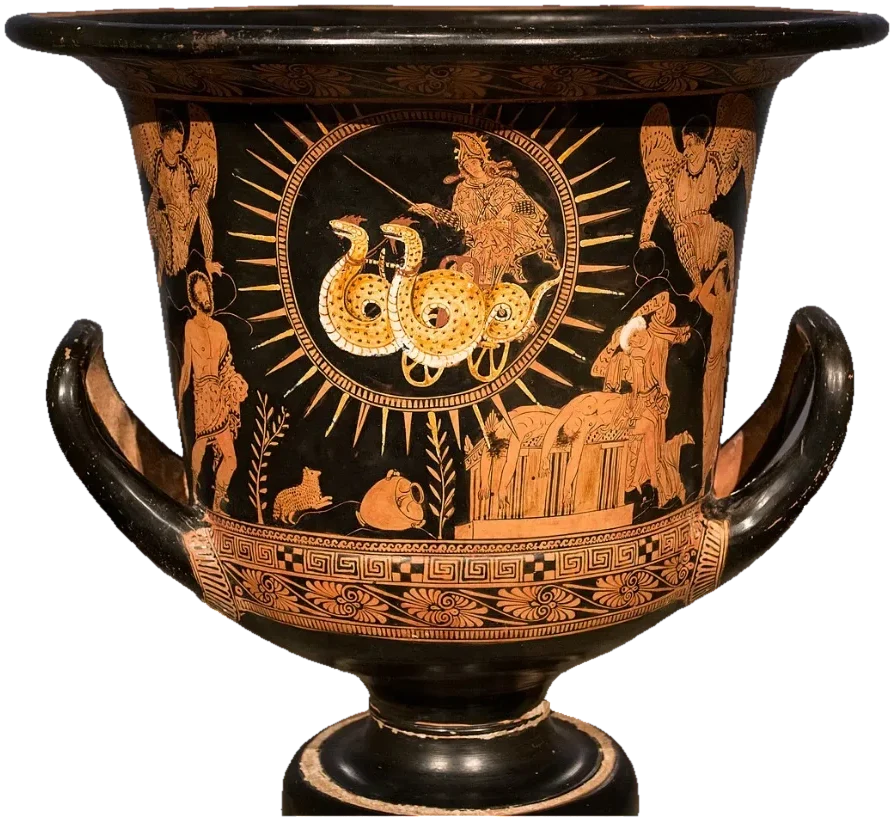
Text and translation
ἀκούεις βοὰν ἀκούεις τέκνων;
Euripides · Medea · the last choral song, broken by the children’s cries from inside the house · two strophic pairs · dochmiacs with iambic trimeters · Murray’s text (Perseus), Lourenço’s colon analysis (2011)
How to read each line
A guide to the Greek, syllables, pitch marks and quantities.
Show the reading key
- Above each line: the line as the edition prints it, each word placed over its own syllables. The main row: the same Greek divided into metrical syllables, each written as it is pronounced. A consonant that closes a syllable is written with it (λόθ | ρο); an elided word is closed up with the next vowel (ν’ἀ); a final consonant carried into the next word is set with a thin space (ς ἰ). Wider gaps mark word-ends.
- Above the syllables: the pitch of each syllable, from the accents. Under them: the quantity of each syllable as it falls in the line, then the transliteration, syllable by syllable, with accented syllables in capitals.
- Under each line: a line-for-line translation. In the right margin of the scansion: the line type, its scheme, and its analysis into cola.
Key to the labels
The names, patterns and symbols used beside this poem.
Show the labels and symbols
The labels in the right margin of the scansion below give the line’s analysis as the scheme file states it, then its scheme and, where the analysis notes them, the period-end, a brevis in longo or a hiatus. ‖ marks the end of a period, ||| the end of the stanza; a line without a period-end runs on into the next (synapheia). × is an anceps, long or short; the last position of every period is indifferent. A click on any syllable highlights the colon it belongs to and explains it. The sources of the labels, with their page numbers, are given line by line under Prosody, line by line.
| Label | Name and shape | What it is |
|---|---|---|
| doch | Dochmius (δ)× — — × — | The dochmius.[5] Its basic shape is ⏑ — — ⏑ —; each of the three longs can be split into two shorts and each short can be replaced by a long (‘drag’), and the forms ⏑ ⏑⏑ — ⏑ — and — ⏑⏑ — ⏑ — are the most frequent.[6] It is reserved for urgent or emotional passages.[7] Lourenço classifies every Euripidean dochmius by its form:[8] ⏑ ⏑⏑ — ⏑ — is Euripides’ favourite shape, ⏑ — — ⏑ — the second.[9] Labels such as 2δ are only shorthand for δ δ: there are probably no dochmiac “dimeters”.[10] |
| ia3 | Iambic trimeter (3 ia)× — ⏑ — × — ⏑ — × — ⏑ — | Three iambic metra.[11] In the strophe the trimeters are the children’s cries from inside the house; in the antistrophe the chorus answers them with trimeters of its own. |
| ia2 | Iambic dimeter (2 ia)× — ⏑ — × — ⏑ — | Two iambic metra, here with both longs of the first metron resolved; Lourenço lists 1281a ~ 1292a with this shape.[12] |
Scansion
The second strophic pair of the song sung while Medea kills her children, laid out colon by colon as Lourenço analyses it: the chorus’s dochmii, the children’s trimeters from inside the house, and the antistrophe that answers them with the story of Ino. The first pair, the prayer to Earth and the Sun (1251–1270), is given after the poem with Lourenço’s schemes: Murray’s text there differs too much from the text Lourenço scans to be laid over his analysis.
(Chorus) Do you hear, do you hear the children’s cry?
O wretched, ill-fated woman!
(First child, within) Oh, what shall I do? Where can I escape my mother’s hands?
(Second child) I do not know, dearest brother: we are being killed.
(Chorus) Shall I go into the house? I think I should
keep murder from the children.
(First child) Yes, by the gods, help us! We need it now.
(Second child) How close we are now to the net of the sword!
(Chorus) Wretched woman, so you were rock or iron,
you who will kill the children,
the harvest you bore yourself, by a death dealt with your own
hand!
One, one woman only of those before, I hear,
laid her hand on her own children:
Ino, driven mad by the gods, when the wife of Zeus
sent her wandering from her house.
The wretched woman falls into the sea for the impious
murder of her children,
stretching her foot out over the sea-cliff,
and dies, dying together with her two sons.
What then could still be terrible? O
bed of women,
full of troubles, how much harm you have done
to mortals already!
Metre
- The song. After Medea goes into the house, a full choral song follows (1251–92), broken up by cries from within: after a first strophic pair that calls on Earth and the Sun to look on the deed, the children are heard trying to escape their mother’s hands; Halleran notes that this echoes Medea’s own first cries from inside the house, embedded in the opening choral song.[13] Mastronarde observes that the chorus’s prayer to the Sun (1251–60) is not answered: the Sun’s help goes to Medea, whose chariot he supplies.[14] Allendorf calls the dochmiac song at 1251–1270 the climax of the action, with an appeal to the gods in the strophe and an emotionally heightened address to Medea in the antistrophe.[15] The antistrophe of the second pair tells of Ino, a brief mythical parallel of the kind that ties a stasimon’s myth openly to the action.[16]
- Dochmiacs. West calls the dochmiac a metre of tragedy above all, and never without urgency or strong feeling. Its basic shape is ⏑ — — ⏑ —; each long can be resolved and each short replaced by a long, and two variants, ⏑ ⏑⏑ — ⏑ — and — ⏑⏑ — ⏑ —, are especially frequent. A word usually ends where a dochmiac metron ends, strophe and antistrophe usually have the same form at the same place, and dochmiacs keep close company with iambic units, trimeters among them, and particularly with cretics and bacchiacs.[6] Battezzato likewise treats it as a peculiarly tragic metre, linked above all with fear and extreme feeling, and explains its name as meaning that it runs askew.[17] Lourenço holds that dochmiacs always signal heightened feeling; he points out that the Medea chorus keep to dactylo-epitrite for most of the play and switch to dochmiacs only once the plot is heading, past all turning back, for the killing of the children.[18] Every dochmius of this pair has one of Euripides’ two favourite shapes: ⏑ — — ⏑ — (275 in Diggle’s text) or ⏑ ⏑⏑ — ⏑ — (395).[19]
- Whose analysis. Every colon is scanned against the analysis printed by F. Lourenço, The Lyric Metres of Euripidean Drama (Coimbra 2011), pp. 153–154, which is made on Diggle’s Oxford text and takes as a colon whatever Diggle prints as a lyric line;[20] the line numbers are his. His labels such as 2δ are only shorthand for δ δ: there are probably no dochmiac “dimeters”.[10] The right margin gives his label; each note opens with his pattern as he prints it. The syllables and their lengths are the workbench’s scansion of Murray’s Greek, which here fits Lourenço’s scheme in every colon. Lourenço’s signs are on pp. 13–15: ∪ is this site’s ⏑, ∪∪ a resolved long, ∩ a short syllable in a long position at period-end, ‖ᴴ and ‖ᴮ period-end shown by hiatus and by breuis in longo, ∫ a word running over the colon-end.
- The trimeters. In the strophe the children’s four lines from inside the house are iambic trimeters (1271–1272, 1277–1278), set between the chorus’s dochmii; in the antistrophe the chorus’s own trimeters stand in the same places (1284–1285, 1288–1289). Lourenço prints them as part of the stanza,[21] and the order of the lines is Diggle’s and Murray’s: 1273–1274 come before 1271–1272. The trimeters respond with each other in their iambic shape but not in their ancipitia.[22] Each trimeter is taken here as a verse, and so as a period of its own;[23] Lourenço marks period-end only where hiatus or breuis in longo proves it.
- Responsion. The dochmii of the antistrophe repeat those of the strophe exactly, as West says responsion in dochmiacs usually is;[24] only the iambic ancipitia differ. Euripides’ “mirror” effect, the same sound at the same point of responding stanzas, links φόνῳ (1286) with φόνον ~ φόνου of the third stasimon (852 ~ 862).[25]
- Periods. Lourenço marks period-end with hiatus after 1287 (δυσσεβεῖ, | ἀκτῆς) and with breuis in longo after 1288 (πόδα, which he lists among his “open” cases, p. 22). The invocation at 1274 also ends a period: Lourenço lists ἰὼ τλᾶμον, ὦ κακοτυχὲς γύναι among the invocations whose period-end is confirmed by hiatus (γύναι. | οἴμοι),[26] though his scheme of the stanza does not print the sign.[27]
- Prosody. The workbench uses the Attic rules (README). West advises that in dochmiacs a stop + liquid seldom lengthens the syllable before it, and that where the choice is open the short reading should be preferred:[28] here every τε- of τέκνων / τέκνοις stays short before κν (1273, 1276, 1280, 1283, 1287), and πίτνει (1286) keeps its short πι before τν. Doric α for η:[29] βοάν, τλᾶμον, σίδαρος, ἅτις, ἁ, ἅλμαν.
- Kovacs’s text. D. Kovacs’s Loeb edition of 1994 also sets 1273–4 before 1271–2 (Seidler) and keeps ὅν at 1281; it differs at 1285 and 1290, where it follows a papyrus, without changing the scansion, and prints several colon pairs as single lines. The line numbers agree.[30]
Prosody, line by line
Every syllable, with the reason for its length. Quantities are read from the vowel where the spelling shows it, from the consonants that follow (“position”), from the accent where it tells, and from the metre where nothing else does. Editors’ notes on the text follow in the boxed paragraphs.
- 1273
Line 1273 · ἀκούεις βοὰν ἀκούεις τέκνων;
ἀκούεις βοὰν ἀκούεις τέκνων;
ἀκούειςβοὰνἀκούειςτέκνω;the period runs on into l. 1274 (synapheia).
The label in the margin, with its sources: Lourenço 2011, p. 153.
- 1 ⏑ἀἀ is short by the metre (position 1 must be short).
- 2 —κούού is a diphthong, long by nature.
- 3 —ειςει is a diphthong, long by nature; closed by ς: long by position.
- 4 ⏑βοο is short by nature.
- 5 —ὰνὰ is long by the metre (position 5 must be long).
- 6 ⏑ἀἀ is short by the metre (position 6 must be short).
- 7 —κούού is a diphthong, long by nature.
- 8 —ειςει is a diphthong, long by nature; closed by ς: long by position.
- 9 ⏑τέέ is short by nature; κν is carried whole into the next syllable, so this syllable stays open and short (Attic correption of a stop + nasal cluster).
- 10 —κνω;ω is long by nature; the line-end is not a period-end: the period runs on into the next line (synapheia), so this syllable keeps its own length, with no brevis in longo, and a word may run over into the next line.[31]
∪ — — ∪ — ∪ — — ∪ —, 2 δ:[32] two dochmii of the second commonest shape, each a clause, ἀκούεις βοάν | ἀκούεις τέκνων. The chorus is divided: Murray marks each change of speaker with a dash at the head of the line (here and at 1274, 1271, 1272, 1277, 1278, 1279, 1282); the dashes are left out of the Greek on this page, because the line display cannot set them without crowding the first word, and the speakers are named in the translation. βοάν has the Doric long ᾱ; the τε of τέκνων stays short before κν. Murray adds the children’s cry ⟨αἰαῖ⟩ before this line (his 1270a, an editorial supplement); Lourenço’s analysis has no colon for it, and it is not shown here.- 1274
Line 1274 · ἰὼ τλᾶμον, ὦ κακοτυχὲς γύναι.
ἰὼ τλᾶμον, ὦ κακοτυχὲς γύναι.
ν ἰὼτλᾶμο,ν ὦκακοτυχὲςγύναι.continues l. 1273 · one period (synapheia).
The label in the margin, with its sources: Lourenço 2011, pp. 25, 153.
- 1 ⏑ν ἰἰ is short by the metre (position 1 must be short); the first consonant belongs to the previous word and is carried over to this vowel.
- 2 —ὼὼ is long by nature.
- 3 —τλᾶᾶ carries a circumflex, so it is long.
- 4 ⏑μο,ο is short by nature.
- 5 —ν ὦὦ is long by nature; the first consonant belongs to the previous word and is carried over to this vowel.
- 6 ⏑καα is short by the metre (position 6 must be short).
- 7 ⏑κοο is short by nature; with its neighbour it resolves the long of position 7 into two shorts.
- 8 ⏑τυυ is short by the metre (position 7 must be short); with its neighbour it resolves the long of position 7 into two shorts.
- 9 —χὲςὲ is short by nature; closed by ς: long by position.
- 10 ⏑γύύ is short by the metre (position 9 must be short).
- 11 ×ναι.αι is a diphthong, long by nature; the last position of the period is indifferent.
- 1271
Line 1271 · οἴμοι, τί δράσω; ποῖ φύγω μητρὸς χέρας;
οἴμοι, τί δράσω; ποῖ φύγω μητρὸς χέρας;
οἴμοι,τίδράσω;ποῖφύγωμητρὸςχέρας;The label in the margin, with its sources: Lourenço 2011, p. 153.
- 1 —οἴοἴ is a diphthong, long by nature.
- 2 —μοι,οι is a diphthong, long by nature.
- 3 ⏑τίί is a vowel of unknown length; the next word begins with δρ, a stop + liquid that does not make position here, so the syllable stays short.
- 4 —δράά is long by the metre (position 4 must be long).
- 5 —σω;ω is long by nature.
- 6 —ποῖοῖ is a diphthong, long by nature.
- 7 ⏑φύύ is short by the metre (position 7 must be short).
- 8 —γωω is long by nature.
- 9 —μηη is long by nature.
- 10 —τρὸςὸ is short by nature; closed by ς: long by position.
- 11 ⏑χέέ is short by nature.
- 12 ×ρας;α is a vowel of unknown length; closed by ς: long by position; the last position of the period is indifferent.
- 1272
Line 1272 · οὐκ οἶδ’, ἄδελφε φίλτατ’· ὀλλύμεσθα γάρ.
οὐκ οἶδ’, ἄδελφε φίλτατ’· ὀλλύμεσθα γάρ.
οὐκοἶδ’,ἄδελφεφίλτατ’·ὀλλύμεσθαγάρ.The label in the margin, with its sources: Lourenço 2011, p. 153.
- 1 —οὐκοὐ is a diphthong, long by nature.
- 2 —οἶοἶ is a diphthong, long by nature.
- 3 ⏑δ’,ἄἄ is short by the metre (position 3 must be short); the apostrophe marks an elided vowel; the consonant before it joins this syllable.
- 4 —δελε is short by nature; closed by λ: long by position.
- 5 ⏑φεε is short by nature.
- 6 —φίλί is a vowel of unknown length; closed by λ: long by position.
- 7 ⏑ταα is short by the metre (position 7 must be short).
- 8 —τ’·ὀλὀ is short by nature; closed by λ: long by position; the apostrophe marks an elided vowel; the consonant before it joins this syllable.
- 9 ⏑λύύ is short by the metre (position 9 must be short).
- 10 —μεσε is short by nature; closed by σ: long by position.
- 11 ⏑θαα is short by the accent rule: acute on the antepenult requires a short final syllable.
- 12 ×γάρ.ά is a vowel of unknown length; closed by ρ: long by position; the last position of the period is indifferent.
— — ∪ — ∪ — ∪ — ∪ — ∪ —, 3 ia:[27] the second child. The elided οἶδ’ and φίλτατ’ join the following vowels.- 1275
Line 1275 · παρέλθω δόμους; ἀρῆξαι φόνον
παρέλθω δόμους; ἀρῆξαι φόνον
παρέλθωδόμους;ἀρῆξαιφόνονthe period runs on into l. 1276 (synapheia).
The label in the margin, with its sources: Lourenço 2011, p. 153.
- 1 ⏑παα is short by the metre (position 1 must be short).
- 2 —ρέλέ is short by nature; closed by λ: long by position.
- 3 —θωω is long by nature.
- 4 ⏑δόό is short by nature.
- 5 —μους;ου is a diphthong, long by nature.
- 6 ⏑ἀἀ is short by the metre (position 6 must be short).
- 7 —ρῆῆ is long by nature; ξ is a double consonant (two sounds) and closes the syllable: long by position.
- 8 —ξαιαι is a diphthong, long by nature.
- 9 ⏑φόό is short by nature.
- 10 —νονο is short by nature; closed by ν: long by position; the line-end is not a period-end: the period runs on into the next line (synapheia), so this syllable keeps its own length, with no brevis in longo, and a word may run over into the next line.[31]
∪ — — ∪ — ∪ — — ∪ —, 2 δ,[32] the chorus again: παρέλθω δόμους; | ἀρῆξαι φόνον, a question and its answer, one in each dochmius.- 1276
Line 1276 · δοκεῖ μοι τέκνοις.
δοκεῖ μοι τέκνοις.
δοκεῖμοιτέκνοις.continues l. 1275 · one period (synapheia); the period runs on into l. 1277 (synapheia).
The label in the margin, with its sources: Lourenço 2011, p. 153.
- 1 ⏑δοο is short by nature.
- 2 —κεῖεῖ is a diphthong, long by nature.
- 3 —μοιοι is a diphthong, long by nature.
- 4 ⏑τέέ is short by nature; κν is carried whole into the next syllable, so this syllable stays open and short (Attic correption of a stop + nasal cluster).
- 5 —κνοις.οι is a diphthong, long by nature; closed by ς: long by position; the line-end is not a period-end: the period runs on into the next line (synapheia), so this syllable keeps its own length, with no brevis in longo, and a word may run over into the next line.[31]
∪ — — ∪ —, δ.[32] The τε of τέκνοις stays short before κν.- 1277
Line 1277 · ναί, πρὸς θεῶν, ἀρήξατ’· ἐν δέοντι γάρ.
ναί, πρὸς θεῶν, ἀρήξατ’· ἐν δέοντι γάρ.
ναί,πρὸςθεῶν,ἀρήξατ’·ἐνδέοντιγάρ.continues l. 1276 · one period (synapheia).
The label in the margin, with its sources: Lourenço 2011, p. 153.
- 1 —ναί,αί is a diphthong, long by nature.
- 2 —πρὸςὸ is short by nature; closed by ς: long by position.
- 3 ⏑θεε is short by nature.
- 4 —ῶν,ῶ is long by nature.
- 5 ⏑ἀἀ is short by the metre (position 5 must be short).
- 6 —ρήή is long by nature; ξ is a double consonant (two sounds) and closes the syllable: long by position.
- 7 ⏑ξαα is short by the metre (position 7 must be short).
- 8 —τ’·ἐνἐ is short by nature; closed by ν: long by position; the apostrophe marks an elided vowel; the consonant before it joins this syllable.
- 9 ⏑δέέ is short by nature.
- 10 —ονο is short by nature; closed by ν: long by position.
- 11 ⏑τιι is short by the accent rule: acute on the antepenult requires a short final syllable.
- 12 ×γάρ.ά is a vowel of unknown length; closed by ρ: long by position; the last position of the period is indifferent.
- 1278
Line 1278 · ὡς ἐγγὺς ἤδη γ’ ἐσμὲν ἀρκύων ξίφους.
ὡς ἐγγὺς ἤδη γ’ ἐσμὲν ἀρκύων ξίφους.
ὡςἐγγὺς ἤδηγ’ἐσμὲν ἀρκύωνξίφους.The label in the margin, with its sources: Lourenço 2011, p. 153.
- 1 —ὡςὡ is long by nature.
- 2 —ἐγἐ is short by nature; closed by γ: long by position.
- 3 ⏑γὺὺ is short by the metre (position 3 must be short).
- 4 —ς ἤἤ is long by nature; the first consonant belongs to the previous word and is carried over to this vowel.
- 5 —δηη is long by nature.
- 6 —γ’ἐσἐ is short by nature; closed by σ: long by position; the apostrophe marks an elided vowel; the consonant before it joins this syllable.
- 7 ⏑μὲὲ is short by nature.
- 8 —ν ἀρἀ is a vowel of unknown length; closed by ρ: long by position; the first consonant belongs to the previous word and is carried over to this vowel.
- 9 ⏑κύύ is short by the metre (position 9 must be short).
- 10 —ωνω is long by nature; closed by ν: long by position.
- 11 ⏑ξίί is short by the metre (position 11 must be short).
- 12 ×φους.ου is a diphthong, long by nature; closed by ς: long by position; the last position of the period is indifferent.
— — ∪ — — — ∪ — ∪ — ∪ —, 3 ia:[27] the second child. The ς of ὡς passes to ἐγγύς, and the ν of ἐσμέν to ἀρκύων.- 1279
Line 1279 · τάλαιν’, ὡς ἄρ’ ἦσθα πέτρος ἢ σίδα-
τάλαιν’, ὡς ἄρ’ ἦσθα πέτρος ἢ σίδα-
τάλαιν’,ὡςἄρ’ἦσθαπέτρος ἢσίδα-the period runs on into l. 1280 (synapheia).
The label in the margin, with its sources: Lourenço 2011, p. 153.
- 1 ⏑τάά is short by the metre (position 1 must be short).
- 2 —λαιαι is a diphthong, long by nature.
- 3 —ν’,ὡςὡ is long by nature; the apostrophe marks an elided vowel; the consonant before it joins this syllable.
- 4 ⏑ἄἄ is short by the metre (position 4 must be short).
- 5 —ρ’ἦσἦ is long by nature; closed by σ: long by position; the apostrophe marks an elided vowel; the consonant before it joins this syllable.
- 6 ⏑θαα is short by the accent rule: circumflex on the penult requires a short final syllable.
- 7 ⏑πέέ is short by nature; τρ is carried whole into the next syllable, so this syllable stays open and short (Attic correption of a stop + liquid cluster); with its neighbour it resolves the long of position 7 into two shorts.
- 8 ⏑τροο is short by nature; with its neighbour it resolves the long of position 7 into two shorts.
- 9 —ς ἢἢ is long by nature; the first consonant belongs to the previous word and is carried over to this vowel.
- 10 ⏑σίί is short by the metre (position 9 must be short).
- 11 —δα-α is long by the metre (position 10 must be long); the line-end is not a period-end: the period runs on into the next line (synapheia), so this syllable keeps its own length, with no brevis in longo, and a word may run over into the next line.[31]
- 1280
Line 1280 · ρος, ἅτις τέκνων
ρος, ἅτις τέκνων
ρο,ς ἅτιςτέκνωcontinues l. 1279 · one period (synapheia); the period runs on into l. 1281a (synapheia).
The label in the margin, with its sources: Lourenço 2011, p. 153.
- 1 ⏑ρο,ο is short by nature.
- 2 —ς ἅἅ is long by the metre (position 2 must be long); the first consonant belongs to the previous word and is carried over to this vowel.
- 3 —τιςι is a vowel of unknown length; closed by ς: long by position.
- 4 ⏑τέέ is short by nature; κν is carried whole into the next syllable, so this syllable stays open and short (Attic correption of a stop + nasal cluster).
- 5 —κνωω is long by nature; the line-end is not a period-end: the period runs on into the next line (synapheia), so this syllable keeps its own length, with no brevis in longo, and a word may run over into the next line.[31]
∪ — — ∪ —, δ.[32] ἅτις is the Doric form of ἥτις, with long ᾱ; the τε of τέκνων stays short.- 1281a
Line 1281a · ὃν ἔτεκες ἄροτον αὐτόχει-
ὃν ἔτεκες ἄροτον αὐτόχει-
ν ὃν ἔτεκες ἄροτον αὐτόχει-continues l. 1280 · one period (synapheia); the period runs on into l. 1281b (synapheia).
The label in the margin, with its sources: Lourenço 2011, p. 153.
- 1 ⏑ν ὃὃ is short by nature; the first consonant belongs to the previous word and is carried over to this vowel.
- 2 ⏑ν ἔἔ is short by nature; the first consonant belongs to the previous word and is carried over to this vowel; with its neighbour it resolves the long of position 2 into two shorts.
- 3 ⏑τεε is short by nature; with its neighbour it resolves the long of position 2 into two shorts.
- 4 ⏑κεε is short by nature.
- 5 ⏑ς ἄἄ is short by the metre (position 4 must be short); the first consonant belongs to the previous word and is carried over to this vowel; with its neighbour it resolves the long of position 4 into two shorts.
- 6 ⏑ροο is short by nature; with its neighbour it resolves the long of position 4 into two shorts.
- 7 ⏑τοο is short by nature.
- 8 —ν αὐαὐ is a diphthong, long by nature; the first consonant belongs to the previous word and is carried over to this vowel.
- 9 ⏑τόό is short by nature.
- 10 —χει-ει is a diphthong, long by nature; the line-end is not a period-end: the period runs on into the next line (synapheia), so this syllable keeps its own length, with no brevis in longo, and a word may run over into the next line.[31]
∪ ∪∪ ∪ ∪∪ ∪ — ∪ —, 2 ia ∫:[35] an iambic dimeter with both longs of the first metron resolved, in tribrach-shaped words (ἔτεκες ἄροτον), a Euripidean mannerism.[36] The word αὐτόχειρι overlaps into the dochmius that follows: Lourenço quotes 1281a–b as an example of a change of metre inside a sequence in synartesis, which shows that a change of metre does not always imply period-end.[37] Murray prints 1281a–b as one line (1281).- 1281b
Line 1281b · ρι μοίρᾳ κτενεῖς.
ρι μοίρᾳ κτενεῖς.
ριμοίρᾳκτενεῖς.continues l. 1281a · one period (synapheia).
The label in the margin, with its sources: Lourenço 2011, p. 153.
- 1 ⏑ριι is short by the accent rule: acute on the antepenult requires a short final syllable.
- 2 —μοίοί is a diphthong, long by nature.
- 3 —ρᾳᾳ is long by nature; the next word begins with κτ: the syllable is closed before it: long by position.
- 4 ⏑κτεε is short by nature.
- 5 ×νεῖς.εῖ is a diphthong, long by nature; closed by ς: long by position; the last position of the period is indifferent.
- 1282
Line 1282 · μίαν δὴ κλύω μίαν τῶν πάρος
μίαν δὴ κλύω μίαν τῶν πάρος
μίανδὴκλύωμίαντῶνπάροςthe period runs on into l. 1283 (synapheia).
The label in the margin, with its sources: Lourenço 2011, p. 153.
- 1 ⏑μίί is short by the metre (position 1 must be short).
- 2 —ανα is a vowel of unknown length; closed by ν: long by position.
- 3 —δὴὴ is long by nature.
- 4 ⏑κλύύ is short by the metre (position 4 must be short).
- 5 —ωω is long by nature.
- 6 ⏑μίί is short by the metre (position 6 must be short).
- 7 —ανα is a vowel of unknown length; closed by ν: long by position.
- 8 —τῶνῶ is long by nature; closed by ν: long by position.
- 9 ⏑πάά is short by the metre (position 9 must be short).
- 10 —ροςο is short by nature; closed by ς: long by position; the line-end is not a period-end: the period runs on into the next line (synapheia), so this syllable keeps its own length, with no brevis in longo, and a word may run over into the next line.[31]
∪ — — ∪ — ∪ — — ∪ —, 2 δ,[32] answering 1273. The repeated μίαν ... μίαν stands at the head of each dochmius, as ἀκούεις ... ἀκούεις does in the strophe.- 1283
Line 1283 · γυναῖκ’ ἐν φίλοις χέρα βαλεῖν τέκνοις·
γυναῖκ’ ἐν φίλοις χέρα βαλεῖν τέκνοις·
γυναῖκ’ἐνφίλοιςχέραβαλεῖντέκνοι·continues l. 1282 · one period (synapheia); the period runs on into l. 1284 (synapheia).
The label in the margin, with its sources: Lourenço 2011, p. 153.
- 1 ⏑γυυ is short by the metre (position 1 must be short).
- 2 —ναῖαῖ is a diphthong, long by nature.
- 3 —κ’ἐνἐ is short by nature; closed by ν: long by position; the apostrophe marks an elided vowel; the consonant before it joins this syllable.
- 4 ⏑φίί is short by the metre (position 4 must be short).
- 5 —λοιςοι is a diphthong, long by nature; closed by ς: long by position.
- 6 ⏑χέέ is short by nature.
- 7 ⏑ραα is short by the metre (position 7 must be short); with its neighbour it resolves the long of position 7 into two shorts.
- 8 ⏑βαα is short by the metre (position 7 must be short); with its neighbour it resolves the long of position 7 into two shorts.
- 9 —λεῖνεῖ is a diphthong, long by nature; closed by ν: long by position.
- 10 ⏑τέέ is short by nature; κν is carried whole into the next syllable, so this syllable stays open and short (Attic correption of a stop + nasal cluster).
- 11 —κνοι·οι is a diphthong, long by nature; the line-end is not a period-end: the period runs on into the next line (synapheia), so this syllable keeps its own length, with no brevis in longo, and a word may run over into the next line.[31]
∪ — — ∪ — ∪ ∪∪ — ∪ —, 2 δ,[33] answering 1274 exactly; χέρα βα- resolves the long. The τε of τέκνοις stays short before κν.- 1284
Line 1284 · Ἰνὼ μανεῖσαν ἐκ θεῶν, ὅθ’ ἡ Διὸς
Ἰνὼ μανεῖσαν ἐκ θεῶν, ὅθ’ ἡ Διὸς
ς Ἰνὼμανεῖσαν ἐκθεῶν,ὅθ’ἡΔιὸςcontinues l. 1283 · one period (synapheia).
The label in the margin, with its sources: Lourenço 2011, p. 153.
- 1 —ς ἸἸ is long by the metre (position 1 must be long); the first consonant belongs to the previous word and is carried over to this vowel.
- 2 —νὼὼ is long by nature.
- 3 ⏑μαα is short by the metre (position 3 must be short).
- 4 —νεῖεῖ is a diphthong, long by nature.
- 5 ⏑σαα is short by the accent rule: circumflex on the penult requires a short final syllable.
- 6 —ν ἐκἐ is short by nature; closed by κ: long by position; the first consonant belongs to the previous word and is carried over to this vowel.
- 7 ⏑θεε is short by nature.
- 8 —ῶν,ῶ is long by nature.
- 9 ⏑ὅὅ is short by nature.
- 10 —θ’ἡἡ is long by nature; the apostrophe marks an elided vowel; the consonant before it joins this syllable.
- 11 ⏑Διι is short by the metre (position 11 must be short).
- 12 ×ὸςὸ is short by nature; closed by ς: long by position; the last position of the period is indifferent.
— — ∪ — ∪ — ∪ — ∪ — ∪ —, 3 ia:[27] the chorus’s trimeter in the place of the first child’s (1271). The ι of Ἰνώ is long, as the scheme requires; Murray’s sentence runs on over the verse-end (Διὸς | δάμαρ).- 1285
Line 1285 · δάμαρ νιν ἐξέπεμψε δωμάτων ἄλῃ·
δάμαρ νιν ἐξέπεμψε δωμάτων ἄλῃ·
δάμαρνιν ἐξέπεμψεδωμάτωνἄλῃ·The label in the margin, with its sources: Lourenço 2011, p. 154.
- 1 ⏑δάά is short by the metre (position 1 must be short).
- 2 —μαρα is a vowel of unknown length; closed by ρ: long by position.
- 3 ⏑νιι is short by the metre (position 3 must be short).
- 4 —ν ἐἐ is short by nature; ξ is a double consonant (two sounds) and closes the syllable: long by position; the first consonant belongs to the previous word and is carried over to this vowel.
- 5 ⏑ξέέ is short by nature.
- 6 —πεμε is short by nature; closed by μ: long by position.
- 7 ⏑ψεε is short by nature.
- 8 —δωω is long by nature.
- 9 ⏑μάά is short by the metre (position 9 must be short).
- 10 —τωνω is long by nature.
- 11 ⏑ἄἄ is short by the metre (position 11 must be short).
- 12 ×λῃ·ῃ is long by nature; the last position of the period is indifferent.
- 1286
Line 1286 · πίτνει δ’ ἁ τάλαιν’ ἐς ἅλμαν φόνῳ
πίτνει δ’ ἁ τάλαιν’ ἐς ἅλμαν φόνῳ
πίτνειδ’ἁτάλαιν’ἐς ἅλμανφόνῳthe period runs on into l. 1287 (synapheia).
The label in the margin, with its sources: Lourenço 2011, p. 154.
- 1 ⏑πίί is a vowel of unknown length; τν is carried whole into the next syllable, so this syllable stays open and short (Attic correption of a stop + nasal cluster).
- 2 —τνειει is a diphthong, long by nature.
- 3 —δ’ἁἁ is long by the metre (position 3 must be long); the apostrophe marks an elided vowel; the consonant before it joins this syllable.
- 4 ⏑τάά is short by the metre (position 4 must be short).
- 5 —λαιαι is a diphthong, long by nature.
- 6 ⏑ν’ἐἐ is short by nature; the apostrophe marks an elided vowel; the consonant before it joins this syllable.
- 7 —ς ἅλἅ is a vowel of unknown length; closed by λ: long by position; the first consonant belongs to the previous word and is carried over to this vowel.
- 8 —μανα is a vowel of unknown length; closed by ν: long by position.
- 9 ⏑φόό is short by nature.
- 10 —νῳῳ is long by nature; the line-end is not a period-end: the period runs on into the next line (synapheia), so this syllable keeps its own length, with no brevis in longo, and a word may run over into the next line.[31]
- 1287
Line 1287 · τέκνων δυσσεβεῖ,
τέκνων δυσσεβεῖ,
τέκνωνδυσσεβεῖ,continues l. 1286 · one period (synapheia).
The label in the margin, with its sources: Lourenço 2011, p. 154.
- 1 ⏑τέέ is short by nature; κν is carried whole into the next syllable, so this syllable stays open and short (Attic correption of a stop + nasal cluster).
- 2 —κνωνω is long by nature; closed by ν: long by position.
- 3 —δυσυ is a vowel of unknown length; closed by σ: long by position.
- 4 ⏑σεε is short by nature.
- 5 ×βεῖ,εῖ is a diphthong, long by nature; the last position of the period is indifferent.
∪ — — ∪ —, δ ‖ᴴ,[39] answering 1276. Period-end, proved by the hiatus δυσσεβεῖ, | ἀκτῆς. The τε of τέκνων stays short before κν.- 1288
Line 1288 · ἀκτῆς ὑπερτείνασα ποντίας πόδα,
ἀκτῆς ὑπερτείνασα ποντίας πόδα,
ἀκτῆςὑπερτείνασαποντίαςπόδα,brevis in longo at period-end (a short in the final long position).
The label in the margin, with its sources: Lourenço 2011, p. 154.
- 1 —ἀκἀ is a vowel of unknown length; closed by κ: long by position.
- 2 —τῆςῆ is long by nature.
- 3 ⏑ὑὑ is short by the metre (position 3 must be short).
- 4 —περε is short by nature; closed by ρ: long by position.
- 5 —τείεί is a diphthong, long by nature.
- 6 —ναα is long by the metre (position 6 must be long).
- 7 ⏑σαα is short by the accent rule: acute on the antepenult requires a short final syllable.
- 8 —πονο is short by nature; closed by ν: long by position.
- 9 ⏑τίί is short by the metre (position 9 must be short).
- 10 —αςα is a vowel of unknown length; closed by ς: long by position.
- 11 ⏑πόό is short by nature.
- 12 ×δα,ᾰ is short (its length is not shown by the ordinary spelling); the last position of the period is indifferent; a short here is brevis in longo.
— — ∪ — — — ∪ — ∪ — ∪ ∩, 3 ia ‖ᴮ:[40] the last syllable, -δα of πόδα, has the short α of the accusative singular[41] in a long position, breuis in longo, which proves the period-end; Lourenço lists Med. 1288 among his “open” cases.[42] ὑπερτείνασα has the long ᾱ of the aorist participle, as Lourenço’s scheme shows.- 1289
Line 1289 · δυοῖν τε παίδοιν συνθανοῦσ’ ἀπόλλυται.
δυοῖν τε παίδοιν συνθανοῦσ’ ἀπόλλυται.
δυοῖντεπαίδοινσυνθανοῦσ’ἀπόλλυται.The label in the margin, with its sources: Lourenço 2011, p. 154.
- 1 ⏑δυυ is short by the metre (position 1 must be short).
- 2 —οῖνοῖ is a diphthong, long by nature; closed by ν: long by position.
- 3 ⏑τεε is short by nature.
- 4 —παίαί is a diphthong, long by nature.
- 5 —δοινοι is a diphthong, long by nature; closed by ν: long by position.
- 6 —συνυ is a vowel of unknown length; closed by ν: long by position.
- 7 ⏑θαα is short by the metre (position 7 must be short).
- 8 —νοῦοῦ is a diphthong, long by nature.
- 9 ⏑σ’ἀἀ is short by the metre (position 9 must be short); the apostrophe marks an elided vowel; the consonant before it joins this syllable.
- 10 —πόλό is short by nature; closed by λ: long by position.
- 11 ⏑λυυ is short by the metre (position 11 must be short).
- 12 ×ται.αι is a diphthong, long by nature; the last position of the period is indifferent.
∪ — ∪ — — — ∪ — ∪ — ∪ —, 3 ia,[38] answering 1278. δυοῖν ... παίδοιν are dual forms.- 1290
Line 1290 · τί δῆτ’ οὖν γένοιτ’ ἂν ἔτι δεινόν; ὦ
τί δῆτ’ οὖν γένοιτ’ ἂν ἔτι δεινόν; ὦ
τίδῆτ’οὖνγένοιτ’ἂν ἔτιδεινό;ν ὦthe period runs on into l. 1291 (synapheia).
The label in the margin, with its sources: Lourenço 2011, p. 154.
- 1 ⏑τίί is short by the metre (position 1 must be short).
- 2 —δῆῆ is long by nature.
- 3 —τ’οὖνοὖ is a diphthong, long by nature; closed by ν: long by position; the apostrophe marks an elided vowel; the consonant before it joins this syllable.
- 4 ⏑γέέ is short by nature.
- 5 —νοιοι is a diphthong, long by nature.
- 6 ⏑τ’ἂἂ is short by the metre (position 6 must be short); the apostrophe marks an elided vowel; the consonant before it joins this syllable.
- 7 ⏑ν ἔἔ is short by nature; the first consonant belongs to the previous word and is carried over to this vowel; with its neighbour it resolves the long of position 7 into two shorts.
- 8 ⏑τιι is short by the metre (position 7 must be short); with its neighbour it resolves the long of position 7 into two shorts.
- 9 —δειει is a diphthong, long by nature.
- 10 ⏑νό;ό is short by nature.
- 11 —ν ὦὦ is long by nature; the first consonant belongs to the previous word and is carried over to this vowel; the line-end is not a period-end: the period runs on into the next line (synapheia), so this syllable keeps its own length, with no brevis in longo, and a word may run over into the next line.[31]
- 1291
Line 1291 · γυναικῶν λέχος
γυναικῶν λέχος
γυναικῶνλέχοςcontinues l. 1290 · one period (synapheia); the period runs on into l. 1292a (synapheia).
The label in the margin, with its sources: Lourenço 2011, p. 154.
- 1 ⏑γυυ is short by the metre (position 1 must be short).
- 2 —ναιαι is a diphthong, long by nature.
- 3 —κῶνῶ is long by nature; closed by ν: long by position.
- 4 ⏑λέέ is short by nature.
- 5 —χοςο is short by nature; closed by ς: long by position; the line-end is not a period-end: the period runs on into the next line (synapheia), so this syllable keeps its own length, with no brevis in longo, and a word may run over into the next line.[31]
∪ — — ∪ —, δ,[39] answering 1280.- 1292a
Line 1292a · πολύπονον, ὅσα βροτοῖς ἔρεξ-
πολύπονον, ὅσα βροτοῖς ἔρεξ-
πολύπονο,ν ὅσαβροτοῖςἔρε-continues l. 1291 · one period (synapheia); the period runs on into l. 1292b (synapheia).
The label in the margin, with its sources: Lourenço 2011, p. 154.
- 1 ⏑ποο is short by nature.
- 2 ⏑λύύ is short by the metre (position 2 must be short); with its neighbour it resolves the long of position 2 into two shorts.
- 3 ⏑ποο is short by nature; with its neighbour it resolves the long of position 2 into two shorts.
- 4 ⏑νο,ο is short by nature.
- 5 ⏑ν ὅὅ is short by nature; the first consonant belongs to the previous word and is carried over to this vowel; with its neighbour it resolves the long of position 4 into two shorts.
- 6 ⏑σαα is a vowel of unknown length; the next word begins with βρ, a stop + liquid that does not make position here, so the syllable stays short; with its neighbour it resolves the long of position 4 into two shorts.
- 7 ⏑βροο is short by nature.
- 8 —τοῖςοῖ is a diphthong, long by nature.
- 9 ⏑ἔἔ is short by nature.
- 10 —ρε-ε is short by nature; ξ is a double consonant (two sounds) and closes the syllable: long by position; the line-end is not a period-end: the period runs on into the next line (synapheia), so this syllable keeps its own length, with no brevis in longo, and a word may run over into the next line.[31]
∪ ∪∪ ∪ ∪∪ ∪ — ∪ —, 2 ia ∫,[44] answering 1281a. The σα of ὅσα stays short before βρ; the ρε of ἔρεξας is long before ξ, and the word overlaps the colon-end. Murray prints 1292a–b as one line (1292).- 1292b
Line 1292b · ας ἤδη κακά.
ας ἤδη κακά.
ξας ἤδηκακά.continues l. 1292a · one period (synapheia); brevis in longo at period-end (a short in the final long position).
The label in the margin, with its sources: Lourenço 2011, p. 154.
- 1 ⏑ξαα is short by the accent rule: acute on the antepenult requires a short final syllable.
- 2 —ς ἤἤ is long by nature; the first consonant belongs to the previous word and is carried over to this vowel.
- 3 —δηη is long by nature.
- 4 ⏑καα is short by the metre (position 4 must be short).
- 5 ×κά.ᾰ́ is short (its length is not shown by the ordinary spelling); the last position of the period is indifferent; a short here is brevis in longo.
Strophe and antistrophe
The antistrophe (1282–1292b) repeats the metre of the strophe (1273–1281b) line for line. The table sets the two side by side with Lourenço’s schemes and labels as he prints them;[21] a scheme printed in the accent colour differs from its partner. The dochmii match exactly; only the trimeters differ, in their ancipitia.
Strophe β′ (1273–1281b) ~ Antistrophe β′ (1282–1292b)
| Line | Lourenço’s scheme | Label | Line | Lourenço’s scheme | Label |
|---|---|---|---|---|---|
| 1273 | ⏑ — — ⏑ — ⏑ — — ⏑ — | 2 δ | 1282 | ⏑ — — ⏑ — ⏑ — — ⏑ — | 2 δ |
| 1274 | ⏑ — — ⏑ — ⏑ ⏑⏑ — ⏑ — | 2 δ | 1283 | ⏑ — — ⏑ — ⏑ ⏑⏑ — ⏑ — | 2 δ |
| 1271 | — — ⏑ — — — ⏑ — — — ⏑ — | 3 ia | 1284 | — — ⏑ — ⏑ — ⏑ — ⏑ — ⏑ — | 3 ia |
| 1272 | — — ⏑ — ⏑ — ⏑ — ⏑ — ⏑ — | 3 ia | 1285 | ⏑ — ⏑ — ⏑ — ⏑ — ⏑ — ⏑ — | 3 ia |
| 1275 | ⏑ — — ⏑ — ⏑ — — ⏑ — | 2 δ | 1286 | ⏑ — — ⏑ — ⏑ — — ⏑ — | 2 δ |
| 1276 | ⏑ — — ⏑ — | δ | 1287 | ⏑ — — ⏑ — | δ ‖ᴴ |
| 1277 | — — ⏑ — ⏑ — ⏑ — ⏑ — ⏑ — | 3 ia | 1288 | — — ⏑ — — — ⏑ — ⏑ — ⏑ ∩ | 3 ia ‖ᴮ |
| 1278 | — — ⏑ — — — ⏑ — ⏑ — ⏑ — | 3 ia | 1289 | ⏑ — ⏑ — — — ⏑ — ⏑ — ⏑ — | 3 ia |
| 1279 | ⏑ — — ⏑ — ⏑ ⏑⏑ — ⏑ — | 2δ ∫ | 1290 | ⏑ — — ⏑ — ⏑ ⏑⏑ — ⏑ — | 2δ |
| 1280 | ⏑ — — ⏑ — | δ | 1291 | ⏑ — — ⏑ — | δ |
| 1281a | ⏑ ⏑⏑ ⏑ ⏑⏑ ⏑ — ⏑ — | 2 ia ∫ | 1292a | ⏑ ⏑⏑ ⏑ ⏑⏑ ⏑ — ⏑ — | 2 ia ∫ |
| 1281b | ⏑ — — ⏑ — | δ | 1292b | ⏑ — — ⏑ — | δ |
The first strophic pair (1251–1270)
The chorus prays to Earth and the Sun to stop Medea (strophe), then turns to Medea herself (antistrophe). Lourenço’s analysis is given below as he prints it.[45] It is not drawn over the Greek, because Murray’s text[46] differs here from Diggle’s, on which the analysis is made: Murray’s lines have a different number of syllables from Lourenço’s cola at 1252, 1255, 1256, 1259, 1266 and 1269, and at 1262 and 1265 the same number in a different pattern of quantities (Murray’s ἆρα μάταν begins with a long where Lourenço’s dochmius begins with a short; in φρενῶν βαρύς the long -νῶν stands where Lourenço has a resolved long). Lourenço’s own discussion marks several of these places: the text of 1256 ~ 1266 is conjectural in Diggle’s edition,[47] 1260 and 1269 are marked as corrupt (for 1269 also the scheme, p. 153)[9], and for the molossus of 1255 ~ 1265 he refers to Diggle’s discussion.[48] The cola 1258–1260 and 1268–1270 are joined by words running over the colon-ends (∫).
What the analysis shows can still be read from the table: a bacchiac (1251 ~ 1261) and a molossus (1255 ~ 1265) stand before a dochmius, metra which Lourenço lists among the iambic metra that join dochmiac sequences,[48] and every other colon is made of dochmii, chiefly of Euripides’ two favourite shapes, ⏑ — — ⏑ — and ⏑ ⏑⏑ — ⏑ —,[49] with — — — ⏑ — at 1252, ⏑ ⏑⏑ ⏑⏑ ⏑ — at 1252 ~ 1262, ⏑ — ⏑⏑ ⏑ — at 1255 ~ 1265 and 1262, and — ⏑⏑ — ⏑ — at 1256 ~ 1266, 1258 and 1260 ~ 1270.[50] Lourenço cites κατίδετ’ ἴδετε (1252) ~ φίλιον ἔτεκες (1262) as tribrach-shaped words in responsion.[36]
| Line | Lourenço’s scheme | Label | Line | Lourenço’s scheme | Label |
|---|---|---|---|---|---|
| 1251 | ⏑ — — ⏑ — — ⏑ — | ba + δ | 1261 | ⏑ — — ⏑ — — ⏑ — | ba + δ |
| 1252 | — — — ⏑ — ⏑ ⏑⏑ ⏑⏑ ⏑ — | 2 δ | 1262 | ⏑ — ⏑⏑ ⏑ — ⏑ ⏑⏑ ⏑⏑ ⏑ — | 2 δ |
| 1253 | ⏑ ⏑⏑ — ⏑ — ⏑ — — ⏑ — | 2δ | 1263 | ⏑ ⏑⏑ — ⏑ — ⏑ — — ⏑ — | 2δ |
| 1254 | ⏑ — — ⏑ — ⏑ — — ⏑ — | 2 δ | 1264 | ⏑ — — ⏑ — ⏑ — — ⏑ — | 2δ |
| 1255 | — — — ⏑ — ⏑⏑ ⏑ — | mol + δ | 1265 | — — — ⏑ — ⏑⏑ ⏑ — | mol + δ |
| 1256 | ⏑ — — ⏑ — — ⏑ ⏑ — ⏑ — | 2 δ | 1266 | ⏑ — — ⏑ — — ⏑ ⏑ — ⏑ — | 2 δ |
| 1257 | ⏑ ⏑ ⏑ — ⏑ — | δ | 1267 | ⏑ ⏑ ⏑ — ⏑ — | δ |
| 1258 | — ⏑ ⏑ — ⏑ — ⏑ ⏑⏑ — ⏑ — | 2 δ ∫ | 1268 | ⏑ ⏑⏑ — ⏑ — ⏑ ⏑⏑ — ⏑ — | 2 δ ∫ |
| 1259 | ⏑ ⏑⏑ — ⏑ — ⏑ — — ⏑ — | 2δ ∫ | 1269 | ⏑ † ⏑ ⏑ — ⏑ † — ⏑ — — ⏑ — | 2δ ∫ |
| 1260 | — ⏑ ⏑ — ⏑ — ⏑ ⏑ — ⏑ — | 2δ | 1270 | — ⏑ ⏑ — ⏑ — ⏑ ⏑⏑ — ⏑ — | 2 δ |
D. Kovacs’s Loeb edition of 1994 prints in these lines readings that Murray does not: Diggle’s supplement χαμαί (1256), Eden’s ὑπαλαστόρων (1260), Seidler’s φρενοβαρής (1265), Porson’s ζαμενής with Wecklein’s φόνου (1266) and Leo’s ἕπεται δ’ ἅμ’ (1269); he gives the children’s cry ἰώ μοι as 1270a.[51]
As printed on Lourenço’s pp. 152–153; where his Part I classifies a dochmius differently from what the spacing of the printed scheme suggests, Part I has been followed in the paragraph above (for instance — ⏑ ⏑ — ⏑ — at 1256, 1258 and 1260 is his — ⏑⏑ — ⏑ —, p. 62; ⏑ ⏑ ⏑ — ⏑ — at 1257 ~ 1267 is ⏑ ⏑⏑ — ⏑ —, p. 60).
ἰὼ Γᾶ τε καὶ παμφαὴς
ἀκτὶς Ἀελίου, κατίδετ’ ἴδετε τὰν
ὀλομέναν γυναῖκα, πρὶν φοινίαν
τέκνοις προσβαλεῖν χέρ’ αὐτοκτόνον·
τεᾶς γὰρ ἀπὸ χρυσέας γονᾶς
ἔβλαστεν, θεοῦ δ’ αἷμά τι πίτνειν
φόβος ὑπ’ ἀνέρων.
ἀλλά νιν, ὦ φάος διογενές, κάτειρ-
γε κατάπαυσον, ἔξελ’ οἴκων φονίαν
τάλαινάν τ’ Ἐρινὺν ὑπ’ ἀλαστόρων.
“Io, Earth, and blazing ray of Helios, look down, look on this woman bent on ruin, before she lays on her children a bloody hand that kills its own kin. She grew from your golden stock, and for a god’s blood to fall at the hands of men is a thing to dread. Zeus-born light, hold her back, make her stop, take out of the house this wretched, blood-stained Erinys driven on by avenging spirits.”
μάταν μόχθος ἔρρει τέκνων,
ἆρα μάταν γένος φίλιον ἔτεκες, ὦ
κυανεᾶν λιποῦσα Συμπληγάδων
πετρᾶν ἀξενωτάταν ἐσβολάν;
δειλαία, τί σοι φρενῶν βαρὺς
χόλος προσπίτνει καὶ δυσμενὴς
φόνος; ἀμείβεται
χαλεπὰ γὰρ βροτοῖς ὁμογενῆ μιά-
σματα ἐπὶ γαῖαν αὐτοφόνταις ξυνῳ-
δὰ θεόθεν πίτνοντ’ ἐπὶ δόμοις ἄχη.
“The toil you gave your children flows away for nothing; was it for nothing you bore a dear brood, you who came through the dark Symplegades, the rocks whose mouth is cruellest to strangers? Wretched one, why does heavy wrath strike at your heart, and hostile murder? It takes its return: hard on mortals is the defilement of kindred blood on the ground, and griefs in tune with it fall from the gods on the houses of those who kill their own.” Murray’s text, 1251–1270, from Perseus, lined as Murray prints it.
Notes
- ^ Halleran 2005, pp. 177–178.
- ^ Halleran 2005, pp. 178–181.
- ^ Debnar 2005, pp. 3–4; Easterling 1997, Chronology, p. 353.
- ^ Halleran 2005, pp. 180–181.
- ^ Lourenço 2011, p. 14; West 1987, p. ix, where it is written ⏒ — — ⏒ —.
- ^ a b West 1987, p. 56; D’Angour 2022, pp. 138–139.
- ^ West 1987, p. 56; Battezzato 2005, p. 158.
- ^ Lourenço 2011, pp. 59–64.
- ^ a b Lourenço 2011, p. 60.
- ^ a b Lourenço 2011, p. 10.
- ^ Lourenço 2011, p. 14; West 1987, p. x.
- ^ Lourenço 2011, p. 119.
- ^ Halleran 2005, p. 181.
- ^ Mastronarde 2005, p. 324.
- ^ Allendorf 2022, p. 431.
- ^ Battezzato 2005, p. 164.
- ^ Battezzato 2005, p. 158.
- ^ Lourenço 2011, p. 30 with n. 30, citing this song.
- ^ Lourenço 2011, p. 60 with nn. 114–115, where each line of this pair is listed.
- ^ Lourenço 2011, pp. 9–10.
- ^ a b Lourenço 2011, pp. 153–154.
- ^ See the table below the poem.
- ^ West 1987, p. 3: a verse is defined by synapheia.
- ^ West 1987, p. 56.
- ^ a b Lourenço 2011, p. 29 n. 26.
- ^ a b Lourenço 2011, p. 25 n. 14.
- ^ a b c d e f Lourenço 2011, p. 153.
- ^ a b West 1987, p. 58.
- ^ D’Alessio 2009, p. 122.
- ^ Kovacs 1994, pp. 396–399.
- ^ a b c d e f g h i j k l West 1987, pp. 3–4.
- ^ a b c d e f Lourenço 2011, pp. 60 n. 114, 153.
- ^ a b c Lourenço 2011, pp. 60 nn. 114–115, 153.
- ^ a b c Kovacs 1994, p. 398.
- ^ Lourenço 2011, pp. 26, 119, 153.
- ^ a b Lourenço 2011, p. 29 n. 28.
- ^ Lourenço 2011, p. 26.
- ^ a b Lourenço 2011, p. 154.
- ^ a b c d Lourenço 2011, pp. 60 n. 114, 154.
- ^ Lourenço 2011, pp. 22, 154.
- ^ a b West 1987, p. 11.
- ^ Lourenço 2011, p. 22.
- ^ Lourenço 2011, pp. 60 nn. 114–115, 154.
- ^ Lourenço 2011, pp. 119, 154.
- ^ Lourenço 2011, pp. 152–153.
- ^ Murray 1902.
- ^ Lourenço 2011, p. 62.
- ^ a b Lourenço 2011, p. 59.
- ^ Lourenço 2011, p. 60 nn. 114–115.
- ^ Lourenço 2011, pp. 61–62.
- ^ Kovacs 1994, pp. 394–397.
Text and sources
- Text: Euripides, Medea 1251–1292, ed. G. Murray, Euripidis Fabulae vol. 1 (Oxford 1902), from the Perseus Digital Library (tlg0006.tlg003.perseus-grc2), licensed CC BY-SA 4.0 (the licence stated in the Perseus file). 1273–1292b re-divided to Lourenço’s colometry, with Murray’s dashes marking a change of speaker omitted (see the note on 1273); 1251–1270 given as Murray prints them. Breves are editorial aids to the scansion and are not shown on the page.
- Colon analysis: F. Lourenço, The Lyric Metres of Euripidean Drama (Coimbra 2011), DOI 10.14195/978-989-721-002-0, pp. 152–154 (Medea 1251–1292b, made on Diggle’s Oxford text), transcribed from the page images; also pp. 9–10, 13–15, 22, 25 n. 14, 26, 29 nn. 26, 28, 30 with n. 30, 59–64 (dochmiac: iambic metra in dochmiac sequences, the repertory of shapes, nn. 114–115), 119.
- M. L. West, Introduction to Greek Metre (Oxford 1987), pp. ix–x (symbols: the dochmius, the iambic metron), 3 (verse and period), 11 (vowel lengths of endings), 56 (dochmiac), 58 (stop + liquid in dochmiacs); checked against the page images. Also West 1987, p. 4 (synapheia and period-end); pp. 34 and 35 n. 1 (the third period of the Sapphic and Alcaic stanzas, divided between two lines of writing in antiquity).
- Context: M. R. Halleran, ‘Episodes’, in J. Gregory (ed.), A Companion to Greek Tragedy (Oxford 2005), p. 181; D. Mastronarde, ‘The Gods’, ibid., p. 324; L. Battezzato, ‘Lyric’, ibid., pp. 158, 164; A. D’Angour, ‘Meter and Music’, in L. Swift (ed.), A Companion to Greek Lyric (Wiley 2022), ch. 9, pp. 138–139; T. Allendorf, ‘Greek Lyric at Rome: Before and After Augustan Poetry’, in L. Swift (ed.), A Companion to Greek Lyric (Hoboken 2022), ch. 29, p. 431; G. B. D’Alessio, ‘Language and pragmatics’, in F. Budelmann (ed.), The Cambridge Companion to Greek Lyric (Cambridge 2009), p. 122.
- Translation: metrehelp.org, CC BY-SA 4.0.
- Compared with: D. Kovacs (ed. and trans.), Euripides I: Cyclops, Alcestis, Medea (Loeb Classical Library 12, Cambridge, MA 1994), pp. 394–399.
Quotations from copyrighted works are not covered by this page’s licence.
Bacchae 1–42 — Dionysus' prologue
Synopsis
Dionysus is the son of Zeus and the Theban princess Semele. He comes to Thebes disguised as a mortal, to prove his godhead to his mother’s family, above all to her nephew, the young king Pentheus. He has already driven the Theban women out to revel on Mount Cithaeron.[1] Pentheus imprisons the stranger, who escapes as the palace shakes. Then, deluded, the king lets himself be dressed as a woman to spy on the maenads. His mother Agave and her sisters tear him apart. Agave brings home his head, thinking it a lion’s, until her father Cadmus leads her to the truth. Dionysus, revealed as a god, sends the family into exile.[2] Euripides died in Macedonia in 406 BC. Sandys thought that he may have written or finished the play at King Archelaus’ court. His son or nephew of the same name staged it at Athens after his death, and it won first prize.[3]
In the prologue Dionysus, in human form, tells why he has come. He has won the East to his rites. Now he means to show the Thebans, above all his mother’s family, that he is a god.[4]
Text and translation
ἥκω Διὸς παῖς τήνδε Θηβαίων χθόνα
Euripides · Bacchae 1–42 · iambic trimeters · text of Murray (Oxford, via Perseus)
How to read each line
A guide to the Greek, syllables, pitch marks and quantities.
Show the reading key
- Above each line: the line as the edition prints it, each word placed over its own syllables. The main row: the same Greek divided into metrical syllables, each written as it is pronounced. A consonant that closes a syllable is written with it (λόθ | ρο); an elided word is closed up with the next vowel (ν’ἀ); a final consonant carried into the next word is set with a thin space (ς ἰ). Wider gaps mark word-ends.
- Above the syllables: the pitch of each syllable, from the accents. Under them: the quantity of each syllable as it falls in the line, then the transliteration, syllable by syllable, with accented syllables in capitals.
- Under each line: a line-for-line translation. In the right margin of the scansion: the line type, its scheme, and its analysis into cola.
Key to the labels
The names, patterns and symbols used beside this poem.
Show the labels and symbols
The labels in the right margin of the scansion below name the line, its scheme, the feet as the line realises them, and the caesurae and diaereses (the named word-ends) that fall in it. In the scheme — is a long position, ⏑ a short one and × an anceps, long or short; the descriptions below say where a long may be resolved into two shorts and where two shorts may stand in place of an anceps or a short.[5] A click on any syllable highlights its metron or colon, or, with the switch, its foot.
| Label | Name and shape | What it is |
|---|---|---|
| im1 | First iambic metron× — ⏑ — | Positions 1–4. The anceps may be long or short, and in the first foot it may be replaced by two shorts, which makes the foot an anapaest (⏑ ⏑ —). Either long may be resolved into two shorts. |
| im2 | Second iambic metron× — ⏑ — | Positions 5–8. The main caesura falls inside it, after position 5 (penthemimeral) or 7 (hephthemimeral). Either long may be resolved into two shorts. Outside the first foot tragedy admits an anapaest only for a proper name. |
| im3 | Third iambic metron× — ⏑ × | Positions 9–12, the last syllable indifferent (period-end). Porson’s law: when the anceps at 9 is long, it and the following syllable belong to the same word, unless one of them is a monosyllable. The long at 10 may be resolved only when the anceps at 9 is short. |
Scansion
Dionysus speaks the prologue of the <i>Bacchae</i>: his journey from Lydia to Thebes and the madness he has sent on the women of Cadmus’ house. Each trimeter is scanned metron by metron, and the many resolutions of the Euripidean trimeter are named one by one with the words that carry them.
I have come, son of Zeus, to this land of the Thebans,
Dionysus, whom once the daughter of Cadmus bore,
Semele, brought to childbirth by the lightning-bearing fire;
and having changed my form from god to mortal
I am here at the streams of Dirce and the water of Ismenus.
I see my thunder-struck mother's tomb
here near the palace, and the ruins of the house
smouldering with the still living flame of the fire of Zeus,
Hera's undying outrage against my mother.
I praise Cadmus, who keeps this ground untrodden,
a sacred precinct for his daughter; and I have covered it
all round with the clustering green of the vine.
Leaving the gold-rich fields of the Lydians
and the Phrygians, and the sun-struck plains of the Persians,
and the walls of Bactria, and the wintry land
of the Medes, and passing through blessed Arabia
and all Asia, which lies along the salt sea
with Greeks and barbarians mingled together,
its fair-towered cities full,
I have come to this city of the Greeks first,
having set the dances going there and established my
rites, so that I might be a god manifest to mortals.
And first of this Greek land I have made Thebes
cry out in ecstasy, fastening the fawnskin to their bodies
and putting the thyrsus in their hands, the ivy shaft;
because my mother's sisters, who least should have done so,
said that Dionysus was not born of Zeus,
but that Semele, wedded to some mortal,
laid the fault of her bed upon Zeus,
a device of Cadmus, and for this, they loudly claimed,
Zeus killed her, because she lied about her marriage.
Therefore I have stung them out of their homes
with madness, and they live on the mountain, out of their minds;
and I have made them wear the dress of my rites,
and all the female offspring of the Cadmeans, all who
were women, I have driven mad out of their homes;
and mingled together with the daughters of Cadmus
they sit on roofless rocks beneath green firs.
For this city must learn thoroughly, even if it is unwilling,
that it is uninitiated in my Bacchic rites,
and I must speak in defence of my mother Semele
by appearing to mortals as the god she bore to Zeus.
Metre
- The line. Three iambic metra, × — ⏑ — | × — ⏑ — | × — ⏑ —, with period-end at every line-end.[6] The trimeter is the metre of the spoken parts of tragedy: the iambics were spoken, not sung, and were felt to come closer than other metres to the rhythm of ordinary speech.[7]
- Resolution. In Euripides the frequency of resolution rises steadily after the Hippolytus of 428 BC until some 35% of the trimeters of the Orestes (408 BC) show it, and it serves to date his plays.[8] Here 14 of the 42 lines are resolved, two of them twice (8, 38): 16 resolved longs, against six in the 48 lines of the Medea. Every pair of shorts lies inside one word, usually a word of three or more syllables, often a long word or a name (τυφόμενα 8, ἀθάνατον 9, Βάκτρια 15, Ἀραβίαν 16, ἀναφέρειν 29, παράκοποι 33, ἀναμεμειγμέναι 37, ἀνορόφοις 38, ἀπολογήσασθαι 41), as West describes;[9] the two disyllables πυρός (8) and ὅτι (31) fill a resolved position by themselves.
- Anapaests. Nine lines open with an anapaest (⏑ ⏑ —): in tragedy the anapaest is admitted in the first foot, and in the other feet only for proper names.[9] Here it falls twice in the god’s name Διόνυσος (2, 27), three times in the name Σεμέλη (3, 28, 41), and in Ἀσίαν (17), τελετάς (22), μανίαις (33) and ἀτέλεστον (40), always inside one word. In Διόνυσος the υ is long,[10] and in τελετάς the α of the accusative plural,[11] so Δι-ό-νῡ- and τε-λε-τᾱ́ς are anapaests, not a short anceps followed by a resolved princeps.
- Caesura and Porson’s law. Penthemimeral or hephthemimeral caesura in every line;[12] in line 25 the word before the penthemimeral place is the prepositive ἐς, which West calls exceptional there,[13] and the division is the hephthemimeral one. Position 9 is long in 25 lines; in 24 the long syllable stands inside a word, and in line 39 it is κεἰ, a monosyllable produced by crasis, which Porson’s law allows.[14]
- Prosody. Attic correption before a stop + liquid or nasal (θυγατρός 11, βοτρυώδει 12, τήνδε πρῶτον 20, ἥκιστα χρῆν 26, ὕβριν 9, πέτραις 38, φανέντα θνητοῖς 42) and position inside the word (πολυχρύσους 13, ἡλιοβλήτους 14, νεβρίδ’ 24);[15] γμ always makes position (ἀναμεμειγμέναι 37), and the κ of ἐκ- closes its own syllable (ἐκμαθεῖν 39).[15] Crasis in τἀκεῖ (21) and κεἰ (39); prodelision in ἐγὼ ’κάλυψα (12).[16]
- Vowel lengths. An α, ι or υ whose length the spelling does not show takes its length from the metre wherever the metre decides it; every such length here agrees with LSJ or with West’s rules for endings.[17] Where the metre does not decide it (at an anceps, or in the last position of the line), the note on the line gives the source for a long vowel, or a short one at the line-end: long in Διόνυσος (2, 27), ἀμείψας (4), τυφόμενα (8), πολυχρύσους (13), τελετάς (22) and αὐτάς (32).
- Kovacs’s text. Murray’s text has been compared with D. Kovacs’s Loeb edition of 2003. The line numbers are the same. His text differs at 1, 14, 20, 21 (Wilamowitz’s τἀκεῖ, as ours), 23, 26, 32 and 38; only at 32, where an anceps becomes short, does a difference change a quantity[18].[19]
Prosody, line by line
Every syllable, with the reason for its length. Quantities are read from the vowel where the spelling shows it, from the consonants that follow (“position”), from the accent where it tells, and from the metre where nothing else does. Editors’ notes on the text follow in the boxed paragraphs.
- 1
Line 1 · ἥκω Διὸς παῖς τήνδε Θηβαίων χθόνα
ἥκω Διὸς παῖς τήνδε Θηβαίων χθόνα
ἥκωΔιὸςπαῖςτήνδεΘηβαίωνχθόναpenthemimeral caesura; hephthemimeral caesura.
- 1 —ἥἥ is long by nature; the position is anceps.
- 2 —κωω is long by nature.
- 3 ⏑Διι is short by the metre (position 3 must be short).
- 4 —ὸςὸ is short by nature; closed by ς: long by position.
- 5 —παῖςαῖ is a diphthong, long by nature; closed by ς: long by position; the position is anceps.
- 6 —τήνή is long by nature; closed by ν: long by position.
- 7 ⏑δεε is short by nature.
- 8 —Θηη is long by nature.
- 9 —βαίαί is a diphthong, long by nature; the position is anceps.
- 10 —ωνω is long by nature; closed by ν: long by position.
- 11 ⏑χθόό is short by nature.
- 12 ×ναᾰ is short (its length is not shown by the ordinary spelling); the last position of the line is indifferent (period-end): a short syllable here is brevis in longo.[20]
Dionysus speaks. Kovacs prints the adjective Θηβαίαν χθόνα, “the Theban land”, for Θηβαίων; the scansion is the same.[21] The α of χθόνα is short.[22] It stands in the last position of the line, where the metre does not show its length; the input marks it short. Penthemimeral caesura after παῖς (word-end after position 5)[12]; a word also ends at the hephthemimeral place, after τήνδε. The anceps at position 9 is long (βαί) and inside the word Θηβαίων, as Porson’s law requires.[12] The last syllable, να, is short: brevis in longo, allowed at the period-end that closes every line.[20]
- 2
Line 2 · Διόνυσος, ὃν τίκτει ποθ’ ἡ Κάδμου κόρη
Διόνυσος, ὃν τίκτει ποθ’ ἡ Κάδμου κόρη
Διόνυσο,ς ὃντίκτειποθ’ἡΚάδμουκόρηhephthemimeral caesura (with elision).
- 1 ⏑Διι is short by the metre (position 1 must be short); with its neighbour it fills the anceps of position 1 with two shorts, making an anapaest (⏑ ⏑ —) of the foot.
- 2 ⏑όό is short by nature; with its neighbour it fills the anceps of position 1 with two shorts, making an anapaest (⏑ ⏑ —) of the foot.
- 3 —νυῡ is long (its length is not shown by the ordinary spelling).
- 4 ⏑σο,ο is short by nature.
- 5 —ς ὃνὃ is short by nature; closed by ν: long by position; the first consonant belongs to the previous word and is carried over to this vowel.
- 6 —τίκί is a vowel of unknown length; closed by κ: long by position; the position is anceps.
- 7 —τειει is a diphthong, long by nature.
- 8 ⏑ποο is short by nature.
- 9 —θ’ἡἡ is long by nature; the apostrophe marks an elided vowel; the consonant before it joins this syllable.
- 10 —Κάδά is a vowel of unknown length; closed by δ: long by position; δμ is one of the four clusters (γμ, γν, δμ, δν) that never leave the syllable before them short;[23] the position is anceps.
- 11 —μουου is a diphthong, long by nature.
- 12 ⏑κόό is short by nature.
- 13 ×ρηη is long by nature; the last position of the line is indifferent (period-end).
The υ of the god’s name is long, so the line opens with an anapaest, Δι-ό-νῡ- (⏑ ⏑ —), not with a short anceps and a resolved second princeps, which a short υ would give. The υ of Διόνυσος is long.[24] The metre agrees (position 2 must be long); the input marks it long. No word ends after position 5, so the caesura is hephthemimeral, after the elided ποθ’ (word-end after position 7, with elision)[25]. The anceps at position 9 is long (Κάδ) and inside the word Κάδμου, as Porson’s law requires.[12] The first foot is an anapaest (⏑ ⏑ —): the anceps (position 1) is filled by two shorts, Δι–ό, in Διόνυσος; in tragedy the anapaest is admitted in the first foot without the restriction to proper names that applies in the other feet, and here its three syllables lie within one word.[9] In Κάδμου the δμ makes position, as γμ, γν, δμ, δν always do.[23] Elision: ποθ’ loses its final vowel before the vowel that begins the next word.[26]
- 3
Line 3 · Σεμέλη λοχευθεῖσ’ ἀστραπηφόρῳ πυρί·
Σεμέλη λοχευθεῖσ’ ἀστραπηφόρῳ πυρί·
Σεμέληλοχευθεῖσ’ἀστραπηφόρῳπυρί·penthemimeral caesura (with elision).
- 1 ⏑Σεε is short by nature; with its neighbour it fills the anceps of position 1 with two shorts, making an anapaest (⏑ ⏑ —) of the foot.
- 2 ⏑μέέ is short by nature; with its neighbour it fills the anceps of position 1 with two shorts, making an anapaest (⏑ ⏑ —) of the foot.
- 3 —ληη is long by nature.
- 4 ⏑λοο is short by nature.
- 5 —χευευ is a diphthong, long by nature.
- 6 —θεῖεῖ is a diphthong, long by nature; the position is anceps.
- 7 —σ’ἀσἀ is a vowel of unknown length; closed by σ: long by position; the apostrophe marks an elided vowel; the consonant before it joins this syllable.
- 8 ⏑τραα is short by the metre (position 7 must be short).
- 9 —πηη is long by nature.
- 10 ⏑φόό is short by nature; the position is anceps.
- 11 —ρῳῳ is long by nature.
- 12 ⏑πυυ is short by the metre (position 11 must be short).
- 13 ×ρί·ῐ́ is short (its length is not shown by the ordinary spelling); the last position of the line is indifferent (period-end): a short syllable here is brevis in longo.[20]
The ι of πυρί is short.[27] It stands in the last position of the line, where the metre does not show its length; the input marks it short. Penthemimeral caesura after the elided λοχευθεῖσ’ (word-end after position 5, with elision, which is quite common at the caesura)[25]. The anceps at position 9 is short (φό). The first foot is an anapaest (⏑ ⏑ —): the anceps (position 1) is filled by two shorts, Σε–μέ, in Σεμέλη; in tragedy the anapaest is admitted in the first foot without the restriction to proper names that applies in the other feet, and here its three syllables lie within one word.[9] Elision: λοχευθεῖσ’ loses its final vowel before the vowel that begins the next word.[26] The last syllable, ρί, is short: brevis in longo, allowed at the period-end that closes every line.[20]
- 4
Line 4 · μορφὴν δ’ ἀμείψας ἐκ θεοῦ βροτησίαν
μορφὴν δ’ ἀμείψας ἐκ θεοῦ βροτησίαν
μορφὴνδ’ἀμείψαςἐκθεοῦβροτησίανpenthemimeral caesura.
- 1 —μορο is short by nature; closed by ρ: long by position; the position is anceps.
- 2 —φὴνὴ is long by nature; closed by ν: long by position.
- 3 ⏑δ’ἀἀ is short by the metre (position 3 must be short); the apostrophe marks an elided vowel; the consonant before it joins this syllable.
- 4 —μείεί is a diphthong, long by nature; ψ is a double consonant (two sounds) and closes the syllable: long by position.
- 5 —ψαςᾱ is long (its length is not shown by the ordinary spelling); the position is anceps.
- 6 —ἐκἐ is short by nature; closed by κ: long by position.
- 7 ⏑θεε is short by nature.
- 8 —οῦοῦ is a diphthong, long by nature.
- 9 ⏑βροο is short by nature; the position is anceps.
- 10 —τηη is long by nature.
- 11 ⏑σίί is short by the metre (position 11 must be short).
- 12 ×ανα is a vowel of unknown length; closed by ν: long by position; the last position of the line is indifferent (period-end).
The α of ἀμείψας is long (the masculine aorist participle ends in long -ᾱς; West 1987, p. 28 prints κυρώσᾱς with the α marked long, and p. 11 says that he marks every long α, ι and υ). Position 5 is anceps, so the metre does not show it; the input marks it long. Penthemimeral caesura after ἀμείψας (word-end after position 5)[12]. The anceps at position 9 is short (βρο). Elision: δ’ loses its final vowel before the vowel that begins the next word.[26]
- 5
Line 5 · πάρειμι Δίρκης νάματ’ Ἰσμηνοῦ θ’ ὕδωρ.
πάρειμι Δίρκης νάματ’ Ἰσμηνοῦ θ’ ὕδωρ.
πάρειμιΔίρκηςνάματ’Ἰσμηνοῦθ’ὕδωρ.penthemimeral caesura; hephthemimeral caesura (with elision).
- 1 ⏑πάᾰ́ is short (its length is not shown by the ordinary spelling); the position is anceps.
- 2 —ρειει is a diphthong, long by nature.
- 3 ⏑μιι is short by the accent rule: acute on the antepenult requires a short final syllable.
- 4 —Δίρί is a vowel of unknown length; closed by ρ: long by position.
- 5 —κηςη is long by nature; closed by ς: long by position; the position is anceps.
- 6 —νάά is long by the metre (position 6 must be long).
- 7 ⏑μαα is short by the metre (position 7 must be short).
- 8 —τ’ἸσἸ is a vowel of unknown length; closed by σ: long by position; the apostrophe marks an elided vowel; the consonant before it joins this syllable.
- 9 —μηη is long by nature; the position is anceps.
- 10 —νοῦοῦ is a diphthong, long by nature.
- 11 ⏑θ’ὕὕ is short by the metre (position 11 must be short); the apostrophe marks an elided vowel; the consonant before it joins this syllable.
- 12 ×δωρ.ω is long by nature; closed by ρ: long by position; the last position of the line is indifferent (period-end).
The α of νάματ’ is long, as position 6 requires.[28] The α of πάρειμι is short.[29] Position 1 is anceps, so the metre does not show it; the input marks it short. Penthemimeral caesura after Δίρκης (word-end after position 5)[12]; a word also ends at the hephthemimeral place, after the elided νάματ’. The anceps at position 9 is long (μη) and inside the word Ἰσμηνοῦ, as Porson’s law requires.[12] Elision: νάματ’, θ’ lose their final vowel before the vowel that begins the next word.[26]
- 6
Line 6 · ὁρῶ δὲ μητρὸς μνῆμα τῆς κεραυνίας
ὁρῶ δὲ μητρὸς μνῆμα τῆς κεραυνίας
ὁρῶδὲμητρὸςμνῆματῆςκεραυνίαςpenthemimeral caesura; hephthemimeral caesura.
- 1 ⏑ὁὁ is short by nature; the position is anceps.
- 2 —ρῶῶ is long by nature.
- 3 ⏑δὲὲ is short by nature.
- 4 —μηη is long by nature.
- 5 —τρὸςὸ is short by nature; closed by ς: long by position; the position is anceps.
- 6 —μνῆῆ is long by nature.
- 7 ⏑μαα is short by the accent rule: circumflex on the penult requires a short final syllable.
- 8 —τῆςῆ is long by nature; closed by ς: long by position.
- 9 ⏑κεε is short by nature; the position is anceps.
- 10 —ραυαυ is a diphthong, long by nature.
- 11 ⏑νίί is short by the metre (position 11 must be short).
- 12 ×αςα is a vowel of unknown length; closed by ς: long by position; the last position of the line is indifferent (period-end).
Penthemimeral caesura after μητρὸς (word-end after position 5)[12]; a word also ends at the hephthemimeral place, after μνῆμα. The anceps at position 9 is short (κε).
- 7
Line 7 · τόδ’ ἐγγὺς οἴκων καὶ δόμων ἐρείπια
τόδ’ ἐγγὺς οἴκων καὶ δόμων ἐρείπια
τόδ’ἐγγὺς οἴκωνκαὶδόμωνἐρείπιαpenthemimeral caesura.
- 1 ⏑τόό is short by nature; the position is anceps.
- 2 —δ’ἐγἐ is short by nature; closed by γ: long by position; the apostrophe marks an elided vowel; the consonant before it joins this syllable.
- 3 ⏑γὺὺ is short by the metre (position 3 must be short).
- 4 —ς οἴοἴ is a diphthong, long by nature; the first consonant belongs to the previous word and is carried over to this vowel.
- 5 —κωνω is long by nature; closed by ν: long by position; the position is anceps.
- 6 —καὶαὶ is a diphthong, long by nature.
- 7 ⏑δόό is short by nature.
- 8 —μωνω is long by nature.
- 9 ⏑ἐἐ is short by nature; the position is anceps.
- 10 —ρείεί is a diphthong, long by nature.
- 11 ⏑πιι is short by the metre (position 11 must be short).
- 12 ×αᾰ is short (its length is not shown by the ordinary spelling); the last position of the line is indifferent (period-end): a short syllable here is brevis in longo.[20]
The α of ἐρείπια is short.[30] It stands in the last position of the line, where the metre does not show its length; the input marks it short. Penthemimeral caesura after οἴκων (word-end after position 5)[12]. The anceps at position 9 is short (ἐ). Elision: τόδ’ loses its final vowel before the vowel that begins the next word.[26] The last syllable, α, is short: brevis in longo, allowed at the period-end that closes every line.[20]
- 8
Line 8 · τυφόμενα Δίου πυρὸς ἔτι ζῶσαν φλόγα,
τυφόμενα Δίου πυρὸς ἔτι ζῶσαν φλόγα,
τυφόμεναΔίουπυρὸς ἔτιζῶσανφλόγα,penthemimeral caesura.
- 1 —τυῡ is long (its length is not shown by the ordinary spelling); the position is anceps.
- 2 ⏑φόό is short by nature; with its neighbour it resolves the long of position 2 into two shorts.
- 3 ⏑μεε is short by nature; with its neighbour it resolves the long of position 2 into two shorts.
- 4 ⏑ναα is short by the accent rule: acute on the antepenult requires a short final syllable.
- 5 —Δίί is long by the metre (position 4 must be long).
- 6 —ουου is a diphthong, long by nature; the position is anceps.
- 7 ⏑πυυ is short by the metre (position 6 must be short); with its neighbour it resolves the long of position 6 into two shorts.
- 8 ⏑ρὸὸ is short by nature; with its neighbour it resolves the long of position 6 into two shorts.
- 9 ⏑ς ἔἔ is short by nature; the first consonant belongs to the previous word and is carried over to this vowel.
- 10 —τιthe next word begins with the double consonant ζ: the syllable is closed before it: long by position.
- 11 —ζῶῶ is long by nature; the position is anceps.
- 12 —σανα is a vowel of unknown length; closed by ν: long by position.
- 13 ⏑φλόό is short by nature.
- 14 ×γα,ᾰ is short (its length is not shown by the ordinary spelling); the last position of the line is indifferent (period-end): a short syllable here is brevis in longo.[20]
Two resolutions in one line, in τυφόμενα and in πυρός. The ι of Δίου is long, as position 4 requires.[31] The υ of τυφόμενα is long.[32] Position 1 is anceps, so the metre does not show it; the input marks it long. The α of φλόγα is short.[22] It stands in the last position of the line, where the metre does not show its length; the input marks it short. Penthemimeral caesura after Δίου (word-end after position 5)[12]. The anceps at position 9 is long (ζῶ) and inside the word ζῶσαν, as Porson’s law requires.[12] The first princeps (position 2) is resolved into two shorts, φό–με, both in the word τυφόμενα, a word of three or more syllables, as is usual;[9] the first foot is a dactyl (— ⏑ ⏑). The third princeps (position 6) is resolved into two shorts, πυ–ρὸ, which make up the whole of the two-syllable word πυρὸς;[33] the third foot is a dactyl (— ⏑ ⏑). The last syllable, γα, is short: brevis in longo, allowed at the period-end that closes every line.[20]
- 9
Line 9 · ἀθάνατον Ἥρας μητέρ’ εἰς ἐμὴν ὕβριν.
ἀθάνατον Ἥρας μητέρ’ εἰς ἐμὴν ὕβριν.
ἀθάνατον Ἥραςμητέρ’εἰςἐμὴνὕβριν.penthemimeral caesura; hephthemimeral caesura (with elision).
- 1 —ἀᾱ̓ is long (its length is not shown by the ordinary spelling); the position is anceps.
- 2 ⏑θάά is short by the metre (position 2 must be short); with its neighbour it resolves the long of position 2 into two shorts.
- 3 ⏑ναα is short by the metre (position 2 must be short); with its neighbour it resolves the long of position 2 into two shorts.
- 4 ⏑τοο is short by nature.
- 5 —ν ἭἭ is long by nature; the first consonant belongs to the previous word and is carried over to this vowel.
- 6 —ραςα is a vowel of unknown length; closed by ς: long by position; the position is anceps.
- 7 —μηη is long by nature.
- 8 ⏑τέέ is short by nature.
- 9 —ρ’εἰςεἰ is a diphthong, long by nature; the apostrophe marks an elided vowel; the consonant before it joins this syllable.
- 10 ⏑ἐἐ is short by nature; the position is anceps.
- 11 —μὴνὴ is long by nature.
- 12 ⏑ὕὕ is a vowel of unknown length; βρ is carried whole into the next syllable, so this syllable stays open and short (Attic correption of a stop + liquid cluster).
- 13 ×βριν.ι is a vowel of unknown length; closed by ν: long by position; the last position of the line is indifferent (period-end).
The α of ἀθάνατον is long.[34] Position 1 is anceps, so the metre does not show it; the input marks it long. Penthemimeral caesura after Ἥρας (word-end after position 5)[12]; a word also ends at the hephthemimeral place, after the elided μητέρ’. The anceps at position 9 is short (ἐ). The first princeps (position 2) is resolved into two shorts, θά–να, both in the word ἀθάνατον, a word of three or more syllables, as is usual;[9] the first foot is a dactyl (— ⏑ ⏑). In ὕβριν the βρ goes whole with the next syllable, so ὕ stays short (Attic correption)[15]. Elision: μητέρ’ loses its final vowel before the vowel that begins the next word.[26]
- 10
Line 10 · αἰνῶ δὲ Κάδμον, ἄβατον ὃς πέδον τόδε
αἰνῶ δὲ Κάδμον, ἄβατον ὃς πέδον τόδε
αἰνῶδὲΚάδμο,ν ἄβατον ὃςπέδοντόδεpenthemimeral caesura; hephthemimeral caesura.
- 1 —αἰαἰ is a diphthong, long by nature; the position is anceps.
- 2 —νῶῶ is long by nature.
- 3 ⏑δὲὲ is short by nature.
- 4 —Κάδά is a vowel of unknown length; closed by δ: long by position; δμ is one of the four clusters (γμ, γν, δμ, δν) that never leave the syllable before them short.[23]
- 5 ⏑μο,ο is short by nature; the position is anceps.
- 6 ⏑ν ἄἄ is short by the metre (position 6 must be short); the first consonant belongs to the previous word and is carried over to this vowel; with its neighbour it resolves the long of position 6 into two shorts.
- 7 ⏑βαα is short by the metre (position 6 must be short); with its neighbour it resolves the long of position 6 into two shorts.
- 8 ⏑τοο is short by nature.
- 9 —ν ὃςὃ is short by nature; closed by ς: long by position; the first consonant belongs to the previous word and is carried over to this vowel.
- 10 ⏑πέέ is short by nature; the position is anceps.
- 11 —δονο is short by nature; closed by ν: long by position.
- 12 ⏑τόό is short by nature.
- 13 ×δεε is short by nature; the last position of the line is indifferent (period-end): a short syllable here is brevis in longo.[20]
Penthemimeral caesura after Κάδμον (word-end after position 5)[12]; a word also ends at the hephthemimeral place, after ἄβατον. The anceps at position 9 is short (πέ). The third princeps (position 6) is resolved into two shorts, ν ἄ–βα, both in the word ἄβατον, a word of three or more syllables, as is usual;[9] the third foot is a tribrach (⏑ ⏑ ⏑). In Κάδμον the δμ makes position, as γμ, γν, δμ, δν always do.[23] The last syllable, δε, is short: brevis in longo, allowed at the period-end that closes every line.[20]
- 11
Line 11 · τίθησι, θυγατρὸς σηκόν· ἀμπέλου δέ νιν
τίθησι, θυγατρὸς σηκόν· ἀμπέλου δέ νιν
τίθησι,θυγατρὸςσηκό·ν ἀμπέλουδένινpenthemimeral caesura; hephthemimeral caesura.
- 1 ⏑τίῐ́ is short (its length is not shown by the ordinary spelling); the position is anceps.
- 2 —θηη is long by nature.
- 3 ⏑σι,ι is short by the accent rule: acute on the antepenult requires a short final syllable.
- 4 ⏑θυυ is short by the metre (position 4 must be short); with its neighbour it resolves the long of position 4 into two shorts.
- 5 ⏑γαα is a vowel of unknown length; τρ is carried whole into the next syllable, so this syllable stays open and short (Attic correption of a stop + liquid cluster); with its neighbour it resolves the long of position 4 into two shorts.
- 6 —τρὸςὸ is short by nature; closed by ς: long by position; the position is anceps.
- 7 —σηη is long by nature.
- 8 ⏑κό·ό is short by nature.
- 9 —ν ἀμἀ is a vowel of unknown length; closed by μ: long by position; the first consonant belongs to the previous word and is carried over to this vowel.
- 10 ⏑πέέ is short by nature; the position is anceps.
- 11 —λουου is a diphthong, long by nature.
- 12 ⏑δέέ is short by nature.
- 13 ×νινι is a vowel of unknown length; closed by ν: long by position; the last position of the line is indifferent (period-end).
The ι of τίθησι is short.[35] Position 1 is anceps, so the metre does not show it; the input marks it short. Penthemimeral caesura after θυγατρὸς (word-end after position 5)[12]; a word also ends at the hephthemimeral place, after σηκόν. The anceps at position 9 is short (πέ). The second princeps (position 4) is resolved into two shorts, θυ–γα, both in the word θυγατρὸς, a word of three or more syllables, as is usual;[9] the second foot is a tribrach (⏑ ⏑ ⏑). In θυγατρὸς the τρ goes whole with the next syllable, so γα stays short (Attic correption)[15].
- 12
Line 12 · πέριξ ἐγὼ ’κάλυψα βοτρυώδει χλόῃ.
πέριξ ἐγὼ ’κάλυψα βοτρυώδει χλόῃ.
πέριξἐγὼκάλυψαβοτρυώδειχλόῃ.hephthemimeral caesura.
- 1 ⏑πέέ is short by nature; the position is anceps.
- 2 —ριξξ is a double consonant (two sounds) and closes the syllable: long by position.
- 3 ⏑ἐἐ is short by nature.
- 4 —γὼὼ is long by nature.
- 5 ⏑κάᾰ́ is short (its length is not shown by the ordinary spelling); the position is anceps.
- 6 —λυψ is a double consonant (two sounds) and closes the syllable: long by position.
- 7 ⏑ψαα is short by the accent rule: acute on the antepenult requires a short final syllable.
- 8 ⏑βοο is short by nature; τρ is carried whole into the next syllable, so this syllable stays open and short (Attic correption of a stop + liquid cluster); with its neighbour it resolves the long of position 8 into two shorts.
- 9 ⏑τρυυ is short by the metre (position 8 must be short); with its neighbour it resolves the long of position 8 into two shorts.
- 10 —ώώ is long by nature; the position is anceps.
- 11 —δειει is a diphthong, long by nature.
- 12 ⏑χλόό is short by nature.
- 13 ×ῃ.ῃ is long by nature; the last position of the line is indifferent (period-end).
The α of ’κάλυψα is short.[36] Position 5 is anceps, so the metre does not show it; the input marks it short. No word ends after position 5, so the caesura is hephthemimeral, after ’κάλυψα (word-end after position 7)[12]. The anceps at position 9 is long (ώ) and inside the word βοτρυώδει, as Porson’s law requires.[12] The fourth princeps (position 8) is resolved into two shorts, βο–τρυ, both in the word βοτρυώδει, a word of three or more syllables, as is usual;[9] the fourth foot is a tribrach (⏑ ⏑ ⏑). In βοτρυώδει the τρ goes whole with the next syllable, so βο stays short (Attic correption)[15]. Prodelision (aphaeresis): ’κάλυψα, its initial vowel absorbed by the long final vowel of the word before.[37]
- 13
Line 13 · λιπὼν δὲ Λυδῶν τοὺς πολυχρύσους γύας
λιπὼν δὲ Λυδῶν τοὺς πολυχρύσους γύας
λιπὼνδὲΛυδῶντοὺςπολυχρύσουςγύαςpenthemimeral caesura.
- 1 ⏑λιῐ is short (its length is not shown by the ordinary spelling); the position is anceps.
- 2 —πὼνὼ is long by nature; closed by ν: long by position.
- 3 ⏑δὲὲ is short by nature.
- 4 —Λυυ is long by the metre (position 4 must be long).
- 5 —δῶνῶ is long by nature; closed by ν: long by position; the position is anceps.
- 6 —τοὺςοὺ is a diphthong, long by nature; closed by ς: long by position.
- 7 ⏑ποο is short by nature.
- 8 —λυχυ is a vowel of unknown length; closed by χ before a liquid: the stop + liquid cluster makes position here, as the metre requires (tragedy allows either).
- 9 —ρύῡ́ is long (its length is not shown by the ordinary spelling); the position is anceps.
- 10 —σουςου is a diphthong, long by nature; closed by ς: long by position.
- 11 ⏑γύύ is short by the metre (position 11 must be short).
- 12 ×αςα is a vowel of unknown length; closed by ς: long by position; the last position of the line is indifferent (period-end).
The υ of Λυδῶν is long, as position 4 requires.[38] The ι of λιπὼν is short (the metre: λιποῦσα fills the short third position of the trimeter at E. Cyc. 186, ἐκλιπών the seventh at Cyc. 4). Position 1 is anceps, so the metre does not show it; the input marks it short. The υ of πολυχρύσους is long.[39] Position 9 is anceps, so the metre does not show it; the input marks it long. Penthemimeral caesura after Λυδῶν (word-end after position 5)[12]. The anceps at position 9 is long (ρύ) and inside the word πολυχρύσους, as Porson’s law requires.[12] In πολυχρύσους the χρ makes position, so λυχ is long: tragedy allows this inside a word.[15]
- 14
Line 14 · Φρυγῶν τε, Περσῶν θ’ ἡλιοβλήτους πλάκας
Φρυγῶν τε, Περσῶν θ’ ἡλιοβλήτους πλάκας
Φρυγῶντε,Περσῶνθ’ἡλιοβλήτουςπλάκαςpenthemimeral caesura.
- 1 ⏑Φρυῠ is short (its length is not shown by the ordinary spelling); the position is anceps.
- 2 —γῶνῶ is long by nature; closed by ν: long by position.
- 3 ⏑τε,ε is short by nature.
- 4 —Περε is short by nature; closed by ρ: long by position.
- 5 —σῶνῶ is long by nature; closed by ν: long by position; the position is anceps.
- 6 —θ’ἡἡ is long by nature; the apostrophe marks an elided vowel; the consonant before it joins this syllable.
- 7 ⏑λιι is short by the metre (position 7 must be short).
- 8 —οβο is short by nature; closed by β before a liquid: the stop + liquid cluster makes position here, as the metre requires (tragedy allows either); βλ makes position as a rule, correption before it being rare.[23]
- 9 —λήή is long by nature; the position is anceps.
- 10 —τουςου is a diphthong, long by nature; closed by ς: long by position.
- 11 ⏑πλάά is short by the metre (position 11 must be short).
- 12 ×καςα is a vowel of unknown length; closed by ς: long by position; the last position of the line is indifferent (period-end).
Kovacs prints Περσῶν without θ’ (Bothe’s deletion), so that the plains of the Persians are the first place Dionysus came to after leaving Lydia and Phrygia; the syllables scan the same, -σῶ-νἡ- for -σῶν-θἡ-.[21] The υ of Φρυγῶν is short (the metre: Φρυγῶν fills the short seventh position of the trimeter at E. Andr. 194, Φρύγας a short of the dactyl at A.R. 2.787). Position 1 is anceps, so the metre does not show it; the input marks it short. Penthemimeral caesura after Περσῶν (word-end after position 5)[12]. The anceps at position 9 is long (λή) and inside the word ἡλιοβλήτους, as Porson’s law requires.[12] In ἡλιοβλήτους the βλ makes position, so οβ is long: tragedy allows this inside a word.[15] Elision: θ’ loses its final vowel before the vowel that begins the next word.[26]
- 15
Line 15 · Βάκτριά τε τείχη τήν τε δύσχιμον χθόνα
Βάκτριά τε τείχη τήν τε δύσχιμον χθόνα
Βάκτριάτετείχητήντεδύσχιμονχθόναpenthemimeral caesura; hephthemimeral caesura.
- 1 —Βάκά is a vowel of unknown length; closed by κ: long by position; the position is anceps.
- 2 ⏑τριι is short by the metre (position 2 must be short); with its neighbour it resolves the long of position 2 into two shorts.
- 3 ⏑άά is short by the accent rule: acute on the antepenult requires a short final syllable; with its neighbour it resolves the long of position 2 into two shorts.
- 4 ⏑τεε is short by nature.
- 5 —τείεί is a diphthong, long by nature.
- 6 —χηη is long by nature; the position is anceps.
- 7 —τήνή is long by nature; closed by ν: long by position.
- 8 ⏑τεε is short by nature.
- 9 —δύσύ is a vowel of unknown length; closed by σ: long by position.
- 10 ⏑χιῐ is short (its length is not shown by the ordinary spelling); the position is anceps.
- 11 —μονο is short by nature; closed by ν: long by position.
- 12 ⏑χθόό is short by nature.
- 13 ×ναᾰ is short (its length is not shown by the ordinary spelling); the last position of the line is indifferent (period-end): a short syllable here is brevis in longo.[20]
The ι of δύσχιμον is short.[40] Position 9 is anceps, so the metre does not show it; the input marks it short. The α of χθόνα is short.[22] It stands in the last position of the line, where the metre does not show its length; the input marks it short. Penthemimeral caesura after τείχη (word-end after position 5)[12]; a word also ends at the hephthemimeral place, after τε. The first princeps (position 2) is resolved into two shorts, τρι–ά, both in the word Βάκτριά, a word of three or more syllables, as is usual;[9] the first foot is a dactyl (— ⏑ ⏑). The last syllable, να, is short: brevis in longo, allowed at the period-end that closes every line.[20]
- 16
Line 16 · Μήδων ἐπελθὼν Ἀραβίαν τ’ εὐδαίμονα
Μήδων ἐπελθὼν Ἀραβίαν τ’ εὐδαίμονα
ΜήδωνἐπελθὼνἈραβίαντ’εὐδαίμοναpenthemimeral caesura.
- 1 —Μήή is long by nature; the position is anceps.
- 2 —δωνω is long by nature.
- 3 ⏑ἐἐ is short by nature.
- 4 —πελε is short by nature; closed by λ: long by position.
- 5 —θὼνὼ is long by nature; the position is anceps.
- 6 ⏑ἈἈ is short by the metre (position 6 must be short); with its neighbour it resolves the long of position 6 into two shorts.
- 7 ⏑ραα is short by the metre (position 6 must be short); with its neighbour it resolves the long of position 6 into two shorts.
- 8 ⏑βίί is short by the metre (position 7 must be short).
- 9 —ανα is a vowel of unknown length; closed by ν: long by position.
- 10 —τ’εὐεὐ is a diphthong, long by nature; the apostrophe marks an elided vowel; the consonant before it joins this syllable; the position is anceps.
- 11 —δαίαί is a diphthong, long by nature.
- 12 ⏑μοο is short by nature.
- 13 ×ναα is short by the accent rule: acute on the antepenult requires a short final syllable; the last position of the line is indifferent (period-end): a short syllable here is brevis in longo.[20]
Penthemimeral caesura after ἐπελθὼν (word-end after position 5)[12]. The anceps at position 9 is long (τ’εὐ) and inside the word εὐδαίμονα, as Porson’s law requires.[12] The third princeps (position 6) is resolved into two shorts, Ἀ–ρα, both in the word Ἀραβίαν, a word of three or more syllables, as is usual;[9] the third foot is a dactyl (— ⏑ ⏑). Elision: τ’ loses its final vowel before the vowel that begins the next word.[26] The last syllable, να, is short: brevis in longo, allowed at the period-end that closes every line.[20]
- 17
Line 17 · Ἀσίαν τε πᾶσαν, ἣ παρ’ ἁλμυρὰν ἅλα
Ἀσίαν τε πᾶσαν, ἣ παρ’ ἁλμυρὰν ἅλα
Ἀσίαντεπᾶσα,ν ἣπαρ’ἁλμυρὰνἅλαpenthemimeral caesura; hephthemimeral caesura (with elision).
- 1 ⏑ἈἈ is short by the metre (position 1 must be short); with its neighbour it fills the anceps of position 1 with two shorts, making an anapaest (⏑ ⏑ —) of the foot.
- 2 ⏑σίί is short by the metre (position 1 must be short); with its neighbour it fills the anceps of position 1 with two shorts, making an anapaest (⏑ ⏑ —) of the foot.
- 3 —ανα is a vowel of unknown length; closed by ν: long by position.
- 4 ⏑τεε is short by nature.
- 5 —πᾶᾶ carries a circumflex, so it is long.
- 6 ⏑σα,α is short by the accent rule: circumflex on the penult requires a short final syllable; the position is anceps.
- 7 —ν ἣἣ is long by nature; the first consonant belongs to the previous word and is carried over to this vowel.
- 8 ⏑παα is short by the metre (position 7 must be short).
- 9 —ρ’ἁλἁ is a vowel of unknown length; closed by λ: long by position; the apostrophe marks an elided vowel; the consonant before it joins this syllable.
- 10 ⏑μυῠ is short (its length is not shown by the ordinary spelling); the position is anceps.
- 11 —ρὰνὰ is long by the metre (position 10 must be long).
- 12 ⏑ἅἅ is short by the metre (position 11 must be short).
- 13 ×λαᾰ is short (its length is not shown by the ordinary spelling); the last position of the line is indifferent (period-end): a short syllable here is brevis in longo.[20]
The υ of ἁλμυρὰν is short.[41] Position 9 is anceps, so the metre does not show it; the input marks it short. The α of ἅλα is short.[42] It stands in the last position of the line, where the metre does not show its length; the input marks it short. Penthemimeral caesura after πᾶσαν (word-end after position 5)[12]; a word also ends at the hephthemimeral place, after the elided παρ’. The first foot is an anapaest (⏑ ⏑ —): the anceps (position 1) is filled by two shorts, Ἀ–σί, in Ἀσίαν; in tragedy the anapaest is admitted in the first foot without the restriction to proper names that applies in the other feet, and here its three syllables lie within one word.[9] Elision: παρ’ loses its final vowel before the vowel that begins the next word.[26] The last syllable, λα, is short: brevis in longo, allowed at the period-end that closes every line.[20]
- 18
Line 18 · κεῖται μιγάσιν Ἕλλησι βαρβάροις θ’ ὁμοῦ
κεῖται μιγάσιν Ἕλλησι βαρβάροις θ’ ὁμοῦ
κεῖταιμιγάσιν Ἕλλησιβαρβάροιςθ’ὁμοῦhephthemimeral caesura.
- 1 —κεῖεῖ is a diphthong, long by nature; the position is anceps.
- 2 —ταιαι is a diphthong, long by nature.
- 3 ⏑μιι is short by the metre (position 3 must be short).
- 4 ⏑γάά is short by the metre (position 4 must be short); with its neighbour it resolves the long of position 4 into two shorts.
- 5 ⏑σιι is short by the metre (position 4 must be short); with its neighbour it resolves the long of position 4 into two shorts.
- 6 —ν ἝλἝ is short by nature; closed by λ: long by position; the first consonant belongs to the previous word and is carried over to this vowel; the position is anceps.
- 7 —ληη is long by nature.
- 8 ⏑σιι is short by the accent rule: acute on the antepenult requires a short final syllable.
- 9 —βαρα is a vowel of unknown length; closed by ρ: long by position.
- 10 ⏑βάᾰ́ is short (its length is not shown by the ordinary spelling); the position is anceps.
- 11 —ροιςοι is a diphthong, long by nature; closed by ς: long by position.
- 12 ⏑θ’ὁὁ is short by nature; the apostrophe marks an elided vowel; the consonant before it joins this syllable.
- 13 ×μοῦοῦ is a diphthong, long by nature; the last position of the line is indifferent (period-end).
The α of βαρβάροις is short.[43] Position 9 is anceps, so the metre does not show it; the input marks it short. No word ends after position 5, so the caesura is hephthemimeral, after Ἕλλησι (word-end after position 7)[12]. The second princeps (position 4) is resolved into two shorts, γά–σι, both in the word μιγάσιν, a word of three or more syllables, as is usual;[9] the second foot is a tribrach (⏑ ⏑ ⏑). Elision: θ’ loses its final vowel before the vowel that begins the next word.[26]
- 19
Line 19 · πλήρεις ἔχουσα καλλιπυργώτους πόλεις,
πλήρεις ἔχουσα καλλιπυργώτους πόλεις,
πλήρειςἔχουσακαλλιπυργώτουςπόλεις,penthemimeral caesura.
- 1 —πλήή is long by nature; the position is anceps.
- 2 —ρειςει is a diphthong, long by nature.
- 3 ⏑ἔἔ is short by nature.
- 4 —χουου is a diphthong, long by nature.
- 5 ⏑σαα is short by the accent rule: acute on the antepenult requires a short final syllable; the position is anceps.
- 6 —καλα is a vowel of unknown length; closed by λ: long by position.
- 7 ⏑λιι is short by the metre (position 7 must be short).
- 8 —πυρυ is a vowel of unknown length; closed by ρ: long by position.
- 9 —γώώ is long by nature; the position is anceps.
- 10 —τουςου is a diphthong, long by nature; closed by ς: long by position.
- 11 ⏑πόό is short by nature.
- 12 ×λεις,ει is a diphthong, long by nature; closed by ς: long by position; the last position of the line is indifferent (period-end).
- 20
Line 20 · ἐς τήνδε πρῶτον ἦλθον Ἑλλήνων πόλιν,
ἐς τήνδε πρῶτον ἦλθον Ἑλλήνων πόλιν,
ἐςτήνδεπρῶτον ἦλθον Ἑλλήνωνπόλιν,penthemimeral caesura; hephthemimeral caesura.
- 1 —ἐςἐ is short by nature; closed by ς: long by position; the position is anceps.
- 2 —τήνή is long by nature; closed by ν: long by position.
- 3 ⏑δεε is short by nature; the next word begins with πρ, a stop + liquid that does not make position here, so the syllable stays short.
- 4 —πρῶῶ is long by nature.
- 5 ⏑τοο is short by nature; the position is anceps.
- 6 —ν ἦλἦ is long by nature; closed by λ: long by position; the first consonant belongs to the previous word and is carried over to this vowel.
- 7 ⏑θοο is short by nature.
- 8 —ν ἙλἙ is short by nature; closed by λ: long by position; the first consonant belongs to the previous word and is carried over to this vowel.
- 9 —λήή is long by nature; the position is anceps.
- 10 —νωνω is long by nature; closed by ν: long by position.
- 11 ⏑πόό is short by nature.
- 12 ×λιν,ι is a vowel of unknown length; closed by ν: long by position; the last position of the line is indifferent (period-end).
Kovacs prints χθόνα for πόλιν at the end of the line.[44] Penthemimeral caesura after πρῶτον (word-end after position 5)[12]; a word also ends at the hephthemimeral place, after ἦλθον. The anceps at position 9 is long (λή) and inside the word Ἑλλήνων, as Porson’s law requires.[12] The final δε of τήνδε stays short before the πρ that begins πρῶτον (Attic correption)[15].
- 21
Line 21 · τἀκεῖ χορεύσας καὶ καταστήσας ἐμὰς
τἀκεῖ χορεύσας καὶ καταστήσας ἐμὰς
τἀκεῖχορεύσαςκαὶκαταστήσαςἐμὰςpenthemimeral caesura.
- 1 —τἀἀ is long by crasis: the coronis marks two words contracted into one long vowel; the position is anceps.
- 2 —κεῖεῖ is a diphthong, long by nature.
- 3 ⏑χοο is short by nature.
- 4 —ρεύεύ is a diphthong, long by nature.
- 5 —σαςα is a vowel of unknown length; closed by ς: long by position; the position is anceps.
- 6 —καὶαὶ is a diphthong, long by nature.
- 7 ⏑καα is short by the metre (position 7 must be short).
- 8 —τασα is a vowel of unknown length; closed by σ: long by position.
- 9 —τήή is long by nature; the position is anceps.
- 10 —σαςα is long by the metre (position 10 must be long).
- 11 ⏑ἐἐ is short by nature.
- 12 ×μὰςὰ is a vowel of unknown length; closed by ς: long by position; the last position of the line is indifferent (period-end).
- 22
Line 22 · τελετάς, ἵν’ εἴην ἐμφανὴς δαίμων βροτοῖς.
τελετάς, ἵν’ εἴην ἐμφανὴς δαίμων βροτοῖς.
τελετάς,ἵν’εἴηνἐμφανὴςδαίμωνβροτοῖς.penthemimeral caesura.
- 1 ⏑τεε is short by nature; with its neighbour it fills the anceps of position 1 with two shorts, making an anapaest (⏑ ⏑ —) of the foot.
- 2 ⏑λεε is short by nature; with its neighbour it fills the anceps of position 1 with two shorts, making an anapaest (⏑ ⏑ —) of the foot.
- 3 —τάς,ᾱ́ is long (its length is not shown by the ordinary spelling).
- 4 ⏑ἵἵ is short by the metre (position 3 must be short).
- 5 —ν’εἴεἴ is a diphthong, long by nature; the apostrophe marks an elided vowel; the consonant before it joins this syllable.
- 6 —ηνη is long by nature; the position is anceps.
- 7 —ἐμἐ is short by nature; closed by μ: long by position.
- 8 ⏑φαα is short by the metre (position 7 must be short).
- 9 —νὴςὴ is long by nature; closed by ς: long by position.
- 10 —δαίαί is a diphthong, long by nature; the position is anceps.
- 11 —μωνω is long by nature; closed by ν: long by position.
- 12 ⏑βροο is short by nature.
- 13 ×τοῖς.οῖ is a diphthong, long by nature; closed by ς: long by position; the last position of the line is indifferent (period-end).
With the long α of τελετᾱ́ς the line opens with an anapaest, τε-λε-τᾱ́ς (⏑ ⏑ —), not with a short anceps and a resolved princeps. The α of τελετάς is long.[46] The metre agrees (position 2 must be long); the input marks it long. Penthemimeral caesura after εἴην (word-end after position 5)[12]. The anceps at position 9 is long (δαί) and inside the word δαίμων, as Porson’s law requires.[12] The first foot is an anapaest (⏑ ⏑ —): the anceps (position 1) is filled by two shorts, τε–λε, in τελετάς; in tragedy the anapaest is admitted in the first foot without the restriction to proper names that applies in the other feet, and here its three syllables lie within one word.[9] Elision: ἵν’ loses its final vowel before the vowel that begins the next word.[26]
- 23
Line 23 · πρώτας δὲ Θήβας τῆσδε γῆς Ἑλληνίδος
πρώτας δὲ Θήβας τῆσδε γῆς Ἑλληνίδος
πρώταςδὲΘήβαςτῆσδεγῆςἙλληνίδοςpenthemimeral caesura; hephthemimeral caesura.
- 1 —πρώώ is long by nature; the position is anceps.
- 2 —ταςα is a vowel of unknown length; closed by ς: long by position.
- 3 ⏑δὲὲ is short by nature.
- 4 —Θήή is long by nature.
- 5 —βαςα is a vowel of unknown length; closed by ς: long by position; the position is anceps.
- 6 —τῆσῆ is long by nature; closed by σ: long by position.
- 7 ⏑δεε is short by nature.
- 8 —γῆςῆ is long by nature.
- 9 —ἙλἙ is short by nature; closed by λ: long by position; the position is anceps.
- 10 —ληη is long by nature.
- 11 ⏑νίί is short by the metre (position 11 must be short).
- 12 ×δοςο is short by nature; closed by ς: long by position; the last position of the line is indifferent (period-end).
- 24
Line 24 · ἀνωλόλυξα, νεβρίδ’ ἐξάψας χροὸς
ἀνωλόλυξα, νεβρίδ’ ἐξάψας χροὸς
ἀνωλόλυξα,νεβρίδ’ἐξάψαςχροὸςpenthemimeral caesura; hephthemimeral caesura (with elision).
- 1 ⏑ἀᾰ̓ is short (its length is not shown by the ordinary spelling); the position is anceps.
- 2 —νωω is long by nature.
- 3 ⏑λόό is short by nature.
- 4 —λυξ is a double consonant (two sounds) and closes the syllable: long by position.
- 5 ⏑ξα,α is short by the accent rule: acute on the antepenult requires a short final syllable; the position is anceps.
- 6 —νεβε is short by nature; closed by β before a liquid: the stop + liquid cluster makes position here, as the metre requires (tragedy allows either).
- 7 ⏑ρίί is short by the metre (position 7 must be short).
- 8 —δ’ἐἐ is short by nature; ξ is a double consonant (two sounds) and closes the syllable: long by position; the apostrophe marks an elided vowel; the consonant before it joins this syllable.
- 9 —ξάψ is a double consonant (two sounds) and closes the syllable: long by position; the position is anceps.
- 10 —ψαςα is a vowel of unknown length; closed by ς: long by position.
- 11 ⏑χροο is short by nature.
- 12 ×ὸςὸ is short by nature; closed by ς: long by position; the last position of the line is indifferent (period-end).
The α of ἀνωλόλυξα is short.[47] Position 1 is anceps, so the metre does not show it; the input marks it short. Penthemimeral caesura after ἀνωλόλυξα (word-end after position 5)[12]; a word also ends at the hephthemimeral place, after the elided νεβρίδ’. The anceps at position 9 is long (ξά) and inside the word ἐξάψας, as Porson’s law requires.[12] In νεβρίδ’ the βρ makes position, so νεβ is long: tragedy allows this inside a word.[15] Elision: νεβρίδ’ loses its final vowel before the vowel that begins the next word.[26]
- 25
Line 25 · θύρσον τε δοὺς ἐς χεῖρα, κίσσινον βέλος·
θύρσον τε δοὺς ἐς χεῖρα, κίσσινον βέλος·
θύρσοντεδοὺςἐςχεῖρα,κίσσινονβέλος·penthemimeral caesura; hephthemimeral caesura.
- 1 —θύρύ is a vowel of unknown length; closed by ρ: long by position; the position is anceps.
- 2 —σονο is short by nature; closed by ν: long by position.
- 3 ⏑τεε is short by nature.
- 4 —δοὺςοὺ is a diphthong, long by nature.
- 5 —ἐςἐ is short by nature; closed by ς: long by position; the position is anceps.
- 6 —χεῖεῖ is a diphthong, long by nature.
- 7 ⏑ρα,α is short by the accent rule: circumflex on the penult requires a short final syllable.
- 8 —κίσί is a vowel of unknown length; closed by σ: long by position.
- 9 ⏑σιῐ is short (its length is not shown by the ordinary spelling); the position is anceps.
- 10 —νονο is short by nature; closed by ν: long by position.
- 11 ⏑βέέ is short by nature.
- 12 ×λος·ο is short by nature; closed by ς: long by position; the last position of the line is indifferent (period-end).
A word ends after position 5, but it is the prepositive ἐς,[48] and West 1987, p. 27 calls a single monosyllabic prepositive before the caesura exceptional; the stronger division is the hephthemimeral caesura after χεῖρα (word-end after position 7)[12]. The ι of κίσσινον is short.[49] Position 9 is anceps, so the metre does not show it; the input marks it short.
- 26
Line 26 · ἐπεί μ’ ἀδελφαὶ μητρός, ἃς ἥκιστα χρῆν,
ἐπεί μ’ ἀδελφαὶ μητρός, ἃς ἥκιστα χρῆν,
ἐπείμ’ἀδελφαὶμητρό,ς ἃςἥκισταχρῆν,penthemimeral caesura; hephthemimeral caesura.
- 1 ⏑ἐἐ is short by nature; the position is anceps.
- 2 —πείεί is a diphthong, long by nature.
- 3 ⏑μ’ἀἀ is short by the metre (position 3 must be short); the apostrophe marks an elided vowel; the consonant before it joins this syllable.
- 4 —δελε is short by nature; closed by λ: long by position.
- 5 —φαὶαὶ is a diphthong, long by nature; the position is anceps.
- 6 —μηη is long by nature.
- 7 ⏑τρό,ό is short by nature.
- 8 —ς ἃςἃ is long by the metre (position 8 must be long); the first consonant belongs to the previous word and is carried over to this vowel.
- 9 —ἥἥ is long by nature; the position is anceps.
- 10 —κισι is a vowel of unknown length; closed by σ: long by position.
- 11 ⏑ταα is short by the accent rule (the accent falls too far back for a long final syllable); the next word begins with χρ, a stop + liquid that does not make position here, so the syllable stays short.
- 12 ×χρῆν,ῆ is long by nature; closed by ν: long by position; the last position of the line is indifferent (period-end).
Kovacs prints ἥκιστ’ ἐχρῆν for ἥκιστα χρῆν; the syllable after -κισ- is short in both.[44] Penthemimeral caesura after ἀδελφαὶ (word-end after position 5)[12]; a word also ends at the hephthemimeral place, after μητρός. The anceps at position 9 is long (ἥ) and inside the word ἥκιστα, as Porson’s law requires.[12] The final τα of ἥκιστα stays short before the χρ that begins χρῆν (Attic correption)[15]. Elision: μ’ loses its final vowel before the vowel that begins the next word.[26]
- 27
Line 27 · Διόνυσον οὐκ ἔφασκον ἐκφῦναι Διός,
Διόνυσον οὐκ ἔφασκον ἐκφῦναι Διός,
Διόνυσον οὐκἔφασκον ἐκφῦναιΔιός,hephthemimeral caesura.
- 1 ⏑Διι is short by the metre (position 1 must be short); with its neighbour it fills the anceps of position 1 with two shorts, making an anapaest (⏑ ⏑ —) of the foot.
- 2 ⏑όό is short by nature; with its neighbour it fills the anceps of position 1 with two shorts, making an anapaest (⏑ ⏑ —) of the foot.
- 3 —νυῡ is long (its length is not shown by the ordinary spelling).
- 4 ⏑σοο is short by nature.
- 5 —ν οὐκοὐ is a diphthong, long by nature; the first consonant belongs to the previous word and is carried over to this vowel.
- 6 ⏑ἔἔ is short by nature; the position is anceps.
- 7 —φασα is a vowel of unknown length; closed by σ: long by position.
- 8 ⏑κοο is short by nature.
- 9 —ν ἐκἐ is short by nature; closed by κ: long by position; the first consonant belongs to the previous word and is carried over to this vowel.
- 10 —φῦῦ carries a circumflex, so it is long; the position is anceps.
- 11 —ναιαι is a diphthong, long by nature.
- 12 ⏑Διι is short by the metre (position 11 must be short).
- 13 ×ός,ό is short by nature; closed by ς: long by position; the last position of the line is indifferent (period-end).
As in line 2, the long υ of the name makes the first foot an anapaest, Δι-ό-νῡ-. The υ of Διόνυσον is long.[24] The metre agrees (position 2 must be long); the input marks it long. No word ends after position 5, so the caesura is hephthemimeral, after ἔφασκον (word-end after position 7)[12]. The anceps at position 9 is long (φῦ) and inside the word ἐκφῦναι, as Porson’s law requires.[12] The first foot is an anapaest (⏑ ⏑ —): the anceps (position 1) is filled by two shorts, Δι–ό, in Διόνυσον; in tragedy the anapaest is admitted in the first foot without the restriction to proper names that applies in the other feet, and here its three syllables lie within one word.[9]
- 28
Line 28 · Σεμέλην δὲ νυμφευθεῖσαν ἐκ θνητοῦ τινος
Σεμέλην δὲ νυμφευθεῖσαν ἐκ θνητοῦ τινος
Σεμέληνδὲνυμφευθεῖσαν ἐκθνητοῦτινοςhephthemimeral caesura.
- 1 ⏑Σεε is short by nature; with its neighbour it fills the anceps of position 1 with two shorts, making an anapaest (⏑ ⏑ —) of the foot.
- 2 ⏑μέέ is short by nature; with its neighbour it fills the anceps of position 1 with two shorts, making an anapaest (⏑ ⏑ —) of the foot.
- 3 —ληνη is long by nature; closed by ν: long by position.
- 4 ⏑δὲὲ is short by nature.
- 5 —νυμυ is a vowel of unknown length; closed by μ: long by position.
- 6 —φευευ is a diphthong, long by nature; the position is anceps.
- 7 —θεῖεῖ is a diphthong, long by nature.
- 8 ⏑σαα is short by the accent rule: circumflex on the penult requires a short final syllable.
- 9 —ν ἐκἐ is short by nature; closed by κ: long by position; the first consonant belongs to the previous word and is carried over to this vowel.
- 10 —θνηη is long by nature; the position is anceps.
- 11 —τοῦοῦ is a diphthong, long by nature.
- 12 ⏑τιι is short by the metre (position 11 must be short).
- 13 ×νοςο is short by nature; closed by ς: long by position; the last position of the line is indifferent (period-end).
No word ends after position 5, so the caesura is hephthemimeral, after νυμφευθεῖσαν (word-end after position 7)[12]. The anceps at position 9 is long (θνη) and inside the word θνητοῦ, as Porson’s law requires.[12] The first foot is an anapaest (⏑ ⏑ —): the anceps (position 1) is filled by two shorts, Σε–μέ, in Σεμέλην; in tragedy the anapaest is admitted in the first foot without the restriction to proper names that applies in the other feet, and here its three syllables lie within one word.[9]
- 29
Line 29 · ἐς Ζῆν’ ἀναφέρειν τὴν ἁμαρτίαν λέχους,
ἐς Ζῆν’ ἀναφέρειν τὴν ἁμαρτίαν λέχους,
ἐςΖῆν’ἀναφέρειντὴνἁμαρτίανλέχους,penthemimeral caesura.
- 1 —ἐςἐ is short by nature; closed by ς: long by position; the position is anceps.
- 2 —Ζῆῆ is long by nature.
- 3 ⏑ν’ἀἀ is short by the metre (position 3 must be short); the apostrophe marks an elided vowel; the consonant before it joins this syllable.
- 4 ⏑ναα is short by the metre (position 4 must be short); with its neighbour it resolves the long of position 4 into two shorts.
- 5 ⏑φέέ is short by nature; with its neighbour it resolves the long of position 4 into two shorts.
- 6 —ρεινει is a diphthong, long by nature; closed by ν: long by position; the position is anceps.
- 7 —τὴνὴ is long by nature.
- 8 ⏑ἁἁ is short by the metre (position 7 must be short).
- 9 —μαρα is a vowel of unknown length; closed by ρ: long by position.
- 10 ⏑τίῐ́ is short (its length is not shown by the ordinary spelling); the position is anceps.
- 11 —ανα is a vowel of unknown length; closed by ν: long by position.
- 12 ⏑λέέ is short by nature.
- 13 ×χους,ου is a diphthong, long by nature; closed by ς: long by position; the last position of the line is indifferent (period-end).
The ι of ἁμαρτίαν is short.[50] Position 9 is anceps, so the metre does not show it; the input marks it short. Penthemimeral caesura after ἀναφέρειν (word-end after position 5)[12]. The second princeps (position 4) is resolved into two shorts, να–φέ, both in the word ἀναφέρειν, a word of three or more syllables, as is usual;[9] the second foot is a tribrach (⏑ ⏑ ⏑). Elision: Ζῆν’ loses its final vowel before the vowel that begins the next word.[26]
- 30
Line 30 · Κάδμου σοφίσμαθ’, ὧν νιν οὕνεκα κτανεῖν
Κάδμου σοφίσμαθ’, ὧν νιν οὕνεκα κτανεῖν
Κάδμουσοφίσμαθ’,ὧννιν οὕνεκακτανεῖνpenthemimeral caesura (with elision); hephthemimeral caesura.
- 1 —Κάδά is a vowel of unknown length; closed by δ: long by position; δμ is one of the four clusters (γμ, γν, δμ, δν) that never leave the syllable before them short;[23] the position is anceps.
- 2 —μουου is a diphthong, long by nature.
- 3 ⏑σοο is short by nature.
- 4 —φίσί is a vowel of unknown length; closed by σ: long by position.
- 5 ⏑μαᾰ is short (its length is not shown by the ordinary spelling); the position is anceps.
- 6 —θ’,ὧνὧ is long by nature; closed by ν: long by position; the apostrophe marks an elided vowel; the consonant before it joins this syllable.
- 7 ⏑νιι is short by the metre (position 7 must be short).
- 8 —ν οὕοὕ is a diphthong, long by nature; the first consonant belongs to the previous word and is carried over to this vowel.
- 9 ⏑νεε is short by nature; the position is anceps.
- 10 —καthe next word begins with κτ: the syllable is closed before it: long by position.
- 11 ⏑κταα is short by the metre (position 11 must be short).
- 12 ×νεῖνεῖ is a diphthong, long by nature; closed by ν: long by position; the last position of the line is indifferent (period-end).
The α of σοφίσμαθ’ is short.[51] Position 5 is anceps, so the metre does not show it; the input marks it short. Penthemimeral caesura after the elided σοφίσμαθ’ (word-end after position 5, with elision, which is quite common at the caesura)[25]; a word also ends at the hephthemimeral place, after νιν. The anceps at position 9 is short (νε). In Κάδμου the δμ makes position, as γμ, γν, δμ, δν always do.[23] Elision: σοφίσμαθ’ loses its final vowel before the vowel that begins the next word.[26]
- 31
Line 31 · Ζῆν’ ἐξεκαυχῶνθ’, ὅτι γάμους ἐψεύσατο.
Ζῆν’ ἐξεκαυχῶνθ’, ὅτι γάμους ἐψεύσατο.
Ζῆν’ἐξεκαυχῶνθ’,ὅτιγάμουςἐψεύσατο.penthemimeral caesura (with elision).
- 1 —Ζῆῆ is long by nature; the position is anceps.
- 2 —ν’ἐἐ is short by nature; ξ is a double consonant (two sounds) and closes the syllable: long by position; the apostrophe marks an elided vowel; the consonant before it joins this syllable.
- 3 ⏑ξεε is short by nature.
- 4 —καυαυ is a diphthong, long by nature.
- 5 —χῶνῶ is long by nature; closed by ν: long by position; the position is anceps.
- 6 ⏑θ’,ὅὅ is short by nature; the apostrophe marks an elided vowel; the consonant before it joins this syllable; with its neighbour it resolves the long of position 6 into two shorts.
- 7 ⏑τιι is short by the metre (position 6 must be short); with its neighbour it resolves the long of position 6 into two shorts.
- 8 ⏑γάά is short by the metre (position 7 must be short).
- 9 —μουςου is a diphthong, long by nature.
- 10 —ἐἐ is short by nature; ψ is a double consonant (two sounds) and closes the syllable: long by position; the position is anceps.
- 11 —ψεύεύ is a diphthong, long by nature.
- 12 ⏑σαα is short by the metre (position 11 must be short).
- 13 ×το.ο is short by nature; the last position of the line is indifferent (period-end): a short syllable here is brevis in longo.[20]
Penthemimeral caesura after the elided ἐξεκαυχῶνθ’ (word-end after position 5, with elision, which is quite common at the caesura)[25]. The anceps at position 9 is long (ἐ) and inside the word ἐψεύσατο, as Porson’s law requires.[12] The third princeps (position 6) is resolved into two shorts, θ’ὅ–τι, which make up the whole of the two-syllable word ὅτι;[33] the third foot is a dactyl (— ⏑ ⏑). Elision: Ζῆν’, ἐξεκαυχῶνθ’ lose their final vowel before the vowel that begins the next word.[26] The last syllable, το, is short: brevis in longo, allowed at the period-end that closes every line.[20]
- 32
Line 32 · τοιγάρ νιν αὐτὰς ἐκ δόμων ᾤστρησ’ ἐγὼ
τοιγάρ νιν αὐτὰς ἐκ δόμων ᾤστρησ’ ἐγὼ
τοιγάρνιν αὐτὰςἐκδόμωνᾤστρησ’ἐγὼpenthemimeral caesura.
- 1 —τοιοι is a diphthong, long by nature; the position is anceps.
- 2 —γάρά is a vowel of unknown length; closed by ρ: long by position.
- 3 ⏑νιι is short by the metre (position 3 must be short).
- 4 —ν αὐαὐ is a diphthong, long by nature; the first consonant belongs to the previous word and is carried over to this vowel.
- 5 —τὰςᾱ̀ is long (its length is not shown by the ordinary spelling); the position is anceps.
- 6 —ἐκἐ is short by nature; closed by κ: long by position.
- 7 ⏑δόό is short by nature.
- 8 —μωνω is long by nature.
- 9 —ᾤσᾤ is long by nature; closed by σ: long by position; the position is anceps.
- 10 —τρηη is long by nature.
- 11 ⏑σ’ἐἐ is short by nature; the apostrophe marks an elided vowel; the consonant before it joins this syllable.
- 12 ×γὼὼ is long by nature; the last position of the line is indifferent (period-end).
Kovacs prints Burges’ αὐτός, “I myself”, for αὐτάς. The fifth position, an anceps, is then short (-τό-σἐκ) where in our text it is long (-τᾱ-σἐκ).[44] The α of αὐτὰς is long.[46] Position 5 is anceps, so the metre does not show it; the input marks it long. Penthemimeral caesura after αὐτὰς (word-end after position 5)[12]. The anceps at position 9 is long (ᾤσ) and inside the word ᾤστρησ’, as Porson’s law requires.[12] Elision: ᾤστρησ’ loses its final vowel before the vowel that begins the next word.[26]
- 33
Line 33 · μανίαις, ὄρος δ’ οἰκοῦσι παράκοποι φρενῶν·
μανίαις, ὄρος δ’ οἰκοῦσι παράκοποι φρενῶν·
μανίαις,ὄροςδ’οἰκοῦσιπαράκοποιφρενῶν·hephthemimeral caesura.
- 1 ⏑μαα is short by the metre (position 1 must be short); with its neighbour it fills the anceps of position 1 with two shorts, making an anapaest (⏑ ⏑ —) of the foot.
- 2 ⏑νίί is short by the metre (position 1 must be short); with its neighbour it fills the anceps of position 1 with two shorts, making an anapaest (⏑ ⏑ —) of the foot.
- 3 —αις,αι is a diphthong, long by nature.
- 4 ⏑ὄὄ is short by nature.
- 5 —ροςο is short by nature; closed by ς: long by position.
- 6 —δ’οἰοἰ is a diphthong, long by nature; the apostrophe marks an elided vowel; the consonant before it joins this syllable; the position is anceps.
- 7 —κοῦοῦ is a diphthong, long by nature.
- 8 ⏑σιι is short by the accent rule: circumflex on the penult requires a short final syllable.
- 9 ⏑παα is short by the metre (position 8 must be short); with its neighbour it resolves the long of position 8 into two shorts.
- 10 ⏑ράά is short by the metre (position 8 must be short); with its neighbour it resolves the long of position 8 into two shorts.
- 11 ⏑κοο is short by nature; the position is anceps.
- 12 —ποιοι is a diphthong, long by nature.
- 13 ⏑φρεε is short by nature.
- 14 ×νῶν·ῶ is long by nature; closed by ν: long by position; the last position of the line is indifferent (period-end).
No word ends after position 5, so the caesura is hephthemimeral, after οἰκοῦσι (word-end after position 7)[12]. The anceps at position 9 is short (κο). The first foot is an anapaest (⏑ ⏑ —): the anceps (position 1) is filled by two shorts, μα–νί, in μανίαις; in tragedy the anapaest is admitted in the first foot without the restriction to proper names that applies in the other feet, and here its three syllables lie within one word.[9] The fourth princeps (position 8) is resolved into two shorts, πα–ρά, both in the word παράκοποι, a word of three or more syllables, as is usual;[9] the fourth foot is a tribrach (⏑ ⏑ ⏑). Elision: δ’ loses its final vowel before the vowel that begins the next word.[26]
- 34
Line 34 · σκευήν τ’ ἔχειν ἠνάγκασ’ ὀργίων ἐμῶν,
σκευήν τ’ ἔχειν ἠνάγκασ’ ὀργίων ἐμῶν,
σκευήντ’ἔχεινἠνάγκασ’ὀργίωνἐμῶν,hephthemimeral caesura (with elision).
- 1 —σκευευ is a diphthong, long by nature; the position is anceps.
- 2 —ήνή is long by nature; closed by ν: long by position.
- 3 ⏑τ’ἔἔ is short by nature; the apostrophe marks an elided vowel; the consonant before it joins this syllable.
- 4 —χεινει is a diphthong, long by nature.
- 5 —ἠἠ is long by nature; the position is anceps.
- 6 —νάγά is a vowel of unknown length; closed by γ: long by position.
- 7 ⏑καα is short by the metre (position 7 must be short).
- 8 —σ’ὀρὀ is short by nature; closed by ρ: long by position; the apostrophe marks an elided vowel; the consonant before it joins this syllable.
- 9 ⏑γίῐ́ is short (its length is not shown by the ordinary spelling); the position is anceps.
- 10 —ωνω is long by nature.
- 11 ⏑ἐἐ is short by nature.
- 12 ×μῶν,ῶ is long by nature; closed by ν: long by position; the last position of the line is indifferent (period-end).
The ι of ὀργίων is short (the metre: ὀργίων and ὄργια fill the short eleventh position of the trimeter at Ba. 262 and 482). Position 9 is anceps, so the metre does not show it; the input marks it short. No word ends after position 5, so the caesura is hephthemimeral, after the elided ἠνάγκασ’ (word-end after position 7, with elision)[25]. Elision: τ’, ἠνάγκασ’ lose their final vowel before the vowel that begins the next word.[26]
- 35
Line 35 · καὶ πᾶν τὸ θῆλυ σπέρμα Καδμείων, ὅσαι
καὶ πᾶν τὸ θῆλυ σπέρμα Καδμείων, ὅσαι
καὶπᾶντὸθῆλυσπέρμαΚαδμείων,ὅσαιpenthemimeral caesura; hephthemimeral caesura.
- 1 —καὶαὶ is a diphthong, long by nature; the position is anceps.
- 2 —πᾶνᾶ carries a circumflex, so it is long; closed by ν: long by position.
- 3 ⏑τὸὸ is short by nature.
- 4 —θῆῆ is long by nature.
- 5 —λυthe next word begins with σπ: the syllable is closed before it: long by position; the position is anceps.
- 6 —σπέρέ is short by nature; closed by ρ: long by position.
- 7 ⏑μαα is short by the metre (position 7 must be short).
- 8 —Καδα is a vowel of unknown length; closed by δ: long by position; δμ is one of the four clusters (γμ, γν, δμ, δν) that never leave the syllable before them short.[23]
- 9 —μείεί is a diphthong, long by nature; the position is anceps.
- 10 —ων,ω is long by nature.
- 11 ⏑ὅὅ is short by nature.
- 12 ×σαιαι is a diphthong, long by nature; the last position of the line is indifferent (period-end).
- 36
Line 36 · γυναῖκες ἦσαν, ἐξέμηνα δωμάτων·
γυναῖκες ἦσαν, ἐξέμηνα δωμάτων·
γυναῖκες ἦσα,ν ἐξέμηναδωμάτων·penthemimeral caesura.
- 1 ⏑γυῠ is short (its length is not shown by the ordinary spelling); the position is anceps.
- 2 —ναῖαῖ is a diphthong, long by nature.
- 3 ⏑κεε is short by nature.
- 4 —ς ἦἦ is long by nature; the first consonant belongs to the previous word and is carried over to this vowel.
- 5 ⏑σα,α is short by the accent rule: circumflex on the penult requires a short final syllable; the position is anceps.
- 6 —ν ἐἐ is short by nature; ξ is a double consonant (two sounds) and closes the syllable: long by position; the first consonant belongs to the previous word and is carried over to this vowel.
- 7 ⏑ξέέ is short by nature.
- 8 —μηη is long by nature.
- 9 ⏑ναα is short by the accent rule: acute on the antepenult requires a short final syllable; the position is anceps.
- 10 —δωω is long by nature.
- 11 ⏑μάά is short by the metre (position 11 must be short).
- 12 ×των·ω is long by nature; closed by ν: long by position; the last position of the line is indifferent (period-end).
- 37
Line 37 · ὁμοῦ δὲ Κάδμου παισὶν ἀναμεμειγμέναι
ὁμοῦ δὲ Κάδμου παισὶν ἀναμεμειγμέναι
ὁμοῦδὲΚάδμουπαισὶν ἀναμεμειγμέναιpenthemimeral caesura; hephthemimeral caesura.
- 1 ⏑ὁὁ is short by nature; the position is anceps.
- 2 —μοῦοῦ is a diphthong, long by nature.
- 3 ⏑δὲὲ is short by nature.
- 4 —Κάδά is a vowel of unknown length; closed by δ: long by position; δμ is one of the four clusters (γμ, γν, δμ, δν) that never leave the syllable before them short.[23]
- 5 —μουου is a diphthong, long by nature; the position is anceps.
- 6 —παιαι is a diphthong, long by nature.
- 7 ⏑σὶὶ is short by the metre (position 7 must be short).
- 8 ⏑ν ἀἀ is short by the metre (position 8 must be short); the first consonant belongs to the previous word and is carried over to this vowel; with its neighbour it resolves the long of position 8 into two shorts.
- 9 ⏑ναα is short by the metre (position 8 must be short); with its neighbour it resolves the long of position 8 into two shorts.
- 10 ⏑μεε is short by nature; the position is anceps.
- 11 —μειγει is a diphthong, long by nature; closed by γ: long by position; γμ is one of the four clusters (γμ, γν, δμ, δν) that never leave the syllable before them short.[23]
- 12 ⏑μέέ is short by nature.
- 13 ×ναιαι is a diphthong, long by nature; the last position of the line is indifferent (period-end).
Penthemimeral caesura after Κάδμου (word-end after position 5)[12]; a word also ends at the hephthemimeral place, after παισὶν. The anceps at position 9 is short (με). The fourth princeps (position 8) is resolved into two shorts, ν ἀ–να, both in the word ἀναμεμειγμέναι, a word of three or more syllables, as is usual;[9] the fourth foot is a tribrach (⏑ ⏑ ⏑). In Κάδμου the δμ makes position, as γμ, γν, δμ, δν always do.[23] In ἀναμεμειγμέναι the γμ makes position, as γμ, γν, δμ, δν always do.[23]
- 38
Line 38 · χλωραῖς ὑπ’ ἐλάταις ἀνορόφοις ἧνται πέτραις.
χλωραῖς ὑπ’ ἐλάταις ἀνορόφοις ἧνται πέτραις.
χλωραῖςὑπ’ἐλάταιςἀνορόφοιςἧνταιπέτραις.penthemimeral caesura.
- 1 —χλωω is long by nature; the position is anceps.
- 2 —ραῖςαῖ is a diphthong, long by nature.
- 3 ⏑ὑὑ is short by the metre (position 3 must be short).
- 4 ⏑π’ἐἐ is short by nature; the apostrophe marks an elided vowel; the consonant before it joins this syllable; with its neighbour it resolves the long of position 4 into two shorts.
- 5 ⏑λάά is short by the metre (position 4 must be short); with its neighbour it resolves the long of position 4 into two shorts.
- 6 —ταιςαι is a diphthong, long by nature; the position is anceps.
- 7 ⏑ἀἀ is short by the metre (position 6 must be short); with its neighbour it resolves the long of position 6 into two shorts.
- 8 ⏑νοο is short by nature; with its neighbour it resolves the long of position 6 into two shorts.
- 9 ⏑ρόό is short by nature.
- 10 —φοιςοι is a diphthong, long by nature.
- 11 —ἧνἧ is long by nature; closed by ν: long by position; the position is anceps.
- 12 —ταιαι is a diphthong, long by nature.
- 13 ⏑πέέ is short by nature; τρ is carried whole into the next syllable, so this syllable stays open and short (Attic correption of a stop + liquid cluster).
- 14 ×τραις.αι is a diphthong, long by nature; closed by ς: long by position; the last position of the line is indifferent (period-end).
Two resolutions in one line, in ἐλάταις and in ἀνορόφοις. Kovacs prints Elmsley’s accusatives ἀνορόφους … πέτρας, “on the cliffs in the open air”; the quantities are the same.[44] Penthemimeral caesura after ἐλάταις (word-end after position 5)[12]. The anceps at position 9 is long (ἧν) and inside the word ἧνται, as Porson’s law requires.[12] The second princeps (position 4) is resolved into two shorts, π’ἐ–λά, both in the word ἐλάταις, a word of three or more syllables, as is usual;[9] the second foot is a tribrach (⏑ ⏑ ⏑). The third princeps (position 6) is resolved into two shorts, ἀ–νο, both in the word ἀνορόφοις, a word of three or more syllables, as is usual;[9] the third foot is a dactyl (— ⏑ ⏑). In πέτραις the τρ goes whole with the next syllable, so πέ stays short (Attic correption)[15]. Elision: ὑπ’ loses its final vowel before the vowel that begins the next word.[26]
- 39
Line 39 · δεῖ γὰρ πόλιν τήνδ’ ἐκμαθεῖν, κεἰ μὴ θέλει,
δεῖ γὰρ πόλιν τήνδ’ ἐκμαθεῖν, κεἰ μὴ θέλει,
δεῖγὰρπόλιντήνδ’ἐκμαθεῖν,κεἰμὴθέλει,penthemimeral caesura (with elision); Porson’s law observed: the long anceps at position 9 is a monosyllable.
- 1 —δεῖεῖ is a diphthong, long by nature; the position is anceps.
- 2 —γὰρὰ is a vowel of unknown length; closed by ρ: long by position.
- 3 ⏑πόό is short by nature.
- 4 —λινι is a vowel of unknown length; closed by ν: long by position.
- 5 —τήνή is long by nature; closed by ν: long by position; the position is anceps.
- 6 —δ’ἐκἐ is short by nature; closed by κ: long by position; the κ of the prefix ἐκ- is never carried into the next syllable;[53] the apostrophe marks an elided vowel; the consonant before it joins this syllable.
- 7 ⏑μαα is short by the metre (position 7 must be short).
- 8 —θεῖν,εῖ is a diphthong, long by nature; closed by ν: long by position.
- 9 —κεἰεἰ is a diphthong, long by nature; the position is anceps.
- 10 —μὴὴ is long by nature.
- 11 ⏑θέέ is short by nature.
- 12 ×λει,ει is a diphthong, long by nature; the last position of the line is indifferent (period-end).
Penthemimeral caesura after the elided τήνδ’ (word-end after position 5, with elision, which is quite common at the caesura)[25]. The anceps at position 9 is the long monosyllable κεἰ, which Porson’s law allows.[12] In ἐκμαθεῖν the κ of the prefix ἐκ- closes its own syllable, as it always does.[53] Elision: τήνδ’ loses its final vowel before the vowel that begins the next word.[26] Crasis: κεἰ is καὶ εἰ run together into one word, the merged vowel long.[45]
- 40
Line 40 · ἀτέλεστον οὖσαν τῶν ἐμῶν βακχευμάτων,
ἀτέλεστον οὖσαν τῶν ἐμῶν βακχευμάτων,
ἀτέλεστον οὖσαντῶνἐμῶνβακχευμάτων,penthemimeral caesura.
- 1 ⏑ἀἀ is short by the metre (position 1 must be short); with its neighbour it fills the anceps of position 1 with two shorts, making an anapaest (⏑ ⏑ —) of the foot.
- 2 ⏑τέέ is short by nature; with its neighbour it fills the anceps of position 1 with two shorts, making an anapaest (⏑ ⏑ —) of the foot.
- 3 —λεσε is short by nature; closed by σ: long by position.
- 4 ⏑τοο is short by nature.
- 5 —ν οὖοὖ is a diphthong, long by nature; the first consonant belongs to the previous word and is carried over to this vowel.
- 6 —σανα is a vowel of unknown length; closed by ν: long by position; the position is anceps.
- 7 —τῶνῶ is long by nature.
- 8 ⏑ἐἐ is short by nature.
- 9 —μῶνῶ is long by nature; closed by ν: long by position.
- 10 —βακα is a vowel of unknown length; closed by κ: long by position; the position is anceps.
- 11 —χευευ is a diphthong, long by nature.
- 12 ⏑μάά is short by the metre (position 11 must be short).
- 13 ×των,ω is long by nature; closed by ν: long by position; the last position of the line is indifferent (period-end).
Penthemimeral caesura after οὖσαν (word-end after position 5)[12]. The anceps at position 9 is long (βακ) and inside the word βακχευμάτων, as Porson’s law requires.[12] The first foot is an anapaest (⏑ ⏑ —): the anceps (position 1) is filled by two shorts, ἀ–τέ, in ἀτέλεστον; in tragedy the anapaest is admitted in the first foot without the restriction to proper names that applies in the other feet, and here its three syllables lie within one word.[9]
- 41
Line 41 · Σεμέλης τε μητρὸς ἀπολογήσασθαί μ’ ὕπερ
Σεμέλης τε μητρὸς ἀπολογήσασθαί μ’ ὕπερ
Σεμέληςτεμητρὸς ἀπολογήσασθαίμ’ὕπερpenthemimeral caesura.
- 1 ⏑Σεε is short by nature; with its neighbour it fills the anceps of position 1 with two shorts, making an anapaest (⏑ ⏑ —) of the foot.
- 2 ⏑μέέ is short by nature; with its neighbour it fills the anceps of position 1 with two shorts, making an anapaest (⏑ ⏑ —) of the foot.
- 3 —ληςη is long by nature; closed by ς: long by position.
- 4 ⏑τεε is short by nature.
- 5 —μηη is long by nature.
- 6 ⏑τρὸὸ is short by nature; the position is anceps.
- 7 ⏑ς ἀἀ is short by the metre (position 6 must be short); the first consonant belongs to the previous word and is carried over to this vowel; with its neighbour it resolves the long of position 6 into two shorts.
- 8 ⏑ποο is short by nature; with its neighbour it resolves the long of position 6 into two shorts.
- 9 ⏑λοο is short by nature.
- 10 —γήή is long by nature.
- 11 —σασα is a vowel of unknown length; closed by σ: long by position; the position is anceps.
- 12 —θαίαί is a diphthong, long by nature.
- 13 ⏑μ’ὕὕ is short by the metre (position 11 must be short); the apostrophe marks an elided vowel; the consonant before it joins this syllable.
- 14 ×περε is short by nature; closed by ρ: long by position; the last position of the line is indifferent (period-end).
Penthemimeral caesura after μητρὸς (word-end after position 5)[12]. The anceps at position 9 is long (σασ) and inside the word ἀπολογήσασθαί, as Porson’s law requires.[12] The first foot is an anapaest (⏑ ⏑ —): the anceps (position 1) is filled by two shorts, Σε–μέ, in Σεμέλης; in tragedy the anapaest is admitted in the first foot without the restriction to proper names that applies in the other feet, and here its three syllables lie within one word.[9] The third princeps (position 6) is resolved into two shorts, ς ἀ–πο, both in the word ἀπολογήσασθαί, a word of three or more syllables, as is usual;[9] the third foot is a tribrach (⏑ ⏑ ⏑). Elision: μ’ loses its final vowel before the vowel that begins the next word.[26]
- 42
Line 42 · φανέντα θνητοῖς δαίμον’ ὃν τίκτει Διί.
φανέντα θνητοῖς δαίμον’ ὃν τίκτει Διί.
φανένταθνητοῖςδαίμον’ὃντίκτειΔιί.penthemimeral caesura; hephthemimeral caesura (with elision).
- 1 ⏑φαᾰ is short (its length is not shown by the ordinary spelling); the position is anceps.
- 2 —νένέ is short by nature; closed by ν: long by position.
- 3 ⏑ταα is a vowel of unknown length; the next word begins with θν, a stop + nasal that does not make position here, so the syllable stays short.
- 4 —θνηη is long by nature.
- 5 —τοῖςοῖ is a diphthong, long by nature; closed by ς: long by position; the position is anceps.
- 6 —δαίαί is a diphthong, long by nature.
- 7 ⏑μοο is short by nature.
- 8 —ν’ὃνὃ is short by nature; closed by ν: long by position; the apostrophe marks an elided vowel; the consonant before it joins this syllable.
- 9 —τίκί is a vowel of unknown length; closed by κ: long by position; the position is anceps.
- 10 —τειει is a diphthong, long by nature.
- 11 ⏑Διι is short by the metre (position 11 must be short).
- 12 ×ί.ῐ́ is short (its length is not shown by the ordinary spelling); the last position of the line is indifferent (period-end): a short syllable here is brevis in longo.[20]
The α of φανέντα is short.[54] Position 1 is anceps, so the metre does not show it; the input marks it short. The ι of Διί is short.[27] It stands in the last position of the line, where the metre does not show its length; the input marks it short. Penthemimeral caesura after θνητοῖς (word-end after position 5)[12]; a word also ends at the hephthemimeral place, after the elided δαίμον’. The anceps at position 9 is long (τίκ) and inside the word τίκτει, as Porson’s law requires.[12] The final τα of φανέντα stays short before the θν that begins θνητοῖς (Attic correption)[15]. Elision: δαίμον’ loses its final vowel before the vowel that begins the next word.[26] The last syllable, ί, is short: brevis in longo, allowed at the period-end that closes every line.[20]
How this page was scanned
The scansion follows these rules of West 1987: γμ, γν, δμ, δν always make position and βλ, γλ make position where the metre leaves a choice;[23] the κ of the prefix ἐκ- before μ or ν closes its own syllable;[53] a long vowel or diphthong before a word beginning with a stop + liquid is long by nature, not by position; a word ending in a consonant carried into the next syllable, or in an elided vowel, still ends there, so that caesurae and Porson’s law are judged correctly;[25] and an anceps filled by two shorts is named an anapaest.[9] Where the spelling and metre leave a vowel’s length undecided, the line note gives the source for a long vowel or a vowel at the line-end (LSJ, or West 1987, pp. 10–11). Every other open α, ι, υ either takes its length from the metre, which agrees with LSJ or West’s rules in every case, or stands short at an anceps, where the page shows it short and LSJ or West’s rules confirm it.
Notes
- ^ Sandys 1885, pp. xlvii–xlviii; Mastronarde 2005, p. 327.
- ^ Sandys 1885, pp. liii–lix; Halleran 2005, p. 175.
- ^ Sandys 1885, pp. xxxvii–xl, xliii; Easterling 1997, Chronology, p. 353.
- ^ Sandys 1885, p. xlvii.
- ^ West 1987, pp. 24–27.
- ^ West 1987, pp. 4, 24–25.
- ^ Swift 2022, p. 378, citing Aristotle, Poetics 1449a and Rhetoric 1408b.
- ^ West 1987, pp. 25–26; Gregory 2005, p. 257; Halleran 2005, p. 170, gives about 7 per cent of trimeters in the early plays and over 40 per cent in the late ones, after Cropp and Fick 1985.
- ^ a b c d e f g h i j k l m n o p q r s t u v w x y z West 1987, p. 26.
- ^ LSJ: Δῐόνῡσος.
- ^ West 1987, p. 11.
- ^ a b c d e f g h i j k l m n o p q r s t u v w x y z aa ab ac ad ae af ag ah ai aj ak al am an ao ap aq ar as at au av aw ax ay az ba bb bc bd be bf bg bh bi bj West 1987, p. 25.
- ^ West 1987, p. 27.
- ^ West 1987, p. 25; Kovacs 2005, p. 389.
- ^ a b c d e f g h i j k l West 1987, pp. 16–17.
- ^ West 1987, pp. 14–15.
- ^ West 1987, pp. 10–11.
- ^ See the notes.
- ^ Kovacs 2003, pp. 12–15.
- ^ a b c d e f g h i j k l m n o p q r s t West 1987, pp. 4, 25, 27.
- ^ a b Kovacs 2003, p. 12.
- ^ a b c West 1987, p. 11: the -α of the accusative singular is short.
- ^ a b c d e f g h i j k l m n West 1987, p. 16.
- ^ a b LSJ s.v. Διόνυσος: Δῐόνῡσος.
- ^ a b c d e f g West 1987, pp. 25, 27.
- ^ a b c d e f g h i j k l m n o p q r s t u v w West 1987, p. 13.
- ^ a b West 1987, p. 11: final -ι is short in most words.
- ^ LSJ s.v. νᾶμα.
- ^ West 1987, p. 11: all prepositions have short vowels, here παρά.
- ^ West 1987, p. 11: the -α of the neuter plural is short.
- ^ LSJ s.v. Δῖος.
- ^ LSJ s.v. τύφω: ῡ.
- ^ a b West 1987, p. 26, where the usual case is a word of three or more syllables.
- ^ LSJ s.v. ἀθάνατος: [ᾱθ- always].
- ^ LSJ s.v. τίθημι: [τῐ].
- ^ LSJ s.v. καλύπτω: κᾰλύπτω.
- ^ West 1987, p. 15.
- ^ LSJ s.v. Λυδός: Λῡδός.
- ^ LSJ s.v. χρυσός: χρῡσός.
- ^ LSJ s.v. δύσχιμος: δύσχῐμος.
- ^ West 1987, p. 11: adjectival suffix -ῠρός.
- ^ LSJ s.v. ἅλς (B): ἅλς, ἁλός with ᾰ.
- ^ LSJ s.v. βάρβαρος: βάρβᾰρος.
- ^ a b c d e Kovacs 2003, p. 14.
- ^ a b West 1987, pp. 10, 14–15.
- ^ a b West 1987, p. 11: -ᾱς in the accusative plural of the first declension.
- ^ West 1987, p. 11: all prepositions have short vowels, here ἀνά.
- ^ West 1987, p. 9 n. 2.
- ^ West 1987, p. 11: adjectival suffix -ῐνος.
- ^ West 1987, p. 11: noun suffix -ῐᾱ.
- ^ West 1987, p. 11: noun suffix -μᾰ.
- ^ LSJ s.v. γυνή: γῠνή.
- ^ a b c West 1987, p. 17.
- ^ LSJ s.v. φαίνω: aor. 2 ἐφάνην [ᾰ].
Text and sources
- Text: Euripides, Euripidis Fabulae, vol. 3, ed. G. Murray (Oxford Classical Texts), from the Perseus Digital Library (urn:cts:greekLit:tlg0006.tlg017.perseus-grc2), licensed CC BY-SA 4.0 (as stated in the file’s TEI header).
- Rules: M. L. West, Introduction to Greek Metre (Oxford 1987), pp. 4 (brevis in longo), 9 n. 2 (prepositives), 10–17 (prosody; vowel lengths of endings pp. 10–11), 24–27 (the iambic trimeter; the rise of resolution in Euripides as a means of dating), 28 (κυρώσᾱς); checked against the page images.
- Vowel lengths: H. G. Liddell, R. Scott, H. S. Jones, A Greek–English Lexicon (LSJ), Perseus Digital Library edition, CC BY-SA 4.0.
- Resolution in Euripides and Porson’s law: J. Gregory, ‘Euripidean Tragedy’, in J. Gregory (ed.), A Companion to Greek Tragedy (Blackwell 2005), ch. 16, p. 257; M. R. Halleran, ‘Episodes’, ibid., ch. 11, p. 170; D. Kovacs, ‘Text and Transmission’, ibid., ch. 24, p. 389.
- The trimeter as spoken verse: L. Swift, ‘Dramatic Lyric’, in L. Swift (ed.), A Companion to Greek Lyric (Wiley 2022), ch. 26, p. 378.
- Translation: © metrehelp.org, CC BY-SA 4.0.
- Compared with: D. Kovacs (ed. and trans.), Euripides VI: Bacchae, Iphigenia at Aulis, Rhesus (Loeb Classical Library 495, Cambridge, MA 2003), pp. 12–15.
Quotations from copyrighted works are not covered by this page’s licence.
Bacchae 64–169 — the parodos (ionics, aeolic, dactylic)
Synopsis
Dionysus is the son of Zeus and the Theban princess Semele. He comes to Thebes disguised as a mortal, to prove his godhead to his mother’s family, above all to her nephew, the young king Pentheus. He has already driven the Theban women out to revel on Mount Cithaeron.[1] Pentheus imprisons the stranger, who escapes as the palace shakes. Then, deluded, the king lets himself be dressed as a woman to spy on the maenads. His mother Agave and her sisters tear him apart. Agave brings home his head, thinking it a lion’s, until her father Cadmus leads her to the truth. Dionysus, revealed as a god, sends the family into exile.[2] Euripides died in Macedonia in 406 BC. Sandys thought that he may have written or finished the play at King Archelaus’ court. His son or nephew of the same name staged it at Athens after his death, and it won first prize.[3]
The chorus are Asian women who followed Dionysus from Lydia. They enter singing of his wondrous birth, calling Thebes to his worship and praising the revel on the hills. The song is in effect a dithyramb on the tragic stage.[4]
Text and translation
Ἀσίας ἀπὸ γᾶς ἱερὸν Τμῶλον ἀμείψασα θοάζω
Euripides · Bacchae · parodos, the entrance song of the chorus of Asian bacchants · proem, two strophic pairs and epode · ionic, aeolic, dactylic and dochmiac cola · Murray’s text (Perseus), Lourenço’s colon analysis (2011)
How to read each line
A guide to the Greek, syllables, pitch marks and quantities.
Show the reading key
- Above each line: the line as the edition prints it, each word placed over its own syllables. The main row: the same Greek divided into metrical syllables, each written as it is pronounced. A consonant that closes a syllable is written with it (λόθ | ρο); an elided word is closed up with the next vowel (ν’ἀ); a final consonant carried into the next word is set with a thin space (ς ἰ). Wider gaps mark word-ends.
- Above the syllables: the pitch of each syllable, from the accents. Under them: the quantity of each syllable as it falls in the line, then the transliteration, syllable by syllable, with accented syllables in capitals.
- Under each line: a line-for-line translation. In the right margin of the scansion: the line type, its scheme, and its analysis into cola.
Key to the labels
The names, patterns and symbols used beside this poem.
Show the labels and symbols
The labels in the right margin of the scansion below give the line’s analysis as the scheme file states it, then its scheme and, where the analysis notes them, the period-end, a brevis in longo or a hiatus. ‖ marks the end of a period, ||| the end of the stanza; a line without a period-end runs on into the next (synapheia). × is an anceps, long or short; the last position of every period is indifferent. A click on any syllable highlights the colon it belongs to and explains it. The sources of the labels, with their page numbers, are given line by line under Prosody, line by line.
| Label | Name and shape | What it is |
|---|---|---|
| io2cat | Catalectic ionic dimeter (2 ioᶜᵃᵗ)⏑ ⏑ — ⏑ ⏑ — — or ⏑ ⏑ — — ⏑ ⏑ — | An ionic dimeter one syllable short: one of its two metra is the short metron ⏑ ⏑ —. Lourenço lists both shapes among the shortened (syncopated) forms of ionic.[5] West writes the short metron io∧ and does not let it answer a full metron.[6] |
| io3 | Ionic trimeter (3 io)⏑ ⏑ — — ⏑ ⏑ — — ⏑ ⏑ — — | Three ionic metra.[7] |
| io2 | Ionic dimeter (2 io)⏑ ⏑ — — ⏑ ⏑ — — | Two ionic metra, ⏑ ⏑ — — each.[8] Ionic is hardly found in Euripidean lyric outside the Supplices, the Bacchae and the Cyclops.[9] West links its prominence in the Bacchae with the metre’s association with devotional cult, and perhaps with Asia.[10] In the Bacchae a long is sometimes resolved and the opening double short sometimes contracted to one long;[11] West finds contraction only at the beginning of the colon, after word-end.[10] Responding ionic cola in Euripides are almost always exactly matched.[9] |
| ar | Aristophanean (ar)— ⏑ ⏑ — ⏑ — — | A choriamb followed by a bacchiac.[12] |
| lng | Long syllable (—)— | A single long added to the colon before it, as Lourenço prints it (“ar —”, “D —”). |
| io3cat | Catalectic ionic trimeter (3 ioᶜᵃᵗ)⏑ ⏑ — ⏑ — — — ⏑ ⏑ — (Ba. 88~104) | Lourenço lists the shape ⏑ ⏑ — ⏑ — — — ⏑ ⏑ — among the shortened (syncopated) forms of ionic, with Ba. 88~104 as its only instance.[5] |
| ia | Iambic metron (ia)× — ⏑ — | The iambic metron.[8] Either long may be resolved into two shorts; Lourenço’s repertory of iambic cola is on Lourenço 2011, pp. 118–123. |
| ba | Bacchiac (ba)⏑ — — | The bacchiac.[13] |
| ch | Choriamb (ch)— ⏑ ⏑ — | The choriamb.[14] |
| glyc | Glyconic (gl)oo — ⏑ ⏑ — ⏑ — | The glyconic.[15] Lourenço’s oo is the aeolic base, which may be — —, — ⏑, ⏑ — or ⏑ ⏑ ⏑;[13] West writes it ○○, a pair of positions that may not both be short.[16] Euripides prefers the base — — (about 200 glyconics) to — ⏑ (about 70) and ⏑ — (30).[17] West: Euripides often resolves the base, usually as ⏑ ⏑ ⏑, which can answer — ⏑ or ⏑ —.[18] Now and then Sophocles and Euripides lengthen the short before a colon’s last long, so that it ends — — — (a dragged close), and those longs are then never resolved;[19] Lourenço’s term for this is cholosis.[20] |
| aeol | Aeolic colonoo — ⏑ ⏑ — ⏑ ⏑ — | Lourenço gives this colon no settled name: his label is “aeolic colon”, and in his discussion he calls ⏑ ⏑ ⏑ — ⏑ ⏑ — ⏑ ⏑ — the “freak glyconic”. Bacchae and Iphigenia at Aulis give the only plausible Euripidean examples.[21] Parker calls such cola “aeolic dactyls”;[22] Dawe uses “dodrans longior” for a similar Sophoclean colon (Ai. 231~254); Lourenço finds Dale’s “prosodiac” reading of Ba. 112~127 and 115~130 still less likely, the context being so plainly aeolic.[21] That Pindar uses oo — ⏑ ⏑ — ⏑ ⏑ — again and again gives the phrase some claim to be a true aeolic colon.[21] |
| da4cat | Catalectic dactylic tetrameter (4 da ∧)— ⏑ ⏑ — ⏑ ⏑ — ⏑ ⏑ — | Four dactyls, the last cut short to a single long. Lourenço lists this shape, with Ba. 116~131, among the dactylic tetrameters with catalexis;[23] his ∧ is a general sign for syncopation,[13] while West’s da∧ means dactyls with catalexis.[16] |
| da2 | Dactylic dimeter (2 da)— ⏑ ⏑ — ⏑ ⏑ | Two dactyls. Lourenço finds dactylic dimeters not often in Euripides; Ba. 117~132 is one of five places with this shape.[23] |
| ph | Pherecratean (ph)oo — ⏑ ⏑ — — | The pherecratean.[24] Lourenço observes that in his last trilogy Euripides exploits the ambiguity of oo — ⏑ ⏑ — — for “transitional” effects: in the parodos of the Bacchae it closes the second strophic pair (119~134, as part of a “priapean” clausula with the glyconic before it) and follows ionics in the epode at 146–7.[25] |
| cr2 | Cretic dimeter (2 cr)— ⏑ — — ⏑ — | Two cretics.[14] Either long of a cretic may be resolved into two shorts; Lourenço lists the Euripidean shapes, Ba. 135 and 160 under — ⏑ ⏑⏑ — ⏑ ⏑⏑.[26] |
| ia2 | Iambic dimeter (2 ia)× — ⏑ — × — ⏑ — | Two iambic metra.[8] Lourenço’s repertory of iambic dimeters is in Lourenço 2011, pp. 118–123. |
| da4 | Dactylic tetrameter (4 da)— ⏑ ⏑ — ⏑ ⏑ — ⏑ ⏑ — ⏑ ⏑ | Four dactyls, Euripides’ favourite dactylic length.[27] A double short may be contracted to one long; Lourenço lists the contracted shapes.[28] |
| cr3q | Three cretics? (3 cr ?)— ⏑ — — ⏑ — — ⏑ — | Lourenço’s label, with his question mark.[29] |
| crux | Corrupt text (†) | Lourenço prints the line between daggers (†), the sign of a corrupt text, and gives no scansion.[29] The quantities shown here are the workbench’s reading of Murray’s text, for reference only; they are not an analysis. |
| em | Extra metrum (e. m.)— — | Outside the metre: Lourenço’s e. m..[13] Here the cry εὐοἷ. |
| ba2 | Two bacchiacs (2 ba)⏑ — — ⏑ — — | Two bacchiacs;[13] Ba. 148a is in Lourenço’s list of the Euripidean instances.[26] |
| acio2 | Ionic dimeter without its first short (∧2 io)⏑ — — ⏑ ⏑ — — | An ionic dimeter that lacks the first of its two opening shorts. Lourenço’s ∧ stands for syncopation of some kind;[13] the label is his,[29] and he lists the shape at Ba. 148b and Hyps. 63.[5] West notes that late in the fifth century the opening double short of an ionic colon is sometimes replaced by a single short.[30] |
| io2syn | Ionic dimeter with syncopation (2 io ∧)⏑ ⏑ — ⏑ ⏑ — — | Lourenço’s label at Ba. 149. The shape is the same as the one he labels 2 ioᶜᵃᵗ at 64, 66, 68 and 72, and he lists all five lines together.[31] His ∧ stands for syncopation of one kind or another.[13] |
| ad | Adonean (ad)— ⏑ ⏑ — — | The adonean.[12] At Ba. 152–3 two adoneans make a transition from ionic to a brief aeolic passage.[32] |
| D | Hemiepes (D)— ⏑ ⏑ — ⏑ ⏑ — | Lourenço’s D, the ἡμιεπές;[33] West uses the same sign.[16] |
| cret | Cretic (cr)— ⏑ — | The cretic.[14] Either long may be resolved into two shorts.[26] |
| da3q | Dactyls? (3 da?)— ⏑ ⏑ — ⏑ ⏑ — ⏑ ⏑ | Lourenço’s label, with his question mark.[29] |
| doch | Dochmius (δ)x — — x — | The dochmius.[34] Its basic shape is ⏑ — — ⏑ —; each of the three longs can be split into two shorts and each short can be replaced by a long (‘drag’), and the forms ⏑ ⏑⏑ — ⏑ — and — ⏑⏑ — ⏑ — are the most frequent.[35] It is reserved for urgent or emotional passages.[36] Lourenço lists every Euripidean form in his repertory:[37] ⏑ ⏑⏑ — ⏑ — is Euripides’ favourite shape, ⏑ — — ⏑ — the second.[38] For Lourenço dochmiac rhythm always marks a rise in emotional tension.[39] |
| da6 | Dactylic hexameter (6 da)— ⏑ ⏑ — ⏑ ⏑ — ⏑ ⏑ — ⏑ ⏑ — ⏑ ⏑ — — | Six dactyls, the last one a spondee.[40] |
Scansion
The whole entrance song of the Bacchae laid out colon by colon as Lourenço analyses it, with the strophe set against its antistrophe, every resolution and contraction placed, the evidence for each period-end, and the places where Murray’s text, or a vowel length given by LSJ, does not fit Lourenço’s scheme.
- line 64: 6 syllables cannot be fitted to the scheme ⏑ ⏑ — ⏑ ⏑ — —; the best attempt leaves 1 position unfilled (6)
- line 72, position 5 (ὑμ): scans L but the scheme needs S
- line 135, position 4 (ρε): scans S but the scheme needs L
- line 140, position 4 (ἐ): scans S but the scheme needs L
- line 140, position 9 (Λύ): scans L but the scheme needs S
From the land of Asia,
leaving holy Tmolus behind, I speed on
for Bromios at a sweet labour,
a toil gladly toiled, hailing the Bac-
chic god with cries of euoi.
Who is in the road? Who is in the road? Who?
Let him keep out of the way, indoors,
and let everyone keep his lips in holy silence;
for with the songs that custom has always ordained
I shall hymn Dionysus.
O blessed is he who, hap-
py, knowing the rites of the gods,
keeps his life pure
and joins his soul to the holy band,
revelling in the mountains
with holy purifications;
who, keeping the rites
of Cybele the Great Mother,
shaking the thyrsus on high
and crowned with ivy,
serves Dionysus.
Go, bacchants, go, bacchants,
bringing Bromios, god and son of a god,
Dionysus, home
from the Phrygian mountains into the broad
dancing-places of Greece — Bromios!
Him once, in the grip of the
forced pains of labour,
when the thunder of Zeus came flying,
his mother bore, cast untimely
from her womb, leaving her life
at the stroke of the thunderbolt.
At once in a chamber of birth
Zeus, son of Cronus, received him;
he hid him in his thigh
and closed it with golden
pins, hidden from Hera.
And when the Fates
brought him to term, he bore the bull-horned god
and crowned him with garlands
of serpents; and so the wild-bred prey is what the mae-
nads twine about their hair.
O Thebes, nurse of Semele,
crown yourselves with ivy;
teem, teem with green
bindweed with its lovely berries,
and make bacchants of yourselves with boughs of oak
or of fir;
fringe your garments of dappled fawnskin
with tufts of white-haired
wool; and in your handling of the violent fennel-wands
be holy. Soon the whole land will dance —
Bromios is whoever leads the bands —
to the mountain, to the mountain, where waits
the crowd of women,
driven from their looms and shuttles
in a frenzy by Dionysus.
O chamber of the Curetes
and holy haunts of Crete
where Zeus was born,
where in their caves the triple-crested
Corybants found for me this circle
of stretched hide;
and in their tense bacchic dancing
they blended it with the sweet-voiced breath
of Phrygian pipes, and into Mother Rhea’s
hand they put it, a beat for the bacchants’ cries;
and from the mother goddess
the raving satyrs won it,
and joined it to the dances
of the festivals held every other year,
in which Dionysus delights.
He is sweet in the mountains, when,
from the running bands,
he falls to the ground, wearing the holy
garment of fawnskin, hunting
the blood of the slaughtered goat, the joy of raw flesh,
rushing to the mountains of Phrygia, of Lydia;
and the leader is Bromios:
euoi!
the ground flows with milk, flows with wine,
flows with the nectar of bees.
Like the smoke of Syrian
frankincense, the Bacchic one, holding up
the fiery flame of the pine-torch
on his fennel-wand, darts
in running and in dances,
rousing the stragglers
and spurring them on with cries,
tossing his soft hair into the air.
And among the cries of euoi he thunders out these words:
‘Go, bacchants,
go, bacchants,
in the splendour of Tmolus with its streams of gold
sing of Dionysus
to the deep-roaring drums,
glorifying with euoi the god of euoi
with Phrygian shouts and cries,
when the sweet-sounding, holy pipe
roars out its holy play, in time with
those who roam to the mountain, to the mountain.’ And glad
then, like a foal beside its mother
at pasture, the bacchant moves her swift foot in leaps.
Metre
- The song. The parodos is the chorus’s entrance song. For Battezzato it brings a cult song onto the stage: a chorus arrives singing in honour of Dionysus; he notes that its ionics are a metre used in orientalizing and Dionysiac contexts.[41] Wilson sees in it what amounts to a dithyramb, Dionysus’ own hymn, performed inside the tragedy.[42] Bierl divides it into a proem (64–72), two strophic pairs and an epode (135–69), and reads the second antistrophe as an account of the origin of the music that accompanies the dance.[43]
- Whose analysis. Every colon is scanned against the analysis printed by F. Lourenço, The Lyric Metres of Euripidean Drama (Coimbra 2011), pp. 321–323, which is made on Diggle’s Oxford text and takes as a colon whatever Diggle prints as a lyric line.[44] The right margin gives Lourenço’s label for each colon; his page is given with each line under Prosody, line by line. The syllables and their lengths are the workbench’s own scansion of Murray’s Greek, so wherever the two disagree a problem is reported above the poem and explained in the note on the line.
- Lourenço’s signs and this page’s. Lourenço’s list is on pp. 13–15. His ∪ is the ⏑ of this site, his ∪∪ is a long resolved into two shorts, and his x is the anceps ×. His oo is the aeolic base, which may be — —, — ∪, ∪ — or ∪ ∪ ∪; West writes ○○, a pair of positions that may not both be short.[16] His ∫ “indicates overlap”: a word runs on over the end of the colon, and the Greek line here then ends in a hyphen; West uses the same sign for dovetailing, where a word ends one position after the colon does.[16] His ‖ is period-end, as in West.[45] Lourenço adds the evidence for it: ‖ᴴ is a period-end shown by hiatus, ‖ᴮ one shown by breuis in longo, and ‖ᴴˢ, ‖ᴴᵃ say that the hiatus is in the strophe or in the antistrophe only; ∩ marks the short syllable in a long position at period-end. His superscript “cat” is catalexis, and his ∧ stands for syncopation of one kind or another;[13] West’s ∧ marks a suppressed position, both in catalexis (io∧, da∧) and in the syncopated iambic metra ∧ia, ia∧.[46] His “e. m.” is extra metrum. On this page the last position of every period is drawn as × (indifferent), as the workbench does on every page.
- Ionics. West observes that Euripides uses ionics especially in the Bacchae, and ties their prominence there to the metre’s association with devotional cult, perhaps also with Asia;[47] D’Angour likewise hears in the ionics of Bacchae 64–72 the exotic, Asian colour of ecstatic worship.[48] Lourenço finds ionic hardly anywhere in Euripides outside the Supplices, the Bacchae and the Cyclops,[9] and more of it in the Bacchae than in any other play, in keeping with its Dionysiac subject and its chorus of Asian women.[49] The colon is ⏑ ⏑ — —, sometimes cut short to ⏑ ⏑ — (West’s io∧). West notes that Euripides in the Phoenissae and the Bacchae admits the resolutions ⏑ ⏑ ⏑⏑ — and ⏑ ⏑ — ⏑⏑, and that the opening double short is contracted to a single long only at the start of a colon, after word-end.[10] In this song Lourenço finds resolution at 79 ~ 95 and 150, contraction at 81 ~ 97, 113 ~ 128, 146 and 147.[9] Responding ionic cola in Euripides are almost always exactly matched,[9] and so they are here. In the epode Lourenço has one ionic colon without its first short (148b, ∧2 io); West notes that late in the century the opening double short is sometimes replaced by a single short.[10]
- Aristophaneans and aeolic cola. Each strophe opens with aristophaneans (— ⏑ ⏑ — ⏑ — —). Lourenço notes that in the Bacchae Euripides uses this colon as he did in his earliest plays, and that it is otherwise almost always a sentence-closing phrase that marks period-end.[50] The second strophic pair moves into aeolic cola: glyconics, the rare “aeolic colon” ⏑ ⏑ ⏑ — ⏑ ⏑ — ⏑ ⏑ —,[21] and a closing glyconic and pherecratean (119 ~ 134), which Lourenço calls a priapean clausula.[25]
- Responsion. The antistrophes answer their strophes colon for colon, and their resolutions and contractions fall in the same places, with one exception: the aristophanean at 123 resolves the second long of its choriamb, the only aristophanean in Euripides to do so, against the unresolved 108.[51] The ionic cola match exactly.[9] Euripides likes to place the same sound at the same point of strophe and antistrophe: θεοῦ at 84 and θεόν at 100;[52] West notes that such echoes probably go with a particular musical phrase.[53]
- Periods. Lourenço marks period-end where hiatus or breuis in longo proves it: after 82 ~ 98 (hiatus in the strophe), after 107 ~ 122 (hiatus in the antistrophe), after 143 (breuis in longo) and after 152 (hiatus). He also marks it without such proof after 77 ~ 93 and 153, where the colon and the sense close. Since the antistrophe repeats the form of the strophe,[54] a period-end proved in one stanza holds for its partner.[55] He prints ‖ᴴˢ after 97 as well, where the strophe has no hiatus and no period-end at the matching line (81)[56]. At the end of the first strophe he marks Βρόμιον (88) as breuis in longo, a short vowel closed by ν; West and Willink hold that such a closed syllable at period-end is long, and Lourenço lists it among his “closed” cases of breuis in longo.[57] The workbench follows West, for whom the last word of a period scans as it would before any following word,[58] and so does not call 88 brevis in longo: authorities differ.
- The epode changes metre almost with every colon: cretics, an iambic dimeter, glyconics, dactylic tetrameters, ionics, bacchiacs, adoneans, a hemiepes, two dochmii, and a closing dactylic hexameter. Two cola are corrupt in Diggle’s text, and Lourenço gives no scansion for them (141, 151).
- Murray’s text and Lourenço’s. In four places Murray’s text does not fit Lourenço’s scheme, which is made on Diggle’s text: 64 (γᾶς, a syllable short of the scheme), 72 (ὑμνήσω, where the scheme needs a short syllable before μν), 135 (ὄρεσιν, a short where the scheme needs a long) and 140 (ἐς, the same). They are left as Murray prints them and reported as scansion problems; our sources do not give Diggle’s readings. A fifth problem, also at 140, is one of vowel length: the scheme needs the υ of Λύδι’ short, LSJ gives it long. Each is explained in its note. Murray’s colometry and line numbers often differ from Lourenço’s: the lines here are re-divided as Lourenço divides them and carry his numbers; each note says where Murray divides differently. Murray’s θιάσουσ— (115) is printed θιάσους—.
- Prosody. The scansion follows Attic prosody. A stop with a liquid or nasal may leave the syllable before it short or make it long, as the metre needs:[59] long in νεβρίδων (111) and καπνόν (144–145), short in νεβρίδος (137). Synizesis is shown with ties: θε‿οῦ (84), χρυσέ‿αισιν (97), θε‿όν (100), all with ε as the first vowel, where West finds it frequent.[60] Hiatus comes before the imperative ἴτε (83), after ἤ (110) and around the exclamation ὦ (151–152), all places where West allows it in tragedy: before and after exclamations and urgent imperatives, and in lyric after ἤ.[61] The language of tragic song has a Doric colouring,[62] and Doric α is one of the marks by which sung lines are recognised.[63] Where it stands for Attic-Ionic η (μάτηρ, ἁνίκα, βιοτάν, ἁδυβόᾳ) it is the inherited long ᾱ, which only Ionic, and Attic in part, gave up;[64] μᾱτρός has this long vowel (78, 128), rather than a short vowel in a syllable made heavy by the following τρ.
- Dale’s analysis. Dale meets this page at four points. (1) 81 κισσῷ τε στεφανωθείς is for her one of the few undoubted ionic dimeters opening — — — (a contracted first metron), as labelled here;[65] ἴτε βάκχαι, ἴτε βάκχαι is her model ionic dimeter.[66] (2) 112 and 115: where Lourenço calls ⏑ ⏑ ⏑ — ⏑ ⏑ — ⏑ ⏑ — an ‘aeolic colon’, Dale takes both as a kind of prosodiac, the dactylic variety of the glyconic that begins rather than ends with the single short, here with a three-syllable base; 116 after 115 is for her a catalectic dactylic tetrameter (or prosodiac). Her quantities are the ones scanned here (her text of 115 has ἄγει for Murray’s ἄγῃ)[67]. Lourenço knows her view and finds it less likely in so plainly aeolic a context.[21] (3) 135: Wilamowitz would bring two resolved dactylic longs into the line by emendation; Dale thinks text and metre too uncertain to build on.[68] (4) The closing dactyls (φοιτάσιν … βάκχα, her 165–7): Dale would divide the fourteen dactylic metra 3 + 2 + 4 + 5, following the pauses of the sense, since in late Euripides pause and colon-end tend to coincide;[69] by the sense that gives φοιτάσιν εἰς ὄρος εἰς ὄρος· | ἡδομένα δ’ ἄρα, | πῶλος … φορβάδι, | κῶλον … βάκχα. This page follows Lourenço’s 4 + 4 + 6, with the words running over the first colon-end; the quantities are the same.
- Kovacs’s text. D. Kovacs’s Loeb edition of 2003 shows three of the readings that Murray’s text lacks and Lourenço’s scheme needs: γαίας at 64, ὄρεσσιν at 135 and εἰς at 140.[70] His other differences mostly leave the scansion as it is (68, 92–3, 94, 102–3, 115, 118–19, 126, 154); at 150 Earle’s βόστρυχον removes the resolution. The line numbers agree with those of this page wherever his margin gives one.[71]
Prosody, line by line
Every syllable, with the reason for its length. Quantities are read from the vowel where the spelling shows it, from the consonants that follow (“position”), from the accent where it tells, and from the metre where nothing else does. Editors’ notes on the text follow in the boxed paragraphs.
- 64
Line 64 · Ἀσίας ἀπὸ γᾶς
Ἀσίας ἀπὸ γᾶς
Ἀσίαςἀπὸγᾶthe period runs on into l. 65 (synapheia).
The label in the margin, with its sources: Lourenço 2011, p. 321.
- 1 ⏑ἈἈ is short by the metre (position 1 must be short).
- 2 ⏑σίί is short by the metre (position 2 must be short).
- 3 —αςα is long by the metre (position 3 must be long).
- 4 ⏑ἀἀ is short by the metre (position 4 must be short).
- 5 ⏑πὸὸ is short by nature.
- 6 —γᾶᾶ carries a circumflex, so it is long; the line-end is not a period-end: the period runs on into the next line (synapheia), so this syllable keeps its own length, with no brevis in longo, and a word may run over into the next line.[58]
⚠ line 64: 6 syllables cannot be fitted to the scheme ⏑ ⏑ — ⏑ ⏑ — —; the best attempt leaves 1 position unfilled (6)
⏑ ⏑ — ⏑ ⏑ — —, 2 ioᶜᵃᵗ.[72] Lourenço lists this shape with 66, 68, 72 and 149.[5] His scheme has seven positions, but Murray’s Ἀσίας ἀπὸ γᾶς has only six syllables, so the text Lourenço scans (Diggle’s) has one syllable more here; the workbench reports the shortfall and leaves one position unfilled. The ς of γᾶς passes to ἱερόν, since the colon runs on. Kovacs prints Bothe’s γαίας for γᾶς: Ἀσίας ἀπὸ γαίας has the seven syllables of Lourenço’s scheme, ⏑ ⏑ — ⏑ ⏑ — —.[73]- 65
Line 65 · ἱερὸν Τμῶλον ἀμείψασα θοάζω
ἱερὸν Τμῶλον ἀμείψασα θοάζω
ς ἱερὸνΤμῶλον ἀμείψασαθοάζωcontinues l. 64 · one period (synapheia); the period runs on into l. 66 (synapheia).
The label in the margin, with its sources: Lourenço 2011, p. 321.
- 1 ⏑ς ἱἱ is short by the metre (position 1 must be short); the first consonant belongs to the previous word and is carried over to this vowel.
- 2 ⏑εε is short by nature.
- 3 —ρὸνὸ is short by nature; closed by ν: long by position.
- 4 —Τμῶῶ is long by nature.
- 5 ⏑λοο is short by nature.
- 6 ⏑ν ἀἀ is short by the metre (position 6 must be short); the first consonant belongs to the previous word and is carried over to this vowel.
- 7 —μείεί is a diphthong, long by nature; ψ is a double consonant (two sounds) and closes the syllable: long by position.
- 8 —ψαα is long by the metre (position 8 must be long).
- 9 ⏑σαα is short by the accent rule: acute on the antepenult requires a short final syllable.
- 10 ⏑θοο is short by nature.
- 11 —άζ is a double consonant (two sounds) and closes the syllable: long by position.
- 12 —ζωω is long by nature; the line-end is not a period-end: the period runs on into the next line (synapheia), so this syllable keeps its own length, with no brevis in longo, and a word may run over into the next line.[58]
⏑ ⏑ — — ⏑ ⏑ — — ⏑ ⏑ — —, 3 io.[74] ἀμείψασα is a feminine aorist participle: the α of its ending -ᾱσα is long, as in the masculine κυρώσᾱς that West marks long,[75] and fills a long position; θοάζω has its α before ζ, which closes the syllable. LSJ cites this line for θοάζω with πόνον: “urge on” the sweet toil for Bromios.[76]- 66
Line 66 · Βρομίῳ πόνον ἡδὺν
Βρομίῳ πόνον ἡδὺν
Βρομίῳπόνον ἡδὺνcontinues l. 65 · one period (synapheia); the period runs on into l. 67a (synapheia).
The label in the margin, with its sources: Lourenço 2011, p. 321.
- 1 ⏑Βροο is short by nature.
- 2 ⏑μίί is short by the metre (position 2 must be short).
- 3 —ῳῳ is long by nature.
- 4 ⏑πόό is short by nature.
- 5 ⏑νοο is short by nature.
- 6 —ν ἡἡ is long by nature; the first consonant belongs to the previous word and is carried over to this vowel.
- 7 —δὺνὺ is a vowel of unknown length; closed by ν: long by position; the line-end is not a period-end: the period runs on into the next line (synapheia), so this syllable keeps its own length, with no brevis in longo, and a word may run over into the next line.[58]
⏑ ⏑ — ⏑ ⏑ — —, 2 ioᶜᵃᵗ.[74] The ν of πόνον passes to ἡδύν; the ω of Βρομίῳ is long before π.- 67a
Line 67a · κάματόν τʼ εὐκάματον, Βάκ-
κάματόν τʼ εὐκάματον, Βάκ-
κάματόντ’εὐκάματον,Βάκ-continues l. 66 · one period (synapheia); the period runs on into l. 67b (synapheia).
The label in the margin, with its sources: Lourenço 2011, p. 321.
- 1 ⏑κάά is short by the metre (position 1 must be short).
- 2 ⏑μαα is short by the metre (position 2 must be short).
- 3 —τόνό is short by nature; closed by ν: long by position.
- 4 —τ’εὐεὐ is a diphthong, long by nature; the apostrophe marks an elided vowel; the consonant before it joins this syllable.
- 5 ⏑κάά is short by the metre (position 5 must be short).
- 6 ⏑μαα is short by the metre (position 6 must be short).
- 7 —τον,ο is short by nature; closed by ν: long by position.
- 8 —Βάκ-ά is a vowel of unknown length; closed by κ: long by position; the line-end is not a period-end: the period runs on into the next line (synapheia), so this syllable keeps its own length, with no brevis in longo, and a word may run over into the next line.[58]
⏑ ⏑ — — ⏑ ⏑ — —, 2 io ∫.[77] The word Βάκχιον overlaps the colon-end: Βάκ- fills the last position. Murray numbers this line 66a.- 67b
Line 67b · χιον εὐαζομένα.
χιον εὐαζομένα.
χιον εὐαζομένα.continues l. 67a · one period (synapheia); the period runs on into l. 68 (synapheia).
The label in the margin, with its sources: Lourenço 2011, pp. 88, 321.
- 1 ⏑χιι is short by the metre (position 1 must be short).
- 2 ⏑οο is short by nature.
- 3 —ν εὐεὐ is a diphthong, long by nature; the first consonant belongs to the previous word and is carried over to this vowel.
- 4 —αζ is a double consonant (two sounds) and closes the syllable: long by position.
- 5 ⏑ζοο is short by nature.
- 6 ⏑μέέ is short by nature.
- 7 —να.α is long by the metre (position 7 must be long); the line-end is not a period-end: the period runs on into the next line (synapheia), so this syllable keeps its own length, with no brevis in longo, and a word may run over into the next line.[58]
⏑ ⏑ — — ⏑ ⏑ —, 2 ioᶜᵃᵗ. Lourenço’s scheme on p. 321 prints eight signs here, ⏑ ⏑ — — ⏑ ⏑ — —, but his label is the catalectic 2 ioᶜᵃᵗ, his repertory lists 67b under ⏑ ⏑ — — ⏑ ⏑ —,[5] and the text has seven syllables; the seven-position form is used here. εὐαζομένα has the Doric long ᾱ of the feminine ending. Murray numbers this line 67.- 68
Line 68 · τίς ὁδῷ τίς ὁδῷ; τίς;
τίς ὁδῷ τίς ὁδῷ; τίς;
τίς ὁδῷτίς ὁδῷ;τίς;continues l. 67b · one period (synapheia); the period runs on into l. 69 (synapheia).
The label in the margin, with its sources: Lourenço 2011, p. 321.
- 1 ⏑τίί is short by the metre (position 1 must be short).
- 2 ⏑ς ὁὁ is short by nature; the first consonant belongs to the previous word and is carried over to this vowel.
- 3 —δῷῷ is long by nature.
- 4 ⏑τίί is short by the metre (position 4 must be short).
- 5 ⏑ς ὁὁ is short by nature; the first consonant belongs to the previous word and is carried over to this vowel.
- 6 —δῷ;ῷ is long by nature.
- 7 —τίς;ί is a vowel of unknown length; closed by ς: long by position; the line-end is not a period-end: the period runs on into the next line (synapheia), so this syllable keeps its own length, with no brevis in longo, and a word may run over into the next line.[58]
⏑ ⏑ — ⏑ ⏑ — —, 2 ioᶜᵃᵗ.[74] Battezzato, quoting Dodds, takes 68–70 as a set formula whose purpose is to make the entry look like a religious procession.[78] The ς of each τίς passes to ὁδῷ. Kovacs punctuates τίς ὁδῷ, τίς ὁδῷ; τίς | μελάθροις;, “who is in the palace?”, so that ἔκτοπος ἔστω stands alone.[73]- 69
Line 69 · μελάθροις ἔκτοπος ἔστω,
μελάθροις ἔκτοπος ἔστω,
μελάθροιςἔκτοπος ἔστω,continues l. 68 · one period (synapheia); the period runs on into l. 70 (synapheia).
The label in the margin, with its sources: Lourenço 2011, p. 321.
- 1 ⏑μεε is short by nature.
- 2 ⏑λάά is a vowel of unknown length; θρ is carried whole into the next syllable, so this syllable stays open and short (Attic correption of a stop + liquid cluster).
- 3 —θροιςοι is a diphthong, long by nature.
- 4 —ἔκἔ is short by nature; closed by κ: long by position.
- 5 ⏑τοο is short by nature.
- 6 ⏑ποο is short by nature.
- 7 —ς ἔσἔ is short by nature; closed by σ: long by position; the first consonant belongs to the previous word and is carried over to this vowel.
- 8 —τω,ω is long by nature; the next word begins with στ: the syllable is closed before it: long by position; the line-end is not a period-end: the period runs on into the next line (synapheia), so this syllable keeps its own length, with no brevis in longo, and a word may run over into the next line.[58]
- 70
Line 70 · στόμα τʼ εὔφημον ἅπας ἐξοσιούσθω·
στόμα τʼ εὔφημον ἅπας ἐξοσιούσθω·
στόματ’εὔφημον ἅπαςἐξοσιούσθω·continues l. 69 · one period (synapheia); the period runs on into l. 71 (synapheia).
The label in the margin, with its sources: Lourenço 2011, p. 321.
- 1 ⏑στόό is short by nature.
- 2 ⏑μαα is short by the metre (position 2 must be short).
- 3 —τ’εὔεὔ is a diphthong, long by nature; the apostrophe marks an elided vowel; the consonant before it joins this syllable.
- 4 —φηη is long by nature.
- 5 ⏑μοο is short by nature.
- 6 ⏑ν ἅἅ is short by the metre (position 6 must be short); the first consonant belongs to the previous word and is carried over to this vowel.
- 7 —παςα is long by the metre (position 7 must be long).
- 8 —ἐἐ is short by nature; ξ is a double consonant (two sounds) and closes the syllable: long by position.
- 9 ⏑ξοο is short by nature.
- 10 ⏑σιι is short by the metre (position 10 must be short).
- 11 —ούσού is a diphthong, long by nature; closed by σ: long by position.
- 12 —θω·ω is long by nature; the line-end is not a period-end: the period runs on into the next line (synapheia), so this syllable keeps its own length, with no brevis in longo, and a word may run over into the next line.[58]
⏑ ⏑ — — ⏑ ⏑ — — ⏑ ⏑ — —, 3 io.[74] Murray divides εὔφη-|μον between his lines 69 and 70; Lourenço’s colon is the whole clause. ἅπας has a long α, which fills a long position.- 71
Line 71 · τὰ νομισθέντα γὰρ αἰεὶ
τὰ νομισθέντα γὰρ αἰεὶ
τὰνομισθένταγὰρ αἰεὶcontinues l. 70 · one period (synapheia); the period runs on into l. 72 (synapheia).
The label in the margin, with its sources: Lourenço 2011, p. 321.
- 1 ⏑τὰὰ is short by the metre (position 1 must be short).
- 2 ⏑νοο is short by nature.
- 3 —μισι is a vowel of unknown length; closed by σ: long by position.
- 4 —θένέ is short by nature; closed by ν: long by position.
- 5 ⏑ταα is short by the metre (position 5 must be short).
- 6 ⏑γὰὰ is short by the metre (position 6 must be short).
- 7 —ρ αἰαἰ is a diphthong, long by nature; the first consonant belongs to the previous word and is carried over to this vowel.
- 8 —εὶεὶ is a diphthong, long by nature; the line-end is not a period-end: the period runs on into the next line (synapheia), so this syllable keeps its own length, with no brevis in longo, and a word may run over into the next line.[58]
⏑ ⏑ — — ⏑ ⏑ — —, 2 io.[77] The ρ of γάρ passes to αἰεί.- 72
Line 72 · Διόνυσον ὑμνήσω.
Διόνυσον ὑμνήσω.
Διόνυσον ὑμνήσω.continues l. 71 · one period (synapheia).
The label in the margin, with its sources: Lourenço 2011, p. 321.
- 1 ⏑Διι is short by the metre (position 1 must be short).
- 2 ⏑όό is short by nature.
- 3 —νυυ is long by the metre (position 3 must be long).
- 4 ⏑σοο is short by nature.
- 5 —ν ὑμὑ is a vowel of unknown length; closed by μ: long by position; the first consonant belongs to the previous word and is carried over to this vowel; but the scheme needs a short syllable in this position: the line does not scan as given and is listed under Scansion problems.
- 6 —νήή is long by nature.
- 7 ×σω.ω is long by nature; the last position of the period is indifferent.
⚠ line 72, position 5 (ὑμ): scans L but the scheme needs S
⏑ ⏑ — ⏑ ⏑ — —, 2 ioᶜᵃᵗ.[74] Lourenço’s fifth position is short, so the first syllable of ὑμνήσω must be short, with μν beginning the next syllable. The workbench lets two consonants after a vowel close its syllable, so it scans ὑμ- long and reports the conflict. West discusses short scansion before a stop with a liquid or nasal,[61] not before μν, and none of our sources discusses this place: unresolved.- 73
Line 73 · ὦ μάκαρ, ὅστις εὐδαί-
ὦ μάκαρ, ὅστις εὐδαί-
ὦμάκα,ρ ὅστις εὐδαί-the period runs on into l. 73–4 (synapheia).
The label in the margin, with its sources: Lourenço 2011, p. 321.
- 1 —ὦὦ is long by nature.
- 2 ⏑μάά is short by the metre (position 2 must be short).
- 3 ⏑κα,α is short by the metre (position 3 must be short).
- 4 —ρ ὅσὅ is short by nature; closed by σ: long by position; the first consonant belongs to the previous word and is carried over to this vowel.
- 5 ⏑τιι is short by the metre (position 5 must be short).
- 6 —ς εὐεὐ is a diphthong, long by nature; the first consonant belongs to the previous word and is carried over to this vowel.
- 7 —δαί-αί is a diphthong, long by nature; the line-end is not a period-end: the period runs on into the next line (synapheia), so this syllable keeps its own length, with no brevis in longo, and a word may run over into the next line.[58]
— ⏑ ⏑ — ⏑ — —, ar ∫.[72] The strophe opens with a blessing, a makarismos.[79] The word εὐδαίμων overlaps the colon-end. Murray prints ὦ as a line of its own (73) and μάκαρ … as 73a; Lourenço’s colometry makes five aristophaneans of 73–77.- 73–4
Line 73–4 · μων τελετὰς θεῶν εἰ-
μων τελετὰς θεῶν εἰ-
μωντελετὰςθεῶνεἰ-continues l. 73 · one period (synapheia); the period runs on into l. 74 (synapheia).
The label in the margin, with its sources: Lourenço 2011, p. 321.
- 1 —μωνω is long by nature; closed by ν: long by position.
- 2 ⏑τεε is short by nature.
- 3 ⏑λεε is short by nature.
- 4 —τὰςὰ is a vowel of unknown length; closed by ς: long by position.
- 5 ⏑θεε is short by nature.
- 6 —ῶνῶ is long by nature.
- 7 —εἰ-εἰ is a diphthong, long by nature; the line-end is not a period-end: the period runs on into the next line (synapheia), so this syllable keeps its own length, with no brevis in longo, and a word may run over into the next line.[58]
— ⏑ ⏑ — ⏑ — —, ar ∫.[72] Again a word, εἰδώς, overlaps the colon-end.- 74
Line 74 · δὼς βιοτὰν ἁγιστεύει
δὼς βιοτὰν ἁγιστεύει
δὼςβιοτὰνἁγιστεύειcontinues l. 73–4 · one period (synapheia); the period runs on into l. 75 (synapheia).
The label in the margin, with its sources: Lourenço 2011, p. 321.
- 1 —δὼςὼ is long by nature; closed by ς: long by position.
- 2 ⏑βιι is short by the metre (position 2 must be short).
- 3 ⏑οο is short by nature.
- 4 —τὰνὰ is long by the metre (position 4 must be long).
- 5 ⏑ἁἁ is short by the metre (position 5 must be short).
- 6 —γισι is a vowel of unknown length; closed by σ: long by position.
- 7 —τεύεύ is a diphthong, long by nature.
- 8 —ειει is a diphthong, long by nature; the line-end is not a period-end: the period runs on into the next line (synapheia), so this syllable keeps its own length, with no brevis in longo, and a word may run over into the next line.[58]
- 75
Line 75 · καὶ θιασεύεται ψυ-
καὶ θιασεύεται ψυ-
καὶθιασεύεταιψυ-continues l. 74 · one period (synapheia); the period runs on into l. 76 (synapheia).
The label in the margin, with its sources: Lourenço 2011, p. 321.
- 1 —καὶαὶ is a diphthong, long by nature.
- 2 ⏑θιι is short by the metre (position 2 must be short).
- 3 ⏑αα is short by the metre (position 3 must be short).
- 4 —σεύεύ is a diphthong, long by nature.
- 5 ⏑εε is short by nature.
- 6 —ταιαι is a diphthong, long by nature; the next word begins with the double consonant ψ: the syllable is closed before it: long by position.
- 7 —ψυ-υ is long by the metre (position 7 must be long); the line-end is not a period-end: the period runs on into the next line (synapheia), so this syllable keeps its own length, with no brevis in longo, and a word may run over into the next line.[58]
— ⏑ ⏑ — ⏑ — —, ar ∫.[72] The υ of ψυχάν is long, filling the last position, and the word overlaps the colon-end.- 76
Line 76 · χὰν ἐν ὄρεσσι βακχεύ-
χὰν ἐν ὄρεσσι βακχεύ-
χὰνἐν ὄρεσσιβακχεύ-continues l. 75 · one period (synapheia); the period runs on into l. 77 (synapheia).
The label in the margin, with its sources: Lourenço 2011, p. 321.
- 1 —χὰνὰ is long by the metre (position 1 must be long).
- 2 ⏑ἐἐ is short by nature.
- 3 ⏑ν ὄὄ is short by nature; the first consonant belongs to the previous word and is carried over to this vowel.
- 4 —ρεσε is short by nature; closed by σ: long by position.
- 5 ⏑σιι is short by the accent rule: acute on the antepenult requires a short final syllable.
- 6 —βακα is a vowel of unknown length; closed by κ: long by position.
- 7 —χεύ-εύ is a diphthong, long by nature; the line-end is not a period-end: the period runs on into the next line (synapheia), so this syllable keeps its own length, with no brevis in longo, and a word may run over into the next line.[58]
— ⏑ ⏑ — ⏑ — —, ar ∫.[72] The ν of ἐν passes to ὄρεσσι. βακχεύων overlaps the colon-end.- 77
Line 77 · ων ὁσίοις καθαρμοῖσιν,
ων ὁσίοις καθαρμοῖσιν,
ωνὁσίοιςκαθαρμοῖσιν,continues l. 76 · one period (synapheia).
The label in the margin, with its sources: Lourenço 2011, p. 321.
- 1 —ωνω is long by nature.
- 2 ⏑ὁὁ is short by nature.
- 3 ⏑σίί is short by the metre (position 3 must be short).
- 4 —οιςοι is a diphthong, long by nature; closed by ς: long by position.
- 5 ⏑καα is short by the metre (position 5 must be short).
- 6 —θαρα is a vowel of unknown length; closed by ρ: long by position.
- 7 —μοῖοῖ is a diphthong, long by nature.
- 8 ×σιν,ι is a vowel of unknown length; closed by ν: long by position; the last position of the period is indifferent.
— ⏑ ⏑ — ⏑ — — —, ar — ‖.[72] Lourenço marks period-end here without hiatus or breuis in longo; the run of aristophaneans and the relative clause end together. Lourenço notes that the aristophanean is otherwise almost always a sentence-closing colon;[81] here six follow one another (73–77), four of them overlapping by a word into the next, before this period-end.- 78
Line 78 · τά τε ματρὸς μεγάλας ὄρ-
τά τε ματρὸς μεγάλας ὄρ-
τάτεματρὸςμεγάλαςὄρ-the period runs on into l. 79 (synapheia).
The label in the margin, with its sources: Lourenço 2011, p. 321.
- 1 ⏑τάά is short by the metre (position 1 must be short).
- 2 ⏑τεε is short by nature.
- 3 —μαᾱ is long (its length is not shown by the ordinary spelling).
- 4 —τρὸςὸ is short by nature; closed by ς: long by position.
- 5 ⏑μεε is short by nature.
- 6 ⏑γάά is short by the metre (position 6 must be short).
- 7 —λαςα is long by the metre (position 7 must be long).
- 8 —ὄρ-ὄ is short by nature; closed by ρ: long by position; the line-end is not a period-end: the period runs on into the next line (synapheia), so this syllable keeps its own length, with no brevis in longo, and a word may run over into the next line.[58]
- 79
Line 79 · για Κυβέλας θεμιτεύων,
για Κυβέλας θεμιτεύων,
γιαΚυβέλαςθεμιτεύω,continues l. 78 · one period (synapheia); the period runs on into l. 80 (synapheia).
The label in the margin, with its sources: Lourenço 2011, p. 321.
- 1 ⏑γιι is short by the metre (position 1 must be short).
- 2 ⏑αα is short by the accent rule: acute on the antepenult requires a short final syllable.
- 3 ⏑Κυυ is short by the metre (position 3 must be short); with its neighbour it resolves the long of position 3 into two shorts.
- 4 ⏑βέέ is short by nature; with its neighbour it resolves the long of position 3 into two shorts.
- 5 —λαςα is a vowel of unknown length; closed by ς: long by position.
- 6 ⏑θεε is short by nature.
- 7 ⏑μιι is short by the metre (position 6 must be short).
- 8 —τεύεύ is a diphthong, long by nature.
- 9 —ω,ω is long by nature; the line-end is not a period-end: the period runs on into the next line (synapheia), so this syllable keeps its own length, with no brevis in longo, and a word may run over into the next line.[58]
- 80
Line 80 · ἀνὰ θύρσον τε τινάσσων,
ἀνὰ θύρσον τε τινάσσων,
ν ἀνὰθύρσοντετινάσσων,continues l. 79 · one period (synapheia); the period runs on into l. 81 (synapheia).
The label in the margin, with its sources: Lourenço 2011, p. 321.
- 1 ⏑ν ἀἀ is short by the metre (position 1 must be short); the first consonant belongs to the previous word and is carried over to this vowel.
- 2 ⏑νὰὰ is short by the metre (position 2 must be short).
- 3 —θύρύ is a vowel of unknown length; closed by ρ: long by position.
- 4 —σονο is short by nature; closed by ν: long by position.
- 5 ⏑τεε is short by nature.
- 6 ⏑τιι is short by the metre (position 6 must be short).
- 7 —νάσά is a vowel of unknown length; closed by σ: long by position.
- 8 —σων,ω is long by nature; closed by ν: long by position; the line-end is not a period-end: the period runs on into the next line (synapheia), so this syllable keeps its own length, with no brevis in longo, and a word may run over into the next line.[58]
⏑ ⏑ — — ⏑ ⏑ — —, 2 io.[72] The ν of θεμιτεύων (79) passes to ἀνά.- 81
Line 81 · κισσῷ τε στεφανωθεὶς
κισσῷ τε στεφανωθεὶς
κισσῷτεστεφανωθεὶςcontinues l. 80 · one period (synapheia); the period runs on into l. 82 (synapheia).
The label in the margin, with its sources: Lourenço 2011, p. 321.
- 1 —κισι is a vowel of unknown length; closed by σ: long by position.
- 2 —σῷῷ is long by nature.
- 3 —τεε is short by nature; the next word begins with στ: the syllable is closed before it: long by position.
- 4 ⏑στεε is short by nature.
- 5 ⏑φαα is short by the metre (position 5 must be short).
- 6 —νωω is long by nature.
- 7 —θεὶςεὶ is a diphthong, long by nature; closed by ς: long by position; the line-end is not a period-end: the period runs on into the next line (synapheia), so this syllable keeps its own length, with no brevis in longo, and a word may run over into the next line.[58]
- 82
Line 82 · Διόνυσον θεραπεύει.
Διόνυσον θεραπεύει.
Διόνυσονθεραπεύει.continues l. 81 · one period (synapheia).
The label in the margin, with its sources: Lourenço 2011, p. 321.
- 1 ⏑Διι is short by the metre (position 1 must be short).
- 2 ⏑όό is short by nature.
- 3 —νυυ is long by the metre (position 3 must be long).
- 4 —σονο is short by nature; closed by ν: long by position.
- 5 ⏑θεε is short by nature.
- 6 ⏑ραα is short by the metre (position 6 must be short).
- 7 —πεύεύ is a diphthong, long by nature.
- 8 ×ει.ει is a diphthong, long by nature; the last position of the period is indifferent.
⏑ ⏑ — — ⏑ ⏑ — —, 2 io ‖ᴴ.[72] The period-end is proved by hiatus: θεραπεύει ends in a vowel and ἴτε begins with one. The last position is drawn as × (indifferent).- 83
Line 83 · ἴτε βάκχαι, ἴτε βάκχαι,
ἴτε βάκχαι, ἴτε βάκχαι,
ἴτεβάκχαι,ἴτεβάκχαι,hiatus inside the line; the period runs on into l. 84 (synapheia).
The label in the margin, with its sources: Lourenço 2011, p. 321.
- 1 ⏑ἴἴ is short by the metre (position 1 must be short).
- 2 ⏑τεε is short by nature.
- 3 —βάκά is a vowel of unknown length; closed by κ: long by position.
- 4 —χαι,αι is a diphthong, long by nature; the next word begins with a vowel and nothing is elided: hiatus.
- 5 ⏑ἴἴ is short by the metre (position 5 must be short).
- 6 ⏑τεε is short by nature.
- 7 —βάκά is a vowel of unknown length; closed by κ: long by position.
- 8 —χαι,αι is a diphthong, long by nature; the line-end is not a period-end: the period runs on into the next line (synapheia), so this syllable keeps its own length, with no brevis in longo, and a word may run over into the next line.[58]
- 84
Line 84 · Βρόμιον παῖδα θεὸν θε‿οῦ
Βρόμιον παῖδα θεὸν θε‿οῦ
Βρόμιονπαῖδαθεὸνθε‿οῦcontinues l. 83 · one period (synapheia); the period runs on into l. 85 (synapheia).
The label in the margin, with its sources: Lourenço 2011, p. 321.
- 1 ⏑Βρόό is short by nature.
- 2 ⏑μιι is short by the metre (position 2 must be short).
- 3 —ονο is short by nature; closed by ν: long by position.
- 4 —παῖαῖ is a diphthong, long by nature.
- 5 ⏑δαα is short by the accent rule: circumflex on the penult requires a short final syllable.
- 6 ⏑θεε is short by nature.
- 7 —ὸνὸ is short by nature; closed by ν: long by position.
- 8 —θε‿οῦεοῦ is two vowels of one word pronounced together as one long syllable (synizesis); the line-end is not a period-end: the period runs on into the next line (synapheia), so this syllable keeps its own length, with no brevis in longo, and a word may run over into the next line.[58]
⏑ ⏑ — — ⏑ ⏑ — —, 2 io.[72] θεοῦ is one syllable by synizesis (θε‿οῦ), as the eight positions require; West finds synizesis frequent inside a word when the first vowel is ε, as in θεός.[60] The antistrophe has θεόν at the same point (100), one of Euripides’ “mirror” effects.[52]- 85
Line 85 · Διόνυσον κατάγουσαι
Διόνυσον κατάγουσαι
Διόνυσονκατάγουσαιcontinues l. 84 · one period (synapheia); the period runs on into l. 86–7 (synapheia).
The label in the margin, with its sources: Lourenço 2011, p. 321.
- 1 ⏑Διι is short by the metre (position 1 must be short).
- 2 ⏑όό is short by nature.
- 3 —νυυ is long by the metre (position 3 must be long).
- 4 —σονο is short by nature; closed by ν: long by position.
- 5 ⏑καα is short by the metre (position 5 must be short).
- 6 ⏑τάά is short by the metre (position 6 must be short).
- 7 —γουου is a diphthong, long by nature.
- 8 —σαιαι is a diphthong, long by nature; the line-end is not a period-end: the period runs on into the next line (synapheia), so this syllable keeps its own length, with no brevis in longo, and a word may run over into the next line.[58]
⏑ ⏑ — — ⏑ ⏑ — —, 2 io.[72]- 86–7
Line 86–7 · Φρυγίων ἐξ ὀρέων Ἑλλάδος εἰς εὐ-
Φρυγίων ἐξ ὀρέων Ἑλλάδος εἰς εὐ-
ΦρυγίωνἐξὀρέωνἙλλάδος εἰςεὐ-continues l. 85 · one period (synapheia); the period runs on into l. 88 (synapheia).
The label in the margin, with its sources: Lourenço 2011, p. 321.
- 1 ⏑Φρυυ is short by the metre (position 1 must be short).
- 2 ⏑γίί is short by the metre (position 2 must be short).
- 3 —ωνω is long by nature.
- 4 —ἐξἐ is short by nature; ξ is a double consonant (two sounds) and closes the syllable: long by position.
- 5 ⏑ὀὀ is short by nature.
- 6 ⏑ρέέ is short by nature.
- 7 —ωνω is long by nature.
- 8 —ἙλἙ is short by nature; closed by λ: long by position.
- 9 ⏑λάά is short by the metre (position 9 must be short).
- 10 ⏑δοο is short by nature.
- 11 —ς εἰςεἰ is a diphthong, long by nature; the first consonant belongs to the previous word and is carried over to this vowel.
- 12 —εὐ-εὐ is a diphthong, long by nature; the line-end is not a period-end: the period runs on into the next line (synapheia), so this syllable keeps its own length, with no brevis in longo, and a word may run over into the next line.[58]
⏑ ⏑ — — ⏑ ⏑ — — ⏑ ⏑ — —, 3 io ∫.[74] The word εὐρυχόρους overlaps the colon-end. Murray divides the passage Ἑλ-|λάδος and ἀ-|γυιάς (86, 87, 87a).- 88
Line 88 · ρυχόρους ἀγυιάς, τὸν Βρόμιον·
ρυχόρους ἀγυιάς, τὸν Βρόμιον·
ρυχόρουςἀγυιάς,τὸνΒρόμιον·continues l. 86–7 · one period (synapheia).
The label in the margin, with its sources: Lourenço 2011, p. 321.
- 1 ⏑ρυυ is short by the metre (position 1 must be short).
- 2 ⏑χόό is short by nature.
- 3 —ρουςου is a diphthong, long by nature.
- 4 ⏑ἀἀ is short by the metre (position 4 must be short).
- 5 —γυιυι is a diphthong, long by nature.
- 6 —άς,ά is a vowel of unknown length; closed by ς: long by position.
- 7 —τὸνὸ is short by nature; closed by ν: long by position.
- 8 ⏑Βρόό is short by nature.
- 9 ⏑μιι is short by the metre (position 9 must be short).
- 10 ×ον·ο is short by nature; closed by ν: long by position; the last position of the period is indifferent.
⏑ ⏑ — ⏑ — — — ⏑ ⏑ ∩, 3 ioᶜᵃᵗ,[72] the only instance of this shape, with 104.[5] The strophe ends here. Lourenço marks the last syllable, -ον of Βρόμιον, as breuis in longo and lists it among his “closed” cases;[84] for West a syllable closed by a consonant at period-end is long, and the workbench follows him:[58] authorities differ.- 89
Line 89 · ὅν ποτʼ ἔχουσʼ ἐν ὠδί-
ὅν ποτʼ ἔχουσʼ ἐν ὠδί-
ὅνποτ’ἔχουσ’ἐν ὠδί-the period runs on into l. 89–90 (synapheia).
The label in the margin, with its sources: Lourenço 2011, p. 321.
- 1 —ὅνὅ is short by nature; closed by ν: long by position.
- 2 ⏑ποο is short by nature.
- 3 ⏑τ’ἔἔ is short by nature; the apostrophe marks an elided vowel; the consonant before it joins this syllable.
- 4 —χουου is a diphthong, long by nature.
- 5 ⏑σ’ἐἐ is short by nature; the apostrophe marks an elided vowel; the consonant before it joins this syllable.
- 6 —ν ὠὠ is long by nature; the first consonant belongs to the previous word and is carried over to this vowel.
- 7 —δί-ί is long by the metre (position 7 must be long); the line-end is not a period-end: the period runs on into the next line (synapheia), so this syllable keeps its own length, with no brevis in longo, and a word may run over into the next line.[58]
- 89–90
Line 89–90 · νων λοχίαις ἀνάγκαι-
νων λοχίαις ἀνάγκαι-
νωνλοχίαιςἀνάγκαι-continues l. 89 · one period (synapheia); the period runs on into l. 90 (synapheia).
The label in the margin, with its sources: Lourenço 2011, p. 321.
- 1 —νωνω is long by nature; closed by ν: long by position.
- 2 ⏑λοο is short by nature.
- 3 ⏑χίί is short by the metre (position 3 must be short).
- 4 —αιςαι is a diphthong, long by nature.
- 5 ⏑ἀἀ is short by the metre (position 5 must be short).
- 6 —νάγά is a vowel of unknown length; closed by γ: long by position.
- 7 —και-αι is a diphthong, long by nature; the line-end is not a period-end: the period runs on into the next line (synapheia), so this syllable keeps its own length, with no brevis in longo, and a word may run over into the next line.[58]
— ⏑ ⏑ — ⏑ — —, ar ∫,[72] answering 73–4. ἀνάγκαισι overlaps the colon-end.- 90
Line 90 · σι πταμένας Διὸς βροντᾶς
σι πταμένας Διὸς βροντᾶς
σιπταμέναςΔιὸςβροντᾶςcontinues l. 89–90 · one period (synapheia); the period runs on into l. 91 (synapheia).
The label in the margin, with its sources: Lourenço 2011, p. 321.
- 1 —σιthe next word begins with πτ: the syllable is closed before it: long by position.
- 2 ⏑πταα is short by the metre (position 2 must be short).
- 3 ⏑μέέ is short by nature.
- 4 —ναςα is a vowel of unknown length; closed by ς: long by position.
- 5 ⏑Διι is short by the metre (position 5 must be short).
- 6 —ὸςὸ is short by nature; closed by ς: long by position.
- 7 —βρονο is short by nature; closed by ν: long by position.
- 8 —τᾶςᾶ carries a circumflex, so it is long; closed by ς: long by position; the line-end is not a period-end: the period runs on into the next line (synapheia), so this syllable keeps its own length, with no brevis in longo, and a word may run over into the next line.[58]
— ⏑ ⏑ — ⏑ — — —, ar —,[72] answering 74. The -σι of ἀνάγκαισι is long by position before πτ.- 91
Line 91 · νηδύος ἔκβολον μά-
νηδύος ἔκβολον μά-
νηδύος ἔκβολονμά-continues l. 90 · one period (synapheia); the period runs on into l. 92 (synapheia).
The label in the margin, with its sources: Lourenço 2011, p. 321.
- 1 —νηη is long by nature.
- 2 ⏑δύύ is short by the metre (position 2 must be short).
- 3 ⏑οο is short by nature.
- 4 —ς ἔκἔ is short by nature; closed by κ: long by position; the first consonant belongs to the previous word and is carried over to this vowel.
- 5 ⏑βοο is short by nature.
- 6 —λονο is short by nature; closed by ν: long by position.
- 7 —μά-ά is long by the metre (position 7 must be long); the line-end is not a period-end: the period runs on into the next line (synapheia), so this syllable keeps its own length, with no brevis in longo, and a word may run over into the next line.[58]
- 92
Line 92 · τηρ ἔτεκεν, λιποῦσʼ αἰ-
τηρ ἔτεκεν, λιποῦσʼ αἰ-
τηρἔτεκεν,λιποῦσ’αἰ-continues l. 91 · one period (synapheia); the period runs on into l. 93 (synapheia).
The label in the margin, with its sources: Lourenço 2011, p. 322.
- 1 —τηρη is long by nature.
- 2 ⏑ἔἔ is short by nature.
- 3 ⏑τεε is short by nature.
- 4 —κεν,ε is short by nature; closed by ν: long by position.
- 5 ⏑λιι is short by the metre (position 5 must be short).
- 6 —ποῦοῦ is a diphthong, long by nature.
- 7 —σ’αἰ-αἰ is a diphthong, long by nature; the apostrophe marks an elided vowel; the consonant before it joins this syllable; the line-end is not a period-end: the period runs on into the next line (synapheia), so this syllable keeps its own length, with no brevis in longo, and a word may run over into the next line.[58]
- 93
Line 93 · ῶνα κεραυνίῳ πληγᾷ·
ῶνα κεραυνίῳ πληγᾷ·
ῶνακεραυνίῳπληγᾷ·continues l. 92 · one period (synapheia).
The label in the margin, with its sources: Lourenço 2011, p. 322.
- 1 —ῶῶ is long by nature.
- 2 ⏑ναα is short by the accent rule: circumflex on the penult requires a short final syllable.
- 3 ⏑κεε is short by nature.
- 4 —ραυαυ is a diphthong, long by nature.
- 5 ⏑νίί is short by the metre (position 5 must be short).
- 6 —ῳῳ is long by nature.
- 7 —πληη is long by nature.
- 8 ×γᾷ·ᾷ is long by nature; the last position of the period is indifferent.
— ⏑ ⏑ — ⏑ — — —, ar — ‖,[89] answering 77; period-end, as in the strophe.- 94
Line 94 · λοχίοις δʼ αὐτίκα νιν δέ-
λοχίοις δʼ αὐτίκα νιν δέ-
λοχίοιςδ’αὐτίκανινδέ-the period runs on into l. 95 (synapheia).
The label in the margin, with its sources: Lourenço 2011, p. 322.
- 1 ⏑λοο is short by nature.
- 2 ⏑χίί is short by the metre (position 2 must be short).
- 3 —οιςοι is a diphthong, long by nature; closed by ς: long by position.
- 4 —δ’αὐαὐ is a diphthong, long by nature; the apostrophe marks an elided vowel; the consonant before it joins this syllable.
- 5 ⏑τίί is short by the metre (position 5 must be short).
- 6 ⏑καα is short by the metre (position 6 must be short).
- 7 —νινι is a vowel of unknown length; closed by ν: long by position.
- 8 —δέ-έ is short by nature; ξ is a double consonant (two sounds) and closes the syllable: long by position; the line-end is not a period-end: the period runs on into the next line (synapheia), so this syllable keeps its own length, with no brevis in longo, and a word may run over into the next line.[58]
- 95
Line 95 · ξατο θαλάμαις Κρονίδας Ζεύς,
ξατο θαλάμαις Κρονίδας Ζεύς,
ξατοθαλάμαιςΚρονίδαςΖεύς,continues l. 94 · one period (synapheia); the period runs on into l. 96 (synapheia).
The label in the margin, with its sources: Lourenço 2011, p. 322.
- 1 ⏑ξαα is short by the metre (position 1 must be short).
- 2 ⏑τοο is short by nature.
- 3 ⏑θαα is short by the metre (position 3 must be short); with its neighbour it resolves the long of position 3 into two shorts.
- 4 ⏑λάά is short by the metre (position 3 must be short); with its neighbour it resolves the long of position 3 into two shorts.
- 5 —μαιςαι is a diphthong, long by nature; closed by ς: long by position.
- 6 ⏑Κροο is short by nature.
- 7 ⏑νίί is short by the metre (position 6 must be short).
- 8 —δαςα is a vowel of unknown length; closed by ς: long by position.
- 9 —Ζεύς,εύ is a diphthong, long by nature; closed by ς: long by position; the line-end is not a period-end: the period runs on into the next line (synapheia), so this syllable keeps its own length, with no brevis in longo, and a word may run over into the next line.[58]
⏑ ⏑ ⏑⏑ — ⏑ ⏑ — —, 2 io:[90] the same resolution as 79 (θαλά-). Κρονίδας has the Doric long ᾱ of the masculine ending.- 96
Line 96 · κατὰ μηρῷ δὲ καλύψας
κατὰ μηρῷ δὲ καλύψας
κατὰμηρῷδὲκαλύψαςcontinues l. 95 · one period (synapheia); the period runs on into l. 97 (synapheia).
The label in the margin, with its sources: Lourenço 2011, p. 322.
- 1 ⏑καα is short by the metre (position 1 must be short).
- 2 ⏑τὰὰ is short by the metre (position 2 must be short).
- 3 —μηη is long by nature.
- 4 —ρῷῷ is long by nature.
- 5 ⏑δὲὲ is short by nature.
- 6 ⏑καα is short by the metre (position 6 must be short).
- 7 —λύψ is a double consonant (two sounds) and closes the syllable: long by position.
- 8 —ψαςα is a vowel of unknown length; closed by ς: long by position; the line-end is not a period-end: the period runs on into the next line (synapheia), so this syllable keeps its own length, with no brevis in longo, and a word may run over into the next line.[58]
⏑ ⏑ — — ⏑ ⏑ — —, 2 io.[89]- 97
Line 97 · χρυσέ‿αισιν συνερείδει
χρυσέ‿αισιν συνερείδει
χρυσέ‿αισινσυνερείδειcontinues l. 96 · one period (synapheia).
The label in the margin, with its sources: Lourenço 2011, p. 322.
- 1 —χρυυ is long by the metre (position 1 must be long).
- 2 —σέ‿αιέαι is two vowels of one word pronounced together as one long syllable (synizesis).
- 3 —σινι is a vowel of unknown length; closed by ν: long by position.
- 4 ⏑συυ is short by the metre (position 4 must be short).
- 5 ⏑νεε is short by nature.
- 6 —ρείεί is a diphthong, long by nature.
- 7 ×δειει is a diphthong, long by nature; the last position of the period is indifferent.
— — — ⏑ ⏑ — —, 2 io ‖ᴴˢ:[89] contraction at the beginning of the colon, as at 81. χρυσέαισιν has synizesis of ε and αι (χρυσέ‿αισιν), as the seven positions require.[60] Lourenço prints ‖ᴴˢ, period-end shown by hiatus in the strophe, after both 97 and 98. The strophe has hiatus after 82 (~ 98), but not after 81 (~ 97: στεφανωθεὶς | Διόνυσον), and Lourenço marks no period-end after 81; the sign at 97 is kept as he prints it but is unexplained.- 98
Line 98 · περόναις κρυπτὸν ἀφʼ Ἥρας.
περόναις κρυπτὸν ἀφʼ Ἥρας.
περόναιςκρυπτὸν ἀφ’Ἥρας.The label in the margin, with its sources: Lourenço 2011, p. 322.
- 1 ⏑πεε is short by nature.
- 2 ⏑ρόό is short by nature.
- 3 —ναιςαι is a diphthong, long by nature; closed by ς: long by position.
- 4 —κρυπυ is a vowel of unknown length; closed by π: long by position.
- 5 ⏑τὸὸ is short by nature.
- 6 ⏑ν ἀἀ is short by the metre (position 6 must be short); the first consonant belongs to the previous word and is carried over to this vowel.
- 7 —φ’ἭἭ is long by nature; the apostrophe marks an elided vowel; the consonant before it joins this syllable.
- 8 ×ρας.α is a vowel of unknown length; closed by ς: long by position; the last position of the period is indifferent.
⏑ ⏑ — — ⏑ ⏑ — —, 2 io ‖ᴴˢ:[89] period-end, proved by the hiatus at the same point of the strophe (82).- 99
Line 99 · ἔτεκεν δʼ, ἁνίκα Μοῖραι
ἔτεκεν δʼ, ἁνίκα Μοῖραι
ἔτεκενδ’,ἁνίκαΜοῖραιthe period runs on into l. 100 (synapheia).
The label in the margin, with its sources: Lourenço 2011, p. 322.
- 1 ⏑ἔἔ is short by nature.
- 2 ⏑τεε is short by nature.
- 3 —κενε is short by nature; closed by ν: long by position.
- 4 —δ’,ἁἁ is long by the metre (position 4 must be long); the apostrophe marks an elided vowel; the consonant before it joins this syllable.
- 5 ⏑νίί is short by the metre (position 5 must be short).
- 6 ⏑καα is short by the metre (position 6 must be short).
- 7 —Μοῖοῖ is a diphthong, long by nature.
- 8 —ραιαι is a diphthong, long by nature; the line-end is not a period-end: the period runs on into the next line (synapheia), so this syllable keeps its own length, with no brevis in longo, and a word may run over into the next line.[58]
- 100
Line 100 · τέλεσαν, ταυρόκερων θε‿ὸν
τέλεσαν, ταυρόκερων θε‿ὸν
τέλεσαν,ταυρόκερωνθε‿ὸνcontinues l. 99 · one period (synapheia); the period runs on into l. 101 (synapheia).
The label in the margin, with its sources: Lourenço 2011, p. 322.
- 1 ⏑τέέ is short by nature.
- 2 ⏑λεε is short by nature.
- 3 —σαν,α is a vowel of unknown length; closed by ν: long by position.
- 4 —ταυαυ is a diphthong, long by nature.
- 5 ⏑ρόό is short by nature.
- 6 ⏑κεε is short by nature.
- 7 —ρωνω is long by nature; closed by ν: long by position.
- 8 —θε‿ὸνεὸ is two vowels of one word pronounced together as one long syllable (synizesis); closed by ν: long by position; the line-end is not a period-end: the period runs on into the next line (synapheia), so this syllable keeps its own length, with no brevis in longo, and a word may run over into the next line.[58]
- 101
Line 101 · στεφάνωσέν τε δρακόντων
στεφάνωσέν τε δρακόντων
στεφάνωσέντεδρακόντωνcontinues l. 100 · one period (synapheia); the period runs on into l. 102–3 (synapheia).
The label in the margin, with its sources: Lourenço 2011, p. 322.
- 1 ⏑στεε is short by nature.
- 2 ⏑φάά is short by the metre (position 2 must be short).
- 3 —νωω is long by nature.
- 4 —σένέ is short by nature; closed by ν: long by position.
- 5 ⏑τεε is short by nature; the next word begins with δρ, a stop + liquid that does not make position here, so the syllable stays short.
- 6 ⏑δραα is short by the metre (position 6 must be short).
- 7 —κόνό is short by nature; closed by ν: long by position.
- 8 —τωνω is long by nature; closed by ν: long by position; the line-end is not a period-end: the period runs on into the next line (synapheia), so this syllable keeps its own length, with no brevis in longo, and a word may run over into the next line.[58]
- 102–3
Line 102–3 · στεφάνοις, ἔνθεν ἄγραν θηροτρόφον μαι-
στεφάνοις, ἔνθεν ἄγραν θηροτρόφον μαι-
στεφάνοις,ἔνθεν ἄγρανθηροτρόφονμαι-continues l. 101 · one period (synapheia); the period runs on into l. 104 (synapheia).
The label in the margin, with its sources: Lourenço 2011, p. 322.
- 1 ⏑στεε is short by nature.
- 2 ⏑φάά is short by the metre (position 2 must be short).
- 3 —νοις,οι is a diphthong, long by nature.
- 4 —ἔνἔ is short by nature; closed by ν: long by position.
- 5 ⏑θεε is short by nature.
- 6 ⏑ν ἄἄ is a vowel of unknown length; γρ is carried whole into the next syllable, so this syllable stays open and short (Attic correption of a stop + liquid cluster); the first consonant belongs to the previous word and is carried over to this vowel.
- 7 —γρανα is a vowel of unknown length; closed by ν: long by position.
- 8 —θηη is long by nature.
- 9 ⏑ροο is short by nature; τρ is carried whole into the next syllable, so this syllable stays open and short (Attic correption of a stop + liquid cluster).
- 10 ⏑τρόό is short by nature.
- 11 —φονο is short by nature; closed by ν: long by position.
- 12 —μαι-αι is a diphthong, long by nature; the line-end is not a period-end: the period runs on into the next line (synapheia), so this syllable keeps its own length, with no brevis in longo, and a word may run over into the next line.[58]
- 104
Line 104 · νάδες ἀμφιβάλλονται πλοκάμοις.
νάδες ἀμφιβάλλονται πλοκάμοις.
νάδες ἀμφιβάλλονταιπλοκάμοις.continues l. 102–3 · one period (synapheia).
The label in the margin, with its sources: Lourenço 2011, p. 322.
- 1 ⏑νάά is short by the metre (position 1 must be short).
- 2 ⏑δεε is short by nature.
- 3 —ς ἀμἀ is a vowel of unknown length; closed by μ: long by position; the first consonant belongs to the previous word and is carried over to this vowel.
- 4 ⏑φιι is short by the metre (position 4 must be short).
- 5 —βάλά is a vowel of unknown length; closed by λ: long by position.
- 6 —λονο is short by nature; closed by ν: long by position.
- 7 —ταιαι is a diphthong, long by nature.
- 8 ⏑πλοο is short by nature.
- 9 ⏑κάά is short by the metre (position 9 must be short).
- 10 ×μοις.οι is a diphthong, long by nature; closed by ς: long by position; the last position of the period is indifferent.
⏑ ⏑ — ⏑ — — — ⏑ ⏑ —, 3 ioᶜᵃᵗ,[90] answering 88. The antistrophe ends here.- 105
Line 105 · ὦ Σεμέλας τροφοὶ Θῆ-
ὦ Σεμέλας τροφοὶ Θῆ-
ὦΣεμέλαςτροφοὶΘῆ-the period runs on into l. 106 (synapheia).
The label in the margin, with its sources: Lourenço 2011, p. 322.
- 1 —ὦὦ is long by nature.
- 2 ⏑Σεε is short by nature.
- 3 ⏑μέέ is short by nature.
- 4 —λαςα is a vowel of unknown length; closed by ς: long by position.
- 5 ⏑τροο is short by nature.
- 6 —φοὶοὶ is a diphthong, long by nature.
- 7 —Θῆ-ῆ is long by nature; the line-end is not a period-end: the period runs on into the next line (synapheia), so this syllable keeps its own length, with no brevis in longo, and a word may run over into the next line.[58]
— ⏑ ⏑ — ⏑ — —, ar ∫.[89] Θῆβαι overlaps the colon-end. Lourenço is sceptical of this pair of aristophaneans in synartesis (~ 120–121) and considers dividing ὦ Σεμέλας τροφοὶ | Θῆβαι, στεφανοῦσθε κισσῷ as a dodrans dovetailed into a hagesichorean, — ⏑ ⏑ — ⏑ — ∫ — — ⏑ ⏑ — ⏑ — —.[81]- 106
Line 106 · βαι, στεφανοῦσθε κισσῷ·
βαι, στεφανοῦσθε κισσῷ·
βαι,στεφανοῦσθεκισσῷ·continues l. 105 · one period (synapheia); the period runs on into l. 107 (synapheia).
The label in the margin, with its sources: Lourenço 2011, p. 322.
- 1 —βαι,αι is a diphthong, long by nature; the next word begins with στ: the syllable is closed before it: long by position.
- 2 ⏑στεε is short by nature.
- 3 ⏑φαα is short by the metre (position 3 must be short).
- 4 —νοῦσοῦ is a diphthong, long by nature; closed by σ: long by position.
- 5 ⏑θεε is short by nature.
- 6 —κισι is a vowel of unknown length; closed by σ: long by position.
- 7 —σῷ·ῷ is long by nature; the line-end is not a period-end: the period runs on into the next line (synapheia), so this syllable keeps its own length, with no brevis in longo, and a word may run over into the next line.[58]
— ⏑ ⏑ — ⏑ — —, ar.[89]- 107
Line 107 · βρύετε βρύετε χλοήρει
βρύετε βρύετε χλοήρει
βρύετεβρύετεχλοήρειcontinues l. 106 · one period (synapheia).
The label in the margin, with its sources: Lourenço 2011, p. 322.
- 1 ⏑βρύύ is short by the metre (position 1 must be short).
- 2 ⏑εε is short by nature; with its neighbour it resolves the long of position 2 into two shorts.
- 3 ⏑τεε is short by nature; the next word begins with βρ, a stop + liquid that does not make position here, so the syllable stays short; with its neighbour it resolves the long of position 2 into two shorts.
- 4 ⏑βρύύ is short by the metre (position 3 must be short).
- 5 ⏑εε is short by nature; with its neighbour it resolves the long of position 4 into two shorts.
- 6 ⏑τεε is short by nature; the next word begins with χλ, a stop + liquid that does not make position here, so the syllable stays short; with its neighbour it resolves the long of position 4 into two shorts.
- 7 ⏑χλοο is short by nature.
- 8 —ήή is long by nature.
- 9 ×ρειει is a diphthong, long by nature; the last position of the period is indifferent.
⏑ ⏑⏑ ⏑ ⏑⏑ ⏑ — —, ia + ba ‖ (he refers to Diggle 1994, p. 470)[89]. Both longs of the iambic metron are resolved: βρύετε βρύετε, two words of tribrach shape, a pattern Lourenço finds typical of Euripides.[93] The ε of the second τε stays short before χλ. The period-end is proved by hiatus in the antistrophe (122).- 108
Line 108 · μίλακι καλλικάρπῳ
μίλακι καλλικάρπῳ
μίλακικαλλικάρπῳthe period runs on into l. 109 (synapheia).
The label in the margin, with its sources: Lourenço 2011, p. 322.
- 1 —μίί is long by the metre (position 1 must be long).
- 2 ⏑λαα is short by the metre (position 2 must be short).
- 3 ⏑κιι is short by the accent rule: acute on the antepenult requires a short final syllable.
- 4 —καλα is a vowel of unknown length; closed by λ: long by position.
- 5 ⏑λιι is short by the metre (position 5 must be short).
- 6 —κάρά is a vowel of unknown length; closed by ρ: long by position.
- 7 —πῳῳ is long by nature; the line-end is not a period-end: the period runs on into the next line (synapheia), so this syllable keeps its own length, with no brevis in longo, and a word may run over into the next line.[58]
- 109
Line 109 · καὶ καταβακχιοῦσθε δρυὸς
καὶ καταβακχιοῦσθε δρυὸς
καὶκαταβακχιοῦσθεδρυὸcontinues l. 108 · one period (synapheia); the period runs on into l. 110 (synapheia).
The label in the margin, with its sources: Lourenço 2011, p. 322.
- 1 —καὶαὶ is a diphthong, long by nature.
- 2 ⏑καα is short by the metre (position 2 must be short).
- 3 ⏑ταα is short by the metre (position 3 must be short).
- 4 —βακα is a vowel of unknown length; closed by κ: long by position.
- 5 ⏑χιι is short by the metre (position 5 must be short).
- 6 —οῦσοῦ is a diphthong, long by nature; closed by σ: long by position.
- 7 ⏑θεε is short by nature; the next word begins with δρ, a stop + liquid that does not make position here, so the syllable stays short.
- 8 ⏑δρυυ is short by the metre (position 8 must be short); with its neighbour it resolves the long of position 8 into two shorts.
- 9 ⏑ὸὸ is short by nature; with its neighbour it resolves the long of position 8 into two shorts; the line-end is not a period-end: the period runs on into the next line (synapheia), so this syllable keeps its own length, with no brevis in longo, and a word may run over into the next line.[58]
- 110
Line 110 · ἢ ἐλάτας κλάδοισι,
ἢ ἐλάτας κλάδοισι,
ς ἢἐλάταςκλάδοισι,continues l. 109 · one period (synapheia); hiatus inside the line; the period runs on into l. 111 (synapheia).
The label in the margin, with its sources: Lourenço 2011, p. 322.
- 1 —ς ἢἢ is long by nature; the first consonant belongs to the previous word and is carried over to this vowel; the next word begins with a vowel and nothing is elided: hiatus.
- 2 ⏑ἐἐ is short by nature.
- 3 ⏑λάά is short by the metre (position 3 must be short).
- 4 —ταςα is a vowel of unknown length; closed by ς: long by position.
- 5 ⏑κλάά is short by the metre (position 5 must be short).
- 6 —δοιοι is a diphthong, long by nature.
- 7 —σι,the next word begins with στ: the syllable is closed before it: long by position; the line-end is not a period-end: the period runs on into the next line (synapheia), so this syllable keeps its own length, with no brevis in longo, and a word may run over into the next line.[58]
- 111
Line 111 · στικτῶν τʼ ἐνδυτὰ νεβρίδων
στικτῶν τʼ ἐνδυτὰ νεβρίδων
στικτῶντ’ἐνδυτὰνεβρίδωνcontinues l. 110 · one period (synapheia); the period runs on into l. 112 (synapheia).
The label in the margin, with its sources: Lourenço 2011, p. 322.
- 1 —στικι is a vowel of unknown length; closed by κ: long by position.
- 2 —τῶνῶ is long by nature; closed by ν: long by position.
- 3 —τ’ἐνἐ is short by nature; closed by ν: long by position; the apostrophe marks an elided vowel; the consonant before it joins this syllable.
- 4 ⏑δυυ is short by the metre (position 4 must be short).
- 5 ⏑τὰὰ is short by the metre (position 5 must be short).
- 6 —νεβε is short by nature; closed by β before a liquid: the stop + liquid cluster makes position here, as the metre requires (tragedy allows either).
- 7 ⏑ρίί is short by the metre (position 7 must be short).
- 8 —δωνω is long by nature; closed by ν: long by position; the line-end is not a period-end: the period runs on into the next line (synapheia), so this syllable keeps its own length, with no brevis in longo, and a word may run over into the next line.[58]
- 112
Line 112 · στέφετε λευκοτρίχων πλοκάμων
στέφετε λευκοτρίχων πλοκάμων
στέφετελευκοτρίχωνπλοκάμωνcontinues l. 111 · one period (synapheia); the period runs on into l. 113 (synapheia).
The label in the margin, with its sources: Lourenço 2011, p. 322.
- 1 ⏑στέέ is short by nature.
- 2 ⏑φεε is short by nature.
- 3 ⏑τεε is short by nature.
- 4 —λευευ is a diphthong, long by nature.
- 5 ⏑κοο is short by nature; τρ is carried whole into the next syllable, so this syllable stays open and short (Attic correption of a stop + liquid cluster).
- 6 ⏑τρίί is short by the metre (position 6 must be short).
- 7 —χωνω is long by nature; closed by ν: long by position.
- 8 ⏑πλοο is short by nature.
- 9 ⏑κάά is short by the metre (position 9 must be short).
- 10 —μωνω is long by nature; closed by ν: long by position; the line-end is not a period-end: the period runs on into the next line (synapheia), so this syllable keeps its own length, with no brevis in longo, and a word may run over into the next line.[58]
⏑ ⏑ ⏑ — ⏑ ⏑ — ⏑ ⏑ —, aeolic colon.[89] Lourenço calls this shape a “freak glyconic”, plausibly found in Euripides only in the Bacchae (112 ~ 127, 115 ~ 130) and the Iphigenia at Aulis; Parker calls it “aeolic dactyls”.[22] The κο of λευκοτρίχων stays short before τρ. Dale: a prosodiac-type colon with three-syllable base, not an aeolic colon.[67]- 113
Line 113 · μαλλοῖς· ἀμφὶ δὲ νάρθηκας ὑβριστὰς
μαλλοῖς· ἀμφὶ δὲ νάρθηκας ὑβριστὰς
μαλλοῖς·ἀμφὶδὲνάρθηκας ὑβριστὰcontinues l. 112 · one period (synapheia); the period runs on into l. 114 (synapheia).
The label in the margin, with its sources: Lourenço 2011, p. 322.
- 1 —μαλα is a vowel of unknown length; closed by λ: long by position.
- 2 —λοῖς·οῖ is a diphthong, long by nature.
- 3 —ἀμἀ is a vowel of unknown length; closed by μ: long by position.
- 4 ⏑φὶὶ is short by the metre (position 4 must be short).
- 5 ⏑δὲὲ is short by nature.
- 6 —νάρά is a vowel of unknown length; closed by ρ: long by position.
- 7 —θηη is long by nature.
- 8 ⏑καα is short by the accent rule: acute on the antepenult requires a short final syllable.
- 9 ⏑ς ὑὑ is a vowel of unknown length; βρ is carried whole into the next syllable, so this syllable stays open and short (Attic correption of a stop + liquid cluster); the first consonant belongs to the previous word and is carried over to this vowel.
- 10 —βρισι is a vowel of unknown length; closed by σ: long by position.
- 11 —τὰὰ is long by the metre (position 11 must be long); the line-end is not a period-end: the period runs on into the next line (synapheia), so this syllable keeps its own length, with no brevis in longo, and a word may run over into the next line.[58]
- 114
Line 114 · ὁσιοῦσθʼ· αὐτίκα γᾶ πᾶσα χορεύσει—
ὁσιοῦσθʼ· αὐτίκα γᾶ πᾶσα χορεύσει—
ς ὁσιοῦσθ’·αὐτίκαγᾶπᾶσαχορεύσειcontinues l. 113 · one period (synapheia); the period runs on into l. 115 (synapheia).
The label in the margin, with its sources: Lourenço 2011, p. 322.
- 1 ⏑ς ὁὁ is short by nature; the first consonant belongs to the previous word and is carried over to this vowel.
- 2 ⏑σιι is short by the metre (position 2 must be short).
- 3 —οῦσοῦ is a diphthong, long by nature; closed by σ: long by position.
- 4 —θ’·αὐαὐ is a diphthong, long by nature; the apostrophe marks an elided vowel; the consonant before it joins this syllable.
- 5 ⏑τίί is short by the metre (position 5 must be short).
- 6 ⏑καα is short by the metre (position 6 must be short).
- 7 —γᾶᾶ carries a circumflex, so it is long.
- 8 —πᾶᾶ carries a circumflex, so it is long.
- 9 ⏑σαα is short by the accent rule: circumflex on the penult requires a short final syllable.
- 10 ⏑χοο is short by nature.
- 11 —ρεύεύ is a diphthong, long by nature.
- 12 —σειει is a diphthong, long by nature; the line-end is not a period-end: the period runs on into the next line (synapheia), so this syllable keeps its own length, with no brevis in longo, and a word may run over into the next line.[58]
⏑ ⏑ — — ⏑ ⏑ — — ⏑ ⏑ — —, 3 io.[90] ὁσιοῦσθʼ is elided before αὐτίκα.- 115
Line 115 · Βρόμιος ὅστις ἄγῃ θιάσους—
Βρόμιος ὅστις ἄγῃ θιάσους—
Βρόμιος ὅστις ἄγῃθιάσουcontinues l. 114 · one period (synapheia); the period runs on into l. 116 (synapheia).
The label in the margin, with its sources: Lourenço 2011, p. 322.
- 1 ⏑Βρόό is short by nature.
- 2 ⏑μιι is short by the metre (position 2 must be short).
- 3 ⏑οο is short by nature.
- 4 —ς ὅσὅ is short by nature; closed by σ: long by position; the first consonant belongs to the previous word and is carried over to this vowel.
- 5 ⏑τιι is short by the metre (position 5 must be short).
- 6 ⏑ς ἄἄ is short by the metre (position 6 must be short); the first consonant belongs to the previous word and is carried over to this vowel.
- 7 —γῃῃ is long by nature.
- 8 ⏑θιι is short by the metre (position 8 must be short).
- 9 ⏑άά is short by the metre (position 9 must be short).
- 10 —σουου is a diphthong, long by nature; the line-end is not a period-end: the period runs on into the next line (synapheia), so this syllable keeps its own length, with no brevis in longo, and a word may run over into the next line.[58]
- 116
Line 116 · εἰς ὄρος εἰς ὄρος, ἔνθα μένει
εἰς ὄρος εἰς ὄρος, ἔνθα μένει
ς εἰςὄρος εἰςὄρο,ς ἔνθαμένειcontinues l. 115 · one period (synapheia); the period runs on into l. 117 (synapheia).
The label in the margin, with its sources: Lourenço 2011, p. 322.
- 1 —ς εἰςεἰ is a diphthong, long by nature; the first consonant belongs to the previous word and is carried over to this vowel.
- 2 ⏑ὄὄ is short by nature.
- 3 ⏑ροο is short by nature.
- 4 —ς εἰςεἰ is a diphthong, long by nature; the first consonant belongs to the previous word and is carried over to this vowel.
- 5 ⏑ὄὄ is short by nature.
- 6 ⏑ρο,ο is short by nature.
- 7 —ς ἔνἔ is short by nature; closed by ν: long by position; the first consonant belongs to the previous word and is carried over to this vowel.
- 8 ⏑θαα is short by the metre (position 8 must be short).
- 9 ⏑μέέ is short by nature.
- 10 —νειει is a diphthong, long by nature; the line-end is not a period-end: the period runs on into the next line (synapheia), so this syllable keeps its own length, with no brevis in longo, and a word may run over into the next line.[58]
— ⏑ ⏑ — ⏑ ⏑ — ⏑ ⏑ —, 4 da ∧:[89] four dactyls, the last cut to a single long, one of Euripides’ catalectic dactylic tetrameters.[23] The cry εἰς ὄρος εἰς ὄρος returns at 163–164.- 117
Line 117 · θηλυγενὴς ὄχλος
θηλυγενὴς ὄχλος
θηλυγενὴςὄχλοcontinues l. 116 · one period (synapheia); the period runs on into l. 118 (synapheia).
The label in the margin, with its sources: Lourenço 2011, p. 322.
- 1 —θηη is long by nature.
- 2 ⏑λυυ is short by the metre (position 2 must be short).
- 3 ⏑γεε is short by nature.
- 4 —νὴςὴ is long by nature.
- 5 ⏑ὄὄ is short by nature; χλ is carried whole into the next syllable, so this syllable stays open and short (Attic correption of a stop + liquid cluster).
- 6 ⏑χλοο is short by nature; the line-end is not a period-end: the period runs on into the next line (synapheia), so this syllable keeps its own length, with no brevis in longo, and a word may run over into the next line.[58]
- 118
Line 118 · ἀφʼ ἱστῶν παρὰ κερκίδων
ἀφʼ ἱστῶν παρὰ κερκίδων
ς ἀφ’ἱστῶνπαρὰκερκίδωνcontinues l. 117 · one period (synapheia); the period runs on into l. 119 (synapheia).
The label in the margin, with its sources: Lourenço 2011, p. 322.
- 1 ⏑ς ἀἀ is short by the metre (position 1 must be short); the first consonant belongs to the previous word and is carried over to this vowel.
- 2 —φ’ἱσἱ is a vowel of unknown length; closed by σ: long by position; the apostrophe marks an elided vowel; the consonant before it joins this syllable.
- 3 —τῶνῶ is long by nature; closed by ν: long by position.
- 4 ⏑παα is short by the metre (position 4 must be short).
- 5 ⏑ρὰὰ is short by the metre (position 5 must be short).
- 6 —κερε is short by nature; closed by ρ: long by position.
- 7 ⏑κίί is short by the metre (position 7 must be short).
- 8 —δωνω is long by nature; closed by ν: long by position; the line-end is not a period-end: the period runs on into the next line (synapheia), so this syllable keeps its own length, with no brevis in longo, and a word may run over into the next line.[58]
⏑ — — ⏑ ⏑ — ⏑ —, gl,[89] with the base ⏑ —. Murray ends this line with τʼ (κερκίδων τʼ); the page shows the elided τʼ at the head of 119, in the syllable τʼ οἰ- to which it belongs.- 119
Line 119 · τʼ οἰστρηθεὶς Διονύσῳ.
τʼ οἰστρηθεὶς Διονύσῳ.
τ’οἰστρηθεὶςΔιονύσῳ.continues l. 118 · one period (synapheia).
The label in the margin, with its sources: Lourenço 2011, p. 322.
- 1 —τ’οἰσοἰ is a diphthong, long by nature; closed by σ: long by position; the apostrophe marks an elided vowel; the consonant before it joins this syllable.
- 2 —τρηη is long by nature.
- 3 —θεὶςεὶ is a diphthong, long by nature; closed by ς: long by position.
- 4 ⏑Διι is short by the metre (position 4 must be short).
- 5 ⏑οο is short by nature.
- 6 —νύύ is long by the metre (position 6 must be long).
- 7 ×σῳ.ῳ is long by nature; the last position of the period is indifferent.
- 120
Line 120 · ὦ θαλάμευμα Κουρή-
ὦ θαλάμευμα Κουρή-
ὦθαλάμευμαΚουρή-the period runs on into l. 121 (synapheia).
The label in the margin, with its sources: Lourenço 2011, p. 322.
- 1 —ὦὦ is long by nature.
- 2 ⏑θαα is short by the metre (position 2 must be short).
- 3 ⏑λάά is short by the metre (position 3 must be short).
- 4 —μευευ is a diphthong, long by nature.
- 5 ⏑μαα is short by the accent rule: acute on the antepenult requires a short final syllable.
- 6 —Κουου is a diphthong, long by nature.
- 7 —ρή-ή is long by nature; the line-end is not a period-end: the period runs on into the next line (synapheia), so this syllable keeps its own length, with no brevis in longo, and a word may run over into the next line.[58]
- 121
Line 121 · των ζάθεοί τε Κρήτας
των ζάθεοί τε Κρήτας
τωνζάθεοίτεΚρήταςcontinues l. 120 · one period (synapheia); the period runs on into l. 122 (synapheia).
The label in the margin, with its sources: Lourenço 2011, p. 322.
- 1 —τωνω is long by nature; closed by ν: long by position.
- 2 ⏑ζάά is short by the metre (position 2 must be short).
- 3 ⏑θεε is short by nature.
- 4 —οίοί is a diphthong, long by nature.
- 5 ⏑τεε is short by nature; the next word begins with Κρ, a stop + liquid that does not make position here, so the syllable stays short.
- 6 —Κρήή is long by nature.
- 7 —ταςα is a vowel of unknown length; closed by ς: long by position; the line-end is not a period-end: the period runs on into the next line (synapheia), so this syllable keeps its own length, with no brevis in longo, and a word may run over into the next line.[58]
— ⏑ ⏑ — ⏑ — —, ar.[89] τε stays short before Κρ.- 122
Line 122 · Διογενέτορες ἔναυλοι,
Διογενέτορες ἔναυλοι,
Διογενέτορες ἔναυλοι,continues l. 121 · one period (synapheia).
The label in the margin, with its sources: Lourenço 2011, p. 322.
- 1 ⏑Διι is short by the metre (position 1 must be short).
- 2 ⏑οο is short by nature; with its neighbour it resolves the long of position 2 into two shorts.
- 3 ⏑γεε is short by nature; with its neighbour it resolves the long of position 2 into two shorts.
- 4 ⏑νέέ is short by nature.
- 5 ⏑τοο is short by nature; with its neighbour it resolves the long of position 4 into two shorts.
- 6 ⏑ρεε is short by nature; with its neighbour it resolves the long of position 4 into two shorts.
- 7 ⏑ς ἔἔ is short by nature; the first consonant belongs to the previous word and is carried over to this vowel.
- 8 —ναυαυ is a diphthong, long by nature.
- 9 ×λοι,οι is a diphthong, long by nature; the last position of the period is indifferent.
- 123
Line 123 · ἔνθα τρικόρυθες ἄντροις
ἔνθα τρικόρυθες ἄντροις
ἔνθατρικόρυθες ἄντροιςthe period runs on into l. 124 (synapheia).
The label in the margin, with its sources: Lourenço 2011, p. 322.
- 1 —ἔνἔ is short by nature; closed by ν: long by position.
- 2 ⏑θαα is a vowel of unknown length; the next word begins with τρ, a stop + liquid that does not make position here, so the syllable stays short.
- 3 ⏑τριι is short by the metre (position 3 must be short).
- 4 ⏑κόό is short by nature; with its neighbour it resolves the long of position 4 into two shorts.
- 5 ⏑ρυυ is short by the metre (position 4 must be short); with its neighbour it resolves the long of position 4 into two shorts.
- 6 ⏑θεε is short by nature.
- 7 —ς ἄνἄ is a vowel of unknown length; closed by ν: long by position; the first consonant belongs to the previous word and is carried over to this vowel.
- 8 —τροιςοι is a diphthong, long by nature; closed by ς: long by position; the line-end is not a period-end: the period runs on into the next line (synapheia), so this syllable keeps its own length, with no brevis in longo, and a word may run over into the next line.[58]
- 124
Line 124 · βυρσότονον κύκλωμα τόδε
βυρσότονον κύκλωμα τόδε
βυρσότονονκύκλωματόδεcontinues l. 123 · one period (synapheia); the period runs on into l. 125 (synapheia).
The label in the margin, with its sources: Lourenço 2011, p. 322.
- 1 —βυρυ is a vowel of unknown length; closed by ρ: long by position.
- 2 ⏑σόό is short by nature.
- 3 ⏑τοο is short by nature.
- 4 —νονο is short by nature; closed by ν: long by position.
- 5 ⏑κύύ is a vowel of unknown length; κλ is carried whole into the next syllable, so this syllable stays open and short (Attic correption of a stop + liquid cluster).
- 6 —κλωω is long by nature.
- 7 ⏑μαα is short by the accent rule: acute on the antepenult requires a short final syllable.
- 8 ⏑τόό is short by nature; with its neighbour it resolves the long of position 8 into two shorts.
- 9 ⏑δεε is short by nature; with its neighbour it resolves the long of position 8 into two shorts; the line-end is not a period-end: the period runs on into the next line (synapheia), so this syllable keeps its own length, with no brevis in longo, and a word may run over into the next line.[58]
- 125
Line 125 · μοι Κορύβαντες ηὗρον·
μοι Κορύβαντες ηὗρον·
μοιΚορύβαντες ηὗρον·continues l. 124 · one period (synapheia); the period runs on into l. 126 (synapheia).
The label in the margin, with its sources: Lourenço 2011, p. 322.
- 1 —μοιοι is a diphthong, long by nature.
- 2 ⏑Κοο is short by nature.
- 3 ⏑ρύύ is short by the metre (position 3 must be short).
- 4 —βανα is a vowel of unknown length; closed by ν: long by position.
- 5 ⏑τεε is short by nature.
- 6 —ς ηὗηὗ is a diphthong, long by nature; the first consonant belongs to the previous word and is carried over to this vowel.
- 7 —ρον·ο is short by nature; closed by ν: long by position; the line-end is not a period-end: the period runs on into the next line (synapheia), so this syllable keeps its own length, with no brevis in longo, and a word may run over into the next line.[58]
— ⏑ ⏑ — ⏑ — —, ar.[89]- 126
Line 126 · βακχείᾳ δʼ ἀνὰ συντόνῳ
βακχείᾳ δʼ ἀνὰ συντόνῳ
βακχείᾳδ’ἀνὰσυντόνῳcontinues l. 125 · one period (synapheia); the period runs on into l. 127 (synapheia).
The label in the margin, with its sources: Lourenço 2011, p. 322.
- 1 —βακα is a vowel of unknown length; closed by κ: long by position.
- 2 —χείεί is a diphthong, long by nature.
- 3 —ᾳᾳ is long by nature.
- 4 ⏑δ’ἀἀ is short by the metre (position 4 must be short); the apostrophe marks an elided vowel; the consonant before it joins this syllable.
- 5 ⏑νὰὰ is short by the metre (position 5 must be short).
- 6 —συνυ is a vowel of unknown length; closed by ν: long by position.
- 7 ⏑τόό is short by nature.
- 8 —νῳῳ is long by nature; the line-end is not a period-end: the period runs on into the next line (synapheia), so this syllable keeps its own length, with no brevis in longo, and a word may run over into the next line.[58]
- 127
Line 127 · κέρασαν ἁδυβόᾳ Φρυγίων
κέρασαν ἁδυβόᾳ Φρυγίων
κέρασαν ἁδυβόᾳΦρυγίωcontinues l. 126 · one period (synapheia); the period runs on into l. 128 (synapheia).
The label in the margin, with its sources: Lourenço 2011, p. 323.
- 1 ⏑κέέ is short by nature.
- 2 ⏑ραα is short by the metre (position 2 must be short).
- 3 ⏑σαα is short by the accent rule: acute on the antepenult requires a short final syllable.
- 4 —ν ἁἁ is long by the metre (position 4 must be long); the first consonant belongs to the previous word and is carried over to this vowel.
- 5 ⏑δυυ is short by the metre (position 5 must be short).
- 6 ⏑βόό is short by nature.
- 7 —ᾳᾳ is long by nature.
- 8 ⏑Φρυυ is short by the metre (position 8 must be short).
- 9 ⏑γίί is short by the metre (position 9 must be short).
- 10 —ωω is long by nature; the line-end is not a period-end: the period runs on into the next line (synapheia), so this syllable keeps its own length, with no brevis in longo, and a word may run over into the next line.[58]
⏑ ⏑ ⏑ — ⏑ ⏑ — ⏑ ⏑ —, aeolic colon,[101] answering 112. ἁδυβόᾳ has the Doric long ᾱ of ἁδύς.- 128
Line 128 · αὐλῶν πνεύματι ματρός τε Ῥέας ἐς
αὐλῶν πνεύματι ματρός τε Ῥέας ἐς
ν αὐλῶνπνεύματιματρόςτεῬέαςἐςcontinues l. 127 · one period (synapheia); the period runs on into l. 129 (synapheia).
The label in the margin, with its sources: Lourenço 2011, p. 323.
- 1 —ν αὐαὐ is a diphthong, long by nature; the first consonant belongs to the previous word and is carried over to this vowel.
- 2 —λῶνῶ is long by nature; closed by ν: long by position.
- 3 —πνεύεύ is a diphthong, long by nature.
- 4 ⏑μαα is short by the metre (position 4 must be short).
- 5 ⏑τιι is short by the accent rule: acute on the antepenult requires a short final syllable.
- 6 —μαᾱ is long (its length is not shown by the ordinary spelling).
- 7 —τρόςό is short by nature; closed by ς: long by position.
- 8 ⏑τεε is short by nature; the next word begins with ρ, which in the dialogue of Attic drama almost always lengthens a short syllable before it, but not here.[102]
- 9 ⏑Ῥέέ is short by nature.
- 10 —αςα is long by the metre (position 10 must be long).
- 11 —ἐςἐ is short by nature; closed by ς: long by position; the line-end is not a period-end: the period runs on into the next line (synapheia), so this syllable keeps its own length, with no brevis in longo, and a word may run over into the next line.[58]
— — — ⏑ ⏑ — — ⏑ ⏑ — —, 3 io,[31] with contraction as at 113. ματρός has the Doric long ᾱ.[103] The α of Ῥέας is long (Ῥέᾱ)[80] and fills a long. τε stays short before Ῥ: in the dialogue of Attic drama a short syllable before an initial ρ is almost always lengthened,[102] but Lourenço’s scheme has a short here.- 129
Line 129 · χέρα θῆκαν, κτύπον εὐάσμασι Βακχᾶν·
χέρα θῆκαν, κτύπον εὐάσμασι Βακχᾶν·
χέραθῆκαν,κτύπον εὐάσμασιΒακχᾶν·continues l. 128 · one period (synapheia); the period runs on into l. 130 (synapheia).
The label in the margin, with its sources: Lourenço 2011, p. 323.
- 1 ⏑χέέ is short by nature.
- 2 ⏑ραα is short by the metre (position 2 must be short).
- 3 —θῆῆ is long by nature.
- 4 —καν,α is a vowel of unknown length; closed by ν: long by position.
- 5 ⏑κτύύ is short by the metre (position 5 must be short).
- 6 ⏑ποο is short by nature.
- 7 —ν εὐεὐ is a diphthong, long by nature; the first consonant belongs to the previous word and is carried over to this vowel.
- 8 —άσά is a vowel of unknown length; closed by σ: long by position.
- 9 ⏑μαα is short by the metre (position 9 must be short).
- 10 ⏑σιι is short by the accent rule: acute on the antepenult requires a short final syllable.
- 11 —Βακα is a vowel of unknown length; closed by κ: long by position.
- 12 —χᾶν·ᾶ carries a circumflex, so it is long; closed by ν: long by position; the line-end is not a period-end: the period runs on into the next line (synapheia), so this syllable keeps its own length, with no brevis in longo, and a word may run over into the next line.[58]
⏑ ⏑ — — ⏑ ⏑ — — ⏑ ⏑ — —, 3 io.[31]- 130
Line 130 · παρὰ δὲ μαινόμενοι Σάτυροι
παρὰ δὲ μαινόμενοι Σάτυροι
παρὰδὲμαινόμενοιΣάτυροιcontinues l. 129 · one period (synapheia); the period runs on into l. 131 (synapheia).
The label in the margin, with its sources: Lourenço 2011, p. 323.
- 1 ⏑παα is short by the metre (position 1 must be short).
- 2 ⏑ρὰὰ is short by the metre (position 2 must be short).
- 3 ⏑δὲὲ is short by nature.
- 4 —μαιαι is a diphthong, long by nature.
- 5 ⏑νόό is short by nature.
- 6 ⏑μεε is short by nature.
- 7 —νοιοι is a diphthong, long by nature.
- 8 ⏑Σάά is short by the metre (position 8 must be short).
- 9 ⏑τυυ is short by the metre (position 9 must be short).
- 10 —ροιοι is a diphthong, long by nature; the line-end is not a period-end: the period runs on into the next line (synapheia), so this syllable keeps its own length, with no brevis in longo, and a word may run over into the next line.[58]
⏑ ⏑ ⏑ — ⏑ ⏑ — ⏑ ⏑ —, aeolic colon,[101] answering 115.- 131
Line 131 · ματέρος ἐξανύσαντο θεᾶς,
ματέρος ἐξανύσαντο θεᾶς,
ματέρος ἐξανύσαντοθεᾶ,continues l. 130 · one period (synapheia); the period runs on into l. 132 (synapheia).
The label in the margin, with its sources: Lourenço 2011, p. 323.
- 1 —μαα is long by the metre (position 1 must be long).
- 2 ⏑τέέ is short by nature.
- 3 ⏑ροο is short by nature.
- 4 —ς ἐἐ is short by nature; ξ is a double consonant (two sounds) and closes the syllable: long by position; the first consonant belongs to the previous word and is carried over to this vowel.
- 5 ⏑ξαα is short by the metre (position 5 must be short).
- 6 ⏑νύύ is short by the metre (position 6 must be short).
- 7 —σανα is a vowel of unknown length; closed by ν: long by position.
- 8 ⏑τοο is short by nature.
- 9 ⏑θεε is short by nature.
- 10 —ᾶ,ᾶ carries a circumflex, so it is long; the line-end is not a period-end: the period runs on into the next line (synapheia), so this syllable keeps its own length, with no brevis in longo, and a word may run over into the next line.[58]
— ⏑ ⏑ — ⏑ ⏑ — ⏑ ⏑ —, 4 da ∧,[104] answering 116. ματέρος has the Doric long ᾱ.- 132
Line 132 · ἐς δὲ χορεύματα
ἐς δὲ χορεύματα
ς ἐςδὲχορεύματαcontinues l. 131 · one period (synapheia); the period runs on into l. 133 (synapheia).
The label in the margin, with its sources: Lourenço 2011, p. 323.
- 1 —ς ἐςἐ is short by nature; closed by ς: long by position; the first consonant belongs to the previous word and is carried over to this vowel.
- 2 ⏑δὲὲ is short by nature.
- 3 ⏑χοο is short by nature.
- 4 —ρεύεύ is a diphthong, long by nature.
- 5 ⏑μαα is short by the metre (position 5 must be short).
- 6 ⏑ταα is short by the accent rule: acute on the antepenult requires a short final syllable; the line-end is not a period-end: the period runs on into the next line (synapheia), so this syllable keeps its own length, with no brevis in longo, and a word may run over into the next line.[58]
— ⏑ ⏑ — ⏑ ⏑, 2 da,[104] answering 117.- 133
Line 133 · συνῆψαν τριετηρίδων,
συνῆψαν τριετηρίδων,
συνῆψαντριετηρίδω,continues l. 132 · one period (synapheia); the period runs on into l. 134 (synapheia).
The label in the margin, with its sources: Lourenço 2011, p. 323.
- 1 ⏑συυ is short by the metre (position 1 must be short).
- 2 —νῆῆ is long by nature; ψ is a double consonant (two sounds) and closes the syllable: long by position.
- 3 —ψανα is a vowel of unknown length; closed by ν: long by position.
- 4 ⏑τριι is short by the metre (position 4 must be short).
- 5 ⏑εε is short by nature.
- 6 —τηη is long by nature.
- 7 ⏑ρίί is short by the metre (position 7 must be short).
- 8 —δω,ω is long by nature; the line-end is not a period-end: the period runs on into the next line (synapheia), so this syllable keeps its own length, with no brevis in longo, and a word may run over into the next line.[58]
⏑ — — ⏑ ⏑ — ⏑ —, gl,[29] answering 118. τριετηρίδων: the festivals held every other year (inclusive count: “every third year”).- 134
Line 134 · αἷς χαίρει Διόνυσος.
αἷς χαίρει Διόνυσος.
ν αἷςχαίρειΔιόνυσος.continues l. 133 · one period (synapheia).
The label in the margin, with its sources: Lourenço 2011, p. 323.
- 1 —ν αἷςαἷ is a diphthong, long by nature; closed by ς: long by position; the first consonant belongs to the previous word and is carried over to this vowel.
- 2 —χαίαί is a diphthong, long by nature.
- 3 —ρειει is a diphthong, long by nature.
- 4 ⏑Διι is short by the metre (position 4 must be short).
- 5 ⏑όό is short by nature.
- 6 —νυυ is long by the metre (position 6 must be long).
- 7 ×σος.ο is short by nature; closed by ς: long by position; the last position of the period is indifferent.
- 135
Line 135 · ἡδὺς ἐν ὄρεσιν, ὅταν
ἡδὺς ἐν ὄρεσιν, ὅταν
ἡδὺς ἐν ὄρεσι,ν ὅταthe period runs on into l. 136 (synapheia).
The label in the margin, with its sources: Lourenço 2011, p. 323.
- 1 —ἡἡ is long by nature.
- 2 ⏑δὺὺ is short by the metre (position 2 must be short).
- 3 ⏑ς ἐἐ is short by nature; the first consonant belongs to the previous word and is carried over to this vowel; with its neighbour it resolves the long of position 3 into two shorts.
- 4 ⏑ν ὄὄ is short by nature; the first consonant belongs to the previous word and is carried over to this vowel; with its neighbour it resolves the long of position 3 into two shorts.
- 5 ⏑ρεε is short by nature; but the scheme needs a long syllable in this position: the line does not scan as given and is listed under Scansion problems.
- 6 ⏑σι,ι is short by the accent rule: acute on the antepenult requires a short final syllable.
- 7 ⏑ν ὅὅ is short by nature; the first consonant belongs to the previous word and is carried over to this vowel; with its neighbour it resolves the long of position 6 into two shorts.
- 8 ⏑ταα is short by the metre (position 6 must be short); with its neighbour it resolves the long of position 6 into two shorts; the line-end is not a period-end: the period runs on into the next line (synapheia), so this syllable keeps its own length, with no brevis in longo, and a word may run over into the next line.[58]
⚠ line 135, position 4 (ρε): scans S but the scheme needs L
— ⏑ ⏑⏑ — ⏑ ⏑⏑, 2 cr:[29] two cretics, each with its second long resolved. Lourenço’s scheme needs a long fourth syllable, but Murray’s ὄρεσιν gives a short (-ρε-), so the colon has seven shorts in a row and the workbench reports the conflict. The doubled σ of ὄρεσσι, which Murray prints at 76, would give the long; the text Lourenço scans presumably differs here, but our sources do not show it. The ν of ὅταν passes to ἐκ. Kovacs prints ὄρεσσιν: its -ρεσ- is long, as Lourenço’s scheme requires.[100]- 136
Line 136 · ἐκ θιάσων δρομαίων
ἐκ θιάσων δρομαίων
ν ἐκθιάσωνδρομαίωνcontinues l. 135 · one period (synapheia); the period runs on into l. 137 (synapheia).
The label in the margin, with its sources: Lourenço 2011, p. 323.
- 1 —ν ἐκἐ is short by nature; closed by κ: long by position; the first consonant belongs to the previous word and is carried over to this vowel.
- 2 ⏑θιι is short by the metre (position 2 must be short).
- 3 ⏑άά is short by the metre (position 3 must be short).
- 4 —σωνω is long by nature; closed by ν: long by position.
- 5 ⏑δροο is short by nature.
- 6 —μαίαί is a diphthong, long by nature.
- 7 —ωνω is long by nature; closed by ν: long by position; the line-end is not a period-end: the period runs on into the next line (synapheia), so this syllable keeps its own length, with no brevis in longo, and a word may run over into the next line.[58]
— ⏑ ⏑ — ⏑ — —, ar.[105] Murray’s line 135 runs on to δρομαί-|ων; Lourenço’s colon is ἐκ θιάσων δρομαίων.- 137
Line 137 · πέσῃ πεδόσε, νεβρίδος ἔχων
πέσῃ πεδόσε, νεβρίδος ἔχων
πέσῃπεδόσε,νεβρίδος ἔχωcontinues l. 136 · one period (synapheia); the period runs on into l. 138 (synapheia).
The label in the margin, with its sources: Lourenço 2011, p. 323.
- 1 ⏑πέέ is short by nature.
- 2 —σῃῃ is long by nature.
- 3 ⏑πεε is short by nature.
- 4 ⏑δόό is short by nature; with its neighbour it resolves the long of position 4 into two shorts.
- 5 ⏑σε,ε is short by nature; with its neighbour it resolves the long of position 4 into two shorts.
- 6 ⏑νεε is short by nature; βρ is carried whole into the next syllable, so this syllable stays open and short (Attic correption of a stop + liquid cluster).
- 7 ⏑βρίί is short by the metre (position 6 must be short); with its neighbour it resolves the long of position 6 into two shorts.
- 8 ⏑δοο is short by nature; with its neighbour it resolves the long of position 6 into two shorts.
- 9 ⏑ς ἔἔ is short by nature; the first consonant belongs to the previous word and is carried over to this vowel.
- 10 —χωω is long by nature; the line-end is not a period-end: the period runs on into the next line (synapheia), so this syllable keeps its own length, with no brevis in longo, and a word may run over into the next line.[58]
⏑ — ⏑ ⏑⏑ ⏑ ⏑⏑ ⏑ —, 2 ia:[29] the second long of each metron is resolved, in πεδόσε and νεβρίδος, words of tribrach shape that Lourenço lists as typical of Euripides.[93] The νε of νεβρίδος stays short before βρ.[106] Murray has no line 137: his 136 ends νε- and his 138 begins -βρίδος. Lourenço’s repertory of iambic cola lists 137 under a different shape, ⏑ — ⏑ ⏑⏑ — ⏑⏑ ⏑ —,[107] which takes the νε- of νεβρίδος as long before βρ and makes the second anceps long; the syllables are the same, and either scansion is possible, since a short vowel before a stop with a liquid may make a short or a long syllable.[59] His scheme on p. 323 and his list of tribrach-shaped words[93] take νε- short, and the page follows them.- 138
Line 138 · ἱερὸν ἐνδυτόν, ἀγρεύων
ἱερὸν ἐνδυτόν, ἀγρεύων
ν ἱερὸν ἐνδυτό,ν ἀγρεύωcontinues l. 137 · one period (synapheia); the period runs on into l. 139 (synapheia).
The label in the margin, with its sources: Lourenço 2011, p. 323.
- 1 ⏑ν ἱἱ is short by the metre (position 1 must be short); the first consonant belongs to the previous word and is carried over to this vowel.
- 2 ⏑εε is short by nature.
- 3 ⏑ρὸὸ is short by nature.
- 4 —ν ἐνἐ is short by nature; closed by ν: long by position; the first consonant belongs to the previous word and is carried over to this vowel.
- 5 ⏑δυυ is short by the metre (position 5 must be short).
- 6 ⏑τό,ό is short by nature.
- 7 —ν ἀγἀ is a vowel of unknown length; closed by γ before a liquid: the stop + liquid cluster makes position here, as the metre requires (tragedy allows either); the first consonant belongs to the previous word and is carried over to this vowel.
- 8 —ρεύεύ is a diphthong, long by nature.
- 9 —ωω is long by nature; the line-end is not a period-end: the period runs on into the next line (synapheia), so this syllable keeps its own length, with no brevis in longo, and a word may run over into the next line.[58]
- 139
Line 139 · αἷμα τραγοκτόνον, ὠμοφάγον χάριν,
αἷμα τραγοκτόνον, ὠμοφάγον χάριν,
ν αἷματραγοκτόνο,ν ὠμοφάγονχάρι,continues l. 138 · one period (synapheia); the period runs on into l. 140 (synapheia).
The label in the margin, with its sources: Lourenço 2011, p. 323.
- 1 —ν αἷαἷ is a diphthong, long by nature; the first consonant belongs to the previous word and is carried over to this vowel.
- 2 ⏑μαα is short by the accent rule (the accent falls too far back for a long final syllable); the next word begins with τρ, a stop + liquid that does not make position here, so the syllable stays short.
- 3 ⏑τραα is short by the metre (position 3 must be short).
- 4 —γοκο is short by nature; closed by κ: long by position.
- 5 ⏑τόό is short by nature.
- 6 ⏑νο,ο is short by nature.
- 7 —ν ὠὠ is long by nature; the first consonant belongs to the previous word and is carried over to this vowel.
- 8 ⏑μοο is short by nature.
- 9 ⏑φάά is short by the metre (position 9 must be short).
- 10 —γονο is short by nature; closed by ν: long by position.
- 11 ⏑χάά is short by the metre (position 11 must be short).
- 12 ⏑ρι,ι is short by the metre (position 12 must be short); the line-end is not a period-end: the period runs on into the next line (synapheia), so this syllable keeps its own length, with no brevis in longo, and a word may run over into the next line.[58]
- 140
Line 140 · ἱέμενος ἐς ὄρεα Φρύγια, Λύδιʼ,
ἱέμενος ἐς ὄρεα Φρύγια, Λύδιʼ,
ν ἱέμενος ἐς ὄρεαΦρύγια,Λύδι’continues l. 139 · one period (synapheia); the period runs on into l. 141 (synapheia).
The label in the margin, with its sources: Lourenço 2011, p. 323.
- 1 —ν ἱἱ is long by the metre (position 1 must be long); the first consonant belongs to the previous word and is carried over to this vowel.
- 2 ⏑έέ is short by nature.
- 3 ⏑μεε is short by nature; with its neighbour it resolves the long of position 3 into two shorts.
- 4 ⏑νοο is short by nature; with its neighbour it resolves the long of position 3 into two shorts.
- 5 ⏑ς ἐἐ is short by nature; the first consonant belongs to the previous word and is carried over to this vowel; but the scheme needs a long syllable in this position: the line does not scan as given and is listed under Scansion problems.
- 6 ⏑ς ὄὄ is short by nature; the first consonant belongs to the previous word and is carried over to this vowel.
- 7 ⏑ρεε is short by nature; with its neighbour it resolves the long of position 6 into two shorts.
- 8 ⏑αα is short by the accent rule (the accent falls too far back for a long final syllable); the next word begins with Φρ, a stop + liquid that does not make position here, so the syllable stays short; with its neighbour it resolves the long of position 6 into two shorts.
- 9 ⏑Φρύύ is short by the metre (position 7 must be short); with its neighbour it resolves the long of position 7 into two shorts.
- 10 ⏑γιι is short by the metre (position 7 must be short); with its neighbour it resolves the long of position 7 into two shorts.
- 11 ⏑α,α is short by the accent rule: acute on the antepenult requires a short final syllable.
- 12 —Λύῡ́ is long (its length is not shown by the ordinary spelling); with its neighbour it resolves the long of position 9 into two shorts; but the scheme needs a short syllable in this position: the line does not scan as given and is listed under Scansion problems.
- 13 ⏑δι’ι is short by the metre (position 9 must be short); the apostrophe marks an elided vowel; the consonant before it joins this syllable; with its neighbour it resolves the long of position 9 into two shorts; the line-end is not a period-end: the period runs on into the next line (synapheia), so this syllable keeps its own length, with no brevis in longo, and a word may run over into the next line.[58]
⚠ line 140, position 4 (ἐ): scans S but the scheme needs L; line 140, position 9 (Λύ): scans L but the scheme needs S
— ⏑ ⏑⏑ — ⏑ ⏑⏑ ⏑⏑ ⏑ ⏑⏑, 3 cr ?.[109] The ι of ἱέμενος is long, as usual in Attic (LSJ quotes this line, with ἐς ὄρεα)[110]. Lourenço’s scheme needs a long fourth syllable, but Murray’s ἐς is short before ὄρεα (its ς passes on), and the workbench reports the conflict; the form εἰς would give the long, so the text Lourenço scans presumably differs here (our sources do not show it). Λύδιʼ is elided before ὁ at the start of the next colon. A second difficulty: Lourenço’s last cretic, ⏑⏑ ⏑ ⏑⏑ (Φρύγι|α|Λύδι’), needs the υ of Λύδι’ short, but LSJ marks it long (so also Λυδός)[111]. The input marks the υ long, so the page reports the clash at position 9 instead of drawing a long vowel short; Lourenço’s query on his label may reflect the difficulty, but he does not say so. Kovacs prints ἱέμενος εἰς ὄρεα and ends the colon there: εἰς gives the long fourth syllable, and his text has no Φρύγια; his 141 begins Λύδι’ ὅδ’ ἔξαρχος Βρόμιος, and the cry εὐοῖ follows as a line of its own.[100]- 141
Line 141 · ὁ δʼ ἔξαρχος Βρόμιος,
ὁ δʼ ἔξαρχος Βρόμιος,
ὁδ’ἔξαρχοςΒρόμιο,continues l. 140 · one period (synapheia); the period runs on into l. (e. m.) (synapheia).
The label in the margin, with its sources: Lourenço 2011, p. 323: † † (corrupt).
- 1 ⏑ὁὁ is short by nature.
- 2 —δ’ἔἔ is short by nature; ξ is a double consonant (two sounds) and closes the syllable: long by position; the apostrophe marks an elided vowel; the consonant before it joins this syllable.
- 3 —ξαρα is a vowel of unknown length; closed by ρ: long by position.
- 4 —χοςο is short by nature; closed by ς: long by position.
- 5 ⏑Βρόό is short by nature.
- 6 ⏑μιι is short by the metre (position 6 must be short).
- 7 ⏑ο,ο is short by nature; the line-end is not a period-end: the period runs on into the next line (synapheia), so this syllable keeps its own length, with no brevis in longo, and a word may run over into the next line.[58]
Lourenço prints this colon between daggers, as corrupt, with no scansion and a query.[29] The quantities shown are only the workbench’s reading of Murray’s words, without analysis. Bierl notes Dionysus here as ἔξαρχος, leader of his chorus.[99] Murray’s line 140 runs on to Βρόμιος; Lourenço numbers ὁ δʼ ἔξαρχος Βρόμιος 141.- (e. m.)
Line (e. m.) · εὐοἷ.
εὐοἷ.
ς εὐοἷ.continues l. 141 · one period (synapheia); the period runs on into l. 142 (synapheia).
The label in the margin, with its sources: Lourenço 2011, p. 323.
- 1 —ς εὐεὐ is a diphthong, long by nature; the first consonant belongs to the previous word and is carried over to this vowel.
- 2 —οἷ.οἷ is a diphthong, long by nature; the line-end is not a period-end: the period runs on into the next line (synapheia), so this syllable keeps its own length, with no brevis in longo, and a word may run over into the next line.[58]
— —, e. m.:[29] the cry εὐοἷ stands outside the metre. Murray numbers it 141.- 142
Line 142 · ῥεῖ δὲ γάλακτι πέδον, ῥεῖ δʼ οἴνῳ,
ῥεῖ δὲ γάλακτι πέδον, ῥεῖ δʼ οἴνῳ,
ῥεῖδὲγάλακτιπέδον,ῥεῖδ’οἴνῳ,continues (e. m.) · one period (synapheia); the period runs on into l. 143 (synapheia).
The label in the margin, with its sources: Lourenço 2011, p. 323.
- 1 —ῥεῖεῖ is a diphthong, long by nature.
- 2 ⏑δὲὲ is short by nature.
- 3 ⏑γάά is short by the metre (position 3 must be short).
- 4 —λακα is a vowel of unknown length; closed by κ: long by position.
- 5 ⏑τιι is short by the accent rule: acute on the antepenult requires a short final syllable.
- 6 ⏑πέέ is short by nature.
- 7 —δον,ο is short by nature; closed by ν: long by position.
- 8 —ῥεῖεῖ is a diphthong, long by nature.
- 9 —δ’οἴοἴ is a diphthong, long by nature; the apostrophe marks an elided vowel; the consonant before it joins this syllable.
- 10 —νῳ,ῳ is long by nature; the line-end is not a period-end: the period runs on into the next line (synapheia), so this syllable keeps its own length, with no brevis in longo, and a word may run over into the next line.[58]
- 143
Line 143 · ῥεῖ δὲ μελισσᾶν νέκταρι.
ῥεῖ δὲ μελισσᾶν νέκταρι.
ῥεῖδὲμελισσᾶννέκταρι.continues l. 142 · one period (synapheia); brevis in longo at period-end (a short in the final long position).
The label in the margin, with its sources: Lourenço 2011, p. 323.
- 1 —ῥεῖεῖ is a diphthong, long by nature.
- 2 ⏑δὲὲ is short by nature.
- 3 ⏑μεε is short by nature.
- 4 —λισι is a vowel of unknown length; closed by σ: long by position.
- 5 —σᾶνᾶ carries a circumflex, so it is long; closed by ν: long by position.
- 6 —νέκέ is short by nature; closed by κ: long by position.
- 7 ⏑ταα is short by the metre (position 7 must be short).
- 8 ×ρι.ι is short by the accent rule: acute on the antepenult requires a short final syllable; the last position of the period is indifferent; a short here is brevis in longo.
— ⏑ ⏑ — — — ⏑ ∩, ch + ia ‖ᴮ:[29] a choriamb and an iambic metron with long anceps. The last syllable, -ρι of νέκταρι, is short in a long position, brevis in longo, which proves the period-end; Lourenço lists it among his “open” cases and among his examples of — ⏑ ⏑ — × — ⏑ — after which the metre changes.[113]- 144
Line 144 · Συρίας δʼ ὡς λιβάνου κα-
Συρίας δʼ ὡς λιβάνου κα-
Συρίαςδ’ὡςλιβάνουκα-the period runs on into l. 145 (synapheia).
The label in the margin, with its sources: Lourenço 2011, p. 323.
- 1 ⏑Συυ is short by the metre (position 1 must be short).
- 2 ⏑ρίί is short by the metre (position 2 must be short).
- 3 —αςα is a vowel of unknown length; closed by ς: long by position.
- 4 —δ’ὡςὡ is long by nature; closed by ς: long by position; the apostrophe marks an elided vowel; the consonant before it joins this syllable.
- 5 ⏑λιι is short by the metre (position 5 must be short).
- 6 ⏑βάά is short by the metre (position 6 must be short).
- 7 —νουου is a diphthong, long by nature.
- 8 —κα-α is a vowel of unknown length; closed by π before a nasal: the stop + nasal cluster makes position here, as the metre requires (tragedy allows either); the line-end is not a period-end: the period runs on into the next line (synapheia), so this syllable keeps its own length, with no brevis in longo, and a word may run over into the next line.[58]
- 145
Line 145 · πνὸν ὁ Βακχεὺς ἀνέχων
πνὸν ὁ Βακχεὺς ἀνέχων
πνὸν ὁΒακχεὺςἀνέχωνcontinues l. 144 · one period (synapheia); the period runs on into l. 146 (synapheia).
The label in the margin, with its sources: Lourenço 2011, p. 323.
- 1 ⏑πνὸὸ is short by nature.
- 2 ⏑ν ὁὁ is short by nature; the first consonant belongs to the previous word and is carried over to this vowel.
- 3 —Βακα is a vowel of unknown length; closed by κ: long by position.
- 4 —χεὺςεὺ is a diphthong, long by nature.
- 5 ⏑ἀἀ is short by the metre (position 5 must be short).
- 6 ⏑νέέ is short by nature.
- 7 —χωνω is long by nature; closed by ν: long by position; the line-end is not a period-end: the period runs on into the next line (synapheia), so this syllable keeps its own length, with no brevis in longo, and a word may run over into the next line.[58]
- 146
Line 146 · πυρσώδη φλόγα πεύκας
πυρσώδη φλόγα πεύκας
πυρσώδηφλόγαπεύκαcontinues l. 145 · one period (synapheia); the period runs on into l. 147 (synapheia).
The label in the margin, with its sources: Lourenço 2011, p. 323.
- 1 —πυρυ is a vowel of unknown length; closed by ρ: long by position.
- 2 —σώώ is long by nature.
- 3 —δηη is long by nature.
- 4 ⏑φλόό is short by nature.
- 5 ⏑γαα is short by the metre (position 5 must be short).
- 6 —πεύεύ is a diphthong, long by nature.
- 7 —καα is long by the metre (position 7 must be long); the line-end is not a period-end: the period runs on into the next line (synapheia), so this syllable keeps its own length, with no brevis in longo, and a word may run over into the next line.[58]
- 147
Line 147 · ἐκ νάρθηκος ἀίσσει
ἐκ νάρθηκος ἀίσσει
ς ἐκνάρθηκος ἀίσσειcontinues l. 146 · one period (synapheia); the period runs on into l. 148a (synapheia).
The label in the margin, with its sources: Lourenço 2011, p. 323.
- 1 —ς ἐκἐ is short by nature; closed by κ: long by position; the first consonant belongs to the previous word and is carried over to this vowel.
- 2 —νάρά is a vowel of unknown length; closed by ρ: long by position.
- 3 —θηη is long by nature.
- 4 ⏑κοο is short by nature.
- 5 ⏑ς ἀἀ is short by the metre (position 5 must be short); the first consonant belongs to the previous word and is carried over to this vowel.
- 6 —ίσί is a vowel of unknown length; closed by σ: long by position.
- 7 —σειει is a diphthong, long by nature; the line-end is not a period-end: the period runs on into the next line (synapheia), so this syllable keeps its own length, with no brevis in longo, and a word may run over into the next line.[58]
— — — ⏑ ⏑ — —, 2 io,[31] with contraction, as 146.- 148a
Line 148a · δρόμῳ καὶ χοροῖσιν
δρόμῳ καὶ χοροῖσιν
δρόμῳκαὶχοροῖσινcontinues l. 147 · one period (synapheia); the period runs on into l. 148b (synapheia).
The label in the margin, with its sources: Lourenço 2011, p. 323.
- 1 ⏑δρόό is short by nature.
- 2 —μῳῳ is long by nature.
- 3 —καὶαὶ is a diphthong, long by nature.
- 4 ⏑χοο is short by nature.
- 5 —ροῖοῖ is a diphthong, long by nature.
- 6 —σινι is a vowel of unknown length; closed by ν: long by position; the line-end is not a period-end: the period runs on into the next line (synapheia), so this syllable keeps its own length, with no brevis in longo, and a word may run over into the next line.[58]
⏑ — — ⏑ — —, 2 ba.[29] Murray numbers this line 147.- 148b
Line 148b · πλανάτας ἐρεθίζων
πλανάτας ἐρεθίζων
πλανάταςἐρεθίζωcontinues l. 148a · one period (synapheia); the period runs on into l. 149 (synapheia).
The label in the margin, with its sources: Lourenço 2011, p. 323.
- 1 ⏑πλαα is short by the metre (position 1 must be short).
- 2 —νάά is long by the metre (position 2 must be long).
- 3 —ταςα is long by the metre (position 3 must be long).
- 4 ⏑ἐἐ is short by nature.
- 5 ⏑ρεε is short by nature.
- 6 —θίζ is a double consonant (two sounds) and closes the syllable: long by position.
- 7 —ζωω is long by nature; the line-end is not a period-end: the period runs on into the next line (synapheia), so this syllable keeps its own length, with no brevis in longo, and a word may run over into the next line.[58]
- 149
Line 149 · ἰαχαῖς τʼ ἀναπάλλων,
ἰαχαῖς τʼ ἀναπάλλων,
ν ἰαχαῖςτ’ἀναπάλλων,continues l. 148b · one period (synapheia); the period runs on into l. 150 (synapheia).
The label in the margin, with its sources: Lourenço 2011, p. 323.
- 1 ⏑ν ἰἰ is short by the metre (position 1 must be short); the first consonant belongs to the previous word and is carried over to this vowel.
- 2 ⏑αα is short by the metre (position 2 must be short).
- 3 —χαῖςαῖ is a diphthong, long by nature; closed by ς: long by position.
- 4 ⏑τ’ἀἀ is short by the metre (position 4 must be short); the apostrophe marks an elided vowel; the consonant before it joins this syllable.
- 5 ⏑ναα is short by the metre (position 5 must be short).
- 6 —πάλά is a vowel of unknown length; closed by λ: long by position.
- 7 —λων,ω is long by nature; closed by ν: long by position; the line-end is not a period-end: the period runs on into the next line (synapheia), so this syllable keeps its own length, with no brevis in longo, and a word may run over into the next line.[58]
- 150
Line 150 · τρυφερόν τε πλόκαμον εἰς αἰθέρα ῥίπτων.
τρυφερόν τε πλόκαμον εἰς αἰθέρα ῥίπτων.
τρυφερόντεπλόκαμον εἰςαἰθέραῥίπτω.continues l. 149 · one period (synapheia); the period runs on into l. 151 (synapheia).
The label in the margin, with its sources: Lourenço 2011, p. 323.
- 1 ⏑τρυυ is short by the metre (position 1 must be short).
- 2 ⏑φεε is short by nature.
- 3 —ρόνό is short by nature; closed by ν: long by position.
- 4 ⏑τεε is short by nature; the next word begins with πλ, a stop + liquid that does not make position here, so the syllable stays short; with its neighbour it resolves the long of position 4 into two shorts.
- 5 ⏑πλόό is short by nature; with its neighbour it resolves the long of position 4 into two shorts.
- 6 ⏑καα is short by the metre (position 5 must be short).
- 7 ⏑μοο is short by nature.
- 8 —ν εἰςεἰ is a diphthong, long by nature; the first consonant belongs to the previous word and is carried over to this vowel.
- 9 —αἰαἰ is a diphthong, long by nature.
- 10 ⏑θέέ is short by nature.
- 11 ⏑ραα is short by the metre (position 10 must be short).
- 12 —ῥίπί is a vowel of unknown length; closed by π: long by position.
- 13 —τω.ω is long by nature; the line-end is not a period-end: the period runs on into the next line (synapheia), so this syllable keeps its own length, with no brevis in longo, and a word may run over into the next line.[58]
⏑ ⏑ — ⏑⏑ ⏑ ⏑ — — ⏑ ⏑ — —, 3 io:[116] the second long of the first metron is resolved (τε πλό-), the resolution ⏑ ⏑ — ⏑⏑ that West finds in the Bacchae.[10] The τε stays short before πλ. Kovacs prints Earle’s τρυφερὸν βόστρυχον for τρυφερόν τε πλόκαμον: ⏑ ⏑ — — | ⏑ ⏑ — — | ⏑ ⏑ — —, three ionic metra with no resolution.[117]- 151
Line 151 · ἅμα δʼ εὐάσμασι τοιάδʼ ἐπιβρέμει·
ἅμα δʼ εὐάσμασι τοιάδʼ ἐπιβρέμει·
ν ἅμαδ’εὐάσμασιτοιάδ’ἐπιβρέμει·continues l. 150 · one period (synapheia); hiatus inside the line; the period runs on into l. 152 (synapheia).
The label in the margin, with its sources: Lourenço 2011, p. 323: † † (corrupt).
- 1 ⏑ν ἅἅ is short by the metre (position 1 must be short); the first consonant belongs to the previous word and is carried over to this vowel.
- 2 ⏑μαα is short by the metre (position 2 must be short).
- 3 —δ’εὐεὐ is a diphthong, long by nature; the apostrophe marks an elided vowel; the consonant before it joins this syllable.
- 4 —άσά is a vowel of unknown length; closed by σ: long by position.
- 5 ⏑μαα is short by the metre (position 5 must be short).
- 6 ⏑σιι is short by the accent rule: acute on the antepenult requires a short final syllable.
- 7 —τοιοι is a diphthong, long by nature.
- 8 ⏑άά is short by the metre (position 8 must be short).
- 9 ⏑δ’ἐἐ is short by nature; the apostrophe marks an elided vowel; the consonant before it joins this syllable.
- 10 ⏑πιι is a vowel of unknown length; βρ is carried whole into the next syllable, so this syllable stays open and short (Attic correption of a stop + liquid cluster).
- 11 ⏑βρέέ is short by nature.
- 12 —μει·ει is a diphthong, long by nature; the next word begins with a vowel and nothing is elided: hiatus; the line-end is not a period-end: the period runs on into the next line (synapheia), so this syllable keeps its own length, with no brevis in longo, and a word may run over into the next line.[58]
Corrupt in the text Lourenço scans: he prints the colon between daggers with no scansion.[29] The quantities shown are only the workbench’s reading of Murray’s words. Hiatus follows before the exclamation ὦ (152). Kovacs also marks the line corrupt, printing †ἅμα δ’ ἐπ’ εὐάσμασιν ἐπιβρέμει τοιάδ’†, and suggests ἐπὶ δ’ εὐάσμασι τοιάδε βρέμει in his apparatus.[117]- 152
Line 152 · Ὦ ἴτε βάκχαι,
Ὦ ἴτε βάκχαι,
Ὦἴτεβάκχαι,continues l. 151 · one period (synapheia); hiatus inside the line.
The label in the margin, with its sources: Lourenço 2011, p. 323.
- 1 —ὮὮ is long by nature; the next word begins with a vowel and nothing is elided: hiatus.
- 2 ⏑ἴἴ is short by the metre (position 2 must be short).
- 3 ⏑τεε is short by nature.
- 4 —βάκά is a vowel of unknown length; closed by κ: long by position.
- 5 ×χαι,αι is a diphthong, long by nature; the last position of the period is indifferent.
- 153
Line 153 · ὦ ἴτε βάκχαι,
ὦ ἴτε βάκχαι,
ὦἴτεβάκχαι,hiatus inside the line.
The label in the margin, with its sources: Lourenço 2011, p. 323.
- 1 —ὦὦ is long by nature; the next word begins with a vowel and nothing is elided: hiatus.
- 2 ⏑ἴἴ is short by the metre (position 2 must be short).
- 3 ⏑τεε is short by nature.
- 4 —βάκά is a vowel of unknown length; closed by κ: long by position.
- 5 ×χαι,αι is a diphthong, long by nature; the last position of the period is indifferent.
- 154
Line 154 · Τμώλου χρυσορόου χλιδᾷ
Τμώλου χρυσορόου χλιδᾷ
Τμώλουχρυσορόουχλιδᾷthe period runs on into l. 155 (synapheia).
The label in the margin, with its sources: Lourenço 2011, p. 323.
- 1 —Τμώώ is long by nature.
- 2 —λουου is a diphthong, long by nature.
- 3 —χρυυ is long by the metre (position 3 must be long).
- 4 ⏑σοο is short by nature.
- 5 ⏑ρόό is short by nature.
- 6 —ουου is a diphthong, long by nature.
- 7 ⏑χλιι is short by the metre (position 7 must be short).
- 8 —δᾷᾷ is long by nature; the line-end is not a period-end: the period runs on into the next line (synapheia), so this syllable keeps its own length, with no brevis in longo, and a word may run over into the next line.[58]
- 155
Line 155 · μέλπετε τὸν Διόνυσον
μέλπετε τὸν Διόνυσον
μέλπετετὸνΔιόνυσονcontinues l. 154 · one period (synapheia); the period runs on into l. 156 (synapheia).
The label in the margin, with its sources: Lourenço 2011, p. 323.
- 1 —μέλέ is short by nature; closed by λ: long by position.
- 2 ⏑πεε is short by nature.
- 3 ⏑τεε is short by nature.
- 4 —τὸνὸ is short by nature; closed by ν: long by position.
- 5 ⏑Διι is short by the metre (position 5 must be short).
- 6 ⏑όό is short by nature.
- 7 —νυυ is long by the metre (position 7 must be long).
- 8 —σονο is short by nature; closed by ν: long by position; the line-end is not a period-end: the period runs on into the next line (synapheia), so this syllable keeps its own length, with no brevis in longo, and a word may run over into the next line.[58]
- 156
Line 156 · βαρυβρόμων ὑπὸ τυμπάνων,
βαρυβρόμων ὑπὸ τυμπάνων,
βαρυβρόμωνὑπὸτυμπάνω,continues l. 155 · one period (synapheia); the period runs on into l. 157–8 (synapheia).
The label in the margin, with its sources: Lourenço 2011, p. 323.
- 1 ⏑βαα is short by the metre (position 1 must be short).
- 2 ⏑ρυυ is a vowel of unknown length; βρ is carried whole into the next syllable, so this syllable stays open and short (Attic correption of a stop + liquid cluster).
- 3 ⏑βρόό is short by nature.
- 4 —μωνω is long by nature.
- 5 ⏑ὑὑ is short by the metre (position 5 must be short).
- 6 ⏑πὸὸ is short by nature.
- 7 —τυμυ is a vowel of unknown length; closed by μ: long by position.
- 8 ⏑πάά is short by the metre (position 8 must be short).
- 9 —νω,ω is long by nature; the line-end is not a period-end: the period runs on into the next line (synapheia), so this syllable keeps its own length, with no brevis in longo, and a word may run over into the next line.[58]
- 157–8
Line 157–8 · εὔια τὸν εὔιον ἀγαλλόμεναι θεὸν
εὔια τὸν εὔιον ἀγαλλόμεναι θεὸν
ν εὔιατὸν εὔιον ἀγαλλόμεναιθεὸcontinues l. 156 · one period (synapheia); the period runs on into l. 159 (synapheia).
The label in the margin, with its sources: Lourenço 2011, p. 323.
- 1 —ν εὔεὔ is a diphthong, long by nature; the first consonant belongs to the previous word and is carried over to this vowel.
- 2 ⏑ιι is short by the metre (position 2 must be short).
- 3 ⏑αα is short by the accent rule: acute on the antepenult requires a short final syllable; with its neighbour it resolves the long of position 3 into two shorts.
- 4 ⏑τὸὸ is short by nature; with its neighbour it resolves the long of position 3 into two shorts.
- 5 —ν εὔεὔ is a diphthong, long by nature; the first consonant belongs to the previous word and is carried over to this vowel.
- 6 ⏑ιι is short by the metre (position 5 must be short).
- 7 ⏑οο is short by nature.
- 8 ⏑ν ἀἀ is short by the metre (position 7 must be short); the first consonant belongs to the previous word and is carried over to this vowel.
- 9 —γαλα is a vowel of unknown length; closed by λ: long by position.
- 10 ⏑λόό is short by nature.
- 11 ⏑μεε is short by nature.
- 12 —ναιαι is a diphthong, long by nature.
- 13 ⏑θεε is short by nature.
- 14 ⏑ὸὸ is short by nature; the line-end is not a period-end: the period runs on into the next line (synapheia), so this syllable keeps its own length, with no brevis in longo, and a word may run over into the next line.[58]
— ⏑ ⏑⏑ — ⏑ ⏑ ⏑ — ⏑ ⏑ — ⏑ ⏑, cr + 3 da?:[109] a cretic with its second long resolved (εὔια τόν), then a run that has one short more than three dactyls. The ν of τόν passes to εὔιον. Murray numbers this line 158.- 159
Line 159 · ἐν Φρυγίαισι βοαῖς ἐνοπαῖσί τε,
ἐν Φρυγίαισι βοαῖς ἐνοπαῖσί τε,
ν ἐνΦρυγίαισιβοαῖςἐνοπαῖσίτε,continues l. 157–8 · one period (synapheia); the period runs on into l. 160 (synapheia).
The label in the margin, with its sources: Lourenço 2011, p. 323.
- 1 —ν ἐνἐ is short by nature; closed by ν: long by position; the first consonant belongs to the previous word and is carried over to this vowel.
- 2 ⏑Φρυυ is short by the metre (position 2 must be short).
- 3 ⏑γίί is short by the metre (position 3 must be short).
- 4 —αιαι is a diphthong, long by nature.
- 5 ⏑σιι is short by the accent rule: acute on the antepenult requires a short final syllable.
- 6 ⏑βοο is short by nature.
- 7 —αῖςαῖ is a diphthong, long by nature.
- 8 ⏑ἐἐ is short by nature.
- 9 ⏑νοο is short by nature.
- 10 —παῖαῖ is a diphthong, long by nature.
- 11 ⏑σίί is short by the accent rule: circumflex on the penult requires a short final syllable.
- 12 ⏑τε,ε is short by nature; the line-end is not a period-end: the period runs on into the next line (synapheia), so this syllable keeps its own length, with no brevis in longo, and a word may run over into the next line.[58]
— ⏑ ⏑ — ⏑ ⏑ — ⏑ ⏑ — ⏑ ⏑, 4 da.[108]- 160
Line 160 · λωτὸς ὅταν εὐκέλαδος
λωτὸς ὅταν εὐκέλαδος
λωτὸς ὅταν εὐκέλαδοcontinues l. 159 · one period (synapheia); the period runs on into l. 161–2 (synapheia).
The label in the margin, with its sources: Lourenço 2011, p. 323.
- 1 —λωω is long by nature.
- 2 ⏑τὸὸ is short by nature.
- 3 ⏑ς ὅὅ is short by nature; the first consonant belongs to the previous word and is carried over to this vowel; with its neighbour it resolves the long of position 3 into two shorts.
- 4 ⏑ταα is short by the metre (position 3 must be short); with its neighbour it resolves the long of position 3 into two shorts.
- 5 —ν εὐεὐ is a diphthong, long by nature; the first consonant belongs to the previous word and is carried over to this vowel.
- 6 ⏑κέέ is short by nature.
- 7 ⏑λαα is short by the metre (position 6 must be short); with its neighbour it resolves the long of position 6 into two shorts.
- 8 ⏑δοο is short by nature; with its neighbour it resolves the long of position 6 into two shorts; the line-end is not a period-end: the period runs on into the next line (synapheia), so this syllable keeps its own length, with no brevis in longo, and a word may run over into the next line.[58]
— ⏑ ⏑⏑ — ⏑ ⏑⏑, 2 cr,[29] each cretic with its second long resolved, as at 135.- 161–2
Line 161–2 · ἱερὸς ἱερὰ παίγματα βρέμῃ, σύνοχα
ἱερὸς ἱερὰ παίγματα βρέμῃ, σύνοχα
ς ἱερὸς ἱερὰπαίγματαβρέμῃ,σύνοχαcontinues l. 160 · one period (synapheia); the period runs on into l. 163–4 (synapheia).
The label in the margin, with its sources: Lourenço 2011, p. 323.
- 1 ⏑ς ἱἱ is short by the metre (position 1 must be short); the first consonant belongs to the previous word and is carried over to this vowel.
- 2 ⏑εε is short by nature; with its neighbour it resolves the long of position 2 into two shorts.
- 3 ⏑ρὸὸ is short by nature; with its neighbour it resolves the long of position 2 into two shorts.
- 4 ⏑ς ἱἱ is short by the metre (position 3 must be short); the first consonant belongs to the previous word and is carried over to this vowel; with its neighbour it resolves the long of position 3 into two shorts.
- 5 ⏑εε is short by nature; with its neighbour it resolves the long of position 3 into two shorts.
- 6 ⏑ρὰὰ is short by the metre (position 4 must be short).
- 7 —παίγαί is a diphthong, long by nature; closed by γ: long by position; γμ is one of the four clusters (γμ, γν, δμ, δν) that never leave the syllable before them short.[61]
- 8 ⏑μαα is short by the metre (position 6 must be short).
- 9 ⏑ταα is short by the accent rule (the accent falls too far back for a long final syllable); the next word begins with βρ, a stop + liquid that does not make position here, so the syllable stays short; with its neighbour it resolves the long of position 7 into two shorts.
- 10 ⏑βρέέ is short by nature; with its neighbour it resolves the long of position 7 into two shorts.
- 11 —μῃ,ῃ is long by nature.
- 12 ⏑σύύ is short by the metre (position 9 must be short).
- 13 ⏑νοο is short by nature; with its neighbour it resolves the long of position 10 into two shorts.
- 14 ⏑χαα is short by the accent rule: acute on the antepenult requires a short final syllable; with its neighbour it resolves the long of position 10 into two shorts; the line-end is not a period-end: the period runs on into the next line (synapheia), so this syllable keeps its own length, with no brevis in longo, and a word may run over into the next line.[58]
⏑ ⏑⏑ ⏑⏑ ⏑ — ⏑ ⏑⏑ — ⏑ ⏑⏑, 2δ:[29] two dochmii. The first resolves both its first and second longs (⏑ ⏑⏑ ⏑⏑ ⏑ —), the second its first and last (⏑ ⏑⏑ — ⏑ ⏑⏑); Lourenço’s repertory lists 161 and 162 under these two forms.[121] West: the basic dochmius is ⏑ — — ⏑ —, any of its longs may be resolved, and its tone is always urgent or emotional.[122] ἱερὸς ἱερά are again tribrach-shaped words.[93] The τα of παίγματα stays short before βρ. Murray numbers this line 164.- 163–4
Line 163–4 · φοιτάσιν εἰς ὄρος εἰς ὄρος· ἡδομέ-
φοιτάσιν εἰς ὄρος εἰς ὄρος· ἡδομέ-
φοιτάσιν εἰςὄρος εἰςὄρο·ς ἡδομέ-continues l. 161–2 · one period (synapheia); the period runs on into l. 165–6 (synapheia).
The label in the margin, with its sources: Lourenço 2011, p. 323.
- 1 —φοιοι is a diphthong, long by nature.
- 2 ⏑τάά is short by the metre (position 2 must be short).
- 3 ⏑σιι is short by the metre (position 3 must be short).
- 4 —ν εἰςεἰ is a diphthong, long by nature; the first consonant belongs to the previous word and is carried over to this vowel.
- 5 ⏑ὄὄ is short by nature.
- 6 ⏑ροο is short by nature.
- 7 —ς εἰςεἰ is a diphthong, long by nature; the first consonant belongs to the previous word and is carried over to this vowel.
- 8 ⏑ὄὄ is short by nature.
- 9 ⏑ρο·ο is short by nature.
- 10 —ς ἡἡ is long by nature; the first consonant belongs to the previous word and is carried over to this vowel.
- 11 ⏑δοο is short by nature.
- 12 ⏑μέ-έ is short by nature; the line-end is not a period-end: the period runs on into the next line (synapheia), so this syllable keeps its own length, with no brevis in longo, and a word may run over into the next line.[58]
— ⏑ ⏑ — ⏑ ⏑ — ⏑ ⏑ — ⏑ ⏑, 4 da ∫.[108] ἡδομένα overlaps the colon-end. Murray numbers this line 165.- 165–6
Line 165–6 · να δʼ ἄρα, πῶλος ὅπως ἅμα ματέρι
να δʼ ἄρα, πῶλος ὅπως ἅμα ματέρι
ναδ’ἄρα,πῶλος ὅπωςἅμαματέριcontinues l. 163–4 · one period (synapheia); the period runs on into l. 167–9 (synapheia).
The label in the margin, with its sources: Lourenço 2011, p. 323.
- 1 —ναα is long by the metre (position 1 must be long).
- 2 ⏑δ’ἄἄ is short by the metre (position 2 must be short); the apostrophe marks an elided vowel; the consonant before it joins this syllable.
- 3 ⏑ρα,α is short by the metre (position 3 must be short).
- 4 —πῶῶ is long by nature.
- 5 ⏑λοο is short by nature.
- 6 ⏑ς ὅὅ is short by nature; the first consonant belongs to the previous word and is carried over to this vowel.
- 7 —πωςω is long by nature.
- 8 ⏑ἅἅ is short by the metre (position 8 must be short).
- 9 ⏑μαα is short by the metre (position 9 must be short).
- 10 —μαα is long by the metre (position 10 must be long).
- 11 ⏑τέέ is short by nature.
- 12 ⏑ριι is short by the metre (position 12 must be short); the line-end is not a period-end: the period runs on into the next line (synapheia), so this syllable keeps its own length, with no brevis in longo, and a word may run over into the next line.[58]
- 167–9
Line 167–9 · φορβάδι, κῶλον ἄγει ταχύπουν σκιρτήμασι βάκχα.
φορβάδι, κῶλον ἄγει ταχύπουν σκιρτήμασι βάκχα.
φορβάδι,κῶλον ἄγειταχύπουνσκιρτήμασιβάκχα.continues l. 165–6 · one period (synapheia).
The label in the margin, with its sources: Lourenço 2011, p. 323.
- 1 —φορο is short by nature; closed by ρ: long by position.
- 2 ⏑βάά is short by the metre (position 2 must be short).
- 3 ⏑δι,ι is short by the metre (position 3 must be short).
- 4 —κῶῶ is long by nature.
- 5 ⏑λοο is short by nature.
- 6 ⏑ν ἄἄ is short by the metre (position 6 must be short); the first consonant belongs to the previous word and is carried over to this vowel.
- 7 —γειει is a diphthong, long by nature.
- 8 ⏑ταα is short by the metre (position 8 must be short).
- 9 ⏑χύύ is short by the metre (position 9 must be short).
- 10 —πουνου is a diphthong, long by nature; closed by ν: long by position.
- 11 —σκιρι is a vowel of unknown length; closed by ρ: long by position.
- 12 —τήή is long by nature.
- 13 ⏑μαα is short by the metre (position 13 must be short).
- 14 ⏑σιι is short by the accent rule: acute on the antepenult requires a short final syllable.
- 15 —βάκά is a vowel of unknown length; closed by κ: long by position.
- 16 ×χα.ᾱ is long (its length is not shown by the ordinary spelling); the last position of the period is indifferent.
— ⏑ ⏑ — ⏑ ⏑ — ⏑ ⏑ — — — ⏑ ⏑ — —, 6 da:[29] a dactylic hexameter with its fourth biceps contracted (-πουν σκιρ-), listed with this shape by Lourenço.[124] βάκχα is the Doric form of βάκχη, with the original long ᾱ;[64] at the end of the song the position is indifferent in any case. The song ends here. Murray numbers this line 169.
Strophe and antistrophe
Each antistrophe repeats the metre of its strophe colon for colon. The tables set the two side by side with Lourenço’s schemes and labels as he prints them;[125] a scheme printed in the accent colour differs from its partner. In the first pair the two stanzas match exactly, except for the period-end signs at 97 ~ 81.[56] In the second pair the only difference of shape is the resolved aristophanean at 123 against the plain one at 108.[51]
Strophe α′ (73–88) ~ Antistrophe α′ (89–104)
| Line | Lourenço’s scheme | Label | Line | Lourenço’s scheme | Label |
|---|---|---|---|---|---|
| 73 | — ⏑ ⏑ — ⏑ — — | ar ∫ | 89 | — ⏑ ⏑ — ⏑ — — | ar ∫ |
| 73-4 | — ⏑ ⏑ — ⏑ — — | ar ∫ | 89-90 | — ⏑ ⏑ — ⏑ — — | ar ∫ |
| 74 | — ⏑ ⏑ — ⏑ — — — | ar — | 90 | — ⏑ ⏑ — ⏑ — — — | ar — |
| 75 | — ⏑ ⏑ — ⏑ — — | ar ∫ | 91 | — ⏑ ⏑ — ⏑ — — | ar ∫ |
| 76 | — ⏑ ⏑ — ⏑ — — | ar ∫ | 92 | — ⏑ ⏑ — ⏑ — — | ar ∫ |
| 77 | — ⏑ ⏑ — ⏑ — — — | ar — ‖ | 93 | — ⏑ ⏑ — ⏑ — — — | ar — ‖ |
| 78 | ⏑ ⏑ — — ⏑ ⏑ — — | 2 io ∫ | 94 | ⏑ ⏑ — — ⏑ ⏑ — — | 2 io ∫ |
| 79 | ⏑ ⏑ ⏑⏑ — ⏑ ⏑ — — | 2 io | 95 | ⏑ ⏑ ⏑⏑ — ⏑ ⏑ — — | 2 io |
| 80 | ⏑ ⏑ — — ⏑ ⏑ — — | 2 io | 96 | ⏑ ⏑ — — ⏑ ⏑ — — | 2 io |
| 81 | — — — ⏑ ⏑ — — | 2 io | 97 | — — — ⏑ ⏑ — — | 2 io ‖ᴴˢ |
| 82 | ⏑ ⏑ — — ⏑ ⏑ — — | 2 io ‖ᴴ | 98 | ⏑ ⏑ — — ⏑ ⏑ — — | 2 io ‖ᴴˢ |
| 83 | ⏑ ⏑ — — ⏑ ⏑ — — | 2 io | 99 | ⏑ ⏑ — — ⏑ ⏑ — — | 2 io |
| 84 | ⏑ ⏑ — — ⏑ ⏑ — — | 2 io | 100 | ⏑ ⏑ — — ⏑ ⏑ — — | 2 io |
| 85 | ⏑ ⏑ — — ⏑ ⏑ — — | 2 io | 101 | ⏑ ⏑ — — ⏑ ⏑ — — | 2 io |
| 86-7 | ⏑ ⏑ — — ⏑ ⏑ — — ⏑ ⏑ — — | 3 io ∫ | 102-3 | ⏑ ⏑ — — ⏑ ⏑ — — ⏑ ⏑ — — | 3 io ∫ |
| 88 | ⏑ ⏑ — ⏑ — — — ⏑ ⏑ ∩ | 3 ioᶜᵃᵗ | 104 | ⏑ ⏑ — ⏑ — — — ⏑ ⏑ — | 3 ioᶜᵃᵗ |
Strophe β′ (105–119) ~ Antistrophe β′ (120–134)
| Line | Lourenço’s scheme | Label | Line | Lourenço’s scheme | Label |
|---|---|---|---|---|---|
| 105 | — ⏑ ⏑ — ⏑ — — | ar ∫ | 120 | — ⏑ ⏑ — ⏑ — — | ar ∫ |
| 106 | — ⏑ ⏑ — ⏑ — — | ar | 121 | — ⏑ ⏑ — ⏑ — — | ar |
| 107 | ⏑ ⏑⏑ ⏑ ⏑⏑ ⏑ — — | ia + ba ‖ | 122 | ⏑ ⏑⏑ ⏑ ⏑⏑ ⏑ — — | ia + ba ‖ᴴᵃ |
| 108 | — ⏑ ⏑ — ⏑ — — | ar | 123 | — ⏑ ⏑ ⏑⏑ ⏑ — — | ar |
| 109 | — ⏑ ⏑ — ⏑ — ⏑ ⏑⏑ | ch + ia | 124 | — ⏑ ⏑ — ⏑ — ⏑ ⏑⏑ | ch + ia |
| 110 | — ⏑ ⏑ — ⏑ — — | ar | 125 | — ⏑ ⏑ — ⏑ — — | ar |
| 111 | — — — ⏑ ⏑ — ⏑ — | gl | 126 | — — — ⏑ ⏑ — ⏑ — | gl |
| 112 | ⏑ ⏑ ⏑ — ⏑ ⏑ — ⏑ ⏑ — | aeolic colon | 127 | ⏑ ⏑ ⏑ — ⏑ ⏑ — ⏑ ⏑ — | aeolic colon |
| 113 | — — — ⏑ ⏑ — — ⏑ ⏑ — — | 3 io | 128 | — — — ⏑ ⏑ — — ⏑ ⏑ — — | 3 io |
| 114 | ⏑ ⏑ — — ⏑ ⏑ — — ⏑ ⏑ — — | 3 io | 129 | ⏑ ⏑ — — ⏑ ⏑ — — ⏑ ⏑ — — | 3 io |
| 115 | ⏑ ⏑ ⏑ — ⏑ ⏑ — ⏑ ⏑ — | aeolic colon | 130 | ⏑ ⏑ ⏑ — ⏑ ⏑ — ⏑ ⏑ — | aeolic colon |
| 116 | — ⏑ ⏑ — ⏑ ⏑ — ⏑ ⏑ — | 4 da ∧ | 131 | — ⏑ ⏑ — ⏑ ⏑ — ⏑ ⏑ — | 4 da ∧ |
| 117 | — ⏑ ⏑ — ⏑ ⏑ | 2 da | 132 | — ⏑ ⏑ — ⏑ ⏑ | 2 da |
| 118 | ⏑ — — ⏑ ⏑ — ⏑ — | gl | 133 | ⏑ — — ⏑ ⏑ — ⏑ — | gl |
| 119 | — — — ⏑ ⏑ — — | ph | 134 | — — — ⏑ ⏑ — — | ph |
Notes
- ^ Sandys 1885, pp. xlvii–xlviii; Mastronarde 2005, p. 327.
- ^ Sandys 1885, pp. liii–lix; Halleran 2005, p. 175.
- ^ Sandys 1885, pp. xxxvii–xl, xliii; Easterling 1997, Chronology, p. 353.
- ^ Sandys 1885, pp. xlviii–xlix; Wilson 2005, p. 188.
- ^ a b c d e f g Lourenço 2011, p. 88.
- ^ West 1987, pp. x, 62.
- ^ Lourenço 2011, pp. 14, 88; West 1987, p. x.
- ^ a b c Lourenço 2011, p. 14; West 1987, p. x.
- ^ a b c d e f g Lourenço 2011, p. 87.
- ^ a b c d e f g h i West 1987, p. 62.
- ^ a b c Lourenço 2011, pp. 87–88.
- ^ a b Lourenço 2011, p. 14; West 1987, p. ix.
- ^ a b c d e f g h Lourenço 2011, p. 13.
- ^ a b c Lourenço 2011, p. 13; West 1987, p. ix.
- ^ Lourenço 2011, p. 14; Battezzato 2009, p. 134.
- ^ a b c d e West 1987, p. ix.
- ^ a b Lourenço 2011, p. 92.
- ^ West 1987, p. 58.
- ^ a b West 1987, p. 59.
- ^ Lourenço 2011, pp. 93–94.
- ^ a b c d e f Lourenço 2011, p. 94.
- ^ a b Lourenço 2011, pp. 94, 322 n. 163.
- ^ a b c d Lourenço 2011, p. 69.
- ^ Lourenço 2011, p. 15; West 1987, p. x.
- ^ a b c d e Lourenço 2011, p. 28 n. 24.
- ^ a b c Lourenço 2011, p. 122.
- ^ Lourenço 2011, pp. 14, 67; West 1987, p. ix.
- ^ a b Lourenço 2011, p. 67.
- ^ a b c d e f g h i j k l m n o p q r s t u v w x Lourenço 2011, p. 323.
- ^ West 1987, p. 62, with E. Phoen. 1539 f.
- ^ a b c d e f Lourenço 2011, pp. 88, 323.
- ^ a b Lourenço 2011, p. 108.
- ^ a b Lourenço 2011, p. 14.
- ^ Lourenço 2011, p. 14; West 1987, p. ix, where it is written ⏒ — — ⏒ —.
- ^ West 1987, p. 56; D’Angour 2022, pp. 138–139.
- ^ West 1987, p. 56; Battezzato 2005, p. 158.
- ^ Lourenço 2011, pp. 60–64.
- ^ Lourenço 2011, p. 60.
- ^ Lourenço 2011, p. 30.
- ^ Lourenço 2011, p. 66, where Ba. 167–9 is listed with the fourth biceps contracted.
- ^ Battezzato 2005, pp. 163–164.
- ^ Wilson 2005, p. 188.
- ^ Bierl 2013, pp. 215–216, 219.
- ^ Lourenço 2011, pp. 9–10.
- ^ West 1987, pp. 4, ix.
- ^ West 1987, pp. ix–x.
- ^ West 1987, pp. 61–62.
- ^ D’Angour 2022, p. 137.
- ^ Lourenço 2011, p. 20.
- ^ Lourenço 2011, pp. 105–106.
- ^ a b c Lourenço 2011, p. 105.
- ^ a b Lourenço 2011, p. 29 n. 26.
- ^ West 1987, p. 4 n. 1.
- ^ West 1987, p. 4.
- ^ Compare Lourenço 2011, p. 21.
- ^ a b See the note on 97.
- ^ Lourenço 2011, pp. 21–23.
- ^ a b c d e f g h i j k l m n o p q r s t u v w x y z aa ab ac ad ae af ag ah ai aj ak al am an ao ap aq ar as at au av aw ax ay az ba bb bc bd be bf bg bh bi bj bk bl bm bn bo bp bq br bs bt bu bv bw bx by bz ca cb cc cd ce cf cg ch ci cj ck West 1987, pp. 3–4.
- ^ a b c d e West 1987, pp. 16–17.
- ^ a b c West 1987, p. 15.
- ^ a b c d e f g West 1987, p. 16.
- ^ Battezzato 2005, p. 149.
- ^ Battezzato 2005, p. 150.
- ^ a b D’Alessio 2009, p. 122.
- ^ a b Dale 1968, p. 144.
- ^ Dale 1968, p. 120.
- ^ a b c Dale 1968, p. 166 n. 2.
- ^ Dale 1968, p. 25 n. 2.
- ^ Dale 1968, p. 39.
- ^ See the notes.
- ^ Kovacs 2003, pp. 16–25.
- ^ a b c d e f g h i j k l m n o p q r Lourenço 2011, p. 321.
- ^ a b Kovacs 2003, p. 16.
- ^ a b c d e f g h Lourenço 2011, pp. 88, 321.
- ^ West 1987, p. 28.
- ^ LSJ s.v. θοάζω (A).
- ^ a b c Lourenço 2011, pp. 87, 321.
- ^ Battezzato 2005, p. 164.
- ^ Bierl 2013, p. 216.
- ^ a b c d LSJ s.v.
- ^ a b c Lourenço 2011, p. 106.
- ^ LSJ s.v. μήτηρ, “Dor. μάτηρ”.
- ^ LSJ s.v. Κυβέλη.
- ^ Lourenço 2011, p. 22.
- ^ Bierl 2013, p. 217.
- ^ LSJ s.v. μήτηρ.
- ^ Lourenço 2011, pp. 321–322.
- ^ a b Kovacs 2003, p. 18.
- ^ a b c d e f g h i j k l m n o p q r s t u v w x y z Lourenço 2011, p. 322.
- ^ a b c d e Lourenço 2011, pp. 88, 322.
- ^ West 1987, p. 15; Lourenço 2011, p. 29 n. 26.
- ^ a b c Kovacs 2003, p. 20.
- ^ a b c d Lourenço 2011, p. 29 n. 28.
- ^ Lourenço 2011, p. 116.
- ^ Lourenço 2011, pp. 94, 322.
- ^ See 105.
- ^ Lourenço 2011, p. 25 n. 14.
- ^ Lourenço 2011, pp. 116, 322.
- ^ a b Bierl 2013, p. 219.
- ^ a b c Kovacs 2003, p. 22.
- ^ a b Lourenço 2011, pp. 94, 323.
- ^ a b West 1987, p. 17.
- ^ See 78.
- ^ a b Lourenço 2011, pp. 69, 323.
- ^ Lourenço 2011, pp. 105, 323.
- ^ Compare 111.
- ^ Lourenço 2011, p. 119.
- ^ a b c d Lourenço 2011, pp. 67 n. 138, 323.
- ^ a b Lourenço 2011, p. 323, with his query.
- ^ LSJ s.v. ἵημι.
- ^ LSJ s.v. Λύδιος, [ῡ].
- ^ Lourenço 2011, pp. 67–69.
- ^ Lourenço 2011, pp. 22, 116.
- ^ Lourenço 2011, pp. 87, 323.
- ^ LSJ s.v. πλανήτης.
- ^ Lourenço 2011, pp. 87–88, 323.
- ^ a b c Kovacs 2003, p. 24.
- ^ Lourenço 2011, pp. 25 n. 14, 102 n. 218.
- ^ Lourenço 2011, pp. 92, 323.
- ^ Lourenço 2011, p. 93.
- ^ Lourenço 2011, p. 61.
- ^ West 1987, p. 56.
- ^ Bierl 2013, p. 221.
- ^ Lourenço 2011, p. 66.
- ^ Lourenço 2011, pp. 321–323.
Text and sources
- Text: Euripides, Bacchae 64–169, ed. G. Murray, Euripidis Fabulae vol. 3 (Oxford 1913), from the Perseus Digital Library (tlg0006.tlg017.perseus-grc2), licensed CC BY-SA 4.0 (the licence stated in the Perseus file). Lines re-divided to Lourenço’s colometry; θιάσουσ— (115) printed with final ς. Ties and macrons are editorial aids to the scansion and are not shown on the page.
- Colon analysis: F. Lourenço, The Lyric Metres of Euripidean Drama (Coimbra 2011), DOI 10.14195/978-989-721-002-0, pp. 321–323 (Bacchae 64–169, made on Diggle’s Oxford text), transcribed from the page images; also pp. 9–10 (colometry), 20 (ionic in the Bacchae), 13–15 (metrical symbols), 21–25 (period-end, breuis in longo, invocations), 28 n. 24 (the pherecratean), 29 nn. 26, 28, 30 (dochmiac rhythm and emotional tension), 60–64 (the repertory of dochmiac shapes), 66–69 (dactylic), 87–88 (ionic), 92–94 (glyconic and the “freak glyconic”), 102 n. 218, 105–106 (aristophanean), 108 (adonean), 116 (— ⏑ ⏑ — × — ⏑ —).
- M. L. West, Introduction to Greek Metre (Oxford 1987), pp. 3–4 (period, brevis in longo, responsion; p. 4 n. 1, echoes between strophes), pp. ix–x (metrical symbols), pp. 15–17 (synizesis, hiatus, stop + liquid, initial ρ), p. 28 (κυρώσᾱς), p. 56 (dochmiac), pp. 58–59 (resolution in aeolic cola, dragged endings), pp. 61–62 (ionics in the Bacchae; resolution, contraction, single for double short); checked against the page images. Also West 1987, pp. 34 and 35 n. 1 (the third period of the Sapphic and Alcaic stanzas, divided between two lines of writing in antiquity).
- Context: L. Battezzato, ‘Lyric’, in J. Gregory (ed.), A Companion to Greek Tragedy (Oxford 2005), pp. 149–150 (Doric colouring and Doric α in sung lines), 158 (dochmiacs), 163–164; P. Wilson, ‘Music’, ibid., p. 188; A. D’Angour, ‘Meter and Music’, in L. Swift (ed.), A Companion to Greek Lyric (Wiley 2022), ch. 9, pp. 137 (ionics), 138–139 (the dochmius); L. Battezzato, ‘Metre and music’, in F. Budelmann (ed.), The Cambridge Companion to Greek Lyric (Cambridge 2009), ch. 7, p. 134 (the glyconic); A. Bierl, ‘Maenadism as self-referential chorality in Euripides’ Bacchae’, in R. Gagné and M. G. Hopman (eds), Choral Mediations in Greek Tragedy (Cambridge 2013), pp. 215–221; G. B. D’Alessio, ‘Language and pragmatics’, in F. Budelmann (ed.), The Cambridge Companion to Greek Lyric (Cambridge 2009), p. 122 (original long ᾱ).
- Vowel lengths not shown by the spelling: Liddell–Scott–Jones, Greek–English Lexicon, Perseus Digital Library edition (s.vv. θοάζω, ἁγιστεύω, μήτηρ, Κυβέλη, ἁνίκα, μῖλαξ, Ῥέα, ἵημι, πλανήτης, Λύδιος, Λυδός).
- Translation: metrehelp.org, CC BY-SA 4.0.
- Comparison: A. M. Dale, The Lyric Metres of Greek Drama, 2nd edn (Cambridge 1968), pp. 25 n. 2, 39, 120, 144, 166 n. 2 (Bacch. 81, 83, 112, 115, 135, 165–7), read from the page images (archive.org).
- Compared with: D. Kovacs (ed. and trans.), Euripides VI: Bacchae, Iphigenia at Aulis, Rhesus (Loeb Classical Library 495, Cambridge, MA 2003), pp. 16–25.
Quotations from copyrighted works are not covered by this page’s licence.
Bacchae 370–433 — the first stasimon (ionic and aeolic)
Synopsis
Dionysus is the son of Zeus and the Theban princess Semele. He comes to Thebes disguised as a mortal, to prove his godhead to his mother’s family, above all to her nephew, the young king Pentheus. He has already driven the Theban women out to revel on Mount Cithaeron.[1] Pentheus imprisons the stranger, who escapes as the palace shakes. Then, deluded, the king lets himself be dressed as a woman to spy on the maenads. His mother Agave and her sisters tear him apart. Agave brings home his head, thinking it a lion’s, until her father Cadmus leads her to the truth. Dionysus, revealed as a god, sends the family into exile.[2] Euripides died in Macedonia in 406 BC. Sandys thought that he may have written or finished the play at King Archelaus’ court. His son or nephew of the same name staged it at Athens after his death, and it won first prize.[3]
Pentheus has just denounced the new god, and mocked old Teiresias and Cadmus in their bacchic dress. The chorus calls on Holiness to hear his insolence, and longs to escape to Cyprus or Pieria.[4]
Text and translation
Ὁσία πότνα θεῶν
Euripides · Bacchae · first stasimon, the chorus of Asian bacchants · two strophic pairs · ionics, then aeolic and iambic cola · Murray’s text (Perseus), Lourenço’s colon analysis (2011)
How to read each line
A guide to the Greek, syllables, pitch marks and quantities.
Show the reading key
- Above each line: the line as the edition prints it, each word placed over its own syllables. The main row: the same Greek divided into metrical syllables, each written as it is pronounced. A consonant that closes a syllable is written with it (λόθ | ρο); an elided word is closed up with the next vowel (ν’ἀ); a final consonant carried into the next word is set with a thin space (ς ἰ). Wider gaps mark word-ends.
- Above the syllables: the pitch of each syllable, from the accents. Under them: the quantity of each syllable as it falls in the line, then the transliteration, syllable by syllable, with accented syllables in capitals.
- Under each line: a line-for-line translation. In the right margin of the scansion: the line type, its scheme, and its analysis into cola.
Key to the labels
The names, patterns and symbols used beside this poem.
Show the labels and symbols
The labels in the right margin of the scansion below give the line’s analysis as the scheme file states it, then its scheme and, where the analysis notes them, the period-end, a brevis in longo or a hiatus. ‖ marks the end of a period, ||| the end of the stanza; a line without a period-end runs on into the next (synapheia). × is an anceps, long or short; the last position of every period is indifferent. A click on any syllable highlights the colon it belongs to and explains it. The sources of the labels, with their page numbers, are given line by line under Prosody, line by line.
| Label | Name and shape | What it is |
|---|---|---|
| io2cat | Catalectic ionic dimeter (2 ioᶜᵃᵗ)⏑ ⏑ — — ⏑ ⏑ — | An ionic dimeter one syllable short, its second metron ⏑ ⏑ —. Lourenço lists it among the shortened (syncopated) forms of ionic.[5] West writes the short metron ⏑ ⏑ — as io∧, and does not allow it to answer a full ionic metron;[6] here it never does. |
| io2 | Ionic dimeter (2 io)⏑ ⏑ — — ⏑ ⏑ — — | Two ionic metra, ⏑ ⏑ — — each.[7] Ionic is hardly found in Euripidean lyric outside the Supplices, the Bacchae and the Cyclops;[8] West links its prominence in the Bacchae with the metre’s association with devotional cult, and perhaps with Asia.[6] Responding ionic cola in Euripides are almost always exactly matched; this song has two of the four exceptions, 372 ~ 388 and 382 ~ 398, where a resolved colon answers an unresolved one.[9] West: Euripides in the Phoenissae and the Bacchae admits the resolutions ⏑ ⏑ ⏑⏑ — and ⏑ ⏑ — ⏑⏑, and the second of them is found answering an unresolved ⏑ ⏑ — —.[6] |
| io3cat | Catalectic ionic trimeter (3 ioᶜᵃᵗ)⏑ ⏑ — — ⏑ ⏑ — — ⏑ ⏑ — or ⏑ ⏑ — — ⏑ ⏑ — ⏑ — — | Three ionic metra, one of them cut short. Lourenço lists both shapes among the shortened forms of ionic: ⏑ ⏑ — — ⏑ ⏑ — — ⏑ ⏑ — at 378 ~ 394, ⏑ ⏑ — — ⏑ ⏑ — ⏑ — — at 385 ~ 401 and in the second stasimon.[5] West says that an ionic strophe in drama may end with a “hypercatalectic” metron, ⏑ ⏑ — — — or ⏑ ⏑ — ⏑ — —:[10] the second is the close of 385 and 401, the last lines of the first strophe and antistrophe. |
| ph | Pherecratean (ph)○○ — ⏑ ⏑ — — | The pherecratean, the glyconic’s catalectic form, which in Euripides’ aeolic songs usually ends a period.[11] Its base is most often — —, far more than any other; ⏑ — is also quite common; Lourenço lists the lines of this song under both.[12] He cites 402–405, ph ‖ ph ‖ gl ∫ ph, as a stanza opening in which catalectic cola make self-contained periods.[13] |
| glyc | Glyconic (gl)○○ — ⏑ ⏑ — ⏑ — | The glyconic.[14] Lourenço’s oo is the aeolic base, — —, — ⏑, ⏑ — or ⏑ ⏑ ⏑;[15] West writes ○○, two positions that may not both be short.[16] Lourenço lists 404 ~ 419 and 406 ~ 421 among the glyconics with base ⏑ —, 407 ~ 422 with base — ⏑.[17] |
| wil | Wilamowitzian (wil)○○ — × — ⏑ ⏑ — | Lourenço’s label for the colon oo — x — ∪ ∪ —, one of Euripides’ favourite cola, of which he uses sixteen different shapes; it frequently responds with the glyconic.[18] 409 ~ 424 has the commonest shape, — — — — — ⏑ ⏑ —, with just over a hundred Euripidean examples.[19] |
| ia2 | Iambic dimeter (2 ia)× — ⏑ — × — ⏑ — | Two iambic metra.[7] At 412 three of the longs are resolved, the last among them; Lourenço lists the colon with this shape.[20] |
| ia3 | Iambic trimeter (3 ia)× — ⏑ — × — ⏑ — × — ⏑ — | Three iambic metra, here with resolved longs.[21] Lourenço counts a trimeter set among lyrics as lyric when the chorus or a character who is singing delivers it.[22] |
| ar | Aristophanean (ar)— ⏑ ⏑ — ⏑ — — | The aristophanean.[23] In Euripides, with two exceptions, it is a sentence-closing phrase that marks period-end, and it closes a stanza 24 times, among them 416 ~ 432–3.[24] Lourenço finds that in the Bacchae Euripides handles it much as he did in his earliest surviving plays.[25] |
| crux1 | Corrupt text (†) | Lourenço prints this colon as † with a query and no scansion:[26] in Diggle’s text it is corrupt. The quantities shown are the workbench’s reading of Murray’s words, for reference only; they are the shape West gives the line, ⏑ — ⏑⏑ — ⏑⏑ ⏑ ⏑ ⏑⏑, as an aeolic colon with resolutions,[27] but they do not answer the strophe’s 412. |
| q429 | Pherecratean shape (?)⏑ — — ⏑ ⏑ — — | Lourenço prints ∪ — — ∪ ∪ — — here, with a dagger after it and a query for a label;[26] he lists 413 ~ †429† among his pherecrateans with base ⏑ —.[28] |
Scansion
The hymn to Holiness and the wish to be carried to Cyprus and Pieria, laid out colon by colon as Lourenço analyses it, with strophe set against antistrophe: ionics for the first pair, with two of the rare places where a resolved ionic answers an unresolved one; pherecrateans, glyconics, wilamowitzians and lyric iambics for the second, where the text of the antistrophe is corrupt.
Holiness, queen among the gods,
Holiness, who over the earth
carry your golden wing,
do you hear these words of Pentheus?
Do you hear his unholy
outrage against Bromios, the
son of Semele, who at the fair-garlanded
festivities is the first god
among the blessed? His are these gifts:
to join the dancing in the band,
to laugh to the pipe,
and to put an end to cares,
whenever the gleam of the grape
comes to the feast of the gods, and in ivy-
bearing festivities the mixing-bowl
casts sleep about men.
Of unbridled mouths
and lawless folly
the end is misfortune;
but a life of quiet
and good sense
stays unshaken and
holds houses together; for far off
though they dwell in the upper air,
the gods of heaven see the affairs of mortals.
Cleverness is not wisdom,
nor is thinking thoughts more than mortal.
Life is short; and so
a man who chases great things
would not take what lies at hand. These are the ways
of madmen and
of ill-counselled men, in my judgement.
Oh to come to Cyprus,
the island of Aphrodite,
where the Loves who charm the mind
dwell among mortals,
and to Paphos, which the hundred-mouthed
streams of a foreign river
make fruitful without rain!
And where the fairest,
Pieria, the Muses’ seat,
the holy slope of Olympus, lies,
take me there, Bromios, Bromios,
leader of bacchants, god of the euoi cry!
There are the Graces, there is Desire; there it is right for bac-
chants to hold their rites.
The god, the son of Zeus,
delights in festivities,
and loves Peace, the giver of wealth,
goddess who nurtures the young.
Equally to the rich
and to the poorer man he has given
the painless delight of wine;
he hates the man who does not care for this:
by daylight and through the friendly nights
to live out a happy life,
and to keep a wise heart and mind
away from men who are too clever.
Whatever the multitude, the simpler folk, have believed and
practise, that I would accept.
Metre
- The song. The first stasimon follows Pentheus’ angry confrontation with Teiresias and Cadmus. Gregory takes the wish of the second strophe to be in Cyprus, sacred to Aphrodite, or in Pieria, seat of the Muses, as a typical Euripidean choral wish to be elsewhere; Aphrodite’s link with Dionysus matters throughout the play, and the Muses, like Dionysus, are patrons of the arts.[29] Bierl reads the first strophe as the chorus casting Pentheus’ action against their leader in terms of their own performance: to act against Dionysus is to stop the chorus, and that is hybris (375); the god’s province is dance and festivity (378–381).[30] Woodruff calls 370–385 the “hymn to reverence” and compares two English translations of it.[31]
- Whose analysis. Every colon is scanned against the analysis printed by F. Lourenço, The Lyric Metres of Euripidean Drama (Coimbra 2011), pp. 324–325, which is made on Diggle’s Oxford text and takes as a colon whatever Diggle prints as a lyric line;[32] the line numbers are his. The right margin gives his label; the note on each line opens with his pattern as he prints it. The syllables and their lengths are the workbench’s scansion of Murray’s Greek. Every line scans against the scheme without a conflict, except the corrupt 427–8, which Lourenço does not scan and which is shown for reference only.
- Signs. Lourenço’s list is on pp. 13–15: his ∪ is this site’s ⏑, ∪∪ a long resolved into two shorts, ∩ a short syllable in a long position at period-end (breuis in longo), ‖ period-end. ‖ᴴ is a period-end shown by hiatus, ‖ᴮ one shown by breuis in longo; ‖ᴴˢ and ‖ᴴᵃ say that the hiatus is in the strophe or in the antistrophe only. ∫ marks overlap, a word running on over the end of the colon (the Greek line then ends in a hyphen); “cat” is catalexis; † marks a corrupt text. On this page the last position of every period is drawn as × (indifferent).
- Ionics. The first pair is ionic throughout: dimeters, ⏑ ⏑ — — ⏑ ⏑ — —, many of them catalectic (⏑ ⏑ — — ⏑ ⏑ —), and catalectic trimeters at 378 ~ 394 and at the close of each stanza (385 ~ 401).[5] Lourenço finds ionic hardly anywhere in Euripides outside the Supplices, the Bacchae and the Cyclops.[8] West ties its prominence in the Bacchae to the metre’s association with devotional cult, and perhaps to a sense of the Asiatic;[6] Battezzato notes its use in orientalizing and Dionysiac contexts,[33] and D’Angour, discussing ionics, cites the choral lyrics of the Bacchae as a place where they suggest exotic Asian rhythms of ecstatic worship.[34] West writes the short metron ⏑ ⏑ — as io∧ and rules out responsion between it and a full metron;[6] in this song it never answers one.
- Responsion. Responding ionic cola in Euripides are almost always exactly matched; this song has two of Lourenço’s four exceptions, 372 ~ 388 and 382 ~ 398, where a colon with a resolved long answers an unresolved one.[9] West observes that Euripides in the Phoenissae and the Bacchae admits the resolution ⏑ ⏑ — ⏑⏑, and that it answers an unresolved ⏑ ⏑ — — more than once.[6] In the second pair the antistrophe differs from the strophe in three places: the base of the wilamowitzian 410 ~ 425 (— ⏑⏑ against ⏑⏑ ⏑), one more resolved long in the lyric trimeter 430–1 than in 414–5, and the corrupt 427–8, which cannot be compared with 412.[35]
- The second pair is aeolic, with pherecrateans (○○ — ⏑ ⏑ — —), glyconics (○○ — ⏑ ⏑ — ⏑ —) and wilamowitzians (○○ — × — ⏑ ⏑ —), then turns to iambics, an iambic dimeter with resolved longs (412) and a lyric iambic trimeter (414–5 ~ 430–1), and closes with an aristophanean.[36] In Euripides’ aeolic songs the pherecratean usually closes a period,[37] and the opening of the strophe, ph ‖ ph ‖ gl ∫ ph, is Lourenço’s example of catalectic cola making self-contained periods at the head of a stanza.[13] The aristophanean closes a Euripidean stanza 24 times, this song among them.[38] Lourenço notes that the pherecratean, which appears six times in the strophe, opens it as the music moves away from ionics, as it does elsewhere in the play, and calls 412–16 ~ †427†–33, 2 ia | ph ‖ᴮ 3 ia ∫ ar, an example of “rhythmic criss-crossing between iambic and aeolic”.[39]
- Periods. Lourenço marks period-end where hiatus or breuis in longo proves it: after 372 ~ 388 (hiatus in the antistrophe, δυστυχία· | ὁ δέ), after 408 and 411 (hiatus in the strophe, ἄνομβροι. | οὗ and Ὀλύμπου, | ἐκεῖσ’; he marks the matching 423 and 426 ‖ᴴˢ), and after 413 (breuis in longo). He also marks period-end without such proof after 402 ~ 417, 403 and 405, where the colon and the sense close. Since the antistrophe repeats the form of the strophe,[40] a period-end proved in one stanza holds for its partner.[41] At 413 Lourenço’s breuis in longo is the closed final syllable of δαῖμον; West holds that such a syllable is long, and the workbench follows West: authorities differ.[42]
- Murray’s text and Lourenço’s. The Greek is Murray’s, letter for letter. Murray’s line division and numbering differ from Lourenço’s in seven places: he prints 385 and 401 as two lines each (385, 385a; 401, 401a), 414–5 and 430–1 as two lines each, and numbers 427–8 as 427, 429 as 428 and 432–3 as 432; this page follows Lourenço. In Diggle’s text 427–9 are corrupt, and Lourenço prints a dagger in place of a scansion for 427–8 and a query for the label of both lines.[26] We have not been able to consult Diggle’s text itself, so any other differences between the two editions that leave the quantities unchanged would not show here.
- Prosody. The workbench uses the Attic rules (README). Doric α for Attic-Ionic η, the original long ᾱ,[43] runs through the song: ἅ (371), Σεμέλας, ἀφροσύνας, τᾶς ἡσυχίας, νᾶσον τᾶς Ἀφροδίτας, θνατοῖσιν, ἅν (406), ἁ καλλιστευομένα, σεμνά, Εἰρήναν, θεάν, ἴσαν, σοφάν, ἱκοίμαν, δεχοίμαν. A stop with a liquid or nasal may leave the syllable before it short or make it long:[44] long in βότ-ρυος (382), τʼ ἀφ-ροσύνας (387), Κύπ-ρον (402), short in Βρόμιον (375), Ἀφροδίτας (403), θελξίφρονες (404), ἕδρα (410), κουροτρόφον (420). Synizesis joins ε to the following vowel in Πενθέ‿ως (373) and θε‿άν (420), as West finds frequent when the first vowel is ε.[45]
- Dale’s analysis. Dale uses this pair to show how ionic and aeolic shade into each other. She sets out the end of the antistrophe with every colon ending at word-end: τὸ σοφὸν δ’ οὐ σοφία | τό τε μὴ θνητὰ φρονεῖν | βραχὺς αἰών· ἐπὶ τούτῳ | δέ τις ἂν μεγάλα διώκων | τὰ παρόντ’ οὐχὶ φέροι. | μαινομένων οἵδε τρόποι | καὶ κακοβούλων παρ’ ἐμοί γε φωτῶν. Then the catalectic τὰ παρόντ’ οὐχὶ φέροι, ⏑ ⏑ — — ⏑ ⏑ —, echoes the earlier catalectic dimeters, and the last two cola, — ⏑ ⏑ — — ⏑ ⏑ — and — ⏑ ⏑ — — ⏑ ⏑ — ⏑ — —, give a choriambic (aeolic) close that leads into the aeolic second pair; the division of the sense in both stanzas, she says, suggests such a change.[46] She grants that the whole could equally run on in ionics to the end, as 519–36 = 537–55 does. Lourenço, whose colometry this page follows, takes that course: 399–401 are 2 io ∫ | 2 io | 3 iocat, with the words running over the colon-ends (μαι-|νομένων, καὶ | κακοβούλων). The quantities are the same in both analyses; only the colometry and the labels differ (Dale’s text has ἐμοί γε for Murray’s ἔμοιγε).
- Kovacs’s text. Compared with D. Kovacs’s Loeb edition of 2003, the text differs in a few readings (372, 396, 406, 409, 411, 412) and in some line divisions (398–401, 404–5, 414–16, 430–3). At 412 Hartung’s ὦ, which Kovacs prints, makes the strophe answer Murray’s 427–8 exactly.[47] The line numbers agree.[48]
Prosody, line by line
Every syllable, with the reason for its length. Quantities are read from the vowel where the spelling shows it, from the consonants that follow (“position”), from the accent where it tells, and from the metre where nothing else does. Editors’ notes on the text follow in the boxed paragraphs.
- 370
Line 370 · Ὁσία πότνα θεῶν,
Ὁσία πότνα θεῶν,
Ὁσίαπότναθεῶ,the period runs on into l. 371 (synapheia).
The label in the margin, with its sources: Lourenço 2011, pp. 88, 324.
- 1 ⏑ὉὉ is short by nature.
- 2 ⏑σίί is short by the metre (position 2 must be short).
- 3 —αα is long by the metre (position 3 must be long).
- 4 —πότό is short by nature; closed by τ before a nasal: the stop + nasal cluster makes position here, as the metre requires (tragedy allows either).
- 5 ⏑ναα is short by the metre (position 5 must be short).
- 6 ⏑θεε is short by nature.
- 7 —ῶ,ῶ is long by nature; the line-end is not a period-end: the period runs on into the next line (synapheia), so this syllable keeps its own length, with no brevis in longo, and a word may run over into the next line.[49]
- 371
Line 371 · Ὁσία δʼ ἃ κατὰ γᾶν
Ὁσία δʼ ἃ κατὰ γᾶν
ν Ὁσίαδ’ἃκατὰγᾶνcontinues l. 370 · one period (synapheia); the period runs on into l. 372 (synapheia).
The label in the margin, with its sources: Lourenço 2011, pp. 88, 324.
- 1 ⏑ν ὉὉ is short by nature; the first consonant belongs to the previous word and is carried over to this vowel.
- 2 ⏑σίί is short by the metre (position 2 must be short).
- 3 —αα is long by the metre (position 3 must be long).
- 4 —δ’ἃἃ is long by the metre (position 4 must be long); the apostrophe marks an elided vowel; the consonant before it joins this syllable.
- 5 ⏑καα is short by the metre (position 5 must be short).
- 6 ⏑τὰὰ is short by the metre (position 6 must be short).
- 7 —γᾶνᾶ carries a circumflex, so it is long; closed by ν: long by position; the line-end is not a period-end: the period runs on into the next line (synapheia), so this syllable keeps its own length, with no brevis in longo, and a word may run over into the next line.[49]
∪ ∪ — — ∪ ∪ —, 2 iocat.[50] ἅ is the Doric relative for ἥ, with long ᾱ.- 372
Line 372 · χρυσέαν πτέρυγα φέρεις,
χρυσέαν πτέρυγα φέρεις,
χρυσέανπτέρυγαφέρεις,continues l. 371 · one period (synapheia).
The label in the margin, with its sources: Lourenço 2011, pp. 87–88, 324.
- 1 ⏑χρυυ is short by the metre (position 1 must be short).
- 2 ⏑σέέ is short by nature.
- 3 —ανα is a vowel of unknown length; closed by ν: long by position.
- 4 ⏑πτέέ is short by nature; with its neighbour it resolves the long of position 4 into two shorts.
- 5 ⏑ρυυ is short by the metre (position 4 must be short); with its neighbour it resolves the long of position 4 into two shorts.
- 6 ⏑γαα is short by the accent rule: acute on the antepenult requires a short final syllable.
- 7 ⏑φέέ is short by nature.
- 8 ×ρεις,ει is a diphthong, long by nature; closed by ς: long by position; the last position of the period is indifferent.
∪ ∪ — ∪∪ ∪ ∪ —, 2 iocat ‖ᴴᵃ:[52] the second long of the first metron is resolved (πτέρυ-), against the unresolved 388, one of the four exceptions to exact responsion in Euripidean ionics.[53] The scheme makes the first syllable of χρυσέαν short, although the υ of χρυσός is long;[54] Lourenço does not comment on it, and none of our sources discusses the point. Period-end, shown by hiatus in the antistrophe (388–9). Kovacs prints W. H. Thompson’s χρυσέᾳ πτέρυγι φέρῃ, “you who pass over the earth on golden wing”; it scans as Murray’s words, ⏑ ⏑ — ⏑⏑ ⏑ ⏑ —.[55]- 373
Line 373 · τάδε Πενθέ‿ως ἀίεις;
τάδε Πενθέ‿ως ἀίεις;
τάδεΠενθέ‿ωςἀίει;the period runs on into l. 374 (synapheia).
The label in the margin, with its sources: Lourenço 2011, pp. 88, 324.
- 1 ⏑τάά is short by the metre (position 1 must be short).
- 2 ⏑δεε is short by nature.
- 3 —Πενε is short by nature; closed by ν: long by position.
- 4 —θέ‿ωςέω is two vowels of one word pronounced together as one long syllable (synizesis).
- 5 ⏑ἀἀ is short by the metre (position 5 must be short).
- 6 ⏑ίί is short by the metre (position 6 must be short).
- 7 —ει;ει is a diphthong, long by nature; the line-end is not a period-end: the period runs on into the next line (synapheia), so this syllable keeps its own length, with no brevis in longo, and a word may run over into the next line.[49]
- 374
Line 374 · ἀίεις οὐχ ὁσίαν
ἀίεις οὐχ ὁσίαν
ς ἀίειςοὐχὁσίαcontinues l. 373 · one period (synapheia); the period runs on into l. 375 (synapheia).
The label in the margin, with its sources: Lourenço 2011, pp. 88, 324.
- 1 ⏑ς ἀἀ is short by the metre (position 1 must be short); the first consonant belongs to the previous word and is carried over to this vowel.
- 2 ⏑ίί is short by the metre (position 2 must be short).
- 3 —ειςει is a diphthong, long by nature.
- 4 —οὐχοὐ is a diphthong, long by nature.
- 5 ⏑ὁὁ is short by nature.
- 6 ⏑σίί is short by the metre (position 6 must be short).
- 7 —αα is long by the metre (position 7 must be long); the line-end is not a period-end: the period runs on into the next line (synapheia), so this syllable keeps its own length, with no brevis in longo, and a word may run over into the next line.[49]
∪ ∪ — — ∪ ∪ —, 2 iocat.[50] ἀίεις again, as in 373. ὁσίαν, like Ὁσία, has a long ᾱ; its ν passes to ὕβριν.- 375
Line 375 · ὕβριν ἐς τὸν Βρόμιον, τὸν
ὕβριν ἐς τὸν Βρόμιον, τὸν
ν ὕβριν ἐςτὸνΒρόμιον,τὸνcontinues l. 374 · one period (synapheia); the period runs on into l. 376 (synapheia).
The label in the margin, with its sources: Lourenço 2011, pp. 88, 324.
- 1 ⏑ν ὕὕ is a vowel of unknown length; βρ is carried whole into the next syllable, so this syllable stays open and short (Attic correption of a stop + liquid cluster); the first consonant belongs to the previous word and is carried over to this vowel.
- 2 ⏑βριι is short by the metre (position 2 must be short).
- 3 —ν ἐςἐ is short by nature; closed by ς: long by position; the first consonant belongs to the previous word and is carried over to this vowel.
- 4 —τὸνὸ is short by nature; closed by ν: long by position.
- 5 ⏑Βρόό is short by nature.
- 6 ⏑μιι is short by the metre (position 6 must be short).
- 7 —ον,ο is short by nature; closed by ν: long by position.
- 8 —τὸνὸ is short by nature; closed by ν: long by position; the line-end is not a period-end: the period runs on into the next line (synapheia), so this syllable keeps its own length, with no brevis in longo, and a word may run over into the next line.[49]
- 376
Line 376 · Σεμέλας, τὸν παρὰ καλλι-
Σεμέλας, τὸν παρὰ καλλι-
Σεμέλας,τὸνπαρὰκαλλισ-continues l. 375 · one period (synapheia); the period runs on into l. 377 (synapheia).
The label in the margin, with its sources: Lourenço 2011, pp. 88, 324.
- 1 ⏑Σεε is short by nature.
- 2 ⏑μέέ is short by nature.
- 3 —λας,α is a vowel of unknown length; closed by ς: long by position.
- 4 —τὸνὸ is short by nature; closed by ν: long by position.
- 5 ⏑παα is short by the metre (position 5 must be short).
- 6 ⏑ρὰὰ is short by the metre (position 6 must be short).
- 7 —καλα is a vowel of unknown length; closed by λ: long by position.
- 8 —λισ-ι is a vowel of unknown length; closed by σ: long by position; the line-end is not a period-end: the period runs on into the next line (synapheia), so this syllable keeps its own length, with no brevis in longo, and a word may run over into the next line.[49]
- 377
Line 377 · στεφάνοις εὐφροσύναις δαί-
στεφάνοις εὐφροσύναις δαί-
τεφάνοιςεὐφροσύναιςδαί-continues l. 376 · one period (synapheia); the period runs on into l. 378 (synapheia).
The label in the margin, with its sources: Lourenço 2011, pp. 88, 324.
- 1 ⏑τεε is short by nature.
- 2 ⏑φάά is short by the metre (position 2 must be short).
- 3 —νοιςοι is a diphthong, long by nature.
- 4 —εὐεὐ is a diphthong, long by nature.
- 5 ⏑φροο is short by nature.
- 6 ⏑σύύ is short by the metre (position 6 must be short).
- 7 —ναιςαι is a diphthong, long by nature; closed by ς: long by position.
- 8 —δαί-αί is a diphthong, long by nature; the line-end is not a period-end: the period runs on into the next line (synapheia), so this syllable keeps its own length, with no brevis in longo, and a word may run over into the next line.[49]
∪ ∪ — — ∪ ∪ — —, 2 io ∫:[50] δαί- runs over into 378.- 378
Line 378 · μονα πρῶτον μακάρων; ὃς τάδʼ ἔχει,
μονα πρῶτον μακάρων; ὃς τάδʼ ἔχει,
μοναπρῶτονμακάρων;ὃςτάδ’ἔχει,continues l. 377 · one period (synapheia); the period runs on into l. 379 (synapheia).
The label in the margin, with its sources: Lourenço 2011, pp. 88, 324.
- 1 ⏑μοο is short by nature.
- 2 ⏑ναα is short by the accent rule (the accent falls too far back for a long final syllable); the next word begins with πρ, a stop + liquid that does not make position here, so the syllable stays short.
- 3 —πρῶῶ is long by nature.
- 4 —τονο is short by nature; closed by ν: long by position.
- 5 ⏑μαα is short by the metre (position 5 must be short).
- 6 ⏑κάά is short by the metre (position 6 must be short).
- 7 —ρων;ω is long by nature.
- 8 —ὃςὃ is short by nature; closed by ς: long by position.
- 9 ⏑τάά is short by the metre (position 9 must be short).
- 10 ⏑δ’ἔἔ is short by nature; the apostrophe marks an elided vowel; the consonant before it joins this syllable.
- 11 —χει,ει is a diphthong, long by nature; the line-end is not a period-end: the period runs on into the next line (synapheia), so this syllable keeps its own length, with no brevis in longo, and a word may run over into the next line.[49]
∪ ∪ — — ∪ ∪ — — ∪ ∪ —, 3 iocat,[50] answered by 394. The να of δαίμονα stays short before πρ.- 379
Line 379 · θιασεύειν τε χοροῖς
θιασεύειν τε χοροῖς
θιασεύειντεχοροῖςcontinues l. 378 · one period (synapheia); the period runs on into l. 380 (synapheia).
The label in the margin, with its sources: Lourenço 2011, pp. 88, 324.
- 1 ⏑θιι is short by the metre (position 1 must be short).
- 2 ⏑αα is short by the metre (position 2 must be short).
- 3 —σεύεύ is a diphthong, long by nature.
- 4 —εινει is a diphthong, long by nature; closed by ν: long by position.
- 5 ⏑τεε is short by nature.
- 6 ⏑χοο is short by nature.
- 7 —ροῖςοῖ is a diphthong, long by nature; closed by ς: long by position; the line-end is not a period-end: the period runs on into the next line (synapheia), so this syllable keeps its own length, with no brevis in longo, and a word may run over into the next line.[49]
- 380
Line 380 · μετά τʼ αὐλοῦ γελάσαι
μετά τʼ αὐλοῦ γελάσαι
μετάτ’αὐλοῦγελάσαιcontinues l. 379 · one period (synapheia); hiatus inside the line; the period runs on into l. 381 (synapheia).
The label in the margin, with its sources: Lourenço 2011, pp. 88, 324.
- 1 ⏑μεε is short by nature.
- 2 ⏑τάά is short by the metre (position 2 must be short).
- 3 —τ’αὐαὐ is a diphthong, long by nature; the apostrophe marks an elided vowel; the consonant before it joins this syllable.
- 4 —λοῦοῦ is a diphthong, long by nature.
- 5 ⏑γεε is short by nature.
- 6 ⏑λάά is short by the metre (position 6 must be short).
- 7 —σαιαι is a diphthong, long by nature; the next word begins with a vowel and nothing is elided: hiatus; the line-end is not a period-end: the period runs on into the next line (synapheia), so this syllable keeps its own length, with no brevis in longo, and a word may run over into the next line.[49]
∪ ∪ — — ∪ ∪ —, 2 iocat.[50] The -σαι of γελάσαι keeps its length before the vowel that begins 381, with no correption; Lourenço marks no period-end here.- 381
Line 381 · ἀποπαῦσαί τε μερίμνας,
ἀποπαῦσαί τε μερίμνας,
ἀποπαῦσαίτεμερίμνα,continues l. 380 · one period (synapheia); the period runs on into l. 382 (synapheia).
The label in the margin, with its sources: Lourenço 2011, pp. 88, 324.
- 1 ⏑ἀἀ is short by the metre (position 1 must be short).
- 2 ⏑ποο is short by nature.
- 3 —παῦαῦ is a diphthong, long by nature.
- 4 —σαίαί is a diphthong, long by nature.
- 5 ⏑τεε is short by nature.
- 6 ⏑μεε is short by nature.
- 7 —ρίμί is a vowel of unknown length; closed by μ: long by position.
- 8 —να,α is long by the metre (position 8 must be long); the line-end is not a period-end: the period runs on into the next line (synapheia), so this syllable keeps its own length, with no brevis in longo, and a word may run over into the next line.[49]
- 382
Line 382 · ὁπόταν βότρυος ἔλθῃ
ὁπόταν βότρυος ἔλθῃ
ς ὁπότανβότρυος ἔλθῃcontinues l. 381 · one period (synapheia); the period runs on into l. 383 (synapheia).
The label in the margin, with its sources: Lourenço 2011, pp. 87–88, 324.
- 1 ⏑ς ὁὁ is short by nature; the first consonant belongs to the previous word and is carried over to this vowel.
- 2 ⏑πόό is short by nature.
- 3 —τανα is a vowel of unknown length; closed by ν: long by position.
- 4 —βότό is short by nature; closed by τ before a liquid: the stop + liquid cluster makes position here, as the metre requires (tragedy allows either).
- 5 ⏑ρυυ is short by the metre (position 5 must be short).
- 6 ⏑οο is short by nature.
- 7 —ς ἔλἔ is short by nature; closed by λ: long by position; the first consonant belongs to the previous word and is carried over to this vowel.
- 8 —θῃῃ is long by nature; the line-end is not a period-end: the period runs on into the next line (synapheia), so this syllable keeps its own length, with no brevis in longo, and a word may run over into the next line.[49]
- 383
Line 383 · γάνος ἐν δαιτὶ θεῶν, κισ-
γάνος ἐν δαιτὶ θεῶν, κισ-
γάνος ἐνδαιτὶθεῶν,κισ-continues l. 382 · one period (synapheia); the period runs on into l. 384 (synapheia).
The label in the margin, with its sources: Lourenço 2011, pp. 88, 324.
- 1 ⏑γάά is short by the metre (position 1 must be short).
- 2 ⏑νοο is short by nature.
- 3 —ς ἐνἐ is short by nature; closed by ν: long by position; the first consonant belongs to the previous word and is carried over to this vowel.
- 4 —δαιαι is a diphthong, long by nature.
- 5 ⏑τὶὶ is short by the metre (position 5 must be short).
- 6 ⏑θεε is short by nature.
- 7 —ῶν,ῶ is long by nature; closed by ν: long by position.
- 8 —κισ-ι is a vowel of unknown length; closed by σ: long by position; the line-end is not a period-end: the period runs on into the next line (synapheia), so this syllable keeps its own length, with no brevis in longo, and a word may run over into the next line.[49]
∪ ∪ — — ∪ ∪ — —, 2 io ∫:[50] κισ- runs over into 384. The ς of γάνος passes to ἐν; the ι of δαιτί is short.- 384
Line 384 · σοφόροις δʼ ἐν θαλίαις ἀν-
σοφόροις δʼ ἐν θαλίαις ἀν-
σοφόροιςδ’ἐνθαλίαιςἀν-continues l. 383 · one period (synapheia); the period runs on into l. 385 (synapheia).
The label in the margin, with its sources: Lourenço 2011, pp. 88, 324.
- 1 ⏑σοο is short by nature.
- 2 ⏑φόό is short by nature.
- 3 —ροιςοι is a diphthong, long by nature; closed by ς: long by position.
- 4 —δ’ἐνἐ is short by nature; closed by ν: long by position; the apostrophe marks an elided vowel; the consonant before it joins this syllable.
- 5 ⏑θαα is short by the metre (position 5 must be short).
- 6 ⏑λίί is short by the metre (position 6 must be short).
- 7 —αιςαι is a diphthong, long by nature.
- 8 —ἀν-ἀ is a vowel of unknown length; closed by ν: long by position; the line-end is not a period-end: the period runs on into the next line (synapheia), so this syllable keeps its own length, with no brevis in longo, and a word may run over into the next line.[49]
- 385
Line 385 · δράσι κρατὴρ ὕπνον ἀμφιβάλλῃ
δράσι κρατὴρ ὕπνον ἀμφιβάλλῃ
δράσικρατὴρὕπνον ἀμφιβάλλῃcontinues l. 384 · one period (synapheia).
The label in the margin, with its sources: Lourenço 2011, pp. 88, 324.
- 1 ⏑δράά is short by the metre (position 1 must be short).
- 2 ⏑σιι is a vowel of unknown length; the next word begins with κρ, a stop + liquid that does not make position here, so the syllable stays short.
- 3 —κραα is long by the metre (position 3 must be long).
- 4 —τὴρὴ is long by nature.
- 5 ⏑ὕὕ is a vowel of unknown length; πν is carried whole into the next syllable, so this syllable stays open and short (Attic correption of a stop + nasal cluster).
- 6 ⏑πνοο is short by nature.
- 7 —ν ἀμἀ is a vowel of unknown length; closed by μ: long by position; the first consonant belongs to the previous word and is carried over to this vowel.
- 8 ⏑φιι is short by the metre (position 8 must be short).
- 9 —βάλά is a vowel of unknown length; closed by λ: long by position.
- 10 ×λῃῃ is long by nature; the last position of the period is indifferent.
∪ ∪ — — ∪ ∪ — ∪ — —, 3 iocat,[50] the close of the strophe. West lists ⏑ ⏑ — ⏑ — —, the shape of its last five positions, among the “hypercatalectic” metra with which an ionic strophe in drama may end.[10] κρατήρ has a long first syllable (Ionic and epic κρητήρ)[61]; the ὑ of ὕπνον stays short before πν. The Perseus text prints this colon as two lines, 385 and 385a.- 386
Line 386 · ἀχαλίνων στομάτων
ἀχαλίνων στομάτων
ἀχαλίνωνστομάτωthe period runs on into l. 387 (synapheia).
The label in the margin, with its sources: Lourenço 2011, pp. 88, 324.
- 1 ⏑ἀἀ is short by the metre (position 1 must be short).
- 2 ⏑χαα is short by the metre (position 2 must be short).
- 3 —λίί is long by the metre (position 3 must be long).
- 4 —νωνω is long by nature; closed by ν: long by position.
- 5 ⏑στοο is short by nature.
- 6 ⏑μάά is short by the metre (position 6 must be short).
- 7 —τωω is long by nature; the line-end is not a period-end: the period runs on into the next line (synapheia), so this syllable keeps its own length, with no brevis in longo, and a word may run over into the next line.[49]
∪ ∪ — — ∪ ∪ —, 2 iocat.[50] ἀχαλίνων: LSJ s.v. ἀχάλινος marks [χᾰ] and a long ι, and cites this line.- 387
Line 387 · ἀνόμου τʼ ἀφροσύνας
ἀνόμου τʼ ἀφροσύνας
ν ἀνόμουτ’ἀφροσύναςcontinues l. 386 · one period (synapheia); the period runs on into l. 388 (synapheia).
The label in the margin, with its sources: Lourenço 2011, pp. 88, 324.
- 1 ⏑ν ἀἀ is short by the metre (position 1 must be short); the first consonant belongs to the previous word and is carried over to this vowel.
- 2 ⏑νόό is short by nature.
- 3 —μουου is a diphthong, long by nature.
- 4 —τ’ἀφἀ is a vowel of unknown length; closed by φ before a liquid: the stop + liquid cluster makes position here, as the metre requires (tragedy allows either); the apostrophe marks an elided vowel; the consonant before it joins this syllable.
- 5 ⏑ροο is short by nature.
- 6 ⏑σύύ is short by the metre (position 6 must be short).
- 7 —ναςα is a vowel of unknown length; closed by ς: long by position; the line-end is not a period-end: the period runs on into the next line (synapheia), so this syllable keeps its own length, with no brevis in longo, and a word may run over into the next line.[49]
- 388
Line 388 · τὸ τέλος δυστυχία·
τὸ τέλος δυστυχία·
τὸτέλοςδυστυχία·continues l. 387 · one period (synapheia).
The label in the margin, with its sources: Lourenço 2011, pp. 87–88, 324.
- 1 ⏑τὸὸ is short by nature.
- 2 ⏑τέέ is short by nature.
- 3 —λοςο is short by nature; closed by ς: long by position.
- 4 —δυσυ is a vowel of unknown length; closed by σ: long by position.
- 5 ⏑τυυ is short by the metre (position 5 must be short).
- 6 ⏑χίί is short by the metre (position 6 must be short).
- 7 ×α·α is of unknown length; the position is anceps, so either scans; the last position of the period is indifferent.
∪ ∪ — — ∪ ∪ —, 2 iocat ‖ᴴ:[52] unresolved, against the resolved 372. Period-end, shown by the hiatus between δυστυχία and ὁ (389). LSJ s.v. δυστυχία cites this line.- 389
Line 389 · ὁ δὲ τᾶς ἡσυχίας
ὁ δὲ τᾶς ἡσυχίας
ὁδὲτᾶςἡσυχίαςthe period runs on into l. 390 (synapheia).
The label in the margin, with its sources: Lourenço 2011, pp. 88, 324.
- 1 ⏑ὁὁ is short by nature.
- 2 ⏑δὲὲ is short by nature.
- 3 —τᾶςᾶ carries a circumflex, so it is long.
- 4 —ἡἡ is long by nature.
- 5 ⏑συυ is short by the metre (position 5 must be short).
- 6 ⏑χίί is short by the metre (position 6 must be short).
- 7 —αςα is a vowel of unknown length; closed by ς: long by position; the line-end is not a period-end: the period runs on into the next line (synapheia), so this syllable keeps its own length, with no brevis in longo, and a word may run over into the next line.[49]
- 390
Line 390 · βίοτος καὶ τὸ φρονεῖν
βίοτος καὶ τὸ φρονεῖν
βίοτοςκαὶτὸφρονεῖcontinues l. 389 · one period (synapheia); the period runs on into l. 391 (synapheia).
The label in the margin, with its sources: Lourenço 2011, pp. 88, 324.
- 1 ⏑βίί is short by the metre (position 1 must be short).
- 2 ⏑οο is short by nature.
- 3 —τοςο is short by nature; closed by ς: long by position.
- 4 —καὶαὶ is a diphthong, long by nature.
- 5 ⏑τὸὸ is short by nature; the next word begins with φρ, a stop + liquid that does not make position here, so the syllable stays short.
- 6 ⏑φροο is short by nature.
- 7 —νεῖεῖ is a diphthong, long by nature; the line-end is not a period-end: the period runs on into the next line (synapheia), so this syllable keeps its own length, with no brevis in longo, and a word may run over into the next line.[49]
∪ ∪ — — ∪ ∪ —, 2 iocat.[50] The ν of φρονεῖν passes to ἀσάλευτον (391).- 391
Line 391 · ἀσάλευτόν τε μένει καὶ
ἀσάλευτόν τε μένει καὶ
ν ἀσάλευτόντεμένεικαὶcontinues l. 390 · one period (synapheia); the period runs on into l. 392 (synapheia).
The label in the margin, with its sources: Lourenço 2011, pp. 88, 324.
- 1 ⏑ν ἀἀ is short by the metre (position 1 must be short); the first consonant belongs to the previous word and is carried over to this vowel.
- 2 ⏑σάά is short by the metre (position 2 must be short).
- 3 —λευευ is a diphthong, long by nature.
- 4 —τόνό is short by nature; closed by ν: long by position.
- 5 ⏑τεε is short by nature.
- 6 ⏑μέέ is short by nature.
- 7 —νειει is a diphthong, long by nature.
- 8 —καὶαὶ is a diphthong, long by nature; the line-end is not a period-end: the period runs on into the next line (synapheia), so this syllable keeps its own length, with no brevis in longo, and a word may run over into the next line.[49]
∪ ∪ — — ∪ ∪ — —, 2 io.[50]- 392
Line 392 · συνέχει δώματα· πόρσω
συνέχει δώματα· πόρσω
συνέχειδώματα·πόρσωcontinues l. 391 · one period (synapheia); the period runs on into l. 393 (synapheia).
The label in the margin, with its sources: Lourenço 2011, pp. 88, 324.
- 1 ⏑συυ is short by the metre (position 1 must be short).
- 2 ⏑νέέ is short by nature.
- 3 —χειει is a diphthong, long by nature.
- 4 —δώώ is long by nature.
- 5 ⏑μαα is short by the metre (position 5 must be short).
- 6 ⏑τα·α is short by the accent rule: acute on the antepenult requires a short final syllable.
- 7 —πόρό is short by nature; closed by ρ: long by position.
- 8 —σωω is long by nature; the line-end is not a period-end: the period runs on into the next line (synapheia), so this syllable keeps its own length, with no brevis in longo, and a word may run over into the next line.[49]
∪ ∪ — — ∪ ∪ — —, 2 io.[50]- 393
Line 393 · γὰρ ὅμως αἰθέρα ναίον-
γὰρ ὅμως αἰθέρα ναίον-
γὰρ ὅμωςαἰθέραναίον-continues l. 392 · one period (synapheia); the period runs on into l. 394 (synapheia).
The label in the margin, with its sources: Lourenço 2011, pp. 88, 324.
- 1 ⏑γὰὰ is short by the metre (position 1 must be short).
- 2 ⏑ρ ὅὅ is short by nature; the first consonant belongs to the previous word and is carried over to this vowel.
- 3 —μωςω is long by nature.
- 4 —αἰαἰ is a diphthong, long by nature.
- 5 ⏑θέέ is short by nature.
- 6 ⏑ραα is short by the metre (position 6 must be short).
- 7 —ναίαί is a diphthong, long by nature.
- 8 —ον-ο is short by nature; closed by ν: long by position; the line-end is not a period-end: the period runs on into the next line (synapheia), so this syllable keeps its own length, with no brevis in longo, and a word may run over into the next line.[49]
∪ ∪ — — ∪ ∪ — —, 2 io ∫:[50] ναίον- runs over into 394. The ρ of γάρ passes to ὅμως.- 394
Line 394 · τες ὁρῶσιν τὰ βροτῶν οὐρανίδαι.
τες ὁρῶσιν τὰ βροτῶν οὐρανίδαι.
τες ὁρῶσιντὰβροτῶνοὐρανίδαι.continues l. 393 · one period (synapheia); the period runs on into l. 395 (synapheia).
The label in the margin, with its sources: Lourenço 2011, pp. 88, 324.
- 1 ⏑τεε is short by nature.
- 2 ⏑ς ὁὁ is short by nature; the first consonant belongs to the previous word and is carried over to this vowel.
- 3 —ρῶῶ is long by nature.
- 4 —σινι is a vowel of unknown length; closed by ν: long by position.
- 5 ⏑τὰὰ is a vowel of unknown length; the next word begins with βρ, a stop + liquid that does not make position here, so the syllable stays short.
- 6 ⏑βροο is short by nature.
- 7 —τῶνῶ is long by nature.
- 8 —οὐοὐ is a diphthong, long by nature.
- 9 ⏑ραα is short by the metre (position 9 must be short).
- 10 ⏑νίί is short by the metre (position 10 must be short).
- 11 —δαι.αι is a diphthong, long by nature; the line-end is not a period-end: the period runs on into the next line (synapheia), so this syllable keeps its own length, with no brevis in longo, and a word may run over into the next line.[49]
∪ ∪ — — ∪ ∪ — — ∪ ∪ —, 3 iocat,[50] answering 378.- 395
Line 395 · τὸ σοφὸν δʼ οὐ σοφία
τὸ σοφὸν δʼ οὐ σοφία
τὸσοφὸνδ’οὐσοφίαcontinues l. 394 · one period (synapheia); the period runs on into l. 396 (synapheia).
The label in the margin, with its sources: Lourenço 2011, pp. 88, 324.
- 1 ⏑τὸὸ is short by nature.
- 2 ⏑σοο is short by nature.
- 3 —φὸνὸ is short by nature; closed by ν: long by position.
- 4 —δ’οὐοὐ is a diphthong, long by nature; the apostrophe marks an elided vowel; the consonant before it joins this syllable.
- 5 ⏑σοο is short by nature.
- 6 ⏑φίί is short by the metre (position 6 must be short).
- 7 —αα is long by the metre (position 7 must be long); the line-end is not a period-end: the period runs on into the next line (synapheia), so this syllable keeps its own length, with no brevis in longo, and a word may run over into the next line.[49]
- 396
Line 396 · τό τε μὴ θνητὰ φρονεῖν.
τό τε μὴ θνητὰ φρονεῖν.
τότεμὴθνητὰφρονεῖν.continues l. 395 · one period (synapheia); the period runs on into l. 397 (synapheia).
The label in the margin, with its sources: Lourenço 2011, pp. 88, 324.
- 1 ⏑τόό is short by nature.
- 2 ⏑τεε is short by nature.
- 3 —μὴὴ is long by nature.
- 4 —θνηη is long by nature.
- 5 ⏑τὰὰ is a vowel of unknown length; the next word begins with φρ, a stop + liquid that does not make position here, so the syllable stays short.
- 6 ⏑φροο is short by nature.
- 7 —νεῖν.εῖ is a diphthong, long by nature; closed by ν: long by position; the line-end is not a period-end: the period runs on into the next line (synapheia), so this syllable keeps its own length, with no brevis in longo, and a word may run over into the next line.[49]
- 397
Line 397 · βραχὺς αἰών· ἐπὶ τούτῳ
βραχὺς αἰών· ἐπὶ τούτῳ
βραχὺς αἰών·ἐπὶτούτῳcontinues l. 396 · one period (synapheia); the period runs on into l. 398 (synapheia).
The label in the margin, with its sources: Lourenço 2011, pp. 88, 324.
- 1 ⏑βραα is short by the metre (position 1 must be short).
- 2 ⏑χὺὺ is short by the metre (position 2 must be short).
- 3 —ς αἰαἰ is a diphthong, long by nature; the first consonant belongs to the previous word and is carried over to this vowel.
- 4 —ών·ώ is long by nature.
- 5 ⏑ἐἐ is short by nature.
- 6 ⏑πὶὶ is short by the metre (position 6 must be short).
- 7 —τούού is a diphthong, long by nature.
- 8 —τῳῳ is long by nature; the line-end is not a period-end: the period runs on into the next line (synapheia), so this syllable keeps its own length, with no brevis in longo, and a word may run over into the next line.[49]
∪ ∪ — — ∪ ∪ — —, 2 io.[50] The ς of βραχύς passes to αἰών.- 398
Line 398 · δέ τις ἂν μεγάλα διώκων
δέ τις ἂν μεγάλα διώκων
δέτις ἂνμεγάλαδιώκωνcontinues l. 397 · one period (synapheia); the period runs on into l. 399 (synapheia).
The label in the margin, with its sources: Lourenço 2011, pp. 87–88, 324.
- 1 ⏑δέέ is short by nature.
- 2 ⏑τιι is short by the metre (position 2 must be short).
- 3 —ς ἂνἂ is a vowel of unknown length; closed by ν: long by position; the first consonant belongs to the previous word and is carried over to this vowel.
- 4 ⏑μεε is short by nature; with its neighbour it resolves the long of position 4 into two shorts.
- 5 ⏑γάά is short by the metre (position 4 must be short); with its neighbour it resolves the long of position 4 into two shorts.
- 6 ⏑λαα is short by the metre (position 5 must be short).
- 7 ⏑διι is short by the metre (position 6 must be short).
- 8 —ώώ is long by nature.
- 9 —κωνω is long by nature; closed by ν: long by position; the line-end is not a period-end: the period runs on into the next line (synapheia), so this syllable keeps its own length, with no brevis in longo, and a word may run over into the next line.[49]
∪ ∪ — ∪∪ ∪ ∪ — —, 2 io:[52] the second long of the first metron is resolved (μεγά-), against the unresolved 382; Lourenço lists the colon alone under this shape.[5] West notes that the resolved form ⏑ ⏑ — ⏑⏑ can answer ⏑ ⏑ — —, as it does several times.[6] The syllable -ς ἄν is long by position before μ.- 399
Line 399 · τὰ παρόντʼ οὐχὶ φέροι. μαι-
τὰ παρόντʼ οὐχὶ φέροι. μαι-
τὰπαρόντ’οὐχὶφέροι.μαι-continues l. 398 · one period (synapheia); the period runs on into l. 400 (synapheia).
The label in the margin, with its sources: Lourenço 2011, pp. 88, 324.
- 1 ⏑τὰὰ is short by the metre (position 1 must be short).
- 2 ⏑παα is short by the metre (position 2 must be short).
- 3 —ρόνό is short by nature; closed by ν: long by position.
- 4 —τ’οὐοὐ is a diphthong, long by nature; the apostrophe marks an elided vowel; the consonant before it joins this syllable.
- 5 ⏑χὶὶ is short by the metre (position 5 must be short).
- 6 ⏑φέέ is short by nature.
- 7 —ροι.οι is a diphthong, long by nature.
- 8 —μαι-αι is a diphthong, long by nature; the line-end is not a period-end: the period runs on into the next line (synapheia), so this syllable keeps its own length, with no brevis in longo, and a word may run over into the next line.[49]
∪ ∪ — — ∪ ∪ — —, 2 io ∫:[50] μαι- runs over into 400. Dale ends the colon at φέροι (⏑ ⏑ — — ⏑ ⏑ —, catalectic) and begins the next with μαινομένων.[64]- 400
Line 400 · νομένων οἵδε τρόποι καὶ
νομένων οἵδε τρόποι καὶ
νομένωνοἵδετρόποικαὶcontinues l. 399 · one period (synapheia); the period runs on into l. 401 (synapheia).
The label in the margin, with its sources: Lourenço 2011, pp. 88, 324.
- 1 ⏑νοο is short by nature.
- 2 ⏑μέέ is short by nature.
- 3 —νωνω is long by nature.
- 4 —οἵοἵ is a diphthong, long by nature.
- 5 ⏑δεε is short by nature; the next word begins with τρ, a stop + liquid that does not make position here, so the syllable stays short.
- 6 ⏑τρόό is short by nature.
- 7 —ποιοι is a diphthong, long by nature.
- 8 —καὶαὶ is a diphthong, long by nature; the line-end is not a period-end: the period runs on into the next line (synapheia), so this syllable keeps its own length, with no brevis in longo, and a word may run over into the next line.[49]
- 401
Line 401 · κακοβούλων παρʼ ἔμοιγε φωτῶν.
κακοβούλων παρʼ ἔμοιγε φωτῶν.
κακοβούλωνπαρ’ἔμοιγεφωτῶν.continues l. 400 · one period (synapheia).
The label in the margin, with its sources: Lourenço 2011, pp. 88, 324.
- 1 ⏑καα is short by the metre (position 1 must be short).
- 2 ⏑κοο is short by nature.
- 3 —βούού is a diphthong, long by nature.
- 4 —λωνω is long by nature; closed by ν: long by position.
- 5 ⏑παα is short by the metre (position 5 must be short).
- 6 ⏑ρ’ἔἔ is short by nature; the apostrophe marks an elided vowel; the consonant before it joins this syllable.
- 7 —μοιοι is a diphthong, long by nature.
- 8 ⏑γεε is short by nature.
- 9 —φωω is long by nature.
- 10 ×τῶν.ῶ is long by nature; closed by ν: long by position; the last position of the period is indifferent.
∪ ∪ — — ∪ ∪ — ∪ — —, 3 iocat,[50] the close of the antistrophe, answering 385. The Perseus text prints this colon as two lines, 401 and 401a. Dale: καὶ κακοβούλων … φωτῶν, — ⏑ ⏑ — — ⏑ ⏑ — ⏑ — —, closing a choriambic run.[64]- 402
Line 402 · ἱκοίμαν ποτὶ Κύπρον,
ἱκοίμαν ποτὶ Κύπρον,
ἱκοίμανποτὶΚύπρον,The label in the margin, with its sources: Lourenço 2011, pp. 25, 96, 324.
- 1 ⏑ἱἱ is short by the metre (position 1 must be short).
- 2 —κοίοί is a diphthong, long by nature.
- 3 —μανα is a vowel of unknown length; closed by ν: long by position.
- 4 ⏑ποο is short by nature.
- 5 ⏑τὶὶ is short by the metre (position 5 must be short).
- 6 —Κύπύ is a vowel of unknown length; closed by π before a liquid: the stop + liquid cluster makes position here, as the metre requires (tragedy allows either).
- 7 ×ρον,ο is short by nature; closed by ν: long by position; the last position of the period is indifferent.
∪ — — ∪ ∪ — —, ph ‖:[65] a pherecratean with base ⏑ —, which Lourenço lists with 417.[28] The Κυ- of Κύπρον is long by position before πρ.[44] The ἱ of ἱκοίμαν is short, as the base ⏑ — requires.- 403
Line 403 · νᾶσον τᾶς Ἀφροδίτας,
νᾶσον τᾶς Ἀφροδίτας,
νᾶσοντᾶςἈφροδίτας,The label in the margin, with its sources: Lourenço 2011, pp. 25, 96, 324.
- 1 —νᾶᾶ carries a circumflex, so it is long.
- 2 —σονο is short by nature; closed by ν: long by position.
- 3 —τᾶςᾶ carries a circumflex, so it is long.
- 4 ⏑ἈἈ is a vowel of unknown length; φρ is carried whole into the next syllable, so this syllable stays open and short (Attic correption of a stop + liquid cluster).
- 5 ⏑φροο is short by nature.
- 6 —δίί is long by the metre (position 6 must be long).
- 7 ×τας,α is a vowel of unknown length; closed by ς: long by position; the last position of the period is indifferent.
- 404
Line 404 · ἵνʼ οἱ θελξίφρονες νέμον-
ἵνʼ οἱ θελξίφρονες νέμον-
ἵν’οἱθελξίφρονεςνέμον-the period runs on into l. 405 (synapheia).
The label in the margin, with its sources: Lourenço 2011, pp. 25, 92, 324.
- 1 ⏑ἵἵ is short by the metre (position 1 must be short).
- 2 —ν’οἱοἱ is a diphthong, long by nature; the apostrophe marks an elided vowel; the consonant before it joins this syllable.
- 3 —θελε is short by nature; closed by λ: long by position.
- 4 ⏑ξίί is a vowel of unknown length; φρ is carried whole into the next syllable, so this syllable stays open and short (Attic correption of a stop + liquid cluster).
- 5 ⏑φροο is short by nature.
- 6 —νεςε is short by nature; closed by ς: long by position.
- 7 ⏑νέέ is short by nature.
- 8 —μον-ο is short by nature; closed by ν: long by position; the line-end is not a period-end: the period runs on into the next line (synapheia), so this syllable keeps its own length, with no brevis in longo, and a word may run over into the next line.[49]
- 405
Line 405 · ται θνατοῖσιν Ἔρωτες,
ται θνατοῖσιν Ἔρωτες,
ταιθνατοῖσιν Ἔρωτες,continues l. 404 · one period (synapheia).
The label in the margin, with its sources: Lourenço 2011, pp. 25, 96, 324.
- 1 —ταιαι is a diphthong, long by nature.
- 2 —θναα is long by the metre (position 2 must be long).
- 3 —τοῖοῖ is a diphthong, long by nature.
- 4 ⏑σιι is short by the accent rule: circumflex on the penult requires a short final syllable.
- 5 ⏑ν ἜἜ is short by nature; the first consonant belongs to the previous word and is carried over to this vowel.
- 6 —ρωω is long by nature.
- 7 ×τες,ε is short by nature; closed by ς: long by position; the last position of the period is indifferent.
— — — ∪ ∪ — —, ph ‖.[65] θνατοῖσιν is Doric for θνητοῖσιν, with long ᾱ.- 406
Line 406 · Πάφον θʼ ἃν ἑκατόστομοι
Πάφον θʼ ἃν ἑκατόστομοι
Πάφονθ’ἃνἑκατόστομοιthe period runs on into l. 407 (synapheia).
The label in the margin, with its sources: Lourenço 2011, pp. 92, 324.
- 1 ⏑Πάά is short by the metre (position 1 must be short).
- 2 —φονο is short by nature; closed by ν: long by position.
- 3 —θ’ἃνἃ is long by the metre (position 3 must be long); the apostrophe marks an elided vowel; the consonant before it joins this syllable.
- 4 ⏑ἑἑ is short by nature.
- 5 ⏑καα is short by the metre (position 5 must be short).
- 6 —τόσό is short by nature; closed by σ: long by position.
- 7 ⏑τοο is short by nature.
- 8 —μοιοι is a diphthong, long by nature; the line-end is not a period-end: the period runs on into the next line (synapheia), so this syllable keeps its own length, with no brevis in longo, and a word may run over into the next line.[49]
- 407
Line 407 · βαρβάρου ποταμοῦ ῥοαὶ
βαρβάρου ποταμοῦ ῥοαὶ
βαρβάρουποταμοῦῥοαὶcontinues l. 406 · one period (synapheia); the period runs on into l. 408 (synapheia).
The label in the margin, with its sources: Lourenço 2011, pp. 92, 325.
- 1 —βαρα is a vowel of unknown length; closed by ρ: long by position.
- 2 ⏑βάά is short by the metre (position 2 must be short).
- 3 —ρουου is a diphthong, long by nature.
- 4 ⏑ποο is short by nature.
- 5 ⏑ταα is short by the metre (position 5 must be short).
- 6 —μοῦοῦ is a diphthong, long by nature.
- 7 ⏑ῥοο is short by nature.
- 8 —αὶαὶ is a diphthong, long by nature; the line-end is not a period-end: the period runs on into the next line (synapheia), so this syllable keeps its own length, with no brevis in longo, and a word may run over into the next line.[49]
- 408
Line 408 · καρπίζουσιν ἄνομβροι.
καρπίζουσιν ἄνομβροι.
καρπίζουσιν ἄνομβροι.continues l. 407 · one period (synapheia).
The label in the margin, with its sources: Lourenço 2011, pp. 96, 325.
- 1 —καρα is a vowel of unknown length; closed by ρ: long by position.
- 2 —πίζ is a double consonant (two sounds) and closes the syllable: long by position.
- 3 —ζουου is a diphthong, long by nature.
- 4 ⏑σιι is short by the accent rule: acute on the antepenult requires a short final syllable.
- 5 ⏑ν ἄἄ is short by the metre (position 5 must be short); the first consonant belongs to the previous word and is carried over to this vowel.
- 6 —νομο is short by nature; closed by μ: long by position.
- 7 ×βροι.οι is a diphthong, long by nature; the last position of the period is indifferent.
Lourenço prints — — ∪ ∪ — —, ph ‖ᴴ,[26] with a gap where a third long should stand: his label is pherecratean, he lists 408 ~ 423 among the pherecrateans of the shape — — — ⏑ ⏑ — —,[74] and καρπίζουσιν ἄνομβροι has seven syllables, so the page gives the full pherecratean. Period-end, shown by the hiatus between ἄνομβροι and οὗ (409).- 409
Line 409 · οὗ δʼ ἁ καλλιστευομένα
οὗ δʼ ἁ καλλιστευομένα
οὗδ’ἁκαλλιστευομέναthe period runs on into l. 410 (synapheia).
The label in the margin, with its sources: Lourenço 2011, pp. 109, 325.
- 1 —οὗοὗ is a diphthong, long by nature.
- 2 —δ’ἁἁ is long by the metre (position 2 must be long); the apostrophe marks an elided vowel; the consonant before it joins this syllable.
- 3 —καλα is a vowel of unknown length; closed by λ: long by position.
- 4 —λισι is a vowel of unknown length; closed by σ: long by position.
- 5 —τευευ is a diphthong, long by nature.
- 6 ⏑οο is short by nature.
- 7 ⏑μέέ is short by nature.
- 8 —ναα is long by the metre (position 8 must be long); the line-end is not a period-end: the period runs on into the next line (synapheia), so this syllable keeps its own length, with no brevis in longo, and a word may run over into the next line.[49]
— — — — — ∪ ∪ —, wil,[75] the commonest shape of the wilamowitzian, with just over a hundred examples in Euripides.[76] ἁ is the Doric article for ἡ; καλλιστευομένα has the Doric long ᾱ of the feminine ending. Kovacs prints Schoene’s οὗ θ’ for οὗ δ’.[69]- 410
Line 410 · Πιερία μούσειος ἕδρα,
Πιερία μούσειος ἕδρα,
Πιερίαμούσειος ἕδρα,continues l. 409 · one period (synapheia); the period runs on into l. 411 (synapheia).
The label in the margin, with its sources: Lourenço 2011, pp. 109, 325.
- 1 —Πιι is long by the metre (position 1 must be long).
- 2 ⏑εε is short by nature; with its neighbour it resolves the long of position 2 into two shorts.
- 3 ⏑ρίί is short by the metre (position 2 must be short); with its neighbour it resolves the long of position 2 into two shorts.
- 4 —αα is long by the metre (position 3 must be long).
- 5 —μούού is a diphthong, long by nature.
- 6 —σειει is a diphthong, long by nature.
- 7 ⏑οο is short by nature.
- 8 ⏑ς ἕἕ is short by nature; δρ is carried whole into the next syllable, so this syllable stays open and short (Attic correption of a stop + liquid cluster); the first consonant belongs to the previous word and is carried over to this vowel.
- 9 —δρα,α is long by the metre (position 8 must be long); the line-end is not a period-end: the period runs on into the next line (synapheia), so this syllable keeps its own length, with no brevis in longo, and a word may run over into the next line.[49]
— ∪∪ — — — ∪ ∪ —, wil.[26] The first syllable of Πιερία is long;[77] -ερί- is the second position of the base, resolved; the final ᾱ is long (Ionic -ίη, LSJ). In Part I Lourenço lists 410 ~ 425 under the shape ∪ ∪∪ — — — ∪ ∪ —, with a short first syllable,[78] which does not fit Murray’s Πιερία; the page follows the scheme printed on p. 325. The ε of ἕδρα stays short before δρ.- 411
Line 411 · σεμνὰ κλιτὺς Ὀλύμπου,
σεμνὰ κλιτὺς Ὀλύμπου,
σεμνὰκλιτὺς Ὀλύμπου,continues l. 410 · one period (synapheia).
The label in the margin, with its sources: Lourenço 2011, pp. 96, 325.
- 1 —σεμε is short by nature; closed by μ: long by position.
- 2 —νὰὰ is a vowel of unknown length; the next word begins with κλ: the syllable is closed before it: long by position.
- 3 —κλιι is long by the metre (position 3 must be long).
- 4 ⏑τὺὺ is short by the metre (position 4 must be short).
- 5 ⏑ς ὈὈ is short by nature; the first consonant belongs to the previous word and is carried over to this vowel.
- 6 —λύμύ is a vowel of unknown length; closed by μ: long by position.
- 7 ×που,ου is a diphthong, long by nature; the last position of the period is indifferent.
— — — ∪ ∪ — —, ph ‖ᴴ.[79] Murray prints κλιτύς; LSJ gives the word as κλειτύς, “freq. written κλι- in codd.”, and marks the υ short except in one Homeric line, so its first syllable is long, as the scheme requires.[80] Period-end, shown by the hiatus between Ὀλύμπου and ἐκεῖσʼ (412). Kovacs prints κλειτύς.[69]- 412
Line 412 · ἐκεῖσʼ ἄγε με, Βρόμιε Βρόμιε,
ἐκεῖσʼ ἄγε με, Βρόμιε Βρόμιε,
ἐκεῖσ’ἄγεμε,ΒρόμιεΒρόμιε,the period runs on into l. 413 (synapheia).
The label in the margin, with its sources: Lourenço 2011, pp. 30, 119, 325.
- 1 ⏑ἐἐ is short by nature.
- 2 —κεῖεῖ is a diphthong, long by nature.
- 3 ⏑σ’ἄἄ is short by the metre (position 3 must be short); the apostrophe marks an elided vowel; the consonant before it joins this syllable.
- 4 ⏑γεε is short by nature; with its neighbour it resolves the long of position 4 into two shorts.
- 5 ⏑με,ε is short by nature; the next word begins with Βρ, a stop + liquid that does not make position here, so the syllable stays short; with its neighbour it resolves the long of position 4 into two shorts.
- 6 ⏑Βρόό is short by nature.
- 7 ⏑μιι is short by the metre (position 6 must be short); with its neighbour it resolves the long of position 6 into two shorts.
- 8 ⏑εε is short by nature; the next word begins with Βρ, a stop + liquid that does not make position here, so the syllable stays short; with its neighbour it resolves the long of position 6 into two shorts.
- 9 ⏑Βρόό is short by nature.
- 10 ⏑μιι is short by the metre (position 8 must be short); with its neighbour it resolves the long of position 8 into two shorts.
- 11 ⏑ε,ε is short by nature; the next word begins with πρ, a stop + liquid that does not make position here, so the syllable stays short; with its neighbour it resolves the long of position 8 into two shorts; the line-end is not a period-end: the period runs on into the next line (synapheia), so this syllable keeps its own length, with no brevis in longo, and a word may run over into the next line.[49]
∪ — ∪ ∪∪ ∪ ∪∪ ∪ ∪∪, 2 ia:[81] an iambic dimeter with three of its longs resolved, the last of them at the end of the colon; Lourenço lists it with Tr. 520 and Or. 991a.[20] Βρόμιε Βρόμιε, the same tribrach-shaped word twice, is among Lourenço’s many examples of Euripides’ “patterning word-length”.[82] The με before Βρ- and the -ε of the first Βρόμιε stay short before βρ.[44] Kovacs prints ἐκεῖσ’ ἄγε μ’, ὦ Βρόμιε Βρόμιε, with Hartung’s supplement ὦ. The colon then scans ⏑ — ⏑ ⏑ — ⏑ ⏑ ⏑ ⏑ ⏑ ⏑, syllable for syllable the shape of 427–8 in Murray’s text, which Kovacs prints without a dagger.[83]- 413
Line 413 · πρόβακχʼ εὔιε δαῖμον.
πρόβακχʼ εὔιε δαῖμον.
πρόβακχ’εὔιεδαῖμον.continues l. 412 · one period (synapheia).
The label in the margin, with its sources: Lourenço 2011, pp. 22, 96, 325.
- 1 ⏑πρόό is short by nature.
- 2 —βακα is a vowel of unknown length; closed by κ: long by position.
- 3 —χ’εὔεὔ is a diphthong, long by nature; the apostrophe marks an elided vowel; the consonant before it joins this syllable.
- 4 ⏑ιι is short by the metre (position 4 must be short).
- 5 ⏑εε is short by nature.
- 6 —δαῖαῖ is a diphthong, long by nature.
- 7 ×μον.ο is short by nature; closed by ν: long by position; the last position of the period is indifferent.
∪ — — ∪ ∪ — ∩, ph ‖ᴮ:[84] a pherecratean with base ⏑ —, listed with †429†.[28] Lourenço marks the last syllable, -μον of δαῖμον, as breuis in longo and lists it among his “closed” cases, final words in -ν;[85] West and Willink hold that a closed syllable at period-end is long,[86] and the workbench follows West, so it draws the position as × without calling it brevis in longo: authorities differ. Lourenço also cites the line as an invocation followed by a period-end proved by breuis in longo.[87] εὔιε has three syllables, ι and ε short, as the scheme requires.- 414–5
Line 414–5 · ἐκεῖ Χάριτες, ἐκεῖ δὲ Πόθος· ἐκεῖ δὲ βάκ-
ἐκεῖ Χάριτες, ἐκεῖ δὲ Πόθος· ἐκεῖ δὲ βάκ-
ἐκεῖΧάριτε,ς ἐκεῖδὲΠόθο·ς ἐκεῖδὲβάκ-the period runs on into l. 416 (synapheia).
The label in the margin, with its sources: Lourenço 2011, pp. 124, 325.
- 1 ⏑ἐἐ is short by nature.
- 2 —κεῖεῖ is a diphthong, long by nature.
- 3 ⏑Χάά is short by the metre (position 3 must be short).
- 4 ⏑ριι is short by the metre (position 4 must be short); with its neighbour it resolves the long of position 4 into two shorts.
- 5 ⏑τε,ε is short by nature; with its neighbour it resolves the long of position 4 into two shorts.
- 6 ⏑ς ἐἐ is short by nature; the first consonant belongs to the previous word and is carried over to this vowel.
- 7 —κεῖεῖ is a diphthong, long by nature.
- 8 ⏑δὲὲ is short by nature.
- 9 ⏑Πόό is short by nature; with its neighbour it resolves the long of position 8 into two shorts.
- 10 ⏑θο·ο is short by nature; with its neighbour it resolves the long of position 8 into two shorts.
- 11 ⏑ς ἐἐ is short by nature; the first consonant belongs to the previous word and is carried over to this vowel.
- 12 —κεῖεῖ is a diphthong, long by nature.
- 13 ⏑δὲὲ is short by nature.
- 14 —βάκ-ά is a vowel of unknown length; closed by κ: long by position; the line-end is not a period-end: the period runs on into the next line (synapheia), so this syllable keeps its own length, with no brevis in longo, and a word may run over into the next line.[49]
- 416
Line 416 · χαις θέμις ὀργιάζειν.
χαις θέμις ὀργιάζειν.
χαιςθέμις ὀργιάζειν.continues l. 414–5 · one period (synapheia).
The label in the margin, with its sources: Lourenço 2011, pp. 105–106, 325.
- 1 —χαιςαι is a diphthong, long by nature; closed by ς: long by position.
- 2 ⏑θέέ is short by nature.
- 3 ⏑μιι is short by the metre (position 3 must be short).
- 4 —ς ὀρὀ is short by nature; closed by ρ: long by position; the first consonant belongs to the previous word and is carried over to this vowel.
- 5 ⏑γιι is short by the metre (position 5 must be short).
- 6 —άζ is a double consonant (two sounds) and closes the syllable: long by position.
- 7 ×ζειν.ει is a diphthong, long by nature; closed by ν: long by position; the last position of the period is indifferent.
- 417
Line 417 · ὁ δαίμων ὁ Διὸς παῖς
ὁ δαίμων ὁ Διὸς παῖς
ὁδαίμωνὁΔιὸςπαῖςThe label in the margin, with its sources: Lourenço 2011, pp. 96, 325.
- 1 ⏑ὁὁ is short by nature.
- 2 —δαίαί is a diphthong, long by nature.
- 3 —μωνω is long by nature.
- 4 ⏑ὁὁ is short by nature.
- 5 ⏑Διι is short by the metre (position 5 must be short).
- 6 —ὸςὸ is short by nature; closed by ς: long by position.
- 7 ×παῖςαῖ is a diphthong, long by nature; closed by ς: long by position; the last position of the period is indifferent.
- 418
Line 418 · χαίρει μὲν θαλίαισιν,
χαίρει μὲν θαλίαισιν,
χαίρειμὲνθαλίαισιν,the period runs on into l. 419 (synapheia).
The label in the margin, with its sources: Lourenço 2011, pp. 96, 325.
- 1 —χαίαί is a diphthong, long by nature.
- 2 —ρειει is a diphthong, long by nature.
- 3 —μὲνὲ is short by nature; closed by ν: long by position.
- 4 ⏑θαα is short by the metre (position 4 must be short).
- 5 ⏑λίί is short by the metre (position 5 must be short).
- 6 —αιαι is a diphthong, long by nature.
- 7 —σιν,ι is a vowel of unknown length; closed by ν: long by position; the line-end is not a period-end: the period runs on into the next line (synapheia), so this syllable keeps its own length, with no brevis in longo, and a word may run over into the next line.[49]
- 419
Line 419 · φιλεῖ δʼ ὀλβοδότειραν Εἰ-
φιλεῖ δʼ ὀλβοδότειραν Εἰ-
φιλεῖδ’ὀλβοδότειραν Εἰ-continues l. 418 · one period (synapheia); the period runs on into l. 420 (synapheia).
The label in the margin, with its sources: Lourenço 2011, pp. 92, 325.
- 1 ⏑φιι is short by the metre (position 1 must be short).
- 2 —λεῖεῖ is a diphthong, long by nature.
- 3 —δ’ὀλὀ is short by nature; closed by λ: long by position; the apostrophe marks an elided vowel; the consonant before it joins this syllable.
- 4 ⏑βοο is short by nature.
- 5 ⏑δόό is short by nature.
- 6 —τειει is a diphthong, long by nature.
- 7 ⏑ραα is short by the accent rule: acute on the antepenult requires a short final syllable.
- 8 —ν Εἰ-Εἰ is a diphthong, long by nature; the first consonant belongs to the previous word and is carried over to this vowel; the line-end is not a period-end: the period runs on into the next line (synapheia), so this syllable keeps its own length, with no brevis in longo, and a word may run over into the next line.[49]
∪ — — ∪ ∪ — ∪ —, gl ∫:[72] Εἰ- runs over into 420.- 420
Line 420 · ρήναν, κουροτρόφον θε‿άν.
ρήναν, κουροτρόφον θε‿άν.
ρήναν,κουροτρόφονθε‿ά.continues l. 419 · one period (synapheia); the period runs on into l. 421 (synapheia).
The label in the margin, with its sources: Lourenço 2011, pp. 96, 325.
- 1 —ρήή is long by nature.
- 2 —ναν,α is a vowel of unknown length; closed by ν: long by position.
- 3 —κουου is a diphthong, long by nature.
- 4 ⏑ροο is short by nature; τρ is carried whole into the next syllable, so this syllable stays open and short (Attic correption of a stop + liquid cluster).
- 5 ⏑τρόό is short by nature.
- 6 —φονο is short by nature; closed by ν: long by position.
- 7 —θε‿ά.εά is two vowels of one word pronounced together as one long syllable (synizesis); the line-end is not a period-end: the period runs on into the next line (synapheia), so this syllable keeps its own length, with no brevis in longo, and a word may run over into the next line.[49]
- 421
Line 421 · ἴσαν δʼ ἔς τε τὸν ὄλβιον
ἴσαν δʼ ἔς τε τὸν ὄλβιον
ν ἴσανδ’ἔςτετὸν ὄλβιονcontinues l. 420 · one period (synapheia); the period runs on into l. 422 (synapheia).
The label in the margin, with its sources: Lourenço 2011, pp. 92, 325.
- 1 ⏑ν ἴἴ is short by the metre (position 1 must be short); the first consonant belongs to the previous word and is carried over to this vowel.
- 2 —σανα is a vowel of unknown length; closed by ν: long by position.
- 3 —δ’ἔςἔ is short by nature; closed by ς: long by position; the apostrophe marks an elided vowel; the consonant before it joins this syllable.
- 4 ⏑τεε is short by nature.
- 5 ⏑τὸὸ is short by nature.
- 6 —ν ὄλὄ is short by nature; closed by λ: long by position; the first consonant belongs to the previous word and is carried over to this vowel.
- 7 ⏑βιι is short by the metre (position 7 must be short).
- 8 —ονο is short by nature; closed by ν: long by position; the line-end is not a period-end: the period runs on into the next line (synapheia), so this syllable keeps its own length, with no brevis in longo, and a word may run over into the next line.[49]
- 422
Line 422 · τόν τε χείρονα δῶκʼ ἔχειν
τόν τε χείρονα δῶκʼ ἔχειν
τόντεχείροναδῶκ’ἔχειcontinues l. 421 · one period (synapheia); the period runs on into l. 423 (synapheia).
The label in the margin, with its sources: Lourenço 2011, pp. 92, 325.
- 1 —τόνό is short by nature; closed by ν: long by position.
- 2 ⏑τεε is short by nature.
- 3 —χείεί is a diphthong, long by nature.
- 4 ⏑ροο is short by nature.
- 5 ⏑ναα is short by the accent rule: acute on the antepenult requires a short final syllable.
- 6 —δῶῶ is long by nature.
- 7 ⏑κ’ἔἔ is short by nature; the apostrophe marks an elided vowel; the consonant before it joins this syllable.
- 8 —χειει is a diphthong, long by nature; the line-end is not a period-end: the period runs on into the next line (synapheia), so this syllable keeps its own length, with no brevis in longo, and a word may run over into the next line.[49]
- 423
Line 423 · οἴνου τέρψιν ἄλυπον·
οἴνου τέρψιν ἄλυπον·
ν οἴνουτέρψιν ἄλυπον·continues l. 422 · one period (synapheia).
The label in the margin, with its sources: Lourenço 2011, pp. 96, 325.
- 1 —ν οἴοἴ is a diphthong, long by nature; the first consonant belongs to the previous word and is carried over to this vowel.
- 2 —νουου is a diphthong, long by nature.
- 3 —τέρέ is short by nature; closed by ρ: long by position.
- 4 ⏑ψιι is short by the metre (position 4 must be short).
- 5 ⏑ν ἄἄ is short by the metre (position 5 must be short); the first consonant belongs to the previous word and is carried over to this vowel.
- 6 —λυυ is long by the metre (position 6 must be long).
- 7 ×πον·ο is short by nature; closed by ν: long by position; the last position of the period is indifferent.
- 424
Line 424 · μισεῖ δʼ ᾧ μὴ ταῦτα μέλει,
μισεῖ δʼ ᾧ μὴ ταῦτα μέλει,
μισεῖδ’ᾧμὴταῦταμέλει,the period runs on into l. 425 (synapheia).
The label in the margin, with its sources: Lourenço 2011, pp. 109, 325.
- 1 —μιι is long by the metre (position 1 must be long).
- 2 —σεῖεῖ is a diphthong, long by nature.
- 3 —δ’ᾧᾧ is long by nature; the apostrophe marks an elided vowel; the consonant before it joins this syllable.
- 4 —μὴὴ is long by nature.
- 5 —ταῦαῦ is a diphthong, long by nature.
- 6 ⏑ταα is short by the accent rule: circumflex on the penult requires a short final syllable.
- 7 ⏑μέέ is short by nature.
- 8 —λει,ει is a diphthong, long by nature; the line-end is not a period-end: the period runs on into the next line (synapheia), so this syllable keeps its own length, with no brevis in longo, and a word may run over into the next line.[49]
- 425
Line 425 · κατὰ φάος νύκτας τε φίλας
κατὰ φάος νύκτας τε φίλας
κατὰφάοςνύκταςτεφίλαcontinues l. 424 · one period (synapheia); the period runs on into l. 426 (synapheia).
The label in the margin, with its sources: Lourenço 2011, pp. 109, 325.
- 1 ⏑καα is short by the metre (position 1 must be short); with its neighbour it resolves the long of position 1 into two shorts.
- 2 ⏑τὰὰ is short by the metre (position 1 must be short); with its neighbour it resolves the long of position 1 into two shorts.
- 3 ⏑φάά is short by the metre (position 2 must be short).
- 4 —οςο is short by nature; closed by ς: long by position.
- 5 —νύκύ is a vowel of unknown length; closed by κ: long by position.
- 6 —ταςα is a vowel of unknown length; closed by ς: long by position.
- 7 ⏑τεε is short by nature.
- 8 ⏑φίί is short by the metre (position 7 must be short).
- 9 —λαα is long by the metre (position 8 must be long); the line-end is not a period-end: the period runs on into the next line (synapheia), so this syllable keeps its own length, with no brevis in longo, and a word may run over into the next line.[49]
∪∪ ∪ — — — ∪ ∪ —, wil.[75] κατὰ φά- gives three short syllables, which fill the base; -ος, closed before ν, is the first long. Lourenço’s scheme on p. 325 divides the three ∪∪ ∪ (a resolved first position of the base, then a short), his list on p. 109 ∪ ∪∪.[92] Either way the base of three syllables answers the three of Πιερί- (410), — ⏑⏑ against ⏑ ⏑ ⏑. φίλας is accusative plural, with long ᾱ.[57]- 426
Line 426 · εὐαίωνα διαζῆν,
εὐαίωνα διαζῆν,
ς εὐαίωναδιαζῆν,continues l. 425 · one period (synapheia).
The label in the margin, with its sources: Lourenço 2011, pp. 96, 325.
- 1 —ς εὐεὐ is a diphthong, long by nature; the first consonant belongs to the previous word and is carried over to this vowel.
- 2 —αίαί is a diphthong, long by nature.
- 3 —ωω is long by nature.
- 4 ⏑ναα is short by the accent rule: acute on the antepenult requires a short final syllable.
- 5 ⏑διι is short by the metre (position 5 must be short).
- 6 —αζ is a double consonant (two sounds) and closes the syllable: long by position.
- 7 ×ζῆν,ῆ is long by nature; closed by ν: long by position; the last position of the period is indifferent.
— — — ∪ ∪ — —, ph ‖ᴴˢ:[79] period-end shown by hiatus in the strophe (411–12) only. The δι of διαζῆν is short.- 427–8
Line 427–8 · σοφὰν δʼ ἀπέχειν πραπίδα φρένα τε
σοφὰν δʼ ἀπέχειν πραπίδα φρένα τε
σοφὰνδ’ἀπέχεινπραπίδαφρένατεthe period runs on into l. 429 (synapheia).
The label in the margin, with its sources: Lourenço 2011, p. 325: † (corrupt).
- 1 ⏑σοο is short by nature.
- 2 —φὰνὰ is a vowel of unknown length; closed by ν: long by position.
- 3 ⏑δ’ἀἀ is short by the metre (position 3 must be short); the apostrophe marks an elided vowel; the consonant before it joins this syllable.
- 4 ⏑πέέ is short by nature.
- 5 —χεινει is a diphthong, long by nature; closed by ν: long by position.
- 6 ⏑πραα is short by the metre (position 6 must be short).
- 7 ⏑πίί is short by the metre (position 7 must be short).
- 8 ⏑δαα is a vowel of unknown length; the next word begins with φρ, a stop + liquid that does not make position here, so the syllable stays short.
- 9 ⏑φρέέ is short by nature.
- 10 ⏑ναα is short by the metre (position 10 must be short).
- 11 ⏑τεε is short by nature; the line-end is not a period-end: the period runs on into the next line (synapheia), so this syllable keeps its own length, with no brevis in longo, and a word may run over into the next line.[49]
Lourenço prints only a dagger, †, the sign of a corrupt text in Diggle’s edition, with a query for the label.[26] The quantities shown are the workbench’s reading of Murray’s words, ⏑ — ⏑ ⏑ — ⏑ ⏑ ⏑ ⏑ ⏑ ⏑, for reference only: they do not answer the strophe’s 412, ⏑ — ⏑ ⏑⏑ ⏑ ⏑⏑ ⏑ ⏑⏑ (the fifth syllable, -χειν, is long where 412 has a short). West, on resolution in aeolic cola, cites the line (as Ba. 427, Murray’s numbering) among the “apparitions” a reader must be prepared for, with exactly this shape, ⏑ — ⏑⏑ — ⏑⏑ ⏑ ⏑ ⏑⏑:[27] he reads Murray’s words as an aeolic colon with three resolved longs, where Lourenço, on Diggle’s text, gives no scansion. The Perseus text numbers this line 427.- 429
Line 429 · περισσῶν παρὰ φωτῶν·
περισσῶν παρὰ φωτῶν·
περισσῶνπαρὰφωτῶν·continues l. 427–8 · one period (synapheia); the period runs on into l. 430–1 (synapheia).
The label in the margin, with its sources: Lourenço 2011, pp. 96, 325.
- 1 ⏑πεε is short by nature.
- 2 —ρισι is a vowel of unknown length; closed by σ: long by position.
- 3 —σῶνῶ is long by nature; closed by ν: long by position.
- 4 ⏑παα is short by the metre (position 4 must be short).
- 5 ⏑ρὰὰ is short by the metre (position 5 must be short).
- 6 —φωω is long by nature.
- 7 —τῶν·ῶ is long by nature; closed by ν: long by position; the line-end is not a period-end: the period runs on into the next line (synapheia), so this syllable keeps its own length, with no brevis in longo, and a word may run over into the next line.[49]
- 430–1
Line 430–1 · τὸ πλῆθος ὅ τι τὸ φαυλότερον ἐνόμισε χρῆ-
τὸ πλῆθος ὅ τι τὸ φαυλότερον ἐνόμισε χρῆ-
τὸπλῆθος ὅτιτὸφαυλότερον ἐνόμισεχρῆ-continues l. 429 · one period (synapheia); the period runs on into l. 432–3 (synapheia).
The label in the margin, with its sources: Lourenço 2011, pp. 125, 325.
- 1 ⏑τὸὸ is short by nature; the next word begins with πλ, a stop + liquid that does not make position here, so the syllable stays short.
- 2 —πλῆῆ is long by nature.
- 3 ⏑θοο is short by nature.
- 4 ⏑ς ὅὅ is short by nature; the first consonant belongs to the previous word and is carried over to this vowel; with its neighbour it resolves the long of position 4 into two shorts.
- 5 ⏑τιι is short by the metre (position 4 must be short); with its neighbour it resolves the long of position 4 into two shorts.
- 6 ⏑τὸὸ is short by nature.
- 7 —φαυαυ is a diphthong, long by nature.
- 8 ⏑λόό is short by nature.
- 9 ⏑τεε is short by nature; with its neighbour it resolves the long of position 8 into two shorts.
- 10 ⏑ροο is short by nature; with its neighbour it resolves the long of position 8 into two shorts.
- 11 ⏑ν ἐἐ is short by nature; the first consonant belongs to the previous word and is carried over to this vowel.
- 12 ⏑νόό is short by nature; with its neighbour it resolves the long of position 10 into two shorts.
- 13 ⏑μιι is short by the metre (position 10 must be short); with its neighbour it resolves the long of position 10 into two shorts.
- 14 ⏑σεε is short by nature; the next word begins with χρ, a stop + liquid that does not make position here, so the syllable stays short.
- 15 —χρῆ-ῆ is long by nature; the line-end is not a period-end: the period runs on into the next line (synapheia), so this syllable keeps its own length, with no brevis in longo, and a word may run over into the next line.[49]
∪ — ∪ ∪∪ ∪ — ∪ ∪∪ ∪ ∪∪ ∪ —, 3 ia ∫:[93] a lyric iambic trimeter with three resolved longs (ὅτι, -τερο-, -νόμι-), one more than 414–5, whose third metron has its first long unresolved (ἐκεῖ) where this colon has -νόμι-; Lourenço lists the two under different shapes.[94] χρῆ- runs over into 432–3. The τὸ before πλ- and the -σε before χρ- stay short.[44] The Perseus text prints the colon as two lines, 430 (τὸ πλῆθος ὅ τι) and 431.- 432–3
Line 432–3 · ταί τε, τόδʼ ἂν δεχοίμαν.
ταί τε, τόδʼ ἂν δεχοίμαν.
ταίτε,τόδ’ἂνδεχοίμαν.continues l. 430–1 · one period (synapheia).
The label in the margin, with its sources: Lourenço 2011, pp. 105–106, 325.
- 1 —ταίαί is a diphthong, long by nature.
- 2 ⏑τε,ε is short by nature.
- 3 ⏑τόό is short by nature.
- 4 —δ’ἂνἂ is a vowel of unknown length; closed by ν: long by position; the apostrophe marks an elided vowel; the consonant before it joins this syllable.
- 5 ⏑δεε is short by nature.
- 6 —χοίοί is a diphthong, long by nature.
- 7 ×μαν.α is a vowel of unknown length; closed by ν: long by position; the last position of the period is indifferent.
Strophe and antistrophe
Each antistrophe repeats the metre of its strophe colon for colon. The tables set the two side by side with Lourenço’s schemes and labels as he prints them,[96] except that 408 is given with the third long his printed scheme omits;[47] a scheme printed in the accent colour differs from its partner. In the first pair the differences are the two resolutions, 372 against 388 and 398 against 382.[59] In the second pair they are the base of 410 ~ 425, the extra resolution of 430–1, and the corrupt 427–8 and 429.
Strophe α′ (370–385) ~ Antistrophe α′ (386–401)
| Line | Lourenço’s scheme | Label | Line | Lourenço’s scheme | Label |
|---|---|---|---|---|---|
| 370 | ⏑ ⏑ — — ⏑ ⏑ — | 2 ioᶜᵃᵗ | 386 | ⏑ ⏑ — — ⏑ ⏑ — | 2 ioᶜᵃᵗ |
| 371 | ⏑ ⏑ — — ⏑ ⏑ — | 2 ioᶜᵃᵗ | 387 | ⏑ ⏑ — — ⏑ ⏑ — | 2 ioᶜᵃᵗ |
| 372 | ⏑ ⏑ — ⏑⏑ ⏑ ⏑ — | 2 ioᶜᵃᵗ ‖ᴴᵃ | 388 | ⏑ ⏑ — — ⏑ ⏑ — | 2 ioᶜᵃᵗ ‖ᴴ |
| 373 | ⏑ ⏑ — — ⏑ ⏑ — | 2 ioᶜᵃᵗ | 389 | ⏑ ⏑ — — ⏑ ⏑ — | 2 ioᶜᵃᵗ |
| 374 | ⏑ ⏑ — — ⏑ ⏑ — | 2 ioᶜᵃᵗ | 390 | ⏑ ⏑ — — ⏑ ⏑ — | 2 ioᶜᵃᵗ |
| 375 | ⏑ ⏑ — — ⏑ ⏑ — — | 2 io | 391 | ⏑ ⏑ — — ⏑ ⏑ — — | 2 io |
| 376 | ⏑ ⏑ — — ⏑ ⏑ — — | 2 io ∫ | 392 | ⏑ ⏑ — — ⏑ ⏑ — — | 2 io |
| 377 | ⏑ ⏑ — — ⏑ ⏑ — — | 2 io ∫ | 393 | ⏑ ⏑ — — ⏑ ⏑ — — | 2 io ∫ |
| 378 | ⏑ ⏑ — — ⏑ ⏑ — — ⏑ ⏑ — | 3 ioᶜᵃᵗ | 394 | ⏑ ⏑ — — ⏑ ⏑ — — ⏑ ⏑ — | 3 ioᶜᵃᵗ |
| 379 | ⏑ ⏑ — — ⏑ ⏑ — | 2 ioᶜᵃᵗ | 395 | ⏑ ⏑ — — ⏑ ⏑ — | 2 ioᶜᵃᵗ |
| 380 | ⏑ ⏑ — — ⏑ ⏑ — | 2 ioᶜᵃᵗ | 396 | ⏑ ⏑ — — ⏑ ⏑ — | 2 ioᶜᵃᵗ |
| 381 | ⏑ ⏑ — — ⏑ ⏑ — — | 2 io | 397 | ⏑ ⏑ — — ⏑ ⏑ — — | 2 io |
| 382 | ⏑ ⏑ — — ⏑ ⏑ — — | 2 io | 398 | ⏑ ⏑ — ⏑⏑ ⏑ ⏑ — — | 2 io |
| 383 | ⏑ ⏑ — — ⏑ ⏑ — — | 2 io ∫ | 399 | ⏑ ⏑ — — ⏑ ⏑ — — | 2 io ∫ |
| 384 | ⏑ ⏑ — — ⏑ ⏑ — — | 2 io ∫ | 400 | ⏑ ⏑ — — ⏑ ⏑ — — | 2 io |
| 385 | ⏑ ⏑ — — ⏑ ⏑ — ⏑ — — | 3 ioᶜᵃᵗ | 401 | ⏑ ⏑ — — ⏑ ⏑ — ⏑ — — | 3 ioᶜᵃᵗ |
Strophe β′ (402–416) ~ Antistrophe β′ (417–433)
| Line | Lourenço’s scheme | Label | Line | Lourenço’s scheme | Label |
|---|---|---|---|---|---|
| 402 | ⏑ — — ⏑ ⏑ — — | ph ‖ | 417 | ⏑ — — ⏑ ⏑ — — | ph ‖ |
| 403 | — — — ⏑ ⏑ — — | ph ‖ | 418 | — — — ⏑ ⏑ — — | ph |
| 404 | ⏑ — — ⏑ ⏑ — ⏑ — | gl ∫ | 419 | ⏑ — — ⏑ ⏑ — ⏑ — | gl ∫ |
| 405 | — — — ⏑ ⏑ — — | ph ‖ | 420 | — — — ⏑ ⏑ — — | ph |
| 406 | ⏑ — — ⏑ ⏑ — ⏑ — | gl | 421 | ⏑ — — ⏑ ⏑ — ⏑ — | gl |
| 407 | — ⏑ — ⏑ ⏑ — ⏑ — | gl | 422 | — ⏑ — ⏑ ⏑ — ⏑ — | gl |
| 408 | — — — ⏑ ⏑ — — | ph ‖ᴴ | 423 | — — — ⏑ ⏑ — — | ph ‖ᴴˢ |
| 409 | — — — — — ⏑ ⏑ — | wil | 424 | — — — — — ⏑ ⏑ — | wil |
| 410 | — ⏑⏑ — — — ⏑ ⏑ — | wil | 425 | ⏑⏑ ⏑ — — — ⏑ ⏑ — | wil |
| 411 | — — — ⏑ ⏑ — — | ph ‖ᴴ | 426 | — — — ⏑ ⏑ — — | ph ‖ᴴˢ |
| 412 | ⏑ — ⏑ ⏑⏑ ⏑ ⏑⏑ ⏑ ⏑⏑ | 2 ia | 427-8 | † | ? |
| 413 | ⏑ — — ⏑ ⏑ — ∩ | ph ‖ᴮ | 429 | ⏑ — — ⏑ ⏑ — — † | ? |
| 414-5 | ⏑ — ⏑ ⏑⏑ ⏑ — ⏑ ⏑⏑ ⏑ — ⏑ — | 3 ia ∫ | 430-1 | ⏑ — ⏑ ⏑⏑ ⏑ — ⏑ ⏑⏑ ⏑ ⏑⏑ ⏑ — | 3 ia ∫ |
| 416 | — ⏑ ⏑ — ⏑ — — | ar | 432-3 | — ⏑ ⏑ — ⏑ — — | ar |
Notes
- ^ Sandys 1885, pp. xlvii–xlviii; Mastronarde 2005, p. 327.
- ^ Sandys 1885, pp. liii–lix; Halleran 2005, p. 175.
- ^ Sandys 1885, pp. xxxvii–xl, xliii; Easterling 1997, Chronology, p. 353.
- ^ Sandys 1885, p. li; Gregory 2005, p. 265.
- ^ a b c d Lourenço 2011, p. 88.
- ^ a b c d e f g West 1987, p. 62.
- ^ a b Lourenço 2011, p. 14; West 1987, p. x.
- ^ a b Lourenço 2011, p. 87.
- ^ a b Lourenço 2011, p. 87 with n. 184.
- ^ a b West 1987, p. 63.
- ^ Lourenço 2011, pp. 15, 95; compare Battezzato 2009, p. 134, on the pherecratean as the catalectic glyconic.
- ^ Lourenço 2011, pp. 95–96 with nn. 203, 205.
- ^ a b Lourenço 2011, p. 25 with n. 13.
- ^ Lourenço 2011, p. 14.
- ^ Lourenço 2011, p. 13.
- ^ West 1987, p. ix.
- ^ Lourenço 2011, p. 92 nn. 191–192.
- ^ Lourenço 2011, pp. 15, 108–109.
- ^ Lourenço 2011, p. 109 with n. 235; cf. p. 94 n. 196; on 410 ~ 425 see the notes.
- ^ a b Lourenço 2011, p. 119.
- ^ Lourenço 2011, pp. 14, 124–125, where 414–5 and 430–1 are listed under different shapes.
- ^ Lourenço 2011, p. 123.
- ^ Lourenço 2011, p. 14; West 1987, p. ix.
- ^ Lourenço 2011, p. 106 with n. 228.
- ^ Lourenço 2011, p. 105.
- ^ a b c d e f g Lourenço 2011, p. 325.
- ^ a b West 1987, p. 59.
- ^ a b c d e Lourenço 2011, p. 96 n. 205.
- ^ Gregory 2005, p. 265.
- ^ a b Bierl 2013, p. 222.
- ^ Woodruff 2005, pp. 501–502.
- ^ Lourenço 2011, pp. 9–10.
- ^ Battezzato 2005, p. 164.
- ^ D’Angour 2022, p. 137.
- ^ See the notes.
- ^ Lourenço 2011, pp. 92, 95–96, 105–106, 108–109, 119, 124–125.
- ^ Lourenço 2011, p. 95.
- ^ a b Lourenço 2011, p. 106 n. 228.
- ^ Lourenço 2011, p. 28 n. 24.
- ^ West 1987, p. 4.
- ^ Compare Lourenço 2011, p. 21.
- ^ See the note on 413.
- ^ D’Alessio 2009, p. 122; Battezzato 2005, pp. 149–150.
- ^ a b c d e f g West 1987, p. 16.
- ^ a b c West 1987, p. 15.
- ^ Dale 1968, p. 145; cf. p. 120 n. 1.
- ^ a b See the note.
- ^ Kovacs 2003, pp. 44–49.
- ^ a b c d e f g h i j k l m n o p q r s t u v w x y z aa ab ac ad ae af ag ah ai aj ak al am an ao ap aq ar as West 1987, pp. 3–4.
- ^ a b c d e f g h i j k l m n o p q r s t u v w x y z aa ab Lourenço 2011, pp. 88, 324.
- ^ LSJ s.v. ὁσία.
- ^ a b c d Lourenço 2011, pp. 87–88, 324.
- ^ Lourenço 2011, p. 87 n. 184; compare West 1987, p. 62.
- ^ LSJ s.v. χρυσός, χρῡσός.
- ^ a b Kovacs 2003, p. 44.
- ^ LSJ s.v. ἀΐω.
- ^ a b c d e f West 1987, p. 11.
- ^ LSJ s.v. θίασος.
- ^ a b Lourenço 2011, p. 87 n. 184.
- ^ a b LSJ s.v. θαλία, θᾰ-.
- ^ LSJ s.v. κρατήρ.
- ^ LSJ s.v. ἡσυχία, ἡσῠχ-.
- ^ LSJ s.v. σοφία.
- ^ a b Dale 1968, p. 145.
- ^ a b c Lourenço 2011, pp. 25, 96, 324.
- ^ LSJ s.v. Ἀφροδίτη, [ῑ].
- ^ Lourenço 2011, pp. 25, 92, 324.
- ^ a b c Lourenço 2011, p. 92 n. 192.
- ^ a b c d Kovacs 2003, p. 46.
- ^ Lourenço 2011, pp. 92, 324.
- ^ LSJ s.v. Πάφος, [ᾰ].
- ^ a b c d Lourenço 2011, pp. 92, 325.
- ^ a b Lourenço 2011, p. 92 n. 191.
- ^ Lourenço 2011, p. 96 n. 203.
- ^ a b c Lourenço 2011, pp. 109, 325.
- ^ Lourenço 2011, p. 109 with n. 235.
- ^ LSJ s.v. Πιερία, Πῑ-.
- ^ Lourenço 2011, p. 109.
- ^ a b c d e f Lourenço 2011, pp. 96, 325.
- ^ LSJ s.v. κλειτύς.
- ^ Lourenço 2011, pp. 119, 325.
- ^ Lourenço 2011, pp. 29–30 with n. 28.
- ^ Kovacs 2003, pp. 46, 48.
- ^ Lourenço 2011, pp. 22, 25, 96, 325.
- ^ Lourenço 2011, p. 22.
- ^ Lourenço 2011, p. 21 with n. 6; West 1987, pp. 3–4.
- ^ Lourenço 2011, p. 25 n. 14.
- ^ Lourenço 2011, pp. 124, 325.
- ^ a b Lourenço 2011, pp. 105–106, 325.
- ^ LSJ s.v. λύπη, λῡ-.
- ^ LSJ s.v. μισέω, μῑ-.
- ^ See the note on 410.
- ^ Lourenço 2011, pp. 125, 325.
- ^ Lourenço 2011, pp. 124, 125.
- ^ Kovacs 2003, p. 48.
- ^ Lourenço 2011, pp. 324–325.
Text and sources
- Text: Euripides, Bacchae 370–433, ed. G. Murray, Euripidis Fabulae vol. 3 (Oxford 1913), from the Perseus Digital Library (tlg0006.tlg017.perseus-grc2), licensed CC BY-SA 4.0 (the licence stated in the Perseus file). Lines re-divided to Lourenço’s colometry at 385, 401, 414–5 and 430–1. Ties are editorial aids to the scansion and are not shown on the page.
- Colon analysis: F. Lourenço, The Lyric Metres of Euripidean Drama (Coimbra 2011), DOI 10.14195/978-989-721-002-0, pp. 324–325 (Bacchae 370–433, made on Diggle’s Oxford text), transcribed from the page images; also pp. 9–10 (colometry), 13–15 (symbols), 21–22 (period-end, breuis in longo), 25 nn. 13–14, 28 n. 24 (the pherecratean in the Bacchae), 29–30 n. 28, 87–88 with n. 184 (ionic), 92 nn. 191–192 (glyconic), 94 n. 196, 95–96 with nn. 203, 205 (pherecratean), 105–106 with n. 228 (aristophanean), 108–109 with n. 235 (wilamowitzian), 119 (iambic dimeter), 123–125 (lyric trimeters).
- M. L. West, Introduction to Greek Metre (Oxford 1987), pp. ix–x (symbols), 3–4 (period-end, responsion), 11 (vowel lengths of endings), 15 (synizesis), 16 (stop + liquid or nasal), 59 (Ba. 427 as a resolved aeolic colon), 62–63 (ionics: io∧, resolution, strophe-endings); checked against the page images. Also West 1987, pp. 34 and 35 n. 1 (the third period of the Sapphic and Alcaic stanzas, divided between two lines of writing in antiquity).
- The pherecratean as catalectic glyconic: L. Battezzato, ‘Metre and music’, in F. Budelmann (ed.), The Cambridge Companion to Greek Lyric (Cambridge 2009), ch. 7, p. 134.
- Context: J. Gregory, ‘Euripidean Tragedy’, in J. Gregory (ed.), A Companion to Greek Tragedy (Oxford 2005), p. 265; L. Battezzato, ‘Lyric’, ibid., pp. 149–150, 164; P. Woodruff, ‘Justice in Translation’, ibid., pp. 501–502; A. Bierl, ‘Maenadism as self-referential chorality in Euripides’ Bacchae’, in R. Gagné and M. G. Hopman (eds), Choral Mediations in Greek Tragedy (Cambridge 2013), p. 222; A. D’Angour, ‘Meter and Music’, in L. Swift (ed.), A Companion to Greek Lyric (Hoboken 2022), ch. 9, p. 137; G. B. D’Alessio, ‘Language and pragmatics’, in F. Budelmann (ed.), The Cambridge Companion to Greek Lyric (Cambridge 2009), p. 122 (original long ᾱ).
- Vowel lengths not shown by the spelling: Liddell–Scott–Jones, Greek–English Lexicon, Perseus Digital Library edition (s.vv. ὁσία, χρυσός, ἀΐω, θίασος, θαλία, κρατήρ, ἀχάλινος, ἡσυχία, δυστυχία, σοφία, Ἀφροδίτη, Πάφος, Πιερία, κλειτύς, λύπη, μισέω).
- Translation: metrehelp.org, CC BY-SA 4.0.
- Comparison: A. M. Dale, The Lyric Metres of Greek Drama, 2nd edn (Cambridge 1968), pp. 120 n. 1, 145 (Bacch. 370–85 = 386–401), read from the page images (archive.org).
- Compared with: D. Kovacs (ed. and trans.), Euripides VI: Bacchae, Iphigenia at Aulis, Rhesus (Loeb Classical Library 495, Cambridge, MA 2003), pp. 44–49.
Quotations from copyrighted works are not covered by this page’s licence.
Bacchae 519–575 — the second stasimon (ionic and anacreontic)
Synopsis
Dionysus is the son of Zeus and the Theban princess Semele. He comes to Thebes disguised as a mortal, to prove his godhead to his mother’s family, above all to her nephew, the young king Pentheus. He has already driven the Theban women out to revel on Mount Cithaeron.[1] Pentheus imprisons the stranger, who escapes as the palace shakes. Then, deluded, the king lets himself be dressed as a woman to spy on the maenads. His mother Agave and her sisters tear him apart. Agave brings home his head, thinking it a lion’s, until her father Cadmus leads her to the truth. Dionysus, revealed as a god, sends the family into exile.[2] Euripides died in Macedonia in 406 BC. Sandys thought that he may have written or finished the play at King Archelaus’ court. His son or nephew of the same name staged it at Athens after his death, and it won first prize.[3]
Pentheus has had the stranger shut up in the palace stables. The chorus calls on Dirce, the Theban spring where the infant god was bathed. It calls on Dionysus himself to come and save his followers.[4]
Text and translation
Ἀχελῴου θύγατερ
Euripides · Bacchae · second stasimon, the chorus of Asian bacchants · strophe, antistrophe and epode · ionics and anacreontics, with an aeolic close · Murray’s text (Perseus), Lourenço’s colon analysis (2011)
How to read each line
A guide to the Greek, syllables, pitch marks and quantities.
Show the reading key
- Above each line: the line as the edition prints it, each word placed over its own syllables. The main row: the same Greek divided into metrical syllables, each written as it is pronounced. A consonant that closes a syllable is written with it (λόθ | ρο); an elided word is closed up with the next vowel (ν’ἀ); a final consonant carried into the next word is set with a thin space (ς ἰ). Wider gaps mark word-ends.
- Above the syllables: the pitch of each syllable, from the accents. Under them: the quantity of each syllable as it falls in the line, then the transliteration, syllable by syllable, with accented syllables in capitals.
- Under each line: a line-for-line translation. In the right margin of the scansion: the line type, its scheme, and its analysis into cola.
Key to the labels
The names, patterns and symbols used beside this poem.
Show the labels and symbols
The labels in the right margin of the scansion below give the line’s analysis as the scheme file states it, then its scheme and, where the analysis notes them, the period-end, a brevis in longo or a hiatus. ‖ marks the end of a period, ||| the end of the stanza; a line without a period-end runs on into the next (synapheia). × is an anceps, long or short; the last position of every period is indifferent. A click on any syllable highlights the colon it belongs to and explains it. The sources of the labels, with their page numbers, are given line by line under Prosody, line by line.
| Label | Name and shape | What it is |
|---|---|---|
| io2cat | Catalectic ionic dimeter (2 ioᶜᵃᵗ)⏑ ⏑ — — ⏑ ⏑ — | An ionic dimeter one syllable short, its second metron ⏑ ⏑ —, one of the shortened (syncopated) forms of ionic in Lourenço’s list.[5] West writes the short metron io∧ and does not let it answer a full metron.[6] At 522 the second long of the first metron is resolved, against the unresolved 541, one of the four exceptions to exact responsion in Euripidean ionics;[7] West notes that Euripides in the Phoenissae and the Bacchae admits the resolution ⏑ ⏑ — ⏑⏑, which is found answering ⏑ ⏑ — —.[6] |
| io2 | Ionic dimeter (2 io)⏑ ⏑ — — ⏑ ⏑ — — | Two ionic metra, ⏑ ⏑ — — each.[8] Ionic is hardly found in Euripidean lyric outside the Supplices, the Bacchae and the Cyclops;[9] West links its prominence in the Bacchae with the metre’s association with devotional cult, and perhaps with Asia.[6] Lourenço lists the dimeters of this song among his full ionic lengths.[10] |
| io3 | Ionic trimeter (3 io)⏑ ⏑ — — ⏑ ⏑ — — ⏑ ⏑ — — | Three ionic metra.[11] At 524–5 the second long of the second metron is resolved, against the unresolved 543–4: Lourenço lists 524–5 alone under this shape and counts the pair among the four exceptions to exact responsion in Euripidean ionics.[12] |
| anacr | Anacreontic (anacr)⏑ ⏑ — ⏑ — ⏑ — — | The anaclastic form of the ionic dimeter.[13] Lourenço lists 526 ~ 545, 527 ~ 546 and 530–532 ~ 549–551.[5] West: in drama straight ionics outnumber anaclastic ones, and the two seldom answer each other;[6] here anacreontic always answers anacreontic. |
| io3cat | Catalectic ionic trimeter (3 ioᶜᵃᵗ)⏑ ⏑ — — ⏑ ⏑ — ⏑ — — | Three ionic metra, one of them cut short; Lourenço lists 536 ~ 555 with the close of the first stasimon’s first pair under this shape.[5] West says that an ionic strophe in drama may end with a “hypercatalectic” metron, ⏑ ⏑ — — — or ⏑ ⏑ — ⏑ — —:[14] the second is the close of 536 and 555. |
| del537 | Not in Lourenço’s analysis | Lourenço prints the number [537] in square brackets, with no scansion, and his antistrophe answers the strophe colon for colon without it.[15] Murray prints the line. The quantities shown are the workbench’s reading of Murray’s words, for reference only; they are not an analysis. |
| ref571 | Not scanned against Lourenço | Murray prints the transmitted πατέρα τε, τόν at 571; Diggle prints Ferrari’s conjecture πατέρ’, ὅν,[16] and Lourenço’s analysis of 571–573, two cola, an “asclepiad” and a choriamb with an iambic metron, is made on Diggle’s text.[17] Murray’s three lines do not fit it. The quantities shown are the workbench’s reading of Murray’s words, for reference only (○ where nothing fixes a vowel’s length); they are not an analysis. |
| wil | Wilamowitzian (wil)○○ — × — ⏑ ⏑ — | Lourenço’s label for the colon oo — x — ∪ ∪ —, which Euripides uses more readily than almost any other.[18] The shape here, — — — — — ⏑ ⏑ —, is the commonest, with just over a hundred Euripidean examples.[19] |
| ph | Pherecratean (ph)○○ — ⏑ ⏑ — — | The pherecratean, the catalectic form of the glyconic and, in Euripides’ aeolic, the usual rhythm for ending a period;[20] 575 has the commonest base, — —.[21] With the wilamowitzian before it, it makes the “wil |
Scansion
The song to Dirce and the appeal to Dionysus to come and check Pentheus, laid out colon by colon as Lourenço analyses it, with strophe set against antistrophe: straight ionics and their anaclastic form, the anacreontic, two of the rare places where a resolved ionic answers an unresolved one, and the places where Murray’s text is not the text Lourenço scans.
- line 549, position 4 (κρυπ): scans L but the scheme needs S
- line 549, position 5 (τὸ): scans S but the scheme needs L
Daughter of Achelous,
revered Dirce, lovely maiden,
for it was you who once in your springs
received the infant of Zeus,
when into his thigh, out of the deathless fire, Zeus
who begot him snatched him, crying aloud:
‘Come, Dithyrambus, enter this male
womb of mine;
I make you known, Bac-
chius, to Thebes, to be called by this name.’
But you, blessed Dirce,
push me away when I bring
my garlanded bands to you.
Why do you spurn me? Why do you flee me?
Yet, I swear by the clustering
joy of Dionysus’ vine,
you will yet care for Bromios.
What rage, what rage
does he show forth, the earth-born
race, sprung from the serpent
of old — Pentheus, whom Echion,
the earth-born, begot,
a wild-eyed monster, no mortal man,
but like a murderous giant who fights against the gods;
who will soon bind me in nooses, me who belong
to Bromios;
and my fellow-reveller he holds already inside the
palace,
hidden in a dark prison.
Do you see this, son of Zeus,
Dionysus, your prophets
struggling against constraint?
Come, shaking your golden-faced
thyrsus, lord, down Olympus,
and check the outrage of the murderous man.
Where then on Nysa, nurse of wild
beasts, do you lead with the thyrsus
your bands, Dionysus, or
on the Corycian peaks?
Or perhaps in the thickly wooded recesses of Olympus,
where once Orpheus, playing the lyre,
drew the trees together with his music,
drew together the beasts of the wild.
Blessed Pieria,
Euios honours you; he will come
to dance, and with his bacchic
revels, crossing the swift-flowing
Axios, he will lead the whirling
Maenads,
and the Lydias, the father, who
bestows happiness on mortals
and wealth, who, I have heard,
makes the land of fine horses fertile
with the fairest waters.
Metre
- The song. Pentheus has resolved to imprison the stranger, the god in disguise (434–518)[22], and the chorus sing of their companion held in a dark prison (547–549). Bierl describes the chorus here as desperate, calling on the absent god and imagining him at other cult sites, last of all Pieria (556–575), where he will lead his maenads in the dance; in such projections, he says, the chorus dreams of freedom in distant places.[22] LSJ cites 526 for Διθύραμβος as a name of Dionysus.[23]
- Whose analysis. Every colon is scanned against the analysis printed by F. Lourenço, The Lyric Metres of Euripidean Drama (Coimbra 2011), pp. 325–327, which is made on Diggle’s Oxford text and takes as a colon whatever Diggle prints as a lyric line;[24] the line numbers are his. The right margin gives his label; the note on each line opens with his pattern as he prints it. The syllables and their lengths are the workbench’s scansion of Murray’s Greek. All the cola scan against the scheme except one, 549, where Murray’s words give an ionic dimeter for Lourenço’s anacreontic; the problem is reported above the poem and explained in the note. [537], which Lourenço leaves out, and 571–573, where Diggle’s text differs from Murray’s, are shown for reference only.
- Signs. Lourenço’s list is on pp. 13–15: his ∪ is this site’s ⏑, ∪∪ a long resolved into two shorts, ∩ a short syllable in a long position at period-end (breuis in longo), ‖ period-end, ‖ᴮ a period-end shown by breuis in longo; ∫ marks overlap, a word running on over the end of the colon (the Greek line then ends in a hyphen); “cat” is catalexis. On this page the last position of every period is drawn as × (indifferent).
- Ionics and anacreontics. The whole song up to its last three cola is ionic: dimeters (⏑ ⏑ — — ⏑ ⏑ — —), catalectic dimeters (⏑ ⏑ — — ⏑ ⏑ —), trimeters, a catalectic trimeter at the end of strophe and antistrophe, and anacreontics, ⏑ ⏑ — ⏑ — ⏑ — —,[5] which West calls the anaclastic equivalent of the ionic dimeter.[25] Lourenço finds ionic hardly anywhere in Euripides outside the Supplices, the Bacchae and the Cyclops;[9] West ties its prominence in the Bacchae to the metre’s association with devotional cult, and perhaps to a sense of the Asiatic, and observes that straight ionics are commoner than anaclastic ones and that the two rarely answer each other.[6] In Lourenço’s analysis an anacreontic always answers an anacreontic.
- Responsion. The antistrophe answers the strophe colon for colon once [537] is set aside, and the two match exactly except in three places. 522 ~ 541 and 524–5 ~ 543–4 are two of Lourenço’s four exceptions to exact responsion in Euripidean ionics, where a colon with a resolved long answers an unresolved one (the other two are in the first stasimon)[7]; West observes that Euripides in the Phoenissae and the Bacchae admits the resolution ⏑ ⏑ — ⏑⏑ and lets it answer an unresolved ⏑ ⏑ — — more than once.[6] At 549 Murray’s words do not answer 530.[26]
- Periods. Lourenço marks period-end after 522 ~ 541, shown by breuis in longo, after 527 ~ 546, and in the epode after 559, 564 and 565. At 522 ~ 541 the “short” final syllables are closed, ἔλαβες and χθόνιος, which Lourenço lists among his “closed” cases, final words in -ς;[27] West and Willink hold that such a closed syllable at period-end is long,[28] and the workbench follows West, drawing the position as × without calling it brevis in longo: authorities differ. The song closes with a wilamowitzian and a pherecratean, which Lourenço calls a “wil | ph” clausula, the pherecratean then becoming Dionysus’ own rhythm when he begins to sing at 576.[29]
- Murray’s text and Lourenço’s. The Greek is Murray’s, letter for letter. His line division differs from Lourenço’s at 523–525, 542–544 and 560–562, where this page follows Lourenço,[30] and the Perseus text numbers the first line 519a. Murray prints 537, οἵαν οἵαν ὀργάν, which Lourenço puts in square brackets and does not analyse. At 571–573 Diggle prints a conjecture of Ferrari’s, πατέρ’, ὅν, for the transmitted πατέρα τε, τόν, which Murray keeps,[16] and Lourenço’s two cola there do not fit Murray’s three lines. At 549 Lourenço’s anacreontic does not fit Murray’s words; our sources do not show what Diggle prints there.
- Prosody. The workbench uses the Attic rules (README). Doric α for Attic-Ionic η, the original long ᾱ,[31] runs through the song: Δίρκα, παγαῖς, ἀναβοάσας, ἐμάν, τάνδε, βᾶθι, τάν, οἴνας, ὀργάν, θιασώταν, ἀνάγκας, Νύσας, τᾶς. A stop with a liquid or nasal may leave the syllable before it short or make it long:[32] short in πότνι’ (520), βοτρυώδη (534), ἀγριωπόν (542), θηροτρόφου (556–7), ἀγρώτας (564), ὕβριν (555), μόλε before χρυσῶπα (553). Synizesis joins ε and οι in θε‿οῖς (543–4), as West finds frequent when the first vowel is ε.[33]
- Dale’s analysis. Dale cites the end of this strophe as plain ionic: after three ionic dimeters, 536 ἔτι τοι τοῦ Βρομίου μελήσει closes with ⏑ ⏑ — — ⏑ ⏑ — ⏑ — —, ending in the anaclastic clausula ⏑ ⏑ — ⏑ — — that Euripides uses in ionics, and here no other reading is possible; she takes the whole pair 519–36 = 537–55 as ionic to the end.[34] This agrees with Lourenço’s 2 io | 2 io | 2 io | 3 iocat for 533–6. (Dale’s text has ἔτι τοι where Murray prints ἔτι σοι; the metre is the same.)
- Kovacs’s text. D. Kovacs’s Loeb edition of 2003 prints at 549 and at 571–3 the readings that fit Lourenço’s scheme and Murray’s do not.[30] Elsewhere it differs from Murray in a few words (554, 560, 564) and in line division (547–9, 556–7, 566–70). He too brackets 537. The line numbers agree.[35]
Prosody, line by line
Every syllable, with the reason for its length. Quantities are read from the vowel where the spelling shows it, from the consonants that follow (“position”), from the accent where it tells, and from the metre where nothing else does. Editors’ notes on the text follow in the boxed paragraphs.
- 519
Line 519 · Ἀχελῴου θύγατερ,
Ἀχελῴου θύγατερ,
Ἀχελῴουθύγατερ,the period runs on into l. 520 (synapheia).
The label in the margin, with its sources: Lourenço 2011, pp. 88, 325.
- 1 ⏑ἈἈ is short by the metre (position 1 must be short).
- 2 ⏑χεε is short by nature.
- 3 —λῴῴ is long by nature.
- 4 —ουου is a diphthong, long by nature.
- 5 ⏑θύύ is short by the metre (position 5 must be short).
- 6 ⏑γαα is short by the metre (position 6 must be short).
- 7 —τερ,ε is short by nature; closed by ρ: long by position; the line-end is not a period-end: the period runs on into the next line (synapheia), so this syllable keeps its own length, with no brevis in longo, and a word may run over into the next line.[36]
- 520
Line 520 · πότνιʼ εὐπάρθενε Δίρκα,
πότνιʼ εὐπάρθενε Δίρκα,
πότνι’εὐπάρθενεΔίρκα,continues l. 519 · one period (synapheia); the period runs on into l. 521 (synapheia).
The label in the margin, with its sources: Lourenço 2011, pp. 88, 325.
- 1 ⏑πόό is short by nature; τν is carried whole into the next syllable, so this syllable stays open and short (Attic correption of a stop + nasal cluster).
- 2 ⏑τνι’ι is short by the metre (position 2 must be short); the apostrophe marks an elided vowel; the consonant before it joins this syllable.
- 3 —εὐεὐ is a diphthong, long by nature.
- 4 —πάρά is a vowel of unknown length; closed by ρ: long by position.
- 5 ⏑θεε is short by nature.
- 6 ⏑νεε is short by nature.
- 7 —Δίρί is a vowel of unknown length; closed by ρ: long by position.
- 8 —κα,α is long by the metre (position 8 must be long); the line-end is not a period-end: the period runs on into the next line (synapheia), so this syllable keeps its own length, with no brevis in longo, and a word may run over into the next line.[36]
- 521
Line 521 · σὺ γὰρ ἐν σαῖς ποτε παγαῖς
σὺ γὰρ ἐν σαῖς ποτε παγαῖς
σὺγὰρ ἐνσαῖςποτεπαγαῖςcontinues l. 520 · one period (synapheia); the period runs on into l. 522 (synapheia).
The label in the margin, with its sources: Lourenço 2011, pp. 88, 325.
- 1 ⏑σὺὺ is short by the metre (position 1 must be short).
- 2 ⏑γὰὰ is short by the metre (position 2 must be short).
- 3 —ρ ἐνἐ is short by nature; closed by ν: long by position; the first consonant belongs to the previous word and is carried over to this vowel.
- 4 —σαῖςαῖ is a diphthong, long by nature; closed by ς: long by position.
- 5 ⏑ποο is short by nature.
- 6 ⏑τεε is short by nature.
- 7 —παα is long by the metre (position 7 must be long).
- 8 —γαῖςαῖ is a diphthong, long by nature; closed by ς: long by position; the line-end is not a period-end: the period runs on into the next line (synapheia), so this syllable keeps its own length, with no brevis in longo, and a word may run over into the next line.[36]
∪ ∪ — — ∪ ∪ — —, 2 io.[37] παγαῖς is Doric for πηγαῖς, with long ᾱ. The ρ of γάρ passes to ἐν.- 522
Line 522 · τὸ Διὸς βρέφος ἔλαβες,
τὸ Διὸς βρέφος ἔλαβες,
τὸΔιὸςβρέφος ἔλαβες,continues l. 521 · one period (synapheia).
The label in the margin, with its sources: Lourenço 2011, pp. 23, 87–88, 325.
- 1 ⏑τὸὸ is short by nature.
- 2 ⏑Διι is short by the metre (position 2 must be short).
- 3 —ὸςὸ is short by nature; closed by ς: long by position.
- 4 ⏑βρέέ is short by nature; with its neighbour it resolves the long of position 4 into two shorts.
- 5 ⏑φοο is short by nature; with its neighbour it resolves the long of position 4 into two shorts.
- 6 ⏑ς ἔἔ is short by nature; the first consonant belongs to the previous word and is carried over to this vowel.
- 7 ⏑λαα is short by the metre (position 6 must be short).
- 8 ×βες,ε is short by nature; closed by ς: long by position; the last position of the period is indifferent.
∪ ∪ — ∪∪ ∪ ∪ ∩, 2 iocat ‖ᴮ:[39] the second long of the first metron is resolved (βρέφο-), against the unresolved 541, one of the four exceptions to exact responsion in Euripidean ionics;[7] Lourenço lists the colon with 372 under this shape.[5] The last syllable, -βες of ἔλαβες, is the closed breuis in longo Lourenço lists on p. 23.[40]- 523
Line 523 · ὅτε μηρῷ πυρὸς ἐξ ἀθανάτου Ζεὺς
ὅτε μηρῷ πυρὸς ἐξ ἀθανάτου Ζεὺς
ὅτεμηρῷπυρὸς ἐξἀθανάτουΖεὺthe period runs on into l. 524–5 (synapheia).
The label in the margin, with its sources: Lourenço 2011, pp. 88, 325.
- 1 ⏑ὅὅ is short by nature.
- 2 ⏑τεε is short by nature.
- 3 —μηη is long by nature.
- 4 —ρῷῷ is long by nature.
- 5 ⏑πυυ is short by the metre (position 5 must be short).
- 6 ⏑ρὸὸ is short by nature.
- 7 —ς ἐξἐ is short by nature; ξ is a double consonant (two sounds) and closes the syllable: long by position; the first consonant belongs to the previous word and is carried over to this vowel.
- 8 —ἀἀ is long by the metre (position 8 must be long).
- 9 ⏑θαα is short by the metre (position 9 must be short).
- 10 ⏑νάά is short by the metre (position 10 must be short).
- 11 —τουου is a diphthong, long by nature; the next word begins with the double consonant Ζ: the syllable is closed before it: long by position.
- 12 —Ζεὺεὺ is a diphthong, long by nature; the line-end is not a period-end: the period runs on into the next line (synapheia), so this syllable keeps its own length, with no brevis in longo, and a word may run over into the next line.[36]
- 524–5
Line 524–5 · ὁ τεκὼν ἥρπασέ νιν, τάδʼ ἀναβοάσας·
ὁ τεκὼν ἥρπασέ νιν, τάδʼ ἀναβοάσας·
ς ὁτεκὼνἥρπασένιν,τάδ’ἀναβοάσα·continues l. 523 · one period (synapheia); the period runs on into l. 526 (synapheia).
The label in the margin, with its sources: Lourenço 2011, pp. 87–88, 325.
- 1 ⏑ς ὁὁ is short by nature; the first consonant belongs to the previous word and is carried over to this vowel.
- 2 ⏑τεε is short by nature.
- 3 —κὼνὼ is long by nature.
- 4 —ἥρἥ is long by nature; closed by ρ: long by position.
- 5 ⏑παα is short by the metre (position 5 must be short).
- 6 ⏑σέέ is short by nature.
- 7 —νιν,ι is a vowel of unknown length; closed by ν: long by position.
- 8 ⏑τάά is short by the metre (position 8 must be short); with its neighbour it resolves the long of position 8 into two shorts.
- 9 ⏑δ’ἀἀ is short by the metre (position 8 must be short); the apostrophe marks an elided vowel; the consonant before it joins this syllable; with its neighbour it resolves the long of position 8 into two shorts.
- 10 ⏑ναα is short by the metre (position 9 must be short).
- 11 ⏑βοο is short by nature.
- 12 —άά is long by the metre (position 11 must be long).
- 13 —σα·α is long by the metre (position 12 must be long); the line-end is not a period-end: the period runs on into the next line (synapheia), so this syllable keeps its own length, with no brevis in longo, and a word may run over into the next line.[36]
- 526
Line 526 · Ἴθι, Διθύραμβʼ, ἐμὰν ἄρ-
Ἴθι, Διθύραμβʼ, ἐμὰν ἄρ-
ς Ἴθι,Διθύραμβ’,ἐμὰνἄρ-continues l. 524–5 · one period (synapheia); the period runs on into l. 527 (synapheia).
The label in the margin, with its sources: Lourenço 2011, pp. 88, 325.
- 1 ⏑ς ἼἼ is short by the metre (position 1 must be short); the first consonant belongs to the previous word and is carried over to this vowel.
- 2 ⏑θι,ι is short by the metre (position 2 must be short).
- 3 —Διι is long by the metre (position 3 must be long).
- 4 ⏑θύύ is short by the metre (position 4 must be short).
- 5 —ραμα is a vowel of unknown length; closed by μ: long by position.
- 6 ⏑β’,ἐἐ is short by nature; the apostrophe marks an elided vowel; the consonant before it joins this syllable.
- 7 —μὰνὰ is long by the metre (position 7 must be long).
- 8 —ἄρ-ἄ is a vowel of unknown length; closed by ρ: long by position; the line-end is not a period-end: the period runs on into the next line (synapheia), so this syllable keeps its own length, with no brevis in longo, and a word may run over into the next line.[36]
- 527
Line 527 · σενα τάνδε βᾶθι νηδύν·
σενα τάνδε βᾶθι νηδύν·
σενατάνδεβᾶθινηδύν·continues l. 526 · one period (synapheia).
The label in the margin, with its sources: Lourenço 2011, pp. 88, 325.
- 1 ⏑σεε is short by nature.
- 2 ⏑ναα is short by the accent rule: acute on the antepenult requires a short final syllable.
- 3 —τάνά is a vowel of unknown length; closed by ν: long by position.
- 4 ⏑δεε is short by nature.
- 5 —βᾶᾶ carries a circumflex, so it is long.
- 6 ⏑θιι is short by the accent rule: circumflex on the penult requires a short final syllable.
- 7 —νηη is long by nature.
- 8 ×δύν·ύ is a vowel of unknown length; closed by ν: long by position; the last position of the period is indifferent.
∪ ∪ — ∪ — ∪ — —, anacr ‖.[37]- 528
Line 528 · ἀναφαίνω σε τόδʼ, ὦ Βάκ-
ἀναφαίνω σε τόδʼ, ὦ Βάκ-
ἀναφαίνωσετόδ’,ὦΒάκ-the period runs on into l. 529 (synapheia).
The label in the margin, with its sources: Lourenço 2011, pp. 88, 325.
- 1 ⏑ἀἀ is short by the metre (position 1 must be short).
- 2 ⏑ναα is short by the metre (position 2 must be short).
- 3 —φαίαί is a diphthong, long by nature.
- 4 —νωω is long by nature.
- 5 ⏑σεε is short by nature.
- 6 ⏑τόό is short by nature.
- 7 —δ’,ὦὦ is long by nature; the apostrophe marks an elided vowel; the consonant before it joins this syllable.
- 8 —Βάκ-ά is a vowel of unknown length; closed by κ: long by position; the line-end is not a period-end: the period runs on into the next line (synapheia), so this syllable keeps its own length, with no brevis in longo, and a word may run over into the next line.[36]
∪ ∪ — — ∪ ∪ — —, 2 io ∫:[37] Βάκ- runs over into 529.- 529
Line 529 · χιε, Θήβαις ὀνομάζειν.
χιε, Θήβαις ὀνομάζειν.
χιε,Θήβαιςὀνομάζειν.continues l. 528 · one period (synapheia); the period runs on into l. 530 (synapheia).
The label in the margin, with its sources: Lourenço 2011, pp. 88, 325.
- 1 ⏑χιι is short by the metre (position 1 must be short).
- 2 ⏑ε,ε is short by nature.
- 3 —Θήή is long by nature.
- 4 —βαιςαι is a diphthong, long by nature.
- 5 ⏑ὀὀ is short by nature.
- 6 ⏑νοο is short by nature.
- 7 —μάζ is a double consonant (two sounds) and closes the syllable: long by position.
- 8 —ζειν.ει is a diphthong, long by nature; closed by ν: long by position; the line-end is not a period-end: the period runs on into the next line (synapheia), so this syllable keeps its own length, with no brevis in longo, and a word may run over into the next line.[36]
∪ ∪ — — ∪ ∪ — —, 2 io.[37] The μα of ὀνομάζειν is long by position before ζ.- 530
Line 530 · σὺ δέ μʼ, ὦ μάκαιρα Δίρκα,
σὺ δέ μʼ, ὦ μάκαιρα Δίρκα,
σὺδέμ’,ὦμάκαιραΔίρκα,continues l. 529 · one period (synapheia); the period runs on into l. 531 (synapheia).
The label in the margin, with its sources: Lourenço 2011, pp. 88, 325.
- 1 ⏑σὺὺ is short by the metre (position 1 must be short).
- 2 ⏑δέέ is short by nature.
- 3 —μ’,ὦὦ is long by nature; the apostrophe marks an elided vowel; the consonant before it joins this syllable.
- 4 ⏑μάά is short by the metre (position 4 must be short).
- 5 —καιαι is a diphthong, long by nature.
- 6 ⏑ραα is short by the accent rule: acute on the antepenult requires a short final syllable.
- 7 —Δίρί is a vowel of unknown length; closed by ρ: long by position.
- 8 —κα,the next word begins with στ: the syllable is closed before it: long by position; the line-end is not a period-end: the period runs on into the next line (synapheia), so this syllable keeps its own length, with no brevis in longo, and a word may run over into the next line.[36]
∪ ∪ — ∪ — ∪ — —, anacr.[37] μάκαιρα: the μα is short, as the scheme requires.- 531
Line 531 · στεφανηφόρους ἀπωθῇ
στεφανηφόρους ἀπωθῇ
στεφανηφόρουςἀπωθῇcontinues l. 530 · one period (synapheia); the period runs on into l. 532 (synapheia).
The label in the margin, with its sources: Lourenço 2011, pp. 88, 325.
- 1 ⏑στεε is short by nature.
- 2 ⏑φαα is short by the metre (position 2 must be short).
- 3 —νηη is long by nature.
- 4 ⏑φόό is short by nature.
- 5 —ρουςου is a diphthong, long by nature.
- 6 ⏑ἀἀ is short by the metre (position 6 must be short).
- 7 —πωω is long by nature.
- 8 —θῇῇ is long by nature; the line-end is not a period-end: the period runs on into the next line (synapheia), so this syllable keeps its own length, with no brevis in longo, and a word may run over into the next line.[36]
∪ ∪ — ∪ — ∪ — —, anacr.[37] The ς of στεφανηφόρους passes to ἀπωθῇ.- 532
Line 532 · θιάσους ἔχουσαν ἐν σοί.
θιάσους ἔχουσαν ἐν σοί.
θιάσουςἔχουσαν ἐνσοί.continues l. 531 · one period (synapheia); the period runs on into l. 533 (synapheia).
The label in the margin, with its sources: Lourenço 2011, pp. 88, 325.
- 1 ⏑θιι is short by the metre (position 1 must be short).
- 2 ⏑άά is short by the metre (position 2 must be short).
- 3 —σουςου is a diphthong, long by nature.
- 4 ⏑ἔἔ is short by nature.
- 5 —χουου is a diphthong, long by nature.
- 6 ⏑σαα is short by the accent rule: acute on the antepenult requires a short final syllable.
- 7 —ν ἐνἐ is short by nature; closed by ν: long by position; the first consonant belongs to the previous word and is carried over to this vowel.
- 8 —σοί.οί is a diphthong, long by nature; the line-end is not a period-end: the period runs on into the next line (synapheia), so this syllable keeps its own length, with no brevis in longo, and a word may run over into the next line.[36]
- 533
Line 533 · τί μʼ ἀναίνῃ; τί με φεύγεις;
τί μʼ ἀναίνῃ; τί με φεύγεις;
τίμ’ἀναίνῃ;τίμεφεύγει;continues l. 532 · one period (synapheia); the period runs on into l. 534 (synapheia).
The label in the margin, with its sources: Lourenço 2011, pp. 88, 326.
- 1 ⏑τίί is short by the metre (position 1 must be short).
- 2 ⏑μ’ἀἀ is short by the metre (position 2 must be short); the apostrophe marks an elided vowel; the consonant before it joins this syllable.
- 3 —ναίαί is a diphthong, long by nature.
- 4 —νῃ;ῃ is long by nature.
- 5 ⏑τίί is short by the metre (position 5 must be short).
- 6 ⏑μεε is short by nature.
- 7 —φεύεύ is a diphthong, long by nature.
- 8 —γει;ει is a diphthong, long by nature; the line-end is not a period-end: the period runs on into the next line (synapheia), so this syllable keeps its own length, with no brevis in longo, and a word may run over into the next line.[36]
∪ ∪ — — ∪ ∪ — —, 2 io.[45]- 534
Line 534 · ἔτι ναὶ τὰν βοτρυώδη
ἔτι ναὶ τὰν βοτρυώδη
ς ἔτιναὶτὰνβοτρυώδηcontinues l. 533 · one period (synapheia); the period runs on into l. 535 (synapheia).
The label in the margin, with its sources: Lourenço 2011, pp. 88, 326.
- 1 ⏑ς ἔἔ is short by nature; the first consonant belongs to the previous word and is carried over to this vowel.
- 2 ⏑τιι is short by the metre (position 2 must be short).
- 3 —ναὶαὶ is a diphthong, long by nature.
- 4 —τὰνὰ is a vowel of unknown length; closed by ν: long by position.
- 5 ⏑βοο is short by nature; τρ is carried whole into the next syllable, so this syllable stays open and short (Attic correption of a stop + liquid cluster).
- 6 ⏑τρυυ is short by the metre (position 6 must be short).
- 7 —ώώ is long by nature.
- 8 —δηη is long by nature; the line-end is not a period-end: the period runs on into the next line (synapheia), so this syllable keeps its own length, with no brevis in longo, and a word may run over into the next line.[36]
- 535
Line 535 · Διονύσου χάριν οἴνας,
Διονύσου χάριν οἴνας,
Διονύσουχάριν οἴνα,continues l. 534 · one period (synapheia); the period runs on into l. 536 (synapheia).
The label in the margin, with its sources: Lourenço 2011, pp. 88, 326.
- 1 ⏑Διι is short by the metre (position 1 must be short).
- 2 ⏑οο is short by nature.
- 3 —νύύ is long by the metre (position 3 must be long).
- 4 —σουου is a diphthong, long by nature.
- 5 ⏑χάά is short by the metre (position 5 must be short).
- 6 ⏑ριι is short by the metre (position 6 must be short).
- 7 —ν οἴοἴ is a diphthong, long by nature; the first consonant belongs to the previous word and is carried over to this vowel.
- 8 —να,α is long by the metre (position 8 must be long); the line-end is not a period-end: the period runs on into the next line (synapheia), so this syllable keeps its own length, with no brevis in longo, and a word may run over into the next line.[36]
- 536
Line 536 · ἔτι σοι τοῦ Βρομίου μελήσει.
ἔτι σοι τοῦ Βρομίου μελήσει.
ς ἔτισοιτοῦΒρομίουμελήσει.continues l. 535 · one period (synapheia).
The label in the margin, with its sources: Lourenço 2011, pp. 88, 326.
- 1 ⏑ς ἔἔ is short by nature; the first consonant belongs to the previous word and is carried over to this vowel.
- 2 ⏑τιι is short by the metre (position 2 must be short).
- 3 —σοιοι is a diphthong, long by nature.
- 4 —τοῦοῦ is a diphthong, long by nature.
- 5 ⏑Βροο is short by nature.
- 6 ⏑μίί is short by the metre (position 6 must be short).
- 7 —ουου is a diphthong, long by nature.
- 8 ⏑μεε is short by nature.
- 9 —λήή is long by nature.
- 10 ×σει.ει is a diphthong, long by nature; the last position of the period is indifferent.
∪ ∪ — — ∪ ∪ — ∪ — —, 3 iocat,[45] the close of the strophe, with the same shape as the close of the first pair of the first stasimon, 385 ~ 401.[5] West lists ⏑ ⏑ — ⏑ — —, the shape of its last five positions, among the “hypercatalectic” metra with which an ionic strophe in drama may end.[14] Dale: three ionic dimeters and then this close, ⏑ ⏑ — — ⏑ ⏑ — ⏑ — —, unambiguously ionic.[34]- [537]
Line [537] · οἵαν οἵαν ὀργὰν
οἵαν οἵαν ὀργὰν
οἵανοἵανὀργὰthe period runs on into l. 538 (synapheia).
The label in the margin, with its sources: not in Lourenço · no colon in Lourenço 2011, p. 326.
- 1 —οἵοἵ is a diphthong, long by nature.
- 2 —ανα is long by the metre (position 2 must be long).
- 3 —οἵοἵ is a diphthong, long by nature.
- 4 —ανα is long by the metre (position 4 must be long).
- 5 —ὀρὀ is short by nature; closed by ρ: long by position.
- 6 —γὰὰ is long by the metre (position 6 must be long); the line-end is not a period-end: the period runs on into the next line (synapheia), so this syllable keeps its own length, with no brevis in longo, and a word may run over into the next line.[36]
Lourenço prints the number [537] in square brackets and gives the line no scansion; his antistrophe answers the strophe colon for colon without it, 538 ~ 519.[15] Murray prints οἵαν οἵαν ὀργάν here, and the page gives it, with the workbench’s reading of its quantities, for reference only. The responsion table leaves it out. Kovacs prints it in square brackets too (Bothe’s deletion).[47]- 538
Line 538 · ἀναφαίνει χθόνιον
ἀναφαίνει χθόνιον
ν ἀναφαίνειχθόνιονcontinues [537] · one period (synapheia); the period runs on into l. 539 (synapheia).
The label in the margin, with its sources: Lourenço 2011, pp. 88, 326.
- 1 ⏑ν ἀἀ is short by the metre (position 1 must be short); the first consonant belongs to the previous word and is carried over to this vowel.
- 2 ⏑ναα is short by the metre (position 2 must be short).
- 3 —φαίαί is a diphthong, long by nature.
- 4 —νειει is a diphthong, long by nature; the next word begins with χθ: the syllable is closed before it: long by position.
- 5 ⏑χθόό is short by nature.
- 6 ⏑νιι is short by the metre (position 6 must be short).
- 7 —ονο is short by nature; closed by ν: long by position; the line-end is not a period-end: the period runs on into the next line (synapheia), so this syllable keeps its own length, with no brevis in longo, and a word may run over into the next line.[36]
∪ ∪ — — ∪ ∪ —, 2 iocat,[45] answering 519.- 539
Line 539 · γένος ἐκφύς τε δράκοντός
γένος ἐκφύς τε δράκοντός
γένος ἐκφύςτεδράκοντόςcontinues l. 538 · one period (synapheia); the period runs on into l. 540 (synapheia).
The label in the margin, with its sources: Lourenço 2011, pp. 88, 326.
- 1 ⏑γέέ is short by nature.
- 2 ⏑νοο is short by nature.
- 3 —ς ἐκἐ is short by nature; closed by κ: long by position; the first consonant belongs to the previous word and is carried over to this vowel.
- 4 —φύςύ is a vowel of unknown length; closed by ς: long by position.
- 5 ⏑τεε is short by nature; the next word begins with δρ, a stop + liquid that does not make position here, so the syllable stays short.
- 6 ⏑δράά is short by the metre (position 6 must be short).
- 7 —κονο is short by nature; closed by ν: long by position.
- 8 —τόςό is short by nature; closed by ς: long by position; the line-end is not a period-end: the period runs on into the next line (synapheia), so this syllable keeps its own length, with no brevis in longo, and a word may run over into the next line.[36]
- 540
Line 540 · ποτε Πενθεύς, ὃν Ἐχίων
ποτε Πενθεύς, ὃν Ἐχίων
ποτεΠενθεύς,ὃν Ἐχίωcontinues l. 539 · one period (synapheia); the period runs on into l. 541 (synapheia).
The label in the margin, with its sources: Lourenço 2011, pp. 88, 326.
- 1 ⏑ποο is short by nature.
- 2 ⏑τεε is short by nature.
- 3 —Πενε is short by nature; closed by ν: long by position.
- 4 —θεύς,εύ is a diphthong, long by nature.
- 5 ⏑ὃὃ is short by nature.
- 6 ⏑ν ἘἘ is short by nature; the first consonant belongs to the previous word and is carried over to this vowel.
- 7 —χίί is long by the metre (position 7 must be long).
- 8 —ωω is long by nature; the line-end is not a period-end: the period runs on into the next line (synapheia), so this syllable keeps its own length, with no brevis in longo, and a word may run over into the next line.[36]
∪ ∪ — — ∪ ∪ — —, 2 io.[45] The ι of Ἐχίων is long, as the scheme requires.- 541
Line 541 · ἐφύτευσε χθόνιος,
ἐφύτευσε χθόνιος,
ν ἐφύτευσεχθόνιος,continues l. 540 · one period (synapheia).
The label in the margin, with its sources: Lourenço 2011, pp. 23, 87–88, 326.
- 1 ⏑ν ἐἐ is short by nature; the first consonant belongs to the previous word and is carried over to this vowel.
- 2 ⏑φύύ is short by the metre (position 2 must be short).
- 3 —τευευ is a diphthong, long by nature.
- 4 —σεε is short by nature; the next word begins with χθ: the syllable is closed before it: long by position.
- 5 ⏑χθόό is short by nature.
- 6 ⏑νιι is short by the metre (position 6 must be short).
- 7 ×ος,ο is short by nature; closed by ς: long by position; the last position of the period is indifferent.
- 542
Line 542 · ἀγριωπὸν τέρας, οὐ φῶτα βρότειον,
ἀγριωπὸν τέρας, οὐ φῶτα βρότειον,
ἀγριωπὸντέρα,ς οὐφῶταβρότειον,the period runs on into l. 543–4 (synapheia).
The label in the margin, with its sources: Lourenço 2011, pp. 88, 326.
- 1 ⏑ἀἀ is a vowel of unknown length; γρ is carried whole into the next syllable, so this syllable stays open and short (Attic correption of a stop + liquid cluster).
- 2 ⏑γριι is short by the metre (position 2 must be short).
- 3 —ωω is long by nature.
- 4 —πὸνὸ is short by nature; closed by ν: long by position.
- 5 ⏑τέέ is short by nature.
- 6 ⏑ρα,α is short by the metre (position 6 must be short).
- 7 —ς οὐοὐ is a diphthong, long by nature; the first consonant belongs to the previous word and is carried over to this vowel.
- 8 —φῶῶ is long by nature.
- 9 ⏑ταα is short by the accent rule (the accent falls too far back for a long final syllable); the next word begins with βρ, a stop + liquid that does not make position here, so the syllable stays short.
- 10 ⏑βρόό is short by nature.
- 11 —τειει is a diphthong, long by nature.
- 12 —ον,ο is short by nature; closed by ν: long by position; the line-end is not a period-end: the period runs on into the next line (synapheia), so this syllable keeps its own length, with no brevis in longo, and a word may run over into the next line.[36]
∪ ∪ — — ∪ ∪ — — ∪ ∪ — —, 3 io,[45] answering 523. Murray divides this colon and the next as three lines, 542 ἀγριωπὸν τέρας, οὐ φῶ-, 543 τα βρότειον, φόνιον δʼ ὥσ-, 544 τε γίγαντʼ…; this page follows Lourenço’s two cola. The ἀ- of ἀγριωπόν stays short before γρ.- 543–4
Line 543–4 · φόνιον δʼ ὥστε γίγαντʼ ἀντίπαλον θε‿οῖς·
φόνιον δʼ ὥστε γίγαντʼ ἀντίπαλον θε‿οῖς·
φόνιονδ’ὥστεγίγαντ’ἀντίπαλονθε‿οῖ·continues l. 542 · one period (synapheia); the period runs on into l. 545 (synapheia).
The label in the margin, with its sources: Lourenço 2011, pp. 87–88, 326.
- 1 ⏑φόό is short by nature.
- 2 ⏑νιι is short by the metre (position 2 must be short).
- 3 —ονο is short by nature; closed by ν: long by position.
- 4 —δ’ὥσὥ is long by nature; closed by σ: long by position; the apostrophe marks an elided vowel; the consonant before it joins this syllable.
- 5 ⏑τεε is short by nature.
- 6 ⏑γίί is short by the metre (position 6 must be short).
- 7 —γανα is a vowel of unknown length; closed by ν: long by position.
- 8 —τ’ἀνἀ is a vowel of unknown length; closed by ν: long by position; the apostrophe marks an elided vowel; the consonant before it joins this syllable.
- 9 ⏑τίί is short by the metre (position 9 must be short).
- 10 ⏑παα is short by the metre (position 10 must be short).
- 11 —λονο is short by nature; closed by ν: long by position.
- 12 —θε‿οῖ·εοῖ is two vowels of one word pronounced together as one long syllable (synizesis); the line-end is not a period-end: the period runs on into the next line (synapheia), so this syllable keeps its own length, with no brevis in longo, and a word may run over into the next line.[36]
Lourenço’s scheme on p. 326 prints ∪ ∪ — — ∪ ∪ — ∪∪ ∪ ∪ — —, 3 io, with a resolution; but in Part I he lists 543–4 among the unresolved ionic trimeters, ⏑ ⏑ — — ⏑ ⏑ — — ⏑ ⏑ — —, and gives 524–5 ~ 543–4 as a pair in which a resolved colon answers an unresolved one.[12] Murray’s words fit the unresolved shape, with θεοῖς one syllable by synizesis (θε‿οῖς)[33], and cannot take the printed resolution, since the syllable in that place, τʼ ἀν-, is closed: the page follows Part I. γίγαντα has a short first ι.[49]- 545
Line 545 · ὃς ἔμʼ ἐν βρόχοισι τὰν τοῦ
ὃς ἔμʼ ἐν βρόχοισι τὰν τοῦ
ς ὃς ἔμ’ἐνβρόχοισιτὰντοῦcontinues l. 543–4 · one period (synapheia); the period runs on into l. 546 (synapheia).
The label in the margin, with its sources: Lourenço 2011, pp. 88, 326.
- 1 ⏑ς ὃὃ is short by nature; the first consonant belongs to the previous word and is carried over to this vowel.
- 2 ⏑ς ἔἔ is short by nature; the first consonant belongs to the previous word and is carried over to this vowel.
- 3 —μ’ἐνἐ is short by nature; closed by ν: long by position; the apostrophe marks an elided vowel; the consonant before it joins this syllable.
- 4 ⏑βρόό is short by nature.
- 5 —χοιοι is a diphthong, long by nature.
- 6 ⏑σιι is short by the accent rule: acute on the antepenult requires a short final syllable.
- 7 —τὰνὰ is a vowel of unknown length; closed by ν: long by position.
- 8 —τοῦοῦ is a diphthong, long by nature; the line-end is not a period-end: the period runs on into the next line (synapheia), so this syllable keeps its own length, with no brevis in longo, and a word may run over into the next line.[36]
∪ ∪ — ∪ — ∪ — —, anacr,[45] answering 526. τάν: the Doric article, long ᾱ.- 546
Line 546 · Βρομίου τάχα ξυνάψει,
Βρομίου τάχα ξυνάψει,
Βρομίουτάχαξυνάψει,continues l. 545 · one period (synapheia).
The label in the margin, with its sources: Lourenço 2011, pp. 88, 326.
- 1 ⏑Βροο is short by nature.
- 2 ⏑μίί is short by the metre (position 2 must be short).
- 3 —ουου is a diphthong, long by nature.
- 4 ⏑τάά is short by the metre (position 4 must be short).
- 5 —χαthe next word begins with the double consonant ξ: the syllable is closed before it: long by position.
- 6 ⏑ξυυ is short by the metre (position 6 must be short).
- 7 —νάψ is a double consonant (two sounds) and closes the syllable: long by position.
- 8 ×ψει,ει is a diphthong, long by nature; the last position of the period is indifferent.
∪ ∪ — ∪ — ∪ — —, anacr ‖.[45] The χα of τάχα is long by position before ξ.- 547
Line 547 · τὸν ἐμὸν δʼ ἐντὸς ἔχει δώ-
τὸν ἐμὸν δʼ ἐντὸς ἔχει δώ-
τὸν ἐμὸνδ’ἐντὸς ἔχειδώ-the period runs on into l. 548 (synapheia).
The label in the margin, with its sources: Lourenço 2011, pp. 88, 326.
- 1 ⏑τὸὸ is short by nature.
- 2 ⏑ν ἐἐ is short by nature; the first consonant belongs to the previous word and is carried over to this vowel.
- 3 —μὸνὸ is short by nature; closed by ν: long by position.
- 4 —δ’ἐνἐ is short by nature; closed by ν: long by position; the apostrophe marks an elided vowel; the consonant before it joins this syllable.
- 5 ⏑τὸὸ is short by nature.
- 6 ⏑ς ἔἔ is short by nature; the first consonant belongs to the previous word and is carried over to this vowel.
- 7 —χειει is a diphthong, long by nature.
- 8 —δώ-ώ is long by nature; the line-end is not a period-end: the period runs on into the next line (synapheia), so this syllable keeps its own length, with no brevis in longo, and a word may run over into the next line.[36]
∪ ∪ — — ∪ ∪ — —, 2 io ∫:[45] δώ- runs over into 548.- 548
Line 548 · ματος ἤδη θιασώταν
ματος ἤδη θιασώταν
ματος ἤδηθιασώτανcontinues l. 547 · one period (synapheia); the period runs on into l. 549 (synapheia).
The label in the margin, with its sources: Lourenço 2011, pp. 88, 326.
- 1 ⏑μαα is short by the metre (position 1 must be short).
- 2 ⏑τοο is short by nature.
- 3 —ς ἤἤ is long by nature; the first consonant belongs to the previous word and is carried over to this vowel.
- 4 —δηη is long by nature.
- 5 ⏑θιι is short by the metre (position 5 must be short).
- 6 ⏑αα is short by the metre (position 6 must be short).
- 7 —σώώ is long by nature.
- 8 —τανα is a vowel of unknown length; closed by ν: long by position; the line-end is not a period-end: the period runs on into the next line (synapheia), so this syllable keeps its own length, with no brevis in longo, and a word may run over into the next line.[36]
∪ ∪ — — ∪ ∪ — —, 2 io.[45] θιασώταν: Doric accusative, long ᾱ.- 549
Line 549 · σκοτίαις κρυπτὸν ἐν εἱρκταῖς.
σκοτίαις κρυπτὸν ἐν εἱρκταῖς.
σκοτίαιςκρυπτὸν ἐν εἱρκταῖ.continues l. 548 · one period (synapheia); the period runs on into l. 550 (synapheia).
The label in the margin, with its sources: Lourenço 2011, pp. 88, 326.
- 1 ⏑σκοο is short by nature.
- 2 ⏑τίί is short by the metre (position 2 must be short).
- 3 —αιςαι is a diphthong, long by nature; closed by ς: long by position.
- 4 —κρυπυ is a vowel of unknown length; closed by π: long by position; but the scheme needs a short syllable in this position: the line does not scan as given and is listed under Scansion problems.
- 5 ⏑τὸὸ is short by nature; but the scheme needs a long syllable in this position: the line does not scan as given and is listed under Scansion problems.
- 6 ⏑ν ἐἐ is short by nature; the first consonant belongs to the previous word and is carried over to this vowel.
- 7 —ν εἱρκεἱ is a diphthong, long by nature; closed by ρκ: long by position; the first consonant belongs to the previous word and is carried over to this vowel.
- 8 —ταῖ.αῖ is a diphthong, long by nature; the line-end is not a period-end: the period runs on into the next line (synapheia), so this syllable keeps its own length, with no brevis in longo, and a word may run over into the next line.[36]
⚠ line 549, position 4 (κρυπ): scans L but the scheme needs S; line 549, position 5 (τὸ): scans S but the scheme needs L
Lourenço prints ∪ ∪ — ∪ — ∪ — —, anacr, answering 530.[45] Murray’s σκοτίαις κρυπτὸν ἐν εἱρκταῖς scans ⏑ ⏑ — — ⏑ ⏑ — —, an ionic dimeter: κρυπ- is long by position before πτ, and τὸν passes its ν to ἐν, leaving τὸ short. The workbench reports the two positions (4 and 5) where the words do not fit. The text Lourenço scans presumably differs here; our sources do not show it. Kovacs prints Bothe’s σκοτίαισι κρυπτὸν εἱρκταῖς (for σκοτίαις κρυπτὸν ἐν εἱρκταῖς), which scans ⏑ ⏑ — ⏑ — ⏑ — —, Lourenço’s anacreontic, answering 530 exactly.[47]- 550
Line 550 · ἐσορᾷς τάδʼ, ὦ Διὸς παῖ
ἐσορᾷς τάδʼ, ὦ Διὸς παῖ
ς ἐσορᾷςτάδ’,ὦΔιὸςπαῖcontinues l. 549 · one period (synapheia); the period runs on into l. 551 (synapheia).
The label in the margin, with its sources: Lourenço 2011, pp. 88, 326.
- 1 ⏑ς ἐἐ is short by nature; the first consonant belongs to the previous word and is carried over to this vowel.
- 2 ⏑σοο is short by nature.
- 3 —ρᾷςᾷ is long by nature; closed by ς: long by position.
- 4 ⏑τάά is short by the metre (position 4 must be short).
- 5 —δ’,ὦὦ is long by nature; the apostrophe marks an elided vowel; the consonant before it joins this syllable.
- 6 ⏑Διι is short by the metre (position 6 must be short).
- 7 —ὸςὸ is short by nature; closed by ς: long by position.
- 8 —παῖαῖ is a diphthong, long by nature; the line-end is not a period-end: the period runs on into the next line (synapheia), so this syllable keeps its own length, with no brevis in longo, and a word may run over into the next line.[36]
∪ ∪ — ∪ — ∪ — —, anacr.[45] ἐσορᾷς: the ᾳ is long (circumflex), the ς passes to τάδʼ.- 551
Line 551 · Διόνυσε, σοὺς προφήτας
Διόνυσε, σοὺς προφήτας
Διόνυσε,σοὺςπροφήταcontinues l. 550 · one period (synapheia); the period runs on into l. 552 (synapheia).
The label in the margin, with its sources: Lourenço 2011, pp. 88, 326.
- 1 ⏑Διι is short by the metre (position 1 must be short).
- 2 ⏑όό is short by nature.
- 3 —νυυ is long by the metre (position 3 must be long).
- 4 ⏑σε,ε is short by nature.
- 5 —σοὺςοὺ is a diphthong, long by nature; closed by ς: long by position.
- 6 ⏑προο is short by nature.
- 7 —φήή is long by nature.
- 8 —ταα is long by the metre (position 8 must be long); the line-end is not a period-end: the period runs on into the next line (synapheia), so this syllable keeps its own length, with no brevis in longo, and a word may run over into the next line.[36]
- 552
Line 552 · ἐν ἁμίλλαισιν ἀνάγκας;
ἐν ἁμίλλαισιν ἀνάγκας;
ς ἐν ἁμίλλαισιν ἀνάγκας;continues l. 551 · one period (synapheia); the period runs on into l. 553 (synapheia).
The label in the margin, with its sources: Lourenço 2011, pp. 88, 326.
- 1 ⏑ς ἐἐ is short by nature; the first consonant belongs to the previous word and is carried over to this vowel.
- 2 ⏑ν ἁἁ is short by the metre (position 2 must be short); the first consonant belongs to the previous word and is carried over to this vowel.
- 3 —μίλί is a vowel of unknown length; closed by λ: long by position.
- 4 —λαιαι is a diphthong, long by nature.
- 5 ⏑σιι is short by the accent rule: acute on the antepenult requires a short final syllable.
- 6 ⏑ν ἀἀ is short by the metre (position 6 must be short); the first consonant belongs to the previous word and is carried over to this vowel.
- 7 —νάγά is a vowel of unknown length; closed by γ: long by position.
- 8 —κας;α is a vowel of unknown length; closed by ς: long by position; the line-end is not a period-end: the period runs on into the next line (synapheia), so this syllable keeps its own length, with no brevis in longo, and a word may run over into the next line.[36]
∪ ∪ — — ∪ ∪ — —, 2 io.[45] ἀνάγκας is a Doric genitive with long ᾱ.- 553
Line 553 · μόλε, χρυσῶπα τινάσσων,
μόλε, χρυσῶπα τινάσσων,
μόλε,χρυσῶπατινάσσω,continues l. 552 · one period (synapheia); the period runs on into l. 554 (synapheia).
The label in the margin, with its sources: Lourenço 2011, pp. 88, 326.
- 1 ⏑μόό is short by nature.
- 2 ⏑λε,ε is short by nature; the next word begins with χρ, a stop + liquid that does not make position here, so the syllable stays short.
- 3 —χρυυ is long by the metre (position 3 must be long).
- 4 —σῶῶ is long by nature.
- 5 ⏑παα is short by the accent rule: circumflex on the penult requires a short final syllable.
- 6 ⏑τιι is short by the metre (position 6 must be short).
- 7 —νάσά is a vowel of unknown length; closed by σ: long by position.
- 8 —σω,ω is long by nature; the line-end is not a period-end: the period runs on into the next line (synapheia), so this syllable keeps its own length, with no brevis in longo, and a word may run over into the next line.[36]
- 554
Line 554 · ἄνα, θύρσον κατʼ Ὄλυμπον,
ἄνα, θύρσον κατʼ Ὄλυμπον,
ν ἄνα,θύρσονκατ’Ὄλυμπον,continues l. 553 · one period (synapheia); the period runs on into l. 555 (synapheia).
The label in the margin, with its sources: Lourenço 2011, pp. 88, 326.
- 1 ⏑ν ἄἄ is short by the metre (position 1 must be short); the first consonant belongs to the previous word and is carried over to this vowel.
- 2 ⏑να,α is short by the metre (position 2 must be short).
- 3 —θύρύ is a vowel of unknown length; closed by ρ: long by position.
- 4 —σονο is short by nature; closed by ν: long by position.
- 5 ⏑καα is short by the metre (position 5 must be short).
- 6 ⏑τ’ὌὌ is short by nature; the apostrophe marks an elided vowel; the consonant before it joins this syllable.
- 7 —λυμυ is a vowel of unknown length; closed by μ: long by position.
- 8 —πον,ο is short by nature; closed by ν: long by position; the line-end is not a period-end: the period runs on into the next line (synapheia), so this syllable keeps its own length, with no brevis in longo, and a word may run over into the next line.[36]
- 555
Line 555 · φονίου δʼ ἀνδρὸς ὕβριν κατάσχες.
φονίου δʼ ἀνδρὸς ὕβριν κατάσχες.
φονίουδ’ἀνδρὸς ὕβρινκατάσχες.continues l. 554 · one period (synapheia).
The label in the margin, with its sources: Lourenço 2011, pp. 88, 326.
- 1 ⏑φοο is short by nature.
- 2 ⏑νίί is short by the metre (position 2 must be short).
- 3 —ουου is a diphthong, long by nature.
- 4 —δ’ἀνἀ is a vowel of unknown length; closed by ν: long by position; the apostrophe marks an elided vowel; the consonant before it joins this syllable.
- 5 ⏑δρὸὸ is short by nature.
- 6 ⏑ς ὕὕ is a vowel of unknown length; βρ is carried whole into the next syllable, so this syllable stays open and short (Attic correption of a stop + liquid cluster); the first consonant belongs to the previous word and is carried over to this vowel.
- 7 —βρινι is a vowel of unknown length; closed by ν: long by position.
- 8 ⏑καα is short by the metre (position 8 must be short).
- 9 —τάσά is a vowel of unknown length; closed by σ: long by position.
- 10 ×χες.ε is short by nature; closed by ς: long by position; the last position of the period is indifferent.
∪ ∪ — — ∪ ∪ — ∪ — —, 3 iocat,[45] the close of the antistrophe, answering 536. The ὑ of ὕβριν stays short before βρ.- 556
Line 556 · πόθι Νύσας ἄρα τᾶς θη-
πόθι Νύσας ἄρα τᾶς θη-
πόθιΝύσαςἄρατᾶςθη-the period runs on into l. 557 (synapheia).
The label in the margin, with its sources: Lourenço 2011, pp. 88, 326.
- 1 ⏑πόό is short by nature.
- 2 ⏑θιι is short by the metre (position 2 must be short).
- 3 —Νύύ is long by the metre (position 3 must be long).
- 4 —σαςα is long by the metre (position 4 must be long).
- 5 ⏑ἄἄ is short by the metre (position 5 must be short).
- 6 ⏑ραα is short by the metre (position 6 must be short).
- 7 —τᾶςᾶ carries a circumflex, so it is long; closed by ς: long by position.
- 8 —θη-η is long by nature; the line-end is not a period-end: the period runs on into the next line (synapheia), so this syllable keeps its own length, with no brevis in longo, and a word may run over into the next line.[36]
- 557
Line 557 · ροτρόφου θυρσοφορεῖς
ροτρόφου θυρσοφορεῖς
ροτρόφουθυρσοφορεῖςcontinues l. 556 · one period (synapheia); the period runs on into l. 558 (synapheia).
The label in the margin, with its sources: Lourenço 2011, pp. 88, 326.
- 1 ⏑ροο is short by nature; τρ is carried whole into the next syllable, so this syllable stays open and short (Attic correption of a stop + liquid cluster).
- 2 ⏑τρόό is short by nature.
- 3 —φουου is a diphthong, long by nature.
- 4 —θυρυ is a vowel of unknown length; closed by ρ: long by position.
- 5 ⏑σοο is short by nature.
- 6 ⏑φοο is short by nature.
- 7 —ρεῖςεῖ is a diphthong, long by nature; closed by ς: long by position; the line-end is not a period-end: the period runs on into the next line (synapheia), so this syllable keeps its own length, with no brevis in longo, and a word may run over into the next line.[36]
Lourenço prints ∪ ∪ — — ∪ —, 2 iocat,[15] six signs where his label and his list of catalectic ionic dimeters on p. 88 have seven (⏑ ⏑ — — ⏑ ⏑ —); Murray’s ροτρόφου θυρσοφορεῖς has seven syllables of that shape, and the page gives it. The ρο stays short before τρ.- 558
Line 558 · θιάσους, ὦ Διόνυσʼ, ἢ
θιάσους, ὦ Διόνυσʼ, ἢ
θιάσους,ὦΔιόνυσ’,ἢcontinues l. 557 · one period (synapheia); the period runs on into l. 559 (synapheia).
The label in the margin, with its sources: Lourenço 2011, pp. 88, 326.
- 1 ⏑θιι is short by the metre (position 1 must be short).
- 2 ⏑άά is short by the metre (position 2 must be short).
- 3 —σους,ου is a diphthong, long by nature.
- 4 —ὦὦ is long by nature.
- 5 ⏑Διι is short by the metre (position 5 must be short).
- 6 ⏑όό is short by nature.
- 7 —νυυ is long by the metre (position 7 must be long).
- 8 —σ’,ἢἢ is long by nature; the apostrophe marks an elided vowel; the consonant before it joins this syllable; the line-end is not a period-end: the period runs on into the next line (synapheia), so this syllable keeps its own length, with no brevis in longo, and a word may run over into the next line.[36]
∪ ∪ — — ∪ ∪ — —, 2 io.[45]- 559
Line 559 · κορυφαῖς Κωρυκίαις;
κορυφαῖς Κωρυκίαις;
κορυφαῖςΚωρυκίαις;continues l. 558 · one period (synapheia).
The label in the margin, with its sources: Lourenço 2011, pp. 88, 326.
- 1 ⏑κοο is short by nature.
- 2 ⏑ρυυ is short by the metre (position 2 must be short).
- 3 —φαῖςαῖ is a diphthong, long by nature; closed by ς: long by position.
- 4 —Κωω is long by nature.
- 5 ⏑ρυυ is short by the metre (position 5 must be short).
- 6 ⏑κίί is short by the metre (position 6 must be short).
- 7 ×αις;αι is a diphthong, long by nature; closed by ς: long by position; the last position of the period is indifferent.
- 560
Line 560 · τάχα δʼ ἐν ταῖς πολυδένδρεσσιν Ὀλύμπου
τάχα δʼ ἐν ταῖς πολυδένδρεσσιν Ὀλύμπου
τάχαδ’ἐνταῖςπολυδένδρεσσιν Ὀλύμπουthe period runs on into l. 561–2 (synapheia).
The label in the margin, with its sources: Lourenço 2011, pp. 88, 326.
- 1 ⏑τάά is short by the metre (position 1 must be short).
- 2 ⏑χαα is short by the metre (position 2 must be short).
- 3 —δ’ἐνἐ is short by nature; closed by ν: long by position; the apostrophe marks an elided vowel; the consonant before it joins this syllable.
- 4 —ταῖςαῖ is a diphthong, long by nature; closed by ς: long by position.
- 5 ⏑ποο is short by nature.
- 6 ⏑λυυ is short by the metre (position 6 must be short).
- 7 —δένέ is short by nature; closed by ν: long by position.
- 8 —δρεσε is short by nature; closed by σ: long by position.
- 9 ⏑σιι is short by the accent rule: acute on the antepenult requires a short final syllable.
- 10 ⏑ν ὈὈ is short by nature; the first consonant belongs to the previous word and is carried over to this vowel.
- 11 —λύμύ is a vowel of unknown length; closed by μ: long by position.
- 12 —πουου is a diphthong, long by nature; the line-end is not a period-end: the period runs on into the next line (synapheia), so this syllable keeps its own length, with no brevis in longo, and a word may run over into the next line.[36]
∪ ∪ — — ∪ ∪ — — ∪ ∪ — —, 3 io.[45] Murray divides this colon and the next as three lines, 560 τάχα δʼ ἐν ταῖς πολυδένδρεσ-, 561 σιν Ὀλύμπου θαλάμαις, ἔν-, 562 θα ποτʼ Ὀρφεὺς κιθαρίζων; this page follows Lourenço’s two cola. Kovacs prints πολυδένδροισιν for πολυδένδρεσσιν; -δροι- and -δρεσ- are both long.[47]- 561–2
Line 561–2 · θαλάμαις, ἔνθα ποτʼ Ὀρφεὺς κιθαρίζων
θαλάμαις, ἔνθα ποτʼ Ὀρφεὺς κιθαρίζων
θαλάμαις,ἔνθαποτ’Ὀρφεὺςκιθαρίζωνcontinues l. 560 · one period (synapheia); the period runs on into l. 563 (synapheia).
The label in the margin, with its sources: Lourenço 2011, pp. 88, 326.
- 1 ⏑θαα is short by the metre (position 1 must be short).
- 2 ⏑λάά is short by the metre (position 2 must be short).
- 3 —μαις,αι is a diphthong, long by nature.
- 4 —ἔνἔ is short by nature; closed by ν: long by position.
- 5 ⏑θαα is short by the metre (position 5 must be short).
- 6 ⏑ποο is short by nature.
- 7 —τ’ὈρὈ is short by nature; closed by ρ: long by position; the apostrophe marks an elided vowel; the consonant before it joins this syllable.
- 8 —φεὺςεὺ is a diphthong, long by nature; closed by ς: long by position.
- 9 ⏑κιι is short by the metre (position 9 must be short).
- 10 ⏑θαα is short by the metre (position 10 must be short).
- 11 —ρίζ is a double consonant (two sounds) and closes the syllable: long by position.
- 12 —ζωνω is long by nature; closed by ν: long by position; the line-end is not a period-end: the period runs on into the next line (synapheia), so this syllable keeps its own length, with no brevis in longo, and a word may run over into the next line.[36]
∪ ∪ — — ∪ ∪ — — ∪ ∪ — —, 3 io.[45] The ρι of κιθαρίζων is long by position before ζ.- 563
Line 563 · σύναγεν δένδρεα μούσαις,
σύναγεν δένδρεα μούσαις,
σύναγενδένδρεαμούσαις,continues l. 561–2 · one period (synapheia); the period runs on into l. 564 (synapheia).
The label in the margin, with its sources: Lourenço 2011, pp. 88, 326.
- 1 ⏑σύύ is short by the metre (position 1 must be short).
- 2 ⏑ναα is short by the metre (position 2 must be short).
- 3 —γενε is short by nature; closed by ν: long by position.
- 4 —δένέ is short by nature; closed by ν: long by position.
- 5 ⏑δρεε is short by nature.
- 6 ⏑αα is short by the accent rule: acute on the antepenult requires a short final syllable.
- 7 —μούού is a diphthong, long by nature.
- 8 —σαις,αι is a diphthong, long by nature; closed by ς: long by position; the line-end is not a period-end: the period runs on into the next line (synapheia), so this syllable keeps its own length, with no brevis in longo, and a word may run over into the next line.[36]
∪ ∪ — — ∪ ∪ — —, 2 io.[45]- 564
Line 564 · σύναγεν θῆρας ἀγρώτας.
σύναγεν θῆρας ἀγρώτας.
σύναγενθῆρας ἀγρώτας.continues l. 563 · one period (synapheia).
The label in the margin, with its sources: Lourenço 2011, pp. 88, 326.
- 1 ⏑σύύ is short by the metre (position 1 must be short).
- 2 ⏑ναα is short by the metre (position 2 must be short).
- 3 —γενε is short by nature; closed by ν: long by position.
- 4 —θῆῆ is long by nature.
- 5 ⏑ραα is short by the accent rule: circumflex on the penult requires a short final syllable.
- 6 ⏑ς ἀἀ is a vowel of unknown length; γρ is carried whole into the next syllable, so this syllable stays open and short (Attic correption of a stop + liquid cluster); the first consonant belongs to the previous word and is carried over to this vowel.
- 7 —γρώώ is long by nature.
- 8 ×τας.α is a vowel of unknown length; closed by ς: long by position; the last position of the period is indifferent.
- 565
Line 565 · μάκαρ ὦ Πιερία,
μάκαρ ὦ Πιερία,
μάκαρ ὦΠιερία,The label in the margin, with its sources: Lourenço 2011, pp. 88, 326.
- 1 ⏑μάά is short by the metre (position 1 must be short).
- 2 ⏑καα is short by the metre (position 2 must be short).
- 3 —ρ ὦὦ is long by nature; the first consonant belongs to the previous word and is carried over to this vowel.
- 4 —Πιι is long by the metre (position 4 must be long).
- 5 ⏑εε is short by nature.
- 6 ⏑ρίί is short by the metre (position 6 must be short).
- 7 ×α,α is of unknown length; the position is anceps, so either scans; the last position of the period is indifferent.
- 566
Line 566 · σέβεταί σʼ Εὔιος, ἥξει
σέβεταί σʼ Εὔιος, ἥξει
σέβεταίσ’Εὔιο,ς ἥξειthe period runs on into l. 567 (synapheia).
The label in the margin, with its sources: Lourenço 2011, pp. 88, 326.
- 1 ⏑σέέ is short by nature.
- 2 ⏑βεε is short by nature.
- 3 —ταίαί is a diphthong, long by nature.
- 4 —σ’ΕὔΕὔ is a diphthong, long by nature; the apostrophe marks an elided vowel; the consonant before it joins this syllable.
- 5 ⏑ιι is short by the metre (position 5 must be short).
- 6 ⏑ο,ο is short by nature.
- 7 —ς ἥἥ is long by nature; ξ is a double consonant (two sounds) and closes the syllable: long by position; the first consonant belongs to the previous word and is carried over to this vowel.
- 8 —ξειει is a diphthong, long by nature; the line-end is not a period-end: the period runs on into the next line (synapheia), so this syllable keeps its own length, with no brevis in longo, and a word may run over into the next line.[36]
∪ ∪ — — ∪ ∪ — —, 2 io.[45] Εὔιος: ι and ο short, as the scheme requires; the ς passes to ἥξει.- 567
Line 567 · τε χορεύσων ἅμα βακχεύ-
τε χορεύσων ἅμα βακχεύ-
τεχορεύσωνἅμαβακχεύ-continues l. 566 · one period (synapheia); the period runs on into l. 568 (synapheia).
The label in the margin, with its sources: Lourenço 2011, pp. 88, 326.
- 1 ⏑τεε is short by nature.
- 2 ⏑χοο is short by nature.
- 3 —ρεύεύ is a diphthong, long by nature.
- 4 —σωνω is long by nature.
- 5 ⏑ἅἅ is short by the metre (position 5 must be short).
- 6 ⏑μαα is short by the metre (position 6 must be short).
- 7 —βακα is a vowel of unknown length; closed by κ: long by position.
- 8 —χεύ-εύ is a diphthong, long by nature; the line-end is not a period-end: the period runs on into the next line (synapheia), so this syllable keeps its own length, with no brevis in longo, and a word may run over into the next line.[36]
∪ ∪ — — ∪ ∪ — —, 2 io ∫:[45] βακχεύ- runs over into 568.- 568
Line 568 · μασι, τόν τʼ ὠκυρόαν
μασι, τόν τʼ ὠκυρόαν
μασι,τόντ’ὠκυρόανcontinues l. 567 · one period (synapheia); the period runs on into l. 569 (synapheia).
The label in the margin, with its sources: Lourenço 2011, pp. 88, 326.
- 1 ⏑μαα is short by the metre (position 1 must be short).
- 2 ⏑σι,ι is short by the accent rule: acute on the antepenult requires a short final syllable.
- 3 —τόνό is short by nature; closed by ν: long by position.
- 4 —τ’ὠὠ is long by nature; the apostrophe marks an elided vowel; the consonant before it joins this syllable.
- 5 ⏑κυυ is short by the metre (position 5 must be short).
- 6 ⏑ρόό is short by nature.
- 7 —ανα is a vowel of unknown length; closed by ν: long by position; the line-end is not a period-end: the period runs on into the next line (synapheia), so this syllable keeps its own length, with no brevis in longo, and a word may run over into the next line.[36]
∪ ∪ — — ∪ ∪ —, 2 iocat.[45] The last syllable of ὠκυρόαν is long, as the scheme requires.- 569
Line 569 · διαβὰς Ἀξιὸν εἱλισ-
διαβὰς Ἀξιὸν εἱλισ-
διαβὰςἈξιὸν εἱλισ-continues l. 568 · one period (synapheia); the period runs on into l. 570 (synapheia).
The label in the margin, with its sources: Lourenço 2011, pp. 88, 326.
- 1 ⏑διι is short by the metre (position 1 must be short).
- 2 ⏑αα is short by the metre (position 2 must be short).
- 3 —βὰςὰ is long by the metre (position 3 must be long).
- 4 —Ἀξ is a double consonant (two sounds) and closes the syllable: long by position.
- 5 ⏑ξιι is short by the metre (position 5 must be short).
- 6 ⏑ὸὸ is short by nature.
- 7 —ν εἱεἱ is a diphthong, long by nature; the first consonant belongs to the previous word and is carried over to this vowel.
- 8 —λισ-ι is a vowel of unknown length; closed by σ: long by position; the line-end is not a period-end: the period runs on into the next line (synapheia), so this syllable keeps its own length, with no brevis in longo, and a word may run over into the next line.[36]
∪ ∪ — — ∪ ∪ — —, 2 io ∫:[45] εἱλισ- runs over into 570. The Ἀ- of Ἀξιόν is long by position before ξ.- 570
Line 570 · σομένας Μαινάδας ἄξει,
σομένας Μαινάδας ἄξει,
σομέναςΜαινάδας ἄξει,continues l. 569 · one period (synapheia); the period runs on into l. 571 (synapheia).
The label in the margin, with its sources: Lourenço 2011, pp. 88, 326.
- 1 ⏑σοο is short by nature.
- 2 ⏑μέέ is short by nature.
- 3 —ναςα is a vowel of unknown length; closed by ς: long by position.
- 4 —Μαιαι is a diphthong, long by nature.
- 5 ⏑νάά is short by the metre (position 5 must be short).
- 6 ⏑δαα is short by the metre (position 6 must be short).
- 7 —ς ἄξ is a double consonant (two sounds) and closes the syllable: long by position; the first consonant belongs to the previous word and is carried over to this vowel.
- 8 —ξει,ει is a diphthong, long by nature; the line-end is not a period-end: the period runs on into the next line (synapheia), so this syllable keeps its own length, with no brevis in longo, and a word may run over into the next line.[36]
∪ ∪ — — ∪ ∪ — —, 2 io.[45] Μαινάδας: the second α is short, the ς passes to ἄξει.- 571
Line 571 · Λυδίαν πατέρα τε, τὸν
Λυδίαν πατέρα τε, τὸν
Λυδίανπατέρατε,τὸνcontinues l. 570 · one period (synapheia); the period runs on into l. 572 (synapheia).
The label in the margin, with its sources: Lourenço 2011, pp. 88, 116, 327.
- 1 —Λυυ is long by the metre (position 1 must be long).
- 2 ⏑δίί is short by the metre (position 2 must be short).
- 3 —ανα is a vowel of unknown length; closed by ν: long by position.
- 4 ⏑παα is short by the metre (position 4 must be short).
- 5 ⏑τέέ is short by nature.
- 6 ⏑ραα is short by the metre (position 6 must be short).
- 7 ⏑τε,ε is short by nature.
- 8 —τὸνὸ is short by nature; closed by ν: long by position; the line-end is not a period-end: the period runs on into the next line (synapheia), so this syllable keeps its own length, with no brevis in longo, and a word may run over into the next line.[36]
Not scanned against Lourenço. For 571–2 he prints — ∪ — ∪ ∪ — — ∪ ∪ — ∪ —, labelled ‘asclepiad’ (in quotation marks, following Seaford’s commentary, p. 194)[55]; in Part I he lists 571–2, with some hesitation between ionic and aeolic, among the ionic lengths, with a resolution, — ∪ — ∪ ∪ — — ∪∪ — ∪ —.[5] His analysis is made on Diggle’s text, which prints Ferrari’s conjecture πατέρ’, ὅν for the transmitted πατέρα τε, τόν;[16] Murray prints the transmitted words, and his three lines 571–573 do not fit Lourenço’s two cola. The quantities shown are the workbench’s reading of Murray’s words, for reference only; ○ marks a vowel whose length nothing on this page fixes. Λυδίαν: the first syllable is long.[56] Kovacs prints the text Lourenço scans: Λυδίαν τε τὸν εὐδαιμονίας βροτοῖς | ὀλβοδόταν πατέρ’, ὃν ἔκλυον (Burges deletes τᾶς; Ferrari reads πατέρ’, ὅν). It scans — ⏑ — ⏑ ⏑ — — ⏑ ⏑ — ⏑ — | — ⏑ ⏑ — ⏑ ⏑ ⏑ ⏑ ⏑ ⏑, the two cola Lourenço prints.[53] The ι of Λυδίαν is short: Lourenço’s scansion of 571, — ⏑ — ⏑ ⏑ —, has it short, and so has Λυδία, the land, at Ba. 55, 234 and 464 (trimeter positions 11, 7 and 7); the page marks it short.- 572
Line 572 · τᾶς εὐδαιμονίας βροτοῖς
τᾶς εὐδαιμονίας βροτοῖς
τᾶςεὐδαιμονίαςβροτοῖcontinues l. 571 · one period (synapheia); the period runs on into l. 573 (synapheia).
The label in the margin, with its sources: Lourenço 2011, p. 327.
- 1 —τᾶςᾶ carries a circumflex, so it is long.
- 2 —εὐεὐ is a diphthong, long by nature.
- 3 —δαιαι is a diphthong, long by nature.
- 4 ⏑μοο is short by nature.
- 5 ⏑νίί is short by the metre (position 5 must be short).
- 6 —αςα is a vowel of unknown length; closed by ς: long by position.
- 7 ⏑βροο is short by nature.
- 8 —τοῖοῖ is a diphthong, long by nature; the line-end is not a period-end: the period runs on into the next line (synapheia), so this syllable keeps its own length, with no brevis in longo, and a word may run over into the next line.[36]
- 573
Line 573 · ὀλβοδόταν, τὸν ἔκλυον
ὀλβοδόταν, τὸν ἔκλυον
ς ὀλβοδόταν,τὸν ἔκλυοcontinues l. 572 · one period (synapheia); the period runs on into l. 574 (synapheia).
The label in the margin, with its sources: Lourenço 2011, pp. 116, 327.
- 1 —ς ὀλὀ is short by nature; closed by λ: long by position; the first consonant belongs to the previous word and is carried over to this vowel.
- 2 ⏑βοο is short by nature.
- 3 ⏑δόό is short by nature.
- 4 —ταν,α is a vowel of unknown length; closed by ν: long by position.
- 5 ⏑τὸὸ is short by nature.
- 6 ⏑ν ἔἔ is short by nature; κλ is carried whole into the next syllable, so this syllable stays open and short (Attic correption of a stop + liquid cluster); the first consonant belongs to the previous word and is carried over to this vowel.
- 7 ⏑κλυυ is short by the metre (position 7 must be short).
- 8 ⏑οο is short by nature; the line-end is not a period-end: the period runs on into the next line (synapheia), so this syllable keeps its own length, with no brevis in longo, and a word may run over into the next line.[36]
Not scanned against Lourenço. For 573 he prints — ∪ ∪ — ∪ ∪∪ ∪ ∪∪, ch + ia, referring to Diggle 1995, p. 40;[59] in Part I he gives the same shape for Ba. 573 as read with Ferrari’s conjecture πατέρ’, ὅν, which Diggle prints, among the examples of the colon — ⏑ ⏑ — × — ⏑ — that Diggle lists.[16] The quantities shown are the workbench’s reading of Murray’s words, for reference only. ἔκλυον has a short υ.[60]- 574
Line 574 · εὔιππον χώραν ὕδασιν
εὔιππον χώραν ὕδασιν
ν εὔιππονχώρανὕδασινcontinues l. 573 · one period (synapheia); the period runs on into l. 575 (synapheia).
The label in the margin, with its sources: Lourenço 2011, pp. 109, 327.
- 1 —ν εὔεὔ is a diphthong, long by nature; the first consonant belongs to the previous word and is carried over to this vowel.
- 2 —ιπι is a vowel of unknown length; closed by π: long by position.
- 3 —πονο is short by nature; closed by ν: long by position.
- 4 —χώώ is long by nature.
- 5 —ρανα is long by the metre (position 5 must be long).
- 6 ⏑ὕὕ is short by the metre (position 6 must be short).
- 7 ⏑δαα is short by the metre (position 7 must be short).
- 8 —σινι is a vowel of unknown length; closed by ν: long by position; the line-end is not a period-end: the period runs on into the next line (synapheia), so this syllable keeps its own length, with no brevis in longo, and a word may run over into the next line.[36]
— — — — — ∪ ∪ —, wil,[17] the commonest shape of the wilamowitzian.[19] The ᾱ of χώραν is long (Ionic χώρη)[61]; the ὑ of ὕδασιν is short, as the scheme requires.- 575
Line 575 · καλλίστοισι λιπαίνειν.
καλλίστοισι λιπαίνειν.
καλλίστοισιλιπαίνειν.continues l. 574 · one period (synapheia).
The label in the margin, with its sources: Lourenço 2011, pp. 28, 96, 327.
- 1 —καλα is a vowel of unknown length; closed by λ: long by position.
- 2 —λίσί is a vowel of unknown length; closed by σ: long by position.
- 3 —τοιοι is a diphthong, long by nature.
- 4 ⏑σιι is short by the accent rule: acute on the antepenult requires a short final syllable.
- 5 ⏑λιι is short by the metre (position 5 must be short).
- 6 —παίαί is a diphthong, long by nature.
- 7 ×νειν.ει is a diphthong, long by nature; closed by ν: long by position; the last position of the period is indifferent.
— — — ∪ ∪ — —, ph,[17] the close of the song, listed among the pherecrateans with base — —;[21] with 574 it makes Lourenço’s “wil | ph” clausula.[29]
Strophe and antistrophe
The antistrophe repeats the metre of the strophe colon for colon once [537] is set aside. The table sets the two side by side with Lourenço’s schemes and labels as he prints them;[62] a scheme printed in the accent colour differs from its partner. The differences are the two resolutions, 522 against 541 and 524–5 against 543–4,[7] and at 543–4 Lourenço’s printed scheme itself carries a resolution that his Part I does not give it.[26] The epode has no partner.
Strophe (519–536) ~ Antistrophe (537–555)
| Line | Lourenço’s scheme | Label | Line | Lourenço’s scheme | Label |
|---|---|---|---|---|---|
| 519 | ⏑ ⏑ — — ⏑ ⏑ — | 2 ioᶜᵃᵗ | 538 | ⏑ ⏑ — — ⏑ ⏑ — | 2 ioᶜᵃᵗ |
| 520 | ⏑ ⏑ — — ⏑ ⏑ — — | 2 io | 539 | ⏑ ⏑ — — ⏑ ⏑ — — | 2 io |
| 521 | ⏑ ⏑ — — ⏑ ⏑ — — | 2 io | 540 | ⏑ ⏑ — — ⏑ ⏑ — — | 2 io |
| 522 | ⏑ ⏑ — ⏑⏑ ⏑ ⏑ ∩ | 2 ioᶜᵃᵗ ‖ᴮ | 541 | ⏑ ⏑ — — ⏑ ⏑ ∩ | 2 ioᶜᵃᵗ ‖ᴮ |
| 523 | ⏑ ⏑ — — ⏑ ⏑ — — ⏑ ⏑ — — | 3 io | 542 | ⏑ ⏑ — — ⏑ ⏑ — — ⏑ ⏑ — — | 3 io |
| 524-5 | ⏑ ⏑ — — ⏑ ⏑ — ⏑⏑ ⏑ ⏑ — — | 3 io | 543-4 | ⏑ ⏑ — — ⏑ ⏑ — — ⏑ ⏑ — — | 3 io |
| 526 | ⏑ ⏑ — ⏑ — ⏑ — — | anacr ∫ | 545 | ⏑ ⏑ — ⏑ — ⏑ — — | anacr |
| 527 | ⏑ ⏑ — ⏑ — ⏑ — — | anacr ‖ | 546 | ⏑ ⏑ — ⏑ — ⏑ — — | anacr ‖ |
| 528 | ⏑ ⏑ — — ⏑ ⏑ — — | 2 io ∫ | 547 | ⏑ ⏑ — — ⏑ ⏑ — — | 2 io ∫ |
| 529 | ⏑ ⏑ — — ⏑ ⏑ — — | 2 io | 548 | ⏑ ⏑ — — ⏑ ⏑ — — | 2 io |
| 530 | ⏑ ⏑ — ⏑ — ⏑ — — | anacr | 549 | ⏑ ⏑ — ⏑ — ⏑ — — | anacr |
| 531 | ⏑ ⏑ — ⏑ — ⏑ — — | anacr | 550 | ⏑ ⏑ — ⏑ — ⏑ — — | anacr |
| 532 | ⏑ ⏑ — ⏑ — ⏑ — — | anacr | 551 | ⏑ ⏑ — ⏑ — ⏑ — — | anacr |
| 533 | ⏑ ⏑ — — ⏑ ⏑ — — | 2 io | 552 | ⏑ ⏑ — — ⏑ ⏑ — — | 2 io |
| 534 | ⏑ ⏑ — — ⏑ ⏑ — — | 2 io | 553 | ⏑ ⏑ — — ⏑ ⏑ — — | 2 io |
| 535 | ⏑ ⏑ — — ⏑ ⏑ — — | 2 io | 554 | ⏑ ⏑ — — ⏑ ⏑ — — | 2 io |
| 536 | ⏑ ⏑ — — ⏑ ⏑ — ⏑ — — | 3 ioᶜᵃᵗ | 555 | ⏑ ⏑ — — ⏑ ⏑ — ⏑ — — | 3 ioᶜᵃᵗ |
Notes
- ^ Sandys 1885, pp. xlvii–xlviii; Mastronarde 2005, p. 327.
- ^ Sandys 1885, pp. liii–lix; Halleran 2005, p. 175.
- ^ Sandys 1885, pp. xxxvii–xl, xliii; Easterling 1997, Chronology, p. 353.
- ^ Sandys 1885, pp. lii–liii.
- ^ a b c d e f g h Lourenço 2011, p. 88.
- ^ a b c d e f West 1987, p. 62.
- ^ a b c d Lourenço 2011, p. 87 n. 184.
- ^ Lourenço 2011, p. 14; West 1987, p. x.
- ^ a b Lourenço 2011, p. 87.
- ^ Lourenço 2011, pp. 87–88.
- ^ Lourenço 2011, pp. 14, 88.
- ^ a b Lourenço 2011, p. 87 n. 184, p. 88.
- ^ Lourenço 2011, p. 14; West 1987, p. 33; D’Angour 2022, p. 137.
- ^ a b West 1987, p. 63.
- ^ a b c Lourenço 2011, p. 326.
- ^ a b c d Lourenço 2011, p. 116.
- ^ a b c Lourenço 2011, p. 327.
- ^ Lourenço 2011, pp. 15, 108.
- ^ a b Lourenço 2011, p. 109.
- ^ Lourenço 2011, pp. 15, 95.
- ^ a b Lourenço 2011, p. 96 n. 203.
- ^ a b Bierl 2013, p. 222.
- ^ LSJ s.v. Διθύραμβος.
- ^ Lourenço 2011, pp. 9–10.
- ^ West 1987, p. 33; D’Angour 2022, p. 137, likewise derives the anacreontic from the ionic dimeter by anaclasis.
- ^ a b See the note.
- ^ Lourenço 2011, p. 23.
- ^ Lourenço 2011, p. 21 with n. 6; West 1987, pp. 3–4.
- ^ a b Lourenço 2011, p. 28 n. 24.
- ^ a b See the notes.
- ^ D’Alessio 2009, p. 122; Battezzato 2005, pp. 149–150.
- ^ a b c d West 1987, p. 16.
- ^ a b West 1987, p. 15.
- ^ a b Dale 1968, p. 145.
- ^ Kovacs 2003, pp. 60–65.
- ^ a b c d e f g h i j k l m n o p q r s t u v w x y z aa ab ac ad ae af ag ah ai aj ak al am an ao ap aq ar West 1987, pp. 3–4.
- ^ a b c d e f g h i j k Lourenço 2011, pp. 88, 325.
- ^ LSJ s.v. θυγάτηρ, long in epic only in the longer forms, for the metre.
- ^ Lourenço 2011, pp. 23, 87–88, 325.
- ^ a b See Periods above.
- ^ LSJ s.v. ἀθάνατος: “ᾱθ- always”.
- ^ Lourenço 2011, pp. 87–88, 325.
- ^ LSJ s.v. Διθύραμβος, which cites this line for the word as a name of Dionysus.
- ^ LSJ s.v. θίασος.
- ^ a b c d e f g h i j k l m n o p q r s t u v w x y z aa ab ac ad ae af Lourenço 2011, pp. 88, 326.
- ^ a b c West 1987, p. 11.
- ^ a b c d Kovacs 2003, p. 62.
- ^ Lourenço 2011, pp. 23, 88, 326.
- ^ LSJ s.v. γίγας, [ῐ].
- ^ LSJ s.v. χρυσός, χρῡσός.
- ^ LSJ s.v. Νῦσα, [ῡ].
- ^ LSJ s.v. Κωρύκιος, [ῠ].
- ^ a b Kovacs 2003, p. 64.
- ^ LSJ s.v. Πιερία, Πῑ-.
- ^ Lourenço 2011, p. 327 n. 164.
- ^ LSJ s.v. Λυδία, Λῡ-.
- ^ See the note on 571.
- ^ West 1987, p. 11: noun suffix -ῐᾱ.
- ^ Lourenço 2011, p. 327 n. 165.
- ^ LSJ s.v. κλύω, [ῠ].
- ^ LSJ s.v. χώρα.
- ^ Lourenço 2011, pp. 325–326.
Text and sources
- Text: Euripides, Bacchae 519–575, ed. G. Murray, Euripidis Fabulae vol. 3 (Oxford 1913), from the Perseus Digital Library (tlg0006.tlg017.perseus-grc2), licensed CC BY-SA 4.0 (the licence stated in the Perseus file). Lines re-divided to Lourenço’s colometry at 523–525, 542–544 and 560–562. Ties are editorial aids to the scansion and are not shown on the page.
- Colon analysis: F. Lourenço, The Lyric Metres of Euripidean Drama (Coimbra 2011), DOI 10.14195/978-989-721-002-0, pp. 325–327 (Bacchae 519–575, made on Diggle’s Oxford text), transcribed from the page images; also pp. 9–10 (colometry), 13–15 (symbols), 21–23 (period-end, closed breuis in longo), 28 n. 24 (the “wil | ph” clausula), 87–88 with n. 184 (ionic and anacreontic), 95–96 n. 203 (pherecratean), 108–109 (wilamowitzian), 116 (Ba. 573 and Ferrari’s conjecture), 327 nn. 164–165.
- M. L. West, Introduction to Greek Metre (Oxford 1987), pp. ix–x (symbols), 3–4 (period-end), 11 (vowel lengths of endings), 15 (synizesis), 16 (stop + liquid or nasal), 33 (the anacreontic), 62–63 (ionics in drama); checked against the page images. Also West 1987, pp. 34 and 35 n. 1 (the third period of the Sapphic and Alcaic stanzas, divided between two lines of writing in antiquity).
- Anacreontics: A. D’Angour, ‘Meter and Music’, in L. Swift (ed.), A Companion to Greek Lyric (Wiley 2022), ch. 9, p. 137.
- Context: A. Bierl, ‘Maenadism as self-referential chorality in Euripides’ Bacchae’, in R. Gagné and M. G. Hopman (eds), Choral Mediations in Greek Tragedy (Cambridge 2013), p. 222; L. Battezzato, ‘Lyric’, in J. Gregory (ed.), A Companion to Greek Tragedy (Oxford 2005), pp. 149–150; G. B. D’Alessio, ‘Language and pragmatics’, in F. Budelmann (ed.), The Cambridge Companion to Greek Lyric (Cambridge 2009), p. 122 (original long ᾱ).
- Vowel lengths not shown by the spelling: Liddell–Scott–Jones, Greek–English Lexicon, Perseus Digital Library edition (s.vv. θυγάτηρ, ἀθάνατος, Διθύραμβος, θίασος, γίγας, χρυσός, Νῦσα, Κωρύκιος, Πιερία, Λυδία, κλύω, χώρα).
- Translation: metrehelp.org, CC BY-SA 4.0.
- Comparison: A. M. Dale, The Lyric Metres of Greek Drama, 2nd edn (Cambridge 1968), p. 145 (Bacch. 519–36 = 537–55, 536), read from the page images (archive.org).
- Compared with: D. Kovacs (ed. and trans.), Euripides VI: Bacchae, Iphigenia at Aulis, Rhesus (Loeb Classical Library 495, Cambridge, MA 2003), pp. 60–65.
Quotations from copyrighted works are not covered by this page’s licence.
Bacchae 862–912 — the third stasimon (aeolic, with a refrain)
Synopsis
Dionysus is the son of Zeus and the Theban princess Semele. He comes to Thebes disguised as a mortal, to prove his godhead to his mother’s family, above all to her nephew, the young king Pentheus. He has already driven the Theban women out to revel on Mount Cithaeron.[1] Pentheus imprisons the stranger, who escapes as the palace shakes. Then, deluded, the king lets himself be dressed as a woman to spy on the maenads. His mother Agave and her sisters tear him apart. Agave brings home his head, thinking it a lion’s, until her father Cadmus leads her to the truth. Dionysus, revealed as a god, sends the family into exile.[2] Euripides died in Macedonia in 406 BC. Sandys thought that he may have written or finished the play at King Archelaus’ court. His son or nephew of the same name staged it at Athens after his death, and it won first prize.[3]
Pentheus has gone in to put on a woman’s dress. The chorus imagines dancing again like a fawn escaped from the hunt. It sings that divine justice slowly but surely hunts down the impious.[4]
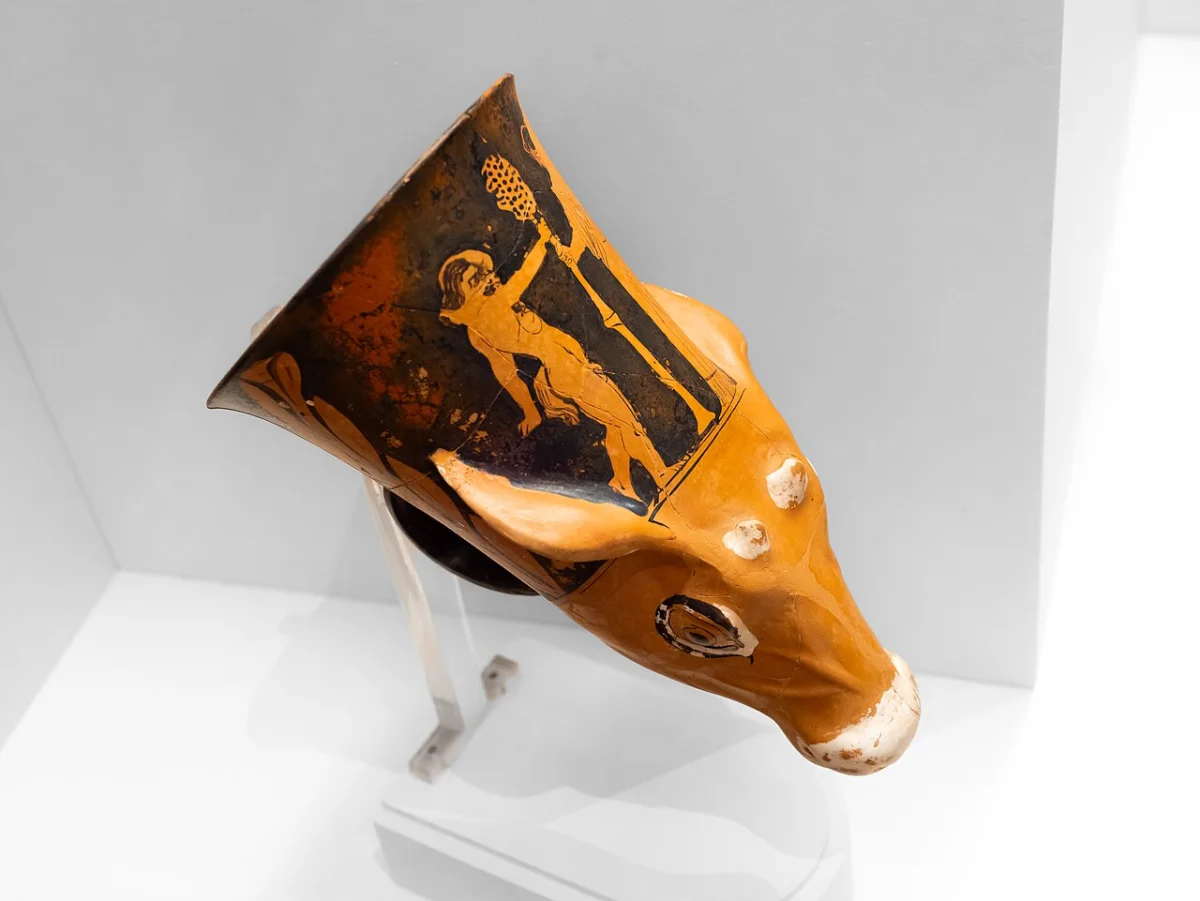
Text and translation
ἆρʼ ἐν παννυχίοις χοροῖς
Euripides · Bacchae · third stasimon, the chorus of Asian bacchants · strophe and antistrophe with a refrain, and epode · aeolic cola, with iambic and iambo-choriambic phrases · Murray’s text (Perseus), Lourenço’s colon analysis (2011)
How to read each line
A guide to the Greek, syllables, pitch marks and quantities.
Show the reading key
- Above each line: the line as the edition prints it, each word placed over its own syllables. The main row: the same Greek divided into metrical syllables, each written as it is pronounced. A consonant that closes a syllable is written with it (λόθ | ρο); an elided word is closed up with the next vowel (ν’ἀ); a final consonant carried into the next word is set with a thin space (ς ἰ). Wider gaps mark word-ends.
- Above the syllables: the pitch of each syllable, from the accents. Under them: the quantity of each syllable as it falls in the line, then the transliteration, syllable by syllable, with accented syllables in capitals.
- Under each line: a line-for-line translation. In the right margin of the scansion: the line type, its scheme, and its analysis into cola.
Key to the labels
The names, patterns and symbols used beside this poem.
Show the labels and symbols
The labels in the right margin of the scansion below give the line’s analysis as the scheme file states it, then its scheme and, where the analysis notes them, the period-end, a brevis in longo or a hiatus. ‖ marks the end of a period, ||| the end of the stanza; a line without a period-end runs on into the next (synapheia). × is an anceps, long or short; the last position of every period is indifferent. A click on any syllable highlights the colon it belongs to and explains it. The sources of the labels, with their page numbers, are given line by line under Prosody, line by line.
| Label | Name and shape | What it is |
|---|---|---|
| glyc | Glyconic (gl)○○ — ⏑ ⏑ — ⏑ — | The glyconic;[5] its base, Lourenço’s oo, is — —, — ⏑, ⏑ — or ⏑ ⏑ ⏑,[6] West’s ○○, two positions that may not both be short.[7] Euripides favours the base — —, with roughly 200 examples, against about 70 with — ⏑ and 30 with ⏑ —;[8] the tribrach base ⏑ ⏑ ⏑ is, Lourenço suggests, the mark of Euripides’ later aeolic.[9] West: a resolved base ⏑ ⏑ ⏑ can answer either — ⏑ or ⏑ —.[10] |
| reiz | Reizianum (reiz)× — ⏑ ⏑ — — | The reizianum, the headless pherecratean, by its nature a colon that closes periods.[11] 863 ~ 883 are among his possible exceptions: there the phrasing probably rules out a period-end after λευκόν and θεῖον (p. 108 n. 230 lists the pair with the shape — — ⏑ ⏑ — —)[12]. |
| wil | Wilamowitzian (wil)○○ — × — ⏑ ⏑ — | Lourenço’s label for the colon oo — x — ∪ ∪ —, one of Euripides’ most used cola.[13] He lists 864 ~ 884 under the shape ⏑ ⏑⏑ — — — ⏑ ⏑ —, and 880 ~ 900 and 892 under the commonest shape, — — — — — ⏑ ⏑ —;[14] 872 ~ 892 and the refrain line 880 = 900 are among his examples of the colon closing a sentence.[15] |
| glch | Glyconic with dragged ending (gl)○○ — ⏑ ⏑ — — — | A glyconic whose last ⏑ — is dragged to — —, Lourenço’s cholosis in the penultimate position. Such glyconics are fairly rare in tragedy; Lourenço lists Ba. 865, 866 (— ⏑ — ⏑ ⏑ — — —) and 885, 886, 887 (— — — ⏑ ⏑ — — —), and notes that 866 ~ 886 are dragged glyconics running on into the next colon, so that the dragged ending does not of itself make the glyconic period-closing.[16] West: a dragged ending can answer an undragged one, but strophe and antistrophe usually match.[17] |
| hept | Aeolic heptasyllable (hept)× — × — ⏑ ⏑ — | The headless form of the wilamowitzian, which does not usually end a sentence.[18] Lourenço lists 869 with the commonest shape, — — — — ⏑ ⏑ —, and 879 ~ 899 and 889 with — — ⏑ — ⏑ ⏑ —, a shape found nearly as often.[19] |
| hex | Aeolic hexasyllable (hex)○○ — ⏑ ⏑ — | The colon that Parker named the aeolic hexasyllable, a name Lourenço adopts: the aeolic base followed by a choriamb.[20] Euripides mostly gives it two long syllables before the choriamb, as at 874a ~ 894a.[21] |
| iach | Iambic metron and choriamb (ia + ch)× — ⏑ — — ⏑ ⏑ — | An iambo-choriambic dimeter, which is easily mistaken for the wilamowitzian; Lourenço lists 874b ~ 894b with both longs of the iambic metron resolved, ⏑ ⏑⏑ ⏑ ⏑⏑ — ⏑ ⏑ —.[22] |
| ia2 | Iambic dimeter (2 ia)× — ⏑ — × — ⏑ — | Two iambic metra.[23] Lourenço lists 875 ~ 895 with the last long resolved, ⏑ — ⏑ — ⏑ — ⏑ ⏑⏑;[24] at 905 every long is resolved.[25] |
| oct | Pendent aeolic octosyllable (oct)× — × — ⏑ ⏑ — — | Lourenço’s descriptive label for x — x — ∪ ∪ — —, which West calls an anaclastic hagesichorean; it occurs twenty-four times in Euripides, and Lourenço lists 876 ~ 896 with the shape ⏑ — ⏑ — ⏑ ⏑ — —.[26] |
| crux877 | Refrain, first line (†)⏑ ⏑ ⏑ ⏑ — ⏑ ⏑ — ⏑ — | Lourenço prints this colon between daggers, the sign of a corrupt text in Diggle’s edition, with a query for its label, but gives it a scansion,[27] and Murray’s words fit that scansion. |
| ph | Pherecratean (ph)○○ — ⏑ ⏑ — — | The pherecratean, the catalectic glyconic, which in Euripides’ aeolic usually brings a period to a close.[28] Lourenço lists 881 = 901 among the pherecrateans with tribrach base, 908 with base — ⏑, 909 and 910 with ⏑ —, 912 with — —.[29] |
| hipp | Hipponactean (hipp)○○ — ⏑ ⏑ — ⏑ — — | The hipponactean.[30] — — — ⏑ ⏑ — ⏑ — —, the shape of 902, 904 and 906, is the only one at all common in Euripides; the epode’s opening hipponactean is a beginning for which Lourenço finds only one parallel in extant tragedy, S. Aj. 596 ~ 609.[31] |
Scansion
The song of the fawn escaped from the hunt, with its refrain “What is wisdom?”, laid out colon by colon as Lourenço analyses it, with strophe set against antistrophe: glyconics, some with their endings dragged, wilamowitzians, heptasyllables and pherecrateans, glyconics with every position resolved, and the two places where Murray’s text is not the text Lourenço scans.
- line 865: 9 syllables cannot be fitted to the scheme — ⏑ — ⏑ ⏑ — — —; the best attempt leaves 1 syllable unplaced (εἰ)
- line 905, position 4 (ρᾳ): scans L but the scheme needs S
Shall I ever, in the dances that last all night,
set my white
foot in bacchic revel, my neck
thrown back into the dewy air,
like a fawn that plays in the green
delights of the meadow
when it has escaped the fearful
hunt, out beyond the watchers,
over the well-woven nets,
and the huntsman with his shouts
urges on the running of his hounds;
and with straining and storm-swift
speed it leaps over the plain
beside the river, delighting
in places empty of men and in the shoots of the shadowy-
leaved wood.
What is wisdom? Or what finer
gift from the gods among mortals
than to hold a stronger hand
over the heads of one’s enemies?
What is fine is dear for ever.
It is slow to stir, but all the same
sure is the strength
of the gods; and it corrects those mortals
who honour senselessness
and do not exalt the things of the gods,
in their mad conceit.
Cunningly the gods conceal
the long foot of time, and
hunt down the impious man. For
never must one think or practise
anything above the laws.
For it costs little to believe
that this has power,
whatever the divine may be,
and what in the length of time has been custom
and is for ever rooted in nature.
What is wisdom? Or what finer
gift from the gods among mortals
than to hold a stronger hand
over the heads of one’s enemies?
What is fine is dear for ever.
Happy is he who from the sea
has escaped the storm and reached harbour;
happy he who has risen above his
toils. In different ways one man passes another
in wealth and power.
Countless, too, for countless men
are the hopes: some
end in prosperity
for mortals, others have come to nothing;
but the man whose life, day by day,
is happy, him I call blessed.
Metre
- The song. Woodruff takes the opening of the strophe (863–867) as an example of the concision of tragic lyric that translators should keep: white set against green, the leap from human dance to a frisking animal, and the epithet “green” moved from the meadow to its delights.[32] Bierl reads the strophe as the chorus imagining its own performance: they dance like a fawn that has escaped the hunt, now that the hunter is himself caught in the trap.[33] The last five cola of the strophe and of the antistrophe are the same words, a refrain; Battezzato’s term for such a refrain, sung again after a lyric section, is ephymnion.[34]
- Whose analysis. Every colon is scanned against the analysis printed by F. Lourenço, The Lyric Metres of Euripidean Drama (Coimbra 2011), pp. 328–329, which is made on Diggle’s Oxford text and takes as a colon whatever Diggle prints as a lyric line;[35] the line numbers are his. The right margin gives his label; the note on each line opens with his pattern as he prints it. The syllables and their lengths are the workbench’s scansion of Murray’s Greek. All the cola scan against the scheme except two, 865 and 905, where Murray’s text is not Diggle’s; the problems are reported above the poem and explained in the notes.
- Signs. Lourenço’s list is on pp. 13–15: his ∪ is this site’s ⏑, ∪∪ a long resolved into two shorts, ‖ period-end, ∫ overlap (a word running on over the end of the colon; the Greek line then ends in a hyphen), † a corrupt text. Where he prints three shorts at the head of an aeolic colon (∪ ∪ ∪) the base is resolved: West’s ○○ realised as ⏑ ⏑ ⏑;[10] this page sets the three shorts as he prints them. On this page the last position of every period is drawn as × (indifferent).
- Aeolic. The song is aeolic: glyconics, ○○ — ⏑ ⏑ — ⏑ —, most often with the base — — that Euripides favours, wilamowitzians (○○ — × — ⏑ ⏑ —), aeolic heptasyllables (× — × — ⏑ ⏑ —), a reizianum, a hexasyllable, pherecrateans and, in the epode, hipponacteans.[36] West finds strophes made wholly of aeolic cola most typical of late Euripides, where the sameness of their rhythm can be nearly hypnotic, and notes that Euripides often admits resolution, most commonly before the choriamb.[10] Into the strophe come iambic and iambo-choriambic phrases (874b–876 ~ 894b–896), and the epode has an iambic dimeter with every long resolved (905).
- Dragged glyconics. Five glyconics end — — — instead of ⏑ — —: 865, 866, 885, 886, 887. Lourenço calls this cholosis in the penultimate position, finds it fairly rare in tragedy, and lists all five;[16] West describes such dragged endings in Sophocles and Euripides.[17] 866 ~ 886 are dragged glyconics that run on into the next colon, which shows that the dragging does not make a glyconic period-closing.[37] At 887 a dragged glyconic answers the ordinary glyconic 867; West allows a dragged ending to answer an undragged one, though the two stanzas usually agree,[17] and Lourenço is all but sure that Diggle’s later transposition δόξαι σὺν μαινομέναι, which removes the irregularity and makes 887 a wilamowitzian, is right.[38] The page follows Murray’s and the OCT’s order.
- Responsion. The antistrophe answers the strophe colon for colon, but the aeolic bases vary freely: — ⏑ in the strophe against — — in the antistrophe at 865–866 ~ 885–886 and 868 ~ 888, ⏑ ⏑⏑ against ⏑ ⏑ ⏑ at 864 ~ 884; the heptasyllables 869 ~ 889 and the wilamowitzians 872 ~ 892 differ in their opening positions; 867 ~ 887 is discussed above. The refrain (877–881 = 897–901) repeats its words, and so its metre, exactly. Lourenço notes that the phrasing of 863 ~ 883 probably rules out a period-end after the reizianum, a colon that otherwise closes periods.[12]
- Periods. Lourenço marks period-end after the wilamowitzians 872 ~ 892 and the octosyllables 876 ~ 896 in the stanzas (he counts 872 ~ 892 and the refrain’s 880 = 900 among the wilamowitzians that close a sentence, p. 109 n. 234), and after 906 and 910 in the epode. In his discussion of the hipponactean he prints the opening of the epode with period-end after 902, 903 and 904 as well,[39] and he counts 903 as a glyconic where the sense makes a clear break;[40] his scheme on p. 329 does not mark them. The page follows the scheme.
- Murray’s text and Lourenço’s. The Greek is Murray’s, letter for letter, and his line division is Lourenço’s; only the numbers differ: Murray’s 873a and 874 are Lourenço’s 874a and 874b, 893a and 894 are 894a and 894b, and Murray’s 908a, 909, 910 and 911 are Lourenço’s 909–912. The texts differ at 865, where Murray’s words have a syllable more than Lourenço’s dragged glyconic, and at 905, where Diggle prints ἕτερα and Murray ἑτέρᾳ.[41] At 883 Murray prints τι in the text; in Diggle’s it is Nauck’s supplement.[12] Lourenço prints the first line of the refrain (877 = 897) between daggers, as corrupt in Diggle’s text, though with a scansion that Murray’s words fit.
- Prosody. The workbench uses the Attic rules (README). Doric α for Attic-Ionic η, the original long ᾱ,[42] runs through the song: δέραν, φοβεράν, φυλακᾶς, κυναγέτας, ἡδομένα, κορυφᾶς, ἀγνωμοσύναν, δαρόν, κούφα δαπάνα. A stop with a liquid or nasal may leave the syllable before it short or make it long:[43] short in νεβρός (866), ὠκυδρόμοις (873), δὲ βροτῶν (884), μακρῷ (895). ἀεί has a long ἀ in the refrain (881 = 901), the Attic quantity, and a short one at 896, as three times in Homer.[44]
- Dale’s analysis. Dale quotes the refrain 877–8 = 897–8 as an aeolic ephymnion repeated in words as well as rhythm: τί τὸ σοφόν; ἢ τί τὸ κάλλιον ⏑ ⏖ ⏑ — ⏑ ⏑ — ⏑ — and παρὰ θεῶν γέρας ἐν βροτοῖς ⏖ ⏑ — ⏑ ⏑ — ⏑ —.[45] For 878 her quantities are this page’s glyconic with a resolved base; for 877 they are this page’s, except that she allows the ι of κάλλιον to be long or short in lyric.[46] Where Lourenço prints 877 between daggers as corrupt in Diggle’s text, Dale insists that the line is on no account to be emended.
- Kovacs’s text. Compared with D. Kovacs’s Loeb edition of 2003: at 865 and at 905 he prints the readings Lourenço scans;[41] at 877 = 897 he prints Willink’s ἦ τι, a syllable shorter than the text Lourenço’s scheme fits. His other differences are of spelling and line division (868, 873–4, 885–6, 893–4, 910). The line numbers agree.[47]
Prosody, line by line
Every syllable, with the reason for its length. Quantities are read from the vowel where the spelling shows it, from the consonants that follow (“position”), from the accent where it tells, and from the metre where nothing else does. Editors’ notes on the text follow in the boxed paragraphs.
- 862
Line 862 · ἆρʼ ἐν παννυχίοις χοροῖς
ἆρʼ ἐν παννυχίοις χοροῖς
ἆρ’ἐνπαννυχίοιςχοροῖςthe period runs on into l. 863 (synapheia).
The label in the margin, with its sources: Lourenço 2011, pp. 92, 107, 328.
- 1 —ἆἆ carries a circumflex, so it is long.
- 2 —ρ’ἐνἐ is short by nature; closed by ν: long by position; the apostrophe marks an elided vowel; the consonant before it joins this syllable.
- 3 —πανα is a vowel of unknown length; closed by ν: long by position.
- 4 ⏑νυυ is short by the metre (position 4 must be short).
- 5 ⏑χίί is short by the metre (position 5 must be short).
- 6 —οιςοι is a diphthong, long by nature; closed by ς: long by position.
- 7 ⏑χοο is short by nature.
- 8 —ροῖςοῖ is a diphthong, long by nature; closed by ς: long by position; the line-end is not a period-end: the period runs on into the next line (synapheia), so this syllable keeps its own length, with no brevis in longo, and a word may run over into the next line.[48]
- 863
Line 863 · θήσω ποτὲ λευκὸν
θήσω ποτὲ λευκὸν
θήσωποτὲλευκὸνcontinues l. 862 · one period (synapheia); the period runs on into l. 864 (synapheia).
The label in the margin, with its sources: Lourenço 2011, pp. 107–108, 328.
- 1 —θήή is long by nature.
- 2 —σωω is long by nature.
- 3 ⏑ποο is short by nature.
- 4 ⏑τὲὲ is short by nature.
- 5 —λευευ is a diphthong, long by nature.
- 6 —κὸνὸ is short by nature; closed by ν: long by position; the line-end is not a period-end: the period runs on into the next line (synapheia), so this syllable keeps its own length, with no brevis in longo, and a word may run over into the next line.[48]
— — ∪ ∪ — —, reiz,[51] the colon Lourenço discusses as a possible exception to the reizianum’s period-closing use: in both stanzas the phrasing seems to run on (θήσω ποτὲ λευκὸν | πόδ’ ~ πιστόν τι τὸ θεῖον | σθένος), so that a period-end here would be unwelcome.[12]- 864
Line 864 · πόδʼ ἀναβακχεύουσα, δέραν
πόδʼ ἀναβακχεύουσα, δέραν
πόδ’ἀναβακχεύουσα,δέραcontinues l. 863 · one period (synapheia); the period runs on into l. 865 (synapheia).
The label in the margin, with its sources: Lourenço 2011, pp. 107, 109, 328.
- 1 ⏑πόό is short by nature.
- 2 ⏑δ’ἀἀ is short by the metre (position 2 must be short); the apostrophe marks an elided vowel; the consonant before it joins this syllable; with its neighbour it resolves the long of position 2 into two shorts.
- 3 ⏑ναα is short by the metre (position 2 must be short); with its neighbour it resolves the long of position 2 into two shorts.
- 4 —βακα is a vowel of unknown length; closed by κ: long by position.
- 5 —χεύεύ is a diphthong, long by nature.
- 6 —ουου is a diphthong, long by nature.
- 7 ⏑σα,α is short by the accent rule: acute on the antepenult requires a short final syllable.
- 8 ⏑δέέ is short by nature.
- 9 —ραα is long by the metre (position 8 must be long); the line-end is not a period-end: the period runs on into the next line (synapheia), so this syllable keeps its own length, with no brevis in longo, and a word may run over into the next line.[48]
- 865
Line 865 · εἰς αἰθέρα δροσερὸν ῥίπτουσʼ,
εἰς αἰθέρα δροσερὸν ῥίπτουσʼ,
ν εἰςαἰθέραδροσερὸνῥίπτουcontinues l. 864 · one period (synapheia); the period runs on into l. 866 (synapheia).
The label in the margin, with its sources: Lourenço 2011, pp. 94, 328.
- 1 —ν εἰςεἰ is a diphthong, long by nature; the first consonant belongs to the previous word and is carried over to this vowel; it could not be fitted into the scheme; the position is anceps.
- 2 —αἰαἰ is a diphthong, long by nature.
- 3 ⏑θέέ is short by nature.
- 4 —ραα is a vowel of unknown length; the next word begins with δρ: the syllable is closed before it: long by position.
- 5 ⏑δροο is short by nature.
- 6 ⏑σεε is short by nature.
- 7 —ρὸνὸ is short by nature; closed by ν: long by position.
- 8 —ῥίπί is a vowel of unknown length; closed by π: long by position.
- 9 —τουου is a diphthong, long by nature; the line-end is not a period-end: the period runs on into the next line (synapheia), so this syllable keeps its own length, with no brevis in longo, and a word may run over into the next line.[48]
⚠ line 865: 9 syllables cannot be fitted to the scheme — ⏑ — ⏑ ⏑ — — —; the best attempt leaves 1 syllable unplaced (εἰ)
Lourenço prints — ∪ — ∪ ∪ — — —, gl, a glyconic with dragged ending.[54] Murray’s εἰς αἰθέρα δροσερὸν ῥίπτουσ’ has nine syllables, — — ⏑ ⏑ ⏑ ⏑ — — —, one more than the scheme, and the workbench reports it, leaving one syllable unplaced. The text Lourenço scans presumably differs here; our sources do not show it. Kovacs prints Musgrave’s αἰθέρ’ ἐς δροσερὸν ῥίπτουσ’: — ⏑ — ⏑ ⏑ — — —, eight syllables, Lourenço’s glyconic.[55]- 866
Line 866 · ὡς νεβρὸς χλοεραῖς ἐμπαί-
ὡς νεβρὸς χλοεραῖς ἐμπαί-
σ’,ὡςνεβρὸςχλοεραῖςἐμπαί-continues l. 865 · one period (synapheia); the period runs on into l. 867 (synapheia).
The label in the margin, with its sources: Lourenço 2011, pp. 94, 328.
- 1 —σ’,ὡςὡ is long by nature; closed by ς: long by position; the apostrophe marks an elided vowel; the consonant before it joins this syllable.
- 2 ⏑νεε is short by nature; βρ is carried whole into the next syllable, so this syllable stays open and short (Attic correption of a stop + liquid cluster).
- 3 —βρὸςὸ is short by nature; closed by ς: long by position.
- 4 ⏑χλοο is short by nature.
- 5 ⏑εε is short by nature.
- 6 —ραῖςαῖ is a diphthong, long by nature.
- 7 —ἐμἐ is short by nature; closed by μ: long by position.
- 8 —παί-αί is a diphthong, long by nature; ζ is a double consonant (two sounds) and closes the syllable: long by position; the line-end is not a period-end: the period runs on into the next line (synapheia), so this syllable keeps its own length, with no brevis in longo, and a word may run over into the next line.[48]
— ∪ — ∪ ∪ — — —, gl ∫:[54] a dragged glyconic, running on into 867 (ἐμπαί-|ζουσα). The νε of νεβρός stays short before βρ.- 867
Line 867 · ζουσα λείμακος ἡδοναῖς,
ζουσα λείμακος ἡδοναῖς,
ζουσαλείμακος ἡδοναῖ,continues l. 866 · one period (synapheia); the period runs on into l. 868 (synapheia).
The label in the margin, with its sources: Lourenço 2011, pp. 92, 328.
- 1 —ζουου is a diphthong, long by nature.
- 2 ⏑σαα is short by the accent rule: acute on the antepenult requires a short final syllable.
- 3 —λείεί is a diphthong, long by nature.
- 4 ⏑μαα is short by the metre (position 4 must be short).
- 5 ⏑κοο is short by nature.
- 6 —ς ἡἡ is long by nature; the first consonant belongs to the previous word and is carried over to this vowel.
- 7 ⏑δοο is short by nature.
- 8 —ναῖ,αῖ is a diphthong, long by nature; the line-end is not a period-end: the period runs on into the next line (synapheia), so this syllable keeps its own length, with no brevis in longo, and a word may run over into the next line.[48]
- 868
Line 868 · ἡνίκʼ ἂν φοβερὰν φύγῃ
ἡνίκʼ ἂν φοβερὰν φύγῃ
ς ἡνίκ’ἂνφοβερὰνφύγῃcontinues l. 867 · one period (synapheia); the period runs on into l. 869 (synapheia).
The label in the margin, with its sources: Lourenço 2011, pp. 92, 328.
- 1 —ς ἡἡ is long by nature; the first consonant belongs to the previous word and is carried over to this vowel.
- 2 ⏑νίί is short by the metre (position 2 must be short).
- 3 —κ’ἂνἂ is a vowel of unknown length; closed by ν: long by position; the apostrophe marks an elided vowel; the consonant before it joins this syllable.
- 4 ⏑φοο is short by nature.
- 5 ⏑βεε is short by nature.
- 6 —ρὰνὰ is a vowel of unknown length; closed by ν: long by position.
- 7 ⏑φύύ is short by the metre (position 7 must be short).
- 8 —γῃῃ is long by nature; the line-end is not a period-end: the period runs on into the next line (synapheia), so this syllable keeps its own length, with no brevis in longo, and a word may run over into the next line.[48]
- 869
Line 869 · θήραν ἔξω φυλακᾶς
θήραν ἔξω φυλακᾶς
θήρανἔξωφυλακᾶcontinues l. 868 · one period (synapheia); the period runs on into l. 870 (synapheia).
The label in the margin, with its sources: Lourenço 2011, pp. 110, 328.
- 1 —θήή is long by nature.
- 2 —ρανα is long by the metre (position 2 must be long).
- 3 —ἔἔ is short by nature; ξ is a double consonant (two sounds) and closes the syllable: long by position.
- 4 —ξωω is long by nature.
- 5 ⏑φυυ is short by the metre (position 5 must be short).
- 6 ⏑λαα is short by the metre (position 6 must be short).
- 7 —κᾶᾶ carries a circumflex, so it is long; the line-end is not a period-end: the period runs on into the next line (synapheia), so this syllable keeps its own length, with no brevis in longo, and a word may run over into the next line.[48]
— — — — ∪ ∪ —, hept,[59] the commonest shape of the heptasyllable.[60] The ᾱ of θήραν is long, as the scheme requires; the ν passes to ἔξω.- 870
Line 870 · εὐπλέκτων ὑπὲρ ἀρκύων,
εὐπλέκτων ὑπὲρ ἀρκύων,
ς εὐπλέκτωνὑπὲρ ἀρκύων,continues l. 869 · one period (synapheia); the period runs on into l. 871 (synapheia).
The label in the margin, with its sources: Lourenço 2011, pp. 92, 328.
- 1 —ς εὐεὐ is a diphthong, long by nature; the first consonant belongs to the previous word and is carried over to this vowel.
- 2 —πλέκέ is short by nature; closed by κ: long by position.
- 3 —τωνω is long by nature.
- 4 ⏑ὑὑ is short by the metre (position 4 must be short).
- 5 ⏑πὲὲ is short by nature.
- 6 —ρ ἀρἀ is a vowel of unknown length; closed by ρ: long by position; the first consonant belongs to the previous word and is carried over to this vowel.
- 7 ⏑κύύ is short by the metre (position 7 must be short).
- 8 —ων,ω is long by nature; closed by ν: long by position; the line-end is not a period-end: the period runs on into the next line (synapheia), so this syllable keeps its own length, with no brevis in longo, and a word may run over into the next line.[48]
- 871
Line 871 · θωΰσσων δὲ κυναγέτας
θωΰσσων δὲ κυναγέτας
θωΰσσωνδὲκυναγέταςcontinues l. 870 · one period (synapheia); the period runs on into l. 872 (synapheia).
The label in the margin, with its sources: Lourenço 2011, pp. 92, 328.
- 1 —θωω is long by nature.
- 2 —ΰσΰ is a vowel of unknown length; closed by σ: long by position.
- 3 —σωνω is long by nature; closed by ν: long by position.
- 4 ⏑δὲὲ is short by nature.
- 5 ⏑κυυ is short by the metre (position 5 must be short).
- 6 —ναα is long by the metre (position 6 must be long).
- 7 ⏑γέέ is short by nature.
- 8 —ταςα is a vowel of unknown length; closed by ς: long by position; the line-end is not a period-end: the period runs on into the next line (synapheia), so this syllable keeps its own length, with no brevis in longo, and a word may run over into the next line.[48]
- 872
Line 872 · συντείνῃ δράμημα κυνῶν·
συντείνῃ δράμημα κυνῶν·
συντείνῃδράμημακυνῶν·continues l. 871 · one period (synapheia).
The label in the margin, with its sources: Lourenço 2011, pp. 109, 328.
- 1 —συνυ is a vowel of unknown length; closed by ν: long by position.
- 2 —τείεί is a diphthong, long by nature.
- 3 —νῃῃ is long by nature.
- 4 ⏑δράά is short by the metre (position 4 must be short).
- 5 —μηη is long by nature.
- 6 ⏑μαα is short by the accent rule: acute on the antepenult requires a short final syllable.
- 7 ⏑κυυ is short by the metre (position 7 must be short).
- 8 ×νῶν·ῶ is long by nature; closed by ν: long by position; the last position of the period is indifferent.
— — — ∪ — ∪ ∪ —, wil ‖,[62] one of his wilamowitzians that close a sentence.[15] The δρα of δράμημα is short.- 873
Line 873 · μόχθοις τʼ ὠκυδρόμοις τʼ ἀέλ-
μόχθοις τʼ ὠκυδρόμοις τʼ ἀέλ-
μόχθοιςτ’ὠκυδρόμοιςτ’ἀέλ-the period runs on into l. 874a (synapheia).
The label in the margin, with its sources: Lourenço 2011, pp. 92, 328.
- 1 —μόχό is short by nature; closed by χ: long by position.
- 2 —θοιςοι is a diphthong, long by nature; closed by ς: long by position.
- 3 —τ’ὠὠ is long by nature; the apostrophe marks an elided vowel; the consonant before it joins this syllable.
- 4 ⏑κυυ is a vowel of unknown length; δρ is carried whole into the next syllable, so this syllable stays open and short (Attic correption of a stop + liquid cluster).
- 5 ⏑δρόό is short by nature.
- 6 —μοιςοι is a diphthong, long by nature; closed by ς: long by position.
- 7 ⏑τ’ἀἀ is short by the metre (position 7 must be short); the apostrophe marks an elided vowel; the consonant before it joins this syllable.
- 8 —έλ-έ is short by nature; closed by λ: long by position; the line-end is not a period-end: the period runs on into the next line (synapheia), so this syllable keeps its own length, with no brevis in longo, and a word may run over into the next line.[48]
- 874a
Line 874a · λαις θρῴσκει πεδίον
λαις θρῴσκει πεδίον
λαιςθρῴσκειπεδίονcontinues l. 873 · one period (synapheia); the period runs on into l. 874b (synapheia).
The label in the margin, with its sources: Lourenço 2011, pp. 111, 328.
- 1 —λαιςαι is a diphthong, long by nature; closed by ς: long by position.
- 2 —θρῴσῴ is long by nature; closed by σ: long by position.
- 3 —κειει is a diphthong, long by nature.
- 4 ⏑πεε is short by nature.
- 5 ⏑δίί is short by the metre (position 5 must be short).
- 6 —ονο is short by nature; closed by ν: long by position; the line-end is not a period-end: the period runs on into the next line (synapheia), so this syllable keeps its own length, with no brevis in longo, and a word may run over into the next line.[48]
- 874b
Line 874b · παραποτάμιον, ἡδομένα
παραποτάμιον, ἡδομένα
παραποτάμιο,ν ἡδομέναcontinues l. 874a · one period (synapheia); the period runs on into l. 875 (synapheia).
The label in the margin, with its sources: Lourenço 2011, pp. 115, 328.
- 1 ⏑παα is short by the metre (position 1 must be short).
- 2 ⏑ραα is short by the metre (position 2 must be short); with its neighbour it resolves the long of position 2 into two shorts.
- 3 ⏑ποο is short by nature; with its neighbour it resolves the long of position 2 into two shorts.
- 4 ⏑τάά is short by the metre (position 3 must be short).
- 5 ⏑μιι is short by the metre (position 4 must be short); with its neighbour it resolves the long of position 4 into two shorts.
- 6 ⏑ο,ο is short by nature; with its neighbour it resolves the long of position 4 into two shorts.
- 7 —ν ἡἡ is long by nature; the first consonant belongs to the previous word and is carried over to this vowel.
- 8 ⏑δοο is short by nature.
- 9 ⏑μέέ is short by nature.
- 10 —ναα is a vowel of unknown length; the next word begins with βρ: the syllable is closed before it: long by position; the line-end is not a period-end: the period runs on into the next line (synapheia), so this syllable keeps its own length, with no brevis in longo, and a word may run over into the next line.[48]
- 875
Line 875 · βροτῶν ἐρημίαις σκιαρο-
βροτῶν ἐρημίαις σκιαρο-
βροτῶνἐρημίαιςσκιαρο-continues l. 874b · one period (synapheia); the period runs on into l. 876 (synapheia).
The label in the margin, with its sources: Lourenço 2011, pp. 119, 328.
- 1 ⏑βροο is short by nature.
- 2 —τῶνῶ is long by nature.
- 3 ⏑ἐἐ is short by nature.
- 4 —ρηη is long by nature.
- 5 ⏑μίί is short by the metre (position 5 must be short).
- 6 —αιςαι is a diphthong, long by nature; closed by ς: long by position.
- 7 ⏑σκιι is short by the metre (position 7 must be short).
- 8 ⏑αα is short by the metre (position 8 must be short); with its neighbour it resolves the long of position 8 into two shorts.
- 9 ⏑ρο-ο is short by nature; with its neighbour it resolves the long of position 8 into two shorts; the line-end is not a period-end: the period runs on into the next line (synapheia), so this syllable keeps its own length, with no brevis in longo, and a word may run over into the next line.[48]
∪ — ∪ — ∪ — ∪ ∪∪, 2 ia ∫,[65] with the last long resolved (σκιαρο-), the word running on into 876.- 876
Line 876 · κόμοιό τʼ ἔρνεσιν ὕλας.
κόμοιό τʼ ἔρνεσιν ὕλας.
κόμοιότ’ἔρνεσιν ὕλας.continues l. 875 · one period (synapheia).
The label in the margin, with its sources: Lourenço 2011, pp. 102, 328.
- 1 ⏑κόό is short by nature.
- 2 —μοιοι is a diphthong, long by nature.
- 3 ⏑όό is short by nature.
- 4 —τ’ἔρἔ is short by nature; closed by ρ: long by position; the apostrophe marks an elided vowel; the consonant before it joins this syllable.
- 5 ⏑νεε is short by nature.
- 6 ⏑σιι is short by the accent rule: acute on the antepenult requires a short final syllable.
- 7 —ν ὕὕ is long by the metre (position 7 must be long); the first consonant belongs to the previous word and is carried over to this vowel.
- 8 ×λας.α is a vowel of unknown length; closed by ς: long by position; the last position of the period is indifferent.
- 877
Line 877 · τί τὸ σοφόν; ἢ τί τὸ κάλλιον
τί τὸ σοφόν; ἢ τί τὸ κάλλιον
τίτὸσοφό;ν ἢτίτὸκάλλιονthe period runs on into l. 878 (synapheia).
The label in the margin, with its sources: Lourenço 2011, p. 328.
- 1 ⏑τίί is short by the metre (position 1 must be short).
- 2 ⏑τὸὸ is short by nature.
- 3 ⏑σοο is short by nature.
- 4 ⏑φό;ό is short by nature.
- 5 —ν ἢἢ is long by nature; the first consonant belongs to the previous word and is carried over to this vowel.
- 6 ⏑τίί is short by the metre (position 6 must be short).
- 7 ⏑τὸὸ is short by nature.
- 8 —κάλά is a vowel of unknown length; closed by λ: long by position.
- 9 ⏑λιι is short by the metre (position 9 must be short).
- 10 —ονο is short by nature; closed by ν: long by position; the line-end is not a period-end: the period runs on into the next line (synapheia), so this syllable keeps its own length, with no brevis in longo, and a word may run over into the next line.[48]
Lourenço prints † ∪ ∪ ∪ ∪ — ∪ ∪ — ∪ — †, with a query for the label:[69] the colon is corrupt in Diggle’s text, but he gives it a scansion, and Murray’s τί τὸ σοφόν; ἢ τί τὸ κάλλιον fits it. The first line of the refrain. Dale scans it ⏑ ⏖ ⏑ — ⏑ ⏑ — ⏑ — (κάλλιον with ι short or long) and holds that it must not be emended.[45] Kovacs prints τί τὸ σοφόν; ἦ τι κάλλιον (Willink, for ἢ τί τὸ), one short syllable fewer than Murray’s words; here and at 897.[70]- 878
Line 878 · παρὰ θεῶν γέρας ἐν βροτοῖς
παρὰ θεῶν γέρας ἐν βροτοῖς
παρὰθεῶνγέρας ἐνβροτοῖcontinues l. 877 · one period (synapheia); the period runs on into l. 879 (synapheia).
The label in the margin, with its sources: Lourenço 2011, pp. 93, 328.
- 1 ⏑παα is short by the metre (position 1 must be short).
- 2 ⏑ρὰὰ is short by the metre (position 2 must be short).
- 3 ⏑θεε is short by nature.
- 4 —ῶνῶ is long by nature; closed by ν: long by position.
- 5 ⏑γέέ is short by nature.
- 6 ⏑ραα is short by the metre (position 6 must be short).
- 7 —ς ἐνἐ is short by nature; closed by ν: long by position; the first consonant belongs to the previous word and is carried over to this vowel.
- 8 ⏑βροο is short by nature.
- 9 —τοῖοῖ is a diphthong, long by nature; the line-end is not a period-end: the period runs on into the next line (synapheia), so this syllable keeps its own length, with no brevis in longo, and a word may run over into the next line.[48]
- 879
Line 879 · ἢ χεῖρʼ ὑπὲρ κορυφᾶς
ἢ χεῖρʼ ὑπὲρ κορυφᾶς
ς ἢχεῖρ’ὑπὲρκορυφᾶςcontinues l. 878 · one period (synapheia); the period runs on into l. 880 (synapheia).
The label in the margin, with its sources: Lourenço 2011, pp. 110, 328.
- 1 —ς ἢἢ is long by nature; the first consonant belongs to the previous word and is carried over to this vowel.
- 2 —χεῖεῖ is a diphthong, long by nature.
- 3 ⏑ρ’ὑὑ is short by the metre (position 3 must be short); the apostrophe marks an elided vowel; the consonant before it joins this syllable.
- 4 —πὲρὲ is short by nature; closed by ρ: long by position.
- 5 ⏑κοο is short by nature.
- 6 ⏑ρυυ is short by the metre (position 6 must be short).
- 7 —φᾶςᾶ carries a circumflex, so it is long; closed by ς: long by position; the line-end is not a period-end: the period runs on into the next line (synapheia), so this syllable keeps its own length, with no brevis in longo, and a word may run over into the next line.[48]
- 880
Line 880 · τῶν ἐχθρῶν κρείσσω κατέχειν;
τῶν ἐχθρῶν κρείσσω κατέχειν;
τῶνἐχθρῶνκρείσσωκατέχει;continues l. 879 · one period (synapheia); the period runs on into l. 881 (synapheia).
The label in the margin, with its sources: Lourenço 2011, pp. 109, 328.
- 1 —τῶνῶ is long by nature.
- 2 —ἐχἐ is short by nature; closed by χ: long by position.
- 3 —θρῶνῶ is long by nature; closed by ν: long by position.
- 4 —κρείσεί is a diphthong, long by nature; closed by σ: long by position.
- 5 —σωω is long by nature.
- 6 ⏑καα is short by the metre (position 6 must be short).
- 7 ⏑τέέ is short by nature.
- 8 —χει;ει is a diphthong, long by nature; the line-end is not a period-end: the period runs on into the next line (synapheia), so this syllable keeps its own length, with no brevis in longo, and a word may run over into the next line.[48]
- 881
Line 881 · ὅ τι καλὸν φίλον ἀεί.
ὅ τι καλὸν φίλον ἀεί.
ν ὅτικαλὸνφίλον ἀεί.continues l. 880 · one period (synapheia).
The label in the margin, with its sources: Lourenço 2011, pp. 96, 328.
- 1 ⏑ν ὅὅ is short by nature; the first consonant belongs to the previous word and is carried over to this vowel.
- 2 ⏑τιι is short by the metre (position 2 must be short).
- 3 ⏑καα is short by the metre (position 3 must be short).
- 4 —λὸνὸ is short by nature; closed by ν: long by position.
- 5 ⏑φίί is short by the metre (position 5 must be short).
- 6 ⏑λοο is short by nature.
- 7 —ν ἀἀ is long by the metre (position 7 must be long); the first consonant belongs to the previous word and is carried over to this vowel.
- 8 ×εί.εί is a diphthong, long by nature; the last position of the period is indifferent.
∪ ∪ ∪ — ∪ ∪ — —, ph,[75] a pherecratean with tribrach base, listed with 901,[76] the close of the strophe. The ἀ of ἀεί is long, as in Attic.[44] Kovacs prints αἰεί; the first syllable is long either way.[55]- 882
Line 882 · ὁρμᾶται μόλις, ἀλλʼ ὅμως
ὁρμᾶται μόλις, ἀλλʼ ὅμως
ὁρμᾶταιμόλι,ς ἀλλ’ὅμωςthe period runs on into l. 883 (synapheia).
The label in the margin, with its sources: Lourenço 2011, pp. 92, 107, 328.
- 1 —ὁρὁ is short by nature; closed by ρ: long by position.
- 2 —μᾶᾶ carries a circumflex, so it is long.
- 3 —ταιαι is a diphthong, long by nature.
- 4 ⏑μόό is short by nature.
- 5 ⏑λι,ι is short by the metre (position 5 must be short).
- 6 —ς ἀλἀ is a vowel of unknown length; closed by λ: long by position; the first consonant belongs to the previous word and is carried over to this vowel.
- 7 ⏑λ’ὅὅ is short by nature; the apostrophe marks an elided vowel; the consonant before it joins this syllable.
- 8 —μωςω is long by nature; closed by ς: long by position; the line-end is not a period-end: the period runs on into the next line (synapheia), so this syllable keeps its own length, with no brevis in longo, and a word may run over into the next line.[48]
— — — ∪ ∪ — ∪ —, gl,[49] answering 862.- 883
Line 883 · πιστόν τι τὸ θεῖον
πιστόν τι τὸ θεῖον
πιστόντιτὸθεῖονcontinues l. 882 · one period (synapheia); the period runs on into l. 884 (synapheia).
The label in the margin, with its sources: Lourenço 2011, pp. 107–108, 328.
- 1 —πισι is a vowel of unknown length; closed by σ: long by position.
- 2 —τόνό is short by nature; closed by ν: long by position.
- 3 ⏑τιι is short by the metre (position 3 must be short).
- 4 ⏑τὸὸ is short by nature.
- 5 —θεῖεῖ is a diphthong, long by nature.
- 6 —ονο is short by nature; closed by ν: long by position; the line-end is not a period-end: the period runs on into the next line (synapheia), so this syllable keeps its own length, with no brevis in longo, and a word may run over into the next line.[48]
- 884
Line 884 · σθένος· ἀπευθύνει δὲ βροτῶν
σθένος· ἀπευθύνει δὲ βροτῶν
σθένο·ς ἀπευθύνειδὲβροτῶνcontinues l. 883 · one period (synapheia); the period runs on into l. 885 (synapheia).
The label in the margin, with its sources: Lourenço 2011, pp. 107, 109, 328.
- 1 ⏑σθέέ is short by nature.
- 2 ⏑νο·ο is short by nature.
- 3 ⏑ς ἀἀ is short by the metre (position 3 must be short); the first consonant belongs to the previous word and is carried over to this vowel.
- 4 —πευευ is a diphthong, long by nature.
- 5 —θύύ is long by the metre (position 5 must be long).
- 6 —νειει is a diphthong, long by nature.
- 7 ⏑δὲὲ is short by nature; the next word begins with βρ, a stop + liquid that does not make position here, so the syllable stays short.
- 8 ⏑βροο is short by nature.
- 9 —τῶνῶ is long by nature; closed by ν: long by position; the line-end is not a period-end: the period runs on into the next line (synapheia), so this syllable keeps its own length, with no brevis in longo, and a word may run over into the next line.[48]
- 885
Line 885 · τούς τʼ ἀγνωμοσύναν τιμῶν-
τούς τʼ ἀγνωμοσύναν τιμῶν-
τούςτ’ἀγνωμοσύναντιμῶν-continues l. 884 · one period (synapheia); the period runs on into l. 886 (synapheia).
The label in the margin, with its sources: Lourenço 2011, pp. 94, 328.
- 1 —τούςού is a diphthong, long by nature; closed by ς: long by position.
- 2 —τ’ἀγἀ is a vowel of unknown length; closed by γ: long by position; γν is one of the four clusters (γμ, γν, δμ, δν) that never leave the syllable before them short;[43] the apostrophe marks an elided vowel; the consonant before it joins this syllable.
- 3 —νωω is long by nature.
- 4 ⏑μοο is short by nature.
- 5 ⏑σύύ is short by the metre (position 5 must be short).
- 6 —νανα is a vowel of unknown length; closed by ν: long by position.
- 7 —τιι is long by the metre (position 7 must be long).
- 8 —μῶν-ῶ is long by nature; closed by ν: long by position; the line-end is not a period-end: the period runs on into the next line (synapheia), so this syllable keeps its own length, with no brevis in longo, and a word may run over into the next line.[48]
- 886
Line 886 · τας καὶ μὴ τὰ θεῶν αὔξον-
τας καὶ μὴ τὰ θεῶν αὔξον-
ταςκαὶμὴτὰθεῶναὔξον-continues l. 885 · one period (synapheia); the period runs on into l. 887 (synapheia).
The label in the margin, with its sources: Lourenço 2011, pp. 94, 328.
- 1 —ταςα is a vowel of unknown length; closed by ς: long by position.
- 2 —καὶαὶ is a diphthong, long by nature.
- 3 —μὴὴ is long by nature.
- 4 ⏑τὰὰ is short by the metre (position 4 must be short).
- 5 ⏑θεε is short by nature.
- 6 —ῶνῶ is long by nature.
- 7 —αὔαὔ is a diphthong, long by nature; ξ is a double consonant (two sounds) and closes the syllable: long by position.
- 8 —ξον-ο is short by nature; closed by ν: long by position; the line-end is not a period-end: the period runs on into the next line (synapheia), so this syllable keeps its own length, with no brevis in longo, and a word may run over into the next line.[48]
— — — ∪ ∪ — — —, gl ∫,[54] dragged, answering 866; αὔξον-|τας runs over into 887.- 887
Line 887 · τας σὺν μαινομένᾳ δόξᾳ.
τας σὺν μαινομένᾳ δόξᾳ.
ταςσὺνμαινομένᾳδόξᾳ.continues l. 886 · one period (synapheia); the period runs on into l. 888 (synapheia).
The label in the margin, with its sources: Lourenço 2011, pp. 94, 328.
- 1 —ταςα is a vowel of unknown length; closed by ς: long by position.
- 2 —σὺνὺ is a vowel of unknown length; closed by ν: long by position.
- 3 —μαιαι is a diphthong, long by nature.
- 4 ⏑νοο is short by nature.
- 5 ⏑μέέ is short by nature.
- 6 —νᾳᾳ is long by nature.
- 7 —δόό is short by nature; ξ is a double consonant (two sounds) and closes the syllable: long by position.
- 8 —ξᾳ.ᾳ is long by nature; the line-end is not a period-end: the period runs on into the next line (synapheia), so this syllable keeps its own length, with no brevis in longo, and a word may run over into the next line.[48]
— — — ∪ ∪ — — —, gl,[54] dragged, answering the ordinary glyconic 867. Lourenço calls Diggle’s later transposition δόξαι σὺν μαινομέναι, which would give a wilamowitzian of the commonest shape and avoid a dragged glyconic answering an ordinary one, “practically certain”.[38] Murray, like the OCT, prints σὺν μαινομένᾳ δόξᾳ.- 888
Line 888 · κρυπτεύουσι δὲ ποικίλως
κρυπτεύουσι δὲ ποικίλως
κρυπτεύουσιδὲποικίλωςcontinues l. 887 · one period (synapheia); the period runs on into l. 889 (synapheia).
The label in the margin, with its sources: Lourenço 2011, pp. 92, 329.
- 1 —κρυπυ is a vowel of unknown length; closed by π: long by position.
- 2 —τεύεύ is a diphthong, long by nature.
- 3 —ουου is a diphthong, long by nature.
- 4 ⏑σιι is short by the accent rule: acute on the antepenult requires a short final syllable.
- 5 ⏑δὲὲ is short by nature.
- 6 —ποιοι is a diphthong, long by nature.
- 7 ⏑κίί is short by the metre (position 7 must be short).
- 8 —λωςω is long by nature; closed by ς: long by position; the line-end is not a period-end: the period runs on into the next line (synapheia), so this syllable keeps its own length, with no brevis in longo, and a word may run over into the next line.[48]
- 889
Line 889 · δαρὸν χρόνου πόδα καὶ
δαρὸν χρόνου πόδα καὶ
δαρὸνχρόνουπόδακαὶcontinues l. 888 · one period (synapheia); the period runs on into l. 890 (synapheia).
The label in the margin, with its sources: Lourenço 2011, pp. 110, 329.
- 1 —δαα is long by the metre (position 1 must be long).
- 2 —ρὸνὸ is short by nature; closed by ν: long by position.
- 3 ⏑χρόό is short by nature.
- 4 —νουου is a diphthong, long by nature.
- 5 ⏑πόό is short by nature.
- 6 ⏑δαα is short by the metre (position 6 must be short).
- 7 —καὶαὶ is a diphthong, long by nature; the line-end is not a period-end: the period runs on into the next line (synapheia), so this syllable keeps its own length, with no brevis in longo, and a word may run over into the next line.[48]
- 890
Line 890 · θηρῶσιν τὸν ἄσεπτον. οὐ
θηρῶσιν τὸν ἄσεπτον. οὐ
θηρῶσιντὸν ἄσεπτο.ν οὐcontinues l. 889 · one period (synapheia); the period runs on into l. 891 (synapheia).
The label in the margin, with its sources: Lourenço 2011, pp. 92, 329.
- 1 —θηη is long by nature.
- 2 —ρῶῶ is long by nature.
- 3 —σινι is a vowel of unknown length; closed by ν: long by position.
- 4 ⏑τὸὸ is short by nature.
- 5 ⏑ν ἄἄ is short by the metre (position 5 must be short); the first consonant belongs to the previous word and is carried over to this vowel.
- 6 —σεπε is short by nature; closed by π: long by position.
- 7 ⏑το.ο is short by nature.
- 8 —ν οὐοὐ is a diphthong, long by nature; the first consonant belongs to the previous word and is carried over to this vowel; the line-end is not a period-end: the period runs on into the next line (synapheia), so this syllable keeps its own length, with no brevis in longo, and a word may run over into the next line.[48]
— — — ∪ ∪ — ∪ —, gl.[80] The ν of τόν passes to ἄσεπτον, whose ἀ is short; the last syllable -τον is short before οὐ.- 891
Line 891 · γὰρ κρεῖσσόν ποτε τῶν νόμων
γὰρ κρεῖσσόν ποτε τῶν νόμων
γὰρκρεῖσσόνποτετῶννόμωνcontinues l. 890 · one period (synapheia); the period runs on into l. 892 (synapheia).
The label in the margin, with its sources: Lourenço 2011, pp. 92, 329.
- 1 —γὰρὰ is a vowel of unknown length; closed by ρ: long by position.
- 2 —κρεῖσεῖ is a diphthong, long by nature; closed by σ: long by position.
- 3 —σόνό is short by nature; closed by ν: long by position.
- 4 ⏑ποο is short by nature.
- 5 ⏑τεε is short by nature.
- 6 —τῶνῶ is long by nature; closed by ν: long by position.
- 7 ⏑νόό is short by nature.
- 8 —μωνω is long by nature; closed by ν: long by position; the line-end is not a period-end: the period runs on into the next line (synapheia), so this syllable keeps its own length, with no brevis in longo, and a word may run over into the next line.[48]
— — — ∪ ∪ — ∪ —, gl.[80]- 892
Line 892 · γιγνώσκειν χρὴ καὶ μελετᾶν.
γιγνώσκειν χρὴ καὶ μελετᾶν.
γιγνώσκεινχρὴκαὶμελετᾶν.continues l. 891 · one period (synapheia).
The label in the margin, with its sources: Lourenço 2011, pp. 109, 329.
- 1 —γιγι is a vowel of unknown length; closed by γ: long by position; γν is one of the four clusters (γμ, γν, δμ, δν) that never leave the syllable before them short.[43]
- 2 —νώσώ is long by nature; closed by σ: long by position.
- 3 —κεινει is a diphthong, long by nature; closed by ν: long by position.
- 4 —χρὴὴ is long by nature.
- 5 —καὶαὶ is a diphthong, long by nature.
- 6 ⏑μεε is short by nature.
- 7 ⏑λεε is short by nature.
- 8 ×τᾶν.ᾶ carries a circumflex, so it is long; closed by ν: long by position; the last position of the period is indifferent.
- 893
Line 893 · κούφα γὰρ δαπάνα νομί-
κούφα γὰρ δαπάνα νομί-
κούφαγὰρδαπάνανομί-the period runs on into l. 894a (synapheia).
The label in the margin, with its sources: Lourenço 2011, pp. 92, 329.
- 1 —κούού is a diphthong, long by nature.
- 2 —φαα is long by the metre (position 2 must be long).
- 3 —γὰρὰ is a vowel of unknown length; closed by ρ: long by position.
- 4 ⏑δαα is short by the metre (position 4 must be short).
- 5 ⏑πάά is short by the metre (position 5 must be short).
- 6 —ναα is long by the metre (position 6 must be long).
- 7 ⏑νοο is short by nature.
- 8 —μί-ζ is a double consonant (two sounds) and closes the syllable: long by position; the line-end is not a period-end: the period runs on into the next line (synapheia), so this syllable keeps its own length, with no brevis in longo, and a word may run over into the next line.[48]
— — — ∪ ∪ — ∪ —, gl ∫:[80] νομί-|ζειν runs over into 894a. κούφα δαπάνα: Doric nominatives, with long final ᾱ; the δα and πα of δαπάνα are short.- 894a
Line 894a · ζειν ἰσχὺν τόδʼ ἔχειν,
ζειν ἰσχὺν τόδʼ ἔχειν,
ζεινἰσχὺντόδ’ἔχει,continues l. 893 · one period (synapheia); the period runs on into l. 894b (synapheia).
The label in the margin, with its sources: Lourenço 2011, pp. 111, 329.
- 1 —ζεινει is a diphthong, long by nature.
- 2 —ἰσἰ is a vowel of unknown length; closed by σ: long by position.
- 3 —χὺνὺ is a vowel of unknown length; closed by ν: long by position.
- 4 ⏑τόό is short by nature.
- 5 ⏑δ’ἔἔ is short by nature; the apostrophe marks an elided vowel; the consonant before it joins this syllable.
- 6 —χει,ει is a diphthong, long by nature; the line-end is not a period-end: the period runs on into the next line (synapheia), so this syllable keeps its own length, with no brevis in longo, and a word may run over into the next line.[48]
— — — ∪ ∪ —, hex,[84] answering 874a. The Perseus text numbers this line 893a.- 894b
Line 894b · ὅ τι ποτʼ ἄρα τὸ δαιμόνιον,
ὅ τι ποτʼ ἄρα τὸ δαιμόνιον,
ν ὅτιποτ’ἄρατὸδαιμόνιον,continues l. 894a · one period (synapheia); the period runs on into l. 895 (synapheia).
The label in the margin, with its sources: Lourenço 2011, pp. 115, 329.
- 1 ⏑ν ὅὅ is short by nature; the first consonant belongs to the previous word and is carried over to this vowel.
- 2 ⏑τιι is short by the metre (position 2 must be short); with its neighbour it resolves the long of position 2 into two shorts.
- 3 ⏑ποο is short by nature; with its neighbour it resolves the long of position 2 into two shorts.
- 4 ⏑τ’ἄἄ is short by the metre (position 3 must be short); the apostrophe marks an elided vowel; the consonant before it joins this syllable.
- 5 ⏑ραα is short by the metre (position 4 must be short); with its neighbour it resolves the long of position 4 into two shorts.
- 6 ⏑τὸὸ is short by nature; with its neighbour it resolves the long of position 4 into two shorts.
- 7 —δαιαι is a diphthong, long by nature.
- 8 ⏑μόό is short by nature.
- 9 ⏑νιι is short by the metre (position 7 must be short).
- 10 —ον,ο is short by nature; closed by ν: long by position; the line-end is not a period-end: the period runs on into the next line (synapheia), so this syllable keeps its own length, with no brevis in longo, and a word may run over into the next line.[48]
∪ ∪∪ ∪ ∪∪ — ∪ ∪ —, ia + ch,[85] answering 874b. The Perseus text numbers this line 894.- 895
Line 895 · τό τʼ ἐν χρόνῳ μακρῷ νόμιμον
τό τʼ ἐν χρόνῳ μακρῷ νόμιμον
τότ’ἐνχρόνῳμακρῷνόμιμοcontinues l. 894b · one period (synapheia); the period runs on into l. 896 (synapheia).
The label in the margin, with its sources: Lourenço 2011, pp. 119, 329.
- 1 ⏑τόό is short by nature.
- 2 —τ’ἐνἐ is short by nature; closed by ν: long by position; the apostrophe marks an elided vowel; the consonant before it joins this syllable.
- 3 ⏑χρόό is short by nature.
- 4 —νῳῳ is long by nature.
- 5 ⏑μαα is a vowel of unknown length; κρ is carried whole into the next syllable, so this syllable stays open and short (Attic correption of a stop + liquid cluster).
- 6 —κρῷῷ is long by nature.
- 7 ⏑νόό is short by nature.
- 8 ⏑μιι is short by the metre (position 8 must be short); with its neighbour it resolves the long of position 8 into two shorts.
- 9 ⏑μοο is short by nature; with its neighbour it resolves the long of position 8 into two shorts; the line-end is not a period-end: the period runs on into the next line (synapheia), so this syllable keeps its own length, with no brevis in longo, and a word may run over into the next line.[48]
- 896
Line 896 · ἀεὶ φύσει τε πεφυκός.
ἀεὶ φύσει τε πεφυκός.
ν ἀεὶφύσειτεπεφυκός.continues l. 895 · one period (synapheia).
The label in the margin, with its sources: Lourenço 2011, pp. 102, 329.
- 1 ⏑ν ἀἀ is short by the metre (position 1 must be short); the first consonant belongs to the previous word and is carried over to this vowel.
- 2 —εὶεὶ is a diphthong, long by nature.
- 3 ⏑φύύ is short by the metre (position 3 must be short).
- 4 —σειει is a diphthong, long by nature.
- 5 ⏑τεε is short by nature.
- 6 ⏑πεε is short by nature.
- 7 —φυυ is long by the metre (position 7 must be long).
- 8 ×κός.ό is short by nature; closed by ς: long by position; the last position of the period is indifferent.
∪ — ∪ — ∪ ∪ — —, oct ‖,[87] the close of the antistrophe before the refrain. ἀεί has a short ἀ here: LSJ gives ᾰ three times in Homer, ᾱ in Attic.[88] The ν of νόμιμον (895) passes to ἀεί. The φυ of πεφυκός is long, the φυ of φύσει short, as the scheme requires.- 897
Line 897 · τί τὸ σοφόν; ἢ τί τὸ κάλλιον
τί τὸ σοφόν; ἢ τί τὸ κάλλιον
τίτὸσοφό;ν ἢτίτὸκάλλιονthe period runs on into l. 898 (synapheia).
The label in the margin, with its sources: Lourenço 2011, p. 329.
- 1 ⏑τίί is short by the metre (position 1 must be short).
- 2 ⏑τὸὸ is short by nature.
- 3 ⏑σοο is short by nature.
- 4 ⏑φό;ό is short by nature.
- 5 —ν ἢἢ is long by nature; the first consonant belongs to the previous word and is carried over to this vowel.
- 6 ⏑τίί is short by the metre (position 6 must be short).
- 7 ⏑τὸὸ is short by nature.
- 8 —κάλά is a vowel of unknown length; closed by λ: long by position.
- 9 ⏑λιι is short by the metre (position 9 must be short).
- 10 —ονο is short by nature; closed by ν: long by position; the line-end is not a period-end: the period runs on into the next line (synapheia), so this syllable keeps its own length, with no brevis in longo, and a word may run over into the next line.[48]
† ∪ ∪ ∪ ∪ — ∪ ∪ — ∪ — †, ?:[89] the refrain, as 877.- 898
Line 898 · παρὰ θεῶν γέρας ἐν βροτοῖς
παρὰ θεῶν γέρας ἐν βροτοῖς
παρὰθεῶνγέρας ἐνβροτοῖcontinues l. 897 · one period (synapheia); the period runs on into l. 899 (synapheia).
The label in the margin, with its sources: Lourenço 2011, pp. 93, 329.
- 1 ⏑παα is short by the metre (position 1 must be short).
- 2 ⏑ρὰὰ is short by the metre (position 2 must be short).
- 3 ⏑θεε is short by nature.
- 4 —ῶνῶ is long by nature; closed by ν: long by position.
- 5 ⏑γέέ is short by nature.
- 6 ⏑ραα is short by the metre (position 6 must be short).
- 7 —ς ἐνἐ is short by nature; closed by ν: long by position; the first consonant belongs to the previous word and is carried over to this vowel.
- 8 ⏑βροο is short by nature.
- 9 —τοῖοῖ is a diphthong, long by nature; the line-end is not a period-end: the period runs on into the next line (synapheia), so this syllable keeps its own length, with no brevis in longo, and a word may run over into the next line.[48]
∪ ∪ ∪ — ∪ ∪ — ∪ —, gl,[90] as 878.- 899
Line 899 · ἢ χεῖρʼ ὑπὲρ κορυφᾶς
ἢ χεῖρʼ ὑπὲρ κορυφᾶς
ς ἢχεῖρ’ὑπὲρκορυφᾶςcontinues l. 898 · one period (synapheia); the period runs on into l. 900 (synapheia).
The label in the margin, with its sources: Lourenço 2011, pp. 110, 329.
- 1 —ς ἢἢ is long by nature; the first consonant belongs to the previous word and is carried over to this vowel.
- 2 —χεῖεῖ is a diphthong, long by nature.
- 3 ⏑ρ’ὑὑ is short by the metre (position 3 must be short); the apostrophe marks an elided vowel; the consonant before it joins this syllable.
- 4 —πὲρὲ is short by nature; closed by ρ: long by position.
- 5 ⏑κοο is short by nature.
- 6 ⏑ρυυ is short by the metre (position 6 must be short).
- 7 —φᾶςᾶ carries a circumflex, so it is long; closed by ς: long by position; the line-end is not a period-end: the period runs on into the next line (synapheia), so this syllable keeps its own length, with no brevis in longo, and a word may run over into the next line.[48]
— — ∪ — ∪ ∪ —, hept,[81] as 879.- 900
Line 900 · τῶν ἐχθρῶν κρείσσω κατέχειν;
τῶν ἐχθρῶν κρείσσω κατέχειν;
τῶνἐχθρῶνκρείσσωκατέχει;continues l. 899 · one period (synapheia); the period runs on into l. 901 (synapheia).
The label in the margin, with its sources: Lourenço 2011, pp. 109, 329.
- 1 —τῶνῶ is long by nature.
- 2 —ἐχἐ is short by nature; closed by χ: long by position.
- 3 —θρῶνῶ is long by nature; closed by ν: long by position.
- 4 —κρείσεί is a diphthong, long by nature; closed by σ: long by position.
- 5 —σωω is long by nature.
- 6 ⏑καα is short by the metre (position 6 must be short).
- 7 ⏑τέέ is short by nature.
- 8 —χει;ει is a diphthong, long by nature; the line-end is not a period-end: the period runs on into the next line (synapheia), so this syllable keeps its own length, with no brevis in longo, and a word may run over into the next line.[48]
— — — — — ∪ ∪ —, wil,[83] as 880.- 901
Line 901 · ὅ τι καλὸν φίλον ἀεί.
ὅ τι καλὸν φίλον ἀεί.
ν ὅτικαλὸνφίλον ἀεί.continues l. 900 · one period (synapheia).
The label in the margin, with its sources: Lourenço 2011, pp. 96, 329.
- 1 ⏑ν ὅὅ is short by nature; the first consonant belongs to the previous word and is carried over to this vowel.
- 2 ⏑τιι is short by the metre (position 2 must be short).
- 3 ⏑καα is short by the metre (position 3 must be short).
- 4 —λὸνὸ is short by nature; closed by ν: long by position.
- 5 ⏑φίί is short by the metre (position 5 must be short).
- 6 ⏑λοο is short by nature.
- 7 —ν ἀἀ is long by the metre (position 7 must be long); the first consonant belongs to the previous word and is carried over to this vowel.
- 8 ×εί.εί is a diphthong, long by nature; the last position of the period is indifferent.
∪ ∪ ∪ — ∪ ∪ — —, ph,[91] as 881, the close of the antistrophe.- 902
Line 902 · εὐδαίμων μὲν ὃς ἐκ θαλάσσας
εὐδαίμων μὲν ὃς ἐκ θαλάσσας
εὐδαίμωνμὲν ὃς ἐκθαλάσσαthe period runs on into l. 903 (synapheia).
The label in the margin, with its sources: Lourenço 2011, pp. 99, 329.
- 1 —εὐεὐ is a diphthong, long by nature.
- 2 —δαίαί is a diphthong, long by nature.
- 3 —μωνω is long by nature; closed by ν: long by position.
- 4 ⏑μὲὲ is short by nature.
- 5 ⏑ν ὃὃ is short by nature; the first consonant belongs to the previous word and is carried over to this vowel.
- 6 —ς ἐκἐ is short by nature; closed by κ: long by position; the first consonant belongs to the previous word and is carried over to this vowel.
- 7 ⏑θαα is short by the metre (position 7 must be short).
- 8 —λάσά is a vowel of unknown length; closed by σ: long by position.
- 9 —σαα is long by the metre (position 9 must be long); the line-end is not a period-end: the period runs on into the next line (synapheia), so this syllable keeps its own length, with no brevis in longo, and a word may run over into the next line.[48]
— — — ∪ ∪ — ∪ — —, hipp.[92] Lourenço finds only one parallel in extant tragedy for an epode that begins its rhythm with a hipponactean, S. Aj. 596 ~ 609.[39] The ν of μέν passes to ὅς, and the ς of ὅς to ἐκ.- 903
Line 903 · ἔφυγε χεῖμα, λιμένα δʼ ἔκιχεν·
ἔφυγε χεῖμα, λιμένα δʼ ἔκιχεν·
ς ἔφυγεχεῖμα,λιμέναδ’ἔκιχε·continues l. 902 · one period (synapheia); the period runs on into l. 904 (synapheia).
The label in the margin, with its sources: Lourenço 2011, pp. 92–93, 99, 329.
- 1 ⏑ς ἔἔ is short by nature; the first consonant belongs to the previous word and is carried over to this vowel.
- 2 ⏑φυυ is short by the metre (position 2 must be short).
- 3 ⏑γεε is short by nature.
- 4 —χεῖεῖ is a diphthong, long by nature.
- 5 ⏑μα,α is short by the accent rule: circumflex on the penult requires a short final syllable.
- 6 ⏑λιι is short by the metre (position 6 must be short).
- 7 ⏑μέέ is short by nature; with its neighbour it resolves the long of position 7 into two shorts.
- 8 ⏑ναα is short by the metre (position 7 must be short); with its neighbour it resolves the long of position 7 into two shorts.
- 9 ⏑δ’ἔἔ is short by nature; the apostrophe marks an elided vowel; the consonant before it joins this syllable.
- 10 ⏑κιι is short by the metre (position 9 must be short); with its neighbour it resolves the long of position 9 into two shorts.
- 11 ⏑χε·ε is short by nature; with its neighbour it resolves the long of position 9 into two shorts; the line-end is not a period-end: the period runs on into the next line (synapheia), so this syllable keeps its own length, with no brevis in longo, and a word may run over into the next line.[48]
- 904
Line 904 · εὐδαίμων δʼ ὃς ὕπερθε μόχθων
εὐδαίμων δʼ ὃς ὕπερθε μόχθων
ν εὐδαίμωνδ’ὃς ὕπερθεμόχθωcontinues l. 903 · one period (synapheia); the period runs on into l. 905 (synapheia).
The label in the margin, with its sources: Lourenço 2011, pp. 99, 329.
- 1 —ν εὐεὐ is a diphthong, long by nature; the first consonant belongs to the previous word and is carried over to this vowel.
- 2 —δαίαί is a diphthong, long by nature.
- 3 —μωνω is long by nature; closed by ν: long by position.
- 4 ⏑δ’ὃὃ is short by nature; the apostrophe marks an elided vowel; the consonant before it joins this syllable.
- 5 ⏑ς ὕὕ is short by the metre (position 5 must be short); the first consonant belongs to the previous word and is carried over to this vowel.
- 6 —περε is short by nature; closed by ρ: long by position.
- 7 ⏑θεε is short by nature.
- 8 —μόχό is short by nature; closed by χ: long by position.
- 9 —θωω is long by nature; the line-end is not a period-end: the period runs on into the next line (synapheia), so this syllable keeps its own length, with no brevis in longo, and a word may run over into the next line.[48]
— — — ∪ ∪ — ∪ — —, hipp.[92] The ὑ of ὕπερθε is short.- 905
Line 905 · ἐγένεθʼ· ἑτέρᾳ δʼ ἕτερος ἕτερον
ἐγένεθʼ· ἑτέρᾳ δʼ ἕτερος ἕτερον
ν ἐγένεθ’·ἑτέρᾳδ’ἕτερος ἕτεροcontinues l. 904 · one period (synapheia); the period runs on into l. 906 (synapheia).
The label in the margin, with its sources: Lourenço 2011, pp. 30, 99, 329; West 1987, p. 59.
- 1 ⏑ν ἐἐ is short by nature; the first consonant belongs to the previous word and is carried over to this vowel.
- 2 ⏑γέέ is short by nature; with its neighbour it resolves the long of position 2 into two shorts.
- 3 ⏑νεε is short by nature; with its neighbour it resolves the long of position 2 into two shorts.
- 4 ⏑θ’·ἑἑ is short by nature; the apostrophe marks an elided vowel; the consonant before it joins this syllable.
- 5 ⏑τέέ is short by nature; with its neighbour it resolves the long of position 4 into two shorts.
- 6 —ρᾳᾳ is long by nature; with its neighbour it resolves the long of position 4 into two shorts; but the scheme needs a short syllable in this position: the line does not scan as given and is listed under Scansion problems.
- 7 ⏑δ’ἕἕ is short by nature; the apostrophe marks an elided vowel; the consonant before it joins this syllable.
- 8 ⏑τεε is short by nature; with its neighbour it resolves the long of position 6 into two shorts.
- 9 ⏑ροο is short by nature; with its neighbour it resolves the long of position 6 into two shorts.
- 10 ⏑ς ἕἕ is short by nature; the first consonant belongs to the previous word and is carried over to this vowel.
- 11 ⏑τεε is short by nature; with its neighbour it resolves the long of position 8 into two shorts.
- 12 ⏑ροο is short by nature; with its neighbour it resolves the long of position 8 into two shorts; the line-end is not a period-end: the period runs on into the next line (synapheia), so this syllable keeps its own length, with no brevis in longo, and a word may run over into the next line.[48]
⚠ line 905, position 4 (ρᾳ): scans L but the scheme needs S
Lourenço prints ∪ ∪∪ ∪ ∪∪ ∪ ∪∪ ∪ ∪∪, 2 ia, an iambic dimeter with every long resolved;[89] his text is Diggle’s ἐγένεθ’· ἕτερα δ’ ἕτερος ἕτερον, with the neuter ἕτερα.[95] Murray prints the dative ἑτέρᾳ, whose final ᾳ is long, so his words do not fit the scheme at the fourth position, and the workbench reports it. West, reading ἑτέρᾳ, gives the line as ⏑⏑ ⏑ ⏑⏑ — ⏑⏑ ⏑ ⏑ ⏑⏑, among the “apparitions” of resolution in aeolic cola:[17] authorities differ, with the text. Lourenço lists ἕτερα δ’ ἕτερος ἕτερον among Euripides’ groupings of tribrach-shaped words.[96] Kovacs prints Bothe’s ἕτερα too.[97]- 906
Line 906 · ὄλβῳ καὶ δυνάμει παρῆλθεν.
ὄλβῳ καὶ δυνάμει παρῆλθεν.
ν ὄλβῳκαὶδυνάμειπαρῆλθεν.continues l. 905 · one period (synapheia).
The label in the margin, with its sources: Lourenço 2011, pp. 99, 329.
- 1 —ν ὄλὄ is short by nature; closed by λ: long by position; the first consonant belongs to the previous word and is carried over to this vowel.
- 2 —βῳῳ is long by nature.
- 3 —καὶαὶ is a diphthong, long by nature.
- 4 ⏑δυυ is short by the metre (position 4 must be short).
- 5 ⏑νάά is short by the metre (position 5 must be short).
- 6 —μειει is a diphthong, long by nature.
- 7 ⏑παα is short by the metre (position 7 must be short).
- 8 —ρῆλῆ is long by nature; closed by λ: long by position.
- 9 ×θεν.ε is short by nature; closed by ν: long by position; the last position of the period is indifferent.
— — — ∪ ∪ — ∪ — —, hipp ‖.[92]- 907
Line 907 · μυρίαι δʼ ἔτι μυρίοις
μυρίαι δʼ ἔτι μυρίοις
μυρίαιδ’ἔτιμυρίοιthe period runs on into l. 908 (synapheia).
The label in the margin, with its sources: Lourenço 2011, pp. 92, 329.
- 1 —μυυ is long by the metre (position 1 must be long).
- 2 ⏑ρίί is short by the metre (position 2 must be short).
- 3 —αιαι is a diphthong, long by nature.
- 4 ⏑δ’ἔἔ is short by nature; the apostrophe marks an elided vowel; the consonant before it joins this syllable.
- 5 ⏑τιι is short by the metre (position 5 must be short).
- 6 —μυυ is long by the metre (position 6 must be long).
- 7 ⏑ρίί is short by the metre (position 7 must be short).
- 8 —οιοι is a diphthong, long by nature; the line-end is not a period-end: the period runs on into the next line (synapheia), so this syllable keeps its own length, with no brevis in longo, and a word may run over into the next line.[48]
- 908
Line 908 · εἰσὶν ἐλπίδες· αἳ μὲν
εἰσὶν ἐλπίδες· αἳ μὲν
ς εἰσὶν ἐλπίδε·ς αἳμὲνcontinues l. 907 · one period (synapheia); the period runs on into l. 909 (synapheia).
The label in the margin, with its sources: Lourenço 2011, pp. 96, 329.
- 1 —ς εἰεἰ is a diphthong, long by nature; the first consonant belongs to the previous word and is carried over to this vowel.
- 2 ⏑σὶὶ is short by the metre (position 2 must be short).
- 3 —ν ἐλἐ is short by nature; closed by λ: long by position; the first consonant belongs to the previous word and is carried over to this vowel.
- 4 ⏑πίί is short by the metre (position 4 must be short).
- 5 ⏑δε·ε is short by nature.
- 6 —ς αἳαἳ is a diphthong, long by nature; the first consonant belongs to the previous word and is carried over to this vowel.
- 7 —μὲνὲ is short by nature; closed by ν: long by position; the line-end is not a period-end: the period runs on into the next line (synapheia), so this syllable keeps its own length, with no brevis in longo, and a word may run over into the next line.[48]
- 909
Line 909 · τελευτῶσιν ἐν ὄλβῳ
τελευτῶσιν ἐν ὄλβῳ
τελευτῶσιν ἐν ὄλβῳcontinues l. 908 · one period (synapheia); the period runs on into l. 910 (synapheia).
The label in the margin, with its sources: Lourenço 2011, pp. 96, 329.
- 1 ⏑τεε is short by nature.
- 2 —λευευ is a diphthong, long by nature.
- 3 —τῶῶ is long by nature.
- 4 ⏑σιι is short by the accent rule: circumflex on the penult requires a short final syllable.
- 5 ⏑ν ἐἐ is short by nature; the first consonant belongs to the previous word and is carried over to this vowel.
- 6 —ν ὄλὄ is short by nature; closed by λ: long by position; the first consonant belongs to the previous word and is carried over to this vowel.
- 7 —βῳῳ is long by nature; the line-end is not a period-end: the period runs on into the next line (synapheia), so this syllable keeps its own length, with no brevis in longo, and a word may run over into the next line.[48]
- 910
Line 910 · βροτοῖς, αἳ δʼ ἀπέβησαν·
βροτοῖς, αἳ δʼ ἀπέβησαν·
βροτοῖς,αἳδ’ἀπέβησαν·continues l. 909 · one period (synapheia).
The label in the margin, with its sources: Lourenço 2011, pp. 96, 329.
- 1 ⏑βροο is short by nature.
- 2 —τοῖς,οῖ is a diphthong, long by nature.
- 3 —αἳαἳ is a diphthong, long by nature.
- 4 ⏑δ’ἀἀ is short by the metre (position 4 must be short); the apostrophe marks an elided vowel; the consonant before it joins this syllable.
- 5 ⏑πέέ is short by nature.
- 6 —βηη is long by nature.
- 7 ×σαν·α is a vowel of unknown length; closed by ν: long by position; the last position of the period is indifferent.
- 911
Line 911 · τὸ δὲ κατʼ ἦμαρ ὅτῳ βίοτος
τὸ δὲ κατʼ ἦμαρ ὅτῳ βίοτος
τὸδὲκατ’ἦμαρ ὅτῳβίοτοthe period runs on into l. 912 (synapheia).
The label in the margin, with its sources: Lourenço 2011, pp. 93, 329.
- 1 ⏑τὸὸ is short by nature.
- 2 ⏑δὲὲ is short by nature.
- 3 ⏑καα is short by the metre (position 3 must be short).
- 4 —τ’ἦἦ is long by nature; the apostrophe marks an elided vowel; the consonant before it joins this syllable.
- 5 ⏑μαα is short by the accent rule: circumflex on the penult requires a short final syllable.
- 6 ⏑ρ ὅὅ is short by nature; the first consonant belongs to the previous word and is carried over to this vowel.
- 7 —τῳῳ is long by nature.
- 8 ⏑βίί is short by the metre (position 8 must be short).
- 9 ⏑οο is short by nature; with its neighbour it resolves the long of position 9 into two shorts.
- 10 ⏑τοο is short by nature; with its neighbour it resolves the long of position 9 into two shorts; the line-end is not a period-end: the period runs on into the next line (synapheia), so this syllable keeps its own length, with no brevis in longo, and a word may run over into the next line.[48]
- 912
Line 912 · εὐδαίμων, μακαρίζω.
εὐδαίμων, μακαρίζω.
ς εὐδαίμων,μακαρίζω.continues l. 911 · one period (synapheia).
The label in the margin, with its sources: Lourenço 2011, pp. 96, 329.
- 1 —ς εὐεὐ is a diphthong, long by nature; the first consonant belongs to the previous word and is carried over to this vowel.
- 2 —δαίαί is a diphthong, long by nature.
- 3 —μων,ω is long by nature; closed by ν: long by position.
- 4 ⏑μαα is short by the metre (position 4 must be short).
- 5 ⏑καα is short by the metre (position 5 must be short).
- 6 —ρίζ is a double consonant (two sounds) and closes the syllable: long by position.
- 7 ×ζω.ω is long by nature; the last position of the period is indifferent.
Strophe and antistrophe
The antistrophe repeats the metre of the strophe colon for colon, with the freedoms of the aeolic base noted above. The table sets the two side by side with Lourenço’s schemes and labels as he prints them;[104] a scheme printed in the accent colour differs from its partner. The epode has no partner.
Strophe (862–881) ~ Antistrophe (882–901)
| Line | Lourenço’s scheme | Label | Line | Lourenço’s scheme | Label |
|---|---|---|---|---|---|
| 862 | — — — ⏑ ⏑ — ⏑ — | gl | 882 | — — — ⏑ ⏑ — ⏑ — | gl |
| 863 | — — ⏑ ⏑ — — | reiz | 883 | — — ⏑ ⏑ — — | reiz |
| 864 | ⏑ ⏑⏑ — — — ⏑ ⏑ — | wil | 884 | ⏑ ⏑ ⏑ — — — ⏑ ⏑ — | wil |
| 865 | — ⏑ — ⏑ ⏑ — — — | gl | 885 | — — — ⏑ ⏑ — — — | gl ∫ |
| 866 | — ⏑ — ⏑ ⏑ — — — | gl ∫ | 886 | — — — ⏑ ⏑ — — — | gl ∫ |
| 867 | — ⏑ — ⏑ ⏑ — ⏑ — | gl | 887 | — — — ⏑ ⏑ — — — | gl |
| 868 | — ⏑ — ⏑ ⏑ — ⏑ — | gl | 888 | — — — ⏑ ⏑ — ⏑ — | gl |
| 869 | — — — — ⏑ ⏑ — | hept | 889 | — — ⏑ — ⏑ ⏑ — | hept |
| 870 | — — — ⏑ ⏑ — ⏑ — | gl | 890 | — — — ⏑ ⏑ — ⏑ — | gl |
| 871 | — — — ⏑ ⏑ — ⏑ — | gl | 891 | — — — ⏑ ⏑ — ⏑ — | gl |
| 872 | — — — ⏑ — ⏑ ⏑ — | wil ‖ | 892 | — — — — — ⏑ ⏑ — | wil ‖ |
| 873 | — — — ⏑ ⏑ — ⏑ — | gl ∫ | 893 | — — — ⏑ ⏑ — ⏑ — | gl ∫ |
| 874a | — — — ⏑ ⏑ — | hex | 894a | — — — ⏑ ⏑ — | hex |
| 874b | ⏑ ⏑⏑ ⏑ ⏑⏑ — ⏑ ⏑ — | ia + ch | 894b | ⏑ ⏑⏑ ⏑ ⏑⏑ — ⏑ ⏑ — | ia + ch |
| 875 | ⏑ — ⏑ — ⏑ — ⏑ ⏑⏑ | 2 ia ∫ | 895 | ⏑ — ⏑ — ⏑ — ⏑ ⏑⏑ | 2 ia |
| 876 | ⏑ — ⏑ — ⏑ ⏑ — — | oct ‖ | 896 | ⏑ — ⏑ — ⏑ ⏑ — — | oct ‖ |
| 877 | † ⏑ ⏑ ⏑ ⏑ — ⏑ ⏑ — ⏑ — † | ? | 897 | † ⏑ ⏑ ⏑ ⏑ — ⏑ ⏑ — ⏑ — † | ? |
| 878 | ⏑ ⏑ ⏑ — ⏑ ⏑ — ⏑ — | gl | 898 | ⏑ ⏑ ⏑ — ⏑ ⏑ — ⏑ — | gl |
| 879 | — — ⏑ — ⏑ ⏑ — | hept | 899 | — — ⏑ — ⏑ ⏑ — | hept |
| 880 | — — — — — ⏑ ⏑ — | wil | 900 | — — — — — ⏑ ⏑ — | wil |
| 881 | ⏑ ⏑ ⏑ — ⏑ ⏑ — — | ph | 901 | ⏑ ⏑ ⏑ — ⏑ ⏑ — — | ph |
Notes
- ^ Sandys 1885, pp. xlvii–xlviii; Mastronarde 2005, p. 327.
- ^ Sandys 1885, pp. liii–lix; Halleran 2005, p. 175.
- ^ Sandys 1885, pp. xxxvii–xl, xliii; Easterling 1997, Chronology, p. 353.
- ^ Sandys 1885, pp. lv–lvi.
- ^ Lourenço 2011, p. 14.
- ^ Lourenço 2011, p. 13.
- ^ West 1987, p. ix.
- ^ Lourenço 2011, p. 92 with nn. 190–192.
- ^ Lourenço 2011, p. 93 with n. 193.
- ^ a b c West 1987, p. 58.
- ^ Lourenço 2011, pp. 15, 107.
- ^ a b c d Lourenço 2011, p. 107.
- ^ Lourenço 2011, pp. 15, 108.
- ^ Lourenço 2011, p. 109 with n. 235.
- ^ a b c d Lourenço 2011, p. 109 n. 234.
- ^ a b Lourenço 2011, pp. 93–94.
- ^ a b c d West 1987, p. 59.
- ^ Lourenço 2011, pp. 14, 110.
- ^ Lourenço 2011, p. 110 with nn. 237–238.
- ^ Lourenço 2011, pp. 14, 111.
- ^ a b Lourenço 2011, p. 111.
- ^ Lourenço 2011, p. 115.
- ^ Lourenço 2011, p. 14; West 1987, p. x.
- ^ Lourenço 2011, p. 119.
- ^ See the note.
- ^ Lourenço 2011, pp. 15, 102.
- ^ Lourenço 2011, pp. 328, 329.
- ^ Lourenço 2011, pp. 15, 95.
- ^ Lourenço 2011, pp. 95–96 nn. 203–206.
- ^ Lourenço 2011, p. 15.
- ^ Lourenço 2011, p. 99 with n. 214.
- ^ Woodruff 2005, p. 499.
- ^ Bierl 2013, p. 223.
- ^ Battezzato 2005, p. 152.
- ^ Lourenço 2011, pp. 9–10.
- ^ Lourenço 2011, pp. 92–111.
- ^ Lourenço 2011, p. 94.
- ^ a b Lourenço 2011, p. 94 n. 196.
- ^ a b Lourenço 2011, p. 99.
- ^ a b Lourenço 2011, p. 92.
- ^ a b See the notes.
- ^ D’Alessio 2009, p. 122; Battezzato 2005, pp. 149–150.
- ^ a b c West 1987, p. 16.
- ^ a b LSJ s.v. ἀεί.
- ^ a b Dale 1968, p. 148.
- ^ Dale 1968, p. 148 n. 1.
- ^ Kovacs 2003, pp. 96–101.
- ^ a b c d e f g h i j k l m n o p q r s t u v w x y z aa ab ac ad ae af ag ah ai aj ak al am an ao ap aq ar West 1987, pp. 3–4.
- ^ a b c d e f g Lourenço 2011, pp. 92, 328.
- ^ a b c Lourenço 2011, p. 92 n. 190.
- ^ a b Lourenço 2011, pp. 107–108, 328.
- ^ a b Lourenço 2011, pp. 107, 109, 328.
- ^ Lourenço 2011, p. 109.
- ^ a b c d e Lourenço 2011, pp. 94, 328.
- ^ a b c d Kovacs 2003, p. 96.
- ^ a b c Lourenço 2011, p. 92 n. 191.
- ^ See Dragged glyconics above.
- ^ LSJ s.v. ἡνίκα, [ῐ].
- ^ a b Lourenço 2011, pp. 110, 328.
- ^ Lourenço 2011, p. 110 n. 237.
- ^ a b c West 1987, p. 11.
- ^ a b Lourenço 2011, pp. 109, 328.
- ^ Lourenço 2011, pp. 111, 328.
- ^ Lourenço 2011, pp. 115, 328.
- ^ Lourenço 2011, pp. 119, 328.
- ^ Lourenço 2011, pp. 102, 328.
- ^ Lourenço 2011, p. 102.
- ^ LSJ s.v. ὕλη, [ῡ].
- ^ Lourenço 2011, p. 328.
- ^ Kovacs 2003, pp. 96, 98.
- ^ Lourenço 2011, pp. 93, 328.
- ^ Lourenço 2011, p. 93 n. 193.
- ^ Lourenço 2011, p. 110 n. 238.
- ^ a b Lourenço 2011, p. 109 n. 235.
- ^ Lourenço 2011, pp. 96, 328.
- ^ Lourenço 2011, p. 96 n. 206.
- ^ Lourenço 2011, p. 107; on the phrasing see the note on 863.
- ^ LSJ s.v. εὐθύνω, εὐθῡ́νω.
- ^ LSJ s.v. τιμάω, τῑ-.
- ^ a b c d e Lourenço 2011, pp. 92, 329.
- ^ a b Lourenço 2011, pp. 110, 329.
- ^ Lourenço 2011, p. 110 nn. 237–238.
- ^ a b Lourenço 2011, pp. 109, 329.
- ^ Lourenço 2011, pp. 111, 329.
- ^ Lourenço 2011, pp. 115, 329.
- ^ Lourenço 2011, pp. 119, 329.
- ^ Lourenço 2011, pp. 102, 329.
- ^ LSJ s.v. ἀεί; compare 881.
- ^ a b Lourenço 2011, p. 329.
- ^ a b Lourenço 2011, pp. 93, 329.
- ^ a b c d e Lourenço 2011, pp. 96, 329.
- ^ a b c Lourenço 2011, pp. 99, 329.
- ^ Lourenço 2011, pp. 92–93, 99, 329.
- ^ Lourenço 2011, p. 93, citing Diggle 1994: 471 and Dale 1983: 141; p. 329 n. 168.
- ^ Lourenço 2011, pp. 30 n. 28, 99.
- ^ Lourenço 2011, p. 30 n. 28.
- ^ Kovacs 2003, p. 98.
- ^ LSJ s.v. μυρίος, μῡρ-, [ῐ].
- ^ Lourenço 2011, p. 96 n. 204.
- ^ a b Lourenço 2011, p. 96 n. 205.
- ^ Kovacs 2003, p. 100.
- ^ Lourenço 2011, p. 93.
- ^ Lourenço 2011, p. 96 n. 203.
- ^ Lourenço 2011, pp. 328–329.
Text and sources
- Text: Euripides, Bacchae 862–911 (Murray’s numbering), ed. G. Murray, Euripidis Fabulae vol. 3 (Oxford 1913), from the Perseus Digital Library (tlg0006.tlg017.perseus-grc2), licensed CC BY-SA 4.0 (the licence stated in the Perseus file). Line numbers are Lourenço’s (862–912). Ties are editorial aids to the scansion and are not shown on the page.
- Colon analysis: F. Lourenço, The Lyric Metres of Euripidean Drama (Coimbra 2011), DOI 10.14195/978-989-721-002-0, pp. 328–329 (Bacchae 862–912, made on Diggle’s Oxford text), transcribed from the page images (read at 200 dpi); also pp. 9–10 (colometry), 13–15 (symbols), 30 n. 28, 92–94 with nn. 190–193, 196 (glyconic; dragged glyconics), 95–96 nn. 203–206 (pherecratean), 99 with n. 214 (hipponactean), 102 (octosyllable), 107–108 with n. 230 (reizianum), 109 with nn. 234–235 (wilamowitzian), 110 with nn. 237–238 (heptasyllable), 111 (hexasyllable), 115 (ia + ch), 119 (iambic dimeter), 329 nn. 167–168; the chapter on aeolic cola, pp. 91–111.
- M. L. West, Introduction to Greek Metre (Oxford 1987), pp. ix–x (symbols), 11 (vowel lengths of endings), 16 (stop + liquid or nasal), 58–59 (aeolic in drama: resolution, dragged endings; Ba. 905); checked against the page images. Also West 1987, pp. 3–4 (synapheia and period-end); pp. 34 and 35 n. 1 (the third period of the Sapphic and Alcaic stanzas, divided between two lines of writing in antiquity).
- Context: P. Woodruff, ‘Justice in Translation’, in J. Gregory (ed.), A Companion to Greek Tragedy (Oxford 2005), p. 499; A. Bierl, ‘Maenadism as self-referential chorality in Euripides’ Bacchae’, in R. Gagné and M. G. Hopman (eds), Choral Mediations in Greek Tragedy (Cambridge 2013), p. 223; L. Battezzato, ‘Lyric’, ibid., pp. 149–150, 152; G. B. D’Alessio, ‘Language and pragmatics’, in F. Budelmann (ed.), The Cambridge Companion to Greek Lyric (Cambridge 2009), p. 122 (original long ᾱ).
- Vowel lengths not shown by the spelling: Liddell–Scott–Jones, Greek–English Lexicon, Perseus Digital Library edition (s.vv. ἀεί, ἡνίκα, ὕλη, εὐθύνω, τιμάω, μυρίος).
- Translation: metrehelp.org, CC BY-SA 4.0.
- Comparison: A. M. Dale, The Lyric Metres of Greek Drama, 2nd edn (Cambridge 1968), p. 148 with n. 1 (Bacch. 877 ff. = 897 ff.), read from the page images (archive.org).
- Compared with: D. Kovacs (ed. and trans.), Euripides VI: Bacchae, Iphigenia at Aulis, Rhesus (Loeb Classical Library 495, Cambridge, MA 2003), pp. 96–101.
Quotations from copyrighted works are not covered by this page’s licence.
Bacchae 977–1023 — the fourth stasimon (dochmiac)
Synopsis
Dionysus is the son of Zeus and the Theban princess Semele. He comes to Thebes disguised as a mortal, to prove his godhead to his mother’s family, above all to her nephew, the young king Pentheus. He has already driven the Theban women out to revel on Mount Cithaeron.[1] Pentheus imprisons the stranger, who escapes as the palace shakes. Then, deluded, the king lets himself be dressed as a woman to spy on the maenads. His mother Agave and her sisters tear him apart. Agave brings home his head, thinking it a lion’s, until her father Cadmus leads her to the truth. Dionysus, revealed as a god, sends the family into exile.[2] Euripides died in Macedonia in 406 BC. Sandys thought that he may have written or finished the play at King Archelaus’ court. His son or nephew of the same name staged it at Athens after his death, and it won first prize.[3]
Dionysus has just led the disguised king off to Cithaeron. The chorus sends the hounds of Madness after the spy. It foretells that his own mother will be the first to punish him.[4]
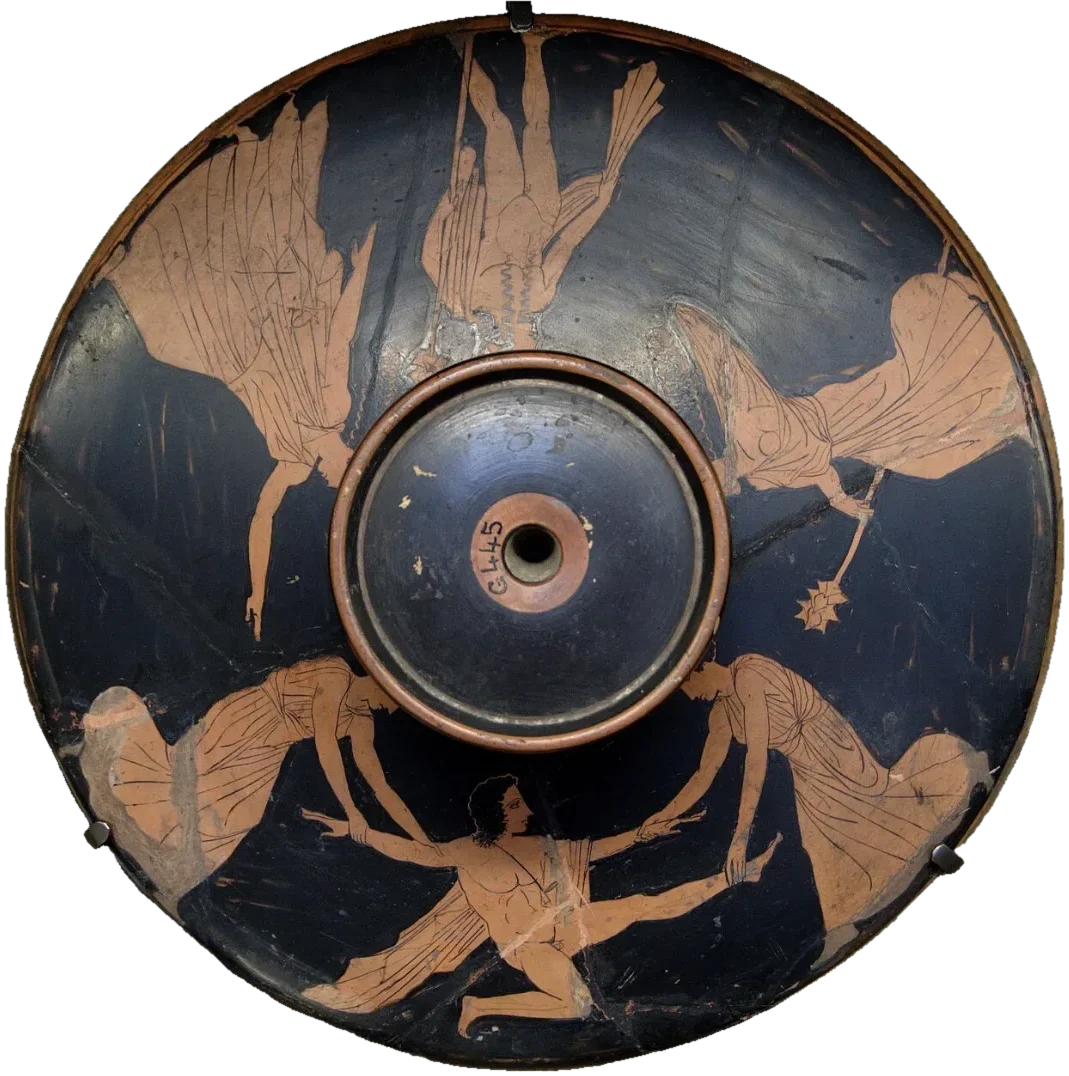
Text and translation
ἴτε θοαὶ Λύσσας κύνες
Euripides · Bacchae · fourth stasimon, the chorus of Asian bacchants · strophe and antistrophe with a refrain, and epode · dochmiacs, with iambic, bacchiac and cretic cola · Murray’s text (Perseus), Lourenço’s colon analysis (2011)
How to read each line
A guide to the Greek, syllables, pitch marks and quantities.
Show the reading key
- Above each line: the line as the edition prints it, each word placed over its own syllables. The main row: the same Greek divided into metrical syllables, each written as it is pronounced. A consonant that closes a syllable is written with it (λόθ | ρο); an elided word is closed up with the next vowel (ν’ἀ); a final consonant carried into the next word is set with a thin space (ς ἰ). Wider gaps mark word-ends.
- Above the syllables: the pitch of each syllable, from the accents. Under them: the quantity of each syllable as it falls in the line, then the transliteration, syllable by syllable, with accented syllables in capitals.
- Under each line: a line-for-line translation. In the right margin of the scansion: the line type, its scheme, and its analysis into cola.
Key to the labels
The names, patterns and symbols used beside this poem.
Show the labels and symbols
The labels in the right margin of the scansion below give the line’s analysis as the scheme file states it, then its scheme and, where the analysis notes them, the period-end, a brevis in longo or a hiatus. ‖ marks the end of a period, ||| the end of the stanza; a line without a period-end runs on into the next (synapheia). × is an anceps, long or short; the last position of every period is indifferent. A click on any syllable highlights the colon it belongs to and explains it. The sources of the labels, with their page numbers, are given line by line under Prosody, line by line.
| Label | Name and shape | What it is |
|---|---|---|
| doch | Dochmius (δ)× — — × — | The dochmius.[5] Its basic shape is ⏑ — — ⏑ —; each of the three longs can be split into two shorts and each short can be replaced by a long (‘drag’), and the forms ⏑ ⏑⏑ — ⏑ — and — ⏑⏑ — ⏑ — are the most frequent.[6] It is reserved for urgent or emotional passages.[7] Lourenço classifies every Euripidean dochmius by its form, and every dochmius of this song is in his lists:[8] ⏑ ⏑⏑ — ⏑ — is Euripides’ favourite shape, ⏑ — — ⏑ — the second.[9] Labels such as 2δ are only shorthand for δ δ: there are probably no dochmiac “dimeters”.[10] |
| kd | Dochmius kaibelianus (kδ)× — ⏑ — ⏑ — | Lourenço’s kδ, x — x — ∪ —,[11] labelled with a query at 983, where the first words are between daggers.[12] The kaibelianus is, like the hypodochmiac, a rare variation used as a dochmius.[13] West, in his Greek Metre of 1982, took 983 ~ 1003 as a kaibelianus answering a normal dochmius; Lourenço notes that this rests on a corrupt text.[13] |
| cr2 | Two cretics (2 cr)— ⏑ — — ⏑ — | Two cretic metra.[14] |
| ia2 | Iambic dimeter (2 ia)× — ⏑ — × — ⏑ — | Two iambic metra.[15] Lourenço lists 992 ~ 1012, with one resolution, and 1022, with two.[16] |
| iaba | Iambic metron and bacchiac (ia + ba)× — ⏑ — ⏑ — — | Normally it ends a period; 993 ~ 1013 is one of the few cases where it runs on into the next colon, which Lourenço does not find troubling, since 992–996 makes a single long period.[17] |
| ba2 | Two bacchiacs (2 ba)⏑ — — ⏑ — — | Two bacchiacs.[18] |
| crux998 | Corrupt text (†) | Lourenço prints a scansion between daggers, with a query for the label:[19] the colon is corrupt in Diggle’s text. Murray’s words, which include σά, an editorial addition in his text, have one syllable more than that scansion. |
| ref1002 | Corrupt text (†) | At 1002–1007 Lourenço prints daggers and queries and, except at 1003, no scansion:[19] the passage is corrupt in Diggle’s text. The quantities shown are the workbench’s reading of Murray’s words, for reference only (○ where nothing fixes a vowel’s length); they are not an analysis. |
| link | Link anceps× | The single syllable that joins the units of dactylo-epitrite.[20] |
| e | Epitrite unit (e)— ⏑ — | The cretic unit of dactylo-epitrite.[21] |
| De | Hemiepes (D)— ⏑ ⏑ — ⏑ ⏑ — | The hemiepes, the dactylic unit of dactylo-epitrite.[22] Lourenço lists 1017 among the cola of the shape ∪ e ∪ D, the “iambelegus”.[23] |
| bacr | Bacchiac and cretic (ba + cr)⏑ — — — ⏑ — | A bacchiac and a cretic; Lourenço lists 1018 alone with the cretic’s first long resolved, ⏑ — — ⏑⏑ ⏑ —.[24] |
Scansion
The song that sends the hounds of Madness after Pentheus, laid out colon by colon as Lourenço analyses it, with strophe set against antistrophe: dochmiacs in nearly every shape Euripides uses, from ⏑ — — ⏑ — to a run of eleven short syllables, the refrain “Let Justice come”, and a corrupt passage in the antistrophe that the page shows for reference only.
Go, swift hounds of Madness, go to the mountain,
where the daughters of Cadmus keep their band,
and sting them to frenzy
against the man in woman’s dress,
the raving spy on the maenads.
His mother first, from a smooth rock
or a stake, will see him
lying in wait, and cry out to the maenads:
‘Who is this that hunts the Cadmeans who run on the mountain,
who has come, come to the mountain, to the mountain, bacchants?
Who was it gave him birth?
He was not born of the blood
of women: of some lioness
is he, or of the race of the Libyan Gorgons.’
Let Justice come for all to see, let her come
sword in hand, and slay, right
through the throat,
the godless, lawless, unjust son of Echion,
born of the earth.
He who with unjust mind and lawless anger
against your rites, Bacchus, and your mother’s,
with maddened heart
and frenzied spirit sets out
to conquer by force the unconquerable —
for thoughts, death that admits no excuse is the teacher of sense
in the things of the gods;
and to think as a mortal makes a life free from pain.
Cleverness I do not grudge;
I take joy in hunting it; but the other things are great
and plain: oh, that life might flow towards what is fine,
that by day and into the night,
pure, one might be reverent, and casting out the customs
that lie outside justice, honour the gods.
Let Justice come for all to see, let her come
sword in hand, and slay, right
through the throat,
the godless, lawless, unjust son of Echion,
born of the earth.
Appear as a bull, or as a many-headed
serpent to see, or as a lion blazing
with fire to behold!
Go, Bacchus; on the hunter of bacchants,
with laughing face, cast the noose,
the deadly one, as he falls beneath the herd
of the maenads.
Metre
- The song. The chorus imagine themselves as the dogs of Lyssa, Madness personified, who are to drive the Theban women to the deed; their cry “to the mountain, to the mountain” (986) is taken up from the parodos, and in the refrain the punishing god is cast as Justice, Dikē.[25]
- Whose analysis. Every colon is scanned against the analysis printed by F. Lourenço, The Lyric Metres of Euripidean Drama (Coimbra 2011), pp. 329–331, which is made on Diggle’s Oxford text and takes as a colon whatever Diggle prints as a lyric line;[26] the line numbers are his. The right margin gives his label; the note on each line opens with his pattern as he prints it. Every dochmius of the song also appears in his repertory of dochmiac shapes,[27] which shows how he divides each line into its two dochmii and which positions are resolved; the page follows that division. The syllables and their lengths are the workbench’s scansion of Murray’s Greek. All the cola scan against the scheme except two, 998 and 1021, where Murray’s text is not Diggle’s; the problems are reported above the poem and explained in the notes. 1002–1007, where Lourenço gives no scansion, are shown for reference only.
- Signs. Lourenço’s list is on pp. 13–15: his ∪ is this site’s ⏑, ∪∪ a long resolved into two shorts, ∩ a short syllable in a long position at period-end (breuis in longo), ‖ period-end, ‖ᴮ a period-end shown by breuis in longo, ‖ᴴˢ one shown by hiatus in the strophe, ∫ overlap, † a corrupt text. Where he prints ∪ ∪ ∪ at the head of a dochmius, the three shorts are the first short and a resolved long (⏑ ⏑⏑), as his repertory shows. On this page the last position of every period is drawn as × (indifferent).
- Dochmiacs. The dochmius is ⏑ — — ⏑ —, with any of its longs resolvable and either short replaceable by a long; it is never used without urgency or strong feeling,[28] and for Lourenço dochmiac rhythm “invariably denotes a heightening of emotional tension”.[29] Here it takes nine of the shapes in Lourenço’s repertory, from the plain ⏑ — — ⏑ — and Euripides’ favourite ⏑ ⏑⏑ — ⏑ —[9] to — — — — — (985) and the fully resolved ⏑ ⏑⏑ ⏑⏑ ⏑ ⏑⏑ (986, 995 = 1015), eight short syllables in a row.[30] Lourenço lists ἄθεον ἄνομον ἄδικον (995 = 1015) among Euripides’ groupings of tribrach-shaped words.[31]
- The refrain (992–996 = 1012–1016) changes metre: an iambic dimeter, an iambic metron with a bacchiac running on into two bacchiacs, a resolved dochmiac pair and a closing dochmius. Lourenço notes that the iambic metron with bacchiac, otherwise a period-closing phrase, here runs on into the next colon, and sees nothing odd in that, since the whole refrain is a single long period.[32]
- Responsion. Where the text is sound the antistrophe answers the strophe colon for colon, with the dochmiac freedom of the second short: at 977 ~ 997 the second dochmius is ⏑ ⏑⏑ — ⏑ — in the strophe and ⏑ ⏑⏑ — — — in the antistrophe.[33] 983 ~ 1003 cannot be compared: West, in his Greek Metre of 1982, took them as a kaibelianus answering a normal dochmius, which Lourenço says rests on a corrupt text.[13] The refrain repeats its words except γόνον (996) ~ τόκον (1016), both “offspring”.
- Periods. Lourenço marks period-end after 978 (hiatus in the strophe, κόραι | ἀνοιστρήσατε), after 987 and 991 (breuis in longo; at 987 the closed ἔτεκεν, which he lists among his “closed” cases, p. 22), after 1010–11 and after 1019 in the epode.[34]
- Murray’s text and Lourenço’s. The Greek is Murray’s, letter for letter. His line division differs from Lourenço’s at 985–987, 989–991, 992–994, 1010–1014 and 1017–1019, and his numbers skip some lines; this page follows Lourenço’s colometry and numbers, and the notes give Murray’s. The texts differ at 998, where Murray prints σά as an editorial addition, which Lourenço’s scansion has no room for; at 1021;[35] and at 1002–1007, which are corrupt in Diggle’s text. The ν of νάειν at 1007 is also an editorial addition in Murray’s text.
- Prosody. The workbench uses the Attic rules (README). Doric α for Attic-Ionic η, the original long ᾱ,[36] runs through the song: Λύσσας, μάτηρ, λευρᾶς, ἀπύσει, δίκα, γνώμᾳ, ὀργᾷ, ματρός, σᾶς, μανείσᾳ, τἀνίκατον, βακχᾶν, τάν. A stop with a liquid or nasal may leave the syllable before it short:[37] πέτρας (982), ὀρειδρόμων (985), πολύκρανος (1017), πυριφλέγων (1018), θηραγρευτᾷ (1020); but West notes that δμ never does so, and Κάδμου (978) and Καδμείων (985) have a long first syllable.[37]
- Dale’s analysis. Dale treats the whole of 977 ff. as a single dochmiac system, one long period.[38] Two points differ from Lourenço’s analysis, which this page follows. (1) 987–8: Dale holds that the system should not be broken between 987 and 988, as most texts break it; she joins τίς ἄρα νιν ἔτεκεν; οὐ into one ‘long dochmiac’,[39] where Lourenço ends a period after ἔτεκεν (δ ‖ᴮ, brevis in longo) and begins 988 with οὐ γὰρ as two cretics. (2) 983 ἢ σκόλοπος ὄψεται: Dale prints it without daggers and scans it × ⏖ ⏑ — ⏑ —, another ‘long dochmiac’,[40] the shape this page labels kδ; Lourenço marks ἢ σκόλοπος as corrupt. Dale also lists 994 σα λαιμῶν διαμπὰξ among the runs of bacchiacs found in tragedy, as labelled here (2 ba).[41]
- Kovacs’s text. D. Kovacs’s Loeb edition of 2003 differs from Murray’s text in many places in the antistrophe (998, 1002–3, 1005–7) and at 983, 985, 996, 1020 and 1021. At 983 and 1003 his readings give both stanzas Lourenço’s shape — ⏑ ⏑ — ⏑ —.[42] The line numbers agree.[43]
Prosody, line by line
Every syllable, with the reason for its length. Quantities are read from the vowel where the spelling shows it, from the consonants that follow (“position”), from the accent where it tells, and from the metre where nothing else does. Editors’ notes on the text follow in the boxed paragraphs.
- 977
Line 977 · ἴτε θοαὶ Λύσσας κύνες ἴτʼ εἰς ὄρος,
ἴτε θοαὶ Λύσσας κύνες ἴτʼ εἰς ὄρος,
ἴτεθοαὶΛύσσαςκύνες ἴτ’εἰςὄρος,the period runs on into l. 978 (synapheia).
The label in the margin, with its sources: Lourenço 2011, pp. 61, 63, 329.
- 1 ⏑ἴἴ is short by the metre (position 1 must be short).
- 2 ⏑τεε is short by nature; with its neighbour it resolves the long of position 2 into two shorts.
- 3 ⏑θοο is short by nature; with its neighbour it resolves the long of position 2 into two shorts.
- 4 —αὶαὶ is a diphthong, long by nature.
- 5 —Λύσύ is a vowel of unknown length; closed by σ: long by position.
- 6 —σαςα is a vowel of unknown length; closed by ς: long by position.
- 7 ⏑κύύ is short by the metre (position 6 must be short).
- 8 ⏑νεε is short by nature; with its neighbour it resolves the long of position 7 into two shorts.
- 9 ⏑ς ἴἴ is short by the metre (position 7 must be short); the first consonant belongs to the previous word and is carried over to this vowel; with its neighbour it resolves the long of position 7 into two shorts.
- 10 —τ’εἰςεἰ is a diphthong, long by nature; the apostrophe marks an elided vowel; the consonant before it joins this syllable.
- 11 ⏑ὄὄ is short by nature.
- 12 —ρος,ο is short by nature; closed by ς: long by position; the line-end is not a period-end: the period runs on into the next line (synapheia), so this syllable keeps its own length, with no brevis in longo, and a word may run over into the next line.[44]
- 978
Line 978 · θίασον ἔνθʼ ἔχουσι Κάδμου κόραι,
θίασον ἔνθʼ ἔχουσι Κάδμου κόραι,
θίασον ἔνθ’ἔχουσιΚάδμουκόραι,continues l. 977 · one period (synapheia).
The label in the margin, with its sources: Lourenço 2011, pp. 61, 329.
- 1 ⏑θίί is short by the metre (position 1 must be short).
- 2 ⏑αα is short by the metre (position 2 must be short); with its neighbour it resolves the long of position 2 into two shorts.
- 3 ⏑σοο is short by nature; with its neighbour it resolves the long of position 2 into two shorts.
- 4 —ν ἔνἔ is short by nature; closed by ν: long by position; the first consonant belongs to the previous word and is carried over to this vowel.
- 5 ⏑θ’ἔἔ is short by nature; the apostrophe marks an elided vowel; the consonant before it joins this syllable.
- 6 —χουου is a diphthong, long by nature.
- 7 ⏑σιι is short by the accent rule: acute on the antepenult requires a short final syllable.
- 8 —Κάδά is a vowel of unknown length; closed by δ: long by position; δμ is one of the four clusters (γμ, γν, δμ, δν) that never leave the syllable before them short.[37]
- 9 —μουου is a diphthong, long by nature.
- 10 ⏑κόό is short by nature.
- 11 ×ραι,αι is a diphthong, long by nature; the last position of the period is indifferent.
Lourenço prints ∪ ∪ ∪ — ∪ — ∪ ∪ — ∪ —, 2δ ‖ᴴˢ.[12] The first dochmius is ⏑ ⏑⏑ — ⏑ — (θίασον ἔνθ’ ἔχου-). His second, ∪ ∪ — ∪ —, is not a dochmiac shape, and his repertory lists 978b with ⏑ ⏑⏑ — ⏑ —, which needs six syllables;[30] Murray’s -σι Κάδμου κόραι has five, and with the long first syllable of Κάδμου (δμ never leaves a syllable short)[37] gives ⏑ — — ⏑ —, the second commonest dochmius. The page scans that shape; the responsion table keeps Lourenço’s print. Period-end, shown by the hiatus between κόραι and ἀνοιστρήσατε.- 979
Line 979 · ἀνοιστρήσατέ νιν
ἀνοιστρήσατέ νιν
ἀνοιστρήσατένιthe period runs on into l. 980 (synapheia).
The label in the margin, with its sources: Lourenço 2011, pp. 61, 329.
- 1 ⏑ἀἀ is short by the metre (position 1 must be short).
- 2 —νοισοι is a diphthong, long by nature; closed by σ: long by position.
- 3 —τρήή is long by nature.
- 4 ⏑σαα is short by the metre (position 4 must be short).
- 5 ⏑τέέ is short by nature; with its neighbour it resolves the long of position 5 into two shorts.
- 6 ⏑νιι is short by the metre (position 5 must be short); with its neighbour it resolves the long of position 5 into two shorts; the line-end is not a period-end: the period runs on into the next line (synapheia), so this syllable keeps its own length, with no brevis in longo, and a word may run over into the next line.[44]
- 980
Line 980 · ἐπὶ τὸν ἐν γυναικομίμῳ στολᾷ
ἐπὶ τὸν ἐν γυναικομίμῳ στολᾷ
ν ἐπὶτὸν ἐνγυναικομίμῳστολᾷcontinues l. 979 · one period (synapheia); the period runs on into l. 981 (synapheia).
The label in the margin, with its sources: Lourenço 2011, pp. 60–61, 329.
- 1 ⏑ν ἐἐ is short by nature; the first consonant belongs to the previous word and is carried over to this vowel.
- 2 ⏑πὶὶ is short by the metre (position 2 must be short); with its neighbour it resolves the long of position 2 into two shorts.
- 3 ⏑τὸὸ is short by nature; with its neighbour it resolves the long of position 2 into two shorts.
- 4 —ν ἐνἐ is short by nature; closed by ν: long by position; the first consonant belongs to the previous word and is carried over to this vowel.
- 5 ⏑γυυ is short by the metre (position 4 must be short).
- 6 —ναιαι is a diphthong, long by nature.
- 7 ⏑κοο is short by nature.
- 8 —μίί is long by the metre (position 7 must be long).
- 9 —μῳῳ is long by nature; the next word begins with στ: the syllable is closed before it: long by position.
- 10 ⏑στοο is short by nature.
- 11 —λᾷᾷ is long by nature; the line-end is not a period-end: the period runs on into the next line (synapheia), so this syllable keeps its own length, with no brevis in longo, and a word may run over into the next line.[44]
- 981
Line 981 · λυσσώδη κατάσκοπον μαινάδων.
λυσσώδη κατάσκοπον μαινάδων.
λυσσώδηκατάσκοπονμαινάδων.continues l. 980 · one period (synapheia); the period runs on into l. 982 (synapheia).
The label in the margin, with its sources: Lourenço 2011, pp. 60–61, 329.
- 1 —λυσυ is a vowel of unknown length; closed by σ: long by position.
- 2 —σώώ is long by nature.
- 3 —δηη is long by nature.
- 4 ⏑καα is short by the metre (position 4 must be short).
- 5 —τάσά is a vowel of unknown length; closed by σ: long by position.
- 6 ⏑κοο is short by nature.
- 7 —πονο is short by nature; closed by ν: long by position.
- 8 —μαιαι is a diphthong, long by nature.
- 9 ⏑νάά is short by the metre (position 9 must be short).
- 10 —δων.ω is long by nature; closed by ν: long by position; the line-end is not a period-end: the period runs on into the next line (synapheia), so this syllable keeps its own length, with no brevis in longo, and a word may run over into the next line.[44]
- 982
Line 982 · μάτηρ πρῶτά νιν λευρᾶς ἀπὸ πέτρας
μάτηρ πρῶτά νιν λευρᾶς ἀπὸ πέτρας
μάτηρπρῶτάνινλευρᾶςἀπὸπέτραcontinues l. 981 · one period (synapheia); the period runs on into l. 983 (synapheia).
The label in the margin, with its sources: Lourenço 2011, pp. 61–62, 329.
- 1 —μάά is long by the metre (position 1 must be long).
- 2 —τηρη is long by nature; closed by ρ: long by position.
- 3 —πρῶῶ is long by nature.
- 4 ⏑τάά is short by the accent rule: circumflex on the penult requires a short final syllable.
- 5 —νινι is a vowel of unknown length; closed by ν: long by position.
- 6 —λευευ is a diphthong, long by nature.
- 7 —ρᾶςᾶ carries a circumflex, so it is long.
- 8 ⏑ἀἀ is short by the metre (position 8 must be short); with its neighbour it resolves the long of position 8 into two shorts.
- 9 ⏑πὸὸ is short by nature; with its neighbour it resolves the long of position 8 into two shorts.
- 10 ⏑πέέ is short by nature; τρ is carried whole into the next syllable, so this syllable stays open and short (Attic correption of a stop + liquid cluster).
- 11 —τραα is long by the metre (position 10 must be long); the line-end is not a period-end: the period runs on into the next line (synapheia), so this syllable keeps its own length, with no brevis in longo, and a word may run over into the next line.[44]
- 983
Line 983 · ἢ σκόλοπος ὄψεται
ἢ σκόλοπος ὄψεται
ς ἢσκόλοπος ὄψεταιcontinues l. 982 · one period (synapheia); the period runs on into l. 984 (synapheia).
The label in the margin, with its sources: Lourenço 2011, pp. 54, 330: † — ∪∪ ∪ † — ∪ —.
- 1 —ς ἢἢ is long by nature; the next word begins with σκ: the syllable is closed before it: long by position; the first consonant belongs to the previous word and is carried over to this vowel.
- 2 ⏑σκόό is short by nature; with its neighbour it resolves the long of position 2 into two shorts.
- 3 ⏑λοο is short by nature; with its neighbour it resolves the long of position 2 into two shorts.
- 4 ⏑ποο is short by nature.
- 5 —ς ὄὄ is short by nature; ψ is a double consonant (two sounds) and closes the syllable: long by position; the first consonant belongs to the previous word and is carried over to this vowel.
- 6 ⏑ψεε is short by nature.
- 7 —ταιαι is a diphthong, long by nature; the line-end is not a period-end: the period runs on into the next line (synapheia), so this syllable keeps its own length, with no brevis in longo, and a word may run over into the next line.[44]
Lourenço prints † — ∪∪ ∪ † — ∪ —, kδ ?, with ἢ σκόλοπος between daggers;[19] Murray’s words fit the shape.[51] Dale: × ⏖ ⏑ — ⏑ —, unemended, a ‘long dochmiac’.[40] Kovacs prints Nauck’s εὔσκοπος, “keen-eyed”, for ἢ σκόλοπος: εὔσκοπος ὄψεται scans — ⏑ ⏑ — ⏑ —, the shape Lourenço gives the answering 1003.[52]- 984
Line 984 · δοκεύοντα, μαινάσιν δʼ ἀπύσει·
δοκεύοντα, μαινάσιν δʼ ἀπύσει·
δοκεύοντα,μαινάσινδ’ἀπύσει·continues l. 983 · one period (synapheia); the period runs on into l. 985 (synapheia).
The label in the margin, with its sources: Lourenço 2011, pp. 60, 330.
- 1 ⏑δοο is short by nature.
- 2 —κεύεύ is a diphthong, long by nature.
- 3 —ονο is short by nature; closed by ν: long by position.
- 4 ⏑τα,α is short by the accent rule: acute on the antepenult requires a short final syllable.
- 5 —μαιαι is a diphthong, long by nature.
- 6 ⏑νάά is short by the metre (position 6 must be short).
- 7 —σινι is a vowel of unknown length; closed by ν: long by position.
- 8 —δ’ἀἀ is long by the metre (position 8 must be long); the apostrophe marks an elided vowel; the consonant before it joins this syllable.
- 9 ⏑πύύ is short by the metre (position 9 must be short).
- 10 —σει·ει is a diphthong, long by nature; the line-end is not a period-end: the period runs on into the next line (synapheia), so this syllable keeps its own length, with no brevis in longo, and a word may run over into the next line.[44]
- 985
Line 985 · Τίς ὅδʼ ὀρειδρόμων μαστὴρ Καδμείων
Τίς ὅδʼ ὀρειδρόμων μαστὴρ Καδμείων
Τίς ὅδ’ὀρειδρόμωνμαστὴρΚαδμείωcontinues l. 984 · one period (synapheia); the period runs on into l. 986 (synapheia).
The label in the margin, with its sources: Lourenço 2011, pp. 61–62, 330.
- 1 ⏑Τίί is short by the metre (position 1 must be short).
- 2 ⏑ς ὅὅ is short by nature; the first consonant belongs to the previous word and is carried over to this vowel; with its neighbour it resolves the long of position 2 into two shorts.
- 3 ⏑δ’ὀὀ is short by nature; the apostrophe marks an elided vowel; the consonant before it joins this syllable; with its neighbour it resolves the long of position 2 into two shorts.
- 4 —ρειει is a diphthong, long by nature.
- 5 ⏑δρόό is short by nature.
- 6 —μωνω is long by nature; closed by ν: long by position.
- 7 —μασα is a vowel of unknown length; closed by σ: long by position.
- 8 —τὴρὴ is long by nature; closed by ρ: long by position.
- 9 —Καδα is a vowel of unknown length; closed by δ: long by position; δμ is one of the four clusters (γμ, γν, δμ, δν) that never leave the syllable before them short.[37]
- 10 —μείεί is a diphthong, long by nature.
- 11 —ωω is long by nature; the line-end is not a period-end: the period runs on into the next line (synapheia), so this syllable keeps its own length, with no brevis in longo, and a word may run over into the next line.[44]
∪ ∪ ∪ — ∪ — — — — — —, 2δ:[19] ⏑ ⏑⏑ — ⏑ — (Τίς ὅδ’ ὀρειδρόμων) and — — — — —, both ancipitia long (μαστὴρ Καδμείων), a shape Lourenço lists with 1160.[55] Murray divides 985–987 as Τίς ὅδʼ ὀρειδρόμων | μαστὴρ Καδμείων ἐς ὄρος ἐς ὄρος ἔμολʼ | ἔμολεν, ὦ βάκχαι; τίς ἄρα νιν ἔτεκεν;; this page follows Lourenço’s three cola. Kovacs prints Maas’s Καδμειᾶν for Καδμείων; the syllable is long either way.[52]- 986
Line 986 · ἐς ὄρος ἐς ὄρος ἔμολʼ ἔμολεν, ὦ βάκχαι;
ἐς ὄρος ἐς ὄρος ἔμολʼ ἔμολεν, ὦ βάκχαι;
ν ἐς ὄρος ἐς ὄρος ἔμολ’ἔμολε,ν ὦβάκχαι;continues l. 985 · one period (synapheia); the period runs on into l. 987 (synapheia).
The label in the margin, with its sources: Lourenço 2011, pp. 61, 63, 330.
- 1 ⏑ν ἐἐ is short by nature; the first consonant belongs to the previous word and is carried over to this vowel.
- 2 ⏑ς ὄὄ is short by nature; the first consonant belongs to the previous word and is carried over to this vowel; with its neighbour it resolves the long of position 2 into two shorts.
- 3 ⏑ροο is short by nature; with its neighbour it resolves the long of position 2 into two shorts.
- 4 ⏑ς ἐἐ is short by nature; the first consonant belongs to the previous word and is carried over to this vowel; with its neighbour it resolves the long of position 3 into two shorts.
- 5 ⏑ς ὄὄ is short by nature; the first consonant belongs to the previous word and is carried over to this vowel; with its neighbour it resolves the long of position 3 into two shorts.
- 6 ⏑ροο is short by nature.
- 7 ⏑ς ἔἔ is short by nature; the first consonant belongs to the previous word and is carried over to this vowel; with its neighbour it resolves the long of position 5 into two shorts.
- 8 ⏑μοο is short by nature; with its neighbour it resolves the long of position 5 into two shorts.
- 9 ⏑λ’ἔἔ is short by nature; the apostrophe marks an elided vowel; the consonant before it joins this syllable.
- 10 ⏑μοο is short by nature; with its neighbour it resolves the long of position 7 into two shorts.
- 11 ⏑λε,ε is short by nature; with its neighbour it resolves the long of position 7 into two shorts.
- 12 —ν ὦὦ is long by nature; the first consonant belongs to the previous word and is carried over to this vowel.
- 13 —βάκά is a vowel of unknown length; closed by κ: long by position.
- 14 —χαι;αι is a diphthong, long by nature; the line-end is not a period-end: the period runs on into the next line (synapheia), so this syllable keeps its own length, with no brevis in longo, and a word may run over into the next line.[44]
- 987
Line 987 · τίς ἄρα νιν ἔτεκεν;
τίς ἄρα νιν ἔτεκεν;
τίς ἄρανιν ἔτεκεν;continues l. 986 · one period (synapheia).
The label in the margin, with its sources: Lourenço 2011, pp. 22, 61, 330.
- 1 ⏑τίί is short by the metre (position 1 must be short).
- 2 ⏑ς ἄἄ is short by the metre (position 2 must be short); the first consonant belongs to the previous word and is carried over to this vowel; with its neighbour it resolves the long of position 2 into two shorts.
- 3 ⏑ραα is short by the metre (position 2 must be short); with its neighbour it resolves the long of position 2 into two shorts.
- 4 ⏑νιι is short by the metre (position 3 must be short); with its neighbour it resolves the long of position 3 into two shorts.
- 5 ⏑ν ἔἔ is short by nature; the first consonant belongs to the previous word and is carried over to this vowel; with its neighbour it resolves the long of position 3 into two shorts.
- 6 ⏑τεε is short by nature.
- 7 ×κεν;ε is short by nature; closed by ν: long by position; the last position of the period is indifferent.
∪ ∪∪ ∪∪ ∪ ∩, δ ‖ᴮ:[57] ⏑ ⏑⏑ ⏑⏑ ⏑ — with the last syllable, -κεν of ἔτεκεν, as breuis in longo. It is a closed syllable, and Lourenço lists it among his “closed” cases, final words in -ν;[58] West and Willink hold that a closed syllable at period-end is long,[59] and the workbench follows West, drawing the position as × without calling it brevis in longo: authorities differ. Dale would not end the period here: τίς ἄρα νιν ἔτεκεν; οὐ is for her one long dochmiac running on into 988.[60]- 988
Line 988 · οὐ γὰρ ἐξ αἵματος
οὐ γὰρ ἐξ αἵματος
οὐγὰρ ἐξαἵματοςthe period runs on into l. 989–90 (synapheia).
The label in the margin, with its sources: Lourenço 2011, pp. 122, 330.
- 1 —οὐοὐ is a diphthong, long by nature.
- 2 ⏑γὰὰ is short by the metre (position 2 must be short).
- 3 —ρ ἐξἐ is short by nature; ξ is a double consonant (two sounds) and closes the syllable: long by position; the first consonant belongs to the previous word and is carried over to this vowel.
- 4 —αἵαἵ is a diphthong, long by nature.
- 5 ⏑μαα is short by the metre (position 5 must be short).
- 6 —τοςο is short by nature; closed by ς: long by position; the line-end is not a period-end: the period runs on into the next line (synapheia), so this syllable keeps its own length, with no brevis in longo, and a word may run over into the next line.[44]
- 989–90
Line 989–90 · γυναικῶν ἔφυ, λεαίνας δέ τινος
γυναικῶν ἔφυ, λεαίνας δέ τινος
γυναικῶνἔφυ,λεαίναςδέτινοcontinues l. 988 · one period (synapheia); the period runs on into l. 991 (synapheia).
The label in the margin, with its sources: Lourenço 2011, pp. 60–61, 330.
- 1 ⏑γυυ is short by the metre (position 1 must be short).
- 2 —ναιαι is a diphthong, long by nature.
- 3 —κῶνῶ is long by nature.
- 4 ⏑ἔἔ is short by nature.
- 5 —φυ,υ is long by the metre (position 5 must be long).
- 6 ⏑λεε is short by nature.
- 7 —αίαί is a diphthong, long by nature.
- 8 —ναςα is a vowel of unknown length; closed by ς: long by position.
- 9 ⏑δέέ is short by nature.
- 10 ⏑τιι is short by the metre (position 10 must be short); with its neighbour it resolves the long of position 10 into two shorts.
- 11 ⏑νοο is short by nature; with its neighbour it resolves the long of position 10 into two shorts; the line-end is not a period-end: the period runs on into the next line (synapheia), so this syllable keeps its own length, with no brevis in longo, and a word may run over into the next line.[44]
∪ — — ∪ — ∪ — — ∪ ∪∪, 2δ:[62] ⏑ — — ⏑ — and ⏑ — — ⏑ ⏑⏑, with the last long resolved (τινος). The υ of ἔφυ is long, as the scheme requires. The Perseus text numbers this line 989.- 991
Line 991 · ὅδʼ ἢ Γοργόνων Λιβυσσᾶν γένος.
ὅδʼ ἢ Γοργόνων Λιβυσσᾶν γένος.
ς ὅδ’ἢΓοργόνωνΛιβυσσᾶνγένος.continues l. 989–90 · one period (synapheia).
The label in the margin, with its sources: Lourenço 2011, pp. 60, 330.
- 1 ⏑ς ὅὅ is short by nature; the first consonant belongs to the previous word and is carried over to this vowel.
- 2 —δ’ἢἢ is long by nature; the apostrophe marks an elided vowel; the consonant before it joins this syllable.
- 3 —Γορο is short by nature; closed by ρ: long by position.
- 4 ⏑γόό is short by nature.
- 5 —νωνω is long by nature; closed by ν: long by position.
- 6 ⏑Λιι is short by the metre (position 6 must be short).
- 7 —βυσυ is a vowel of unknown length; closed by σ: long by position.
- 8 —σᾶνᾶ carries a circumflex, so it is long; closed by ν: long by position.
- 9 ⏑γέέ is short by nature.
- 10 ×νος.ο is short by nature; closed by ς: long by position; the last position of the period is indifferent.
∪ — — ∪ — ∪ — — ∪ ∩, 2δ ‖ᴮ:[53] two dochmii ⏑ — — ⏑ —, the last syllable (-νος of γένος) marked as breuis in longo; it is closed, as at 987. Λιβυσσᾶν: Doric genitive plural. The Perseus text numbers this line 990.- 992
Line 992 · ἴτω δίκα φανερός, ἴτω
ἴτω δίκα φανερός, ἴτω
ἴτωδίκαφανερό,ς ἴτωthe period runs on into l. 993 (synapheia).
The label in the margin, with its sources: Lourenço 2011, pp. 119, 330.
- 1 ⏑ἴἴ is short by the metre (position 1 must be short).
- 2 —τωω is long by nature.
- 3 ⏑δίί is short by the metre (position 3 must be short).
- 4 —καα is long by the metre (position 4 must be long).
- 5 ⏑φαα is short by the metre (position 5 must be short).
- 6 ⏑νεε is short by nature; with its neighbour it resolves the long of position 6 into two shorts.
- 7 ⏑ρό,ό is short by nature; with its neighbour it resolves the long of position 6 into two shorts.
- 8 ⏑ς ἴἴ is short by the metre (position 7 must be short); the first consonant belongs to the previous word and is carried over to this vowel.
- 9 —τωω is long by nature; the next word begins with the double consonant ξ: the syllable is closed before it: long by position; the line-end is not a period-end: the period runs on into the next line (synapheia), so this syllable keeps its own length, with no brevis in longo, and a word may run over into the next line.[44]
- 993
Line 993 · ξιφηφόρος φονεύου-
ξιφηφόρος φονεύου-
ξιφηφόροςφονεύου-continues l. 992 · one period (synapheia); the period runs on into l. 994 (synapheia).
The label in the margin, with its sources: Lourenço 2011, pp. 121, 330.
- 1 ⏑ξιι is short by the metre (position 1 must be short).
- 2 —φηη is long by nature.
- 3 ⏑φόό is short by nature.
- 4 —ροςο is short by nature; closed by ς: long by position.
- 5 ⏑φοο is short by nature.
- 6 —νεύεύ is a diphthong, long by nature.
- 7 —ου-ου is a diphthong, long by nature; the line-end is not a period-end: the period runs on into the next line (synapheia), so this syllable keeps its own length, with no brevis in longo, and a word may run over into the next line.[44]
∪ — ∪ — ∪ — —, ia + ba ∫:[64] φονεύου-|σα runs over into 994. Lourenço calls this a rare example of the colon in synartesis, and thinks it unproblematic inside one long period.[65]- 994
Line 994 · σα λαιμῶν διαμπὰξ
σα λαιμῶν διαμπὰξ
σαλαιμῶνδιαμπὰξcontinues l. 993 · one period (synapheia); the period runs on into l. 995 (synapheia).
The label in the margin, with its sources: Lourenço 2011, pp. 122, 330.
- 1 ⏑σαα is short by the accent rule: acute on the antepenult requires a short final syllable.
- 2 —λαιαι is a diphthong, long by nature.
- 3 —μῶνῶ is long by nature; closed by ν: long by position.
- 4 ⏑διι is short by the metre (position 4 must be short).
- 5 —αμα is a vowel of unknown length; closed by μ: long by position.
- 6 —πὰξὰ is a vowel of unknown length; closed by ξ: long by position; the line-end is not a period-end: the period runs on into the next line (synapheia), so this syllable keeps its own length, with no brevis in longo, and a word may run over into the next line.[44]
- 995
Line 995 · τὸν ἄθεον ἄνομον ἄδικον Ἐχίονος
τὸν ἄθεον ἄνομον ἄδικον Ἐχίονος
τὸν ἄθεον ἄνομον ἄδικον Ἐχίονοςcontinues l. 994 · one period (synapheia); the period runs on into l. 996 (synapheia).
The label in the margin, with its sources: Lourenço 2011, pp. 30, 61, 330.
- 1 ⏑τὸὸ is short by nature.
- 2 ⏑ν ἄἄ is short by the metre (position 2 must be short); the first consonant belongs to the previous word and is carried over to this vowel; with its neighbour it resolves the long of position 2 into two shorts.
- 3 ⏑θεε is short by nature; with its neighbour it resolves the long of position 2 into two shorts.
- 4 ⏑οο is short by nature; with its neighbour it resolves the long of position 3 into two shorts.
- 5 ⏑ν ἄἄ is short by the metre (position 3 must be short); the first consonant belongs to the previous word and is carried over to this vowel; with its neighbour it resolves the long of position 3 into two shorts.
- 6 ⏑νοο is short by nature.
- 7 ⏑μοο is short by nature; with its neighbour it resolves the long of position 5 into two shorts.
- 8 ⏑ν ἄἄ is short by the metre (position 5 must be short); the first consonant belongs to the previous word and is carried over to this vowel; with its neighbour it resolves the long of position 5 into two shorts.
- 9 ⏑διι is short by the metre (position 6 must be short).
- 10 ⏑κοο is short by nature; with its neighbour it resolves the long of position 7 into two shorts.
- 11 ⏑ν ἘἘ is short by nature; the first consonant belongs to the previous word and is carried over to this vowel; with its neighbour it resolves the long of position 7 into two shorts.
- 12 —χίί is long by the metre (position 8 must be long).
- 13 ⏑οο is short by nature.
- 14 —νοςο is short by nature; closed by ς: long by position; the line-end is not a period-end: the period runs on into the next line (synapheia), so this syllable keeps its own length, with no brevis in longo, and a word may run over into the next line.[44]
Lourenço’s scheme on p. 330 prints twelve short syllables and — ∪ —; but his repertory gives the line as ⏑ ⏑⏑ ⏑⏑ ⏑ ⏑⏑ and ⏑ ⏑⏑ — ⏑ —, “995a = 1015a” and “995b = 1015b”, eleven shorts and — ⏑ —, as he prints the identical 1015.[66] Murray’s words have eleven, and the page follows the repertory. The ι of Ἐχίονος is long, as the scheme requires.[67]- 996
Line 996 · γόνον γηγενῆ.
γόνον γηγενῆ.
γόνονγηγενῆ.continues l. 995 · one period (synapheia).
The label in the margin, with its sources: Lourenço 2011, pp. 60, 330.
- 1 ⏑γόό is short by nature.
- 2 —νονο is short by nature; closed by ν: long by position.
- 3 —γηη is long by nature.
- 4 ⏑γεε is short by nature.
- 5 ×νῆ.ῆ is long by nature; the last position of the period is indifferent.
- 997
Line 997 · ὃς ἀδίκῳ γνώμᾳ παρανόμῳ τʼ ὀργᾷ
ὃς ἀδίκῳ γνώμᾳ παρανόμῳ τʼ ὀργᾷ
ὃς ἀδίκῳγνώμᾳπαρανόμῳτ’ὀργᾷthe period runs on into l. 998 (synapheia).
The label in the margin, with its sources: Lourenço 2011, pp. 63, 330.
- 1 ⏑ὃὃ is short by nature.
- 2 ⏑ς ἀἀ is short by the metre (position 2 must be short); the first consonant belongs to the previous word and is carried over to this vowel; with its neighbour it resolves the long of position 2 into two shorts.
- 3 ⏑δίί is short by the metre (position 2 must be short); with its neighbour it resolves the long of position 2 into two shorts.
- 4 —κῳῳ is long by nature.
- 5 —γνώώ is long by nature.
- 6 —μᾳᾳ is long by nature.
- 7 ⏑παα is short by the metre (position 6 must be short).
- 8 ⏑ραα is short by the metre (position 7 must be short); with its neighbour it resolves the long of position 7 into two shorts.
- 9 ⏑νόό is short by nature; with its neighbour it resolves the long of position 7 into two shorts.
- 10 —μῳῳ is long by nature.
- 11 —τ’ὀρὀ is short by nature; closed by ρ: long by position; the apostrophe marks an elided vowel; the consonant before it joins this syllable.
- 12 —γᾷᾷ is long by nature; the line-end is not a period-end: the period runs on into the next line (synapheia), so this syllable keeps its own length, with no brevis in longo, and a word may run over into the next line.[44]
∪ ∪ ∪ — — — ∪ ∪ ∪ — — —, 2δ:[69] ⏑ ⏑⏑ — — — twice. γνώμᾳ, ὀργᾷ: Doric datives, long ᾱ.- 998
Line 998 · περὶ σὰ Βάκχιʼ, ὄργια ματρός τε σᾶς
περὶ σὰ Βάκχιʼ, ὄργια ματρός τε σᾶς
περὶσὰΒάκχι’ὄργιαματρόςτεσᾶςcontinues l. 997 · one period (synapheia); the period runs on into l. 999 (synapheia).
The label in the margin, with its sources: Lourenço 2011, p. 330: † ∪ ∪ — ∪ — ∪ ∪ — — ∪ — †.
- 1 ⏑πεε is short by nature; it could not be fitted into the scheme; the position is anceps.
- 2 ⏑ρὶὶ is short by the metre (position 1 must be short).
- 3 ⏑σὰὰ is short by the metre (position 2 must be short).
- 4 —Βάκά is a vowel of unknown length; closed by κ: long by position.
- 5 ⏑χι’ι is short by the metre (position 4 must be short); the apostrophe marks an elided vowel; the consonant before it joins this syllable.
- 6 —ὄρὄ is short by nature; closed by ρ: long by position.
- 7 ⏑γιι is short by the metre (position 6 must be short).
- 8 ⏑αα is short by the accent rule: acute on the antepenult requires a short final syllable.
- 9 —ματα is a vowel of unknown length; closed by τ before a liquid: the stop + liquid cluster makes position here, as the metre requires (tragedy allows either).
- 10 —ρόςό is short by nature; closed by ς: long by position.
- 11 ⏑τεε is short by nature.
- 12 —σᾶςᾶ carries a circumflex, so it is long; closed by ς: long by position; the line-end is not a period-end: the period runs on into the next line (synapheia), so this syllable keeps its own length, with no brevis in longo, and a word may run over into the next line.[44]
⚠ line 998: 12 syllables cannot be fitted to the scheme ⏑ ⏑ — ⏑ — ⏑ ⏑ — — ⏑ —; the best attempt leaves 1 syllable unplaced (πε)
Lourenço prints † ∪ ∪ — ∪ — ∪ ∪ — — ∪ — †, with a query for the label:[19] the colon is corrupt in Diggle’s text. Murray’s line includes σά, an editorial addition (so marked in the Perseus text), and has twelve syllables to Lourenço’s eleven; the workbench reports it and leaves one syllable unplaced. Without σά, Murray’s words would fit the printed scansion. Kovacs prints περὶ <σά,> Βάκχε, σᾶς τ’ ὄργια ματέρος, a conjecture he credits to Murray (σά to Scaliger), for περὶ σὰ Βάκχι’, ὄργια ματρός τε σᾶς.[68]- 999
Line 999 · μανείσᾳ πραπίδι
μανείσᾳ πραπίδι
μανείσᾳπραπίδιcontinues l. 998 · one period (synapheia); the period runs on into l. 1000 (synapheia).
The label in the margin, with its sources: Lourenço 2011, pp. 61, 330.
- 1 ⏑μαα is short by the metre (position 1 must be short).
- 2 —νείεί is a diphthong, long by nature.
- 3 —σᾳᾳ is long by nature.
- 4 ⏑πραα is short by the metre (position 4 must be short).
- 5 ⏑πίί is short by the metre (position 5 must be short); with its neighbour it resolves the long of position 5 into two shorts.
- 6 ⏑διι is short by the metre (position 5 must be short); with its neighbour it resolves the long of position 5 into two shorts; the line-end is not a period-end: the period runs on into the next line (synapheia), so this syllable keeps its own length, with no brevis in longo, and a word may run over into the next line.[44]
∪ — — ∪ ∪∪, δ,[66] answering 979. μανείσᾳ: Doric, long ᾱ.- 1000
Line 1000 · παρακόπῳ τε λήματι στέλλεται,
παρακόπῳ τε λήματι στέλλεται,
παρακόπῳτελήματιστέλλεται,continues l. 999 · one period (synapheia); the period runs on into l. 1001 (synapheia).
The label in the margin, with its sources: Lourenço 2011, pp. 60–61, 330.
- 1 ⏑παα is short by the metre (position 1 must be short).
- 2 ⏑ραα is short by the metre (position 2 must be short); with its neighbour it resolves the long of position 2 into two shorts.
- 3 ⏑κόό is short by nature; with its neighbour it resolves the long of position 2 into two shorts.
- 4 —πῳῳ is long by nature.
- 5 ⏑τεε is short by nature.
- 6 —λήή is long by nature.
- 7 ⏑μαα is short by the metre (position 6 must be short).
- 8 —τιthe next word begins with στ: the syllable is closed before it: long by position.
- 9 —στέλέ is short by nature; closed by λ: long by position.
- 10 ⏑λεε is short by nature.
- 11 —ται,αι is a diphthong, long by nature; the line-end is not a period-end: the period runs on into the next line (synapheia), so this syllable keeps its own length, with no brevis in longo, and a word may run over into the next line.[44]
- 1001
Line 1001 · τἀνίκατον ὡς κρατήσων βίᾳ,
τἀνίκατον ὡς κρατήσων βίᾳ,
τἀνίκατον ὡςκρατήσωνβίᾳ,continues l. 1000 · one period (synapheia); the period runs on into l. 1002 (synapheia).
The label in the margin, with its sources: Lourenço 2011, pp. 60–61, 330.
- 1 —τἀἀ is long by crasis: the coronis marks two words contracted into one long vowel.
- 2 —νίί is long by the metre (position 2 must be long).
- 3 —καα is long by the metre (position 3 must be long).
- 4 ⏑τοο is short by nature.
- 5 —ν ὡςὡ is long by nature; closed by ς: long by position; the first consonant belongs to the previous word and is carried over to this vowel.
- 6 ⏑κραα is short by the metre (position 6 must be short).
- 7 —τήή is long by nature.
- 8 —σωνω is long by nature; closed by ν: long by position.
- 9 ⏑βίί is short by the metre (position 9 must be short).
- 10 —ᾳ,ᾳ is long by nature; the line-end is not a period-end: the period runs on into the next line (synapheia), so this syllable keeps its own length, with no brevis in longo, and a word may run over into the next line.[44]
- 1002
Line 1002 · γνωμᾶν σωφρόνα θάνατος ἀπροφάσι-
γνωμᾶν σωφρόνα θάνατος ἀπροφάσι-
γνωμᾶνσωφρόναθάνατος ἀπροφάσισ-continues l. 1001 · one period (synapheia); the period runs on into l. 1003 (synapheia).
The label in the margin, with its sources: Lourenço 2011, p. 330: †.
- 1 —γνωω is long by nature.
- 2 —μᾶνᾶ carries a circumflex, so it is long; closed by ν: long by position.
- 3 —σωω is long by nature.
- 4 ⏑φρόό is short by nature.
- 5 ⏑ναα is short by the metre (position 5 must be short).
- 6 ⏑θάά is short by the metre (position 6 must be short).
- 7 ⏑ναα is short by the metre (position 7 must be short).
- 8 ⏑τοο is short by nature.
- 9 ⏑ς ἀἀ is a vowel of unknown length; πρ is carried whole into the next syllable, so this syllable stays open and short (Attic correption of a stop + liquid cluster); the first consonant belongs to the previous word and is carried over to this vowel.
- 10 ⏑προο is short by nature.
- 11 ⏑φάά is short by the metre (position 11 must be short).
- 12 —σισ-ι is a vowel of unknown length; closed by σ: long by position; the line-end is not a period-end: the period runs on into the next line (synapheia), so this syllable keeps its own length, with no brevis in longo, and a word may run over into the next line.[44]
Lourenço prints only a dagger here, and a query for the label:[19] 1002–1007 are corrupt in Diggle’s text, and only 1003 has a scansion. The quantities shown are the workbench’s reading of Murray’s words, for reference only; ○ marks a vowel whose length nothing on this page fixes. The translation of 1002–1007 renders Murray’s words as printed; the text is corrupt. Kovacs prints γνωμᾶν σωφρόνισμα θάνατος· ἀόκνως <δ’> | ἐς τὰ θεῶν ἔφυ (σωφρόνισμα and δ’ Dodds’s, ἀόκνως his own).[68] The vowels of θάνατος are short,[72] and so are the ἀ- and -φα- of ἀπροφάσιστος;[73] the page marks them short.- 1003
Line 1003 · στος ἐς τὰ θεῶν ἔφυ·
στος ἐς τὰ θεῶν ἔφυ·
τος ἐςτὰθεῶνἔφυ·continues l. 1002 · one period (synapheia); the period runs on into l. 1004 (synapheia).
The label in the margin, with its sources: Lourenço 2011, p. 330: — ∪ ∪ — ∪ — ?.
- 1 ⏑τοο is short by nature.
- 2 —ς ἐςἐ is short by nature; closed by ς: long by position; the first consonant belongs to the previous word and is carried over to this vowel.
- 3 ⏑τὰὰ is short by the metre (position 3 must be short).
- 4 ⏑θεε is short by nature.
- 5 —ῶνῶ is long by nature.
- 6 ⏑ἔἔ is short by nature.
- 7 —φυ·υ is a vowel of unknown length; the next word begins with βρ: the syllable is closed before it: long by position; the line-end is not a period-end: the period runs on into the next line (synapheia), so this syllable keeps its own length, with no brevis in longo, and a word may run over into the next line.[44]
- 1004
Line 1004 · βροτείως τʼ ἔχειν ἄλυπος βίος.
βροτείως τʼ ἔχειν ἄλυπος βίος.
βροτείωςτ’ἔχεινἄλυποςβίος.continues l. 1003 · one period (synapheia); the period runs on into l. 1005 (synapheia).
The label in the margin, with its sources: Lourenço 2011, p. 330: no scansion.
- 1 ⏑βροο is short by nature.
- 2 —τείεί is a diphthong, long by nature.
- 3 —ωςω is long by nature; closed by ς: long by position.
- 4 ⏑τ’ἔἔ is short by nature; the apostrophe marks an elided vowel; the consonant before it joins this syllable.
- 5 —χεινει is a diphthong, long by nature.
- 6 ⏑ἄἄ is short by the metre (position 6 must be short).
- 7 —λυυ is long by the metre (position 7 must be long).
- 8 —ποςο is short by nature; closed by ς: long by position.
- 9 ⏑βίί is short by the metre (position 9 must be short).
- 10 —ος.ο is short by nature; closed by ς: long by position; the line-end is not a period-end: the period runs on into the next line (synapheia), so this syllable keeps its own length, with no brevis in longo, and a word may run over into the next line.[44]
- 1005
Line 1005 · τὸ σοφὸν οὐ φθονῶ·
τὸ σοφὸν οὐ φθονῶ·
τὸσοφὸν οὐφθονῶ·continues l. 1004 · one period (synapheia); the period runs on into l. 1006 (synapheia).
The label in the margin, with its sources: Lourenço 2011, p. 330: no scansion.
- 1 ⏑τὸὸ is short by nature.
- 2 ⏑σοο is short by nature.
- 3 ⏑φὸὸ is short by nature.
- 4 —ν οὐοὐ is a diphthong, long by nature; the next word begins with φθ: the syllable is closed before it: long by position; the first consonant belongs to the previous word and is carried over to this vowel.
- 5 ⏑φθοο is short by nature.
- 6 —νῶ·ῶ is long by nature; the line-end is not a period-end: the period runs on into the next line (synapheia), so this syllable keeps its own length, with no brevis in longo, and a word may run over into the next line.[44]
- 1006
Line 1006 · χαίρω θηρεύουσα· τὰ δʼ ἕτερα μεγάλα
χαίρω θηρεύουσα· τὰ δʼ ἕτερα μεγάλα
χαίρωθηρεύουσα·τὰδ’ἕτεραμεγάλαcontinues l. 1005 · one period (synapheia); the period runs on into l. 1007 (synapheia).
The label in the margin, with its sources: Lourenço 2011, p. 330: no scansion.
- 1 —χαίαί is a diphthong, long by nature.
- 2 —ρωω is long by nature.
- 3 —θηη is long by nature.
- 4 —ρεύεύ is a diphthong, long by nature.
- 5 —ουου is a diphthong, long by nature.
- 6 ⏑σα·α is short by the accent rule: acute on the antepenult requires a short final syllable; the position is anceps.
- 7 ⏑τὰὰ is short by the metre (position 7 must be short).
- 8 ⏑δ’ἕἕ is short by nature; the apostrophe marks an elided vowel; the consonant before it joins this syllable.
- 9 ⏑τεε is short by nature.
- 10 ⏑ραα is short by the accent rule: acute on the antepenult requires a short final syllable.
- 11 ⏑μεε is short by nature.
- 12 ⏑γάά is short by the metre (position 12 must be short).
- 13 ⏑λαα is short by the metre (position 13 must be short); the line-end is not a period-end: the period runs on into the next line (synapheia), so this syllable keeps its own length, with no brevis in longo, and a word may run over into the next line.[44]
- 1007
Line 1007 · φανερά τʼ· ὤ, νάειν ἐπὶ τὰ καλὰ βίον,
φανερά τʼ· ὤ, νάειν ἐπὶ τὰ καλὰ βίον,
φανεράτ’·ὤ,νάεινἐπὶτὰκαλὰβίο,continues l. 1006 · one period (synapheia); the period runs on into l. 1008 (synapheia).
The label in the margin, with its sources: Lourenço 2011, p. 330: †.
- 1 ⏑φαα is short by the metre (position 1 must be short).
- 2 ⏑νεε is short by nature.
- 3 ⏑ράά is short by the metre (position 3 must be short).
- 4 —τ’·ὤ,ὤ is long by nature; the apostrophe marks an elided vowel; the consonant before it joins this syllable.
- 5 ⏑νάά is short by the metre (position 5 must be short).
- 6 —εινει is a diphthong, long by nature.
- 7 ⏑ἐἐ is short by nature.
- 8 ⏑πὶὶ is short by the metre (position 8 must be short).
- 9 ⏑τὰὰ is short by the metre (position 9 must be short).
- 10 ⏑καα is short by the metre (position 10 must be short).
- 11 ⏑λὰὰ is short by the metre (position 11 must be short).
- 12 ⏑βίί is short by the metre (position 12 must be short).
- 13 ⏑ο,ο is short by nature; the line-end is not a period-end: the period runs on into the next line (synapheia), so this syllable keeps its own length, with no brevis in longo, and a word may run over into the next line.[44]
Lourenço prints a dagger and no scansion;[19] reference only. νάειν: the ν is an editorial addition in Murray’s text (so marked in the Perseus text). The first α of φανερά is short,[77] the first α of καλά is short in lyric and tragedy,[78] and the ι of βίον is short;[75] the page marks them short. The α of νάειν is short (the metre: νάει and νάουσιν have it in a short of the dactyl at Od. 6.292 and Il. 21.197)[79]; the page marks it short.- 1008
Line 1008 · ἦμαρ ἐς νύκτα τʼ εὐ-
ἦμαρ ἐς νύκτα τʼ εὐ-
ν ἦμαρ ἐςνύκτατ’εὐ-continues l. 1007 · one period (synapheia); the period runs on into l. 1009 (synapheia).
The label in the margin, with its sources: Lourenço 2011, pp. 122, 330.
- 1 —ν ἦἦ is long by nature; the first consonant belongs to the previous word and is carried over to this vowel.
- 2 ⏑μαα is short by the accent rule: circumflex on the penult requires a short final syllable.
- 3 —ρ ἐςἐ is short by nature; closed by ς: long by position; the first consonant belongs to the previous word and is carried over to this vowel.
- 4 —νύκύ is a vowel of unknown length; closed by κ: long by position.
- 5 ⏑ταα is short by the metre (position 5 must be short).
- 6 —τ’εὐ-εὐ is a diphthong, long by nature; the apostrophe marks an elided vowel; the consonant before it joins this syllable; the line-end is not a period-end: the period runs on into the next line (synapheia), so this syllable keeps its own length, with no brevis in longo, and a word may run over into the next line.[44]
— ∪ — — ∪ —, 2 cr ∫:[61] εὐ-|αγοῦντ’ runs over into 1009.- 1009
Line 1009 · αγοῦντʼ εὐσεβεῖν, τὰ δʼ ἔξω νόμιμα
αγοῦντʼ εὐσεβεῖν, τὰ δʼ ἔξω νόμιμα
αγοῦντ’εὐσεβεῖν,τὰδ’ἔξωνόμιμαcontinues l. 1008 · one period (synapheia); the period runs on into l. 1010–11 (synapheia).
The label in the margin, with its sources: Lourenço 2011, pp. 60–61, 330.
- 1 ⏑αα is short by the metre (position 1 must be short).
- 2 —γοῦνοῦ is a diphthong, long by nature; closed by ν: long by position.
- 3 —τ’εὐεὐ is a diphthong, long by nature; the apostrophe marks an elided vowel; the consonant before it joins this syllable.
- 4 ⏑σεε is short by nature.
- 5 —βεῖν,εῖ is a diphthong, long by nature; closed by ν: long by position.
- 6 ⏑τὰὰ is short by the metre (position 6 must be short).
- 7 —δ’ἔἔ is short by nature; ξ is a double consonant (two sounds) and closes the syllable: long by position; the apostrophe marks an elided vowel; the consonant before it joins this syllable.
- 8 —ξωω is long by nature.
- 9 ⏑νόό is short by nature.
- 10 ⏑μιι is short by the metre (position 10 must be short); with its neighbour it resolves the long of position 10 into two shorts.
- 11 ⏑μαα is short by the accent rule: acute on the antepenult requires a short final syllable; with its neighbour it resolves the long of position 10 into two shorts; the line-end is not a period-end: the period runs on into the next line (synapheia), so this syllable keeps its own length, with no brevis in longo, and a word may run over into the next line.[44]
∪ — — ∪ — ∪ — — ∪ ∪∪, 2δ,[62] answering 989–90.- 1010–11
Line 1010–11 · δίκας ἐκβαλόντα τιμᾶν θεούς.
δίκας ἐκβαλόντα τιμᾶν θεούς.
δίκαςἐκβαλόντατιμᾶνθεούς.continues l. 1009 · one period (synapheia).
The label in the margin, with its sources: Lourenço 2011, pp. 60, 330.
- 1 ⏑δίί is short by the metre (position 1 must be short).
- 2 —καςα is long by the metre (position 2 must be long).
- 3 —ἐκἐ is short by nature; closed by κ: long by position.
- 4 ⏑βαα is short by the metre (position 4 must be short).
- 5 —λόνό is short by nature; closed by ν: long by position.
- 6 ⏑ταα is short by the metre (position 6 must be short).
- 7 —τιι is long by the metre (position 7 must be long).
- 8 —μᾶνᾶ carries a circumflex, so it is long; closed by ν: long by position.
- 9 ⏑θεε is short by nature.
- 10 ×ούς.ού is a diphthong, long by nature; closed by ς: long by position; the last position of the period is indifferent.
- 1012
Line 1012 · ἴτω δίκα φανερός, ἴτω
ἴτω δίκα φανερός, ἴτω
ἴτωδίκαφανερό,ς ἴτωthe period runs on into l. 1013 (synapheia).
The label in the margin, with its sources: Lourenço 2011, pp. 119, 330.
- 1 ⏑ἴἴ is short by the metre (position 1 must be short).
- 2 —τωω is long by nature.
- 3 ⏑δίί is short by the metre (position 3 must be short).
- 4 —καα is long by the metre (position 4 must be long).
- 5 ⏑φαα is short by the metre (position 5 must be short).
- 6 ⏑νεε is short by nature; with its neighbour it resolves the long of position 6 into two shorts.
- 7 ⏑ρό,ό is short by nature; with its neighbour it resolves the long of position 6 into two shorts.
- 8 ⏑ς ἴἴ is short by the metre (position 7 must be short); the first consonant belongs to the previous word and is carried over to this vowel.
- 9 —τωω is long by nature; the next word begins with the double consonant ξ: the syllable is closed before it: long by position; the line-end is not a period-end: the period runs on into the next line (synapheia), so this syllable keeps its own length, with no brevis in longo, and a word may run over into the next line.[44]
∪ — ∪ — ∪ ∪∪ ∪ —, 2 ia,[63] the refrain, as 992. Murray numbers the refrain lines 1013–1016.- 1013
Line 1013 · ξιφηφόρος φονεύου-
ξιφηφόρος φονεύου-
ξιφηφόροςφονεύου-continues l. 1012 · one period (synapheia); the period runs on into l. 1014 (synapheia).
The label in the margin, with its sources: Lourenço 2011, pp. 121, 330.
- 1 ⏑ξιι is short by the metre (position 1 must be short).
- 2 —φηη is long by nature.
- 3 ⏑φόό is short by nature.
- 4 —ροςο is short by nature; closed by ς: long by position.
- 5 ⏑φοο is short by nature.
- 6 —νεύεύ is a diphthong, long by nature.
- 7 —ου-ου is a diphthong, long by nature; the line-end is not a period-end: the period runs on into the next line (synapheia), so this syllable keeps its own length, with no brevis in longo, and a word may run over into the next line.[44]
- 1014
Line 1014 · σα λαιμῶν διαμπὰξ
σα λαιμῶν διαμπὰξ
σαλαιμῶνδιαμπὰξcontinues l. 1013 · one period (synapheia); the period runs on into l. 1015 (synapheia).
The label in the margin, with its sources: Lourenço 2011, pp. 122, 330.
- 1 ⏑σαα is short by the accent rule: acute on the antepenult requires a short final syllable.
- 2 —λαιαι is a diphthong, long by nature.
- 3 —μῶνῶ is long by nature; closed by ν: long by position.
- 4 ⏑διι is short by the metre (position 4 must be short).
- 5 —αμα is a vowel of unknown length; closed by μ: long by position.
- 6 —πὰξὰ is a vowel of unknown length; closed by ξ: long by position; the line-end is not a period-end: the period runs on into the next line (synapheia), so this syllable keeps its own length, with no brevis in longo, and a word may run over into the next line.[44]
∪ — — ∪ — —, 2 ba,[61] as 994.- 1015
Line 1015 · τὸν ἄθεον ἄνομον ἄδικον Ἐχίονος
τὸν ἄθεον ἄνομον ἄδικον Ἐχίονος
τὸν ἄθεον ἄνομον ἄδικον Ἐχίονοςcontinues l. 1014 · one period (synapheia); the period runs on into l. 1016 (synapheia).
The label in the margin, with its sources: Lourenço 2011, pp. 30, 61, 330.
- 1 ⏑τὸὸ is short by nature.
- 2 ⏑ν ἄἄ is short by the metre (position 2 must be short); the first consonant belongs to the previous word and is carried over to this vowel; with its neighbour it resolves the long of position 2 into two shorts.
- 3 ⏑θεε is short by nature; with its neighbour it resolves the long of position 2 into two shorts.
- 4 ⏑οο is short by nature; with its neighbour it resolves the long of position 3 into two shorts.
- 5 ⏑ν ἄἄ is short by the metre (position 3 must be short); the first consonant belongs to the previous word and is carried over to this vowel; with its neighbour it resolves the long of position 3 into two shorts.
- 6 ⏑νοο is short by nature.
- 7 ⏑μοο is short by nature; with its neighbour it resolves the long of position 5 into two shorts.
- 8 ⏑ν ἄἄ is short by the metre (position 5 must be short); the first consonant belongs to the previous word and is carried over to this vowel; with its neighbour it resolves the long of position 5 into two shorts.
- 9 ⏑διι is short by the metre (position 6 must be short).
- 10 ⏑κοο is short by nature; with its neighbour it resolves the long of position 7 into two shorts.
- 11 ⏑ν ἘἘ is short by nature; the first consonant belongs to the previous word and is carried over to this vowel; with its neighbour it resolves the long of position 7 into two shorts.
- 12 —χίί is long by the metre (position 8 must be long).
- 13 ⏑οο is short by nature.
- 14 —νοςο is short by nature; closed by ς: long by position; the line-end is not a period-end: the period runs on into the next line (synapheia), so this syllable keeps its own length, with no brevis in longo, and a word may run over into the next line.[44]
∪ ∪∪ ∪∪ ∪ ∪∪ ∪ ∪∪ — ∪ —, 2δ,[66] as 995.- 1016
Line 1016 · τόκον γηγενῆ.
τόκον γηγενῆ.
τόκονγηγενῆ.continues l. 1015 · one period (synapheia).
The label in the margin, with its sources: Lourenço 2011, pp. 60, 330.
- 1 ⏑τόό is short by nature.
- 2 —κονο is short by nature; closed by ν: long by position.
- 3 —γηη is long by nature.
- 4 ⏑γεε is short by nature.
- 5 ×νῆ.ῆ is long by nature; the last position of the period is indifferent.
∪ — — ∪ —, δ,[53] the close of the antistrophe: τόκον here for the strophe’s γόνον (996).- 1017
Line 1017 · φάνηθι ταῦρος ἢ πολύκρανος ἰδεῖν
φάνηθι ταῦρος ἢ πολύκρανος ἰδεῖν
φάνηθιταῦρος ἢπολύκρανος ἰδεῖνthe period runs on into l. 1018 (synapheia).
The label in the margin, with its sources: Lourenço 2011, pp. 85, 330.
- 1 ⏑φάά is short by the metre (position 1 must be short).
- 2 —νηη is long by nature.
- 3 ⏑θιι is short by the accent rule: acute on the antepenult requires a short final syllable.
- 4 —ταῦαῦ is a diphthong, long by nature.
- 5 ⏑ροο is short by nature.
- 6 —ς ἢἢ is long by nature; the first consonant belongs to the previous word and is carried over to this vowel.
- 7 ⏑ποο is short by nature.
- 8 ⏑λύύ is a vowel of unknown length; κρ is carried whole into the next syllable, so this syllable stays open and short (Attic correption of a stop + liquid cluster).
- 9 —κραα is long by the metre (position 9 must be long).
- 10 ⏑νοο is short by nature.
- 11 ⏑ς ἰἰ is short by the metre (position 11 must be short); the first consonant belongs to the previous word and is carried over to this vowel.
- 12 —δεῖνεῖ is a diphthong, long by nature; closed by ν: long by position; the line-end is not a period-end: the period runs on into the next line (synapheia), so this syllable keeps its own length, with no brevis in longo, and a word may run over into the next line.[44]
∪ — ∪ — ∪ — ∪ ∪ — ∪ ∪ —, ∪ e ∪ D,[82] the dactylo-epitrite colon called “iambelegus”, which Lourenço lists with Alc. 876 ~ 893 and others.[23] The λυ of πολύκρανος stays short before κρ. The Perseus text numbers this line 1018.- 1018
Line 1018 · δράκων ἢ πυριφλέγων
δράκων ἢ πυριφλέγων
δράκωνἢπυριφλέγωcontinues l. 1017 · one period (synapheia); the period runs on into l. 1019 (synapheia).
The label in the margin, with its sources: Lourenço 2011, pp. 122, 330.
- 1 ⏑δράά is short by the metre (position 1 must be short).
- 2 —κωνω is long by nature.
- 3 —ἢἢ is long by nature.
- 4 ⏑πυυ is short by the metre (position 4 must be short); with its neighbour it resolves the long of position 4 into two shorts.
- 5 ⏑ριι is a vowel of unknown length; φλ is carried whole into the next syllable, so this syllable stays open and short (Attic correption of a stop + liquid cluster); with its neighbour it resolves the long of position 4 into two shorts.
- 6 ⏑φλέέ is short by nature.
- 7 —γωω is long by nature; the line-end is not a period-end: the period runs on into the next line (synapheia), so this syllable keeps its own length, with no brevis in longo, and a word may run over into the next line.[44]
- 1019
Line 1019 · ὁρᾶσθαι λέων.
ὁρᾶσθαι λέων.
ν ὁρᾶσθαιλέων.continues l. 1018 · one period (synapheia).
The label in the margin, with its sources: Lourenço 2011, pp. 60, 330.
- 1 ⏑ν ὁὁ is short by nature; the first consonant belongs to the previous word and is carried over to this vowel.
- 2 —ρᾶσᾶ carries a circumflex, so it is long; closed by σ: long by position.
- 3 —θαιαι is a diphthong, long by nature.
- 4 ⏑λέέ is short by nature.
- 5 ×ων.ω is long by nature; closed by ν: long by position; the last position of the period is indifferent.
∪ — — ∪ —, δ ‖.[53]- 1020
Line 1020 · ἴθʼ, ὦ Βάκχε, θηραγρευτᾷ βακχᾶν
ἴθʼ, ὦ Βάκχε, θηραγρευτᾷ βακχᾶν
ἴθ’,ὦΒάκχε,θηραγρευτᾷβακχᾶνthe period runs on into l. 1021 (synapheia).
The label in the margin, with its sources: Lourenço 2011, pp. 60, 63, 330.
- 1 ⏑ἴἴ is short by the metre (position 1 must be short).
- 2 —θ’,ὦὦ is long by nature; the apostrophe marks an elided vowel; the consonant before it joins this syllable.
- 3 —Βάκά is a vowel of unknown length; closed by κ: long by position.
- 4 ⏑χε,ε is short by nature.
- 5 —θηη is long by nature.
- 6 ⏑ραα is a vowel of unknown length; γρ is carried whole into the next syllable, so this syllable stays open and short (Attic correption of a stop + liquid cluster).
- 7 —γρευευ is a diphthong, long by nature.
- 8 —τᾷᾷ is long by nature.
- 9 —βακα is a vowel of unknown length; closed by κ: long by position.
- 10 —χᾶνᾶ carries a circumflex, so it is long; closed by ν: long by position; the line-end is not a period-end: the period runs on into the next line (synapheia), so this syllable keeps its own length, with no brevis in longo, and a word may run over into the next line.[44]
∪ — — ∪ — ∪ — — — —, 2δ:[19] ⏑ — — ⏑ — and ⏑ — — — —, as Murray’s words have it (ρα stays short before γρ in θηραγρευτᾷ). His repertory lists 1020b with ⏑ ⏑⏑ — — —,[83] a syllable more than the scheme and the words; the page follows the scheme. Kovacs prints Kopff’s θὴρ ἀγρευτᾷ, “as a beast”, for θηραγρευτᾷ; the syllables are the same.[81]- 1021
Line 1021 · γελῶντι προσώπῳ περίβαλε βρόχον
γελῶντι προσώπῳ περίβαλε βρόχον
γελῶντιπροσώπῳπερίβαλεβρόχονcontinues l. 1020 · one period (synapheia); the period runs on into l. 1022 (synapheia).
The label in the margin, with its sources: Lourenço 2011, pp. 60–61, 331.
- 1 ⏑γεε is short by nature.
- 2 —λῶνῶ is long by nature; closed by ν: long by position.
- 3 —τιι is short by the accent rule (the accent falls too far back for a long final syllable); the next word begins with πρ: the syllable is closed before it: long by position.
- 4 ⏑προο is short by nature.
- 5 —σώώ is long by nature.
- 6 —πῳῳ is long by nature; but the scheme needs a short syllable in this position: the line does not scan as given and is listed under Scansion problems.
- 7 ⏑πεε is short by nature; with its neighbour it resolves the long of position 7 into two shorts.
- 8 ⏑ρίί is short by the metre (position 7 must be short); with its neighbour it resolves the long of position 7 into two shorts.
- 9 ⏑βαα is short by the metre (position 8 must be short); with its neighbour it resolves the long of position 8 into two shorts.
- 10 ⏑λεε is short by nature; the next word begins with βρ, a stop + liquid that does not make position here, so the syllable stays short; with its neighbour it resolves the long of position 8 into two shorts.
- 11 ⏑βρόό is short by nature.
- 12 —χονο is short by nature; closed by ν: long by position; the line-end is not a period-end: the period runs on into the next line (synapheia), so this syllable keeps its own length, with no brevis in longo, and a word may run over into the next line.[44]
⚠ line 1021, position 6 (πῳ): scans L but the scheme needs S
Lourenço prints ∪ — — ∪ — ∪ ∪∪ ∪∪ ∪ —, 2δ,[84] and lists the second dochmius, 1021b, as ⏑ ⏑⏑ ⏑⏑ ⏑ —.[30] That needs a short syllable where Murray has the -πῳ of προσώπῳ, a long diphthong, so the workbench reports a conflict at the sixth position. The text Lourenço scans presumably differs; our sources do not show it. Kovacs prints προσώπῳ γελῶντι, the order he credits to Murray, for γελῶντι προσώπῳ: ⏑ — — ⏑ — ⏑ in place of ⏑ — ⏑ ⏑ — —.[81]- 1022
Line 1022 · θανάσιμον ὑπʼ ἀγέλαν πεσόν-
θανάσιμον ὑπʼ ἀγέλαν πεσόν-
θανάσιμον ὑπ’ἀγέλανπεσόν-continues l. 1021 · one period (synapheia); the period runs on into l. 1023 (synapheia).
The label in the margin, with its sources: Lourenço 2011, pp. 119, 331.
- 1 ⏑θαα is short by the metre (position 1 must be short).
- 2 ⏑νάά is short by the metre (position 2 must be short); with its neighbour it resolves the long of position 2 into two shorts.
- 3 ⏑σιι is short by the metre (position 2 must be short); with its neighbour it resolves the long of position 2 into two shorts.
- 4 ⏑μοο is short by nature.
- 5 ⏑ν ὑὑ is short by the metre (position 4 must be short); the first consonant belongs to the previous word and is carried over to this vowel; with its neighbour it resolves the long of position 4 into two shorts.
- 6 ⏑π’ἀἀ is short by the metre (position 4 must be short); the apostrophe marks an elided vowel; the consonant before it joins this syllable; with its neighbour it resolves the long of position 4 into two shorts.
- 7 ⏑γέέ is short by nature.
- 8 —λανα is a vowel of unknown length; closed by ν: long by position.
- 9 ⏑πεε is short by nature.
- 10 —σόν-ό is short by nature; closed by ν: long by position; the line-end is not a period-end: the period runs on into the next line (synapheia), so this syllable keeps its own length, with no brevis in longo, and a word may run over into the next line.[44]
- 1023
Line 1023 · τι τὰν μαινάδων.
τι τὰν μαινάδων.
τιτὰνμαινάδων.continues l. 1022 · one period (synapheia).
The label in the margin, with its sources: Lourenço 2011, pp. 60, 331.
- 1 ⏑τιι is short by the metre (position 1 must be short).
- 2 —τὰνὰ is a vowel of unknown length; closed by ν: long by position.
- 3 —μαιαι is a diphthong, long by nature.
- 4 ⏑νάά is short by the metre (position 4 must be short).
- 5 ×δων.ω is long by nature; closed by ν: long by position; the last position of the period is indifferent.
∪ — — ∪ —, δ,[86] the close of the song. τάν: Doric article, long ᾱ.
Strophe and antistrophe
The antistrophe repeats the metre of the strophe colon for colon where the text is sound. The table sets the two side by side with Lourenço’s schemes and labels as he prints them,[87] including the slips at 978 and 995 discussed in the notes; a scheme printed in the accent colour differs from its partner. At 1002–1007 he gives daggers and queries and, except at 1003, no scansion. The epode has no partner.
Strophe (977–996) ~ Antistrophe (997–1016)
| Line | Lourenço’s scheme | Label | Line | Lourenço’s scheme | Label |
|---|---|---|---|---|---|
| 977 | ⏑ ⏑ ⏑ — — — ⏑ ⏑ ⏑ — ⏑ — | 2δ | 997 | ⏑ ⏑ ⏑ — — — ⏑ ⏑ ⏑ — — — | 2δ |
| 978 | ⏑ ⏑ ⏑ — ⏑ — ⏑ ⏑ — ⏑ — | 2δ ‖ᴴˢ | 998 | † ⏑ ⏑ — ⏑ — ⏑ ⏑ — — ⏑ — † | ? |
| 979 | ⏑ — — ⏑ ⏑⏑ | δ | 999 | ⏑ — — ⏑ ⏑⏑ | δ |
| 980 | ⏑ ⏑ ⏑ — ⏑ — ⏑ — — ⏑ — | 2δ | 1000 | ⏑ ⏑ ⏑ — ⏑ — ⏑ — — ⏑ — | 2δ |
| 981 | — — — ⏑ — ⏑ — — ⏑ — | 2δ | 1001 | — — — ⏑ — ⏑ — — ⏑ — | 2δ |
| 982 | — — — ⏑ — — — ⏑⏑ ⏑ — | 2δ | 1002 | † | ? |
| 983 | † — ⏑⏑ ⏑ † — ⏑ — | kδ ? | 1003 | — ⏑ ⏑ — ⏑ — | ? |
| 984 | ⏑ — — ⏑ — ⏑ — — ⏑ — | 2δ | 1004 | (no scansion) | ? |
| 985 | ⏑ ⏑ ⏑ — ⏑ — — — — — — | 2δ | 1005 | (no scansion) | ? |
| 986 | ⏑ ⏑⏑ ⏑⏑ ⏑ ⏑⏑ ⏑ ⏑⏑ — — — | 2δ | 1006 | (no scansion) | ? |
| 987 | ⏑ ⏑⏑ ⏑⏑ ⏑ ∩ | δ ‖ᴮ | 1007 | † | ? |
| 988 | — ⏑ — — ⏑ — | 2 cr | 1008 | — ⏑ — — ⏑ — | 2 cr ∫ |
| 989-90 | ⏑ — — ⏑ — ⏑ — — ⏑ ⏑⏑ | 2δ | 1009 | ⏑ — — ⏑ — ⏑ — — ⏑ ⏑⏑ | 2δ |
| 991 | ⏑ — — ⏑ — ⏑ — — ⏑ ∩ | 2δ ‖ᴮ | 1010-11 | ⏑ — — ⏑ — ⏑ — — ⏑ — | 2δ ‖ |
| 992 | ⏑ — ⏑ — ⏑ ⏑⏑ ⏑ — | 2 ia | 1012 | ⏑ — ⏑ — ⏑ ⏑⏑ ⏑ — | 2 ia |
| 993 | ⏑ — ⏑ — ⏑ — — | ia + ba ∫ | 1013 | ⏑ — ⏑ — ⏑ — — | ia + ba ∫ |
| 994 | ⏑ — — ⏑ — — | 2 ba | 1014 | ⏑ — — ⏑ — — | 2 ba |
| 995 | ⏑ ⏑ ⏑ ⏑ ⏑ ⏑ ⏑ ⏑ ⏑ ⏑ ⏑ ⏑ — ⏑ — | 2δ | 1015 | ⏑ ⏑⏑ ⏑⏑ ⏑ ⏑⏑ ⏑ ⏑⏑ — ⏑ — | 2δ |
| 996 | ⏑ — — ⏑ — | δ | 1016 | ⏑ — — ⏑ — | δ |
Notes
- ^ Sandys 1885, pp. xlvii–xlviii; Mastronarde 2005, p. 327.
- ^ Sandys 1885, pp. liii–lix; Halleran 2005, p. 175.
- ^ Sandys 1885, pp. xxxvii–xl, xliii; Easterling 1997, Chronology, p. 353.
- ^ Sandys 1885, pp. lvi–lvii.
- ^ Lourenço 2011, p. 14; West 1987, p. ix, where it is written ⏒ — — ⏒ —.
- ^ West 1987, p. 56; D’Angour 2022, pp. 138–139.
- ^ West 1987, p. 56; Battezzato 2005, p. 158.
- ^ Lourenço 2011, pp. 59–64.
- ^ a b c Lourenço 2011, p. 60.
- ^ Lourenço 2011, p. 10; on the emotional force of dochmiacs in Euripides see the note on the metre (Lourenço 2011, p. 30).
- ^ Lourenço 2011, p. 14.
- ^ a b c d Lourenço 2011, p. 329.
- ^ a b c Lourenço 2011, p. 54 n. 98.
- ^ Lourenço 2011, pp. 13, 122, where 988 ~ 1008 is listed.
- ^ Lourenço 2011, p. 14; West 1987, p. x.
- ^ a b Lourenço 2011, p. 119.
- ^ Lourenço 2011, p. 121 with n. 268.
- ^ Lourenço 2011, pp. 13, 122, where 994 ~ 1014 is listed.
- ^ a b c d e f g h i j k l m Lourenço 2011, p. 330.
- ^ Lourenço 2011, p. 81.
- ^ Lourenço 2011, pp. 14, 81; West 1987, p. x.
- ^ Lourenço 2011, p. 14; West 1987, p. ix.
- ^ a b Lourenço 2011, p. 85.
- ^ a b c d Lourenço 2011, p. 122.
- ^ a b Bierl 2013, p. 223.
- ^ Lourenço 2011, pp. 9–10.
- ^ Lourenço 2011, pp. 59–63.
- ^ West 1987, p. 56; D’Angour 2022, p. 138, likewise ties it to agitation and distress.
- ^ Lourenço 2011, p. 30.
- ^ a b c d e f Lourenço 2011, p. 61.
- ^ Lourenço 2011, p. 30 n. 28.
- ^ Lourenço 2011, p. 121 n. 268.
- ^ Lourenço 2011, pp. 60–63.
- ^ On closed syllables at period-end see the note on 987.
- ^ See the note.
- ^ D’Alessio 2009, p. 122; Battezzato 2005, pp. 149–150.
- ^ a b c d e West 1987, p. 16.
- ^ Dale 1968, p. 200.
- ^ Dale 1968, p. 200 n. 1, referring to pp. 115–16.
- ^ a b Dale 1968, pp. 116, 200 n. 1.
- ^ a b Dale 1968, p. 101 n. 1.
- ^ See the notes.
- ^ Kovacs 2003, pp. 108–113.
- ^ a b c d e f g h i j k l m n o p q r s t u v w x y z aa ab ac ad ae af ag ah ai aj ak West 1987, pp. 3–4.
- ^ Lourenço 2011, pp. 61, 63.
- ^ a b West 1987, p. 11.
- ^ Lourenço 2011, pp. 61, 329.
- ^ Lourenço 2011, pp. 60–61, 329.
- ^ Lourenço 2011, pp. 61–62, 329.
- ^ Lourenço 2011, p. 62.
- ^ On 983 ~ 1003 see Responsion above.
- ^ a b Kovacs 2003, p. 108.
- ^ a b c d e f Lourenço 2011, pp. 60, 330.
- ^ LSJ s.v. ἠπύω.
- ^ Lourenço 2011, pp. 61–62.
- ^ Lourenço 2011, pp. 61, 63, 330.
- ^ Lourenço 2011, pp. 22, 61, 330.
- ^ Lourenço 2011, p. 22.
- ^ Lourenço 2011, p. 21 with n. 6; West 1987, pp. 3–4.
- ^ Dale 1968, p. 200 n. 1.
- ^ a b c d e Lourenço 2011, pp. 122, 330.
- ^ a b c Lourenço 2011, pp. 60–61, 330.
- ^ a b Lourenço 2011, pp. 119, 330.
- ^ a b Lourenço 2011, pp. 121, 330.
- ^ Lourenço 2011, p. 121 n. 268; p. 330 n. 169.
- ^ a b c Lourenço 2011, pp. 61, 330.
- ^ On ἄθεον ἄνομον ἄδικον see Dochmiacs above.
- ^ a b c d e Kovacs 2003, p. 110.
- ^ Lourenço 2011, pp. 63, 330.
- ^ See the note there.
- ^ LSJ s.v. ἀνίκητος, [ῑ].
- ^ LSJ s.v. θάνατος: θᾰ́νᾰτος.
- ^ LSJ s.v. ἀ-: privative ἀ- is ᾰ; LSJ s.v. ἀπροφάσιστος: [φᾰ].
- ^ LSJ s.v. ἀ-: privative ἀ- is ᾰ.
- ^ a b LSJ s.v. βίος: [ῐ].
- ^ LSJ s.v. μέγας: μέγᾰς.
- ^ LSJ s.v. φανερός: φᾰνερός.
- ^ LSJ s.v. καλός: ᾰ in Lyr. and Trag.
- ^ LSJ s.v. νάω: ᾰ in Homer and presupposed by Attic νᾷ, ᾱ only as a variant and in later epic.
- ^ LSJ s.v. τιμάω, τῑ-.
- ^ a b c Kovacs 2003, p. 112.
- ^ Lourenço 2011, pp. 85, 330.
- ^ Lourenço 2011, p. 63.
- ^ Lourenço 2011, p. 331.
- ^ Lourenço 2011, pp. 119, 331.
- ^ Lourenço 2011, pp. 60, 331.
- ^ Lourenço 2011, pp. 329–330.
Text and sources
- Text: Euripides, Bacchae 977–1023, ed. G. Murray, Euripidis Fabulae vol. 3 (Oxford 1913), from the Perseus Digital Library (tlg0006.tlg017.perseus-grc2), licensed CC BY-SA 4.0 (the licence stated in the Perseus file). Lines re-divided to Lourenço’s colometry at 985–991, 992–994, 1010–1014 and 1017–1019. Ties are editorial aids to the scansion and are not shown on the page.
- Colon analysis: F. Lourenço, The Lyric Metres of Euripidean Drama (Coimbra 2011), DOI 10.14195/978-989-721-002-0, pp. 329–331 (Bacchae 977–1023, made on Diggle’s Oxford text), transcribed from the page images (read at 200 and 400 dpi); also pp. 9–10 (colometry), 13–15 (symbols), 21–22 (period-end, closed breuis in longo), 30 with n. 28 (dochmiacs and emotional tension; tribrach-shaped words), 54 n. 98 (kaibelianus; 983 ~ 1003), 59–64 (repertory of dochmiac shapes), 81 (dactylo-epitrite units and link anceps), 85 (∪ e ∪ D), 119 (iambic dimeter), 121 n. 268 (ia + ba), 122 (bacchiacs, cretics, ba + cr), 330 n. 169.
- M. L. West, Introduction to Greek Metre (Oxford 1987), pp. ix–x (symbols), 3–4 (period-end), 11 (vowel lengths of endings), 16 (stop + liquid or nasal; δμ), 56 (dochmiacs); checked against the page images. Also West 1987, pp. 34 and 35 n. 1 (the third period of the Sapphic and Alcaic stanzas, divided between two lines of writing in antiquity).
- The dochmius: A. D’Angour, ‘Meter and Music’, in L. Swift (ed.), A Companion to Greek Lyric (Wiley 2022), ch. 9, pp. 138–139.
- Context: A. Bierl, ‘Maenadism as self-referential chorality in Euripides’ Bacchae’, in R. Gagné and M. G. Hopman (eds), Choral Mediations in Greek Tragedy (Cambridge 2013), p. 223; L. Battezzato, ‘Lyric’, in J. Gregory (ed.), A Companion to Greek Tragedy (Oxford 2005), pp. 149–150, 158; G. B. D’Alessio, ‘Language and pragmatics’, in F. Budelmann (ed.), The Cambridge Companion to Greek Lyric (Cambridge 2009), p. 122 (original long ᾱ).
- Vowel lengths not shown by the spelling: Liddell–Scott–Jones, Greek–English Lexicon, Perseus Digital Library edition (s.vv. ἠπύω, ἀνίκητος, τιμάω).
- Translation: metrehelp.org, CC BY-SA 4.0.
- Comparison: A. M. Dale, The Lyric Metres of Greek Drama, 2nd edn (Cambridge 1968), pp. 101 n. 1, 116, 200 with n. 1 (Bacch. 977 ff., 983, 987–8, 994), read from the page images (archive.org).
- Compared with: D. Kovacs (ed. and trans.), Euripides VI: Bacchae, Iphigenia at Aulis, Rhesus (Loeb Classical Library 495, Cambridge, MA 2003), pp. 108–113.
Quotations from copyrighted works are not covered by this page’s licence.
Orestes 729–746 — Pylades arrives (trochaic tetrameters)
Synopsis
The Orestes takes up the story where Aeschylus’ Libation Bearers ends.[1] Orestes has killed his mother, and faces a death sentence from an Argive court. His sister Electra hopes that their uncle Menelaus, just home from Troy, will rescue him.[2] Menelaus will not commit himself, and stays away from the assembly. The assembly condemns brother and sister to death.[3] With their friend Pylades they try to kill Helen and seize her daughter Hermione as a hostage. Orestes stands on the palace roof with his sword at Hermione’s throat, ready to burn the house. Then Apollo appears and imposes the traditional ending, down to Orestes’ marriage with Hermione.[4] The play was produced in 408 BC. Its Argive factions have been read as a picture of Athens in that year.[5]
Menelaus has just left Orestes without the help he begged for. Pylades arrives at a run, with news that the citizens are assembling against Orestes and Electra. The two friends talk over Menelaus’ betrayal in single lines of trochaic tetrameter (lines 729–746).[3]
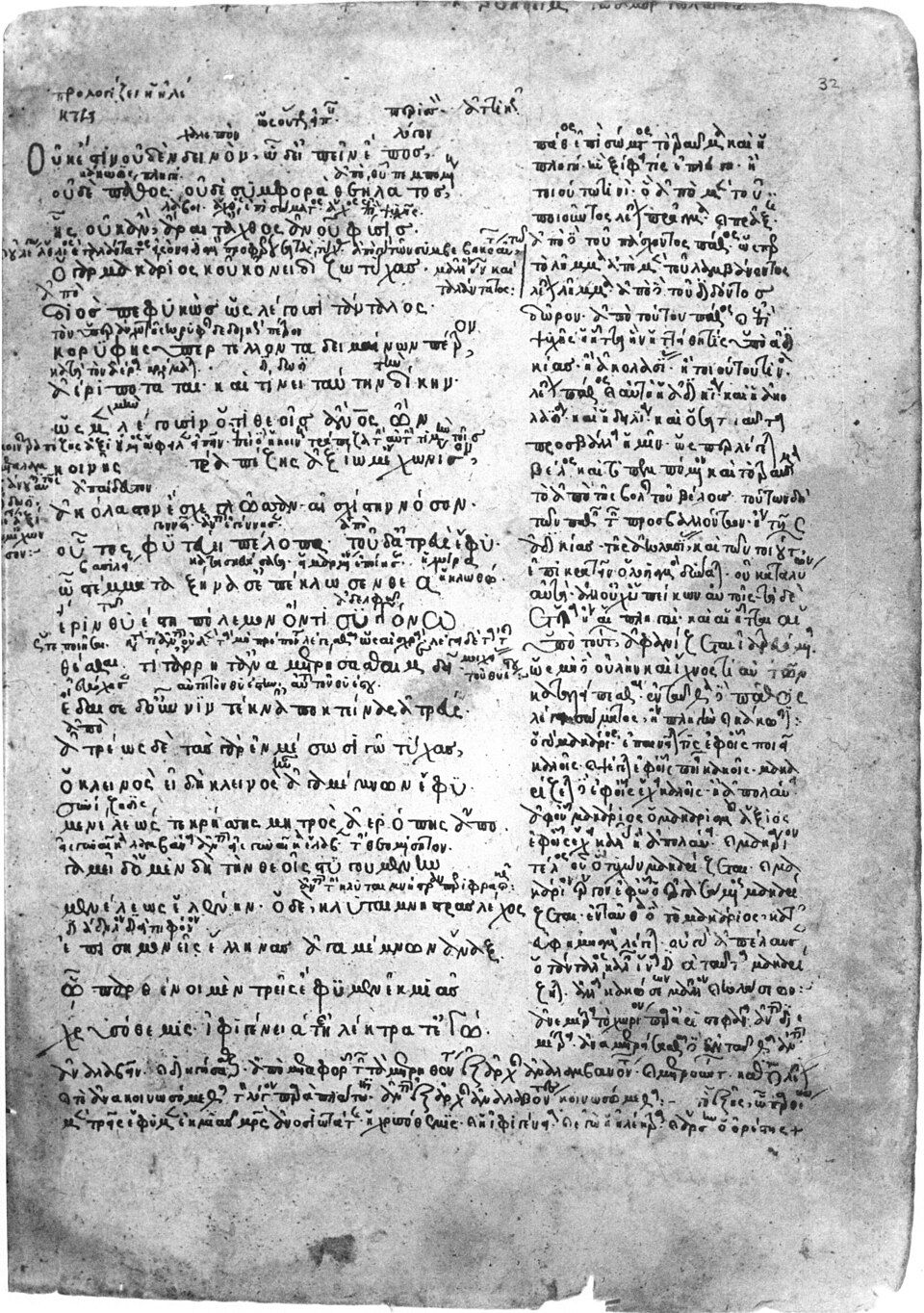
Text and translation
θᾶσσον ᾗ με χρῆν προβαίνων ἱκόμην δι’ ἄστεως
Euripides · Orestes 729–746 · trochaic tetrameters catalectic · text of Murray (Oxford, via Perseus)
How to read each line
A guide to the Greek, syllables, pitch marks and quantities.
Show the reading key
- Above each line: the line as the edition prints it, each word placed over its own syllables. The main row: the same Greek divided into metrical syllables, each written as it is pronounced. A consonant that closes a syllable is written with it (λόθ | ρο); an elided word is closed up with the next vowel (ν’ἀ); a final consonant carried into the next word is set with a thin space (ς ἰ). Wider gaps mark word-ends.
- Above the syllables: the pitch of each syllable, from the accents. Under them: the quantity of each syllable as it falls in the line, then the transliteration, syllable by syllable, with accented syllables in capitals.
- Under each line: a line-for-line translation. In the right margin of the scansion: the line type, its scheme, and its analysis into cola.
Key to the labels
The names, patterns and symbols used beside this poem.
Show the labels and symbols
The labels in the right margin of the scansion below name the line, its scheme, the feet as the line realises them, and the caesurae and diaereses (the named word-ends) that fall in it. In the scheme — is a long position, ⏑ a short one and × an anceps, long or short; the descriptions below say where a long may be resolved into two shorts and where two shorts may stand in place of an anceps or a short.[6] A click on any syllable highlights its metron or colon, or, with the switch, its foot.
| Label | Name and shape | What it is |
|---|---|---|
| tm1 | First trochaic metron— ⏑ — × | Positions 1–4. The longs may be resolved into two shorts. Havet’s law: tragedy avoids the rhythm — ⏑ — — with word-end after it in the first metron, so a long anceps at 4 does not end a word. |
| tm2 | Second trochaic metron— ⏑ — × | Positions 5–8. The longs may be resolved. The normal caesura of the tetrameter is a diaeresis, word-end after position 8, which divides the line in two. |
| tm3 | Third trochaic metron— ⏑ — × | Positions 9–12. The longs may be resolved. Porson’s law: in tragedy, when the anceps at 12 is long, it and the following syllable belong to the same word, unless one of them is a monosyllable. |
| tmc | Catalectic metron— ⏑ × | Positions 13–15: the last metron lacks its final syllable, and its last position is indifferent (period-end). In tragedy the long at 13 may be resolved only when the anceps at 12 is short. |
Scansion
Pylades arrives at a run with news of the assembly, and he and Orestes exchange single lines about Menelaus’ betrayal. The scene is in trochaic tetrameters: each line is scanned metron by metron, with its diaeresis, the first and last anceps checked against Havet’s and Porson’s laws, and every resolution named with the words that carry it.
I have come through the city faster than I should have walked,
having heard of an assembly of the citizens, and seen it plainly myself,
against you and your sister, meaning to kill you both at once.
What is this? How are you? How do you fare, dearest to me of my age-mates,
my friends and my kin? For you are all of these to me.
We are lost, to tell you my troubles in brief.
Then you would bring me down in your ruin; for friends share everything.
Menelaus has been utterly base towards me and my sister.
Naturally: the husband of a bad wife turns out bad.
For me his coming has been the same as if he had not come.
Has he really come to this land, then?
Late; but even so he was very quickly caught out as false to his friends.
And has he come home bringing by ship that worst of wives?
Not he her: she brought him here.
Where is she, the one woman who destroyed the most Achaeans?
In my house, if I may still call it mine.
And what did you say to your father's brother?
Not to look on while I and my sister are put to death by the citizens.
Metre
- The line. The trochaic tetrameter catalectic, — ⏑ — × | — ⏑ — × ‖ — ⏑ — × | — ⏑ ×, used in tragedy mainly by Aeschylus and in the later plays of Euripides;[7] the Orestes, of 408 BC, is the play West takes as the high point of Euripides’ resolution in the trimeter.[8]
- Diaeresis. Every line has word-end after the second metron, after position 8.[9]
- Porson’s and Havet’s laws. When the anceps of the third metron (position 12) or of the first (position 4) is long, it does not end a word unless the word is a monosyllable.[10] Both laws are kept in every line; the long anceps at position 4 is the monosyllable καί in line 733 and ὡς in line 734.
- Resolution. Resolution is possible in any of the first six princeps positions, and the frequency of resolution in tragic tetrameters is somewhat higher than in the same poets’ trimeters.[6] Here eight longs are resolved in six of the eighteen lines: the first princeps five times (ἐπί 731, τί τάδε 732, Μενέλεως 736, χρόνιος 740, σὺ δέ 745), the fourth in ἐς ἐμέ (736), the fifth in κακός (740), the sixth in ἀπέδωκεν (738). Where the two shorts belong to different words, the first is a monosyllable closely joined to the second (τί τάδε, ἐς ἐμέ, σὺ δέ), as West 1987, p. 26 describes for the trimeter; the conditions in the tetrameter are similar.[11]
- Prosody. Synizesis of -εως in πόλεως (730), which the metre requires and the input marks with a tie;[12] prodelision in ποῦ ’στιν (743); crasis in τἀμά (734) and ταὐτόν (738).[13] Attic correption before a stop + liquid (με χρῆν 729, τί πράσσεις 732, πατρός 745);[14] γν, γμ always make position (κασιγνήτην 736, 746; γίγνεσθαι 737; ἀφιγμένος 739; κασιγνήτῳ 745).[15]
- Vowel lengths. An α, ι or υ whose length the spelling does not show takes its length from the metre wherever the metre decides it; every such length here agrees with LSJ or with West’s rules for endings.[16] Where the metre does not decide it (at an anceps, or in the last position of the line), the note on the line gives the source for a long vowel, or a short one at the line-end: the α of ἐφωράθη (740) is long,[17] so position 12 is long there, inside the word.
- Kovacs’s text. Murray’s text has been compared with D. Kovacs’s Loeb edition of 2002. The numbering is the same; the one difference that bears on the metre is at 730, where Kovacs’s reading makes an anceps short[18].[19]
Prosody, line by line
Every syllable, with the reason for its length. Quantities are read from the vowel where the spelling shows it, from the consonants that follow (“position”), from the accent where it tells, and from the metre where nothing else does. Editors’ notes on the text follow in the boxed paragraphs.
- 729
Line 729 · θᾶσσον ᾗ με χρῆν προβαίνων ἱκόμην δι’ ἄστεως,
θᾶσσον ᾗ με χρῆν προβαίνων ἱκόμην δι’ ἄστεως,
θᾶσσον ᾗμεχρῆνπροβαίνωνἱκόμηνδι’ἄστεως,diaeresis after the second metron.
- 1 —θᾶσᾶ carries a circumflex, so it is long; closed by σ: long by position.
- 2 ⏑σοο is short by nature.
- 3 —ν ᾗᾗ is long by nature; the first consonant belongs to the previous word and is carried over to this vowel.
- 4 ⏑μεε is short by nature; the next word begins with χρ, a stop + liquid that does not make position here, so the syllable stays short; the position is anceps.
- 5 —χρῆνῆ is long by nature; closed by ν: long by position.
- 6 ⏑προο is short by nature.
- 7 —βαίαί is a diphthong, long by nature.
- 8 —νωνω is long by nature; the position is anceps.
- 9 —ἱἱ is long by the metre (position 9 must be long).
- 10 ⏑κόό is short by nature.
- 11 —μηνη is long by nature; closed by ν: long by position.
- 12 ⏑δι’ῐ is short (its length is not shown by the ordinary spelling); the apostrophe marks an elided vowel; the consonant before it joins this syllable; the position is anceps.
- 13 —ἄσἄ is a vowel of unknown length; closed by σ: long by position.
- 14 ⏑τεε is short by nature.
- 15 ×ως,ω is long by nature; closed by ς: long by position; the last position of the line is indifferent (period-end).
Pylades speaks (lines 729–733). The ι of ἱκόμην is long, as position 9 requires: it is lengthened by the augment.[20] ἄστεως is three syllables here (ἄσ-τε-ως, — ⏑ ×), without the synizesis that πόλεως has in the next line. The anceps of the first metron (position 4) is short (με). Kovacs prints θᾶσσον ἤ μ’ ἐχρῆν; the quantities are the same.[21] The ι of δι’ is short.[22] Position 12 is anceps, so the metre does not show it; the input marks it short. Diaeresis after the second metron, after προβαίνων (word-end after position 8), the normal caesura of the tetrameter.[23] The short monosyllable με stays short before the χρ that begins χρῆν (Attic correption)[14]. Elision: δι’ loses its final vowel before the vowel that begins the next word.[24]
- 730
Line 730 · σύλλογον πόλε‿ως ἀκούσας, τὸν δ’ ἰδὼν αὐτὸς σαφῶς,
σύλλογον πόλε‿ως ἀκούσας, τὸν δ’ ἰδὼν αὐτὸς σαφῶς,
σύλλογονπόλε‿ωςἀκούσας,τὸνδ’ἰδὼναὐτὸςσαφῶς,diaeresis after the second metron.
- 1 —σύλύ is a vowel of unknown length; closed by λ: long by position.
- 2 ⏑λοο is short by nature.
- 3 —γονο is short by nature; closed by ν: long by position.
- 4 ⏑πόό is short by nature; the position is anceps.
- 5 —λε‿ωςεω is two vowels of one word pronounced together as one long syllable (synizesis).
- 6 ⏑ἀἀ is short by the metre (position 6 must be short).
- 7 —κούού is a diphthong, long by nature.
- 8 —σας,α is a vowel of unknown length; closed by ς: long by position; the position is anceps.
- 9 —τὸνὸ is short by nature; closed by ν: long by position.
- 10 ⏑δ’ἰἰ is short by the metre (position 10 must be short); the apostrophe marks an elided vowel; the consonant before it joins this syllable.
- 11 —δὼνὼ is long by nature.
- 12 —αὐαὐ is a diphthong, long by nature; the position is anceps.
- 13 —τὸςὸ is short by nature; closed by ς: long by position.
- 14 ⏑σαα is short by the metre (position 14 must be short).
- 15 ×φῶς,ῶ is long by nature; closed by ς: long by position; the last position of the line is indifferent (period-end).
πόλεως must be two syllables, πό-λεως, with -εως pronounced as one long syllable (synizesis): with three syllables the line would need two shorts at the anceps of position 4, which tragedy admits in the tetrameter only for a name.[11] West 1987, p. 15 gives πόλεως as an example of synizesis within the word, frequent where the first vowel is ε. Kovacs prints Cron’s ὄντ’, ἰδὼν δ’ αὐτὸς σαφῶς for τὸν δ’ ἰδὼν αὐτὸς σαφῶς. The σ of ἀκούσας then passes to ὄντ’, so the eighth position, the anceps of the second metron, is short in his text and long in ours.[21] Diaeresis after the second metron, after ἀκούσας (word-end after position 8), the normal caesura of the tetrameter.[23] The anceps at position 12 is long (αὐ) and inside the word αὐτὸς, as Porson’s law requires.[23] The anceps of the first metron (position 4) is short (πό). Elision: δ’ loses its final vowel before the vowel that begins the next word.[24]
- 731
Line 731 · ἐπὶ σὲ σύγγονόν τε τὴν σήν, ὡς κτενοῦντας αὐτίκα.
ἐπὶ σὲ σύγγονόν τε τὴν σήν, ὡς κτενοῦντας αὐτίκα.
ἐπὶσὲσύγγονόντετὴνσήν,ὡςκτενοῦντας αὐτίκα.diaeresis after the second metron.
- 1 ⏑ἐἐ is short by nature; with its neighbour it resolves the long of position 1 into two shorts.
- 2 ⏑πὶὶ is short by the metre (position 1 must be short); with its neighbour it resolves the long of position 1 into two shorts.
- 3 ⏑σὲὲ is short by nature.
- 4 —σύγύ is a vowel of unknown length; closed by γ: long by position.
- 5 ⏑γοο is short by nature; the position is anceps.
- 6 —νόνό is short by nature; closed by ν: long by position.
- 7 ⏑τεε is short by nature.
- 8 —τὴνὴ is long by nature; closed by ν: long by position.
- 9 —σήν,ή is long by nature; the position is anceps.
- 10 —ὡςὡ is long by nature; closed by ς: long by position.
- 11 ⏑κτεε is short by nature.
- 12 —νοῦνοῦ is a diphthong, long by nature; closed by ν: long by position.
- 13 ⏑ταα is short by the accent rule: circumflex on the penult requires a short final syllable; the position is anceps.
- 14 —ς αὐαὐ is a diphthong, long by nature; the first consonant belongs to the previous word and is carried over to this vowel.
- 15 ⏑τίί is short by the metre (position 14 must be short).
- 16 ×κα.ᾰ is short (its length is not shown by the ordinary spelling); the last position of the line is indifferent (period-end): a short syllable here is brevis in longo.[25]
Kovacs’s apparatus records that Herwerden deleted this line; Kovacs keeps it.[21] The α of αὐτίκα is short.[26] It stands in the last position of the line, where the metre does not show its length; the input marks it short. Diaeresis after the second metron, after σήν (word-end after position 8), the normal caesura of the tetrameter.[23] The anceps at position 12 is short (τα). The anceps of the first metron (position 4) is short (γο). The first princeps (position 1) is resolved into two shorts, ἐ–πὶ, which make up the whole of the two-syllable word ἐπὶ.[27] The last syllable, κα, is short: brevis in longo, allowed at the period-end that closes every line.[25]
- 732
Line 732 · τί τάδε; πῶς ἔχεις; τί πράσσεις, φίλταθ’ ἡλίκων ἐμοὶ
τί τάδε; πῶς ἔχεις; τί πράσσεις, φίλταθ’ ἡλίκων ἐμοὶ
τίτάδε;πῶςἔχεις;τίπράσσεις,φίλταθ’ἡλίκωνἐμοὶdiaeresis after the second metron.
- 1 ⏑τίί is short by the metre (position 1 must be short); with its neighbour it resolves the long of position 1 into two shorts.
- 2 ⏑τάά is short by the metre (position 1 must be short); with its neighbour it resolves the long of position 1 into two shorts.
- 3 ⏑δε;ε is short by nature.
- 4 —πῶςῶ is long by nature.
- 5 ⏑ἔἔ is short by nature; the position is anceps.
- 6 —χεις;ει is a diphthong, long by nature; closed by ς: long by position.
- 7 ⏑τίί is a vowel of unknown length; the next word begins with πρ, a stop + liquid that does not make position here, so the syllable stays short.
- 8 —πράσά is a vowel of unknown length; closed by σ: long by position.
- 9 —σεις,ει is a diphthong, long by nature; closed by ς: long by position; the position is anceps.
- 10 —φίλί is a vowel of unknown length; closed by λ: long by position.
- 11 ⏑ταα is short by the metre (position 10 must be short).
- 12 —θ’ἡἡ is long by nature; the apostrophe marks an elided vowel; the consonant before it joins this syllable.
- 13 ⏑λίῐ́ is short (its length is not shown by the ordinary spelling); the position is anceps.
- 14 —κωνω is long by nature.
- 15 ⏑ἐἐ is short by nature.
- 16 ×μοὶοὶ is a diphthong, long by nature; the last position of the line is indifferent (period-end).
The anceps of the first metron (position 4) is short (ἔ). The ι of ἡλίκων is short (the metre: ἡλίκων fills the short seventh position of the trimeter at E. Hipp. 1180, ἥλικες a short of the dactyl at Od. 18.373). Position 12 is anceps, so the metre does not show it; the input marks it short. Diaeresis after the second metron, after πράσσεις (word-end after position 8), the normal caesura of the tetrameter.[23] The first princeps (position 1) is resolved into two shorts, τί–τά, which belong to two words, τί and τάδε; West 1987, p. 26 notes that in this case the first word is normally a monosyllable or at most a disyllable, closely linked with the second by phrasing. The short monosyllable τί stays short before the πρ that begins πράσσεις (Attic correption)[14]. Elision: φίλταθ’ loses its final vowel before the vowel that begins the next word.[24]
- 733
Line 733 · καὶ φίλων καὶ συγγενείας; πάντα γὰρ τάδ’ εἶ σύ μοι.
καὶ φίλων καὶ συγγενείας; πάντα γὰρ τάδ’ εἶ σύ μοι.
καὶφίλωνκαὶσυγγενείας;πάνταγὰρτάδ’εἶσύμοι.diaeresis after the second metron; Havet’s law observed: the long anceps at position 4 is a monosyllable.
- 1 —καὶαὶ is a diphthong, long by nature.
- 2 ⏑φίί is short by the metre (position 2 must be short).
- 3 —λωνω is long by nature; closed by ν: long by position.
- 4 —καὶαὶ is a diphthong, long by nature; the position is anceps.
- 5 —συγυ is a vowel of unknown length; closed by γ: long by position.
- 6 ⏑γεε is short by nature.
- 7 —νείεί is a diphthong, long by nature.
- 8 —ας;α is a vowel of unknown length; closed by ς: long by position; the position is anceps.
- 9 —πάνά is a vowel of unknown length; closed by ν: long by position.
- 10 ⏑ταα is short by the metre (position 10 must be short).
- 11 —γὰρὰ is a vowel of unknown length; closed by ρ: long by position.
- 12 ⏑τάᾰ́ is short (its length is not shown by the ordinary spelling); the position is anceps.
- 13 —δ’εἶεἶ is a diphthong, long by nature; the apostrophe marks an elided vowel; the consonant before it joins this syllable.
- 14 ⏑σύύ is short by the metre (position 14 must be short).
- 15 ×μοι.οι is a diphthong, long by nature; the last position of the line is indifferent (period-end).
The anceps of the first metron (position 4) is the long monosyllable καὶ, which Havet’s law allows.[23] The α of τάδ’ is short.[28] Position 12 is anceps, so the metre does not show it; the input marks it short. Diaeresis after the second metron, after συγγενείας (word-end after position 8), the normal caesura of the tetrameter.[23] Elision: τάδ’ loses its final vowel before the vowel that begins the next word.[24]
- 734
Line 734 · οἰχόμεσθ’, ὡς ἐν βραχεῖ σοι τἀμὰ δηλώσω κακά.
οἰχόμεσθ’, ὡς ἐν βραχεῖ σοι τἀμὰ δηλώσω κακά.
οἰχόμεσθ’,ὡςἐνβραχεῖσοιτἀμὰδηλώσωκακά.diaeresis after the second metron; Havet’s law observed: the long anceps at position 4 is a monosyllable.
- 1 —οἰοἰ is a diphthong, long by nature.
- 2 ⏑χόό is short by nature.
- 3 —μεσε is short by nature; closed by σ: long by position.
- 4 —θ’,ὡςὡ is long by nature; the apostrophe marks an elided vowel; the consonant before it joins this syllable; the position is anceps.
- 5 —ἐνἐ is short by nature; closed by ν: long by position.
- 6 ⏑βραα is short by the metre (position 6 must be short).
- 7 —χεῖεῖ is a diphthong, long by nature.
- 8 —σοιοι is a diphthong, long by nature; the position is anceps.
- 9 —τἀἀ is long by crasis: the coronis marks two words contracted into one long vowel.
- 10 ⏑μὰὰ is short by the metre (position 10 must be short).
- 11 —δηη is long by nature.
- 12 —λώώ is long by nature; the position is anceps.
- 13 —σωω is long by nature.
- 14 ⏑καα is short by the metre (position 14 must be short).
- 15 ×κά.ᾰ́ is short (its length is not shown by the ordinary spelling); the last position of the line is indifferent (period-end): a short syllable here is brevis in longo.[25]
Orestes speaks; from here the two speak in alternate lines (stichomythia). The α of κακά is short.[29] It stands in the last position of the line, where the metre does not show its length; the input marks it short. Diaeresis after the second metron, after σοι (word-end after position 8), the normal caesura of the tetrameter.[23] The anceps at position 12 is long (λώ) and inside the word δηλώσω, as Porson’s law requires.[23] The anceps of the first metron (position 4) is the long monosyllable ὡς, which Havet’s law allows.[23] Elision: οἰχόμεσθ’ loses its final vowel before the vowel that begins the next word.[24] Crasis: τἀμὰ is τὰ ἐμά run together into one word, the merged vowel long.[30] The last syllable, κά, is short: brevis in longo, allowed at the period-end that closes every line.[25]
- 735
Line 735 · συγκατασκάπτοις ἂν ἡμᾶς· κοινὰ γὰρ τὰ τῶν φίλων.
συγκατασκάπτοις ἂν ἡμᾶς· κοινὰ γὰρ τὰ τῶν φίλων.
συγκατασκάπτοιςἂν ἡμᾶς·κοινὰγὰρτὰτῶνφίλων.diaeresis after the second metron.
- 1 —συγυ is a vowel of unknown length; closed by γ: long by position.
- 2 ⏑καα is short by the metre (position 2 must be short).
- 3 —τασα is a vowel of unknown length; closed by σ: long by position.
- 4 —κάπά is a vowel of unknown length; closed by π: long by position; the position is anceps.
- 5 —τοιςοι is a diphthong, long by nature.
- 6 ⏑ἂἂ is short by the metre (position 6 must be short).
- 7 —ν ἡἡ is long by nature; the first consonant belongs to the previous word and is carried over to this vowel.
- 8 —μᾶς·ᾶ carries a circumflex, so it is long; closed by ς: long by position; the position is anceps.
- 9 —κοιοι is a diphthong, long by nature.
- 10 ⏑νὰὰ is short by the metre (position 10 must be short).
- 11 —γὰρὰ is a vowel of unknown length; closed by ρ: long by position.
- 12 ⏑τὰᾰ̀ is short (its length is not shown by the ordinary spelling); the position is anceps.
- 13 —τῶνῶ is long by nature; closed by ν: long by position.
- 14 ⏑φίί is short by the metre (position 14 must be short).
- 15 ×λων.ω is long by nature; closed by ν: long by position; the last position of the line is indifferent (period-end).
Pylades. The anceps of the first metron (position 4) is long (κάπ) and inside the word συγκατασκάπτοις, as Havet’s law requires.[23] The α of τὰ is short.[28] Position 12 is anceps, so the metre does not show it; the input marks it short. Diaeresis after the second metron, after ἡμᾶς (word-end after position 8), the normal caesura of the tetrameter.[23]
- 736
Line 736 · Μενέλεως κάκιστος ἐς ἐμὲ καὶ κασιγνήτην ἐμήν.
Μενέλεως κάκιστος ἐς ἐμὲ καὶ κασιγνήτην ἐμήν.
Μενέλεωςκάκιστος ἐς ἐμὲκαὶκασιγνήτηνἐμήν.diaeresis after the second metron.
- 1 ⏑Μεε is short by nature; with its neighbour it resolves the long of position 1 into two shorts.
- 2 ⏑νέέ is short by nature; with its neighbour it resolves the long of position 1 into two shorts.
- 3 ⏑λεε is short by nature.
- 4 —ωςω is long by nature; closed by ς: long by position.
- 5 ⏑κάᾰ́ is short (its length is not shown by the ordinary spelling); the position is anceps.
- 6 —κισι is a vowel of unknown length; closed by σ: long by position.
- 7 ⏑τοο is short by nature.
- 8 ⏑ς ἐἐ is short by nature; the first consonant belongs to the previous word and is carried over to this vowel; with its neighbour it resolves the long of position 7 into two shorts.
- 9 ⏑ς ἐἐ is short by nature; the first consonant belongs to the previous word and is carried over to this vowel; with its neighbour it resolves the long of position 7 into two shorts.
- 10 ⏑μὲὲ is short by nature; the position is anceps.
- 11 —καὶαὶ is a diphthong, long by nature.
- 12 ⏑καα is short by the metre (position 10 must be short).
- 13 —σιγι is a vowel of unknown length; closed by γ: long by position; γν is one of the four clusters (γμ, γν, δμ, δν) that never leave the syllable before them short.[15]
- 14 —νήή is long by nature; the position is anceps.
- 15 —τηνη is long by nature.
- 16 ⏑ἐἐ is short by nature.
- 17 ×μήν.ή is long by nature; closed by ν: long by position; the last position of the line is indifferent (period-end).
Orestes. The first princeps is resolved in the name Μενέλεως, Με-νέ-, and its last two syllables are -λε- short and -ως long, without synizesis. The fourth princeps (position 7) is resolved across two words, the preposition ἐς and the first syllable of ἐμέ: West 1987, p. 26 notes that in this case the first word is normally a monosyllable closely linked with the second. The anceps at position 12 is long (νή) and inside the word κασιγνήτην, as Porson’s law requires.[23] Kovacs punctuates 736 as the start of a sentence that Pylades interrupts and Orestes finishes at 738.[31] The α of κάκιστος is short.[32] Position 4 is anceps, so the metre does not show it; the input marks it short. Diaeresis after the second metron, after ἐμὲ (word-end after position 8), the normal caesura of the tetrameter.[23] In κασιγνήτην the γν makes position, as γμ, γν, δμ, δν always do.[15]
- 737
Line 737 · εἰκότως, κακῆς γυναικὸς ἄνδρα γίγνεσθαι κακόν.
εἰκότως, κακῆς γυναικὸς ἄνδρα γίγνεσθαι κακόν.
εἰκότως,κακῆςγυναικὸς ἄνδραγίγνεσθαικακόν.diaeresis after the second metron.
- 1 —εἰεἰ is a diphthong, long by nature.
- 2 ⏑κόό is short by nature.
- 3 —τως,ω is long by nature; closed by ς: long by position.
- 4 ⏑καᾰ is short (its length is not shown by the ordinary spelling); the position is anceps.
- 5 —κῆςῆ is long by nature; closed by ς: long by position.
- 6 ⏑γυυ is short by the metre (position 6 must be short).
- 7 —ναιαι is a diphthong, long by nature.
- 8 ⏑κὸὸ is short by nature; the position is anceps.
- 9 —ς ἄνἄ is a vowel of unknown length; closed by ν: long by position; the first consonant belongs to the previous word and is carried over to this vowel.
- 10 ⏑δραα is short by the metre (position 10 must be short).
- 11 —γίγί is a vowel of unknown length; closed by γ: long by position; γν is one of the four clusters (γμ, γν, δμ, δν) that never leave the syllable before them short.[15]
- 12 —νεσε is short by nature; closed by σ: long by position; the position is anceps.
- 13 —θαιαι is a diphthong, long by nature.
- 14 ⏑καα is short by the metre (position 14 must be short).
- 15 ×κόν.ό is short by nature; closed by ν: long by position; the last position of the line is indifferent (period-end).
Pylades. The anceps at position 12 is long (νεσ) and inside the word γίγνεσθαι, as Porson’s law requires.[23] The α of κακῆς is short.[32] Position 4 is anceps, so the metre does not show it; the input marks it short. Diaeresis after the second metron, after γυναικὸς (word-end after position 8), the normal caesura of the tetrameter.[23] In γίγνεσθαι the γν makes position, as γμ, γν, δμ, δν always do.[15]
- 738
Line 738 · ὥσπερ οὐκ ἐλθὼν ἔμοιγε ταὐτὸν ἀπέδωκεν μολών.
ὥσπερ οὐκ ἐλθὼν ἔμοιγε ταὐτὸν ἀπέδωκεν μολών.
ὥσπερ οὐκἐλθὼνἔμοιγεταὐτὸν ἀπέδωκενμολών.diaeresis after the second metron.
- 1 —ὥσὥ is long by nature; closed by σ: long by position.
- 2 ⏑πεε is short by nature.
- 3 —ρ οὐκοὐ is a diphthong, long by nature; the first consonant belongs to the previous word and is carried over to this vowel.
- 4 —ἐλἐ is short by nature; closed by λ: long by position; the position is anceps.
- 5 —θὼνὼ is long by nature.
- 6 ⏑ἔἔ is short by nature.
- 7 —μοιοι is a diphthong, long by nature.
- 8 ⏑γεε is short by nature; the position is anceps.
- 9 —ταὐαὐ is a diphthong, long by nature.
- 10 ⏑τὸὸ is short by nature.
- 11 ⏑ν ἀἀ is short by the metre (position 11 must be short); the first consonant belongs to the previous word and is carried over to this vowel; with its neighbour it resolves the long of position 11 into two shorts.
- 12 ⏑πέέ is short by nature; with its neighbour it resolves the long of position 11 into two shorts.
- 13 —δωω is long by nature; the position is anceps.
- 14 —κενε is short by nature; closed by ν: long by position.
- 15 ⏑μοο is short by nature.
- 16 ×λών.ώ is long by nature; closed by ν: long by position; the last position of the line is indifferent (period-end).
Orestes. Diaeresis after the second metron, after ἔμοιγε (word-end after position 8), the normal caesura of the tetrameter.[23] The anceps at position 12 is long (δω) and inside the word ἀπέδωκεν, as Porson’s law requires.[23] The anceps of the first metron (position 4) is long (ἐλ) and inside the word ἐλθὼν, as Havet’s law requires.[23] The sixth princeps (position 11) is resolved into two shorts, ν ἀ–πέ, both in the word ἀπέδωκεν, a word of three or more syllables, as is usual.[33] Crasis: ταὐτὸν is τὸ αὐτό run together into one word, the merged vowel long.[30]
- 739
Line 739 · ἦ γάρ ἐστιν ὡς ἀληθῶς τήνδ’ ἀφιγμένος χθόνα;
ἦ γάρ ἐστιν ὡς ἀληθῶς τήνδ’ ἀφιγμένος χθόνα;
ἦγάρ ἐστιν ὡςἀληθῶςτήνδ’ἀφιγμένοςχθόνα;diaeresis after the second metron.
- 1 —ἦἦ is long by nature.
- 2 ⏑γάά is short by the metre (position 2 must be short).
- 3 —ρ ἐσἐ is short by nature; closed by σ: long by position; the first consonant belongs to the previous word and is carried over to this vowel.
- 4 ⏑τιῐ is short (its length is not shown by the ordinary spelling); the position is anceps.
- 5 —ν ὡςὡ is long by nature; the first consonant belongs to the previous word and is carried over to this vowel.
- 6 ⏑ἀἀ is short by the metre (position 6 must be short).
- 7 —ληη is long by nature.
- 8 —θῶςῶ is long by nature; closed by ς: long by position; the position is anceps.
- 9 —τήνή is long by nature; closed by ν: long by position.
- 10 ⏑δ’ἀἀ is short by the metre (position 10 must be short); the apostrophe marks an elided vowel; the consonant before it joins this syllable.
- 11 —φιγι is a vowel of unknown length; closed by γ: long by position; γμ is one of the four clusters (γμ, γν, δμ, δν) that never leave the syllable before them short.[15]
- 12 ⏑μέέ is short by nature; the position is anceps.
- 13 —νοςο is short by nature; closed by ς: long by position.
- 14 ⏑χθόό is short by nature.
- 15 ×να;ᾰ is short (its length is not shown by the ordinary spelling); the last position of the line is indifferent (period-end): a short syllable here is brevis in longo.[25]
Pylades. The anceps at position 12 is short (μέ). The ι of ἐστιν is short.[34] Position 4 is anceps, so the metre does not show it; the input marks it short. The α of χθόνα is short.[35] It stands in the last position of the line, where the metre does not show its length; the input marks it short. Diaeresis after the second metron, after ἀληθῶς (word-end after position 8), the normal caesura of the tetrameter.[23] In ἀφιγμένος the γμ makes position, as γμ, γν, δμ, δν always do.[15] Elision: τήνδ’ loses its final vowel before the vowel that begins the next word.[24] The last syllable, να, is short: brevis in longo, allowed at the period-end that closes every line.[25]
- 740
Line 740 · χρόνιος· ἀλλ’ ὅμως τάχιστα κακὸς ἐφωράθη φίλοις.
χρόνιος· ἀλλ’ ὅμως τάχιστα κακὸς ἐφωράθη φίλοις.
χρόνιο·ς ἀλλ’ὅμωςτάχιστακακὸς ἐφωράθηφίλοις.diaeresis after the second metron.
- 1 ⏑χρόό is short by nature; with its neighbour it resolves the long of position 1 into two shorts.
- 2 ⏑νιι is short by the metre (position 1 must be short); with its neighbour it resolves the long of position 1 into two shorts.
- 3 ⏑ο·ο is short by nature.
- 4 —ς ἀλἀ is a vowel of unknown length; closed by λ: long by position; the first consonant belongs to the previous word and is carried over to this vowel.
- 5 ⏑λ’ὅὅ is short by nature; the apostrophe marks an elided vowel; the consonant before it joins this syllable; the position is anceps.
- 6 —μωςω is long by nature; closed by ς: long by position.
- 7 ⏑τάά is short by the metre (position 6 must be short).
- 8 —χισι is a vowel of unknown length; closed by σ: long by position.
- 9 ⏑ταα is short by the accent rule: acute on the antepenult requires a short final syllable; the position is anceps.
- 10 ⏑καα is short by the metre (position 9 must be short); with its neighbour it resolves the long of position 9 into two shorts.
- 11 ⏑κὸὸ is short by nature; with its neighbour it resolves the long of position 9 into two shorts.
- 12 ⏑ς ἐἐ is short by nature; the first consonant belongs to the previous word and is carried over to this vowel.
- 13 —φωω is long by nature.
- 14 —ράᾱ́ is long (its length is not shown by the ordinary spelling); the position is anceps.
- 15 —θηη is long by nature.
- 16 ⏑φίί is short by the metre (position 14 must be short).
- 17 ×λοις.οι is a diphthong, long by nature; closed by ς: long by position; the last position of the line is indifferent (period-end).
Orestes. Two resolutions in one line, in χρόνιος and in κακός. The α of ἐφωράθη is long.[36] Position 12 is anceps, so the metre does not show it; the input marks it long. Diaeresis after the second metron, after τάχιστα (word-end after position 8), the normal caesura of the tetrameter.[23] The anceps at position 12 is long (ρά) and inside the word ἐφωράθη, as Porson’s law requires.[23] The anceps of the first metron (position 4) is short (λ’ὅ). The first princeps (position 1) is resolved into two shorts, χρό–νι, both in the word χρόνιος, a word of three or more syllables, as is usual.[33] The fifth princeps (position 9) is resolved into two shorts, κα–κὸ, which make up the whole of the two-syllable word κακὸς.[27] Elision: ἀλλ’ loses its final vowel before the vowel that begins the next word.[24]
- 741
Line 741 · καὶ δάμαρτα τὴν κακίστην ναυστολῶν ἐλήλυθεν;
καὶ δάμαρτα τὴν κακίστην ναυστολῶν ἐλήλυθεν;
καὶδάμαρτατὴνκακίστηνναυστολῶνἐλήλυθεν;diaeresis after the second metron.
- 1 —καὶαὶ is a diphthong, long by nature.
- 2 ⏑δάά is short by the metre (position 2 must be short).
- 3 —μαρα is a vowel of unknown length; closed by ρ: long by position.
- 4 ⏑ταα is short by the accent rule: acute on the antepenult requires a short final syllable; the position is anceps.
- 5 —τὴνὴ is long by nature; closed by ν: long by position.
- 6 ⏑καα is short by the metre (position 6 must be short).
- 7 —κίσί is a vowel of unknown length; closed by σ: long by position.
- 8 —τηνη is long by nature; closed by ν: long by position; the position is anceps.
- 9 —ναυσαυ is a diphthong, long by nature; closed by σ: long by position.
- 10 ⏑τοο is short by nature.
- 11 —λῶνῶ is long by nature.
- 12 ⏑ἐἐ is short by nature; the position is anceps.
- 13 —λήή is long by nature.
- 14 ⏑λυυ is short by the metre (position 14 must be short).
- 15 ×θεν;ε is short by nature; closed by ν: long by position; the last position of the line is indifferent (period-end).
Pylades. Diaeresis after the second metron, after κακίστην (word-end after position 8), the normal caesura of the tetrameter.[23] The anceps at position 12 is short (ἐ). The anceps of the first metron (position 4) is short (τα).
- 742
Line 742 · οὐκ ἐκεῖνος, ἀλλ’ ἐκείνη κεῖνον ἐνθάδ’ ἤγαγεν.
οὐκ ἐκεῖνος, ἀλλ’ ἐκείνη κεῖνον ἐνθάδ’ ἤγαγεν.
οὐκἐκεῖνο,ς ἀλλ’ἐκείνηκεῖνον ἐνθάδ’ἤγαγεν.diaeresis after the second metron.
- 1 —οὐκοὐ is a diphthong, long by nature.
- 2 ⏑ἐἐ is short by nature.
- 3 —κεῖεῖ is a diphthong, long by nature.
- 4 ⏑νο,ο is short by nature; the position is anceps.
- 5 —ς ἀλἀ is a vowel of unknown length; closed by λ: long by position; the first consonant belongs to the previous word and is carried over to this vowel.
- 6 ⏑λ’ἐἐ is short by nature; the apostrophe marks an elided vowel; the consonant before it joins this syllable.
- 7 —κείεί is a diphthong, long by nature.
- 8 —νηη is long by nature; the position is anceps.
- 9 —κεῖεῖ is a diphthong, long by nature.
- 10 ⏑νοο is short by nature.
- 11 —ν ἐνἐ is short by nature; closed by ν: long by position; the first consonant belongs to the previous word and is carried over to this vowel.
- 12 ⏑θάᾰ́ is short (its length is not shown by the ordinary spelling); the position is anceps.
- 13 —δ’ἤἤ is long by nature; the apostrophe marks an elided vowel; the consonant before it joins this syllable.
- 14 ⏑γαα is short by the metre (position 14 must be short).
- 15 ×γεν.ε is short by nature; closed by ν: long by position; the last position of the line is indifferent (period-end).
Orestes. The anceps of the first metron (position 4) is short (νο). The α of ἐνθάδ’ is short.[37] Position 12 is anceps, so the metre does not show it; the input marks it short. Diaeresis after the second metron, after ἐκείνη (word-end after position 8), the normal caesura of the tetrameter.[23] Elision: ἀλλ’, ἐνθάδ’ lose their final vowel before the vowel that begins the next word.[24]
- 743
Line 743 · ποῦ ’στιν ἣ πλείστους Ἀχαιῶν ὤλεσεν γυνὴ μία;
ποῦ ’στιν ἣ πλείστους Ἀχαιῶν ὤλεσεν γυνὴ μία;
ποῦστιν ἣπλείστουςἈχαιῶνὤλεσενγυνὴμία;diaeresis after the second metron.
- 1 —ποῦοῦ is a diphthong, long by nature; the next word begins with στ: the syllable is closed before it: long by position.
- 2 ⏑στιι is short by the metre (position 2 must be short).
- 3 —ν ἣἣ is long by nature; the first consonant belongs to the previous word and is carried over to this vowel.
- 4 —πλείσεί is a diphthong, long by nature; closed by σ: long by position; the position is anceps.
- 5 —τουςου is a diphthong, long by nature.
- 6 ⏑ἈἈ is short by the metre (position 6 must be short).
- 7 —χαιαι is a diphthong, long by nature.
- 8 —ῶνῶ is long by nature; the position is anceps.
- 9 —ὤὤ is long by nature.
- 10 ⏑λεε is short by nature.
- 11 —σενε is short by nature; closed by ν: long by position.
- 12 ⏑γυῠ is short (its length is not shown by the ordinary spelling); the position is anceps.
- 13 —νὴὴ is long by nature.
- 14 ⏑μίί is short by the metre (position 14 must be short).
- 15 ×α;ᾰ is short (its length is not shown by the ordinary spelling); the last position of the line is indifferent (period-end): a short syllable here is brevis in longo.[25]
Pylades. The anceps of the first metron (position 4) is long (πλείσ) and inside the word πλείστους, as Havet’s law requires.[23] The υ of γυνὴ is short.[38] Position 12 is anceps, so the metre does not show it; the input marks it short. The α of μία is short.[39] It stands in the last position of the line, where the metre does not show its length; the input marks it short. Diaeresis after the second metron, after Ἀχαιῶν (word-end after position 8), the normal caesura of the tetrameter.[23] Prodelision (aphaeresis): ’στιν stands for ἐστιν, its initial vowel absorbed by the long final vowel of the word before.[12] The last syllable, α, is short: brevis in longo, allowed at the period-end that closes every line.[25]
- 744
Line 744 · ἐν δόμοις ἐμοῖσιν, εἰ δὴ τούσδ’ ἐμοὺς καλεῖν χρεών.
ἐν δόμοις ἐμοῖσιν, εἰ δὴ τούσδ’ ἐμοὺς καλεῖν χρεών.
ἐνδόμοιςἐμοῖσι,ν εἰδὴτούσδ’ἐμοὺςκαλεῖνχρεών.diaeresis after the second metron.
- 1 —ἐνἐ is short by nature; closed by ν: long by position.
- 2 ⏑δόό is short by nature.
- 3 —μοιςοι is a diphthong, long by nature.
- 4 ⏑ἐἐ is short by nature; the position is anceps.
- 5 —μοῖοῖ is a diphthong, long by nature.
- 6 ⏑σι,ι is short by the accent rule: circumflex on the penult requires a short final syllable.
- 7 —ν εἰεἰ is a diphthong, long by nature; the first consonant belongs to the previous word and is carried over to this vowel.
- 8 —δὴὴ is long by nature; the position is anceps.
- 9 —τούσού is a diphthong, long by nature; closed by σ: long by position.
- 10 ⏑δ’ἐἐ is short by nature; the apostrophe marks an elided vowel; the consonant before it joins this syllable.
- 11 —μοὺςοὺ is a diphthong, long by nature; closed by ς: long by position.
- 12 ⏑καᾰ is short (its length is not shown by the ordinary spelling); the position is anceps.
- 13 —λεῖνεῖ is a diphthong, long by nature; closed by ν: long by position.
- 14 ⏑χρεε is short by nature.
- 15 ×ών.ώ is long by nature; closed by ν: long by position; the last position of the line is indifferent (period-end).
Orestes. The anceps of the first metron (position 4) is short (ἐ). The α of καλεῖν is short.[40] Position 12 is anceps, so the metre does not show it; the input marks it short. Diaeresis after the second metron, after δὴ (word-end after position 8), the normal caesura of the tetrameter.[23] Elision: τούσδ’ loses its final vowel before the vowel that begins the next word.[24]
- 745
Line 745 · σὺ δὲ τίνας λόγους ἔλεξας σοῦ κασιγνήτῳ πατρός;
σὺ δὲ τίνας λόγους ἔλεξας σοῦ κασιγνήτῳ πατρός;
σὺδὲτίναςλόγουςἔλεξαςσοῦκασιγνήτῳπατρός;diaeresis after the second metron.
- 1 ⏑σὺὺ is short by the metre (position 1 must be short); with its neighbour it resolves the long of position 1 into two shorts.
- 2 ⏑δὲὲ is short by nature; with its neighbour it resolves the long of position 1 into two shorts.
- 3 ⏑τίί is short by the metre (position 2 must be short).
- 4 —ναςα is a vowel of unknown length; closed by ς: long by position.
- 5 ⏑λόό is short by nature; the position is anceps.
- 6 —γουςου is a diphthong, long by nature.
- 7 ⏑ἔἔ is short by nature.
- 8 —λεε is short by nature; ξ is a double consonant (two sounds) and closes the syllable: long by position.
- 9 —ξαςα is a vowel of unknown length; closed by ς: long by position; the position is anceps.
- 10 —σοῦοῦ is a diphthong, long by nature.
- 11 ⏑καα is short by the metre (position 10 must be short).
- 12 —σιγι is a vowel of unknown length; closed by γ: long by position; γν is one of the four clusters (γμ, γν, δμ, δν) that never leave the syllable before them short.[15]
- 13 —νήή is long by nature; the position is anceps.
- 14 —τῳῳ is long by nature.
- 15 ⏑παα is a vowel of unknown length; τρ is carried whole into the next syllable, so this syllable stays open and short (Attic correption of a stop + liquid cluster).
- 16 ×τρός;ό is short by nature; closed by ς: long by position; the last position of the line is indifferent (period-end).
Pylades. Diaeresis after the second metron, after ἔλεξας (word-end after position 8), the normal caesura of the tetrameter.[23] The anceps at position 12 is long (νή) and inside the word κασιγνήτῳ, as Porson’s law requires.[23] The anceps of the first metron (position 4) is short (λό). The first princeps (position 1) is resolved into two shorts, σὺ–δὲ, which belong to two words, σὺ and δὲ; West 1987, p. 26 notes that in this case the first word is normally a monosyllable or at most a disyllable, closely linked with the second by phrasing. In κασιγνήτῳ the γν makes position, as γμ, γν, δμ, δν always do.[15] In πατρός the τρ goes whole with the next syllable, so πα stays short (Attic correption)[14].
- 746
Line 746 · μή μ’ ἰδεῖν θανόνθ’ ὑπ’ ἀστῶν καὶ κασιγνήτην ἐμήν.
μή μ’ ἰδεῖν θανόνθ’ ὑπ’ ἀστῶν καὶ κασιγνήτην ἐμήν.
μήμ’ἰδεῖνθανόνθ’ὑπ’ἀστῶνκαὶκασιγνήτηνἐμήν.diaeresis after the second metron.
- 1 —μήή is long by nature.
- 2 ⏑μ’ἰἰ is short by the metre (position 2 must be short); the apostrophe marks an elided vowel; the consonant before it joins this syllable.
- 3 —δεῖνεῖ is a diphthong, long by nature; closed by ν: long by position.
- 4 ⏑θαᾰ is short (its length is not shown by the ordinary spelling); the position is anceps.
- 5 —νόνό is short by nature; closed by ν: long by position.
- 6 ⏑θ’ὑὑ is short by the metre (position 6 must be short); the apostrophe marks an elided vowel; the consonant before it joins this syllable.
- 7 —π’ἀσἀ is a vowel of unknown length; closed by σ: long by position; the apostrophe marks an elided vowel; the consonant before it joins this syllable.
- 8 —τῶνῶ is long by nature; closed by ν: long by position; the position is anceps.
- 9 —καὶαὶ is a diphthong, long by nature.
- 10 ⏑καα is short by the metre (position 10 must be short).
- 11 —σιγι is a vowel of unknown length; closed by γ: long by position; γν is one of the four clusters (γμ, γν, δμ, δν) that never leave the syllable before them short.[15]
- 12 —νήή is long by nature; the position is anceps.
- 13 —τηνη is long by nature.
- 14 ⏑ἐἐ is short by nature.
- 15 ×μήν.ή is long by nature; closed by ν: long by position; the last position of the line is indifferent (period-end).
Orestes. The anceps at position 12 is long (νή) and inside the word κασιγνήτην, as Porson’s law requires.[23] The α of θανόνθ’ is short.[41] Position 4 is anceps, so the metre does not show it; the input marks it short. Diaeresis after the second metron, after ἀστῶν (word-end after position 8), the normal caesura of the tetrameter.[23] In κασιγνήτην the γν makes position, as γμ, γν, δμ, δν always do.[15] Elision: μ’, θανόνθ’, ὑπ’ lose their final vowel before the vowel that begins the next word.[24]
How this page was scanned
The lines are numbered as in the play. The scansion follows these rules of West 1987: γμ, γν, δμ, δν always make position;[15] a word ending in a consonant carried into the next syllable, or in an elided vowel, still ends there; and Porson’s law at position 12 and Havet’s law at position 4 of the tragic tetrameter.[23] Where the spelling and metre leave a vowel’s length undecided, the line note gives the source for a long vowel or a vowel at the line-end (LSJ, or West 1987, pp. 10–11). Every other open α, ι, υ either takes its length from the metre, which agrees with LSJ or West’s rules in every case, or stands short at an anceps, where the page shows it short and LSJ or West’s rules confirm it.
Notes
- ^ Debnar 2005, p. 19.
- ^ Roberts 2005, p. 141.
- ^ a b Debnar 2005, pp. 19–20.
- ^ Roberts 2005, pp. 144–145; Davidson 2005, p. 200.
- ^ Easterling 1997, Chronology, p. 353; Debnar 2005, pp. 5, 20.
- ^ a b West 1987, pp. 28–29.
- ^ West 1987, p. 28; Halleran 2005, p. 170, finds no undisputed example in the surviving tragedies between 458 and 415 BC, after which Euripides took it up again, though sparingly.
- ^ West 1987, p. 25.
- ^ West 1987, p. 28; Battezzato 2009, p. 137.
- ^ West 1987, pp. 25, 28; Battezzato 2009, p. 137, on Porson’s law in the tragic tetrameter.
- ^ a b West 1987, p. 29.
- ^ a b West 1987, p. 15.
- ^ West 1987, pp. 14–15.
- ^ a b c d West 1987, pp. 16–17.
- ^ a b c d e f g h i j k l West 1987, p. 16.
- ^ West 1987, pp. 10–11.
- ^ LSJ.
- ^ See the notes.
- ^ Kovacs 2002, pp. 486–491.
- ^ LSJ s.v. ἱκνέομαι.
- ^ a b c Kovacs 2002, p. 486.
- ^ West 1987, p. 11: all prepositions have short vowels, here διά.
- ^ a b c d e f g h i j k l m n o p q r s t u v w x y z aa ab ac ad ae af West 1987, p. 28.
- ^ a b c d e f g h i j West 1987, p. 13.
- ^ a b c d e f g h West 1987, pp. 4, 28.
- ^ LSJ s.v. αὐτίκα: αὐτίκᾰ.
- ^ a b West 1987, p. 26, where the usual case is a word of three or more syllables.
- ^ a b West 1987, p. 11: -ᾰ of the neuter plural.
- ^ West 1987, p. 11: the -α of the neuter plural is short.
- ^ a b West 1987, pp. 10, 14–15.
- ^ Kovacs 2002, p. 488.
- ^ a b LSJ s.v. κακός: κᾰκός.
- ^ a b West 1987, p. 26.
- ^ West 1987, p. 11: final -ῐ, -ῠ.
- ^ West 1987, p. 11: the -α of the accusative singular is short.
- ^ LSJ s.v. φωράω: ᾱ, future φωρᾱ́σω.
- ^ LSJ s.v. ἐνθάδε: [ᾰ].
- ^ LSJ s.v. γυνή: γῠνή.
- ^ LSJ s.v. εἷς: feminine μίᾰ.
- ^ LSJ s.v. καλέω: κᾰλέω.
- ^ LSJ s.v. θνῄσκω: aor. 2 ἔθᾰνον.
Text and sources
- Text: Euripides, Euripidis Fabulae, vol. 3, ed. G. Murray (Oxford Classical Texts), from the Perseus Digital Library (urn:cts:greekLit:tlg0006.tlg016.perseus-grc2), licensed CC BY-SA 4.0 (as stated in the file’s TEI header).
- Rules: M. L. West, Introduction to Greek Metre (Oxford 1987), pp. 4 (brevis in longo), 10–17 (prosody; vowel lengths of endings pp. 10–11), 25–26 (resolution in Euripides; word-shapes of resolution), 28–29 (the trochaic tetrameter); checked against the page images.
- Vowel lengths: H. G. Liddell, R. Scott, H. S. Jones, A Greek–English Lexicon (LSJ), Perseus Digital Library edition, CC BY-SA 4.0.
- L. Battezzato, ‘Metre and music’, in F. Budelmann (ed.), The Cambridge Companion to Greek Lyric (Cambridge 2009), ch. 7, p. 137 (the diaeresis of the trochaic tetrameter; Porson’s law in tragic tetrameters).
- M. R. Halleran, ‘Episodes’, in J. Gregory (ed.), A Companion to Greek Tragedy (Blackwell 2005), ch. 11, p. 170 (the trochaic tetrameter in tragedy).
- Translation: © metrehelp.org, CC BY-SA 4.0.
- Compared with: D. Kovacs (ed. and trans.), Euripides V: Helen, Phoenician Women, Orestes (Loeb Classical Library 11, Cambridge, MA 2002), pp. 486–491.
Quotations from copyrighted works are not covered by this page’s licence.

).jpg)


