Poets and playwrightsComedy
Aristophanes
Aristophanes’ comedies: dialogue, choral song and their metrical licences.
Works
- Synopsis
- Text and translation
- How to read each line
- Key to the labels
- Scansion
- Metre
- Prosody, line by line
- How this page was scanned
- Notes
- Synopsis
- Text and translation
- How to read each line
- Key to the labels
- Scansion
- Metre
- Prosody, line by line
- How this page was scanned
- Notes
- Synopsis
- Text and translation
- How to read each line
- Key to the labels
- Scansion
- Metre
- Prosody, line by line
- Strophe and antistrophe
- Notes
- Synopsis
- Text and translation
- How to read each line
- Key to the labels
- Scansion
- Metre
- Prosody, line by line
- Notes
About · 1 of 6
Aristophanes: life and career
Many poets of Old Comedy are known by name, but Aristophanes is the only one whose plays survive whole. All eleven extant comedies are his; his predecessors and rivals are known from fragments.[1] What the sources say of his life and career is gathered here. The plays and their dates are on the next tab.
Dates. He was born about 445 BC and died in 386/0.[2] His surviving comedies run from the Acharnians to the Wealth of 388. The sources differ by a year over the Acharnians: one chronology dates it to 425, Seidensticker to 426.[3] Either way, the plays document only a short stretch of the history of Old Comedy. Comedy was added to the official programme of the City Dionysia in 486, and it was surely being performed earlier.[4]
The Cambridge Companion to Greek Comedy puts his birth, in all likelihood, shortly after 450 BC, and his death after 388. He wrote about forty comedies, so the eleven that survive are about a quarter of his work. That is a far larger share than survives of Aeschylus or Sophocles. The eleven can be dated, most of them precisely, and they span his whole career.[5]
Two festivals. At the City Dionysia, from 486, one day of the festival was given to the comic competition.[6] Seidensticker, following Storey, puts five comedies on the programme of that day.[7] The Lenaea was older and “more inward-looking”. It was held in the depths of winter, in January–February.[8] There tragedy and comedy were late additions to an ancient festival, and comedy seems to have ranked relatively higher than at the Dionysia.[9]
One of Aristophanes’ characters contrasts the two festivals: at the Lenaea “the foreigners are not here yet” (κοὔπω ξένοι πάρεισιν, koupō xenoi pareisin).[10] The Frogs won first prize at the Lenaea of 405.[11]
A poet and his chorus. A poet “sought a chorus” from the archon, and the archon “gave a chorus” to those he selected. The first phrase is attested in Aristophanes (Knights 513).[12] At the end of the fifth century Aristophanes entrusted the training of the chorus (chorodidaskalia) for several of his plays to Callistratus. His reasons are unknown.[13]
Naming names. Comedy, unlike tragedy, attacks individuals by name. Aristophanes ridicules Socrates and Euripides. He attacks Nicias, Demosthenes, Pericles, Alcibiades and, again and again, Cleon, openly or in transparent disguise.[14] Euripides is a central figure in the Acharnians and the Thesmophoriazusae, and the butt of jokes in other plays.[11]
Besides Aristophanes, the leading poets of Old Comedy were Eupolis and Cratinus.[7] With Aristophanes they make up the comic triad. Unlike Pherecrates and Crates, these three did not shrink from direct political attack.[15] At the end of Plato’s Symposium, Socrates can only with difficulty make Agathon and Aristophanes admit that one poet could write both tragedy and comedy. No playwright is documented as having done both.[16]
A listener to lyric. At Frogs 1314 and 1348 he parodies Euripides’ prolonged setting of the first syllable of εἱλίσσετε (heilissete), “twirl”.[17] This was a fifth-century novelty: only then did musicians begin to divide a long syllable between two notes.[18] At Acharnians 633–638 he mocks envoys who flatter Athens with lyric tags, “violet-crowned” and “shining”. The scholiast traces these to Pindar’s dithyrambs.[19]
The lekythion is the colon — ⏑ — × — ⏑ —. It takes its name from the repeated joke in his Frogs, lēkuthion apōlesen, “lost his little oil-flask”.[20] How he uses earlier songs is described on the Chorus and song tab.
His name in the ancient metricians. Hephaestion calls the anapaestic tetrameter catalectic “the Aristophanean”, citing Clouds 962. It is not so named because Aristophanes invented it, he explains, since it is found in Cratinus and, before Cratinus, in Epicharmus. It is named so “because Aristophanes used it a great deal”.[21]
Notes
- ^ Seidensticker 2005, p. 39; West 1987, pp. 49–50.
- ^ Easterling 1997, Chronology pp. 352, 354.
- ^ Easterling 1997, Chronology p. 353; Seidensticker 2005, p. 39.
- ^ Seidensticker 2005, p. 39; Easterling 1997, Chronology p. 352.
- ^ Revermann 2014, p. 1.
- ^ Easterling 1997, p. 37.
- ^ a b Seidensticker 2005, p. 39.
- ^ Cartledge 1997, p. 8.
- ^ Cartledge 1997, pp. 19, 26–27.
- ^ Goldhill 1997, p. 60.
- ^ a b Gregory 2005, p. 251.
- ^ Pelliccia 2009, p. 242 with n. 10.
- ^ Athanassaki 2022, p. 10 n. 37.
- ^ Seidensticker 2005, p. 41.
- ^ Seidensticker 2005, p. 53 n. 1.
- ^ Seidensticker 2005, pp. 39–40.
- ^ D’Angour 2022, ch. 9, §’Classical Lyric Meters’.
- ^ Battezzato 2009, p. 143 with n. 25.
- ^ Phillips 2022, ch. 8, §’Citations: Lyric Detached’.
- ^ D’Angour 2022, ch. 9, opening section.
- ^ Hephaestion, Ench. 8.2–3.
About · 2 of 6
The plays and their dates
Eleven comedies survive. The text quoted on this site is the Oxford Classical Text of F. W. Hall and W. M. Geldart, Aristophanis Comoediae (2 vols, 1906–1907), in the Perseus Digital Library. The dates below are those of the Cambridge Companion’s chronology. Where another source gives a different year, both are shown.
| Play | Date | Remark | Source |
|---|---|---|---|
| Acharnians (Ἀχαρνῆς, Acharnēs) | 425 (Chronology); 426 (Seidensticker) | the hero gets himself a private thirty-year truce, in the form of vintage wine; the earliest surviving comedy | Easterling 1997, Chronology p. 353; Seidensticker 2005, pp. 39, 42–43 |
| Knights (Ἱππῆς, Hippēs) | 424 | the hated politician is driven out and the state made young again | Chronology p. 353; Seidensticker 2005, p. 43 |
| Clouds (Νεφέλαι, Nephelai) | 423 | the hero sends his son to Socrates; contest of Stronger and Weaker Argument | Chronology p. 353; Goldhill 1997, p. 134 |
| Wasps (Σφῆκες, Sphēkes) | 422 | Chronology p. 353 | |
| Peace (Εἰρήνη, Eirēnē) | 421 | staged as a real peace with Sparta was about to be concluded; the hero flies to Olympus on a giant dung beetle | Chronology p. 353; Cartledge 1997, p. 9; Seidensticker 2005, p. 42 |
| Birds (Ὄρνιθες, Ornithes) | 414 | two Athenians found a state of the birds between heaven and earth | Chronology p. 353; Hornblower 2009, p. 50; Seidensticker 2005, p. 42 |
| Lysistrata (Λυσιστράτη, Lysistratē) | 411 | a sex strike forces the men to end the war | Chronology p. 353; Hornblower 2009, p. 48; Seidensticker 2005, p. 42 |
| Thesmophoriazusae (Θεσμοφοριάζουσαι, Thesmophoriazousai) | 411 | Euripides and his kinsman burlesque Euripides’ own tragedies | Chronology p. 353; Hall 1997, p. 95 |
| Frogs (Βάτραχοι, Batrachoi) | 405 | first prize at the Lenaea; Dionysus judges a contest between Aeschylus and Euripides | Chronology p. 353; Gregory 2005, p. 251 |
| Ecclesiazusae (Ἐκκλησιάζουσαι, Ekklēsiazousai) | 393/2 (Chronology); 391 (Swift) | women disguised as men pack the Assembly | Chronology p. 354; Swift 2022, p. 386; Cartledge 1997, p. 27 |
| Wealth (Πλοῦτος, Ploutos) | 388 | Chronology p. 354; Swift 2022, p. 386 |
Where the sources differ. Two dates are not agreed. The chronology dates the Acharnians to 425, and Seidensticker to 426. The chronology dates the Ecclesiazusae to 393/2, and Swift to 391. The sources do not discuss the difference, so both are given.
Fantasy and structure. Old Comedy draws its strength from fantastic ideas, which often shape the whole plot. Its scenes are frequently set one after another, rather than one because of another. The agon is a formal contest of argument between two characters. The set pieces, the parabasis and the agon, are worked out in detail. But the plays are built more loosely and openly than tragedies.[1]
Comedy also goes where surviving tragedy does not: into Hades in the Frogs, into the upper air in the Birds, and up to Olympus in the Peace.[2] Its plays are as a rule set in an Athens plagued by the Peloponnesian War.[3] The Ecclesiazusae has been read as sharing the “feminist” tendency of Plato’s Republic, but “probably mistakenly”.[4]
Lost plays and a second version. A first paeon is the foot — ⏑ ⏑ ⏑. Hephaestion quotes tetrameters of first paeons from the Georgoi, which is not among the eleven. He says that Aristophanes often set cretics in the middle of such lines in his second Thesmophoriazusae.[5] A fragment of his earliest comedy showed boys at school learning their Homeric vocabulary.[6] In the Frogs the scene at 1437–1453 is incoherent. One possible explanation is that some of its lines come from a revised version of the play.[7]
In the metrical handbook. One remark concerns development within the corpus: cretics are especially common in Aristophanes’ earlier plays.[8]
Notes
About · 3 of 6
The text in antiquity
The comedies are followed here from the theatre to the Alexandrian edition and the ancient commentaries. The Byzantine manuscripts and the printed editions are on the Manuscripts tab. The general story is told on the page How the texts reached us.
Old comedy as repertoire. In 339 BC “old comedy” was introduced at the City Dionysia, as “old tragedy” had been in 386.[1] For tragedy this meant that one “old” play was performed each year beside the new ones.[2]
The Alexandrian edition. Under Ptolemy Philadelphus (286–247), Lycophron of Chalcis is said to have produced critical editions of the comedies. Alexander of Aetolia did the same for the tragedies and satyr-plays. Not a single reading or comment from either edition has come down to us.[3] Comedy was edited on the same lines as tragedy. Which copies served as the basis is unknown. But the wealth of material in the surviving scholia shows how keenly Aristophanes’ plays were studied, although there is no sign that they were still performed.[4] Monographs on special subjects included one on the characters of comedy, by Hypsicrates.[5]
The colometry of the lyric passages is credited to Aristophanes of Byzantium. His dates are c. 257–180 BC in one account and c. 255–180 in another.[6] How far the credit is deserved is disputed.[7]
A metrical commentary. In the early Roman Empire Heliodorus wrote a commentary on the metres of Aristophanes. It does not survive as a book, but parts of it are in the scholia.[8] In the fourteenth century it guided Triclinius’ new metrical notes on the plays.[9]
A school author. Under the Empire, pupils read Homer and the other poets, and tragedy and comedy above all.[8] The Atticists demanded the diction of classical Athens, and this kept its authors on the school curriculum. New copies went on being made often enough to ensure that most of them survived.[10]
What the scholia preserve. The scholia carry pieces of this ancient learning into the medieval manuscripts. The scholium on Acharnians 637 traces the envoys’ flattering epithets to Pindar’s dithyrambs.[11] The scholia on Peace 695–699 report that Xenophanes called Simonides a skinflint.[12] A lyric of the Peace alluded to the opening of Stesichorus’ Oresteia, and we know this only because an ancient commentator said so.[13]
In the Ecclesiazusae and the Wealth, the manuscripts give only the word χοροῦ (chorou), “[song] of the chorus”, where a choral passage stood. Whether the songs were never part of the written play, or were cut or lost later, is disputed.[14]
The rest of Old Comedy. The other poets of Old Comedy survive only in quotations, and the ancient metricians are one channel for them. Hephaestion cites Cratinus and Epicharmus for the anapaestic tetrameter he calls Aristophanean, and Eupolis’ Kolakes for paeonic tetrameters.[15] A dicolon is a verse made of two cola. Three of the comic dicola are found in the extant plays; the others are known only from fragments. The eupolidean is known from Clouds 518–562 and from many fragments of other poets.[16] One comic trimeter has five resolutions, as many as the line can hold, and it too is a fragment.[17]
Comedy in Sicily. Epicharmus wrote comedies at Syracuse earlier than Cratinus, Eupolis and Aristophanes. Aristotle reports that the Dorians of Sicily claimed comedy as their own, and that Epicharmus lived not long before the first Athenian comic poets.[18] His language looks like the real Doric spoken at Syracuse, not a literary Doric like that of choral lyric.[19] His plays survive only in fragments. These contain no lyric metre and no clear mention of a chorus, though many of his titles are plural, such as Bacchae and Persians, and may name one.[20]
Notes
- ^ Easterling 1997, Chronology p. 354.
- ^ Kovacs 2005, p. 381.
- ^ Kovacs 2005, p. 384.
- ^ Reynolds and Wilson 1991, pp. 15–16.
- ^ Reynolds and Wilson 1991, p. 10.
- ^ Reynolds and Wilson 1991, pp. 4–5; Sampson 2022, ch. 7, §’Dialect and Meter’.
- ^ See How the texts reached us › Colometry.
- ^ a b Reynolds and Wilson 1991, p. 45.
- ^ Reynolds and Wilson 1991, p. 77; see the Manuscripts tab.
- ^ Reynolds and Wilson 1991, p. 47.
- ^ Phillips 2022, ch. 8, §’Citations: Lyric Detached’.
- ^ Rawles 2022, p. 329 n. 25.
- ^ Finglass 2022, p. 242.
- ^ Swift 2022, p. 386; see the Chorus and song tab.
- ^ Hephaestion, Ench. 8.2–3, 13.2.
- ^ West 1987, pp. 49–50.
- ^ West 1987, p. 26.
- ^ Bosher 2014, p. 80; Willi 2014, p. 175.
- ^ Willi 2014, p. 177.
- ^ Bosher 2014, p. 88.
About · 4 of 6
Manuscripts and editions
The Transmission tab ends with the ancient commentaries. Here the eleven plays are followed through Byzantium to the first printed edition and the texts used today. The general history is on How the texts reached us.
Read in Byzantium. In the ninth century the patriarch Photius wrote a great survey of his reading, and it almost wholly omits poetry. But in his letters he mentions that he had read Aristophanes’ Wealth, a school text.[1]
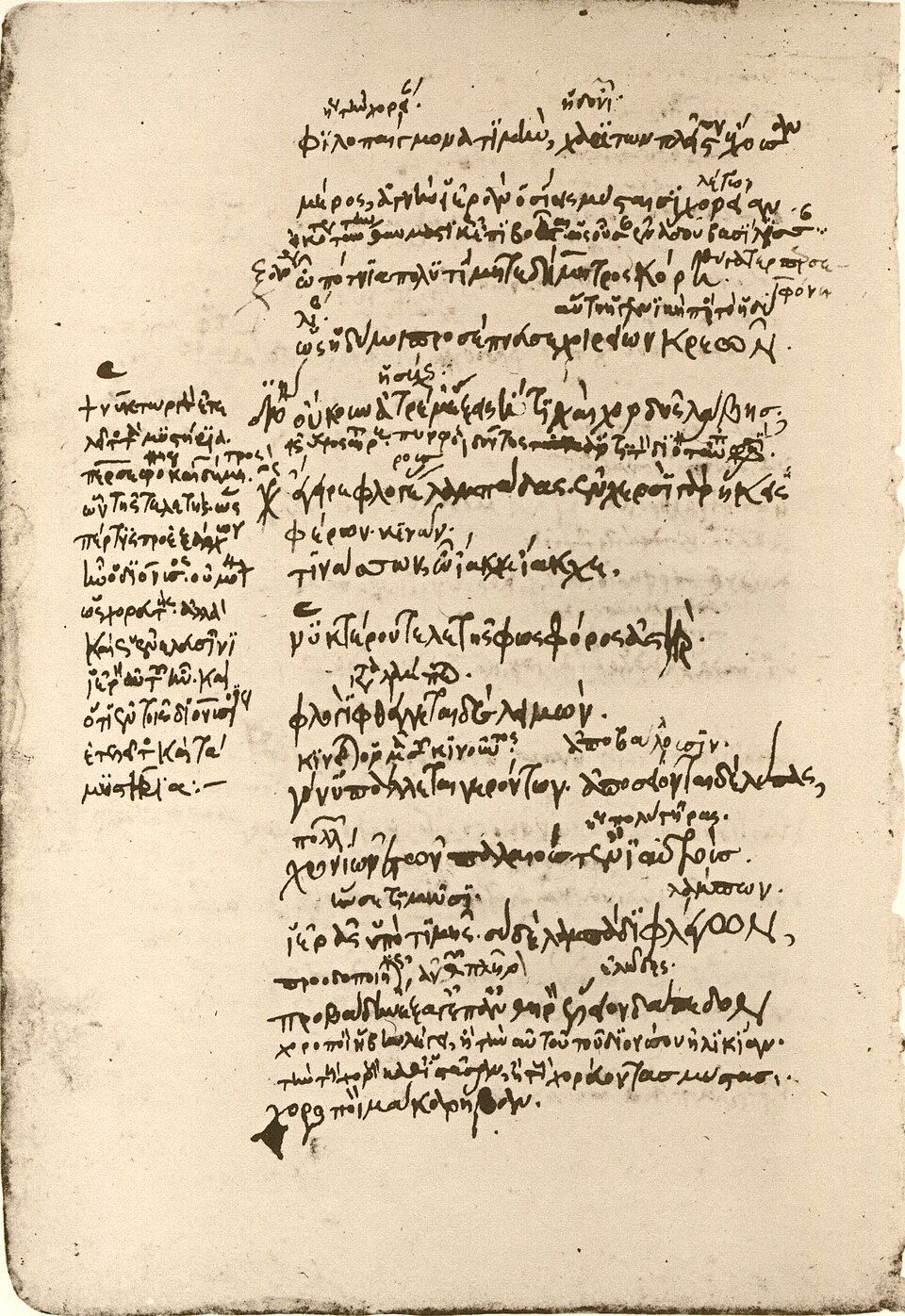
The Ravenna manuscript. In the tenth century a burst of copying produced some of the most valuable manuscripts of Greek poetry. Among them is the Ravenna Aristophanes (Ravenna gr. 429), the one medieval manuscript that has all eleven plays.[2] Its scribe probably also wrote a manuscript of Demosthenes (Laur. 59.9).[3] The “famous codex Venetus” (Marc. gr. 474) was perhaps among the books that Cardinal Bessarion acquired from the monastery of Saint Nicholas at Otranto. It came to Venice when he gave his library to the city in 1468.[4]
About 170 manuscripts of Aristophanes written before 1600 survive, some 35 of them from before 1400. The Venetus, of the late eleventh century, has seven plays and is highly valued alongside the Ravenna manuscript.[5] Aristophanes was kept because Byzantine schools aimed to teach Attic prose and verse. Menander, who had once been the comic author read in schools, dropped out.[6]
The Suda as a witness. The Suda is a tenth-century encyclopedia. It drew heavily on the text and scholia of Aristophanes, and so it is a witness of some weight to both.[2] Sometimes it alone keeps the right reading, and the metre can show it. Knights 254 is a trochaic tetrameter. There the manuscripts have the unmetrical ἔφυγε (ephyge), “ran off”, and the Suda has ἔφευγεν (epheugen), “used to run off”,[7] which the Oxford text prints:
ἅσπερ Εὐκράτης ἔφευγεν εὐθὺ τῶν κυρηβίων.
hasper Eukratēs epheugen euthy tōn kyrēbiōn.
“(he knows the roads) by which Eucrates used to run off, straight to the bran-sellers.”
The seventh position (red) must be long, and the Suda’s ἔφευγεν gives it the long diphthong -φευ-. The manuscripts’ ἔφυγε (ephyge) would put the short φυ there.
Aristophanes, Knights 254, as the Oxford text prints it
ἔφευγεν ∿ἔφυγε ∿
The scheme is — ⏑ — × — ⏑ — × ¦ — ⏑ — × — ⏑ — ‖.[8] With ἔφυγε, the seventh position, a princeps that must be long, would fall on the short φυ.
In Clouds 215 the Suda has μεταφροντίζετε (metaphrontizete), “an amusing new coinage”. Reynolds and Wilson think it probably correct, and the Ravenna scholiast seems to have read it too. But Hall and Geldart print the manuscripts’ πάνυ φροντίζετε (pany phrontizete). Here both readings scan alike, since με-τα- and πά-νυ are both two short syllables, so the metre cannot decide. At Acharnians 23 editors reject the Suda’s dative ἀωρίᾳ (aōriāi) for the manuscripts’ ἀωρίαν (aōrian).[9]
The schoolroom and the triad. John Tzetzes (c. 1110–1180) appears to have run a school in Constantinople. He wrote commentaries on three plays. In a note on Wealth 677 he says that he would not lengthen his explanation but for the space left on the page.[10] By the late thirteenth century, schools read three plays each of the tragedians and of Aristophanes. These were called the “triad”. Tzetzes had commented on just the three comedies that later became standard reading, and most manuscripts of these authors contain only the triad.[11] The other plays survived just long enough to be rescued by Renaissance collectors.[11]
Triclinius. Demetrius Triclinius was a schoolmaster at Thessalonica about 1305–1320. He knew that the lyrics of the chorus in tragedy and comedy were meant to respond exactly. He wrote a separate metrical commentary on many plays. For Aristophanes he was guided by Heliodorus’ ancient commentary in the old scholia. In his autograph copies he set his commentary beside the revised scholia, in separate columns.[12]
The first printed Aristophanes. The Aldine Aristophanes of 1498 is the first large volume for which Marcus Musurus was “undoubtedly responsible”. He built the text from at least four manuscripts, one of which survives in Modena (Estensis a. U. 5.10). He printed the scholia in the margins, as in a medieval manuscript, combining notes of different types. And he restored the text in a number of passages.[13] Later work by N. G. Wilson (1962) found Musurus’ contribution to the scholia less substantial than had been believed.[14]
The Aldine edition lacked two plays, Lysistrata and Women at the Thesmophoria. They were first printed in 1515, by the Giunta press in Florence.[15]
On the stage again. Revivals of Aristophanes began in the universities. A performance of Peace at Cambridge in 1546 seems to have been an exception in its time. In 1886 students of the University of Pennsylvania played Acharnians in ancient Greek at the Academy of Music in Philadelphia. In 1903 Birds was performed in Greek at the opening of the Greek Theatre at the University of California, Berkeley (Van Steen 2014, pp. 435, 438).
Modern texts. This site quotes Hall and Geldart’s Oxford text (1906–1907) in the Perseus Digital Library. On the lyrics, both Companions cite L. P. E. Parker, The Songs of Aristophanes (Oxford 1997). M. S. Silk’s “Aristophanes as a Lyric Poet” (1980) is “essential reading” on their style.[16]
Notes
- ^ Reynolds and Wilson 1991, p. 63.
- ^ a b Reynolds and Wilson 1991, p. 66.
- ^ Reynolds and Wilson 1991, p. 67.
- ^ Reynolds and Wilson 1991, p. 149.
- ^ Wilson 2014, p. 430.
- ^ Wilson 2014, pp. 427, 429.
- ^ Reynolds and Wilson 1991, p. 219.
- ^ West 1987, p. 28.
- ^ Reynolds and Wilson 1991, pp. 219–220.
- ^ Reynolds and Wilson 1991, p. 71.
- ^ a b Reynolds and Wilson 1991, p. 78.
- ^ Reynolds and Wilson 1991, pp. 76–77.
- ^ Reynolds and Wilson 1991, pp. 157–158.
- ^ Reynolds and Wilson 1991, p. 279; see Printing.
- ^ Wilson 2014, p. 431.
- ^ Swift 2022, pp. 387–388; Battezzato 2009, p. 143 n. 25; on reading an apparatus see Apparatus.
About · 5 of 6
His metres: speech and recitative
Levels of style. Comedy moves between levels of style. In short passages the versification rises to the tragic standard. Sometimes this is actual parody of a tragic passage; sometimes it marks a character’s self-importance. Only close attention to the metre will reveal such passages.[1] One marker is the treatment of stop + liquid. In comic dialogue it does not lengthen a preceding syllable with a short vowel, except in parody of tragedy.[2]
The language as a whole shows the same mixture. Pointed brevity stands beside extravagant fullness, lofty imagery beside crude obscenity, and colloquial frankness beside paratragic pathos. There are dialect forms, and borrowings from every genre from Homeric epic to the new dithyramb.[3]
Comic dialogue used much the same metres as tragedy and satyr play, but with looser rules. This holds for Old and New Comedy alike. An audience could recognise parody of tragedy by the verse alone. The opening speech of the Lysistrata has few resolutions for a comedy, yet still too many for a tragedy.[4]
The comic trimeter
The first four lines of the Acharnians show most of the comic licences at once:
ὅσα δὴ δέδηγμαι τὴν ἐμαυτοῦ καρδίαν,
ἥσθην δὲ βαιά, πάνυ δὲ βαιά, τέτταρα·
ἃ δ’ ὠδυνήθην, ψαμμακοσιογάργαρα.
φέρ’ ἴδω, τί δ’ ἥσθην ἄξιον χαιρηδόνος;
hosa dē dedēgmai tēn emautou kardian, / hēsthēn de baia, pany de baia, tettara; / ha d’ ōdynēthēn, psammakosiogargara. / pher’ idō, ti d’ hēsthēn axion chairēdonos?
“Oh, the bites I have taken, right to the heart! My joys were small, so very small: four. My sorrows, sand-hundred-heaps. Come now, what joy have I had that was worth a cheer?”
Lines 1 and 4 open with an anapaestic foot, ⏑ ⏑ — (red). Line 2 resolves the third princeps (πάνυ, red) and line 3 the fourth (-κο-σι-, red). Lines 2 and 3 end in a short syllable in the last, long position (brevis in longo).
Aristophanes, Acharnians 1–4
synthetic ∿
Lines 1 and 4 open with an anapaestic foot. Line 2 resolves the third princeps (πάνυ), and line 3 the fourth (κο-σι). Lines 2 and 3 end in brevis in longo. ἅ (3) is short.[5] The comic trimeter differs from the tragic trimeter in these ways:[6]
| Comic licence | Detail | Source |
|---|---|---|
| Lines with no caesura | many lines have none at all (Eq. 129), and many have caesura at the end of the third foot | p. 25 |
| Anapaestic feet admitted freely | in any of the first five feet; in tragedy only for names | p. 26 |
| Porson’s Law ignored | Eq. 129 breaks it | p. 25 |
| Resolved fifth princeps with long anceps | in tragedy only with short anceps | pp. 25, 27 |
| More frequent resolution | one fragment has five in a line | p. 26 |
| Stop + liquid does not lengthen | except in parody of tragedy | pp. 16–17, 27 |
A resolution is split when a word-end falls between its two shorts. Split resolutions occur in the first foot even across punctuation or a change of speaker. They also occur under elision (Av. 1523), and in fixed phrases such as ἀκούετε λεῴ (akouete leōi), “hear, people”, and αὐτίκα μάλα (autika mala), “this very moment”.[7] The split anapaest, avoided in New Comedy, is admitted, as at Ach. 6.[7]
Tetrameters, runs and dicola
Trochaic tetrameters neglect the normal caesura about once in seven lines.[8] Resolution is somewhat less frequent than in the same author’s trimeters. In drama two shorts now and then stand in the short or anceps position of the first three metra. The syllables scanning ⏑ ⏑ — must then be in one word; in tragedy this happens only for a name.[9]
Iambic tetrameters catalectic run × — ⏑ — × — ⏑ — ¦ × — ⏑ — ⏑ — — ‖. This “cheerful metre” serves the entries and exits of the chorus, and contest scenes. Three lines in four have caesura after the second metron. Any of the first six feet may be an anapaest, as at Eq. 342–345.[9]
Anapaestic tetrameters catalectic are frequent in Old Comedy.[9] Hephaestion names the line “Aristophanean” and quotes Clouds 962:[10]
λέξω τοίνυν τὴν ἀρχαίαν παιδείαν ὡς διέκειτο,
ὅτ’ ἐγὼ τὰ δίκαια λέγων ἤνθουν καὶ σωφροσύνη ’νενόμιστο.
πρῶτον μὲν ἔδει παιδὸς φωνὴν γρύξαντος μηδὲν ἀκοῦσαι·
lexō toinyn tēn archaian paideian hōs diekeito, / hot’ egō ta dikaia legōn ēnthoun kai sōphrosynē ’nenomisto. / prōton men edei paidos phōnēn gryxantos mēden akousai;
“I shall tell, then, how the old education was ordered, when I flourished speaking what is just and self-restraint was the custom. First, one was not to hear a sound of a boy muttering.”
Every two shorts may be contracted into one long, so line 961 is all longs until its close, ⏑ ⏑ — —. In 962 the word δίκαια (red) runs one short past the end of the first metron.
Aristophanes, Clouds 961–963, quoted by Hephaestion, Ench. 8.2
synthetic ∿
The scheme is ⏔ — ⏔ — | ⏔ — ⏔ — | ⏔ — ⏔ — ⁝ ⏑ ⏑ — — ‖. About nine lines in ten have caesura after the second metron, nearly as many after the first, and nearly half after the third.[11] Here ¦ marks word-end. It normally falls at a metron-boundary, but in 962 δίκαια runs one short past the first metron. Runs of four shorts are avoided, so the resolved metron is normally — ⏖ — —.[12]
The pnigos. Excited dialogue in iambic or trochaic tetrameters sometimes ends in a burst of ten to sixty metra in the same rhythm. They run in unbroken synapheia to the final catalexis. These are the “systems” or πνίγη (pnigē), “breathlessnesses”, as at Nub. 1443–1451. Anapaestic runs likewise follow anapaestic tetrameters.[13]
Comic dicola. A dicolon is a verse made of two cola. Three dicola occur in the extant plays.[14] The eupolidean (Nub. 518–562, and in many fragments by other poets) has the scheme ○ ○ ⏕ × — ⏑ ⏑ — ⁝ ○ ⁝ ○ — × — ⏑ — ‖, that is, gl¨ ⁝ gl¨∧ ‖. The first position of the first colon, and the shared position between the dotted bars, can be resolved (⏑ ⏑). In each colon the first position is usually long. When it is resolved, the second position is always short.[15]
ὦ θεώμενοι κατερῶ πρὸς ὑμᾶς ἐλευθέρως
ō theōmenoi katerō pros hymās eleutherōs
“Spectators, I will speak frankly and tell you …”
gl¨ ⁝ gl¨∧: the anaclastic glyconic — ⏑ — ⏑ — ⏑ ⏑ — (eight positions), then the shared position (red), then the shorter colon — — ⏑ — ⏑ —.
Aristophanes, Clouds 518, the first eupolidean of the parabasis (Clouds 518–562 tab)
synthetic ∿
Vesp. 1528–1537 has × — ⏑ ⏑ — ⏑ ⏑ — ⁝ × ⁝ — ⏑ — ⏑ — — ‖, × D ⁝ × ⁝ ith. It combines in one verse the cola of Archilochus’ epodic strophe. Vesp. 248–272 has × — ⏑ — × — ⏑ — ⁝ — ⏑ — ⏑ — — ‖, 2ia ⁝ ith.[15]
Aristophanes’ lyric metres are described on the Metres: sung tab.
Notes
- ^ West 1987, p. 27 n. 4.
- ^ West 1987, pp. 16–17, 27.
- ^ Seidensticker 2005, pp. 41–42.
- ^ Konstan 2014, pp. 33–34.
- ^ West 1987, p. 13.
- ^ West 1987, p. 27.
- ^ a b West 1987, p. 26.
- ^ West 1987, p. 28.
- ^ a b c West 1987, p. 29.
- ^ Hephaestion, Ench. 8.2.
- ^ West 1987, p. 30.
- ^ West 1987, pp. 29–30.
- ^ West 1987, p. 49.
- ^ West 1987, pp. 49–50.
- ^ a b West 1987, p. 50.
About · 6 of 6
Chorus and song in Aristophanes
Comedy shared a chorus with tragedy. In both, the chorus sang and danced to the aulos. But the comic chorus was larger, and its songs did different work.[1] The metres of the songs are on the Metres: sung tab.
Twenty-four. The dithyramb had fifty singers and dancers, and comedy twenty-four. Tragedy had at first twelve, and later fifteen.[2] The set piece of the comic chorus was the parabasis, in seven parts. The word means “stepping forth”: the chorus stepped forward to address the audience.[3] We know very little of the dance and music of the comic chorus. They must have been sharply distinct from tragedy’s.[1]
Choruses and their songs. Comic choruses play characters. Some are realistic, like the men of Acharnae, or the old men and old women of the Lysistrata. Many are fantastic, like clouds, birds and wasps. In the Birds each member represented a different bird (268–304).[4]
Aristophanes’ lyric interludes are on the whole shorter than tragic odes. A strophe and its antistrophe are often separated by an episode, and some songs are only a few lines long. Lyric makes up 17% of the surviving plays, and less in the two plays of the fourth century.[4] In the Assemblywomen (391) and Wealth (388) the manuscripts give only the word χοροῦ (chorou), “[song] of the chorus”, in place of some choral passages. What this marks is disputed: a dance interlude, a song not integral to the play, or odes cut or lost later.[4]
High and low. Comic lyric runs along a spectrum, a scheme that goes back to Silk. At one end is “high” lyric, close to the style of tragedy or Pindar. At the other is “low” lyric, with everyday or vulgar words. High lyrics can pass for real cult songs, as the prayer of Thesmophoriazusae 312–330 does. The Initiates’ hymn to Iacchus in the Frogs (323–353) is “mostly ionics”, and close to the parodos of Euripides’ Bacchae. It slides from piety into jokes: the colloquial “little sandal” (σανδαλίσκον, sandaliskon), and the abuse of 416–430.[5]
Older songs in comedy. Comic lyric quotes earlier lyric outright. A boy at the banquet in Peace sings Archilochus’ poem on the lost shield (1298–1302). The Hoopoe’s song in the Birds includes a line of Alcman (251).[6] A lyric of the Peace (421) alludes to the opening of Stesichorus’ Oresteia. Not all the audience would have caught the allusion.[7]
Alcaeus appears often. At the symposium in the Wasps, Philocleon adapts Alcaeus’ warning against Pittacus and turns it on Cleon (1232–1235, with Alc. 141). The Birds echoes Alcaeus 345 (1410–1411). The tragedian Agathon of the Thesmophoriazusae cites Alcaeus as a precedent for his own appearance (160–163). In a fragment someone is asked to take up and sing a skolion of Alcaeus (fr. 235 PCG).[8] Aristophanes’ own reading may have included the Lesbian poets.[9]
A Spartan song. The Lysistrata closes with a “Spartan” lyric. Hornblower calls it a clever and politically courageous recreation of the manner of Alcman. Taplin thinks that the play did not end with it, and that another poet wrote it for Spartans. Sommerstein objects that Aristophanes would not have called an old song a “new Muse” (1295).[10] The point is disputed.
Poets on stage. The New Music was the style of song that innovating poets and musicians developed in the later fifth century. Aristophanes’ plays are a main source for it. In the Birds the dithyrambist Cinesias floats among the clouds in search of inspiration (1372–1409), and twice advertises his originality. In the Thesmophoriazusae Agathon wears women’s clothing to suit his characters. The Frogs mocks Euripides’ diction, metres and singing.[11]
Older poets fare no better. A hack in the Birds offers songs “in the manner of Simonides” (916–918). The Clouds (1353–1362) makes Simonides old-fashioned. In the Peace (695–699) he is the greedy old man who would put to sea on a sieve for profit.[12]
Notes
- ^ a b Seidensticker 2005, p. 40.
- ^ Easterling 1997, p. 157; Seidensticker 2005, p. 40.
- ^ Seidensticker 2005, p. 42.
- ^ a b c Swift 2022, p. 386.
- ^ Swift 2022, pp. 387–388.
- ^ Swift 2022, pp. 386–387.
- ^ Finglass 2022, p. 242.
- ^ Spelman 2022, pp. 276, 282–283 with n. 21.
- ^ Spelman 2022, p. 283.
- ^ Hornblower 2009, p. 48 with n. 37.
- ^ LeVen 2022, p. 364; Csapo and Wilson 2009, p. 282.
- ^ Hornblower 2009, pp. 50–51; Graziosi and Haubold 2009, p. 108 n. 41; Rawles 2022, p. 329.
Acharnians 1–42 — Dicaeopolis on the Pnyx
Synopsis
Dicaeopolis is an Athenian farmer, sick of the war with Sparta. He fails to get the Assembly to discuss peace. So he buys a private thirty-year truce for himself and his family, delivered in the form of vintage wine.[1] The ancient summary of the play tells the rest. The old men of Acharnae, who form the chorus, set on him as a traitor. He borrows from Euripides the beggar’s rags of the hero Telephus to plead his case, and wins the chorus over. He faces down the general Lamachus and enjoys the fruits of peace: a market open to Megarians and Boeotians, and a feast. Lamachus meanwhile goes off to fight and comes home wounded.[2] It is the earliest comedy to survive.[3] It was produced through Callistratus at the Lenaea, in the archonship of Euthynus (426/5), and won first prize, ahead of Cratinus and Eupolis. The Cambridge chronology dates it to 425, Seidensticker to 426.[4]
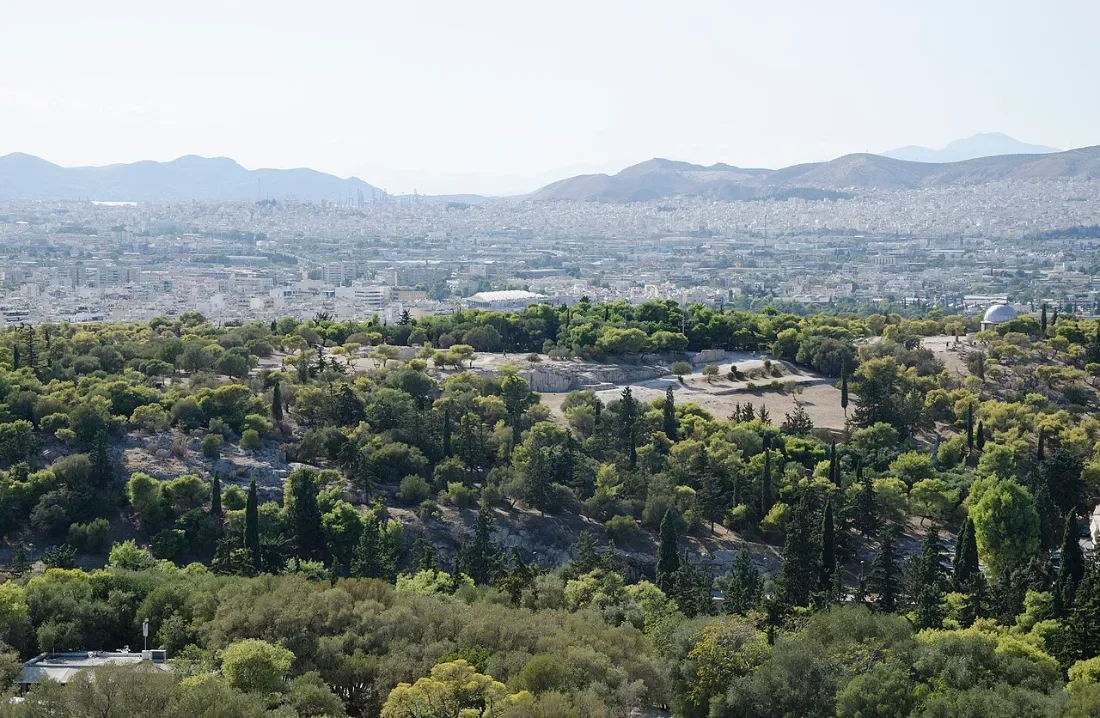
These are the opening lines. At dawn on the Pnyx, Dicaeopolis waits alone for the Assembly to begin. He counts his few pleasures and many pains, and he resolves to shout down any speaker who talks of anything but peace (lines 1–42).
Text and translation
ὅσα δὴ δέδηγμαι τὴν ἐμαυτοῦ καρδίαν
Aristophanes · Acharnians 1–42 · iambic trimeters (comic) · text of Hall and Geldart (Oxford, via Perseus)
How to read each line
A guide to the Greek, syllables, pitch marks and quantities.
Show the reading key
- Above each line: the line as the edition prints it, each word placed over its own syllables. The main row: the same Greek divided into metrical syllables, each written as it is pronounced. A consonant that closes a syllable is written with it (λόθ | ρο); an elided word is closed up with the next vowel (ν’ἀ); a final consonant carried into the next word is set with a thin space (ς ἰ). Wider gaps mark word-ends.
- Above the syllables: the pitch of each syllable, from the accents. Under them: the quantity of each syllable as it falls in the line, then the transliteration, syllable by syllable, with accented syllables in capitals.
- Under each line: a line-for-line translation. In the right margin of the scansion: the line type, its scheme, and its analysis into cola.
Key to the labels
The names, patterns and symbols used beside this poem.
Show the labels and symbols
The labels in the right margin of the scansion below name the line, its scheme, the feet as the line realises them, and the caesurae and diaereses (the named word-ends) that fall in it. In the scheme — is a long position, ⏑ a short one and × an anceps, long or short; the descriptions below say where a long may be resolved into two shorts and where two shorts may stand in place of an anceps or a short.[5] A click on any syllable highlights its metron or colon, or, with the switch, its foot.
| Label | Name and shape | What it is |
|---|---|---|
| im1 | First iambic metron× — ⏑ — | Positions 1–4. The anceps may be long or short. Either foot may take the form of an anapaest (⏑ ⏑ —), and either long may be resolved into two shorts. |
| im2 | Second iambic metron× — ⏑ — | Positions 5–8. The caesura usually falls inside it, after position 5 (penthemimeral) or 7 (hephthemimeral); many comic lines divide after position 6, and many have no caesura at all. Either foot may be an anapaest, and either long may be resolved. |
| im3 | Third iambic metron× — ⏑ × | Positions 9–12, the last syllable indifferent (period-end). Comedy ignores Porson’s law. The fifth foot may be an anapaest, and the long at 10 may be resolved even after a long anceps, as it is in most cases. |
Scansion
Dicaeopolis alone on the Pnyx before the Assembly, counting his pleasures and pains. Each comic trimeter is scanned foot by foot, with its caesura or lack of one, every resolution and anapaest (and whether it is “split”), and the licences in which comedy parts company with tragedy.
How many things have bitten me to the heart,
and how few my pleasures, very few: four;
and my pains, sand-heap-hundred-umpteen.
Come, let me see, what pleasure did I have worth the joy?
I know one that cheered my heart to see:
the five talents that Cleon vomited up.
How I gloated at that! And I love the Knights
for that deed; it was worthy of Greece.
But then I suffered another pain, a tragic one,
when I sat there gaping, waiting for Aeschylus,
and the herald called out, "Bring on your chorus, Theognis."
How do you think that shook my heart?
But I had another pleasure, when once, after Moschus,
Dexitheus came on to sing a Boeotian tune.
But this year I died and was twisted all askew
when Chaeris crept out to play the Orthian tune.
But never, since I first began to wash,
have my eyebrows been stung so badly by soap
as now, when, though a regular Assembly
is due this morning, the Pnyx here is empty,
and people chatter in the market, and up and down
they dodge the rope dyed red.
Not even the presiding officers have come; they will come
late, and then, you can't imagine how they will jostle,
when they arrive, one another for the front bench,
pouring down all together; but how there is to be peace,
they care nothing at all. O city, city!
But I, always the very first to come to the Assembly,
take my seat; and then, when I am alone,
I groan, I yawn, I stretch, I fart,
I fidget, I scribble, I pluck my hairs, I do sums,
gazing out towards the country, longing for peace,
hating the town and longing for my own village,
which never once said "buy charcoal",
or vinegar, or oil; it did not know the word "buy",
but produced everything itself, and the "buyer" was nowhere.
So now I have come thoroughly prepared
to shout, to interrupt, to abuse the speakers,
if anyone speaks of anything but peace.
But here come the presiding officers, at noon.
Didn't I say so? That's just what I was saying:
every man is jostling for the front seats.
Metre
- The line. The comic trimeter has the same three iambic metra as the tragic, × — ⏑ — | × — ⏑ — | × — ⏑ —, but West 1987, p. 27 lists six differences: comedy allows a line without caesura, uses the anapaestic foot without restriction, disregards Porson’s law, resolves the fifth princeps even after a long anceps, resolves more often, and lets stop + liquid lengthen a short syllable before it only when it is parodying tragedy. All but the fourth can be seen in these 42 lines.
- Anapaests. Any of the first five feet may be an anapaest (⏑ ⏑ —).[6] There are 19 here, in the first foot (1, 4, 8, 10, 11, 16, 26, 31), the second (6, 7, 16, 19, 23, 37, 38, 40), the third (31) and the fourth (14, 39). Line 6 is West’s own example of a “split” anapaest, where a word that began before the foot ends inside it (πέν|τε τα-λάν-), a type that New Comedy avoids.[6]
- Resolution. Sixteen resolved longs in 42 lines. Where the two shorts belong to different words, the first is a monosyllable closely linked to the second, as West 1987, p. 26 describes: τὸ κέαρ (5), ἐν ἀγορᾷ (21), τὸ μεμιλτωμένον (22), τὸν ἀγρόν (32).
- Caesura. Line 31 has none, and line 37 divides only after the third foot (ἥκω ‖), the two habits West names as comic.[7]
- Porson’s law. Comedy ignores it:[8] in lines 1, 18, 21, 24 and 30 a long anceps at position 9 ends a word of more than one syllable, which tragedy would avoid.
- Prosody. A stop + liquid normally leaves the syllable before it short in comic dialogue (ἀτεχνῶς 37, ὑποκρούειν 38, προεδρίαν 42, ἄλλο πλήν 39);[9] βλ in ἀποβλέπων (32) makes position, as that cluster almost always does.[10] Comedy’s other licences here: crasis (ἐγᾦδ’ 5, τοὔργον 8, κἄνω 21, κᾆτ’ 29, χὠ 36, οὑγώ 41), prodelision (’κεχήνη 10, ’γώ 17, ’λεγον 41), the deictic αὑτηί (20) and οὑτοιί (40) with their vowel shortened before -ί, and hiatus after περί (39).[11]
- Henderson’s text. Hall and Geldart’s text has been compared with J. Henderson’s Loeb edition of 1998. The line numbers are the same and the words differ only at 5, 13 and in εἰς for ἐς at 32 and 42, none of which changes the scansion.[12]
Prosody, line by line
Every syllable, with the reason for its length. Quantities are read from the vowel where the spelling shows it, from the consonants that follow (“position”), from the accent where it tells, and from the metre where nothing else does. Editors’ notes on the text follow in the boxed paragraphs.
- 1
Line 1 · ὅσα δὴ δέδηγμαι τὴν ἐμαυτοῦ καρδίαν,
ὅσα δὴ δέδηγμαι τὴν ἐμαυτοῦ καρδίαν,
ὅσαδὴδέδηγμαιτὴνἐμαυτοῦκαρδίαν,penthemimeral caesura.
- 1 ⏑ὅὅ is short by nature; with its neighbour it fills the anceps of position 1 with two shorts, making an anapaest (⏑ ⏑ —) of the foot.
- 2 ⏑σαα is short by the metre (position 1 must be short); with its neighbour it fills the anceps of position 1 with two shorts, making an anapaest (⏑ ⏑ —) of the foot.
- 3 —δὴὴ is long by nature.
- 4 ⏑δέέ is short by nature.
- 5 —δηγη is long by nature; closed by γ: long by position; γμ is one of the four clusters (γμ, γν, δμ, δν) that never leave the syllable before them short.[10]
- 6 —μαιαι is a diphthong, long by nature; the position is anceps.
- 7 —τὴνὴ is long by nature.
- 8 ⏑ἐἐ is short by nature.
- 9 —μαυαυ is a diphthong, long by nature.
- 10 —τοῦοῦ is a diphthong, long by nature; the position is anceps.
- 11 —καρα is a vowel of unknown length; closed by ρ: long by position.
- 12 ⏑δίί is short by the metre (position 11 must be short).
- 13 ×αν,α is a vowel of unknown length; closed by ν: long by position; the last position of the line is indifferent (period-end).
Dicaeopolis speaks, alone on the Pnyx. Penthemimeral caesura after δέδηγμαι (word-end after position 5)[7]. The long anceps at position 9, τοῦ, ends the word ἐμαυτοῦ: tragedy would avoid this (Porson’s law), but comedy ignores the law.[8] The first foot is an anapaest (⏑ ⏑ —): the anceps (position 1) is filled by two shorts, ὅ–σα, in ὅσα δὴ; comedy admits the anapaest in any of the first five feet.[13] In δέδηγμαι the γμ makes position, as γμ, γν, δμ, δν always do.[10]
- 2
Line 2 · ἥσθην δὲ βαιά, πάνυ δὲ βαιά, τέτταρα·
ἥσθην δὲ βαιά, πάνυ δὲ βαιά, τέτταρα·
ἥσθηνδὲβαιά,πάνυδὲβαιά,τέτταρα·penthemimeral caesura; hephthemimeral caesura.
- 1 —ἥσἥ is long by nature; closed by σ: long by position; the position is anceps.
- 2 —θηνη is long by nature; closed by ν: long by position.
- 3 ⏑δὲὲ is short by nature.
- 4 —βαιαι is a diphthong, long by nature.
- 5 ⏑ά,ᾰ́ is short (its length is not shown by the ordinary spelling); the position is anceps.
- 6 ⏑πάᾰ́ is short (its length is not shown by the ordinary spelling); with its neighbour it resolves the long of position 6 into two shorts.
- 7 ⏑νυυ is short by the metre (position 6 must be short); with its neighbour it resolves the long of position 6 into two shorts.
- 8 ⏑δὲὲ is short by nature.
- 9 —βαιαι is a diphthong, long by nature.
- 10 ⏑ά,ᾰ́ is short (its length is not shown by the ordinary spelling); the position is anceps.
- 11 —τέτέ is short by nature; closed by τ: long by position.
- 12 ⏑ταα is short by the metre (position 11 must be short).
- 13 ×ρα·α is short by the accent rule: acute on the antepenult requires a short final syllable; the last position of the line is indifferent (period-end): a short syllable here is brevis in longo.[14]
Position 6 is resolved into πά–νυ. The α of βαιά is short.[15] Position 5 is anceps, so the metre does not show it; the input marks it short. The α of βαιά is short.[15] Position 9 is anceps, so the metre does not show it; the input marks it short. The α of πάνυ is short.[16] The metre agrees (position 6 must be short); the input marks it short. Penthemimeral caesura after βαιά (word-end after position 5)[7]; a word also ends at the hephthemimeral place, after δὲ. The third princeps (position 6) is resolved into two shorts, πά–νυ, which make up the whole of the two-syllable word πάνυ;[17] the third foot is a tribrach (⏑ ⏑ ⏑). The last syllable, ρα, is short: brevis in longo, allowed at the period-end that closes every line.[14]
- 3
Line 3 · ἃ δ’ ὠδυνήθην, ψαμμακοσιογάργαρα.
ἃ δ’ ὠδυνήθην, ψαμμακοσιογάργαρα.
ἃδ’ὠδυνήθην,ψαμμακοσιογάργαρα.penthemimeral caesura.
- 1 ⏑ἃᾰ̔̀ is short (its length is not shown by the ordinary spelling); the position is anceps.
- 2 —δ’ὠὠ is long by nature; the apostrophe marks an elided vowel; the consonant before it joins this syllable.
- 3 ⏑δυυ is short by the metre (position 3 must be short).
- 4 —νήή is long by nature.
- 5 —θην,η is long by nature; closed by ν: long by position; the position is anceps.
- 6 —ψαμα is a vowel of unknown length; closed by μ: long by position.
- 7 ⏑μαα is short by the metre (position 7 must be short).
- 8 ⏑κοο is short by nature; with its neighbour it resolves the long of position 8 into two shorts.
- 9 ⏑σιι is short by the metre (position 8 must be short); with its neighbour it resolves the long of position 8 into two shorts.
- 10 ⏑οο is short by nature; the position is anceps.
- 11 —γάρά is a vowel of unknown length; closed by ρ: long by position.
- 12 ⏑γαα is short by the metre (position 11 must be short).
- 13 ×ρα.α is short by the accent rule: acute on the antepenult requires a short final syllable; the last position of the line is indifferent (period-end): a short syllable here is brevis in longo.[14]
The α of ἃ is short.[15] Position 1 is anceps, so the metre does not show it; the input marks it short. Penthemimeral caesura after ὠδυνήθην (word-end after position 5)[7]. The anceps at position 9 is short (ο). The fourth princeps (position 8) is resolved into two shorts, κο–σι, both in the word ψαμμακοσιογάργαρα, a word of three or more syllables, as is usual;[6] the fourth foot is a tribrach (⏑ ⏑ ⏑). Elision: δ’ loses its final vowel before the vowel that begins the next word.[18] The last syllable, ρα, is short: brevis in longo, allowed at the period-end that closes every line.[14]
- 4
Line 4 · φέρ’ ἴδω, τί δ’ ἥσθην ἄξιον χαιρηδόνος;
φέρ’ ἴδω, τί δ’ ἥσθην ἄξιον χαιρηδόνος;
φέρ’ἴδω,τίδ’ἥσθηνἄξιονχαιρηδόνος;penthemimeral caesura.
- 1 ⏑φέέ is short by nature; with its neighbour it fills the anceps of position 1 with two shorts, making an anapaest (⏑ ⏑ —) of the foot.
- 2 ⏑ρ’ἴἴ is short by the metre (position 1 must be short); the apostrophe marks an elided vowel; the consonant before it joins this syllable; with its neighbour it fills the anceps of position 1 with two shorts, making an anapaest (⏑ ⏑ —) of the foot.
- 3 —δω,ω is long by nature.
- 4 ⏑τίί is short by the metre (position 3 must be short).
- 5 —δ’ἥσἥ is long by nature; closed by σ: long by position; the apostrophe marks an elided vowel; the consonant before it joins this syllable.
- 6 —θηνη is long by nature; the position is anceps.
- 7 —ἄξ is a double consonant (two sounds) and closes the syllable: long by position.
- 8 ⏑ξιι is short by the metre (position 7 must be short).
- 9 —ονο is short by nature; closed by ν: long by position.
- 10 —χαιαι is a diphthong, long by nature; the position is anceps.
- 11 —ρηη is long by nature.
- 12 ⏑δόό is short by nature.
- 13 ×νος;ο is short by nature; closed by ς: long by position; the last position of the line is indifferent (period-end).
Penthemimeral caesura after ἥσθην (word-end after position 5)[7]. The anceps at position 9 is long (χαι) and inside the word χαιρηδόνος. The first foot is an anapaest (⏑ ⏑ —): the anceps (position 1) is filled by two shorts, φέ–ρ’ἴ, in φέρ’ ἴδω; comedy admits the anapaest in any of the first five feet.[13] Elision: φέρ’, δ’ lose their final vowel before the vowel that begins the next word.[18]
- 5
Line 5 · ἐγᾦδ’ ἐφ’ ᾧ γε τὸ κέαρ ηὐφράνθην ἰδών,
ἐγᾦδ’ ἐφ’ ᾧ γε τὸ κέαρ ηὐφράνθην ἰδών,
ἐγᾦδ’ἐφ’ᾧγετὸκέαρ ηὐφράνθηνἰδών,penthemimeral caesura; hephthemimeral caesura.
- 1 ⏑ἐἐ is short by nature; the position is anceps.
- 2 —γᾦᾦ is long by nature.
- 3 ⏑δ’ἐἐ is short by nature; the apostrophe marks an elided vowel; the consonant before it joins this syllable.
- 4 —φ’ᾧᾧ is long by nature; the apostrophe marks an elided vowel; the consonant before it joins this syllable.
- 5 ⏑γεε is short by nature; the position is anceps.
- 6 ⏑τὸὸ is short by nature; with its neighbour it resolves the long of position 6 into two shorts.
- 7 ⏑κέέ is short by nature; with its neighbour it resolves the long of position 6 into two shorts.
- 8 ⏑αα is short by the metre (position 7 must be short).
- 9 —ρ ηὐηὐ is a diphthong, long by nature; the first consonant belongs to the previous word and is carried over to this vowel.
- 10 —φράνά is a vowel of unknown length; closed by ν: long by position; the position is anceps.
- 11 —θηνη is long by nature.
- 12 ⏑ἰἰ is short by the metre (position 11 must be short).
- 13 ×δών,ώ is long by nature; closed by ν: long by position; the last position of the line is indifferent (period-end).
Henderson prints the unaugmented εὐφράνθην; the syllable is long either way.[19] Penthemimeral caesura after γε (word-end after position 5)[7]; a word also ends at the hephthemimeral place, after κέαρ. The anceps at position 9 is long (φράν) and inside the word ηὐφράνθην. The third princeps (position 6) is resolved into two shorts, τὸ–κέ, which belong to two words, τὸ and κέαρ; West 1987, p. 26 notes that in this case the first word is normally a monosyllable or at most a disyllable, closely linked with the second by phrasing; the third foot is a tribrach (⏑ ⏑ ⏑). Elision: ἐγᾦδ’, ἐφ’ lose their final vowel before the vowel that begins the next word.[18] Crasis: ἐγᾦδ’ is ἐγὼ οἶδα run together into one word, the merged vowel long.[20]
- 6
Line 6 · τοῖς πέντε ταλάντοις οἷς Κλέων ἐξήμεσεν.
τοῖς πέντε ταλάντοις οἷς Κλέων ἐξήμεσεν.
τοῖςπέντεταλάντοιςοἷςΚλέωνἐξήμεσεν.penthemimeral caesura.
- 1 —τοῖςοῖ is a diphthong, long by nature; closed by ς: long by position; the position is anceps.
- 2 —πένέ is short by nature; closed by ν: long by position.
- 3 ⏑τεε is short by nature; with its neighbour it splits the short of position 3 into two shorts, making the anapaest that comedy admits.
- 4 ⏑ταα is short by the metre (position 3 must be short); with its neighbour it splits the short of position 3 into two shorts, making the anapaest that comedy admits.
- 5 —λάνά is a vowel of unknown length; closed by ν: long by position.
- 6 —τοιςοι is a diphthong, long by nature; the position is anceps.
- 7 —οἷςοἷ is a diphthong, long by nature; closed by ς: long by position.
- 8 ⏑Κλέέ is short by nature.
- 9 —ωνω is long by nature.
- 10 —ἐἐ is short by nature; ξ is a double consonant (two sounds) and closes the syllable: long by position; the position is anceps.
- 11 —ξήή is long by nature.
- 12 ⏑μεε is short by nature.
- 13 ×σεν.ε is short by nature; closed by ν: long by position; the last position of the line is indifferent (period-end).
West 1987, p. 26 quotes this line as his example of the split anapaest. Penthemimeral caesura after ταλάντοις (word-end after position 5)[7]. The anceps at position 9 is long (ἐ) and inside the word ἐξήμεσεν. The second foot is an anapaest (⏑ ⏑ —): the short of position 3 is split into two, τε–τα, in πέντε ταλάντοις; it is a “split” anapaest, a word that began before the foot ending inside it, which comedy allows though New Comedy avoids it.[6]
- 7
Line 7 · ταῦθ’ ὡς ἐγανώθην, καὶ φιλῶ τοὺς ἱππέας
ταῦθ’ ὡς ἐγανώθην, καὶ φιλῶ τοὺς ἱππέας
ταῦθ’ὡςἐγανώθην,καὶφιλῶτοὺςἱππέαςpenthemimeral caesura.
- 1 —ταῦαῦ is a diphthong, long by nature; the position is anceps.
- 2 —θ’ὡςὡ is long by nature; the apostrophe marks an elided vowel; the consonant before it joins this syllable.
- 3 ⏑ἐἐ is short by nature; with its neighbour it splits the short of position 3 into two shorts, making the anapaest that comedy admits.
- 4 ⏑γαα is short by the metre (position 3 must be short); with its neighbour it splits the short of position 3 into two shorts, making the anapaest that comedy admits.
- 5 —νώώ is long by nature.
- 6 —θην,η is long by nature; closed by ν: long by position; the position is anceps.
- 7 —καὶαὶ is a diphthong, long by nature.
- 8 ⏑φιι is short by the metre (position 7 must be short).
- 9 —λῶῶ is long by nature.
- 10 —τοὺςοὺ is a diphthong, long by nature; the position is anceps.
- 11 —ἱπἱ is a vowel of unknown length; closed by π: long by position.
- 12 ⏑πέέ is short by nature.
- 13 ×αςα is a vowel of unknown length; closed by ς: long by position; the last position of the line is indifferent (period-end).
Penthemimeral caesura after ἐγανώθην (word-end after position 5)[7]. The anceps at position 9 is the long monosyllable τοὺς, which Porson’s law allows.[7] The second foot is an anapaest (⏑ ⏑ —): the short of position 3 is split into two, ἐ–γα, in ἐγανώθην; comedy admits the anapaest in any of the first five feet.[13] Elision: ταῦθ’ loses its final vowel before the vowel that begins the next word.[18]
- 8
Line 8 · διὰ τοῦτο τοὔργον· ἄξιον γὰρ Ἑλλάδι.
διὰ τοῦτο τοὔργον· ἄξιον γὰρ Ἑλλάδι.
διὰτοῦτοτοὔργο·ν ἄξιονγὰρ Ἑλλάδι.penthemimeral caesura.
- 1 ⏑διι is short by the metre (position 1 must be short); with its neighbour it fills the anceps of position 1 with two shorts, making an anapaest (⏑ ⏑ —) of the foot.
- 2 ⏑ὰὰ is short by the metre (position 1 must be short); with its neighbour it fills the anceps of position 1 with two shorts, making an anapaest (⏑ ⏑ —) of the foot.
- 3 —τοῦοῦ is a diphthong, long by nature.
- 4 ⏑τοο is short by nature.
- 5 —τοὔροὔ is a diphthong, long by nature; closed by ρ: long by position.
- 6 ⏑γο·ο is short by nature; the position is anceps.
- 7 —ν ἄξ is a double consonant (two sounds) and closes the syllable: long by position; the first consonant belongs to the previous word and is carried over to this vowel.
- 8 ⏑ξιι is short by the metre (position 7 must be short).
- 9 —ονο is short by nature; closed by ν: long by position.
- 10 ⏑γὰᾰ̀ is short (its length is not shown by the ordinary spelling); the position is anceps.
- 11 —ρ ἙλἙ is short by nature; closed by λ: long by position; the first consonant belongs to the previous word and is carried over to this vowel.
- 12 ⏑λάά is short by the metre (position 11 must be short).
- 13 ×δι.ι is of unknown length; the last position of the line is indifferent (period-end).
The α of γὰρ is short (the metre: γάρ fills a position that must be short in OT 62 and Medea 17, both on this site). Position 9 is anceps, so the metre does not show it; the input marks it short. Penthemimeral caesura after τοὔργον (word-end after position 5)[7]. The first foot is an anapaest (⏑ ⏑ —): the anceps (position 1) is filled by two shorts, δι–ὰ, in διὰ τοῦτο; comedy admits the anapaest in any of the first five feet.[13] Crasis: τοὔργον is τὸ ἔργον run together into one word, the merged vowel long.[20]
- 9
Line 9 · ἀλλ’ ὠδυνήθην ἕτερον αὖ τραγῳδικόν,
ἀλλ’ ὠδυνήθην ἕτερον αὖ τραγῳδικόν,
ἀλλ’ὠδυνήθηνἕτερον αὖτραγῳδικόν,penthemimeral caesura; hephthemimeral caesura.
- 1 —ἀλἀ is a vowel of unknown length; closed by λ: long by position; the position is anceps.
- 2 —λ’ὠὠ is long by nature; the apostrophe marks an elided vowel; the consonant before it joins this syllable.
- 3 ⏑δυυ is short by the metre (position 3 must be short).
- 4 —νήή is long by nature.
- 5 —θηνη is long by nature; the position is anceps.
- 6 ⏑ἕἕ is short by nature; with its neighbour it resolves the long of position 6 into two shorts.
- 7 ⏑τεε is short by nature; with its neighbour it resolves the long of position 6 into two shorts.
- 8 ⏑ροο is short by nature.
- 9 —ν αὖαὖ is a diphthong, long by nature; the first consonant belongs to the previous word and is carried over to this vowel.
- 10 ⏑τραᾰ is short (its length is not shown by the ordinary spelling); the position is anceps.
- 11 —γῳῳ is long by nature.
- 12 ⏑διι is short by the metre (position 11 must be short).
- 13 ×κόν,ό is short by nature; closed by ν: long by position; the last position of the line is indifferent (period-end).
The α of τραγῳδικόν is short.[21] Position 9 is anceps, so the metre does not show it; the input marks it short. Penthemimeral caesura after ὠδυνήθην (word-end after position 5)[7]; a word also ends at the hephthemimeral place, after ἕτερον. The third princeps (position 6) is resolved into two shorts, ἕ–τε, both in the word ἕτερον, a word of three or more syllables, as is usual;[6] the third foot is a dactyl (— ⏑ ⏑). Elision: ἀλλ’ loses its final vowel before the vowel that begins the next word.[18]
- 10
Line 10 · ὅτε δὴ ’κεχήνη προσδοκῶν τὸν Αἰσχύλον,
ὅτε δὴ ’κεχήνη προσδοκῶν τὸν Αἰσχύλον,
ὅτεδὴκεχήνηπροσδοκῶντὸν Αἰσχύλον,penthemimeral caesura.
- 1 ⏑ὅὅ is short by nature; with its neighbour it fills the anceps of position 1 with two shorts, making an anapaest (⏑ ⏑ —) of the foot.
- 2 ⏑τεε is short by nature; with its neighbour it fills the anceps of position 1 with two shorts, making an anapaest (⏑ ⏑ —) of the foot.
- 3 —δὴὴ is long by nature.
- 4 ⏑κεε is short by nature.
- 5 —χήή is long by nature.
- 6 —νηη is long by nature; the position is anceps.
- 7 —προσο is short by nature; closed by σ: long by position.
- 8 ⏑δοο is short by nature.
- 9 —κῶνῶ is long by nature; closed by ν: long by position.
- 10 ⏑τὸὸ is short by nature; the position is anceps.
- 11 —ν ΑἰσΑἰ is a diphthong, long by nature; closed by σ: long by position; the first consonant belongs to the previous word and is carried over to this vowel.
- 12 ⏑χύύ is short by the metre (position 11 must be short).
- 13 ×λον,ο is short by nature; closed by ν: long by position; the last position of the line is indifferent (period-end).
Penthemimeral caesura after ’κεχήνη (word-end after position 5)[7]. The anceps at position 9 is short (τὸ). The first foot is an anapaest (⏑ ⏑ —): the anceps (position 1) is filled by two shorts, ὅ–τε, in ὅτε δὴ; comedy admits the anapaest in any of the first five feet.[13] Prodelision (aphaeresis): ’κεχήνη stands for ἐκεχήνη, its initial vowel absorbed by the long final vowel of the word before.[22]
- 11
Line 11 · ὁ δ’ ἀνεῖπεν, εἴσαγ’ ὦ Θέογνι τὸν χορόν.
ὁ δ’ ἀνεῖπεν, εἴσαγ’ ὦ Θέογνι τὸν χορόν.
ὁδ’ἀνεῖπε,ν εἴσαγ’ὦΘέογνιτὸνχορόν.penthemimeral caesura (with elision).
- 1 ⏑ὁὁ is short by nature; with its neighbour it fills the anceps of position 1 with two shorts, making an anapaest (⏑ ⏑ —) of the foot.
- 2 ⏑δ’ἀἀ is short by the metre (position 1 must be short); the apostrophe marks an elided vowel; the consonant before it joins this syllable; with its neighbour it fills the anceps of position 1 with two shorts, making an anapaest (⏑ ⏑ —) of the foot.
- 3 —νεῖεῖ is a diphthong, long by nature.
- 4 ⏑πε,ε is short by nature.
- 5 —ν εἴεἴ is a diphthong, long by nature; the first consonant belongs to the previous word and is carried over to this vowel.
- 6 ⏑σαᾰ is short (its length is not shown by the ordinary spelling); the position is anceps.
- 7 —γ’ὦὦ is long by nature; the apostrophe marks an elided vowel; the consonant before it joins this syllable.
- 8 ⏑Θέέ is short by nature.
- 9 —ογο is short by nature; closed by γ: long by position; γν is one of the four clusters (γμ, γν, δμ, δν) that never leave the syllable before them short.[10]
- 10 ⏑νιι is short by the accent rule: acute on the antepenult requires a short final syllable; the position is anceps.
- 11 —τὸνὸ is short by nature; closed by ν: long by position.
- 12 ⏑χοο is short by nature.
- 13 ×ρόν.ό is short by nature; closed by ν: long by position; the last position of the line is indifferent (period-end).
The α of εἴσαγ’ is short.[23] Position 5 is anceps, so the metre does not show it; the input marks it short. Penthemimeral caesura after the elided εἴσαγ’ (word-end after position 5, with elision, which is quite common at the caesura)[8]. The anceps at position 9 is short (νι). The first foot is an anapaest (⏑ ⏑ —): the anceps (position 1) is filled by two shorts, ὁ–δ’ἀ, in ὁ δ’ ἀνεῖπεν; comedy admits the anapaest in any of the first five feet.[13] In Θέογνι the γν makes position, as γμ, γν, δμ, δν always do.[10] Elision: δ’, εἴσαγ’ lose their final vowel before the vowel that begins the next word.[18]
- 12
Line 12 · πῶς τοῦτ’ ἔσεισέ μου δοκεῖς τὴν καρδίαν;
πῶς τοῦτ’ ἔσεισέ μου δοκεῖς τὴν καρδίαν;
πῶςτοῦτ’ἔσεισέμουδοκεῖςτὴνκαρδίαν;penthemimeral caesura.
- 1 —πῶςῶ is long by nature; closed by ς: long by position; the position is anceps.
- 2 —τοῦοῦ is a diphthong, long by nature.
- 3 ⏑τ’ἔἔ is short by nature; the apostrophe marks an elided vowel; the consonant before it joins this syllable.
- 4 —σειει is a diphthong, long by nature.
- 5 ⏑σέέ is short by nature; the position is anceps.
- 6 —μουου is a diphthong, long by nature.
- 7 ⏑δοο is short by nature.
- 8 —κεῖςεῖ is a diphthong, long by nature; closed by ς: long by position.
- 9 —τὴνὴ is long by nature; closed by ν: long by position; the position is anceps.
- 10 —καρα is a vowel of unknown length; closed by ρ: long by position.
- 11 ⏑δίί is short by the metre (position 11 must be short).
- 12 ×αν;α is a vowel of unknown length; closed by ν: long by position; the last position of the line is indifferent (period-end).
- 13
Line 13 · ἀλλ’ ἕτερον ἥσθην, ἡνίκ’ ἐπὶ Μόσχῳ ποτὲ
ἀλλ’ ἕτερον ἥσθην, ἡνίκ’ ἐπὶ Μόσχῳ ποτὲ
ἀλλ’ἕτερον ἥσθην,ἡνίκ’ἐπὶΜόσχῳποτὲpenthemimeral caesura; hephthemimeral caesura (with elision).
- 1 —ἀλἀ is a vowel of unknown length; closed by λ: long by position; the position is anceps.
- 2 ⏑λ’ἕἕ is short by nature; the apostrophe marks an elided vowel; the consonant before it joins this syllable; with its neighbour it resolves the long of position 2 into two shorts.
- 3 ⏑τεε is short by nature; with its neighbour it resolves the long of position 2 into two shorts.
- 4 ⏑ροο is short by nature.
- 5 —ν ἥσἥ is long by nature; closed by σ: long by position; the first consonant belongs to the previous word and is carried over to this vowel.
- 6 —θην,η is long by nature; the position is anceps.
- 7 —ἡἡ is long by nature.
- 8 ⏑νίί is short by the metre (position 7 must be short).
- 9 ⏑κ’ἐἐ is short by nature; the apostrophe marks an elided vowel; the consonant before it joins this syllable; with its neighbour it resolves the long of position 8 into two shorts.
- 10 ⏑πὶὶ is short by the metre (position 8 must be short); with its neighbour it resolves the long of position 8 into two shorts.
- 11 —Μόσό is short by nature; closed by σ: long by position; the position is anceps.
- 12 —χῳῳ is long by nature.
- 13 ⏑ποο is short by nature.
- 14 ×τὲὲ is short by nature; the last position of the line is indifferent (period-end): a short syllable here is brevis in longo.[14]
Henderson prints ἐπὶ μόσχῳ with a small letter and takes it as the title of a song, not the name Moschus; the scansion is the same.[24] Penthemimeral caesura after ἥσθην (word-end after position 5)[7]; a word also ends at the hephthemimeral place, after the elided ἡνίκ’. The anceps at position 9 is long (Μόσ) and inside the word Μόσχῳ. The first princeps (position 2) is resolved into two shorts, λ’ἕ–τε, both in the word ἕτερον, a word of three or more syllables, as is usual;[6] the first foot is a dactyl (— ⏑ ⏑). The fourth princeps (position 8) is resolved into two shorts, κ’ἐ–πὶ, which make up the whole of the two-syllable word ἐπὶ;[17] the fourth foot is a tribrach (⏑ ⏑ ⏑). Elision: ἀλλ’, ἡνίκ’ lose their final vowel before the vowel that begins the next word.[18] The last syllable, τὲ, is short: brevis in longo, allowed at the period-end that closes every line.[14]
- 14
Line 14 · Δεξίθεος εἰσῆλθ’ ᾀσόμενος Βοιώτιον.
Δεξίθεος εἰσῆλθ’ ᾀσόμενος Βοιώτιον.
Δεξίθεος εἰσῆλθ’ᾀσόμενοςΒοιώτιον.penthemimeral caesura (with elision).
- 1 —Δεε is short by nature; ξ is a double consonant (two sounds) and closes the syllable: long by position; the position is anceps.
- 2 ⏑ξίῐ́ is short (its length is not shown by the ordinary spelling); with its neighbour it resolves the long of position 2 into two shorts.
- 3 ⏑θεε is short by nature; with its neighbour it resolves the long of position 2 into two shorts.
- 4 ⏑οο is short by nature.
- 5 —ς εἰεἰ is a diphthong, long by nature; the first consonant belongs to the previous word and is carried over to this vowel.
- 6 —σῆλῆ is long by nature; closed by λ: long by position; the position is anceps.
- 7 —θ’ᾀᾀ is long by nature; the apostrophe marks an elided vowel; the consonant before it joins this syllable.
- 8 ⏑σόό is short by nature; with its neighbour it splits the short of position 7 into two shorts, making the anapaest that comedy admits.
- 9 ⏑μεε is short by nature; with its neighbour it splits the short of position 7 into two shorts, making the anapaest that comedy admits.
- 10 —νοςο is short by nature; closed by ς: long by position.
- 11 —Βοιοι is a diphthong, long by nature; the position is anceps.
- 12 —ώώ is long by nature.
- 13 ⏑τιι is short by the metre (position 11 must be short).
- 14 ×ον.ο is short by nature; closed by ν: long by position; the last position of the line is indifferent (period-end).
With the ι short, -ῐ-θε- is the resolved first princeps (position 2) after Δεξ- in the anceps; with a long ι the line would need an anapaest in the second foot instead (θε-ο), which comedy also admits,[25] so the metre alone does not decide. The ι of Δεξίθεος is short (no source used here states it; the same first element is short in Δεξίνικος at Ar. Plutus 800 (Hall and Geldart’s text, Perseus), εὖ πάνυ λέγεις· ὡς Δεξίνικός γʼ οὑτοσὶ, where -ξι- fills the short seventh position of the trimeter). The metre agrees (position 2 must be short); the input marks it short. Penthemimeral caesura after the elided εἰσῆλθ’ (word-end after position 5, with elision, which is quite common at the caesura)[8]. The anceps at position 9 is long (Βοι) and inside the word Βοιώτιον. The first princeps (position 2) is resolved into two shorts, ξί–θε, both in the word Δεξίθεος, a word of three or more syllables, as is usual;[6] the first foot is a dactyl (— ⏑ ⏑). The fourth foot is an anapaest (⏑ ⏑ —): the short of position 7 is split into two, σό–με, in ᾀσόμενος; comedy admits the anapaest in any of the first five feet.[13] Elision: εἰσῆλθ’ loses its final vowel before the vowel that begins the next word.[18]
- 15
Line 15 · τῆτες δ’ ἀπέθανον καὶ διεστράφην ἰδών,
τῆτες δ’ ἀπέθανον καὶ διεστράφην ἰδών,
τῆτεςδ’ἀπέθανονκαὶδιεστράφηνἰδών,penthemimeral caesura.
- 1 —τῆῆ is long by nature; the position is anceps.
- 2 —τεςε is short by nature; closed by ς: long by position.
- 3 ⏑δ’ἀἀ is short by the metre (position 3 must be short); the apostrophe marks an elided vowel; the consonant before it joins this syllable.
- 4 ⏑πέέ is short by nature; with its neighbour it resolves the long of position 4 into two shorts.
- 5 ⏑θαα is short by the metre (position 4 must be short); with its neighbour it resolves the long of position 4 into two shorts.
- 6 —νονο is short by nature; closed by ν: long by position; the position is anceps.
- 7 —καὶαὶ is a diphthong, long by nature.
- 8 ⏑διι is short by the metre (position 7 must be short).
- 9 —εσε is short by nature; closed by σ: long by position.
- 10 ⏑τράᾰ́ is short (its length is not shown by the ordinary spelling); the position is anceps.
- 11 —φηνη is long by nature.
- 12 ⏑ἰἰ is short by the metre (position 11 must be short).
- 13 ×δών,ώ is long by nature; closed by ν: long by position; the last position of the line is indifferent (period-end).
The α of διεστράφην is short.[26] Position 9 is anceps, so the metre does not show it; the input marks it short. Penthemimeral caesura after ἀπέθανον (word-end after position 5)[7]. The second princeps (position 4) is resolved into two shorts, πέ–θα, both in the word ἀπέθανον, a word of three or more syllables, as is usual;[6] the second foot is a tribrach (⏑ ⏑ ⏑). Elision: δ’ loses its final vowel before the vowel that begins the next word.[18]
- 16
Line 16 · ὅτε δὴ παρέκυψε Χαῖρις ἐπὶ τὸν ὄρθιον.
ὅτε δὴ παρέκυψε Χαῖρις ἐπὶ τὸν ὄρθιον.
ὅτεδὴπαρέκυψεΧαῖρις ἐπὶτὸν ὄρθιον.penthemimeral caesura; hephthemimeral caesura.
- 1 ⏑ὅὅ is short by nature; with its neighbour it fills the anceps of position 1 with two shorts, making an anapaest (⏑ ⏑ —) of the foot.
- 2 ⏑τεε is short by nature; with its neighbour it fills the anceps of position 1 with two shorts, making an anapaest (⏑ ⏑ —) of the foot.
- 3 —δὴὴ is long by nature.
- 4 ⏑παα is short by the metre (position 3 must be short); with its neighbour it splits the short of position 3 into two shorts, making the anapaest that comedy admits.
- 5 ⏑ρέέ is short by nature; with its neighbour it splits the short of position 3 into two shorts, making the anapaest that comedy admits.
- 6 —κυψ is a double consonant (two sounds) and closes the syllable: long by position.
- 7 ⏑ψεε is short by nature; the position is anceps.
- 8 —Χαῖαῖ is a diphthong, long by nature.
- 9 ⏑ριι is short by the accent rule: circumflex on the penult requires a short final syllable.
- 10 ⏑ς ἐἐ is short by nature; the first consonant belongs to the previous word and is carried over to this vowel; with its neighbour it resolves the long of position 8 into two shorts.
- 11 ⏑πὶὶ is short by the metre (position 8 must be short); with its neighbour it resolves the long of position 8 into two shorts.
- 12 ⏑τὸὸ is short by nature; the position is anceps.
- 13 —ν ὄρὄ is short by nature; closed by ρ: long by position; the first consonant belongs to the previous word and is carried over to this vowel.
- 14 ⏑θιι is short by the metre (position 11 must be short).
- 15 ×ον.ο is short by nature; closed by ν: long by position; the last position of the line is indifferent (period-end).
Penthemimeral caesura after παρέκυψε (word-end after position 5)[7]; a word also ends at the hephthemimeral place, after Χαῖρις. The anceps at position 9 is short (τὸ). The first foot is an anapaest (⏑ ⏑ —): the anceps (position 1) is filled by two shorts, ὅ–τε, in ὅτε δὴ; comedy admits the anapaest in any of the first five feet.[13] The second foot is an anapaest (⏑ ⏑ —): the short of position 3 is split into two, πα–ρέ, in παρέκυψε; comedy admits the anapaest in any of the first five feet.[13] The fourth princeps (position 8) is resolved into two shorts, ς ἐ–πὶ, which make up the whole of the two-syllable word ἐπὶ;[17] the fourth foot is a tribrach (⏑ ⏑ ⏑).
- 17
Line 17 · ἀλλ’ οὐδεπώποτ’ ἐξ ὅτου ’γὼ ῥύπτομαι
ἀλλ’ οὐδεπώποτ’ ἐξ ὅτου ’γὼ ῥύπτομαι
ἀλλ’οὐδεπώποτ’ἐξὅτουγὼῥύπτομαιpenthemimeral caesura (with elision).
- 1 —ἀλἀ is a vowel of unknown length; closed by λ: long by position; the position is anceps.
- 2 —λ’οὐοὐ is a diphthong, long by nature; the apostrophe marks an elided vowel; the consonant before it joins this syllable.
- 3 ⏑δεε is short by nature.
- 4 —πώώ is long by nature.
- 5 ⏑ποο is short by nature; the position is anceps.
- 6 —τ’ἐξἐ is short by nature; ξ is a double consonant (two sounds) and closes the syllable: long by position; the apostrophe marks an elided vowel; the consonant before it joins this syllable.
- 7 ⏑ὅὅ is short by nature.
- 8 —τουου is a diphthong, long by nature.
- 9 —γὼὼ is long by nature; the position is anceps.
- 10 —ῥύπύ is a vowel of unknown length; closed by π: long by position.
- 11 ⏑τοο is short by nature.
- 12 ×μαιαι is a diphthong, long by nature; the last position of the line is indifferent (period-end).
Penthemimeral caesura after the elided οὐδεπώποτ’ (word-end after position 5, with elision, which is quite common at the caesura)[8]. The anceps at position 9 is the long monosyllable ’γὼ, which Porson’s law allows.[7] Elision: ἀλλ’, οὐδεπώποτ’ lose their final vowel before the vowel that begins the next word.[18] Prodelision (aphaeresis): ’γὼ stands for ἐγώ, its initial vowel absorbed by the long final vowel of the word before.[22]
- 18
Line 18 · οὕτως ἐδήχθην ὑπὸ κονίας τὰς ὀφρῦς
οὕτως ἐδήχθην ὑπὸ κονίας τὰς ὀφρῦς
οὕτωςἐδήχθηνὑπὸκονίαςτὰςὀφρῦςpenthemimeral caesura.
- 1 —οὕοὕ is a diphthong, long by nature; the position is anceps.
- 2 —τωςω is long by nature.
- 3 ⏑ἐἐ is short by nature.
- 4 —δήχή is long by nature; closed by χ: long by position.
- 5 —θηνη is long by nature; the position is anceps.
- 6 ⏑ὑὑ̆ is short (its length is not shown by the ordinary spelling); with its neighbour it resolves the long of position 6 into two shorts.
- 7 ⏑πὸὸ is short by nature; with its neighbour it resolves the long of position 6 into two shorts.
- 8 ⏑κοο is short by nature.
- 9 —νίί is long by the metre (position 8 must be long).
- 10 —αςα is a vowel of unknown length; closed by ς: long by position; the position is anceps.
- 11 —τὰςὰ is long by the metre (position 10 must be long).
- 12 ⏑ὀὀ is short by nature; φρ is carried whole into the next syllable, so this syllable stays open and short (Attic correption of a stop + liquid cluster).
- 13 ×φρῦςῦ carries a circumflex, so it is long; closed by ς: long by position; the last position of the line is indifferent (period-end).
Position 6 is resolved into ὑ–πό, and the ι of κονίας is long at position 8: LSJ s.v. κονία notes ῑ in iambics, citing this line and Lys. 470, and ῐ in lyric. The υ of ὑπὸ is short.[27] The metre agrees (position 6 must be short); the input marks it short. Penthemimeral caesura after ἐδήχθην (word-end after position 5)[7]. The long anceps at position 9, ας, ends the word κονίας: tragedy would avoid this (Porson’s law), but comedy ignores the law.[8] The third princeps (position 6) is resolved into two shorts, ὑ–πὸ, which make up the whole of the two-syllable word ὑπὸ;[17] the third foot is a dactyl (— ⏑ ⏑). In ὀφρῦς the φρ goes whole with the next syllable, so ὀ stays short (Attic correption)[28].
- 19
Line 19 · ὡς νῦν, ὁπότ’ οὔσης κυρίας ἐκκλησίας
ὡς νῦν, ὁπότ’ οὔσης κυρίας ἐκκλησίας
ὡςνῦν,ὁπότ’οὔσηςκυρίαςἐκκλησίαςpenthemimeral caesura.
- 1 —ὡςὡ is long by nature; closed by ς: long by position; the position is anceps.
- 2 —νῦν,ῦ carries a circumflex, so it is long.
- 3 ⏑ὁὁ is short by nature; with its neighbour it splits the short of position 3 into two shorts, making the anapaest that comedy admits.
- 4 ⏑πόό is short by nature; with its neighbour it splits the short of position 3 into two shorts, making the anapaest that comedy admits.
- 5 —τ’οὔοὔ is a diphthong, long by nature; the apostrophe marks an elided vowel; the consonant before it joins this syllable.
- 6 —σηςη is long by nature; closed by ς: long by position; the position is anceps.
- 7 —κυυ is long by the metre (position 6 must be long).
- 8 ⏑ρίί is short by the metre (position 7 must be short).
- 9 —αςα is long by the metre (position 8 must be long).
- 10 —ἐκἐ is short by nature; closed by κ: long by position; the position is anceps.
- 11 —κληη is long by nature.
- 12 ⏑σίί is short by the metre (position 11 must be short).
- 13 ×αςα is a vowel of unknown length; closed by ς: long by position; the last position of the line is indifferent (period-end).
Penthemimeral caesura after οὔσης (word-end after position 5)[7]. The anceps at position 9 is long (ἐκ) and inside the word ἐκκλησίας. The second foot is an anapaest (⏑ ⏑ —): the short of position 3 is split into two, ὁ–πό, in ὁπότ’ οὔσης; comedy admits the anapaest in any of the first five feet.[13] Elision: ὁπότ’ loses its final vowel before the vowel that begins the next word.[18]
- 20
Line 20 · ἑωθινῆς ἔρημος ἡ πνὺξ αὑτηΐ,
ἑωθινῆς ἔρημος ἡ πνὺξ αὑτηΐ,
ἑωθινῆςἔρημος ἡπνὺξαὑτηΐ,hephthemimeral caesura.
- 1 ⏑ἑἑ is short by nature; the position is anceps.
- 2 —ωω is long by nature.
- 3 ⏑θιι is short by the metre (position 3 must be short).
- 4 —νῆςῆ is long by nature.
- 5 ⏑ἔἔ is short by nature; the position is anceps.
- 6 —ρηη is long by nature.
- 7 ⏑μοο is short by nature.
- 8 —ς ἡἡ is long by nature; the first consonant belongs to the previous word and is carried over to this vowel.
- 9 —πνὺξξ is a double consonant (two sounds) and closes the syllable: long by position; the position is anceps.
- 10 —αὑαὑ is a diphthong, long by nature.
- 11 ⏑τηη is long by nature; the long vowel is shortened before the deictic suffix -ί, as it always is in the emphatic forms of οὗτος (internal correption)[29].
- 12 ×ΐ,ῑ̈́ is long (its length is not shown by the ordinary spelling); the last position of the line is indifferent (period-end).
The input writes the deictic ί with a diaeresis (αὑτηΐ) so that it counts as a syllable of its own. The ι of αὑτηΐ is long.[30] It stands in the last position of the line, where the metre does not show its length; the input marks it long. No word ends after position 5, so the caesura is hephthemimeral, after ἔρημος (word-end after position 7)[7]. The anceps at position 9 is the long monosyllable πνὺξ, which Porson’s law allows.[7] In αὑτηΐ the long vowel before the deictic suffix -ί is shortened, as it always is in these emphatic forms.[29]
- 21
Line 21 · οἱ δ’ ἐν ἀγορᾷ λαλοῦσι κἄνω καὶ κάτω
οἱ δ’ ἐν ἀγορᾷ λαλοῦσι κἄνω καὶ κάτω
οἱδ’ἐν ἀγορᾷλαλοῦσικἄνωκαὶκάτωhephthemimeral caesura.
- 1 —οἱοἱ is a diphthong, long by nature; the position is anceps.
- 2 ⏑δ’ἐἐ is short by nature; the apostrophe marks an elided vowel; the consonant before it joins this syllable; with its neighbour it resolves the long of position 2 into two shorts.
- 3 ⏑ν ἀἀ is short by the metre (position 2 must be short); the first consonant belongs to the previous word and is carried over to this vowel; with its neighbour it resolves the long of position 2 into two shorts.
- 4 ⏑γοο is short by nature.
- 5 —ρᾷᾷ is long by nature.
- 6 ⏑λαᾰ is short (its length is not shown by the ordinary spelling); the position is anceps.
- 7 —λοῦοῦ is a diphthong, long by nature.
- 8 ⏑σιι is short by the accent rule: circumflex on the penult requires a short final syllable.
- 9 —κἄἄ is long by crasis: the coronis marks two words contracted into one long vowel.
- 10 —νωω is long by nature; the position is anceps.
- 11 —καὶαὶ is a diphthong, long by nature.
- 12 ⏑κάά is short by the metre (position 11 must be short).
- 13 ×τωω is long by nature; the last position of the line is indifferent (period-end).
The α of λαλοῦσι is short.[31] Position 5 is anceps, so the metre does not show it; the input marks it short. No word ends after position 5, so the caesura is hephthemimeral, after λαλοῦσι (word-end after position 7)[7]. The long anceps at position 9, νω, ends the word κἄνω: tragedy would avoid this (Porson’s law), but comedy ignores the law.[8] The first princeps (position 2) is resolved into two shorts, δ’ἐ–ν ἀ, which belong to two words, ἐν and ἀγορᾷ; West 1987, p. 26 notes that in this case the first word is normally a monosyllable or at most a disyllable, closely linked with the second by phrasing; the first foot is a dactyl (— ⏑ ⏑). Elision: δ’ loses its final vowel before the vowel that begins the next word.[18] Crasis: κἄνω is καὶ ἄνω run together into one word, the merged vowel long.[20]
- 22
Line 22 · τὸ σχοινίον φεύγουσι τὸ μεμιλτωμένον.
τὸ σχοινίον φεύγουσι τὸ μεμιλτωμένον.
τὸσχοινίονφεύγουσιτὸμεμιλτωμένον.hephthemimeral caesura.
- 1 —τὸὸ is short by nature; the next word begins with σχ: the syllable is closed before it: long by position; the position is anceps.
- 2 —σχοιοι is a diphthong, long by nature.
- 3 ⏑νίί is short by the metre (position 3 must be short).
- 4 —ονο is short by nature; closed by ν: long by position.
- 5 —φεύεύ is a diphthong, long by nature; the position is anceps.
- 6 —γουου is a diphthong, long by nature.
- 7 ⏑σιι is short by the accent rule: acute on the antepenult requires a short final syllable.
- 8 ⏑τὸὸ is short by nature; with its neighbour it resolves the long of position 8 into two shorts.
- 9 ⏑μεε is short by nature; with its neighbour it resolves the long of position 8 into two shorts.
- 10 —μιλι is a vowel of unknown length; closed by λ: long by position; the position is anceps.
- 11 —τωω is long by nature.
- 12 ⏑μέέ is short by nature.
- 13 ×νον.ο is short by nature; closed by ν: long by position; the last position of the line is indifferent (period-end).
No word ends after position 5, so the caesura is hephthemimeral, after φεύγουσι (word-end after position 7)[7]. The anceps at position 9 is long (μιλ) and inside the word μεμιλτωμένον. The fourth princeps (position 8) is resolved into two shorts, τὸ–με, which belong to two words, τὸ and μεμιλτωμένον; West 1987, p. 26 notes that in this case the first word is normally a monosyllable or at most a disyllable, closely linked with the second by phrasing; the fourth foot is a tribrach (⏑ ⏑ ⏑).
- 23
Line 23 · οὐδ’ οἱ πρυτάνεις ἥκουσιν, ἀλλ’ ἀωρίαν
οὐδ’ οἱ πρυτάνεις ἥκουσιν, ἀλλ’ ἀωρίαν
οὐδ’οἱπρυτάνειςἥκουσι,ν ἀλλ’ἀωρίανhephthemimeral caesura.
- 1 —οὐοὐ is a diphthong, long by nature; the position is anceps.
- 2 —δ’οἱοἱ is a diphthong, long by nature; the apostrophe marks an elided vowel; the consonant before it joins this syllable.
- 3 ⏑πρυυ is short by the metre (position 3 must be short); with its neighbour it splits the short of position 3 into two shorts, making the anapaest that comedy admits.
- 4 ⏑τάά is short by the metre (position 3 must be short); with its neighbour it splits the short of position 3 into two shorts, making the anapaest that comedy admits.
- 5 —νειςει is a diphthong, long by nature.
- 6 —ἥἥ is long by nature; the position is anceps.
- 7 —κουου is a diphthong, long by nature.
- 8 ⏑σι,ι is short by the accent rule: acute on the antepenult requires a short final syllable.
- 9 —ν ἀλἀ is a vowel of unknown length; closed by λ: long by position; the first consonant belongs to the previous word and is carried over to this vowel.
- 10 ⏑λ’ἀᾰ̓ is short (its length is not shown by the ordinary spelling); the apostrophe marks an elided vowel; the consonant before it joins this syllable; the position is anceps.
- 11 —ωω is long by nature.
- 12 ⏑ρίί is short by the metre (position 11 must be short).
- 13 ×ανα is a vowel of unknown length; closed by ν: long by position; the last position of the line is indifferent (period-end).
The α of ἀωρίαν is short.[32] Position 9 is anceps, so the metre does not show it; the input marks it short. No word ends after position 5, so the caesura is hephthemimeral, after ἥκουσιν (word-end after position 7)[7]. The second foot is an anapaest (⏑ ⏑ —): the short of position 3 is split into two, πρυ–τά, in πρυτάνεις; comedy admits the anapaest in any of the first five feet.[13] Elision: οὐδ’, ἀλλ’ lose their final vowel before the vowel that begins the next word.[18]
- 24
Line 24 · ἥκοντες, εἶτα δ’ ὠστιοῦνται πῶς δοκεῖς
ἥκοντες, εἶτα δ’ ὠστιοῦνται πῶς δοκεῖς
ἥκοντε,ς εἶταδ’ὠστιοῦνταιπῶςδοκεῖςpenthemimeral caesura.
- 1 —ἥἥ is long by nature; the position is anceps.
- 2 —κονο is short by nature; closed by ν: long by position.
- 3 ⏑τε,ε is short by nature.
- 4 —ς εἶεἶ is a diphthong, long by nature; the first consonant belongs to the previous word and is carried over to this vowel.
- 5 ⏑ταα is short by the accent rule: circumflex on the penult requires a short final syllable; the position is anceps.
- 6 —δ’ὠσὠ is long by nature; closed by σ: long by position; the apostrophe marks an elided vowel; the consonant before it joins this syllable.
- 7 ⏑τιι is short by the metre (position 7 must be short).
- 8 —οῦνοῦ is a diphthong, long by nature; closed by ν: long by position.
- 9 —ταιαι is a diphthong, long by nature; the position is anceps.
- 10 —πῶςῶ is long by nature; closed by ς: long by position.
- 11 ⏑δοο is short by nature.
- 12 ×κεῖςεῖ is a diphthong, long by nature; closed by ς: long by position; the last position of the line is indifferent (period-end).
- 25
Line 25 · ἐλθόντες ἀλλήλοισι περὶ πρώτου ξύλου,
ἐλθόντες ἀλλήλοισι περὶ πρώτου ξύλου,
ἐλθόντες ἀλλήλοισιπερὶπρώτουξύλου,hephthemimeral caesura.
- 1 —ἐλἐ is short by nature; closed by λ: long by position; the position is anceps.
- 2 —θόνό is short by nature; closed by ν: long by position.
- 3 ⏑τεε is short by nature.
- 4 —ς ἀλἀ is a vowel of unknown length; closed by λ: long by position; the first consonant belongs to the previous word and is carried over to this vowel.
- 5 —λήή is long by nature; the position is anceps.
- 6 —λοιοι is a diphthong, long by nature.
- 7 ⏑σιι is short by the accent rule: acute on the antepenult requires a short final syllable.
- 8 ⏑πεε is short by nature; with its neighbour it resolves the long of position 8 into two shorts.
- 9 ⏑ρὶὶ is a vowel of unknown length; the next word begins with πρ, a stop + liquid that does not make position here, so the syllable stays short; with its neighbour it resolves the long of position 8 into two shorts.
- 10 —πρώώ is long by nature; the position is anceps.
- 11 —τουου is a diphthong, long by nature; the next word begins with the double consonant ξ: the syllable is closed before it: long by position.
- 12 ⏑ξύύ is short by the metre (position 11 must be short).
- 13 ×λου,ου is a diphthong, long by nature; the last position of the line is indifferent (period-end).
No word ends after position 5, so the caesura is hephthemimeral, after ἀλλήλοισι (word-end after position 7)[7]. The anceps at position 9 is long (πρώ) and inside the word πρώτου. The fourth princeps (position 8) is resolved into two shorts, πε–ρὶ, which make up the whole of the two-syllable word περὶ;[17] the fourth foot is a tribrach (⏑ ⏑ ⏑). The final ρὶ of περὶ stays short before the πρ that begins πρώτου (Attic correption)[28].
- 26
Line 26 · ἁθρόοι καταρρέοντες· εἰρήνη δ’ ὅπως
ἁθρόοι καταρρέοντες· εἰρήνη δ’ ὅπως
ἁθρόοικαταρρέοντε·ς εἰρήνηδ’ὅπωςhephthemimeral caesura.
- 1 ⏑ἁᾰ̔ is short (its length is not shown by the ordinary spelling); θρ is carried whole into the next syllable, so this syllable stays open and short (Attic correption of a stop + liquid cluster); with its neighbour it fills the anceps of position 1 with two shorts, making an anapaest (⏑ ⏑ —) of the foot.
- 2 ⏑θρόό is short by nature; with its neighbour it fills the anceps of position 1 with two shorts, making an anapaest (⏑ ⏑ —) of the foot.
- 3 —οιοι is a diphthong, long by nature.
- 4 ⏑καα is short by the metre (position 3 must be short).
- 5 —ταρα is a vowel of unknown length; closed by ρ: long by position.
- 6 ⏑ρέέ is short by nature; the position is anceps.
- 7 —ονο is short by nature; closed by ν: long by position.
- 8 ⏑τε·ε is short by nature.
- 9 —ς εἰεἰ is a diphthong, long by nature; the first consonant belongs to the previous word and is carried over to this vowel.
- 10 —ρήή is long by nature; the position is anceps.
- 11 —νηη is long by nature.
- 12 ⏑δ’ὅὅ is short by nature; the apostrophe marks an elided vowel; the consonant before it joins this syllable.
- 13 ×πωςω is long by nature; closed by ς: long by position; the last position of the line is indifferent (period-end).
The α of ἁθρόοι is short.[33] The metre agrees (position 1 must be short); the input marks it short. No word ends after position 5, so the caesura is hephthemimeral, after καταρρέοντες (word-end after position 7)[7]. The anceps at position 9 is long (ρή) and inside the word εἰρήνη. The first foot is an anapaest (⏑ ⏑ —): the anceps (position 1) is filled by two shorts, ἁ–θρό, in ἁθρόοι; comedy admits the anapaest in any of the first five feet.[13] In ἁθρόοι the θρ goes whole with the next syllable, so ἁ stays short (Attic correption)[28]. Elision: δ’ loses its final vowel before the vowel that begins the next word.[18]
- 27
Line 27 · ἔσται προτιμῶσ’ οὐδέν· ὦ πόλις πόλις.
ἔσται προτιμῶσ’ οὐδέν· ὦ πόλις πόλις.
ἔσταιπροτιμῶσ’οὐδέ·ν ὦπόλιςπόλις.penthemimeral caesura (with elision); hephthemimeral caesura.
- 1 —ἔσἔ is short by nature; closed by σ: long by position; the position is anceps.
- 2 —ταιαι is a diphthong, long by nature.
- 3 ⏑προο is short by nature.
- 4 —τιι is long by the metre (position 4 must be long).
- 5 —μῶῶ is long by nature; the position is anceps.
- 6 —σ’οὐοὐ is a diphthong, long by nature; the apostrophe marks an elided vowel; the consonant before it joins this syllable.
- 7 ⏑δέ·έ is short by nature.
- 8 —ν ὦὦ is long by nature; the first consonant belongs to the previous word and is carried over to this vowel.
- 9 ⏑πόό is short by nature; the position is anceps.
- 10 —λιςι is a vowel of unknown length; closed by ς: long by position.
- 11 ⏑πόό is short by nature.
- 12 ×λις.ι is a vowel of unknown length; closed by ς: long by position; the last position of the line is indifferent (period-end).
Penthemimeral caesura after the elided προτιμῶσ’ (word-end after position 5, with elision, which is quite common at the caesura)[8]; a word also ends at the hephthemimeral place, after οὐδέν. The anceps at position 9 is short (πό). Elision: προτιμῶσ’ loses its final vowel before the vowel that begins the next word.[18]
- 28
Line 28 · ἐγὼ δ’ ἀεὶ πρώτιστος εἰς ἐκκλησίαν
ἐγὼ δ’ ἀεὶ πρώτιστος εἰς ἐκκλησίαν
ἐγὼδ’ἀεὶπρώτιστος εἰςἐκκλησίανhephthemimeral caesura.
- 1 ⏑ἐἐ is short by nature; the position is anceps.
- 2 —γὼὼ is long by nature.
- 3 ⏑δ’ἀἀ is short by the metre (position 3 must be short); the apostrophe marks an elided vowel; the consonant before it joins this syllable.
- 4 —εὶεὶ is a diphthong, long by nature.
- 5 —πρώώ is long by nature; the position is anceps.
- 6 —τισι is a vowel of unknown length; closed by σ: long by position.
- 7 ⏑τοο is short by nature.
- 8 —ς εἰςεἰ is a diphthong, long by nature; the first consonant belongs to the previous word and is carried over to this vowel.
- 9 —ἐκἐ is short by nature; closed by κ: long by position; the position is anceps.
- 10 —κληη is long by nature.
- 11 ⏑σίί is short by the metre (position 11 must be short).
- 12 ×ανα is a vowel of unknown length; closed by ν: long by position; the last position of the line is indifferent (period-end).
- 29
Line 29 · νοστῶν κάθημαι· κᾆτ’ ἐπειδὰν ὦ μόνος,
νοστῶν κάθημαι· κᾆτ’ ἐπειδὰν ὦ μόνος,
νοστῶνκάθημαι·κᾆτ’ἐπειδὰν ὦμόνος,penthemimeral caesura.
- 1 —νοσο is short by nature; closed by σ: long by position; the position is anceps.
- 2 —τῶνῶ is long by nature; closed by ν: long by position.
- 3 ⏑κάά is short by the metre (position 3 must be short).
- 4 —θηη is long by nature.
- 5 —μαι·αι is a diphthong, long by nature; the position is anceps.
- 6 —κᾆᾆ is long by nature.
- 7 ⏑τ’ἐἐ is short by nature; the apostrophe marks an elided vowel; the consonant before it joins this syllable.
- 8 —πειει is a diphthong, long by nature.
- 9 ○δὰὰ is of unknown length; the position is anceps, so either scans.
- 10 —ν ὦὦ is long by nature; the first consonant belongs to the previous word and is carried over to this vowel.
- 11 ⏑μόό is short by nature.
- 12 ×νος,ο is short by nature; closed by ς: long by position; the last position of the line is indifferent (period-end).
The α of ἐπειδάν is left ○. LSJ (s.v. ἐπειδάν) thinks -ᾱν probable, but no line in the verse searched (the Perseus texts of Homer, Hesiod, the Homeric Hymns, Apollonius, Theocritus, Aeschylus, Sophocles, Euripides and Aristophanes) puts the syllable where the metre fixes it: wherever it stands before a vowel it is in an anceps, except at E. Rh. 469, where LSJ reads ἐπεὶ δ’ ἄν. Position 9 here is anceps too. Penthemimeral caesura after κάθημαι (word-end after position 5)[7]. Elision: κᾆτ’ loses its final vowel before the vowel that begins the next word.[18] Crasis: κᾆτ’ is καὶ εἶτα run together into one word, the merged vowel long.[20]
- 30
Line 30 · στένω κέχηνα σκορδινῶμαι πέρδομαι,
στένω κέχηνα σκορδινῶμαι πέρδομαι,
στένωκέχηνασκορδινῶμαιπέρδομαι,penthemimeral caesura.
- 1 ⏑στέέ is short by nature; the position is anceps.
- 2 —νωω is long by nature.
- 3 ⏑κέέ is short by nature.
- 4 —χηη is long by nature.
- 5 —ναthe next word begins with σκ: the syllable is closed before it: long by position; the position is anceps.
- 6 —σκορο is short by nature; closed by ρ: long by position.
- 7 ⏑διι is short by the metre (position 7 must be short).
- 8 —νῶῶ is long by nature.
- 9 —μαιαι is a diphthong, long by nature; the position is anceps.
- 10 —πέρέ is short by nature; closed by ρ: long by position.
- 11 ⏑δοο is short by nature.
- 12 ×μαι,αι is a diphthong, long by nature; the last position of the line is indifferent (period-end).
- 31
Line 31 · ἀπορῶ γράφω παρατίλλομαι λογίζομαι,
ἀπορῶ γράφω παρατίλλομαι λογίζομαι,
ἀπορῶγράφωπαρατίλλομαιλογίζομαι,no caesura.
- 1 ⏑ἀἀ is short by the metre (position 1 must be short); with its neighbour it fills the anceps of position 1 with two shorts, making an anapaest (⏑ ⏑ —) of the foot.
- 2 ⏑ποο is short by nature; with its neighbour it fills the anceps of position 1 with two shorts, making an anapaest (⏑ ⏑ —) of the foot.
- 3 —ρῶῶ is long by nature.
- 4 ⏑γράά is short by the metre (position 3 must be short).
- 5 —φωω is long by nature.
- 6 ⏑παα is short by the metre (position 5 must be short); with its neighbour it fills the anceps of position 5 with two shorts, making an anapaest (⏑ ⏑ —) of the foot.
- 7 ⏑ραα is short by the metre (position 5 must be short); with its neighbour it fills the anceps of position 5 with two shorts, making an anapaest (⏑ ⏑ —) of the foot.
- 8 —τίλί is a vowel of unknown length; closed by λ: long by position.
- 9 ⏑λοο is short by nature.
- 10 —μαιαι is a diphthong, long by nature.
- 11 ⏑λοο is short by nature; the position is anceps.
- 12 —γίζ is a double consonant (two sounds) and closes the syllable: long by position.
- 13 ⏑ζοο is short by nature.
- 14 ×μαι,αι is a diphthong, long by nature; the last position of the line is indifferent (period-end).
The line has no caesura: no word ends after position 5, 6 or 7. Comedy allows this.[8] The anceps at position 9 is short (λο). The first foot is an anapaest (⏑ ⏑ —): the anceps (position 1) is filled by two shorts, ἀ–πο, in ἀπορῶ; comedy admits the anapaest in any of the first five feet.[13] The third foot is an anapaest (⏑ ⏑ —): the anceps (position 5) is filled by two shorts, πα–ρα, in παρατίλλομαι; comedy admits the anapaest in any of the first five feet.[13]
- 32
Line 32 · ἀποβλέπων ἐς τὸν ἀγρὸν εἰρήνης ἐρῶν,
ἀποβλέπων ἐς τὸν ἀγρὸν εἰρήνης ἐρῶν,
ἀποβλέπωνἐςτὸν ἀγρὸν εἰρήνηςἐρῶν,penthemimeral caesura; hephthemimeral caesura.
- 1 ⏑ἀᾰ̓ is short (its length is not shown by the ordinary spelling); the position is anceps.
- 2 —ποβο is short by nature; closed by β before a liquid: the stop + liquid cluster makes position here, as the metre requires (tragedy allows either); βλ makes position as a rule, correption before it being rare.[10]
- 3 ⏑λέέ is short by nature.
- 4 —πωνω is long by nature.
- 5 —ἐςἐ is short by nature; closed by ς: long by position; the position is anceps.
- 6 ⏑τὸὸ is short by nature; with its neighbour it resolves the long of position 6 into two shorts.
- 7 ⏑ν ἀἀ is a vowel of unknown length; γρ is carried whole into the next syllable, so this syllable stays open and short (Attic correption of a stop + liquid cluster); the first consonant belongs to the previous word and is carried over to this vowel; with its neighbour it resolves the long of position 6 into two shorts.
- 8 ⏑γρὸὸ is short by nature.
- 9 —ν εἰεἰ is a diphthong, long by nature; the first consonant belongs to the previous word and is carried over to this vowel.
- 10 —ρήή is long by nature; the position is anceps.
- 11 —νηςη is long by nature.
- 12 ⏑ἐἐ is short by nature.
- 13 ×ρῶν,ῶ is long by nature; closed by ν: long by position; the last position of the line is indifferent (period-end).
In ἀποβλέπων the βλ makes position, so -ποβ- is long at position 2: the line will not scan otherwise. This is not tragic colouring: West 1987, p. 16 notes that the voiced stops resist the syllable-releasing treatment and that correption before βλ is found only from the fifth century and then rarely. Before the γρ of ἀγρόν, by contrast, ἀ- stays short (Attic correption)[28]. The word-end after position 5 follows the prepositive ἐς;[34] the firmer division is after ἀγρόν, at position 7. The α of ἀποβλέπων is short.[35] Position 1 is anceps, so the metre does not show it; the input marks it short. Penthemimeral caesura after ἐς (word-end after position 5)[7]; a word also ends at the hephthemimeral place, after ἀγρὸν. The anceps at position 9 is long (ρή) and inside the word εἰρήνης. The third princeps (position 6) is resolved into two shorts, τὸ–ν ἀ, which belong to two words, τὸν and ἀγρὸν; West 1987, p. 26 notes that in this case the first word is normally a monosyllable or at most a disyllable, closely linked with the second by phrasing; the third foot is a dactyl (— ⏑ ⏑).
- 33
Line 33 · στυγῶν μὲν ἄστυ τὸν δ’ ἐμὸν δῆμον ποθῶν,
στυγῶν μὲν ἄστυ τὸν δ’ ἐμὸν δῆμον ποθῶν,
στυγῶνμὲν ἄστυτὸνδ’ἐμὸνδῆμονποθῶν,penthemimeral caesura.
- 1 ⏑στυῠ is short (its length is not shown by the ordinary spelling); the position is anceps.
- 2 —γῶνῶ is long by nature; closed by ν: long by position.
- 3 ⏑μὲὲ is short by nature.
- 4 —ν ἄσἄ is a vowel of unknown length; closed by σ: long by position; the first consonant belongs to the previous word and is carried over to this vowel.
- 5 ⏑τυῠ is short (its length is not shown by the ordinary spelling); the position is anceps.
- 6 —τὸνὸ is short by nature; closed by ν: long by position.
- 7 ⏑δ’ἐἐ is short by nature; the apostrophe marks an elided vowel; the consonant before it joins this syllable.
- 8 —μὸνὸ is short by nature; closed by ν: long by position.
- 9 —δῆῆ is long by nature; the position is anceps.
- 10 —μονο is short by nature; closed by ν: long by position.
- 11 ⏑ποο is short by nature.
- 12 ×θῶν,ῶ is long by nature; closed by ν: long by position; the last position of the line is indifferent (period-end).
The υ of στυγῶν is short.[36] Position 1 is anceps, so the metre does not show it; the input marks it short. The υ of ἄστυ is short.[37] Position 5 is anceps, so the metre does not show it; the input marks it short. Penthemimeral caesura after ἄστυ (word-end after position 5)[7]. The anceps at position 9 is long (δῆ) and inside the word δῆμον. Elision: δ’ loses its final vowel before the vowel that begins the next word.[18]
- 34
Line 34 · ὃς οὐδεπώποτ’ εἶπεν, ἄνθρακας πρίω,
ὃς οὐδεπώποτ’ εἶπεν, ἄνθρακας πρίω,
ὃς οὐδεπώποτ’εἶπε,ν ἄνθρακαςπρίω,penthemimeral caesura (with elision); hephthemimeral caesura.
- 1 ⏑ὃὃ is short by nature; the position is anceps.
- 2 —ς οὐοὐ is a diphthong, long by nature; the first consonant belongs to the previous word and is carried over to this vowel.
- 3 ⏑δεε is short by nature.
- 4 —πώώ is long by nature.
- 5 ⏑ποο is short by nature; the position is anceps.
- 6 —τ’εἶεἶ is a diphthong, long by nature; the apostrophe marks an elided vowel; the consonant before it joins this syllable.
- 7 ⏑πε,ε is short by nature.
- 8 —ν ἄνἄ is a vowel of unknown length; closed by ν: long by position; the first consonant belongs to the previous word and is carried over to this vowel.
- 9 ⏑θραᾰ is short (its length is not shown by the ordinary spelling); the position is anceps.
- 10 —καςα is a vowel of unknown length; closed by ς: long by position.
- 11 ⏑πρίί is short by the metre (position 11 must be short).
- 12 ×ω,ω is long by nature; the last position of the line is indifferent (period-end).
The α of ἄνθρακας is short (the metre: ἄνθρακες fills the short seventh position of the trimeter at Ach. 348, ἄνθρακος the eleventh at E. Cyc. 244). Position 9 is anceps, so the metre does not show it; the input marks it short. Penthemimeral caesura after the elided οὐδεπώποτ’ (word-end after position 5, with elision, which is quite common at the caesura)[8]; a word also ends at the hephthemimeral place, after εἶπεν. Elision: οὐδεπώποτ’ loses its final vowel before the vowel that begins the next word.[18]
- 35
Line 35 · οὐκ ὄξος οὐκ ἔλαιον, οὐδ’ ᾔδει πρίω,
οὐκ ὄξος οὐκ ἔλαιον, οὐδ’ ᾔδει πρίω,
οὐκὄξος οὐκἔλαιο,ν οὐδ’ᾔδειπρίω,hephthemimeral caesura.
- 1 —οὐκοὐ is a diphthong, long by nature; the position is anceps.
- 2 —ὄὄ is short by nature; ξ is a double consonant (two sounds) and closes the syllable: long by position.
- 3 ⏑ξοο is short by nature.
- 4 —ς οὐκοὐ is a diphthong, long by nature; the first consonant belongs to the previous word and is carried over to this vowel.
- 5 ⏑ἔἔ is short by nature; the position is anceps.
- 6 —λαιαι is a diphthong, long by nature.
- 7 ⏑ο,ο is short by nature.
- 8 —ν οὐοὐ is a diphthong, long by nature; the first consonant belongs to the previous word and is carried over to this vowel.
- 9 —δ’ᾔᾔ is long by nature; the apostrophe marks an elided vowel; the consonant before it joins this syllable; the position is anceps.
- 10 —δειει is a diphthong, long by nature.
- 11 ⏑πρίί is short by the metre (position 11 must be short).
- 12 ×ω,ω is long by nature; the last position of the line is indifferent (period-end).
- 36
Line 36 · ἀλλ’ αὐτὸς ἔφερε πάντα χὠ πρίων ἀπῆν.
ἀλλ’ αὐτὸς ἔφερε πάντα χὠ πρίων ἀπῆν.
ἀλλ’αὐτὸς ἔφερεπάνταχὠπρίωνἀπῆν.penthemimeral caesura; hephthemimeral caesura.
- 1 —ἀλἀ is a vowel of unknown length; closed by λ: long by position; the position is anceps.
- 2 —λ’αὐαὐ is a diphthong, long by nature; the apostrophe marks an elided vowel; the consonant before it joins this syllable.
- 3 ⏑τὸὸ is short by nature.
- 4 ⏑ς ἔἔ is short by nature; the first consonant belongs to the previous word and is carried over to this vowel; with its neighbour it resolves the long of position 4 into two shorts.
- 5 ⏑φεε is short by nature; with its neighbour it resolves the long of position 4 into two shorts.
- 6 ⏑ρεε is short by nature; the position is anceps.
- 7 —πάνά is a vowel of unknown length; closed by ν: long by position.
- 8 ⏑ταα is short by the metre (position 7 must be short).
- 9 —χὠὠ is long by nature.
- 10 ○πρίί is of unknown length; the position is anceps, so either scans.
- 11 —ωνω is long by nature.
- 12 ⏑ἀἀ is short by the metre (position 11 must be short).
- 13 ×πῆν.ῆ is long by nature; closed by ν: long by position; the last position of the line is indifferent (period-end).
The ι of πρίων is left ○: the word is the comic noun made from πρίω, “buy!”,[38] whose ι is short (πρίω fills the short eleventh position at 34 and 35), with a pun on πρίων “saw”, whose ι is long in tragedy and comedy.[39] Which length Aristophanes meant is not known, and position 9 is anceps. Penthemimeral caesura after ἔφερε (word-end after position 5)[7]; a word also ends at the hephthemimeral place, after πάντα. The second princeps (position 4) is resolved into two shorts, ς ἔ–φε, both in the word ἔφερε, a word of three or more syllables, as is usual;[6] the second foot is a tribrach (⏑ ⏑ ⏑). Elision: ἀλλ’ loses its final vowel before the vowel that begins the next word.[18] Crasis: χὠ is καὶ ὁ run together into one word, the merged vowel long.[20]
- 37
Line 37 · νῦν οὖν ἀτεχνῶς ἥκω παρεσκευασμένος
νῦν οὖν ἀτεχνῶς ἥκω παρεσκευασμένος
νῦνοὖνἀτεχνῶςἥκωπαρεσκευασμένοςcaesura after the third foot (medial).
- 1 —νῦνῦ carries a circumflex, so it is long; the position is anceps.
- 2 —οὖνοὖ is a diphthong, long by nature.
- 3 ⏑ἀἀ is short by the metre (position 3 must be short); with its neighbour it splits the short of position 3 into two shorts, making the anapaest that comedy admits.
- 4 ⏑τεε is short by nature; χν is carried whole into the next syllable, so this syllable stays open and short (Attic correption of a stop + nasal cluster); with its neighbour it splits the short of position 3 into two shorts, making the anapaest that comedy admits.
- 5 —χνῶςῶ is long by nature.
- 6 —ἥἥ is long by nature; the position is anceps.
- 7 —κωω is long by nature.
- 8 ⏑παα is short by the metre (position 7 must be short).
- 9 —ρεσε is short by nature; closed by σ: long by position.
- 10 —κευευ is a diphthong, long by nature; the position is anceps.
- 11 —ασα is a vowel of unknown length; closed by σ: long by position.
- 12 ⏑μέέ is short by nature.
- 13 ×νοςο is short by nature; closed by ς: long by position; the last position of the line is indifferent (period-end).
There is no word-end after position 5 or 7; the line divides after the third foot, after ἥκω. Many comic lines have their caesura here.[7] The anceps at position 9 is long (κευ) and inside the word παρεσκευασμένος. The second foot is an anapaest (⏑ ⏑ —): the short of position 3 is split into two, ἀ–τε, in ἀτεχνῶς; comedy admits the anapaest in any of the first five feet.[13] In ἀτεχνῶς the χν goes whole with the next syllable, so τε stays short (Attic correption)[28].
- 38
Line 38 · βοᾶν ὑποκρούειν λοιδορεῖν τοὺς ῥήτορας,
βοᾶν ὑποκρούειν λοιδορεῖν τοὺς ῥήτορας,
βοᾶνὑποκρούεινλοιδορεῖντοὺςῥήτορας,penthemimeral caesura.
- 1 ⏑βοο is short by nature; the position is anceps.
- 2 —ᾶνᾶ carries a circumflex, so it is long.
- 3 ⏑ὑὑ is short by the metre (position 3 must be short); with its neighbour it splits the short of position 3 into two shorts, making the anapaest that comedy admits.
- 4 ⏑ποο is short by nature; κρ is carried whole into the next syllable, so this syllable stays open and short (Attic correption of a stop + liquid cluster); with its neighbour it splits the short of position 3 into two shorts, making the anapaest that comedy admits.
- 5 —κρούού is a diphthong, long by nature.
- 6 —εινει is a diphthong, long by nature; closed by ν: long by position; the position is anceps.
- 7 —λοιοι is a diphthong, long by nature.
- 8 ⏑δοο is short by nature.
- 9 —ρεῖνεῖ is a diphthong, long by nature; closed by ν: long by position.
- 10 —τοὺςοὺ is a diphthong, long by nature; closed by ς: long by position; the position is anceps.
- 11 —ῥήή is long by nature.
- 12 ⏑τοο is short by nature.
- 13 ×ρας,α is a vowel of unknown length; closed by ς: long by position; the last position of the line is indifferent (period-end).
Penthemimeral caesura after ὑποκρούειν (word-end after position 5)[7]. The anceps at position 9 is the long monosyllable τοὺς, which Porson’s law allows.[7] The second foot is an anapaest (⏑ ⏑ —): the short of position 3 is split into two, ὑ–πο, in ὑποκρούειν; comedy admits the anapaest in any of the first five feet.[13] In ὑποκρούειν the κρ goes whole with the next syllable, so πο stays short (Attic correption)[28].
- 39
Line 39 · ἐάν τις ἄλλο πλὴν περὶ εἰρήνης λέγῃ.
ἐάν τις ἄλλο πλὴν περὶ εἰρήνης λέγῃ.
ἐάντις ἄλλοπλὴνπερὶεἰρήνηςλέγῃ.penthemimeral caesura; hephthemimeral caesura.
- 1 ⏑ἐἐ is short by nature; the position is anceps.
- 2 —άνά is a vowel of unknown length; closed by ν: long by position.
- 3 ⏑τιι is short by the metre (position 3 must be short).
- 4 —ς ἄλἄ is a vowel of unknown length; closed by λ: long by position; the first consonant belongs to the previous word and is carried over to this vowel.
- 5 ⏑λοο is short by nature; the next word begins with πλ, a stop + liquid that does not make position here, so the syllable stays short; the position is anceps.
- 6 —πλὴνὴ is long by nature; closed by ν: long by position.
- 7 ⏑πεε is short by nature; with its neighbour it splits the short of position 7 into two shorts, making the anapaest that comedy admits.
- 8 ⏑ρὶὶ is short by the metre (position 7 must be short); the next word begins with a vowel and nothing is elided: hiatus; with its neighbour it splits the short of position 7 into two shorts, making the anapaest that comedy admits.
- 9 —εἰεἰ is a diphthong, long by nature.
- 10 —ρήή is long by nature; the position is anceps.
- 11 —νηςη is long by nature; closed by ς: long by position.
- 12 ⏑λέέ is short by nature.
- 13 ×γῃ.ῃ is long by nature; the last position of the line is indifferent (period-end).
περί is one of the words whose final vowel is not elided,[18] and comedy admits hiatus after it: περὶ εἰρήνης.[40] Penthemimeral caesura after ἄλλο (word-end after position 5)[7]; a word also ends at the hephthemimeral place, after περὶ. The anceps at position 9 is long (ρή) and inside the word εἰρήνης. The fourth foot is an anapaest (⏑ ⏑ —): the short of position 7 is split into two, πε–ρὶ, in περὶ εἰρήνης; comedy admits the anapaest in any of the first five feet.[13] The final λο of ἄλλο stays short before the πλ that begins πλὴν (Attic correption)[28].
- 40
Line 40 · ἀλλ’ οἱ πρυτάνεις γὰρ οὑτοιὶ μεσημβρινοί.
ἀλλ’ οἱ πρυτάνεις γὰρ οὑτοιὶ μεσημβρινοί.
ἀλλ’οἱπρυτάνειςγὰρ οὑτοιὶμεσημβρινοί.penthemimeral caesura.
- 1 —ἀλἀ is a vowel of unknown length; closed by λ: long by position; the position is anceps.
- 2 —λ’οἱοἱ is a diphthong, long by nature; the apostrophe marks an elided vowel; the consonant before it joins this syllable.
- 3 ⏑πρυυ is short by the metre (position 3 must be short); with its neighbour it splits the short of position 3 into two shorts, making the anapaest that comedy admits.
- 4 ⏑τάά is short by the metre (position 3 must be short); with its neighbour it splits the short of position 3 into two shorts, making the anapaest that comedy admits.
- 5 —νειςει is a diphthong, long by nature; closed by ς: long by position.
- 6 ⏑γὰᾰ̀ is short (its length is not shown by the ordinary spelling); the position is anceps.
- 7 —ρ οὑοὑ is a diphthong, long by nature; the first consonant belongs to the previous word and is carried over to this vowel.
- 8 ⏑τοιοι is a diphthong, long by nature; the diphthong is shortened before the vowel that follows it inside the word, as the metre requires (internal correption, frequent in Attic verse with words containing αι and οι)[29].
- 9 —ὶὶ is long by the metre (position 8 must be long).
- 10 ⏑μεε is short by nature; the position is anceps.
- 11 —σημη is long by nature; closed by μ: long by position.
- 12 ⏑βριι is short by the metre (position 11 must be short).
- 13 ×νοί.οί is a diphthong, long by nature; the last position of the line is indifferent (period-end).
In οὑτοιί the diphthong οι is shortened before the deictic -ί, as it always is in these emphatic forms;[29] the -ί itself fills the long position 8. The α of γὰρ is short (the metre: γάρ fills a position that must be short in OT 62 and Medea 17, both on this site). Position 5 is anceps, so the metre does not show it; the input marks it short. Penthemimeral caesura after γὰρ (word-end after position 5)[7]. The anceps at position 9 is short (με). The second foot is an anapaest (⏑ ⏑ —): the short of position 3 is split into two, πρυ–τά, in πρυτάνεις; comedy admits the anapaest in any of the first five feet.[13] Elision: ἀλλ’ loses its final vowel before the vowel that begins the next word.[18]
- 41
Line 41 · οὐκ ἠγόρευον; τοῦτ’ ἐκεῖν’ οὑγὼ ’λεγον·
οὐκ ἠγόρευον; τοῦτ’ ἐκεῖν’ οὑγὼ ’λεγον·
οὐκἠγόρευον;τοῦτ’ἐκεῖν’οὑγὼλεγον·penthemimeral caesura.
- 1 —οὐκοὐ is a diphthong, long by nature; the position is anceps.
- 2 —ἠἠ is long by nature.
- 3 ⏑γόό is short by nature.
- 4 —ρευευ is a diphthong, long by nature.
- 5 —ον;ο is short by nature; closed by ν: long by position; the position is anceps.
- 6 —τοῦοῦ is a diphthong, long by nature.
- 7 ⏑τ’ἐἐ is short by nature; the apostrophe marks an elided vowel; the consonant before it joins this syllable.
- 8 —κεῖεῖ is a diphthong, long by nature.
- 9 —ν’οὑοὑ is a diphthong, long by nature; the apostrophe marks an elided vowel; the consonant before it joins this syllable; the position is anceps.
- 10 —γὼὼ is long by nature.
- 11 ⏑λεε is short by nature.
- 12 ×γον·ο is short by nature; closed by ν: long by position; the last position of the line is indifferent (period-end).
οὑγώ is crasis of ὃ ἐγώ, the merged vowel long.[41] Penthemimeral caesura after ἠγόρευον (word-end after position 5)[7]. The anceps at position 9 is long (ν’οὑ) and inside the word οὑγὼ. Elision: τοῦτ’, ἐκεῖν’ lose their final vowel before the vowel that begins the next word.[18] Prodelision (aphaeresis): ’λεγον stands for ἔλεγον, its initial vowel absorbed by the long final vowel of the word before.[22]
- 42
Line 42 · ἐς τὴν προεδρίαν πᾶς ἀνὴρ ὠστίζεται.
ἐς τὴν προεδρίαν πᾶς ἀνὴρ ὠστίζεται.
ἐςτὴνπροεδρίανπᾶςἀνὴρὠστίζεται.penthemimeral caesura.
- 1 —ἐςἐ is short by nature; closed by ς: long by position; the position is anceps.
- 2 —τὴνὴ is long by nature; closed by ν: long by position.
- 3 ⏑προο is short by nature.
- 4 ⏑εε is short by nature; δρ is carried whole into the next syllable, so this syllable stays open and short (Attic correption of a stop + liquid cluster); with its neighbour it resolves the long of position 4 into two shorts.
- 5 ⏑δρίί is short by the metre (position 4 must be short); with its neighbour it resolves the long of position 4 into two shorts.
- 6 —ανα is a vowel of unknown length; closed by ν: long by position; the position is anceps.
- 7 —πᾶςᾶ carries a circumflex, so it is long.
- 8 ⏑ἀἀ is short by the metre (position 7 must be short).
- 9 —νὴρὴ is long by nature.
- 10 —ὠσὠ is long by nature; closed by σ: long by position; the position is anceps.
- 11 —τίζ is a double consonant (two sounds) and closes the syllable: long by position.
- 12 ⏑ζεε is short by nature.
- 13 ×ται.αι is a diphthong, long by nature; the last position of the line is indifferent (period-end).
Penthemimeral caesura after προεδρίαν (word-end after position 5)[7]. The anceps at position 9 is long (ὠσ) and inside the word ὠστίζεται. The second princeps (position 4) is resolved into two shorts, ε–δρί, both in the word προεδρίαν, a word of three or more syllables, as is usual;[6] the second foot is a tribrach (⏑ ⏑ ⏑). In προεδρίαν the δρ goes whole with the next syllable, so ε stays short (Attic correption)[28].
How this page was scanned
In comic trimeter, an anapaest may fill every foot but the last. The scansion follows these rules of West 1987: γμ, γν, δμ, δν always make position and βλ, γλ make position where the metre leaves a choice;[10] the long vowel before a deictic -ί may be shortened;[29] a word ending in a consonant carried into the next syllable, or in an elided vowel, still ends there.[8] Four vowels need particular attention: the short α of πάνυ (2), the short ι of Δεξίθεος (14), the short υ of the preposition ὑπό (18), and the deictic ί of αὑτηί (20), written with a diaeresis so that it counts as a syllable of its own. Open α, ι, υ otherwise take their length from the metre or, at an anceps, are left undetermined.
Notes
- ^ Seidensticker 2005, p. 42.
- ^ Starkie 1909, pp. 3–4.
- ^ Seidensticker 2005, p. 43.
- ^ Starkie 1909, p. 4; Easterling 1997, Chronology, p. 353; Seidensticker 2005, p. 39.
- ^ West 1987, pp. 24–27.
- ^ a b c d e f g h i j West 1987, p. 26.
- ^ a b c d e f g h i j k l m n o p q r s t u v w x y z aa ab ac ad ae af ag ah ai aj ak al am an ao ap West 1987, p. 25.
- ^ a b c d e f g h i j k l m West 1987, pp. 25, 27.
- ^ West 1987, pp. 16–17, 27; Devine and Stephens 1994, pp. 34–35, who take the short syllable to have been the norm of spoken Attic.
- ^ a b c d e f g West 1987, p. 16.
- ^ West 1987, pp. 13–16.
- ^ Henderson 1998a, pp. 56–61.
- ^ a b c d e f g h i j k l m n o p q r West 1987, pp. 26–27.
- ^ a b c d e f West 1987, pp. 4, 25, 27.
- ^ a b c West 1987, p. 11: -ᾰ of the neuter plural.
- ^ LSJ s.v. πάνυ: πάνῠ [ᾰ].
- ^ a b c d e West 1987, p. 26, where the usual case is a word of three or more syllables.
- ^ a b c d e f g h i j k l m n o p q r s t u v w x y z West 1987, p. 13.
- ^ Henderson 1998a, p. 56.
- ^ a b c d e West 1987, pp. 10, 14–15.
- ^ LSJ s.v. τραγῳδικός: τρᾰγῳδικός.
- ^ a b c West 1987, p. 15.
- ^ LSJ s.v. ἄγω: [ᾰ].
- ^ Henderson 1998a, p. 58.
- ^ West 1987, p. 27.
- ^ LSJ s.v. στρέφω: aor. 2 ἐστράφην [ᾰ], always in Trag., freq. in Att.
- ^ West 1987, p. 11: all prepositions have short vowels; LSJ s.v. ὑπό: [ῠ].
- ^ a b c d e f g h West 1987, pp. 16–17.
- ^ a b c d e West 1987, p. 14.
- ^ West 1987, p. 11: deictic -ῑ, as in οὑτοσί, ὁδί.
- ^ LSJ s.v. λαλέω: λᾰλέω.
- ^ LSJ s.v. ἀ-: privative ἀ- is ᾰ.
- ^ LSJ s.v. ἀ-: copulative ἁ-/ἀ-, as in ἁθρόος, is ᾰ.
- ^ West 1987, p. 9 n. 2.
- ^ West 1987, p. 11: all prepositions have short vowels, here ἀπό.
- ^ LSJ s.v. στυγέω: στῠγέω.
- ^ West 1987, p. 11: final -ῐ, -ῠ.
- ^ LSJ πρίων (B).
- ^ LSJ πρίων (A): ῑ Trag. and Com.
- ^ West 1987, pp. 13, 16.
- ^ West 1987, pp. 14–15.
Text and sources
- Text: Aristophanes, Aristophanis Comoediae, ed. F. W. Hall and W. M. Geldart, vol. 1 (Oxford Classical Texts), from the Perseus Digital Library (urn:cts:greekLit:tlg0019.tlg001.perseus-grc2), licensed CC BY-SA 4.0 (as stated in the file’s TEI header).
- Rules: M. L. West, Introduction to Greek Metre (Oxford 1987), pp. 4 (brevis in longo), 9 (prepositives), 10–17 (prosody: unelidable words and comic hiatus, correption, the deictic -ί, crasis and prodelision, stop + liquid in comedy), 24–27 (the iambic trimeter and its comic form; Acharnians 6 quoted for the split anapaest).
- A. M. Devine and L. D. Stephens, The Prosody of Greek Speech (New York and Oxford 1994), pp. 34–35 (stop + liquid within the word in tragedy and comedy).
- Translation: © metrehelp.org, CC BY-SA 4.0.
- Quantities: Liddell–Scott–Jones, Greek–English Lexicon, Perseus Digital Library, CC BY-SA 4.0 (the licence of the Perseus lexica repository), s.vv. πάνυ, ὑπό, κονία (citing l. 18); Aristophanes, Plutus 800, ed. Hall and Geldart, Perseus Digital Library (urn:cts:greekLit:tlg0019.tlg011.perseus-grc2), CC BY-SA 4.0 (as stated in the file’s TEI header), for Δεξι- short.
- Compared with: J. Henderson (ed. and trans.), Aristophanes I: Acharnians, Knights (Loeb Classical Library 178, Cambridge, MA 1998), pp. 56–61.
Quotations from copyrighted works are not covered by this page’s licence.
Clouds 1–24 — Strepsiades awake
Synopsis
Strepsiades is a farmer who married into a grand city family, and the debts of his horse-mad son have ruined him. He hopes to learn the argument that wins lawsuits, and so escape his creditors. So he enrols in Socrates’ school, the phrontistērion or “Thinkery”, where the Clouds are the only gods. He proves too slow, and sends his son instead. The son learns from the contest of the Stronger and the Weaker Argument.[1] He routs the creditors, then beats his father and proves it right. Strepsiades sets fire to the school.[2] The Clouds came third and last at the City Dionysia of 423 BC, behind Cratinus and Ameipsias. The text we have is a revision, never finished. An ancient hypothesis says that it was never staged. The parabasis was among the parts rewritten.[3]
These are the opening lines. Before dawn, sleepless on his couch, Strepsiades groans at the length of the night. He curses his snoring slaves and his sleeping son, and turns to his debts.[4]
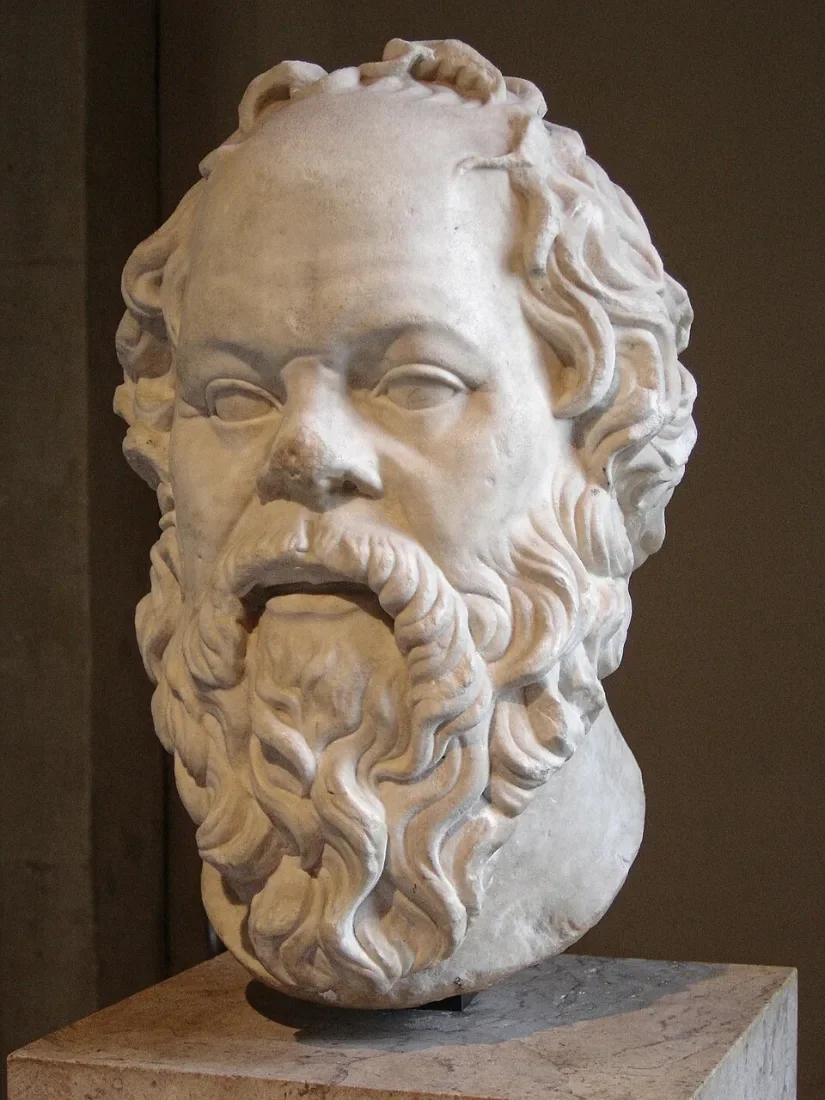
Text and translation
ἰοὺ ἰού· ὦ Ζεῦ βασιλεῦ τὸ χρῆμα τῶν νυκτῶν ὅσον
Aristophanes · Clouds 1–24 · iambic trimeters (comic) · text of Hall and Geldart (Oxford, via Perseus)
How to read each line
A guide to the Greek, syllables, pitch marks and quantities.
Show the reading key
- Above each line: the line as the edition prints it, each word placed over its own syllables. The main row: the same Greek divided into metrical syllables, each written as it is pronounced. A consonant that closes a syllable is written with it (λόθ | ρο); an elided word is closed up with the next vowel (ν’ἀ); a final consonant carried into the next word is set with a thin space (ς ἰ). Wider gaps mark word-ends.
- Above the syllables: the pitch of each syllable, from the accents. Under them: the quantity of each syllable as it falls in the line, then the transliteration, syllable by syllable, with accented syllables in capitals.
- Under each line: a line-for-line translation. In the right margin of the scansion: the line type, its scheme, and its analysis into cola.
Key to the labels
The names, patterns and symbols used beside this poem.
Show the labels and symbols
The labels in the right margin of the scansion below name the line, its scheme, the feet as the line realises them, and the caesurae and diaereses (the named word-ends) that fall in it. In the scheme — is a long position, ⏑ a short one and × an anceps, long or short; the descriptions below say where a long may be resolved into two shorts and where two shorts may stand in place of an anceps or a short.[5] A click on any syllable highlights its metron or colon, or, with the switch, its foot.
| Label | Name and shape | What it is |
|---|---|---|
| xm | Extra metrum× × × × | An exclamation that the edition prints as a line of its own. It stands outside the verse, so no metrical scheme applies. Its syllables are shown with their natural quantities. |
| im1 | First iambic metron× — ⏑ — | Positions 1–4. The anceps may be long or short. Either foot may take the form of an anapaest (⏑ ⏑ —), and either long may be resolved into two shorts. |
| im2 | Second iambic metron× — ⏑ — | Positions 5–8. The caesura usually falls inside it, after position 5 (penthemimeral) or 7 (hephthemimeral); many comic lines divide after position 6, and many have no caesura at all. Either foot may be an anapaest, and either long may be resolved. |
| im3 | Third iambic metron× — ⏑ × | Positions 9–12, the last syllable indifferent (period-end). Comedy ignores Porson’s law. The fifth foot may be an anapaest, and the long at 10 may be resolved even after a long anceps, as it is in most cases. |
Scansion
Strepsiades, sleepless before dawn, curses the war, his snoring slaves and his horse-mad son, and calls for the ledger of his debts. Each comic trimeter is scanned foot by foot, with every resolution and anapaest named, and the opening cry ἰοὺ ἰού shown outside the metre.
Oh dear, oh dear!
O Zeus, king, what a length the nights are!
Endless. Will it never be day?
And yet I heard the cock long ago;
and the slaves are snoring; they would not have, before.
Damn you, war, for many reasons,
since I may not even punish my own slaves.
Nor does this fine young man here
wake up in the night, but farts away
wrapped up in five blankets.
Well, if that's the way, let's snore, wrapped up.
But I can't sleep, poor wretch, bitten
by the expense and the stable and the debts
because of this son of mine here. He wears his hair long,
rides horses and drives a pair,
and dreams of horses; and I am ruined
seeing the moon bring on the twentieths of the month;
for the interest is running. Light a lamp, boy,
and bring out the ledger, so that I can take it and read
how many people I owe money to, and reckon up the interest.
Come, let me see, what do I owe? Twelve minas to Pasias.
Twelve minas to Pasias for what? What did I use them for?
When I bought the koppa-branded horse. Oh, wretch that I am,
I wish I had had my eye knocked out with a stone first!
Metre
- The line. The comic trimeter, × — ⏑ — | × — ⏑ — | × — ⏑ —, with the six features that set it apart from the tragic: lines without caesura, anapaests admitted freely, Porson’s law ignored, the fifth princeps resolved after a long anceps, more frequent resolution, and stop + liquid not lengthening a short syllable unless tragedy is in play.[6] The exclamation ἰοὺ ἰού (1), printed by the editors as a line of its own, stands outside the metre.
- Anapaests. Seventeen anapaests (⏑ ⏑ —) in 23 trimeters, in every foot from the first to the fifth.[7] In line 3 the anapaest of the third foot is “split”: οὐδέποθ’ begins before the foot and ends, with elision, inside it.[8] In lines 21 and 22 the anapaest is formed across τί and the vowel that follows it, with the hiatus after τί that comedy admits.[9]
- Resolution. Ten resolved longs. In line 12 the fifth princeps is resolved after a long anceps (εὕδειν δα-κνό-μενος), the combination West names as comic.[6] Where the shorts belong to two words, the first is a monosyllable (ὁ δέ 14) or an elided word (ἵν’ ἀναγνῶ 19), the comic exception West notes for elision.[8]
- Porson’s law. Ignored, as in all comedy:[10] in lines 6, 12, 17 and 20 a long anceps at position 9 ends a word of more than one syllable.
- Caesura. Line 4 has no caesura; line 16 divides only after the third foot.[11] In lines 13, 14, 23 and 24 the word-end at the caesura place follows a prepositive (καί, τόν), and the sense divides elsewhere.
- Prosody. Correption before a stop + liquid or nasal is the comic norm (οὐδ’ ὁ χρηστός 8, φάτνης 13, λύχνον 18, τὸ γραμματεῖον 19, ἐπριάμην 23);[12] γν makes position in ἀναγνῶ (19).[13] Crasis in κἄκφερε (19); the deictic οὑτοσί (8) and τουτονί (14) with their long -ί.[14]
- Henderson’s text. Hall and Geldart’s text has been compared with J. Henderson’s Loeb edition of 1998: the words and the line numbers of 1–24 are the same, and the two texts differ only in punctuation.[15]
Prosody, line by line
Every syllable, with the reason for its length. Quantities are read from the vowel where the spelling shows it, from the consonants that follow (“position”), from the accent where it tells, and from the metre where nothing else does. Editors’ notes on the text follow in the boxed paragraphs.
- 1
Line 1 · ἰοὺ ἰού·
ἰοὺ ἰού·
ἰοὺἰού·exclamation outside the metre (extra metrum).
- 1 ⏑ἰῐ̓ is short (its length is not shown by the ordinary spelling); the position is anceps.
- 2 —οὺοὺ is a diphthong, long by nature; the next word begins with a vowel and nothing is elided: hiatus; the position is anceps.
- 3 ⏑ἰῐ̓ is short (its length is not shown by the ordinary spelling); the position is anceps.
- 4 ×ού·ού is a diphthong, long by nature; the position is anceps.
Strepsiades speaks. The cry ἰοὺ ἰού is printed by the editors as a line of its own and stands outside the metre, as LSJ notes it sometimes does in the Attic poets, citing this line and A. Ag. 25 (s.v. ἰού); -ού is long, the length of the ι is not shown by the spelling and no source used here gives it, so it is drawn ○, and the hiatus between the two words is the hiatus after exclamations.[13] The ι of ἰοὺ is short (the metre: when ἰοὺ ἰού stands inside a trimeter its second ι fills the short third position, S. OT 1071 and 1182, Phil. 38). Position 1 is anceps, so the metre does not show it; the input marks it short. The ι of ἰού is short (the metre: when ἰοὺ ἰού stands inside a trimeter its second ι fills the short third position, S. OT 1071 and 1182, Phil. 38). Position 3 is anceps, so the metre does not show it; the input marks it short.
- 2
Line 2 · ὦ Ζεῦ βασιλεῦ τὸ χρῆμα τῶν νυκτῶν ὅσον·
ὦ Ζεῦ βασιλεῦ τὸ χρῆμα τῶν νυκτῶν ὅσον·
ὦΖεῦβασιλεῦτὸχρῆματῶννυκτῶνὅσον·penthemimeral caesura; hephthemimeral caesura.
- 1 —ὦὦ is long by nature; the next word begins with the double consonant Ζ: the syllable is closed before it: long by position; the position is anceps.
- 2 —Ζεῦεῦ is a diphthong, long by nature.
- 3 ⏑βαα is short by the metre (position 3 must be short); with its neighbour it splits the short of position 3 into two shorts, making the anapaest that comedy admits.
- 4 ⏑σιι is short by the metre (position 3 must be short); with its neighbour it splits the short of position 3 into two shorts, making the anapaest that comedy admits.
- 5 —λεῦεῦ is a diphthong, long by nature.
- 6 ⏑τὸὸ is short by nature; the next word begins with χρ, a stop + liquid that does not make position here, so the syllable stays short; the position is anceps.
- 7 —χρῆῆ is long by nature.
- 8 ⏑μαα is short by the accent rule: circumflex on the penult requires a short final syllable.
- 9 —τῶνῶ is long by nature; closed by ν: long by position.
- 10 —νυκυ is a vowel of unknown length; closed by κ: long by position; the position is anceps.
- 11 —τῶνῶ is long by nature.
- 12 ⏑ὅὅ is short by nature.
- 13 ×σον·ο is short by nature; closed by ν: long by position; the last position of the line is indifferent (period-end).
Penthemimeral caesura after τὸ (word-end after position 5)[11]; a word also ends at the hephthemimeral place, after χρῆμα. The anceps at position 9 is long (νυκ) and inside the word νυκτῶν. The second foot is an anapaest (⏑ ⏑ —): the short of position 3 is split into two, βα–σι, in βασιλεῦ; comedy admits the anapaest in any of the first five feet.[7] The short monosyllable τὸ stays short before the χρ that begins χρῆμα (Attic correption)[16].
- 3
Line 3 · ἀπέραντον. οὐδέποθ’ ἡμέρα γενήσεται;
ἀπέραντον. οὐδέποθ’ ἡμέρα γενήσεται;
ἀπέραντο.ν οὐδέποθ’ἡμέραγενήσεται;penthemimeral caesura (with elision).
- 1 ⏑ἀἀ is short by the metre (position 1 must be short); with its neighbour it fills the anceps of position 1 with two shorts, making an anapaest (⏑ ⏑ —) of the foot.
- 2 ⏑πέέ is short by nature; with its neighbour it fills the anceps of position 1 with two shorts, making an anapaest (⏑ ⏑ —) of the foot.
- 3 —ρανα is a vowel of unknown length; closed by ν: long by position.
- 4 ⏑το.ο is short by nature.
- 5 —ν οὐοὐ is a diphthong, long by nature; the first consonant belongs to the previous word and is carried over to this vowel.
- 6 ⏑δέέ is short by nature; with its neighbour it fills the anceps of position 5 with two shorts, making an anapaest (⏑ ⏑ —) of the foot.
- 7 ⏑ποο is short by nature; with its neighbour it fills the anceps of position 5 with two shorts, making an anapaest (⏑ ⏑ —) of the foot.
- 8 —θ’ἡἡ is long by nature; the apostrophe marks an elided vowel; the consonant before it joins this syllable.
- 9 ⏑μέέ is short by nature.
- 10 —ραα is long by the metre (position 8 must be long).
- 11 ⏑γεε is short by nature; the position is anceps.
- 12 —νήή is long by nature.
- 13 ⏑σεε is short by nature.
- 14 ×ται;αι is a diphthong, long by nature; the last position of the line is indifferent (period-end).
Penthemimeral caesura after the elided οὐδέποθ’ (word-end after position 5, with elision, which is quite common at the caesura)[10]. The anceps at position 9 is short (γε). The first foot is an anapaest (⏑ ⏑ —): the anceps (position 1) is filled by two shorts, ἀ–πέ, in ἀπέραντον; comedy admits the anapaest in any of the first five feet.[7] The third foot is an anapaest (⏑ ⏑ —): the anceps (position 5) is filled by two shorts, δέ–πο, in οὐδέποθ’ ἡμέρα; it is a “split” anapaest, a word that began before the foot ending inside it, which comedy allows though New Comedy avoids it.[8] Elision: οὐδέποθ’ loses its final vowel before the vowel that begins the next word.[17]
- 4
Line 4 · καὶ μὴν πάλαι γ’ ἀλεκτρυόνος ἤκουσ’ ἐγώ·
καὶ μὴν πάλαι γ’ ἀλεκτρυόνος ἤκουσ’ ἐγώ·
καὶμὴνπάλαιγ’ἀλεκτρυόνος ἤκουσ’ἐγώ·no caesura.
- 1 —καὶαὶ is a diphthong, long by nature; the position is anceps.
- 2 —μὴνὴ is long by nature; closed by ν: long by position.
- 3 ⏑πάά is short by the metre (position 3 must be short).
- 4 —λαιαι is a diphthong, long by nature.
- 5 ⏑γ’ἀᾰ̓ is short (its length is not shown by the ordinary spelling); the apostrophe marks an elided vowel; the consonant before it joins this syllable; the position is anceps.
- 6 —λεκε is short by nature; closed by κ: long by position.
- 7 ⏑τρυυ is short by the metre (position 7 must be short).
- 8 ⏑όό is short by nature; with its neighbour it resolves the long of position 8 into two shorts.
- 9 ⏑νοο is short by nature; with its neighbour it resolves the long of position 8 into two shorts.
- 10 —ς ἤἤ is long by nature; the first consonant belongs to the previous word and is carried over to this vowel; the position is anceps.
- 11 —κουου is a diphthong, long by nature.
- 12 ⏑σ’ἐἐ is short by nature; the apostrophe marks an elided vowel; the consonant before it joins this syllable.
- 13 ×γώ·ώ is long by nature; the last position of the line is indifferent (period-end).
The γ’ after πάλαι is the elided particle γε, joined to the first syllable of ἀλεκτρυόνος. The α of ἀλεκτρυόνος is short.[18] Position 5 is anceps, so the metre does not show it; the input marks it short. The line has no caesura: no word ends after position 5, 6 or 7. Comedy allows this.[10] The anceps at position 9 is long (ς ἤ) and inside the word ἤκουσ’. The fourth princeps (position 8) is resolved into two shorts, ό–νο, both in the word ἀλεκτρυόνος, a word of three or more syllables, as is usual;[8] the fourth foot is a tribrach (⏑ ⏑ ⏑). Elision: γ’, ἤκουσ’ lose their final vowel before the vowel that begins the next word.[17]
- 5
Line 5 · οἱ δ’ οἰκέται ῥέγκουσιν· ἀλλ’ οὐκ ἂν πρὸ τοῦ.
οἱ δ’ οἰκέται ῥέγκουσιν· ἀλλ’ οὐκ ἂν πρὸ τοῦ.
οἱδ’οἰκέταιῥέγκουσι·ν ἀλλ’οὐκἂνπρὸτοῦ.hephthemimeral caesura.
- 1 —οἱοἱ is a diphthong, long by nature; the position is anceps.
- 2 —δ’οἰοἰ is a diphthong, long by nature; the apostrophe marks an elided vowel; the consonant before it joins this syllable.
- 3 ⏑κέέ is short by nature.
- 4 —ταιαι is a diphthong, long by nature.
- 5 —ῥέγέ is short by nature; closed by γ: long by position; the position is anceps.
- 6 —κουου is a diphthong, long by nature.
- 7 ⏑σι·ι is short by the accent rule: acute on the antepenult requires a short final syllable.
- 8 —ν ἀλἀ is a vowel of unknown length; closed by λ: long by position; the first consonant belongs to the previous word and is carried over to this vowel.
- 9 —λ’οὐκοὐ is a diphthong, long by nature; the apostrophe marks an elided vowel; the consonant before it joins this syllable; the position is anceps.
- 10 —ἂνἂ is a vowel of unknown length; closed by ν: long by position.
- 11 ⏑πρὸὸ is short by nature.
- 12 ×τοῦ.οῦ is a diphthong, long by nature; the last position of the line is indifferent (period-end).
No word ends after position 5, so the caesura is hephthemimeral, after ῥέγκουσιν (word-end after position 7)[11]. The anceps at position 9 is the long monosyllable οὐκ, which Porson’s law allows.[11] Elision: δ’, ἀλλ’ lose their final vowel before the vowel that begins the next word.[17]
- 6
Line 6 · ἀπόλοιο δῆτ’ ὦ πόλεμε πολλῶν οὕνεκα,
ἀπόλοιο δῆτ’ ὦ πόλεμε πολλῶν οὕνεκα,
ἀπόλοιοδῆτ’ὦπόλεμεπολλῶνοὕνεκα,penthemimeral caesura; hephthemimeral caesura.
- 1 ⏑ἀἀ is short by the metre (position 1 must be short); with its neighbour it fills the anceps of position 1 with two shorts, making an anapaest (⏑ ⏑ —) of the foot.
- 2 ⏑πόό is short by nature; with its neighbour it fills the anceps of position 1 with two shorts, making an anapaest (⏑ ⏑ —) of the foot.
- 3 —λοιοι is a diphthong, long by nature.
- 4 ⏑οο is short by nature.
- 5 —δῆῆ is long by nature.
- 6 —τ’ὦὦ is long by nature; the apostrophe marks an elided vowel; the consonant before it joins this syllable; the position is anceps.
- 7 ⏑πόό is short by nature; with its neighbour it resolves the long of position 6 into two shorts.
- 8 ⏑λεε is short by nature; with its neighbour it resolves the long of position 6 into two shorts.
- 9 ⏑μεε is short by nature.
- 10 —πολο is short by nature; closed by λ: long by position.
- 11 —λῶνῶ is long by nature; the position is anceps.
- 12 —οὕοὕ is a diphthong, long by nature.
- 13 ⏑νεε is short by nature.
- 14 ×κα,α is short by the accent rule: acute on the antepenult requires a short final syllable; the last position of the line is indifferent (period-end): a short syllable here is brevis in longo.[19]
Penthemimeral caesura after ὦ (word-end after position 5)[11]; a word also ends at the hephthemimeral place, after πόλεμε. The long anceps at position 9, λῶν, ends the word πολλῶν: tragedy would avoid this (Porson’s law), but comedy ignores the law.[10] The first foot is an anapaest (⏑ ⏑ —): the anceps (position 1) is filled by two shorts, ἀ–πό, in ἀπόλοιο; comedy admits the anapaest in any of the first five feet.[7] The third princeps (position 6) is resolved into two shorts, πό–λε, both in the word πόλεμε, a word of three or more syllables, as is usual;[8] the third foot is a dactyl (— ⏑ ⏑). Elision: δῆτ’ loses its final vowel before the vowel that begins the next word.[17] The last syllable, κα, is short: brevis in longo, allowed at the period-end that closes every line.[19]
- 7
Line 7 · ὅτ’ οὐδὲ κολάσ’ ἔξεστί μοι τοὺς οἰκέτας.
ὅτ’ οὐδὲ κολάσ’ ἔξεστί μοι τοὺς οἰκέτας.
ὅτ’οὐδὲκολάσ’ἔξεστίμοιτοὺςοἰκέτας.hephthemimeral caesura.
- 1 ⏑ὅὅ is short by nature; the position is anceps.
- 2 —τ’οὐοὐ is a diphthong, long by nature; the apostrophe marks an elided vowel; the consonant before it joins this syllable.
- 3 ⏑δὲὲ is short by nature.
- 4 ⏑κοο is short by nature; with its neighbour it resolves the long of position 4 into two shorts.
- 5 ⏑λάά is short by the metre (position 4 must be short); with its neighbour it resolves the long of position 4 into two shorts.
- 6 —σ’ἔἔ is short by nature; ξ is a double consonant (two sounds) and closes the syllable: long by position; the apostrophe marks an elided vowel; the consonant before it joins this syllable; the position is anceps.
- 7 —ξεσε is short by nature; closed by σ: long by position.
- 8 ⏑τίί is short by the accent rule: acute on the antepenult requires a short final syllable.
- 9 —μοιοι is a diphthong, long by nature.
- 10 —τοὺςοὺ is a diphthong, long by nature; the position is anceps.
- 11 —οἰοἰ is a diphthong, long by nature.
- 12 ⏑κέέ is short by nature.
- 13 ×τας.α is a vowel of unknown length; closed by ς: long by position; the last position of the line is indifferent (period-end).
No word ends after position 5, so the caesura is hephthemimeral, after ἔξεστί (word-end after position 7)[11]. The anceps at position 9 is the long monosyllable τοὺς, which Porson’s law allows.[11] The second princeps (position 4) is resolved into two shorts, κο–λά, both in the elided word κολάσ’; the second foot is a tribrach (⏑ ⏑ ⏑). Elision: ὅτ’, κολάσ’ lose their final vowel before the vowel that begins the next word.[17]
- 8
Line 8 · ἀλλ’ οὐδ’ ὁ χρηστὸς οὑτοσὶ νεανίας
ἀλλ’ οὐδ’ ὁ χρηστὸς οὑτοσὶ νεανίας
ἀλλ’οὐδ’ὁχρηστὸς οὑτοσὶνεανίαςpenthemimeral caesura.
- 1 —ἀλἀ is a vowel of unknown length; closed by λ: long by position; the position is anceps.
- 2 —λ’οὐοὐ is a diphthong, long by nature; the apostrophe marks an elided vowel; the consonant before it joins this syllable.
- 3 ⏑δ’ὁὁ is short by nature; the next word begins with χρ, a stop + liquid that does not make position here, so the syllable stays short; the apostrophe marks an elided vowel; the consonant before it joins this syllable.
- 4 —χρηση is long by nature; closed by σ: long by position.
- 5 ⏑τὸὸ is short by nature; the position is anceps.
- 6 —ς οὑοὑ is a diphthong, long by nature; the first consonant belongs to the previous word and is carried over to this vowel.
- 7 ⏑τοο is short by nature.
- 8 —σὶὶ is long by the metre (position 8 must be long).
- 9 ⏑νεε is short by nature; the position is anceps.
- 10 —αα is long by the metre (position 10 must be long).
- 11 ⏑νίί is short by the metre (position 11 must be short).
- 12 ×αςα is a vowel of unknown length; closed by ς: long by position; the last position of the line is indifferent (period-end).
Penthemimeral caesura after χρηστὸς (word-end after position 5)[11]. The anceps at position 9 is short (νε). The short monosyllable ὁ stays short before the χρ that begins χρηστὸς (Attic correption)[16]. Elision: ἀλλ’, οὐδ’ lose their final vowel before the vowel that begins the next word.[17]
- 9
Line 9 · ἐγείρεται τῆς νυκτός, ἀλλὰ πέρδεται
ἐγείρεται τῆς νυκτός, ἀλλὰ πέρδεται
ἐγείρεταιτῆςνυκτό,ς ἀλλὰπέρδεταιpenthemimeral caesura; hephthemimeral caesura.
- 1 ⏑ἐἐ is short by nature; the position is anceps.
- 2 —γείεί is a diphthong, long by nature.
- 3 ⏑ρεε is short by nature.
- 4 —ταιαι is a diphthong, long by nature.
- 5 —τῆςῆ is long by nature; closed by ς: long by position; the position is anceps.
- 6 —νυκυ is a vowel of unknown length; closed by κ: long by position.
- 7 ⏑τό,ό is short by nature.
- 8 —ς ἀλἀ is a vowel of unknown length; closed by λ: long by position; the first consonant belongs to the previous word and is carried over to this vowel.
- 9 ⏑λὰᾰ̀ is short (its length is not shown by the ordinary spelling); the position is anceps.
- 10 —πέρέ is short by nature; closed by ρ: long by position.
- 11 ⏑δεε is short by nature.
- 12 ×ταιαι is a diphthong, long by nature; the last position of the line is indifferent (period-end).
The α of ἀλλὰ is short (the metre: ἀλλά fills the short third position of the trimeter at E. Alc. 50 and the seventh at Alc. 207). Position 9 is anceps, so the metre does not show it; the input marks it short. Penthemimeral caesura after τῆς (word-end after position 5)[11]; a word also ends at the hephthemimeral place, after νυκτός.
- 10
Line 10 · ἐν πέντε σισύραις ἐγκεκορδυλημένος.
ἐν πέντε σισύραις ἐγκεκορδυλημένος.
ἐνπέντεσισύραιςἐγκεκορδυλημένος.penthemimeral caesura.
- 1 —ἐνἐ is short by nature; closed by ν: long by position; the position is anceps.
- 2 —πένέ is short by nature; closed by ν: long by position.
- 3 ⏑τεε is short by nature.
- 4 ⏑σιι is short by the metre (position 4 must be short); with its neighbour it resolves the long of position 4 into two shorts.
- 5 ⏑σύύ is short by the metre (position 4 must be short); with its neighbour it resolves the long of position 4 into two shorts.
- 6 —ραιςαι is a diphthong, long by nature; the position is anceps.
- 7 —ἐγἐ is short by nature; closed by γ: long by position.
- 8 ⏑κεε is short by nature.
- 9 —κορο is short by nature; closed by ρ: long by position.
- 10 ⏑δυῠ is short (its length is not shown by the ordinary spelling); the position is anceps.
- 11 —ληη is long by nature.
- 12 ⏑μέέ is short by nature.
- 13 ×νος.ο is short by nature; closed by ς: long by position; the last position of the line is indifferent (period-end).
The υ of ἐγκεκορδυλημένος is short.[20] Position 9 is anceps, so the metre does not show it; the input marks it short. Penthemimeral caesura after σισύραις (word-end after position 5)[11]. The second princeps (position 4) is resolved into two shorts, σι–σύ, both in the word σισύραις, a word of three or more syllables, as is usual;[8] the second foot is a tribrach (⏑ ⏑ ⏑).
- 11
Line 11 · ἀλλ’ εἰ δοκεῖ ῥέγκωμεν ἐγκεκαλυμμένοι.
ἀλλ’ εἰ δοκεῖ ῥέγκωμεν ἐγκεκαλυμμένοι.
ἀλλ’εἰδοκεῖῥέγκωμεν ἐγκεκαλυμμένοι.hephthemimeral caesura.
- 1 —ἀλἀ is a vowel of unknown length; closed by λ: long by position; the position is anceps.
- 2 —λ’εἰεἰ is a diphthong, long by nature; the apostrophe marks an elided vowel; the consonant before it joins this syllable.
- 3 ⏑δοο is short by nature.
- 4 —κεῖεῖ is a diphthong, long by nature.
- 5 —ῥέγέ is short by nature; closed by γ: long by position; the position is anceps.
- 6 —κωω is long by nature.
- 7 ⏑μεε is short by nature.
- 8 —ν ἐγἐ is short by nature; closed by γ: long by position; the first consonant belongs to the previous word and is carried over to this vowel.
- 9 ⏑κεε is short by nature; with its neighbour it fills the anceps of position 9 with two shorts, making an anapaest (⏑ ⏑ —) of the foot.
- 10 ⏑καα is short by the metre (position 9 must be short); with its neighbour it fills the anceps of position 9 with two shorts, making an anapaest (⏑ ⏑ —) of the foot.
- 11 —λυμυ is a vowel of unknown length; closed by μ: long by position.
- 12 ⏑μέέ is short by nature.
- 13 ×νοι.οι is a diphthong, long by nature; the last position of the line is indifferent (period-end).
No word ends after position 5, so the caesura is hephthemimeral, after ῥέγκωμεν (word-end after position 7)[11]. The fifth foot is an anapaest (⏑ ⏑ —): the anceps (position 9) is filled by two shorts, κε–κα, in ἐγκεκαλυμμένοι; comedy admits the anapaest in any of the first five feet.[7] Elision: ἀλλ’ loses its final vowel before the vowel that begins the next word.[17]
- 12
Line 12 · ἀλλ’ οὐ δύναμαι δείλαιος εὕδειν δακνόμενος
ἀλλ’ οὐ δύναμαι δείλαιος εὕδειν δακνόμενος
ἀλλ’οὐδύναμαιδείλαιος εὕδεινδακνόμενοςhephthemimeral caesura.
- 1 —ἀλἀ is a vowel of unknown length; closed by λ: long by position; the position is anceps.
- 2 —λ’οὐοὐ is a diphthong, long by nature; the apostrophe marks an elided vowel; the consonant before it joins this syllable.
- 3 ⏑δύύ is short by the metre (position 3 must be short); with its neighbour it splits the short of position 3 into two shorts, making the anapaest that comedy admits.
- 4 ⏑ναα is short by the metre (position 3 must be short); with its neighbour it splits the short of position 3 into two shorts, making the anapaest that comedy admits.
- 5 —μαιαι is a diphthong, long by nature.
- 6 —δείεί is a diphthong, long by nature; the position is anceps.
- 7 —λαιαι is a diphthong, long by nature.
- 8 ⏑οο is short by nature.
- 9 —ς εὕεὕ is a diphthong, long by nature; the first consonant belongs to the previous word and is carried over to this vowel.
- 10 —δεινει is a diphthong, long by nature; closed by ν: long by position; the position is anceps.
- 11 ⏑δαα is a vowel of unknown length; κν is carried whole into the next syllable, so this syllable stays open and short (Attic correption of a stop + nasal cluster); with its neighbour it resolves the long of position 10 into two shorts.
- 12 ⏑κνόό is short by nature; with its neighbour it resolves the long of position 10 into two shorts.
- 13 ⏑μεε is short by nature.
- 14 ×νοςο is short by nature; closed by ς: long by position; the last position of the line is indifferent (period-end).
No word ends after position 5, so the caesura is hephthemimeral, after δείλαιος (word-end after position 7)[11]. The long anceps at position 9, δειν, ends the word εὕδειν: tragedy would avoid this (Porson’s law), but comedy ignores the law.[10] The second foot is an anapaest (⏑ ⏑ —): the short of position 3 is split into two, δύ–να, in δύναμαι; comedy admits the anapaest in any of the first five feet.[7] The fifth princeps (position 10) is resolved into two shorts, δα–κνό, both in the word δακνόμενος, a word of three or more syllables, as is usual;[8] the fifth foot is a dactyl (— ⏑ ⏑). The anceps before it (position 9) is long: comedy, unlike tragedy, combines a resolved fifth princeps with a long anceps, and in most cases does so.[6] In δακνόμενος the κν goes whole with the next syllable, so δα stays short (Attic correption)[16]. Elision: ἀλλ’ loses its final vowel before the vowel that begins the next word.[17]
- 13
Line 13 · ὑπὸ τῆς δαπάνης καὶ τῆς φάτνης καὶ τῶν χρεῶν
ὑπὸ τῆς δαπάνης καὶ τῆς φάτνης καὶ τῶν χρεῶν
ὑπὸτῆςδαπάνηςκαὶτῆςφάτνηςκαὶτῶνχρεῶνpenthemimeral caesura.
- 1 ⏑ὑὑ is short by the metre (position 1 must be short); with its neighbour it fills the anceps of position 1 with two shorts, making an anapaest (⏑ ⏑ —) of the foot.
- 2 ⏑πὸὸ is short by nature; with its neighbour it fills the anceps of position 1 with two shorts, making an anapaest (⏑ ⏑ —) of the foot.
- 3 —τῆςῆ is long by nature; closed by ς: long by position.
- 4 ⏑δαα is short by the metre (position 3 must be short); with its neighbour it splits the short of position 3 into two shorts, making the anapaest that comedy admits.
- 5 ⏑πάά is short by the metre (position 3 must be short); with its neighbour it splits the short of position 3 into two shorts, making the anapaest that comedy admits.
- 6 —νηςη is long by nature; closed by ς: long by position.
- 7 —καὶαὶ is a diphthong, long by nature; the position is anceps.
- 8 —τῆςῆ is long by nature; closed by ς: long by position.
- 9 ⏑φάᾰ́ is short (its length is not shown by the ordinary spelling); τν is carried whole into the next syllable, so this syllable stays open and short (Attic correption of a stop + nasal cluster).
- 10 —τνηςη is long by nature; closed by ς: long by position.
- 11 —καὶαὶ is a diphthong, long by nature; the position is anceps.
- 12 —τῶνῶ is long by nature; closed by ν: long by position.
- 13 ⏑χρεε is short by nature.
- 14 ×ῶνῶ is long by nature; closed by ν: long by position; the last position of the line is indifferent (period-end).
Words end after position 5 and after position 6, but the words are καί and the article τῆς, both prepositives,[21] and nothing ends after position 7; the line is built of three short phrases, “the expense, the stable, the debts”, with no true caesura, which comedy allows.[11] The α of φάτνης is short (the metre: φάτναισι is a short syllable in the third position of the trimeter at E. Hipp. 1240). The metre agrees (position 7 must be short); the input marks it short. The anceps at position 9 is the long monosyllable καὶ, which Porson’s law allows.[11] The first foot is an anapaest (⏑ ⏑ —): the anceps (position 1) is filled by two shorts, ὑ–πὸ, in ὑπὸ τῆς; comedy admits the anapaest in any of the first five feet.[7] The second foot is an anapaest (⏑ ⏑ —): the short of position 3 is split into two, δα–πά, in δαπάνης; comedy admits the anapaest in any of the first five feet.[7] In φάτνης the τν goes whole with the next syllable, so φά stays short (Attic correption)[16].
- 14
Line 14 · διὰ τουτονὶ τὸν υἱόν. ὁ δὲ κόμην ἔχων
διὰ τουτονὶ τὸν υἱόν. ὁ δὲ κόμην ἔχων
διὰτουτονὶτὸν υἱό.ν ὁδὲκόμηνἔχωνpenthemimeral caesura; hephthemimeral caesura.
- 1 ⏑διι is short by the metre (position 1 must be short); with its neighbour it fills the anceps of position 1 with two shorts, making an anapaest (⏑ ⏑ —) of the foot.
- 2 ⏑ὰὰ is short by the metre (position 1 must be short); with its neighbour it fills the anceps of position 1 with two shorts, making an anapaest (⏑ ⏑ —) of the foot.
- 3 —τουου is a diphthong, long by nature.
- 4 ⏑τοο is short by nature.
- 5 —νὶὶ is long by the metre (position 4 must be long).
- 6 ⏑τὸὸ is short by nature; the position is anceps.
- 7 —ν υἱυἱ is a diphthong, long by nature; the first consonant belongs to the previous word and is carried over to this vowel.
- 8 ⏑ό.ό is short by nature.
- 9 ⏑ν ὁὁ is short by nature; the first consonant belongs to the previous word and is carried over to this vowel; with its neighbour it resolves the long of position 8 into two shorts.
- 10 ⏑δὲὲ is short by nature; with its neighbour it resolves the long of position 8 into two shorts.
- 11 ⏑κόό is short by nature; the position is anceps.
- 12 —μηνη is long by nature.
- 13 ⏑ἔἔ is short by nature.
- 14 ×χωνω is long by nature; closed by ν: long by position; the last position of the line is indifferent (period-end).
A word ends after position 5, but it is the article τόν, a prepositive;[21] the sense divides after υἱόν, at position 7, the hephthemimeral place. The anceps at position 9 is short (κό). The first foot is an anapaest (⏑ ⏑ —): the anceps (position 1) is filled by two shorts, δι–ὰ, in διὰ τουτονὶ; comedy admits the anapaest in any of the first five feet.[7] The fourth princeps (position 8) is resolved into two shorts, ν ὁ–δὲ, which belong to two words, ὁ and δὲ; West 1987, p. 26 notes that in this case the first word is normally a monosyllable or at most a disyllable, closely linked with the second by phrasing; the fourth foot is a tribrach (⏑ ⏑ ⏑).
- 15
Line 15 · ἱππάζεταί τε καὶ ξυνωρικεύεται
ἱππάζεταί τε καὶ ξυνωρικεύεται
ἱππάζεταίτεκαὶξυνωρικεύεταιpenthemimeral caesura.
- 1 —ἱπἱ is a vowel of unknown length; closed by π: long by position; the position is anceps.
- 2 —πάζ is a double consonant (two sounds) and closes the syllable: long by position.
- 3 ⏑ζεε is short by nature.
- 4 —ταίαί is a diphthong, long by nature.
- 5 ⏑τεε is short by nature; the position is anceps.
- 6 —καὶαὶ is a diphthong, long by nature; the next word begins with the double consonant ξ: the syllable is closed before it: long by position.
- 7 ⏑ξυυ is short by the metre (position 7 must be short).
- 8 —νωω is long by nature.
- 9 ⏑ριῐ is short (its length is not shown by the ordinary spelling); the position is anceps.
- 10 —κεύεύ is a diphthong, long by nature.
- 11 ⏑εε is short by nature.
- 12 ×ταιαι is a diphthong, long by nature; the last position of the line is indifferent (period-end).
- 16
Line 16 · ὀνειροπολεῖ θ’ ἵππους· ἐγὼ δ’ ἀπόλλυμαι
ὀνειροπολεῖ θ’ ἵππους· ἐγὼ δ’ ἀπόλλυμαι
ὀνειροπολεῖθ’ἵππους·ἐγὼδ’ἀπόλλυμαιcaesura after the third foot (medial).
- 1 ⏑ὀὀ is short by nature; the position is anceps.
- 2 —νειει is a diphthong, long by nature.
- 3 ⏑ροο is short by nature; with its neighbour it splits the short of position 3 into two shorts, making the anapaest that comedy admits.
- 4 ⏑ποο is short by nature; with its neighbour it splits the short of position 3 into two shorts, making the anapaest that comedy admits.
- 5 —λεῖεῖ is a diphthong, long by nature.
- 6 —θ’ἵπἵ is a vowel of unknown length; closed by π: long by position; the apostrophe marks an elided vowel; the consonant before it joins this syllable; the position is anceps.
- 7 —πους·ου is a diphthong, long by nature.
- 8 ⏑ἐἐ is short by nature.
- 9 —γὼὼ is long by nature.
- 10 ⏑δ’ἀᾰ̓ is short (its length is not shown by the ordinary spelling); the apostrophe marks an elided vowel; the consonant before it joins this syllable; the position is anceps.
- 11 —πόλό is short by nature; closed by λ: long by position.
- 12 ⏑λυυ is short by the metre (position 11 must be short).
- 13 ×μαιαι is a diphthong, long by nature; the last position of the line is indifferent (period-end).
The α of ἀπόλλυμαι is short.[23] Position 9 is anceps, so the metre does not show it; the input marks it short. There is no word-end after position 5 or 7; the line divides after the third foot, after ἵππους. Many comic lines have their caesura here.[11] The second foot is an anapaest (⏑ ⏑ —): the short of position 3 is split into two, ρο–πο, in ὀνειροπολεῖ; comedy admits the anapaest in any of the first five feet.[7] Elision: θ’, δ’ lose their final vowel before the vowel that begins the next word.[17]
- 17
Line 17 · ὁρῶν ἄγουσαν τὴν σελήνην εἰκάδας·
ὁρῶν ἄγουσαν τὴν σελήνην εἰκάδας·
ὁρῶνἄγουσαντὴνσελήνηνεἰκάδας·penthemimeral caesura.
- 1 ⏑ὁὁ is short by nature; the position is anceps.
- 2 —ρῶνῶ is long by nature.
- 3 ⏑ἄἄ is short by the metre (position 3 must be short).
- 4 —γουου is a diphthong, long by nature.
- 5 —σανα is a vowel of unknown length; closed by ν: long by position; the position is anceps.
- 6 —τὴνὴ is long by nature; closed by ν: long by position.
- 7 ⏑σεε is short by nature.
- 8 —λήή is long by nature.
- 9 —νηνη is long by nature; the position is anceps.
- 10 —εἰεἰ is a diphthong, long by nature.
- 11 ⏑κάά is short by the metre (position 11 must be short).
- 12 ×δας·α is a vowel of unknown length; closed by ς: long by position; the last position of the line is indifferent (period-end).
- 18
Line 18 · οἱ γὰρ τόκοι χωροῦσιν. ἅπτε παῖ λύχνον,
οἱ γὰρ τόκοι χωροῦσιν. ἅπτε παῖ λύχνον,
οἱγὰρτόκοιχωροῦσι.ν ἅπτεπαῖλύχνον,hephthemimeral caesura.
- 1 —οἱοἱ is a diphthong, long by nature; the position is anceps.
- 2 —γὰρὰ is a vowel of unknown length; closed by ρ: long by position.
- 3 ⏑τόό is short by nature.
- 4 —κοιοι is a diphthong, long by nature.
- 5 —χωω is long by nature; the position is anceps.
- 6 —ροῦοῦ is a diphthong, long by nature.
- 7 ⏑σι.ι is short by the accent rule: circumflex on the penult requires a short final syllable.
- 8 —ν ἅπἅ is a vowel of unknown length; closed by π: long by position; the first consonant belongs to the previous word and is carried over to this vowel.
- 9 ⏑τεε is short by nature; the position is anceps.
- 10 —παῖαῖ is a diphthong, long by nature.
- 11 ⏑λύύ is a vowel of unknown length; χν is carried whole into the next syllable, so this syllable stays open and short (Attic correption of a stop + nasal cluster).
- 12 ×χνον,ο is short by nature; closed by ν: long by position; the last position of the line is indifferent (period-end).
- 19
Line 19 · κἄκφερε τὸ γραμματεῖον, ἵν’ ἀναγνῶ λαβὼν
κἄκφερε τὸ γραμματεῖον, ἵν’ ἀναγνῶ λαβὼν
κἄκφερετὸγραμματεῖο,ν ἵν’ἀναγνῶλαβὼνhephthemimeral caesura.
- 1 —κἄκἄ is a vowel of unknown length; closed by κ: long by position; the position is anceps.
- 2 ⏑φεε is short by nature; with its neighbour it resolves the long of position 2 into two shorts.
- 3 ⏑ρεε is short by nature; with its neighbour it resolves the long of position 2 into two shorts.
- 4 ⏑τὸὸ is short by nature; the next word begins with γρ, a stop + liquid that does not make position here, so the syllable stays short.
- 5 —γραμα is a vowel of unknown length; closed by μ: long by position.
- 6 ⏑μαᾰ is short (its length is not shown by the ordinary spelling); the position is anceps.
- 7 —τεῖεῖ is a diphthong, long by nature.
- 8 ⏑ο,ο is short by nature.
- 9 ⏑ν ἵἵ is short by the metre (position 8 must be short); the first consonant belongs to the previous word and is carried over to this vowel; with its neighbour it resolves the long of position 8 into two shorts.
- 10 ⏑ν’ἀἀ is short by the metre (position 8 must be short); the apostrophe marks an elided vowel; the consonant before it joins this syllable; with its neighbour it resolves the long of position 8 into two shorts.
- 11 —ναγα is a vowel of unknown length; closed by γ: long by position; γν is one of the four clusters (γμ, γν, δμ, δν) that never leave the syllable before them short;[13] the position is anceps.
- 12 —νῶῶ is long by nature.
- 13 ⏑λαα is short by the metre (position 11 must be short).
- 14 ×βὼνὼ is long by nature; closed by ν: long by position; the last position of the line is indifferent (period-end).
The resolved fourth princeps is split between the elided ἵν’ (ἵνα) and the first syllable of ἀναγνῶ: West 1987, p. 26 notes that comedy admits shorts from different words where there is elision. The α of γραμματεῖον is short.[24] Position 5 is anceps, so the metre does not show it; the input marks it short. No word ends after position 5, so the caesura is hephthemimeral, after γραμματεῖον (word-end after position 7)[11]. The anceps at position 9 is long (ναγ) and inside the word ἀναγνῶ. The first princeps (position 2) is resolved into two shorts, φε–ρε, both in the word κἄκφερε, a word of three or more syllables, as is usual;[8] the first foot is a dactyl (— ⏑ ⏑). The fourth princeps (position 8) is resolved into two shorts, ν ἵ–ν’ἀ, which belong to two words, ἵν’ and ἀναγνῶ; West 1987, p. 26 notes that in this case the first word is normally a monosyllable or at most a disyllable, closely linked with the second by phrasing; the fourth foot is a tribrach (⏑ ⏑ ⏑). The short monosyllable τὸ stays short before the γρ that begins γραμματεῖον (Attic correption)[16]. In ἀναγνῶ the γν makes position, as γμ, γν, δμ, δν always do.[13] Elision: ἵν’ loses its final vowel before the vowel that begins the next word.[17] Crasis: κἄκφερε is καὶ ἔκφερε run together into one word, the merged vowel long.[25]
- 20
Line 20 · ὁπόσοις ὀφείλω καὶ λογίσωμαι τοὺς τόκους.
ὁπόσοις ὀφείλω καὶ λογίσωμαι τοὺς τόκους.
ὁπόσοιςὀφείλωκαὶλογίσωμαιτοὺςτόκους.penthemimeral caesura.
- 1 ⏑ὁὁ is short by nature; with its neighbour it fills the anceps of position 1 with two shorts, making an anapaest (⏑ ⏑ —) of the foot.
- 2 ⏑πόό is short by nature; with its neighbour it fills the anceps of position 1 with two shorts, making an anapaest (⏑ ⏑ —) of the foot.
- 3 —σοιςοι is a diphthong, long by nature.
- 4 ⏑ὀὀ is short by nature.
- 5 —φείεί is a diphthong, long by nature.
- 6 —λωω is long by nature; the position is anceps.
- 7 —καὶαὶ is a diphthong, long by nature.
- 8 ⏑λοο is short by nature; with its neighbour it splits the short of position 7 into two shorts, making the anapaest that comedy admits.
- 9 ⏑γίί is short by the metre (position 7 must be short); with its neighbour it splits the short of position 7 into two shorts, making the anapaest that comedy admits.
- 10 —σωω is long by nature.
- 11 —μαιαι is a diphthong, long by nature; the position is anceps.
- 12 —τοὺςοὺ is a diphthong, long by nature; closed by ς: long by position.
- 13 ⏑τόό is short by nature.
- 14 ×κους.ου is a diphthong, long by nature; closed by ς: long by position; the last position of the line is indifferent (period-end).
Penthemimeral caesura after ὀφείλω (word-end after position 5)[11]. The long anceps at position 9, μαι, ends the word λογίσωμαι: tragedy would avoid this (Porson’s law), but comedy ignores the law.[10] The first foot is an anapaest (⏑ ⏑ —): the anceps (position 1) is filled by two shorts, ὁ–πό, in ὁπόσοις; comedy admits the anapaest in any of the first five feet.[7] The fourth foot is an anapaest (⏑ ⏑ —): the short of position 7 is split into two, λο–γί, in λογίσωμαι; comedy admits the anapaest in any of the first five feet.[7]
- 21
Line 21 · φέρ’ ἴδω τί ὀφείλω; δώδεκα μνᾶς Πασίᾳ.
φέρ’ ἴδω τί ὀφείλω; δώδεκα μνᾶς Πασίᾳ.
φέρ’ἴδωτίὀφείλω;δώδεκαμνᾶςΠασίᾳ.penthemimeral caesura.
- 1 ⏑φέέ is short by nature; with its neighbour it fills the anceps of position 1 with two shorts, making an anapaest (⏑ ⏑ —) of the foot.
- 2 ⏑ρ’ἴἴ is short by the metre (position 1 must be short); the apostrophe marks an elided vowel; the consonant before it joins this syllable; with its neighbour it fills the anceps of position 1 with two shorts, making an anapaest (⏑ ⏑ —) of the foot.
- 3 —δωω is long by nature.
- 4 ⏑τίί is short by the metre (position 3 must be short); the next word begins with a vowel and nothing is elided: hiatus; with its neighbour it splits the short of position 3 into two shorts, making the anapaest that comedy admits.
- 5 ⏑ὀὀ is short by nature; with its neighbour it splits the short of position 3 into two shorts, making the anapaest that comedy admits.
- 6 —φείεί is a diphthong, long by nature.
- 7 —λω;ω is long by nature; the position is anceps.
- 8 —δώώ is long by nature.
- 9 ⏑δεε is short by nature.
- 10 —καthe next word begins with μν: the syllable is closed before it: long by position.
- 11 —μνᾶςᾶ carries a circumflex, so it is long; closed by ς: long by position; the position is anceps.
- 12 —Παα is long by the metre (position 10 must be long).
- 13 ⏑σίί is short by the metre (position 11 must be short).
- 14 ×ᾳ.ᾳ is long by nature; the last position of the line is indifferent (period-end).
τί keeps its vowel before ὀφείλω: τί is not elided,[17] and comedy admits hiatus after it.[9] Penthemimeral caesura after ὀφείλω (word-end after position 5)[11]. The anceps at position 9 is the long monosyllable μνᾶς, which Porson’s law allows.[11] The first foot is an anapaest (⏑ ⏑ —): the anceps (position 1) is filled by two shorts, φέ–ρ’ἴ, in φέρ’ ἴδω; comedy admits the anapaest in any of the first five feet.[7] The second foot is an anapaest (⏑ ⏑ —): the short of position 3 is split into two, τί–ὀ, in τί ὀφείλω; comedy admits the anapaest in any of the first five feet.[7] Elision: φέρ’ loses its final vowel before the vowel that begins the next word.[17]
- 22
Line 22 · τοῦ δώδεκα μνᾶς Πασίᾳ; τί ἐχρησάμην;
τοῦ δώδεκα μνᾶς Πασίᾳ; τί ἐχρησάμην;
τοῦδώδεκαμνᾶςΠασίᾳ;τίἐχρησάμην;penthemimeral caesura.
- 1 —τοῦοῦ is a diphthong, long by nature; the position is anceps.
- 2 —δώώ is long by nature.
- 3 ⏑δεε is short by nature.
- 4 —καthe next word begins with μν: the syllable is closed before it: long by position.
- 5 —μνᾶςᾶ carries a circumflex, so it is long; closed by ς: long by position; the position is anceps.
- 6 —Παα is long by the metre (position 6 must be long).
- 7 ⏑σίί is short by the metre (position 7 must be short).
- 8 —ᾳ;ᾳ is long by nature.
- 9 ⏑τίί is short by the metre (position 9 must be short); the next word begins with a vowel and nothing is elided: hiatus; with its neighbour it fills the anceps of position 9 with two shorts, making an anapaest (⏑ ⏑ —) of the foot.
- 10 ⏑ἐἐ is short by nature; χρ is carried whole into the next syllable, so this syllable stays open and short (Attic correption of a stop + liquid cluster); with its neighbour it fills the anceps of position 9 with two shorts, making an anapaest (⏑ ⏑ —) of the foot.
- 11 —χρηη is long by nature.
- 12 ⏑σάά is short by the metre (position 11 must be short).
- 13 ×μην;η is long by nature; closed by ν: long by position; the last position of the line is indifferent (period-end).
τί again stands in hiatus before ἐχρησάμην,[9] and the ἐ- of ἐχρησάμην stays short before χρ. Penthemimeral caesura after μνᾶς (word-end after position 5)[11]. The fifth foot is an anapaest (⏑ ⏑ —): the anceps (position 9) is filled by two shorts, τί–ἐ, in τί ἐχρησάμην; comedy admits the anapaest in any of the first five feet.[7] In ἐχρησάμην the χρ goes whole with the next syllable, so ἐ stays short (Attic correption)[16].
- 23
Line 23 · ὅτ’ ἐπριάμην τὸν κοππατίαν. οἴμοι τάλας,
ὅτ’ ἐπριάμην τὸν κοππατίαν. οἴμοι τάλας,
ὅτ’ἐπριάμηντὸνκοππατία.ν οἴμοιτάλας,penthemimeral caesura.
- 1 ⏑ὅὅ is short by nature; the position is anceps.
- 2 ⏑τ’ἐἐ is short by nature; πρ is carried whole into the next syllable, so this syllable stays open and short (Attic correption of a stop + liquid cluster); the apostrophe marks an elided vowel; the consonant before it joins this syllable; with its neighbour it resolves the long of position 2 into two shorts.
- 3 ⏑πριι is short by the metre (position 2 must be short); with its neighbour it resolves the long of position 2 into two shorts.
- 4 ⏑άά is short by the metre (position 3 must be short).
- 5 —μηνη is long by nature; closed by ν: long by position.
- 6 —τὸνὸ is short by nature; closed by ν: long by position; the position is anceps.
- 7 —κοπο is short by nature; closed by π: long by position.
- 8 ⏑παα is short by the metre (position 7 must be short).
- 9 ⏑τίί is short by the metre (position 8 must be short); with its neighbour it resolves the long of position 8 into two shorts.
- 10 ⏑α.α is short by the metre (position 8 must be short); with its neighbour it resolves the long of position 8 into two shorts.
- 11 —ν οἴοἴ is a diphthong, long by nature; the first consonant belongs to the previous word and is carried over to this vowel; the position is anceps.
- 12 —μοιοι is a diphthong, long by nature.
- 13 ⏑τάά is short by the metre (position 11 must be short).
- 14 ×λας,α is a vowel of unknown length; closed by ς: long by position; the last position of the line is indifferent (period-end).
A word ends after position 5, but it is the article τόν, a prepositive;[21] there is no word-end after position 6 or 7, and the sense pause falls after κοππατίαν, at position 8. The anceps at position 9 is long (ν οἴ) and inside the word οἴμοι. The first princeps (position 2) is resolved into two shorts, τ’ἐ–πρι, both in the word ἐπριάμην, a word of three or more syllables, as is usual;[8] the first foot is a tribrach (⏑ ⏑ ⏑). The fourth princeps (position 8) is resolved into two shorts, τί–α, both in the word κοππατίαν, a word of three or more syllables, as is usual;[8] the fourth foot is a tribrach (⏑ ⏑ ⏑). In ἐπριάμην the πρ goes whole with the next syllable, so τ’ἐ stays short (Attic correption)[16]. Elision: ὅτ’ loses its final vowel before the vowel that begins the next word.[17]
- 24
Line 24 · εἴθ’ ἐξεκόπην πρότερον τὸν ὀφθαλμὸν λίθῳ.
εἴθ’ ἐξεκόπην πρότερον τὸν ὀφθαλμὸν λίθῳ.
εἴθ’ἐξεκόπηνπρότεροντὸν ὀφθαλμὸνλίθῳ.hephthemimeral caesura.
- 1 —εἴεἴ is a diphthong, long by nature; the position is anceps.
- 2 —θ’ἐἐ is short by nature; ξ is a double consonant (two sounds) and closes the syllable: long by position; the apostrophe marks an elided vowel; the consonant before it joins this syllable.
- 3 ⏑ξεε is short by nature; with its neighbour it splits the short of position 3 into two shorts, making the anapaest that comedy admits.
- 4 ⏑κόό is short by nature; with its neighbour it splits the short of position 3 into two shorts, making the anapaest that comedy admits.
- 5 —πηνη is long by nature; closed by ν: long by position.
- 6 ⏑πρόό is short by nature; with its neighbour it fills the anceps of position 5 with two shorts, making an anapaest (⏑ ⏑ —) of the foot.
- 7 ⏑τεε is short by nature; with its neighbour it fills the anceps of position 5 with two shorts, making an anapaest (⏑ ⏑ —) of the foot.
- 8 —ρονο is short by nature; closed by ν: long by position.
- 9 ⏑τὸὸ is short by nature.
- 10 —ν ὀφὀ is short by nature; closed by φ: long by position; the first consonant belongs to the previous word and is carried over to this vowel.
- 11 —θαλα is a vowel of unknown length; closed by λ: long by position; the position is anceps.
- 12 —μὸνὸ is short by nature; closed by ν: long by position.
- 13 ⏑λίί is short by the metre (position 11 must be short).
- 14 ×θῳ.ῳ is long by nature; the last position of the line is indifferent (period-end).
Words end after position 6 (πρότερον) and after position 7 (the article τόν, a prepositive)[21]; the real division is after πρότερον, the caesura after the third foot that many comic lines have.[11] The anceps at position 9 is long (θαλ) and inside the word ὀφθαλμὸν. The second foot is an anapaest (⏑ ⏑ —): the short of position 3 is split into two, ξε–κό, in ἐξεκόπην; comedy admits the anapaest in any of the first five feet.[7] The third foot is an anapaest (⏑ ⏑ —): the anceps (position 5) is filled by two shorts, πρό–τε, in πρότερον; comedy admits the anapaest in any of the first five feet.[7] Elision: εἴθ’ loses its final vowel before the vowel that begins the next word.[17]
How this page was scanned
Built with the Sapphic Workbench through the wrapper dram_build.py; scanner and wrapper apply these rules of West 1987: γμ, γν, δμ, δν always make position;[13] a word ending in a consonant carried into the next syllable, or in an elided vowel, still ends there.[10] The form is a catalogue (trimeter-comic-clouds1-24 in forms_d/dramatists.py): every line is the comic trimeter except line 1, the exclamation outside the metre. Open α, ι, υ take their length from the metre or, at an anceps, are left undetermined.
Notes
- ^ Starkie 1911, pp. xi–xx; Goldhill 1997, p. 134.
- ^ Starkie 1911, pp. xxi–xxiii.
- ^ Easterling 1997, Chronology, p. 353; Starkie 1911, pp. li–liii.
- ^ Starkie 1911, p. xi.
- ^ West 1987, pp. 24–27.
- ^ a b c West 1987, p. 27.
- ^ a b c d e f g h i j k l m n o p q West 1987, pp. 26–27.
- ^ a b c d e f g h i j West 1987, p. 26.
- ^ a b c West 1987, pp. 13, 16.
- ^ a b c d e f g h West 1987, pp. 25, 27.
- ^ a b c d e f g h i j k l m n o p q r s t u v w x West 1987, p. 25.
- ^ West 1987, pp. 16–17, 27; Devine and Stephens 1994, pp. 34–35.
- ^ a b c d e West 1987, p. 16.
- ^ West 1987, pp. 14–15.
- ^ Henderson 1998b, pp. 10–13.
- ^ a b c d e f g h West 1987, pp. 16–17.
- ^ a b c d e f g h i j k l m n West 1987, p. 13.
- ^ LSJ s.v. ἀλεκτρυών: [ᾰ].
- ^ a b West 1987, pp. 4, 25, 27.
- ^ LSJ s.v. ἐγκορδυλέω: -δῠλέω.
- ^ a b c d West 1987, p. 9 n. 2.
- ^ LSJ s.v. συνωρικεύομαι: -ῐκεύομαι.
- ^ West 1987, p. 11: all prepositions have short vowels, here ἀπό.
- ^ West 1987, p. 11: noun suffix -μᾰ.
- ^ West 1987, pp. 10, 14–15.
Text and sources
- Text: Aristophanes, Aristophanis Comoediae, ed. F. W. Hall and W. M. Geldart, vol. 1 (Oxford Classical Texts), from the Perseus Digital Library (urn:cts:greekLit:tlg0019.tlg003.perseus-grc2), licensed CC BY-SA 4.0 (as stated in the file’s TEI header).
- Rules: M. L. West, Introduction to Greek Metre (Oxford 1987), pp. 4 (brevis in longo), 9 (prepositives), 10–17 (prosody: unelidable words and comic hiatus, crasis, stop + liquid in comedy), 24–27 (the iambic trimeter and its comic form).
- A. M. Devine and L. D. Stephens, The Prosody of Greek Speech (New York and Oxford 1994), pp. 34–35 (stop + liquid within the word in tragedy and comedy).
- Translation: © metrehelp.org, CC BY-SA 4.0.
- Liddell–Scott–Jones, Greek–English Lexicon, Perseus Digital Library, CC BY-SA 4.0 (the licence of the Perseus lexica repository), s.v. ἰού (extra versum, Ar. Nub. 1).
- Compared with: J. Henderson (ed. and trans.), Aristophanes II: Clouds, Wasps, Peace (Loeb Classical Library 488, Cambridge, MA 1998), pp. 10–13.
Quotations from copyrighted works are not covered by this page’s licence.
Clouds 287–90 — the Clouds’ parodos: a change of step
Synopsis
Strepsiades is a farmer who married into a grand city family, and the debts of his horse-mad son have ruined him. He hopes to learn the argument that wins lawsuits, and so escape his creditors. So he enrols in Socrates’ school, the phrontistērion or “Thinkery”, where the Clouds are the only gods. He proves too slow, and sends his son instead. The son learns from the contest of the Stronger and the Weaker Argument.[1] He routs the creditors, then beats his father and proves it right. Strepsiades sets fire to the school.[2] The Clouds came third and last at the City Dionysia of 423 BC, behind Cratinus and Ameipsias. The text we have is a revision, never finished. An ancient hypothesis says that it was never staged. The parabasis was among the parts rewritten.[3]
Strepsiades is about to be initiated in the Thinkery. Socrates calls on the Clouds, and their song is heard before they come into view. These lines close its strophe, and 311–313 close the antistrophe.[4]
Text and translation
ἀλλʼ ἀποσεισάμεναι νέφος ὄμβριον
Aristophanes · Clouds · parodos, the chorus of Clouds · the end of the strophe and of the antistrophe (287–90 ~ 311–13) · dactylic · Hall and Geldart’s text (Perseus), West’s analysis (1987, p. 64)
How to read each line
A guide to the Greek, syllables, pitch marks and quantities.
Show the reading key
- Above each line: the line as the edition prints it, each word placed over its own syllables. The main row: the same Greek divided into metrical syllables, each written as it is pronounced. A consonant that closes a syllable is written with it (λόθ | ρο); an elided word is closed up with the next vowel (ν’ἀ); a final consonant carried into the next word is set with a thin space (ς ἰ). Wider gaps mark word-ends.
- Above the syllables: the pitch of each syllable, from the accents. Under them: the quantity of each syllable as it falls in the line, then the transliteration, syllable by syllable, with accented syllables in capitals.
- Under each line: a line-for-line translation. In the right margin of the scansion: the line type, its scheme, and its analysis into cola.
Key to the labels
The names, patterns and symbols used beside this poem.
Show the labels and symbols
The labels in the right margin of the scansion below give the line’s analysis as the scheme file states it, then its scheme and, where the analysis notes them, the period-end, a brevis in longo or a hiatus. ‖ marks the end of a period, ||| the end of the stanza; a line without a period-end runs on into the next (synapheia). × is an anceps, long or short; the last position of every period is indifferent. A click on any syllable highlights the colon it belongs to and explains it. The sources of the labels, with their page numbers, are given line by line under Prosody, line by line.
| Label | Name and shape | What it is |
|---|---|---|
| da4 | Dactylic tetrameter (4da)— ⏔ — ⏔ — ⏔ — ⏔ | Four dactyls, — ⏑ ⏑ each;[5] in drama a biceps may be contracted. Acatalectic: it ends with the two shorts of the fourth dactyl, so the next colon must follow on without a pause.[6] |
| dD | Long, D, long (– D –)— — ⏔ — ⏔ — — | West’s – D –: the dactylic sequence D, — ⏑ ⏑ — ⏑ ⏑ —,[5] framed by a long before and a long after. It does not start on a princeps of the dactylic run: after the tetrameter the listener must change step.[6] |
The feet
Scansion
Two dactylic tetrameters and then a colon that does not begin on a princeps, so that the hearer has to change step: West’s example from comedy of a practice he calls characteristically Sophoclean. The close of the antistrophe answers syllable for syllable.
But let us shake the rain-cloud off
our immortal form, and look upon
the earth with far-seeing eye.
and, as spring comes on, the joy of Bromius,
the challenges of sweet-voiced choruses,
and the deep-roaring music of pipes.
Metre
- The song. Socrates prays to the Clouds (263–74), and the chorus of Clouds answers with the strophe of the parodos (275–90). They will rise from Ocean to the mountain-tops and look down on the earth. Socrates and Strepsiades speak (291–97), and the antistrophe (298–313) turns to Athens, λιπαρὰν χθόνα Παλλάδος (300), with its mysteries and festivals. The page scans the last three lines of each stanza, the lines West analyses. The rest of the parodos he does not discuss.
- Whose analysis. West prints the three lines with the sigla 4da | 4da | – D – |||.[6] He numbers them 288–90; Hall and Geldart (Perseus) number them 287, 288, 290. da is the dactyl — ⏑ ⏑ and D the sequence — ⏑ ⏑ — ⏑ ⏑ —.[5] West marks no period-end before |||, so the three lines are one period, set here in synapheia. The antistrophe, which he does not quote, is scanned against the same scheme. It answers syllable for syllable: there are no differences to mark in the table below.
- A change of step. West describes a device that is typical of Sophocles, though not his alone: after an acatalectic tetrameter comes a colon that does not open on a princeps, and the listener has to change step. It breaks the usual rule of Greek metre that, inside a period, no more than two shorts or one long stand between one princeps and the next. Euripides has it several times, often where a strophe ends, and West adds this passage, Clouds 288–90.[6] Here the second tetrameter ends with the princeps δώ- and its two shorts -με-θα. The next colon begins with a long, τη-, that is not the princeps of a dactyl, and only then comes the princeps λεσ- of D. Between the two principes stand ⏑ ⏑ —, two shorts and a long. The antistrophe has the same: the princeps -θίσ-, then -μα-τα, then καί, then the princeps μοῦ-.[7]
- Dactyls in drama. In West’s account the dactylic strophes of drama normally include some iambic matter, and their dactylic cola, though they may be as short as two metra, mostly run to between four and seven.[8] This close has no iambic element and no contraction. Every biceps is two shorts in both stanzas.
- Prosody. The workbench uses the Attic rules (README), with correption allowed: a final long vowel before a vowel may be shortened. West finds this licence almost only in double-short rhythm,[9] and he notes correption in the dactyls of Sophocles, Electra 132.[6] It occurs once, in τηλεσκόπῳ ὄμματι (290). Before a stop with a liquid, Attic verse usually keeps the syllable short. In comic dialogue the long scansion appears only when tragedy is parodied or the style is raised.[10] Here the metre needs the long, in βαρύβρομος (313)[11].
- Dale’s analysis. Dale treats the whole first song of the Clouds (275 ff.) as a dactylic stanza with very little alien admixture, built largely of B-type tetrameters, her term for dactylic cola whose last metron is open, — ⏑ ⏑.[12] That fits West’s 4da | 4da for 287–8 ~ 311–12. Two points concern the lines just before this excerpt: she rejects Wilamowitz’s removal of the ‘awkward’ pentameter 285 = 309, by moving syllables into the next colon to get dactyls in even pairs, as an artificial division;[13] and she notes that the short aristophanean — ⏑ ⏑ — ⏑ — — at 286 breaks the run of dactyls with a closing effect.[14] She does not discuss the last colon, 290 ~ 313.
- Henderson’s text. Compared with J. Henderson’s Loeb edition of 1998, the words of 287–290 and 311–313 are the same as Hall and Geldart’s, and the line numbers agree.[15]
Prosody, line by line
Every syllable, with the reason for its length. Quantities are read from the vowel where the spelling shows it, from the consonants that follow (“position”), from the accent where it tells, and from the metre where nothing else does. Editors’ notes on the text follow in the boxed paragraphs.
- 287
Line 287 · ἀλλʼ ἀποσεισάμεναι νέφος ὄμβριον
ἀλλʼ ἀποσεισάμεναι νέφος ὄμβριον
ἀλλ’ἀποσεισάμεναινέφος ὄμβριοthe period runs on into l. 288 (synapheia).
The label in the margin, with its sources: West 1987, p. 64.
- 1 —ἀλἀ is a vowel of unknown length; closed by λ: long by position.
- 2 ⏑λ’ἀἀ is short by the metre (position 2 must be short); the apostrophe marks an elided vowel; the consonant before it joins this syllable; one of the two shorts of the biceps at position 2.
- 3 ⏑ποο is short by nature; one of the two shorts of the biceps at position 2.
- 4 —σειει is a diphthong, long by nature.
- 5 ⏑σάά is short by the metre (position 4 must be short); one of the two shorts of the biceps at position 4.
- 6 ⏑μεε is short by nature; one of the two shorts of the biceps at position 4.
- 7 —ναιαι is a diphthong, long by nature.
- 8 ⏑νέέ is short by nature; one of the two shorts of the biceps at position 6.
- 9 ⏑φοο is short by nature; one of the two shorts of the biceps at position 6.
- 10 —ς ὄμὄ is short by nature; closed by μ: long by position; the first consonant belongs to the previous word and is carried over to this vowel.
- 11 ⏑βριι is short by the metre (position 8 must be short); one of the two shorts of the biceps at position 8.
- 12 ⏑οο is short by nature; one of the two shorts of the biceps at position 8; the line-end is not a period-end: the period runs on into the next line (synapheia), so this syllable keeps its own length, with no brevis in longo, and a word may run over into the next line.[16]
- 288
Line 288 · ἀθανάτας ἰδέας ἐπιδώμεθα
ἀθανάτας ἰδέας ἐπιδώμεθα
ν ἀθανάταςἰδέαςἐπιδώμεθαcontinues l. 287 · one period (synapheia); the period runs on into l. 290 (synapheia).
The label in the margin, with its sources: West 1987, p. 64.
- 1 —ν ἀᾱ̓ is long (its length is not shown by the ordinary spelling); the first consonant belongs to the previous word and is carried over to this vowel.
- 2 ⏑θαα is short by the metre (position 2 must be short); one of the two shorts of the biceps at position 2.
- 3 ⏑νάά is short by the metre (position 2 must be short); one of the two shorts of the biceps at position 2.
- 4 —ταςᾱ is long (its length is not shown by the ordinary spelling).
- 5 ⏑ἰἰ is short by the metre (position 4 must be short); one of the two shorts of the biceps at position 4.
- 6 ⏑δέέ is short by nature; one of the two shorts of the biceps at position 4.
- 7 —αςᾱ is long (its length is not shown by the ordinary spelling).
- 8 ⏑ἐἐ is short by nature; one of the two shorts of the biceps at position 6.
- 9 ⏑πιι is short by the metre (position 6 must be short); one of the two shorts of the biceps at position 6.
- 10 —δώώ is long by nature.
- 11 ⏑μεε is short by nature; one of the two shorts of the biceps at position 8.
- 12 ⏑θαα is short by the accent rule: acute on the antepenult requires a short final syllable; one of the two shorts of the biceps at position 8; the line-end is not a period-end: the period runs on into the next line (synapheia), so this syllable keeps its own length, with no brevis in longo, and a word may run over into the next line.[16]
Strophe, 4da |.[6] West prints ᾱ̓θανάτᾱς ἰδέᾱς with long marks.[6] The first α of ἀθάνατος is long,[19] the next two short.[20] The genitive singular -ᾱς is long,[17] and ἰδέα has a short ι.[21] These three long α agree with West’s marks. ἐπιδώμεθα ends the second acatalectic tetrameter with two shorts.- 290
Line 290 · τηλεσκόπῳ ὄμματι γαῖαν.
τηλεσκόπῳ ὄμματι γαῖαν.
τηλεσκόπῳὄμματιγαῖαν.continues l. 288 · one period (synapheia).
The label in the margin, with its sources: West 1987, p. 64.
- 1 —τηη is long by nature.
- 2 —λεσε is short by nature; closed by σ: long by position.
- 3 ⏑κόό is short by nature; one of the two shorts of the biceps at position 3.
- 4 ⏑πῳῳ is long by nature; shortened before the vowel that begins the next word (correption, which West 1987, p. 14, finds in epic, elegy and some lyric), as the metre requires; one of the two shorts of the biceps at position 3.
- 5 —ὄμὄ is short by nature; closed by μ: long by position.
- 6 ⏑μαα is short by the metre (position 5 must be short); one of the two shorts of the biceps at position 5.
- 7 ⏑τιι is short by the accent rule: acute on the antepenult requires a short final syllable; one of the two shorts of the biceps at position 5.
- 8 —γαῖαῖ is a diphthong, long by nature.
- 9 ×αν.α is a vowel of unknown length; closed by ν: long by position; the last position of the period is indifferent.
Strophe, – D – |||.[6] τη- is the long that opens the colon; λεσκόπῳ ὄμματι γαῖ- is D, — ⏑ ⏑ — ⏑ ⏑ —; -αν is the final long. The -ῳ of τηλεσκόπῳ is shortened before ὄμματι (correption)[9]. LSJ s.v. τηλεσκόπος, “far-seeing”, cites this line. West writes τηλεσκόπωι, with the iota adscript; the scansion is the same.- 311
Line 311 · ἦρί τʼ ἐπερχομένῳ Βρομία χάρις,
ἦρί τʼ ἐπερχομένῳ Βρομία χάρις,
ἦρίτ’ἐπερχομένῳΒρομίαχάρι,the period runs on into l. 312 (synapheia).
The label in the margin, with its sources: West 1987, p. 64.
- 1 —ἦἦ is long by nature.
- 2 ⏑ρίί is short by the accent rule: circumflex on the penult requires a short final syllable; one of the two shorts of the biceps at position 2.
- 3 ⏑τ’ἐἐ is short by nature; the apostrophe marks an elided vowel; the consonant before it joins this syllable; one of the two shorts of the biceps at position 2.
- 4 —περε is short by nature; closed by ρ: long by position.
- 5 ⏑χοο is short by nature; one of the two shorts of the biceps at position 4.
- 6 ⏑μέέ is short by nature; one of the two shorts of the biceps at position 4.
- 7 —νῳῳ is long by nature.
- 8 ⏑Βροο is short by nature; one of the two shorts of the biceps at position 6.
- 9 ⏑μίί is short by the metre (position 6 must be short); one of the two shorts of the biceps at position 6.
- 10 —αα is long by the metre (position 7 must be long).
- 11 ⏑χάά is short by the metre (position 8 must be short); one of the two shorts of the biceps at position 8.
- 12 ⏑ρι,ι is short by the metre (position 8 must be short); one of the two shorts of the biceps at position 8; the line-end is not a period-end: the period runs on into the next line (synapheia), so this syllable keeps its own length, with no brevis in longo, and a word may run over into the next line.[16]
Antistrophe, 4da | (note on 287). ἦρι is the dative of ἦρ, contracted from ἔαρ, “spring”.[22] Βρομία is from Βρόμιος, “sounding”, and as a name of Bacchus, Bromius.[23] Its -μί- is short (-ῐος)[17], and its final α, at a princeps, is long, as the metre requires. The ς of χάρις passes to the next line, as the ν of ὄμβριον does in the strophe.- 312
Line 312 · εὐκελάδων τε χορῶν ἐρεθίσματα,
εὐκελάδων τε χορῶν ἐρεθίσματα,
ς εὐκελάδωντεχορῶνἐρεθίσματα,continues l. 311 · one period (synapheia); the period runs on into l. 313 (synapheia).
The label in the margin, with its sources: West 1987, p. 64.
- 1 —ς εὐεὐ is a diphthong, long by nature; the first consonant belongs to the previous word and is carried over to this vowel.
- 2 ⏑κεε is short by nature; one of the two shorts of the biceps at position 2.
- 3 ⏑λάά is short by the metre (position 2 must be short); one of the two shorts of the biceps at position 2.
- 4 —δωνω is long by nature; closed by ν: long by position.
- 5 ⏑τεε is short by nature; one of the two shorts of the biceps at position 4.
- 6 ⏑χοο is short by nature; one of the two shorts of the biceps at position 4.
- 7 —ρῶνῶ is long by nature.
- 8 ⏑ἐἐ is short by nature; one of the two shorts of the biceps at position 6.
- 9 ⏑ρεε is short by nature; one of the two shorts of the biceps at position 6.
- 10 —θίσί is a vowel of unknown length; closed by σ: long by position.
- 11 ⏑μαα is short by the metre (position 8 must be short); one of the two shorts of the biceps at position 8.
- 12 ⏑τα,α is short by the accent rule: acute on the antepenult requires a short final syllable; one of the two shorts of the biceps at position 8; the line-end is not a period-end: the period runs on into the next line (synapheia), so this syllable keeps its own length, with no brevis in longo, and a word may run over into the next line.[16]
Antistrophe, 4da | (note on 288). -θισ- of ἐρεθίσματα is long because σ and μ follow, and it stands at the princeps. LSJ s.v. ἐρέθισμα, “provocation”, cites this line, χορῶν ἐρεθίσματα, “the challenges of choruses”.- 313
Line 313 · καὶ μοῦσα βαρύβρομος αὐλῶν.
καὶ μοῦσα βαρύβρομος αὐλῶν.
καὶμοῦσαβαρύβρομος αὐλῶν.continues l. 312 · one period (synapheia).
The label in the margin, with its sources: West 1987, p. 64.
- 1 —καὶαὶ is a diphthong, long by nature.
- 2 —μοῦοῦ is a diphthong, long by nature.
- 3 ⏑σαα is short by the accent rule: circumflex on the penult requires a short final syllable; one of the two shorts of the biceps at position 3.
- 4 ⏑βαα is short by the metre (position 3 must be short); one of the two shorts of the biceps at position 3.
- 5 —ρύβύ is a vowel of unknown length; closed by β before a liquid: the stop + liquid cluster makes position here, as the metre requires (tragedy allows either).
- 6 ⏑ροο is short by nature; one of the two shorts of the biceps at position 5.
- 7 ⏑μοο is short by nature; one of the two shorts of the biceps at position 5.
- 8 —ς αὐαὐ is a diphthong, long by nature; the first consonant belongs to the previous word and is carried over to this vowel.
- 9 ×λῶν.ῶ is long by nature; closed by ν: long by position; the last position of the period is indifferent.
Antistrophe, – D – ||| (note on 290). καί is the opening long, μοῦσα βαρύβρομος αὐ- is D, and -λῶν is the final long. In βαρύβρομος the υ is short,[24] but its syllable is long, closed by the β of βρ, and it gives D its second princeps. The voiced stops (β, δ, γ) resist the short treatment before a liquid somewhat more than the others.[25]
Strophe and antistrophe
The two closes side by side, line by line, with the realisation of every position and the word-ends (|). Nothing differs: every syllable of the strophe has the length of its partner in the antistrophe.
| West’s label | Strophe (end, 287–90) | Antistrophe (end, 311–13) | ||
|---|---|---|---|---|
| 4da | | 287 | — | ⏑ ⏑ — ⏑ ⏑ — | ⏑ ⏑ | — ⏑ ⏑ | 311 | — ⏑ ⏑ — ⏑ ⏑ — | ⏑ ⏑ — | ⏑ ⏑ |
| 4da | | 288 | — ⏑ ⏑ — | ⏑ ⏑ — | ⏑ ⏑ — ⏑ ⏑ | 312 | — ⏑ ⏑ — | ⏑ ⏑ — | ⏑ ⏑ — ⏑ ⏑ |
| – D – ||| | 290 | — — ⏑ ⏑ | — ⏑ ⏑ | — — | 313 | — | — ⏑ ⏑ — ⏑ ⏑ | — — |
Notes
- ^ Starkie 1911, pp. xi–xx; Goldhill 1997, p. 134.
- ^ Starkie 1911, pp. xxi–xxiii.
- ^ Easterling 1997, Chronology, p. 353; Starkie 1911, pp. li–liii.
- ^ Starkie 1911, p. xiii.
- ^ a b c d West 1987, p. ix.
- ^ a b c d e f g h i West 1987, p. 64.
- ^ See the Dactylic family page (other dactylic lengths), which describes the same practice.
- ^ West 1987, p. 63.
- ^ a b West 1987, p. 14.
- ^ West 1987, pp. 16–17; Devine and Stephens 1994, p. 35, likewise link it with formal style and tragic parody.
- ^ See the Clouds 1–24 tab for the spoken verse of the same play.
- ^ Dale 1968, pp. 32, 37.
- ^ Dale 1968, p. 38.
- ^ Dale 1968, p. 161.
- ^ Henderson 1998b, pp. 46–49.
- ^ a b c d West 1987, pp. 3–4.
- ^ a b c West 1987, p. 11.
- ^ West 1987, p. 11; LSJ ὄμβριος, “rainy”.
- ^ LSJ: “ᾱθ- always in the Adj. and all derivs.”
- ^ LSJ ἀθᾰ́νᾰτος.
- ^ LSJ ἰδέα [ῐ].
- ^ LSJ s.v. ἦρ.
- ^ LSJ s.v. Βρόμιος.
- ^ LSJ βᾰρῠ́βρομος.
- ^ West 1987, p. 16; Devine and Stephens 1994, p. 34; for the long scansion in comedy see Metre above, “Prosody”.
Text and sources
- Text: Aristophanes, Clouds 287–90 and 311–13, ed. F. W. Hall and W. M. Geldart (Aristophanis Comoediae i, Oxford 1906), from the Perseus Digital Library (tlg0019.tlg003.perseus-grc2), CC BY-SA 4.0. Perseus has no line 289; West numbers the strophe’s lines 288–90. The macrons on ᾱ̓θανάτᾱς ἰδέᾱς are West’s, and here are editorial aids to the scansion; they are not shown on the page.
- Metrical analysis: M. L. West, Introduction to Greek Metre (Oxford 1987), p. 64 (Nub. 288–90 with sigla and the change of step, read from the page image); also pp. ix (symbols, from a photograph), 11, 14, 16–17 and 63. Checked against the page images. Also West 1987, pp. 3–4 (synapheia and period-end); pp. 34 and 35 n. 1 (the third period of the Sapphic and Alcaic stanzas, divided between two lines of writing in antiquity).
- Stop + liquid: A. M. Devine and L. D. Stephens, The Prosody of Greek Speech (New York and Oxford 1994), pp. 34–35.
- Vowel lengths and meanings: Liddell–Scott–Jones, Greek–English Lexicon, Perseus Digital Library edition, CC BY-SA 4.0 (s.vv. ἀθάνατος, ἰδέα, ὄμβριος, τηλεσκόπος, ἦρ, Βρόμιος, ἐρέθισμα, βαρύβρομος).
- Translation: metrehelp.org, CC BY-SA 4.0.
- Comparison: A. M. Dale, The Lyric Metres of Greek Drama, 2nd edn (Cambridge 1968), pp. 32, 37–38, 161 (Nub. 275 ff., 280, 285 = 309, 286), read from the page images (archive.org).
- Compared with: J. Henderson (ed. and trans.), Aristophanes II: Clouds, Wasps, Peace (Loeb Classical Library 488, Cambridge, MA 1998), pp. 46–49.
Quotations from copyrighted works are not covered by this page’s licence.
Clouds 518–62 — the parabasis in eupolideans
Synopsis
Strepsiades is a farmer who married into a grand city family, and the debts of his horse-mad son have ruined him. He hopes to learn the argument that wins lawsuits, and so escape his creditors. So he enrols in Socrates’ school, the phrontistērion or “Thinkery”, where the Clouds are the only gods. He proves too slow, and sends his son instead. The son learns from the contest of the Stronger and the Weaker Argument.[1] He routs the creditors, then beats his father and proves it right. Strepsiades sets fire to the school.[2] The Clouds came third and last at the City Dionysia of 423 BC, behind Cratinus and Ameipsias. The text we have is a revision, never finished. An ancient hypothesis says that it was never staged. The parabasis was among the parts rewritten.[3]
In the parabasis the chorus leader speaks for the poet. The Clouds, his cleverest comedy, was beaten by vulgar rivals when it was first staged. He asks the audience to receive it better now. This speech belongs to the revision.[4]
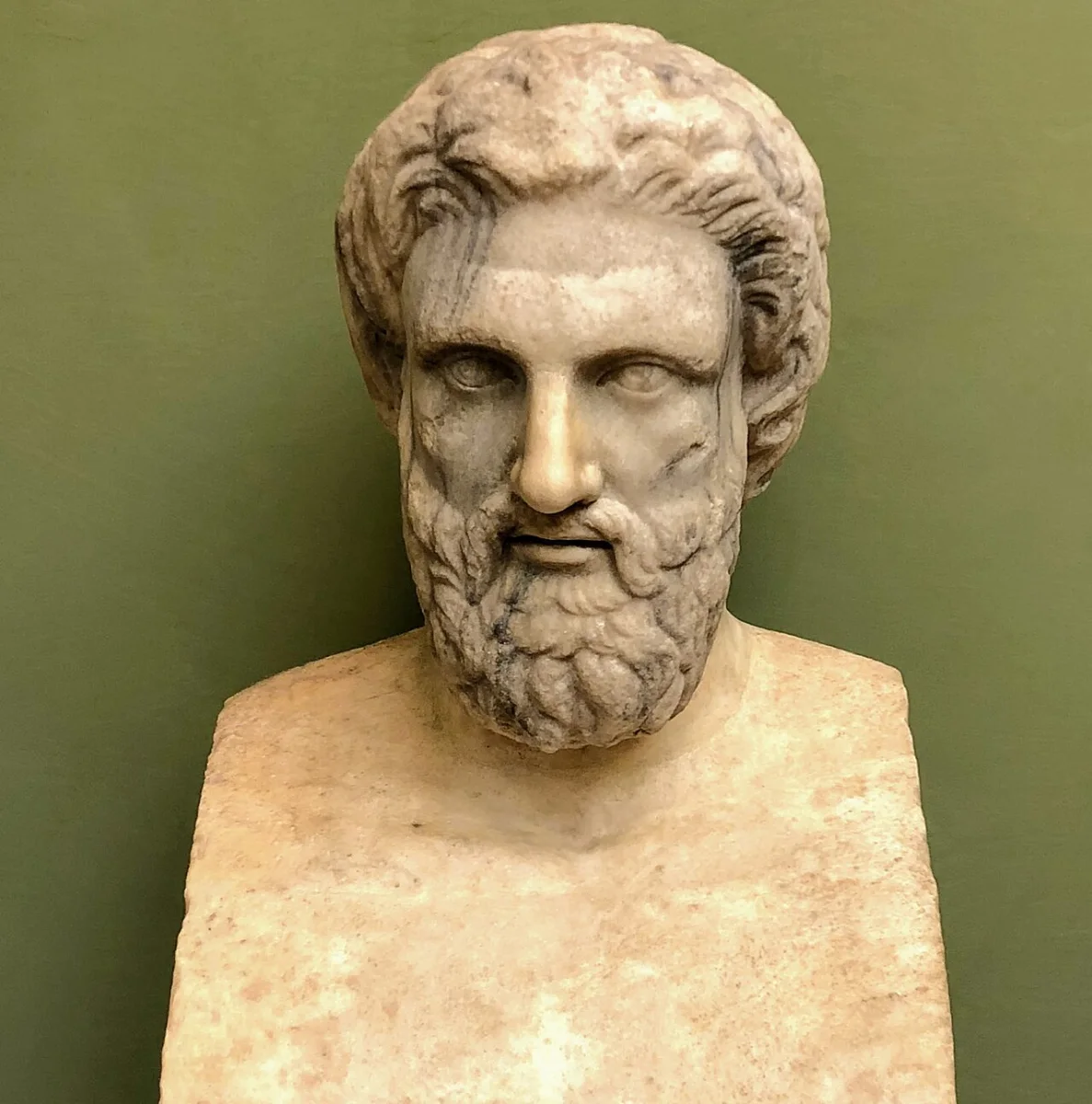
Text and translation
ὦ θεώμενοι κατερῶ πρὸς ὑμᾶς ἐλευθέρως
Aristophanes · Clouds · parabasis proper · eupolidean (gl¨ ⁝ gl¨∧) · Hall and Geldart’s text (Perseus), compared with Henderson’s Loeb · West’s scheme (1987, p. 50) and Dale’s (1968, p. 147 n. 1)
How to read each line
A guide to the Greek, syllables, pitch marks and quantities.
Show the reading key
- Above each line: the line as the edition prints it, each word placed over its own syllables. The main row: the same Greek divided into metrical syllables, each written as it is pronounced. A consonant that closes a syllable is written with it (λόθ | ρο); an elided word is closed up with the next vowel (ν’ἀ); a final consonant carried into the next word is set with a thin space (ς ἰ). Wider gaps mark word-ends.
- Above the syllables: the pitch of each syllable, from the accents. Under them: the quantity of each syllable as it falls in the line, then the transliteration, syllable by syllable, with accented syllables in capitals.
- Under each line: a line-for-line translation. In the right margin of the scansion: the line type, its scheme, and its analysis into cola.
Key to the labels
The names, patterns and symbols used beside this poem.
Show the labels and symbols
The labels in the right margin of the scansion below give the line’s analysis as the scheme file states it, then its scheme and, where the analysis notes them, the period-end, a brevis in longo or a hiatus. ‖ marks the end of a period, ||| the end of the stanza; a line without a period-end runs on into the next (synapheia). × is an anceps, long or short; the last position of every period is indifferent. A click on any syllable highlights the colon it belongs to and explains it.
| Label | Name and shape | What it is |
|---|---|---|
| eup1 | First colon: anaclastic glyconic (gl¨)○ ○ — × — ⏑ ⏑ — | West’s first colon, the anaclastic glyconic ○ ○ — × — ⏑ ⏑ —.[5] Dale describes the same eight positions as her choriambic dimeter B, — × — × — ⏑ ⏑ —.[6] The first position is usually long; when it is resolved, the second is short.[7] The first two syllables may be inverted to ⏑ —.[6] |
| eup2 | Second colon: catalectic anaclastic glyconic (gl¨∧)○ ○ — × — ⏑ — | West’s second colon, the anaclastic glyconic without its last position, ○ ○ — × — ⏑ —.[7] Dale calls it the catalectic half, — × — × — ⏑ —.[6] Word-end between the two cola falls either before or after its first position.[7] |
Scansion
In the parabasis the chorus leader speaks for the poet. He complains that this play, his cleverest, was beaten when first staged, and boasts of his own clean, new comedy against his rivals. The verse is the eupolidean, a long line of two aeolic cola used in series. All forty-five lines scan; one has a vowel of unknown length.
Spectators, I will speak frankly and tell you
the truth, by Dionysus, who brought me up.
As surely as I hope to win and be thought skilled,
I believed you were clever spectators
and this the cleverest of my comedies,
and I thought you should have the first taste of it — the play that cost me
the most work. Then I withdrew, beaten by vulgar men,
though I did not deserve it. For this I blame you,
the clever ones, for whose sake I took all that trouble.
Even so I will never willingly betray the clever among you.
For ever since, here, men whom it is a pleasure even to name
spoke highly of my Decent Boy and my Debauchee,
and I — for I was still a maiden, and not yet allowed to give birth —
exposed my child, and another girl took it up,
and you brought it up and educated it nobly,
from that time I have held sworn pledges of your good judgment.
So now this comedy, like Electra in the old play,
has come searching, in the hope of finding spectators as clever;
for she will know her brother's lock of hair if she sees it.
See how modest she is by nature: first of all
she has not come with a leather thing stitched on and dangling,
red at the tip and thick, to make the children laugh;
she has not mocked the bald, nor danced the kordax;
there is no old man speaking his lines who beats
whoever is near with his stick, to bury his bad jokes;
she has not rushed in with torches, and she does not shout ‘help, help’;
she has come trusting in herself and her words.
And I, a poet of that kind, do not put on airs,
nor do I try to cheat you by bringing on the same things two and three times;
I always bring in new forms and work them with skill,
none of them like the others and all of them clever.
I struck Cleon in the belly when he was at his greatest,
and I did not dare to jump on him again when he was down.
But these others, once Hyperbolus gave them a hold,
keep on trampling the wretched man, and his mother too.
Eupolis first of all dragged his Maricas on stage,
a bad turning-inside-out of our Knights, the bungler,
and added a drunken old woman for the sake of the kordax, the one
whom Phrynichus put on stage long ago, the one the sea-monster was eating.
Then Hermippus wrote a play against Hyperbolus too,
and now all the others are laying into Hyperbolus,
copying my images of the eels.
So whoever laughs at these, let him take no pleasure in mine;
but if you enjoy me and my inventions,
you will be thought wise in the seasons to come.
Metre
- The passage. The parabasis is the “stepping forth” of the chorus to address the audience, and in Aristophanes it has seven parts.[8] These lines are the parabasis proper, spoken by the chorus leader in the poet’s voice. The sung ode follows at 563.[9]
- The verse. West counts the eupolidean among the comic dicola: verses made of two simple cola and used in series for choral addresses.[10] He cites this passage and many fragments of other poets for it.[7] Dale treats it among the dicola that comedy uses stichically in place of catalectic tetrameters, beside the aristophanean and the cratinean, and gives this passage.[11] Hephaestion calls it the so-called eupolidean and classes it as a polyschematist metre, one that takes many shapes; he quotes 529 as his example.[12]
- West’s scheme. ○ ○ — × — ⏑ ⏑ — ⁝ ○ ⁝ ○ — × — ⏑ — ‖, that is gl¨ ⁝ gl¨∧.[7] gl¨ is the anaclastic glyconic, ○ ○ — × — ⏑ ⏑ —.[13] ○ ○ are two positions of which at least one must be long.[14] In each colon the first position is usually long; when it is resolved, the second position is always short.[7] The ⁝ on each side of the second colon’s first position shows that word-end falls either before or after it.
- Dale’s description. Dale calls the line a tetrameter made of her choriambic dimeter B, — × — × — ⏑ ⏑ —, and a catalectic half, — × — × — ⏑ —. She suggests that Eupolis took over from Cratinus the idea of a shortened second half: in the cratinean a cretic replaces a choriamb, and Eupolis did the same with her dimeter B. In either half the first two syllables may be inverted to × —, as in 529 and 518, but not doubly inverted to an iambic shape; 539 resolves the first long.[6] The quantities are the same as West’s. The two scholars describe the first two positions differently: West writes the aeolic base ○ ○, Dale — × with the inversion as a licence.
- How the lines run. All forty-five lines scan. In the first colon positions 3, 5, 6–7 and 8 never vary, and in the second colon positions 3, 5 and 6. The first two positions of each colon are — —, — ⏑ or ⏑ —. The inverted ⏑ — opens the first colon in 529 and the second colon in 518, 527, 535, 549 and 552. The fourth position of each colon is a true anceps: long in 519, short in 522. The only resolution is in 539, ἐρυθρὸν ἐξ, ⏖ ⏑ —, as West and Dale say.
- 556 and the name Φρύνιχος. LSJ has no entry for the name, but Aristophanes’ own trimeters settle its first two vowels. In Frogs 13, εἴπερ ποιήσω μηδὲν ὧνπερ Φρύνιχος, Φρυ- fills the tenth position, which must be long, and -νι- the eleventh, which must be short; in Thesmophoriazusae 164, καὶ Φρύνιχος, τοῦτον γὰρ οὖν ἀκήκοας, Φρυ- fills the long second position and -νι- the short third (Hall and Geldart’s text, Perseus). So the υ is long and the ι short, and 556 opens — ⏑ —, like 537, a base that West’s scheme and Dale’s both allow. Until 12 October 2026 this page left the question open and showed ⏑ ⏑ —.
- Comic prosody. The workbench uses the Attic rules (README). In comedy a short vowel before a stop with a liquid normally stays short, and lengthening is a mark of tragic or elevated style.[15] So it is here: ἐρυθρόν (539), κολετρῶσ’ (552), δὲ πρεσβύτης (541). Hiatus is admitted next to exclamations,[16] as in ἰοὺ ἰού (543). Attic poets often shorten οι and αι before a vowel inside a word,[17] as in πεποίηχ’ (556). Crasis: τἀληθῆ (519), χὠ (529), κἀγώ (530, 545), κοὐκ (530, 550), κἀπαιδεύσατε (532), τἀδελφοῦ (536), τἄπη (541), ταὔτ’ (546). Aphaeresis: ʼπιτύχῃ (535), ʼξαπατᾶν (546).
- Vowel lengths. The line notes give sources for these vowel lengths: the long υ of ὑμεῖς, ὑμᾶς, ὑμῖν, ὑμῶν (518, 521, 523, 525, 527, 532, 533, 546); θεᾱτάς, θεᾱταῖς (521, 535); Διόνῡσον (519); νῑκήσαιμι (520); καταπῡ́γων (529); σκῡτίον (538); κόρδᾱχ’, κόρδᾱκος (540, 555); πρεσβῡ́της (541); τᾱ́ς (559, 562). Most other α ι υ that the metre decides are short endings or prefixes in West’s list,[18] or were checked in LSJ. Φρῡ́νῐχος (556) is marked from the metre of Aristophanes’ trimeters.[19] Where no source read gives a length (Μαρικᾶν, the ending of ἑτέρα in 531), the metre decides it and the panel says so.
- Henderson’s text. Compared with J. Henderson’s Loeb edition.[20] The differences do not change the metre: 528 οὓς (Blaydes) for οἷς; 530 ἔτ’ ἦ for ἔτ’ ἦν; 533 παρ’ ὑμῶν for παρ’ ὑμῖν; 538 σκύτινον for σκυτίον; 540 ἔσκωψεν for ἔσκωψε (a long syllable at the anceps instead of a short); 547 εἰσφέρων and 549 εἰς for ἐσφέρων and ἐς. His apparatus records ὑμᾶς in one manuscript at 527.[21]
Prosody, line by line
Every syllable, with the reason for its length. Quantities are read from the vowel where the spelling shows it, from the consonants that follow (“position”), from the accent where it tells, and from the metre where nothing else does. Editors’ notes on the text follow in the boxed paragraphs.
- 518
Line 518 · ὦ θεώμενοι κατερῶ πρὸς ὑμᾶς ἐλευθέρως
ὦ θεώμενοι κατερῶ πρὸς ὑμᾶς ἐλευθέρως
ὦθεώμενοικατερῶπρὸς ὑμᾶςἐλευθέρως- 1 —ὦὦ is long by nature; the position is anceps.
- 2 ⏑θεε is short by nature; the position is anceps.
- 3 —ώώ is long by nature.
- 4 ⏑μεε is short by nature; the position is anceps.
- 5 —νοιοι is a diphthong, long by nature.
- 6 ⏑καα is short by the metre (position 6 must be short).
- 7 ⏑τεε is short by nature.
- 8 —ρῶῶ is long by nature.
- 9 ⏑πρὸὸ is short by nature; the position is anceps.
- 10 —ς ὑῡ̔ is long (its length is not shown by the ordinary spelling); the first consonant belongs to the previous word and is carried over to this vowel; the position is anceps.
- 11 —μᾶςᾶ carries a circumflex, so it is long.
- 12 ⏑ἐἐ is short by nature; the position is anceps.
- 13 —λευευ is a diphthong, long by nature.
- 14 ⏑θέέ is short by nature.
- 15 ×ρωςω is long by nature; closed by ς: long by position; the last position of the period is indifferent.
- 519
Line 519 · τἀληθῆ νὴ τὸν Διόνυσον τὸν ἐκθρέψαντά με.
τἀληθῆ νὴ τὸν Διόνυσον τὸν ἐκθρέψαντά με.
τἀληθῆνὴτὸνΔιόνυσοντὸν ἐκθρέψαντάμε.brevis in longo at period-end (a short in the final long position).
- 1 —τἀἀ is long by crasis: the coronis marks two words contracted into one long vowel; the position is anceps.
- 2 —ληη is long by nature; the position is anceps.
- 3 —θῆῆ is long by nature.
- 4 —νὴὴ is long by nature; the position is anceps.
- 5 —τὸνὸ is short by nature; closed by ν: long by position.
- 6 ⏑Διι is short by the metre (position 6 must be short).
- 7 ⏑όό is short by nature.
- 8 —νυῡ is long (its length is not shown by the ordinary spelling).
- 9 —σονο is short by nature; closed by ν: long by position; the position is anceps.
- 10 ⏑τὸὸ is short by nature; the position is anceps.
- 11 —ν ἐκἐ is short by nature; closed by κ: long by position; the first consonant belongs to the previous word and is carried over to this vowel.
- 12 —θρέέ is short by nature; ψ is a double consonant (two sounds) and closes the syllable: long by position; the position is anceps.
- 13 —ψανα is a vowel of unknown length; closed by ν: long by position.
- 14 ⏑τάά is short by the accent rule: acute on the antepenult requires a short final syllable.
- 15 ×με.ε is short by nature; the last position of the period is indifferent; a short here is brevis in longo.
- 520
Line 520 · οὕτω νικήσαιμί τʼ ἐγὼ καὶ νομιζοίμην σοφός,
οὕτω νικήσαιμί τʼ ἐγὼ καὶ νομιζοίμην σοφός,
οὕτωνικήσαιμίτ’ἐγὼκαὶνομιζοίμηνσοφός,- 1 —οὕοὕ is a diphthong, long by nature; the position is anceps.
- 2 —τωω is long by nature; the position is anceps.
- 3 —νιῑ is long (its length is not shown by the ordinary spelling).
- 4 —κήή is long by nature; the position is anceps.
- 5 —σαιαι is a diphthong, long by nature.
- 6 ⏑μίί is short by the accent rule: acute on the antepenult requires a short final syllable.
- 7 ⏑τ’ἐἐ is short by nature; the apostrophe marks an elided vowel; the consonant before it joins this syllable.
- 8 —γὼὼ is long by nature.
- 9 —καὶαὶ is a diphthong, long by nature; the position is anceps.
- 10 ⏑νοο is short by nature; the position is anceps.
- 11 —μιζ is a double consonant (two sounds) and closes the syllable: long by position.
- 12 —ζοίοί is a diphthong, long by nature; the position is anceps.
- 13 —μηνη is long by nature; closed by ν: long by position.
- 14 ⏑σοο is short by nature.
- 15 ×φός,ό is short by nature; closed by ς: long by position; the last position of the period is indifferent.
νικάω has a long ι.[24] Both ancipitia are long here (-τω, καὶ).- 521
Line 521 · ὡς ὑμᾶς ἡγούμενος εἶναι θεατὰς δεξιοὺς
ὡς ὑμᾶς ἡγούμενος εἶναι θεατὰς δεξιοὺς
ὡςὑμᾶςἡγούμενος εἶναιθεατὰςδεξιοὺς- 1 —ὡςὡ is long by nature; the position is anceps.
- 2 —ὑῡ̔ is long (its length is not shown by the ordinary spelling); the position is anceps.
- 3 —μᾶςᾶ carries a circumflex, so it is long.
- 4 —ἡἡ is long by nature; the position is anceps.
- 5 —γούού is a diphthong, long by nature.
- 6 ⏑μεε is short by nature.
- 7 ⏑νοο is short by nature.
- 8 —ς εἶεἶ is a diphthong, long by nature; the first consonant belongs to the previous word and is carried over to this vowel.
- 9 —ναιαι is a diphthong, long by nature; the position is anceps.
- 10 ⏑θεε is short by nature; the position is anceps.
- 11 —αᾱ is long (its length is not shown by the ordinary spelling).
- 12 —τὰςὰ is a vowel of unknown length; closed by ς: long by position; the position is anceps.
- 13 —δεε is short by nature; ξ is a double consonant (two sounds) and closes the syllable: long by position.
- 14 ⏑ξιι is short by the metre (position 14 must be short).
- 15 ×οὺςοὺ is a diphthong, long by nature; closed by ς: long by position; the last position of the period is indifferent.
θεατής has a long α.[25]- 522
Line 522 · καὶ ταύτην σοφώτατʼ ἔχειν τῶν ἐμῶν κωμῳδιῶν,
καὶ ταύτην σοφώτατʼ ἔχειν τῶν ἐμῶν κωμῳδιῶν,
καὶταύτηνσοφώτατ’ἔχειντῶνἐμῶνκωμῳδιῶν,- 1 —καὶαὶ is a diphthong, long by nature; the position is anceps.
- 2 —ταύαύ is a diphthong, long by nature; the position is anceps.
- 3 —τηνη is long by nature; closed by ν: long by position.
- 4 ⏑σοο is short by nature; the position is anceps.
- 5 —φώώ is long by nature.
- 6 ⏑ταα is short by the metre (position 6 must be short).
- 7 ⏑τ’ἔἔ is short by nature; the apostrophe marks an elided vowel; the consonant before it joins this syllable.
- 8 —χεινει is a diphthong, long by nature; closed by ν: long by position.
- 9 —τῶνῶ is long by nature; the position is anceps.
- 10 ⏑ἐἐ is short by nature; the position is anceps.
- 11 —μῶνῶ is long by nature; closed by ν: long by position.
- 12 —κωω is long by nature; the position is anceps.
- 13 —μῳῳ is long by nature.
- 14 ⏑διι is short by the metre (position 14 must be short).
- 15 ×ῶν,ῶ is long by nature; closed by ν: long by position; the last position of the period is indifferent.
κωμῳδία: LSJ cites this line for the word.- 523
Line 523 · πρώτους ἠξίωσʼ ἀναγεῦσʼ ὑμᾶς, ἣ παρέσχε μοι
πρώτους ἠξίωσʼ ἀναγεῦσʼ ὑμᾶς, ἣ παρέσχε μοι
πρώτουςἠξίωσ’ἀναγεῦσ’ὑμᾶς,ἣπαρέσχεμοι- 1 —πρώώ is long by nature; the position is anceps.
- 2 —τουςου is a diphthong, long by nature; the position is anceps.
- 3 —ἠἠ is long by nature; ξ is a double consonant (two sounds) and closes the syllable: long by position.
- 4 ⏑ξίῐ́ is short (its length is not shown by the ordinary spelling); the position is anceps.
- 5 —ωω is long by nature.
- 6 ⏑σ’ἀἀ is short by the metre (position 6 must be short); the apostrophe marks an elided vowel; the consonant before it joins this syllable.
- 7 ⏑ναα is short by the metre (position 7 must be short).
- 8 —γεῦεῦ is a diphthong, long by nature.
- 9 —σ’ὑῡ̔ is long (its length is not shown by the ordinary spelling); the apostrophe marks an elided vowel; the consonant before it joins this syllable; the position is anceps.
- 10 —μᾶς,ᾶ carries a circumflex, so it is long; the position is anceps.
- 11 —ἣἣ is long by nature.
- 12 ⏑παᾰ is short (its length is not shown by the ordinary spelling); the position is anceps.
- 13 —ρέσέ is short by nature; closed by σ: long by position.
- 14 ⏑χεε is short by nature.
- 15 ×μοιοι is a diphthong, long by nature; the last position of the period is indifferent.
ὑμᾶς with the long υ again.[26] The ᾰ of παρέσχε is short;[27] the metre does not show it here, and the input marks it. The ῐ of ἠξίωσ is short (the metre: ἠξίουν fills the short eleventh position of the trimeter at E. Alc. 1010, ἄξιον a short of the dactyl at Theocr. 1.44); the metre does not show it here, and the input marks it.- 524
Line 524 · ἔργον πλεῖστον· εἶτʼ ἀνεχώρουν ὑπʼ ἀνδρῶν φορτικῶν
ἔργον πλεῖστον· εἶτʼ ἀνεχώρουν ὑπʼ ἀνδρῶν φορτικῶν
ἔργονπλεῖστο·ν εἶτ’ἀνεχώρουνὑπ’ἀνδρῶνφορτικῶν- 1 —ἔρἔ is short by nature; closed by ρ: long by position; the position is anceps.
- 2 —γονο is short by nature; closed by ν: long by position; the position is anceps.
- 3 —πλεῖσεῖ is a diphthong, long by nature; closed by σ: long by position.
- 4 ⏑το·ο is short by nature; the position is anceps.
- 5 —ν εἶεἶ is a diphthong, long by nature; the first consonant belongs to the previous word and is carried over to this vowel.
- 6 ⏑τ’ἀἀ is short by the metre (position 6 must be short); the apostrophe marks an elided vowel; the consonant before it joins this syllable.
- 7 ⏑νεε is short by nature.
- 8 —χώώ is long by nature.
- 9 —ρουνου is a diphthong, long by nature; the position is anceps.
- 10 ⏑ὑῠ̔ is short (its length is not shown by the ordinary spelling); the position is anceps.
- 11 —π’ἀνἀ is a vowel of unknown length; closed by ν: long by position; the apostrophe marks an elided vowel; the consonant before it joins this syllable.
- 12 —δρῶνῶ is long by nature; closed by ν: long by position; the position is anceps.
- 13 —φορο is short by nature; closed by ρ: long by position.
- 14 ⏑τιι is short by the metre (position 14 must be short).
- 15 ×κῶνῶ is long by nature; closed by ν: long by position; the last position of the period is indifferent.
The ῠ of ὑπʼ is short;[28] the metre does not show it here, and the input marks it.- 525
Line 525 · ἡττηθεὶς οὐκ ἄξιος ὤν· ταῦτʼ οὖν ὑμῖν μέμφομαι
ἡττηθεὶς οὐκ ἄξιος ὤν· ταῦτʼ οὖν ὑμῖν μέμφομαι
ἡττηθεὶςοὐκἄξιος ὤν·ταῦτ’οὖνὑμῖνμέμφομαι- 1 —ἡτἡ is long by nature; closed by τ: long by position; the position is anceps.
- 2 —τηη is long by nature; the position is anceps.
- 3 —θεὶςεὶ is a diphthong, long by nature.
- 4 —οὐκοὐ is a diphthong, long by nature; the position is anceps.
- 5 —ἄξ is a double consonant (two sounds) and closes the syllable: long by position.
- 6 ⏑ξιι is short by the metre (position 6 must be short).
- 7 ⏑οο is short by nature.
- 8 —ς ὤν·ὤ is long by nature; closed by ν: long by position; the first consonant belongs to the previous word and is carried over to this vowel.
- 9 —ταῦαῦ is a diphthong, long by nature; the position is anceps.
- 10 —τ’οὖνοὖ is a diphthong, long by nature; the apostrophe marks an elided vowel; the consonant before it joins this syllable; the position is anceps.
- 11 —ὑῡ̔ is long (its length is not shown by the ordinary spelling).
- 12 —μῖνῖ carries a circumflex, so it is long; closed by ν: long by position; the position is anceps.
- 13 —μέμέ is short by nature; closed by μ: long by position.
- 14 ⏑φοο is short by nature.
- 15 ×μαιαι is a diphthong, long by nature; the last position of the period is indifferent.
Here the metre itself shows the long υ of ὑμῖν: it stands at the third position of the second colon, which is always long.- 526
Line 526 · τοῖς σοφοῖς, ὧν οὕνεκʼ ἐγὼ ταῦτʼ ἐπραγματευόμην.
τοῖς σοφοῖς, ὧν οὕνεκʼ ἐγὼ ταῦτʼ ἐπραγματευόμην.
τοῖςσοφοῖς,ὧνοὕνεκ’ἐγὼταῦτ’ἐπραγματευόμην.- 1 —τοῖςοῖ is a diphthong, long by nature; closed by ς: long by position; the position is anceps.
- 2 ⏑σοο is short by nature; the position is anceps.
- 3 —φοῖς,οῖ is a diphthong, long by nature.
- 4 —ὧνὧ is long by nature; the position is anceps.
- 5 —οὕοὕ is a diphthong, long by nature.
- 6 ⏑νεε is short by nature.
- 7 ⏑κ’ἐἐ is short by nature; the apostrophe marks an elided vowel; the consonant before it joins this syllable.
- 8 —γὼὼ is long by nature.
- 9 —ταῦαῦ is a diphthong, long by nature; the position is anceps.
- 10 ⏑τ’ἐἐ is short by nature; πρ is carried whole into the next syllable, so this syllable stays open and short (Attic correption of a stop + liquid cluster); the apostrophe marks an elided vowel; the consonant before it joins this syllable; the position is anceps.
- 11 —πραγα is a vowel of unknown length; closed by γ: long by position; γμ is one of the four clusters (γμ, γν, δμ, δν) that never leave the syllable before them short.[16]
- 12 ⏑μαᾰ is short (its length is not shown by the ordinary spelling); the position is anceps.
- 13 —τευευ is a diphthong, long by nature.
- 14 ⏑όό is short by nature.
- 15 ×μην.η is long by nature; closed by ν: long by position; the last position of the period is indifferent.
The ᾰ of ἐπραγματευόμην is short;[29] the metre does not show it here, and the input marks it.- 527
Line 527 · ἀλλʼ οὐδʼ ὣς ὑμῶν ποθʼ ἑκὼν προδώσω τοὺς δεξιούς.
ἀλλʼ οὐδʼ ὣς ὑμῶν ποθʼ ἑκὼν προδώσω τοὺς δεξιούς.
ἀλλ’οὐδ’ὣςὑμῶνποθ’ἑκὼνπροδώσωτοὺςδεξιούς.- 1 —ἀλἀ is a vowel of unknown length; closed by λ: long by position; the position is anceps.
- 2 —λ’οὐοὐ is a diphthong, long by nature; the apostrophe marks an elided vowel; the consonant before it joins this syllable; the position is anceps.
- 3 —δ’ὣςὣ is long by nature; the apostrophe marks an elided vowel; the consonant before it joins this syllable.
- 4 —ὑῡ̔ is long (its length is not shown by the ordinary spelling); the position is anceps.
- 5 —μῶνῶ is long by nature; closed by ν: long by position.
- 6 ⏑ποο is short by nature.
- 7 ⏑θ’ἑἑ is short by nature; the apostrophe marks an elided vowel; the consonant before it joins this syllable.
- 8 —κὼνὼ is long by nature; closed by ν: long by position.
- 9 ⏑προο is short by nature; the position is anceps.
- 10 —δώώ is long by nature; the position is anceps.
- 11 —σωω is long by nature.
- 12 —τοὺςοὺ is a diphthong, long by nature; closed by ς: long by position; the position is anceps.
- 13 —δεε is short by nature; ξ is a double consonant (two sounds) and closes the syllable: long by position.
- 14 ⏑ξιι is short by the metre (position 14 must be short).
- 15 ×ούς.ού is a diphthong, long by nature; closed by ς: long by position; the last position of the period is indifferent.
Henderson’s apparatus reports ὑμᾶς for ὑμῶν in one manuscript.[21]- 528
Line 528 · ἐξ ὅτου γὰρ ἐνθάδʼ ὑπʼ ἀνδρῶν, οἷς ἡδὺ καὶ λέγειν,
ἐξ ὅτου γὰρ ἐνθάδʼ ὑπʼ ἀνδρῶν, οἷς ἡδὺ καὶ λέγειν,
ἐξὅτουγὰρ ἐνθάδ’ὑπ’ἀνδρῶν,οἷςἡδὺκαὶλέγειν,- 1 —ἐξἐ is short by nature; ξ is a double consonant (two sounds) and closes the syllable: long by position; the position is anceps.
- 2 ⏑ὅὅ is short by nature; the position is anceps.
- 3 —τουου is a diphthong, long by nature.
- 4 ⏑γὰᾰ̀ is short (its length is not shown by the ordinary spelling); the position is anceps.
- 5 —ρ ἐνἐ is short by nature; closed by ν: long by position; the first consonant belongs to the previous word and is carried over to this vowel.
- 6 ⏑θάά is short by the metre (position 6 must be short).
- 7 ⏑δ’ὑὑ is short by the metre (position 7 must be short); the apostrophe marks an elided vowel; the consonant before it joins this syllable.
- 8 —π’ἀνἀ is a vowel of unknown length; closed by ν: long by position; the apostrophe marks an elided vowel; the consonant before it joins this syllable.
- 9 —δρῶν,ῶ is long by nature; the position is anceps.
- 10 —οἷςοἷ is a diphthong, long by nature; the position is anceps.
- 11 —ἡἡ is long by nature.
- 12 ⏑δὺῠ̀ is short (its length is not shown by the ordinary spelling); the position is anceps.
- 13 —καὶαὶ is a diphthong, long by nature.
- 14 ⏑λέέ is short by nature.
- 15 ×γειν,ει is a diphthong, long by nature; closed by ν: long by position; the last position of the period is indifferent.
Henderson prints Blaydes’s οὓς for οἷς;[21] both are long before ἡδύ. The ᾰ of γὰρ is short (the metre: γάρ fills a position that must be short in OT 62 and Medea 17, both on this site); the metre does not show it here, and the input marks it. The ῠ of ἡδὺ is short;[30] the metre does not show it here, and the input marks it.- 529
Line 529 · ὁ σώφρων τε χὠ καταπύγων ἄριστʼ ἠκουσάτην,
ὁ σώφρων τε χὠ καταπύγων ἄριστʼ ἠκουσάτην,
ὁσώφρωντεχὠκαταπύγωνἄριστ’ἠκουσάτην,- 1 ⏑ὁὁ is short by nature; the position is anceps.
- 2 —σώώ is long by nature; the position is anceps.
- 3 —φρωνω is long by nature; closed by ν: long by position.
- 4 ⏑τεε is short by nature; the position is anceps.
- 5 —χὠὠ is long by nature.
- 6 ⏑καα is short by the metre (position 6 must be short).
- 7 ⏑ταα is short by the metre (position 7 must be short).
- 8 —πύῡ́ is long (its length is not shown by the ordinary spelling).
- 9 —γωνω is long by nature; the position is anceps.
- 10 ⏑ἄᾰ̓́ is short (its length is not shown by the ordinary spelling); the position is anceps.
- 11 —ρισι is a vowel of unknown length; closed by σ: long by position.
- 12 —τ’ἠἠ is long by nature; the apostrophe marks an elided vowel; the consonant before it joins this syllable; the position is anceps.
- 13 —κουου is a diphthong, long by nature.
- 14 ⏑σάά is short by the metre (position 14 must be short).
- 15 ×την,η is long by nature; closed by ν: long by position; the last position of the period is indifferent.
gl¨ ⁝ gl¨∧ with the first colon inverted, ὁ σώ-, ⏑ —, as Dale notes.[6] καταπύγων has a long υ.[31] The word runs over the colon-end: its last syllable, -γων, is the first position of the second colon, the alternative word-end that West’s scheme allows.[7] Hephaestion quotes this line as his example of the eupolidean.[12] The ᾰ of ἄριστʼ is short;[32] the metre does not show it here, and the input marks it.- 530
Line 530 · κἀγώ, παρθένος γὰρ ἔτʼ ἦν, κοὐκ ἐξῆν πώ μοι τεκεῖν,
κἀγώ, παρθένος γὰρ ἔτʼ ἦν, κοὐκ ἐξῆν πώ μοι τεκεῖν,
κἀγώ,παρθένοςγὰρ ἔτ’ἦν,κοὐκἐξῆνπώμοιτεκεῖν,- 1 —κἀἀ is long by crasis: the coronis marks two words contracted into one long vowel; the position is anceps.
- 2 —γώ,ώ is long by nature; the position is anceps.
- 3 —παρα is a vowel of unknown length; closed by ρ: long by position.
- 4 ⏑θέέ is short by nature; the position is anceps.
- 5 —νοςο is short by nature; closed by ς: long by position.
- 6 ⏑γὰὰ is short by the metre (position 6 must be short).
- 7 ⏑ρ ἔἔ is short by nature; the first consonant belongs to the previous word and is carried over to this vowel.
- 8 —τ’ἦν,ἦ is long by nature; closed by ν: long by position; the apostrophe marks an elided vowel; the consonant before it joins this syllable.
- 9 —κοὐκοὐ is a diphthong, long by nature; the position is anceps.
- 10 —ἐἐ is short by nature; ξ is a double consonant (two sounds) and closes the syllable: long by position; the position is anceps.
- 11 —ξῆνῆ is long by nature; closed by ν: long by position.
- 12 —πώώ is long by nature; the position is anceps.
- 13 —μοιοι is a diphthong, long by nature.
- 14 ⏑τεε is short by nature.
- 15 ×κεῖν,εῖ is a diphthong, long by nature; closed by ν: long by position; the last position of the period is indifferent.
Henderson prints ἔτ’ ἦ for ἔτ’ ἦν;[21] the syllable is long either way.- 531
Line 531 · ἐξέθηκα, παῖς δʼ ἑτέρα τις λαβοῦσʼ ἀνείλετο,
ἐξέθηκα, παῖς δʼ ἑτέρα τις λαβοῦσʼ ἀνείλετο,
ἐξέθηκα,παῖςδ’ἑτέρατιςλαβοῦσ’ἀνείλετο,brevis in longo at period-end (a short in the final long position).
- 1 —ἐἐ is short by nature; ξ is a double consonant (two sounds) and closes the syllable: long by position; the position is anceps.
- 2 ⏑ξέέ is short by nature; the position is anceps.
- 3 —θηη is long by nature.
- 4 ⏑κα,α is short by the accent rule: acute on the antepenult requires a short final syllable; the position is anceps.
- 5 —παῖςαῖ is a diphthong, long by nature; closed by ς: long by position.
- 6 ⏑δ’ἑἑ is short by nature; the apostrophe marks an elided vowel; the consonant before it joins this syllable.
- 7 ⏑τέέ is short by nature.
- 8 —ραα is long by the metre (position 8 must be long).
- 9 —τιςι is a vowel of unknown length; closed by ς: long by position; the position is anceps.
- 10 ⏑λαᾰ is short (its length is not shown by the ordinary spelling); the position is anceps.
- 11 —βοῦοῦ is a diphthong, long by nature.
- 12 ⏑σ’ἀᾰ̓ is short (its length is not shown by the ordinary spelling); the apostrophe marks an elided vowel; the consonant before it joins this syllable; the position is anceps.
- 13 —νείεί is a diphthong, long by nature.
- 14 ⏑λεε is short by nature.
- 15 ×το,ο is short by nature; the last position of the period is indifferent; a short here is brevis in longo.
The final α of ἑτέρα fills the long eighth position. No source read for this page gives its length; the metre decides it. The ᾰ of ἀνείλετο is short;[33] the metre does not show it here, and the input marks it. The ᾰ of λαβοῦσ is short (the metre: λαβών fills the short third position of the trimeter at E. Cyc. 15 and 570; λάβε a short of the dactyl at A.R. 3.76); the metre does not show it here, and the input marks it.- 532
Line 532 · ὑμεῖς δʼ ἐξεθρέψατε γενναίως κἀπαιδεύσατε·
ὑμεῖς δʼ ἐξεθρέψατε γενναίως κἀπαιδεύσατε·
ὑμεῖςδ’ἐξεθρέψατεγενναίωςκἀπαιδεύσατε·brevis in longo at period-end (a short in the final long position).
- 1 —ὑῡ̔ is long (its length is not shown by the ordinary spelling); the position is anceps.
- 2 —μεῖςεῖ is a diphthong, long by nature; closed by ς: long by position; the position is anceps.
- 3 —δ’ἐἐ is short by nature; ξ is a double consonant (two sounds) and closes the syllable: long by position; the apostrophe marks an elided vowel; the consonant before it joins this syllable.
- 4 ⏑ξεε is short by nature; θρ is carried whole into the next syllable, so this syllable stays open and short (Attic correption of a stop + liquid cluster); the position is anceps.
- 5 —θρέέ is short by nature; ψ is a double consonant (two sounds) and closes the syllable: long by position.
- 6 ⏑ψαα is short by the metre (position 6 must be short).
- 7 ⏑τεε is short by nature.
- 8 —γενε is short by nature; closed by ν: long by position.
- 9 —ναίαί is a diphthong, long by nature; the position is anceps.
- 10 —ωςω is long by nature; closed by ς: long by position; the position is anceps.
- 11 —κἀἀ is long by crasis: the coronis marks two words contracted into one long vowel.
- 12 —παιαι is a diphthong, long by nature; the position is anceps.
- 13 —δεύεύ is a diphthong, long by nature.
- 14 ⏑σαα is short by the metre (position 14 must be short).
- 15 ×τε·ε is short by nature; the last position of the period is indifferent; a short here is brevis in longo.
ὑμεῖς with the long υ.[26] ἐξ-, before ξ, is long.- 533
Line 533 · ἐκ τούτου μοι πιστὰ παρʼ ὑμῖν γνώμης ἔσθʼ ὅρκια.
ἐκ τούτου μοι πιστὰ παρʼ ὑμῖν γνώμης ἔσθʼ ὅρκια.
ἐκτούτουμοιπιστὰπαρ’ὑμῖνγνώμηςἔσθ’ὅρκια.brevis in longo at period-end (a short in the final long position).
- 1 —ἐκἐ is short by nature; closed by κ: long by position; the position is anceps.
- 2 —τούού is a diphthong, long by nature; the position is anceps.
- 3 —τουου is a diphthong, long by nature.
- 4 —μοιοι is a diphthong, long by nature; the position is anceps.
- 5 —πισι is a vowel of unknown length; closed by σ: long by position.
- 6 ⏑τὰὰ is short by the metre (position 6 must be short).
- 7 ⏑παα is short by the metre (position 7 must be short).
- 8 —ρ’ὑῡ̔ is long (its length is not shown by the ordinary spelling); the apostrophe marks an elided vowel; the consonant before it joins this syllable.
- 9 —μῖνῖ carries a circumflex, so it is long; closed by ν: long by position; the position is anceps.
- 10 —γνώώ is long by nature; the position is anceps.
- 11 —μηςη is long by nature.
- 12 —ἔσἔ is short by nature; closed by σ: long by position; the position is anceps.
- 13 —θ’ὅρὅ is short by nature; closed by ρ: long by position; the apostrophe marks an elided vowel; the consonant before it joins this syllable.
- 14 ⏑κιι is short by the metre (position 14 must be short).
- 15 ×α.α is short by the accent rule: acute on the antepenult requires a short final syllable; the last position of the period is indifferent; a short here is brevis in longo.
Henderson prints παρ’ ὑμῶν for παρ’ ὑμῖν;[21] both are long.- 534
Line 534 · νῦν οὖν Ἠλέκτραν κατʼ ἐκείνην ἥδʼ ἡ κωμῳδία
νῦν οὖν Ἠλέκτραν κατʼ ἐκείνην ἥδʼ ἡ κωμῳδία
νῦνοὖνἨλέκτρανκατ’ἐκείνηνἥδ’ἡκωμῳδία- 1 —νῦνῦ carries a circumflex, so it is long; the position is anceps.
- 2 —οὖνοὖ is a diphthong, long by nature; the position is anceps.
- 3 —ἨἨ is long by nature.
- 4 —λέκέ is short by nature; closed by κ: long by position; the position is anceps.
- 5 —τρανα is a vowel of unknown length; closed by ν: long by position.
- 6 ⏑καα is short by the metre (position 6 must be short).
- 7 ⏑τ’ἐἐ is short by nature; the apostrophe marks an elided vowel; the consonant before it joins this syllable.
- 8 —κείεί is a diphthong, long by nature.
- 9 —νηνη is long by nature; the position is anceps.
- 10 —ἥἥ is long by nature; the position is anceps.
- 11 —δ’ἡἡ is long by nature; the apostrophe marks an elided vowel; the consonant before it joins this syllable.
- 12 —κωω is long by nature; the position is anceps.
- 13 —μῳῳ is long by nature.
- 14 ⏑δίί is short by the metre (position 14 must be short).
- 15 ×αα is of unknown length; the position is anceps, so either scans; the last position of the period is indifferent.
- 535
Line 535 · ζητοῦσʼ ἦλθʼ, ἤν που ʼπιτύχῃ θεαταῖς οὕτω σοφοῖς·
ζητοῦσʼ ἦλθʼ, ἤν που ʼπιτύχῃ θεαταῖς οὕτω σοφοῖς·
ζητοῦσ’ἦλθ’,ἤνπουπιτύχῃθεαταῖςοὕτωσοφοῖς·- 1 —ζηη is long by nature; the position is anceps.
- 2 —τοῦοῦ is a diphthong, long by nature; the position is anceps.
- 3 —σ’ἦλἦ is long by nature; closed by λ: long by position; the apostrophe marks an elided vowel; the consonant before it joins this syllable.
- 4 —θ’,ἤνἤ is long by nature; closed by ν: long by position; the apostrophe marks an elided vowel; the consonant before it joins this syllable; the position is anceps.
- 5 —πουου is a diphthong, long by nature.
- 6 ⏑πιι is short by the metre (position 6 must be short).
- 7 ⏑τύύ is short by the metre (position 7 must be short).
- 8 —χῃῃ is long by nature.
- 9 ⏑θεε is short by nature; the position is anceps.
- 10 —αᾱ is long (its length is not shown by the ordinary spelling); the position is anceps.
- 11 —ταῖςαῖ is a diphthong, long by nature.
- 12 —οὕοὕ is a diphthong, long by nature; the position is anceps.
- 13 —τωω is long by nature.
- 14 ⏑σοο is short by nature.
- 15 ×φοῖς·οῖ is a diphthong, long by nature; closed by ς: long by position; the last position of the period is indifferent.
θεαταῖς has a long α,[34] so the second colon opens with the inversion θε-ᾱ-, ⏑ —. ʼπιτύχῃ has lost its ἐ- after ἤν που (aphaeresis).- 536
Line 536 · γνώσεται γάρ, ἤνπερ ἴδῃ, τἀδελφοῦ τὸν βόστρυχον.
γνώσεται γάρ, ἤνπερ ἴδῃ, τἀδελφοῦ τὸν βόστρυχον.
γνώσεταιγά,ρ ἤνπερ ἴδῃ,τἀδελφοῦτὸνβόστρυχον.- 1 —γνώώ is long by nature; the position is anceps.
- 2 ⏑σεε is short by nature; the position is anceps.
- 3 —ταιαι is a diphthong, long by nature.
- 4 ⏑γά,ᾰ́ is short (its length is not shown by the ordinary spelling); the position is anceps.
- 5 —ρ ἤνἤ is long by nature; closed by ν: long by position; the first consonant belongs to the previous word and is carried over to this vowel.
- 6 ⏑πεε is short by nature.
- 7 ⏑ρ ἴἴ is short by the metre (position 7 must be short); the first consonant belongs to the previous word and is carried over to this vowel.
- 8 —δῃ,ῃ is long by nature.
- 9 —τἀἀ is long by crasis: the coronis marks two words contracted into one long vowel; the position is anceps.
- 10 —δελε is short by nature; closed by λ: long by position; the position is anceps.
- 11 —φοῦοῦ is a diphthong, long by nature.
- 12 —τὸνὸ is short by nature; closed by ν: long by position; the position is anceps.
- 13 —βόσό is short by nature; closed by σ: long by position.
- 14 ⏑τρυυ is short by the metre (position 14 must be short).
- 15 ×χον.ο is short by nature; closed by ν: long by position; the last position of the period is indifferent.
The ᾰ of γάρ is short (the metre: γάρ fills a position that must be short in OT 62 and Medea 17, both on this site); the metre does not show it here, and the input marks it.- 537
Line 537 · ὡς δὲ σώφρων ἐστὶ φύσει σκέψασθʼ· ἥτις πρῶτα μὲν
ὡς δὲ σώφρων ἐστὶ φύσει σκέψασθʼ· ἥτις πρῶτα μὲν
ὡςδὲσώφρωνἐστὶφύσεισκέψασθ’·ἥτιςπρῶταμὲν- 1 —ὡςὡ is long by nature; closed by ς: long by position; the position is anceps.
- 2 ⏑δὲὲ is short by nature; the position is anceps.
- 3 —σώώ is long by nature.
- 4 —φρωνω is long by nature; the position is anceps.
- 5 —ἐσἐ is short by nature; closed by σ: long by position.
- 6 ⏑τὶὶ is short by the metre (position 6 must be short).
- 7 ⏑φύύ is short by the metre (position 7 must be short).
- 8 —σειει is a diphthong, long by nature; the next word begins with σκ: the syllable is closed before it: long by position.
- 9 —σκέέ is short by nature; ψ is a double consonant (two sounds) and closes the syllable: long by position; the position is anceps.
- 10 —ψασα is a vowel of unknown length; closed by σ: long by position; the position is anceps.
- 11 —θ’·ἥἥ is long by nature; the apostrophe marks an elided vowel; the consonant before it joins this syllable.
- 12 —τιςι is a vowel of unknown length; closed by ς: long by position; the position is anceps.
- 13 —πρῶῶ is long by nature.
- 14 ⏑ταα is short by the accent rule: circumflex on the penult requires a short final syllable.
- 15 ×μὲνὲ is short by nature; closed by ν: long by position; the last position of the period is indifferent.
West prints 537–40 as his example of the eupolidean, with the colon-end marked after φύσει.[7]- 538
Line 538 · οὐδὲν ἦλθε ῥαψαμένη σκυτίον καθειμένον
οὐδὲν ἦλθε ῥαψαμένη σκυτίον καθειμένον
οὐδὲν ἦλθεῥαψαμένησκυτίονκαθειμένον- 1 —οὐοὐ is a diphthong, long by nature; the position is anceps.
- 2 ⏑δὲὲ is short by nature; the position is anceps.
- 3 —ν ἦλἦ is long by nature; closed by λ: long by position; the first consonant belongs to the previous word and is carried over to this vowel.
- 4 —θεε is short by nature, but the syllable is long before the initial ρ of the next word: an initial continuant could be prolonged so as to add length to the syllable before it, and before ρ this is almost invariable in the dialogue of Attic drama;[35] the position is anceps.
- 5 —ῥαψ is a double consonant (two sounds) and closes the syllable: long by position.
- 6 ⏑ψαα is short by the metre (position 6 must be short).
- 7 ⏑μέέ is short by nature.
- 8 —νηη is long by nature; the next word begins with σκ: the syllable is closed before it: long by position.
- 9 —σκυῡ is long (its length is not shown by the ordinary spelling); the position is anceps.
- 10 ⏑τίῐ́ is short (its length is not shown by the ordinary spelling); the position is anceps.
- 11 —ονο is short by nature; closed by ν: long by position.
- 12 ⏑καᾰ is short (its length is not shown by the ordinary spelling); the position is anceps.
- 13 —θειει is a diphthong, long by nature.
- 14 ⏑μέέ is short by nature.
- 15 ×νονο is short by nature; closed by ν: long by position; the last position of the period is indifferent.
H-G print σκυτίον, Henderson and West σκύτινον.[36] Both begin with a long υ[37] and scan the same here. θε of ἦλθε stands at the anceps before ῥαψαμένη. The ᾰ of καθειμένον is short;[38] the metre does not show it here, and the input marks it. The ῐ of σκυτίον is short (the diminutive suffix -ιον (Smyth § 852.1) has a short ι in ἱμάτιον, the short third position of the trimeter at Ar. Thesm. 250, and in παιδίον[39]); the metre does not show it here, and the input marks it.- 539
Line 539 · ἐρυθρὸν ἐξ ἄκρου παχύ, τοῖς παιδίοις ἵνʼ ᾖ γέλως·
ἐρυθρὸν ἐξ ἄκρου παχύ, τοῖς παιδίοις ἵνʼ ᾖ γέλως·
ἐρυθρὸν ἐξἄκρουπαχύ,τοῖςπαιδίοιςἵν’ᾖγέλως·- 1 ⏑ἐἐ is short by nature; with its neighbour it fills the anceps of position 1 with two shorts.
- 2 ⏑ρυῠ is short (its length is not shown by the ordinary spelling); θρ is carried whole into the next syllable, so this syllable stays open and short (Attic correption of a stop + liquid cluster); with its neighbour it fills the anceps of position 1 with two shorts.
- 3 ⏑θρὸὸ is short by nature; the position is anceps.
- 4 —ν ἐξἐ is short by nature; ξ is a double consonant (two sounds) and closes the syllable: long by position; the first consonant belongs to the previous word and is carried over to this vowel.
- 5 ⏑ἄᾰ̓́ is short (its length is not shown by the ordinary spelling); κρ is carried whole into the next syllable, so this syllable stays open and short (Attic correption of a stop + liquid cluster); the position is anceps.
- 6 —κρουου is a diphthong, long by nature.
- 7 ⏑παα is short by the metre (position 6 must be short).
- 8 ⏑χύ,ύ is short by the metre (position 7 must be short).
- 9 —τοῖςοῖ is a diphthong, long by nature; closed by ς: long by position.
- 10 —παιαι is a diphthong, long by nature; the position is anceps.
- 11 ⏑δίῐ́ is short (its length is not shown by the ordinary spelling); the position is anceps.
- 12 —οιςοι is a diphthong, long by nature.
- 13 ⏑ἵῐ̔́ is short (its length is not shown by the ordinary spelling); the position is anceps.
- 14 —ν’ᾖᾖ is long by nature; the apostrophe marks an elided vowel; the consonant before it joins this syllable.
- 15 ⏑γέέ is short by nature.
- 16 ×λως·ω is long by nature; closed by ς: long by position; the last position of the period is indifferent.
The only resolution in the passage: ἐρυθρὸν ἐξ, ⏖ ⏑ —, with the first position resolved and the second short.[40] ἐρυθρός has a short υ,[41] which stays short before θρ in comedy.[15] The ῠ of ἐρυθρὸν is short;[42] the metre does not show it here, and the input marks it. The ᾰ of ἄκρου is short (the metre: ἄκρους is a short syllable in the third position of the trimeter, before κρ, at E. Cyc. 159 and 393); the metre does not show it here, and the input marks it. The ῐ of παιδίοις is short (the metre: παιδίοις fills the short eleventh position of the trimeter at Ar. Pax 50, παιδίον at Nub. 132); the metre does not show it here, and the input marks it. The ῐ of ἵν is short (the metre: ἵνα has it in a short of the dactyl at A.R. 1.100 and 2.56); the metre does not show it here, and the input marks it.- 540
Line 540 · οὐδʼ ἔσκωψε τοὺς φαλακρούς, οὐδὲ κόρδαχʼ εἵλκυσεν,
οὐδʼ ἔσκωψε τοὺς φαλακρούς, οὐδὲ κόρδαχʼ εἵλκυσεν,
οὐδ’ἔσκωψετοὺςφαλακρούς,οὐδὲκόρδαχ’εἵλκυσεν,- 1 —οὐοὐ is a diphthong, long by nature; the position is anceps.
- 2 —δ’ἔσἔ is short by nature; closed by σ: long by position; the apostrophe marks an elided vowel; the consonant before it joins this syllable; the position is anceps.
- 3 —κωω is long by nature; ψ is a double consonant (two sounds) and closes the syllable: long by position.
- 4 ⏑ψεε is short by nature; the position is anceps.
- 5 —τοὺςοὺ is a diphthong, long by nature; closed by ς: long by position.
- 6 ⏑φαα is short by the metre (position 6 must be short).
- 7 ⏑λαα is a vowel of unknown length; κρ is carried whole into the next syllable, so this syllable stays open and short (Attic correption of a stop + liquid cluster).
- 8 —κρούς,ού is a diphthong, long by nature.
- 9 —οὐοὐ is a diphthong, long by nature; the position is anceps.
- 10 ⏑δὲὲ is short by nature; the position is anceps.
- 11 —κόρό is short by nature; closed by ρ: long by position.
- 12 —δαᾱ is long (its length is not shown by the ordinary spelling); the position is anceps.
- 13 —χ’εἵλεἵ is a diphthong, long by nature; closed by λ: long by position; the apostrophe marks an elided vowel; the consonant before it joins this syllable.
- 14 ⏑κυυ is short by the metre (position 14 must be short).
- 15 ×σεν,ε is short by nature; closed by ν: long by position; the last position of the period is indifferent.
- 541
Line 541 · οὐδὲ πρεσβύτης ὁ λέγων τἄπη τῇ βακτηρίᾳ
οὐδὲ πρεσβύτης ὁ λέγων τἄπη τῇ βακτηρίᾳ
οὐδὲπρεσβύτηςὁλέγωντἄπητῇβακτηρίᾳ- 1 —οὐοὐ is a diphthong, long by nature; the position is anceps.
- 2 ⏑δὲὲ is short by nature; the next word begins with πρ, a stop + liquid that does not make position here, so the syllable stays short; the position is anceps.
- 3 —πρεσε is short by nature; closed by σ: long by position.
- 4 —βύῡ́ is long (its length is not shown by the ordinary spelling); the position is anceps.
- 5 —τηςη is long by nature.
- 6 ⏑ὁὁ is short by nature.
- 7 ⏑λέέ is short by nature.
- 8 —γωνω is long by nature; closed by ν: long by position.
- 9 —τἄἄ is long by crasis: the coronis marks two words contracted into one long vowel; the position is anceps.
- 10 —πηη is long by nature; the position is anceps.
- 11 —τῇῇ is long by nature.
- 12 —βακα is a vowel of unknown length; closed by κ: long by position; the position is anceps.
- 13 —τηη is long by nature.
- 14 ⏑ρίί is short by the metre (position 14 must be short).
- 15 ×ᾳᾳ is long by nature; the last position of the period is indifferent.
πρεσβύτης has a long υ.[46] τἄπη is crasis of τὰ ἔπη.- 542
Line 542 · τύπτει τὸν παρόντʼ ἀφανίζων πονηρὰ σκώμματα,
τύπτει τὸν παρόντʼ ἀφανίζων πονηρὰ σκώμματα,
τύπτειτὸνπαρόντ’ἀφανίζωνπονηρὰσκώμματα,brevis in longo at period-end (a short in the final long position).
- 1 —τύπύ is a vowel of unknown length; closed by π: long by position; the position is anceps.
- 2 —τειει is a diphthong, long by nature; the position is anceps.
- 3 —τὸνὸ is short by nature; closed by ν: long by position.
- 4 ⏑παᾰ is short (its length is not shown by the ordinary spelling); the position is anceps.
- 5 —ρόνό is short by nature; closed by ν: long by position.
- 6 ⏑τ’ἀἀ is short by the metre (position 6 must be short); the apostrophe marks an elided vowel; the consonant before it joins this syllable.
- 7 ⏑φαα is short by the metre (position 7 must be short).
- 8 —νίζ is a double consonant (two sounds) and closes the syllable: long by position.
- 9 —ζωνω is long by nature; closed by ν: long by position; the position is anceps.
- 10 ⏑ποο is short by nature; the position is anceps.
- 11 —νηη is long by nature.
- 12 —ρὰthe next word begins with σκ: the syllable is closed before it: long by position; the position is anceps.
- 13 —σκώμώ is long by nature; closed by μ: long by position.
- 14 ⏑μαα is short by the metre (position 14 must be short).
- 15 ×τα,α is short by the accent rule: acute on the antepenult requires a short final syllable; the last position of the period is indifferent; a short here is brevis in longo.
The ᾰ of παρόντʼ is short;[27] the metre does not show it here, and the input marks it.- 543
Line 543 · οὐδʼ εἰσῇξε δᾷδας ἔχουσʼ, οὐδʼ ἰοὺ ἰοὺ βοᾷ,
οὐδʼ εἰσῇξε δᾷδας ἔχουσʼ, οὐδʼ ἰοὺ ἰοὺ βοᾷ,
οὐδ’εἰσῇξεδᾷδας ἔχουσ’,οὐδ’ἰοὺἰοὺβοᾷ,hiatus inside the line.
- 1 —οὐοὐ is a diphthong, long by nature; the position is anceps.
- 2 —δ’εἰεἰ is a diphthong, long by nature; the apostrophe marks an elided vowel; the consonant before it joins this syllable; the position is anceps.
- 3 —σῇῇ is long by nature; ξ is a double consonant (two sounds) and closes the syllable: long by position.
- 4 ⏑ξεε is short by nature; the position is anceps.
- 5 —δᾷᾷ is long by nature.
- 6 ⏑δαα is short by the accent rule: circumflex on the penult requires a short final syllable.
- 7 ⏑ς ἔἔ is short by nature; the first consonant belongs to the previous word and is carried over to this vowel.
- 8 —χουου is a diphthong, long by nature.
- 9 —σ’,οὐοὐ is a diphthong, long by nature; the apostrophe marks an elided vowel; the consonant before it joins this syllable; the position is anceps.
- 10 ⏑δ’ἰῐ̓ is short (its length is not shown by the ordinary spelling); the apostrophe marks an elided vowel; the consonant before it joins this syllable; the position is anceps.
- 11 —οὺοὺ is a diphthong, long by nature; the next word begins with a vowel and nothing is elided: hiatus.
- 12 ⏑ἰῐ̓ is short (its length is not shown by the ordinary spelling); the position is anceps.
- 13 —οὺοὺ is a diphthong, long by nature.
- 14 ⏑βοο is short by nature.
- 15 ×ᾷ,ᾷ is long by nature; the last position of the period is indifferent.
ἰοὺ ἰού: hiatus between exclamations, which drama admits.[16] The ῐ of ἰοὺ is short (the metre: when ἰοὺ ἰού stands inside a trimeter its second ι fills the short third position, S. OT 1071 and 1182, Phil. 38); the metre does not show it here, and the input marks it.- 544
Line 544 · ἀλλʼ αὑτῇ καὶ τοῖς ἔπεσιν πιστεύουσʼ ἐλήλυθεν.
ἀλλʼ αὑτῇ καὶ τοῖς ἔπεσιν πιστεύουσʼ ἐλήλυθεν.
ἀλλ’αὑτῇκαὶτοῖςἔπεσινπιστεύουσ’ἐλήλυθεν.- 1 —ἀλἀ is a vowel of unknown length; closed by λ: long by position; the position is anceps.
- 2 —λ’αὑαὑ is a diphthong, long by nature; the apostrophe marks an elided vowel; the consonant before it joins this syllable; the position is anceps.
- 3 —τῇῇ is long by nature.
- 4 —καὶαὶ is a diphthong, long by nature; the position is anceps.
- 5 —τοῖςοῖ is a diphthong, long by nature.
- 6 ⏑ἔἔ is short by nature.
- 7 ⏑πεε is short by nature.
- 8 —σινι is a vowel of unknown length; closed by ν: long by position.
- 9 —πισι is a vowel of unknown length; closed by σ: long by position; the position is anceps.
- 10 —τεύεύ is a diphthong, long by nature; the position is anceps.
- 11 —ουου is a diphthong, long by nature.
- 12 ⏑σ’ἐἐ is short by nature; the apostrophe marks an elided vowel; the consonant before it joins this syllable; the position is anceps.
- 13 —λήή is long by nature.
- 14 ⏑λυυ is short by the metre (position 14 must be short).
- 15 ×θεν.ε is short by nature; closed by ν: long by position; the last position of the period is indifferent.
- 545
Line 545 · κἀγὼ μὲν τοιοῦτος ἀνὴρ ὢν ποιητὴς οὐ κομῶ,
κἀγὼ μὲν τοιοῦτος ἀνὴρ ὢν ποιητὴς οὐ κομῶ,
κἀγὼμὲντοιοῦτος ἀνὴρὢνποιητὴςοὐκομῶ,- 1 —κἀἀ is long by crasis: the coronis marks two words contracted into one long vowel; the position is anceps.
- 2 —γὼὼ is long by nature; the position is anceps.
- 3 —μὲνὲ is short by nature; closed by ν: long by position.
- 4 —τοιοι is a diphthong, long by nature; the position is anceps.
- 5 —οῦοῦ is a diphthong, long by nature.
- 6 ⏑τοο is short by nature.
- 7 ⏑ς ἀἀ is short by the metre (position 7 must be short); the first consonant belongs to the previous word and is carried over to this vowel.
- 8 —νὴρὴ is long by nature.
- 9 —ὢνὢ is long by nature; closed by ν: long by position; the position is anceps.
- 10 —ποιοι is a diphthong, long by nature; the position is anceps.
- 11 —ηη is long by nature.
- 12 —τὴςὴ is long by nature; the position is anceps.
- 13 —οὐοὐ is a diphthong, long by nature.
- 14 ⏑κοο is short by nature.
- 15 ×μῶ,ῶ is long by nature; the last position of the period is indifferent.
- 546
Line 546 · οὐδʼ ὑμᾶς ζητῶ ʼξαπατᾶν δὶς καὶ τρὶς ταὔτʼ εἰσάγων,
οὐδʼ ὑμᾶς ζητῶ ʼξαπατᾶν δὶς καὶ τρὶς ταὔτʼ εἰσάγων,
οὐδ’ὑμᾶςζητῶξαπατᾶνδὶςκαὶτρὶςταὔτ’εἰσάγων,- 1 —οὐοὐ is a diphthong, long by nature; the position is anceps.
- 2 —δ’ὑῡ̔ is long (its length is not shown by the ordinary spelling); the apostrophe marks an elided vowel; the consonant before it joins this syllable; the position is anceps.
- 3 —μᾶςᾶ carries a circumflex, so it is long; closed by ς: long by position.
- 4 —ζηη is long by nature; the position is anceps.
- 5 —τῶῶ is long by nature; the next word begins with the double consonant ξ: the syllable is closed before it: long by position.
- 6 ⏑ξαα is short by the metre (position 6 must be short).
- 7 ⏑παα is short by the metre (position 7 must be short).
- 8 —τᾶνᾶ carries a circumflex, so it is long; closed by ν: long by position.
- 9 —δὶςὶ is a vowel of unknown length; closed by ς: long by position; the position is anceps.
- 10 —καὶαὶ is a diphthong, long by nature; the position is anceps.
- 11 —τρὶςὶ is a vowel of unknown length; closed by ς: long by position.
- 12 —ταὔαὔ is a diphthong, long by nature; the position is anceps.
- 13 —τ’εἰεἰ is a diphthong, long by nature; the apostrophe marks an elided vowel; the consonant before it joins this syllable.
- 14 ⏑σάά is short by the metre (position 14 must be short).
- 15 ×γων,ω is long by nature; closed by ν: long by position; the last position of the period is indifferent.
ʼξαπατᾶν: aphaeresis after ζητῶ. ταὔτ’ is crasis of τὰ αὐτά.- 547
Line 547 · ἀλλʼ ἀεὶ καινὰς ἰδέας ἐσφέρων σοφίζομαι,
ἀλλʼ ἀεὶ καινὰς ἰδέας ἐσφέρων σοφίζομαι,
ἀλλ’ἀεὶκαινὰςἰδέαςἐσφέρωνσοφίζομαι,- 1 —ἀλἀ is a vowel of unknown length; closed by λ: long by position; the position is anceps.
- 2 ○λ’ἀἀ is of unknown length; the position is anceps, so either scans; the apostrophe marks an elided vowel; the consonant before it joins this syllable.
- 3 —εὶεὶ is a diphthong, long by nature.
- 4 —καιαι is a diphthong, long by nature; the position is anceps.
- 5 —νὰςὰ is long by the metre (position 5 must be long).
- 6 ⏑ἰἰ is short by the metre (position 6 must be short).
- 7 ⏑δέέ is short by nature.
- 8 —αςα is long by the metre (position 8 must be long).
- 9 —ἐσἐ is short by nature; closed by σ: long by position; the position is anceps.
- 10 ⏑φέέ is short by nature; the position is anceps.
- 11 —ρωνω is long by nature; closed by ν: long by position.
- 12 ⏑σοο is short by nature; the position is anceps.
- 13 —φίζ is a double consonant (two sounds) and closes the syllable: long by position.
- 14 ⏑ζοο is short by nature.
- 15 ×μαι,αι is a diphthong, long by nature; the last position of the period is indifferent.
- 548
Line 548 · οὐδὲν ἀλλήλαισιν ὁμοίας καὶ πάσας δεξιάς·
οὐδὲν ἀλλήλαισιν ὁμοίας καὶ πάσας δεξιάς·
οὐδὲν ἀλλήλαισιν ὁμοίαςκαὶπάσαςδεξιάς·- 1 —οὐοὐ is a diphthong, long by nature; the position is anceps.
- 2 ⏑δὲὲ is short by nature; the position is anceps.
- 3 —ν ἀλἀ is a vowel of unknown length; closed by λ: long by position; the first consonant belongs to the previous word and is carried over to this vowel.
- 4 —λήή is long by nature; the position is anceps.
- 5 —λαιαι is a diphthong, long by nature.
- 6 ⏑σιι is short by the accent rule: acute on the antepenult requires a short final syllable.
- 7 ⏑ν ὁὁ is short by nature; the first consonant belongs to the previous word and is carried over to this vowel.
- 8 —μοίοί is a diphthong, long by nature.
- 9 —αςα is a vowel of unknown length; closed by ς: long by position; the position is anceps.
- 10 —καὶαὶ is a diphthong, long by nature; the position is anceps.
- 11 —πάά is long by the metre (position 11 must be long).
- 12 —σαςα is a vowel of unknown length; closed by ς: long by position; the position is anceps.
- 13 —δεε is short by nature; ξ is a double consonant (two sounds) and closes the syllable: long by position.
- 14 ⏑ξιι is short by the metre (position 14 must be short).
- 15 ×άς·ά is a vowel of unknown length; closed by ς: long by position; the last position of the period is indifferent.
- 549
Line 549 · ὃς μέγιστον ὄντα Κλέωνʼ ἔπαισʼ ἐς τὴν γαστέρα,
ὃς μέγιστον ὄντα Κλέωνʼ ἔπαισʼ ἐς τὴν γαστέρα,
ὃςμέγιστον ὄνταΚλέων’ἔπαισ’ἐςτὴνγαστέρα,- 1 —ὃςὃ is short by nature; closed by ς: long by position; the position is anceps.
- 2 ⏑μέέ is short by nature; the position is anceps.
- 3 —γισι is a vowel of unknown length; closed by σ: long by position.
- 4 ⏑τοο is short by nature; the position is anceps.
- 5 —ν ὄνὄ is short by nature; closed by ν: long by position; the first consonant belongs to the previous word and is carried over to this vowel.
- 6 ⏑ταα is a vowel of unknown length; the next word begins with Κλ, a stop + liquid that does not make position here, so the syllable stays short.
- 7 ⏑Κλέέ is short by nature.
- 8 —ωω is long by nature.
- 9 ⏑ν’ἔἔ is short by nature; the apostrophe marks an elided vowel; the consonant before it joins this syllable; the position is anceps.
- 10 —παιαι is a diphthong, long by nature; the position is anceps.
- 11 —σ’ἐςἐ is short by nature; closed by ς: long by position; the apostrophe marks an elided vowel; the consonant before it joins this syllable.
- 12 —τὴνὴ is long by nature; closed by ν: long by position; the position is anceps.
- 13 —γασα is a vowel of unknown length; closed by σ: long by position.
- 14 ⏑τέέ is short by nature.
- 15 ×ρα,α is of unknown length; the position is anceps, so either scans; the last position of the period is indifferent.
Henderson prints εἰς for ἐς;[44] same scansion.- 550
Line 550 · κοὐκ ἐτόλμησʼ αὖθις ἐπεμπηδῆσʼ αὐτῷ κειμένῳ.
κοὐκ ἐτόλμησʼ αὖθις ἐπεμπηδῆσʼ αὐτῷ κειμένῳ.
κοὐκἐτόλμησ’αὖθις ἐπεμπηδῆσ’αὐτῷκειμένῳ.- 1 —κοὐκοὐ is a diphthong, long by nature; the position is anceps.
- 2 ⏑ἐἐ is short by nature; the position is anceps.
- 3 —τόλό is short by nature; closed by λ: long by position.
- 4 —μηη is long by nature; the position is anceps.
- 5 —σ’αὖαὖ is a diphthong, long by nature; the apostrophe marks an elided vowel; the consonant before it joins this syllable.
- 6 ⏑θιι is short by the accent rule: circumflex on the penult requires a short final syllable.
- 7 ⏑ς ἐἐ is short by nature; the first consonant belongs to the previous word and is carried over to this vowel.
- 8 —πεμε is short by nature; closed by μ: long by position.
- 9 —πηη is long by nature; the position is anceps.
- 10 —δῆῆ is long by nature; the position is anceps.
- 11 —σ’αὐαὐ is a diphthong, long by nature; the apostrophe marks an elided vowel; the consonant before it joins this syllable.
- 12 —τῷῷ is long by nature; the position is anceps.
- 13 —κειει is a diphthong, long by nature.
- 14 ⏑μέέ is short by nature.
- 15 ×νῳ.ῳ is long by nature; the last position of the period is indifferent.
- 551
Line 551 · οὗτοι δʼ, ὡς ἅπαξ παρέδωκεν λαβὴν Ὑπέρβολος,
οὗτοι δʼ, ὡς ἅπαξ παρέδωκεν λαβὴν Ὑπέρβολος,
οὗτοιδ’,ὡςἅπαξπαρέδωκενλαβὴνὙπέρβολος,- 1 —οὗοὗ is a diphthong, long by nature; the position is anceps.
- 2 —τοιοι is a diphthong, long by nature; the position is anceps.
- 3 —δ’,ὡςὡ is long by nature; the apostrophe marks an elided vowel; the consonant before it joins this syllable.
- 4 ⏑ἅᾰ̔́ is short (its length is not shown by the ordinary spelling); the position is anceps.
- 5 —παξα is a vowel of unknown length; closed by ξ: long by position.
- 6 ⏑παα is short by the metre (position 6 must be short).
- 7 ⏑ρέέ is short by nature.
- 8 —δωω is long by nature.
- 9 —κενε is short by nature; closed by ν: long by position; the position is anceps.
- 10 ⏑λαᾰ is short (its length is not shown by the ordinary spelling); the position is anceps.
- 11 —βὴνὴ is long by nature.
- 12 ⏑ὙῨ̔ is short (its length is not shown by the ordinary spelling); the position is anceps.
- 13 —πέρέ is short by nature; closed by ρ: long by position.
- 14 ⏑βοο is short by nature.
- 15 ×λος,ο is short by nature; closed by ς: long by position; the last position of the period is indifferent.
The ᾰ of ἅπαξ is short;[48] the metre does not show it here, and the input marks it. The ᾰ of λαβὴν is short;[49] the metre does not show it here, and the input marks it. The ῠ of Ὑπέρβολος is short (the metre: ὑπερ- is short in ὑπερβεβλημένην and ὑπερβαλών, the short seventh position of the trimeter at E. Alc. 153 and 795); the metre does not show it here, and the input marks it.- 552
Line 552 · τοῦτον δείλαιον κολετρῶσʼ ἀεὶ καὶ τὴν μητέρα.
τοῦτον δείλαιον κολετρῶσʼ ἀεὶ καὶ τὴν μητέρα.
τοῦτονδείλαιονκολετρῶσ’ἀεὶκαὶτὴνμητέρα.- 1 —τοῦοῦ is a diphthong, long by nature; the position is anceps.
- 2 —τονο is short by nature; closed by ν: long by position; the position is anceps.
- 3 —δείεί is a diphthong, long by nature.
- 4 —λαιαι is a diphthong, long by nature; the position is anceps.
- 5 —ονο is short by nature; closed by ν: long by position.
- 6 ⏑κοο is short by nature.
- 7 ⏑λεε is short by nature; τρ is carried whole into the next syllable, so this syllable stays open and short (Attic correption of a stop + liquid cluster).
- 8 —τρῶῶ is long by nature.
- 9 ○σ’ἀἀ is of unknown length; the position is anceps, so either scans; the apostrophe marks an elided vowel; the consonant before it joins this syllable.
- 10 —εὶεὶ is a diphthong, long by nature; the position is anceps.
- 11 —καὶαὶ is a diphthong, long by nature.
- 12 —τὴνὴ is long by nature; closed by ν: long by position; the position is anceps.
- 13 —μηη is long by nature.
- 14 ⏑τέέ is short by nature.
- 15 ×ρα.α is of unknown length; the position is anceps, so either scans; the last position of the period is indifferent.
κολετρῶσ’: the ε stays short before τρ, as normally in comedy.[15] The second colon opens with the inversion ⏑ —, -σ’ ἀεί. The α of ἀεί is left ○: its length varies in Attic,[47] short at E. Hipp. 17 (trimeter, position 11) and long at S. OT 786 (position 4), and here it stands in a free anceps, so neither the metre nor the word settles it.- 553
Line 553 · Εὔπολις μὲν τὸν Μαρικᾶν πρώτιστον παρείλκυσεν
Εὔπολις μὲν τὸν Μαρικᾶν πρώτιστον παρείλκυσεν
ΕὔπολιςμὲντὸνΜαρικᾶνπρώτιστονπαρείλκυσεν- 1 —ΕὔΕὔ is a diphthong, long by nature; the position is anceps.
- 2 ⏑ποο is short by nature; the position is anceps.
- 3 —λιςι is a vowel of unknown length; closed by ς: long by position.
- 4 —μὲνὲ is short by nature; closed by ν: long by position; the position is anceps.
- 5 —τὸνὸ is short by nature; closed by ν: long by position.
- 6 ⏑Μαα is short by the metre (position 6 must be short).
- 7 ⏑ριι is short by the metre (position 7 must be short).
- 8 —κᾶνᾶ carries a circumflex, so it is long; closed by ν: long by position.
- 9 —πρώώ is long by nature; the position is anceps.
- 10 —τισι is a vowel of unknown length; closed by σ: long by position; the position is anceps.
- 11 —τονο is short by nature; closed by ν: long by position.
- 12 ⏑παᾰ is short (its length is not shown by the ordinary spelling); the position is anceps.
- 13 —ρείλεί is a diphthong, long by nature; closed by λ: long by position.
- 14 ⏑κυυ is short by the metre (position 14 must be short).
- 15 ×σενε is short by nature; closed by ν: long by position; the last position of the period is indifferent.
Μαρικᾶν: the lengths of the first two syllables are decided by the metre (⏑ ⏑ at positions 6–7); no source read gives them. The ᾰ of παρείλκυσεν is short;[27] the metre does not show it here, and the input marks it.- 554
Line 554 · ἐκστρέψας τοὺς ἡμετέρους Ἱππέας κακὸς κακῶς,
ἐκστρέψας τοὺς ἡμετέρους Ἱππέας κακὸς κακῶς,
ἐκστρέψαςτοὺςἡμετέρουςἹππέαςκακὸςκακῶς,- 1 —ἐκσἐ is short by nature; closed by κσ: long by position; the position is anceps.
- 2 —τρέέ is short by nature; ψ is a double consonant (two sounds) and closes the syllable: long by position; the position is anceps.
- 3 —ψαςα is a vowel of unknown length; closed by ς: long by position.
- 4 —τοὺςοὺ is a diphthong, long by nature; the position is anceps.
- 5 —ἡἡ is long by nature.
- 6 ⏑μεε is short by nature.
- 7 ⏑τέέ is short by nature.
- 8 —ρουςου is a diphthong, long by nature.
- 9 —ἹπἹ is a vowel of unknown length; closed by π: long by position; the position is anceps.
- 10 ⏑πέέ is short by nature; the position is anceps.
- 11 —αςα is a vowel of unknown length; closed by ς: long by position.
- 12 ⏑καᾰ is short (its length is not shown by the ordinary spelling); the position is anceps.
- 13 —κὸςὸ is short by nature; closed by ς: long by position.
- 14 ⏑καα is short by the metre (position 14 must be short).
- 15 ×κῶς,ῶ is long by nature; closed by ς: long by position; the last position of the period is indifferent.
The ᾰ of κακὸς is short;[50] the metre does not show it here, and the input marks it.- 555
Line 555 · προσθεὶς αὐτῷ γραῦν μεθύσην τοῦ κόρδακος οὕνεχʼ, ἣν
προσθεὶς αὐτῷ γραῦν μεθύσην τοῦ κόρδακος οὕνεχʼ, ἣν
προσθεὶςαὐτῷγραῦνμεθύσηντοῦκόρδακος οὕνεχ’,ἣν- 1 —προσο is short by nature; closed by σ: long by position; the position is anceps.
- 2 —θεὶςεὶ is a diphthong, long by nature; the position is anceps.
- 3 —αὐαὐ is a diphthong, long by nature.
- 4 —τῷῷ is long by nature; the position is anceps.
- 5 —γραῦναῦ is a diphthong, long by nature; closed by ν: long by position.
- 6 ⏑μεε is short by nature.
- 7 ⏑θύύ is short by the metre (position 7 must be short).
- 8 —σηνη is long by nature; closed by ν: long by position.
- 9 —τοῦοῦ is a diphthong, long by nature; the position is anceps.
- 10 —κόρό is short by nature; closed by ρ: long by position; the position is anceps.
- 11 —δαᾱ is long (its length is not shown by the ordinary spelling).
- 12 ⏑κοο is short by nature; the position is anceps.
- 13 —ς οὕοὕ is a diphthong, long by nature; the first consonant belongs to the previous word and is carried over to this vowel.
- 14 ⏑νεε is short by nature.
- 15 ×χ’,ἣνἣ is long by nature; closed by ν: long by position; the apostrophe marks an elided vowel; the consonant before it joins this syllable; the last position of the period is indifferent.
κόρδακος with the long α.[51] LSJ s.v. μέθυσος cites μεθύση γραῦς from this line.- 556
Line 556 · Φρύνιχος πάλαι πεποίηχʼ, ἣν τὸ κῆτος ἤσθιεν.
Φρύνιχος πάλαι πεποίηχʼ, ἣν τὸ κῆτος ἤσθιεν.
Φρύνιχοςπάλαιπεποίηχ’,ἣντὸκῆτος ἤσθιεν.- 1 —Φρύῡ́ is long (its length is not shown by the ordinary spelling); the position is anceps.
- 2 ⏑νιῐ is short (its length is not shown by the ordinary spelling); the position is anceps.
- 3 —χοςο is short by nature; closed by ς: long by position.
- 4 ⏑πάᾰ́ is short (its length is not shown by the ordinary spelling); the position is anceps.
- 5 —λαιαι is a diphthong, long by nature.
- 6 ⏑πεε is short by nature.
- 7 ⏑ποίοί is a diphthong, long by nature; the diphthong is shortened before the vowel that follows it inside the word, as the metre requires (internal correption, frequent in Attic verse with words containing αι and οι)[17].
- 8 —ηη is long by nature.
- 9 —χ’,ἣνἣ is long by nature; closed by ν: long by position; the apostrophe marks an elided vowel; the consonant before it joins this syllable; the position is anceps.
- 10 ⏑τὸὸ is short by nature; the position is anceps.
- 11 —κῆῆ is long by nature.
- 12 ⏑τοο is short by nature; the position is anceps.
- 13 —ς ἤσἤ is long by nature; closed by σ: long by position; the first consonant belongs to the previous word and is carried over to this vowel.
- 14 ⏑θιι is short by the metre (position 14 must be short).
- 15 ×εν.ε is short by nature; closed by ν: long by position; the last position of the period is indifferent.
The υ of Φρύνιχος is long and its ι short, as the metre shows in Frogs 13 and Thesmophoriazusae 164;[52] the input marks both, and the base is — ⏑. πεποίηχ’: the οι is shortened before η inside the word, as often in Attic.[17] The ᾰ of πάλαι is short;[53] the metre does not show it here, and the input marks it.- 557
Line 557 · εἶθʼ Ἕρμιππος αὖθις ἐποίησεν εἰς Ὑπέρβολον,
εἶθʼ Ἕρμιππος αὖθις ἐποίησεν εἰς Ὑπέρβολον,
εἶθ’Ἕρμιππος αὖθις ἐποίησεν εἰςὙπέρβολον,- 1 —εἶεἶ is a diphthong, long by nature; the position is anceps.
- 2 —θ’ἝρἝ is short by nature; closed by ρ: long by position; the apostrophe marks an elided vowel; the consonant before it joins this syllable; the position is anceps.
- 3 —μιπι is a vowel of unknown length; closed by π: long by position.
- 4 ⏑ποο is short by nature; the position is anceps.
- 5 —ς αὖαὖ is a diphthong, long by nature; the first consonant belongs to the previous word and is carried over to this vowel.
- 6 ⏑θιι is short by the accent rule: circumflex on the penult requires a short final syllable.
- 7 ⏑ς ἐἐ is short by nature; the first consonant belongs to the previous word and is carried over to this vowel.
- 8 —ποίοί is a diphthong, long by nature.
- 9 —ηη is long by nature; the position is anceps.
- 10 ⏑σεε is short by nature; the position is anceps.
- 11 —ν εἰςεἰ is a diphthong, long by nature; the first consonant belongs to the previous word and is carried over to this vowel.
- 12 ⏑ὙῨ̔ is short (its length is not shown by the ordinary spelling); the position is anceps.
- 13 —πέρέ is short by nature; closed by ρ: long by position.
- 14 ⏑βοο is short by nature.
- 15 ×λον,ο is short by nature; closed by ν: long by position; the last position of the period is indifferent.
The ῠ of Ὑπέρβολον is short (the metre: ὑπερ- is short in ὑπερβεβλημένην and ὑπερβαλών, the short seventh position of the trimeter at E. Alc. 153 and 795); the metre does not show it here, and the input marks it.- 558
Line 558 · ἄλλοι τʼ ἤδη πάντες ἐρείδουσιν εἰς Ὑπέρβολον,
ἄλλοι τʼ ἤδη πάντες ἐρείδουσιν εἰς Ὑπέρβολον,
ἄλλοιτ’ἤδηπάντες ἐρείδουσιν εἰςὙπέρβολον,- 1 —ἄλἄ is a vowel of unknown length; closed by λ: long by position; the position is anceps.
- 2 —λοιοι is a diphthong, long by nature; the position is anceps.
- 3 —τ’ἤἤ is long by nature; the apostrophe marks an elided vowel; the consonant before it joins this syllable.
- 4 —δηη is long by nature; the position is anceps.
- 5 —πάνά is a vowel of unknown length; closed by ν: long by position.
- 6 ⏑τεε is short by nature.
- 7 ⏑ς ἐἐ is short by nature; the first consonant belongs to the previous word and is carried over to this vowel.
- 8 —ρείεί is a diphthong, long by nature.
- 9 —δουου is a diphthong, long by nature; the position is anceps.
- 10 ⏑σιι is short by the accent rule: acute on the antepenult requires a short final syllable; the position is anceps.
- 11 —ν εἰςεἰ is a diphthong, long by nature; the first consonant belongs to the previous word and is carried over to this vowel.
- 12 ⏑ὙῨ̔ is short (its length is not shown by the ordinary spelling); the position is anceps.
- 13 —πέρέ is short by nature; closed by ρ: long by position.
- 14 ⏑βοο is short by nature.
- 15 ×λον,ο is short by nature; closed by ν: long by position; the last position of the period is indifferent.
The ῠ of Ὑπέρβολον is short (the metre: ὑπερ- is short in ὑπερβεβλημένην and ὑπερβαλών, the short seventh position of the trimeter at E. Alc. 153 and 795); the metre does not show it here, and the input marks it.- 559
Line 559 · τὰς εἰκοὺς τῶν ἐγχέλεων τὰς ἐμὰς μιμούμενοι.
τὰς εἰκοὺς τῶν ἐγχέλεων τὰς ἐμὰς μιμούμενοι.
τὰςεἰκοὺςτῶνἐγχέλεωντὰςἐμὰςμιμούμενοι.- 1 —τὰςᾱ̀ is long (its length is not shown by the ordinary spelling); the position is anceps.
- 2 —εἰεἰ is a diphthong, long by nature; the position is anceps.
- 3 —κοὺςοὺ is a diphthong, long by nature; closed by ς: long by position.
- 4 —τῶνῶ is long by nature; the position is anceps.
- 5 —ἐγἐ is short by nature; closed by γ: long by position.
- 6 ⏑χέέ is short by nature.
- 7 ⏑λεε is short by nature.
- 8 —ωνω is long by nature; closed by ν: long by position.
- 9 —τὰςᾱ̀ is long (its length is not shown by the ordinary spelling); the position is anceps.
- 10 ⏑ἐἐ is short by nature; the position is anceps.
- 11 —μὰςὰ is a vowel of unknown length; closed by ς: long by position.
- 12 —μιῑ is long (its length is not shown by the ordinary spelling); the position is anceps.
- 13 —μούού is a diphthong, long by nature.
- 14 ⏑μεε is short by nature.
- 15 ×νοι.οι is a diphthong, long by nature; the last position of the period is indifferent.
- 560
Line 560 · ὅστις οὖν τούτοισι γελᾷ, τοῖς ἐμοῖς μὴ χαιρέτω·
ὅστις οὖν τούτοισι γελᾷ, τοῖς ἐμοῖς μὴ χαιρέτω·
ὅστις οὖντούτοισιγελᾷ,τοῖςἐμοῖςμὴχαιρέτω·- 1 —ὅσὅ is short by nature; closed by σ: long by position; the position is anceps.
- 2 ⏑τιῐ is short (its length is not shown by the ordinary spelling); the position is anceps.
- 3 —ς οὖνοὖ is a diphthong, long by nature; closed by ν: long by position; the first consonant belongs to the previous word and is carried over to this vowel.
- 4 —τούού is a diphthong, long by nature; the position is anceps.
- 5 —τοιοι is a diphthong, long by nature.
- 6 ⏑σιι is short by the accent rule: acute on the antepenult requires a short final syllable.
- 7 ⏑γεε is short by nature.
- 8 —λᾷ,ᾷ is long by nature.
- 9 —τοῖςοῖ is a diphthong, long by nature; the position is anceps.
- 10 ⏑ἐἐ is short by nature; the position is anceps.
- 11 —μοῖςοῖ is a diphthong, long by nature; closed by ς: long by position.
- 12 —μὴὴ is long by nature; the position is anceps.
- 13 —χαιαι is a diphthong, long by nature.
- 14 ⏑ρέέ is short by nature.
- 15 ×τω·ω is long by nature; the last position of the period is indifferent.
The ῐ of ὅστις is short (the metre: ὅστις fills the short third position of the trimeter at E. Alc. 1071 and the seventh at Cyc. 128); the metre does not show it here, and the input marks it.- 561
Line 561 · ἢν δʼ ἐμοὶ καὶ τοῖσιν ἐμοῖς εὐφραίνησθʼ εὑρήμασιν,
ἢν δʼ ἐμοὶ καὶ τοῖσιν ἐμοῖς εὐφραίνησθʼ εὑρήμασιν,
ἢνδ’ἐμοὶκαὶτοῖσιν ἐμοῖςεὐφραίνησθ’εὑρήμασιν,- 1 —ἢνἢ is long by nature; closed by ν: long by position; the position is anceps.
- 2 ⏑δ’ἐἐ is short by nature; the apostrophe marks an elided vowel; the consonant before it joins this syllable; the position is anceps.
- 3 —μοὶοὶ is a diphthong, long by nature.
- 4 —καὶαὶ is a diphthong, long by nature; the position is anceps.
- 5 —τοῖοῖ is a diphthong, long by nature.
- 6 ⏑σιι is short by the accent rule: circumflex on the penult requires a short final syllable.
- 7 ⏑ν ἐἐ is short by nature; the first consonant belongs to the previous word and is carried over to this vowel.
- 8 —μοῖςοῖ is a diphthong, long by nature.
- 9 —εὐεὐ is a diphthong, long by nature; the position is anceps.
- 10 —φραίαί is a diphthong, long by nature; the position is anceps.
- 11 —νηση is long by nature; closed by σ: long by position.
- 12 —θ’εὑεὑ is a diphthong, long by nature; the apostrophe marks an elided vowel; the consonant before it joins this syllable; the position is anceps.
- 13 —ρήή is long by nature.
- 14 ⏑μαα is short by the metre (position 14 must be short).
- 15 ×σιν,ι is a vowel of unknown length; closed by ν: long by position; the last position of the period is indifferent.
- 562
Line 562 · ἐς τὰς ὥρας τὰς ἑτέρας εὖ φρονεῖν δοκήσετε.
ἐς τὰς ὥρας τὰς ἑτέρας εὖ φρονεῖν δοκήσετε.
ἐςτὰςὥραςτὰςἑτέραςεὖφρονεῖνδοκήσετε.brevis in longo at period-end (a short in the final long position).
- 1 —ἐςἐ is short by nature; closed by ς: long by position; the position is anceps.
- 2 —τὰςᾱ̀ is long (its length is not shown by the ordinary spelling); the position is anceps.
- 3 —ὥὥ is long by nature.
- 4 —ραςα is a vowel of unknown length; closed by ς: long by position; the position is anceps.
- 5 —τὰςᾱ̀ is long (its length is not shown by the ordinary spelling).
- 6 ⏑ἑἑ is short by nature.
- 7 ⏑τέέ is short by nature.
- 8 —ραςα is long by the metre (position 8 must be long).
- 9 —εὖεὖ is a diphthong, long by nature; the position is anceps.
- 10 ⏑φροο is short by nature; the position is anceps.
- 11 —νεῖνεῖ is a diphthong, long by nature; closed by ν: long by position.
- 12 ⏑δοο is short by nature; the position is anceps.
- 13 —κήή is long by nature.
- 14 ⏑σεε is short by nature.
- 15 ×τε.ε is short by nature; the last position of the period is indifferent; a short here is brevis in longo.
Notes
- ^ Starkie 1911, pp. xi–xx; Goldhill 1997, p. 134.
- ^ Starkie 1911, pp. xxi–xxiii.
- ^ Easterling 1997, Chronology, p. 353; Starkie 1911, pp. li–liii.
- ^ Starkie 1911, pp. xv–xvi, lii.
- ^ West 1987, pp. x, 50.
- ^ a b c d e f Dale 1968, p. 147 n. 1.
- ^ a b c d e f g h West 1987, p. 50.
- ^ Seidensticker 2005, p. 42.
- ^ See the next tab.
- ^ West 1987, p. 49.
- ^ Dale 1968, p. 147.
- ^ a b Hephaestion, Ench. 16.5.
- ^ West 1987, p. x.
- ^ West 1987, p. ix.
- ^ a b c West 1987, pp. 16–17.
- ^ a b c West 1987, p. 16.
- ^ a b c West 1987, p. 14.
- ^ a b West 1987, p. 11.
- ^ See the note on 556.
- ^ Henderson 1998b, pp. 82–87.
- ^ a b c d e Henderson 1998b, p. 82.
- ^ LSJ Δῐόνῡσος.
- ^ a b West 1987, p. 4.
- ^ LSJ νῑκάω.
- ^ LSJ θεᾱτής, which cites Clouds 575.
- ^ a b See 518.
- ^ a b c West 1987, p. 11: all prepositions have short vowels, here παρά.
- ^ West 1987, p. 11: all prepositions have short vowels, here ὑπό.
- ^ West 1987, p. 11: noun suffix -μᾰ.
- ^ West 1987, p. 11: -ῠ in adjectives in -υς.
- ^ LSJ καταπῡ́γων.
- ^ LSJ s.v. ἄριστος: [ᾰ].
- ^ West 1987, p. 11: all prepositions have short vowels, here ἀνά.
- ^ LSJ θεᾱτής.
- ^ West 1987, p. 17.
- ^ Henderson 1998b, p. 82; West 1987, p. 50.
- ^ LSJ σκῡτίον, σκῡ́τῐνος, which quotes this line with σκύτινον.
- ^ West 1987, p. 11: all prepositions have short vowels, here κατά.
- ^ See 539.
- ^ West 1987, p. 50; Dale 1968, p. 147 n. 1.
- ^ LSJ s.v. ἐρυθρός.
- ^ LSJ s.v. ἐρυθρός: [ῠ by nature].
- ^ LSJ κόρδαξ, -ᾱκος, which cites this line and 555.
- ^ a b c Henderson 1998b, p. 84.
- ^ LSJ φᾰλακρός.
- ^ LSJ πρεσβῡ́της, which cites Clouds 358.
- ^ a b LSJ s.v. ἀεί: ᾰ three times in Homer, ᾱ or ᾰ in Attic.
- ^ LSJ s.v. ἅπαξ: [ᾰπ].
- ^ LSJ s.v. λαβή: λᾰβή.
- ^ LSJ s.v. κακός: κᾰκός.
- ^ See 540.
- ^ See “556 and the name Φρύνιχος”.
- ^ LSJ s.v. πάλαι: [ᾰ].
- ^ LSJ s.v. μιμέομαι: μῑμέομαι.
- ^ See 559.
Text and sources
- Text: Aristophanes, Clouds 518–62, ed. F. W. Hall and W. M. Geldart (Oxford 1907), from the Perseus Digital Library (tlg0019.tlg003.perseus-grc2), CC BY-SA 4.0. Macrons on υ, α and ι are aids to the scansion; the line notes give the sources.
- Scheme: M. L. West, Introduction to Greek Metre (Oxford 1987), p. 50 (read on the page image), with pp. ix–x (sigla), 4, 11, 14, 16–17, 49. A. M. Dale, The Lyric Metres of Greek Drama, 2nd edn (Cambridge 1968), p. 147 with n. 1, read from the page image. Hephaestion, Enchiridion 16.5 (ed. Consbruch 1906).
- Context: B. Seidensticker, ‘Dithyramb, Comedy, and Satyr-Play’, in J. Gregory (ed.), A Companion to Greek Tragedy (Oxford 2005), p. 42.
- Vowel lengths: Liddell–Scott–Jones, Greek–English Lexicon, Perseus Digital Library edition, CC BY-SA 4.0 (s.vv. ὑμέτερος, θεατής, Διόνυσος, νικάω, καταπύγων, σκυτίον, σκύτινος, κόρδαξ, πρεσβύτης, ἐρυθρός, φαλακρός, μέθυσος, κωμῳδία).
- Translation: metrehelp.org, CC BY-SA 4.0.
- Compared with: J. Henderson (ed. and trans.), Aristophanes II (Loeb Classical Library 488, Cambridge, MA 1998), pp. 82–87, text and apparatus.
Quotations from copyrighted works are not covered by this page’s licence.
Clouds 563–74 ~ 595–606 — the parabasis ode and antode: choriambic, dactylic and aeolic cola
Synopsis
Strepsiades is a farmer who married into a grand city family, and the debts of his horse-mad son have ruined him. He hopes to learn the argument that wins lawsuits, and so escape his creditors. So he enrols in Socrates’ school, the phrontistērion or “Thinkery”, where the Clouds are the only gods. He proves too slow, and sends his son instead. The son learns from the contest of the Stronger and the Weaker Argument.[1] He routs the creditors, then beats his father and proves it right. Strepsiades sets fire to the school.[2] The Clouds came third and last at the City Dionysia of 423 BC, behind Cratinus and Ameipsias. The text we have is a revision, never finished. An ancient hypothesis says that it was never staged. The parabasis was among the parts rewritten.[3]
These are the sung ode and antode of the parabasis. The Clouds call Zeus, Poseidon, Aether and the Sun to their dance, and then Phoebus, Artemis, Athena and Dionysus. Between the two stanzas they recount their services to Athens and attack Cleon.[4]
Text and translation
ὑψιμέδοντα μὲν θεῶν Ζῆνα τύραννον ἐς χορὸν πρῶτα μέγαν κικλήσκω
Aristophanes · Clouds · parabasis: ode and antode of the epirrhematic syzygy · iambo-choriambic, dactylic, choriambic dimeters and priapean · Hall and Geldart’s text (Perseus), Dale’s scheme (1968, p. 135)
How to read each line
A guide to the Greek, syllables, pitch marks and quantities.
Show the reading key
- Above each line: the line as the edition prints it, each word placed over its own syllables. The main row: the same Greek divided into metrical syllables, each written as it is pronounced. A consonant that closes a syllable is written with it (λόθ | ρο); an elided word is closed up with the next vowel (ν’ἀ); a final consonant carried into the next word is set with a thin space (ς ἰ). Wider gaps mark word-ends.
- Above the syllables: the pitch of each syllable, from the accents. Under them: the quantity of each syllable as it falls in the line, then the transliteration, syllable by syllable, with accented syllables in capitals.
- Under each line: a line-for-line translation. In the right margin of the scansion: the line type, its scheme, and its analysis into cola.
Key to the labels
The names, patterns and symbols used beside this poem.
Show the labels and symbols
The labels in the right margin of the scansion below give the line’s analysis as the scheme file states it, then its scheme and, where the analysis notes them, the period-end, a brevis in longo or a hiatus. ‖ marks the end of a period, ||| the end of the stanza; a line without a period-end runs on into the next (synapheia). × is an anceps, long or short; the last position of every period is indifferent. A click on any syllable highlights the colon it belongs to and explains it. The sources of the labels, with their page numbers, are given line by line under Prosody, line by line.
| Label | Name and shape | What it is |
|---|---|---|
| chia | Choriamb + iambic metron (ch ia)— ⏑ ⏑ — ⏑ — ⏑ — | A choriamb, — ⏑ ⏑ —, followed by an iambic metron. Dale calls the cola that summon Zeus and Poseidon iambo-choriambic.[5] West notes that Aristophanes uses choriambs and aristophaneans now and then in his lyrics.[6] |
| ar | Aristophanean (ar)— ⏑ ⏑ — ⏑ — — | The aristophanean, — ⏑ ⏑ — ⏑ — —.[7] Here it closes a period, as Dale’s scheme shows.[5] |
| chiach | ch ia ch— ⏑ ⏑ — ⏑ — ⏑ — — ⏑ ⏑ — | Dale says this colon could be described as a choriambic dimeter of her type A plus a choriamb, or as two hexasyllables, dodrans A + dodrans B.[8] |
| da4 | Dactylic tetrameter (4da)— ⏑ ⏑ — ⏑ ⏑ — ⏑ ⏑ — ⏑ ⏑ | Four dactylic metra. Dale cites 569–70 (her numbers) for a run of dactylic cola closed by a spondee, a tetrameter and then a pentameter.[9] |
| da5 | Dactylic pentameter (5da)— ⏑ ⏑ — ⏑ ⏑ — ⏑ ⏑ — ⏑ ⏑ — — | Five dactylic metra, the last reduced to two longs. With the tetrameter before it, it gives the effect of a compound.[9] |
| chd | Choriambic dimeter (ch dim.)— × — × — ⏑ ⏑ — | Dale’s choriambic dimeter B: a first metron of free form, then a choriamb.[10] In 571 the first metron has the iambic form × — ⏑ —, which Dale calls a double (iambic) inversion;[11] in 572 it is — × — ×.[5] |
| gl | Glyconic (gl)○ ○ — ⏑ ⏑ — ⏑ — | The glyconic, ○ ○ — ⏑ ⏑ — ⏑ —.[7] ○ ○ is the aeolic base, two positions of which at least one is long.[12] |
| ph | Pherecratean (ph)○ ○ — ⏑ ⏑ — — | The pherecratean, the catalectic form of the glyconic.[7] Glyconic and pherecratean together make the priapean,[13] with which Dale ends the stanza.[5] |
Scansion
The Clouds summon the gods to their dance: Zeus, Poseidon, Aether and the Sun in the ode, then Apollo, Artemis, Athena and Dionysus in the antode. Dale prints the ode as her example of how easily iambo-choriambic passes into aeolic. Each god or group has its own rhythm: choriambs for the Olympians, dactyls for Aether, choriambic dimeters and a priapean for the Sun.
Zeus, ruler on high among the gods,
the great lord, into my dance
I call first;
and the mighty keeper of the trident,
of the earth and the salt sea
the savage heaver;
and our father of the great name,
the most holy Aether, who feeds the life of all;
and the driver of horses, who with his
blazing rays holds
the plain of the earth, a great power among the gods
and among mortals.
Be with me also, lord Phoebus,
Delian, who hold the Cynthian
high-peaked rock;
and you, blessed one, who hold the all-golden house at Ephesus,
in which the daughters of the
Lydians greatly revere you;
and our own goddess of the land,
holder of the aegis, guardian of the city, Athena;
and he who holds the rock of Parnassus
and shines among the pine torches,
conspicuous among the Delphic bacchants,
Dionysus the reveller.
Metre
- The song. The parabasis is the part of a comedy in which the chorus steps forward to address the audience; Seidensticker describes it as having seven parts.[14] In Clouds the chorus-leader’s address in eupolideans (518–62) is followed by an “epirrhematic syzygy”. This is a sung strophe and antistrophe, each followed by an equal number of spoken trochaic tetrameters. West lists Clouds 563–626 among his examples and notes that the tetrameters come in fixed numbers, sixteen or twenty.[15] Here the ode is 563–74 and the antode 595–606. The epirrhema (575–94) and the antepirrhema (607–26) are tetrameters, and they are not on this tab. Between them the ode and antode call twelve gods, a cletic hymn (κλητικὸς ὕμνος) in Dale’s phrase.[5]
- Whose analysis. Dale prints the whole ode with a row of signs for each colon, in twelve rows, with period-end after rows 3, 6 and 8.[5] She uses it to show how thin the line is between iambo-choriambic and aeolic. In her account Zeus and Poseidon are summoned in iambo-choriambic, Aether in dactyls, and Helios in choriambic dimeters and a priapean. The page follows her rows, re-dividing Hall and Geldart’s lines, and scans the antode against the same scheme. Both stanzas scan with no conflict. The labels in the margin are West’s sigla for the same shapes.[16] Dale’s own terms are given in the key and in the line notes.
- West’s sigla. ch is the choriamb, — ⏑ ⏑ —; ia the iambic metron, × — ⏑ —; da the dactylic metron, — ⏑ ⏑.[17] The aeolic cola are the glyconic gl, ○ ○ — ⏑ ⏑ — ⏑ —, its catalectic form the pherecratean ph, ○ ○ — ⏑ ⏑ — —, and the aristophanean ar, — ⏑ ⏑ — ⏑ — —.[7] ○ ○ is the aeolic base, two positions of which at least one is long; ‖ marks period-end and ||| strophe-end.[12] gl | ph together make the priapean.[13]
- Choriambs in comedy. West notes that Aristophanes’ lyrics are mostly simple iambic and trochaic. Choriambs and aristophaneans appear in them from time to time, and choriambs sometimes answer iambic metra.[6] Dale observes that comic lyric uses iambo-choriambic more than the elaborate aeolic types.[18] The ode begins with three cola of this kind, two choriamb + iambic metron and an aristophanean.
- The dactyls. Aether, the Clouds’ father, gets a run of four dactyls and then five, the last metron reduced to a spondee. Dale cites the pair (her 569–70) for a run of dactylic cola closed by a spondee, which gives the effect of a single compound.[9]
- Choriambic dimeters and priapean. Dale’s choriambic dimeter of type B has a first metron of free form and then a choriamb, — × — × — ⏑ ⏑ —.[11] In 571 ~ 603 the first metron has the iambic form, × — ⏑ —, which she calls a double, iambic inversion and contrasts with the eupolideans of 518–62, which never have it.[11] In 572 ~ 604 it has the form — × — ×. In row 4 (566 ~ 598) Dale offers two descriptions: a choriambic dimeter of her type A plus a choriamb, or two hexasyllables, dodrans A + dodrans B.[8] The stanza ends with a glyconic and a pherecratean, the priapean.
- Responsion. The two stanzas answer each other exactly, except for the first two positions of the glyconic (573 ~ 605). The aeolic base allows that freedom: γῆς πέ- (— ⏑) answers Βάκχαις (— —).
- Prosody. Lyric correption is allowed on this page.[19] It is needed twice, both times in a choriamb: καὶ ἁλμυρᾶς (567) and μοι αὖτε (595). Before a stop with a liquid the syllable may be short or long.[20] The scansion needs it short in κικλήσκω (565), ἄγριον (567b), μοχλευτήν (567b) and βιοθρέμμονα (570), and long in πέτραν at the start of 604, which answers the long λάμπ- of 572. In 597 the ν of ἔχων passes to ὑψικέρατα, and ὑψ- is long, since ψ is a double consonant.[21]
- Vowel lengths. Two vowel lengths need explanation: ὑψικέρᾱτα (597), from LSJ s.v. ὑψικέρως, which cites the accusative ὑψικέρᾱτα πέτραν, “a high-peaked rock”, from Pindar fr. 325; and Ἀθάνᾱ (602), Doric for Attic Ἀθηνᾶ. Original ᾱ is kept in every dialect but Ionic and in part Attic.[22] Other lengths the metre decides, with LSJ: Λῡδός (600), Διόνῡσος (606), ἡμετέρᾱ (601, Doric).
- Henderson’s text. Compared with J. Henderson’s Loeb edition.[23] The text is the same, except that he prints εἰς χορόν for ἐς χορόν in 564, which scans the same. His lines differ: he divides 567 after θαλάσσης and numbers ἄγριον μοχλευτήν as 568, so that his 569–70 are Hall and Geldart’s 568 and 570. In the antode he divides after Λυδῶν (599). His numbers are those Dale uses.
Prosody, line by line
Every syllable, with the reason for its length. Quantities are read from the vowel where the spelling shows it, from the consonants that follow (“position”), from the accent where it tells, and from the metre where nothing else does. Editors’ notes on the text follow in the boxed paragraphs.
- 563
Line 563 · ὑψιμέδοντα μὲν θεῶν
ὑψιμέδοντα μὲν θεῶν
ὑψιμέδονταμὲνθεῶνthe period runs on into l. 564 (synapheia).
The label in the margin, with its sources: Dale 1968, p. 135.
- 1 —ὑψ is a double consonant (two sounds) and closes the syllable: long by position.
- 2 ⏑ψιι is short by the metre (position 2 must be short).
- 3 ⏑μέέ is short by nature.
- 4 —δονο is short by nature; closed by ν: long by position.
- 5 ⏑ταα is short by the accent rule: acute on the antepenult requires a short final syllable.
- 6 —μὲνὲ is short by nature; closed by ν: long by position.
- 7 ⏑θεε is short by nature.
- 8 —ῶνῶ is long by nature; closed by ν: long by position; the line-end is not a period-end: the period runs on into the next line (synapheia), so this syllable keeps its own length, with no brevis in longo, and a word may run over into the next line.[24]
- 564
Line 564 · Ζῆνα τύραννον ἐς χορὸν
Ζῆνα τύραννον ἐς χορὸν
Ζῆνατύραννον ἐςχορὸνcontinues l. 563 · one period (synapheia); the period runs on into l. 565 (synapheia).
- 1 —Ζῆῆ is long by nature.
- 2 ⏑ναα is short by the accent rule: circumflex on the penult requires a short final syllable.
- 3 ⏑τύύ is short by the metre (position 3 must be short).
- 4 —ρανα is a vowel of unknown length; closed by ν: long by position.
- 5 ⏑νοο is short by nature.
- 6 —ν ἐςἐ is short by nature; closed by ς: long by position; the first consonant belongs to the previous word and is carried over to this vowel.
- 7 ⏑χοο is short by nature.
- 8 —ρὸνὸ is short by nature; closed by ν: long by position; the line-end is not a period-end: the period runs on into the next line (synapheia), so this syllable keeps its own length, with no brevis in longo, and a word may run over into the next line.[24]
ch ia. Henderson prints εἰς for ἐς: in either form the syllable is long.[25]- 565
Line 565 · πρῶτα μέγαν κικλήσκω·
πρῶτα μέγαν κικλήσκω·
πρῶταμέγανκικλήσκω·continues l. 564 · one period (synapheia).
- 1 —πρῶῶ is long by nature.
- 2 ⏑ταα is short by the accent rule: circumflex on the penult requires a short final syllable.
- 3 ⏑μέέ is short by nature.
- 4 —γανα is a vowel of unknown length; closed by ν: long by position.
- 5 ⏑κιι is a vowel of unknown length; κλ is carried whole into the next syllable, so this syllable stays open and short (Attic correption of a stop + liquid cluster).
- 6 —κλήσή is long by nature; closed by σ: long by position.
- 7 ×κω·ω is long by nature; the last position of the period is indifferent.
ar ‖, the aristophanean, which closes the first period.[5] κι- stays short before κλ.- 566
Line 566 · τόν τε μεγασθενῆ τριαίνης ταμίαν,
τόν τε μεγασθενῆ τριαίνης ταμίαν,
τόντεμεγασθενῆτριαίνηςταμίαν,the period runs on into l. 567 (synapheia).
The label in the margin, with its sources: Dale 1968, p. 139.
- 1 —τόνό is short by nature; closed by ν: long by position.
- 2 ⏑τεε is short by nature.
- 3 ⏑μεε is short by nature.
- 4 —γασα is a vowel of unknown length; closed by σ: long by position.
- 5 ⏑θεε is short by nature.
- 6 —νῆῆ is long by nature.
- 7 ⏑τριι is short by the metre (position 7 must be short).
- 8 —αίαί is a diphthong, long by nature.
- 9 —νηςη is long by nature; closed by ς: long by position.
- 10 ⏑ταα is short by the metre (position 10 must be short).
- 11 ⏑μίί is short by the metre (position 11 must be short).
- 12 —αν,α is a vowel of unknown length; closed by ν: long by position; the line-end is not a period-end: the period runs on into the next line (synapheia), so this syllable keeps its own length, with no brevis in longo, and a word may run over into the next line.[24]
ch ia ch: — ⏑ ⏑ — | ⏑ — ⏑ — | — ⏑ ⏑ —. Dale: either a choriambic dimeter A + choriamb, or dodrans A + dodrans B.[8] μεγασ-θενῆ: the σθ closes -γασ-. τριαίνης has a short ι before the diphthong.- 567
Line 567 · γῆς τε καὶ ἁλμυρᾶς θαλάσ-
γῆς τε καὶ ἁλμυρᾶς θαλάσ-
γῆςτεκαὶἁλμυρᾶςθαλάσ-continues l. 566 · one period (synapheia); the period runs on into l. 567b (synapheia).
- 1 —γῆςῆ is long by nature; closed by ς: long by position.
- 2 ⏑τεε is short by nature.
- 3 ⏑καὶαὶ is a diphthong, long by nature; shortened before the vowel that begins the next word (correption, which West 1987, p. 14, finds in epic, elegy and some lyric), as the metre requires.
- 4 —ἁλἁ is a vowel of unknown length; closed by λ: long by position.
- 5 ⏑μυυ is short by the metre (position 5 must be short).
- 6 —ρᾶςᾶ carries a circumflex, so it is long; closed by ς: long by position.
- 7 ⏑θαα is short by the metre (position 7 must be short).
- 8 —λάσ-ά is a vowel of unknown length; closed by σ: long by position; the line-end is not a period-end: the period runs on into the next line (synapheia), so this syllable keeps its own length, with no brevis in longo, and a word may run over into the next line.[24]
- 567b
Line 567b · σης ἄγριον μοχλευτήν·
σης ἄγριον μοχλευτήν·
σηςἄγριονμοχλευτήν·continues l. 567 · one period (synapheia).
- 1 —σηςη is long by nature.
- 2 ⏑ἄἄ is a vowel of unknown length; γρ is carried whole into the next syllable, so this syllable stays open and short (Attic correption of a stop + liquid cluster).
- 3 ⏑γριι is short by the metre (position 3 must be short).
- 4 —ονο is short by nature; closed by ν: long by position.
- 5 ⏑μοο is short by nature; χλ is carried whole into the next syllable, so this syllable stays open and short (Attic correption of a stop + liquid cluster).
- 6 —χλευευ is a diphthong, long by nature.
- 7 ×τήν·ή is long by nature; closed by ν: long by position; the last position of the period is indifferent.
ar ‖. The ς of θαλάσσης passes to ἄγριον, and ἀ- stays short before γρ. Henderson numbers this colon 568.- 568
Line 568 · καὶ μεγαλώνυμον ἡμέτερον πατέρʼ
καὶ μεγαλώνυμον ἡμέτερον πατέρʼ
καὶμεγαλώνυμον ἡμέτερονπατέthe period runs on into l. 570 (synapheia).
The label in the margin, with its sources: Dale 1968, p. 42.
- 1 —καὶαὶ is a diphthong, long by nature.
- 2 ⏑μεε is short by nature.
- 3 ⏑γαα is short by the metre (position 3 must be short).
- 4 —λώώ is long by nature.
- 5 ⏑νυυ is short by the metre (position 5 must be short).
- 6 ⏑μοο is short by nature.
- 7 —ν ἡἡ is long by nature; the first consonant belongs to the previous word and is carried over to this vowel.
- 8 ⏑μέέ is short by nature.
- 9 ⏑τεε is short by nature.
- 10 —ρονο is short by nature; closed by ν: long by position.
- 11 ⏑παα is short by the metre (position 11 must be short).
- 12 ⏑τέέ is short by nature; the line-end is not a period-end: the period runs on into the next line (synapheia), so this syllable keeps its own length, with no brevis in longo, and a word may run over into the next line.[24]
4da: four dactyls.[27] The elided πατέρʼ runs into Αἰθέρα; its last syllable, -τε-, is the final short of the tetrameter. Henderson and Dale number this line 569.- 570
Line 570 · Αἰθέρα σεμνότατον βιοθρέμμονα πάντων·
Αἰθέρα σεμνότατον βιοθρέμμονα πάντων·
ρ’Αἰθέρασεμνότατονβιοθρέμμοναπάντων·continues l. 568 · one period (synapheia).
The label in the margin, with its sources: Dale 1968, p. 42.
- 1 —ρ’ΑἰΑἰ is a diphthong, long by nature; the apostrophe marks an elided vowel; the consonant before it joins this syllable.
- 2 ⏑θέέ is short by nature.
- 3 ⏑ραα is short by the metre (position 3 must be short).
- 4 —σεμε is short by nature; closed by μ: long by position.
- 5 ⏑νόό is short by nature.
- 6 ⏑ταα is short by the metre (position 6 must be short).
- 7 —τονο is short by nature; closed by ν: long by position.
- 8 ⏑βιι is short by the metre (position 8 must be short).
- 9 ⏑οο is short by nature; θρ is carried whole into the next syllable, so this syllable stays open and short (Attic correption of a stop + liquid cluster).
- 10 —θρέμέ is short by nature; closed by μ: long by position.
- 11 ⏑μοο is short by nature.
- 12 ⏑ναα is short by the accent rule: acute on the antepenult requires a short final syllable.
- 13 —πάνά is a vowel of unknown length; closed by ν: long by position.
- 14 ×των·ω is long by nature; closed by ν: long by position; the last position of the period is indifferent.
- 571
Line 571 · τόν θʼ ἱππονώμαν, ὃς ὑπερ-
τόν θʼ ἱππονώμαν, ὃς ὑπερ-
τόνθ’ἱππονώμαν,ὃς ὑπερ-the period runs on into l. 571–2 (synapheia).
The label in the margin, with its sources: Dale 1968, p. 147 n. 1.
- 1 —τόνό is short by nature; closed by ν: long by position; the position is anceps.
- 2 —θ’ἱπἱ is a vowel of unknown length; closed by π: long by position; the apostrophe marks an elided vowel; the consonant before it joins this syllable.
- 3 ⏑ποο is short by nature.
- 4 —νώώ is long by nature.
- 5 —μαν,α is long by the metre (position 5 must be long).
- 6 ⏑ὃὃ is short by nature.
- 7 ⏑ς ὑὑ is short by the metre (position 7 must be short); the first consonant belongs to the previous word and is carried over to this vowel.
- 8 —περ-ε is short by nature; closed by ρ: long by position; the line-end is not a period-end: the period runs on into the next line (synapheia), so this syllable keeps its own length, with no brevis in longo, and a word may run over into the next line.[24]
- 571–2
Line 571–2 · λάμπροις ἀκτῖσιν κατέχει
λάμπροις ἀκτῖσιν κατέχει
λάμπροιςἀκτῖσινκατέχειcontinues l. 571 · one period (synapheia); the period runs on into l. 573 (synapheia).
The label in the margin, with its sources: Dale 1968, p. 135.
- 1 —λάμά is a vowel of unknown length; closed by μ: long by position.
- 2 —προιςοι is a diphthong, long by nature; the position is anceps.
- 3 —ἀκἀ is a vowel of unknown length; closed by κ: long by position.
- 4 —τῖῖ carries a circumflex, so it is long; the position is anceps.
- 5 —σινι is a vowel of unknown length; closed by ν: long by position.
- 6 ⏑καα is short by the metre (position 6 must be short).
- 7 ⏑τέέ is short by nature.
- 8 —χειει is a diphthong, long by nature; the line-end is not a period-end: the period runs on into the next line (synapheia), so this syllable keeps its own length, with no brevis in longo, and a word may run over into the next line.[24]
Choriambic dimeter, — × — × — ⏑ ⏑ —:[5] λάμπροις ἀκτῖσιν fills the free first metron, κατέχει the choriamb. Both ancipitia are long here.- 573
Line 573 · γῆς πέδον μέγας ἐν θεοῖς
γῆς πέδον μέγας ἐν θεοῖς
γῆςπέδονμέγας ἐνθεοῖcontinues l. 571–2 · one period (synapheia); the period runs on into l. 574 (synapheia).
- 1 —γῆςῆ is long by nature; closed by ς: long by position; the position is anceps.
- 2 ⏑πέέ is short by nature; the position is anceps.
- 3 —δονο is short by nature; closed by ν: long by position.
- 4 ⏑μέέ is short by nature.
- 5 ⏑γαα is short by the metre (position 5 must be short).
- 6 —ς ἐνἐ is short by nature; closed by ν: long by position; the first consonant belongs to the previous word and is carried over to this vowel.
- 7 ⏑θεε is short by nature.
- 8 —οῖοῖ is a diphthong, long by nature; the line-end is not a period-end: the period runs on into the next line (synapheia), so this syllable keeps its own length, with no brevis in longo, and a word may run over into the next line.[24]
gl, with the base — ⏑ (γῆς πέ-).- 574
Line 574 · ἐν θνητοῖσί τε δαίμων.
ἐν θνητοῖσί τε δαίμων.
ς ἐνθνητοῖσίτεδαίμων.continues l. 573 · one period (synapheia).
- 1 —ς ἐνἐ is short by nature; closed by ν: long by position; the first consonant belongs to the previous word and is carried over to this vowel; the position is anceps.
- 2 —θνηη is long by nature; the position is anceps.
- 3 —τοῖοῖ is a diphthong, long by nature.
- 4 ⏑σίί is short by the accent rule: circumflex on the penult requires a short final syllable.
- 5 ⏑τεε is short by nature.
- 6 —δαίαί is a diphthong, long by nature.
- 7 ×μων.ω is long by nature; closed by ν: long by position; the last position of the period is indifferent.
- 595
Line 595 · ἀμφί μοι αὖτε Φοῖβʼ ἄναξ
ἀμφί μοι αὖτε Φοῖβʼ ἄναξ
ἀμφίμοιαὖτεΦοῖβ’ἄναξthe period runs on into l. 596 (synapheia).
The label in the margin, with its sources: Dale 1968, p. 135.
- 1 —ἀμἀ is a vowel of unknown length; closed by μ: long by position.
- 2 ⏑φίί is short by the metre (position 2 must be short).
- 3 ⏑μοιοι is a diphthong, long by nature; shortened before the vowel that begins the next word (correption, which West 1987, p. 14, finds in epic, elegy and some lyric), as the metre requires.
- 4 —αὖαὖ is a diphthong, long by nature.
- 5 ⏑τεε is short by nature.
- 6 —Φοῖοῖ is a diphthong, long by nature.
- 7 ⏑β’ἄἄ is short by the metre (position 7 must be short); the apostrophe marks an elided vowel; the consonant before it joins this syllable.
- 8 —ναξα is a vowel of unknown length; closed by ξ: long by position; the line-end is not a period-end: the period runs on into the next line (synapheia), so this syllable keeps its own length, with no brevis in longo, and a word may run over into the next line.[24]
ch ia, as 563. μοι is shortened before αὖτε (lyric correption)[26].- 596
Line 596 · Δήλιε Κυνθίαν ἔχων
Δήλιε Κυνθίαν ἔχων
ΔήλιεΚυνθίανἔχωcontinues l. 595 · one period (synapheia); the period runs on into l. 597 (synapheia).
- 1 —Δήή is long by nature.
- 2 ⏑λιι is short by the metre (position 2 must be short).
- 3 ⏑εε is short by nature.
- 4 —Κυνυ is a vowel of unknown length; closed by ν: long by position.
- 5 ⏑θίί is short by the metre (position 5 must be short).
- 6 —ανα is long by the metre (position 6 must be long).
- 7 ⏑ἔἔ is short by nature.
- 8 —χωω is long by nature; the line-end is not a period-end: the period runs on into the next line (synapheia), so this syllable keeps its own length, with no brevis in longo, and a word may run over into the next line.[24]
ch ia. The last syllable of Κυνθίαν fills a long position of the iambic metron.- 597
Line 597 · ὑψικέρατα πέτραν,
ὑψικέρατα πέτραν,
ν ὑψικέραταπέτραν,continues l. 596 · one period (synapheia).
- 1 —ν ὑψ is a double consonant (two sounds) and closes the syllable: long by position; the first consonant belongs to the previous word and is carried over to this vowel.
- 2 ⏑ψιι is short by the metre (position 2 must be short).
- 3 ⏑κέέ is short by nature.
- 4 —ραᾱ is long (its length is not shown by the ordinary spelling).
- 5 ⏑ταα is short by the accent rule: acute on the antepenult requires a short final syllable.
- 6 —πέτέ is short by nature; closed by τ before a liquid: the stop + liquid cluster makes position here, as the metre requires (tragedy allows either).
- 7 ×ραν,α is a vowel of unknown length; closed by ν: long by position; the last position of the period is indifferent.
ar ‖. ὑψικέρατα has a long ᾱ,[29] as the fourth position needs. πέ- is long before τρ.- 598
Line 598 · ἥ τʼ Ἐφέσου μάκαιρα πάγχρυσον ἔχεις
ἥ τʼ Ἐφέσου μάκαιρα πάγχρυσον ἔχεις
ἥτ’Ἐφέσουμάκαιραπάγχρυσον ἔχειthe period runs on into l. 600 (synapheia).
The label in the margin, with its sources: Dale 1968, p. 139.
- 1 —ἥἥ is long by nature.
- 2 ⏑τ’ἘἘ is short by nature; the apostrophe marks an elided vowel; the consonant before it joins this syllable.
- 3 ⏑φέέ is short by nature.
- 4 —σουου is a diphthong, long by nature.
- 5 ⏑μάά is short by the metre (position 5 must be short).
- 6 —καιαι is a diphthong, long by nature.
- 7 ⏑ραα is short by the accent rule: acute on the antepenult requires a short final syllable.
- 8 —πάγά is a vowel of unknown length; closed by γ: long by position.
- 9 —χρυυ is long by the metre (position 9 must be long).
- 10 ⏑σοο is short by nature.
- 11 ⏑ν ἔἔ is short by nature; the first consonant belongs to the previous word and is carried over to this vowel.
- 12 —χειει is a diphthong, long by nature; the line-end is not a period-end: the period runs on into the next line (synapheia), so this syllable keeps its own length, with no brevis in longo, and a word may run over into the next line.[24]
ch ia ch, as 566. The final α of μάκαιρα stands at the short seventh position; πάγ- and -χρυ- fill the long eighth and ninth.- 600
Line 600 · οἶκον ἐν ᾧ κόραι σε Λυ-
οἶκον ἐν ᾧ κόραι σε Λυ-
ς οἶκον ἐν ᾧκόραισεΛυ-continues l. 598 · one period (synapheia); the period runs on into l. 600b (synapheia).
- 1 —ς οἶοἶ is a diphthong, long by nature; the first consonant belongs to the previous word and is carried over to this vowel.
- 2 ⏑κοο is short by nature.
- 3 ⏑ν ἐἐ is short by nature; the first consonant belongs to the previous word and is carried over to this vowel.
- 4 —ν ᾧᾧ is long by nature; the first consonant belongs to the previous word and is carried over to this vowel.
- 5 ⏑κόό is short by nature.
- 6 —ραιαι is a diphthong, long by nature.
- 7 ⏑σεε is short by nature.
- 8 —Λυ-υ is long by the metre (position 8 must be long); the line-end is not a period-end: the period runs on into the next line (synapheia), so this syllable keeps its own length, with no brevis in longo, and a word may run over into the next line.[24]
ch ia, ending inside Λυ-|δῶν. Λυδός has a long υ,[30] the last, long position.- 600b
Line 600b · δῶν μεγάλως σέβουσιν,
δῶν μεγάλως σέβουσιν,
δῶνμεγάλωςσέβουσιν,continues l. 600 · one period (synapheia).
- 1 —δῶνῶ is long by nature; closed by ν: long by position.
- 2 ⏑μεε is short by nature.
- 3 ⏑γάά is short by the metre (position 3 must be short).
- 4 —λωςω is long by nature; closed by ς: long by position.
- 5 ⏑σέέ is short by nature.
- 6 —βουου is a diphthong, long by nature.
- 7 ×σιν,ι is a vowel of unknown length; closed by ν: long by position; the last position of the period is indifferent.
ar ‖. Henderson ends his 599 with Λυδῶν and numbers μεγάλως σέβουσιν as 600.- 601
Line 601 · ἥ τʼ ἐπιχώριος ἡμετέρα θεὸς
ἥ τʼ ἐπιχώριος ἡμετέρα θεὸς
ἥτ’ἐπιχώριος ἡμετέραθεὸthe period runs on into l. 602 (synapheia).
The label in the margin, with its sources: Dale 1968, p. 42.
- 1 —ἥἥ is long by nature.
- 2 ⏑τ’ἐἐ is short by nature; the apostrophe marks an elided vowel; the consonant before it joins this syllable.
- 3 ⏑πιι is short by the metre (position 3 must be short).
- 4 —χώώ is long by nature.
- 5 ⏑ριι is short by the metre (position 5 must be short).
- 6 ⏑οο is short by nature.
- 7 —ς ἡἡ is long by nature; the first consonant belongs to the previous word and is carried over to this vowel.
- 8 ⏑μεε is short by nature.
- 9 ⏑τέέ is short by nature.
- 10 —ραα is long by the metre (position 10 must be long).
- 11 ⏑θεε is short by nature.
- 12 ⏑ὸὸ is short by nature; the line-end is not a period-end: the period runs on into the next line (synapheia), so this syllable keeps its own length, with no brevis in longo, and a word may run over into the next line.[24]
4da. ἡμετέρα has the Doric long ᾱ, at the tenth position; the ς of θεός passes to αἰγίδος, so -ὸς is short.- 602
Line 602 · αἰγίδος ἡνίοχος πολιοῦχος Ἀθάνα,
αἰγίδος ἡνίοχος πολιοῦχος Ἀθάνα,
ς αἰγίδος ἡνίοχοςπολιοῦχος Ἀθάνα,continues l. 601 · one period (synapheia).
The label in the margin, with its sources: Dale 1968, p. 42.
- 1 —ς αἰαἰ is a diphthong, long by nature; the first consonant belongs to the previous word and is carried over to this vowel.
- 2 ⏑γίί is short by the metre (position 2 must be short).
- 3 ⏑δοο is short by nature.
- 4 —ς ἡἡ is long by nature; the first consonant belongs to the previous word and is carried over to this vowel.
- 5 ⏑νίί is short by the metre (position 5 must be short).
- 6 ⏑οο is short by nature.
- 7 —χοςο is short by nature; closed by ς: long by position.
- 8 ⏑ποο is short by nature.
- 9 ⏑λιι is short by the metre (position 9 must be short).
- 10 —οῦοῦ is a diphthong, long by nature.
- 11 ⏑χοο is short by nature.
- 12 ⏑ς ἈἈ is short by the metre (position 12 must be short); the first consonant belongs to the previous word and is carried over to this vowel.
- 13 —θάά is long by the metre (position 13 must be long).
- 14 ×να,ᾱ is long (its length is not shown by the ordinary spelling); the last position of the period is indifferent.
5da ‖. Ἀθάνᾱ is Doric for Attic Ἀθηνᾶ, with long ᾱ. The ς of ἡνίοχος and πολιοῦχος passes to the next vowel each time, giving the double shorts.- 603
Line 603 · Παρνασσίαν θʼ ὃς κατέχων
Παρνασσίαν θʼ ὃς κατέχων
Παρνασσίανθ’ὃςκατέχωνthe period runs on into l. 604 (synapheia).
The label in the margin, with its sources: Dale 1968, p. 147 n. 1.
- 1 —Παρα is a vowel of unknown length; closed by ρ: long by position; the position is anceps.
- 2 —νασα is a vowel of unknown length; closed by σ: long by position.
- 3 ⏑σίί is short by the metre (position 3 must be short).
- 4 —ανα is a vowel of unknown length; closed by ν: long by position.
- 5 —θ’ὃςὃ is short by nature; closed by ς: long by position; the apostrophe marks an elided vowel; the consonant before it joins this syllable.
- 6 ⏑καα is short by the metre (position 6 must be short).
- 7 ⏑τέέ is short by nature.
- 8 —χωνω is long by nature; closed by ν: long by position; the line-end is not a period-end: the period runs on into the next line (synapheia), so this syllable keeps its own length, with no brevis in longo, and a word may run over into the next line.[24]
Choriambic dimeter with an iambic first metron, as 571: Παρνασσίαν θʼ, then ὃς κατέχων. The last syllable of Παρνασσίαν fills the long fourth position.- 604
Line 604 · πέτραν σὺν πεύκαις σελαγεῖ
πέτραν σὺν πεύκαις σελαγεῖ
πέτρανσὺνπεύκαιςσελαγεῖcontinues l. 603 · one period (synapheia); the period runs on into l. 605 (synapheia).
The label in the margin, with its sources: Dale 1968, p. 135.
- 1 —πέτέ is short by nature; closed by τ before a liquid: the stop + liquid cluster makes position here, as the metre requires (tragedy allows either).
- 2 —ρανα is a vowel of unknown length; closed by ν: long by position; the position is anceps.
- 3 —σὺνὺ is a vowel of unknown length; closed by ν: long by position.
- 4 —πεύεύ is a diphthong, long by nature; the position is anceps.
- 5 —καιςαι is a diphthong, long by nature; closed by ς: long by position.
- 6 ⏑σεε is short by nature.
- 7 ⏑λαα is short by the metre (position 7 must be short).
- 8 —γεῖεῖ is a diphthong, long by nature; the line-end is not a period-end: the period runs on into the next line (synapheia), so this syllable keeps its own length, with no brevis in longo, and a word may run over into the next line.[24]
Choriambic dimeter, as 571–2. πέ- of πέτραν is lengthened before τρ,[20] to answer λάμ- in the ode.- 605
Line 605 · Βάκχαις Δελφίσιν ἐμπρέπων,
Βάκχαις Δελφίσιν ἐμπρέπων,
ΒάκχαιςΔελφίσιν ἐμπρέπων,continues l. 604 · one period (synapheia); the period runs on into l. 606 (synapheia).
- 1 —Βάκά is a vowel of unknown length; closed by κ: long by position; the position is anceps.
- 2 —χαιςαι is a diphthong, long by nature; closed by ς: long by position; the position is anceps.
- 3 —Δελε is short by nature; closed by λ: long by position.
- 4 ⏑φίί is short by the metre (position 4 must be short).
- 5 ⏑σιι is short by the metre (position 5 must be short).
- 6 —ν ἐμἐ is short by nature; closed by μ: long by position; the first consonant belongs to the previous word and is carried over to this vowel.
- 7 ⏑πρέέ is short by nature.
- 8 —πων,ω is long by nature; closed by ν: long by position; the line-end is not a period-end: the period runs on into the next line (synapheia), so this syllable keeps its own length, with no brevis in longo, and a word may run over into the next line.[24]
gl, with the base — — (Βάκχαις).- 606
Line 606 · κωμαστὴς Διόνυσος.
κωμαστὴς Διόνυσος.
κωμαστὴςΔιόνυσος.continues l. 605 · one period (synapheia).
- 1 —κωω is long by nature; the position is anceps.
- 2 —μασα is a vowel of unknown length; closed by σ: long by position; the position is anceps.
- 3 —τὴςὴ is long by nature; closed by ς: long by position.
- 4 ⏑Διι is short by the metre (position 4 must be short).
- 5 ⏑όό is short by nature.
- 6 —νυυ is long by the metre (position 6 must be long).
- 7 ×σος.ο is short by nature; closed by ς: long by position; the last position of the period is indifferent.
ph |||. Διόνυσος has a long υ,[31] at the long sixth position.
Strophe and antistrophe
Ode and antode side by side, colon by colon. They differ at only one position, the second of the glyconic’s aeolic base (573 ~ 605).
| West’s label | Ode (563–74) | Antode (595–606) | ||
|---|---|---|---|---|
| ch ia | 563 | — ⏑ ⏑ — ⏑ | — | ⏑ — | 595 | — ⏑ | ⏑ | — ⏑ | — | ⏑ — |
| ch ia | 564 | — ⏑ | ⏑ — ⏑ | — | ⏑ — | 596 | — ⏑ ⏑ | — ⏑ — | ⏑ — |
| ar ‖ | 565 | — ⏑ | ⏑ — | ⏑ — — | 597 | — ⏑ ⏑ — ⏑ | — — |
| ch ia ch | 566 | — | ⏑ | ⏑ — ⏑ — | ⏑ — — | ⏑ ⏑ — | 598 | — | ⏑ ⏑ — | ⏑ — ⏑ | — — ⏑ | ⏑ — |
| ch ia | 567 | — | ⏑ | ⏑ | — ⏑ — | ⏑ — | 600 | — ⏑ | ⏑ | — | ⏑ — | ⏑ | — |
| ar ‖ | 567b | — | ⏑ ⏑ — | ⏑ — — | 600b | — | ⏑ ⏑ — | ⏑ — — |
| 4da | 568 | — | ⏑ ⏑ — ⏑ ⏑ | — ⏑ ⏑ — | ⏑ ⏑ | 601 | — | ⏑ ⏑ — ⏑ ⏑ | — ⏑ ⏑ — | ⏑ ⏑ |
| 5da ‖ | 570 | — ⏑ ⏑ | — ⏑ ⏑ — | ⏑ ⏑ — ⏑ ⏑ | — — | 602 | — ⏑ ⏑ | — ⏑ ⏑ — | ⏑ ⏑ — ⏑ | ⏑ — — |
| ch dim. | 571 | — | — ⏑ — — | ⏑ | ⏑ — | 603 | — — ⏑ — | — | ⏑ ⏑ — |
| ch dim. | 571–2 | — — | — — — | ⏑ ⏑ — | 604 | — — | — | — — | ⏑ ⏑ — |
| gl | 573 | — | ⏑ — | ⏑ ⏑ | — | ⏑ — | 605 | — — | — ⏑ ⏑ | — ⏑ — |
| ph ||| | 574 | — | — — ⏑ | ⏑ | — — | 606 | — — — | ⏑ ⏑ — — |
Notes
- ^ Starkie 1911, pp. xi–xx; Goldhill 1997, p. 134.
- ^ Starkie 1911, pp. xxi–xxiii.
- ^ Easterling 1997, Chronology, p. 353; Starkie 1911, pp. li–liii.
- ^ Starkie 1911, p. xvi.
- ^ a b c d e f g h i j Dale 1968, p. 135.
- ^ a b West 1987, p. 54.
- ^ a b c d West 1987, p. 33.
- ^ a b c Dale 1968, p. 139.
- ^ a b c d Dale 1968, p. 42.
- ^ Dale 1968, pp. 135, 147 n. 1.
- ^ a b c d Dale 1968, p. 147 n. 1.
- ^ a b West 1987, p. ix.
- ^ a b West 1987, p. 77.
- ^ Seidensticker 2005, p. 42.
- ^ West 1987, p. 51 and n. 4.
- ^ West 1987, pp. ix–x, 33, 77.
- ^ West 1987, p. x.
- ^ Dale 1968, p. 147.
- ^ West 1987, p. 14: almost confined to double-short rhythm.
- ^ a b West 1987, pp. 16–17.
- ^ West 1987, p. 12 n. 1.
- ^ D’Alessio 2009, p. 122.
- ^ Henderson 1998b, pp. 86–89.
- ^ a b c d e f g h i j k l m n o p West 1987, pp. 3–4.
- ^ Henderson 1998b, p. 86.
- ^ a b West 1987, p. 14.
- ^ Dale 1968, pp. 42, 135.
- ^ Dale 1968, p. 135; West 1987, p. 77.
- ^ LSJ s.v. ὑψικέρως, citing ὑψικέρᾱτα πέτραν from Pindar fr. 325.
- ^ LSJ Λῡδός.
- ^ LSJ Διόνῡσος.
Text and sources
- Text: Aristophanes, Clouds 563–74, 595–606, ed. F. W. Hall and W. M. Geldart, Aristophanis Comoediae (Oxford 1907), from the Perseus Digital Library (tlg0019.tlg003.perseus-grc2), CC BY-SA 4.0. Lines re-divided to the rows of Dale’s scheme. Macrons on ὑψικέρᾱτα (597) and Ἀθάνᾱ (602) are aids to the scansion; the line notes give the sources.
- Metrical analysis: A. M. Dale, The Lyric Metres of Greek Drama, 2nd edn (Cambridge 1968), p. 135 (Nub. 563–74 with a scheme for each row), p. 139 (566), p. 147 with n. 1 (571; the eupolidean), p. 42 (569–70); read from the page images.
- Sigla and prosody: M. L. West, Introduction to Greek Metre (Oxford 1987), pp. ix–x, 12 n. 1, 14 (correption), 16–17 (stop + liquid), 33 (aeolic cola), 51 and n. 4 (epirrhematic syzygy; Nub. 563–626), 54 (Aristophanes’ lyric), 77 (priapean). Also West 1987, pp. 3–4 (synapheia and period-end); pp. 34 and 35 n. 1 (the third period of the Sapphic and Alcaic stanzas, divided between two lines of writing in antiquity).
- Context: B. Seidensticker, ‘Dithyramb, Comedy, and Satyr-Play’, in J. Gregory (ed.), A Companion to Greek Tragedy (Oxford 2005), p. 42. Doric ᾱ: G. B. D’Alessio, ‘Language and pragmatics’, in F. Budelmann (ed.), The Cambridge Companion to Greek Lyric (Cambridge 2009), p. 122.
- Vowel lengths: Liddell–Scott–Jones, Greek–English Lexicon, Perseus Digital Library edition, CC BY-SA 4.0 (s.vv. ὑψικέρως, ὑψιμέδων, βιοθρέμμων, Λυδός, Διόνυσος).
- Translation: metrehelp.org, CC BY-SA 4.0.
- Compared with: J. Henderson (ed. and trans.), Aristophanes II: Clouds, Wasps, Peace (Loeb Classical Library 488, Cambridge, MA 1998), pp. 86–89.
Quotations from copyrighted works are not covered by this page’s licence.
Birds 327–51 — the birds’ alarm: anapaests that turn into paeons
Synopsis
Two Athenians, Peisthetaerus and Euelpides, are weary of the city’s lawsuits. They go looking for a quiet place to live, and come to the Hoopoe, who was once Tereus, king of Thrace. Peisthetaerus persuades the birds to build a walled city in the air between heaven and earth. Then the smoke of sacrifices can no longer reach the gods. The gods, starved into submission, give way. The play ends with his wedding to Basileia, the embodiment of Zeus’ sovereignty.[1] The Birds was staged at the Great Dionysia of 414 BC, in the archonship of Chabrias. The Athenian expedition to Sicily (415–413) was then under way. The play came second, behind the Revellers of Ameipsias and ahead of the Solitary of Phrynichus.[2]
The Hoopoe has summoned the birds. They find two men among them, and the chorus cries out that its friend has betrayed it and the ancient laws of the birds. It makes ready to attack (lines 327–351).[3]
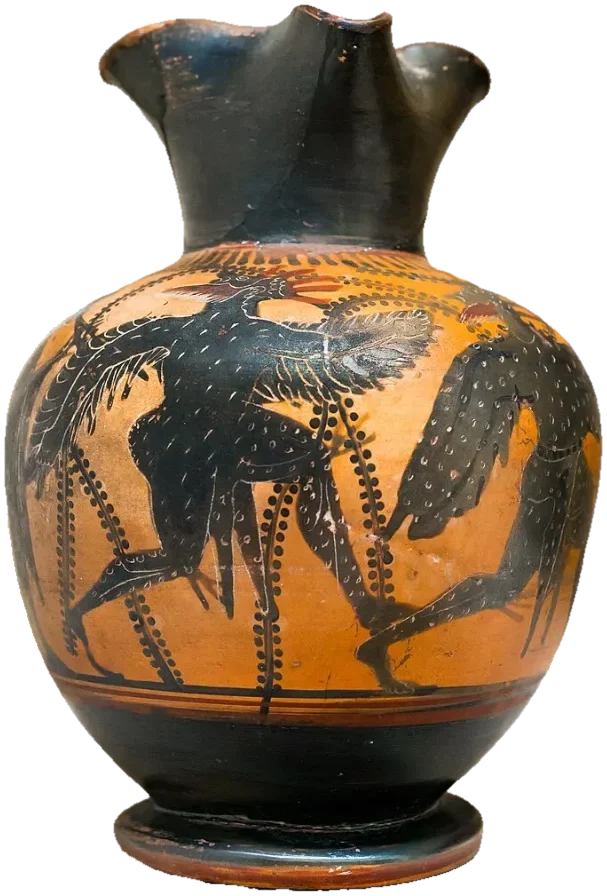
Text and translation
προδεδόμεθʼ ἀνόσιά τʼ ἐπάθομεν
Aristophanes · Birds · the chorus of birds · strophe and antistrophe (327–35 ~ 343–51) · lyric anapaests, then anapaests answered by cretics · Hall and Geldart’s text (Perseus), West’s analysis (1987, pp. 60–61)
How to read each line
A guide to the Greek, syllables, pitch marks and quantities.
Show the reading key
- Above each line: the line as the edition prints it, each word placed over its own syllables. The main row: the same Greek divided into metrical syllables, each written as it is pronounced. A consonant that closes a syllable is written with it (λόθ | ρο); an elided word is closed up with the next vowel (ν’ἀ); a final consonant carried into the next word is set with a thin space (ς ἰ). Wider gaps mark word-ends.
- Above the syllables: the pitch of each syllable, from the accents. Under them: the quantity of each syllable as it falls in the line, then the transliteration, syllable by syllable, with accented syllables in capitals.
- Under each line: a line-for-line translation. In the right margin of the scansion: the line type, its scheme, and its analysis into cola.
Key to the labels
The names, patterns and symbols used beside this poem.
Show the labels and symbols
The labels in the right margin of the scansion below give the line’s analysis as the scheme file states it, then its scheme and, where the analysis notes them, the period-end, a brevis in longo or a hiatus. ‖ marks the end of a period, ||| the end of the stanza; a line without a period-end runs on into the next (synapheia). × is an anceps, long or short; the last position of every period is indifferent. A click on any syllable highlights the colon it belongs to and explains it. The sources of the labels, with their page numbers, are given line by line under Prosody, line by line.
| Label | Name and shape | What it is |
|---|---|---|
| xm | Exclamation⏑ — ⏑ — | The cries ἔα ἔα and ἰὼ ἰώ open the strophe and the antistrophe. West does not analyse them; the page shows their natural quantities without imposing a metre. |
| an2 | Anapaestic dimeter (2an)⏔ — ⏔ — ⏔ — ⏔ — | Two anapaestic metra, ⏑ ⏑ — ⏑ ⏑ — each,[4] in four feet of ⏔ —; the long may be resolved, giving runs of four shorts,[5] and comedy uses the proceleusmatic (⏑ ⏑ ⏖) more freely than tragedy, usually with word-end on each side of it.[6] West takes this part of the strophe as plainly anapaestic;[6] the label is this page’s. |
| an3 | Anapaestic trimeter (3an)⏔ — ⏔ — ⏔ — ⏔ — ⏔ — ⏔ — | Three anapaestic metra, six feet, as West prints 329–30 on one line;[6] the label is this page’s. |
| an2c | Anapaestic dimeter with catalexis (2an∧)⏔ — ⏔ — ⏔ — — | Anapaestic metra with catalexis, ending … ⏑ ⏑ — —:[4] the paroemiac. In lyric anapaests the catalectic dimeter often consists of seven longs,[5] as in 348. The label is this page’s. |
| paean | Anapaests answered by paeons× ⏑ ⏖ … | West’s schemes for 333–35 ~ 349–51: in the strophe the feet are proceleusmatics ⏑ ⏑ ⏖ and anapaests ⏑ ⏑ —, in the antistrophe first paeons — ⏑ ⏖ and cretics — ⏑ —. The anapaest and the cretic, or the proceleusmatic and the paeon, can thus answer each other.[6] The first position of each foot is therefore written ×. |
The feet
| Foot and shape | Where |
|---|---|
| Exclamation⏑ — ⏑ — | Outside the metre (not analysed by West). |
| Anapaestic foot⏔ ⏕ | Half an anapaestic metron: a biceps (two shorts, or one long by contraction) and a long that may be resolved into two shorts; ⏑ ⏑ ⏖ is the proceleusmatic.[7] |
| Closing long— | The last position of the catalectic metron.[4] |
| Proceleusmatic or paeon× ⏑ ⏖ | ⏑ ⏑ ⏖ in the strophe’s anapaestic form, — ⏑ ⏖, a first paeon, in the antistrophe’s cretic form.[8] |
| Anapaest or cretic× ⏑ — | ⏑ ⏑ — (anapaest) in the strophe, — ⏑ — (cretic) in the antistrophe.[6] |
Scansion
West’s example of two things comedy does with sung anapaests: runs of four short syllables, each marked off by word-end, and, in the second half of this strophe, an anapaest answered in the antistrophe by a cretic. The anapaestic half is scanned here foot by foot; the second half follows West’s own scheme, and shows one line where the strophe’s text has a syllable more than his scheme.
- line 334–5: 15 syllables cannot be fitted to the scheme × ⏑ ⏕ × ⏑ — × ⏑ ⏕ × ⏑ ×; the best attempt leaves 1 syllable unplaced (ἐ)
Ha! Ha!
We are betrayed, we have suffered unholy things! For he who
was our friend and grazed beside us on the plains where we were reared together
has broken the ancient laws,
has broken the oaths of the birds;
he has called us into a trap and thrown
me to an unholy race, which
from the day it was born has been bred my enemy.
Io! Io!
Lead on, fall on, bring on a hostile onset
of slaughter! Throw your wing round them on every side, close the circle!
For these two must howl, both of them,
and give my beak its fodder.
For neither shady mountain nor cloud
of the upper air nor grey sea
is there that will take these two in when they escape from me.
Metre
- The song. The chorus of Birds are birds, each dressed, as the text indicates, as a different kind (268–304)[9]. Told by the Hoopoe that he has received two men (320–26), they break out in alarm. The strophe (327–35) cries betrayal. In the seven lines that follow (336–42) the chorus turns on the two old men and Euelpides blames Peisetaerus. Then the antistrophe (343–51) calls the birds to the attack. Swift notes that Aristophanes often lets a short episode intervene between a choral strophe and its antistrophe.[9]
- Whose analysis. West uses this song in his section on lyric anapaests. Comedy, he says, is readier than tragedy to use the proceleusmatic (⏑ ⏑ ⏖), usually setting each one off by word-end, and he cites this passage (Av. 328 f.) and prints 328–31, dividing 328–30 into feet by bars at word-ends: προδεδόμεθʼ | ἀνόσιά τʼ | ἐπάθομεν· | ὃς γὰρ.[6] Of the whole pair he says that the opening of the strophe is plainly anapaestic, while its second half responds irregularly; he prints the schemes of 333–35 and 349–51, three rows each, to show the anapaest (in its proceleusmatic form) standing where the other stanza has a cretic or paeon.[6] He prints no scheme for 327–32. For those lines the page writes anapaestic feet, followed by , and divides them as West prints 328–31 and as Hall and Geldart print 332. The labels 2an, 3an and 2an∧ are the page’s own, from West’s sigla.[4] The cries ἔᾱ ἔᾱ and ῐ̓ὼ ῐ̓ώ are left outside the metre. For 333–35 ~ 349–51 the rows, with West’s | and |||, are his.
- Lyric anapaests. West lists seven marks that set sung anapaests apart from marching anapaests.[5] Three of them can be seen here. The first is heavy contraction of the bicipitia, which often leaves a full dimeter with eight longs and a catalectic one with seven: 347 has eight longs and 348 has seven (ὡς δεῖ τώδʼ οἰμώζειν ἄμφω | καὶ δοῦναι ῥύγχει φορβάν). The second is the run of four shorts, a biceps next to a resolved princeps in either order: these are the proceleusmatics of 328–30 ~ 344–46. The anapaestic tetrameter of comedy, by contrast, generally avoids a run of four short syllables.[10] The third is the catalectic dimeter, which West would expect to end a period wherever it stands: here (332 ~ 348) it closes the anapaestic part. West also lists Doric colouring, in tragedy and in comedy’s parodies of tragedy.[5] The antistrophe has the Doric accusatives ὁρμάν (345) and φορβάν (348), Attic ὁρμήν and φορβήν, with long ᾱ.[11]
- The proceleusmatic. Hephaestion knew this foot under the name προκελευματικός. He lists it among the feet the anapaestic line admits, “rarely” (σπανίως, Ench. 8.1). He also reports that the more discerning (τοῖς … χαριεστέροις) took a line made of such feet as anapaestic: a proceleusmatic stands in place of each anapaest, but in the last place the anapaest is kept “pure and unresolved” (καθαροῦ καὶ μὴ λελυμένου, Ench. 8.8). In 328–9, likewise, three proceleusmatics are followed by a last foot that is not resolved (ὃς γὰρ, — —).
- Anapaest and paeon. In West’s rows for 333–35 the strophe has proceleusmatics ⏑ ⏑ ⏖ and anapaests ⏑ ⏑ —. In the same places the antistrophe has first paeons — ⏑ ⏖ and cretics — ⏑ —. The first paeon is the cretic with its second long resolved; the name is the one the ancient metricians gave it, and the frequency of this form in drama is why West calls the whole family cretic-paeonic.[12] The two stanzas differ only in the first position of a foot: a short in the strophe, a long in the antistrophe. The page therefore writes that position ×, and the table below shows where the stanzas differ.[13]
- Hiatus. The hiatus inside the cries (ἔᾱ | ἔᾱ, ῐ̓ὼ | ῐ̓ώ) stands next to an exclamation. The one in the antistrophe, παντᾷ | ἐπίβαλε (345–6), stands next to an imperative. West allows hiatus even in tragedy next to exclamations, urgent commands and similar words.[14] Neither falls at a line-end, and the page does not take either as marking period-end. Nor does it take the hiatus after the imperative κύκλωσαι, at the end of 345–6, as a period-end. The hiatus after ῐ̓ώ, at the end of 343, falls where the page marks a pause after the cry (note on 343).
- Prosody. The workbench uses the Attic rules (README). Before a stop with a liquid the syllable stays short (“Attic correption”)[15]: -μό- in ὁμότροφα (329–30), κύ- in κύκλωσαι (345–6), and ἐ- in ἐτράφη (334–5). Every α ι υ in the runs of short syllables is short, as the metre requires. Where West’s rules for suffixes apply,[16] they agree. These are: the neuter plural -ᾰ (ἀνόσιᾰ, ὁμότροφᾰ, πεδίᾰ); the accusative singular -ᾰ (πτέρυγᾰ, and LSJ s.v. πτέρυξ, gen. -ῠγος); adjectival -ῐος (ἀνόσιος, πολέμιος, φόνιος, αἰθέριος); and prepositions (παρά, περί).
- Dale’s analysis. Dale cites 333–4 ~ 349–50 for a comic licence of responsion: the number of syllables is kept, but a short lengthened in one stanza changes the rhythm, so that metra of ⏑ ⏑ ⏑ ⏑ in one stanza answer metra of — ⏑ ⏑ ⏑ in the other.[17] This is the correspondence West’s rows for 333–35 ~ 349–51 show, proceleusmatic against cretic or paeon; the two describe the same facts, West in terms of anapaest and paeon, Dale as a licence of responsion within a fixed syllable count.
- Henderson’s text. Compared with J. Henderson’s Loeb edition of 2000, the words are the same except at 334, where he has no ἐπ’ and so gives the fourteen syllables of West’s row.[18] He prints the song in shorter lines; the line numbers agree.[19]
Prosody, line by line
Every syllable, with the reason for its length. Quantities are read from the vowel where the spelling shows it, from the consonants that follow (“position”), from the accent where it tells, and from the metre where nothing else does. Editors’ notes on the text follow in the boxed paragraphs.
- 327
Line 327 · ἔα ἔα,
ἔα ἔα,
ἔαἔα,hiatus inside the line.
The label in the margin, with its sources: not analysed by West.
- 1 ⏑ἔἔ is short by nature; the position is anceps.
- 2 —αᾱ is long (its length is not shown by the ordinary spelling); the next word begins with a vowel and nothing is elided: hiatus; the position is anceps.
- 3 ⏑ἔἔ is short by nature; the position is anceps.
- 4 ×α,ᾱ is long (its length is not shown by the ordinary spelling); the last position of the period is indifferent.
Strophe. The cry ἔα[20] has a long α. West prints ἔᾱ ἔᾱ, with long marks, as a line on its own at the head of his specimen of lyric anapaests, Euripides, Ion 154.[5] The cry is not part of the anapaestic run. The page draws its last syllable as × and marks a pause (‖) after it; that division is the page’s own, following West’s practice of setting the cry on a line of its own. The hiatus after ἔᾱ follows an exclamation.[14]- 328–9
Line 328–9 · προδεδόμεθʼ ἀνόσιά τʼ ἐπάθομεν· ὃς γὰρ
προδεδόμεθʼ ἀνόσιά τʼ ἐπάθομεν· ὃς γὰρ
προδεδόμεθ’ἀνόσιάτ’ἐπάθομε·ν ὃςγὰρthe period runs on into l. 329–30 (synapheia).
The label in the margin, with its sources: West 1987, p. 61 (feet).
- 1 ⏑προο is short by nature; one of the two shorts of the biceps at position 1.
- 2 ⏑δεε is short by nature; one of the two shorts of the biceps at position 1.
- 3 ⏑δόό is short by nature; with its neighbour it resolves the long of position 2 into two shorts.
- 4 ⏑μεε is short by nature; with its neighbour it resolves the long of position 2 into two shorts.
- 5 ⏑θ’ἀἀ is short by the metre (position 3 must be short); the apostrophe marks an elided vowel; the consonant before it joins this syllable; one of the two shorts of the biceps at position 3.
- 6 ⏑νόό is short by nature; one of the two shorts of the biceps at position 3.
- 7 ⏑σιι is short by the metre (position 4 must be short); with its neighbour it resolves the long of position 4 into two shorts.
- 8 ⏑άά is short by the accent rule: acute on the antepenult requires a short final syllable; with its neighbour it resolves the long of position 4 into two shorts.
- 9 ⏑τ’ἐἐ is short by nature; the apostrophe marks an elided vowel; the consonant before it joins this syllable; one of the two shorts of the biceps at position 5.
- 10 ⏑πάά is short by the metre (position 5 must be short); one of the two shorts of the biceps at position 5.
- 11 ⏑θοο is short by nature; with its neighbour it resolves the long of position 6 into two shorts.
- 12 ⏑με·ε is short by nature; with its neighbour it resolves the long of position 6 into two shorts.
- 13 —ν ὃςὃ is short by nature; closed by ς: long by position; the first consonant belongs to the previous word and is carried over to this vowel; a single long contracts the two shorts of the biceps at position 7.
- 14 —γὰρὰ is a vowel of unknown length; closed by ρ: long by position; the line-end is not a period-end: the period runs on into the next line (synapheia), so this syllable keeps its own length, with no brevis in longo, and a word may run over into the next line.[21]
Strophe, 2an. West’s example of comic proceleusmatics, each set off by word-end.[6] Each of the first three feet is a word or word-group of four short syllables, ⏑ ⏑ ⏖: προδεδόμεθʼ | ἀνόσιά τʼ | ἐπάθομεν. The fourth, ὃς γὰρ, is two longs: the biceps is contracted and the long is not resolved. The ν of ἐπάθομεν passes to ὃς, which is long by position.- 329–30
Line 329–30 · φίλος ἦν ὁμότροφά θʼ ἡμῖν ἐνέμετο πεδία παρʼ ἡμῖν,
φίλος ἦν ὁμότροφά θʼ ἡμῖν ἐνέμετο πεδία παρʼ ἡμῖν,
φίλος ἦνὁμότροφάθ’ἡμῖνἐνέμετοπεδίαπαρ’ἡμῖν,continues l. 328–9 · one period (synapheia); the period runs on into l. 331 (synapheia).
The label in the margin, with its sources: West 1987, p. 61 (feet).
- 1 ⏑φίί is short by the metre (position 1 must be short); one of the two shorts of the biceps at position 1.
- 2 ⏑λοο is short by nature; one of the two shorts of the biceps at position 1.
- 3 —ς ἦνἦ is long by nature; the first consonant belongs to the previous word and is carried over to this vowel.
- 4 ⏑ὁὁ is short by nature; one of the two shorts of the biceps at position 3.
- 5 ⏑μόό is short by nature; τρ is carried whole into the next syllable, so this syllable stays open and short (Attic correption of a stop + liquid cluster); one of the two shorts of the biceps at position 3.
- 6 ⏑τροο is short by nature; with its neighbour it resolves the long of position 4 into two shorts.
- 7 ⏑φάά is short by the accent rule: acute on the antepenult requires a short final syllable; with its neighbour it resolves the long of position 4 into two shorts.
- 8 —θ’ἡἡ is long by nature; the apostrophe marks an elided vowel; the consonant before it joins this syllable; a single long contracts the two shorts of the biceps at position 5.
- 9 —μῖνῖ carries a circumflex, so it is long.
- 10 ⏑ἐἐ is short by nature; one of the two shorts of the biceps at position 7.
- 11 ⏑νέέ is short by nature; one of the two shorts of the biceps at position 7.
- 12 ⏑μεε is short by nature; with its neighbour it resolves the long of position 8 into two shorts.
- 13 ⏑τοο is short by nature; with its neighbour it resolves the long of position 8 into two shorts.
- 14 ⏑πεε is short by nature; one of the two shorts of the biceps at position 9.
- 15 ⏑δίί is short by the metre (position 9 must be short); one of the two shorts of the biceps at position 9.
- 16 ⏑αα is short by the metre (position 10 must be short); with its neighbour it resolves the long of position 10 into two shorts.
- 17 ⏑παα is short by the metre (position 10 must be short); with its neighbour it resolves the long of position 10 into two shorts.
- 18 —ρ’ἡἡ is long by nature; the apostrophe marks an elided vowel; the consonant before it joins this syllable; a single long contracts the two shorts of the biceps at position 11.
- 19 —μῖν,ῖ carries a circumflex, so it is long; closed by ν: long by position; the line-end is not a period-end: the period runs on into the next line (synapheia), so this syllable keeps its own length, with no brevis in longo, and a word may run over into the next line.[21]
Strophe, 3an. West prints this as one line of six feet, with a bar at each word-end: φίλος ἦν | ὁμότροφά θʼ | ἡμῖν | ἐνέμετο | πεδία παρʼ | ἡμῖν.[6] The page labels it an anapaestic trimeter. Proceleusmatics alternate with contracted feet: ⏑ ⏑ — | ⏑ ⏑ ⏖ | — — | ⏑ ⏑ ⏖ | ⏑ ⏑ ⏖ | — —. In ὁμότροφα the -μό- stays short before τρ.[15]- 331
Line 331 · παρέβη μὲν θεσμοὺς ἀρχαίους,
παρέβη μὲν θεσμοὺς ἀρχαίους,
παρέβημὲνθεσμοὺςἀρχαίους,continues l. 329–30 · one period (synapheia); the period runs on into l. 332 (synapheia).
The label in the margin, with its sources: anapaestic (West 1987, p. 61).
- 1 ⏑παα is short by the metre (position 1 must be short); one of the two shorts of the biceps at position 1.
- 2 ⏑ρέέ is short by nature; one of the two shorts of the biceps at position 1.
- 3 —βηη is long by nature.
- 4 —μὲνὲ is short by nature; closed by ν: long by position; a single long contracts the two shorts of the biceps at position 3.
- 5 —θεσε is short by nature; closed by σ: long by position.
- 6 —μοὺςοὺ is a diphthong, long by nature; a single long contracts the two shorts of the biceps at position 5.
- 7 —ἀρἀ is a vowel of unknown length; closed by ρ: long by position.
- 8 —χαίαί is a diphthong, long by nature; a single long contracts the two shorts of the biceps at position 7.
- 9 —ους,ου is a diphthong, long by nature; closed by ς: long by position; the line-end is not a period-end: the period runs on into the next line (synapheia), so this syllable keeps its own length, with no brevis in longo, and a word may run over into the next line.[21]
Strophe, 2an. παρέβη μὲν θεσμοὺς ἀρχαίους: ⏑ ⏑ — | — — | — — | — —, with every biceps after the first contracted. West quotes the line as the third of his example.[6]- 332
Line 332 · παρέβη δʼ ὅρκους ὀρνίθων·
παρέβη δʼ ὅρκους ὀρνίθων·
παρέβηδ’ὅρκουςὀρνίθων·continues l. 331 · one period (synapheia).
The label in the margin, with its sources: anapaestic (West 1987, p. 61).
- 1 ⏑παα is short by the metre (position 1 must be short); one of the two shorts of the biceps at position 1.
- 2 ⏑ρέέ is short by nature; one of the two shorts of the biceps at position 1.
- 3 —βηη is long by nature.
- 4 —δ’ὅρὅ is short by nature; closed by ρ: long by position; the apostrophe marks an elided vowel; the consonant before it joins this syllable; a single long contracts the two shorts of the biceps at position 3.
- 5 —κουςου is a diphthong, long by nature.
- 6 —ὀρὀ is short by nature; closed by ρ: long by position; a single long contracts the two shorts of the biceps at position 5.
- 7 —νίί is long by the metre (position 6 must be long).
- 8 ×θων·ω is long by nature; closed by ν: long by position; the last position of the period is indifferent.
- 333
Line 333 · ἐς δὲ δόλον ἐκάλεσε, παρέβαλέ
ἐς δὲ δόλον ἐκάλεσε, παρέβαλέ
ἐςδὲδόλον ἐκάλεσε,παρέβαλέthe period runs on into l. 333–4 (synapheia).
The label in the margin, with its sources: · West 1987, p. 61.
- 1 —ἐςἐ is short by nature; closed by ς: long by position; the position is anceps.
- 2 ⏑δὲὲ is short by nature.
- 3 ⏑δόό is short by nature; with its neighbour it resolves the long of position 3 into two shorts.
- 4 ⏑λοο is short by nature; with its neighbour it resolves the long of position 3 into two shorts.
- 5 ⏑ν ἐἐ is short by nature; the first consonant belongs to the previous word and is carried over to this vowel; the position is anceps.
- 6 ⏑κάά is short by the metre (position 5 must be short).
- 7 ⏑λεε is short by nature; with its neighbour it resolves the long of position 6 into two shorts.
- 8 ⏑σε,ε is short by nature; with its neighbour it resolves the long of position 6 into two shorts.
- 9 ⏑παᾰ is short (its length is not shown by the ordinary spelling); the position is anceps.
- 10 ⏑ρέέ is short by nature.
- 11 ⏑βαα is short by the metre (position 9 must be short); with its neighbour it resolves the long of position 9 into two shorts.
- 12 ⏑λέέ is short by nature; with its neighbour it resolves the long of position 9 into two shorts; the line-end is not a period-end: the period runs on into the next line (synapheia), so this syllable keeps its own length, with no brevis in longo, and a word may run over into the next line.[21]
Strophe, West’s row 1: — ⏑ ⏖ | ⏑ ⏑ ⏖ | ⏑ ⏑ ⏖ |.[6] The first foot, ἐς δὲ δόλον, already has a long first position, as in the antistrophe. The other two are proceleusmatics, each marked off by word-end (ἐκάλεσε, παρέβαλε-).- 333–4
Line 333–4 · τʼ ἐμὲ παρὰ γένος ἀνόσιον, ὅπερ
τʼ ἐμὲ παρὰ γένος ἀνόσιον, ὅπερ
τ’ἐμὲπαρὰγένος ἀνόσιο,ν ὅπεcontinues l. 333 · one period (synapheia); the period runs on into l. 334–5 (synapheia).
The label in the margin, with its sources: · West 1987, p. 61.
- 1 ⏑τ’ἐἐ is short by nature; the apostrophe marks an elided vowel; the consonant before it joins this syllable; the position is anceps.
- 2 ⏑μὲὲ is short by nature.
- 3 ⏑παα is short by the metre (position 3 must be short); with its neighbour it resolves the long of position 3 into two shorts.
- 4 ⏑ρὰὰ is short by the metre (position 3 must be short); with its neighbour it resolves the long of position 3 into two shorts.
- 5 ⏑γέέ is short by nature; the position is anceps.
- 6 ⏑νοο is short by nature.
- 7 ⏑ς ἀἀ is short by the metre (position 6 must be short); the first consonant belongs to the previous word and is carried over to this vowel; with its neighbour it resolves the long of position 6 into two shorts.
- 8 ⏑νόό is short by nature; with its neighbour it resolves the long of position 6 into two shorts.
- 9 ⏑σιῐ is short (its length is not shown by the ordinary spelling); the position is anceps.
- 10 ⏑ο,ο is short by nature.
- 11 ⏑ν ὅὅ is short by nature; the first consonant belongs to the previous word and is carried over to this vowel; with its neighbour it resolves the long of position 9 into two shorts.
- 12 ⏑πεε is short by nature; with its neighbour it resolves the long of position 9 into two shorts; the line-end is not a period-end: the period runs on into the next line (synapheia), so this syllable keeps its own length, with no brevis in longo, and a word may run over into the next line.[21]
Strophe, West’s row 2: ⏑ ⏑ ⏖ | ⏑ ⏑ ⏖ ⏑ ⏑ ⏖ |,[6] twelve short syllables in a row. In γένος ἀνόσιον the ς passes to the next word, and the syllable stays short. The ρ of ὅπερ passes to ἐξότʼ in the next line.- 334–5
Line 334–5 · ἐξότʼ ἐγένετʼ ἐπʼ ἐμοὶ πολέμιον ἐτράφη.
ἐξότʼ ἐγένετʼ ἐπʼ ἐμοὶ πολέμιον ἐτράφη.
ρ ἐξότ’ἐγένετ’ἐπ’ἐμοὶπολέμιον ἐτράφη.continues l. 333–4 · one period (synapheia).
The label in the margin, with its sources: · West 1987, p. 61.
- 1 —ρ ἐἐ is short by nature; ξ is a double consonant (two sounds) and closes the syllable: long by position; the first consonant belongs to the previous word and is carried over to this vowel; it could not be fitted into the scheme; the position is anceps.
- 2 ⏑ξόό is short by nature; the position is anceps.
- 3 ⏑τ’ἐἐ is short by nature; the apostrophe marks an elided vowel; the consonant before it joins this syllable.
- 4 ⏑γέέ is short by nature; with its neighbour it resolves the long of position 3 into two shorts.
- 5 ⏑νεε is short by nature; with its neighbour it resolves the long of position 3 into two shorts.
- 6 ⏑τ’ἐἐ is short by nature; the apostrophe marks an elided vowel; the consonant before it joins this syllable; the position is anceps.
- 7 ⏑π’ἐἐ is short by nature; the apostrophe marks an elided vowel; the consonant before it joins this syllable.
- 8 —μοὶοὶ is a diphthong, long by nature.
- 9 ⏑ποο is short by nature; the position is anceps.
- 10 ⏑λέέ is short by nature.
- 11 ⏑μιι is short by the metre (position 9 must be short); with its neighbour it resolves the long of position 9 into two shorts.
- 12 ⏑οο is short by nature; with its neighbour it resolves the long of position 9 into two shorts.
- 13 ⏑ν ἐἐ is short by nature; τρ is carried whole into the next syllable, so this syllable stays open and short (Attic correption of a stop + liquid cluster); the first consonant belongs to the previous word and is carried over to this vowel; the position is anceps.
- 14 ⏑τράά is short by the metre (position 11 must be short).
- 15 ×φη.η is long by nature; the last position of the period is indifferent.
⚠ line 334–5: 15 syllables cannot be fitted to the scheme × ⏑ ⏕ × ⏑ — × ⏑ ⏕ × ⏑ ×; the best attempt leaves 1 syllable unplaced (ἐ)
Strophe, West’s row 3: — ⏑ ⏖ ⏑ ⏑ — | ⏑ ⏑ ⏖ | ⏑ ⏑ — |||.[6] Problem: West’s row has fourteen syllables, and Hall and Geldart’s text, ὅπερ ἐξότʼ ἐγένετʼ ἐπʼ ἐμοὶ πολέμιον ἐτράφη, gives fifteen. Between the long ἐξ- and the long -μοί of ἐμοί West has ⏑ ⏖ ⏑ ⏑, five shorts. The text has six: -ό, τʼἐ-, -γέ-, -νε, τʼἐ-, πʼἐ-. West evidently read a text one short syllable shorter here. He prints only the scheme, and our sources do not say which syllable is missing. The workbench therefore cannot fit the line. It leaves one syllable unplaced, and its placing of the others is only a best attempt. The rest of the row, πολέμιον ἐτράφη, fits West’s ⏑ ⏑ ⏖ | ⏑ ⏑ — exactly. In ἐτράφη the ε stays short before τρ. Henderson prints ἐξότ’ ἐγένετ’ ἐμοί, without ἐπ’. That is one short syllable fewer: between ἐξ- and -μοί there are then five shorts, as in West’s row, and the line has his fourteen syllables.[23]- 343
Line 343 · ἰὼ ἰώ,
ἰὼ ἰώ,
ἰὼἰώ,hiatus inside the line.
The label in the margin, with its sources: not analysed by West.
- 1 ⏑ἰῐ̓ is short (its length is not shown by the ordinary spelling); the position is anceps.
- 2 —ὼὼ is long by nature; the next word begins with a vowel and nothing is elided: hiatus; the position is anceps.
- 3 ⏑ἰῐ̓ is short (its length is not shown by the ordinary spelling); the position is anceps.
- 4 ×ώ,ώ is long by nature; the last position of the period is indifferent.
Antistrophe. ἰώ is an exclamation “chiefly in dramatic poetry (lyr.)”. LSJ gives the ι as short, “yet sts. ῑ, in anap.”.[24] The page shows the ordinary short ι, since it does not scan the cry as part of the anapaests (note on 327). The hiatus inside the cry, and the hiatus after it (ἰώ | ἔπαγʼ), are the kind West allows around an exclamation.[14] The second is also consistent with the pause the page marks after the cry (note on 327).- 344–5
Line 344–5 · ἔπαγʼ ἔπιθʼ ἐπίφερε πολέμιον ὁρμὰν
ἔπαγʼ ἔπιθʼ ἐπίφερε πολέμιον ὁρμὰν
ἔπαγ’ἔπιθ’ἐπίφερεπολέμιον ὁρμὰνthe period runs on into l. 345–6 (synapheia).
The label in the margin, with its sources: West 1987, p. 61 (feet).
- 1 ⏑ἔἔ is short by nature; one of the two shorts of the biceps at position 1.
- 2 ⏑παα is short by the metre (position 1 must be short); one of the two shorts of the biceps at position 1.
- 3 ⏑γ’ἔἔ is short by nature; the apostrophe marks an elided vowel; the consonant before it joins this syllable; with its neighbour it resolves the long of position 2 into two shorts.
- 4 ⏑πιι is short by the metre (position 2 must be short); with its neighbour it resolves the long of position 2 into two shorts.
- 5 ⏑θ’ἐἐ is short by nature; the apostrophe marks an elided vowel; the consonant before it joins this syllable; one of the two shorts of the biceps at position 3.
- 6 ⏑πίί is short by the metre (position 3 must be short); one of the two shorts of the biceps at position 3.
- 7 ⏑φεε is short by nature; with its neighbour it resolves the long of position 4 into two shorts.
- 8 ⏑ρεε is short by nature; with its neighbour it resolves the long of position 4 into two shorts.
- 9 ⏑ποο is short by nature; one of the two shorts of the biceps at position 5.
- 10 ⏑λέέ is short by nature; one of the two shorts of the biceps at position 5.
- 11 ⏑μιι is short by the metre (position 6 must be short); with its neighbour it resolves the long of position 6 into two shorts.
- 12 ⏑οο is short by nature; with its neighbour it resolves the long of position 6 into two shorts.
- 13 —ν ὁρὁ is short by nature; closed by ρ: long by position; the first consonant belongs to the previous word and is carried over to this vowel; a single long contracts the two shorts of the biceps at position 7.
- 14 —μὰνὰ is a vowel of unknown length; closed by ν: long by position; the line-end is not a period-end: the period runs on into the next line (synapheia), so this syllable keeps its own length, with no brevis in longo, and a word may run over into the next line.[21]
Antistrophe, 2an (note on 328–9). Three proceleusmatics, each a word or word-group: ἔπαγʼ ἔπιθʼ | ἐπίφερε | πολέμιον, the first made of two elided imperatives. Then a contracted foot, ὁρμάν. ὁρμάν is the Doric form of ὁρμήν, with a long ᾱ.- 345–6
Line 345–6 · φονίαν, πτέρυγά τε παντᾷ ἐπίβαλε περί τε κύκλωσαι·
φονίαν, πτέρυγά τε παντᾷ ἐπίβαλε περί τε κύκλωσαι·
φονίαν,πτέρυγάτεπαντᾷἐπίβαλεπερίτεκύκλωσαι·continues l. 344–5 · one period (synapheia); hiatus inside the line; the period runs on into l. 347 (synapheia).
The label in the margin, with its sources: West 1987, p. 61 (feet).
- 1 ⏑φοο is short by nature; one of the two shorts of the biceps at position 1.
- 2 ⏑νίί is short by the metre (position 1 must be short); one of the two shorts of the biceps at position 1.
- 3 —αν,α is a vowel of unknown length; closed by ν: long by position.
- 4 ⏑πτέέ is short by nature; one of the two shorts of the biceps at position 3.
- 5 ⏑ρυυ is short by the metre (position 3 must be short); one of the two shorts of the biceps at position 3.
- 6 ⏑γάά is short by the accent rule: acute on the antepenult requires a short final syllable; with its neighbour it resolves the long of position 4 into two shorts.
- 7 ⏑τεε is short by nature; with its neighbour it resolves the long of position 4 into two shorts.
- 8 —πανα is a vowel of unknown length; closed by ν: long by position; a single long contracts the two shorts of the biceps at position 5.
- 9 —τᾷᾷ is long by nature; the next word begins with a vowel and nothing is elided: hiatus.
- 10 ⏑ἐἐ is short by nature; one of the two shorts of the biceps at position 7.
- 11 ⏑πίί is short by the metre (position 7 must be short); one of the two shorts of the biceps at position 7.
- 12 ⏑βαα is short by the metre (position 8 must be short); with its neighbour it resolves the long of position 8 into two shorts.
- 13 ⏑λεε is short by nature; with its neighbour it resolves the long of position 8 into two shorts.
- 14 ⏑πεε is short by nature; one of the two shorts of the biceps at position 9.
- 15 ⏑ρίί is short by the metre (position 9 must be short); one of the two shorts of the biceps at position 9.
- 16 ⏑τεε is short by nature; with its neighbour it resolves the long of position 10 into two shorts.
- 17 ⏑κύύ is a vowel of unknown length; κλ is carried whole into the next syllable, so this syllable stays open and short (Attic correption of a stop + liquid cluster); with its neighbour it resolves the long of position 10 into two shorts.
- 18 —κλωω is long by nature; a single long contracts the two shorts of the biceps at position 11.
- 19 —σαι·αι is a diphthong, long by nature; the next word begins with a vowel and nothing is elided: hiatus; the line-end is not a period-end: the period runs on into the next line (synapheia), so this syllable keeps its own length, with no brevis in longo, and a word may run over into the next line.[21]
Antistrophe, 3an, answering 329–30 foot for foot: φονίαν, | πτέρυγά τε | παντᾷ | ἐπίβαλε | περί τε κύ- | κλωσαι, with the same alternation of ⏑ ⏑ ⏖ and — —. There is hiatus before the imperative ἐπίβαλε, and the long -ᾷ of παντᾷ is not shortened.[25] κύ- stays short before κλ.[15] Henderson prints ἐπίβαλε, as here; his apparatus records Reisig’s περίβαλε.[26]- 347
Line 347 · ὡς δεῖ τώδʼ οἰμώζειν ἄμφω
ὡς δεῖ τώδʼ οἰμώζειν ἄμφω
ὡςδεῖτώδ’οἰμώζεινἄμφωcontinues l. 345–6 · one period (synapheia); the period runs on into l. 348 (synapheia).
The label in the margin, with its sources: anapaestic (West 1987, p. 61).
- 1 —ὡςὡ is long by nature; closed by ς: long by position; a single long contracts the two shorts of the biceps at position 1.
- 2 —δεῖεῖ is a diphthong, long by nature.
- 3 —τώώ is long by nature; a single long contracts the two shorts of the biceps at position 3.
- 4 —δ’οἰοἰ is a diphthong, long by nature; the apostrophe marks an elided vowel; the consonant before it joins this syllable.
- 5 —μώώ is long by nature; ζ is a double consonant (two sounds) and closes the syllable: long by position; a single long contracts the two shorts of the biceps at position 5.
- 6 —ζεινει is a diphthong, long by nature.
- 7 —ἄμἄ is a vowel of unknown length; closed by μ: long by position; a single long contracts the two shorts of the biceps at position 7.
- 8 —φωω is long by nature; the line-end is not a period-end: the period runs on into the next line (synapheia), so this syllable keeps its own length, with no brevis in longo, and a word may run over into the next line.[21]
Antistrophe, 2an, made entirely of long syllables (eight), the form West says the lyric dimeter “very often” takes.[5] It answers the ⏑ ⏑ — of παρέβη with a contracted biceps, ὡς δεῖ.- 348
Line 348 · καὶ δοῦναι ῥύγχει φορβάν.
καὶ δοῦναι ῥύγχει φορβάν.
καὶδοῦναιῥύγχειφορβάν.continues l. 347 · one period (synapheia).
The label in the margin, with its sources: anapaestic (West 1987, p. 61).
- 1 —καὶαὶ is a diphthong, long by nature; a single long contracts the two shorts of the biceps at position 1.
- 2 —δοῦοῦ is a diphthong, long by nature.
- 3 —ναιαι is a diphthong, long by nature; a single long contracts the two shorts of the biceps at position 3.
- 4 —ῥύγύ is a vowel of unknown length; closed by γ: long by position.
- 5 —χειει is a diphthong, long by nature; a single long contracts the two shorts of the biceps at position 5.
- 6 —φορο is short by nature; closed by ρ: long by position.
- 7 ×βάν.ά is a vowel of unknown length; closed by ν: long by position; the last position of the period is indifferent.
- 349
Line 349 · οὔτε γὰρ ὄρος σκιερὸν οὔτε νέφος
οὔτε γὰρ ὄρος σκιερὸν οὔτε νέφος
οὔτεγὰρ ὄροςσκιερὸν οὔτενέφοthe period runs on into l. 349–50 (synapheia).
The label in the margin, with its sources: · West 1987, p. 61.
- 1 —οὔοὔ is a diphthong, long by nature; the position is anceps.
- 2 ⏑τεε is short by nature.
- 3 ⏑γὰὰ is short by the metre (position 3 must be short); with its neighbour it resolves the long of position 3 into two shorts.
- 4 ⏑ρ ὄὄ is short by nature; the first consonant belongs to the previous word and is carried over to this vowel; with its neighbour it resolves the long of position 3 into two shorts.
- 5 —ροςο is short by nature; closed by ς: long by position; the position is anceps.
- 6 ⏑σκιι is short by the metre (position 5 must be short).
- 7 ⏑εε is short by nature; with its neighbour it resolves the long of position 6 into two shorts.
- 8 ⏑ρὸὸ is short by nature; with its neighbour it resolves the long of position 6 into two shorts.
- 9 —ν οὔοὔ is a diphthong, long by nature; the first consonant belongs to the previous word and is carried over to this vowel; the position is anceps.
- 10 ⏑τεε is short by nature.
- 11 ⏑νέέ is short by nature; with its neighbour it resolves the long of position 9 into two shorts.
- 12 ⏑φοο is short by nature; with its neighbour it resolves the long of position 9 into two shorts; the line-end is not a period-end: the period runs on into the next line (synapheia), so this syllable keeps its own length, with no brevis in longo, and a word may run over into the next line.[21]
Antistrophe, West’s row 1: — ⏑ ⏖ — ⏑ ⏖ | — ⏑ ⏖ |.[6] Every foot is a first paeon: οὔτε γὰρ ὄ- | ρος σκιερὸ- | ν οὔτε νέφο-. Each first position is long; in the strophe it is short in the second and third feet. ρος is long because σκ follows.- 349–50
Line 349–50 · αἰθέριον οὔτε πολιὸν πέλαγος
αἰθέριον οὔτε πολιὸν πέλαγος
ς αἰθέριον οὔτεπολιὸνπέλαγοcontinues l. 349 · one period (synapheia); the period runs on into l. 350–1 (synapheia).
The label in the margin, with its sources: · West 1987, p. 61.
- 1 —ς αἰαἰ is a diphthong, long by nature; the first consonant belongs to the previous word and is carried over to this vowel; the position is anceps.
- 2 ⏑θέέ is short by nature.
- 3 ⏑ριι is short by the metre (position 3 must be short); with its neighbour it resolves the long of position 3 into two shorts.
- 4 ⏑οο is short by nature; with its neighbour it resolves the long of position 3 into two shorts.
- 5 —ν οὔοὔ is a diphthong, long by nature; the first consonant belongs to the previous word and is carried over to this vowel; the position is anceps.
- 6 ⏑τεε is short by nature.
- 7 ⏑ποο is short by nature; with its neighbour it resolves the long of position 6 into two shorts.
- 8 ⏑λιι is short by the metre (position 6 must be short); with its neighbour it resolves the long of position 6 into two shorts.
- 9 —ὸνὸ is short by nature; closed by ν: long by position; the position is anceps.
- 10 ⏑πέέ is short by nature.
- 11 ⏑λαα is short by the metre (position 9 must be short); with its neighbour it resolves the long of position 9 into two shorts.
- 12 ⏑γοο is short by nature; with its neighbour it resolves the long of position 9 into two shorts; the line-end is not a period-end: the period runs on into the next line (synapheia), so this syllable keeps its own length, with no brevis in longo, and a word may run over into the next line.[21]
Antistrophe, West’s row 2: — ⏑ ⏖ | — ⏑ ⏖ — ⏑ ⏖ |,[6] three first paeons against the strophe’s three proceleusmatics. The ς of νέφος passes to αἰθέριον, and the ν of αἰθέριον to οὔτε. -ὸν of πολιόν is long because the π of πέλαγος follows.- 350–1
Line 350–1 · ἔστιν ὅ τι δέξεται τώδʼ ἀποφυγόντε με.
ἔστιν ὅ τι δέξεται τώδʼ ἀποφυγόντε με.
ς ἔστιν ὅτιδέξεταιτώδ’ἀποφυγόντεμε.continues l. 349–50 · one period (synapheia); brevis in longo at period-end (a short in the final long position).
The label in the margin, with its sources: · West 1987, p. 61.
- 1 —ς ἔσἔ is short by nature; closed by σ: long by position; the first consonant belongs to the previous word and is carried over to this vowel; the position is anceps.
- 2 ⏑τιι is short by the metre (position 2 must be short).
- 3 ⏑ν ὅὅ is short by nature; the first consonant belongs to the previous word and is carried over to this vowel; with its neighbour it resolves the long of position 3 into two shorts.
- 4 ⏑τιι is short by the metre (position 3 must be short); with its neighbour it resolves the long of position 3 into two shorts.
- 5 —δέέ is short by nature; ξ is a double consonant (two sounds) and closes the syllable: long by position; the position is anceps.
- 6 ⏑ξεε is short by nature.
- 7 —ταιαι is a diphthong, long by nature.
- 8 —τώώ is long by nature; the position is anceps.
- 9 ⏑δ’ἀἀ is short by the metre (position 8 must be short); the apostrophe marks an elided vowel; the consonant before it joins this syllable.
- 10 ⏑ποο is short by nature; with its neighbour it resolves the long of position 9 into two shorts.
- 11 ⏑φυυ is short by the metre (position 9 must be short); with its neighbour it resolves the long of position 9 into two shorts.
- 12 —γόνό is short by nature; closed by ν: long by position; the position is anceps.
- 13 ⏑τεε is short by nature.
- 14 ×με.ε is short by nature; the last position of the period is indifferent; a short here is brevis in longo.
Strophe and antistrophe
The two stanzas side by side, line by line, with the realisation of every position and the word-ends (|). The signs printed in the accent colour mark the places where the stanzas differ. Two are in the anapaestic part, a biceps of two shorts in the strophe (παρέβη) against a contracted biceps in the antistrophe (ὡς δεῖ, καὶ δοῦ-). The rest are in the paeonic part, a short in the strophe against a long in the antistrophe in the first position of a foot. The strophe’s last row is shown as the workbench scanned it but is not compared.[31] West’s own rows show the remaining differences there: ⏑ ~ — in the first position of the second, third and fourth feet.
| West’s label | Strophe (327–35) | Antistrophe (343–51) | ||
|---|---|---|---|---|
| exclamation | 327 | ⏑ — | ⏑ — | 343 | ⏑ — | ⏑ — |
| 2an | 328–9 | ⏑ ⏑ ⏖ | ⏑ ⏑ ⏖ | ⏑ ⏑ ⏖ | | — | 344–5 | ⏑ ⏑ | ⏖ | ⏑ ⏑ ⏖ | ⏑ ⏑ ⏖ | — |
| 3an | 329–30 | ⏑ ⏑ | — | ⏑ ⏑ ⏖ | — | ⏑ ⏑ ⏖ | ⏑ ⏑ ⏖ | — | 345–6 | ⏑ ⏑ — | ⏑ ⏑ ⏖ | — | ⏑ ⏑ ⏖ | ⏑ ⏑ | ⏖ — |
| 2an | 331 | ⏑ ⏑ — | | — | — — | 347 | | — | | — — | — |
| 2an∧ ‖ | 332 | ⏑ ⏑ — | — | — — | 348 | | — | — | — — |
| West’s row 1 | | 333 | — | ⏑ | ⏖ | ⏑ ⏑ ⏖ | ⏑ ⏑ ⏖ | 349 | — ⏑ | ⏖ — | ⏑ ⏖ | — ⏑ | ⏖ |
| West’s row 2 | | 333–4 | ⏑ ⏑ | ⏖ | ⏑ ⏑ | ⏖ ⏑ ⏑ | ⏖ | 349–50 | — ⏑ ⏖ | — ⏑ | ⏖ — | ⏑ ⏖ |
| West’s row 3 ||| | 334–5 | ⏑ | ⏑ ⏖ | ⏑ | ⏑ — | ⏑ ⏑ ⏖ | ⏑ ⏑ — does not fit West’s row[31] | 350–1 | — ⏑ | ⏖ | — ⏑ — | — | ⏑ ⏖ — ⏑ | ⏑ |
Notes
- ^ Rogers 1906, p. x; Seidensticker 2005, p. 42.
- ^ Rogers 1906, pp. vii–viii; Easterling 1997, Chronology, p. 353.
- ^ Rogers 1906, p. x.
- ^ a b c d e West 1987, p. ix.
- ^ a b c d e f g h West 1987, p. 60.
- ^ a b c d e f g h i j k l m n o p West 1987, p. 61.
- ^ West 1987, pp. 60–61.
- ^ West 1987, pp. 55, 61.
- ^ a b Swift 2022, p. 386.
- ^ West 1987, pp. 29–30.
- ^ D’Alessio 2009, p. 122; see the Anapaestic family page (lyric anapaests), which cites 328–30.
- ^ West 1987, p. 55.
- ^ See the Cretic-paeonic family page (usage) and the Dramatic lyric page (comedy), which both cite this passage.
- ^ a b c West 1987, p. 16.
- ^ a b c West 1987, pp. 16–17.
- ^ West 1987, p. 11.
- ^ Dale 1968, p. 190, referring back to her treatment of anapaests.
- ^ See the note.
- ^ Henderson 2000, pp. 62–65.
- ^ LSJ ἔᾱ, “exclam. of surprise or displeasure, ha! oho!”
- ^ a b c d e f g h i j West 1987, pp. 3–4.
- ^ LSJ s.v. ὄρνις, gen. ὄρνῑθος.
- ^ Henderson 2000, p. 62.
- ^ LSJ s.v. ἰώ.
- ^ See Metre above, “Hiatus”.
- ^ Henderson 2000, p. 64.
- ^ LSJ s.v. ῥύγχος, citing this line.
- ^ LSJ s.v. φορβή.
- ^ D’Alessio 2009, p. 122.
- ^ West 1987, p. 4.
- ^ a b See the note on 334–5.
Text and sources
- Text: Aristophanes, Birds 327–35 and 343–51, ed. F. W. Hall and W. M. Geldart (Aristophanis Comoediae i, Oxford 1906), from the Perseus Digital Library (tlg0019.tlg006.perseus-grc2), CC BY-SA 4.0. Lines re-divided into West’s lines for 328–31 and into the rows of his scheme for 333–35 ~ 349–51. The macrons on ἔᾱ and the breves on ῐ̓ώ are editorial aids to the scansion and are not shown on the page.
- Metrical analysis: M. L. West, Introduction to Greek Metre (Oxford 1987), p. 61 (328–31 with word-division; the schemes of 333–35 and 349–51, read from the page image at 800 dpi); p. 60 (the marks of lyric anapaests; ἔᾱ ἔᾱ in E. Ion 154); also pp. ix (symbols, from a photograph), 4, 11, 16–17, 29–30 and 55. Checked against the page images. Also West 1987, p. 3 (synapheia and period-end); pp. 34 and 35 n. 1 (the third period of the Sapphic and Alcaic stanzas, divided between two lines of writing in antiquity).
- Hephaestion, Enchiridion 8.1 and 8.8, ed. M. Consbruch (Leipzig 1906), Greek text from First1KGreek, CC BY-SA 4.0.
- Context: L. Swift, ‘Dramatic Lyric’, in L. Swift (ed.), A Companion to Greek Lyric (Hoboken, NJ 2022), p. 386. G. B. D’Alessio, ‘Language and pragmatics’, in F. Budelmann (ed.), The Cambridge Companion to Greek Lyric (Cambridge 2009), p. 122.
- Vowel lengths and meanings: Liddell–Scott–Jones, Greek–English Lexicon, Perseus Digital Library edition, CC BY-SA 4.0 (s.vv. ἔα, ἰώ, ὄρνις, πτέρυξ, ῥύγχος, φορβή, παραβάλλω, ὁμότροφος).
- Translation: metrehelp.org, CC BY-SA 4.0.
- Comparison: A. M. Dale, The Lyric Metres of Greek Drama, 2nd edn (Cambridge 1968), p. 190 (Av. 333–4 ~ 349–50), read from the page images (archive.org).
- Compared with: J. Henderson (ed. and trans.), Aristophanes III: Birds, Lysistrata, Women at the Thesmophoria (Loeb Classical Library 179, Cambridge, MA 2000), pp. 62–65.
Quotations from copyrighted works are not covered by this page’s licence.


