Verse formsComposite forms
Lyric in drama
The sung metres of tragedy and comedy, from paired stanzas to the New Music.
The metrical families one by one: dactylic, iambic, trochaic, aeolic, ionic, anapaestic, dochmiac and the rest.
Lyric in drama · 1 of 6
How tragic lyric works
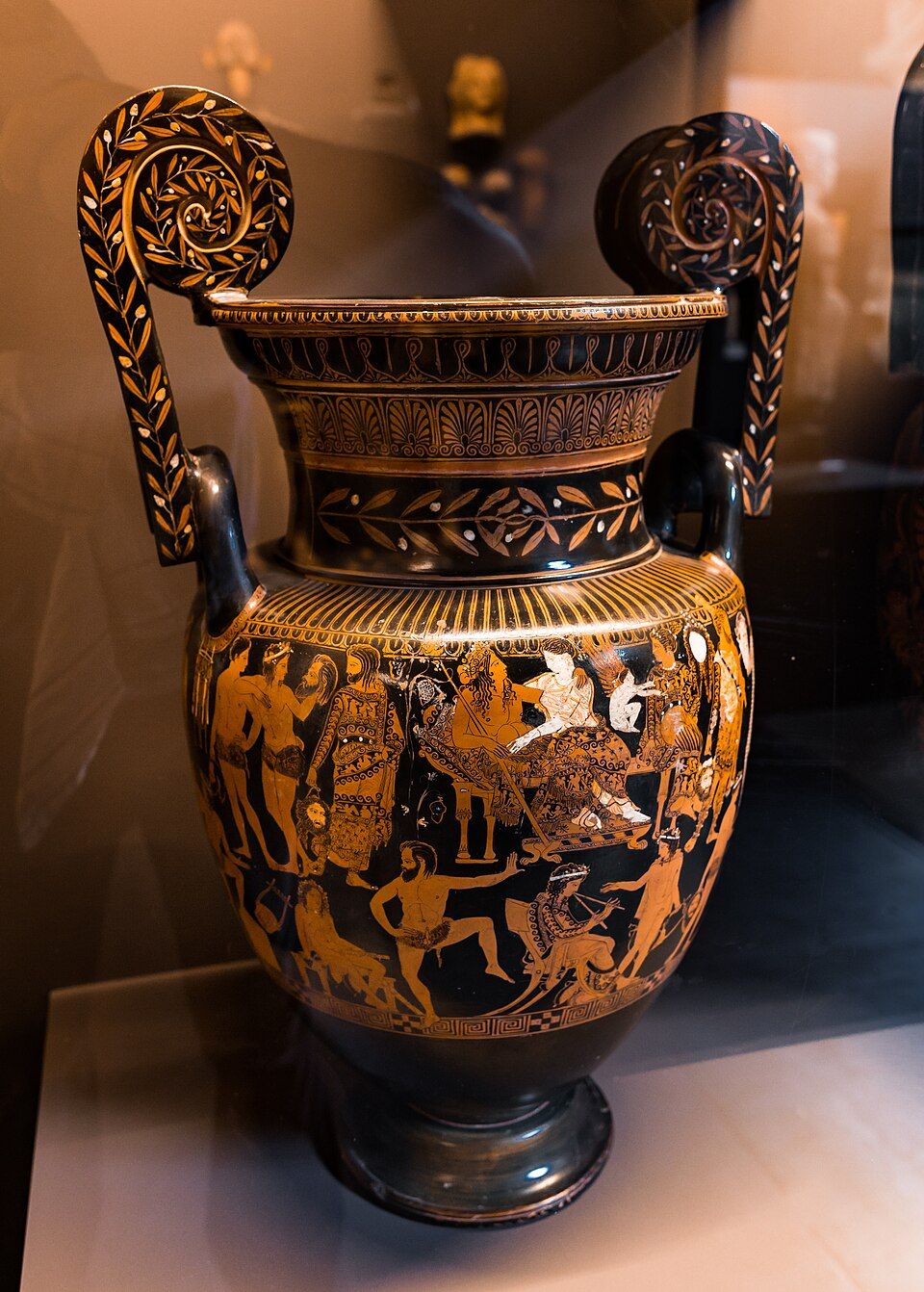
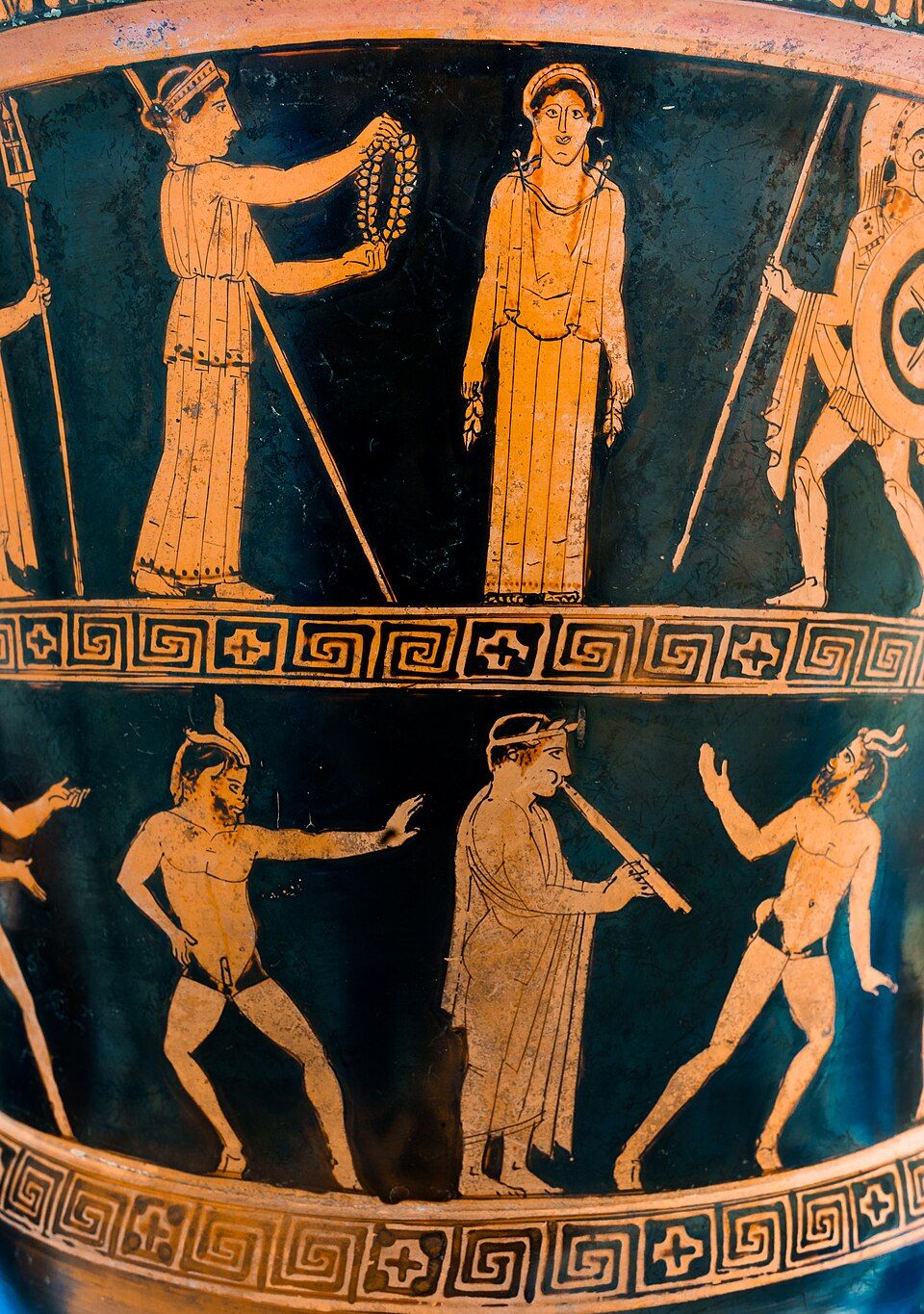
Three modes of delivery were used in drama: recitation without music, recitation with music (παρακαταλογή, parakatalogē, “recitative”), and singing. The recited parts are always in stichic metres, the same line repeated, or in long periods of a single, uniform rhythm. The sung parts were normally in non-stichic metres, mostly strophic.[1] The division worked as a set of cues for the audience. Lyric metres meant song and dance, other rhythms (above all anapaests) recitative, and spoken iambics most dialogue.[2] The third mode, between song and speech, was associated particularly with anapaests.[3] Song in drama was generally accompanied by the aulos.[4]
Between speech and song. Two kinds of long run in one rhythm stand between the trimeters and the lyric proper. The first is marching anapaests. These are long runs of irregular length, with catalexis at each period-end and synapheia throughout, conventionally set out as dimeters.[1] Catalexis is the loss of the last position of a colon; synapheia is continuity of scansion from one line into the next, with no break between them.[5] The second, in Aristophanes, is the pnigos (πνῖγος, pnigos) or “breathlessness”. This is a burst of ten to sixty iambic or trochaic metra, with unbroken synapheia down to a final catalexis.[6] Sung (lyric) anapaests are distinguished from marching ones by a set of features.[7] Among them are Doric colouring of the dialect, much contraction, so that a dimeter often consists of eight long syllables, and catalectic dimeters admitted anywhere.[8] Three lines of the chorus’s song in the Medea show the first two:
148 ἄιες· ὦ Ζεῦ καὶ γᾶ καὶ φῶς
149 ἀχὰν οἵαν ἁ δύστανος
150 μέλπει νύμφα;
Did you hear, O Zeus and earth and light, what a cry the unhappy bride sends up?
Euripides, Medea 148–150. Red: a dimeter of eight long syllables, every biceps contracted. ἀχάν (achan) and ἁ (ha), with α where Attic has η, are the Doric colouring.
synthetic ∿
Strophic arrangement. Most often the songs run AA BB CC... A single epode may close the series. Now and then a strophe without a partner stands before the pairs (a proode) or between them (a mesode).[9]
When a strophe is divided between different singers, or between singer and chorus, the antistrophe is almost invariably divided at the same points.[10]
Passages that are only partly sung are often fully symmetrical. An example is Ajax 348–429, where the spoken trimeters between the sung parts answer one another in number. West assumes that the accompaniment went on through the spoken lines.[11] The same strict plan holds in Aeschylus’ epirrhematic dialogues, sung stanzas answered by spoken lines, where each strophe and antistrophe is followed by the same number of spoken lines.[12] In tragedy occasionally, in comedy often, strophe and antistrophe are separated by a scene of dialogue.[13]
Mixing the families. At times the dramatists bring more than one metrical type into a single strophe.[14] Aeschylus often varies the penultimate verse of an iambic strophe with a dochmiac or dactylic colon. Dochmiacs attract iambic units and cretics. D/e strophes modulate into iambic. A Sophoclean dactylic tetrameter may be followed by a colon that does not start on a princeps, so that the beat shifts and a new step must be taken up.[15] The incorporation of mixed metres “proceeds further” in tragedy than in Pindar. In the arias of late Euripides strophic repetition gives way to metrically free composition.[16]
Where periods end. Whatever the passage, the analyst has the same three jobs. The first is to settle the metrical category. The second is to fix where each period begins and ends. The third is to account for each period as a sequence of cola, and of variations that can be paralleled elsewhere.[14] Because no strophe in tragedy occurs more than twice, the marks of period-end (hiatus, brevis in longo, anceps iuxta anceps) turn up only here and there. A strophe’s metrical sequence is repeated only once, in its antistrophe.[17]
Each of the three marks has a simple form. Hiatus is a vowel at the end of one word meeting a vowel at the start of the next, with nothing elided.[18] It is one of the signs of period-end, so where it stands at a line-end a period ends there:[19]
82 Διόνυσον θεραπεύει. ‖
83 ἴτε βάκχαι, ἴτε βάκχαι
… serves Dionysus. Go, bacchants, go, bacchants,
Euripides, Bacchae 82–83. Red: -ει (-ei) and ἴ- (i-): a vowel meets a vowel with nothing elided, a hiatus, so a period ends after 82.
synthetic ∿
Brevis in longo is a short syllable in a position that should be long, allowed only at the end of a period:[20]
αἰὼν Αἰακιδᾶν ἄτερθε τοῦδε. |||
… of the Aeacids’ breed, but this man’s.
Sophocles, Ajax 645, the end of the stanza. Red: -δε (-de), a short syllable in the final long position, the brevis in longo.
synthetic ∿
Anceps iuxta anceps, “anceps next to anceps”, is the case where one colon ends with an anceps and the next begins with an anceps or a short position. Then a period must end between them.[21]
Textual corruption is frequent. Where it spoils the responsion, it may be impossible to tell which of the two stanzas, if either, keeps the true metrical scheme.[22] Good modern commentaries contain metrical analyses. Dawe’s Teubner covers all of Sophocles, and Dale’s Metrical Analyses of Tragic Choruses all of tragedy.[23]
Who sings what. Dochmiacs, the typically tragic metre, become predominantly astrophic, that is, sung without a responding stanza, in Euripides after Andromache.[24] The dochmiac is the quintessential metre of dramatic lyric.[25] Lyric anapaests in tragedy are practically confined to monodies and dialogues in which an actor sings. They may accompany entrances.[26] The long astrophic monodies and lyric dialogues of the last plays of Euripides and Sophocles show the greatest diversity of metre. A song without responsion did not bind its words to a melody fixed in advance, and changing metre suited such composition well.[27] Monodies are often astrophic, and therefore even more varied in metre than choral lyric.[28] A monody (μονῳδία, monōidia) is a solo, as opposed to the song of the chorus.[29]
The chorus and dance. In the comic parabasis the number of trochaic tetrameters after strophe and antistrophe is fixed at sixteen or twenty. West explains this regularity by a set pattern, either of the chorus’s movements in the orchestra or of changes in the pipe accompaniment.[14] Anapaestic cola of odd length in Aristophanes suggest to him that the chorus’s paces came in odd numbers.[26] And the comic cretic’s affinity with trochaic rhythm is a matter of “comic song/dance”.[30]
The papyrus of Euripides’ Orestes with musical notation marks syllables of its dochmiacs with points, apparently a rising beat. D’Angour adds that the sign may be a purely rhythmical convention, rather than a record of the singers’ arms or feet in the dance.[31]
Notes
- ^ a b West 1987, p. 48.
- ^ Easterling 1997, p. 157.
- ^ Swift 2022, p. 378.
- ^ D’Angour 2022, ch. 9, §’From Meter to Music’; Battezzato 2005, p. 150.
- ^ West 1987, p. 3.
- ^ West 1987, p. 49.
- ^ West 1987, p. 60; Battezzato 2005, p. 151.
- ^ West 1987, p. 60.
- ^ West 1987, p. 50; Battezzato 2005, pp. 151–152; Swift 2022, p. 378.
- ^ West 1987, pp. 50–51; Battezzato 2005, p. 151.
- ^ West 1987, pp. 50–51.
- ^ Battezzato 2005, p. 153.
- ^ West 1987, p. 51; Swift 2022, p. 386.
- ^ a b c West 1987, p. 51.
- ^ West 1987, pp. 53, 56–57, 64, 66.
- ^ D’Angour 2022, ch. 9, §’Classical Lyric Meters’.
- ^ Battezzato 2005, p. 151.
- ^ West 1987, p. 15.
- ^ West 1987, pp. 36–37.
- ^ West 1987, p. 4.
- ^ West 1987, p. 37.
- ^ West 1987, pp. 51–52.
- ^ West 1987, p. 52.
- ^ West 1987, pp. 56–57.
- ^ Lourenço 2011, p. 53.
- ^ a b West 1987, p. 61.
- ^ West 1987, p. 66.
- ^ Swift 2022, p. 384.
- ^ LSJ s.v. μονῳδία.
- ^ West 1987, p. 55.
- ^ D’Angour 2022, ch. 9, §’From Meter to Music’ with n. 6.
Lyric in drama · 2 of 6
The metrical families in tragedy
West surveys the sung metres of drama family by family (his chapter V, sections B–I). Here are the essentials of each, with a short scanned example from the passage West himself discusses.
Iambic and trochaic.[1] Lyric iambics are built from syncopated and unsyncopated metra, that is, metra with and without a suppressed position, mostly grouped in dimeters and trimeters, and are particularly prominent in Aeschylus. The syncopated forms are the “cretic” — ⏑ — (∧ia), the “baccheus” ⏑ — — (ia∧) and the “spondee” — — (∧ia∧). ∧ia + ia makes a lekythion, and ∧ia + ia∧ an ithyphallic. Aeschylus strongly prefers short syllables in all anceps positions except the final one. He usually repeats a long anceps of the strophe in the antistrophe, and is very sparing with resolution. Sophocles admits long anceps somewhat more often. In Euripides’ later arias trochaic phrasing proliferates.[2] Extended trochaic lyric is practically confined to those later plays.[3] West’s example is the antistrophe in which the Agamemnon’s chorus begins the story of Aulis, answering the strophe 176–83 (strophic division as in Smyth’s text):[4]
184 καὶ τόθ’ ἡγεμὼν ὁ πρέ-
185 σβυς νεῶν Ἀχαιικῶν, ‖
186 μάντιν οὔτινα ψέγων, ‖
187 ἐμπαίοις τύχαισι συμπνέων, ‖
And then the elder leader of the Achaean ships, blaming no seer, breathing in time with the fortunes that struck him…
Aeschylus, Agamemnon 184–187. Red: πρέσ- (pres-), long because West divides πρέσ|βυς; -να (-na), long before ψ (ps). A lekythion is ∧ia + ia, — ⏑ — + ⏑ — ⏑ —.
synthetic ∿
West divides πρέσ-|βυς, so that πρέσ- is long; in 186 the α of οὔτινα is long before ψ.
Dochmiac.[5] It is the typically tragic metre, found in every extant tragedy, and always urgent or emotional. Outside drama it scarcely occurs. It is the quintessential metre of dramatic lyric, charged with emotion. Apart from the Hellenistic Grenfell fragment it is absent from extant lyric.[6] The basic rhythm is ⏑ — — ⏑ —. But any of the three longs may be resolved, and either short may be replaced by a long (“drag”). So the dochmius takes on a great many different shapes. The commonest variants are ⏑ ⏖ — ⏑ — and — ⏖ — ⏑ —. Metron-end usually coincides with word-end, and responsion is usually exact.[7]
79 μεθεῖται στρατός· στρατόπεδον λιπὼν
80 ῥεῖ πολὺς ὅδε λεὼς πρόδρομος ἱππότας·
81 αἰθερία κόνις με πείθει φανεῖσ’,
82 ἄναυδος σαφὴς ἔτυμος ἄγγελος. ‖
The army is let loose; leaving its camp the great host streams on, horsemen in front. The dust climbing the air persuades me, appearing, a voiceless, clear, true messenger.
Aeschylus, Seven against Thebes 79–82, scanned after West’s marks. Each line is two dochmii, with word-end between them (dashed bar). Red: the first short dragged (a long in its place) and resolved longs (two shorts in place of one).
synthetic ∿
In 80 the opening metron is resolved twice.[7] Its first position is also dragged (ῥεῖ).
Aeolic.[8] Pure aeolic strophes are uncommon in Aeschylus. There are several in Sophocles, and they are especially characteristic of later Euripides. There the sameness of their rhythm often has a nearly trance-like effect.[9] Aeschylus practically never writes whole stretches of aeolic, while it is one of the main rhythms of Sophocles and Euripides.[10] Euripides often resolves, most commonly in the part of the colon before — ⏑ ⏑ —, the base ○ ○ becoming ⏑ ⏑ ⏑. Sophocles and Euripides occasionally drag a colon’s close to — — —. Choriambic expansion is particularly Sophoclean.[8]
202 Τύριον οἶδμα λιποῦσ’ ἔβαν
203 ἀκροθίνια Λοξίᾳ
204 Φοινίσσας ἀπὸ νάσου ‖
Leaving the Tyrian swell I came, first-fruits for Loxias from the Phoenician island.
Euripides, Phoenissae 202–204, scanned after West’s marks. Red, in 202: the base with its first position resolved, three shorts; in 203: ἀκ- (ak-), long because West divides ἀκ|ρο-.
synthetic ∿
For 203 West writes the scheme — × — ⏑ ⏑ — ⏑ —, with an anceps in the second position of the base. West divides ἀκ|ροθίνια, so the first syllable is lengthened before κρ.[9]
Lyric anapaests.[11] Several features distinguish them from marching anapaests: Doric colouring; dimeters without word-division between the metra; heavy contraction, so that the acatalectic dimeter is often eight longs and the catalectic seven; catalectic dimeters anywhere and in succession; acatalectic dimeters in final place; runs of four shorts; and admixture of other cola. Euripides makes the greatest use of them, most extensively in Hecuba, Troades, IT and Ion. In West’s view their strings of catalectic lines give an impression of troubled, faltering movement.[11] Lyric anapaests are less constrained than recited ones (the paroemiac, for instance, need not close a system). In later Euripides shapes made mostly or wholly of long syllables predominate.[12]
154a φοιτῶσ’ ἤδη λείπουσίν τε
155 πτανοὶ Παρνασοῦ κοίτας·
156 αὐδῶ μὴ χρίμπτειν θριγκοῖς
157 μηδ’ ἐς χρυσήρεις οἴκους —
Already they come, the birds, leaving their Parnassian roosts; I bid them not to come near the cornices nor the gold-decked house.
Euripides, Ion 154a–157, scanned after West’s marks. Every syllable is long: each biceps is contracted (red). The first line is a full dimeter, the others catalectic, one position short.
synthetic ∿
Perseus prints Παρνασοῦ. West prints Παρνᾱσσοῦ, marking the α long, so the second syllable is long either way. (West also has εἰς for Perseus’ ἐς in 157, again without metrical difference.) His marginal notes mark 154a–159 “every biceps contracted” and 155–157 “catalectic”.[13]
Ionic.[14] Ionic is commonest in Aeschylus. It is occasional in Sophocles and Euripides (especially Bacchae) and in Old Comedy. It has an association with devotional cult, and perhaps a sense of the Asiatic. It is hardly ever found in Euripides outside Supplices, Bacchae and Cyclops, and it is used in orientalising and Dionysiac contexts.[15] Straight ionics ⏑ ⏑ — — predominate over anaclastic ⏑ ⏑ — ⏑ — ⏑ — —. Quite often a short metron ⏑ ⏑ — (io∧) replaces ⏑ ⏑ — —, and io∧ cannot respond with io.[16]
70 Ἀθαμαντίδος Ἕλλας,
71 πολύγομφον ὅδισμα
72 ζυγὸν ἀμφιβαλὼν αὐχένι πόντου. |||
…of Athamas’s daughter Helle, throwing a many-bolted roadway as a yoke on the neck of the sea.
Aeschylus, Persians 70–72, scanned after West’s marks. Red: the short metron io∧, ⏑ ⏑ —, at the head of each line; in 71, -μα (-ma), long before ζ (z).
synthetic ∿
The -μα of ὅδισμα is long before ζ. West analyses 71–72 together as io∧ io io∧ 2io |||.[16]
Dactylic.[17] Dactylic strophes usually contain some iambic elements. The dactyls come in lengths from 2da∧ upwards, mostly four to seven metra. Sophocles and Euripides sometimes have longer periods than Aeschylus, normally marked off into tetrameters by word-division. A characteristically, though not exclusively, Sophoclean trick is to follow an acatalectic tetrameter with a colon that does not start on a princeps.[18]
129 ὦ γενέθλα γενναίων, ‖
130 ἥκετ’ ἐμῶν καμάτων παραμύθιον.
131 οἶδά τε καὶ ξυνίημι τάδ’, οὔ τί με
132 φυγγάνει, οὐδ’ ἐθέλω προλιπεῖν τόδε,
O offspring of noble parents, you have come to comfort my sufferings. I know and understand this, it does not escape me; yet I will not give this up…
Sophocles, Electra 129–132, scanned after West’s marks. 129 is a dactylic trimeter catalectic, ending — ×; 130–132 are tetrameters, run together in synapheia. Red: γεν- (gen-), a contracted biceps; -νει (-nei), a diphthong shortened before the vowel of οὐδ’ (oud’), correption.
synthetic ∿
West notes the contraction in 129, synapheia through 130–135, and the correption in φυγγάνει.[19] The caret in 3da∧ marks the pendant ending — × in place of a final dactyl.[20]
Dactylo-epitrite.[21] Aeschylus’ genuine plays lack it. PV has it several times, as do the early plays of Sophocles and Euripides. It occurs too in Rhesus, and occasionally in Old and Middle Comedy. Colon-division often coincides with word-division, as throughout this passage.[22] For tragedy the distribution is the same: none in Aeschylus except Prometheus, occasional in Sophocles, frequent in Euripides but less so in his later plays.[23]
410 ἄνω ποταμῶν ἱερῶν χωροῦσι παγαί,
411 καὶ δίκα καὶ πάντα πάλιν στρέφεται. ‖
412–3 ἀνδράσι μὲν δόλιαι βουλαί, θεῶν
414 δ’ οὐκέτι πίστις ἄραρε·
The streams of the sacred rivers flow backwards, and justice and everything is turned around. Men’s counsels are treacherous, and faith in the gods is no longer firm.
Euripides, Medea 410–414. D is — ⏑ ⏑ — ⏑ ⏑ —, e is — ⏑ —; red: the single syllables that link them. Each colon ends with a word.
synthetic ∿
Notes
- ^ West 1987, pp. 52–55.
- ^ West 1987, pp. 52–53.
- ^ Lourenço 2011, p. 35.
- ^ West 1987, p. 52.
- ^ West 1987, pp. 56–58.
- ^ Lourenço 2011, p. 53.
- ^ a b West 1987, p. 56.
- ^ a b West 1987, pp. 58–59.
- ^ a b West 1987, p. 58.
- ^ Lourenço 2011, p. 91.
- ^ a b West 1987, pp. 60–61.
- ^ Lourenço 2011, pp. 45–46.
- ^ West 1987, p. 60.
- ^ West 1987, pp. 61–63.
- ^ Lourenço 2011, p. 87; Battezzato 2005, p. 164.
- ^ a b West 1987, p. 62.
- ^ West 1987, pp. 63–65.
- ^ West 1987, pp. 63–64.
- ^ West 1987, p. 64.
- ^ West 1987, p. 38.
- ^ West 1987, pp. 65–66.
- ^ West 1987, p. 65.
- ^ Lourenço 2011, p. 81.
Lyric in drama · 3 of 6
Worked example: Antigone 781–800, strophe and antistrophe
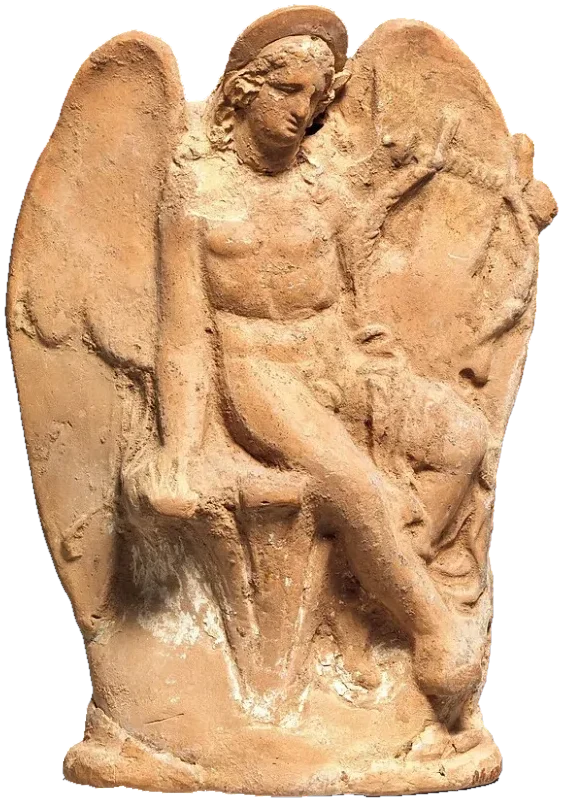
Here is a short choral song from Sophocles, scanned colon by colon, and then set beside its antistrophe. The third stasimon of Antigone (781–800), the chorus’s hymn to Eros, is short enough to see whole. It shows the three things that mark lyric in drama: a strophe answered once by its antistrophe, cola from more than one family in a single stanza, and a Doric colouring of the language. The cola are divided as in the site’s own scansion of the passage.
The strophe (781–790)
781 Ἔρως ἀνίκατε μάχαν,
782 Ἔρως, ὃς ἐν κτήμασι πίπτεις,
783 ὃς ἐν μαλακαῖς παρειαῖς
784 νεάνιδος ἐννυχεύεις,
785 φοιτᾷς δʼ ὑπερπόντιος ἔν τʼ
786 ἀγρονόμοις αὐλαῖς·
787–8 καί σʼ οὔτʼ ἀθανάτων φύξιμος οὐδεὶς
789 οὔθʼ ἁμερίων σέ γʼ ἀν-
790 θρώπων. ὁ δʼ ἔχων μέμηνεν. |||
Eros, unconquered in battle, Eros, you who fall upon men’s possessions, who keep your night-watch on a girl’s soft cheeks, you roam over the sea and among the homesteads in the wild; no immortal can escape you, nor any of men, whose lives last a day, and whoever has you is mad.
Sophocles, Antigone 781–790, the strophe. Red, in 781: -νίκα- (-nīka-), long ι and Doric long α; in 786: τ’ἀγ- (t’ag-), the elided τ’ of 785 running on into ἀγρονόμοις (agronomois), with ἀγ- long before γρ (gr); in 789: ἀν- (an-), closed by ν (n) and split from -θρώπων (-thrōpōn) at the colon-end.
synthetic ∿
Step by step
1. Syllables and quantities. Divide each colon into syllables, carrying a final consonant over to a following vowel. Mark each syllable long (long vowel, diphthong, or closed by a consonant) or short.[1] A few points decide the scansion. In 781 the ι of ἀνίκατε is long, and its -κα- has a Doric long α. In 786 the ἀ- of ἀγρονόμοις is long because γρ is divided between syllables (ἀγ|ρο-). This is the long scansion that tragedy allows before stop + liquid inside a word.[2] In 787–8 the first α of ἀθανάτων is long, as the metre needs. In 789 the ν of ἀν- closes the syllable before θρ, so ἀν- is long.
2. The cola. Lay the shapes against West’s list of aeolic cola.[3] 783, 784 and 790 are hagesichoreans, × — ⏑ ⏑ — ⏑ — —. West named this colon, and Dale called it a “choriambic enoplian”. Its family, aeolic or enoplian, is ambiguous from its first appearances. These three Antigone cola are among its uses in tragedy.[4] 789 is a telesillean, one syllable shorter than the hagesichorean.[5] 781 and 785 are a different animal: an iambic metron before a choriamb, × — ⏑ — — ⏑ ⏑ —. This is the iambo-choriambic dimeter, which is often mistaken for the wilamowitzian.[6] 782 is the same with one more long: an iambic metron prefixed to an adonean (the label is this site’s).[7] 786 is a dodrans, — ⏑ ⏑ — ⏑ —, with its close dragged to — — —. Sophocles and Euripides occasionally do this.[8]
3. The long colon. 787–8 is a pherecratean with one choriamb inserted, phᶜ.[7] It has the base καί σ’, two choriambs and a final long. Dawe calls the same colon a catalectic minor asclepiad.[9] Choriambic expansion of this kind is particularly Sophoclean.[10] The shape — — — ⏑ ⏑ — — ⏑ ⏑ — — is exactly that of Philoctetes 710, πλὴν ἐξ ὠκυβόλων εἴ ποτε τόξων, which West also labels phᶜ.[8] Built only of longs and double shorts, such a colon could also be heard as ionic. Dale calls this Sophocles’ “aeolo-ionic” ambiguity. But she argues that at Philoctetes 710 he meant the line to be heard as aeolic.[11]
4. Periods. In tragedy the signs of period-end (hiatus, brevis in longo) turn up only now and then.[12] Here they do not turn up at all. Every colon ends in a long syllable, and no colon-end has hiatus. Two places show that a period continues. At 785–6 the elided τ’ goes with ἀγρονόμοις, so the scansion runs across the colon-end. At 789–90 the word ἀνθρώπων is split between the cola, and a period cannot end inside a word.[13] That split, with word-end one position after the end of the colon, is called dovetailing (∫).[14] Only the stanza-end ||| is certain.
Responsion
The antistrophe (791–800) repeats the strophe position by position.[15] Set the two side by side:
| Colon | Strophe | Antistrophe |
|---|---|---|
| 781 ~ 791 | ⏑ — ⏑ — — ⏑ ⏑ — | ⏑ — ⏑ — — ⏑ ⏑ — |
| 785 ~ 795 | — — ⏑ — — ⏑ ⏑ — | — — ⏑ — — ⏑ ⏑ — |
| 786 ~ 796 | — ⏑ ⏑ — — — | — ⏑ ⏑ — — — |
| 787–8 ~ 797–8 | — — — ⏑ ⏑ — — ⏑ ⏑ — — | — — — ⏑ ⏑ — ⏖ ⏑ ⏑ — — |
| 789 ~ 799 | — — ⏑ ⏑ — ⏑ — ∫ | — — ⏑ ⏑ — ⏑ — ∫ |
The other four pairs match exactly. Even the anceps positions agree: short at the start of 781–784 and 791–794, long in 785 and 795. The one difference is in 797–8, νύμφας, τῶν μεγάλων πάρεδρος ἐν ἀρχαῖς, where πάρε- resolves the first long of the second choriamb. Resolution of the choriamb’s longs is allowed in tragic aeolic, but exact responsion is more usual.[16] Here are the two lines, colon by colon:
787–8 καί σʼ οὔτʼ ἀθανάτων φύξιμος οὐδεὶς
797–8 νύμφας, τῶν μεγάλων πάρεδρος ἐν ἀρχαῖς
Sophocles, Antigone 787–788 (strophe) and 797–798 (antistrophe). The two lines answer position by position, except that in 797–798 the first long of the second choriamb is resolved into two shorts, πάρε- (pare-), in red.
synthetic ∿
The dovetailing recurs as well. θεσμῶν. ἄμαχος γὰρ ἐμ-|παίζει (799–800) splits a word at the same point as οὔθ’ ἁμερίων σέ γ’ ἀν-|θρώπων.
What makes this tragic lyric
Four things make this tragic lyric. The strophe is heard twice and no more, as every tragic strophe is.[17] Aeolic cola (hagesichorean, telesillean, an expanded pherecratean) are mixed in one stanza with iambo-choriambic dimeters. Responsion is exact enough to test each scansion against its partner. And the language has the Doric long α of choral song, the “Doric patina” of tragic lyric in Battezzato’s phrase.[18] In 781 ἀνίκᾱτε (anikāte) is the Doric form of ἀνίκητος (anikētos), “unconquered”,[19] and the same long α stands in ἁμερίων, νύμφᾱς and Ἀφροδίτᾱ.
Notes
- ^ West 1987, p. 12.
- ^ West 1987, p. 17.
- ^ West 1987, pp. 33–34.
- ^ Lourenço 2011, p. 100 with n. 215.
- ^ West 1987, p. 33.
- ^ Lourenço 2011, p. 115.
- ^ a b West 1987, p. 34.
- ^ a b West 1987, p. 59.
- ^ Lourenço 2011, p. 113 n. 245.
- ^ West 1987, p. 59; Lourenço 2011, p. 113.
- ^ Dale 1968, pp. 143–144 and p. 144 n. 1.
- ^ West 1987, pp. 51–52.
- ^ West 1987, pp. 3–4.
- ^ West 1987, p. 42.
- ^ West 1987, p. 4.
- ^ West 1987, pp. 58–59.
- ^ West 1987, p. 51.
- ^ Battezzato 2005, p. 149.
- ^ LSJ s.v. ἀνίκητος.
Lyric in drama · 4 of 6
Comedy
Comedy uses the same families as tragedy, but handles them differently and adds verse-forms of its own. The spoken trimeter is freer. It has lines without caesura, anapaestic feet admitted freely, Porson’s Law ignored, more frequent resolution, and no lengthening before stop + liquid except in parody of tragedy.[1] An anapaest here is two shorts in place of the single anceps or short at the start of an iambic foot, ⏑ ⏑ — for × — or ⏑ —. The opening of the Clouds shows how freely it comes:
3 ἀπέραντον. οὐδέποθ’ ἡμέρα γενήσεται;
Endless. Will it never be day?
13 ὑπὸ τῆς δαπάνης καὶ τῆς φάτνης καὶ τῶν χρεῶν
by the expense and the stable and the debts
Aristophanes, Clouds 3 and 13. Red: anapaests, two shorts in place of a single anceps or short, ⏑ ⏑ — for × — or ⏑ —. In 13 they fill both feet of the first metron.
synthetic ∿
Porson’s Law forbids a long, word-final syllable in the third anceps of the trimeter. The word-end that Porson’s Law forbids is admitted only in comedy.[2] Some passages rise to the tragic standard of versification, in parody or to express self-importance. They need attention to metrical detail to be recognised.[3] The iambic tetrameter catalectic is common in Old Comedy for entries and exits of the chorus and in contest scenes. The anapaestic tetrameter catalectic is frequent there too.[4]
The parabasis. A notable part of the parabasis is the epirrhematic syzygy. Strophe and antistrophe are each followed by the same number of trochaic tetrameters, sixteen or twenty, which must have been delivered in recitative.[5] The examples include the double syzygy of Lysistrata 614–705.[6] Old Comedy also used stichic dicola, verses compounded of two simple cola, where the chorus addressed the audience or took a large share in a dialogue. Three occur in Aristophanes’ extant plays.[7] One is the eupolidean. Another is × — ⏑ ⏑ — ⏑ ⏑ — ⁝ × ⁝ — ⏑ — ⏑ — — ‖ (× D ⁝ × ⁝ ith) in Wasps 1528–37. It welds into a single line the two cola that make up one of Archilochus’ epodic strophes. The third is × — ⏑ — × — ⏑ — ⁝ — ⏑ — ⏑ — — ‖ (2ia ⁝ ith) in Wasps 248–72.
The eupolidean. West’s scheme, which covers Clouds 518–62 and numerous fragments by other poets, is:[8]
| First colon | Second colon | ||
|---|---|---|---|
| scheme | ○ ○ ⏕ × — ⏑ ⏑ — | ⁝ ○ ⁝ | ○ — × — ⏑ — ‖ |
| West’s label | gl¨ (anaclastic glyconic) | gl¨∧ (its catalectic) |
⁝ reproduces West’s dotted bars (the break may come one position later). West marks the first ○ of each colon resolvable. In both cola the opening position is normally long. Where it is resolved, the position after it is invariably short.[8] Here is part of his example, Clouds 537–40 (Perseus text, which agrees with West’s):
537 ὡς δὲ σώφρων ἐστὶ φύσει σκέψασθ’· ἥτις πρῶτα μὲν
539 ἐρυθρὸν ἐξ ἄκρου παχύ, τοῖς παιδίοις ἵν’ ᾖ γέλως·
540 οὐδ’ ἔσκωψε τοὺς φαλακρούς, οὐδὲ κόρδαχ’ εἵλκυσεν,
See how modest she is by nature: first, she has not come [with a dangling leather phallus, 538] red at the tip and thick, to make the children laugh; she has not mocked the bald, nor danced the kordax.
Aristophanes, Clouds 537, 539, 540, eupolideans. The single middle position (○) falls between West’s dotted bars. Red, in 539: the first position resolved, ἐρυ- (ery-), and the position after it short, θρὸ- (thro-), as West’s rule requires; in 540: φα- (pha-), short before κρ (kr), the comic rule on stop + liquid.
synthetic ∿
In 539 the first position is resolved (ἐρυ-), and the second (θρὸν) is short, as West’s rule requires. ἀ- of ἄκρου (red) is short before κρ, in the free × position, and so is the α of φαλακρούς in 540. That is the comic rule on stop + liquid: in Attic speech a short vowel stayed short before these pairs, so the short scansion is the normal one in comedy.[9] West marks the α of κόρδᾱχ’ long. Hephaestion calls the eupolidean “epichoriambic polyschematist”, because the comic poets admit a spondee in the trochaic metra against the rule. He quotes Clouds 529, ὁ σώφρων τε χὠ καταπύγων ἄριστ’ ἠκουσάτην.[10] He says the same of the cratinean, citing the whole parabasis of Eupolis’ Astrateutoi.[11]
Runs. Excited tetrameter dialogue sometimes culminates in a pnigos. This is ten to sixty metra in the same rhythm, with unbroken synapheia. The phrasing is often of dimeter length, and in trochaics there is regular caesura after each dimeter.[12]
Aristophanes’ lyrics. In tragedy trochaic movement develops in strophes that begin iambic. Aristophanes’ strophes often open in trochaic rhythm and stay in it, keeping blunt cola for the ends of periods. His iambic lyrics are typically simple, with little syncopation except when parodying tragedy. But he likes to begin a trochaic period with ∧ia∧ set off by word-division, as at Lysistrata 658 f. Dactylic cola, dochmiacs, choriambs and aristophaneans appear occasionally.[13]
Responsion is freer, especially where strophe and antistrophe are far apart. In some passages a trochaic metron — ⏑ — × responds with — ⏑ × ⏑. Aristophanes keeps only one effective princeps per metron, and so marks the rhythm less sharply than usual.[14] Cretics belong particularly to the earlier plays. The tetrameter cr⏖ cr⏖ cr⏖ cr is the commonest period.[15] Here cr⏖ is a cretic with its last long resolved, the first paeon — ⏑ ⏑ ⏑.
Comic anapaests make freer use of proceleusmatics ⏑ ⏑ ⏑ ⏑, anapaests with the long resolved, mostly marked off by word-division, as at Birds 328 f.:
προδεδόμεθ’ ἀνόσιά τ’ ἐπάθομεν· ὃς γὰρ
We are betrayed, we have suffered unholy things! For he who
Aristophanes, Birds 328–329. Each anapaestic foot of four shorts (red) ends with a word: προδεδόμεθ’ | ἀνόσιά τ’ | ἐπάθομεν (prodedometh’ | anosia t’ | epathomen).
synthetic ∿
Cola of odd length occur: a pentapody at Acharnians 285, and a tripody followed by eleven feet at Lysistrata 478–83. In Birds 327–35 ~ 343–51 the proceleusmatic becomes interchangeable with the paeon.[16]
The ionic hymns of Agathon in Thesmophoriazusae 101–29 and of the Initiates in Frogs 323–53 reflect the metre’s cult associations. Agathon admits the resolutions ⏑ ⏑ ⏖ — and ⏑ ⏑ — ⏖. In Wasps 273 ff. Aristophanes allows remarkable freedoms of ionic responsion, ⏑ ⏑ — — answering — ⏑ — — or ⏑ ⏑ — ⏑.[17] The Initiates’ song, mostly in ionics, can be read as close to genuine cult hymns and to the parodos of the Bacchae.[18] Clouds 288–90 changes step like Sophocles, 4da | 4da | — D — |||.[19] Dactylo-epitrite is used occasionally in Old and Middle Comedy.[20]
Menander and New Comedy. Menander observes the caesura of the trochaic tetrameter regularly, allowing a postpositive after it. He divides his iambic tetrameters about equally at the two caesura positions.[21] New Comedy, with very few exceptions, avoids “split anapaests” in the trimeter. In a split anapaest a word beginning before the anapaestic foot ends within it.[22] The trimeter of later antiquity is basically the comic kind.[23]
Notes
- ^ West 1987, p. 27.
- ^ Devine and Stephens 1994, p. 105.
- ^ West 1987, p. 27 n. 4.
- ^ West 1987, p. 29.
- ^ West 1987, p. 51.
- ^ West 1987, p. 51 n. 4.
- ^ West 1987, pp. 49–50.
- ^ a b West 1987, p. 50.
- ^ West 1987, pp. 16–17.
- ^ Hephaestion, Ench. 16.5.
- ^ Hephaestion, Ench. 16.6.
- ^ West 1987, p. 49.
- ^ West 1987, p. 54.
- ^ West 1987, pp. 54–55.
- ^ West 1987, p. 55; Hephaestion, Ench. 13.2.
- ^ West 1987, p. 61.
- ^ West 1987, pp. 62–63.
- ^ Swift 2022, p. 387.
- ^ West 1987, p. 64.
- ^ West 1987, p. 65.
- ^ West 1987, pp. 28–29.
- ^ West 1987, p. 26.
- ^ West 1987, p. 81.
Lyric in drama · 5 of 6
Polymetry
In the second half of the fifth century the song of tragedy changed. The dramatists had always swung from one metre to another within a strophe. In the long astrophic monodies and lyric dialogues of the last plays of Euripides and Sophocles, the swinging became the method. Without responsion the tragedian never had to fit his words to a tune already laid down. The tune in turn could follow every shift of feeling in the text, and changing metre came naturally in such writing.[1] Astrophic song in late tragedy, especially in Euripides, goes with its popularity in non-tragic lyric of the late fifth century. The monodies, often astrophic, are more varied in metre still than choral song.[2]
Euripides’ later style. Several changes appear together. In the iambics of the later plays, especially in solo arias, the rhythm runs on more freely. It spills past the limits of the trimeter, above all through the proliferation of trochaic phrasing.[3] The string of trochaic songs at the start of Helen is without parallel.[4] West’s example is Helen’s invocation of the Sirens, with his analysis:[3]
167 πτεροφόροι νεάνιδες,
168 παρθένοι Χθονὸς κόραι
169 Σειρῆνες, εἴθ’ ἐμοῖς γόοις
170 μόλοιτ’ ἔχουσαι Λίβυν
Winged maidens, virgin daughters of Earth, Sirens, would that you might come to my laments with the Libyan pipe…
Euripides, Helen 167–170, divided into syllables after West’s analysis. The lekythia, — ⏑ — ⏑ — ⏑ —, open with a long and so move in trochaic phrasing; 169–170 are iambic. Red: the first long of 167 resolved into two shorts.
synthetic ∿
From τοῖς ἐμοῖσι (172) onwards, West says, the passage becomes a true πνῖγος (pnigos), a breathless run, in which no pause is possible. The many resolutions add to the sense of headlong flight. The trochaic word-divisions keep time for the listener, but they also signal that the pause has not yet come, and the passage has to end iambic.[5] At 174 ~ 186 a syncopated metron responds with a full one. This licence is paralleled in Bacchylides, but many scholars dispute it.[6]
In Euripides’ spoken trimeters, resolution grows steadily more frequent from the Hippolytus (428 BC) to the Orestes (408). In the Orestes about 35% of the trimeters have it, so resolution provides a criterion for dating his plays.[7] A resolution splits one long of the trimeter into two shorts. A line of the Bacchae, one of the last plays, has two:
χλωραῖς ὑπ’ ἐλάταις ἀνορόφοις ἧνται πέτραις.
They sit on roofless rocks beneath green firs.
Euripides, Bacchae 38, a late play: two of the trimeter’s longs resolved into two shorts (red), in the first and second metra.
synthetic ∿
Across the styles of tragedy the growth of resolution is exponential.[8] Dochmiacs become predominantly astrophic after Andromache.[9] Lyric anapaests are used most in the transitional plays.[10] Pure aeolic strophes of trance-like uniformity mark later Euripides.[11] And late ionics admit new licences.[12]
Polymetry. Sophocles, Philoctetes 1169–1217 is West’s model case. It begins in iambics, and turns to ionics in mid-sentence at 1175, continuing to 1185. Then it has anapaests, aeolic and dactylic cola, and dactylic tetrameters flowing from 1196 to 1207. It closes with dactylic, aeolic, iambic and dactylo-epitrite cola. So every family appears except cretics and dochmiacs.[13] Polymetry is this use of many metres in one song.
The singers of such passages probably had to execute harmonic modulations too, one of the marks of the New Music in the later fifth century.[14] Ancient critics held such modulations (metabolai) and polymetry against that music, among its other innovations. Its influence on Euripides can be traced from the Trojan Women (415 BC) onwards.[15] In astrophic song the word accent influenced the melodic line.[16]
Notes
- ^ West 1987, p. 66.
- ^ Battezzato 2005, p. 152; Swift 2022, p. 384.
- ^ a b West 1987, p. 53.
- ^ Lourenço 2011, p. 35.
- ^ West 1987, pp. 53–54.
- ^ West 1987, p. 54.
- ^ West 1987, pp. 25–26.
- ^ Devine and Stephens 1994, p. 107.
- ^ West 1987, p. 57.
- ^ West 1987, p. 61.
- ^ West 1987, p. 58.
- ^ West 1987, p. 62.
- ^ West 1987, pp. 66–67.
- ^ West 1987, p. 67.
- ^ LeVen 2022, p. 367; Wilson 2005, p. 190.
- ^ West 1987, p. 68 n. 2.
Lyric in drama · 6 of 6
The New Music
In the second half of the fifth century Athenian music changed with the metres. Here is the evidence for the new style, and for its continuation outside drama.
The Orestes papyrus. No earlier papyrus preserves so long a stretch of melody in notation. It gives part of an antistrophe of a chorus of Euripides’ Orestes (lines 338–45), in dochmiacs. D’Angour thinks the melody probably Euripides’ own. Some syllables are marked with points (stigmai), apparently indicating a rising beat on the first and third of the dochmius’ five elements.[1] Wilson too raises the possibility that this is the poet’s own music. But he notes that the papyrus is no earlier than about 280 BC.[2] Perseus prints the lines in Murray’s order:
338 ματέρος αἷμα σᾶς, ὅ σ’ ἀναβακχεύει;
340 ὁ μέγας ὄλβος οὐ μόνιμος ἐν βροτοῖς·
339 κατολοφύρομαι κατολοφύρομαι.
…your mother’s blood, which drives you into frenzy? Great prosperity is not lasting among mortals. I lament, I lament.
Euripides, Orestes 338, 340, 339, in the order of the papyrus, divided into syllables after the quantities given here. Each line is two dochmii. Red: μᾱ- (mā-), a dragged first position, and -χεύ- (-cheu-), a dragged fourth element. In all six dochmii the first long is resolved into two shorts.
synthetic ∿
In 338 μᾱ- (Doric ᾱ for Attic η) is long, a dragged first position. In ἀναβακχεύει the fourth element is dragged. In 340 the syllable before βρ- is -ς ἐν (-s en), closed by ν and so long in any case; βρο- itself is short, and the second dochmius, μόνιμος ἐν βροτοῖς, runs ⏑ ⏖ — ⏑ —. West’s advice for dochmiacs, to prefer the short scansion before stop + liquid where a syllable could go either way, does not come into play in these lines.[3]
D’Angour sees in the melody the New Musical style fashionable in Athens in the second half of the fifth century. It uses word-painting: a falling cadence on κατολοφύρομαι, and a high note on ἀναβακχεύει, “leap”, reached by an upward leap of a large interval (perhaps a fifth). Wilson points to the same style in the papyrus’s last phrase, where the one syllable ἐν carries two notes and is written e-en.[2] Earlier lyric music was said to have been simpler, conforming to one tuning of the seven-stringed lyre. The most plausible hypothesis, D’Angour adds, is that it followed the natural pitches of the words.[1]
Euripides’ prolonged setting of the first syllable of εἱλίσσετε was parodied by Aristophanes. Dionysius of Halicarnassus, quoted by D’Angour, observes that music and rhythm alter the quantities of words, making the syllables fit the durations of the rhythm. In such song, D’Angour concludes, it can be hard to be sure which metrical cola we are dealing with.[4] LeVen reads Dionysius’ discussion of the Orestes as showing that New Music melody, unlike traditional practice, paid no regard to the pitch accents of the words.[5]
Timotheus and the fourth century. The dithyrambists of the late fifth century shared the polymetry of the drama of their day. Our chief witness is Timotheus’ Persae (PMG 788–91), which began with a hexameter, perhaps several. In the long papyrus fragment, lines 1–126 and 139–77 are predominantly iambic. They have occasional choriambs and trochaic segmentation, but also cretic, dochmiac, dactylic, anapaestic and aeolic sequences. Lines 127–38 and 178–201 are mainly aeolic. In the conclusion (202–40) Timotheus turns wholly to aeolic, glyconics and pherecrateans in alternation.[6] The papyrus, found in 1904, holds about 240 lines of the poem.[7] This Berlin papyrus dates from the fourth century BC. It has no meaningful colometry, which places the onus of metrical analysis squarely on its editors.[8]
Such virtuoso pieces were not, however, typical of song in the fourth century. The usual metre of educated lyric in the fourth and third centuries was a smooth, generally astrophic dactylo-epitrite, built of D, — ⏑ ⏑ — ⏑ ⏑ —, and e, — ⏑ —. Outside drama dochmiacs recur only in one Hellenistic aria, the Grenfell erotic fragment.[9]



