Verse formsLyric metres
Aeolic
The fixed-syllable rhythms of Sappho and Alcaeus, and their later use in song and drama.
The metrical families one by one: dactylic, iambic, trochaic, aeolic, ionic, anapaestic, dochmiac and the rest.
Aeolic · 1 of 6
The aeolic base and the choriamb
“Aeolic” is the name for a family of asymmetrical cola. A colon is a single metrical phrase of not more than about twelve syllables.[1] Aeolic cola cannot be divided into feet or metra, and they combine double-short and single-short movement.[2] They are typical of the two Lesbian poets, Sappho and Alcaeus, but by no means confined to the Aeolians. Where they are used in Pindar, drama or elsewhere, the metre is still called aeolic. The label only names a general type, though, and does not define any particular form.[3] The word is also used in the same broad way for a whole family of kindred phrases with the choriamb at their centre.[4]
Two Lesbian rules. The Lesbian tradition is in some respects more archaic than the others. It does not resolve a long into two shorts, nor contract two shorts into a long. So the number of syllables in a verse is fixed.[5] And in some cola the first two positions are free in quantity. This freedom is probably a relic of the original Indo-European freedom of the part of the verse before the cadence.[6] A fixed syllable count and a free opening are both among the inherited Indo-European features that the Aeolic metres keep.[7]
The aeolic base. That double anceps is called the aeolic base. Everywhere else in Greek verse, anceps positions occur only singly.[8] The first syllable of the base is more often long than short. Both short is uncommon even in the Lesbians, and later poets almost completely avoid it.[9] In Pindar, as in Attic drama, the base is filled by — —, — ⏑, ⏑ — or the resolved ⏑ ⏑ ⏑.[10] So Pindar and the Attic poets do not use the double-short form at all.[11] For the base so limited West writes ○ ○ instead of × ×. Either syllable may be long or short, provided both are not short.[3] Anacreon already restricts the base so that at least one of the two is long, and usually both are.[12]
The main cola. The main cola are these, with West’s abbreviations:[3]
| Colon | Scheme | Note |
|---|---|---|
| glyconic (gl) | × × — ⏑ ⏑ — ⏑ — | the central form, eight positions |
| pherecratean (ph) | × × — ⏑ ⏑ — — | the catalectic of gl[13] |
| telesillean (tl) | × — ⏑ ⏑ — ⏑ — | one syllable shorter than gl at the beginning, in effect an acephalous glyconic[14] |
| reizianum (r) | × — ⏑ ⏑ — — | the catalectic of tl[13] |
| hipponactean (hi) | × × — ⏑ ⏑ — ⏑ — — | one syllable longer than gl |
| hagesichorean (hag) | × — ⏑ ⏑ — ⏑ — — | one syllable longer than tl |
| aristophanean (ar) | — ⏑ ⏑ — ⏑ — — | |
| dodrans (dod) | — ⏑ ⏑ — ⏑ — | |
| adonean (ad) | — ⏑ ⏑ — — | the catalectic of dod |
| enneasyllable (enn) | × — × — ⏑ ⏑ — ⏑ — | a glyconic with one more syllable in front[15] |
Read the table as a grid. Each colon is the choriamb — ⏑ ⏑ — with something before it and something after it. Before it stands a base × ×, a single ×, or nothing. After it stands ⏑ — (blunt), ⏑ — — (pendant), or — alone when the colon is catalectic. The same family can also be set out from the glyconic. The pherecratean is then its catalectic form, and the hipponactean its hypercatalectic form. The telesillean, reizianum, hagesichorean and adonean are headless forms.[16] The invariable “dum-di-di-dum” of the choriamb is the characteristic element of Aeolic verse. Many Lesbian metres may be heard around it.[17]
Hephaestion’s own examples of three of these cola show the pattern. Each has the choriamb in the middle, the base before it, and a short close after it:[18]
glyconic κάπρος ἡνίχ’ ὁ μαινόλης
pherecratean ἄνδρες πρόσχετε τὸν νοῦν
hipponactean καὶ κνίσῃ τινὰ θυμιήσας
“when the raging boar …” · “Men, give your minds to (a new invention) …” · “and having made a savoury burnt offering to someone”
Hephaestion’s examples of the three cola (Enchiridion 10.2; the third is by Hipponax). Red: the choriamb, — ⏑ ⏑ —, at the centre of each. The glyconic closes blunt, ⏑ —; the pherecratean is one position shorter; the hipponactean one longer, closing pendant.
synthetic ∿
Blunt and pendant. A colon ending … ⏑ — is called blunt. One ending … ⏑ — × is called pendant, because its final long is felt to “hang off” the penultimate.[19] So gl, tl and dod are blunt, and hi, hag and ar are pendant.
Anaclasis. The glyconic occasionally changes by a transposition of quantities, which is called anaclasis.[20] It then becomes either — ⏑ ⏑ — ⏑ — ⏑ — (West’s ¨gl) or × × — × — ⏑ ⏑ — (gl¨). The hipponactean likewise becomes — ⏑ ⏑ — ⏑ — ⏑ — — (¨hi) or × × — × — ⏑ ⏑ — — (hi¨). The anaclastic forms may respond with the standard form. The position of the ¨ shows whether the double short comes earlier or later than normal.[21]
The second form, ○ ○ — × — ⏑ ⏑ —, is often called the “choriambic dimeter”, and sometimes the Wilamowitzianus.[22] Sappho already lets it respond with the glyconic, at frr. 95.9 and 96.7.[23] Glyconic, wilamowitzianus and telesillean can be treated as variants of one metre that answer one another in responsion. This unity was shown by Itsumi’s 1982 study of Corinna, Euripides and Aristophanes.[24] Itsumi’s own scheme for Pindar sets the glyconic beside the wilamowitzianum ○ ○ — ⏑ — ⏑ ⏑ —. Each is a base followed by a six-position unit, the dodrans or its mirror image.[25]
Names in other systems. West’s dodrans — ⏑ ⏑ — ⏑ — and its anaclastic form ○ ○ — ⏑ ⏑ — (dod¨, his “reversed dodrans”)[26] are A. M. Dale’s “dodrans A and B”.[27] The nineteenth-century term “logaoedic” for all such asymmetric verse is now obsolete.[28] “Polyschematist” is applied to aeolic cola that take various responding forms through anaclasis and the freedom of the base.[29] Maas’s “element” is West’s “position”.[27] Hephaestion fits the same cola into his “antispastic” metre. Its opening dipody has its first foot in any of the four disyllabic shapes, and its last dipody is iambic.[30] His three examples gave the forms their names.[18] He calls ἄνδρες πρόσχετε τὸν νοῦν the “Pherecratean”. He calls κάπρος ἡνίχ’ ὁ μαινόλης, which is anonymous, “Glyconean, Glycon himself having invented it”. And καὶ κνίσῃ τινὰ θυμιήσας, by Hipponax, is “called the Sapphic enneasyllable or Hipponactean”.
In the glyconic the base is κά-προ. The first syllable may count long or short before πρ. The second (its ς going with ἡνίχ’) is short. Hephaestion’s “four shapes of the disyllable” for the first foot is his way of describing this free base.
Some names record the poet with whom a shape was associated. Sapphics are named from Sappho, Alcaics from Alcaeus, and glyconics from Glycon, a poet about whom little is known.[31] So too are the pherecratean, hipponactean, telesillean and asclepiad. Each is named after the poet supposed to have been the first to use the colon line after line in a stichic poem.[32]
Notes
- ^ West 1987, p. 4.
- ^ West 1987, pp. 6, 33.
- ^ a b c West 1987, p. 33.
- ^ Lourenço 2011, p. 91.
- ^ West 1987, p. 32; Battezzato 2009, p. 134.
- ^ West 1987, pp. 6, 32–33.
- ^ Battezzato 2009, p. 133.
- ^ West 1987, p. 6.
- ^ Battezzato 2009, p. 134.
- ^ Itsumi 2009, p. 25.
- ^ Kiparsky 2018, p. 98.
- ^ West 1987, p. 40.
- ^ a b Itsumi 2009, p. 26.
- ^ West 1987, p. 85; Battezzato 2021, p. 124.
- ^ West 1987, pp. x, 87.
- ^ Battezzato 2021, pp. 123–124.
- ^ D’Angour 2022, ch. 9, §’Archaic Lyric Meters’.
- ^ a b Hephaestion, Ench. 10.2.
- ^ West 1987, p. 6; D’Angour 2022, ch. 9.
- ^ West 1987, p. 8.
- ^ West 1987, pp. 33–34.
- ^ West 1987, pp. 86, 90.
- ^ Battezzato 2021, p. 123.
- ^ Kiparsky 2018, p. 83 with n. 8.
- ^ Itsumi 2009, pp. xii, 24.
- ^ West 1987, p. ix.
- ^ a b West 1987, p. 86.
- ^ West 1987, p. 88.
- ^ West 1987, p. 89.
- ^ Hephaestion, Ench. 10.1.
- ^ D’Angour 2022, ch. 9, opening section.
- ^ Battezzato 2021, p. 123 n. 7.
Aeolic · 2 of 6
Expansion: dactylic and choriambic
The basic cola are sometimes used as complete verses, and sometimes two or three are combined into one. More often they are lengthened. There are three ways of doing this.[1]
1. Prefixing. An iambic metron × — ⏑ —, or an acephalous one — ⏑ — (∧ia), is put in front. On West’s analysis the Sapphic hendecasyllable is ∧ia + hag. The first line of Sappho’s hymn to Aphrodite shows the two parts:
Ποικιλόθρον’ ἀθανάτ’ Ἀφρόδιτα,
Immortal Aphrodite of the intricate throne,
Sappho, fr. 1.1, a Sapphic hendecasyllable, on West’s analysis an acephalous iambic metron (red) put in front of a hagesichorean.
synthetic ∿
2. Suffixing. An iambic metron × — ⏑ —, or a catalectic one ⏑ — — (ia∧), is added at the end. Two verses gl ia∧ open a dozen of the Athenian skolia.[2]
3. Expansion from within. The internal sequence — ⏑ ⏑ (dactylic) or — ⏑ ⏑ — (choriambic) is repeated once, twice or three times. This is marked with a superior d or c (2d, 3d, 2c, 3c). Here are two examples:[1]
× × — ⏑ ⏑ ⟨— ⏑ ⏑ — ⏑ ⏑⟩ — ⏑ — = gl²ᵈ
× — ⏑ ⏑ — ⟨— ⏑ ⏑ —⟩ ⏑ — — = hagᶜ
Three real lines show choriambic expansion step by step. A glyconic has one choriamb. An asclepiad, glᶜ, adds a second, and a greater asclepiad, gl²ᶜ, a third:
gl κάπρος ἡνίχ’ ὁ μαινόλης
glᶜ ἦλθες ἐκ περάτων γᾶς, ἐλεφαντίναν
gl²ᶜ Πώνωμεν· τί τὰ λύχν’ ὀμμένομεν; δάκτυλος ἀμέρα·
gl: “when the raging boar …” (anonymous, in Hephaestion, Ench. 10.2). glᶜ: “You have come from the ends of the earth, with the ivory (hilt) …” (Alcaeus, fr. 350.1, in Ench. 10.3). gl²ᶜ: “Let us drink! Why are we waiting for the lamps? The day is a finger’s breadth.” (Alcaeus, fr. 346.1).
Choriambic expansion. The glyconic has one choriamb; the asclepiad repeats it once; the greater asclepiad twice. Red: the added choriambs. Dashed red bars: the word-ends that often fall between the choriambs.
synthetic ∿
The commonest forms:
| Form | Scheme | Where |
|---|---|---|
| gl²ᵈ | × × — ⏑ ⏑ — ⏑ ⏑ — ⏑ ⏑ — ⏑ — | Sappho fr. 44;[3] the whole of Sappho’s second book, Hephaestion’s “Sapphic fourteen-syllable”,[4] frr. 43–52 in Voigt[5] |
| glᶜ (“asclepiad”) | ○ ○ — ⏑ ⏑ — ⁝ — ⏑ ⏑ — ⏑ — | Alcaeus; Hephaestion’s Ἀσκληπιάδειον;[6] scheme as West prints it[7] |
| gl²ᶜ (“greater asclepiad”) | ○ ○ — ⏑ ⏑ — ⁝ — ⏑ ⏑ — ⁝ — ⏑ ⏑ — ⏑ — | Sappho’s third book (frr. 53–57);[8] Theocritus 28;[9] scheme as West prints it[7] |
| ph²ᶜ | ○ ○ — ⏑ ⏑ — — ⏑ ⏑ — — ⏑ ⏑ — — | Sappho fr. 140, the lament for Adonis (Voigt’s pher²ᶜ);[10] West prints no scheme for it: this is ph, ○ ○ — ⏑ ⏑ — —, with two choriambs inserted, by his definition of expansion[1] |
Other handbooks illustrate both kinds of expansion of the glyconic in the same way.[11] The idea of “internal expansion” and its raised symbols go back mainly to Snell. The idea describes the rhythms as performed, not the historical process that created them.[12]
In verses with choriambic expansion there is often caesura between the choriambs: × × — ⏑ ⏑ — ⁝ — ⏑ ⏑ — ⁝ — ⏑ ⏑ — ⏑ —. West marks it with dotted bars, his sign for “often word-end”.[13] The asclepiad schemes in the table carry the same marks in his glossary.[7]
The asclepiads. “Asclepiad” and “greater asclepiad” are glᶜ and gl²ᶜ.[7] Hephaestion already has the name. His Ἀσκληπιάδειον is the acatalectic antispastic trimeter whose last dipody alone is iambic.[6] His example is Alcaeus (fr. 350 Voigt):
ἦλθες ἐκ περάτων γᾶς, ἐλεφαντίνανλαβὰν τῶ ξίφεος χρυσοδέταν ἔχων— ⏑ — ⏑ ⏑ — ¦ — ⏑ ⏑ — ⏑ —⏑ — — ⏑ ⏑ — ¦ — ⏑ ⏑ — ⏑ —You have come from the ends of the earth, with the ivory hilt of your sword bound in gold.
synthetic ∿
Note the free base: — ⏑ in the first line, ⏑ — in the second.
The longer form Hephaestion calls the “Sapphic sixteen-syllable, in which the whole of Sappho’s third book is written, and many songs of Alcaeus”.[14] His example is Alcaeus (fr. 343 Voigt):
Νύμφαις ταὶς Διὸς ἐξ αἰγιόχω φαῖσι τετυγμέναις— — — ⏑ ⏑ — ¦ — ⏑ ⏑ — ¦ — ⏑ ⏑ — ⏑ —(to) the Nymphs, who they say were born of aegis-bearing Zeus
synthetic ∿
Word-end falls at both places marked ⁝, after αἰγιόχω as well as after ἐξ. The sign means “often” word-end, not an invariable rule.[15] Hephaestion adds that Simias of Rhodes used a hypercatalectic form (the “Simiacum”). Alcaeus even used an acatalectic pentameter, Κρονίδα βασιλῆος γένος Αἶαν, τὸν ἄριστον πέδ’ Ἀχιλλέα.[16]
The catalectic form. Sappho’s lament for Adonis (fr. 140 Voigt) is Hephaestion’s “pure tetrameter catalectic”.[17] In West’s notation it is ph²ᶜ:
κατθνάσκει Κυθέρη’ ἁβρὸς Ἄδωνις· τί κε θεῖμεν;καττύπτεσθε κόραι καὶ κατερείκεσθε χιτῶνας.— — — ⏑ ⏑ — ¦ — ⏑ ⏑ — ¦ — ⏑ ⏑ — —Delicate Adonis is dying, Cytherea: what are we to do? Beat your breasts, girls, and tear your tunics.
synthetic ∿
The text and spelling are Hephaestion’s. ἁ- before -βρ- is long. Normal Lesbian lyric avoids the short scansion before stop + liquid.[18]
Dactylic expansion gives the quite different movement of Sappho fr. 44, the wedding of Hector and Andromache. The poem is composed in gl²ᵈ used stichically. It is a narrative with a heroic setting. It is also the one poem in Aeolic metre that admits the epic abnormalities of prosody, such as correption, though not contraction.[3] The choice of gl²ᵈ, with its likeness to the hexameter, suits the poem’s epic subject. Fr. 44.5 is among Sappho’s lines with epic-style shortening of a final diphthong.[19] The stanza of fr. 94 shows the same device within a strophe: gl ‖ gl ‖ glᵈ |||. Its third verse expands the two before it.[20]
Later. Anacreon’s anaclastic glyconic with choriambic expansion yields his “iambo-choriambic” verses. They are — ⏑ ⏑ — — ⏑ ⏑ — × — ⏑ — × — ⏑ — (¨glᶜ ia) or — ⏑ ⏑ — — ⏑ ⏑ — — ⏑ ⏑ — × — ⏑ — (¨gl²ᶜ), and the two are treated as interchangeable.[21] In drama the choriambic type of expansion is particularly Sophoclean. Philoctetes 706 ff. has glᶜ twice, phᶜ, and a few verses later gl²ᶜ, with word-divisions between the choriambs.[22] In the third century Theocritus chose gl²ᶜ and gl²ᵈ for the Lesbian-dialect poems 28–31. He made no secret of the poets he was following.[9]
Hephaestion’s own account treats choriambic verse as a metre in its own right, “pure” or “mixed with iambics”. It normally ends in the iambic close ⏑ — ×.[23] The aeolic cola with a free base he files instead under the antispastic.[24] The modern description is simpler: one family of cola, lengthened by a repeatable choriamb.
Notes
- ^ a b c West 1987, p. 34.
- ^ West 1987, pp. 34, 42.
- ^ a b West 1987, p. 35.
- ^ Hephaestion, Ench. 7.7.
- ^ Voigt 1971, p. 18; Battezzato 2021, p. 124 with n. 13.
- ^ a b Hephaestion, Ench. 10.3.
- ^ a b c d West 1987, p. 85.
- ^ Hephaestion, Ench. 10.6; Voigt 1971, p. 19; Battezzato 2021, p. 124.
- ^ a b West 1987, p. 76; Morrison 2022, p. 397.
- ^ Hephaestion, Ench. 10.4; Voigt 1971, p. 19.
- ^ D’Angour 2022, ch. 9, §’Archaic Lyric Meters’.
- ^ Battezzato 2009, pp. 134–135; Battezzato 2021, p. 124 with n. 10.
- ^ West 1987, pp. ix, 34.
- ^ Hephaestion, Ench. 10.6.
- ^ West 1987, pp. ix, 34, 85.
- ^ Hephaestion, Ench. 10.6–7.
- ^ Hephaestion, Ench. 10.4.
- ^ West 1987, p. 16 n. 7.
- ^ Battezzato 2009, p. 140; Battezzato 2021, p. 125 n. 16.
- ^ West 1987, p. 34; Battezzato 2021, p. 128.
- ^ West 1987, pp. 40–41.
- ^ West 1987, p. 59.
- ^ Hephaestion, Ench. 9.1–2.
- ^ Hephaestion, Ench. 10.
Aeolic · 3 of 6
The Lesbian stanzas
Nearly all Lesbian verse was composed in strophes of two, three or four verses. In those of three or four, at least one verse has a different form from the others.[1] Sappho fr. 94.6–8 shows the simplest case. Here the third verse is “an amplification of the preceding ones”. This is the pattern aaA:
6 τὰν δ’ ἔγω τάδ’ ἀμειβόμαν
7 χαίροισ’ ἔρχεο κἄμεθεν
8 μέμναισ’, οἶσθα γὰρ ὤς ⟨σ⟩ε πεδήπομεν
And I answered her: Go, and be glad, and keep me in mind; you know how we looked after you.
Sappho fr. 94.6–8: Greek from Waddell’s Dickinson text, CC BY-SA 4.0. Red: the aeolic base, — ⏑ in 6, — — in 7 and 8. Lines 6 and 7 are glyconics (a, a); line 8 is one dactyl longer (A). Translation ours.
synthetic ∿
The text and labels are as West prints them; his long marks over the α of τὰν, ἀμειβόμαν and κἄμεθεν are not reproduced.[2]
The Sapphic stanza. The same aaA pattern is seen in the two commonest Lesbian strophe-forms. The Sapphic is three periods, not four:[2]
| Period | West’s scheme | West | Voigt (A 1) |
|---|---|---|---|
| 1 | — ⏑ — × — ⏑ ⏑ — ⏑ — — ‖ | ∧ia hag | cr ∧hipp |
| 2 | — ⏑ — × — ⏑ ⏑ — ⏑ — — ‖ | ∧ia hag | cr ∧hipp |
| 3 | — ⏑ — × — ⏑ ⏑ — ⏑ ⁝ —⁀× ⁝ — ⏑ ⏑ — — ||| | [3] | cr ∧gl ∧pher |
West’s mark ⁝ shows where word-end is frequent. His ⁀ is a bridge, a place where word-end is avoided.[4] In the third period word-end is frequent after the ninth and eleventh positions, and it is avoided between the tenth and eleventh. West allows that the third period could be labelled ∧ia hag ⁝ ad. But he says that the label hides what matters: the period is “a distended form of the first and second”.[2]
Voigt starts from different cola (cretic, acephalous hipponactean, acephalous glyconic and pherecratean) and arrives at the same shape.[5] Battezzato gives the same analysis. He prefers cr ∧glyc ∧pher for the third period, because the pherecratean is the catalectic of the glyconic and often marks an ending.[6]
In antiquity the third period was written on two lines. It was divided after the eleventh position, where caesura is frequent. Hence Horace treats the stanza as four lines, and editions still usually print it so.[7] Battezzato explains the layout by convenience. It saves space, and it makes the repeated cr ∧hipp at the start of lines 1–3 easy to see, although no metrical pause separates lines 3 and 4.[8] Maas sets out the scheme in the same way. He has the hendecasyllable twice, then one long line in which the adonean follows the third hendecasyllable after only a dotted division. His Alcaic strophe has a full bar at the corresponding point.[9] A recent introduction to metre still describes the stanza as four lines, three hendecasyllables and an adonean.[10]
Here is a Sapphic stanza, the first of the hymn to Aphrodite, set out by West’s cola:
1 Ποικιλόθρον’ ἀθανάτ’ Ἀφρόδιτα
2 παῖ Δίος δολόπλοκε, λίσσομαί σε
3 μή μ’ ἄσαισι μηδ’ ὀνίαισι δάμνα
4 πότνια, θῦμον
Immortal Aphrodite of the intricate throne, child of Zeus who plaits deceits, I pray you: do not with nausea and with sorrows break, Lady, my heart,
Sappho fr. 1.1–4: Greek from Waddell’s Dickinson text, CC BY-SA 4.0; a Sapphic strophe. Lines 3 and 4 together are the third period, ∧ia hag ⁝ ad, written over two lines.
synthetic ∿
Hephaestion calls the hendecasyllable “epichoriambic”:[11]
τοῦτο δὲ τὴν μὲν πρώτην συζυγίαν ἔχει τροχαϊκὴν ἑξάσημον ἢ ἑπτάσημον, τὴν δὲ δευτέραν χοριαμβικήν, τὴν δὲ κατάκλειδα ἐξ ἰάμβου καὶ τῆς ἀδιαφόρου· ὥστε εἶναι τὰ πάντα δύο σχήματα περὶ τὴν τετάρτην συλλαβήν, πῆ μὲν βραχεῖαν γινομένην, πῆ δὲ μακράν. This has its first dipody trochaic, of six or seven time-units, its second choriambic, and its close made of an iamb and the indifferent syllable; so that in all there are two forms, differing at the fourth syllable, which is sometimes short and sometimes long.
That is — ⏑ — × ¦ — ⏑ ⏑ — ¦ ⏑ — ×, the modern scheme in ancient dress. He adds three things. The verse occurs in Alcaeus too, “and it is unclear whose invention it is, even though it is called Sapphic”. Three of them are used in each strophe. And the fourth line is a five-syllable “choriambic penthemimer”, πότνια θυμόν.[11]
The Alcaic stanza. The Alcaic follows the same pattern:[2]
| Period | West’s scheme | West |
|---|---|---|
| 1 | × — ⏑ ⁝ — × ⁝ — ⏑ ⏑ — ⏑ — ‖ | pe ⁝ dod |
| 2 | × — ⏑ ⁝ — × ⁝ — ⏑ ⏑ — ⏑ — ‖ | pe ⁝ dod |
| 3 | × — ⏑ ⁝ —⁀× — ⏑ —⁀× ⁝ — ⏑ ⏑ — ⏑ ⏑ — ⏑ — — ||| | no label printed |
The third period has two bridges, between positions 4 and 5 and between 8 and 9.[12] West gives no label for the third period. Like the Sapphic, it is a distended form of the first two. Compare the schemes. The opening × — ⏑ — × is extended by four positions, and the dodrans by a further — ⏑ ⏑, with a pendant close. In antiquity the third period was divided after the ninth position.[7] This gives the familiar four lines of 11, 11, 9 and 10 syllables. Here too the last two lines are one verse, nineteen syllables long, set out on two lines for practical reasons.[13]
D’Angour describes the resulting shape as AABC. Two identical lines come first. Then comes a slower nine-syllable line of evenly balanced longs, and then a faster, predominantly dactylic finale. The lines of eleven end blunt, and the last ends pendent.[14]
And an Alcaic stanza by Alcaeus:
5 κάββαλλε τὸν χείμων’, ἐπὶ μὲν τίθεις
6 πῦρ, ἐν δὲ κέρναις οἶνον ἀφειδέως
7 μέλιχρον, αὐτὰρ ἀμφὶ κόρσαι
8 μάλθακον ἀμφι[βάλων] γνόφαλλον
Throw the storm down: heap up the fire, and mix the wine, not sparing it, sweet as honey, and at your temples wrap a soft woollen pad.
Alcaeus fr. 338.5–8: Greek from Smyth1900 p.18, public domain; an Alcaic strophe; square brackets mark letters restored. Lines 7 and 8 together are the third period, written over two lines.
synthetic ∿
Hephaestion files the hendecasyllable as “epionic a maiore, a trimeter catalectic”:[15]
ὃ τὴν μὲν πρώτην συζυγίαν ἔχει ἰαμβικήν, ἤτοι ἑξάσημον ἢ ἑπτάσημον, τὴν δὲ δευτέραν ἰωνικὴν ἀπὸ μείζονος ἢ δευτέραν παιωνικήν, τὴν δὲ κατάκλειδα ἐκ τροχαίου καὶ τῆς ἀδιαφόρου, οἷον ὧ’ ναξ Ἄπολλον, παῖ μεγάλω Δίος It has its first dipody iambic, of six or seven time-units, its second ionic a maiore or second paeon, and its close made of a trochee and the indifferent syllable, as: “O lord Apollo, child of great Zeus”.— — ⏑ — ¦ — — ⏑ ⏑ ¦ — ⏑ —
synthetic ∿
His four forms are the four combinations of the two anceps positions, 1 and 5. The verse one syllable longer, × — ⏑ — × — ⏑ ⏑ — ⏑ — —, he calls the Alcaic dodecasyllable: ἰόπλοκ’, ἁγνά, μελλιχόμειδε Σαπφοῖ.[16] These strophe-forms were used in many poems, each probably sung to a tune of its own.[17]
A single compound period. Occasionally a strophe was formed from a single compound period. An example is Sappho fr. 96.12–14, where words run over the line-ends.[17] The strophe of fr. 96 is one verse without internal pause, and Alcaeus fr. 140 is a parallel:[18]
12 ἀ δ’ ⟨ἐ⟩έρσα κάλα κέχυται, τεθά-
13 λαισι δὲ βρόδα κἄπαλ’ ἄν-
14 θρυσκα καὶ μελίλωτος ἀνθεμώδης
Fair dew has fallen all around; roses are thriving, and soft chervil, and melilot full of flowers.
Sappho fr. 96.12–14: Greek from Waddell’s Dickinson text, CC BY-SA 4.0; one period over three written lines. Words run over the line-ends, τεθά|λαισι (tethalaisi), ἄν|θρυσκα (anthryska). Red: δὲ (de), long before βρ (br), which West divides between the syllables. Translation ours.
synthetic ∿
West marks the ἀ and the final α of ἐέρσα and κάλα long. He divides βρ in βρόδα, so that δὲ is long (text and labels as West prints them).[17]
Prosody within the stanza. No position may be resolved or contracted, so the syllable count is fixed.[19] Every Sapphic stanza has 11 + 11 + 16 syllables, and every Alcaic 11 + 11 + 19. When vowels meet, elision or synecphonesis is the rule.[20] Normal Lesbian lyric avoids short scansion before stop + liquid, even at the beginning of a word.[21] Both rules are applied in the worked example.
Notes
- ^ West 1987, p. 34; Battezzato 2009, p. 135.
- ^ a b c d West 1987, p. 34.
- ^ See below.
- ^ West 1987, p. ix.
- ^ Voigt 1971, p. 15.
- ^ Battezzato 2021, p. 127.
- ^ a b West 1987, p. 35 n. 1.
- ^ Battezzato 2009, p. 135; Battezzato 2021, p. 127.
- ^ Maas 1962, p. 39.
- ^ Natoli et al. 2022, pp. 338–339.
- ^ a b Hephaestion, Ench. 14.1.
- ^ West 1987, pp. ix, 34.
- ^ Battezzato 2009, p. 136; Battezzato 2021, p. 128.
- ^ D’Angour 2022, ch. 9, §’Archaic Lyric Meters’.
- ^ Hephaestion, Ench. 14.3.
- ^ Hephaestion, Ench. 14.4.
- ^ a b c West 1987, p. 35.
- ^ Battezzato 2021, p. 128.
- ^ West 1987, p. 32; Battezzato 2021, p. 121.
- ^ West 1987, p. 35 n. 2.
- ^ West 1987, p. 16 n. 7.
Aeolic · 4 of 6
Aeolic in Anacreon and Pindar
Outside Lesbos the aeolic cola lose their fixed syllable-count by stages. First the base is regularised. Then it admits resolution. Then resolution spreads through the colon.[1] Drama is on the Drama and after tab.
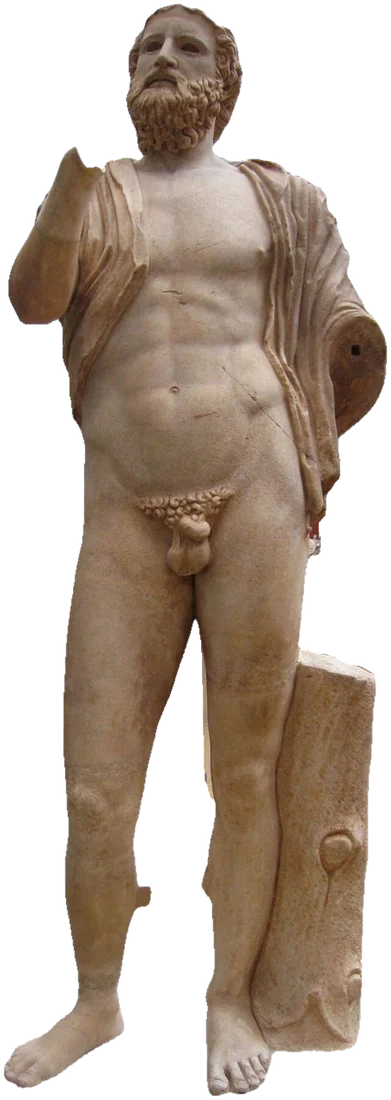
Anacreon. Anacreon was an Ionian, but aeolic cola and ionics are prominent in his work.[2] Here is PMG 358.1–4, with the purple ball of Smyth’s text:
σφαίρηι δηὖτέ με πορφυρῆι |
βάλλων χρυσοκόμης Ἔρως |
νήνι ποικιλοσαμβάλωι |
συμπαίζειν προκαλεῖται.
Once again golden-haired Eros strikes me with a purple ball and challenges me to play with the girl in the fancy sandals.
Anacreon, PMG 358.1–4: Smyth 1900 pp. 46–47, public domain. Red: the aeolic base, long long in every line.
synthetic ∿
The four cola are clearly marked off by word-division, but they are in synapheia. So West ends each of the first three with his word-end sign |, not with ‖.[3] The base is restricted. At least one of its two syllables must be long, and usually both are, as in each line here.[2] Anacreon uses his anaclastic glyconic ¨gl, — ⏑ ⏑ — × — ⏑ —, with its catalectic, ar, and with the ithyphallic. With choriambic expansion it yields his iambo-choriambic verses.[4]
In PMG 378 he resolves the first position of such a verse, ⏑ ⏑ ⏑ — … . Together with an uncertain instance in Ibycus, this is the earliest resolution in the sequence — ⏑ ⏑. Before this, resolution had been confined to — ⏑ —. It is attested that the resolution ran through the whole song.[5] In PMG 346 fr. 1 the cola are “dovetailed”. Word-end comes systematically one position later than expected. So what would be straightforward aeolic has all the appearance of ionic.[6] The Athenian skolia, many sung to the same tunes, use ¨gl, dod and gl ia∧ in short strophes.[7]
Pindar. Most of Pindar’s and Bacchylides’ poems that are not dactylo-epitrite fall into the aeolic category. They are so called because of the part played in them by gl and gl¨, tl and tl¨, ph, r, dod and dod¨. The base is now ○ ○ with the first position resolvable. So a glyconic may open — —, — ⏑, ⏑ ⏑ —, ⏑ ⏑ ⏑ or ⏑ —. The ⏑ — form is not found in responsion with the others. Itsumi’s count of the base in Pindar agrees on two points. The forms seldom answer one another (— — ~ — ⏑ being the only regular responsion), and ⏑ ⏑ ⏑ is common. But he recognises only four forms, — —, — ⏑, ⏑ — and ⏑ ⏑ ⏑. He would admit ⏑ ⏑ — only on a corrupt text. — —, the usual form in tragedy, is rare in Pindar.[8] The authorities differ on ⏑ ⏑ —.
A double-short form ⏑ ⏑ — ⏑ ⏑ — ⏑ — occurs, but not in responsion with the others. It seems to have taken on an independent identity.[9] Pindar also admits resolution later in the colon, as ⏖ ⏑ — ⏑ ⏑ ⏖ ⏑ ⏖, and occasionally contraction, as — ⏑ — ⏔ — (dod¨).[10] So Pindar and Bacchylides abandon the fixed syllable count of Lesbian aeolic, and let the base take three syllables. Pindar now and then resolves a long or contracts two shorts.[11]
A few of the simplest poems can be analysed straight off. Here is the first strophe of the Fourth Nemean, with West’s labels:[10]
| Greek (Perseus) | scansion | West | |
|---|---|---|---|
| 1 | ἄριστος εὐφροσύνα πόνων κεκριμένων | ⏑ — ⏑ — ⏑ ⏑ — ⏑ — — ⏑ ⏑ — | tl¨ dod¨ ‖ |
| 2 | ἰατρός· αἱ δὲ σοφαί | — — ⏑ — ⏑ ⏑ — | tl¨ ‖ |
| 3 | Μοισᾶν θύγατρες ἀοιδαὶ θέλξαν νιν ἁπτόμεναι. | — — ⏑ — ⏑ ⏑ — — — — — — ⏑ ⏑ — | tl¨ ∫ gl¨ ‖ |
| 4 | οὐδὲ θερμὸν ὕδωρ τόσον γε μαλθακὰ τέγγει | — ⏑ — ⏑ ⏑ — ⏑ — ⏑ — ⏑ ⏑ — — | gl r ‖ |
| 5 | γυῖα, τόσσον εὐλογία φόρμιγγι συνάορος. | — ⏑ — ⏑ — ⏑ ⏑ — — — ⏑ ⏑ — ⏑ — | gl¨ tl ‖ |
| 6 | ῥῆμα δ’ ἑργμάτων χρονιώτερον βιοτεύει, | — ⏑ — ⏑ — ⏑ ⏑ — ⏑ — ⏑ ⏑ — — | gl¨ r ‖ |
| 7 | ὅ τι κε σὺν Χαρίτων τύχᾱι | ⏑ ⏑ ⏑ — ⏑ ⏑ — ⏑ — | ⏖gl ‖ (first position resolved) |
| 8 | γλῶσσα φρενὸς ἐξέλοι βαθείας. | — — ⏑ ⏑ — ⏑ — ⏑ — — | tl ia∧ ||| |
The best healer of toils, once they are decided, is festivity; and songs, the wise daughters of the Muses, charm it with their touch. Not even warm water bathes the limbs so gently as praise partnered with the lyre. The word lives longer than deeds, whatever the tongue draws, by the Graces’ favour, from the depth of the mind.
West marks the quantities. In line 3 he divides τρ in θύγατρες. He marks νιν long, lengthened by its final consonant before the vowel, as happens occasionally in Pindar.[12] The ∫ marks ἀοιδαί running across the join of two cola, as a word does at this point in eleven of the twelve strophes.[13] Itsumi analyses lines 2–7 with the same cola under other names (his hepta = tl¨, wil = gl¨). But he reads line 1 as hepta+2 d, × — × — ⏑ ⏑ — ⏑ — | — ⏑ ⏑ —, and line 8 as a single phrase, tel+3.[14] In line 4 the Greek follows Perseus (Sandys), τέγγει, ‘wets’. It has the same two long syllables as the reading in West’s table. The closing iambic metron is a familiar kind of addition to an aeolic colon.[15] Here and there dochmiac units also appear.[10]
Most aeolic poems are harder. The poet states a motif at the start of the strophe and then develops and embroiders it. So sequences that baffle when taken on their own can readily be explained from what precedes them. For West, tracing how such a sequence grew out of the earlier ones matters more than deciding what to call it.[10] Itsumi calls this “dynamic analysis”. He grants its merits, but he argues that without a consistent classification it cannot show which forms are usual and which are odd.[16] Snell’s editions set related sequences in vertical alignment. They mark mutants with bracketed sigla, such as (gl) for a variation on a glyconic. This does not define the colon, but interprets it.[17] Pindar adopts new patterns of rhythm for most odes. They are held together by the repetition of complex periods.[18]
Notes
- ^ Battezzato 2009, pp. 134, 142.
- ^ a b West 1987, p. 40.
- ^ West 1987, pp. ix, 40.
- ^ West 1987, pp. 40–41.
- ^ West 1987, p. 41.
- ^ West 1987, pp. 41–42.
- ^ West 1987, p. 42.
- ^ Itsumi 2009, pp. 25 with n. 41, 32.
- ^ West 1987, pp. 44–45.
- ^ a b c d West 1987, p. 45.
- ^ Battezzato 2009, p. 142.
- ^ West 1987, p. 18.
- ^ Itsumi 2009, p. 297.
- ^ Itsumi 2009, pp. 16, 293, 299.
- ^ Compare suffixing on the Expansion tab.
- ^ Itsumi 2009, pp. 3–4.
- ^ West 1987, p. 46.
- ^ D’Angour 2022, ch. 9, §’Classical Lyric Meters’.
Aeolic · 5 of 6
Worked example: a Sapphic and an Alcaic stanza
Here are two stanzas, one of each kind, scanned syllable by syllable. The method is the same for both:
- Count the syllables. The Lesbian count is fixed, since nothing is resolved or contracted.[1]
- Mark each syllable long or short. A syllable is long if it has a long vowel or diphthong, or if it is closed by a consonant.[2] Remember that normal Lesbian lyric avoids short scansion before stop + liquid.[3]
- Lay the result against the scheme.
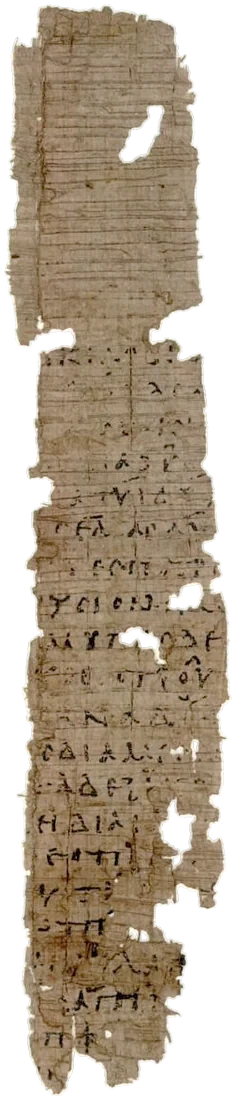
Sappho fr. 1.1–4 (Sapphic stanza)
Each syllable stands in a column over its sign, with its transliteration below:
1 Ποικιλόθρον’ ἀθανάτ’ Ἀφρόδιτα,
2 παῖ Δίος δολόπλοκε, λίσσομαί σε,
3 μή μ’ ἄσαισι μηδ’ ὀνίαισι δάμνα,
4 πότνια, θῦμον,
Periods: line 1 ‖ line 2 ‖ lines 3 and 4 together |||. Lines 1 and 2 end in a free last position (×); line 3 does not, because it runs straight on into line 4.
Immortal Aphrodite of the ornate throne, child of Zeus, weaver of wiles, I beg you: do not with pains and griefs crush my heart, lady.
Sappho, fr. 1.1–4, the first stanza of the hymn to Aphrodite.
synthetic ∿
West’s scheme: — ⏑ — × — ⏑ ⏑ — ⏑ — — ‖ twice, then — ⏑ — × — ⏑ ⏑ — ⏑ ⁝ —⁀× ⁝ — ⏑ ⏑ — — |||.[4] Here ⁝ marks frequent word-end, and ⁀ a bridge, a place where word-end is avoided.[5] West writes the last position of a period as long, whatever the syllable.[6] In the scansions here it is ×.
| Line | Syllables | Notes |
|---|---|---|
| 1 | Ποι-κι-λόθ-ρο-νἀ-θα-νά-τἀφ-ρό-δι-τα | 11. λοθ- is closed (θρ divided) and long; the ν of -θρον’ goes with the following vowel, so ρο- is short; ἀ- of ἀθανάτ’ is long here, as the metre requires and as this site’s line-by-line scansion marks it; τἀφ- before ρ is closed and long; final -τα is the free last position |
| 2 | παῖ-Δί-ος-δο-λόπ-λο-κε-λίσ-σο-μαί-σε | 11. -ος before δ- is closed, hence long; λοπ- closed (πλ divided) and long; -σε free at period-end |
| 3 | μή-μἄ-σαι-σι-μη-δὀ-νί-αι-σι-δάμ-να | 11. Elision of με and μηδέ; -αι- of ὀνίαισι is a diphthong, long; the line does not end a period but runs on into line 4 |
| 4 | πότ-νι-α-θῦ-μον | 5. The adonean; -μον is the free final position before stanza-end |
In the fourth position of lines 1–3 the stanza has ⏑ each time. The anceps there may be long or short. These are Hephaestion’s “two forms” of the verse.[7] Lines 1 and 2 end with period-end (‖). Line 3 runs into 4 without a break, so the stanza is three periods, not four.[8] The third period follows West’s marks exactly. Word-end falls after the ninth position (ὀνίαισι) and the eleventh (δάμνα). There is none across the bridge, which falls inside δάμ|να. Hephaestion’s description, “a trochaic dipody, a choriamb, and a close of iamb plus indifferent syllable”,[7] maps onto the same eleven positions: Ποι-κι-λόθ-ρο ¦ νἀ-θα-νά-τἀφ ¦ ρό-δι-τα.
Alcaeus fr. 338 (Alcaic stanza)
The text is Voigt’s.[9] Line 8 lacks two syllables after ἀμφι-, and Voigt marks them as a gap ⟨ ⟩:
5 κάββαλλε τὸν χείμων’, ἐπὶ μὲν τίθεις
6 πῦρ, ἐν δὲ κέρναις οἶνον ἀφειδέως
7 μέλιχρον, αὐτὰρ ἀμφὶ κόρσαι
8 μάλθακον ἀμφι[βάλων] γνόφαλλον.
Lines 5 and 6: Alcaic hendecasyllables, × — ⏑ — × — ⏑ ⏑ — ⏑ —. Line 7: the enneasyllable. Line 8: the decasyllable, — ⏑ ⏑ — ⏑ ⏑ — ⏑ — ×. Syllables in square brackets fill the gap in line 8.
Beat down the storm: put on the fire, mix the honey-sweet wine without stint, and about your temples [put] a soft cushion.
Alcaeus, fr. 338.5–8. Syllables, quantities and transliterations from this site’s scansion of the poem.
synthetic ∿
West’s scheme: × — ⏑ ⁝ — × ⁝ — ⏑ ⏑ — ⏑ — ‖ twice, then × — ⏑ ⁝ —⁀× — ⏑ —⁀× ⁝ — ⏑ ⏑ — ⏑ ⏑ — ⏑ — — |||.[4]
| Line | Syllables | Notes |
|---|---|---|
| 1 | κάβ-βαλ-λε-τὸν-χεί-μω-νἐ-πὶ-μὲν-τί-θεις | 11. Both anceps positions (1 and 5) long; τὸν before χ- closed; the ν of χείμων’ goes with ἐπὶ; μὲν before τ- closed |
| 2 | πῦ-ρἐν-δὲ-κέρ-ναι-σοἶ-νο-νἀ-φει-δέ-ως | 11. πῦρ has long υ; ἐν before δ- closed; the final consonants of πῦρ, κέρναις and οἶνον go with the following vowels, so νο- is short and -ναι- long by its diphthong |
| 3 | μέ-λιχ-ρο-ναὐ-τὰ-ρἀμ-φὶ-κόρ-σαι | 9. Anceps positions 1 and 5 short, 9 long; λιχ- closed (χρ divided) and long; ρο- short, its ν going with αὐτὰρ; ρἀμ- before φ- closed |
| 4 | μόλ-θα-κο-νἀμ-φι-⟨ - ⟩-γνό-φαλ-λον | 8 + 2 missing. The expanded close — ⏑ ⏑ — ⏑ ⏑ — ⏑ — —: the gap must hold ⏑ —, and the second of its syllables is long whatever it is, since γν before it always makes position;[10] γνό- short; -λον is the free final position. Voigt’s apparatus reports supplements, among them Grotefend’s ἀμφι⟨βαλὼν⟩ |
Lines 3 and 4 are one period of nineteen positions, written on two lines after the ninth position, as in antiquity.[11] Hephaestion’s description of the hendecasyllable, “an iambic dipody, an ionic a maiore, and a close of trochee plus indifferent syllable”,[12] fits line 1 as κάββαλλε τὸν ¦ χείμων’ ἐπὶ ¦ μὲν τίθεις. This is a different segmentation of the same eleven positions. It is a reminder that the ancient feet are descriptions, not the units the poet composed in.
Two things can be taken from the pair. The Sapphic hendecasyllable opens — ⏑ —, and the Alcaic × — ⏑ —. So the first begins “falling”, and the second “rising”.[13] And in both the last period is a distended form of the first two.[4] The stanza is not three different lines and a tail, but one phrase stated twice and then stretched.
Notes
- ^ West 1987, p. 32.
- ^ West 1987, pp. 12–13.
- ^ West 1987, p. 16 n. 7.
- ^ a b c West 1987, p. 34.
- ^ West 1987, p. ix.
- ^ West 1987, p. 4.
- ^ a b Hephaestion, Ench. 14.1.
- ^ West 1987, p. 34; Battezzato 2021, p. 127.
- ^ Voigt 1971, p. 311.
- ^ West 1987, p. 16.
- ^ West 1987, p. 35 n. 1; Battezzato 2021, p. 128.
- ^ Hephaestion, Ench. 14.3.
- ^ West 1987, p. 6.
Aeolic · 6 of 6
Aeolic in drama and after
Tragedy. Pure aeolic strophes are uncommon in Aeschylus. His iambic strophes, though, often end with an aristophanean, or sometimes a pherecratean.[1] There are several aeolic strophes in Sophocles, and they are especially characteristic of later Euripides. There the sameness of the rhythm, kept up through a whole strophe, can be almost hypnotic.[2] Aeschylus practically never writes whole stanzas in aeolic. For Sophocles and Euripides it is one of the main lyric rhythms, and Euripides’ stanzas are for the most part variations on the glyconic.[3] Here is the opening of West’s specimen, Phoenissae 202–213:
202 Τύριον οἶδμα λιποῦσ’ ἔβαν
203 ἀκροθίνια Λοξίᾳ
204 Φοινίσσας ἀπὸ νάσου
I left the Tyrian swell and came, first-fruits for Loxias from the Phoenician island.
Euripides, Phoenissae 202–204, glyconic, glyconic, pherecratean. Red: the base with its first position resolved.
synthetic ∿
The first glyconic opens with the first position resolved, Τύρι-, ⏑ ⏑ for —. In the second West divides κρ, so that ἀκ- is long (in tragedy a stop + liquid may be treated either way).[4] His × in the second position takes account of the antistrophe. The strophe continues in glyconics, a telesillean and a hipponactean. It ends κάλλιστον κελάδημα, — — — ⏑ ⏑ — —, ph ||| (Perseus text).[2]
Euripides’ and Sophocles’ habits:[5]
| Feature | Rule |
|---|---|
| resolution | most common in the part of the colon before — ⏑ ⏑ —: a two-position base ○ ○ normally resolves to ⏑ ⏑ ⏑ (responding with — ⏑ or ⏑ —; disputed: Itsumi finds that ⏑ ⏑ ⏑ as a rule answers only itself, in tragedy as in Pindar),[6] a three-position opening, as in tl¨, to × ⏖ ⏑; the longs of the choriamb and the final long of the glyconic are also resolvable |
| drag | Sophocles and Euripides occasionally make an ending — ⏑ — into — — —; a dragged ending may respond with an undragged, but exact responsion is more usual |
| anaclasis | exact responsion is the rule (tl¨, gl¨ etc.), with exceptions such as S. Tr. 960 (tl) ~ 929 (tl¨) |
| contraction | sequences derived from aeolic cola by contracting two shorts into a long occur in context (S. Ant. 1137 f., E. IT 1125 f.) |
| expansion | dactylic or choriambic; the choriambic type is particularly Sophoclean (Phil. 706 ff.) |
West brackets such contracted derivatives, (tl¨), (gl¨), to show that they are not themselves aeolic cola.[7] A telesillean could itself be described as an acephalous glyconic.[8]
How the base answers in Euripides. A complete count of the glyconics in Euripides’ strophic songs gives 193 pairs of strophe and antistrophe. In 143 pairs, about three in four, the two opening positions have exactly the same shape in both stanzas. The commonest pairing is — — with — —, in 92 pairs, nearly half. The one frequent mismatch is — — in one stanza against — ⏑ in the other, in 41 pairs (21%).[9] The openings ⏑ — and — ⏑ almost never answer each other. A glyconic that begins ⏑ — therefore behaves almost like a separate colon.[10] The resolved opening ⏑ ⏑ ⏑ normally answers only itself, and it belongs mainly to Euripides’ later plays. Of 77 glyconics that open this way, only 5 come from his seven earliest surviving plays.[11]
Euripides also prefers the pherecratean to the hipponactean by far: one count finds 250 lines of the first against 33 of the second.[12] Some of his favourite combinations are not Lesbian at all. The pairing of glyconic and pherecratean, the priapean, is common in tragedy and in Anacreon, but it does not occur in the surviving Lesbian poems.[13]
Afterwards. Aeolic survives into Hellenistic times, especially for festival compositions of a conventional kind. These are usually glyconics in short strophes with a pherecratean close. The anaclastic glyconic ○ ○ — × — ⏑ ⏑ — (gl¨) becomes increasingly frequent. An example is Corinna (PMG 654 iii 12–21). In the ten lines West quotes, the only straight glyconic is the third line of the second stanza.[14] The little hymn to the Mother of the Gods inscribed at Epidaurus (PMG 935) seems to have been in quatrains of three telesilleans and a reizianum. The prefatory poem of Corinna’s song-collection (PMG 655) and the concluding prayer of Limenius’ Paean are in stichic glyconics without strophic structure. Limenius at least ended with a pherecratean.[15]
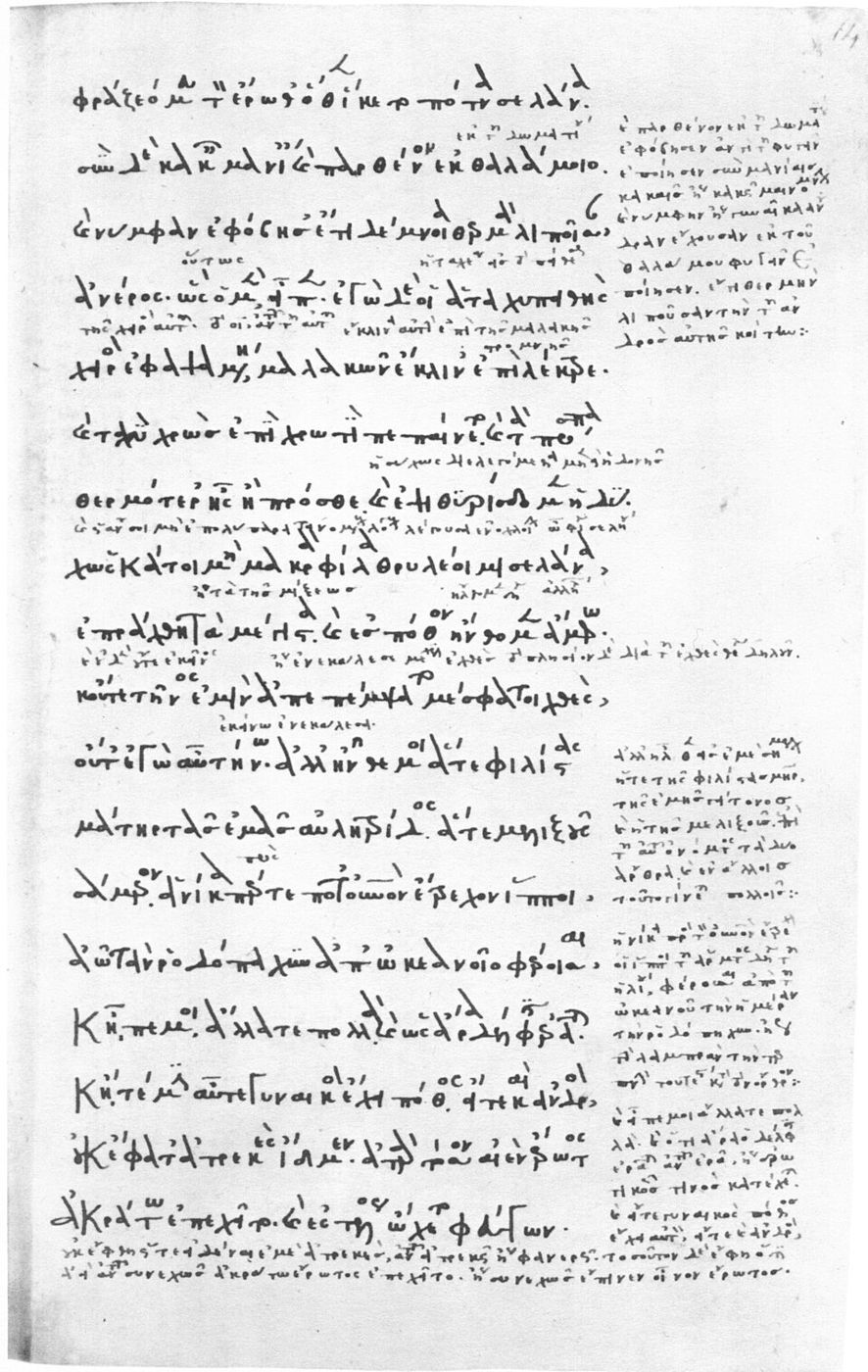
Hellenistic book-poets also revived Lesbian forms for literary use. Theocritus wrote poems 28–31 in Lesbian dialect. In them he uses gl²ᶜ and gl²ᵈ, openly choosing the Lesbian poets as his model. From 29.39 onwards he affects the old double-short form of the aeolic base, a form little used since the fifth century.[16] The four poems are a reworking of Sappho and Alcaeus in their own dialect and metres. Idyll 29 even opens with a quotation of Alcaeus.[17]
Notes
- ^ West 1987, pp. 53, 58.
- ^ a b West 1987, p. 58.
- ^ Lourenço 2011, p. 91.
- ^ West 1987, p. 16.
- ^ West 1987, pp. 58–59.
- ^ Itsumi 2009, p. 34.
- ^ West 1987, p. 59.
- ^ West 1987, p. 85.
- ^ Itsumi 1982, p. 127.
- ^ Itsumi 1982, pp. 127–128.
- ^ Itsumi 1982, pp. 128–129.
- ^ Itsumi 1982, p. 6.
- ^ Itsumi 1982, p. 9.
- ^ West 1987, p. 72.
- ^ West 1987, p. 73.
- ^ West 1987, p. 76.
- ^ Morrison 2022, p. 397.


