Verse formsLyric metres
Cretic and paeonic
Cretic and paeonic rhythms in lyric and comedy, and their relation to iambic verse.
The metrical families one by one: dactylic, iambic, trochaic, aeolic, ionic, anapaestic, dochmiac and the rest.
Cretic and paeonic · 1 of 3
The cretic and the paeons
The cretic is the metron — ⏑ —. It is five morae long. A mora is the unit of time: a short syllable takes one, a long syllable two, so — ⏑ — lasts 2 + 1 + 2. “Cretic-paeonic” is West’s name for verse built from it.[1] Writers on the music say the same in their own terms. The rhythm is quintuple time, two beats against three, familiar from east-European folk music. It is a five-time foot with no fixed preference for 2 + 3 or 3 + 2. It is versatile enough for the solemn Delphic hymns and for the bawdy songs of Aristophanes.[2] Here a cretic opens a line of Euripides’ Medea:
εἰ δὲ σὸς πόσις καινὰ λέχη σεβίζει
If your husband honours a new bed,
Euripides, Medea 155–156. Red: the cretic, 2 + 1 + 2 = 5 morae, before an aeolic colon.
synthetic ∿
Learners meet the shape in two quite different places. It is a metre in its own right, in Alcman and in the lively songs of Aristophanes. It is also a shape that appears inside iambic song when a position is suppressed. The two must be kept apart.
The ancient feet. Hephaestion counts the three-syllable feet of five times. They are the bacchius ⏑ — —, the amphimacer or cretic — ⏑ —, and the palimbacchius — — ⏑. The molossus — — — has six.[3] Among the four-syllable feet of five times are the four paeons: first — ⏑ ⏑ ⏑, second ⏑ — ⏑ ⏑, third ⏑ ⏑ — ⏑, fourth ⏑ ⏑ ⏑ —.[4]
His chapter on the “paeonic” metre says that it has three kinds: cretic, bacchiac and palimbacchiac. The palimbacchiac is unsuited to song. The cretic is suited to it, “and it admits resolutions into the so-called paeons”. The poets themselves called it cretic. Cratinus does so in the Trophonius: ἔγειρε δὴ νῦν, μοῦσα, κρητικὸν μέλος, “wake now, Muse, a Cretan song”.[5] The bacchiac is rare, found only in short stretches.[6]
The modern view. The modern account starts from Alcman 58. Its lines are built of cretic metra, — ⏑ — (cr), and end in a catalectic metron — —, one that lacks its final position. Later poets admit resolution, the splitting of a long into two shorts. This gives — ⏑ ⏖ or ⏖ ⏑ —, the “paeonic” feet, or sometimes ⏖ ⏑ ⏖. These resolutions show that the metron is a unit of five morae. It is distinct from the “spurious” cretic ⌊ ⏑ — (∧ia), which appears in later iambic lyric as the equivalent of an iambic metron.[7] Here are two resolved cretics, each with its last long split, in a line of the Bacchae:
λωτὸς ὅταν εὐκέλαδος
when the sweet-sounding pipe
Euripides, Bacchae 160: two cretics, each with its last long resolved into two shorts (red). Each still lasts 2 + 1 + 1 + 1 = 5 morae. The final -ς (-s) of εὐκέλαδος (eukelados) begins the next line’s first syllable, so -δο- (-do-) is short.
synthetic ∿
The two shapes look alike on the page, but they differ in time. In the genuine cretic the first long is an ordinary two-mora long, and the whole metron lasts five morae. Syncopated iambics are iambics with a position suppressed; the sign ∧ marks the gap. In them the long marked ⌊ is a triseme. It is held for three morae, so that the metron keeps the six morae of × — ⏑ —.[8] The musical documents bear this out. A cretic shape embedded in iambic rhythm has its first syllable prolonged, and in trochaic rhythm its last. A rhythmical papyrus (P.Oxy. 2687) prescribes this, and the placing of rests in the scores confirms it.[9]
Here are three syncopated metra in a row, in a line of the Agamemnon:
μνησιπήμων πόνος· καὶ παρ’ ἄ-
the painful memory of woe; and to the unwilling too
Aeschylus, Agamemnon 180: three syncopated iambic metra among iambics. Red: the first long of each, held for three morae.
synthetic ∿
For West, Bacchylides 17 proves the equivalence. Responsion is the matching of strophe and antistrophe, position by position. At eight places the scheme of this ode lets a syncopated iambic metron in one stanza answer an unsyncopated one in the other, mostly ⏕ ⏑ — with ⏒ — ⏑ —. The time of the missing short goes to one of the longs beside it, which becomes a triseme.[10] Maehler reads the same ode as cretic instead (the reading is disputed).
| Shape | Name in West | What it is | Where |
|---|---|---|---|
| — ⏑ — | cr | genuine cretic, 5 morae; resolvable | Alcman, Aristophanes, Delphic paeans |
| — ⏑ ⏖ | “first paeon” | the commonest resolved form in drama | West p. 55 |
| ⏖ ⏑ — | “fourth paeon” | the rarer resolved form | West pp. 39, 55 |
| ⏖ ⏑ ⏖ | fully resolved cretic | occasional | West p. 39 |
| ⌊ ⏑ — | ∧ia | syncopated iambic metron, 6 morae with a triseme | Pindar, tragedy |
| ⏑ — ⌊ | ia∧ | syncopated iambic, “baccheus” | tragedy |
| ⌊ ⌊ | ∧ia∧ | syncopated iambic, “spondee”; in the iambic odes of Simonides, Bacchylides and Pindar at period-end only | West pp. 46, 52 |
Three of the rarer shapes in lines of verse:
16.11 τόσα χοροὶ Δελφῶν
songs as many as these the Delphian choirs
Bacchylides 16.11. Red: the first long of the cretic resolved into two shorts.
6.1 Λάχων Διὸς μεγίστου
Lachon from Zeus the highest
Bacchylides 6.1: an iambic metron, then one that has lost its short syllable.
ἄγ’ αὖτ’ ἐς οἶκον τὸν Κλεησίππω
Come, home again to the house of Cleesippus.
Alcman, quoted by Hephaestion: two iambic metra and, at the end of the line, one with two positions suppressed.
synthetic ∿
Why “paeonic” is added. In drama West qualifies “cretic” with “paeonic” for two reasons. One is how often the resolved form — ⏑ ⏖ (rarely ⏖ ⏑ —) occurs there. The ancient metricians called this form the first paeon. The other is the need to tell it apart from the “cretics” that appear by syncopation among iambics. West doubts that cr and ∧ia can always be kept strictly apart, given certain things in Aristophanes. But he holds that the cretic is still plainly a category of its own, separate from iambic.[11]
The practical test is resolution. A cretic among dochmiacs in Agamemnon 1136 ff. is totally resolved. That proves these to be genuine cretics and not syncopated iambics.[12] A recurring sequence of three shorts between longs is the distinguishing mark of the metre.[11] Aristophanes’ paeonic verses are the main classical home of the rhythm, and they show the same fluidity between paeonic and trochaic. The Hellenistic paeans of Delphi are almost entirely paeonic, with long syllables often split between two notes.[13] In Agamemnon 1142 a fully resolved cretic stands beside a plain one:
νόμον ἄνομον, οἷά τις ξουθὰ
a strain that is no strain, like some quick-voiced bird,
Aeschylus, Agamemnon 1142, among dochmiacs. Red: both longs of the first cretic resolved, five shorts for five morae.
synthetic ∿
Neighbours. Cretics and bacchei occur in short sequences among dochmiacs. The combinations cr δ, δ cr, ia δ and δ ia are common. There are also “dragged” cretics, with a long in the middle position.[12] In Aristophanes the resolved (paeonic) cretic — ⏑ ⏖ has a special affinity with the trochaic metron. He passes from cretics into trochaics and back, or mixes them, or lets a resolved cretic respond with a trochaic metron. It is as though, for comic song and dance, the heart of trochaic rhythm were the shape — ⏑ × ⏑.[11] In Birds 327–35 ~ 343–51 the anapaest in its resolved, proceleusmatic form, ⏑ ⏑ ⏑ ⏑, becomes interchangeable with the cretic (paeon).[14]
The ancient tetrameter. A tetrameter is a line of four metra. Hephaestion describes the standard comic line. Some poets take first paeons in every place except the last, where they put a cretic, “and so they compose the much-talked-of tetrameter”. He quotes Aristophanes’ Georgoi and Wasps and Eupolis’ Kolakes.[15]
Notes
- ^ West 1987, pp. 39, 55.
- ^ West 1992, pp. 140–141; Landels 1999, c. p. 121.
- ^ Hephaestion, Ench. 3.2.
- ^ Hephaestion, Ench. 3.3.
- ^ Hephaestion, Ench. 13.1.
- ^ Hephaestion, Ench. 13.8.
- ^ West 1987, p. 39.
- ^ West 1987, pp. 7, 47.
- ^ Devine and Stephens 1994, p. 115.
- ^ West 1987, p. 47.
- ^ a b c West 1987, p. 55.
- ^ a b West 1987, p. 57.
- ^ West 1992, pp. 141–142.
- ^ West 1987, p. 61.
- ^ Hephaestion, Ench. 13.2.
Cretic and paeonic · 2 of 3
Who used cretics
Alcman. The earliest cretics in West’s survey are Alcman’s (PMG 58). These are two lines of pure cretic metra, closed by the catalectic — —.[1] Hephaestion quotes the same lines as his example of a cretic hexameter catalectic, “composed of amphimacers alone”. He adds that the paeonic metre can run as far as six metra “because it does not exceed thirty times”:[2]
Ἀφροδίτα μὲν οὐκ ἔστι, μάργος δ’ Ἔρως οἷα ⟨παῖς⟩ παίσδει
ἄκρ’ ἐπ’ ἄνθη καβαίνων, ἃ μή μοι θίγῃς, τῶ κυπαιρίσκω.
It is not Aphrodite: it is wild Eros playing like a child, stepping down onto the flower-tips of the galingale. Do not touch them, I beg you.
Alcman, PMG 58, quoted by Hephaestion: five cretics and a catalectic close in each line; no position resolved.
synthetic ∿
West marks the syllable-divisions Ἀφ|ροδ- and ἀκ|ρ’. So both opening syllables are long by position, and the ι and final α of Ἀφροδίτα are long.[1] No position is resolved. The five-time metron is used in its plain form.
Bacchylides (disputed). Hephaestion notes that “whole songs are composed in cretics, as in Bacchylides”, and quotes the opening of one.[3] West’s three categories for Simonides, Bacchylides and Pindar are dactylo-epitrite, aeolic and iambic. He counts Bacchylides 17 among the iambic poems. At eight places in it, syncopated and unsyncopated iambic metra respond.[4]
Maehler reads the same ode differently. For him the story of Theseus’ voyage to Crete is told in a predominantly “Cretan” metre of cretics and paeons. Bacchylides experiments with it much as Pindar experiments with dactylo-epitrite. Maehler finds a new “long cretic”, — ⏑ — ⏑ —, again and again. He finds link-syllables as in dactylo-epitrite, mostly short except at the beginning or end of a period. Lines that seem to begin iambic are better taken as a cretic with a preceding syllable. And an apparent lekythion is better taken as cr ⏑ cr, not cr ia.[5]
Tragedy. Tragedy has hardly any cretic-paeonic. The only wholly cretic strophe is Aeschylus, Suppliants 418–22 ~ 423–7. The strophe that follows begins cretic but turns into dochmiacs.[6] Otherwise cretics appear in short sequences in dochmiac contexts. There their resolution marks them as genuine cretics rather than syncopated iambics.[7]
Old Comedy. Aristophanes uses cretics particularly in his earlier plays. Periods are of various lengths, at least up to thirteen metra. But the commonest is a tetrameter, cr⏖ cr⏖ cr⏖ cr ‖: three resolved metra and a final unresolved one.[6] This is Hephaestion’s “much-talked-of tetrameter”. He illustrates it from the Georgoi:[8]
ὦ πόλι φίλη Κέκροπος, αὐτοφυὲς Ἀττική,
χαῖρε λιπαρὸν δάπεδον, οὖθαρ ἀγαθῆς χθονός.
O city dear to Cecrops, native-born Attica, hail, shining ground, udder of the good land.
Aristophanes, Georgoi, quoted by Hephaestion, Enchiridion 13.2: three first paeons and a cretic in each line. Red: the resolved long.
synthetic ∿
He adds that in the same play Aristophanes “somewhere put the fourth paeon instead of the first”: ἐν ἀγορᾷ δ’ αὖ πλάτανον εὖ διαφυτεύσομεν, ⏖ ⏑ — ¦ — ⏑ ⏖ ¦ — ⏑ ⏖ ¦ — ⏑ —. In the second Thesmophoriazusae, he says, Aristophanes often put plain cretics in the middle of such tetrameters.[9] Simias, by contrast, favoured unresolved cretics. In one poem he resolved both longs. He used a foot of five shorts everywhere except the last place, where he put a fourth paeon.[10] Some poets built the tetrameter the other way round, with three fourth paeons and a closing cretic:[11]
θυμελικὰν ἴθι μάκαρ φιλοφρόνως εἰς ἔριν.
Come, blessed one, graciously to the contest of the stage.
Quoted by Hephaestion, Enchiridion 13.4: three fourth paeons and a closing cretic. Red: the resolved first long.
synthetic ∿
Theopompus extended the first-paeon pattern to a pentameter, the Theopompeion.[12] In comedy the resolved cretic has a special relationship with the trochaic metron. Anapaest and cretic are exchanged in Birds 327–35 ~ 343–51.[13]
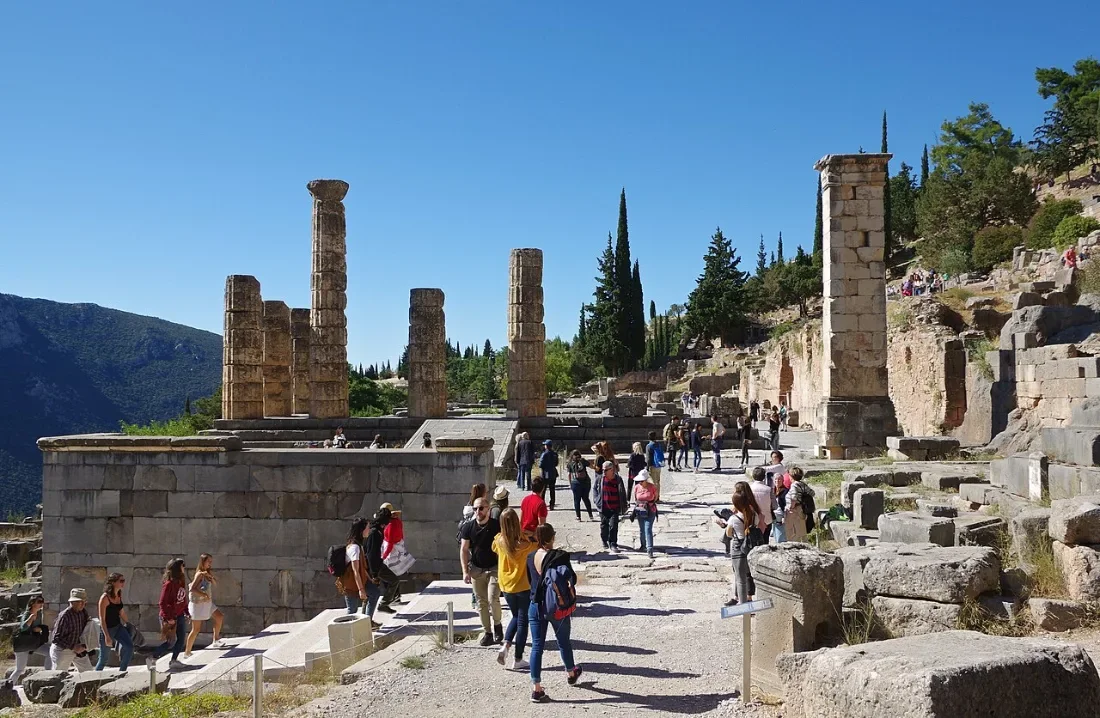
Delphi and the Empire. There had probably been a long tradition of cretic-paeonic hymns at Delphi. It is reflected in two astrophic paeans by Athenian poets, performed there in 127 BC and inscribed with musical notation (CA 141 ff. = Pöhlmann 19, 20). Their periods vary in length. The first two that West prints are pentameters, and the next is far longer. The four forms of metron occur in this order of frequency: — ⏑ —, — ⏑ ⏖, ⏖ ⏑ —, ⏖ ⏑ ⏖.[14] The cretic paeans of Limenius and Athenaeus are among the Hellenistic poems that use a lyric metre stichically rather than in strophes.[15] West compares the Hymn to Apollo 514–19, PMG 950(a) and (b), and PMG 1031. The last is an invocation of Dionysus at a θυμελικὸς ἀγών, in tetrameters ⏖cr ⏖cr ⏖cr cr.[16]
Mesomedes’ short hymn to Isis dates from the Hadrianic period. In it the metron may also take the novel forms — — ⏑, ⏑ ⏑ — ⏑ or ⏑ — ⏑ ⏑. In these, anaclasis has rearranged its time-values. The hymn is in dimeters with synapheia throughout. After it, cretic-paeonic is not found again.[17]
Notes
- ^ a b West 1987, p. 39.
- ^ Hephaestion, Ench. 13.6.
- ^ Hephaestion, Ench. 13.7.
- ^ West 1987, pp. 43, 46–47.
- ^ Maehler 2004, p. 17.
- ^ a b West 1987, p. 55.
- ^ West 1987, p. 57.
- ^ Hephaestion, Ench. 13.2.
- ^ Hephaestion, Ench. 13.3.
- ^ Hephaestion, Ench. 13.3–4.
- ^ Hephaestion, Ench. 13.4.
- ^ Hephaestion, Ench. 13.5.
- ^ West 1987, pp. 55, 61.
- ^ West 1987, pp. 71–72.
- ^ Morrison 2022, p. 397.
- ^ West 1987, p. 71 n. 4.
- ^ West 1987, p. 72.
Cretic and paeonic · 3 of 3
Worked example: Aristophanes, Acharnians 976–979
The chorus of the Acharnians has watched Dicaeopolis enjoy the fruits of his private peace. Now it sings of the good things that peace brings of their own accord. It sings too of War, the drunken guest whom they will never again let into the house. West quotes four lines as his specimen of the comic cretic tetrameter, numbering them 978–81.[1] The text below is Hall and Geldart’s. It prints the preceding cretic lines as long verses and numbers them 971, 973, 975. So West’s 978–81 are its 976–979.
αὐτόματα πάντ’ ἀγαθὰ τῷδέ γε πορίζεται.
οὐδέποτ’ ἐγὼ Πόλεμον οἴκαδ’ ὑποδέξομαι,
οὐδὲ παρ’ ἐμοί ποτε τὸν Ἁρμόδιον ᾄσεται
ξυγκατακλινείς, ὅτι παροινικὸς ἀνὴρ ἔφυ,
All good things come to this man of their own accord. Never will I receive War into my house, nor shall he ever sing the Harmodius song at my table, reclining beside me, for he is a man who turns nasty in his cups.
Aristophanes, Acharnians: four tetrameters, cr⏖ cr⏖ cr⏖ cr. Red: the resolved second long of each first paeon.
synthetic ∿
The scheme. Each line is a tetrameter, cr⏖ cr⏖ cr⏖ cr ‖. It has three metra with the second long resolved, giving the “first paeon” — ⏑ ⏑ ⏑, and an unresolved cretic to close.[1] This is exactly the line Hephaestion describes: first paeons in every place but the last, which takes the cretic.[2] The run of three short syllables between longs, repeated three times a line, is what marks the metre out.[1]
Line by line.
976. In αὐτόματα, αὐ- is long, and three shorts follow. In the second metron πάν- is long by position, and τ’ ἀ-γα-θὰ gives the three shorts (the elided τ’ goes with the following vowel). τῷδέ γε πο- is the third metron. -ρίζεται is the fourth, with the final -αι long by nature.
977. οὐδέποτ’ ἐ- opens the line. Πόλεμον is personified, War as a party guest. Its three shorts fill the resolved position of the second metron, after the long -γώ. οἴκαδ’ ὑπο- is the third metron, and -δέξομαι the fourth.
978. τὸν before Ἁρμόδιον is short. Its ν goes with the next vowel (the rough breathing does not make position). The long of the third metron is Ἁρ-. -μόδιον gives the three shorts. The ο of -ον is short before the vowel of ᾄσεται.
979. Hall and Geldart’s text reads παροινικὸς ἀνήρ. There the third metron is resolved like the others: -ροινικὸς ἀ- gives the three shorts. West prints a different text, πάροινος ἁνήρ, with crasis (ὁ ἀνήρ, West marking the α long). So -ροινος ἁ- scans — ⏑ —. West comments on exactly that: “981 The third metron is unresolved”.[1] The two readings differ in sense hardly at all, and the metre admits both. This is a reminder that scansion depends on the edition in hand. A metrical note in one book may describe a text that another book does not print.
Comic quantities. In ξυγκατακλινείς the α of -κατα- stays short before κλ. So does the ε of Κέκροπος in the Georgoi line that Hephaestion quotes.[2] In Attic speech short syllables regularly remained short before stop + liquid. This is the normal scansion in the dialogue of comedy. The long scansion appears only in parody of tragedy or in a raised style (the same rule is the last in West’s list of features of the comic trimeter).[3] For stop + liquid inside the word, the short scansion is overwhelmingly the norm in comedy. In comic dialogue the long one goes mainly with a formal style, as when tragedy is parodied.[4] Each tetrameter ends in period-end (‖), though the sense runs on from 978 into 979.
Cretic or trochaic? Aristophanes passes from cretics into trochaics or back, or mixes them, or lets a (resolved) cretic respond with a trochaic metron. So close a link might suggest that the comic cretic was timed — ⏑ ⌊. Its last long would then be a triseme, so that it lasts as long as a trochaic metron. But a cretic of that shape could not be resolved into — ⏑ ⏖. West concludes that the affinity belongs rather to the paeonic form itself. It is as though, for comic song and dance, the heart of trochaic rhythm were the shape — ⏑ × ⏑.[1]
The safe description of these four lines is therefore the one given above. They are four periods of genuine five-mora cretics, three of them resolved, in the pattern that Hephaestion already singled out as the standard comic tetrameter.