Verse formsStichic metres
Trochaic
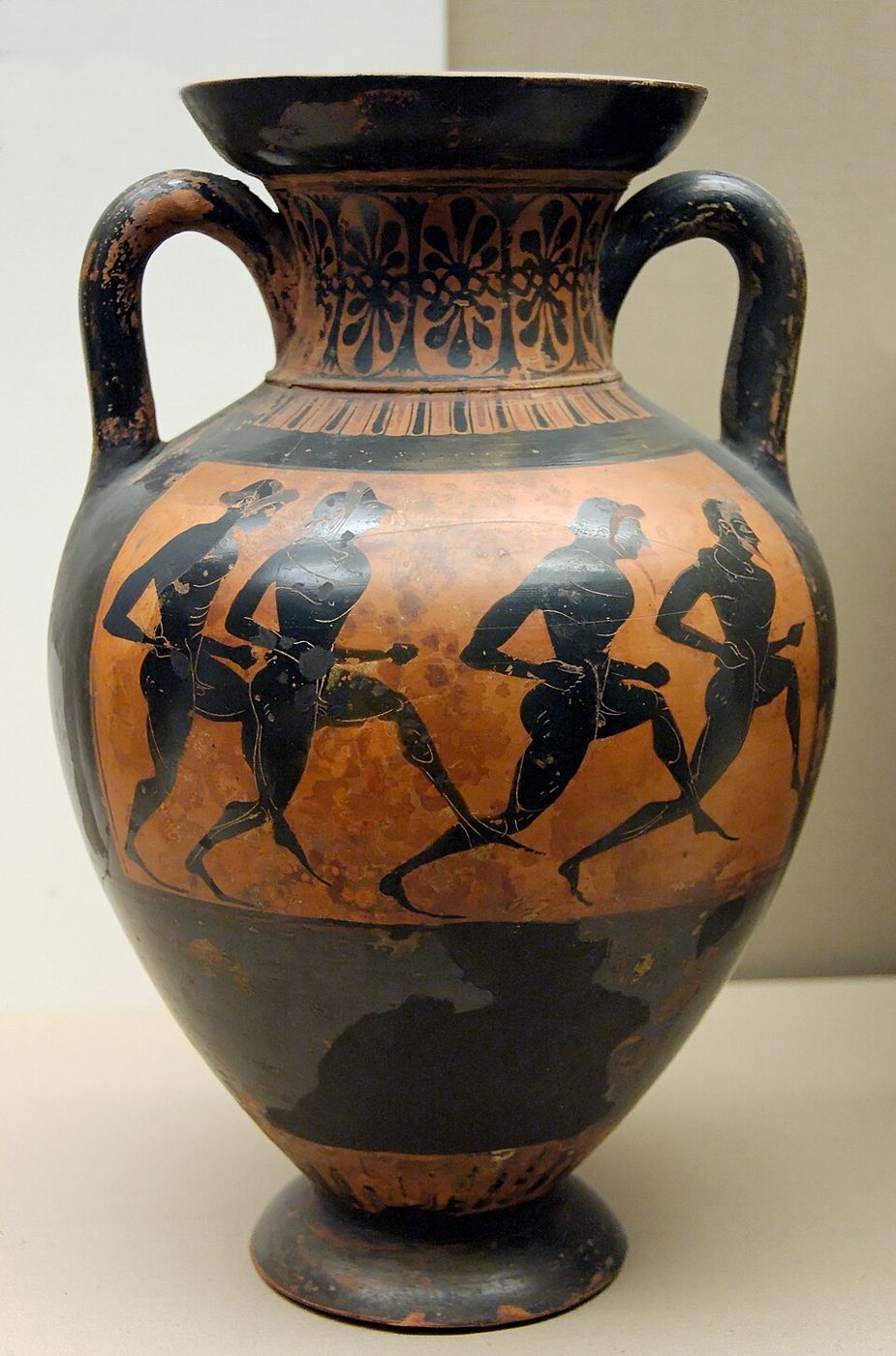
The trochaic tetrameter of drama and the shorter trochaic rhythms of song.
The metrical families one by one: dactylic, iambic, trochaic, aeolic, ionic, anapaestic, dochmiac and the rest.
Trochaic · 1 of 3
The trochaic tetrameter catalectic
A trochee is the foot — ⏑, a long followed by a short.[1] The trochaic metron joins two of them, — ⏑ — ×: a long, a short, a long and an anceps. It is the mirror of the iambic × — ⏑ —.[2] The Greek word τροχαῖος (trochaios), “running”, suggests that the metre was associated with a brisk tempo.[3] Its chief stichic form is the tetrameter catalectic. Archilochus and Solon composed in it, and drama kept it for particular scenes. In tragedy it belongs above all to Aeschylus and to Euripides’ late plays.[4] It stands beside the trimeter among Archilochus’ stichic metres.[5] No undisputed tetrameter survives in tragedy between the Oresteia (458) and Trojan Women (415). Euripides then brought the older verse back, though he used it sparingly.[6] In his late plays it goes with the excitement of quickening action.[7]
Comedy also gives it a set place in the parabasis. After the strophe, and again after the antistrophe, comes a block of tetrameters of the same length, sixteen or twenty lines. This is called the “epirrhematic syzygy”, and these blocks must have been delivered in recitative.[8]
The scheme
— ⏑ — × — ⏑ — × ¦ — ⏑ — × — ⏑ — ‖
synthetic ∿ · the rhythm: a long note for —, a short one for ⏑
West marks the regular caesura after the second metron, with a lighter division after the third. The usual word-end comes after the eighth element.[5] The line resembles an iambic trimeter prefixed by — ⏑ —.[4] Compare the last twelve positions above with × — ⏑ — × — ⏑ — × — ⏑ —. The final metron is catalectic, — ⏑ —, with the last syllable omitted.[9]
Hephaestion puts it in terms of feet. The odd feet take trochee, tribrach or dactyl, and the even feet those and also spondee and anapaest. When the line is catalectic, the penultimate foot is mostly a trochee, sometimes a tribrach.[10] The dactyl in the odd places, he adds, was used least by the iambographers, rarely by the tragedians and constantly by the comic poets. In the same way the iambic admits the anapaest in its even places. He calls both “irrational”, since a spondee, of which these are the resolutions, cannot stand there.[11]
Hephaestion’s specimen of the line is by Archilochus. Its four metra, the last one short, stand out clearly:
Ἐρξίη πῆ δηῦτ’ ἄνολβος ἀθροΐζεται στρατός
Erxies, where is the hapless army mustering this time?
Archilochus, quoted by Hephaestion, Enchiridion 6.2. Red: the catalectic last metron. Dashed bar: the caesura after the second metron.
synthetic ∿
This is Hephaestion’s specimen of the tetrameter catalectic. D’Angour’s is Archilochus fr. 120, on leading the dithyramb.[3]
The caesura
Epicharmus often ignores the normal caesura after the second metron, and Aristophanes lacks it in about one line in seven. Menander keeps it as a rule, though he lets a postpositive follow it. A line without it usually has word-end one position before that point or two after it. Tragedy has two such lines, A. Pers. 165 and S. Phil. 1402.[4] West’s specimen is the queen’s reply at A. Pers. 226–9. Here are its first two lines:
226 ἀλλὰ μὴν εὔνους γ’ ὁ πρῶτος τῶνδ’ ἐνυπνίων κριτὴς
227 παιδὶ καὶ δόμοις ἐμοῖσι τήνδ’ ἐκύρωσας φάτιν.
Well then, you, the first interpreter of these dreams, have been kindly in confirming this meaning for my son and my house.
Aeschylus, Persians 226–227. Red, in 226: the long first anceps εὔ- (eu-) and -νους (-nous), one word, as Havet’s Law requires; in 227: the long third anceps -ρω- (-rō-) and -σας (-sas), one word, as Porson’s Law requires. Dashed bars: the caesura after the second metron.
synthetic ∿
The text is Perseus’. West prints τήνδε κυρώσας, which scans the same, and marks ἐνυπ'νίων with πν divided, so that its second syllable is long.[4]
Porson’s Law and Havet’s Law
Porson’s Law applies at the end of the line in early iambus and in tragedy, just as in the trimeter. A long anceps in the third metron and the syllable after it belong to the same word, unless one is a monosyllable.[4] The law holds for the trochaic tetrameters as well as the trimeters of tragedy, and for archaic iambus too.[12] Porson also found the matching rule for the start of the line, now usually called Havet’s Law. The first metron avoids the rhythm — ⏑ — — ¦ …, with word-end after a long first anceps. Euripides offers three apparent exceptions.[4] In Pers. 227 above the third anceps, -ρω-, is long, and -σας follows in the same word. The first anceps, δό-, is short, so Havet’s Law does not arise. In 226 the first anceps, εὔ-, is long, and -νους follows in the same word.
Resolution and double short
Any of the first six principes may be resolved. Drama resolves the seventh as well, though tragedy does so only when the anceps next to it is short. Tragedians resolve a little more often here than in their trimeters, and comic poets a little less. The conditions are much as in the trimeter.[13] Now and then drama puts two shorts in a short or anceps position of the first three metra, on condition that the ⏑ ⏑ — sequence lies within one word. Tragedy does it only to fit in a name, as E. IA 882.[14] A double short in the short position is what Hephaestion calls the dactyl in the odd places.[11]
Later use
In later centuries the trochaic tetrameter drops out of literary use. The exceptions are gnomic verse, written mostly under Epicharmus’ name and in his manner, and the odd inscription.[15]
| feature | rule | source |
|---|---|---|
| scheme | — ⏑ — × — ⏑ — × ¦ — ⏑ — × — ⏑ — ‖ | West 1987, p. 28 |
| caesura | after the second metron; neglected 1 in 7 by Aristophanes, regular in Menander | West 1987, p. 28 |
| Porson’s Law | at the line-end, in early iambus and tragedy | West 1987, p. 28 |
| Havet’s Law | no word-end after a long first anceps | West 1987, p. 28 |
| resolution | principes 1–6, in drama 7 (tragedy: adjacent anceps short) | West 1987, pp. 28–29 |
| double short in ⏑ or × | first three metra, within one word; in tragedy only for names | West 1987, p. 29 |
Notes
- ^ Hephaestion, Ench. 3.1.
- ^ West 1987, p. 5.
- ^ a b D’Angour 2022, ch. 9, §’Archaic Lyric Meters’.
- ^ a b c d e f West 1987, p. 28.
- ^ a b Battezzato 2009, p. 136.
- ^ Halleran 2005, p. 170.
- ^ Gregory 2005, p. 257.
- ^ West 1987, p. 51 with n. 4, cf. p. 48.
- ^ West 1987, p. 5; D’Angour 2022, ch. 9.
- ^ Hephaestion, Ench. 6.1, 6.6.
- ^ a b Hephaestion, Ench. 6.5.
- ^ Battezzato 2009, p. 137.
- ^ West 1987, pp. 28–29.
- ^ West 1987, p. 29.
- ^ West 1987, p. 81.
Trochaic · 2 of 3
Trochaic in lyric
Trochaic and iambic are the two faces of single-short rhythm, … — ⏑ — × — ⏑ — ….[1] A sequence may begin “rising” (⏑ —) or “falling” (— ⏑). It may end “blunt” (⏑ —) or “pendant” (— ×). Trochaic cola are falling. In sung verse the question of where iambic ends and trochaic begins is often a question of phrasing rather than of metre.[2]
Three short cola from the table below show a falling start and the two kinds of ending. Two lekythia of Euripides end blunt; an ithyphallic of Archilochus ends pendant:
lekythion νῦν δέ μοι πρὸ τειχέων
lekythion θούριος μολὼν Ἄρης,
ithyphallic κάρφεται γὰρ ἤδη
Lekythia: “and now before the walls furious Ares has come” (Euripides, Phoenissae 239–240). Ithyphallic: “it is already shrivelling” (Archilochus, fr. 188.2).
Falling start: the colon begins on a long, — ⏑. Blunt end: it closes on a long after a short, ⏑ —. Pendant end: it closes with an extra position after the last long, — ×.
synthetic ∿
The named cola
Hephaestion’s trochaic chapter lists the notable lengths:[3]
| colon | scheme | Hephaestion | example |
|---|---|---|---|
| dimeter catalectic | — ⏑ — × — ⏑ — | “called Euripidean or lekythion” (6.2) | νῦν δέ μοι πρὸ τειχέων / θούριος μολὼν Ἄρης, — ⏑ — ⏑ — ⏑ — twice, “and now before the walls furious Ares has come” (E. Phoen. 239–40) |
| trimeter catalectic | — ⏑ — × — ⏑ — × — ⏑ — | “which some call an acephalous iambic” (6.2) | Ζεῦ πάτερ, γάμον μὲν οὐκ ἐδαισάμην, — ⏑ — ⏑ — ⏑ — ⏑ — ⏑ —, “Father Zeus, I did not feast at the wedding” (Archil.) |
| tetrameter catalectic | — ⏑ — × — ⏑ — × — ⏑ — × — ⏑ — | the stichic line (6.2) | |
| dimeter brachycatalectic | — ⏑ — ⏑ — — | “called ithyphallic”, first used by Archilochus after a dactylic tetrameter (6.3) | κάρφεται γὰρ ἤδη |
| tetrameter brachycatalectic | — ⏑ — × — ⏑ — × — ⏑ — ⏑ — — | (6.4) | |
| tetrameter acatalectic | — ⏑ — × — ⏑ — × — ⏑ — × — ⏑ — × | “famous”, Anacreon (6.4) | κλῦθί μευ γέροντος εὐέθειρα χρυσόπεπλε κούρα, — ⏑ — ⏑ — ⏑ — ⏑ — ⏑ — ⏑ — ⏑ — —, “hear me, an old man, fair-haired golden-robed maiden” |
The modern analysis differs. West derives the two commonest of these, lekythion and ithyphallic, not from a trochaic metron but from the iambic metron by syncopation. The syncopated forms of the metron are called cretic (— ⏑ —, ∧ia), baccheus (⏑ — —, ia∧) and spondee (— —, ∧ia∧). ∧ia + ia gives the lekythion, and ∧ia + ia∧ the ithyphallic, which serves as the lekythion’s catalectic form.[4] In tragedy the lekythion is, for the most part, a syncopated iambic colon, cr + ia.[5] So what Hephaestion files under τροχαϊκόν, West files under lyric iambics.[4] Hephaestion names Archilochus as the first user of the ithyphallic.[6] The ithyphallic is among West’s Archilochean epodic cola.[7] And the lekythion is already coupled with an iambic dimeter in the Demeter song ascribed to Archilochus ([Archil.] 322–3).[8]
Trochaic cola in the lyric poets
Apart from dactyls, the commonest cola in Alcman’s fragments are trochaic and iambic dimeters; the strophe of the Louvre Partheneion contains two trochaic trimeters and two trochaic dimeters in succession.[9]
Trochaic phrasing in drama
When tragedy moves into trochaic rhythm, it does so part-way through a strophe that opened with iambic, or at any rate blunt, cola.[10] Aeschylus and Sophocles now and then cut an iambic run so that a pendant colon, trochaic or other, emerges. An example is A. Eum. 505–7, 2tr | 2lk, a dovetailing of lk 2ia lk.[11] Euripides’ late plays, and their solo arias above all, push forward more fluently. The clearest sign is the spread of trochaic phrasing. In Hel. 167–78 lekythia and iambic dimeters give way to a run of trochaic metra, “a real πνῖγος”, its many resolutions heightening the effect of headlong flight.[12] Extended trochaic lyric in tragedy is practically limited to these late plays. The string of trochaic songs at the start of Helen is without parallel. The second strophic pair of the Phoenissae parodos (239–60) is among the wholly or mainly trochaic songs.[13]
West insists that writing such a passage as trochaic does not move it out of the iambic category. It must still close iambically. The one “trochaic” close normally allowed is ⏑ — ⏑ — | — ⏑ — — ‖, and it does not grow out of the trochaic rhythm before it. It is a special period-ending, met also in Simonides, Bacchylides and Pindar.[10] In Hel. 174 ~ 186 a syncopated metron answers a full one. The text there has been suspected, and the few parallels in Euripides and Aeschylus are disputed by many scholars.[10]
Aristophanes, by contrast, often opens a strophe in trochaics and stays with them, keeping blunt cola for the ends of periods. He rarely syncopates except in parody of tragedy. But he is fond of beginning a trochaic period with ∧ia∧ (— —), generally set off by word-division, as Lys. 658 f.[10] He also takes freedoms of responsion. Sometimes a trochaic metron — ⏑ — × responds with — ⏑ × ⏑, as Vesp. 1062 ~ 1093. In such metra only the first princeps seems to count. The second is treated as anceps, while the anceps after it stays short (— ⏑ × ⏑, not — ⏑ × ×). So the rhythmic pattern is defined more loosely than usual.[14]
Trochaic runs and the cretic
Trochaic runs (πνίγη) in Aristophanes have regular caesura after each dimeter.[15] The cretic-paeonic metre of comedy, — ⏑ — with its resolved form — ⏑ ⏑ ⏑, stands close to trochaic. Aristophanes moves between cretics and trochaics in both directions, mixes them, and lets a resolved cretic answer a trochaic metron. West suggests that the true kinship is between the trochaic metron and the paeonic form, — ⏑ ⏑ ⏑. It is as though, for comic song and dance, — ⏑ × ⏑ were the core of trochaic rhythm.[16]
Notes
- ^ West 1987, p. 6.
- ^ West 1987, pp. 6, 54.
- ^ Hephaestion, Ench. 6.2–4.
- ^ a b West 1987, p. 52.
- ^ Lourenço 2011, p. 35 n. 46.
- ^ Hephaestion, Ench. 6.3.
- ^ West 1987, p. 31.
- ^ West 1987, p. 32.
- ^ West 1987, p. 36.
- ^ a b c d West 1987, p. 54.
- ^ West 1987, p. 53.
- ^ West 1987, pp. 53–54.
- ^ Lourenço 2011, p. 35.
- ^ West 1987, pp. 54–55.
- ^ West 1987, p. 49.
- ^ West 1987, p. 55.
Trochaic · 3 of 3
Worked example: Aeschylus, Persians 155–158
The chorus of Persian elders greets the queen as she enters, in trochaic tetrameters. Tragedy uses this metre above all in Aeschylus and in Euripides’ late plays.[1] The scheme is — ⏑ — × — ⏑ — × ¦ — ⏑ — × — ⏑ — ‖. Positions are numbered 1–15 in the notes, the ancipitia being 4, 8 and 12, and the regular caesura falls after position 8. The two bridges tested below are Havet’s, at the first anceps, and Porson’s, at the third. For Maas they are one rule. In every metre with the rhythm × — ⏑ — × no word ends after a long anceps, except at the mid-line caesura, and the tragic tetrameter keeps it without exception. Allen too treats the two laws as a single phenomenon of serious verse.[2]
ὦ βαθυζώνων ἄνασσα Περσίδων ὑπερτάτη,
O queen, highest of the deep-girdled women of Persia,
Aeschylus, Persians 155. Dashed bar: the caesura after the second metron. Red: the three anceps positions, 4, 8 and 12.
synthetic ∿
Caesura after the second metron. Position 3, θυ-, has a short vowel. But the syllable is closed and long, because ζ counts as two consonants.[3] The first anceps (4, -ζώ-) is long, and is followed by -νων in the same word, so Havet’s Law is kept. The third anceps (12, ὑ-) is short.
μῆτερ ἡ Ξέρξου γεραιά, χαῖρε, Δαρείου γύναι·
aged mother of Xerxes, hail, wife of Darius;
Aeschylus, Persians 156. Dashed bar: the caesura after the second metron. Red: the three anceps positions, 4, 8 and 12.
synthetic ∿
Caesura after γεραιά. -τερ is short because its ρ is followed by a vowel.[4] The first anceps, Ξέρ-, is long and stays inside its word (Havet’s Law). The third anceps, -ρεί-, is long, and the syllable after it, -ου, belongs to the same word. So Porson’s Law is observed.[5] The α of Δαρείου is long, as the name requires for position 11.
θεοῦ μὲν εὐνάτειρα Περσῶν, θεοῦ δὲ καὶ μήτηρ ἔφυς,
you were the consort of a god of the Persians, and a god's mother too,
Aeschylus, Persians 157. Dashed bar: the caesura after the second metron. Red: the three anceps positions, 4, 8 and 12.
synthetic ∿
θεοῦ is one syllable twice over, by synecphonesis within the word, which is frequent after ε.[6] Both the second anceps (-σῶν) and the third (μή-) are long. μή- is followed by -τηρ in the same word, so Porson’s Law holds. μέν is short before εὐ-.
εἴ τι μὴ δαίμων παλαιὸς νῦν μεθέστηκε στρατῷ.
unless the ancient fortune has now deserted the army.
Aeschylus, Persians 158. Dashed bar: the caesura after the second metron. Red: the three anceps positions, 4, 8 and 12.
synthetic ∿
Caesura after παλαιός, whose final syllable -ὸς is closed before ν- and so long. It fills the second anceps. The syllables -θεσ- and -κεσ- (before στρ-) are closed and long. στ is not a stop + liquid group.[7] The third anceps, -τη-, is long and followed by -κε in the same word (Porson’s Law).
What the four lines show
| feature | lines |
|---|---|
| caesura after the second metron | all four[5] |
| first anceps long | all four, each time inside a word: Havet’s Law kept |
| second anceps | short in 155, 156; long in 157, 158 |
| third anceps long | 156, 157, 158, each followed by the rest of the same word: Porson’s Law kept |
| resolution | none |
| double short in ⏑ or × | none; the line has no proper names needing it[8] |
| synecphonesis | 157 (θεοῦ twice) |
Aeschylus is one of the two tragic users West names.[5] These lines show the metre at its most regular: no resolution, the caesura in every line, and the two bridges at the ends of the line respected. Compare the queen’s reply at 226–9, West’s own specimen, where the first anceps of 227 is short and of 226 long, with the same results.


